Author: frankarmstrong

  • Podcast: Murder Most Foul: Amanda Knox on the Lucy Letby Case

    American journalist Amanda Knox joins Frank Armstrong to discuss the case of English nurse Lucy Letby. Knox was herself falsely charged with murdering her roommate Meredith Kerchner in Italy in 2007 and spent four years in prison.

    Lucy Letby was a nurse working in the neonatal unit of the Countess of Chester hospital. She was found guilty of murdering seven babies in her care in 2023, based primarily on statistical evidence and statements she made apparently implicating her.

    Amanda has found parallels with her treatment by the British media, and points to major flaws in the prosecution case.

    Episode Credits:

    Host: Frank Armstrong

    Music: Loafing Heroes – ​​https://theloafingheroes.bandcamp.com

    Produced by Massimiliano Galli – https://www.massimilianogalli.com

  • Piano Van on the N17

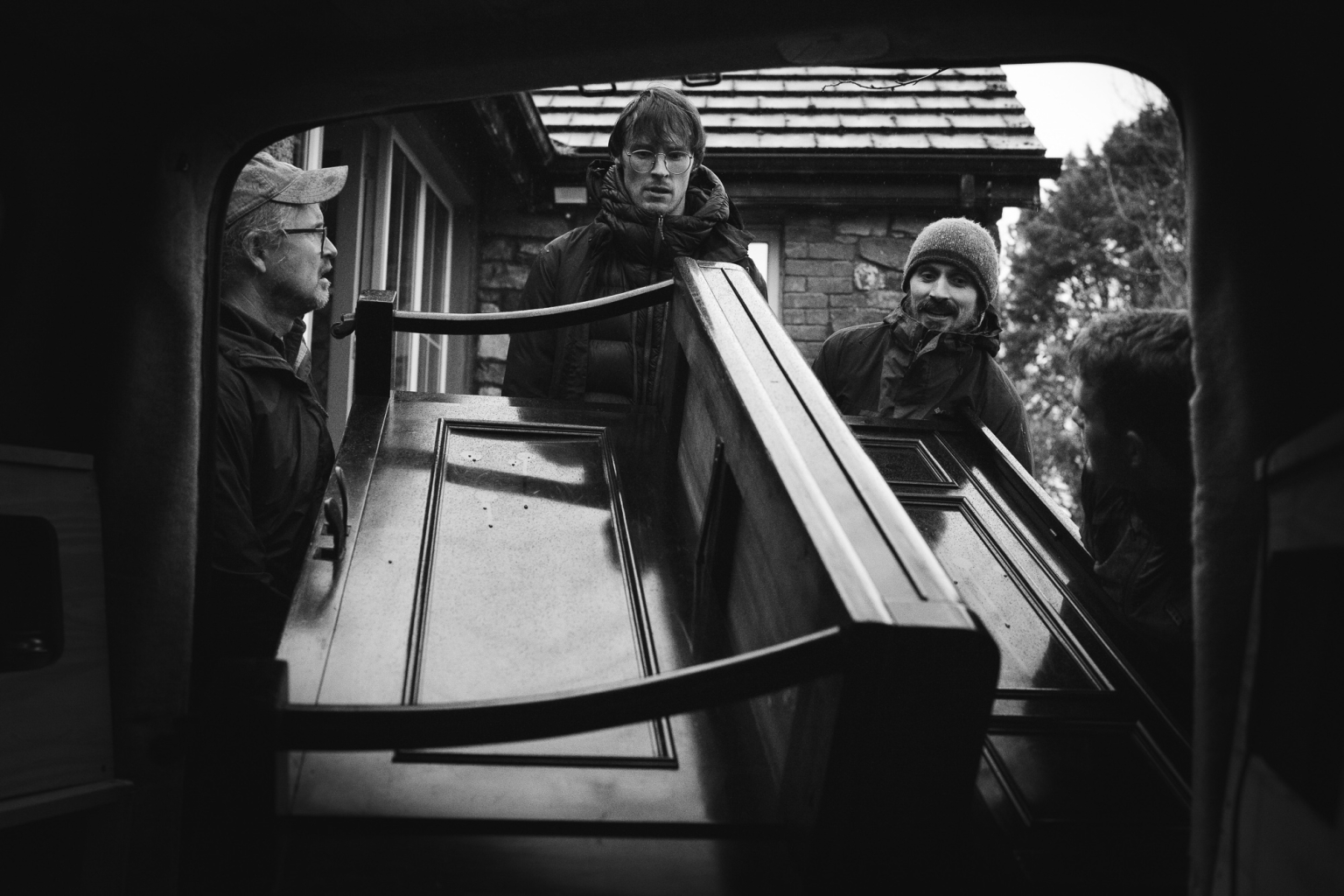
    Word came through from cousin Ed in Limerick: ‘Good news, I’ve a piano for you that’ll fit in Paul’s van.’ ‘Great stuff’ I enthused, blithely disregarding the challenge of getting it as far as my house in Sligo, let alone up the steps and through the door.

    Remarkably, cousin Paul agreed to make the trip on a dank evening in January when winter seemed interminable: ‘sure a road trip would be a bit of craic.’ Relative to other possibilities on that first weekend of January he was probably right.

    A layer of ice shrouded the tarmac as we set off from Sligo town on Saturday morning. At the Toberbride roundabout outside Collooney we bought what were apparently small Americanos. When these appeared in pint-sized cups it begged the question: what manner of receptacle is reserved for a large one? The proprietor clearly understands the importance of motorists loading up on the dark sludge before driving the first leg of the N17, especially on a bleak January morning.

    Collooney gives way to Ballinacarrow, where you find signs for Coolaney on the road to Cloonacool, then Tubbercurry anticipates Curry, and you’re into Mayo by the time the caffeine wears off.

    The Saw Doctors travelled the N17 from Tuam to Galway with ‘thoughts and dreams,’ a state of mind not recommended for the winding road to Tubbercurry, an accident blackspot. As for ‘stone walls and the grasses green’, although there are plenty of the former, the boggy fields are more fawn than green at this time of year, until you get past Tuam at least.

    The road widens before Ireland West Airport, outside Knock. There, Our Lady, Saint Joseph and Saint John the Evangelist appeared to Mary Byrne in 1879, but the opening of the airport in 1985 was the real miracle, as Christy Moore insisted. The messianic zeal of Monsignor James Horan brought this solitary crumb of infrastructure to a neglected north-west region in 1986.

    Only featherheads now dream of the Western Rail Corridor being resuscitated as far as Sligo, despite tangible evidence of surviving track under public ownership, recalling Monty Python: what did the British ever do for us? The 2024 All-Island Strategic Rail Review proposes new lines are restricted to connecting settlements with populations over fifty thousand, but how is a city, such as Sligo, supposed to expand sustainably without further rail infrastructure, and is Donegal to remain the forgotten county forever?

    The N17, which serves as the main north-south transport artery through Connacht, abuts a curiously desolate landscape, almost entirely devoid of native woodland. It offers a foretaste of the Midlands, without the charm of the waterways. Far from wild Atlantic shores, it’s scenery that nurtures disappointment.

    Beyond the seemingly supernatural marilyn of Knocknashee (‘hill of the fairies’), there’s barely a hillock in view along the entire route to Galway. There the slick motorways of another Ireland come into view. I’ve never taken the route other than under a sky that promises rain, and usually delivers.

    Many of the super-sized bungalows along it appear to have been constructed in the 1980s, when Ireland still exported its children. Aesthetic considerations did not figure prominently in the considerations of draughtsmen, who might as well have been paid by the room. The influence of Southfork, the Ewing Mansion outside Dallas, Texas is apparent in the expansive Southern Colonial style of some of these over-sized residences.

    Ribbon developments streak from historic towns, where the number of pubs diminish with each increase in the price of a pint. They say the kids prefer to go to the gym these days in any case.

    Beyond Galway, the gentle scenery of east Clare barely registered such was the speed we reached on the N18 motorway. Before long we were crawling through dystopian industrial estates outside Limerick. At last, we reached the city’s attractive inner core, including the country’s only Georgian Crescent, near the house where our piano was located.

    Ed had let us know there would be 5.5 men on hand to lift the piano. It turned out the .5 of a man was a blind Jack Russel, and that the additional men were piano players rather than heavyweight lifters. Undeterred, we hefted it out of the house – which mercifully had no steps at the entrance – and squeezed it into the van, albeit at a slightly awkward angle, without too much bother.

    There followed an evening of revelry, as the additional piano lifters, who turned out to be Maltese, revealed their real talent, as musicians. At one point, I am convinced, the blind dog chimed in, but sadly we lack documentary evidence to this effect. The only regret is that cousin Ed declined to sing his cult – a small cult admittedly – classic, ‘Mow’, about a young man taking refuge from the slings and arrows of outrageous fortune in the gentle comforts of cutting the grass.

    On Sunday morning we awoke early. Cousin Paul had taken further precautions against the January blues by booking a seaweed bath back in Sligo for that afternoon. The road rose to meet us at 9am, as we traced our way back home along the same route.

    At Milltown, Galway a large, modernist church that spoke of a more self-confident era was welcoming the remaining Cathaholics that shuffle through its doors. Among the pillars of Old Ireland, only the GAA continues to thrive. Today its brash, new club houses might pass for aircraft hangers. This is Supermac’s country of ersatz, super-sized Americana.

    After passing Tuam, we required further lashings of the dark sludge. At the petrol station in Ballindine a screen saver at the till read: ‘Coronavirus COVID-19 – Contactless – We would prefer if you could pay be contactless card.’ Covid frayed the social bonds like no other event in modern Irish history, and along the N17 it’s a gift that keeps on giving to a corporate aspiration for a brave new, cashless world.

    The real challenge came at the other end. Another cousin Johnny was thankfully on hand, and our photographer’s boyfriend Shane, a strapping Mayo man, was enlisted too.

    The great weight of a piano – most uprights weigh well in excess of 200kg – proved more of a challenge than anticipated, but after much heaving and straining – ribs were almost popped – we maneuvered it into the space. It now could do with tuning, and awaits a suitable hand.

    All Images: Síoraí Photography

  • ‘The Deep and Inveterate Root of Social Evil’


    It would surely be a great piece of good fortune for Paddy … if English cultivation could drive all his fairies out of his head
    Examiner, June 10, 1843, British Library Newspapers

    What hope is there for a nation which lives on potatoes?
    Charles Trevelyan

    At the end of March last year, during what proved a marvellously sunny spring, a horticulturalist friend imparted the rudiments of potato cultivation. Granted, I wasn’t a complete novice. I knew about chitting (allowing seed potato to sprout in an egg box on a sunny windowsill) before planting, and banking (piling earth on a potato plant as it grows), but his instructions elevated my gardening to another level. An area knotted with grass and weeds would be transformed into neat potato hillocks – or ‘lazy beds’ – within a few hours, breaking that ground up for further cultivation in subsequent years.

    First, my guide carefully measured the length and width of each bed, using string attached to an iron stake to mark the boundaries, thereby giving each plant space to thrive. Next, he layered a bag of manure along the length of each row, sprinkling potash on top, and placing chitted potatoes at even intervals atop.

    Then began the real work, mainly using what he referred to as a Fermanagh spade with a long thin blade that lifted the sod on each side over the potatoes, sealing them off and creating a small ditch between each row. The cherry on top was a sprinkling of pine needles to cover the gaps and keep the weeds at bay.

    Initially the effort required to lift and turn the sod defeated me. My height seemed an unshakable impediment until, after much grumbling, I grew accustomed to lowering the spade sufficiently to use a thigh to make the lift. After another lesson I was equipped to dig my own beds, allowing me to go forth and evangelise about how easy it is to grow the tuber.

    Beyond occasionally removing nettles and thistles, I expended no further labour on the potato beds over the course of spring and summer. A potato’s vigorous growth in Irish conditions easily outpaces any weed and requires no watering. Then, after just over three months, my ‘earlies’ were ready, and, as any grower will smugly volunteer, there’s nothing quite like the taste of your own, not to mention the joy of letting everyone know about it.

    In growing potatoes, it felt as if I was partaking of an ancient ritual. Yet the potato plant solanum tuberosum is an exotic, native to the Americas, probably introduced to Ireland by Basque fishermen, rather than Sir Walter Raleigh, in the early seventeenth century. Potatoes are a very modern phenomenon in Ireland.

    Nonetheless, it is a remarkably fecund crop in Irish conditions. Thus, before the Great Famine, an acre of potatoes could amply feed a family of six, as well as sustaining pigs and fowl. Indeed, prior to the famine half of all potatoes were fed to domestic animals, which were primarily used to pay the rent, with little meat consumed on their farms. At that time, an acre of grain was reported to produce about 4,200 pounds of saleable produce, while an acre of potatoes yielded as much as 72,100 pounds of food for subsistence.

    Such abundance seems miraculous, but as Virgil’s Georgics warns us: ‘The great Father himself has willed that the path of husbandry should not be smooth.’  Over-reliance on any subsistence crop brings great danger, and the dependence of the Irish poor on the potato was extreme. Indeed, an entire rural economy, benefitting a largely absentee landlord class, was built around it.

    The wars of the seventeenth century led the Irish peasantry to take advantage of its unique nutritional profile – unlike wheat it contains all eight essential amino acids – and suitability for small scale storage, but not largescale export. In retrospect, Henry Hobhouse opined that ‘of all the havoc wrought by [Oliver] Cromwell in Ireland, the by-product, the lazy bed, was in the end the most damaging.’[i] In the meantime it allowed the Irish population to scale heights in the mid-nineteenth that still haven’t been returned to.

    Peasant Funeral in the Mam Turk Mountains of Connemara, Ireland.

    Modernity

    In Rot: A History of the Irish Famine Padraic X. Scanlan explores the modernity of Ireland’s experience with potato cultivation, culminating in the arrival of the dreaded blight phytophthora infestans in 1845. He details how ‘[p]otatoes allowed landlords to hire cheap and plentiful labour to work large, export-orientated farms while also collecting rent from subdivided and subleased farms and potato grounds.’

    Ireland became the guinea pig for British colonialism of the late nineteenth century, aspects of which linger to this day. Scanlan asserts that ‘[t]he staggering inequality, pervasive debt, outrageous rent-gouging, precarious employment, and vulnerability to changes in commodity prices that torment so many in the twenty-first century were rehearsed in the Irish countryside before the potato failed.’

    In their impoverishment, ‘[t]he Irish poor made complex wagers on their rent and potato yields, hoping to find any marginal advantage. They knew that changes in a day’s trading price of crops and livestock in London might ruin them.’ Scanlon therefore argues that ‘the Irish economy resembled the precarious future of capitalism more than its feudal past.’ He suggests that Ireland’s rural economy had many features of a squalid modern slum, where faith in luck, supernatural or otherwise, prevailed, just as ‘pyramid schemes, lotteries, and other quasi-magical forms of wealth appropriation’ are evident today.

    An early nineteenth century German visitor to Ireland, Johann Kohl, had never seen anything like Irish poverty, wherein ‘Irish labourers had no national dress, no institutions of peasant life that could contest the power of their landlords.’ This was a society in terminal decline, stemming in particular from the departure of its remaining tribal leaders in the early seventeenth century Flight of the Earls. This permitted the seizure and plantation of the entire country, heralding a steep cultural decline, including the gradual loss of the native tongue.

    The Great Famine would provide the coup de grâce that shattered the bonds of social life and civility. That is not to say societal collapse was inevitable – the famine of 1741 actually had a higher proportionate death toll, but its ill-effects did not linger in the same way. By 1845, however, a seemingly inexorably rising population was placing intense pressure on scarce land. Most of this remained in the possession of landlords, who cared little for their tenants and were often seeking to convert small, intensively cultivated plots into extensive pasture, in conjunction with a rising class of indigenous ‘strong’ farmers.

    Ireland’s social segregation, especially in the wake of the Act of Union – reflected in and reinforced by sectarian divisions – was the underlying cause of the country’s vulnerability to famine. There was certainly sufficient food to feed the population – only in 1847 did grain imports exceed imports – but most produce was destined for the English market.

    It’s hard to imagine a disaster on a similar scale occurring in England at that time, or any major European country for that matter, where landowners maintained a more paternalistic relationship with their tenants. Notably, the proposal by the leading nationalist politician Daniel O’Connell, himself a landlord, to embargo food exports for the duration of the Famine was greeted with derision in Westminster.

    Signs of such scarcity in a more urbanised country would surely have caused a major political upheaval, as in the case of the French Revolution which has been described as an extended bread riot. Ireland did experience a Young Irelander rebellion in 1848, but the starving populace were unable to summon a coherent resistance.

    The Blame Game

    A colonial discourse had long been evident in English accounts of the Irish, going back at least to Giraldis Cambrensis in the late twelfth century. These are akin to the ‘Orientalist’ stereotypes that emerged in Western accounts of the Islamic world, and depicted the Irish as lazy, dishonest, prone to violence and thus requiring civilising.

    By the mid-nineteenth such stereotypes were joined by the discourse of political economy, positing that ‘the market was as miraculously self-organising as the natural world.’ Edmund Burke argued that God would not look kindly on ‘breaking the laws of commerce, which are the laws of nature.’

    Irish reliance on the potato as their primary foodstuff was considered an affront to this spirit of capitalism. Many blamed the potato for Paddy’s laziness, ‘whereof the labour of one man can feed forty.’  The economist Robert Malthus maintained that until they starved, they would not learn.

    The leading civil servant for Ireland over the course of the Famine, Charles Trevelyan considered the possibility that the blight was ‘some great intervention of Providence to bring back the potato to its original use and intention as an adjunct, and not as a principle article of national food.’

    The sanctity of the market would have an important bearing on the nature of famine relief. Teaching the Irish to prefer wages to potatoes for subsistence, then Prime Minister Lord Russell said would impel them ‘to study economy, cleanliness, and the value of time; to aim at improving the character of themselves and their children.’ Extensive public work schemes therefore substituted for direct aid to the starving, who were forced to expend what little energy they possessed building roads to nowhere.

    Most insidiously in 1847 an amendment to exclude anyone holding land of a quarter acre or more from eligibility for poor relief was introduced by William Henry Gregory (ironically the future husband of Lady Gregory the co-founder of the Abbey), an M.P. for Galway. The ‘Gregory Clause’ caused thousands to lose their land in order to avail of the meagre relief available, forcing many into emigration aboard coffin ships.

    As a result of the failure of the crop and these cruel policies up to a million starved or died of disease, and another million emigrated. Unlike after the 1741 famine, the population would not increase, as often their land was converted to pasture, which by then had become more profitable than tillage.

    Old lazy beds.

    Potato Myths

    In Rot, Scanlan refers to numerous sources claiming the Irish peasantry ate on average between 12 pounds and 14 pounds (c.6kg) of potatoes per day. He takes issue with the veracity of these accounts, however, arguing that ‘the idea of a heroic Irish appetite for potatoes revealed a thriving British colonial vision of Ireland.’

    He admonishes ‘credulous’ historians – including this one – for uncritically accepting reports that the Irish poor seemed unusually healthy compared to the British working class ‘a view that indulges in one of the most durable colonial myths that of the strapping and noble savage.’ He asks pertinently: ‘why reject only the insults and believe only the claims that flatter the Irish.’

    Scanlan’s argument that the level of potato consumption was purposely exaggerated appears valid: he adduces evidence to the effect that eating such gargantuan quantities would have caused digestive difficulties. Nonetheless, in years of plenty at least, the rural Irish were surely healthier than their British working class counterparts, who were already consuming a diet high in sugar and refined wheat, deficient in protein and lacking fresh fruit and vegetables. In a rural setting highly nutritious wild foodstuffs would have been foraged or hunted. Moreover, most Irish children were not by then forced into hard labour inside factories, and, moreover, there were no ‘satanic mills’ in the countryside diminishing air quality.

    Scanlan also effectively dismisses the notion that there was anything peculiarly noxious about the much-maligned lumper potato, which prevailed over other varieties at the time of the famine, arguing ‘[h]ad the blight not struck, another people’s potato would have taken its place, and the Lumper might have to be considered a treat.’

    ‘The weakness of potato crops,’ he writes, ‘was not the individual variety of potato planted or the mode of planting, but the genetic liabilities of using sets, rather than seeds.’

    A starving Irish family from Carraroe, County Galway, during the Great Famine in Ireland.

    Legacy

    Dependency on the potato plant was a product of war. Its cultivation then allowed unprecedented numbers to inhabit rural Ireland. What was really lacking in that culture was the application of demographic brakes, as the population continued to expand despite decreasing access to land. This is perhaps best attributed to the absence of an indigenous political and cultural leadership from the seventeenth century. A form of social atomisation seems to have occurred, where the individual family unit took precedence over the wider tribe or tuath.

    The arrival of the potato plant to these shores is responsible for the size of the Irish diaspora around the world. Far fewer would have survived the conflagrations of the seventeenth century without it, and the rural population would not have expanded in similar fashion on a grain-based diet.

    The mostly callous response of the British government to the Famine probably ensured that Ireland could never be comfortably integrated into the United Kingdom. Yet conversely it also accelerated Ireland’s absorption into the Anglophone world. This paradox yielded a distinctive national literature in English. Also, ironically independence was achieved primarily by the descendants of the petit-bourgeois strong farmers that saw their holdings expand in the wake of the Famine. Kevin O’Higgins’ description of his colleagues as ‘the most conservative-minded revolutionaries that ever put through a successful revolution,’ makes sense in this light.

    Despite largely being ignored in mainstream discourse today, the cultural legacy of the Great Famine lingers. It may be identified in an unhealthy relationship to sex, and the absence of a gastronomic culture, and also, arguably, in a prevailing sense of futility that still pervades rural Ireland.

    Padraic X. Scanlan’s Rot is an important contribution to scholarship on the Great Famine, maintaining a dialogue with an unhappy past we often occlude. Perhaps those of us still living here suffer from a form of survivor guilt that prevents us from adequately engaging with its legacy.

    The attention Scanlan points to the “complex wagers” pursued by Irish peasants in unstable markets is a particularly useful insight, presenting an agency that is usually denied to passive victims. This may also inform our understanding of modern Ireland, where the political class display all the skill of the middleman in attracting foreign capital, but rely increasingly on insecure taxation income from this source – a bit like our ancestors relying on the remarkable fecundity of the potato.

    [i] Hobhouse, H. Seeds of change: six plants that changed mankind (London, 1985), 253..

  • Theocracy – the Emigrant’s Artist

    Sé Merry Doyle’s latest documentary, Theocracy – the Emigrant’s Artist, serves as an excellent introduction to the stirring painting of Bernard Canavan. It offers an intimate portrait of a man whose distressing backstory has yielded extraordinary works of art that amplify our understanding of an appalling system that held sway for so long in Ireland. The film is to be screened at the Cork Film Festival on November 10.

    Bernard, like Shane MacGowan, is an artist who speaks, through his lived experience, for what Joe Cleary has described as the ‘spailpín [lit. ‘journeyman’] culture’ of ‘hard labour and hard living, of wandering and exile, resentment and loss … nurtured by two languages.’

    “Disembarkation”

    There is an added ingredient here. Bernard Canavan was born in Ireland in 1944, but that wasn’t his birth name. As a newborn, he was cruelly removed from the care of his young parents and placed in an orphanage. That his mother and her then-boyfriend had decided to marry didn’t matter. An infant born out of wedlock was viewed as the personification of sin.

    This was an all-too-familiar experience under what can accurately be described as a theocracy governing Ireland after independence. This was a fusion of devout Catholicism with a set of post-colonial Victorian values that emerged in the wake of the Great Famine. This made Ireland a dark place for many decades. Indeed, Ronan Sheehan refers to a ‘theology of incarceration’ governing most aspects of life at that time, realising W. B. Yeats’s concern about an emerging Ireland where ‘men were born to pray and save.’

    ‘Gods love for mothers and their infants’

    In the orphanage, punishment of sin formed only a part of what was also a business enterprise. Children were commodified, offered for adoption or experimented on by pharmaceutical companies.

    Fortunately, as a young child Bernard was rescued by a woman called Margaret Canavan, who was born into an Irish family living in Argentina. After her father’s death, she retuned to Ireland and settled in Edgworthstown, County Longford. This midlands town is the scene of some of Bernard’s most captivating work.

    There, he grew up under a nurturing mother who protected him from the brutality of the education system, and instilled a lifelong love of reading. This autodidact earned a scholarship to Ruskin College in Oxford, later studying politics, philosophy and economics at Worcester College.

    The film includes a memorable visit to the midlands town, where Bernard confronts memories of the pain of women and men, girls and boys, leaving a broken Ireland to face the indignity of the cattle boat and a new life in England. The men would face the harshness of the building sites and lodging houses, the world of subbies, piece work, being ‘on the lump’.

    Whatever you say, say Nothing’

    Bernard’s has long campaigned against the injustices that thousands of children suffered in Irish orphanages. In an emotive scene, Bernard visits Hampstead Heath where a man called Peter Tyrell set himself alight in 1967. As a young lad Peter endured rape and abuse in Letterfrack Industrial School and eventually succumbed to the trauma. The only clue as to his identity was a torn postcard addressed to the Irish civil rights activist and Senator, Owen Sheehy-Skeffington, with whom he had corresponded – and who had made efforts to bring his case to light.

    A highlight of the film is where Bernard makes an emotional return to the place of his incarceration, Saint Patrick’s Guild, ‘The House of Shame.’ There, he bears witness to what happened to him, speaking for other unfortunates who suffered a similar fate, most of whom have not had an opportunity to tell their tales.

    ‘In the Free State’

    Eventually, Bernard emigrated to England, returning briefly to Ireland in the 1960s to work as a marketing executive in Dublin. After two years, however, he returned to England, taking up residence in London, where he still lives. There, he worked on a freelance basis for a variety of underground papers and magazines, producing illustrations, cartoon strips and political satire for the likes of OZ, Peace News and International Times.

    Great credit is due to Sé Merry Doyle for making this film on a shoestring budget. It makes one wonder why so much of Ireland’s interesting cultural output is still occurring on the margins or abroad, unaided and underfunded. Our theocratic model appears to have been replaced by a neoliberal logic of profit and loss, where the work of an artist such as Bernard Canavan becomes a slightly awkward memory.

    Feature Image: “The Innocent”

  • Pathfinder: Manchán Magan


    I will follow these gallant heroes beneath the clay
    The warriors my ancestors served ever since Christ’s day.
    From Cabhair ni Ghoirfead / I Will Not Cry for Help by Aogán Ó Rathaille.

    Many poets, and all mystic and occult writers, in all ages and countries, have declared that behind the visible are chains on chains of conscious beings, who are not of heaven but of the earth, who have no inherent form but change according to their whim, or the mind that sees them.
    From Irish Fairy and Folk Tales by W. B. Yeats.

    I remain haunted by the death of the writer and broadcaster Manchán Magan. Ongoing outpourings on my social media feeds, and across mainstream media, reveal I am not the only one so affected. Over his lifetime, it’s fair to say, he became a national icon – ‘regarded as a representative symbol,’ and now even ‘worthy of veneration.’

    Above all perhaps, Manchán – properly pronounced Man-a-chán as I was recently informed by a Gaeilgeoir from west Kerry – tapped into, and indeed engendered, renewed appreciation for the Irish language, stripping it of associations that led many of my generation to recoil from it in our early years.

    Instructively, Hugh Ó Caoláin, reachtaire/chair of Trinity College’s Cumann Gaelach recently argued that the language now occupies a new cultural space in the national consciousness:

    I think there has been a huge mentality change. It doesn’t represent conservatism any more. It’s progressive. It’s about non-colonialism and reclaiming our indigenous culture. A lot of young people look at the culture that was and realise such richness is being lost.

    Indeed, according to Pól Ó hÍomhair (20) another member of the Cumann:

    As a gay man, I would always view Irish as a symbol of a modern progressive, non-colonial, inclusive Ireland.

    It is hard to imagine that progressive shift occurring in the absence of Manchán’s almost messianic zeal. As a journalist, he embraced media old and new – from video blogs to best-selling literary-historical works – all presented in the inimical style of shaman-scholar-wanderer.

    His output was prolific and multi-dimensional. Whereas Gaelic-Irishness once seemed restricted to asserting a singular national identity, Manchán brought appreciation to a more inclusive and elevated plain, which might occasionally lapse into an arrogance he was aware of being prone to.

    A light-hearted description of English as ‘a relatively recent West Germanic language’ developed by ‘gangs of land-hungry Angles, Saxons, Jutes and Frisians,’ hordes of whom displaced an apparently more noble Irish language, unfairly denigrates a tongue he revelled in, and which has been the preferred medium for many Irish writers who have left an unmistakable imprint.

    Moreover, the early English were also subjected to colonisation, after the Norman invasion of 1066, which accounts for why over half of its vocabulary derives from French. Indeed, English wasn’t an official language in England until 1362, when the Statute of Pleading first made English an official language of the law courts.

    Furthermore, after colonising England the Normans crossed into Ireland in 1169 at the behest of an Irish chieftain, Diarmait Mac Murchada. He had sought military assistance from the Norman lord Strongbow, giving his daughter Aoife’s hand in marriage in return.

    Thereafter, the Normans under Henry II conquered most of Ireland, bequeathing distinctively ‘Irish’ names such as FitzGerald, Burke and Lynch. Most of them living beyond ‘the Pale’ of settlement around Dublin, however, eventually adopted the Irish language and customs. They later declined to convert to Protestantism, thereby forming part of the Irish nation, ‘more Irish than Irish themselves,’ which emerged in the wake of the seventeenth century Plantations.

    The heady brew of language and identity may create divisions, which often dissolve when subjected to historical scrutiny and poetic meddling. Manchán was mostly engaged in scrutiny and meddling, but faint traces of his forebearers’ chauvinism occasionally appeared.

    Proselytizing ‘the first, official language’ is only one aspect of Manchán’s legacy. He also awakened reverence for the land and people through documentary work in particular, for television and radio, and unashamedly drew attention to numinous presence ‘immanent in the landscape.’

    After long travels, and encounters with peoples on the edge, he fostered awareness of our connections to aboriginal cultures, as well as drawing attention to exploitative practices etched into our landscape. He was unafraid to float metaphysical concepts and point to the uncanny; or allow the truth to get in the way of a good yearn.

    What follows is a personal reflection on a public figure I knew a little, and whose educational formation I shared to a surprising degree. I also use this as an opportunity to explore ideas around language and identity, which foreground Manchán’s own work and upbringing, as well as my own.

    Encounters

    I distinctly recall three encounters with him. Each left a mark. The first was at Another Love Story music festival, in 2017 or thereabouts. Our conversation ranged over environmental issues. Initially, I was wary of someone who worked within mainstream media, providing cover with slim doses of virtue, as I saw it. Yet I found we shared many of the same ideals.

    The diaphanous sprite on film seemed remote from this formidable presence in the flesh. After all, this was a man who had crossed continents, daring to go to places that made me cower. I wasn’t won over entirely, however. I wanted more from him, more unsettling resistance.

    We next met at Dublin’s first Extinction Rebellion demonstration in 2019, a movement which at that time exhibited a child-like innocence, at least for many Irish participants. He had the same friendly presence, despite my reticence, but I found something else there now, a commitment to resistance.

    That first demo occurred at precisely the same location, in front of the GPO on O’Connell Street, as another rather more pivotal gathering in 1916. Nearby, on Moore Street, one of its leaders – who showed up despite believing it to be a doomed enterprise – Manchán’s granduncle Michael Joseph O’Rahilly – known as ‘The O’Rahilly’ – was shot by British machine gun fire. He made it as far as a nearby laneway, now called O’Rahilly Parade, where he succumbed to his wounds.

    There was a glow to Manchán that day. Later, I recall him forming part of a vanguard that staged a sit-down protest, blocking car traffic along the quays. I watched on, unwilling to face what seemed, with Gardaí in attendance, another doomed enterprise, inviting arrest. Now who was the real resistance fighter? It would not have been his first time behind bars. But the authorities were all too canny that day. There were to be no high-profile martyrs.

    The last encounter I had with Manchán was in late 2020 at the Fumbaly Café, the remarkable enterprise and creative space owned by his partner Aisling. Those were the dark days of Covid lockdowns, when faces were hidden from view as in a bad dream. Everything seemed impossible.

    I vividly recall him insisting that a big change had come over the world. He asserted, prophetically, that the kind of musical and food events that I had been putting on were in the past, and so it has proved. In truth, he left a bleak impression. I wonder about the ill-effects of isolation on his gregarious soul.

    Manchán in second year, c. 1985.

    Educational Background

    Recently, I learned that Manchán and I attended, five years apart, the same Jesuit school in Ranelagh, Gonzaga College, where his funeral took place.

    If ever we were to meet again in some celestial sphere, or after reincarnation, I would be intrigued to find out a bit more about his experience there. He has revealed that he wasn’t entirely comfortable in a setting which, at least in my time, seemed calibrated to produce upstanding members of the professional classes.

    There were creative outlets, in school plays and operas, and academic endeavour was encouraged, but it hardly nourished alternative ideas. Religious instruction was prescriptive rather than expansive. Mysticism, or anything autre for that matter, was hardly in vogue in Gonzaga in the late 1980s, while the Irish language only seemed relevant as a Leaving Cert subject. School Irish certainly provided me with no insights into the extraordinary literature that emerged in the oldest written European vernacular language north of the Alps.

    I have looked back over a few photos of Manchán among classmates in school annuals. Like myself, he did not participate in any of the rugby teams given such prominence. He looks like a slightly forlorn dreamer, albeit a tougher school might have knocked the day-dreaming out of such an ethereal character.

    The Gonzaga Record contains two references to Manchán from his fifth year in 1988 – aged between sixteen or seventeen. An account of the school opera recalls: ‘Backstage was handled admirably by Manchan [spelt without the fada presumably to his annoyance] Magan, and things never got far out of hand.’

    It is surprising to find that Manchán is not treading the boards, centre stage, mesmerizing audiences. I half-expected to find an account of him wearing a cloak of crimson bird feathers, like his great-great-great-granduncle Aogán Ó Rathaille, the last great poet of the Bardic school. Manchán had noble pedigree, and in later life at least, he didn’t hide any light, or ancestry, under a bushel.

    Theatrical design, nonetheless, relies on a capacity for improvisation, which presumably he also harnessed when building the first strawbale house in Ireland, an ‘ecological, mortgage-free home’ home in Westmeath for less than €6,000 in 1997, after he was left a small sum of money by his late grandmother.

    The 1988 Record also contains, fittingly, a picture of him next to a large litter bin, which he and twenty-five other students pushed around Dublin’s city centre, collecting rubbish and raising money for charity.

    The unusual symmetry in our educational background runs deeper. We also both attended the co-ed Mount Anville Montessori school, attached to the girls’ secondary school of the same name in Goatstown, from around aged four to eight, before entering the all-boys Gonzaga ‘Prep’ School.

    Furthermore, after completing his Leaving Cert, Manchán enrolled, as I did, in nearby UCD to study History, although he studied Irish along with it, while I did pure history. Nonetheless, that’s perhaps seventeen years of almost the exact same educational formation, five years apart.

    Manchán in his fifth year, c. 1988.

    Mother Tongue

    As alluded to there was a significant fork in the road insofar as Manchán studied History and Irish, a language which took on huge significance throughout his life. Indeed, it was his first language and mother tongue. This vital connection deepened over childhood summers spent in west Kerry, where Gaelic remained the lingua franca. He was also raised alongside his maternal grandmother Sighle Humphreys (1899-1994), a firebrand Republican and Irish language activist.

    Fluency in Irish gave Manchán an opportunity to present travel documentaries, at the behest of his brother Ruan, for TG4 from 1996. It was then that he really took to the stage, and never really left it.

    In contrast, I trace a troubled relationship with Irish to my mother’s preference for European sophistication – she spoke French, Italian and German. Born in leafy Donnybrook, close to where Manchán grew up, she had little sympathy for Republicanism either, writing a letter to the Irish Times in 1966 expressing disapproval with the 1916 Rising on its fiftieth anniversary. She argued there was another, non-violent, path to independence.

    The other side of my family was a different story however. My namesake paternal grandfather from Sligo acted as auditor of UCD’s Irish language society, as ‘Proinsias  Tréanlámagh,’ in the late 1920s. His father, my great-grandfather Luke Armstrong, acted as ‘Head Centre’ for the IRB in Sligo during the Land War of the 1880s. He was accused of treason, and only narrowly escaped the hangman’s noose. Moreover, my father gained a partial university scholarship through a somewhat utilitarian attention to the language.

    Nonetheless, for me, especially in my formative years, Irish represented a conservative authority in school, and even a violent nationalism I repudiated in the midst of the Troubles. It didn’t help that I had an Irish teacher in secondary school who I felt bullied by, which only repelled me further.

    Moreover, like Manchán I spent my summers in the west of Ireland living in an alternative reality to my Dublin suburb existence. As a garrison town, however, the hinterland of Sligo has a very different relationship with the Irish language to west Kerry. An historic crossing point between Connacht and Ulster, there are enduring ties to Northern Ireland. A rail line connected Sligo with Enniskillen until the 1950s. The prevalence of English since even prior to the Famine did not, however, prevent the poet W.B. Yeats and his painter brother Jack from drawing on its lore and folk tales to furnish their art.

    I also went to an Irish College in the Gaeltacht of Connemara for a few weeks one summer and got along fine with the language. But the accommodation offered by the host family was cramped and shabby, and the food appalling – under-cooked frozen pizza leaves a nasty aftertaste.

    Then at college, studying history, I made a good friend whose father participated in the so-called Language Freedom Movement, which campaigned during the 1960s against Irish as a compulsory language. He kept a photograph of this father speaking at a rally with placard in hand – and a fist seemingly attached to his chin. That fist belongs to the arm of a priest, the future primate of all-Ireland, Cardinal Tomás Séamus Ó Fiaich. For me at the time, that image epitomised exactly what the Irish language stood for.

    In contrast, I took pride in the achievements of Irish writers in English. I recall empathising with James Joyce’s Stephen Hero, when Stephen Daedulus decides to take a course in the Irish language. His teacher Madden takes exception to Stephen ‘running down your own people at every hand’s turn.’ In my copy of the novel I marked Stephen’s response: ‘I would like to learn it – as a language, said Stephen lyingly.’ Thus, Joyce chose ‘silence, exile, and cunning.’

    Joyce’s rejection of national chauvinism comes to the fore in the ‘Cyclops’ episode of Ulysses where we meet the ugly prejudices of ‘the Citizen’ (apparently modelled on the Gaelic Athletic Association’s founder Michael Cusack) who opposes miscegenation, ‘A fellow that’s neither fish nor fowl,’ and blames a woman for Ireland’s subjugation: ‘The adulteress and her paramour brought the Saxon robbers here.’

    The Citizen offers a one-eyed account of Irish history in which the country only prospers in isolation from England: ‘We had our trade with Spain and the French and with the Flemings before those mongrels were pupped.’

    In contrast, Leopold Bloom rejects entirely the gathering forces of hatred that culminated in World War I:

    it’s no use … Force, hatred, history, all that. That’s not life for men and women, insult and hatred. And everybody knows that it’s the very opposite of that what is really life.

    The Citizen asks what that really is, to which Bloom replies: ‘Love … I mean the opposite of hatred’. The Citizen guffaws witheringly: ‘A new apostle to the gentiles … Universal love.’

    Manchán’s views were, assuredly, more in line with those of Leopold Bloom than the Citizen, but a tension between universal lover and little islander is evident in his background.

    Michael O’Rahilly. Illustration by David Rooney from ‘1916 portraits and lives’, Royal Irish Academy, 2015.

    Irish Nationalist

    In many interviews – which I have belatedly binged on – Manchán alludes with pride, but also some wariness, to his forebearers, especially the aforementioned The O’Rahilly. That wariness was justified.

    R. F. Foster certainly arrives with his own biases. Nonetheless his Vivid Faces – The Revolutionary Generation in Ireland 1890-1923 provides insights into The O’Rahilly’s brand of ethnic nationalism. Foster claimed the Volunteering movement gave ‘full rein to O’Rahilly’s obsession with heraldry, titles and coats of arms; his papers include much semi-mystical correspondence about the spiritual symbols of the Volunteer flag and the need to evoke occult Celtic harmonies.’ Manchán would have approved of this, but other aspects would have been far less appealing.

    Foster points to The O’Rahilly’s ‘Anglophobia’ that had been ‘nurtured by a sojourn in America,’ which he concludes ‘represented an extreme and violent tendency within the movement (p.190).’ Foster also references an account of his ‘violently racist beliefs about American blacks (p.14),’ entirely at odds with Manchán’s politics.

    Manchán understood Irishness and the Irish language in an expansive way. For him it was always about sharing insights. He has helped stripped it of association with severe Catholicism and chauvinistic patriotism, connecting Irish identity with indigenous traditions around the world.

    He also expressed romantic love through it. I recall a touching article he wrote for the Irish Times describing how he had found himself drawing on the Irish language to express his love for his partner, Aisling, whose name means ‘dream’ or ‘vision,’ and was a Gaelic poetic form used by W.B. Yeats in ‘The Song of Wandering Aengus.’

    Manchán decision to build a small house in rural Westmeath also recalls Yeats’ arising to ‘The Lake Isle of Inissfree’ – ‘a small cabin build there, of clay and wattles made,’ to ‘live alone in the bee-loud glade.’

    Yeats County

    Last year, I embarked along a similar path, purchasing a house in Sligo, where I discovered a wild beehive lodged into my house, just two kilometres away from where my father was born to my grandmother, also called Sheila!

    Sheila Armstrong was a very different character to Sighle Humphreys, however. Born in Liverpool to an Irish immigrant publican and his Sligo-born wife I suspect she didn’t have a word of Irish, and was a tremendous snob, besides being the kindest soul imaginable.

    Her Catholic devotion did not extend to Republican sympathies. I recall the horror on her face when witnessing TV images of the Enniskillen bombing in 1987. This was a place she went to on occasional shopping trips, including to Gordon Wilson’s drapery, whose daughter Marie was killed in the outrage.

    The phrase ‘mother tongue’ implies we are handed down an affinity with a language through the maternal line. My mother and surviving grandmother displayed no interest, and even a little resistance, to the Irish language, which probably left an indelible mark.

    I have also wondered, with a name like Armstrong and given my mother’s maiden name was FitzGerald, whether I truly belong to the Irish nation, conceived by some early revolutionaries as an Irish-language speaking entity based on bloodlines. Born into an Irish Catholic family, I do have ancestry with more Irish-sounding names, but I suspect many of my forebearers spoke Old English or Old Norse for long periods after settling in the country.

    Nonetheless, as I engage more closely with Manchán’s work and legacy, I recognise compelling reasons to develop a greater understanding of the language. The psychological barrier, and trauma even, is slowly ebbing away.

    I doubt I’ll ever become fluent in the language, but I can at least get over feelings of inadequacy and irritation when I hear it spoken. At the very least, it provides a key for understanding the origin of our place names, and vital insights into flora, fauna and human history.

    That is not to say I don’t take issue with some of Manchán’s imaginative flights. There may be thirty-two words for a field in Irish, but given the language’s distinctive periods and pronounced regional varieties, I doubt anyone apart from him has ever known them all! Nonetheless, in a period of extreme homogenisation let us celebrate Manchán’s magical vision for Ireland. The king of the faeries has returned to his realm.

    Come away, O human child!
    To the waters and the wild
    With a faery, hand in hand,
    For the world’s more full of weeping than you can understand.

  • Diabolical Healers

    Intriguingly, women held more or less equal power in many of the African continent’s varied societies prior to its violent colonial subjugation. Gender equality was, however, viewed as a challenge to imperial hegemony by colonial administrators – more familiar with women in Counter-Reformation Europe attired in nun’s wimples ‘in order to prepare them for a life of seclusion.’

    A new work, The Heretic of Cacheu (Penguin, Random House, London, 2025) by Toby Green exhumes the records of a Portuguese Inquisitorial trial from 1665 into apparently deviant conduct of one such matriarchal figure in Cacheu – at that point ‘the most important Atlantic trading town in Senegambia.’ This was the first African region to be drawn by the Portuguese systematically into the transatlantic slave trade, the appalling legacy of which we contend with to this day.

    Senegambia.

    Eric Williams argues that ‘slavery was not born of racism; rather, racism was the consequence of slavery.’ The deeply troubling treatment of slaves on American plantations produced a form of dehumanisation, and hierarchical conception of human ‘races.’ Apparently ‘the curse of Ham’ assigned a lower status to dark-skinned people, an idea that perhaps allowed their overseers to sleep at night.

    Walter Rodney has previously explored how slavery corrupted preexisting forms of dependence known in West Africa prior to the Portuguese arrival. The legal status of slaves in Cacheu, however, depended absolutely on the Roman concept of slavery, wherein the master held a power of life and death over his human chattel.

    The forcible removal, of up to thirteen million men, for the most part – only eleven of whom survived the dreaded passage – caused profound dislocation and lasting trauma to societies on both sides of the Atlantic.

    Green observes how, just as in war time Britain where women took on industrial work after men were sent to the front line to be slaughtered, ‘during the political conflicts in Africa generated by the transatlantic traffic women’s labour burden increased – as did the opportunities to capitalize on this for some women.’ One such was Crispina Peres, the most successful trader in the city of Cacheu, ‘who was such a catch that during her life she was married to not one but two captain-majors of the town.’

    Both she and her husband Jorge Gonçalves Frances were of mixed heritage – Portuguese fathers and West African mothers. This gave them a competitive advantage, as they were able to inhabit both worlds, and trade effectively using an array of languages. Interestingly,Crispina was the dominant partner, due in no small part to Jorge’s persistent infirmities.

    Her husband’s illnesses led Crispina to engage with the djabakós – traditional healers with knowledge of local herbs and their properties. The djabakós ‘helped with fevers, difficult childbirth, worked with the bodies of the dead and provided succour to all those hanging on to the worlds of the living.’ According to Green, ‘[t]he importance of the djabakós in Cacheu spoke to the fact that African political power remained dominant.’

    At that time in Cacheu, as in Europe, ‘the health of the body and the spirit were seen as integrated’. Thus, ‘healing the body also required healing the spirit,’ which gave rise to strange – in the minds of colonial authorities – practices, including animal sacrifices. Moreover, many of these healers also practised Islam, which challenged Christian supremacy.

    Green observes that disease was rife in Cacheu ‘because this was a town at the heart of a period of crisis-driven transformation;’ further opining that ‘periods of crisis and the collapse of an existing sociopolitical culture are often accompanied by disease.’

    Slaves on the West Coast of Africa, c.1833 (oil on canvas) by Biard, Francois Auguste (1798-1882).

    In the sixteenth century, therefore, smallpox and other infectious diseases wiped out an incredible 95% of the population native to the Americas. This was exacerbated by hunger and economic hardship, ‘alongside the psychological crisis felt by many Native Americans at the brutally violent end of everything that they had known and which had brought them security.’

    Green also alludes to the plague of alcoholism afflicting the post-Soviet Union society of Russia, which is strongly connected to the decline in life expectancy there by up to five years in the early 1990s. This raises a question as to what lies behind the current stalling and in some cases decrease in life expectancy across Europe, and the U.S.. While COVID-19 has been a factor, excess deaths in many countries have actually increased since 2021. The data might imply that we are witnessing an unravelling, at least, of an existing sociopolitical culture. Green, who is also an historian of the Covid period, might attribute this to the trauma of lockdowns.

    It may seem inappropriate to compare our present era with the violent convulsions of the seventeenth century, but Green’s observation about waves of disease and premature death causing ‘fear and panic, generating scapegoating, gossip and hatreds’ might reasonably also be applied to the Covid period in the West. A comparison between the colonial role of the Inquisition in the seventeenth century and the role of the WHO in Africa in more recent times might also be ventured, although Green resists making this explicit.

    He does, however, connect health policy with the exercise of authority more generally: ‘historically those who diagnose the condition in the first place are generally those who then are empowered to claim the authority to heal it.’ In our time, the African continent was subjected to inappropriate guidance for a disease such as Covid, a disease which had little impact on its overwhelmingly youthful population, while drawing resources away from more beneficial programmes with lasting benefits.

    Similarly, at that time in Cacheu, Senegambian healers knew how to apply local plants to reducing swellings and fevers, while European apothecaries usually relied on imported salves from Europe, which tended not to be useful in such a setting.

    Ultimately, the Portuguese officials could not tolerate a high profile figure in Cacheu such as Crispina Peres routinely turning to the djabakós for assistance. Green argues that ‘the imperial assault on West African ways of healing both inaugurated a form of medical colonialism and was a key factor in the shifting balance of power between European empires and West Africans at this time’

    Finally, it would be mistaken to see Crispina Peres as either a saintly or even heroic figure. During her trial, which lasted three years and resulted in her having to perform penance, she openly acknowledged the cruelty she visited on her own slaves. Thus, she admitted to imprisoning a household slaves named Eiria, saying she would die without confessing. This poor woman was indeed kept in shackles until she died. It goes to show perhaps that simply empowering women won’t necessarily lead to perfect conditions on Planet Earth.


    Feature Image: Fortress of Cacheu

  • Ireland and Palestine: A Crucial Vote Awaits

    Around Ireland and in its online expressions, there is vocal and colourful support for the cause of Palestine. Its flag is draped from windows, hung from gate posts and serves as WhatsApp profile pictures. PLO scarves are again in vogue, while watermelon t-shirts are worn when the weather allows, and charitable fund-raisers on behalf of Gaza seem to have people cycling the length and breadth of the country. Members of Ireland’s small Jewish community have complained of anger being directed against them, unfairly, over the conduct of Israel. Pro-Palestinian advocates are, however, invariably, committed anti-racists: the kind of people who showed up for Black Lives Matter and Extinction Rebellion. It is not a Populist movement built on resentment against ‘an enemy within’ – an outlook characterising antisemitism of the past in Ireland and elsewhere – but an aspiration, however naively expressed, for a better world, and an identification which can be traced back to the Irish people’s historic experience of colonialism.

    Solidarity with Palestine is identified with leading artistic figures such as the globally renowned author of Normal People Sally Rooney, who has declined to have her books translated into Hebrew. It is a cultural phenomenon as much as political agitation. Numerous musical acts – notably Northern Irish rap group Kneecap – have courted cancellation and even potential criminal prosecution in the U.K. for drawing attention to the cause. It is also, admittedly, a well-received form of protest, within Ireland at least, garnering social media likes and real-world approval. It does not risk the wrath of the community – as was the case with dissent from the Covid consensus – or police jackboots, as we see descending in other European countries, and the U.S..

    Ireland’s octogenarian poet-President Michael D. O’Higgins has been an outspoken critic of Israel over the treatment of Gaza in particular. Despite occupying a largely ceremonial role, his stance has conferred legitimacy on expressions of rage on this issue. Referred to affectionately as ‘Michael D.’, his emphasis on human rights, social justice and the arts transcends ordinary politics, but a commitment to military neutrality – including in response to the War in Ukraine – has created tensions with the centre-right Irish government. This government under Micheál Martin as Taoiseach (Prime Minister) is also a vocal critic of Israel on the international stage, joining South Africa’s genocide case against Israel earlier this year. There is evident, nonetheless, among the Irish government an underlying anxiety to avoid a serious rupture with a significant trading partner, and especially that country’s sponsor the United States. Ireland remains, remarkably, Israel’s second biggest trading partner.

    Members of the Irish government may well care about innocent Palestinian civilians caught in the crosshairs, and having famine inflicted on them. A more cynical, and arguably realistic, view would be that political expediency is paramount in the Irish government’s response.

    A low corporation tax rate regime and other incentives over the past fifty years have attracted a raft of large U.S. companies, particularly from the tech, and pharmaceutical sectors, to Ireland, along with other investment of various kinds, predatory or otherwise. Donald Trump even owns a golf club, Doonbeg, in the west of Ireland. Since the Financial Crisis, Foreign Direct Investment has delivered consistently high economic growth and near full employment, but the attendant spiralling cost of housing, in particular, has eroded support for the parties in government. Recent decades have also witnessed unprecedented immigration into a state which, for most of its history, has been ethnically homogenous, save for the North, which remains part of the United Kingdom. There, sectarian tensions between Catholics and Protestants generated a bitter, low-intensity thirty-year conflict that ended after the Good Friday Agreement in 1998. Opposing factions adopted different sides in the Israeli-Palestinian conflict – still evident in murals on buildings across the province – thereby conflating Irish Republicanism with the cause of Palestine.

    U.S. companies in Ireland also have ties to Israel – notably Intel which employs almost five thousand in Ireland and approximately ten thousand in Israel. Importantly, Israel wields even greater clout in Washington than Ireland, despite an Irish diaspora in the U.S. of over thirty million dwarfing the five million Jewish-Americans – some of whom are leading critics of Israel.

    Irish government politicians often characterise Irish sovereignty as severely circumscribed by dint of our being a ‘small, open economy,’ susceptible to global shocks. As a result, government politicians tend to bend over backwards on behalf of Irish-based U.S. companies. Thus, former Taoiseach Enda Kenny is alleged to have told Facebook executives in 2013 that he would use Ireland’s presidency of the E.U. to lobby member states over data privacy laws. Although we rarely hear of such exchanges, doubtless they occur. Ireland’s strained relations with Israel – which last year removed its Irish embassy describing Ireland as ‘the most extreme country against Israel internationally’ – is surely discussed, given major tech companies’ evident (as we will see) allegiance to Israel. Presumably Irish government officials stress their vulnerability on this issue to the left-wing opposition, especially Sinn Fein, which emerged as a serious threat to a long-standing political duopoly in the 2020 General Election.

    Representatives of U.S. and other capital surely recognise that their interests are best served by the two parties of the centre-right – compelled to coalesce in the wake of the Financial Crash – retaining power. This probably explains the leeway given to the Irish government in criticising Israel on the global stage, including joining South Africa’s genocide case against Israel in January 2025. A red line would appear to be drawn, however, under any serious interruption of trade with Israel, including the transport of munitions to that country over Irish aerospace, or the use by the U.S. military of Shannon Airport as a stopover.

    A looming threat to the status quo emerged prior to the 2024 General Election when, under pressure from the opposition, the government parties agreed to adopt an Occupied Territories Bill. This bill – a version of which was previously approved by the Dáil but never brought into law – purports to place an embargo on trade with the Occupied Territories. In its current form it will not, however, apply to services. If passed, it is unlikely to amount to anything more than a symbolic gesture. It is, nonetheless, causing disquiet in Washington.

    It’s also notable that in January 2025 the Irish government adopted the International Holocaust Remembrance Alliance’s (IHRA) non-legally binding working definition of antisemitism, which according to Israeli and international civil society organisations has been used ‘to muzzle legitimate speech and activism by critics of Israel’s human rights record and advocates for Palestinian rights’. This definition was used to undermine Jeremy Corbyn’s leadership of the Labour Party, and could have serious repercussions in the context of recent ‘hate speech’ legislation.

    In recent times, Irish government policy tends to inform, or is perhaps informed by, the content and tone of legacy media. This includes the so-called ‘paper of record’ the Irish Times, which dominates the cultural space in a similar way to the New York Times in the U.S.. The government cannot, however, easily regulate what is being said on social media platforms. As the Israeli response unfolded after the October 7 attacks, Ireland’s canny neoliberal handlers would have observed the mounting fury being expressed, often by otherwise apolitical people, on platforms such as Instagram. This also became apparent in widely attended public protests. The Irish government’s faltering embrace of the cause of Palestine might be interpreted as a form of controlled opposition, wherein they stand as a placeholder for genuine supporters of Palestine. Such controlled opposition of a relatively malleable proxy (Ireland) may also, at times, act as a useful counterweight to the U.S. in its dealings with its Israeli ally.

    A developing fracture within Irish nationalism associated with the advent of multiculturalism should also be noted. A nascent nativist movement departs from traditional Irish Republicanism, sympathetic to the cause of Palestine. The emergence of what is often simplistically labelled a ‘far right’ – mainly drawing support from deprived urban areas and others on the margins – is undoubtedly inspired by other Populist movements around the world. Such movements have tended to be anti-Muslim and pro-Israeli – an influential U.K. actor Tommy Robinson is an active supporter of Israel; albeit, recent criticism of the U.S.’s unwavering support for Israel from leading MAGA figures likely exerts an influence over Irish fellow travellers. Nevertheless, support for Palestine is certainly still evident in Dublin’s working class districts, where Palestinian flags are often unfurled.

    ‘our hearts and our anger, you know where that’s pointed’

    A Shot Across the Bows

    ‘In the light of what’s happened in Israel and Gaza, a song about non-violence seems somewhat ridiculous, even laughable, but our prayers have always been for peace and for non-violence;’ so said Bono on October 8 at a concert in Los Vegas, before adding menacingly: ‘But our hearts and our anger, you know where that’s pointed … So sing with us… and those beautiful kids at that music festival,’ he continued, before launching into ‘Pride (In the Name of Love).’

    Bono would subsequently receive a Presidential Medal of Freedom from President Biden. His apparent endorsement of Israel’s response to Hamas’s brutal (but far, far less impactful) attack on Israeli civilians formed part of a global propaganda wave providing cover for Israel’s actions. In the wake of October 7, dissent from the somewhat disingenuous proposition that ‘Israeli had a right to defend itself’ became almost impossible for anyone in a position of influence, including in Ireland. This became a carte blanche to attack Gaza, and elsewhere, amidst disinformation and exaggeration.

    On October 13, the founder of Web Summit, Paddy Cosgrave, one of Ireland’s leading businessmen and a prominent critic of the Irish government, wrote on Twitter/X: ‘War crimes are war crimes, even when committed by allies,’ referring to Israel’s airstrikes and blockade of the Gaza Strip, which the U.N. had warned could lead to mass starvation of the 2.3 million people living there. Cosgrave followed up with a message condemning the Hamas attack. In response to criticism from leading technology figures and investors, he posted a statement on the Web Summit blog apologizing and clarifying his position. ‘I unreservedly condemn Hamas’ evil, disgusting and monstrous October 7 attack. I also call for the unconditional release of all hostages,’ he wrote. ‘I unequivocally support Israel’s right to exist and to defend itself … I also believe that, in defending itself, Israel should adhere to international law and the Geneva Conventions — i..e, not commit war crimes.’

    The apology was insufficient to sway major sponsors and headliners who announced they would boycott the Web Summit event. These included tech heavyweights Meta, Google, Intel, Siemens and Amazon, all with Irish operations. ‘Unfortunately, my personal comments have become a distraction from the event, and our team, our sponsors, our start-ups and the people who attend,’ Cosgrave said in a resignation statement; ‘I sincerely apologise again for any hurt I have caused.’ Cosgrave’s maverick opposition could not be controlled, unlike, arguably, the Irish government. Nor did Cosgrave have friends within the Irish political establishment to plead his case. His immediate resignation probably saved his company, and he would return as CEO six months later.

    In the wake of October 7, the Irish government seemed prepared to be going along with the U.S. position and that of the E.U., under Ursula von der Leyen, which projected an image of the Israeli flag over European buildings in solidarity. Tánaiste (deputy-prime minister) and Minister for Foreign Affairs, currently Taoiseach, Micheál Martin visited Israel the following month. In response to a request from Alon Davidi, the mayor of Sderot a town near the border with Gaza, to support Israel Martin responded: ‘I’m here to see this firsthand and to listen; to seek to understand the trauma that your community has gone through and not just in horrific events over the seventh but as you said for over two decades, if not three decades, in terms of rockets.’

    He then set out the Irish government’s position: ‘Ireland is unequivocal in its condemnation of the Hamas attack and will give no quarter to that form of terrorism. We are explicit in our public statements in condemning without condition the unconscionable attacks on children, on women and on innocent civilians.’ Martin added that Ireland’s long-standing support for a two-state solution should not be equated with support for Hamas and ‘absolutely’ affirmed Israel’s right to exist – ‘in case that is in question.’ He noted that Irish-Israeli citizen Kim Damti had been murdered by Hamas and Emily Hand taken hostage in Gaza. Martin said he did not believe that a military solution would create a safe environment for future generations: ‘We may have to disagree on that – and I respect where you’re coming from – but our sense is that there’s a real danger that you will radicalise opinion of future generations even more.’

    Martin’s approach was calculated, recognizing historic Irish support for the Palestinian cause, while making sure to be seen to be on Israel’s side. In response, left-wing opponents described it as a propaganda tour. Since then, Martin has been a prominent critic of Israel on the international stage, somehow reconciling this with his government permitting munitions to pass through Irish aerospace, and for Israel to remain a major trading partner.

    Martin appears to have another, more important, agenda, which would, in all likelihood, be supported by U.S. interests in Ireland. In the wake of the Russia-Ukraine war he sought to align Ireland more closely with the rest of the West, seemingly endeavouring to abandon a policy of neutrality that emerged during World War II and which continued over the course the Cold War, when Ireland remained outside NATO. Despite consistent opposition among the population to any change, Martin’s government has pushed forward with proposals to end the so-called Triple Lock, requiring the approval of the U.N. Security Council, a decision by Government and a vote in the Dáil (the legislative assembly) before Ireland commits a substantial number of troops to peace-keeping operations.

    White House Criticism

    In 2000, a prominent government Minister is believed to have described Ireland as being closer to Boston than Berlin. In some respects, this remains the case. Government services are generally poorly resourced relative to other European countries, while apartment-living is uncommon and the private motor car is generally relied on ahead of public transport. On the issue of Palestine, however, unlike the U.S., the Irish population has been relatively consistent in its opposition to Israeli incursions, and supportive of a two-state solution, however remote, and indeed unsatisfactory, this outcome now appears.

    There are, however, a few political outliers on this issue, one of whom seemed to be former Taoiseach Leo Varadkar. Back in 2017, hawk-eyed Irish activists observed the then Taoiseach’s online interaction with Barry Williams, who they considered Ireland’s most ardent supporter of Israel and ran the group Irish4Israel. Then, in 2019 Varadkar replied to a letter from ten members of the U.S. Congress by noting his opposition to an Occupied Territories Bill ‘on both political and legal grounds.’

    Furthermore, in early 2024 speaking once again as Taoiseach, Varadkar expressed caution about accusing Israel of genocide based on the spurious consideration that millions of Jewish people were victims of it in the past. He said the government wouldn’t use the term unless it was ‘absolutely convinced’ that genocide was occurring. Responding to the question of whether Ireland would join South Africa’s case against Israel at the International Court of Justice (ICJ) about the Israeli state’s treatment of people in Gaza he said: ‘I would be a little bit uncomfortable about accusing Israel, a Jewish state, of Genocide given the fact that six million Jews – over half the population of Jews in Europe – were killed.’ Adding, ‘I would just think we need to be a little bit careful about using words like that unless we’re absolutely convinced that they’re the appropriate ones.’

    The dial seemed to have moved considerably, however, by the time of Varadkar’s last major public appearance as Taoiseach in the White House on St. Patrick’s Day on March 17, 2024. This occurred just days before he announced his surprise resignation, after his government suffered damaging defeats in two referendums on references to family and women in the constitution. In a speech that was well-received in Ireland, and which seemed unusually provocative given where it took place, Varadkar said:

    Mr President, as you know, the Irish people are deeply troubled about the catastrophe that’s unfolding before our eyes in Gaza. When I travel the world, leaders often ask me why the Irish have so much empathy for the Palestinian people. The answer is simple: we see our history in their eyes. A story of displacement and dispossession, a national identity questioned and denied, forced emigration, discrimination, and now – hunger.

    Adding:

    The people of Gaza desperately need food, medicine and shelter. Most especially they need the bombs to stop. This has to stop. On both sides. The hostages brought home. And humanitarian relief allowed in.

    A looming General Election perhaps explained the unusual force of the criticism. Indeed, the issue of Palestine did not become a significant electoral issue once the ruling parties agreed to introduce their own Occupied Territories Bill. Perhaps the U.S. Democratic leadership, with close ties to the Irish political establishment, recognised the political ramifications of his speech and even green-lighted his words. External criticism, moreover, might have been useful for the Biden administration in its own dealing with the Israelis, given student protests then occurring across the U.S., and their own unpreparedness to criticise Israel with the Republicans emphasising unwavering support. Meanwhile, Varadkar could sail into the political sunset with the approval of Ireland’s many Palestinian activists ringing in his ears, and in a good position to take up future political roles.

    President Donald Trump with Taoiseach Micheál Martin.

    St. Patrick’s Day 2025          

    The issue of Palestine did not figure prominently before Taoiseach Micheál Martin’s visit to the Trump White House in 2025. The concern at that time was over the new President’s tariffs wreaking havoc on the Irish economy, by forcing U.S. firms to transfer their operations to the U.S..

    At one point, however, a reporter inquired of Martin whether he planned to discuss Trump’s previous plans to expel Palestinians from Gaza. At this, Trump jumped in, responding with a denial. ‘Nobody’s expelling any Palestinians,’ he replied. Palestinians were again brought up by Trump as he reminisced about his recent speech to a joint session of Congress. The term ‘Palestinian’ was used in a bizarre fashion to insult his rivals in the Democratic Party. He described Chuck Schumer, the Senate Minority Leader as a Palestinian: ‘as far as I’m concerned. You know, he’s become a Palestinian. He used to be Jewish. He’s not Jewish anymore: He’s a Palestinian.’

    Martin, nonetheless, in contrast to Varadkar’s outspoken comments the previous year, lauded Trump for his approach to securing a peace agreement. After Trump was asked about the St Patrick’s Day boycott, the Taoiseach interjected ‘to pay tribute to the president on the peace initiatives’ in Gaza and elsewhere. It’s clear from these exchanges that Martin and his advisors were unwilling to risk any loss of influence for the sake of Palestine. Perhaps Trump also recognised that those in power in Ireland were prepared to serve U.S. interests and were, in effect, “controlling” popular Irish solidarity with Palestine.

    President Michael D. Higgins.

    A Looming Presidential Election

    In a recent opinion piece for Ireland’s so-called ‘paper of record’, the Irish Times, regular columnist Finn McRedmond (incidentally as a student in Cambridge she wrote an article revealing how she had voted for David Cameron’s Conservatives in 2015) wrote:

    Irish foreign policy is in a strange place right now. We are, as has long been the case, totally impotent on matters of global politics – with no real army to speak of, outside of Nato, militaristically neutral and never even close the so-called grown-ups table when the future of Europe is at stake. (Did that invite to the White House with Friedrich Merz, Giorgia Meloni, Keir Starmer, Emmanuel Macron and Mark Rutte get lost in the post?)

    But simultaneously, there are plenty of members of the Irish establishment who – in full cognisance of this basic reality – believe that the world is somehow willing to listen to Ireland’s lectures on affairs of international morality.

    The main object of McRedmond’s ire was, unsurprisingly, President Michael D. Higgins. She complained bitterly that he had bent ‘the shape and contours of the office [the Presidency] to his whims, professing to the world on behalf of the nation as though he speaks for us all.’ O’Higgins’ fourteen-year tenure comes to an end later this year, and McRedmond expressed concern that another left-wing candidate Catherine Connolly – the natural heir to Michael D. Higgins – could win the election this November. McRedmond professed herself:

    anxious to learn that Catherine Connolly is a contender of relative significance. She has recently said Irish people should resist a “trend towards imperialism” in the European Union, as the bloc is becoming “increasingly militarised under the leadership of Ursula von der Leyen and the European People’s Party”; that the EU has “lost its moral compass”; and that “the US, England and France are deeply entrenched in an arms industry which causes bloodshed across the world.

    McRedmond’s own rise to prominence as a regular columnist for the Irish Times might be traced to an influential father’s acting as CEO to a commercial body – An Post the postal service – owned by the state, and political views inspired more by her time in Peterhouse College, Cambridge than the Falls Road in West Belfast.

    Her piece articulates an anxiety within the Irish establishment, a section of which she castigates, that a figure similar in her outlook to Michael D. could win the presidency. While overcoming most Irish people’s reluctance to abandon neutrality – another Irish Times columnist recently described it as ‘absurd and complacent’ – and even joining NATO, appears to be the primary objective, popular Irish opposition to Isreal and attention to Gaza remains a serious inconvenience. Apart from placing the Irish government in a difficult position vis-à-vis U.S. investors, unwavering U.S., E.U. and U.K. support of Israel undermines the West’s claim to moral leadership in supporting Ukraine against Russia. Most Irish supporters of Palestine are now opposed to Ireland entering any military alliance – and are increasingly hesitant about a militaristic E.U. – in any way supportive of Israel.

    Under the Irish Constitution, the President occupies a largely ceremonial position, similar to that of the monarch in the U.K.. Despite a lack of executive or legislative function, an individual, such as Michael D. Higgins – and Mary Robinson before him – may still use the platform to bring about cultural change, and legitimate outrage. Thus, what are controversial positions on Israel elsewhere in Europe and the U.S. have become the norm in Ireland. This makes it politically expedient for government politicians to represent these viewpoints. If a less radical candidate wins the forthcoming election, as seems more than likely, the heat could be taken out of criticism of Israel in Ireland. Indeed, it is possible the change to the definition of antisemitism could, in time, lead to criminal prosecutions for ‘hate speech’ under new laws, supposedly designed to counter racism.

    The plight of Palestinians living under Israeli occupation may seem remote from an Irish Presidential election that is likely to see a turnout below fifty percent, but Ireland’s popular support for Palestine could easily be blunted in the absence of a legitimating figure in that office. This could have the effect of altering the tone, and content, of Palestine’s most consistent advocate in Europe on the international stage. The Irish government’s adoption of the IHRA’s definition of antisemitism, continued permission for Irish aerospace to be used for transporting munitions, and ongoing trading ties between the two countries, do not point to genuine conviction on the part of the Irish government on this issue.

    Members of the Irish government are given to portraying the country as fragile and dependent, but this ignores the significant ‘soft power’ at its disposal. It is, by most measures, an extremely wealthy country, with an enormous government surplus, and commercial banks in a far better state than before the Crash. Moreover, the country’s geographic position on the edge of Europe insulates it from Europe’s historic zones of conflict, including the current one in Ukraine. Contrary to media scaremongering, Russia has no designs on Ireland. There is also a vast Irish diaspora around the world to call on, particularly in the U.S.. Donald Trump even referred to the importance of this constituency in the aforementioned White House meeting with Martin. It explains why any Irish Taoiseach is warmly welcomed on St. Patrick’s Day, no matter which President occupies the White House. Ireland’s outspoken opposition to Israel will, however, be easier to control if a less steadfast individual wins the forthcoming Presidential election.

    This article was originally published in South African magazine Herri.

    Feature Image: Daniele Idini

  • The Inscrutable Mr. Scruton

    At the end of Roger Scruton’s short book On Hunting, an out-of-print memoir about the British conservative philosopher’s discovery and participation in fox hunting during middle age, Scruton focuses on the final days of his cob Bob. Shorn of the energy needed to gallop in herd-like fashion through the landscape as a part of the hunt, B cuts a forlorn figure. Like a boxer no longer fit for the ring, he appears to live a half-life, waiting ominously for the end to come:

    The time came when he could no longer hunt; nor could he stay in the field, where he would overeat and become bloated and hobbling. Nor could he be ridden, since deprived of hunting, he became increasingly curmudgeonly and depressed, shying at every flutter in the hedgerow (p.131).

    Scruton’s memoir is a defence of country life as it manifests in the sport of fox hunting, a sport banned in the UK on animal rights grounds. Some call the text polemic. Others a rant. Disillusioned with life, the ‘post-modern’ as he calls the contemporary age, Scruton takes refuge in the Cotswolds where he begins riding a pony called Dumbo. Slowly, like a magnet pulling him in, he discovers the hunt. He is soon a true believer. His life changes dramatically through this discovery, as an obsession takes him in its grip. At one point, having taken up a US academic post, Scruton flies home every Friday to hunt at the weekend. He finds in the hunt the essence of an England he academically locates as the springboard of conservatism, a melting point of class interest that pushes against the prevailing accusation that fox hunting is the domain of the posh. Scruton claims fox hunting is an alliance of country folk across class barriers, the trace of an older community life that respects nature as Other to the human realm.

    But he doesn’t stop there. A sentimental urge to dismiss fox hunting as a sport, Scruton argues, lends it cruel and barbarous as an activity, lacking modern sophistication. The fox is invested with piety. Animals are rendered redundant rejoinders of pity and sentiment. Nature, Scruton believes, has little room for pity: the wild takes root in the multiple forces of the herd. Scruton writes of Bob’s impending retirement as a lament to the cob’s lack of purpose when he has been removed from the expenditure of hunting – the ‘flourishing’ of the horse in a multi-species environment.  He turns to Nietzsche’s eternal recurrence by way of defending the practice of fox hunting as a sport that requires the eternal recurrence of the individual fox to protect the general species. The traditions of country life depend on renewing the species to maintain the hunter-gatherer on the land. This, ultimately, accounts for an attachment to the natural world.

    To read and engage with Scruton’s writing is not to necessarily agree. One of his critics Jeanette Winterson, appears on the sleeve lauding the book as brilliant and horrible in equal measure. Scruton’s father lamented Old England’s vanishing but had little truck with countryside traditions his son was drawn to. My father, in contrast, was a hunt master and a GP heavily invested in the family planning movement in the West of Ireland (he was involved in legalising family planning as a medical resource). He saw little contradiction in sitting atop nature’s totem as a progressive modern. His interest in tradition did not extend to the Church, its hierarchy or the power it yielded. Like Scruton, my father was drawn to the cross-class dalliance of a sport I was introduced to as a child, a multispecies environment made up of horses, hounds and humans that left a considerable mark as a source of moral debate. The impact of my own involvement with the sport was not just experiential. It was philosophical to the point of ontological. For in the throes of the hunt, horse and human give up their singularity, adrenaline mounts and the normal limits of everyday life are transgressed. The horse jumps fences it would not ordinarily entertain, outside of the collective embroglio of the hunt. An energy pulsates through the collective, as Scruton notes, that engenders the primeval, pre-modern, pushing the group beyond the boundaries of a day to day ‘identity’ that takes root as a singularising force. Like Winterson, I find Scruton’s text both fascinating in parts and deeply problematic in others.

    Scruton’s distaste for modern culture is prevalent across his memoir. He has a disdain for New Labour and Blair’s alliance with Britpop: a regressive force he finds wrapped up in the trimmings of progress. He fails to look outside the official corridors of power, at the parallel culture that rose in the late 80s amidst the slack spaces of recession England. Rave was banned and supressed like fox hunting in the 90s. Scruton hardly mentions a phenomenon that shares many of the melting pot properties he finds in fox hunting, albeit settling in rural spaces after its suppression. Rave culture, as Simon Reynolds and Jeremy Deller respectively argue, loosened the class divide so that tradesmen meshed with students, hooligans with new age travellers, and a culture evolved that transmutes the becoming-animal of the herd into the collective imbroglio of the dance. Scruton does, funnily enough, equate hunting with dancing at one point in his text. The point of intersection, however, lies in class dissolution, de-individuating properties of the collective and an energy manipulated by the adrenaline-fuelled order of the huntsman qua DJ. Hunting and raving manifest in collectives, the chaos of the herd managed and given unity by the totemic figure of the huntsman and the DJ. Both forms of congress are marked by slow tempos succumbing to the impetus of insistent speed: the beat line that affects the dancers, the scent that regales the horse and hound moving, pack-like, across terrain humans follow in suit.

    Does Scruton miss these cultural outlets? Outlets that generate the same collective spirit Scruton finds in hunting? Scruton laments the erosion of rural practices that bind people in labour. Profound alienation comes with modernity, a symptom of a society Scruton feels increasingly enframes nature as instruments. Animals that roamed the land as fellow beings across a multitude of species are readily encountered as instruments with no recourse to the broader collective challenges of the species. One does not have to agree with Scruton, or indeed agree with his support of fox hunting, even his turn to Heidegger, to feel some kind of affinity with the malaise that drives him from the city. I felt a similar malaise. I became disillusioned with suburban city life. Like Scruton, I was fed up with middle class suburbs and customs. I moved to the country in 2017 to get close to a more organic life.

    Scruton leaves London to embrace the last vestiges of old England. Later this year, I will publish a memoir A Sheepdog Named Oscar: Love and Companionship in Rural Ireland with Dopplehouse Press in the US about moving to the country like Scruton from the perspective of a sheepdog I found on a desolate farm. I discover the old of Ireland. For many years, I disliked Scruton. I saw him as a toff philosopher who represented everything I disliked about toffs in general. I read his book on hunting out of curiosity, and although far from seduced by his argument, valued his reflections on the old. I began to recalibrate my memories of riding horseback in the West of Ireland. One of my abiding memories, and one triggered by Scruton’s text, is jumping stone walls pushed on by the adrenaline that seemed to lift me out of myself. The ‘I’ of individuated self-trappings seemed to momentarily evaporate in time. I resisted the lure of the hunt as a sign of moral decay and spent a lifetime exploring the collective dissolution of the ‘I’ in other transcultural forms. Two events occurred that led me to reflect on this earlier time in my life as part of a book that pressed my own interest in an old vanishing Ireland. First, my father died in a car crash. He was travelling home from a point-to-point in Ballingary in County Tipperary when he collided with another car (Scruton mentions point-to-points as social extensions of the hunting community in his book). I missed a call the evening before, when I was driving from Ballybunnion with kids in tow. My father was doing something he always did, I thought. He could wait. He left behind horses, cats and dogs, and acres of land.

    The second event is captured in the memoir title. It concerns finding a sheepdog named Oscar on a rundown farm, part of an old ascendency listed estate in the wild of East Clare. Oscar was living there alone, and little is known about his early life. He was undoubtedly bred to work sheep and cattle. His demeanour, long-haired and a little bigger than a typical border collie, has been described as a collie and working sheepdog. An animal that is not a pet. The book tells of rehabilitation against the rhetorical ‘where are you?’ that aggravated the mind of a son dizzy with loss. Over the four years explored in the book, a rabbit hole is travelled similar to the hole Scruton discovers in middle age. Scruton absconded to the countryside from London, took refuge in age-old traditions of the land. I too, absconded and took refuge. Unlike Scruton, however, who found in nature the mantra of the herd, the hole pulled me back into an Ireland I had lost touch with over decades of city living, rooted in the symbiotic cultivation of care between a sheepdog and me. Simply, I had to understand a ‘companion animal’ that beyond all consideration of creatures and pets I had encountered before seemed to live on my timeline alone. I wanted to understand symbiosis between species as an ontological foundation of life.

    I began the text as a project. A story that would tell of finding and rehabilitating Oscar in words and illustrations, against the realisation that my father was really gone, during the Covid 19 lockdown. I had extra time on my hands due to the restrictions and sought to make hay while I could. The story starts in 2017 in East Clare, on an abandoned farm and ascendency estate before coming full circle in the summer of 2020. By writing a book about a companion dog that led me to the inscrutable Mr. Scruton, along with many of those who sit on the opposite side of the animal rights debate – Nobel Laureates such as J.M Coetzee and Olga Tokarczuk – I was able to find solace, away from the debilitating lockdown, in a world of thought and action.

    The book focuses on symbiosis and companionship. How does symbiosis manifest between a dog and handler? How important are interspecies relations based on work? Unlike nimble short haired dogs running at break net speed, spitting their fire at sheep beckoned to move at the command, subject to a master’s whistle, Oscar is a slow and meticulous mover. Everything happens through his eyes. To understand his behaviour, a being that arrived when the reality of my father’s death was beginning to hit home, I did a Scruton and turned my focus on working animals – went down a rabbit hole of all consuming proportions. But unlike Scruton, I returned to the surface with one unanswered question. I was propelled by a more obtuse problem. Is it possible, I ask, for a nonhuman animal, a dog, to care for a human? For Scruton, the animal fascinates in its instinct, coming alive in the multispecies hunt, like a sheepdog running the galley in line with the farmer’s commands. Symbiosis between nonhuman and human brings benefits. But the question that propels my focus in A Sheepdog Named Oscar is another: can nonhuman animals really care for humans? Is to care a transaction that brings more than utility?

    Perhaps a rhetorical question. A question, or plural, destined for the never-ending to and fro of analysis. But in asking this question I was delving into a minefield that encompassed so much of what is real. By standing on this minefield, I was peering into another world. For years I tried to get Oscar to swim in some way. At the beach, when the tide had come in, I would run into crashing waves in the pretence that I was engulfed by water, the froth of the ocean spinning around in all directions. And though he became visibly frustrated, agitated, dipping his toes in, he refused to swim. He never made it past first base. Sometimes, when crossing a stream near the woods around the corner from our house, I motioned to push him in. I hoped instinct would kick off and he would overcome his fear. But it was too difficult. I could not entrust myself to do it. He trusts me not to hurt him. And I worry that pushing him into the water will hurt him. He looks at me, like he knows things are awry, and his drooping and begging face seems to say so. Scruton criticises animals’ rights activism that, he believes, confuses nonhuman and human. He believes a kind of confusion satiates the impulse to do good (the Disnifying process, as he calls it). Perhaps, in not pushing Oscar, I am not shielding him. Maybe he wants to fall in and swim, and I inevitably hold him back? Walt Disney writes the script and draws the animation. Or something like that. But this argument doesn’t convince me entirely. Too much runs counter.

    Anecdotes rush in. There’s one about swimming, from Sunday of the August Bank Holiday, in 2021. We are driving across county lines to collect our son Anton from a friend’s house in Kilkee and decide to make a family day out. It is high summer, perfect for a picnic and swim. We stop off in Kilrush after seeing, from the car, groups of people picnicking and sunbathing beside water. Then we wander down to the rocks, lay our towels out and keep Oscar on a leash. There are kids and dogs on the beach and people might start to get uppity about him wandering.

    I decide to cool off and tell the gang to mind my stuff. I release Oscar from the leash and let him sit at the rock. I am of the impression he will wait on the sand while I swim, his concentration fixated on my body descending into the water. I make my way further, submerging myself in water shallow for a considerable distance. To swim I need to walk out at least a hundred meters, where there is only one person whose body is fully submerged in water. I push through the water, making incremental advances until the water reaches my waist and then I dive through the water, swimming as best I can in the shallow terrain. The water deepens until eventually I am swimming freely, the silver rays of sunlight bouncing off the surface.

    ‘Get him out. He’s filthy. Dogs aren’t allowed to swim in the estuary,’ the other guy swimming beside me shouts over in my direction. I remember realising it was the estuary we were in, and it was why the water was so shallow for so far, but not really taking in what he meant about a dog. Then I turned to face in towards the beach, where the other swimmers were looking. About one hundred and fifty metres from the shore, Oscar was swimming towards me.

    His head was just above the water line, but I could see that his legs were working in overdrive beneath. I told the other guy swimming who began remonstrating about Oscar swimming like a war had broken out to take a hike. The ‘F’ word might even have been used. I made the point that Oscar was probably a lot cleaner than most of the humans happily swimming in the estuary.

    Oscar swam around my back, circling me until I could hold him, my feet touching the ground. In the moment of touch, the two hearts of two species rubbing against one another, I thought of many times I tried to coax him into water and failed. What had changed? Why did he leave the others and act, pushing against whatever sensation is made manifest in language as ‘fear,’ to be by my side. What was he doing when pushing himself into an experience so foreign to his nervy nature? He was not a swimmer. He hated water. He was a sheepdog bred for land.

    Few sights have overwhelmed me to a point of astonishment, as the one of Oscar swimming in the estuary so far from the beach, an astonishment that captivated my wife and son to the same degree as they watched him swim towards me. In Jason Molina’s ‘Lioness,’ the artist sings of two lions who fall in love. One is on one side of the Nile, the other lives across the river. Their attraction compels them to risk their lives to swim out into the river so that they can meet each other eventually. At a pivotal moment, Molina sings the critical refrain on repeat ‘I will swim to you, I will SWIM TO YOU.’ The song is not really about a lioness. It is about burning rocks of love, that makes two hearts beat as one. It is, for me, about an animal too afraid to swim until a friend and master is in danger. A Sheepdog Named Oscar is an attempt to understand these burning rocks, as expressed in Molina’s refrain ‘I will swim to you.’ These lines manifest as a kind of love that evolves from the blood of a sheepdog and touches a human. Care that emits from a human and touches the life of the nonhuman who swims to him. The sheepdog who watches another fall into water and who leaps into action. What compels Oscar to swim through the cold and alien water, so that ‘I’ and ‘you’ can melt into the temporal plane of ‘we?’ Is it simply love, designed to show humans it exists outside the limitations of the human realm?

  • Podcast: ‘We Urgently Need a Global Vision’

    In a turbulent period in European history, and beyond, we are delighted to draw on the sage input of the former Irish ambassador to Russia, poet Philip McDonagh, who also worked for a long period on the Good Friday Agreement that brought peace to Northern Ireland. He explores the possibilities for a lasting, inclusive peace between Russia and Ukraine. He also laments the expansion in military investment in the U.K. and the rest of Europe, calling for a new global vision to contend with the troubles of our time.

    Philip McDonagh discusses the role of rhetoric in international politics, going all the way back to Aristotle and Thucydides’ History of the Peloponnesian War. A key concept, in his view, is a right to dissent: he considers this a vital component to democracy that is under threat across the world today. He refers explicitly to the lack of debate around the ‘triple lock’ on the Irish government’s ability to commit Irish troops to peace-keeping operations.

    Philip McDonagh worked extensively on the Good Friday Agreement as political counsellor to the Irish embassy in London, and was subsequently involved in various initiatives to bring lessons from this to other conflict zones, including India-Pakistan, India-Sri Lanka and Korea. The most important lesson he draws from these negotiations is the need to reframe the problem so that ‘all sides can see a better future.’

    He regards ‘small, potted statements on X’ as a huge impediment to diplomacy, considering this part of a wider cultural disaster that we are experiencing with the information environment. He would be delighted to advise Michael Martin before his visit to the White House, referring to the continued relevance of the OSCE, which offers a framework that includes the United States and the Russian Federation for peace-keeping and monitoring.

    As Irish ambassador in Moscow he conducted high level negotiations with Russian officials, and found their diplomatic service to be highly professional. He recalls ex-Soviet leader Mikhail Gorbachev saying to him that Ireland could reconcile Russia and the United States because of our friendship with the Americans, and what he thought would be our empathy with a Russian perspective.

    He refers to fears on the Russian side of entering negotiations, given the stated objectives of European sanctions has been to collapse the Russian economy. He maintains that they would see a pattern of discrediting or criminalising the Russian leadership precisely in order to prevent negotiations.

    Russia is part of Europe he argues, pointing to the geographic definition of the continent extending to the Urals, and pointing to the great Russian writers such as Tolstoy, Dostoevsky and Pushkin, as well as shared Christian and Muslim traditions. He refers to an unhelpful cancellation of Russian culture in parts of Eastern Europe in particular.

    Philip McDonagh says that the major task of diplomacy is to attempt to reconcile the interests of both sides in the Russia-Ukraine conflict. Notably, the potential expansion of NATO into Ukraine and Georgia was a source of serious discontent in Russia prior to the outbreak of the war.

    He takes a global perspective on the need to resolve the European conflict, arguing it is immoral for us to commit to spending huge sums of money on weapons, when so many around the world are starving. We need a methodology or framework to think about the future he argues – new spaces led by civil society. This requires a morally serious form of multilateralism he says, maintaining that to describe this as a planetary emergency is realistic.

    He concludes with a quote from Dietrich Bonhoeffer who said: ‘we must have the courage to believe in a future that is not visible in the alternatives of the present. That’s the future we have to enable with our political choices.’

  • Michel Houellebecq’s Annihilation

    Michel Houellebecq’s latest novel Annihilation offers a lengthy (526-page) disquisition on the journey to death, which is life itself, in all its tragedy and absurdity. In particular, the novel unfolds the preoccupations of an individual coming to terms with his impending demise. There is also a searing critique of prevailing cultural and institutional attitudes towards aging and infirmity. Apart from the economic dimension, the evident detachment and even callousness – strikingly apparent during the Covid pandemic – is surely linked to our inability to contend with new technologies. As Paul, the main protagonist puts it:

    What was the point of installing 5G if you simply couldn’t make contact with one another anymore, and perform the essential gestures, the ones that allow the human species to reproduce, the ones that also, sometimes, allow you to be happy?

    Annihilation is a tale, or a collection of interlinked tales, portraying a broken, unhappy, society, where the family unit has been seriously undermined, but perhaps surprisingly it offers hope to the disaffected, however obliquely.

    At first, it seems that only by embracing traditional values, including the Catholic faith, can someone experience the good life – here represented by the lives of the benevolent Cécile, Paul’s sister, and her stalwart husband Hervé, who both support the far-right National Rally.

    The more politically centrist Paul does, however, ultimately achieve contentment through romantic love, especially the resumption – after a ten-year hiatus – of sexual relations with his wife Prudence. Over the course of the novel, he seems to develop an appreciation of how such goods as pleasure, virtue, honour and wealth fit together, recalling the Aristotlean concept of eudaimonia, the highest good humans could strive toward, a life ‘well lived.’

    This intellectual and emotional journey occurs as he confronts the abyss, of death, which he considers ‘absolute destruction.’ Blaise Pacal’s words resonate with Paul: ‘The final act is bloody, however beautiful the comedy of all the rest: in the end dirt is thrown on your head and that’s it forever.’

    It is perhaps safe to assume that this reflects the author’s own eschatological assessment, although any kind of nihilism is strenuously resisted in the novel. Love, familial and romantic, and the exercise of reason, appear to be the saving graces.

    Moreover, despite the contentment that Cécile exhibits from a traditional outlook, her beliefs appear naïve – albeit her faith in a form of resurrection is vindicated. That religious adherence, however, seems to require the exclusion of doubt, and even the suspension of reason, and, importantly, the avoidance of absurdity. Revealingly, the author doesn’t acquaint us with her innermost thoughts and reflections. It’s as if these aren’t worthy of recounting.

    Sexual Obsession

    A somewhat comedic element is supplied by frequent allusions to sex and desire. Indeed, sexual references are an occasionally jarring staple found throughout Houellebecq’s novels, explaining in large measure his Marmite effect. What may verge on an obsession, does act as a useful critique of bourgeois propriety, which is artfully scorned.

    Perhaps the most amusing, and sordid, interlude among these sequences in Annihilation involves Paul deciding to visit a prostitute before he resumes carnal relations with Prudence – ‘a girl to check that it worked, as a sort of intermediary before coming back to normal sex.’

    By this point, the couple’s sex life has ended prematurely, in part because of Prudence’s New Age spirituality. Dietary choices are symptomatic of their wider alienation from one another. Revealingly, the anthropologist Claude Levi-Strauss identified copulation with eating, as both processes involve a union of two complementary elements – une conjunction par complementairé. Prudence and Paul do not dine together.

    They also sleep in separate rooms in a luxury apartment on Paris’s Rue Lheureux. According to the narrator: ‘The coincidence’ of their joint purchase ‘was not accidental’, as ‘an improvement in living conditions often goes hand-in-hand with a deterioration of reasons for living, and living together in particular.’ The couple inhabit a neoliberal tragedy of endless choice and stifled desire.

    Having resolved to engage the services of a ‘high class’ prostitute once Prudence’s spiritual journey leads to a sexual re-awakening, he encounters a young woman called Mélodie in a dimly lit room. After some interplay – including what Bill Clinton claimed fell short of ‘sexual relations’ – Paul asks the young woman to turn on a brighter light, whereupon Mélodie’s true identity is revealed as his niece, Anne-Lise, wholesome Cécile’s daughter.

    It’s a pretty sick joke, directed perhaps at the Catholic values of Anne-Lise’s unknowing parents, although it seems no great harm is done to family relations. When next they meet Anne-Lise tells her uncle she is glad to have been able to help restore relations with Prudence. Thankfully her parents never get wind of the seedy liaison.

    Annihilation reveals a romantic side to Houellebecq nonetheless, as he tenderly depicts the re-flourishing of a loving relationship between Paul and Prudence, which endures to the end. Earlier in the novel, the narrator wonders: ‘Is it true that the first image that we leave in the eyes of the beloved is always superimposed, for ever, on to what we become?’ Despite outward disfigurement the ideal of love can endure.

    Unsurprisingly – this is a Houellebecq novel after all – there is a caveat, as the narrator portrays children as the agents of destruction:

    After destroying its parents as a couple, the child sets about destroying them individually, its chief preoccupation being to wait for their death so that it can inherit its legacy, as clearly established in the French realist literature of the nineteenth century.

    Spy Thriller

    Annihilation is also at a certain level a spy thriller, in which Paul, and his colleagues in the Ministry, untangle a wave of apparently unrelated and quite distinctive terror attacks through recourse to archaic symbols. This fascinating plotline, however, fades into the background as the more pressing question of mortality hoves into view.

    Indeed, Paul feels that the destruction of contemporary society and culture would not be an altogether unwelcome development: ‘the worst thing was that if the terrorists’ goal was to annihilate the world as he knew it, to annihilate the modern world, he couldn’t entirely blame them.’

    Paul acts as a chef de cabinet to a senior, high-functioning Minister who is considering running for the presidency, but despite his obvious ability he ultimately lacks the egotistical drive, confiding to Paul, ‘the president has one political conviction, and only one. It is exactly the same as that of all his predecessor, and can be summed up in the phrase: “I am made to be president of the Republic”’

    The ensuing presidential election in the novel looks very like the last two that have taken place in France, where the National Rally candidate secures the largest share of the vote in the first round, but falls short in the second once disunited left-wing voters rally around a pragmatic centrist candidate. In the novel, and real life, this creates an unshifting political landscape, a technocracy dominated by a leadership cadre educated in the same elite institutions, who largely pursue the same neoliberal goals.

    The position of President thus becomes the preserve of a cynical, egotist such as the incumbent, who seems distasteful to almost everyone in France today. In the novel, Paul concludes that with the convergence of the media and political sphere, democracy is dead.

    More details Macron celebrating France’s victory over Croatia in the 2018 World Cup final in Moscow, Russia.

    Touching Account

    Above all, Annihilation is a touching account of a family brought together – at least for a while – by their father Édouard suffering a stroke that renders him ‘a vegetable’ according to his deeply unpleasant daughter-in-law, a vindictive journalist who has conceived a child with a black sperm donor, seemingly in order to humiliate her husband, Paul’s artistic and timid brother Aurélien.

    To start with Édouard is well treated in the care home, where the family, including his second wife, are permitted to play a nurturing role. This brings great improvements to his condition and despite continuing to be mute he learns to communicate once again. Conditions in the facility deteriorate precipitously, however, due to institutional in-fighting, to a point where Édouard’s life is threatened.

    This gives the author an opportunity to castigate contemporary Western attitudes towards the old and infirm left to rot in uncaring institutions. He contrasts these with the approach of many of those working in such places. Thus, ‘for most Maghrebis putting their parents in an institution would have meant dishonour.’

    In the end the family resolve to remove their father from the facility, contacting an unlikely band of anti-euthanasia activists who successfully organise a heist, spiriting the patient away. There are, however, repercussions for Paul due to it being exposed in an article by his malign sister-in-law, who has at this stage been spurned by the tragic Aurélien in favour of an African nurse. The author leaves us in no doubt about his views on euthanasia, which he sees as a symptomatic of European nihilism.

    Any novel is obviously not, and nor should it be, a systematic work of philosophy or sociology. Moreover, it would be simplistic to assume that Paul’s views cohere exactly with the author’s own. Nonetheless, Houellebecq’s unflinching account of contemporary society, mainly expressed through Paul, ought to raise alarm bells.

    Most of us are ill-equipped to deal with the deaths of those close to us, never mind our own. Technology is distorting our appreciation of reality, while supposedly rising living standards are not making us any happier. It would be easy to dismiss Houellebecq as a sex-obsessed sensationalist, but there are few contemporary novelists able to diagnose the ills of our society in such an entertaining manner.