
Category: Global

  • Sahel: Water does not become bitter without cause
     

    Ruwa baya tsami a banza:

    Water does not become bitter without cause.

    There is a reason for everything.

    The Sahel throughout history has been known for many things. To the historically inclined, it is the region that produced empires like Wagadu, Mali and Songhai, and cities of world renown like Timbuktu. Today, the Sahel represents something else entirely: instability, as it faces climate variability, insurgency, and fragile governance.

    2020 Analysis of the regional crisis. Source https://erccportal.jrc.ec.europa.eu/ECHO-Products/Maps#/maps/3330.

    Stretching from Senegal in the west through Mali, Burkina Faso, Niger, northern Nigeria and onward to Chad and Sudan in the east, this 6,000 kilometre zone has produced more military coups in the last decade than anywhere else on earth. Since 2020 alone: Mali twice, Guinea, Burkina Faso twice, Niger, and Sudan, the latter embroiled in a devastating conflict between the Sudanese Armed Forces and the Rapid Support Forces that has already killed hundreds of thousands and displaced millions. The media dubbed it the coup belt. Security analysts called it the Sahel crisis. Outside powers, Russia, France, the Gulf states, the United States, manoeuvred for influence in a fracturing landscape.

    What almost nobody asked, at least not with any seriousness, was the historical question: what was here before?

    Not merely before the coups. Before the colonial borders that manufactured these states, before the French administrative systems that shaped their governments, before the extraction economies that defined their relationship to the world market.

    What was the political and economic life of this zone when it was organised according to its own internal logic, by its own institutions, on the basis of its own material conditions? That is what I seek to explore through this platform.

    This is not out of a sense of reactionary nostalgia. You cannot understand what a place has become without understanding what it was, what forces transformed it, and which of those transformations built capacity and which destroyed it. Northern Nigeria today is associated, in the global imagination and in too much of the Nigerian imagination, with poverty, insurgency and dysfunction.

    Boko Haram. Bandits. The caricature of Sharia law deployed by politicians as a tool of control. Coups next door. Violence and weapons spilling across borders drawn by colonial administrators through the middle of communities, trade networks and political relationships that had existed for centuries before European powers decided they had the right to divide the continent at a conference table in Berlin.

    These things did not come from nowhere. To understand where they came from, we have to look at the land itself, how it shaped the people, and how the people shaped it.

    The Shore of the Great Sea of Sand

    Orthographic Map of Africa showing the Sahelian Zone. Source : wikimedia commons. Author : Flockedereisbaer

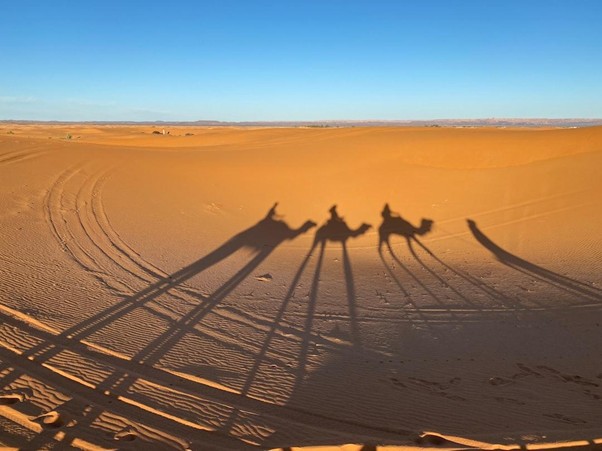
    Sāhil in Arabic means coast or shore. In the imagination of the Arab geographers of the Middle Ages, the Sahara was not a wall. It was a sea. The camel earns its nickname, ship of the desert, honestly. It allowed merchants to make the months-long voyage across that vast expanse, linking the Mediterranean world to West Africa. The Sahel was the southern shoreline of that sea.

    A shoreline is not a remote frontier. It is the first point of arrival. Goods land there, get taxed, get redistributed. The people who control the access points accumulate wealth and build institutions. The cities that grew along this shoreline, Timbuktu, Gao, Agadez, Aoudaghost, and later Katsina and Kano, were structural consequences of that position. Constantinople sat at the crossroads between Europe and Asia and extracted enormous wealth from that geography for over a thousand years. Timbuktu sat where the gold and salt trades intersected and grew exceptionally wealthy, connecting North Africa and the Mediterranean to the productive interior of West Africa. Whoever controlled such a position could tax trade moving in both directions, access goods otherwise unavailable, and hold a structural advantage over competitors. Geography does not determine history, but it sets the terms on which history unfolds.

    The Sudan: Climate, Geography, Ecology

    The African landscape is a varied one. Moving southward from the Sahara toward the equator, rainfall increases steadily and the vegetation responds in distinct bands. Each band runs roughly east-west across the continent, with the rainfall gradient running north-south.

    To understand what this means in practice, follow an imaginary merchant setting out from Sijilmasa, the great Moroccan terminus of the trans-Saharan trade, sometime in the 11th or 12th century. He has loaded his camels with slabs of Saharan salt, bolts of North African cloth, and copper ingots from the Mediterranean world. His destination is the markets of the Sudan. His journey south will carry him through several worlds in succession, each one wetter, greener, and more densely populated than the last.

    The northernmost inhabited zone is the Sahara itself: less than 150 millimetres of rain annually, vast, arid, traversable only with knowledge accumulated over generations. The Tamashek, Tubu and Amazigh peoples hold this world. They know where water sits beneath the surface and how the seasonal winds move. Our merchant cannot cross without them. He pays a toll and hires guides, folding the cost into the price his goods will command at the other end. The Sahara is dangerous and expensive, which is precisely why the goods that cross it are worth crossing it for.

    After weeks of travel, the landscape shifts. The hard gravel plains of the deep Sahara give way to the Sahel proper, where annual rainfall runs between 150 and 600 millimetres. Semi-arid steppe. Thorny acacia scrub. A landscape suited to pastoral herding and seasonal movement, in most areas not adequate for settled cultivation. The few cities that exist here become all the more important for their scarcity. At Taghaza, our merchant loads additional blocks of rock salt, a commodity mined there by enslaved labourers under brutal conditions. Salt is so essential to life in the agricultural south that it commands near its weight in gold at certain markets. That simple fact drives the entire commercial logic of the Saharan world. At Timbuktu or Walata, he enters a different order of things entirely: a city of scholars, merchants and administrators sitting at the junction of the desert routes and the productive Sudan. He exchanges his salt and Mediterranean goods for gold, kola nuts and leather goods from the south. He hears news of the markets further inland. He weighs whether to press on or turn back.

    He presses on. The landscape rewards his decision. Trees thicken. Grass grows tall between them. The soil deepens. The dusty, pale earth of the Sahara gives way to the red laterite soil familiar to anyone who has spent time in West Africa, rich and dense underfoot. Annual rainfall here ranges between 600 and 1,200 millimetres. The growing season runs long enough for reliable grain cultivation. Millet, sorghum, cotton, groundnuts. Cattle graze across the open woodland. Horses are kept and bred. Populations concentrate in numbers impossible further north. Cities grow large and stay large because the surrounding land can feed them across many consecutive years without exhaustion.

    This is the bilād al-sūdān, the land of the black people, the broad belt of productive savanna the Arab geographers named and described across centuries of writing. In modern ecological terminology it carries the name Sudanian savanna, though the medieval Arabic name carries more historical weight. This is the zone our merchant has been trying to reach from the moment he loaded his camels in Sijilmasa. These markets, these consumers, and this world were the reason he carried everything across the desert.

    He has arrived in the agricultural heartland of West Africa.

    Further south still, the Guinea savanna thickens into closed forest, where rainfall exceeds 1,500 millimetres annually, the canopy closes over, and the tsetse fly kills cattle and makes cavalry warfare almost impossible. Powerful and institutionally sophisticated states flourished in this region: Oyo, Benin, Asante. Each connected to the same continent-spanning trade network through chains of regional merchants and intermediaries. Our merchant will not venture this far. His goods travel the rest of the way through other hands, through the networks of Mande-speaking Dyula traders and Hausa fatake who specialised in exactly this kind of relay commerce. He sells to them, and they carry his salt southward to people he will never meet.

    What Each Zone Produces and Why it Matters

    Salt commands near its weight in gold at certain markets.

    Salt from the Sahara. Robin Taylor, CC BY 2.0, via Wikimedia Commons.

    The Saharan mines at Bilma, Kawar, and Taghaza produce a mineral that the agricultural populations of the Sudan belt cannot produce for themselves in adequate quantities. Salt preserves food, seasons it, and maintains the biological functions of people and their animals. Without access to it, agricultural communities weaken and decline. This biological necessity is what drives human beings to organise caravans of hundreds of animals across one of the most hostile environments on earth, month after month, generation after generation.

    Gold flows in the opposite direction. The forest zone of West Africa contains some of the richest alluvial gold deposits in the pre-modern world, worked by Akan-speaking miners in what is today Ghana and Côte d’Ivoire. That gold fed the monetary systems of medieval North Africa and Europe. It funded the Fatimid Caliphate. It built the great mosques of Morocco. European monetary expansion from the 13th century onward depended substantially on West African gold long before Europeans had any direct access to West Africa at all. The forest zone also produces kola nuts, a mild, bitter stimulant that became the social currency of Muslim West Africa wherever Islamic law prohibited alcohol. Kola travels without refrigeration, remains potent for weeks, and carries ritual significance at ceremonies from Senegambia to the Niger Delta. Hausa merchants built entire trading empires on the kola circuit alone. The ancestors of Nigeria’s richest Man Aliko Dangote were Agalawa merchants who grew wealthy through the Kola trade.

    Cotton cloth and leather goods move in every direction. The Sudanic region weaves and dyes cloth that North African and Saharan buyers prize. It tans hides into leather goods, sandals, saddlebags and harnesses, whose quality the Mediterranean world cannot match from its own resources.

    None of these zones is self-sufficient. The pressure toward exchange is structural, not incidental. It does not require any particular ruler to decide to encourage trade. It arises from the complementarity of the zones themselves, from the fact that survival and prosperity in each depends on what the others produce. The political consequences of this logic are enormous. Controlling the transit points between zones, taxing the movement of goods across ecological boundaries, is one of the primary mechanisms of wealth accumulation in pre-modern West Africa. The empires that rise and dominate this region do not, for the most part, produce the commodities they trade. They sit between the producers and the consumers, and they tax the passage.

    The Empires of the Sudan: Power Built on Position

    Map of the Wagadu empire. Luxo, CC BY-SA 3.0 <http://creativecommons.org/licenses/by-sa/3.0/>, via Wikimedia Commons

    The empire the Arabs called Ghana, and which its own people knew as Wagadu, built the first great demonstration of this logic. Rising in the western Sudan, probably by the 4th or 5th century CE, Wagadu sat between the gold-producing regions of the south and the North African merchants hungry for that gold. The state did not mine the gold. It taxed it.

    The Arab geographer Al-Bakri, writing in 1068, recorded the precise mechanism. The king of Wagadu levied a tax of one dinar of gold on every donkey load of salt entering the country, and two dinars on every load leaving it. He charged five mithqals on a load of copper and ten mithqals on a load of finished goods. Gold nuggets found in the mines belonged entirely to the crown. Private citizens could trade gold dust freely, but the crown entirely monopolised nuggets, which could be used as money and accumulate political power. Al-Bakri described the king’s court audience: the ruler sat in a domed pavilion surrounded by horses wearing golden halters, dogs wearing golden collars guarding his doors, and ten pages standing to his right carrying shields and swords decorated with gold. Behind him stood the sons of subordinate kings, their hair interlaced with gold.

    This is not just for the sake of flexing, although that played a part. It is a public display of the fiscal power the state extracts from its position in the trade network. The gold on those horses and dogs and sword hilts passed through Wagadu’s markets and Wagadu’s tax offices. They represent accumulated transit fees, turned into symbols of authority.

    Wagadu extended its reach from Takrur in the Senegambia region east to the Niger, controlling the western trans-Saharan routes for several centuries. Its decline came gradually from the 11th century onward, through a combination of Almoravid pressure, internal rebellions, and the progressive southward shift of gold-producing communities beyond its reach. There is scholarly debate today about whether Almoravid pressure was military or commercial and how decisive a role it played in Wagadu’s decline.

    Mali

    Its successor took the same logic further and built something larger.

    The Mali Empire of the Mansas reached from the Atlantic coast to the Niger bend at its height in the 13th and 14th centuries, incorporating the gold-producing Bambuk and Bure fields directly into its territory rather than simply taxing their output from a distance. This shift from transit taxation to direct control of production represented a significant intensification of the model. Mali did not abandon the transit fees; it added productive control on top of them.

    The wealth this generated was genuinely staggering. In 1324, Mansa Musa, the ruler of Mali, performed the hajj to Mecca and passed through Cairo on the way. He travelled with a retinue reportedly numbering in the tens of thousands and distributed so much gold in Cairo and along the route that he single-handedly triggered an inflationary crisis in the Egyptian gold market. Contemporary Arabic sources record that the price of gold in Cairo had still not fully recovered twelve years later. One man’s pilgrimage gift-giving destabilised a regional monetary economy for over a decade. That is what the structural control of the Sudan’s gold output looked like in practice.

    Mansa Musa Depicted on the Catalan Atlas, Abraham Cresques, 1375. public domain via Wikimedia Commons.

    Under the Mansas, Timbuktu became the intellectual capital of the Sudan. The Sankore Mosque and its associated scholarly networks attracted students and teachers from across the Islamic world. Mali’s trading diaspora, the Wangara and Dyula merchants who spread out from the empire’s commercial networks, carried Islam southward and eastward into regions the empire itself never directly controlled. They built mosques in market towns across the savanna, established the contract forms and credit mechanisms of Islamic commercial law, and created the social infrastructure that later Islamic reform movements would draw on and contest.

    Songhai

    Map of the Songhai Empire. HetmanTheResearcher, CC BY-SA 4.0, via Wikimedia Commons.

    The last and among the largest of the great Sudanic empires rose from within Mali’s shadow and eventually consumed it.

    Songhai centred on Gao in the Niger bend, a city that had been a significant commercial centre for centuries before the empire’s rise. Initially a tributary state under Mali, Songhai began asserting independence in the mid-15th century under Sunni Ali Ber, a military commander of exceptional energy who spent nearly three decades in almost continuous campaigning, capturing Timbuktu in 1468 and Jenne in 1473 and turning the Niger river into Songhai’s internal highway. Sunni Ali understood something that his predecessors had sometimes neglected: control of the river meant control of the grain trade that fed the cities of the Sudan, which meant leverage over the urban populations and scholarly classes on which commercial empires depended.

    His successor, Askia Muhammad, who seized power in 1493 and built the empire’s administrative and intellectual infrastructure, brought Timbuktu to its peak. By the late 15th century, Timbuktu held a population that contemporary sources estimated at up to 100,000 people. The Sankore Mosque alone had 25,000 students. The city imported books from across North Africa and the Middle East and produced its own manuscript tradition that scholars are still cataloguing today. Askia Muhammad undertook his own famous hajj in 1496, arriving in Cairo and Mecca with gold but also with political questions: he sought a fatwa from the Egyptian scholar al-Suyuti legitimising his deposition of Sunni Ali’s dynasty. Religion and political authority were inseparable, and the caliphs and scholars of the east were the sources of legitimacy that Sudanic rulers sought.

    Songhai’s collapse came suddenly. In 1591, a Moroccan army under Judar Pasha crossed the Sahara with something no Sudanic army had yet faced: firearms. At the Battle of Tondibi on the Niger, Moroccan muskets and cannon scattered a Songhai cavalry force many times larger. It was the first use of firearms south of the Sahara in a major engagement, and it exposed a structural vulnerability that the military architecture of the savanna empires had never needed to address before. Songhai fragmented. The Moroccan forces could conquer but not administer an empire of that scale from their North African base. The Sudan entered a period of political fragmentation that would define it for the following century.

    Kanem-Bornu: The Ancient State of the Central Sudan

    Kanem-Bornu at its greatest extent by Megartonius, CC0, via Wikimedia Commons.

    While Wagadu, Mali and Songhai rose and fell in the western Sudan, a different political tradition took root in the east and proved more durable than any of them.

    The state centred on Lake Chad, known first as Kanem and later as Bornu, appears in Arabic sources as early as the 9th century. The Dugawa dynasty that founded it controlled the central trans-Saharan corridor running through the Fezzan in modern Libya, connecting the Mediterranean directly to the Lake Chad basin and the agricultural lands to its south and west. Where the western Sudan empires built their power on the gold routes, Kanem-Bornu built on a different set of commodities: enslaved people, ivory and natron, the sodium carbonate mineral used across the Arab world for soap-making, food preservation and glass production.

    Islam arrived at the Kanem court around the 11th century, making it one of the earliest Muslim polities in Africa south of the Sahara. The conversion was not merely spiritual. It gave Kanem’s rulers access to the networks of Islamic scholarship, commerce and political legitimacy that connected the Sudan to the wider Muslim world. The Mai sent students to study in North Africa and brought back scholars to staff his administration. He corresponded with the Sultan of Morocco and the rulers of Egypt as a fellow Muslim sovereign. Islam provided the institutional language through which Kanem-Bornu organised its bureaucracy, justified its laws, and conducted its diplomacy.

    That bureaucracy proved extraordinarily resilient. The state survived internal rebellions, external invasions. The realm persisted after the forced relocation of its capital from Kanem, east of the lake, to Bornu, west of it in the 14th century, a massive institutional disruption that most states would not have survived. It survived the disruptions of the 16th century that destroyed Songhai. It adapted, reformed, and persisted across ten centuries of continuous existence, making it arguably the most durable state institution in West African history.

    That durability rested on a resource base that demands honest accounting. Bornu was not merely complicit in the trans-Saharan slave trade. For long periods, it organised and profited from it at scale. The state taxed the movement of enslaved people northward through its territory. Elite households depended on enslaved labour for agriculture, craft production and domestic work. Military expansion into the territories to the south and west was partly organised around the capture of people who would be sold northward or retained within the state economy. This was not an aberration imposed on an otherwise pristine political economy. The capture of people was structurally embedded in how Bornu accumulated and distributed surplus, how its ruling class maintained itself, and how it funded the military capacity that kept it intact. A history that omits this is not an honest history.

    Bornu’s influence radiated westward into Hausaland across many centuries. The political vocabulary of the Hausa city-states carries the fingerprints of this contact. The title Ciroma, used in Hausa courts for a senior ranked position, is a Kanuri borrowing from Bornu. Galadima, another major Hausa title, has the same eastern roots. The Bayajidda foundational legend, which we will examine carefully in the next essay, routes the origin of the Hausa states through Bornu for reasons that are not accidental. Bornu was the dominant power of the central Sudan for most of the period in which the Hausa city-states were forming their institutions. Its administrative models, its Islamic scholarly networks, and its commercial relationships all shaped what Hausaland became. The reign of Mai Idris Alooma was the Apogee of the polity and it would slowly decline in the centuries following his reign. I will cover his reign with the care it deserves in its own essay.

    Bornu’s power and influence would wane over the centuries, driven by shifting trade routes, environmental changes and the rise of powerful rivals like the Usmanid/Sokoto Caliphate. The state met its end in 1900, when Rabeh Zubayr, a Sudanese warlord and former slave soldier who had carved his way across the central Sudan with a disciplined firearms-equipped army, besieged and destroyed the Bornu capital. Rabeh’s conquest coincided almost exactly with the arrival of French colonial forces from the west and British forces from the south. The three-way collision finished what a millennium of rivals had failed to do. Bornu, which had outlasted Wagadu, Mali and Songhai by centuries, fell not to any single force but to the specific conjuncture of the 1890s, when the internal disruption of Rabeh’s campaign intersected with the external pressure of European colonial conquest at the worst possible moment.

    Our merchant from Sijilmasa, had he lived long enough and travelled far enough east, would have recognised the world of Bornu: the same logic of transit taxation, the same integration of Islamic commercial law into the fabric of trade, the same cities growing wealthy at the junction of ecological zones. But he would also have noticed something different about the political terrain further west, in the territory that Bornu influenced but did not control. A cluster of city-states, each independent, each competitive, each building its own institutions and its own commercial networks. Fragmented where Bornu was unified. Commercially distributed where Bornu was centrally administered. Younger in its political consolidation but extraordinarily dynamic.

    Why Any of this Matters

    The empires described in this essay did not exist in a separate, sealed-off past with no connection to the present. They were the product of specific material conditions, specific ecological positions, and institutional choices made over centuries. Wagadu’s wealth stemmed from the trans-Saharan trade, Songhai’s internal highway was the Niger river, and Bornu’s millennium-long anchor was the Lake Chad basin; these assets did not vanish with the empires’ demise. The geography remained. The ecological logic endured. Trade routes remained, at least until colonial borders, railway lines and artificial tariff walls were drawn through them.

    What changed was who controlled them and in whose interest they operated.

    The colonial partition of the 1880s and 1890s did not encounter an empty or stagnant landscape. It encountered the successor states of a thousand years of Sudanic political development, states that had survived the collapse of Songhai, the disruption of the trans-Saharan routes, and centuries of internal competition. What colonialism did was reorganise that landscape. It redirected trade routes toward coastal ports and away from the Saharan corridors that had sustained the interior for centuries. Wherever it preserved certain institutions, the emirate system in northern Nigeria being the most consequential example, it did so in forms useful to administrators rather than local populations. It created borders that cut through the agricultural zones, pastoral routes and commercial networks that the ecological logic of the region had generated over centuries. And it extracted resources with none of the internal redistribution, however unequal and often brutal, that the older state systems had practised. The Sahelian Juntas claim to have seized power to right those wrongs, but only time will tell.

    Captain Ibrahim Traore, Military Leader of Burkina Faso. Source Bamjo226, CC0, via Wikimedia Commons.

    The coup belt is the inheritance of that reorganisation. The states collapsing today did not build on the institutional foundations of Wagadu, Mali, or Bornu. They were built on colonial administrative frameworks that prioritised control over capacity, extraction over development, and the convenience of outside powers over the coherence of local political economies. The Sahel crisis is not evidence that this region cannot sustain complex political life. The record described in this essay is the evidence against that claim. It is evidence that the specific political structures imposed over the last century have failed, and that understanding why requires going further back than the coups, further back than independence, further back than colonialism itself.

    That is the work of this series: https://thesahelianrecord7.substack.com/

    Feature Image: Jillian Amatt – Artistic Voyages on Unsplash

    Sources:

    Al-Bakri, Kitāb al-Masālik wa-al-Mamālik (Book of Routes and Realms), c. 1068, in Basil Davidson, The African Past (Penguin Books, 1966), p. 81

    Brooks, George E., Landlords and Strangers: Ecology, Society, and Trade in Western Africa, 1000–1630 (Westview Press, 1993)

    Hunwick, John O., Timbuktu and the Songhay Empire (Brill, 1999)

    Last, Murray, The Sokoto Caliphate (Longmans, 1967)

    Levtzion, Nehemia, Ancient Ghana and Mali (Methuen, 1973)

    Levtzion, Nehemia and J.F.P. Hopkins (eds.), Corpus of Early Arabic Sources for West African History (Cambridge University Press, 1981)

    Lovejoy, Paul E., Salt of the Desert Sun (Cambridge University Press, 1986)

    Lovejoy, Paul E., Transformations in Slavery: A History of Slavery in Africa (Cambridge University Press, 1983)

    Lovejoy, Paul E., Caravans of Kola (Ahmadu Bello University Press, 1980)

    Trimingham, J. Spencer, A History of Islam in West Africa (Oxford University Press, 1962)

    Webb, James L.A. Jr., Desert Frontier: Ecological and Economic Change Along the Western Sahel, 1600–1850 (University of Wisconsin Press, 1995)

  • In God We Trust Inc.

    Ryszard Kapuściński in Imperium (1993) warned of three plagues, or contagions threatening the world: nationalism, racism and fundamentalism. He further identified one shared trait or a common denominator in ‘an aggressive all powerful total irrationality,’ arguing that ‘[a]nyone stricken with one of these plagues is beyond reason. In his head burns a sacred pyre that awaits its sacrificial victims.’

    The lunatics have now well and truly taken over the asylum worldwide. We are now witnessing a new unholy war being led by evangelical Christians against Islam, just as earlier crusades emanated from Europe in the Middle Ages. And like those earlier wars, the acquisition of plunder is clearly a motivating factor.

    Noticeably, the clearly sociopathic Pete Hegseth talks of the Iran war as God’s War, and the soldiery are briefed accordingly. Trump uses similar language, but holy wars often occlude terrestrial agendas. Add the dimension of rampant technology, wherein war is conducted remotely in video game sequences and one reaches a level of savagery reminiscent of the 1940s. Meanwhile AI plunders our libraries and distorts our reality with propagandist bombast.

    Hegseth’s macabre ceremonies in the White House have included Doug Wilson, the founder of the Communion of Reformed Evangelical Churches. He has stated that homosexuality should be a crime and that women shouldn’t be allowed to vote. As editor of The Princeton Tory, Hegseth also suggested that homosexuality was immoral.

    In March 2026, soon after the start of the U.S./Israeli attack – branded with the biblical denotation Operation Epic Fury – it has been reported that military leaders told their service members that the war was ‘part of God’s divine plan,’ and that President Donald Trump had been anointed by Jesus. One commander quoted the Book of Revelation, and said the war will bring the second coming of Jesus Christ. The whole exercise has a distinct air of Stanley Kubrick’s Dr Strangelove (1959).

    The legendary punk band, The Dead Kennedys album In God We Trust Inc (1982) curiously presages our times, but none of what is being done in God’s name is properly Kennedyesque, or indeed genuinely Christian. It appears to be an extension of what Eisenhower warned of the existential threat of the Military Industrial Complex. Wars. As IG Farben and Bleichroder knew, wars are a great source of revenue.

    The leading Catholic legal philosopher John Finnis is also a believer in God’s law. Marriage is for him exclusively between a man and a woman and purely for procreation. He considers homosexual congress and sex outside marriage as intrinsically shameful, immoral and harmful. In Natural Law and Natural Rights (1980) he compares abortion to carpet bombing civilians. Sadly, murdering the civilian population of Iran does not appear to bother the zealots in the White House to the same extent as interfering with women’s reproductive rights.

    Jonathan Sacks, the leading contemporary Jewish philosopher in the U.K. railed against extremism. In Morality (2020) he outlined positive religious values, including a focus on dignity, associative levels of responsibility, community and a sense of public service and the common good. Is all of this now lost on the Likud faction in Israel?

    Christian jihadism, historically, also includes the horrendous conquest of South America by Spanish Conquistadors. In modern times the Blairite justification, couched at one level in Christian terms, for the war on Iraq was also used to mask narrow self-interest in securing oil. The war in Iran, now engulfing the entire Middle East, also has significant acquisitive elements, but is more obviously an attack on what is perceived in racial terms as a satanic culture.

    Shortly before his death Sacks equated altruistic evil with the neoconservative group, who held themselves to be good and their opponents to be evil. This leads to the arrogant imperialist assumptions that ‘we’ are inflicting punishment for ‘their’ own good, and that killing multitudes will pave the way to democracy.

    Both the late Christopher Hitchens, and indeed Richard Dawkins, have written extensively about the new forms of religious extremes we are witnessing, with the finger of blame primarily pointed at Islam. Islamic extremism does provide graphic examples of brutal beheadings, mass executions, stoning to death for adultery, planes hitting the Twin Towers, as well as the murder of journalists. There is also evident in Britain a lack of integration, and a secessionism unconducive to any kind of harmonious multiculturalism. Recourse to genocide, however, seems to be the preserve of evangelical Christians and Zionists.

    Osama bin Laden (L) sits with his adviser and purported successor Ayman al-Zawahiri (Foto: HO/Scanpix 2011)

    Islamic Rage

    Much of the Islamic rage can be traced to neo-imperialism in the Middle East. The current phase began in earnest with the invasion of Iraq, and has culminated in this attack on Iran.

    Christopher Hitchens’ worst intellectual error, inexcusable in my view, was to support the Bush-Blair invasion of Iraq. He was, indirectly, supporting, though he might not have seen it, an even worse form of religious fundamentalism directed against another.

    In works such as Culture and Imperialism (1994) and Orientalism (1978) the Palestinian author Edward Said author asserted that ‘Patriotism, chauvinism, ethnic, religious and racial hatreds can lead to mass destructiveness.’ He cites our own Conor Cruise O’Brien to the effect that imagined communities of identity are hijacked by the petty dictators of state nationalism, like Benjamin Netanyahu.

    In Marxist terms, religious fundamentalism can be traced to growing disparities of wealth and structural inequality, as well as a lack of opportunities to gain a rounded education. We have seen an all-too-great an emphasis on technical or scientific education for economic advancement, as opposed to a broad liberal education that inculcates critical thinking.

    In these straitened times extremism speaks of a need to belong to a cause, leading to belief in something ethereal, no matter how ludicrous. Belief in an afterlife defines people’s existences and justifies even self-immolation.

    As the wheels come off the neoliberal economic system and the societal bonds wither, extremist Christian nationalism and the demonisation of the other has stepped into the void to provide solace.

    Passion Conferences, a music and evangelism festival at Georgia Dome in Atlanta, Georgia, United States, in 2013.

    U.S. Evangelism

    In the United States, we are witnessing an unholy synergy between Evangelical Christians and racism. Far-right demagogues have articulated a view that ‘our’ country is being overrun by immigrants and that the dominant ethnic group must ‘take back control’ from a phantom intellectual Marxism espoused by liberal elites, Harvard or straight socialism. All of these apparently emanate from the decadence of a mixed race cosmopolis. The fire is spreading to Europe, U.K and Ireland too.

    Thus, we find a global descent into the extremist and racist abyss, where those we disagree with are scapegoated and targeted. This is a product of a dualistic mode of thinking, which Sacks identifies with a need to define God in relation to the Satan residing in others. This leads to the demonisation of those we disagree with, evident also in social media vilification.

    What the Christian far-right in the United States and elsewhere offer is the establishment of the Kingdom of Heaven on earth, which involves isolation of the righteous few in gated communities, segregating the rich chosen people from the disaster they inflict on others.

    The now tarnished Noam Chomsky once claimed that the Republican Party is the ‘most dangerous organization in world history.’ Chomsky also claimed in a BBC Newsnight interview that nearly 40% of the American public believe that the Second Coming will occur by 2050. So, Pete Hegseth may be preaching to the converted.

    Brazilian President Lula with Pope Francis 21.06.2023 
    Foto: Ricardo Stuckert/PR

    Religion as Agent for Good?

    Alternatively, in The Godless Gospel (2020) Julian Baggini calls for forms of religion shorn of hatred so we may realise our best intentions and develop empathy and compassion. He envisages a commitment to personal humility and an obligation and commitment to the truth, causing as little harm as possible. There are clearly good values that Christianity may teach to those of a secular persuasion presently lacking in moral clarity.

    Above all, the atheist and perhaps the leading intellect left on the planet Jurgen Habermas recognises how religion engenders social integration, and can be a basis for communicative action, his core concept. As far back as 1978 he argued, from a secular perspective, for the necessity of religious ideas to humanise society. These would be religious ideas where we learn to communicate reasonably without resort to falsetto Jihadism.

    The former Pope Francis’s experiences in the barrios of Buenos Aires also appear to have shaped an empathy towards the wretched of the Earth. He preached tolerance and engagement, as well as social and economic justice. The present Pope has, encouragingly, in un-American fashion, condemned what is happening, however mutedly. Let us hope that he is untainted by the dark money of the Vatican and does not go the way of John Paul II.

    Christian socialism is a potentially vital force if it reflects the values of what Philip Pullman calls that great man Jesus, but not the values, as he equally presents, of that scoundrel Jesus Christ. This latter is a distortion of New Testament values, dedicated to the accumulation of capital, a lack of compassion and political manipulation.

    Neo-feudalism

    We appear to be witnessing Old Testament fury, but beyond the zealotry it seems that neoliberalism is morphing into neo-feudalism. The Book of Genesis sanctions man’s dominion over the Earth, which appears to be permitting a scorched earth approach, but this is a smoke screen. Institutional Evangelical Christianity is wedded to the exchange of goods, along with the exchange of gods. Drill Baby Drill.

    The last word I leave to Clarence Darrow, who represented a progressive America of another era in his closing speech in The Scopes Trial:

    Ignorance and fanaticism are ever busy and need feeding. Always it is feeding and gloating for more.——-, it is the setting of man against man and creed against creed until with flying banners and beating drums we are marching backward to the glorious ages of the sixteenth century when bigots lighted fagots to burn the men who dared to bring any intelligence and enlightenment and culture to the human mind.

    Those who suffer from toxic nationalism, toxic religious mania and toxic racism are beyond reason and must be overcome.

    Feature Image: Some of Pete Hegseth’s tattoos, 2021

  • Archiving Gaza in the Present

    Review: Archiving Gaza in the Present: Memory, Culture and Erasure. Edited by Dina Matar and Venetia Porter (Saqi Books, London, November, 2025). 

    While Israel has made Gaza synonymous with its genocide, a rich cultural heritage, now largely destroyed, paints a completely different picture. The introduction to Archiving Gaza in the Present: Memory Culture and Erasure states that the book serves as “a reminder that Gaza as we see it today in the media’s live-streaming coverage of the war, miserable, shattered and deformed is not the Gaza that saw the unfolding of many civilisations.”

    The book is a compilation of papers and visual material presented at a two-day conference in November 2024 in London, a little over a year since Israel unleashed its genocide in Gaza. The level of annihilation and erasure – not only of Gaza’s infrastructure but also of its historical sites – made archiving and preservation more urgent. Palestine’s historical and cultural heritage is presented in the book through the contributions of various artists, historians, lawyers, curators, archaeologists, poets and journalists. Described as an ‘archive of Gaza in the present’, the book illustrates the process of archiving even as Israel continued to wage its destructive campaign.

    There is also an urgency to archive. In 2024, halfway through the genocide before the ceasefire announcement, which Israel has now violated hundreds of times, the world was witnessing a replica of the 1948 Nakba. This time they were using sophisticated military technology resulting in unprecedented destruction of Palestinian lives, culture and heritage in Gaza. For example, camps established in the aftermath of the 1948 Nakba, during which thousands of Palestinians fled to Gaza, were bombed in Israel’s genocide: “The names of camps are becoming those of mass graves.”

    With each massacre, Israel erases a part of Gaza. The compilation of essays and visual material in the book show not only the magnitude of destruction, but how much of that destruction is unknown to the West.

    Salman Abu Sitta, for example, notes that Gaza is the only place in Palestine which never took down the Palestinian flag since before the Nakba. Gaza was also the first to play a central role in the anti-colonial struggle and refugee political organisation. Gaza’s traits are largely overlooked due to the colonial impositions inflicted on it. Indeed, as Abu Sitta notes, the term ‘Gaza Strip’ is a product of this recent colonisation.

    An aerial photo of displaced Palestinians waiting in northern Nuseirat to return to their homes in Gaza. © 2025 UNRWA Photo by Ashraf Amra

    A Decolonial Act

    Archiving Gaza is a decolonial act, happening at a time of political and demographic erasure. Many artists in Gaza have had their studios destroyed in Israel’s bombing, their work decimated, yet continue to express themselves and their wider communities in Gaza.

    Thus, art became a way to document the genocide, using whatever materials were available. Some artists directed their efforts towards art therapy. One particular collection of images that stands out in the book is Ahmed Muhanna’s art work, drawn on the packaging of humanitarian aid boxes: “He began drawing on them, incorporating the stamped warning ‘Not for Sale or Exchange’ into his compositions – reframing it as an artistic and philosophical element.”

    Several artworks now deal with memories of genocide, memories of Palestinians killed by Israel, memories of being still alive amid the erasure. Maisara Baroud states: “In my work, I express the story beyond the official narrative. It is the story of war that produces a tremendous capacity for harm, conquering distance, geography, and even the speed of sound to bring death to more people in less time.”

    Prior to the genocide, Gaza was a thriving art hub, with residencies, art programmes, exhibitions and grants for artists. The art department at the Al-Aqsa University in Gaza was established in 1995, the same year the university was recognised, and it played a major role in promoting art through academic programmes. In 2021, recognising the restrictions as well as earlier destruction, the concept of the Sahab Museum (The Museum of the Clouds) was implemented, preserving material and digital works in a curated virtual space that is also an act of resistance. It decolonises Gaza through Palestinian memory, “providing an attempt to respond to the destruction of cultural archives, which lies at the heart of colonial policy.”

    The book also documents Gaza’s deceased artists. One example is Fathi Ghaben, who died after inhaling white phosphorus. His paintings are synonymous with Palestinian resistance,  depicting the Palestinian flag as well as other cultural symbols in his art, leading to his arrest and detention by Israel in the 1980s. Another Palestinian artist from Gaza, Mahasen al-Khatib was killed in October 2024, just hours after publishing her last artwork depicting Sha’ban al-Dalou, who was burnt alive following a strike on the tents outside al-Aqsa Hospital.

    The striking discrepancy between Ghaben’s paintings and the art produced during the genocide illustrate both devastation and displacement. Apart from the bombed buildings, burnt vehicles, what stands out is Gaza and its population as a multitude of barely discernible figures. Masses of people awaiting food, landscapes of tents. Upon viewing the images, one pauses to think of the population’s individual identities in the midst of these scenes, and that is where the horror surges through.

    Fathi Ghaben 1947-2024.

    Rich Cultural Heritage

    Shifting from past to present and back to the past again, the essays in the book attest to both Gaza’s rich cultural heritage, ancient civilisations and Israel’s erasure. Six thousand years of history have been battered into oblivion by Israel to sustain the myth of a barren land ripe for colonisation. Hosting two hundred archaeological sites, Israel targeted Gaza prior to the genocide in a bid to assert its fabricated narrative of ownership over the land through archaeology and excavations. The first archaeological discovery was made before the British Mandate in 1879 in Nuseirat – a statue of Zeus which now forms part of the Istanbul Archaeological Museum. From 1967 onwards, excavations were carried out by the Israeli military.

    Jawdat Khoudary, a Palestinian from Gaza, started his own private collection of antiquities after finding an Islamic glass coin. With over 3,000 artefacts dating back from 2000 BC to the Ottoman Empire, Khoudary eventually decided to establish the region’s first archaeological museum in 2008. In February 2024, the museum was completely obliterated by Israel.

    The book refers to Polish lawyer Raphael Lemkin who coined the word genocide and who identified eight dimensions: political, social, cultural, economic, biological, physical, religious and moral. Israel’s eradication of Gaza illustrates how each of these components is intertwined in the systematic erasure of land and generations of people.

    The erasure also limits the Palestinians people’s struggle for self-determination. Israel destroyed numerous libraries in Gaza during the genocide, but before that, it had already looted most of Palestine’s archives during the 1948 Nakba, which are now held in Israel’s State Archive and the National Library. Quoting Palestinian scholar Mezna Qato, the book notes that Palestine’s history is under Israeli state surveillance: “To tell a history of Palestine now often requires seeking access through Israeli state keepers.”

    The Islamic University of Gaza in 2021.

    As a result of Israel’s colonial violence, Gaza’s exclusion from the rest of the world is amplified in several ways. Education is one example – Western universities do not engage with Gaza’s universities, as Israel’s colonial narrative is increasingly upheld in academic institutions. The exclusion of Gaza can also be traced back to the British Mandate and the 1948 Nakba, during which the entirety of Palestine faced restrictions on curriculum expansion and resources. Since October 2023, however, Israel moved from destruction to annihilation of Gaza’s education system. Other parts of Gaza’s history are also overlooked and largely unknown to the world, such as the history of aviation in Gaza and how this was also linked to Zionist colonial violence.

    Archiving Gaza in the present, as the book title states, represents quite a contradiction. Archiving in the face of erasure primarily presents one dilemma, as the book states in the case of archaeology, “Given the ongoing humanitarian, economic and environmental crises in Gaza, identifying new archaeological sites is not currently a priority.” However, the altered landscape requires an urgency to channel efforts towards preservation.

    But altered land presents a major problem. As the book shows, so much of Gaza has been lost that its very survival as a distinct entity has been placed in peril. Amid striving to safeguard their own survival in a land reduced to rubble, Palestinians are also aware of the necessity of preserving what can be salvaged, at a time when they are also preserving their own history of the genocide. International humanitarian law has failed Palestinians, as the book asserts. A Palestinian oral history thus becomes not only central but imperative. As the international community rallies behind the U.S. 20-point plan for Gaza, which upholds the Zionist narrative of a barren land in the current genocidal erasure, reclaiming Gaza in recollections, and wider Palestinian narratives, is an important part of decolonisation.

    In complete defiance to the Zionist narrative, this collection of essays and photos stand as testimony to Gaza as Palestinians know and remember it.

    Feature Image: Forced Displacement of Palestinians in the Gaza Strip devastated by Israeli bombing, January 29, 2025.

  • Podcast: ‘Turkey’s Phrase of the Year: Gözaltina aliniyorum’


    The Turkish phrase Gözaltına alınıyorum translates simply as: ‘I’m being taken into custody.’ This was selected by the independent media outlet T24 as the phrase of the year for 2025. Had it not been that, in my view, it just as easily could have been Türkiye’de yargı bağımsızdır, meaning ‘the judiciary in Turkey is independent,’ a line repeated endlessly, like a tongue-twister, by Ministers and MPs from Erdoğan’s ruling party, the AKP. And yes, I’m being ironic.

    On March 19, Turkey woke up to a morning marked by an operation aimed at eliminating the possibility of a change in power through elections, and declaring open war on institutional opposition.

    The mayor of the Istanbul Metropolitan Municipality (IMM) and the opposition’s presidential hopeful, Ekrem İmamoğlu, was taken into custody along with dozens of IMM employees and close members of his team. Shortly afterward, university students organized and gathered in front of Istanbul University main campus, marching toward Saraçhane, which is the location of the Istanbul mayoral headquarters, just a couple of kilometers away.

    Then more people joined. And more.

    Emergency bans on unauthorized demonstrations and marches were imposed at lightning speed. Metro and bus services were cancelled by government decree to block access to the area. The police presence and traffic checkpoints increased rapidly. Even these hastily implemented measures – designed specifically to prevent people from gathering in front of the IMM headquarters – failed to stop hundreds of thousands from filling the streets within hours.

    In the days that followed, people maintained a vigil through the nights, both at Çağlayan Courthouse, where Mayor İmamoğlu was taken, and in front of the municipality building. They refused to leave the Squares.

    While all this was unfolding, people like me – those watching from afar living abroad – fell into a grimly familiar ritual. Every morning around 6am, opening X (Twiiter) meant watching your entire timeline fill, within seconds, with posts like:

    “I’m being taken into custody.”

    “Police raided my home at dawn. I’m being taken into custody.”

    “The police came to my apartment in Şişli around 4:30 a.m. Please take care of my dog. I think I’m being taken into custody.”

    There were dozens of such tweets. Some days, without exaggeration, hundreds.

    Turkey Isn’t Outside the West. It Helped Build It

    Fast forward to today. Ekrem İmamoğlu, along with over 400 others, has been held in pretrial detention for nine months. Those detained include sixteen mayors from the main opposition Republican People’s Party (CHP); his lawyer, Mehmet Pehlivan; his election campaign adviser, Necati Özkan; his drivers, Recep Cebeci and Zekai Kıratlı (whose names do not even appear in the 4,000-page indictment); his assistant, Kadriye Kasapoğlu; district mayor Murat Çalık, a two-time cancer survivor currently undergoing treatment; and hundreds of others I cannot possibly list here.

    As I write these lines, social media is once again flooded with news of fresh crackdowns targeting the Istanbul Metropolitan Municipality. The municipality’s deputy secretary general, the head of the fire department, Remzi Albayrak, and dozens of others have been taken into custody as part of the ongoing operations against İmamoğlu and his circle.

    All of these individuals are accused of forming a criminal organization, corruption, causing public financial loss, and terrorism – charges that, over time, have increasingly been reframed as espionage, alongside several other alleged crimes.

    According to legal professionals and academics, these accusations are laid out in an indictment of roughly 4,000 pages that does not read as if it were prepared with professional rigour. The document has been widely criticized for being grossly inflated, riddled with technical errors, filled with repetitive sections, reliant almost exclusively on anonymous “secret witness” testimony, and strikingly devoid of concrete or substantiated evidence. More troubling still, some of the more than 400 people currently in detention are not even named in the indictment, yet they remain behind bars.

    Very recently, the European Court of Human Rights decided to fast-track Ekrem İmamoğlu’s case, specifically his application concerning unlawful detention. The application was filed by his lawyer, Mehmet Pehlivan who is himself currently in detention.

    Yet the European Court of Human Rights, along with international institutions more broadly, is increasingly portrayed by the Erdoğan government, now in its twenty-third year in power, as anti-national, foreign-backed, and unpatriotic. In official rhetoric, these institutions are cast as insufficiently “domestic” and allegedly hostile to Turkey’s national interests.

    This framing follows a familiar authoritarian script, but reality is more complicated, and far less convenient. Turkey is not an outsider to the Western political and legal order. It helped build it.

    Turkey is a founding signatory to the European Convention on Human Rights and a member of the Council of Europe, making it legally bound by both the Convention’s provisions and the case law of the European Court of Human Rights. It is also a party to the core United Nations human rights treaties.

    What, then, is the purpose of this fabricated, anti-Western, exclusionary narrative?

    ‘Down With Tyranny, Long Live Freedom!’

    The aim is to crush resistance, normalize sweeping losses of rights, freedoms, and prosperity, and impose a “new Turkey” modelled on a hybrid of Central Asian authoritarianism, Russian-style rule, and the institutional failures of parts of the post-colonial Middle East.

    This vision is fundamentally incompatible with Turkey’s realities: its diverse socio-cultural fabric and, more importantly, its socio-political legacy of more than two centuries of struggle for democracy and modernization.

    That legacy dates back to 1839, a decisive turning point in Ottoman history, when decades-long, Western-oriented reform efforts were institutionalized through the Tanzimat Edict. These reforms eventually led to the establishment of the first parliament and the first civilian constitution in 1876.

    With the Tanzimat Edict, Ottoman subjects were recognized as equal citizens for the first time. Egalitarian reforms in areas such as taxation and military service aimed to ensure that non-Muslims, alongside Turkish Muslim citizens, bore the same duties and responsibilities toward the state.

    The reforms also sought to guarantee the security of life, property, and honour for all citizens; to ensure property could be lawfully inherited; to establish transparency in judicial proceedings; and to prohibit executions without due process.

    These principles were not merely rhetorical. Concrete regulations gave them legal force, and the constitution that followed formally limited and distributed the powers of the sultan.

    In 1858, homosexuality was decriminalized, making the Ottoman Empire the second state in the world, after France in 1791, to take such a remarkable step.

    The path toward building a republic grounded in parliamentary democracy and equal citizenship, however, was never linear. As in France, Italy, or Japan, and many other democracies, progress came through reversals and ruptures. The Ottoman Empire’s first constitution was suspended and parliament dissolved, only to be reinstated three decades later. As borders across Europe were redrawn through wars and upheaval, this turbulent process culminated in the founding of the Republic of Turkey.

    Like other nations, Turks did not abandon the desire for a better future or the struggle required to build it. Today, however, all of this is under threat.

    President Erdoğan has amassed more power than many Ottoman sultans and continues to seek more. Research by the V-Dem Institute at the University of Gothenburg shows that Turkey’s democracy score stood at 0.17 in the early 1900s, rose to 0.53 in the early years of the republic, reached 0.74 in 2002 when Erdoğan’s AKP first came to power, and has since fallen back to 0.18.

    It is no coincidence that a slogan more than a century old has returned to the streets: Kahrolsun istibdat, yaşasın hürriyet! meaning  ‘Down with tyranny, long live freedom.’ It has been one of the most frequently chanted slogans at the Saraçhane demonstrations following İmamoğlu’s imprisonment.

    For more than two decades, Turkey’s media has been monopolized by oligarchs handpicked by Erdoğan. As a result, the voices of ordinary, hardworking, middle class Turks have been largely silenced, especially abroad. Deliberate policies have severed society’s connection with the outside world, suppressed public expression, and helped cement an image of Turkey as a failed democracy which is a perception many in the West has accepted uncritically.

    The Syrian war, and the years-long influx of refugees have reinforced this distorted view. Since 2012, Turkey has become nearly inseparable from Syria in the Western imagination, as if the country had absorbed another nation entirely. Over more than a decade, this association has come at steep economic, political, and moral costs, leaving Turkey and Syria almost interchangeable in the minds of outsiders.

    It is precisely these deliberately erased realities of Turkey that I want to bring back into focus in this article.

    Through its constitution, Turkey is a parliamentary democracy, and until roughly a decade ago, it functioned as one, at least since 1950, around the same time many Western democracies were consolidating. Eastern Europe, by contrast, remained under authoritarian rule until the 1990s. Since 2017, however, Turkey has gradually morphed into an electoral autocracy, with steadily eroding rights and freedoms.

    Yet Turkish society itself is not defined by these trends. Erdoğan is attempting to impose a regime change against the will of the people.

    Even before the unlawful detention of İmamoğlu and hundreds of others, a 2024 PEW Research survey showed that 67 percent of Turks were dissatisfied with the country’s democracy. Among those under 35, that figure rises to 75 percent. Eighty percent of respondents support direct, electoral democracy, while 62 percent reject the idea of indefinite rule by a strongman.

    In another striking example, 56 percent of people in Turkey believe that religious texts – given the country’s Muslim-majority population, in this case the Quran – should have no influence over the constitution or laws. This figure is several times higher than in other Muslim-majority countries, where comparable research could be conducted.

    For context, the same survey analyzed thirty-six countries, including Tunisia, which experienced a brief period of parliamentary democracy between 2011 and 2021 and today scores slightly higher than Turkey on democracy indices. Yet Tunisia is excluded from the section of the study that examines the role of the Quran in politics simply because even asking such questions is socially unacceptable there, despite Tunisia being one of the West’s preferred points of comparison with Turkey. By comparison, the equivalent figures are 51 percent in the United States, 57 percent in Poland (referring to the Bible), 54 percent in Israel (Jewish scripture), and just 12 percent in India (Hindu scripture).

    Only 17 percent of people in Turkey believe religious texts should influence national laws. By contrast, the figure is 66 percent in Indonesia (home to Bali, often perceived as a globally famous, relatively secular tourist destination), 22 percent in our complex, love-hate neighbor Greece, and 28 percent in the United States.

    Why does this matter?

    The overwhelming majority of Turks, regardless of religiosity or whether they vote for Erdoğan and the AKP, support Turkey’s constitutional definition as a secular, parliamentary, democratic republic. They want these founding principles to remain intact, and they are deeply dissatisfied with the current system of governance.

    A new constitutional amendment is expected soon. Just as previous amendments were justified with buzzwords like “military oversight,” “judiciary status quo,” or “democratization,” the government is likely to use the cultural rights demands of Turkey’s ethnic minorities, particularly the Kurds, as a pretext for a full constitutional overhaul. In reality, these issues could be addressed through minor, targeted adjustments without rewriting the constitution.

    In the near future, many will try to tell you otherwise. Please, don’t believe them.

  • Review: Displaced in Gaza: Stories from the Gaza Genocide

    Gaza’s history since the Nakba of 1948 is punctuated by waves of forced displacement. The enclave has been the epicentre of Palestinian refugees since 1948, having welcomed Palestinians from all over the colonised territories. Since Israel’s genocide against Palestinians in Gaza began in October 2023 its entire population of over two million, in a territory of just 151 km2, has been rendered internally displaced persons.

    Displaced in Gaza: Stories from the Gaza Genocide, Edited by Yousef M Aljamal, Norma Hashim, Noor Nabulsi, and Zoe Jannuzi (Haymarket Books, 2025) is a collection of twenty-seven testimonies of Palestinians living in Gaza enduring the genocide. An immediate response upon reading through the chapter titles is: to what extent have we become desensitised as spectators or activists? And, moreover, what is the link, or disconnect, between this wider perception of a genocide occurring and a person living through it?

    It begs the question, when reading through the testimonies, after more than two years how much can our mind take before the experiences themselves, narrated by survivors, merely become background noise? With the daily recounting of Israel’s kill toll being reduced to statistical data – a roll call similar to the reporting of Covid cases that gradually desensitised the listener – can our minds link back to the human tragedy?

    Of course we should. For the chapter titles speak of a shattered, mundane reality. Birthdays morph into atrocities. Education is ruptured by bombs. A woman is widowed by targeted assassination. A husband is killed while searching for food. Entire families are wiped out. The details are so mundane, so quotidian, yet genocide is an immense, unforgivable laceration in both its experience and the memory if it. That memory should, and must, extend to the rest of us. Narratives can combat desensitisation, as long as we know what to prioritise.

    In the foreword to the book, Ahmad Alnaouq writes:

    Everyone on Gaza is now a citizen journalist, determined more than ever to confront and challenge the Western media narrative – the demonising and dehumanising of the Palestinians, the lack of agency recognised, and the distortion of truth.

    This collection of testimonies directly challenges the Western hegemonic narrative which, even while reporting the official genocide kill toll, still finds ways of sanitising bloodshed and diminishing the humanity of Palestinian survivors. The kill toll is represented in two ways – as a statistic that either supports sporadic calls for accountability or offered in support of Israel “finishing the job.”

    Yousef Al-Jamal references the Palestinian poet and academic Refaat Alareer, who was killed by Israel in 2023, and for whom storytelling was an integral component of Palestinian history.

    A Poem for Refaat Alareer

    ‘For centuries,’ AL-Jamal writes, ‘Palestinians have tended the rich oral history of Palestine, preserving cultural heritage, including folktales and stories about the land.’ This collection of narratives from the Gaza genocide is a contribution to Palestine’s oral history, and one that, due to its international dissemination, cannot be destroyed by Israel.

    The personal narratives in this book speak of a disrupted simplicity, but not a disrupted normality. This includes death or killing, displacement, hunger, the tribulations of living and enduring life under a highly militarised genocide. We find the disruption of education and attempts to teach, as well as the full spectrum of forced displacement including of a Nakba survivor, along with attempts to rebuild a semblance of normality even as Israel destroys Gaza’s infrastructure. Even before the genocide, Palestinians in Gaza faced immense hardships and restrictions which were normalised into manageable deprivation, even by international institutions.

    For many Palestinians, as evidenced by several contributors to this anthology, the large scale killing meant that families were welcoming other relatives into their midst. At times it was orphaned children, as was the case with Aisha Osama Abu Ajwa, a mother of four children who began taking care of two children whose parents were killed when Israel bombed an entire residential block. In her description of forced displacement, Abu Ajwa writes, ‘The children witnessed dozens of martyrs’ bodies strewn on the ground. They cried intensely, while blood covered the streets.’

    ‘I hope war ends soon. Eight months of continuous killing exhausts us,’ writes Fidaa Fathi Abu Yousef, whose son was killed while riding a bike just 800m away from the family home.

    Another recurring horror is Palestinians fleeing to supposedly safe zones, while Israel bombs move in the direction the displaced are heading, leaving not only a trail of displacement but bloodshed. The killing of Palestinian children, as described by the narrators of this genocide, encompass all ages. The visibility of Israel killing children is magnified when the writers note the dead children’s ages. Thus removed from the general term, the children take on meaningful identities; allowing the reader to recognise how Israel has attempted to obliterate Palestinians through its killing of the younger generations. Children killed on their birthday, children killed while sleeping, the tragedy is portrayed through the eyes of the living, bereaved and those unable to process their loss due to a perpetual quest for survival.

    Their attempt to persist in living instead of perishing at times makes the writing of these recollections and experiences become slightly devoid of emotion. Emotion almost becomes a luxury when surviving a genocide, but the almost matter-of-fact narratives in this collection make grief all the more important, not only to grasp but experience. Israel has not only wiped entire families out and lacerated others beyond repair, it has also obliterated entire psychological processes that are necessary when experiencing traumatic events. In the midst of a genocide, Palestinians are unable to experience the grieving process.

    Incessant worry about family members displaced in different locations around Gaza is another hardship Palestinians must endure. Without means of communication for the most part, relatives receive no news of each other. ‘Gaza is small, yet we have not seen each other since the war began. We have not reunited. I know nothing of my sons. My life’s dream is to reunite with them in one home before my death,’ Yusra Salem Abu Awad states in her narrative.

    The script flips to a twelve-year-old boy, Youssef Qawash, writing about how he has lost his father and uncle in a bombing and not knowing whether his father’s remains will ever be discovered. ‘My uncles have searched in Deir al-Balah and Maghazi, but no one knows where my father is buried,’ Qawash ponders, noting that his father might still be buried under the rubble of destroyed houses.

    Ireland and Palestine: A Crucial Vote Awaits

    The ramifications of starvation are reflected in Najlaa Al-Kafarna’s story. Her husband was killed while searching for food for the family on the third day of the genocide, which was their second day of forced displacement. Six other relatives were also massacred in their search for food. Her special needs son, Muhammad, is malnourished and lacks medication and physical therapy sessions.

    Throughout most of the narratives in the book, the cry for food recurs. So does the lack of basic necessities, and the wearing of the same clothes through different seasons. We find the rationing of flour, and the shelling of a school while forcibly displaced Palestinians are baking bread. The deprivation is exacerbated by employment being almost non-existent during the genocide. Profound mental health issues as a result of ongoing trauma (Palestinians cannot speak of post-traumatic stress disorder) are also a common experience.

    ‘This war is larger than the 1948 Nakba. I am 91 years old,’ Mohammed Abdul Jabbar Abu Seif says. Aged fifteen, he experienced the first Zionist ethnic cleansing of Palestine and he notes the differences between the specific targeting of Zionist paramilitaries in 1948, and the widespread destruction of the current genocide in Gaza. One of the few remaining survivors of the Nakba, he narrates his experience of displacement in 1948 and how his family settled in Gaza in the Nuseirat camp. ‘My testament to my children and grandchildren is to never leave Gaza. We cannot leave Gaza, and we cannot migrate again,’ Abu Seif asserts, noting the miscalculation in 1948 of an eventual return and of leaving to save their lives.

    Narrating the Israeli colonial aggressions he has experienced throughout his life, he describes the genocide as ‘a war of extermination and destruction of humans and nature.’ The description is far more tangible than the word genocide will ever be, particularly now that the international community has diluted its meaning to preserve Israel’s impunity. A destruction of humans and nature is something that anyone anywhere in the world can easily envisage. This narrative brings the consequences of destruction, as well as fear, to the reader’s mind.

    The entirety of this anthology also serves to highlight what a vibrant society Palestinians in Gaza had created before the genocide. Education stands out in particular as one of their achievements. Indeed the tenacity to attempt to study and teach throughout the genocide is remarkable. Ambitions are currently stilted, but dreams are still cherished, An awareness of the many hurdles to overcome in order to create a healthy society post-genocide is also to the fore in many narratives in this collection. As the UNSC hands over the rebuilding of Gaza to the U.S. administration, thus prolonging the genocide, these testimonies will stand in opposition to the U.S.-Israeli narrative. More importantly, they are a sliver of testimony from Palestinians that neither the U.S. nor Israel, have the power to annihilate.

    Feature Image: Ahsanul Haque Z

  • Ireland and Palestine: A Crucial Vote Awaits

    Around Ireland and in its online expressions, there is vocal and colourful support for the cause of Palestine. Its flag is draped from windows, hung from gate posts and serves as WhatsApp profile pictures. PLO scarves are again in vogue, while watermelon t-shirts are worn when the weather allows, and charitable fund-raisers on behalf of Gaza seem to have people cycling the length and breadth of the country. Members of Ireland’s small Jewish community have complained of anger being directed against them, unfairly, over the conduct of Israel. Pro-Palestinian advocates are, however, invariably, committed anti-racists: the kind of people who showed up for Black Lives Matter and Extinction Rebellion. It is not a Populist movement built on resentment against ‘an enemy within’ – an outlook characterising antisemitism of the past in Ireland and elsewhere – but an aspiration, however naively expressed, for a better world, and an identification which can be traced back to the Irish people’s historic experience of colonialism.

    Solidarity with Palestine is identified with leading artistic figures such as the globally renowned author of Normal People Sally Rooney, who has declined to have her books translated into Hebrew. It is a cultural phenomenon as much as political agitation. Numerous musical acts – notably Northern Irish rap group Kneecap – have courted cancellation and even potential criminal prosecution in the U.K. for drawing attention to the cause. It is also, admittedly, a well-received form of protest, within Ireland at least, garnering social media likes and real-world approval. It does not risk the wrath of the community – as was the case with dissent from the Covid consensus – or police jackboots, as we see descending in other European countries, and the U.S..

    Ireland’s octogenarian poet-President Michael D. O’Higgins has been an outspoken critic of Israel over the treatment of Gaza in particular. Despite occupying a largely ceremonial role, his stance has conferred legitimacy on expressions of rage on this issue. Referred to affectionately as ‘Michael D.’, his emphasis on human rights, social justice and the arts transcends ordinary politics, but a commitment to military neutrality – including in response to the War in Ukraine – has created tensions with the centre-right Irish government. This government under Micheál Martin as Taoiseach (Prime Minister) is also a vocal critic of Israel on the international stage, joining South Africa’s genocide case against Israel earlier this year. There is evident, nonetheless, among the Irish government an underlying anxiety to avoid a serious rupture with a significant trading partner, and especially that country’s sponsor the United States. Ireland remains, remarkably, Israel’s second biggest trading partner.

    Members of the Irish government may well care about innocent Palestinian civilians caught in the crosshairs, and having famine inflicted on them. A more cynical, and arguably realistic, view would be that political expediency is paramount in the Irish government’s response.

    A low corporation tax rate regime and other incentives over the past fifty years have attracted a raft of large U.S. companies, particularly from the tech, and pharmaceutical sectors, to Ireland, along with other investment of various kinds, predatory or otherwise. Donald Trump even owns a golf club, Doonbeg, in the west of Ireland. Since the Financial Crisis, Foreign Direct Investment has delivered consistently high economic growth and near full employment, but the attendant spiralling cost of housing, in particular, has eroded support for the parties in government. Recent decades have also witnessed unprecedented immigration into a state which, for most of its history, has been ethnically homogenous, save for the North, which remains part of the United Kingdom. There, sectarian tensions between Catholics and Protestants generated a bitter, low-intensity thirty-year conflict that ended after the Good Friday Agreement in 1998. Opposing factions adopted different sides in the Israeli-Palestinian conflict – still evident in murals on buildings across the province – thereby conflating Irish Republicanism with the cause of Palestine.

    U.S. companies in Ireland also have ties to Israel – notably Intel which employs almost five thousand in Ireland and approximately ten thousand in Israel. Importantly, Israel wields even greater clout in Washington than Ireland, despite an Irish diaspora in the U.S. of over thirty million dwarfing the five million Jewish-Americans – some of whom are leading critics of Israel.

    Irish government politicians often characterise Irish sovereignty as severely circumscribed by dint of our being a ‘small, open economy,’ susceptible to global shocks. As a result, government politicians tend to bend over backwards on behalf of Irish-based U.S. companies. Thus, former Taoiseach Enda Kenny is alleged to have told Facebook executives in 2013 that he would use Ireland’s presidency of the E.U. to lobby member states over data privacy laws. Although we rarely hear of such exchanges, doubtless they occur. Ireland’s strained relations with Israel – which last year removed its Irish embassy describing Ireland as ‘the most extreme country against Israel internationally’ – is surely discussed, given major tech companies’ evident (as we will see) allegiance to Israel. Presumably Irish government officials stress their vulnerability on this issue to the left-wing opposition, especially Sinn Fein, which emerged as a serious threat to a long-standing political duopoly in the 2020 General Election.

    Representatives of U.S. and other capital surely recognise that their interests are best served by the two parties of the centre-right – compelled to coalesce in the wake of the Financial Crash – retaining power. This probably explains the leeway given to the Irish government in criticising Israel on the global stage, including joining South Africa’s genocide case against Israel in January 2025. A red line would appear to be drawn, however, under any serious interruption of trade with Israel, including the transport of munitions to that country over Irish aerospace, or the use by the U.S. military of Shannon Airport as a stopover.

    A looming threat to the status quo emerged prior to the 2024 General Election when, under pressure from the opposition, the government parties agreed to adopt an Occupied Territories Bill. This bill – a version of which was previously approved by the Dáil but never brought into law – purports to place an embargo on trade with the Occupied Territories. In its current form it will not, however, apply to services. If passed, it is unlikely to amount to anything more than a symbolic gesture. It is, nonetheless, causing disquiet in Washington.

    It’s also notable that in January 2025 the Irish government adopted the International Holocaust Remembrance Alliance’s (IHRA) non-legally binding working definition of antisemitism, which according to Israeli and international civil society organisations has been used ‘to muzzle legitimate speech and activism by critics of Israel’s human rights record and advocates for Palestinian rights’. This definition was used to undermine Jeremy Corbyn’s leadership of the Labour Party, and could have serious repercussions in the context of recent ‘hate speech’ legislation.

    In recent times, Irish government policy tends to inform, or is perhaps informed by, the content and tone of legacy media. This includes the so-called ‘paper of record’ the Irish Times, which dominates the cultural space in a similar way to the New York Times in the U.S.. The government cannot, however, easily regulate what is being said on social media platforms. As the Israeli response unfolded after the October 7 attacks, Ireland’s canny neoliberal handlers would have observed the mounting fury being expressed, often by otherwise apolitical people, on platforms such as Instagram. This also became apparent in widely attended public protests. The Irish government’s faltering embrace of the cause of Palestine might be interpreted as a form of controlled opposition, wherein they stand as a placeholder for genuine supporters of Palestine. Such controlled opposition of a relatively malleable proxy (Ireland) may also, at times, act as a useful counterweight to the U.S. in its dealings with its Israeli ally.

    A developing fracture within Irish nationalism associated with the advent of multiculturalism should also be noted. A nascent nativist movement departs from traditional Irish Republicanism, sympathetic to the cause of Palestine. The emergence of what is often simplistically labelled a ‘far right’ – mainly drawing support from deprived urban areas and others on the margins – is undoubtedly inspired by other Populist movements around the world. Such movements have tended to be anti-Muslim and pro-Israeli – an influential U.K. actor Tommy Robinson is an active supporter of Israel; albeit, recent criticism of the U.S.’s unwavering support for Israel from leading MAGA figures likely exerts an influence over Irish fellow travellers. Nevertheless, support for Palestine is certainly still evident in Dublin’s working class districts, where Palestinian flags are often unfurled.

    ‘our hearts and our anger, you know where that’s pointed’

    A Shot Across the Bows

    ‘In the light of what’s happened in Israel and Gaza, a song about non-violence seems somewhat ridiculous, even laughable, but our prayers have always been for peace and for non-violence;’ so said Bono on October 8 at a concert in Los Vegas, before adding menacingly: ‘But our hearts and our anger, you know where that’s pointed … So sing with us… and those beautiful kids at that music festival,’ he continued, before launching into ‘Pride (In the Name of Love).’

    Bono would subsequently receive a Presidential Medal of Freedom from President Biden. His apparent endorsement of Israel’s response to Hamas’s brutal (but far, far less impactful) attack on Israeli civilians formed part of a global propaganda wave providing cover for Israel’s actions. In the wake of October 7, dissent from the somewhat disingenuous proposition that ‘Israeli had a right to defend itself’ became almost impossible for anyone in a position of influence, including in Ireland. This became a carte blanche to attack Gaza, and elsewhere, amidst disinformation and exaggeration.

    On October 13, the founder of Web Summit, Paddy Cosgrave, one of Ireland’s leading businessmen and a prominent critic of the Irish government, wrote on Twitter/X: ‘War crimes are war crimes, even when committed by allies,’ referring to Israel’s airstrikes and blockade of the Gaza Strip, which the U.N. had warned could lead to mass starvation of the 2.3 million people living there. Cosgrave followed up with a message condemning the Hamas attack. In response to criticism from leading technology figures and investors, he posted a statement on the Web Summit blog apologizing and clarifying his position. ‘I unreservedly condemn Hamas’ evil, disgusting and monstrous October 7 attack. I also call for the unconditional release of all hostages,’ he wrote. ‘I unequivocally support Israel’s right to exist and to defend itself … I also believe that, in defending itself, Israel should adhere to international law and the Geneva Conventions — i..e, not commit war crimes.’

    The apology was insufficient to sway major sponsors and headliners who announced they would boycott the Web Summit event. These included tech heavyweights Meta, Google, Intel, Siemens and Amazon, all with Irish operations. ‘Unfortunately, my personal comments have become a distraction from the event, and our team, our sponsors, our start-ups and the people who attend,’ Cosgrave said in a resignation statement; ‘I sincerely apologise again for any hurt I have caused.’ Cosgrave’s maverick opposition could not be controlled, unlike, arguably, the Irish government. Nor did Cosgrave have friends within the Irish political establishment to plead his case. His immediate resignation probably saved his company, and he would return as CEO six months later.

    In the wake of October 7, the Irish government seemed prepared to be going along with the U.S. position and that of the E.U., under Ursula von der Leyen, which projected an image of the Israeli flag over European buildings in solidarity. Tánaiste (deputy-prime minister) and Minister for Foreign Affairs, currently Taoiseach, Micheál Martin visited Israel the following month. In response to a request from Alon Davidi, the mayor of Sderot a town near the border with Gaza, to support Israel Martin responded: ‘I’m here to see this firsthand and to listen; to seek to understand the trauma that your community has gone through and not just in horrific events over the seventh but as you said for over two decades, if not three decades, in terms of rockets.’

    He then set out the Irish government’s position: ‘Ireland is unequivocal in its condemnation of the Hamas attack and will give no quarter to that form of terrorism. We are explicit in our public statements in condemning without condition the unconscionable attacks on children, on women and on innocent civilians.’ Martin added that Ireland’s long-standing support for a two-state solution should not be equated with support for Hamas and ‘absolutely’ affirmed Israel’s right to exist – ‘in case that is in question.’ He noted that Irish-Israeli citizen Kim Damti had been murdered by Hamas and Emily Hand taken hostage in Gaza. Martin said he did not believe that a military solution would create a safe environment for future generations: ‘We may have to disagree on that – and I respect where you’re coming from – but our sense is that there’s a real danger that you will radicalise opinion of future generations even more.’

    Martin’s approach was calculated, recognizing historic Irish support for the Palestinian cause, while making sure to be seen to be on Israel’s side. In response, left-wing opponents described it as a propaganda tour. Since then, Martin has been a prominent critic of Israel on the international stage, somehow reconciling this with his government permitting munitions to pass through Irish aerospace, and for Israel to remain a major trading partner.

    Martin appears to have another, more important, agenda, which would, in all likelihood, be supported by U.S. interests in Ireland. In the wake of the Russia-Ukraine war he sought to align Ireland more closely with the rest of the West, seemingly endeavouring to abandon a policy of neutrality that emerged during World War II and which continued over the course the Cold War, when Ireland remained outside NATO. Despite consistent opposition among the population to any change, Martin’s government has pushed forward with proposals to end the so-called Triple Lock, requiring the approval of the U.N. Security Council, a decision by Government and a vote in the Dáil (the legislative assembly) before Ireland commits a substantial number of troops to peace-keeping operations.

    White House Criticism

    In 2000, a prominent government Minister is believed to have described Ireland as being closer to Boston than Berlin. In some respects, this remains the case. Government services are generally poorly resourced relative to other European countries, while apartment-living is uncommon and the private motor car is generally relied on ahead of public transport. On the issue of Palestine, however, unlike the U.S., the Irish population has been relatively consistent in its opposition to Israeli incursions, and supportive of a two-state solution, however remote, and indeed unsatisfactory, this outcome now appears.

    There are, however, a few political outliers on this issue, one of whom seemed to be former Taoiseach Leo Varadkar. Back in 2017, hawk-eyed Irish activists observed the then Taoiseach’s online interaction with Barry Williams, who they considered Ireland’s most ardent supporter of Israel and ran the group Irish4Israel. Then, in 2019 Varadkar replied to a letter from ten members of the U.S. Congress by noting his opposition to an Occupied Territories Bill ‘on both political and legal grounds.’

    Furthermore, in early 2024 speaking once again as Taoiseach, Varadkar expressed caution about accusing Israel of genocide based on the spurious consideration that millions of Jewish people were victims of it in the past. He said the government wouldn’t use the term unless it was ‘absolutely convinced’ that genocide was occurring. Responding to the question of whether Ireland would join South Africa’s case against Israel at the International Court of Justice (ICJ) about the Israeli state’s treatment of people in Gaza he said: ‘I would be a little bit uncomfortable about accusing Israel, a Jewish state, of Genocide given the fact that six million Jews – over half the population of Jews in Europe – were killed.’ Adding, ‘I would just think we need to be a little bit careful about using words like that unless we’re absolutely convinced that they’re the appropriate ones.’

    The dial seemed to have moved considerably, however, by the time of Varadkar’s last major public appearance as Taoiseach in the White House on St. Patrick’s Day on March 17, 2024. This occurred just days before he announced his surprise resignation, after his government suffered damaging defeats in two referendums on references to family and women in the constitution. In a speech that was well-received in Ireland, and which seemed unusually provocative given where it took place, Varadkar said:

    Mr President, as you know, the Irish people are deeply troubled about the catastrophe that’s unfolding before our eyes in Gaza. When I travel the world, leaders often ask me why the Irish have so much empathy for the Palestinian people. The answer is simple: we see our history in their eyes. A story of displacement and dispossession, a national identity questioned and denied, forced emigration, discrimination, and now – hunger.

    Adding:

    The people of Gaza desperately need food, medicine and shelter. Most especially they need the bombs to stop. This has to stop. On both sides. The hostages brought home. And humanitarian relief allowed in.

    A looming General Election perhaps explained the unusual force of the criticism. Indeed, the issue of Palestine did not become a significant electoral issue once the ruling parties agreed to introduce their own Occupied Territories Bill. Perhaps the U.S. Democratic leadership, with close ties to the Irish political establishment, recognised the political ramifications of his speech and even green-lighted his words. External criticism, moreover, might have been useful for the Biden administration in its own dealing with the Israelis, given student protests then occurring across the U.S., and their own unpreparedness to criticise Israel with the Republicans emphasising unwavering support. Meanwhile, Varadkar could sail into the political sunset with the approval of Ireland’s many Palestinian activists ringing in his ears, and in a good position to take up future political roles.

    President Donald Trump with Taoiseach Micheál Martin.

    St. Patrick’s Day 2025          

    The issue of Palestine did not figure prominently before Taoiseach Micheál Martin’s visit to the Trump White House in 2025. The concern at that time was over the new President’s tariffs wreaking havoc on the Irish economy, by forcing U.S. firms to transfer their operations to the U.S..

    At one point, however, a reporter inquired of Martin whether he planned to discuss Trump’s previous plans to expel Palestinians from Gaza. At this, Trump jumped in, responding with a denial. ‘Nobody’s expelling any Palestinians,’ he replied. Palestinians were again brought up by Trump as he reminisced about his recent speech to a joint session of Congress. The term ‘Palestinian’ was used in a bizarre fashion to insult his rivals in the Democratic Party. He described Chuck Schumer, the Senate Minority Leader as a Palestinian: ‘as far as I’m concerned. You know, he’s become a Palestinian. He used to be Jewish. He’s not Jewish anymore: He’s a Palestinian.’

    Martin, nonetheless, in contrast to Varadkar’s outspoken comments the previous year, lauded Trump for his approach to securing a peace agreement. After Trump was asked about the St Patrick’s Day boycott, the Taoiseach interjected ‘to pay tribute to the president on the peace initiatives’ in Gaza and elsewhere. It’s clear from these exchanges that Martin and his advisors were unwilling to risk any loss of influence for the sake of Palestine. Perhaps Trump also recognised that those in power in Ireland were prepared to serve U.S. interests and were, in effect, “controlling” popular Irish solidarity with Palestine.

    President Michael D. Higgins.

    A Looming Presidential Election

    In a recent opinion piece for Ireland’s so-called ‘paper of record’, the Irish Times, regular columnist Finn McRedmond (incidentally as a student in Cambridge she wrote an article revealing how she had voted for David Cameron’s Conservatives in 2015) wrote:

    Irish foreign policy is in a strange place right now. We are, as has long been the case, totally impotent on matters of global politics – with no real army to speak of, outside of Nato, militaristically neutral and never even close the so-called grown-ups table when the future of Europe is at stake. (Did that invite to the White House with Friedrich Merz, Giorgia Meloni, Keir Starmer, Emmanuel Macron and Mark Rutte get lost in the post?)

    But simultaneously, there are plenty of members of the Irish establishment who – in full cognisance of this basic reality – believe that the world is somehow willing to listen to Ireland’s lectures on affairs of international morality.

    The main object of McRedmond’s ire was, unsurprisingly, President Michael D. Higgins. She complained bitterly that he had bent ‘the shape and contours of the office [the Presidency] to his whims, professing to the world on behalf of the nation as though he speaks for us all.’ O’Higgins’ fourteen-year tenure comes to an end later this year, and McRedmond expressed concern that another left-wing candidate Catherine Connolly – the natural heir to Michael D. Higgins – could win the election this November. McRedmond professed herself:

    anxious to learn that Catherine Connolly is a contender of relative significance. She has recently said Irish people should resist a “trend towards imperialism” in the European Union, as the bloc is becoming “increasingly militarised under the leadership of Ursula von der Leyen and the European People’s Party”; that the EU has “lost its moral compass”; and that “the US, England and France are deeply entrenched in an arms industry which causes bloodshed across the world.

    McRedmond’s own rise to prominence as a regular columnist for the Irish Times might be traced to an influential father’s acting as CEO to a commercial body – An Post the postal service – owned by the state, and political views inspired more by her time in Peterhouse College, Cambridge than the Falls Road in West Belfast.

    Her piece articulates an anxiety within the Irish establishment, a section of which she castigates, that a figure similar in her outlook to Michael D. could win the presidency. While overcoming most Irish people’s reluctance to abandon neutrality – another Irish Times columnist recently described it as ‘absurd and complacent’ – and even joining NATO, appears to be the primary objective, popular Irish opposition to Isreal and attention to Gaza remains a serious inconvenience. Apart from placing the Irish government in a difficult position vis-à-vis U.S. investors, unwavering U.S., E.U. and U.K. support of Israel undermines the West’s claim to moral leadership in supporting Ukraine against Russia. Most Irish supporters of Palestine are now opposed to Ireland entering any military alliance – and are increasingly hesitant about a militaristic E.U. – in any way supportive of Israel.

    Under the Irish Constitution, the President occupies a largely ceremonial position, similar to that of the monarch in the U.K.. Despite a lack of executive or legislative function, an individual, such as Michael D. Higgins – and Mary Robinson before him – may still use the platform to bring about cultural change, and legitimate outrage. Thus, what are controversial positions on Israel elsewhere in Europe and the U.S. have become the norm in Ireland. This makes it politically expedient for government politicians to represent these viewpoints. If a less radical candidate wins the forthcoming election, as seems more than likely, the heat could be taken out of criticism of Israel in Ireland. Indeed, it is possible the change to the definition of antisemitism could, in time, lead to criminal prosecutions for ‘hate speech’ under new laws, supposedly designed to counter racism.

    The plight of Palestinians living under Israeli occupation may seem remote from an Irish Presidential election that is likely to see a turnout below fifty percent, but Ireland’s popular support for Palestine could easily be blunted in the absence of a legitimating figure in that office. This could have the effect of altering the tone, and content, of Palestine’s most consistent advocate in Europe on the international stage. The Irish government’s adoption of the IHRA’s definition of antisemitism, continued permission for Irish aerospace to be used for transporting munitions, and ongoing trading ties between the two countries, do not point to genuine conviction on the part of the Irish government on this issue.

    Members of the Irish government are given to portraying the country as fragile and dependent, but this ignores the significant ‘soft power’ at its disposal. It is, by most measures, an extremely wealthy country, with an enormous government surplus, and commercial banks in a far better state than before the Crash. Moreover, the country’s geographic position on the edge of Europe insulates it from Europe’s historic zones of conflict, including the current one in Ukraine. Contrary to media scaremongering, Russia has no designs on Ireland. There is also a vast Irish diaspora around the world to call on, particularly in the U.S.. Donald Trump even referred to the importance of this constituency in the aforementioned White House meeting with Martin. It explains why any Irish Taoiseach is warmly welcomed on St. Patrick’s Day, no matter which President occupies the White House. Ireland’s outspoken opposition to Israel will, however, be easier to control if a less steadfast individual wins the forthcoming Presidential election.

    This article was originally published in South African magazine Herri.

    Feature Image: Daniele Idini

  • Guantanamo Founded on U.S. Occupation

    A week after U.S. Democrat Congresswoman Rashida Tlaib wrote to the Department of Homeland Security and the Department of Defence demanding a halt to the use of Guantanamo as a detention facility, CBS obtained internal government records exposing the Trump administration’s accelerating transfer of detainees. Departing from the earlier policy of only holding migrants from South America pending deportation, the U.S. is now also detaining migrants from Africa, Asia and Europe at Guantanamo.

    This confirms earlier speculations in June that the U.S. would be expanding Guantanamo facility to detain thousands of migrants.

    In response legal efforts have intensified to stop the U.S. government from sending detained migrants to Guantanamo. It has been argued that ‘the government has never before used a detention facility outside of the United States to detain noncitizens for immigration purposes.’ The issue of the U.S. illegal occupation of Guantanamo is not only marginalised, but silenced. Yet, it is the historical U.S. aggression against Cuba that provides the foundations for Guantanamo’s notoriety.

    What Defence Secretary Pete Hegseth described as ‘the frontlines of the war against America’s southern border,’ has been U.S.-occupied territory in Cuba since 1903.

    U.S. Occupation

    U.S. intervention in Cuba’s War of Independence against Spain was the first step in denying the people their political autonomy. The Treaty of Paris (1898) forced Spain to relinquish Cuba and supposedly guaranteed the island’s independence. The Platt Amendment (1901), however, established eight conditions restricted Cuban independence, while giving the U.S. the right to intervene in its affairs, ostensibly to defend Cuban independence. The Platt Amendment’s eight clauses were included in a permanent treaty between both countries that was signed in 1903.

    Notably, Article 1 of the Platt Amendment states, ‘The Government of Cuba shall never enter into any treaty or other compact with any foreign power or powers which will impair or tend to impair the independence of Cuba, nor in any manner authorize or permit any foreign power of powers to obtain by colonization or for military or naval purposes, or otherwise, lodgment in or control over any portion of said island.’

    The U.S., however, excluded itself from the stipulations in Article I. Article IV states ‘All acts of the United States in Cuba during its military occupancy thereof are ratified and validated, and all lawful rights acquired thereunder shall be maintained and protected.’

    Writing to U.S. President Theodore Roosevelt in 1901, U.S. Chief of Staff Leonard Wood said: ‘Of course, Cuba has been left with little or no independence by the Platt Amendment… The island will gradually become Americanised, and in due time we shall have one of the richest and most desirable possessions anywhere in the world.’

    The Platt Amendment also required Cuba to sell or lease lands for coaling or naval stations, under the guise of enabling the U.S. to maintain Cuban independence.

    In February 1903, the U.S. and Cuba signed an agreement for the lease of Guantanamo, supposedly for the sole use ‘as coaling and naval stations only, and for no other purpose.’ The agreement gave the U.S. complete jurisdiction over the stipulated areas. The lease for Guantanamo was set at $2,000 to be paid annually in gold. In 1934, the Treaty of Reciprocity replaced the Platt Amendment and the 1903 Permanent Treaty, except for clauses relating to Guantanamo. The Treaty of Reciprocity explicitly stated that until the U.S. decides to abandon Guantanamo, or both countries reach an agreement, the U.S. ‘shall continue to have the territorial extent which it now occupies.’ By 1952, Guantanamo’s naval station had expanded to include a training centre, besides a naval station, naval air station, and a Marine Corps and warehouse base.

    Fidel Castro on a visit to Washington.

    U.S. Imperialist Aggression

    Cuban revolutionary leader Fidel Castro and the July 26 Movement overthrew the U.S.-backed dictator Fulgencio Batista on January 1,1959. On March 5, 1959, Fidel demanded that the U.S. relinquishe its occupation of Guantanamo. In protest against the U.S. illegal occupation of Cuban territory, the Cuban revolutionary government stopped cashing the lease cheques after 1960. In that same year, the U.S. severed diplomatic relations with Cuba.

    A 1962 declassified memorandum states that if Cuba had to ‘denounce and repudiate’ the agreements upon which the U.S. holds the Guantanamo base, the U.S. ‘would be justified in resisting with force,’ given that no termination date was agreed upon.

    By that time, the U.S. had already attempted to overthrow Fidel Castro. In 1961, the U.S. authorised the Bay of Pigs Invasion – a counterrevolutionary attack planned during the Eisenhower administration and caried out under President J. F. Kennedy – in which a group of Cuban exiles trained by the C.I.A. attempted to infiltrate Cuba. They were defeated by the Cuban revolutionary forces within seventy-two hours. The defeat prompted Kennedy to launch the United States Agency for International Development (USAID) and in 1962, and the U.S. imposed its long-standing blockade on Cuba.

    Between 1961 and 1962, Cuba recorded at least three attacks by U.S. soldiers against Cuban civilians in Guantanamo. Manuel Prieto Gomez was interrogated and physically tortured at the military base for allegedly stealing documents relating to the naval base pay roll. Gomez, who named Rear Admiral F. W. Fenno as his interrogator and torturer, said he was targeted for openly supporting Fidel Castro. Ruben Lopez Sabariego, who also supported the revolution and who worked at the base, was detained and murdered. His body was buried in a shallow grave at the naval base. Rodolfo Rosell Salas, a Cuban fisherman, was found dead in his boat in Guantanamo territory, his body showing signs of severe torture.

    These first three murders were followed by other instances of U.S. forces killing Cubans in Guantanamo. In 1976, the Cuban constitution declared the earlier treaties regarding Guantanamo null and illegal, since they were signed under unequal conditions that diminished Cuba’s sovereignty and territorial integrity.

    The U.S. also used Guantanamo as a training base for foreign intervention in South America. In 1979, President Jimmy Carter announced the U.S. would conduct military manoeuvres in Guantanamo, reported in the press in 1980 as Operation Solid Shield 80, which included the transportation of an additional 1,200 U.S. Marines. Further plans and drills for military intervention in South America took place in 1982 under Operation Ocean Venture 82, which included a simulation of invading Puerto Rico. Two years later, the Pentagon sent a report to Congress, detailing a plan to spend $43.4 million to improve Guantanamo, as well as upgrading military installations in South America by 1988. In 1987, the U.S. announced Operation Solid Shield 87, which consisted of a practice response to a hypothetical assistance call from Honduras in case of an invasion from Nicaragua – as well as a response to a Cuban reaction in case of such a scenario.

    Protesters at Ft. Huachuca against the US policy of endorsing torture.

    Violations of international Law

    Besides the aggression against Cuba, the U.S. began using Guantanamo as a detention facility in the 1970s, when it intercepted boats carrying Haitians. Those on board were sent to Guantanamo for detention and processing. The situation was repeated in 1991, when the U.S. backed the Haitian Army to overthrow the democratically-elected president Jean-Bertrand Aristide.

    Using Guantanamo as a detention base rested on the ambiguous conditions under which the territory was leased. The U.S. retained jurisdiction over Guantanamo while Cuba retained sovereignty. The U.S. government has argued, however, that U.S. courts do not have jurisdiction over Guantanamo since it does not hold sovereignty over the territory.

    Since the onset of the so-called War on Terror, Cuban territory has been exploited by the U.S., which committed atrocious acts of torture. These were linked to further violations of international law such as the extraordinary rendition of alleged terror suspects, which made Guantanamo a black site for C.I.A. enhanced interrogation techniques.

    Several European countries participated in the C.I.A.’s extraordinary rendition flights. Austria, Italy, Poland, Portugal and the U.K. refused to cooperate during investigations carried out by rapporteur Giovanni Fava. The report states that the C.I.A. operated 1,245 flights within European airspace to U.S. bases in Europe, some of which were linked to extraordinary rendition and also to Guantanamo.

    While President G. W. Bush publicly defended Guantanamo’s use in the C.I.A.’s extraordinary rendition program in 2010, Barack Obama had announced his intention to close the detention facility within a year – a statement he reneged upon four months after suspending the trials.

    Cuban Foreign Minister Bruno Rodriguez has regularly criticised U.S. intervention in Cuba, including the use of Guantanamo as a detention and torture site. It only gains symbolic political momentum, however, when it comes to the illegal U.S. blockade against Cuba. Regarding Guantanamo and the Western front against migration, Cuba’s right to reclaim its territory is overshadowed by both well-meaning and ill-intentioned policies. Human rights organisations are calling for the detention facilities to be closed, but ending the U.S. illegal occupation of Guantanamo is central to closing the detention facilities, an occupation which Cuba has denounced since the revolution.

    As Fidel Castro wrote, ‘The U.S. base at Guantanamo was necessary in order to humiliate and to carry out the dirty deeds that take place there. If we must await the downfall of the system, we will wait … Cuba will always be waiting in a state of combat readiness.’

    Feature Image: A tent facility at a disused NSGB air terminal used to hold Haitian migrants

  • Turkey, Journalism and Erdoğan

    The following is a Q and A between Luke Sheehan and Deniz Güngör.

    Can you summarize the political crisis in Turkey? 

    First, I must say that in Turkey, a person must have a university diploma to be eligible to run for president. After the main opposition CHP’s Istanbul Metropolitan Municipality Mayor Ekrem İmamoğlu announced his presidential candidacy, judicial operations were launched. First, İmamoğlu’s diploma was annulled, then he was detained on March 19 and subsequently arrested. Following this, a series of protest demonstrations were organized in Saraçhane, where the Istanbul Metropolitan Municipality building is located.

    What is happening in Istanbul? What is the atmosphere like now? 

    The protests ended due to the interjection of the Ramadan holiday. However, it is safe to say that all these developments have awakened the social opposition. Turkey had not witnessed such large-scale, nearly nationwide protests since the 2013 Gezi Park resistance. Even though the protests have ended, the smallest decision from the government drives the opposition back to the streets.

    Recount the key moments of the last few months in your own experience? 

    One of the most critical moments of the last few months was the police violence during the Saraçhane protests on March 23. After a rally organized by the CHP in Saraçhane, the police attacked demonstrators and journalists near the Bozdoğan Aqueduct with pepper spray, plastic bullets, and batons. (The reason the protesters tried to push through the police stationed at the Bozdoğan Aqueduct was that they wanted to march to Taksim Square. The government has been banning all protests at Taksim Square since the Gezi Park resistance due to fear of its symbolic significance.) Many people were injured, including me. A police officer sprayed pepper gas directly into my face and kicked me in the stomach. Since that day, 301 university students and young people have been arrested and sent to prison. Most of them have now been released, but some are still imprisoned despite serious health issues. Calls for their release continue on social media.

    How would you recount İmamoğlu’s path in politics? How did he come to represent a threat to Erdoğan? 

    Before becoming the mayor of Istanbul Metropolitan Municipality, İmamoğlu was the mayor of the Beylikdüzü district in Istanbul. He was hardly known before becoming the metropolitan mayor. Until the 2019 elections, Istanbul was governed by Erdoğan’s party, the AKP. Erdoğan once said, “Whoever wins Istanbul, wins Turkey.” For this reason, Istanbul holds great significance for them. When İmamoğlu narrowly defeated the AKP’s candidate Binali Yıldırım in 2019, he first caught Erdoğan’s attention. The election was annulled, and İmamoğlu was subjected to many provocations. However, in the re-run election in June 2019, İmamoğlu was elected mayor by a landslide. After CHP took over Istanbul, corruption under the AKP administration was exposed. Religious cults embedded within the municipality were removed, and a policy of social municipalism was adopted. Projects like municipal daycare centers and public canteens (designed to support the people suffering under the economic crisis) were developed. Despite all the AKP propaganda, İmamoğlu was re-elected in the 2024 local elections. 

    Since 2019, a large portion of society has expressed the desire to see İmamoğlu as president. This made him a target for Erdoğan. The AKP regime is terrified of losing power, especially since people still demand answers about the $128 billion that went missing from the Central Bank. If the AKP loses power, they know it won’t end well for them.

    Compared to previous flare ups and crises [Gezi Park protests 2013], what is different about these events? Apart from factual differences, how does it feel different? 

    The Gezi Park resistance began as a movement to protect Gezi Park, and the police violence and deaths deepened it. But Saraçhane is a direct response to political maneuvers, increasing repression, arrests, and is directly against Erdoğan. It still is. The protests found expression in universities through academic boycotts, and people from all walks of life took to the streets. The Saraçhane protests were a stand against Erdoğan and his Islamist, authoritarian policies.

    How is journalism functioning in this environment?

    The police try to prevent journalists from recording as much as possible. Their goal is to keep the torture they inflict from being documented. Often, journalists are detained together with protesters, surrounded by police.

    Your colleagues were detained in February, can you describe what happened? Was that business as usual for journalists in Turkey?

    Every month in Turkey, journalists are detained or prosecuted for the news they report or for their social media posts. This has become one of the regime’s mechanisms of repression and has sadly become normalized. It’s now rare to find a journalist who doesn’t have at least one lawsuit filed against them. In February, detentions were carried out after BirGün reported on a visit by Sabah newspaper to Istanbul’s Chief Public Prosecutor, Akın Gürlek, in his office. Sabah had also reported on the same visit.

    Uğur Koç, Berkant Gültekin, and Yaşar Gökdemir were taken to Istanbul Police Headquarters in Vatan in the evening to give statements and were initially denied access to their lawyers. None of the three were summoned; they were directly taken from their homes. After their statements at the police station were completed around noon, they were referred to the Istanbul Courthouse in Çağlayan. Berkant Gültekin was released after giving his statement to the prosecutor. Uğur Koç and Yaşar Gökdemir were also released by the court with judicial control measures. All they did was report a visit already published by Sabah.

    How is the violence being applied in the response to protest? Is it different to the past?

    Unfortunately, tactics like reverse handcuffing and pepper spray have become normalized forms of police brutality in Turkish protests.

    Can you single out a story of an ordinary family and how they have been affected?

    On April 8, university student Esila Ayık was arrested in Istanbul’s Kadıköy district for holding a sign that read “Dictator Erdoğan” at the Kadıköy Dayanışma Stage, accused of “insulting the president.” Ayık suffers from chronic heart and kidney disease. She has collapsed in prison and been hospitalized multiple times. Despite all these health problems, she has not been released. Her father repeatedly pleads, “Please release my daughter,” but Esila remains imprisoned.

    Do the pro-Imamoglu people feel a connection to any citizens elsewhere locked in some kind of struggle?

    Honestly, I don’t think so. People in Turkey see the struggle here as unique and particular to their own circumstances.

    You are 25. You have lived almost your whole life under the government of one leader. What does that feel like for your generation? Do you feel like Turkey can be called a democracy?

    Unfortunately, I have lived my entire life under the Erdoğan regime. From the moment he came to power, he embraced an Islamist political identity and had ties with the Gülen movement. However, after the 2016 coup attempt, he pretended those ties never existed and started accusing dissidents of being linked to FETÖ (Fetullahist Terrorist Organization). After the state of emergency was declared in 2016, repression increased, freedoms were restricted, and the economic crisis deepened. I believe this has especially impacted my generation and the ones after me. The generation before us wasn’t afraid to take to the streets to demand their rights. But until the Saraçhane protests, people were silenced by fear — “What if I get arrested, detained, what if I can’t find a job in the future?” Even something as simple as going to the cinema has become unaffordable for young people. Going out for a drink or to the theater has become a luxury. Most of us are unemployed university graduates. People no longer trust the election results, nor the judiciary. So no, as long as Erdoğan’s regime continues, it is not possible to talk about democracy in Turkey.

    If you could summarize the current situation with a metaphor, what would it be?

    The wall of fear the dictator built over 23 years had already cracked — now it’s crumbling.

    Images all copyright © BirGün

    Deniz Güngör graduated in 2023 from the Department of Journalism at the Faculty of Communication Sciences, Anadolu University in Eskişehir Turkey. Since 2021, Deniz has been working at BirGün Newspaper. She was awarded in the 65th Turkey Journalism Achievement Awards organized by the Turkish Journalists’ Association (TGC) for her interview “The Hope We Carry Is Our Reason to Live”, and again in the 66th TGC Awards for her news report titled “Unauthorized Surgery at a Private Hospital: They Lied to the Judiciary”.

  • Lebanon: 5,000 Kilometres Away

    Beirut, Mar Elias, 26 November, 7pm.

    Despite the cold wave that hit the city this week (8 degrees Celsius is equivalent to 0 in the Mediterranean), my mother and sister left all the windows and doors open, to prevent the worst. They are – as I type – sitting in my sister’s room in the middle of the apartment. They moved away from the balconies, from the saloon, where chandeliers could fall on their heads. They sat there with a heater and they said they were praying. Praying? I come from a family that does not pray. Well, my sister has started a tradition lately. Transmission in my family is inverted it seems….

    We talked for 15 minutes and then, short of words, I stayed there. I’ve been 45 minutes on the phone, not talking anymore, just in the background, just listening, tele-transporting myself to the house, trying to be present for them, for the neighborhood, for my childhood, for my upbringing, for myself in fact, in silence. A phone call to hear silence, and to witness a bombardment. Waiting with them, for the bombardment. To add some absurdity to the absurdity, I do not want them to wait alone, so I am waiting from afar with them on the phone. Waiting for the sound.

    My mother and sister are also waiting for my other sister, who is blocked in the Hamra traffic. Since the evacuation order was issued an hour ago, people ran off and are acting according to the “safety” measurement. An urban nightmare. My mother and sister are 600 metres away from a location listed as a targeted spot, as part of a list of targeted spots. My mother and sister believe and trust that they are okay and that they will be okay and that everything will be alright.

    They asked me to hang up as my brother needs to talk to mother. I had to hang-up.

    I am 5000 kilometres away, yet I do not feel that I am okay nor do I feel that I am alright. Actually, I do not share their opinion. I am scared, just like last October, when I was scared when the tension started. I am scared like last November, when two monsters were threatening to “Flatten Beirut, like [they] are flattening Gaza”. I am not a geopolitical expert; I have good sensors though. My skin is full of those. I feel events, people and situations (precisely the reason why I am geographically away from Mar Elias at the moment). And what my mother and sister are living now, I also feel it so acutely. My mother’s tone of voice betrays her stoic words. This lady saw it all, she is strong but her voice is shaking. She cannot fake it any longer… I feel ashamed to be away and that she has to see more, more of it, more of the same. Shame. I returned to Beirut in 2018 and had my share until mid-2024. So all I can do is call back and stay on the phone.

    –  Please let me stay with you, do not hang up.

    I am a scared mother, I am scared. I am scared just like we had to hide in the corridor for long nights in 1989 when the “East-West” War was on. When, for some reason, we were stuck in a corridor despite being totally outside the “East-West” logic. I am scared just like in 1990, during the War of Liberation, when we had to run, father and I, from Verdun up-hill home, using walls as our only shelter, moving like lizards, from wall to wall until we reached home, when his forty-five-year-old body was hiding mine of 5 years old. It is striking how I can still remember his body twitching.  I am scared, just like in 2006, when our house was shaking like an autumn leaf because of its proximity to the southern suburb area.

    –   Mama, how do you feel? What did you eat for lunch?
    –   I cooked green beans and rice, and …

    Mother’s voice is cut, muted for a moment; it agonizes for seconds.

    –  Mama! Are you okay?
    –  I am okay. I think something blew off… the floor shook a bit.
    –  Mama, are you okay?
    –  Yes, yes, I am fine… It is done, it’s over. “That was it!”, she adds in a reassuring tone, as if nothing happened, not to scare me. 

    Then I hear the cry she tames. But I hear it. She swallows it, as she is so good at hiding emotions, suffocating them. I learned a bit of that from her. At least, only when it comes to crying… for the rest I am very explicit. I feel the silent water in my eyes, flooding water as silent as hers.

    Silence.

    That was it: the promised, announced, planned and advertised attack on my mother’s area. Not Hezbollah’s area, not a single-one-of-them area – I will forever refuse such a takeover of my area, as it is simply my mother’s area. That swallowing of something in her throat felt like a violent mutilation. I witnessed my mother’s breath cut by the IDF. My mother who had to silently watch the Israeli soldiers hiding in her parking lot, during the civil war when they entered Beirut West, and specifically our neighborhood, and regularly visited Ali Alwan from the Murabitoun – a collaborating spy. 1981. My mother, whose home office got hit by their bombing, when they were looking for Yaser Arafat, who was located a few buildings away. 1982. My mother, who is not knowledgeable of any military artillery, had a Milan (Missile d’Infanterie Léger Antichar) hitting her roof, and therefore she knows all about Milan missiles. Mother is an expert in Milan missiles actually. She recognizes those, as every militia man went up to observe it under her guidance, before collecting it from her place. She dealt, however, with the dusty remains of the aftermath alone.

    Then she remembered I am still here, as I remained silent and was only capable of writing frenetically. She overcame her emotions, with an unusual sharing of details:

    –  Lily, I am glad you are away. The air is polluted, dusty, black powder on all surfaces here. You cannot touch a surface. You cannot breathe well. Every day, I thank God for being alive and for you being away.

    –  Well, mama I know how cumbersome I am to you…

    –  No, you wouldn’t have been able to run. You wouldn’t have taken it.

    –  I cannot run anymore as much as I did since the Explosion, mama. Also, I am not only a runner… it is not the only activity I live for….

    –  Lily, water is scarce and cleaning your 15 meters’ balcony every day and planting bulbs and seeds weekly wouldn’t be easy… you would not have really dealt with the rationing …

    –  You didn’t tell me that last time we spoke.

    –  Do you really need to know everything? You’re tiring, you always want to know everything….

    She has been actually lying, since I left she has been lying. She avoids telling me whatever goes wrong. I always discover the truth later.

    Then she screams: “Nathalie, do not step on the balcony! Stay inside”.

    –  Lily, we need to take a phone call; someone is calling us.

    She hangs up on me for the second time.


    Dublin, Portobello, 26 November, 6pm.

    I feel alone and lonely and utterly sad. I am in an early time zone, and I feel left behind, not only in space but also in time. I do not want to be there; she is perfectly right. My nervous system would not be up to it. She knows her kids well, despite the opacity and the thick curtains of hidden emotions we built between each other, her and I. She is tougher and so are my sisters. Maybe because I left at 22. They never left. She never left, she never left Lebanon, never left Mar Elias. It’s her hood, that made it ours, as per our matriarchy.

    I called again in ten minutes. They didn’t even talk to me; they opened the line and continued conversing. Nathalie tells mother: “The ceasefire has been announced”. My sister should be delusional. A ceasefire while we just got “raped”? How is that possible?

    I open my news channels. “Israel approves ceasefire deal with Lebanon, continues to heavily strike Beirut and various areas”, Beirut Today.

    It’s surreal.

    Middle East Eye (MEE) reports: “Israeli Prime Minister Benjamin Netanyahu on Tuesday said his war cabinet had approved a ceasefire with Hezbollah in Lebanon that will pause fighting for 60 days. He promised that Israel’s war on Gaza will continue. US and Arab officials told Middle East Eye that under the agreement, Israeli forces will withdraw from south Lebanon. Hezbollah has agreed to end its armed presence along the border and move heavy weapons north of the Litani River, the sources said. The Lebanese army is expected to deploy in south Lebanon, with at least 5,000 troops set to patrol the border area along with an existing UN peacekeeping force. An international committee, including the US and France, will be established to supervise the implementation of the ceasefire agreement and UN Security Council Resolution 1701, which ended the last major war between Hezbollah and Israel in 2006. Hezbollah is yet to comment on the deal. US President Joe Biden will speak later on Tuesday. A senior US official told MEE that Israel will not be granted the right to attack Lebanon based on any suspicious movements”.

    I have not been sleeping well. I have been sleeping either little or lightly. I’ve also been having nightmares, night sweats and uneasy mornings. Last night, I slept light and little. I was late and have a deadline tonight. David, a recently made friend, texts: “Phibsborough this evening, we can listen to traditional musicdo you want to join? “Music? The Irish’s best skill… I have not eaten yet, I had a work meeting. I am hungry, I also need to pee, and work and sleep early if I can, but the silence is heavy. Irish Music. It is like finding evidence of God when one was just doubting the concept. My eyes are itching. I scrub my eyes, bite my nails’ skin, it tastes salty. My eyes should be salty. I want water on my body and water in my eyes.

    I finally stand and walk in circles, something I often do when lost in my own cage of thoughts… I start looking for eye drops. I need eye drops for sensitive eyes and maybe to be around people making music. Because it’s been months of sonic booms, thunder of bombardments, knocks of explosives, bursts of war tokens, and ongoing buzz, yet all I need is music. My ears feel a deep, deep silence though: a silence similar to a soundless bombing. I imagine that I am deaf. What if I became deaf for real? The silent break in my mother’s voice swallowing the attack, absorbing the shock, stayed in a cochlear space in my body, more profound than any sound I have ever heard.

    It is silent peace time, and time for traditional Irish lyre…

    Feature Image: Moment Israeli strike hits building in Beirut’s southern suburbs | AFP

  • Lebanon: Domestic Considerations May Prove Decisive to Hezbollah

    Media coverage of the war currently unfolding in Lebanon describe Hezbollah as an “Iranian-backed” group, and frame the conflict as one between them and Israel. In this reading, little attention is given to Lebanon beyond Hezbollah, nor that Hezbollah, for all its links to Iran, is first and foremost a Lebanese group embedded in Lebanon’s sociopolitical fabric. As Michael Young at the Carnegie Middle East Centre also points out, while Hezbollah’s military superiority enables it to act unilaterally, and undermine the Lebanese state at any given moment, the armed group must still weigh into consideration its relations with other domestic actors, both allies and adversaries, in order to secure its longer-term presence in Lebanon.

    War with Israel will strain these relations. Israel’s brutal response has already killed over 2,000 people, displaced over a million, and destroyed homes across Lebanon. Israeli atrocities will likely breath fresh life into the Lebanese resistance, birth a new generation of Hezbollah fighters, and contribute to an even greater level of anti-Israel sentiment across Lebanon. But simultaneously, the damage inflicted on Lebanon will make many call into question Hezbollah’s unilateral course of action in launching rockets into Israel since October 7th last year.

    So far, the only material result of these attacks has been to bring harm to Lebanon, with no obvious benefit to the Palestinian cause beyond the symbolic show of solidarity with Hamas. And Lebanon has enough problems as it is. The country continues to suffer in the wake of a gargantuan economic collapse that has hollowed out state institutions, and sent poverty rates spiralling over the past five years.

    Criticism of Hezbollah is valid, but should not be allowed to reinforce Netanyahu’s narrative that Lebanon has been “kidnapped” by Hezbollah, or that if Hezbollah were out of the picture, a process of normalisation could begin between the two countries. While it is true there are some political actors in Lebanon who secretly harbour a desire for normalisation, most notably the Christian far right, it is equally true that Palestinian solidarity, and an appetite for anticolonial resistance against Israel, extends beyond Hezbollah to wider Lebanon.

    The opening years of Lebanon’s Civil War in the mid-1970s showed this. A pro-Palestinian coalition of Lebanese groups led by Druze leader Kamal Jumblatt formed an alliance to challenge the Christian far right who were trying to expel the Palestinians from Lebanon. It is also worth noting how today, US-led funding for the Lebanese army is deliberately limited, with no supply of the sort of weaponry that could render them a match for Israel. It may be argued that the non-state position of resistance to Israel is inevitable, given the West’s unconditional support for Israel would never allow the Lebanese army to assume such a position, even if it enjoyed a democratic mandate to do so.

    Domestic criticism of Hezbollah and opposition to Israel are not mutually exclusive. Over the past decade, Hezbollah’s revered status as the resistance to Zionist aggression has depreciated. The group’s stances towards various events in Lebanon and Syria have exposed them as being part of a corrupt political establishment that it so often claimed to stand apart from. Hezbollah’s decision to enter the Syrian Civil War in support of the Assad regime was hugely controversial and pitted it against Sunni Islamist opinion both in Lebanon and regionally. Indeed, news of Hassan Nasrallah’s death prompted scenes of jubilation in Idlib, the last holdout against the Assad regime in post-war Syria.

    Mass Protest Movement

    More recently, in 2019, when a hugely optimistic mass protest movement erupted in Lebanon demanding an end to the country’s corrupt sectarian system, Hezbollah intervened decisively against the protestors, denouncing the movement as a plot by foreign embassies trying to destabilise Lebanon. In late 2019 and into 2020, Hezbollah-affiliated gangs were commonly seen confronting street protestors in Beirut, thuggishly trying to intimidate them off the streets.

    Hezbollah’s thuggery was made visible once more in 2021, when a prominent Hezbollah critic and civil society activist Lokman Slim was found murdered in his car in South Lebanon. The judicial case into the killing failed to make any progress, reflecting a culture of impunity that Hezbollah enjoys in Lebanon.

    Hezbollah impunity was the focus of heated criticism in the aftermath of the massive explosion at the Beirut port in 2020, which came about when thousands of tons of fertiliser exploded in a warehouse, killing over 200 people and causing heavy damage to much of the capital. Many believed that the suspicious presence of such a fertiliser which can been used to make improvised explosives, was somehow linked to Hezbollah operations. The unexplained failure of repeated bureaucratic efforts to remove the dangerous material from the port, hinted at opaque Hezbollah interference, possibly linked to Syria. The group was the first to publicly reject calls for an international investigation into the port explosion, further placing them under suspicion and above the law.

    Because of the port’s location in the city, the explosion did most damage to Christian neighbourhoods in East Beirut. This circumstance helped stir up anti-Hezbollah sentiment among Lebanese Christians. This is significant because one of Hezbollah’s major domestic allies since the mid-2000s, has been a Christian party, the Free Patriotic Movement (FPM). The alliance with the FPM was informally articulated through the Mar Mikhael Agreement, that effectively gave Hezbollah political cover and greater legitimacy for their armed presence in Lebanon.

    The FPM’s longtime leader Michel Aoun became president of Lebanon in 2016, further securing Hezbollah’s position. But his presidential term ended in 2022, and he is yet to be replaced as political power brokers, including Hezbollah, fail to agree on a successor. Lebanon’s current presidential vacuum is casting uncertainty toward Hezbollah’s place within domestic politics.

    Meanwhile the FPM have been heavily criticised by other Christian parties including the Lebanese Forces, for aligning themselves with Hezbollah and failing to protect Christian interests, as the devastation from the Beirut explosion served so well to demonstrate. With parliamentary elections scheduled for 2022, the Lebanese Forces sought to capitalize on anti-Hezbollah sentiment and courted Christian voters frustrated with the FPM’s passive collaboration with Hezbollah. This meant adapting a bullish attitude towards Hezbollah, particularly in relation to the Beirut explosion.

    Funeral of the Hezbollah members killed in the clashes.

    The Tayouneh Incident

    Tensions came to a head in October 2021 with the Tayouneh Incident. Hezbollah and its allies organised a protest to the Ministry of Justice in Beirut against the Beirut Port investigation. The protesters consisted of Hezbollah and its allies’ Shia’ supporters from South Beirut, many of whom were armed. When the crowd reached a major junction called Tayouneh, demarcating where Christian East Beirut begins, a segment of the protesters entered adjacent neighbourhoods and were fired on by Christian gunmen positioned in surrounding high rises, most likely affiliated with the Lebanese Forces.

    Street fighting ensued all afternoon, with six Hezbollah-affiliated gunmen killed. The incident put Beirut on a knife edge with many fearing the outbreak of a new civil war. The location of Tayouneh was ominously symbolic. It was here that a Christian militia attack on a busload of Palestinians in 1975 set in motion Lebanon’s fifteen year long civil war.

    The parliamentary elections went ahead in 2022. The FPM lost seats, and the anti-Hezbollah Lebanese Forces made substantial gains, becoming the country’s largest Christian party. This, combined with the presidential vacuum, means the political cover that Hezbollah enjoyed under the Mar Mikhael agreement is no longer in place.

    Fast forward to current events and none of these political considerations seem immediately relevant. Israel has now brought the war to Lebanon and the country for the foreseeable future is locked into Hezbollah’s war of resistance. But Hezbollah has been hit hard. Its’ military strength, carefully accrued over decades, has been severely depleted.

    Some estimate that about half of the Lebanese group’s arsenal of rockets and missiles have been destroyed by Israeli airstrikes, though it is hard to be sure. Since early summer, a string of senior Hezbollah commanders have been killed by Israel, including the party’s longtime leader Hassan Nasrallah on 27 September. To kill Nasrallah, Israel dropped 80 American-made ‘bunker busting’ bombs, weighing 2,000 pounds each, on Hezbollah’s underground command centre in the heart of South Beirut.

    The attack shook the whole capital, levelling six residential buildings and leaving a massive crater of rubble, with Nasrallah and others dead and buried underneath. This devastation came just as Hezbollah was reeling from Israel’s attack on their communication systems, as hundreds of pagers and walkie talkies used by Hezbollah operatives, simultaneously exploded killing approximately 32 people, including children.

    A Rainy Night in Saifi – Luke Sheehan and Nadim Shehadi in conversation

    Infiltration

    Within the space of a few weeks, Israel has shown how devastatingly extensive their infiltration of Hezbollah has been over the past few years. Until now, analysts tended to emphasise how Hezbollah’s involvement in the Syrian Civil War enabled the group to expand and increase its strength. Now commentators are pointing out how the group may be over-extended.

    A recent article in the Financial Times pointed out how the need for more recruits in Syria, collaboration with corrupt Syrian officers, and Russian intelligence likely provided Israel with opportunities to better infiltrate the group. There are also rumours of an Israeli-planted Iranian spy who has gained close access to Hezbollah in recent years and potentially played a role in the killing of Nasrallah. The Israeli attack was based off real-time information regarding the former leader’s whereabouts. The use of AI in satellite and drone footage to detect Hezbollah locations, and of sophisticated surveillance systems like Pegasus have also likely played a part in giving Israel the clear upper hand over their rival.

    While Hezbollah may be weakened, they likely retain significant strength. An Israeli ground invasion will meet dogged guerilla resistance from thousands of determined and well-trained Hezbollah fighters with substantial, albeit depleted, firepower. Hezbollah are well dug in. Bogging down IDF soldiers in endless guerilla warfare will help them change the narrative that so far has gone against them.

    This narrative may play a part in shaping the Hezbollah that emerges out of this conflict. A major question will be Iran’s ability to support Hezbollah’s military recovery. Hezbollah relies on its military superiority within Lebanon to coerce other Lebanese actors into forming political arrangements that favour Hezbollah.

    Events in recent years have, however, destabilized these arrangements and brought Hezbollah and Lebanon to an uncertain political juncture. Now, the war with Israel threatens Hezbollah’s military superiority. Together these developments raise uncertainty as to how Hezbollah will emerge from this conflict and whether they will be able to retain their dominant political position in Lebanon once the dust settles. Such domestic considerations may ultimately prove more decisive to Hezbollah decision-makers than the current confrontation with Israel.

    Feature Image: Hezbollah fighters in southern Lebanon, May 2023