
Category: Society

  • Piano Van on the N17
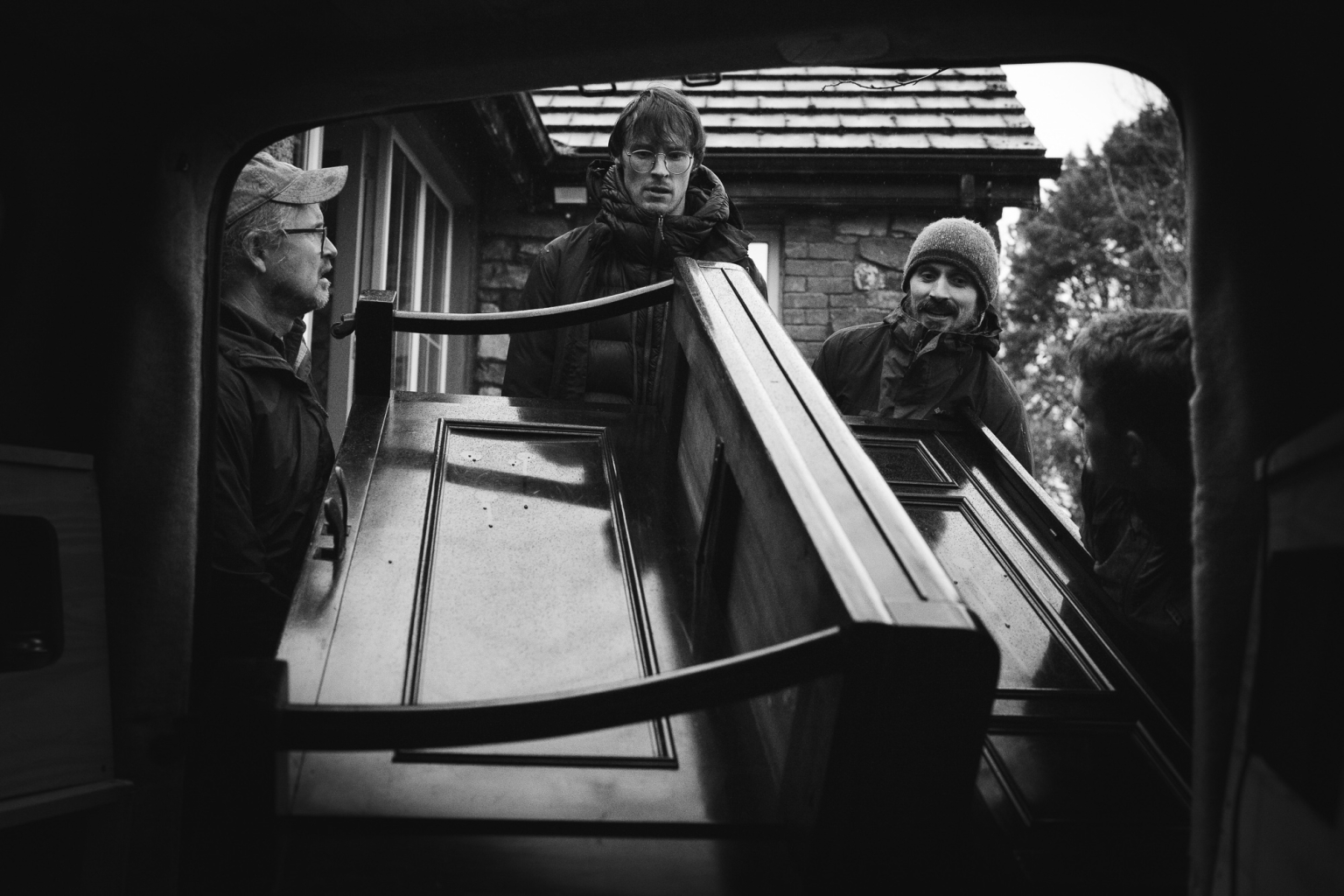
    Word came through from cousin Ed in Limerick: ‘Good news, I’ve a piano for you that’ll fit in Paul’s van.’ ‘Great stuff’ I enthused, blithely disregarding the challenge of getting it as far as my house in Sligo, let alone up the steps and through the door.

    Remarkably, cousin Paul agreed to make the trip on a dank evening in January when winter seemed interminable: ‘sure a road trip would be a bit of craic.’ Relative to other possibilities on that first weekend of January he was probably right.

    A layer of ice shrouded the tarmac as we set off from Sligo town on Saturday morning. At the Toberbride roundabout outside Collooney we bought what were apparently small Americanos. When these appeared in pint-sized cups it begged the question: what manner of receptacle is reserved for a large one? The proprietor clearly understands the importance of motorists loading up on the dark sludge before driving the first leg of the N17, especially on a bleak January morning.

    Collooney gives way to Ballinacarrow, where you find signs for Coolaney on the road to Cloonacool, then Tubbercurry anticipates Curry, and you’re into Mayo by the time the caffeine wears off.

    The Saw Doctors travelled the N17 from Tuam to Galway with ‘thoughts and dreams,’ a state of mind not recommended for the winding road to Tubbercurry, an accident blackspot. As for ‘stone walls and the grasses green’, although there are plenty of the former, the boggy fields are more fawn than green at this time of year, until you get past Tuam at least.

    The road widens before Ireland West Airport, outside Knock. There, Our Lady, Saint Joseph and Saint John the Evangelist appeared to Mary Byrne in 1879, but the opening of the airport in 1985 was the real miracle, as Christy Moore insisted. The messianic zeal of Monsignor James Horan brought this solitary crumb of infrastructure to a neglected north-west region in 1986.

    Only featherheads now dream of the Western Rail Corridor being resuscitated as far as Sligo, despite tangible evidence of surviving track under public ownership, recalling Monty Python: what did the British ever do for us? The 2024 All-Island Strategic Rail Review proposes new lines are restricted to connecting settlements with populations over fifty thousand, but how is a city, such as Sligo, supposed to expand sustainably without further rail infrastructure, and is Donegal to remain the forgotten county forever?

    The N17, which serves as the main north-south transport artery through Connacht, abuts a curiously desolate landscape, almost entirely devoid of native woodland. It offers a foretaste of the Midlands, without the charm of the waterways. Far from wild Atlantic shores, it’s scenery that nurtures disappointment.

    Beyond the seemingly supernatural marilyn of Knocknashee (‘hill of the fairies’), there’s barely a hillock in view along the entire route to Galway. There the slick motorways of another Ireland come into view. I’ve never taken the route other than under a sky that promises rain, and usually delivers.

    Many of the super-sized bungalows along it appear to have been constructed in the 1980s, when Ireland still exported its children. Aesthetic considerations did not figure prominently in the considerations of draughtsmen, who might as well have been paid by the room. The influence of Southfork, the Ewing Mansion outside Dallas, Texas is apparent in the expansive Southern Colonial style of some of these over-sized residences.

    Ribbon developments streak from historic towns, where the number of pubs diminish with each increase in the price of a pint. They say the kids prefer to go to the gym these days in any case.

    Beyond Galway, the gentle scenery of east Clare barely registered such was the speed we reached on the N18 motorway. Before long we were crawling through dystopian industrial estates outside Limerick. At last, we reached the city’s attractive inner core, including the country’s only Georgian Crescent, near the house where our piano was located.

    Ed had let us know there would be 5.5 men on hand to lift the piano. It turned out the .5 of a man was a blind Jack Russel, and that the additional men were piano players rather than heavyweight lifters. Undeterred, we hefted it out of the house – which mercifully had no steps at the entrance – and squeezed it into the van, albeit at a slightly awkward angle, without too much bother.

    There followed an evening of revelry, as the additional piano lifters, who turned out to be Maltese, revealed their real talent, as musicians. At one point, I am convinced, the blind dog chimed in, but sadly we lack documentary evidence to this effect. The only regret is that cousin Ed declined to sing his cult – a small cult admittedly – classic, ‘Mow’, about a young man taking refuge from the slings and arrows of outrageous fortune in the gentle comforts of cutting the grass.

    On Sunday morning we awoke early. Cousin Paul had taken further precautions against the January blues by booking a seaweed bath back in Sligo for that afternoon. The road rose to meet us at 9am, as we traced our way back home along the same route.

    At Milltown, Galway a large, modernist church that spoke of a more self-confident era was welcoming the remaining Cathaholics that shuffle through its doors. Among the pillars of Old Ireland, only the GAA continues to thrive. Today its brash, new club houses might pass for aircraft hangers. This is Supermac’s country of ersatz, super-sized Americana.

    After passing Tuam, we required further lashings of the dark sludge. At the petrol station in Ballindine a screen saver at the till read: ‘Coronavirus COVID-19 – Contactless – We would prefer if you could pay be contactless card.’ Covid frayed the social bonds like no other event in modern Irish history, and along the N17 it’s a gift that keeps on giving to a corporate aspiration for a brave new, cashless world.

    The real challenge came at the other end. Another cousin Johnny was thankfully on hand, and our photographer’s boyfriend Shane, a strapping Mayo man, was enlisted too.

    The great weight of a piano – most uprights weigh well in excess of 200kg – proved more of a challenge than anticipated, but after much heaving and straining – ribs were almost popped – we maneuvered it into the space. It now could do with tuning, and awaits a suitable hand.

    All Images: Síoraí Photography

  • On the Question of Immigration

    The European Convention on Human Rights (ECHR) is perhaps best understood as the culmination of the Enlightenment tradition of constitutionalism, hedged in legalistic language of proportionality and balance. It asserts that people have a right – or at the very least the right to have rights – to rely on the Convention when a domestic state has been derelict.

    It has been invoked successfully on many occasions against Ireland, most obviously with Mary Robinson’s enlistment by David Norris in 1990 to establish his right to privacy in terms of the criminalisation of homosexuality, in circumstances where the Irish domestic Supreme Court decided against him. That challenge fell within the rubric of Article 8 of the Convention: respect for your private and family life.

    The prohibition against torture and inhumane and degrading treatment under Article 3 of the Convention has protected Irish people in the infamous H Block 5 techniques case Ireland v U.K. (1979).

    Using the same Article 3, the ECHR sanctioned the rogue police state in the Greek case of The Regime of The Colonels (1966), and multiple human rights cases for the actions of various police forces not least in Turkey – referred to in a recent Cassandra Voices Podcast and article. It is noticeable that it has been extended to mental suffering, including demonisation by race. With ever more advanced techniques of torture, abuse and degrading treatment that extension was a jurisprudential necessity.

    A new podcast and article discuss fresh crackdowns targeting the Istanbul Metropolitan Municipality, with Fatima Akman Lehmann joining Luke Sheehan.https://t.co/nQzOJ3bxCP

    — CassandraVoices (@VoicesCassandra) January 3, 2026

    The track record of Ireland’s noncompliance does not make for pretty reading, not least the Norris Case. In many recent cases, given the fractured incorporation of the Convention, we have witnessed the development of the sinister interpretative obligation where the Convention is ignored if a constitutional principle applies, however dubiously, or as in the recent cases of Quirke and Dwyer, where the Irish courts used police powers and data protection to sidestep the Convention and thus entirely undermine its legal application.

    Along with others, historically we have been a rogue state in Convention compliance terms, and contrary to the view of Gerard Hogan our Constitution is a paltry substitute, not least given the diminution of Due Process by the Irish judiciary, which, in fairness, Hogan sedulously opposes.

    Now, with Minister for Justice O’ Callaghan leading the way, a joint statement of The Council of Europe calls for Article 8 of the ECHR, which protects the right to a family life, to be ‘adjusted so that more weight is put on the nature and seriousness of the offence committed and less weight is put on the foreign criminal’s social, cultural, and family ties with the host Country.’

    It also call for the crucial Article 3 to be ‘constrained to the most serious issues in a manner which does not prevent State Parties from taking proportionate decisions on the expulsion of foreign criminals, or in removal or extradition cases.’

    The joint statement also stresses the importance of ‘a states’ right… to control the entry, residence, and expulsion of foreigners from their territories, which should guide the interpretation of the Convention.’

    Image: Matt Barnard

    Vexed Question of Our Age

    Immigration has been the vexed question of our age, and the use of the word foreigner in the above statement is a deeply divisive word. There should be no such expression allowed in any language, only people. None of us are pure blood. The word “foreigner” in this context is meaningless.

    My experience of the ludicrous Irish refugee tribunal system was that the vast preponderance of claims were rejected, and if a tribunal chair had the temerity to admit to more than a minuscule amounts of claims he or she would be removed. The Cosma case (2006) – involving suicidal ideation – I litigated with Gerard Hogan in the High and Supreme Courts sidestepped Article 2 of the convention, in circumstances where there were tangible psychological reports. English tribunals are better but increasingly restrictive, albeit educated English judges tend to respect the Convention.

    In the Irish system I encountered judgments of monumental absurdity, involving ill-informed credibility assessments.

    It should be born in mind that many of those who seek asylum have been falsely convicted or framed by state criminals. Turkey comes to mind. When someone is accused by criminals of being a criminal the term loses any meaning.

    In all this the lessons of history and the reason why the Convention was founded are lost. Let us consider, therefore, given my mixed Austrian-Irish heritage, the respective experiences of forced or compulsory immigration in both these countries.

    In some cases, as in that of legendary Austrian-Jewish writers such as Joseph Roth, Stevan Zweig and indeed the very elderly Sigmund Freud forced migration was a consequence of real or prospective political persecution, and what is known as non-refoulement is a central part of immigration law, which is a well-founded fear of political persecution.

    That was during the last epoch of real barbarism. It’s clear that we are now returning to similar depravities, as the gyres of history turn.

    Apart from writers and intelligentsia who were often thoroughly disenchanted with the place, most of those leaving the country have done so for economic reasons. In more recent times, if not always, we have been welcomed into the U.K. and U.S.. Sadly, we no longer live in a world that extends a welcome to the poor huddled masses. And despite others welcoming the Irish, apart from welcoming tourists and accommodating multinationals, we have never really been the land of a thousand welcomes.

    Sideshow and Deflection

    The immigration issue is in fact a sideshow and deflection, where fag end capitalism foments hatred and discord, turning people against each other. It is often used to deflect attention from governmental inaction in housing and substantive equality matters.

    The Irish approach seems to be move immigrants down the canal, or use Gastarbeiter who pay exorbitant fees to shady educational institutions, but keep refusing them settled status.

    In a separate initiative O’Callaghan has a point about working immigrants contributing to accommodation costs, and no doubt family reunification issues do require careful consideration, especially with respect to the costing of whether those who come in can be supported by family members, but any denudation of Article 3 opens up a dangerous vista.

    Violent demonstrations and attacks on particular nationalities suggest that Irish parochialism and indeed racism have reached unprecedented levels. This is also the case in the rest of Europe and the UK. Let us consider the larger context.

    First published in 1918, and translated into English in 1926, Oswald Spengler’s The Decline of the West was perhaps the most influential text of the 1930s. Spengler  blamed what he saw as a declining European civilisation on the dilution of a mythical Aryan race – whether Germanic or Anglo Saxon. Spengler influenced Hitler and provided an ideological impetus for the extermination of undesirable races in the Holocaust or Shoah.

    Moreover, our age of chaos and uncertainty allows strongman leaders like Viktor Orban (whose Hungary signed this document) to assert as policy demonization of the other. If you listen carefully enough you will recognise that the Social Darwinism of another age is also the rallying cry of neo-liberalism, as an age of cartels and select groups brings exclusion and enforced conformity against others.

    It hardly matters to racists, who do not believe in science or empirical evidence, that there is zero evidence for the concept of race, as geneticists have worked out that every person on Earth can trace a lineage back to a single common female ancestor – a Mitochondrial Eve – who lived around 200,000 years ago.

    Franz Fanon

    Reproducing Colonialism

    Who is not a foreigner and what the hell does that mean? In works such as Culture and Imperialism (1994) and Orientalism (1978) Edward Said argued that ‘Patriotism, chauvinism, ethnic, religious and racial hatreds can lead to mass destructiveness.’ He also cites our very own Conor Cruise O’Brien to the effect that Imagined Communities of identity are hijacked by the petty dictators of state nationalism.

    Meanwhile, Frantz Fanon’s seminal anti-colonial text The Wretched of the Earth (1961) demonstrates how the indigenous population is required to pay the debts of the occupying powers.

    This is now being reproduced in our own societies in the form of austerity. The occupying powers are now the corporatocracy, or those with inherited wealth. The only difference from the colonial period is they no longer exclusively come from a distinct ethnic group. In fact, a veneer of diversity is achieved with the promotion of a few specimens with varied pigmentation. Leo Varadkar comes to mind. As long as they embrace safe, politically correct policies that ignore structural racism they become one of us.

    What Fanon said is true both of former colonialism and now internal colonialism by corporate vulture and hedge funds with politicians as puppets: ‘The people’s property and the people’s sovereignty are to be stripped from them.’

    Furthermore, with respect to the assault on Article 3, certain Irish nationals might nativistically welcome this without understanding that its denudation, in conjunction with the already denuded due process, ushers in the potential Article 3 violation of Irish citizens in Ireland.

    We are on a slippery slope to a larger police state.

    The previous site of the heavy gang on Harcourt Street may already be equipped with physical and newly given psychological torture techniques derived from American institutions. Be careful what you wish for citizens.

    Thus we find an increasing differentiation between ‘them’ and ‘us’, involving unedifying forms of class warfare and demonization of those outside the dominant culture, whether foreigner, migrant or displaced. ‘Killing an Arab’, the central theme of expurgation of ‘the other’ in Albert Camus’s L’ Étranger is now writ large in our culture.

    Camus, in my view the greatest writer, humanist and intellect of the 20th Century with his Shakespearean mixed-race native ambivalence is a ghostly prophet of the way we live now.

    Well before fascism there was of course widespread hatred of the wandering and or wealthy jew. The rebranding of Herzog Park in Dublin might be part of a resurgent anti-Semetism. Why not rebrand it Wittgenstein Park, after one of the great intellects of the 20th century, who is merely awarded a humble plaque in the Aishling Hotel.

    Albert Camus in 1957 by Robert Edwards
    Albert Camus in 1957 by Robert Edwards

    End of an Era

    We are seeing a growing hostility towards miscegenation, mixed marriages and corruption of bloodlines. Members of the blue-blooded, ‘Anglo-Norman’, Fine Gael party display an absurd sense of entitlement, while many Fianna Fáil members appear to be card-carrying racists, while a vigilante Catholic Right inveighs against alleged paedophiliac Asian men, while ignoring the litany of its own abuses.

    All is not lost in Britain, though the rise of Tommy Robinson and co does not augur well. Even in the polyglot cosmopolis – the ultimate melting pot that is London – the sense is that multicultural tolerance has been eroded substantially, and is being replaced by fractious intolerance, racism, class warfare, intimidation and social fragmentation.

    The Post Second World war humanist consensus is almost gone.

    The words of Stefan Zweig, who committed suicide in Brazil after fleeing Hitler’s Europe are returning to haunt us: ‘I feel that Europe, in its state of degeneracy has passed its own death sentence.’

    Feature Image: Syrian and Iraqi migrants arriving in Lesbos, Greece, in 2015 seeking refuge.

  • Banksy and Protest Rights: The View from The Robing Room

    As I sauntered from the Old Bailey past the RCJ the Banksy painting caricaturing a judge attacking a protester was no longer even a ghostly shadow, but it very much remains in the public domain, after reports emerged that it had been reported as criminal damage.

    On September 25, on Old Brompton Road, a comprehensive exhibition of Banksy’s work opened, which brazenly included the mural stencilled onto a different surface. This raised all sorts of issues about the commercialization of art and the edge of protest, not to mention whether or not he should be prosecuted.

    Based on Fiat Justicia, Mr Bansky faces prosecution for the recent RCJ Mural as criminal damage. I also hear he may be charged with being in contempt of court, leading to his long anonymity being exposed. Being named and shamed is another feature of our hysterical times.

    Recently, a bit like the opening to a P.J. Wodehouse novel, an erudite discussion was held among learned friends in the robing room of Hove Crown Court, steered by the most venerable member, as to whether the t-shirts, now selling fast, of this auspicious work should be deemed the proceeds of crime. The consensus was that in the U.K., post-conviction, the seller is responsible. Perhaps that is fanciful, but you never know.

    Policy considerations were also broached, such as whether in prosecuting him would you create a martyr that would lead to more t-shirts being sold? Would the state then be complicit in facilitating crime not least by increasing his revenues.

    Charles Dickens, his work the subject of many copyright violations and thieving particularly by Americans in his lifetime, expressed the view in Bleak House that it was far, far better to have nothing to do with the law. Well, it is certainly far better for the law to have nothing to do with Banksy, or is it?

    The consensus in the robing room was that given he is profiting from the mural, there was a strong argument for a significant fine, with the trial perhaps being conducted through in camera proceedings, preserving his anonymity, with any receipts being diverted back into the criminal justice system.

    Further, the venerable member concluded that he was inciting protest. The discussion took place over an entire lunch, and if any of us were briefed it would have occupied many days of court time, but should it occupy any court time at all is the real question?

    Mr Banksy, I am reliably informed, arrived at around 4-5am masquerading as a delivery truck driver. There was just enough light to use his meticulously prepared stencil. It is not now simply guerilla art, but increasingly reflective on worrying times. Many people are in on the act.

    The recreated version of the mural by Diiego Rivera, known as Man, Controller of the Universe.

    Diego Rivera

    Among the greatest painters of murals was Diego Rivera. His famous mural in the Rockefeller Center in New York was taken down because of his cheeky insertion of Lenin contrary to the edicts of one of the citadels of world capitalism. They destroyed it in violation of copyright law. An integrity right protects a work from being destroyed, mutilated or defaced or put it in an inappropriate setting.

    Examples of violations include colorizing a black and white film such as The Maltese Falcon (1941), or including ad breaks during the Monty Python parrot sketch, or inserting cover ups of nudity, such as even in the Sistine Chapel, but outright destruction is rare. Indeed, there was uproar in Berlin when some of the murals on the Berlin wall were destroyed.

    The Banksy mural was an insertion of overtly political content in a work of art, and the destruction or censorship of protest art has always been a feature of oppressive regimes. So, was the reaction disproportionate or ill-thought out?

    Mr Banksy is a national treasure, and frankly as great an artists as any in England since Lucien Freud. I suspect any prosecution will backfire or has, revealing institutional incompetence and hubris.

    The Banksy mural has significant political implications and presents authoritarian judges and the state cracking down on protest, not least in response to legitimate public outrage over Gaza, but what’s good for the goose is also for the gander. It is legitimate political art, but the regulation of protest as opposed to protest art is more complex now.

    Jasper Johns’s ‘Flag’, Encaustic, oil and collage on fabric mounted on plywood,1954-55.

    Protest Rights.

    The flag of St George is also copyright protected, and very similar to the flag of Switzerland and indeed the Red Cross, but it has been traduced by maniacs spreading hatred and division. The visibility of the flag has increased significantly across England.

    It is now the case that English, Irish and indeed American national identity is as fragile as the American flag fractured and loose as in the Jasper Johns painting. The Irish tricolour is also a symbol of unity of green and orange, but is now potentially divisive. Extreme nationalism, along with racism, is one of the scourges of our time. It is a reversion in my view to the 1930’s – symptomatic of a new dark age.

    There is, of course, a marked distinction between genuine patriotism and the revival of tribalistic, exclusionary and racist nationalism. Not all patriotism to reference Jeremy Bentham is the refuge of the scoundrel.

    But racism and chauvinistic nationalism go hand in hand and generally morph into fascism. The target is the excluded other, now the immigrant. Nigel Farage is now proposing to remove those without a settled status.

    Timothy Snyder recently came off the fence in On Freedom (2024) labelling the alt-right fascists, after considering the etymology of the term. But is he also an enabler given some of the neoconservative views he has expressed?

    Let us cease bandying about anodyne terms like crypto-fascism and use language with precision and exactitude. There are now fascists and a gathering mob, but this has been engineered by, and is under the control of, others. Who then are the enablers is the crucial question?

    Is Banksy an enabler? I am not so sure

    Source: BBC.

    London Protests

    On the streets of central London recently I was reminded of three things: John Reed and Ten Days That Shook the World (1919), his blow-by-blow account of the Russian Revolution; the scene in Cabaret (1972) where, semi-fictitiously, Christopher Isherwood decides to leave Berlin after hearing a version of Horst Wessel being sung. Finally, surveying the hate-filled eyes I was also reminded of Leni Riefenstahl’s Triumph of the Will (1935).

    I would argue that a similar species of Irish hatred is more vicious but far less powerful in electoral terms, bu there is now a real danger of the extreme right winning power in the U.K..

    Dozens of police officers were injured at the protests, yet only twenty-five arrests were made.  The counter demonstrators, understandably smaller in number, were non-violent, and let us be clear that a right to protest is intrinsic to democracy. Peaceful protest that is, an idea as old as Gandhi or Martin Luther King. Yet there were 500 arrests made at the peaceful Gaza protests in early October.

    This casts the right to protest into doubt, or at the very least demonstrates a need for greater regulation and proportionality. The insurrectionist riots and arson attacks on accommodation related to asylum seekers in Ireland in recent times is also a case in point, demonstrating the necessity of regulating (violent) protest.

    The Just Oil protesters, with others to come, were convicted under the Police, Crime, Sentencing and Courts Act 2022 (PCA) of conspiracy to cause a public nuisance, in response to the M25 motorway disruption in November 2022. Judge Hehir dismissed the defence of mere political opinion and belief as excluded from the present English legislation.

    That decision undoubtedly opens a dangerous vista, but the crucial question is that of whether a demonstration potentially causes harm, and that one clearly could have caused harm, and it certainly caused a significant furore and inconvenience.

    “Lilies that fester smell far worse than weeds.”

    Orange lily

    In the famous common law prosecution orange lily case Humphries v O’ Connor (1864) plucking an orange order lily from a woman in the nationalist area of Belfast was deemed a justifiable police act and regulation of protest, as the offending lily had the potential to cause a breach of the peace. This occurs when an individual causes harm, or if it is likely that they will cause harm to another individual or property, or if it puts another person in fear of being harmed.

    As Shakespeare put it in Sonnet 94:

    For sweetest things turn sourest by their deeds;
    Lilies that fester smell far worse than weeds.

    But what harm or public nuisance has Banksy caused? He has frankly adorned RCJ with better artwork outside than there is inside. Is it really an incitement to protest in contravention of the law or a protest to survive?

    Ronald Dworkin, towards the end of his career, wrote an article on the Right to Ridicule peculiarly appropriate to Banksy. There are, for sure, limits, such as Enoch Burke silently or not so silently protesting outside his school. He is not an artist and most decidedly frankly a nuisance, disturbing children being educated. So perhaps certain forms of protest should be consigned to Mountjoy. But there are also demonstrators from Stop Oil, Gaza Extinction Rebellion residing, perhaps excessively, in custody in the U.K.. Now, perhaps a great artist in will be in there next. But that mural was created before 150,000 people turned up in central London.

    The great political artist of our time, a private and ostensibly decent man, should not be publicly prosecuted for making legitimate points of criticism, with a drawing that Goya Picasso, Schiele or indeed Hergé would have been proud of. Hergé’s TIN TIN books were about the Manichean divide between good and evil. So who is the demon today, the contemporary Captain Haddock?

    Banksy deserves an anonymous knighthood not public humiliation. He should be known by his self-designation and not outed by a magistrate’s court.

    Whether he should pay a fine for profiting commercially from the mural is a different question. After all, would he not approve of charges being pressed against the fascist mob that attacked the police?  Perhaps any proceeds should go to police wellness programmes?

    In the film Cabaret the Isherwood character says: “do you really think you can control them?” Well, Banksy do you? And are you encouraging them or inciting the mob, the robbing room sagely discussed.

    It is crucial to realize that the Populist alt-right and indeed at times the extreme left have served to reduce speech and protest rights in an increasingly vigilante age, and now use protest to destroy democracy. So be careful about admonitions of judicial crackdowns even through art. For many are using democracy to destroy the social democratic consensus. And fringe leftist protests such as Just Oil are not much better.

    So, the legal arguments about disproportionately cracking down on violent or even peaceful protests certainly are no longer as clear-cut as the mural might suggest.

    In the robing room the venerable member concluded that perhaps an arbitral solution might involve a private settlement, i.e. a charitable gift. But none of that settles the regulation of the right to protest, which is now increasingly fragile.


    Feature Image: Banksy mural, 8 September 2025.

  • Ностальгия

    ‘I confess I do not believe in time.’
    Vladimir Nabokov

    On a hostel rooftop in Morocco, I met a Russian man who had not been home since the war broke out. I was there to catch the last of the sun and read my book in peace so when he first introduced himself I made no effort to be friendly. It soon became clear that he wasn’t motivated by any particular attraction to me, as I had immediately and arrogantly presumed, but because he had seen that I was reading Bulgakov’s Heart of a Dog. Some mingled instinct of nostalgia and boredom had led him to overcome his aversion to intruding on strangers, he explained.

    I invited him to sit and the conversation roamed freely. He described late spring in St Petersburg and the peculiar sense of dissolution that comes with moving through endless bars and the sun never setting. I told him about the St Patrick’s Day parade in Dublin and people in green hats strewn on the bridges at dawn. We spoke about the war and about La Rochefoucauld and about rap. We agreed that Tolstoy was better than Dostoevsky; we disagreed about Kendrick Lamar and Drake. Soon it was dark so we got a six pack of Casablanca beers and sat by the pool. We shared a pack of Marlboro Golds and began to talk about heartbreak, naturally. He said that in Russian there are more specific words for sadness: Тоска, Надрыв, Грусть, Ностальгия. I gave him my pen so he could write them in the back of my book. When we finished all the beers he retrieved a half bottle of vodka from his room. We made light of our romantic humiliations. You can speak most openly with people you know you’ll never see again.

    I didn’t think about him again until recently, in a bookshop in Dublin, when I came across a copy of Nabokov’s Speak, Memory, which had come up that night. He’d urged me to give it another go, insisting it was worth it, even going so far as to say it was his best work, which isn’t an opinion you hear much. Even Nabakov said it was a dismal flop, and he wasn’t known for his humility.

    I should get it out of the way that I read Lolita at a formative age, close to Lolita’s age, in fact, and that I loved it completely without understanding it in the slightest. (I used to think this was a unique experience but over the years I’ve met many women like me.) Lolita is the book I’ve returned to most and my love for it has only deepened, though now I understand its awfulness. So, as a long time fan of Nabokov, I’m disposed to forgive his more unlikeable traits, which I admit are unlikeable in the extreme: his aristocratic disdain, his insistence on his own brilliance, his exhausting multilingual wordplay, his obsessive control over interpretation, his stylised indifference. Updike put it best: ‘I don’t like what his ego has done to make him so very complex.’ All Nabokov’s vices are displayed most opulently in Speak, Memory.

    It’s less of an autobiography than a record of personality. He sets down a few of his passions, such as lepidopterology, but more importantly, he catalogs his many hatreds. They range from small gripes with Freud’s theories or disagreements with ignorant critics to the amazingly vague, such as music (‘an arbitrary succession of more or less annoying sounds’), or sleep (‘I simply cannot get used to the nightly betrayal of genius…the wrench of parting with consciousness is unspeakably repulsive to me.’) Every time I’ve attempted to read Speak, Memory I’ve gone in with good intentions and every time I’ve been thoroughly defeated.

    This time, however, the book seemed to speak directly into the conversation with the Russian man on the hostel rooftop in Morocco. I saw it as a story about exile and nostalgia, and I wondered if he had urged me to reread it because he understood that neither of us had been home for years, though his reasons were far graver and sadder than mine. The word nostalgia, as you may already know, comes from the Greek νόστος, ‘return home’, and ἄλγος, ‘ache’.

    Speak, Memory tells the story of the author’s aristocratic childhood in Russia at the turn of the century, the 1917 Bolshevik revolution that forced him to flee, and his attempts to build a new life in America. Early on, Nabokov makes it clear that his project is not political but sentimental, addressing a brief chapter to ‘the particular idiot who, because he lost a fortune in some crash, thinks he understands me.’ ‘My contempt for the emigre who hates the Reds because they stole his money and land is complete,’ he explains. ‘The nostalgia I have been cherishing all these years is a hypertrophied sense of lost childhood, not sorrow for lost banknotes.’

    Out of that childhood he creates something mythical and shadowless. He elevates to epic proportions something that is, in fact, very ordinary. He misses his beautiful mother and the garden where he used to play. He wishes he could go back. But he can’t admit it so straightforwardly so he invokes the Muse, like Homer. The Muse steps in and the past rushes back, intact. ‘I see again my schoolroom in Vyra, the blue roses of the wallpaper, the open window. That robust reality makes a ghost of the present. The mirror brims with brightness; a bumblebee has entered the room and bumps against the ceiling. Everything is as it should be, nothing will ever change, nobody will ever die.’ The motivating impulse is against oblivion. Like with the butterflies he pins to a board, he wants to take the moment in all its impossible detail, to fix and immortalise it. The enemy is time, which pulls you away from everything you love. Memory is a tool for defeating time.

    Nabokov’s exile isn’t just a matter of geography or politics; it’s a spiritual condition marked by the loss of a world that no longer exists. Speak, Memory doesn’t progress logically, it circles back on itself, drawing connections through motif and image rather than sequence. Its structure mimics the strange, folding logic of memory, where one detail can suddenly trigger a whole Proustian journey of the mind.

    This associative structure is how diasporic cultures preserve history. It is encoded in fragments, in music, in idioms, in rituals that seem personal but are weighted with collective meaning. The longing for return, or for a wholeness that never fully existed, becomes formal rather than simply emotional. Nostalgia is a structural feature. It organizes the past via symbols. In such contexts, the ache of memory is not a flaw. It is how identity endures across distance.

    In the back pages of my book, I still have the man’s careful, looping words in Cyrillic: Тоска, Надрыв, Грусть, Ностальгия. I’ve forgotten the precise differences between these shades of sadness, but the point remains: not all nostalgia is the same. There is the soft kind, the sentimental kind that sells postcards and heritage tours. But there is also a harder kind: nostalgia as mnemonic, as survival instinct.

    Feature Image: Walter Mori

  • A Visit to the Hague

    Late last year HHJ Gumpert KC – one of the judges in the formidable fortress that is Woolwich Crown Court the flagship anti-terrorism court in the U.K. – kindly secured for me a visit to the ICC out of court time. The tour was given by a former member of the team he led in the Congolese prosecutions.

    The ICC issued its first judgment in 2012 when it found Congolese rebel leader Thomas Lubanga Dyilo guilty of war crimes related to his abuse of child soldiers. Lubanga was sentenced to fourteen years’ imprisonment. Gumpert also successfully prosecuted Dominic Ongwen, who was sentenced to twenty-five years for myriad crimes.

    The Rome Statute, which entered into force on 1 July 2002, established the International Criminal Court, though Israel voted against it, after murmurings on the transfer of populations that is the resettlement programme. The court works on the principle of ineffectiveness, where national courts have been derelict. It lacks universal territorial jurisdiction, and may only investigate and prosecute crimes committed within member states, crimes committed by nationals of member states, or crimes in situations referred to the Court by the United Nations Security Council.

    On 17 March 2023, ICC judges issued arrest warrants for Russian leader Vladimir Putin and the Presidential Commissioner for Children’s Rights in Russia for alleged child abductions in the 2022 Russian invasion of Ukraine. Putin was charged for actions against Ukraine, which although not a party to it, has accepted the authority of the court since 2014. Should Putin travel to a state party to it, local authorities can arrest him. Later in 2023, Russia’s Ministry of Internal Affairs retaliated by placing several ICC officials on its wanted list. On November 21 last year, when I was in Gompert’s court in Woolwich, warrants were formally issued for the arrest of Benjamin Netanyahu.

    It occurs to me that an informal journalistic war crimes court was initiated by Christopher Hitchen, whose book The Trial Against Henry Kissinger (2001) accused Henry Kissinger of war crimes. This led to a Parisian judge issuing an arrest warrant and Kissinger hopscotching it back to the safety of Fox News. So, Netanyahu will no doubt control his foreign trips, and Ireland is clearly out of the question. Mr Putin does not seem to need to travel to enemy states.

    The process to establish the ICC district may be “triggered” by any one of three sources: (1) a state party, (2) the Security Council, or (3) a prosecutor.

    So, there is huge independence in that there is a self-originating prosecutor jurisdiction. though he needs the approval of Pre-Trial Chamber to initiate the investigation. The factors listed in Article 53 are a reasonable basis for a prosecution. These include whether the case would be admissible, or whether there are substantial reasons to believe that an investigation would not serve the interests of justice (the latter stipulates balancing against the gravity of the crime and the interests of the victims).

    Brumandinho Dam Disaster, Brazil, 2019.

    2016 Policy Paper

    During my visit there was much talk about the Policy paper on case selection and prioritisation published in September 2016, indicating that the ICC would focus on environmental crimes when selecting cases. According to this document, the Office will consider prosecuting Rome Statute crimes that result in, inter alia, the destruction of the environment, the illegal exploitation of natural resources or the illegal dispossession of land.

    Richard A. Falk coined the phrase Ecocide as a Crime Against Humanity in 1974. In my view we should also include Economicide, when one deals with the illegal dispossession of land. What about bringing banksters or hedge fund managers (including through NAMA) to justice? And what about no longer drawing a distinction between the Kinahan gang and Goldman Sachs? Or is it time bring a case against Bill Gates or Elon Musk?

    It should be born in mind that, alas, having someone prosecuted by the ICC is a tricky exercise. The Israelis clearly breached international law when they bundled Adolf Eichmann onto a plane in Argentina in 1960. How do you get Netanyahu to court? Or Putin? Or what if one indicted Trump or Bannon? A real danger is that the present U.S. administration will directly or indirectly withdraw funding for the court, even though the U.S. is not a signatory. They might even undermine American officials for working against the interests of Israel, or any of its allies in this dangerous world.

    The core concept of Crimes Against Humanity had its first incarnation during the Nuremberg Tribunal, but its inception may derive from the discourse in Sophocles ‘Antigone’ as to whether an immoral law is a law. In that play – the Rosetta stone of modern natural law – the heroine Antigone observes to the harsh, positivist Creon, King of Thebes, who will not allow her brother, who has fought against him, to be buried with the proper rites, that natural law has been breached.

    Yes; for it was not Zeus that had published me that edict; not such are the laws set among men by the justice who neither dwells with the gods below; nor deemed I that thy decrees were of such force, that a mortal could override the unwritten and unfailing statutes of heaven. For their life is not of to-day or yesterday, but from all time, and no man knows when they were first put forth…

    From the great Roman statesman Cicero’s perspective, an unjust law is not a law: ‘Those who formulated wicked and unjust statutes for nations, thereby breaking their promises and agreements, put into effect anything but laws.’

    Most famous of all, early Christian lawyers, St Augustine of Hippo said: ‘lex iniusta non-Est lex’ – an unjust law is not a law.

    Radbruchs’s Formula

    A crucial juristic figure was the German Gustav Radbruch (1878-1949), both a law professor and a government minister during the Weimar Republic. In Radbruchs’s Formula he argued that where statute law was incompatible with positivist law to an intolerable degree, and where it negated the principle of equality, which is central to justice, it could be disregarded.

    [P]reference is given to the positive law, duly enacted and secured by state power, even where it is unjust and fails to benefit the people unless it conflicts with justice to so intolerable a level that a statute becomes in effect false law and must therefore yield to justice…where there is not even an attempt at justice. Where equality, the core of justice, is deliberately betrayed in positive law then the statute is not merely false law it lacks completely the very nature of law.

    For him justice (Gerechtigkeit) was linked to human rights. Thus, in Funf Minuten Rechtsphilosophie he contended that there was a law which was above statute: ‘However one may like to describe it: the law of God, the law of nature, the law of reason.’

    It is important to note that his views were followed in various German cases after the War and was part of the discourse that led to the Nuremberg war crimes tribunal.

    Historically much later, in the 1992 cases of Strelitz, Kessler and Krenz, former East German Border Guards were convicted of offences despite section 27/2 of the East German Border Act that indicated that the protection of the border outweighed the right to life. The German Supreme Court in endorsing Radbruch indicated that:

    [A] justification available at the time of the act can be disregarded due to its violation of superior law if it shows an evident and gross violation of basic principles of justice and humanity… The contradiction of the positive law to justice must be of such unbearable proportions that the law must yield to justice as incorrect law.

    A group of Bosniaks from the Lašva Valley close by Travnik, Bosnia and Herzegovina that were forced out of their homes and villages by Croat forces in 1993. Photo: Mikhail Evstafiev.

    Ethnic Cleansing

    The Nuremberg Court and The European Convention on Human Rights were set up with the idea that the cataclysms of the past must never happen again. Sadly more have come to pass. In Bosnia we witnessed the arrival of a modern variant: ethnic cleansing. In 1992, the United Nations General Assembly deemed ethnic cleansing to be a form of genocide stating that it was:

    Gravely concerned about the deterioration of the situation in the Republic of Bosnia and Herzegovina owing to intensified aggressive acts by the Serbian and Montenegrin forces to acquire more territories by force, characterised by a consistent pattern of gross and systematic violations of human rights…. controlled areas of concentration camps and detention centres, in pursuit of the abhorrent policy of ‘ethnic cleansing’, which is a form of genocide.

    In 2001, the International Criminal Tribunal for the Former Yugoslavia (ICTY) judged that the 1995 Srebrenica massacre was genocide though the Court had no authority to determine whether it amounted to war crimes and Crimes against Humanity. A kind of fore runner of the ICC though ad hoc.

    The court concluded by seeking to eliminate a part of the Bosnian Muslims, the Bosnian Serb forces had committed genocide. They targeted for extinction the 40,000 Bosnian Muslims living in Srebrenica, a group which was emblematic of the Bosnian Muslims in general.  They stripped all the male Muslim prisoners, military and civilian, elderly and young, of their personal belongings and identification, and deliberately and methodically killed them, solely on the basis of their identity.

    Slobodan Milosevic, the former President of Serbia and of Yugoslavia, was the most senior political figure to stand trial at the ICTY. He was charged with having committed genocide. The formal accusation accused him of planning, preparing and executing the destruction of the Bosnian Muslim national, ethnical, racial or religious groups, as such, in named territories within Bosnia and Herzegovina.

    He died during his trial, on 11 March 2006, and no verdict was returned. Ten years later, Radovan Karadzic was found guilty of genocide in Srebrenica, war crimes and Crimes against Humanity, ten of the eleven charges in total, and sentenced to forty years’ imprisonment.

    Morality of the Law

    The natural lawyer Lon Fuller, in supporting Radbruch, argues that the German courts were correct in striking down the Nazi laws and that a legal system must have certain characteristics if it is to command the fidelity of a right-thinking person. Fuller, in The Morality of Law, (1964) argues that Nazi law did not have coherence and goodness and instances the use of retroactive legislation, such as the Rohm purge of 1934. Further, for Fuller, the Nazi laws were deeply immoral for a variety of procedural reasons. They were not published, they were vague, and they could not be interpreted in a congruent fashion.

    We are now entering such a dangerous universe. In camera, unpublished surveillance laws are violating privacy, and retroactive and overly broad legislation erode free expression. The anti-immigration hysteria and the rise of the far right may lead to de facto ethnic cleansing. The control of the world by transnational corporations has occurred through violations of privacy, data mining and economic crime.

    The real concern in northern Europe and in Brussels also is around how AI will not be controlled by a corporate economy. Why is that? Considerations of profit will ensure, as the former head of AI in Google recently argued, that within thirty years there is a ten to twenty percent chance of human liquidation. It trespasses in an unbridled way on boundaries.

    The question of compensation and reparation also arose in our discussion at the ICC, and I mentioned that the Innocence Project in all its conferences has a separate stream for the exonerated. So does the ICC. Thus, surely it is time the Irish government finally to deliver on its Magdalene Laundry promises, and compensate those disposed by banksters? Fat chance.

    The concept of obligations ergo omnes needs to be extended to new challenges. The ICC needs to be supported to extend its jurisdiction. They seem beleaguered but to quote Halldor Laxness they are at least Independent People. Independent People are important. Thus bankers were jailed in his native land Iceland when Independent People prevailed.

    Feature Image: The premises of the International Criminal Court in The Hague, Netherlands. The ICC moved into this building in December 2015.

  • The Relevance of Jurisprudence to Law Part 3

    The remains of unquestionably the greatest intellect of the nineteenth century, Karl Marx, are buried in Highgate Cemetery in London. I recently tossed a red rose on the site. I doubt whether Judge Gerard Hogan, to whom I have addressed previous articles in this series, or any other legal positivist, would do likewise.

    While positivists often engage, though disagree, with rights-based -thinkers such as Ronald Dworkin, most exhibit a level of incomprehension, and often outright hostility towards certain forms of Radical Jurisprudence. No doubt the often unclearly expressed ideas of late Marxism, structuralism and post structuralism often are a factor, but that is only a partial excuse.

    Noam Chomsky – himself a linguistic positivist – once made a comment to the same effect on these authors, exempting Michel Foucault. He had developed a rational understanding of Foucault, but none for example of Derrida, who many including myself regard as largely intellectually fraudulent. Indeed, many Cambridge University philosophers objected to the conferring of an honorary degree on him, although I believe there is an element of truth to his babbling on relative truth or foresight.

    This plan of Jeremy Bentham’s panopticon prison was drawn by Willey Reveley in 1791.

    Panopticon

    It is, nonetheless, easy to see why, as far as my harsh assessment of post-structuralism Foucault is exempted. Foucault makes very relevant contributions to Jurisprudence and the practice of law.

    First, the transplantation of Jeremy Bentham’s idea of the panopticon – the all-seeing surveillance prison such as Kilmainham in Dublin – is in Foucault’s view a depiction of modern society, where a uniform doctrine is enforced in schools, law courts and hospitals, leading to blind conformity.

    Foucault presaged the age of Surveillance Capitalism and 24-hour data surveillance in Ireland, achieved in camera in the Quirke Case through the representations of the Minister for Justice Helen McEntee. Thus, we have a global panopticon wherein the value of privacy and freedom is thrown to the wolves.

    Now our judges aside from Hogan, most recently in the Dwyer Case restricting the privacy right, ignore ECHR and EU law. This undermines an ideal of liberty, at least as old as J.S. Mill in modern times, and in fact going back to the Greeks. So, Foucault’s insight is not about postmodernism. It translates into the destruction of rights under Article 3 of the Irish Constitution and 8 and 5 of the Convention.

    The second of Foucault’s contribution is his book on madness in the age of reason. The fundamental tenet is that the Enlightenment / Age of Reason involved the necessity, intellectually and then institutionally, to confine the unreasoned – those who were called mad – into asylums. Well, who is mad and who is clinically insane?

    The recent US Democrat convention, with the rather wonderful Mr Walz speaking from the heart on middle-class US conservatism about banning books and depriving choice stands against that Twitter conversation between Musk and Trump.

    The problem of reason and madness is also clear earlier in Ken Kesey’s masterpieces ‘One Flew Over The Cuckoo’s Nest’ (1962). What happens when the lunatics have taken over the asylum and a dissident voice says no? What of when the man or woman of reason, the pursuer of nuance and grey, the boy who cries wolf, the creature of the Enlightenment is locked up by those who are in fact self-interestedly insane.

    Foucault was apparently not on the UCD Jurisprudence syllabus in the late 1970s. A short journey to the Arts block to encounter Richard Kearney’s expertise in Continental Philosophy would have been beneficial.

    Marx and Engels in the printing house of the Neue Rheinische Zeitung. E. Capiro, 1895.

    The Crucial Figures

    The crucial figures of radical jurisprudence are not the structuralist, even Foucault, but the great Marxist theoreticians. For Marx law was a mirage, an ideology upholding the interests of the bourgeoisie, He considered it a mere superstructure determined by the economic base. Law, he observed, served the interests of the ruling class.

    Thus, in Marxist terms Hogan’s analysis of Kelsen is a form of intellectual masking or ideology justifying a form of state authoritarianism, which Marx would surely have interpreted precisely as the Populism of the petit bourgeoisie. No judicial deferral should be granted to the popular sovereignty of the mob.

    Marx though is not consistent about law. He argues that in the properly ordered Communist society there would be no need for laws, as we would spontaneously co-operate in our Communist Nirvana. But at times he concedes, inconsistently, that law is not always bad, and a close textual analysis of his views on property rights, and the freeing up of the alienation of estates to facilitate greater capital, shows that sometimes the superstructure can influence the base, and thus influence economic relations.

    So, what of Ireland controlled by a landlord class achieving nothing and facilitating careers going nowhere except to Microsoft and criminal banks, or the legal service class who act like vultures preying on the vulnerable on behalf of the powerful?

    The legal realist Oliver Wendell Holmes in his famous rebuke to unregulated free market economics in Lochner (1905) said the Fourth Amendment does not enact Mr Herbert Spencer’s social statics, and nor should the Irish Supreme Court enforce the interests of the commercial fat cats of Aran Square or elsewhere.

    Many Marxists, such as Lenin, saw the necessity for rules in a never-ending interregnum on the way to a Communist Utopia, which is never to be achieved. More pragmatically, the fundamental question for any judge which the Marxists pose is: whose interests do the rules serve?

    The Marxists influenced the critical legal studies movement, which to some extent educated me, adopting the radical indeterminacy thesis, an idea borrowed at one level from the legal realists. They argue that given the plasticity and malleability of rules, legal outcome can be very unpredictable and in fact subjective.

    There really is no such thing as a ‘plain fact’ or literal interpretation of almost any legal text. To avoid nihilism we should invoke moral principle as a corrective.

    Alienation

    The term alienation coined by Marx more generally to describe exploitation of workers serves as a warning as to how our government is destroying both the working and middle classes,

    Subsequent Marxist have been more approving of law. The legendary Antonio Gramsci, while imprisoned by Mussolini, adopted the phrase ‘hegemony’ to suggests as necessary a form of co-operation in law, politics and culture between the proletariat and the bourgeoisie. Now this coalition argument suggests law can be used as an instrument of social change. That depends on a desire to change for the good.

    One wonders whether the new, petite bourgeoisie-aligned Keir Starmer government in the U.K. should be a source of optimism or seen as a false dawn? More taxes on the wealthy, or further savage austerity for the poor?

    The Rule of Law is a central concept in jurisprudence, though hotly contested, and Marx aside, it has dominated the thinking of some of the main Marxists thinkers of recent vintage.

    In his codicil to Whigs and Hunters (1975), E.P. Thompson expressed a view on the Rule of Law as an unqualified good, which at times could check arbitrary authority. That of course assumes the Rule of Law exists in an ethical polity. It is not that evident in Ireland today as core principles are violated or improperly implemented.

    Thus, the independence of the judiciary is not obvious in Ireland, the use of in camera proceedings, akin to the promulgation of secret laws, is a cardinal violation of the notion that justice must be carried out in public. We also find an apparent tolerance of police corruption, the abandonment of substantive rather than formal equality, and indeed the abandonment of constitutional rights.

    Thompsons argument is premised on the idea that the judges are willing to enforce the rule of law, often with the effect of unsettling vested interests, as in the recent, painfully prolonged, Assange case. Irish judges are more likely to do the opposite.

    Jürgen Habermas

    Habermas

    Jürgen Habermas is, as ever, a crucial contemporary thinker, and, with all due respect to Gerard Hogan’s veneration of Kelsen, he is not just the world’s leading intellectual figure but the towering German intellect along with Thomas Mann and Kafka of the 20th century.

    Since Habermas abandoned the Frankfurt school, and thus post-structuralism, he has become, for over fifty years, one of the great proponents of the Rule of Law and legalism. He stresses the importance for judges not to subvert rights and parliamentary laws protecting civil liberties including the right to protest, viewing civil disobedience as central to revitalizing democracy.

    In contrast, the knee jerk reaction in Ireland and the UK has been to give more powers to the police to regulate dissent.

    Habermas’ other idea of communicative action, borrowed at one level incidentally from the arch positivist Austin, is the elaboration of the idea of ideal speech. His ideal for the vindication of speech rights is the eighteenth century salon. The ideas of communicative action in legal and judicial terms blends into the ideas audi alterum partem (‘listen to the other side’), and the obligation not to be either subjectively or objectively biased.

    Ideology, a term adopted by Marx, has been reinterpreted by Slavoj Žižek, drawing on another Marxist in Lacan, as ideological misidentification. In both instances, and applied to law, there is the sense that the bureaucratic class are engaged in false consciousness or deceptive ideas.

    Lon L. Fuller, who is not a Marxist but a natural lawyer, argued that once a legal system has not a tinsel of legality left, but enforces barbarism, it is no longer a legal system.

    To round the series off, a Marxist would fully understand the rage of Populism, but not necessarily approve of it. Of course pure Communist societies do not work, but nor does pure neo-liberalism. Indeed, Ireland is not working except for the landlord class.

    What does work legally ethically and morally is a social democratic Just Society advocated by the master John Rawls. What does work is Sweden, Denmark, Norway and much of northern Europe, where people are not in Marxist terms commodified and viewed as product, but in the moral Kantian sense things in themselves.

    John Rawls intellectually speaking would never have existed but for Karl Marx and a difficult thing for a legal positivist practitioner to realise is that Marx is in fact the greatest of all legal, political and economic philosophers. This is not to say he is entirely correct or a model to be followed in overall societal regulation, but a useful corrective to interpret laws and asses whose interest they serve and, if necessary, to bend rules to achieve socially just outcomes.

    Dworkin in fact argued that the South African judges during Apartheid should potentially have lied about the content of a racist law. I also agree or rather at the very least that they should have interpreted it to bring about socially just outcomes.

    Marxism at its best focuses on civil and in particular social and economic rights, and the judiciary responsibility to enforce them into the law and the Constitution, to the extent that this is consistent with the Rule of Law.

    Feature Image:Tomb of Karl Marx, East Highgate Cemetery, London.


  • The Relevance of Jurisprudence to Law Part 2

    In the first part of this series, London-based barrister, who taught Jurisprudence for sixteen years in the Honorable Society of the King’s Inns in Dublin, David Langwallner takes issue with Irish Supreme Court Justice Gerard Hogan devotion to Legal Positivism, instead arguing morality and politics should inform the law. He elaborates further on that debate in this article.

    This piece details what I believe is absent in the form of Legal Positivism that has been advocated by Supreme Court Judge Gerard Hogan. Indeed, there is a wider blind spot among the Irish legal establishment on whether jurisprudence should go beyond Legal Positivism, into the territory of Natural Law.

    A few years ago this debate might have been confined to the classroom and seminar, but it now assumes central importance.

    There is currently a crisis of legitimacy in the Rule of Law worldwide, unprecedented since the 1930s, and Ireland is not exempt. In my view Positivistic limitations on the subject is a sign of intellectual infantilism – an unnecessary curtailment of the boundaries of law, and what it means. Worse still, Legal Positivism contributes to a false assurance of just outcomes.

    The Nuremberg Trials.

    The Fundamental Question of Jurisprudence

    Let us thus address the fundamental question of jurisprudence: what law is, and what that matters in its practice?

    For a Positivist, the essence of law is legal fact, if it stems from an authoritative source often referred to as the Sovereign. Or let us call it, as Hans Kelsen and Hogan do the grundnorm (‘basic norm’). Then the law is divided into rules conferring powers on officials, within a given system, to apply them. This process occurs at a remove from politics or morality.

    H. L. A. Hart, the other leading Positivist with Kelsen, calls these rules either primary or duty imposing rules, or secondary or power conferring rules, which often rely on enforcement by adjudication by tribunals or courts, but not, it seems, by interpretation. That is the initial fallacy.

    Thus, according to Legal Positivism the job of any official is to apply rules literally. Giving, what Ronald Dworkin called, ‘plain facts their plain meaning.’

    Yet, very little is ever plain, and as the leading jurist of the 20th century, not Kelsen but Dworkin, maintained law is a question of the interpretation, not the application, of plain facts. It is also about principle not authority. And the texture of law is slippery and often as unclear as mud. Hence legitimate legal interpretation is a matter of law, not purely political philosophy. That is the crucial point and the one Hardiman and Hogan, among other UCD Positivists, fail to understand.

    Consider this in a different context. Imagine a witness says someone’s hair is dark, the question becomes how dark on a scale of 1-100, and was there any grey in the darkness? There is invariably a lack of clarity on any matter, and even the arch-Positivist Hart conceded an open texture or fuzziness even to statutory rules.

    That concession by Hart – as Dworkin correctly maintains – undermines his whole theory. For Hart, where the rule is fuzzy, he suggests a judge use his discretion. Dworkin correctly queries whether discretion per se should form any part of a legal dispensation.

    In fact, given that many rules have an open texture – in that they are capable of various interpretations – the reliance on an untrammelled or open-ended discretion, as Dworkin maintains, undermines Hart’s conception of Legal Positivism. The natural lawyer John Finnis also correctly points out, in parenthesis, a weakness to Hart’s internal point of view, crucial to his Positivist agenda. To save Legal Positivism from morality Finnis points out, by using normative language such as ‘ought’ or ‘should’ Hart is conceding a moral component to law.

    Contrary to Hogan’s position on legal interpretation, Dworkin contended that it must involve political and moral interpretation, and not be an exercise in literalism or strict constructionism.

    To make sense of law as a corpus and not rely on discretion per se law legal interpretation must be an exercise in principled interpretation. Only then can it create a seamless whole that is not a web of deceit, or draconian rules, but one of justice.

    Adolf Eichmann

    Slow Train

    The abandonment of principle and constitutional rights is a slow train to the sort of cognitive dissonance embodied in the likes of Adolf Eichman, when he argued he was only doing his job. This is the divorce of officialdom from morality.

    Such issues led to the famous Hart-Fuller Debate on the relationship between law and morality and to a consideration of retroactive laws. Fuller in effect maintained we owe no obedience to laws without a tinsel of legality. Even Kelsen applied retroactivity exceptionally in the case of the Nazis.

    Dworkins progenitor and mentor is John Rawls, who is decidedly back in fashion in the academic community. Not that his ideas have ever gone away entirely, but his critique of neoliberalism and his conception of a just society seems more pertinent than ever,

    Daniel Chandler in his recent book Free and Equal: What Would a Fair Society Look Like? (2023) argues that there is a broad approval among academics around the ideas of the maximisation of liberties; a measure of discrimination in favour of the disadvantaged; and an element of putting money aside for future generations to meet the economic and environmental devastation of neoliberalism. To our power brokers, however, these principles have little or no significance. Seemingly, as Chandler contends, the more Rawls gains traction in the academic community, the less his ideas are implemented by our rulers.

    Of course, Rawls is a political philosopher and though he does address law, he does not do so with the precision of Dworkin.

    For Dworkin the answer is very clear: our judiciary have a moral and principled obligation to interpret laws in a socially just way to protect the innocent, the disempowered, the accused and sanction the government when required. This also includes the moral obligation not to defer to a Separation of Powers, but to declare a law unconstitutional when it is called for. It also includes a non-textualist approach to read rights into the constitution as a living instrument, to protect the rights of the citizen, and non-citizen.

    In Ireland the lure of Legal Positivism and the abandonment of the wisdom of Rawls and Dworkin among the judiciary has led to the non-enforcement of social and economic rights. This has contributed to a housing and homelessness crisis, tearing apart the very fabric of our society and fuelling the rise of the far right.

    The judiciary could have easily followed Canadian and South Africa as well as Indian Jurisprudence, which either give vitality to the Right to Life contained in Article 2 of the Constitution, by including the quality of that life. They might have also revived Article 45, and thus the social contract.

    Ensnared by banking interests, debt, and agency capture, the courts have failed to intervene. These decisions and non-decisions are unforgiveable, immoral, and even borderline criminal.

    Further, In Rawlsian terms They have not maximised rights over absurd limitations on public and common good considerations, thus systematically destroying due process and privacy rights, ignoring or sidelining EU and ECHR law along the way. They have given ever more power to our police forces, standing idly by as 24-Hour Surveillance takes place, with more special courts to come, amidst an unspecified emergency.

    The Four Courts, Dublin.

    Long Dead Values

    Our gatekeepers have deferred to long dead values. They have not utilised the constitution progressively, and failed to protect non-nationals adequately. I suspect they will curtail freedom of speech if the hate speech bill passes.

    Since Adrian Hardiman, and indeed before, they have been utterly useless in upholding the constitution.

    Part of the Positivist agenda is to focus on Positivistic realism. Realism, though useful in some respects as an analysis of trial practice and what courts do, justifies cynicism and above all Populism. If there is one idea that captures the leading realists Karl Llewellyn’s conception of policy, it is the will of the majority, or what people want. What Hogan terms the grundnorm of popular sovereignty.

    The problem with deferring to Populism in our present Dark Age is that we are dealing with agency capture of the media, excessive blind sheep obedience, alt-right mob rule and the enforcement of it through legislation, such as anti-immigrant measures or mass surveillance.

    It is in fact important for judges to be, as Dworkin put it, philosopher monarchs, in the sense of vindicating rights against tyranny. Thus, gatekeepers must protect rights against tyranny and realise that, as Hannah Arendt put it, we should have the right to have rights.

    In Ireland the judiciary defer to Kesean popular sovereignty and judicial restraint. It is correct to see them as accomplices to evil. Even Hogan, our finest judge, risks selling his soul to the devil.

    Justitia in the Superior Courts Building in Budapest, Hungary.

    Are Rules Important?

    The other fundamental question is whether rules are really that important. The realist scholar Roscoe Pound called them merely pretty playthings. This is the view, commonly held among realists, that a judge reaches the subjective conclusion, dictated by policy considerations and then makes the rules fit the facts. In short, the rule is an intellectual justification of a conclusion. This is a view I have some sympathy with, but it again demonstrates the obsolescence of black letter law.

    Crucially, Dworkin gives rules or plain fact more weight, and thus does not undermine legality but argues that a rule or even the plain fact of a rule is subordinate to the interpretation of principle. Thus, the judge is obliged to attempt to achieve the best creative and constructive sense of the law as a matter of principle, where principles have dimensions of weight and importance, and rules do not.

    The important point comes where there is a conflict between a rule and a principle. Here the principle, whether legal or moral, prevails.

    Dworkin points to the Lord Atkins Neighbour principle in the foundational case in Tort Law Donoghue v Stevenson (1932), to the effect that constitutional values are principles in the law. Indeed, a crucial application of principle is where a law is declared unconstitutional. That is when a Positive law struck down by a principle. Or when the principles of the ECHR are enforced, which we rarely see, rendering our constitution a nudum pactum – a promise that is not legally enforceable.

    In this respect by its embrasure of literalism and historicism in judicial interpretation, Legal Positivism negates the spirit of the law, and deems crucial issues non justiciable. It does not protect matters of principle and rights, and fails to develop the constitution as a living instrument to adapt to changing circumstances.

    The negation of this development of constitutional rights has led in America to the justification of handguns, in that they were commonly in use at the time of the American Revolution by the historicist Scalia, and the over-ruling of Roe Versus Wade, as inter alia in a specific context it sought to graft a non-literal privacy right into the constitution of the US.

    Dworkin’s principled interpretation, unlike Legal Positivism, takes rights seriously and takes issue with legal realist premises, based on majoritarianism, that rights are subservient to policy consideration.

  • The Relevance of Jurisprudence to Law Part 1

    This article is a response to Supreme Court Justice Gerard Hogan’s Annual Hale Lecture in Trinity College, Dublin in November 2023 on the on the topic of: ‘Grundnormen in UK and Irish Constitutional Law,’ and I thank him for sending it to me.

    The grundnormen is a creation of the legendary Austrian jurist Hans Kelsen. He is viewed by many as the greatest figure in Jurisprudence of the 20th Century. For his own part, in the mould of Justices Niall McCarthy, Adrian Hardiman and Declan Costello, Gerard Hogan is, in my view, our only current top class Irish judge, and a man for whom I have great respect.

    However, Hogan’s paper, although a brilliant piece of work, is profoundly unsettling not as such in what it is right about, but in terms of what it is wrong about, largely by omission or occlusion, i.e. what it does not say.

    He frankly concedes that the UCD lectures he received in jurisprudence failed to equip him with an understanding of the relevance of John Rawles or even The Natural Lawyer, John Finnis, nor does he reference radical jurisprudence, or indeed the éminence grise of 20th century legal philosophy, Ronald Dworkin. Thus, Hogan emerges as an arch positivist – as of course was Kelsen – a literalist and strict constructionist. It is fair to describe him as a black letter lawyer.

    Kelsen was the purest and most consistent of the positivists in emphasising the precise distinction between law and the domains of politics and morality, with one significant aberration on which more later. It is called a pure theory of law, Kelsen argued, because it only describes the law and attempts to eliminate from the object of this description everything that is not strictly law: Its aim is to free the science of law from alien elements. This is the methodological basis of the theory.

    Hans Kelsen 1881-1973.

    Kelsen: The Pure Theory of Law

    It is perhaps unsurprising that one of Hogan’s instructors in jurisprudence while in UCD, Professor John Kelly, in a superb posthumous A Short History of Legal Theory (Oxford University Press,1992), expresses equally bafflement with post-positivism. It is merely an afterthought in that book. Well that is UCD.

    Likewise, consider Adrian Hardiman’s apparent chastisement of John Rawls in his judgment in the seminal 1991 Sinnott case for viewing political philosophy as a branch of jurisprudence:

    [t]heorists of this view consider that they can provide a body of principles which can be interpreted and applied by courts, to the virtual exclusion or marginalisation of the political process…I[f] judges were to become involved in such an enterprise, designing the details of policy in individual cases or in general, and ranking some areas of policy in priority to others, they would step beyond their appointed role.

    Also, the reference to Lord Denning’s subtle dismissal of jurisprudence at the outset of Hogan’s paper is at one level a revelation of the standard wisdom of practising lawyers that only positivistic jurisprudence is relevant to court cases.

    When the U.K. Supreme Court overturned Boris Johnson attempt to suspend parliamentary scrutiny by proroguing it, Lord Pannick KC, the advocate in the case, gave a most revealing and rare interview after the event. In a sense Hogan’s argument is about where they stretched matters too far. I disagree.

    The problem with Hogan/Kelsen, and positivism more broadly, is, fundamentally, the cleavage between law and morality and/or law and politics, which are treated as if they are separate domains and not relevant to the subject of jurisprudence.

    Hogan also purports not to understand the Natural Lawyer. When it comes to John Finnis I agree. Finnis argues unconvincingly that the law should reflect self-evident goods such as marriage involving sexual congress, which has as its aim the production of children. In short sex for the sake of sex, not for conception, is not good, because it does not conform to the common good of friendship, which is intrinsic to heterosexual congress within marriage, or the good of parenthood.

    Jeremy Bentham like many positivists regarded natural law as ‘nonsense upon stilts;’ or as the other positivist John Austin suggested: if you invoke in a court room that an act is contrary to natural law a judge will indicate the inconclusiveness of your reasoning by hanging you. Many are also sceptical, as they ought to be, of inserting the values of The Iona Institute into the Irish Constitution.

    But that does not answer the question of morality or politics as an aspect of jurisprudence by a process of legitimate legal interpretation. This is the interpretation of texts in the sense of the grand style judge, mentioned by Karl Llewellyn, who defers not just to literalism, but also to policy and principle.

    Thus, Hogan effectively dismisses John Rawls and Ronald Dworkin, Marx’s Grundrisse and the legal realist perspective on policy from legal interpretation. Hogan also falsely invokes Oliver Wendell Holmes as a positivist. He was in fact the founder of legal realism – the forerunner to Llewellyn – who said, ‘The prophecies of what the courts mean in fact are what I mean by the law.’

    It is, however, brave of Hogan to attempt to define the mystical grundnorm. In Ireland it can be interpreted as the Constitution, based on popular sovereignty, or parliamentary sovereignty in the UK. But at its most abstract level the grundnorm is that which is responsible for the historically first constitution, in Kelsen’s own words.

    So, why does that create problems? First, and not least, the concept of original intent and the intentions of the Founding Fathers, is intrinsic to US jurisprudence, especially through the likes of Amy Coney Barrett. This involves a deference to long dead people or long dead intentions in different historical circumstances, an approach which Ronald Dworkin has rightly criticised.

    Kelsen, like indeed Hogan, was in an extracurricular sense far from apolitical. He was a Jewish intellectual and supporter of Weimar Germany. However, he believed, as Hogan does, in the essential goodness of the state. Although, in fairness Hogan has sagely warned about the denudation of due process by the Irish judiciary. In my opinion Kelsen was, and Hogan is, over-wedded to the view that states have duties to allow rights, but only on its conditional fiat. I cannot accept that at face value for it assumes the state apparatus in its present incarnation protects rights, which in the case of Ireland it clearly not the case.

    It assumes the Irish state has a tinsel of legality. Yet with our corrupt police force, dysfunctional justice department, populist leadership, and compliant judges we are entering a period of anarchy I fear.

    The Nuremberg Trials.

    Nuremberg Trials

    Curiously, Hogan does not mention Keisen’s famous moral detour, where he contorted positivism to justify the jurisdiction of the Nuremberg War Crimes Tribunal. Although Kelsen fundamentally disagreed with the legal basis for the assumption of authority and the way in which individual responsibility was not more differentiated, he defended the Nuremberg Trials. Contorting the principle of retroactivity, he argued the Nazis knew at the time what they were doing was immoral and not innocent. Thus, he created an exception to retroactivity, which is a cardinal violation of positivism, and indeed that amorphous notion, the Rule of Law; for which he has been heavily criticised by other positivists such as Joseph Raz.

    Hogan quotes another positivist, Jonathan Sumption at length in dissent at the prorogation of parliament case around the necessity to defer to parliament and the Rule of Law, or ‘the people’ as in Ireland. This should apply only if parliament is entitled to deference, which it is not in my view in Ireland, and only marginally so in the UK.

    Judicial review should protect against executive action or ouster clauses removing the jurisdiction of the courts, as in the UK. The Irish courts do not apply judicial review with rigour, and certainly not in a fashion similar to the mandatory orders in South African or India to enforce shelter, housing and health care rights. They also defer to the notional expertise of immigration tribunals and police decisions.

    Hogan has previously referenced the obliteration of due process in Ireland, and indeed the constitutional dispensation has provided scant support for those whose privacy rights have been violated.

    It is also notable that Hogan discusses the jurist, Carl Schmitt. Schmidt famously argued against emergency power clauses and secret laws, and yet our courts in camera last year approved of twenty-for-hour surveillance of the entire population, and we await the extension of the Special Criminal Courts. An unspecified emergency has been referred to by Minister Helen McEntee. Perhaps Hogan knows what this is.

    John Rawls 1921-2002.

    John Rawls

    In my view, the most important book of political philosophy since Karl Marx’s Grundrisse is John Rawls A Theory of Justice (Harvard University Press, 1971).

    The Rawlsian approach is to pose a question: where people are placed behind a veil of ignorance wherein they cannot know what their personal circumstances will be, how would they chose to order their society?

    He suggests that most people would choose the maximum number of liberties, as they would not enjoy living in a society where civil liberties are not adequately protected. Secondly, he argues that most would choose some measure of wealth edistribution in favour of the disadvantaged.

    If you were to be born a sub-Saharan Africa, or Ireland for that matter, you would surely want some measure of social protection. This principle is despised by neoliberals, and is central to the arguments in favour of housing rights, health care rights, food rights and a civilised society.

    Thirdly, Rawls argues for equality of opportunity and the elimination of self-advancement based on birth, family ties or social position.

    Rawls adds an additional idea, The Just Savings Principle, wherein we cannot denude the Earth for future generations. However, Amartya Sen, in The Idea of Justice (Harvard University Press, 2011) argues that Rawls fails to address the reality that the achievement of a Rawlsian society is resource dependent. Clearly, we need to build a just society based on our capacities and needs.

    Ireland is among the richest countries in Europe, yet successive governments have permitted rampant homelessness and moveable refugee shelters. Surely these ongoing violations require mandatory orders?

    Codicil

    As a codicil, Hogan references the Irish Constitution, and has written the definitive text on the subject, but at this stage all that wonderful analysis seems to amount to a Tristam Shandyesque cock-and-bull story. The problem is positivism: positivism in an age of draconian laws; positivism in a crypto-fascist age.

    Thus, when Hogan suggests popular sovereignty as a grundnorm, he should look squarely at the Gorgon’s Head and the rampant Populism that neoliberal policies have produced.

    Populism is not an acceptable juridical dispensation when all civility is lost, as in fact Sumption hitherto argued. The law becomes, as the jurist Eugen Ehrlich argued, in a criticism of Kelsen, a mask for brute force. We are right because we are powerful: macht geht vor recht as Bismarck put it.

    The fundamental questions are whether the gatekeepers, including the judges, are really aware of the social realities, and are they attempting to achieve a just and decent society. Gerard Hogan should bone up on Rawls, Dworkin, Legal Realism and even Marx’s Grundrisse, in my view a far more convincing abstract analysis of the role of law in society than Kelsen’s Grundnorm.

  • Guilt and Innocence in the Criminal Justice System Part 2

    As the founder of the now seemingly inactive Irish Innocence Project, and co-founder of The European Innocence Network, I staunchly oppose the death penalty, with exceptions for certain Crimes Against Humanity. I have personally visited and represented individuals on death row in Kenya and the U.S.. This underscores the critical need for our legal system to exercise caution, and precision, to avoid wrongful convictions.

    Recently, I have condemned in a Cassandra Voices Podcast the inhumane prospect of Julian Assange enduring indefinite incarceration. This stance does not, however, imply a belief in universal innocence, or countenance a dismissal of deserved punishment. Rather, I advocate for a measured approach to justice, echoing Shakespeare’s notion of ‘measure for measure’ in determining appropriate consequences for actions.

    Following an ethical determination of guilt, the central question revolves around what form of punishment is suitable. But before delving into punishment, we must first address the concept of guilt, and whether the guilty evade accountability.

    Unfortunately, instances abound of individuals with power or wealth evading justice through various means. Examples include former President Trump and Clinton’s long list of pardons on leaving office, and instances of state officials abusing their authority, as depicted in literature such as Klima’s 1991 novel Judges on Trial. These cases underscore the danger posed by those entrusted with upholding the law manipulating it for personal gain.

    The Worst Criminal

    A state or judicial criminal is often the worst criminal. They have subverted the Rule of Law and the processes they were appointed to uphold. They are professional hypocrites.

    In his 1971 detective novel Equal Danger, Leonardo Sciascia demonstrates how in Italy judges may become, by stages, complicit in murder. Chillingly, the President of the Supreme Court intimates to the investigating detective that in condoning murder the judiciary are incapable of error.

    Sciascia also documented the complicity of the mafia and Christian Democrats in the murder of God’s banker Roberto Calvi in 1982, and of course the kidnap and murder of the progressive, or incorruptible, Christian Democrat Aldo Moro in 1978.

    In Ireland the incident that primarily gave rise to Conor Cruise O’ Brian’s immortal phrase GUBU (grotesque, unbelievable, bizarre and unprecedented) was the murderer of the nurse Bridie Gargan and the farmer Dónal Dunne in 1982. The murderer Malcolm McArthur was discovered on the private property of then Attorney General Patrick Connolly.

    Not uniquely in Ireland, the powerful avoid and do not accept responsibility for their actions and may resort to framing others. Voltaire, the earliest expert in miscarriages of justice coined the phrase per encourager les autres, to deal with the scapegoating of Admiral Pyle by the establishment.

    Political criminals also enact laws to protect their interests. The new Hate Crimes Bill in Ireland is finally being opposed by SF as they have recognised the danger it poses.

    Foundational Tenet

    The legal principle of ‘presumed innocent until proven guilty beyond reasonable doubt,’ as established in the case of Woolmington v DPP (1935), serves as a foundational tenet. Yet, challenges arise, particularly regarding the interpretation of evidence and credibility of assessments.

    In every case I have recently conducted the same question is asked by jurors: “is sure the same as beyond all reasonable doubt?” Judge rightly say yes, and try to avoid further questioning to avoid being buried in semantics.

    Of course, the crucial point is that unless someone tells a defence lawyer he or she is guilty – in which case you either withdraw or can only defend by challenging the prosecution evidence without asserting innocence – you cannot know definitively.

    Cognitive bias cuts all sorts of ways. A defence lawyer should be timorous about getting a client to plead guilty if there is any doubt. Not least, many clients are vulnerable and inclined to please authority and, as has happened in my experience, defendants may seek to change their plea.

    The intersection of morality and legality further complicates matters. It is essential to caution against conflating moral judgment with legal culpability. Instances of moral condemnation influencing legal proceedings – as seen in the admission of bad character evidence – highlight the need for a nuanced approach.

    A feature of my speeches is to caution a jury not to confuse morality with legality. Moral condemnation is often used by the prosecution to smear the accused, and the previous bad character admissions ushered in by Blair in the U.K. opens that gateway.

    In Ireland, however, the exclusion of bad character is not a good idea. Evidence of bad character is only inadmissible in certain defined exceptions, such as if one puts one’s good character in evidence. There should be more of a halfway house.

    Despite efforts to discern guilt, the process remains fraught with challenges. Guilty individuals often resort to elaborate tactics to obfuscate the truth, necessitating a vigilant approach from their lawyers. Additionally, societal biases and institutional pressures can influence witness testimony and judicial outcomes.

    In the pursuit of justice, it is crucial to distinguish between genuine miscarriages of justice and rightful accountability. While liberal objections to wrongful convictions are warranted, there are instances where the punishment must align with the severity of the crime. The case of the Moors Murderers 1963-65, Ian Brady and Myra Hindley, serves as a poignant example of criminals rightfully facing lifelong imprisonment.

    Reluctantly, it must be conceded many are guilty. And it is sometimes very difficult to get them to accept their guilt. Even my great hero Clarence Darrow ‘Attorney for the Damned’ represented Leopold and Loeb, who in a nihilistic fashion attempted to kill another young man simply to prove they could get away with it. As in the Jamie Bolger case. Darrow knew they were guilty and avoided an insanity plea. Instead, he made the greatest plea in mitigation in the recorded legal annals to avoid the death penalty. But they did do it.

    Lucy Letby mugshot.

    Nurse Letby Case

    The recent case of Nurse Lucy Letby who was found guilty of murdering seven infants in Manchester crown court in 2023 is instructive.

    She is not the first Mancunium serial killer. Between 1963-65 in Saddleworth Moor near Manchester Mancunians Ian Brady and Myra Hindley murdered innocent children. It is noticeable that they were also influenced by the film ‘Compulsion‘ documenting the Leopold and Loeb case.

    Working on a recent case in Manchester, I resisted the temptation to visit the moors, but did pass by Market Street, Cheshire where another notorious murderer, the serial killer and doctor, erstwhile respectability known as Harold Shipman had his surgery. In this case a later inquiry revealed the police should have acted sooner. So, one should not always attack the police.

    And there is some evidence in Nurse Letby’s case that the NHS, in collective group think, buried their heads in the sand as the evidence accumulated. They were protecting the guilty through cognitive bias. A consultant who gave evidence in her case said lives could have been saved if there was not a cover up to preserve institutional reputation. Thus, in fairness, state officials, doctors and police officers are often hit from both sides: damned if they do; damned if they don’t.

    I have represented clients in several cases where due to witness reluctance or external pressures, the police have taken the action of NFA (No Further Action), which they have come to regret.

    The cheaper the crook…

    So, what are the hallmarks of guilt? It is surprisingly difficult to work out. One crucial sign is perhaps, as the American actor Humphrey Bogart said: ‘the cheaper the crook the gaudier the patter.’ Overly complex explanations are often a sign of guilt.

    The patter includes: convoluted challenges to police evidence gathering and exercise of due diligence on instruction; excessive casting of doubt on overwhelming expert evidence; elaborate excuses for extreme violence based on self-defence; and inappropriate allegations of police misconduct.

    Now the process must be tested and many wish to save their skins. Those who are desperate will often resort to anything, and the defence lawyer on instructions often must facilitate this.

    I remember how both myself and Adrian Hardiman were tarred with damnation, overlooking constitutional niceties, in the constitutional challenge to The Proceeds of Crime Act as lawyers for Gilligan by the Sunday Independent.

    A trial process weighs up whether evidence is relevant or not, and whether there is a case to be answered. The question of whether a case should have been brought in the first place is a different matter.

    Legal representatives may also argue over whether there has been an abuse of process through non-disclosure, non-compliance or a fit up. In this respect the absence of video or phone evidence is crucial. Once confronted, a guilty person may tangle themselves up in lies, which affects their credibility when giving evidence

    A witness who is lying must avoid the truth and is often lulled by persistent questioning into the trap of telling the truth by indirection.

    Thus, the prosecuting barrister Edward Carson, after listening to days of Oscar Wildes’ ridicule at his trial for gross indecency in 1895, popped the surprise question – a deadly weapon to be sparingly used in the barrister’s art – about the boy Grainger.

    Did you Kiss him?

    The answer which leads to the Reading Gaol and early death in Paris was:

    Oh no he was far too ugly.

    It must be stressed that the credibility of a witness must be read in the context of the vulnerable person they may be. Some suffer from addiction and mental health issues, which is not to say they are not telling the truth.

    Sadly, in a world of increasing subjectivism and loss of truth those who lie may have been telling the truth as they see it, or as they remember it, but not as a fact. Witnesses for defence and prosecution also have intellectual masking to justify in their own mind what they have done. Everyone, as Voltaire indicated, has their reasons.

    Anti-social Media

    In our time, text evidence from social media and other digital uploads such as chat lines are often very incriminating. The utilisation of social media can have disastrous consequences as historic texts and chats can come back to haunt you. They might demonstrate a propensity as a prelude or aftermath to an incident, and they often show planning, ostensible grooming or worse still acceptance. But comments of a salacious nature in isolation can be magnified by unscrupulous prosecutors.

    Scurrilous tactics are never justified, but tarnished evidence is often admitted. I am no fan of racist vigilante groups or engaging in quasi entrapment, but I recognise that sometimes they catch people who are guilty, or, more ambiguously, exhibit certain traits.

    Video evidence often confronts someone with what they really did under the influence and normally leads to a quick acceptance of responsibility.

    What happens next has been characterised by Oliver Wendell Holmes as the ‘bad man’ of law:

    If you want to know the law and nothing else, you must look at it as a bad man, who cares only for the material consequences which such knowledge enables him to predict, and not as a good one, who finds his reasons for conduct, whether inside the law or outside of it, in the vaguer sanctions of conscience.

    The legal process is often unforgiving, albeit this is necessary at times.

    I do not believe in punishment as denunciation, or retribution where guilt and sin are confused, such as occurred in the sentencing of Roger Casement to death.

    With respect to what the British call just and proportionate punishment, I had the privilege of inspecting a Norwegian prison when attending a death penalty conference in Oslo. The tennis courts, swimming pools, private rooms discourage recidivism and potentially rehabilitate criminals.

    The Court of Appeal in the UK in R v. Ali (2023) is actively discouraging judges from sending people to prison, not least in congested post-Covid times. Most come out not wiser, but weaker.

    But let us also be conscious of the appropriate punishment for the massacre of the innocents.  Not all who claim a miscarriage has occurred are victims. There is a time for a liberal objection to a miscarriage of justice, and a time for when the punishment should fit the crime. Even the Norwegian prison system struggled with the serial killer Anders Breivik, who they had to build a special facility for.

    I wonder will certain lawyers, businessmen or lawyers ever see justice? Not likely, apart from a few subordinates thrown to the wolves. This was the pattern of our banking prosecutions. The rich can retain the best lawyers and engage in plausible deniability, and a chain of command.

    Thus, corporate lawyers, judges and businessmen, as well as puppet politicians, have the justice game rigged, up to the point where they commit murder. Then of course the system must react? This may become a pertinent question for Ireland in the coming months.

    Feature Image: Christian Wasserfallen
  • Fear, Class, and Universal Basic Income

    On the April 13 2024, a man stabbed several people in a shopping centre in Sydney. The morning after, I was walking past the Four Courts in Dublin, when a man approached me making a stabbing motion in the air. I fixed my eyes on him as my heart sped up, but it stopped as quickly as it started. Just a gesture of three or four stabs. I saw there was nothing in his hands, but kept my distance as he passed. He didn’t make eye contact or acknowledge me.

    The experience threw me off kilter. For a second I doubted what I’d seen. Why would someone do that? To scare people? But he didn’t even seem to notice me. Was he on the phone, and accompanying his words with thoughtless gestures, inconsiderate of how it might affect passers by? Or was he lost in his thoughts, unaware of the world, and acting out some inner drama? Safe to say, I looked over my shoulder a few times as I walked on.

    The problem of violence, such as the Sydney stabbing, or the shocking attack on Dublin’s Parnell Square last year, involves many factors: trauma, mental illness, addiction, social isolation, inequality… We could pull on any thread and find enough material to make a case for its importance in contributing to such acts.

    For the mainstream media and politicians, however, explanations are simple. These people are “thugs“, “hoodlums“, “scumbags“. Anyone questioning the role society plays may be accused of giving criminals a free pass, and not holding them accountable for their actions.

    After violent attacks like the ones mentioned, the media is normally quick to assure people that the motivation was not “terrorism”. The distinction seems to be this: terrorism is motivated by an ideology, a political position. A terrorist act has meaning. But these other types of attacks, according to the mainstream, have no meaning. The attacker was “schizophrenic”, homeless, jobless. Therefore, the violence has no sense to it. It is merely an outburst of animal savagery into the pure, clean, bright and ordered streets. The blame does not lie in us, but in them – those who cannot raise themselves up high enough to walk among us in our enlightened ways.

    Violence is like a volcanic eruption. It comes from the lower, subterranean levels of the social body. And we happily ignore the tectonic pressures that are pressing down on those in the depths.

    Dublin Riots.

    Within and Without

    How long before supermarkets are only accessible to those who can prove their bourgeois status?

    “QR codes at the ready, please.”

    Matthew struggled to hold his phone steady as the guard scanned the QR.

    “Let us see here…” said the guard, reviewing Matthew’s data. “An annual income of sixty thousand a year… Very good sir, go right ahead.”

    Minister for Justice McEntee’s vision for the future of public safety paves the way admirably for such a future, with her proposals including mass surveillance with Garda body cameras, CCTV, EU-wide biometric databases, and Facial Recognition Technology (FRT). To quote from Deleuze’s prescient ‘Postscript on the Societies of Control’:

    Felix Guattari has imagined a city where one would be able to leave one’s apartment, one’s street, one’s neighbourhood, thanks to one’s (dividual) electronic card that raises a given barrier; but the card could just as easily be rejected on a given day or between certain hours; what counts is not the barrier but the computer that tracks each person’s position — licit or illicit — and effects a universal modulation.

    Our smartphones would be easily integrated into such a system. We could implement it in an afternoon. Of course, some people will complain of the undemocratic aesthetic of such a system, but then when they read the news reports about stabbings, and think of the children, they will put aside their misgivings and gladly walk through the sliding doors with the rest of us. Most of us conformed to a similar QR code system during the pandemic in the name of the public good.

    Instead of radical change, society is on track for a compromise. Instead of asking ourselves why our society causes so much illness, loneliness and violence, we are resolving to create stronger walls between us.

    Europe is already a fortress, a walled garden in the memorable words of Josep Borrell, the EU’s foreign policy chief. Our world is divided into the lucky few within, and the unlucky masses without. This dichotomy reaches its most absurd form in Gaza, where enemies at Israel’s gate are not outside, but themselves walled in, a city under siege, enclosed by blockades and checkpoint borders, barraged by missiles.

    Image: Daniele Idini.

    Golden Tickets

    Western society dangles two tickets into the middle class before the labour force: inheritance and hard work. For many people, however, even the second option is becoming unfeasible. The ladder is being pulled up, and the majority of young people now worry they are going to be left behind.

    Let us step past, however, the despair of the downwardly-mobile middle class, of which much has been already written. What are we to do with those who cannot meet the demands of middle class careerism? If you can’t manage your addictive behaviours (after all, we are all addicts, in one way or another), and you can’t navigate the world of work, what happens to you?

    Those who cannot work are directed to a world of rules, appointments, documents, waiting rooms, lines, interviews, and regular check-ins.

    But what if you don’t have a fixed address? And what if you don’t have a mobile phone? Or what if you can’t keep track of all these requirements?

    If you fail to navigate the Kafkaesque world of bureaucracy, then you have the final frontier; a Diogenes-like existence at street corners, hostels, and cardboard windbreaks. Soup outside the GPO. Spare change. Random assaults by drunken louts who take middle-class disdain for you as permission to inflict pain.

    Stockbrokers, New York, 1966 from United States Library of Congress‘s Prints and Photographs division under the digital ID ppmsca.03199.

    A Successful Civilisation

    Historically speaking, our civilisation has arrived at a point of absurd wealth. Through industry, the machine, the market, automation, and the outsourcing of backbreaking work to countries with conveniently lax labour laws, we have access to luxuries unimaginable to a mediaeval king. According to the British Fashion Council, we have enough clothes to dress the world for the next six generations. According to the UN, we can feed everybody on the planet. Why then, do we insist on bestowing the fruits of collective human achievement only to those who pass the test of ‘functioning’ in an insane society?

    This hyper complex informational administrative “service” economy is historically unprecedented. And yet we expect everybody to pick up the skills necessary to thrive in it, or we punish them brutally and unsympathetically. We see it as a bare minimum achievement to survive in this strange environment and punish those who can’t live like us with alienation, hunger, and hardship.

    In 2013, eight million 5-centime coins (one per inhabitant) were dumped on the Bundesplatz in Bern to support the 2016 Swiss referendum for a basic income (which was rejected 77%–23%).

    The Case for Universal Basic Income

    I am a proponent of Universal Basic Income (UBI). The idea is simple: give everybody enough money for clothes, food and shelter. The income is different from the dole. Everybody gets it, even if they don’t need it. There’s no need to endure intrusive bureaucratic nosing into how you spend your time in order to qualify for it.

    Most of us dismiss UBI out of hand. But why? Do we fear that a life of safety, satiety and comfort will make us lazy, debased, selfish creatures? It appears to me our current system does a fine enough job at that. If anything, UBI would do the opposite. It would improve morality, because it’s easy to be generous and patient when you are well-fed and comfortable.

    But for all you cynics, to whom I sympathise, let’s put aside the appeal to morality and ask this: Do you really think a basic lifestyle of security and comfort would be enough for most people? I think many people would work simply so they can show off their wealth to others, without needing to be incentivised by fear of ruin. As social animals, our need for status is deeply felt. People will work to signal their vigour, or simply as a way to pass the time and give their life a sense of purpose and meaning.

    And what about jobs that nobody would do for free? At the moment, these are the lowest paying jobs in our economy. We expect the people with the fewest opportunities to resort to them – essentially a kind of slavery. In a better society, the most unpleasant jobs, like cleaning the toilets, would be the best paid. Or maybe we can just build some robots to do that, rather than building robots to make music and art – you know, the stuff that humans actually like doing.

    Anyway, what’s the big deal if people become idle? Let them go for it. Idleness is certainly less harmful than most of the activity that goes on in our civilisation, and earns applause, billions of euros, and occasionally Nobel Peace Prizes.

    Fin Divilly – Songwriter and Performer by Daniele Idini.

    Not just for Artists

    UBI was trialed in Ireland, in a flawed manner, via the Basic Income for the Arts (BIA) pilot scheme, which closed in 2022. As the name suggests, a basic income was extended to artists alone. To me, this runs contrary to the most important part of Universal Basic Income: its universality. You shouldn’t need to prove that you are already providing a service to society in order to qualify for it. That’s putting the cart before the horse. UBI is meant to free up people so they can begin to do more valuable things with their time, which should be valuable to society too.

    By granting it only to a certain category of people, it implied that the income was a conditional grant, rather than an unconditional gift. It came across as a transparent deal: we’ll give you money, but we want you to create commodities in return. Rather than challenge the logic of capitalism, opening the way for a new kind of society, it reinforced the existing system.

    I understand that artists were impacted badly by the pandemic, but so were homemakers and carers – are they contributing less to society than professional artists? UBI should be a no-strings-attached gift given in good faith to everybody, not a conditional grant for a cohort of well-respected creatives.

    The flawed thinking behind the BIA scheme was so effective at poisoning the well, and confusing people about the potential of UBI, that it almost feels intentional. A better trial would involve a completely fair lottery, with the name of everyone in the country in the pot. That way, we could see the impact of receiving a UBI on the lives of people from a cross section of Irish society, and all types of socioeconomic backgrounds.

    A lot of people today are stuck doing work they know is meaningless, simply because it pays the bills. The technical term for such an employment, as coined by the late David Graeber, is a “bullshit job”. Far from being a ticket to freedom, bullshit jobs induce a feeling of guilt, low self-worth, and absurdity. Most of us have ideas of what we would like to do if we had more time, if we weren’t constrained by the necessities of earning money for rent, food, and utilities. Ultimately, we are kept in place by a sensation of insecurity. Imagine what we could do if our lives weren’t based on fear.

    Feature Image: Daniele Idini