Blog

  • Archiving Gaza in the Present

    Review: Archiving Gaza in the Present: Memory, Culture and Erasure. Edited by Dina Matar and Venetia Porter (Saqi Books, London, November, 2025). 

    While Israel has made Gaza synonymous with its genocide, a rich cultural heritage, now largely destroyed, paints a completely different picture. The introduction to Archiving Gaza in the Present: Memory Culture and Erasure states that the book serves as “a reminder that Gaza as we see it today in the media’s live-streaming coverage of the war, miserable, shattered and deformed is not the Gaza that saw the unfolding of many civilisations.”

    The book is a compilation of papers and visual material presented at a two-day conference in November 2024 in London, a little over a year since Israel unleashed its genocide in Gaza. The level of annihilation and erasure – not only of Gaza’s infrastructure but also of its historical sites – made archiving and preservation more urgent. Palestine’s historical and cultural heritage is presented in the book through the contributions of various artists, historians, lawyers, curators, archaeologists, poets and journalists. Described as an ‘archive of Gaza in the present’, the book illustrates the process of archiving even as Israel continued to wage its destructive campaign.

    There is also an urgency to archive. In 2024, halfway through the genocide before the ceasefire announcement, which Israel has now violated hundreds of times, the world was witnessing a replica of the 1948 Nakba. This time they were using sophisticated military technology resulting in unprecedented destruction of Palestinian lives, culture and heritage in Gaza. For example, camps established in the aftermath of the 1948 Nakba, during which thousands of Palestinians fled to Gaza, were bombed in Israel’s genocide: “The names of camps are becoming those of mass graves.”

    With each massacre, Israel erases a part of Gaza. The compilation of essays and visual material in the book show not only the magnitude of destruction, but how much of that destruction is unknown to the West.

    Salman Abu Sitta, for example, notes that Gaza is the only place in Palestine which never took down the Palestinian flag since before the Nakba. Gaza was also the first to play a central role in the anti-colonial struggle and refugee political organisation. Gaza’s traits are largely overlooked due to the colonial impositions inflicted on it. Indeed, as Abu Sitta notes, the term ‘Gaza Strip’ is a product of this recent colonisation.

    An aerial photo of displaced Palestinians waiting in northern Nuseirat to return to their homes in Gaza. © 2025 UNRWA Photo by Ashraf Amra

    A Decolonial Act

    Archiving Gaza is a decolonial act, happening at a time of political and demographic erasure. Many artists in Gaza have had their studios destroyed in Israel’s bombing, their work decimated, yet continue to express themselves and their wider communities in Gaza.

    Thus, art became a way to document the genocide, using whatever materials were available. Some artists directed their efforts towards art therapy. One particular collection of images that stands out in the book is Ahmed Muhanna’s art work, drawn on the packaging of humanitarian aid boxes: “He began drawing on them, incorporating the stamped warning ‘Not for Sale or Exchange’ into his compositions – reframing it as an artistic and philosophical element.”

    Several artworks now deal with memories of genocide, memories of Palestinians killed by Israel, memories of being still alive amid the erasure. Maisara Baroud states: “In my work, I express the story beyond the official narrative. It is the story of war that produces a tremendous capacity for harm, conquering distance, geography, and even the speed of sound to bring death to more people in less time.”

    Prior to the genocide, Gaza was a thriving art hub, with residencies, art programmes, exhibitions and grants for artists. The art department at the Al-Aqsa University in Gaza was established in 1995, the same year the university was recognised, and it played a major role in promoting art through academic programmes. In 2021, recognising the restrictions as well as earlier destruction, the concept of the Sahab Museum (The Museum of the Clouds) was implemented, preserving material and digital works in a curated virtual space that is also an act of resistance. It decolonises Gaza through Palestinian memory, “providing an attempt to respond to the destruction of cultural archives, which lies at the heart of colonial policy.”

    The book also documents Gaza’s deceased artists. One example is Fathi Ghaben, who died after inhaling white phosphorus. His paintings are synonymous with Palestinian resistance,  depicting the Palestinian flag as well as other cultural symbols in his art, leading to his arrest and detention by Israel in the 1980s. Another Palestinian artist from Gaza, Mahasen al-Khatib was killed in October 2024, just hours after publishing her last artwork depicting Sha’ban al-Dalou, who was burnt alive following a strike on the tents outside al-Aqsa Hospital.

    The striking discrepancy between Ghaben’s paintings and the art produced during the genocide illustrate both devastation and displacement. Apart from the bombed buildings, burnt vehicles, what stands out is Gaza and its population as a multitude of barely discernible figures. Masses of people awaiting food, landscapes of tents. Upon viewing the images, one pauses to think of the population’s individual identities in the midst of these scenes, and that is where the horror surges through.

    Fathi Ghaben 1947-2024.

    Rich Cultural Heritage

    Shifting from past to present and back to the past again, the essays in the book attest to both Gaza’s rich cultural heritage, ancient civilisations and Israel’s erasure. Six thousand years of history have been battered into oblivion by Israel to sustain the myth of a barren land ripe for colonisation. Hosting two hundred archaeological sites, Israel targeted Gaza prior to the genocide in a bid to assert its fabricated narrative of ownership over the land through archaeology and excavations. The first archaeological discovery was made before the British Mandate in 1879 in Nuseirat – a statue of Zeus which now forms part of the Istanbul Archaeological Museum. From 1967 onwards, excavations were carried out by the Israeli military.

    Jawdat Khoudary, a Palestinian from Gaza, started his own private collection of antiquities after finding an Islamic glass coin. With over 3,000 artefacts dating back from 2000 BC to the Ottoman Empire, Khoudary eventually decided to establish the region’s first archaeological museum in 2008. In February 2024, the museum was completely obliterated by Israel.

    The book refers to Polish lawyer Raphael Lemkin who coined the word genocide and who identified eight dimensions: political, social, cultural, economic, biological, physical, religious and moral. Israel’s eradication of Gaza illustrates how each of these components is intertwined in the systematic erasure of land and generations of people.

    The erasure also limits the Palestinians people’s struggle for self-determination. Israel destroyed numerous libraries in Gaza during the genocide, but before that, it had already looted most of Palestine’s archives during the 1948 Nakba, which are now held in Israel’s State Archive and the National Library. Quoting Palestinian scholar Mezna Qato, the book notes that Palestine’s history is under Israeli state surveillance: “To tell a history of Palestine now often requires seeking access through Israeli state keepers.”

    The Islamic University of Gaza in 2021.

    As a result of Israel’s colonial violence, Gaza’s exclusion from the rest of the world is amplified in several ways. Education is one example – Western universities do not engage with Gaza’s universities, as Israel’s colonial narrative is increasingly upheld in academic institutions. The exclusion of Gaza can also be traced back to the British Mandate and the 1948 Nakba, during which the entirety of Palestine faced restrictions on curriculum expansion and resources. Since October 2023, however, Israel moved from destruction to annihilation of Gaza’s education system. Other parts of Gaza’s history are also overlooked and largely unknown to the world, such as the history of aviation in Gaza and how this was also linked to Zionist colonial violence.

    Archiving Gaza in the present, as the book title states, represents quite a contradiction. Archiving in the face of erasure primarily presents one dilemma, as the book states in the case of archaeology, “Given the ongoing humanitarian, economic and environmental crises in Gaza, identifying new archaeological sites is not currently a priority.” However, the altered landscape requires an urgency to channel efforts towards preservation.

    But altered land presents a major problem. As the book shows, so much of Gaza has been lost that its very survival as a distinct entity has been placed in peril. Amid striving to safeguard their own survival in a land reduced to rubble, Palestinians are also aware of the necessity of preserving what can be salvaged, at a time when they are also preserving their own history of the genocide. International humanitarian law has failed Palestinians, as the book asserts. A Palestinian oral history thus becomes not only central but imperative. As the international community rallies behind the U.S. 20-point plan for Gaza, which upholds the Zionist narrative of a barren land in the current genocidal erasure, reclaiming Gaza in recollections, and wider Palestinian narratives, is an important part of decolonisation.

    In complete defiance to the Zionist narrative, this collection of essays and photos stand as testimony to Gaza as Palestinians know and remember it.

    Feature Image: Forced Displacement of Palestinians in the Gaza Strip devastated by Israeli bombing, January 29, 2025.

  • Political Art – from Banksy to Weimar

    A reliable source, who happens to be representing him, now informs me that Banksy is to be prosecuted over his RCJ mural. This form of artistic censorship, leads me to consider the important role that art has played in terms of political commentary, and how some of the masterpieces in this genre resonate with contemporary events.

    Many of the atrocities of our time are today hidden from view, as computer game technology permits de-humanised genocide. War reporters are often banned from reporting on the ground, or if they do they are generally ’embedded,’ as tools of propaganda. There is no Robert Capa or Don McCullen visible in this age. As a result, death and barbarism are remote, with disinformation omnipresent. Thus we rely on an artist such as Banksy to redress the imbalance, and provoke a moral response.

    Today we can, at best, only partially bear witness to our reality. The news media offers up a version akin to a flame throwing shadows on the wall of a cave. Previously art engaged more closely with politics, but today few artists speak to our time.

    Many great artists throughout history have of course remained non-political and focused on the human condition. Moreover, political art often veers into dogmatism – recall socialist realism or Italian fascist art. One must carefully distinguish art from propaganda. Satire and caricature walk an uneasy path in this respect.

    The origins of European art lie in the depiction of mainly Biblical scenes, which yielded little of an overtly political nature, although the proton-surrealist work of Hieronymus Bosch especially ‘The Garden of Earthly Delights’ (1490) speak of a world of chaos and brutality. This is not dissimilar to our present universe. Depictions of hell provide a commentary on social entropy and evil.

    Among the pioneers in depicting ordinary human life was the Flemish master Peter Breughal the Elder. Scenes of social gatherings and festivities contain subtle and unobtrusive political messages. So, for example in the ‘Census at Bethlehem’ (1566) you have to look very closely to find Jesus and Mary arriving in on a donkey and trap amid representations of peasant life. His paintings provide hints into the nature of the institutions and practices of the time, and the plight of poor folk.

    In Renaissance Italy Titian and Raphael’s Cardinals often show cruelty or majestic temporal power. In those hardened faces one often gets a sense of that time. The demonic religious paintings of Caravaggio are almost a textbook exercise in conspiracy, murder and intrigue. How much fun would he have hid with the Jeffrey Epstein revelations!?

    Mary and Joseph are registered in the census at Bethlehem.

    Durer and Beyond

    The only Renaissance giant who is markedly different, and often avowedly political by way of mysterious and hidden social commentaries, is the great German painter Albrecht Dürer. It is the woodcuts and the lithographs where the apocalyptic commentary is most evident. The fourth woodcut of his Apocalypse cycle ‘The Four Horsemen of the Apocalypse’, (1497) depicts the first four of seven seals that must be opened for the Apocalypse to begin, These are Conquest, War, Famine, and Death. All are now evident internationally.

    In the famous engraving ‘Knight Death and Devil’ (1513) the knight seems resigned, and his facial features are downcast with the devil enveloping him. It is believed the portrayal is a literal, though pointed, celebration of the knight’s Christian faith, and of the ideals of humanism threatened or protected by the fox.

    The engraving Melancholia (1514) is a magus of ideas, clearly influenced by paganism, alchemy, and astrology – the dark demonological arts. It is also a cold mathematical work and exercise in numerology. It contains a brooding central figure, best represented as an allegory of the limits of reason, and a personal or collective descent into madness when reason no longer makes sense. To anyone scrolling through Twitter on a daily basis this may sound all-too-familiar.

    William Hogarth’s tremendous political engravings are also worth mentioning in respect of contemporary afflictions. His most famous print, Gin Lane (1751) graphically depicts infanticide, drunken oblivion, disinterment of corpses, starvation, beggary, poverty, impalement, suicide, debt, debauchery and the collapsing buildings of society. Also notable are his anti-corruption election cartoons such as An Election Entertainment (1757).

    Hogarth’s only contemporary competitor was James Gilroy and his famous ‘Plum Pudding in Danger’ (1805), which seems most apt for our present world, dividing into competing trading blocks. In this Napoleon and Pitt divide the world up and gorge themselves. Napoleon is cutting away a slice of land to the east of the British Isles marked ‘Europe’, but his piece of land is much smaller than Pitt’s portion of sea. The inscription reads: ‘state gourmets taking a little supper’. Greenland, Ukraine take your pick.

    Goya is the greatest political artist of them all in my view. In his oeuvre we encounter a treasure trove of commentary for our time. First and foremost, there is the incredible execution painting ‘The Third of May’ (1808), revisited by Manet, as well as lithographs of torture and brutality. His work curiously presages contemporary debauchery and cannibalism, societal and solipsistic that is.

    French Revolution

    In the same period there is the great portrait painter of the French Revolution and the Napoleonic era Jacque-Louis David. Some might consider his Neo-Classicisal style a little austere, but it’s nonetheless worthwhile visiting the main gallery in Bruges just to see The Death of Marat (1793).

    David was a propagandist for the Jacobins. Marat, the Montagnard faction, was murdered by Charlotte Corday, who supported the opposing Girondins. She blamed Marat for his involvement in numerous executions that had taken place during the Terror quite correctly, but the painting strengthened support for the Montagnards as David successfully presented him as a tireless revolutionary betrayed by conniving forces. A martyr covered in a holy glow, taking his last breaths, with revolutionary pen in hand.

    Indeed, the Reign of Terror only heightened after this painting’s release and after the Revolution, Jacques-Louis David shifted allegiance to the Emperor Napoleon, for whom he produced fawning political art including The Coronation of Napoleon (1807). Admirers of the Marat painting should read Albert Camus’s The Rebel (1951) as to the true Marat and the extremist terror.

    A near contemporary of David, Delacroix of course creates the famous painting of the flag and revolution Liberty Leading the People (1830), but we should be cautious about that French notion in its unrestrained form, certainly at this juncture, although the argument for protest and change are greater than ever.

    Death of Marat by David

    Greatest Epoch

    The greatest epoch in my view for political art was just after World War I. Many artists experienced the devastation of the trenches, and used this to condemn bellicose militarism. In the Weimar Republic we find the apogee of political art and social commentary through caricaturists such as George Grosz, and Otto Dix. No wonder the Nazis considered this degenerate art.

    If you look at Grosz’s inelegantly titled Pillars of Society (1926) – with the superior subtitle Shit for Brains – you will see one of the paragons of virtue, with, well, shit for brains. It anticipates disaster as the economy collapses, while the Nazi judges and commissars worked hand-in-glove with their jackboot associates.

    The etchings and paintings of Otto Dix also perfectly capture the collapse, most obviously The Match Seller (1920), The War Triptych or the engraving Stormtroopers Advance Under Gas (1924). These are among the greatest anti-war works. He survived the Somme and intellectual pretentiousness to produce paintings of the calibre of Portrait of the Journalist Sylvia von Harden (1926).

    Close to the Prada hangs the most monumental work of political art. To see it in the flesh is extraordinary. That is Picasso’s fatal depiction of the massacre of the innocents during the Spanish Civil War Guernica (1937). It now hangs symbolically now over Gaza or The Ukraine as a rebuke, as is the core symbol the dove of peace.

    The Spanish Civil War produced many other great works of art particularly the photography of Robert Capa, which is disturbing in its brutality, as are the later pictures of Cartier Bresson after the liberation of Paris where collaborators were made examples of. Likewise, the extremism of our time cuts in all sorts of ways, as does the demonisation of those we disagree with.

    Other great war photographs show the aftermath of Hiroshima and the liberation of the Concentration Camps, documented in Resnais documentary Night and Fog (1945). Unforgettable also is the photography of the bullet to the head of the Viet Kong activist. Even in this de-sensitised social media age that still has the capacity to shock.

    Picasso’s Guernica.

    Animation and Cartoons

    Animation substantively begins with Walt Disney, and his films are at times wonderful and at other times an expression of crass American values. The figure of Cruella de Ville from The Dalmatians appears crucial to our time, conveying the theme of the murder of the innocent for personal self-aggrandisement. A few contemporary figures would appear well equipped for the role, Ghislaine Maxwell in particular.

    The greatest cartoonist of all was the Belgian Hergé (George Prosper Remi), who has been accused, unfairly, of fascism for writing for Le Soir during wartime. This is an accusation almost as absurd as that levelled against P.G. Wodehouse, which is not to say that the character of the creator of the immortal Tintin is unimpeachable.

    Literary critic Jean-Marie Apostolidès identifies the character of Tintin as representing a personification of the ‘New Youth’ concept promoted by the European far-right. Indeed, Tintin in the Land of the Soviets (1930) was a work of anti-socialist propaganda, but then, in fairness, Tintin in America was designed as a work of anti-Americanism, highly critical of capitalism, commercialism, and industrialisation.

    Many would counter that Hergé was far from right-wing, as exemplified by his condemnation of racism in the United States in the introduction to Tintin in America (1932), and that the wonderful The Blue Lotus (1936) took a distinctly anti-imperialist stance, unlike Tintin in The Congo (1931), which has shades of Colonel Kurz. During the fascist era he did not join the far-right Rexist Party, later asserting that he ‘had always had an aversion to it’ and that ‘to throw my heart and soul into an ideology is the opposite of who I am.’

    From his earliest years, Hergé was openly critical of racism. He lambasted the pervasive racism of U.S. society in the prelude to Tintin in America published in Le Petit Vingtième on 20 August 1931, and ridiculed racist attitudes toward the Chinese in The Blue Lotus.

    Whatever the ambiguity, the art is riveting as Vietnamese-American novelist Viet Thanh Nguyen observed: ‘Hergé’s work is deeply flawed, and yet riveting narratively and aesthetically. I have forgotten all the well-intentioned, moralistic children’s literature that I have read, but I haven’t forgotten Hergé.’

    Of moralism and cartoons Roald Dahls illustrated by Quentin Blakes books are less ambiguous and more unsettling as portrayals of human evil and the macabre. not least the character of Willie Wonka. His character anticipates the soma-induced greed of our age.

    Animation has of course transmogrified into manga and anime, where the master is Miyzaki. In My Neighbour Totora (1988) the forest is warding off the evil spirits. Gai regenerating as when the industrial demons are confronted and beaten in his ecological masterpiece Princess Mononoke (1997). A little spring blossoms.

    Preserve his Anonymity!

    The important role of art as a form of political commentary should be re-asserted, and the forthcoming prosecution (if my source is to be believed) of Banksy sets a very dangerous precedent. It sends out a clear message to other artists, and will have a chilling effect in all likelihood. At the very least Banksy’s anonymity should be preserved in the event of him being prosecuted. Very few comment in a visual form so presciently on our times. He is the greatest political muralist since Diego Riveria, and the world needs more, not less, political art as a way of vitalising people and as an antidote to propaganda.

    Feature Image: The Plumb-pudding in danger; – or – State Epicures taking un Petit Souper by James Gillray

  • Poem: Gillnets

    Gillnets

    I remember as a child picking them out
    from the bow, and peering down at currents
    moving freely through their masks – the net draped
    from an orderly row of cork floaters, near shore.

    There a canopy of beeches could dapple light
    onto the water’s surface, or space between two pine boughs
    slant a shaft that widened undertow
    to an aquascope’s beam stretching my fathom,

    to where I could spot a sea trout’s glint
    in the haze of algae-motes flickering,
    or the larger shadow of a salmon gliding
    over rocks in olive sea-moss at the bottom.

    But I never witnessed the billowing out
    and tangling; the settlement upon giving in –
    I came always to the hush of fires smouldering.


    Oil painting of gillnetting, The salmon fisher, by Eilif Peterssen

  • Who is my Neighbour? On the Death of Renee Good

    It’s very possible that Renee Nicole Good reasoned, as I would’ve, that her whiteness would protect her when she put her Honda Pilot, dog in tow, in the path of ICE vehicles on a Minneapolis street less than a mile from where George Floyd’s last words were, just six years before, “I can’t breathe.” Unfortunately for Renee—a poet, wife, and mother of three—neither the historically privileged color of her skin nor her citizenship were sufficient to shield her from three shots fired at point blank range by an ICE officer after a brief and startling confrontation. The officer was briefly hospitalized and released the same day.

    Ordinary Americans can add this outrageous bloodshed to a growing list of Orwellian events prompted by the Trump administration, which includes both the killing itself and subsequent state-propagated lies seeking to style Good as a ‘domestic terrorist’ and ‘professional agitator.’ Today, I woke to news of a flurry of resignations from top prosecutors: four senior leaders in the division that investigates police killings have resigned in protest, and six federal prosecutors in Minnesota have jumped ship, not to mention the FBI denying local MN authorities any access to their investigation.

    Our times (and our enforcement officers) are trigger-happy, and the socio-political hot buttons have long since boiled over. There is palpable temptation—on all sides of the American partisan spectrum—to give into violence, or despair, or both. Reaching into an exhausted rattle-bag of the faith in which I was raised, “love thy neighbor as thyself” – a Levitical commandment echoed by Jesus of Nazareth—sits like a cold stone in my palm.

    Christ was an effective radical because he knew when to flip a table and when to restore a sword-shorn ear lopped off in protest of his own arrest. Angry Americans flip tables with zeal. It’s the cathartic part, the part that soothes our sense of wounded moral dignity and our desire to see immediate justice. But I fear that until we understand the counterintuitive nature of this rattle-bag text – counterintuitive because we do not get to pick and choose the identities of our neighbors, and because we are completely entrenched as a society in ‘othering’ those outside our given and (especially) our chosen ‘tribes’ – we will continue to see blood in the streets and lies on the screen.

    POTUS is set on besmirching the name and legacy of Renee Nicole Good—who died standing up for her neighbors. I’m certain we will not see these calumnies retracted any time soon. A closeted melancholiac, I’m left mourning Renee, a fellow artist, and imagining what it means to bring up my young son in such turbulent, hate-stricken times. I know I’m not the only one.

    We might finally start living when we learn to kill each other with kindness. Until then, we seem doomed to proceed without the last two words and suffer the consequences.


    SOMETHING GOOD
    by Haley Hodges

    Sky, road, rain, one great
    grey. Into this toothless homogeny
    come fanged questions—
    must we raise our children
    in a police state? Was the grey,
    say, two generations back
    (grand grey to this grey)
    softer, somehow? Fault fate
    if you must. How to return
    to iridescence—to joy—
    despite this—despite all—
    before we return to dust:
    that’s our operation, our
    immutable mandate. Let
    slates be wiped and crammed
    with this endeavor. Light,
    it’s time. Come like cream
    to the top. Crown each
    seeking life, lives going
    to the lengths men with guns
    and covered faces go—
    but oh, finally gently. And
    for something good.

    Feature Image: Uniformed HSI SRT agents in Los Angeles


  • On the Question of Immigration

    The European Convention on Human Rights (ECHR) is perhaps best understood as the culmination of the Enlightenment tradition of constitutionalism, hedged in legalistic language of proportionality and balance. It asserts that people have a right – or at the very least the right to have rights – to rely on the Convention when a domestic state has been derelict.

    It has been invoked successfully on many occasions against Ireland, most obviously with Mary Robinson’s enlistment by David Norris in 1990 to establish his right to privacy in terms of the criminalisation of homosexuality, in circumstances where the Irish domestic Supreme Court decided against him. That challenge fell within the rubric of Article 8 of the Convention: respect for your private and family life.

    The prohibition against torture and inhumane and degrading treatment under Article 3 of the Convention has protected Irish people in the infamous H Block 5 techniques case Ireland v U.K. (1979).

    Using the same Article 3, the ECHR sanctioned the rogue police state in the Greek case of The Regime of The Colonels (1966), and multiple human rights cases for the actions of various police forces not least in Turkey – referred to in a recent Cassandra Voices Podcast and article. It is noticeable that it has been extended to mental suffering, including demonisation by race. With ever more advanced techniques of torture, abuse and degrading treatment that extension was a jurisprudential necessity.

    A new podcast and article discuss fresh crackdowns targeting the Istanbul Metropolitan Municipality, with Fatima Akman Lehmann joining Luke Sheehan.https://t.co/nQzOJ3bxCP

    — CassandraVoices (@VoicesCassandra) January 3, 2026

    The track record of Ireland’s noncompliance does not make for pretty reading, not least the Norris Case. In many recent cases, given the fractured incorporation of the Convention, we have witnessed the development of the sinister interpretative obligation where the Convention is ignored if a constitutional principle applies, however dubiously, or as in the recent cases of Quirke and Dwyer, where the Irish courts used police powers and data protection to sidestep the Convention and thus entirely undermine its legal application.

    Along with others, historically we have been a rogue state in Convention compliance terms, and contrary to the view of Gerard Hogan our Constitution is a paltry substitute, not least given the diminution of Due Process by the Irish judiciary, which, in fairness, Hogan sedulously opposes.

    Now, with Minister for Justice O’ Callaghan leading the way, a joint statement of The Council of Europe calls for Article 8 of the ECHR, which protects the right to a family life, to be ‘adjusted so that more weight is put on the nature and seriousness of the offence committed and less weight is put on the foreign criminal’s social, cultural, and family ties with the host Country.’

    It also call for the crucial Article 3 to be ‘constrained to the most serious issues in a manner which does not prevent State Parties from taking proportionate decisions on the expulsion of foreign criminals, or in removal or extradition cases.’

    The joint statement also stresses the importance of ‘a states’ right… to control the entry, residence, and expulsion of foreigners from their territories, which should guide the interpretation of the Convention.’

    Image: Matt Barnard

    Vexed Question of Our Age

    Immigration has been the vexed question of our age, and the use of the word foreigner in the above statement is a deeply divisive word. There should be no such expression allowed in any language, only people. None of us are pure blood. The word “foreigner” in this context is meaningless.

    My experience of the ludicrous Irish refugee tribunal system was that the vast preponderance of claims were rejected, and if a tribunal chair had the temerity to admit to more than a minuscule amounts of claims he or she would be removed. The Cosma case (2006) – involving suicidal ideation – I litigated with Gerard Hogan in the High and Supreme Courts sidestepped Article 2 of the convention, in circumstances where there were tangible psychological reports. English tribunals are better but increasingly restrictive, albeit educated English judges tend to respect the Convention.

    In the Irish system I encountered judgments of monumental absurdity, involving ill-informed credibility assessments.

    It should be born in mind that many of those who seek asylum have been falsely convicted or framed by state criminals. Turkey comes to mind. When someone is accused by criminals of being a criminal the term loses any meaning.

    In all this the lessons of history and the reason why the Convention was founded are lost. Let us consider, therefore, given my mixed Austrian-Irish heritage, the respective experiences of forced or compulsory immigration in both these countries.

    In some cases, as in that of legendary Austrian-Jewish writers such as Joseph Roth, Stevan Zweig and indeed the very elderly Sigmund Freud forced migration was a consequence of real or prospective political persecution, and what is known as non-refoulement is a central part of immigration law, which is a well-founded fear of political persecution.

    That was during the last epoch of real barbarism. It’s clear that we are now returning to similar depravities, as the gyres of history turn.

    Apart from writers and intelligentsia who were often thoroughly disenchanted with the place, most of those leaving the country have done so for economic reasons. In more recent times, if not always, we have been welcomed into the U.K. and U.S.. Sadly, we no longer live in a world that extends a welcome to the poor huddled masses. And despite others welcoming the Irish, apart from welcoming tourists and accommodating multinationals, we have never really been the land of a thousand welcomes.

    Sideshow and Deflection

    The immigration issue is in fact a sideshow and deflection, where fag end capitalism foments hatred and discord, turning people against each other. It is often used to deflect attention from governmental inaction in housing and substantive equality matters.

    The Irish approach seems to be move immigrants down the canal, or use Gastarbeiter who pay exorbitant fees to shady educational institutions, but keep refusing them settled status.

    In a separate initiative O’Callaghan has a point about working immigrants contributing to accommodation costs, and no doubt family reunification issues do require careful consideration, especially with respect to the costing of whether those who come in can be supported by family members, but any denudation of Article 3 opens up a dangerous vista.

    Violent demonstrations and attacks on particular nationalities suggest that Irish parochialism and indeed racism have reached unprecedented levels. This is also the case in the rest of Europe and the UK. Let us consider the larger context.

    First published in 1918, and translated into English in 1926, Oswald Spengler’s The Decline of the West was perhaps the most influential text of the 1930s. Spengler  blamed what he saw as a declining European civilisation on the dilution of a mythical Aryan race – whether Germanic or Anglo Saxon. Spengler influenced Hitler and provided an ideological impetus for the extermination of undesirable races in the Holocaust or Shoah.

    Moreover, our age of chaos and uncertainty allows strongman leaders like Viktor Orban (whose Hungary signed this document) to assert as policy demonization of the other. If you listen carefully enough you will recognise that the Social Darwinism of another age is also the rallying cry of neo-liberalism, as an age of cartels and select groups brings exclusion and enforced conformity against others.

    It hardly matters to racists, who do not believe in science or empirical evidence, that there is zero evidence for the concept of race, as geneticists have worked out that every person on Earth can trace a lineage back to a single common female ancestor – a Mitochondrial Eve – who lived around 200,000 years ago.

    Franz Fanon

    Reproducing Colonialism

    Who is not a foreigner and what the hell does that mean? In works such as Culture and Imperialism (1994) and Orientalism (1978) Edward Said argued that ‘Patriotism, chauvinism, ethnic, religious and racial hatreds can lead to mass destructiveness.’ He also cites our very own Conor Cruise O’Brien to the effect that Imagined Communities of identity are hijacked by the petty dictators of state nationalism.

    Meanwhile, Frantz Fanon’s seminal anti-colonial text The Wretched of the Earth (1961) demonstrates how the indigenous population is required to pay the debts of the occupying powers.

    This is now being reproduced in our own societies in the form of austerity. The occupying powers are now the corporatocracy, or those with inherited wealth. The only difference from the colonial period is they no longer exclusively come from a distinct ethnic group. In fact, a veneer of diversity is achieved with the promotion of a few specimens with varied pigmentation. Leo Varadkar comes to mind. As long as they embrace safe, politically correct policies that ignore structural racism they become one of us.

    What Fanon said is true both of former colonialism and now internal colonialism by corporate vulture and hedge funds with politicians as puppets: ‘The people’s property and the people’s sovereignty are to be stripped from them.’

    Furthermore, with respect to the assault on Article 3, certain Irish nationals might nativistically welcome this without understanding that its denudation, in conjunction with the already denuded due process, ushers in the potential Article 3 violation of Irish citizens in Ireland.

    We are on a slippery slope to a larger police state.

    The previous site of the heavy gang on Harcourt Street may already be equipped with physical and newly given psychological torture techniques derived from American institutions. Be careful what you wish for citizens.

    Thus we find an increasing differentiation between ‘them’ and ‘us’, involving unedifying forms of class warfare and demonization of those outside the dominant culture, whether foreigner, migrant or displaced. ‘Killing an Arab’, the central theme of expurgation of ‘the other’ in Albert Camus’s L’ Étranger is now writ large in our culture.

    Camus, in my view the greatest writer, humanist and intellect of the 20th Century with his Shakespearean mixed-race native ambivalence is a ghostly prophet of the way we live now.

    Well before fascism there was of course widespread hatred of the wandering and or wealthy jew. The rebranding of Herzog Park in Dublin might be part of a resurgent anti-Semetism. Why not rebrand it Wittgenstein Park, after one of the great intellects of the 20th century, who is merely awarded a humble plaque in the Aishling Hotel.

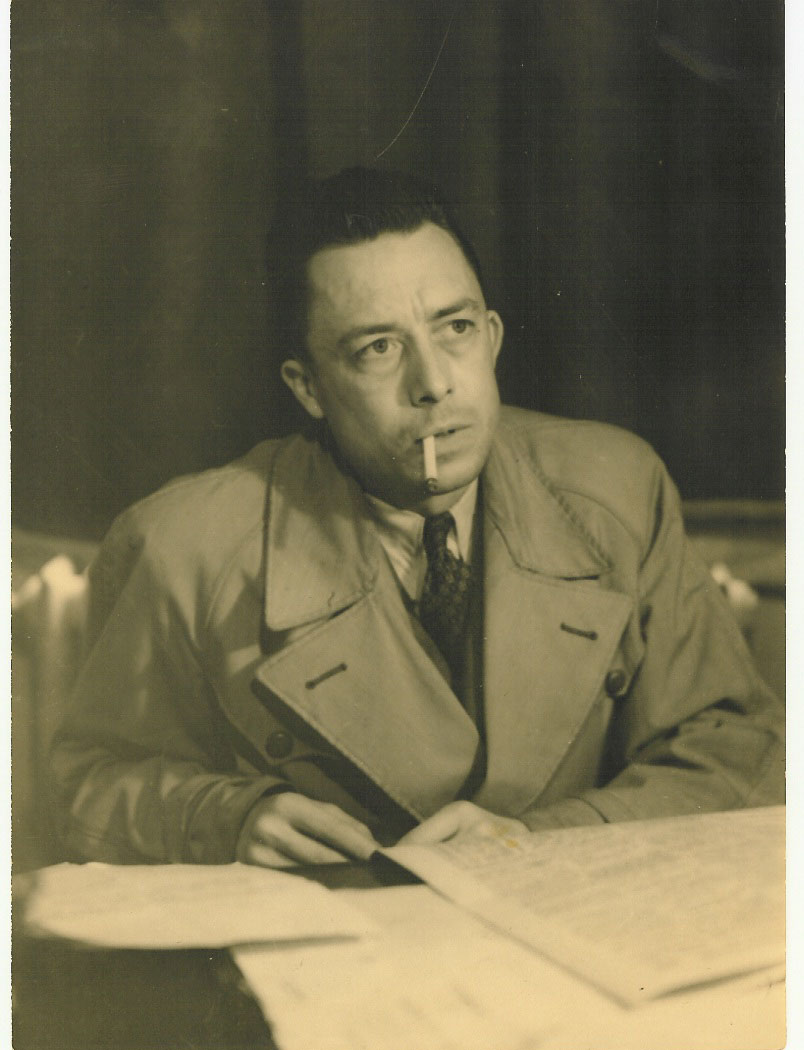
    Albert Camus in 1957 by Robert Edwards
    Albert Camus in 1957 by Robert Edwards

    End of an Era

    We are seeing a growing hostility towards miscegenation, mixed marriages and corruption of bloodlines. Members of the blue-blooded, ‘Anglo-Norman’, Fine Gael party display an absurd sense of entitlement, while many Fianna Fáil members appear to be card-carrying racists, while a vigilante Catholic Right inveighs against alleged paedophiliac Asian men, while ignoring the litany of its own abuses.

    All is not lost in Britain, though the rise of Tommy Robinson and co does not augur well. Even in the polyglot cosmopolis – the ultimate melting pot that is London – the sense is that multicultural tolerance has been eroded substantially, and is being replaced by fractious intolerance, racism, class warfare, intimidation and social fragmentation.

    The Post Second World war humanist consensus is almost gone.

    The words of Stefan Zweig, who committed suicide in Brazil after fleeing Hitler’s Europe are returning to haunt us: ‘I feel that Europe, in its state of degeneracy has passed its own death sentence.’

    Feature Image: Syrian and Iraqi migrants arriving in Lesbos, Greece, in 2015 seeking refuge.

  • Poem: ‘Fothering the Sheep’

    Fothering the sheep

    Only minus seven this morning
    but the gate latches are frozen solid.
    ‘We’ll need a kettleful to unfreeze them.’
    There’s more snow forecast and a gale warning.

    ‘We need to get hay up to the sheep
    before it blows in.’ The cart’s struggling.
    The sheep are gathered, waiting. ‘They’re patient,
    I’ll give them that.’ The snow’s firm, packed deep.

    ‘Nay, don’t all push at once! You’ll get your share.’
    Sheep surge forward, eyes fixed on the hay.
    The lads flick it up. It falls in bundles on the snow.
    Strewing the hay shows the sheep they care.

    Image: Daniele Idini

  • ‘The Deep and Inveterate Root of Social Evil’


    It would surely be a great piece of good fortune for Paddy … if English cultivation could drive all his fairies out of his head
    Examiner, June 10, 1843, British Library Newspapers

    What hope is there for a nation which lives on potatoes?
    Charles Trevelyan

    At the end of March last year, during what proved a marvellously sunny spring, a horticulturalist friend imparted the rudiments of potato cultivation. Granted, I wasn’t a complete novice. I knew about chitting (allowing seed potato to sprout in an egg box on a sunny windowsill) before planting, and banking (piling earth on a potato plant as it grows), but his instructions elevated my gardening to another level. An area knotted with grass and weeds would be transformed into neat potato hillocks – or ‘lazy beds’ – within a few hours, breaking that ground up for further cultivation in subsequent years.

    First, my guide carefully measured the length and width of each bed, using string attached to an iron stake to mark the boundaries, thereby giving each plant space to thrive. Next, he layered a bag of manure along the length of each row, sprinkling potash on top, and placing chitted potatoes at even intervals atop.

    Then began the real work, mainly using what he referred to as a Fermanagh spade with a long thin blade that lifted the sod on each side over the potatoes, sealing them off and creating a small ditch between each row. The cherry on top was a sprinkling of pine needles to cover the gaps and keep the weeds at bay.

    Initially the effort required to lift and turn the sod defeated me. My height seemed an unshakable impediment until, after much grumbling, I grew accustomed to lowering the spade sufficiently to use a thigh to make the lift. After another lesson I was equipped to dig my own beds, allowing me to go forth and evangelise about how easy it is to grow the tuber.

    Beyond occasionally removing nettles and thistles, I expended no further labour on the potato beds over the course of spring and summer. A potato’s vigorous growth in Irish conditions easily outpaces any weed and requires no watering. Then, after just over three months, my ‘earlies’ were ready, and, as any grower will smugly volunteer, there’s nothing quite like the taste of your own, not to mention the joy of letting everyone know about it.

    In growing potatoes, it felt as if I was partaking of an ancient ritual. Yet the potato plant solanum tuberosum is an exotic, native to the Americas, probably introduced to Ireland by Basque fishermen, rather than Sir Walter Raleigh, in the early seventeenth century. Potatoes are a very modern phenomenon in Ireland.

    Nonetheless, it is a remarkably fecund crop in Irish conditions. Thus, before the Great Famine, an acre of potatoes could amply feed a family of six, as well as sustaining pigs and fowl. Indeed, prior to the famine half of all potatoes were fed to domestic animals, which were primarily used to pay the rent, with little meat consumed on their farms. At that time, an acre of grain was reported to produce about 4,200 pounds of saleable produce, while an acre of potatoes yielded as much as 72,100 pounds of food for subsistence.

    Such abundance seems miraculous, but as Virgil’s Georgics warns us: ‘The great Father himself has willed that the path of husbandry should not be smooth.’  Over-reliance on any subsistence crop brings great danger, and the dependence of the Irish poor on the potato was extreme. Indeed, an entire rural economy, benefitting a largely absentee landlord class, was built around it.

    The wars of the seventeenth century led the Irish peasantry to take advantage of its unique nutritional profile – unlike wheat it contains all eight essential amino acids – and suitability for small scale storage, but not largescale export. In retrospect, Henry Hobhouse opined that ‘of all the havoc wrought by [Oliver] Cromwell in Ireland, the by-product, the lazy bed, was in the end the most damaging.’[i] In the meantime it allowed the Irish population to scale heights in the mid-nineteenth that still haven’t been returned to.

    Peasant Funeral in the Mam Turk Mountains of Connemara, Ireland.

    Modernity

    In Rot: A History of the Irish Famine Padraic X. Scanlan explores the modernity of Ireland’s experience with potato cultivation, culminating in the arrival of the dreaded blight phytophthora infestans in 1845. He details how ‘[p]otatoes allowed landlords to hire cheap and plentiful labour to work large, export-orientated farms while also collecting rent from subdivided and subleased farms and potato grounds.’

    Ireland became the guinea pig for British colonialism of the late nineteenth century, aspects of which linger to this day. Scanlan asserts that ‘[t]he staggering inequality, pervasive debt, outrageous rent-gouging, precarious employment, and vulnerability to changes in commodity prices that torment so many in the twenty-first century were rehearsed in the Irish countryside before the potato failed.’

    In their impoverishment, ‘[t]he Irish poor made complex wagers on their rent and potato yields, hoping to find any marginal advantage. They knew that changes in a day’s trading price of crops and livestock in London might ruin them.’ Scanlon therefore argues that ‘the Irish economy resembled the precarious future of capitalism more than its feudal past.’ He suggests that Ireland’s rural economy had many features of a squalid modern slum, where faith in luck, supernatural or otherwise, prevailed, just as ‘pyramid schemes, lotteries, and other quasi-magical forms of wealth appropriation’ are evident today.

    An early nineteenth century German visitor to Ireland, Johann Kohl, had never seen anything like Irish poverty, wherein ‘Irish labourers had no national dress, no institutions of peasant life that could contest the power of their landlords.’ This was a society in terminal decline, stemming in particular from the departure of its remaining tribal leaders in the early seventeenth century Flight of the Earls. This permitted the seizure and plantation of the entire country, heralding a steep cultural decline, including the gradual loss of the native tongue.

    The Great Famine would provide the coup de grâce that shattered the bonds of social life and civility. That is not to say societal collapse was inevitable – the famine of 1741 actually had a higher proportionate death toll, but its ill-effects did not linger in the same way. By 1845, however, a seemingly inexorably rising population was placing intense pressure on scarce land. Most of this remained in the possession of landlords, who cared little for their tenants and were often seeking to convert small, intensively cultivated plots into extensive pasture, in conjunction with a rising class of indigenous ‘strong’ farmers.

    Ireland’s social segregation, especially in the wake of the Act of Union – reflected in and reinforced by sectarian divisions – was the underlying cause of the country’s vulnerability to famine. There was certainly sufficient food to feed the population – only in 1847 did grain imports exceed imports – but most produce was destined for the English market.

    It’s hard to imagine a disaster on a similar scale occurring in England at that time, or any major European country for that matter, where landowners maintained a more paternalistic relationship with their tenants. Notably, the proposal by the leading nationalist politician Daniel O’Connell, himself a landlord, to embargo food exports for the duration of the Famine was greeted with derision in Westminster.

    Signs of such scarcity in a more urbanised country would surely have caused a major political upheaval, as in the case of the French Revolution which has been described as an extended bread riot. Ireland did experience a Young Irelander rebellion in 1848, but the starving populace were unable to summon a coherent resistance.

    The Blame Game

    A colonial discourse had long been evident in English accounts of the Irish, going back at least to Giraldis Cambrensis in the late twelfth century. These are akin to the ‘Orientalist’ stereotypes that emerged in Western accounts of the Islamic world, and depicted the Irish as lazy, dishonest, prone to violence and thus requiring civilising.

    By the mid-nineteenth such stereotypes were joined by the discourse of political economy, positing that ‘the market was as miraculously self-organising as the natural world.’ Edmund Burke argued that God would not look kindly on ‘breaking the laws of commerce, which are the laws of nature.’

    Irish reliance on the potato as their primary foodstuff was considered an affront to this spirit of capitalism. Many blamed the potato for Paddy’s laziness, ‘whereof the labour of one man can feed forty.’  The economist Robert Malthus maintained that until they starved, they would not learn.

    The leading civil servant for Ireland over the course of the Famine, Charles Trevelyan considered the possibility that the blight was ‘some great intervention of Providence to bring back the potato to its original use and intention as an adjunct, and not as a principle article of national food.’

    The sanctity of the market would have an important bearing on the nature of famine relief. Teaching the Irish to prefer wages to potatoes for subsistence, then Prime Minister Lord Russell said would impel them ‘to study economy, cleanliness, and the value of time; to aim at improving the character of themselves and their children.’ Extensive public work schemes therefore substituted for direct aid to the starving, who were forced to expend what little energy they possessed building roads to nowhere.

    Most insidiously in 1847 an amendment to exclude anyone holding land of a quarter acre or more from eligibility for poor relief was introduced by William Henry Gregory (ironically the future husband of Lady Gregory the co-founder of the Abbey), an M.P. for Galway. The ‘Gregory Clause’ caused thousands to lose their land in order to avail of the meagre relief available, forcing many into emigration aboard coffin ships.

    As a result of the failure of the crop and these cruel policies up to a million starved or died of disease, and another million emigrated. Unlike after the 1741 famine, the population would not increase, as often their land was converted to pasture, which by then had become more profitable than tillage.

    Old lazy beds.

    Potato Myths

    In Rot, Scanlan refers to numerous sources claiming the Irish peasantry ate on average between 12 pounds and 14 pounds (c.6kg) of potatoes per day. He takes issue with the veracity of these accounts, however, arguing that ‘the idea of a heroic Irish appetite for potatoes revealed a thriving British colonial vision of Ireland.’

    He admonishes ‘credulous’ historians – including this one – for uncritically accepting reports that the Irish poor seemed unusually healthy compared to the British working class ‘a view that indulges in one of the most durable colonial myths that of the strapping and noble savage.’ He asks pertinently: ‘why reject only the insults and believe only the claims that flatter the Irish.’

    Scanlan’s argument that the level of potato consumption was purposely exaggerated appears valid: he adduces evidence to the effect that eating such gargantuan quantities would have caused digestive difficulties. Nonetheless, in years of plenty at least, the rural Irish were surely healthier than their British working class counterparts, who were already consuming a diet high in sugar and refined wheat, deficient in protein and lacking fresh fruit and vegetables. In a rural setting highly nutritious wild foodstuffs would have been foraged or hunted. Moreover, most Irish children were not by then forced into hard labour inside factories, and, moreover, there were no ‘satanic mills’ in the countryside diminishing air quality.

    Scanlan also effectively dismisses the notion that there was anything peculiarly noxious about the much-maligned lumper potato, which prevailed over other varieties at the time of the famine, arguing ‘[h]ad the blight not struck, another people’s potato would have taken its place, and the Lumper might have to be considered a treat.’

    ‘The weakness of potato crops,’ he writes, ‘was not the individual variety of potato planted or the mode of planting, but the genetic liabilities of using sets, rather than seeds.’

    A starving Irish family from Carraroe, County Galway, during the Great Famine in Ireland.

    Legacy

    Dependency on the potato plant was a product of war. Its cultivation then allowed unprecedented numbers to inhabit rural Ireland. What was really lacking in that culture was the application of demographic brakes, as the population continued to expand despite decreasing access to land. This is perhaps best attributed to the absence of an indigenous political and cultural leadership from the seventeenth century. A form of social atomisation seems to have occurred, where the individual family unit took precedence over the wider tribe or tuath.

    The arrival of the potato plant to these shores is responsible for the size of the Irish diaspora around the world. Far fewer would have survived the conflagrations of the seventeenth century without it, and the rural population would not have expanded in similar fashion on a grain-based diet.

    The mostly callous response of the British government to the Famine probably ensured that Ireland could never be comfortably integrated into the United Kingdom. Yet conversely it also accelerated Ireland’s absorption into the Anglophone world. This paradox yielded a distinctive national literature in English. Also, ironically independence was achieved primarily by the descendants of the petit-bourgeois strong farmers that saw their holdings expand in the wake of the Famine. Kevin O’Higgins’ description of his colleagues as ‘the most conservative-minded revolutionaries that ever put through a successful revolution,’ makes sense in this light.

    Despite largely being ignored in mainstream discourse today, the cultural legacy of the Great Famine lingers. It may be identified in an unhealthy relationship to sex, and the absence of a gastronomic culture, and also, arguably, in a prevailing sense of futility that still pervades rural Ireland.

    Padraic X. Scanlan’s Rot is an important contribution to scholarship on the Great Famine, maintaining a dialogue with an unhappy past we often occlude. Perhaps those of us still living here suffer from a form of survivor guilt that prevents us from adequately engaging with its legacy.

    The attention Scanlan points to the “complex wagers” pursued by Irish peasants in unstable markets is a particularly useful insight, presenting an agency that is usually denied to passive victims. This may also inform our understanding of modern Ireland, where the political class display all the skill of the middleman in attracting foreign capital, but rely increasingly on insecure taxation income from this source – a bit like our ancestors relying on the remarkable fecundity of the potato.

    [i] Hobhouse, H. Seeds of change: six plants that changed mankind (London, 1985), 253..

  • Poem: There is a Panther on the Streets of Paris

    There is a Panther on the Streets of Paris

    slinging hammocks of intent between each step,
    hunting unbroken hearts beyond the senses.

    No one knows.
    Rumours breeze like leaves along Boulevard Saint Germain.

    Another takes a table at Le Café Des Arts
    indistinct in clouds of Vogue Bleu.

    No one.  Not even the off-duty gendarme
    whose breath caught in the branches of his lungs

    when he glimpsed its paws’ dry prints
    on Rue De Verneuil after rain.

    A physician at Hôtel-Dieu
    treated a man who claimed the creature styled

    his hair with an upward rough-tongued lick;
    a couple on Pont De Carrousel who swore

    they were undone declaiming love,
    as if their hearts were removed to make one.

    An ophthalmologist looked behind fiery eyes
    the day Notre-Dame succumbed

    to its blood against the sky,
    and the dense fur of melanistic night.

    Feature Image: Denishan Joseph

  • Contemporary Turkish Poetry Considered

    Review: Fog Bells: 8 Contemporary Turkish Poets (Dedalus Press, 2025)

    “A writer’s life”, the poet Nick Laird once remarked, with a self-assurance befitting a Royal Society of Literature Fellow, “is a cycle of trying to get to their work, sitting staring at the blank screen, wandering off, steering their reluctant bodies back” to the desk where they compose – out of the ambient, affluent bustle of London or New York, where they live – a “pattern” on the page, to make sense of the “chaos of daily circumstance”. Given the apparently placid tenor of Laird’s own routine, such “chaos” would appear to be largely symbolic, or at least to unfold outside the pale of the writer’s bubbled existence, self-absorbed and self-admiring.

    Sometimes, of course, the amiable sequestration of even the most punctilious of poetic solipsists can be disturbed: by disruptive riots or bad reviews, human rights abuses or pesky up-starts who have the audacity to care. It’s then that the holy guardians are called on to defend and re-sanctify the art, imperilled by a round of “daily circumstance” grown all too intrusive. To quote Ireland’s current Chair of Poetry, speaking in 2017:

    Must poetry be louder, must it be more active, more politically and socially engaged? I can’t bring myself to believe that the answer to this is yes. Poetry’s response must be to remain true to itself rather than rush into rhetoric. Poems shouldn’t be about getting a point across.

    Poetry’s right to be pointless, the poet’s freedom to shun the claims of political or social conscience: these are the resounding criteria, the engraven ingredients, of literary greatness.

    We might wonder how such prescriptions would be received in Turkey, a country which, under the influence of Recep Erdoğan, has undergone a process of forceful “authoritarian consolidation” in recent years: the diversity of a multi-ethnic polity replaced by a top-down state “restructured along hyperpresidential lines” and specialising in “the mass persecution”of perceived “dissidents, who have been jailed in their thousands.” Where censorship and imprisonment are looming realities for citizens (including writers) who dare to ask questions – and even occasionally attempt to get their “point across” – it’s possible that the supposed right of poets not to think or care about very much beyond their own line-breaks would smack of empty-headed conformism, rather than the liberty its advocates pretend.

    Perhaps post-doctoral literary scholars of the future will resolve such paradoxes and speculations definitively, for one and for all. For now, readers can occupy themselves with Fog Bells: 8 Contemporary Turkish Poets, a new bi-lingual anthology from Dedalus Press, carefully curated and translated by Istanbul-based poet, Neil P. Doherty.

    Doherty’s versions pay tribute to the range and vitality of his chosen poets – spanning multiple generations, but all still in their literary prime. His own style becomes recognisable as the book progresses: each voice he presents has its own kind of under-stated wit and oneirc clarity, catching the rhythms of history in a vivider light. “The world is a saddleless horse”, observes Gökçenur Ç., “we try not to fall off”, though “we whisper ‘you couldn’t be real’ / into its ear.”

    There is often a philosophical undercurrent surging just below the surface of these writers’ attentions, poem after poem, in the words of Cevat Çapan, “tirelessly / seeking for the roots of life itself.” The marginality and strange endurance of human yearnings become connecting threads in the expansive tapestry Doherty draws into billowing life. “This graveyard we call memory”, notes Elif Sofya, “grows and grows in our heads”, a “haunting of the body” now metamorphosed into words

    Time and again, the richness and intensity of individual perceptions are balanced – granted weight and depth – by a galvanizing recognition of story-telling as a mode of shared (albeit frequently contested) consciousness. Gonca Özmen thus recalls and elegizes the victims of the Roboski massacre, carried out by the state military against a group of (mostly teenaged) Turkish civilians. “Branches entwined in a verdant forest” give way, in the poem, to “arms and legs entwined in an empty forest”, as a spectral crowd of grieving mothers assembles in the aftermath, “day and night clutching these soaking wet photographs”. Mustafa Köz, similarly, manages to hold the broken world, like a fallen teardrop, in delicate suspension: it “was for all of you that we exiles set out on the road at dawn”, he sings, “for the sake of these lands, crushed under bloody, iron heels.”

    The full range of felt emotion – encompassing grief, joy, whimsy, longing – seems somehow distilled and honoured in this vibrant anthology. Among other things, its arrival may send a reviving gust of energy through the more insular spaces of Irish culture. Poetry’s horizons have always been broader than the comfortable confines within which many of our cliqued and sinecured gate-keepers have been content to keep it slotted. Its home is the world, and its journeys manifold – across languages and histories, alive with “the honour of carrying / This light.”

  • Podcast: ‘Turkey’s Phrase of the Year: Gözaltina aliniyorum’


    The Turkish phrase Gözaltına alınıyorum translates simply as: ‘I’m being taken into custody.’ This was selected by the independent media outlet T24 as the phrase of the year for 2025. Had it not been that, in my view, it just as easily could have been Türkiye’de yargı bağımsızdır, meaning ‘the judiciary in Turkey is independent,’ a line repeated endlessly, like a tongue-twister, by Ministers and MPs from Erdoğan’s ruling party, the AKP. And yes, I’m being ironic.

    On March 19, Turkey woke up to a morning marked by an operation aimed at eliminating the possibility of a change in power through elections, and declaring open war on institutional opposition.

    The mayor of the Istanbul Metropolitan Municipality (IMM) and the opposition’s presidential hopeful, Ekrem İmamoğlu, was taken into custody along with dozens of IMM employees and close members of his team. Shortly afterward, university students organized and gathered in front of Istanbul University main campus, marching toward Saraçhane, which is the location of the Istanbul mayoral headquarters, just a couple of kilometers away.

    Then more people joined. And more.

    Emergency bans on unauthorized demonstrations and marches were imposed at lightning speed. Metro and bus services were cancelled by government decree to block access to the area. The police presence and traffic checkpoints increased rapidly. Even these hastily implemented measures – designed specifically to prevent people from gathering in front of the IMM headquarters – failed to stop hundreds of thousands from filling the streets within hours.

    In the days that followed, people maintained a vigil through the nights, both at Çağlayan Courthouse, where Mayor İmamoğlu was taken, and in front of the municipality building. They refused to leave the Squares.

    While all this was unfolding, people like me – those watching from afar living abroad – fell into a grimly familiar ritual. Every morning around 6am, opening X (Twiiter) meant watching your entire timeline fill, within seconds, with posts like:

    “I’m being taken into custody.”

    “Police raided my home at dawn. I’m being taken into custody.”

    “The police came to my apartment in Şişli around 4:30 a.m. Please take care of my dog. I think I’m being taken into custody.”

    There were dozens of such tweets. Some days, without exaggeration, hundreds.

    Turkey Isn’t Outside the West. It Helped Build It

    Fast forward to today. Ekrem İmamoğlu, along with over 400 others, has been held in pretrial detention for nine months. Those detained include sixteen mayors from the main opposition Republican People’s Party (CHP); his lawyer, Mehmet Pehlivan; his election campaign adviser, Necati Özkan; his drivers, Recep Cebeci and Zekai Kıratlı (whose names do not even appear in the 4,000-page indictment); his assistant, Kadriye Kasapoğlu; district mayor Murat Çalık, a two-time cancer survivor currently undergoing treatment; and hundreds of others I cannot possibly list here.

    As I write these lines, social media is once again flooded with news of fresh crackdowns targeting the Istanbul Metropolitan Municipality. The municipality’s deputy secretary general, the head of the fire department, Remzi Albayrak, and dozens of others have been taken into custody as part of the ongoing operations against İmamoğlu and his circle.

    All of these individuals are accused of forming a criminal organization, corruption, causing public financial loss, and terrorism – charges that, over time, have increasingly been reframed as espionage, alongside several other alleged crimes.

    According to legal professionals and academics, these accusations are laid out in an indictment of roughly 4,000 pages that does not read as if it were prepared with professional rigour. The document has been widely criticized for being grossly inflated, riddled with technical errors, filled with repetitive sections, reliant almost exclusively on anonymous “secret witness” testimony, and strikingly devoid of concrete or substantiated evidence. More troubling still, some of the more than 400 people currently in detention are not even named in the indictment, yet they remain behind bars.

    Very recently, the European Court of Human Rights decided to fast-track Ekrem İmamoğlu’s case, specifically his application concerning unlawful detention. The application was filed by his lawyer, Mehmet Pehlivan who is himself currently in detention.

    Yet the European Court of Human Rights, along with international institutions more broadly, is increasingly portrayed by the Erdoğan government, now in its twenty-third year in power, as anti-national, foreign-backed, and unpatriotic. In official rhetoric, these institutions are cast as insufficiently “domestic” and allegedly hostile to Turkey’s national interests.

    This framing follows a familiar authoritarian script, but reality is more complicated, and far less convenient. Turkey is not an outsider to the Western political and legal order. It helped build it.

    Turkey is a founding signatory to the European Convention on Human Rights and a member of the Council of Europe, making it legally bound by both the Convention’s provisions and the case law of the European Court of Human Rights. It is also a party to the core United Nations human rights treaties.

    What, then, is the purpose of this fabricated, anti-Western, exclusionary narrative?

    ‘Down With Tyranny, Long Live Freedom!’

    The aim is to crush resistance, normalize sweeping losses of rights, freedoms, and prosperity, and impose a “new Turkey” modelled on a hybrid of Central Asian authoritarianism, Russian-style rule, and the institutional failures of parts of the post-colonial Middle East.

    This vision is fundamentally incompatible with Turkey’s realities: its diverse socio-cultural fabric and, more importantly, its socio-political legacy of more than two centuries of struggle for democracy and modernization.

    That legacy dates back to 1839, a decisive turning point in Ottoman history, when decades-long, Western-oriented reform efforts were institutionalized through the Tanzimat Edict. These reforms eventually led to the establishment of the first parliament and the first civilian constitution in 1876.

    With the Tanzimat Edict, Ottoman subjects were recognized as equal citizens for the first time. Egalitarian reforms in areas such as taxation and military service aimed to ensure that non-Muslims, alongside Turkish Muslim citizens, bore the same duties and responsibilities toward the state.

    The reforms also sought to guarantee the security of life, property, and honour for all citizens; to ensure property could be lawfully inherited; to establish transparency in judicial proceedings; and to prohibit executions without due process.

    These principles were not merely rhetorical. Concrete regulations gave them legal force, and the constitution that followed formally limited and distributed the powers of the sultan.

    In 1858, homosexuality was decriminalized, making the Ottoman Empire the second state in the world, after France in 1791, to take such a remarkable step.

    The path toward building a republic grounded in parliamentary democracy and equal citizenship, however, was never linear. As in France, Italy, or Japan, and many other democracies, progress came through reversals and ruptures. The Ottoman Empire’s first constitution was suspended and parliament dissolved, only to be reinstated three decades later. As borders across Europe were redrawn through wars and upheaval, this turbulent process culminated in the founding of the Republic of Turkey.

    Like other nations, Turks did not abandon the desire for a better future or the struggle required to build it. Today, however, all of this is under threat.

    President Erdoğan has amassed more power than many Ottoman sultans and continues to seek more. Research by the V-Dem Institute at the University of Gothenburg shows that Turkey’s democracy score stood at 0.17 in the early 1900s, rose to 0.53 in the early years of the republic, reached 0.74 in 2002 when Erdoğan’s AKP first came to power, and has since fallen back to 0.18.

    It is no coincidence that a slogan more than a century old has returned to the streets: Kahrolsun istibdat, yaşasın hürriyet! meaning  ‘Down with tyranny, long live freedom.’ It has been one of the most frequently chanted slogans at the Saraçhane demonstrations following İmamoğlu’s imprisonment.

    For more than two decades, Turkey’s media has been monopolized by oligarchs handpicked by Erdoğan. As a result, the voices of ordinary, hardworking, middle class Turks have been largely silenced, especially abroad. Deliberate policies have severed society’s connection with the outside world, suppressed public expression, and helped cement an image of Turkey as a failed democracy which is a perception many in the West has accepted uncritically.

    The Syrian war, and the years-long influx of refugees have reinforced this distorted view. Since 2012, Turkey has become nearly inseparable from Syria in the Western imagination, as if the country had absorbed another nation entirely. Over more than a decade, this association has come at steep economic, political, and moral costs, leaving Turkey and Syria almost interchangeable in the minds of outsiders.

    It is precisely these deliberately erased realities of Turkey that I want to bring back into focus in this article.

    Through its constitution, Turkey is a parliamentary democracy, and until roughly a decade ago, it functioned as one, at least since 1950, around the same time many Western democracies were consolidating. Eastern Europe, by contrast, remained under authoritarian rule until the 1990s. Since 2017, however, Turkey has gradually morphed into an electoral autocracy, with steadily eroding rights and freedoms.

    Yet Turkish society itself is not defined by these trends. Erdoğan is attempting to impose a regime change against the will of the people.

    Even before the unlawful detention of İmamoğlu and hundreds of others, a 2024 PEW Research survey showed that 67 percent of Turks were dissatisfied with the country’s democracy. Among those under 35, that figure rises to 75 percent. Eighty percent of respondents support direct, electoral democracy, while 62 percent reject the idea of indefinite rule by a strongman.

    In another striking example, 56 percent of people in Turkey believe that religious texts – given the country’s Muslim-majority population, in this case the Quran – should have no influence over the constitution or laws. This figure is several times higher than in other Muslim-majority countries, where comparable research could be conducted.

    For context, the same survey analyzed thirty-six countries, including Tunisia, which experienced a brief period of parliamentary democracy between 2011 and 2021 and today scores slightly higher than Turkey on democracy indices. Yet Tunisia is excluded from the section of the study that examines the role of the Quran in politics simply because even asking such questions is socially unacceptable there, despite Tunisia being one of the West’s preferred points of comparison with Turkey. By comparison, the equivalent figures are 51 percent in the United States, 57 percent in Poland (referring to the Bible), 54 percent in Israel (Jewish scripture), and just 12 percent in India (Hindu scripture).

    Only 17 percent of people in Turkey believe religious texts should influence national laws. By contrast, the figure is 66 percent in Indonesia (home to Bali, often perceived as a globally famous, relatively secular tourist destination), 22 percent in our complex, love-hate neighbor Greece, and 28 percent in the United States.

    Why does this matter?

    The overwhelming majority of Turks, regardless of religiosity or whether they vote for Erdoğan and the AKP, support Turkey’s constitutional definition as a secular, parliamentary, democratic republic. They want these founding principles to remain intact, and they are deeply dissatisfied with the current system of governance.

    A new constitutional amendment is expected soon. Just as previous amendments were justified with buzzwords like “military oversight,” “judiciary status quo,” or “democratization,” the government is likely to use the cultural rights demands of Turkey’s ethnic minorities, particularly the Kurds, as a pretext for a full constitutional overhaul. In reality, these issues could be addressed through minor, targeted adjustments without rewriting the constitution.

    In the near future, many will try to tell you otherwise. Please, don’t believe them.