Blog

  • Bullying: It’s You, Not Me

    Bullies can take many shapes, forms, and disguises. It seems a daily occurrence that can be defined as repeated behaviours that are intentional or have malicious intent to cause fear or to instil feelings of superiority in the bully, while also causing anxiety and hopelessness in the victim, due to the bully’s relentless behaviour.

    Northern Ireland, where I grew up, is a hotspot for bullying. It seems to thrive in an environment where tribalistic differences are constantly debated, leading to hostility, sectarian violence, hatred, and ultimately, often, murder.

    When I was a boy, from about the age of six for a few years I was indeed a bully myself. I should add that I have been bullied many times.

    Anyway, I bullied a girl at primary school who had an eating disorder. She used to make large bubbles with her mouth because her stomach was troubled. I mocked her over it, because I was a damaged child and did not know any better. She was thin, wore glasses, and I was a pig-ignorant, angry little boy with blonde hair and blue eyes. It was as if butter wouldn’t melt in his mouth, adults used to say about me once they realised, I was a bully without an emotional processor.

    But I could not understand what I was doing due to poor emotional regulation and underdeveloped emotional skills. One thing was certain: I was damaged.

    I come from a broken home and a troubled, all-encompassing background where violence was often inflicted by a parent or guardian. They were young themselves and did not know any better.

    I was constantly on the defensive. And I remained so for decades. Fight or flight with pounding anxiety, cortisol coursing through my system.

    It is a difficult paradigm to break – the cycle of aggressor abuse and the inflicted aggressions, both verbal and physical.

    I was aggressive and used to demand that other school kids bring in a football to school until two much tougher brothers roughed me up out the front of the school on the grass one afternoon. And the bullied girl’s mother accosted me at the school gates, calling me out, rightly so, but I did not know any better. My bullying was reactive without conscious thought. My prefrontal cortex was not developed. Anyway, that was the end of my primary school bullying career.

    Cottonbro Studio

    Bullying in Adulthood

    There is always an opportunity to make money, poke fun at someone, or treat someone like a lesser human being; and here’s the thing: people definitely do, and try to do it, daily.

    I have watched several TEDx Talks on bullying and other YouTube videos on the topic. There seem to be two types of bullying: implicit and explicit.

    It’s a complex human behaviour to gauge on the social barometer. That is, many people are involved in these actions. It is part of us. Indeed, one wonders which circle of Dante’s Hell houses bullies and what they have awaiting there.

    Is it a deliberate choice or a visceral response to something in their psyche? Sometimes, individuals with damaged self-esteem find it challenging to know how to repair themselves. They have become so deeply traumatised that they cling to what they know, or rather, have become.

    There is the Dark Triad of Personality: Machiavellianism, Narcissism, and, in a pitiful corner, Psychopathy, which is quite common in Northern Ireland if you ask me.

    In Eric Berne’s Transactional Analysis, he posits that some individuals employ mind games and manipulate others’ emotions to achieve their goals.

    In my teens, a bigger mate bullied me because of his size and skill as a fighter. Needless to say, we are no longer friends.

    A few years ago, he emailed to ask how I was and say that he missed me, or something to that effect. I replied telling him that he had bullied me, and I had dark thoughts about getting revenge on my bullies.

    He emailed back, saying he didn’t believe it, that he, it, the bullying ‘was that bad.’ But he was – he was a bully. He is probably still in denial.

    In some ways, he was a rather unusual character. I believe he was bisexual and concealed it, using aggression as a coping mechanism. He also tried to project an image of being a tough man.

    In Northern Ireland, the projected image of ‘don’t mess with me sunshine’ is all. The knuckle-dragging image of the hard man, the person feared and respected for his reputation as a fighter, is deeply ingrained in the collective, broken Northern Irish psyche.

    Loudmouth

    When I turned eighteen, I was quite the loudmouth, and a young, tough bloke at a local disco bullied me.

    One night, he was waiting outside the disco, itching for a fight, slouched against the wall under the arch of the local hotel. I was walking alone, leaving the disco, and he decided to pick a fight with me. He approached and swung a big, balled-up fist. I took it without ducking, as I was intoxicated – as usual – and he clocked me. Since I was skinnier and therefore fair game, it was on for him.

    He thumped me, and I staggered away. Afterwards, I sat on a low stone wall, and I think I had a bloodied nose – I cannot quite recall, but I do remember putting my jeans in the bath with warm water and salt, which drew the blood out of them.

    On another occasion, I was a bundle of nerves due to anxiety, excessive drug use, and simply not being well. I suffered from cannabis-induced psychosis and alcoholism. When he came over and threatened me I soiled myself. I sat there in the front seat of my mate’s car, let it happen, and wetted my trousers. I didn’t show anything to my friends inside the car, but that’s what occurred. The bully left after realising I wasn’t taking the bait or accepting the challenge of a fight. I was very skinny then, not eating properly, and most likely he would have beaten me to a pulp.

    Years later, I wanted to attack this individual. Full of rage, I was letting him dominate me in a way. I often thought of killing him. Decades of pent-up rage came to the fore in my psyche, and I was not going to lie down and take it anymore. The fact is that he was an ignorant halfwit and would have had little insight into his behaviour.

    Then there was the self-proclaimed ‘Christian’ in a homeless hostel in Belfast. A ‘Baptist’, ‘turn the other cheek?’ They were full of shite. He was, and probably still is, a narcissist who ‘knew better’ than the rest. He bullied me, well, it was institutional abuse, while I was resident in a homeless hostel. He became insanely jealous of the friendly relationship I had with one of the female staff. Getting through that situation over a year severely tested me because I had finally a bit of strength about me then, and I wanted to test that out.

    After that there was bullying, from a verbally abusive, ‘celebrity’ chef, who I worked for. He called me ‘a useless bastard.’ because I didn’t dress a plate of raw salmon to his standard. I informed him that I would not talk to a dog the way he talked to his staff, and I walked away not to return. He was well known as a bully. One day, allegedly, he grabbed one of his smaller trainees by the neck and pinned him up against a fridge. Needless to say, he doesn’t come across as a bully on the television or radio.

    Image: Pietro Lang

    Owning up to my own Failings

    I intentionally bullied a rather large, but chilled out guy with whom I shared a house as he was one of the laziest people I have ever met. He would not lift a finger to keeping the house in shape. He lay in bed all day nursing a hangover, something I had plenty of experience with.

    He was angry with me, but I later apologised and explained I only tried to motivate him when he lay in bed all day. Once I pulled him and his mattress off his bed and took him downstairs, as it was a lovely day outside, and he was lamenting his life while suffering from a hangover. This was his, or rather our norm.

    One day, I made a loud noise behind him in the kitchen, as he didn’t know I was there, which startled him while making a sandwich. He held a steak knife in his hand, turned around, and said: ‘Just you wait, Burnsy. One day I will get you.’

    Bullying also occurs in relationships. They must always be right. They will gaslight you into believing that you are the problem. They play the victim and are rather good at emotional manipulation. They cannot comprehend that a relationship is a collaboration. They call the shots, hold the power, and you must bend to their ways.

    I have been gaslight into believing that I was always the problem. Playing the victim is a form of emotional manipulation. Some cannot comprehend that a relationship is a collaboration. They must call the shots. Bullies rarely change. I work on it.

    Yet, sometimes you have to act aggressively when no other option is working.  Once, back home, a letting agency with questionable ethics, known for rather shoddy practices, failed to answer my calls, refusing to return a deposit of £527.00 owed to me. They dragged their heels and told me one date and then another, and wouldn’t pay.

    The owner has been done for fraud multiple times. It seemed as if the ‘management’ were trying to rip me off for the sheer fun of it. So, I went to their office and told them they had ten minutes to pay me, or I would have to get a bit rough. I got my money back within an hour or so.

    Robert Greene

    Robert Greene on Bullies

    Robert Greene, in his book The 48 Laws of Power, doesn’t explicitly discuss bullying as a primary topic, but he does address behaviours and tactics that are often associated with bullying, particularly in the context of power dynamics and social interactions. He highlights how insecurity and a desire for control can motivate individuals to engage in manipulative and aggressive behaviours towards others.’

    I do not stand for bullying nowadays. Although I wonder whether challenging or confronting a bully is really only a Pyrrhic victory? Or perhaps it’s a way to square the circle of your own trauma. I will leave it the reader to decide. I wrote this piece to confront my own mistakes and bullying behaviours to help build clarity and humility in myself, from now on.

    Feature Image: Mikhail Nilov

  • It’s All Academic: Bad Ideas Bloom

    A few years ago, I had occasion to walk regularly past the university in Galway. My journeys took me across the Salmon Weir Bridge, which had narrow footpaths and has since been relieved by a new footbridge, and up past the cathedral and the university. Often, I found myself walking against the current of students coming from the university. The various encounters along the way were sometimes surprisingly hostile. Many of the students seemed fired up with startling aggressive intent. Their demeanour reminded me of us as kids pouring out of the cinemas having watched a Bruce Lee movie, flexing fledgling muscles, feeling ready to take on the world.

    Naturally, I wondered: is it just me or is this a thing? On one occasion, when a young black woman glared at me on sight, for no apparent reason, a paraphrase of Ali G’s line popped into my mind, “Is it cuz I’s white?” That made me smile, for a while anyway, until I realized there was likely more than a grain of truth in it.

    I had attended that university as a mature student, took an arts degree, majored in English and sociology/politics (soc ‘n’ pol) and I do recall feeling similarly fired up at the time about the injustices of capitalism and so on, leaving me inclined to glower at men in suits. Was I now the man in the suit?

    I read up on what was being disseminated in the universities that was causing students in England and across the West to tear down statues and demand reparations for slavery, among other outraged activities. Back in the 70s and 80s, this same type of young person would be forming bands or theatre troupes, annoying no one, but neighbours and critics. What has changed?

    Pilgrims Going to Church by George Henry Boughton (1867).

    The New Puritans

    I came across a very helpful book by Andrew Doyle called The New Puritans: How the Religion of Social Justice Captured the Western World, which pretty much laid out the entire state of play: woke ideology filling the place that religion used to occupy and becoming a pseudo-religion itself.  It seemed that I, as a “white hetero male with colonialist tendencies,” as a student might put it, was actually the new framed culprit for everything wrong with the world. A kind of latter-day elder of Zion, guilty of everything, with an innate desire to colonise as a result of an innate desire for violent expression and appropriation. In a word, I’m “bad”, and not in a good way, as in rapper “cool”. And not even salvageable. To put it religiously, I’m beyond redemption.

    This idea of the “white hetero male”, as being “violent” likely stemmed from a confusion of terms, where male competitiveness was equated with “aggression”, which then brought the word “violent” into the word family, to be used for effect in argumentative debate, because everyone responds to scare stories and everyone loves a villain to make themselves look “good” in comparison. And what is a lecture after all but a kind of performance, the students filling the lecture theatres of the western world being the audiences. From this perspective the idea of the violent white male is a kind of pulp fiction, designed to thrill, while giving the freshers something to shoot at.

    But as philosopher and neuroscientist Sam Harris puts it, there usually aren’t that many bad people around at any one time. Maybe only 1% or so of people are psychopaths and sadists in any one historical moment. More often there are bad ideas that good people act upon with good intentions and usually disastrous consequences.

    And it seems from what I’ve learned from Doyle’s book and other sources, that Western universities have been disseminating some very bad ideas for a long while now, among them the idea that all white men are innately violent and all their works corrupt and deserving of destruction. But they don’t call it “destruction”. They call it “dismantling”. Meaning, I suppose, polite destruction.

    “No, Marie Antoinette, we’re not chopping off your head, silly girl, we’re simply dismantling you.”

    Then as if things weren’t complicated enough, meaning itself is regarded as a “construction” to facilitate patriarchal power, and that definitions of anything you care to name are totally subjective. Meaning, everything has many meanings. As many meanings as there are people. Which means that nothing has any real meaning, only subjective interpretation. Which means that everything is meaningless and ultimately the best yarn wins.

    All these bad ideas then became cornerstones of black studies, leading to the conclusion of the increasingly discredited doctrine of Critical Race Theory, which itself is racist, and often proudly so – “Now it’s our turn!” – that “violent” white people owe people of colour big time, with, apparently, justified hell to pay. A belief system which is perhaps even inspiring the killing of white farmers in South Africa.

    Incidentally, the “Now it’s our turn” idea also comes from feminism, and was used by some feminists to justify abuses of power when they gained authority over others, conveniently failing to recognize that far from creating equality Heaven on Earth, many of them seemed instead quite determined to create the same old same old, with themselves in the seats of power. Proving, at least, that power and ambition still have very definite meanings.

    Compulsory

    When I started in university in the early 1990s, one of the things that struck me as odd at the time was that gender studies was compulsory. The last time I’d been in “school”, Irish language was compulsory and eventually people saw that this was a bad idea because it created a system of inequality, favouring some and side-lining others. Now here I was, back in “school”, and the university, which I understood as being a place of free-thinking, had a compulsory subject. It all seemed a bit “off” to me.

    I asked some people I knew who worked in education about the oddity of having a compulsory subject in the free-thinking university, and both just looked back at me and said absolutely nothing, immovably shtum, although both exuded the vibe that this was some kind of unmentionable thing and that I would be best off saying no more about it, which I duly did, obediently attending the various compulsory gender studies lectures and seminars, to no great advantage.

    “To put it clearly, girls: white men are bad, but white women are good. We’re their first victims. And there’s hell to pay”

    Ironically, feminists also appear to have placed themselves in the role of white saviour to the Third World. Now heading up NGOs and helpfully inviting millions to “deserved better lives” in the likes of Newtownmountkennedy, they continue the task of identifying “bad” people, most of whom, oddly enough, come wrapped in white skin with male genitalia, making them easy to spot.

    “Look! A violent colonialist misogynist! Get him!”

    On top of all that, those radicalised students emerging from Western universities appear to believe that anyone who disagrees with them, on even the most trivial point, is actually evil, if not in direct league with Satan, and possibly psychically and spiritually contagious, justifying physical reprimand, as was demonstrated recently in Limerick when student Jamie O’Mahoney waved an Israeli flag during a pro-Palestine meeting. It’s little wonder then that these unfortunate students, at the receiving end of an education seemingly designed to make enemies of their fellow countrymen, now appear to have so much in common with radical Islam.

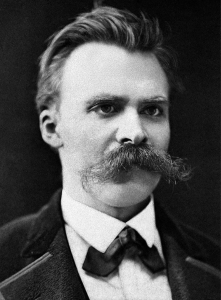
    Friedrich Nietzsche

    Theory to Practise

    Well-intentioned theory, as was so strikingly demonstrated by the Nazi misreading of Nietzsche, doesn’t always bloom beautifully into reality. For instance, one of the current real-world consequences of the teachings of comfortable academics serenely creating theoretical paper models in ivy-decked tenure, is mass immigration. The thinking and moral lesson being that male white Europe owes reparations to the Third World for colonialist crimes committed in previous centuries. This idea is partly driven by another text called The Wretched of the Earth by Frantz Fanon, which was a big ideas source in my university time.

    The ensuing academic-influenced invitation to the actual wretched of the Earth has resulted in, among other perplexities, the village of Dundrum in County Tipperary, with a population of 200 or so, being joined by almost 300 male strays – sans WAGs – from the Third World who no one quite knows, least of all our government, with locals being labelled criminally racist by the apostles of the global equality agenda for even questioning this more than extraordinary imposition. If there was any real social justice, those migrants would be housed in the universities. Chickens coming home to roost and all that.

    “Now girls, listen up! I want you to give a big feminist ‘Hey there’ to your new exotic boyfriends.”

    John Rawls

    The Pot is Black

    If the Humanities become selectively humane, as appears to be happening, it’s no longer the Humanities. It’s something else entirely. And the particular slant of “humanities” that is becoming evident in universities across the West seems more than a little racist and sexist, the very things it claims to be attempting to eradicate, itself apparently unwittingly succumbing to malignant Freudian projection on a grand scale.

    Referencing political philosopher John Rawls’ book A Theory of Justice, Thomas Sowell, economist and historian writes in his 2010 book “Intellectuals and Society”:

    Justice is the first virtue of institutions, as truth is of systems of thought. A theory, however elegant and economical, must be rejected or revised if it is untrue; likewise, laws and institutions, no matter how efficient and well-arranged, must be reformed or abolished if they are unjust.

    The way things are going, we may one day see a social movement demanding reparations from the universities.

  • Poem: And Me

    And Me

    Naked for you, beneath
    some moon somewhere, which sounds
    like an ending, unless you begin
    with it. White as a page, as a unicorn’s
    horn, some skin—all of mine. So stare
    down—star-down is how I want to lay
    with you. Come further up. Go
    further in. Night is falling with us.
    Night, the witch’s sweet-tooth craving—
    she can’t stop biting it, can’t stop licking
    out the hours. Don’t think about that
    just now. Don’t watch her. Watch me.

    Feature Image: Two Nudes in a Forest, Frida Kahlo 1939

  • Public Intellectuals: Voltaire

    Voltaire (1694-1778) is the self-invented name of François-Marie Arouet, riffed on a childhood description of him as a determined little man. He belongs in the Panthéon in Paris, old wise and wizened, but eyes sharp and gleaming through the stone. The central figure in the Enlightenment, Voltaire’s legacy is now being systematically dismantled worldwide.

    It is notable that Black Lives Matter sought to desecrate his statue despite condemnation of slavery in his most famous book Candide (1759). It was an unjust attack, even allowing for his occasional ambiguity as a product of his times. Why not go to Monticello and attack icons of Thomas Jefferson? John F Kennedy famously said in a meeting of Nobel Prize winners in the White House: ‘there is more intellect in this room except when Thomas Jefferson dined alone.’ We may not simply be desecrating statues, but also those who brought Enlightenment to the human soul.

    Voltaire’s work is eclectic and difficult to classify. His plays are rightly disparaged, though these were often his main source of income. They also brought a lengthy stay in the Bastille, as well as forced exile for over two years in London, where he got to know among others Newton and Swift. There, he wrote a celebratory text on the English, famously describing them as a nation of one hundred religions but only one sauce. He went on to popularize Newton, and is attributed with spreading the story of the apple tree.

    So, using quotations from the man himself let’s explore his central contribution.

    Voltaire was imprisoned in the Bastille from 16 May 1717 to 15 April 1718 in a windowless cell.
    1. Freedom Of Speech

    I disapprove of what you say, but I will defend to the death your right to say it.

    If we resort to ‘no platforming’ or censoring people for saying things we disagree with then all is lost. Sadly, we no longer have a polity dedicated to ideal speech, the utopia envisaged by Habermas, via Jeremy Bentham. Instead, we find a uniform, soporific social media blandness.

    Ronald Dworkin  towards the end of his illustrious career, and in response to the Danish Cartoon incident, wrote a nuanced defence of the right to offend, saying:

    Ridicule is a distinct kind of expression: its substance cannot be repackaged in a less offensive rhetorical form without expressing something very different from what was intended.

    So, in a democracy no one, however powerful or important, can have a right not to be insulted or offended.

    Thus, for example, in 2015, when 12 journalists from satirical paper Charlie Hebdo were shot in a terrorist attack, Voltaire’s Trait sur la tolerance/ Treaty on Tolerance (1763), which defends freedom of speech was drawn attention to. Protesters marched down the Boulevard Voltaire in Paris brandishing images of the great man shouting: Je suis Charlie.

    In the treatise he argued: Oh, different worshippers of a peaceful god. …love God and your neighbour.

    Christoper Hitchens Oscar Wilde, along with others such as the English judge Stephan Sedley, have in substance also remarked that the freedom to speak inoffensively is a freedom not worth having  They are merely his intellectual offspring.

    Voltaire with Denis Diderot, Jean le Rond d’Alembert, Marquis de Condorcet and Jean-François de La Harpe.
    1. Religion

    If God did not exist, it would be necessary to invent him.

    The problem in this post-truth-transhumanist zeitgeist is that there exists a moral vacuum. Moral relativism and the structuralists have destroyed community, sociability and the Aristotelian tradition of the virtues. The death of God in people’s lives has undermined society and social ordering. Habermas‘ most recent text in effect says so. Voltaire agrees.

    Voltaire was actually an atheist but deliberately circumspect. On his death bed he was asked did he want the services of a priest for the last rites and renounce Satan. His Delphic response was: ‘This is no time to be making new enemies.’

    Thus, the arch-rationalist and pragmatist recognised the need for doubt. He understood the need for Christian compassion and religion as a source of social order. Indeed, he famously was sceptical of certainties.

    On the brink of the destruction of the ancien regime, he spent his final twenty-five years in Ferney, a fabulous estate near the Swiss border at Geneva. It was built to some extent on the proceeds of winning the French lottery. He treated his workers admirably and built a model town, which I have had the privilege of visiting.

    Luckily, he was not around to witness the descent of the French Revolution into barbarism and terror ushered in by virulent atheists such as St Just and Robespierre.

    Indeed, Thomas Paine, the author of The Rights of Man and co-author of The French Declaration of The Rights (1793) narrowly avoided the guillotine by a mark on the wrong door at the height of the Terror.

    In the interests of balance it was worth recalling another of his aphorisms on religion:

    I have never made but one prayer to God, a very short one: Oh Lord, make my enemies ridiculous. And God granted it. (Letter to Étienne Noël Danielsville, May 16, 1767)”

    and

    God is a comedian playing to an audience that is too afraid to laugh.

    Voltaire at Frederick the Great’s Sanssouci, by Pierre Charles Baquoy.
    1. Miscarriages of Justice

    It is better to risk saving a guilty person than to condemn an innocent one.

    In the summer of 1765, in the little town of Abbeville in Picardie in northern France, three young men, Franzoi’s-Jean Lefebvre, chevalier de La Barre, Gaillard d’Alene and Charles Moisnel, were accused of sacrilege, blasphemy and irreligion. A crucifix had been damaged on a bridge leading to Abbeville. The three young men had been observed failing to doff their hats as a religious procession passed. They had been heard singing songs with pornographic allusions to the Virgin Mary. Shocking and libertine books were discovered in La Barre’s room, among them Voltaire’s Dictionarie Philosophique, printed anonymously in Geneva in 1764.

    On July 1 1766, La Barre was tortured and beheaded. His body was burnt on a pyre together with Voltaire’s Dictionary. Voltaire heard about the case in his retreat at Ferney, when the first accusations were made.

    At first, he was hopeful that the death sentence would be commuted. Later, when he learned that the execution had taken place, he was horrified. In a letter to a friend, he expressed his horror at the strange combination of frivolity and cruelty he observed in the French. After the burning and symbolic execution of his Dictionary he felt indirectly targeted and under genuine threat. Extradition in fraught times was a possibility.

    He retaliated brilliantly. In the 1769 edition of the Encyclopaedia entitled La Raison par alphabet, Voltaire includes an article on torture in which he relates La Barre’s ordeal. The prosecution mentioned this scandalous book which was later put on the Vatican’s Index Libro.

    He wrote initially in the hope of achieving a retrial. With each new attempt to intervene on behalf of the accused, Voltaire goes back to the documents, re-reading and cross-checking. As new information comes to light, he modifies his arguments, considering the potentially biased nature of the “facts” that had been presented to him.

    Noticeably Voltaire scatters them throughout his letters to friends, but also circulates them among important members of the judiciary. Luckily, he had the privilege of being on friendly terms with the powerful. Thus, he enjoyed a volatile lifelong relationship with Frederick the Great of Prussia and Catherine the Great in Russia as well as the King of France. This saved his skin.

    In the Le Barre case what was at issue was not the legality of the proceedings, but the legitimacy of the judiciary.

    A crucial text Prix de la justice et de humanity (1777), describes the French justice system from the point of view of a Swiss protestant traveller in France. Yet, the last important text Voltaire wrote on the case was Le Cri du sang innocent (1775), a letter addressed to the King of France, Louis XVI, and signed by La Barre’s co-accused who had escaped to Prussia. It was a decidedly brave stance.

    He also intervened famously in the Calas affair, involving a Protestant merchant who was sentenced to death on the Wheel by the Parliament in Toulouse. and executed on March 10th, 1762 after being convicted of murdering one of his sons who had openly converted to Catholicism. Voltaire wrote to the Comte argental and Memo la Comtesse:

    …You will ask me, my divine angels, why I am so interested in this merchant of Toulouse who has been broken on the wheel. I will tell you. First, it is because I am a man. Then it is because I see how foreigners in discussing this affair condemn us. Is it necessary to make the name of France stink all over the continent…. which dishonours the whole of human nature?

    Voltaire was contacted about the case, and after initial suspicions that Calas was guilty of anti-Catholic fanaticism were dispelled by his investigations, he began a campaign to get the sentence overturned, claiming that Marc-Antoine had committed suicide because of gambling debts and being unable to finish his university studies

    Voltaire’s efforts were successful, and King Louis XV received the family and had the sentence annulled in 1764. The king fired the chief magistrate of Toulouse, and in 1765 Jean Calas was posthumously exonerated. There was also the posthumous pardon of the Comte De Lally, which led to a comment from a Swiss functionary with whom he maintained cordial but confrontational relationships: ‘You seem to attack Christianity but do the work of a Christian.’

    Portrait of Voltaire in the Palace of Versailles, 1724-1725.
    1. Post Truth

    Those who can make you believe absurdities can make you commit atrocities.

    and

    It is forbidden to kill; therefore, all murderers are punished unless they kill in large numbers and to the sound of trumpets.

    Is there a more apt comment on the way our post-truth disinformation society justifies genocide, racism and the exclusion and murder of the other

    Then there is the defining quote representing the motif of his career: It is dangerous to be right in matters on which the established authorities are wrong.

    1. Self-Care

    We also find him dispensing advice that is superior to any self-help books currently on the market, and certainly a lot better than Jordan Peterson’s

    The more I read, the more I acquire, the more certain I am that I know nothing.

    and

    Let us cultivate our garden.

    And he did so for twenty-five years.

    So, what if he was a bit of a libertine. The alt right and indeed puritanical left are very adept at confusing sexual licence with immorality.

    He also wrote science fiction. In Micromegas (1752) fiction aliens visiting earth learn that a theologian Thomas Acquinas said the universe was made uniquely for mankind they collectively erupted in laughter.

    He is really the creator of all that is now being lost. The father of constitutionalism, the rule of law, decency and anti-extremism, a hater of superstition. His scepticism still stares down from the Panthéon.

    Feature Image: Voltaire’s tomb in the Paris Panthéon

  • Guantanamo Founded on U.S. Occupation

    A week after U.S. Democrat Congresswoman Rashida Tlaib wrote to the Department of Homeland Security and the Department of Defence demanding a halt to the use of Guantanamo as a detention facility, CBS obtained internal government records exposing the Trump administration’s accelerating transfer of detainees. Departing from the earlier policy of only holding migrants from South America pending deportation, the U.S. is now also detaining migrants from Africa, Asia and Europe at Guantanamo.

    This confirms earlier speculations in June that the U.S. would be expanding Guantanamo facility to detain thousands of migrants.

    In response legal efforts have intensified to stop the U.S. government from sending detained migrants to Guantanamo. It has been argued that ‘the government has never before used a detention facility outside of the United States to detain noncitizens for immigration purposes.’ The issue of the U.S. illegal occupation of Guantanamo is not only marginalised, but silenced. Yet, it is the historical U.S. aggression against Cuba that provides the foundations for Guantanamo’s notoriety.

    What Defence Secretary Pete Hegseth described as ‘the frontlines of the war against America’s southern border,’ has been U.S.-occupied territory in Cuba since 1903.

    U.S. Occupation

    U.S. intervention in Cuba’s War of Independence against Spain was the first step in denying the people their political autonomy. The Treaty of Paris (1898) forced Spain to relinquish Cuba and supposedly guaranteed the island’s independence. The Platt Amendment (1901), however, established eight conditions restricted Cuban independence, while giving the U.S. the right to intervene in its affairs, ostensibly to defend Cuban independence. The Platt Amendment’s eight clauses were included in a permanent treaty between both countries that was signed in 1903.

    Notably, Article 1 of the Platt Amendment states, ‘The Government of Cuba shall never enter into any treaty or other compact with any foreign power or powers which will impair or tend to impair the independence of Cuba, nor in any manner authorize or permit any foreign power of powers to obtain by colonization or for military or naval purposes, or otherwise, lodgment in or control over any portion of said island.’

    The U.S., however, excluded itself from the stipulations in Article I. Article IV states ‘All acts of the United States in Cuba during its military occupancy thereof are ratified and validated, and all lawful rights acquired thereunder shall be maintained and protected.’

    Writing to U.S. President Theodore Roosevelt in 1901, U.S. Chief of Staff Leonard Wood said: ‘Of course, Cuba has been left with little or no independence by the Platt Amendment… The island will gradually become Americanised, and in due time we shall have one of the richest and most desirable possessions anywhere in the world.’

    The Platt Amendment also required Cuba to sell or lease lands for coaling or naval stations, under the guise of enabling the U.S. to maintain Cuban independence.

    In February 1903, the U.S. and Cuba signed an agreement for the lease of Guantanamo, supposedly for the sole use ‘as coaling and naval stations only, and for no other purpose.’ The agreement gave the U.S. complete jurisdiction over the stipulated areas. The lease for Guantanamo was set at $2,000 to be paid annually in gold. In 1934, the Treaty of Reciprocity replaced the Platt Amendment and the 1903 Permanent Treaty, except for clauses relating to Guantanamo. The Treaty of Reciprocity explicitly stated that until the U.S. decides to abandon Guantanamo, or both countries reach an agreement, the U.S. ‘shall continue to have the territorial extent which it now occupies.’ By 1952, Guantanamo’s naval station had expanded to include a training centre, besides a naval station, naval air station, and a Marine Corps and warehouse base.

    Fidel Castro on a visit to Washington.

    U.S. Imperialist Aggression

    Cuban revolutionary leader Fidel Castro and the July 26 Movement overthrew the U.S.-backed dictator Fulgencio Batista on January 1,1959. On March 5, 1959, Fidel demanded that the U.S. relinquishe its occupation of Guantanamo. In protest against the U.S. illegal occupation of Cuban territory, the Cuban revolutionary government stopped cashing the lease cheques after 1960. In that same year, the U.S. severed diplomatic relations with Cuba.

    A 1962 declassified memorandum states that if Cuba had to ‘denounce and repudiate’ the agreements upon which the U.S. holds the Guantanamo base, the U.S. ‘would be justified in resisting with force,’ given that no termination date was agreed upon.

    By that time, the U.S. had already attempted to overthrow Fidel Castro. In 1961, the U.S. authorised the Bay of Pigs Invasion – a counterrevolutionary attack planned during the Eisenhower administration and caried out under President J. F. Kennedy – in which a group of Cuban exiles trained by the C.I.A. attempted to infiltrate Cuba. They were defeated by the Cuban revolutionary forces within seventy-two hours. The defeat prompted Kennedy to launch the United States Agency for International Development (USAID) and in 1962, and the U.S. imposed its long-standing blockade on Cuba.

    Between 1961 and 1962, Cuba recorded at least three attacks by U.S. soldiers against Cuban civilians in Guantanamo. Manuel Prieto Gomez was interrogated and physically tortured at the military base for allegedly stealing documents relating to the naval base pay roll. Gomez, who named Rear Admiral F. W. Fenno as his interrogator and torturer, said he was targeted for openly supporting Fidel Castro. Ruben Lopez Sabariego, who also supported the revolution and who worked at the base, was detained and murdered. His body was buried in a shallow grave at the naval base. Rodolfo Rosell Salas, a Cuban fisherman, was found dead in his boat in Guantanamo territory, his body showing signs of severe torture.

    These first three murders were followed by other instances of U.S. forces killing Cubans in Guantanamo. In 1976, the Cuban constitution declared the earlier treaties regarding Guantanamo null and illegal, since they were signed under unequal conditions that diminished Cuba’s sovereignty and territorial integrity.

    The U.S. also used Guantanamo as a training base for foreign intervention in South America. In 1979, President Jimmy Carter announced the U.S. would conduct military manoeuvres in Guantanamo, reported in the press in 1980 as Operation Solid Shield 80, which included the transportation of an additional 1,200 U.S. Marines. Further plans and drills for military intervention in South America took place in 1982 under Operation Ocean Venture 82, which included a simulation of invading Puerto Rico. Two years later, the Pentagon sent a report to Congress, detailing a plan to spend $43.4 million to improve Guantanamo, as well as upgrading military installations in South America by 1988. In 1987, the U.S. announced Operation Solid Shield 87, which consisted of a practice response to a hypothetical assistance call from Honduras in case of an invasion from Nicaragua – as well as a response to a Cuban reaction in case of such a scenario.

    Protesters at Ft. Huachuca against the US policy of endorsing torture.

    Violations of international Law

    Besides the aggression against Cuba, the U.S. began using Guantanamo as a detention facility in the 1970s, when it intercepted boats carrying Haitians. Those on board were sent to Guantanamo for detention and processing. The situation was repeated in 1991, when the U.S. backed the Haitian Army to overthrow the democratically-elected president Jean-Bertrand Aristide.

    Using Guantanamo as a detention base rested on the ambiguous conditions under which the territory was leased. The U.S. retained jurisdiction over Guantanamo while Cuba retained sovereignty. The U.S. government has argued, however, that U.S. courts do not have jurisdiction over Guantanamo since it does not hold sovereignty over the territory.

    Since the onset of the so-called War on Terror, Cuban territory has been exploited by the U.S., which committed atrocious acts of torture. These were linked to further violations of international law such as the extraordinary rendition of alleged terror suspects, which made Guantanamo a black site for C.I.A. enhanced interrogation techniques.

    Several European countries participated in the C.I.A.’s extraordinary rendition flights. Austria, Italy, Poland, Portugal and the U.K. refused to cooperate during investigations carried out by rapporteur Giovanni Fava. The report states that the C.I.A. operated 1,245 flights within European airspace to U.S. bases in Europe, some of which were linked to extraordinary rendition and also to Guantanamo.

    While President G. W. Bush publicly defended Guantanamo’s use in the C.I.A.’s extraordinary rendition program in 2010, Barack Obama had announced his intention to close the detention facility within a year – a statement he reneged upon four months after suspending the trials.

    Cuban Foreign Minister Bruno Rodriguez has regularly criticised U.S. intervention in Cuba, including the use of Guantanamo as a detention and torture site. It only gains symbolic political momentum, however, when it comes to the illegal U.S. blockade against Cuba. Regarding Guantanamo and the Western front against migration, Cuba’s right to reclaim its territory is overshadowed by both well-meaning and ill-intentioned policies. Human rights organisations are calling for the detention facilities to be closed, but ending the U.S. illegal occupation of Guantanamo is central to closing the detention facilities, an occupation which Cuba has denounced since the revolution.

    As Fidel Castro wrote, ‘The U.S. base at Guantanamo was necessary in order to humiliate and to carry out the dirty deeds that take place there. If we must await the downfall of the system, we will wait … Cuba will always be waiting in a state of combat readiness.’

    Feature Image: A tent facility at a disused NSGB air terminal used to hold Haitian migrants

  • Psychopomp

    The magic place lay under a blanket of snow. On the ridge of the park he walked, a silhouette shifting, hunched and thoughtful under night. The lone trudging figure, wearing a long black wool coat and a brown fedora, moved carefully through the virgin white crunch towards the warren of streets by the Thames. He paused and felt the cold wind on his face as the panorama light of London grew before him. The city had grown to block out the starlight. Everything was quiet. The park was locked but he had jumped the fence and wandered in the snow past the general’s statue that stands watch over the sleeping city. He had something particular in mind. This would be the night of his death. Above the bridge, watching the river, the angel quietly waited.

    His thoughts were closing in on him, condensing the entire galaxy into his field of vision. Every sinew, every hair on his legs and arms, his liver and his feet, his knees, his fingertips, and his nose, were simply a mortal vehicle for his thoughts. A carriage for his soul, for his fleeting being, anchored in evermore. The falling snow was now resting on him, but he was happy to let it settle, comforted by the nature’s way. He had spent most of that day walking the city streets, seeking aloneness among the architecture. He could ignore himself in the crowd. He thought to himself “The London crowd will only end when mankind ends. Maybe that’s why it can be so pitiless.” The blizzard had arrived hand in hand with sundown and the snowfall continued into the night. It sought the soul that cannot flee, that will not hide. It sought the lone figure, who’s spirit was in rebellion. He had decided to murder the endless voice in his head. It was however indecision itself that had brought him to this sad moment.

    London was keeping him alive like a patient on a drip. The breathing history of the buildings, the ancient lineaments that welcome each generation, giving the children clues as what to do next, held him in its familiar embrace. The ghosts that had built it had walked him home many times. Now they had fallen as silent as the snow. He looked out at the skyline and registered how it had changed so dramatically within his short lifetime. The glass towers becoming a money made monolith before his eyes, but somehow lacking Manhattans punch. The lack of stone in the shining spectacle reminded the man of the impermanence of glass and metal. Not like good old St Paul’s cathedral, smiling in the vista. He looked ahead down the pavement and saw that the white drift was untouched.

    He looked at his phone. One twenty-three in the morning. Maybe no-one had been here. He looked back and saw the single line of footprints he had made being slowly erased by the blizzard. He looked around. There was no-one. He suddenly felt the familiar loneliness, that old dog, the pang of memory. It was the city itself. Empty as the soul of sorrow. Every single generation now gone, every one up until these last living three, vanished, returned to oblivion. He looked up at the snowfall in the lamplight and it eased his troubled mind. He had wanted to die. Not now though, not in that moment, registering the long-forgotten struggles, the long-forgotten victories of the unremembered ones that had brought him here, to this moment. Mesmerized, he stood still for a while. London lay before him like an eternal thing. That night the falling snow was beautiful, and he stayed long enough to understand.

    There was one place open. A private party in someone’s house going late into the night. The house stood on the edge of the river with a Christmas tree of white twinkling lights in the window. There were cheerful voices inside, warm in the snowy night. It was a birthday. The stranger wearing the brown fedora and the long coat opened the door and the patrons registered his presence with a dart of the eyes in the candle light. Dancing between the chattering voices was music. The beautiful sound of violins. He sat down in a black leather chair and closed his eyes. He started wondering about music. Music the liberator, the soul of dreams, emancipator of captives, of slaves, uplifter of the downhearted. He wondered whether music was evidence of something unique in us. Music, sorrow and saviour. Creator of dark and light. The meaning of barren planets. The fertile spirit of the wasteland. Crying tears of sorrow and tears of joy. It is both winning and losing. It is hope. It is delight. It is anger tamed. It is dancing. It is the life in the smile, somehow surviving the death of the world.

    Above the bridge the statue of the angel with its wings set to heaven watched the Thames flowing, waiting in silence under the falling snow. ‘It has the power to make you brave enough to die.’ He thought ‘Who masters who? The music or the musician?” The lone figure walked out onto the street and lighting a cigarette looked up at the sky as if it was watching him. When the cigarette was done and the cold of the snow had been felt, he re-entered in search of one more drink. He sat back in the chair with another glass of Jameson. The people at the party knew him but he didn’t know them, because he had garnered some fame. He regretted not being inconspicuous in the world. ‘It would have helped my art if I was unknown’ he thought to the point of melancholy. He had been drinking whiskey heavily the night before and it had burnt his brain-peace. When he slowly opened his eyes that morning, registering the havoc lonely rocking and rolling can have, and not just on the liver, he realised his mind-zone was also faltering. Between his brain and his mind he now found himself floating. It had taken him the whole day to recover from the hangover. He had laid in the single bed long enough for it to become uncomfortable. He got up, washed his face only, lit a cigarette and looked out of the window into the pale winter glow of the street and remembered he was young enough. Life took on new meaning, a subtle charge of being, without foreboding or fear. Someone offered him a line of cocaine on a recently microwaved plate. The crisp twenty-pound note bit gently into his nostril as he breathed the powder up his nose feeling slightly invigorated against his drunkenness. He smiled as he handed the plate and note back, but stayed seated as if the party was a film and he was in the theatre just to watch.

    Next came the green faerie. He looked into the glass of absinthe as if it was a beautiful painting and as he lifted the glass to his mouth he thought of her. How could he not? As it hit his throat and he swallowed, all he heard was music in his head, above the chattering of the kitchen party. The white lights of the Christmas tree made his eyes glow. He suddenly felt at home in his wanderings for the first time that day. He drank another whiskey back and sighed a great sigh of relief. It took him a minute to adjust to its potency. He realised he was drunk and experiencing a curdling head rush, so he stood up out of the leather chair and walked slowly and deliberately, giving accidently the false impression he was sober. A sudden rush of energy came over him, like the surge of a cold shower. He thanked the strangers who implored him to stay so they could indulge in his celebrity, bade them farewell and exited the place in favour of the snowy streets. The sweet noise of the party evaporated on the lane. It was the middle of the night and he was alone again. Still darkness. The angel watched the river from high up on her perch.

    He trudged on through the thick snow. The labyrinth of London was not unfriendly. He made his way forward, trudging through the whirling white, back towards the heart of the city. Now the thing that tormented him didn’t need to be killed. It had gone into hiding. The strong drinks he had consumed were coursing through his veins, but the falling snow had begun to retreat, its diminished ferocity had tempered his awe. His mind returned to its once contented state. It wrapped itself around his body again until he could feel no cold, and see only the hollow of the night.

    The lone figure had walked nearly a mile when he looked up and saw a police car with its main lights off, driving slowly alongside him. Annoyance, followed by a dim throng of adrenaline. Could be fun to run. He avoided eye contact with the passing car. He noticed a taxi cab on the other side of the road. The man waved him in and the snow fell from him as he sat down in the car and closed the door. He smiled to see the police lights disappear down the road and gently kneaded the bag of powder in his coat pocket. He said ‘Shaftesbury Avenue’ and the car began to move. He rested his head back and watched as the snowy city passed him by, knowing for sure, for certain if he lived, that some years from now he would only be able to remember glimpses of this undiluted beauty. How can someone remember their exact sequence of thoughts when so much time has passed? Memory is an image in which sometimes lives a feeling. He conceived again his plan. Perhaps the end of pain approached, the end of suffering for good. He began to tremble.

    Thoughts of Soho re-emerged in his mind’s eye. That’s where the lonely people go. That was his tribe. He thanked the driver and got out and saw he wasn’t the only one lost. He walked past prostitutes who beckoned him to join. It was a potent mix, desire and loneliness. Perhaps the most potent. Disregarding humiliation, the cause of almost all violence, his temptation was reflected in his change of pace. He carried on with the melting appearance of a fake smile. One of the prostitutes dressed in a skirt of red leather asked for a cigarette. He spontaneously turned around and handed her one. The lack of mercy and compassion in her eyes chilled his spirit more than any winter night. He sensed something wicked deep inside her, but then thought it was only himself, reflected. He concluded as he turned and walked away toward the river that she had killed more innocence than most. ‘Good old London. It is beautiful in the snowfall.’ He thought. Sometimes people have been able to achieve this rarity, to build an environment that reflects their imagination. As the white haciendas of Andalusia are built for the sun, so London is built for the people now forgotten, the barely remembered past of the world, and its unintelligible, mysterious future. The lone figure had bitten and hit himself countless times and cried bitter tears deep into the night. Now he understood why. Now his life was nearly over, in ruins, he finally understood what his tears had meant. They were what he was destined to become. And how he had been ordained to die, by his own soul. He turned and walked down elegant sideroads to the river.

    He looked down an empty street and saw no one. Then, from behind the corner at the end of the block he saw the head of a stag, with large antlers, slowly emerge around the street corner. The large, strange eyes stared straight at him. He blinked to awaken himself, to catch his senses. It was obviously a prop, being worn by a man. But the man was obscured by the wall. Then the arm and hand appeared, a long black arm with hoofs for hands rested on the wall, but still the weird head, motionless, stared out at him.

    “What?” He thought. Only questions, only surprise. It offered no immediate threat, but its rareness induced fear. The strange looking animal head stared at the lone figure, immovable and unflinching. They stood there staring at each other for long drawn-out seconds. Then slowly, the stag’s head with its large black eyes retreated back behind the wall leaving the lone figure totally alone. In the unexplainable moment it began to snow again. He quickly span around to see if anyone was there, if anyone had seen what he had just seen, but there was no one. Only the snow, falling from the night.

    He took a half-drunk miniature bottle of whiskey from the deep pocket of his coat and drank it back, skilfully opening his gullet to allow the fiery liquid to pass. The aftershock nauseated him so he washed it down with a quick cigarette and walked away from the other worldly scene with a quick pace, rolling his ankle on the snowy cobbles as he went. He stood still in the falling snow, unable to detect any psychodelia within or without his senses. He made his way quickly to the river.

    Soon he reached the dark brooding swirls of the Thames and it seemed to him that the river itself was dancing. He looked over the iron railing. The Thames devoured the snowfall as if it had dominion over the sky. In the near distance was the bridge, devoid of all movement. With clumsy drunken movements he climbed up on the wall and as he stood up, he realised his feet had fissured the untouched, untainted snow. He stood there alone and looked out at the old magnificent buildings on the other side of the river. There was no-one there, no-one to tell him to get down. But a part of his soul wanted to die. A great part. He was unexpectedly reminded of the beauty that humankind holds in its hand, but the boundlessness of its potential was somehow being blocked out like starlight behind the blackness of clouds. London was singing. The falling snow was obscured by the black river night. He looked at the distant bridge and saw the angel. There it was, made of stone, waiting still.

    And then, from on top of the bridge, the stags head slowly ascended above the grey brick wall. The lone figure rubbed his eyes. The weird stag was up on the bridge staring down at him. How he had got there so quickly the lone figure didn’t understand. His breath was swallowed up by the adrenaline rush of fear. His footing felt unsteady on the snow-covered wall and he had the sudden sensation he was about to fall, fall, fall down into the dark river. The wind and snow took up and blew the lone figure’s hat clean off his head. He wobbled as he quickly stretched for it but it had gone into the babbling darkness below. He caught sight of it in the light of a street lamp, right way up, riding the white washing waves of the river. It sank beneath the gloom. He sighed sadly to see it drown, like departing an old trusted friend forever. He looked up and the stag was still there on the bridge staring down at him, with those strange, dark eyes. The wind stormed in and blew his hair up into his face, but now he only had the will to let it do its work. Staring through the swirl he saw the stag looking directly at him, motionless in the blizzard. Then the arms of the stag man raised and his hands rested on the antlers but still those black eyes were fixed, penetrating the stormy night. The lone figure, terrified, looked down at the river and heard the sound of the rushing waves calling.

    And then, he heard music rising. The melody exploded through the curtain. His soul began to shine. Hiding in the visible, the music burst in colours, lighting the lone figure’s eyes like underwater lamplight reaching the surface of a lake. The music. The beautiful music. The lone figure wept. He remembered kindness. Through his tears he saw his hat re-emerge on the surface. The dream world came back to him. The world of imagination. He looked up and there was the stag man, now standing up on the wall of the bridge. He suddenly felt frightened to see the pagan thing. The stag man stood still, looking straight at him. A feeling came over the lone figure to jump down off the wall. But he stayed. It was as if he was beckoning the strange apparition to make the first move. The cold wind whipped up. The adrenaline surging through the lone figure’s body kept him warm enough. Then the man on the bridge took off the stag’s head and stared down at him. ‘It can’t be’ said the lone figure out loud as he looked at the man. ‘No! It can’t be!!’ He screamed at the night. It was his own face up on the bridge, staring down at himself. Tears burnt through the freezing air. The stag man smiled and dived off the high bridge with a look of joy on his face, down into the Thames and under he went. The lone figure could feel his heart beating fast as he looked at the place where the stag man had landed. It was time. His pain would soon end, and his joy. Heaven and hell waited in the waves. He leapt from the wall into the mist, with his arms stretched out in front of him, his hands hitting the ice-cold water first. Unwatched by any living soul, the lamplit murk of the river consumed them both. They were seen no more. High above, the stone angel watched the scene, her tears made of rain, her open wings gathering the falling snow.

    Feature Image: Marina Azzaro 

  • Covid-19 Vaccines: Informed Consent?

    What if I told you that I had a new product – never before used on a population-wide basis – and after coming into use the manufacturer requested that a court compel the authorities to lock away the results of the initial trials from prying eyes for seventy five years?

    This same product is made using E.coli bacteria. Yes, they are the little buggers that can give you the runs, but they are not all bad. These same clever E.coli make strands of genetic material or recipes for a protein that’s actually found on the outside of the virus, Sars-CoV2,a beta-corona virus that in healthy people may give them a bad cold. For others it can prove nasty, but in this unfortunate group of people almost anything can prove nasty. This is the same spike protein that is thought to provoke the worst excesses of the immune response when one encounters a beta-corona virus.

    The genetic material uses a unique substance N1-methyl pseudouridine, a synthetic base not found in nature as one of the letters spelling out the recipe for spike protein production. This substance, we are told, stabilises the recipe and helps the cell produce spike protein for longer. That can be a good thing because we want spike protein, to allow our immune system to react to it and produce protective antibodies for future use.

    That would be all very well if that’s all it did. Pseudouridine, however, produces a phenomena called frameshifting so that the reading of the recipe can go a bit off track. It’s a bit like reading ‘add  4 cups of flower’ and instead adding ‘flour’ to your scone mix. Who knows what you might end up with. Actually nobody knows for sure.

    And that’s not the only problem with letting E.coli make products for humans. E.coli have their own agendas. They are living creatures and not machines. They are under evolutionary pressure to disseminate their genes. One of the ways in which they do so is by packaging them into a little envelope called a plasmid and ejecting it out into the world. This is the process used to make the mRNA for the Covid vaccines, only the bacteria don’t just follow the recipe. They are artists and so embellish and improvise and sneak their DNA into the end product.

    Now the manufacturer assures us that they are one step ahead of these fiendish creatures and have managed to remove most, but not all of this foreign material. The manufacturers have in the past few years caught a break from the regulators who once upon a time said that the DNA from bacteria had to be so low that it was measured in picograms. It’s now measured in nanograms, which is one thousand times greater!

    They reassure us that this tiny amount – albeit one thousand times greater than was previously permitted – is broken down by the immune system. The immune system doesn’t like ‘naked DNA,’ i.e. DNA free-floating in the body. What if it’s not naked, but contained within the lipid nanoparticle, and it enters the cell with the rest of its encapsulated material?

    If the DNA passed on to us humans from our E.coli cousins were to confer the ability to photosynthesise, I’d gladly accept the reduction in my food bill, but what does the bacterial DNA code for?

    But its ok, or at least the manufacturers tell us it is. The level of DNA set by the FDA is what the manufacturer says is in their products. They’ve tested them and the various regulatory bodies believe them. Fingers crossed behind the back etc etc.

    Several independent researchers, however, noticed the crossing of fingers trick and had a look for themselves and found a lot more bacterial DNA. Now who do we believe?

    If that isn’t bad enough something else in the vials, and I don’t understand why it is there. This wasn’t presented to the FDA in the original application for licensing as ‘it was considered to be a non-functional part of the plasmid.’ Its presence has been disputed by some regulatory bodies and researchers, but is now actually recorded in the manufacturer’s literature.

    This substance is Simian virus 40, not all of the virus, just a portion called a promoter/enhancer sequence. In another incarnation this same substance – genetic material from a monkey virus – facilitates the entry of genetic material into the nucleus and hence the genome of the individual treated. This is the desired aim in this other incarnation, but is it the desired aim in the Covid vaccines? If not then why is it there?

    Authorities have sought to reassure those asking questions about SV40 that it is a ‘naturally occurring virus’. Somehow telling me that I am to be injected with a portion of genetic material from a virus that infects monkeys doesn’t reassure me.

    Let us speculate for a moment on the ramifications if this genetic sequence did facilitate the entry of the vaccine genetic material into our genetic material. If it was a heart cell or a liver cell nothing might happen. That genetic material may never again be expressed in the lifetime of that individual especially if they were elderly, wherein cellular activity, like most other activities, is slowed right down. If, however, the genetic material is incorporated into a sperm cell, what then? It could theoretically be transferred to the next generation through a baby with rapidly growing cells. What then?

    Pseudouridine is a synthetic substance not found in nature. Will we have then created semi-synthetic life forms or trans-humans? And just to stretch this concept to the point of being almost ridiculous, who owns the genetic material? Does the manufacturer have any proprietorial rights over the trans-human creature? When I discussed this with ChatGPT it gave me a long winded explanation as to why this is a complex medicolegal area, but it didn’t say ‘no’.

    Maybe I’m over-reacting. Maybe N1-methyl pseudouridine, bacterial plasmid DNA and fragments of SV40 will do me no harm. But what about the lipid nanoparticle?

    Surely a fatty bubble couldn’t do us harm, or could it?

    Once again, regulatory authorities dispute that there is substantial risk to us humans. They deny the amount of DNA, whether the DNA can incorporate into our genome, whether the mRNA can incorporate into our genome, significance of the SV40 fragment and the potential side effects of synthetic lipids.

    The title of this essay is ‘Informed Consent.’ At the time that these products where given emergency use authorisation they were still technically experimental and given the abundance of unanswered questions I would say they remain experimental.

    The 1947 Nuremberg Code, formulated after the trials of the Nazi doctors stresses the concept of informed consent before an experimental medical procedure is carried out on a human being. What percentage of the 70% of the world’s population who received these products can say that they gave ‘informed consent’?

  • Teenage Sex for Meth

    Aged sixteen, I started trading sex for meth. There was no discussion about this with the drug dealers. It was understood. To me, this was a natural progression. My stepfather began to gawk at me when my first breast bud appeared, then molested me when I was twelve. Until I left home for college, I suffered his ongoing body comments and threats, which proved him interested in his sexual excitement and not his fatherly duties. Perhaps even worse, the predatory behavior I experienced within my own family created a dangerous foundation that others soon would exploit.

    By thirteen, many adult men would stare and some asked me out. That year, an eighteen-year-old had sex with me on a beach, when I couldn’t find the words to say no. A family friend molested me while I was on the phone with my mother, apparently confident I wouldn’t tell her. He was right as that didn’t occur to me because she never intervened when my stepfather beat me. By sixteen, I’d had sexual encounters with at least six men more than ten years older. They all expressed astonishment at my prowess but otherwise had not referenced the age implications.

    Each traumatic event, including the regular physical attacks at home, propelled me into a search for escape. Within a month of the initial sexual assault, I often consumed alcohol. I added marijuana, then pills, then acid. At sixteen, I found my drug of choice, methamphetamine, and began shooting up at seventeen. I was in full-bore addiction when I graduated high school.

    I had disconnected from my body and emotions long before I used drugs. This strategy helped me endure life in a house of horrors. The chemicals made this technique easier to maintain. As my substance use disorder progressed, so did my promiscuity statistics. I earned the approval of men at the top of the local drug dealer tier because of my sexual skills and attractiveness. If they weren’t available, I’d have sex with almost anyone who filled my spoon with meth, even strangers. With the guys from my hometown, I accommodated them to reinforce the friendship bond or in an unstated exchange for speed. Once a dealer I’d known since childhood suggested I blow him, handed me a half-ounce bag of meth, and told me to take as much as I wanted.

    The “sex and drugs and rock and roll” motto of the day afforded me a bit of cover. But that slogan’s fun aspect didn’t apply. Sometimes these men, even those I categorized as buddies, would become aggressive if I said no to sex. For example, I occasionally slept with the ex-con who first provided me with meth. One afternoon, he tried to convince me to give him oral sex, which I politely refused, since I needed to sleep after a three-day drug run. He pushed my head down repeatedly, trying to force me. I cried and after a while he left. Later, when I ran into him at the bar, he bought me a drink and gave me a speed vial. I interpreted this as an apology. Afterward, I’d hang out with him in a group but never alone.

    This was a rare healthy decision. More typical, I took rides from men I barely knew or went to their apartments to shoot up. The other meth-addicted girls warned me against this. But I didn’t care about the risk, as long as I gained access to the drug I craved. Plus, in addition to the deep drive to consume meth, threatening situations felt familiar and energizing. I often wondered if I’d survive the night but did it anyway.

    And to be pretty provided a rare feeling of power, as short-lived and superficial as it was. At times, my promiscuity caused me to writhe in disappointment with myself. But I shoved aside such thoughts. I wasn’t thrilled when someone mentioned that, behind my back, people said I was a slut, that horrible word society uses to put down women but not their male partners. Still, I didn’t care enough about my reputation to change. In my mind, the greater the number of boys, and especially adults, who desired me, the greater my value. I didn’t appreciate that the validation I sought through promiscuity exacerbated the pain that compelled me to fall even deeper into my addiction.

    So, when I entered recovery for my methamphetamine use disorder, I felt ashamed of my promiscuity. Until, in treatment for post-traumatic stress and anxiety, my counselor pointed out that most of my earliest sexual experiences were crimes against me. This list includes my stepfather’s molestation and sexual threats, the family friend who grabbed my naked breasts, every adult male who had sex with me when I was under the legal age of consent, and each sexual encounter where I complied due to fear.

    Gradually, as a result of hard work in therapy, I came to understand the connection between trauma, addiction, and my actions. I also learned that one-third of abused adolescents develop a substance use disorder by age eighteen. And those, like me, with four childhood traumas or greater, are six times as likely to do so in their lifetime. Similarly, this group is four times more likely to start sexual activity earlier, to become pregnant as a teenager, and to have over fifty sexual partners. While it is true that some women make these choices freely, which is their right, many fall into the behavior for reasons they barely fathom.

    I didn’t have any of this information when I was sleeping around. Gaining this new understanding released the self-condemnation and allowed me to empathize with my younger self. I had made these self-harming and life-threatening choices because all these sexual assaults, and the physical abuse, destroyed any belief that I deserved better or had anything else to offer. Looking back, I even congratulated myself for entering into a monogamous relationship in my early twenties. Because this was long before I began the long slog to heal from my addiction and the emotional scars from my childhood.

    It’s been thirty-one years since I began my recovery journey. During this process, I married my long-term partner, went to law school, and was appointed a federal judge. I also learned to recognize and then address the numerous effects of my trauma history. While I still struggle with anxiety, these episodes are less intense and briefer. Instead of making choices that add to my pain, I now value serenity and contentment.

    Still, I clearly recall how, when I engaged in high-risk activities like sex with strangers, I intermittently would think, “I’ve lost my mind” or “I must not care if I live or die.” This message also came from others, mostly through their horrified expressions when they heard what I’d done.

    What I, and my drug cohorts, should have thought was, “What happened to you that you’re driven to act this way?”

    Feature Image: Daniele Idini

  • The Release of Love

    Todo lo que vemos o nos parece, no es sino un ensueño en un ensueño!
    ‘Everything we see or seem to see is nothing but a dream within a dream’
    – Ruben Dario

    My father was cremated in Dublin, but he belonged to the heat. In Ireland, he carried Nicaragua on his shoulders—low, heavy, as if the land itself rode with him. He spoke in a voice that never lost the edge of elsewhere –somewhere tropical, somewhere distant. He loved it here, but never lost fully his unique Latin American flair, which, as you can imagine, stood out in a place like Dublin. He wasn’t like the other Irish dads. I used to think he sounded like a story half-told. Now I wish I had asked for the remainder of that story. However, when we wish, it is always too late.

    As I stood there, the street, Calle Cuba, was quieter than I remembered it. After many years, I had returned to Central America, my father’s land –  the land of my origins and where half of my blood line lies. I wondered what I was going to do. I was now twenty-five, no longer a child, and no longer accompanied by my mother – or, by my father. Having decided to go back to Nicaragua with a backpack, a grief-stricken heart, and many unanswered questions, I was now present in the liminal space of my father’s past. This was where his roots lie. Where he grew up, worked hard. Where he looked to escape from. This particular neighbourhood in Managua now seemed dusty and desolate, with only the curious eyes of the odd passerby and the noise of distant traffic from the main street. The fragments that remained in my memory from when I saw it last seemed louder– brighter. I had come here when I was twelve years old, too young to know the meaning of what was rooted in this land, or the meaning of what it is to be of mixed nationality. Or the meaning of anything, really. No one at home in Ireland ever talked about this side of my heritage. But dad, he ensured I made the journey with him across the wild Atlantic to see the little house that he was building – for me. He always spoke with a quiet pride about what home was to him, or about relatives that I didn’t know. There were a multitude of them. I knew names and names knew me. But that was about it. Even then I felt like a guest in my own story – always listening intently – yet thinking that the stories seemed too hot, too loud, and too far away.

    Memory plays funnily in soft focus. Sun-drenched and half-formed, Nicaragua, until I returned, lived more in feeling than in reality. Both he and the past were never truly mine to hold. Learning to count to ten in Spanish when I was twelve was the closest I ever got to it. Jumping up the staircase in the family home with a cousin, one step at a time. Uno, dos, tres. The numbers slipped easily off my tongue, like butter. They were always there, but never had the chance to emerge. Little me was so estranged. Happily Irish, but unaware of this other world that ran through my blood. I remembered the mango tree that grew above this unfinished house, and eating the fruit that would drop lazily onto the roof. I would suck the tropical, flesh-like yellow goodness, right down to the seed, and eat it with salt. I recall the noise of the streets and the colourful birds—how alive everything felt. Even the pavement was breathing, or shimmering rather in the hot sun my mother could not handle.

    I remembered the bitter, cacao smell of the coffee plantations we would visit, the sun-lit bamboo, the verdant palm trees and the wild dogs whose bones protruded like knives. I remembered the distant relatives that embraced me with besos and amor. How loved I felt – as the big brown eyed, curly-haired Anita, who had come all the way from Ireland. I felt almost like a prize that my dad had brought to showcase from that far away, capitalistic land in the Western world. And mostly I remembered how, over there, my father was central to it all. The magnet that connected the pieces. His energy was magnetic – too powerful at times – causing friends and family to flock to him. Fast forward sixteen years, and things had changed. He was no longer there to protect me, and the stillness that I felt when I stepped out onto the street reflected exactly that. 

    Rivas, Nicaragua. Image: Fabian Wiktor.

    Perhaps a part of the reason for my going there again amidst a backpacking trip throughout Central America was to gain some sense of closure. I thought that by being in this foreign and mystical land far from home, I would feel a noteworthy connection and something within me would stir. This, I suppose, was ultimately the goal of my trip, having travelled down through Mexico, Guatemala, El Salvador, and finally, five months later, to Nicaragua. When we arrived on a night bus from El Salvador, the air was hot and heavy as everyone unloaded from the van. There were no presents under a tree, no jingle bells, and certainly no partridge in a pear tree. But this is where I chose to spend this Christmas. A year and a half after my father’s funeral, I guessed being there would allow the unresolved within me to resolve itself. Untangle the threads of grief gently full of quiet resolve, like loosening a knot in silk– carefully, slowly, so nothing tears. Perhaps this was all I thought I had left to reach my father again. And when it didn’t, when it wouldn’t budge, I felt the stillness, the nothingness, that comes after death. The quiet whisper in the dark that tells youthere are no more chances’. No more years to resolve the distance or work on a relationship that, just maybe, could have been better. I discovered then, that with death comes release. And instead of idealising and imagining the place in my mind from afar, I saw it in its true colours, miles and miles across the rough Atlantic.


    I lost him in a physical sense in June of 2023. Though we hadn’t always been close, his absence tore something open in me—something I hadn’t known was holding me together. It felt like I had lost a layer of myself, the kind that only one who has lost a parent can conceive of. Grief quickly arrived as a hole in my heart that I thought could never be filled again. It’s funny how time works, it plays tricks. Now I feel guilty that I am not sad enough. At first, the sadness was all-consuming. Now, it feels insufficient. When I think back to the weeks following his death, the loss seemed unconquerable- almost like an impassable landscape. Tears would come as I drove to work, causing me to pull over. A song would play, and sadness would follow, my mental state undone by a single lyric. I thought then that this hole could never be filled, that this experience, or the dark shadow of it, would shape me forever more. Now I know that, although this hole can never be truly filled, light can filter in. It can come streaming gracefully in hues of gold, through love, people and moments, and slowly allow me to come back together.


    I found out he was sick in spring, and he died in summer. The sun was beginning to slip behind the terracotta rooftop of my home in Central Valencia, Spain, when my phone began vibrating. I had finished teaching English for the evening and my feet were outstretched on the terrace, as I took in the honeyed light that makes you forget that the world can be cruel. When the phone rang I picked up right away, delighted to practice my now fluid Spanish with my father.

    He spoke, ‘the doctor says my cancer is terminal, and that I only have months to live’.

    I paused. I questioned. The soft breeze blew.

    ‘What do you mean?’

    ‘The cancer has spread- to my skin, my lungs, all over.’

    I drew in a breath.

    And with that, came the kind of loud silence that hangs, the only kind that follows the word terminal.

    Dublin. Image: Mark Dalton

    Dirty Old Town

    With that I made a return to Ireland, heading straight to my dad’s apartment in a heavy mist, the grey weather cloaking the city like a shroud. It was a stark contrast from sunny Valencia. Dublin was the same as it always was, red brick and grey, the dirty old town I had grown up in. I loved it and hated it at the same time. I sensed that there was a storm coming. The car radio had said so.

    When I arrived at his building, I paused before knocking. He opened the door, and immediately I could see the physical decline. In just a matter of months, the cancer had begun to eat him alive. Inglorious sickness, and soon to be untimely death. Through cigarette smoke, he pulled me into a hug, but the strong and macho man that I knew him to be was fading. He had grown more fragile, and instead of muscle I felt bone. His face had lost some of its colour. It was still my father’s embrace, but it carried the unmistakable weight of what had begun to slip, slip away. The potential to build on our relationship, get closer again – slipping and scattering like sand through open fingers.

    I saw in him, the fading light of a slow dying star.

    In the following weeks, I came to understand that there is no substance to time. Like light or air, it is ever present but cannot be grasped; even if you know it is running out. I also learned that there are limitations to language, and that sometimes more than words are needed to express meaning. Words cannot fill the void which follows such a loss. I did not want to believe that the doctor’s words were real when a fresh afternoon in April brought us to the GP. Sitting in a cold room in the practice in Phibsborough, she repeated the words again: ‘Months, or weeks, to live’. The words were loud, flying off her lips and into my consciousness. My father laughed when she said them, but I saw the pain in his eyes. He didn’t want me to hear them either.

    How can one possibly process this information? Did his life, or what it had been until this moment, flash before his eyes? Did the unfinished house in Managua, far, far away, rise like a mirage in his mind?

    But the doctor didn’t laugh, she was dead serious in fact. She furrowed her brow.

    ‘You’ll need to consider making funeral arrangements’, she said. I didn’t respond, and neither did he.

    Her words hung in the air and we allowed them to sit there for a while.

    Outside, cars whizzed by and people went about their daily lives, chatting about this, that, and the weather.

    The Hospice

    In the months that followed I was consumed by hospice visits, surrounded by illness.

    I was very much alive, and a regular attender in a space filled with dying people. His room was at the back, and had a view over the beautiful garden where flowers were in bloom. Pink hydrangeas, mostly, and potted plants that were scattered all around. On good days, we spent afternoons outside in the sunshine.  I would bring him out in a wheelchair, as by then, walking left him breathless. We sat together in the sunshine and shared cigarettes. It felt like a quiet rebellion on his part. No chemotherapy, no quitting smoking. The killing object between his lips had, perhaps, lost its power to kill. Without saying so, he knew the damage was done. Ordinary instants passed uneventfully as I waited for the world to shift beneath my feet. But the days were normal. We did not speak much about death. In fact, we spoke about everything other than what was actually happening. Denial and avoidance echoed – loud, and strangely comforting. Family came from overseas – Nicaragua and Atlanta – to visit. We took pictures, shared meals, and still, I could not cry. I felt as if I was a character in Dali’s Dreamscape, ever present to witness his melting clock and the unraveling of time. Reality danced and played and all we could do was wait for him to become the photograph on the mantelpiece.

    Salvador Dalí. The Persistence of Memory. 1931.

    They say that people choose their time to die. When it happened I was the only one in the hospice room with him. It was a sunny day in mid June, in St Francis Hospice, Raheny. The head nurse, Anne, an angel complete with white hair and a heart of gold, had called me out of work to say that his condition had grown weaker; he was slipping. I got there as soon as I could, and once I ran into the room, his frail body reached out to me. The flip had officially switched, I was now the strength that my father needed, just as I had, my whole life, needed his. Although he could not speak properly, he saw me. There was still life in his eyes although the rest of him had given up. I think he knew that it was his time. Over the course of an hour or so, nurses came and went from the room. Outside, I could hear the soft clatter of trolleys and the low murmur of them exchanging life updates. They attended to us as they attended to other patients. His condition was notably weaker, but nothing unusual – they still thought he had weeks. Every noise from outside or notification on my phone was a terrifying reminder that time hadn’t stopped. But, to me, it had.

    We were approaching the summer solstice and the clouds outside drifted and resembled white silk on a canvas of deep blue. As the light in the room changed, my dad’s breathing did too—long, deep, and laboured breaths. He was slipping like smoke from a fire no longer burning. My heart racing, I panicked, rang the bell. Anne came to help. I spoke to him, telling him everything would be okay. He looked at me; a helpless look that still haunts me. Anne began to speak, words of comfort and affirmation. Softly she said ‘yes, nice and easy, that’s it, it’s happening’. I just held his hand. He gasped. And gasped again. Looked at me with those shining brown eyes. Fixed his gaze. And suddenly they were glazed. A glazed look that I will never forget. His hand slipped from mine, and went cold. Silence. Anne walked over, gently took his silver bracelet off and placed it on my wrist. The room was still. But of course, it was filled with pain and release. She closed his eyes.

    There is a fine line between life and death, and in that moment I experienced it. I left the room and went into an adjacent one; a reading room overlooking the garden, intended just for visitors. I cried out louder than I ever had before. Everyone around heard me scream. Finally, the emotion had surfaced. The tears had come.

    Or should I say: the release of love.

    There is no proper way to grieve, just as there is no overarching meaning to be found to life. Letting go feels like a betrayal. But perhaps it is essential for the living to stay living, while the dead remain close to our hearts, forever. Just maybe this is how we keep living—carrying our loved ones; not in the past, but in the breath between ordinary moments.

  • Musician of the Month: Jaed

    On recovering a lost part of the soul

    She was summoned back from the dead, a spirit with form to keep me company, sword, sister for me, brother- man. I missed her, was lonely so she came. Her voice tore down buildings as she flew around me, and though it comforted me, the price was too high, people were going to get hurt, the earth was sinking in, the ground cracked and sunk. My sister brought me to a canyon, vast desert open plains and still they crumbled from my dead wife’s voice. This place was suitable, but was no way to live. I would have my love by my side but no one could come near. And she was a floating thing, I could never really touch her, flying pixie with dark air, dark hair. ‘This is the only safe place’ my sister said, but even then the mountain tops were crumbling on the horizon. Blue sky yellow ground and yellow tumbling mountain tips breaking away and falling down. ‘Send her back’

    ‘So many bad things happened here. So many good things can still happen here.’ Photo by Luisa Felicia Clauss Taino symbol of Protection of the Earth Mother taken during the solar eclipse 2024 in a basement where a mother and child were murdered by the father.

    Girls have fathers. Conjuring the man but keeping him in the bag. I can have all the dinner I want at this kind of resort. And everything’s ok with this girl now right? I think she came out of the bag enjoying a raven’s crow. Beehive around my arm at night. Thrown against walls and not held warm. In a pit of hate, pleasant petals falling over the dainty hunt and slaughter.

    I Loved the Gauntlet and There Was No Other Way. Album Released October 29th 2024. Photo and images by Uhuruheru Costume, headpiece & makeup by Uhurumatahari with help from their daughter Laxmi.

    Such a relief to breathe a dream, loving the solid ground and also the spirit of breath coming on like a volcano. Dreams that were written on parts of my body were part of something else you were interested in. A point of light was written something about you on my side, showing you were also written inside me. There were so many words, so many words that you were interested in.

    On the cusp of welcome, on the cusp on invasion. Do you feel you are a soul-less cog in a wheel? Do you regret every time you push people away? What is it that people meet if they don’t meet your heart? I’m dying to meet you in a space that’s strong enough to really see you and to be fully seen. I think I’m ready, I want to try. I want to sing your song that’s my song too and get well paid. Steer me away for terror and into kindness. The edge hell so near suddenly and I only on a sofa reclined. I stomached the casual racism too, alerted to make an intelligent difference. There is no reason to be circling around the carcass. Let’s eat and be strong, clean up and to move along with the true meaning of the scavenger and the vulture. The child, the man and the woman do not need to walk down such a dark path alone, do not need to walk down such a dark path at all. A little company on the ledge let’s say, a little company on the ledge. My secret space is small and round and along the edges are some rectangular friends (they are not all bad you know)

    Still from ‘Very Fond’ video.

    These days are simple for me now. When it’s time I withdraw to greet my grief and menstruation while watching the evening sky turn dark. Writing living Taino song. Do I write a song how I’ve been fucking spirits? Any spirit, any and all? And when I stopped, when it was time to shut the factory down, how they came at me first in dreams of iphones of porn but they couldnt tempt me, I had got so clean. Later was next level. I thought I was in heaven until I couldnt move my arm. Then I knew I was dreaming. In my fake dream of heaven I knew I was  asleep in my bed. I knew it was coming for me and that I must wake up fully. It’s true that when good healing is happening it also attracts the bad spirits.

    ‘The Free Hand’ Italy 2025

    They held me down when they couldn’t tempt me to use, and be used. They held my left hand to the corner of the bed. When I fully woke up my arm was being pulled slowly. They rubbed my breast just as I got myself free. Lol. That was weird I said. And you know the difference between dreaming and not. Cheeky bastards. I slept with the light on, ok, but still spooked and scared. Next night my wardrobe door popped open. Is that what’s been following me around this whole time? Is that the demon I was feeding? Now we’re going to get to know each other real well. We can become true and caring friends because all the cards are on the table now. Surely there’s better things we can be doing than rolling around the sack with all those blue and pink probing tendrils from outer space pumping into us. I had been pushing this gunk into me for years. And years with the way I was forcing my body to feel a certain way. So after thirty days and thirty nights she showed me how it was done. She’d be the boss of the hand, not the other way around and nothing would be forced. And yes, I had strict rules on simple things and in the end it was the inside and the opening of a flower that could actually seduce me and nothing less.

    Handmade guitar by Tim Stapley.

    FEATURE IMAGE by Luisa Felicia Clauss.

    Jaed plays her next show July 3 at The Windmill, Brixton, London.

    https://linktr.ee/jaedway

    Instagram: https://www.instagram.com/____jaed_____/?hl=en

    Bandcamp: Jaed