Blog

  • Lament for Áirt Uí Laoire

    In August of  1969 I was driving across Ireland with the late Bearnard Ó Riain, the older brother of a good friend of mine, the late Dinno Ryan. Most of my old friends are now ‘late’.

    We were going to join others in a mountain-walking weekend. Bearnard had participated in the nineteen-fifties IRA campaign in the North of Ireland, was captured and interned in the Curragh. He could not stand being locked up and he signed a statement renouncing his involvement in the IRA and undertaking to leave Ireland. He had gone to Africa, married an English girl named Carol, had two children and spent the next ten years there. The marriage had broken up and he was now back in Ireland to gather his resources.

    I switched on the car radio to get the news and we heard that the North had exploded again, that Orangemen were burning Nationalists out of their homes in Belfast.

    [ngg src=”galleries” ids=”3″ display=”basic_slideshow”]He turned to me with a look that said: ‘I have to go up there’. I knew that he needed some distraction from his domestic circumstance. I also suspected he needed to exorcise his old guilt at signing himself out of the IRA and I turned the car northwards.

    We arrived in Derry as the Rossville flats siege was ending. On the roof of the flats we met Bernadette Devlin. Bearnard asked her if we could help in any way. ‘You could help to clear up this mess,’ she said and we started clearing away the broken bottles and stones, remnants of Molotov cocktails.

    We found a bed for the night on the floor of RTE reporter Seán Duignan’s City Hotel bedroom. Word came that  there had also been serious trouble in Dungiven.  Seán was excited, predicting a civil war.

    Belfast

    The following morning we drove to Dungiven, which was now peaceful, recovering from a night of violence. It was all very anti-climactical. I later wrote an article which the Evening Press published with the title: ‘Trouble will always be where I am not.’

    The same applied to Belfast. The only sign that there had been trouble on Bombay Street was a lone figure whose bald head I recognised from newspaper photos as belonging to Joe Cahill. He was keeping guard with some kind of rifle.

    Bearnard and I acted like tourists and strolled up the ravaged street. Encountering some suspicious young men of whose allegiance we could not be sure we prudently claimed to be Canadian journalists. Our years of travelling had smoothed the rough edges of our Dublin accents so that we could pass ourselves off as harmless. 

    The following morning we investigated a burnt out factory on, I think, the Falls Road. Someone shouted ‘sniper’ and everybody dived for cover. I could not take it seriously and simply lined myself up behind a lamppost. If there actually was a sniper in the factory building, I reasoned, he would need to be a very good shot and at worst I could only be winged.

    But there were no shots. I was beginning to think the whole situation was quite exaggerated by journalists. Later that day we witnessed the first contingent of British soldiers taking up positions on the Falls Road and being applauded by the grateful citizens. What struck me was the nervousness of the lieutenant in charge and the gaucheness, the mystified expressions of the soldiers under his command.

    How were they – or we – to know that we were witnessing the beginnings of a Nationalist revolt and an occupation and vicious war that would dominate our island for the next thirty years?

    The above mentioned Bearnard O Riain lived in Johannesburg. He had written a most interesting memoir of his dramatic life. It opens with the scene of a drunken man kicking a woman lying in the gutter. To his horror, the writer realises that the woman is his wife and he himself is the violent drunk. Bearnard’s book is quite unlike my fanciful reminiscences. It is that unique object: a well-written, honest memoir. No publisher in Ireland was interested in publishing it.

    It would be five years before I again braved the North of Ireland, next time as  the guest of ‘Official’ Sinn Féin.

    Conamara

    By 1974 I was entrenched in a cottage in Baile na h-Abhann, Conamara where TG4 would be built over a score years later.

    A softly spoken man named Eamon Smullen called one day. He had the idea of making a film on the subject of the epic poem, Caoineadh Áirt Uí Laoire. It had been a favourite of mine in school. He could even offer some money to make it.

    I jumped at the chance. It took me six months to research, write and direct the film with an amateur cast entirely from the area. It took a few more months to edit and finish it. Essentially it was a tragic love story.

    The (true) context was a hopeless one-man protest against the Penal Laws imposed by the English in the 18th century. Joe Comerford and myself were the only crew with film experience, Joe on camera, myself on sound. My then wife Helen was the indispensable production support.

    When the film was finished, my neighbours – including the cast of the film – were a little bewildered by my quite unconscious use of Brechtian alienation techniques. This was a pragmatic solution to the problem of using an all-amateur cast. I needed to creep up on and defuse, audience prejudices against both amateurs and the Irish language.

    I did this by using authentic native speakers rather than urban Gaeilgeoirí and scripted it accordingly as an amateur rehearsal with roughly dramatic re-enactments. It worked very well because it offended the proper targets. When it was shown at the Savoy cinema in the Cork Film Festival, actors Niall Tóibín and Donal McCann happened to be seated behind me. At the end Niall tapped me on the shoulder and whispered: ‘Quinn, yer a clever hoor.’

    That was as fine a compliment as I could get and certainly took the sting out of the Irish Times’s Fergus Lenihan describing the film as ‘formless as the Connemara rocks.’

    Dermot Breen, Director of the Festival, was delighted to be offered the film – the only other Irish entry besides my friend Louis Marcus’s fine Waterford Glass job.

    Naturally I thought my baby was a work celebrating the genius of Conamara but, considering the pleasant expectations of film audiences, Louis’s beautiful cinematography won.

    Later, Dermot Breen who was double-jobbing as Irish Film Censor, demanded cuts to certain mild profanities in my English subtitles – e.g. ‘shit’ and ‘Jesus’. I refused and he confined the film to viewers over sixteen years. The Dublin premiere was launched by Síobhán McKenna in the Drumcondra Grand cinema in 1975 while I was having a quiet little breakdown.

    Dance Hall charge

    It also seemed a good idea to show it at the first night of our little ‘cinema’ in Carraroe in the same year. Although I was entirely to blame for the film the titles included a credit for the ‘Education Department of Sinn Féin’ of which Eamon Smullen was director and who had provided the £6000 towards its making.

    The war in the North was in full swing;  Sinn Féin was split into Provos’ and ‘Stickies’. I had no interest in either group, nor in the subtleties of North/South politics. All I saw was an opportunity to make a film about my favourite poem in Irish, which is still a landmark in Irish literary history.

    Oblivious to the political implications I went ahead with the job. But politicians have longer memories than their constituents. I had previously, on our closed-circuit video, made fun of the Minister for the Gaeltacht’s poor command of the language of the Gaeltacht. There were two political black marks against me.

    Thus on the night of the Carraroe showing of the film the local Garda arrived at the door asking to see my licence to show films. No such licence existed. The only legislation the State had ever bothered to enact concerning film was the Dance Hall Act of 1935. Nobody could dance in our cinema because the seats were bolted to the floor.

    The Garda, a decent man named Rice, mentioned the suspicion that  I was raising funds for the IRA!  I was summonsed to appear in court on the Dance Hall charge. It was a petty case of political harassment and the Garda was the messenger: don’t mess with the Minister, the message said.

    The Case for the Defence

    George Morrison of Mise Éire fame brought a sample of old flammable nitrate film as an exhibit in my defence. This was the dangerous stuff for which the British had legislated in 1904 and which had long fallen into disuse. 

    George intended to ignite an inch of it and detonate it in court as a smoke bomb – a game we had played as children. The demonstration would show the difference between it and the modern safety film which I handled.

    Perhaps fortunately, George did not get the chance as the case was summarily dismissed with no blot on my escutcheon. Nevertheless some of the mud stuck and forever afterwards I was considered locally to be somehow not politically kosher.

    Officially, I was bordering on the subversive. When some maverick IRA man named ‘Mad Dog’ McGlinchy was being sought high and low throughout Ireland there were only three houses searched in Conamara. One of them was mine. The Special Branch found and formally confiscated a child’s popgun which did not work.

    Belfast drinking club

    President Cearrbhaill O Dálaigh had a private peek at the film in the Project Theatre in Dublin and wrote a complimentary note to me. Film critic Ciaran Carty had kindly described it as ‘the Irish film I for one have been waiting for.’

    But the film was not really respectable until the Northern war was over. It has never been shown on RTE but TG4 is more daring and have shown it twice. When Channel Four showed it they cut out the credits for Sinn Féin. Meantime Eamon Smullen wanted to show the film in a Republican drinking club in Belfast and brought Joe Comerford, cameraman, and myself up there. 

    The film also seemed to confuse that audience. A lady turned to us and asked: ‘What are yiz? Some kinda antellectuals?’ While we were there the club was raided by the British Army who moved silently and grimly through the crowd. 

    I found it strange that there was no heckling, not a voice raised in protest and deduced that, yes, there is something frightful happening in this part of Ireland.

    We were accommodated that night in the house of a man named Billy MacMillan whom I gathered had been shot by the rival Provisional IRA. In Ireland the first thing on the agenda is the split.

    I noticed a  man in the tiny back yard of the house carrying a revolver, presumably to protect us. It felt as if we were in a film. We were escorted to the eight-o’clock train the next morning by Eamon Smullen, the gentle man who had asked me to make the film.

    At no stage did I feel in danger. I think I must sleepwalk through life, incapable of  taking anything seriously, not even the darkness. All is at arm’s length. It still surprises me that

    Caoineadh Áirt Uí Laoire has become a kind of icon in the lexicon of Irish film making. In recent years it was exhibited for a month in Trinity’s Douglas Hyde Gallery. It was also featured in the Irish Museum of Modern Art as an example of the work of modern Irish artists.

    A couple of years ago it was restored and Joe Comerford and I showed it in Derrynane, the Kerry home of Daniel O’Connell’s family which features in the film. In the introduction I mentioned the film’s small budget.

    Poet Theo Dorgan was present and later in the pub said to me: ‘I know where that £6000 came from. I think I even know the post office from which it was stolen.’ I still hope he was joking.

    SUPPORT Cassandra Voices with a Patreon Donation CLlCK HERE

    Bob Quinn directed Poitín, the first feature film entirely in the Irish language, while his documentary works include the four-part Atlantean series tracing the origins of the Irish people. His recent memoir A Monk Manqué is being serialized in Cassandra Voices.

  • Poetry – Ben Keatinge

    Black Vulture

    You loom at Madzharovo
    then at Bosilovo
    roost at Kalanjevo.

    Black pilgrim
    cowl of the air
    crossing these skies,

    come, we are prone
    and torn, numbed,
    expecting your news.

    Cormorants at Dojran Lake

    The fisher Christs are drying their wings
    a great white pelican gawps
    and gives a wide September yawn
    a prudent heron heeds, and waits.

    The Tetovo Buzzards

    The Tetovo buzzards loop high and swoop low,
    they circle the plains across Tetovo,
    with the Vardar they bend, drift the ravines,
    wider and deeper, hunting in teams;
    the valleys are empty, the villages small,
    the fields unfenced and the minarets tall;
    did I hear one give a shriek-like ‘Shqip’
    when crossing the canyon next to Chiflik?
    Swinging from Saraj to Kumanovo
    they reckon the wind, climb as they go.

    Pelicans at Prespa Lake

    Some pelicans festoon the bay
    like summer boats at Howth or Bray
    here to forage, to fish
    and fly back across the spit
    like local geese as day grows late
    in Prespa or at Donabate
    who swoop on Sutton, or on Rush,
    then tail it to Achilleios.

    Benjamin Keatinge is a Visiting Research Fellow at the School of English, Trinity College Dublin. His poetry has appeared in Orbis, Eborakon, The Galway Review, Agenda and Flare and is forthcoming in Writing Home: The ‘New Irish’ Poets (Dedalus Press, 2019). He is editor of Making Integral: Critical Essays on Richard Murphy (Cork University Press, 2019).

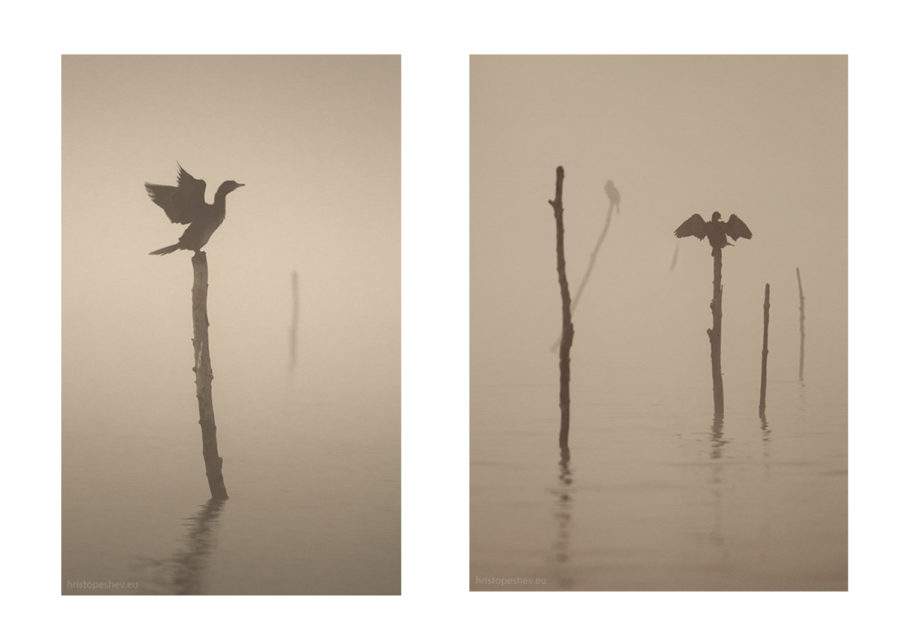
    Pictures by Hristo Peshev. Bulgarian conservationist and wildlife photographer who works as field work co-ordinator at the Fund for Wild Flora and Fauna, Blagoevgrad, Bulgaria specializing in vulture conservation.
  • What Separates us from Monsters? Dylan Tighe’s Redubbing of Pasolini’s Saló

    Before even taking my seat, three times I was warned of the ‘gory content’ in Dylan Tighe’s redubbed rendition of ‘Salò’, or ‘120 Days of Sodom.’ Then announcements made at the start, noting our nearest fire exits, and the two-hour-and-ten minute performance length (sans interval), warned us again that we could leave at any time.

    Those familiar with Pasolini’s final film will understand that this performance is not for the faint hearted. Having run since last Thursday, it has received a critical Irish Times review claiming it abuses the relationship between spectator and performer by traumatising its audience.[i]

    But abuse, as we so brutally learn, is not something that can be left behind at the theatre door. Abuse is not a choice. And a choice we had – we were reminded of it four times. ‘120 Days of Sodom’ is not a new discovery, nor are the stories echoed from the Magdalene Laundries and Christian Brother schools. So, please be advised: if you think that you can’t handle it, then you probably can’t.

    Tighe has no interest in merely entertaining. He seems to have anticipated backlash, telling the Irish Examiner: ‘I was thinking about what it means to be outraged by a representation when there is not as much outrage, culturally, about the facts.’[ii] This is the general theme explored, and it is likely to provoke outrage. I even received a note from my editor afterwards saying: ‘I understand if you had to leave before it was finished.’

    On stage, chairs, small screens, bottled water and microphones are set up for the determined and brave cast. Centre stage, an Irish flag is placed on top of a filing drawer. The flag is later dropped on and discarded to access the files. Later, a European Union flag will be draped, notably when the death reports of young refugees are read out in a clinical and matter-of-fact tone.

    The film is given a new setting, Sligo – later there’s a nod to W.B. Yeats’s notorious line: ‘Base-born products of base beds’ – and our performers give us sound effects of whimpering, aggressive rape and sniggering, while a scattered script draws together a story based on the brutal scenes unfolding onscreen. Context is built from the verbatim accounts of clinical abuse stories. Parallels are easily and purposefully drawn.

    Perhaps the most shocking incident in the film is when a female adolescent is forced to eat the faeces of her abuser. More shocking is the link between that and an exact report of a priest admitting to demanding that a young boy lick faeces off his shoe. ‘I didn’t mean for him to actually do it,’ he says.

    Similar accounts are read throughout, oftentimes in upbeat and haughty tones. Tighe has scripted it so that many of the accounts are dubbed over an older, well-dressed courtesan in the film, assumed to signify a nun.

    I also questioned: what makes the older women exempt from abuse? Is it merely that they are past the age of abuse, or is it something deeper? Have they already endured something similar? One scene where an older lady is flouncing around in a manic way, and then flashes the crowd of male abusers, signifies the latter.

    I found myself waiting in anticipation for the accounts to be read out, for meaning to be given to the disturbing images and events onscreen. Although exercised intelligently, it could have made more sense to stick with one dominant theme: the sexual and physical abuse inflicted on thousands of children by members of the Catholic clergy.

    The list of deceased refugee adolescents was, nonetheless, more than moving, like many of the recollections. I cried silently in my seat. And, while I understand this was Tighe’s point – that this is not history, this is present day – it felt too ambitious. Hadn’t we suffered through enough already?

    I considered leaving around as many times as I was told that it would be OK if I had to do so. But I stayed. Perhaps because of a feeling that this was necessary. To bear witness to the brutality, to face it without a shield, to remove the mask on the truth.

    The play began with an introduction from Tighe himself, addressing the audience in Italian with subtitles onscreen. But one cannot simultaneously look at his facial expressions and read from the subtitles. A choice needs to be made. Similarly, towards the end, as the adolescent characters are shown being abused horrifically, smoke is released onstage, eventually covering the screen, leaving us back in a position of safety.

    This subtle occlusion served as a representation of our daily reality. By ‘our’ I really mean those of us who may not have suffered first-hand these harrowing crimes, but who have listened to many accounts. As a telephone counsellor volunteering in the Dublin Rape Crisis Centre, I can say I have listened. I have acknowledged. I have heard stories such as those depicted on onstage. I also appreciated finding the Crisis telephone number listed on a laminated sign in the cubicles after the performance ended.

    Yet there was something different to this type of listening, something even more foul-tasting, which is a knowledge that these crimes have not been accounted for. These crimes have been covered up and excused. So much so that it falls to Tighe, and others, to recreate the trauma in order for us to face up to it.

    Understandably, this production is not for everyone. But the fact that such a production is being staged in the Abbey – the theatre of Yeats, Synge and Lady Gregory – is significant. An uncomfortable, unpleasant necessity – acting in a way like the Playboy of the Western World questioned other sides of the Irish character. This is why I did not leave.

    The performance explores consumption and an inability to satisfy that consumptive greed which seems to accompany positions of power. It led me to question our own present, overwhelming need to consume. The adolescents could easily stand in for how we exploit the Earth’s resources, how we abuse and ignore the plight of wildlife, farm animals – all in the name of perceived necessities that we assume to be needs.

    I don’t believe that it is Tighe’s intention to put blame on his audience. Rather, this production demands we ask ourselves ‘what separates us from monsters?’

    Feature Image: Luca Truffarelli 

    [ngg src=”galleries” ids=”2″ display=”basic_imagebrowser”][i] Ciara L. Murphy, ‘Pasolini’s Salò Redubbed review: Aims for greatness but falls significantly short’, September 30th, 2019, Irish Times, https://www.irishtimes.com/culture/stage/pasolini-s-sal%C3%B2-redubbed-review-aims-for-greatness-but-falls-significantly-short-1.4034991

    [ii] Alan O’Riordain, ‘Classic 120 Days of Sodom redubbed for Irish context’, September 22nd, 2019, Irish Examiner, https://www.irishexaminer.com/breakingnews/lifestyle/culture/classic-120-days-of-sodom-redubbed-for-irish-context-952326.html

  • Musician of the Month: Phil Christie | The Bonk


    A Digest

    For most of us, the stomach is positioned around our middle. In East-Asian cultures, this area is usually considered the seat of the subjective self – the centre, from which we extend outward towards the world. Closer to home, we usually think of ourselves as residing somewhere behind the eyes, perhaps at one of the busier junctions of brain fold. Testing both locations within myself for signs of existence, I’m most aware of a ‘self’ when something goes wrong; when things are going well, I don’t occur to myself at all.

    The solar plexus is where the feeling of danger registers whenever it appears I am under threat (emotionally or physically). This reaction happens in my guts before any wordthoughts have time to log the incident in my head. Recent scientific investigations show the extent of the neural network in and around the stomach, and lend credibility to the idea that we exist much more in our bellies than we think we do. I like this idea. It makes sense when I think about playing and writing music, and what can be considered ‘my own’ in any of it.

    The word ‘stomach’ traces back to stoma, a Greek word having the sense of a kind of mouth; an opening; an inlet or an outlet. Interestingly, the entire alimentary canal – oesophagus through to the large intestine – can be strictly considered external to our bodies from an anatomical perspective, in that it has openings at either end. If we consider the stomach as the seat of the self, we might concede that we exist outside ourselves in a certain way all the time. The ear is another stoma, another digestive organ, where voices are metabolized and absorbed into the nerve stream.

    I find the most enjoyment in making sounds when it lends strangeness to the experience of being. When you listen to another person or another thing, you’re initiated into another world, churned around in another belly. Within the transmission process, you are suspended between selves, with an ability to be inside and outside simultaneously, accessing all the feelings on both sides of the exchange.

    As you listen and digest the sounds you hear, you’re not only receiving – the ear also gives a voice to the other person or the other thing. Anytime I hear Roy Orbison sing ‘In Dreams’ now I can’t help but hear what David Lynch heard in the piece for Blue Velvet. His ear has edited what Roy Orbison and ‘his’ song are forever.

    All of this is a preface to my admission that I always find it difficult to write about what I do with music, ‘my own stuff’. I think everyone should find that difficult. I’m suspicious of those who don’t. There is a well-founded anxiety that comes with the notion of having a genre, image, piece of music, or slogan, represent you.

    Because when things are working well and when music is working well, there is no need to think about what you are doing. You shouldn’t be able to name it.

    The boundaries between what you hear and digest and what you try to say, or sound, are fluid and always shifting. Artists like R. Stevie Moore and Robert Wyatt, whose songs present a healthy digestion of the sounds and perspectives of others, for me always come out sounding the most original.

    This makes me reflect on the obsession we have with our selves, and also, the idea of eclecticism in music. Everyone wants to find what is unique and self-identical and unmixed and quintessential in themselves. The commodification and marketing of music propagates this obsession because in order to sell things, we need personalities, niches, geniuses, and so on. As a musical artist, distinguishing oneself from ‘the others’ through branding, imagery, sounds, and words is deemed crucial to being able to survive the Internet.

    I think it’s worth making the case for selflessness again. This is not to suggest that we don’t reflect on the place we occupy in the world; we might do well to recognise that the need to identify ourselves with any position is questionable and also very boring. The thing that is really interesting to me in all of this is the experience of not being anything, possessing no essential qualities, having nothing particularly special to speak of, and being fully content to tip on.

    SUPPORT Cassandra Voices with a Patreon Donation CLlCK HERE

    The Bonk play The Sound House on 11.10.19

    May Feign is available for free download here.

  • The Confidence Man

    ‘I say the word ‘forever’ less and less, the more I understand it.’

    It’s a good line. I might get it tattooed on my chest. Or carved on my tombstone.

    During the heatwaves and increased storm warnings of the summer, I felt my heartbeat for the first time in a while. The seasons change so rapidly now; I can barely keep up.

    It’s quarter to five on a Friday evening. I’ve been awake since twelve, but only forced myself to get up an hour ago. I sleep in my clothes more and more nowadays. Eventually I’ll stop writing and try and tidy the house up. Or at least shower, and shave. Sometimes I want to jack the writing in, and put a bullet in my mouth. Other times I wake up ready to hold onto life like it’s all I have – because it is all I have.

    I also know I have a talent, but it’s not a very useful one.

    I barely sleep anymore. I can’t concentrate on anything. The noise in my head is never still. I have what could be charitably described as a ‘rich inner life’. My brain keeps snaring itself into knots; I go from wired to exhausted in a matter of minutes.

    I have my wins, I have my losses; living with both requires skill.

    Christ. I sound like I’m scribbling down ideas for a GQ op-ed.

    On the Beach

    ‘Though my problems are meaningless/That don’t make them go away.’

    As always, Neil Young says it better than I or anyone else can. All this year, I’ve had his ‘On the Beach’ album on repeat. The title song’s jangling bassline and weary falsetto are good reminders that at least my life has a belter soundtrack.

    That phrase ‘toxic masculinity’ keeps coming back to me. A quick Google search of the term yields over 10,100,000 results. Every time there’s a mass shooting or an assault or even a film or a comedian that arouses controversy, it’s listed as among the chief factors. A lot of us, myself included, engage in it.

    I don’t doubt or deny the concept or its validity. But it also sounds like a good name of a beer to me. Like a stout or an ale or even an IPA. Occasionally I half-joke to myself: if the writing doesn’t work out, I’ll start my own microbrewery, and the Tox-Mas IPA will be its premium product. Blonde, red, unfiltered. Whatever you want.

    Being alone is natural, yet people don’t know how to be. It’s not a skill they teach you in school, or during office hours. We’re tired of living with the inner cavity, of the disappointment, and of letting each other down. Yet the disconnect that’s become so prevalent in recent decades is now the norm. People seize up just texting each other. The more we anchor ourselves to our hope, the more let down we inevitably feel. The let-downs, both the ones you’re responsible for and the ones visited upon you, pile up and you start measuring them. I don’t live without hope, but I don’t wholly rely on it, either.

    Loneliness

    Loneliness is considered a mental-health problem nowadays. As most aspects of the human condition are. It’s a symptom of being Irish, I suppose; the inability to countenance that someone or something is worth loving. Whatever suffering I’ve faced in this life is fairly minor compared to that faced by most people I know. I’ve lost friends to suicide, and others to their own inner demons. Because I can’t afford therapy, I turn to language.

    I am often alone, but rarely lonely. Loneliness is inevitable; it cannot be escaped. Loneliness rarely means being alone. It usually means no-one caring.

    Overfed with an endless scroll of stories, posts, newsfeeds, articles shared from newsites blasting the latest cause for concern. Some call it an overpopulation issue; others say it’s the pervasive influence of technology and social media in everyday life. Actual face-to-face contact is declining. At any given point our eyes are glued to some sort of screen. Mass disconnection – is it any wonder?

    The hackneyed, social-media friendly refrain of ‘love yourself!’ rings hollow when people seem to care little about each other. The constant reminders to put oneself first, of the paramountcy if one’s own immediate happiness and gratification, how if should always take precedence over the needs of one’s family and friends.

    Being involved with someone for a long period of time has only increased my worries and knowledge of how bad I am. I don’t need anyone else finding that out.

    Low-level exhaustion

    I wonder if all this intensity is necessary. Or if I am over just over-enthusiastic and say yes too much, too quickly. I follow the reformed alcoholic’s recommendation, and take each day as it comes, work on what I have to: scripts, reviews, my novel, my poems.

    This is new for me; the low-level exhaustion that simmers quietly at the back of each day. In college, I used to churn out multiple three-thousand-word essays, poems, and playscripts. I badly needed a girlfriend then. Confidence, too. If I had more confidence, my life would be very different.

    Now, I just need a job. Or at least, something to keep me occupied. I don’t care about forging a career or drafting up five-year plans. A job is just a way of keeping afloat, so I can write.

    I should still teach myself a few new things, though. Like how to make fire from kindling, without matches or a lighter. Manage my finances better. Jog, cycle, lift weights. Programme a computer from scratch. Things that are quite necessary for a life of competence, and which don’t engage me in the slightest.

    I need no-one and no-one needs me. Is that a strength or a weakness?

    Warped Version of Adolescence

    I’m now back living in my parents’ home, and leading a warped version of my adolescence again. The dynamic with my parents and younger sister is closer to that of roommates than a family unit. We lead our individual lives, work our own jobs, and interaction remains minimal, even under the one roof. We are either too busy or don’t care. We just lack the energy to care. Hence why I rarely speak or expect anything from them. The bond of blood ties everyone, but I’m not sure.

    My father’s boots clumping on the wooden floorboards, the shower’s hiss and the extended sigh of the kettle boiling, the scorch of black coffee at the back of my throat. These are the reminders of how things can change and remain the same.

    They say adulthood is just the slow realisation that all the wisdom fed to you since infancy is categorically false.

    I am single, and yet I am not isolating myself anymore. When I was with my ex-, she was my priority.

    Putting other friendships aside seemed like a virtue, as it meant I was prioritizing my partner. This is what men do in relationships, apparently. When the breakup happens, they find they’ve no mates to turn to. I’m not in the humour to be anyone’s boyfriend now; I lack the energy to care about being with someone.

    Women moving faster

    I keep thinking about women, as always. They seem to move faster than me, their footsteps ablaze with purpose. I look at their hands more and more, to see if they wear rings. Most of them aren’t. It’s not something I ever thought I’d do. It’s become another reflex, like checking the time or my emails.

    Do all men do this?

    Occasionally I look my exes up online, like the creep I am. I don’t go on dates that much.

    There’s always the need to impress, and I rarely feel that impressive. I’ve no business being someone’s boyfriend.

    I was someone’s boyfriend for three years; in all that time, I never quite believed that she loved me. I couldn’t see any reason why she would. But she did. And I loved her back.

    She used to look at me as if I was a god. I knew it was only a matter of time before the reality of what I am would become clear. I could only keep the masquerade up for long, and then she’d want me gone. As she eventually did.

    Every woman I’ve been with I’ve inevitably let down.

    Most blokes seem to make it their life’s work to pester women until they either give in or set their brothers on them. I’m more willing to take ‘no’ for an answer. Usually, I expect it.

    I’ve never felt wanted anyway. I’d say I’ve been out of the game for too long, but that would imply I’ve even been in the game in the first place.

    The beginning of things are always exciting. Once I see the ambit of work that must go into something, I lose interest.

    I don’t know if I have a stunted capacity to feel or recognise love, or am just incapable of feeling it.

    I’ve also trained myself not to get sentimental anymore. To the point that major losses or setbacks don’t hit as hard as they should. The mawkishness is repulsive to anyone who witnesses it.

    News thump

    More and more in my newsfeed about Brexit, climate change, the housing crisis here, banking layoffs in Germany, mass drownings in the Mediterranean, multi-millionaire men of the people taking selfies at Everest’s peak, immigrant detention centres at the Mexican border. The inevitable and deserved comparisons to Auschwitz and Dachau. There’s no ignoring it anymore.

    Armageddon, Ragnorok, Kali Yuga, Al-Qiyammah, the Anthropocene. Every society, in every era, puts a name to the inevitable, to the moment of its collapse. It continues to this day.

    I remember chatting up this girl once, in the smoking section in Workman’s. Whether she fancied me, or was just bored, I couldn’t tell. I never can. She was confident in the way only young people are.

    A man sitting alone in a pub is usually best avoided, but she came up to me and got the conversation going. I say we had a conversation, but really I just let her talk about this upcoming art exhibition she was about to have in Amsterdam. Its overall theme was about body image, how men and women perceive theirs, for good or for ill. Five years ago, this would’ve impressed me.

    She asked me did I like my body, the way I looked, did I feel comfortable in my skin. I didn’t really have an answer for her. If she was waiting for me to make a move, she was sorely disappointed. Not that I didn’t want to, I just didn’t know when. It’s a very delicate dance, and I have very heavy feet.

    I know I am far less than what I could be. I don’t need a self-help guide to realise that.

    The mind is a cave; the brain peels back. I can’t be alone for very long without the craving for a cold beer breaking the surface. I need to stay numb. I need to forget that I exist.

    I want to be somebody else. I’m tired of being a burden to everyone. But this is the flesh I am sealed into.

    Only a few days ago, I was invited to go on a hike through Glendalough. Sweat on my torso and mud on my boots; feeling the winds at such a high altitude, overlooking the swirl of black water that is the Upper Lake in the valley, scrape at my face. Strangely enough, it cleared my head.

    At home, I got back to work. Wrote and felt the old strength come back. I know the value of hope now, the necessity of keeping going. I still know better than to rely on it, but it isn’t unwelcome for now.

    SUPPORT Cassandra Voices with a Patreon Donation CLlCK HERE

    Daniel Wade is a Dublin-based author. He was awarded the Hennessy prize New Irish Writing in 2015, and his poetry has appeared in over two dozen publications. Follow his progress on Facebook, Instagram and Twitter.
  • Reviving the Language of Care in Climate Change Consciousness

    As a child I had recurring dreams of great waves crashing over me. Some would swallow me up, making me lose consciousness. In others I would reach the top of a hill, where I would observe the sea level slowly rising from afar, engulfing the fishing village in which I still live.

    My village is in a protected area in southern Brazil. The place is an idyllic meeting point, where hills, river, white sand dunes and the sea merge into a breath-taking view. The river, called Madre, meaning mother, dances through the wetlands, appearing like a serpent before it reaches the sea. Most days its floodplain lies well away from the houses on the coast line.

    Lately, however, we are observing higher tides and the shrinking of the sandbank. This year winter arrived late and was shorter than usual. We experienced extreme heat alternating with cold days that interfered with the mullet’s reproduction cycle. As a result the fishing season was shorter than usual.

    Climate fluctuation is increasingly evident, affecting the rhythms of nature and impacting on livelihoods.

    For millions of people around the globe, the climate breakdown is a living reality rather than a far off prediction. According to the Internal Displacement Monitoring Centre, 17.2 million[i] people fled their homes in 2018, due to storms, hurricanes, floods, other cataclysmic weather events or environmental shifts. Those living in the Philippines, China and India have been most adversely affected by these phenomena.

    Climate change and forced displacement are the defining challenges of our times.

    In the wake of climate breakdown last month António Guterres, the United Nations Secretary-General hosted the 2019 Climate Action Summit in New York, calling for concrete action to meet the global climate predicament.

    In spite of being in the company of many of the world’s most powerful political leaders, the star of the summit was clearly a Swedish teenager who had just crossed the Atlantic Ocean in a zero-carbon sailboat. Greta Thunberg, climate activist and global phenomenon, managed to capture all our attention. In a powerful speech addressed to governments, businesses and civil society, she condemned world leaders for betraying younger generations, and for indolence in response to the climate collapse and its attendant human costs. 

    I was moved and indeed overjoyed to observe Greta calling humanity’s attention to a dimension often excluded from these talks – the human and ecological costs of our destructive economic system and fossil fuel-addicted societies. 

    Visibly emotional, she uttered the now famous words: ‘people are suffering; people are dying; entire ecosystems are collapsing; we are in the beginning of a mass extinction, and all you can talk about is money and fairy tales of eternal economic growth.’

    At a stroke Greta had restored the language of care to climate talks, having underpined her arguments with reference to the science.

    In as much as we must address issues related to carbon emissions, build creative and sustainable solutions, and change our economic systems and modes of production, the conversation must include climate justice for those on the frontline of climate change. We will only understand forced displacement in the context of climate breakdown once we revive within ourselves the language of care for others, for all living beings, and for the planet itself.

    Unless we humanise the lived experience of those forced to flee hurricanes, floods and droughts, we will continue to externalise the human cost of climate breakdown, and carry on with business as usual: the “fairy tales of eternal economic growth.” 

    If the images of Cyclone Idai, which hit Mozambique, Zimbabwe and Malawi, and Hurricane Dorian – the strongest storm ever to land in the Bahamas – do not awaken concern and care for the victims of climate breakdown, then humanity seems doomed.

    Often I have a sense of hopelessness. I understand many people share similar responses and feelings. When I feel overwhelmed and insignificant in the face of this global crises I take refuge in silence.        

    As an adult working with communities displaced by wars, poverty and weather events, my childhood dreams now support me. At times, caught up in the here and now, I am immersed in the sea of action; at other points, I pause and step back to reflect, restore and witness the larger picture.

    To my mind, these are complementary movements sustaining an open heart and active hands in a world in crisis. As I delve inwardly I observe my motivations. I connect with my principles and values, I feel the pain of a suffering world. As I emerge outwardly, I align my actions and speech with deeper aspects of myself. They are the in-breath and out-breath of sacred activism, that operate like the seasons of my existence.

    To confront widespread climate breakdown, and the despair this brings, one must connect with the language of deep care for the Earth and all living beings. Then we can respond from a place of transformation and embody a new way of living and relating to the planet.

    SUPPORT Cassandra Voices with a Patreon Donation CLlCK HERE

    [i] Internal Displacement Monitoring Centre, ‘Global Report on Internal Displacement 2019’, http://www.internal-displacement.org/global-report/grid2019/

  • Artist of the Month: Conor Campbell

    Around four years ago I completed a drawing inspired by a childhood dream featuring a landscape of balloons, floating boats and orange trees. I then shared it on social media and a friend, Sam Clague, messaged me asking if he could use it for an EP he was releasing called ‘Balloons’. I hadn’t considered the idea of my work being used as cover art until that point. I loved Sam’s music and the music he sent me for the EP seemed to fit the mood of the drawing perfectly, so I said yes.

    A year or so later I moved to Dublin, where I befriended Brían and Diarmuid of Ye Vagabonds. They liked what I had done for Sam and eventually asked me to do the cover for their first album ‘Ye Vagabonds’. This led to many further collaborations over the following years.

    I found when a musician came to me with an idea, or with an example of the sound and atmosphere of their release, that the image emerged very easily. It also helped if I loved the music.

    Music and art have always existed in the same world for me. The mood and melody of the music guides my hand, determining the mood and atmosphere of whatever I am working on. When I really connect with the songs, it doesn’t even feel like I am doing any work. I just listen and paint. The colours and the mood are already in the song.

    I started painting after my first year studying architecture. I hadn’t really done anything artistic up to that point. The architecture degree I took in the University of Limerick had a significant influence on my visual sensibility, and liberated alternative ways of thinking creatively. In the beginning I would lie in bed listening to ambient music or psychedelic rock and discover colours and shapes coming into my mind’s eye for each song. Then the following morning I would set about drawing the imagery I recalled from that semi-conscious state.

    Various elements of my childhood and life interests have influenced my practice. I grew up around a lot of religious imagery in Catholic churches and convents. I remember going to mass and zoning out staring at stained glass windows. My father introduced me to Byzantine iconography when I was very young, instigating an interest in ancient art, particularly Egyptian hieroglyphs and medieval illustrations and tapestries.

    I usually build up my work with layer upon layer of dots and colour. Through this chaos I find an order. If I am doing something that isn’t working, I just paint over it with a new layer of dots. I see the dots almost as pixels that allow me to organically control the evolution of the image into its finality.

    I think my work is usually highly detailed because of my interest in fractals and the infinite detail of reality. So at times I find it hard to know where to draw the line (pun intended) in terms of detail.

    Recently I have started collaborating with the musician Gareth Quinn Redmond, a recent and dear friend of mine. We connected over a mutual love of ambient/environmental music. I brought some paintings over to his house and he wrote music inspired by them.

    It was a new departure to engage in this collaborative process, where I was involved in the music’s development and genesis through back and forth conversations with Gar. I usually make art to music that I am listening to, but this time there was a musician writing music to my art. It was fascinating to be almost inverting the process I was used to. Our first EP ‘Monachopsis’ was released on the 20th of September this year.

    SUPPORT Cassandra Voices with a Patreon Donation CLlCK HERE

  • The Andersons

    The cacophony of the city took on a new chorus when the construction of a new corporate imprint on the London skyline began. The whining of earth chewing machines carving out the footing for the new monolith metres into the historic soil, and soon argentine rods sprouted the intention of new growth. It was only the unexpected discovery of ‘them’ that slowed the anthem of progress.

    It started with the desperate crackle of a two-way radio in the site construction office. ‘Base, this is Pit One. We got a situation here, guv.’

    ‘What is it this time, Baldwin? Tell me it’s not another bloody medieval gravesite,’ was the annoyed reply of the construction site supervisor, standing, moving the blinds to peer out the window toward the source of the annoyance.

    ‘It’s worse than that, Guv,’ came the reply. ‘They’re alive!’

    In the pit all worked had stopped and a cluster of several dozen men provided a constant hum of speculation directed toward a foreboding five-foot high tunnel off the main pit. The site supervisor, half-running toward his foreman, had to shout over the din of the mumblecrust. ‘What the bloody hell do you mean ‘alive’? If this is some sort of…’

    The collective gasp from the assembled workers was enough to interrupt him, and, there in the middle of the city, all sound seemingly stopped. The toots, screeches and constant combustion muffled into nothing and all available eyes stared at the tunnel opening.

    From deep inside the blackness, on the edge of available light, a shuffling sound preceded an old pair of worn leather shoes, the toe caps popped up from the soles to reveal tattered grey-black socks. In the full sunlight, the shoes stopped. Dozens of quiet eyes followed the stooped figure’s rise from looking at his feet to meeting their intense stares full frontal.

    The figure stood erect. It was a vision of greyness, from long, scrambled hair and twisted full beard, to the heavy double breasted greatcoat wrapped around a frame supported by patchworked trouser legs. Instead of a face there were two large flat glasses for eyes, surrounded by a mask of rubber, all of which was flecked with dried mud. Diagonally bisecting the greatcoat was a  wide khaki belt leading to a bag at his waist. On the head was a cheese cutter hat. It was of indeterminate age, save for possible carbon dating.

    The crowd of construction workers leans in the opposite direction as the figure’s arm moves up to the face and slowly peels off the rubber and glass revealing the grey face of an elderly man. Squinting through eye-slits against the sunlight, the man puts his mask under one arm, pinning it in place with his elbow and raises his hand horizontally across his forehead to better see the people before him with his sun-blinded eyes.

    Like a giant basking shark, the collective mouths of the workers are agape at what they are witnessing. One man in the front, perceiving the tunnel figure’s gesture wrongly, slowly raises his hand in a return salute and keeps it in place until he realises the error and tries to pretend he was only wiping his brow, lowering his head to help his hand slowly return to his side.

    The figure looks around the construction pit at the sea of yellow protective helmets and day-glo vests, then upwards eight storeys, taking in the huge crane branded ‘Schmitt’ along its working beak, and musters a crackled voice to ask: ‘Are you Germans?’ As the man scans faces under his hand to forehead for some sign of recognition of his words, there is no answer, no voice from the crowd courageous enough to reply. ‘Sprechen zie Deutsche?’ the figure tries in a louder voice. Still the reply is silence.

    The workers lean back in unison, mouths still catching the wind, as the silence is broken by a muffled, incomprehensible voice from inside the tunnel. The man turns, bends and re-enters the tunnel head first, speaking to someone inside. Slowly he backs out holding the hand of that someone else, stooped by the constrictions of the passage. Into the sunlight the crowd sees another figure led out, bathed in the same grey cast, same tattered clothing and gnarled hair as the man. Her face too is gas masked and covered with what once was a brightly coloured babushka. Her trailing arm reveals that she is holding the hand of a third, much taller figure, this one covered in what appears to be an undersea diver’s helmet, a bell-shaped metallic contraption with a circle of glass the size of a dinner plate. Inside the spectators can clearly see the face of a younger bearded man, with long dark hair filling the sides of the container on his head.

    Now the assemblage adopts a collective puzzled look as the crowd on one side faces the three shabby figures opposite with a five-metre buffer of mud and construction debris between them. The stare-down continues beyond polite levels until the construction site manager, safely three rows behind his charges, pushes his way to the front and steps into no-man’s land.

    ‘All right, that’s it!’ he says angrily, pointing a solitary finger at the bedraggled three, but talking to his foreman. ‘Now we’ve got bloody illegal immigrants tunnelling into the country. Call the Old Bill, Baldwin.’

    Across the divide, the old man quietly speaks to his group. ‘They don’t sound German. Sound like us.’ The woman agrees with a series of nods, so the man tries again, this time to the site supervisor.

    ‘Ello there. I’m Barry. An this is me other half, Sylvia. And me boy, Winston. There’s no need for the Old Bill, we’re just the Andersons.’

    The site supervisor is not moved from his original opinion of the situation and stabs his finger at the offenders to underline his words.

    ‘We’ll see. You’ll find we’re not the soft touch country you think we are.’

    It wasn’t until later, inside the police station interview room, that the group was allowed a word, and then the Old Bill didn’t like those words.

    ‘Stone the crows! You’re makin’ a big mistake ‘ere. We’re Brits. Hell, named me boy ‘ere after our prime minister. Now if we can just go on our way.’ The tattered group was sitting on one side of table, facing a uniformed officer and a detective.

    ‘Not until we sort this out,’ the uniformed officer said.

    The detective, a middle aged man named Horth, was dressed in his new catalogue black leather reefer jacket (50 weeks, £1.98 week!) which glistened in the fluorescent light. ‘And you don’t have any sort of identification? Driving licence? Passport? National Insurance card? Something that can prove you are who you say you are?’

    Barry is quizzical at first, then, like a man who has lost a wallet, searches through the grimy layers surrounding him, patting pockets present and absent. Coming up empty he turns to Sylvia who also goes through the pat-pat routine until she hits something. She turns sideways for modesty and sticks a dirty hand down into her cleavage, retrieving a worn leather wallet and hands it silently to Barry. Cautiously, Barry offers it to the man in the shiny black leather coat. The detective thumbs through the yellowed papers, placing some on the desk before them, cautiously at first, as though he were handling a rare manuscript, but, upon reading each piece of paper, increasingly slaps them to the table.

    ‘Ration books? Food coupons?’ The leather wallet follows the papers to the table. ‘Are you takin’ the mick? I want to know who you are and where you came from. If you want to claim political asylum, you must declare it now.’

    ‘No. I keep tellin’ ya, we’re from London. We’re not political at all. We’ve been underground since the bomb hit. You know – Hitler? The Nazis?’

    ‘You expect us to believe that you’ve been in a hole in the ground since World War Two?’

    ‘Oh my giddy aunt! It weren’t a hole in the ground when we was there. It were our Anderson shelter. Course, at first I didn’t believe it would do us any good…just more government trying to make us feel better. But I’ve come to be a believer,’ Barry says with emphasis.

    Sylvia nods in agreement. Winston watches their performance with no expression on his face.

    ‘What about you son?’ the detective enquires. ‘You got anything on you that proves who you are?’ Winston moves his upper torso back, afraid of the question, then looks for Barry and Sylvia for support. ‘He don’t have nothin’ more than what we’ve got,’ Barry interjects. ‘We’ve never even got him a birth certificate.’

    ‘Right. This isn’t going anywhere,’ the detective said leaning down across the table to confront the trio. ‘I’ll say it again: do you expect us to believe that you’ve been underground for 63 years?’

    ‘Do you think we’d stay in there? We’ve been waiting for someone to rescue us.’ Barry turns to his wife and son for affirmative and they nod in agreement. ‘By the way, did we win?’

    ‘Win what?’

    ‘The war, of course.’

    Horth looks at the officer in frustration, rolling his eyes upward and withholding an answer just like you would from naughty children demanding answers to the obvious. The detective waves to the uniformed officer to join him outside the room.

    As the door closes behind the departing men Winston ventures an opinion in a whispered tone. ‘Guess not. Gawd ‘elp us. Now we’re in for it.’

    The group of four men in fluorescent jackets and health and safety helmet crawled their way through the crude dirt tunnel, their light-sabres of battery-powered illumination showing the way into the earth tube. Ahead lay the answers to the origin of the sub-species that had just escaped. Outside, in the innards of the construction site, police hierarchy and immigration stood guard, waiting for answers. They were complemented by a score of underlings ready serve their every whim. Their radio crackled: ‘Awright, base. This is Echo Charlie 2. Nothing but dirt and more dirt, so far, Guv and we’re at about 150 meters now. How much farther you want us? Over.’ ‘Keep going until you’ve got something to talk about,’ was the command.

    And so they continued to crawl. ‘Me Dad was a miner,’ one crawler, the one bringing up the rear ventured mostly to hear the sound of his own voice. There was no answer.


    ‘Watch it!,’ the lead crawler warned. ‘There’s a drop-off just ahead. It’s…’ He inched forward. ‘It’s an entrance of some sort with corrugated around it like an igloo.’ He reached for his walkie. ‘Awright, base. This is Echo Charlie 2 and now I’ve got something to talk about.’

    ‘What’s that then?’

    ‘We come up to some sort of entrance. It’s got a half-round sheet of that corrugated steel over it, and right in the middle is a door. I’m opening it now…’ He pushed hard on the wood and it swung back to give up its secrets to the sweep of his torch. ‘Oh my gawd!’

    Barry was sitting at the police interview table surrounded by two PCs and three other high-ranking police – enough big brass to build a tuba with.

    ‘We was blasted early one morning. 1945 it were. 27 March. I figure it were one of those rocket thingies because we never heard any bombers or anything…just a big whoosh and then it went all dark. Course me and her was in our Anderson. We always slept there, just in case. It were dark, but then I’m used to seeing dark after all them years.’

    One of the brass, the one with the whitest hair, stepped forward. ‘Mr Anderson…’

    ‘Oh, it’s just Barry m’lud.’

    ‘Barry. If we are to believe that you’ve been buried inside your Anderson shelter for the past 60 some years, can you tell us how you managed to survive? What did you eat? How did you get enough exercise in one of those shelters? I mean, it beggars belief.’

    ‘Oh that’s easy m’lud. I was a trader y’see and I had access to all sorts during the war. Well, not the military essentials, y’understand. At one time I had five Andersons hooked up. But it weren’t just the Andersons as I told the other coppers, no sir. It were where those shelters led us. We found us an even better shelter after we figured there weren’t nobody coming to rescue us. And I had, let’s say, enough for us to live on. I told you, I had access.’

    There was a whispered conference among the brass after this declaration, with the whitest hair man asking: ‘How could you find a better shelter Mr Anderson?’

    ‘Barry. Well, when we sussed there weren’t nobody coming for us we started digging, figuring we’d find a way out. But it seems we just found a bigger room. It were some sort of old Victorian sewer system, all high brick walls and a river running right through it. It had everything we needed.’ Barry looked at the whitest hair man and noticed a bulge in one of his pockets. ‘You don’t suppose I could cadge one of them fags?’

    An exasperated high-ranking police official in the construction site pit grabbed the walkie and screamed: ‘Oh my god, what? What have you found?’ The answer came back immediately.

    ‘Sir, it’s like an underground cavern here. From the back of the shelter we found a short tunnel that led to this huge brick vault, like some sort of ancient sewer. There’s stuff everywhere. Like a rubbish tip. And some patchy furniture, even a bed. Somebody’s been living here alright sir.’

    ‘Alright. Take some photos and return. We’ll sort this out at HQ.’

    Barry was now exhaling a long stream of white smoke from the confines of his beard. ‘If you don’t mind me asking m’lud, what’s this little brown bit at the end?’

    ‘It’s a filter. Helps keep the bad stuff out,’ replied one of the PCs before the whitest hair man could answer. ‘Nothing bad about this. I ran out about 50 years back. Never thought I’d see a fag again.’

    ‘You’re saying you had a 60 year supply of food underground with you Mr Anderson? That’s somehow hard to believe. Like what for example?’

    ‘Well, no I didn’t have 60 years’ worth. But like I told you I had access as a trader. We had the basics and then there was the food that we could catch.’

    ‘Catch?’

    ‘Well, yes, m’lud. Sylvia there is pretty good with fixing up meals.’

    ‘There’s more than one way to skin a rat, if you know what I mean sir,’ Sylvia added with a laugh at her own pun. Winston showed her support by reaching over and patting her back several times with his wide smile.

    After the shocked looks at the very idea of main course rat there was another whispered conference with the brass assessing the information they had. But it was Barry who kept the conversation going.

    ‘Pardon me m’lud, but we’re all still confused about this. We ain’t getting any straight answers: Did we win the war, or are you just working for the Germans?’

    ‘Yeah,’ Sylvia piped up, ‘We’d just like to know who we’re dealing with here. I mean there weren’t much news coming through our home.’

    ‘If I am to believe your story Mrs Anderson,’ the whitest hair man said, ‘then I suppose the question is cogent. Actually, we won the war.’

    ‘Who’s we?’ Sylvia shot back. ‘You sound like an Englishman, but how do we know you’re not on their side?’

    ‘We. The English, won the war,’ was the reply.

    Barrie and Sylvia embraced and Winston, who had been sensibly quiet throughout the interrogation, made it a threesome, embracing both Mum and Dad from behind, his gangly arms enveloping them shoulder to shoulder. ‘I told you!’ Winston shouted. They all jumped up and down and Barry even reached over to throw some papers in the air as substitute confetti.

    The assembled law enforcement contingent watched this microcosmic VE Day celebration with a mixture of annoyance and awe. Detective Horth walked through the door in the middle of this celebration and stands and watches for a few seconds until the whitest hair man beckons him over to the corner of sanity. ‘Don’t ask,’ he says referring to the dancing threesome. ‘Something new for me?’ Horth leans over and whispers several sentences in his ear. ‘Mr Anderson? Mr Anderson, if you will?’ The celebration dies down and all eyes turn to the man with the whitest hair.

    ‘Mr Anderson, you are free to go. And there’s someone waiting for you out at the front desk. We will need to speak to you again, so make sure you leave us some contact details. Detective Horth here will show you the way and introduce you to someone who will ensure you have accommodation for the night.’

    The long camel-haired overcoat shouted upper class expensive exposed as it was now in the interior of a police station. It was draped over the frame of a silver-haired, perma-tanned man standing at the sergeant’s desk in a way that suggested a 30’s black and white film – the arms of the coat hanging empty-handed, and the man gesturing independent of the cashmere appendages.

    ‘Something big is happening here,’ a passing PC stage-whispered to his companion. They stop a respectable distance away within sight of the man.

    ‘Whatcha mean?’

    ‘That’s Alex Whitford. Recognise him?’

    ‘Not really. Big man is he? Gangster type?’

    ‘No…he’s the guy what’s made a living out of getting publicity and shed-loads of money for people who want to make the most of their 15 minutes of fame. So either some pop star’s been nicked for drugs, or…hold on a minute…’ The PC hears a conversation start with the sergeant and hopes his super-hearing can pick up some of it.

    ‘Three people, a man a woman and a child, sergeant. I’m their…guardian, if you will. They were brought in from a construction site I believe,’ Alex said to the sergeant.

    ‘Yes sir. I believe they are about to be released, Mr Whitford,’ the sergeant says. ‘Can you let them know I’m waiting please? I’ve arranged accommodation and it’s getting late.’ He looks at his Girard-Perregaux, then around the room noticing the two PCs hovering.

    The remote listeners immediately mimic looking at a clip board, and decide on an exit strategy – closest door and out.

    ‘I told you it was something big,’ the PC said on the other side of the door.

    So, when a paparazzo called him with a tip that the police were holding three people buried in a bomb shelter since world war two, he didn’t flinch or question, but instead started the publicity machine rolling.

    It was he who was waiting for the Andersons at the police station. It was he who arranged a hotel suite for them. It was he who had arranged new clothes and toiletries for them. It was he who would arrange the orgy of media that lie ahead. He and his son Jefferson, the apprentice PR man. Jefferson is a photocopy of his father, immaculately groomed, but in a younger style.

    ‘We’ll take full responsibility for them sergeant. Not to worry,’ Jefferson said. The introductions were done while walking down a darkened corridor toward a side exit Alex knew would throw off the scent to the troop of press waiting outside. His tipster would get exclusive access later.

    ‘What has the world come to?’ Barry asked as they wandered around the £1,250 a night suite. Barry and Syvia, still in their underground clothes, look over the luxurious amenities of the various rooms while Winston sits on the foot of a bed, TV remote control in hand. Oblivious to the function of what he holds, he’s not even facing the large flat screen mounted on the wall, but intuitively begins to push the buttons. Meanwhile, so many famous label shopping bags litter the floor that Barry and Syvia are drawn to wade through the tissue wrapped contents.

    Barry holds up a pair of Y fronts, ‘These are the whitest smalls I’ve seen since we got married.’ Sylvia nods in agreement and holding up a pair of thigh-revealing underwear.

    ‘These knickers look like they’ve been through the war, Barry. Had a hip shot off.’ She opens them and holds them against her waist. ‘Both hips!’

    Barry reads from the tag sewn inside, ‘Gordon Bennett! I thought they was meant to be getting us NEW clothes. What else they got in here?’ As they rummage in the bags.

    Outside posh hotel suite Alex Whitford and son Jefferson conferred before knocking.

    Alex conspired to his son, ‘Now, just so we’re clear: Whilst I talk to the Andersons, you’ll take young Winston under your wing. This whole retro family will be a mega-event, but the boy is the key. Show him the ropes of whatever it is young people do.’

    Jefferson complied ‘For the agreed price, yes Father.’

    Loud rap music startled Alex who looking to Jefferson knocked urgently on the door.

    ‘I wanna touch you, feel you, know your sex. You know you wanna mama, ‘cause I’m da best. Put yousef against me, feel da rise. It what’s you want baby, my secret surprise.’

    In the hotel room Barry and Sylvia look around, then react quickly. Leaping on the bed, they wrestle the remote away from Winston’s tight grip. As Barry gains control, all slowly turn in wide-eyed horror at the image on the wide-screen television. With late 20th century instinct, Winston co-holds the remote while they all watch. On the television, the rap song continues with scantily clad women dancing and backing up the singer. ‘Sex me up, sex me down. Turn me around. Sex me up, sex me down. Turn me around. Put yousef against me, feel da rise. It what’s you want baby, my secret surprise.’

    Louder is a knock on the door and Sylvia scrambles off the bed shaking her head in the interminable din. She opens the door with a helpless look on her face to Alex and Jefferson who instantly realise what is occurring. Jefferson strides over to the bed, and seizing the remote from a still struggling Barry and Winston, casually  mutes the television.

    Barry, relieved, shouts, ‘Bloody hell! That’ll clear out yer earwax. What the bloody…’

    Alex answers, ‘Television. The media. Your ticket to fame and fortune Mr Anderson.’

    Barry insists ‘You ain’t getting me up in no striptease film.’ And nodding towards Sylvia, ‘Her neither. And Winston, he don’t know about such things.’

    Jefferson reassures them, ‘It’s only MTV, a music show. The best selling music of the week on television.’

    Barry is now drowning in deep disbelief, ‘You mean Vera Lynn’s dead?’

    Alex diplomatically proffers, ‘In a musical sense, yes. We have much to do Mr Anderson, everybody wants your story, and we have to make sure we make the most out of it. I wanted to get you settled. We need to look at how we’re going to handle this. Jefferson. Look after young Winston.’

    Jefferson shows Winston the bedroom door and it closes behind them leaving the adults alone in the living room. Barry is all ears, ‘Well you can start by telling us what we missed.’

    Alex opens his mouth to answer and what exits is a speedy montage of news events from 1945-present. At the end, Barry and Sylvia are legs akimbo on a sofa, exhausted by the march of time. A timid Barry can’t quite contain himself, ‘So Elizabeth’s the Queen, and the Queen has a band, and the Germans are our friends? Plus we have a cinema in every home, electronic post, £90-thousand a week footballers, a man on the moon, and fish ‘n chips ain’t our favourite food no more?’

    That night in the posh hotel suite bedroom, Winston and Jefferson are seated at a table.

    Winston whines, ‘I don’t know much about what’s happened since we was under, ‘n Dad says you’re to tell me.’

    Jefferson begins gently, ‘Right young Winston…it all started about twenty years ago…’ and a young person’s oral history of everything missed comes out quickly in an uncut montage including bands, drugs, fashion and electronic gadgets.

    Winston wants to know, ‘So, I can chain me trousers front to back, wear a bead necklace and ‘f-c-u-k’ on me shirt, and girls can dress in their smalls so’s you can see their protuberances. And they bounce to really loud music like what we just saw. I can drink and smoke lots of whatever I want, Lord luv a duck! I’m glad we won the war.’

    In the ultra posh men’s clothing store, an army of solicitous sales people scurry about carrying armloads of trendy men’s clothing for Jefferson to veto or accept on behalf of his new prodigy. Winston is now cleaned and polished to an outwardly sharp young man but uncomfortable in his new clothes, he fingers the jumper embroidered ‘BEN SHERMAN.’

    Winston needs to know, ‘Why I’ve got to wear Mr Sherman’s clothes? Doesn’t he want them anymore?’

    Jefferson explains, ‘Because it’s a brand. And you wear so people will respect you. It’s the way things are here, my dear boy.’

    Winston is now eager to confirm, ‘Tell me again about those girls who show their sparkly stomachs. Will they respect me? Why do some have sparkly stomachs and some don’t?’

    Jefferson realizes, ‘Oh yes. But we must do a lot more towards your education. What do you know about girls anyway?’

    The next day a knot of  trendy, pierced navel, barely dressed teenage girls chatter excitedly and point toward Winston.

    One girl whispers ‘It is! That’s Leonardo. I think I’d know him when I saw him.’

    ‘That’s Sweet Barry,’ Cargill says. ‘He’s alive!’

    The news was flickering on the small TV set hanging off the wall in the sitting room of the care home. Barely half a dozen of the residents were there and only one was watching, the rest involved in their own worlds.

    ‘Who’s that who’s alive?’ said Parbinger from his wheelchair, the only one who heard the exclamation. ‘Sweet Barry from Stepney. Had a gimp leg what kept him out of the war. We all heard one of them Vee-twos got him and his missus back in ’45. But that sure is the Sweet Barry I knew. He was a right old magpie.’

    ‘And he’s ‘sweet’ why?’

    ‘’Cause Barry once had nearly two tonnes of sugar during the war. Never did hear where it came from, but folks didn’t much ask questions back then. Made him a fortune, he did, and the name Sweet Barry stuck. Now they’ve dug him up, didn’t they?’

    ‘Thought you said he was alive?’

    ‘He was. He is. Claims he’s been buried in his Anderson shelter since ’45 and some builders just dug him and his missus up. And their kid and all. Sweet Jesus that man has all the luck.’

    ‘I thought you said his name was Sweet Barry?’

    We’ll meet again

    Don’t know where

    Don’t know when

    But I know we’ll meet again some sunny day…

    SUPPORT Cassandra Voices with a Patreon Donation CLlCK HERE
  • Hate Crimes in Spain not as they Seem

    Some years ago I read about a small theatre in Moscow staging hard-hitting plays critical of Official Russia. It goes without saying that the authorities did not take kindly to Teatr.doc and its founders, Mikhail Ugarov and Elena Gremina (who both died of heart attacks within six weeks of each other in 2018).[i]

    In 2014 Moscow City Council closed the theatre on a planning technicality regarding the location of a window. Then, in 2018, nine of the theatre’s actors were arrested for ‘unlawfully drinking alcohol in central Moscow.’[ii] And in August of this year, unknown assailants stormed the stage during a gay-themed play.

    But despite all the bureaucratic obstacles put in its way, Teatr.doc continues because even a regime like Putin’s baulks at blatantly shutting down a tiny theatre – it prefers to use legal levers to stifle dissent.

    Unfortunately, Putin’s regime is not alone in basing its repression on the ‘rule of law’. Erdogan’s Turkey is also at it. Even in the EU, Poland, Hungary and Spain are using repressive legislation and compliant judges to shut down non-conformism.

    Flawed Democratic Transition in Spain

    The case of Spain is the most alarming because few people are aware of the problems there. Ever since dictator Francisco Franco died in 1975, the country has been portrayed as the poster child for a transition from totalitarianism to democracy. But, as is often the case with the family of an alcoholic who falls off the wagon, its friends are ignoring the warning signs, hoping that it’ll right itself, and turning a blind eye to lapses.

    Problems have long dogged the fledgling democracy. In the mid-1980s, the then Socialist government organised death squads against those suspected of links to Basque terrorist organisation ETA. A few bureaucrats and a senior minister even spent a few months behind bars for their role in the scandal.

    Then in the late 1990s, judges shut down a number of Basque nationalist publications on the grounds that they were financing ETA. The conservative prime minister at the time, Jose Maria Aznar, even boasted ‘Did anyone believe we wouldn’t dare close [them] down?’[iii] An unusual thing to say in a democracy supposedly with a Separation of Powers.

    Most disturbing of all, journalists from those publications served jail sentences of up to eleven years. The closures of all the publications were later – too late for those who had been jailed –found by Spain’s higher courts to have been unlawful.

    the ‘Gag Law’

    Those cases could be written off as once-in-a-decade incidents caused by disconcertion in responding to a terrorist campaign. But since 2015, new legislation – the Organic Law for Citizens’ Security, colloquially known as the ‘Gag Law’ – has allowed the authorities to clamp down on free speech, free assembly and peaceful acts of civil disobedience.

    Complementing the Gag Law is anti-discrimination legislation – known as ‘hatred offences’ – which was introduced to deal with, for example, racism and sexism but is increasingly being used to prosecute people on ideological grounds. And from looking at official statistics, it’s clear that such legislation is being disproportionately employed in two regions: Catalonia and the Basque Country.

    In 2017, the last year for which official figures are available,[iv] there were 1,418 ‘hatred offenses’ in Spain. Of these, 36% were prosecuted in Catalonia and 10% in the Basque provinces. That means almost half of all cases in two regions accounted for just a fifth of the population.

    ‘ideological hatred’

    And when hatred offenses are broken down, ‘ideological hatred’ in Catalonia accounted for 42% of all cases nationally. There’s an explanation for this.

    Since the beginning the decade, Catalan nationalism has gone from being satisfied with devolution within Spain to demanding a referendum on independence. After being stonewalled by the government in Madrid, they went ahead and organised one on their own. The conservative government at the time responded by sending in thousands of riot police to requisition ballot boxes. In carrying this out, the police beat voters with truncheons and fired rubber bullets into crowds queuing outside polling stations.

    The images were seen around the world and proved a PR disaster for Spain, which has since then tried to dismiss these events as ‘fake news’ and ‘Catalan propaganda’. The Supreme Court in Madrid is now deliberating on the fate of twelve Catalan leaders accused of violent rebellion, sedition and embezzlement for organising the referendum. They face up to twenty-five-years behind bars.

    Going hand-in-hand with the trial of the leaders is a lower level persecution of ordinary Catalans, who publicly display separatist sympathies. Many are charged with ‘ideological hatred’. And while the cases are often thrown out by the courts, on account of risible evidence, the stress of being charged and the cost of hiring a legal team might deter democratic expression of political opinions. Thus, the threat of prosecution allows the state to persecute without explicitly having to do so.

    Other targets

    That said, Catalan nationalists aren’t the only ones being targeted. The Podemos mayor of Cadiz, José María González Santos, is standing trial[v] at the time of writing on an ‘ideological hatred’ charge. He has been accused of ‘hatred of Israel’ in response to cancelling a run of Israeli movies during a film festival. Also a Barcelona University professor is being investigated for ‘calumny’[vi] after claiming that prisoners are tortured in Catalan prisons.

    Other almost comical cases that have made headlines are those of a clown with a red nose[vii] who stood beside a policeman and a car mechanic[viii] who refused to service the vehicle of a police officer. Both were Catalans and both were charged with ‘ideological hatred’. Both cases were thrown out, but not after the accused had endured months of uncertainty.

    Both cases also serve to highlight how legislation designed to protect minorities is being used to persecute members of a national minority in order to protect police from perceived slights. As the former interior minister, the conservative judge Jose Ignacio Zoido said: ‘All those who have disrespected the forces and corps of security of the state will pay for it in the courts.’[ix]

    One such case is that of Catalan satirical magazine El Jueves, which was charged with ‘hatred’[x] for a cartoon saying that cocaine supplies had run out in Catalonia because of all the riot police sent there from the rest of Spain. While people who protested outside a hotel hosting said riot police were also investigated for ‘hatred.’[xi]

    Against the Constitution?

    The crime of ‘hating’ police has given rise to some controversy among legal academics. Professor Joaquin Urias, a constitutional law expert at Seville University, has argued that ‘it can’t be applied to protect an institution.’ He added: ‘Accepting that hating the police is a criminal offence could insert us into a terrible spiral of repression.’ He was responding to the so-called ‘Alsasua 8’[xii] youths, who were jailed for between two and thirteen years for public disorder offences and ‘ideological discrimination’ after a bar fight with two off-duty policemen.

    Perhaps the most notorious cases are those of the puppeteers Alfonso Lazaro de la Fuente and Raul Garcia, who spent three days in jail, and the TV comedian Dani Mateo, who is Catalan. The puppeteers were charged with ‘hatred’ and ‘glorifying terrorism’ after parents complained about a banner held by one of the puppets in a children’s matinee in Madrid. They endured an eleven-month ordeal from their arrest to the judge striking out the case. Meanwhile, Mateo was charged with ‘hatred’ for appearing to blow his nose on a Spanish flag during a TV sketch. His ordeal lasted a mere three months.

    The situation is, to put it mildly, an affront to democracy. Amnesty International has said that it is having ‘a profoundly chilling effect, creating an environment in which people are increasingly afraid to express alternative views, or make controversial jokes.’

    Esteban Beltran, Director of Amnesty International Spain, added: ‘Sending rappers to jail for song lyrics and outlawing political satire demonstrates how narrow the boundaries of acceptable online speech have become in Spain.’

    He continues: ‘People should not face criminal prosecution simply for saying, tweeting or singing something that might be distasteful or shocking. Spain’s broad and vaguely worded law is resulting in the silencing of free speech and the crushing of artistic expression.’

    What next?

    The current caretaker government of Socialist Pedro Sanchez indicated while in opposition that it would address these worrying trends. But despite being in power for more than a year, it has done nothing other than to set up a propaganda ministry, Global Spain, which aims to fight the ‘disinformation’ about the state of democracy spread by, wait for it, ‘the enemies of Spain.’

    What can be done to make Spain change course? With four of the five big parties in its parliament fully behind the idea that Spain is protecting democracy by clamping down on freedom of expression, there are appears to be little hope. Foreign criticism, such as claims that there are political prisoners in its jails, makes the Spanish establishment bristle. But perhaps more concerted criticism from the EU and its member states might have an effect. We won’t know until the EU speaks out – up till now, it has chosen to look the other way.

    SUPPORT Cassandra Voices with a Patreon Donation CLlCK HERE

    [i] Sophia Kishkovsky, ‘Moscow Theater Rebels, Husband and Wife, Are Dead’, June 8th, 2018, The New York Times, https://www.nytimes.com/2018/06/08/obituaries/gremina-and-ugarov-russia-teatr-doc-die.html

    [ii] Katie Davies, ‘Actors from Russia’s independent Teatr.doc detained by Moscow police’, July 5th, 2018, The Calvert Journal, https://www.calvertjournal.com/articles/show/10464/actors-from-russias-independent-teatr.doc-detained-by-moscow-police.

    [iii] Jose Miguel Larraya, ‘”¿Alguien pensaba que no nos íbamos a atrever a cerrar ‘Egin’?”’ July 23rd, 1998, El País, https://elpais.com/diario/1998/07/23/espana/901144814_850215.html

    [iv] http://www.interior.gob.es/documents/10180/7146983/ESTUDIO+INCIDENTES+DELITOS+DE+ODIO+2017+v3.pdf/5d9f1996-87ee-4e30-bff4-e2c68fade874

    [v] Untitled, ‘José María González ‘Kichi’ declara en el juzgado por cancelar un ciclo de cine israelí’, September 17th, 2019, Diario de Cadiz, https://www.diariodecadiz.es/cadiz/Jose-Maria-Gonzalez-Kichi-declara-juzgado_0_1392460911.html.

    [vi] Untitled, ‘El juez admite la querella de CCOO e imputa a un profesor de la UB por decir que en las prisiones “hay torturas”’ September 19th, 2019, eldiario.es, https://www.eldiario.es/catalunya/sociedad/querella-CCOO-profesor-UB-prisiones_0_942806331.html

    [vii] Jordi Pessaradona, ‘Imputado por un delito de odio el concejal catalán de la nariz de payaso’, February 23rd, 2018, Público, https://www.publico.es/politica/imputado-delito-odio-concejal-catalan-nariz-payaso.html

    [viii] Jordi Cabre, ‘Archivado el caso del mecánico de Reus acusado de delito de odio’, 23rd of March, 2019, Diari de Tarragona, https://www.diaridetarragona.com/reus/Archivado-el-caso-del-mecanico-de-Reus-acusado-de-delito-de-odio-20190325-0057.html

    [ix] Carles Villalonga, ‘Delito de odio: ¿uso o abuso?’, March 4th, 2018, La Vanguardia, https://www.lavanguardia.com/politica/20180304/441143656491/delito-odio-incitacion-violencia.html

    [x] Pascual Serrano, ‘El delito de odio, la revista ‘El Jueves’ y la Policía’, November 14th, 2017, Público, https://blogs.publico.es/otrasmiradas/11541/el-delito-de-odio-la-revista-el-jueves-y-la-policia/

    [xi] Javier Álverez, ‘Fiscalía investiga por delitos de odio y amenazas la expulsión de los policías de los hoteles’, October 3rd, 2017, Seiz, https://cadenaser.com/ser/2017/10/03/tribunales/1507017054_809275.html

    [xii] Guy Hedgecoe ‘Ghost of ETA refuses to fade for Spanish Right’ June 9th, 2019, politico.eu https://www.politico.eu/article/eta-spanish-right-basque-country-alsasua/

  • Public Intellectuals: Jürgen Habermas

    It came as a surprise when the editor of Cassandra Voices divulged recently that he had never read any works by Jürgen Habermas (1929 – ), who I regard as a strong contender to be the greatest living public intellectual. I put this down to limitations inherent in his generation, so I felt compelled to expand on the wisdom and complexity of this towering figure – among the last in the line of transcendent, rigorous intellectuals of the Old Left.

    It is perhaps a partial Germanic background that predisposes my appreciation of Habermas, and I frequently reference his work. Clearly not to everyone’s taste, a technical, and at times dense prose writer, he is not a model stylist. The salient points he makes are, however, of substance, lying as they do in an embrace of communality, anti-extremism and moderation.

    Habermas’s intellectual origins are in Critical Theory and he was, as we shall see, at one time an adherent of the Frankfurt School, and a committed Marxist (he remains Marxist in orientation, but his intellectual voyage has taken him a long way clear). Having definitively broken from the Frankfurt School, he became a firm defender of rationality and Enlightenment Values, the very antithesis of the Designer Marxism of the Sorbonne that spawned this Post-Truth zeitgeist that I have previously written about.

    In essence, Habermas recovers the substantive aspects of rationality, and puts forward a theory of practical reasoning and political deliberation. He regards reason as emancipatory and an antidote to dogmatism, compulsion, and domination. The substance of law is particularly important to him – indeed he has expressed regret that he did not study law – and much of his writings are legal in character.

    Part of the Habermas project is to elevate the space of public deliberation and the Rule of Law above Postmodern scepticism. Arguably, embracing legal philosophy compelled him to focus on the particular rather than the general – empiricism rather than Continental philosophy.

    Background

    As a member of the Flakhelfer generation who came of age during the final phase of Wold War II, Habermas was tremendously influenced by the horrors of the Holocaust, which he first encountered in cinematic reels after the war.

    In response, he venerates the Rule of Law as a counterweight to the horrors of Nazism. Moreover, though at times he is withering in his assessment of the post-war West Germany state (‘the FDR’), his criticism remained constructive and democratic in orientation, anticipating a Third Way between conservatism and doctrinaire Marxism, while bypassing the Critical Theory festering in academia.

    In his early writings Habermas was anxious to depart from influential intellectuals such as Carl Schmitt, tainted by association with Nazism. He opposed veneration of the state, emphasising instead the importance of civil society.

    In contrast to Marxists – many of whom dismissed this as a form of bourgeois fetishization – Habermas emphasised the value of legality. He does not, however, endorse law uncritically. Thus he was sceptical initially of the role of the German Constitutional Court, which developed fundamental rights in a largely progressive fashion. Habermas regarded such judge-led laws as paternalistic. As indicated, he emphasised the importance of civil society engaging in rational discourse rather than a scheme of state-driven rights recognition.

    Furthermore, Habermas sought to reconcile legitimacy with legality. He puts significant store in constitutionalism and a right to civil disobedience, reviving a liberal-socialist argument against the unbending Postmodernists. Habermas argues for a structural transformation and reinvention of the public sphere.

    In his early writings Habermas was also anxious to promote a positive conception of democracy, based on principles of legality and popular sovereignty. He identified an eclipse in the public sphere in the FDR during 1950s, and argued that in place of reasoning and decision-making propaganda and acclamation held sway.

    Natural Law

    Habermas has been deeply critical of an idea of politics as a technical affair, emphasising instead the importance of plebiscite or Direct Democracy. He is critical of a growing tendency to devolve power to technocrats and administrators, seeing the legislative branch of government as the real guardian of constitutionality. He argues that negative liberties could be reinvented only as positive guarantees of participation within a unified state society.

    In his earlier writings he was also sceptical of civil and political rights and these negative liberties. However, from 1961 we see a shift in his writing, as he became more positive about rights. In particular he is influenced by a series of Federal Constitutional Court decisions, including the Luth/Harlan case, which reinforced positive liberties and had a radiating effect on private law. He commends the court for applying rights in a horizontal fashion, against private parties and for recognising a positive obligation to protect speech.

    Nonetheless, throughout his intellectual life he has remained sceptical of court-imposed solutions, and, unlike the American philosopher Dworkin, judges themselves.

    It should be stressed that Habermas has been opposed to the Natural Law orientation of the Federal Constitutional Court, and has always sedulously opposed Natural Law. As he put it ‘Natural Law is devoid of any and every convincing philosophical justification,’[i] a point I endorse.

    Democratic Deficits

    Between 1961 and 1964 Habermas railed against democratic deficits in the FDR, a state which he believed had been handed over to technocrats. Inherent was a distrust of scientization and its fundamental incapacity to grapple with ethical questions, applying to the pursuit of the ‘good life’. He argued that the normative considerations essential to a democracy were being occluded.

    In a prescient remark, anticipating our present commodification of human life he writes:

    In modelling itself on the natural sciences, a science of politics risks treating the human being more as an object than a subject of historical processes.[ii]

    Habermas coined the term decisionist, meaning political decisions taken in a technical fashion unharnessed to ethical considerations. To counter this he emphasised the importance of reason, arguing against the scientization of politics and suggesting that unless technical knowledge was translated into practical knowledge political power would remain substantively irrational. The public sphere was the only place for that translation and that act of translation is the only way to make ‘a scientized society, a rational one.’[iii]

    Habermas thus argues that technocratic thought distorts the proper relationship between science and politics, and that citizens of the state need to be included in the translation between science and politics; in other words democracy needs to be inclusive and direct, as a technocratic consciousness excludes practical ethical questions from public deliberation.

    Habermas suggests that ruling elites in reducing practical questions about the good life to mere technical problems, undermined public, rational democratic discussion of values by the public. This had the effect of masking the value-laden character of government decisions, generally in the service of ascendant capitalism.

    Today’s fumbling bureaucrats and trickle-down-austerity-merchants are the semi-educated heirs of Habermas’s technocratic elite, devoted to growth-without-end, while ignoring externalities such as ecological and environmental meltdown.

    Alas his countrywoman Angela Merkel and her Eurocrat friends succeeded, by proxy, in destroying the social fabric and human structure of Ireland and Greece through adherence to a savage doctrine of austerity. The imposition of technical solutions (‘reducing the deficit’) negated the moral dimension of their actions, upholding a value-laden ideology that worked to the benefit of a shrinking economic elite who prospered after ‘weathering the storm’, at the expense of the preponderance of the population who were left on the scrapheap.

    Herbert Marcuse

    Habermas distinguished himself from his friend and former Frankfurt school colleague Marcuse in his attitude towards technology.

    First, unlike Marcuse, he saw technology as a permanent fixture of the human condition. Secondly, while Marcuse leaned towards the idea of a technological Utopia, wherein emancipatory machines would free workers from of work, Habermas emphasised the importance of the institutional framework of choice, decision and practical deliberation, seeing the permanence of technology without its liberating consequences. Thus, he steered a middle course between the technocratic right and the Marxist left:

    today better utilisation of an unrealised potential leads to an improvement of the economic industrial apparatus but no longer eo ipso to a transformation of the institutional framework with emancipatory consequences.[iv]

    He would surely despair at the mass surveillance of the internet, social media and automation, including a reconstitution of human identity through information technology. These are far from emancipatory consequences of technology. Automation and robotic capitalism will not award people more time to achieve leisure and growth.

    Communicative Action

    In 1968 Habermas introduces his key theory of Communicative Action, where he lays out his contention that the Left had incorrectly assumed that a change in the mode of production would automatically result in desirable changes in the relations of production. He argued that the technocratic approach of the Right and this Left utopianism converged in that each viewed politics as no longer requiring legitimation.

    In place of these, Habermas proposes a shift from a technocratic politics to concepts of work-interaction and communicative action:

    I suspect that the general relation of institutional framework (interaction) and subsystems of purposive rational action (work in the broad sense of instrumental and strategic action) is more suited than historic materialism to reconstructing the sociocultural phases of the history of mankind.[v]

    He further argues that:

    It becomes clear that two concepts of rationalisation must be distinguished. rationalisation at the level of the institutional framework can occur only in the medium of interaction itself, that is by removing restrictions on communication.[vi]

    Habermas also distinguished between technical reason and substantive or communicative reason, which he argued was vitally important: ‘The institutional organisation of society continues to be a problem of practice related to communication, not one of technology, no matter how scientifically guided.’[vii]

    Habermas argued thus for a domination-free communication, and that ideology systematically distorted communication. His argument is for universal pragmatics:

    By reconstructing the conditions of possible communication Habermas hoped to identify the elements necessarily presupposed in the successful exchange of speech acts and thereby to uncover the universal validity basis of speech.[viii]

    Habermas asserted that through language, speakers adopt a practical stance oriented toward ‘reaching understanding,’ which he regards as an ‘inherent telos’ of speech. When individuals address each other in this manner, they engage in what Habermas calls ‘communicative action,’ which he distinguishes from strategic forms of social action

    In communicative action:

    speakers coordinate their action and pursuit of individual (or joint) goals on the basis of a shared understanding that the goals are inherently reasonable or merit-worthy. Whereas strategic action succeeds insofar as the actors achieve their individual goals, communicative action succeeds insofar as the actors freely agree that their goal (or goals) is reasonable, that it merits cooperative behavior. Communicative action is thus an inherently consensual form of social coordination in which actors “mobilize the potential for rationality” given with ordinary language and its telos of rationally motivated agreement.[ix]

    speech acts

    Over the course of a decade the theory of universal pragmatics culminated in a theory of justice as fairness of communication. In this Habermas was influenced by the English positivist John Austin and his idea of ideal speech, arguing with respect to speech acts that:

    In uttering a speech act, the speaker unavoidably raises validity claims which can only be redeemed in a discourse having the structure of an ideal speech situation. However, distorted the actual conditions of communication may be, every competent speaker possesses the means of the construction of a speech situation which would be free from domination and in which disputes concerning the truth of statements or the correctness of norms could be rationally resolved.[x]

    In his recent writings he has amplified on speech acts and identifies four ‘pragmatic presuppositions’ essential, he argues, to communicative rationality:

    • no one capable of making a relevant contribution has been excluded,
    • participants have equal voice,
    • they are internally free to speak their honest opinion without deception or self-deception, and
    • there are no sources of coercion built into the process and procedures of discourse.[xi]

    The essence of all of this is the idea of inclusive critical discussion, free of social and economic pressures, in which all involved treat each other as equals in a cooperative attempt to reach an understanding on matters of common concern.

    In this context Habermas harks back to the salons of the Enlightenment, and claimed that as mass societies emerged over the course of the 19th century, ideas became commodities, assimilated to the economics of mass media consumption.

    Habermas sought to revive this tradition of free-ranging thought in attempting to re-install public reason, and calls for a socio-institutionally feasible concept of public opinion-formation that is historically meaningful, and which normatively meets the requirements of the social-welfare state, and which is theoretically clear and empirically identifiable. He argues that this: ‘can be grounded only in the structural transformation of the public sphere itself and in the dimension of its development.’[xii]

    During this period, Habermas also evaluated the German Sociologist Max Weber seeing in his compatriot’s thought an iron cage of modernity, assigning law and morality to different spheres of rationality. Law required, Habermas argued, a rational justification in contrast to Weber’s positivism equating legality with legitimacy.

    Habermas asserted a need for the law to be justified not simply in technocratic terms, but also in terms of principle or practical moral justification. Law, he argued, was intimately linked to morality and politics and to the constitutional organisation of political power.

    Civil Disobedience

    Habermas was a man of his time, and like Albert Camus, engaged with its controversies. Thus from 1978-87 he turned to the question of civil disobedience in response to what was happening in Germany, especially in response to protests against the proliferation of nuclear weapons.

    Habermas defended civil disobedience and endorsed John Rawls view that this was a morally grounded act, which must appeal to publicly recognised principles. He argued that state legitimacy was intimately connected to the normative quality of the state in arguing for a representative democracy that held a place for civil disobedience.

    Habermas saw civil disobedience of a peaceful nature as a revitalising force, and rejected the authoritarian legalism of Conservatives. Instead he placed faith in dissenting citizen, and saw the German state as a self-revitalising project animated by a noninstitutionalised mistrust of itself.

    At this time Habermas set his sights on Postmodernism. In fact, he called young conservatives antimodernists, old conservatives premodernisms and neo-conservatives postmodernist (such as the Green party who, in a quasi-Luddite way, argued against aspects of modernity) and rejected all three.

    Instead Habermas placed his faith in a concept of communicative rationality with reason centre stage. He would be in his element attacking the way in which post-modernist relativistic nonsense has been co-opted by the Alt-Right and the Neoconservatives.

    More recently, Habermas has emphasised the values of law, politics and the Rule of Law. In fact, he argues that democracy and the Rule of Law are co-original and presuppose each other. He argues for popular sovereignty in conjunction with human rights as the legitimacy of laws; prioritising popular sovereignty and a proceduralist theory as an alternative to ideology. He puts his trust in the productive forces of communication.

    Habermas argues that breaking up legislative power into institutionalised and noninstitutionalised spaces – the parliament and the plurality of public spheres – was the best way to achieve the democratic ideal of self-determination. He saw the noninstitutionalised distrust of the citizen, reflected in civil disobedience, as central to a democracy.

    He explained that the ideal speech situation created the necessary formal or procedural framework within which the public could deliberate and fill in the picture of a good society. Within such a framework participants could decide the concrete possibilities of social organisation they desired.

    His position is summarised thus:

    Habermas dubs his position an “epistemic proceduralism.” The position is proceduralist because collective reasonableness emerges from the operation of the democratic process; it is epistemic insofar as that process results in collective learning. The latter presupposes a fruitful interplay of three major discursive arenas: the dispersed communication of citizens in civil society; the “media-based mass communication” in the political public sphere; and the institutionalized discourse of lawmakers. When these arenas work well together, civil society and the public sphere generate a set of considered public opinions that then influence the deliberation of lawmakers.[xiii]

    In conclusion

    Habermas saw German constitutionalism as an unfinished project and sought to offer a Third Way of democratic discussion between formalistic positivism and moralistic natural law. He is critical of the foisting of human rights on us by judges –  and was critical of the Dworkinean prioritising of the judiciary – placing faith instead in in popular sovereignty.

    He argues, nonetheless, that a system of rights constitutes a minimum set of normative institutional conditions for any legitimate modern political order, but that further institutional mechanisms such as legislatures and other branches of government must operate as an open society of interpreters of the constitution.

    These are the important values espoused by Habermas:

    1: The rule of law and legalism.

    2: Speech and communication untainted by ideology.

    3: The voyage of social passage from post-modernist nonsense to Enlightenment values.

    Interestingly, both Habermas and Noam Chomsky are of a similar vintage, and are perhaps the residues, or remnants, of a tradition of learning and rigour, which is now largely marginalised and ignored. Though he is often difficult to read in a stilted Germanic style derived from Kant through Heidegger and even Thomas Mann, his ideas are of vital relevance. The great challenge is to impart these, and gain an audience.

    A dialogue between secular non-extremist humanism and Christian non-extreme humanism.

    The following is a codicil to a recent piece I wrote on Jurgen Habermas as part of the Public Intellectuals series.

    I list ten crucial lessons and interpretations from the man I regard as the leading public intellectual of our time who bridges schools of thought in a way similar to Edmund Burke, and with more rigour. Habermas was scorned by the agitprop leftists in Germany after he spoke out against a growing extremism as he read it.

    1. Habermas was correct to abandon postmodernism such as that identified by the Frankfurt School, and replace it with rationalist ideology whether Christian or secularist. We need to reunite through reason against the dark forces in the world.
    2. His crucial idea of communicative action and ideal speech invites us to talk in neutral conditions purged of ideology. This has led me to advocate for a world council composed of non-corporate, non-business, apolitical leaders apart from those who are properly rational, which includes Barack Obama and Vladimir Putin. Independent think tanks. Let us talk and argue but not fall out and scream at each other any longer.
    3. Accept religion from an atheist perspective, all to their own. Spirtuality is not to be despised, and we need a communication about ethics and morality. A common ground.
    4. Avoid all extremism. It is counter-productive, whether leftist or rightist. That includes religious fundamentalists and atheist bashers of religion. An interdisciplinary dialogue between faith and reason, a reasoned faith, is needed to confront the problems of the world.
    5. Society should run using technocratic methods with ethical and moral components. Vorsprung durch technik, Germany works but has inflicted its model work practices to liquidate much of Europe. Merkel is not Helmut Schmidt.
    6. Embrace the intellectual tradition and raise our civilisation. Nuance is key.
    7. Democracy is enriched by dissidence, protest and a sense of community beyond parties. but not agitprop doomsday cults.
    8. In certain jurisdictions judicial and other elites cannot be trusted. Too many are now compromised. We need fresh ideas and perspectives.
    9. The United States is on the brink and should not be deferred to. The global challenge of silicon valley needs to be challenged, just as we should be challenging the encroachment of China.
    10. Continue to resist the intellectual and political legacies of both Nazism and Marxist-Leninism.

    [i] Jürgen Habermas: Natural Law and Revolution (1963), p. 113

    [ii] Matthew Specter: Habermas: An Intellectual Biography, Cambridge University Press, Cambridge, p.93

    [iii] Ibid, p. 97

    [iv] Habermas: Technik und Disenchant ales Ideologies (1968) p99.

    [v] Ibid, p.92.

    [vi] Ibid, p.98.

    [vii] Ibid, pp.78-79

    [viii] Specter, p.???

    [ix] Habermas: Stanford Internet Encyclopedia.

    [x] John B. Thompson and David Helds: Habermas: Critical Debates, M.I.T Press., Cambridge,  pp.8-9

    [xi] Habermas: Stanford Internet Encyclopedia. https://plato.stanford.edu/entries/habermas/

    [xii] Jürgen Habermas, The Structural Transformation of the Public Sphere, (translated by Thomas Burger and Frederick Lawrence), M.I.T. Press, 1989,  p.244.

    [xiii] Habermas: Stanford Internet Encyclopedia, https://plato.stanford.edu/entries/habermas/