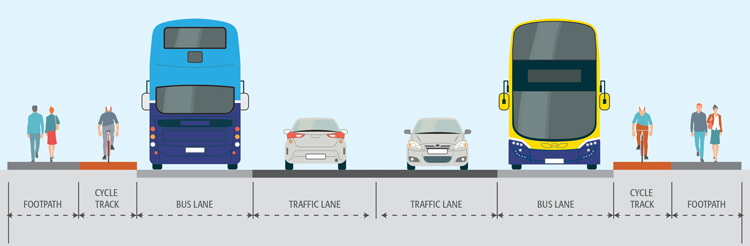
Under normal circumstances, developing a bus network should confer great benefits on a city: it is cheap, quick to implement, and causes little disruption. Yet, remarkably, the BusConnects plan manages to achieve precisely the opposite effects.
Furthermore, ever since BusConnects has been on the agenda, it has diverted public attention away from other improvements that should be ongoing. Delivering more buses with clean, non-diesel engines would be a tangible improvement that could happen without controversy, as would priority traffic lights. Instead we seem to be forging ahead with a costly megaproject, which threatens the city’s character, and ultimately may not even come about.
Dublin has an unenviable history in terms of delivering public transport megaprojects. DART Underground is an obvious example, while the Airport Metro has been in gestation since 1966: to date the only element is a station recently built beside the Mater Hospital.
I have repeatedly sought details as to cost of that station, by way of Access on the Information on the Environment Requests to the National Transport Authority, yet these have gone unanswered, after being initially acknowledged.
Where megaprojects have been touted in the past, this has tended to divert progress that could more easily be made in other areas. For instance, there was little interest in getting the Phoenix Park tunnel brought into passenger use while the DART Underground project was being advanced.
Failed megaprojects can also be incredibly costly: reports indicate that €200 million was spent on the last effort to build the Airport Metro.[i]
The real issue is that, if realised, BusConnects will make permanent space for private motor cars. This would be achieved at the cost of the city’s built heritage and green infrastructure – including thousands of road side and privately owned trees. As such, this element appears to contravene both the Dublin City Development Plan[ii] and the EU Habitats Directive[iii].
Thus, Objective GIO27 commits: ‘To protect trees, hedgerows or groups of trees which function as wildlife corridors or ‘stepping stones’ in accordance with Article 10 of the EU Habitats Directive.’
While Policy SC15 seeks: ‘To recognise and promote green infrastructure and landscape as an integral part of the form and structure of the city, including streets and public spaces.’
And Policy SC12 aims: ‘To ensure that development within or affecting Dublin’s villages protects their character.’
It is noted that at a public meeting earlier this year in the Clayton Hotel off Leeson Street, on behalf of the National Transport Agency (NTA), Hugh Creegan, stated that plans have not yet been prepared for replacement of trees.
Given the massive scope of the scheme, it seems essential to provide plans for what will occur after the initial destructive phase – otherwise, the plan is missing key elements, and is premature.
Road-widening schemes for Dublin during the 1970s and 1980s were not a solution to our transport ills then – and do not provide one now.
Areas along the inner tangent such as Summerhill, Bridgefoot Street, and Christchurch, are still scarred by those developments. Other areas, including both canals, were also under extreme danger – yet fortunately, the megaproject of road-widening was never realised.
This brings us to the real question: why is a road-widening project being foisted on Dubliners, when they clearly prefer rail and tram transport to bus? Luas and DART provide end-to-end services and enhance neighbourhoods (and property values) along the routes. This is certainly not the case with road-widening schemes, which contribute noise and air pollution.
BusConnects envisages 1,400+ compulsory purchase orders (CPOs), including the removal of many private gardens, bringing traffic closer to people’s front doors. Costs are far from clear. There is a major discrepancy between values suggested by the NTA ranging between €30,000 to €60,000 per CPO, and the potential diminution in the value of certain properties along the routes. A figure suggested for some properties has been as high as €500,000,[iv] a difference by a factor of ten.
The assumption that bus represents better value for money does not hold true when assessed over a thirty-year time span: trams last longer and carry more people, as well as requiring fewer drivers. Moreover, road surfaces generally demand more frequent maintenance than rail tracks.
According to an ArcGIS assessment I undertook, over 100,000 Dublin residents could have access to the Irish Rail network, if stations were opened at logical sites along the route, such as Ballyfermot, Cabra, Dublin Zoo, Croke Park, East Wall. and Dublin Ferry Port. As with the Phoenix Park tunnel being brought into use, there is no serious impediment to extending the city’s existing rail network – except for a lack of will, combined with an apparent preference for meretricious megaprojects.
Moreover, BusConnects also effectively gets in the way of decent cycling infrastructure being developed. Although the adverts proclaim that over two hundred kilometres of cycleways are to be built as part of BusConnects, in reality that scheme has priority over the extensive cycleway plans announced five years ago by the NTA.[v] Hence cycle provision is once again put on the back burner.
This Bus Connects plan does not represent value for money, and would destroy wildlife, diminish the built environment. It should be set aside. Dubliners deserve better than Bus Connects. The NTA are expected to make planning applications so as to develop the BusConnects scheme during 2020.
Do you think this piece is valuable? If so, you might consider providing us with financial support via Patreon, or simply pay us a small sum directly using PayPal: admin@cassandravoices.com. Thanks for supporting independent journalism. Subscribe for free to our monthly newsletter here.
This piece has been composed from a submission filed with the National Transport Authority (NTA) by Ruadhán MacEoin BSc. MSc., who is a planner and urban designer. For his Master’s Degree in Richview UCD (2017), he assessed recent delivery of public transport in Dublin, and produced a thesis entitled ‘Democratic Accountability or a Speculator’s Blank Cheque: What Lessons Have Been Learned from Dublin’s Experience of Transport 21?’. In the past, MacEoin wrote for numerous publications on planning matters, including The Sunday Times, The Irish Times, and Plan Magazine. He lives and works in Dublin.
In the mid-1990s Seosamh O Cuaig and I were filming a programme for TG4 in the State of Minnesota. It concerned an 1880 shipload of emigrants from Conamara.
In the city of St. Paul we were told that the term ‘Connemara’ was a century-old Minnesota synonym for lazy. This was curious, because nobody in the 19th century could survive on the rocky garrantaí of Conamara without hard, relentless physical work. There was no dole.
We learned that the ‘Connemara’ slander originated in 1880 when a Catholic Bishop, John Ireland, publicly blamed his financial troubles on a group of fisher-families from this area. He had taken them from their rocky fields and canvas currachs in the West of Ireland, and settled the oldest and youngest members of the families, against their will, miles from the city on the vast prairies.
They were instructed to become farmers. For the fit and young of the same families the bishop organized jobs in the city of St. Paul. Then came the worst winter in living history with temperatures thirty below.
The plight of those raw prairie dwellers was so desperate that they became the subject of national debate in the American Press. The Bishop, responding to WASP criticism, said they were too lazy to work. His criticisms were widely reported.
Naturally his urban flock and his separated brethren – the Freemasons of Morris County – did not doubt his word. But the Conamara immigrants, being neither literate or English speakers, could not defend themselves in that language, had no access to the print media.
In Spring the Bishop relented, the ‘Connemaras’ were delivered back to the city of St. Paul – which was where they had thought they were going in the first place. They made a success of their lives, one of them eventually becoming mayor of the city.
At least one Conamara family persevered on the prairie – that of Learaí Ó Flathartha – and also thrived. Nevertheless the slander of ‘laziness’ had persisted to this day, mainly because the immigrants could not defend themselves in English.
‘But,’ as Seosamh O Cuaig grimly said to me during the course of making the film, ‘I can read and I can write, in English’ Therefore we intensified our researches and the film eventually showed how these people had been used as scapegoats for the failed ambitions of the colonizing Bishop, a Republican and an entrepeneur. Helped by a laicised Bishop Shannon we detailed his predecessor’s personal ownership of the railway land awarded to him for the purposes of Catholic settlement. It seemed clear that as time was running out on his contract, Bishop Ireland used these poor people simply to buy time and fulfil his undertakings to his friends in the Railway company.
So fraught were his financial dealings that after he died his sister, a Mother Superior, destroyed all of the personal papers that related to the incident. But the mud stuck. Two Irish-American Minnesota lawyers happily told us, on film, that their Limerick-born father had emphasized to them: ‘Make sure people know you are from Limerick, not from Conamara.’
‘the cash crop’
Nearly a century after the Minnesota mess, in 1973 in Conamara I had recorded a vox populi with youngsters attending the Irish Summer Colleges in Conamara. All townies, they unanimously dismissed the place as consisting of nothing but rocks, with no attractions whatsoever. The locals, according to a few, were lazy.
How could they have made this judgment in three weeks? Presumably they had brought that bit of baggage with them from their suburban homes. Luckily, they know a little better now and there certainly is no local resentment to the Summer College industry.
Business is business and the modern students are referred to locally by the affectionate term ‘the cash crop’. Nevertheless, from Marx with his term ‘rural idiocy’ to Garret Fitzgerald’s opposition to Knock Airport; from John D. Sheridan’s bucolic ‘Thomasheen James’ to stand-up comics today, there is something universal in this urban contempt for rural-dwelling ‘culchies’.
The painter Michael FarrelI would jokingly ask sculptor Eddie Delaney and myself: ‘Are you two still rotting away in Connemara?’ The perception is based sometimes on ignorance, sometimes on fear of the wild men of the West.
A film editor whom I brought to Conamara years ago confessed to me that his ventures beyond the Pale had hitherto never brought him further than Leixlip – fifteen miles from Dublin.
Over the years, and quite separately, I remember two old friends of mine, a journalist and an actress, saying they felt threatened in the company of people in South Conamara. In forty years I have never felt thus threatened. My friends could not explain why they felt that way. I can only speculate on the reasons.
Dancing at the Crossroads
First, there may be resentment at the imposition of obligatory Irish on the monoglot English-speaking population of the island. This State policy was a Dublin invention but the resentment it engendered was directed at the imagined native speakers in their ghettoes in the West, as well as at soft targets like the writer Peig Sayers, and former Taoiseach (prime minister) and President Éamon de Valera, universally known as ‘Dev’.
The latter’s quite admirable ambitions for human beings on this island were regularly ridiculed. Incidentally, what precisely is wrong with good-looking girls and athletic young men, small local industry, and the human activity of dancing which Dev advocated?
Whatever his faults, Dev was way ahead of E. F Schumacher’s ‘Small is Beautiful’ philosophy. The small linguistic communities of the Gaeltachtaí may in the past have been a material source of resentment in that the grants the natives received were positively discriminatory and favoured Irish-speaking households. But they did not get electricity until 1956!
The pure and simple truth of the resentment, according to research by Mairtin O Catháin, published in the Galway Advertiser, is, as Wilde said, rarely pure and never simple. O Catháin showed that substantial Gaeltacht grants – not the petty ones based on linguistic facility but the serious ones for business and enterprise – actually benefit more the fictional ‘gaeltacht’ residents of booming suburbs such as Bearna, Moycullen, Knocknacarra and Claregalway than the actual Irish-speaking families in small villages like Cill Chiarån or Carna.
Garnering votes from such dense English-speaking suburbs once guaranteed Fianna Fáil success in elections to such quangos as the Board of Udarås na Gaeltachta. Indeed one of that party’s proud successes was a man from Claregalway who could speak no Irish whatsoever!
This is the pragmatic reason why the outrageously fictional extension of ‘the gaeltacht’, invented by Fine Gael’s Patrick Lindsay more than fifty years ago, could be maintained by Fianna Fáil’s clever directors of elections. The result is that the only community for which Irish is the first language gets a minimum of the kudos and all of the brickbats for speaking Irish.
The above Mr. Lindsay actually spent his retirement as my neighbour in Conamara. He once said publicly and in my presence that he was attracted to the place by its ‘touch of savagery.’ Despite his unconscious racism, the locals drank happily with him in Tí Michael Jack’s pub.
One can be sure that the modern version of W.B.Yeats’s freckled fisherman in Connemara cloth going to a place ‘where stone is dark under froth’ is no Irish speaker at all. He probably has a pad in Ballyconneely, Connemara where three-quarters of the houses belong to weekend visitors from Dublin and environs.
Then there is the neo-liberal urbanite’s association of the Irish language and rural life with poverty and idiocy. There is the canard that, as in the nineteenth century, incest flourished because the roads were bad and that this resulted in a population of malformed retards.
But a medical doctor’s RHA survey of Leitir Mealláin in 1891 – which I possess – described this community as the healthiest and handsomest he had ever seen. The endless parade of bright and beautiful young native speakers on TG4 for more than the past decade should by now have given the lie to that perception.
‘Going to the Source’
But a lie that’s big enough – as Goebbels proved – becomes the conventional wisdom. Years ago I attended a Temple Bar debate in Dublin where Dr. Terence Browne of Trinity College and Fintan O’Toole of the Irish Times locked horns. In the course of it Terence Browne referred to Irish as a dead language. Fintan did not disagree.
I had just driven up from my Béal an Daingin post office, where the staff and customers all joked and did their business in Irish. I mentioned this as evidence that the rumours of the demise of Irish might be exaggerated, and asked Terence how he could support his impression. His dismissive answer was couched in analogies to ‘dead’ Latin.
I concluded this was not personally researched, and a second hand opinion derived from the conventional East coast urban wisdom, i.e. that Irish was a suspect badge of the unholy trinity of nationalism, Catholicism and Provo-ism. I did not have the nerve to remind this fine scholar to take his own academic advice and ‘go to the source’, before dismissing the language.
The source of my own experience is over forty years living and working in the only bilingual community in Ireland, whose tradition is neither narrow nor insular: it knows Boston better than Enda Kenny, and all the main cities of England better than Bertie Ahern – in other words, Conamara is made up of men and women of the world.
Long before Sir Anthony O’ Reilly said Ireland was a great place to tog out in, but that the real game was ‘elsewhere’, the people of Conamara and rural Ireland in general were forced to explore that ‘elsewhere’. And it was not to play the gentleman’s game of rugby, but to survive their abandonment by the entrepreneurial class from whom O’Reilly sprang.
In the time I have lived in Conamara most of my work has been devoted to countering this subconscious racism, trying to persuade Irish urbanites – including its professional gaeilgeoirs – that my rural neighbours are not lazy thugs, but the hardest-working people I ever encountered; not ‘thick’, but the most coherent and smart, bilingual community in this island.
At a practical level, every family in Conamara could build their own house and make any repairs necessary, grow their own food, build a boat, excavate their own fuel, subtly negotiate the traps of central bureaucracy, and be on first name terms with their local and national public representatives. Such skills are pretty thin on the ground in suburbia and, when global warming intensifies, my neighbours are the kind of people from whom I will certainly be seeking survival advice.
Reference Group Theory
Years ago in Canada I learned the principle of reference group theory. It is better known as the pecking order, establishing who we are in relation to the echelons above and below us. Thus, Toronto English speakers look down on the French of Quebec. They both look down on the Scots of Nova Scotia who in turn look down on the Irish of Newfoundland or ‘Newfies’.
In the US the WASPS looked down on the Irish Catholics, who looked down on the Italian Catholics. And everybody agreed that all a Polack fish was competent to do was drown. At the bottom of the heap were the Blacks and then the aboriginal native Americans.
It was social benchmarking, each group maintaining its pecking order. Conamara is not entirely free of this. I have heard a man from An Spidéal expressing doubts about the degree of civilization of people twenty miles west of him.
Reference group theory is not just financially and socially alive in a class-ridden society such as ours. It has deep roots in our insecurities. It emerged in Kerryman jokes, yummy mummies and SUVs, the DART accent, Ross O’Carroll Kelly and especially the terms ‘culchies’ and ‘knackers’ It is accepted as part of the natural order.
But we are essentially social animals and have depended for our evolutionary survival not on our individual natures being red in tooth and claw, but on the social behaviour called cooperation which is designed to keep the more ugly parts of our nature under control.
No bypasses or rat-runs
It is a poor reflection of Western civilization that, before and since Hiroshima, the animal species most actively practising cooperation is the ant. The ruthless competitor, the profiteer at all cost, those CEOs who show a paper profit by getting rid of as many employees as possible are still our heroes, no matter how often they have revealed their feet of clay.
Is this an argument against Market values and modern Progress? Yes, if progress and the oil that lubricates the so-called free market and our modern lifestyle mean the death of community and consequent lack of empathy with our neighbour, quite apart from the distant deaths of hundreds of thousands of innocent Iraqis, together with the destroyed lives of 30,000 decent young Americans. Not to mention the imminent decay of our planet.
Is there any point anymore in pleading for non-consumptive lifestyles – not to mention understanding, tolerance, respect, love your neighbour, kiss a Traveller for Christ? Did the warnings of Mountjoy prison ex-Governor John Lonergan, or homeless children’s protector Fr. Peter McVerry have any effect?
Did Bono and Geldof and all the NGOs make us deaf to the fact that Charity begins at home? The corporations and advertisers who make so much money from our insecurities, fears and petty snobberies have set us on a material and metaphysical road which has no bypasses or rat-runs or backwaters.
There may be no escape from our unsustainable lifestyles and topsy-turvy values until the sea levels rise, oil runs out, the tankers grind to a stop and clean water is $100 a barrel. It will end in tears. Perhaps sooner than we think. But I am an optimist. That’s why I long ago embraced the rural life, planted trees for my six children and ten grandchildren and cut wood for my stove.
I believe that despite all the spin-doctoring, truth will out, that we are all now aware of our responsibilities, all travellers on the road to God-knows-where, tourists in the departure lounge, mice sailing on a ship of cheese. But I’m also realistic enough to remember Dorothy Parker’s words:
‘O life is a glorious cycle of song, a medley of extemporanea / And love is a thing that can never go wrong / And I’m Queen Marie of Romania.’
Do you think this piece is valuable? If so, you might consider providing us with financial support via Patreon, or simply pay us a small sum directly using PayPal: admin@cassandravoices.com. Thanks for supporting independent journalism. Subscribe for free to our monthly newsletter here.
Among the least discussed, but perhaps most important influence of the Digital Age is our tendency to live in bubbles. We no longer have to be rich to live in the equivalent of gated communities.
TV, radio, and the internet provide echo chambers for our beliefs. Sophisticated algorithms deployed by Facebook and Google generally only exposes us to what we agree with. Friends with different opinions? Don’t worry, Facebook has it figured out. You won’t find them on your feed any longer. An article in Google News about Sudan? Not a chance. Google determined that based on my geography and preference for inane sports news this is unlikely to appeal to me.
This is important, not least because we spend hours each day glued to our smartphones. What we see is curated for us and controlled by a handful of corporations.
I was reminded of this recently on a flight to Atlanta from Chicago, when I struck up a conversation with a man sitting next to me, a doctor, who, despite holding very different world views to my own, made for a great travel companion.
We shared stories, asked questions and even argued about the nature of America’s divided politics. It was entirely refreshing. As we left the plane, he thanked me, noting he hadn’t had such a meaningful chat with a stranger in years, despite being a regular traveller. Why? Because most of us hardly look up from our smartphones, even to say hello.
Politics today is an extension of these echo chambers. We hear what we want to hear. That is nothing new – we have long preferred to block out whatever hurts us, or flies in the face of our world view. What is new is that we no longer need to block out anything ourselves.
Were I to listen to talk show radio, turn my TV to Fox News and read articles on Breitbart, supplemented by Google or Facebook curation, I am likely to agree with Trump’s reality. There, immigrants are invading our Southern border and taking our jobs; liberals are down with killing third trimester babies; global warming is a hoax; the economy has never been better; and we’re making America great again. Who is to say I am wrong? It is my reality.
If I listen to NPR, switch to CNBC/CNN and read the Washington Post or the New York Times, with a little help from social media, I am likely to see Trump as a mean-spirited bully, who is out of touch with reality, my reality. There immigrant children are needlessly torn from their families; conservative men are taking rights away from women; the environment is being destroyed; the economy is pumped up on steroids by virtue of a tax cut for corporations; and only the next election can save America. Who is to say I am wrong? It is my reality.
These alternative realities are borne out in poll numbers, which have been remarkably consistent over the last few years. Trump’s approval rating hovers around forty-percent, no matter what he does. Why? Mainly because in this ‘alternative reality’, the truth is hard to distinguish.
Fake news does exist – except its not fake. It is real news written from a point of view that serves the interest of their owners/advertisers, and, yes, the consumers of news. It is only fake because it is not unbiased, objective news. Instead of fake news we ought to call it biased, lazy news.
I include lazy as well as biased, because news such as a natural disaster occurring doesn’t have an agenda, nor is it always mean-spirited. Often what we get is simply lazy journalism, jumping on immediately apparent realities that gets more eyeballs today, even if it will not stand the test of time.
A case in point. For those who read the previous edition of Bull Moose, what about this for an attention-grabbing headline ‘GOP Equates Abortion to Holocaust,’ which, for anyone who took the time to read the Bill, is what they did. Except journalists rarely read a Bill, they merely see its news value, and talk about how restrictive it is.
By being constantly in the news, Trump has attained mastery over media in today’s America. Rather than blame him, however, journalists, and the public, should look themselves in the mirror. Being informed is a choice we make, no matter how difficult it is. This requires us to be citizen journalists, on a continuous quest for truth, and discerning about who and what we believe.
It should also involve talking to our neighbors. Engaging in free and open dialogue is a hard-earned democratic entitlement. Let’s step out of comfort zones and try talking to the person sitting next to us.
Do you think this piece is valuable? If so, you might consider providing us with financial support via Patreon, or simply pay us a small sum directly using PayPal: admin@cassandravoices.com. Thanks for supporting independent journalism. Subscribe for free to our monthly newsletter here.
In the ferry terminal of Algeciras, on Spain’s southern coast, two middle-aged gangsters from Cork sit and wait. Maurice and Charlie have been tipped off that at some stage in the next twenty-four-hours Maurice’s estranged daughter Dilly will show up. They can’t be sure whether she will, or what she’ll do if and when she does. For now, they keep watch, and reminisce about their wild and violent past.
Night Boat to Tangier cuts from the ferry terminal to locations across Spain and Ireland, at various points between the mid-90s and the present day. Maurice and Charlie are no strangers to the sea routes between Morocco and Ireland, having smuggled hash along them for many years. Lately times have been hard on them though: ‘The men are elegiacal, woeful, heavy in the bones. Also they are broke and grieving.’
The gritty port-side setting is tense and edgy, and makes for a vivid backdrop to the gangsters’ dialogue. These conversations are by turns comical, philosophical, sentimental, and laced with the threat of violence. Towards the end of the first scene, Maurice and Charlie accost a passing English traveller to ask if he’s seen Dilly. They charm his dog and chat about football, but it’s not long before the threat is spelled out: ‘I don’t know if you’re getting the sense of this yet… But you’re dealing with truly dreadful fucken men here.’
Night Boat to Tangier is Kevin Barry’s third novel. His first, City of Bohane, cemented his reputation as one of Ireland’s most inventive and exhilarating writers. A gangland thriller set in 2053, City of Bohane is futuristic and nostalgic, violent and tender, funny and sad, sometimes all at once. Barry’s second novel, Beatlebone, imagined John Lennon’s 1978 visit to Ireland. Barry conjures Lennon’s voice with uncanny accuracy, giving it unexpected depth and pathos, and he makes some bold choices with the novel’s form. To say any more would amount to a spoiler…
Alongside the two novels, two collections of short stories have been published, There Are Little Kingdoms and Dark Lies The Island. In a quieter way, these are at least as impressive; they certainly show the breadth of Kevin Barry’s ability and imagination just as clearly.
Night Boat to Tangier is effortlessly readable, the pacing succinct and cinematic. Impressionistic images flash past rapidly. Descriptive passages are pared back to a few evocative details. Even the punctuation is economical: by leaving out speech marks, Barry blurs the lines between what his characters think, feel, see and say. The fluidity of his free indirect style quickly brings each character to life. This is true not only of Maurice and Charlie, but also of the three women in their lives, each of whom emerges as complex and convincing.
Kevin Barry’s first novel was a genuine ground-breaker. It was inevitable that Night Boat to Tangier would come freighted with high expectations and unfair comparisons. Each one of Barry’s books brings its own distinct pleasures though. His latest is funny, wistful, colourful, violent, tender and profound. It will stand with the best of them.
Do you think this piece is valuable? If so, you might consider providing us with financial support via Patreon, or simply pay us a small sum directly using PayPal: admin@cassandravoices.com. Thanks for supporting independent journalism. Subscribe for free to our monthly newsletter here.
No soy yo quien atraviesa estos valles prendidos de ocres, ni este el tren que me lleva de un lugar a otro lugar.
La tierra se retuerce mostrando sus costuras y de las balsas de agua emana un vapor sin voz.
Los túneles construyen el paisaje con su lenguaje de fronteras.
En el vidrio reflejado, superpuesto a los adolescentes chopos, a los desnudos almendros de otoño, a las hayas, sabinas y retama, al maíz con sus artríticos penachos secos, mi rostro descansa entre los otros.
Por delante del dormido campanario, de la vejiga de la fábrica, de los afilados dedos de los álamos, otros ensayan a escuchar el rumor de un tren que nunca se detiene.
Site Visit
It is not I who traverses
these valleys hung in ochres,
nor this the train that takes me
from one place to another.
The earth writhes
uncovering its seams,
and from the water reservoirs
a voiceless vapour rises.
Tunnels build the landscape up
with their language of borders.
Reflected on the glass,
superimposed over the adolescent black poplars,
the naked almond trees of autumn,
the beeches, phoenician junipers and brooms,
the cornfields with their arthritic dry cobs,
my face rests amongst the others.
In front of the sleeping bell tower,
the factory’s bladder,
and the sharpened fingers of the poplars,
others are rehearsing to listen
to the whisper of this train that never stops.
Alberto Marcos is an architect and designer who lives between Madrid and Hampshire. He has published several books of poetry: “Mujer desnudando el Mediterráneo”, Calambur, 1999 (UPM Poetry Prize), “maya”, Pez Privé, 2001, and “NSEO, la urdimbre del mapa”, in-constant, 2014. He has been inconstantly working on his new collection of poems, “School Run”, since then. Hopefully it will soon see the light.
Do you think this piece is valuable? If so, you might consider providing us with financial support via Patreon, or simply pay us a small sum directly using PayPal: admin@cassandravoices.com. Thanks for supporting independent journalism. Subscribe for free to our monthly newsletter here.
In 2016 the Department of Education and Skill’s outlined its latest scheme for Gaeltacht (designated Irish-language) districts: ‘Policy on Gaeltacht Education 2017 – 2022’. It aims to reverse the adoption of English as the primary language of these areas, a process which is pretty well complete.
Irish speakers are now in a minority in twenty out of the twenty-six ‘Gaeltacht Language Planning Areas’, often with numbers which are quite miniscule.[i]
The new education scheme is, nonetheless, being implemented throughout the defined districts. Each school’s Management Committee was offered the choice of becoming a designated ‘Gaeltacht School’, and 106 out of 133 primary schools agreed, as did 27 of the 28 secondary schools at that time, with the last one joining in subsequently. [ii]
Their participation is entirely unsurprising, however, given it qualifies any school for extra teaching staff and other resources to implement an enhanced Irish-language curriculum, as well as to teach the general curriculum through Irish. Remarkably, no English at all is taught to any children for the first two years of their primary schooling.
This plan will fail as all such Revival of Irish plans have done, and for the same reason. They derive from a defective belief that official action can reverse the people’s choice to speak English. It is simply impossible to sustain a separate language community as a relic of the past among an overwhelmingly English-speaking nation, even assuming the parents of the children concerned are actually seeking this.
Is this a new insight? Hardly! In 1963 ‘The Final Report of The Commission on the Restoration of the Irish Language’ was clear:
The preservation and strengthening of the Gaeltacht, therefore, must not be approached as if it were an attempt to preserve in one corner of the country an aboriginal reservation to remind us of the past…
In any case, the new Gaeltacht Education Policy is not a scheme to preserve a Gaeltacht, but to re-invent one. It is a sort of linguistic Jurassic Park experiment, where the captive school children are expected to mutate into an Irish-speaking tribe after a spell inside the Department of Education’s fantasy laboratory.
Of course it won’t happen. Today’s infants will emerge in due course from their Irish-medium ‘Gaeltacht’ designated schools as native English-speakers. As adults they will live their lives in the English-speaking world, of which they are already a part.
In 1990 Reg Hindley the author of The Death of the Irish Language painted a revealing picture of children in Gaeltacht areas:
the problem is not usually one of downright mendacity, much as it feels it when being assured by respectable people in positions of considerable trust that the children in their area all speak Irish excellently and are devoted to it, whereas the infants in the playground are playing loudly in English and the teenagers of whom one enquired directions where chatting in English when interrupted. [iii]
But the account of a deviant Sassenach was denounced by Irish language enthusiasts, and his research dismissed with contumely.[iv]
Nonetheless, in 2017 a Department of Education report on an Achill Island school bluntly stated that ‘the pupils speak only English.’[v]
In 2018 another Department report on the new Gaeltacht Education scheme itself said: ‘There are significant challenges in encouraging teenagers to speak Irish among themselves in social situations in the school environment.’[vi]
Thus, it seems the schoolchildren chat in their home language as soon as they can get away from their teachers. What a surprise!
In 2004 a ‘Study of Gaeltacht Schools’ carried out for COGG (the ‘Council for Gaeltacht and Gaelscoil Education’) said that ‘English is the main language used by pupils in normal conversational interactions in the vast majority of Gaeltacht schools.’
Subsequently, in 2014, a report by NUIG ‘Analysis of Bilingual Competence – language acquisition among young people in the Gaeltacht” revealed:
Unbalanced bilingualism or dominant bilingualism is the norm. English is the dominant language since it is the language in which they exhibit greater ability. Irish is the weaker language or it is the weaker language for the majority of pupils … From the point of view of formal linguistics, the majority of pupils function better in English, since it is the language in which they have the greater ability.
These facts about Irish-language use in Gaeltacht areas is of course well-known to State officials, considering that altering them is the stated purpose of their grand experiment.
A moral question arises here around using pupils as guinea pigs. On this point, Joe Mac Donncha in the Dublin Review of Books opined:
One might well ask, at this stage, if it is morally tenable for the state to continue to encourage parents in Gaeltacht communities to raise their children through the medium of Irish when the state itself is aware, or should be aware, that those children will struggle to acquire native-speaker competence in their first language, given the linguistic dynamics of the current Gaeltacht.[vii]
So why is this still happening? The answer is that it is a matter of a fixed political ideology, and it is in the nature of ideologues that they are immune to external influence, moral or otherwise. And as we know, when social engineers have the power to carry out their schemes, they often acquire a sense of absolute entitlement to do so.
Spare a thought for the school children concerned who choose to speak English whenever they are able. We may ask what entitles the Department to impose such ‘revivalist’ policies on them especially in many districts that have long since abandoned Irish.
‘Saving’ the Irish language may serve the interests of a coterie of enthusiasts, but does anyone care whether or not it benefits the children concerned?
Do you think this piece is valuable? If so, you might consider providing us with financial support via Patreon, or simply pay us a small sum directly using PayPal: admin@cassandravoices.com. Thanks for supporting independent journalism. Subscribe for free to our monthly newsletter here.
[i] Untitled, ‘Cainteoirí laethúla ina mionlach i 20 den 26 ceantar pleanála teanga sa Ghaeltacht – figiúirí nua daonáirimh’, July 20th, 2017, www.tuairisc.ie. https://tuairisc.ie/cainteoiri-laethula-ina-mionlach-i-21-den-26-ceantar-pleanala-teanga-sa-ghaeltacht-figiuiri-nua-daonairimh/
[ii] Untitled, ‘Na cúiseanna nach dteastaíonn stádas ‘Gaeltachta’ ó 27 scoil sa Ghaeltacht’, May 14th, 2019, www.tuairisc.ie. https://tuairisc.ie/na-cuiseanna-nach-dteastaionn-stadas-gaeltachta-o-27-scoil-sa-ghaeltacht/
[iii] Reg Hindley, The Death of the Irish Language, Routledge, London, 1990, p.59
[iv] For example: ‘Buried Alive – A Reply to Reg Hindley’s The Death of the Irish Language’. Dáil Uí Chadhain, 1991
[v] Unknown, ‘Achill Island pupils ‘speak only English’ The Sunday Times, December 10th, 2017.
[vi] ‘Schools participating in the Gaeltacht School Recognition Scheme’ September-December 2018, Department of Education and Skills.
[vii] Joe Mac Donncha, ‘The Death of a language’, Dublin Review of Books, April, 2015
It is the job of the market to turn the base material of our emotions into gold. Andre Codrescu
In Ireland, if you hear ‘Section 8’, you might think THEFT, as here we have a statute for that, oh and FRAUD. No need to applaud. Meanwhile in America, they might mean housing the homeless or be talking about WWII-era homosexuals, bisexuals, crossdressers and transgender people deemed mentally unfit to serve in the military. Their undesirable behaviour being quaintly labelled ‘dishonorable discharge.’
Social engineering aside, it seems even at the federal level, there’s a fine line between love and hate. But be aware there exists a vital Section 8 under Article One of the venerable U.S. Constitution, called ‘The Copyright Clause’. It reads: ‘To promote the progress of science and useful arts, by securing for limited times to authors and inventors the exclusive rights to their respective writings and discoveries.’
Also known as the ‘Intellectual Property Clause’, these precious words provide that each patent granted remains inviolate for a solid seventeen years. And I speak from personal experience: in the sixties, once expired, patents could not be renewed.
Since then, Congress has consistently cobbled together rules around a patent to galvanize its value, with consequent financial benefits for the holder. These and other actions by Congress systemically thwart the laws that governed a creative capitalism under which America once thrived.
One result has been to tilt the playing field in favor of corrupt oligarchs and multinational corporations, who can afford the capital-intensive funding of new ventures on the front end.
While the Constitution’s specified process for amendment was ignored by Congress, a slew of new laws were spawned to maintain the 99% at 1960s income levels. This legislation bedevils a middle class who slaves for longer and less, but still pays the sky-rocketing price of ingenuity and innovation.
To become a songwriter, performing artist, or movie producer today requires alliances or confrontations with giant media or technology corporations, and involves fighting prohibitively expensive legal offensives to retain patent rights in perpetuity.
Michael Jackson’s heirs have inherited the highest-earning estate in history according to Forbes magazine, which collects more royalties than Jackson himself ever did. Michael’s life ended in a homicidal dose of sedatives administered by his personal physician. After being convicted of involuntary manslaughter, the doctor served four years, before being released based on a combination of prison overcrowding and his own good behaviour.
Samuel Clemens, who wrote under the nom de plume Mark Twain, was a staunch advocate for authors against publishers. He identified the latter as pirates of copyright and speculated that last minute augmentations to his works could prevent them ever entering the public domain.
Do his descendants still receive royalties for Tom Sawyer? The short answer is no. In 1966 the last of his line, granddaughter Nina, a heavy drinker, informed bartenders of her preference for vodka to be served, graveside, at her funeral. Found in her oft-frequented Los Angeles motel room, Nina was declared a suicide, and her cause of death presumed to be alcohol and an overdose of pills.
Generating billions every year, Big Pharma makes minuscule changes to the secret sauces developed just prior to the expiration of a plethora of profitable patents. The drug cartel’s strategy buys another seventeen years of protection for products which remain fundamentally unchanged, while Americans continue to be overcharged. Smaller firms that could otherwise create efficacious generic alternatives at lower prices are cut out of this highly lucrative cycle.
In technology for twenty-six consecutive years, IBM has maintained its position as the U.S. patent leader. Big Blue dominates the market and is on track to tally a grand total of ten thousand patents. This leaves companies like Apple, Google, Intel, Microsoft, Samsung and Qualcomm to quibble over the crumbs of core technologies, meaning more artificial intelligence, cloud computing, virtual reality and drones.
Be they for licensing or litigation alone, reaping the hefty annual fees from these expansive global portfolios remains their primary business activity, and these companies don’t feel compelled to produce anything of lasting tangible value at all.
On reflection, a beacon can be weakened, but does the U.S. Constitution seek and destroy the same creativity it claims to preserve? On closer inspection, do ‘We the People’ get what we deserve at the till, when those good ol’ boys we elected hand us the bill?
Do you think this piece is valuable? If so, you might consider providing us with financial support via Patreon, or simply pay us a small sum directly using PayPal: admin@cassandravoices.com. Thanks for supporting independent journalism. Subscribe for free to our monthly newsletter here.
Following a global trend since the arrival of the Internet, mainstream Irish media, including the so-called ‘paper of record’ the Irish Times, is increasingly required to sell itself. The days of someone reading a daily newspapers cover-to-cover are fading into nostalgic memories. Now editors feel obliged to dangle click-bait, and even fake news, often through social media feeds, with content increasingly accessed on smartphones.
The result is diminished intellectual content, with greater emphasis on sports, titillating lifestyle stories, and consumer surveys. Moreover, advertising paymasters, generally multinational companies, often appear insulated from probing investigations; in Ireland’s case leading to a reliance on foreign-owned publications to break stories.
Journalism should not be placed on a pedestal, or equated with a secular priesthood: any writer has conflicts of interest, biases and personal foibles. Nor are business people bereft of ethical considerations. The point is about how the interests of the public informant and salesperson are balanced across a media spectrum, and the danger inherent to any democracy when media is run on a purely commercial basis, identifying its interests with other businesses. This now appears to be the case with the three main Irish players: the national broadcaster RTÉ, Independent News and Media and the Irish Times newspaper (which last year purchased the only other indigenous national daily, the Irish Examiner).
It is also apparent that the current Irish government’s ‘pro-business’ policies align with the interests of leading providers. This brings broadly sympathetic coverage, evident especially in the uncritical ‘reporting’ of strategic leaks, and publication of generally flattering images of leading politicians, especially media-conscious Taoiseach Varadkar.
The close relationship between mainstream Irish media and the government came into sharp focus last year when unmarked government advertorials appeared across indigenous print media.[i] This now has serious implications for reporting on the environment, including man-made climate change and the Extinction Crisis.
Climate Inaction
On June 16th the Irish government launched a Climate Action Plan that gained essentially positive press coverage, emphasising how seriously the government was taking the issue. For example, the headline in the Irish Times the following day read: ‘Climate action plan promises ‘radical’ change.’
Environmental NGOs, however, reacted very differently to the Plan. An Taisce said it fell ‘well short of the kind of radical, transformational document our recently declared national ‘climate and biodiversity emergency’ warrants.’[ii]
Friends of the Earth offered a more favourable assessment describing the machinery for delivery as ‘the biggest innovation in Irish climate policy in 20 years.’ They cautioned, however, that the ‘plan gets us to the starting line on climate action. It will take consistent political leadership to ensure it is implemented on time…’[iii]
Elsewhere, The Environmental Pillar, a coalition of over thirty national environment groups, lambasted a ‘general lack of clarity, ambition and urgency in the new Climate Action Plan to Tackle Climate Breakdown’, or reverse biodiversity decline.[iv]
Finally, the Irish Wildlife Trust in its press release bluntly stated: ‘There is no indication that the government is willing to rethink agricultural expansion plans which are as odds with environment goals.’[v]
Importantly, agriculture (essentially livestock agriculture) and transport (mostly of the private motor car variety) are projected to remain the main sources of Irish greenhouse gas emissions (currently combining to comprise over 50% of the total – rising both in absolute terms and proportionately. See table below).
Climate Deception
The Plan does little to address the Irish population’s disproportionate contribution to a climate change (the third highest per capita in the EU[vi]) that is already giving rise to extreme weather events close to our shores, and increasing frequency of storms here too. It also all but ignores a potentially irreversible Extinction Crisis facing the natural world, including in Ireland.
Since then the government has blocked the passage of a cross-party Climate Emergency Bill, using a previously arcane and potentially unconstitutional ‘money messages’ parliamentary procedure. The Bill would have denied any further licences being granted for the purpose of oil or gas exploration in the country. This is certainly not evidence of the kind of “consistent political leadership” sought by Friends of the Earth, who, on reflection, more recently acknowledged that the ‘actual measures in the Plan don’t add up to bringing Irish emissions down far enough fast enough.’[vii]
In essence, the Irish Times, among others,[viii] helped generate positivity in the Plan’s wake. This is apparent in the opening paragraph to an editorial the following day:
The appropriately broad scope of the Government’s Climate Action Plan must be acknowledged. A scan of the plan’s headings shows that this administration, however belatedly, has fully grasped that global heating is negatively impacting every aspect of our life and that a plethora of policies and behaviours require urgent changes.[ix]
Over the following days, opinion writers debated aspects of the plan, but none, it seems, was permitted to excoriate it.
The greenwashing is best illustrated by a photograph featuring the following day in the Irish Times of the full Cabinet of Ministers arriving in the Phoenix Park to launch the Plan on an electric bus.[x] Yet this is one of just 13 State-owned electric vehicles among 6,573 listed, and came after the National Transport Authority recently announced the purchase of a further 200 diesel buses,[xi] for use nationwide. In Dublin nitrogen dioxide levels from diesel engines are already in breach of EU standards in a range of locations,[xii] seriously imperilling human health.
The EPA’s recent emissions’ projections[xiii] make for stark reading:
Mt CO2 eq
2017
2020
2025
2030
Growth 2018-2030
Agriculture
20.21
20.32
20.66
20.85
3.2%
Transport
12.00
12.68
12.48
11.86
-1.2%
Energy Industries
11.74
11.95
13.66
8.62
-26.5%
Residential
5.74
6.42
5.66
4.55
-20.7%
Manufacturing Combustion
4.66
3.86
3.70
3.44
-26.2%
Industrial Processes
2.23
2.39
2.67
3.01
34.6%
Commercial and Public Services
1.97
1.31
1.15
0.97
-50.9%
F-Gases
1.23
0.98
0.90
0.78
-35.9%
Waste
0.93
0.58
0.49
0.44
-52.2%
TOTAL
60.74
60.53
61.43
54.55
-10.2%
The highest-emitting sector, agriculture, is predicted to increase its share to almost forty-per-cent of the total by 2030, while emissions from transport flatline. There is no evidence that the government’s Plan will alter these trajectories.
Climate Opportunism
In fact, climate change is being sold as an opportunity to roll out a fleet of electric cars, especially once the implementation of Bus Connects – really a road-widening exercise – ensures Dublin becomes even more of a U.S.-style motor-city.
Foreign manufacture of electric vehicles externalises environmental and human impacts, including the mining of cobalt in Congo for lithium batteries.[xiv]
Considering the success of the Luas, light rail seems a superior option to develop in our urban areas than noisy, uncomfortable and polluting buses. With a comparable population to Dublin, Prague has an extensive tram network offering a rapid, regular and comfortable service.
A sensible climate action plan for urban areas could offer scope for a new generation of electric vehicles, including electric bikes, scooters and vehicles for the elderly – perhaps even involving state assistance to manufacturing enterprises. The motor car, as currently conceived, is not simply a major polluter, it is also unnecessarily large and poses serious dangers to other road users, as well as leading to social atomisation.
Moreover, as long as fossil fuels generate electric power (under the Plan coal-burning Moneypoint power station is to be phased out in 2025,[xv] conveniently beyond the lifespan of this or the next government), electric vehicles could actually generate higher emissions than diesel equivalents, as one German study shows.[xvi]
Another lacuna to the Plan is a failure to discuss reducing air travel between Dublin-London, accounting for 15,000 flights per annum, making it the busiest air corridor in Europe.[xvii] This might involve improving ferry services out of Dublin and, at the very least, providing a rail service from the Dublin city centre to the Port. It could even involve cooperating with the U.K. government to achieve improvements in the rail service out of Holyhead, potentially making sail-rail journey times competitive with air travel alternative.[xviii]
Furthermore, the tired argument about maintaining the status quo in agriculture, the worst-offending sector, to the benefit of a narrowing elite, and underpinned by billions in subsidies, is based on a common misconception that Irish livestock ‘production’ diminishes impacts from livestock agriculture occurring elsewhere.
This is the ‘our coal smokes less than their coal’ argument. In fact, recent analysis by An Taisce of U.N. figures[xix] shows Irish agricultural products to be responsible for among the highest emissions in Europe. Any plan purporting to diminish Ireland’s contribution to climate change is a waste of paper without proposals for radical reform of Irish agriculture. Emphasis, and subsidies, should shift to the cultivation of fruit and vegetables for the home market thereby reducing fossil fuel dependency, increasing employment and potentially raising the nation’s health.
The so-called ‘Paper of Record’
The Irish Times should not be considered a ‘paper of record’, or an unbiased conduit of ‘facts’, as it advertises itself. Although managed as a trust, a significant salary overhang and investments extraneous to news-gathering and commentary, including www.myhome.ie, have seen it develop into what is an overwhelmingly commercial concern. This approach may be a necessity for the survival of a medium-sized newspaper in the digital era, but it has important, generally unacknowledged, consequences for Irish democracy.
It should be emphasised that many Irish Times journalists display diligence and integrity, and stories are still broken, but since Paul O’Neill became editor in 2017, the paper has become noticeably more business-friendly, and deferential to the current government.
One leading columnist, Stephen Collins, is particularly partisan in his support for the dominant economic consensus of steady growth and rising rents administered by a political duopoly.[xx] Left-wing analysis of Irish politics and society is only given an intermittent platform, especially since Vincent Brown’s retirement, and with Fintan O’Toole mainly devoted to international commentary.
Notably, Dan Flinter, chairman of the Irish Times Trust since 2013, holds a range of external directorships, where potential conflicts of interest could arise. For example, he is a non-executive director of Dairygold Co-Op, and chairman of its Remuneration Committee and a member of the Acquisitions and Investments Committee.[xxi] Ongoing expansion of the dairy sector since the lifting of EU milk quotas in 2015 has been the leading cause of the agricultural sector’s (and the country’s) rising emissions.
A worldwide environmental crisis is upon us, and many, particularly young, Irish people are focused on the country’s global responsibilities. Meaningfully addressing the gathering storm – in Ireland’s case by shifting agricultural priorities (and subsidies) away from livestock production and phasing out the motor car in urban areas – would work, however, to the detriment of vested interests that advertise heavily in Irish media.[xxii] Such an approach would also be anathema to the dominant paradigm of economic growth-without-end, oblivious to environmental impact.
The government’s Climate Action Plan seems to have been designed to assuage the justifiable fears, and desire for real action, among wide sections of the population, but it is really a greenwashing exercise, as the responses of leading environmental NGOs show.
Unforgivably, the Irish Times misrepresented the Plan as a ‘radical’ document, despite its obvious deficiencies. This is a betrayal of a loyal readership, and honourable journalists working there. Irish democracy is being undermined by an institution which many of us grew up believing was one of its cornerstones, on an issue of crucial global importance.
[xiii] ‘EPA’S GREENHOUSE GAS PROJECTIONS SHOW THAT IRELAND HAS MORE TO DO TO MEET ITS 2030 TARGETS’, Environmental Protection Agency, June 6th, 2019. https://www.epa.ie/mobile/news/name,66072,en.html?fbclid=IwAR3cGLpPKV9k4fTIVE8EMCJ_DPqG4bK_Ked5xWObMD5pzt_j63_wGQK7R24 accessed 9/6/19.
[xxii] As regards the motor car industry, see Stephen Court, ‘Drivetime’, Cassandra Voices, 31st of May, 2018. ‘http://cassandravoices.com/environment/drive-time-the-irish-medias-message/
In 2015, documentary filmmaker and Director of Loopline Film, Sé Merry Doyle, and the Irish Film Institute, received funding from the Broadcasting Authority of Ireland to archive the company’s collection. Over a twelve-month period, Sé and I fully catalogued 16mm and 35mm films, tapes in a variety of formats, and numerous audio materials. These were simultaneously preserved and digitised at IFI Film Archive.
The Loopline Collection comprises some thirty-eight titles made over its thirty-five-year lifespan. There are full documentaries and TV series as well as previously unseen pilot materials for projects that, for one reason or another, never got the green light. These outtakes are the vein of gold running through the collection.
The most accomplished works, in my opinion, are the full-length biographical documentaries on Irish artists: ‘John Henry Foley – Sculptor of the Empire’ (Sé Merry Doyle, 2007), ‘Patrick Kavanagh – No Man’s Fool’ (Merry Doyle, 1994), ‘James Gandon – A Life’ (Merry Doyle, 1996), and ‘Patrick Scott – Golden Boy’ (Merry Doyle, 2003).
Later films focus on journeys made by artists across geographical and emotional frontiers: ‘John Ford – Dreaming the Quiet Man’ (Sé Merry Doyle, 2011) and ‘Jimmy Murakami – Non-Alien’ (Merry Doyle, 2014). Other productions deal with the issue of Irish Republicanism as seen from the female perspective: ‘Mairéad Farrell – an Unfinished Conversation’ (Martina Durac, 2014), ‘Kathleen Lynn – Rebel Doctor’ (Merry Doyle, 2011), and the series ‘Mna an IRA’ (Durac, 2012).
Working-class life in Dublin is a prominent theme. The 1984 observational documentary, ‘Looking On’, focuses on efforts by artists and communal activists to highlight the inner city community’s struggle against property developers and Dublin Corporation. It’s a theme taken up and developed in later works: ‘Essie’s Last Stand’ (Liam McGrath, Merry Doyle, 1999), the elegiac ‘Alive-Alive-O – A Requiem for Dublin’ (Merry Doyle, 1999), and in rushes for a proposed documentary on the regeneration of Ballymun in 2004 – which, sadly, was never completed.
Expressionist Art in Ireland
Working through the materials, I was struck by Merry Doyle’s persistent exploration of expressionist art in Ireland, a subject scarcely touched on in Irish documentary. His extraordinarily intimate portrait of artist Patrick Scott, ‘Golden Boy’, traces the development of expressionist art in Ireland since World War II.
Similarly, ‘Lament for Patrick Ireland’ (Merry Doyle, 2010) depicts Irish-American artist Brian O’Doherty’s artistic response to the Northern Ireland conflict. Rushes for another Loopline series, ‘Soiscéal Phádraic’, look at art exhibitions by modernists Scott and Robert Ballagh.
One of the most ambitious of several unfinished projects is the substantial footage shot between 1999 and 2007 for ‘Outside Looking In’, a planned documentary series on the impact of modernist art on Ireland. The unseen rushes focus on architects Scott-Tallon-Walker, and artists Robert Ballagh, Dorothy Cross, Michael Cullen, Louis Le Broquy, Ann Madden, Patrick Scott, Sean Scully and Corban Walker.
‘Outside Looking In’ also features a detailed report on the ‘Breaking Ground’ art retrospective exhibition at the Irish Museum of Modern Art (IMMA) in 2000, which includes a fascinating interview with then-Director, Declan McGonagle. There are filmed reports on Irish artists Annie Tallentire and Katie Holton representing Ireland at the Venice Biennale in 1999 and 2003; an item on video installation artist Willie Doherty; and audio of Seamus Heaney reading two poems written for his late friend, architect Robin Walker (the subject of Merry Doyle’s latest award-winning documentary, ‘Talking to My Father’).
Watching this material, I was reminded of Merry Doyle’s passion and commitment to his projects through the years. He deserves enormous credit for putting together this significant collection of materials for future artists and art historians.
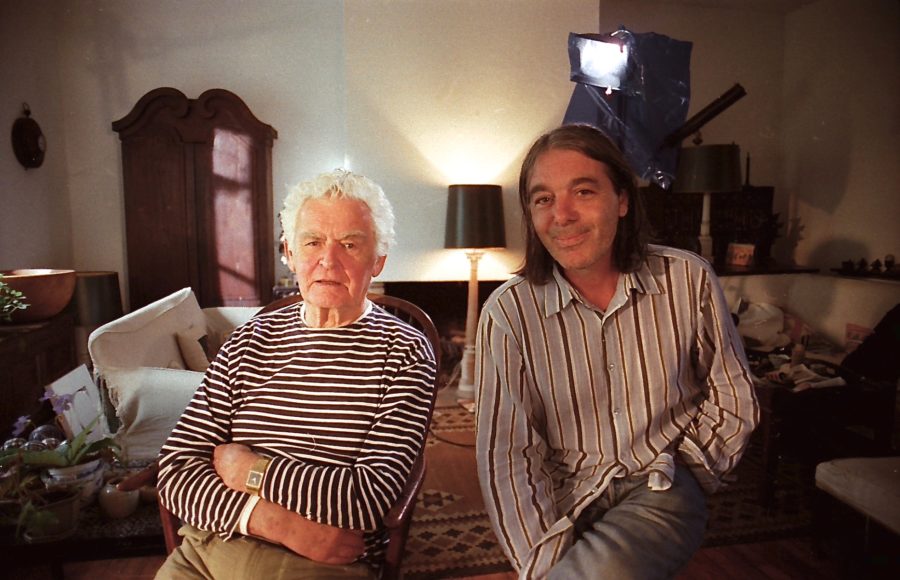
Patrick Scott with Sé Merry Doyle.
Dublin’s Popular Music Scene
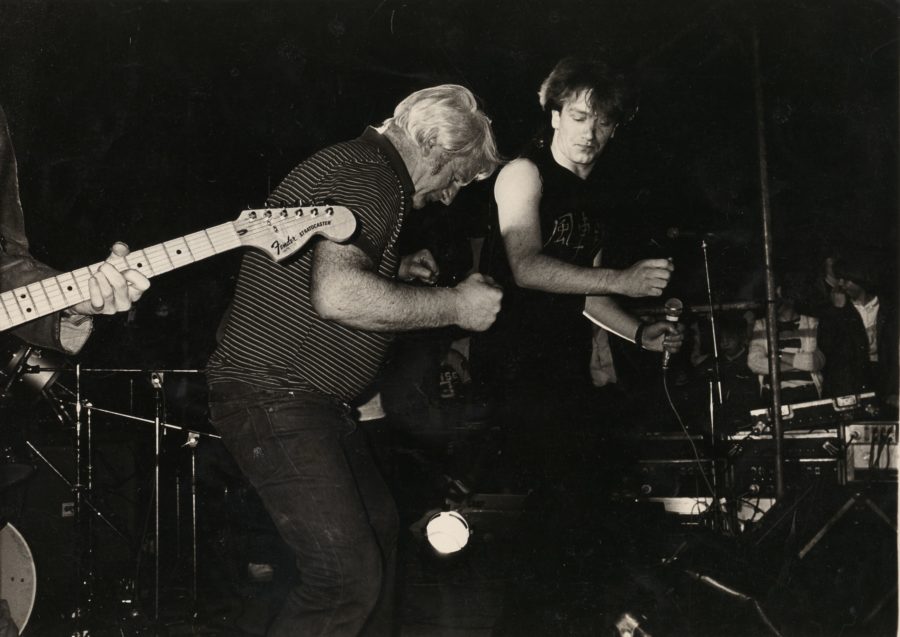
For those interested in the popular music scene in Dublin from the 1980s to the present, the collection contains some intriguing items. Outtakes from ‘Looking On’ feature unseen footage of 1980s bands The Atrix and Hotfoot and an early impromptu rooftop show in Sheriff Street by U2.
U2 on Sheriff Street. Photo courtesy of Christine Bond.
Rushes for an unedited tribute concert staged by friends and fellow musicians of guitarist Jimmy Faulkner at the Olympia Theatre in 2008 capture the full show (filmed with four cameras) with performances by Paul Brady, Christy Moore, Mary Stokes, Declan Sinnott, Noel Bridgeman, Ed Deane, Don Baker, Honor Heffernan and others. The show is compered by musical impresario Smiley Bolger and politician Eamonn McCann, and the rushes contain informative and amusing backstage interviews about the Dublin music scene from the 1970s to the millennium.
Other musical treasures include audio rushes of the soundtracks composed for the later documentaries by multi-instrumentalist Ger Kiely and complete audio takes of traditional Dublin ballads sung by musicologist Frank Harte for ‘Alive-Alive-O’. These are records of a vibrant, but largely unexplored, Dublin music scene.
Frosty Interview
Going through the tapes, it became obvious that some of the finished documentaries could have been further enhanced by more extensive use of the rushes. We can see, in retrospect, that the requirements of TV scheduling put constraints on the running times of the documentaries.
It’s one of the great benefits of this particular archive project that that these outtakes can now be encountered and enjoyed as stand-alone pieces. For example, Merry Doyle’s personalised portrait of poet Patrick Kavanagh, ‘Patrick Kavanagh – No Man’s Fool’, is heartfelt and full of intimate moments, but the outtakes flesh out the story considerably. There are in-depth, previously-unseen interviews with actor T.P. McKenna, author Dermot Healy, poet John Montague and other people close to the poet.
A fascinating sequence with Kavanagh’s brother, Peter, at the installation of a plaque at Parson’s Bookshop on Baggot Street, sheds light on the controversial relationship of the siblings. Audio recordings of actor Gerard McSorley’s beautiful readings of Kavanagh’s poems, only partially used in the film’s final cut, emphasise the genius of both actor and poet.
Writers Dermot Healy and Leland Bardwell perform a wonderful dialogue on the subject of Kavanagh’s women at the Model Arts Theatre, Sligo. A hitherto unseen lecture on Kavanagh by poet Paul Durcan at a Carrickmacross hotel is affectionate and funny.
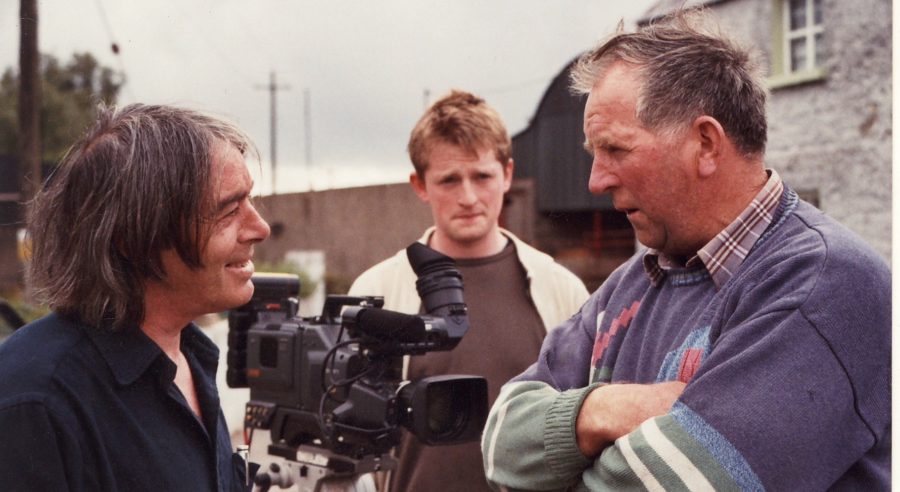
On location, ‘Patrick Kavanagh – No Man’s Fool’.
The same can be said regarding the rushes for the historical biography, ‘James Gandon – A Life’, which feature lengthy interviews with the late architect Sam Stephenson, art historian Edward McParland, and conservationist David Slattery.
There’s a wonderful guided tour of Gandon’s architecture along Dublin’s River Liffey by art historian Maurice Craig, which was not included in the film and comprises a colourful history lesson in itself. The rushes for the scenes in which veteran Irish actor Christopher Casson plays an ageing Gandon show him engaged on the final work in his distinguished career. One of the best things here is a spectacularly frosty interview with former Taoiseach, Charles J. Haughey at his Gandon-built home, Abbeyville, in North Dublin.
Street Traders
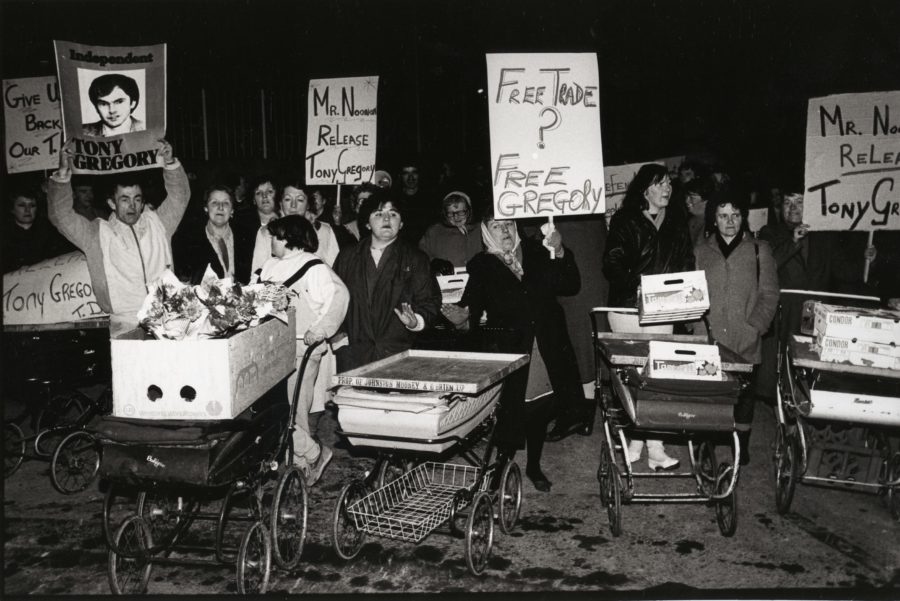
The copious rushes for one of the finest Loopline productions, the personal and impressionistic ‘Alive-Alive-O: A Requiem for Dublin’, are astonishing. They encompass an unprecedented record of the suppression by the state of Dublin’s traditional street traders, the closure of marketplaces, the heroin epidemic that devastated the inner city communities in the 80s, and the work of TDs and social activists in defending the workers livelihoods.
Among the outtakes is interview with the the fiercely articulate late T.D. Tony Gregory. The collection also has lovely audio recordings of actor Jasmine Russell reading commissioned verse by contemporary working-class poet, Paula Meehan.
Supporters of Tony Gregory. Photo courtesy of Derek Spiers.
The rushes for ‘John Henry Foley – Sculptor of the Empire’ are equally detailed and rich. They feature, for example, lengthy interviews with sculptor Cliodhna Cullen, art historians Paula Murray and John Turpin, Senator David Norris and then-Director of the National Museum, Pat Wallace.
Also contained herein are extended rushes of two intriguing journeys: one to Cambridge, England, where Foley’s statue of General Hardinge, once proudly displayed in Ireland, now stands in a relative’s country garden; and another to Barrack Pore in Calcutta, India, a cemetery for decommissioned imperial statues. The high production values of the finished documentary are reflected in the breadth and richness of these rushes.
Watching the outtakes of ‘Patrick Scott – Golden Boy’, one becomes aware of the closeness between director Merry Doyle and Scott. In a lengthy week-long interview, the modest, Zen-like Scott reflects on his career in an Ireland inimical to non-representational art.
There are many interviews never used in the final cut with people such as art critic Bruce Arnold and others intimate with Scott. An interview with Scott’s friend, the late poet Seamus Heaney, is of particular interest. Merry Doyle has done Scott an enormous service in recording this material for future generations. It all amounts to a truly compendious overview of the history of modern art in Ireland.
Folk Art
‘Hidden Treasures’ (Anne O’Leary, 1998) is a four-part anthropological series looking at Irish folk-life. It was structured around 16mm field recordings of traditional rural crafts made by the National Museum of Ireland from the 1950s to the 1970s, which Merry Doyle had restored and digitised before inviting folklorist O’Leary to direct.
The series focuses on man’s relationship with the sea, traditional agricultural tools and technologies, and the role of ritual in rural life. Haunting colour footage shot by cinematographers Brendan Doyle and John T. Davis throughout rural Ireland complements this early archive footage and the rushes add up to a beautiful folklore archive in themselves.
Like its companion piece, the one-off Christmas documentary, ‘Ó Bhéal go Beal um Nollag’ (Durac, Vanessa Gildea, 2010), ‘Hidden Treasures’ provides a final glimpse of quickly fading traditions. (Incidentally, this was not Merry Doyle’s only foray into film archiving. He was also responsible for the 1996 restoration of ‘O’Donoghue’s Opera’ (Kevin Sheldon, 1965), a lost film featuring The Dubliners, and Peter Lennon’s 1968 documentary, ‘The Rocky Road to Dublin’.)
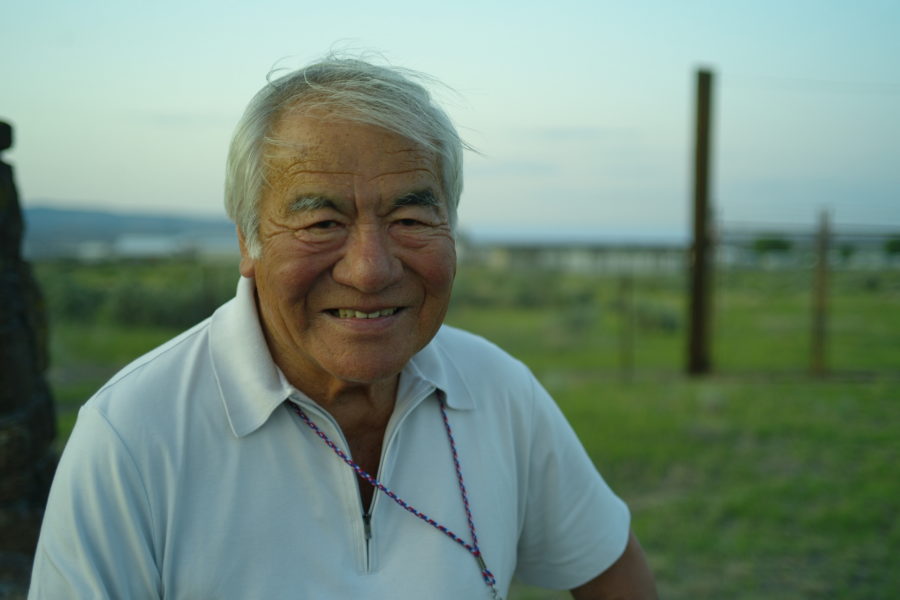
One of the finest Loopline productions, ‘Jimmy Murakami – Non-Alien’, is a moving account of the animator-director’s attempt to reconcile the events of a troubled childhood by journeying from his adopted home in Dublin back to the site of trauma – Tule Lake, California. There his family were incarcerated in a Japanese-American concentration camp during World War II.
JImmy Murakmai at Tule Lake.
As in the Scott portrait, the rushes here reveal Merry Doyle’s close relationship with his subject (he and Murakami had been friends for years before the film’s production). While the film itself is a moving account of Murakami’s spiritual journey, the rushes show the ways in which Merry Doyle attempts, over many takes, to get to the core of his friend’s emotional conflict.
While Murakami drives along a Californian highway at sunset, Paddy Jordan’s camera captures perfectly the emotions coming to his face, as producer Vanessa Gildea sobs in the back seat of the car. As the journey comes to an end, the rushes show how the director’s patience is rewarded by the arrival of an exquisite sunset that permeates the closing scenes.
Sadly, Jimmy Murakami passed away not long after the film’s release, but, as with the Patrick Scott project, Merry Doyle and crew have created a staggering portrait of this unique artist for the generations.
In ‘Kathleen Lynn – Rebel Doctor’, Merry Doyle and crew tell the little-known story of the suffragette, Republican and doctor and her conflict with the independent state in establishing Saint Ultan’s Children’s Hospital in Dublin.
The rushes feature in-depth interviews with feminist historians Sinead McCoole, Loretta Clarke, Margaret Ó hÓgartaigh, author of a book on Lynn, Honor O’Brolchain, historian Margaret MacCurtain, feminist activist and historian Dr. Margaret Ward, medical experts Dr. Barbara Stokes and Dr. Rosarie Barry, as well as a touching interview with 109-year-old Bridget Dirrane, author, Republican and former staff member at Saint Ultans.
The Quiet Man
Merry Doyle’s hugely-ambitious work, ‘John Ford – Dreaming the Quiet Man’ is, like ‘Jimmy Murakami – Non-Alien’, another story of an artist’s journey into the past.
Seven years in the making, it’s Merry Doyle’s imagining of Irish-American film director John Ford’s dream of returning to Ireland to make the film ‘The Quiet Man’ (1952), as well as a conscious attempt to redress the film’s negative reputation on home ground.
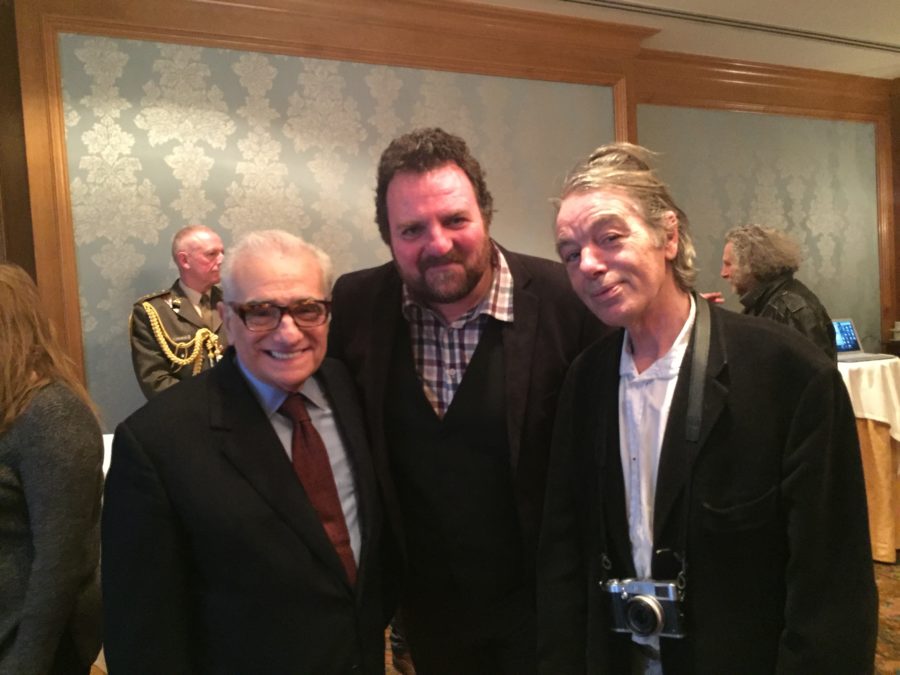
With Martin Scorsese (l).
The rushes include a detailed interview with American director, Martin Scorsese, in which he discusses the poetry of Ford’s film and themes of emigration and community. American director, Peter Bogdanovich, talks about his personal relationship with Ford and his deeply-felt affection for The Quiet Man. Dublin-born Hollywood actress, Maureen O’Hara, the film’s female lead, entertainingly reveals her relationships with the difficult Ford, actor John Wayne and her experience working on the film.
In an interview with Jay Cocks at the Algonquin Hotel in New York, the scriptwriter explains how the boxing scene from Ford’s film influenced the ringside scenes in Scorsese’s ‘Raging Bull’. John Wayne’s daughter Aissa talks about how Ford, O’Hara and Wayne struggled to get the film financed. American academics Joseph McBride and William C. Dowling speak almost obsessively about Ford and ‘The Quiet Man’. The rushes also contain some breath-taking footage of Monument Valley, Utah, where Ford shot many of his Westerns, through the lens of regular Loopline cameraman, Paddy Jordan.
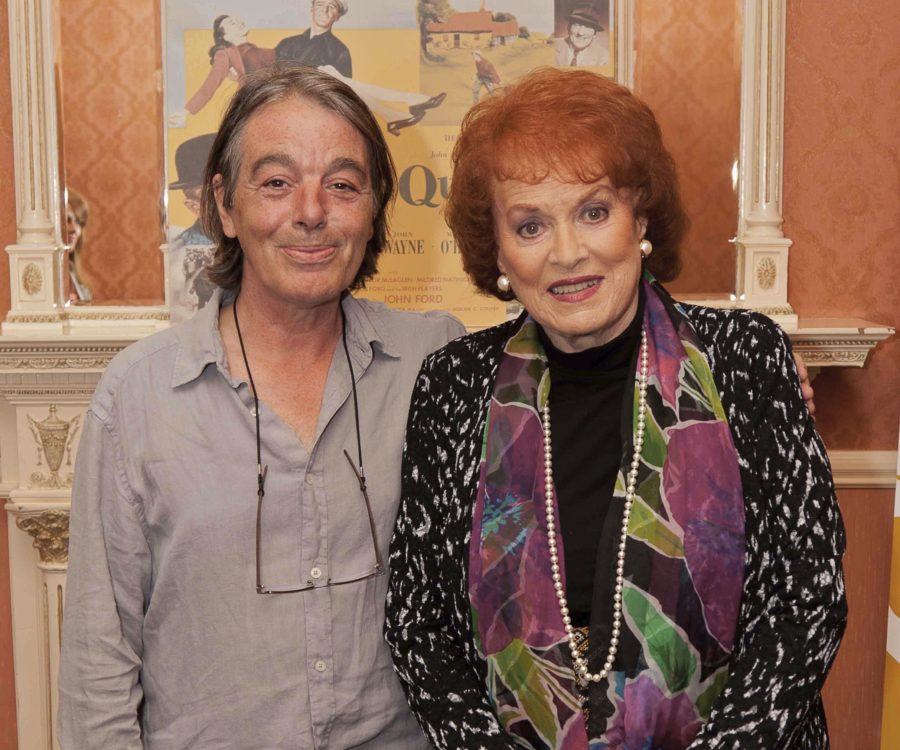
Sé Merry Doyle & Maureen O’Hara at The Maureen O’Hara Film Festival, at the Eccles Hotel, Glengarriff, Co. Cork. Picture: John Delea/Muskerry Photos.
Poetry and Literature
While the collection focuses mainly on the visual arts in Ireland, there is a special emphasis on poetry and literature. An outtake from the ‘Soiscéal Phádraic’ arts magazine series, for example, features an amicable interview with writer John McGahern at the Galway launch of his ‘Memoir’ in 2005.
The popular Imprint series, produced and broadcast between 1999 and 2001, features interviews with national and international writers and is presented by poet Theo Dorgan. Irish writers interviewed are poets Eavan Boland, Dermot Bolger, Anthony Cronin, Brendan Kennelly, John Montague, Michael Longley and Nuala Ní Domhnaill; novelists Leland Bardwell, Maeve Binchy, Roddy Doyle, Jennifer Johnston, Bernard MacLaverty, Joseph O’Connor and Colm Toibín; and playwrights Thomas Kilroy and Hugh Leonard. International writers interviewed are Margaret Atwood, J.G.Ballard, Thomas Keneally, Richard Ford, Doris Lessing, Edward W. Said and Gore Vidal. These interviews have never been seen before in their entirety. An hilarious interview with American writer Kinky Freedman is one of my personal favourites.
The Imprint series also featured especially commissioned short films on poets and writers by new Irish directors: Maurice Healy’s charming short on legendary sports journalist Con Houlihan; Paul Duane’s films on novelists Patrick McCabe and J.M O’Neill; Art O’Leary’s meditation on Dublin’s War Memorial Park; Hilary Dully’s comic take on the poetry of Rita Ann Higgins; Barrie Dowdall’s atmospheric short on Wexford playwright Billy Roach; Donald Taylor Black’s rumination on Russian poet and novelist Boris Pasternak; Brendan J. Byrne’s lyrical and experimental pieces on poet Louis McNiece, novelist Brian Moore and poet Ciaran Carson; Eve Morrison’s visit to the Dublin Inner City Folklore Project; Niamh Barrett on novelist Marian Keyes; Sé Merry Doyle on Charles Dickens in Ireland and his short about Oscar Wilde, ‘Wild About Oscar’; and David Barker on writer Carlo Gebler. The rushes for the Con Houlihan short make for particularly absorbing viewing.
In San Francisco.
Master Class
It struck me that the rushes and outtakes constitute a kind of master class in documentary filmmaking. Merry Doyle and crew members are present throughout and the process of filmmaking is often laid bare: the filming of establishing shots; the pursuit of the best takes; the honing in on ideas that arise during interviews; as well as the playfulness of the crew after a successful filming session.
An unfinished project, ‘Documentary Where Art Thou?’, a series of interviews with prominent international documentary filmmakers filmed at workshops funded by Screen Training Ireland, examines the subject of documentary production itself. The interviews are loose and informal, allowing directors Jon Bang Carlsen, Molly Dineen, D.A. Pennebaker and Chris Hegadus, John T. Davis and Peter Wintonick to engage with the nuts and bolts of documentary theory and practice. Russian director, Maria Goldovskaya, is also filmed giving a class on her work as a political filmmaker.
The rushes shot by the Loopline Film crew for projects that were never completed give a clear picture of the traditional difficulties of raising funding for serious cultural documentaries. Watching the footage shot for a projected film on writer Lafcadio Hearn (Greek-born but of Irish heritage), drove home to me how significant and entertaining such a film would have been and it becomes quite obvious that an opportunity had been missed.
The unfolding events are funny and often moving as Merry Doyle’s camera accompanies great-grandson Bon Koizumi and his wife in the footsteps of the writer around Dublin, Waterford and Mayo. The preservation of these materials at the IFI leaves open the possibility that these projects might eventually be completed.
Equally tantalising are the rushes for a documentary portrait of Irish writer, historian and critic, Ulick O’Connor. In retrospect, it’s a shame that Merry Doyle was unable to raise funding to complete the project as the pilot material shows a refined literary mind at work.
O’Connor delivers a detailed lecture on the Irish Literary Renaissance at the United Arts Club in Dublin and gives an eyebrow-raising interview at his Dublin home. At one point he reads from his translation of an Irish-language poem by Brendan Behan on Oscar Wilde’s sexuality. It’s an unknown poem which could be read as Behan’s own coming-out statement (camouflaged, ironically, by the Irish language).
Sé Merry Doyle.
Life Goes On
Abandoned footage (by Merry Doyle and Linda O’Sullivan) for a portrait of the late socialist politician Jim Kemmy, a humanist and visionary, once more indicates the short-sightedness of funders. The rushes outline Kemmy’s trade union work in the 1970s and 80s, his championing of the working-class, his contribution to the anti-apartheid movement, his work on family planning and his battle against the Catholic Church.
Merry Doyle’s pilot material focuses on this important figure through informative interviews with Kemmy’s brother Joe, Labour TD Janice O’Sullivan, and Kemmy’s partner and co-worker, Patsy Harrold. Another incomplete project from 2002 comprises sketches for a portrait of Limerick old-school Republican, Richard Behal.
While the incomplete projects in the Loopline Collection throw much light on the difficulties of raising funding for serious social, cultural and historical documentaries, one can only be grateful for Loopline Film’s commitment and determination to pursue important subjects through creative storytelling.
Thankfully, the IFI and the BAI have been insightful enough to preserve for oncoming generations this broad panorama of Irish social, artistic and cultural life across two centuries. It’s a fitting testimony to the lifelong work and commitment of Sé Merry Doyle and his contributors at Loopline Film over thirty-five years.
Life, meanwhile, goes on as Merry Doyle steers Loopline Film into the future with two fresh projects: ‘John Huston – A Man Without a Country’, the story of American film director John Huston’s adoption of Ireland as a home in the 1960s; and a work-in-progress, ‘Hanna & Me’, the story of Micheline Sheehy Skeffington’s retracing of her great-grandmother Hanna Sheehy Skeffington’s journey to America in the 1920s as a suffragette and political activist.