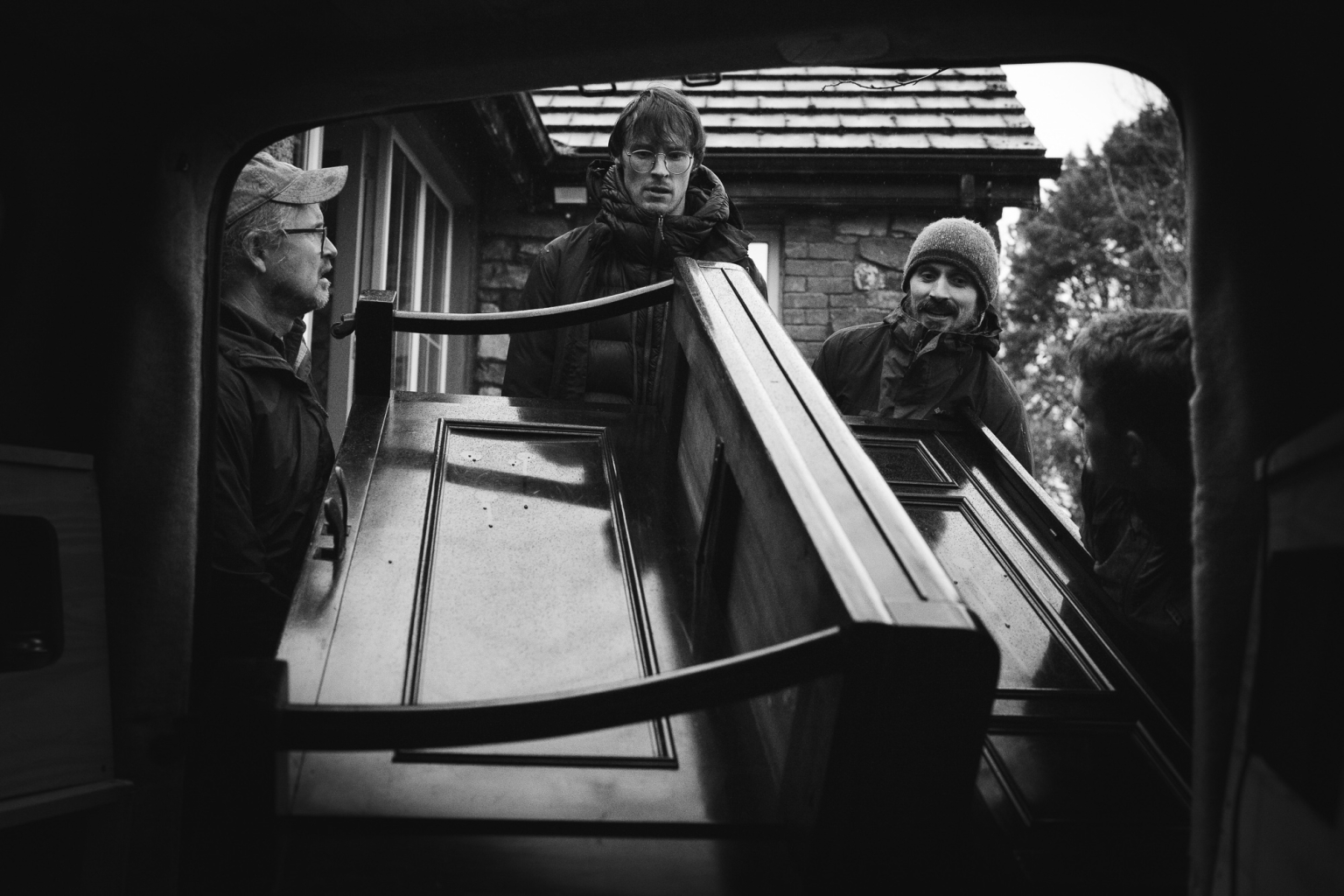
Word came through from cousin Ed in Limerick: ‘Good news, I’ve a piano for you that’ll fit in Paul’s van.’ ‘Great stuff’ I enthused, blithely disregarding the challenge of getting it as far as my house in Sligo, let alone up the steps and through the door.
Remarkably, cousin Paul agreed to make the trip on a dank evening in January when winter seemed interminable: ‘sure a road trip would be a bit of craic.’ Relative to other possibilities on that first weekend of January he was probably right.
A layer of ice shrouded the tarmac as we set off from Sligo town on Saturday morning. At the Toberbride roundabout outside Collooney we bought what were apparently small Americanos. When these appeared in pint-sized cups it begged the question: what manner of receptacle is reserved for a large one? The proprietor clearly understands the importance of motorists loading up on the dark sludge before driving the first leg of the N17, especially on a bleak January morning.
Collooney gives way to Ballinacarrow, where you find signs for Coolaney on the road to Cloonacool, then Tubbercurry anticipates Curry, and you’re into Mayo by the time the caffeine wears off.
The Saw Doctors travelled the N17 from Tuam to Galway with ‘thoughts and dreams,’ a state of mind not recommended for the winding road to Tubbercurry, an accident blackspot. As for ‘stone walls and the grasses green’, although there are plenty of the former, the boggy fields are more fawn than green at this time of year, until you get past Tuam at least.
The road widens before Ireland West Airport, outside Knock. There, Our Lady, Saint Joseph and Saint John the Evangelist appeared to Mary Byrne in 1879, but the opening of the airport in 1985 was the real miracle, as Christy Moore insisted. The messianic zeal of Monsignor James Horan brought this solitary crumb of infrastructure to a neglected north-west region in 1986.
Only featherheads now dream of the Western Rail Corridor being resuscitated as far as Sligo, despite tangible evidence of surviving track under public ownership, recalling Monty Python: what did the British ever do for us? The 2024 All-Island Strategic Rail Review proposes new lines are restricted to connecting settlements with populations over fifty thousand, but how is a city, such as Sligo, supposed to expand sustainably without further rail infrastructure, and is Donegal to remain the forgotten county forever?
The N17, which serves as the main north-south transport artery through Connacht, abuts a curiously desolate landscape, almost entirely devoid of native woodland. It offers a foretaste of the Midlands, without the charm of the waterways. Far from wild Atlantic shores, it’s scenery that nurtures disappointment.
Beyond the seemingly supernatural marilyn of Knocknashee (‘hill of the fairies’), there’s barely a hillock in view along the entire route to Galway. There the slick motorways of another Ireland come into view. I’ve never taken the route other than under a sky that promises rain, and usually delivers.
Many of the super-sized bungalows along it appear to have been constructed in the 1980s, when Ireland still exported its children. Aesthetic considerations did not figure prominently in the considerations of draughtsmen, who might as well have been paid by the room. The influence of Southfork, the Ewing Mansion outside Dallas, Texas is apparent in the expansive Southern Colonial style of some of these over-sized residences.
Ribbon developments streak from historic towns, where the number of pubs diminish with each increase in the price of a pint. They say the kids prefer to go to the gym these days in any case.
Beyond Galway, the gentle scenery of east Clare barely registered such was the speed we reached on the N18 motorway. Before long we were crawling through dystopian industrial estates outside Limerick. At last, we reached the city’s attractive inner core, including the country’s only Georgian Crescent, near the house where our piano was located.
Ed had let us know there would be 5.5 men on hand to lift the piano. It turned out the .5 of a man was a blind Jack Russel, and that the additional men were piano players rather than heavyweight lifters. Undeterred, we hefted it out of the house – which mercifully had no steps at the entrance – and squeezed it into the van, albeit at a slightly awkward angle, without too much bother.
There followed an evening of revelry, as the additional piano lifters, who turned out to be Maltese, revealed their real talent, as musicians. At one point, I am convinced, the blind dog chimed in, but sadly we lack documentary evidence to this effect. The only regret is that cousin Ed declined to sing his cult – a small cult admittedly – classic, ‘Mow’, about a young man taking refuge from the slings and arrows of outrageous fortune in the gentle comforts of cutting the grass.
On Sunday morning we awoke early. Cousin Paul had taken further precautions against the January blues by booking a seaweed bath back in Sligo for that afternoon. The road rose to meet us at 9am, as we traced our way back home along the same route.
At Milltown, Galway a large, modernist church that spoke of a more self-confident era was welcoming the remaining Cathaholics that shuffle through its doors. Among the pillars of Old Ireland, only the GAA continues to thrive. Today its brash, new club houses might pass for aircraft hangers. This is Supermac’s country of ersatz, super-sized Americana.
After passing Tuam, we required further lashings of the dark sludge. At the petrol station in Ballindine a screen saver at the till read: ‘Coronavirus COVID-19 – Contactless – We would prefer if you could pay be contactless card.’ Covid frayed the social bonds like no other event in modern Irish history, and along the N17 it’s a gift that keeps on giving to a corporate aspiration for a brave new, cashless world.
The real challenge came at the other end. Another cousin Johnny was thankfully on hand, and our photographer’s boyfriend Shane, a strapping Mayo man, was enlisted too.
The great weight of a piano – most uprights weigh well in excess of 200kg – proved more of a challenge than anticipated, but after much heaving and straining – ribs were almost popped – we maneuvered it into the space. It now could do with tuning, and awaits a suitable hand.
Gazing up into the darkness I saw myself as a creature driven and derided by vanity; and my eyes burned with anguish and anger.’
James Joyce, ‘Araby’, from Dubliners (1914)
Nineteen Seventy-Nine was a big year for me. I turned eighteen, which meant I could vote, had I felt so inclined. I had my first real girlfriend, and mistakenly thought that was going to last for ever. I did my Leaving Certificate, for which I did not do very much study (an unfortunate fact not unconnected to having said first girlfriend, and also my discovery of the live punk rock music scene around Dublin). I had my first proper adult job, or job that adults did, working as a bus conductor through that long, hot summer (nepotism was involved in securing the temporary position). Bus conducting is a job adults no longer do – or children for that matter – since it is a job that no longer exists, at least in Ireland. My first real girlfriend broke up with me after a few months and, heartbroken, I struggled to understand why. I got into the vocational college course I wanted (a triumph somewhat tainted by the presence of said first ex-girlfriend there too). I formed my first and, so far, only band, and we played a grand total of five paying gigs, before succumbing to the pressures of non-stardom. And I saw future megastars U2 play in the Dandelion Market at St. Stephen’s Green, McGonagle’s nightclub in St. Anne’s Street (afternoon gigs), and the Baggot Inn on Baggot Street – attendance at the Dandelion Market for one of the fledgling band’s shows there coming to be regarded in later years as our generation’s equivalent of being present in the General Post Office for the 1916 Easter Rising.
And in 1979 Pope John Paul II came to Ireland, paying a flying three-day visit from Saturday, 29 September to Monday, 1 October. I refrained from going to see his Saturday show in the Phoenix Park, Dublin, which was a rather radical move, considering how pretty much everyone else on the east coast of Ireland and beyond – some 1,250,000 people in fact, one-third of the then population of the country – flocked there for the event, while other extravaganzas in Drogheda, Clonmacnoise, Galway, Knock, Maynooth and Limerick during the following two days meant that he eventually wound up playing to over 2.5m souls, all told.
I wonder why I had already made up my mind about institutional religion, and so vehemently renounced the Catholic faith, even at that early stage? After all, this was a time – long before clerical sexual abuse scandals and increased levels of education had put paid to the church’s vice-like dominance – when nearly everyone in Ireland was a Catholic, in some shape or form, except the small percentage who weren’t, and they were usually some sort of Protestant. Agnostics, much less those evil atheists, were few and far between. I must have been ahead of my time in this regard, which means being out of step with the present. More practically, where were my parents, and how did I avoid being corralled, or shamed, into going?
Twelve-year-old me had caused consternation in my hyper religious family by announcing that I no longer wanted to go to Sunday Mass. All kinds of pressure was brought to bear – visits to Jesuit spiritual advisors, withdrawal of pocket money – in an effort to get me ‘back on the right road’. I capitulated by saying I was going to evening Mass by myself, and instead took long walks for the required duration.
I suppose my main beef with the Catholic ethos was its ubiquity, coupled with the fact that much of it just didn’t make any sense to empirically minded young me. An early fan of comparative religion, I questioned why one version of God was popular in one part of the world, while another held sway in another part, while both claimed to be the one true faith. It seemed like some sort of competitive sport, which I surmised was not what a just, wise and beneficent Godly entity would have necessarily intended. As a child, I’d had a keen interest in astronomy, which served to make me place affairs on tiny Planet Earth in a more universal perspective. Had God made the entire cosmos, or only our small corner of it? Had God been around before the universe had been created and, if so, who’d made God, or where did He come from? Also, I had been an altar boy, and my glimpse behind the scenes of the congregation’s collection offerings being counted out and bagged off alerted me to the worldly pecuniary underpinning of the celestial domain. God was inextricably funded by Mammon.
Getting my hands on some books, other than prayer missals, probably expedited my apostasy as well. For example James Joyce’s künstlerroman, A Portrait of the Artist as a Young Man (1916), or Albert Camus’s ode to existential alienation, L’Etranger (1942) (or, indeed, Colin Wilson’s popular literary critical study of the time, which favours the English translation of that title, The Outsider (1956)), never mind science fiction like Robert A. Heinlein’s Stranger in a Strange Land (recommended via New Musical Express articles on David Bowie, and subsequently appropriated as the title of a song by that Dublin new wave band U2, from their sophomore album October (1981) – and itself a direct Biblical quotation (Exodus 2:22)). I actually read these books, rather than merely name-dropping them, as others were wont to do. Being educated at a school run by the now notorious and reviled Christian Brothers – even one of the better ‘fee-paying’ ones (my parents were poor, but I was sent to a posh school, a story too convoluted to provide an explanation for here) – didn’t help either, as the pedagogical experience amounted to little more than daily skirmishes in a war of attrition between ‘us’ and ‘them’. I had, and retain, a problem with authority figures of any description. I felt instinctively, rather than could articulate coherently, that the church was just about controlling people, keeping them in line. They tried to break your will, so that you would do the will of God. I wasn’t one for obeying the rules, although I didn’t always like the consequences if I didn’t.
The day of the Pope’s mass in the Phoenix Park I was still employed in my student job on the buses, and transport workers were among the few sectors doing any service that day, ferrying the multitudes to and from the site. There were no private cars on the road. A special stand had been erected for us busmen to view the proceedings, between doing the outward and return journeys. I didn’t bother going down to it, but hung out by my bus, eating my lunch. I don’t know where the rest of my family were. My father, also a bus conductor (thus, the nepotism), would have been down in the busmen’s viewing area, but it would have been easy to miss him in the general ‘Mass’ chaos. My mother, a semi-invalid, probably stayed at home. The fact that I was on duty would have precluded me meeting up with my elder brother or sister or their families. All in all, my summer job saved me a lot of potential conflict that day, and was a good excuse for not having to make a fake show of religiosity. I suppose, unlike many others, I also earned a few bob courtesy of the Pontiff’s Dublin visit. Transport had begotten me some delight.
Some time in the months following that autumn day I got to meet and become friendly with the guys in this group called U2 – well, Bono, Edge and Larry at any rate, Adam proving more elusive. Dublin was small, much smaller than I had previously imagined, hailing as I did from a sheltered background where my parents didn’t do much socialising, and the music community was even smaller. I cannot remember with any clarity how this happened: I was in a band, they were in a band, both playing the same scene; I’d been writing for a music fanzine, Imprint, which that tumultuous first girlfriend edited; in the summer of 1980 I’d begun writing for Hot Press music magazine, as part of my journalism training course (a distinct incidence of lycanthropism: critic by day, musician by night – or vice versa); most likely, it was because I’d started attending the Shalom Christian prayer group, of which those three musicians, plus various Virgin Prunes (U2’s outlier, little brother band) were also members.
This admission may seem startling, given my already confessed antipathy to so-called ‘organised’ religion. But perhaps exactly what appealed was that this was not at all organised. And while I may have shunned the church, all traces of spiritual longing had not deserted me. Even Joyce’s Stephen Dedalus suffered a reconversion (or do ‘lapsed’ Catholics ‘relapse’?), before abandoning religion, specifically Roman Catholicism, for evermore.
This newfound Bible-bashing proved to be an unhappy conflux of events, a classic case of bad timing: after all, the hippie liberals in Hot Press didn’t care for their punky young contributors to be sneaking off to prayer meetings on the sly, when we should have been skulling pints and vacuuming up rip-snorting intoxicants and generally behaving in a recognisably debauched and approved Rock’n’Roll manner (Hot Press advertising slogan of the period: ‘Making Ireland Safe for Rock’n’Roll’), even if in subsequent years the fate and fortunes of that particular organ became inextricably entwined with the largesse of U2’s coffers – thus ensuring that you’ll never read a bad word about U2 in Hot Press. I kept such associations undercover at my place of casual employment, although I do remember allusions in that publication’s gossip pages inquiring as to ‘What is this hip new religion?’. The U2 boys were in no hurry to have their committed Christian beliefs become common public knowledge either, at this early stage.
That was the summer, 1980, of U2 recording their debut album Boy at Windmill Lane Studios, where I was present on at least one occasion. I also remember a trip to Gorey Arts Festival on 15 August, to see the band play at the Theatre Hall, possibly the worst live performance of their entire career, due to being ensconced in the studio, under-rehearsed, and road rusty. By September, I had dropped out of my journalism course, determined that my vocation was to be a professional songwriter and musician. But by the turn of the year, the winter of discontent, it had all turned to shit: my band, 1991, were good, and we’d had great fun and learned a lot making music, but we weren’t making any money; my parents, unable or unwilling to support me in this endeavour, were berating me to pay for my upkeep; my attitude having proven unpopular in Hot Press, I wasn’t getting any work there – and in any case the magazine had never been the most regular of paymasters, and when you did finally squeeze a cheque out of them the rewards were meagre. I took a mind-numbing job turning screws in an electronics assembly factory, to stave off simmering discontent at home. The bass player didn’t fit, and we needed a new one. The lead guitarist wanted me to play bass, while we looked for a new singer, a reconfiguration I wasn’t about to accept. I may not have been possessed of the best voice in the world (unlike Bono Vox, whose nickname proclaimed that he had a ‘good voice’ in dog Latin), but neither was Lou Reed. Most piercingly, my second and more profound loss of faith occurred, and can best be attributed to the creeping realisation that the Born Again God-bothering was merely providing a haven for those embroiled in the insecurities of late adolescence, terrified at the prospect of facing into an uncertain young adulthood. This applied as much to the U2ers as other frequenters of those Monday evening gatherings in the tiny flat in East Arran Street – although they arguably had much more going for them than most of the other worshippers. A cult-like sect can be as much about control and manipulation, albeit on a smaller, more intimate scale, as any mainstream belief system. So, everything disintegrated, I felt I had few options, and I grew temporarily deranged.
In retrospect, I can rationalise my brief, embarrassing flirtation with fundamentalist religion as my way of reconciling the strong influence of the traditionally grounded Catholicism of my parents’ generation, coupled with my sister and her family’s membership of a Charismatic Renewal Christian Community (a particularly noxious commingling of said traditional Irish Catholicism with U.S.-style evangelicalism), with the local popular musical culture of which I was a devotee, thus simultaneously winning the approval of my family and getting on with establishing myself in my chosen field. I would be keeping everyone happy. Even Bob Dylan had found God, and David Bowie was wearing a crucifix around his neck. Maybe religion could be hip and liberating, instead of a straitjacket stranglehold on imagination and creativity. How wrong I was. For there were a lot of people – indeed, all those outside the tiny circle of my immediate family and the Shalom brethren – who weren’t very happy at all. Context is everything. I blame the dread example of Bono and his two bandmates for leading me astray. Still, they held steadfast to their fervent beliefs, for the time being at least, which must have been hard, even outré, given the indie rock milieu in which they were operating. But they had a sense of mission, and wanted to change the world, which is what kept them going. I had just wanted to write original songs with good hooks, mostly about girls and relationships, falling in love and breaking up, the secular rather than the sacred. It wasn’t enough to sustain me in the face of parental disapproval and opposition, and the financial insecurity.
And so, amid all this hysteria, I cut my losses, and decamped to Amsterdam, to get away from it all, and make a fresh start after a turbulent couple of years.
So began my (mis)adventures as part of yet another subculture, that of disenfranchised European internal immigrants – Irish, Scottish, Welsh, English, French, Italian – all in Holland to earn some money before returning to college or moving on to warmer climes. My cohort worked for an agency which placed us in food-processing factories, and we lived in dormitories on a farm about twenty kilometres from Amsterdam city centre. A fleet of vans ferried us to and from our work places five days a week, for alternating weeks of early and late shifts (much like those scheduled for bus crews). At weekends, I’d go up to the bright lights with my newfound and now lifelong friend, Mick, and I’d busk while he bottled (held the hat and collected the money), and we’d stay over in hostels and sample the mythic delights of the port’s sleazy nightlife – buy drugs, get drunk, eat space cake, and watch bands and films in the Paradiso or Melkweg. I was not just backsliding, but well-lapsed by then. We even quit our jobs for a few weeks and lived in a tent on a campsite on the outskirts of the city, having calculated that we could just about precariously survive on my street-performer’s revenues.
But even there, I could not escape the rising U2 phenomenon. Well, I could have if I’d tried, but obviously I didn’t want to. It’s hard to imagine from this vantage-point, the best part of forty-five years later, but there was a time when they were comparable contemporaries of Echo & The Bunnymen and Joy Division, just another interesting indie band on the up, a time when it seemed not unfanciful that The Edge would become the next Tom Verlaine (outstandingly gifted, idiosyncratic guitarist with New York avant-garde outfit Television), and they’d make slightly off-kilter, left-of-centre, alternative music, well-regarded and influential among their peers, but hardly the earth-bestriding colossus into which they subsequently grew. This was still a couple of years before the martial drum beat of ‘Sunday Bloody Sunday’ and the expansive strains of ‘New Year’s Day’ were to be heard ringing out from the rec rooms of every frat house across the USA. The pretending-to-be-cowboys-lost-in-the-desert phase of The Josuha Tree album, a change of image adopted as part of a huge push to break the hugely lucrative US market, was still half a decade away.
They were playing in the pretty college town of Leiden on Wednesday, 28 October 1981, while touring to promote that second album, October, and I made it my business to get along and reconnect, following up again two days later, when they took the stage at the famed Paradiso club back in Amsterdam. Both were excellent shows, if memory serves, as they were a tight little road-hardened unit by that point. When I approached their tour bus outside the first venue, I was remembered and made welcome, and then invited into the dressing rooms for both shows, and watched the performances from the wings. Maybe they thought I still shared their evangelical faith, or were under the impression that I was there in my capacity as a rock journalist. More likely, they were just glad to see a Dublin face in the crowd on their travels. Friday, 30 October was Larry’s birthday, or rather the 31 is, but it was celebrated on the Friday night, I forget why, maybe because his girlfriend was over. A battery-operated toy fire engine, and other gifts, were unwrapped. I spent both nights sleeping on the floor of the twin bed hotel rooms shared by Edge and Adam (Bono and Larry always roomed together in another one). A few months later, back in Dublin, I received a ‘Postcard from The Edge’ which read, ‘Nice to run into you in Holland, God Bless.’
You see, I hadn’t been completely stupid. Yes, after Amsterdam, I had taken off on my pan-European odyssey, in my mind doing for my continent what Kerouac had done for his, stopping off in in Frankfurt, Cologne, Munich, Salzburg, Belgrade, Athens and a sprinkling of Greek islands. But I had also managed to save some money, in order to return to the Auld Sod, and register myself in UCD for a proper university education (a luxury it was thought not everyone was entitled to back then, when getting an arts degree had more value than a certificate of attendance). After all, this was the recession-torn 1980s, there were no jobs, and sitting in lecture theatres and libraries was preferable to working in some dead-end job – in the unlikely event that you could find one – or not working at all. I didn’t want to spend the rest of my life picking burnt carrots off a conveyor belt, or even busking for passing change. And so, aged twenty-one, and with some life experience behind me, my new life of long hours at a desk burying myself in books began. Why should such pleasures be the preserve solely of the privileged?
The second last time I met Bono he was out with Adam, at some nightclub in Dublin, when they were taking a break from the recording of their third album War (1983), between September and November 1982. The Hot House Flowers duo of Liam Ó Maonlaí and Fiachna Ó Braonáin, in their alternative iteration as The Benzini Brothers, were knocking out R’n’B standards in the corner (R’n’B here referring broadly to the genre of music made by Chuck Berry rather than by Beyonce). Everyone in the place was too cool or too embarrassed to talk to the by now fairly famous frontman, or maybe out of deference were just leaving him alone to enjoy his night out, but in his inimitable, irrepressible way, Bono made a point of tapping me on the arm when he recognised me sitting a few places up from him, and said hello. Wow, he remembered me, again, having been half-way around the world since we last ran into each other. We shot the breeze for a while, nothing too deep or meaningful, typical after hours venue conversation. We agreed the live show was good.
The last time I encountered Bono I was working student security at a gig by Welsh band The Alarm on the UCD Belfield campus, on 22 October 1983. My job was to guard their dressing room door. The ever-ebullient one arrived with an entourage, to offer moral support to a group who had toured with U2 as an opening act. He gave me a big wave and full-on smile as soon as he saw me (much to the jaw-dropping surprise of the too-cool-for-school Students’ Union social secretary and his crew, whom I sensed had pegged me as a bit of an nerd), told me how he really wanted to get down to doing some serious reading soon too, and inquired what time I’d be finished my doorman duties. I told him being a student was fine, except for the lack of money. ‘Sure, what do you need money for?’ was his reply. Later on he did a turn on stage with his Cymru friends, improvising lyrics to Dylan’s ‘Knockin’ On Heaven’s Door’, and then disappeared into the night.
The last time I was in the presence of Mr. B was when he was called on to launch an exhibition of work by Italian painter Francesco Clemente at the Irish Museum of Modern Art, early in 2004. The circumstances were quite comical. He arrived in a flurry of security, gave his speech, and was whisked away again in jig time; there was no mingling with the assembled throng. The place was, it has to be admitted, packed to the rafters, much more so than any other gallery opening I’ve ever been invited to, with the great and good of Dublin’s bourgeoisie, all anxious to catch a glimpse of the great man. Just because he’s Bono. Just because his band are rich, famous and successful. Because that’s the only way the middle-class vulgarians, who ordinarily have no interest in popular music and culture, can appreciate its significance: through money, how much it sells and how much it makes. Afterwards, there were the usual overheard comments about his diminutive physical stature, of the ilk of ‘He’s very short in real life, isn’t he?’ Ah, Bono and his Napoleon complex.
The last time I saw U2 live – having caught them a few times at various junctures around the globe since those club dates in Holland in 1982 – was in August 1993 in the RDS Arena in Ballsbridge, Dublin, as part of the Zoo TV tour. Achtung Baby (1991) and Zooropa (1993), the albums they were then touring, are now widely regarded as the pinnacle of the band’s artistic career (although I am sometimes tempted to argue that Boy remains their best album, and it’s been downhill ever since). Their popularity and status had put them well out of my league by then, and I was just another punter standing in the middle of a field. I have not had any desire to see them again since then, not being much of a one for huge outdoor stadium gigs. I certainly would not have been caught dead at any of the forty concerts which made up their U2:UV Achtung Baby Live at Sphere residency in Las Vegas from 29 September 2023 to 2 March 2024, a meretriciously bloated spectacle (judging from the snippets I inadvertently saw of it online) which would be best described as a sell-out, if they hadn’t sold out years before that. If U2 wouldn’t go to the mountain of touring, then the mountain of fans could come to see U2 in one place, and where better than the gaudiness conceptualised of Vegas, even if in this case not everything that happened there stayed there? Anyway, it is my hipsterish habit to discover nascent bands and enthuse about them in their formative stages when they are still trying to make it, only to – with some notable exceptions – gradually lose interest as they achieve widespread recognition and become established in the mainstream. Call it inverted critical snobbery, if you will, but it’s rare bands who continue to improve with age; for most, the law of diminishing returns sadly kicks in, sooner or later. U2 actually had quite a good run, before they started marking time, followed by a typical decline setting in.
Here ends the chronology of my personal Zelig-like relationship with Ireland’s biggest rock export, and its most famous son. Let us now put it all into a little perspective.
Bono on stage in 1983.
Everybody in Dublin (and now many far beyond) has at least one U2 or, more specifically, one Bono story. (Legion are the number of bands who are identified, liked or disliked, solely on the basis of the behaviour of their frontman.) Some of the stories are about how he’s just an ordinary bloke, some are about how he’s a prick. (The former tend to be the more distant ones, timewise, the latter more recent.) But everybody also would have liked the fairytale of a band they formed in high school becoming world-famous. Everybody would have liked to be in a band based on deep commitment and friendship, rather than a bunch of divisive, competing egotists who just happened to be able to play their instruments and grew up in the same place. Everybody would have liked, in some way or another, the U2 story to be theirs – up to a point.
So I didn’t become a rock star (while Bono did), which is a regret, but not a big one. Certainly, it would have been salutary to have been given the time and opportunity to try and find out how far I could have taken it, but times were harder for people from my background in those days, and I didn’t have the support, contacts or confidence to make it work and pursue the dream. But, there again, probably neither did he – except for the utter confidence, which helped him acquire the support and contacts. To be honest, I didn’t have his patent chutzpah, or his vaulting ambition. Few did, or do. Nor his lack of self-consciousness, which can be flipped and cast positively as that familiar, winning self-confidence. He is a living, breathing example of – as Sinéad O’Connor would have had it – the value of ignorance.
You see, Rock’n’Roll was still just about ‘bad’ in our day, not yet a multi-million dollar business. This was long before the advent of private ‘train-to-be-a-rockstar’ colleges such as BIMM, or the state doing-its-bit-for-the-kids with the likes of Ballyfermot Rock School. In fact, I can remember that when I inquired of the Principal of the Brothers’ kip where I received my secondary education (an institution staffed predominantly by ‘fools in old-style hats and coats’, constantly complaining about ‘long’ collar-length hair and denim jeans and, when punk belatedly arrived, about short spiky hair and leather jackets, sprinkled with stern admonitions about ‘immorality’), if my band could rehearse in the school gym at weekends, he was quick to ascertain the socio-economic background of each group member – and refused us on the basis that the drummer, my first cousin Robbie, was from Ballyfermot, thus demonstrating his poisonous admixture of Irish Catholic conservatism’s censorious attitude to any uncodified artistic activity, and plain old social snobbery. Happily, my local Protestant rector was generous enough to let his nearby primary school – which most kids in the neighbourhood attended irrespective of their religious persuasion – be used by any bunch of teenagers who wanted to practise their developing chops in their spare time. Bono has made much of his mixed-marriage parentage, which means not that one of them was a man and the other a woman, but that his father was a Catholic and his mother was a Protestant. This alliance led to him getting his schooling in the interdenominational Mount Temple Comprehensive, a liberal enclave which perhaps determined the entire subsequent course of his life. They would not have been so disapproving of students’ budding efforts at creative expression. In fact, if reports and results are to be credited, they positively encouraged it. Perhaps Bono has played his own part in making Rock’n’Roll not so ‘Bad’ (to appropriate one of U2’s more well-known song titles) and more socially accepted but, in a sense, that has only made it worse, by making it less incendiary and so less relevant to cutting edge discourse. Now bog-standard ‘rock’ is just another form of corporate entertainment, and a niche interest as well, no longer central to youth culture. Which is part of why it is so disconcerting to hear the 1990s talked of as though it was ancient history, like the 1950s were spoken of during the 1980s – but which is, undeniably, exactly the same amount of time elapsed: thirty years.
Of course I am not so foolish as to think that U2, and Mr. B, nearly ruined my life. I was more than capable of doing that myself (with a little help from family, so-called-friends, and powerful institutions). Maybe I should have just been stronger, more single-minded, more determined – in short, more like him. Maybe, like him, I should have ‘kept the faith’. But that is not my nature, at least not in that sphere. Besides, everybody runs up against the walls of their own innate talent, eventually. I was good, I wasn’t bad, my band were good (if disunited), but was I good enough? It’s probably a bit like being the best football player in your local under-16s soccer team, and because you’re head and shoulders above the other kids there, you think the world is just waiting for you to conquer it, but discovering in succeeding years that you’re more of a League 1 or League of Ireland level journeyman rather than a potential Premiership international superstar, the next Messi or Ronaldo. Still, lots of guys and gals are happy to make a reasonable living in lower divisions or lowly leagues, doing something they enjoy, operating within the limitations of their personal talent walls. But, for me, once an enjoyable hobby becomes ‘the job’, it tends to lose some of its lustre – unless you’re really good at it, and are always getting better, or maintaining the same high standard. In any case, I’m probably a better writer than I am a musician, and the working conditions are more congenial to a person like me – or the person I have become, due to those conditions.
For I’ve attained enough self-knowledge to realise that I would have been temperamentally unsuited to the role of being a rock star. While I like the buzz of performing, playing with friends in private, or sometimes even in public – once I’ve got over my initial nerves, and if it’s going well – I imagine I would have found the rigours of constant touring a sore trial: always being surrounded by people, everybody wanting a piece of you, never having a minute to yourself. I don’t think I’d have been very stable or content being in the glare of the spotlight, unless I’d managed to cultivate strategies to distance myself from it (which, depending on the reification or compartmentalisation of personality involved, is kind of a contradiction in terms). Never mind Bono, to quote another capering frontman, Mick Jagger, on his former bandmate, Brian Jones: ‘Fame doesn’t sit very comfortably on anyone’s shoulders,’ (here, with tongue-in-cheek, reflexively referencing himself) ‘but some people’s shoulders [don’t] seem to fit it on at all. And he was one of them.’ That’s it: given my then – and, albeit increasingly in moderation, still abiding – liking for certain illicit substances, I may well have wound up gaining unwanted membership of the 27 Club. Besides, I was a budding (self-styled!) intellectual – even if I didn’t know it – at a time when rock musicians were not supposed to have brains, or be too clever. Admittedly, intellectuals in general do not enjoy very much popularity in the public eye (unless you live in France), as it is assumed that they lack ‘the common touch’ – which may very well be true. And while public intellectuals can be identified in these parts (every Irish person is, to a greater or lesser extent, a ‘public intellectual’, in the open-air lunatic asylum that Ireland so patently is), the idea and reality of being ‘always on’, as those with a high profile in any field must be, but particularly in the entertainment sector which requires constant self-promotion, can prove tiresome to those of us with minds of our own, and a need for solitude. I’m much happier being alone in my study, reading and writing (or taking the occasional break by playing my guitar) than I would be traipsing across the concert stages of the world. Notwithstanding the fact that it does mean I languish in relative obscurity.
Fintan O’Toole in 2010.
Fintan O’Toole was surely right, in his article headlined ‘Bono at 60 – Why is Ireland so ambivalent about its most famous son?’ (The Irish Times, 20/05/2020), about how, with Bono, ‘Whatever part of the brain makes us cringe at ourselves is missing’, as evidenced by when Hot Press – in its infinite wisdom – sent him to interview Bob Dylan (Slane, 1984), and it soon became clear that he knew fuck all about Dylan or his music. The reporter-for-the-day didn’t even know any of the lyrics to Bob’s albatross-round-his-neck most well-known song, ‘Blowin’ in the Wind’, when he joined the headliner on stage for the encore – so he had the temerity to improvise his own. The generally resolutely poker-faced Mr. Dylan was clearly nonplussed, and looked askance at these antics. As this one incident among many illustrates, Bono certainly doesn’t lack for brass neck, and is good at spoofing – in contrast to more reflective and reticent people, who like to do their research and know what they’re talking about before they open their mouths (which, in Bono’s case, is usually to change feet).
And yet, as anyone who has ever met him will tell you, his charm is lethal. He is, though you’d be loath to admit it, a nice guy. Or was, when I was acquainted with him. Maybe a bit brash, and loud, but not obnoxiously so. And he does have a great talent, perhaps not so much as a musician, but as a performer. I’ve seen him make a football stadium in Modena, Italy, seem as intimate as a small theatre, on the 1987 Joshua Tree tour (and I was standing a lot farther back by then than I had been in The Dandelion Market or McGonagle’s or The Baggot Inn). He came to hear my band rehearse once, and offer advice. He was always enthusiastic and interested in people and the stuff they were doing, with no apparent motive of self-interest, other than being friendly. Obviously, I haven’t seen or spoken to him in years. So it’s strange how much I dislike him (or rather, his public persona) and even the group now, and this despite some of the undeniably great records they’ve made – always acknowledging the fact that they haven’t made a decent one in years, and seem content to reinterpret their own back catalogue, in the process becoming a heritage act, their own tribute band. Like many Irish people, Dubliners especially, I tend to concur when I hear the oft-repeated phrase, ‘Bono is a pox’.
The simple reason for this antipathy is the perceived hypocrisy involved in his political posturing and tax avoidance, and the concomitant suspicion (as most thoroughly documented and delineated in Harry Browne’s book The Frontman (2013)) that perhaps all Bono’s do-gooding celebrity philanthropy and hobnobbing with dodgy politicians and economists in 10 Downing Street or the White House or at the Davos World Economic Forum or the G8 summit, in reality only makes things worse rather than better, or better only in the short term, because it perpetuates the present system, of which he is a thoroughly embedded part.
For sure, a card-carrying socialist proselytiser like Billy Bragg, or even right-on Paul Weller, do not have anything like Bono’s reach or range of influence, but everyone knows where they stand politically. Bono’s politics, and even his religious beliefs, have always remained opaque, at least until more recent years, beyond a vague ‘don’t hurt people, help them’ ill-thought-out, secular Christian humanism. But all the fuzzy charity work and debt-relief activism shouldn’t obscure the fact that he is, and always has been, an arch capitalist. This began to become overt in an Op-Ed Guest Columnist piece he wrote for the New York Times (02/01/2010), ‘Ten for the Next Ten’, which, amid predictions for the incoming decade, contained the parenthetical injunction ‘(Trust in capitalism – we’ll find a way)’. It became fully manifest in his acceptance speech for the U.S. Presidential Medal of Freedom, bestowed on him by the outgoing holder of that office, Joe Biden, in January 2025 – wherein he said his campaigning activities are ‘a way to bring the capitalists on board (and that was before I realized I was one)’. It’s all about trickle down with Bono. He could even be considered to be a personified proponent of the U.S. evangelical-style ‘prosperity gospel’.
(Incidentally, consenting to be conferred with that honour (and be photographed in beatific choirboy pose) was an unforgivably smug, self-centred extravagance, at a time when Genocide Joe was funding the ethnic cleansing of the Palestinian people by the apartheid state of Israel (a process continued seamlessly by the current incumbent). A real crusading, anti-establishment rock star would have refused the garish, star-encrusted trinket, just as John Lennon handed back his MBE in 1969 in protest, in his own words, ‘against Britain’s involvement in the Nigeria-Biafra thing, against our support of America in Vietnam, and against ‘Cold Turkey’ slipping down the charts.’ But then Bono has been remarkably reticent about the atrocities and human rights violations being committed in Gaza, in contrast to his lifelong vocal concern with Africa, and solving the problems of some of the continent’s poorer countries (and also given his rush to intervene in other war-torn centres like the Balkans and Ukraine). His unbelievably crass comments in an interview (RTE Radio 1’s Brendan O’Connor Show, May 2025) about ‘competitive empathy’ regarding the humanitarian crisis in Gaza serve only as a telling indication of where his own ‘competitive empathy’ lies. Make poverty history, and promote conflict resolution, but only in certain locales. But such an intervention in Middle Eastern geopolitics would doubtlessly damage U2’s marketability in the States, given the large support the terrorist state of Israel enjoys there, not only among its Jewish, but also its Christian fundamentalist population. After all, Christian Zionists maintain that the Book of Genesis says that God will bless those who bless Israel, and curse those who curse it. Furthermore, the evangelicals – who number some 62 million in the U.S. – believe that the return of Jews to the Holy Land, and the conversion of Jews to Christian belief, is a prerequisite for the return of Christ, which will in turn be heralded by the Rapture, when true believers will be whisked away to meet Jesus in an otherworldly realm.)
Of course Bono would think of himself as too smart – in the sense of being streetwise and practical – to be a Marxist, or even a socialist. Why would he even consider such a course, when capitalism has so demonstratively worked for hardworking him? Bono is a Northside Dubliner who has long been resident in a mansion in the poshest district on the Southside. I grew up on a council estate on the Southside, but have migrated in the opposite direction to him, and now live in a spacious detached house in north County Dublin, because that is one of the few places where we can afford a home which is more than a suburban shoebox, while still within striking distance of Dublin city centre, on a bus route. He may sing about ‘Where the Streets Have No Name’, but he lives ‘Where the Houses Have No Numbers’. He is very rich, while I remain – comparatively speaking – very poor (as, I would wager a modest amount, do you). He buys properties as investments, and flips them, like any good businessman would, as though unimaginably enormous royalties from humungous record sales and astronomical proceeds from record-breaking world tours aren’t enough. It’s been quite a remarkable journey from suspected Sandinista sympathiser (‘Bullet the Blue Sky’, anyone?) to international property speculator. Even drummer Larry has got in on the act, last heard of suing a Dublin accountancy firm over bad property investment advice. Sure you’d have to be doing something with all your money, rather than just letting it sit there in a deposit account in the bank or post office. But it’s not really about the music anymore, and hasn’t been for a long time. Sadly, the institution that is U2 is now all things to all people; but it could have been so much more. It could have meant so much more than just an exemplary business model. One is tempted, in a biblical allusion, to say that Bono has sold his musical birthright for a mess of monetary pottage. Except that it amounts to a very large mess. Not that there is anything inherently wrong with commercial success, but lots of the wealth didn’t come from music. The art just provided the seed capital. Perhaps he should have become a contestant on Dragon’s Den instead, and saved us all the trouble. One thinks of that oft-quoted cliché, variously attributed to Georges Clemenceau or Winston Churchill: ‘If a man is not a socialist by the time he is twenty, he has no heart. If he is not a conservative by the time he is forty, he has no brain.’ Except Bono was never a socialist, even at twenty, and I remain some sort of one, even in my sixties. From which I can only conclude that I have no brain. Yet why wouldn’t I be a socialist, given my socio-economic circumstances and my diagnosis of why I find myself in them? Bono’s argument, and that of those of his kind, would be that I am just left-leaning because I’m not well-off (and, concomitantly, that I’m not well-off because I am left-leaning), and that I’m probably lazy too. But then, I don’t operate in a socialist society, so what hope have I, unless I ‘get with the programme’ they have always been ‘brainy’ enough to embrace? (Just as it is difficult to be a socialist in a capitalist society, it is a hard road if you are based in Ireland and are someone who likes to write about rock music, but who thinks Hot Press is little more than a fortnightly public relations press release masquerading as cutting-edge criticism: bring on some free market choice in Irish music journalism outlets, please.)
For, what if they are right? What if my politics are just evidence of my own incorrigible naivety? What if I should have ‘got with the programme’ all around me years ago? I might now be rich, or richer than I am, or at least ‘well-off’ or ‘comfortable’ or ‘secure’, or any of those other terms commonly employed to denote not having to worry about money. Or maybe, more than likely, I’d still be struggling, like almost everyone else I know, to get by. Most people live in debt for most of their lives, anyway, just to keep up middle-class appearances. Somehow, I think Bono probably worries about money a good deal more than I do – albeit in a rather different way. The usual non-committal riposte, whenever Bono’s bona fides are questioned, is that ‘He means well’. But this amounts to little more than a (holy) fool’s pardon. Forgive him, for he knows not what he does. Besides, I think he has a fair idea of what he does. While obviously not the most self-aware individual on the planet, he is far from unaware of the repercussions of his actions. In addition to which, Lenin, Hitler, Mao – all those utopian visionaries-gone-wrong – meant well, leastways at various points in their careers. It is rare that someone does not ‘mean well’, for some of the people, if not all the people, some of the time, if not all the time. Most people ‘mean well’ for somebody, at some time – if only for themselves. The road to hell is paved with good intentions – and sometimes also with actions. ‘Salvation is of the Lord, lest any man should boast.’
Bono has God, I do not. ‘Christian rock’ is a hugely popular subgenre in the U.S. but almost unknown outside of it. But in many ways, U2 were the original Christian rock band, and Bono’s frequent lyrical references to God, Yahweh and Jesus have contributed in no small part to making them popular there, to the extent that the U.S. is their breadbasket, which in turn has made them rich, and their wealth is in turn the reason why important, powerful people (Blair, Browne, Bush, Obama) listened to him and wanted to be seen to hang with him. The recently deceased Pope Francis was probably more of a socialist than Bono is, or ever was (as is his newly-appointed his successor). Yet when said R.C. church mainman visited Ireland on 25 and 26 August 2018, as part of the World Meeting of Families (whatever that is), his audiences were not nearly as large as those that turned out for John Paul II in 1979. When Pope Francis celebrated Mass at the Papal Cross in Phoenix Park – a monument that commemorates his predecessor’s visit thirty-nine years previously – approximately 152,000 attended the service, according to the Office of Public Works (far less than the estimated 500,000 predicted, which was itself a huge reduction on the preceding performance). More Irish people may have come around to my way of thinking in the interim as regards attendance at pontifical gigs, but Bono and his bandmates could certainly draw a bigger crowd in Dublin than the Bishop of Rome, aka God’s appointed vicar on earth: a three-night run at Croke Park, which they did in 2005 and 2009, amounted to 240,000 tickets sold each time, give or take a few thousand – which even accounting for fans who might have gone to all three separate appearances still trumps Jorge Mario Bergoglio’s audience figures – and they were not waiving appearance fees. John Lennon took a lot of flak in 1966 when he claimed that The Beatles were more popular than Jesus. Bono could have, with some justification, made the same assertion at the height of U2’s prominence – at least within Ireland. Not that he would have done so, and definitely not back in his beloved born again USA – if only because it might be a closer run thing over there. Still, little wonder that he might be tempted, as the old joke has it, to walk around Dublin thinking he is God (the difference between the two deities being that God doesn’t walk around the Fair City thinking he’s Bono).
Bono and his wife Ali Hewson at the 2022 Kennedy Center Honors Dinner.
I have no idea what would happen if I met Bono now. But, much like what Elvis Costello has said in interview (with Allen Jones, Dublin, May 1989, from Too Late To Stop Now (2023)) about Paul McCartney:
You know, I think of him, McCartney, like he’s Buzz Aldrin or somebody. Someone who’s been to the fucking moon. None of us can conceive what it must be like to have been through what he’s experienced. It’s a unique experience, probably, in the 20th century, to be him. And that’s not making too big a thing of it.
I think it must be really odd being Bono. Considering how Mega U2 have been, the monolith they’ve become, it’s surprising he’s even halfway normal – if, indeed, he is. Although there was always something a bit abnormal about him, even in the early days. It’s like that thing people used to say about Bill Clinton: how when he walks into a room he’s instantly the centre of attention (even before he was world-famous) because he glows, with a particular kind of luminous energy. I guess it’s called charisma. But that must be difficult for others to be around all the time. It must be even stranger for Bono to have been known for all his public life by a nickname that he acquired as a teenager: it stuck so tightly that he could never drop it – like his mask. Or what if he doesn’t, as he and all his myriad fans would aver, wear a mask? What if what you see is what you get? Or maybe the mask, like the nickname, has adhered so solidly to his face that he can never take it off? His mask is his face. I mean, when does Bono go home? And what’s he like when he gets there? Is he ever plain old Paul Hewson? Or is he ‘Bono’ all the time? I sincerely hope not, because that would be truly scary. Unfortunately, it may well be the case.
A few months ago I sold my copy of U23, the band’s first 12” EP (bought on release in 1979, only a thousand copies pressed, £1.49 R.R.P.) for €5,000 online, which paid for the paint job on the exterior of our new house, and other odd jobs arising from personalising the property. So, it wasn’t all for nothing. Maybe Bono is right, after all, along with his friends in the World Bank: maybe trickle down does work. Maybe there even really is a God, who looks down and smiles with satisfaction on all this personal wealth accumulation. All thanks and praise be to Bono, and the lads.
What makes for fine rhetoric in an age of disinformation? Clearly, this is distinct from the techniques employed by corporate motivational speakers, tele-evangelists or self-help gurus. A useful starting point is to examine Aristotle’s views on Rhetoric, who argued that speech can produce persuasion (pistis) either through the character (êthos) of the speaker, the emotional state (pathos) of the listener, or the argument (logos) itself. Artistotle divides rhetoric into three branches. Deliberativespeech that sets out to persuade or dissuade. Judicialspeech that accuses or defends, and Epideictic speech that praises or blames.
He sub-divides this into deliberative speech, where there is advice to do something or a warning. Churchill from the back benches warning about the rise of Hitler is a good example of this form. Furthermore, a judicial speech which is intrinsic to the advocate is what he terms an epideictic speech. These include, among others, funeral and celebratory speeches. Abraham Lincoln’s speech Gettysburg Address a good example of the last.
In his dialogue’s, Plato, Aristotle’s predecessor, was primarily responsible for bringing the founder of all philosophy Socrates to the world. Unlike Aristotle, however, Socrates was deeply sceptical of all sorts of rhetoric. The Socratic method invites scepticism and ultimately may perhaps lead us into an intellectual dead end, in so far as it never answers anything but questions everything. Thus, the dark arts of rhetoric were despised by Socrates, which may have been a contributory factor to his conviction and execution for impiety, not least as a result of the play The Clouds by Aristophanes which satirises him.
The Socratic method, however, largely ends in aporia, meaning a matter being unresolved. Interestingly, discrediting arguments is crucial to an advocate raising doubts before a jury. The Socratic method also utilises elenchus which discards unsustainable arguments one by one. Sherlock Holmes in Arthur Conan Doyle’s The Casebook of Sherlock Holmes (1927) puts it this way: ‘When you have eliminated all which is impossible, then whatever remains, however improbable, must be the truth.’
The Death of Socrates, by Jacques-Louis David (1787).
Stunned and Possessed
Socrates was obviously a very effective persuader in the Aristotelian sense, or as another great orator Alcibiades put it, all who listened were ‘stunned and possessed.’ Nevertheless, he clearly had a point about the dangers of rhetoric. He encapsulated this beautifully at his own trial, which is referenced in Plato’s Apology
How you have felt, O men of Athens, at hearing the speeches of my accusers, I cannot tell; but I know that their persuasive words almost made me forget who I was – such was the effect of them; and yet they have hardly spoken a word of truth. But many as their falsehoods were, there was one of them which quite amazed me; – I mean when they told you to be upon your guard, and not to let yourselves be deceived by the force of my eloquence.
Used for a just cause rhetoric can be highly effective and great force for the good, either in the Aristotelian sense or in Aquinas’. Yet it can also be used for nefarious purposes. That distinction ought to focus the mind on what is good and bad rhetoric, or oratory, and indeed whether it is only good if the motivations behind it are good. Clearly bad rhetoric in the moral sense can be effective. Propaganda is probably best illustrated by Goebbels. This is what he said about the burning of the books before some 40,000 people in Berlin:
No to decadence and moral corruption … The future German man will not just be a man of books, but a man of character. It is to this end that we want to educate you. … And thus, you do well in this midnight hour to commit to the flames the evil spirit of the past.
Notably, in my last piece for Cassandra Voices I recalled the focus of Karl Kraus’ final anti-fascist text Third Walpurgis Night (1933) not on Hitler but on his rhetorician facilitator Goebbels. Or consider the facility with words of another satanic figure Aleister Crowley even in text:
I am gold, I am God, Flesh to thy bone, flower to thy rod.
With hoofs of steel I race on the rocks
Through solstice stubborn to equinox.
And I rave; and I rape, and I rip, and I rend
Everlasting, world without end Hymn to Pan (1913)
Unfortunately, practitioners of witchcraft, magic, or sorcery often seem drawn to the dark arts. In this respect the conventional definition of a warlock (a male witch) is an oath breaker, and no great orator or advocate intentionally misleads. There are other gradations of rhetoric as a dark art. Sorcery is low grade. Magic a higher form. Sorcery is merely results-driven. There is no consultation of principle. It has often been termed a crime against God and humanity. Thus, Goebbels and Crowley are examples of effective but morally bad oratory but given different moral positions in my view, distortion comes first as inappropriate oratory.
Aleister Crowley.
Legal Ambiguity
Judicial or legal speech is ambiguous, and is capable of distortion, as when Cicero the great orator and trial lawyer defended Murena for bribing an electoral outcome against the highly ethical Cato. Cicero knew he got an obviously guilty man off for political reasons.
As Aristotle recognised, however, any speech involves the effect on the listener. Thus, in Leni Riefenstahl’s classic documentary The Triumph of the Will (1936) the spellbinding oratory of Hitler is amply demonstrated, crucially with brilliant cross-cutting to the starry-eyed admiration of those choosing to believe. The film is not unlike watching an American evangelical Christian meeting.
So, who were the great orators? Excluding examples from Classical Antiquity such as Pericles I discuss a few:
Aneurin Bevin
Aneurin Bevin was the architect of the NHS, who became the most loathed and loved man in England. This socialist gadfly with the sharpest of tongues engaged in a long-term sparring match with Winston Churchill. He was also intrinsic to Atlee’s resignation and Churchills appointment. Churchill once called him ‘a squalid nuisance’ not least when he was appointed Minister for Health in 1945. He was biased by a typically inappropriate Bevin question in 1942, at the nadir of the war: ‘The Prime Minister wins debate after debate and loses battle after battle.’
He was also remarkably acerbic in exposing stupidity. About his political opponent Anthony Eden he said: ‘Beneath the sophistication of his appearance and manner he has all the unplumbable stupidities and unawareness of his class and type.’ He described the Tories more generally as ‘worse than vermin.’
Benjamin Disraeli
Then there was the great adversary of Gladstone and architect, along with Metternich of peace in Europe, the Sephardic Jew Benjamin Disraeli, who also a great novelist.
Disraeli loathed the puritanical Gladstone, who was also a great orator. Unsurprisingly, the feeling was mutual. At one point he differentiated between the words misfortune and calamity with reference to his foe: ‘If Gladstone fell in the Thames, that would be a misfortune. But if someone fished him out again, that would be a calamity.’
Moreover, Mark Twain attributed a crucial phrase applicable to our age to the British politician: ‘There are three types of lies — lies, damn lies, and statistics.’
He was also a master of rebuttal, a crucial skill for an advocate. A fellow M.P. once said to him: ‘Sir, you will either die on the gallows or of some unspeakable disease,’ to which he replied: ‘That depends Sir, whether I embrace your policies or your mistress.’
Furthermore, he was acutely conscious of stupidity and pettiness, saying: ‘To be conscious that you are ignorant is a great step to knowledge;’ and ‘Little things affect little minds.’
He also displayed a degree of Socratic self-reflexiveness stating that
One of the hardest things in this world is to admit you are wrong. And nothing is more helpful in resolving a situation than its frank admission.”
Winston Churchill
The historical ledger reveals his role as First Lord of The Admiralty in causing the disaster that was Gallipoli, while the people of Dresden, who took seventy years to rebuild the Fraenkische, have never forgiven the actions of Bomber Harris, which admittedly Churchill was contrite about. Hitler’s great opponent was responsible for a long list of war crimes, not least a certain blindness to the welfare of other races – just ask the Bengalis – but as an Orator in a time of great crisis he was unparalleled.
In his first speech upon uniting Labour and Conservatives against a common foe he said: ‘I would say to the House, as I said to those who have joined this Government I have nothing to offer but blood, toil, tears and sweat.’ And after the near-disaster at Dunkirk he said:
This is the lesson: never give in, never give in, never, never, never, never—in nothing, great or small, large, or petty—never give in except to convictions of honour and good sense.
Also, memorably after Montgomery’s victory at Tobruk, when the tide had turned he said:
Now this is not the end. It is not even the beginning of the end. But it is the end of the beginning.
He was also given to witty if chauvinistic asides, sometimes difficult to disentangle from his evil doppelganger F.E. Smith, particularly with respect to Lady Astor the first female member of parliament. The following statement is said to have occurred with another M.P. Bessie Braddock. ‘Sir’ she said, ‘you are drunk,’ to which he replied: ‘And you, Bessie, are ugly. But I shall be sober in the morning, and you will still be ugly.’
Clarence Darrow
Clarence Darrow was the greatest trial lawyer that ever lived in my view, but also an inspiration behind progressivism, a desire derived from a group of like-minded people, including Oliver Wendelll Homes to improve society. His career is littered with triumphs, including the greatest plea in mitigation ever in Leopold and Lowe and his staunch defence of anti-racism in the Scottsdale case. Often considered merely a sophisticated country bumkin lawyer, he was in fact an incredible orator.
This is what he had to say about criminal defence lawyers:
To be an effective criminal defense counsel, an attorney must be prepared to be demanding, outrageous, irreverent, blasphemous, a rogue, a renegade, and a hated, isolated, and lonely person – few love a spokesperson for the despised and the damned.
And in The Scopes Trial we find the greatest cross-examination ever of his opponent the prosecutor William Jennings Bryan, three-time presidential candidate and religious fundamentalist:
Bryan: A witness had testified on Bishop Ussher’s theory that the Earth was formed in 4004 B.C.
Darrow: That estimate is printed in the Bible?
Bryan: Everybody knows, at least, I think most of the people know, that was the estimate given.
Darrow: But what do you think that the Bible itself says? Don’t you know how it had arrived?
Bryan: I never made a calculation.
Darrow: A calculation from what?
Bryan: I could not say.
Darrow: From the generations of man?
Bryan: I would not want to say that.
Darrow: What do you think?
Bryan: I do not think about things about which I do not think.
Darrow: Do you think about things about which you do think?
Above all there is the famous peroration in that case
If today you can take a thing like evolution and make it a crime to teach it in the public school, tomorrow you can make it a crime to teach it in the private schools, and the next year you can make it a crime to teach it to the hustings or in the church. At the next session you may ban books and the newspapers. Soon you may set Catholic against Protestant and Protestant against Protestant and try to foist your own religion upon the minds of men. If you can do one you can do the other. Ignorance and fanaticism are ever busy and needs feeding.
Darrow’s agnosticism, incidentally, may be attributed to a sense of doubt intrinsic to trial lawyers. Indeed, he wrote extensively about Voltaire, who was also a man of doubt, reason and with a sensitivity to miscarriages of justice.
Martin Luther King
First there was his description of wisdom: ‘In the end, we will remember not the words of our enemies, but the silence of our friends.’ And on the subject of tolerance he said: ‘There is some good in the worst of us and some evil in the best of us. When we discover this, we are less prone to hate our enemies.’ Also a common theme evident in all the great orators, was his hatred of ignorance: ‘Nothing in the world is more dangerous than sincere ignorance and conscientious stupidity.’ But let me sign off this article with perhaps the greatest public rhetorical statement ever, which remains apposite to our age:
I have a dream that my four little children will one day live in a nation where they will not be judged by the colour of their skin but by the content of their character.
Feature Image: A fresco by Cesare Maccari (1840-1919) depicting Roman senator Cicero (106-43 BCE) denouncing Catiline’s conspiracy to overthrow the Republic in the Roman senate. (Palazzo Madama, Rome).
I have been working in education for the last twenty-three years, and been publishing books as a writer over the last sixteen. I find disturbing the recent precipitous decline in reading and, consequent ignorance pervading contemporary culture. In response, in an effort to demonstrate its importance to my critical development, I would like to trace the build-up of my current library which I started developing in 1999. I should preface this by saying that before 1999, I had been living and working in France for the most part. So, when I returned to live in the Republic of Ireland, just before the millennium, I was really starting from scratch.
I should also mention, as it is extremely important, particularly in the context of tpoehe present discourse – primarily focused on both personal and professional growth – that I had just experienced a profound trauma at that time. In 2000, I lost someone very valuable to me, and not only that, but also by losing this person I lost a whole way of life. So, in many ways, when I started buying my first books they were, without a doubt, instrumental in helping me face the trauma on an daily basis.
So, what kind of books did I buy and read, twenty-five years ago? Looking at my library, which is comprised of around six hundred or so books, I know exactly which shelf – there are thirty-five in all – that I should start with. These are ones I began reading when I arrived here in Dublin; predominantly poetry books written by Eastern European authors that have been translated into English by some wonderful translators.
Why Eastern European poetry in English translation? I craved humour in my life, but not just of the glib and cynical Hollywood kind, which I was also relying on at other moments. You see life in Europe after World War II was not easy. Countries that had been torn apart by the most appalling violence were trying to put themselves back together. Poland, the former Czechoslovakia and Serbia were three of the main countries whose poets and poetry I was particularly attracted to. I will take each of these three countries in sequence and describe some of my poets I loved to read almost a quarter of a century ago. I will also try to identify the very specific humour that these poets displayed, and why this appealed to me at a time when I was trying to get over the traumatic event that had such a destabilizing effect on me.
Morskie Oko alpine lake in the Tatra Mountains, Poland.
Poland
Let’s start with Poland, as it is a country with which we Irish have a lot in common. Both of us experienced brutal colonial history amid violence, economic hardship and a profound engagement with the Roman Catholic church. I am going to describe very briefly the work of two Nobel Prize winning poets, Czelaw Milosz (1911-2004) and Nobel-laureate Wislawa Szymborska (1923-2012), both of whom I loved to read during that period. Undergoing a lot of emotional suffering, I appreciated in particular their wonderful sense of irony.
An experience of profound suffering can do many things to you depending on your personality type. Some people, for example, simply give up. Life loses all its spark, and you sleepwalk through it for the remainder of your life. This is not living, but merely existing, and it is not my approach. Of course, you don’t know how you are going to adapt to a personal crisis, particularly of the kind that I was facing.
Of course, when you are suffering, you become very poor company to others, as all you want to do is think about yourself. Self-pity, is a terribly egotistical response, but when you are genuinely suffering, you generally don’t have any time for other people and their particular problems. These two great poets, however, allowed me to empathise with others. By reading their work I began to take an interest in other people once again, as it was quite clear from reading their poetry, that they had themselves suffered enormously. For example, Milosz particularly in his early poetry, describes the Warsaw ghetto.
Wislawa Szymborska was of the same generation of poets such as Milosz and although her poetry is less explicit about her experience of the war. There is a steeliness of spirit, as in Milosz, behind the subtlety and irony which mask these experiences. This I found deeply inspiring. Indeed, when I think of Szymborska and her poetry, I think of three lines, which were translated beautifully by her translators, Stanislaw Barańczak and Clare Cavanagh.
The joy of writing. The power of preserving. Revenge of a mortal hand.
The last line is particularly arresting, particularly in the context of today. Revenge is not exactly a motive for the majority of so-called poets writing in this country, or so you would imagine. We are so governed to restrain ourselves from such notions – formerly by the Catholic Church, forgiveness being key – and latterly by the all-pervasive ideology of political correctness embedded in institutional ideas such as DEI (Diversity, Equity and Integration). The bland platitudes that have become the calling card of spokespeople in corporate cultures and NGOs have obliterated such notions as Szymborska seems to be conveying in the lines above.
Like most people who suffer, I felt that I had been wronged, and, as a writer myself, what Szymborska had managed to do, in just three lines, was to give credence to a whole worldview, or artistic philosophy. She made me think of Dante and Joyce and other writers down through the ages, who all had the same belief. How did this translate to me? Use your suffering, but don’t be poisoned by it. Use it with some irony and wit!
You see, I was beginning to become more human. This is what reading such poets had done to me. They were achieving two results: teaching me to be a ‘mench’, and, at the same time, teaching me how to write.
The Federal Assembly in Prague.
Czechoslovakia
Again, in the former Czechoslovakia there was the poet and immunologist, Miroslav Holub ( 1923-1998). Holub became a hugely important writer to me during this early period what we affectionately now term as the ‘noughties’. I began with a wonderful collection published by Bloodaxe called Poems Before & After, referring to the period before the Soviet occupation and after. As with Milosz and Szymborska, Holub had this beautiful steely quality. All three poets were tough, resilient, and strong. They were not ‘woke’, for want of a better word. They were not full of bright, dewy-eyed idealism about the future having tasted the bitterness of Life, with a capital L,. Yet they managed to deal with it, on terms which they had made their own.
The Gift of Speech
He spoke: his round mouth opened and shut in the manner of a fish’s song. A bubbling hiss could be heard as the void rushed in headlong like marsh gas.
Sometimes the poems read almost like ‘nasty jokes’, as I came to describe them. I loved this quality the more and more I read Eastern European poetry. It was full of what you might plainly describe as ‘tough love’. This is exactly what I needed, right after getting my ass kicked by some girl. Such was my trauma! Here were poets, of such stature, writing about world war, relating directly some of their most apocalyptic experiences, Holub and Milosz particularly, and they were making light of it! What pain had I in comparison? It really helped put things into perspective. I was just a little bitch, in comparison, moaning about some girl! Jesus, I needed to Man Up!
Golubac Fortress by Danube river, Serbia.
Serbia
Finally, there were the two Serbian poets, Aleksander Ristović ( 1933-1994) and Vasko Popa (1922-1991), who brought the very self same qualities as Holub, Szymborska and Milosz: a steeliness which fortified them against ‘the slings and arrows of outrageous fortune’. I discovered Ristović first in a beautiful little Faber edition that had a detail taken from ‘The Garden of Earthly Delights’, by Hieronymus Bosch, which had been one of my favourite paintings as a boy. The poems were translated by a fellow poet, Charles Simic, whom I later went on to read. This short collection, simply titled Devil’s Lunch, was a selection of the Serb poet’s work, and it was a delight that gave me hours of pleasure. Here is a taste.
The Glimmer of Gold
Nobody reads poetry anymore, so who the hell are you I see bent over this book?
I loved the directness of approach, the bookish and almost medieval humour. The poetry of Vasko Popa was very different. Again you found the steel, but, the humour was less present, more a kind of violence that lingered uneasily in the background. For this reason, I read less of him, but his enigmatic micro-constellations that inhabited defiantly every single page made me sit up. I came away from his poetry marvelling at the very distinct approach of these formidable writers.
Over a decade later, after first obtaining a degree in philosophy, I went on to complete a masters in comparative literature where I found myself translating the poetry of Charles Baudelaire. I would spend the next decade and a half translating his work, and I see the self-same qualities of steeliness and inimitable humour in Baudelaire. It is something that I find really lacking in contemporary life. There is a war going on in Eastern Europe yet again. I know that both Ukrainian and Russian poets are writing about this old theme, yet again. I see some of this work being posted thanks to poets like Nina Kossman, who is also an avid translator, particularly of the Russian poet, Marina Tsvetaeva (1892-1941).
Yet, when I look around here in Dublin – a city I have been quite active in over the years organizing festivals and readings – I very rarely find Irish writing with a similar vigour. You see it in poets like Seamus Heaney and Patrick Kavanagh, of course, both coming from farming backgrounds where the violent nature of life is a constant backdrop. Heaney’s first collection Death of a Naturalist (1966) was all over such themes, while Kavanagh’s ‘The Great Hunger’ (1942), is without a doubt one of the greatest long poems written in the English language in the last century. It is also extremely funny, confronting an eternal Irish problem, sexual repression.It also aligns with the stoic sense of detachment that all of the aforementioned Eastern masters brought to their work.
Most people whose Irish childhood was spent between the mid-1950s and mid-1960s wistfully remember the comics then available. They were mostly published by the DC Thomson company based in Aberdeen, Scotland. The Beano and The Dandy were read by boys and girls, and girls’ comics like Bunty and the School Friend (this for older girls) had wide appeal. For older Boys there were masculine comics like Hotspur, Tiger and Eagle, choc-a-bloc with soccer and World War II action stories. Brothers and sisters took an occasional peek at each other’s favourites out of curiosity.
Nowadays I sometimes buy The Beano weekly or the Dandy Annual and give them to a woman I know who passes them on to her nieces and nephews. I notice that Lord Snooty and his Pals are still around; Desperate Dan still enjoys monster cow pies with an oxtail protruding through the side; the Bash Street Kids are up to their madcap antics, but they don’t get whacked nowadays by angry teacher because caning has been outlawed. Minny the Minx, tomboy forever, still enjoys smashing things with her home-made catapult, but is not smacked with her parent’s slipper. Multicultural Britain is deftly integrated into The Beano with Asian girls from Hindu and Muslim homes. Afro-Caribbean ethnicity is also given a place. There is no discussion as such about religious beliefs, but festive events like Christmas and Diwali are featured.
Cultural Self-Confidence and Irish Comics
Some efforts were made from the 1950s onwards to produce Irish comics that promoted the cultural norms and references of a state that broke from the values of the British Empire after 1922. These entrepreneurial efforts had limited success. Economies of scale was one limiting factor. The Irish population was either stagnant or only slowly increasing. The Irish comics had no income from advertising.
In the 1950s there was a monthly Irish comic called The Leprechaun. In the 1960s and 1970s a comic titled Our Boys appeared, and one called An Gael Ōg which was for young readers learning Irish. These latter titles were produced by the Christian Brothers. Since the 1970s the educational Folens company has published Christmas annuals with titles like Súgra, Siamsa and Spraoi for parents to place beneath Christmas trees. Some Celtic themes, some aspects of contemporary life and some Irish language fun are included in the titles. These only appear once a year. Irish children still go to shops and newsagents to buy The Beano, Spiderman and a few American publications.
Perhaps there’s a market for an Irish-produced monthly childrens’ comic? We have many illustrators of stimulating children’s books in Irish and English who could surely be attracted to such an enterprise. The movie animation industry in Ireland has contributed to films that were nominated for Bafta and Oscar awards. I hope some of this artistic talent can be garnered for the launch of a comic or two that Irish children and their parents would gladly read.
Continental Comics
Since the early twentieth century Italian children’s comics called fumetti (smoke puffs – the bubbles with cartoon dialogue) have appeared. During the turbulent 1930s and ‘40s chauvinism and fascism were extolled unfortunately, but contemporary Italy has happy-go-lucky children’s comics that appeal to nonpolitical tastes. In France and francophone Belgium since the early twentieth century there has been a plentiful supply of bandes dessinées comics. Astérix comic stories have portrayed ancient France to the delight of children and adults around the world for many decades.
Incidentally, comics with lots of bubble dialogue are published by language teaching companies for people learning French and other foreign languages. The TEFL teaching English as a foreign language industry in Ireland could follow suit.
A Zambian Comic
While living in Zambia I occasionally read a comic called Orbit – the magazine for young Zambians, which was subsidised by the Ministry of Education. The magazine could be read by children from aged twelve upwards and promoted science, technology, nature study and fun within an African context. See this link for sample pages: Discovering “Orbit” – Zambia’s unique science and comic magazine – downthetubes.net.
I recall posting copies of the comic to youthful Irish relatives and hope they absorbed positive impressions of African life.
Indeed, at the Carnsore anti-nuclear rally in 1980 I sold specially imported copies of Orbit along with modern African novels and collections of proverbs.
Perhaps, if kids today were to read more comics they might be less attracted to the dark world of the internet, and their imaginations might roam more freely. Finally, a comprehensive history of Irish comics might assist our understanding of the cultural formation of the children of yesteryear.
How would you feel upon discovering the objects of your daily, habitual use—ordinary objects of every imaginable function and variety—were inspirited, sensitively keen observers with their own desires, gripes, preoccupations, and ways of understanding the world?
This is precisely the brain-tickling puzzle Jennifer Maier’s newly-released third collection The Occupant (University of Pittsburgh Press) shakes, opens, and pieces together with feeling and skill. A deft mingling of prose and traditional poems offer pathos, wit, and vulnerable, costly wisdom as 30-odd objects speak from the vantage point of their respective individual existences alongside the titular “occupant,” – an unnamed woman living alone to whom they belong; and whose point of view is also poetically inhabited.
Maier is at her best in these moving poems, which deliberately rely on the rhythms of one person’s quotidian existence and ‘stuff’ to raise urgent, profound questions about human life and experience. Take, for instance, the goosebump-inducing rebuke of “Alarm Clock” –
–How like you not to see
that even I, untouched by time, can’t keep it. – Some days I want to drop my hands
in futility at the way you equate passing with – dissolution: each tick a small erasure,
like the beat of your own heart: one less, – one less. And have you ever stopped to think not even you can spend a thing you can’t possess?
The wonderful tonal panoply of this collection—which moves with the poet’s characteristically fluid grace through everything from wry humor (Think opposites attract?//Ix-nay on that) to loneliness (The woman wonders if she has taken up knitting because she has no children) to existential angst—is enabled by the dynamic marriage of Maier’s own prolific emotive range with the metaphysical conceit at play throughout The Occupant; which includes in its opening pages Paul Éluard’s words—“There is another world, but it is in this one” –a marvelous and discreet key unlocking the pages that follow.
In penning this review, I found I couldn’t waste my privileged position as Jennifer Maier’s MFA student-advisee. She was good enough to tell me (following the careful consideration with which she approaches even the smallest endeavor) what inanimate object she would herself elect to become for eternity. (I told her I’d be a gargoyle, which is accurate, if mildly out-of-pocket) She went with a rather more elegant selection—
‘As ever, I would be torn between beauty (my French Empire walnut bookcase) and utility (a whisk, or a pair of scissors). But if I had to be a single object for eternity, I think I would be a mirror – a beautiful one, to be sure. As a mirror, I could encounter a wide variety of faces and objects and reflect them back, neutrally, without preconceptions. And I would certainly enjoy observing the private responses—satisfaction, dismay–of those searching my reaches for “what they really are,” or believe themselves to be.’
Because of the immense and obvious thematic consistency, I wondered if Jennifer had encountered a recent, fascinating-if-head-scratching development in philosophy. I shot her an email:
Are you familiar with the (quite new!!) trend in metaphysics called Object-oriented Ontology?? There’s SO much natural overlap with your book that I think I’ll have to highlight the connection.
In brief:
Object-oriented ontology maintains that objects exist independently of human perception and are not ontologically exhausted by their relations with humans or other objects. For object-oriented ontologists, all relations, including those between nonhumans, distort their related objects in the same basic manner as human consciousness and exist on an equal ontological footing with one another.
She replied—
I was not aware per se of Object-oriented Ontology, but the objects in my home – or in the Occupant’s, for that matter – may well be “ontologically exhausted,”
especially today, when I’m trying to get everything back in order after last week’s renovations and painting (I decided to do the same color in the living room—Farrow & Ball’s “Elephant’s Breath,” partly for the name, and partly because I love how it slouches between gray and lavender, depending on light and time of day)
Ontological exhaustion is no joke—person or saucer or spider—and the remedies seem few and far between. Even so, The Occupant’s occupant appears to find a strange, imprecise respite in Maier’s closing poem; in the character of the light, which may be instructive for us all:
–Time is flowing forward again; sunlight gilding this still room in the house of the mind that deplores a vacancy as, then and now, the Occupant looks up from her writing to trace particles of dust drifting everywhere in the air, alighting on every surface.
Jennifer Maier’s work has appeared in Poetry, American Poet, The Gettysburg Review, New Letters, The Writer’s Almanac, and in many other print, online, and media venues. Her debut collection, Dark Alphabet, was named one of “Ten Remarkable Books of 2006” by the Academy of American Poets and was a finalist for the 2008 Poets’ Prize. Her second book, Now, Now, was published by the University of Pittsburgh Press in 2013. She serves as writer in residence and professor of modern poetry and creative writing at Seattle Pacific Universit
‘I wish I could think of a positive point to leave you with. Will you take two negative points?’ Woody Allen, from his stand-up comedy routine (1964)
Consider the facts: French writer Annie Ernaux has an affair with a young man, thirty years her junior (she was fifty-four, he was twenty-four), and writes about it, in the recently published The Young Man. Therein, she flatly admits that she was simply using him solely for her own satisfaction, stating that she was with a younger man ‘so that I would not continually be looking at the timeworn face of a man my age, the face of my own aging. When A.’s face was before me, mine was young too. Men have known this forever, and I saw no reason to deprive myself.’ Also, ‘I felt as if I had been lying on a bed since age eighteen and never risen from it – the same bed but in different places, with different men, indistinguishable from one another.’ It is hailed as disarmingly honest in reclaiming female desire – as though we did not already know that women have always had desires, and do not really need to reclaim them because they never went away. Annie Ernaux is lauded. She has won the Nobel Prize, among other prestigious awards.
Then there is the case of North American filmmaker Woody Allen: he has an affair with a young woman, thirty-five years his junior (he was fifty-six, she was twenty-one), and despite the fact that they married five years later, and have since adopted two daughters, and been apparently happy in their union for twenty-six years and counting, he is vilified as a predatory creep and possible paedophile, constantly mentioned in the same breath as charged and/or convicted sex-offenders Bill Cosby, Harvey Weinstein and Jeffrey Epstein. He now has difficulty financing his films in his own country, and has to do so abroad – notably in France. Amazon refused to distribute his 2019 film, A Rainy Day in New York, as ‘unmarketable’, resulting in a law suit for breach of contract. While some famous actors have stood by him, singing his praises, others have rushed to distance themselves from him, making clear that they regret having worked with him, and would not do so again. His memoir Apropos of Nothing was dropped by his original publisher, after protests from his ex-girlfriend Mia Farrow and some members of her family, and a staff walkout at the publishing firm, although it was subsequently taken up by another house. He has been blacklisted, or in the parlance de nos jours, ‘cancelled’. (Amusing titbit: the contribution of Allen and his wife to Hillary Clinton’s 2016 Presidential campaign was unceremoniously returned. The principle of ‘innocent until proven guilty’, and the requirement of due process, seemingly does not apply in Clinton’s legal framework.) This double standard needs scrutiny.
Rosita Sweetman says sexual abuse of women by powerful men is still endemic, but hails incredibly brave young women like Dylan Farrow for calling it out.https://t.co/JMu6e02KuU
@RositaSweetman #WoodyAllen#Metoo
Obviously, there are additional factors which serve to place Allen in an unfavourable light, and can be used to justify the opprobrium he endures. For one, the young woman he took up with, Soon-Yi Previn, was the adopted daughter of that ex-girlfriend, Farrow, who was still at the time his current girlfriend. For another, and far more damaging to his reputation, he was accused by Farrow, in the aftermath of the Allen/Soon-Yi relationship becoming public knowledge in 1992, of molesting his and Farrow’s adopted daughter Dylan, then aged seven, an accusation which resurfaced in 2016 in the wake of the #MeToo movement, and a 2021 HBO documentary featuring interviews with Dylan, Allen v. Farrow. In fairness, Ernaux’s young paramour was a fan (a male groupie?), not an extended family member, and she has never been accused of sexually assaulting a seven-year-old boy, much less the adopted son of her then boyfriend. But, the key word in the previous sentence, to my mind, is ‘accused’. (Echoes resonate of the reflexively eponymous 1988 Jonathan Kaplan film, starring Jodie Foster, in which she portrays a rape victim who struggles to get justice. Who, exactly, was The Accused?) Allen has been accused, but never charged, much less convicted – unlike Cosby, Weinstein and Epstein.
It is not my intention here to delve into the copious mound of facts and opinions, claims and counterclaims, which surround this case, and are readily available elsewhere to those with the inclination to do the proper research. Such an approach would involve excessive quotation from the large swathes of television, newspaper and magazine interviews, statements and op. ed. pieces I have read (to say nothing of the social media onslaughts on either side), information which has long been in the public domain. The Allen/Farrow/Previn blended family imbroglio is too sad and sordid and multifaceted, the problems around the original accusation too byzantine – partaking of classical tragedy – to allow of a simple black and white interpretation, and we may never know the whole story, only the conflicting, partial versions. So I will be economical with my references, but hopefully not with the truth – as I see it. The trouble with presenting an argument from either side of this dispute is that, as with the majority of such issues, once a side is taken, all arguments become one-sided. However, while I hope to avoid the bulk of the ‘he said/she said’ discourse on this episode of the culture wars, I will allow myself the odd judgement, while trying to avoid being overly partisan. My own allegiances will soon become apparent, and in any case I have other matters to engage with here: mainly, societal attitudes to legal, large age gap relationships; and, also, the age old conundrum around the separation of the artist and the work.
Let us pull from the pile this quote, if only because it pithily summarises the vast and seemingly endless debate around the Allen/Farrow debacle. Daphne Merkin wrote in her profile of Soon-Yi (New York Magazine/Vulture, 17/09/2018):
With regard to almost every aspect of life in the Farrow household, Soon-Yi’s story, like those of her younger brother Moses and Allen himself, is strikingly different from what’s put forth by Mia and Dylan as well as their son and brother Ronan Farrow, the journalist who has written a series of high-profile #MeToo stories over the past year. I can’t pretend to know what actually occurred, of course, and neither can anyone other than Allen and Dylan. Even the judge who eventually denied Allen custody of Dylan opined that “we will probably never know what happened on August 4, 1992.” All of life is filled with competing narratives, and the burden of interpretation is ultimately on the listener and his or her subjectively arrived-at sense of the truth.
People will choose sides, based on previous loyalties and ideological standpoints, often ignoring evidence and even succumbing to flimsily substantiated conspiracy theories. (Needless to say, Merkin herself has faced multiple accusations of bias, both as a long-term acquaintance of Allen’s, and as a #MeToo sceptic). Still, a few salient points, often ignored, deserve to be made in Allen’s defence on both (separate, but in many minds, related) counts: that of the inappropriateness of his relationship with, and possible grooming of, his now wife (who was his then girlfriend’s adopted daughter); and that of sexually assaulting his own adopted daughter.
Allen is on record as stating that he had no serious qualms about his relationship with Soon-Yi. ‘I didn’t feel that just because she was Mia’s adopted daughter, there was any great moral dilemma. It was a fact, but not one with any great import. It wasn’t like she was my daughter,’ he told Time magazine in an August 1992 interview. ‘I am not Soon-Yi’s father or stepfather. I’ve never even lived with Mia. I never had any family dinners over there. I was not a father to her adopted kids in any sense of the word.’ Supporters will concur. Detractors will see in this attitude further evidence of the man’s deficient conscience, and questionable moral probity. It does seem that the romantic part of Allen’s relationship with Farrow was well over by the time Soon-Yi and he got together, at least according to the Woody and Soon-Yi side of things. Allen and Farrow were maintaining a loose union mostly for the sake of the two children they had adopted, and the one biological child they had had together. In December 1987 Farrow gave birth to her and Allen’s son, Satchel (now known as Ronan) Farrow. Farrow wanted to adopt another child in 1991, and Allen said he would not take ‘a lousy attitude toward it’ so long as she agreed to his adoption of Dylan and Moses, whom Farrow had already adopted by herself. In October of that year she adopted another Vietnamese child (who turned out to have disabilities Farrow could not cope with, and so was passed on to another adoptive family). Allen’s adoption of Dylan and Moses was finalised in December 1991, shortly before Farrow discovered that Allen and Soon-Yi were romantically and sexually involved, in January 1992.
Soon-Yi’s version of events, and justification for them, is more or less the same as Allen’s. In August 1992 she wrote, in a statement to Newsweek, that Allen had never been a father figure to her, and that they had become friendly long after his romance with Farrow had ended, adding:
I’m not a retarded little underage flower who was raped, molested and spoiled by some evil stepfather – not by a long shot. I’m a psychology major at college who fell for a man who happens to be the ex-boyfriend of Mia. I admit it’s offbeat, but let’s not get hysterical.
This was repeated twenty-six years later, in that controversial 2018 Vulture interview with Merkin: ‘We didn’t think of him as a father. He didn’t even have clothing at our house, not even a toothbrush.’ She went on to say that she was ‘madly in love’ with Allen. ‘[I was] completely attracted to him, physically and sexually. I know he’d said that I’d meet someone in college, but I’d already decided,’ she told Vulture. ‘From the first kiss I was a goner and loved him.’ As Allen and Farrow had never married, and as Allen had never adopted Soon-Yi, their relationship was not illegal. Furthermore, at twenty-one, she was more than ‘of age’. Soon-Yi’s affirmations are, unsurprisingly, disparaged by the vilifiers, as the product of an impressionable young woman manipulated by her more worldly and high-profile partner, and who may even be suffering from Stockholm Syndrome. This interpretation finds its equal and opposite expression on the part of Allen’s advocates in the contention that Dylan was coached by Farrow into making her accusations of molestation, as the vindictive vengefulness of a woman wronged.
However, in many ways, the propriety of Allen’s relationship with Soon-Yi is a red herring, when it comes to characterising him as a sexual predator. Although it should not need to be pointed out, apparently it does: when it comes to passing judgement on Woody Allen’s large age gap marriage in particular, or large age gap relationships in general, and whether or not the senior party – man or woman – is de facto creepy, Allen’s status as an accused (but, more importantly, uncharged and unconvicted) child molester is simply irrelevant, if only because paedophilia (defined as a primary or exclusive sexual attraction to prepubescent children), hebephilia (a primary or exclusive sexual interest in eleven to fourteen-year-old pubescents) and ephebophilia (a primary sexual interest in mid-to-late adolescents, generally ages fifteen to nineteen) are very distinct, not necessarily overlapping, preferences, with the later not considered by mental health professionals to be pathological. Twenty-one-year-old women are not seven-year-old girls. In other words, it would be entirely possible that Allen could have groomed Soon-Yi as an adolescent but not molested Dylan; and, vice versa, he could possibly have molested Dylan while not ever have been grooming Soon-Yi. One act would not substantiate the other. In addition, it is just as likely that neither act took place as that both did.
Paedophilia itself is a compulsive behaviour: you do not suddenly start acting on paedophiliac impulses when you are fifty-seven-years old. Indeed, clinicians differentiate between paedophiles and child molesters, and ‘preferential’ and ‘situational’ child abuse, since not all of those with a sexual preference for prepubescents molest children, and not all child molesters are true paedophiles. There are motives for child sexual abuse that are unrelated to paedophilia, such as marital problems, the unavailability of an adult partner, or general anti-social tendencies – which does not, of course, mean that everyone who finds themselves in such situations is going to abuse children. Furthermore, paedophilia is a prenatal, genetic sexual orientation: people are born that way, rather like being born straight, gay, bi or trans. For this reason, there is no evidence that paedophilia can be cured. Such an endeavour would be a little like trying to ‘cure’ homosexuality through aversion therapy, one of the more shameful practices of the many to be found in the history of psychiatry. Instead, most therapies focus on treating paedophiles so that they refrain from acting on their desires. However, in the wider society, just as there was once no understanding, or at best condescension, for LGBTQ+ people or unmarried mothers (the phrase ‘single parent family’ had not even entered the lexicon), now there is none for paedophiles – only judgement and condemnation. Every generation needs a minority to hate on, even if it is demonstrably true that paedophiles do more harm to the vulnerable than LGBTQ+ or unwed Mums ever did. Remember: there was a time, not so long ago, when gay people were routinely considered to be a bunch of pederasts, and unmarried pregnant females were thought of as lascivious ‘fallen’ women, whose ‘innocence’ had been taken, or who had given it up too easily. Magdalen laundries were full of them.
Allen had no previous record of sexual activity with children (which does not, of course, mean that it did not happen – nor would it be of much consolation to Dylan, if her accusations against Allen are true). Various studies have indicated that non-paedophilic offenders do tend to do so at times of high stress, have a later onset of offending, and have fewer, often familial, victims; while paedophilic offenders frequently start offending at an early age, have a larger number of victims who are more often than not extrafamilial, and are more driven to offend. Such classifications and terminology may be irrelevant to victims, but while the possibility that Allen is a very late onset, single incidence child molester remains, it is unlikely that he is a paedophile. His numerous relationships with adult, so called ‘age appropriate’ women would also militate against this diagnosis.
For those unfamiliar with the bare facts, Allen was accused of one incident of molestation of a seven-year-old by the child’s adoptive mother, against the backdrop of the revelation of his legal relationship with another adoptive daughter of the seven-year-old’s adoptive mother, and the ensuing custody battle between him and the child’s mother for custody of the seven-year-old adopted daughter, and two other children, one adopted and one biological. He was investigated in two separate states, Connecticut and New York, and cleared in both. These investigations included both physical and psychological examinations of Dylan, and lie detector tests taken by Allen, which he passed. The Connecticut State’s Attorney did not press charges. During the investigation the Connecticut State Police referred Dylan to the Child Sexual Abuse Clinic of Yale–New Haven Hospital, which concluded that Allen had not sexually abused Dylan, and that the allegation was probably coached or influenced by Mia Farrow. After a fourteen month long inquiry, the New York Department of Social Services found ‘no credible evidence’ to support the allegation. Furthermore, Farrow’s legal representatives offered Allen the opportunity to have the abuse allegation remain private, in exchange for a huge payout to Farrow in compensation and child maintenance, which he refused. This hardly points to his having any sense of guilt, or an overriding desire to preserve his reputation.
But then come the speculative caveats: the state attorney in Connecticut found ‘probable cause’ to prosecute, but decided against doing so because it would further traumatise Dylan, and because there was ‘reasonable doubt’ that a conviction was a certain outcome, as it had been impossible to reach the conclusion that the abuse had occurred. One of the social workers in the New York investigation was fired and replaced because he was in favour of charging Allen. I find this latter claim, with its implication that Allen was too powerful a figure in the U.S. film industry to face the full rigors of the law, what with his having many sympathetic friends, and having brought millions in revenue into New York City, vaguely ridiculous: if Harvey Weinstein, a much more powerful presence in the U.S. film industry, can be charged and convicted, then Woody Allen certainly can. If it was so easy for rich and powerful men to act with impunity and evade the justice system, then why are Weinstein and Cosby serving prison sentences, and why was Jeffrey Epstein in prison on remand (when he committed suicide), while Woody Allen is not? As regards Allen’s rejection of Farrow’s lawyers’ attempt at mediation, which involved financial payments in exchange for making the charge go away, his antagonists might argue that this was only because Allen did not want to be lumbered with paying out such a large sum of money to Farrow in what he considered to be an extortionate deal. Again, your explanations will tend to be determined by which side you have already taken.
The opposition between Allen supporters who claim that Farrow coached and cajoled Dylan, and the Farrow supporters who claim that Allen groomed and manipulated Soon-Yi, sadly extends into the Farrow family itself. Moses Farrow, who was fourteen at the time of the accusations, and is today a forty-six-year-old psychotherapist, staunchly supports Woody and Soon-Yi. In a long blog post from May 2018 titled ‘A Son Speaks Out’, he makes detailed claims about how Mia tyrannised him into upholding her version of events, how Mia coached Dylan during the videotaped interview she did with her, and that initially taking Mia’s side before coming out against her when he was an adult (and therefore no longer financially dependent on her) was ‘the biggest regret of my life.’ On the other hand, Ronan (formerly Satchel) Farrow, aged four at the time and today a thirty-seven-year-old investigative journalist, staunchly supports Mia and Dylan. He continues to campaign against Allen, both in mainstream media outlets and on social media. On one side, Soon-Yi and Moses paint a picture of Mia Farrow as mercurial, violent and manipulative, given to outbursts of rage and cruel punishments, and the instigator of Dylan’s allegations against Woody, as revenge for his affair with Soon-Yi. On the other side, Dylan and Ronan defend their mother against attacks while continuing to assert that Woody molested Dylan.
What those who take sides in the Farrow family feud generally do not take into account is that even if Mia was an abusive, controlling, bad mother, it is still conceivable that Woody Allen molested Dylan Farrow. One possibility does not negate the other. It just adds to the sadness. Equally, just because Woody Allen began an affair and since married a woman thirty-five years younger than him, who was his then partner’s adopted daughter, it does not automatically make him a paedophile, a molester, or even a groomer. A further strand in this tangled web is the possibility that Soon-Yi Previn could have been exacting a subtle form of revenge on her adoptive mother Mia Farrow, consciously or unconsciously, for what she perceives was an abusive childhood, by ‘stealing’ her boyfriend. What is clear, however, is that there is a marked difference between the accounts and outcomes of Farrow’s biological and/or Caucasian children, and those of her adopted and/or Asian ones, and the sides they have subsequently taken. So maybe she did play favourites, as many parents do, with undertones of racism.
‘What’s your favourite Woody Allen movie?’ So begins Dylan Farrow’s open letter to the New York Times of 01/02/2014, in which she reiterated her accusation of molestation by Allen. There has emerged a line of argument which attempts to find evidence of his grooming of Soon-Yi and – bizarrely – his molestation of Dylan, in Allen’s inappropriate interest in teenage girls as displayed in his film work. While reference is made to a few snippets scattered throughout the oeuvre, such as when Rob, the friend of Allen’s Alvy Singer in Annie Hall (1977), in recounting an escapade in Los Angeles, declares, ‘Twins, Max! Sixteen years old. Can you imagine the mathematical possibilities?’, the chief culprit is the entirety of Allen’s 1979 movie, Manhattan, with its central storyline of a relationship between forty-two-year-old television comedy writer Isaac Davis (played by Allen) and seventeen-year-old high school student Tracy (played by Mariel Hemingway).
Revisiting Manhattan forty-five years later, what is striking now is not only how all the other adult characters in the film are totally accepting of the couple in their social circle (save for a solitary throwaway quip by Ike’s other love interest, Mary Wilkie (Diane Keaton): ‘somewhere Nabokov is smiling’), regarding it as at worst an eccentric but charming peccadillo, but also how garlanded with praise from both audiences and critics, as well as awards, the film was at the time of its release. Even as late as October 2013, Guardian readers were voting it the best film directed by Woody Allen. Clearly, Manhattan’s portrayal of a middle-aged man dating a teenager drew little derision back then, with the sole dissenting voice on record being that of Pauline Kael, who wrote in her New York Times review: ‘What man in his forties but Woody Allen could pass off a predilection for teenagers as a quest for true values?’ What viewers and so-called critics frequently do not realise about Annie Hall is that, despite the fact that it is narrated by the Woody stand-in Alvy, it is actually about a developing female artist (whose name gives the film its title) who outgrows an immature male partner. Similarly, with Manhattan, it is Tracy who imparts important life lessons to Ike, such as the closing advice ‘you have to have a little faith in people’. Manhattan only began to attract more negative analysis in the late 2010s, as Allen’s reputation again came into question after the rise of the #MeToo movement, and Dylan’s reiterated allegations. Societal attitudes have changed, but only relatively recently.
As even those who find Allen suspect or downright creepy will have to admit, Manhattan came out at a particular point in history (which was pretty much most of history up to and surpassing that particular point) where the kind of relationship portrayed in the film seemed unobjectionable to many adults (male and female). Take, for example, the character of Randal P. McMurphy in Ken Kesey’s novel One Flew Over the Cuckoo’s Nest (1962): feigning mental illness, McMurphy is transferred from a prison work farm to a psychiatric facility because he thinks it will be an easier way to serve out his six month sentence. His crimes? ‘Drunkenness, Assault and Battery, Disturbing the Peace, repeated gambling, and one arrest for…’ Statutory Rape. He was never convicted, as the fifteen-year-old girl chose not to testify, possibly due to intimidation. However, McMurphy claims that the girl, ‘Said she was seventeen, Doc, and she was plenty willin’.’, and that her insatiable sexual appetite made him take ‘to sewing my pants shut.’ He continues his own defence by arguing that he was forced to leave town after the trial because, ‘that little hustler would of actually burnt me to a frazzle by the time she reached legal sixteen.’ The subsequent filmisation by Miloš Forman, released in 1975, is even more openly condoning of McMurphy’s sexual history (and readers who are easily triggered should consider themselves warned that perhaps it would be in their best interests to skip over this excerpt from McMurphy’s interview with the good Dr. Spivey):
She was fifteen years old, going on thirty-five, Doc, and she told me she was eighteen, she was very willing, I practically had to take to sewing my pants shut. Between you and me, uh, she might have been fifteen, but when you get that little red beaver right up there in front of you, I don’t think it’s crazy at all and I don’t think you do either. No man alive could resist that, and that’s why I got into jail to begin with. And now they’re telling me I’m crazy over here because I don’t sit there like a goddamn vegetable. Don’t make a bit of sense to me. If that’s what being crazy is, then I’m senseless, out of it, gone-down-the-road, wacko. But no more, no less, that’s it.
Presumably, Kesey as author, followed thirteen years later by scriptwriters Lawrence Hauben and Bo Goldman, thought that this crime was an acceptable one for a protagonist – whose status as a Christ-like figure is subtly alluded to throughout the narrative – to commit, and still remain a ‘good guy’, or even a secular redemptive saviour of sorts, however flawed. The reading and film audiences were in accord – if they thought about it at all – given the massive contemporary popularity of the book and film. Interestingly, Ryan Gilbey’s reassessment in the New Statesman on the occasion of the film’s re-release in 2017 appeared under the headline: ‘Watching One Flew Over the Cuckoo’s Nest again, I feel sorry for Nurse Ratched’, the character previously seen as the story’s arch villainess.
But Tracy in Manhattan was not underage ‘jailbait’, to use the colloquial term for the temptation of sexual relations with minors. The age of consent in New York state was seventeen in 1979, and remains so today. (As of April 2021, of the fifty U.S. states, thirty have an age of consent of sixteen, nine at seventeen, and in eleven states the age is eighteen.) Thus, there is nothing illegal about Ike and Tracy’s relationship, as she is deemed capable of giving consent to sex with anyone else over the age of seventeen (save for cases of incest), with no so-called ‘Romeo and Juliet’ rules governing the age of her partner(s). Whether or not that represents informed consent is a matter for the legislature. (As we know from the political sphere, consent can be manufactured.) I would suggest that if the majority of a given society is of the opinion that a sexual relationship between a forty-two-year old and seventeen-year-old, or the portrayal thereof, is inappropriate, reprehensible, or criminal, then it is the current law which now needs to be changed, not the filmmaker or his work, retrospectively. After all, you cannot be indicted for a crime now that was not a crime then – in fiction or in reality. Well, maybe in fiction.
Was Vladimir Nabokov a predatory, manipulative man because he wrote a novel about a predatory, manipulative man? Hardly, although Martin Amis, who averred ‘I bow to no one in my love for this great and greatly inspiring genius’ (in ‘The Problem with Nabokov’, The Guardian, 14/11/2009), cannot help but have queasy reservations about what he perceives as the ‘only significant embarrassment’ in the literary reputation of one of his writerly heroes, opining (in ‘Divine Levity’, Times Literary Supplement, 23/12/2011): ‘Of the nineteen fictions, no fewer than six wholly or partly concern themselves with the sexuality of prepubescent girls . . . To be as clear as one can be: the unignorable infestation of nymphets in Nabokov is not a matter of morality; it is a matter of aesthetics. There are just too many of them.’ What if Nabokov had been accused of sexual impropriety (as could happen to anyone, for a variety of reasons, especially those burdened with teaching fickle, entitled students in the humanities departments of universities, in order to earn a living), would the facts that he had written Lolita and that paedophilia features in five of his other novels have been held in evidence against him? Was Nabokov a creep because he wrote about creeps – at length? Doubtless, there are millennials who would like to see Lolita banned, just as there were Moral Majority types who wanted it censored when it was published in 1955 (by the Olympia Press in Paris, for fear of backlash in the Anglophone world). Senior publisher Dan Franklin has gone on record stating that he would not publish Lolita today, for fear ‘a committee of 30-year-olds’ would resign in protest because of #MeToo and social media.
Granted, it is disingenuous to conflate opposition to abuse and harassment with unreconstructed Judeo-Christian prudishness about sex. But it still amounts to arguing that there are facets of human behaviour that are out of bounds for nuanced exploration by artists and writers. We have exchanged the rationale for the puritanism of one era for that of another – however well-intentioned both of them were and are. Lewis Carroll obsessed about a prepubescent girl in Alice in Wonderland and Alice Through the Looking Glass. Father/Daughter incest is a major theme in James Joyce’s Finnegans Wake. From Gravity’s Rainbow to Bleeding Edge, via Mason & Dixon and Against The Day, incest and paedophilia run like a fault line through the work of Thomas Pynchon. In these days of sensitivity readers, should we ban them all? Should they come with a health warming? If we accept that paedophilia and incest and sexual abuse of children in general are things in the real world, and that they are immoral, where does that put the morality of writing about the topics or choosing not to, or passing laws to outlaw or censor such material? Does choosing not to publish facilitate covering them up? Does choosing to do so serve in tacitly promoting them? Such writing is deeply discomfiting, as it was probably intended to be. You would probably not be well-adjusted if you did not find it so. One thinks of Judge John Munro Woolsey, who concluded in the New York trial of Joyce’s Ulysses for obscenity in 1933 that, ‘Whilst in many places the effect of Ulysses on the reader undoubtedly is somewhat emetic, nowhere does it tend to be an aphrodisiac.’ But did the good judge not suspect that the novel’s power as an emetic was in some ways dependent on its being aphrodisiac? Does it not all depend on point-of-view and direction of sympathies, both within and without the texts? And, if so, who is to decide what the point-of-view, and direction of sympathies, are? Who will judge the judges? But if you are really looking for a book to censor because of depictions of rape and incest, then why not start with the Bible?
There is a large age gap relationship in Sophia Coppola’s film Lost In Translation (2003), which remains unconsummated. The precise disparity itself is left unspecified, but Scarlett Johansson was seventeen when she played the role of Charlotte, a recent Yale philosophy graduate in her early twenties, and Bill Murray was fifty-two when he took on the character of Bob Harris, a faded actor in his early fifties. That the mutual attraction is romantic in nature is made clear by the significant show of disappointment exhibited by Charlotte when Bob has a fling with a more age appropriate woman (equally adulterous, but that transgression is not the focus of our moral inquiry here). In her rather vanilla defence of her storyline, in an interview given as part of the twentieth anniversary of the film’s release, Coppola stated:
Part of the story is about how you can have romantic connections that aren’t sexual or physical. You can have crushes on people where it isn’t that kind of thing. Part of the idea was that you can have connections where you can’t be together for various reasons because you’re at different points in life.
But what if it had turned sexual? Would Bob have suddenly metamorphosised into a predatory creep? Certainly, certain sections of the commentariat would have it so. They even express misgivings about the relationship portrayed as it stands. It is unlikely that what is widely regarded as a Gen X cinema classic would garner such a warm reception were it released today, given the heightened awareness of gendered power imbalances in the movie business, and elsewhere. The film assuredly benefitted greatly from being released before online discourse consumed pop culture, as it would easily have fallen foul of debates about the ethics of age gap relationships if it came out in the age of X (formerly Twitter). Furthermore, what if it had been made by a man? What if it had been made by Woody Allen?
I notice that I myself have now fallen into the trap of failing to distinguish between legal and illegal sexual activity. But perhaps that is because there is a large cohort of people who are of the opinion that associations which are currently legal ought to be illegal. And if that were to happen, such currently legal relationships would become much less common in fictional representations, as it would become much less of a burning issue, although not in the realms of fantasy fiction. The queasiness of taboo which applied to Lolita in its day would now apply to Manhattan – as, indeed, it already does, but with much greater force, as now both scenarios would be equally illicit. And what would be the fate of future attempts at such representations?
The fact is, just as Annie Ernaux was attracted to a man thirty years her junior, older men have always been attracted to women much younger than themselves, for the very reasons Ernaux says motivated her in her attraction to a much younger man. This is entirely understandable, whether you are a man or a woman: after all, youth is beautiful and full of promise; age is ragged and full of compromise. Was Ernaux grooming and being manipulative? Probably not, as it was her lover who first wrote to her, although she may have taken advantage of his fandom to have her way with him. But that was just ‘reclaiming female desire’. Nor has she been the only one engaged in this pursuit. When it comes to writers, a nefarious bunch to be sure, consider this: Iris Mudoch had a (legal) affair with a student when she was forty-four and he was twenty-four; Angela Carter had a (legal) affair with a nineteen-year-old man when she was thirty-one; and Germaine Greer published a book entitled The Boy (2003) – a study of the youthful male face and form from antiquity to the present day – in which she wrote that the ideally attractive boy must be ‘old enough to be capable of sexual response but not yet old enough to shave. This window of opportunity is not only narrow, it is mostly illegal.’ The erotic reawakening of middle-aged and older women is the main theme of several recently published novels: in Susan Minot’s Don’t Be A Stranger (2024), Ivy Cooper is in her early fifties, while her love interest Ansel is twenty years younger; in Miranda July’s All Fours (2024), the nameless heroine is forty-five-years-old, and constantly fantasises about sex with whomever; and Julia May Jonas’s Vladimir (2022) (a sly nod to Nabokov), features an unnamed fifty-eight-year-old academic, whose husband has been accused of historic sexual misconduct with seven ‘of age’ students, lusting after a forty-year-old colleague. (Parenthetically, Anne Enright’s excellent early short story ‘Felix’ riffs, both stylistically and thematically, on a female Humbert Humbert, a forty-seven-year-old suburban housewife who has an affair with her teenage daughter’s boyfriend.)
In the cinema world, the mother-of-all-cougars is the Simon and Garfunkel serenaded Mrs. Robinson, the older woman who seduces and has an affair with Benjamin Braddock in Mike Nichols’ The Graduate (1967). A then thirty-five-year-old Anne Bancroft was playing a woman whose age, although unspecified, was at least ten years older than that, somewhere in her forties, which is a sharp reminder of Hollywood’s standards when it comes to roles for leading actresses (or ‘female actors’). As the twenty-one-year-old Benjamin, twenty-nine-year-old Dustin Hoffman was in reality only six year younger than Bancroft. (Interestingly, the film also contains a false rape accusation, made by Mrs. Robinson against Ben, in order to thwart his relationship with her daughter, Elaine (Katherine Ross)). The older-woman-younger-boy trope later appears in Richard Eyre’s Notes on a Scandal (2006), itself adapted from the 2003 novel by Zoë Heller. The scandal in question concerns forty-one-year-old art teacher and mother of two Sheba Hart, who has an affair with one of her underage secondary school students, fifteen-year-old Steven Connolly. Paul Thomas Anderson’s Liquorice Pizza (2021) is a contemporary film depicting a twenty-five-year-old woman, photographer’s assistant Alana Kane, dating a fifteen-year-old boy, actor Gary Valentine. Todd Haynes’ May December (2023) features Gracie Atherton-Yoo and her husband Joe Yoo, who started a relationship in the 1990s, when she was a thirty-six-year-old mother of two and he was twelve. Gracie has spent time in jail for statuary rape, where she gave birth to Joe’s baby. When she was freed on parole they got married, had two more children, and are still together. The scenario is loosely based on the real life story of Seattle teacher and mother of four Mary Kay Letourneau who, aged thirty-four in 1996, seduced her twelve-year-old student, Vili Fualaau. Like Gracie, Letourneau spent several years in prison, and married a then of age Fualaau upon her release in 2005, and had two children with him. In Halina Reijn’s Babygirl (2024), CEO Romy (Nicole Kidman), a married mother of two daughters, embarks on a powerplay affair with her intern Samuel (Harris Dickinson). While how old they are is not specifically detailed in dialogue, the official screenplay indicates that their respective ages are forty-nine and twenty-five, a twenty-four year disparity. Furthermore, Kidman is fifty-seven while Dickinson is twenty-eight, making the leads’ real life age gap one of twenty-nine years. (As it happens, Kidman is no stranger to taking on such roles, as she portrayed similar older women involved with younger men in A Family Affair (2024), The Paperboy (2012) and To Die For (1995).) Reijn has promoted her film thus:
If we see a movie where the male actor is the same age as the female actor, we find that odd. Which is insane. It should completely be normalized that the age gaps switch and that women have different relationships. We’re not trapped in a box anymore. We internalize the male gaze, we internalize patriarchy, and we need to free ourselves from it. It’s really hard.
In real life, Madonna is sixty-five, her boyfriend is twenty-seven. Cher is seventy-seven, her boyfriend is thirty-five. Brigitte Macron is seventy-one, her husband Emmanuel Macron is forty-seven. Some of these relationships are legal, some are not, while some inhabit a grey area, depending on where and when they occur. But the middle-aged ladies are evidently horny for young male flesh, at least in these zeitgeisty cultural representations. The message is clear: having a toy boy is cool, whereas having a younger woman, it would seem, is not – or not anymore. What men have always known, and women are catching on to, to echo Ernaux, is that connubial domesticity is often a burdensome bore from which respite is required. Thus, for men, the acquiring of a mistress, or the discreet visits to the brothel, to supplement the mundane or meagre mollifications of the marriage bed. So, either women are just catching up and this is only equality in action, or else no older person, man or woman, should be allowed to cultivate such intergenerational romantic or sexual relationships in the first place. After all, what is sauce for the goose is sauce for the gander – or is it the other way around?
Feature Image: G1AWGP Cannes, France. 12th May, 2016. Woody Allen, Soon Yi Previn Director And Wife Cafe Society, Premiere. 69 Th Cannes Film Festival Cannes, France 12 May 2016 Diw88737 Credit: Allstar Picture Library/Alamy Live News
The poet Haley Hodges has recently written a winsome essay for Cassandra Voices claiming that the Galactic Empress, Her Swiftiness, Queen of Ubiquity, is our “greatest confessional poet.” Let’s leave aside that Tay-Tay isn’t a poet—that song-writing and poetry-writing are different games with different rules—she is certainly a confessional, and one in the terms Hodges outlines. So far, so good. But I want to take issue with the hyperbolic praise in which that essay bathes the Golden Girl.
Haley Hodges views Taylor Swift as the greatest current exponent of confessional poetry, which is always a tightrope walk, a precarious style with precarious risks.https://t.co/mb6WmSp2RM#TaylorSwift
One has, of course, to account for her success, and I do so by thinking of her as some latter-day Tennyson striding into the enormous gap left in literature by the passing of the Romantics. He became, despite his frequent mediocrity, the national poet simply because there was nothing else around—in much the same way that whatever show aired after Seinfeld in the era of broadcast television was bound to be popular simply because people couldn’t be bothered to get up and change the channel.
So it is with Miss Swift. Despite the fact that she can barely sing, play guitar, dance, or write songs, she has somehow become our late empire’s troubadour simply because, well, it seemed like we should have one, and she was there.
I will say, however, that she does seem to have both the sense and the good taste to enlist the talents of better musicians when she finds them as aides-de-camp. I don’t know whether there’s a real relationship here or if he’s just a hired gun, but in finding the guy from The National and letting him do his thing across a couple of her albums, she has shown shrewd awareness of the limits of her own powers. It’s just unfortunate, to me anyway, that she sings over it.
Also in the plus column for Miss Swift is something called “vibes,” which I have on good authority is how the youngsters are measuring musical quality these days. The alternative is to measure something like albums, songs, or performances, but I do have to admit that the vibes on an album like folklore—or even the new tortured poets record—are just right. The album art and production quality are suggestive of very specific kinds of scenes, which is to say, ways of being in the world that I think most people are quite hungry for. Perhaps it’s okay that music is serving a different role for this generation than it did for previous ones. Rather than, say, producing memorable songs that one might sing out loud with friends or tap one’s foot to in bars, Swift produces a kind of mood. If that mood is principally tepid, leftist, feminine revenge porn, well, what is that to me?
But actually, is such a posture all that new? Take punk music, for example. How many of those records are about posture—about a certain way of being in the world—more than they are, say, about musicianship or song-craft? Rather more than a few, I’d think.
In the end, I think of Miss Swift’s accomplishment like I think of the accomplishment of the McDonalds restauranteurs. The fare offered is easy and everywhere. It appeals to an extremely broad base of persons looking for an easy fix. There’s something uniquely American about both products. Some people, of course, may turn their noses up at both. At other times, though, it can be just the thing wanted—especially if it’s late, you’re tired, and hanging out with friends, and no one can think of where else to go.
No. I think the more apt literary key for understanding Swiftian appeal contra confessionals is the early novelists. Here’s the oft-forgotten American critic William Dean Howells on what the youngsters were then ingesting: bad writing that does “a great deal of harm in the world.” “[Figures like Swift]” he argues, “that heroine, [have] long taught by example, if not precept, that Love, or the passion or fancy she mistook for it, was the chief interest of a life which is really concerned with a great many other things; that it was lasting in the way she knew it; that it was worthy of every sacrifice, and was a finer thing than prudence, obedience, reason; that love alone was glorious and beautiful, and these were mean and ugly in comparison with it.” (From “The Editor’s Study” 1887).
This is precisely Swift’s contribution to world culture, in my view. She works to elevate not-even-the-state-of, but the feeling of being in love to the ne plus ultra of human experience. Her obsession with dopey, high-school boys and floppy hair made sense when she was a teenaged songwriter, appealing mostly to other teens whose concerns tend to be similarly circumscribed. But I expected—I thought we all expected—that she’d grow out of them.
We were wrong. Her emotional range is the same. Her jealousies are the same. Her available subjects are the same now, in her 30’s, a billionaire, as they were walking past the lockers hoping to be noticed. That too would be fine; cases of arrested development are legion, except that she foists this worldview so broadly about. Thanks to her, several generations of women have been baptized into the shallow end of the kiddie pool, there to thrash about and encourage one another in their Mean Girls affectations.
I don’t know. At the beginning of his essay, Howells cautions about reading to much into these pulp offerings: “the [art] that aims merely to entertain—the [art] that is to serious fiction as the opera buffe…and the pantomime are to the true drama—need not feel the burden of this obligation so deeply.” That’s probably right. That’s what she’s doing. It’s entertainment. We don’t have to take it so seriously. It’s what Liam Gallagher of Oasis once referred to as “junk food music.”
And there’s nothing wrong with a little junk food! This is America! Have some. Enjoy yourself. But let’s not make the category mistake of thinking it counts as cuisine.
Out with the old, in with the new. In the same month that Don’t Look Back in Ongar (2024), the final (27th) instalment of the Ross O’Carroll Kelly fictional autobiography was published, the Irish-language musical comedy Kneecap (2024) quickly became the year’s highest-grossing cinema release.
The differences between these two are more than apparent: the ROCK books and newspaper column have given us a satirical history of the south Dublin elite as the country bounces between booms and busts over more than 20 years, while Kneecap is the semi-biographical contemporary story of two working-class Belfast boys who team up with a schoolteacher to form Kneecap, the Irish-language rap group. But it’s also possible to imagine a baton being passed along here, especially when we regard the books and the film in terms of the linguistic shitscape that is modern Ireland.
In the semi-fictional universe of ROCK, the contortions of the English language are the greatest source of comedy, the most pertinent commentary on class and gender difference, and the clearest exposition of Irish culture as being in a state of perpetual colonial aftermath. The bizarre renderings of various accents in ROCK, along with highly convoluted slang, its very narrow field of cultural references, and the characters’ sponge-like acquisition of Americanisms, are a turn-off for many. But they are flattering for readers who, by understanding the linguistic nuances, become themselves the objects of satire.
Kneecap is more patently ‘about’ language. In the film itself and in the band’s music and branding (Kneecap is a band in the real world), language is described in the clearest terms as a political issue. The use of Irish, especially in the northern context, is an anti-colonial act – the campaign for the passing of Irish Language Act of 2022 in the British parliament forms the background to the story. Each word is a bullet fired for freedom, according to the mantra of the die-hard pre-ceasefire philosophy of one protagonist’s father (played by Michael Fassbender, who played Bobby Sands in Hunger some years ago). Alongside the fluently delivered postcolonial critique of language and empire, the film also plays on more subtle conflicts of personal battles fought with language – one protagonist whose parents have raised him in Irish and now refuse to speak it to him, another who refuses to speak English when detained by police, and another who hides his Irish-language musical activity from his language-activist partner.
Cultural Divide
These mutual misunderstandings will put ROCK readers in mind of the language barrier that is raised between Ross and his own son, Ronan, who has been raised in Finglas and speaks with a working-class Dublin accent. Now Ronan works in the highest government circles for his grandfather (Ross’s father), the Trump-adjacent Taoiseach. Father and son both speak English, and Ronan always understands Ross, but Ross often just does not get what his son is saying to him:
‘I shouldn’t be tedding you this, Rosser.’ ‘You might as well tell me? I probably won’t understand it anyway.’ ‘The Gubderminth ren ourra muddy.’ ‘They what?’ ‘Thee ren ourra muddy.’ ‘No, it’s not catching.’ ‘Thee.’ ‘They.’ ‘Ren.’ ‘Ran.’ ‘Ourra.’ ‘Out of.’ ‘Muddy.’ ‘Oh, muddy! Okay, I get you.’
The joke is partly Ross’s low intelligence, which is what he is referring to at the start when he says he probably won’t understand. Ross is completely ignorant, near-illiterate and unable to focus on anything requiring mental exertion. But he is firm in his self-identity and in the cultural values that count (rugby, private schools, luxury consumption, machismo, etc.). The joke is also of course based on class caricatures, and the working-class characters are treated with as much Swiftian mercilessness as anyone else.
More than Swift, however, the contortion of English in the mouth of Ronan resembles the Joycean madness that descends on the language, on all languages, in Finnegans Wake in particular. When Ronan speaks, the Attorney General becomes the ‘Attordeney Generdoddle’ – and the reader finds themselves in the position of Ross, trying to transform this hibernicized monstrosity back into something comprehensible, back into the language of power. The ROCK books are full of these linguistic breakdowns and anomalies, of characters talking past each other, of language acting as a pick with which to dig even deeper into one’s own trench. The world of the ROCK books, like the language that is spoken in them, is chaotic, controlled by the wrong people, and full of injustices in every chapter. This dark portrait of Ireland, like the best satire, is delivered as a prolonged, stupid, sick, and yet funny, joke.
Naoise Ó Cairealláin with Michael Fassbender in Kneecap.
Labour of Resistance
While the do-nothings in the south live free of the British yoke, the Belfast crowd are working hard at the labour of resistance. Education, self-motivation, organising are all positive attributes in Kneecap, which goes some way toward explaining the heavy emphasis on drug-taking hedonism that runs throughout, a careful counter to the characterisation of moralising busybody do-gooder that in other times and contexts has stuck so well to militant gaeilgeoirí. Indeed, when Irish does occasionally appear in earlier ROCK instalments, it tends to reek of worthiness, a tool for virtue-signalling southerners for whom gaelscoileanna are little more than feeder schools for the elite private institutions.
That there is something important and vital at stake is absolutely clear in Kneecap. The achievement of bringing so many people to see an Irish-language film, both within the island and without, is enormous. The band and the film itself combine masterfully punkish attitudinizing and youth-coolness on the one hand, and mainstream institutional endorsement on the other. The Kneecap thing is slickly done and, with money from TG4, Northern Ireland Screen, Coimisiún na Meán and Screen Ireland, plus public endorsements from people such as Elton John and Cillian Murphy, and positive coverage everywhere from the Guardian to the LATimes, they will bring the Irish language and the reasons why it should be spoken to more eyes and ears than perhaps anyone has ever achieved. They also show no sign of toning down their solidarity with Palestine, which will surely hurt their chances when it comes to the Oscars, now that the film has secured the Irish nomination.
Joyce jokes in A Portrait of the Artist that the best English in the world is to be heard in Lower Drumcondra. Ross O’Carroll Kelly would be dismayed to hear this, given that it is on the northside, but he would also have to admit that he is no judge. In fact, he might not even understand the statement, whether joke or not. Being in judgement about language, having an opinion of any kind, is a sophisticated thing in the ROCK universe. In a way, this is a kind of guarantor that the language that does get spoken there has a kind of spontaneous purity, as it flows with so little friction. In Kneecap, the characters can only dream of being so mindlessly expressive. When we look ahead to the process of unification that is surely underway at this stage, the unionist-nationalist divide will occupy much of our attention, but other, vast cultural gaps run through the island, as the difference between this book and this film illustrates.
Life, as we find it, is too hard for us; it brings us too many pains, disappointments and impossible tasks. In order to bear it we cannot dispense with palliative measures… There are perhaps three such measures: powerful deflections, which cause us to make light of our misery; substitutive satisfactions, which diminish it; and intoxicating substances, which make us insensible to it. Sigmund Freud from Civilisation and its Discontents (1930)
One sees it traversing through the garrulous troughs on social media, particularly X (formerly known as Twitter), and in the comments section on YouTube. For example, ‘Dads car,’ and, ‘Mums SUV’, rather than ‘Dad’s car,’ or ‘Mum’s SUV.’
It is time-consuming to learn how to punctuate and, thus, write correctly – adhering to the rules. Many find concentrating on this to be a chore. One comprehends, but… it is unadulterated, plaintive laziness.
This is not ‘Grammar-Nazism’ as the meme-led, cultural clichéd term goes. This is about improving one’s writing, working harder, avoiding inertia and Mediocrity. Many prefer verbal communication and visual stimuli to sitting down to write – in a chair ‘old school’, the traditional way.
An instantaneous gratification culture is alive and well. It descends into a podgy finger flicking on a dimly lit screen of an evening, absorbing those dopamine hits. Bobbing and weaving through the electronic morass. Jiving and twisting. The synaptic twerking of consciousness.
We, as human beings, have become slovenly. Infantilised, as we pig out on junk food. Recumbent and ‘comfy’, as we wade through the internet’s offerings. Night after night.
WALL-Es
That scene in the Disney Pixar movie WALL-E with overweight patrons onboard the flying-in-space cruise ship on hover chairs flying around onboard, never walking, watching big screens that tell us when to eat and when to chill. These humans reflect what we have become: our seemingly ambiguous comfort in this obesity has been normalised.
This is where the capitalist market has led us. There is profit in wanton laziness for those who make the products of greed readily available and easy to consume. They do not want to give up that income stream, and into the troughs come the snouts that munch, munch, and munch amidst the squeals.
Shucking up gallons of fizzy drinks. Snuffling down handfuls of sweets and munching upon oil-laden fries. Scoffing on crisps, cakes, and biscuits to fill that sugar, fat, and salt desire, with little or no real nutritional value to help our brains and bodies function.
This writer has been guilty of the above, overeating junk food. It leads to diabetes, heart disease, high cholesterol, and long-term health complications. It is a work in progress to avoid being bowled out at fifty, succumbing to gout, fat-infused valves, and diabetes.
The idea of spending, as one young person informed me of late, ‘the evening/night scrolling through TikTok,’ is a sad indictment of where many have arrived. We delight in the displayed lives of others on the smartphone’s small screen. But is there anything to be learned from this narcissistic intrigue and fascination?
This writer believes there is a correlation between poor diets and sedentary lifestyles. It is about accepting banality as the status quo and not desiring to work harder.
Mediocrity, as a movement, is parasitical. It moves onto a host, infects it with its form of banal idealism, and then moves on to the next victim, where it implements the same process. Replication. A bacillus of sorts.
Mediocrity feeds into apathetic mindsets that have been taken over by the synaptic-feed outlay. It encompasses newspapers, mainstream media, and much of what is posted on the internet. It promotes and projects an idealistic self-image. Differences are highlighted and ultimately vilified – leading to racism – day in and day out.
Terms such as ‘Shock’ and ‘Fury’ in online news articles feed into that visceral, tribe-on-alert, emotive response that keeps people in that Sartrean fear of ‘the Other’, compounding accepted, interjected biases.
We are also constantly exposed to false standards of measurement. There is a multitude of inane, beige, loquacious, naive, idealistic, and elegiac minds all desiring the same thing – to be rich and famous.
As Freud states in the opening paragraph of Civilisation and its Discontents: ‘It is impossible to escape the impression that people commonly use false standards of measurement – that they seek power, success, and wealth for themselves and admire them in others, and that they underestimate what is of true value in life.’
Having a million social media followers does not generally bring financial success – it is illusory. These individuals, who are generally beneficiaries of marketing campaigns, have become false prophets. Mediocrity is a virus, burning through media outlets, claiming there is only one way.
Because of its extensive reach and influence, Mediocrity is not readily noticed and thus rectified. It has become entrenched. The indomitable rise of Mediocrity coincides with a fall in proper adherence to punctuation and grammar rules.
Titivillus, a demon said to introduce errors into the work of scribes, besets a scribe at his desk (14th century illustration),
Punctuation in History
As far back as 260 BCE (Before the Christian Era) in China symbols were being used as full stops on bamboo texts to indicate the end of a chapter. Around this time, Western scholars used scriptio continua, text with no separation between the words. The Greeks were using punctuation marks consisting of vertically arranged dots from the 5th century BC as an aid to oral delivery. After 200 BC, the Greeks used Aristophanes of Byzantium’s system (called théseis) of a single dot (punctus) to mark up speeches.
In addition, the Greeks used the paragraphos (or gamma) to mark the beginning of sentences, marginal diples to mark quotations, and a koronis to indicate the end of major sections.
To take two forms of punctuation, the comma and the semicolon. The comma is widely attributed to Aldus Manutius, a 15th-century Italian printer who used a mark now recognized as a comma to separate words. The word is derived from the Greek koptein (literally ‘to cut off’).
Meanwhile, the semicolon is first attested to in Pietro Bembo’s book De Aetna (1496). In English it is most commonly used to link (in a single sentence) two independent clauses that are closely related in thought, such as when restating the preceding idea with a different expression.
Among great exponents of punctuation, essayist Thomas Carlyle’s 1829 paper ‘Signs of the Times’ employs commas, semicolons, and dashes to break up his sentences and usher in and connect content. Similarly, Herman Melville’s divine usage of the semicolon in his seminal 1851 is evident throughout his almost biblical, classic Moby Dick.
A semicolon can waver back and forth like the tail of a young fry salmon, or a whole raft of them can glitter and flip like sardines caught in a net. A semicolon can work like a wooden gate, allowing the woolly sheep of greater meaning to enter greener pastures, enhancing the experience of reading.
I notice online that some scholars believe that semicolons are pretentious and overactive. So, is this writer just cribbing the numbskulls of opacity? Are we in a fugue state? A place of unlimited bohemianism. Or am I mixing aphorisms?
There are rustling hedgerows of commentators who draft in writers such as James Joyce, saying he ‘kept punctuation usage to a minimum.’ Maybe for Ulysses, but please do not allow yourself to be locked up in the one house of another writer’s style for justification and throw away the key. This is how a particular style becomes overgrown, with mossy banks, thorny thickets, and crabgrass obscuring the view.
I recall a history lecture where the American lecturer said that commas in an academic essay amounted to a crime. This may be true of an academic paper which is dedicated towards a particular arguments that employs texts to make it, but not in a more literary style.
Gertrude Stein seemed to take umbrage at ‘unwarranted’ punctuation with her grandstanding as a grammarian. She was the one who did the heavy lifting in terms of criticism – employing an academic register in her prose to disenfranchise good punctuation usage further. Stating: ‘I really do not know that anything has ever been more exciting than diagramming sentences.’
If we embark upon this model, this mentality, we enter a Stygian process – one that slips off the banks and bobs on down to the underworld – into a void of immutable darkness and further self-perpetuating ignorance.
You see punctuation can give writing its function. That is a litany of small symbols denoting how that particular nuanced form acts or functions. A sentence can be a sentence, but punctuation can jolt it into life. Some may say it is a question of style. I say it is a question of slovenliness in an age of electronic meandering.