
Tag: society

  • Piano Van on the N17
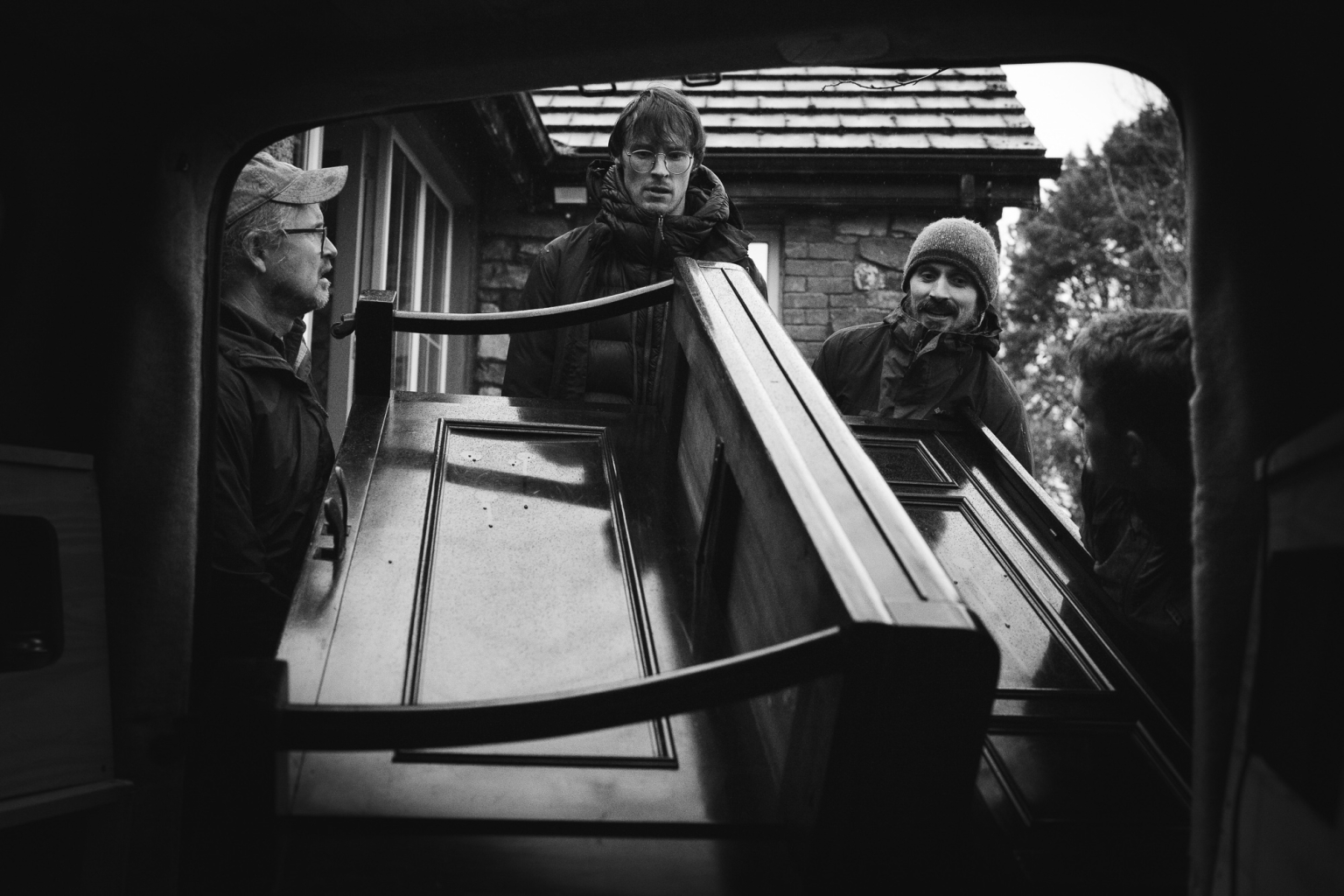
    Word came through from cousin Ed in Limerick: ‘Good news, I’ve a piano for you that’ll fit in Paul’s van.’ ‘Great stuff’ I enthused, blithely disregarding the challenge of getting it as far as my house in Sligo, let alone up the steps and through the door.

    Remarkably, cousin Paul agreed to make the trip on a dank evening in January when winter seemed interminable: ‘sure a road trip would be a bit of craic.’ Relative to other possibilities on that first weekend of January he was probably right.

    A layer of ice shrouded the tarmac as we set off from Sligo town on Saturday morning. At the Toberbride roundabout outside Collooney we bought what were apparently small Americanos. When these appeared in pint-sized cups it begged the question: what manner of receptacle is reserved for a large one? The proprietor clearly understands the importance of motorists loading up on the dark sludge before driving the first leg of the N17, especially on a bleak January morning.

    Collooney gives way to Ballinacarrow, where you find signs for Coolaney on the road to Cloonacool, then Tubbercurry anticipates Curry, and you’re into Mayo by the time the caffeine wears off.

    The Saw Doctors travelled the N17 from Tuam to Galway with ‘thoughts and dreams,’ a state of mind not recommended for the winding road to Tubbercurry, an accident blackspot. As for ‘stone walls and the grasses green’, although there are plenty of the former, the boggy fields are more fawn than green at this time of year, until you get past Tuam at least.

    The road widens before Ireland West Airport, outside Knock. There, Our Lady, Saint Joseph and Saint John the Evangelist appeared to Mary Byrne in 1879, but the opening of the airport in 1985 was the real miracle, as Christy Moore insisted. The messianic zeal of Monsignor James Horan brought this solitary crumb of infrastructure to a neglected north-west region in 1986.

    Only featherheads now dream of the Western Rail Corridor being resuscitated as far as Sligo, despite tangible evidence of surviving track under public ownership, recalling Monty Python: what did the British ever do for us? The 2024 All-Island Strategic Rail Review proposes new lines are restricted to connecting settlements with populations over fifty thousand, but how is a city, such as Sligo, supposed to expand sustainably without further rail infrastructure, and is Donegal to remain the forgotten county forever?

    The N17, which serves as the main north-south transport artery through Connacht, abuts a curiously desolate landscape, almost entirely devoid of native woodland. It offers a foretaste of the Midlands, without the charm of the waterways. Far from wild Atlantic shores, it’s scenery that nurtures disappointment.

    Beyond the seemingly supernatural marilyn of Knocknashee (‘hill of the fairies’), there’s barely a hillock in view along the entire route to Galway. There the slick motorways of another Ireland come into view. I’ve never taken the route other than under a sky that promises rain, and usually delivers.

    Many of the super-sized bungalows along it appear to have been constructed in the 1980s, when Ireland still exported its children. Aesthetic considerations did not figure prominently in the considerations of draughtsmen, who might as well have been paid by the room. The influence of Southfork, the Ewing Mansion outside Dallas, Texas is apparent in the expansive Southern Colonial style of some of these over-sized residences.

    Ribbon developments streak from historic towns, where the number of pubs diminish with each increase in the price of a pint. They say the kids prefer to go to the gym these days in any case.

    Beyond Galway, the gentle scenery of east Clare barely registered such was the speed we reached on the N18 motorway. Before long we were crawling through dystopian industrial estates outside Limerick. At last, we reached the city’s attractive inner core, including the country’s only Georgian Crescent, near the house where our piano was located.

    Ed had let us know there would be 5.5 men on hand to lift the piano. It turned out the .5 of a man was a blind Jack Russel, and that the additional men were piano players rather than heavyweight lifters. Undeterred, we hefted it out of the house – which mercifully had no steps at the entrance – and squeezed it into the van, albeit at a slightly awkward angle, without too much bother.

    There followed an evening of revelry, as the additional piano lifters, who turned out to be Maltese, revealed their real talent, as musicians. At one point, I am convinced, the blind dog chimed in, but sadly we lack documentary evidence to this effect. The only regret is that cousin Ed declined to sing his cult – a small cult admittedly – classic, ‘Mow’, about a young man taking refuge from the slings and arrows of outrageous fortune in the gentle comforts of cutting the grass.

    On Sunday morning we awoke early. Cousin Paul had taken further precautions against the January blues by booking a seaweed bath back in Sligo for that afternoon. The road rose to meet us at 9am, as we traced our way back home along the same route.

    At Milltown, Galway a large, modernist church that spoke of a more self-confident era was welcoming the remaining Cathaholics that shuffle through its doors. Among the pillars of Old Ireland, only the GAA continues to thrive. Today its brash, new club houses might pass for aircraft hangers. This is Supermac’s country of ersatz, super-sized Americana.

    After passing Tuam, we required further lashings of the dark sludge. At the petrol station in Ballindine a screen saver at the till read: ‘Coronavirus COVID-19 – Contactless – We would prefer if you could pay be contactless card.’ Covid frayed the social bonds like no other event in modern Irish history, and along the N17 it’s a gift that keeps on giving to a corporate aspiration for a brave new, cashless world.

    The real challenge came at the other end. Another cousin Johnny was thankfully on hand, and our photographer’s boyfriend Shane, a strapping Mayo man, was enlisted too.

    The great weight of a piano – most uprights weigh well in excess of 200kg – proved more of a challenge than anticipated, but after much heaving and straining – ribs were almost popped – we maneuvered it into the space. It now could do with tuning, and awaits a suitable hand.

    All Images: Síoraí Photography

  • A Conversation with Carlo Gébler

    Carlo Gébler’s work spans fiction, nonfiction, memoir, history, theatre, and film. Born in Dublin in 1954 and raised in London and Ireland, he has published more than thirty books. The author of plays for stage and radio, screenplays, and documentaries, he has for many years taught creative writing in prisons, currently in HMP Hydebank and Loughan House Open Prison. I am fortunate to have been tutored by him at Trinity College Dublin. In this conversation we discuss his prolific working practice, and how he draws on memory and personal history in his work.

    RUBY: What are you working on at the moment?

    CARLO GÉBLER: I’m writing two nonfiction books. One is about my maternal grandparents—my mother’s mother and father—who my brother and I were sent from London to Ireland to stay with throughout our childhood. They lived in East Clare in a house called Drewsborough—the book is called Drewsborough—and they were remarkable people. John McGahern said, more-or-less, that until the 1970s everyone in Ireland was a Victorian, and Lena and Michael O’Brien, my maternal grandparents were exactly that. They were very strange and unusual people. Drewsborough is about what I remember of them and its focus is my half-understanding—and sometimes quarter-understanding—all the things I was hearing from them about the family’s back history. I got so much wrong, but all the mistakes and misunderstandings formed my psyche’s geology; the errors of comprehension are now me.

    RUBY: When you return to these family memories, are you trying to restore something, or revise your understanding of what you experienced?

    CARLO GÉBLER: The second. I’m trying to understand what I thought and what I think now which is different to what I thought when I was a child. I know so much more now—about Ireland then, about my family, about the forces acting on them. I’m also as I age increasingly attracted to non-fiction. I like that I don’t have to invent or fictionalize; and I’m just giving an account of that world as it was.

    RUBY: And the second non-fiction book?

    CARLO GÉBLER: That’s a book about death. 2024 was my death year. My mother died, and three other really important people also passed that year.

    RUBY: Oh, I’m so sorry.

    CARLO GÉBLER: But the book I’m writing, tentatively called No One Tells You; the final years of Edna O’Brien, is less about death itself, and particularly my mother’s death and more about the impact that death, and particularly her death, has and had on me.

    RUBY: You also have a play in the works?

    CARLO GÉBLER: Yes—The Elephant in the Garage. It’s a true story of a woman who kept an elephant in her garage in Belfast during the Second World War. The producer found the story through a connection he had with someone who used to run a jazz club in London and who told him this story which he told me. It’s remarkable story and fiendish to stage! My job is to write it, which I’ve done; the rest is up to the production team.

    RUBY: You once told me at Trinity that writing is like descending into the basement, where the characters are already. How do you get down there?

    CARLO GÉBLER: The unconscious is always communicating—in dreams, daydreams, slips of the tongue. You need to pay attention to the intimations and signals coming from below and when they’re signalling you to come, don’t tarry, make haste. And that place when I get to it is like an old theatre; and there they are, on stage, in costume, make up on, the characters and they ‘do’ the scene and I watch and follow and write it up. David Lynch says, which is not so dissimilar, that the creative space where the unconscious gifts you its fruits is a dark room with a TV in the corner playing something, and your job is to record or transcribe what’s on the TV. You shut up and you listen because there they are on the screen, in costume, lines learnt, your characters, acting out the scene. In order to facilitate access to this magical, numinous space where the unconscious gives you what it has, regularity helps: you do it, i.e. you write at the same time every day and pretty soon you’ll find your psyche will be ready at that time to offer you whatever it has. The unconscious wants to cooperate but the writer must make that process frictionless and easy. So, the writer mustn’t do things that mess that relationship up.

    RUBY: Much of your work is memoiristic or rooted in memory. Is there nostalgia in that impulse?

    CARLO GÉBLER: Of course. In times of chaos or disorder, it’s comforting to return to the foreign country of the past. But it’s more than nostalgia: the present and future are made by the past. Going back to excavate your own geology, you drill down through layered strata and find out what your life has been formed from which helps you to understand your present, the present.

    Nabokov does this brilliantly in Speak, Memory. He does it by giving you pictures, one after the next, and as his understanding deepens, so the pictures he offers get richer and better and brighter. In the memoirs I’ve written or am trying to write, I’m attempting to do something similar, to give a deep understanding of the past and the connection of the past to the present, though obviously my efforts have never been and never will be as good as Nabokov’s efforts. I mention Nabokov’s memoir, among other reasons, because it’s always good to have a sense of what is possible, what can be done, which, even though better than what one can do oneself, nonetheless spurs one on.

    Vladimir Nabokov

    RUBY: Your advice as a writing teacher was to describe events plainly, without sentimentality, and to avoid editorializing. How did that sense of restraint develop?

    CARLO GÉBLER: From talking, listening to people tell stories about themselves, and talking about my own past over many years. What I learned is: get out of the way. Keep things plain. Don’t moralize from the present. Don’t tell the reader what to feel. Readers don’t like it when they sense the writing has designs on them—Keats put it far better than I ever could when he wrote, he was speaking of poetry but his observation applies to all forms, “We hate poetry that has a palpable design upon us—and if we do not agree, seems to put its hand in its breeches pocket. Poetry should be great & unobtrusive, a thing which enters into one’s soul, and does not startle it or amaze it with itself but with its subject.”

    All literature is a trick, of course. You’re smuggling images from your interior into someone else’s. The less interference, the cleaner the transmission.

    RUBY: How do you decide whether a project becomes fiction or nonfiction?

    CARLO GÉBLER: I would never voluntarily write a play—they’re too hard and too hard to get staged. So, it’s always prose. Then the choice is between fiction and nonfiction. How do I decide?  Each case is different. The first novel I wrote was The Eleventh Summer. It’s a fictional account (it might now be called auto-fiction) of life with my maternal grandparents, the Victorians in east Clare. It’s a novel built out of the evocation of atmosphere and mood.  It was published in 1985. But in the intervening forty or so years, I’ve learnt so much more about those people than I knew as a child. In Drewsborough I wanted to use that new material that has come to me, that has been given to me, but I decided I shouldn’t and mustn’t do it as fiction—though the material is fantastic and could happily be novelised—because to fictionalise would blunt the truth. The facts are so extraordinary it’s better to leave them alone than trick them into fiction. So here was the reason I chose non-fiction rather than fiction, though every case is different.

    So, what do I mean by fictionalising ‘would blunt the truth’? Let me illustrate: for years my father—pugnacious, left-leaning, and contemptuous of what he called the Irish peasant class—maintained the O’Brien family fortune, my maternal grandparent’s money, the money that bought the estate and the house they lived in, Drewsborough, came from cough medicine sold in industrial quantities to gullible Irish navvies in nineteen century America who were dying of consumption. It sounded like pure myth and as a way to disparage my maternal grandparents it was a marvellous. I assumed it was a schtick. However, which I didn’t know as a child, and which I didn’t know when I wrote The Eleventh Summer in the mid-1980s, it’s absolutely true. But I only found out recently.

    The details are as follows. Three O’Brien priests went to America pre-Famine and ended up in Lowell, Massachusetts. They were my great, great, great uncles. In Lowell they became pillars of the Irish-Catholic community and led the fight back against the Know Nothings. One priest became ill, probably with tuberculosis, and died; his brother, John, also fell sick, went to a chemist in Lowell, and was cured by a concoction of this liquorice-flavoured water the chemist made. His parishioners then began asking the chemist for “Father John’s medicine.” These requests put an idea into chemist’s mind. He went to Father John and he said, Let me use your name and picture; I’ll put them on every bottle of the medicine, and you’ll get a cut of every sale. Father John O’Brien agreed and the rest as they say, was history. Father John’s Medicine, made in Lowell, Massachusetts, was a best seller. It sold in incredible quantities and on the back these sales, the O’Brien family fortune was made, the fortune which bought Drewsborough, where I spent my childhood. Why fictionalize that? There’s no need It’s already more novelistic than fiction.

    Father John’s Medicine at Crook County Museum & Art Gallery in Sundance, Wyoming.

    RUBY: And how did that myth—now revealed as true—shape the family?

    CARLO GÉBLER: The fortune ruined my grandfather and his brother. The fact that Father John’s Medicine made a fortune was a freak event but it created in my grandfather and his brother a deep, subliminal belief that extraordinary financial salvation was always just around the corner. They spent insanely but because they believed they’d be saved they thought they were untouchable.  They weren’t. Financial salvation is never around the corner. The world is heartless and particularly heartless to those who get into financial difficulties, as Madame Bovary knew all too well. Debt and failure, with large side orders of shame, destroyed the O’Brien men. As a child, staying in that house, it felt almost gothic—Edgar Allan Poe by way of East Clare—and I could sense this dark past even if I didn’t then understand it or grasp how it came about. Understanding, as I said, came later. But the atmosphere experienced in childhood, wow, that was powerful and never forgotten.

    RUBY: And what about memory itself? Its accuracy? Its falsifications?

    CARLO GÉBLER: We’re all formidable recording instruments. Everything floods in and is stored according to associative rather than chronological, logic. When you write you sift patiently, and the more you do this, the more the details of the past are yielded up to you.

    But accuracy is slippery. When I finished Father and I, the book about my father and my life in London in the late fifties and early sixties , I sent it to Peter Robinson. He was a neighbour who had lived beside us when I was a child. We were the same age and he was my exact contemporary. Peter read the manuscript, corrected various details, and then he rang me up; “I read the book,” he said, “and I don’t understand why you make absolutely no mention of the fact that for two years we walked to and from school together—sometimes four times a day.” “Did we?” I said. “Did we?” Yes, we had but I had and have no memory of that whatsoever.

    RUBY: Not at all?

    CARLO GÉBLER: Not at all. This is why memory is so tricky. On the one hand it’s true, the more you sift, the more the details of the past are yielded up to you; but on the other hand, some things you can’t find no matter how hard you look because they’ve been stored somewhere where you can’t put your hand on them, like my walking to and from school with Peter Robinson for two years. And by the way, the reason I think I have no memory of that experience, I can’t find it, is because I was happy and it was the opposite of happy that mattered more to me and that forms the pith of that book.

    RUBY: You’ve been attending screenings of The Blue Road, the documentary about your mother. What is that like for you?

    CARLO GÉBLER: I’ve been to several screenings, yes. It’s a marvellous film, a brilliant piece of work and I have enormous respect and admiration for the director Sinead O’Shea. Each time I see it I think I’m seeing a different film. And the conclusion I’ve come to—although it’s a very good film in all sorts of other ways—is that primarily it’s a record of somebody’s slide towards extinction. It follows my mother in her last years and as you watch, as the film advances, you see her, literally shrinking, vanishing. You see her edging towards the precipice, towards dying. That’s an unusual subject for a film but I applaud the filmmaker for offering that account.

    RUBY: And how do people respond to that?

    CARLO GÉBLER: My sense is that people mostly chose not to see that it’s a film about death. They prefer to project onto the film the things that have inside them that they want the film to carry.

    RUBY: Are there recurring projections? Patterns in what people want the film to mean?

    CARLO GÉBLER: They mostly want to see it as a film about progress, Ireland’s social and cultural and political progress. And yes, the film documents the changes that occurred in Ireland over the last seventy years. But for me the film’s kernel is something else entirely; it’s not an uptick film; it’s a record of a human being as their body gives up; in other words, it’s an unflinchingly study of evanescence and mortality (and as we’re a death-denying society this can only do us good) and it’s a film which asserts, also, that my mother’s primary struggle was the maintenance of a close and harmonious relationship with her unconscious. That was my mother’s struggle, and it’s every artist and writer’s struggle, and all the rest, the things that are traditionally associated with her, the parties, the glamorous friendships, the clothes, that was just, is just, chaff.

    RUBY: Was psychoanalysis a useful framework for you as a writer, especially in writing about your family?

    CARLO GÉBLER: Yes. When I was growing up, especially in adolescence, therapy and psychoanalysis were a subject of great interest to many if not most of the people in my mother’s social circle. It was as big a thing as politics. Everyone, or nearly everyone who came to the house, was interested in it and approved of it. The overwhelming consensus was that any form of self-exhumation was a good thing because it deepened self-knowledge. There were disagreements of course about the competing schools and approaches as was inevitable seeing as Jung, Freud, Reich and Adler all had adherents and devotees. I often heard discussions, even arguments, about which approach was best. But everyone, everyone who was interested in analysis, agreed about the principle of analysis, regardless of their school or their beliefs. Everyone was adamant: the unconscious mattered. Dreams, slips of the tongue, malapropisms, et cetera, all had meaning; these things, dreams especially, betrayed the inner truth, the inner life of the person, and one’s duty as a conscious, allegedly functioning human being was to engage and understand. The unexamined life is not worth living, as Socrates had it—and everyone psychoanalytically inclined was signed up to that.

    Much later, in the early nineties, I went into analysis myself. I mean I had it myself. It was traditional. Week after month after year I went at the appointed hour; waited for the summons, entered the consulting room, lay on the couch, saw the ceiling above, heard the analyst (who was sitting behind me) open his notebook and click his pen, and then I started to talk and I wouldn’t stop till my hour was up. I had always apprehended that there were deep seams of unexplored material down there, and when I started speaking and remembering I comprehended just how true that was. Talking catalysed deep excavation. The submerged was lifted into the light. I saw how my inner geology (or some of it at any rate) had been made. It was transformative; it re-made me as a person. I became what I was always supposed to be only more so as a result, or so I like to think. And everything I’ve written since—starting with Father and I—rests on that psychoanalytical bed and is the product of that experience. Psychoanalysis truly, for me, is the only begetter.

    Interestingly, serendipitously, the analysis coincided (does this prove that after all perhaps there is a God?) with my beginning to work in prisons.  The analysis and the prison teaching nourished one another and fed into one another. On the couch I was being listened to very carefully and on the landings, I found or I learnt, I had to listen just as closely, just as carefully as the analyst. I had to practice active listening, the value of which cannot be emphasised enough. In active listening, you don’t speak, you don’t make yourself important. You stay very quiet and observe and tune in to what’s going on, and if you do this, you do discover everything that’s going on in time. I was getting that in analysis as I was trying this out on the landings. That’s what I meant by the two feeding one another, the analysis and the jail work. The importance of being quiet and watching, which I learnt on the couch and on the prison landings, still governs the way I live now. When I’m teaching that’s what I’m really doing; listening very carefully.

    RUBY: You said that your mother’s experience with R. D. Laing and LSD was traumatic. Did that shape your sense of psychoanalysis’ limits?

    CARLO GÉBLER:  My mother’s position vis-à-vis the social world, people, society, those amongst whom she found herself living, contrary to the impression she gave of being confident and at ease, was anxious and fretful. The world was unpredictable and uncontrollable and not easy. However, with what was inside, with what we can call the unconscious, she had an extraordinary relationship. It began in childhood. She was, in a way, an animist: she could ‘feel’ or ‘hear’ or ‘see’ the spirits indwelling in trees and stones and rocks and hills and so on, and she spoke to them, she communed with them, she interacted with them and they spoke and communed and interacted right back. And from the sense that these spirits—or their energies, whatever they were—were communicating with her, narratives emerged. That’s how she began making up stories. The trees, the rocks, the wind, the hills, they spoke to her and she spoke back, content accumulated and that content became narrative.

    After that, her access to the unconscious was astonishingly easy. In the early years, when she wrote her first novels and stories (the 1960s, 1970s) she could pick up a pen and the text would simply come. Words flowed without thought. Not everyone has that. Flaubert said he was like a dromedary—slow to get going but able to continue for a long time once started. My mother was the opposite. She could drop straight down into wherever the words came from; or, if you prefer, as E.M. Foster liked to put it, she could lower a pail into a well and pull something up, instantly, just like that. The work came in quick, bright bursts—like magnesium burning.

    LSD destroyed that, temporarily anyway. One, the trip itself was a catastrophe, a nightmare. It unmade her sanity. That immediate calamity was followed by the aftermath, another kind of calamity. She suffered from flashbacks. These went on for a long time. The flashbacks were ferocious and annihilating. The problem for her was the seat of this disabling and destabilizing content. It was the unconscious, which had always been the place from where the work came; but now, besides the work, for the work was still coming, it was the place from where the terrors which threatened to overthrow her, originated, and came. So, what had been nourishing became a place that in part she feared. For the writer she was this was devastating because it signalled the end of the open, easy relationship she’d had with her interior. After the LSD it became enormously difficult for her to maintain her previous easy, instantaneous relationship with her unconscious. She persevered—she kept on writing—but it was hellish.

    RUBY: In the prisons, what exactly were or are you doing day to day?

    CARLO GÉBLER: A mix of things. First, because I wasn’t in classrooms, I was peripatetic and unescorted, I acted as a point of contact—someone the men could talk to on the landings, and who might help them towards the education department and full-time education. I was fairly successful in that regard. Technically, i.e., according to the job description, I helped with creative writing, and I helped students studying for O-levels, A-levels, degrees—I helped them with their essays.

    I ran several book clubs. I also helped with letters—especially letters of apology to victims. And sometimes, if probation required an account of a crime, particularly for prisoners hoping to transfer, I helped the prisoner to write an account of their crime, which they had to write before they could be considered for transfer. And, of course, there was always a gap between the version they wanted to offer—“there was a knife and someone unfortunately died”—and the truth in the probation files. You’d know, say, that the man who was being asked to write up his offence had stabbed another man forty-two times in a pub. My job in this instance was to bring the prisoner to the point where he could say, “I stabbed my victim forty-two times in a pub.”

    RUBY: It does sound very close to therapy.

    CARLO GÉBLER:  Not really—I wasn’t there to catalyse growth or even remorse; my job in this instance was entirely practical; the prisoner couldn’t transfer until he wrote an unexpurgated account of his offence that reflected the facts and I was just there to help him do that. However, I would be the first to concede that in another life perhaps I might have become a therapist. I think I might have enjoyed that. What can’t be denied either is that I relied heavily on the essentials I learnt in the consulting room from the experience of therapy: be very quiet, listen hard, be patient, don’t rush to judgement. And then on top of those principles there was what I learnt in prison and could only have learnt in prison (nowhere else could have taught me this but the landing): in a prison, a stranger, a visitor, like I was, must be self-effacing. An outsider in a prison is in someone else’s world, an ecosystem with its own rules, vendettas, protocols. The visitor might not like it but the visitor must fit in.  I certainly tried.

    RUBY: How did you end up working in prison in the first place?

    CARLO GÉBLER:  By accident. Before the Good Friday Agreement, the British state realised they needed to prepare the men in the Maze for release—they needed to offer education, training and so on in order that the 800 or so paramilitaries in the Maze, who the British Government knew would be going home after the end of the Troubles (though they told no one about this) could lead productive, non-violent lives on civvy street when they left prison. In simple terms, 800 paramilitaries couldn’t just be let ‘go home’. They need to leave equipped with skills and resources so they could live differently to how they had been living when they’d been paramilitaries. Thus, in the early nineties, this is years before the Good Friday Agreement, artists and other sorts of ‘inspiring’ types were brought into the Maze (Long Kesh by the way to truculent Republicans) to help the men develop new skills. The creative-writing part hadn’t gone well, and a woman called Mourner Crozier, who ran the Community Relations Council, who knew my work, and who knew me, thought that perhaps I might be able to make the creative writing component work, and came to see me and put the proposal. After a long process, I ended up in the Maze for six weeks, then twelve weeks, then three months and eventually several years, on and off. Then in 1997 I transferred to HMP Maghaberry, a Category A high security prison (for so-called Ordinary Decent Criminals as opposed to paramilitaries) where I was writer-in-residence for 18 years.

    But back to Maura Crozier and her invitation. When she first asked me, I wasn’t surprised. On the contrary I thought, I’ve been waiting for this. My grandfather had been sent to a hard-labour camp in Co. Meath in 1914 as an enemy alien by the British State (he was technically an Austro-Hungarian living in Dublin), and as result of being incarcerated, my grandfather didn’t see my father, his firstborn son, for five years. My father believed that rupture damaged them both permanently, irreparably, because it stopped attachment. And my grandfather’s five-year absence in the camp did stop attachment; when my grandfather returned he and my father never bonded. I knew all this and in a psychoanalytical way, when Maurna came and asked me to go into the Maze, I felt I had to do it because by doing it I would be helping damaged fathers repair their relationships with their damaged sons. And it went even further than that. I believed (somehow) that it was my destiny to work in prison. My knowledge of my father’s miserable life, plus our miserable life, his and mine, for we never attached, my father and I, like he never attached to his father, my grandfather, had primed me for this role. Magical thinking I know—but as analysis teaches one, or it taught me this at any rate, I’m absolutely saturated with it.

    RUBY: When you write about historical places and events—like internment, like the Ribbonmen, like ancient Thebes—how do you find your way into them?

    CARLO GÉBLER:  I look at writers who do it well. Bruce Chatwin, for instance—In Patagonia, Chatwin’s great travel book, is full of history, Butch Cassidy and the Sundance Kid, the Conquistadors, gauchos, anarchists, et cetera, et cetera —but Chatwin makes the past compelling through language and selection. He got his style partly from Osip Mandelstam’s Journey to Armenia and partly from Isaac Babel and the Red Cavalry stories. James Salter’s summary of Babel is worth quoting here; Babel he said, ‘He has the three essentials of greatness: style, structure, and authority’ Another ‘inspiration’ is Alan Moorehead, author of The White Nile and The Blue Nile. Chatwin and Moorehead are travel writers, but they write history in a way that comes alive. Chatwin is particularly influential (with Babel behind) because he is so very concrete, so very selective, and so very concerned to arrange his language as if it were a line of dominoes. So, in Chatwin (and Babel behind him), you’re told something, and it leads to something else, which leads to something else, and on and on it goes, and you’re carried along pell-mell by this river of words and as a reading experience its thrilling, compulsive and entrancing. That’s the long answer. The short answer is basically, I just copied what someone else had done.

    Chatwin, photographed by Lord Snowdon, in 1982.

    RUBY: I, Antigone has that sense of inevitability—even though it’s not historical. Events follow on like dominoes. It made me think of that quote by Anouilh: “The spring is wound up tight. It will uncoil of itself. That is what is so convenient in tragedy. The least little turn of the wrist will do the job.” There’s a sense that the outcome is inbuilt into the design from the start. It’s scary but impressive.

    CARLO GÉBLER:  Yes. You trap the reader. You put them on the train and drive them to the end. All the writing I admire has that internal, undeviating, relentless sense of conviction, certainty, and inevitability. The sense that the writer knows where they’re going and you’re going there to and there’s absolutely no escape.

    RUBY: What drew you to the Antigone story specifically?

    CARLO GÉBLER:  I was born in 1954, and as I was growing up in London I encountered the early, idealistic NHS and the social security safety net constructed by the post-war Labour government of 1945 to 1950. In my childhood, when we lived in Morden, in south London, there was still this vestigial sense that the world was going to be made a better place for people to live in, and I could feel that as a child and what’s more I was a beneficiary of that as a young adult. Throughout the 1970s I had free third-level education—first at the University of York and then at what was called the National film School (now the National Film and Television School). In order to get the money to go to these institutions, I simply went to the Greater London Education Authority, filled out a form, and they paid for university and film school. I didn’t have to do anything extraordinary or deceitful; the understanding was that I’d pay it back by working and paying tax. That was the contract, and it seemed entirely right to me. They’d help me and I’d pay them back—that seemed entirely right and reasonable and ethical.

    And then all of that vanished. Suddenly I felt we were going backwards, that the world had tied itself into a terrible knot. This was around 2016, before or after Brexit. At the time I was reading Oedipus at Colonus—not Oedipus Rex and not Antigone, but the middle one. In this play Antigone tells the envoys from Thebes who’ve come to take Oedipus back to Thebes, “Yes everything you say about him is true, but none of it is of his own devising.” What she’s saying, as a Greek Classical audience would have known, was, yes, Oedipus killed Laius, Oedipus married Jocasta—all of it absolutely happened; he did it freely, and at the same time he had no option, no freedom, because everything he did was set in motion long before he was born, by Laius’s assault, his rape of Chrysippus, and that whole prehistory, none of which, as Antigone brilliantly puts it, was off his own devising, drove Oedipus’s life.

    I thought: this is exactly our situation. We have agency, and yet we’ve surrendered it; we are agents of our own downfall, destroying the world in countless ways, and at the same time we’re trapped by precedents, nostalgia, inherited patterns which means we are not free and can’t act in any other way but the wrong way. Of course, if Oedipus had asked the Oracle a different question, everything would have been different. He asked, “Am I my father’s son?”—longing for confirmation—and this was the wrong question. The Oracle said yes, and he mistook what that meant; he took this to mean he was the son of his adoptive father, who he didn’t know was his adoptive father, whereas the Oracle meant was that he was Laius, his real father’s son. Oedipus should have asked “Who is my father?” but he couldn’t, he was psychologically incapable of asking a question like that because it would have overthrown everything he believed. The myth teaches that you must ask the right question, but here we are, a quarter of the way into the twenty-first century, still asking the wrong ones politically, culturally, et cetera, et cetera. And that’s why I wrote I, Antigone.

    RUBY: And obviously the Oedipus trilogy is central to the history of psychoanalysis. Were you thinking about that during the writing of it?

    CARLO GÉBLER:  Yes, partly because I was reading Freud (occasionally) when writing the novel. But much more important, speaking psychoanalytically, than the figure, Sigmund Freud, though I understand how important he was, was what ‘analysis’ in general encourages, tuning in. What the analysand is encouraged to do is listen to the self—something most of us ignore, and don’t do. All those desires, wants, yearnings and needs that are in us get pushed down, set aside: attending to them is the path to well-being. At the same time, without a certain amount of denial and even lying, society couldn’t function; those mechanisms have their place. But within the safety of the consulting room, the task is to go down, to get to the bottom of oneself—which is, really, what we spend our whole lives trying to do. So, I, Antigone came out of that, peering into the self, determining what I was feeling about the world after 2016 (depressed) and then turning that energy or whatever it was into language, narrative.

    RUBY: Do you think a writer’s job is to protect that unconscious space?

    CARLO GÉBLER:  The single most important thing to remember is that everything you write comes from inside you. Even if you’re writing biography—the life of Samuel Pepys, say—you may have masses of research, but it’s what your internal being makes of that material, the stamp of yourself that you put on the material which comes from within, that makes the text sing. Everything comes from within.

    Your job as a writer is to maintain your relationship with the unconscious—to keep it open and healthy and smooth. And you must not do things that interfere with it. The things that mess it up are the things you put into yourself: drink, drugs, relationships lived in the wrong way, the general garbage one can fill oneself with. How do you say all that without sounding pious? It’s impossible. I know I’m sounding pious. I’m aware of it. And hypocritical. I loved narcotics when I was young, went to parties, drank plenty. But as I’ve got older the drinking et cetera diminished and then mostly stopped—it’s partly age, the body not coping, and it’s partly because I’ve come to feel that the unconscious is everything and whatever I do I mustn’t do anything that mucks it up. I can’t even afford a hangover.

    When you’re young you think you’re invincible. I took all sorts of risks—not just in the way I lived but simply bicycling, walking, everything. I wasn’t risk-averse. Now, at seventy-one, I think: I have to keep the unconscious functioning. I’ve spent years working in concert with it, making books, and I don’t want to rupture that process or impede it in any way by doing something stupid. So I’m much more careful.

    RUBY: Has your writing process shifted with age?

    CARLO GÉBLER:  Completely. When I was younger, I saw the whole book at once—like hills in a landscape. I knew I just had to climb them in order in which they appeared before me and the book would be born complete. Now it’s different. I begin, language catalyses, and suddenly there’s a path I didn’t expect. I see a forest. A lake. Oh I think, “I didn’t expect to be seeing that. I think I’ll just walk down and take a look.” That’s how it is now.

    RUBY: You trained as a filmmaker—what made you turn toward writing as your main medium?

    CARLO GÉBLER:  I was at the National Film School and got a term at the Polish film school in Łódź—L-O-D-Z. Łódź had about five thousand students, and I met so many people who were enormously talented, who had extraordinary scripts, but were working as cutters or scene painters or whatever, because they couldn’t get their brilliant scripts greenlit. This was the seventies, and Poland was an autocratic state. I remember talking to them and thinking: this is terrible. These brilliant scripts will never be made for political reasons. They’ll simply never reach completion. It was unhealthy, even damaging.

    When I came back, I realised the same thing could happen in a Western capitalist environment. There are more possibilities under capitalism, but the risk of not completing is still there. So, I decided to redirect my energies away from directing and towards writing and publishing If you write a book and ten copies are printed, at least they exist; they’re in a library forever. You can write a brilliant film script, but unless it’s shot, edited, promoted, projected in a cinema, it may as well not exist. And I decided it would not be my fate, to be the father of unfulfilled, unmade film scripts.

    RUBY: When you go down into that unconscious place- do you find it communicates in images or words?

    CARLO GÉBLER:  It’s that you see and hear something that’s like a play, or like a film. Down in the making place, the unconscious, murky, misty, ethereal, real entities are just there and they do their stuff in front of you. And this happens in fiction and nonfiction alike—it’s just as true for one as for the other. You see the thing. It isn’t exactly cinema or theatre, but it’s not far from that either. You watch it, you transcribe what you see as words. But it begins with images. Images, scenes, then words.

  • Hooligans, Thugs and Gangsters


    Our world, especially the United States, is now becoming a Gangster Enterprise where brutality and soma-induced compliance maintain the ruling order. Sadly, the weapons of resistance against authoritarianism are not readily apparent. Housing rights and in some cases a right to life are threatened at all levels. We experience deep-seated inequality and a worldwide Ponzi-scheme, not least in Ireland. This is a country where the banksters and their political apparatchiks are in charge. Welcome Paschal to the knowledge base of the World Bank.

    The global population, apart from a small coterie of the rich, are reduced to corporate and other forms of slavery and servitude. Dissidence and criticism is categorised as disruption or even criminalised. It is a situation unprecedented since medieval times, but then the lord of the manor often took care of his vassals. Not any longer.

    In this respect, the definition and etymology of three terms hooligan, thug and gangster has become central to any understanding of this New Dark Age.

    In general, the term hooligan is closely related to rioting, disorderly conduct, bullying and vandalism. Today, either actual violence or the threat it is omnipresent. Often, regrettably this emanates from those in authority in corporate organisations, schools or other institutions.

    Hooliganism is fundamentally about brutality, and it is telling that brutalist architecture began to arrive in Italy under Mussolini. This is where veneration of the strongman – or Big Fella in Ireland’s case – really began.

    Today, true strength is associated with brutality and the strongman, one of Umberto Eco’s canonical definitions of fascism, has reemerged. Prole workers are being bullied in a period of an unregulated free markets, not unlike that which obtained at the turn of the twentieth century in America in The Jungle by Upton Sinclair (1905).

    The word hooligan is in fact Irish or perhaps Scottish in origin. Thus, the Victorian novel Hooligan Nights (1899) is based on the character of Patrick Holohan a.k.a. Hooligan. The Scots, as anyone who has spoken in the Glasgow Union would attest, have also a form of attribution for that term in that General Wade during the Jacobite rebellion in 1794 referred to the Scots as hooligans.

    The word first appeared in print in London police reports in 1894 referring to the name of a gang of youths in the Lambeth area — the Hooligan Boys.

    The Daily Graphic thus records  in 1898: ‘The avalanche of brutality which, under the name of ‘Hooliganism’ … has cast such a dire slur on the social records of South London.’

    Modern Hooligans c. 1990.

    Extortion is intrinsic to gangsterism including its corporate version. As a barrister I am aware of how blackmail cases have a particular flavour of awfulness, involving emotional and financial manipulation, fear of disclosure, along with physical and psychic violence.

    H.G. Wells wrote in his 1909 semi-autobiographical novel Tono-Bungay:

    Three energetic young men of the hooligan type, in neck-wraps and caps, were packing wooden cases with papered-up bottles, amidst much straw and confusion.

    And then we arrive via the Blueshirts, Blackshirts et al at the football hooliganism from the 1970s and 1980s, which was referred to as ‘The British Disease,’ but was also evident in Italy, Russia and elsewhere.

    A hooligan is, above all, someone who has no consequential respect for other people, their privacy, or their values. They nonchalantly damage the lives of others. The word thug is often used in this context or in the legal profession, a not dissimilar expression is boot boys with brains. Our learned friends.

    But it is far from exclusively British in origin or orientation, although the late Martin Amis suggested that the yobs are taking over, and certainly that is the theme of his uneven Lisbon Asbo (2012).

    Group of Thuggees, c. 1894.

    Thug and Gangster

    The word thug is derived from the term for the cult Indian sect thuggee, and is often associated with excessive nativism or colonialism. It should be stressed that the thugees caricatured in Gunga Din (1939), or in the Indiana Jones movies, were in fact actively engaged in deception and motivated by religious fundamentalism. So, one of their mantras is: ‘God is all in all, for good and evil.’

    Well, that could be a slogan for the activities of the fundamentalist Evangelical robber barons of our age. Our new thugees?

    Gangs or gangsterism is also a-turn-of-the-century phenomenon. Thus, Scorsese’s Gangs of New York (2002) portrays The Bowery Boys immortalised by Day Lewis as Bill the Butcher. They were nativistic Americans and viciously anti-Irish. Today of course we have vicious Irish nativists, wishing to exclude others. Ignorance disinformation and stupidity, as Karl Krauss historically indicated, is now apparent in every direction.

    The terms gangster is centrally associated with the Costa Nostra or the mafia, and it is revealing that this develops after the decline of feudalism and the rule of primogeniture. In Marxist terms the freeing up of the alienation of land created the possibility of exploitation.

    The Italian aristocrat Tomasi di Lampedusa’s extraordinary novel The Leopard (1960) was written under a settled hopeless expectation of death. It was filmed brilliantly by Visconti and is a crucial portrait of Italy in revolution, just as feudal entitlements are stripped away. The abolition of feudalism was replaced by sharecropping and small holdings, which ushered in the opportunistic mafia and robber barons.

    Today wealth is channelled to a small minority, and everyone else is left scrambling for a living in worldwide corporate serf-Capitalism or, in some respects, serf-Communism. Take your pick. The gangsters corporate and their role models worldwide engage in blackmail, deceit, and manipulation.

    How do you expect the wretched of this Earth to behave? What with the lure of consumerism and an endless media barrage of lifestyle choices, hedonism, and easy money.

    The gangster drug problem in Dublin, for example, essentially stems from an abject failure in urban planning, moving people from solid working class communities into squalid estates as well as the tower blocks of Ballymun, which spawned drug-infested infernos. Naturally, these buildings were modelled on the brutalism of Le Corbusier.

    Roberto Saviano exhibited his expertise in the Italian drug trade in his book Gomorrah (2006), which demonstrates the economic rational and organisation of the drug cartels. His subsequent book Zero, Zero, Zero (2016) makes the following crucial points:

    First, the gangster drug cartels of South America and Italy among other places created a model of business organisation and funding that corporate organisations have emulated. What difference in moral terms is there between vulture funds, Goldman Sachs, and drug barons? None at all. The business of America is business. Or of Ireland or, more pertinently, of China.

    Secondly, this model has become, through both its ruthlessness and an omertà code of compliance, the model for corporate business organisation. The transnational vulture funds and purchasers of Canadian, Chinese and American origin presently destroying Ireland are, in moral terms, equivalent to drug cartels.

    There is, no moral distinction between Steve Bannon, the late Peter Sutherland, Xi Jinpeng and Pablo Escobar. Corporate law firms’ bankers share the same dynamic as the drugs trade.

    Piazza Pretoria, Palermo.

    Visit to Palermo

    I recently visited Sicily and while in Palermo stayed in a beautiful old hotel with a golden bath frequented by Elizabeth Taylor and Richard Burton for under fifty pounds. I chose the restaurant because it was recommended by Peter Robb in Midnight in Sicily (1996). It was just around the corner.

    Before leaving the concierge said to me: ‘Oh no, Sir, we will order you a taxi, the alleyway is bad.’ You could walk around it, but that would take an extra forty-five minutes, while a cab will take fifteen minutes, and it’s a beautiful drive.’

    And so it was. When I arrived in the restaurant, serving the fantastic Sicilian dishes recommended by Peter Robb Pesto Al Sarna, I noticed the adjacent table had lots of guns on the table, and from the alleyway the hotelier referred to gun shots were audible.

    Agrigento is of course very close to Corleone a town with many limousines with blocked windows and a dislike of visitors. The next day on the drive there I was greeted by half-finished buildings. Unfinished, because of backhanders to the mafia. Reminiscent of the false promise of housing from Mr Martin.

    Thus, we are rendering housing, both for the rentier and mortgaged class, impossible in Ireland. We are destroying the next generation from living happy and fulfilled lives, as we embark on the road to an ever-compliant mediaeval feudalism.

    Beautiful spaces and buildings create balanced, adjusted people, as Alain De Boton rightly argues in his book about buildings and urban spaces The Architecture of Happiness (2006). And yet the tribalistic veneration of gangsters from Ned Kelly to Don Corleone to the Irish variations in Martin Cahil and Gerry Hutch persists.

    Gerry Hutch has been around as long as I have. I won’t get into morals or ethics, but Hutch has been kind to the community in Dublin Central in indirect ways, as Bertie Ahern put it. Whether we like it or not, he is respected by downtrodden working class Dubliners, in a way that the legal class is not. I doubt Rossa Phelan, another person who secured a not guilty verdict in a recent murder trial, will be going up for an election any time soon.

    The solution to all this is the reassertion of community, fraternity, equality and of course respect, but this must be earned rather than inherited. Their wise talk is about trust and respect which leads to kindness and inner warmth. Openness to chat.

    Feature Image: James Cagney in Angels with Dirty Faces, 1938

  • Distortions Of Language


    What tangled web we weave when our intention is to deceive?
    Sir Walter Scott

    The distortion of language lies at the heart of the greatest of threats to human civilisation. It now effects all aspects of the public and civic sphere, from court rooms to journalism to the expression of corporate-political elites. It is what allows atrocities to be sanctioned or airbrushed.

    The distortion of language fundamentally undermines the idea of shared and purposeful communication, whether interpersonal or societal. This is what Jurgen Habermas, in a different context, referred to as Communicative Action – a term borrowed from John Austin’s idea of ideal speech language – effectively purging it of ideology and taint. Distortion undermines the use of language in terms of truth-saying or truth-telling propositions.

    Theodor Adorno famously argued that after Auschwitz to write a poem was barbaric, implying that nothing could conjure up or express in human terms such atrocities. Nevertheless, various accounts by Primo Levi as a survivor in books such as If This Is A Man (1947)  and The Truce (1963) did poetically express the horror and show how human resilience endured. Language survived in a humanistic age to express the terms of the horror, but we are now in a more obviously trans-humanist age, and remnants of civilisation are not as obviously influential or vocal.

    The propaganda and euphemisms leading up to the Holocaust involved the use of language as a masking device to conceal different meanings and agendas.

    Although I am wary of structuralism, I do believe it is often necessary to deconstruct meaning. That occurs when an expression is being used to conceal an ulterior purpose, or to make a horror more palatable. The object of euphemisms, buzz words and jargons is often to distract, deflect and misdirect.

    Kenneth Branagh’s film Conspiracy (2011) effectively depicts the use by the Nazi High command at the Wannsee Conference chaired by Heydrich of the term evacuation, which of course really meant extermination.

    The phrase more typical of our age since Srebrenica has been ethnic cleansing, which is an opaque word for genocide, which at least has been used expressly in response to the actions of the Israelis, but even the utilisation of the appropriate word in a world of distorted coverage invokes fake well-financed indignation.

    In war or military matters historically, other euphemisms are collateral damage, friendly fire, or my favourite crew transfer question – meaning coffins for the dead bodies from the space shuttle.

    George Orwell.

    Orwell

    Any discussion of language in the context of war and politics leads inevitably to George Orwell.

    The term Doublespeak has been culled from Orwell’s 1984 (1949), although it was not used in the text where expressions like Doublethink and Newspeak perfectly express the nature of propaganda.

    In our time, political speech and writing are the defence of the indefensible… Thus, political language must consist of euphemism, question-begging and sheer cloudy vagueness… the great enemy of clear language is insincerity. Where there is a gap between one’s real and one’s declared aims, one turns as it were instinctively to long words and exhausted idioms…

    Orwell elaborated on these themes earlier in his magisterial essay The Politics of the English Language (1946). He piquantly observed of political language that it ‘is designed to make lies sound truthful and murder respectable, and to give an appearance of solidity to pure wind.’ The essay chastises vagueness and prioritises clarity and simplicity over euphemisms.

    Thus, when defenceless villages are destroyed it is called pacification, and the plunder of property is called rectification of frontiers. One might think of other euphemisms in use today, such as affordable housing or even debt relief.

    Orwell’s essay is not confined to political language but includes all forms of distortion of language:

    The great enemy of clear language is insincerity. When there is a gap between one’s real and one’s declared aims, one turns as it were instinctively to long words and exhausted idioms, like a cuttlefish spurting out ink.

    Though he saw a terminal decline in the England of his time. He did suggest certain remedies well worth citing:

    1. Never use a metaphorsimile, or other figure of speechwhich you are used to seeing in print. (Examples that Orwell gave included swan song, and hotbed. Such phrases are dying metaphors which a present speaker does not understand the context of, and the original meaning rendered meaningless because those who use them did not know their original meaning. The historical interpretation of the US Constitution by such as Scalia is like this.
    2. Never use a long word where a short one will do.
    3. If it is possible to cut a word out, always cut it out.
    4. Never use the passivewhere you can use the active.
    5. Never use a foreign phrase, a scientific word, or a jargonword if you can think of an everyday English equivalent.

    And the last canonical rule:

    1. Break any of these rules sooner than say anything outright barbarous.

    Linguistic Distortion

    Albert Camus is the great prose master both in terms of precision and sensuality. He can be quoted endlessly, but with respect to doublespeak there is this quotation from The Plague (1949) elaborating on Animal Farm (1950):

    There will come a time in human history when the man who says two plus two equals four will be sentenced to death.

    The criminally underrated Ernest Hemingway wrote a little known, but invaluable text called On Writing (1984), containing his observations about his craft, which curiously mirror that of Orwell.

    He advised writers to cut out the scrollwork of ornament. Stick to what is true and cut out the superfluous. Write about what you know. Like Orwell, he emphasises the active verb and the shortest word possible.

    With respect to the issue of immigration the word removal is now used without elaboration or explanation, notably at the recent Tory conference. The word disposal invokes similar considerations. Again, this involves a form of distortion and side-tracking of reality.

    A real problem occurs when bureaucratic language or legalese conceal infamy. People often buy into it for ease of mind, or owing to a blinkered or cognitively dissociated sense that nothing is happening – or that it suits their interests. This theme is beautifully expressed in the Oscar-winning film The Zone of Interest (2023).

    In terms of the precise use of language to explain horror we have the Martin Niemoller parable during the rise of Nazism:

    First, they came for the socialists, and I did not speak out—because I was not a socialist. Then they came for the trade unionists, and I did not speak out—because I was not a trade unionist. Then they came for the Jews, and I did not speak out—because I was not a Jew. Then they came for me—and there was no one left to speak for me.

    Contrast the clarity and sincerity of that with this from Donald Rumsfeld:

    Reports that say that something has not happened are always interesting to me, because as we know, there are known knowns; there are things we know we know. We also know there are known unknowns; we know there are some things we do not know. But there are also unknown unknowns—the ones we do not know we do not know.

    Rumsfeld comments are wrought with care and are lying to serve a purpose or engaging in deception to so do. That is the point St. Augustine condemned in his categorisations of lying as the truly venal lie.

    Other awful phrases now creeping into our world of sound bites and doublespeak include the new normal. This is effectively a plea to accept degradation and Chinese corporate capitalism, as well as to be controlled and shrivelled in an Age of Surveillance Capitalism. Compliance is another dangerous euphemism.

    We have, conversely, also become obsessed with hygiene and health and are preyed on in that respect. Stay safe. Oh, and take our drugs. The slightest cold sets people off into hysteria, leading to limited physical contact and an increasingly asexuality.

    This new form of social hygiene divides the world into the pure and the impure. Corporate and advertising interests are adept at this. Virtually any episode of the Madmen series set in the 1950s demonstrates that. In legal terms there is always a degree of tolerance of puff and blow to use the contract law term until the disparity between claim and exaggeration meets the reality of what is being done. Simply the best. Largest in the industry.

    Advertising and politics are now so co-mingled, and have been for some time in the interests of big business, that there is now little difference between winning an election and selling tinned beans. Make the product be the change.

    Sadly, such approaches have also crept into the criminal justice system. Thus we find slogans such as no excuse for abuse, while in sex abuses cases the phrase there is no smoke without fire is migrating into closing speeches.

    Political correctness is the ultimate destruction of language, providing an excuse for no platforming people and undermining freedom of expression.

    Malcolm McDowell in Clockwork Orange.

    Simplicity has its Drawbacks

    But with all respect to Orwell and Hemingway simplicity has its drawbacks. Camus was never simple.

    Thus, in Anthony Burgess’ A Clockwork Orange reveals a universe of gobbledygook, much in evidence in social media, reducing language to that of Alex the Droog. The compression of meaning into shorthand symbols or abbreviations is a return to the planet of the apes, creating simplistic misleading forms of communication such as the flawed Me Too movement.

    In my view we should reformulate the legendary text by Flaubert, The Dictionary of Received Ideas (1911-13) and Ambrose Bierce’s The Devils Dictionary (1911), filtered through the legendary dictionary of Dr Johnson in terms of providing more amplified definitions of some of the distortions of language in our age. The expression used to be followed by the real meaning.

    As in the definition of ‘Pension’ in Dr Johnsons’ dictionary: 

    In England it is understood to mean pay given to a state hireling for treason to his country.

    Or ‘Faith’ from The Devils Dictionary:

    Belief without evidence in what is told by one who speaks without knowledge, of things without parallel.

    Or Flaubert’s definition of sex as ‘Intimacy occurred.’

    I thus suggest a new dictionary of the real meanings of the doublespeak of our time, and indeed a reversion to old patterns of behaviour. This requires us to read books leading to an enhanced form of comprehension relying on clarity and simplicity.

    In this respect, self-reportage or sincerity can also be bullshit and ought to be treated with scepticism. Sincerely adopting your own euphemism can lead you to condone atrocities. It is precision and adherence to the facts that is crucial, certainly in political and civic discourse, which is not always easy.

    As Samuel Beckett, the master of succinctness once put it:

    Ever Tried. Ever Failed. Never Mind, Try Again. Fail Again. Fail Better.


    Feature Image: Tamás Mészáros

  • Pathfinder: Manchán Magan


    I will follow these gallant heroes beneath the clay
    The warriors my ancestors served ever since Christ’s day.
    From Cabhair ni Ghoirfead / I Will Not Cry for Help by Aogán Ó Rathaille.

    Many poets, and all mystic and occult writers, in all ages and countries, have declared that behind the visible are chains on chains of conscious beings, who are not of heaven but of the earth, who have no inherent form but change according to their whim, or the mind that sees them.
    From Irish Fairy and Folk Tales by W. B. Yeats.

    I remain haunted by the death of the writer and broadcaster Manchán Magan. Ongoing outpourings on my social media feeds, and across mainstream media, reveal I am not the only one so affected. Over his lifetime, it’s fair to say, he became a national icon – ‘regarded as a representative symbol,’ and now even ‘worthy of veneration.’

    Above all perhaps, Manchán – properly pronounced Man-a-chán as I was recently informed by a Gaeilgeoir from west Kerry – tapped into, and indeed engendered, renewed appreciation for the Irish language, stripping it of associations that led many of my generation to recoil from it in our early years.

    Instructively, Hugh Ó Caoláin, reachtaire/chair of Trinity College’s Cumann Gaelach recently argued that the language now occupies a new cultural space in the national consciousness:

    I think there has been a huge mentality change. It doesn’t represent conservatism any more. It’s progressive. It’s about non-colonialism and reclaiming our indigenous culture. A lot of young people look at the culture that was and realise such richness is being lost.

    Indeed, according to Pól Ó hÍomhair (20) another member of the Cumann:

    As a gay man, I would always view Irish as a symbol of a modern progressive, non-colonial, inclusive Ireland.

    It is hard to imagine that progressive shift occurring in the absence of Manchán’s almost messianic zeal. As a journalist, he embraced media old and new – from video blogs to best-selling literary-historical works – all presented in the inimical style of shaman-scholar-wanderer.

    His output was prolific and multi-dimensional. Whereas Gaelic-Irishness once seemed restricted to asserting a singular national identity, Manchán brought appreciation to a more inclusive and elevated plain, which might occasionally lapse into an arrogance he was aware of being prone to.

    A light-hearted description of English as ‘a relatively recent West Germanic language’ developed by ‘gangs of land-hungry Angles, Saxons, Jutes and Frisians,’ hordes of whom displaced an apparently more noble Irish language, unfairly denigrates a tongue he revelled in, and which has been the preferred medium for many Irish writers who have left an unmistakable imprint.

    Moreover, the early English were also subjected to colonisation, after the Norman invasion of 1066, which accounts for why over half of its vocabulary derives from French. Indeed, English wasn’t an official language in England until 1362, when the Statute of Pleading first made English an official language of the law courts.

    Furthermore, after colonising England the Normans crossed into Ireland in 1169 at the behest of an Irish chieftain, Diarmait Mac Murchada. He had sought military assistance from the Norman lord Strongbow, giving his daughter Aoife’s hand in marriage in return.

    Thereafter, the Normans under Henry II conquered most of Ireland, bequeathing distinctively ‘Irish’ names such as FitzGerald, Burke and Lynch. Most of them living beyond ‘the Pale’ of settlement around Dublin, however, eventually adopted the Irish language and customs. They later declined to convert to Protestantism, thereby forming part of the Irish nation, ‘more Irish than Irish themselves,’ which emerged in the wake of the seventeenth century Plantations.

    The heady brew of language and identity may create divisions, which often dissolve when subjected to historical scrutiny and poetic meddling. Manchán was mostly engaged in scrutiny and meddling, but faint traces of his forebearers’ chauvinism occasionally appeared.

    Proselytizing ‘the first, official language’ is only one aspect of Manchán’s legacy. He also awakened reverence for the land and people through documentary work in particular, for television and radio, and unashamedly drew attention to numinous presence ‘immanent in the landscape.’

    After long travels, and encounters with peoples on the edge, he fostered awareness of our connections to aboriginal cultures, as well as drawing attention to exploitative practices etched into our landscape. He was unafraid to float metaphysical concepts and point to the uncanny; or allow the truth to get in the way of a good yearn.

    What follows is a personal reflection on a public figure I knew a little, and whose educational formation I shared to a surprising degree. I also use this as an opportunity to explore ideas around language and identity, which foreground Manchán’s own work and upbringing, as well as my own.

    Encounters

    I distinctly recall three encounters with him. Each left a mark. The first was at Another Love Story music festival, in 2017 or thereabouts. Our conversation ranged over environmental issues. Initially, I was wary of someone who worked within mainstream media, providing cover with slim doses of virtue, as I saw it. Yet I found we shared many of the same ideals.

    The diaphanous sprite on film seemed remote from this formidable presence in the flesh. After all, this was a man who had crossed continents, daring to go to places that made me cower. I wasn’t won over entirely, however. I wanted more from him, more unsettling resistance.

    We next met at Dublin’s first Extinction Rebellion demonstration in 2019, a movement which at that time exhibited a child-like innocence, at least for many Irish participants. He had the same friendly presence, despite my reticence, but I found something else there now, a commitment to resistance.

    That first demo occurred at precisely the same location, in front of the GPO on O’Connell Street, as another rather more pivotal gathering in 1916. Nearby, on Moore Street, one of its leaders – who showed up despite believing it to be a doomed enterprise – Manchán’s granduncle Michael Joseph O’Rahilly – known as ‘The O’Rahilly’ – was shot by British machine gun fire. He made it as far as a nearby laneway, now called O’Rahilly Parade, where he succumbed to his wounds.

    There was a glow to Manchán that day. Later, I recall him forming part of a vanguard that staged a sit-down protest, blocking car traffic along the quays. I watched on, unwilling to face what seemed, with Gardaí in attendance, another doomed enterprise, inviting arrest. Now who was the real resistance fighter? It would not have been his first time behind bars. But the authorities were all too canny that day. There were to be no high-profile martyrs.

    The last encounter I had with Manchán was in late 2020 at the Fumbaly Café, the remarkable enterprise and creative space owned by his partner Aisling. Those were the dark days of Covid lockdowns, when faces were hidden from view as in a bad dream. Everything seemed impossible.

    I vividly recall him insisting that a big change had come over the world. He asserted, prophetically, that the kind of musical and food events that I had been putting on were in the past, and so it has proved. In truth, he left a bleak impression. I wonder about the ill-effects of isolation on his gregarious soul.

    Manchán in second year, c. 1985.

    Educational Background

    Recently, I learned that Manchán and I attended, five years apart, the same Jesuit school in Ranelagh, Gonzaga College, where his funeral took place.

    If ever we were to meet again in some celestial sphere, or after reincarnation, I would be intrigued to find out a bit more about his experience there. He has revealed that he wasn’t entirely comfortable in a setting which, at least in my time, seemed calibrated to produce upstanding members of the professional classes.

    There were creative outlets, in school plays and operas, and academic endeavour was encouraged, but it hardly nourished alternative ideas. Religious instruction was prescriptive rather than expansive. Mysticism, or anything autre for that matter, was hardly in vogue in Gonzaga in the late 1980s, while the Irish language only seemed relevant as a Leaving Cert subject. School Irish certainly provided me with no insights into the extraordinary literature that emerged in the oldest written European vernacular language north of the Alps.

    I have looked back over a few photos of Manchán among classmates in school annuals. Like myself, he did not participate in any of the rugby teams given such prominence. He looks like a slightly forlorn dreamer, albeit a tougher school might have knocked the day-dreaming out of such an ethereal character.

    The Gonzaga Record contains two references to Manchán from his fifth year in 1988 – aged between sixteen or seventeen. An account of the school opera recalls: ‘Backstage was handled admirably by Manchan [spelt without the fada presumably to his annoyance] Magan, and things never got far out of hand.’

    It is surprising to find that Manchán is not treading the boards, centre stage, mesmerizing audiences. I half-expected to find an account of him wearing a cloak of crimson bird feathers, like his great-great-great-granduncle Aogán Ó Rathaille, the last great poet of the Bardic school. Manchán had noble pedigree, and in later life at least, he didn’t hide any light, or ancestry, under a bushel.

    Theatrical design, nonetheless, relies on a capacity for improvisation, which presumably he also harnessed when building the first strawbale house in Ireland, an ‘ecological, mortgage-free home’ home in Westmeath for less than €6,000 in 1997, after he was left a small sum of money by his late grandmother.

    The 1988 Record also contains, fittingly, a picture of him next to a large litter bin, which he and twenty-five other students pushed around Dublin’s city centre, collecting rubbish and raising money for charity.

    The unusual symmetry in our educational background runs deeper. We also both attended the co-ed Mount Anville Montessori school, attached to the girls’ secondary school of the same name in Goatstown, from around aged four to eight, before entering the all-boys Gonzaga ‘Prep’ School.

    Furthermore, after completing his Leaving Cert, Manchán enrolled, as I did, in nearby UCD to study History, although he studied Irish along with it, while I did pure history. Nonetheless, that’s perhaps seventeen years of almost the exact same educational formation, five years apart.

    Manchán in his fifth year, c. 1988.

    Mother Tongue

    As alluded to there was a significant fork in the road insofar as Manchán studied History and Irish, a language which took on huge significance throughout his life. Indeed, it was his first language and mother tongue. This vital connection deepened over childhood summers spent in west Kerry, where Gaelic remained the lingua franca. He was also raised alongside his maternal grandmother Sighle Humphreys (1899-1994), a firebrand Republican and Irish language activist.

    Fluency in Irish gave Manchán an opportunity to present travel documentaries, at the behest of his brother Ruan, for TG4 from 1996. It was then that he really took to the stage, and never really left it.

    In contrast, I trace a troubled relationship with Irish to my mother’s preference for European sophistication – she spoke French, Italian and German. Born in leafy Donnybrook, close to where Manchán grew up, she had little sympathy for Republicanism either, writing a letter to the Irish Times in 1966 expressing disapproval with the 1916 Rising on its fiftieth anniversary. She argued there was another, non-violent, path to independence.

    The other side of my family was a different story however. My namesake paternal grandfather from Sligo acted as auditor of UCD’s Irish language society, as ‘Proinsias  Tréanlámagh,’ in the late 1920s. His father, my great-grandfather Luke Armstrong, acted as ‘Head Centre’ for the IRB in Sligo during the Land War of the 1880s. He was accused of treason, and only narrowly escaped the hangman’s noose. Moreover, my father gained a partial university scholarship through a somewhat utilitarian attention to the language.

    Nonetheless, for me, especially in my formative years, Irish represented a conservative authority in school, and even a violent nationalism I repudiated in the midst of the Troubles. It didn’t help that I had an Irish teacher in secondary school who I felt bullied by, which only repelled me further.

    Moreover, like Manchán I spent my summers in the west of Ireland living in an alternative reality to my Dublin suburb existence. As a garrison town, however, the hinterland of Sligo has a very different relationship with the Irish language to west Kerry. An historic crossing point between Connacht and Ulster, there are enduring ties to Northern Ireland. A rail line connected Sligo with Enniskillen until the 1950s. The prevalence of English since even prior to the Famine did not, however, prevent the poet W.B. Yeats and his painter brother Jack from drawing on its lore and folk tales to furnish their art.

    I also went to an Irish College in the Gaeltacht of Connemara for a few weeks one summer and got along fine with the language. But the accommodation offered by the host family was cramped and shabby, and the food appalling – under-cooked frozen pizza leaves a nasty aftertaste.

    Then at college, studying history, I made a good friend whose father participated in the so-called Language Freedom Movement, which campaigned during the 1960s against Irish as a compulsory language. He kept a photograph of this father speaking at a rally with placard in hand – and a fist seemingly attached to his chin. That fist belongs to the arm of a priest, the future primate of all-Ireland, Cardinal Tomás Séamus Ó Fiaich. For me at the time, that image epitomised exactly what the Irish language stood for.

    In contrast, I took pride in the achievements of Irish writers in English. I recall empathising with James Joyce’s Stephen Hero, when Stephen Daedulus decides to take a course in the Irish language. His teacher Madden takes exception to Stephen ‘running down your own people at every hand’s turn.’ In my copy of the novel I marked Stephen’s response: ‘I would like to learn it – as a language, said Stephen lyingly.’ Thus, Joyce chose ‘silence, exile, and cunning.’

    Joyce’s rejection of national chauvinism comes to the fore in the ‘Cyclops’ episode of Ulysses where we meet the ugly prejudices of ‘the Citizen’ (apparently modelled on the Gaelic Athletic Association’s founder Michael Cusack) who opposes miscegenation, ‘A fellow that’s neither fish nor fowl,’ and blames a woman for Ireland’s subjugation: ‘The adulteress and her paramour brought the Saxon robbers here.’

    The Citizen offers a one-eyed account of Irish history in which the country only prospers in isolation from England: ‘We had our trade with Spain and the French and with the Flemings before those mongrels were pupped.’

    In contrast, Leopold Bloom rejects entirely the gathering forces of hatred that culminated in World War I:

    it’s no use … Force, hatred, history, all that. That’s not life for men and women, insult and hatred. And everybody knows that it’s the very opposite of that what is really life.

    The Citizen asks what that really is, to which Bloom replies: ‘Love … I mean the opposite of hatred’. The Citizen guffaws witheringly: ‘A new apostle to the gentiles … Universal love.’

    Manchán’s views were, assuredly, more in line with those of Leopold Bloom than the Citizen, but a tension between universal lover and little islander is evident in his background.

    Michael O’Rahilly. Illustration by David Rooney from ‘1916 portraits and lives’, Royal Irish Academy, 2015.

    Irish Nationalist

    In many interviews – which I have belatedly binged on – Manchán alludes with pride, but also some wariness, to his forebearers, especially the aforementioned The O’Rahilly. That wariness was justified.

    R. F. Foster certainly arrives with his own biases. Nonetheless his Vivid Faces – The Revolutionary Generation in Ireland 1890-1923 provides insights into The O’Rahilly’s brand of ethnic nationalism. Foster claimed the Volunteering movement gave ‘full rein to O’Rahilly’s obsession with heraldry, titles and coats of arms; his papers include much semi-mystical correspondence about the spiritual symbols of the Volunteer flag and the need to evoke occult Celtic harmonies.’ Manchán would have approved of this, but other aspects would have been far less appealing.

    Foster points to The O’Rahilly’s ‘Anglophobia’ that had been ‘nurtured by a sojourn in America,’ which he concludes ‘represented an extreme and violent tendency within the movement (p.190).’ Foster also references an account of his ‘violently racist beliefs about American blacks (p.14),’ entirely at odds with Manchán’s politics.

    Manchán understood Irishness and the Irish language in an expansive way. For him it was always about sharing insights. He has helped stripped it of association with severe Catholicism and chauvinistic patriotism, connecting Irish identity with indigenous traditions around the world.

    He also expressed romantic love through it. I recall a touching article he wrote for the Irish Times describing how he had found himself drawing on the Irish language to express his love for his partner, Aisling, whose name means ‘dream’ or ‘vision,’ and was a Gaelic poetic form used by W.B. Yeats in ‘The Song of Wandering Aengus.’

    Manchán decision to build a small house in rural Westmeath also recalls Yeats’ arising to ‘The Lake Isle of Inissfree’ – ‘a small cabin build there, of clay and wattles made,’ to ‘live alone in the bee-loud glade.’

    Yeats County

    Last year, I embarked along a similar path, purchasing a house in Sligo, where I discovered a wild beehive lodged into my house, just two kilometres away from where my father was born to my grandmother, also called Sheila!

    Sheila Armstrong was a very different character to Sighle Humphreys, however. Born in Liverpool to an Irish immigrant publican and his Sligo-born wife I suspect she didn’t have a word of Irish, and was a tremendous snob, besides being the kindest soul imaginable.

    Her Catholic devotion did not extend to Republican sympathies. I recall the horror on her face when witnessing TV images of the Enniskillen bombing in 1987. This was a place she went to on occasional shopping trips, including to Gordon Wilson’s drapery, whose daughter Marie was killed in the outrage.

    The phrase ‘mother tongue’ implies we are handed down an affinity with a language through the maternal line. My mother and surviving grandmother displayed no interest, and even a little resistance, to the Irish language, which probably left an indelible mark.

    I have also wondered, with a name like Armstrong and given my mother’s maiden name was FitzGerald, whether I truly belong to the Irish nation, conceived by some early revolutionaries as an Irish-language speaking entity based on bloodlines. Born into an Irish Catholic family, I do have ancestry with more Irish-sounding names, but I suspect many of my forebearers spoke Old English or Old Norse for long periods after settling in the country.

    Nonetheless, as I engage more closely with Manchán’s work and legacy, I recognise compelling reasons to develop a greater understanding of the language. The psychological barrier, and trauma even, is slowly ebbing away.

    I doubt I’ll ever become fluent in the language, but I can at least get over feelings of inadequacy and irritation when I hear it spoken. At the very least, it provides a key for understanding the origin of our place names, and vital insights into flora, fauna and human history.

    That is not to say I don’t take issue with some of Manchán’s imaginative flights. There may be thirty-two words for a field in Irish, but given the language’s distinctive periods and pronounced regional varieties, I doubt anyone apart from him has ever known them all! Nonetheless, in a period of extreme homogenisation let us celebrate Manchán’s magical vision for Ireland. The king of the faeries has returned to his realm.

    Come away, O human child!
    To the waters and the wild
    With a faery, hand in hand,
    For the world’s more full of weeping than you can understand.

  • Podcast: “He Bought Plato” a conversation with John Dillon

    John Dillon, Regius Professor of Greek (Emeritus) at Trinity College Dublin, is an Irish classicist and philosopher considered a world authority in ancient philosophy and Platonism. Born in Madison, Wisconsin in 1939, he returned to Ireland as a child and studied Classics at Oxford before earning a Ph.D. at UC Berkeley. He taught at Berkeley from 1969 until his appointment at Trinity in 1980, where he remained until his retirement in 2006. Dillon is founder and Director Emeritus of the Dublin Plato Centre and a member of several prestigious academies, including the Royal Irish Academy and the Academy of Athens. A professor Emeritus of the British Academy. He has published over thirty books and numerous articles, focusing on the transmission of Platonic philosophy.

    Episode Credits:

    Host: Luke Sheehan

    Music: Loafing Heroes – ​​https://theloafingheroes.bandcamp.com

    Produced by Massimiliano Galli – https://www.massimilianogalli.com

  • On Rhetoric

    What makes for fine rhetoric in an age of disinformation? Clearly, this is distinct from the techniques employed by corporate motivational speakers, tele-evangelists or self-help gurus. A useful starting point is to examine Aristotle’s views on Rhetoric, who argued that speech can produce persuasion (pistis) either through the character (êthos) of the speaker, the emotional state (pathos) of the listener, or the argument (logos) itself. Artistotle divides rhetoric into three branches. Deliberative speech that sets out to persuade or dissuade. Judicial speech that accuses or defends, and Epideictic speech that praises or blames.

    He sub-divides this into deliberative speech, where there is advice to do something or a warning. Churchill from the back benches warning about the rise of Hitler is a good example of this form. Furthermore, a judicial speech which is intrinsic to the advocate is what he terms an epideictic speech. These include, among others, funeral and celebratory speeches. Abraham Lincoln’s speech Gettysburg Address a good example of the last.

    In his dialogue’s, Plato, Aristotle’s predecessor, was primarily responsible for bringing the founder of all philosophy Socrates to the world. Unlike Aristotle, however, Socrates was deeply sceptical of all sorts of rhetoric. The Socratic method invites scepticism and ultimately may perhaps lead us into an intellectual dead end, in so far as it never answers anything but questions everything. Thus, the dark arts of rhetoric were despised by Socrates, which may have been a contributory factor to his conviction and execution for impiety, not least as a result of the play The Clouds by Aristophanes which satirises him.

    The Socratic method, however, largely ends in aporia, meaning a matter being unresolved. Interestingly, discrediting arguments is crucial to an advocate raising doubts before a jury. The Socratic method also utilises elenchus which discards unsustainable arguments one by one. Sherlock Holmes in Arthur Conan Doyle’s The Casebook of Sherlock Holmes (1927) puts it this way: ‘When you have eliminated all which is impossible, then whatever remains, however improbable, must be the truth.’

    The Death of Socrates, by Jacques-Louis David (1787).

    Stunned and Possessed

    Socrates was obviously a very effective persuader in the Aristotelian sense, or as another great orator Alcibiades put it, all who listened were ‘stunned and possessed.’ Nevertheless, he clearly had a point about the dangers of rhetoric. He encapsulated this beautifully at his own trial, which is referenced in Plato’s Apology

    How you have felt, O men of Athens, at hearing the speeches of my accusers, I cannot tell; but I know that their persuasive words almost made me forget who I was – such was the effect of them; and yet they have hardly spoken a word of truth. But many as their falsehoods were, there was one of them which quite amazed me; – I mean when they told you to be upon your guard, and not to let yourselves be deceived by the force of my eloquence.

    Used for a just cause rhetoric can be highly effective and great force for the good, either in the Aristotelian sense or in Aquinas’. Yet it can also be used for nefarious purposes. That distinction ought to focus the mind on what is good and bad rhetoric, or oratory, and indeed whether it is only good if the motivations behind it are good. Clearly bad rhetoric in the moral sense can be effective. Propaganda is probably best illustrated by Goebbels. This is what he said about the burning of the books before some 40,000 people in Berlin:

    No to decadence and moral corruption … The future German man will not just be a man of books, but a man of character. It is to this end that we want to educate you. … And thus, you do well in this midnight hour to commit to the flames the evil spirit of the past.

    Notably, in my last piece for Cassandra Voices I recalled the focus of Karl Kraus’ final anti-fascist text Third Walpurgis Night (1933) not on Hitler but on his rhetorician facilitator Goebbels. Or consider the facility with words of another satanic figure Aleister Crowley even in text:

    I am gold, I am God, Flesh to thy bone, flower to thy rod.
    With hoofs of steel I race on the rocks
    Through solstice stubborn to equinox.
    And I rave; and I rape, and I rip, and I rend
    Everlasting, world without end
    Hymn to Pan (1913)

    Unfortunately, practitioners of witchcraft, magic, or sorcery often seem drawn to the dark arts. In this respect the conventional definition of a warlock (a male witch) is an oath breaker, and no great orator or advocate intentionally misleads. There are other gradations of rhetoric as a dark art. Sorcery is low grade. Magic a higher form. Sorcery is merely results-driven. There is no consultation of principle. It has often been termed a crime against God and humanity. Thus, Goebbels and Crowley are examples of effective but morally bad oratory but given different moral positions in my view, distortion comes first as inappropriate oratory.

    Aleister Crowley.

    Legal Ambiguity

    Judicial or legal speech is ambiguous, and is capable of distortion, as when Cicero the great orator and trial lawyer defended Murena for bribing an electoral outcome against the highly ethical Cato. Cicero knew he got an obviously guilty man off for political reasons.

    As Aristotle recognised, however, any speech involves the effect on the listener. Thus, in Leni Riefenstahl’s classic documentary The Triumph of the Will (1936) the spellbinding oratory of Hitler is amply demonstrated, crucially with brilliant cross-cutting to the starry-eyed admiration of those choosing to believe. The film is not unlike watching an American evangelical Christian meeting.

    So, who were the great orators? Excluding examples from Classical Antiquity such as Pericles I discuss a few:


    Aneurin Bevin

    Aneurin Bevin was the architect of the NHS, who became the most loathed and loved man in England. This socialist gadfly with the sharpest of tongues engaged in a long-term sparring match with Winston Churchill. He was also intrinsic to Atlee’s resignation and Churchills appointment. Churchill once called him ‘a squalid nuisance’ not least when he was appointed Minister for Health in 1945. He was biased by a typically inappropriate Bevin question in 1942, at the nadir of the war: ‘The Prime Minister wins debate after debate and loses battle after battle.’

    Bevin had a real conception of the truth, describing advertising as ‘an evil service.’ He also welcomed an opportunity to prick ‘the bloated bladder of lies with the poniard of truth.’ He was also clairvoyant saying: ‘Soon, if we are not prudent, millions of people will be watching each other starve to death through expensive television sets.’

    He was also remarkably acerbic in exposing stupidity. About his political opponent Anthony Eden he said: ‘Beneath the sophistication of his appearance and manner he has all the unplumbable stupidities and unawareness of his class and type.’ He described the Tories more generally as ‘worse than vermin.’

    Benjamin Disraeli

    Then there was the great adversary of Gladstone and architect, along with Metternich of peace in Europe, the Sephardic Jew Benjamin Disraeli, who also a great novelist.

    Disraeli loathed the puritanical Gladstone, who was also a great orator. Unsurprisingly, the feeling was mutual. At one point he differentiated between the words misfortune and calamity with reference to his foe: ‘If Gladstone fell in the Thames, that would be a misfortune. But if someone fished him out again, that would be a calamity.’

    Moreover, Mark Twain attributed a crucial phrase applicable to our age to the British politician: ‘There are three types of lies — lies, damn lies, and statistics.’

    He was also a master of rebuttal, a crucial skill for an advocate. A fellow M.P. once said to him: ‘Sir, you will either die on the gallows or of some unspeakable disease,’ to which he replied: ‘That depends Sir, whether I embrace your policies or your mistress.’

    Furthermore, he was acutely conscious of stupidity and pettiness, saying: ‘To be conscious that you are ignorant is a great step to knowledge;’ and ‘Little things affect little minds.’

    He also displayed a degree of Socratic self-reflexiveness stating that

    One of the hardest things in this world is to admit you are wrong. And nothing is more helpful in resolving a situation than its frank admission.”


    Winston Churchill

    The historical ledger reveals his role as First Lord of The Admiralty in causing the disaster that was Gallipoli, while the people of Dresden, who took seventy years to rebuild the Fraenkische, have never forgiven the actions of Bomber Harris, which admittedly Churchill was contrite about. Hitler’s great opponent was responsible for a long list of war crimes, not least a certain blindness to the welfare of other races – just ask the Bengalis – but as an Orator in a time of great crisis he was unparalleled.

    In his first speech upon uniting Labour and Conservatives against a common foe he said: ‘I would say to the House, as I said to those who have joined this Government I have nothing to offer but blood, toil, tears and sweat.’ And after the near-disaster at Dunkirk he said:

    This is the lesson: never give in, never give in, never, never, never, never—in nothing, great or small, large, or petty—never give in except to convictions of honour and good sense.

    Also, memorably after Montgomery’s victory at Tobruk, when the tide had turned he said:

    Now this is not the end. It is not even the beginning of the end. But it is the end of the beginning. 

    He was also given to witty if chauvinistic asides, sometimes difficult to disentangle from his evil doppelganger F.E. Smith, particularly with respect to Lady Astor the first female member of parliament. The following statement is said to have occurred with another M.P. Bessie Braddock. ‘Sir’ she said, ‘you are drunk,’ to which he replied:  ‘And you, Bessie, are ugly. But I shall be sober in the morning, and you will still be ugly.’

    Clarence Darrow

    Clarence Darrow was the greatest trial lawyer that ever lived in my view, but also an inspiration behind progressivism, a desire derived from a group of like-minded people, including Oliver Wendelll Homes to improve society. His career is littered with triumphs, including the greatest plea in mitigation ever in Leopold and Lowe and his staunch defence of anti-racism in the Scottsdale case. Often considered merely a sophisticated country bumkin lawyer, he was in fact an incredible orator.

    This is what he had to say about criminal defence lawyers:

    To be an effective criminal defense counsel, an attorney must be prepared to be demanding, outrageous, irreverent, blasphemous, a rogue, a renegade, and a hated, isolated, and lonely person – few love a spokesperson for the despised and the damned.

    And in The Scopes Trial we find the greatest cross-examination ever of his opponent the prosecutor William Jennings Bryan, three-time presidential candidate and religious fundamentalist:

    Bryan:  A witness had testified on Bishop Ussher’s theory that the Earth was formed in 4004 B.C.

    Darrow: That estimate is printed in the Bible?

    Bryan: Everybody knows, at least, I think most of the people know, that was the estimate given.

    Darrow: But what do you think that the Bible itself says? Don’t you know how it had arrived?

    Bryan: I never made a calculation.

    Darrow: A calculation from what?

    Bryan: I could not say.

    Darrow: From the generations of man?

    Bryan: I would not want to say that.

    Darrow: What do you think?

    Bryan: I do not think about things about which I do not think.

    Darrow: Do you think about things about which you do think?

    Above all there is the famous peroration in that case

    If today you can take a thing like evolution and make it a crime to teach it in the public school, tomorrow you can make it a crime to teach it in the private schools, and the next year you can make it a crime to teach it to the hustings or in the church. At the next session you may ban books and the newspapers. Soon you may set Catholic against Protestant and Protestant against Protestant and try to foist your own religion upon the minds of men. If you can do one you can do the other. Ignorance and fanaticism are ever busy and needs feeding.

    Darrow’s agnosticism, incidentally, may be attributed to a sense of doubt intrinsic to trial lawyers. Indeed, he wrote extensively about Voltaire, who was also a man of doubt, reason and with a sensitivity to miscarriages of justice.

    Martin Luther King

    First there was his description of wisdom: ‘In the end, we will remember not the words of our enemies, but the silence of our friends.’ And on the subject of tolerance he said: ‘There is some good in the worst of us and some evil in the best of us. When we discover this, we are less prone to hate our enemies.’ Also a common theme evident in all the great orators, was his hatred of ignorance: ‘Nothing in the world is more dangerous than sincere ignorance and conscientious stupidity.’ But let me sign off this article with perhaps the greatest public rhetorical statement ever, which remains apposite to our age:

    I have a dream that my four little children will one day live in a nation where they will not be judged by the colour of their skin but by the content of their character.

    Feature Image: A fresco by Cesare Maccari (1840-1919) depicting Roman senator Cicero (106-43 BCE) denouncing Catiline’s conspiracy to overthrow the Republic in the Roman senate. (Palazzo Madama, Rome).

  • Zambia: Literature through English

    I spent a number of years in Zambia, in the early seventies, the mid-seventies and the early nineties, teaching the English language and literature in English to school students in their early and late teens. They were preparing for public examinations including GCE overseas certificate organised by Cambridge University. It was called Literature in English because novels and nonfictional biographies by modern African authors were among the set texts in addition to Shakespeare and novels by George Orwell and Thomas Hardy.

    Here is a list of texts I had the pleasure of reading and discussing with my classes. Some of them were written originally in French by writers resident in French-speaking countries of West Africa and translated into English for the benefit of readers elsewhere who could not read French. The year of first publication is given.

    All of these were published in the UK Heinemann Modern African Writers series. Visit their website for many more titles.

    Cry the Beloved Country, by Alan Paton (1948)

    Things Fall Apart, by Chinua Achebe (1958)

    No Longer at Ease, by Chinua Achebe (1960)

    The African Child, by Camara Laye (1953)

    Houseboy, by Ferdinand Oyono (1956)

    The River Between, by James Ngugi (1965)

    Mine Boy, by Peter Abrahams (1946)

    Down Second Avenue, by Ezekiel Mphahlele (1959)  autobiography

    In Corner B & Other Stories, by Ezekiel Mphalele (1967)        short stories

    Return to the Shadows, by Robert Serumaga (1969)

    Mission to Kala, by Mongo Beti (1957)

    Alan Paton was a white South African Christian, probably an Anglican, who was opposed to racial discrimination. Today he might be termed a white liberal. His novel Cry the Beloved Country portrays rural and urban society just before the race laws were passed by the all-white parliament implementing the ideology of Apartheid (so-called separate development). The novel portrays a black village priest and a white farmer who must deal with news of a murder. A Zulu priest, Stephen Kumalo, receives a message that his daughter Gertrude is ill in Johannesburg. Kumalo visits the distant city for the first time and discovers that Gertrude has taken to living from selling illicit alcohol and prostitution. His son Absalom has murdered a white man during a botched burglary. The murdered man had multicultural sympathies and was the son of a white farmer near Kumalo’s simple residence. Other characters appear throughout the novel, which is well-crafted and full of symbolism.

    I read this novel with teenage African students in Livingston, Zambia in 1992-93 just as Nelson Mandela was released from twenty-seven years detention in the notorious Robben Island and was happy to remark that the warped world portrayed in Alan Paton’s text was ending.

    Things Fall Apart

    Things Fall Apart (borrowing from a poem by Yeats) by Nigerian Chinua Achebe achieved worldwide fame and was translated into many languages. It describes the traditional village life of Okonkwo before colonial forces brought changes that Okonkwo could not cope with. Ultimately his anomie drives him to suicide. In many ways the personality of Okonkwo is unappealing to the modern reader – he is patriarchal and hidebound by customs which are a barrier to social progress. It recalls in a different context of Peig Sayers and her anti-modern idealisation of life on the Great Blasket Island.

    In my opinion a far more satisfactory novel by Achebe is No longer at Ease (from a poem by T.S.Eliot) which looks at newly-independent Nigeria and the financial pressures that tribal loyalty exert on the main character, who yields to the temptation of bribe taking in exchange for doing favours. Achebe incidentally published a short collection of essays entitled The Trouble with Nigeria, which deals with corruption, tribalism, militarism and religious-regional tensions. Presidentialism – the cult of the President – is another peeve. He contrasts it with an occasion when he attended a cultural event in Dublin and President Patrick Hillery accompanied by his aide-de-camp arrived and took a seat without anybody in the audience rising to salute him – unthinkable in Nigeria.

    Camara Laye from French-speaking West Africa published his autobiographical narrative about simple village life entitled L’Enfant Noir. I read the English version with students in a rural school preparing for the Form Three exam, the equivalent of the Junior Cert. I wouldn’t describe it as an outstanding work. It is rather sentimental and unreflective in parts. But my students enjoyed reading it.

    Ferdinand Oyono’s short novel was published in French in 1956 and translated into English. The houseboy performs cleaning and simple cooking chores for the Governor of a West African state during colonial times. It is narrated in diary form, two exercise notebooks such as might be used in a school. The town cemetery has an African section and a European section. A few of the European graves contain the remains of inter-racial children that their white fathers acknowledged. The houseboy learns French taking a peek at Parisian newspapers. His interesting situation becomes dangerous in the second notebook when the Governor’s wife goes on holiday to France and he begins an affair with a white mistress. The houseboy sees too much and… there are consequences. It is a brilliant little novel.

    From Kenya

    From Kenya in the early twentieth century comes, The River Between by James Ngugi was written while he was studying abroad. It deals with the collision between African culture and foreign Christian missionaries who suspect ‘pagan practices’. On the ridges where members of the Kikuyu tribe dwell many miles north of Nairobi a teenage boy and his sweetheart, Waiyaki and Muthoni, are Christians, but nonetheless want to proceed with the coming-of-age male and female circumcision ceremonies. (In those days female circumcision was not identified as a patriarchal control of female sexual freedom – Ngugi uses it as a symbol of African authenticity.) Tribal rivalries and personal animosity bring matters to the boil. Muthoni says she is a Christian but also wants “to be beautiful in the tribe” through circumcision. My students in Zambia were not familiar with circumcision rites as the male form is practised only in one small area, but they enjoyed this novel, which sold well.

    The writer became a cultural nationalist and changed his name to Ngugi wa Thiongo. He wrote many books and essays in Kiswahili, now the second official language of Kenya after English. He taught courses in literature in the UK, the USA and other regions of Africa. He got into deep trouble with Kenyan politicians because he thought they were neo-colonial stooges.

    Mine Boy by Peter Abrahams is a sort of coming-of-age novel that describes a migrant worker’s experiences of encountering the big city in South Africa. The village boy sees young city women selling distilled liquor and fighting over their pitches. He sees loose morals everywhere and asks naively Are there any customs here? Abrahams has been faulted in not tackling the racial discrimination in this novel.

    A more interesting later novel in which Abrahams draws on personal experiences of studying in the UK is entitled A Wreath for Udomo. After graduating in the UK, Udomo returns to an imaginary country called Panafrica, struggles for independence and becomes Prime Minister. A concatenation of personal and tribal antagonisms destroys freedom ideals and … read this very realistic novel. This work was not on the schools syllabus but copies could be borrowed from school libraries.

    Ezekiel Mphalele

    Life growing up in a shanty suburb in South Africa is graphically described by Ezekiel Mphalele. We read this set text for GCE certificate in a Livingstone school. In 1993 Zeke Mphalele was an honoured guest at the University of Zambia in Lusaka. It coincided with school holidays and I travelled to a reading and discussion with the writer hosted by secondary school teachers. He was asked why so many writers emerged in West and East Africa and South Africa, but not in Zambia, and answered that intense struggles against colonial and racial situations impel autobiographical and fictive writing. A similar intensity did not exist in Northern Rhodesia before it changed its name to Zambia in 1964.

    Mphalele did not become a novelist. He wrote short stories and essays and had a most successful teaching career in USA universities. In Corner B & Other Stories, by Ezekiel Mphalele (1967) published by East Africa Publishing House (Nairobi) was not on the Zambia exam syllabus. I can recommend it for the curious.

    Return to the Shadows was written by Robert Serumaga, who studied at Trinity College Dublin before returning to Uganda. The novel is set in the aftermath of a military coup in a country called Adnagu (Uganda spelled backwards) and seems to presage the terrible years of Idi Amin.

    Finally, there is the humorous novel of French-speaking author Mongo Beti from West Africa, Mission to Kala, which portrays mischievous intrigue by a chief and his associates when a young city man who failed the baccalaureate is sent on a ‘mission’.

    *Books about life in Africa have been written by white writers with British and other backgrounds. Elspeth Huxley, Joyce Carey (Anglo-Irish) and Doris Lessing come to mind.   Africa-based writers of different ethnic orientation have published in different languages about many themes. The human condition in all its cultural and geographical variations is worth writing about. One point I wish to make here is that efforts should be made to establish financially viable Africa-based publishing companies. Metropolitan London and Paris with large Afro-populations dominate the Africa publishing scene.

    Feature Image: Zambia National Assembly building in Lusaka

  • Eastern European Poetry in a Time of Trauma

    I have been working in education for the last twenty-three years, and been publishing books as a writer over the last sixteen. I find disturbing the recent precipitous decline in reading and, consequent ignorance pervading contemporary culture. In response, in an effort to demonstrate its importance to my critical development, I would like to trace the build-up of my current library which I started developing in 1999. I should preface this by saying that before 1999, I had been living and working in France for the most part. So, when I returned to live in the Republic of Ireland, just before the millennium, I was really starting from scratch.

    I should also mention, as it is extremely important, particularly in the context of tpoehe present discourse – primarily focused on both personal and professional growth – that I had just experienced a profound trauma at that time. In 2000, I lost someone very valuable to me, and not only that, but also by losing this person I lost a whole way of life. So, in many ways, when I started buying my first books they were, without a doubt, instrumental in helping me face the trauma on an daily basis.

    So, what kind of books did I buy and read, twenty-five years ago? Looking at my library, which is comprised of around six hundred or so books, I know exactly which shelf – there are thirty-five in all – that I should start with. These are ones I began reading when I arrived here in Dublin; predominantly poetry books written by Eastern European authors that have been translated into English by some wonderful translators.

    Why Eastern European poetry in English translation? I craved humour in my life, but not just of the glib and cynical Hollywood kind, which I was also relying on at other moments. You see life in Europe after World War II was not easy. Countries that had been torn apart by the most appalling violence were trying to put themselves back together. Poland, the former Czechoslovakia and Serbia were three of the main countries whose poets and poetry I was particularly attracted to. I will take each of these three countries in sequence and describe some of my poets I loved to read almost a quarter of a century ago. I will also try to identify the very specific humour that these poets displayed, and why this appealed to me at a time when I was trying to get over the traumatic event that had such a destabilizing effect on me.

    Morskie Oko alpine lake in the Tatra Mountains, Poland.

    Poland

    Let’s start with Poland, as it is a country with which we Irish have a lot in common. Both of us experienced brutal colonial history amid violence, economic hardship and a profound engagement with the Roman Catholic church. I am going to describe very briefly the work of two Nobel Prize winning poets, Czelaw Milosz (1911-2004) and Nobel-laureate Wislawa Szymborska (1923-2012), both of whom I loved to read during that period. Undergoing a lot of emotional suffering, I appreciated in particular their wonderful sense of irony.

    An experience of profound suffering can do many things to you depending on your personality type. Some people, for example, simply give up. Life loses all its spark, and you sleepwalk through it for the remainder of your life. This is not living, but merely existing, and it is not my approach. Of course, you don’t know how you are going to adapt to a personal crisis, particularly of the kind that I was facing.

    Of course, when you are suffering, you become very poor company to others, as all you want to do is think about yourself. Self-pity, is a terribly egotistical response, but when you are genuinely suffering, you generally don’t have any time for other people and their particular problems. These two great poets, however, allowed me to empathise with others. By reading their work I began to take an interest in other people once again, as it was quite clear from reading their poetry, that they had themselves suffered enormously. For example, Milosz particularly in his early poetry, describes the Warsaw ghetto.

    Wislawa Szymborska was of the same generation of poets such as Milosz and although her poetry is less explicit about her experience of the war. There is a steeliness of spirit, as in Milosz, behind the subtlety and irony which mask these experiences. This I found deeply inspiring. Indeed, when I think of Szymborska and her poetry, I think of three lines, which were translated beautifully by her translators, Stanislaw Barańczak and Clare Cavanagh.

    The joy of writing.
    The power of preserving.
    Revenge of a mortal hand.

    The last line is particularly arresting, particularly in the context of today. Revenge is not exactly a motive for the majority of so-called poets writing in this country, or so you would imagine. We are so governed to restrain ourselves from such notions – formerly by the Catholic Church, forgiveness being key – and latterly by the all-pervasive ideology of political correctness embedded in institutional ideas such as DEI (Diversity, Equity and Integration). The bland platitudes that have become the calling card of spokespeople in corporate cultures and NGOs have obliterated such notions as Szymborska seems to be conveying in the lines above.

    Like most people who suffer, I felt that I had been wronged, and, as a writer myself, what Szymborska had managed to do, in just three lines, was to give credence to a whole worldview, or artistic philosophy. She made me think of Dante and Joyce and other writers down through the ages, who all had the same belief. How did this translate to me? Use your suffering, but don’t be poisoned by it. Use it with some irony and wit!

    You see, I was beginning to become more human. This is what reading such poets had done to me. They were achieving two results: teaching me to be a ‘mench’, and, at the same time, teaching me how to write.

    The Federal Assembly in Prague.

    Czechoslovakia

    Again, in the former Czechoslovakia there was the poet and immunologist, Miroslav Holub ( 1923-1998). Holub became a hugely important writer to me during this early period what we affectionately now term as the ‘noughties’. I began with a wonderful collection published by Bloodaxe called Poems Before & After, referring to the period before the Soviet occupation and after. As with Milosz and Szymborska, Holub had this beautiful steely quality. All three poets were tough, resilient, and strong. They were not ‘woke’, for want of a better word. They were not full of bright, dewy-eyed idealism about the future having tasted the bitterness of Life, with a capital L,. Yet they managed to deal with it, on terms which they had made their own.

    The Gift of Speech

    He spoke:
    his round mouth opened
    and shut in the manner
    of a fish’s song.
    A bubbling hiss
    could be heard
    as the void
    rushed in headlong
    like marsh gas.

    Sometimes the poems read almost like ‘nasty jokes’, as I came to describe them. I loved this quality the more and more I read Eastern European poetry. It was full of what you might plainly describe as ‘tough love’. This is exactly what I needed, right after getting my ass kicked by some girl. Such was my trauma! Here were poets, of such stature, writing about world war, relating directly some of their most apocalyptic experiences, Holub and Milosz particularly, and they were making light of it! What pain had I in comparison? It really helped put things into perspective. I was just a little bitch, in comparison, moaning about some girl! Jesus, I needed to Man Up!

    Golubac Fortress by Danube river, Serbia.

    Serbia

    Finally, there were the two Serbian poets, Aleksander Ristović ( 1933-1994) and Vasko Popa (1922-1991), who brought the very self same qualities as Holub, Szymborska and Milosz: a steeliness which fortified them against ‘the slings and arrows of outrageous fortune’. I discovered Ristović first in a beautiful little Faber edition that had a detail taken from ‘The Garden of Earthly Delights’, by Hieronymus Bosch, which had been one of my favourite paintings as a boy. The poems were translated by a fellow poet, Charles Simic, whom I later went on to read. This short collection, simply titled Devil’s Lunch, was a selection of the Serb poet’s work, and it was a delight that gave me hours of pleasure. Here is a taste.

    The Glimmer of Gold

    Nobody reads poetry anymore,
    so who the hell are you
    I see bent over this book?

    I loved the directness of approach, the bookish and almost medieval humour. The poetry of Vasko Popa was very different. Again you found the steel, but, the humour was less present, more a kind of violence that lingered uneasily in the background. For this reason, I read less of him, but his enigmatic micro-constellations that inhabited defiantly every single page made me sit up. I came away from his poetry marvelling at the very distinct approach of these formidable writers.

    Over a decade later, after first obtaining a degree in philosophy, I went on to complete a masters in comparative literature where I found myself translating the poetry of Charles Baudelaire. I would spend the next decade and a half translating his work, and I see the self-same qualities of steeliness and inimitable humour in Baudelaire. It is something that I find really lacking in contemporary life. There is a war going on in Eastern Europe yet again. I know that both Ukrainian and Russian poets are writing about this old theme, yet again. I see some of this work being posted thanks to poets like Nina Kossman, who is also an avid translator, particularly of the Russian poet, Marina Tsvetaeva (1892-1941).

    Yet, when I look around here in Dublin – a city I have been quite active in over the years organizing festivals and readings – I very rarely find Irish writing with a similar vigour. You see it in poets like Seamus Heaney and Patrick Kavanagh, of course, both coming from farming backgrounds where the violent nature of life is a constant backdrop. Heaney’s first collection Death of a Naturalist (1966) was all over such themes, while Kavanagh’s ‘The Great Hunger’ (1942), is without a doubt one of the greatest long poems written in the English language in the last century. It is also extremely funny, confronting an eternal Irish problem, sexual repression.It also aligns with the stoic sense of detachment that all of the aforementioned Eastern masters brought to their work.


    Feature Image: Prague from Powder Tower


  • Podcast: The Ghosts of Monto: Terry Fagan on 1950s Dublin

    Terry Fagan is a renowned Irish local historian and storyteller from Dublin’s North Inner City. Born in the 1950s and raised in the historic heart of what was once Europe’s largest red-light district, the Monto, Fagan witnessed firsthand the rapid transformation, and often erasure, of the surrounding Dublin tenements and their culture.

    He is, to this day, one of the best living sources of lore and information about this lost world, as well as a collector of histories of it.

    In the 1970s, Fagan began his historical work by recording oral histories from local residents, many of whom remembered formative events such as the 1913 Lock-Out, the 1916 Easter Rising, and the War of Independence and Civil War. These interviews also documented memories relating to life in Dublin’s tenements, experiences in industrial schools and Magdalen laundries, dock work, women’s roles, deaths of children, money lenders, orphanage life, and more, covering both the public and intensely personal history of inner-city Dublin.

    Fagan’s work extends far beyond oral interviews. He is the longtime director of the North Inner City Folklore Project, an initiative that began as a jobs program and allowed him to preserve and publish stories from his community. Over decades, he has amassed a vast collection of tenement artefacts: photographs, books, letters, coins, dockers’ buttons, children’s toys. His vision has always been to open a dedicated museum so this vital social history is preserved within, and for, the local community rather than being housed elsewhere.

    This museum has been a reality in the past and Terry’s current passion is to reestablish it.

    Terry has published works such as “Monto: Madams, Murder and Black Coddle” and “Dublin Tenements: Memories of Life in Dublin’s Notorious Tenements,” both drawn from his extensive oral history collections.  He is also a popular walking tour guide, interweaving tales from his own life as well as audio samples from the collections he oversaw. The Monto tour includes tales about brothel madams, dockers, and a “hidden Dublin” many would prefer to leave interred in the past.