
Tag: storm

  • Portugal: Storm Kristin’s Devastating Effects
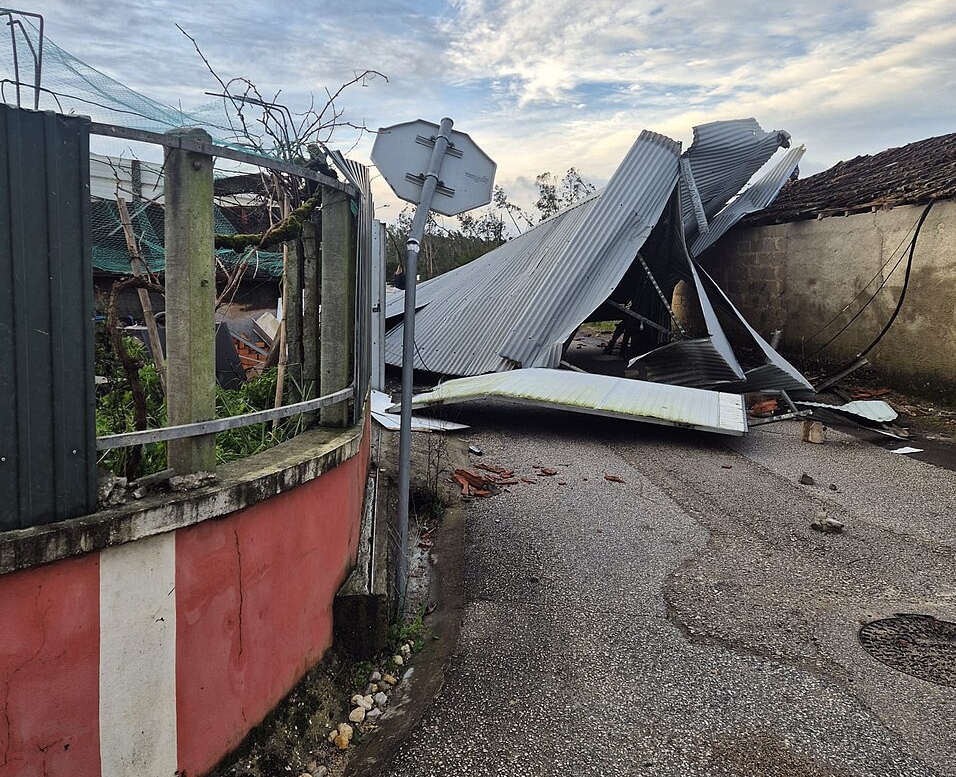
    One could easily mistake the names Francis, Goretti, Harry, Ingrid, and Joseph for the names of a bunch of digital nomads passing through Portugal in recent times. Yet these are the names of storms, or diluvial nomads, which have become regular visitors to Portugal, with varying degrees of impact: more or less gusty and rainy; causing some flood or roof leaks or a tree falling here and there; nothing out of this world.

    So, when Storm Kristin arrived in the early hours of January 28th, it took many people by surprise, in spite of the warnings, and its impact still hadn’t sunk in after its passage. The region surrounding the city of Leiria (near the coast, roughly halfway between Lisbon and Porto) bore its brunt: several deaths, winds peaking at 200km/h, incessant rain and almost a million people left without power, water or network signal.

    Among those people was my own elderly mother, who I couldn’t reach for three days, having decided to check if she was unscathed and sheltered. I presumed she’d be alright, beyond the power cut, but not hearing from someone close becomes increasingly anxiogenic.

    As the region fell into a black hole, the focus of the news soon drifted elsewhere: returning to the daily incidents of the presidential election campaign and wins by Portuguese clubs in the Champions League, especially Benfica’s spectacular victory over Real Madrid. Most of the country was oblivious to the distress felt by a substantial chunk of its population.

    Over the past few years, originating in a glitch in a famous video game, there has been a viral running joke that Leiria doesn’t exist, that it’s off the map. It became so well known that the local tourism board ended up adopting it as a slogan. In the aftermath of the storm, the irony wasn’t lost on most people.

    It really was as if Leiria didn’t actually exist. Fortunately, my mother was alright, and unshaken. Kristin had awoken her in the middle of night. She simply got dressed, tucked her mobile phone into her pocket, grabbed a torch and the house keys and waited it out on the sofa, in the dark, with the world howling, whipping and cracking outside.

    Fortunately the house remained almost unscathed too. The vegetation was, however, hard hit. Especially, the old tall trees in the back of her garden. One pine and three oaks fell to the ground, while another pine and oak are still standing but are look certain to slide with the ground they stand on. Smaller fruit trees were hit too, but that’s no big deal.

    Sense of Destruction

    As I got closer to her house, the sense of destruction grew stronger. Roof tiles had flown off, while posts and signs were bent and torn away. Many, sickeningly many, trees had been uprooted, or snapped in half like matchsticks, or were leaning in such a way that they faced a slow death, and would have to be chopped down.

    There were sycamores, cedars, a great deal of oaks, countless Atlantic pines, and also many eucalypti, a perfect fuel for forest fires, which I could do without for the most part.

    The cities of Marinha Grande, first, and then, Leiria looked like they had been under attack. Three days after the storm – under the first, short-lived, rays of sun for a long while –  people were out on the streets, but the silence was eerie, mainly broken by the sound of chainsaws, trucks and hammering.

    There remained a dusty haze in the atmosphere. What had been a fairly leafy city and region, looked to have been stripped naked. I foresee a weird shortage of shade in the summer.

    The buildings, roofs, factories, urban equipment etc. can be fixed up and rebuilt within a short time. Even a sixteenth century chapel, part of the city’s skyline, or the pinnacles of a fifteenth century monastery in the town of Batalha, which was also destroyed by the storm. But for the economic ecosystem, the consequences may be dire.

    The region, which has been one of the economic engines of the country, has managed to keep unemployment low and withstand various wider crises since the seventies, thanks to diversified industries and exporting capacity, particularly in plastics, moulds, wood and glass.

    Leiria and its Castle.

    Specific Trees

    Trees are a different, soul-crushing, story. In Leiria and its immediate surroundings alone, never mind the broader region, it has been estimated that eight million trees were destroyed. There are specific trees, some of which have existed for as long as I can remember that I would randomly revisit and vividly see in my memories and dreams, like an amputee feels a phantom limb.

    As a child, I rode my bike over tapestries of fern and pine needles. I fell off my bike due to scattered pinecones and jutting roots. I played football with trunks as goalposts. Seeing pieces of bark chipped off due to a shot hitting the ‘post’ would leave us unmoved. After all, there was such an abundance of trees, with enough time for regeneration.

    The fragrance of resin, pine and eucalyptus hung in the air, especially in the summer. Over the past decades, however, due to increasing demographic and economic pressure, vast swathes of woodland have already disappeared.

    One symbolic example, and also the largest of these woodlands, is the plainly named Pinhal de Leiria (Leiria’s pine forest) or Pinhal do Rei (King’s pine forest), an expanse of over 11,000 hectares of maritime pines, stretching over twenty kilometres along the coast.

    This was presciently planted from the thirteenth century, in order to contain the encroaching dunes and to mitigate the effect of Atlantic winds. Also, two centuries later, the ships used by the Portuguese to venture out into the Atlantic Ocean were built from the wood of that forest.

    On account of its sheer size and location by the wild ocean, it has provided magnificent views and is a refuge for many. Some would say there is a mystical side to it. At the very least, it is intrinsic to the local identity.

    In October 2017, another Storm, Leslie (and possibly criminal hands as well) caused uncontrollable fires that burned 80% of the forest. I recently heard someone refer to that fire as its ‘holocaust’. A word I found sadly appropriate.

    In 2026, Storm Kristin finished it off with a final sweep. The forest is gone. I guess the trees can be replanted, but how long will they take to grow? Will they be given the time to grow at all?

    In the early twentieth century, local poet Afonso Lopes Vieira called it the ‘green cathedral’. Does this crumbled cathedral have sufficient followers pious enough to resurrect it?

    Given the recurring fires and storms, competing priorities and the length of time it takes trees to reach maturity, I very much doubt I’ll see proper reforestation in my lifetime.

    Although less ravaging, Kristin was followed by Leonardo, Marta and Nils blowing and raining into roofless houses, for a couple more weeks. The effects of climate change are palpable, by now. We are in the thick of it. Its consequences are snowballing in unpredictable ways.

    Features Image: Debris from after the initial disaster, clogging up a Leiria street.