Author: casswp

  • Hello world!

    Welcome to WordPress. This is your first post. Edit or delete it, then start writing!

  • Sahel: Water does not become bitter without cause
     

    Ruwa baya tsami a banza:

    Water does not become bitter without cause.

    There is a reason for everything.

    The Sahel throughout history has been known for many things. To the historically inclined, it is the region that produced empires like Wagadu, Mali and Songhai, and cities of world renown like Timbuktu. Today, the Sahel represents something else entirely: instability, as it faces climate variability, insurgency, and fragile governance.

    2020 Analysis of the regional crisis. Source https://erccportal.jrc.ec.europa.eu/ECHO-Products/Maps#/maps/3330.

    Stretching from Senegal in the west through Mali, Burkina Faso, Niger, northern Nigeria and onward to Chad and Sudan in the east, this 6,000 kilometre zone has produced more military coups in the last decade than anywhere else on earth. Since 2020 alone: Mali twice, Guinea, Burkina Faso twice, Niger, and Sudan, the latter embroiled in a devastating conflict between the Sudanese Armed Forces and the Rapid Support Forces that has already killed hundreds of thousands and displaced millions. The media dubbed it the coup belt. Security analysts called it the Sahel crisis. Outside powers, Russia, France, the Gulf states, the United States, manoeuvred for influence in a fracturing landscape.

    What almost nobody asked, at least not with any seriousness, was the historical question: what was here before?

    Not merely before the coups. Before the colonial borders that manufactured these states, before the French administrative systems that shaped their governments, before the extraction economies that defined their relationship to the world market.

    What was the political and economic life of this zone when it was organised according to its own internal logic, by its own institutions, on the basis of its own material conditions? That is what I seek to explore through this platform.

    This is not out of a sense of reactionary nostalgia. You cannot understand what a place has become without understanding what it was, what forces transformed it, and which of those transformations built capacity and which destroyed it. Northern Nigeria today is associated, in the global imagination and in too much of the Nigerian imagination, with poverty, insurgency and dysfunction.

    Boko Haram. Bandits. The caricature of Sharia law deployed by politicians as a tool of control. Coups next door. Violence and weapons spilling across borders drawn by colonial administrators through the middle of communities, trade networks and political relationships that had existed for centuries before European powers decided they had the right to divide the continent at a conference table in Berlin.

    These things did not come from nowhere. To understand where they came from, we have to look at the land itself, how it shaped the people, and how the people shaped it.

    The Shore of the Great Sea of Sand

    Orthographic Map of Africa showing the Sahelian Zone. Source : wikimedia commons. Author : Flockedereisbaer

    Sāhil in Arabic means coast or shore. In the imagination of the Arab geographers of the Middle Ages, the Sahara was not a wall. It was a sea. The camel earns its nickname, ship of the desert, honestly. It allowed merchants to make the months-long voyage across that vast expanse, linking the Mediterranean world to West Africa. The Sahel was the southern shoreline of that sea.

    A shoreline is not a remote frontier. It is the first point of arrival. Goods land there, get taxed, get redistributed. The people who control the access points accumulate wealth and build institutions. The cities that grew along this shoreline, Timbuktu, Gao, Agadez, Aoudaghost, and later Katsina and Kano, were structural consequences of that position. Constantinople sat at the crossroads between Europe and Asia and extracted enormous wealth from that geography for over a thousand years. Timbuktu sat where the gold and salt trades intersected and grew exceptionally wealthy, connecting North Africa and the Mediterranean to the productive interior of West Africa. Whoever controlled such a position could tax trade moving in both directions, access goods otherwise unavailable, and hold a structural advantage over competitors. Geography does not determine history, but it sets the terms on which history unfolds.

    The Sudan: Climate, Geography, Ecology

    The African landscape is a varied one. Moving southward from the Sahara toward the equator, rainfall increases steadily and the vegetation responds in distinct bands. Each band runs roughly east-west across the continent, with the rainfall gradient running north-south.

    To understand what this means in practice, follow an imaginary merchant setting out from Sijilmasa, the great Moroccan terminus of the trans-Saharan trade, sometime in the 11th or 12th century. He has loaded his camels with slabs of Saharan salt, bolts of North African cloth, and copper ingots from the Mediterranean world. His destination is the markets of the Sudan. His journey south will carry him through several worlds in succession, each one wetter, greener, and more densely populated than the last.

    The northernmost inhabited zone is the Sahara itself: less than 150 millimetres of rain annually, vast, arid, traversable only with knowledge accumulated over generations. The Tamashek, Tubu and Amazigh peoples hold this world. They know where water sits beneath the surface and how the seasonal winds move. Our merchant cannot cross without them. He pays a toll and hires guides, folding the cost into the price his goods will command at the other end. The Sahara is dangerous and expensive, which is precisely why the goods that cross it are worth crossing it for.

    After weeks of travel, the landscape shifts. The hard gravel plains of the deep Sahara give way to the Sahel proper, where annual rainfall runs between 150 and 600 millimetres. Semi-arid steppe. Thorny acacia scrub. A landscape suited to pastoral herding and seasonal movement, in most areas not adequate for settled cultivation. The few cities that exist here become all the more important for their scarcity. At Taghaza, our merchant loads additional blocks of rock salt, a commodity mined there by enslaved labourers under brutal conditions. Salt is so essential to life in the agricultural south that it commands near its weight in gold at certain markets. That simple fact drives the entire commercial logic of the Saharan world. At Timbuktu or Walata, he enters a different order of things entirely: a city of scholars, merchants and administrators sitting at the junction of the desert routes and the productive Sudan. He exchanges his salt and Mediterranean goods for gold, kola nuts and leather goods from the south. He hears news of the markets further inland. He weighs whether to press on or turn back.

    He presses on. The landscape rewards his decision. Trees thicken. Grass grows tall between them. The soil deepens. The dusty, pale earth of the Sahara gives way to the red laterite soil familiar to anyone who has spent time in West Africa, rich and dense underfoot. Annual rainfall here ranges between 600 and 1,200 millimetres. The growing season runs long enough for reliable grain cultivation. Millet, sorghum, cotton, groundnuts. Cattle graze across the open woodland. Horses are kept and bred. Populations concentrate in numbers impossible further north. Cities grow large and stay large because the surrounding land can feed them across many consecutive years without exhaustion.

    This is the bilād al-sūdān, the land of the black people, the broad belt of productive savanna the Arab geographers named and described across centuries of writing. In modern ecological terminology it carries the name Sudanian savanna, though the medieval Arabic name carries more historical weight. This is the zone our merchant has been trying to reach from the moment he loaded his camels in Sijilmasa. These markets, these consumers, and this world were the reason he carried everything across the desert.

    He has arrived in the agricultural heartland of West Africa.

    Further south still, the Guinea savanna thickens into closed forest, where rainfall exceeds 1,500 millimetres annually, the canopy closes over, and the tsetse fly kills cattle and makes cavalry warfare almost impossible. Powerful and institutionally sophisticated states flourished in this region: Oyo, Benin, Asante. Each connected to the same continent-spanning trade network through chains of regional merchants and intermediaries. Our merchant will not venture this far. His goods travel the rest of the way through other hands, through the networks of Mande-speaking Dyula traders and Hausa fatake who specialised in exactly this kind of relay commerce. He sells to them, and they carry his salt southward to people he will never meet.

    What Each Zone Produces and Why it Matters

    Salt commands near its weight in gold at certain markets.

    Salt from the Sahara. Robin Taylor, CC BY 2.0, via Wikimedia Commons.

    The Saharan mines at Bilma, Kawar, and Taghaza produce a mineral that the agricultural populations of the Sudan belt cannot produce for themselves in adequate quantities. Salt preserves food, seasons it, and maintains the biological functions of people and their animals. Without access to it, agricultural communities weaken and decline. This biological necessity is what drives human beings to organise caravans of hundreds of animals across one of the most hostile environments on earth, month after month, generation after generation.

    Gold flows in the opposite direction. The forest zone of West Africa contains some of the richest alluvial gold deposits in the pre-modern world, worked by Akan-speaking miners in what is today Ghana and Côte d’Ivoire. That gold fed the monetary systems of medieval North Africa and Europe. It funded the Fatimid Caliphate. It built the great mosques of Morocco. European monetary expansion from the 13th century onward depended substantially on West African gold long before Europeans had any direct access to West Africa at all. The forest zone also produces kola nuts, a mild, bitter stimulant that became the social currency of Muslim West Africa wherever Islamic law prohibited alcohol. Kola travels without refrigeration, remains potent for weeks, and carries ritual significance at ceremonies from Senegambia to the Niger Delta. Hausa merchants built entire trading empires on the kola circuit alone. The ancestors of Nigeria’s richest Man Aliko Dangote were Agalawa merchants who grew wealthy through the Kola trade.

    Cotton cloth and leather goods move in every direction. The Sudanic region weaves and dyes cloth that North African and Saharan buyers prize. It tans hides into leather goods, sandals, saddlebags and harnesses, whose quality the Mediterranean world cannot match from its own resources.

    None of these zones is self-sufficient. The pressure toward exchange is structural, not incidental. It does not require any particular ruler to decide to encourage trade. It arises from the complementarity of the zones themselves, from the fact that survival and prosperity in each depends on what the others produce. The political consequences of this logic are enormous. Controlling the transit points between zones, taxing the movement of goods across ecological boundaries, is one of the primary mechanisms of wealth accumulation in pre-modern West Africa. The empires that rise and dominate this region do not, for the most part, produce the commodities they trade. They sit between the producers and the consumers, and they tax the passage.

    The Empires of the Sudan: Power Built on Position

    Map of the Wagadu empire. Luxo, CC BY-SA 3.0 <http://creativecommons.org/licenses/by-sa/3.0/>, via Wikimedia Commons

    The empire the Arabs called Ghana, and which its own people knew as Wagadu, built the first great demonstration of this logic. Rising in the western Sudan, probably by the 4th or 5th century CE, Wagadu sat between the gold-producing regions of the south and the North African merchants hungry for that gold. The state did not mine the gold. It taxed it.

    The Arab geographer Al-Bakri, writing in 1068, recorded the precise mechanism. The king of Wagadu levied a tax of one dinar of gold on every donkey load of salt entering the country, and two dinars on every load leaving it. He charged five mithqals on a load of copper and ten mithqals on a load of finished goods. Gold nuggets found in the mines belonged entirely to the crown. Private citizens could trade gold dust freely, but the crown entirely monopolised nuggets, which could be used as money and accumulate political power. Al-Bakri described the king’s court audience: the ruler sat in a domed pavilion surrounded by horses wearing golden halters, dogs wearing golden collars guarding his doors, and ten pages standing to his right carrying shields and swords decorated with gold. Behind him stood the sons of subordinate kings, their hair interlaced with gold.

    This is not just for the sake of flexing, although that played a part. It is a public display of the fiscal power the state extracts from its position in the trade network. The gold on those horses and dogs and sword hilts passed through Wagadu’s markets and Wagadu’s tax offices. They represent accumulated transit fees, turned into symbols of authority.

    Wagadu extended its reach from Takrur in the Senegambia region east to the Niger, controlling the western trans-Saharan routes for several centuries. Its decline came gradually from the 11th century onward, through a combination of Almoravid pressure, internal rebellions, and the progressive southward shift of gold-producing communities beyond its reach. There is scholarly debate today about whether Almoravid pressure was military or commercial and how decisive a role it played in Wagadu’s decline.

    Mali

    Its successor took the same logic further and built something larger.

    The Mali Empire of the Mansas reached from the Atlantic coast to the Niger bend at its height in the 13th and 14th centuries, incorporating the gold-producing Bambuk and Bure fields directly into its territory rather than simply taxing their output from a distance. This shift from transit taxation to direct control of production represented a significant intensification of the model. Mali did not abandon the transit fees; it added productive control on top of them.

    The wealth this generated was genuinely staggering. In 1324, Mansa Musa, the ruler of Mali, performed the hajj to Mecca and passed through Cairo on the way. He travelled with a retinue reportedly numbering in the tens of thousands and distributed so much gold in Cairo and along the route that he single-handedly triggered an inflationary crisis in the Egyptian gold market. Contemporary Arabic sources record that the price of gold in Cairo had still not fully recovered twelve years later. One man’s pilgrimage gift-giving destabilised a regional monetary economy for over a decade. That is what the structural control of the Sudan’s gold output looked like in practice.

    Mansa Musa Depicted on the Catalan Atlas, Abraham Cresques, 1375. public domain via Wikimedia Commons.

    Under the Mansas, Timbuktu became the intellectual capital of the Sudan. The Sankore Mosque and its associated scholarly networks attracted students and teachers from across the Islamic world. Mali’s trading diaspora, the Wangara and Dyula merchants who spread out from the empire’s commercial networks, carried Islam southward and eastward into regions the empire itself never directly controlled. They built mosques in market towns across the savanna, established the contract forms and credit mechanisms of Islamic commercial law, and created the social infrastructure that later Islamic reform movements would draw on and contest.

    Songhai

    Map of the Songhai Empire. HetmanTheResearcher, CC BY-SA 4.0, via Wikimedia Commons.

    The last and among the largest of the great Sudanic empires rose from within Mali’s shadow and eventually consumed it.

    Songhai centred on Gao in the Niger bend, a city that had been a significant commercial centre for centuries before the empire’s rise. Initially a tributary state under Mali, Songhai began asserting independence in the mid-15th century under Sunni Ali Ber, a military commander of exceptional energy who spent nearly three decades in almost continuous campaigning, capturing Timbuktu in 1468 and Jenne in 1473 and turning the Niger river into Songhai’s internal highway. Sunni Ali understood something that his predecessors had sometimes neglected: control of the river meant control of the grain trade that fed the cities of the Sudan, which meant leverage over the urban populations and scholarly classes on which commercial empires depended.

    His successor, Askia Muhammad, who seized power in 1493 and built the empire’s administrative and intellectual infrastructure, brought Timbuktu to its peak. By the late 15th century, Timbuktu held a population that contemporary sources estimated at up to 100,000 people. The Sankore Mosque alone had 25,000 students. The city imported books from across North Africa and the Middle East and produced its own manuscript tradition that scholars are still cataloguing today. Askia Muhammad undertook his own famous hajj in 1496, arriving in Cairo and Mecca with gold but also with political questions: he sought a fatwa from the Egyptian scholar al-Suyuti legitimising his deposition of Sunni Ali’s dynasty. Religion and political authority were inseparable, and the caliphs and scholars of the east were the sources of legitimacy that Sudanic rulers sought.

    Songhai’s collapse came suddenly. In 1591, a Moroccan army under Judar Pasha crossed the Sahara with something no Sudanic army had yet faced: firearms. At the Battle of Tondibi on the Niger, Moroccan muskets and cannon scattered a Songhai cavalry force many times larger. It was the first use of firearms south of the Sahara in a major engagement, and it exposed a structural vulnerability that the military architecture of the savanna empires had never needed to address before. Songhai fragmented. The Moroccan forces could conquer but not administer an empire of that scale from their North African base. The Sudan entered a period of political fragmentation that would define it for the following century.

    Kanem-Bornu: The Ancient State of the Central Sudan

    Kanem-Bornu at its greatest extent by Megartonius, CC0, via Wikimedia Commons.

    While Wagadu, Mali and Songhai rose and fell in the western Sudan, a different political tradition took root in the east and proved more durable than any of them.

    The state centred on Lake Chad, known first as Kanem and later as Bornu, appears in Arabic sources as early as the 9th century. The Dugawa dynasty that founded it controlled the central trans-Saharan corridor running through the Fezzan in modern Libya, connecting the Mediterranean directly to the Lake Chad basin and the agricultural lands to its south and west. Where the western Sudan empires built their power on the gold routes, Kanem-Bornu built on a different set of commodities: enslaved people, ivory and natron, the sodium carbonate mineral used across the Arab world for soap-making, food preservation and glass production.

    Islam arrived at the Kanem court around the 11th century, making it one of the earliest Muslim polities in Africa south of the Sahara. The conversion was not merely spiritual. It gave Kanem’s rulers access to the networks of Islamic scholarship, commerce and political legitimacy that connected the Sudan to the wider Muslim world. The Mai sent students to study in North Africa and brought back scholars to staff his administration. He corresponded with the Sultan of Morocco and the rulers of Egypt as a fellow Muslim sovereign. Islam provided the institutional language through which Kanem-Bornu organised its bureaucracy, justified its laws, and conducted its diplomacy.

    That bureaucracy proved extraordinarily resilient. The state survived internal rebellions, external invasions. The realm persisted after the forced relocation of its capital from Kanem, east of the lake, to Bornu, west of it in the 14th century, a massive institutional disruption that most states would not have survived. It survived the disruptions of the 16th century that destroyed Songhai. It adapted, reformed, and persisted across ten centuries of continuous existence, making it arguably the most durable state institution in West African history.

    That durability rested on a resource base that demands honest accounting. Bornu was not merely complicit in the trans-Saharan slave trade. For long periods, it organised and profited from it at scale. The state taxed the movement of enslaved people northward through its territory. Elite households depended on enslaved labour for agriculture, craft production and domestic work. Military expansion into the territories to the south and west was partly organised around the capture of people who would be sold northward or retained within the state economy. This was not an aberration imposed on an otherwise pristine political economy. The capture of people was structurally embedded in how Bornu accumulated and distributed surplus, how its ruling class maintained itself, and how it funded the military capacity that kept it intact. A history that omits this is not an honest history.

    Bornu’s influence radiated westward into Hausaland across many centuries. The political vocabulary of the Hausa city-states carries the fingerprints of this contact. The title Ciroma, used in Hausa courts for a senior ranked position, is a Kanuri borrowing from Bornu. Galadima, another major Hausa title, has the same eastern roots. The Bayajidda foundational legend, which we will examine carefully in the next essay, routes the origin of the Hausa states through Bornu for reasons that are not accidental. Bornu was the dominant power of the central Sudan for most of the period in which the Hausa city-states were forming their institutions. Its administrative models, its Islamic scholarly networks, and its commercial relationships all shaped what Hausaland became. The reign of Mai Idris Alooma was the Apogee of the polity and it would slowly decline in the centuries following his reign. I will cover his reign with the care it deserves in its own essay.

    Bornu’s power and influence would wane over the centuries, driven by shifting trade routes, environmental changes and the rise of powerful rivals like the Usmanid/Sokoto Caliphate. The state met its end in 1900, when Rabeh Zubayr, a Sudanese warlord and former slave soldier who had carved his way across the central Sudan with a disciplined firearms-equipped army, besieged and destroyed the Bornu capital. Rabeh’s conquest coincided almost exactly with the arrival of French colonial forces from the west and British forces from the south. The three-way collision finished what a millennium of rivals had failed to do. Bornu, which had outlasted Wagadu, Mali and Songhai by centuries, fell not to any single force but to the specific conjuncture of the 1890s, when the internal disruption of Rabeh’s campaign intersected with the external pressure of European colonial conquest at the worst possible moment.

    Our merchant from Sijilmasa, had he lived long enough and travelled far enough east, would have recognised the world of Bornu: the same logic of transit taxation, the same integration of Islamic commercial law into the fabric of trade, the same cities growing wealthy at the junction of ecological zones. But he would also have noticed something different about the political terrain further west, in the territory that Bornu influenced but did not control. A cluster of city-states, each independent, each competitive, each building its own institutions and its own commercial networks. Fragmented where Bornu was unified. Commercially distributed where Bornu was centrally administered. Younger in its political consolidation but extraordinarily dynamic.

    Why Any of this Matters

    The empires described in this essay did not exist in a separate, sealed-off past with no connection to the present. They were the product of specific material conditions, specific ecological positions, and institutional choices made over centuries. Wagadu’s wealth stemmed from the trans-Saharan trade, Songhai’s internal highway was the Niger river, and Bornu’s millennium-long anchor was the Lake Chad basin; these assets did not vanish with the empires’ demise. The geography remained. The ecological logic endured. Trade routes remained, at least until colonial borders, railway lines and artificial tariff walls were drawn through them.

    What changed was who controlled them and in whose interest they operated.

    The colonial partition of the 1880s and 1890s did not encounter an empty or stagnant landscape. It encountered the successor states of a thousand years of Sudanic political development, states that had survived the collapse of Songhai, the disruption of the trans-Saharan routes, and centuries of internal competition. What colonialism did was reorganise that landscape. It redirected trade routes toward coastal ports and away from the Saharan corridors that had sustained the interior for centuries. Wherever it preserved certain institutions, the emirate system in northern Nigeria being the most consequential example, it did so in forms useful to administrators rather than local populations. It created borders that cut through the agricultural zones, pastoral routes and commercial networks that the ecological logic of the region had generated over centuries. And it extracted resources with none of the internal redistribution, however unequal and often brutal, that the older state systems had practised. The Sahelian Juntas claim to have seized power to right those wrongs, but only time will tell.

    Captain Ibrahim Traore, Military Leader of Burkina Faso. Source Bamjo226, CC0, via Wikimedia Commons.

    The coup belt is the inheritance of that reorganisation. The states collapsing today did not build on the institutional foundations of Wagadu, Mali, or Bornu. They were built on colonial administrative frameworks that prioritised control over capacity, extraction over development, and the convenience of outside powers over the coherence of local political economies. The Sahel crisis is not evidence that this region cannot sustain complex political life. The record described in this essay is the evidence against that claim. It is evidence that the specific political structures imposed over the last century have failed, and that understanding why requires going further back than the coups, further back than independence, further back than colonialism itself.

    That is the work of this series: https://thesahelianrecord7.substack.com/

    Feature Image: Jillian Amatt – Artistic Voyages on Unsplash

    Sources:

    Al-Bakri, Kitāb al-Masālik wa-al-Mamālik (Book of Routes and Realms), c. 1068, in Basil Davidson, The African Past (Penguin Books, 1966), p. 81

    Brooks, George E., Landlords and Strangers: Ecology, Society, and Trade in Western Africa, 1000–1630 (Westview Press, 1993)

    Hunwick, John O., Timbuktu and the Songhay Empire (Brill, 1999)

    Last, Murray, The Sokoto Caliphate (Longmans, 1967)

    Levtzion, Nehemia, Ancient Ghana and Mali (Methuen, 1973)

    Levtzion, Nehemia and J.F.P. Hopkins (eds.), Corpus of Early Arabic Sources for West African History (Cambridge University Press, 1981)

    Lovejoy, Paul E., Salt of the Desert Sun (Cambridge University Press, 1986)

    Lovejoy, Paul E., Transformations in Slavery: A History of Slavery in Africa (Cambridge University Press, 1983)

    Lovejoy, Paul E., Caravans of Kola (Ahmadu Bello University Press, 1980)

    Trimingham, J. Spencer, A History of Islam in West Africa (Oxford University Press, 1962)

    Webb, James L.A. Jr., Desert Frontier: Ecological and Economic Change Along the Western Sahel, 1600–1850 (University of Wisconsin Press, 1995)

  • Musician of the Month: Cedar Dobson

    I am a California native Irish traditional musician based in Ireland. I started playing music when I was around seven years old, beginning on piano and the Native American flute, which was my first wind instrument. My dad bought three of these flutes before I was born, and I am still playing them to this day. I tried various instruments as a child, including clarinet, saxophone, various percussion instruments, the accordion, and a few others. It wasn’t until I was eleven-years-old however that I discovered the tin whistle.

    I was about to board the bus back from an American Civil War reenactment in Mariposa, California, when I visited the souvenir stand. I bought a tin whistle from a barrel and my life changed forever. I played it on the bus heading home, then occasionally throughout the year, setting it down for a while before picking it up again in May 2014.

    I was inspired by a few film scores and remembered a tune that my grandparent’s friends played at their barn, which was called ‘The Swallowtail Jig’. I searched for this tune on YouTube and the gates of traditional Irish music heaven opened for me. I have been ‘tradicted’ ever since!

    I listen to many different sources of traditional Irish music as well as folk music from around the world, classic rock, American folk, jazz, and more.

    These influences have made an impact on my playing. My style is my own creation, influenced by these genres and specific individuals suchas Brian Finnegan, Alan Doherty, Ali Levack, and others. It is highly percussive and energetic, which reflects the person I am.

    I am currently working on an album that will be released on March 23rd. I co-engineered and mixed four albums, including ‘Harmonies’ (a flute and whistle meditation album), ‘Decade’, (a traditional Irish music album with a contemporary twist), ‘Tradify’ (an album that features a band I was in), and ‘A Whistle Wonderland’ (Christmas music treated as traditional Irish tunes).

    The album that will be released this month is entitled ‘From Kolkata to Dublin’, which is a minimally produced album featuring the Indian tabla, tin whistles, and exotic/rare wind instruments.

    I am planning to record duets with tin whistles and harmonica/button accordion this month, and to record an album of traditional Irish music that suits the Chinese Hulusi.

    As I write this, I am in the middle of eight days of gigging in Dublin. Six gigs down, three to go!

    I am a full-time musician, gigging every week and offering my remote recording services, teaching, custom tune compositions, and more.

    I am also currently forming the Cedar Dobson Band, which will consist of two or three musicians that will be performing at various festivals within Ireland this year as well as abroad.

    One of my greatest joys in life is to perform and share my original music and arrangements with others. This music is my life and I love it so much!

    I am expanding my horizons by diving into the world of gypsy jazz, playing complex solos on the low whistle. I am planning to film professional music videos to send to festivals as one of my goals is to play in Celtic connections next year. I just want to play the music that I love so much with others who appreciate it. That way I will able to express my emotions through music and hopefully touch other people on a deep level. Music is so powerfully emotional and it’s vital for us during this time in history.

    I post videos nearly every day on social media and YouTube. I post a tune of the week every Sunday as well as videos of exotic wind instruments and videos of me riding a unicycle while playing the tin whistle simultaneously. Indeed I love a good challenge and unicycling while playing the tin whistle has been just that!

    I hope to break into the scene more within Ireland and Europe as I am striving for more fulfilling opportunities, such as performing in festivals and in beautiful venues. I am grateful for every opportunity though, as they have made a positive impact on me. I am making valuable connections more often now than before.

    I moved to Ireland from California to experience the music as it is in all of its glory, honesty, and rawness. I’ve been based in Ireland for nearly five years and I am absolutely living the dream! I’m so grateful for every opportunity. I am now looking forward to traveling within Ireland and abroad, sharing the joys of music with others and hopefully offering moments of peace, joy, and lightness to others.

    This music has formed me into the person I am today. Endless gratitude!

    Latest Album: Decade https://cedardobsonmusic.bandcamp.com/album/decade

    Instagram: https://www.instagram.com/cedar_dobson_music?igsh=MWF3a2hxc3Z5bHU0bg%3D%3D&utm_source=qr

    Website: www.cedardobson.com

    YouTube Channel: https://www.youtube.com/@CedarDobsonMusic

  • Podcast: Ward Bosses and Alligator Bishops: Irish Americans and Tammany Hall with Terry Golway

    For this Saint Patrick’s Day episode, Luke Sheehan asked Irish-American historian and New York history expert Terry Golway to help create an overview of the Irish American experience, with a focus on post-famine migration and the infamous Tammany Hall.

    Episode Credits:

    Host: Luke Sheehan

    Music: Loafing Heroes – ​​https://theloafingheroes.bandcamp.com

    Produced by Massimiliano Galli – https://www.massimilianogalli.com


  • Fiction: PANOPTICON

    The Panopticon

    The panopticon is an architectural design for institutional buildings with an inbuilt system of control. Originated by the English philosopher and social theorist Jeremy Bentham it was later derided by historian Michel Foucoult as replacing fetters with hidden observers, thus creating a form of obedience that is based on information rather than force. The panopticon at the Rilhafoles Hospital in Lisbon – later renamed after Dr. Miguel Bombarda – was built in 1896 and was closely based on Bentham’s ideas.

    Lisbon July 7th 1951

    After more than ten years of incarceration Vladimir was moved to a new cell in Block 8 where they could keep a continuous eye on him. Within a few days he had made the new cell his own with his caged birds, his wildly coloured crocheted doilies, his dolls and his huge picture of the Virgin Mary with vividly painted lips, kohled eyes and a sly side-gaze. When Tiago, the “good” nurse, asked him

    Do you like it here Vladimir?

    Yes. It’s peaceful.

    Don’t you want to ask to leave now?

    No, no. Anyway, who would I ask? The director’s a madman.

    Apart from the disruption of the move Vladimir hardly noticed the new conditions. He knew they were watching him but there was nothing new about that.

    Stuttgart May 7th 1937

    He was a madman, that Portuguese dancer in the corps. Wild mad beautiful.

    This dream had none of the flickering monochrome of “archive footage”: it was as bright and vivid as life itself. He saw the gloved male hand on the door of the sleek limousine. He saw the porcine reddened faces, the uniforms, the flowers, the glint of glass against the plush of the theatre. He was whisked off to luxurious palaces, given costly wines and white powders. In this new and shining prison he was given a whiff of freedom. He was, yes, maddened by it. Sex, beautiful clothes, the smell of money and power drove him mad, unanchored as he was from anything except the actuality of the dance, the orchestra, the theatre, the money he was given every week, the lovely wild greedy boys, the new uncouth country, language and culture, the fawning adoring old men in uniforms. The freedom – or whatever it might be – was delicious and intoxicating and he drank it so, so eagerly.

    Lisbon, May 9th 1980

    The journalist showed up after breakfast. She asked lots of questions to which Vladimir replied honestly but somehow unsatisfactorily. He answered her questions about his time as a dancer touring in Spain and Germany just before the war but he seemed unable to link his own experience to the momentous political happenings of the time and even seemed unaware of the fact that he had been courted by the beasts of the regimes. She was kind to him and endlessly patient as Vladimir provided her with nothing. She asked to look at his paintings and clothes and dolls and suggested that he might consider doing a self-portrait.

    Lisbon, April 26th 1974

    There was a revolution in progress outside.

    The good nurse was late and when he did show up he brought with him a transistor radio which played jolly martial music interspersed with announcements from the Armed Forces Movement. The good nurse hadn’t shaved and looked different somehow, radiant with some hidden happiness.

    Everything’s going to change now, comrade. The revolution has just started. The new world will be for all of us. You too Vladimir. There’ll even be a place for you.

    Vladimir didn’t share the good nurse’s optimistic outlook.

    My dolls don’t quite believe you. They think we’re here for ever.

    Vladmir pointed to his dolls ranged on the bed and on every surface in the small cell.

    No, no, no. In time we’ll all be free. Even your dolls. This place is the old world. It’ll all be swept away I promise you.

    Be careful what you say. The walls have ears.

    Lisbon, November 9th 1980

    As soon as he could Vladimir made good on the promise of his vivid dream and painted a moustache on his picture of the Blessed Virgin. When good nurse Bruno saw it he asked what had happened to the lovely virgin. Oh, said Vladimir, she asked me to make her hairy. Bruno was not a very devout Catholic but, although he thought the addition of the moustache was rather disrespectful decided not to comment any further. The weather had turned cold and Vladimir had enveloped himself in a number of the crocheted blankets he had made over the years. The bold stripes on the blankets made him look as though he had been bound and trussed. On his head was a carefully-made headdress of knitted items and artificial flowers.

    You think he wouldn’t like it, says Vladimir, I mean the moustache.

    Who, says Bruno.

    You know….Dr. S. He wouldn’t like to have a hairy Madonna perhaps.

    Dr. S? l

    Yes, he might not approve I suppose.

    Oh Vladimir! He’s been dead for more than ten years.

    Oh, I know but it’s still important what he thinks. Isn’t it?

    No. Not any more.

    Oh, so I can keep the moustache?

    Have you fed your birds yet?

    Dr. Salazar.

    Lisbon, May 7th 1948

    They were very nice to him before the operation. Even the bad nurse. No-one really told him what the operation was or what it was meant to do but he knew that it was a new and revolutionary surgery invented by a Portuguese doctor and that they’d be opening up his skull and that afterwards he’d be free to go and live his life and wouldn’t have to come back to the hospital.

    Leucotomy? Lobotomy? Dr….. Moniz?

    Lisbon, 10th September 1948

    He remembered nothing of it afterwards. They had all told him that it would calm him and make him happier but all he felt was a bit of a headache and some anguish about his head being shaved and swathed in bandages. They kept telling him he was better but he felt just the same. Still full of lust and fury, still only interested in what they called “feminine arts”, still wanting to dress in women’s clothes. So after a short and frightening time in what they called the outside world, here he was, back under their vigilant gaze of the panopticon and the ministrations of the good and bad nurses.

    Lisbon, July 10th 1982

    Vladimir had a huge surge of energy and at last set to work on the self-portrait that the journalist had suggested to him. He used his usual brilliant colour palette and black outlines but this time he was unable to confine the image of himself to the limits of the canvas and his feet, ears and the top of his head were all cut off. He gave himself the same vivid red lips and the heavy eye make-up that he’d given the Blessed Virgin and dressed himself in a variety of vibrant materials. In each of his hands, held in front of him, perched a bird, one blue, one yellow.

    January 23rd 1983

    Is that you? said the bad nurse, pointing at a black and white photograph of a handsome young man in a suit and tie leaning against a car. No, said Vladimir, it’s not me, but he threw me like a doll onto the bed. I think this is me. He indicated another old photo, this time of a dancer onstage and suspended in the air with his feet together, his arms aloft and his painted face triumphant but somehow fearful.

    They all came to Stuttgart and they took us off in their cars. Then we went to Berlin and then they brought me here. Ja, mein herr! Ja, ja!

    Prometheus. Beethoven, Petrushka. Stravinsky. Dolls. Puppets. Ja, ja, ja!

    January 10th 1986

    It was the current bad nurse, Adérito, who broke the news. He was just the latest in a succession of good and bad nurses over the past four decades. Their names changed but they were always either good or bad. Vladimir hadn’t painted anything or made anything for over a year and he was, at last dispirited, hunched in his chair and swathed in blankets.

    You’ll be leaving soon.

    Where am I going?

    That’s your business. But we’ll be free of your nonsense at last. Vladi.

    Nonsense?

    Your knitting and dolls and dressing up and lies.

    Vladimir took the shawl from his shoulders and flapped it at the bad nurse.

    Careful, sweetie, said the bad nurse. Or we may have to take away your privileges again. And then what would happen to your birds?

    Vladimir struck a pose.

    The next day he died.


    Feature Image: Section view of a panopticon prison drawn by Willey Reveley, circa 1791. The cells are marked with (H); a skylight (M) was to provide light and ventilation.[

  • Poem: ‘The con cometh’

    The con cometh

    The demon smirks, having laid out her wares.
    Will they see what she’s doing?
    Will they realise how they’re being taken in?
    Not all will grasp how an influencer works.
    She hopes they won’t. Her power over them
    depends on her ability to cajole and deceive.
    She insinuates herself into their thoughts,
    whispering temptations, telling them that the world
    is theirs for the taking. Only a click away.
    It’s not all about apples. Other goods are available.


    Feature Image: Max Beckmann – Family Picture (1920)

  • Portugal: Storm Kristin’s Devastating Effects

    One could easily mistake the names Francis, Goretti, Harry, Ingrid, and Joseph for the names of a bunch of digital nomads passing through Portugal in recent times. Yet these are the names of storms, or diluvial nomads, which have become regular visitors to Portugal, with varying degrees of impact: more or less gusty and rainy; causing some flood or roof leaks or a tree falling here and there; nothing out of this world.

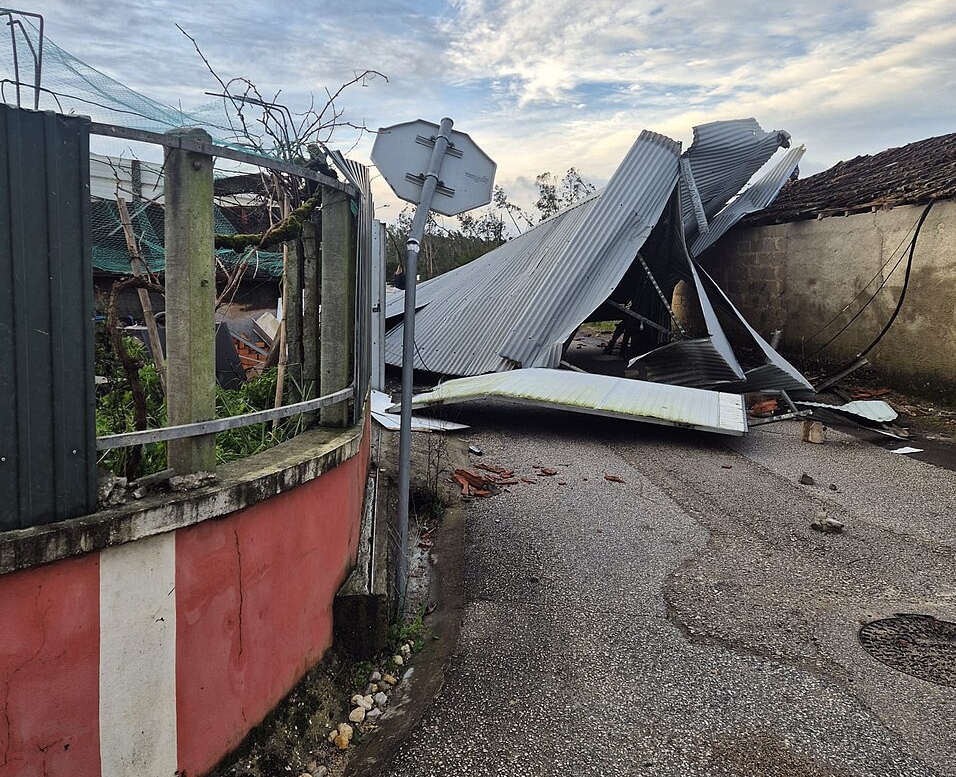
    So, when Storm Kristin arrived in the early hours of January 28th, it took many people by surprise, in spite of the warnings, and its impact still hadn’t sunk in after its passage. The region surrounding the city of Leiria (near the coast, roughly halfway between Lisbon and Porto) bore its brunt: several deaths, winds peaking at 200km/h, incessant rain and almost a million people left without power, water or network signal.

    Among those people was my own elderly mother, who I couldn’t reach for three days, having decided to check if she was unscathed and sheltered. I presumed she’d be alright, beyond the power cut, but not hearing from someone close becomes increasingly anxiogenic.

    As the region fell into a black hole, the focus of the news soon drifted elsewhere: returning to the daily incidents of the presidential election campaign and wins by Portuguese clubs in the Champions League, especially Benfica’s spectacular victory over Real Madrid. Most of the country was oblivious to the distress felt by a substantial chunk of its population.

    Over the past few years, originating in a glitch in a famous video game, there has been a viral running joke that Leiria doesn’t exist, that it’s off the map. It became so well known that the local tourism board ended up adopting it as a slogan. In the aftermath of the storm, the irony wasn’t lost on most people.

    It really was as if Leiria didn’t actually exist. Fortunately, my mother was alright, and unshaken. Kristin had awoken her in the middle of night. She simply got dressed, tucked her mobile phone into her pocket, grabbed a torch and the house keys and waited it out on the sofa, in the dark, with the world howling, whipping and cracking outside.

    Fortunately the house remained almost unscathed too. The vegetation was, however, hard hit. Especially, the old tall trees in the back of her garden. One pine and three oaks fell to the ground, while another pine and oak are still standing but are look certain to slide with the ground they stand on. Smaller fruit trees were hit too, but that’s no big deal.

    Sense of Destruction

    As I got closer to her house, the sense of destruction grew stronger. Roof tiles had flown off, while posts and signs were bent and torn away. Many, sickeningly many, trees had been uprooted, or snapped in half like matchsticks, or were leaning in such a way that they faced a slow death, and would have to be chopped down.

    There were sycamores, cedars, a great deal of oaks, countless Atlantic pines, and also many eucalypti, a perfect fuel for forest fires, which I could do without for the most part.

    The cities of Marinha Grande, first, and then, Leiria looked like they had been under attack. Three days after the storm – under the first, short-lived, rays of sun for a long while –  people were out on the streets, but the silence was eerie, mainly broken by the sound of chainsaws, trucks and hammering.

    There remained a dusty haze in the atmosphere. What had been a fairly leafy city and region, looked to have been stripped naked. I foresee a weird shortage of shade in the summer.

    The buildings, roofs, factories, urban equipment etc. can be fixed up and rebuilt within a short time. Even a sixteenth century chapel, part of the city’s skyline, or the pinnacles of a fifteenth century monastery in the town of Batalha, which was also destroyed by the storm. But for the economic ecosystem, the consequences may be dire.

    The region, which has been one of the economic engines of the country, has managed to keep unemployment low and withstand various wider crises since the seventies, thanks to diversified industries and exporting capacity, particularly in plastics, moulds, wood and glass.

    Leiria and its Castle.

    Specific Trees

    Trees are a different, soul-crushing, story. In Leiria and its immediate surroundings alone, never mind the broader region, it has been estimated that eight million trees were destroyed. There are specific trees, some of which have existed for as long as I can remember that I would randomly revisit and vividly see in my memories and dreams, like an amputee feels a phantom limb.

    As a child, I rode my bike over tapestries of fern and pine needles. I fell off my bike due to scattered pinecones and jutting roots. I played football with trunks as goalposts. Seeing pieces of bark chipped off due to a shot hitting the ‘post’ would leave us unmoved. After all, there was such an abundance of trees, with enough time for regeneration.

    The fragrance of resin, pine and eucalyptus hung in the air, especially in the summer. Over the past decades, however, due to increasing demographic and economic pressure, vast swathes of woodland have already disappeared.

    One symbolic example, and also the largest of these woodlands, is the plainly named Pinhal de Leiria (Leiria’s pine forest) or Pinhal do Rei (King’s pine forest), an expanse of over 11,000 hectares of maritime pines, stretching over twenty kilometres along the coast.

    This was presciently planted from the thirteenth century, in order to contain the encroaching dunes and to mitigate the effect of Atlantic winds. Also, two centuries later, the ships used by the Portuguese to venture out into the Atlantic Ocean were built from the wood of that forest.

    On account of its sheer size and location by the wild ocean, it has provided magnificent views and is a refuge for many. Some would say there is a mystical side to it. At the very least, it is intrinsic to the local identity.

    In October 2017, another Storm, Leslie (and possibly criminal hands as well) caused uncontrollable fires that burned 80% of the forest. I recently heard someone refer to that fire as its ‘holocaust’. A word I found sadly appropriate.

    In 2026, Storm Kristin finished it off with a final sweep. The forest is gone. I guess the trees can be replanted, but how long will they take to grow? Will they be given the time to grow at all?

    In the early twentieth century, local poet Afonso Lopes Vieira called it the ‘green cathedral’. Does this crumbled cathedral have sufficient followers pious enough to resurrect it?

    Given the recurring fires and storms, competing priorities and the length of time it takes trees to reach maturity, I very much doubt I’ll see proper reforestation in my lifetime.

    Although less ravaging, Kristin was followed by Leonardo, Marta and Nils blowing and raining into roofless houses, for a couple more weeks. The effects of climate change are palpable, by now. We are in the thick of it. Its consequences are snowballing in unpredictable ways.

    Features Image: Debris from after the initial disaster, clogging up a Leiria street.

  • A Tender, Provocative Interweaving of Earthly and Divine

    Review: Eros Rex, poems by Haley Hodges, Orison Books.

    Brimming over with desire, Haley Hodges’ collection Eros Rex reverberates ‘like the plucked string of a lute’ (‘Innocence’) with stark, sensuous questions about Christliness and control.

    Hodges’ poems insist upon the reader’s attention in much the same way as the poetic voice demands attention from those who spark her desire, insisting upon an external authority to which power can be ceded. The headiness of many of Hodges’ poems stems from her depiction of the power within the giving up of power; the paradox of maintaining control by choosing to yield control. Again and again, the poetic voice issues commands – to religious authorities (‘Come climax / Christ, come Eros Rex’ in ‘Eros Rex’), to figures of amorous interplay (‘Make me your illumined cave / of wonders. Make me your clever girl’ in ‘Sapiosexual’) and perhaps to the reader, to the self, or both at once (‘Just try’ in ‘Maybe welcome it’). ‘Give me / the collar. Give me the crown,’ the voice commands in ‘Two Takes’, one of many images in which the wielding of control through the issuing of instructions is couched behind a veneer of subservience. And among the many imperative commands given to others, there are just as many expressions of internal desire, from the physical to the metaphysical. Perhaps the most evocative of these is found amidst the snow-covered world depicted in ‘Blizzard’, in which the poetic voice wishes for ‘snow Jesus / not acid Jesus’. As with many of Hodges’ most arresting phrases, the complexity of meaning brought forth despite the simplicity of the immediate image hits the reader as sharply as ‘Corrosive Christ’ (‘Blizzard’) eating away sin.

    There is an enjoyable purposefulness to the rather jarring juxtaposition of earthly and divine woven throughout the collection. The reader is immediately made aware that we will be oscillating between the grand and the everyday, the lofty and the mundane, through the contrast between the first and seconds poems. After the titular poem’s delicious portrayal of all-encompassing desire, extending beyond the mental and the physical to the realm of the spiritual (‘spasm / of the panting soul’), over the page we find ourselves among ‘plastic mustard packets’ and ‘five-/dollar duo deals’ – we have transitioned from the realm of Eros Rex to that of a different monarch, found much closer to home (‘Burger King’). This is one example of many in which Hodges seizes the control her poetic voice so clearly enjoys offering to others through her ability to keep her reader guessing, wielding her wit and unreserved boldness to great effect.

    Eros Rex oscillates between self-assured yielding in the name of pleasure and vulnerable exposure of the uncertainties of a soul adrift in a dark, unrecognisable ocean. While the likes of ‘Sapiosexual, ‘Master, Master’, ‘What was the best you ever had?’ and ‘Between the jaws’ confidently offer up a knowing eroticism with a certain glint in the eye, these are counter-balanced by the quiet stillness of ‘Heart Talks’, ‘Drifting’, and ‘What is memory, if not testament?’, each of which delivers its own sucker-punch ending. Of course, the sensual and the poignant are not divorced from one other – even amidst the eroticised religious imagery of ‘Master, Master’, there is a sudden heartfelt sincerity as the voice proclaims, ‘my love of you has been / the death of artifice’. Nevertheless, it is when the voice is not engaging in erotically charged power plays, but instead turns its focus inwards, that the single-minded confidence, unapologetic demands, and fiery sharpness of the more carnal poems are eroded like sea-glass. What remains is fragile, tender, and achingly poignant. When the satisfying and pleasurable sense of self-certainty is stripped away, we are left looking inwards with a quiet contemplation of isolation, purpose, and need.

    Many questions are put forward over the course of the collection, some more explicitly than others.

    Implicitly, the collection asks: Who are we when we are left alone?

    And explicitly: What is memory if not testament?

    Whether any reader believes that the answers can be found within these pages or not, we will surely find ourselves with much to contemplate in seeking them, buoyed by the ample richness of imagery and sound that makes up Eros Rex.

  • Cuckoo

    Cuckoo

    I fall to Wales
    between barred clouds and slate sea,

    trailing a long day like a banner.
    Coucou, I say, I am from Kinshasa 

    Cwcw, they say.
    Soft rain rills desert dust from my wings.

    I am not a migrant;
    this is my second home.

    I fathom the woods for dunnocks.
    Zulus call me unokukhukhuza.

    My eye is a universe.
    I quarter the meadows for pipits.

    My eggs hatch their terror like slow bombs.
    More! they megaphone.

    More! is not enough –
    they might swallow their parents whole.  

    They follow white thread stitching black roads to the coast.
    Their hearts’ compasses beat them south:

    Africa Africa Africa.
    The sun scags at their backs like a hawk.

    Forests applaud their arrival.
    Warm rain brooks Wales from their feathers. 

    Cwcw, they say.
    Coucou, I say.

    Feature Image: A chick of the common cuckoo in the nest of a tree pipit

  • Musician of the Month: Jenny Ní Ruiséil

    Jenny Ní Ruiséil is a musician and Yoga teacher, based in the west of Ireland. She creates music inspired by her roots finding her voice through singing in the Irish language, as well as taking inspiration from medicine music around the world and devotional chanting tradition of bhakti yoga and other spiritual traditions. Jenny is inspired by the continuously changing landscapes of the natural world, our human bodies, and the relationship between mind, body and awareness that we navigate on a daily basis.

    My earliest musical influences were quite classical in nature – I trained from a young age on the classical flute and played in orchestras and concert bands throughout primary and secondary school. I was always enamoured with the idea of being a singer but I didn’t officially take any lessons until I was in about 5th year in school. I taught myself guitar at fifteen – on a right-handed guitar that my dad had lying around the house (I’m left-handed).

    During my teenage years I was fortunate enough to attend the Gaeltacht (Coláiste Lurgan), where I subsequently worked. It was there that my love for music and songwriting was really given a space to flourish. I often say that if it wasn’t for Gaeilge (the Irish language) and Coláiste Lurgan, I would not be a singer today. Gaeilge literally gave me my voice. My boss in the college Mícheál Ó Foighil was the first person to ever put me in a room and say – ‘tá tusa ag canadh an amhráin seo’ (you are singing this song) – for no other reason that he believed me capable of it.

    I can’t tell you how impactful that was. Or how impactful it was to be part of a community centered around speaking the Irish language and creating music for young people to reconnect to it. As I got older I began spending whole summers there, and ended up working as a múinteoir and stiúrthóir ceoil (musical director). My job (along with a small group of others) was to translate songs into Irish and adapt them to suit groups of teenagers to sing in groups. We would then record the songs in a studio and shoot music videos to upload to Youtube for them to enjoy at home.

    Eventually, myself and the other teachers responsible for these projects formed a band, Seo Linn, who I sang with for nearly five years. Our music was mainly as Gaeilge (in Irish), with some bilingual songs too. We were really lucky to be given some amazing opportunities to travel to Uganda, Boston, London, Scotland and all over Ireland. We played for Micheal D. Higgins on a few occasions, as well as in venues and college bars all over the country, and I can safely say they were my ‘wildest’ days!

    I took a ‘break’ from the band aged twenty-two that ended up being permanent, as my mental health wasn’t good and I was struggling with an eating disorder. It was from there that yoga and meditation became important staples in my life, and I went fully into studying and practicing yoga while I travelled. I didn’t sing for a couple of years then, until one day I found myself at a Kirtan session (a form of call and response chanting), and fell in love immediately with the practice.

    It was a bit outside of my comfort zone at the time, as the only reference point I had for ‘devotion’ was something I associated with mass and the Catholic Church growing up. But I quickly realised that Kirtan (and yoga for that matter) were speaking to something much more universal, and something that any human with a heart has the capacity to connect to and feel impacted by.

    I began hosting kirtan sessions back in Dublin in around 2019, and was starting to write my own original songs again by this point. It is still a journey for me to reclaim the idea of being a
    singer-songwriter, but I feel that mantra and my yoga practice has really bolstered me to trust my creative instincts and capacity again.

    My music now reflects this, and is still deeply influenced by the land, music, spirituality and mythology of Ireland as well as my own personal healing journey.

    My hope for the future is to continue writing and creating more music that can connect people to the healing capacity of song and chanting, whilst also capturing some of the essence of Ireland and the magic contained within the language and landscape of this land.

    Spotify: Jenny Ní Ruiséil

    Instagram: Jenny Ní Ruiséil