Blog

  • Musician of the Month – Bartholomew Ryan of The Loafing Heroes

    ‘Descend the stairs, bend your legs, melting one by one. / Open your mouth to the snake in the sand, swallowing you one by one.’ So begins the first single from our latest album. It’s one of my treasured moments in the meandering Loafing Heroes journey: in how it came about, how it was constructed, the unfolding of its words and arrangement, and how it sounds on the record.

    “Stairs” sums up much of what I dream about with this music, its vision and where I’m at – then and now. Because, really, however much I say this is the end of a project, or that it is the beginning of a new one; we are really, always, in a way, wrenched into the middle of things, into the middle of life.

    Feeling heartbroken at the end of a relationship, trying to come to terms with the death of a loved one, suddenly hearing by accident a special song from a moment in your life, or catching a smell that brings you somewhere, smothering you with longing, nostalgia, a great sadness or joy – these all throw me into the middle of things, into the middle of life.

    We are suddenly tuning in again – or rather – we may feel that we are spectacularly out of tune with the regular speed of day-to-day, calculative life, and in tune for a moment with another world that is alarmingly alive.

    Months can go by when no new song emerges, as an energy once bubbling over deserts you, and you think, well, that’s the end of that. Or, perhaps you say that I must find a way to begin again, do something new. And then it comes.

    Sometimes all it takes is to hear someone speak, watch a concert, see someone dance, or travel in the countryside away from the chatter of the city. In my case, the intervention came in the form of a visiting friend called Jonathan.

    Along the great river

    After a lifetime thinking about it, I had been travelling along the great river Amazon for almost 3000km, listening to the mesmerizing cacophony, seeing the green, green, green of all the jungle, and following the trail of an extraordinary human called Roger Casement. After making it back to Europe, I went straight on a tour with the band to Ireland for two weeks, and then finally returned to my apartment in Lisbon.

    I just wanted to be alone for a few days after being in such close quarters with people on the road. But Jonathan was staying at my place and he was still there. He was full of beans and delighted to see me, and yet he could quickly see that I was a little moody and withdrawn.

    But that wouldn’t stop him. He knew that I hadn’t written a song in at least six months. So that evening, we forced ourselves to play a game. He offered me three words – ‘hair’, ‘software’ and ‘snake’; a chord to begin; and thirty minutes to come up with something. That’s how the song ‘Stairs’ came about.

    I was thrown into the middle of things – I found myself diving, drowning and then submerged in the interlude, and suddenly I was singing about my hair being on fire and my skin turning to water. It was exhilarating, liberating, revealing. For me, that is what making music is all about. And if you can connect that creation and performance with someone else – then it really is alive.

    Jaime McGill of The Loafing Heroes Image © Sebastian Urzendowsky.

    Beginnings, endings, interludes

    I began The Loafing Heroes back when I was living in Denmark doing a Phd on Kierkegaard, where I met a wandering soul called Jamie from Arizona. We started making music together and recording the first Loafing Heroes songs.

    Four years later, I was living in Berlin pursuing a career as a philosophy lecturer wondering where to go next with the music. The spirit of The Loafing Heroes is that it morphs with the people that have come in and out over the years. This allows diverse flavours and colours to emerge and fade away along the trail.

    We recorded three albums in Berlin: Unterwegs (2009), Chula (2010) and Planets (2011). With Jonathan – yes the same one (from Berlin), another Jaime (this one from Nebraska), and Noni (from Dublin).

    My dear friend and gifted songwriter Michael Hall whom we all affectionately called Big Bear produced the first album (Unterwegs) and was present throughout the album. He died tragically in 2013, yet his ghost continues to haunt and inspire us.

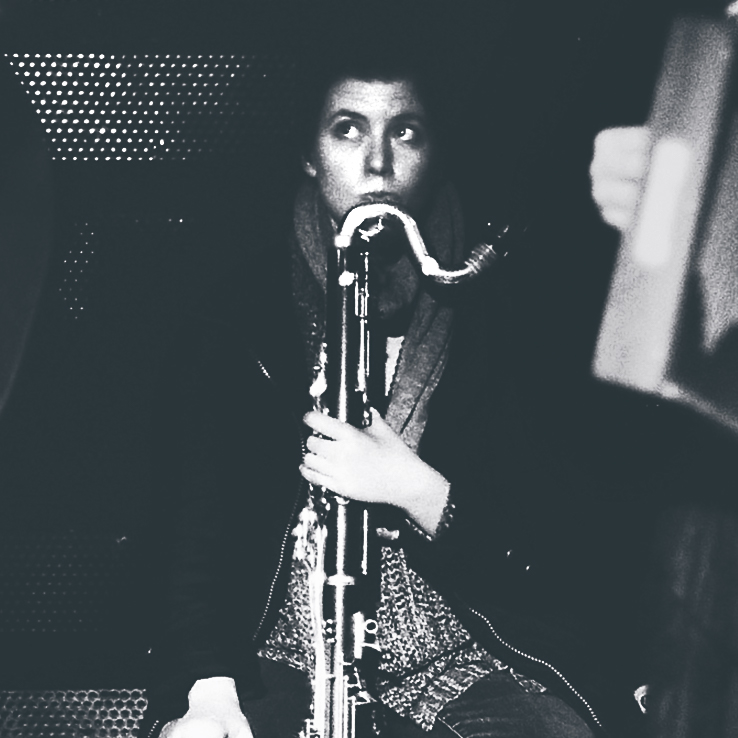
    After four years, we all found ourselves going in different directions. I headed down to Lisbon to begin a research project on the enchanting poet of multiplicity – Fernando Pessoa; Jonathan formed another band called Fenster that have gone on to record some really special experimental pop music; Noni set off to work on solar energy in Rwanda; while Jaime remained for the time being in Berlin, but would remain committed and connected to The Loafing Heroes. She plays the bass clarinet – one of the trademark sounds of the band over the last ten years – and has recorded on all of our six albums.

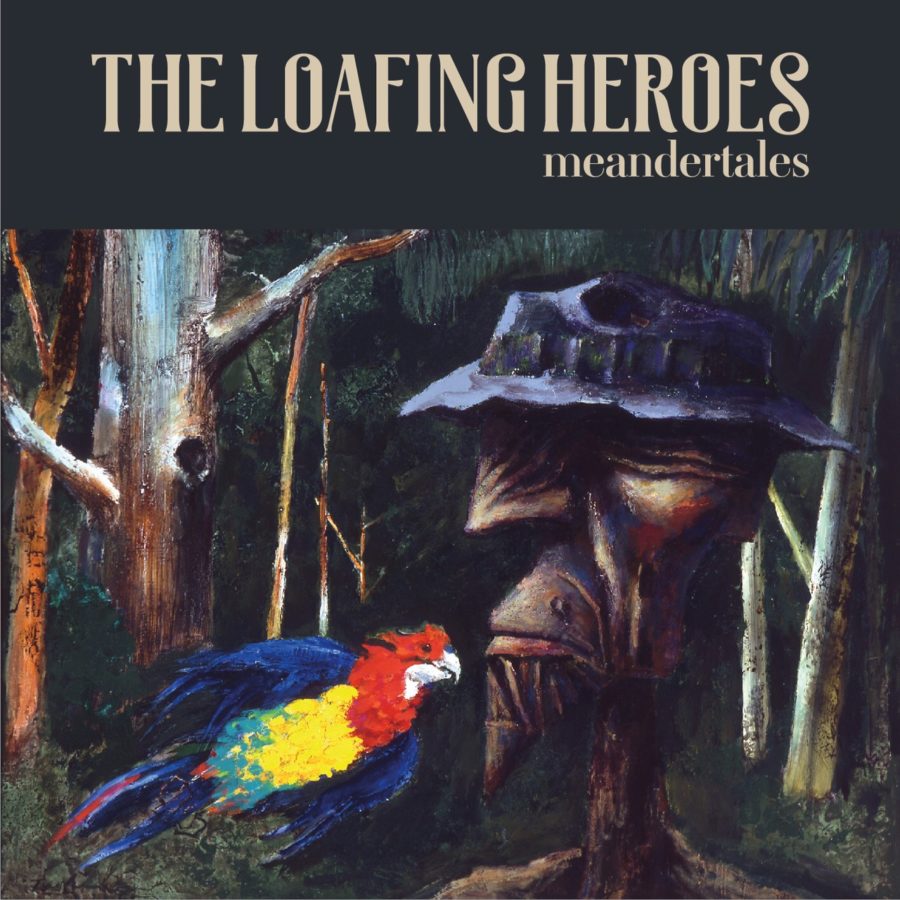
    The three other albums were recorded while based in Lisbon (Crossing the Threshold [2014], The Baron in the Trees [2016] and Meandertales [2019]). I met Portuguese novelist João Tordo on my first night in the city, and he became a new loafing hero, and played double bass on the two albums before Meandertales.

    I glimpsed Judith with a violin on her back one night at The Lisbon Players Theatre, and soon she was playing with us too. From Germany, Judith actually makes her own violins and violas, and has played on all three of the last albums.

    Judith Retzlik of the Loafing Heroes, Image © Emiliano Perillo.

    Other musicians and friends have weaved in and out, but before Judith left Lisbon to return to Germany she introduced me to Giulia with a plan for her to join. From Italy, Giulia is now at the centre of the band, playing autoharp, piano, percussion, concertina, and singing and writing songs on the last two albums.

    To complete this crooked cosmopolitan tale, four of our albums have been produced and mixed by our very talented, generous comrade and friend from Greece – Tadklimp.

    Giulia Gallina of the Loafing Heroes. Image © Lucia Borro

    Chaosmos

    Many of the songs have evolved from various strange places; on the one hand, from travelling through vast expansive landscapes; and, on the other, hiding away in dark melancholy, verging on paralysis, in the interiors of a room that can sometimes seem like a shrinking capsule.

    Loafing is always essential in an age of increasing speed, technological overload, psychological detachment and environmental collapse – as we humans exhaust everything under the sun.

    Let’s slow down. Let’s wander. Let’s see and think anew, and laugh. Let’s channel and imbibe energy not into potency, possibility and power; but rather as actual, as here and now, in everything that exists. Energy as a passive ‘is’.

    These twelve new songs (constructed by Giulia, Judith, Jaime and I), from our new album under the title Meandertales, encompass the distorted fairytale and dream-folk that throw us into the middle of life. In the totality and disintegration of chaosmos, in this loafing musical endeavor, I work and play to transform my energetic pessimism into a subversive joy.

    Forthcoming Shows
    Friday, 12th of April: Clonskeagh Castle, Dublin, Ireland.
    Saturday, 13th of April, Bello Bar, Dublin, Ireland. (IRISH ALBUM LAUNCH)
    Sunday, 14th of April, Pot Duggans, Ennistymon, Co. Clare, Ireland.
    Tuesday, 16th of April, Tech Amergin, Waterville, Co. Kerry, Ireland.
    Friday, 19th of April,MUSICBOX, Lisbon, Portugal. (PORTUGUESE ALBUM LAUNCH)    ,

    Bartholomew Ryan is a philosophy research coordinator at the New University of Lisbon (http://www.ifilnova.pt/pages/bartholomew-ryan) and leader of the international band The Loafing Heroes (http://www.theloafingheroes.com)

    Feature Image: Otwin Biernat

    We rely on contributions to keep Cassandra Voices going.


  • Artist of the Month – Héctor Castells

    [Best_Wordpress_Gallery id=”38″ gal_title=”Featured Artist of the Month: Hector Castells”]

    These poems belong to the Puddle Heroes series, by the hectic fish.


    Puddle heroes is a collection of pictures of puddles with people on it, people not necessarily drowned as much as free floating

    They are the icons of all the rhymes that follow.

    All the photographs have been turned upside down, which is an involuntary tribute to the photographer dyslexia 

    The idea behind it is that sometimes reality is better upside down, likely always.

    And the idea behind is also that water dignifies, which is something that funerals do as well, for they are the only places in humanity, besides puddles, where people understands silence and go without themselves.

    Or their ego.

    It is the great thing about working with people reflected: they are egoless for they belong to your imagination.

    all verses are written in pencil because sinking the tip of mine on photographic paper is an experience as silent and devoid of ego, as water and poetry are


    rubble fish

    my heart is a red fish
    that eats blue rubble
    and loves scrabble,

    my heart is the
    red playlist
    that you yellowed
    on crystal sand

    on black sundays
    when the lord fails to
    deliver shelter
    and the cripple crumble
    long before
    the corporate rumble

    my tongue skips and rhymes
    white canvas and blue velvet
    as my keypad chooses the sky
    against my tendency to sly

    idiot as it is
    stupid is it not

    the algorithm
    keeps playing
    songs of love
    and wisdom

    where Newton shines
    in his own rainbows


    BIRTHDAY WAYS

    Coming to an age there’s one tear and my rage.
    My skinny tree has blown all its CV’s,
    floating leaves with former articles and ex professions;
    colliding against empty trays&huge depressions.

    .

    once there was a notion
    and two degrees.
    the spirit of democracy
    cost me all amphetamines
    & a PhD.

    could have been an orchard
    with a lemon tree;
    thought I knew
    I wanted to be free

    all my branches are now empty,
    cracking slowly as one deep wrinkle.
    36 dilemmas and a skinny rope
    should be enough to roll down all my hopes

    end of September
    one more millimetre.
    dripping like serum
    in cold plastic bags,
    early ages are crawling towards
    its aftermath

    CHIT FUCK YOU CHAT     

    oh my dog,
    me life for a Xanax
    Yves Tumor song
    is a sonic sword;
    on its tip, we rattle.

    your acid work
    keeps on dripping
    like a double-bassed
    little green devil
    on sixteen deafening speakers,
    sliding so close
    & far away;
    in absolute disarray.

    this is not my fault.
    It’s my fucking fall.

    I gently spike the bushes,
    its lighters and its promises,
    words pouring away
    like little green devils

    out of control, not aiming
    at one single point
    but wondering what’s
    the whole fucking point
    of your endless black pint

    the fucking interstellar shithole
    where I CHIT FUCK YOU
    CHAT you for hours,
    while you dripped
    and repeated
    all your never-ending routines.

    you use to rhyme your words,
    in mathematical equations
    of love and wisdom,
    where I was the cat
    and you were the snow

    white forests came too early
    like some guns
    or most of the flowers,
    that rarely appear at the start

    this is you and me
    together in our mayhem
    so inescapable and reversed,
    like a Friday
    in a nasty Monday way

    same sugar, identical dopamine;
    your bluntness grew fat
    as you kept the cheat and the chat,
    trading dolphins
    for mosquitoes

    CHIT FUCK YOU CHAT me no more,

    as your sweat drips
    my body weakens
    once you’d reach your vein
    I’d lonely lose my name.

    I neglect the errands,
    and make amends
    with mistakes
    by fucking them slowly
    up and down,
    nice and gently,
    in all directions;

    it’s equally maddening to think
    about the island by your shore,
    realizing that I’m here
    and I’m not

    that you sink
    and I don’t

    the air shaking,
    fucking crunching the barley
    of your CHIT FUCK YOU CHAT
    its endless swifts
    in bloomless fields

    spinning in layers
    erratic onions:
    in every thin line,
    lies a fat oblivion.


    LITTLE GOAT

    a little goat sighs above my head.
    softly wrapped in Sunday dreams,
    her lightened breath
    sweeps tomorrow’s beams.

    weekend fades another
    monday dead.

    young ibex
    swapped the heat
    for two cold feet.
    her former curls
    got frozen under wool.
    now she is like a woman
    lying by some pool.
    the sudden stop
    of skinny orgasms,
    kept her kind of cool.

    wind quite blows
    uncompromised frights.
    a bunch of punctured clouds
    are gathering to fight

    little goat smells the air
    and sees the cliff.
    It only takes one memory
    to get her belly stiff.

    dirty rain recalls
    the flavour of her pain.
    there was no hope
    in those remote slopes.

    the skylight bleeds
    northern thunderlights
    are freaking out her tail
    creature turning pale

    run run run,
    little young ibex.
    there is no fun
    in repressed sex.
    far away from your jungle,
    there’s an irish psycho
    and a triangle.

    We rely on contributions to keep Cassandra Voices going.

  • Fine Gael’s Habitat Denial

    The idea of home is a recurring Irish preoccupation – níl aon tinteán mar do thinteán féin.[i] This can be traced to a history of Famine dispossession, and a subsequent Land War. The Irish Constitution still commits the State to supporting women as home-makers.[ii]

    It perhaps explains the vehemence of recent criticism, from across the political spectrum, directed at the Fingal Battalion Direct Action for protesting outside private residences of government ministers Simon Harris, Richard Bruton and Paschal Donohoe, as well as Taoiseach Leo Varadkar.

    Social Democrat councillor Gary Gannon condemned the campaign as ‘entirely wrong’[iii]; while the Irish Times also weighed in, likening the protests to interventions at hospitals and medical clinics by anti-abortion groups.[iv]

    While in the UK the sight of politicians’ homes being besieged by an intrusive media or angry protestors is a familiar one, in Ireland we expect restraint and even civility around the domestic space of public representatives.

    That the Fingal group styles itself a ‘Battalion’ also conveys paramilitarism and a form of mob rule. Political protest, however, is always considered ugly by those in power, and an absolute ban on any form would set a dangerous precedent. What if the mob is actually in power?

    Before the last Italian election a crowd, holding candles, gathered outside the Milan residence of Silvio Berlusconi, as a member of the Five Star Movement read out an indictment against the disgraced former prime minister, revealing his links to the real mob, or mafia.[v] It was a powerful democratic statement: calling a billionaire politician to account outside his home.

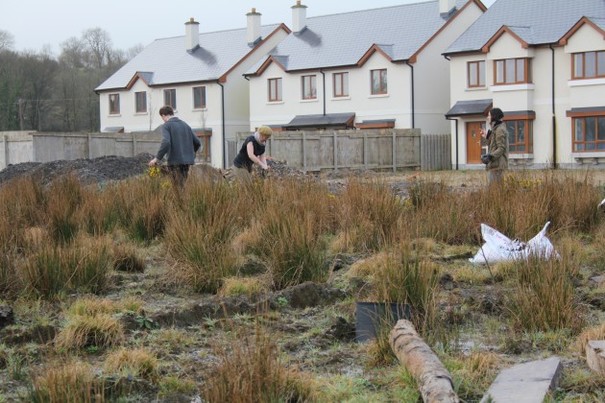
    In order for a campaign on the margins to gain public attention a degree of civil disobedience is often required. That was certainly the case with the NAMA to Nature project in 2012.[vi] Ghost estates around the country appeared as a testament to folly and greed, making the public overwhelmingly receptive to what was a trespass on private property to heal the landscape by planting trees.

    But since the Crash we have seen a steady reassertion of the rights of property-owners. This often works to the detriment of marginalised citizens, and can imperil the habitats of species under threat of extinction. Travellers also defy a widespread devotion to private ownership, making them a convenient target for unscrupulous politicians.

    The government’s housing policy is failing at a fundamental level the ten thousand homeless citizens.[vii] An entrenched sympathy with landlords was set out by Eoghan Murphy in a speech to the Dáil last December:

    We have to be very careful in interfering more than we are at the moment. We have to make sure that we are not placing extra burdens on these small landlords. And we have to make sure that we are not prohibiting someone from selling a property that they own when they might need to sell that property for perfectly legitimate reasons in their own lives. They may not have the money to re-compensate the person living in the property at that point.[viii]

    Above all the government has failed to build the houses necessary to alleviate the Housing Crisis, at a time of when the states coffers are bulging. Taoiseach Varadkar’s oft-stated ideological opposition to socialism seems an obvious reason.

    Upholding property holders rights extends to giving farmers free reign to do as they wish on their land. Last month Minister for Arts, Heritage and the Gaeltacht Josepha Madigan signed off on an order extending the burning season of uplands, the habitats of hen harriers and skylarks, among other wildlife.

    Anne Marie Hourihane in the The Times Irish edition provided a scathing assessment of the Minister’s response:

    At the weekend Josepha Madigan, the heritage minister, suggested that we address Ireland’s plummeting bird population by installing bird feeders in our gardens. Unfortunately, skylarks and hen harriers are not known for their attendance at bird tables, preferring to nest in uplands. Maybe the proposed bird feeders are intended as a diversionary tactic for the birds that will be nesting in the hedgerows in August. For example, your local yellowhammer — if you have one, as the yellowhammer is already on our danger list — might leave his hedgerow to get a slap-up feed at some well-appointed bird table, then fly back to his hedgerow, where he’ll say: “Hey, man, where’s my gaff? Also, the wife and kids . . .” It’s going to be a great craic.

    Hourihane also highlighted an extension to the period for cutting hedgerows, which, she wrote, ‘contain so much wildlife, so many insects — including bees — so many small mammals, that they are a permanent wildlife programme all on their own. Now we will be allowed to cut them in August.’[ix]

    Madigan’s response revealed either naivete, or a disregard for vulnerable species. Yet this runs contrary to the common good of preserving wildlife, potentially infringing what may, at a later time, be found to be in breach of any native species right, ‘to be, to habitat, and to fulfil its role in the ever-renewing processes of the Earth community’, as argued previously.

    Leo Varadkar’s committed to an ‘extensive investment programme’ in the arts[x] during the Fine Gael leadership election, yet many artists and musicians struggle to afford a accommidation in Ireland. This is especially the case in Dublin, soon to be the EU’s most expensive city for rental accommodation.[xi] The plight of musicians is particularly difficult given how digital technology has decimated potential earnings from CD sales.

    Songwriter David Kitt, who grew up in Madigan’s Dublin South constituency, where his father Tom Kitt was actually a Fianna Fail T.D., last year announced he was unable to afford accommodation in the capital, bemoaning how, ‘Dublin’s heart and soul is being ripped out and sold to the highest bidder.’[xii]

    Furthermore, a recent letter signed by 407 members of the Irish theatre community claimed the direction the Abbey theatre is taking is causing ‘devastation among our ranks’, and pointing out there would not be a single Irish-based actor involved in any productions between September 2018 and February 2019.[xiii]

    The Abbey, founded by W.B. Yeats and Lady Gregory, is the national theatre of Ireland. The staging of J.M. Synge’s Playboy of the Western World in 1907 there brought riots over an unfavourable portrayal of Irishness. A lack of indigenous theatrical productions today prevents similar interrogations of contemporary Irish culture, while forcing many thespians into exile.

    True art and literature, as George Steiner argues, is ‘always, a critique’, involving ‘a value judgment of, the inheritance and context to which they pertain.’[xiv]

    We have also learnt of funding being denied by Irish embassies abroad to Irish artistic endeavours that fail to cast the country in a favourable light.

    The reliance of artists on patronage develops worrying dynamics. Will the anointed elite continue to pose the difficult questions essential to great works if funding is jeopardised? The major concern, however, is that Dublin, in particular, is being denuded of the vitality and originality of a vibrant artistic community, compelled to make their homes elsewhere.

    Rare birds and feckless artists are forms of endangered wild life that do not fit comfortably into a society dominated by the interests of land owners. Those who invade the domestic spaces of politicians are roundly condemned, but can Ireland offer the sanctity of a home for all its species?

    We rely on contributions to keep Cassandra Voices going.

    [i] Lit. ‘There’s no hearth like your own hearth’, or ‘there’s no place like home’.

    [ii] Article 41.2.1: ‘In particular, the State recognises that by her life within the home, woman gives to the State a support without which the common good cannot be achieved.’

    [iii] Gary Gannon, Twitter: @1GaryGannon: https://twitter.com/1GaryGannon/status/1104784247825596416, March 10th, 2019. accessed 12/3/19.

    [iv] Untitled editorial, ‘The Irish Times view on political protests: Crossing the line’, Irish Times, February 19th, 2019. https://www.irishtimes.com/opinion/editorial/the-irish-times-view-on-political-protests-crossing-the-line-1.3798009, accessed 12/3/19.

    [v] ‘Alessandro Di Battista sotto la villa di Berlusconi, legge la sentenza Dell’Utri (COMPLETO)’ Youtube, February 9th 2018. https://www.youtube.com/watch?v=GRpXvuxP28k, accessed 12/3/19.

    [vi] Frank Armstrong ‘Nama to Nature: why we are planting trees on ghost estates’, March 19th, 2012, www.thejournal.ie, https://www.thejournal.ie/nama-to-nature-why-we-are-planting-trees-on-ghost-estates-384378-Mar2012/, accessed 13/3/19.

    [vii] Pat Flanagan ‘Number of homeless in Ireland hits record high of more than 10,000, according to new figures’, March 27th, 2019, Irish Mirror, https://www.irishmirror.ie/news/irish-news/number-homeless-ireland-hits-record-14195755, 29/3/19.

    [viii] ‘Deputy Eoghan Murphy – Private Members’ Business – 12.12.2018’, YouTube,   https://www.youtube.com/watch?v=z1RRw0lM9iI, accessed 18/12/19.

    [ix] Anne Marie Hourihane, ‘Ireland, where the wild things are under threat’, February 13th, 2019, The Times (Irish edition), https://www.thetimes.co.uk/article/ireland-where-the-wild-things-are-under-threat-tmps0c80x, accessed 13/3/19.

    [x] Elaine Loughlin, ‘Leo Varadkar pledges double budget for sport and arts’, Irish Examiner, May 22nd, 2017, https://www.irishexaminer.com/ireland/leo-varadkar-pledges-double-budget-for-sport-and-arts-450636.html, accessed 20/3/19.

    [xi] Sean Murray, ‘Dublin now in top 5 most expensive places to rent in Europe, research finds’, March 13th, 2019, thejournal.ie, https://www.thejournal.ie/dublin-rent-europe-4538856-Mar2019/, accessed 14/3/19.

    [xii] Untitled, ‘Songwriter David Kitt quits Dublin due to high rents’, July 31st, 2019, RTE, https://www.rte.ie/entertainment/2018/0730/982081-songwriter-david-kitt-quits-dublin-due-to-high-rents/, accessed 14/3/19.

    [xiii] Aoife Barry, ‘Abbey and theatre makers to meet as 100 more sign letter of ‘concern and dissatisfaction’’, January 29th, 2019, thejournal.ie, https://www.thejournal.ie/abbey-theatre-concern-meeting-committee-4464893-Jan2019/, accessed, 14/3/19.

    [xiv] George Steiner, Real Presences, London, Faber and Faber, 1989, p.11

    [xv] Rosita Boland, ‘Josepha Madigan on culture and her racy self-published novel’, November 29th, 2018, Irish Times, https://www.irishtimes.com/culture/josepha-madigan-on-culture-and-her-racy-self-published-novel-1.3712257, accessed 19/3/19.

  • My Grandmother’s Life Under the Third Reich and Behind the Iron Curtain

    Irene H.

    Going into your house, I sat in the conservatory waiting for the door to open. Waiting for your familiar rasping voice to call, “Mann! Herzenskind, komm rein.” I remained there still in the leather chair, trying to pluck up the courage to open the door and be met with emptiness. You’d snuck out one night three weeks earlier.

    In almost a century of life, history marked Irene Hauser (née Leitgeber) and she, in turn, was determined to leave her mark. Born in Berlin’s Wedding district in 1924, her life was shaped by passages in history books. As a twelve year-old girl she sat in the stands watching Leni Riefenstahl film the 1936 Olympics, so awe-struck by the cameras that she almost forgot to watch any of the tournament.

    She left school without graduating and when she told her parents at the end of the war that she wanted to go to university they thought she had lost her mind. It wasn’t her first choice. She had wanted to become a fashion designer but with barely enough food around to feed the population, whatever about fabric, that seemed like an even more fanciful idea. So Irene became the first person to go to university in her family and enrolled in physics at East Berlin’s Humboldt University, where she accounted for one half of the female student population on her course.

    The city had been bombed into the ground and few possessed the creativity to imagine how this heap of rubble could ever resemble a functioning city again. Irene’s lectures were held inside some of the brick skeletons that remained scattered through the city, and during the icy winter months she sat in the auditorium wrapped in an over-sized fur coat.

    In the 1980’s she retired as a professor in physics. Much must have happened between those two moments and sometimes she spoke about her work but it was the stories of what seemed like fantastical adventures that burned themselves into the mind of her youngest granddaughter. She told of her trip to Hanoi during a ceasefire in the Vietnam War. Her delegation was sent to provide expertise to Vietnamese scientists in the war effort, and Irene spent much of her time there trying to avoid the local food. In the 1960s she and her husband, also a physicist, worked on a secret research programme near Dresden to develop nuclear power.

    The lust for life you possessed made everything seem possible and any fragility a bewildering concept. As we all sat in the chapel, your funeral seemed such a ludicrous event.

    Although Irene knew how to bring her experiences to life in the stories she told, there was much silence about the suffering she witnessed and endured. Like many of her contemporaries, it was her actions that provided clues about the war that marked her.

    No scrap of food was ever thrown away. Instead she tried to redistribute what she didn’t want to eat. Once she attempted to cajole her granddaughter into packing a half-eaten sausage for her trip back to London.

    When she did speak about it, it was so matter of fact that there was little room for emotions. Anecdotes like the dead body lying in the hallway of the apartment block, which stopped her home being looted or the ridiculousness of her trying to salvage a carpet from her aunt’s burning home after an air raid seemed like abstractions. Even then, recounting herself walking through one of Berlin’s wide avenues lined by blazing buildings drew a harrowing image.

    Irene was just twenty then. She grabbed life whichever way she could. So when she met the funny and clever Oskar at a laboratory she worked in, she didn’t see his limp. When an overseer, whose only function was to report to the SA (Sturmabteilung), threatened her with concentration camp if she carried on seeing the Halbjuden, meeting Oskar in secret seemed the only plausible solution to her dilemma.

    Oskar didn’t want to let her marry him — him! A cripple. But Irene had made up her mind. And so it went. The two celebrated the defeat of Nazi Germany with a wedding and a rhubarb pie. Four years later, Irene gave birth to her only surviving child while Oskar was imprisoned on trumped up smuggling charges and cultivating his life-long aversion to Skat, a card game he played from morning till night with other inmates to pass the long days. His imprisonment had mobilised a student movement and although newspaper clippings of the protests and petitions for his release had been kept in a folder, Irene gave them to an archive soon after his death. Forward was the only direction she knew.

    You always had a solution to everything and knew how to cover your tracks when you didn’t. Your quirky pride left no room for any admission of defeat. After you gave up smoking, you developed an affinity for checking on the washing behind the shed after each meal. Even your own son had no idea that you couldn’t cook until granddad died.

    Much was left untold. Secretly we pieced some of your story together not to feel so inadequate in your shadow. To get to know the fallible human. Next to you our failures sometimes stung unbearably.

    Perhaps a growing awareness of her silence prompted Irene to write a small booklet about her life in her last years. No one was to read it until she was gone. There was little sense that writing it gave her much joy. Rather it was a task that had to be completed, and like every task in life, complete it she did.

    It recounts her childhood experiences in the Third Reich: pushing her parents to allow her to join the Bund Deutscher Mädchen (the equivalent to the Hitler Youth for girls) against their will; the turmoil of the post-war years, and the division of Berlin; her many professional achievements, and some reflections on the political life of the time in which she was inevitably involved. Maybe some modesty stopped her from indulging personal impressions and feelings in her booklet, but an impatience for anything that lay in the past certainly did.

    In our last phone call you told me to never grow this old. The thought of being a burden to anyone was a greater weight on you than you could bear. ‘But grandma, we’re all so happy you got this old.’ Although I didn’t know it then with that I let you go. That day I stopped tearing and pulling at you. Life would be ok. Your death was befitting of your life. Fast and impatient.

    Photo Caption: A photo of Irene, perhaps strict and stern to any stranger. But for those who knew her those lips hold back a smile and those eyes are filled with a lively curiosity that lasted as long as she did. By Franziska Hauser

    We rely on contributions to keep Cassandra Voices going.

  • HAP-less – Addressing the Needs of Homeless in Temporary Accommodation

    Brilliant white cinder-block walls and pastel-coloured floors. In between, lightweight partition walls carve up what is essentially a warehouse, and inspire confusion in short tangential corridors. Varying odours and temperatures permeate the air, where a multitude of individuals experiencing homelessness have the fortune of a roof over their head. Some move quickly, others slowly, some stagger.

    It being my first day in this service, the four o’clock room check is an opportunity to familiarise with a few of the residents, and the complicated building. My colleague hands me the bed-list and a pen, and we make sure our walkie-talkies are working. He’ll check if they’re in, and I’ll mark the list accordingly.

    ‘You have to be careful with the women,’ so the warning goes. ‘Always go in pairs. If they accuse you of something and you’re alone, that kind of stuff can stick. Protect yourself.’

    Announcing ourselves as, ‘male staff,’ we enter the first, and exclusively, female, corridor. As we move from room to room we check the toilets – each cubicle. We say ‘hi’ to a number of the ladies, my colleague checks my notations, and we move along to the next corridor.

    I find myself standing away from the doors, clipboard in hand, behind my colleague. I feel an urge to be more visible to those in the rooms; I hardly want my presence to resemble some kind of warden.

    Making things easy for me, my colleague introduces me to a number of the residents, which in many instances goes well. But, to complicate things further, I soon realise that I should avoid being too friendly.

    Many are almost completely uninterested by my presence; I begin to feel I should have respect not so much for people’s privacy (largely non-existent), as more basically their space, my entry into which is that of yet another new face. It is, after all, their home.

    Lying on a bed, in the corner of a square room, with partition walls which do not reach the high aluminium ceiling above, is a young woman, no more than twenty years-of-age, coming around from a worrying drug experience, initiated some days previously. At least she’s definitely breathing.

    Sharing a room with a ‘crack-head’ must be difficult – just as sharing a room with someone who doesn’t appreciate your addiction to the substance may be.

    I follow my colleague as we move from room to room, ticking the boxes and making brief greetings. Through a door bursts a notably thin woman, with a number of others behind her, electrifying the atmosphere as she confronts my colleague, keen to set the record straight.

    Arms raised, she proceeds to direct our attention to the common area where, according to this woman, there is a ‘bitch,’ who needs to ‘shut her fucking mouth.’ I can’t help recalling the words of a member of management: ‘Many of our clients are seriously underdeveloped, cognitively. It is not unlike working with children.’

    My colleague endeavours to calm the situation down, encouraging the woman to ignore others around her. She must focus on herself. The woman is responsive despite her warning that the ‘bitch’ inside had better keep out of her way. She relents: ‘I just need to get out of here.’

    Another passing service user gets my attention: ‘It’s like Big Brother in here.’ The woman moves on hurriedly, the others behind her disperse, and we carry on with our checks. My colleague ensures I have ticked the right boxes, given the momentary commotion.


    Prior to room checks, meal times had been a source of some controversy at handover. It being my first day, I had hardly contributed to the discussion. But now it comes up again with the colleague I am shadowing: ‘We don’t want to create a culture of smoking crack and eating cereal all day,’ she says. The service users are not to be provided with food, other than toast, before or after dinner. Staff are supposed to stick strictly to meal times. That means no pot noodles, soup, rice pudding, or cereal.

    ‘Right… so that’s the kind of thing we’re dealing with?’; ‘Yes, loads of crack in here, and spice.’

    It is difficult to deny a person in this environment food – but telling them what time of the day they can have Rice Crispies makes sense. If I tell them it is twelve o’clock often some ask whether I am referring to day or night. Strict mealtimes encourage routine, a reason to get up in the morning and be somewhere in the evening – despite its illegality, many bedrooms don’t have windows. They are set to encourage people to be up during the daytime; a bedroom may be safer and more comfortable than a doorway on the street, but it can offer fertile ground for despair nevertheless.

    Outside their bedrooms service-users are that bit more likely to avail of support from key workers or social workers. Of course when a physical environment inhibits anyone’s capacity to look outside – the inverse being an effort to inhibit others looking in – hope is a hard sell. But, in any case, that is why it is done.

    Entering the next hallway, I see shower curtains draped over the doorways – that morning another staff member, who had greeted me, apologised for the doorways, something she felt made the place feel like a Concentration Camp. The council, she said, are yet to install the doors.

    We knock on the partition walls before announcing ourselves: ‘Staff. Hi fellas. How are you doing today?’ My colleague’s admirable rapport with the residents takes the edge off his gallows humour. How does a person perceive an authority manifested in a prohibition on Corn Flakes?

    The drunk or ‘crack-head’ stereotype loses relevance when the service user has a job, whose hours are such that they get home(?) after dinner time. The person may just want a bowl of cereal before bed, as I surely would, importantly, on getting home. What about the person who fancies a bowl of cereal at any time of the day?

    Homeless is an umbrella term used to classify thousands of individuals who don’t have their own front door. But exactly why a person ends up in that situation varies widely. There is a Homelessness Crisis, meaning identifying and ordering the different classifications of homeless individuals relative to their needs is a luxury – we are led to believe – the country cannot afford. All kinds of people – highly dependent and highly independent – are lumped together. When someone asks for cereal, it is perhaps best to suspend judgement. There is not necessarily a negative consequences to a bowl of cereal at midnight.

    It is suggested by a new member of staff that a particular client may be on the autistic spectrum, as his social etiquette is deeply lacking. It is something my colleague thought we should consider. That colleague had worked with autistic individuals in the past, so it seems plausible. But following conversation with another member of staff, who had known the client since he first entered the service – over ten years previously – another probable explanation turned up: the client had entered the service in his early twenties when his social interactions were far from a central concern. Ten years on, having spent a decade in a shelter, his capacity to interact with the outside world has been all but destroyed.

    You often think of elderly men, savvy in the ways of surviving as rough sleepers, as those to whom the epithet ‘entrenched homelessness’ applies. But this is a young man who doesn’t sleep rough, whose home is the homeless services.

    Another client argues given that he has lived in the country for over twenty years he should not have to listen to people asking him whether he would like to go home. He cannot go home: actually Ireland is home. We are discussing his recent transfer from the social housing list into a relatively new scheme called HAP (Housing Assistance Payment), whereby the government subsidises rent payments to private landlords, on behalf of HAP-approved tenants. That he should be continually asked to return home is a worrying reflection on the HAP scheme, packaged as an opportunity for the service user, but subject to the arbitrary decisions of private landlords, who often reject aspiring HAP tenants precisely for being aspiring HAP tenants.

    He has been given a number of months to find a landlord who will accept him as a tenant. His more immediate concern, however, is his cancer, for which he really needs employment so he can look after himself.

    The government policy which focuses on the one thing all homeless people by definition lack, has repercussions for those with complex needs. One might argue that housing this particular individual in private rental accommodation would have the beneficial consequence of increasing his chances of attaining employment, and maintaining good health, and avoiding the stress of being moved from accommodation to accommodation.

    The stress of sharing a room with strangers, sleeping on his valuables is effecting his mental health he tells me. I’m struck by the reasonably well accredited hypothesis linking mental ill-health with physical infirmity, and I think once more of his cancer. Arguably, this emphasises the importance of getting this person housed, but my client is cynical, has little money, and potentially little time. He is frightened of adding to the statistic of homeless fatalities in 2019.

    His immediate need is money. He needs prescribed medication, healthy food, and perhaps a counsellor or psychotherapist. That people aren’t being housed is disgraceful in itself, but in the interim they are suffering, deteriorating mentally and physically, and potentially dying. People suffer in the services, as they wait, often hopelessly. These are the vicious consequence of being unable to live independently.

    Later, we discover a client rolling uncontrollably on the floor, experiencing what appears to be a seizure. He’s banging his head, and almost frothing at the mouth. We calm him, briefly, before he wriggles out of our control and continues. His head is our primary concern, which we endeavour to get a pillow underneath of. I get on the phone to my colleague who is down in reception. She gets on to the emergency services. They want to know if he is experiencing breathing difficulties. As far as I can tell he is breathing relatively normally. To make sure, I ask him directly. Managing to control him, I gain his attention and ask. Rather than responding verbally, he proceeds to demonstrate what sounds like incredibly strained breathing –  as though on cue. He looks directly into my eyes and begins to cough in between episodes of holding his breath. Although we continue to calm him and inhibit self-harm, I am now less fearful for his well-being.

    Once the paramedics arrive they work out quite quickly there isn’t much wrong, at least with what they can help with. They sit him up, holding him still from beneath the arms and probe him with questions. He manages to ignore them until they, somewhat more hands on, start pinching him somewhere around the chest. This certainly gets his attention and he finally blurts out: ‘fuck off.’ There’s a pause as we all come to understand that whatever is wrong with this service-user, it does not require emergency medical attention. He needs to go to bed and sleep it off.

    A few weeks later, at a staff outing, I converse with a colleague who understands that despite the somewhat theatrical nature of the episode, there was, below the surface, a man reaching out for help, however desperately. It seems his only way of having his suffering recognised was to act out the part, blurring the lines between reality and fiction. He was not suffering in the way his behaviour suggested, but that is not to say he wasn’t suffering, as he drunkenly played out the part on an otherwise uneventful night in another homeless service.

    Homelessness is complicated. These three words cannot do justice to what they purport to express. We are dealing with thousands of different lives under the umbrella term. What is at issue are the needs of individuals; and you can be sure these will multiply the longer one remains homeless. Whilst housing people is a reasonable objective, we cannot obscure the compelling needs of each individual.

    Most homeless services adopt the Housing First approach. Of American origin, the original idea was that individuals experiencing homelessness should be placed automatically into independent living, bypassing temporary accommodations such as hostels. Once the client is established in their home, so it goes, outreach services will work on supporting individual needs. The initiative has a track record of success, and been adopted by a number of the leading services in Ireland. The issue today, however, is the vast numbers of those experiencing homeless who, after not being offered their own accommodation, end up in temporary accommodation.

    Is there not a paradox to services advocating Housing First when the existence of those very services demonstrate the shortcomings of the Housing First approach? More worryingly perhaps: does it potentially license those who could otherwise support people in these services to delimit their support, on the basis that they can, in accordance with the Housing First approach, legitimately claim it is better to wait until those in need of such services are housed? Focus on permanent housing, and permit short-term suffering.

    Inasmuch as a singular vision for the future is something to be celebrated amongst policy makers, public services, charities and NGOs, we cannot allow it to obstruct recognition of current needs. Most homeless services additionally advocate the person-centred approach. Better to consider the individual where they are at, and offer support accordingly. If a service user’s mental health deteriorates, we abide by the person-centred approach insofar as we have compassion and understand that person’s particular state of mind, and support them accordingly. The trouble is that in our current situation, the Housing First approach, is, arguably, in contradiction with the Person-Centred Approach, as it draws attention and resources away from individual needs.

    As I’m covering a shift in a family accommodation unit. Over a cigarette break I take the opportunity to find out more about the service. ‘Many of the families don’t like HAP. They don’t want to be at the mercy of a private landlord, who could sell up next year,’ my colleague begins. ‘They wait on the social housing list. Could be years. Mental health begins to really suffer. Lots of them smoke a lot of cannabis. And then the children suffer.’

    I tell him about some of the men I am more familiar with, from another service, and how a number of them grew up under child protection services: ‘You can see the cycle.’ To reiterate, I am hardly opposed to housing the homeless. People should be getting housed. But at issue is meeting the varied needs of the many people experiencing homelessness, at a time when the prospect of finding private rental accommodation is remote. Numerous individuals have many and complicated needs, and these should be considered simultaneously.

    Homelessness is indeed a challenging issue. People’s many basic needs are complicated by the experience of homelessness. There is no universal panacea. We should be housing the homeless. But whether a young woman out of her mind on street drugs, an exhausted shift worker unable to get a snack before bed, a cancer patient with no money, or an alcoholic despairing at six o’clock in the morning, I cannot help but think that a slogan more fitting would be: ‘listen to the homeless.’

  • Getting Growing

    It was exciting to meet the enthusiasm at the inaugural meeting of Talamh Beo, a grassroots organisation of farmers, growers and land-based workers on the island of Ireland. It aims to ensure a living landscape, where people and ecosystems thrive together.

    Inspiration comes from the Landworkers’ Alliance (UK), which in the five years of its existence has become a voice for small food producers, farmers, growers and land-based workers (which also includes beekeepers, herbalists, foresters and flower farmers).

    What we do at grassroots level in Ireland is of the utmost important as we confront a potential climate catastrophe, which we need to acknowledge as individuals and communities. No matter who we are in society, and what class we belong to, we all eat three times a day, and should be nourishing ourselves with good food, from a ground that is well taken care of.

    We can farm in a far more sustainable way, beginning with our own gardens, and make conscientious food choices, avoiding plastic waste, and supporting local farmers.

    This is crucial to our health and wellbeing, ‘Let the food be your medicine’, as Hippocrates put it; or as Darina Allen said on her ‘Foodture’ podcast: ‘Do your best to source chemical-free organic food, it’s really worth the investment … the less you spend on food the more you spend on medical care.’

    If you think you can’t afford better food, consider where you now invest your money: how often do you go to the hairdresser, or drink a pint or choose to drive somewhere? There are priorities we have in terms of our time and money.
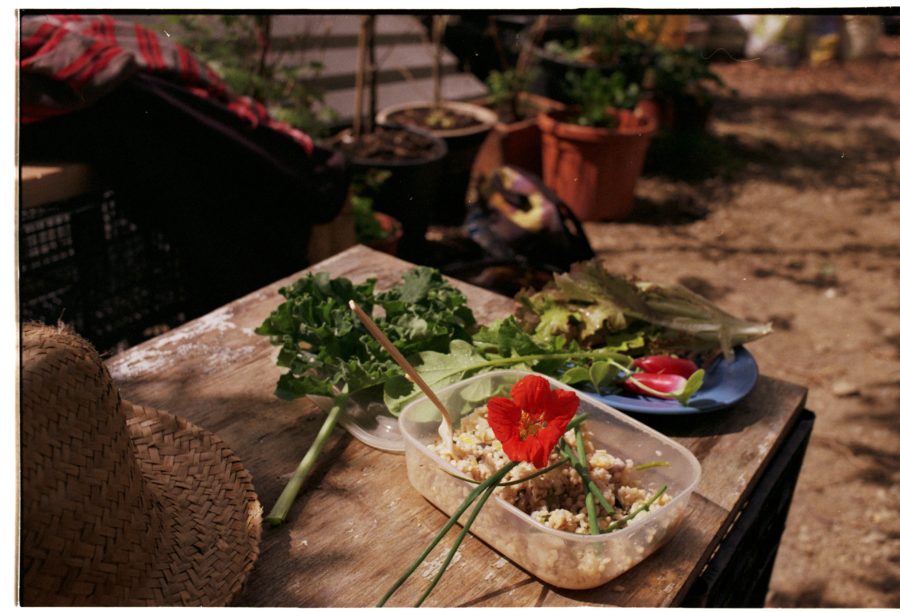
    It is always a good time to start thinking about growing some of your own vegetables!

    Ideally you should begin by building up soil nutrients from November onwards, but if you are starting now and feel you have missed the boat, don’t worry. We are adopting a No-dig method in our garden, which can begin at any time of the year. In this respect our inspiration is the legendary Charles Dowding, whose website and Instagram page offers plenty of excellent free advice.

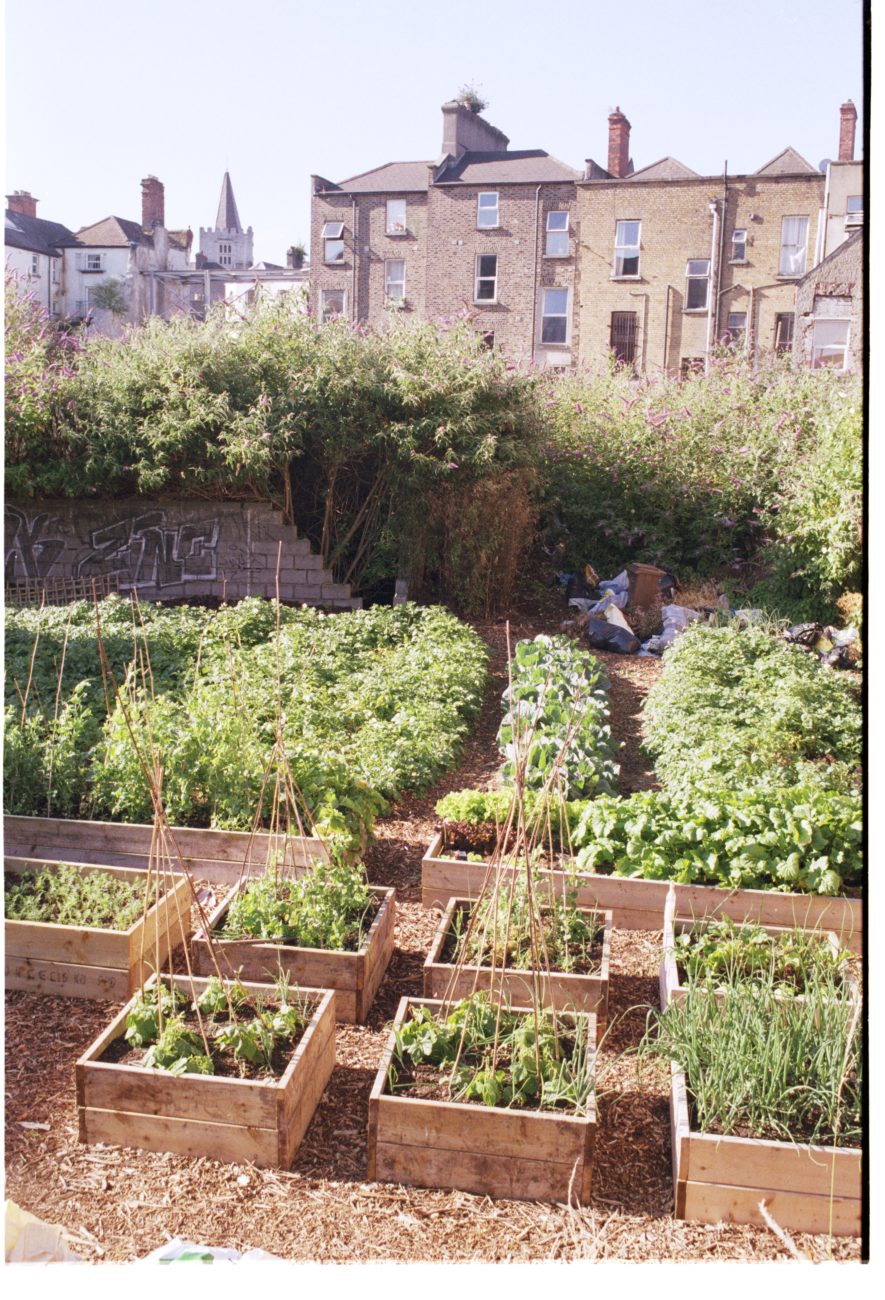
    If your space is limited you can use raised beds made from timber. Even a small concrete yard offers sufficient space. This type of raised bed is ideal for older people who might wish to avoid bending over.

    The main ingredient of growing is good compost, which you can source from local farmers, and elsewhere. To start a bed we recommend gathering lots of cardboard, and spreading it straight onto the ground. Then spread a 10cm layer of compost over this. Beds should be approximately 1m wide, allowing 30cm for pathways between each one. Wood chips give a neat appearance to the pathways, and suppress weeds.

    While your new beds are settling down, start propagating your favourite vegetable varieties in pots and trays of fine seed compost on your windowsills inside. You don’t generally need a rich compost to germinate seeds; heat and moisture are sufficient. You can multi-sow and do successional sowing to have a continuous supply of fresh ingredients throughout the year.

    Those wishing to start an organic farming business, or a just develop partial self-sufficiency, should access networks of independent Irish growing organisations. We highly recommend linking up with an experienced farmer in your area to build a good relationship, and learn where the food you eat is coming from.

    The Organic Growers of Ireland has created a Small Growers Network to help growers who have completed formal training or an internship with them. It is essentially a participatory network that is open to anyone who feels it would be useful. You don’t need much experience to be part of it; what you do need is the enthusiasm required to build up your strength on the farm.

    The Network offers a forum for small farmers to highlight the specific needs of their holdings. It is organised by Jason Horner, founder of the OGI, and monthly meetings are happening in Cloughjordan, with farm walks providing different discussion topics, led by established organic growers.

    Becoming a supporter of Irish Seedsavers helped us get involved in seed sharing and gave us access to workshops and events (including brilliant talks from Mary Raynolds). Apple-tasting days were a highlight. Seed saving is useful to anyone with an interest in biodiversity, increasing the variety of vegetables, and helping bees to pollinate by reducing monoculture.

    The Flower Farmers of Ireland also promote the cultivation, marketing, sale and use of Irish-grown cut-flowers and foliage, and support and act as an advocate for growers.

    We believe the Land belongs to us all. That is why we need to restore natural ecosystems, and put power back into the hands of small-scale producers. At the moment production is dominated by multinational supermarkets, which leads to waste and inequalities. It is time to get up and grow, or at least choose honestly grown local food.

    Other useful links

    The Landworkers Alliance in the UK: Farmer’s organisation

    Via Campesina: International Farmer’s Movement

    European Coordination Via Campesina: European Branch of Via Campesina

    Food Sovereignty Ireland

    We rely on contributions to keep Cassandra Voices going.

  • BREXIT – A Poem

    Once I had finished it I didn’t understand my own poem,
    so how could you?

    There had been a moment when, possessed by a sort of deftness, I had made choices
    about matters such as line length

    but now all that had left me. I was confused.
    The intriguing question is what path led me
    from that bewilderment to my present mode of address.

    This is something which concerns you, so pay attention!

    In a very true sense it is your curiosity,
    which led me, like an umbilical threadworm,
    out of the labyrinth. And here we both are,
    blinking in the sunlight, a bit traumatised perhaps,
    attracting too many flies for our mutual liking,
    but here nonetheless, in whatever space this is,
    field or piazza, over which I am making this address,
    dear Ariadne.

    ­_                      Never doubt, I will come back for you.
    I see now what separates us is a slowly widening stretch
    of crystalline water. These islands are lovely and puritanical.
    They suit your beauty down to a T.

    I’m sorry, have I made a mistake about your name?
    Is this, strictly speaking, European soil?
    Anyway, I must be off.

    Wait for me!

    Alex Winter practised for many years as a barrister and now works in the field of psychotherapy.

    We rely on contributions to keep Cassandra Voices going.

  • Manus’s Further Misadventures

    Jesinta got back in touch with Manus through the internet. Face-book. He had stuck his name and a photo of himself up, and someone from his distant past had got in touch with him. For Manus it was a timely, and much appreciated contact

    He was down in the dumps living in Dublin. An old man from Belfast. No one knew him.

    He had met a few people but they were all far too straight by far for the likes of Manus. Their smug security inherent in the safe lives they had lived. They hadn’t even tried mind altering illegal drugs or reality revealer’s (as his day would have termed them) like magic mushrooms or acid. Their whole outlook on life seemed to be gleamed from viewing television. They had done straight jobs. Lived straight lives. They had never been on the wrong side of the law, been homeless or squatted houses. They had never been beaten by the police or chased through the streets by thugs while the police looked on. They were straights, who believed the straight view of the world as portrayed on the flat screen. They never thought about it, but if pushed they would say they believed there was a democracy in which they could affect social and economic decisions, and a free press which presented them with all the necessary information to make those decisions.

    Then they would describe druggies as ‘delusional’.

    So it was great to have Jesinta contact him on the net.

    The email said ‘do you remember Ingleston common?’,  then there was the name Jesinta and a telephone number. Manus felt all a-glow thinking about Ingleston common free festival. Just the fact that there had been free festivals.

    It had been the early eighties in England. He had been traveling from Stonehenge with a convoy of around fifty vehicles: cars, vans, flat backed trucks, caravans, buses and motorbikes.

    The police had tried to break the convoy up. It had been during the Thatcher years, and the police were all tooled up and pushing for a ruckus, with the drug-crazed, anarchistic rabble the press had daubed the ‘peace convoy.’

    As a show of strength, police in riot gear lined the bridges going over the motorway. Intent on breaking the convoy they blocked the entrances to the motorway stations thereby denying the convoy fuel. A few inexperienced young bucks broke from the ranks and tried driving in to the service stations as ordinary citizens who had the right to refuel at a motorway station.

    They were captured.

    Then the convoy-led vehicles swerved across the motorway and cut out their engines.

    It was mid-afternoon on one of the busiest motorways in England and if the vehicles of the convoy weren’t going to be allowed to refuel and continue their journey then neither would anyone else.

    The police could trash the vehicles and arrest the people but that motorway was going to remain blocked for at least a day. That would cause disruption to an important trading route, and bring media coverage. The police quickly capitulated, allowing the convoy to refuel and escorted them to a piece of common land just outside Bristol called Ingleston Common.

    A woman called Jesinta had turned up on the site. She was working as a prostitute from a massage parlour in the predominantly West Indian area of London known as Brixton. She had told Manus they were both Virgo monkeys, who could be of use to each other. and brought him home to her boudoir, complete with waterbed, mirrored wall and Turkish light fittings. She gave him the cash for a pound of good Jamaican weed, and set him up in the herb business.

    On the day Prince Charles and Princess Di. married Manus sat with Jesinta and the rest of the girls from the toss shop, who celebrated their day off with champagne and cocaine. They mostly listened too reggae and dub music. Prince Fari boasted about ‘heavy manners … Discipline, discipline, heavy heavy discipline.’

    But Jesinta also had some white man’s music, some American country singer who sang about ‘beat the lady’s of fame at the lady’s own game.’ Manus would always remember the line.

    From his twenties Manus could remember many misadventures. Jesinta had featured in a few. Thinking back to those heady lawless days it seemed like a dream.

    The facebook message from Jesinta seemed like confirmation that his memories were real.

    Manus phoned the number and it was her. He had tried to make contact over the years, but like most of his past she wasn’t easy to trace. And here she was alive and kicking.

    She had got her hands on some cash too. She wanted to send him a ticket to come visit and see how she lived now.

    He was overjoyed at the contact. Some kind of continuity to his life. It seemed he had upped and moved on so many times in his life. Cutting off a little piece of himself each time he moved. Contact with Jesinta was like contact with his amputated self.

    So ‘yea Jesinta,’ he said ‘fly us over to Cyprus.’

    She got annoyed that he couldn’t just up and fly over that day. What was the mater with him had he become an old man? So stuck in his routine that he couldn’t just get up and take off. And he had to admit that he was. He had his five-year-old daughter Shirifa. Her wellbeing was his priority and it wouldn’t be good for her if her da just upped and offed.

    He knew then Cyprus probably wasn’t really such a good idea.

    It had been wonderful the contact with Jesinta. The confirmation that someone else shared the same past experiences but bringing that memory back into flesh and blood reality!?

    Jesinta could be generous and kind-hearted, but she was also a difficult enough human being to be around. She didn’t have any reason to love Manus either. Except in the same way that he loved her, as part of the past, as some sort of passport back to the days of rebellion. Days of virtual no go areas for the police in certain sections of cities all over the British isles. Days when people believed they were going to chant down Babylon. Days of free festivals.

    But that whole counter-culture was dead now. Dead and denied. Like it never really existed.

    Manus had, decades before, loved Jesinta and left her but he had seen her a few times since. The last time he had seen her they hadn’t been lovers for at least five years and he had called round out of the blue after a fight at work.

    She was still on the game advertising herself as a mature woman, and she had a punter call. She asked Manus to be quiet while she went upstairs, but then she was back down in two minutes wrapped in a towel asking him if he would come up stairs and fuck her for a bit and she would give him twenty quid. It was a strange scenario for Manus. Apparently the punter was paying extra to have someone else go first.

    Manus would have done it for free.

    But he’d noticed it then as she’d raised her legs up, her flesh getting flabby and he wondered how long she could keep charging men for the privilege of touching it.

    In the year two thousand and eleven, Manus’s last lover had been the mother of his child and she’d been twenty years his junior. But she had shown him the full, viciousness of unconscious youth in the child custody battle and maybe he was ready for a more mature relationship. Hell he was old himself now. Maybe Jesinta and he could be lovers again. She had been twelve years older than him. He wondered if she could still raise her old legs up. Maybe they could laugh at each other’s ailments and still find some sexual pleasure.

    In any event Manus and his daughter Shirifa flew to Larnaca.

    At first sight Jesinta looked like Maria Sabina the mushroom priestess. Sallow skin and greasy grey long hair, flat against her skull. But her body was plumper. Fast food plump. She moved with the slow effort of age that Manus understood although his own body denied all logic and, in spite of its abuse over the years, had remained fairly healthy. He even still had a full head of black hair. And most of his own teeth.

    When Shirifa went to bed the first night Manus and Jesinta sat with each other. They talked of friends who had died. Biker Spider. Phil the beer. Graham Gaskin. Characters from back in the day.

    And then had little to say to one another.

    Manus was not the wild young brave Jesinta had persuaded back to her reservation and she wasn’t the ass with class persona she had been either. She twirled her once luscious dark, now, lank grey hair between her fingers. There was a residual element of coyness in the gesture. But sex didn’t really seem to be an option.

    She was on some prescription mood enhancers and mostly watched T.V. all day. Manus hated that kinda stuff. As Jesinta had thirty years before. He would rather be crazy and unhappy rather than have sanity and happiness as prescribed by the pharmaceutical and media companies. And whatever they were supposed to be doing for Jesinta wasn’t working. She was intransigent and dogmatic most of the time.

    On one particularly bad day Manus and Shirifa had stayed out as long as they could and, too tired to walk any longer, caught a taxi.

    Then there it was on the floor of the taxi.

    A wallet.

    Bunch of fifties bulging out.

    Manus hadn’t the cash to pay for a fortnight’s alternative accommodation for them but there it was just sitting on the floor of the back seat.

    He thought about it. He picked the wallet up and stuck it in his bag.

    When they got home Jesinta was pissed off. They hadn’t stayed out long enough, or they had stayed out too long. There was no pleasing the woman. Manus asked her if she ever had a good day, and she warned him about another crack like that, and Manus was glad he had picked the cash. He was going to need it.

    He took Shirifa out again on the pretext of getting ice cream. He ditched the wallet in some long grass and pocketed the cash. Six hundred and forty euros.

    He felt sick.

    He didn’t like thieving from individuals. Corporations, companies, banks, governments, he didn’t give a toss about, but individuals…. naw it wasn’t cool.

    He was the sort who would need to talk to someone about it too, but there was no one he could tell. He tried to reassure himself that he could spend it on Shirifa, but it still didn’t feel good. He had a crap feeling in his guts.

    Then Jesinta texted to say the police had called by looking for him. Of course the wallets owner had contacted the taxi firm and the taxi driver had given the last fare’s address. Manus could of course still get away with it. The wallet was ditched and the cash was untraceable but …. no. He just wouldn’t be up to it, and the thought of getting arrested for theft while in charge of his daughter in a foreign country sent shivers down his spine. No. He managed to find the wallet in the long grass where he had thrown it, stuck the cash back inside and brought it down to the cop shop. They said he might be in for a reward. He just raised his eyes and shook his head.

    When he got back to Jesinta’s he felt relief and gratitude for all he had. Shirifa slept safely and soundly and Manus sat beside her. As was his habit he tried to scribble down some semblance of a story around his experience. His story told of an old lover, a free-spirited strong woman he had met at a free festival. A woman who would have despised this ugly caricature of herself trapped in some rut of vicious behaviour. The story went on to the point where Manus brought the wallet down to the cop shop, got back to Jesinta’s and felt grateful for what he had. It went on to have Jesinta wake up to all the treasures she had (not least amongst them being visited by Shirifa and her father) and in so doing Jesinta broke the habit of lashing back at all the vicious blows life had struck her. A habit she had carried on with even when life had stopped dealing her vicious blows.

    Manus left his story (like all his stories an effort to get his point of view across), where Jesinta would find it and read it. And find it and read it she did.

    She never admitted reading it, even denying it when he asked her. But she quoted lines and incidents from the story and did try her best for a half a day or so to behave as though she were with friends. People she could be easy with. People who didn’t want to rob or beat or cheat or dominate or belittle her in any way. People who had a sense of respect and even affection for her.

    They all had breakfast in Jesinta’s room. Brushing Shirifas hair, Jesinta explained to the inquisitive five year old what a September monkey and a March rooster were. But it didn’t last much more than half a day before the drugs wore off, or kicked in, or she just slipped back into some mental rut where she had to fight back even though no one was fighting against her.

    Whatever.

    Shirifa and Manus left Jesinta’s a few days later. They had spent three hundred euros and only had two hundred left. They found a hostel which didn’t charge for Shirifa and only charged Manus seventy for the week. They didn’t eat in cafes any longer, or buy nicknacks, or play the amusement arcades. At the hostel Shirifa met a Romanian boy named Matayo. Manus met a French Canadian woman named Mannon.

    Manus called back on Jesinta before they left. Shirifa didn’t want to. Shirifa at five years old still adored her father, and had been thrilled to meet someone from his world. Daddy’s old friend. And Jesinta had disappointed Shirifa. So Shirifa didn’t call back with him but Jesinta wasn’t the worst. Their was a touch of Miss Haversham about her. The hurt bitter twisted touch.

    Manus tried to kiss her before he left.

    He wanted to be affectionate but the only part of her that seemed to be open to a kiss was her hand. This could have resembled a devotee kissing a priestess or a pupil kissing a teacher. He hoped it wasn’t too much like a peasant kissing the hand of the rich.

    Manus was still an old man from Belfast living in Dublin where no one knew him. Most people that he knew from his youth were now grumpy old ones stuck in their ways. Or dead. The dead ones were easier to love. The living were harder to deal with.

    We rely on contributions to keep Cassandra Voices going.

  • ‘Discourse of Pollution’ from the ‘Trump of the Tropics’

    The use of xenophobic language by Brazil’s new president, Jair Bolsonaro, known as the ‘Trump of the tropics’, reinforces a dangerous narrative in which refugees and migrants are portrayed as threats to national security, writes humanitarian worker Bruna Kadletz.

    FLORIANÓPOLIS, Brazil – In his first official visit to the White House, Brazil’s new Far Right President Jair Bolsonaro, declared his support to president Donald Trump´s dehumanising immigration policies.

    Publicly reinforcing dangerous stereotypes of refugees and migrants as threats to national security, cultural heritage and social order he said in an with Fox News on Monday, March 18th: ‘The majority of potential immigrants do not have good intentions or do not intend to do the best or do good for the American people.’[efn_note]Jill Colvin and Peter Prengman, ‘Trump buddies up with Bolsonaro, the ‘Trump of the Tropics’’ March 20th, 2019, Associated Press, https://www.apnews.com/bdc70648e5814d25b549d1c252910006, accessed 27/3/19.[/efn_note]During the same interview Bolsonaro lent support to Trump’s plan to build his infamous wall along the US-Mexico border.

    Such remarks are in line with a growing global anti-immigrant trend, treating refugees as unwanted, and referring them to as potential criminals and threats to stability.[efn_note]Vince Chadwick, ‘The top 10 wackiest anti-refugee remarks’ October 19th, 2015, www.politico.eu, https://www.politico.eu/article/toxic-news-refugees-migrants-eu/, accessed 27/3/19.[/efn_note]

    The Populist language of violence and xenophobia promotes the idea that asylum seekers, refugees and vulnerable migrants pollute societies, contaminating social and economic relationships, and that their presence leaves streets dirty. This normalises confinement in exclusion zones, such as refugee camps, detention centres or ships on dangerous voyages.

    American author and cultural critic Henry Giroux calls this rhetoric the ‘discourse of pollution.’ In the United States, the Trump administration employs it as a form of dehumanization, enabling ‘policies in which people are relegated outside boundaries of justice and become the driving force for policies of terminal exclusion.’[efn_note]Henri Giroux, ‘Trump’s Racist Language of Pollution Drives His Brand of Fascism’, January 9th, 2019, Truthdig, https://www.truthdig.com/articles/trumps-racist-language-of-pollution-drives-his-brand-of-fascism/, accessed 27/3/19.[/efn_note]

    The Bolsonaro administration shadows Trump´s moves and employs the same rhetoric from the discourse of pollution. On entering office, his first major move was to pull Brazil out of the United Nations-led Global Compact for Safe Orderly and Regular Migration, adopted by more than 160 countries in December 2018.[efn_note]UN News, ‘Governments adopt global migration pact to help ‘prevent suffering and chaos’, United Nations Department of Economic and Social Affairs, December 10th, 2018, https://www.un.org/development/desa/en/news/population/global-migration-pact.html, accessed 27/3/19.[/efn_note]‘Not just anyone can come into our home,’ he declared on Twitter. ‘Defending our national sovereignty has been a key part of our campaign and it is now a priority of our government,’ he continued in another tweet.

    Bolsonaro’s views on migrants is consistent with a history of xenophobic comments. In a 2015 interview, he referred to Senegalese, Haitian, Syrian and other asylum seekers arriving in Brazil as ‘the scum of the world,’[efn_note]Alexandre Parrode, ‘Ouça entrevista em que Bolsonaro chama refugiados de “escória” e sugere infarto a Dilma’, September 21st, 2015, Jornal Opcao, https://www.jornalopcao.com.br/ultimas-noticias/ouca-entrevista-em-que-bolsonaro-chama-refugiados-de-escoria-e-sugere-infarto-a-dilma-46313/, accessed 27/3/19.[/efn_note] implying the country had enough problems already, and that they would even pose a threat to the Brazilian Armed Forces.

    On January 6th, he posted a video on his official Facebook page of a Muslim woman being stoned to death. The description underneath reads, ‘Under Sharia law, a woman is stoned to death by many coward Muslims. This is the culture wishing to invade the West and subject us to this aberration.'[efn_note]Jair Bolsonaro Official Facebook Page: https://m.facebook.com/story.php?story_fbid=1340804376068545&id=211857482296579, accessed 17/3/19.[/efn_note]

    The Brazilian government’s xenophobia and decision to walk away from the migration compact signals dark days of hostility, and stricter border controls.

    Refugees and immigrants, seeking protection and better living conditions, are most affected by the discourse of pollution. Instead of having their human rights vindicated, such a point of view increases the vulnerability and fear of refugees and migrants.

    Far Right global leaders seem to think their individual online rantings exist in a vacuum, but their words embed belief systems, and legitimates the behaviour of extremists. For a head of State to say migrants do not have good intentions or are scum is highly irresponsible. Leaders should be uniting people with a progressive vision, rather than exploiting existing divisions.

    This perverse language informs policies which could lead to further exclusion and vulnerability in places from Brazil to the United States.

    Thus, Bolsonaro’s administration poses a threat to refugees’ human rights. If his discourse of pollution brings harsher migration policies, the result could be further xenophobic attacks, hostility and policies of exclusion. That would only accentuate the vulnerability of asylum seekers and refugees in Brazil.

    Violent and xenophobic language can lead to violent acts being perpetrated against refugees and migrants. The recent massacre at the two mosques in Christchurch, New Zealand, of fifty people, is just the latest example of White Supremacy and Far Right terrorism, encouraged by a misleading narrative of refugees and migrants as pollutants that need to be cleaned up.

    In contrast to others, New Zealand´s Prime Minister, Jacinta Ardern, responded to the massacre with courage and leadership. Her compassionate and caring response is a stark contrast to the angry words of Donald Trump, Jair Bolsanaro and others. Only with the power of love can we move forward as a united global community.

    We rely on contributions to keep Cassandra Voices going.

  • The Limits of Law

    ‘What is law?’ This is a fundamental question posed at the outset of any course in the philosophy of law. The standard form of response includes that it is a system of rules, according to a tradition known as legal positivism. Such is a ‘black letter’ lawyer, and Anglo-American approach. This is a product of a tradition of formalism, pioneered by scholars such as Jeremy Bentham and John Austin, and latterly taken up by Christopher Columbus Langdell and H. L. A. Hart.

    In a nutshell it says that if you want to ascertain what the law is then you simply look it up in a statute, or derive it from the interpretation of a case or precedent, and, hey presto, there you have it.  As a lawyer you then arm yourself for battle with this information. Such an outlook matches the common-sense approach of most lawyers. But interpretations of case laws, statutes and constitutions differ. Even within black letter law the meaning of language is never clear. Facts are never exactly the same. Rules are opaque, seen through the looking glass as in Lewis Carrol’s Alice in Wonderland:

    When I use a word Humpty Dumpty said, in rather a scornful tone, it means just what I chose it to mean-neither more nor less. The question is said Alice whether you can make words mean so many different things.[i]

    In fact, the central assumption of certain positivists, such as Hart[ii] that facts are plain, and all meaning is shared, is eminently contestable. It leads to the fallacy within the black letter tradition that law, or legal meaning, can simply be ‘downloaded’ from a case or a statute and technically applied to any case at bar.

    In contrast, the leading rights-driven lawyer, Ronald Dworkin[iii] (in for example Laws Empire, 1986) saw law as a matter of argument, and interpretation. Law and legal meaning are thus intensely creative. He concluded that the best or superior interpretation succeeded – as in Herman Hesse’s last novel The Glass Bead Game – but often this fitted, subjectively, with an overarching liberal agenda. For Dworkin, the right or best answer was always the liberal answer, which allowed his critics to pillory him, arguing his approach was a trojan horse laden with premeditated answers.

    But questions of what law is cede to questions of legal validity. Thus, whether something is there on a statue book, or in a court case, must be related to whether that which is law is itself valid.

    Ultimately an impasse is reached in that legal validity, in order to have normative and thus binding force, cannot simply rely on legal validation. Or to put it more simply, black letter, legal validity must be cross-checked against the moral or ethical quality of any law.

    Nonsense on Stilts

    Thus, the argument runs, in order to be valid black letter law it must also be morally reasonable. This concept is deeply alien to an Anglo-Saxon mindset. It invokes the spectre of supernatural deities and that abomination that Bentham referred to as ‘Nonsense on Stilts’, natural law.

    Ever since Bentham, the architect of legal positivism, English lawyers have frowned and derided such abstract speculation. Within the British intellectual tradition, from Hobbes to Hitchens, the existence of a supernatural deity is either not accepted, or treated with utmost scepticism. Even devout Christian defer to the intellectual wisdom of traditional British empiricism.

    Yet there is still a widely maintained view, of which residues exist even within the British mindset, that in extremis when a law has forfeited all claims to legitimacy it should be abandoned.

    This was also the perception of the reformed German positivist lawyer Gustav Radbruch at the end of World War II in response to Nazism. He argued that once a law abandons all principles of humanitarian morality it ceases to be law. This became known as Radbruch’s formula, and forms the basis of modern human rights instruments and charters.

    Here we approach the kernel of the problem namely, if a law departs from fundamental moral principle should one comply with it; or instead engage in civil disobedience to unsettle and repeal it? Furthermore, should a judge invalidate it on moral grounds?

    Law in Action

    This then throws up the thorny question of morality, a world conjuring images of Baptist street preachers, and public avengers screaming from the rooftops. The moral majority often contends, in Lord Devlin’s terms, that what disgusts the average man on the Clapham omnibus should be declared illegal (see Devlin, The Enforcement of Morals, 1959). But given how many minds are polluted with prejudice that may be a perilous formula.

    Such is the positivist dilemma, and also a pragmatic and realistic one. The view I increasingly lean towards is that it is less important what the black letter law says, as opposed to what are the repercussions of the law.

    As Oliver Wendell Holmes, the quintessential realist, put it: ‘The prophecies of what the courts do in fact are what I mean by the law and nothing else.’[iv] Thus, Holmes maintained there was no law as such until a court had pronounced on the matter. This has morphed into the concept of law-in-action, which is a useful corrective to black letter legal theorising of the ivory tower type.

    It is all well and good to talk about rules, but in the trial and family courts it is not rules but fact, semi-fact, prejudice and bias that condition outcomes. Such technical law as there is contested often is agreed beforehand, and irrelevant to the outcome.

    The question thus becomes: where statute and the practice of the courts is manipulated to favour certain outcomes, what recourse does any citizen have, and what obligation are owed in terms of obedience?

    The Subversion of Subversion

    What are you to do if you are confronted with a corrupt state and attacked personally and professionally by an abuse of process or lack of standards. The current imprisonment and trial of the Catalan leaders in Spain, who had the temerity to organise a referendum trial in Spain is one good example of the distortion of law.

    A number of options are available: you can fight back in a loaded game with predetermined outcomes; comply and sympathise with the plight of your torturers, who are only doing their jobs after all. Stockholm Syndrome must always to be resisted. You can also engage in civil disobedience or write letters to newspapers, or refuse to recognise the legitimacy of a subversive state. Then you may be imprisoned or even murdered either in detention or on the street in plain view, like the Maltese journalist Daphne Caruana Galizia. More likely you will be bankrupted. Such today are the perils of dissidence around the world.

    In practical terms this often means exile is the best option, either as a professional or as a political refugee.

    A place of sanctuary, however, may not provide an adequate haven due to its failure, deliberate or otherwise, to understand the intricacies of the laws of another state. It may feel obligated to comply with reciprocal extradition treaties. Fortunately a court in Schleswig-Holstein refused to extradite the Catalan leader Carles Puigdemont, as it was clear that the charge of violent rebellion laid against him was an abomination. This world is nonetheless increasingly dangerous for enemies of the people: politicians, human rights lawyers, journalists and whistle blowers.

    It leads to the unsettling question of whether, if a state engages in criminali behaviour, is retaliation against a state officials permissible?

    I believe that self-help, disobedience and fighting fire with fire even in an extra-curial sense can in certain circumstances be justified. In general, however, the pen is a mighty counterweight to the sword and a weapon when the legal system no longer functions. The Fourth Estate can still blow smoke up the arses of the establishment.

    This leads to the worrying conclusion that we expect too much from law and that the overlap between law and justice is extremely tenuous. That at least is the case in those states where a crisis of legitimacy is leading to a breakdown in the rule of law.

    Law in societies no longer complying with the rule of law, is whatever works to bring about a desired outcome, which is often the incarceration of the alleged subversive.

    Civilised states at least pay lip service and occasional adherence to justice. Those who believe in legalism and the rule of law, encompassing such diverse figures as the Dworkin, Jurgen Habermas and the late Marxist historian E.P. Thompson, suggest law can be a force to check tyranny.

    As Thompson wrote in Whigs and Hunters:

    But the rule of law itself, the imposing of effective inhibitions upon power and the defence of the citizen from power’s all-intrusive claims, seems to me to be an unqualified human good. To deny or belittle this good is, in this dangerous century when the resources and pretensions of power continue to enlarge, a desperate error of intellectual abstraction.[v]

    The rule of law can, however, only obtain if the legal system has not descended into barbarism.

    Radbruch’s Formula

    As aforementioned, a crucial juristic figure is Gustav Radbruch, both a law professor and government minister during the Weimar Republic. It is often argued that opinions expressed in his earlier writings are positivistic. In 1932 he was a relativist in terms of the question of whether moral standards existed in law. He wrote that a judge had an obligation to uphold an unjust law. The Second World War changed his mind.

    In the famous ‘Radbruch’s Formula’ (Radbruchsche Formel) he argued that where statute law was incompatible with positivist law to an intolerable degree, and if it negated the principle of equality which is central to justice, it could be disregarded. In 1946 he wrote:

    [P]reference is given to the positive law, duly enacted and secured by state power as it is, even where it is unjust and fails to benefit the people unless it conflicts with justice reaches so intolerable a level that a statute becomes in effect false law and must therefore yield to justice … where there is not even an attempt at justice, where equality the core of justice is deliberately betrayed in the issuance of positive law then the statute is not merely false law it lacks completely the very nature of law.[vi]

    Radbruch suggests that where a government’s conduct is intolerable, the statue ceases to be valid. Law and must yield to justice. It was clear for Radbruch that this sense of justice (Gerechtigkeit) was linked to human rights. Thus, in Funf Minuten Rechtsphilosophie he argued for ‘justice as moral equality as applying the same measure to all or guaranteeing human rights to all.’[vii]

    As Hart indicates:

    His considered reflections led him to the doctrine that the fundamental principles of humanitarian morality were part of the very concept of Recht or legality and that no positive enactment or statute, however clearly it was expressed and however clearly it conformed with the formal criteria of validity of a legal system, could be valid if it contravened basic principles of morality.[viii]

    Fuller also argues in oft-repeated quote:

    To me there is nothing shocking in saying that a dictatorship which clothes itself with a tinsel of legal form can so far depart from the morality of order, from the inner morality of law itself, that it ceases to be a legal system. When a system calling itself law is predicated upon a general disregard by judges of the terms of the laws they purport to enforce, when this system habitually cures its legal irregularities, even the grossest, by retroactive statutes, when it has only to resort to forays of terror in the street, which no one dares challenge, in order to escape even those scant restraints imposed by the pretence of legality – when all those things have become true of a dictatorship, it is not hard for me, at least, to deny to it, the name of law.[ix]

    But is the moral answer ever completely clear and who is to judge?

    The Fog of War

    In this respect it is worthwhile considering a fascinating film documentary by Errol Morris about Robert McNamara, called The Fog of War. McNamara was Secretary of Defense under Presidents Johnson and Kennedy, and a man of many private accomplishments. In his documentary he surveys his career through a glass darkly.

    McNamara reveals that as an assistant to the American General Curtis Le May he was responsible for the carpet bombing of Tokyo. He admits that if the US had lost the Second World War, he could have been prosecuted for war crimes. He ultimately concedes he was a war criminal, but his side had won. Victory is not necessarily the victory of the morally just.

    Moral arguments can become even more complex. A recent documentary by Claude Landsman – responsible for perhaps the greatest documentary ever made Shoah (1985) – called The Last of the Unjust traces the life of Benjamin Murmelstein during World War I through a series of interviews prior to his death, alongside contemporary reflections by the director. The moral complexity of Murmelstein, a rabbi to the Jewish community at the Theresienstadt ‘model’ Concentration Camp, is such that he is difficult to place, in the seemingly straightforward narrative of the Shoah, as victim or vector. It is only thirty years later that Landsman revisits the footage.

    The argument of the film is replete with moral ambiguity. As head of the Jewish Council in Warsaw Murmelstein liaised with Adolf Eichmann. Then as leader of the Jews at the propagandistic Theresienstadt he was responsible for maintaining the illusion of happy campers; the salutary consequence was that many Jews were saved from the death camps.

    But many others were sent to the gas chambers from Theresienstadt and Murmelstein was privy to those decisions, and saved his own skin. At the end of the war he was prosecuted but the case was dropped.

    What have I done wrong he asks constantly through the film? Did I not do my best? Did I not do good? What would you have done in the same circumstances?

    Should he have been prosecuted or acclaimed like Oscar Schindler, Nazi War Profiteer, Drunk and Womaniser yet a saviour of the lives, at great personal cost, of over one thousand Cracow Jews, rights beside Auschwitz? Schindler is now buried alongside the Israeli hierarchy in the national cemetery in Tel Aviv.

    Conclusions

    Thus, even the invalidation of laws based on morality creates problems. So, in summary, what can be said about law, legality and morality?

    1. That judges should adhere to the process of legality and avoid bending the rules to suit the interest of those who appoint them. They ought to be independent, and not subject to political pressure or motivated by dogma.
    2. That justice must be blind to class or colour, and neutral and dispassionate. Show Trials, such as those going on in Spain today, reveal the mob ascendant.
    3. That judges ought to jettison strict adherence to black letter outcomes, unmitigated by flexibility.
    4. That the judiciary and fact finders must be committed to the process of truth elicitation and non-fabrication.
    5. That in extreme circumstance of an immoral legal code or state-sponsored illegality, a judge should reserve a discretionary right to strike down a statute or a precedent.

    Perhaps people have too much faith in the law and indeed lawyers, but in our times a faith in justice is one of the few things to hold on to.

    A just system is one administered by independent-minded gatekeepers of flexibility, motivated by principle and not corrupt or politically compromised. Fortunately there are many such judges left in the UK.

    We rely on contributions to keep Cassandra Voices going.

    [i] Lewis Carroll, Alice Through The Looking Glass, Chapter 6, 1871.

    [ii] A. L. A. Hart, The Concept of Law, London, Clarendon Law Series, 1961.

    [iii] Ronald Dworkin, Laws Empire, New York, Belknap Press, 1986.

    [iv] Oliver Wendell Holmes, The Path of the Law, 10 Harvard Law Review, 1897 457-58

    [v]  E.P. Thompson, Whigs and Hunters, London, Allen Lane, 1975, Appendix 1.

    [vi] Gustav Radbruch, Five Finutes of Legal Philosophy, 1945

    [vii] Radbruch Gesetetchiches Unrecht Und Bergesetiches Recht Sufddeutsche Juristrazeitung (1946), p.107

    [viii] A. L. A. Hart, Positivism and the Separation of Law and Morality, vol 71. 1984, p.617.

    [ix] Lon L. Fuller, Morality of Law, 1964, New Haven, Yale University Press, 1964, p.660.