Blog

  • Containing Strife – Professional Ideals in Law and Mediation

    Perhaps we can agree on this much: conflict is intrinsic to the human condition. We are desiring creatures. Our needs and wants rub up against those of others. Add in an event of intensification: a road accident, a perceived act of negligence, breach of commitment or betrayal of trust. Then there arises anger and its close relative, blame.

    Many such situations can be framed in legal terms. We have codes to regulate how people ought to behave. A breach gives rise to the possibility of redress. Often, however, we may observe what looks like a complex legal dispute, but that is not at the heart of the matter.

    As a lawyer I worked for months on the blowout of a large and successful business partnership that engaged several large law firms, and various court proceedings. Yet it was never clear why the parties had fallen out. I heard it suggested that the root of the trouble was the slighting by one partner of another’s wife. There is also the phenomenon of ‘grief to grievance’. People in heightened emotional states are more prone to disagreement and finding fault.

    Because we are generally disabled by our conflicts, it can suit us to delegate their resolution to people trained for that purpose. ‘You will be hearing from my solicitors!’ Those are the experts who know what remedies are obtainable, or how far our interests can be pushed.

    II

    The work of lawyers is considered that of a profession. To call an occupation a profession suggests a difference from other ways of scratching a living. There is, in origin at least, the suggestion of  calling or vocation.

    That said, professions have their own associated pathologies. George Bernard Shaw fashioned the line that ‘every profession is a conspiracy against the laity’. Adam Smith famously wrote in The Wealth of Nations that ‘People of the same trade seldom meet together, even for merriment and diversion, but the conversation ends in a conspiracy against the public, or in some contrivance to raise prices.’

    I want to focus for a moment on the nature of professional legal work in litigation and dispute resolution before considering the emerging profession of a mediator.

    The question arises now, whether there is a useful distinction that can still be drawn between a profession and a business. One hears a complaint in recent years that the law has become just one more business. Indeed promotional advertising addressed to the business community often makes a virtue of this development, suggesting that legal firms have a better understanding of the needs of business as a result of being, so to speak, in the same boat: ‘We are [firm XY], where law means business…’.

    What are the distinguishing features of a profession? Generally, one finds an insistence on codes of practice which its members must adhere to. Since lawyers hold a monopoly on the workings of the justice system, their conduct is heavily regulated. By contrast, persons working, say, in the IT sector will have to comply with relevant law applicable to that activity, but will not be subject personally to regulation as to how they conduct their business.

    Another aspect is that professional work seems to involve a higher degree of responsibility for the welfare of the person to whom services are supplied. It should not be a case of profit maximization, of caveat emptor. The expression ‘client’ rather than ‘customer’ indicates a different standard.

    Admittedly, much legal work performed in modern conditions, such as that associated with purchase and sale of property, or construction or corporate mergers or acquisitions might be considered as, simply, one more business. On the other hand, work in handling civil disputes can more readily be seen to have a more significant professional element, especially if promotion of a more peaceful, less strife-ridden society is to be seen as a public good.

    The idea of a profession would also suggest some level of restraint as regards charges, as opposed to ‘what the market will bear’. The historic appendage of a cloth purse till attached to a barrister’s gown, into which a couple of guineas could be slipped unbeknownst to the noble advocate may attract derision, but there is some kind of echo there, however faint.

    Within a law firm, it is hard to justify the use of fee targets for practitioners in dispute work if the social aim is to encourage expeditious settlement. Any scheme to base remuneration or bonuses on such targets would surely be suggestive of a Faustian bargain.

    One would also expect a measure of restraint as regards marketing of professional services which would not be applicable to pure business. This is a difficult area because lawyers have to take account of what competitors are doing. Yet a young solicitor observed to me rather sadly: ‘I was brought up to believe the fee follows the work, but now it seems the work follows the fee’.

    III

    A distinguishing feature of professional work is that it attracts the expression ‘practice’ as a description. There is a whole field of philosophical commentary as to the nature of ‘practices’ and their contribution to society. The philosopher Joseph Dunne has illuminated this subject. His words can offer an inspirational ideal for professional practice.

    A practice is a coherent and invariably quite complex set of activities and tasks that has evolved cooperatively and cumulatively over time. It is alive in the community who are its insiders (that is to say its genuine practitioners) and it stays alive only so long as they sustain a commitment to creatively develop and sustain it – sometimes by shifts which at the time may seem dramatic and even subversive. Central to any such practice are standards of excellence, themselves subject to development and redefinition, which demand responsiveness from those who are, or are trying to become, practitioners.

    Engagement in the characteristic tasks of a practice, which embody standards that challenge one in so far as they are beyond one, leads, when it goes well, to the development not only of competencies specific to that practice but also of moral qualities that transcend it – that characterize one not just as a practitioner in that domain but as a person in life. 

    He adds that a thing worth noticing about what may be called the economy of a practice is that it is not based on scarcity. Thus if one person excels it need not be at the cost of the other people’s chances to develop their talents. He concludes that ‘Every achievement of excellence enriches all those who participate in or care about a practice; it can be an occasion for admiration or even celebration as well as sometimes, of course, for attempts at emulation.’

    What is spoken of here, of course, is practice at its very best, but to express the ideal is to provide some yardstick by which particular work settings can be judged.

    IV

    What then of the newly emerging profession of mediator, an activity recently given status in Ireland as a result of the Mediation Act 2017? This Act, which envisages the establishment of codes of conduct for mediators, had a lengthy gestation, starting with a consultation undertaken by the Law Reform Commission nearly a decade ago.

    The main impetus has been dissatisfaction with the standard model of litigation, built as it is on adversarial confrontation, and correspondingly high costs. There is increasing resistance to what is labeled as ‘binary’ thinking, and promotion of what is termed a ‘non-dual consciousness’. The mediation model asks parties to recognize that they have a shared problem.

    Patterns of practice in mediation are still emerging. Those who have engaged in this work for many years can be heard to complain that lawyers are wanting to take over the field, and to run mediations as if conducted on a practice ground so as to play out what a courtroom outcome would look like.

    The kind of intellectual activity associated with intensive legal work – what a neuroscientist might classify as left-brain-activity, may be necessary to provide an understanding of a case that has proceeded along the litigation path, but the actual work of mediation calls for capacities more associated with the right hemisphere of the brain, and recourse to intuition.

    It is notable that the Mediation Act requires solicitors to give advice on the mediation option before legal proceeding can be commenced. The essential innovation introduced by the mediation alternative is not the arrival of the mediator on the scene, but a decision by parties in conflict to face each other to discuss their differences. This opens the possibility for value added in the engagement of a third party to facilitate the process.

    I suggest that mediation reaches its full potential when the mediator is able to bring to the table a certain capacity that may be called a ‘presence,’ a personal stillness that is evident even in a highly charged setting. This attribute will be hospitable to the parties. It will also support what may be considered the particular ‘magic’ of mediation, a feature unmatched in the adversarial legal system. This is the right of a mediator to have confidential discussions with each party to the conflict. To the degree that the mediator’s energy is sufficiently receptive, a party will be encouraged to be frank in such meetings, to look at both sides of the case, and to recognize their own share in creating the conflict.

    The kind of energies called for in mediation are exactly opposite to the driven, ‘weaponised’ environment associated with legal processes. The quality of presence that I have referred to is not beyond anyone working in dispute resolution, but it needs to be cultivated. For some this may mean consistent Zen meditation or yoga or like practices (the body is always present), or long walks with the dog. A certain spaciousness is called for.

    To imagine that what is called for in mediation is a mere brokering role, or knocking heads together, is to misconceive the potential. And mediators need to remember that reference to what it might cost to have a legal case run through the courts’ system is a poor yardstick with which to measure the value of the service.

    ********

    A younger colleague who worked with me, who was generally considered to have ‘got’ mediation observed that she had come to realize that ‘mediation is mostly about doing nothing’.

    But then, as we know, a certain kind of non-doing can be very powerful.

    And as to selling the mediator’s expertise, there is a wisdom in the story of the famed Rabbi who consoled a young colleague disappointed at how few people were seeking his advice: ‘They come to me’, the great man said, ‘because I am astonished that they come, and they do not come to you, because you are astonished that they do not come’.

    Fergus Armstrong is a mediator and former lawyer: www.oneresolve.ie

    Feature Image: Maggie Armstrong


  • B Road Blues

    Born by the river, out in the sticks

    I was born on a bend on the Forty Eighty-six


    Making old friends, Rubicon tricks

    Much still to fix on the Forty Eighty-six


    Romans rode here, hear the hoof clicks

    Some see their ghosts on the Forty Eighty-six


    Journey’s the same, the dead and the quick’s

    Cutting through the mist on the Forty Eighty-six


    Executor, executrix

    Fresh eggs for sale on the Forty Eighty-six


    Love lasts forever, young love pricks

    Some are still searching on the Forty Eighty-six


    Stone and timber, timber and bricks

    Much to remember on the Forty Eighty-six


    Stacks with plenty, plenty with nix

    Weather unrelenting on the Forty Eighty-six


    Players pretend with frantic theatrics

    Not just teenage kicks on the Forty Eighty-six


    They fought before with axes and picks

    Fought a Civil War on the Forty Eighty-six


    The pain they pray is the lame and the sick’s

    May one day fade away on the Forty Eighty-six


    Some are flame throwers, swear like Bill Hicks

    Others grow church flowers on the Forty Eighty-six


    Hat-tricks won, missed penalty kicks

    Dislocating hips on the Forty Eighty-six


    Life ain’t a sweetshop just selling Twix

    It’s a big ol’ pic’n’mix on the Forty Eighty-six


    Simon called Peter, Richard’s nicked Dick’s

    Some names are made on the Forty Eighty-six


    Magicians vape smoke with their cash and card tricks

    Magic’s still a secret on the Forty Eighty-six


    Some write with quills, sharper than Bics

    Slanty-id italics on the Forty Eighty-six


    A thief may never know from whom he nicks

    Flash cars flashing past on the Forty Eighty-six


    Ringing guitars’ lickety licks

    Bending like Hendrix on the Forty Eighty-six


    Choose party sex over party politics

    Horny Burke’s dilemma on the Forty Eighty-six


    Peace wind blowing Vulcan aeronautics

    Once heroed Hurricanes on the Forty Eighty-six


    Hellfire statistics, bullet ballistics

    But now bombs won’t win wars on the Forty Eighty-six


    Some speak the truth, some speak synthetics

    Some don’t speak at all on the Forty Eighty-six


    Birds and beasts, lambs and chicks

    Nature’s an engraver on the Forty Eighty-six


    No slow runners, torched Olympics

    Silver, bronze, gold on the Forty Eighty-six


    Carabosse dusk dirt-track dominatrix

    Allsortsa country matters on the Forty Eighty-six


    Peacock feathers flair in fancy flicks

    Pride falls like darkness on the Forty Eighty-six


    Ain’t surprised the dead get more crosses than ticks

    Many miles of road on the Forty Eighty-six


    Paul Curran was born in Stratford-upon-Avon in 1975. He holds a degree in English Language and Literature from the University of Oxford and a Masters Degree from the Royal Central School of Speech & Drama. He has worked widely as a professional actor. His Only Sonnet loosely follows the pattern of the seasons, comprised of 100+ ‘alternative’ sonnets; Repeat Fees and its 80 sonnets and longer poems was published in July 2017.

  • Song Shorts

    “Iggy‘s not coming for lunch?” asked Ron.

    He tasted his breathe while talking, it smelt surprisingly of milk.

    “Need to get a shower,” he said.

    A television was blinking upstairs. The automatic shutdown announced the television will be black in few minutes. Iggy was lying on the floor looking at the ceiling.

    He started figuring out what happened. Once again he put his dreams against reality. His stupid nature against facts. He thought about her as just a woman now. She could not have been a real woman. She was a symbol. She was definitely a sign of a possible redemption. My little China girl, you wore a beautiful uniform sitting straight on your back at the restaurant. Cheering discreetly. But redemption never arrives by chance. You have to work on it and even then there are people who will never find a proper one. There are simply people who needs to be against the wind at 300 km/h. I gave you a different room every night, so you would have never felt bored. I gave you the best wines with the most complicated aromas. I gave you the biggest television ever. But you see, the redemption I’m used to tends to collapse easily. And so it did. I need to be against the wind at 300 km/h. And I ruined everything you are. We’re people used to chewing other people, you know.

    The table is broken in the middle and unfortunately it’s my fault. When you cannot control your feelings and – more than everything – your fucking movements, those kind of things happen.

    Iggy stood up. Then he jumped twice as if there was an imaginary rope                           “No headache,” he said to himself.

    “ There is no point in telling the whole story…,” he said “it’s quite intellectual.”             “ What do you mean?” Ron asked.                                                                                                       “ I mean, not good things for us. Kind of painful.”


    WAITING FOR THE MAN_ VELVET UNDERGROUND

    https://youtu.be/hugY9CwhfzE

    It’s freezing and the rain is coming through my shoes. I’m standing at the corner in Lexington and I need to shit. I wait here like a street lamp with money clutched in my hand. He will be here in few minutes, sick as dawn. Then I will shit somewhere. I need to control the needs of my body and establish an order. But it’s going to be hard. Because everything makes me want to shit. Bricks are reflecting rain. Grey is everywhere. There is a prostitute on the other side of the street. I suppose she’s a prostitute. I hope, otherwise I can’t imagine why is she standing there. She’s young, she could be seventeen or eighteen. She doesn’t look particularly sick: she’s just waiting for something, trying to follow the right order of things. I need to shit.

    I start to think about God. I need a real God that fixes things, a fat reliable God living on my shoulders. It’s incredible how humans can build totally depressing spots. It’s fucking bad to be here. Your life is a guinea pig life without a wheel or anything like it. I need to shit. And a God, for fuck’s sake. I want to feel his dry breath behind me.

    No way. This idiot is never on time. Who is he? I don’t mind, I just have to be on time for him. But he shows no respect, no fucking respect. Twenty-six wet dollars clutched in my hand. Yes, we really have the worst Gods ever in this place. Never on time. Then the prostitute crosses the road. She’s coming towards me, slowly. Despite the rain her make up is really solid. It seems that you need to shit, she says. And she stares at me. Then her hands go through her bag and she shows me a small paper box. It’s brownish and dry. She reminds me of someone I met in school. Remember that you need to shit, she says. Luanne? I ask. She nods her head. I give her twenty-six dollars, it seems the most obvious thing. I open my hand with my crumpled twenty-six dollars. She takes them and puts them in a bag without even looking . I’m sure I have already seen her. She looks younger than seventeen or eighteen. But she could easily be in her thirties as well. And she’s so fucking dry.

    Are you waterproof? I ask. Sure, she answers.

  • Spain on Trial

    Writing in The Observer in 1961, Peter Benenson lamented that ‘in Spain, students who circulate leaflets calling for the right to hold discussions on current affairs are charged with ‘military rebellion’.’

    So what? You may ask yourself – that was 57 years ago under the Franco dictatorship. But that’s the point: six decades later in a liberal democracy, dozens of people in Spain have been charged with crimes such as ‘sedition’, ‘rebellion’ and ‘terrorism’ for offences such as blocking roads and bar fights with off-duty police officers.

    Benenson, who used his article as the launchpad for founding Amnesty International, added that ‘no government… is at greater pains to emphasise its constitutional guarantees than the Spanish, but it fails to apply them’. This observation rings true today, where the Spanish government and Madrid-based media react with apoplexy at any criticism of Spain’s handling of the Catalan crisis. Spain, they argue, is a modern and mature democracy with separation of powers and legal guarantees.

    By coincidence, the Spanish government’s recent travails with Catalan separatists have coincided this spring with the trial of eight youths from the highland town of Altsasu in Navarre. With about 7,500 inhabitants, it’s typical of the middling market towns that make up the Basque nationalist heartland straddling the Franco-Spanish border.

    5am bar brawl

    In October 2016, the youths became embroiled in a 5am bar fight. The two men they tussled with were off-duty police officers: one of whom suffered a fractured ankle. State prosecutors allege that the youths knew this and that it was an intentional assault; that they sent text messages to others to join in. The eight were arrested and transferred to Madrid, where three have remained ever since awaiting trial without bail.

    If convicted, they face sentences of between 12 and 62 years on terrorism-related charges. It is instructive to set out the draconian penalties just one, Oihan Arnanz, faces. Eight years for terroristic public disorder; two years for attacking agents of authority; eight years for non-terrorist lesions; and twelve-and-a-half years for making terroristic threats.

    Needless to say, the case has caused consternation in the town and wider Navarre. Locals feel the proposed sentences excessive and vengeful. Baltazar Garzon, the judge who earned fame for trying to extradite former Chilean dictator Augusto Pinochet 20 years ago, has claimed the trial ‘trivialises’ genuine terrorist offences and should never have gone beyond a circuit court.

    Human rights charities such as Amnesty and Fair Trials have criticised the use of anti-terror laws to deal with a bar brawl – which would lead to sentences of up to 60 years for a fractured ankle. To further highlight the absurdity of the charges, Rafa Mora, a Spanish reality TV star who was involved in a bar fight with off-duty police officers was fined €300.

    Ministers have openly commented on the trial. The Interior Minister has tweeted that the testimony of one of the officers was ‘disturbing’; meanwhile the conservative news website El Español has labelled the accused as the ‘children of hatred’, and the formerly liberal El País has described Navarre as a society that is ‘hostage to xenophobia’.

    Yet at the end of the trial, the judge finally allowed evidence from the defence that contradicted court testimonies by the victims and police officers on the scene. In mobile phone footage, one of the victims is seen pacing about outside the pub in a spotless white shirt – despite claiming to have been stamped on and kicked on the pub floor during the attack. The prosecution’s response was to suggest the footage had been edited, and summed up: ‘What we are seeing is fascism in its purest state by the Basque supremacists.’

    Brute force

    A short distance away, in another Madrid courtroom, hearings were taking place for an undoubtedly bigger event: the trials against the more than two dozen Catalan nationalists accused of ‘misappropriation of public funds’, ‘sedition’, ‘rebellion’ and ‘terrorism’.

    This case has received far more international coverage because of the shocking images of Spanish police beating would-be voters in the unconstitutional independence referendum called by the Catalan regional government on October 1, 2017.

    Rebuffed by the central government in Madrid after years of at attempts to negotiate a referendum, the nationalist-controlled regional executive decided to throw down the gauntlet. Quim Arrufat of the hard-left separatist CUP party telegraphed the strategy a year in advance: ‘A unilateral independence referendum would show up the undemocratic contradictions of the state, not just to our people but to the world; so that it resorts to some type of legal or even brute force.’

    The inflexible PM Mariano Rajoy took the bait and sent in the stormtroopers. Since then, Madrid has been reeling, especially as half a dozen of the accused have fled to other jurisdictions and extraditing them is proving to be far from straightforward.

    The lack of violence by the nationalists is the elephant in the room, though it hasn’t stopped the Madrid press from talking up the ‘violence’. It means that the legal case against them is, at best, flimsy. So flimsy, in fact, that a German court took fewer than 48 hours to reject as ‘inadmissible’ the charges of violent rebellion against Carles Puigdemont, the deposed Catalan president who was arrested in Germany on a European Arrest Warrant. It was a double humiliation for Spain: the court took two days to reject six months of legal work by Spanish prosecutors and it also questioned, by implication, the quality of the rule of law in Spain. 

    German hostages

    The result has been a spike in anti-German rhetoric by politicians and the Madrid-based media. The more restrained criticism was that it was an insult for a regional German court to rule against Spain’s Supreme Court, while the more volatile have called the decision ‘racist’ and suggested that ‘there are 200,000 German hostages in the Balearic Islands.’

    Meanwhile, El Español ran a piece on the Schleswig-Holstein’s ‘Nazi heritage’ – helpfully illustrating it with a triptych of mugshots featuring Puigdemont and Nazi war criminals. Germany’s embassy in Madrid was also on the receiving end, with 4,000 messages arriving per day, ‘many in an insulting tone’, to complain about the tribunal’s decision.

    Not ones to let the politicians, media and ordinary public make all the running, Spain’s Supreme Court also weighed in by accusing the German tribunal of a ’lack of rigour’. It also claimed, somewhat cryptically, that had police not intervened on referendum day, “it would have been very probable that a massacre occurred”. It didn’t specify who would have perpetrated the ‘massacre’. Nor did it explain the legal basis for a hypothesis of a crime that never took place actually being a crime. But this fits in with the Orwellian nature of the whole ‘violent’ rebellion charge: In their arrest warrant prosecutors blame the Catalan leadership for inciting civilians for violence on the part of the police, saying that ‘a gathering of approximately 250 people…impeded the access to the polling station…generating the aggression of the officers who intervened.’

    Siege mentality

    The Schleswig-Holstein ruling and the difficulties Spain has encountered in extraditing wanted Catalans from Belgium, Scotland and Switzerland, coupled with what it perceives as unfairly hostile media coverage abroad, has led to a siege mentality. It cuts to the bone even more so because the nationalists are routinely portrayed in the Madrid-based media as xenophobic putschists and even Nazis. Apparently, it doesn’t enter their heads that anyone could characterise them any other way.

    Narratives against Catalan nationalism are so widespread that Spain’s paper of record, El País, has taken to comparing Pep Guardiola, the Catalan manager of Manchester City Football Club, with Joseph Goebbels while pumping out op-eds labelling him a ‘liar’. Guardiola is, of course, a Catalan nationalist and delighted to make the point at every opportunity. It’s not just the media who are hounding Guardiola: his family has been subjected to official harassment with his private jet searched and a car his daughter was travelling in stopped by armed police and searched.

    The media and Twitter are alight with anger and dismay at reports in The Times – whose ‘Spain Again’ editorial got under the skin of quite a few – Le Monde, Washington Post and Der Spiegel criticising Spain. The message being put out is that it is Spain itself on trial, when it should really be the seditious Catalan putschists.

    The mainstream media bristles at this questioning of Spain’s democratic credentials; that Spain’s judiciary is a tool of government policy; and that anyone could think there are ‘political prisoners’ in Spain. They suggest that Spain is once again the victim of ‘black propaganda’ and characterised as Franco-landia.

    As the ultraconservative paper, ABC, put it: ‘On the other side of the Pyrenees, the image of an inquisitional and underdeveloped Spain, pseudo-African and intolerant, is as alive as ever.’

    Lashing out like that is an example of what award-winning writer John Carlin – who is half-Spanish – calls the ‘insecurity’ of Spanish nationalism. Carlin experienced first-hand the backlash against foreign criticism when he was sacked by El País after two decades as a columnist, for criticising the handling of the Catalan crisis. ‘I do not support separatism,’ he told Catalan news site Vilaweb, ‘But that is not enough. You must absolutely scorn secessionists, almost hate them and systematically disrespect them in a visible manner.’

    And Carlin is not alone. Another half-Spanish journalist, Tom Burns, was on the receiving end of a reporter’s ire in a recent El Mundo interview, after he bemoaned police brutality. Asserting that it was a journalist’s job to report the truth, the reporter asked: ‘Why are foreign media portraying Spain as a Francoist country, without separation of powers?

    In tatters

    While the Schleswig-Holstein tribunal gave short shrift to allegations of ‘violent’ rebellion, it asked for more evidence to back up the claims of misappropriation of public funds. But as German magazine Der Spiegel revealed: ‘In their arrest warrant, the Spanish checked the box for corruption but there was no reference in the warrant text indicating that any corruption had occurred.’

    Despite a lack of fundamental evidence to ground the charge, the German court nonetheless sought further particulars, leading Der Spiegel to conclude: ‘the Higher Regional Court ruling was still too merciful with its treatment of the Spanish arrest warrant.’

    While the rebellion charge against Puigdemont is in tatters other Catalan leaders remain in Castilian jails awaiting trial. The former still faces a maximum eight years on the misappropriation charge, although this is seen as insufficient punishment for daring to declare independence.

    But even this is at risk after a bombshell interview by Spain’s finance minister, Cristobal Montoro. El Mundo, the conservative paper he spoke to, didn’t even lead with the claim, preferring to headline on a nothingburger about Rajoy. But his comments were picked up by the Catalan press and the lawyers of the accused.

    Montoro was only repeating what he and PM Rajoy had told Parliament in February: ‘I don’t know with what money they paid for the Chinese ballot boxes,’ he said. ‘But I know it wasn’t public money.’ At a stroke, the man pulling Spain’s purse strings had discredited the prosecutors and police investigators, who, while admitting that they have been ‘unable to determine’ how the referendum was paid for with public funds, claimed that up to €1.9m was misused for such ends. It appears the police have found invoices but have been unable to establish that they were actually paid as no monies were debited to accounts.

    It’s hard not to overstate the anger at Montoro in the Madrid press. Terms such as ‘clumsy’, ‘irresponsible’, ‘unforgivable’ and an ‘own-goal’ were among those that made it to print. Some even thought he was covering his back and called for him to resign. The previously hawkish finance minister is now a marked man, seen as an enabler of putschists.

    Is this a case of a politician being savaged for telling the truth? The police reports are full of holes. The interior minister has admitted that police quadrupled the number of injuries they received while beating would-be voters and, incredibly, the chief leading the investigation has been tweeting about it under the name Tacitus, disparaging the Catalan leaders and making accurate predictions about the legal process, a habit the justice minister Rafael Catala shares. So much for the separation of powers.

    Lack of credibility

    Nowhere is the lack of credibility in police claims more obvious than in the case of the ‘village’ of Sant Esteve de les Roures. A report on Catalan ‘violence’ on referendum day detailed this hamlet as being particularly vicious, with brutal attacks on police officers. Someone spotted that there is no such town and, in the only witty moment of this whole saga, created a Twitter profile claiming to be the town hall.

    They then trolled the police for a month. But, amid the laughs, the fact that the police fabricated violence against them appears to have been forgotten.

    Of the 315 acts of ‘violence’ in that dodgy dossier, almost 200 were nothing more than road blocks in which nobody was physically hurt. But in the current climate, where jeering the national anthem is considered ‘violence’, anything is talked up to support the extradition of Puigdemont & Co.

    Another to bear the brunt of this hyperbolic definition of ‘violence’ is Tamara Carrasco, a 32-year-old Catalan nationalist activist, alleged to be a leader of the Committees for the Defence of the Republic (CDR). She took part in the blocking of a motorway and was charged with terrorism and rebellion. State prosecutors labelled her ‘a clear threat to the established constitutional order’, who carried out ‘acts of rebellion, aimed at normalising disobedience and confrontation with the state, bringing the Catalan sovereignty process to the streets with violent acts’. In a rare outbreak of common sense, the judge dismissed the charges and settled for disobedience. The State has appealed.

    While it would be churlish to compare democratic Spain with Apartheid South Africa, it does bear an uncomfortable similarity in one respect: the use of exaggerated, even spurious, criminal charges to punish and put away for a long time political, to use Benenson’s phrase, non-conformists – and to send a warning to anyone who might think of emulating them. Nelson Mandela, remember, was charged with four counts of sabotage and conspiracy to violently overthrow the government, and served 27 years in jail.

    The Parliamentary Assembly of the Council of Europe has five criteria for defining a political prisoner. Arguably, all of these apply to the Basque youths – though the Spanish government will point to the caveat that ‘those deprived of their personal liberty for terrorist crimes shall not be considered political prisoners’ – and Catalan politicians and activists, meet three of these, without the aggravation of terrorism.

    Slap in the face

    So, why the outlandish accusations? Well, as in Stalin’s Russia, it makes for a better show trial. But the real reason is that they prefer to lock away Puigdemont & Co for decades rather than eight. The same goes for the Basque youths.

    The Spanish government has been caught flat-footed by the tenacious and tricky Catalan leadership. From being goaded into the PR disaster of sending in police to beat voters to the escape by some to other countries – which has required embarrassing extradition hearings that have humiliated Spain’s justice system – Madrid has looked ham-fisted and authoritarian.

    The problem has been that the government has only one strategy: criminalisation. It worked against ETA terrorism but is proving ineffective against peaceful Catalan nationalism. Hence the constant need to portray Catalan nationalists as xenophobic putschists, which bears similarities with the Russian propaganda campaign against Ukraine.

    It’s likely that the Catalan nationalists expected such a response to their antics. They have always seemed to be one step ahead of Rajoy and his ministers. Even when it looked like they had suffered a setback in Puigdemont’s detention in Germany, the Schleswig-Holstein ruling ended up being a massive slap in the government’s face.

    With no legal mechanism for achieving independence while the government in Madrid refuses to negotiate, the only hope Separatists cling to is that the EU will force Spain to the table. But so far other European powers has shown no inclination to do so, lamely claiming that it’s an ‘internal matter’. Naturally, Madrid rejects the idea out of hand. Foreign Minister Alfonso Dastis said that ‘mediation through a third party would be a victory for Puigdemont.’

    Separatists must either tempt the government into further repression or ‘internationalise’ the problem. In other words, put Spain on trial. The Spanish government’s draconian response to a political impasse and amateurish attempts at securing extraditions have drawn the eyes of Europe to a justice system that appears to be at the beck and call of the government.

  • The Subversion of Subversion

    Professional experience as a criminal lawyer has shaped my appreciation of the interplay between political subversion and its criminalisation. I have observed how real subversion often emanates from those state authorities inflicting punishment against the supposedly subversive.

    This has come into sharp focus since a German court declined to extradite the deposed Catalan president Carles Puigdemont on foot of an arrest warrant requested by the Spanish government. Puidgemont is alleged to have used the public purse to fund the referendum, this despite Spain’s Prime Minister Mariano Rajoy actually admitting to parliament that he had not done so. Nonetheless, he faces the charge of rebellion in Spain carrying a prison sentence of up to 30 years, despite the non-violent approach. Fortunately, the German court decided that the offence was not the equivalent of treason under German law, which requires actual violence.

    Subversion is deviation from a social construct or norm and, of course, a positive law. But the norm or law may in itself be morally fallible or sanctionable, and even subversive, an understanding state authorities generally refuse to permit.

    In staging the referendum, Puidgemont was initiating a measure for which he received an electoral mandate from a large proportion of the Catalan people. The Spanish government responded in a manner that suggested it was reacting to a violent uprising, when there was no such thing. State violence is ongoing.

    Spain has long been an aggregation of regional entities run from the centre, often in autocratic fashion. Under the Franco dictatorship (1939-75) non-Spanish identities were actively suppressed. Many inhabitants of the Basque country and Catalonia now regard themselves as belonging to distinct nations. Catalan separatism is not purely atavistic nationalism however, it also flows from a shared belief in republicanism, socialism and anarchism, and a repudiation of the political heirs of Franco operating in the ruling Partido Popular (PP).

    Throughout history states have behaved criminally and used the law to justify it, as we are witnessing in Spain today.

    The norm of Inca civilisation was the blood sacrifice of human victims. Euphemistically phrased, the norm of Nazi law was the ‘evacuation of the Jews’ or the ‘final solution of the Jewish question’. The norm of law enforcement in the Deep South of the United States until the 1950s was the lynching of African-Americans. The norm of the Irish police seems to be to frame people for sexual abuse. These norms are all anathema to fundamental human rights, but were carried out, or at least permitted, by state institutions.

    A deviant and subversive state projects deviancy and subversion on its victims. Contrary views are tightly controlled. Thus the dissident or conscientious objector is prosecuted, sometimes for treason, as a deviation from an oppressive norm. For example, Andrei Sakharov, the Nobel Peace Prize-winning scientist and dissident, was imprisoned by the authorities in the Soviet Union for subversion.

    Increasingly, protesters, leftists, and even human rights lawyers are labelled subversives by authorities subverting the institutions of the state. In Ireland politically-motivated prosecutions have been brought against elected representatives taking part in demonstrations. The Irish judiciary have to some extent resisted the subversive tide, but we may ask how long their independence will endure.

    II

    How are we to explain why more Spaniards are not resisting their government? We may assume that what Michel Foucault describes as the internalisation of punishment for deviant or unorthodox behaviour occurs. There is no need for a secret police force if people are disciplining their own inclinations to resist.

    Foucault said that the direct punishment of earlier times had been internalised, and made more insidious by the exercise of social control in schools, hospitals and factories. In a 1978 interview he said:

    In my book on the birth of the prison, I tried to show how the idea of a technology of individuals, a certain type of power, was exercised over individuals in order to tame them, shape them and guide their conduct as a kind of strict correlative to the birth of a liberal type of regime. Beyond the prison itself, a carceral style of reasoning, focused on punishable deviations from the norm, thus came to inform a wide variety of modern institutions. In schools, factories and army barracks, authorities carefully regulated the use of time (punishing tardiness, slowness, the interruption of tasks) activity (punishing inattention, negligence a lack of zeal); speech (punishing idle chatter, insolence, profanity); the body (punishing poor posture, dirtiness, lack in stipulated reflexes) and finally sexuality (punishing impurity,)

    Right-wing conservatives across the world have always been concerned about the radicalisation of youth, and seen universities as hotbeds of opposition and free thinking. This is leading to the marginalisation and demonisation of left-wing scholars, but the internalisation of control has a more dangerous outcome.

    In colleges, universities and schools we find widespread suppression of free speech and discourse. Discussion is increasingly confined to narrow parameters, with potentially divisive subjects avoided. A generation of rote learners, not critical thinkers, is on the rise. We are in an age of conformity, where obedience has become a sine qua non for career advancement, as Noam Chomsky reminds Andrew Marr in this interview for the BBC in the 1990s.

    The era of uninhibited and rambunctious debate in campuses is drawing to a close. One reason is the so-called ‘snowflake’ phenomenon, where anything remotely controversial is deemed too upsetting for the listener. This is a method of thought control, which often serves to diminish criticism of vested interests. All of these cultural factors are yielding a generation (with many honourable exceptions) who are technocratic and dangerously compliant: a growing body of amoral ‘yes men’ who willingly carry out orders.

    Moreover, within the college structure, promotion and preferment is linked to an increasingly controlled discourse where ideas that cut across dominant norms are penalised. The new paradigm is neoliberal and knee-jerk conservatism, which morphs easily into the kind of authoritarian rule we see mustering in Spain – a democracy with the trappings of a dictatorship.

    An indicator of a growing educational void in that country is the current investigation there into irregularities into the seemingly corrupt way a master’s degree was awarded to Madrid regional premier Cristina Cifuentes. The scandal has extended to another representative of the ruling Partido Popular (PP) whose qualification did not require him to attend class or take exams. The public university King Juan Carlos University has strong ties to the conservative government: he who pays the piper calls the ideological tune. Across the world, it is increasingly advantageous for academics to adopt right-wing viewpoints.

    In conjunction with a compliant Spanish media – including, regrettably, the once liberal El País – it means views offending a dominant norm are characterised as deviant or dissident, or subversive. Yet the norm itself may be subversive, as in the Spanish government’s reaction to Catalan separatism.

    III

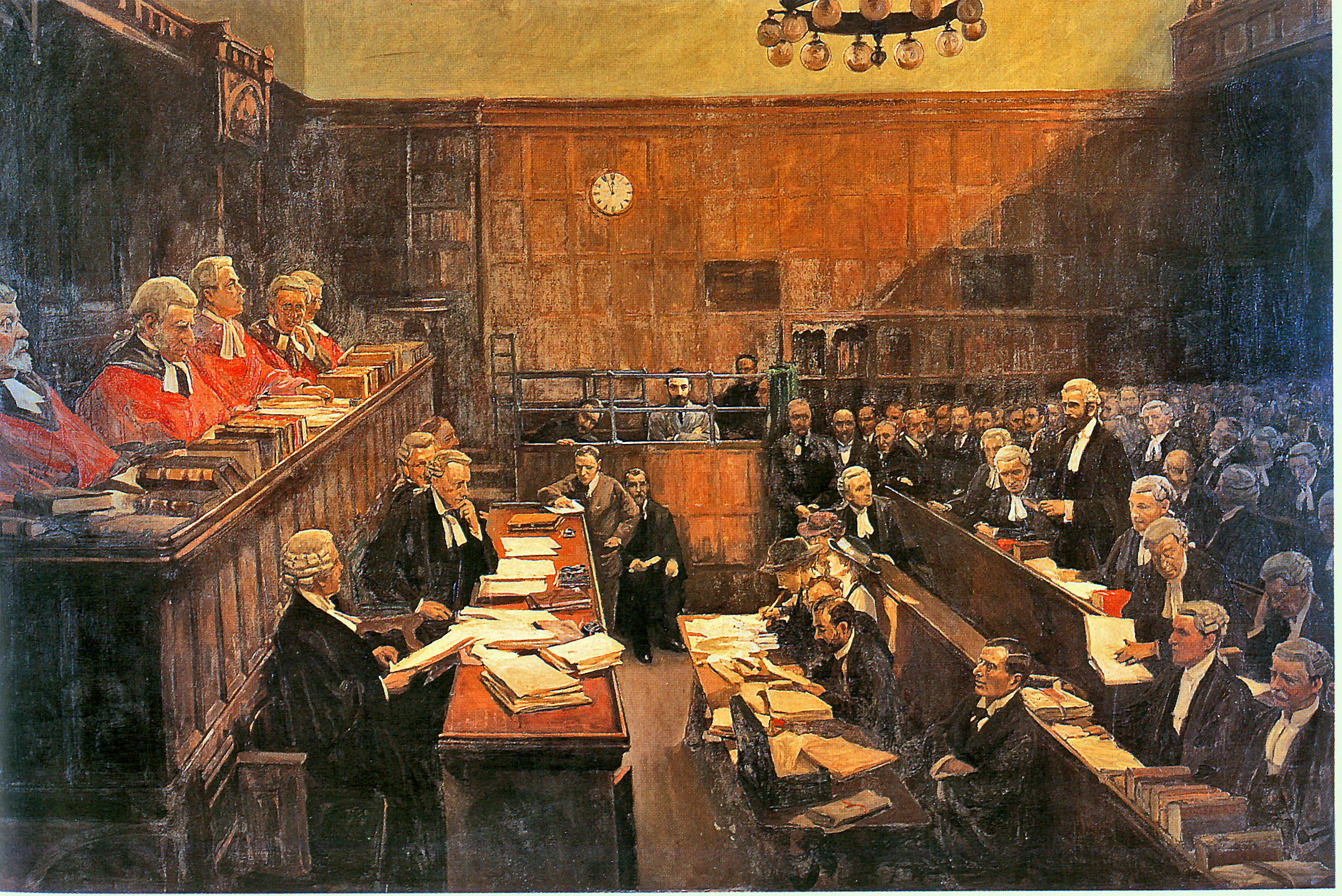
    Treason has always been a political prosecution by the victors. Sir John Lavery’s famous portrait of the Court of Appeal trial of Roger Casement springs to mind. He was charged with high treason and executed by the British for attempting to end their rule in Ireland. Mr Justice Darling gazes down on him with barely concealed contempt. The accused looks depressed, as well he might. Casement, once the terrorist, is today held up as a hero and martyr in Ireland. One should always interrogate who is accusing whom of treason, and why.

    Sir John Lavery’s painting of the trial of Roger Casement.

    The great Spanish poet Federico Garcia Lorca was brutally murdered in 1936 for his opposition to the violent imposition of an authoritarian quasi-fascist state in Spain. The rebel who wins becomes a national hero: to the victor the spoils of office, including the judicial arm.

    Woe betide his enemies, such as Lorca. Ironically in the Spain Civil War (1936-39) it was traitors who murdered him: traitors against a legitimate left-wing coalition government. The Nationalists rebelled, invaded Spain from colonies in Morocco and took Lorca’s life, along with hundreds of thousands of others.

    During and after the Civil War, the victorious Nationalists charged thousands of vanquished Republicans with treason for defending a legitimately constituted state. Thus we found the subversive justice of the traitorous victors against the constitutional losers.

    High treason is generally a dubious classification intimately connected to power. The Spanish government has the power in Spain today, and is ruthlessly subverting the law for political ends.

    In an age of ascendant nationalism and irredentism, the vectors of centralisation and monolithic control are growing more resilient as transnational agencies fragment. The EU has looked on at what is happening in Spain with the insouciance of a latter-day Neville Chamberlain.

    This even after Pablo Casado the Prime Minister Rajoy’s spokesman warned that Pudgemont would end up like Catalan Civil War independence leader Lluís Companys. Companys was handed over to Franco’s regime by the Gestapo and shot by firing squad in 1940. Considering the lack of independence of the Spanish judiciary, any prosecution seems likely to be a show trial.

    At least the Schleswig-Holstein court scrupulously examined the extradition warrant against Puidgemont to assess whether the Spanish offence of rebellion was at idem with an allegation of high treason under German law. For a European arrest warrant to succeed, the court must be satisfied that there is an identical offence under domestic law. This involves a comparison of the matter and detail of the laws operating in each jurisdiction.

    The loose definition of violence under the Spanish law of rebellion indicated it was not equivalent to the German law of treason. That objective assessment has unleashed a hysterical response from members of the Spanish government and media, including El País, amidst claims that the decision was politically motivated. More substantively, an appeal has been lodged with European Court of Justice in Luxembourg.

    German courts enjoy a reputation for impartiality. But given the extremely political nature of the charge, one may wonder whether political pressure was applied to the court. The political motivation would surely have been to favour the Spanish government’s argument. So hurrah for the presiding judge Martin Probst and his colleagues Matthias Hohmann and Matthias Schiemann.

    Subversion of political objectives, where the judiciary upholds human rights, may have negative consequences for individual judges who feel the pinch of state control, seen starkly in Poland. But as Foucault observed, modern punishments act more subtly through the internalisation of subversive norms.

    IV

    An Enemy of The People is perhaps Henrik Ibsen’s most overtly political play. The premise is simple: a prominent and well-connected local engineer, whose brother is the town mayor, is asked to conduct a survey of the municipal water supply. The town in question is famous as a spa resort, attracting a great deal of tourism. But when the tests are carried out, he finds serious impurities and informs the townsfolk of the results.

    The reaction is revealing, and dispiriting. Rather than lauding his wisdom in carrying out the analysis, vested interests turn on him with ever-increasing ferocity. A storm of hatred is unleashed.

    He will destroy the local economy. Livelihoods will be effected. The industry of the town will suffer. The whistleblower is shunned, ostracised, victimised. His family is torn apart and he becomes an enemy of the people. The mob descends in all its unfettered glory.

    Those that seek to expose corruption – its multi-hydra tentacles which reach the highest levels of power – are often disposed of by whatever means necessary. They have drawn the enmity of the powerful: the ones who matter.

    Puigdemont is no money launderer or expropriator of public funds, as many in the highest ranks of the PP have been revealed to be. He is no traitor, but an elected representative who endeavoured to offer the Catalan people the chance to declare a desire for independence, only to see the attempt attacked by the central government, whose violent excesses recalls the the Franco dictatorship.

    We often see mismatches between crime and punishment. The fictional John Valgean in Victo Hugo’s Les Miserables is maliciously persecuted for his theft of a loaf of bread. On the other extreme, those companies that now systematically plunder the world’s environment and usher in an era of unheard of inequality escape punishment having manipulated democracy.

    It’s quite simple. Subversives among the corporate elite would prefer a centralised Spain. An independent Catalonia or Basque country could spell trouble for transnational commerce.

    So let us take stock and assess carefully the use of terms such as dissidence, subversion and deviance which are bandied about. Let us consider who are the real traitors.

    Rebellion may be rebellion against tyranny, or it may be a counter-revolution involving those who are resistant to genuine democracy. So let us be wary of subversion by those who are themselves subversives.

    This article was written in collaboration with Frank Armstrong and A. Reynolds.

  • The Slow Death of Irish Nature

    ‘Blade Runner 2049’ is a sci-fi follow up to the 1982 cult classic starring Harrison Ford and Sean Young. Our future hero is Ryan Gosling who navigates a lonely, desolate world amid general dystopian bleakness. The viewer is told that by 2049 all ecosystems have collapsed, leaving a sterile planet, allowing humans to survive only due to our air and water purifying technology. Food is the produce of industrial laboratories and citizens eek out their pointless existences huddled in soulless (and loveless) cities. It’s not pretty, and 2049 is only 30 years off – eek!

    Although evidently a work of fiction, the idea that we stand on an ecological precipice is very much the stuff of daily news. Two studies in particular, one on the decline of insect populations in Germany, the other on the disappearance of farmland birds in France, really let the headline writers out of the traps.
    Scientists warn of ‘ecological Armageddon’ after study shows flying insect numbers plummeting by 75% warned the London Independent; Europe faces ‘biodiversity oblivion’ after collapse in French birds howled the Guardian, which went on to say that “intensive farming and pesticides could turn Europe’s farmland into a desert that ultimately imperils all humans”.

    Environmentalists lap this up – it bolsters what we’ve been crying about for years (and decades in some cases). Maybe, now that we’re all about to die a horrible death, politicians and policy makers will finally take us seriously and do what’s necessary to avert calamity. But hold up a sec. How exactly does turning Europe’s farmland into a desert imperil all humans? Sure, flying insects pollinate crops – and I’ll miss apples and strawberries when their price rockets because pollination has to be done by people with feather dusters – but I’m not going to starve! Where are the facts behind these doomsday assertions? What does it even mean when an ecosystem collapses?

    II

    Surprisingly, the idea of ‘collapse’ is not nearly as well studied as you might imagine. The book of the same name, by polymath Jared Diamond, looked at the collapse of societies, or human civilisations, which generally features environmental change as one of a number of factors.

    For instance, the collapse of the Viking settlements in Greenland was largely due to the inability of the farmers, with their cows and oats, to adapt to colder conditions – even thought the Inuit alongside them did just fine hunting and gathering.

    The Maya civilisation of Central America may well have collapsed primarily due to environmental changes, but it did not mean that all the Maya people died out – many people of Maya descent live in Central American countries today.

    We have our own example right here in Ireland – the Céide Field dairy farming community on the north coast of County Mayo made a living from the land up to about 5,000 years ago. Some believe that the collapse of their society was partly due to deforestation, which made the soil wetter, and promoted the spread of bog and the loss of nutrients. Yet farming in Ireland continued.

    Instances where all life has been destroyed are rare if non-existent – the only example I can think of are the oceanic dead zones where so much farm and human waste has been dumped in the sea that bacterial action has sucked all oxygen from the water (none of these thankfully are anywhere near Ireland). Even deserts are not dead.

    The International Union for the Conservation of Nature (IUCN) is the global body which monitors the health of Earth’s ecosystems and it is best known for its conservation assessments of individual species, which results in endangered species lists (or ‘red lists’ as they’re known). Its assessment of habitats – that is, the environments in which species live – is much less developed. It does however provide a useful definition to allow us to tell when a whole ecosystem has collapsed:

    “An ecosystem is considered collapsed when it is virtually certain that it’s defining biotic [living] or abiotic [non-living] features are lost, and the characteristic native biota [i.e. the plants and animals] are no longer sustained. […] Collapse is a transformation of identity, a loss of defining features, and/or replacement by a different, novel ecosystem”.

    As an example it shows how the Aral Sea in Central Asia, which was once the fourth largest inland water body in the world. Extraction of the water for agricultural irrigation meant that by the late 1980s  most of the water had disappeared along with the community of plants and animals which once lived there. The Aral Sea today is not a dead zone, plants and animals continue to live there, but it is drastically different to what it was. It no longer supports the livelihoods which once sustained themselves by fishing, and salt intrusion from deep in the soil means that it may never recover.

    Another example of ecosystem collapse is the Grand Banks cod fishery off the coast of Newfoundland. There, despite the ending of all fishing in the 1990s, the cod have not returned. In both cases, the loss of the ecosystem led to devastating social and environmental disruption. Yet nobody died and life in these areas goes on (of the human and non-human kind), and a new normal has settled in. Sad tales to be sure, but it’s a far cry from Hollywood disaster zone.

    III

    To get a glimpse of what it’s like to live in a collapsed ecosystem just take a trip to Iceland. When the first human settlers arrived there around the end of the first millennium AD they found a country that was up to 40% covered in forest. The rest of Iceland was covered in a near-sterile ice sheet or bare volcanic rock.

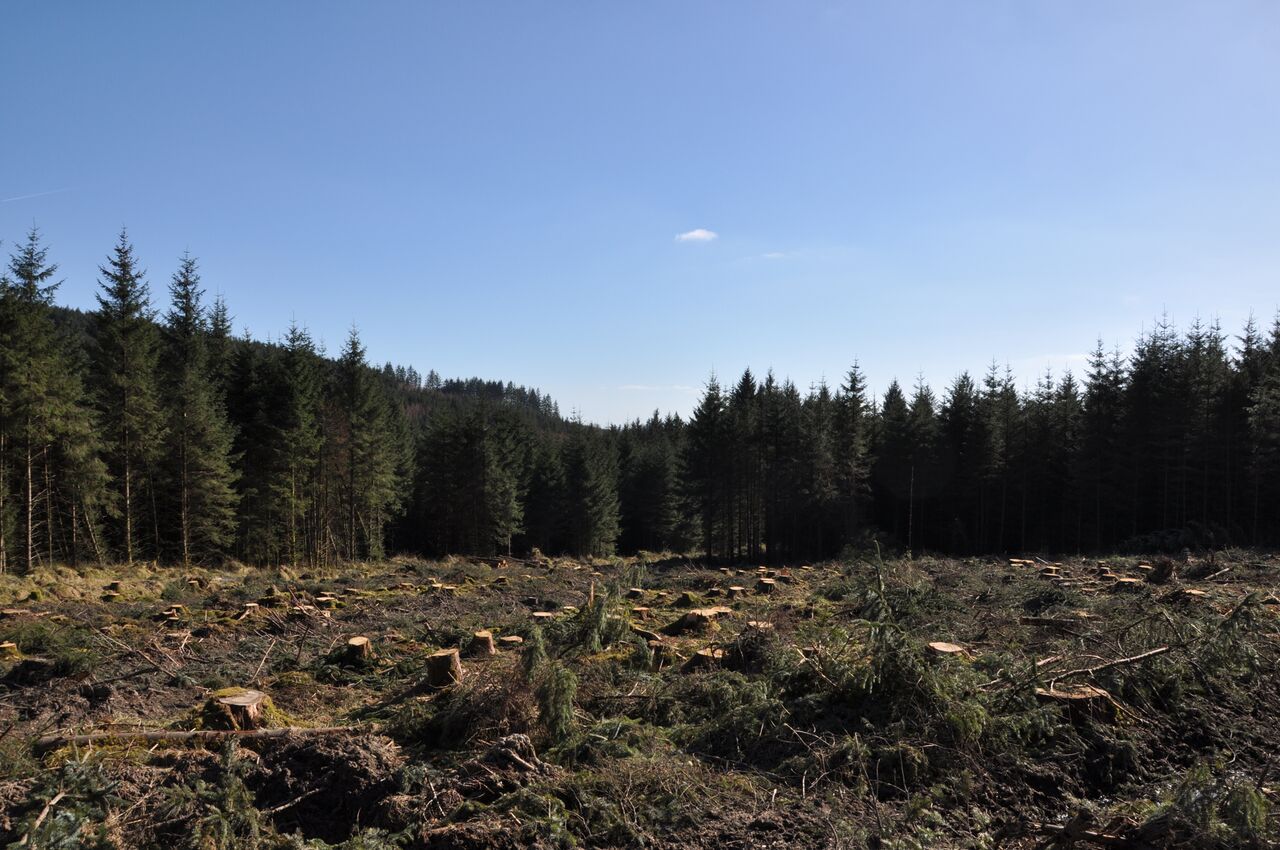
    Like farming communities everywhere they set about felling the trees to plant crops or graze animals. The forests were a source of fuel and fodder for people and their animals but nevertheless deforestation continued right up to the 1950s. The result was massive soil erosion which prohibits the growth of any vegetation, as well as destructive sand storms as the fierce sub-Artic wind whips up the loose soil.

    Today Iceland has virtually no forest left and establishing new woodland has proven to be extremely difficult. Much of Iceland is now technically a desert. Nevertheless, its small population enjoys a high standard of living and a consumer culture that is available to anyone else in the world on a middle-class income.

    It is currently enjoying a tourist boom, with more visitors perhaps than it can cope with, and these people are drawn primarily for its dramatic landscapes. Modern technology means that no one goes hungry or wants for freshwater. They have abundant geothermal energy which is even being harnessed to grow peppers and tomatoes in polytunnels outside Reykjavik. They also have a renowned fishing industry which, due to good management, is still productive.

    Visitors to Iceland scarcely notice that they are traversing a collapsed ecosystem but are nevertheless enthralled by its beauty and grandeur. So the question is posed: is it possible for the natural world to collapse all around us and, rather than provoking death and destruction, for it be met with a shrug? Maybe there will be no point of reckoning, no fulcrum upon which the attention of politicians will swing towards policies which are genuinely geared towards restoring the living world. Maybe it will happen and we’ll be too busy on our screens to pay any attention.

    IV

    Take a look at the environmental history of Ireland. It is believed that when people first arrived on our island the land was cloaked with extensive oak forests. In between there were wetlands (bogs, swamps and the like), lakes and rivers, and maybe the very tops of some of the higher mountains had no trees. The oceans teemed with life.

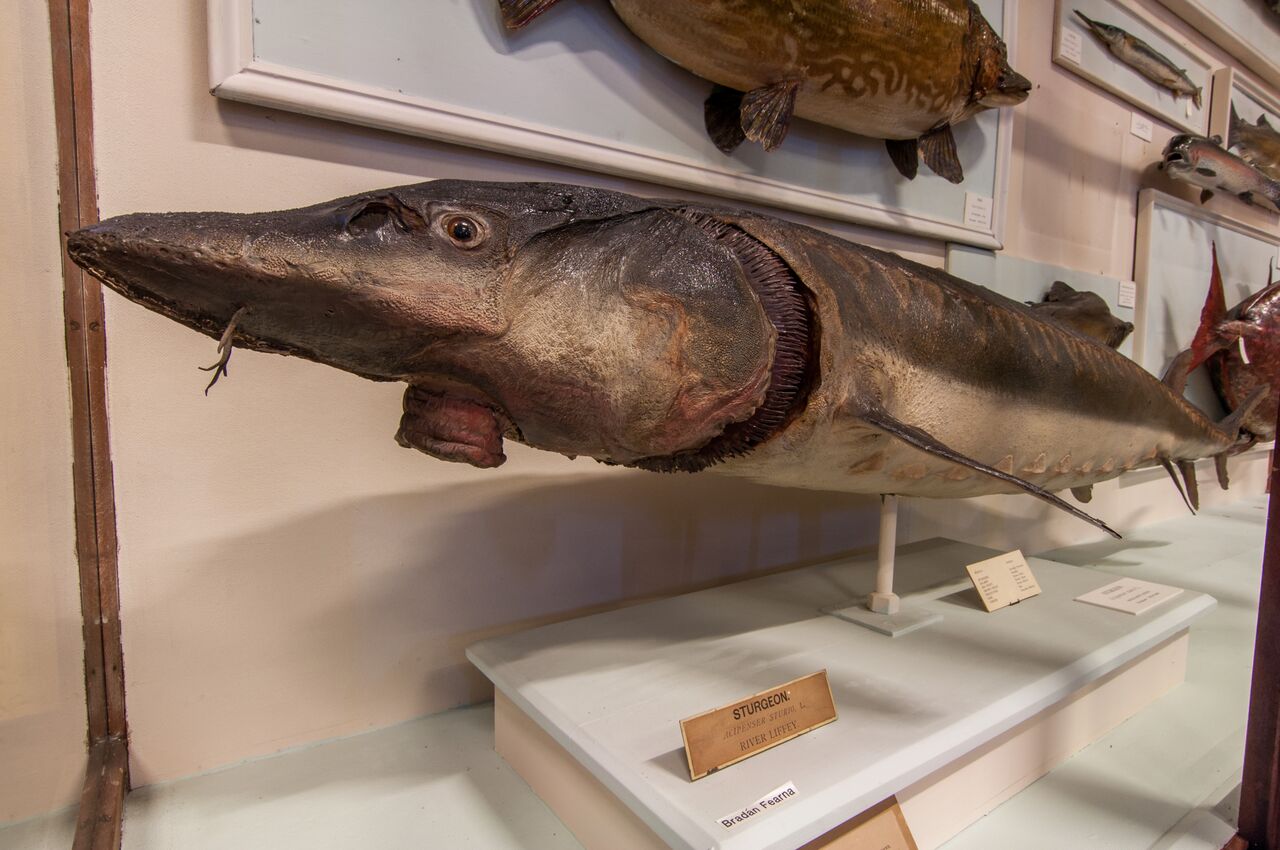
    Now-extinct Sturgeon in the Natural History Museum.

    5,000 years ago the first farming communities emerged and, just like in Iceland, this was associated with deforestation. Some species went extinct in this time, such as the brown bear, lynx and wild cat, and this is bound to have had an effect on the forests that remained. Up to 500 or 600 years ago, most of these ecosystems on land and sea were largely intact. Forest cover had reduced dramatically (one reference gives forest cover as about one eighth of the land cover in 1600) but our rivers ran free, great wetlands held flocks of cranes and wolves were widespread.

    By 1800 the forest ecosystem had collapsed completely, at this stage only tiny fragments remained while key forest animals like the wild boar had vanished (wild boar increase woodland biodiversity and help in the germination of tree seedlings by rooting in the soil). The wolf was also extinct. Most people appreciate that food webs are impacted when only one species is taken out, though oftentimes the exact impact can be hard to discern. Not the wolf – we now know just how important the presence of a top predator is in keeping all the plants and animals in check, not only deer but the smaller predators like foxes.

    By the end of the 1800’s not only the wolf but all the large birds of prey (two species of eagle, Red Kite, Buzzard, Osprey, Goshawk and Marsh Harrier) were also gone. By 1920 the extinction tally was added to further. Even the North Atlantic Right Whale – hunted off the coast of Donegal in the early 1900s – had disappeared completely.

    All the same, the rivers were still bursting with fish and pollution was virtually unheard off. Vast oyster beds around the coast had been dredged away but the sea’s bounty remained  immeasurable. There had been lots of turf-cutting for domestic fuel but there were still vast areas of intact bog and fen, and floodplains which attracted enormous numbers of birds – particularly those which laid their eggs on the ground, like Corncrakes, Lapwings, Curlews and Redshanks. In winter these areas hosted great flocks of wintering geese, ducks and swans. The air would have constantly been alive with their calls. Since that time let’s take a look at what has happened:

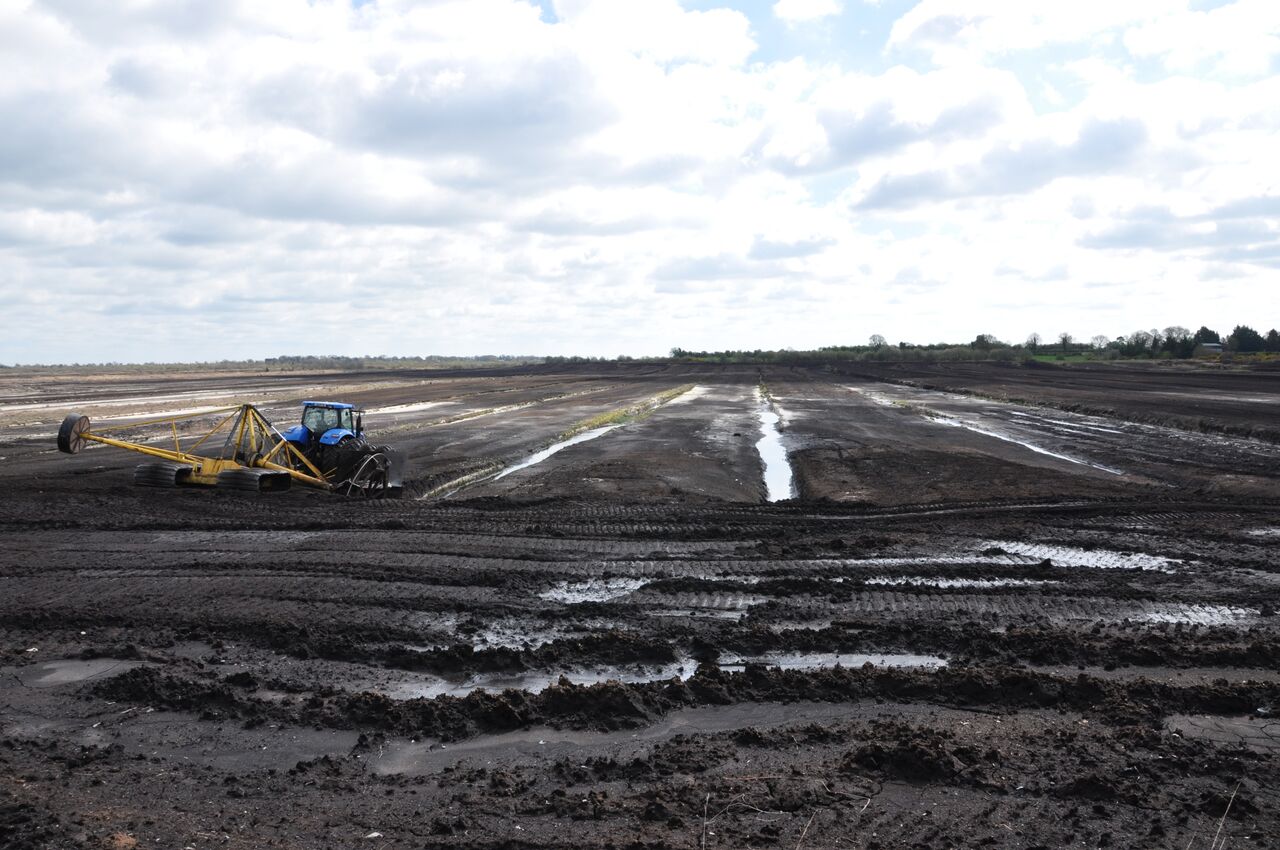
    • The area of midlands raised bog has been reduced to 0.63% of its original extent, primarily from industrial-scale open pit mining. There are no untouched bogs remaining and the best example (Clara Bog in Offaly) has a road slicing through it.
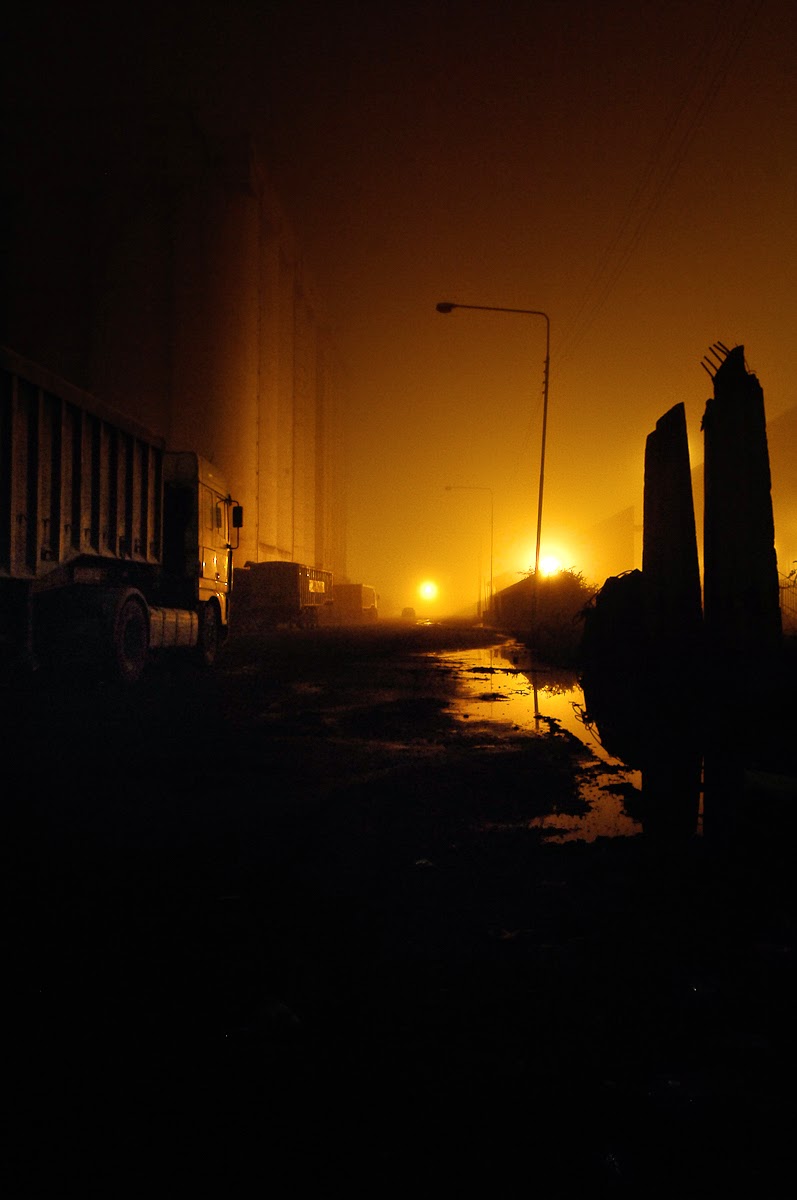
    Industrial scale peat extraction is a feature of many midland counties.
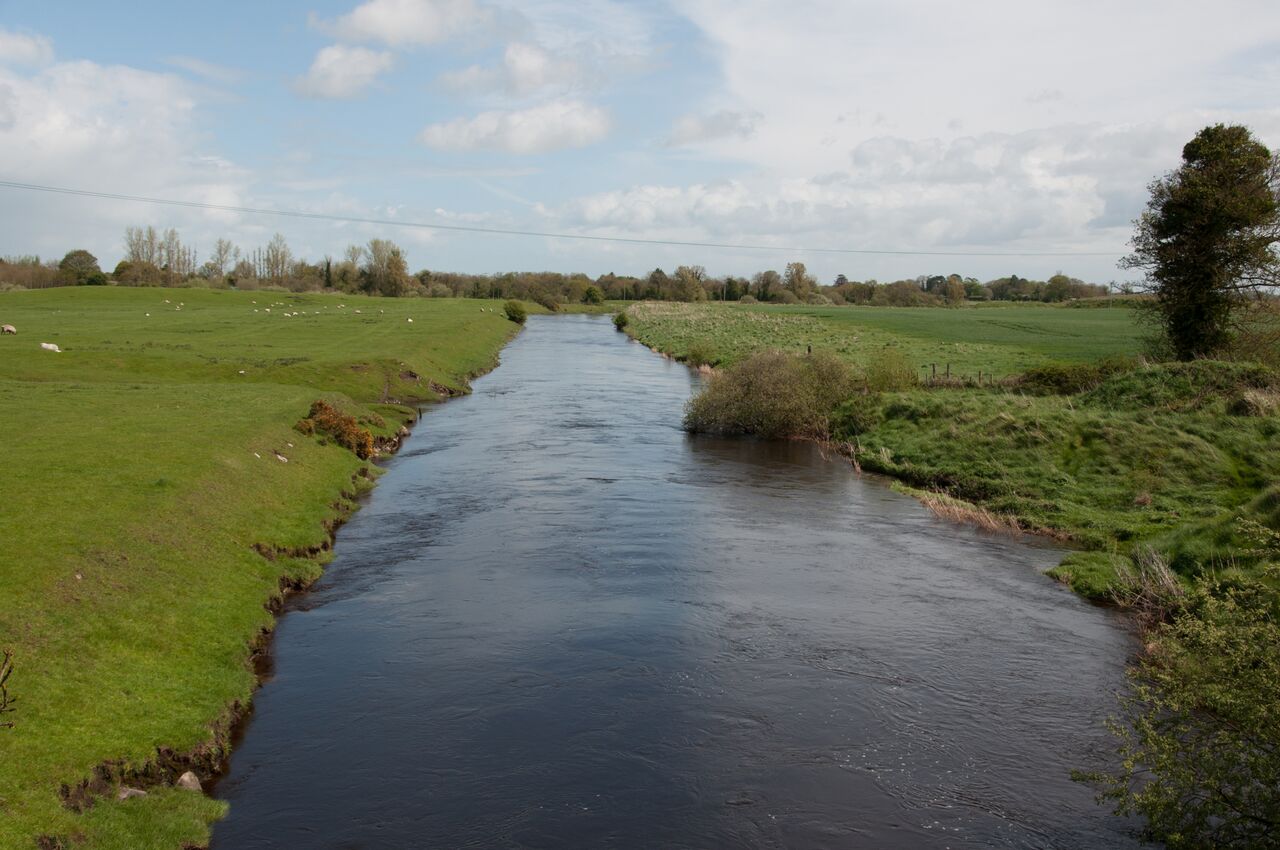
    • The Office of Public Works have deepened and straightened 11,500km of river channel under the Arterial Drainage Act of 1942, cutting rivers off from their natural flood plains. Impassable dams on the Shannon, Erne, Liffey and Lee (among others) mean migratory fish cannot access their traditional spawning grounds. Salmon and Eel populations have collapsed to the point where both species are threatened with extinction. There are virtually no Salmon in the River Shannon above the Ardnacrusha dam today.
    • Approximately half of water bodies (lakes, rivers, estuaries) are polluted while the number of ‘pristine’ water sites has dwindled from over 500 in the 1980s to only 21 today. There is no river left in Ireland healthy enough to allow Freshwater Pearl Mussels to breed in.
    Drainage has drastically altered many Irish rivers, leading to flooding.
    • Of the great peat bogs which stretch across the West of Ireland and other mountain areas, only 28% are ‘worthy of conservation’ – as the rest has been destroyed beyond salvation by conifer plantations and drainage, while fires, turf-cutting, wind farms etc. have left none of our upland habitats in ‘good condition’ according to the National Parks and Wildlife Service.
    Conifer plantation smother landscapes, communities and wildlife.
    • Fish are no longer present in coastal waters in any abundance – traditional fisheries for Herring, Mackerel, Cod, Whiting, Bass, Sole, Plaice, Turbot and other flatfish have all but disappeared. ‘Fishing’ today in these areas is not for fish but crustaceans (prawns, crabs and lobsters) while the real fishing is done by enormous factory boats far out to sea. Bottom trawling and dredging – which obliterate seafloor communities of plants and animals – is carried out practically everywhere, and sometimes more than once a year. It not only results in habitat loss but overfishing of non-target species and colossal waste (up to 90% of the contents of a prawn trawl can be dumped overboard).
    • Modern farming relies increasingly on inputs of chemical sprays or reseeding, which eradicates wild plants and animals with brutal efficiency. The next time you look at a farmer’s field see how many flowers or flying insects you can count.
    • 62% of sharks and rays occurring in Irish waters are threatened with extinction. Some, such as the angel shark, flapper skate and porbeagle shark, are critically endangered.
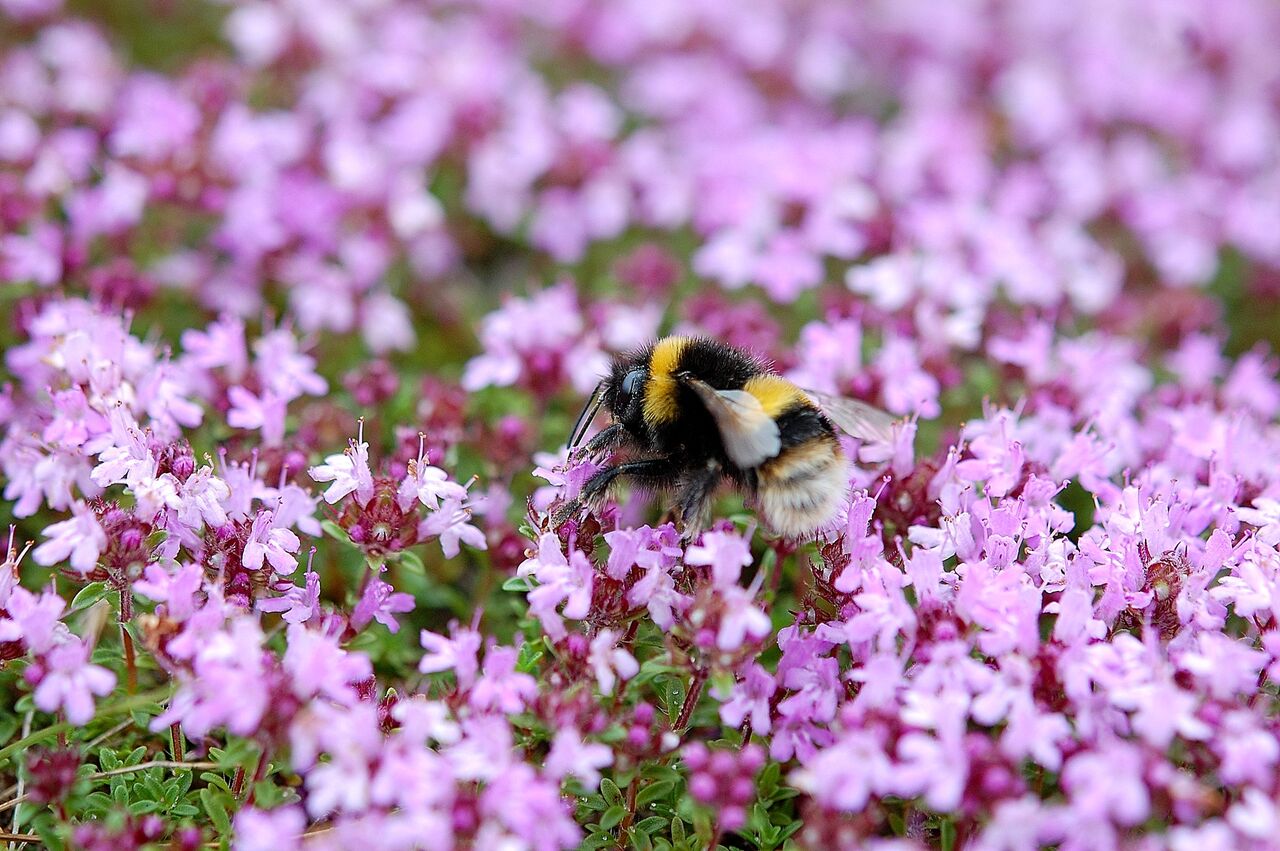
    Bumble bees are vital pollinators of wild plants as well as fruit crops.
    • Conservation assessments have been carried out for mammals, birds, moths, plants, mayflies, dragonflies, amphibians, reptiles, freshwater fish, butterflies, water beetles, freshwater molluscs, sharks, and bees. On average a third of all of these species are either ‘threatened’ or ‘near threatened’ with extinction.
    • There is documented evidence that about 115 species of plant and animal have gone extinct from Ireland since the arrival of humans. Many more have gone from common and widespread to the verge of extinction in the space of my lifetime, such as the curlew, the nightjar and the purple sea urchin (I’m 44).

    In the words of the IUCN all of our ecosystems – on land and at sea – have suffered a transformation of identity, a loss of defining features and a replacement by a different/novel ecosystem. They have all collapsed. Yet this has largely gone unnoticed, unremarked upon and even unappreciated by many environmentalists and ecologists in Ireland.

    IV

    Today, unlike the Greenland Vikings or the Maya, we draw on resources from across the entire planet. My ice cream might contain palm oil grown on land which once had rich Indonesian rain forest, the steak I order in my local restaurant may come from a cow raised on deforested land in Brazil or my smoked salmon may be indirectly resulting in overfishing of a fish species I’ve never heard of before, in a lawless part of the high seas.

    Many Irish cows, destined to be eaten in China, have been raised by eating not only locally grown grass, but soya products from South America. Much of the time it’s virtually impossible to know what the impact of our purchasing decisions has been. Does this mean that while we may live happy, cosseted lives in our own degraded environment, we are really just exporting ecosystem collapse to the farthest reaches of the planet? Are we living on borrowed time?

    Nearly 10 years ago an international team of scientists tried to answer this question and the answer was: probably. Their paper, Planetary Boundaries: Exploring the Safe Operating Space for Humanity, published in the journal Ecology and Society in 2009, identified nine planetary boundaries within which ‘humanity can operate safely’. These included climate change, ocean acidification, ozone depletion, use of freshwater, biodiversity loss and land-system change.

    For three of these, climate change, biodiversity loss and disruption of the nitrogen cycle, we have already broken through the limits of what is sustainable. In 2012 a study led by Anthony Barnosky of the University of California, Berkeley was published in the journal Nature. It asked whether humans are forcing a planetary-scale transition “with the potential to transform Earth rapidly and irreversibly into a state unknown in human experience”. It concluded that the plausibility of such an eventuality “seems high”. One of the authors told the New York Times that “the situation scares the hell out me”.

    In Ireland these arguments seem abstract despite the fact that the natural world has collapsed all around us. We rely entirely on purification technology for drinkable water as the water from rivers and lakes would otherwise make us sick. Thousands of people have been put out of work around our coasts after fish populations vanished, and continue to disappear (there is currently talk that traditional eel fishermen are in line for compensation in return for handing in their nets; the volume of exported lobsters fell by 20% in 2017 etc.).

    Extinction brings with it the irreversible loss of heritage, tradition and folklore. Across Ireland farming of any kind is increasingly a loss-making enterprise – according to Teagasc sheep, beef and tillage sectors rely entirely on state aid for an income. Even the much-touted dairy sector is heavily dependent upon subsidies which perversely promote pollution, habitat loss and further extinction.

    We have a forestry sector which is dominated by non-native conifer monocultures to produce cheap furniture and costs Irish taxpayers €100 million per year. Meanwhile climate change, along with ecological collapse, has left farmers and foresters more vulnerable than ever to extreme weather events, disease and other influences beyond their control. These changes will be calamitous for some, but for most it will unfold with a shrug.

    V

    Our lives are not quite as devoid of colour as the inhabitants of the imaginary city in Blade Runner but they are increasingly dependent upon technology and more divorced from nature. Few people today know the taste of wild salmon or hear the sound of the curlew and we are all the poorer for it.

    To bring nature back we need to change the story. We need to start talking more about the opportunities and not only about the threats. What if we planted enormous forests of native trees in which there could be food production, recreation and valuable timber? What if we could rebuild the health of the sea so that a net full of fresh Herring or Oysters or Turbot could be sold at the pier from a small, low-impact fishing boat? What if we restored our uplands and rivers so that anglers could once again catch monster Salmon; or if we had clean water to drink, and farmers could pick up a pearl (from a Freshwater Pearl Mussel) from the bottom of a sparkling river? What if we transformed the open cast peat mines across the midlands into a wilderness with bears, cranes, wolves and flocks of wild birds which darken the sky?

    Killarney National Park – under threat from invasive species and grazing by animals.

    These are experiences which would enrich our country not only for visitors but for the people who live in these areas. We have a long way to go before life itself is snuffed out and Ireland still has amazing wildlife spectacles. But these are getting fewer in number all the time. Dramatic changes are upon us and uncertainty lies ahead. We can shrug our shoulders and allow ourselves to be carried away, or we can be bold and create a future for our children which is not merely habitable, but rich and rewarding.

    Pádraic Fogarty is an ecologist and campaign officer with the Irish Wildlife Trust. His book, Whittled Away – Ireland’s Vanishing Nature was published in 2017 by Collins Press. He tweets under the handle @whittledaway

  • Earthsong – The Winged Moment as it Flies

    Earthsong camps assemble people of all ages, who converge in a natural setting to sing and dance their hearts out. Using the UK-based Unicorn camps as a model, Earthsong was engendered in Ireland by John Bowker and Angie Pinson in 2007. Other influences include Oak Dragon camps, and even Glastonbury.

    Earthsong offers an escape from the humdrum: a temporary ‘liminal’ space to explore wildness and sensitivities. As the week progresses the feeling of separation from normality grows. At Earthsong there are no age restrictions leading to a mélange of generations. Families make up the majority of participants, and almost half of those in attendance are under eighteen.

    Some come simply for a family holiday, or to spend a sociable week camping; others seek to drop out of ‘reality’ for a period. It is a space where esoteric ideas flourish as like-minded souls celebrate shared outlooks. For some Earthsong counteracts feelings of negativity towards spiritual ideas, born out of compulsion in their religious upbringings.

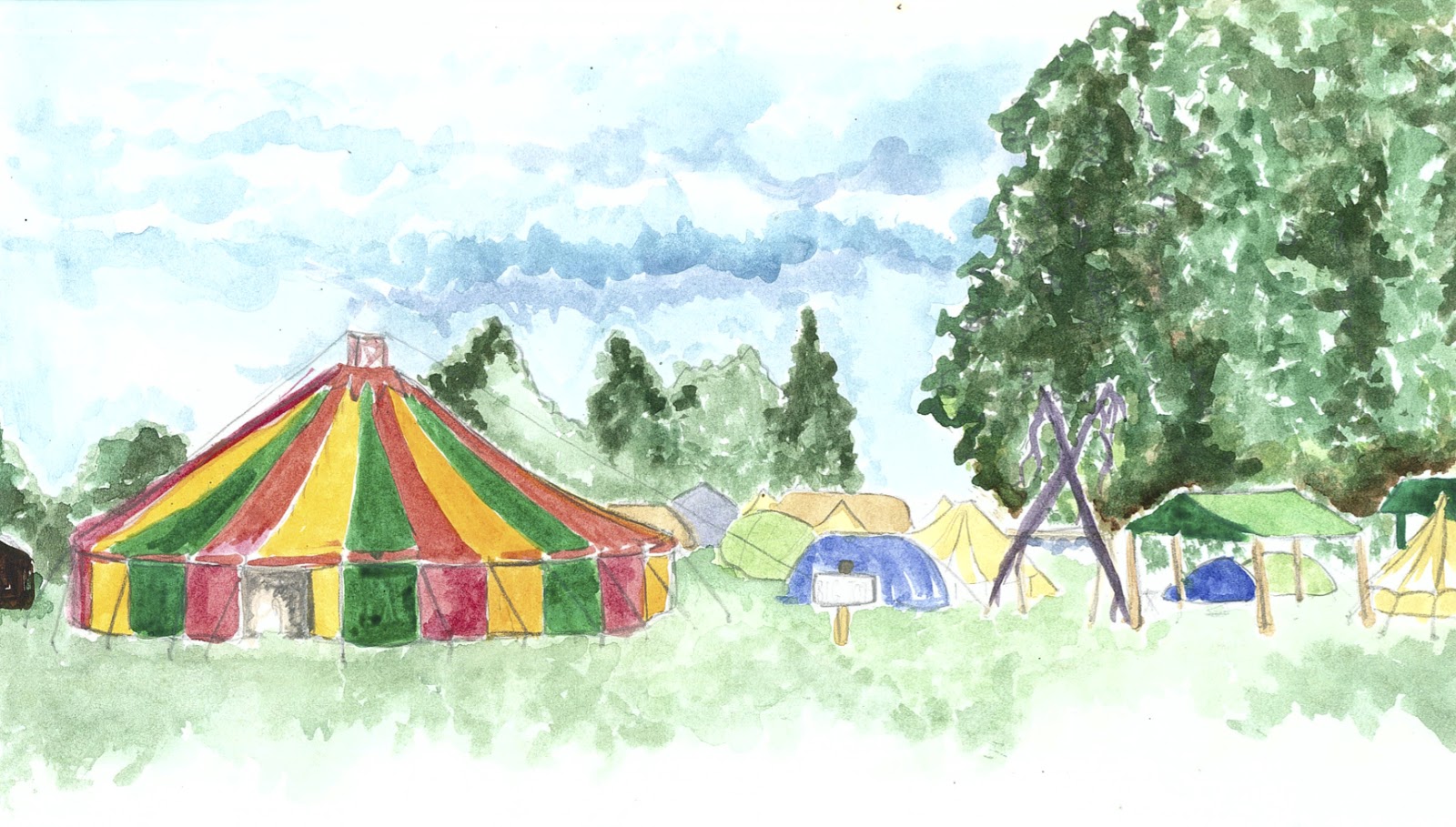
    The field where Earthsong is located is found up a leafy lane-way set away from the road. On arrival participants are greeted by whimsical signs such as ‘Warning, fairies crossing’. Magic is in the air. At the top of the lane, a ‘gatekeeper’, in a fairy costume, greets new arrivals.

    Dropping off one’s car on the ‘outside’ before stepping into the arena is the first stage in a rite of passage. Upon arrival participants choose a circle in which to pitch their tent, where it remains for the duration. Each circle contains approximately twenty people. These clusters lie on the edge of the field, while social spaces such as the Big Top, yurts, Big White marquee, café and shop are centrally located.

    Throughout the week all live and cook as one over a central fire, and participate in a multitude of group activities. This type of communal living is novel for many – and can be challenging if one is accustomed to the usual separation from one’s neighbours.

    It can be intense, both physically and psychologically, but rewarding too. This is an extreme and concentrated example of community, providing insights into how wider communal and ecologically-minded societies could evolve.

    II

    Earthsong offers a space to explore essential characteristics of our humanity through workshops that are on offer throughout the week. These range from tribal-drumming, basket-weaving, ‘family constellations’, African dance, non-violent communication, laughter-yoga, yurt-making, group-singing, sound-healing to circle dance, depending on the camp. There are two seven-day camps each summer in County Tipperary, ‘Dance Camp’ and ‘Harvest Camp’, as well as two three-day camps in County Clare.

    Through altered language, behaviours and activities Earthsong generates separation from the ‘outside world’, or ‘muggle land’, as it is jokingly referred to1. This isolation contributes to the unique atmosphere of the retreat, allowing participants to forget aspects of their lives on the outside.

    A serious challenge is the absence of electricity, although, communal showers, heated by a wood-burning stove, are available in a wooden lodge. People are also encouraged to switch off mobile phones, or store them in cars or tents.

    There is a strict no alcohol or drugs policy, which provides a rare experience in Ireland, and is a defining feature of the Earthsong experience. ‘Natural highs’ are achieved through events such as drumming and group singing. Safety is the principal rational for this. The ban on intoxicants makes Earthsong family-friendly, and also means everyone is on the same ‘buzz’.

    Earthsong is respectful of all spiritual traditions, but is not affiliated to any particular belief system, and organisers consciously avoid dogma. Nonetheless, ritual plays a defining role, from symbolic hand-gestures to welcoming ceremonies, and the Firedance; these generate an aura of mystery and forge community.

    Earthsong is a patchwork of cultures and rites, holding each one in equal esteem. The musical practices at Earthsong include west African drumming and chanting, African dance, kirtan, circle dance, folk music, among many others.

    III

    What is it that attracts people to countercultural, alternative living, such as is experienced at  Earthsong, even temporarily? To some extent it is a way of life and set of attitudes that are consciously differentiated from any dominant culture.

    This may be born out of dissatisfaction with society as it has developed, where an increasing obsession with technology, a Neoliberal outlook, lack of care for the environment and stressful work-life imbalances leads to alienation, anxiety and a growing culture of fear or distrust. It also reflects a desire to restore spirituality and purpose, and discover alternatives to destructive patterns of unsustainable living2.

    An alternative standpoint is to view Earthsong in terms of what people are moving towards rather than what they are running from3. Many who attend Earthsong do not lack for community or a sustainable lifestyle beyond the camp. It often serves to affirm lifestyles rooted in nature and creative thought.

    The word liminality derives from the Latin ‘limin’ meaning ‘threshold’, and was first identified by Arnold van Gennep in 1909 in his study Les Rites de Passage. He suggested that customs within social groups are linked to sacred phases. In many instances the passage from one phase to another – whether ageing, illnesses or change in season – involve some sort of ceremony, or rite of passage.

    He suggests there are three stages to this ritual process; the first involves a separation from everyday life preliminaire; this is followed by the liminal, or ‘in-between’ phase liminaire, where status is removed and daily routine is replaced by devotion to the sacred. The third phase is reaggregation, or post-liminaire, where the initiate returns to everyday life, newly defined and ‘transformed’ by the ritual journey.

    Van Gennep’s description of the liminaire phase inspired Victor Turner in the 1960s to develop the term ‘betwixt and between’ to describe the liminal state of hippies and the Beat Generation (The Ritual Process: Structure and Anti-Structure, 1969).

    Van Gennep’s theory had been applied to non-Western societies, but Turner used them for modern society, applying the term ‘liminoid’ for a state of being that was ‘like-liminal’, but not quite. He cited the hippies of the 1960s as examples, especially those choosing to live in a society on the threshold of ‘traditional’, mainstream and structured society.

    Turner adopted the term ‘structural outsiderhood’ for a state of mind of ‘normal’ citizens who have yet to reach the ‘utopia’ they wish and fight for.  As such, they float in a liminoid space. It is perhaps this ‘liminoid’ element, in combination with the more ‘traditional’, ritual-based liminal element, that best describes the music found at Earthsong.

    IV

    Communitas is a Latin noun referring either to an unstructured community in which people are equal, or to the spirit of community itself. There are varying levels of communitas operating at Earthcamp, including existential (or spontaneous) communitas in what William Blake knew as the winged moment as it flies4. Ironically, it is the fate of all existential communitas to ‘decline and fall’ into structure.

    Loersch and Arbuckle5 argue that music evolved as a mechanism to create and maintain group structure by acting as a form of social communication – a tool to share a group’s mental state with others, without the need for direct interaction. They hypothesised that a musical performance uniquely influences the behaviours and emotions of participants, thus creating a coordinated group.

    There is evidence that synchronised movement in response to music amplifies this bonding process. This occurs in dance. Others suggest that ‘musicking’ provides a space where traditional status hierarchies no longer hold (Bergh (2010)6 and Boyce-Tillman (2009)7).

    Reilly, in her study of the Magi people of Southeast Brazil, suggests that to experience ‘musical communitas’ is to experience: ‘a sense of intersubjectivity, which neutralises structure and creates the illusion of anti-structure’8. She goes on to suggest that all musical activity entails ritualised behaviour, ‘obscuring the divide’ between the sacred and the profane.

    Therefore, ‘enchantment’ is not only found in religious contexts: any environment that encourages an experience of communitas through music conjures an alternative social reality into being.

    It is in this world of enchantment that participants construct and experience the ‘harmonious order’ that could merge with an external reality; a mystical vision which is often out of step with dominant ideas in our culture.

    In The More Beautiful World Our Hearts Know Is Possible, Charles Eisenstein develops the age-old concept of ‘interbeing’, the idea of everything in the universe being interconnected9. This ‘echoes the worldview’ of ancient tribes and traditions across time and space, challenging us to ‘look beyond the world of concepts and opposites’, and thereby put aside our differences.

    Eisenstein speaks of humans experiencing a ‘separation’ from interconnectedness, embodied in money, school, religion and politics, which have the potential to alienate and destruct. He warns against the contemporary ‘glorification of change…of constantly discarding the old’, which may become a form of escapism.

    While appropriation of native spirituality has been condemned as cultural murder, Eisenstein suggests this interest comes from a recognition that indigenous peoples have retained for millennia that which ‘we of the West are finally ready to hear, as our own rituals, myths, and institutions break down’.

    He uses the term ‘Age of Reunion’ to describe this reintegration. This also offers a defence against the charge of acquisition of anOther’s traditions; looking beyond borders and boundaries and acknowledging our dependence on, and connectedness with, all other members of our species (the important ethical considerations of this concept lie far beyond the reaches of this current research).

    V

    Throughout the camp Heartsong took place at 8.45 am each morning in the Big Top, after the kirtan session and Dance of Life. Heartsong means to sing ‘from the heart’, to sing one’s emotions out in full, alongside others.

    The songs chosen are traditional from a variety of sources as well as contemporary numbers written by Heartsong facilitators. Usually practised in simple four-part harmony in repetitive lines, Heartsong melodies and words tend to evoke powerful emotions.

    On one such morning during Dance camp I arrived at 8.40am, just in time to witness the gentle practice of lighting the tea-lights around the altar. It was a slow start, with participants trickling in through one of the four entrances of the tent. We were invited to stand in one of four sections (‘tops’, altos, tenors, bass) in a circle around a central column or ‘altar’.

    We were given a short background to the songs we were about to sing, and reassured that we did not have to be great singers. The precise cultural context of the songs was not always of primary importance. Similarly, Tríona Ní Shíocháin in her discussion of Irish traditional song, wrote that in the re-creation of oral transmission, the singer enters a ludic, playful space, where new ideas and interpretations come to the fore, and a collective identity is thereby reinvented10.

    In the case of Heartsong where most, if not all, participants are unfamiliar with the language of the lyrics, one is left to interpret feelings through the sound, rather than the meaning of the words. This can represent a space of empathy and imagination.

    That morning as we began to learn our parts, through repetition of the slow, simple phrases, more and more people joined the group. Once all the sections were up to speed, we were ready to begin singing in unison.

    We began by creating a space of safety, using a Maori signal. This involved placing one’s right hand on the heart and holding the other out in front, with everyone singing a collective ‘ooooo’, while wiggling the fingers of their left hand. Thus we sent a wave of energy from our fingertips to the people around us.

    We were reminded that the space of Heartsong might lead to powerful release of emotion. The importance of safety was repeatedly highlighted throughout: there was a recognition that what we were doing could be misconstrued beyond the gates.

    The gate-crew could be seen as guarding the entrance ‘over the limen’ into the space of Earthsong, enhancing one’s journey through the camp.

    Organisers spoke of our ‘tribe’, and the idea of sending the energy of songs to our ‘people’, be they ‘rivers, animals [or] trees’. We were encouraged to look out for participants whose emotions were triggered by the experience.

    At my first camp two years before, I must admit, it was an unsettling sight and sound. We are not accustomed to such raw emotions being on show, we are used to hiding these as we proceed on our generally solitary path through the maze of social life.

    Heartsong provides a caring, non-judgmental space in which emotions are welcomed and honoured.

    One evening there was a ‘Forest Songs’ session held below a circle of trees, which had a profoundly ethereal quality. It was a unique feeling to sing one’s heart out in the company of trees. On the night approximately sixty participants gathered under the canopy with the singing facilitators in the centre. Faces could only be distinguished by flickering candle-light.

    VI

    The Firedance, weather-permitting, takes place at the centre of the field as the festival draws to a close. During the day a huge fire of slab-wood and logs are constructed by volunteers.

    The drummers attend a practice earlier on the day, so the Firedance commences immediately. We are encouraged to think as a whole community, not just one, and to believe that by taking part in the Firedance we are welcoming ancient traditions, and acknowledging all indigenous communities, who form part of a collective ancestry.

    The dangers and force of the fire is not taken lightly, and as I experienced on a windy evening, the flames and smoke are highly unpredictable. The danger is acknowledged and respected, and we are all responsible for one another’s safety. We step into a dangerous environment, but that fire represents life and our wild natures, and reminds us to look out for one another.

    While liminal spaces are sites of togetherness and creativity they can also be unsettling, disturbing and dangerous as we confront what is missing from our culture11.

    The creation of safe spaces and the altered language and behaviours create a magical environment. This other-worldliness, togetherness and community are crucial factors in encouraging people to return year on year, recreating a temporary space in which to re-imagine themselves, their lives, and the society around them.

    I do not wish to overly romanticise Earthsong. It would be impossible to generate a fully ritualistic, liminal space for the duration of the camps. Being a mere week in duration, it is simply a taster of real magic.

    As with any gathering of people, festival, or communal living experience, issues arise, rules are broken and behaviours of ‘normal life’ are not easily cast off. Sometimes people sullenly sit in their cars, making phone-calls or updating their Instagram accounts. Children steal from the shop. Families squabble. A child attempts to set the compost loos on fire.

    The no-drink-and-drugs rule was broken once or twice (or more) the last time I attended. Complaints are made. Shelters collapse. Eyes sting from cooking over an open fire. Arguments ensue. Earthsong is both very different and quite similar to ‘normal life’.

    There are nonetheless pockets of togetherness and shared experience that bind the community, despite all the practical necessities, and mundanities. These are in fact part and parcel of the experience.

    Turner writes of the great difficulty in maintaining a permanent state of communitas and that it ‘must sooner or later come to an end. We thus encounter the paradox that the experience of communitas becomes the memory of communitas…’12.

    Acknowledgements

    I would like to acknowledge all those who interacted with me during fieldwork at Earthsong in July 2016, and am very grateful for the contributions they made to the research.

    Reference List

    1. Dowd, N. (2015). ‘The re-enchantment of the world: the transformative experience of Earthsong camp.’ Undergraduate. University College Cork.
    1. Ehrenfeld, J. (2008). Sustainability by Design. New Haven and London: Yale University Press, p.64.
    1. Holyfield, L., Cobb, M., Murray, K., & McKinzie, A. (2013). ‘Musical Ties That Bind: Nostalgia, Affect, and Heritage in Festival Narratives.’ Symbolic Interaction, 36(4), p.457-477.
    1. Turner, V. (1969). The ritual process. New York: Cornell University Press, p.132.
    2. Loersch, C. and Arbuckle, N. (2013). ‘Unraveling the mystery of music: Music as an evolved group process.’ Journal of Personality and Social Psychology, 105(5), p.777-798.
    1. Bergh, A. (2010). I’d like to teach the world to sing: Music and conflict transformation. Ph.D. University of Exeter.
    1. Boyce-Tillman, J. (2009). ‘The Transformative Qualities of a Liminal Space Created by Musicking.’ Philosophy of Music Education Review, 17(2), p.184-202.
    1. Reily, S. (2002). Voices of the Magi. Chicago [Ill.]: University of Chicago Press.
    2. Eisenstein, C. (2013). The More Beautiful World our Hearts Know is Possible. North Atlantic Books.
    1. Ní Shíocháin, T. (2014). ‘Memory, Liminality and Song Performance: Understanding the History of Thought through Song.’ International Political Anthropology, 7(1), p.73-88.
    1. Tempest, S., Starkey, K., & Ennew, C. (2007). ‘In the Death Zone: A study of limits in the 1996 Mount Everest disaster.’ Human Relations, 60(7), p.1039-1064.
    1. Turner, V. (1982). ‘From ritual to theatre.’ New York, NY: Performing Arts Journal Publications.
  • The Man Who Lit a French Fire Under English Football

    Arsène Wenger is special.

    He enabled the Invincibles, only the second team not to lose once in an entire season in one of the most competitive leagues in the world. He fostered so many of the talents who shone not only for him but all their clubs and countries. His best teams played some of the loveliest soccer, fast, tough, and often breath-takingly skillful. He introduced modern diet and conditioning. He won most of the available competitions at least once, with the significant exception of the Champions League.

    He’s one of the most philosophical of football men. His great failing is that he is fundamentally an Economist.

    Wenger’s austere, intellectual, worldly yet kind approach, combined with his deep understanding, allowed him to alloy continental notions of diet and training with native English hard-running and combative effort. He gave out PhD’s in soccer. He maybe didn’t win enough, but he built a future not just for his club but for the game. He is a coach who could lecture a board of directors on amortization as easily as train a teenager in positioning.

    His best teams possessed great strength, speed, technique, and will. Doughty personalities worked hard for each other, with honesty and compassion. Composed of players from all over the world they were nonetheless clearly Arsenal players. They played for their shirt, their fans. They played for Arsène.

    The goals, so many great goals, my favourite Bergkamp’s spatio-temporal short-circuit:

    Henry’s goal is another triumph of outrageous athleticism, creativity, and skill:

    https://www.youtube.com/watch?v=8qy5iZh86e4

    Wenger’s other great achievement was his facilitation of the move from the old Highbury stadium to the Emirates, all the while managing to avoid the vast debts that have impaired so many other clubs. He tended to buy young players and develop them, selling on those not quite his type, and only in later years splurged, unsuccessfully, on a few marquee names. He was truly a manager not a coach. Players speak of his trust in them to learn, his expectation of intelligence and willing curiosity.

    Throughout it all, his anachronistic, prickly, “didn’t see it,” demeanor both charmed and irritated. He could be kind and overbearing at the same time, like a tired old schoolteacher reaching deep for the patience needed to help his errant charges, and was often especially so with journalists. Perhaps unwittingly he provided a theatrical counterpoint to the gruff, over-manly, almost thuggish displays of other managers.

    In recent years his inability to spend, or spend wisely, has enervated his squads. They have done well to provide a reminiscent value, and a kind of tactical test, against which all other Premiership teams must measure themselves twice a season, but they have not looked close to being able to challenge for honours. They still have a ropey defense, their midfield is slight, and their strikers profligate if not disinterested. They flatter and deceive in equal measure. They have become an echo of an idea of a kind of football, and the world has moved on with typically robust lack of romance. Too much an economist to be a romantic Wenger nonetheless seems trapped in an ideological hall of soccer mirrors, forever seeing some variant of old reflections staring back at him.

    Au revoir Arsène, et merci.

  • A Garden Should not Require Permission to Live on Earth

    This article was triggered by events that took place at the Community Garden located on Oliver Bond Street, Dublin 8 before Christmas 2017. Our petition and a background story can be found here

    The average person living in a city centre has very little interaction with actual soil: city dwellers spend most of their time outside walking on pavement while visually surrounded by a concrete jungle. Exposure to city green spaces typically takes the form of manufactured parks, managed by The City, that are suited to the frameworks for gentrification. That is why it seems obvious to me, that the following conversation relating to the Community Garden spaces in the Liberties neighborhood’s, would not be taking place if the spotlight was on a Community Garden in Ballsbridge.

    Community Gardens in Dublin: the Current Model

    The political lock out of the Oliver Bond Street Community Garden, is an excellent demonstration of how something that should be natural – plants, living outside, in their native environment; can turn into a disaster once people with zero compassion, respect, or knowledge for the health and wellbeing of the environment, see an opportunity to validate their ‘power-over’.

    The current situation in Dublin regarding space concerns has manifested a ‘secret garden culture’ among Community Garden Growers and Inner-City Gardens.

    These independent green spaces are being seized before they have the opportunity to fully blossom beyond the developmental phase because success in the form of social economy would increase a garden’s staying power. During the developmental stages these gardens are still malleable – their roots are not as strong and are therefore easier to weed out. This internal pressure to maintain Green Space autonomy has skewed public opinion on the value of Inner-City Gardening by deflecting the positive impact that these spaces can have on communities. How can the public truly understand and reap the long-term benefits from something that has never been allowed to come into full fruition?

    What does this pattern really reflect? The Necessity for a shift in public opinion

    At its core, the primary challenge for gardeners in Irish culture is a lack of public respect. This devaluation is an unusual condition that does not seem to exist in any other major European city. In Dublin, Community Gardens have been categorized as ‘substandard green spaces’ in an effort by the City to demean and add further fuel to the existing stigmatization that paints Community Gardens as no more than part-time, temporary hobby plots. As a result, there is no culture of Inner-City Community Gardening in Dublin.

    Culture of Convenience

    Removing the soil from produce has removed society’s connection to nature. The soil that gave life to the food you eat is commonly called ‘dirt’ and is seen as an inconvenience. We want produce that is “clean” and shiny.

    Today’s supermarket shopping experience reflects the principles of a complacent nation, as it is no longer a sensory one. You cannot touch or smell half of the produce that you purchase if you shop in major supermarkets, because these products are pre-washed, and pre-packaged in plastic with a barcode to cater to you: the dis-engaged consumer, who expects an impersonal self-serve experience that is fast and easy. We live in a time where people expect instant gratification, and that often comes at an environmental cost.

    Gardens take time and work – people are impatient. Culture of convenience is a culture of laziness and corporations have groomed and now cater to this model. As a result, many people have zero awareness of how to grow their own food due to the reliance they put on everyone BUT themselves. People no longer take responsibility for themselves because they no longer know how to trust themselves and this manufactured condition becomes more dangerous when detachment from self-sufficiency correlates to people unconsciously giving their personal power away.

    Corporation stimulate demand in order to survive, and exert more power through the development of ‘hero worshiping’ (the corporation), which develops a victim mentality in the consumer. Linking back to independent spaces: if people are able to use Community Gardens to figure things out for themselves: experiment, learn, and generate ideas as solutions, then they can step back into their own personal power. Community gardens reflect creativity and rebellion and that challenges those that cling to the initials and titles next to their names.

    Control

    The space-race perception in Dublin is one that creates the notion that sharing is not possible. It suggests that because there is not enough room, that you can only have either housing or green spaces, not both. And because Community Gardens generally do not provide secure profit to the Council, they are the first to face extinction.

    It is very important to make the distinction that the space issue is structural – and if The City maintains the attitude that Independent Green Spaces are not valuable, then they are communicating to the public, that the wellbeing of its citizens is insignificant, when in the same race as profit. By making a mockery out of Green Spaces in order to shape public opinion, The City is participating in environmental injustice – more specifically, food injustice

    Community Gardens add a sense of “wildness” to a neighbourhood – plants can grow as they wish, people from all walks of life can equally come together and put their hands in the soil and get ‘dirty’; everyone is reminded that an object as small as a seed has the capacity and potential to grow into something more, when given the space and nourishment to expand and change. Community Gardens have endless potential just like the people involved in them – a simple reminder that it is the passionate people that make a city compassionate.

  • A Breakthrough to Save Humanity

    In Dante Alighieri’s The Divine Comedy (1320) we encounter a forlorn Ulysses (Greek, Odysseus) in the Inferno, punished to eternal torments for deceitful stratagems in the Trojan war, and beyond. Dante adds a layer to the Classical myth, where the aged warrior returns to his native Ithaca only to find:

    not sweetness of a son, not reverence
    for an ageing father, not the debt of love
    I owed Penelope to make her happy
    could quench deep in myself the burning wish
    to know the world and have experience
    of all man’s vices, of all human worth.

    He persuades his crew to embark on a final voyage to a: ‘world they called unpeopled’. For five months they sail until, ‘there appeared a mountain shape, darkened / by distance, that arose to endless heights,’ which is the mount of Purgatory. But, ‘celebrations soon turned into grief,’ as a whirlwind wrecks the fleet, consigning Odysseus and his crew to a watery grave. A hero, who dared travel beyond accepted limitations, is doomed to an excruciating hell, even if there is a suspicion that Dante admires his chutzpah for seeking to experience “all human worth.”[i]

    Fear of the sea is an intuitive recognition of the danger it poses, in contrast to an attachment to home ground. As Herman Melville in Moby Dick (1851) puts it: ‘For as this appalling ocean surrounds the verdant land, so in the soul of man there lies one insular Tahiti, full of peace and joy, but encompassed by all the horrors of the half known life. God keep thee! Push not from that isle, thou canst never return!’[ii]

    Odysseus’s sorry fate also reflects a medieval mindset that looked askance at unfettered ambition. This devolved into superstitions deterring voyages to unchartered territories. Thus Laurens van der Post relates a story told to him by Carl Jung, ‘that if one wanted to fix a precise moment at which the Renaissance began, it would be the day when the Italian poet Petrarch decided to defy superstition and climbed a mountain in the Alps, just for the sake of reaching its summit.’[iii] Through a rebirth in Classical ideas that followed in Petrarch’s wake, Europeans opened their eyes to hidden possibilities, leading to the discovery of new continents that relied on a spirit of innovation.

    Poetic Inspiration

    Poetry in its widest sense is a font of ingenuity and invention. Thus Andre Breton in his Surrealist Manifesto saw it as: ‘Dictated by the thought, in the absence of any control exercised by reason, exempt from any aesthetic or moral concern.’ Reversing a dictum attributed to Stalin describing poets as engineers of the human soul, Breton attributes scientific breakthroughs to a poetic imagination, arguing: ‘the conquests of science rest far more on a surrealistic than on a logical thinking.’[iv]

    This reinforces Percy Shelley’s proposition that poets, operating in varying capacities, are the ‘unacknowledged legislators of the world.’ The spark for any new venture comes from an imagination Shelley equates with poetry. He distinguishes this faculty from reason, which he describes as the ‘enumeration of qualities already known’; whereas ‘imagination in the perception of the values of those qualities, both separately and as a whole … Reason is to imagination as the instrument to the agent, as the body to the spirit, as the shadow to the substance.[v]

    Too often governments, corporations and individuals inhibit that poetic ignition. Across society we see reason and logic in constant motion, but imagination is barely nurtured, and often frowned on. We proceed from point A to B, all too often ignoring possibilities arising in the remainder of the alphabet. Yet scientific innovation is predicated on poetically imagining possibilities beyond contemporary restraints. It is notable that, besides his contributions to the understanding of the physical universe, Albert Einstein was a prolific poet.

    Technological advances have diminished our intuitive fear of the ocean. As Melville put it: ‘however much … man may brag of his science and skill … yet for ever and for ever, to the crack of doom, the sea will insult and murder him … nevertheless, by the continual repetition of these very impressions, man has lost that sense of the full awfulness of the sea which aboriginally belongs to it.’[vi]

    Incontestably, a combination of greed and frightening religious extremism motivated the global exploration of the sixteenth century, which rapidly encompassed the whole Earth. But the first voyagers also displayed admirable qualities, including a willingness to set aside a fear of the unknown, the strange and exotic.

    Crossing great stretches of ocean demanded breakthroughs in nautical engineering, including the development of a lighter, more mobile, craft, the caravel. Developed in Portugal under Henry the Navigator (d.1460), this vessel could sail into a head wind. Such innovations occurred because adventurous spirits imagined pathways previously considered taboo. It is only by taking such imaginative flights, overcoming prejudices and applying the required labour, that new inventions are realised.

    Despite the ensuing carnage and destruction of natural environments wrought by European colonisation, there remains an enduring heroism in this original repudiation of orthodoxy. In Dante’s Inferno Odysseus did founder, but we may laud a spirit rejecting preconceived limitations that a medieval mind considered hubristic. Innovation demands an interrogation of established ideas, a rejection of preconception and the embrace of the unknown – like a bird taking flight for the first time in its evolution. How did that feel?

    The Great Adventure of Our Time

    Theodore Zeldin recently considered what the great adventure of our time should be: if in the sixteenth century it was discovering new continents; and scientific enquiry in the seventeenth; or addressing political equality in the eighteenth. Precisely the most valuable quest in our time remained elusive to him, but he argued that giving a new meaning to work could offer a great adventure: ‘so that it is more than the exercise of a valued skill, more than the enjoyment of collaboration with others, more than a price that has to be paid in search of security and status, means using work to redefine freedom.’[vii]

    A revolution in working practices does seem overdue, with technology performing most basic and increasingly complex tasks. A new departure in attitudes to employment should also appeal to anyone disheartened by the irrationality of boundless economic growth. Any new economy ought to harness creativity in different domains, and address the tendency towards homogenisation of large corporations. Still, I fear this aspiration to alter work practices is insufficiently ambitious for the environmental challenges of the twenty-first century, in the shape of runaway climate change and a Sixth Extinction.

    Previously Naomi Klein has pointed a finger at unbridled capitalism,[viii] but simply achieving a more equitable distribution of wealth appears insufficient. Historically at least, socialism has been defined in materialistic terms, apportioning needs within a hierarchy that continues to inflate. There is a moral obligation to furnish all humans with basic necessities yes, but we must also enter into a harmonious relationship with the natural world, which, thus far, most political ideologies and organised religions have failed adequately to take account of. Within an altered ethical framework, encompassing an idea of Wild Law that I have previously expounded on, necessity will be the mother of invention of the tools required for favourable adaptations.

    ‘By nature free’

    We are in Milton’s words from Paradise Lost (1667): ‘By nature free, not overruled by fate’, but each individual vessel still faces ruin unless we tame the raging waters of our collective acquisitiveness. We require an Age of Empathy elevating symbiosis and cooperation. Thus according to Gandhi: ‘Man is not born to live in isolation but is essentially a social animal independent and interdependent. No one should ride on another’s back.’[ix]

    If we continue to gorge ourselves on the world’s resources – failing to acknowledge the limit of natural capital – we confront death and destruction on an unimaginable scale. Let us hope it does not take another Flood of Biblical proportions to awaken us to this reality. Alas, a shock to the global system seems necessary to shake us out of our collective stupor. We must face up to what the future holds, and aggressively confront sinister and self-serving conspiracy theories.

    The field of science – a term only coined in the 1830s the field having previously been referred to as natural philosophy – alone cannot convey the world as it will appear in the decades to come if we continue on our present course. The arts play a vital role in conveying the apocalyptic scenes awaiting. Science fiction has long plotted dystopian scenarios – going back to Mary Shelley’s The Last Man (1826) – and this vision is entering the mainstream of literature.

    In Cormac McCarthy’s The Road (2006) a father and son wander through an apocalyptic landscape denied the sun’s live-giving rays. Cannibalism is rife as the last humans compete with one another. In the final paragraph there is a mesmerising ode to a lost Nature:

    Once there were brook trout in the streams in the mountains. You could see them standing in the amber current where the white edges of their fins wimpled softly in the flow. They smelled of moss in your hand. Polished and muscular and torsional. On their backs were vermiculate patterns that were maps of the world in its becoming. Maps and mazes. Of a thing which could not be put back. Not to be made right again. In the deep glens where they lived all things were older than man and they hummed of mystery.[x]

    Verily a Paradise Lost.

    Harsh Realities

    When we face up to harsh realities a change in outlook can occur. Laurens van der Post writes:

    It was only when man looked death full in the face that the mortality which is imminent in the final regard releases him from all excess in his proportions, and in the surrender of egotistical presumption which follows as night in the day, unlocks him for the experience of compassion for all living things, ‘from ant to Emperor, whale to cat’, as the Buddhists of Tibet put it, which is the sign of his conscious return from exile to the all-belonging, which has been his point of departure and is then his Home. [xi]

    Humans are capable of mind-boggling cruelty and selfishness but within our spectrum we possess staggering levels of empathy and compassion. These diverging characteristics may even co-exist in the same person.

    I propose that the great adventure of this epoch lies in the way we relate to Nature, which is all life on Earth, including ourselves. The challenge, as I see it, is to ground ourselves within that diverse ecology rather than placing ourselves above other forms of life, as the Western philosophic tradition has purported to do so. Thus Plato formatively established a hierarchy of beings in his Timaeus (c.360 BCE), proceeding from men at the top down through women to the ‘lower’ animals. Somewhat comically he compares other animals unfavourably to human beings:

    The race of birds was produced by a process of transformation, whereby feathers grew instead of hair, from harmless empty-headed men, who were interested in the heavens but were silly enough to think that the most certain astronomical demonstrations proceed through observation. Wild land animals have come from men who made no use of philosophy and never in any way considered the nature of the heavens because they had ceased to use the circles in the head and followed the leadership of the parts in the soul in the breast.[xii]

    Unfortunately, the lasting impression Plato has made on Western culture with these ideas has been no laughing matter.

    Sentience

    Widening the circle of empathy brings us into communion with all living beings. Even plant life deserves reverence. In Peter Wohlleben’s The Hidden Life of Trees[xiii] we discover remarkable species, displaying unaccounted for intelligences. Trees communicate with one another using an array of languages including scent from blossoms, and via electrical signals that travel at a third of an inch per minute. This allows them to warn neighbours if they are under attack. Chemical signals are also passed via fungal networks around root tips, a so-called ‘wood wide web.’

    Moreover, the ability of plants to learn from external stimuli has been exhibited in Dr Monica Gagliano’s experiments on the sensitivity of the mimosa plant. Gagliano released individual drops of water on the plant’s foliage at regular intervals. At first the anxious plants instantly closed their leaves, mistaking the single droplets for the onset of heavy rainfall. After a number of false alarms, however, the plants recognised these to be harmless and kept their leaves open. Remarkably, the small plants learnt from the experience, applying the lessons weeks later.[xiv]

    Thus, in consuming any plant we should be mindful of all its complexity, and prize agricultural systems that permits a wide diversity of life to co-exist. Nonetheless, plant life can be distinguished from animal in terms of sentience: which is the capacity to feel, perceive, or experience subjectively. Essentially, we know that other animals feel pain – both physical and psychological – via central nervous systems similar to our own. The precise boundaries between plant and animal life may be frayed, but the evidence for pain in other animals is unmistakable.

    Factory farming may soon be viewed as among the worst crimes in human history. The food writer Michael Pollan referred to a Concentrated Animal Feeding Operation (CAFO) he visited as, ‘a place I won’t soon forget: a deep circle of porcine hell.’ In a display of cognitive dissonance he acknowledges the pork sandwich he eats is ‘underwritten by the most brutal kind of agriculture.’ At least he quotes Ralph Waldo Emerson to the effect that ‘however scrupulously the slaughterhouse is concealed in the graceful distance of miles, there is complicity.’[xv]

    The effect of animal domestication, especially grazing ruminants and the cultivation of foodstuffs for their consumption, also has a devastating effect on surviving free animals, compelled to make way for a vast expansion of agriculture around the globe. Astonishingly, today humans, our livestock (and pets) account for ninety-six percent of the Earth’s total land vertebrate biomass.[xvi] This has all occurred alongside immeasurable devastation to the plant kingdom.

    It is futile to read a philosophy of veganism back through human history to condemn ancestors who often killed animals for survival – or even to focus on those remaining hunter-gatherer communities living in remote and inhospitable regions. But in Western societies, at least, there are a multitude of healthful and tasty alternatives to animal products, displaying great qualities of human inventiveness in the gastronomic field. We are not obligate carnivores, unlike our near relative homo neanderthalensis that seems to have gone extinct for this reason.[xvii] A global food chain now allows us to overcome seasonal shortages and localized crop failures to provide a nutritious plant-based-diet-for-all.

    New Departure

    In his biographic account of hunting whales on board a Norwegian vessel in the 1920s Laurens van der Post, recites an extraordinary statement on the new departure he considered necessary in our relationship to the natural world:

    I could not deny the excitement and acceleration into a consummation of archaic joy which the process of stalking and hunting, even at sea, had invoked in me, although I was at present now only as an observer. On the other hand, hard on these emotions, came an equal and opposite revulsion which nearly overwhelmed me when the hunt, as now, was successful and one was faced with the acceptance of the fact that one had aided and abetted in an act of murder of such a unique manifestation of creation. The only dispensation of the paradox ever granted to me in the past, unaware as I had been of the immensity of it until revealed to me in this moment at sea, was that in hunting out of necessity, all revulsions were redeemed by the satisfaction one felt in bringing food home to the hungry. That such satisfaction was not an illusion, nor a form of special pleading in the court of natural conscience, was proved to me by the profound feeling of gratitude one invariably felt for the animal that had died in order for others to live … [but]what could this possibly have to do with the necessities which were essential for the redemption of the act of killing … in this increasingly technological moment of my youth, when control of life was passing more and more from nature to man, and when there were already available all sorts of artificial substitutes for the essential oils which animals like the whale had once been the only source of supply, what, I asked myself bitterly, could justify such killing except the greed of man for money … Worse still, I was certain that our imperviousness to the consternation caused by such killing in the heart of the nature could be the beginning of an enmity between man and the life which had brought him forth that could imperil his future on earth itself.[xviii]

    Dietary change may indeed be relevant to the wider transformation of the human person. The legendary gastronome Jean Anthelme Brillat-Savarin’s maxim ‘Tell me what you eat and I will tell you what you are,’ perhaps overstates the argument, yet the constituents of a diet do exert a profound influence on minds inseparable from bodies. This is ingrained in almost every spiritual tradition, even Christianity. Thus in Western monasticism, going back to the Early Church Fathers and the Rule of St. Benedict, consumption of animal products was considered incompatible with a life of meditation and prayer.

    We are a product of the air we breathe, the fluids we imbibe and the bacteria with which we co-exist, our genetic programming, and perhaps morphic resonances, whereby self-organising systems inherit a memory from previous similar systems.[xix] Nonetheless, the vast complexity of food at our disposal makes this arguably the leading variable in that process of growth and atrophy characterising life as we know it.

    Humanity today utilises a mere six hundred out of the hundreds of thousands of edible plants that exist on Earth.[xx] This vast, unrealised potential of unnurtured crop varieties mean we are only skimming the surface of agricultural possibilities, with dramatic implications for the environments that we manage. Untapped potential may also lies in the cultivation of bacteria, that could be conditioned to taste like familiar foodstuffs, including meat. George Monbiot recently argued that lab-grown food could save the planet,[xxi] albeit these technologies are still in their infancy. What we now require is an alliance of farmers, chefs, scientists and gastronomes, unbound by convention, to imagine new possibilities in a Fourth Agricultural Revolution.

    Theodore Zeldin is right to say that: ‘The invention of a new dish is an act of freedom, small but not insignificant.’[xxii] We can all play a part in this great adventure.

    An altered relationship with Nature would be a revolution unlike any other in human history, and it is surely essential for this to occur in the Anthropocene, our current geological age of human impacts, where the accumulated bones of domesticated chickens are a sign of our overweening presence, along with nuclear residues, and climate chaos. Aside from any ethical stance, ecological limits are in sight: we cannot continue slaughtering over fifty billion domesticated animals each year for food.

    Vegan Diet

    As Jiddu Krishnamurti puts it: ‘We haven’t time to fool around anymore – the house is on fire.’[xxiii] The world’s population now stands at over seven billion. At the beginning of the last century we were a mere one and a half billion, with a far shorter life span than today, leading lives far less exacting on the planet’s resources. We have since applied science to the manufacture of all manner of conveniences, culminating in a global obesity pandemic and giant plastic graveyards in the Pacific Ocean. We have waged a relentless war on the natural world that sees no sign of abating. Since the 1970s, when I was born, 60% of all mammal species have gone extinct,[xxiv] mainly through a loss of habitat intimately connected to the foods we eat.

    Scientists are devoting their imaginative faculties to the realisation of a carbon-diminished future, but environmental morality should not be reduced to an exercise in carbon accounting. I would argue that the single most transformative step any person can take in their life is to embrace a vegan philosophy, which entails a cooperative rather than exploitative relationship with Nature. And if you should fail initially, try and try again.

    Projected population growth over the coming decades makes meat consumption even more unsustainable, leading to further, horrific ‘efficiencies’ in factory farming. The whole edifice of animal agriculture ought to crumble, perhaps bringing an expansion in human consciousness. Thus Charles Darwin argues that the history of man’s moral development has been a continual extension of the objects of his ‘social instincts’ and ‘sympathies’ writing:

    Originally each man had regard only for himself and those of a very narrow circle about him; later he came to regard more and more not only, the welfare, but the happiness of all his fellow men; then his sympathies became more tender and widely diffused, extending to men of all races, to the imbecile, maimed and other useless members of society, and finally to the lower animals.[xxv]

    Tennyson’s ‘Ulysses’

    Five hundred years after Dante’s Divine Comedy in 1833 Alfred Lord Tennyson published his poem ‘Ulysses’, where he develops the epic tale of Odysseus further. Again we find a frustrated Odysseus in Ithaca before a final voyage bemoaning:

    How dull it is to pause, to make an end,
    To rust unburnished, not to shine in use!’
    To follow knowledge like a sinking star,
    Beyond the utmost bound of human thought.

    In the spirit of his age of expansion Tennyson hails an ambition ‘to strive, to seek, to find, and not to yield,’ and so might we adopt such an approach to confront impending environmental crises. As a species we are entering unknown and decidedly choppy waters, and now require imaginative capacities to take flight. This is an ominous, but ultimately heroic quest that requires us to cross new moral frontiers.

    [i] Dante Alighieri The Divine Comedy, Inferno, Mark Musa (Translator), New York, Penguin, 2003, Canto 26

    [ii] Herman Melville, Moby Dick, Wordsworth Classics, London, 1992 p.262

    [iii] Laurens van der Post, Yet Being Someone Other, The Hogarth Press, London, 1982, p.18

    [iv] MANIFESTO OF SURREALISM BY ANDRÉ BRETON, 1924.

    [v] Percy Bysshe Shelley, ‘A Defence of Poetry’ (1821)

    [vi] Melville, 1992, p,261

    [vii] Theodore Zeldin, The Hidden Pleasures of Life: A New Way of Remembering the Past and Imagining the Future, MacLehose Press, London, p.313

    [viii] Naomi Klein This Changes Everything: Capitalism vs. the Climate, Simon and Schuster, New York, 2014.

    [ix] Anthony Parel, Gandhi, Freedom and Self-Rule, Lexington Books, London, 2000, Washington, p.109

    [x] Cormac McCarthy, The Road, Alfred A. Knopf, New York, p.287

    [xi] van der Post, 1992 p.223

    [xii] Plato, Timaeus and Critias, translated by Benjamin Jowett, Penguin Classics, London, 2008, p.90

    [xiii] Peter Wohlleben, The Hidden Life of Trees, Jane Billinghurst (translator), Black Inc., Carlton, 2016

    [xiv] Monica Gagliano, Thus Spoke the Plant, North Atlantic Books, New York, 2018

    [xv] Michael Pollan, Cooked – A Natural History of Transformation, Penguin, New York, pp.49-51

    [xvi] Olivia Rosane, ‘Humans and Big Ag Livestock Now Account for 96 Percent of Mammal Biomass’, EcoWatch, 2018, https://www.ecowatch.com/biomass-humans-animals-2571413930.html

    [xvii] Tim Flannery, Europe – A Natural History, Allen Lane, London, 2018, p.177

    [xviii] van der Post, 1982, p.88

    [xix] Rupert Sheldrake, https://www.sheldrake.org/research/morphic-resonance

    [xx] Theodore Zeldin, An Intimate History of Humanity, Harper Perennial, London, 1994, p.93

    [xxi] George Monbiot, ‘Lab-grown food will soon destroy farming – and save the planet’, The Guardian, January 8th, 2020, https://www.theguardian.com/commentisfree/2020/jan/08/lab-grown-food-destroy-farming-save-planet

    [xxii] Zeldin, 1994, p.94

    [xxiii]  Jiddu Krishnamurti, ‘Knowledge and the transformation of man,’ https://jkrishnamurti.org/content/knowledge-and-transformation-man

    [xxiv] Damian Carrington, ‘Humanity has wiped out 60% of animal populations since 1970, report finds’, The Guardian, October 30th, 2018, https://www.theguardian.com/environment/2018/oct/30/humanity-wiped-out-animals-since-1970-major-report-finds

    [xxv] From The Descent of Man.