Blog

  • My Fellow Americans – A Short Story

    When I first moved to Dublin, I thought there were a lot of out-of-shape athletes living in the city. I later learned that my misconception was the same as the basis of a joke that had been topical fifteen or twenty years before I got there.

    The joke was about a politician opening a shopping mall but not having been properly briefed by his PA first and thinking that he was opening a gym. I was never told the proper wording. But when I made known my little athletic observation one time to George Sexton, that’s what he told me: “Oh, that’s the same as this joke about the Square in Tallaght.” It wasn’t like him to be dismissive like that, so it emerges from time to time out of the settled silt of the memory of our less remarkable share of moments.

    I’d come to Ireland for my Junior Year Abroad, in the early years of the new century. My explanation for going there was simple: I wanted to live in the city of James Joyce’s Ulysses. That’s what I told myself at the time. In retrospect, I know I was looking for love.

    I preferred the works of William Faulkner to Joyce but Faulkner’s city of Jefferson and Yoknapatawpha County don’t exist, so Joyce’s Dublin seemed like the perfect alternative. I made my application and was accepted at Trinity College.

    I arrived in the rain in late September and as I struggled to figure out the best means of getting into the city I felt the full and cold lonesomeness of solitary travel. Eventually I found a big blue bus, which took me right to campus, where I’d be staying for the year.

    It was on the bus ride in that I first saw the athletes. So, this is Dublin, I thought, looking out the window at the people in the brightly coloured shell-suits, ambling round O’Connell Street looking to score drugs; and I was feeling ever more confused and lonely.

    After getting settled in my room, I set out that evening to try and find some of the local character for which Dublin is famed.

    *******

    The next day, the school had organized an orientation day for us American Juniors and our European equivalents. It wasn’t the kind of thing I’d normally have gone to but when the time came, I was quite relieved. My bar-hopping adventures on the first night had not exactly gone to plan – most of the people to whom I spoke seemed surprised that I would try and make conversation with them.

    And when I arrived at the lecture theatre, there they all were: my fellow Americans. It wasn’t so much that I thought I wouldn’t like any of them, it was more that, that wasn’t why I’d come over. I’d declared that I was going to Ireland, to live amongst the Irish. I was looking for something different. Determined though I was, for almost the first three months I spent there, I hung around almost exclusively with two of these orientation-day Americans: Dave and Eddie.

    They were there that first day, at the library, like me, looking conspicuous amongst the sensibly dressed Europeans and kids from the Mid-West.

    “You guys about ready to bail too?” I said on our way out of the introductory talk, when I saw them diverge from the tour.

    They were roommates it turned out and so had met already. Dave, from Southern California, had even managed to source some weed too, so we went back to their room to get high.

    A lot of our time there was spent like that, smoking weed – back in my place usually – listening to old jazz records and discussing literature. Often, as evenings wore on, Eddie, who was a Whitman nut, would end up declaiming impressively lengthy sections of Song of Myself; be it in a bar, a party, or even back in one of our rooms. I always felt a little embarrassed, but Dave encouraged it with such seriousness that I never dared reproach or make known my uneasiness. All this was before Eddie lost his marbles and his father had to come get him.

    *******

    It was the week before we were due to break for Christmas that we first met George Sexton.

    George? It seemed so strange a name for an Irishman – it still does: George. But he was Irish all right, that’s for sure.

    The name of the bar was Doyle’s, if I recall, a dive joint not far from the college. George was there wearing a cravat with funny little dogs on it, which themselves were wearing cravats and his eyes had that wild look they got sometimes. Eddie had met George in a class once, which prompted him to come over.

    “I remember you from that tutorial I went to,” he said by way of greeting as he sat down. This surprised us, as it was unusual for any of our Irish classmates to initiate engagement. That evening we were there with a mixture of English kids, which may have had something to do with him coming over, I guess.

    The four of us talked a while on the edge of the group. He asked a lot of questions – interesting ones – his brow stern with thought throughout.

    He was silent for a time then and I’d almost forgotten he was there when all of a sudden, he leapt up and roared in this guttural Pan-American brogue, “Butter up my eyes, Shove tin-foil in my Ears, Tell me lies about Vietnam!”

    It sounded like those old recordings of Nixon, oddly.

    Dave said, “That’s the most dramatic thing I’ve ever seen!”

    And then he was gone.

    Three days later I was on a plane back home for the holidays. Two weeks of family and snow. But all I could think of was George Sexton. It frightened me a little. I would have to meet him again when I got back.

    Which was easier said than done. On my return, I called Dave. He and Eddie had stayed in Ireland over the Christmas period. Dave sounded a little out of sorts when I spoke to him but glad to hear from me nonetheless.

    As soon as I met them, it was clear that Eddie was unwell. Dave hovered about nervously, looking to me for a reaction. I tried to suggest to Eddie that he’d maybe had enough to drink as he went to refill his tumbler again. He became angry immediately, spitting poison at me.

    His drinking got worse as the weeks went by. He became increasingly messy and had completely given up going to class. Dave, who was quite a bit upset by the whole thing, kept apologizing, saying he hadn’t seen it coming, that suddenly one day he was just like that, drinking whiskey out of his pocket, like a secret, eyes like an injured dog.

    They’d spent a deal of time while I was away hanging out with George Sexton, but nobody had seen him much since I got back. Then out of the blue one day, he appeared. He’d heard about the hospital, he said, and tried to visit Eddie but had been told that Eddie had skipped out already.

    Things had gotten completely out of hand and of course, Eddie’s father had to come for him in the end. Dave and I were unable to say a word to the man as he looked from us to what had become of his son.

    George called by that evening. He was unshaven by a couple of days, which served to accentuate his lips, which were full and red like an open wound amid all those shocking black bristles. I felt repulsed but couldn’t look away from it either – George’s mouth.

    “Hello again,” he said to me quietly before asking after Eddie. Eddie – who had already left my thoughts, like all he’d been was a portent of George.

    The three of us sat up a while then, trying to remember signs or indications which might have warned us about our friend’s decline. By turns it seemed obvious, then not at all, that things would wind up the way that they did.

    “We should meet again,” I said as he got up to leave late on.

    “Sure…” he replied, his eyes indecipherable. The thought seemed to impede his ability to put his arms through his sleeves; he stood still, his shoulders pinned back by his heavy coat. “Yes,” he answered finally, poking his hands free.

    After that, we saw quite a bit of each other. We’d meet daily at coffee shops, and talk, sometimes for hours. George studied French and Art History. He knew what he liked when it came to literature but it was Art about which he felt most strongly. He dressed impeccably but not just like an old-school dandy or flâneur, learned from a book. He had genuine style, consistent and inimitable. And he moved with such effortless grace. I never felt as oafishly American as I did when I was with George.

    He had come out of a relationship just before Christmas time, having broken the poor girl’s heart seemingly. He had no interest in getting tangled up in something like that again, he kept saying. And the offers were always there: it wasn’t just that he was handsome, people just generally wanted to be around him. Always.  Everybody loved him. I’ve never met anyone since who had the same effect on people as George had then.

    He could be generous and good-natured and had a capacity for asking piercing questions which had a way of making you feel that he already knew you better than anyone else you’d ever met. He was perceptive, in a way that people took personally – almost as a point of pride. But there was something else too. A certain fatalistic fearlessness which made him frightening from time to time. In moods like that, he could disappear for days on end.

    I’d ask him where he’d been and he would just smile and say, “No-where,” hiding a bruised knuckle or even a limp. And he’d be back to his normal self then, buying drinks and generally being the object of everyone’s attention.

    “Delicious to see you George,” they’d say.

    George’s response was always non-verbal. He’d smile his mischievous smile, full to the brim in his eyes, while his mouth danced around between smirk and genuine delight.

    *******

    It was just after exam time. Which, of course, meant a party. It wasn’t the very last time I saw him, but it was nearly so. My heart was heavy with the knowledge that I would soon be leaving but I remember feeling dizzy too about that night and what it might entail. The sense that my time was coming to an end made it exciting – an end-of-days feeling.

    The afternoon was warm and mostly dry. George suggested that we have a barbeque at this perfect little beach he knew about before going to the party. Just the two of us. We locked our bikes at a nearby Dart station. George led the way and between the two of us, we managed to secure our haul of beers and charcoal to our destination.

    The sun went in and out behind the clouds, like it was in a ritualized dance of courtship with the sky. George lit the fire: he was practical like that, yet he always had such neat hands and dress. He went down to the shore then, to wash the coal off, and after, suggested we go for a swim. “It’s nice,” he claimed. I was reluctant, I remember, and pointed out that we’d already lit the fire and that I was hungry.

    We ate, and drank beers cooled by the sea, lying on the grass.

    The sky cleared after a time and George was adamant then, as it warmed up: we had to swim. We stripped to our briefs and went in search of a spot from where we could jump straight in, neither of us courageous enough to wade in from the sand.

    “Here will do,” George said, standing on a rock above the placid sea. It didn’t strike me as being terribly safe but I didn’t say so, I just followed George’s leap into the blue.

    I was completely unprepared for the shock of the cold. I thrashed madly, gasping and looking all around me for the quickest way out. George just floated and laughed at the sight of my antics. The relief of being out of the water was enormous.

    After a quick swim, George got out too – rather more graciously than I – laughing still and shaking his head.

    We sat quietly then, smiling and watching the sea as we dried out in the sun. The delicate make-up of his features was echoed in the neatness of his torso; his taut narrowness glistened.

    *******

    When the sun weaved its way in behind the cloud cover, the cold air touched our skin all over and I remember all the while that I was all atremble. It was the most exquisite feeling and it’s then that it happened. That’s when George said to me the thing that I’ve thought about ever since. It was so silent by the sea, I could have willed that moment to last forever. When George whispered to me, “Phillip, we’re all alone now, you know? It’s just the two of us.” It had been just what I was thinking, and it made me stop dead. George was looking at me expectantly and for a second, I couldn’t be sure whether he had said it or if I had just imagined it. I froze. I didn’t know what to say, I was so full of longing and dread. I could feel my heart thump like it was trying to escape.

    “George, I know…” I started to stammer, considering his confident gaze as he edged closer to me.

    “Why are you trembling Phillip?” he asked.

    I closed my eyes.

    And then my phone rang.

    I answered it.

    It was my older brother, Paul, calling to say that he’d pick me up from the airport in a week’s time.

    When I got off the phone, George was looking at me still. But I looked away then.

    “It’s getting late,” I said. “We should get going.”

    “Whatever you like Phillip,” George smiled back. “Whatever you like.”

    *******

    The party was at a run-down, three-story house on Leinster Road, with the whole place rented as one. We arrived at around nine or ten and it was alive already. We were quickly separated in the throng of chit-chat about summer plans. Everybody oozed that invincibility which flares so brightly towards the end of college life before reality snuffs it out. Everyone had something to say. And more than ever, I wanted to speak only to George.

    Dave was there. He seemed happier than I’d seen him in a while. Round about midnight we fell in to talking about our wild first term. Eddie was doing better, he told me. I said I was glad and we discussed what our respective Senior Years held in store for us and what we might do afterward.

    A guy he knew passed then and he introduced us, explaining that his friend, John, played the trumpet and that he thought I’d very much enjoy hearing his band play.

    I tried to put George out of my mind for a while as John and I got caught up in conversation. We had the same obscure records and he talked about music just the way I felt about it. Dave left us to it, saying he’d see us later. I wanted to ask him to look out for George but didn’t know how.

    John, from Connecticut, was over in Dublin full-time, studying music and math. He’d had a band called the Ice-Cream Men the whole time he was there. He tried to keep the band members as American as possible, for authenticity, he said.

    It was getting late by then and I was worried about where George had gotten to. An urge to rush out and find him, to see him before morning at all costs, washed over me. I had to ask him about what he’d said on the beach earlier, and thought that if I could, it might all still come right.

    I didn’t know how to abandon John, while he rummaged in his bag, looking for an eighth of whiskey he had. He re-emerged excited, showing me a record he’d bought earlier that day.

    “I completely forgot! We have to play it!” he said, his eyes aglow, “There’s gotta be a record player here somewhere.”

    “I’ll go search the place,” I said, jumping at the chance to look for George. John followed after me.

    We bled back into the party, pushing through the other bodies. Hunters in a wood of flesh, John bearing his LP; me, seeming to be searching for a record player, while really I searched for George.

    Nearing the top of the building, I’d pretty much given up hope.

    There were two rooms off the top-floor landing. It seemed utterly pointless at this stage but we persevered nonetheless.

    John made for the room on the right, so I went to the one on the left.

    I reached for the door-handle and out popped George.

    “Hi,” he said shyly, a little breathless. A girl, smiling, stood behind him.

    “…Phillip, this is Cathy.”

    His face had that same inscrutable smile as it had on the beach earlier, like he knew just a little bit more than everyone else.

    *******

    I don’t remember what album it was that John was trying to play.

    The week after the party, I went to see The Ice-Cream Men. That’s where I met Trudy. We were married the following fall.


    Donal Flynn was born and grew up in Limerick. He lives in Dublin and works in retail. He has a story in the current edition of The Honest Ulsterman

  • Psalm 95

    95

                   While someone exhorts us
                   In song to sing to God,
    	I've looked askance and asked, is he
                   Among us here or not?
    And found that question, off its no-man's land
                   Uptaken then in hand,
    
                   Lies with sheep in shade,
                   And takes its rest in space,
               Beneath a large-leafed chestnut, bright
                   With burning candles, placed
    At intervals upon it, by that same hand,
                   Which forms from sea dry land.
    
                   Can it be we have
                   A second chance of rest?
            I labour to hear a voice whose sworn
                   Obscurity you blessed,
    Like a bright cloud above unharvested grain,
                   A clear heat after rain.


    Edward Clarke’s latest book is called The Vagabond Spirit of Poetry.

    Featured Image: Daniele Idini.

  • Displaced – Abdalla Al Omari

    All our biographies, if they went back far enough, would begin by explaining how our ancestors came to be more or less enslaved, and to what degree we have become free of this inheritance.

    Theodore Zeldin, An Intimate History of Humanity (London, 1995), p.7

    We are facing a world in a state of perpetual conflict, which urgently requires solutions on many fronts. The sense of belonging to a place or nation has been universally and irreversibly destabilised.

    Integration is a burning question, with unresolved arguments and extreme resolutions: blockages, indifference and walls.

    The Refugee Crisis of 2015 was a complex phenomenon, but it was also a simple request for help: individual choices to escape miserable conditions of political and social degeneration.

    I found the best response to these exhausting debates in the art of Syrian Abdalla Al Omari. His work silences the state of fear and anger flowing through news and social networks, where intelligence and compassion is failing in front of our eyes, giving way to widespread ignorance and emotive anger.

    Terrified by the ‘Other’, fear reigns instead of constructive ideas and creativity. We need to re-activate the empathic part of our brains that makes us see ourselves in others, chasing a conspiracy of life instead of death.

    II – Fragility

    Marina Abramovic’s 1974 performance Rhythm 0 shows the fragility of the human condition. Laying on a table seventy-two objects, she invited her audience to use them in any way they chose. Once invited, they did not hesitate to select the pistol with bullets rather than feathers and roses. The performance ceased when the audience became too aggressive.

    III – Empathy

    Omari’s brushstrokes confront bizarre laws and bullets, and transforms his anger into an unexpected visual awakening. He portrays political leaders as refugees. Beyond the obvious comedic value this develops empathic responses.

    He says:

    While depicting my subjects and developing the series, I eventually arrived at the paradoxical nature of empathy, and somehow my aim shifted from an expression of the anger I had, that I thought was the trigger, to a more vivid desire to disarm my figures and to picture them outside of their positions of power.

    It is a ‘sweet revenge’ on politicians and powerful leaders, whose decisions displace innocent civilians. He continues:

    I wanted to take away their power, not to serve me and my pain, but to give them back their humanity and to give the audience an insight into what the power of vulnerability can achieve.

    This ‘celebration of vulnerability’ is for the artist a surrealistic experiment revealing the inner face of the problem: the inner face of both refugees, political leaders, and ourselves:

    It’s  time for not only artists but any other kind of profession to be more involved in what is in the social-political situation universally.

    IV – Identification

    According to Daniel Trilling:

    In her 1951 book The Origins of Totalitarianism, the political theorist Hannah Arendt argued that the inability of states to guarantee rights to displaced people in Europe between the world wars helped create the conditions for dictatorship. Statelessness reduced people to the condition of outlaws: they had to break laws in order to live and they were subject to jail sentences without ever committing a crime. Being a refugee means not doing what you are told – if you did, you would probably have stayed at home to be killed. And you continue bending the rules, telling untruths, concealing yourself, even after you have left immediate danger, because that is the way you negotiate a hostile system.

    Similarly Abdalli Omari writes:

    When you only talk about quantity of people you totally ignore the fact that all these numbers are persons, are individual stories, are people.

    What would you do in the shoes of a refugee? Would you keep moving despite the impediments?

    What have we in privileged societies to fear from refugees? These are people in search of fresh opportunities, new arrivals looking to reinvent themselves. Are not many of us searching for the same thing?

    *******

    Portiamo Omero e Dante,
    il cieco e il pellegrino
    l’odore che perdeste
    l’uguaglianza che avete sottomesso

    We carry Homer and Dante, the blind man and the pilgrim,
    the smell that you’ve lost, the equality you’ve repressed.

    Erri de Luca

  • Gitanjali – after Rabindranath Tagore

    I am made endless for your pleasure

    Again and again emptied and filled

    A frail vessel ever with fresh life

    And melodies eternally new

    Breathed through me

    As though a little reed flute

    Cast over the earth

    And at your hand’s immortal touch

    My small heart loses all limits of joy

    To create ineffable utterances

    And on these small hands of mine

    Your infinite gifts are received

    Ages pass and still they pour

    And still there is room for more


    Navika Ramjee was born in South Africa in 1950 into an Indian family. Her family history is marked by that of the British Raj. She now lives in Oxford. Her work has appeared in The Wallace Stevens Journal and Aerodrome, a South African literary journal.

  • Drive Time: The Irish Media’s Message

    Tune into any Irish radio station, and it is hard to escape the constant flogging of motor cars: RTE’s flagship ‘Morning Ireland’ is associated with Opel; sports bulletins on the same programme are brought to you by Kia; traffic introduced by Hyundai, only afterwards to be announced as ‘AA Roadwatch’. Ads for other brands such as Mercedes and Peugeot generally feature during commercial breaks, seemingly every third or fourth slot. By early evening it is ‘Drivetime’; while over on Newstalk, you find Ivan Yates’s ‘The Hard Shoulder’.

    Meanwhile, national newspapers carry regular motoring supplements – with adverts also layered through the main sections. In Ireland car ‘culture’ not only prevails, it dominates.

    Ostensibly innocuous, if anything the adverts appear reassuring: smooth voices caressing parents into protecting their little cherubs inside whichever metal-cocoon-on-wheels they are selling. Branding imbues these vehicles – or ‘estates’ – with a pioneering sense of ‘Discovery’; a ‘Highlander’, ‘Land Cruiser’ or ‘Land Rover’ ranging across a great sweep of virgin landscape, as opposed to the reality of sitting for hours in traffic.

    It is twelve years since the European Union’s environmental body described ‘Dublin as a ‘worst case scenario‘ for ‘unsustainable car-dependent urban sprawl(1)’. Yet peculiarly, RTE uses sales of imported cars as an indicator for how well the economy is performing(2).

    The not-so-subliminal-message is that a shiny-new-car is a good sign. But car-usage is blatantly contrary to the national interest, if we are to reduce greenhouse gas emissions and associated fines. Transport, a substantial proportion of which is private car-usage, accounts for approximately 20% of all national emissions.

    As long as media outlets receive hefty advertising revenue from car importers, there will be an inducement to avoid questioning our car culture. More obviously, vehicles are frequently offered as prizes in competitions, most recently on RTE’s ‘The Late Late Show’ on the 25th of May(3). By contrast, the lowly bicycle is rarely, if ever, considered prize-worthy.

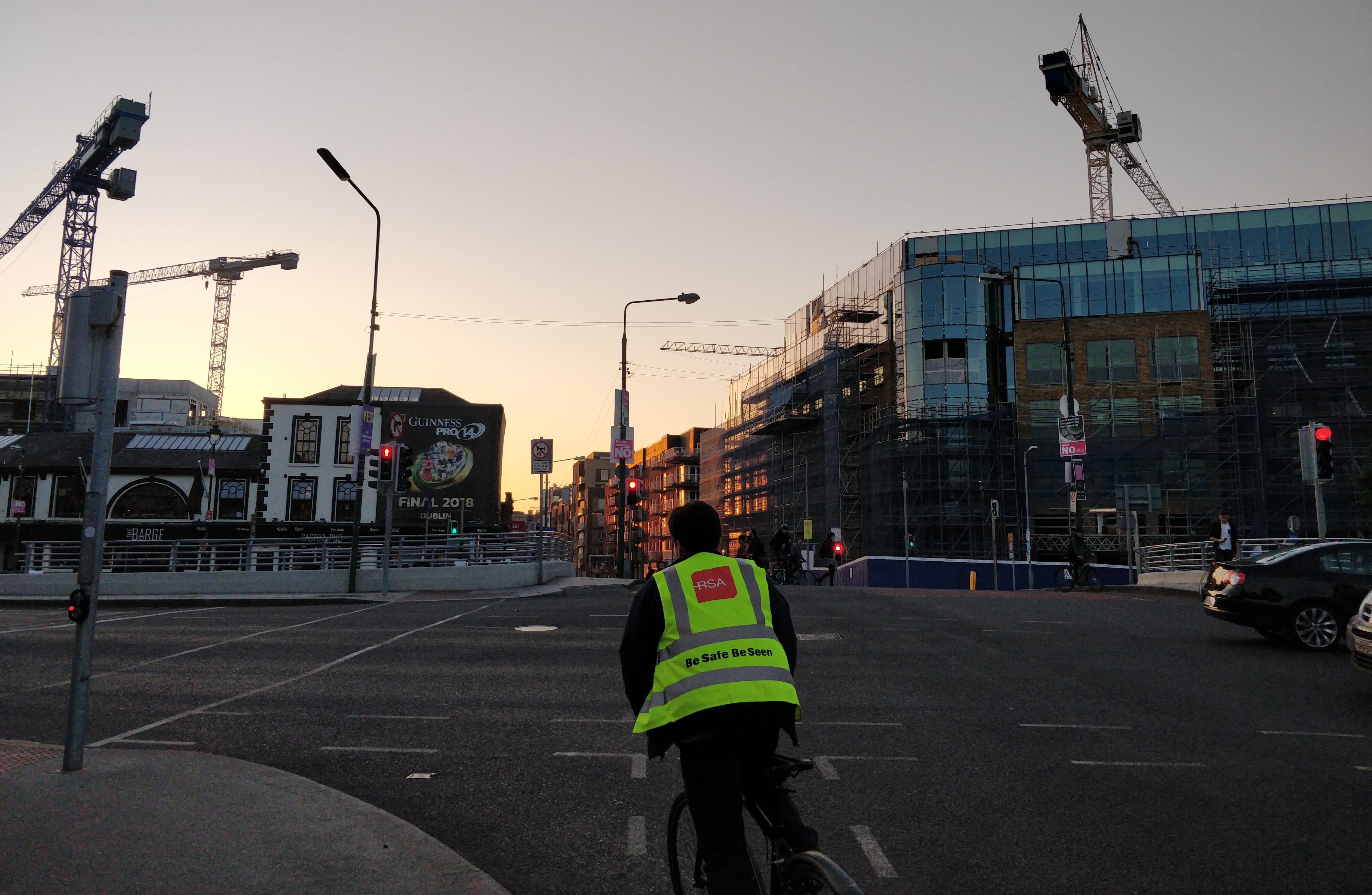
    Lone cyclist, Charlemont Bridge, Dublin.

    II – Cyclist ‘deaths’

    Typically, when a cyclist is killed headlines and news bulletins state he has died in a collision – a passive inevitability arising from being on the wrong side of an autonomous vehicle. Yet such machines are under human control. Would it not be more accurate to say a cyclist has been killed?

    Alas, neither cyclists, public transport users, nor pedestrians tend to purchase media space, despite comprising the vast majority of those in transit across Ireland, particularly in urban areas, in which most of the population now resides. Where there is coverage of transport alternatives it usually relates to how these affect motorists, as where bus lanes generate traffic jams, or where cyclists create a nuisance by failing to observe the law.

    Little substantive probing occurs into improvements to the transport infrastructure – or indeed how Ireland stacks up internationally.

    Apart from being presented as a nuisance, on those rare occasions that cycling is treated positively, it is depicted as good for children or fitness. But rarely, if ever, is it taken as a realistic alternative to the car. Overwhelmingly, the message is: four wheels good, two wheels bad.

    Last month, a cyclist was killed by a driver turning a lorry at the main N11 junction immediately outside RTE’s premises in Dublin(4). Coincidentally, currently there are plans to develop a new vehicular junction along the N11 on lands formerly owned by RTE that are being redeveloped for housing. The plans are attracting objections, alleging the proposed provision for cyclists is unsafe and substandard(5).

    Notably, the route is a major cycle artery to the country’s largest university, University College Dublin. The RTE radar does not appear to have picked up an important story on its doorstep.

    III – Cars In Their Eyes

    One basic measure the national broadcaster could make to raise public confidence would be to provide an easily accessible public declaration of any direct remuneration, ‘gifts’, or other contractual arrangements into which RTE or its senior personnel enter into with third parties, including car dealers and importers. This would be in line with the transparency the BBC demands of its employees(6).

    It is of interest that over the years reports have emerged of various ‘stars’ being provided with complimentary cars by dealerships. As far back as May 2005, Tommy Broughan TD called for transparency, informing Dáil Éireann that Ryan Tubridy had the use of a Lexus, while Pat Kenny and Gerry Ryan (both then contracted to RTE) had ‘relationships’ with BMW and Mazda respectively(7).

    Tubridy currently presents ‘The Late Late Show’, which is ‘sponsored’ by Renault. Earlier this year his comments – which the Dublin Cycling Campaign described as ‘casual incitement of hatred’ – attracted five hundred complaints to the broadcaster. He had suggested that people who (legally) cycle two abreast should be ‘binned‘(8).

    Given RTE receives almost two hundred million euro per annum from the public through mandatory TV licences, surely the Irish people have a right to know whether Mr Tubridy continues to be provided with a vehicle by any outside firms.

    What information there is available is generally gleaned from marketeers’ press releases. Investigations into possible conflicts of interest are almost unheard of, at least in public.

    Meanwhile, an opinion piece last year by RTE’s Countrywide presenter Damien O’Reilly in The Farmers Journal ridiculed Irish cyclists for wearing luminescent clothing to ensure their safety: this was ‘aggressively coloured’ as O’Reilly put it(9). Separately, the Sunday Times revealed (following a successful freedom of information request) that O’Reilly had been paid for work done on behalf of An Bord Bia in Dubai, which was approved by RTE management(10).

    ‘Moonlighting’ of RTE stars has given rise to further controversy in recent months, with Claire Byrne landing herself in hot water over work done on behalf of financial services firm Davy’s(11).

    Elsewhere there has been a failure to reveal corporate funding of programming. Phoenix Magazine reported that Derek Mooney’s Programme ‘Turf Life’, broadcast on May 4th 2018, was supported financially by Bord Na Móna, but this was not declared in the programme’s credits(12).

    IV – George’s Marvellous Meddling

    Over on Newstalk, George Hook set himself up as the champion of the poor downtrodden motorists, while castigating other road users – such as cyclists of course!

    In 2015 on daytime television Hook declared that he ‘hates cyclists with a passion‘(13), before stating: ‘They do what the hell they like. They’re a threat to themselves, they’re a threat to pedestrians, and ultimately they’re a threat to motorcars, as motorcars trying to avoid these lunatics will have an accident.’

    Last September he outdid himself, comparing cyclists to Nazis on the BBC’s Nolan Show(14).

    Champion of downtrodden motorists George Hook.

    Notably, Hook has previously been provided with a free car by Peugeot. RTE’s own website carries a report from June 22nd, 2011 in their ‘Motors’ section, entitled (seemingly without irony) ‘508 Hooked’, in which ‘Peugeot Managing Director Geroge Harbourne said: ‘George is an excellent brand ambassador for Peugeot. We very much look forward to working with him to increase the awareness of the Peugeot brand in Ireland, through his high public profile’ (15).

    V – Increasing Obsolescence

    Last year, national car sales dropped 10%, yet contrary to perceived wisdom this did not coincide with economic stagnation(16). Increasingly, those fortunate enough to get by without a car realise that these metal boxes no longer represent freedom, but are instead a costly burden best avoided.

    Cars are good for a weekly shop – but so is a taxi – and in any case the traditional weekly shop is a decreasing habit, especially among the younger generation. Yet perversely, as more people move away from cars, the national broadcaster sings the praises of the internal combustion engine with increasing vigour.

    During the ‘Bertie boom years’, many first-time buyers bought a ‘starter home’ far from Dublin, which required a long daily commute by car. This was often endured in the hope of returning to Dublin at some later date. Alas many of those dreams have receded.

    These days, although accommodation in Dublin is in notoriously short supply, most of the younger generation are nonetheless opting to stay put in the capital, and avoiding the daily imprisonment that car dependency brings. Wander around the ‘go-getter ghettos’ of Google’s HQ on Barrow Street, Docklands, and East Point Business Park: cyclists, pedestrians, and public transport users abound, but there is little sign of cars.

    In Dublin twenty years ago taxis were notoriously rare, and buses did not enjoy their own lanes. Having a motor in those days was a distinct advantage. Yet roll on two decades and owning a car is arguably more of a burden, and increasingly identified with ill-health.

    The link between car dependency and obesity is well established(17); sadly, Ireland could be set to become the most obese country in Europe(18), which in part reflects our car dependency. Yet instead of discussing the obvious links, the Irish media is more likely to allude to the danger and zealotry of cyclists. Could it be that the idea of cycling as a normal mode of transport for regular people is too much of a threat to vested interests?

    VI – A Gathering Storm

    The New Scientist(19) reported that the fumes created by car engines tend to have a worse effect on those inside vehicles, rather than outside, as had previously been believed. That lovely ‘new car smell’ may actually mask toxic odours, which the driver and occupants might otherwise detect. For example, PM 10s are among the numerous known carcinogens created by diesel emissions(20).

    Another report recently featured in the UK media indicates that a class action is being brought against Volkswagen(21), following the emissions scandal, which involved the manufacturer lying for years about the level of toxic fumes generated by its vehicles. This may be the tip of a large iceberg.

    If it turns out that children developed asthma from riding in such vehicles – and if there is no background family history causation is plausible(22) – the emissions scandal could explode further, with major consequences in terms of costs to manufacturers, and changes in public policy.

    Unsurprisingly, there has been little coverage of this in the Irish media, but the story could be of even more relevance here. Firstly, our greater car-dependency exposes us to greater danger. Secondly, the manufacturer associated with misleading governments, the public, and owners – Volkswagen – was the top-selling brand in this country between 2012 and 2016(23).

    That is a triple-whammy to which Irish people may have been particularly exposed – yet hardly a peep from anywhere in the Irish media. Might we see greater coverage of such issues in mainstream Irish media in the years to come? Don’t hold your breath, unless that is you are being passed by a noxious vehicle belching out toxic fumes.

    On May 8th RTE’s Freedom of Information Officer accepted a Freedom of Information Request from Cassandra Voices seeking records of payments or payments-in-kind from motor car dealership to leading RTE stars that have been approved by RTE management since January 1st, 2017. RTE have 30 days in which to respond. Details will be revealed in the next edition.

    (1) Untitled, Belfast Telegraph, ‘EU using Dublin as example of worst-case urban, 4th of October, 2016, sprawl’ https://www.belfasttelegraph.co.uk/breakingnews/breakingnews_ukandireland/eu-using-dublin-as-example-of-worstcase-urban-sprawl-28409383.html

    (2) Untitled, RTE: ‘From manufacturing to car sales, UK economy bounces back’, 6th of  August, 2013 : https://www.rte.ie/news/business/2013/0806/466637-uk-economy/.
    Also, Untitled, RTE, ‘2016 car sales rise 17.5%, Toyota most popular make – SIMI’ Tuesday, 3rd of January, 2017: https://www.rte.ie/news/business/2017/0103/842420-2016-car-sales/.

    (3)  RTE Player, ‘Car Giveaway / The Late Late Show’, 25th of May, 2018, https://www.rte.ie/player/ie/show/the-late-late-show-extras-30003017/10884022/

    (4) Gráinne Ní Aodha, ‘19-year-old cyclist dies after collision with truck near UCD this afternoon’ 18th of April, 2018: http://www.thejournal.ie/cyclist-serious-injuries-dublin-n11-3965285-Apr2018/

    (5) Untitled, irishcyclist.com ‘NEW RTE JUNCTION COULD MEAN MORE CONFLICTS BETWEEN CYCLISTS AND BUSES’19th of April, 2018, http://irishcycle.com/2018/04/19/new-rte-junction-could-mean-more-conflicts-between-cyclists-and-buses/

    (6) BBC Code of Ethical Policy, downloaded 29/5/18 : http://downloads.bbc.co.uk/supplying/pdf/BBC_Ethical_Policy.pdf

    (7) Untitled, breakingnews.ie ‘Call for RTÉ broadcasters to declare free cars’, 5th of May, 2005,  https://www.breakingnews.ie/ireland/call-for-rte-broadcasters-to-declare-free-cars-201227.html

    (8) Untitled, Stickybottle, ‘Flood of complaints to RTE after ‘Late Late Show’ cyclists item’ 14th of March, 2018, http://www.stickybottle.com/latest-news/complaints-rte-cyclists-item/

    (9) Untitled, Stickybottle, ‘Irish cyclists dress too aggressively – Farmers Journal column’, 27th of July, 2017 http://www.stickybottle.com/latest-news/irish-cyclists-to-blame-for-their-own-unpopularity-farmers-journal-column/

    (10) Frank Armstrong, CountryWide’s O’Reilly comes a cropper with greenwash row’ 22nd of October, 2017: https://www.thetimes.co.uk/edition/ireland/countrywides-oreilly-comes-a-cropper-with-greenwash-row-dn83xmxs9

    (11) John Burns, ‘RTE ‘kept in the dark’ over Claire Byrne moonlighting’, 22nd of October, 2017, https://www.thetimes.co.uk/article/rte-kept-in-the-dark-over-claire-byrne-moonlighting-kzf75rp2c

    (12) Phoenix Magazine, May 2018.

    (13) Untitled, thebikecomesfirst.com ‘“I hate cyclists with a passion” – George Hook’, 5th of July, 2015: http://www.thebikecomesfirst.com/i-hate-cyclists-with-a-passion-george-hook/

    (14) Alan O’Keeffe, ‘’I’m never going to do a Nazi salute again,’ promises Hook’’, 18th of November, 2017, https://www.independent.ie/irish-news/news/im-never-going-to-do-a-nazi-salute-again-promises-hook-36331313.html

    (15) Untitled, RTE Lifestyle ‘508 Hooked’: 22nd of June, 2011, https://www.rte.ie/lifestyle/motors/2011/0622/145287-hookg/

    (16) Conall Ó Fátharta, ‘Brexit blamed as car sales down 10% in first nine months’ 2nd of November, 2017: https://www.irishexaminer.com/ireland/brexit-blamed-as-car-sales-down-10-in-first-nine-months-462040.html

    (17) Rob Stein, ‘Car Use Drives Up Weight, Study Finds’, 31st of May, 2004: http://www.washingtonpost.com/wp-dyn/articles/A3062-2004May30.html

    (18) Rachel Flaherty, 6th of May, 2015, ‘Ireland set to be most obese country in Europe, WHO says’ https://www.irishtimes.com/news/health/ireland-set-to-be-most-obese-country-in-europe-who-says-1.2201731

    (19) Wiebina Heesterman, ‘Air pollution is worse inside cars and in dust’ 23rd of November, 2016, https://www.newscientist.com/letter/mg23231011-100-9-air-pollution-is-worse-inside-cars-and-in-dust/ 

    (20) Victoria Wooloston Diesel cars “kill 5,000 people a year” in Europe — and the UK is one of the worst offenders’, 18th of September, 2017, http://www.alphr.com/environment/1007053/pollution-diesel-cars-deaths-UK

    (21) Rob Davies, Dieselgate: UK motorists file class-action suit against VW, 9th of January, 2017. https://www.theguardian.com/business/2017/jan/09/dieselgate-volkswagen-uk-motorists-class-action-suit

    (22) www.asthmaorg.uk ‘Pollution’, downloaded 29/5/2018 https://www.asthma.org.uk/advice/triggers/pollution/

    (23)Melanie May, ‘These are the 5 top-selling cars of 2017 so far’, downloaded 29/5/2018 http://www.thejournal.ie/best-selling-cars-ireland-2017-3483985-Jul2017/

  • History’s Dead Hand on the Middle East

    Last month’s opening of the U.S. embassy in Jerusalem served to re-ignite Palestinian rage against what many there regard as a latter-day ‘Crusader’ state, a term with particular resonance in that region.

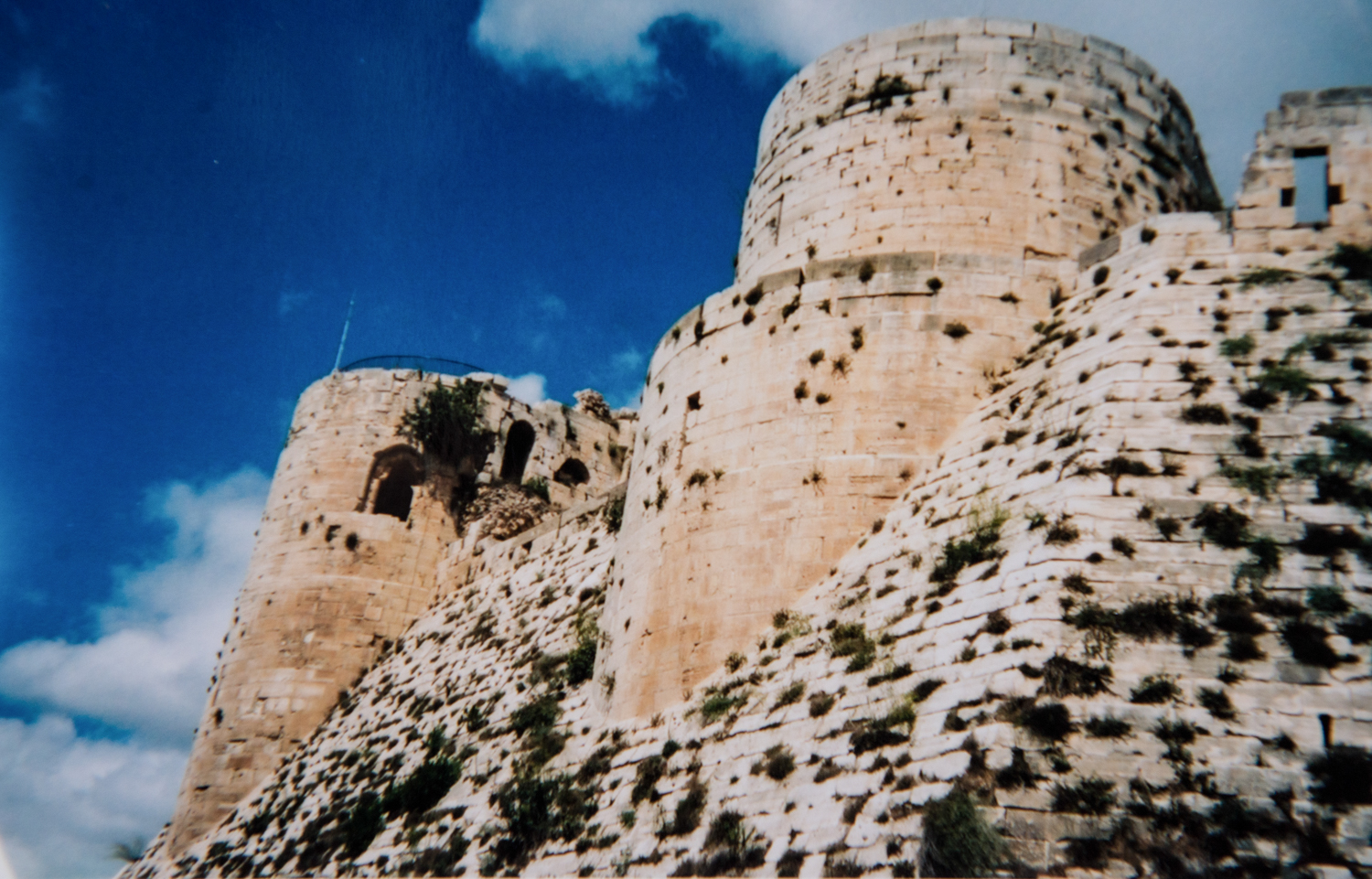
    Krak des Chevaliers, Crusader Castle, Syria. Photo: Frank Armstrong, 2003.

    No other city juxtaposes such piety and passion as Jerusalem. It is sacred to the three great monotheistic faiths of Judaism, Christianity and Islam, and located close to the birthplace of civilisation itself. All the dominant empires of the Mediterranean and western Asia have battled for possession of this strategic gateway to three continents, and on it goes.

    With Europe enjoying a long, and increasingly complacent, holiday from its bloody history, and with the U.S. finding itself in ‘united states of amnesia’, the past is often forgotten; but in the Middle East – a heavily-laden term itself – a symbolic inheritance smoulders and crackles.

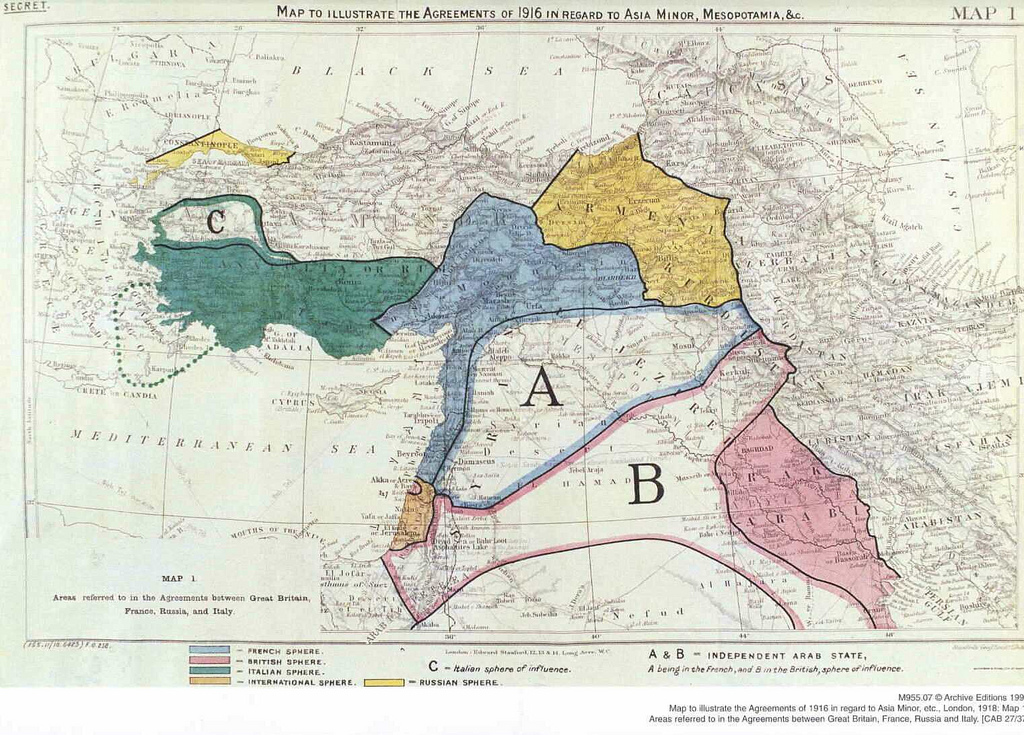
    Thus, when Islamic State, or Daesh, burst into Iraqi and Syrian politics and declared a short-lived Caliphate in 2014, they claimed they were destroying the despised Sykes-Picot border. These ‘lines in the sand’ (somewhat altered after the war) demarcating post-colonial states were the product of a secret alliance between the Allied Powers to carve up the Ottoman Empire in 1916, against the claims of Arab nationalists.

    The reason this latest gesture of U.S. support for the Israeli government of Benjamin Netanyahu – and nod to a domestic Christian fundamentalist audience – is a cause of such outrage lies in the profound meaning attached to the ancient city, which, ironically, derives its name from a Bronze Age ‘pagan’ deity Shalem; the preceding ‘Jeru; is a corruption of the Sumerian word ‘yeru’, for ‘settlement’ or ‘cornerstone’.

    For Jews it is an historic capital, and site of the First and Second Temples, of which only the Wailing Wall survives after its destruction during the Great Jewish Revolt against Roman Rule (66-73 CE). The city also has profound associations with Christianity, as the site of the trial and crucifixion of Jesus Christ; furthermore among the Evangelical Rapture movement it is believed that the rebuilding by the Jews of their Temple will anticipate the Second Coming, which explains the devotion of many U.S. Republicans to the cause of Israel.

    Islam is also deeply-embedded in the city. Many Biblical traditions contained within Judaism and Christianity were accepted by Muhammad in the Qur’an, although he explicitly denies the doctrine of the trinity (though, surprisingly, not the virgin birth) in verse 171 of the 4th Sura: Do not say, ‘Three’. Stop. It is better for you, Allah is but one God. He is far above having a son. This doctrine of tawhid or ‘oneness’ is crucial to any understanding of Islam, especially the Sunni variant.

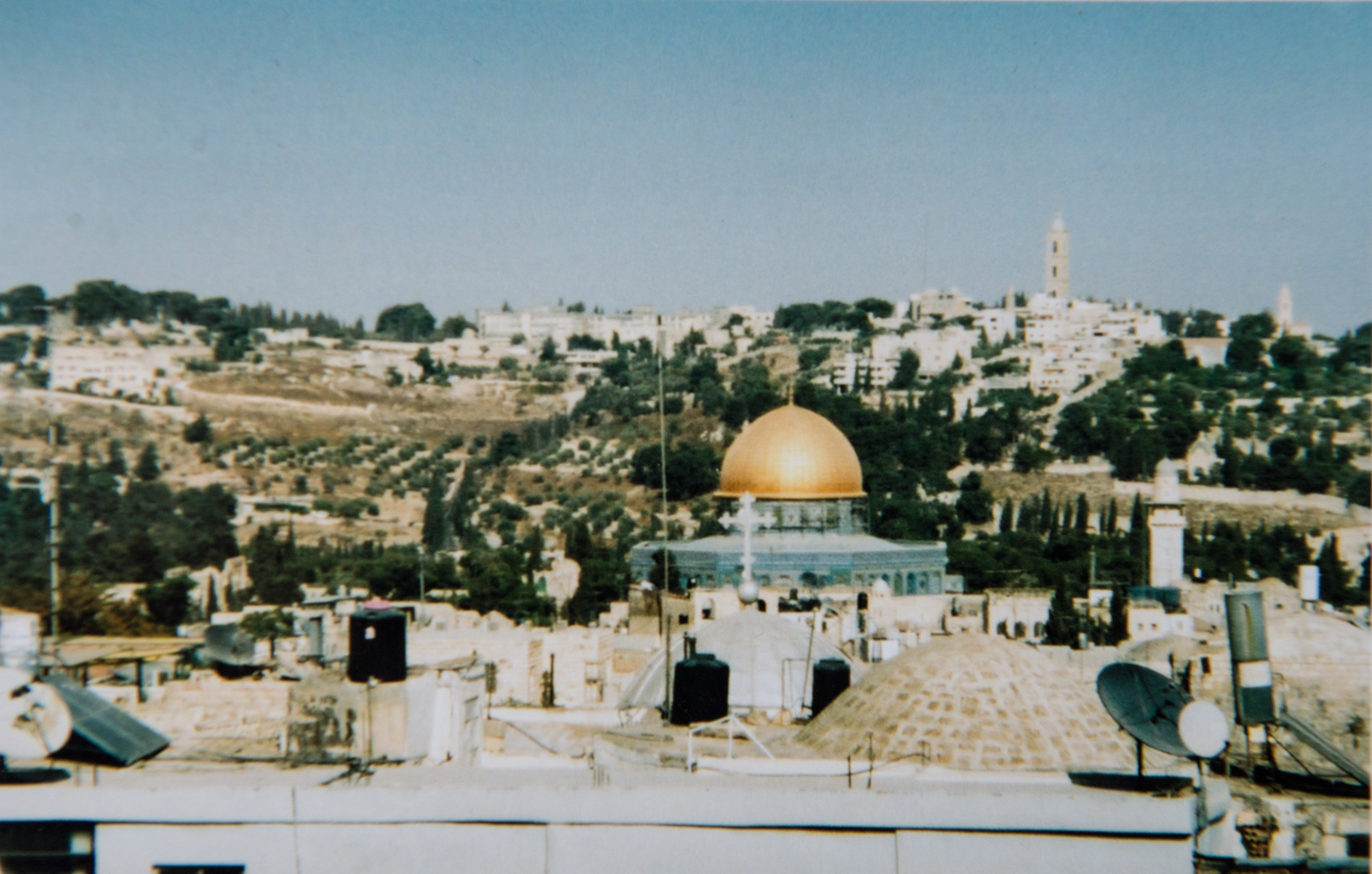
    Above all the Muslim presence in Jerusalem is located in the shimmering Dome of the Rock completed by Caliph ‘Abd al-Malik in 691 CE on the site of the Second Temple after the Islamic conquest in 638 CE.

    The Dome of the Rock. Photo: Frank Armstrong, 2003.

    In the The Crucible of Islam G. W. Bowersock points to a Qur’anic verse inscribed on the north door of the structure in which Muhammad condemns polytheism. This was a charge that could be leveled against Christians with the trinity in mind. Bowersock argues this did not augur well for future sectarian relations: ‘Abd al-Malik’s Dome of the Rock arose on ground that was shared by the great monotheisms, but it proclaimed only one of them and offered no path to coexistence with the other two(1)’.

    This lapidary statement of intent contrasts with the relative benignity of the lightning conquest by the followers of Muhammad of a great empire stretching from the Iberian peninsula to Persia. As Bowersock puts it: ‘Archaeological evidence which has been cultivated for this period in recent years confirm the lack of any substantive impact of the Muslims on local populations.’

    Adherents of other monotheistic religions in that region simply had to pay jiza – a head tax – and a tax on land known as kharaj. Despite their initial opposition, and alliance with the Sassanid Empire in Persia, Jews were far better treated under their Islamic lords than their co-religious under ‘Christian’ rulers in Europe. Those who appeal to history in the Middle East, on all sides, tend to be selective in their recollections.

    II ‘Middle’ or ‘Near’ East?

    The term ‘Near East’ was coined at the end of the nineteenth century to describe the Ottoman Empire and its successor states, while the expression the ‘Middle East’ was used for the area that intervened between the ‘Near’ and ‘Far’ ‘East’. With the demise of the Ottoman Empire, however, the ‘Middle East’ migrated westward and came to include the ‘Arab’ states that had emerged from the Ottoman Empire. This, in turn, heralded the emergence of ‘Central Asia’ to describe what had been the ‘Middle East’.

    This has given rise to the argument, advanced in particular by Edward Said, that the term should be expunged from use. Said was reacting to an enduring European discourse used to justify imperialism, often treating the region as a special case requiring tutelage.

    According to a contemporary ‘Orientalist’ Bernard Lewis (d.2018): ‘The Middle East as an area of study for scholars in the western world presents peculiar problems different from those of most other areas. It is different than a situation in which we study a part of our own society. That I think is self-evident.’

    Western imperialism did not cease with the end of the British and French mandates in Iraq, Jordan, Syrian and Lebanon whose borders are the legacy of Sykes-Picot. The presence of vast oil reserves has given rise to constant meddling. David Frum, formerly a speech writer of George W. Bush, who coined the phrase ‘axis of evil’, records that Bernard Lewis was invited to the White House in November, 2001, ‘to explain his views’.

    Frum approvingly noticed ‘a marked up copy of one of Bernard Lewis’s articles in the clutch of papers the president held(2).’ The extent to which archaic Orientalist opinions retain their appeal, and more importantly a propaganda value, emphasising a distinction between ‘democratic’ West, and ‘tyrannical’ East, lends credence to Said’s thesis that: ‘the vindication of Orientalism was not only its intellectual or artistic successes but its later effectiveness, its usefulness, its authority(3).’

    Does the term the Middle East to describe a great swathe of territory from Morocco to Iran retain any usefulness therefore? Nikki Keddie argues the term retains an explanatory usefulness for ‘an uneasy but still adapted blend of pastoral nomadism and settled life’ in the region(4).

    This has roots in the ideas of the fourteenth-century Arab historian Ibn Khaldun’s who pointed to a perpetual conflict between badu (nomadism) and hadar (urbanites) in the region. He claimed the superior ‘asabiyya (group solidarity) of the badu brought successive victories against hadar. However, after a number of generations this ‘asabiyya is corrupted by the more luxurious of life in the city, and the cycle continues(5). Even today one can see certain of these dynamics playing out in conflicts from Syria and Iraq.

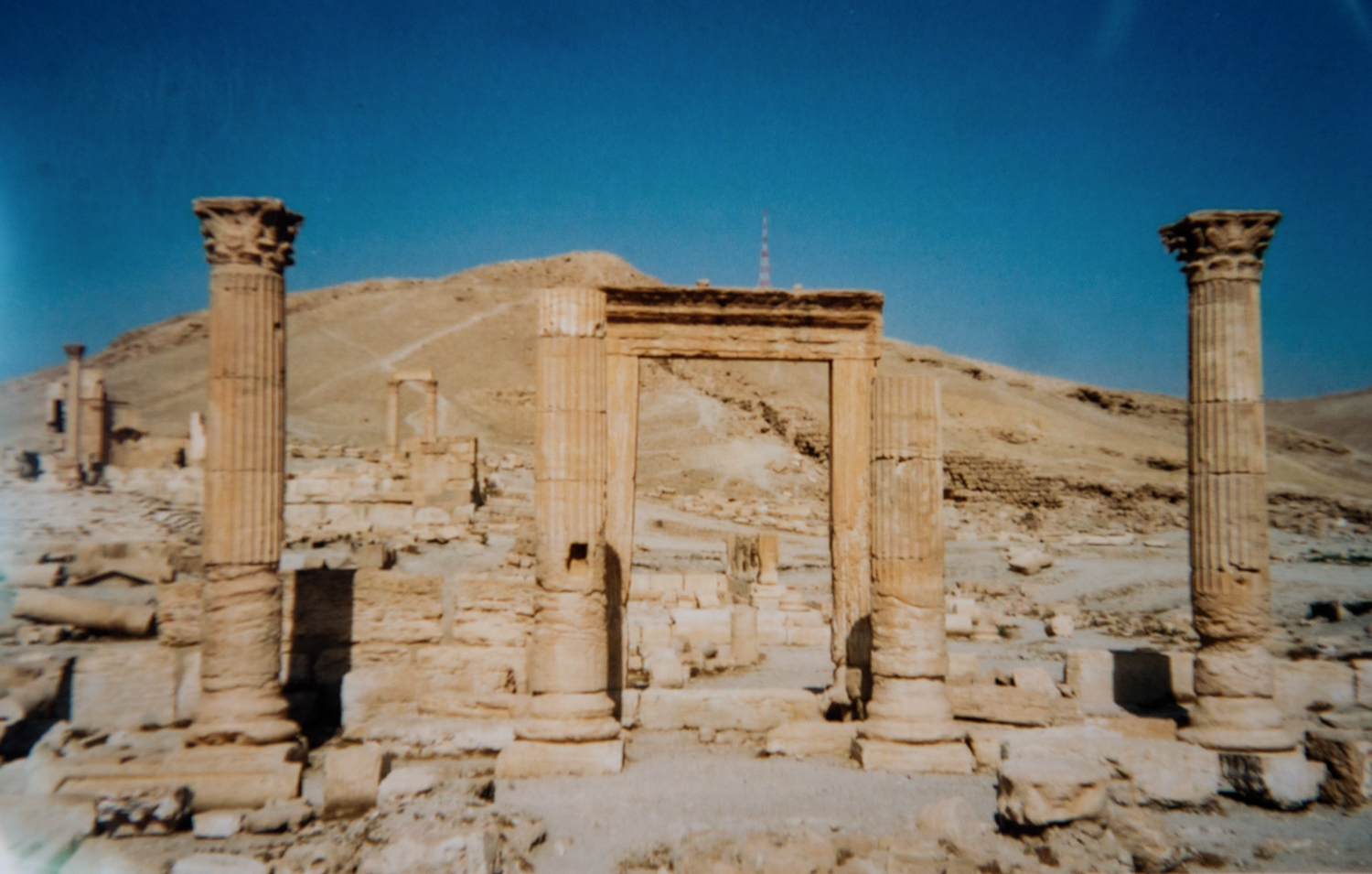
    Palmyra, Syria. Photo: Frank Armstrong, 2003.

    Today, the term the Middle East approximates with the region subjected to the first wave of Muslim conquest (the Iberian peninsula apart), and arguably that legacy is still evident. This is not, however, to equate the region with the ‘Islamic World’, or more vaguely ‘Islamic government’, since ‘Muslims in power’ took on varying forms in places such as in India during the Mogul Empire, where it was the minority creed.

    Nazih Ayubi argues that the jizya and kharaj taxes imposed by the original ‘Islamic’ state were the basis of a ‘tributary’ mode of production, involving wealth being extracted by the politically and socially superior from the politically and socially inferior. This survived into the Ottoman Empire (1299-1922), under whom all land was owned by the state, and where until the seventeenth century, armies were composed of slaves requisitioned from the populace(6).

    European colonisation, especially after World War I, dragged much of the region into the world economy, sweeping away political structures in the process, but underlying cultures endured, and the architectural inheritance of the region serves as an important reminder.

    Thus, the shared historical experience of much of the Middle East, under the original ‘Islamic State’ and especially the Ottoman Empire, in combination with enduring nomadic social structures suggests a regional congruence. Colonialism had a significant impact, and distorted borders, but the region is also a product of a far longer history, which encroaches heavily on the present.

    III Israel’s Iron Wall

    Contrary to the image of a technologically-advanced, forward-looking society, the ghosts of history also exert a magnetic pull on Israeli society.

    The conduct of the Israeli authorities reflect the ideology of the Likud Party, now led by Netanyahu, which has been the dominant political force in Israel since its foundation in 1977 under Menachem Begin.

    The Arab-Israeli wars which greeted the foundation of Israel in 1948 (known as al-nakba – the catastrophe – to Palestinians) brought a succession of Israeli victories, especially the 1967 Six-Day War which effectively neutralised Gamal Abdel Nasser, the erstwhile champion of Arab Nationalism.

    Their ascendancy in the region was affirmed by the demise of the Soviet Union, and establishment of the U.S., Israel’s Cold War patron, as lone Superpower. The Palestinian case was further weakened by PLO support for Iraq before the first Gulf War in 1991, and the invasion of Iraq and toppling of Saddam Hussein in 2003.

    But despite accords with neighbouring Egypt and Jordan, Israel faces perpetual conflict as most Arabs have a fixed view on her as a colonial, oppressive presence in the region. Only continued autocratic rule in Egypt and Jordan (maintained by vast U.S. ‘development’ aid) keeps these sentiments in check.

    The Israeli electorate has consistently favoured leaders unwilling to countenance concessions, and the expansion of settlements is a fixed policy. Withdrawal from Gaza in 2006 was a strategic realisation that it was untenable to maintain 10,000 settlers inside a grossly over-populated strip of land containing over a million and a half Palestinians. Better to focus on shoring up the fertile parts of the West Bank, and Jerusalem.

    To explain Israeli intransigence it is necessary to explore the basis of Likud ideology, which can be traced to three principle sources: first, the writings of Ze’ev Jabotinsky; second, the experience of the Holocaust; and third, the emergence of religious Zionism after 1967.

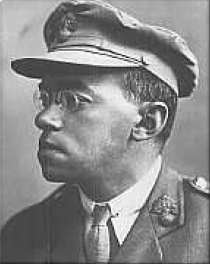
    Zev (Vladimir) Jabotinsky.

    Ze’ev (Vladimir) Jabotinsky (1880-1940), a Russian born Jew, is generally viewed as the spiritual founder of the Israeli Right. In 1923 he wrote an influential article entitled ‘On the Iron Wall (We and the Arabs)’ in which he asserted that a ‘voluntary agreement between us and the Arabs of Palestine is inconceivable now or in the foreseeable future’, since, every indigenous people ‘will resist alien settlers as long as they see any hope of ridding themselves of the dangers of foreign settlement.’

    In response to resistance Jabotinsky advocated ‘an iron wall’ of military might which ‘they [the Arabs] will be powerless to break down.’ Only then ‘will they have given up all hope of getting rid of the alien settlers. Only then will extremist groups with their slogan ‘No, never’ lose their influence, and only then will their influence be transferred to more moderate groups.’ At that point he envisaged limited political rights being granted.

    Jabotinsky’s metaphorical “iron wall” was given literal expression by Ariel Sharon’s construction of a ‘security fence’ in 2003 cutting through the West Bank, although the anticipated acquiescence of the Palestinians, in Hamas at least, has not materialised.

    The second major influence on Likud, and Israeli society in general, is the trauma of the Holocaust experience. The collective memory of passivity in the face of genocide mandates a policy of fierce reprisal in response to the taking of Jewish life. Restraint is characterised as appeasement.

    In his book A Place Among the Nations (New York, 1993) Benjamin Netanyahu dwelt on the lessons of appeasement of Nazi Germany, and the betrayal of Czechoslovakia. Arabs are likened to Nazi Germany, Palestinians to the Sudeten Germans, and Israel to the small democracy of Czechoslovakia, the victim of Neville Chamberlain’s 1938 Munich Agreement with Hitler.

    This Holocaust motif was also harnessed by opponents of Yitzhak Rabin after he signed up to the Oslo Accords in 1991. Inside the Knesset (Israel’s parliament) two Likud deputies proceeded to open black umbrellas comparing Rabin’s deal to Chamberlain’s Munich capitulation, while effigies of Rabin dressed in SS uniform were set alight at right wing demonstrations.

    The ferocity of Israel’s response to Hamas, however, works against the moderate leadership that Jabotinsky’s model requires. Likud policy exceeds the methodology of the ‘iron wall’, and perpetuates conflict.

    The last major influence on Likud is religious Zionism, especially that generated by the optimism of the 1967 victory. Those enormous territorial gains were interpreted as a sign of divine favour, and settlement of the land became a religious imperative.

    Its force was demonstrated by the assassination of Yitzhak Rabin in 1995, which effectively de-railed the Oslo Peace Process. Rabin’s killer was a young extremist by the name of Yigal Amir. During his trial Amir told the court that according to halacha (Jewish law), a Jew who gives his land to the enemy and endangers the life of other Jews must be killed.

    IV The Wahhabi Formula

    Alongside uncritical support of Israel, the other plank of U.S. Middle Eastern policy has been a long-standing alliance with the Al-Saud family, who gave their name to the country of Saudi Arabia in 1932. As Guardians of the Holy Cities of Mecca and Medina to which all Muslims are called on to make a pilgrimage hajj at least once in their lifetime, the hand of history lies heavily. The ruling family have used a Wahhabi blueprint to project their power both internationally and domestically

    The writings of Muhammad Abdel Al-Wahhab (1703-1792), a religious scholar brought up in the strict Hanabali school, repudiate unorthodox practices such as saint veneration. This was common among the Shi’a (faction), which had broken with the dominant Sunni – faithful custodians of Muslim practice (sunna) – after the murder of the fourth caliph Ali in 661 CE.

    Al-Wahhab exalted the doctrine of tawhid: ‘God’s uniqueness as omnipotent lord of creation and his uniqueness as deserving worship and the absolute devotion of his servants’, which is reflected in the inscription on the Dome of the Rock.

    In 1744 Al-Wahhab entered into an accord with the tribal lord Muhammad Al-Saud. The politico-religious alliance generated vast conquests in Arabia as previously warring tribes were once again united under the banner of Islam. In exchange for ideological justification and recruits for the conquests, shari’a, religious law, as interpreted by the ulama, the religious scholars, was imposed on the territories.

    In his writings Al-Wahhab emphasised that obedience to rulers is obligatory even if the ruler should be oppressive. The commands of the ruler (the imam – ‘commander of the faithful’) should only be ignored if he contradicts the rules of religion.

    The Kingdom of Saudi Arabia adopted this Wahhabist formula once again at the beginning of the twentieth century, but a shift in the balance of power has seen the temporal authorities, bolstered by oil wealth, largely dictate to the ulama. This led Helen Lackner Lackner to opine that ‘the fiction of Wahhabism which has lost its real roots with the destruction of the age old desert culture can only be maintained by an intellectual petrification.(7)’

    However, by the 1970s Islam had become according to Kostiner and Teitelbaum ‘a two edged political instrument – as the kingdom’s primary medium of self-legitimisation, and as the main venue of protest for opposition elements.’ Given how formal political protest, in the shape of political parties, had never been tolerated, unsurprisingly, opposition emerged from the religious milieu, culminating, arguably, in Osama bin Laden and Al-Queda.

    State application of Wahhabism also leaves the Shi’a as a persecuted minority (5-10% of the overall Saudi population) perpetually at odds with the regime, and subject to repression.

    Mohammed bin Salman with U.S. President Donald Trump, March, 2017.

    Just as history imprisons the Israeli government in their tyrannical treatment of the Palestinians, similarly Saudi Arabia is bound by its inheritance. The current Crown Prince, thirty-two-year-old Mohammed bin Salman, courts Western approval by granting women the right to drive, but has done nothing to alter the male guardianship system, where male relatives or husbands have control over almost all aspects of women’s lives.

    More meaningful is Saudi participation in the Syrian and Yemeni civil wars, which serve as bloody proxies for internal contradictions. The age-old conflict with Persia/Iran is, similarly, linked to a battle to preserve conformity in the country itself.

    V Monotheism v Polytheism

    No one cause explains the complex origins of conflict in the Middle East. Moreover, arguably violence is inherent in the human condition, and those of us living within the relatively peaceful confines of Europe and America are perhaps living through a golden age of relative peace. Nonetheless, it is apparent that the wars of the Middle East have boiled with almost unmatched intensity since the end of the Ottoman caliphate in 1922.

    Oil wealth and vast military arsenals have played a role, as does the proximity to Europe which bequeaths embroilment in destructive alliances. But a society that had been so dominated by the instructors of a monotheistic faith now appears devoid of leadership, while the other two that emerged in the region also claim dominion. It seems in the nature of each one to suggest that the other is intolerable, despite the obvious similarities.

    For centuries the Ottoman Empire imposed an orthodoxy that brought relative tranquility, but this was predicated on exploitation by social superiors. The popular appeal of Arab nationalism faded with Nasser, and failed to alter the social structures to forge genuinely fair societies. Political Islam appeared as ‘the answer’ in the late 1970s, but it has often been the only avenue for the expression of discontents, and contains within its inheritance repressive tendencies towards competing belief systems, including atheism.

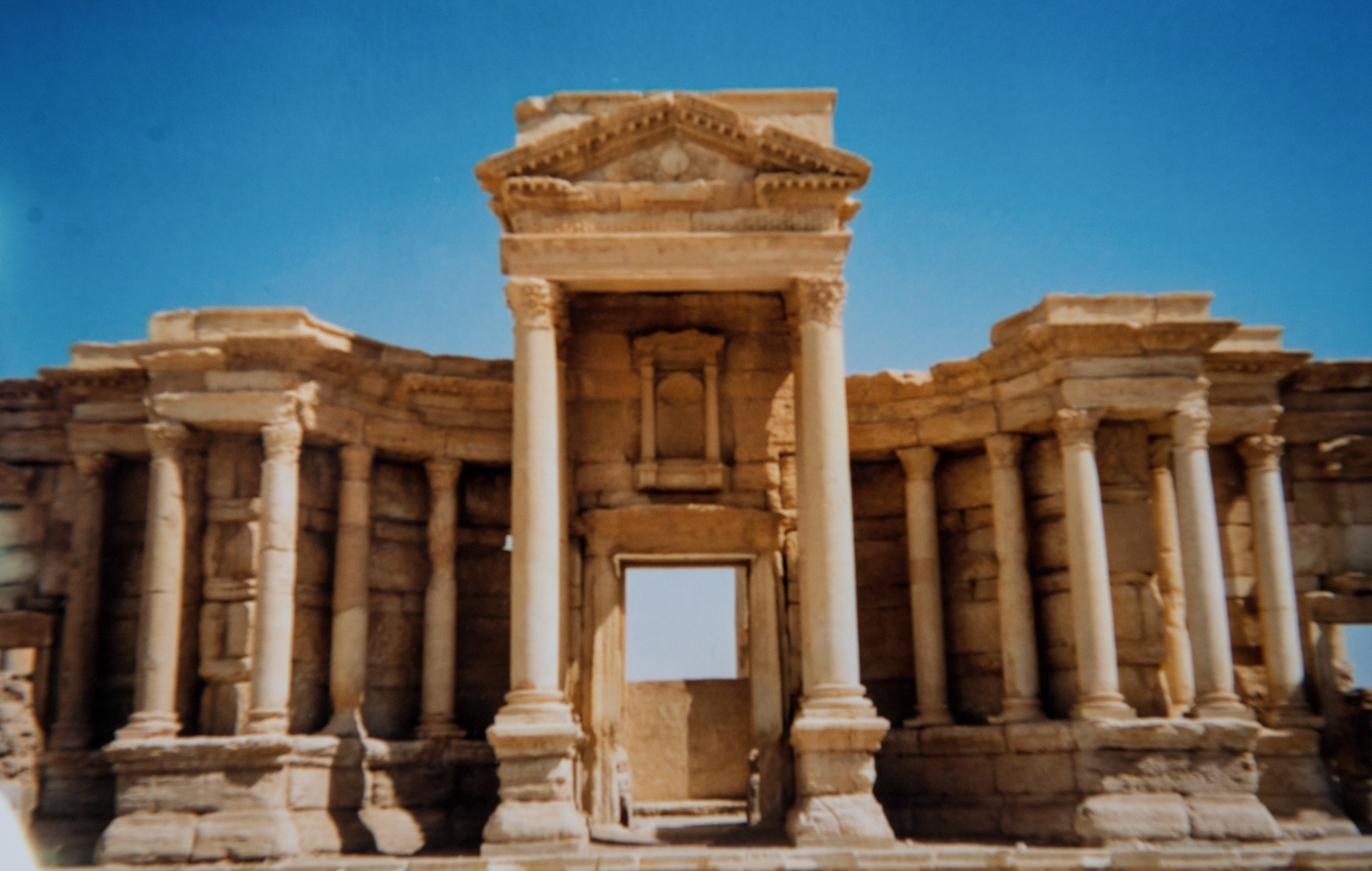
    Palmyra, Syria. Photo: Frank Armstrong, 2003.

    In 2015 the world looked on in horror as so-called Islamic State set about destroying the remains of the Hellenic city of Palmyra, which I had the pleasure to visit in 2003. One may have assumed it was vandalism on a grand scale, but its destruction appears to have flown from the doctrine of tawhid. The disorder of the present was viewed through the prism of pre-Islamic Arabia, as Bowersock explains:

    The tribes, clans and gods of Arabia at this time worked to the advantage of external powers. It was precisely this diversity and disunity that would be a threat to Muhammad when he first began to receive his revelation from Gabriel and would be resolved only as the Islamic movement gathered strength(8).

    No rival could be allowed to stand before submission (Islam) to one God.

    One of the pantheon of gods worshipped at Palmyra is called Allat (earlier known as Ailat). She is often depicted as a consort of another pagan god Allah, whose name Muslims appropriated for the one God of Islam. A Jungian analysis would suggest a symbolic severance from the eternal feminine, which gives rise to enduring conflict; the vehemence directed at the so-called Satanic Verses, purportedly featuring a dialogue between Muhammad and that deity, are revealing.

    Jewish monotheism is not only characterised by one god but also by one people deserving of God’s intercession, which could explain the single-minded attitude of Israel towards the rest of the world. Nor has the idea of a tripartite Christian deity diluted a singular conviction legitimating the destructive colonisation of most of the planet, in the name of God. All of the monotheistic faiths are characterised by a disjunction with the feminine, and perhaps Nature itself.

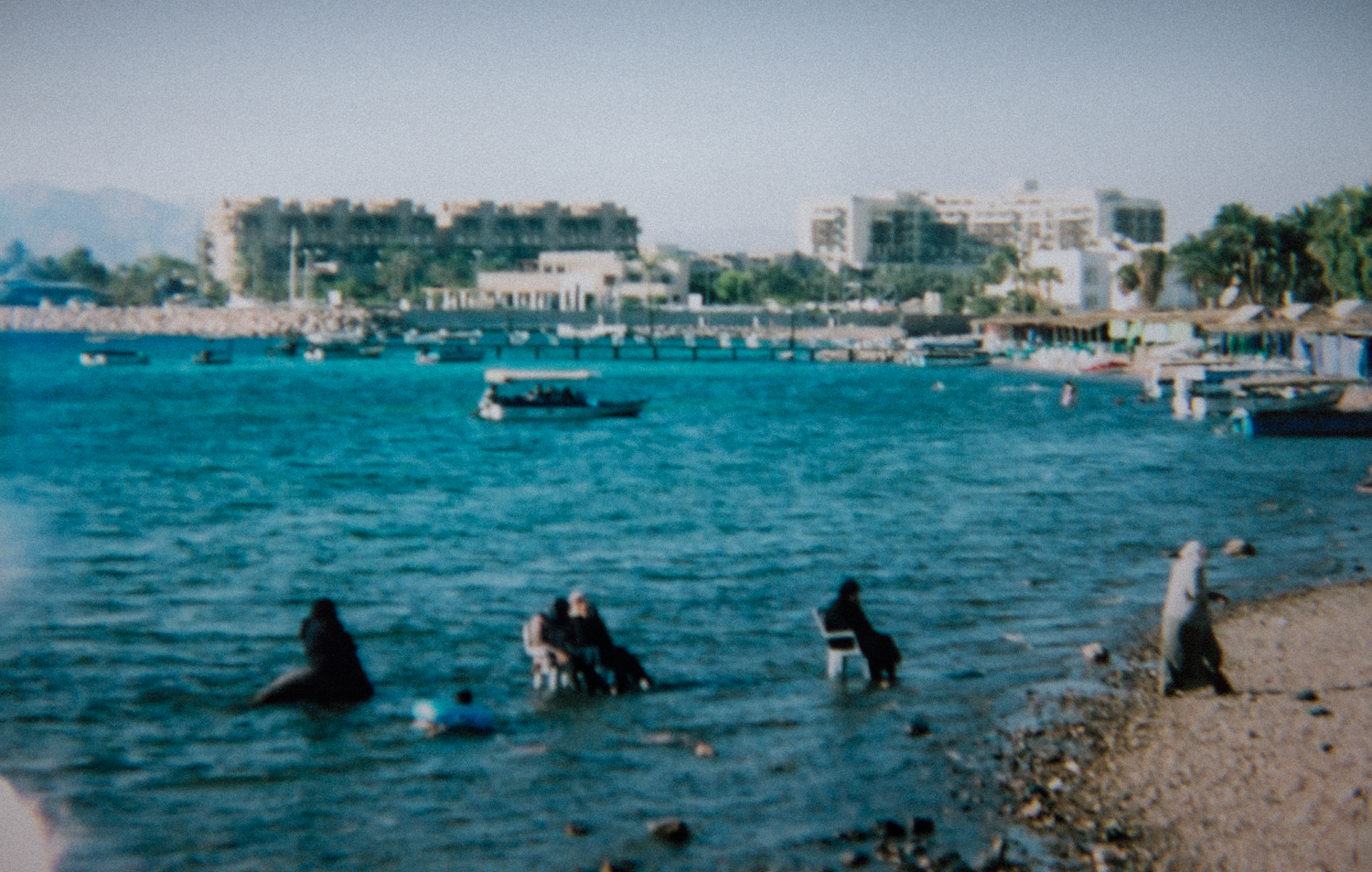
    Aqaba, Jordan. Photo: Frank Armstrong, 2003.

    The wounds of the Middle East continue to fester, with no end in sight to the conflicts in Israel, Syria and Yemen. Religion continues to play a divisive role and forgotten are the days of the first Islamic Empire when individual conscience appears to have been respected, at least beyond Arabia. One fears that calamities will continue until a radical reappraisal of our religious traditions occur.

    Frank Armstrong completed a Masters in Islamic Societies and Cultures in the School of Oriental Studies (SOAS) in 2004, and lived for a period in the Middle East.

    Feature Image: Kevin Fox, all rights reserved.

    (1) G. W. Bowersock The Crucible of Islam (London, 2015), p.158

    (2) David Frum, The Right Man: The Surprise Presidency of George W. Bush, (New York, 2003) p.171-175

    (3) Edward Said, Orientalism (New York, 1978), p.128

    (4) Nikki R. Keddie, ‘Is the a Middle East’ International Journal of Middle Eastern Studies Vol. 4 (1973) p.269

    (5) Nazih Ayubi, Over-stating the Arab StateState Politics and Society in the Middle East, (London 1995) p.30

    (6) Ibid, p. 39

    (7) Helen Lackner, A House Built on Sand – A Political Economy of Saudi Arabia, London, 1978 p.217

    (8) G. W. Bowersock The Crucible of Islam (London, 2015), p.158

  • In the Place Of Sound

    In and between these lines I will explore aspects of the fascinating and dynamic relationship between music, identity and place. Reflecting on my own musical ventures, as well as turning to secondary sources discussing theoretical concepts on the topic, I will point to various ways in which one’s relation to a place is both reflected in, and actively imagined and reinforced with the help of music.

    I will also discuss the idea of music as a place in itself. Representing a world that seems to lie somewhat apart from our everyday life, the entrance into this ‘parallel world’ can give a strong sense of connection to our surroundings, to the world, and not least to our selves. For the travelling musician, it can serve as a place they can carry around with them and thus feel at home wherever they go.

    A child’s venture into a parallel world

    This piece is inspired by my own experience of living and musicking abroad: turning my Austrian ear and heart to traditional musics from Ireland, which has been my home for the past 12 years, and gradually planted seeds for the creation of tunes and songs that would combine elements of Austrian and Irish music traditions. At the same time, North Indian ragas, odd meters and Swedish polska rhythms – which I came across on my travels – started to extend the palette of colours with which I paint on my musical canvas.

    Upon reflection it became clear to me that the practice of combining different musical elements, standing in connection to particular places and peoples, allow me to reconcile multiple new identities and connections to new places without losing a strong connection to the place and culture within which I grew up.

    Furthermore, forming neither entirely part of the here nor the there – neither Austria nor Ireland or elsewhere, this music seems to present a place in itself that instills me with a sense of connectedness. It provides a place I can retreat to wherever I am in the world. In this music, I feel at home.

    II

    In September 2005, seeking to learn Irish tunes in their ‘natural environment’, I accidentally emigrated to Ireland. It had been my intention to spend a year abroad after finishing secondary school. But when the time came to return to Austria I simply stayed put, having fallen in love with the West of Ireland: its beautiful shades of green; the wild Atlantic; the mountains; rivers; the people and their music.

    Prior to moving to Ireland, I had been forced to rest my hands for an extended period due to a bout of tendonitis. In my newly found home of Sligo I took up playing the violin again, under the guidance of my friend Rodney Lancashire.

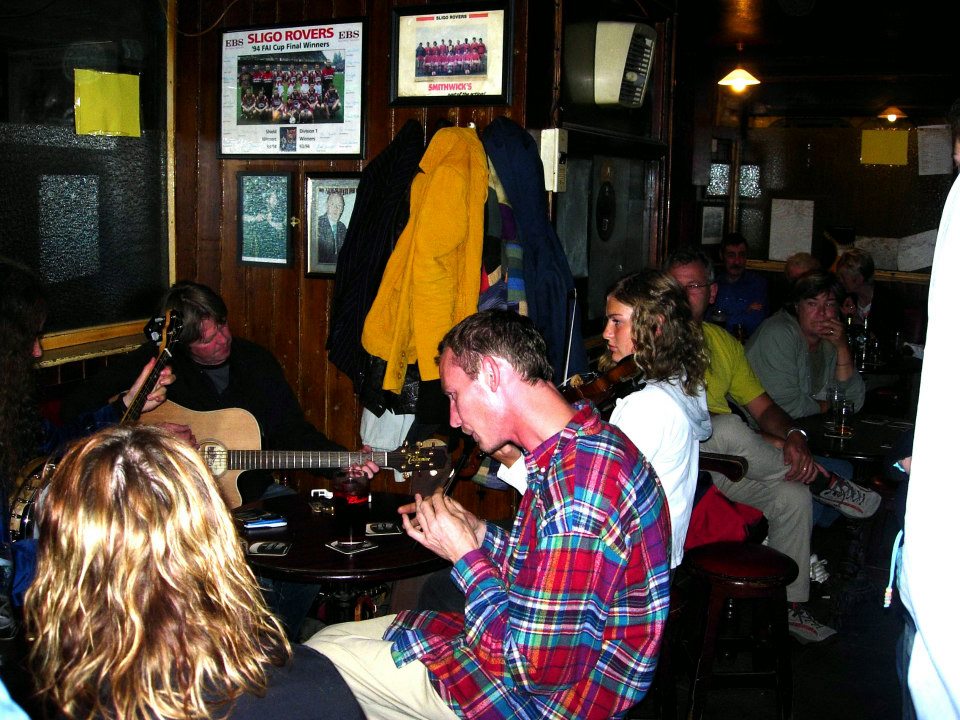
    A ‘session’ in Foley’s Bar, Sligo.

    Beginning anew, I left behind everything else I had learnt, fully immersing myself in Irish traditional fiddle playing. Only later, over the course of academic studies at UCC, did I slowly reconnect with my earlier musical identities. These lay largely in European Classical music, which I had studied on various instruments since the age of five, and Austrian traditional music, which I got involved with through local folk festivals during my teenage years.

    Next to Irish traditional music, I started to practice diverse musical traditions, including North Indian Classical music, which I studied intensively during a three-month stay in India, shortly before I enrolled in UCC.

    Moreover, I made first attempts to compose my own music. One of the first pieces I wrote was ‘Austrindia’: its melody is based on, but doesn’t entirely stay faithful to, the scale used for Raag Charukeshi, an early evening raag I had studied under Pt. Sukhdev Prasad Mishra, in Varanasi, India.

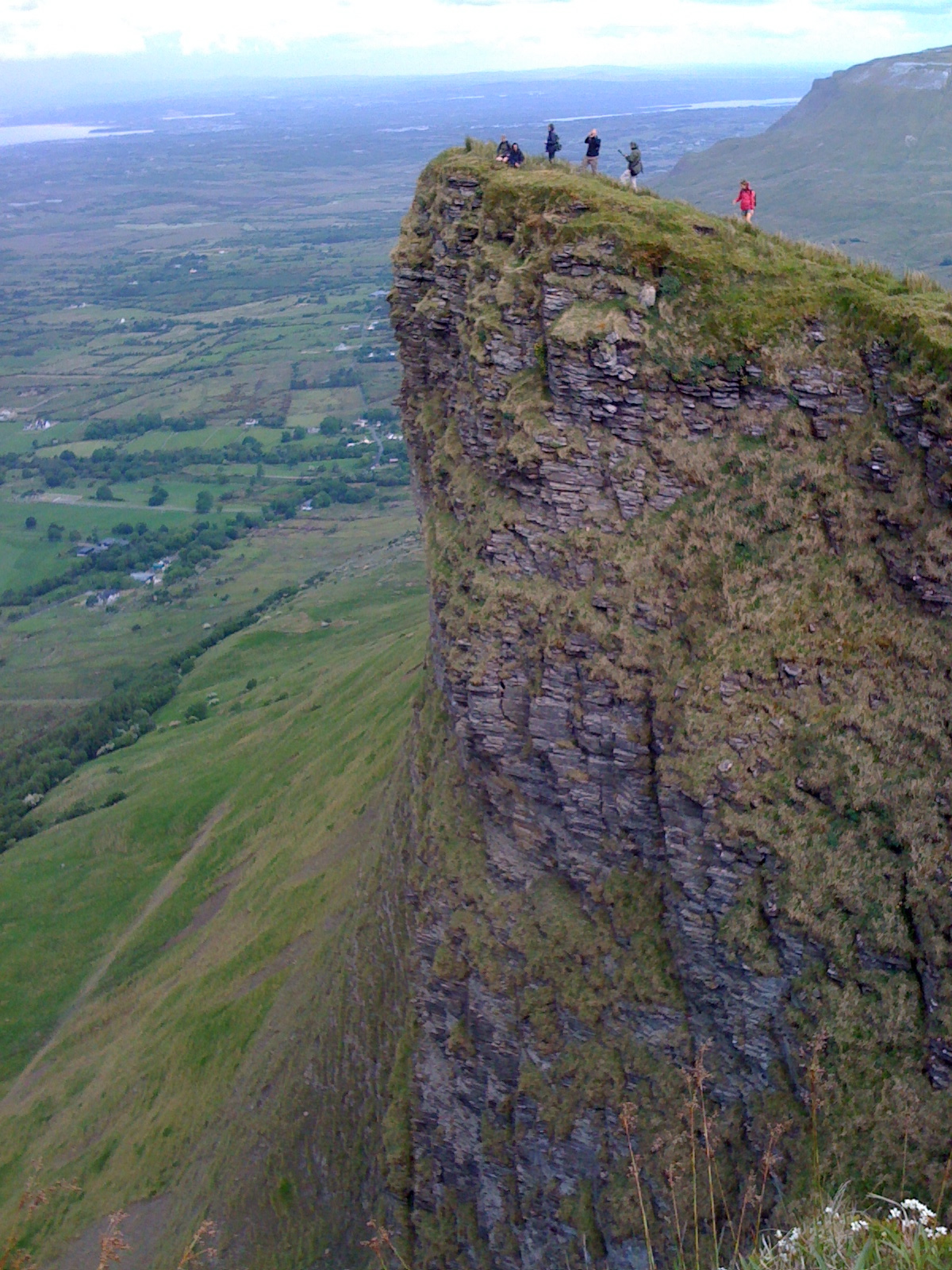
    Yodeling on top of BenWiskin, Sligo.

    I experimented with singing the melody in a yodelling style, a vocal technique derived from Austrian traditional singing practices in which notes are approached in a direct way from the chest to the head voice, causing a distinctive breaking noise characteristic of this type of singing.

    This first attempt to bring my different musical worlds together brought a strong sense of fulfilment, inspiring further compositions in a similar vein, including ‘Like Lisa’ and ‘Jodlfunk- Da Alma Zua’. These also feature yodelling techniques like ‘Austrindia’; this time, however, the yodel is set to modal scales, more typical of Irish traditional music.

    Both ‘Like Lisa’ and ‘Jodlfunk- Da Alma Zua’ include sections carrying elements of Irish traditional music: the middle part of ‘Like Lisa’ is a tune in g mixolydian. Although adhering to the scheme of two underlying rhythmic cycles of seven bars of 7/8 and one of 5/8, and three bars of 7/4 and one of 6/4, the phrasing of the bow and ornamentation such as cuts and rolls is strongly reminiscent of an Irish reel or jig.

    III

    Upon reflection I realise that, in their various different ways, all of these compositions strive to unite my home place of Austria with my newly found home in Ireland, as well as other places such as Varanasi in India, which are close to my heart.

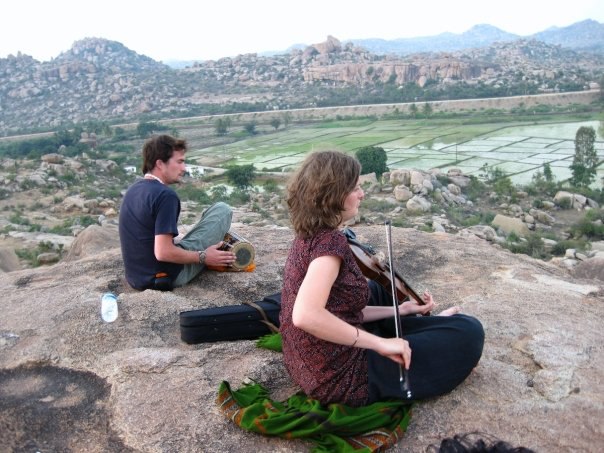
    Playing in Hampi, India.

    This, as I became more and more aware during the course of my research for a dissertation project, provides me with a sense of continuity in what I do and who I am, helping to express myself authentically as a musician and individual. It provides me with a certain stillness. I can be true to myself, and avoid feeling that I have to ‘hide’ or ignore any one part of me.

    I further realised that what I conceptualise as ‘place’ is much more than a specific landscape, cityscape or physical environment. It also includes certain sounds, memories and, more than anything, the people I associate with that place.

    Moreover, it became apparent that diverse places don’t merely co-exist in my music: at the moment of performance, they form an entirely new place, without any fixed geographical position. This place has no literal geographical basis, though it does foster a ‘placeness’ of a different order, in the realm of the sound, to which I can retreat whenever I play.

    When I perform my own music, or music with which I am at home at the same level, I feel a strong sense of being transported to this ‘parallel world’. This develops a bond with a higher form of truth, that lets me go a step beyond everyday reality.

    As a musician adhering to a modern vagabond lifestyle, music offers the possibility of entering this place no matter where I am. It is a constant in ever-changing surroundings that enables me to bring my home with me, wherever I go.

    IV

    Place may be conceptualised as far more than a mere geographical location: like everything else we experience, our concept of place is tied to the mechanisms of perception. Thus, incoming stimuli from the outside world are taken in and consequently matched up with our cognitive frameworks.

    These in turn are crafted with the help of our knowledge, previous experiences and memories. It follows that our concept and perception of place is a construct of mind that only partly relies on certain physical surroundings, a land- or city- scape.

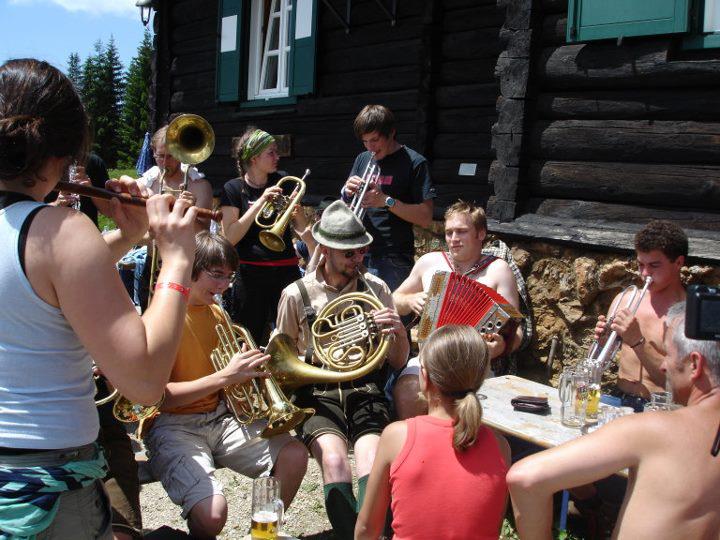
    Alpine Austrian music session outside hut.

    Similarly, when discussing America’s ‘invisible landscape’, folklorist Kent C. Ryden describes places as ‘fusions of experience, landscape and location.’ Quoting geographer Yi-Fu Tuan he explains how ‘the feel of a place is registered in one’s muscles and bones’. For Ryden, the kind of feeling that we get for a place when we get to know it better constitutes ‘a unique blend of sight, sounds, and smells, a unique harmony of natural and artificial rhythms such as times of sunrise and sunset, or of work and play.’

    Issues of place and identity are more and more relevant in an increasingly globalised world. Moving from country to country is becoming a regular and normalised activity for many, if not most of us. As a consequence of our vagabond lifestyles, many different places form parts of our identities. It can feel like we are at home in a number of places, or in no place at all.

    Rapport and Overing explain that anxious advocators of an ‘idyllic past of unified tradition’ express their concerns that ‘individuals are in transit between a plurality of life-worlds but come to be at home in none’.

    At the same time as feeling a connection to more than one place or experiencing a sense of homelessness, it can appear that we are literally in more than one place at the same time, or indeed in no place at all. This is often due to modern technology, which may lead to a perception of a virtual reality lying beyond any objective or physical reality.

    In his discussion of the consequences of modern life, Giddens explains how through the advent of modernity, space became disconnected from place. Through the invention of maps that would represent the world from a universal and objective viewpoint, we came to conceive of something Giddens refers to as ‘empty space’ as an entity in itself that is no longer connected to a specific physical setting. The existence of space as something that has no boundaries or specific meaning recalls Stilgoe’s definition of ‘landscape’ that stands in opposition to natural ‘wilderness’:

    a forest or swamp or prairie no more constitutes a landscape than does a chain of mountains. Such land forms are only wilderness, the chaos from which landscapes are created by men intent on ordering and shaping space for their own ends (Stilgoe, 1982).

    Music is an effective means of inscribing meaning onto space and express a relationship to it. According to Jaques Attali, our very distinction between music and noise reflects the distinction between ‘culture and nature’. Through engagement with music we erect boundaries that define if something is a ‘place’ or ‘space’; if something is ‘home’ or ‘foreign’; or if something belongs, or does not. Consequently, social, individual and geographical borders are reflected in music, which inform a sense of place.

    Music can be used to differentiate between different places and people, but it can also serve to expand boundaries linking ‘homeland’ to what Mark Slobin refers to as ‘hereland’. It creates bonds between different countries, and links to any place one wishes to be at or belong to.

    Moreover, it has the potential to give us a sense that we are all connected to all places, at all times. This appears to be the spirit behind so-called ‘Ethno festivals’ happening all over Europe, which bring together young people that exchange their folk musics.

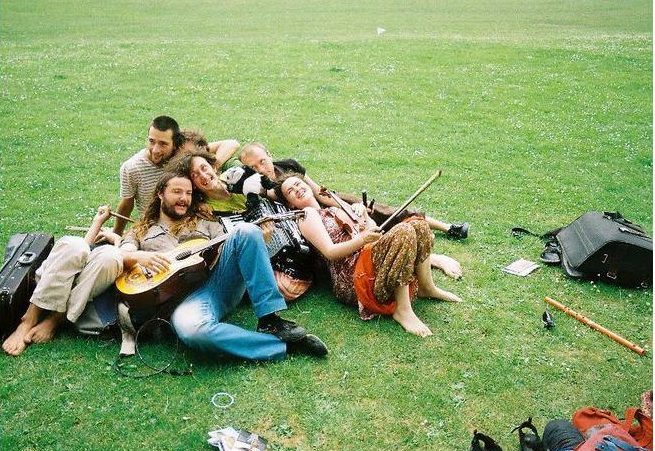
    Ethno-in-Transit.

    Individual musicians, groups and entire nations link and separate themselves, their places and people with the help of music in various different ways. We sing, play, compose, listen and dance to music that carries references to specific locations, or indeed travelling or being ‘on the road’, in the form of song lyrics. We engage with, and create music that contains imitations of sounds that occur in particular places, or as Zuckermann points out, the frequencies of a physical environment.

    Slobin states that we ‘domesticate’ what to our ears is foreign music and adapt it to make it our own according to commonly shared agreements of what our own music is. We engage in what Slobin refers to as ‘code-switching’ in order to shift between a number of different musical styles or to layer different styles of music on top of each other in one and the same piece. We share and associate ourselves with music that to us reflects the feel, the shape, and the people of a place.

    V

    Given that any space can be turned into a place through the assignment of meaning to it, it can feel like the involvement with music – be it through listening, playing or dancing to it – creates a place of its own.

    Victor Turner explains how as part of our ever-repeating social dramas we enter a ‘liminal’ space, a kind of parallel world that he describes as ‘neither here nor there […] betwixt and between the positions assigned and arrayed by law, custom, convention, and ceremonial’. According to Turner, it is this period in which we are somewhat apart from our everyday life that both mirrors the nature of our artistic involvement and is advanced by it. This place has its own rules, its own reality and its own time: that of the present moment.

    Alfred Schutz explains how music, due to its polythetical structure, is conceived of step by step rather than as a whole: a time zone apart from quotidian time. He explains how music unfolds in what he refers to as ‘inner time’. Thus, when we perform, we share our own ‘stream of consciousness’ with that of the composer: ‘two series of events in inner time, one belonging to the stream of consciousness of the composer, the other to the stream of consciousness of the beholder, are lived through in simultaneity, which simultaneity is created by the ongoing flux of the musical process.’

    Claudia Schwab and Matija Solce.

    When we play music together, we equally tap into each others’ streams of consciousness and together ‘live through a vivid present’. In addition to sharing ‘inner time’, the music is lived through in ‘spatialised outer time’. Thus Schutz says both ‘share not only the inner durèe in which the content of the music played actualizes itself; each, simultaneously, shares in vivid presence the Other’s stream of consciousness in immediacy’.

    When Schutz explains the musical process of ‘inner time’ he adds that ‘when for one reason or another the flux of inner time […] has been interrupted […]’, the performers might have to fall back on devices measuring ‘outer time’ in order to play together.’

    Pleasurable as it is, not every musical performance brings with it the experience of dwelling in a parallel world: a more intense and lasting experience of entering a different place seems to be related to the ability of staying in the present moment.

    The psychologist Mihaly Csikszentmihalyi conceptualises flow as ‘the state in which people are so involved in an activity that nothing else seems to matter’. He explains how ‘in the flow state, action follows upon action according to an internal logic that seems to need no conscious intervention by the actor […] there is little distinction between self and environment, between stimulus and response, or between past, present and future’.

    *******

    Claudia Schwab (photo by Peter Crann).

    Place, with all that belongs to it, including memories of home, connections to certain peoples and their music or the impression of distinct landscapes, undoubtedly plays a fundamental role in our understanding of self. A strong connection to a place creates a sense of belonging, and thus of home. Furthermore, the experience of entering a form of parallel world that lets us be aware of a higher plain of existence speaks for the fact that music can be seen as place. In this place, we can find a deep connection to ourselves. We can feel the togetherness with others, satisfying our innate need to be understood and to be with other people. It is a place that we can carry with us, that can make us feel at home wherever we are in the world, and glimpse an alternate form of reality. This has certainly been my experience of gallivanting around the world as a musician.

    This article is based on Claudia’s thesis, completed in September 2013 while studying for a Masters in Ethnomusicology in University College Cork.

  • A Guide to Preventing Data Leakage

    The Internet is a big old scary place, full of dark corners, strange protocols, dodgy individuals, unscrupulous corporations and cynical state-level actors.

    The tools we use to access the Internet, though often very powerful, remain badly-designed. This is true not only in terms of the User Experience (UX) and User Interface (UI), but also in how they let us use and manage our data.

    Most big Internet/Web companies use “dark patterns” to exploit normal human behaviors profitably, and often without serious consideration of the consequences to the average human psyche.

    Every day there are hundreds if not thousands of severe security breaches, and every month or so we hear of egregious acts of deliberate abuse, or contemptible neglect on the scale of millions of individuals affected.

    This is made worse by the sheer amount of data our devices leak, all the time. Pretty much every computer has a hardware backdoor, either explicitly as in the Intel Management Engine (perhaps added at the behest of the National Security Agency), and most mobile telephone modems are little black boxes over which the user has no control. Location, browser history, contacts, messages, emails, etc., etc,. are all leaked in multiple ways, through apps and websites, through wifi and 4G, and worst of all directly from the operating systems.

    For example, in this video, we load the following sites simultaneously in a Firefox browser and use Lightbeam to visualise all the links made between sites by loading shared assets such as images, scripts, style sheets and other data common to any website.

    Simulating a typical browsing session on 18 sites (nytimes.com, theguardian.com, huffingtonpost.com, en.wikipedia.orgi, skatehut.co.uk, amazon.com x 2, vox.com, bbc.com, cracked.com, facebook.com, trivago.ie, skyscanner.net, nbcnews.com, answers.com, weather.com, ie.match.com, imgur.com) you can see 384 different servsers now have data on how you access these websites. The extreme amount of inter-connectivity is quite a show!

    Now we reload the same 18 pages with partial tracking prevention plugins to Firefox and observe only 58, and these only minimally.


    What follows is a guide to ‘tightening up’. This advice is intended for personal use. It is broken down into sections so it can be implemented in stages. Each section is colour-coded according to difficulty as follows:

    Easy – even for Grandpa

    Normal – can set up email on phone

    Hard – summon nearest teenager

    Difficult – might need professional help


    Problem: Hardware

    At the bottom of the stack we have the hardware problem, which is that most computers are not totally under the control of their users, and usually have at least one but often two or more completely independent, remotely-controlled, onboard computers. On Intel chips it’s called the Intel Management Engine, on AMD it’s called the AMD Platform Security Processor. Most mobile telephones use a proprietary technology from Broadcom, a massive US company, and are made in China, and are known to have a variety of intentional holes in their security.

    Solution: Use AMD products on the Laptop/Desktop and wait for Purism Mobile (and verified RISCV in the long term).

    AMD make all the main desktop/laptop/server chips that are not made by Intel, and have a better reputation.

    The Purism mobile project (Librem 5) is the great hope for everyone interested in fully user-controlled mobile phone. It will hopefully be ready in about a year. RISCV is a completely open, community-created, modern-chip-architecture that promises high-performance in both number of computations per second and energy use.


    Problem: Operating System

    Here we get to the big one, the choice of “church”. There are four main options: Apple, Google, Microsoft, GNU/Linux.

    Apple is the most cultish OS, a mono-aesthetic walled garden, famous for its ‘taste’ and convenience, infamous for its rigidity and cost. They manage their app store jealously, refusing programs that interfere with their ability to profitise your time on their systems. They have a well-funded reputation for safety, frequently destroyed for those in the know by errors such as the ability to login in remotely as administrator without a password. Their mobile efforts are more secure in some ways, but Apple themselves still extract huge amounts of ‘telemetry’ on every user, for their own and others benefit.

    Google offer Android. Google make money by selling advertising to third parties, along with detailed information about how to use best their platform. Android, though quite secure in certain aspects from a technical point of view, is still essentially a mobile person monitoring device. Google recently removed their famous “Don’t be evil” motto from their handbook.

    Microsoft sell Windows 10, the latest version of the most widely and successfully attacked operating system ever. Microsoft have been in trouble all over the world for their antics. Their devices send vast amounts of ‘anonymized’ data back to headquarters deliberately, and to pretty much every major Internet crime group as well.

    GNU/Linux is a multi-decade community-driven operating system initiated by one of the true heroes of privacy and freedom: Richard Stallman. It is now developed all over the world, in the open, by companies such as Google (who use it internally to power their advertising thought-trap) and organisations such as CERN and NASA. It powers most of the Internet, and is freely used on everything from wireless routers to phones to laptops to supercomputers.

    Solution: Linux Mint, the easiest and most polished operating systems distribution (free as in speech and as in beer)

    Difficult, but not impossible


    Problem: Safe Browsing

    We use a browser for nearly all our general use of the Internet. This is great as it provides an all-in-one tool that can do everything from email to games, but distressingly insecure as it is a one-stop-shop for tracking people’s habits online. There are four main browsers, each associated with one of the operating systems listed above.

    • Apple – Safari (also runs on Microsoft)
    • Google – Chrome (also runs on Apple, Microsoft, GNU/Linux)
    • Microsoft – Edge
    • Gnu/Linux – Firefox (also runs on Apple, Google, Microsoft)

    Solution: Firefox and Tor Browser Bundle

    Only one choice here, but it comes in two varieties: Firefox, and Firefox packaged as the Tor Browser Bundle.

    Firefox is a powerful, research-driven, privacy-focussed, standards-compliant, community-backed browser. All the code is open-source, meaning is can be and is examined out in the open by experts all over the world. The non-profit organisation that oversees Firefox, Mozilla, is very clear in its motives. The Tor Browser Bundle wraps the browser with the Tor project, providing vastly increased anonymity online, at the expense of being slower to use due to the added encryption complexity.

    Firefox is better with plugins, here are a few to get you started (these can break many websites):


    Problem: Your Internet Service Provider/Mobile Phone Operator

    Companies that sell you Internet Access are almost all required by law to record a lot of data about your activity.

    Solution: A Virtual Private Network such as Proton VPN

    A VPN sets up an encrypted point-to-point link from your computer/phone to another computer in a server farm elsewhere on the Internet. This hides your IP address (one of the most important tracking details), and some other data.

    Solution: Use TOR

    TOR is a method of encrypting your network traffic over a randomised colection of links over the Internet. It is quite secure, more so than only a VPN, but really quite slow. Used with a VPN (computer -> VPN -> TOR) it is quite effective.


    Problem: The Law in every jurisdiction

    Every Government on the planet reserves the right to legislate on people’s use of the Internet, and exercises it to varying degrees. The Government of the U.S.A., instrumental in the development of the Internet, reserves quite ridiculous authority to interfere, and uses and abuses this with aplomb.

    Solution: Stay in the EU/become an EU citizen

    Amazingly, the EU, the latest political hegemony in the most consistently abusive collective polity in human history, is now the bastion of Human Freedom. It is actually becoming quite effective in this role, and improving all the time.

    Solution: Enforce Human Rights Law

    ‘Article 12.

    No one shall be subjected to arbitrary interference with his privacy, family, home or correspondence, nor to attacks upon his honour and reputation. Everyone has the right to the protection of the law against such interference or attacks.’


    Problem: Web Services and Social Media

    The entire business model of providing web services (email in your browser, for example) and social media is to monetise the data you give up by using these services.

    Solution: Don’t, just don’t (at least not yet)

    There are a small number of privacy-respecting web-services/social media organisations that provide most, but not all, of what we expect from these systems. They are still young, suffer from technical and User Experience problems, and have yet to achieve critical mass. In a few years, perhaps sooner, the landscape will be very different. Instead, just give people a ring, or write them a postcard, or just make sure to look them up next time you are near. If everyone reaches out the world becomes small.


    The Electronic Freedom Foundation provides the best overall guide to being safe online. Read more here.

  • Big Plans in Little Jerusalem

    June 1985: I was at work in my garden shed, when I heard someone talking. I looked out and saw a man with a sub-machine gun. He was guarding the back of the old synagogue, that had become the Irish Jewish museum. President Chaim Hertzog, who was raised in Dublin, was opening it that fine day. Security was stronger at the front, and an ambulance with its engine running was at the door. Mr Hertzog did his duty and was whisked away.

    There were few of his faith left in this quarter once known as Little Jerusalem. Their national school around the corner had closed, and its contents thrown into a skip. There I found old ledgers, listing those who had donated money to Jewish refugees from Germany. I gave the ledgers to the museum. It was a small place, but visited by people from all over the world whose parents and grandparents had lived here. The neighbours were proud of it.

    Almost thirty years later, I was again in my garden shed when I heard men talking at the back of the museum. Plans were afoot to enlarge it; the Office of Public Works was apparently in charge. I wrote to the OPW, asking if that was so. Soon afterwards I received a call from the museum’s new board, bothered by my concern.

    When the plans were reluctantly displayed, the whole neighbourhood was concerned. The old synagogue ‒ the last one in the city – along with five adjoining houses would be demolished, and rebuilt in pastiche. A theatre would be built underground. The back gardens would be built over, to house an archive, a Holocaust memorial and restaurant. It would be guarded by bomb-proof concrete, shatter-proof glass, security lights, sensors and cameras.

    This would enlarge the original museum by 600%. It seemed wrong to shove all this into one of Dublin’s smallest residential streets. We suggested that it be built on a bigger site. There was one vacant down the street opposite the Jewish bakery. Why not there?

    Suggestions and objections were not welcomed. Residents hung out banners, but these were torn down, or slashed with knives at night. Cars were keyed, eggs thrown at windows. Local protest meetings were arranged by email; mysteriously, the emails were hacked.

    In 2013, the year of the Gathering, the museum hosted a week of lectures, which the Israeli ambassador came to attend. Mysteriously, I could not receive BBC Radio 4 that week. When the lectures ended and the ambassador had gone, my reception returned. Presumably, the Long Wave had been blocked. It felt like the West Bank. The new chairman was from Israel, and seemed baffled by us. What was our problem? Planning permission had been granted. They had won.

    The residents’ appeal was heard at An Bord Pleanala’s grimy building in Marlborough Street that same year. The museum’s lawyers, from London and Tel Aviv, exuded confidence ‒ rightly so. They had the OPW on their side, and a letter of approval from the Taoiseach. The appeal was refused.

    A neighbour, recently retired from the higher ranks of the Civil Service, felt free to divulge the obvious truth. The government of Israel wanted a stronger voice in Ireland, to counter support for the Palestinian cause. The word was given to our government, who passed it on down the line. Planning permission was to be granted, and if locals didn’t like it, well, tough.

    But the pesky residents persisted. The museum board’s crudeness and misjudgement backfired. The expected millions in US dollars did not materialise. The inflated project was abandoned. The old museum is still there, a small place that tells the story of a small community. May it flourish.

  • A Hurler’s Silver Branch Perception

    One evening, while walking on Derada Hill, a hare sprung from under my feet. I found myself, all of a sudden, on the ground burying my head in the warm form left in the grass, and I asked that primordial form to act as a poultice, to draw out my expensive European education from my head, because in my western way of thinking I was damaging the earth. It had set me up in opposition to what is natural and native to us. 
    John Moriarty, Nostos, (Lilliput Press, Dublin, 1994).

    I can’t say when I first played hurling. It was with me on all of the great moments of self-discovery I can think of. Once I had a decent footing in the world I became aware of a stick being close by.

    It defined my youth; this game, this skill, this way of spending time. It was frustrating and it was ordinary and it was miserable at times, but a current ran through me, a note that intensified as I played. It got more serious as I grew up, the stakes got higher, my identity hardened, a community of people formed and goals were unconsciously set, if not assumed.

    A former captain of the Wexford Intercounty team, Diarmuid Lyng analyses games for TG4 and Newstalk , and contributes to national print media.

    And when the final curtain fell, amid the chaos of going from the all-encompassing nature of modern sport to the great vacuum of retirement, I found myself in West Kerry, with the writings of John Moriarty, trying to read my way through a depression, in the hope that I would once again, make sense of me, to me.

    I was wandering the countryside a lot during that period, learning to forage wild plants while growing comfortable in swathes of time dedicated to the question of how the outer world was interacting with my inner landscape.

    I remember sitting at the foot of Ceann Sibéal on the evening of an honest storm, marveling at waves rolling in and crashing against the foot of the cliff. Inwardly, I thought of the net in Croke Park shaking. The waves of energy emanating from the player, the sliotar bypassing the goalkeeper and crashing into the net, creating a wave like that at the foot of the cliff in front of me.

    I sat on Clogher Beach and marvelled at the ability of a player standing fully ninety yards apart from another, who hits a ball at over one hundred miles an hour, reaching a height of seventy yards at its apex, and within the first second or two of him striking it – in it’s very initial ascent – to move to the exact spot where the ball arrives so as only to have to extend an arm in order to catch it. What remarkable qualities of mind and body are at work there? What more are we capable of? And why doesn’t anyone refer to this? Shouldn’t it turn our spines in to question marks to interrogate the magnificent of it all?

    Silver Branch Perception

    What I found in West Kerry is that when the fences around me fell away, when I went out to the wild places, the boundaries in my mind disintegrated too, and these thoughts and feelings had their way with me. It brought me back to the soul of the game: to Silver Branch Perception.

    Silver Branch Perception was bestowed on Bran Mac Feabhal by Mananánn Mac Lir in Irish mythology. It is a gift, a way of seeing the world for the paradise that it is; the awareness that when we separate ourselves from our social story, we can see the world paradisally.

    The Tuath Dé would later defend this gift at the Second Battle of Maigh Tuiread against the Formorians.

    Balor of the Evil Eye led the Formorians, who, according to Moriarty, looked on Ireland purely for its resources, the reducing eye – the Súil Mildeagach –seeing only uses and benefits. Thus a cow is looked on as pounds of beef, and a tree for the lengths of its timber.

    The Tuath Dé, led by Lugh, held the Silver Branch and they fought to defend it. According to Moriarty, The Third Battle of Maigh Tuiread is being enacted within us today.

    I recognise from my hurling experiences what he meant. We are disconnected from the parts of the game that are essential to the overall health of society. We have adopted a Formorian mindset, we have assumed Balor’s evil eye. It is disconnecting us from the essence of the game.

    But Nature is lying us down on the psychiatrists couch and asking hard questions. The ash die-back disease is one of the symptoms diagnosed. This will decimate the most common Irish hedgerow tree over the next thirty to forty years. Its chances of survival are uncertain. Still 50,000 trees are cut down a year for 350,000 hurls to keep it business-as-usual.

    But what of the ash tree? Could most GAA players identify what one even looks like? Do we care? Do we feel a responsibility for its survival beyond what is needed for our ‘use and benefit’? Is Nature reminding us of one of the fundamentals of the game?

    We know now that the forest floor is alive with a web of mycelium that function along the lines of the Internet: a ‘tree wide web’. When a bush is sick it can tell a healthy tree, which may send the necessary nutrients to its ailing friend. Can we play the same role for the ash? Can we listen to what the tree needs, and come to its assistance?

    If we don’t go back to listening, to being humbled by nature – if we ignore the possibilities of the Silver Branch – we will be paying lip service to bridging the great disconnect, choosing the dis-ease of the Formorian mindset so prevalent in modern Irish society.

    Spiritually, there is a shift going on here from Rome to the Orient. Meditation, yoga, Tai Chi and mindfulness are rooted in Eastern ideas of existence. True to form, we look beyond our cultural inheritance to negotiate an internal crises in our perception of reality.

    But answers are here, all around us. Let us plant ash trees in every GAA club in the country in the hope of identifying strains resistant to the disease, and ensure its survival. Let us reduce dependence on a food system in danger of implosion, by subsidising polytunnels for anyone willing to work one. Let us go out to the wild places and allow our own wildness to surface, and, in so doing, revive an awareness that what is primeval inside us is not to be feared, but valued.

    I am aware of the intellectual ease with which many will digest this notion, but can we live it? Can we make the hard choices? Colonisation introduced many well-documented ills. Being the bastard child of Americana has brought even greater woes, though less appreciated, as we remain in a cultural, political and economical stranglehold. But as the neon lights of superficiality fade, what will anchor us?

    I think about the role of hurling, the tree, and the way we play the game. I examine my own role. I wonder about my role as a father; I wonder how the win-at-all-costs mentality will affect my son. I wonder about what caused a woman to email me last week to say she was relieved a torn cruciate ligament would keep her away from the stresses of GAA.

    The Minotaur

    I ask Moriarty what we need. He tells me about the Minotaur.

    The great Greek legend of the Minotaur is King Minos’s tale of woe. His wife Pasiphae becomes transfixed with the Bull God that emerges from the sea.

    The Bull won’t mate with any human, so she orders the carpenter Daedalus to construct a wooden cow. Once completed she enters the cow, assumes the position, and the Bull impregnates her.

    Soon she gives birth to a half-man half-bull: a monstrous creation. Out of shame King Minos constructs a labyrinth beneath the city of Knossos and banishes the Minotaur beneath the royal carpet.

    Once a month a virgin child is sent from the city of Athens and dispatched into the labyrinth as food for the insatiable beast. Theseus takes umbrage that the maidens of his city are being devoured, and travels to Crete vowing to slay the monster. There he meets Ariadne, stepdaughter of the king and half-sister of the Minotaur, at the gates of the labyrinth. She gives him a ball of wool to navigate his return.

    Theseus fulfills his destiny as a warrior by killing the monster and emerges in triumph from the labyrinth. That, to Moriarty, is the mythical story, but he sees another dimension.

    The Minotaur represents our animal nature, and it is the appeal of this that Pasiphae has succumbed to. Minos as King has dominion over the people, and regulates his society. Animal nature, primordial wildness, runs contrary to civic virtue. He drives his shame beneath that which he controls. He then must feed that shame with sacrifice.

    Enter the Warrior Theseus. He has bloody murder on his mind and awaits a triumphant return. But according to Moriarty this win-at-all-costs mentality must change; this is where we cross over from the mythological into the real, to the battles at Croke Park.

    We don’t need another Theseus, or another Cuchulainn. We need a medicine man, someone that can dive into the depths of the Irish psyche and take a comb of walrus ivory to Caitlin Ni hUllachain’s hair: to comb our Cartesianism, to comb out our sins against Nature, to comb out our theories and creeds that put us on a collision course with this gorgeous blue jewel hanging in space.

    If Theseus or anyone else wants to be a real hero, he must join King Minos and return to the labyrinth, take the Minotaur by the hand and walk him into the cityscape, accepting his shame in order to transcend it. This is the great journey.

    We have a great opportunity now within the GAA to create a healing space in which coaches can heal: where they can tune into the deeper messages of the game, of the hurl, of the tree. Where they hear the medicines of Nature, which heals them of their anger and shame. Where they reconnect to purpose and are reminded of agency. Where they rediscover their place in the world, and where outcome is secondary to the journey.

    Fulfilling a Heroic Destiny

    Spiritually, we are at sea. That’s why we don’t feel the plight of the ailing ash. The Catholic Church took on the role of guardian of the great message of the Christ story. The message that we can be at one with the unfolding moment, that we can transcend our suffering and open ourselves to a greater potential.

    The Church became moral arbiters of that message and pursued power and control, which divorced them from the source. They were not equipped for the gravity of the message that we are, in fact, already in Paradise. But independently we can create a space to engage with it, with humble invitation, we can heal ourselves and return to abundance.

    Nature is abundant. The law of the universe is balance. When we are in balance we are in abundance. When we chose with agency to be in imbalance, we no longer live in abundance; instead we become locked in a mentality of scarcity, which furthers the imbalance.

    Those that benefit most from these conditions are those that are most fearful of the scarcity complex within themselves. Those that are in imbalance have lost the ability to trust in the unfolding moment. They replace that trust with sufficient control of the moment to ensure they don’t slip into a reality that their minds are incapable of digesting.

    We must deal with our fear in order to be whelmed and overwhelmed by the majesty of the natural world. In crossing that threshold we slip into a paradisal view of the Earth, and no longer want to damage it. This is free energy. We allow ourselves to re-integrate, we play our Orphic note that resonates with the universe.

    This is where we identify our purpose, from this place. As though in sitting with Nature, in being psycho-analysed by Nature, where our preconceived stories about ourselves fall silent; the messages that we need to hear can be heard above the din: from the universe demanding we fulfill our heroic destiny; where we recall our gravity and our greatness, and make the contribution the universe requires of us.

    Then we can identify the most pressing needs in the world, and apply our tremendous talents and resources to meet those needs, therein lies our purpose.

    Croke Park

    I spoke about some of these things in Croke Park recently, ideas that have been forming around me and inside of me, inspired by John Moriarty and my experience of hurling. He gave me leave to understand the world for myself, deferring to no one.

    I don’t need experts to tell me about Climate Change, or the effect of EMF’s on bee populations, or young men’s suicide rate, to know the disconnect is for real. It’s everywhere. It’s screaming at us to stop, to look around, to renegotiate our most sacred and primal contracts with Nature, and hurling has a role to play.

    Moriarty is guide. He is a guide because he went to these places. He let go of his conditioning and walked the earth with a barefoot mind and a barefoot heart. The last pages of Nostos, his autobiography, are written from the paradise he so often refers to. This is not a philosophical concept, it is the reality of the universe, which will lead us away from calamity. I know it is real because I have experienced it.
    Its appreciation brings great possibilities for our young people, who are less hampered by the toxic legacy of shame lying on us as a people, on our language and on our landscape. With minds blown open by the Internet, they have the energy of youth to take great strides, but require mentors more than ever. Can the GAA offer a space where coaches harrow their own great depths to become the mentors we need?

    Can we encourage balance in our young people so they can make their great contribution? Where they play sport to experience the union that is central to all creative pursuit, the feeling that comes when time and effort cease and a blissful harmony prevails. Can we value those moments once again, and in valuing them permit our young people to experience the world in a different way, beyond the limitations of outcome?

    This is a journey Moriarty opened up for me, on which I constantly take wrong turns, but one worthy of continuing. If you are still with me, I encourage you to stand on the edge of a lake, or in front of a tree and just breathe. Breathe and resist the temptation to label and to understand and to intellectualise, and see what fills the gaps. It may be a fleeting experience, it may be difficult to hold on to, but it will heal.

    And if you happen to see the wild form of the hare, bury your head in that wild form, and ask it with humility and reverence to guide you on this heroic journey out of the Formorian labyrinth, and back to the great and sacred Earth.

    Diarmuid Lyng facilitates group exploration of spirituality in nature, masculinity, meditation, resilience, yoga to a wide range of audiences including schools, university, GAA clubs.