This piece came from a little sound I heard in my head, an atmosphere, which I wanted to explore.
First, I made myself a soundbed to play in, and allowed two journeying violin lines to hatch out of my imagination; then I captured them in a digital suspension, wherein I gave one of them a delay and placed them in a pleasant and warm space.
The piece still surprises me when I listen back to it; it went in unexpected directions. But then, I wasn’t planning for it to be any way in particular; I set out to explore in the atmosphere I had created: to see what I could find.
I barely remember making it.
The file tells me the date alright, and I found it on my computer, so I know it must have been me. I have found this is a useful tactic for keeping track of recordings, as my brain cannot organise like this.
My handwritten notes tend to make sense only within about thirty minutes of completion. I often forget having played things.
Once I have worked on something a bit I will do a ‘save as’, and give it some sort of name.
The other day, I had a difficult morning and decided to ‘be productive’, as a way of dealing with my emotions. That was when I found this piece, recorded three weeks earlier. I cleaned up the files, and mixed it a little. It felt like a healthy coping mechanism, and tasted as fresh as spring sorrel.
I often wonder how much denial is involved in my creative process. This piece in particular has a very unconscious feel, revealed in the following elements: I barely remember making it – suggesting I entered a deep flow state while playing; I find it hard to remember how it sounds when I think of it; and it takes an unexpected turn.
I seem to have succeeded in tricking my own brain.
On the other hand, denial is such a powerful force. Maybe I did plan it out and have conveniently blocked this out. How can I speak authentically about my own subjective, mercurial mind?
I consider the unconscious, flow state, to be hugely important in the creative process, and very nourishing to engage with, but I could just be fooling myself completely and creating psychological scaffolding – it is impossible to be sure about any of this.
Home EKG rigs are getting more and more affordable. It could be so interesting to measure brainwaves during different states of consciousness. On the other hand, purchasing one of these definitely involves an unsustainable civilisation squeezing out yet more material goods… Hang on, where did I put my fiddle?
W.B. Yeats’s poem, ‘The Song of Wandering Aengus’ retains an appeal more than a century after its publication in 1899. Musicians in particular – from Christy Moore to Mike Scott – have been drawn to its magical imagery and measured cadences.
One cruel New Years’s morning a few years ago its opening lines: ‘I went out to the hazel wood, / Because a fire was in my head’, popped into my head after romantic hopes had been dashed the night before. I realised a dose of Nature was the only conceivable cure.
Like Yeats, most of us feel overwhelmed by our racing thoughts at times. Then the sanctuary of a forest or running water can still the mind. Nothing ever feels quite so bad in a beautiful natural setting.
We may also draw lessons there, as in Shakespeare’s play As You Like It, where Duke Frederik finds ‘tongues in trees, books in the running brooks, sermons in stones, and good in everything’.
But what if, instead of a resplendent Nature, we encounter a degraded landscape and poisoned waterways? What message burns into our souls if the hazel woods are reduced to cow fields or sitka spruce plantations, where birdsong is no longer heard?
Even in Yeats’s time there were few of the virgin forests, which once covered the entire island. As Frank Mitchell puts it:
It is hard for us to picture the majesty and silence of these primeval woods, which stretched from Ireland far across northern Europe. We are accustomed to an almost treeless countryside, and if we can find anywhere some scraps of ‘native’ woodland, we are disappointed by the quality of thetrees(1).
And the picture is getting worse, with increasing use of chemicals, and intensification of agriculture: the Slow Death of Irish Nature.
Irish agriculture is neither efficient, timeless, nor equitable. It remains afloat because of European subsidies, holding in perma-frost a system designed to satisfy the appetites of the British Empire, enriching a small number of large farmers and industry barons especially, while most farms teeter on the brink.
Structural deficiencies are skillfully concealed from the Irish people by obsequious, and often corrupt, politicians, a desultory education system, and a compliant media. Only the prospect of hundreds of millions in fines for failure to reduce runaway Greenhouse Gas Emissions may save the land from further despoliation; but even one mitigation strategy, of planting monoculture plantations, is eroding biodiversity further.
The exploitation of Ireland’s Nature goes hand in hand with the exploitation of millions of domesticated animals and human beings.
Karl Marx highlighted a disturbed metabolic interaction between human society and the environment under a capitalist system, which he termed metabolic rift. The intensification of agriculture depletes nutrients from soils, which Marx viewed as analogous, and kindred with the exploitation of labour, leading to an alienation from Nature.
II – The Great Hunger
To my knowledge Ireland (North and South) is the only substantial region in the world with a lower population today than in the 1840s. The population peaked at almost 8.5 million, and has only reached 6.5 million today – a considerable rise on the 1950s, when it had dipped below three million in the South.
The steady decline was intimately connected to a shift away from a predominantly mixed agriculture, with an emphasis on tillage and subsistence, to a system based almost exclusively on generating livestock for the Imperial British market.
The catalyst was the Great Famine 1845-1850, although the move away from tillage was also a product of Britain finding cheaper sources of grain after the Napoleonic Wars. Remarkably, according to Amartyra Sen: ‘In no other famine in the world [was] the proportion of the people killed … as large as in the Irish famine of the 1840s(2)’.
The Great Famine was devastating to the three million depending, almost exclusively, on the potato for nourishment. By the eve of the disaster that vulnerable cohort of cottiers and subtenants occupied just one million acres, representing a mere five percent of the of the total acreage of land suitable for agriculture(3).
With twenty million acres available to produce the population’s food, even with the worst conceivable crop failures, an abundance of food could have been grown to feed the entire population. But the market demanded cattle ‘on-the-hoof’, exported live to England, and other livestock products. The land was not the patrimony of the people, but a generally absent landlord class.
To produce and trade commodities for the Empire required a substantial comprador class, who profited from the shift. Famine survivors took advantage of the land clearances as Kerby A. Miller writes:
an unknown but surely very large proportion of Famine sufferers were not evicted by Protestant landlords but by Catholic strong and middling farmers, who drove off their subtenants and cottiers, and dismissed their labourers and servants, both to save themselves from ruin and to consolidate their own properties(4).
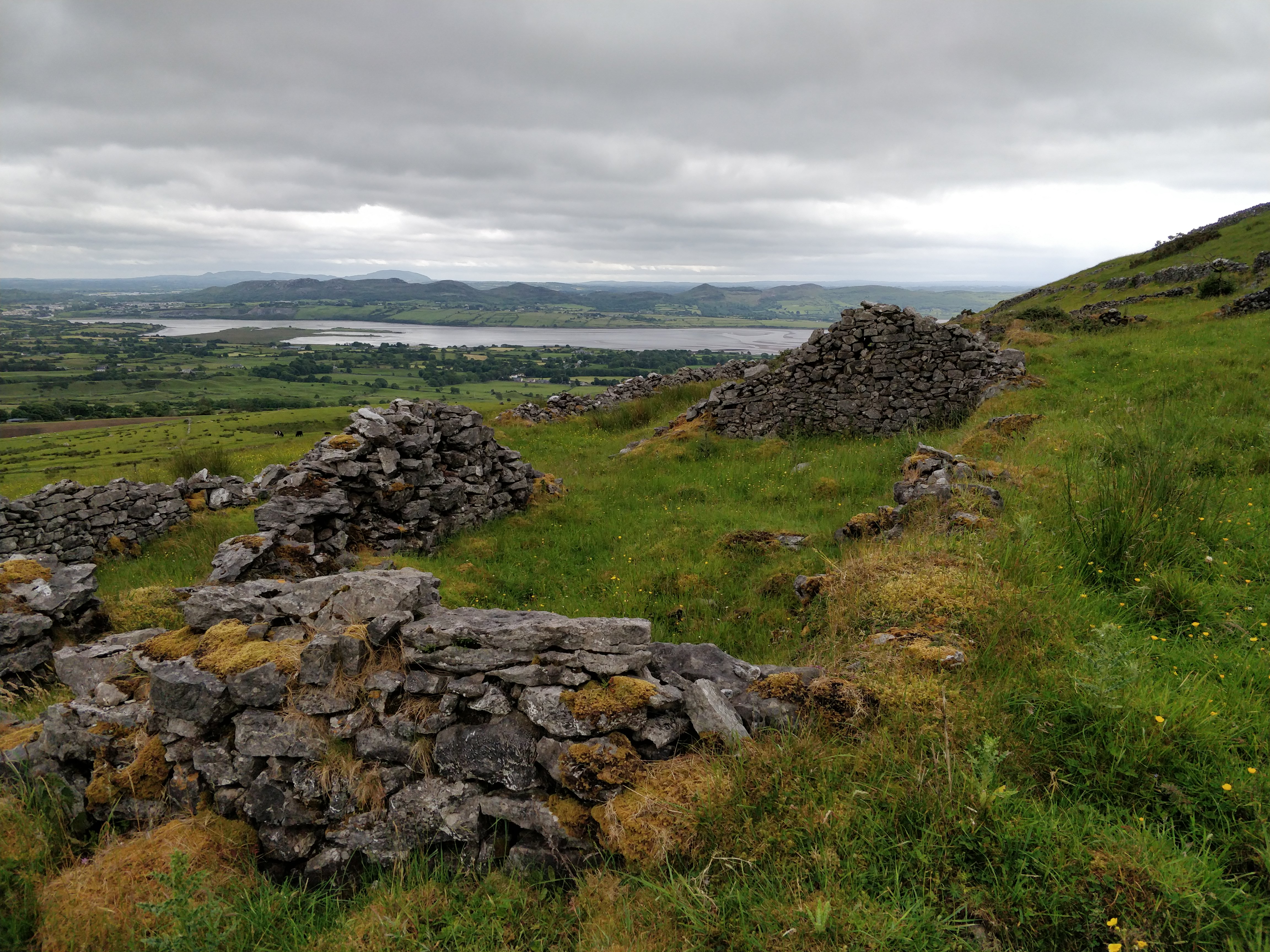
Abandoned cottage, County Sligo.
Strong farmers and merchants formed the backbone of the political movements which agitated for possession of the land, and ultimately Irish independence. But tenant ownership and national sovereignty did not reverse the agricultural transition of the post-Famine era. This system depended on low labour inputs for profitability, ensuring a rapid flow of emigration throughout the nineteenth century and into the twentieth.
Revealingly, when works were undertaken on the substantial farmhouse where my father grew up in Sligo the slates on the roof were dated to the 1840s. It is disturbing to consider a prosperous farmer building his homestead there off the back of wealth from lands seized from smallholders. Joe Lee imagines the effects across much of the country:
They will have seen corpses, if not in their own dwellings, then on the roads and in the ditches. Many are likely to have felt a degree of guilt, of the type that often afflicts survivors of tragedies, not only of the Holocaust, but of events like earthquakes, and mining catastrophes … A sense of guilt can simmer below the surface to perhaps breakout in uncontrollable and, to uncomprehending outside observers, in apparently inexplicable ways(5).
The Irish nation still lives with an echo of this survivor guilt, that has expressed itself in ways we do not yet fully comprehend. One such may have been a distortion of sexuality amidst extreme piety; another perhaps, a loathing for the land itself, still expressed in a ruthless exploitation that often seems wanton in its disregard.
III – Irish Farming Today
Teagasc’s recent National Farm Survey for 2017 revealed there were 84,599 farms in Ireland, with an average of income of €31,374. Of these 15,639 were dairy farms with an average income of €86,115. There were a mere 7,387 tillage farms (many growing feedstuffs for livestock), with an average income of €37,158. The remainder – three quarters of all farms – were (dry) cattle and sheep farms, with an average income under €15,000. Indeed, thirty-five-per cent turned a profit of less than €10,000.
According to the report (on p.5): ‘In general, farm income continues to be highly reliant on direct payments. In 2017 the average total payment received was €17,672 per farm, this accounted for 75% of average farm income.’
Remarkably, on an average dry cattle or sheep farm over 100% of ‘income’ derived from direct payments (subsidisation), while almost €20,000 of an average dairy farm’s substantial earnings, came from subsidies. It is a truly dysfunctional system.
Seventy-five percent of Irish farms would go out of business overnight under a free market, while a small number of already wealthy farmers receive subsidisation totalling approximately €300 million.
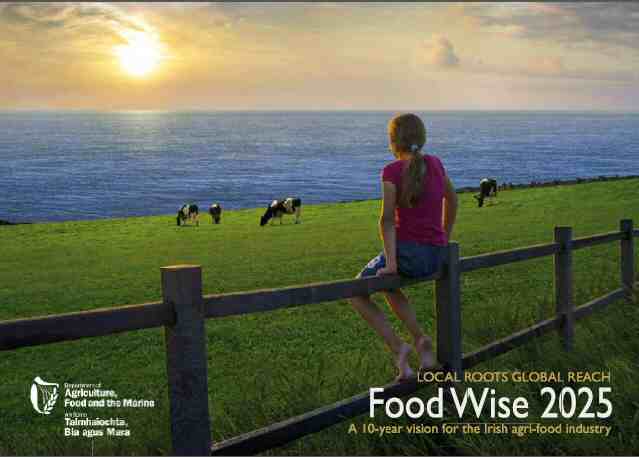
The government has committed to expanding agricultural production, particularly the dairy sector, under a report entitled, without irony, FoodWise 2025. However, a 2018 Teagasc report admits that these aspirations will ‘provide a significant challenge to meeting emissions targets, particularly as agriculture comprises one-third of national emissions and 44% of the non-Emission Trading Sectors (non-ETS).’
Revealingly the image chosen by the authors of the plan does not reveal a single tree or bush.
A growing proportion of Ireland’s agricultural products (including the thousands of animals shipped abroad in appalling conditions) are exported to non-EU states, including undemocratic regimes such as those in Saudi Arabia, Egypt and Turkey. The powdered milk market is of particular importance, with Ireland the second leading exporter to China, after New Zealand. Exclusive Breastfeeding is recommended by the WHO for babies up to six months of age.
Ireland grows little of its own food, relying on exports for the majority of fruit and vegetables the latter of which, remarkably, form less than 1% of overall energy intake, a deficiency linked, in all likelihood, to the obesity pandemic(6).
Contrary to the portrayal of Ireland as ‘the Food Ireland’, the country is actually a net importer of food calories, making us vulnerable to food ‘shocks’, including major storm events – such as the recent ‘Beast from the East’, when supermarkets supply chains failed. Yet Ireland’s temperate climate is suited to year-round cultivation of a wide variety of crops.
The beef industry has been subject to a succession of scandals over decades, including what amounted to a government bail out for Goodman International in the early 1990s. More recently we saw horse meat being substituted for beef. The industry has enriched a small number of barons, especially Larry Goodman who had an estimated net worth, along with his spouse, of €706 million in 2015. It would take the average dry cattle farmer, on €15,000 per annum, 47,000 years to accumulate that fortune. The disparities in wealth in Irish farming are probably greater now than ever.
The main farming organisation, the IFA advocates on behalf of an increasingly obsolete system, where food prices for consumers are so high that Tesco’s executives reportedly referred to the country as Treasure Island; while ruining the environment, and leaving most farms on the brink of collapse.
In 2015 that organisation was rocked by revelations that general secretary, Pat Smith, had received pay and perks worth some €1m for 2013 and 2014. For good measure, his payoff amounted to €2m. Just as eye-watering for ordinary farmers was how then IFA president, Eddie Downey was receiving almost €200,000 annually, some eight times the average farmer’s income at the time.
Most disturbingly, however, is the extent to which the state projects a green image for Irish farming, using taxpayers money, through the Origin Green advertising campaign, which the Irish Wildlife Trust has described as a sham.
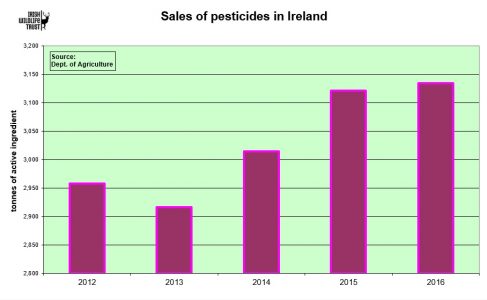
As part of a global insectaggedon, pesticide use has continued to climb in Ireland, posing grave dangers to essential pollinators. A third of Irish bee species could soon be extinct. According to Professor John Breen Irish grasslands are useless for bees: ‘Intensification of our farming is the key issue,’ he says. ‘It has taken a toll.’
Meanwhile half of Ireland’s waterways are now polluted, mainly by farm run-offs.
The long-term prognosis for Irish agriculture is extremely bad. The system cannot endure indefinitely. We are leaching the soil of nutrients, and contributing significantly to Climate Change, while exploiting the understandable desire of farm families to stay on their land.
Exploitation of the landscape of Ireland goes hand in hand with the exploitation of most farmers, confirming Marx’s theory of metabolic rift. Farmers should instead be supported to restore biodiversity, and grow crops, primarily for local consumption, both of which would be long term investments in the health of the population.
IV – Returning to the Source
‘The Song of Wandering Aengus’ is an imaginative vision for Ireland, reinvented as a glimmering girl. Yeats was singing a nation into being. But he would later bemoan the death of Romantic Ireland, as a rising class of Strong Farmers and their heirs, whose sons entered business and the professions, fumbled in greasy tills, adding the half pence to the pence, and prayer to shivering prayer.
The 1916 Rising claimed the land of Ireland to be the patrimony of the people, but the interest of individual property owners has long held sway, under a 1937 Constitution that has been interpreted to favour the wealthy, as opposed to the common good.
It was on one memorable journey, which I took during my early twenties, that I woke up to the damage being done to our environment.
The morning after the night before, I felt overwhelmed by Dublin life, and determined to proceed by foot to find a sanctuary away from the city. I would find a spot to camp, removed from the banter, bright lights and braggadocio.
I proceeded south through drab suburbs punctuated by ugly strip malls, attesting to poor planning in the city’s hinterland. I crossed a wide and ominous motorway under construction that became the M50, and proceeded to climb hills beyond the city limits; an endeavour increasingly fraught on roads lacking footpaths.
As cars shot by spewing noise, pollution and anger, I chose to proceed off-piste. After scaling fences and passing through a few deserted cow fields, I encountered ugly groves of immature spruces being fattened, like turkeys, for the satisfaction of a North American Christmas fantasy.
Eventually the terrain grew sparser, boggier and less fenced-in. At last I met a variety of deciduous trees; the spectacle a sprawling magnificence of autumnal colours as my legs wearied under the strain of my pack.
I began to collect firewood as I proceeded, soon gathering a sufficient quantity for my purposes. At last I reached the source of the River Dodder, a tributary of the Liffey, which passes within a hundred metres of my family home. Unconsciously, I was reaching back into my own origins, and I felt a spring in my step.
As the light declined, waves of midgies brought crass irritation to my reveries, but soon the sun had disappeared altogether, and smoke from the fire deterred my tormenters. I prepared a meal consisting primarily of potatoes – the food of our impoverished ancestors –that I wrapped in tinfoil and cooked in the ashes of the fire.
All about was a glorious silence, and the stars, usually masked by urban light, appeared as a hidden script that I had failed to notice. At last I felt at home.
(1) Frank Mitchell, Reading the Irish Landscape, (Dublin, 1990), p.89.
(2) Amartya Sen, Identity and Violence: the Delusion of Destiny, (New York, 2006), p.105.
(3) Raymond Crotty, Irish Agricultural Production (), p.85.
(4) Kerby Miller, ‘Emigration to North America in the era of the Great Famine’, in Crawley, Smyth and Murphy, Atlas of the Great Famine ( p.221.
(5) Joseph Lee, ‘The Famine as History’, in O Grada, Famine 150: commemorative lecture series, (Dublin, 1997) p.168-9
(6) Colin Sage, Tara Kenny Connecting agri-export productivism, sustainability and domestic food security via the metabolic rift: The case of the Republic of Ireland (2017), p.19
https://www.sciencedirect.com/science/article/pii/S245226351730006X
At the age of sixteen, in 2001, I took a job in a small factory which built appliances in Cardano al Campo, near Milan’s Malpensa airport. I worked there for four years.
As with the majority of the manufacturing industries in the area, including the spring-making factory I had worked in the previous year, it was a family-run, small enterprise, with just a handful of clients. Much of the machinery dated from the first half of the twentieth century. Fortunately, as it turned out, they had invested in modern machinery that would allow them to diversify their offerings, and therefore survive the global economic crash, from 2008.
I vividly recall the three newspapers that were delivered to the factory each morning: the Sole 24 Ore, the Italian equivalent of the Financial Times; LaPrealpina, a local newspaper; and La Padania, the mouthpiece of the then rising Northern League (Lega Nord), which was allied at that time with Silvio Berlusconi’s Forza Italia.
I also remember my colleagues being outraged at the protestors defending Article 18, which governs labour rights, despite this being to their benefit. I heard comments such as ‘they are mainly students with nothing better to do than going about shouting in the streets and smashing shop windows.’
Back then Northern Italy was still one of the most prosperous regions in the world, and probably still is. From 1979 to 1998, Italian industrial production actually outpaced Germany’s by more than ten per cent, and most of that was in the North. But when the crisis struck businesses similar to the one I had worked in began to cascade like dominoes.
In that factory’s industrial district more than half of the businesses folded within five years. Today in their place are parking lots for Malpensa airport.
II – Separatism
Italy is a country with strong regional identities, although separatism has been rare throughout its history, apart from sporadic outbursts in Sardinia, Sicily and small Alpine enclaves of German speakers.
When the Northern League emerged in the early 1990s it captured a lot of support in my region. The then leader Umberto Bossi was born in nearby Cassano Magnago.
As the first cracks of an unsustainable economic model were becoming apparent – well before the earthquake hit – mistrust and cynicism towards the political establishment had become widespread. This was especially apparent among the working class in the kind of businesses that I worked for, which formed the backbone of the region’s, and arguably the nation’s prosperity.
In the beginning the Northern League called for a federal model of government, inspired by nearby Switzerland, but the leadership soon became outspoken in their separatist aspirations. This was, however, quite different to nationalist movements elsewhere, such as in Sardinia, as the Northern League ceased to be a genuine threat to the territorial integrity of the country once they entered the labyrinth of national politics.
Blaming Italian society’s ills on an enemy within was their main tactic for gaining support from the beginning: the corrupt political class from Rome, Roma Ladrona, the lazy Southerner and the parasitic Roma community were convenient scapegoats, at a time when political discourse had been coarsened under Berlusconi’s dominance.
The Italian economy began to fragment in the wake of joining the euro, which did not allow for the periodic currency devaluations that had kept the country competitive. The government failed to control the price of consumer goods after the changeover, while salaries remained static. This eroded significantly the purchasing power of households.
As the global banking system imploded, and businesses migrated to distant countries with lower labour costs, fortunes were lost, savings dried up and many were left unemployed. This coincided with a rapid rise in immigration; first from Eastern European countries such as Albania, then later from Africa and Asia.
Almost overnight Italy became a multicultural society, and government services, especially in housing and education, were not prepared for the influx.
The migrants who settled in Italy became symbolic of the global forces that had proved so ruinous to many. They became the new target for the Northern League, which under Matteo Salvini conveniently buried its difference with the South of Italy, re-branding itself as simply the League (La Lega), and finding new scapegoats.
III – The New Government
As I worked in the factory I managed to complete my high school education by night, which gave me the opportunity to travel and gain a greater perspective on the world. But I recognise from my region the kind of talk about foreigners that I hear now from Salvini, and others.
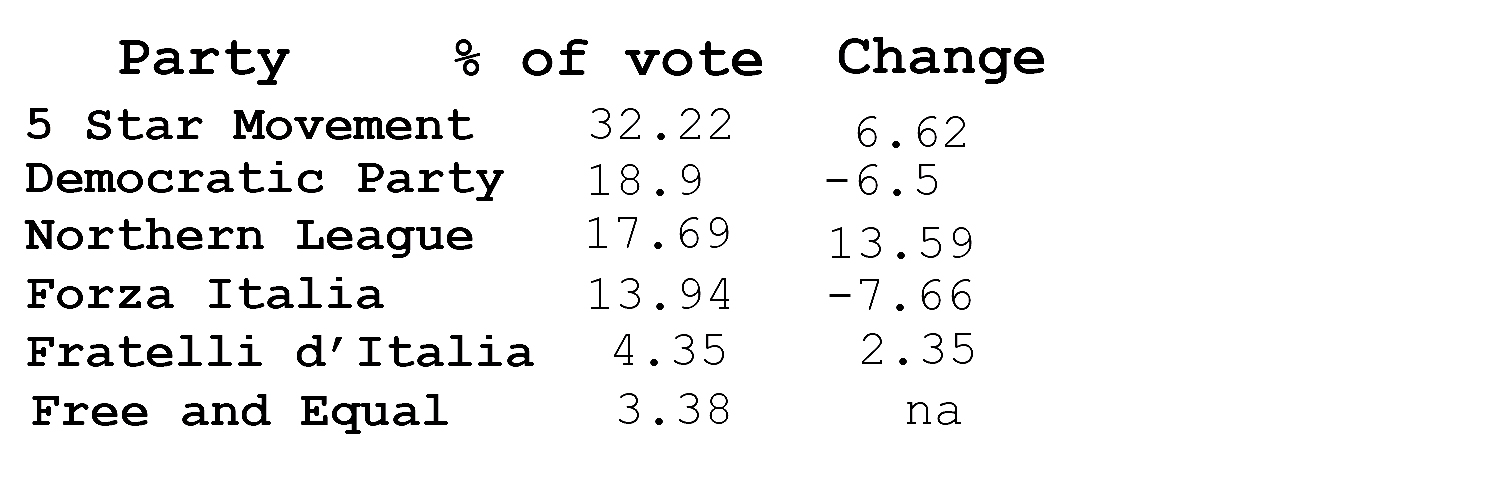
How do we explain the rise of Salvini? In the last election his party emerged as the third largest in the country and the main party of the Centre-Right alliance, which included Berlusconi’s Forza Italia and other Centre and Right wing parties.
After discussions which took months, an agreement was reached to form a government between the largest party, the Five Star Movement (M5S), which had insufficient representatives to form one alone, and the League. Crucially, Salvini was allowed to become Minister of the Interior, where he is in a position to implement xenophobic policies.
Salvini seems to understand that power is increasingly located in the social media space and below-the-line commentaries on newspaper articles and videos. One tolerant commentator might find himself against ten online reactionaries, who in their normal lives may have a quite peaceful disposition. This kind of short-attention-span politics is an ideal breeding ground for racist stereotypes and armchair experts.
When Salvini says we need to repatriate five hundred thousand illegal immigrants he receives a wave of online endorsement, despite this being a remote possibility without outrageous human rights violations being perpetrated.
Likewise, he says that we will expel all illegal ‘Roma’, but ‘unfortunately we will have to keep the Italian ones’. The key word here is “unfortunately.”
Of course it might just all be hot air. But he has tapped into an angry mood.
III – Migrations
I have been living beyond the borders of my native Italy for fourteen years now, but I am still transfixed by our dysfunctional politics as much as the next Italian, and have access to the world’s media. I have witnessed how state institutions fail and even persecute people, and could tell stories that only Italians would believe.
Like many among my generation, born in the 1980s, I had begun to despair that politics would continue to be dominated by corrupt elites – complicit or just plain lazy members of the public administration – and mafias with tentacles extending throughout every aspect of the Italian economic system.
At the same time, Silvio Berlusconi’s media empire seemed to have made pulp out of our collective brains. His Forza Italia party took over from the Christian Democrats and the Craxian left-wing faction as the dominant force after the Mani Pulite (clean hands) scandal in the 1990s. But real power lay with global elites and organised crime.
Not even the vestiges of our great civilisation and the Rule of Law could actually bring down Berlusconi. It was left to the European Community to deliver the coup de grâce. In return Italy was sentenced by its European partners to perma-austerity. Guess what: Berlusconi is still alive and kicking.
Italy has been the first port of call for the majority of Africans seeking to make Europe their home, and they have been prevented from moving further afield due to the unfair Dublin Regulation of 2014. Many new arrivals have been reduced to virtual slave labourers, or become entangled in the mafias of the South.
Meanwhile, in order to stanch the flow, the Italian government, along with its European partners-in-crime, entered into an agreement with the Libyan authorities, which has led to the establishment of internment camps for aspiring migrants, where NGOs report appalling abuses. Just last week, the European Community agreed to attempt to build further reception centres around Africa, and even within Europe. But reception of refugees by another state is on a voluntary basis, meaning nothing of any consequence will happen.
The Trumpian use by Salvini of the migrants aboard the rescue ship the Aquarius as political pawns was an absolute disgrace, but it is worth bearing in mind that what we are not hearing about in the news is probably worse. Every minute of uncertainly for every migrant creates further unnecessary suffering.
There are no easy solutions to the problems faced by Italy, and Europe. Migrants are entering what is already a densely populated country with an ineffective government. The absence of adequate accommodation makes migrants more visible, and an obvious target.
George Soros is a hate figure for many Italians because of his support for migrant rights. But his proposal for the equivalent of a Marshall Plan for Africa makes a lot of sense. It would also be useful for Italians to understand that the country’s declining birth rates mean the economy will soon need more workers. But short-attention-span-politics makes that argument difficult to make.
The hateful message of Salvini grows more powerful by the day.
V – The Cuckoo in the Nest
The emergence of the M5S seemed to offer the hope of revolutionary change in Italian society and politics. I followed Bebe Grillo’s blog from its inception, and it was a breath of fresh air, although I did not agree with everything he had to say.
The appeal of M5S is analogous to the League’s. It is Populist, reflecting, right or wrong, what ordinary people think. In particular it challenges the elites.
The question is whether the alliance which the M5S has entered into with the League is a pact with the Devil. But it was the only conceivable way for a government to be formed, once the Democratic Party stubbornly refused to enter negotiations to form a coalition. That party’s credibility faded when they embraced the politics of perma-austerity, and the sight of former leading figures like Elena Bosci cavorting with Berlusconi fills most left-leaning Italians with disgust.
Recent polls and local election results show clearly that the big winners of the coalition have been the League, who are now the most popular party in the country. The Guardian has even referred to Salvini as Italy’s de facto prime minister, which only serves to bolster his legitimacy.
But this is not true, and I remain hopeful that aspects of the M5S’s policies will be implemented, such as tackling the ridiculously high pensions awarded to retired officials. Grand infrastructural projects costing billions of euros, such as the Lyon to Turin high speed rail, which bring few benefits to the working class, may also be shelved. Perhaps too they can set about cleaning up the toxic poisoning of places such as Terra dei Fuochi, and just maybe challenge the extensive networks of organised crime.
However, the agreement entered into between the parties is highly aspirational, ranging from a regressive plan for a flat tax and a guarantee of a basic income for all Italians. It is difficult to see the government lasting very long, and the worry is that Salvini, with the wind in his sails, emerges as the big winner. Like the cuckoo in the nest.
How to fathom the phenomenon of ‘fandom’? Certainly it is one of the most familiar, most recognisable, and common, of personality traits – yet oddly, one of the least analysed personality traits.
We all have a tendency towards being a ‘fan’ of something or other. It is a near-universal inclination evident in everyone from tech titans to favela-dwelling street kids. Yet that doesn’t make this thing called fandom any easier to comprehend.
Becoming a fan of the right thing, at the right time, can be a liberating gateway to an array of regular natural highs, and an excuse for completely out-of-character behaviour. But it can lead to frustration and a pain that only eases when you abandon hope.
There are genuine physiological and mental health benefits, and even employment opportunities in fandom, even if it defies rational explanation. Fandom may define a person’s life: ‘He was a fine father, a good friend, and as everyone knows, a passionate Waterford hurling fan all his life,’ it might be said.
Nick Hornby always pops to mind whenever I consider the topic (as I do more than is good for me). Like most struggling writers, Nick had been tipping along for years, when a lightbulb switched in his head. He dropped his Dostoevsky-lite pretentions, and tapped directly into his Arsenal FC obsession. He came up with the novel Fever Pitch (1992).
He followed this up with another global bestseller High Fidelity (1995) – a novel built entirely around musical obsession, and the butterfly effect it can have on a life. The success of both books lies in their unique, and accessible, capacity to get under the skin of fanatical fandom.
Hornby’s is the simplistic, embedded fandom that most of us get sucked into at some point in life. There is none of that nauseating need ‘finally to meet my hero’ – or fulfilment of a deep quest to reach ‘the destination of a lifelong journey.’ No, none of that horseshit, Nick Hornby’s global bestsellers are simply about the reality of being a fan.
One of the defining features of fandom, as Hornby explained, is that pleasure of reading newspaper reports after a favourable result, and knowing that friends and family are reading the same report and thinking of you. But my word there are many more aspects.
II – From Russia with Love
As I write I am travelling from Moscow to St. Petersburg on day seven of the 2018 World Cup, the biggest sporting event on the planet, by any metric. It really is something to behold.
The host nation is Mother Russia, and in the midst of a toxic sameness afflicting an increasingly globalized world, this place remains, unmistakably, Russia, an intoxicating brew which hits you as soon as you arrive.
Or at least that is how it was before this. As with anywhere, the World Cup month is an entirely different beast and – whether you really believe it or not – this month of madness every four years is still all about Football and Fans. Nothing else. To battle against that reality would be a fruitless endeavour.
Even the legendarily terrifying Russian authorities have succumbed to World Cup madness. To such an extent that the normally reserved Russian people have followed suit.
Y’see, just like fandom, the World Cup itself is a bizarre and inexplicable thing. It temporarily requires even the most autocratic and despotic regimes to drop tools and play nice. But it ain’t some well-meaning peace initiative organised by the UN. It is a deeply corporate enterprise – the colossal plaything of an openly corrupt and corporate governing body named FIFA.
To be given the right to host the event by the Swiss-based sportocrats, Russia has had to commit to the biggest societal and behavioural shifts since the fall of Communism, and by Jove it is running smoothly.
Napoleon may have made it to Moscow before a ruinous retreat, and Hitler came close too, but only FIFA and Football fans have found the ingredients to the secret sauce required to tame the Russian Bear – albeit temporarily.
https://www.youtube.com/watch?v=1as1IceOALY
III – The World Cup in Unison
So here we all are now. Hundreds of thousands of the most colourful and diverse visiting fans, mixing delightfully with millions of ethnically-diverse Russians. While the spell lasts, it is bizarre and wonderful.
Everything is choreographed to within an inch of its life, but nothing is familiar. To anyone. In normal times most people enjoy the chance to show wide-eyed visitors around their homelands, taking pride as they see the place for themselves through fresh sets of eyes.
But not this time. The World Cup is entirely its own domain – familiar to nobody – a surreal pop-up-football-country and unique cultural mix built entirely around the unlikeliest blend of fans in full expression.
Everything is being made up as it goes along, and to this writer it is a joyous space to inhabit temporarily (in spite of the best efforts of the English fans). I believe everyone should make this kind of pilgrimage at least once in their lifetime.
This really is unchartered territory for all of us – even seasoned fans such as myself attending the sixth World Cup, who are brief residents of World Cup Fantasy Land.
Everyone – from the dourest cop, to the openly gay charmer who cut my hair, is on their very best behaviour for the month.
The diplomatic top brass in all the foreign embassies are on high alert too, and stocked with temporary crisis staff. Legions of PR gurus focus on protecting each country’s reputation from a potential humiliation in front of a watching world.
For instance yesterday a group of Columbians were caught sneaking alcohol into a stadium concealed in a pair of binoculars. This became a huge incident – a national embarrassment – requiring ministerial-level apologies to the Russian authorities. And that’s from a country that allowed Pablo Escobar run riot for decades, and one of whose players was shot for missing a penalty after USA 1994.
Even a train journey during the World Cup is an uplifting experience. Reportedly, all Russian train conductors have been compelled to attend training exercises in ‘pleasantries and tolerance’, and the country’s vast rail network is free-of-charge for any fan with a match ticket.
IV – Fiesta Time
Extravagant hospitality is normal at World Cups – national stereotypes go out the window – but this visiting horde of fans seem on better behaviour than usual.
My apartment until mid-July is in a leafy, well-to-do corner of Moscow called Sokolniki – a sleepy neighbourhood with playgrounds, and parks aplenty. However, an entire block in this normally placid area has been taken over by the hugely charismatic and enigmatic fans of Senegal.
Masses of wildly-enthused, tall and athletic-looking Africans are crammed into one building, spilling out in groups to dance and sing loudly on the street in support of ‘The Lions’ of Senegal, while festooning the locality with their flags.
Honestly, it’s Fantastic. The energy, the vibrant colours, the pumping music, the tribal moves – all delivered with a World Cup-imbued civility and joy that the normally stiff locals are warming to. It is brilliant and contagious.
And that is one single building – just one set of visiting fans. There are thousands of other fervent groups spread right across the enormous country for the month. Even the usually stiff and well-groomed Scandinavians and Germans are going batshit crazy.
And then there is the remarkable juxtaposition of fans gatherings in iconic places like Red Square, Nikolskaya Street, and outside the Bolshoi theatre. A wild and widespread array of colour and noise has caught all of Russia off guard, and foreigners already living here are giddy at the sight of their normally reticent neighbours smiling and casually chatting to strangers.
Even the over-organised and branded FIFA ‘Fanzones’ have a lovely vibe to them, mostly down to one simple fact: these are the places where you will find the South Americans.
Their fans raise so many questions. Even after a week of asking around, I have found nobody who can explain how so many South American fans have managed to make it to Russia. How in god’s name have they been able to afford the trip when most of these countries are falling apart economically, while so many Western Europeans have ‘sensibly’ skipped it?
Where are all these South Americans living, eating and sleeping while they are here, and how the hell did the Peruvians manage to carry their hundreds of street-long flags and blow-up Llamas? Imagine the excess baggage costs alone!
What a thing Fandom is, eh? It might be dismissed as just a curious personality trait, but as the first world gets ever blander, with toxic sameness delivered via massive global brands like Apple, Facebook and Nike – I see fandom as an important way of keeping human life interesting on planet Earth.
In this time of multiple global tensions and unreported traumas, the World Cup in Russia is arguably the most hopeful place to be in the world – now who could have guessed that?
Russia might well go back to being the stiff scary place of yore, but after this experience there will certainly be a residual warmth towards Russia felt by fans who have been caught off guard by how welcoming it has been. And the effect on Russians could be the same. That’s the brilliance of a World Cup.
*******
‘Ahhh but Ed… How can you praise an event hosted in a place with a reputation for x, y and z …?’, I was repeatedly asked by well-meaning liberal mates before leaving for Russia.
They have a point, but they don’t get it. The host country is merely a vessel for this event to bloom, a landscape where a pop-up utopia flourishes regardless of everyday norms. In fact, the more damaged a country is, the greater the benefit of a mass influx of World Cup fans.
So sod the haters and the cynics. With a fortnight to go in Russia 2018, I am already plotting how to get to the next one in 2022, due to be hosted in the utterly-illogical FIFA choice of Qatar. There you will find the full menu of human rights abuses; and strict public alcohol bans, and female repression, and dark laws against homosexuality.
But I will still go to Qatar, along with hundreds of thousands of fans, because I get it. I have seen at first-hand how transformative a month of fan-delivered warmth can be – and will enjoy watching Qataris melt in different ways when the hordes descend, and the World Cup fiesta takes over.
The legacy of an unstoppable force meeting an objectionable object is not easy to quantify, but I would defy any human with a soul to come to this event and not be moved to appreciate the joys of life as a football fan.;
My train has arrived in St. Peterburg. A Costa Rican has already invited me to/ visit his solar farm over an 11am beer. Another one has offered to help carry my equipment. Brazil kick off their second match in a space-aged stadium in the centre of the most beautiful city in Europe. If you can’t be a fan of this experience, then I pity you.
The great Italo Calvino’s novel Invisible Cities imagines a conversation between the Mongolian emperor Kubla Khan and the legendary traveller Marco Polo. Kubla Khan asks Marco Polo to describe for him the great cities he has visited.
After a number of vivid and enthralling accounts it becomes clear that Marco Polo is confining himself to a description of his native Venice, as if the rest of the world counts for little, a view for which I have some sympathy.
Let us imagine another fictional conversation, set in contemporary Ireland, in which Taoiseach Leo Varadkar encounters a non-national – from Lithuania we’ll say – and asks her for a description of Dublin and its hinterland.
You will indulge this far-fetched conceit I hope, dear reader, of our imperator deigning to converse with a migrant of modest means.
Suave Leo will be confident– ‘our GDP growth is off the charts’ he assures himself – in a favourable verdict on his achievements as Taoiseach, and the state of the country after almost a decade of Fine Gael in power.
‘She will surely recognise this as ‘the best little country in the world to do business in’, with near full employment; an economic powerhouse, like Venice in its day – they might have built St. Mark’s and the gondolas, but we have the Dundrum Shopping Centure and the M50; a land of céad míle fáilte – as long as you are an ‘an ex-pat’ with a decent credit line; of milk and honey, so much dairy in fact that we are the second leading exporter of powder milk to Chinese mothers, who can now work longer hours to produce the consumer goods we don’t need; of comely maidens at cross purposes. The boom is getting boomier, again!’
Using the structure of Calvino’s book let us imagine her response, chapter by chapter.
Chapter 1
She concedes Ireland has given her employment:
‘Which requires me to work long, often anti-social, hours, though I am grateful for it, as others haven’t been so lucky and ended up on the street, or involved in organised crime. But I have to say that since the economic crisis I have encountered significant hostility from native Irish, even though I speak perfect English – perfect you understand – albeit with an accent.’
‘Taoiseach I can’t help feeling I have had to work significantly harder than the younger generation of wealthy Irish, who don’t recognise my achievements. I am well educated but my academic qualifications are often disparaged. There is a Little Islander mentality, though I guess you might find the same attitudes if you came to work in my ex-Soviet republic.’
‘We Lithuanians are also a small nation, like your own Taoiseach’, she says, pausing to reflect that he might empathise with her plight, given his mixed-race background.
‘Currently I live in a satellite town of Dublin, where I work and have studied in the past. I find the environment harsh and uncomfortable, and public transport pathetic, which forces most people into their cars.’
‘Many Irish people I meet seem very nice, but this can be superficial, and I have been subjected to racist abuse for speaking Lithuanian with my friends on the bus.’
‘I have the impression the country is being run for the sake of a privileged few. I have found out quite a bit about your country Taoiseach, and it seems there are dynasties that run it, especially in politics where I see the same names cropping up again and again, just like the former Soviet officials who re-invented themselves as democratic politicians where I am from.’
‘I have also heard there are certain private schools in Dublin which most the top lawyers and businessmen attended, and now send their children to, and I think a lot politicians were educated in one of them too, including, if I am not mistaken, yourself. Do you work on behalf of these people or the wider community Mr Varadkar?’
Leo feigns a smile that looks more like a grimace – he’s hoping the conversation won’t go on much longer, but realises he can’t ignore the woman as someone might have their camera on him. He interjects, summoning all the charm that bewitched his party when Enda finally fell on his sword: ‘Look at me, I am half-Indian and gay. I made it the top, and so can you.’ But strangely he doesn’t look her in the eye when he speaks.
Chapter 2
The Lithuanian lady responds: ‘As I said Irish people are very friendly, but sometimes this masks a lack of emotional depth. They love to talk but prefer not to listen. They are highly sociable, but drink to excess. They fill their minds with absurd patriotism, and tell lachrymose tales of hardship and grievance. They give out, but generally do nothing. They are often obsessed with trivia, or with pop culture, and televised sport. Politics seems to be reduced to personalities rather than the issues.’
She continues, a steely determination entering her voice, aware that this will be her one opportunity to speak candidly to a person in power: ‘Politics, Taoiseach, is about the issues and nothing else. Irish politicians are economical with the truth, and often, frankly, lie. Compromise is not always possibly, and sometimes harsh words are required. Cover-ups of corruption are not conducive to a well-ordered society.’
‘More generally, it is difficult with such overt friendliness to work out when to take people seriously. In this context I have, as a young attractive woman, experienced numerous protestations of love from inadequate men, who only dare speak to me when they are drunk.’
At this stage Leo is getting exasperated at how ungrateful she is for all the country has given her. But he manages somehow to contain a rising disgust.
Chapter 3
She continues: ‘when people get to know you on a personal level they are nice and there is still a strong sense of community in the rural areas I have worked in – social supports and community among the older generation. But this is nowhere near as prevalent in Dublin, where I encounter greed, selfishness and casual disregard. Homelessness is rampant and, I am telling you, you would not want to get sick. The one medical emergency I experienced I had to wait for hours in A&E, and I felt the treatment was inadequate.’
‘I have now taken out private health insurance – as you advised young people to when you were Minister for Health – but even still I face queues, and that is the experience of other people I know in the same situation.’
‘And my experience with the private sector, especially the banks, is that people are not that competent, often downright rude, yet curiously patronizing.’
‘But really Leo the police are particularly rude and judgmental towards non-nationals. In my community I hear a lot of complaints about them. Some of their conduct seems to be legalized banditry, as corrupt as … any country on earth. Yet I read in the newspapers that your party does not have the will to deal with the institutional scandals, or train them properly. Frankly Leo they are in many respects as bad as the criminals they are supposed to police.’
Leo is now seething and on the point of flying off the handle. She is questioning the very essence of his Ireland, despite the opportunities it has given her. He turns accusatorial: ‘But we welcomed you, and you have lived here for over 10 years. Of course we are not perfect but which country is?’
Chapter 4
She responds: ‘It is true there is sufficient food to eat, but as for the standard of living, or quality of life, it doesn’t compare favourably with other countries, unless you are privileged. There is a glass ceiling on how far a non-national can climb in this country, and you Taoiseach are the exception that proves the rule.’
‘Non-EU migrants especially have had to endure victimisation, and the barbarities of Direct Provision. My humble abode in the sticks is far too small, and cost a ridiculous sum for negligible space, which eats into my meagre income. All around us people are being forced to live in ever-decreasing spaces. This is not conducive to emotional or intellectual wellbeing.’
She is becoming forceful again: ‘Even applying your capitalist logic: you cannot produce creative or productive people if they are forced to live in shoe boxes. People will want to leave. They will have had enough. Even if I wanted a family that would probably be impossible, which I find quite depressing.’
Leo, now astonished and increasingly irate at this candid and uniformly negative response, asks, with a surprising, but revealing, innocence: ‘well who is responsible for these mistakes?’
Chapter 5
‘Without naming names Taoiseach, I’ll offer you a biblical reference, which became an Italian film and a byword for corruption. Ireland is becoming ‘Sodom and Gomorrah’, or at least Gomorrah. No one has any confidence in many of the state institutions or private actors; there is a sense that the political class is corrupt and self-serving; dispensing patronage for favours and committing the sins of simony with Big Business and the professional classes. Our banking structure is a farce: why didn’t we just nationalize them like Iceland, which got out of its recession much sooner?’
‘I have to confess Taoiseach that I bought my apartment at the height of the boom, and now have difficulty making repayments. The bank won’t allow me to get back on a tracker mortgage, even though they promised to do so. The interest rates are crippling me. I want out.’
‘My friends who are renting are in an even worse plight, and are often randomly evicted by the purchasing power of Canadian and American vulture funds linked to Goldman Sachs. This is not right. Further, it seems to be a society where, if I may be so bold as to quote an Irishism: ‘it is not what you know, but who you know ’, that gets you ahead, which is not meritocratic.’
‘I am sorry to be so forward Taoiseach but governance here does not conform with that of a functioning European social democracy. I am hesitant to be so candid as my culture has imbued me with a formal politesse and deference. I am a decent and civilized person. But Ireland has the resources to become a genuine social democracy, but can’t be as long as you misapply and mismanage your revenue.’
‘Also the endless diet of violence both real, and magnified by the press, is undermining my quality of life. As a woman I am alarmed the stories of sexual assaults I hear in the press. Whether real or exaggerated, I do not feel completely safe walking the streets of Dublin at night.
‘Newspapers trivialise and sensationalise, and do not report the truth at times. Violence has unfortunately become part of the entertainment industry, but increasingly truth and fiction are difficult to disentangle.’
But Leo, a crackle of emotion in his voice, at last gets a word in: ‘surely the youthful energy here can make this society work?’
Chapter 6
She replies: ‘Ah yes the youth. The youth want to leave Leo for a better quality of life. Many older people too. The brain drain is continuing. Even young native Irish in creative fields don’t have career opportunities, and prefer not to work for multinational companies. They don’t want to live in a satellite town in order to live independently of their parents. The environment you live in impacts significantly on your self-esteem Taoiseach.’
Some of the younger generation in Ireland are doing well of course, and there is a culture of entitlement, both boorish and materialistic. Culture is commodified, and it is almost impossible for independent artists to live here with the inflated cost of living. Irish people don’t seem to read the ‘big books’ that I grew up attached to. Ignorance seems to breed a culture of compliance. Of course this is what happens when survival is the main priority. The desperation for money and pervasive avarice have coarsened social interactions. You have lost God and embraced Mammon. It is not that I am particularly religious, in fact I am an atheist, and I too want enough money for a decent standard of living, but this society seems rudderless, and unprincipled.’
This continues on for many more chapters.
Endlessly critical, endlessly precise, endlessly judgmental. Lucid, and scathing. By the end, Leo’s world is falling apart and he implores his vengeful demon to offer a dose of optimism.
Chapter 7
‘The countryside is beautiful’, she responds, ‘in particular the Atlantic coastline. Connemara is one of the most glorious places I have ever set eyes on. I often try to hike in Wicklow, which is nearly as wonderful as the West, but much of it is inaccessible without a car, as the bus services is almost non-existent. An American friend of mine also says that Ireland is a good place to play golf. And at times in bars and socializing ‘the craic’, as they say, is ‘mighty’. But Leo not even the Irish can live on craic alone, which has its disturbing shadow.’
She then stops abruptly and bids adieu. She has to get up early in the morning for a job interview in London, assuming, post-Brexit, she can get a visa. She is increasingly conscious of how perilous being a migrant is, and may be, throughout Europe in the future.
Her parting shot is that it is not just Ireland, but Europe and the rest of the world, that is increasingly hostile to migrants. She may be confronting a future of further displacement.
Leo sighs bemusedly – remaining convinced of his beneficence. He will consider carefully what she has had to say. He will make Ireland better for those willing to work. But soon the failings she has pointed to slip his distracted mind, and as the problems multiply, he sees no obvious solutions: ‘Let’s just keep it business as usual’ he says to himself.
Interstitial space: a space between structures or objects, i.e the contiguous fluid-filled space existing between the skin and body organs.
*******
It is difficult
to get the news from poems
yet men die miserably every day
for lack
of what is found there
from ‘Asphodel, That Greeny Flower’, by William Carlos Williams.
I – ‘It is probably a tumour’
It is 2:30 a.m. and the emergency room is at its busiest, crowded with nurses, rushing porters and patients. The doors to the ambulance bay swing open and a gurney emerges into their midsts. Lying on it is an old man, naked except for a green-paper hospital gown. His beard and matted grey hair make him an old testament prophet, the two paramedics pushing the trolley his head bowed acolytes.
I watch them as they pass. He lies prone, bone-thin and hollow-cheeked. His arms stretch and move in the air as if conducting some unseen orchestra, the sinews and ligaments of his limbs like bunches of reeds under his papery skin. As the little group moves by, he turns his head and vomits a dark brown liquid on the floor.
After he is triaged by a nurse I am directed to his cubicle to assess him. He is incapable pf answering my questions. The paramedics who brought him in tell me he was found by a neighbour, having collapsed on his kitchen floor.
No one can say how long he had been there. His mouth is dry, his pulse quick. I gently pinch the skin on his arm. As his body is dehydrated from the vomiting, the skin remains standing in folds. His abdomen is swollen and taut.
I lean in and listen with my stethoscope. If healthy his bowels will have a murmuring bass tone, like the burble of a theatre crowd waiting for a curtain to be raised. I hear nothing at first, and then a sound like water splashing on a metal surface, a high pitched tinkling. This sign, along with his other symptoms, indicate that something is obstructing his intestine.
I order intravenous fluid to be set up and walk him to the radiology department. An x-ray shows his lower intestine is grossly hyperinflated, its loops ridged like giant caterpillar pupae, the deep black of the air in the lumen overblown and the intestinal wall thinned out under the pressure.
There is something blocking his descending colon, some errant tissue the x-rays can’t penetrate, appearing asymmetric and bright white against the black of the air. It is probably a tumour. I call the surgeon to begin the preparation for the inevitable operation. He arrives in a flurry of white scrubs and begins his own assessment.
There is nothing to do now but rehydrate him and wait for a theatre to become free. I order more intravenous fluid to be set up, check on my other patients, and then walk to the doctor’s room for a short break.
II – The Interstitium
It is set away from the noise of the emergency room, down a long corridor lit by a blinking strip light. The room is empty at this hour but the low coffee table is full of the detritus of earlier shifts: paper cups half-filled with cold black coffee, pots of reheatable noodles, notepads, pens with their plastic cracked and teeth marks indented on their surface.
A television with its sound muted shows a slick-haired anchorman mouthing silently, the endless ticker tape of 24-hour news tracing its way across his tie. The room is windowless and unloved, a nothing space to be briefly passed through.
I lie down on the sofa and study the back of my hand, its dorsal surface, webbed by skin and hair. I imagine a microscopic view of the tissues: the cells inside which the organic chemical processes and genetic reproductions occur, the machinery of life.
And then I imagine the space between the cells, the interstitium, and the fluid slowly seeping into these spaces in the old man’s tissues out in the emergency room as the intravenous treatment has its effect.
III – ‘The Drunken Boat’
When doctors begin working in the emergency room they go through a kind of exposure therapy. No matter how long they’ve spent in medical school, witnessing for the first time the taboo of the sanctity of a person’s body being broken is a shock.
The first trauma case I experienced was a young man who was involved in a motorbike accident; his body crushed by the impact. My response was as anyone’s would be: a raised heart-rate, an out-of-body feeling, the running thought ‘is this real?’, ‘because this can’t be real’.
Through experience and repeated exposure this response lessened, to a point where now the shock has disappeared and these patients are now – for the first few acute minutes at least – simply a series of problems to be solved.
But the need to find meaning in these experiences is not something that wears off with time, nor is it something that is taught in medical schools. So where then to find it?
In the pocket of my scrubs there are crumpled post-it notes, a pocket light, chewing gum, and a thin book of Rimbaud’s poetry. I picked the volume from my bookshelf on the way to my night shift because of its size, slipping easily into the pocket of my scrubs.
I know nothing about the poet but I now have ten minutes before my break ends, and need some distraction. I turn the page to the only poem whose title I recognise ‘La Bateau Ivre’, ‘The Drunken Boat’, and begin to read:
As I was going down impassive rivers, I no longer felt myself guided by haulers
The poem is spoken in the voice of the eponymous boat, unmoored and adrift on a strange sea. It travels drunkenly, moving through a cascading world of imagery, going wherever it pleases.
It has, as one critic put it, ‘the authority of thought to think itself through us’. Happy to be consumed by the poem for these short few minutes, I feel my consciousness awash with the poet’s vision, as if the walls of the anonymous room where I sit have become the banks of a swirling ocean.
Rimbaud was sixteen when he wrote the poem, and wandering the roads between Normandy and Paris; there is a juvenility to the wide eyed imagery of the poem. It feels like it was written as he walked, the dynamism of his youth pumping though his body.
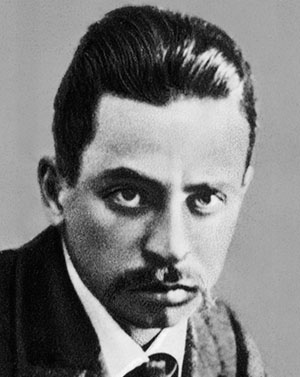
I look at his photograph on the book cover. He is just a boy and, despite being in black and white, his eyes appear a translucent blue. He is an unformed space, yet to be filled with life, untethered and free to produce his hallucinogenic hymn to the energy of existence.
The boat moves across an ocean where anything is possible. It is this space, that Rimbaud calls the sea, that artists try to occupy. The areas outside the quotidian, the interstitia of life where art is created and where it has its effect. (Though I imagine these interstitia are as likely to be as easily accessed when daydreaming while doing the washing up, as they are while in some kind of self-enforced ‘artistic’ meditation).
After this rush of movement and crazed imagery however, the poem resolves itself back in the everyday. The boat, after travelling the broiling ocean, becomes a toy pushed around a puddle by a child.
IV – Recovery
The modernist poet William Carlos Williams held the conviction that poetry was ‘equipment for living, a necessary guide amid the bewilderments of life.’ Williams was perhaps a connoisseur of these bewilderments, practising as a family doctor and a professor of paediatrics throughout his life.
Emergency rooms are life multiplied and concentrated: full to the brim with the drama, noise and emotion of its extreme moments. It would seem the furthest place away from the contemplative spaces where art is created and regarded.
But as Rimbaud’s boat must return from the sea to the constraints of a puddle, so these interstitial spaces must communicate with real life. And as such art can have a practical use, which can be put to work, even in the noise of an emergency room in the middle of the night.
I close the book and prepare to return to work. It is 2:50 a.m., another five hours to go before the end of the shift.
Something has changed in the short break I have had. The reading of the poem has made my body feel skittish, as if adrenaline has been released into my system. Somewhere cogs move and blocks fall into place.
When trying to assess if someone has had a heart attack I will ask them what kind of pain they have experienced. Was it sharp? blunt? heavy? stabbing?
Patients find it difficult to describe a feeling that deep and visceral. The brain is finely-honed to locate exactly a superficial sensation on the body’s surface, but is often unable to give words to a feeling that profound.
Patients will instead often fold a hand into a fist and press it against their chest to indicate what they mean. The effect of the poem is similar: some altering in the relationship between the self and the world, a communication between the interstitium and the cell, that takes place in the depths, impossible to locate precisely or accurately describe.
I return to the emergency room and check first on the old man. The intravenous bag flowing into the vein in his arm is nearly empty. A little colour has returned to his cheeks and he appears less hollowed out.
The sodium chloride has rehydrated him, filling his interstitium. These spaces, the spaces between cells, though empty, do have a function. They give the tissues of the body their tensile strength. They are the scaffolding on which life sits. Without them we would not be able to combat gravity, to walk upright, to reach high.
The old man grabs the sides of the gurney as I approach. He pulls himself up to sit.
One trail runs dry, but a scent hangs in the air. Pursuant to Stephen Court’s Drivetime article for Cassandra Voices deconstructing the Irish media’s – including RTÉ ’s – relationship with the motor car sector, I lodged a Freedom of Information (FOI) request with the national broadcaster.
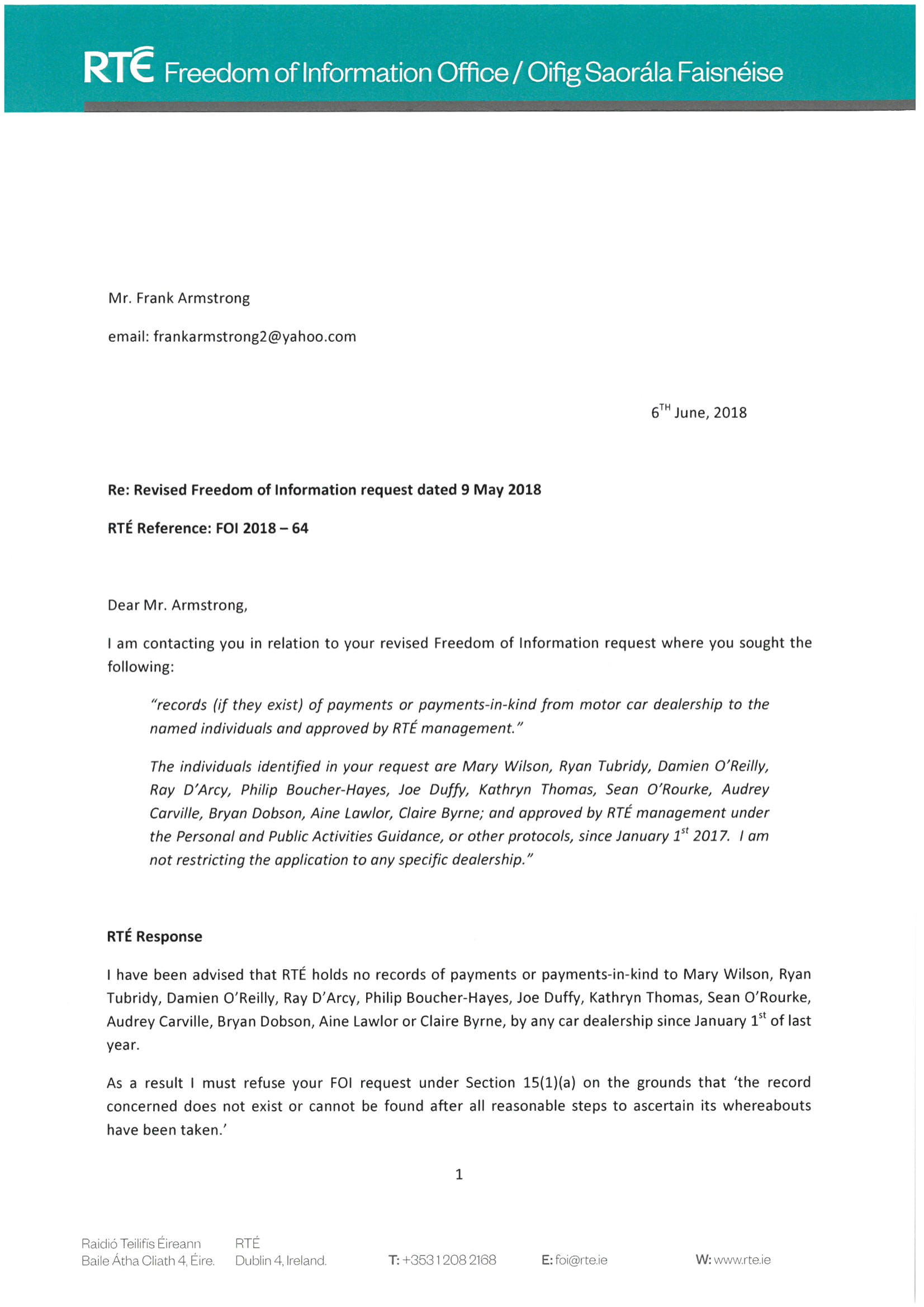
I sought records of payments, or payments-in-kind, from car dealership to leading RTÉ stars, approved by RTÉ ’s management since January 1st, 2017 under the Personal and Public Activities Guidance.
RTÉ’s FOI officer responded on June 6th to say there was no record of any such payments or payments-in-kind.
So can we be sure that RTÉ ’s ‘star’ personalities are appropriately objective in their reporting on transport issues?
Unfortunately not, as an FOI is a request for records containing information, rather than the information itself. According to a recent judgment (quoted by RTÉ’s FOI Officer): ‘If the record does not exist the body concerned is not required to create records to provide the information sought’ (Case 170505, Ms X and Louth County Council).
In other words, the FOI officer is under no obligation to dig for information on behalf of an applicant if the question posed misses records containing the targeted information; albeit an officer must take reasonable steps to comply with a request, which usually takes thirty days.
There is ample evidence of a permissive culture among RTÉ management towards employees’ earnings from third party sources. This was revealed in another FOI application I took earlier this year, unrelated to enquiries into the motor sector. But RTÉ’s officer chose to withhold details of who received what from whom – for reasons of commercial sensitivity.
As long as the national broadcaster does not provide a publicly accessible register of all transactions between employees (including so-called ‘external employees’ who avail of tax breaks available to companies) with third parties, as the BBC does, then suspicion lingers.
At the very least the national broadcaster should reveal the text of the Personal and Public Activities Guidance, which regulates employee’s third party relationships.
Any media organisation in receipt of a disproportionate proportion of its advertisement revenue from a particular sector is exposed to a charge of bias, which may operate in subtle ways.
II –Bring Cyclists to Justice
A recent example of what appears to be ‘Groupthink’ in the national broadcaster came from the unlikely source of Olivia O’Leary on – you guessed it – her weekly Drivetime column on June 19th.
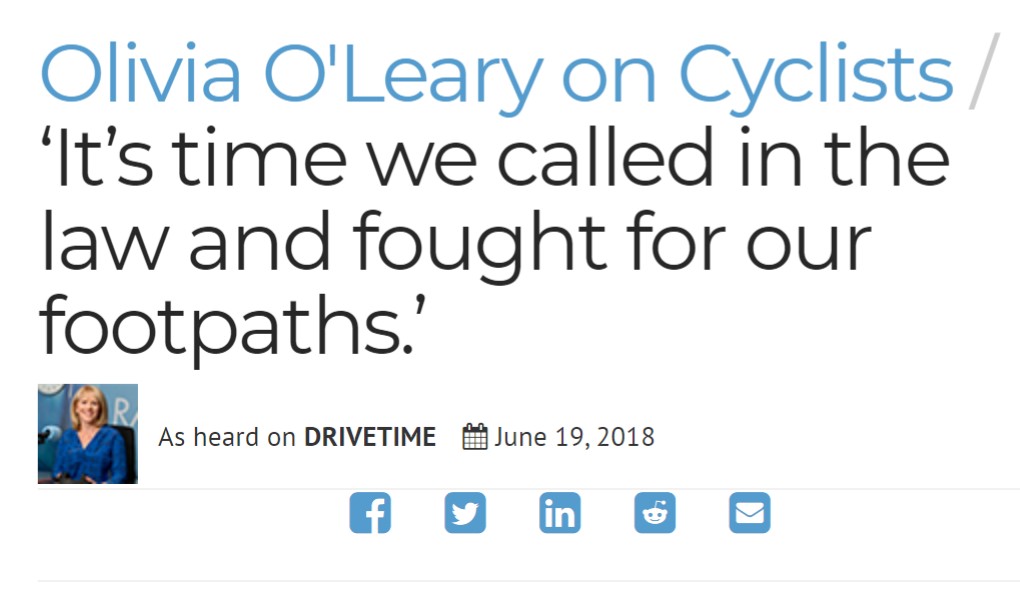
Drivetime’s website adopts the incendiary title: ‘Olivia O’Leary on Cyclists: ‘It’s time we called in the law and fought for our footpaths’. It is a case of ‘we’, the ‘normal’ people, presumably motorists, ranged against ‘them’, that strange species of two-wheeled fanatics, invading ‘our’ footpaths. The title invites confrontation beyond legal enforcement.
The column itself is more balanced than the title suggests, but contains serious lapses of judgment. O’Leary said she was in favour of banning cars from between the canals and acknowledged that ‘cars destroy a city’, but then proceeded to lambaste the behaviour of cyclists in Dublin’s city centre.
She limits her complaint to a certain type of (male) cyclist on a Dublin bike ‘thundering along’ footpaths, but that nuance is lost in the following statement:
But, you know, there is one thing that private cars, for all their faults, usually do not do. They do not drive down the middle of the footpath, scattering pedestrians left and right. Cyclists, on the other hand, do this all the time.
O’Leary also, remarkably, jokes about using an umbrella to unseat any cyclist who engages in ‘Panzer tank stuff’, before adding that she would not actually recommend this. Ha ha ha. Hopefully some hot head has not had ideas put in his head.
This seems particularly insensitive, to put it kindly, considering how that very week in June ten people including three pedestrians had been killed by motor vehicles. Two were hit-and-runs. Unlike those killers, O’Leary missed the real culprits.
Moreover, as Cian Ginty points out in a column for Irishcycle.com, a simple Google search yields examples of pedestrians on footpaths being killed by motorists.
O’Leary is relating her personal experiences as a pedestrian in Dublin, which is fair enough, and of course there are lunatics out there. But what she fails to acknowledge is that friction between pedestrians and cyclists is largely a product of the deficient cycling infrastructure in the capital.
Mounting the footpath in Dublin’s centre is often a safety measure in a crush of buses, taxis and private cars. Most cyclists will then glide at the pace of the average pram, and give right of way to pedestrians, some of whom, nonetheless, will take the opportunity to scream into the cyclist’s ear.
O’Leary should have known better than to target cyclists for long failures in urban planning. She also ought to be pissed off with how the Drivetime producers have distorted her column.
III – Motor Mouths
Transparency in terms of external payments and gifts is especially important where, as Stephen Court’s article illustrates, there is a record of high profile figures – including Ryan Tubridy and others – apparently receiving free cars from dealerships, and also where numerous programmes from Drivetime to Liveline are sponsored by car companies, who also dominate commercial breaks.
If a presenter’s salary is linked to the advertising revenue his or her programme attracts this could be seen as an indirect payment, which might inhibit the expression of views unsympathetic to the sponsor. At the very least large scale advertising by any sector creates an objective bias, i.e. an appearance of bias, even without direct evidence.
No doubt these are existential questions for a state broadcaster, whose business model relies on advertising revenues of €151.5 last year, along with TV €186.1 million in licence fees.
One of the reasons I say that we have to have our numbers up [is] because it only works when the numbers are up. Joe Duffy, Irish Times, Saturday, December 9th, 2017.
Is a widespread devotion to ratings really a pursuit of advertising revenue? With RTÉ consistently losing money (€5.6 million last year), it is time to cut its cloth, and focus on its primary public service: the delivery of news and current affairs at a remove from vested interests.
This should involve an end to exorbitant salaries. The country is awash with aspiring journalists, most of whom would happily work on an average RTÉ salary of €70,000 per annum.
The BBC manages to perform this role satisfactorily in the UK, while allowing commerical competitors. The population might be more willingly pay their TV licenses if the broadcaster delivered a better service. The country has among the highest evasion rates in Europe.
It is time to kill the radio star on the national broadcaster.
IV – A Broader Malaise
The extent of payments from external sources to RTÉ’s household names was revealed in another FOI application I took earlier this year. But the officer refused to divulge precise details, claiming this could be advantageous to competitors, might result in financial loss to contractors, and potentially ‘prejudice RTÉ ’s contractual negotiations in respect of future engagements with independent contractors’.
I saw details of payments by third parties to Ryan Tubridy, Ray D’Arcy, Miriam O’Callaghan, Damien O’Reilly, Marty Morrissey, Claire Byrne, Bryan Dobson, Sean O’Rourke, Joe Duffy, Philip Boucher-Hayes, Joe Duffy, Kathryn Thomas, Mary Wilson and Marian Finucane
The officer responded that for 2017, ‘the total number of requests to engage in external ventures that RTÉ received was 122. Of that number, 114 were approved and 8 were refused. Of those granted, 97 were independent contractor requests and 1 was a RTÉ employee request. Of those refused, 7 were independent contractor requests and 17 were RTÉ employee requests.’
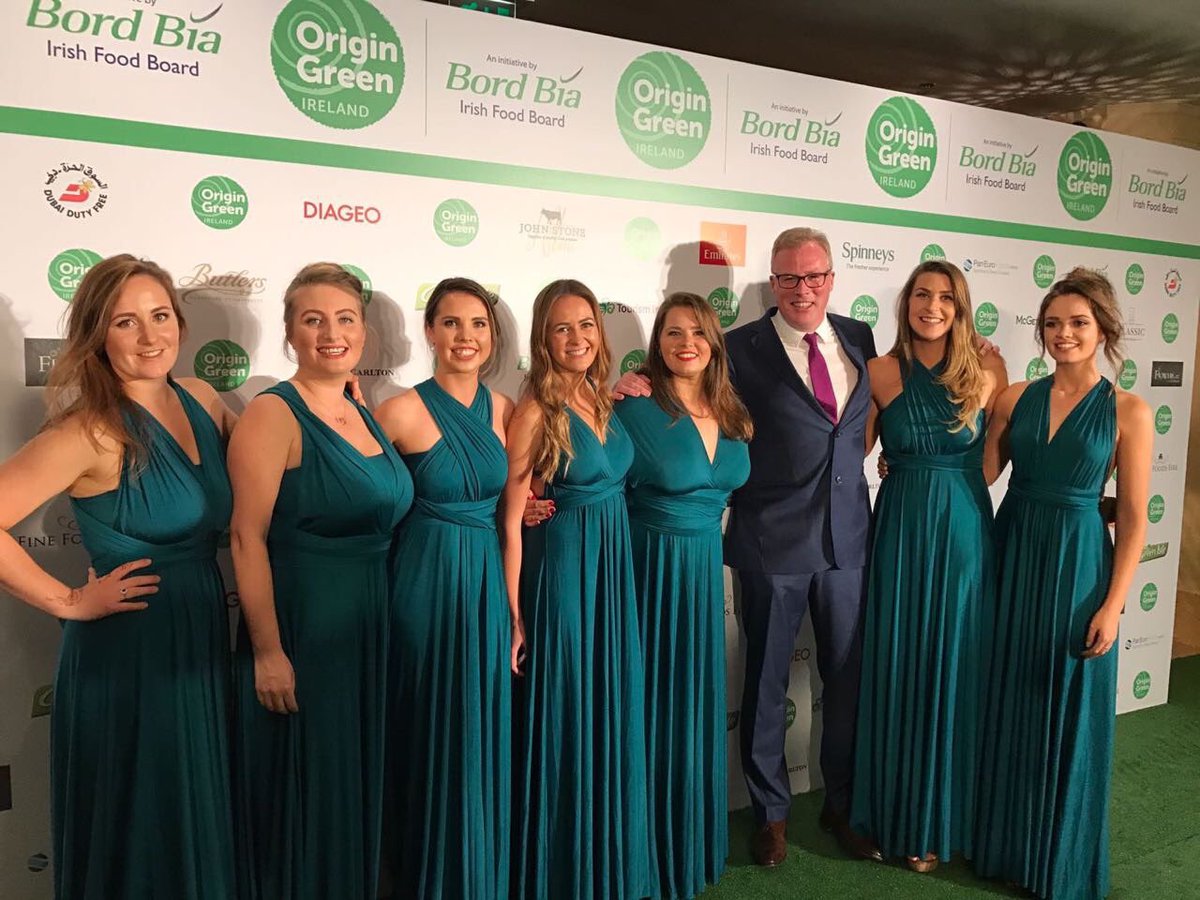
That the vast majority of requests were approved in 2017, particularly to independent contractors, shows the organisation takes a liberal view on potential conflicts of interest. Indeed, it is a matter of public record that management approved a payment by Origin Green/Bord Bia to Damien O’Reilly last year despite an obvious conflict of interest.
RTÉ’s Damien O’Reilly.
RTÉ claimed the majority of payments were for ‘non-commercial events, and mostly in support of charitable or other not-for-profit organisations’. In the absence of further details, however, it is impossible to verify this claim. It begs the question: if the work is harmless, or even benign, why did they withhold the information? Bord Bia is a not-for-profit semi-state body, but there was still a conflict of interest for RTÉ’s main agricultural correspondent to be receiving money from that organisation.
We cannot now tell whether any of the third parties have connections to the motor car industry in Ireland. And even if an organisation is charitable, or not-for-profit, this does not imply neutrality on contentious issue.
The claim that divulging information would “prejudice RTÉ ’s contractual negotiations” suggests the likes of Ryan Tubridy – who has been outspoken in his criticism of cyclists – could be lost to commercial competitors if damaging information enters the public domain.
That contention may be questioned, in the case of Tubridy at least. After moonlighting with the BBC in 2016 Tubridy admitted he found connecting with UK listeners difficult, while leaving for Newstalk or TV3 would represent a career regression.
Most of RTÉ ’s household names found fame, and fortune, through extended exposure on RTÉ. The failure of Pat Kenny to draw a substantial number of his former listeners away from the station, when he departed for Newstalk, indicates most people are in the habit of tuning into the state broadcaster, rather than the radio ‘star’.
V –A Tool of the Sector
The state broadcaster is certainly not alone in the Irish media in its reliance on advertising from the motor car industry, and the objective bias this brings. Our ‘paper of record’, the Irish Times, seems to do little investigative work into subject-matters impinging on its leading advertisers; and while generally virtue-signalling in its approval of cycling, has also contributed to negative stereotyping.
One such portrayal came from Fintan O’Toole in 2013. O’Toole, whose father was a bus driver, as he has reminded his readers, does not drive. But seemingly that does not extend to sympathy for cycling. During National Bike Week in 2013 he wrote, tongue-in-cheek, that cyclists were the ‘spawn of the devil’, no doubt to the guffaws of his colleagues on the editorial floor.
But the article was actually a genuine indictment of the behaviour of cyclists, who are portrayed as casually mounting footpath and endangering pedestrians, even where they have been provided with their own lanes.
As with Olivia O’Leary, O’Toole posited a false dichotomy between pedestrians and cyclists, ‘us’ and ‘them’, which ignores how the problem is not with either form of locomotion, but the utter dominance of the motor car in Ireland’s urban areas.
Many of Dublin’s cycle lanes are defective: the track might be potholed, or simply a part of the road that is coloured red, a simulacrum of a real cycle lane without a protective curb, where parking is often permitted outside rush hour.
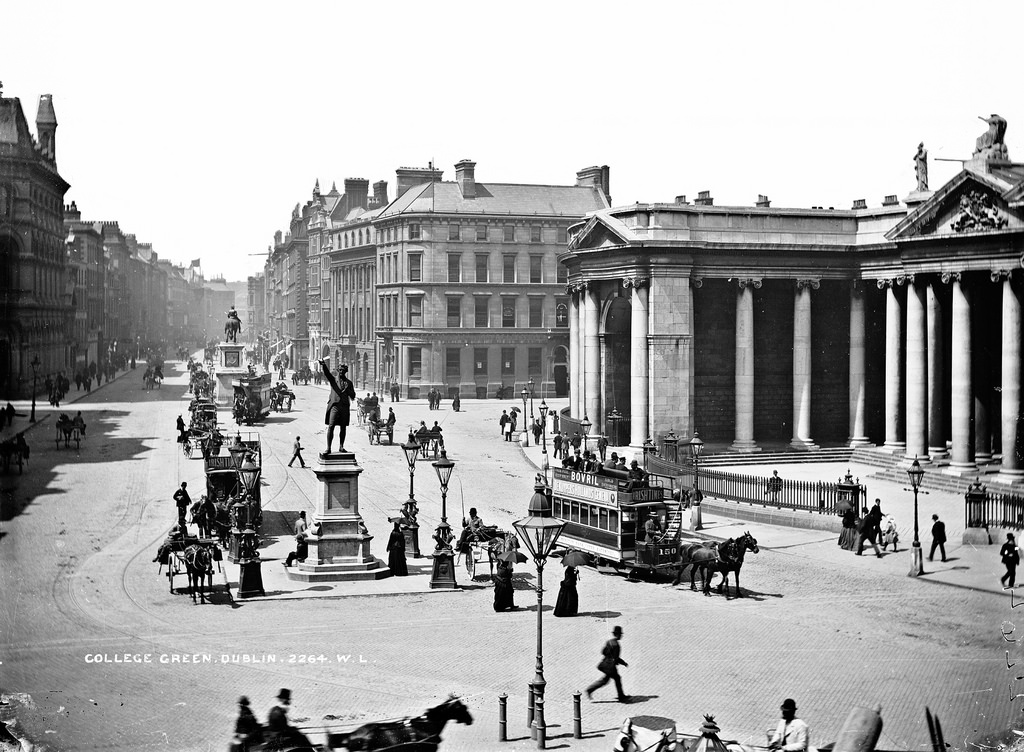
O’Toole recently wrote an article criticising plans to remove motorized traffic from College Green, a measure which would also be advantageous to cyclists. O’Toole’s argument was that this would work to the detriment of mostly working class bus passengers. Cycling is not mentioned once in the article.
College Green c.1890.
The implication is that cycling is not a realistic mode of transport for the working class, but instead the preserve of middle class, lycra-clad, fitness enthusiasts, which is certainly not the case in cities where the bike is king. O’Toole is right insofar as he draws attention to the poor provision of public transport in Dublin, and to emphasise the continued importance of the bus.
But rather than abandoning plans for a plan that would make the centre of the city more accessible to pedestrians and cyclists, a better outcome would be investment in quality bus corridors and the introduction of radial routes.
*******
With a climate comparable to Copenhagen’s and Amsterdam’s, Dublin is regarded as the Great Bike Hope of Emerging Bicycle Cities. But the media, from state broadcaster to the national ‘paper of record’ have failed to drive home that message, and few politicians, beyond the Green Party, have consistently campaigned on behalf of cycling, which should be a viable and healthy alternative for most healthy urbans residents.
A deficient cycling infrastructure is another blot on the copy book of a country ranked second worst in Europe for tackling Climate Change, and which confronts an obesity pandemic.
The national broadcaster might insulate itself from claims of objective bias by not treating news and current affairs as cash cows. Then we might be offered better reporting on important issues, such as reforming a sclerotic transport infrastructure. And if RTÉ’s ‘stars’ reckon they are not being paid well enough, they should be told to get on their bikes.
So you’re single. At least if you’re reading this, there is a good chance you are. Do you view being single positively or negatively? What stories do you tell yourself about why you are currently single, and about what your life may be like when you have a partner in it?
Through my work as a relationship coach, many of my clients tell me they need a partner to do things with, share experiences, support them, or take care of them. But there is a problem when you tell yourself you need a partner for these reasons. It suggests there is something lacking in your life, limiting you from experiencing a full life without someone else.
Sure, there is a comfort in sharing experiences with another person, but when you decide this can only be found through someone else there is a problem.
I believe you are only ready to create a healthy intimate relationship when you can wholeheartedly say you want rather than need (i.e., a partner).
If you are reading this thinking, of course I don’t need a partner but the attitude you hold about being in a relationship is that it is far superior to being single, then perhaps this attitude is blocking you from attracting the kind of mate you seek.
I regard modern dating as romantic consumerism with an over-reliance on online dating.
Online dating has changed the way people date, mate and separate, yet our human need to connect, be accepted, desired and treated with compassion and love has not. Humans are born to belong and connect, yet swiping culture offers a selection of ways to opt out of real connection and settle for pseudo-connection.
If you genuinely want to meet a partner or make an authentic connection with people, and rely solely on online dating to do that, you will end up dissatisfied and frustrated. Most of my clients who are dating online in Dublin at the moment describe how challenging it is to connect with people virtually, never mind in person, and begin to think there is something wrong with them.
It doesn’t stop there. After one unsuccessful match there often comes the catastrophic thinking that, ‘I will be alone forever’. Modern dating requires so much resilience and adaptability to deal with all the uncertainty characteristic of a game with no rules.
What might be improved upon is a person’s quality of thinking. Any kind of limited thinking regarding your ability to meet someone is flawed in the same way as it is wrong to believe a relationship can offer you a refuge from the life you are living.
Research conducted by Roy Baumeister suggests that entertaining the very idea of social exclusion can actually impair your IQ and ability to think straight. This information helps us understand the suffering you can feel by merely thinking about a future without a partner in it.
The thought alone can lead to further impaired thinking and we must protect against that. One way to do so is to find ways to be socially connected exclusive of online dating, to protect your wellbeing, and be in a better position to attract a suitable partner.
Here are five ways to stay socially connected and in the process make it easier to find someone:
What lights you up? Do more of the things you love such as attending the theatre, gigs, or outdoor activities.
Unsure what lights you up? Spend time to find out what does. Reach out to people you know who may already be involved in interesting activities.
Take the plunge and connect with friends of friends if they live in your area. You already have things in common, and most people are happy to extend their circle.
Look after your well-being. Find a grounding activity such as meditation, yoga, Tai Chi.
Talk and engage with people at any opportunity, from the person serving you to whoever is sitting beside you in the coffee shop. Become a pro at connecting with people in every day situations.
Remember, if you experience anxiety or depression, developing relationships and socialising in traditional ways can be that little bit more challenging, and may affect your ability to interact and connect with others. Access www.aware.ie or www.socialanxietyireland.com to empower you to develop more confidence in social settings, and build healthy relationships.
Annie Lavin, Ireland’s dating and relationship coach, is based in Dublin and works with clients all over the world. She empowers people to achieve relationship success by transforming their relationship with themselves. Annie is passionate about supporting people to create and maintain healthy, meaningful relationships amid the chaos of the modern dating world www.relationshipcoach.ie.
In the previous edition of Cassandra Voices Eoin Tierney explored the extent to which data is routinely harvested in a variety of ways, some of which we cannot easily control. This extends to hardware used to measure one’s fitness.
Fitbit, a company producing a famous activity tracker, is no exception. Data gleaned from these devices, usually worn like watches, has even been accepted as evidence in criminal trials in the United States. While in certain contexts such application renders numerous advantages, in the wrong hands there are obvious risks to the kind of information amassed by Fitbit being in circulation.
With the General Data Protection Regulation (GDPR) entering into force last month, organisations all over the globe are reconsidering their data protection approaches and, as a result, updating their privacy policies. The brand-new Fitbit Privacy Policy, last updated on April 23rd 2018, can be found on the Fitbit’s official website.
Like most privacy policies, its main objective is to align the company’s data privacy policies with the requirements of the GDPR. In particular, it lays down the scope of data routinely collected by Fitbit devices which includes a customer’s name, email address, phone number, payment details and geographic location, period of time for which such data is retained, and more..
All these provisions are worth noting down for anyone who uses or intends to use Fitbit devices. One category that is essential for the Fitbit operations, but should have a red flag attached to it in the context of the GDPR, is the health-related and biometric data.
In particular, Fitbit routinely collects your ‘logs for food, weight, sleep, water or female health tracking’, as well as other details that may furnish a vivid picture of any user’s behavioural patterns.
Article 9 of the GDPR places data concerning health and biometric data within the special categories of personal data, processing of which is restricted to ten instances only. These, include, among others, explicit consent, public interest consideration and performance of obligations in the area of employment and social security.
Article 9.4 goes further, creating wide leeway for member states to legislate in this area – something that should have Fitbit on its guard for legislative developments in the countries where it operates.
This being said, Fitbit’s Privacy Policy does acknowledge the extent of sensitive personal data gathered by its watches and commits to obtain a separate consent from its users for related processing. It also expressly reserves the right to ‘preserve or disclose information about you to comply with a law, regulation, legal process, or governmental request’.
This is a typical provision found in most privacy policies. The GDPR itself expressly allows the disclosure of personal data following a mandatory legal requirement.
However, in case of Fitbit it took an unexpected turn in a recent Wisconsin murder trial, when a judge allowed step-tracking data, generated by Fitbit, as evidence to prove the defendant was not capable of committing a murder, as the device proved he had been sleeping at that time.
In another instance, Fitbit logs were used by Connecticut police, this time to charge Richard Dabate for murdering his wife. The man concocted a fictional story to cover the murder, but his wife’s Fitbit brought the truth to the surface, revealing inconsistencies in Dabate’s version of events.
Yet another example of Fitbit usage that clearly goes beyond what a fitness bracelet was intended for is the partnership that insurance companies are entering into with Fitbit.
In particular, individuals are offered the option of a type of coverage that involves wearing a tracking device and sharing the data it collects with the insurance provider. On the one hand, such development will help insurance companies to stay up to date with the health condition of their customers and, if the need be, provide necessary assistance in case of an accident.
At the same time, it effectively offers a full overview of a person’s life, including information about biorhythms, habits, and lifestyle quirks, that may later be utilized by insurance providers for purposes contrary to the interest of insurees, for example, by denying them insurance coverage, or raising their premium.
*******
The aforementioned cases illustrate how modern technologies may be utilized in ways that an average user would never expect when purchasing a devise. This may bring benefits, while in other instances it shares intimate information about its owner which could be their detriment.
The purposes for which public authorities and external companies are using Fitbit-generated data remain contentious. Clearly, it turns out deceptively-guiltless fitness-tracking-gadgets turn out to amass unprecedented amounts of personal data.
Arguably this tendency will only increase in future, with companies seeking more and more personal data to enhance and customise their products and services, in order to remain competitive in the modern market of accelerated technological development.
For now, the least a regular user should do is to stay up to date with his or her rights under existing data protection legislation; as well as developing a clear picture of what personal data, and for which purposes, is being processed, and used, by manufacturers.
All of these questions should be addressed in the privacy policy of any company in question, and these are usually available on a company’s website.
So next time, before blithely hitting the ‘I accept’ button in a privacy notice pop-up while configuring your Fitbit device, make sure you genuinely do not mind that sensitive and, otherwise, confidential, information about you is being collected, analysed, stored and even shared externally for purposes that go far beyond keeping you fit.
We can only imagine how poetry entered human consciousness. I intuit that its emergence was linked to the first use of fire, that most seminal of technologies, whose devouring mysteries transfix us with a spirit that endows our own.
I see one among a band awakening from a dream, and entering a trance. She incants a tale of the fire’s origin, her words embodied in physical expression, which inspires the band to adapt the tools to summon the first, intentional spark.
In the flickering light that ensues the poet appears to shift shape. She is a streak of light morphing into the appearance of other animals of the forest. Her words are not common speech, but arrive in measured cadences, uncannily familiar to a mesmerised audience.
The tale she recounts, though fantastical, resonates with commonplace experiences and includes practical insights. As the narrative arcs to a point of heightened tension the poet breaks the spell with a joke, seizing the assembly with laughter, but a few remain silent.
Transfixed by the incendiary words, the band begins to chant; eventually a chorus chimes, integrating non-verbal melodies. Next a rhythm is struck, then a communal dance previously employed to intimidate a long extinct primeval beast, still lurking in our nightmares.
For a moment the forest itself is convulsed by these energies. Afterwards, or even coinciding with this, a visual representation of the performance is crafted. It is kept as a sacred object for subsequent rites.
Out of this poetic source I see four springs generating story, song, dance, and visual art. These intertwine and will eventually merge into an oceanic consciousness. The continuity between words, music and dance is apparent, while the symbol is not only the origin of painting and sculpture, but also of the word, ‘made flesh’, in script, which over time migrates from pictographic representation to alphabets, rejoining and completing its journey along the great river of poetry.
The spoken word is an animating spirit and crucial catalyst joining language to a musical faculty. The written word records and even amplifies this. Only later does abstract, disembodied reasoning in the form of philosophy arrive.
Musical Language
According to Walter Ong: ‘More than any other single invention, writing has transformed human consciousness’. The Greeks were not the first to develop it, but improved on earlier models by representing vowels for the first time, making literacy far easier to achieve.
Through this the Greeks derived great technical and intellectual benefits, but it brought the danger of abstraction, and a distancing from Nature. Socrates, a confirmed townsman, claimed he had nothing to learn from fields and trees, but only men.
In writing we encounter the dominance of the written word itself, a logo-centrism, which finds us in the narrow purview of the left hemisphere of the brain.
But according to Iain McGilchrist the origins of language lie ‘in the empathic communication medium of music and the right hemisphere, where it is deeply connected with the body.’ There is no conflict he says between this belief, and the idea language developed out of gesture: ‘Music is deeply gestural in nature: dance and the body are everywhere implied in it.’ He continues: ‘To the extent that the origins of language lie in music, they lie in a certain sort of gesture, that of dance: social non-purposive (useless).’
The origin of language, therefore, should not be seen in pure utilitarian terms.
“Useless” play in language is the stirring of poetry, but a creation that is the catalyst of Art, which acts as a form of revelation, where metaphor, according to McGilchrist, ‘links language to life’. The absence of utility in poetry is therefore superficial. It is a creative spark, bringing perception at new vantages, and sight through different lenses. Art is the resolution of the image.
Human communication is not uniquely ingenious, but we display a particular ability to measure speech in song and poetry – a mathematical sensibility in communication.
According to McGilchrist, what distinguishes our music is that ‘no other creature begins to synchronise the rhythm, or blend the pitch, of its utterances with that of its fellows, in the way that human singing does instinctively’. It would appear that we gravitate to a musical order that was established in the West by Pythagoras, who divined that a musical note produced by a string of fixed tension could be converted into its octave if the length of the string was reduced in half, and its fifth when reduced by two thirds.
Unlike ourselves, most bird species have a syrinx in their throats, allowing two notes to be sung simultaneously, as they exhale and inhale. But birdsong, however bewitching, is unmeasured. The dawn chorus is an unintentional unity, representing disconnected currents emanating from the varying concerns of often competing species; harmonious only as the voice of one Nature, spiritus mundi, or Gaia.
At its lofty height, poetry combines the order of music with profound questioning and metaphorical vision. This is a mysterious hallmark of humanity.
Grammars of Creation
Artistic beauty in its ideal, unrealisable, state is the expression of the diffuse and infinitely complex voices within Nature’s harmony. What we consider aesthetically pleasing derives from an ascetic order in music that finds an analogy in all artistic forms. The spark is poetry.
Poetry is the lute through which the voice of Nature sounds. But the instrument may be misshapen, perhaps through misuse. More tragic is when the pitch of beauty is too high for an audiences to hear.
What is poetic has a dual nature: generative and disruptive. Just as in Nature Heraclitus envisaged a fire of renewal, so poetry devours and renews. Philosophy may define beauty, including justice, at any point in time, but this is primarily exegesis rather than creation. Thus Yeats argued ‘whatever of philosophy has been made poetry is alone permanent’.
Nature demands that plants and animals of diffuse species assist one another, but we appear to be alone in imaginatively standing outside our immediate frame, situating ourselves in the lives of others through fictions, as we see first in cave paintings.
The paintings in Chauvet Cave in France were begun approximately thirty thousand years ago.
To convey such imaginings required novel linguistic constructions. George Steiner points to a grammar of creation in the use of a future tense, allowing us ‘to discuss possible events on the day after one’s funeral or in stellar space a million years hence’.
This, he says, looks to be specific to homo sapiens, as do ‘the use of subjunctive and of counter-factual modes’, which are kindred to future tenses. Steiner intuits that these emerged at the end of the Ice Age to discuss food storage. He links this to the discovery of animal breeding and agriculture.
But I see a capacity for inter-subjectivity, including a subjunctive ‘if’ clause, arriving earlier: in the symbolic language of poetry, rather than to facilitate practical exchange. To chart this grammatical genesis I turn to Rene Girard’s idea of the scapegoat, which, he argued, emerged as a means of settling differences arising out of competition acquisition of scarce resources.
‘Man is not naturally a carnivore’, Girard writes, ‘human hunting should not be thought of in terms of animal predation.’ He argues that animal domestication arose out of the use of animals in sacrifice, not as food: ‘What impelled men to hunt was the search for a reconciliatory victim’.
After mining anthropological literature he found a ‘common denominator’ of a ‘collective murder’ of a scapegoat, attributed to animals or men. To conceive of this reconciliatory victim required a subjunctive ‘if’ clause, enabling the band to channel their grievances away from self-annihilation.
When an animal victim is chosen instead of a human and ritually slaughtered the smoke rising from the sacrifice is seen to appease the gods. Thus, in the Odyssey after Odysseus returns in disguise to Ithaca, he shares a meal with his loyal servant Eumeaus who performs the necessary rites of sacrifice:
The swineherd, soul of virtue, did not forget the gods.
He began the rite by plucking tufts from the porkers’ head,
threw them into the fire and prayed to all the powers,
“Bring him home, our wise Odysseus, home at last!”
Then raising himself full-length, with an oak log
he’d left unsplit he clubbed and stunned the beast
and it gasped out its life …
The men slashed its throat, singed the carcass,
quickly quartered it all, and then the swineherd,
cutting first strips for the gods from every limb,
spread them across the thighs, wrapped in sleek fat,
and sprinkling barley over them, flung them on the fire
In Christianity this culminates in the ‘lamb of good that takes away the sins of the world.’ The language of these fictions, therefore, appears to originate in symbolic representation, which is a hallmark of poetry.
These new grammars imparted a capacity for planning, and an understanding of natural cycles, which can lead to the outlook of the suzerain: the ‘keeper or overlord’ personified by Judge Holden in Cormac McCarthy’s Blood Meridian, who says: ‘Whatever in creation exists without my knowledge exists without my consent’.
But it also engenders empathy with other life forms, which recalls the Isha Upanishad: ‘Of a certainty the man who can see all creatures in himself, himself in all creatures, knows no sorrow.’
McGilchrist writes: ‘I believe that the great achievement of human kind is not to have perfected utility through banding together to form groups, but to have learnt through our faculty for inter-subjective experience, and our related ability to imitate, to transcend utility altogether.’ That is the essence of true poetry.
Poetry and Justice
Art often awakes sensitivity to injustice indirectly, as the eighteenth century Swiss philosopher Johan Sulzer observed:
Wisdom knows about everything that man ought to be; it points the path to perfection and happiness which is related to it. But it cannot give strength to go down that often arduous path. The fine arts make the path smooth and adorn it with flowers which by their delightful scent, irresistibly entice the wanderer to continue on his way.
A shift in sensibility created by exposure to the beauty of Art operates unpredictably on ethical choices as, unlike a rational choice, shifts in sentiment rarely involve a decisive, eureka moment, when an argument is settled.
Rather, encountering beauty may lead to impulsive moral decisions based on heightened sensitivity, as where a person refrains from eating meat, when it does not ‘feel’ right.
Encountering a crowning achievement in music or poetry may awaken action in an apparently unrelated domain. Great music, and other Art, stills the mind, and engenders benevolence.
In divine rapture the poet builds a mythology out of imaginative materials located in Nature, and in the process incubates conventions and laws: ‘the poets are the unacknowledged legislators of the world’ wrote Percy Shelley.
Percy Bysshe Shelley 1792-1822.
Firm moral convictions may bring a poet into conflict with temporal power, and demagogues appropriate and distort mythologies. The false poet, and prophet, appeals to the vanity of a sovereign.
A poet may feel compelled, nonetheless, to compromise with a patron – even a tyrant – to allow their work to reach fruition. In Shelley’s ‘Ozymandias’ the artist mocks a haughty ruler before posterity:
I met a traveller from an antique land,
Who said—“Two vast and trunkless legs of stone
Stand in the desert. . . . Near them, on the sand,
Half sunk a shattered visage lies, whose frown,
And wrinkled lip, and sneer of cold command,
Tell that its sculptor well those passions read
Which yet survive, stamped on these lifeless things,
The hand that mocked them, and the heart that fed;
A true poet’s opposition to political power is, however, based on principle, not an anarchic reflex, and he may support a wise and just regime. For example, Dante favoured the Holy Roman Empire, as he saw a strong transnational authority as necessary to maintain peace in the Italian peninsula. A contemporary poet could support the notion of a European Community, or the United Nations, for similar reasons.
Poetry remains a vital commodity in any culture, foregrounding and guiding other artistic endeavours, channelling empathy, and forging justice. Defining its nature is elusive, and perhaps futile, but it is apparent that philosophers are increasingly drawn to its revelation.
It is not restricted to composition of metrical verse: any writer aspires to it. Alasdair MacIntyre writes: ‘Knowing how to go on and to go further in the use of the expressions of a language is that part of the ability of every language-user which is poetic. The poet by profession merely has the ability to a preeminent degree’.
Shelley saw poetry in metrical verse as being its ‘imperial form’, but recognised its presence elsewhere. ‘The parts of a composition may’ even be poetical, ‘without the composition as a whole being poetical’, he said. Poetry inhabits the best prose as a flow that carries a listener into the vision of the writer.
Poetry is perhaps best defined by what it is not, which is the everyday speech often imitated in novels and plays. It aspires to originality and even prophecy, as Aristotle says: ‘it is not the function of the poet to relate what has happened, but what may happen’.
It has an essential orality. Thus Yeats wrote: ‘Whenever one finds a fine verse one wants to read it to somebody, and it would be much less trouble and much pleasanter if we could all listen, friend by friend, lover by beloved.’
The Sacred Spring
Poetic language need not be extravagant, but the true poet is never entirely in control of composition. Thus Socrates complained that a man cannot accede ‘to the gates of poetry without the madness of the Muses.’ This seeming loss of consciousness in a deep flow state may lead to extravagant language, but this is unintentional.
Kathleen Raine points to the lofty style that distinguishes poetry from regular speech. She notes how Jung, who generally disliked high-flown speech, found that when what he called ‘mana, daemons, gods or the unconscious speaks in words its utterances are in a high style, hieratic, often archaic, grandiose, removed as it is possible to be from the speech of that common man the everyday self’.
Raine identifies this with a primal poetic impulse she encountered in the composition of folk songs: ‘The singing of the ballad was by no means in common speech. It was extremely slow, dignified and highly mannered’. She concludes that: ‘It is a mark of imaginative inspiration and content to write in a high and mannered style, removed from common speech; as it is of the absence of imaginative participation to write either in a conversational tone or to write in a deliberately vulgar idiom.’
Raine further opines that: ‘What was written for the sake of easy comprehension is precisely that part of poetry which becomes incomprehensible within a few years.’ This we find in the lyrics of most contemporary popular music, which sounds dated almost at the point of release.
On the other hand, today we see a widespread trend whereby difficulty is equated with quality. This may originate in contemporary economic structures, where many professional poets survive on government grants, and as academic specialists. Linguistic obscurity may be a cynical calculation, which contributes to a widespread, and tragic, alienation from poetry.
It appears to have a meaning and form internal to itself, beyond any individual poet. Jahan Ramazani observed, ‘time and again’, how poems, ‘reasserted themselves as poems even in the moments of seeming to fuse with their others.’
Similarly, when Dadaists and Russian futurists tried to fabricate new languages they found their imagined syntaxes led back to established moulds. Any poet travels a path overlaid with uncountable footprints guiding their course. The poem knows where it wishes to travel in the anticipatory stillness of creation. The great challenge in today’s digital fog is to encounter this tranquillity.
Poetry in Language
Many poets agree that composition is an ongoing revelation, conventionally attributed to the muse. But in the discussion of poetry there is perhaps too great an emphasis on individual genius, although the individual experience cannot be discounted.
We find in creation a dialectic between individual expression and the treasures hidden in all languages. The linguist Edward Sapir suggests that it is intrinsic to language every one of which ‘is itself a collective art of expression.’ He asserts that ‘An artist utilises the native esthetic resources of his speech. He may be thankful if the given palette of colours is rich, if the springboard is light. But he deserves no special credit for felicities that are the language’s own.’
Similarly Marcel Duchamp wrote: ‘Since the tubes of paint used by the artist are manufactured and ready made products we must conclude that all the paintings in the world are ‘readymades aided’ and also works of assemblage.’ The poet, however, renews and recasts these materials, sometimes bringing new colours to the palette, and reviving the use of others.
In some cases we find a mingling of tongues as new words enter languages in neologisms, as in Shakespeare’s heroic contribution to the English language. But this process is fraught with the risk of contrivance. Great poets are not necessarily polyglots, though they often are.
The expression of poetry should not be seen as an evolutionary display of verbal plumage, although troubadours will always seek to enchant. The German poet Rainer Maria Rilke firmly rejects meretricious verse. ‘Young man’ he warns:
it’s not about love, when your voice
forces open your mouth – learn to forget
your sudden outburst. That will run out.
True singing is a different breath. A breath
around nothing. A breeze in the god. A wind.
Rainer Maria Rilke 1875-1926.
The mythos of poetry is an intuitive response to life’s challenges, unconnected to the logos of philosophy, or scientific observation.
Its wisdom adds layers to a mystery lying beyond direct inquisition. ‘The abstract is not life’, Yeats wrote on his deathbed, ‘and everywhere draws out its contradictions. You can refute Hegel but not the Saint or the Song of Sixpence’.
The poet is never in control of the process of composition, and eminent authorities such as Samuel Taylor Coleridge and John Milton have attributed inspiration to their dreams.
Charles Simic criticizes: the assumption … that the poet knows beforehand what he or she wishes to say and that the writing of the poem is the search for the most effective means of gussying up these ideas: if this were correct, poetry would simply repeat what had been said and thought before.’
Untuning the Sky
William Dryden, the first Poet Laureate, proposed in his Essay of Dramaticke Poesie that, ‘if natural causes be more known now than in the time of Aristotle, because more studied, it follows that poesy and other arts may, with the same pains, arrive still nearer to perfection’. Rather than affirming an alternative role for poetry, he was suggesting it should be informed by natural philosophy, as science was referred to until the 1830s.
In fact George Steiner observes a contrary trend: ‘Where the sciences, pure and applied, wherever mathematics came to map, to energize, to expand human experience and possibilities, the retreat from the word proved correlative and ineluctable.’
The greatest poetry looks beyond the real world of immediate perception and reinvents it, travelling at a different pace to the often linear progression of a philosophical argument. Thus the work of hundreds, or even thousands, of years ago may be compared with, and often exceeds in quality, the best available today.
The poetic vision arises from a sensitivity that sees the tears of a sycamore tree, as opposed to its biological classification. Nontheless, the greatest scientists – such as Alexander van Humboldt – have been animated by poetry, and poets, of course, do learn from science.
There are signs of stultifying premeditation as opposed to poetic vision, in Dyrden’s Grand Chorus to ‘A Song for St. Cecilia’s Day’ (1687), signalling the Final Judgement.
So when the last and dreadful hour
This crumbling pageant shall devour,
The trumpet shall be heard on high,
The dead shall live, the living die,
And music shall untune the sky.
The idea of music, which is the expression of harmony, signalling the end of days is troubling, and almost paradoxical. Samuel Johnson described this image as ‘so awful in itself, that it can owe little to poetry; and I could wish the antithesis of music untuning had found some other place’.
*******
A poet can be foolish, even sinister, without this undermining the aesthetic appeal of her work. Poetic ability does not equate with individual moral virtue. Posterity excuses the obnoxious behaviour and statements that are not intrinsic to the poetry itself, assuming Art to rise above the mundane, and that its beauty will engender justice.
Artistic censorship is a grave danger for any society, but in an era of free speech we may be facing greater dangers still, as George Steiner warns: ‘The patronage of the mass media and the free market, the distributive opportunism of mass consumption, could be more damaging to art and to thought than have been the censorious regimes of the past’.