Blog

  • The Audacity of a Third Party Candidate

    The problem with writing about the U.S. Democratic Party, whether analytically, historically, or even as a matter of praxis, is that it has all been said or tried before.

    Want to run party candidates on a left-wing (or progressive, or whatever?) platform? Recall the so-called Alliance Yardstick, when the Farmers’ Alliance in 1890 held Democratic Party candidates it endorsed to its full program, including such items as the nationalization of the railroads, a progressive income tax, and significant monetary reform. They got hundreds of candidates elected — most of whom promptly abandoned the agreement.

    This led to the formation of the People’s Party in 1892, which did well by the standards of a third party, before largely getting gobbled up when the Democrats adopted one of their main planks (free silver) in 1896.

    Or, for that matter, the experiences of the Democratic Socialists of America in the 1970s and 1980s, when formerly third-party socialists led by Mike Harrington surmised that with the conservative white supremacist wing of the Democratic Party leaving in droves, what remained could be turned in a social-democratic direction. Problem was (among many others) the trade-union leaders, whose support the DSA was banking on, failed to lend their support, and aside from Ron Dellums in the Bay Area, the DSA devolved into an organization of long-in-the-tooth ex-New Leftists and left-talking trade-union bureaucrats, until the past few years pushed its membership north of 50,000, and its median age roughly millennial.

    So what does a socialist/leftist of any stripe do about this behemoth of an organization that isn’t leftist in any meaningful sense — even the crappy sort of continuous sell-out leftism of the Irish Labour Party variety — but nevertheless fills that space in a first-past-the-post system that naturally generates two main parties?

    Moreover, what are the chances of doing so in a political landscape that hasn’t seen a new major party emerge since the Republicans first ran John C. Frémont for president in 1856? This gets us to a dilemma facing any practitioner of reform politics in the United States: do you go into one of the old Parties and try to take it over from within, or do you set up a third party to oppose both the Democrats and Republicans?

    There are several advantages, at least perceived, of taking over an established party. In the first place, you already find an infrastructure. There is a central fund, precinct captains, name recognition. Many people vote out of habit, too, so habitual Democrats might well continue voting Democrat in spite of more radical candidates.

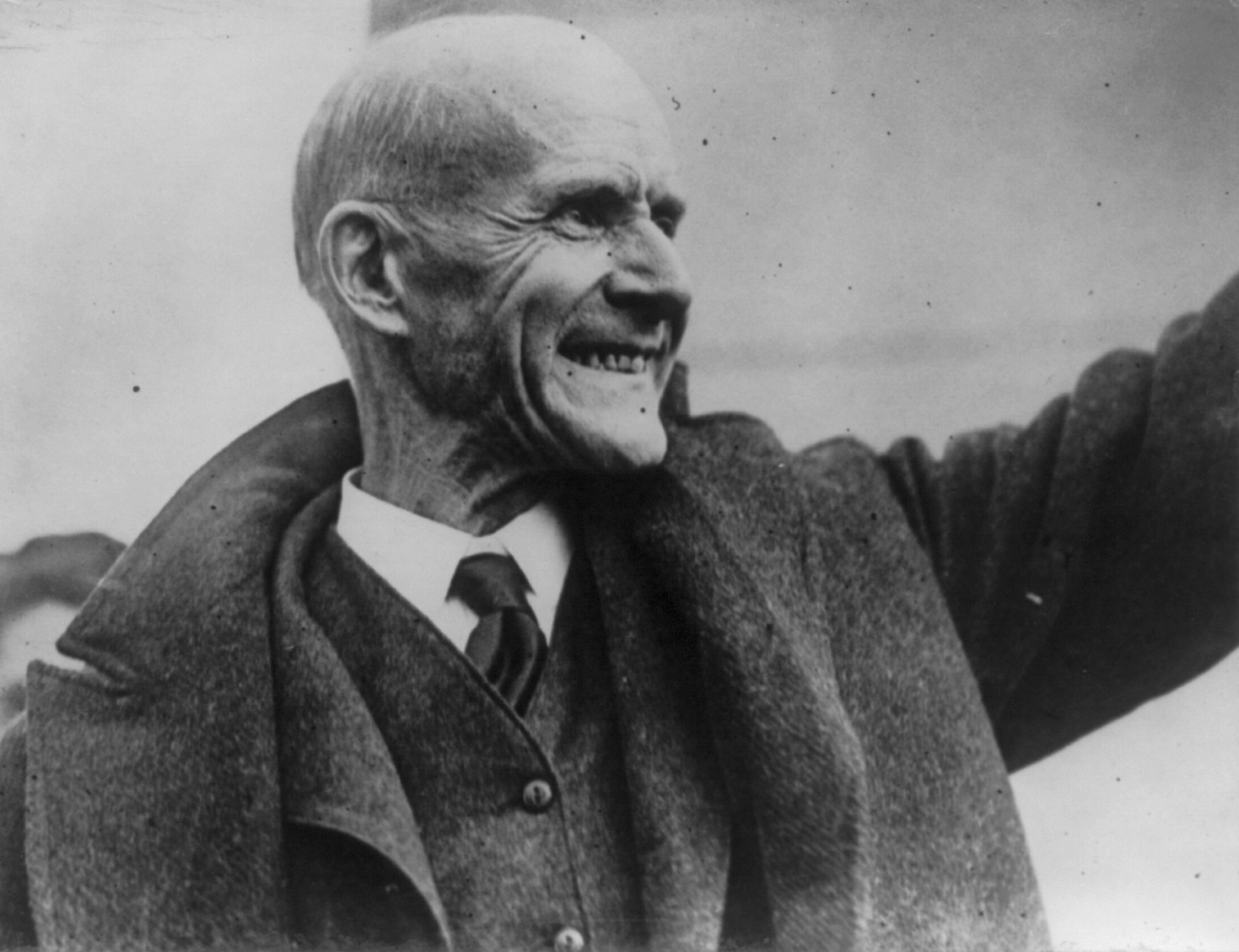
    Starting from scratch and taking on deep-seated traditional loyalties, moreover, can be daunting. The two major American political parties, after all, have remained a constant since the Civil War. Taking them on has not proven terribly easy, with the single-best showing for a third-party socialist candidate to date being that of Eugene Debs, who won 900,000 votes in 1912, which sounds impressive until one realizes that was roughly 6% of the total.
    The problems with capturing one of the two major parties for an insurgent political movement, though, flow from this same strength. Though the Democrats and Republicans are, to a certain degree, malleable, they are — and were — nonetheless well-established institutions. Taking them over was easier said than done. If one managed to capture either major party, one would probably not capture it all at the same time. Donations can dry up — or be used to win over politicians to return to the fold.

    Moreover, the considerable bureaucracy of each party can be wielded against internal dissent. Ask Bernie Sanders. Getting one’s own candidates nominated is only part of the battle.

    The creation of a third party has one considerable advantage, notwithstanding the need to create new machinery in the face of deep-seated party loyalties. Importantly, you retains control of your message. The party discipline affecting your elected officials is your own concern. Still, gaining and maintaining ballot access is fiendishly (and deliberately) difficult. When a reform-minded third party does shows up in mainstream debates it is usually as a swear word in the mouth of Democrats, who say you robbed them.

    This outrage, notably directed at Ralph Nader in 2000 and Jill Stein in 2016, is contemptible, particularly given the outrage, both muted and open, emanating from the establishment liberal punditocracy at Bernie Sanders running as a Democrat even though he isn’t a real Democrat! (Cue ugly crying, specious accusations of misogyny and racism, and behind-the-scenes machinations with the Clinton campaign.)

    If one works within the Democratic Party, one is engaging in a hostile takeover; if one works outside it, one is a spoiler. The nabobs of liberalism are, naturally, opposed to both because they are opposed to any kind of anti-capitalist or anti-imperialist politics.

    Seth Ackerman, writing in Jacobin, proposed something of a both/and strategy in an article entitled ‘A Blueprint for a New Party’. Noting that the Democrats, and Republicans, unusually for political parties in much of the world, are not really ‘parties’ in the way most people, most places think of such entities. He deserves to be quoted at length:

    Beneath our winner-take-all electoral rules, we also have a unique — and uniquely repressive — legal system governing political parties and the mechanics of elections. This system has nothing to do with the Constitution or the Founding Fathers. Rather, it was established by the major-party leaders, state by state, over a period stretching roughly from 1890 to 1920.

    Before then, the old Jacksonian framework prevailed: there was no secret ballot, and no officially printed ballot. Voters brought their own “tickets” to the polls and deposited them in a ballot box under the watchful eye of party workers and onlookers.

    Meanwhile, the parties — which were then wholly private, unregulated clubs, fueled by patronage — chose their nominees using the “caucus-convention” system: a pyramid of county, state, and national party conventions in which participants at the lower-level meetings chose delegates to attend the higher-level meetings….

    In the 1880s and 1890s, this cozy system was disrupted by a new breed of “hustling candidates,” who actively campaigned for office rather than quietly currying favor with a few key party workers. When informal local caucuses started to become scenes of open competitive campaigning by rival factions, each seeking lucrative patronage jobs, they degenerated into chaos, often violence.

    Worse, candidates who lost the party nomination would try to win the election anyway by employing their own agents to hand out “pasted” or “knifed” party tickets on election day, grafting their names inconspicuously onto the regular party ticket.

    Party leaders were losing control over their traditional means of maintaining a disciplined political army. Their response was a series of state-level legislative reforms that permanently transformed the American political system, creating the electoral machinery we have today.

    Ackerman’s argument is that with the state moving in to take over a key part of internal party life — the selection of candidates — via primaries, getting on the ballot if one is not in one of the major parties can be intensely time-consuming (This, however, depends to a degree on the state — as each one has different electoral laws).

    On the other hand, Ackerman acknowledges that the demands of a major party in regards to quid-pro-quo for any meaningful support can make that approach untenable too. Ackerman’s proposal for a new type of left-wing party also should be quoted at length:

    The following is a proposal for such a model: a national political organization that would have chapters at the state and local levels, a binding program, a leadership accountable to its members, and electoral candidates nominated at all levels throughout the country.

    As a nationwide organization, it would have a national educational apparatus, recognized leaders and spokespeople at the national level, and its candidates and other activities would come under a single, nationally recognized label…. In any given race, the organization could choose to run in major- or minor-party primaries, as nonpartisan independents, or even, theoretically, on the organization’s own ballot line.

    The ballot line would thus be regarded as a secondary issue. The organization would base its legal right to exist not on the repressive ballot laws, but on the fundamental rights of freedom of association.

    This is a deft, if perhaps conjunctural way around the problem — ballot party is explicitly not one’s real party. The challenge, though, is in the implementation.

    The case of DSA member and presumptive New York congresswoman Alexandria Ocasio-Cortez is instructive. After scoring an upset against Queens Democratic Party satrap, and heir apparent to Nancy Pelosi, Joe Crowley, Ocasio-Cortez, an intelligent, charismatic twentysomething who, with the septuagenarian Sanders has become the face of ‘democratic socialism’ in the United States, seems at times unclear as to whether she is in the first place a Democrat or member of the ‘movement’ that propelled her to success.

    Upon being confronted on her entirely decent statement against the Israeli occupation of Palestine this July, she backtracked into wishy-washy and vague formulations like: ‘Palestinians are experiencing difficulty in access to their housing and homes. Oh I think — what I meant is that the settlements that are increasing in some of these areas and places where Palestinians are experiencing difficulty in access to their housing and homes…’ and ‘I am not the expert at geopolitics on this issue. I am a firm believer in finding a two-state solution on this issue, and I’m happy to sit down with leaders on both of these — for me, I just look at things through a human-rights lens, and I may not use the right words. I know this is a very intense issue.’

    This is not, as many pundits both rightist and centrist have intimated, a matter of the pretty young lady not knowing what she is talking about. It is a matter of trying not to piss off the AIPAC-aligned majority of the Democratic Party, while not entirely throwing the Palestinians under the treads of a Merkava tank.

    In its own way, just as gratuitous was AOC’s slobbering Tweet when pro-war, corporate greedhead and all-around shitbag John McCain finally slipped this mortal coil. To wit: ‘John McCain’s legacy represents an unparalleled example of human decency and American service.’ Why don’t you tell us about how Princess Diana is ‘the People’s Princess,’ and a veritable ‘candle in the wind’, while you’re at it?

    The question of orienting towards a party whose leadership views even mild reforms such as single-payer healthcare and maybe taking, you know, a pass on a few of the major imperialist clusterfucks of the past nigh-on two hundred years has been a fraught one for the left for almost as long as there has been an American left.

    The AOC case illustrates that while being a self-described democratic socialist and having a (D) next to your name on television may not be mutually exclusive in an absolute sense, it is in tension. We shall see how she and a handful of other elected DSA members handle this, with some hope, and no small apprehension. It has gone horribly wrong before.
  • Twinned

    Storrington

    Place of storks and green-
    clad chalk. Are the Gypsies still
    perched on ‘The Warren’?
     

    Camargue

    Flamingo heaven,
    white horses, black madonna.
    Heart’s grey forgiven.

    Camargue

    Red dust on the shoes
    of Gaditans carrying
    Sara-la-Kali.

    Storrington

    At the age of eight:
    the camp fire by their wagon
    shed heavenly light.

    Jamie McKendrick was born in Liverpool in 1955. He is the author of six collections of poetry. Faber and Faber published his Selected Poems in 2016 and he is editor of their 20th-Century Italian Poems (2004).

  • Nonetheless

    A cormorant dives to feed,
    then perches, its wings
    spread to dry.
    There are fish, there is
    a break in the clouds.

    A freighter embarks, laden
    with necessary goods,
    including toys, 

    much as a researcher
    presents his findings.

    This world is henceforth one in which
    these things have taken place,

    and the gates that would prevail against them
    have so far failed.


    J.D. Smith’s fourth collection, The Killing Tree, was published in 2016, and his individual poems have appeared in publications including Dark Mountain, New Verse News and Terrain. His other books include the essay collection Dowsing and Science and the children’s picture book The Best Mariachi in the World. He works as an editor in Washington, DC, where he lives with his wife Paula Van Lare, their rescue animals and no small amount of trepidation. More information and occasional updates are available at www.jdsmithwriter.com.

  • Ancient Irish Sagas

    The following is a short retelling and interpretation of a number of Irish sagas, including two, ‘The Second Battle of Moytura’ and ‘The Wooing of Étaín’, from the golden age of Gaelic literature in the early middle ages.

    I – The Second Battle of Moytura

    Cath Maige Tuired  (‘The Second Battle of Moytura’) c. 875 is the centrepiece of the extraordinary Irish Mythological Cycle, relating how the Tuatha Dé (‘god-peoples’) had been oppressed by their enemies the Formorians (Fomoire). It consists of a series of fantastical episodes of enduring interest. We meet a Tuatha Dé exhausted by impossible labours and tributes after the half-Formorian Bres becomes High King of Ireland. He replaces Nuada who had lost his arm and authority in battle.

    We learn that the court physician Diancecht fashions Nuada a prosthetic silver limb in its place. In the meantime, Diancecht’s son Miach begins to heal Nuada’s real severed arm, but the father prefers his own methods and surgically kills his son by removing his brain. Miach is buried by his sister Airmed and from his grave sprout three hundred and sixty-five healing herbs, which she orders in her cloak. Diancecht has other ideas, however, scattering the herbs, each of whose value would remain obscure to humanity.

    In the account of Diancecht’s preference for an artificial arm over Miach’s more complimentary approach, the anonymous poet may be suggesting that the best healing comes from within the body itself, while the scattering of the healing herbs could represent ignorance of the cures freely available in Nature. It also appears that a professional body will seek to preserve its privileged position, in which case this remains a powerful metaphor for the modern pharmaceutical industry. A man with a silver arm presages the contemporary spectre of transhumance, whereby human beings propose to upload their bodies into computers, in fulfillment of René Descartes’s dualistic idea of a homunculus controlling a mechanical body.

    The ‘Second Battle’ parades scenes of Rabelaisian excess, especially involving one character, the Dagda, who undertakes a mission inside the territory of the Formorians. There he meets a distortion of hospitality, whereby he is compelled to consume vast quantities of porridge to a point where is belly is the size of a cauldron. Afterwards he must loosen his bowels before sexual congress with a Formorian princess. In Mark William’s ‘less genteel’ translation: ‘The girl jumped on him and whacked him across the arse, and her curly bush was revealed. At that point the Dagda gained a mistress, and they had sex’. Smutty Irish humour has long antecedents.

    In Jungian terms the Formorians seem to represent the nefarious shadow of the Tuatha Dé, an external, exploitative force that corrupt and indebt the native inhabitants, a narrative familiar to contemporary Ireland. However, the half-Formorian Bres is eventually succeeded by Lug, who is also of mixed parentage. Yet he combines all the highest attributes of the áes dána (skilled people). Lug and Bres differ in that the former’s father is Tuatha Dé and his mother Formorian, while the latter’s ancestry is the reverse.

    This might appear as simply an expression of approval of patriarchal descent. There is however a richer symbolic meaning available if we see a balance in Lug’s mixed ancestry between the thrusting, will-to-power of male energy on his Formorian mother’s side, and the earthier characteristics of the Tuatha Dé, that equate with female love, on his father’s side. He achieves wholeness when, paradoxically, the female characteristics arrive through a dominant male parentage wherein the thrusting Formorian energies are contained (Mf:Fm = Fm). Bres differs in that the ‘male’ Formorian outlook is ascendant as it arrives from a dominant male father, repressing his ‘caring’ Tuatha Dé ‘feminine’ energies (Mm:Ff = Mf).

    Another fascinating scene occurs after the Formorians are vanquished and Lug captures the errant Bres, who pleads for his life by proposing the Tuatha Dé should plant crops four times a year. Lug recognises this as impossible, or unsustainable, and only spares his foe when he reveals how the men of Ireland could operate a plough. According to Mark Williams in his indispensable Ireland’s Immortals: The history of the gods of Irish myth (2017): ‘the Formorians in the saga are characterized by a monstrously exploitative and unnatural relationship to the organic world, in a strange anticipation of contemporary agri-business’. This may be so, but Lug’s character also has a Formorian dimension, that, crucially, is contained positively by his (Fm) parentage. Similarly, in this episode, when Bres’s knowledge is refined from the approach of ploughing the earth four times a year, we find he confers a crucial skill. The relationship between the Tuatha Dé and the Formorians may also have been a commentary on the benefit of accommodating the skills of Norse raiders, then besetting Ireland, who also brought technological advances in agriculture and sailing.

    There are lessons here for a contemporary audience insofar as we need both a thrusting, male, Formorian, energy, to put a plan into action but crucially it is the caring, ‘female’ Tuatha Dé approach that should guide our endeavours. It is the dominance of the Formorian mind that brought us the Atomic bomb.

    II – The Wooing of Étaín

    Tochmarc Étaín (‘The Wooing of Étaín’) c.800-1000 is a colourful tale of romantic intrigues and magical spells, featuring perhaps the greatest femme fatale in Irish literature. Based on recurring shape-shifting, we find hints of belief in metempsychosis – the transmigration of souls – preceding Christianity. Only fully translated in 1930, Irish Revivalists such as W.B. Yeats were besotted by the intrigues. Here the Tuatha Dé are reduced from the giants of the ‘Second Battle’ to ethereal síde, ‘faeries’, living in síd mounds, familiar in folklore today.

    When Midir of the Tuatha Dé demands that Aengus his foster son gives him the most beautiful woman in Ireland in compensation for the infliction of an accidental injury trouble begins. She is Étaín, who Aengus ‘earns’ by performing a series of tasks for her father, the high king of Ireland. Aengus then presents her to Midir, who, however, already has a wife in Fúamnach. She does not take kindly to the new arrival, eventually turning her into a giant bluebottle with a magic spell. Even in this altered state Midir finds fulfilment in her company, and the divine Calliphora vomitoria performs various miracles along the way. Furious, Fúamnach summons great winds to drive Midir’s buzzing consort away. Eventually, exhausted, she falls into the drinking vessel of a woman who swallows her and becomes pregnant, reproducing Étaín 1,002 years after her original birth.

    The beauty is then married off to another high king of Ireland Eochu. Unfortunately his brother Ailill, upon setting eyes on her, falls hopelessly in love, and starts to waste away. Ailill confesses his feelings to her whereupon the blood returns to his cheeks. In order to cure him fully the obliging Étaín assents to an amorous exchange, but insists, for the sake of propriety, this should not take place under the king’s roof. In the meantime, the apparently immortal Midir puts Ailill to sleep and assumes his form, revealing to Étaín their ancient love when they finally meet. She agrees to give it another go, but only if Eochu agrees to sell her. Naturally he refuses, only for Midir to win her from him in a game of chess after bluffing for the first two rounds. Still Eochu refuses to give up his wife, defending Tara, the seat of the Irish high king, with all his men. Undeterred, Midir miraculously appears inside Tara where the lovers embrace and transmogrify into swans that escape through the skylight together. In response Eochu orders his men to dig up every síd mound in the country. At this stage Midir plays a trick on him by returning a replica of Étaín, who, it transpires, is actually Eochu’s daughter, Étaín having been pregnant with her.

    Eochu’s fate is in an interesting inversion of the Oedipus myth, and echoes Jung’s understanding of the collective unconscious whereby ignorance and unawareness carry the greatest offence. As van der Post puts it: ‘in Greek myth, legend and art, the villain is always the ignorance where it serves as representative of inner unawareness.’ In this tale the folly lies in denying the expression of love, especially when the Tuatha Dé are involved. Nevertheless Étaín is a moral exemplar bound by social conventions reflected in her refusal to dishonour Eochu’s home with Ailill whose recovery reflects the benefit of giving vent to passions. Also, Étaín only agrees to return to Midir if Eochu consents. Having lost Étaín in chess he welches on the bet and is punished by unconsciously committing the taboo of incest. The enduring image is of two swans, who in nature mate for life, joyfully escaping. The idea of beauty inhabiting the generally disparaged bluebottle attests to a joyful relationship with Nature. As the Eesha-Upanishad says: ‘Of a certainty the man who can see all creatures in himself, himself in all creatures, knows no sorrow.’

    III – A Change in Attitude

    From 900 there is a shift in the name of the Túatha Dé, crystallizing as Túatha Dé Danann, ‘the Peoples of the Goddess Danu’ in about 1200 which Williams suggests may have been ‘a deliberate attempt at inducing mental estrangement’. In the later middle ages we find pseudo-histories such as ‘The Book of Invasions’ (Lebor Gabála Érenn) c.1150 which tells the story of Ireland and its various waves of settlers and invaders from the time of Noah’s Flood to the era of the Gaels or ‘Milesians’, meaning the ethnic Irish themselves. Here the Tuatha Dé are stripped of godlike qualities and are instead imagined as a race of pagan necromancers preceding the Gaels. Historicising the Tuatha Dé also winnowed the creative possibilities available to poets, and Irish language literature thereafter fails to scale the earlier heights. The Tuatha Dé become darker presences usually associated with human failings.

    Suspicion extends to their bewitching music. In one episode of the ‘The Colloquy of the Elders’ (Accalam na Senórach) c.1220 the character of St. Patrick expresses these reservations: ‘Good it was,’ said Patrick, ‘were it not indeed for the magical melody of the síde in it.’ Yet their creative presence is still acknowledged in traditional Irish music: the word for session is derived from síde.

    ‘The Tragic Death of the Children of Lir’ (Oidheadh Chloinne Lir) c.1450 is a tale familiar around the world. The story involves a wicked step-mother Aoife whose magic transforms Lir’s two sets of twins from his first wife into swans. Forced to endure what is portrayed as an unhappy fate their resolve is strengthened by one of them, Fionnghuala, who seems to have an inner knowledge of Christian revelation. Eventually they meet a saintly monk called Mochaomhóg who baptises them, whereupon the spell is broken and they become aged human beings who die and ascend to heaven. It is worthwhile comparing this to the ‘Wooing of Étaín’, where shape-shifting into swans is an affirmative escape into Nature.

    But according to Laurens van der Post:

    the bird always and everywhere from Stone-Age man to Stravinsky has been the image of the inspiration, the unthinkable thought which enters our selves like a bird unsolicited out of the blue, it was for Jung … one of the signs of confirmation from nature that sustain the spirit in its search for enlightenment and emancipation from the floating world of appearances.

    In ‘The Tragic Death of the Children of Lir’ a censorious cage is placed over the bird of imaginative possibilities, which fitted neatly with the domineering Catholicism of independent Ireland. The worth of life as a swan is rejected, as a dissipated human form is preferred, as long as salvation is available from the one true Apostolic Church.

    ‘The Tragic Deaths of Children of Tuireann’ (Oidheadh Chloinne Tuireann) c.1500 returns to the subject-matter of the ‘Second Battle of Moytura’, but at this point internal rivalry bedevils the Tuatha Dé, leading to the murder of Cian, the father of Lug, by the sons of Tuireann. The sons attempt to bury Cian’s mangled remains six times but each time the Earth rejects his body, illustrating Jung’s idea of a collective unconscious where nature itself rises up against a nefarious deed. This idea is also found in Émile Zola’s novel Thérèse Raquin (1868) where a murdered husband haunts the landscape of those responsible for the deed, his wife and her lover who are driven to commit suicide together.

    Lug intuits that the sons are responsible for the deed and succeeds in gaining a commitment for them to pay éric, the legal compensation for homicide. Unsurprisingly the sons meet a sorry fate in their quests to satisfy this, but perhaps more interesting is the depiction of the Tuatha Dé as an enfeebled race incapable of contending with the Formorians. The illusion to the fractious politics of that period is obvious, and as Gaelic Irish culture crumbled after the Tudor conquest and subsequent plantations the vibrancy of the side diminished in parallel, until their resuscitation, ironically mainly via descendants of the conquerors, during the Irish Revival of the late nineteenth and early twentieth century.

  • Artist of the Month – Moira Tierney

    [Best_Wordpress_Gallery id=”20″ gal_title=”Featured Artist of the Month: Moira Tierney”]


    The beach is one of the few places you’re going to see New Yorkers immobile, supine, sleeping in the sun … everyone piles onto the F train to Coney Island, or the Q to Brighton Beach, or the A to the Rockaways, with the coolers of food and booze, the umbrellas, the boomboxes … the lifeguards at the Rockaways are the handiest with their whistles (Rip Tide Alert); Brighton Beach has the all-seasons Russian swimmers (Odessa represent); Coney Island is bearing up under the assault of developers, who haven’t quite managed to kill the vibe (Reggae and Old School House on the Boardwalk) … there’s always someone hefting a cooler of nutcrackers down along the beach (you mightn’t know exactly what’s in them, but the buzz is guaranteed), as well as beer (cold beer! holodni pivo!) and bottled water … the chislers go mad when they see the ice-cream cart approaching (also hauled down along the beach in the soft sand) … after the summer eases on out and the streets lose their heat, the boardwalk is still buzzin …

    Moira Tierney is a film-maker based in Dublin and NY. You can find out more about her work here:
    http://moiratierney.net/ + http://www.mexindex.ie/artist/moira-tierney/?_sf_s=moira+tierney

  • Two Poems

    Anthony Caleshu’s forthcoming book, from which this pair of poems is taken, is titled, A Dynamic Exchange between Us (Shearsman, 2019). He is the author of three previous books of poems, including The Victor Poems (Shearsman, 2015), and Of Whales: in Print, in Paint, in Sea, in Stars, in Coin, in House, in Margins (Salt, 2010; named a ‘book of the year’ in The Daily Telegraph). He is also the author of three books of criticism on contemporary poetry, most recently as editor of In the Air: Essays on the Poetry of Peter Gizzi (Wesleyan UP, 2018)). He is Professor of Poetry and Programme Manager for the MA Creative Writing at University of Plymouth.

  • An Irish Poet Attains Greatness

    I am sticking my neck out to declare: Micheal O’Siadhail’s book-length poem, The Five Quintets, is the most important work of English-language literature that has been published so far this century. O’Siadhail’s towering achievement melds reflections on the arts, economics, politics, philosophy and, fascinatingly, science into lyrical verse that transfixes the reader. He urges we enter a paradise of compromise, love and engagement, whilst crisscrossing the disabling specialisms that bedevil our time.

    Inspired in particular by Dante Alighieri’s thirteenth century journey through heaven, hell and purgatory in The Divine Comedy, O’Siadhail introduces us to men especially, and women, who have shaped, and distorted, our modernity. The Italian poet himself is channelled, offering to guide O’Siadhail’s journey through hell to ‘heaven’s vertigo’, ‘And summing up an era work the seam / Between the modern world and its aftermath’.

    T.S Eliot’s influence also lurks in the poem’s title – an allusion to his The Four Quartets – which, O’Siadhail writes in the introduction, ‘feels it needed a fifth part’, as it ‘never really gets to the joy and let-go of an imagined heaven’. The influence of that American poet is held in check, as this literary shark, ‘demands an absolute / To order seas of doubt which rage inside’.

    Moral absolutists are, without fail, scorned in O’Siadhail’s schema. The heaven which he glimpses is never fixed, but in play, and informed by the principle of uncertainty. Similarly, utopia, ‘no place’, is a term frequently used to denigrate those theorists whose intellectual pride obscures a vision of an elusive paradise.

    O’Siadhail’s muses are numerous, but ‘Madame Jazz’, an earlier incarnation, acts as a Virgil-like sidekick throughout.

    Although each sacred book’s a lip-read score,
    Improvising there is always more;
    You jazz on what’s our own and our rapport.

    Each solo and ensemble of a piece,
    Grooves and tempos shifting without cease,
    We flourish in a syncopated peace.

    In all our imperfections we advance,
    Trusting in creation’s free-willed chance;
    Sweet Madam Jazz, in you we are the dance.

    Her gyrations allow O’Siadhail to fix on a horizon in constant, though not immediately apparent, motion.

    In the final section, we also encounter Dante’s Beatrice, who perhaps best captures the rupture which O’Siadhail’s work seeks to heal:

    You mortals down below can fail to see
    how marvels coded in the universe
    reflect the face of God’s infinity.

    Too graceless, too constrained, you still immerse
    yourselves in steps and miss out on the dance –
    the scientists and poets don’t converse

    or celebrate each quantum of advance,
    discovering a heaven’s cameo
    in God, the gambler’s mix of love and chance.

    Laurens van der Post wrote: ‘For me the passion of spirit we call “religion”, and the love of truth that impels the scientist, come from one indivisible source, and their separation in the time of my life was a singularly artificial and catastrophic amputation.’ O’Siadhail’s work may help restore a moral compass to the great scientific adventures, which have brought mastery over planet Earth, but often with unintended, or unacknowledged, costs. Religious, including many poets, in turn, might no longer see themselves as being in opposition to science, but in fruitful communication with its inherent mysteries.

    II – The badger and the fox.

    In the first quintet, Making, we meet a host of writers, musicians and artists, who are assigned in haikus (or ‘saikus’ – a neologism) an animal or plant spirit. These are followed by carefully crafted sonnets, combining narrative accounts and artists’ voices, channelled through O’Siadhail. He rhapsodises on the achievements of many, but there are stinging observations on the artistic limitations, or myopia, of others.

    Thus, William Wordsworth’s legacy is tainted by a failure to generate the epics he had dreamed of, his Prelude represents: ‘All Foothills to the peaks you never reached’; while Samuel Taylor Coleridge’s ‘Youth’s promise’ was diminished ’in opium’s malaise’.

    That arch-worrier Franz Kafka is consigned to a ‘sleepless hell’, as O’Siadhail condemns him for feeding ‘… the wizened dreams of minds withdrawn / Your nightmare’s broken trust denying dawn.’ While Pablo Picasso has become, ‘A famous for being famous millionaire’, unhinged by fortune and acclaim.

    For others there is reverence, including Fyodor Dostoyevsky, for never deviating from a desire ‘to stanch life’s sufferings’, and having, ‘No truck with any cause but moral truth’. In his compassion we find a ‘glimpse of paradise’.

    Classical composers including Ludwig van Beethoven, Wolfgang Amadeus Mozart, Gustav Mahler and J. S. Bach are also celebrated, but Richard Wagner, ‘a lone wolf’, is condemned for mustering dark nationalistic forces. Elsewhere, O’Siadhail’s George Frederic Handel conveys the sublime balance of his oeuvre.

    I only want to hold the music’s line
    A flighty psyche focused on its goal
    So every voice can shine but not outshine,
    From all the woven parts create the whole.

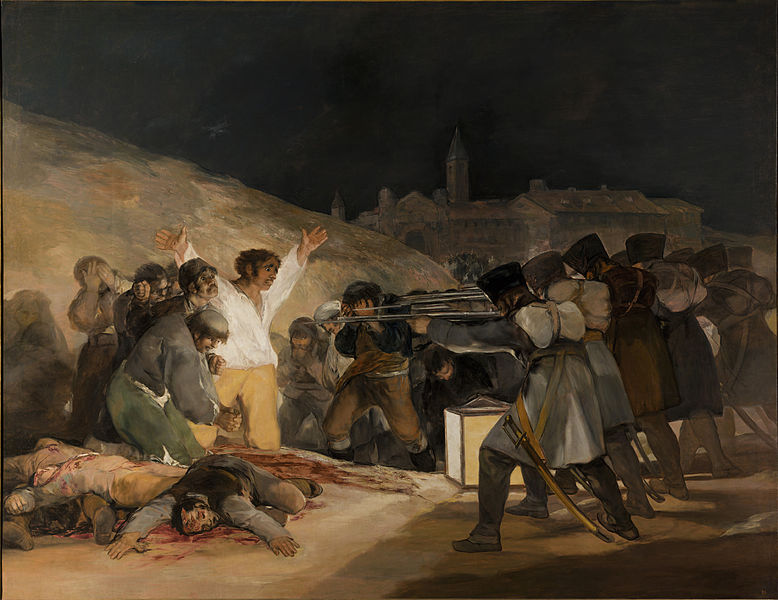
    Painters are less evident among these shades, but his description of Francisco Goya’s ‘Third of May’ ’merits retelling:

    Where fusiliers have turned their nameless back
    And bend to execute their point blank prey;
    My lamp of pity lights the victim’s face.

    The ‘Third of May’, by Francisco Goya.

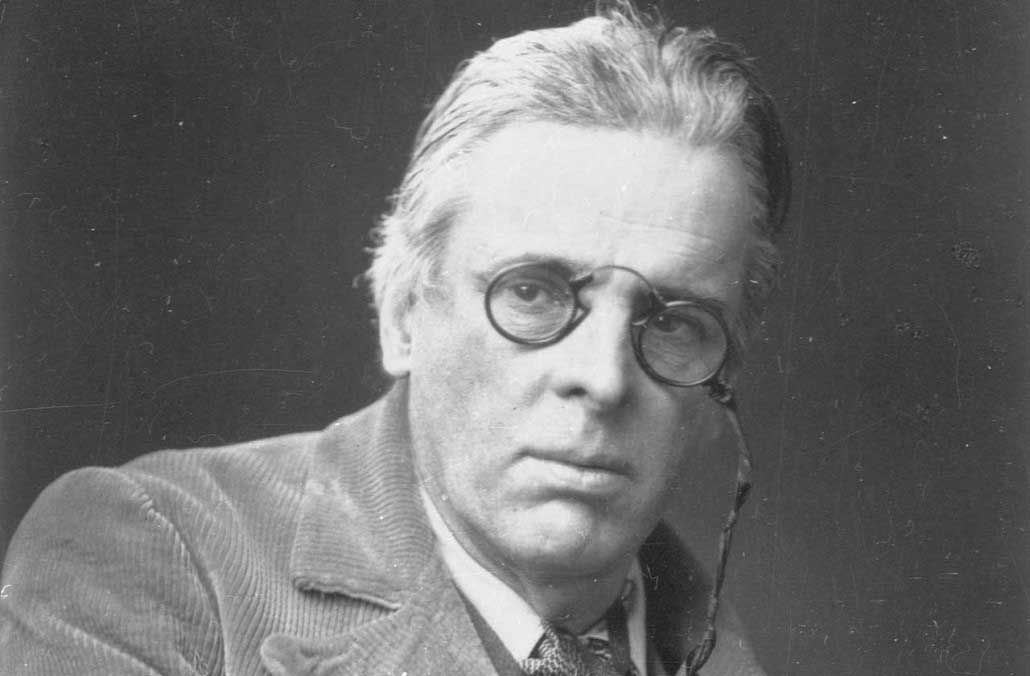
    Irish readers will be intrigued by his encounters in our literary pantheon. Suitably, W.B. Yeats is depicted as a badger, ‘the churning digger / With its nose close to the ground’. O’Siadhail hails him as ‘the archpriest of sound’, and, unusually, integrates and adapts many of his lines, such as ‘Old lecher with a love on every wing’, from the still smouldering Tower.

    But there is a stern rebuke for his promotion of eugenics: ‘scorning base-born products of base beds’, and unwillingness to look beyond a fantastical world that is, ‘dead and gone … That perfect past your mind’s own cul de sac’. Instead O’Siadhail urges: ‘Retrieve best thoughts once shed and then move on’.

    Characterised as a badger, W.B. Yeats.

    O’Siadhail is similarly conflicted over James Joyce’s legacy, admitting to loving a language ‘burbling up in play’. From one great linguists to another, O’Siadhail tells him he is as good a reader as, ‘you’ll get to understand your punning riverrun’, but counters, ‘I know the charge of words, and yet and yet’.

    He wonders if his fellow Jesuit-educated writer’s works hold, ‘a microscope that is too small in scale’, and whether, ‘in the end does anything take flight’. This might come as a relief to those who have baulked at Finnegans Wake’s circumlocutions.

    O’Siadhail is suspicious of a character ‘so proud and so obsessed’, for whom others are ‘walk on parts in your world’s play’. He scorns the, ‘dreamlike doodling of an introvert’. But there is high praise indeed for Molly Bloom’s soliloquy in Ulysses, including a playful pun of his own:

    Still once at least, though in a woman’s voice,
    I didn’t pun or try to be opaque
    But spoke my shortest playful work of praise
    And yes, in Molly’s yes I did reJoyce.

    The other two Irish writers we meet are Patrick Kavanagh, ‘A kamikaze trusting in God’s wind’, who, ‘In hungry times’, paid the price’, for being a ‘peeping Tom who lusts for paradise’; along with praise for Brian Friel’s ‘impish wit’.

    Notably absent are Seamus Heaney (who has perhaps been canonized prematurely?), and Samuel Beckett. Elsewhere O’Siadhail has criticised the interiority of Modernists, who refused to take responsibility ‘for shaping a wider meaning’. He continues:

    Apart from the risk of solipsism and plain self-indulgence, there is the risk of turning poetry into a kind of private piety, which ends up marginalising poetry or branding it as some kind of academic pursuit not appropriate to the ordinary reader of books.

    Refreshingly, however all-encompassing his themes, O’Siadhail’s language is never self-indulgent, and always endeavours to inform.

    III – ‘The Dismal Science’

    O’Siadhail tells the story of the making and undoing of our modernity by theorists and movers and shakers, as he seeks to reshape our current approaches. The self-imposed constraints of metre, and often rhyme, bring a pleasant economy of expression.

    O’Siadhail’s ambition to tell the story of our time in The Five Quintet recalls the Roman poet Ovid’s Metamorphosis, which draws together the mythologies that informed an understanding of the ancient world  in order to forge a new consciousness. Here the Classical titans give way to seminal figures such as Adam Smith, Karl Marx, Thomas Malthus, Karl Marx, J. M. Keynes, Milton Friedman and Amartya Sen, along with men of commerce, who are today often vemerated as heroes.

    The bargain struck, the business done,
    The dealer’s will and drive for wealth,
    Our new concern with number one.

    One self-interested specimen on display is Ireland’s own Michael Fingleton:

    Still bent on short-term deals to boost
    A bottom line. A bonus-gained,
    Already on your way to ruin
    All caution to the winds – who cares?
    Ambitious tiger burning bright
    And brazen in your riot-run
    You do not know the dust you’ll bite.

    It seems unlikely O’Siadhail sought legal advice on the potential for defamation in this section. It would certainly make for quite a trial to find the poet in the dock against the disgraced banker. A defence of justification should be available for the following lines:

    Small loaners find you’ll go to law
    To take your pound of flesh to pay
    What’s owed; for bigger borrowers
    You bend or buck to make the rules,
    Indulge whatever debts occur.

    There is a nuanced treatment of Adam Smith’s contribution to economic theory. Laissez faire, permits ‘the hidden hand’ to operate, leading to competition which generates efficiencies, but which at all times requires vigilance against ‘crafty dealers’ in league, ‘to fix a price and profit by intrigue’.

    O’Siadhail’s ‘modern mind’ cannot understand, however, Smith’s failure to rail against children being harnessed in black holes ‘Deep down in Durham’s shafts and pits’. He also points to the irony of merchants, ‘Whose mean rapacity you taunt’, adopting Smith as their first forebear.

    O’Siadhail has interesting reflections on Robert Malthus, who may yet be vindicated in his prediction that food production capacity will not keep pace with the demand of a growing population:

    Your thesis bites so near the bone.
    Malthusian views now haunt our thoughts;
    These times will know a darker tone.

    Is this the onset of a devastating Climate Change he is referring to?

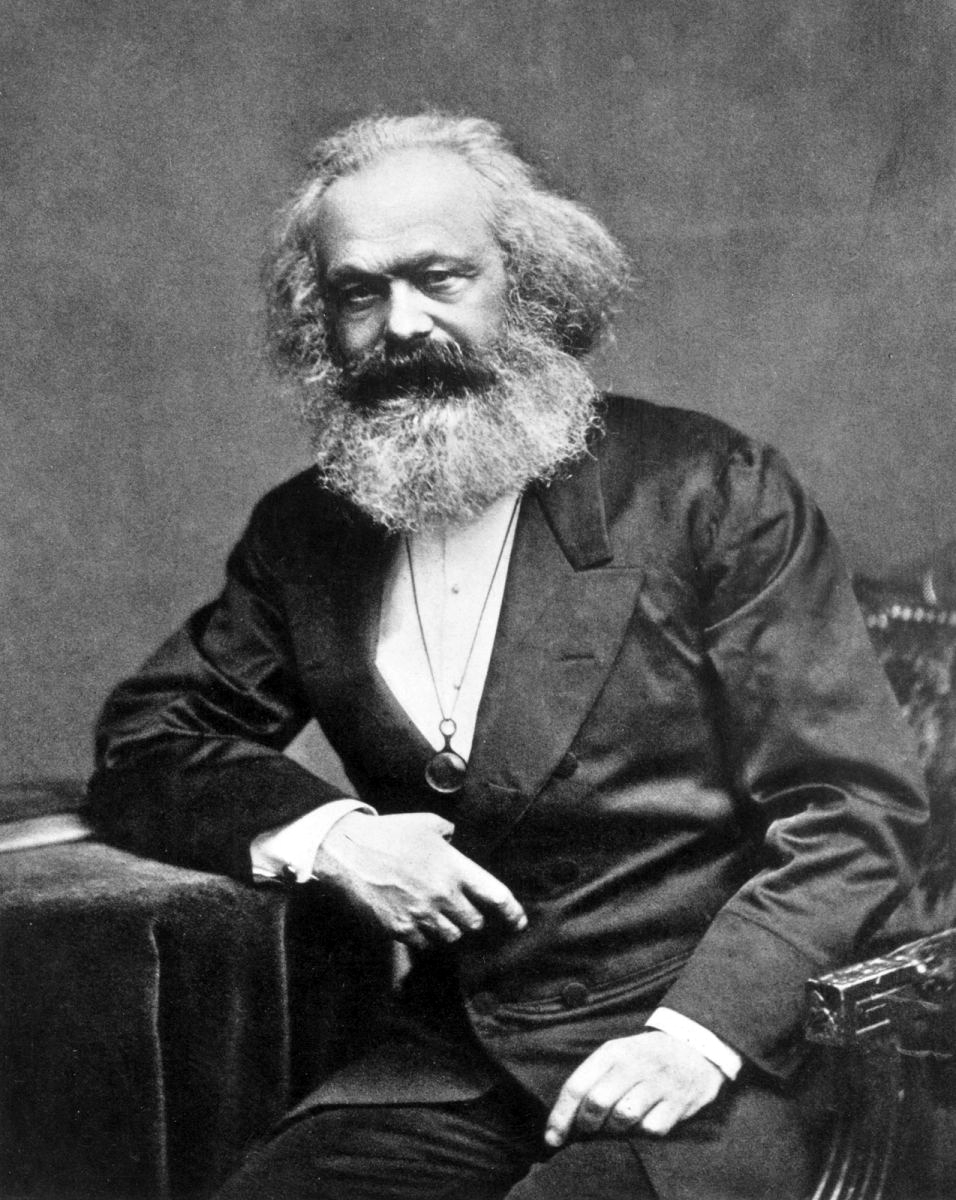
    O’Siadhail is conflicted in his appreciation of Karl Marx, hailing him as a visionary who foresees ‘as no one else had seen’, that four hundred billionaires would hold just half our wealth, alongside the ‘constant gyres of boom and bust’, apparent in late capitalism.

    Karl Marx, ‘a know-all coldness’.

    But according to O’Siadhail, the Communism that Marx imagines contains a core failing evident in its designer, ‘a know-all coldness at your core’. Indeed, being a ‘know-all’ is an oft-repeated barb, leading to the delusion of utopia. This point is central to O’Siadhail’s diagnosis of what has brewed many of our present troubles. Thus Marx is condemned for failing to conceive of compromise, ‘Where conflicts would be reconciled’.

    We also meet J.M. Keynes who learns by listening to his peers, and is thus lionised as a ‘Soft changer, saint of step by step’, who recognises how, often, only government stimuli will lift an economy out of the doldrums:

    The system does not cure itself;
    So maybe it needs money lent
    To make it flow and multiply

    Far less favourable is O’Siadhail’s assessment of Milton Friedman, another ‘know-all’, whose rigour ‘will room no doubt / Your mind demands all black and white’. While acknowledging he served up some neglected thoughts, O’Siadhail chides him for using Keynes’s ‘one defect’ – of failing to appreciate the significance of monetary supply – to justify opposition to all state interference with the ‘hidden hand’.

    Instead we find: ‘Free flow finance gives quick-fix gains / But blows up bubbles that must burst’, where, ‘The wily then are winners all’. O’Siadhail plumbs for the Scandinavian laws: ‘Where weak need not go to the wall’.

    One Scandinavian theorist we meet is Thorstein Veblen, who reveals an acute understanding of why workers are not always sympathetic to Marxist ideas.

    Society does not cohere in hate–
    All workers really want to emulate
    Their boss – the weak are would-be rich at heart;
    If Marx had not been wrong and me not right
    The poor would tear society apart.

    O’Siadhail sees a need for more than Marxist materialism to meet the challenge of inequality. The height of wisdom arrives from a woman, and ‘cub economist’, Kathryn Tanner, who finds in the ‘love-dream born of Bethlehem’ the possibility of mending the distortions of the market place.

    Tanner, through O’Siadhail, says:

    Is this utopian, I hear you ask,
    A heaven here on earth, a hopeless task,
    Another revolution run roughshod?
    O no! It’s here and now we must uphold
    The common right of all to gifts of God.

    This is perhaps Dietrich Bonhoeffer’s ‘Christianity of this world’, grounded in earthly challenges, rather than lofty metaphysics. One might also discern the influence of his intellectual brother-in-arms the theologian David Ford.

    IV – The Art of the Possible

    The next section, entitled Steering, meditates on good governance. O’Siadhail decries the fantasists of left and right, while bemoaning ‘tweedle dee’ and ‘tweedle dum’ politics, such as we find in Ireland. He warns: ‘the thieves of power / Come noiselessly in nights of apathy.’

    O’Siadhail’s continues to inveigh against ‘know-all’ attitudes, warning the reader to guard against the real sympathies of utopians.

    Fear ideas that outreach the heart,
    Chilled compassion of the ideologue.
    What purports to pity broken lives
    Often hides a know-all arrogance
    That wants to own the future and the past,
    So refuses, starting from the now.
    Greedy for the perfect all create
    Hells of blood and soil and golden age.

    Readers might be intrigued by his descriptions of Margaret Thatcher, ‘Forthright Grantham grocer’s girl’, as an autocrat. Her parvenus attitude reflects Thorstein Veblen’s earlier insights into the aspirational, “would be rich”, working class:

    Some who shin the tall and greasy pole
    Carry in their bones a sympathy,
    Want to spare all comers such a climb;
    Others vaunt their courage and condemn
    Weakness they had fought to overcome,
    See all frailness as a threat to power.

    Margaret Thatcher: tearing apart society’s ‘love-ravelled fabric’.

    In O’Siadhail’s account Thatcher is prompted by Keith Joseph, ‘To rethink all in Milton Friedman’s words’. This leads to the tearing of society’s ‘love-ravelled fabric’.

    There is also an intriguing description of the arch-networker, Jean Monnet, one of the original architects of the European Community. O’Siadhail traces the current fraying of the Union right back to the failure of Monnet and others to conjure, beyond simply commerce and trade, a European identity, based on ‘deeper bonds and ties’.

    Perhaps writing in the wake of the Greek and Irish bailouts, O’Siadhail seems wary of ‘Brussels’ one-fits-all’ approach:

    Starred blue flag so dutifully raised,
    Still not fluttering in our chambered hearts
    Heaven is no timeless superstate.

    In Canto 5 of this section, ‘A Beckoned Dream’, O’Siadhail reveals a political paradise comprising of William Ewart Gladstone, who accepted Irish Home Rule, Mahatma Gandhi, Dag Hammarskjold, the ‘United Nations’ guiding star of peace’, Nelson Mandela and, less convincingly, former Irish President Mary McAleese, who is commended for building sectarian bridges among ‘Ghosts of Europe’s once religious wars.’

    I found this choice puzzling as McAleese was more of a figurehead as Irish President, and did less to interrogate the rising tide of inequality in Ireland than her successor Michael D. Higgins. Moreover, McAleese was an electoral candidate (in the 1987 General Election) for Fianna Fail under the corrupt leadership of Charles Haughey, who also tactically rejected the reconciliatory Anglo-Irish Agreement in 1985, and her Presidential candidature came during the tenure of another tainted figure in Bertie Ahern.

    I would prefer to have seen greater emphasis on environmental responsibility in this cockpit, as humanity stares down the barrel of self-inflicted ecological collapse. Perhaps some will be frustrated by the idea that political change cannot arrive more quickly than in ‘Fractions less imperfect than before’, considering the challenges that now press against us, but his emphasis on the value of dialogue is surely correct: ‘Gaze-to-gaze in our humanity / Enmity we can thaw … ’

    V – God and Science

    The two final cantos Finding and Meaning, covering Science and Philosophy, might stretch most readers more than the first three; although O’Siadhail never succumbs to drawing too liberally from his rich pallet of languages and knowledge. It will be intriguing to encounter scientific responses to his account of the great leaps forward in our understanding of the universe.

    Following his rejection of the fixity of political utopias, O’Siadhail sees a cosmos born of Heisenberg’s Uncertainty Principle, as opposed to a ‘knotty crossword yielded clue by clue’ that is capable of completion. Here we encounter a God that plays dice.

    In Meaning, O’Siadhail continues to riff (in Dante’s own terza rima) on the unknowableness of the divine:

    Allow our God a purpose not our own
    and here outside a timeless roundelay
    we dance within our fragile ecozone

    Here we meet the shades of Martin Luther, John Calvin, Rene Descartes, John Locke, Immanuel Kant, and a sneering Friedrich Nietzsche, who is condemned for a lack of compassion, and an unwillingness to compromise, yet:

    Despite his detached mind’s strange solitaire,
    for all mad Nietzche’s overreaching claims,
    his genius shows how humans overbear;

    Next come Sigmund Freud, Bertrand Russell, Martin Heidegger, Jean-Paul Sartre – dismissed as a ‘a braggadocio of angst that sinks / to vanish in the nothingness of hell’ – Søren Kierkegaard, Emmanuel Levinas, Paul Ricouer, Said Nursi, and Jean Vanier, who wonders ‘What if the weak become our first concern / what if such love decides our balance sheet’.

    Vanier also offers encouragement to the poet:

    this poem may be a slow fuse to guide
    the moments in our psyches which allow
    an amplitude, a deeper second sight.

    Then Hannah Arendt again condemns:

    Utopians who weave their gossamer
    ideal never see the here and now;
    for such far sight the present blur,

    We also meet O’Siadhail’s first wife, who died some years ago after a long illness:

    In your compassion, Bríd, I think I grow
    and understand how only love can heal;
    I learn to feel what others undergo.

    Finally, there is a dreamy vision of Paradise in which O’Siadhail travels along a path between two parallel rows of trees each ‘interwoven with its counterpart’, ‘in curves of paradox which shape the light’.

    VI – Poetic Futures

    O’Siadhail’s The Five Quintets synthesises many of the great intellectual questions of our time. In so doing O’Siadhail fits Robert Graves’s description of a poet as, ‘the unsatisfied child who dares to ask the difficult question which arises from the schoolmaster’s answer to his simple question, and then the still more difficult question which arises from that.’ O’Siadhail keeps asking the big questions, having refused the easy chair of academia, where poetry often becomes an obscure word game, and a private members’s club. Authentic poetry may still be difficult, but this arises from considering profound questions.

    The length of The Five Quintets also poses the question as to whether long form, epic, poetry may come back into vogue.

    Previously, the Canadian literary critic Northrope Frye argued that Edgar Allan Poe’s essay ‘The Poetic Principle’, published posthumously in 1850, had a ‘tremendous influence on future poetry’. Poe proposed that a long poem was a contradiction in terms, and that all existing long poems of genuine quality consisted of moments of intense poetic experience, ‘stuck together with a connective tissue of narrative or argument which was really versified prose.’

    Frye regarded this as preposterous, but a preference for brevity, which may mask a lack of ambition or vision, is still apparent.

    May we revisit a Romantic Age to recover long form poetry, when poets, such as Coleridge and Shelley, were participants in scientific debates? Indeed the word science was only coined in the 1830s. Since then it has become the preserve of specialists.

    The master poet. Image (c) Julia Hembree Smith.

    I was a little disappointed not to meet the shade of Shelley, who had less than thirty years to impart his genius. Perhaps O’Siadhail shrank from the apparent violence of his near namesake’s earlier pronouncements on the ‘necessity’ of atheism and the revolutionary sentiments of much of his early verse, but over the course of his short life his outlook mellowed.

    Just as Shelley’s challenged vested interests, similarly I suspect The Five Quintets will make some readers distinctly uncomfortable: first, it exposes gaping holes in most of our appreciation of the wonders of human thought and creation; secondly, it challenges the social and economic structures we live under; thirdly, it dismisses the delusional quick-fixes of utopians; finally, he challenges a prevalent view that religion and science are irreconcilable.

    I also anticipate that the poem will only be given the credit it deserves in Ireland once it has received the imprimatur of international critics.

  • How to Free Yourself from a Narcissist

    A proud man has disdain for other people, he undervalues them. The Narcissus overvalues them, because in every person’s eyes he sees his own image, and wants to embellish it. So he takes care of all his mirrors.
    Milan Kundera The Festival of Insignificance

    In the beginning, I thought about him endlessly, night and day, over and over again. I didn’t think the thoughts would ever stop. They were constant, circular and exhausting, and the crushing pain of the descending reality had me questioning everything about my life. I wondered what he was thinking, if he missed me, if he had realised what he had done or if knowing that he’d never get me back would mean there would be no self-reflection. If so, now he would despise me with even more conviction than he had before. It was a limb amputation, an exorcism I didn’t want but knew I needed, an offering of my very cells back to the universe.

    I yearned for him because I didn’t know the truth. How could I? I had believed him, believed who he was pretending to be. Who could intentionally deceive another like that? It couldn’t be so. We had played together, laughed together, cried in each other’s arms. Protected each other. Championed each other. Loved each other.

    It took forever to see past the act. To understand that my baby didn’t care about me, that he wasn’t able to. That my darling didn’t see me, just the things that he could manipulate to draw me in. Everything I gave him, every way I depleted myself, every single thing I sacrificed for him, for us, was invisible to him. Instead, he branded me an ungrateful, unloving, pathological, pathetic joke. And this is what he believed.

    The hardest part for me in the aftermath of my discovery that my love was a narcissist, was accepting that there was nothing I could do to change him. It was the injustice of knowing that despite everything he promised me, he could close himself off to my pain, and move himself on with no remorse. He could convince himself that I was bad, and shred my heart to pieces without a dent to his conscience. And I could never get him to see otherwise because you cannot reason with somebody that depends upon delusion for survival.

    The abandonment hits you like a freight train. There is no way to soften this collision. You may fear that the impact will kill you, or that you will dissolve in desolate depression – your forgotten, worthless, ragged body strewn upon the tracks. Worthless, because nobody could treat another this way, unless it was somehow deserved.

    You find that it takes more strength to stay still than to chase after the train, with all its precious cargo. You desperately want to lasso your ropes to the back of the carriage as it thunderously speeds past you, but you know that if you do so, you will be dragged along those haunted rails toward a phantom promise, forever. And so you wait, but for what you do not know.

    This is not the end. It’s the beginning. Change is coming and this change is going to teach you how to free yourself. Because you are a survivor, and survivors have a deep and powerful instinct to keep on moving, no matter how torn your skin and battered your bones, no matter how much your swollen heart might weigh you down. You survive without becoming like them because despite the pain of choosing someone that manipulated and abused your sacred, trusting offering of love, you do not close yourself to it.

    Slowly, you begin to understand, and later to believe, that none of this was your fault. And that you are not the person your narcissist convinced you that you were. That the world is full of bruised and damaged people that are not as strong as you. People that inflict pain, to feel pleasure in their power, while you and your loving heart absorb their abuse to lighten their load. It’s easy to be like them. They are weak.

    You are here because you have been tough enough to take what they have given you, tough for far too long. You are here because you were chosen for your gorgeous light and your beautiful soul. If you did not shine so brightly, you would not have been valuable to them. They may have learned to drain this light but they did not deplete you. You will regenerate. Because this is who you are.

    Your narcissist fed off you because they cannot create their own goodness. With a closed heart and a suffocated soul they have no true power at all. None. You do. Love, the most powerful energy source on earth is what kept you with your abuser, what caused you to shoulder burdens that were not yours. And love is what will set you free.

    But first, you need to learn to direct it at the person that really deserves it – yourself. Learn to parent yourself with love and see how strong you become. Practice the art of supporting yourself, and refusing to self-abandon and you will never be caught again. Feel the nourishment of your own love and kindness and watch the joy that will spring forth from your powerful heart.

    Float confidently away from those heavy iron tracks. You’ve got something so much better than the train now. You’ve got wings.

  • The Key Change to Fix the Irish Constitution

    The Harp needs more than tuning. The single most important and useful change we should make to our Constitution is to remove the first paragraph of Article 45 which reads:

    Directive Principles of Social Policy

    The principles of social policy set forth in this article are intended for the general guidance of the Oireachtas. The application of those principles in the making of laws shall be the care of the Oireachtas exclusively, and shall not be cognisable by any court under any of the provisions of this constitution.

    As detailed below, this article provides clear instruction to the Oireachtas to ensure the material welfare of the people, but, crucially, prevents any meaningful judicial enforcement.

    Article 45 covers a lot, instructing the Oireachtas:

    • to promote the welfare of the entire people.
    • to secure wage equality and sufficiency.
    • to manage the natural assets to ‘subserve the common good.’
    • to prevent free competition from detrimental concentration of essential commodities.
    • to manage credit for the benefit of the people.
    • to ensure private enterprise is efficient and where lacking be supplemented by the State.
    • to safeguard the interests of the weak and needy.
    • to ensure the health of the people and prevent exploitation.

    There is so much to welcome here. It is clear, humane, balanced, and entirely workable. Sadly, our Constitution grants the Oireachtas, and hence the Government, a judicial free-hand, and so allows them to ignore their responsibilities.

    An amendment to remove the offending ‘cognisable’ clause, highlighted above, would allow judicial oversight of the vast majority of Government business, requiring efficiency, charity and compassion.

    There is limited jurisprudence on the matter. Initially the courts refused to countenance any argument appealing to Article 45, but it has also served as guidance, insofar as it has been used to inform decisions. This progressive approach to allow reference to the Article has yet to be accepted by the Supreme Court, and current conservative thinking reckons it to be clearly beyond the competence of any court: ‘an invalid usurpation of legislative authority’, and a breach of the separation of powers.

    Quite apart from rendering these goals easily ignored by the government, as citizens we have no recourse in law against any government for failing in its duties. Witness the Housing Crisis, Direct Provision, wage inequality, the gap between the minimum and a living wage, the destruction of natural habitats, commercial exploitation of natural resources, multinational tax avoidance, and the general inefficiency of public services, especially health care in all its forms.

    Instead, our government suggests we turn our attention to the Blasphemy clause. This is welcome among secularists, profoundly uncomfortable for the devout, and so will stir a lot of debate but it will make no meaningful difference to the lives of people.

    Consider one issue afflicting the Nation: the Housing Crisis

    The ideology that free markets are inherently efficient is rampant across the world, and clearly evident in Ireland. The common belief that only very lightly regulated business can achieve efficiencies unobtainable in the public sector is especially clear in our Government’s current policies. This avoids both the fundamental conceptual problem of measuring efficiency in terms of money, or more generally wealth creation, and also breaches sections 1, 2-ii, 2-iii, 2-iv, 2-v, 3-ii, and 4-1 of Artcle 45.

    There are almost 100,000 empty houses in Ireland, and about 10,000 homeless people, of which some 3,755 are children, in 1,739 families.

    Rents are rising rapidly, and are already 23% above the pre-Recession peak.

    Rather than exercise Eminent Domain and issue Compulsory Purchase Orders, an old and well established technique of Government, to buy and re-use exiting property to house families, the Oireachtas is considering the Home Building Finance Ireland Bill, which proposes:

    to provide for the establishment of a company called Home Building Finance Ireland (HBFI), to increase the availability of debt funding for residential development in the State. HBFI will provide financing to developers seeking to build viable residential development projects in Ireland on commercial, market equivalent terms and conditions.

    The Bill facilitates funding of HBFI from resources currently held by the Irish Strategic Investment Fund (ISIF), the granting of the necessary power to the National Treasury Management Agency (NTMA) to provide staff and services to HBFI on a cost recoverable basis, the granting of specific powers to HBFI to enable it to carry on the business of residential development finance, and ensures appropriate accountability for HBFI.

    This overtly favours property developers, contrary to the common good. Indeed, the cost of administering this HBFI will likely run to many millions, millions which could be spent directly by the Government on building and maintaining public housing.

    Consider section 2-iv of Article 45 states:

    that in what pertains to the control of credit the constant and predominant aim shall be the welfare of the people as a whole.

    This bill favours developers over the people who are in most need of housing. It is against the spirit of Article 45, but our current Government is happier delegating responsibility to poorly overseen private quangos. This is just one example of why we need to be able to challenge our Government in our Courts.

    Were we to remove the offending paragraph we could not only pursue our indolent government in our Courts for their derelictions of duties to the people; we could also ensure that all future legislation would take full account of our socio-economic rights.

    This is not a charter for vexatious litigants, it should not and would not allow suit against the Government for minor infringements. The Supreme Court is, by necessity, selective in the cases it hears, and once a matter is decided there the precedent is binding on lower courts. But the doctrine of Separation of Powers should not allow the Supreme Court to deny jurisdiction over any part of our Law.

    Let us recall that these principles of Article 45 are already for the guidance of the Oireachtas. That our elected representatives neglect their responsibilities is nothing short of abhorrent.

    It is our Constitution and we must change it. It is up to us as citizens to elect representatives that will introduce legislation for a referendum to fix this broken string.


  • Steve Bannon’s Tour de Farce

    Donald Trump’s former confidante Steve Bannon has been on a latter-day American Grand Tour around Europe. But rather than making his peace ‘With learned Italian things / And the proud stones of Greece’, he embarked on an ideological excursion through the newly constituted enclaves of extreme right wing Populism; spreading a gospel on behalf of his erstwhile ally Mr. Trump, who unceremoniously dumped him last year.

    At one level this is a rapprochement with a mentor, who he praises gushingly when given the opportunity, and also an exercise in lobbying on behalf of the corporate interests he serves. All of this is treated as Populism, which originated as a recognition of the socio-economic rights of the working class.

    The U.S. Populist Party was a movement of the 1890s, involving Midwestern and Southern farmers and some labour unions, which denounced an economic system in which the fruits of the toil of millions has been stolen to build colossal fortunes for a few. It was also laced with religious fundamentalism. This latter is also an important ingredient to the Trump formula too: the rights of the poor are ultimately subordinate to the Never Never Land promise of an afterlife. Some consider Trump a latter-day Nebuchadnezzar, ‘sent by God to wreak vengeance on an idolatrous and wicked people’.

    In Europe Populist movements have also been left wing, and even Communist: including the Popular Front governments of France and Spain during the 1930s, which ultimately succumbed to Fascist invasions. Mr Bannon pretends to be unconcerned whether Populism is of the Right or Left; although Mussolini, who he praises for his virility, was also in some respects a Populist, having begun his political journey as a socialist.

    Usage was revived, erroneously, in the 1950s to describe the ‘Populist’ anti-Communist ‘witch hunt’ of Joseph McCarthy, reflecting how Populism had drawn closer to an appeal to prejudice and selfish sectional interest.

    On his recent tour Bannon sang the praises of recently elected Populist governments in Italy and Hungary, some of whom bear more than a family resemblance to fascists. Power to the people. As long as they vote for us of course.

    I – Ordinary Working Joe

    Bannon paints a picture of conflict in broad brush strokes, between a global elite and the Ordinary Working Joe. A distinction is drawn between populist nationalism, and the global establishment of what he terms ‘crony capitalism’.

    This passage from a recent Vanity Fair interview puts this in perspective:

    Bannon’s blue-collar upbringing and conservative Catholic faith undergird his populist ideas. He argues that his platform of economic nationalism has been misrepresented by critics that label it racist. Cutting immigration and erecting trade barriers will help people of color by tightening the labor market, thereby raising wages. In the White House, he argued to increase tax rates on the wealthy and has problems with the G.O.P. tax plan (although he ultimately supports it). Bannon also argued to end the country’s decades-long entanglement in Afghanistan and spend the money at home. “You could rebuild America! Do you understand what Baltimore and St. Louis and these places would look like?” And he told me he thinks the government should regulate Google and Facebook like public utilities. “They’re too powerful. I want to make sure their data is a public trust. The stocks would drop two-thirds in value.

    I was reminded of the famous description of Richard Nixon being about as honest as a three dollar bill, and, as Noam Chomsky puts it: ‘language in the service of propaganda’.

    Let us ascertain what Steve Bannon is really saying: he wants national sovereignty reasserted against the global elite, but curiously Populist governments, such as his own, tend to favour the global elite in their tax programmes.

    There is ample resistance in Europe to transnational corporations, so Bannon’s real mission appears to be to retain European markets, and undermine the European Union, which brings unnecessary encumbrances to the interests of his sponsors: American elite capitalism; his cronies; his global elite; his gang.

    The real objection is to those global elites that threaten the agenda of Goldman Sachs and transnational U.S. capitalism. He does not appreciate the “crony capitalism” of those elites that are not his cronies.

    Superficially he favours the working man and protection of indigenous citizens. Meanwhile his mentor, after riding a wave of blue collar support, displayed his gratitude by dismantling ‘horrible’ Obamacare, ironically affecting his own constituency far worse than Democrat voters.

    By reneging on the Paris Climate Change agreement, and placing industry ‘yes men’ in the EPA, Trump and Bannon may precipitate another Dust Bowl in Middle America; creating new Grapes of Wrath, and accelerating the destruction of blue collar America, which voted for him under false pretenses.

    In the words of Zizek the working class are being sold ‘ideological misidentification’, which Marx understood as a form of brainwashing to vote contrary to one’s interests.

    II – The Scapegoat

    How better to pander to the working class than by invoking the threat of a Satanic Other, or enemy within, such as the Jews were defined by the Nazis. Today we have undocumented aliens stealing ‘our’ jobs, or foreigners polluting ‘our’ gene pool.

    Bannon emphasises sovereignty and economic autarky, but this should not prevent the free flow of ethnically-diverse American business people – commonly referred to as ex-pats – from selling into European markets.

    On the other hand, the surplus populations of the Global South and those fleeing war zones such as Syria – which he expressly invokes in the context of Hungary – are to be stopped at the borders and their human rights annihilated. The quid pro quo for adopting U.S. economic norms is that populist European states can maintain their ethnic cleanliness.

    Syrian refugees strike at the platform of Budapest Keleti railway station, September 2015.

    Their exile is of course the responsibility of the Military Industrial Complex that Bannon serves, which destabilised the Middle East. Although he criticises Bush and the GOP establishment, one wonders how much of this is a smokescreen.

    Those legal Hispanic and working class Blacks workers that are pandered to will be abandoned when their American Dreams turn to nightmares. They will remain poverty-stricken, working longer hours for less, without health insurance or pension entitlements: a source of cheap labour. ‘Power to the people’ is a carefully constructed ruse. They will have no power and be told what to do.

    Critical media has to be aligned with Globalised capitalism, or treated as an enemy of the people. They cannot be allowed to speak the truth to power, or at least to Mr Trump. Such people do not answer questions which are asked of them because they avoid them.

    Mr Bannon speaks and writes in carefully-crafted soundbites and pseudo-intellectualisms, which do not stand up to serious scrutiny. His new-found Populist narrative requires Bannon to ignore his long association with the handmaiden’s of globalisation, Goldman Sachs, while Trump’s administration comprises an assortment of cronies from the global elite.

    Ideological opposition to NAFTA, which serves certain U.S. interests, does not extend to supporting the EU’s current stance on the TTIP, which would allow American and other corporate interests to override national sovereignty, and sue the living daylights out of national governments and small businesses.

    Steve Bannon is against radicalisation, which is given an etiolated definition as anything that exposes his agenda. The new radicals he despises are liberal professors, human rights activists and journalists who expose the horrendous economic and environmental effects of neo-liberalism. In short, those who speak candidly on the media, and cannot be bought.

    The new generation of soft-skilled snowflakes cannot be exposed to what the likes of Steve Bannon has in store for them. They must be compliant and vote for the Right candidates. Self-immolation of the innocents.

    Interestingly, Bannon is now appealing to Bernie Sander’s constituency, as Sanders is the real deal and must be neutralised, and his ideological clothes appropriated. For a genuine Populist to represent working class interests would be disastrous.

    Bernie Sanders, the real deal.

    III – Calling a fascist a fascist

    In a very sinister way Steve Bannon talks about the inherent dangers of biotechnology and artificial intelligence and the challenges it presents. Yet he and his eccentric billionaire friend Robert Mercer have used artificial intelligence in Climate Change Denial through the Heartland Institute.

    Mercer funded Cambridge Analytica, whose advertising played on people’s emotions having profiled them to good effect, a key strategy in orchestrating Trump’s electoral success.

    Bannon opposes artificial intelligence and robots as China has stolen a march on his Capitalist cronies. He wants his artificial intelligence and his robots.

    I regard Steve Bannon as an ubermensch fascist who believes in Social Darwinism, and the control of the worker by the insanely rich. He does not care a jot about the working class, save as objects of exploitation to be duped.

    He is a shameless transnational capitalist, and only opposes it when regulation (referred to as red tape, as if polluting a river is just a matter of red tape) challenges his interests. He is a demagogue, who preys on the insecurities and prejudices of the working class to buttress his faction.

    He is aware of an impending environmental and economic meltdown, and is recommending compounds for the mega rich, who expect to be enriched further through his propagandistic grand tour to the now proto-fascist and compliant enclaves of Italy, Hungary and the Czech Republic.

    He is even more dangerous than Trump because he is cleverer, his rhetoric a disturbing marriage of psycho-babble and neo-liberalism.

    What is needed to counteract him is what he despises: fearless criticism, and genuine Populism divorced from religious fundamentalism. This is coming from Bernie Saunders, NGOs, human rights activists and anyone who still believes in a liberal education, the Rule of Law, and sees the dangers inherent in an appeal to the mob.

    *******

    The aspiring Emperor Bannon has no clothes, and offers hope in the manner of a quack doctor or false messiah.

    Behind the toxic combination of Neoliberalism and demagoguery, the presentation of relativistic half-baked shibboleths, is what Chomsky describes as the most dangerous organisation on earth: the right wing of the Republican Party, controlled by religious maniacs envisaging the end of days.

    Steve Bannon is of course carefully providing escape hatches for the mega rich to weather the coming storm in compounds away from the Populist mob, which they simultaneously exploit and undermine.

    Death on the installment plan, as mortgage owners in Ireland find out, or as George Orwell put it: How the Poor Die.