Blog

  • Bull Moose – In Praise of Uncivil Discourse

    When truth is the casualty, everyone suffers. 

    For new Americans, spending Thanksgiving in the U.S. comes as a surprise. It’s the busiest travel time of the year, ranking ahead of Christmas and the 4th of July. While some associate Thanksgiving with shopping bonanzas like Black Friday or Cyber Monday, for most it’s simply an opportunity to spend time with family and friends; watching football or just gathering around the dinner table.

    Given that it’s always the last Thursday of November, it also marks the beginning of the holiday season. A time then to take stock, reflect and make plans for the year ahead, finishing any business before the year closes.

    It is little secret that Americans are becoming ever more polarized politically, in no small part due to the comfortable bubbles with which we surround ourselves, in our day-to-day-lives and online.

    All too easily, we can tune out people with whom we disagree. Except when it comes to Thanksgiving. Sitting around the dinner table, it’s hard to steer conversation away from current events. Issues like climate change, inequality, the composition of the Supreme Court, the mess in DC, what to make of Trump, or even football, bubble up.

    Polarization may also be causing people to fall out with one another over politics: according to Pew research more than eight-out-of-ten U.S. adults (roughly 85%) say political debate in the country has become more negative and less respectful.[i]

    Interestingly, a lot of Republican voters feel victimized in this regard. By a wide margin, Republicans believe the mainstream of political discourse is more hospitable to Democrats than to the GOP. Interestingly, Dems also think Republicans are more comfortable sharing their viewpoints, but only by a few percentage points.[ii]

    Given this toxic climate, many choose simply to stay away from any issue that is remotely political, especially given how few people are likely to be dissuaded from their current stance.[iii]

    The problem is that not taking ownership of political views can be harmful. It begs the question as to whether any democracy built on the free sharing of opinions and facts can survive in the face of this extreme polarization within social media bubbles and alternative facts. The jury is still out.

    It seems as if truth and facts are becoming ever harder to determine. People have warmed to the argument that there are always two sides to every issue.

    But there are plain facts which don’t have two sides – the truth.

    In today’s America, it has become commonplace to argue over facts. In some quarters, it might seem improper to suggest that sea levels are rising, despite the mounting evidence; or that a crowd at an inauguration was smaller than a previous one, or that black unemployment is at an all-time low.

    As in other parts of the world, truth is under attack, muddled by a barrage of special interest and nation states seeking to weaken the very democracy the West is built on. If this sounds alarmist, it is. As an aside – I suggest you watch Sacha Baron Cohen give his views on social media moguls, and their blatant lack of responsibility with regards to the truth.

    If you think this is simply a problem on the right of the political spectrum, you’re mistaken. The left is just as adept at bending the truth to suit themselves. The ‘woke’ left is famous for eating its own, so to speak. Writing in The Bulwark, Tim Miller brilliantly documents how Pete Buttigieg, who aspires to be America’s first openly gay President, is a under a multi-prong attack from so-called ‘progressives.’[iv]

    ‘Washington DC’s most interesting ‘power’ couple’

    So, on to the Impeachment Hearings. What we are witnessing is a political tactic that is as old as democracy itself. If you cannot win an argument with facts, you shout louder than the other side.

    Say what you like about the proceeding, but the Republicans are shouting louder. With the political theater gripping the nation – the needle of public opinion has hardly moved in recent months – Republicans are screaming about the unfair process and treatment to Trump.

    Last week, when a legal scholar remarked that even Barron Trump could not become a Baron as Trump is not King, Republicans erupted in indignation. How could Democrats drag a thirteen-year-old boy into the conversation?[v]

    Ah, the moral outrage. On and on the playbook goes – shout, distract, divide – with little change in public opinion on whether Trump should be removed from office.

    Did the Democrats call out the Republicans on this fake moral outrage? No. Actually the legal scholar later apologized for bringing Barron into the conversation. One of the few to call out Republicans on the ‘nothing burger’ was George Conway III – one of Trump’s harshest critics, and none other than spouse to Kellyanne Conway.

    Wait, what? The same Kellyanne Conway, advisor to Trump, who famously coined the term ‘alternative facts’ when asked about the true size of the crowds the latter’s inauguration?

    Yes, together they form Washington DCs most interesting ‘power’ couple. One is a fervent Trump supporter, and survivor of a White House where few, except family and Stephen Miller, survive for long.

    The other thinks Trump suffers from a ‘narcissistic personality disorder’[vi] and is constantly feuding with him online. Interestingly, he was once the head of the conservative Federalist society at Yale and reportedly was introduced to Kellyanne by none other than Ann Coulter. He also dated Laura Ingraham. For anyone unfamiliar with Laura Ingraham, she currently hosts the 10pm weekday evening slot on Fox – and is the reigning queen of conservative broadcasting.

    Home Comforts

    Over Thanksgiving dinner Bull Moose posed a question to some of his more left-leaning friends: ‘why are Republicans more aggressive in their use of social media and defense of their own?’

    We hear the standard answer: ‘it’s because of corporate media control.’ The argument runs that billionaires are not giving voice to Democrat views. It holds some truth, but at best it’s an incomplete picture. Look at George Conway or AOC – if you are willing to shout loudly there are ways around the filters.

    But maybe, also, it’s the very nature of today’s mainstream left to care inherently about another person’s point of view, which makes them less aggressive in the defense of their viewpoint.

    What is certain is that it’s high time for ordinary Americans, right and left, to stop being afraid of hurting one another’s feelings, and being offended by a different point of view. If Kellyanne and George – who Donald has called a husband from hell and a stone cold LOSER – can do it, maybe the rest of us can engage in a bit more civilized discourse over dinner, without fear of reprisal.

    Image: Constantino © Idini

    [i] Untitled, ‘Public Highly Critical of State of Political Discourse in the U.S.’ Pew Research, June 19th, 2019, https://www.people-press.org/2019/06/19/public-highly-critical-of-state-of-political-discourse-in-the-u-s/

    [ii] Bradley Jones, ‘Republicans see a national political climate comfortable for Democrats, but less so for GOP’, Pew Research, June 24th, 2019, https://www.pewresearch.org/fact-tank/2019/06/24/republicans-see-a-national-political-climate-comfortable-for-democrats-but-less-so-for-gop/

    [iii] Domenico Montanaro, ‘Poll: Americans Overwhelmingly Say Impeachment Hearings Won’t Change Their Minds’, NPR, November 19th, 2019, https://www.npr.org/2019/11/19/780540637/poll-americans-overwhelmingly-say-impeachment-hearings-wont-change-their-minds

    [iv] Tim Miller, ‘The Problematic Pete Wars’, The Bulwark, December 6th, 2019, https://thebulwark.com/the-problematic-pete-wars/

    [v] Marina Pitofsky, ‘George Conway calls out Melania Trump after she criticizes impeachment witness: ‘You’re amplifying what was a nothingburger reference’, The Hill, December 4th, 2019, https://thehill.com/blogs/blog-briefing-room/news/473104-george-conway-calls-out-melania-trump-after-she-defends-barron


    [vi] Daniel Lippman ‘Kellyanne Conway defends Trump after he attacked her husband’, Politico, March 20th, 2019, https://www.politico.com/story/2019/03/20/kellyanne-george-conway-trump-1229193

  • No Comment – Save Our Seas

    [Best_Wordpress_Gallery id=”65″ gal_title=”No Comment – Save Our Seas”]

  • Poetry – Daniel Wade

    Rooftop Blues

    I could go for a quick smoke on the roof,
    the steel vent pipe snaking
    its lobed edges toward the window,
    hear the incidental music of engines snarl up
    from Richmond Street, relentless as diesel.                    
    Maybe, just maybe, I see people for what we are
    and want no part in it? Spilled lighter fluid,
    a puddle of technicolour, swirls like marbled
    paper where a lit match was dropped, and where
    flames now spasm. A dove, olive branch
    gripped in its beak, is shot down by tracer-bullet
    in the lull of sundown, and, like me, bouncers
    light up down laneways. Beats from a DJ throb
    from an emergency exit to remind me that escape
    is no longer possible, not now, then or ever,
    and that I am moored, permanently, to here.                           


    Rope Jockey

    A text from the agency tells me
    when and where to be
    and what tools to have on-site
    (though I know that already):
    harness and gloves, high-viz
    and hard hat. On the Luas,
    I watch Dublin hunker in March rain,
    her blue-black skyline tightened like a toolbelt
    and head into the site at 7 on the dot,
    with an Americano
    from Frank and Honest
    and a heart attack sandwich
    (that’s a breakfast roll to you)
    to keep me going.
    The site is knotted, impassable as a jungle:
    a cluster of skeletal cranes loom
    in the sky, statically iron,
    set in stone or steel, balanced against all weather,
    jibs shredding cloud as the wind’s high grip
    rattles through bony lattice
    and chain-sling as they slowly swivel
    to lift granite slabs to the roof:
    pulleys and outriggers and bolts set in a concrete base,
    concrete vomited from mixers, giant rust-
    scuffed boxes stacked high
    with rollers and chains, corrugated ridges.
    I wonder how soon it’ll be
    before funding gets pulled and it’s left derelict,
    not even a quarter of the way finished:
    the rich weight of industry, injurious as scorn. 
    Secretly, I’m grateful for the job,
    that I get to work on this building
    destined to be a hotel
    or some tech firm’s HQ,
    I.D. card swinging and bleeping me in,
    my serial number memorised like girl’s name.
    Rung by rung, I climb 
    as if towards heaven, past girders and I-beams
    slung low in ruled, russet mesh,
    my wings soaked in caffeine and blood,
    numb to the view 
    nestling far below me, steel-grey morass
    of roofs and webbed pavements, traffic
    an arterial drip-feed. I sit in the cab controls
    like a pilot becalmed in mid-air,
    grip the levers and manoeuvre the crane into life,
    harnessing it to come ‘round full circle,
    as if in slow motion
    with a conclusive thud. Load follows load,
    lb follows lb, and I’ll do
    as many as thirty, forty lifts a day
    if I have to, the back jib
    and counterweight locked in their waltz,
    ’til a voice on the radio confirms:
    “Yeh, she’s all clear, boss.”
    And time isn’t measured by my watch
    but by the rise and sink of the sun,
    a solar disk in tiled and black in slow hurtle
    across the glass cages,
    reddening my face by degrees. It’s mad
    how dark it gets in the space of a few hours,
    how much the city looks like a crime scene,
    how unstoppable it all seems.


    Daniel Wade is a Dublin-based author. He was awarded the Hennessy prize New Irish Writing in 2015, and his poetry has appeared in over two dozen publications. Follow his progress on Facebook, Instagram and Twitter.

  • Artist of the Month – Maria Julia Goyena

    [Best_Wordpress_Gallery id=”62″ gal_title=”Featured Artist of the Month: Maria Julia Goyena”]

    ‘Inner coherence is prior to artistic manifestation.’
    Maria Julia Goyena

    Wandering minstrels travelled through villages in the Middle Ages, telling stories with a book of archetypal images of the time in which they lived.

    The pages came loose and they/we continued telling the stories, with the leaves now shuffled. The sense of using these images to foretell the future arrived later.

    Another story, a different one, says that it was invented by the Egyptians and that Hermes Trismegistus had something to do with it.

    They were, and we are, ‘The Fool’, because we are all born innocent and impulsive, and in our journey that is our life, we become ‘The World’. ‘The World’ represents an ending to a cycle of life, a pause in life before the next big cycle which began with ‘The Fool’. The ‘World’ is an indicator of a major and inexorable change.

    Yes, Tarot is the story of a trip, of a journey, a story that is retold over and over again and which we continue to tell. It speaks for itself, it speaks of others too. It is the story with stories inside itself.

    The origin of Tarot, as those things that are always with us, remains mundane and mysterious at once. It continues, and resignifies itself without ever aging. Because of its particular and universal imaginary it continues to be a channel of our dreams and nightmares, desires and anxieties, like everything that has a living spirit in it.

    Tarot reflects and narrates our selves, becoming true ‘cultural memes’ at the cost of being redundant. These are images that we transmit without even being aware of when they began.

    We don’t have them in our DNA. We transmit them because we carry the idea with us, like the wheel, like a chair… things that were invented in different civilizations or in other times without having contact with each other.

    My particular look, my particular antenna emitting information and my universal antenna that receives it, catalyse these images and unify them in this Tarot. A little new look with its own soul. Mixed.

    Besides, memory edits and editing, as Pasolini has said, is poetry.

    By constantly editing, our memory reinvents reality poetically. Our subjectivity tints our gaze and we build out of our dreams a concrete reality. That is the power of dreams. It is believed that because they are ungraspable, they are less real. But of course this is the trap, this is why they are so elusive sometimes. And of course that is why it is essential to know which base element feeds our dreams. The external reality is the dream constructed by others, when I (anyone) meets the other realities, generating new information. Art, Collage, Education: these things are a metaphor for what surrounds us; as Aristotle would say, ‘we lie to tell the truth’ by putting veils in art.

    What does this mean? It means the obvious. It means that we generate images that anchor them in the deep meaning of what we want to say, but they are images, they are poetry, they are colour, they are metaphors, therefore they are “lies.” But what they never are is dishonest… And as the inner coherence is prior to the artistic manifestation, we know that they are the result of an internal alchemy, their balance dynamic.

    And then my memory appears…
    Memory:  a collage.
    You remember a smile, a look.
    You remember what clothes someone had on …
    or
    You remember what is not said.
    Therefore, and because the editing is the poetry of the story, I compose and configure myself, because it is my memory that invents me.
    That’s what I’m actively living … my edition.
    I am my sense.
    I am my small and humble self and they are my worlds that I share.

    Tarot: body intuitions and a book of free pages. Always poetry in images.

    This is my hybrid, my own beautiful monster and humble servant who collaborates with the other owner of a truth that may be clear or may be cryptic. It doesn’t matter … it’s a challenge!


    www.mariajuliagoyena.com

    www.instagram.com/tourbellyne


  • Poetry – Out Walking


    Sammy Jay, 30, grew up in Oxford and in Ireland by the sea. He works as a rare book dealer with Peter Harrington of London, tending to their literature department with an interest in poetry in particular. He has been writing since he can remember, and is working on his first collection.

  • To Advance We Must Stop: Two Weeks of Protests in Bogotá

    A national strike was called in Colombia for Thursday, the 21st of November. In Bogotá, it would be the beginning of two weeks of protests, parties, and panics.

    Iván Duque, Colombia’s  right-wing president, was elected in 2018. Since then he has tried to implement the typical Latin American neo-liberal programme: pension privatisation; privatisation of government agencies; cuts to education budgets; cuts to corporation tax; cuts to the minimum wage for young people; the violent suppression of the left; the violation of peace treaties; the murder of social leaders. The strikes are a response to that programme.

    Bouncing in the spotlight of the Andean sun

    The marches began on Thursday morning. Thousands walked along the main routes into the centre of the city. Approaching from a few streets over, it sounded like the noise from a football stadium. There was music and whistles and horns. Crowds bounced in the spotlight of the Andean sun. Police helicopters hovered over the tree-topped mountains which enclose the city. Theatre groups twirled white flags like batons. Trapeze artists hung red ribbons from bridges and performed for the crowds passing underneath. The multi-coloured indigenous flag – the Wiphala – sparkled  in the sunshine. The flags of over fifty trade unions waved above the walking crowds. Topless protestors posed for photographs. People in traditional indigenous clothes played music and danced in a circle. Fireworks went off.

    One group of marchers carried a naked, blood-covered doll to represent the eight children who had been killed in August by the Colombian military.[i]

    There were pictures of pigs everywhere. The president, whenever he appears on television, has a bewildered look that is made worse by the porcine upturn of his nose. There were pig masks, pig posters, pig flags, people dressed as pigs, the president’s face on the body of a pig, a puppet of a pig being controlled by Álvaro Uribe.

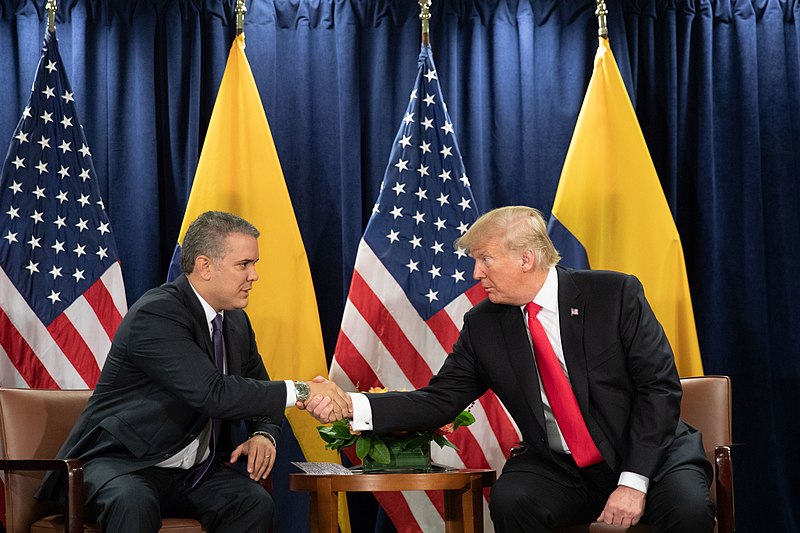
    President Donald J. Trump shakes hands with the President of the Republic of Colombia Ivan Duque Marquez prior to participating in a bilateral meeting Tuesday, Sept. 25, 2018, at the United Nations Headquarters in New York. (Official White House Photo by Shealah Craighead)

    Mr. Duque is widely considered to be a proxy for Mr. Uribe, the influential former president. The name Uribe alone evokes, for some Colombians, images of death squads, narco money, pro-business corruption, and the genocide of poor and indigenous people. For others, Uribe means safety, progress, prosperity, and victory over left-wing terrorists.

    In a surprise move, students from the National University of Colombia turned west to block the airport. The were stopped along the route by ESMAD, Colombia’s controversial riot police unit.[ii] The riot police fired teargas and stun grenades. The students held their hands up and chanted Sin violencia, both a statement of intent and an accusation directed at the riot police’s reputation for brutality.

    The rest of the marches continued on towards Plaza Bolívar, the historic centre of Bogotá. The protestors stood around in the early afternoon as the sky darkened. They listened to the shouts of the anti-government speeches from a stage at the top of the plaza. The trouble started when the rain started falling.

    Some of the protestors pulled down the black cloth which had been put up to protect the historic buildings around the plaza. They burned the black cloth in the shelter of stone pillars. The riot police cleared the plaza with teargas and stun grenades. The water cannon trucks, black and square and as slow as tanks from the first world war, rolled in and sprayed the remaining protestors out into the narrow streets nearby. They would fight their way back into the plaza and be repelled again many times over the next few hours.

    Fires burned at intersections

    The rain continued to fall. The televisions stations divided their screens in four to show the different riots across the city. The police sirens kept a high pitched background beat as the TV presenters described the rioting.

    Stones were smashed on the ground and broken into smaller pieces and thrown at the riot police. Teargas was fired, the canisters skipped over the wet streets with a trail of white smoke behind them. The smoking canisters were picked up and thrown back towards the riot police. The water cannon trucks were surrounded and attacked and sprayed with graffiti and pounded with stones.

    Bus stations were smashed up with hammers. Fires burned at intersections in working class suburbs, the smoke could be seen from across the city. People with hoods up and their faces covered with scarves ran at the riot police and ran back as the riot police advanced. They chased each other up and down the streets as it got dark.

    They chased each other up and down the television screens in the wealthier northern suburbs where nobody protests. Bogotá is used to such scenes. Rain. Plumes of teargas. Scarfs across faces. Smashed glass. Smashed stones. The streets in the rain soaked north, by comparison, were silent. Christmas trees flickered in the windows of multi-story apartment blocks. In the empty bars and the empty restaurants, bored staff watched the riots on television. There was an empty feeling in the streets like in the days after Christmas.

    For many people in the north of the city, they first heard the distinctive sound of what became known as the ‘Cacerolazo’ from their phones. They saw videos of pots and pans being banged in protest on WhatsApp or Twitter or Facebook.

    It was only when they opened their windows or stepped out onto their balconies that they heard the tinklings of this new protest in the buildings around them. Windows which had previously been lights on the skyline revealed people, more and more as the night went on, banging pots and pans.

    It was happening all over the divided city. Videos of it went viral. The president held a press conference to denounce the riots and the vandalism of the late afternoon. On the news, after he was finished, they showed[iii] the chess pattern lights of tall residential buildings ringing with the sound of the protest.

    In Cali, a large city in southwest Colombia, the protests had led to looting. The night had brought terror. They were calling it the ‘Cali Purge’. A curfew had been set. There were rumours of gangs breaking into houses. Vigilantes stood outside apartment buildings and shot at any shadow that moved.

    The protests in Bogotá continued on Friday. In the south of the city, a bus was hijacked. The videos would be replayed all day on television.[iv] The bus succumbed to a crowd of people after a failed attempt at reversing back down a muddy street. The bus was then driven around with the cheering crowd on board, while others cheered and chased after it. In CCTV footage, the bus was rammed through the shutters of a supermarket while the workers inside scrambled to reinforce a temporary barricade of cardboard boxes. The workers were buried under their fallen barricade as looters ran in through the gap in the crumpled shutter.

    ‘A shallow gene pool of private schools and country clubs’

    The Colombian elite are a paranoid, jittery group at the best of times. They are like pure-bred dogs; overly groomed, prone to neuroticism, easily panicked by outsiders. They mate in a shallow gene pool of private schools and country clubs.

    They survive on inherited money, stolen land, and a reflexive violence towards any sign of redistribution. In response to the looting and riots, the mayor banned the sale of alcohol and called a curfew. It would be the first curfew in forty-two years. By 9pm on Friday night, everyone in Bogotá would have to be inside.

    The dark, empty streets would terrify a city that is already afraid of the night. While Colombia may be associated with magical realism, Bogotá is a noir city. The dark here is heavy. The streetlights can barely push it out of their way. On a normal evening, people hurry home in the dark, rushing in out of the cold, fearful of the empty streets. It is a corrupt, distrustful city, marred by heavy rain and armed muggings and the memory of kidnapping, bombs, and assassinations.

    The rumours started after the curfew. As in Cali, gangs of looters were said to be invading apartment buildings and houses. The word went around by WhatsApp voice notes.

    On Twitter people posted their address and wrote some version of ‘they have entered my building, please help.’ The emergency police line went down. Alarms went off. Gunshots were reported. Families hid under their beds. Old ladies cried on the phone to relatives in the US. The purge had come to the wealthy, northern suburbs.

    The city has millions of desperate poor and they were out there in the dark. Some said they were gangs of Venezuelan refugees. Some said they were Colombians down from the hillside slums. Vigilante groups formed to defend their apartment buildings. They were shown on television, holding their broomstick handles and golf clubs and hammers and knives in poses of self-defence.

    The fear was illogical. Why loot an occupied apartment building when there were unguarded shops all over the city? Unless there was another motive. Unless the chaos and the curfew had unleashed the stored up hate that the poor feel for the rich. Unless it was revenge. Revenge for the way this city and this country had operated for years. It was guilt, as much as rumour, which caused the panic.

    The army was called in to save the northern suburbs. Tanks[v] rolled down the streets and were cheered by the vigilantes outside their apartment buildings. Helicopters hummed over the empty streets. They found nothing. By Saturday morning, it would be revealed to be fake,[vi] though no one knows yet what kind of fake.

    Some say the police had rounded up criminals in trucks and unleashed them on the residential buildings of the upper middle class. Some say it was all orchestrated by Twitter bots. Others believed that the story of the fake terror was itself fake.

    Dilan Cruz

    On Saturday afternoon, a protestor, Dilan Cruz, was shot[vii] in the head as he ran away from the riot police. He was hit by a non-lethal projectile, fired from a riot policeman’s shotgun. The eighteen-year-old lay in an induced coma on Saturday evening. Protestors stood in a circle around the blood stained spot where he had fallen. They laid wreaths. They held moments of silence. The other protests around the city were louder, buzzing with the energy of Saturday night. These days of chaos had been like a heatwave or a World Cup for many people – a break from the mundane.

    On the street outside the compound where the president has his private home, it was like the second night of a music festival.

    Jugglers got up on people’s shoulders and threw flaming torches back and forth. A band in the centre of the two lane street kept a drum beat which was matched and added to by everyone else, banging their pots and pans and dancing along. A police helicopter with its lights on watched from above. Fireworks shot up into the air and exploded. The crowd turned on their phone torches and waved them from side to side in a moment of semi-silence for Dilan Cruz.

    Riot police with their shields up stood in a line on the lawn in front of the compound. The other residents of the other expensive houses stood behind them, watching the party. Friends found friends in the crowd until it grew to block both sides of the street.

    Girls got up on their boyfriend’s shoulders and waved homemade protest signs. People bought beer from a small shop nearby. The smell of weed was sewn into the air like a musical note. The crowd chanted, to the rhythm of a drum beat, ‘A parar para avanzar, viva el paro nacional’ (To advance we must stop, long live the national strike). The party went on until around 2am when the crowd grew small enough to be tear gassed by the riot police.

    Epa Colombia

    Monday brought more protests and more stories. Epa Colombia, a Youtuber who first became famous for saying ‘Epa Colombia’, had filmed herself smashing up a bus station with a hammer during Thursday’s marches. She became a symbol for what some considered to be the mindless vandalism of the protests. She was arrested,[viii] fined, and banned from all social media.

    Fifty-nine Venuezalans were deported[ix] by military plane. While they were charged with looting, their deportation was a symbolic act, a sign of the anti-Venezuelan feeling which had developed around the protests. A soldier recorded a video in support of the strikes, it went viral, he took his own life[x] out of fear over what might happen.

    On Monday night, Dilan Cruz died. It made international news, which is unusual. Colombia normally gets an easy ride from the anglophone media.[xi] It is written about as an up and coming tourist destination,[xii] if it’s written about at all. The systemic murder of social leaders is ignored, while Colombia is referred to as a foodie paradise.[xiii]

    Marches in Hong Kong and Caracas make front pages, while bigger protests in Bogotá are rarely mentioned.

    On Tuesday, union leaders called another national strike for the following day. A video went viral on Tuesday night. It showed a water cannon truck, as usual, spraying protesting students off the motorway in front of the national university. The students walked towards the truck with their hands raised. The truck reversed.[xiv]

    The national strike on Wednesday brought thousands onto the streets again. The students took over the main motorway. They walked north and were cheered as they went. They got to the edge of the city around 9pm. The riot police cornered about two hundred of them in quiet streets near the motorway. They were beaten and tear gassed. Many students were reported to be missing the following morning.[xv] One was seriously injured.

    There was another national strike on the following Wednesday, 4th of December. Thousands marched again, but the government continued to implement its neoliberal agenda.

    Normality, corrupt and violent and internationally accepted, appears to have been restored. The sound of pots and pans banging has grown faint. The streets no longer buzz with the feeling that anything is possible. There are rumours, though, of more strikes to come. The beat of ‘A parar para avanzar, viva el paro nacional’ is stuck in the memory of the city like an earworm. There are many who still listen for it on these quiet nights between protests.

    [i] Untitled, ‘Colombia defense minister resigns amid pressure over bombing casualties,’ Reuters, November 6th, 2019, https://www.reuters.com/article/us-colombia-politics/colombia-defense-minister-resigns-amid-pressure-over-bombing-casualties-idUSKBN1XG36K

    [ii] Untitled, ‘Colombianos exigen desmontar el Escuadrón Móvil Antidisturbios (Esmad) tras 20 años de represión homicida,’ Globovision, November 30th, 2019, https://globovision.com/article/colombia-protestas-esmad-manifestaciones-violencia

    [iii] El Tiempo, ‘Histórico cacerolazo se toma las calles de Bogotá | EL TIEMPO’, Youtube, November 21st, 2019, https://www.youtube.com/watch?v=AuekRtoKJfo

    [iv] Red MAS Noticias, ‘Red+ | Vándalos roban bus del SITP y rompen puerta de almacén para saquearlo,’ Youtube, November 22nd, 2019, https://www.youtube.com/watch?v=kbBYCjJP_UU&has_verified=1

    [v] Maria Fernada Pulecio U, @PulecioU, Twitter, November 23rd, 2019, https://mobile.twitter.com/PulecioU/status/1198106200845541377

    [vi] Untitled, ‘¿Cuentas falsas en Twitter inventaron disturbios en Cedritos durante toque de queda?’, November 23rd, 2019, NACION, https://www.bluradio.com/nacion/cuentas-falsas-en-twitter-inventaron-disturbios-en-cedritos-durante-toque-de-queda-233588-ie435.

    [vii] NoticiasUnoColombia, ‘El video que subió Dilan Cruz cuando marchaba pacíficamente antes de ser impactado’, Youtube, November 24th, 2019, https://www.youtube.com/watch?v=RxYq1UvUfTQ

    [viii] Noticias Caracol, ‘Epa Colombia tendrá que cerrar sus redes sociales,’ Youtube, November 29th, 2019, https://www.youtube.com/watch?v=3oQzQBP2M4o

    [ix] ‘Expulsan de Colombia a 59 venezolanos por actos vandálicos en Bogotá’, El Tiempo, November 25th, 2019, https://www.eltiempo.com/bogota/expulsan-a-venezolanos-por-actos-vandalicos-en-bogota-436974

    [x] Adriaan Alsema, ‘Soldier commits suicide citing stigmatization over support for Colombia’s national strike,’ Colombia Reports, November 26th, 2019, https://colombiareports.com/soldier-commits-suicide-citing-stigmatization-over-support-for-colombias-national-strike/

    [xi] Nell McShane Wulfhart, ‘36 Hours in Bogotá’, New York Times, December 27th, 2018, https://www.nytimes.com/2018/12/27/travel/what-to-do-in-bogota.html

    [xii] Brooke Porter Katz, ‘Five Places to Go in Bogotá,’ New York Times, December 5th, 2018, https://www.nytimes.com/2018/12/05/travel/five-places-to-go-in-bogota.html

    [xiii] Paul Richardson, ‘’You get five countries for the price of one’ – how Colombia became a foodie superpower,’ The Telegraph, January 8th, 2019, https://www.telegraph.co.uk/travel/destinations/south-america/colombia/colombia-foodie-gastronomy/

    [xiv] Joshua Potash, ‘Student protesters in Bogota, Colombia forcing police to retreat.’ Twitter, November 27th, 2019, https://twitter.com/JoshuaPotash/status/1199762726324752386

    [xv] Adriaan Alsema, ‘20 students missing’, 1 injured after US endorsement triggers brutal repression of Colombia’s peaceful protest,’ Colombia Reports, November 27th, 2019, https://colombiareports.com/20-students-missing-1-injured-after-us-endorsement-triggers-brutal-repression-of-colombias-peaceful-protest/

  • Public Intellectual Series: Michel Foucault

    I wrote what follows prior to the Covid-19 pandemic, and have been prompted to re-read all of Michel Foucault’s work, including his lectures and digressions. It seems to me that the following is worth emphasizing:

    1. The concept of the Panopticon, Foucault borrowed from Jeremy Bentham is increasingly prominent in the wake of this virus that has accelerated the introduction of a system of mass surveillance.
    2. Inappropriate behavior is being re-defined to encompass ordinary sociability, while once cherished liberties are easily forgotten. A state of derealisation is upon us.
    3. Madness may now be redefined, leading to detention under draconian (anti-terror) laws for anyone perceived as deviant, subversive or even non-conformist in an ever-narrowing consensus. People who do not behave, act or dress in a specific way are now labelled ‘mad’. People who oppose draconian laws are ‘mad’. Maybe even human rights lawyers will be locked up.
    4. The media and other vectors of public opinion manage the message to ensure compliance and control.
    5. The concept of punishment has been internalized as a regime of prolonged social distancing and self-isolation undermines humanistic instincts. An ever more compliant and fearful population will welcome the Panopticon.

    David Langwallner, July, 2020.

    Introduction

    I have previously quoted a passage from Noam Chomsky, which acutely surveys the post-structuralist origins of our present Post-Truth condition. These words are worth recalling once again:

    There are lots of things I don’t understand – say, the latest debates over whether neutrinos have mass or the way that Fermat’s last theorem was (apparently) proven recently. But from 50 years in this game, I have learned two things: (1) I can ask friends who work in these areas to explain it to me at a level that I can understand, and they can do so, without particular difficulty; (2) if I’m interested, I can proceed to learn more so that I will come to understand it. Now Derrida, Lacan, Lyotard, Kristeva, etc. — even Foucault, whom I knew and liked, and who was somewhat different from the rest — write things that I also don’t understand, but (1) and (2) don’t hold: no one who says they do understand can explain it to me and I haven’t a clue as to how to proceed to overcome my failures. That leaves one of two possibilities: (a) some new advance in intellectual life has been made, perhaps some sudden genetic mutation, which has created a form of ‘theory’ that is beyond quantum theory, topology, etc., in depth and profundity; or (b) … I won’t spell it out.[i]

    A point worth emphasis from the thinly disguised contempt he displays towards this deceitful movement is Chomsky’s regard for Michel Foucault as “different from the rest” – a superior calibre of intellect to the rest. A hedged concession admittedly, but one I happen to share.

    Alone among Post-Modernists, Foucault’s methodology was empiricist and historicist. Rather than relying on incomprehensible prose and bizarre generalisation he adopted inductive reasoning. As an historian of ideas, we don’t simply find him inventing absurd abstractions, but analysing real, existing data.

    Foucault’s ‘critical philosophy’ undermines universalist claims by exhibiting how they are the outcome of contingent historical forces, and are not scientifically grounded realities

    Madness and Civilisation

    In Madness and Civilisation, (1961, Librairie Plon) Foucault examines conventional understandings of mental illness, arguing madness and reason are categories first developed in Enlightenment thought. He sees madness as a product of the Age of Reason, the excluded ‘Other’ against which reason defines itself.

    His thesis is that the practice of confining the mad is a transformation of the medieval practice of confining lepers in lazar houses, an institutional structure of confinement already in place when the modern concept of madness as a disease emerged, even if confining those defined as such to institutions was a break with the past.

    Focusing on this transitional period, Foucault argues that in its infancy, or nascence, reason is a concept that defines itself in opposition to an ‘other’ of madness.

    As he explains:

    What is originate is the caesura that establishes the distance between reason and non-reason; reason’s subjugation of non-reason, wresting from it its truth as madness, crime, or disease, derives explicitly from this point.

    Thus truth of reason is found where madness arrives in place of non-reason, and differences are defined in terms of oppositions. Thus, the meaning of reason is defined by the meaning of madness.

    Foucault argues that if we are to insist upon reason we must not be mad, and so protect ourselves from what we are not. He notes that the confinement of the mad in asylums is a product of the mid-seventeenth century, and that it is no coincidence that the process of confinement developed in conjunction with the Age of Reason. Thus madness operated as an ‘other’ to reason, and as products of Enlightenment thought.

    For Foucault: ‘[M]madness was an invention, a product of social relations and not an independent reality.’[ii]

    Of course that point can be expanded to our present age, with concepts of rationality and ideas on mental health shifting, augmented by social media, message management and outright thought control. The paradigm shift is towards an all-consuming neo-liberalism, and conformity reconfiguring human identity itself. Soon, I fear, even moderate liberalism might be deemed mad, recalling Chile in the 1970s, or even 1930s Germany.

    In my practice as a London-based barrister, increasingly, I find clients in disassociated and decrealised states. Social alienation is leading many to perceive themselves as passive onlookers in lives not truly their own. The ills of social dissatisfaction and structural curtailment of achievement leading to moderate or even severe depression.

    The unrealisable expectations of consumerism and its unattainable objects is creating individual neurosis and psychosis. In essence, pervasive neo-liberalism fosters madness.

    Forms of social sanitation and indeed sexual sanitation coupled with an excessive political correctness are thus criminalising deviant behaviour. We live at a time when judgment on those who are essentially normal is handed down by deviants; a spectator democracy where people have lost ownership of their lives. It’s as if we are in the Central London Hatchery and Conditioning Centre of Alduous Huxley’s Brave New World.

    Discipline and Punish

    In his other crucial text Discipline and Punish, (Gallimard, 1975) Foucault examines punishment through the ages, arguing that torture has simply been reconceived.

    He raises ever more pressing doubts about the hidden costs of a penal style that avoids visible coercion, instead seeking to transform ‘the heart, the thoughts, the will, the inclinations.’ Thus efforts to institute ‘less cruelty, less suffering, more gentleness, more respect, more humanity,’ have, according to Foucault, had the perverse effect of reinventing the entirety of modern society along the lines of a prison, imposing ever subtler, and insidiously punishing discipline. Not just on convicts, but also on soldiers, on workers, on students. Even the various professionals trained to supervise disciplinary institutions are not spared its effects. Corrective technologies of the individual have been refined, producing a double effect: a soul to be known and a subjection to be maintained.

    At the core of Foucault’s picture of modern ‘disciplinary’ society are three primary techniques of control: hierarchical observation; normalising judgment; and the examination. Thus, to a great extent, control over people is exerted merely by observing them.

    Further, modern disciplinary control is often concerned with a person’s failure to meet a required standard and in order to correct deviant behaviour. The impetus is not revenge, but reform, encouraging the individual to live by the dominant norms of society. Thus the phenomenon of normalisation is intrinsic to our society, e.g. national educational standards, standards-driven approval for drugs et al. It is encountered especially in control over whatever is perceived as excessively libertarian, including sexually ‘promiscuous’ lifestyles.

    The norm itself may of course be perverse.

    Foucault contends that as people are examined in schools and hospitals control is exercised over them in hierarchical fashion, with the application of normalising judgment. This is what he terms power/knowledge, which combines into a unified whole: ‘the deployment of force and the establishment of truth.’

    Further, force or control elicits ‘truth’ from those undergoing examination in conjunction with exercising controls over their behaviour. Knowledge is thus an instrument of power, and the goals of power and the goals of knowledge cannot be separated from knowing we control, and in controlling what we know.

    Yet the problem often lies with the knowers who know, but do not turn the lens on themselves.

    Google and Facebook now exercise control, not in top down fashion, but through a levelling user-generated mediocrity, where personal data is mined in order to influence consumer and political choices in a networked society, as they remould what it means to be an individual.

    The Panopticon

    In Discipline and Punish, Foucault is heavily influenced by Jeremy Bentham’s idea of the panopticon. Bentham imagined a glass prison in which prisoners were under continuous surveillance, and argued that by applying perpetual inspection to prisons, schools, factories and hospitals one might harmoniously co-ordinate self-interest and social duty. To Bentham this would lead to ‘the greatest happiness of the greatest number,’ even if are turned into automatons: ‘Call them soldiers, call them monks, call them machines: so they were but happy ones, I should not care.’

    Bentham’s Panopticon is, for Foucault, an ideal architectural model for modern disciplinary power in that each inmate is visible to a central power, and can be seen at any time. With inmates assuming their every act is witnessed, control is exercised internally.

    Foucault suggests that Bentham’s ideas, rather than being fanciful, have become paradigmatic in modern society. Unlike the power of sovereignty, which was often exercised violently, the power of discipline is mild, insidiously humane as it is exercised through discreet surveillance rather than overt coercion. Such supervision, according to Foucault, dissociates power from the body, leaving us compliant and normalised – ready to take orders from above. The effect was an ‘automatic functioning of power’ – ‘A perfection of power’ that tended, paradoxically, to render its actual exercise useless.

    Foucault elaborates on this in a 1978 interview:

    In my book on the birth of the prison I tried to show how the idea of a technology of individuals, a certain type of power, was exercised over individuals in order to tame them, shape them and guide their conduct as a kind of strict correlative to the birth of a liberal type of regime. Beyond the prison itself, a cerebral style of reasoning, focused on punishable deviations from the norm, thus came to inform a wide variety of modern institutions. In schools, factories, and army barracks, authorities carefully regulated the use of time (punishing tardiness, slowness, the interruption of tasks) activity (punishing inattention, negligence a lack of zeal); speech (punishing idle chatter, insolence, profanity); the body (punishing poor posture, dirtiness, lack in stipulated reflexes) and finally sexuality (punishing impurity, indecency, abnormal behaviour).

    He concludes Discipline and Punish with the view that:

    In a system of surveillance there is no need for arms, physical violence, material constraints. Just a gaze. An inspecting gaze, a gaze which each individual under its weight will end by internalising to the point that he is his own supervisor, each individual thus exercising this surveillance over, and against, himself. A superb formula: power exercised continuously and for what turns out to be a minimal cost.

    Bentham’s idea for a prison was only occasionally adopted and ultimately found to be inhumane. Kilmainham in Dublin stands as an isolated example. To penetrate its inner sanctum is to see how, from every vantage, the prisoner is being watched. This time of domination by (anti-)social media is not so very different.

    Truman Show

    Now even a propensity for mildly deviant behaviour is under the overarching supervision of Big Brother – the virtual reality Truman Shows of our daily existences. We have become pieces on a chessboard controlled by the all-powerful corporate influencers, the ultra-rich and the bureaucratic state. These are the worst of times that Foucault saw coming.

    For Foucault the exercise of power in modern societies is complex – domination and rights are not only derived from the power of a sovereign institution of subjects, but are also the product of the lines of force arising from social relations. Subjects are not just determined from above, but are constituted within the system. Thus he explicitly rejects the positivist/sovereign as the source of all-encompassing authority in our society:

    My aim has been to give due weight … to the fact of domination to expose but its latent nature and its brutality. I then wanted to show not only how right is, in a general way, the instrument of domination – which scarcely needs saying – but also show the extent to which, and the forms in which, right, (not simply the laws but the whole complex of apparatuses, institutions and regulations responsible for their application) transmits and puts in motion relations that are not relations of sovereignty, but of domination. Moreover, in speaking of domination I do not have in mind that solid and global kind of domination that one person exercises over another, or one group over another, but the manifold forms of domination that can be exercised within society. Not the domination of the king in his central position, therefore, but that of his subjects in their mutual relations: not the uniform edifice of sovereignty, but the multiple forms of subjugation that have a place and function within the social organism … In other words, rather than ask ourselves how the sovereign appears to use in lofty isolation. We should try to discover how it is that subjects are gradually, progressively, really and materially constituted through a multiplicity of organisms, forces, energies, materials, desires, thoughts … We should try to grasp subjection in its material instance as a constitution of subjects. This would be the exact opposite of Hobbes project in Leviathan, and of that, I believe, of all jurists for whom the problem is the distillation of the single will – or rather, the constitution of a unitary, singular body, animated by a spirit of sovereignty … I would say that we should direct us researches on the nature of power not towards the juridical edifice of sovereignty, the state apparatuses and the ideologies which accompany them, but towards domination and the material operators of power, towards forms of subjection and the inflections and utilisations of their localised systems, and towards strategic apparatuses. We must eschew the model of Leviathan in the study of power. We must escape from the limited field of juridical sovereignty and state institutions, and instead base our analysis of power on the study of the techniques and tactics of domination. 

    Critical Appraisal

    William Davies applies this to an understanding of law and politics:

    Foucault suggests that we abandon the juridical analysis of power, which has emphasised the notion of sovereignty. If we think about law as something which is in itself powerful, something which supplies the answers to disputes and orders social behaviour according to the intentions of a powerful body of lawmakers and judges, we are, perhaps missing an important point. This is simply that many other systems of power, many other systems of meaning and value in society, interact with the legal system. It is not just institutionalised law which says no, or which orders behaviour, or which punishes us for our transgressions. There are, for instance, a multitude of social prescriptions, which order behaviour and the way, we think about the world. Social norms cannot be ultimately distinguished from institutionalised law. The way that a law is applied depends on the interpretation of facts in a case, and therefore, ultimately on the social values and assumptions which go into making that interpretation. Power in the legal system cannot therefore be described simply in terms of hierarchy of people with authority to make decisions, or of laws with the potential to determine disputes: though both the hierarchy of people and that of laws certainly exist, they are shot through with social meanings and systems of relationships which cannot be reduced to one-dimensional descriptions.

    Thus what find now is no longer a top-down state leviathan, but micro-management, corporate and internet brainwashing, the regulation and management of behaviour and expectation, which is re-defining ‘appropriate’ conduct We the wretched of the earth, the ordinary citizen, the disengaged are reduced to surviving under controlled conditions in a spectator democracy. ‘We the many’ are the collective other. ‘They the few’ powerful watch over us, deciding our fate in ever subtler and more insidious ways.

    This leads to political parties becoming increasingly contorted and nugatory, and NGO’s dispersed and un-coordinated. It is not so much a democratic deficit as a democratic void, as we are reduced to deciding who watches over us.

    Foucault saw all of this clearly. His individual response was to embark on personal hedonism, which accelerated his self-destruction – a personal cri de coeur in favour of libertarianism. But this should have been tempered by greater self-discipline, as his excesses diminished his achievements and led to an early grave.

    Solipsistic Sexuality

    Nonetheless, his contextual analysis of sexuality is also of great relevance to the present age. In effect neo-liberalism leads us to focus on private development, awakening sexual libertarianism to negate the political and accentuate further disengagement. He also saw the possible return of fascism.

    But at least, as Foucault points out, social institutions and structures, being contingent, are susceptible to change. Current trends will surely will pass eventually, albeit saving oneself in the meantime is a necessity. Our existences are finite after all.

    The other option is to migrate to Iceland, before being compelled to do so:

    If ever I hear again of any lapse from a proper standard of infantile decorum, I shall ask for your transference to a sub centre- preferably to Iceland.[iii]

    [i] Noam Chomsky, ‘On Postmodernism, Theory, Fads, Etc’ no date (probably 1996), at http://199.172.47.21/lbbs/forums/ncpmlong.htm>

    [ii] James Miller, The Passion of Michel Foucault, Simon and Schuster, New York, p 103.

    [iii] Aldous Huxley, Brave New World, Chatto and Windus, London, 1932 p.85
  • Irish Eyes Unsmiling: Have I Got News For You Brexit-Election Special!

    Bob Hope once wisecracked: ‘the choice between Carter and Regan was not so much the choice of the lesser of two evils, as the evil of two lessers.’ In Brexit-land that joke has transmuted into one about the difference between Boris Johnson and Jeremy Corbyn.

    The Irish media, as ever, are looking at this election through a narrow prism of self-interest. A hard or soft border; opposition of the DUP to a United Ireland; the noxious brew of tribalism and nationalism.

    The sideshow of whether the North will be within a Customs Union occludes profound questions. A Tory Government minister has announced, in effect, that within fourteen months all E.U. nationals will have to ‘regularise’ their residency status, with a discretionary right to withhold a leave to remain.[i] That is the really serious repercussion of Brexit for hundreds of thousands of Irish citizens living in the U.K..

    Michael Gove – a man for whom the term Machiavellian might have been invented – whose statecraft is overlaid with a pretence of humanity, alongside juvenile humour, murmurs about repatriation of immigrants après la deluge.

    With the extradition of ‘undesirables’ proceeding apace, historic crimes will be used to determine the right to continue to reside – ‘at her majesty’s pleasure.’ I have never taken a word of Gove’s seriously – intellectually that is – though I do have a soft spot for his comedic turn. The phrase an Englishman’s word is his bond, need not necessarily apply to Scottish Tory – et tu Michael.

    Michael Gove, ‘for whom the term Machiavellian might have been invented’

    It is a noticeable in my criminal defence representations that extradition matters which, hitherto, were settled as a matter of course are now revived, particularly where Eastern Europeans are concerned. Spengler’s proto-fascist text The Decline of the West (1918-22) seems a la mode. Across the world, we witness a rise in irredentist racism stigmatising ‘degenerate’ races and lifestyles, the demonization, exclusion and elimination of the ‘other.’ 

    Decisions as to who can stay and who is showed out the door are based, increasingly, on an economic calculus – a cost-benefit analysis of life – meaning a corrupt Russian oligarch is likely to get the nod ahead of a political dissident.

    The fool in King Lear advises: Have more than you show. Speak less than you know, an approach that Boris Johnson has very much taken to heart. After Brexit, in all likelihood, the National Health Service will be on the table – Trumping smokescreen denials aside – no doubt involving the nefarious orc that is Steve Bannon. Soon free medical treatment will be restricted to U.K. nationals, permitting an insidious soft entry, engineered by Big Pharma Americans, before the ultimate coup de grâce of privatisation.

    Johnson’s commitment to the NHS during the election campaign is purely tactical; indeed he once described it as a ‘top down, monopolistic’ system.[ii]

    The lethal trade agreement – T.T.I.P. all over again –  will facilitate Canadian and American corporations to sue the living daylights out of employers who dare to extend pensions, health care and a quality of life. I have no doubt these restrictions will form part of any trade deal.

    What we are seeing is the imminent dismantling of the welfare state, the end of the Bevanite social compact, and abandonment of Keynesian intervention.

    Brexit is, however, a complex conversation, also based on the failure of the European Union to live up to its principles. It has imposed a savage, doctrinaire austerity that has seriously undermined the social structure of Ireland and Greece. So really Remain is just a lesser of two evils, with Germanic autocratic lunatics at the helm.

    British decency misguidedly seeks a degree of moderation, fair play and reason in the European Union. Good luck with that. Brussels is a hotbed of lobbyists and bureaucrats, playing career snakes and ladders.

    Brexit was born of a perception that multiculturalism and mass immigration had failed. It’s a sad irony that the uncritical endorsement of open borders by the left actually contributed to people trafficking, money laundering and a heightened terror threat. Moreover, visceral dislike of Israel has engendered antisemitism on the fringes of the Labour Party, which Corbyn failed to stamp out adequately.

    Neo-liberalism is a false paradigm, voodoo economics issued by the church of scientology. It is not just a European consensus, but a world delusion. At least the U.K. is now debating the issues.

    The Irish ambassador for neo-liberalism is that bland consumerist bon viveur David McWilliams. In recent articles he has hailed the Berlin Wall as a triumph of capitalism for Ireland.[iii] Now he crows in Dublin wine bars to pseudo-sophisticates about corporatism providing jobs for tech workers who pay most of their salary in rents to what remains of the bourgeoisie – his people.

    ‘bland consumerist bon viveur David McWilliams’

    Well David you and your comprador class of charlatans facilitate the siphoning of funds into Canadian and American vulture funds fronted by Goldman Sachs. In Ireland the ‘powers that be’ will keep workers on short term contracts, without access to affordable housing or sustainable futures;  all for the benefit of a shrinking band of lightweight neophytes, who are Masters of an increasingly desolate Universe.

    Like Miriam O’ Callaghan, McWilliams is the perfect parrot of Ryanair-consumerism, a bland presentational non-entity facilitating disempowered and entrenching futility in people’s lives. With preppie awfulness he has the audacity to quote Jonathan Swift, without ever absorbing the contents of his most famous tract on Malthusian Liquidation: ‘A Modest Proposal’, which bitingly satires the Mercantilism of his time that we are returning to.

    By and large, the British are less prone to seduction by false prophets. Though the right to ridicule, so intrinsic to democracy, as Ronald Dworkin noted,[iv] is being eroded by light entertainment, sound bites and bland criticism.

    Johnson is the poster boy for this decline. A debased British culture is now offering a steady stream of safe comedy such as ‘Have I Got News for You,’ where politicians metamorphize into comedians or vice versa. Johnson has ridden the wave of light entertainment, Brit Pop and laddish buffoonery.

    Dazzling but superficial wit and repartee have crafted a kind of telethon effect spring-boarding him into the highest office in the land.

    The endless womanising and boorish behaviour appeal to a ‘Jack the Lad’ Skinner and Badiel constituency. But reminders of Trumpian excess has been turned into an asset for political advancement. Philandering did no harm to Clinton either, who began the rot. The vulgar jocks have won. Bannon and Trump are merely an extension of Bubba, as is Johnson.

    So the horror expressed by Heseltine, Clarke, Major and other more civilised Tory grandees falls on deaf ears.

    Corbyn is the antithesis of a vulgar jock, but wooly thinking on multi-culturalism, nostalgic cloth-cap socialism, and the endorsement of political correctness has handed the Right all the ammunition they crave.

    What we need is a return to the kingdom of the just and the wise, but forget about it. Corbyn is, nonetheless, the lesser of two evils. A controlled Remain and rejection of Brexit alongside an emasculated Corbyn, under supervision by coalition partners, looks to be the best outcome.

    Who knows, perhaps the outcome will even involve – you first read it here – that most accommodating of human beings Mr Gove. Flexibility was always something Machiavelli recommended in his Prince. But however you vote be careful for what you wish for this Christmas.

    [i] Mathew Weaver and Amelia Gentleman, ‘EU nationals lacking settled status could be deported, minister says’, The Guardian, October 10th, 2019, https://www.theguardian.com/politics/2019/oct/10/eu-nationals-lacking-settled-status-could-be-deported-minister-says

    [ii] Twitter, ‘Tory Fibs’, December 5th, 2019, https://twitter.com/ToryFibs/status/1202566322078584832

    [iii] David McWIlliams, ‘Ireland was the big winner from the fall of the Berlin Wall’, Irish Times, November 9th, 2019, https://www.irishtimes.com/opinion/david-mcwilliams-ireland-was-the-big-winner-from-the-fall-of-the-berlin-wall-1.4075841?mode=sample&auth-failed=1&pw-origin=https%3A%2F%2Fwww.irishtimes.com%2Fopinion%2Fdavid-mcwilliams-ireland-was-the-big-winner-from-the-fall-of-the-berlin-wall-1.4075841

    [iv] Ronald Dworkian, ‘The Right to Ridicule’, March 23rd, 2006, New York Review of Books, https://www.nybooks.com/articles/2006/03/23/the-right-to-ridicule/

  • Jeremy Corbyn, Percy Shelley and Ireland

    The Irish media generally looks askance at Jeremy Corbyn’s ‘radical socialist manifesto.’[i] An historically warm relationship with Sinn Féin, Brexit neutrality, and lifelong commitment to the redistribution of wealth receive a cool reception in reports and commentary, while grossly inflated charges of Antisemitism within the Labour Party are threaded through articles.[ii]

    Yet the Labour leader belongs to a tradition of English radicals with an abiding sympathy for Ireland. His anti-colonial, republican and Chartist outlook has also brought commitment to the downtrodden Palestinian people, and opposition to the machinations of the arms industry in Britain – which is the second largest exporter in the world, including to dictatorships such as that ruling Saudi Arabia.[iii] Corbyn’s enduring idealism is reminiscent of the poet and radical Percy Bysshe Shelley (1792-1822).

    In fact Corbyn drew the slogan ‘we the many, they the few’ that resonated so powerfully during the 2017 General Election, from the Romantic poet, who drowned tragically off Lerici in Italy at the age of just twenty-nine.

    These lines from Shelley’s poem ‘The Masque of Anarchy’, were written in the wake of the Peterloo massacre of 1819, when cavalry charged into a crowd of over sixty thousand unarmed civilians, killing eighteen, who had gathered to demand the reform of parliamentary representation. The atrocity actually led to the foundation of The Guardian newspaper, and was the subject of a Mike Leigh film in 2018.

    Shelley calls on the downtrodden people:

    Rise like Lions after slumber
    In unvanquishable number,
    Shake your chains to earth like dew
    Which in sleep had fallen on you —
    Ye are many — they are few.

    The poet’s links to Ireland extend beyond his second wife Mary Shelley’s maternal grandmother’s Ballyshannon origins; or the Irish painter Emilia Curran’s 1819 iconic portrait. Having been expelled from Oxford in 1811, after authorities discovered him to be the author of a pamphlet entitled ‘The Necessity of Atheism’ – the first such argument printed in England – he went on to display an abiding interest in ‘John Bull’s Other island’.

    At the end of the Napoleonic War Ireland’s plight remained a vital cause for English radicals, at a time when the Irish population – in the midst of a Malthusian demographic crisis after colonisation and the introduction of the potato at the start of the seventeenth century – was almost half that of England’s. Soon after expulsion from Oxford, Shelley travelled to Dublin in 1812, along with his first wife Harriet, with whom he had just eloped.

    The young poet was greatly perturbed by the poverty and inequality greeting him in a city whose wealth and status had been greatly diminished by the Act of Union of 1801, which meant Irish M.P.s took their seats in Westminster not Dublin. He wrote: ‘I had no conception of the depth of human misery until now. The poor of Dublin are assuredly the meanest and most miserable of all.’[iv]

    His experience of Ireland appears to figure in what he described as his ‘poetic education,’ in the preface to the long poem ‘Laon and Cythna’ (1818): ‘I have seen the theatre of the more visible ravages of tyranny and war … the naked inhabitants sitting famished upon their desolated thresholds.’[v]

    The precocious nineteen-year-old addressed the Catholic Committee, containing the dying embers of the United Irishman movement, in what is now Smock Alley Theatre in Dublin. Asserting a pacifism that is also prominent throughout the current Labour leader’s career, he urged: ‘In no case employ violence, the way to liberty and happiness is never to transgress the rules of virtue and justice. Liberty and happiness are founded upon virtue and justice. If you destroy the one you destroy the other.’

    The future leader of Catholic Emancipation, Daniel O’Connell, is believed to have been at the meeting, although he may not have been present for Shelley’s speech itself. O’Connell shared a distaste for armed conflict, a view which prevailed as the mainstream approach in Irish nationalism until World War I.

    Shelley’s sympathies lay with the historically oppressed Catholic community in Ireland, just as Corbyn’s lay with Northern Irish Catholics during the Troubles. There is little doubt that Shelley would share Corbyn’s principled opposition to Trident, Britain’s thirty-billion-pound nuclear weapons programme.

    Another link between Shelley and Ireland is that he completed what is considered his most revolutionary poem ‘Queen Mab’ while holidaying on Ross Island on Killarney Lake. This strident work, which he later partly disavowed, became a standard text for English socialists, including an approving Karl Marx. In this we discover a condemnation of commerce: ‘beneath whose poison-breathing shade / No solitary virtue dares to spring.’

    Corbyn’s antipathy to big business has long antecedents, therefore, in British culture, albeit the trenchant views on the subject of Shelley’s near contemporary ‘the Father of Economics’ Adam Smith (d. 1790) are generally overlooked: ‘People of the same trade seldom meet together, even for merriment and diversion, but the conversation ends in a conspiracy against the public, or in some contrivance to raise prices.’ A suspicion of commercial self-interest in politics is well founded.

    Shelley has been an inspiration to a host of Irish writers including W.B. Yeats who claimed Shelley shaped his life,[vi] as well as Sean O’Casey who described himself as a Shelleyan Communist. Another devotee George Bernard Shaw described Shelley approvingly as: ‘a republican, a leveller, a radical of the most extreme sort.’

    Shelley was an inspiration for another of Shaw’s lifelong causes: vegetarianism,[vii] which the former laid out in an 1813 book: A Vindication of Natural Diet, although the term itself only came into being in the 1840s. Until that point anyone renouncing flesh was referred to as being a ‘Pythagorean’, after the Greek philosopher and mathematician of Antiquity, Pythagoras.

    Similarly, Jeremy Corbyn has been a vegetarian for almost fifty years. Considering the influence of the Irish livestock lobby on mainstream Irish media, this may have aroused further suspicion. Corbyn has, however, tended to play down that feature of his politics, perhaps forewarned by George Orwell’s condemnation of sandal-wearing vegetarians ‘burbling about dialectical materialism’ in The Road to Wigan Pier.[viii]

    Nonetheless, socialists such as Corbyn are stigmatised as forming part of a ‘north London, metropolitan, liberal elite’ by right-wing Populists such as the Home Secretary Priti Patel,[ix] who herself previously suggested using the possibility of food shortages in Ireland to force the E.U.’s hand over Brexit.[x] Corybn’s lifetime commitment to the redistribution of wealth, including resistance to austerity, may be the fruition of Shelleyian idealism: ‘a consciousness of good, which neither gold / Nor sordid fame, nor hope of heavenly bliss / Can purchase.’[xi]

    Corbyn, like Shelley before him, might have appeared naïve at times, including in his approach to Ireland. But he could yet emerge as the first British Prime Minister to feel genuine remorse for the damage wrought by British colonialism on Ireland. Moreover, notwithstanding the ongoing instability of the European project in the wake of Brexit, the genuine warmth he feels towards Ireland may harmonise relations between the peoples of these islands – the vast majority of whom have suffered under the yoke of tyrannical government over the course of a shared history.

    I for one dearly hope the British people “Rise like Lions after slumber / In unvanquishable number.” and vote Labour in the General Election on December 12th.

    [i] Simon Carswell, ‘It’s a means to an end – I want Brexit’, Irish Times, December 6th, 2019. https://www.irishtimes.com/news/world/uk/uk-election-it-s-a-means-to-an-end-i-want-brexit-done-1.4105840

    [ii] See, Finn McRedmond, ‘ The Labour leader seems temperamentally incapable of apologising for the anti-Semitism that has wracked his party,’ – ‘Political rot has spread from US to UK,’ Irish Times, December 6th, 2019, https://www.irishtimes.com/opinion/political-rot-has-spread-from-us-to-uk-1.4105894:

    [iii] Dan Sabbagh, ‘UK reclaims place as world’s second largest arms exporter’, The Guardian, July 30th, 2019,  https://www.theguardian.com/world/2019/jul/30/uk-reclaims-place-as-worlds-second-largest-arms-exporter

    [iv] Percy Bysshe Shelley, ‘An Address to the Irish People’, 1812, https://www.bl.uk/collection-items/p-b-shelleys-address-to-the-irish-people,

    [v] Author’s own recording: https://soundcloud.com/frank-armstrong-649911741/shelleys-preface-to-laon-and

    [vi] W.B. Yeats ‘The Philosophy of Shelley’s Poetry’, 1900, http://www.yeatsvision.com/Shelley.html.

    [vii] Percy Bysshe Shelley, ‘A Vindication of Natural Diet’, 1813, http://www.animal-rights-library.com/texts-c/shelley01.htm

    [viii] George Orwell, The Road to Wigan Pier, Part 2, 13, http://www.telelib.com/authors/O/OrwellGeorge/prose/RoadToWiganPier/wiganpierpart_13.html

    [ix] Daniel Sugarman, ‘Why I don’t think Priti Patel’s reference to “north London” was an anti-Semitic dog whistle’, October 3rd, 2019, New Statesman, https://www.newstatesman.com/politics/uk/2019/10/why-i-don-t-think-priti-patel-s-reference-north-london-was-anti-semitic-dog

    [x] Gráinne Ní Aodha, ‘Tory MP suggests using possible ‘no-deal’ food shortages to force Ireland to drop the backstop’, December 7th, 2018, https://www.thejournal.ie/brexit-threat-food-shortages-ireland-4381228-Dec2018/

    [xi] ‘P. B. Shelley, ‘Queen Mab,’ Book V

  • Randal McDonnell – ‘I’d gladly strike the first match at his cremation and spit paraffin on his embers’

    I was sickened to read a fawning obituary to an absolute creep and impostor Randal McDonnell. It fails to mention that he was a predator and pederast with an insatiable lust for young boys.

    He made a misery of my late teenage years and I carried for way too long the shame and guilt for what he did to me as though it had been my responsibility.

    Twice he seriously abused me, even once video recording the abuse so he could press pause and marvel at the highlights of his wickedness. I didn’t have the luxury of pressing pause on what was happening to me, nor was I later able to scrub the tape of my life clean.

    In my own delusional way, I put it all down to a wild adventure, but I know now that was just a hopeless coping mechanism. They say not to speak ill of the dead but I’d gladly strike the first match at his cremation and spit paraffin on his embers. When a few years back I wrote these lines, it was him I was referring to. Go rot in hell!

    ***

    As the calendar grew thinner and the water colder, I swam further out into October and November’s waves….cold. Cycling down to the Forty Foot on the green bicycle my mother had bid on in Buckley’s auctioneers, Sandycove. The bike locked with a combination of my age my year in school.

    Undressing, the breeze all salty around my jangling Autumn bollox. Holding the hand rail, my feet on the went granite, down into the waves, nerve enough to swim out to the buoy.

    Arms of rock on either side, at low tide, laced with green weed, kelp and periwinkles, full tide, they were harbour champions, granite guardians.

    And I swam out beyond their embrace, a wink from the Bailey light house, staining their wet side in crushed orange, a neon wink from Howth.

    The currents singing their own wild liquid song and me tossed about like drift wood, soaked, fucked, dream song. My arms, all fifteen years of them, ploughing through the dark spilt ink waves.

    Into the neon Dún Laoghaire, sea-salted, cold blankets of water.

    I saw the spires of the Town Hall, Saint Joseph’s and Saint Michael’s, the clock on the Town Hall, a tiny pale moon chained to Time. The lit front rooms of the houses that looked out on Scott’s Man’s Bay as I swam further into the night.

    And there I saw him first, a shadow on the shore. Me bobbing like a seal, him, fawn coat, tall and dry.

    Late night eel in the water, I weaved through the water, home to the railing that would hoist me back to land again.

    And there he was with his hard leather glove applause, chiming with the wave lapped steps.

    Shaking with the cold, I stepped out of the water.

    “You are a brave young man, you must be freezing…such a brave young man”

    He had my towel, all ready in his hands. Up the jelly fish licked steps I climbed towards that blue Dunne’s Stores towel that had just a while ago been in my bag.

    Rubbed down like a gold medal otter. Who was he? Why me?

    “Such a brave young man, and so cold, let The Count warm you up”

    My shoulders first, then my shivering ass. The Count knew well how to warm up a trembling lip biting lad.

    I saw the smudged lights of Dalkey as he grabbed my pleasure.

    I came with shame. My white seed floating on a wave that bit my toes with a fresh assault of cold. Who was he? And why did I let him? He held me tight around the neck as I wept into the waves, tears in salt water. His huge leather gloved hand over my mouth, a dark cloud hiding the moon. Forty Feet of silence and salt sprayed shame.

    I dreamt of a knife, a blade that would rise out of the water, a sharp tool of the tide that would slice him.

    I passed out, so as not to feel his Terra Ferma paws on me. I am a wave not a boy. I am not here.

    And then he let me go and all fifteen years of me clung to the rail that led down to the deep and I watched my vomit float, an angry broth on on the night water…..

    Obituary: ‘The life and death of Randal MacDonnell – the most remarkable Irish figure you’ve probably never heard of’ – Independent.ie