Blog

  • Poetry Recording – Paul Curran

    Try mph

    To Payney, Tinpan, JJ, Tom P., Tom C., Col, Ry, Peewee

    I know the car I would most love to own:

    Well red, early seventies TR6,

    That beautiful, British-built, roadster mix,

    Boldly bearing the boxed badge of renown –

    Great jewel in Triumph’s commercial crown –

    Two point five litre, manual, straight-six,

    Mint restored, flying new like a phoenix,

    To be roared, roof down, roared round my home town.

    Not for the dropping into overdrive –

    Instrumentation alive on the dash –

    Nor for near-by-gone auto heritage.

    More for the pace and the raw expressive

    Chase and catching of oneself off guard – Flash! –

    Much unfussed by life’s high, rising mileage.

    Paul Curran was born in Stratford-upon-Avon in 1975. He holds a degree in English Language and Literature from the University of Oxford and a Masters Degree from the Royal Central School of Speech & Drama. He has worked widely as a professional actor. His Only Sonnet loosely follows the pattern of the seasons, comprised of 100+ ‘alternative’ sonnets; Repeat Fees and its 80 sonnets and longer poems was published in July 2017.

  • Review: Frank Connolly’s A Conspiracy of Lies

    Dublin and Monaghan people remember where they were on the 17th May 1974, the day three bombs exploded in Dublin and one in Monaghan. A UCD undergraduate at the time, I was in the library in Belfield when news of the bombs in Parnell Street, Talbot Street and South Leinster Street came through.

    We were shocked. Some rushed from the library. Others, myself included, obeyed a caution from the librarian to stay put. My father’s office at 1 Clare Street faced onto South Leinster Street. When eventually I reached my mother by telephone, I learned he was OK. The blast had smashed all the windows in his office and knocked him over. Otherwise, he was unhurt.

    Forty-five years on and no-one has been charged with an offence relating to the bombings. Every year there is a commemoration in Talbot Street, at the memorial there which bears the names of the dead. There have been judicial enquiries, books, newspaper articles, TV investigations but not, until now, a drama or fiction which centres on the Irish state’s largest ever crime, if you count all four explosions as one transaction.

    I noted the omission ten years ago in a paper delivered to The Plato Centre TCD entitled ‘Robert Emmet and An Aesthetic Of The State.’ Why didn’t Irish writers write about the State and its institutions? Why didn’t they write about the Dublin-Monaghan bombings and the State’s role in that debacle?

    Charles Dickens’s Bleak House offers a vision of the courts of chancery in 19th century England. Tom Wolfe’s Bonfire Of The Vanities offers a view of Wall Street in 20th century USA. Myriad British and American movies and T.V. series portray the operation of law, medicine, the army, the police and government.

    In 2008, when I read my paper, the plain people of Ireland were confronted with a local and international banking crisis following the collapse of Lehman brothers in a tsunami of fraud. The terms of the banking crisis and the state’s role in it were novel and incomprehensible. Who, if anyone, should be explaining the anatomy of the swamp to the Irish people? Why not Irish writers?

    History or Fiction?

    A difficulty, which must have often presented itself to Frank Connolly in the writing of this novel – one which he handles adroitly – is the temptation to write history rather than fiction.

    Various people and events loom large in the history of the bombings. General Frank Kitson for example, was in Belfast from 1970-1972, and his ‘Low Intensity Operations’ is the standard.

    The British Army’s Textbook on Counter-Insurgency advocates, inter alia, the use of gangs and pseudo-gangs to ‘counter-terrorize the terrorists.’

    Notably, on Friday the 21st July 1972, the Provisional IRA detonated twenty bombs at various locations in Belfast within the space of eighty minutes.

    Liam Cosgrave was Taoiseach in May 1974. Patrick Cooney was Minister For Justice. Conor Cruise O’Brien was Minister For Posts and Telegraphs. Declan Costello was Attorney-General. These characters and events are close to the action of Conspiracy Of Lies, yet they are not called to the stage.

    Liam Cosgrave, second from the left with U.S. Gerald President .

    A fiction or drama which relates to actual people and actual events is primarily concerned with characters and telling a story about those characters. Thus Neil Jordan’s film Michael Collins conveys the action of The War Of Independence through a romance, a love-triangle to be precise, in which Collins and his friend Harry Boland are rivals for the affection of Kitty Kiernan and subsequently compete for the hearts and minds of the Irish people in the dispute which arises over the Treaty.

    Any romance needs a villain, a role fulfilled by Eamonn De Valera in that film. Sometimes there is tension between the requirements of the genre and historical facts. Did Harry Boland really die like Harry Lime in The Third Man in the sewers of the city?

    Moreover, if Kitty Kiernan did look like Julia Roberts, then why bother with the Irish Republic? Was Eamon De Valera actually in the vicinity of Béal na Bláth in County Cork at the time of the ambush and complicit in the assassination?

    https://www.youtube.com/watch?v=s96v_DkOug0

    Wedding Signal

    A Conspiracy Of Lies offers romance against a background of bombings. Both Joe and Angie are scarred by the events, and Angie’s mother is virtually blinded by one bomb. Joe narrowly misses being blown up by another.

    Both eventually get jobs in a Dublin restaurant where they chance upon information which points to the identity of the bombers and their accomplices. Their efforts to pursue the matter bring them into conflict with various institutions.

    In a vividly realized scene, Joe is beaten up by the police. The villain is a corrupt cabinet minister who has taken a bribe from an oil company and is in cahoots with British intelligence agents, who are complicit in the bombings. Angie is arrested and charged with a serious offence. Facing a long prison sentence, she is spirited out of court by her supporters, ultimately reunited with Joe on the continent where the story ends.

    A Shakespearean comedy ends with a wedding, signalling the renewal of society. The wedding of Joe and Angie is not meant to signal the renewal of Irish society, however, which is portrayed as corrupt, incompetent, divided, treacherous, dishonest, cowardly and incapable of dealing with a crisis like the Dublin and Monaghan bombings. Instead it signals the survival of Joe and Angie, radicals who might be able to come up with a response.

    Frank Connolly’s book is a carefully crafted, brave and challenging work which I think will feature on Irish Studies courses for some time to come.

    A Conspiracy of Lies was published by Mercier Press.

    Featured Image, courtesy of Dublin City Library and Archive is of the wreckage caused by the third Dublin bomb (c. 5.32pm) at South Leinster Street (with Trinity College railings in the background), where two women were killed instantly. Seven more people would be killed when a fourth bomb exploded outside Greacan’s pub in Monaghan town at c. 6.58pm. https://www.dublincity.ie/library-galleries1/171?page=5

  • New Music Video: Niwel Tsumbu & Éamonn Cagney ‘Words of Wisdom’

    Congolese composer, guitarist, and singer Niwel Tsumbu has just released a video for ‘Words of Wisdom’ with Éamonn Cagney — and you can check it out below. This new track features Tsumbu on guitar, percussionist Cagney, violinist Cora Venus Lunny, as well as a host of sampled voices.

    The composer describes his intention with the piece:

    A multitude of sampled wisdom keepers such as: Maya Angelou, Malala Yousafzai, Neil DeGrasse, Jane Goodall and Joseph Campbell, ‘Words of Wisdom’ explore the planetary and human challenges we face in our society today. Maya Angelou speaks about courage as the foundation for right action, compassion, and kindness, Malala Yousafzai speaks of the simplicity of equality and the importance of education for every child, Neil DeGrasse Tyson tells us to persist until we have made a difference, Joseph Campbell wants us to follow our bliss, and Jane Goodall begs us to eliminate the crippling poverty around the world. I hope you enjoy and more importantly the message gets through.

    For more information about Niwel Tsumbu’s work see: https://www.improvisedmusic.ie/artists/details/niwel-tsumbu

  • Poetry – Kevin Higgins

    Advisory Epistle From Literature Quangocrat
    after Alexander Pope 

    About my person, I at all times carry
    a bowl of re-heated cocktail sausages
    and a completed application form asking
    that I be better funded next year. I only read novels
    which interrogate the relationship
    between gout and Islamist terrorism,
    translated from the obligatory French;
    and poets whose words make me sink
    more comfortably into
    my brown swivel chair.

    It’s taken five hundred thousand Euro
    strategically invested by a range
    of government agencies
    over the past three years to give
    the literature loving public
    me sitting here in this office, knowing
    the name of the third most
    popular poet in Mongolia;
    a country I had to visit
    three times last year,
    at your expense, to ascertain
    the correct pronunciation
    of said verse-maker’s name.

    My most ardent followers,
    a hairy-palmed crew
    of professional online smoochers
    who append themselves to me
    on the off-chance, like maggots
    around an untreated wound,
    each with an avant-garde masterpiece safely
    locked way inside his or her head.

    My own favourite writers? By far
    those who are on nobody’s
    side but their own.

  • A Monk Manqué – ‘what a young girl in love will say to keep her man’

    Disregarding chronological order, this is the tenth episode of A Monk Manqué, Bob Quinn’s unpublished (unpublishable?) memoir A Monk Manqué, following

    A Monk Manqué – Prologue

    A Monk Manqué – Thaura Mornton

    Making Films

    Early Days in RTÉ

    Waiting for Colonel Ghaddafi

    Culchies – An Excerpt from A Monk Manqué

    Last Days in RTÉ – ‘I have come to kill you’

    Lament for Áirt Uí Laoire

    The Conman and Correspondence with Kurt Vonnegut

    Old Man Talk – ‘I used to ride young wans in here’

    Job Interviews

    Trudie Fursey, a 7th century Irish saint, was born on Lough Corrib in Co. Galway. He had a church named after him and like many others expanded his missionary operations to Britain and the Continent, dying in 652 in a village called Mezzerolles which was renamed Forsheim and eventually became Pforzheim.

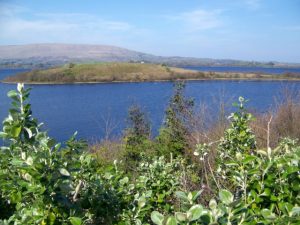
    Looking across the Lough towards Inishlannaun/Inis Fhlannain from the churchyard of Our Lady of the Valley Church. Image: Trish Steel.

    We Irish were always wanderers. Ending up as a teacher in Fursey’s adoptive town brought my tally of successive occupations to seventeen.

    The advertisement in The Guardian resulted in an interview in Manchester University, where a laconic man showed no interest in my previous teaching experience. This was fortunate because I had none.

    It seemed sufficient that I could distinguish between standard English and say, Urdu. It was a bonus to actually speak one of the King’s dialects –  even without a Home Counties accent. The fact that my contemporary, Ronnie Drew, was also teaching Dublinese in Spain gave me confidence, at least enough to satisfy my interrogator.

    I travelled back to Dublin to collect a couple of books and inform my parents. They had meantime taken note, on my behalf, of a quite different job opportunity.

    I had time to fit in an interview with some men who were recruiting for a brand new Irish television service. I greatly enjoyed the interview, cared little for the result and assured them that with people of their good humour in charge, the service was sure to be a success. Promptly dismissing the matter from my mind I headed for the promised land, Germany.

    Berlitz teaching techniques

    Happily en route on the long train and boat journey and still daydreaming, I fell asleep, and did not awaken until the train stopped in Stuttgart, many miles beyond my destination. I had to wait on a cold platform until sheepishly boarding the next train back to Pforzheim. The unsmiling head teacher, the Frau Oberst who met me, was not impressed.

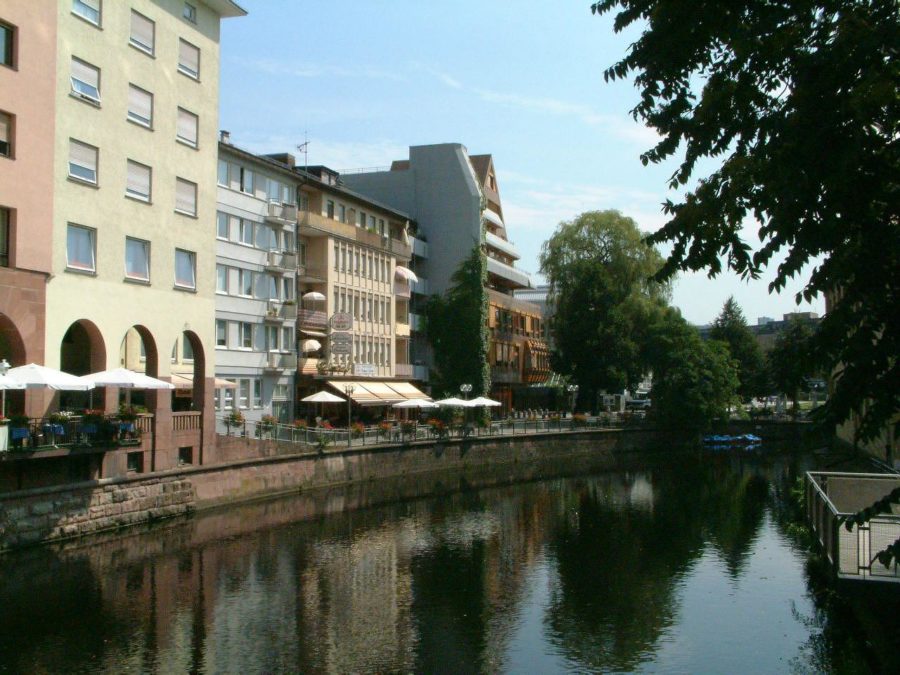
    Pforzheim: View from Horse Bridge (Rossbruecke) along the Enz river.

    I was given a month of learning Berlitz teaching techniques. My companion on the introductory course was also Irish. Her name was Colleen and she had just graduated as Miss Elegance, Trinity College in that same year, 1961.

    Ours was a short and innocent interlude (a repressed Irish background ensured that). The reason Colleen and I were accepted for training was the sudden erection of The Wall. It had caused many expatriate English teachers to scurry back to Blighty.

    A Third World War seemed possible. Being Irish, and innocent of world politics, Colleen and I had no bone to pick with the East Germans nor with the real villains, the Russians.

    Our xenophobia was confined to the traditional Anglo-Saxon foe and sprang from a more ancient quarrel than that of the Cold War. Although she and I were doused in competing versions of Christianity, we shared the vague bond of Irish neutrality, such as it was.

    We wandered contentedly by the river Enz, footloose because we were unshackled from the tight reins of culture and family, free to discuss anything we liked.  Alas, once we had completed our short training course in Karlsruhe and were considered to  be qualified Berlitz teachers, our fraternising was judged to be pedagogically unsound and she was retained in Karlsruhe while I was stuck in  Pforzheim. Once we were separated I never saw Colleen again, one of the themes of my life.

    Herr Dinkelbaum

    That weekend I spent my entire week’s food allowance in the Goldene Adler pub and was consequently reduced to a diet of a single apple over three days. Hunger encouraged the hallucination that my life was over and food superfluous.

    What was needed was an anaesthetic. The Goldene Adler supplied this in litres. Countless other hostelries have since been equally generous to me. I also came across Heinrich Boll’s ‘Irish Journal’ and its penetrating picture of 1950s Ireland made me homesick.

    The interval of gloom was relieved by the arrival of a new student in my classroom. Her name was Trudie and she helped me forget. To relieve the earnestness of the classes I bought a yellow hand puppet which I called Herr Dinkelbaum and introduced him as a proxy teacher. I like to think Wittgenstein gave me the idea: think for yourself and trust your instincts. They’ll often get you into trouble but you’ll have a lot more fun.

    Herr Dinkelbaum lightened the Teutonic gloom. One evening a student brought in a case of Coca Cola and a bottle of Vodka and the lesson became even more raucous.

    But my Berlitz training course had omitted the vital detail that there would be a concealed microphone in each classroom. Despite my defence that to educate you must first entertain – which is an impeccable formula for television – my supervisor, the same Frau Oberst was unconvinced.

    The subsequent rap on the knuckles – a deduction from my paltry pay – was, I felt, unduly harsh and I protested. Making a vague reference to Gestapo surveillance practices was also not a good idea. Only the scarcity of English teachers saved my bacon.

    lovers’ corner

    Trudy had a Botticelli shape, thoroughbred ankles, had lost her father in the war and clearly needed a father figure. Six years her senior, I seemed to fit the bill.

    We spent many happy hours in the Goldene Adler pub/restaurant where in lovers’ corner there was a sign in German saying, ‘Here it is permitted to tell lies’.

    After a couple of delightful months, however, a letter from Ireland reminded me of that long forgotten interview in Dublin. The new TV service was offering me a job, to start immediately.

    In no hurry, I wrote back saying my contract would not allow me to leave yet. I lingered for a month in Pforzheim to enjoy Trudie, consider my options and save up the train fare. Would I stay in Pforzheim with Trudie and become a penniless would-be writer or would I please my parents by taking this job?

    For once I decided they deserved a break, bade Trudie a tearful farewell and returned home. A month later I got an even more tearful letter claiming that she was pregnant and I must return, otherwise she would set her GI brother-in-law on me.

    I ignored the letter and dived into the exciting world of television. But the past was always on my mind. Exactly thirty years after that parting I diverted from a filming expedition in Germany and paid a flying visit to Pforzheim.

    With some basic research in the basement of the town hall I was given Trudie’s present married status, address and telephone number – a tribute to German thoroughness as well as their weakness for my elaborately romantic cover story.

    Is that Robert?

    I rang the number and in my half-remembered German said: ‘Is that Trudie Bopp?”  She replied in German: ‘That was once my name.’  ‘Do you remember Herr Dinkelbaum?’ I asked.  After a long silence, Trudie replied: ‘Is that Robert?’

    Over coffee in the Goldene Adler which still existed (although the Berlitz school did not), I noticed she was still beautiful and spoke no English – a reflection on my teaching talents. She was clearly taking no chances with this blast from the past: she had arranged for her daughter to pick her up in one hour. They were going shopping for the girl’s imminent wedding.

    Trudie remembered everything, even her threatening letter of three decades ago, to wit: if I did not return and face my responsibilities I would die. I asked her how old the daughter was now. Just twenty eight, she said. A quick exercise in mental arithmetic whetted my interest. Was it possible that I might have a half-German offspring?

    There was not time to press the matter as the daughter duly arrived to whisk her mother away. I could hardly interrogate the girl or study her features for a resemblance. I felt a little disappointed, and not convinced either way.

    The following morning, just before departing my hotel, curiosity overcame me.  I rang the number again and asked Trudie to tell me the truth about her old letter. Now, decades later, she laughed and dismissed her white lie and the empty threat: ‘You must know what a young girl in love will say to keep her man.’

    The realisation that she remembered our romance as clearly as myself was consolation. The Arab mantra ‘Man is the animal with the short memory’ is quite mistaken. I now remember ancient, significant things with more clarity than my breakfast this morning.

    Now, where did I leave my coffee?

    Feature Image is of the so-called Venus of Willendorf an an 11.1-centimetre-tall (4.4 in) figurine estimated to have been made c. 30,000 BCE.

  • Artist of the Month – Keshet Zur

    Poiesis, from the Ancient Greek: ποίησις meaning knowing by making, is ‘the activity in which a person brings something into being that did not exist before.’[i]

    It is the process of shaping as opposed to doing. It is not imposed; it is a process of listening; of working with. In an interview with Meredith Monk on her process she said, ‘I have to keep following it, and see what it needs.’[ii]

    When we shape we are in dialogue with material, not merely self-expressing, but also being open to the unexpected, tapping into what some call ‘flow’; something beyond the self.

    Origins

    When I first moved to Ireland in 2002, I studied fine art in KCAT, an art centre with an inclusion policy where people with artistic talent, regardless of neurotypical or diverse definitions, all studied together. It meant my introduction to the stance taken by second level art education was inclusive, and never elitist.

    I then moved to Dublin to study photography at Griffith College and pursue a longstanding dream to become a photographer. Having been introduced to photography at the age of ten, by twelve I was developing my own film and printing photos in the dark room.

    I loved the tangibility of photography, and so the rise of digital photography initially brought heartache; I continued to crave the craft element. One of the ways I experimented was in creating sculptural photography, but it felt as if I had to make a hard case for it within my photography course.

    I was on the road to completing my degree, while at the same time working for a youth service in the inner city, teaching cooking and setting up a community garden.

    All the while attending exhibition openings and getting a taste of Dublin’s art scene, I was aware that the children and adults I was meeting through my work were not exposed to the galleries I was visiting, nor were they necessarily spaces in which they would have felt welcome.

    My final photographic project was about the changing structure of family life in Ireland, and the gaps in legal services to represent their interests. By the end of the degree I came to realize that as much as I loved working with art, pursuing it as a solo career was not going to be enough. I wanted to learn more about bridging the two worlds of art and community.

    Expressive Art Therapy

    A month after graduating I began an MA in Expressive Arts Therapy (EXA) at The European Graduate School. I felt an immediate connection to the philosophy of EXA and its method of practice. EXA embraces intermodality, working with multiple forms within one session.

    Suddenly my impulse for tangible photography needed no explanation. As with other therapy styles, the therapist creates a frame of trust by providing an environment free of judgment where a client feels held. With EXA, however, the element of art is what moves us into action.

    The arts provide a safe container for the unknown to emerge, as we step away from linear thought patterns to discover the new. We suffer when we feel paralyzed and hopeless, and when what we perceive as possible feels restricted. Working with the imagination creates unrestricted openings wherein we feel empowered and excited to move into action.

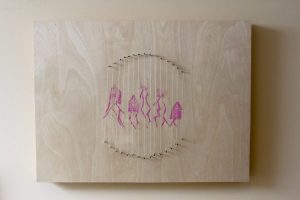
    ‘Who the city belongs to?’ Print on wood with nails and thread. 
    This work was made in July 2019 out of frustration with the current housing crisis. 

    In 2010, I co-founded Expressive Arts Ireland with my parents, both of whom are expressive art therapists. Since then we have been facilitating professional and self-development workshops and collaborating with international universities.

    Initially, while working with the intermodal approach our core subjects differed; my own photography; my father’s storytelling; and my mother’s nature; nowadays one flows into the other.

    Environment

    It has become increasingly important for me to work with nature. Natural disasters around the world had been overwhelming me to a point of despair and numbness.

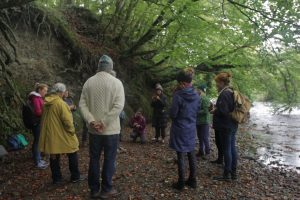
    Last September we decided to offer a weekend workshop integrating arts and nature. We worked with people’s inherent connection to nature, and in doing so broke down some of the boundaries separating ourselves from nature.

    By focusing on personal and individual stories we are reminded of human resilience which builds hope. Working with nature, we see ourselves as an intrinsic part of it, neither separate nor opposed.

    This thinking leads to new behaviour, which in turn leads to change; this leads to empowerment and ultimately system change. By regaining faith we foster the power to move into action.

    Curating 

    As well as working with Expressive Arts, I have also worked for community organizations and charities. In recent years I became an outreach facilitator for artists with autism, promoting participation and inclusion through the arts by curating exhibitions and supporting their careers.

    With Autism Initiatives I curated and coordinated a group show at the Mermaid Arts Centre in 2018 called INSIDEOUT / MAKERS, as well as an exhibition and associated publication entitled ‘Bringing About The New’, at The Lexicon Library in 2019.

    I am currently working independently with one of the artists from the group, who will launch his first solo show in 2021. At each exhibition the works were carefully handled, beautifully framed and presented, enhancing and fostering the artists’ pride and self-regard.

    How we respond to what is made and how we take care of it is no less valuable than the process of creation. Notably, artists revisiting the show following its opening related differently to the public space as they now felt a sense of ownership over it.

    Art spaces which promote diversity are beneficial to all members of society, as we advance through exposure to a wide range of views and experiences. Any progressive society must challenge prevailing understandings of value and ability. Art spaces can be forerunners in advocating for diversity.

    Art is an amazing communication tool for social change, with the capacity to convey messages through metaphor and by invoking emotional and contemplative responses. Through art we can work with what connects, rather than separates, us from one another.

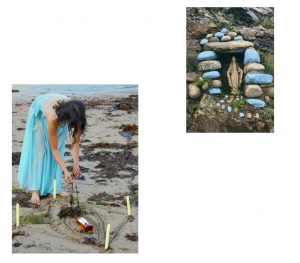
    This performance took place in September, 2019 at a week long residential Body/Landscape workshop on Arranmore Island, Donegal, with the dancer and choreographer Frank van de Ven. 
    At various locations on the island, and in particular at the fisherman’s dock, I encountered sculptures of Mary. I learned that the fishermen prayed before going out to sea, some of them not knowing how to swim. For me it drew a connection with the natural crisis; people sending their prayers yet not being called into action.

    Art as an agent for change

    Life for me is about asking questions; without interrogation there is little capacity for change. But to be in a position to ask ourselves profound, life-altering questions, we need to feel acknowledged, loved and accepted.

    Only then can we embrace life’s uncertainties and provisionality. Art-making provides a frame within which we make sense of the world, while accessing an opportunity for shifts in thinking. William Kentridge describes his process as such: ‘The hope is the work itself will not just give you an answer, but even provide the questions and make connections you hadn’t thought of before.’[iii]

    I believe the personal is political and that in making changes in our lives we are taking part in collective transformation around the world. Embodiment of this notion ignites a fire within us to take responsibility and a pride in our capacity to contribute to shape a healthy society.

    I trust there are many others out there that desire and conceive of a better life for all. In supporting people to embark on an artistic journey through the expressive arts approach, and community engagement projects, I hope I am partaking in facilitating this global transformation.

    To find out more about Expressive Art Therapy and our upcoming workshops please visit www.expressiveartsireland.com

    Weekend Introduction Workshops 2020:

    Integrating the Arts of Storytelling With Expressive Arts Therapy

    March 20th, 21st, 22nd.

    Integrating Intermodal Arts and Photography With Expressive Arts Therapy.

    May 15th,16th,17th.

    Integrating Art and Nature in Expressive Arts Therapy

    September 25th  ,26th, 27th.

    [i] Donald Polkinghorne, Practice and the Human Sciences: The Case for a Judgment-Based Practice of Care, SUNY Press, 2004, p. 115.

    [ii] Meredith Monk, ‘I believe in the healing power of art,’ Tate Gallery, November 3rd, 2017, https://www.tate.org.uk/art/videos/tateshots/meredith-monk-i-believe-healing-power-art

    [iii] William Kentridge, ‘Instructions on making sense of the world,’ Text by Kerri von Geusau, TLMag   https://tlmagazine.com/william-kentridge-instructions-on-making-sense-of-the-world/

  • Camp Moria Lesbos – ‘Hell in Europe’

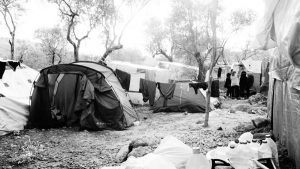
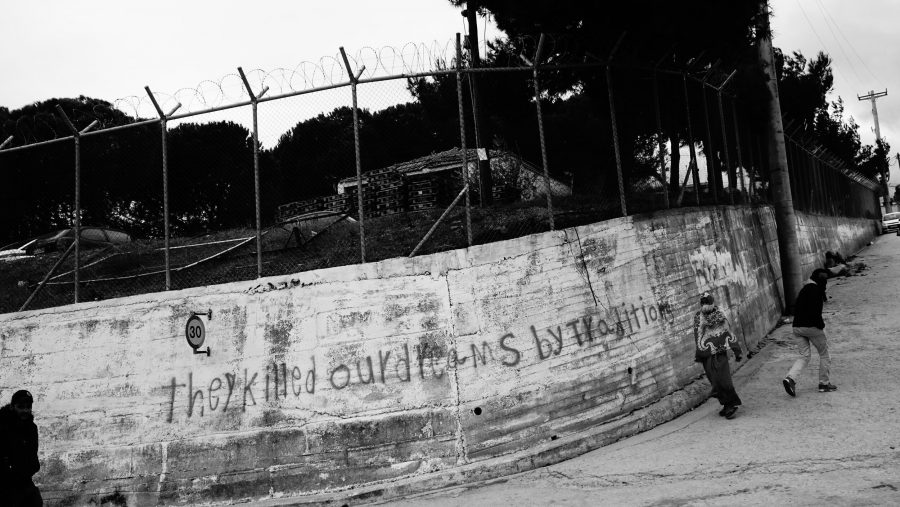
    Having grown up around favelas in the East Side of São Paulo I was expecting a similar scene of poverty mixed with a strong sense of community. Instead Moria has a post-war feeling, as it is for many people living there, who showed me evidence on their phones of the destruction they were escaping. It’s a tough and unfriendly place, until you meet the families.

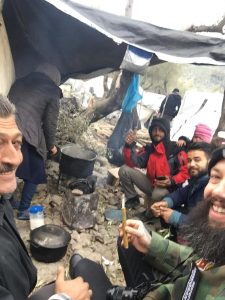
    The first smell that hits you is the smoke from wood, plastic and anything else that burns, as they cook on open fires. A blind person would think the whole place was on fire. The second smell is a strong male odour. It’s there because there are hardly any facilities for people to wash.

    It’s completely dirty everywhere. The bathrooms are covered in shit. It’s even on the ground where people do business and cook food.

    But life goes on. There are market stalls selling soft drinks, fruit and vegetables and clothing. I met two barbers working within their communities.

    “The first smell that hits you first is the smoke from wood, plastic and anything else that burns, as they cook on open fires.” Moria Camp, Lesbos, December 2019. Fellipe Lopes.

    The air pollution and dreadful hygiene cause a lot of sickness. The men also smoke a lot. Everyone is coughing all the time. I developed a chest infection myself afterwards. The Irish doctor said it came from bacteria prevalent in camps such as this.

    Médecins Sans Frontières (MSF) do have a medical facility, but the clinic is overwhelmed. They can’t accommodate everybody. Whether you get medical attention also depends on which camp you live in. If you are lucky you might get to attend a hospital in Mytilene, the capital and main town of the island of Lesbos.

    At one point a lady from Syria showed me a document indicating she suffers from cancer, but she wasn’t receiving the medication she requires.

    Many of the kids have skin problems. But the worst part is the mental torture of living in the camp that brings out the worst human characteristics.

    ‘I heard the noise of stabbing’

    People are regularly stabbed to death. Every day there is another story, and a lot of these cases are going unreported.

    At one point a guy passed five metres away from me with a machete, a massive knife, and I heard the noise of stabbing. As a photo-journalist my instinct was to go and take a shot, but as soon as I moved a friend, Mohammed, held me back, saying what must have been “don’t go” in Arabic. I understood from the strength he exerted that I shouldn’t move.

    An African man had been killed. The perpetrator disappeared. This sort of thing happens every single day in a camp built for a maximum of 4,000 people, now housing more than 20,000 and growing. A friend said that over the last two weeks another two hundred tents had been erected. I looked down and saw a wave of them across the hillside.

    Yet I didn’t feel unsafe. As the days went by I became more confident. I knew the friends I had been introduced to would protect me. That’s how it works in Moria.

    Moria Camp, Lesbos, December 2019. Fellipe Lopes

    When you enter the camp you notice the separation between nationalities. In one part there are Africans, mainly from Somalia, Sudan, Ethiopia and Congo, in another you find the dominant Afghan groups, with black and white scarfs speaking different languages. There is a small part of the camp where the Syrians live.

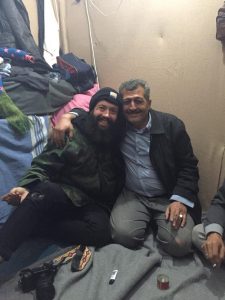
    I grew close to the Syrian community, speaking a mixture of broken Arabic and broken English, and also using phones to translate. Most of them say the system is not working for them; that if you are a Syrian in Moria you have no chance of being relocated elsewhere in the European Union. You will be denied documents.

    Many Syrians believe they are stuck there forever. I met members of one family who have been waiting for a year-and-a-half now.

    In general, cases are not being resolved. There are people waiting for official refugee status, or waiting other documentation. Each case is different. But some people are being scheduled for appointments in 2021, just to start the process. Until then they are not permitted to leave the island. They have to sit and wait in the apocalypse that is Moria.

    The Prison’

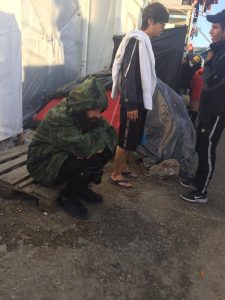
    There are three areas in the camp. First there is the so-called ‘Friendly Campus’ run by Movement on the Ground, which has most of the better accommodation, which is not saying a lot. Throughout the camp you find structures built from any wood and plastic they find, and tents of different sizes; some are big enough to sleep twenty people, others are the kind of two-man tents you would expect to see at a music festival.

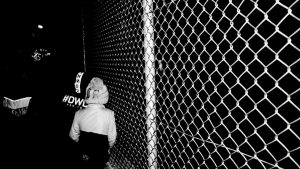
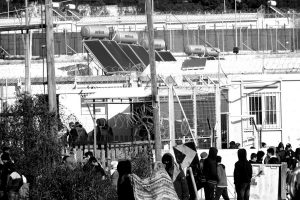
    Then there is ‘the Prison’, which is the original camp. There you find the so-called ‘boxes’, which are temporary structures, some of which even have AC devices that take the chill off the freezing January temperatures. Journalists are not allowed to enter this part. A bus sits at the entrance with eight policemen bearing big guns. But where there is a will there is a way.

    The Prison, Moria camp, Lesbos. Fellipe Lopes

    I entered with a small camera inside my jacket pocket. People were helping me to get in and out. They knew when and where there would be no cops around and I could walk in and out.

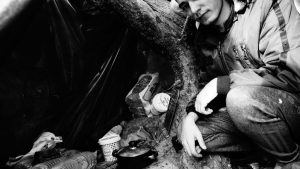
    Another part is called ‘the Jungle’, which is really a forest where people are living. I met one guy who had carved a hole in a tree and now sleeps inside the bark with a plastic sheet for shelter. A man forced to live inside a tree in the European Union in 2020.

    “I met one guy who had carved a hole in a tree and now sleeps inside the bark with a plastic sheet for shelter.” Moria camp, Lesbos, December 2019. Fellipe Lopes

    There is a part of the camp that has electricity, and where people can charge their phones. Most parts, however, have no access whatsoever.

    They cook for themselves, improvising with things like old paint tins over open fires. The camp is next to an olive grove so there is some wood available and they burn whatever else they can find.

    There are two options for food. The first is to take it directly from the camp dispensary. There you queue and receive a free meal. On Sundays you get chicken and rice; for the rest of the week it’s beans and vegetables.

    But the food is awful. I couldn’t imagine eating it. So what most families do is recook it, using containers to carry it to their fires, mixing it with the spices they carry. It seems to become a bit more digestible.

    Another option is available to families who receive allowances of approximately €90 per month. They can catch a bus, or take a one-hour-and-a-half journey by foot, to the island’s capital Mytilene and purchase the cheapest food they find in the supermarket, usually rice, beans or noodles.

    How much any family receives seems to be a lottery. There is no apparent formula. Some families get nothing. The lucky ones are given a UNHCR MasterCard with credit on it rather than hard cash.

    For water there are taps to refill plastic bottles. I drank it a few times and thankfully it didn’t make me ill. Locals don’t seem to drink the tap water.

    Moria camp, Lesbos, December 2019. Fellipe Lopes

    The frequency of rape

    Until I came to Moria, I had never been to a place where there was no sense of hope. In the favelas people have a seriously tough life, but most of them believe that things will get better. In Moria, however, ninety percent of people I spoke to believe they will be staying there forever. They don’t see a future, believing either they will be killed, or live out their days there. Just a few families I spoke to saw a light at the end of the tunnel.

    One thing I heard that made me feel really emotional was that I was bringing hope: “you are a guy from Brazil living in another country. You are an immigrant too who came here to tell our stories”.

    In the camps there are loads of suicides, including kids under the age of ten.

    One thing I should say is that rape is getting more frequent inside the camp. Women are of course victims, but I have heard that a number of young boys between the ages of seven and twelve have been targeted too.

    One man came to me and told me his heart was breaking. He took my phone, translating from Arabic into English that his young son had been raped in the bathrooms. He said he was afraid to inform the authorities because he feared retaliation. As a result he, and others, keep their kids inside the tents.

    Some of the families do manage to send their kids to school. But I didn’t hear of any teenagers attending high school. They go to cultural centres, the Hope Project and One Happy Family, where they spend an hour painting or playing football, and can take English lessons. But there is no regular schooling for that age group.

    Empowerment and Love

    European NGO workers say they want to empower people living in the camp. But how do you empower someone living in these conditions? The NGOS are doing what they can, but people are unfamiliar with the European concept of empowerment.

    Yet around the rest of the island life goes on as normal. You would hardly even know Moria existed, with farmers working the fields, on an island that is a place of great natural beauty, and still popular with tourists.

    There is some local sympathy for the refugees, but it has to be said most people are inclined to ignore them. Taxi drivers were asking why I was going there, or warned me against visiting.

    On one occasion I was in a supermarket where a cashier refused to serve a Congolese man. She just told him to get out. She said he couldn’t make his purchase. She wouldn’t accept his card, so I intervened to pay for his drink and snack.

    Another time a Syrian family came along with us to a restaurant. The waiter would not direct a word at them, and looked for the permission of myself and my colleague Caoimhe Butterly for what they could order.

    I was lucky enough to be staying in guesthouse accommodation in Mytilene. Every night when I called a taxi to get away from the foul-smelling camp I felt a wave of guilt. Knowing how those people were living made me uncomfortable in my clean bed.

    On New Year’s Eve we hung out with friends from Syria, Ghana and Ethiopia in the town. We went to a bar, where people were drinking and taking drugs.

    Towards the end of the evening Haya from Syria began crying. She said: “I wished so much to be outside the camp, and now I see those people having fun and I just miss my family. I just want to be in the box. Because that is all I have left in my life. I don’t have money, I don’t have a job, I don’t have expectations. The only thing I have left is my family, and I’m here.”

    That broke my heart, as I had a similar feeling after a phone call with my mother in Brazil. At the end of the day you have your family.

    What holds those people together? It is love. There is no social programme. There is nothing from the U.N. and there is nothing much from the NGOs either. If you get close to them, to the families, what you find is loads of love between them, and kindness to strangers. That generosity of spirit holds us together.


    Twitter:@fellipelopes7

    Instagram: @fellipelopes.7

    www.fellipelopes.com

  • Psychedelic Therapy – “Love is the Glue”

    Editor’s Note: Previously Frank Armstrong reviewed Michael Pollan’s journey through the use of psychedelics. Here ‘Desmond O’Brien’ recalls a recent psilocybin treatment at a clinic in the Netherlands, which he found ‘a hugely emotional and profoundly beautiful experience, interspersed with frequent moments of absolute hilarity.’

    ‘my life had come to an end’

    I recently went on a psilocybin (so-called magic mushroom) retreat in the Netherlands – a form of psychedelic therapy for anxiety and depression. To the uninitiated this may sound like quackery, but there’s a good deal of solid scientific evidence pointing to its potential for treatment of mental illness, especially long-term depression.

    Prior to going through with it, I had concluded that I was doomed to an endless cycle of frustrated unease and pessimism. What I went through has made me more optimistic that I have a lot more time left, and that chapters remain to be written. But it is still early days, and I am not saying it will be easy.

    The retreat was quite a journey. Three days, with a trip in the middle day, bookended by powerful group therapy conducted by trained professionals, all in a tranquil setting with access to a garden.

    I found it a hugely emotional and profoundly beautiful experience, interspersed with frequent moments of absolute hilarity. At no point was I scared by what was a wild ride that brought tremendous catharsis, and involved deep bonding with fellow participants.

    For a long time beforehand I was at the bottom of a dark, deepening well, clawing helplessly at the walls. I am still in that pit in practical and material terms, but the light at the top doesn’t seem quite so far away. It’s as if a rope has been dropped down for me to climb towards the opening.

    By the end of the experience I felt more relaxed than I have done in years. Only time will tell how capable I am of integrating what I have learnt into my day-to-day life.

    I must persevere with therapy, meditation, writing, communicating, yoga and just breathing. Contending with horrific, insidious and relentless anxiety, as I have done, I need constant reminders to slow down so as to avoid those terrible spirals.

    “Cosmic Pocahontas”

    The ‘trip’ began with geometric patterns emerging from the darkness, creating quite a pleasant show. It brought neither anxiety nor nausea, as affected a few other participants.

    Indeed, one poor fella’s vomiting cut through the air in Dolby Surround Sound reminiscent of The Exorcist! But he was gently taken care of by the facilitators, and emerged after a while into the bliss we all felt, and was utterly untroubled by that phase in retrospect.

    Slowly, the doors of the library of memory opened and I was brought on a tour, over which I had considerable control. This featured many moments of my past, such as running out to play in my grandparents’ garden, and being tucked into bed by an au pair.

    It was all from a first-person perspective. I never saw myself. There was an overwhelming feeling of love as I observed these scenes, and many friends and family appeared – or perhaps it is more accurate to say I had chosen to bring them to mind – all enveloped in this infinite affection.

    “Love is the glue”, I said to myself after discovering a wonderful sense of oneness with the universe. I had the sense of us all, young and old, alive and dead, as helpless babies in the eyes of an omniscient presence, tumbling in eternal clumsiness through space, bouncing off each other while she, and it did seem a nurturing, reassuring maternal figure (the “Cosmic Pocahontas”, as the other Irish fella there referred to her in his Cork accent), observing us all with a benign smile, having seen it all before.

    Most of the time, rather than looking around and getting my jollies with visuals – and especially during the first few hours – I wore eye covers to heighten the inward therapeutic journey. This deepened the tour of the unconscious.

    I experienced tears of joy, sadness and laughter that ran down my face for a great part of the journey. Emotional inhibition was lost and at one point with the prompting and hug from a facilitator, I sobbed uncontrolably and breathlessly like a child.

    Returning to a pleasant normality

    At a certain point I removed the eye covers. After that, at all times, I knew exactly where I was, and who I was with. I experienced no auditory or visual hallucinations, but amplified senses, a curious fuzziness to everything, changes in texture and a mildly swirling fractalization of surfaces and objects; no pink elephants!

    Looking around, we resembled infants in a crèche, smiling warmly at each other, in mutual knowing. Towards the end we sat up, ate the sliced fruit and pieces of chocolate provided for us, and began to reflect in pairs and small groups on our experiences.

    Finally, we took off our jackets and shoes, creating another amusing kindergarten-scene-of-chaos, and then strolled and chatted in the garden. Returning to a pleasant normality, we endeavoured to articulate our individual experiences.

    The analogy that came to my mind is this: that we are, as adults, swimming in lanes defined over time by the influences of our environments. The psychedelic experience lifts up those lane dividers, allowing us to roam freely in the pool. By the end of the experience, we had developed an awareness of how we are stuck in those lanes, but that they are not as fixed as we had perceived. And that is freedom.

    The experience brings us back to our younger, more joyous and playful selves, peeling away, at least for a while, the rigid constraints of our adult selves, to reveal the child that we were, and still are.

    And little kids, as I’m sure you are aware, trip up all the time.

    To contact the author of this piece email: admin@cassandravoices.com

  • Democracy in Decay: Steve Bannon & Jordan Peterson

    ‘The interesting thing is that they’re protesting against themselves. There’s no enemy out there. They know they are the enemy.’
    J.G Ballard, Millenium[i]

    The 2019 Reuters Institute Digital News Report points to increasing de-politicisation across the Western world. This accompanies a seemingly inexorable rising tide of ‘identitarian’ Populism, globally led by Steve Bannon. The movement channels latent anger into cynicism towards central governments and supra-national institutions such as the E.U.; just when we require solidarity to address climate chaos.

    Symptomatic were Conservative Party tactics during U.K Election 2019 – under the influence of Bannon – promising nothing beyond ‘getting Brexit done’; in other words a negation of the country’s institutional ties with other states – rather than a vision for improvement. This recalls Donald Trump’s ongoing pledge to ‘DRAIN THE SWAMP’ of Washington politics.

    In a climate of suspicion, roguish buffoons like Donald Trump, Jair Bolsonaro and Boris Johnson have lied and cheated their way to high office. The moral landscape has altered to a point where the truth doesn’t seem to count for much anymore; in contrast to a cosy relationship with Big Data, and plenty of campaign dosh, which is more vital than ever.

    Delving deeper, these political trends are tremors from a seismic Internet Revolution radically re-shaping our societies and very brains. This new medium has proved a fruitful ground for the advancement, and enrichment, of varied corporate entities and human beings. Those benefitting include Canadian psychology Professor Jordan Peterson, arguably the first public intellectual of the Digital Age – with many of his lengthy YouTube lectures hitting numbers associated with music videos.

    It is instructive that Steve Bannon targeted Peterson’s online devotees before the last Presidential election. Peterson came to prominence especially through the so-called culture wars, contributing to a ‘woke’ caricature, which really should be attributed to the liberal centre, given the emphasis leading lights such as Tony Blair, Barack Obama and Hilary Clinton placed on political correctness and multiculturalism.

    Peterson’s cult status brings adulation of a type associated with Pop stars, drawing huge audiences to venues across the English-speaking world. A predominantly male audience has been impressed by a refusal to pay the usual fealties to political correctness, and offered the kind of sound, fatherly advice that many seem to lack, but Peterson abuses his power by peddling climate change denial, while demeaning collective institutions, and governments.

    Politicide

    In 2003 Israeli sociologist Baruch Kimmerling published a book called Politicide, which charted the destruction of the Palestinian nation as a political entity. He claimed the state of Israel was transforming Palestinians into a leaderless community struggling for an identity – as had previously been the case.[ii] Thus in 1969, then Prime Minister Golda Meir questioned the existence of a distinctive Palestinian people, an inquiry that might soon be aired again.

    Israel’s erosion of Palestinian identity has been achieved through collective impoverishment, targeted assassination of key leaders and the age-old technique of divide and conquer. Now the Palestinian voice on the international stage has been reduced to a barely audible whimper.

    A similar, though less overtly violent, campaign of Politicide is being waged by Steve Bannon, Dominic Cummings and other unelected political advisors across the Western world. Democracy is being corroded by sophisticated technology, including from the notorious Cambridge Analytica, mining data from social media and other online interactions to develop advertising specific to targeted groups in key marginals.

    The old left that forged bonds both within countries and internationally, especially through working class solidarity is the immediate target of attack ads that are having an effect. In this respect, Margaret Thatcher’s 1980 comment ‘And you know, there is no society’ recalls Golda Meir’s aspersion of Palestinian identity. Lacking sufficient resources for social media campaigns, and pilloried by journalists increasingly beholden to conservative billionaires such as the Koch brothers, socialism is on the decline across Europe and beyond.

    Drawing support away from the old left, so-called Populists – who really have little in common with the agrarian-radical originals of the late nineteenth century led by William Jennings Bryan – are incubating acceptance of a global corporate order, directing oppositional energies against what they characterise as a corrupt state – which of course is being hollowed out by those same corporations, through lobbying and regulatory capture.

    An important component of Politicide is for growing numbers to be turned off news content altogether. Thus the Reuters Digital News Report for 2019 found an average of 32% across a large number of countries actively avoid it, up from 29% the previous year. In the U.K. that figure reached 35% in the election years of 2019, a striking 11% increase on the previous poll. Such shifts do not occur by accident. Turning people off trusted news sources increases susceptibility to fake news arriving via political ads.

    Last September Mathew D’Ancona outlined the ongoing involvement of Steve Bannon in Conservative Party tactics. In the last election, according to Adam Ramsay war was waged ‘on the political process, on trust, and on truth;’ a Hobbesian project ensuring ‘the whole experience is miserable, bewildering and stressful;’ all that remains is to ‘ask voters to make it go away.’

    The success of the Bannon formula is not measured purely in terms of increasing vote share, but also in opponents losing support through apathy and despair. The most important social media platform remains Facebook, still the dominant player by quite a margin, especially for older people. There we find the kind of attack ads long a feature of U.S. political culture targeted precisely at voters in marginal or swing constituencies or states.

    What was novel for the U.K. in 2019 was widespread indifference to the truth, with 88% of Conservative Facebook ads containing lies. This may have been what Dominic Cummings was referring to in his last blog post when he mused on how: ‘the ecosystem evolves rapidly while political journalists are still behind the 2016 tech.’[iii]

    Both Steve Bannon and Dominic Cummings are clever political operators, they are not, however, geniuses. But the project of politicide, working distinctly to the advantage of large corporations, is the product of broader cultural currents. The first wave of the Internet Revolution is fraying old systems of thought, and recasting political discourse. The Jordan Peterson phenomenon is instructive.

    The rise of the ‘Petersonites’

    Notably, Steve Bannon mined the data of the followers of Jordan Peterson before the 2016 U.S. Presidential election as ‘they were looking for a father figure to tell them what to do,’ according to a Cambridge Analytica whistleblower.[iv] Apparently they possessed ‘the big five traits’ of easily manipulatable men: frustrated economic opportunities; an estranged father; enjoyment of word salad; not showering on a regular basis; and ranking in the top quartile for the Dunning-Kruger Effect.

    Perhaps unsurprisingly given his fanbase, in the wake of Brexit Peterson compared the E.U. to the Tower of Babel: ‘a homogenous totalitarian structure that usurps the transcendent.’ This follows insinuation that transgender activists were equivalent to Maoists.

    Jordan Peterson is not, however, a political extremist – by North American standards at least. Nonetheless, his generally compelling talks – with ideas distilled in particular from the archetypes of C.S. Jung and Aristotle’s virtues – have been adopted, and glossed, by a legion of far-right digital warriors. He also represents a successful formula for the entrepreneurial pursuit of an online personality in this neo-liberal zeitgeist that has been copied more broadly.

    Peterson’s fame, or notoriety, derives mainly from impressive public speaking performances and televised debates rather than through books. Indeed, his literary output is a relatively modest two publications[v]the most recent a self-help bestseller.

    Like Donald Trump, Peterson is a master of the new digital medium. While the U.S. President specialises in cutting brevity – ‘show me someone who has no ego and he is a loser[vi] – Jordan Peterson represents the opposite pole, opting for grandiloquent expression; dazzling audiences with a flurry of references; fluently recalled using streams of synonyms ‘maxing out’ any SAT Writing and Language test. He reaches a crescendo of self-righteousness when laying waste to scruffy woke opponents.

    The Digital Age

    We are in the early stages of a communications revolution reconfiguring human societies, and perhaps rewiring our brains.[vii] This Digital Age is characterised by a ‘secondary orality’ conveyed through video, podcast and memes that still depends on an inheritance of books.[viii] As the pace of change accelerated with the arrival of affordable smartphones from 2010, the quality of political journalism declined in tandem.

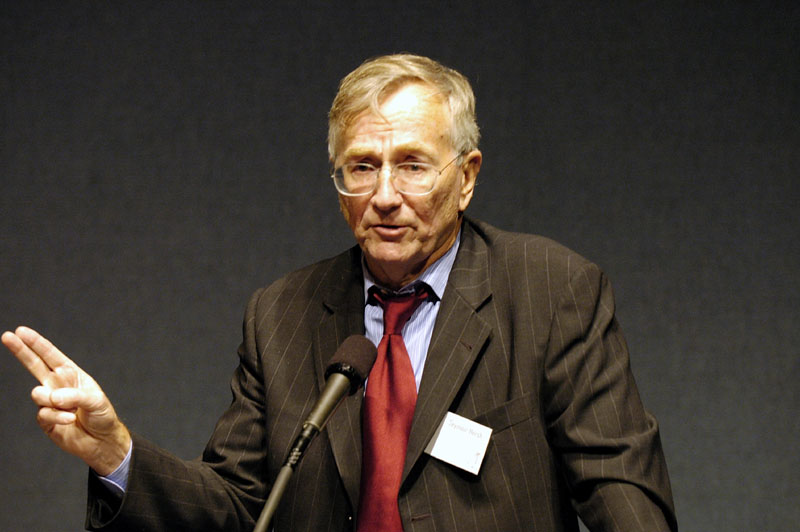
    The great U.S. reporter Seymour Hersh recently offered a withering assessment of contemporary media to the effect that ‘We are sodden with fake news, hyped-up and incomplete information, and false assertions delivered non-stop by our daily newspapers, our televisions, our online news agencies, our social media, and our President.’[ix]

    Seymour, ‘Si’, Hersh, photographed in 2004.

    Crucially, leisure-reading of books[x] is giving way to multimedia engagement via smartphones, disseminated, mediated and curated through unregulated social media platforms; the most widely accessed of which, Facebook, refuses to vet political ads for their veracity, selling our data to the highest bidders.

    It is perhaps unsurprising that abandonment of books in favour of digital ephemera should herald a cultural decline. On social media the image is king, and language, as Richard Seymour argues in the Twittering Machine, is increasingly reduced to its effects, like all manipulative communication, from marketing to military propaganda.[xi]

    These developments are unravelling a profound cultural inheritance. Walter Ong contends that ‘More than any other single invention, writing has transformed human consciousness.’[xii] ‘By separating the knower from the known’, he says, ‘writing makes possible increasingly articulate introspectivity, opening the psyche as never before not only to the objective world quite distinct form itself but also to the interior self against whom the objective world is set.’[xiii]

    It is through textual records, passed down and renewed by each generation of scholars, that the wide-ranging dialectics required for scientific research and philosophical enquiry occur. The development of writing allowed us to determine and convey facts.

    The increasing dominance of a ‘secondary orality’ of video and podcast is shifting political debate away from philosophic “articulate intropsectivity”, and also bringing celebrity veneration, as “the knower” (or quickfire know-all such as Jordan Peterson) merges with what is “known.”

    Moreover, unlike public intellectuals of the recent past, who conveyed facts and ideas in books, the output of a digital-era leading light arrives in a stream of video, more challenging to parse, or counter, than the venerable medium in print form. Thus, previously agreed upon facts are more easily dismissed as we enter an era of post-truth.

    ‘An explosion in identity talk’

    Alongside devotion to vacuous celebrity, Richard Seymour observes that over the course of the last decade, as the numbers regularly accessing Twitter and Facebook grew into billions, there has been ‘an explosion in identity talk.’[xiv]

    Jordan Peterson is perhaps the intellectual apotheosis of this trend. Thus, in 2016 after igniting controversy for refusing to adopt gender-neutral pronouns, he released a series of videos justifying his positions.[xv] Soon he had emerged as a global conservative champion in the culture war, ‘destroying’ interlocutors with well-rehearsed, and often, it must be said, reasonable arguments.

    Peterson railed against a woke-ish political correctness that many on the left already acknowledged had lurched into absurdity, to the exclusion of more pressing discussions of climate change, ecological collapse, spiralling inequality and unaccountable digital platforms.

    Amy Chua identifies acute problems with identity politics ‘on both sides of the political spectrum,’ which she says, ‘leaves the United States in a perilous new situation: almost no one is standing up for an America without identity politics, for an American identity that transcends and unites all the country’s many subgroups.’[xvi]

    Peterson has amassed a reasonable fortune in the process of emerging as both hero and villain in the febrile culture war. Knowingly or otherwise, he has served the interests of Bannon and his ilk.

    Narrowing Debate

    Jordan Peterson is broadly correct that the parameters of debate in Anglophone so-called liberal – or ‘woke-ish’ to use the term de jour – media such as The Guardian and The New York Times have narrowed. The phenomenon of no-platforming outspoken thinkers such as Germain Greer for questioning whether a transgender individual should be considered a woman is disturbing. The media’s obsession with celebrity sex scandals often amounts to little more than clickbait.

    Moreover in America, and elsewhere, a range of media from Fox News to Breitbart have picked up the slack, accommodating so-called conservative, increasingly far-right, standpoints.

    Similarly, right-wing views are well represented in U.K. media by established players such as The Telegraph, Daily Mail and Daily Express as well as newcomers like Spiked, whose founders’ journey from Marxism to the alt-right is symptomatic. The traditional viewpoint that Peterson purports to represent is far from being marginal across the Anglophone world.

    A shift towards identity politics can be traced to the fissuring of the political order at the end of the Cold War, as mainstream centre-left parties in the U.S. and U.K. pivoted to the centre-right.

    Thus in the U.S., Democratic Presidents Bill Clinton and then Barack Obama essentially ignored spiralling inequalities attending the rise of the digital behemoths, assuaging discontents by endeavouring to roll out state-funded medical care that has done little to break the dominance of Big Pharma and an epidemic of legal drug addiction. With identity politics centre-stage, Obama’s victory – that ‘Audacity of Hope’ –  was mistakenly viewed as the harbinger of a tolerant and inclusive society.

    Then stories such as the ‘birther’ controversy – an unfounded rumour that Obama had not been born in the United States which, if true, would have debarred him from the presidency – generated endless columns in the liberal media,[xvii] to the exclusion of reporting on social and environmental issues highlighting the despoliation of the Earth by large corporations.

    Focus on identity politics, from race to feminism and same-sex marriage, not to mention abortion, diverted attention from the long-standing exclusion of the poor of all ‘races’, with real wages stagnating for decades,[xviii] while extraordinary wealth and privilege has been concentrated in increasingly few hands.

    Donald Trump tapped into economic insecurities – offering up poor Latino immigrants as a scapegoat to blue collar workers – to win the Presidency of 2016. Hilary Clinton and her handlers persevered with identity politics, emphasising the importance of a female candidacy, and focusing on her opponent’s philandering, rather than addressing entrenched poverty and social exclusion, let alone the excesses of the military industrial complex, and lost.

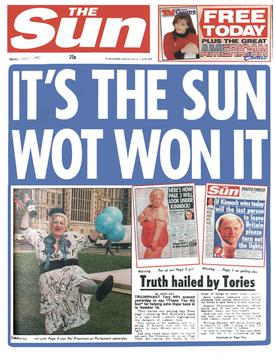
    In the U.K., the Labour Party also settled in the centre, or even centre-right, under Tony Blair and Gordon Brown (1997-2010). New Labour essentially accepted Margaret Thatcher’s (1979-90) market deregulations and privatisations to the satisfaction of the newspaper barons that tend to decide elections. ‘It’s The Sun Wot Won It’ read Rupert Murdoch’s Sun after John Major’s come-from-behind victory in 1992 – a cheeky headline masking a sinister political reality.

    The Sun newspaper, April 11th, 1992.

    As Mark Fisher memorably put it: ‘Blairism has consolidated and outstripped the ideological gains of Thatcherism by ensuring the apparently total victory of PR over punk, of politeness over antagonism, of middle class utility over proletarian art.’[xix]

    Later David Cameron and his fellow ‘modernisers’, or ‘One Nation’ Tories, rebranded the Conservative Party in the dress code of New Labour, embracing non-economic issues such as marriage equality and increasing the visibility of female and ethnic minority representatives, while pursuing Thatcherite, austerity policies in the background.

    This approach yielded electoral success in 2010 and 2015, before Brexit derailed the formula. Similar to Trump’s victory over Hilary, Brexit bubbled up, dialectically, inside the cauldron of identity politics first stirred by the centre-right.

    It is disingenuous therefore for Jordan Peterson to bemoan the excesses of identity politics given it was the centre-right he claims to support that has promoted ‘woke-ish’ causes. Grandstanding on controversies over transgender identity simply gives oxygen to debates that are of little consequence, at least by comparison with fundamental issues of human welfare and climate chaos.

    Logos

    As a psychologist with extensive clinical experience Jordan Peterson is acutely attuned to what makes a primarily male target audience tick. Skillful rhetoric taps into the concerns of essentially Anglophone or Nordic males, perturbed by suggestions they should be ashamed of privileged upbringings, another unhelpful idea that entered debates around identity politics.

    Importantly, Peterson also gave intellectual credibility to belief in God after decades of sustained attacks from evangelical atheists such as Richard Dawkins, and, following Jung, identifies the role of spirituality in recovery from mental illness. His appeal to mythology also presented novel insights to an audience jaded by a dominant discourse of scientific materialism.

    More problematically, however, Peterson also styles himself a philosopher and scientist. But as James Hamblin pointed out in The Atlantic what Peterson is really selling is a sense of order and control. Thus, while science is about settling questions and determining facts, self-help is concerned with supplying immediate answers to the question of how to live in the world. Hence, a recurring idea in Jordan Peterson’s book is that humans need rules as ‘an antidote to chaos.’[xx]

    A crucial concept that Peterson has pronounced on is ‘logos’, which the Aristotelian philosopher Alasdair MacIntyre in Whose Justice Which Rationality describes as follows:

    To engage in intellectual enquiry is then not simply to advance theses and to give one’s rational allegiance to those theses which so far withstand rational refutation; it is to understand the movement form thesis to thesis as a movement towards a kind of logos which will disclose how things are, not relative to some point of view, but as such.

    Essentially, logos, in contrast to moral relativism, permits us to pronounce on moral ‘truths.’ In the wrong hands, however, it leads to moral absolutism, and is a sinister recipe for totalitarianism of a sort the Catholic Church institutionalised through the idea of a Pope speaking ex cathedra.

    In our time, where celebrity veneration increasingly equates the knower with the known, real danger lurks in vesting any individual with a singular authority. We should instead assess the merit of their ideas on a case-by-case basis.

    Jordan Peterson makes compelling arguments regarding the excesses of political correctness, and even in assessing virtues necessary for a good life, but he should certainly not be considered omniscient, or even competent, in fields beyond his ken.

    The ‘Lion Diet’

    Notably, Peterson has revealed himself as a climate change denier having argued before the Cambridge Union that views on climate change are inseparable from political orientations,[xxi] an assumption no doubt resting easily with a conservative fanbase, or market. It would certainly have pleased Steve Bannon.

    Here we can see the contradiction that lies at the heart of Peterson between the scientist and the charmer, with the latter winning out. One may speculate as to why he holds these views that are at variance with scientific orthodoxy. Perhaps adherence to a ‘carnivore diet’ led to the distortion and departure from science, and logos.[xxii]

    The edifice of Peterson’s ideas starts to crumble when we examine the ‘Lion Diet’ he has adopted on the advice of his daughter Michaela. James Hamblin recalls how:

    On the comedian Joe Rogan’s podcast, Jordan Peterson explained how Mikhaila’s experience had convinced him to eliminate everything but meat and leafy greens from his diet, and that in the last two months he had gone full meat and eliminated vegetables. Since he changed his diet, his laundry list of maladies has disappeared, he told Rogan. His lifelong depression, anxiety, gastric reflux (and associated snoring), inability to wake up in the mornings, psoriasis, gingivitis, floaters in his right eye, numbness on the sides of his legs, problems with mood regulation—all of it is gone, and he attributes it to the diet.

    Bannon

    Trump’s victory and the Brexit Referendum are products of a profound, and arguably justifiable, disillusionment with the political status quo. Washington and Brussels are both seen as corrupt centres of power. Many of the arguments against these institutions are valid, but ignore the essential functions federal and supranational institutions still perform, with the baby being thrown out with the bathwater in the case of Brexit.

    Of more importance to Populist success, however, has been the growing sense of ‘them’ and ‘us’, derived from identity politics. Mistakenly characterised as ethnic pride, it diminishes solidarity between human beings. Thus we enter the third decade of the millennium increasingly lonely, anxious, depressed, destructive and dependent, to quote Erich Fromm.

    The Internet Revolution has brought opportunities for a few, particularly the first corporations to optimise social media, and aggressively pursue audience share through acquisition of kindred platforms in Facebook’s case. It has also allowed human beings of varied intelligences to thrive, from Donald Trump to Jordan Peterson, and more encouragingly, Greta Thunberg.

    Peterson is the reigning conservative intellectual champion, who has used an undeniable talent to deflect attention from the real challenges confronted by humanity. His strawman of the left is really a creation of the liberal centre. Peterson may prove to be a dangerous guru whose eccentric tastes have brought climate denial.

    The intellectual decay associated with Peterson provides the soil wherein Bannon’s seedlings germinate. Peterson informs his legions of fans to stand up straight and ‘own’ their prejudices (whether against transgender individuals or supranational institutions), while Bannon’s software prowls online preferences for signs of alienation.

    We are only slowly coming to terms with a Digital Age reshaping our reality. The rise of a “secondary orality” is fraying our allegiance to the older print medium of books that acted as a conduit for facts. Video and podcast are easily accessed but content is not easily parsed. Moreover, as we retreat into a solitary cyberspace the view of the world is often jaundiced, and Bannon wins.

    Feature Image by Gage Skidmore/wikicommons: Jordan Peterson speaking with attendees at the 2018 Young Women’s Leadership Summit hosted by Turning Point USA at the Hyatt Regency DFW Hotel in Dallas, Texas.

    [i] J. G. Ballard, Millennium People, Fourth Estate, London, 2003, p.109.

    [ii] Deaglán de Bréadún, ‘Contemplating Politicide’, Irish Times, August 9th, 2003, https://www.irishtimes.com/news/contemplating-politicide-1.369096

    [iii] Dominic Cummings, ‘‘Two hands are a lot’ — we’re hiring data scientists, project managers, policy experts, assorted weirdos…’ Blog Post, January 2nd, 2020, https://dominiccummings.com/2020/01/02/two-hands-are-a-lot-were-hiring-data-scientists-project-managers-policy-experts-assorted-weirdos/

    [iv] Andrew Hall, ‘Steve Bannon Targeted Jordan Peterson’s Followers Because They Were ‘Easy To Manipulate’’, Laughing in Disbelief, November 4th, 2019, https://www.patheos.com/blogs/laughingindisbelief/2019/11/steve-bannon-targeted-jordan-petersons-followers-because-they-were-easy-to-manipulate/

    [v] Maps of Meaning: The Architecture of Belief, Routledge, Abingdon, 1999 and 12 Rules for Life: An Antidote to Chaos. Penguin Random House, New York, 2018. Peterson has also authored or co-authored more than a hundred academic papers.

    [vi] https://twitter.com/realdonaldtrump/status/225949765324636160?lang=en

    [vii] Hilary Bruek, ‘This is what your smartphone is doing to your brain — and it isn’t good’, March 1st, 2019, Business Insider, https://www.businessinsider.com/what-your-smartphone-is-doing-to-your-brain-and-it-isnt-good-2018-3?r=US&IR=T

    [viii] Walter Ong, ‘Orality and Literacy – The Technologisation of the Word METHVE and co. London, 10982 p.2

    [ix] Seymour M. Hersh, Reporter: A Memoir, New York, Random House, 2018, p.3.

    [x] Untitled, ‘Leisure Reading in the U.S. is at an all time low’, Washington Post, June 29th, 2018, https://www.washingtonpost.com/news/wonk/wp/2018/06/29/leisure-reading-in-the-u-s-is-at-an-all-time-low/

    [xi] Richard Seymour, The Twittering Machine, Indigo, London, 2019, p.118

    [xii] Ong p. 78

    [xiii] Ibid, p.105

    [xiv] Seymour, 2019, p.100

    [xv] Jessica Murphy, ‘Toronto professor Jordan Peterson takes on gender-neutral pronouns’, BBC News, November 4th, 2016, https://www.bbc.com/news/world-us-canada-37875695

    [xvi] Amy Chua, ‘How America’s identity politics went from inclusion to division’, The Guardian, March 1st, 2018, https://www.theguardian.com/society/2018/mar/01/how-americas-identity-politics-went-from-inclusion-to-division

    [xvii] Michael Calderone, ‘Fox News Gives Donald Trump A Pass On Birther Crusade It Helped Fuel’, Huffington Post, August 23rd, 2016. https://www.huffpost.com/entry/fox-news-donald-trump-birtherism_n_57e54a06e4b08d73b830d54e

    [xviii] Drew Desilver, ‘For most U.S. workers, real wages have barely budged in decades’, Pew Research Centre, August 7th, 2018, https://www.pewresearch.org/fact-tank/2018/08/07/for-most-us-workers-real-wages-have-barely-budged-for-decades/

    [xix] Mark Fisher, K-Punk – The Collected and Unpublished Writings of Mark Fisher (2004 -2016), Shepperton, London, 2018, p.61

    [xx] James Hamblin, ‘The Jordan Peterson All-Meat Diet, The Atlantic, August 28th, 2018, https://www.theatlantic.com/health/archive/2018/08/the-peterson-family-meat-cleanse/567613/

    [xxi] Jordan Peterson at the Cambridge Union: https://www.youtube.com/watch?v=pBbvehbomrY

    [xxii] Adam Gabbatt, ‘My carnivore diet: what I learned from eating only beef, salt and water’, The Guardian, September 11th, 2018, https://www.theguardian.com/food/2018/sep/10/my-carnivore-diet-jordan-peterson-beef

  • Siberian Blue

    Prokopyevsk, 1974

    SNOW is everywhere. So much of it, that the whole world looks like an old black-and-white movie. Through the grey haze, a pale and tired winter sun tries to warm the frozen land but only succeeds in turning water crystals into some kind of sparkling fairy dust.

    Snow piles on double-sloped roofs like gigantic fur hats worn by Tartar warriors. It covers orchards and gardens with one unspoiled crispy sheet, broken here and there by naked trees and brush. Blackcurrant and raspberry bushes stretch crooked twig-fingers in a feeble attempt to gather some snow from the air as protection from the bitter cold.

    Snow lies in huge mounds on the sidewalks where the cleaners have pushed it aside. Flakes of it fly in the air, which gives it colour and a shape resembling Grand-Dad Frost’s long silver beard to be tousled by the strong northerly gusts. Snow spirals up and off the tops of snowdrifts just as a desert breeze blows sand off the crest of dunes. But it’s not warm here, far from it. It’s freezing, and all things come alive if only to cloak themselves in the fluffy white mantle against frost-bite.

    Snow Castle

    I’m a real Siberian child, enjoying myself outside in sub-zero temperatures. Melted snow on my mittens cakes up into a layer of large ice diamonds. It’s impossible to brush them off now, as the ice clings to the wool fibres. I don’t really care though – I’m all covered in snow, from head to toe. But I’m not cold, having warmed up from playing with my friends, building a snow castle in an enormous snow bank built by the bulldozer at the side of my house. The castle looks more like a hobbit-hole, inhabited by four tiny, white, furry creatures, popping out here and there on the sides of a snowy hill.

    It’s probably -25C. But so what? Our castle of snow is being invaded by evil mercenaries from the neighbouring building, two-storied and posh. But the castle belongs to our post-war barrack, mine and Anyuta’s. We live in the barrack and the castle is ours by God and all man-made laws. We won’t surrender it while we’re alive!

    Anyuta is covering the north exit, viciously attacked by an older more experienced soldier, Ruler, while I deflect a heavy snowball bombardment from the south. Ruler thought he was very clever when he started the attack of the gate defended by a ‘woman’ three years his junior. Nasty bastard! But Anyuta proved to be a tough nut. She’s spun around in the narrow exit to kick Ruler with incredible energy. Her tiny ice incrusted woollen boots are called valenki. That round face, outlined by the fake fur of her pink coat’s hood, is so close to mine, upside down, laughing. Her big brown eyes are shining through the cloud of vapour like two ice-glazed cherries, cheeks bright red, lit by the cold and the fight.

    I’m throwing back the snowballs to my red-headed opponent, Toast, trying to cover Anyuta’s exposed face. The fat Toast is as evil as Ruler, because he’s purposefully aiming at Anyuta. But I’m a warrior! I’m a knight! A bogatyr! I will save my sweet maiden and our beautiful home, even if I have to die in the battle. I’m picking up a snowball in each hand, springing up and running towards my enemy screaming “Huraaaaaah!”

    Toast has not expected that. With the first snowball I knock his hat off and his red hair bursts like a flame among the all-consuming whiteness. The second snowball smacks right into his scarred cheek and he immediately pleads for mercy, because I’m already at his bastion. All his snowballs, which he was preparing so patiently before the battle, are mine!

    “On your knees, you disgusting creature! Kiss my boots, as you surrender!” I say, pushing his red head towards my valenki.

    “I’m already on my knees, you dope! Stop pushing my head! My ears are freezing!”

    “Plead for mercy, and I will give you back your useless helmet!”

    Toast starts crying and I stack his rabbit-fur hat on his flaming head. It immediately falls down and he’s not picking it up, hoping he’ll catch cold and it would be a perfect excuse for him not to go to the kindergarten in the morning. His grandma would be fussing around him day and night, feeding him like a piglet for slaughter and pouring hot tea with raspberry jam down his throat. Plus, he could always blame me for his misfortune.

    “Typical Germans,” I grumble. “Just a little kick in the ass, and there you are, crying like a girl!”

    “Yeah, right, I didn’t knock your hat off, did I? Now, if I get ill, it’ll be your fault, and I’ll tell my grandma you did it!”

    “Well, tell her whatever you want, you sneak!” I reply defiantly, even though I’m not looking forward to Toast’s grand-mother’s visit to my home and accusing me of all the imaginable sins that a five-year-old boy could have done. I know that my mom would just laugh it off, but my granny would be very disappointed with me, and I hate when she tells me she’s disappointed.

    “I’m not Fascist!”

    ”I’ll tell your grandma that you were throwing snowballs at Anyuta’s face. It’s a miracle you didn’t hit her, you nasty fascist sneak!”

    “I’ll tell my grandma you called me a “Fascist!” I’m not a Fascist!” Toast started crying in earnest.

    Anyuta and Ruler are standing beside us.

    “Stop blubbering, Zhenka,” says Anyuta, “he didn’t do anything bad to you!”

    “He knocked my hat off!”

    “You’re such a sissy!” says Ruler. “If you keep sniffling and go complaining, we’ll never play with you again. And when you go to school some day, everybody will know you’re a sneak and a traitor, and nobody will ever talk to you! Ever!”

    Sasha, the Ruler, has already started school, and he was quite an authority among us, the kindergarten kids. He already knew how to count ‘til one thousand, and could even properly hand-write his name.

    I could only count up to ten and print my name with huge crooked letters (even though I was pretty proud of my achievements and even intended once to print my initials with pee on the snow).

    We’ve always liked to listen to his stories about the teachers, uniforms, broken pen-boxes and other kids in such an ‘adult’ institution as THE SCHOOL. Everything seemed to be so magical and appealing in his ‘grown-up’ world. We still have to wait for two years to enter that wonderland called THE SCHOOL and stop being called ‘kids.’

    Toast has stopped crying as if a divine illumination had descended on him from the gathering snow clouds and the early winter dusk. The last rays of sunlight tinted the snow around us fuchsia-pink, like the magical blood of the fallen heroes who were fighting for our hobbit-holes (pardon, CASTLE) so bravely and now are no more.

    We can almost see them, our imaginary knights, archers and common soldiers, dying in the field for our lord and ladyship’s honour and our home. Zhenya the Toast’s head is covered with fallen snowflakes that make his red flaming hair burn with an ominous pink sparkle.

    “I was joking, you dopes,” he finally says, shaking the tears off his colourless eyelashes and putting his hat on. He realized he may indeed catch cold and it won’t give him any advantage now. “It’s so easy to scare you! Would I ever give my pals away? Is that how you think of me?”

    “Friends then,” says Sasha the Ruler. “Peace to this beautiful unspoilt and unconquered castle! Long live the king and the queen! I have to go home now. The blasted Crow (his primary school teacher’s nickname) gave us loads of homework to do. Enjoy the potty training in your kinder-garten tomorrow.”

    Little Germany

    “I have to go too,” sniffles Toast. “My grandma will be awfully worried. It’s getting dark. Plus, she’s been cooking apfel-kugel today. Yummy!”

    Zhenya looks like an apfel-kugel himself – all round and “toasted”. His red hair, freckles and a scar on his cheek make him resemble a plump, freshly fried doughnut, stuffed to the brim with the German delicacies his grand-mother fills him with all day long. Zhenya is not stingy – he brings his granny’s culinary production to the street in amounts that could feed a small battalion of the Red Army – and we all gorge ourselves on pies and sweets cooked according to the ancient German recipes.

    Zhenya’s grand-mother is indeed German, but not one who was born in Germany. She’s Volga settlement German – eighteenth century.

    Tsarina Catherine II signed a decree allowing  foreigners who so desired to colonise unspoilt Russian territories. More than 30,000 Europeans were recruited, mostly from Germanic kingdoms and principalities. Most of those Germans and their descendants settled on the River Volga, living in their own communities unmolested until the Second World War.

    Jealously they guarded their traditions, language and cuisine, carrying in their hearts a nostalgia for their forefathers, who’d left their homeland centuries ago to find happiness and prosperity in wild and cold Russia. In spite of having been born in their new ‘Motherland’, somewhere deep in their consciousness, they always missed their ancestors’ walks on the Rhine, Christmas Markets, mulled wine and roasted chestnuts.

    But when the war broke out, ‘Little Germany’ attracted unwanted attention from Stalin. The Great Leader thought Germans on the Volga might easily side with the enemy – they were Germans after all – even though they’d lived through two centuries of Russian history and become as Soviet as anybody else in my huge country.

    But their foreign blood made them potential traitors, and the whole settlement was sent to Siberia, the Urals and Kazakhstan, where they were thinly dispersed amongst the locals. Thus, my little town in the middle of nowhere, has real foreigners in its midst, speaking Russian in a German accent so thick, that we can hardly make heads nor tails of what they are saying.

    I laughed to myself, when Zhenya’s Granny was telling my own babushka, that she finally bought herself a nice pair of sobaki – our word for dogs. When obviously she meant to say sapogi about her new boots. Evidently the subtleties of our so-called barbaric language eluded her, so uncorrected she carried on bragging about the warmth and comfort of her new winter dogs.

    She comes to our humble home complaining about me. Because I bring her Zhenya to tears quite often. I call him a fascist, especially when he makes me mad. That happens a lot, because he is too girly, and one girl, Anyuta, in our company is more than enough. But to his face I’ve never called him ‘Toast’, ’doughnut’ or ‘fat-factory,’ because it would be a dig below the waist.

    However, post-war, the fallout from fascism is still felt by all, and calling someone a fascist just because of his German heritage isn’t nice either. Toast’s granny detests the fascist label as much as he does.

    But when she visits us for a chat with my grandma, and brings us a big slice of straight-from-the-oven apfel strudel, then I bless the Germans (and Germany) for remembering how to bake those delicious pies, and wonder where Toast’s granny gets apples in the middle of the winter.

    The carrots I have at home are no match for her warm pie and its golden crust covered with melted sugar. Granny gives it all to me, wiping a tear from her eye; while, like a starved puppy, I lick its sweet filling from my fingers.

    Once, when Zhenya’s grandma had just left, I proceeded to devour the pie my eyes had been feasting on for hours, and she sat beside me, stroking my hair.

    ‘Gemography’

    “Eat, sweet child, eat. It’s not your fault we’re so poor. I wish we had money and connections to get you some bonbons or a chocolate bar. I wish your father came over more regularly and took care of you. But soon, you’ll grow up, go to school and learn how to read and write, even gemography…”

    “I already know how to read, Babushka. They taught us in kindergarten! And it’s “geography”, not “gemography”. Ruler told us he will study geography next year.” I saw myself as practically a scientist, since I knew how to pronounce the word “geography”, and an adult like my grandma didn’t.

    “Oh, that’s good! It’s so good indeed. You’re such a clever boy, Mishenka! Now, the school will be so easy for you! And then you’ll study hard and you can be whatever you choose to be! Imagine, you’ll be a doctor when you grow up? You’ll wear a white gown and a stetho … stethacope … that thing to listen to the chest. Everybody will respect you, and the people will greet you on the street “Good morning, Mikhail Gennadyevich”, and you will have your own office and a nurse … Imagine! You just have to study hard at school and get good grades.”

    “I will, Babushka. Can’t wait to go to school! Can I go next year?” already seeing myself dressed in a white gown with a stethoscope around my neck.

    “Not yet, sweetheart. You’re only five. Just wait for two years.”

    “But why? I can already count to ten.”

    My grandma hesitated: “You have to grow up a little. Otherwise the school desk will be too big for you. You won’t see what the teacher writes on the black-board.”

    My dream of becoming a doctor soon burst like a soap bubble. I’d have to study first. On top of that, I’d have to wait for two long years before even beginning my studies.

    So unfair! I turned back to the apfel strudel, finishing the remains of the slice in two seconds and started to feel sleepy, with the images still floating in front of my eyes: a white gown, a stethoscope, a blackboard (whatever it is in reality, but I see a black, charred by the fire board from a pirate ship), a doctor’s office and me there, behind the school desk.

    Bride-to-be

    Toast’s round shape, and Ruler’s tall and lanky one, start to disappear in the snowfall. It’s become a little warmer now, and snowflakes glide through the air like extra-terrestrial insects, waltzing around in their mysterious mating dance. They finish and die, covering the earth with their tiny bodies to protect it from the winter cold. The entire world is blanketed by their heroic sacrifice. I don’t know anything else beyond our barrack, orchards, kindergarten and the two-storied buildings where Toast and Ruler live.

    Anyuta takes my hand. A year younger than me, I consider her a perfect candidate to be my bride when I decide to get married. She’s pretty, sweet, and she plays with boys, while other girls in the kindergarten only play with stupid dolls and don’t go out to the street without their parents

    My grand-dad doesn’t like Anyuta. He calls her “little gypsy”, and says Anyuta’s mother is a “slut.” Trying to defend the lady of my heart and her mother, I told him once that I’m a slut as well.

    “That boy is properly stupid! Honestly! Now, he’s a slut too!” he turned to my grandma. “I tell you once again, don’t let him play with that gypsy girl! She’ll be the exact copy of her mother! Mark my words.”

    “He’s a child, for God’s sake. You shouldn’t use those words in front of him. What if he goes and says to Ninka “Good morning, Mrs. Slut?” What then? Are you going to explain to her where he heard the word and why he called her so?”

    “She knows it herself that she’s a slut, your Ninka woman. Did you see her with a new tall guy the other day? She just dumps the little gypsy at her mother’s and jumps on anyone with a cock and a pulse,” my grandpa grumbles. “What else can you call her? Virgin Mary?”

    “Don’t mention the Virgin Mary, for God’s sake! God forgive us,” my grandma made a quick sign of cross on her chest. “Please, don’t say that in front of the child again! There’s no need for him to learn all those words of yours!”

    “He’s a boy! He’ll learn them sooner or later, won’t he? Especially if he keeps playing with that little gypsy girl,” retorted my grand-pa. “He doesn’t understand what we’re talking about anyway. Do you, Mishok?” He turned to me.

    “Of course I do!” I was really eager to show my grand-dad that I’d already grown up. “I also have a cock! And Anyuta has a cunt!”

    I rushed to demonstrate all the information I’d learned about sex from Ruler. He’d told us once, that both Toast and I had cocks so small, that we could do nothing with them but pee. That was how I came to comprehend that strange object on my body. Obviously  aware of it, I  didn’t know it was called a “cock”.

    He’d also said that women had cunts which I interpreted as merely the absence of having a cock. Consequently, I’d undressed a doll in the kindergarten, confirming my theory that girls had indeed absolutely nothing there. Just a small hole at the bottom.

    “Mishenka, my little boy, don’t say those words. There are bad, really bad. Only drunkards and criminals use them. You won’t use them, will you?” My granny looked like she was going to cry.

    “I told you!” my grand-dad seemed to be pleased. “Little gypsy! She’s teaching him all this stuff. And these are only flowers – the berries will come later.”

    Scared, I was sure I’d said something awful. Granny was about to cry and I hate seeing my grandma crying. I told myself, that I’d never ever use those words in front of her again.

    An ugly beast

    Anyuta and I stand in the gathering darkness in front of our barrack. She lives in number 6, and I – in number 1. There are ten one-room flats in total in this long, dark, red-brick building. The snow on the roof almost blends into the snowdrifts, as if the building is even bigger.

    I don’t want to go home yet. Neither does Anya. The falling snow sparkles yellow in rectangles of light cast from the apartments. Above the half-curtain that covers only the bottom part of the window, I can watch Anyuta’s grand-mother cooking dinner.

    Standing in front of her flat, I feel far away from my own home. Unable to see what my own granny is doing, I get a physical sensation of being miles away, in a raging snow-storm at the North Pole. I’m gripped by fear that I’ll be lost and because of me, grandma will cry with grief.

    Anyuta is holding my hand. ‘We’d better make ourselves a house,’ she says. ‘I’ve never seen such a snowfall in my entire life.’ I agree. I’ve never seen such a snowfall either. I couldn’t even distinguish the windows of the barrack from the building now. What I saw resembled a series of pale suns secreted behind gossamer.

    We walk towards the row of toolsheds built in front of the barrack. A sheet of freshly fallen flakes lay undisturbed, and clean ahead of us. Hand in hand; we’re knee-deep in the snow. Pioneers in uncharted territories, the first to spoil the virgin beauty of land that hasn’t known a man. At least today. The last wind left a snowdrift to tower in front of the sheds and for us it’s like the Himalayas!

    When we approach the danger zone, at the gap between those sheds leading to the public latrines, Anyuta stops me with her hand.

    “Let’s not go there. Mom says an ugly beast lives there and he has very stinky breath. Do you smell it?” She sniffs the air, but the usual summer stench can hardly be perceived in the freezing cold. “She says he likes to eat small children, especially girls!”

    “I’m not a child, Anya! I’m five! And I’m a whole year older than you. You don’t even know what five means yet! You still show your fingers when they ask how old you are. But I’m a grown up man! Don’t be afraid, my princess, I will protect you!”

    I know exactly where the stench comes from, because my mum tried to teach me how to use the latrine once. Petrified with fear, I refused even to approach a big gaping hole on the floor, full of excrement and flies.

    But I don’t tell that to Anyuta. Besides, her mother may be right. The beast might live inside that stinky pit. I pull her a step forward, then, after a moment of thinking, I decide to make a snowball for good measure. ‘If the beast comes out, I’ll throw the snowball right between his eyes, and he’ll die forever!’

    Easier said than done, though. I suddenly smelt the putrid stench of the latrine monster. Did someone cough out there, in the gap? Or roar? The snow is waist high and we’re so far from home! We can’t run fast either. We’re stuck in the snow. Scared, I see Anyuta’s eyes wide with terror. Has she seen the beast? Can the beast cast a freezing spell?

    Anyuta’s tomcat, Shaitan, jumps out of the shed with a piece of sausage in his snout and dives into the gap. Something inside the shed falls down with a loud metallic clatter. In a split second, we see two bright green spots. Shaitan’s eyes are glowing in the forbidden gap, until he turns his head back, listening to the night. Everything returns to normality. The total silence, interrupted sometimes by a howl of the wind under the rooftops, and the barking of a dog somewhere.

    Anyuta smiles.”Oof, Shaitan scared me breathless! I’ll tell my grandma now who steals her smoked sausages from the shed. She thinks mum drinks wine with her boyfriends there, and they eat the sausages for a snack,” she’s looked away.

    “You know that Shaitan means ‘demon’ in Turkmenish? I saw it in a cartoon. I called the cat Shaitan, because he was scratching me badly even when he was a kitten. I love him though, when he’s not hungry. He can be very friendly. He doesn’t like when I pull his tail though. Or touch his belly.”

    The Perfect Spot

    We’ve decided not to climb the Everest, but walk around it, to the toolshed’s doors, where the wind, for some reason unknown to us, has blown all the snow away. And there, we’ve found a perfect spot for our home: the wall of snow makes a mountain on one side, the shed-door on the other, and the ‘snow-hat’ hanging from the roof above us.

    It almost touches the peak of the Everest, and so it isn’t snowing here. It’s warm and cosy. We make a huge table on the mountain side, two cubical chairs, and as a final touch, I cut the window into the outside world. Anya starts ‘cooking dinner’ – snowballs with sugar, and I’m making cookies from the harder pressed sheet of snow I’ve cut on the side of the mountain. The cookies look so good! I rub them against the door to perfect them in the shape of stars, crescents and circles.

    “How did you do that?” Anya’s brown eyes are again wide open.

    “When you marry me, I’ll make these cookies for you every day. Even in the summer. I’ll find snow for you…”

    I suddenly feel that I should kiss her and give her a snow doughnut as an engagement ring. She’s so near. I reach out and kiss her on the lips, like I used to kiss my mum before I grew up to the mature age of five. Anyuta’s lips were wet and covered with snot. I barely stop myself from spitting out and saying “Oof, yak!”

    “Don’t do that again,” she says angrily, “I’m too young to be a mother! You know where all this kissing leads!”

    I honestly don’t know. How could I?

    “First, it’s all this kissing-wissing, and then – oops, you’re pregnant. That’s what my grandma said to my mom,” she explains patiently. “You can get pregnant from kissing, you silly.”

    “Pregnant?” Even the word bewildered me. It sounded so funny.

    “Yes! Belly with a baby! How do you think you were born? Found in the cabbage patch?”

    Wasn’t I? Until this moment. My mum always told me, that as I was born in the middle of the summer, I was found among the cabbages on my granny’s orchard. She said she went out to bring a cabbage for soup, and found me, big, fat and pink, but with a head of long black hair. She always said that I was born with long black hair. However, the contradiction of “being born” and “found in the orchard” never bothered me until now.

    “Do the men get pregnant?” I ask her trembling with fear.

    “Mmmm,” she touches her chin with her mitten and looks up thinking. “I’m not sure…”

    In shock now I realize, I’m way too young to be a mother as well. On the other hand, why are men called fathers? I’ve never heard anybody call a man Mother. Even though, Uncle Semyon has a really big belly. God, he must be pregnant. My heart sank. What will my grandma say when my belly starts growing? Why on earth have I kissed her? And Anyuta’s still trying to recall what her grandma said.

    “I think so,” she says finally. “Do you think only we women have to suffer?” She takes my snow doughnut though. “It’s beautiful! Are those mini diamonds?”

    “It’s just snow!” I immediately forgot about my little ‘pregnancy problem’, more concerned by an imminent slap from my grand-dad, when he finds out I’m having a baby.

    “Snow is mini-diamonds, you silly. Look!” She catches a drifting snow-flake. “Look at it closer. Do you see how beautiful it is? It’s like a little flower, only pointy. Look!”

    The snow-flake is indeed the most beautiful thing I have ever seen so far, and I immediately decide to immortalise it on paper for Anyuta. As soon as I get home, I’ll draw it!

    “Mishenka, where are you, sweet kitten?” I hear my granny’s voice from far away. “Come home, child! It’s freezing cold out here!”

    “Can I play a little longer, Bab?” I said sticking my head out of the improvised window to see granny, but the sash collapsed and our sweet home flooded with millions of mini-diamonds that smashed my childhood dreams. Still vivid. In snow.