On the LUAS, she counts thirty cranes spiking the skyline. She hasn’t seen this many since 2007. The entire journey into town, she keeps her face visible; she doesn’t care who sees the scar snaking from her cheek to the bridge of her nose. Under her jacket, she grips the hunting knife, reassuringly heavy against her rib.
She gets off at Westmoreland and heads across the river to the northside, cutting down a side-street that leads to the Pro-Cathedral. The cathedral, or the heart of the city, Gavin once called it. She keeps her head up and her pace brisk, ignoring the eddy of activity around her and the odd looks she gets for the scar.
On O’ Connell Street, rush-hour crowds pitch and roll at traffic lights. She ignores seagulls screeching from the boardwalk, convoys of buses and LUAS clangs, Deliveroo cyclists dodging cycle-lanes, bouncers invigilating in doorways, the fluorescent glare from Supermac’s, haggard junkies lurching between double-yellows and taxi ranks. Under the GPO’s bullet-bejewelled portico, she spots a young girl huddled in a sleeping bag, forlornly holding out a styrofoam cup like an offering. Homeless in her hometown. She leans and drops a few coins in the cup, then keeps on walking, barely hearing the weary “Ah, thanks, Love” the girl murmurs after her. Two guards turn to watch her pass. They notice her scar, but she ignores them. Their high-vis jackets sting her eyes.
The heavy timber doors creak open, puncturing the silence within. Gavin stands rock-still up near the altar, a bar of garish light spilling slantwise over him from the beaten-gold apse above. She recognizes his stance. Barefoot and stripped to the waist, his prized kukuri knife slung across his torso from a scabbard, he looks like some sort of urban savage. Even that far away, she can feel his gaze on her, assessing her face and movements. He could be grinning; he usually does when he sees her. Forcing the door shut, she mutes the city’s roar.
The Pro-Cathedral is more like an art gallery than a place of worship. Gavin told her he hadn’t set foot in it since he was a kid. He’d hated the smell of incense, the bone-white texture of the pillars. He doesn’t mind it too much now, though; grim-faced statues of saints and garish Stations of the Cross seemed to console him. She’d never been inside it before. As she moves among the pews, she sees they are alone.
Mass has long since emptied out. Not a lone parishioner left; she expects to see some still scattered amid the pews, heads bowed and hands clasped. There isn’t even anyone lighting a candle at the back. No danger of being seen or heard. It’s better to meet in places such as here, where no audience can assess them. He walks down the nave, meets her halfway. Coils of scarring – mementos from previous duels such as this – ripple on his chest and arms. Some she’s dished out to him personally, little welted tokens of her dexterity and skill. Of course, there are others she doesn’t recognise, fresher and angrier-looking; clearly given to Gavin by opponents who aren’t her. She notices him smiling as he advances.
“Howiya. Fancy seeing you here. How’s that keepin’?” He nods at her scar.
“I’m still here, aren’t I?” She stares and his smiles broadens.
“And I’m glad y’are. Thought I scared y’off there.”
“You wish, Gavin.”
“Y’have what we agreed?” She nods, unzips her jacket to reveal the leather sheath slung across her waist. The pommel of her Damascus steel blade catches the light. He eyes it.
“Let’s get to it, so,” he says finally. She glances up at the light pouring through the apse and walks backwards, keeping her eye on him. He turns and walks thirty paces back down the aisle, drawing out the kukuri as he goes. He seems to fill the entire cathedral, his movements tight and regimented like a soldier at parade and a flicker of misgiving darts through her. He almost seems to be planning each move as he snaps the kukuri this way and that.
The kukuri hisses cleanly and flashes in the dim, dusty light and as he cleaves the air, the blade’s white arc blurs with the whirl of his strokes. She expects he’ll either accidently cut a notch off one of the pews’ varnished oak or dislodge it, but he’s too nimble.
As long as she’s known him, Gavin has jealously guarded the kukuri. He’s owned many knives in the past, some new and some antique, some acquired locally or online, and others collected in far-off regions where knives rank as works of art and skill with them is in high demand. She’s seen his full armamentarium of Bowies and Swiss Armies, butterflies and sharpfingers. He often takes better care of these implements than he does his own body. He once boasted that, if he’d the time and resources, he could ensure his knife collection would last for centuries after they’re both gone.
But the kukuri is his pride and joy. He keeps it in a handcrafted leather sheath, and no one, not even her, is permitted to touch it. It’s a combat weapon, trademark of the Nepali Ghurka tribesmen who made it famous. The blade is stainless steel and razor-sharp, hand hammered to a black, thermoplastic hilt. It can be cleaned, sharpened and repaired. Formidable in its simplicity, it can cut through any material she cares to name. Even when it’s no longer suitable for the job, Gavin will not discard it. The kukuri cost him a mint when he bought it online, and a single slash from it could lop her head clean from her shoulders.
She has been careful in her own choice of weapon: the Damascus was bought second-hand from a vendor in town, its bone hilt smoothed to fit her grip. Her collection of blades isn’t nearly as extensive as Gavin’s, but she’s taught herself well with each of them. After much consideration, the Damascus is her best bet against the kukuri. She’s spent each evening of the week practising in her flat, once she is sure her flatmates have all fallen asleep. She is loath to go anywhere without it now.
He faces her, and his grip tightens with a neat flick of the wrist. His other hand is held out, open. She removes her jacket and shoes, to leave them bundled on a nearby pew; her own scars, mainly on her arms and ribs, are now in plain sight. She shivers a little at the chill wafting over her. She scans the nave, calculates how limited her movements are actually going to be. Then she draws out her own blade, raises it, and walks up to face him. Of the two of them, she has the longer reach while Gavin has speed. He also has an exposed forearm, the tendons waiting to be severed. She notices them first.
They meet like this once a month, and never in the same location. That way, neither of them is at an unfair advantage on familiar ground. Once they duelled at the end of the pier in Dun Laoghaire, at her suggestion; another time it was in a building site behind Gavins house. Once they agree on the place, there is no going back. Under no circumstances will either of them withdraw.
Their rules are few and fair: there are only ten minutes to fight. He will fight with only his kukuri, and she with her Damascus steel. No nails, fists or teeth allowed. No point in even trying to emerge unscathed; getting cut or sliced is inevitable. The wounds must be inflicted cleanly and whoever draws the most blood wins.
The last time they duelled, she’d been a hair too slow dodging his slash, and he’d given her the scar on her cheek. She remembered how he stood back, eyes glazing, in admiration of his handiwork, even as blood dribbled down her face. He helped her dress the wound afterward. She went home and practised knife moves in the dim of her flat, swearing to herself she wouldn’t make the same mistake again.
This is their strangest arena so far. It’s always been out in the open until now. Manouvering will be difficult, unless she manages to back him up towards the altar. She sees her chances of that as being about even.
He lunges, lightning-quick as a dancer, swinging at her forearm. His body becomes a fever of movement, limbs snaking and dashing at her, the force of his attack bringing her to heel. Were she still a novice, it would have happened too fast for her to even react. But she’s trained herself hard, and well. His curved stroke narrowly misses her. He chops at the air, butchering dust. The kukuri falls hard and heavy, and Gavin gains ground.
She parries with the flat of her blade, blocking his blows and stabbing, to drive him back somewhat. Their steely clangs and clatters echo through the cathedral like the shrieks of ill-fated souls. To anyone else, that sound is murder on the ears. To her and Gavin, it’s sweet as an aria.
She lashes out in between his blows, her blade nicking his sternum. It’s not a deep cut, certainly not enough to warrant victory for her, but enough for Gavin to grunt and stagger backward, dazed. He glances down, and his free hand locates the laceration as blood starts seeping down his chest and onto the tiles. The splashes, too, echo loudly and they both stand back, appraising each other and the damage. She sees his smile is askew and can hear his heavy breathing. Holy through his own blood, she thinks.
“Nice one”, he says, with something like approval in his eyes, and raises the kukri to resume the salvo. But his strokes are sloppier and his breathing has gotten heavier. He tries hacking again, in a downward arc, but she dodges and his blade is stuck fast, lodged in a pew near the front. He wrenches his knife free, but a few noticeable notches are left behind in the wooden bench. Gavin grits his teeth and spits, approaching her with fury in his eyes.
He’s starting to break one of his rules, the one he told her when she first picked up a blade: never get angry in a duel. It blurs concentration, makes you clumsy and more likely to be beaten. He’s no less dangerous for it, though. Droplets from the cut on his chest spray over the pews and floor; his feet leave prints in his wake as he swings and keeps missing. He flails now, aware slightly that a shift in the air has occurred and he is no longer at an advantage. Weakened, he wards off her advances on him, blocking her riposte somewhat, but it’s not enough. He forces her back a bit, but she charges, and he lists against a pew, grabbing on to it to catch his fall. With raspy breath and mouth agape, Gavin steps forward, blade lowered, staring wildly at her. His empty hand finds the nick and the blood pooling around it stains his fingers. The cut runs deeper than either of them thought. His face now registers something alien, for he has no facility to fathom defeat.
I heard Sir Geoffrey refer many times in his Oxford lectures (2010-2015) to our current situation as one of ‘plutocratic anarchy’. I suspect that, like many, he was fascinated and frustrated by the oxymoronic sight of ordinary, ‘common’ people persistently voting for, excusing, and admiring those who would subject and exploit them.
People voting against egalitarianism, that sort of thing. People claiming to hate élites and experts, while lauding fatuous celebrities, mendacious politicians and tax-avoiding oligarchs to the skies. What the hell! It’s a job to keep calm, it is. What’s happened to intrinsic value? After such gnosis, what forgiveness?
Hill is, in this Book, much concerned with our chaotic, self-defeating times, but he’s concerned too with cultural instances of last words, late testaments, final goodbyes and deathbed flourishes. The barbarians may be at the ruined gates, but the professor has brought ashore and stored (in his memory) a whole load of good stuff for us. He’s passing it on.
The Book of Baruch by the Gnostic Justin is a Last Supper, a séance, a cénacle, a ‘Scipionic Circle’ (see poem 128), a consistory. Just look who’s been invited, look who’s turned up!
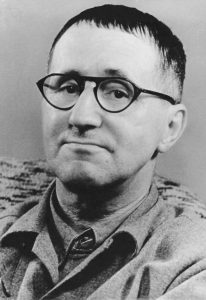
What are they talking about? They can’t be serious. Stuff about ‘fate’ and ‘genius’ and ‘intrinsic value’, and ‘poetry’ and ‘gnosis’ and ‘hierarchy’. And, what’s this, Bertolt Brecht (1898-1956) – ‘the Augsburger’ – and his ‘epic theatre’, Brecht who once versified the Communist Manifesto in Lucretian hexameters, and named Brueghel’s Dulle Griet (Mad Meg) a ‘great war painting’ (see 123) – well, ‘it is vital that we | resurrect Brecht’ (124). Christ!
Bertolt Brecht
Final Words?
How to categorise this weird offering, its preposterous form? Is it a biographia literaria (Coleridge)? A tractatus theologico-politicus (Spinoza)? A religio poetae (Coventry Patmore)? A Day-Book of Counsel and Comfort (George Fox)?
Does Hill intend for us to think this is epic theatre? He refers peevishly to W H Auden’s political poem ‘The Orators’ in poem 158: ‘The nearest we get to epic theatre is ‘The Orators’.’
Of this 1932 poem (G.H. was born in 1932), Auden wrote: ‘The central theme of ‘The Orators’ seems to be hero-worship, and we all know what that can lead to politically.’
There’s plenty of hero-worship in The Book of Baruch, plenty of wrestling too with the betrayal of the working class (31), and the embarrassments of the Tory tradition: ‘Tory, to me at this latter day, is both rabble and oligarchy’ (261).
Is Milton’s Paradise Lost epic theatre? I guess so. Milton’s all over the place in The Book of Baruch; amidst the civil war of austerity-and-Brexit, anarchic plutocracy’s generous mess of potage, Hill takes comfort in the compensations of falling towards the grave.
We might more readily expect a Last Will and Testament, I suppose. GH was in his 80s, and whilst he always seems to have written as if he thought he might die tomorrow, well, this is more obviously an apostrophe to those who would survive him. The poem numbered ‘47’ begins, perhaps, with an old man muttering to himself:
If this is going to be your testament best press on with it.
A testament – leaving stuff to someone, testifying to having existed; let’s also remember that GH is masquing himself as one ‘gnostic Justin’, who may understand ‘testament’ more grandly to mean a covenant or new dispensation of some sort, (for those who come after), a scripture, even.
Well, William Blake’s engraving (plate 14) for his America: A Prophecy (1793) is the jacket image, after all. (And Justin appraises that engraving too – see ‘170’: ‘his beard imitates mine in my mock senile portraits’. Sir Geoffrey threatens to get senile on us, but there’s exquisite method in this discombobulation, I suspect).
‘America is an early radiant work if we simply let the illumination bathe us’, a voice declares. I propose that we take time to consider the professor’s last things, and bathe in the illuminations and recriminations that Hill-Justin has to offer?
A Great Gift
So; a generic hybrid. A testament, a covenant, a witness statement, a testimony, a symposium, a reproach, a mockery (Pope’s Dunciad is a lost friend). H’m. I’m only fussing over this because I feel that GH is bequeathing all us ‘poetasters’ – ok, I admit it – a new form to play with.
It is a great gift, and I, for one, am moved to tears. You might say he’s just teasing us with being mock prophetic (as well as mock senile), but that’s ok too, isn’t it? Look at the long lines – they don’t even end at the right hand margin, do they?
Folded back into hanging-indent paragraphs, like a manifesto or, (actually), a stanza from Andre Breton’s ‘Ode to Fourier’ (see 179), or, I should say, looking remarkably like Rimbaud’s lineation in Une Saison en Enfer.
Who’d ‘ve thought it? GH makes something of this source in 167, raving about Rimbaud’s (and David Bomberg’s) part in the invention of ‘modernist poetry’, through an instinctive concurrence, apparently, with the philosopher Berkeley’s redemptive notion ‘that particles are units in the mind’s energy’. (This stuff may need some work doing: you could try D J Greene’s 1953 journal article, ‘Smart, Berkeley, the Scientists and the Poets: A Note on Eighteenth-Century Anti-Newtonianism’.) It’s all part of a thrilling defence of poetry for the 21st century; and look out for Kit Smart (‘no hoodlum’, 28) throughout the poem, and the product of his season in hell, Jubilate Agno.
Not obviously poetry then, but beyond prose, certainly. A 21st century Walt Whitman, for sure, inventorying what’s excitingly referred to (47) as ‘the untenable sanctities of abiding things’. Beyond grasping, out of kilter, implausible, but we do know such things, don’t we?
Certainly, [Listen to me – ‘Certainly’!], an old humanities professor might know a thing or two about what’s worth preserving, what might stay us, what abides, what might redeem the time, dare I say. Is this about redemption, after all, HaShem’s ways to man, and is it now delivered by these here genii and their gnomic achievements?
GH reminds us, for example, of the poet Thomas Nashe’s ‘finest poem thrown away on a dull drama’ – remember that invincible line?
Brightness falls from the air
This from a poem in Nashe’s Summer’s Last Will and Testament (1600), a comedy. Well, if poems can do that…
‘old-fashioned encyclopedic knowledge’
The thing about testament and prophecy, we might remember, is that they’re inevitably political and more or less obviously, satirical, (you can’t get away from Jonathan Swift, Alexander Pope, the other mockers – Ben Jonson’s ‘On the Famous Voyage’, for instance). Oh, yes – and also theological. Sorry. Well, just think Søren Kierkegaard, if it helps – his many pseudonymous personae – Johannes Climacus, that sort of thing.
Come to think of it, the title of Johannes Climacus’s 1846 work is perfect for GH’s book: Concluding Unscientific Postscript – ‘scrapings and parings of systematic thought . . . divided into bits’, as its epigraph notes. So much I have known, and know, don’t you know? Unbelievable stuff, ‘untenable’, beyond my grasp, inordinate, but something there, let me tell you. I’ve seen things, as the replicant says before expiring in Ridley Scott’s film Blade Runner. Peace be upon him.
It is a great gift, and I, for one, am moved to tears. I’d like to try it too; who knows, my children might be grateful to their poetasting father, when he’s gone? I’m not as old, nor as learned, nor as wise as GH, nor would he have deemed me a poet, but there’s plenty to encourage me here: ‘Poets with old-fashioned encyclopedic knowledge bring good seed to tillage’. (126) And then, later, he writes:
– With always an encyclopedia on which to rest my left
– arm, I do not have to resort overmuch to erm. (256)
Seems to be down to knowledge, then, and not, erm, inspiration (or genius?) Phew! I can do this. The gnostic Jonathan. A gnostic poetaster. Let’s see.
Geoffrey Hill 1932-2016.
Automatism
What else? How to get started each day, overcome the embarrassment and inferiority of the poetaster? Well, I can tell you, GH recommends the practitioners of automatism.
Robert Desnos is our (hu)man – ‘far and away the best of those Surreal men’ (139). I have to look into this. Peter Stockwell’s book The Language of Surrealism is certainly helpful. He writes: ‘in principle anyone could engage in automatic writing’, and refers to a ‘meeting on 25 September 1922 [the year of ‘The Waste Land’, and of Ulysses], in [André] Breton’s studio on the Rue de Fontaine in Paris, at which [René] Crevel, newly arrived from a spiritualist séance, suggested using the same technique for writing.’
Apparently, Robert Desnos was proficient in writing during a ‘self-induced trance-like sleep’, ‘in which striking images were often expressed with dense echoic sound-effects of alliteration, rhyme and punning.’ He wrote, for instance: ‘Mots, êtes-vous des mythes et pareils aux myrtes des morts? [Words, are you myths and similar to the myrtles of the dead?]’ This was published ‘in Littérature in December 1922 . . . under the name Rrose Sélavy (a pun on eros, c’est la vie)”. And these good mots duly make their appearance in Baruch – check number 139. Is this the discombobulating method?
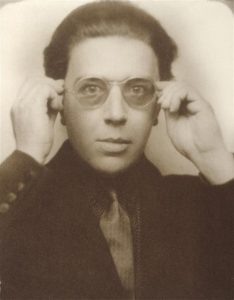
There has to be something in this for the gnostic Justin, right? I can’t prove this – (Go-ogle doesn’t know, for heaven’s sake – how agnostic is that?) – but I think the line quoted in poem 73 of this Book of Baruch: ‘To run on empty is to achieve a sort of hallucinatory abundance and clarity’ – I think this must be a translation of something in André Breton’s Manifesto of Surrealism (1924), and that Breton is the ‘Parnassian and … sassy man’ also mentioned there, (not Hopkins, who is above that, as we know).
André Breton in 1924.
The paradox, the oxymoron – they’re pretty surreal, aren’t they? GH always had plenty of time for the paradox, the oxymoron; and the cryptogram too, I’d say; all is surreal in such verbal tourbillions (Robert Graves’ brave word; see ‘On Portents’, and appraised by GH in one of his lectures). And – just in passing – there’s plenty of focus in Baruch on ‘codes’ – ‘the codes from London were always that absurd’ (89) – and the weird poetic lines/codes in Jean Cocteau’s film Orphée (‘a cultural film of established acclaim’ (139)), and – would you believe it? – Alan Turing’s turned up (227).
There is something in this. Let’s remember, those codes did mean something, (to those in the know, to those in the Résistance (89) or the Widerstand (255), for instance, God bless ‘em). People do solve cryptograms, don’t they? Poetasters are with the resistance too, right? Codes for a consistory. Like Polari, or Yiddish.
But how much cryptic and recondite erudition can the nation – those to whom we bequeath all this – tolerate? (See 163) The poetaster will do well to remember how her work may be received; words of warning: ‘Poem as inaccurate | prism inaccurately decoded; progressively derided; making honest | decent people appear stupid; all the pretence of a séance’ (163).
But take heart; let’s not forget that final mystery about which the mystics advise, and via, apparently, this same automatic writing (see Evelyn Underhill’s Mysticism) – look at this in poem 40, our professor musing on ‘intrinsic value’ and John Donne’s final writings: ‘our grandest poetics | perform their mystic dance of savagely disputed provenance.’
Hallelujah. Hill-Justin notes, approvingly, ‘Rouault’s mystical aggressive passivity.’ And has a mystical experience of his own, with ‘[d]ense holly trees’ (221). This is, after all, ‘’Geoff’s Mystery Tour’, perilous self-entertainment that would have | delighted my Aunt Nell, the bright one of our family.’ (178) This delights me: ‘All the mysterium of God is in the measure of time.’ (183) Who knows otherwise?
Form and Process
So much for form and process? Worth pausing here; because I want to say that (what used to be called) the content of this mock-prophecy is absolutely fascinating too, no doubt about it, I’m ashamed to admit. So I’ll come back later, if you don’t mind, to this thing about form and genre and provenance, this ‘All Souls’ Night’ (Yeats) summoning to a final showdown, a last reckoning.
A little bit about the content, even though the Professor insisted this is of no interest if it hasn’t got ‘technic’, (also Yeats, (and Ezra Pound)). But we’ve established the technic is automatism, isn’t it, the subjective-made-objective, the mask which is self-portrait, the sensibility-register. The anti-lyric, too. See 182: ‘The form I choose is monologue though with frequent episodes of multi- | voiced fugue.’
Firstly, if you’re the sort of person who likes to hear, say, Sir Geoffrey Hill choose his favourite bits of music, (he was once on Radio 3’s Private Passions, where the ‘Coventry Carol’ played alongside Jimi Hendrix’s ‘Star-spangled Banner’), well, this will be a revelation, (as prophecies are supposed to be, no?)
Here – this is important to say – you have to simultaneously hear, as counterpoint to various musical miracles, the bells in Wren’s churches crashing to the ground during the Blitz. This prophecy is ‘loud with falling bell-chambers’ (10), ‘bells, a last | cascade of thrashing, mangled squeals’ (36), ‘bells falling and bawling’ (2); and ‘the toppling creel of half- | melted bell-metal’ provides a great metaphor for automatic writing and this whole book: ‘astonishing collocations of syntax and semiotics’ (36). Hill-Justin listens, too, hoping to “cough up the phlegm of a poem”, to
The mingled throps and thrangs of bell-ropes and bell metal, mangled and _ muffled songs, when you stand beneath the bell chamber, hearing the _ ropes grunt and clamber. (72)
We might recall the opening lines of Yeats’ séance poem, ‘All Souls’ Night: Epilogue to ‘A Vision’’:
Midnight has come, and the great Christ Church Bell And many a lesser bell sound through the room; And it is All Souls’ Night
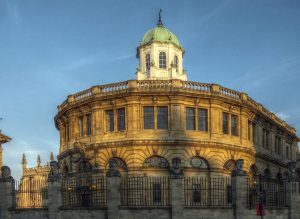
The Sheldonian Theatre, Oxford, designed by Christopher Wren.
I think it’s midnight for GH too, and HaShem’s in the tomb, and Tennyson’s ‘Ring out, wild bells, to the wild sky’ is a distant memory, (lacking some ‘obduracy of the mind’s address’, apparently (69)). When Hill-Justin tried to compose music himself, he informs us, he failed: ‘My piano compositions failed because I could not compose a convincing | ground bass’ (249). He succeeds here, with Wren’s crashing bells.
We should remember GH didn’t want to be a poet, after all:
I would have prayed to excel in mathematics and music if I had prayed at all; _ envying Wren and the musicians of the Chapel Royal; passacaglias and _ Purcell; for that is where the mind stands to itself, albeit in hell. (25)
Well, look – listen! – the music of Purcell does seem to come out on top here. (When GH was invited by The Economist to read his Clavics and work-in-progress at the Purcell Room on the South Bank in 2011 – ‘What! Six daybooks, already?’ we all declared. (Actually, seven now.) – GH closed proceedings with the most menacing and atoning rendition of Hopkins’ sonnet ‘Henry Purcell’ you could ever dread to hear.) GH seems to agree with what Hopkins says of Purcell:
The poet wishes well to the divine genius of Purcell and praises him that, whereas other musicians have given utterance to the moods of man’s mind, he has, beyond that, uttered in notes the very make and species of man as created both in him and in all men generally.
Wow! (Plenty of derogatory stuff about ‘moods’ as the domain of mere poetasting in Baruch, be warned.)
And Hopkins is a key presence at the table – this cénacle – throughout. In 176 Hopkins and Purcell are linked via Purcell’s ability to create ‘sprung rhythm | two centuries before ‘That Nature is a Heraclitean fire’ which its | rediscoverer – a devout Purcell admirer – felt duty bound to keep | hidden lest he should bring notoriety upon the Society in which you do | as you are bidden.’
Odes and Welcome Songs
Let’s see which bits of Purcell are playing at the Feast, on ‘the wind-up gramophone’ (137). Well, it seems to be his Odes and Welcome Songs (185; 187; 188), and this is what Hill-Justin says of them: ‘these ‘welcome songs’ feature a benign vision for the future of the | kingdom in accordance with divine nature’ (188).
He goes on to express extraordinary gratitude and estimation (189): ‘Tell him his saddest | music well-betides us, elides all but our last, worst fears.’ Plenty of compensations, then, even after a referendum and all history’s idiot repetitions.
So much for content? O, but look out for, nevertheless, Schubert’s Quintet (70; 253), Handel’s Saul (79) – ‘how profound the accessible can be, | given mastery” – Thirties jazz – “accurate music appropriate to heaven” (36) – Britten’s A Ceremony of Carols (130), ‘L’hymne de l’Union Européenne’ (140), symphony number 9 by Malcolm Arnold – ‘old Malc’ – “that final untri- | umphing lento of twenty-odd minutes”, “its near subliminal song” (197), and Ralph Vaughan Williams:
I bless the marvellous ‘Five Mystical Songs’: although strong music cannot _ even begin to mend wrongs, it is, in some way I wish I could well relate, _ analogous to the Pentecostal tongues. (85)
Ok. So – poetry – this poetry – aspires to the condition of music, yes? Well, I’m not sure about that with Hill-Justin, after all. Set down this, set down this: ‘Not | music. Hebrew. Poetry aspires | to the condition of Hebrew.’
Of course! Now we’re talking. This naughty apophthegm is ripped from Hill’s 2000 prophecy, Speech! Speech! (poem 20). Such wisdom bears contemplation. (Well, I’m reading Yuri Slezkine’s The Jewish Century as back-up).
And I was always told the three archetypes of the human condition to be Faust, Don Juan and Ahasuerus, don’t you know. [Whilst we’re here, Wikipedia keeps us informed that Kant himself refers to the legendary Ahasuerus, wandering Jew, in his The Only Possible Argument in Support of a Demonstration of the Existence of God. I’m reminded of Hill’s long-time interest in Peirce’s ‘A Neglected Argument for the Reality of God’. – Sorry – am I going into séance mode?] And what about Lear as archetype too (God’s spy)? What about Falstaff (God’s clown)? Our prophet is all these.)
Hill-Justin – the poet-prophet – as Ahasuerus. Exiled, unhoused Adam. Well, this did preoccupy John Milton at the end of all his hopes and dreams. Where did it all go wrong? And Milton’s all over The Book of Baruch, as I say. ‘Latterly, led by the hand in his good grey coat, a blind good looker, looking like | a Quaker.’ (18)
Supremely non-conformist, speaking truth to power, aficionado of peace. And a reader – don’t you know – of the Hebrew scriptures. Geoffrey Hill, Hebraist, (there was a quotation in Hebrew for The Triumph of Love (1998), wasn’t there?) He refers mysteriously in 96 to ‘the | inexorable semitic-semantic code.’ Is this that ‘God’s grammar’ thing, again; isn’t that from John Donne? Still, the still, small voice.
John Milton 1608-1674
Love Supreme
The gnostic Justin, we think, was ‘Jewish-Christian’, and, excitingly, considered a heretic by Hippolytus, (third century). And look at this:
But because I am not a Jew I desire to know all that was said when, once a year,
__ the high priest convened in holy fear with the Ark of God.
Hill’s naughtiness and perspicacity, his agile-mindedness and contrariness and impetuosity all remind me, at least, of the Hebrew prophets. It’s a familiarity with HaShem (her omniscience and inordinacy), a longing to hear HaShem’s voice (in the gathered silence of this Quakerly meeting), which makes Hill’s encyclopaedic mind, too, into a psaltery of praise and vexation and vexatiousness. Isn’t this the Hebraic mindset? Forgive me.
Hill repeats this sense, actually, of exclusion from, what, the chosen race? In 216: ‘I am not a Jew though I married one; and I subscribe to their iron scorn.’
Jewish cultural illuminati are prominent and are revered. Besides the anonymous authors of the Gnostic Bible (40) and The Book of Job (86), there’s Simone Weil, of course, Robert Desnos (very much so), Len Rosoman and his commentary on the epicentral Mad Meg painting (is it a pogrom?) by Brueghel; David Bomberg too, Celan, Tzara, Gershom Scholem (think his Major Trends in Jewish Mysticism (1941)), the Mandelstams, Gillian Rose (quoting from his late friend’s Judaism and Modernity, wouldn’t you know; must read this), Sandy Goehr (his co-eval), even Leopold Bloom; the Jewish century, I’m convinced.
We see ‘Willy Brandt at the | Ghetto memorial’ (77), consider ‘the topic of Jews and usury’ (186), never forgetting strains of antisemitism in ‘my grievous heroes’ (186; 111; 177). And a strange and riddling identification: ‘Ich bin Dreyfus, an old man who walks with a cane, thus – ‘ (189). If poetry aspires to the condition of Hebrew, then I suppose the poet’s task is both to resist and to aspire to scriptural authority for herself. A bit much for a poetaster, truth be told.
Anacoluthon!, as decency demands. Yes, even Love Supreme has to come to an end. Let me finish, please. We’ve got the Hebraic mindset then, the surrealist automatism and discombobulation, the musical passacaglia – and we’ve also got pained awareness of the betrayal of the working class (and the European mindset, bien sûr), the death of intrinsic value (O, no it’s not!), there’s Hill’s gnostic ‘back garden apple’, his parents’ suffering and his childhood, poet-soldiers and – pilots, (Eric Ravilious, d. 1942 (242)), war photography (Mathew Brady (247)), divination (everywhere), and Coke (1552-1634) and Grotius (1583-1645) laying the foundations for international law, as all great poets do, too. Mind you, let’s be clear:
The waters recede: neither covenant nor creed. (236)
This great prose poem, divine table-talk, is endless. You can’t stop loving it. As Ezra Pound wrote of Wyndham Lewis’s work in 1917 on illustrations for Timon of Athens, (and quoted in Baruch, 229), we hear everywhere the prophetic “fury of intelligence baffled and inspired by circumjacent stupidity.” But this fury is never unmixed with “ ‘summer’s sovereign good’” (from, is it, the last poem Hopkins wrote?) and (though not “irrefutable”) “evidence of cosmic cadence” (256). How GH loved this all, all this wisdom, all this folly.
Love you, Professor. Lead the way.
Intrinsic value that I care about is as tenuous and wiry as a bit of great verse. (163)
It is a great gift, and I, for one, am moved to tears.
I first heard the story of Gene Shepherd after receiving a 46th rejection slip for my novel.
Shepherd was a New York radio presenter who broadcast regularly for twenty-two years. What interested me about him was that he created a best-selling book which did not exist.
Because he thought disc jockeys were just an extension of the music industry, Shepherd played no music on his show – except the occasional tune by himself on a kazoo or a nose harp; otherwise he talked non-stop from midnight to 4.30 every morning. He had 50,000 loyal listeners for whom he first invented the term ‘night persons’: insomniacs, airline pilots, night watchmen, burglars, lovers and those who lived their lives while their fellow New Yorkers slept.
One night he told his listeners that they had a great advantage over daytime people: they thought for themselves. He argued that daytime people’s lives and tastes were dictated by rigid work schedules and especially by arbitrary consumer guides called lists: the ten best-dressed women; the twenty richest men; the thirty best songs; the fifty best novels.
‘How many of you’, he asked, ‘ever voted for the Academy Awards? Who actually decides these things? Who makes up these lists?’ His concern had begun in a bookshop when the assistant haughtily told him that the book he had requested, a minor classic, did not exist because it was not on her publisher list.
The Conspiracy
One Summer night in 1956 Shepherd invited his listeners to conspire with him in inventing a book which actually did not exist. After several nights of listeners phone calls he opted for the suitably tempting title, I, Libertine, by an imaginary author, F. R. Ewing, and an imaginary publisher, Excelsior Press, which, for prestige, they would describe as an imprint of the ‘Cambridge University Press’.
Over the next few nights he distilled his listeners’ ideas for background material to the book and its author. The writer would be called Frederick Ronald Ewing, British, of course. His CV would include a spell as a Lieutenant Commander in the North Atlantic fleet, a BBC radio broadcaster, a regular contributor to the London Observer and he would now be a settled civil servant in Rhodesia.
He also must have a charming wife named Marjorie, a horsewoman from the north country. The imaginary book, I, Libertine, would be described as the first volume of a trilogy on the subject of 18th century Erotica.
Besieging Bookshops
Shepherd now urged his listeners to descend on their local bookshop over the following days and ask for the non-existent book. The results were hilarious.
The New York bookshops were besieged by Shepherd’s conspirators who reported their experiences on air. Shepherd had predicted that the first caller to a shop would be dismissed, that the second would be told the book was on order; but that a third inquiry would result in telephone calls to distributors who would then besiege Publishers Weekly. It all happened exactly as he had predicted.
One listener reported on a snooty bookshop assistant, the kind, he said, who gave the impression that he might himself be Kierkegaard or Schopenhauer. The assistant had the habit of dropping remarks like ‘Proust never really matured’ or ‘Joyce, a bit overrated don’t you think?’ When the customer asked, however, for the non-existent Fred Ewing’s I, Libertine, the same assistant brightened up: ‘Ah, Ewing’, he said, ‘it’s about time the public discovered him’.
Going Global
Airline pilots listening on shortwave got the joke and brought word of the imaginary book to Paris, London, Rome, even to Honolulu bookshops. Soon everybody was talking about I, Libertine.
Gene Shepherd and his listeners kept the intrigue going for eight weeks. One student reported that his end-of-term thesis on Frederik R. Ewing’s equally non-existent pre-war BBC Radio 3 broadcasts on the History of Literature had been awarded a B plus.
The student’s examiner had written in red ink ‘Superb research!’ The student mournfully told Shepherd on air: ‘Maybe my whole education’s been phoney. Now I think maybe even Chaucer didn’t exist.’
Another listener rang to say she mentioned the book at her bridge club. Three ladies claimed to have read it, two of them disliking it very much.
A fundamentalist church in Boston actually banned the book.
A New York gossip columnist, Errol Wilson, wrote: ‘Had lunch to-day with Freddie Ewing and his wife just before they set sail for India. Freddie said he was surprised at the popularity of his book’
Finally, the inevitable: the New York Times Literary supplement carried a review of the non-existent book. As a result I, Libertine appeared on the nationwide best-seller list and Gene Shepherd’s project was complete.
But he was now getting nervous. What if the President of the U.S.A. referred to the non-existent book – this was, after all, the paranoid fifties. Might Shepherd be hauled before The House Un-American Activities Committee, for making an ass of the Commander-in-Chief?
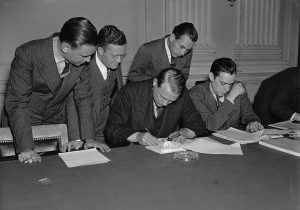
House Un-American Activities Committee.
Busted
When a journalist rang in to tell Shepherd that he too was a ‘night person’, that he knew the whole story and suggested that it might be time to reveal the deception Shepherd jumped at the chance.
The Wall Street Journal carried the entire bizarre story on its front page. It was reproduced word for word across the world – even in Pravda, the official Soviet news agency.
Shepherd was inundated with phone inquiries from newspapers in six countries. But in America the story was spun very carefully. ‘Radio DJ deceives the public’ was the usual headline. This, as Shepherd protested, was untrue. His entire listenership had simply demonstrated how hype and PR could manipulate the public. But his was an unpalatable message in the self-proclaimed home of individualism.
The story ended not too badly. Before the expose, a paperback publisher named Ballantine had asked the Wall Street journalist for help in tracking down Ewing with a view to buying the paperback rights to the non-existent book.
Shepherd joined them one day for lunch and the journalist introduced the broadcaster as the real Frederick Ronald Ewing. Ballantine was astonished but retained his focus. He said: ‘Of course, you will now have to write the book’ And in six weeks the broadcaster and the journalist did so. The real book became a bestseller and they gave the proceeds to charity.
Moneybutton
However Gene Shepherd had long been resented by the advertisers on his radio show – he tended to make fun of the commercials with the introduction ‘Here comes the moneybutton’ – and they gradually sidelined him into doing hour-long broadcasts.
No longer was total freedom of the airwaves available to him. He ended his career presenting his show on college campus radio while he churned out books, for one of which he invented the slogan: ‘In God we Trust – the rest pay cash’. Gene Shepherd died in 2002.
I now await my own novel’s 47th rejection slip, but thanks to Gene Shepherd I care a little less whether it comes or not.
The light that streams across the universe
Brings evidence of other worlds than ours
Where midst the flux of fields and particles
Eternal wisdom older than the stars
Unweaves her web of possibilities
The patterner experiments and plays.
Bright pearls arranged according to the laws of chance
Or unknown logic, now ingathering
Dark threaded galaxies where furious force
Sweeps stirs and scars the dust of earlier worlds
And in continuous creation builds again
Forms that persist beyond the death of stars.
I too shall praise the heaven’s magnificence
Honour with awe its ever abundant power
That once with measured force spread out the sky
To be a bound and roof upon our world
And a protection to the fragile Earth
I dreamed we built a home for everyone
There where I danced beneath the moody sky
We gathered gifts from the untamed wilderness
And put our passions together to prove our skill
I piled turves around the tallest tree
To form a seat and meeting place for friends
And all around
We planted seeds and hope in the dark ground.
A craftsman wrought a jewel long ago
Welded of words and of lines laid true:
From older songs he hammered out his tale
Of courage and of loss, of king and earl
Of men and monsters, a memorial
An elegy of an imagined past.
This that the war geared Danes far in days long gone
Gained fame in story, glory in war
How that the Ethelings harassed their enemies
Tribute and treasure took from tribes all around
So that the gold giver strong in his growing band
Folk wielder, wide ruler, strong in command
It pleased the peoples’ king to plot a towering hall
Gathered the workmen there from every land
To build the glad mead hall wondrous in workmanship
Famed amongst every folk, glorious and grand
Glad in the glee of hall, song mead and feast
Welcome to give to all, stranger and guest
He shared God’s wealth with all, except the common land
Care for the young and old , while shall the hall still stand.
Fast came feud, the dragon crawls along the rock
Brother by brother slain, who from his dark tower gazes on his hoard
The works of man overthrown, and grimly the dragon guards his greed
Nothing of worth remains, while treasure proud he broods of doom
War without end, he who is now the wyrm was once a man
He will devour all, and in his banks and barrows guard his pride.
All of our wealth they bury deep, they who were human once are monsters now.
Until a hero would come who had learned all the language of birds
Who had seen how the hazel nut falls who had found out the strength of a wolf
Who far from the friends of men had drunk of the spring and the well
And boasts he will reforge the shattered past.
Because I knew two fat and greedy slugs
Had crept into my garden to destroy
And everywhere they’d been they’d left their slime
On everything I did and still do love
So I must wander in the wild lands
Of my imagination flying far
Beyond each seen hill. into each dark wood
In endless exploration travelling
And trace each little river to its source
There is no river running round the world to bring us back
To step and step again on our own land
And see it for the first time: river run
River run, river run, always new under the sun
River run to the sea, river run, river run.
And then my mind moves on
To Homer’s heroes weeping by their ships
Who in the pain of war
Or washed by slave girls
Sitting in high seats
Would eat their roast meat and their mixed red wine
Gold jugs and silver basins, gleaming oiled skin
And think themselves like gods
As some blind singer skilled
Sang of their war achievements and their crimes.
The old man now remembering his loss
In his imagination finds his home
Trickster and fighter once, teller of tales,
Sacker of cities,
To meet again the weaver of his dreams.
An old man now imagines his return
That trickster, trader, sacker of cities, king
Teller of tales of whom once tales were told
Will find his way again still with deceit
His youth disguised now only by old age
To meet again the weaver of his dreams.
He will imagine what the swineherd said.
That happy is the lad that had no need
To be a hero.
Odysseus had taken all the boys
To fight in wars for Agamemnon’s glory
He’d let them kill the cattle of the sun
And brought back none.
And now the arrogant young lords
Devour all and never leave a scrap
Till everything is gone.
They taunt and mock the poor.
And drive the needy stranger from their door.
And if the king returns he’ll do such things as will be told in story
He’ll bring a bloody climax to their deeds
Renew himself
In all the joy of action….
Then I awoke in a fair field of folk
And let the leaves of memory fall through my skull,
The bare and distant trees where few birds call
The ferns and dead leaves by the waterfall
And the grey lichen on the granite wall
We go to hear the sermon of John Ball
For Much the Miller will grind small small,
Because I know that winter is delayed
While all the colours of the evening sky
Still gleam and fade.
David Hillman was born in Launceston, Cornwall where the poet Charles Causley was then working as a teacher. One of the children of Ron Hillman, a postman. David read widely and explored the countryside on foot but restricted by his family’s poverty he had never been more than fifteen miles from home until he left at the age of fifteen to get involved in politics and study. He obtained degrees in Physics Maths and in Modern History in Brighton, Oxford, and Liverpool, and has spent many years teaching in Oxford including some quite challenging environments. He considers himself an apprentice poet, now in his early seventies.
Ireland is a funny old place. I’m not sure we’re prepared for the rough times ahead. We’re soon turning one-hundred-years old – which is basically puberty as far as nation states go.
We’re riddled with latent energy – mostly guilt and anger – from the past, just as the future is becoming an unstoppable force. It’s hard to take pride (in its literal sense) in a past so troubled, so instead we focus on the defining moments of history.
Centuries of suffering and persecution of people on this island become a footnote to the realignment of power structures, our identity shrouded in myth and broad sweeps, as bit-part actors in nearly a millennium of recent existence. And I think, an internal struggle between our natural impulses as sardonic inhabitants of a dark, wet and green North Atlantic island.
The coming wave can be extrapolated to a similar battle in the area of artistic self-expression that has been raging for most of our history. What do we value about ourselves and how should we express that in the public sphere? Is society thriving? If not, then am I hearing this reality represented in the everyday art that I encounter?
Access and Capital
This existential discrepancy between the lives we lead and the art that is presented back to us is a discombobulating force, particularly for a nation so unsure of its footing, and in deep crisis. The usual heroes notwithstanding, mainstream radio too often provides us with local music that has been commodified and sanitised for a global market; an idea from elsewhere with a soft Irish focus which tells you that we mean you no harm; a people and an island made of random edges too often represented by a smooth, diluted version of an imported algorithm.
Our music industry is thriving only when we appear to be competing internationally, when our output raises sufficient capital to attract the attention of the people who really should have been paying attention in the first place. And of course, one can argue that it was always thus: that artistic edges have been shaved off in exchange for access and capital. But now technology has turned a razor into a meat grinder and flipped the supply chain on its head.
How can music that requires more than one listen (or even thirty seconds to get going) compete in a marketplace that monitors audience response in real time? How does structurally-reactionary art gain access to those very structures that it is critiquing? How can art that does not factor in commercial concerns – such as advertising, revenue, and so on – hope to succeed in a hyper-capitalist market place? These dilemmas are present across the musical food chain as specialist organisations continue to crumble in the face of ever-expanding technocratic machinations, mostly deserted in a media landscape that has been slowly absorbed by the global monolith.
‘As vibrant and as vital as it has ever been’
There is a line in the sand now. Just as successive generations decide where progress begins and ends – I am seeing people decry the absence of ‘great music’, ‘protest music’, etc., etc., or the crushing, cyclical canard of the current generation not being up to scratch.
It is all out there and it is not hard to find. Music is as vibrant and as vital as it has ever been. However, the access points are frequently controlled and poisoned to the point where people can unironically use a web browser to complain that music stopped when Kurt Cobain died or something.
Every year I see five to ten live acts who literally flip my brain on its head – and that’s after a lifetime of working in music and going to gigs. Audiences are smart and if you treat them like adults and show them the limitless possibilities of music then they will respond accordingly; treat them like objects to generate revenue at the mercy of capital then we end up roughly where we are now.
‘Nobody really gives one solitary shit abut us’
I grew up thinking everyone hated the Irish (via the UK media). From my late teens and onwards, I was lead to believe that everyone absolutely loves the Irish. But it was only when I realized that in the greater scheme things, nobody really gives one solitary shit about us that I began to understand my own identity, and where I plugged into the world both personally and artistically.
I started to learn how not to blink. The idea remains interesting with or without an audience; trying to plug directly into the capitalist monstrosity that the music industry was becoming was a recipe for electrocution.
Everything at the same time is no place for small, different things that need time and space to breathe: gig announcements competing with missing dogs and wellness memes for the surreal oxygen available in the greatest pile-on the world has ever seen. Thousands of years of localized learning and practice reconstituted as instant global spaghetti.
The challenge is to stay focused as an artist, and accept that a sub-subsistence existence in a lifetime of participation in the arts is now not just a distinct possibility, but a likelihood. And that the preservation of tradition and the space for new ideas to emerge and develop could well be an increasingly thankless and costly road.
It is not all bleak of course, not by a long shot. I don’t believe in golden generations, or lists, or any terms that attempt to run complex historical realities through a tabloid filter – I do believe in community and, right now, there are defiantly-specific, strong, and vibrant communities across genres appearing all over the country (with experienced, thoughtful documentarians capturing what is happening).
Uncompromising acts have muscled their way onto a bigger stage by the sheer force of their own momentum and billionaire-owned radio has been compelled to accept the odd blemish in their playlists. Collectives that are popping up in major cities and beyond, call the world as they see it, saying bullshit to rock mythology and transparent hype. This is the hope that I plug into when I wobble and wonder what the hell I am still doing in music.
‘Twenty-first century music promotion is weird’
I’m in my forties now and while I have plenty of energy and love for music, it has become increasingly tough to generate sufficient internal optimism to keep promoting touring acts. The contradictory force of the show itself being the panacea to hopelessness, and also, a source of profound anxiety right up to that point, is something that I wrestle with nearly every day of the year.
As Irish cities and towns are squeezed tighter and tighter and the cost of travelling with luggage continues to climb, inevitably, ticket prices for shows go up and the associated pressure increases. You try to reach people but you are literally shouting over Donald Trump. You shout louder and you realise that you are shouting over the latest tragedy to have befallen the city so you back off and then immediately feel guilty for not promoting the show properly. Twenty-first century music promotion is weird.
That’s the job so I can’t really complain, but at some point the space in my head is gonna be needed for reflection rather than fretting, and I’d also absolutely love a shot at music just as a hobby again. And if I cannot get out of this fantasy industry then I would, at the very least, like a shot at effecting structural change for the good of musicians. Almost nobody speaks for musicians any more.
For more information on Vincent Dermody’s work, see:
Alternating Current Festival, Dublin, 13-15 March 2020:
Hardly a week goes by without someone asking me about my connection to Christopher Hitchens. Such enquiries are clearly predicated on our common concerns. I suspect at one level my own modest bohemianism and libertarianism has invited comparison. Although we share an unbridled enthusiasm for talking Hitchens was, however, also a great listener, something I am struggling to get better at.
I had a brief encounter with the man himself one enchanting and admittedly drunken evening. Being then youthful I was somewhat dazzled by his presence, yet more so when the bill for the wine and cognac arrived.
I found Christopher Hitchens almost preternaturally eloquent, even when plastered. Industrial quantities of booze only seemed to inspire him to new heights, as it does many artists. Nonetheless, he was fortunate to have the constitution of an ox – a unique case and liver to boot. Predictably, it was the cigarettes that killed him in the end.
Despite a dreadful personal lifestyle in conventional terms, his achievements and outputs – to use a terms whose origin in economics he would have despised – as the author, co-author, editor, or co-editor of over thirty books, were nothing short of phenomenal. Lifestyle excesses did not undermine his craft or genius.
Non-compromised Intellect
As a man of letters, Hitchens is the last in the line of a Belle Époque tradition requiring a confidence trick that Voltaire, George Orwell, Gore Vidal, Albert Camusand, truthfully, few others have pulled off. These were all men who operated in a space of utter independence and autonomy; as journalists not beholden to anyone; as non-compromised intellects, projecting intelligences greater than any academic-for-hire.
Hitchens himself was a generalist and synthesiser, a man of substance, far removed from the letter writer to a newspaper dismissed as a crank by those who control the message and form the opinions in our dumbed-down zeitgeist.
He played a role for which there is no job description, as it really does not exist, for he himself defined it through sheer force of will. Self-selected and self-ordained, he was truly a law unto himself.
It helped that the power brokers adored his transgressive presence. Walking on the wild side, he was a unique, larger than life character. Albeit toadying up to the powerful ultimately mars his legacy.
He was fortunate to receive the adulation of Americans, and of course he panhandled to them. They loved to debate with this antichrist of an atheist.
Perhaps they believed such a troubled human being seemed ripe for religious conversion, which of course he never succumbed to. In fact, the very religious doctor who supervised his dying days was anxious for a death bed conversion that never came, all of which is splendidly documented in his book Mortality (2012).
He might not like the comparison, but it seems to me that like many sincerely committed religious people he held an innocent faith that public debate matters: that serious argument around fundamental questions counts, and continues to shape public opinion.
Support for Invasion of Iraq
Hitchens’s blinkered support of the 2003 invasion of Iraq was based on hatred of religion in all its forms, and Islam in particular. He thus stands complicit by proxy in endorsing U.S. terrorism.
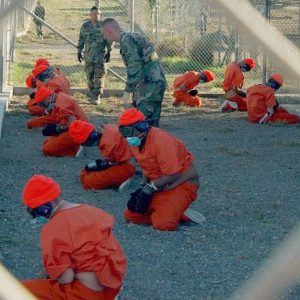
Hitchens failed to acknowledge that the US was acting as a terror state. When President Bush’s chief legal advisor Alberto Gonzalez described the Geneva Convention to be ‘quaint’ and ‘obsolete’[i] it opened to the door to the torture carried out in Guantanamo Bay and Abu Ghraib.
Guantanamo Bay.
Having said that at least Hitchens had the good grace to undergo the torture of waterboarding himself under controlled conditions, that he wrote about in a famous Vanity Fair article, declaring ‘Believe Me, It’s Torture.’[ii]
I happen to share Hitchens’s hatred of extreme religious fundamentalism and jihadi terror tactics, but am not oblivious to their origins, and the even greater danger posed by the maniacs on the far-right of the Republican Party in the U.S.: that triage of evil, Post-Truth, moral relativism and religious fundamentalism that Noam Chomsky has pointed to.
U.S. Republican extremists, unlike anarchists or deluded and fragmented Islamic jihadists possess true wealth and power, making them really frightening.
Moreover, on account of his British upbringing Hitchens was not exposed to the Catholic fundamentalism I have encountered, which is in some respects the worst, and certainly the pettiest, of all.
Attack on Bill Clinton
There is much to be said in favour of Christopher Hitchens. He was after all, the great Satan to the religious right, predicting, along with Richard Dawkins, the rise of religious fundamentalism, both Christian and Islamic. He saw it all coming.
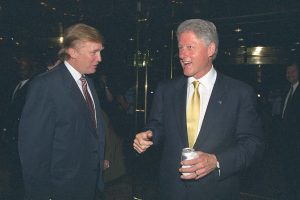
Indeed, Clinton was the beginning of the end. Bubba is like a fractured image of Trump and Steve Bannon and precursor to their redneck populism. With his forensic mind, Hitchens knew a spin merchant when he saw one.
Bill Clinton with Donald Trump c.2000.
Hitchens recognised Clinton as a Populist vulgarian, and ultimately a betrayer and subverter of the liberal cause. He could see that Clinton’s lack of spine, principle and integrity would allow the Neo-Cons to undermine the liberalism he claimed to stand for.
Clinton is a hillbilly product of an educational system prioritising policy wonking. Today we see far too much emphasis on graft and data retention along with carefully managed communication, which is the obverse of true argumentation. Thus discussion and debate is confined within ever-narrowing parameters.
Hitchens’s commitment to the Enlightenment values of reason and truth unquestionably dictated an intense dislike of the purveyors of Post-Truth nonsense.
Hitchens was not, however, as critical of U.S. neo-liberalism as he ought to have been, and his departure from Marxism led to obsequiousness towards the establishment. This ideology, or ‘false consciousness’ in Marxist terms, is laying waste to the world and Hitchens should have seen it coming.
Perhaps the cognitive dissonance, can be explained in material terms by this intellectual Marxist being on the neo-liberal payroll. He was where the money was, representing the opposing, other times supportive, viewpoints on Fox News. Yet he remained danger to all comers, a white knuckle ride on an unruly horse.
The Bonfire of the Vanities
In a sense Hitchens was intellectually mediocre, not unlike Jordan Peterson in that he pandered to the corporate market. The neo-liberal banqueted intellectual, who keeps it safe and ted-talky. Anything can be resolved by one market under god. Well no it cannot.
Thus, by side-tracking to Islam, supporting the Bushman wars and demonising Clinton he perversely and indirectly served Republican interests. His Marxism twisted and bent like a tattered cover effectively brought endorsement of U.S-led neo-liberalism.
Hitchens had an opulent and luxurious lifestyle, and I believe it blurred his judgment. Money can corrupt anyone. Indeed, a character in Martin Amis’s book Money (1984) was ostensibly based on him.
He liked to be indulged, flattered and entertained, and craved an audience too much. The scoop was all important. A neediness to be the centre of public attention was an obviously failing.
Hichens’s unscrupulous lifestyle, alcoholism and opportunism, some say, is also fictionally documented in Tom Wolfe’s iconic 1980s novel The Bonfire of The Vanities (1987). The fictional character that emerges is far from sympathetic.
That is not say he was not mostly correct in his arguments. We should judge the ideas rather than the man, who must have been difficult to live with.
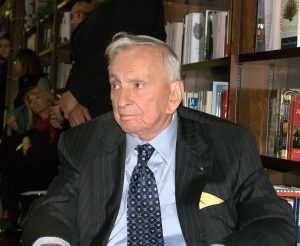
Above all, Christopher Hitchens maintained the idea of public intellectualism, and was a champion of any cause he firmly believed in. He was like a successful Ignatius F O’ Reilly railing against a Confederacy of Dunces (1980), operating in what Gore Vidal termed ‘The Republic of Amnesia.’
Interestingly, Vidal anointed him as his successor and dauphin. But perhaps unsurprisingly they had a falling out, given there is little of the austere Brahmin in Christopher Hitchens.
Though he might bridle at the suggestion, Hichens is more like the smooth-talking William F. Buckley, the architect of U.S. neo-liberalism, at least in personality terms. A fractiousness and emotional incompatibility between Buckley and Vidal is also easy to detect in Best of Enemies, a recent documentary about their famous debates and interchanges during the 1968 U.S. Presidential Election.
Gore Vidal, 2009. Image: David Shankbone
A One-Off
Hitchens’s sheer force of personality and will is unlikely to be seen again any time soon. Even his enemies would concede he was a one-off, a public entertainer of such colour and intellect that he was guaranteed to give a performance, and unlike in Franz Kafka’s The Hunger Artist (1922), the public never tired of it.
But the heroic lifestyle, involving so much booze, and stage fright no doubt, killed him prematurely. We can, however, draw a few lessons from his intellectual legacy.
First, to be vigilant to public discourse being hijacked by spin merchants, quacks, false expertise and imbeciles that we now seem to be buying wholesale.
Secondly, to listen carefully to those who speak consequentially and even cause the necessary offence. These kind of people are being obliterated or subsumed by mindless internet chatter, and sound bites. As Hitchens famously said: ‘My own opinion is enough for me and I claim the right to defend it against anybody, anywhere and if you do not like it stand in line while I kick your ass.
Thirdly, to recognise that our moral compass of truth is being lost to a religous fundamentalism that appears to be winning.
Fourthly, we must question the pillars of society just as Hitchens interrogated the roles of Mother Teresa, Bill Clinton and Henry Kissinger, to devastating effect.
His book on Mother Theresa is in fact incendiary. The title the Missionary Position: Mother Teresa in Theory and Practice (1995) is a pun of true genius containing a veiled attack on Catholic attitudes towards sexuality, and so called charity.
Hitchens fillets her to show how the ostensible compassion and charity was really a mask for leaving people to die in appalling conditions, without adequate support mechanisms or proper treatment; in short demonstrating that she was a hypocrite.
Master of the Polemic
Excessively religious people like to be seen to be good as opposed to doing good. Tokenism holds sway. Many devoutly religious people I knew were all in favour of the Innocence ProjectI founded in Ireland; that is as long as it did not interfere with their interests, and of course funding was out of the question.
Hitchens was the acknowledged master of the polemic, and revived the tradition of the public essay. In this sense his easily digested and short books – beautifully written, precise and pungent – are not just in the line of his great hero George Orwell, but owe a debt also to the tradition of 18th century Anglo-Irish letters, encapsulated by figures such as Jonathan Swift or William Hazlitt.
His work could also be profoundly serious, at which point he ceased to be just a polemicist. His public education text on The Rights of Man (2006), juxtaposing Thomas Paine and Edmund Burke is a perfect summary of the values of the constitutional Enlightenment. It condenses a lot of learning and is far better than many large treatises on the subject that go unread and unremembered.
I sense that he appealed to his contemporary audience as a generalist confronting legions of specialists. His ranging intellect contrasted with the products of an educational system that no longer permits all-rounders. When he engaged in his ideal forum of public debate he simply knew too much, and was too articulate with a ready supply of historical and literary allusions that dumbfounded his critics, putting the political spinmeisters on the back foot.
He achieved glory by unconventional methods, to put it mildly, and it must have astounded him that a third class degree, admittedly from Balliol in Oxford University, brought him so far. He bucked the specialist trend.
One Man Show
I wonder whether such a ribald, Rabelaisian figure of jollity and deadly accuracy could gain traction with an audience today. Where would his footholds to glory lie? His unruly lifestyle in these censorious times would probably ensure that he never got past first base.
At one level it was all a kind of performance. A one man show that went on and on. The clown prince. But what a show it was.
What his opponents lacked, and he possessed in spades, was depth and interdisciplinary context, and above all else a genius for sharp communication and barbed wit. He used words to nuclear effect and with antennae raised to the fraudulence and hypocrisy of our times.
He is sadly missed, for our real foes of Post-Truth, moral relativism and the repudiation of Enlightenment values hold a vice-like grip over public consciousness.
I suspect he was also a little big man, a voice that just had to be heard. Perhaps his oversized personality was a compensation for social maladjustment, and even Asperger Syndrome or similar. Like Oscar in Gunter Grass’s The Tin Drum (1959) he banged on for the sake of the marginalised and those classified as deviant.
It was the transposition of his erudition and learning in a practical sense to the issues of his time that also defined him. Given the context in which he operated, his life was a minor miracle. A last popular gasp of learning and context that gained traction and a mass audience.
He once said that our lives only have meaning to the extent that we give them meaning, which is not to condone his attitude towards the women or the booze.
There was a craving for middle class acceptance for which he had to overcome an inherent vulgarity and crassness. America suited him as a pundit and pugilist of an anti-intellectual vulgarity, who could speak at their level. Being of a kind, he recognised the flaws in Clinton.
He was never quite an English gentleman. Never officer material.
In America he was one step, in savvy terms, above the vulgarity around him but still appealed at a frat-boy level. For in the kingdom of the blind man the one eyed man is king.
The thing that is currently occupying my attention is a new album that I’ll be releasing in April of this year. It’s a duo album with Dan Trueman called ‘the Fate of Bones’, a follow-up to our 2014 record ‘Laghdú’.
Dan is a pretty big influence on me: the instrument I play, the 10-string hardanger d’amore fiddle, was something he dreamt up. He commissioned a Norwegain luthier, Salve Hakedal, to make the first one in 2010. You could think of it like a cross between traditional Norwegian hardanger fiddle and the baroque Viola d’Amore. Five of the strings are bowed, and the remaining five are sympathetic strings, their purpose being to add resonance to specific frequencies, like a selective in-built reverb.
The instrument really comes into its own when you tune it such that the harmonics of the bowed strings all start talking to each other and the sympathetic strings, and this means that we deviate from the standard practice of tuning in fifths. Tuning this instrument in fifths leads to paradoxes for tuning the sympathetic strings, and in any case it feels so much more alive in an ‘open’ tuning. These open tunings will be any combination of fourths, fifths, major and minor thirds and sixths, octaves and maybe the odd seventh, and each tuning possesses a character and colour of its own.
We call these alternative tunings ‘crosstunings’, and we like to write music where each of our instruments is tuned to a different but related crosstuning – this means that each instrument contains a different set of possibilities, and can play combinations on notes unavailable to the other. Our term for this is ‘complementary crosstunings’.
I find these alternate tunings to be a great tool for writing new music: it’s as though you’ve switched around the location of the letters on your keyboard, so that by typing your familiar finger patterns, you get new words for free. Or by adapting existing material to the new tuning, it obtains a new flavour through that particular prism.
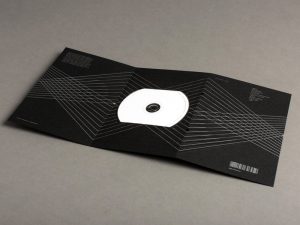
laghdu Artwork.
We have been collaborating with the designer Rossi McAuley for the artwork on both albums, and the discussion for this latest album has been fascinating to me. We asked Rossi to reimagine what album artwork might mean in this age of digital downloads and disposable CDs.
The artwork he is producing has been liberated from the constraints of being a package for a disc and he is designing a triptych of posters for us, with a new visual musical language that expands on traditional notation to include information about the harmonic relationship between the notes.
I’ve been writing little computer programmes for myself to play with this notation and get a better understanding of how it works and how to read it. Below is an example of one set of complementary crosstunings we use.
‘Notation’
I like how our title ‘the Fate of Bones’ makes me think of musical notation as a skeleton, to be fleshed out every time we turn these symbols into sound. That title comes from a passage in W.G. Sebald’s ‘The Rings of Saturn’ where he speaks of no man knowing the fate of his bones once he is dead. I guess the same goes for those things we leave in our wake, and part of Rossi’s idea is imagining somebody happening upon these posters in a hundred years’ time and seeking to communicate something to them, long after we and our music have been forgotten.
The artwork is also partly inspired by the Voyager Golden Record in this regard, in its aim to communicate ideas in distilled graphic form across distances of time and space. It’s important to us that this artwork be functional rather than just a thing of beauty: somebody literate in music should be able to decipher concrete ideas from studying it over time. This triptych of posters will have another function: it will form part of our performance of the music on the album, kind of like our ‘set’ on stage, which we will interact with for specific reasons.
One of our pieces, ‘Thirteen’, will be written out across all six sides of the posters, and will demand a certain choreography of us as we play it from the score. And each time we need to retune our instruments to a new set of complementary crosstunings, the triptych will provide us with the information we need. But it will also serve as a kind of meditation device as we tune, and in this regard it is inspired by Patrick Scott’s Meditation Tables.
We’ll be releasing the album in April, and perhaps we might share a few singles over the month or two leading up to it. It’s quite a unique thing, I’m looking forward to sharing it with the wider world.
The Jehovah’s Witnesses were driving me crazy with their too-polite knocks and damnation pamphlets. Maybe they earned extra credit for early morning salvation attempts? I was always too sleepy to answer and peeked thru the peephole at their church lady hats and cheap briefcases as they walked to the curb. Martha at the hardware store was one. She had hair she could sit on and I saw her eating a bowl of cereal on the bus. She once showed me a little laminated card in her wallet – NUNCA SANGRE – blood transfusions were not allowed even if you were dying in the street.
Maybe the Jehovah’s did the math and figured the odds were on their side; after dozens of mornings of relentless knocking, I answered the door on Saturday. With dripping hair and wrapped in a towel, I swung the door open dramatically.
“Good morning,” said the lone guy who was most definitely not a Jehovah’s Witness.
“Oh,” I answered, my hand reassuring the knotted terrycloth around my chest.
“This actually happens all the time,” the young man said. His hair was the color of a manila envelope and obviously cut while blindfolded. His eyes were the most boring eyes in the world – just dots really – but his smile was so ridiculous, so dazzling – like a movie star, like a billboard for toothpaste.
“I was praying the towel would finally scare off the Witnesses,” I blurted out.
“I’m not scared, but I’m not one of them.” He held up clipboard; a pencil on a string dangled from it. “I ask questions.”
“Door to door?” I asked. “Door to door,” he nodded.
He was wearing a light blue workshirt with an embroidered ACME patch over the pocket. It seemed vaguely professional.
“I will answer your questions,” I told him. “Come with me to the Laundromat and ask me questions from your clipboard.”
He followed me into the kitchen. The small TV on the counter was turned to the Spanish soap opera. Louisa shouted at Ricardo – “Donde esta mi madre?” – I pushed some magazines off the second chair and Acme sat down. “I watch this to keep my Spanish from getting rusty. The main thing to remember is that ‘Estoy embarazada’ does not mean what it sounds like. It means ‘I’m pregnant.’ I found out the hard way.”
Acme laughed.
I spooned two tablespoons of instant coffee into two mugs and poured boiling water from a small saucepan. The brown grains swirled to the surface until I propellered the spoon and they dissolved with the heat. I handed Acme his coffee and grabbed an elementary-school-lunch-sized milk carton from the almost empty refrigerator. “Have you seen me?” was written on three sides, next to a postage stamp of a photo of a girl with a crooked smile and startled eyes.
I plopped down in the other kitchen chair and we sipped our coffee. “You are still in your Jehovah’s Witness towel,” Acme pointed out.
“I know. I do laundry every Saturday. Every piece I own except this towel. We can wheel over to the Laundromat after coffee.”
“Not that I mind,” said Acme. “I just wondered.” He noisily slurped his coffee. “This is probably the worst coffee I’ve ever had.”
I laughed. “The coffee at the Laundromat is even worse. Somehow you can even taste the styrofoam cup.”
We sat quietly. Outdoor sounds squeezed in through the half-opened window – a man coughing, an outburst of barking, a plane jetting overhead and then fading away. I tucked my feet under my chair and slid them back out on top of white canvas tennis shoes, the backs bent in, flattened. Using my pointer finger as a shoe horn, I
wedged on the still doubled knotted sneakers.
“Ready for our adventure?” I asked, as I buttoned up my raincoat over the Jehovahs Witness towel.
The wire grocery cart was waiting next to the front door; the lumpy cloth laundry bags oozed through the slats like mashed potatoes.
Acme grabbed his clipboard and we wheeled the cart down the sidewalk towards the Laundromat. The handfuls of laundry quarters in my coat pockets rattled as I tripped over every bump in the cement I did not see.
“Ok, first question – why are you just wearing a towel and washing all your clothes at once?”
I sighed. “The Four F’s, I guess. Fire, flood, famine, father.”
Acme looked confused. “Five F’s – one is for follow up. Please.”
I rolled my eyes. “My dad was a fireman so he drilled it into me to always be prepared.”
“Prepared for what?”
“Prepared for anything. To save time, to escape as quickly as possible. At night I got my breakfast 90% ready – cereal poured into the bowl, two pieces of bread poised in the toaster, the pre-buttered knife diagonal on the plate. All I had to do in the morning was push the toaster button.
“He would do time trials to see how long it would take me to get out of the house. I never knew when they would happen. Sometimes the smoke alarm would go off after midnight. I once caught him standing on a chair in the hallway, exhaling an entire pack of cigarettes in front of the smoke detector.
“Every rung of the escape ladder shook as I climbed down in the dark. The blackness was only broken by my father directing his powerful flashlight at me, like one of those helicopters looking for fugitives from the sky.
“A few times he blasted the referee in a can – that metal tube with a horn attached. He stood in the driveway and squeezed it mercilessly. Of course the neighbors hated him. And he used a stopwatch. I wore my nightgown over my school clothes. It helped me feel at least outwardly normal. It also cut seconds off my escape time.
“No matter how often the drills happened – sometimes it was months between them and other times they were back to back – there was a constant fear of sleep. Each drill was a crazy adrenaline rush. I needed to run off the extra energy surge and I’d stand in the dark living room and jog in place until I was finally exhausted.”
“Jesus,” Acme said, shaking his head.
“My father wrote down my times in a pocket notebook he kept with him at all times. Rows of numbers, colored pencil charts and graphs. It wasn’t until he disappeared, the day he emptied his pockets onto the kitchen counter and calmly walked out the door, that I began to under- stand what he had done. How he had negated every single day for a future of emergency and disaster that never happened. I realized how much time was lost, wasted.
“He unplugged every lamp, every appliance, but the refrigerator, at night. He blamed faulty electrical work for most household fires. I learned to see in the dark, to feel my way around the house, to trace the outline of furniture, doorways, with my hands; count out the necessary steps to the bathroom. It was like living in a Braille coloring book. I slept with the curtains open to get even a sliver of street light into my room.”
“Did you ever sleep?” Acme asked.
“I learned to sleep at weird times in weird places. Snoring in the shower, catnaps in the cafeteria. Even now, beds seem dangerous. I still make my bed with all the sheets at once, one on top of the other. That first night, it’s like I’ve built a force field around me. And every morning, I peel off a layer, like an onion, and my protection shrinks by that precious millimeter.”
We paused at the intersection. Acme turned towards me, the sun blazing and outrageous behind him. Suddenly his hair was orange, like it was on fire and his skin was transparent. Red and blue veins that had been invisible suddenly made a nonsensical roadmap of his forehead, his neck. It was as if he had been turned inside out.
He was talking to me, but I was tuned out, distracted by the gentle pulsating in his temple. His talk no longer words but just sounds, like the teacher in Charlie Brown. Then I noticed the blood trickle, ever so slowly, from his nose, outline his upper lip and then drip down his chin and onto his blue shirt. The blood blossomed into a spidery red flower. My eyes refocused, and startled, I asked, “Are you ok?”
Acme reflexively rubbed his face, smearing the blood with his fingertips, then looked at his hand. “I’m sorry. It happens.”
I poked around in my dirty laundry and handed him a gym sock. “Thanks. People around here are used to it. Sometimes they even seem kind of disappointed if I don’t bleed.” Wearing my sock like a puppet, Acme tilted his head back and pinched his nostrils. The blood soaked his fingertips and striped the white cotton sock on his arm.
Acme and I stopped on the sidewalk, his head tilted back, looking at the sky, hoping for gravity to stop the blood. A bowlegged woman in a terrible housecoat was waiting outside the Laundromat, her tiny dog impatient and tangled around her concave ankles. At her feet, a thank-you-for-shopping-here plastic bag was dropped, a box of popsicles melting into a rainbow puddle. A few noisy bees and a line of ants were drinking in the sweet decay. The dog was licking its feet.
“We’re here,” I laughed and pushed open the door. I wheeled my overloaded cart in like a drunk driver.
“Good morning, young lady,” called out Miss Helen, the attendant.
She was the oldest woman in the world, a skeleton really, ruling in her secondhand upholstered armchair, aluminum TV tray at her side. Miss Helen wore plaid polyester pants and a faded sweatshirt, a fistful of tissues tucked underneath one wristband. Nobody had ever seen her out of that chair.
Acme looked at Miss Helen and whispered, “Is it really her job to sit there all day?”
“She runs a tight ship. Her dead husband opened this place a million years ago.”
I walked over to Miss Helen. “I’m renting one of your
National Enquirers until my laundry is done,” I said, and tossed a quarter into the mayonnaise jar on her tray. She nodded. I waved the yellowed tabloid in the air: Dolly Parton Shocker! “This looks good!”
The Laundromat was a big square bisected by a long countertop on skinny legs. On one wall were the port- holes of the industrial washers and on the other leg of the L, were the dryers. A row of molded plastic chairs, segmented like a caterpillar, ran along the steamy windows.
Acme, still pinching his bloody nose, looked around fascinated. He watched the woman leaning against a washer, holding a paper cup, ringed with old coffee like an ancient tree. Her movements were slow and stiff, a rusted robot, as she brought the cup to her lips. “It’s like a meeting of Sleepwalkers Anonymous in here.”
“It is another world,” I agreed. “Planet Fluff and Fold.”
I dumped my laundry onto the big table and sorted it into piles to wash. Acme talked, the gym sock muffling his voice, like a kid trying to do impressions. The blood on his shirt was growing, climbing its way across his chest. “I think my nosebleed finally stopped but my shirt looks like a crime scene.” Acme slowly unbuttoned his shirt with wet fingers, dotting the fabric with bloody halfmoons. “Tshirt too,” I commanded.
He sat there, shirtless in the plastic chair, looking at his reflection in the round glass of the dryer door and wiping his nose with the sock. His skin was so pale, he glowed.
“No shirt, no shoes, no service,” I reminded him, pointing to the cardboard sign scotch taped to the wall. “Miss Helen is very strict about topless customers. That’s why I wear my trenchcoat.” I handed him a bedsheet. He knotted it around his neck like a cape.
He washed the blood off his face in the water fountain, his features distorted like a funhouse mirror in the molded metal. Then he held his shirt above the spout and the arc of water blasted clean the center of the bloody stain. The shirt turned brown, then pale, then a rusty shadow. He tossed the wet shirts into the drum of the washer and they thwacked solidly, like a fish slapped onto a dock. The quarters activated the machine and it gradually came to life – the steady bursts of water, the sporadic release of detergent, the increasingly rhythmic agitator.
Acme in his cape, me in my towel – we quietly watched the portal of the washing machine as if it was the most fascinating movie in the world. It was soothing and hypnotic.
“I told you about the midnight ladders and why I am sitting here, now, with you, in a Laundromat. So how did you start going door-to-door with your clipboard asking strangers questions?”
“See that guy over there?” Acme asked. “The guy in the grey space suit?” He tilted his head toward the fat man folding dozens of pairs of underwear into tidy origami packets. He was wearing a puffy plastic jumpsuit, with thick elastic cuffs at the wrists and ankles. It was like elephant skin.
“That’s George. The first time I saw him I was eight-years-old and assumed he was an astronaut. He was in his front yard, raking leaves in his inflatable suit.”
George was whistling. I noticed the rubber gasket with a big knob, attached at the belly button, on his crinkly jumpsuit. I suddenly realized it was an inflatable sauna suit from the back of Parade Magazine, the kind that plug into the vacuum cleaner hose for extra reduction powers. “I always wondered who actually bought those diet suits,”
I said to Acme. “The FDA outlawed those things when people got dehydrated and passed out in the middle of Kmart.”
Acme said, “George never seems to get any smaller but he always seems hopeful, even when his suit is deflated. He stopped wearing real clothes decades ago. He even wears it grocery shopping. When I saw him pushing that cart filled with paper towels and Tang, I assumed he was an off-duty astronaut. That’s the beauty of a uniform, even a half-baked one – your identity is never questioned.”
I watched George methodically pairing up his clean tube socks, his plastic suit rustling loudly like candy wrappers in a movie theatre.
“I’d see George,” Acme continued, “and shyly ask him questions about outer space because I was obsessed with the moon. George never actually said he was in NASA, never once agreed with my crazy science fiction-fueled theories. But he never said no either, never denied my assumptions. I’d ask him stuff like ‘What’s it like up there?’ and he’d answer ‘Dark. And, ummm…cold?’”
“Did the other kids think he was an astronaut too?” “I was never sure,” Acme answered. “I felt like it was our special connection, that I was the only one smart enough to guess his top secret secret. After all, it’s more exciting to talk about peeing in zero-gravity than sitting in a broken Barcalounger and watching Wheel of Fortune all day. It was a secret that made us both happier.
“A few years later I found a balled up polyester Burger King uniform in a bus stop. It smelled like a million french fries. I’m not sure why, but I pulled it over my Tshirt and wore it home. Strangers asked me questions about my job, like if I could drink unlimited milkshakes. Just by putting on a different shirt, I became a different person. It seemed so easy, maybe too easy, to not be me. Suddenly I understood George, and how it was easier to just go along with things.
“I wondered who else I could become. I looked for mechanics shirts at the thrift shop. I’d find supermarket cashier smocks abandoned on sidewalks in a minimum wage rage. I had a drawerful of termite exterminator sweatshirts and a faded lifeguard tank top. I’d put on a uniform and go to a part of the city I didn’t know and plop myself down in a coffee shop all day. People would ask me questions, treat me like an expert. It felt good to be an authority on something. I had been fired from every real job I had ever had. I was a pizza delivery guy with no sense of direction. I somehow left open all the ferret cages at the pet shop and couldn’t mow a straight line at the golf course.”
I laughed and turned to look at Acme. He was staring straight ahead at the washing machine as he spoke. He sighed and adjusted the bedsheet knotted around his neck. I looked at the washer. Framed in the shiny glass door, the wet white laundry was sloppy and spinning, suds dotted the water. A lonely red sock swirled among the towels and Tshirts, spiraling like a giant peppermint candy, first in one direction and then in reverse. The air was humid from the endless cycles of clothes dryers drying. Miss Helen dramatically fanned herself with a rolled up Weekly World News.
“But what made you stop answering questions and start asking them from door to door?”
Acme shifted in the plastic chair. “I was wearing a starched lab coat and a teenager offered me a cruller if I gave her a second opinion on her upcoming gall bladder surgery. I realized Readers Digest medical knowledge was a dangerous thing. So I told her I was a veterinarian. She was disappointed.”
A small boy in Batman pajamas set up a tiny bowling alley on the floor next to the industrial washers. We watched as he rolled a dirty tennis ball into a triangle of miniature boxes of Tide detergent from the vending machine. Some were full and some were torn open, and with each collision a cloud of grit and blinding dust exploded into the air like spores.
Sometimes when the ball missed the kid kicked the boxes over with his foot and satisfied, smiled.
Acme looked at me. “Those miniature detergents are just like the fun-size boxes of cereal I used to beg my father to buy for me. I loved to cut along the dotted lines and fold back the cardboard wings. It was like a camping trip in your hand.”
George sat across from us and rested a can of orange soda on the shelf of his stomach. The Laundromat got hotter with each load of clothes thrown into a dryer. His face was flushed and sweaty. George wiped his forehead with a bandanna then retucked it into the cuff of his suit. With each fidget his plastic space suit noisily suctioned and unsuctioned onto the molded plastic chair, breathing, moving, almost as if it was alive. I looked at George’s wrinkled wrists, imprinted with years of elastic, and I thought about all those years spent mummified in plastic, his body cut off from air, from the world, so much that it was gradually losing its elasticity, its color, that it was starting to resemble the plastic suit he wore like a suit of armor.
Acme pointed to Washer 17. “It’s winding down,” he said, as it did a lethargic last spin. He pulled out an armful of wet laundry and looked at it helplessly. “I need a dryer.”
I found one and he dumped it all in. The front of his bedsheet cape was heavy and grey with a circle of damp; the back hung and billowed. I pulled out quarters from the pocket of my trenchcoat and slid them into the slot. The wet laundry thumped clumsily as it slowly began to spin, picking up momentum. George slurped is soda. Acme leaned over and said quietly, “I’m scared George will become one of those shut ins who refuse to leave their vinyl recliners for years and eat cases of potato chips and their skin eventually fuses into the cushions. Somehow they lose themselves…”
I finished his sentence, “…and become a chair with a face.”
“Exactly,” said Acme. “It’s scary. George went from an astronaut to a Lazy Boy recliner all because of that stupid jumpsuit. It seemed like too much baggage. The gall bladder question – the responsibility – shook me up and I threw it all out, every uniform I had. But the Acme shirt seemed different. It was universal but somehow vague. I carried a clipboard and everything shifted. Strangers stopped asking me to diagnose the weird clanking in their dishwashers. I asked the questions.
“The first questions are always easy, to build up their confidence, like those $100 categories on Jeopardy. Then things snowball from specifics like ‘Left handed or right handed?’ to ‘Would you ever parachute into a volcano?’ to a zinger like ‘Tell me about the time you were most disappointed by your parents.’”
The dryers hummed and the washers thwacked all around us. The air felt thick with dampness and heat. The whole place had that yeasty smell of lint. Miss Helen shimmied in her chair and used both hands to lift her limp left leg over her right knee, an oddly ladylike gesture. Her left foot dangled and shook.
“I ran out of my own questions after the first week. I underestimated how excited people were to talk about themselves. No one was surprised, no one refused to answer. I started an endless master list of questions. I stole from everywhere – Cosmo magazine, crackpot pop psychology books, supermarket scandal sheets. Even Bazooka Joe comics. Somehow the randomness made it all seem oddly legitimate. I took some notes, but mostly the interviews became meandering monologues. I nodded a lot.
People finished, unburdened and exhausted. They even looked lighter and brighter, more buoyant. Some glowed.”
I looked at Acme. “It sounds like going to confession with scientist. And without the phone booth.”
“It is. And I even have the cape,” he said, flapping the bedsheet around his shoulders.
“Don’t underestimate the power of a cape or a trenchcoat.”
We watched the dryers spin. As the minutes passed, the wet clothes tumbled and incrementally fluffed up behind the glass doors, like whipped cream.
“Ask me a question,” I said, slightly dizzy from watching the dryers
“Here’s a good one. What’s your favorite vehicle?” “It’s a tie. A golf cart and a cement mixer.” “Why am I not surprised,” Acme said.
“I’m pretty predictable. So what’s yours?” “An elevator.”
“That does not count.”
“It counts. It moves.”
“Maybe I should borrow your demented dictionary,” I said.
The dryer spun, then paused, then noisily shifted gears for a final reverse spin. We watched the digital red numbers count down. Two minutes, then one. Click! The hot laundry crackled with electricity. I pulled at a knot of stuck socks, stretching them like saltwater taffy. Sparks fireflied into the air. Acme flapped his knotted bedsheet like a dimestore Dracula.
The windows of the Laundromat were dreamy and foggy. At eye level, circles and slashes were rubbed out by fingers to see the world outside. I took off my trench- coat. Side by side, we sorted the laundry. Faint ghosts of warmth pulsated from the piles of socks and shirts and skirts. I dug out Acme’s shirt, grabbed it by the shoulders and shook it out. It was hot – alive again – like skin, as I put it on.
Out of Ireland have we come.
Great hatred, little room,
Maimed us at the start.
I carry from my mother’s womb
A fanatic heart.
W.B. Yeats, ‘Remorse for Intemperate Speech’ (1931)
With proportional representation in multi-seat constituencies, Irish elections tend to be colourful affairs. Debate rarely rises above the clamour of claim and counter-claim as candidates seemingly festoon every available lamppost the length and breadth of the country with posters. In rural constituencies especially, local causes tend to trump national concerns, while questions of global import rarely register.
But times are changing as cosmopolitan younger voters gravitate towards parties from beyond the political establishment. Until the 1990s Fianna Fáil (‘soldiers of destiny’), Fine Gael (‘family of the Irish’), and Labour – which historically assumed the role of minor coalition partner to Fine Gael – enjoyed near total domination of Dáil Éireann, the national parliament. Today no single party expects to command an overall majority, and coalitions are the norm.
The ruling Fine Gael party, having spent four years in an unprecedented ‘confidence and supply’ agreement with its old foe Fianna Fáil, called a snap election on January 14th, seemingly hoping to be rewarded for its competent handling of Brexit negotiations, and to avoid losing a no confidence motion over the performance of the Minister for Health Simon Harris.[i]
Unexpectedly, however, a political earthquake is on the cards as an array of left-leaning parties, especially the increasingly popular Sinn Féin (‘ourselves’), the Green Party, Labour, People Before Profit, the Social Democrats, and even an unheralded socially conservative newcomer Aontú (‘consent’), have made social justice the central issue of the campaign.
For the moment opposition to the centre-right mainstream of Fine Gael and Fianna Fáil is coming from the left, responding in particular to an ongoing Housing Crisis. But Ireland is not immune from the wave of identity politics sweeping far-right Populists into power elsewhere.
Another recession might easily trigger far-right Populism within the existing framework, bringing together an unholy trinity, seen elsewhere, of xenophobia – including opposition to E.U. membership – climate change denial and opposition to abortion services.
Who me?
Identities are hotly contested on the island of Ireland. Thus the Fine Gael-led government’s recent proposal to rehabilitate the Royal Irish Constabulary (RIC) – the British Crown’s police force prior to independence in 1921 – brought a veritable Twitter storm of anger and bewilderment.
In its wake, the rousing Wolf Tone 1972 rebel song ‘Come out ye Black and Tans’ topped the iTunes charts in Ireland, and the U.K.,[ii] before being ripped off by Kerry independent candidate Michael Healy-Rae for his election campaign song.
The bizarre decision perhaps explains Fine Gael’s steep decline in support, as revealed in recent opinion polls. Although a wave of violent crime, including the horrifying murder of a Drogheda teenager,[iii] and the story of a homeless man receiving ‘life-changing’ injuries after a tent, with him inside, was forcibly removed by heavy machinery from the side of one of Dublin’s canals,[iv] contributed to widespread unease with the orientation of Irish society under the current administration.
Identity politics vary from country to country, and from epoch to epoch. In the U.S. race has long been a divisive issue. In the U.K. incipient (so-called ‘Little-Englander’) nationalism is the new clarion call, with the shattering of transnational working class identity emphasised by the implosion of the Labour Party in Scotland.
Historic cleavages in Ireland have tended to be religious rather than ethno-linguistic or racial, pitting Catholics against Protestants and Dissenters (or Presbyterians), at least since the failure of the United Irishman project in the 1790s; although, in the South at least, divisions have also recently emerged along familiar liberal versus conservative lines – especially over reproductive rights and marriage equality.
Identity politics tend to shred solidarities based on economic status both within countries and internationally, often involving deference to aristocracy or accumulated wealth. Developing a political movement based on social class, however, can also be problematic, as for example where a person’s ‘bourgeois’ speech or mannerism is stigmatised. The great diversity within any class formation is also easily overlooked.
The success of the Populist far-right in both the U.S. and U.K. has been achieved by combining working class disaffection – including resentment towards the kind of educated middle-class ‘elites’ generally at the helm of socialist parties – with ‘primordial’ racial or national identification.
As with the racism exhibited by poor Irish-Americans against former African-American slaves who migrated North after the U.S. Civil War (1860-65), the lowest income strata is often most resistant to new arrivals, who may be seen, and are often depicted in the media, as competitors for jobs, housing and other government services.
Brexit Effect
Whether, and for how long, Irish politics avoids the gravitational pull of far-right Populism is unclear. Certainly Brexit stoked identity politics in Ireland by amplifying latent anti-English prejudices.
Notably, over the course of protracted negotiations, the Irish media lampooned English nostalgia – emanating from ‘swivel-eyed loons’ – for a bygone, imperial age. The Irish Times leading columnist Fintan O’Toole even boasted that for the first time in history Ireland, with a population of under five million, was now a more powerful State than the U.K.,[v] which has a population of almost seventy million.
At least Irish nationalism tends to oppose unsavoury outlooks identified with English nationalism, including a xenophobia previously directed against Irish living there. Sinn Féin has also tempered historic anti-E.U. sentiment in the wake of Brexit, perhaps on the basis that ‘my enemies enemy is my friend.’
Moreover, Ireland’s openness to foreign investment, and low corporation taxation, means Steve Bannon – and presumably Donald Trump who owns a golf course and hotel in Doonbeg, County Clare – see little reason to interfere in Irish politics, with U.S. armed service personel permitted to use Shannon Airport as a stopover. But this might change if the rise of the left, especially Sinn Féin, continues unabated.
Arch-Imperialist Mike Pence was today greeting American troops in Shannon Airport
It is a continuing disgrace to the Irish people that American Imperialism should be allowed to use any part of Ireland as a military staging ground
— Anti Imperialist Action Ireland (@AIAIreland) January 25, 2020
Radical Redistribution
The absence of a legacy of heavy industry in the shape of rust-belt towns denies far-right Populists in Ireland the ‘blue-collar’ support base relied on by Trump, and Tory Brexiteers. On mainland Europe too, far-right Populists have successfully appealed to these working class former supporters of social democratic parties.
Most of what passes for a working class in Ireland, historically, are really petit-bourgeois pastoralists, many of whose sons became publicans, auctioneers and shopkeepers, selling commodities on the international market, and in recent times relying on grant aid from the European Union. These farmers have tended to vote overwhelmingly for one or other of the centre-right parties. But Irish society, and politics, is in a period of significant flux.
The two main centre-right parties are now struggling to retain the support of an aging, and shrinking, livestock farming cohort. That sector is in crisis owing to a slump in beef prices and existential fears around climate chaos and Brexit. Over the course of the past year, supermarkets and processing plants have been blockaded, as a schism grows between better-off dairy farmers and beef farmers, overwhelmingly reliant on subsidies.
Meanwhile, with a population approaching two million that dwarfs the other main urban centres of Cork, Limerick, Waterford and Galway that barely register half a million between them, the capital Dublin is the economic engine of the country. But chronic under-investment in transport infrastructure and social housing has brought spiralling rents[viii] in the capital, affecting the young disproportionately. Therefore, calls for a radical redistribution of wealth, along with action on climate change, are growing louder.
Across the country, the rising cost of living, from property to health and childcare, since recovery from the Economic Crash of 2008 and subsequent EU/IMF bailout is disrupting the centre-right consensus, dominant since the state’s foundation.
Riding high in the polls, Sinn Féin only emerged after the end of the Northern Ireland Troubles in 1999 as a serious force in the South. It has successfully twinned the objective of achieving Irish unity with radical (at least for Ireland) redistribution, pledging to enshrine the right to a home in the Irish Constitution. Its manifesto also promises to pay back €1,500 to renters, a three-year rent freeze, and the largest public housing funding scheme the state has ever seen.[ix]
Sinn Féin MPs, MLAs & TDs gather ahead of the Dáil100 event.
On the centre-right Fianna Fáil appears to be regaining pre-eminence, after riding pillion passenger with the minority Fine Gael administration. A formal coalition of these two is the most likely outcome of the election. Nevertheless, for their combined share of the vote to drop significantly below 50% is unprecedented.
As in the last U.K. election, there is a huge divergence between the voting intentions of the young and the old, with the former despairing at the failure of successive administrations to deliver affordable housing, public transport, address the climate and biodiversity emergency or further the cause of Irish unity. Similarly to the U.K. too, the left in Ireland suffers from a factionalism that makes a grand coalition unlikely.
Labour leader Brendan Howlin said he is hopeful of a progressive alliance after the #GE2020. He said there are “very serious barriers” to working with Sinn Féin. He said, “There are fundamental issues of trust about who runs SF.” pic.twitter.com/0KvTLlmbdY
Over the course of Irish history neither of the two dominant centre-right parties have been over-burdened by ideology, although Fine Gael’s ‘Just Society’-wing endeavoured to forge a social democratic party in the late 1960s.[x] Today, predictably, Fianna Fáil lays claim to more centrist policies with campaign literature proclaiming ‘an Ireland for all.’
Extended periods in opposition have tended to witness greater emphasis on left-wing causes by both parties. Once a government is formed, however, the ‘realities’ of power, often enunciated by a stubborn legion of Sir Humphreys in the civil service, brings business as usual.
Famously, in 1987 after hounding Fine Gael for its attempts to curb government expenditure in order to reduce the national debt, Fianna Fáil under Charlie Haughey introduced a series of its own swingeing cut backs.
In Ireland, substantive reforms arrive pitifully slowly as manifold Quangos, persistent Nimbyism and entrenched property interests inhibit infrastructural schemes, with the notable exception of motorways in a car-centric country. Tellingly, Dublin is the third worst city in the world for traffic congestion[xi] due to long term failures in delivering public transport, and historic corruption in land rezoning that brought a judicial tribunal lasting for fifteen years due to constant legal challenges.
On the other hand, the Irish economy has grown exponentially since the mid-1990s – reversing long-term emigration trends and attracting signification immigration for the first time – notwithstanding the catastrophic EU/IMF Bailout of 2010.
The Progressive Democrats (popularly referred to as the PDs), a breakaway party from Fianna Fáil that first enjoyed success in the 1987 election, played an important role in laying the foundations for the sustained economic growth and high employment that ensued from the mid-1990s.
Under the leadership of Desmond O’Malley, Mary Harney and Michael McDowell, the party sought to modernise the country, preferring the private sector to assume the role of an often inefficient (and corrupt) State. Despite its Fianna Fáil origins, the PD’s economically liberal agenda appealed to business-minded Fine Gael supporters, despairing at that party’s handling of the economy.
Although the party reached a high water mark in the 1987 election and steadily declined thereafter, before disappearing entirely in 2009, it left an indelible mark on successive governments. This helped created the so-called Celtic Tiger, with Ireland moving ‘closer to Boston than Berlin’, in the words of Mary Harney in 2000.[xii]
The PDs were coalition partner to Fianna Fáil over the course of four administrations (1989-92, 1997-2002, 2002-2007, and 2007-2009), securing Ireland’s position as a low tax haven for foreign multinationals. But the delivery of social and affordable housing was left in the hands of the private sector, which yielded insufficient units throughout the boom years. Moreover, the State, including local authorities, lost its capacity to construct social housing, from which it has been slow to recover.
Not only did PD ideology influence Fianna Fáil – with Minister for Finance (1997-2004) Charlie McCreevy once flirting with membership – but also Fine Gael. Thus, the former leader and Minister for Health (2004-11) Mary Harney is recorded as a confidant of Taoiseach Varadkar, who rose to prominence as a staunch critic of his own party’s social democratic tendencies.[xiii]
Under neo-liberal policies, in particular the low corporation tax regime of 12.5%, Ireland attracted significant foreign direct investment, with global technology giants such as Google, Facebook and Apple establishing European headquarters, along with pharmaceutical firms like Pfizer.
Google HQ, Dublin, Ireland
Low interest rates after joining the euro also contributed to runaway inflation in house prices until the bubble burst after 2008, leading to negative equity that ruined hundreds of thousands. Many workers, especially in the construction sector, were forced to leave Ireland for good. But consistent tax returns from the employees of multinationals in particular, allowed the exchequer finances to recover more rapidly than expected.
The EU/IMF Bailout stabilised property values, and the low taxation regime continued to attract investment into the Irish market, resulting in a bonanza for the surviving indigenous landlords. But the restoration is now working to the detriment of much of the indigenous population, with salaries failing to keep pace with rental costs.[xiv]
New Ireland
Away from the economy, over the course of the last decade, a new species of identity politics took centre stage, dividing upholders of ‘traditional’ Catholic values and ‘modern’ liberals, mainly of a younger vintage. Battles lines were drawn over marriage equality and reproductive rights, with liberal values emerging triumphant in two referendums.
Dublin Castle after 8th Referendum results declared.
Similar to ‘One Nation’ Tories led by David Cameron, Fine Gael under first Enda Kenny and then Leo Varadkar embraced a liberal social agenda, with the gay half-Indian Varadkar’s accession to power a symbol of widespread tolerance, and acceptance of diversity.
Indeed, although the country has experienced an unprecedented surge in immigration since the turn of the millennium, with the number of non-national inhabitants now almost 13% of the total,[xv] there is little sing of a far-right Populist insurgency.
Brexit also provided the Irish government with an opportunity to play a card generally monopolised by more nationalistic political rivals – with Varadkar speculating on the possibility of a united Ireland in his lifetime[xvi] – although the bizarre decision to commemorate the RIC seems to have used up that political capital.
The other side of Fine Gael’s liberal coin has been a conservative reluctance to interfere in the economy, particularly where provision of social housing has been concerned. In part at least, this stems from Leo Varadkar’s apparent aversion to anything hinting at socialism. Thus he complained in a 2018 speech about those who wanted ‘to divide our society into people who live in different areas, with some people paying for everything.’[xvii]
Real Estate Investment Trusts
The scale of an unfolding Housing Crisis, however, of unaffordable rents, homelessness and under-supply is now even attracting criticism from former PD leader, Michael McDowell, who recently wrote:
There is an ideological problem here. The private sector cannot solve the issue. The State must intervene to boost housing supply – social and owner-occupied. Even the term “private sector” is mutating before our eyes. When Reits [real estate investment trusts] buy entire developments to let at high rents – a new phenomenon – that has become the new meaning of the “private sector”.
Allegiance to the centre-right has previously been secured by an expectation among property owners that mortgages will ultimately yield capital appreciation. This requires consistent economic growth, which without adequate rent control measures has brought the rental inflation driving younger voters into the arms of Sinn Féin, and other left-wing parties.
Younger buyers are still assisted by inter-generational transfers, but this is a single step on a steep ladder. Decades of mortgage repayments await, alongside spiralling childcare and healthcare costs. Although Leo Varadkar claims to represent early rising workers, in fact his government’s laissez faire policies are to the advantage of substantial rentier property owners.
I am a champion for the self-employed & people who get up early in the morning and nobody gets up earlier than the Irish farmer! As long as I am around self employed people will never be taken for granted #IFAAGM
As the 2008 Crash proved, a fairy tale of Irish economic growth-without-end cannot endure – quite aside from ecological constraints – given the inherent volatility of the capitalist system itself. As David Graeber explains: ‘Capitalism is a system that enshrines the gambler as an essential part of its operation, in a way that no other ever has, yet at the same time, capitalism seems to be uniquely incapable of conceiving of its own eternity.’[xxiii]
With steady U.S. economic growth the Irish economy is likely to continue to grow in tandem, as has been the case since the 1990s, but another U.S. recession could see a Populist far-right emerge from out of the long grass in Ireland.
Direct Provision
September’s well-organised protests in the small town of Oughterard in County Galway,[xxiv] along with demonstrations against other proposed Direct Provision accommodation centres for refugee and asylum seekers, indicates a new anti-immigrant mood in rural Ireland. But unless, or until, one of the three main nationalists parties embraces such an outlook it is likely to remain marginal.
The Irish ‘Blueshirts’
With origins in the ‘Blueshirt’ fascist movement of the 1930s, Fine Gael has occasionally accommodated far-right views throughout its history. One prominent anti-Semite of the 1940s was Oliver J. Flanagan, ironically the late father of the current Minister for Justice Charlie Flanagan, who has promised to introduce anti-hate crime legislation; much to the chagrin of far-right vloggers, such as the journalist-turned-far-right-politician Gemma O’Doherty.
Varadkar appears to assume that a half-Indian background insulates him from accusations of racism. Thus, in response to People Before Profit’s Bríd Smith’s criticism in the Dáil of Fine Gael’s recent by-election candidate Verona Murphy – who had claimed asylum seekers as young as three years-of-age could be influenced by ISIS – he claimed to know ‘a little more about experiencing racism than perhaps you do.’[xxvii]
Fine Gael has since de-selected the Wexford woman, who is standing as an independent in the forthcoming election. Yet even Danny Healy-Rae (the brother of the aforementioned Michael) was able to expose the hypocrisy of Varadkar’s criticism of Noel Grealish’s inflammatory (and erroneous) Dáil speech on Nigerians sending home remittances.[xxviii]
Fine Gael’s overriding focus, however, is to deliver the elixir of economic growth, rising rents, and well-remunerated jobs, through foreign direct investment, while embracing further integration with the European Union. Anti-immigration rhetoric jeopardises that political and economic formula.
Sinn Féin, Fianna Fáil and Aontú
Given a nationalist background in Northern Irish politics, and historic advocacy of protectionist economic policies outside the E.U., Sinn Féin might seem a likely candidate for adopting a nativist agenda. But the Party has remained faithful to its anti-colonial principles and avoids Populist anti-immigrant messaging. Moreover, many of Sinn Féin’s new cohort of young supporters would be alienated by such an approach.
Under the steadying hand of Micheál Martin, Fianna Fáil stands on the brink of power, either in coalition with Fine Gael or perhaps a combination of other parties. Under his guidance the party is highly unlikely to embrace any form of far-right Populism. But another recession, and a further leftward surge, could tear up that playbook, with a different outlook emerging under new leadership.
Although Martin advocated for a ‘Yes’ vote in the abortion referendum, a majority within the Fianna Fáil parliamentary party opposed repeal of the Eighth Amendment.[xxix] Notwithstanding its crushing defeat in the 2018 referendum, there exists in Ireland a substantial and well-organised anti-abortion movement, prompted by journalists and vloggers,[xxx] which might easily fall in behind a large party such as Fianna Fáil, as occurred with the Brexiter takeover of the Tories in the U.K..
Opposition to abortion services does not necessarily connote adherence to a broad spectrum of far-right ideas, but nor is it a stand-alone issue. Far-right ideologues around the world, including in Ireland, speak of a Great Replacement conspiracy theory wherein the native population is replaced by immigrants. Abortion is considered a means of diminishing the indigenous population.
Undeniably, Peader Tóibín, the leader of the newcomer Aontú represents the views of many in ‘middle’ or ‘forgotten’ Ireland. It will be intriguing to see how this conservative party performs in the forthcoming election.
There is no doubt there is a growing unease and concern among many people in Ireland around the issue of immigration. Our view is very simple, there needs to be sustainable levels of immigration in this country, it needs to be managed. There needs to be some link between the capacity of the country and the numbers of people coming in if there’s not there’s going to be hardship for indigenous and newcomers alike.[xxxi]
Should Aontú achieve electoral success on the issue of immigration in a future election, it would not require a great leap of imagination to envision ‘soul-searching’ in Fianna Fáil that leads to a ‘harder line’ being taken on immigration, and perhaps the embrace of other far-right platforms. Aontú may not survive long, but like PDs they could leave an indelible imprint on Irish politics.
Climate change denial would also appeal to farmers under pressure to reduce emissions from a sector contributing 34% of the national total; as well as a motor car-lobby resistant to carbon taxes and public transport.
Cognitive Dissonance
Thankfully, it requires a degree of cognitive dissonance for the far-right in Ireland to adopt the anti-immigrant rhetoric employed in the U.S. and U.K..
First and foremost, Irish people have emigrated in extraordinary numbers over the course of the past two centuries. Secondly, it can hardly be argued that the country lacks space given the population density was greater in the 1840s than today. Indeed, stemming a decline in rural Ireland’s population is an ongoing challenge.
The furore over Direct Provision is better assessed in terms of a housing crisis in the greater Dublin region. This led to the State securing cheap properties elsewhere; perhaps in an attempt to avoid the accusation that it looks after refugees, while failing to provide accommodation for homeless in the capital.
Finally, anyone appraised of Irish history will be aware that the Irish ‘nation’ is a composite of many waves of migration and conquests. The medieval Book of Invasion (Lebor Gabála Érenn) tells of the land being taken over six times by six different peoples. Thus James Joyce argued: ‘What race or language … can nowadays claim to be pure? No race has less right to make such a boast than the one presently inhabiting Ireland.’[xxxii]
James Joyce: ‘What race or language … can nowadays claim to be pure?’
With the institutions of the Irish state ill-equipped for a significant influx, however, friction with an indigenous population confronting a housing and homelessness crisis, if unchecked, seems inevitable.
Island Nation
Operating as an offshore member of the European Union, located between the two most populous (and powerful!) English-speaking nations brings significant advantages to an Irish State that struggled to hold its people for the first eighty years of independence. The Industrial Development Authority, established in the late 1940s, has played a crucial role in attracting some of the largest companies in the world, providing secure employment for indigenous and foreign workers under a low corporation taxation regime that infuriates many of Ireland’s E.U. partners.
The EU/IMF Bailout, however – through which the State consented to take on the debts owing to unsecured bond holders – is a Faustian Pact mandating economic-growth-without-end to prevent another debt crisis. It has restored the price of property, and rents, to levels seen during the Celtic Tiger era.
A low corporation taxation regime and lack of significant property taxes attracted the interest real estate investment trusts (Reits) that have brought the boom back with a vengeance. This works to the benefit of an ever-shrinking proportion of the population, with the young in particular struggling to live in a capital ill-served by public transport.
Long term, to address the extraordinary wealth tied-up in property meaningful land taxes ought to be introduced. Here, unfortunately, Sinn Féin has evinced reluctance to introduce what might prove unpopular measures in the short term; proposing instead to phase out unpopular local property taxes, and only to tax the earnings of Reits.[xxxiii]
But land taxes[xxxiv] could bring more land into productive use by penalising land-hording, permitting young people to buy homes at more affordable prices from empty-nesting elders, who should be accommodated in smaller, climate-friendly units. A reduction in the cost of agricultural would also encourage the development of alternative, climate-friendly, agriculture.
In the wake of Brexit, Ireland may re-assess its relationship with an E.U. (including the euro) struggling to contain atavistic forces in many countries. In the event of another global recession, the Stability and Growth Pact, requiring deficits to stay within 3%, should not impede the State from responding with Keynesian measures. Otherwise austerity policies could lead to a Populist far-right gaining traction.
The Irish general election of 2020 may prove a watershed, with the duopoly of Fianna Fáil and Fine Gael being knocked off their seemingly unassailable perch, and a more conventional left-right division developing. But the politics of identity may derail ambitious social programmes, with the question of the border unresolved.
A ongoing challenge for the left, and Irish progressives more broadly, is to develop a fair distribution of resources, and sustainability, in a State still bearing the wounds of colonisation.
Featured Image (c) Daniele Idini.
[i] Fiachra Ó Cionnaith, ‘TD calling for no-confidence vote in Simon Harris’, RTÉ, January 9th, 2020, https://www.rte.ie/news/politics/2020/0109/1105248-politics-no-confidence-motion/
[ii] Michael Staines, ‘Come Out Ye Black and Tans tops Charts in the UK and Ireland after RIC controversy’, Newstalk, January 9th, 2020, https://www.newstalk.com/news/wolfe-tones-come-out-black-and-tans-947680
[iii] Paul Reynolds, ‘Drogheda feud reaches new level of barbarity with teenager’s murder’, RTÉ, 18th of January, 2020, https://www.rte.ie/news/crime/2020/0117/1108136-mulready-woods-drogheda/
[iv] Conrad Duncan, ‘‘Absolutely disgusting’: Homeless man suffers ‘life-changing’ injuries after tent cleared away by Dublin city council’, Independent, January 15th, 2020, https://www.independent.co.uk/news/world/europe/homeless-man-life-changing-injuries-dublin-city-council-ireland-varadkar-a9284936.html
[v] Fintan O’Toole, ‘Fintan O’Toole: For the first time since 1171, Ireland is more powerful than Britain’, September 14th, 2019, https://www.irishtimes.com/opinion/fintan-o-toole-for-the-first-time-since-1171-ireland-is-more-powerful-than-britain-1.4014922?mode=sample&auth-failed=1&pw-origin=https%3A%2F%2Fwww.irishtimes.com%2Fopinion%2Ffintan-o-toole-for-the-first-time-since-1171-ireland-is-more-powerful-than-britain-1.4014922
[vi] Finn McRedmond, ‘Finn McRedmond: Like Tories, Corbyn has failed Ireland’, August 24th, 2019, https://www.irishtimes.com/opinion/finn-mcredmond-like-tories-corbyn-has-failed-ireland-1.3995334
[vii] Press Association, ‘Sinn Féin pledges to secure border poll within five years’, Breaking News¸ January 28th, 2020, https://www.breakingnews.ie/ireland/sinn-fein-pledges-to-secure-border-poll-within-five-years-978299.html
[viii] Sorcha Pollak, ‘Dublin rents to rise 17% by 2021 due to lack of supply, report finds’, Irish Times April 8th, 2019, https://www.irishtimes.com/business/economy/dublin-rents-to-rise-17-by-2021-due-to-lack-of-supply-report-finds-1.3853074?mode=sample&auth-failed=1&pw-origin=https%3A%2F%2Fwww.irishtimes.com%2Fbusiness%2Feconomy%2Fdublin-rents-to-rise-17-by-2021-due-to-lack-of-supply-report-finds-1.3853074
[ix] Roisin Agnew, ‘Can Sinn Féin’s young voters finally pull Ireland to the left?’ The Guardian, January 31st, 2020, https://www.theguardian.com/commentisfree/2020/jan/31/sinn-fein-ireland-left-election-ira
[x] Rhona McCord, ‘Book Review, ‘A Just Society for Ireland?’’ The Irish Story, December 16th, 2013, https://www.theirishstory.com/2013/12/16/book-review-a-just-society-for-ireland/#.Xjg8giPLdPY
[xi] Fergal O’Brien, Dublin third worst city for time spent sitting in traffic – survey, RTÉ, February `13th, 2019, https://www.rte.ie/news/dublin/2019/0213/1029375-dublin-traffic-survey/.
[xii] Dan White, ‘Dan White: Harney was right — we are closer to Boston than Berlin’, Herald.ie, May 24th, 2011, https://www.herald.ie/opinion/columnists/dan-white/dan-white-harney-was-right-we-are-closer-to-boston-than-berlin-27980646.html
[xiii] Frank Armstrong, ‘Leo-Liberal’, Cassandra Voices, October 5th, 2019, https://cassandravoices.com/current-affairs/politics/leo-liberal/
[xiv] Sean Murray, ‘Dublin now in top 5 most expensive places to rent in Europe, research finds’, The Journal, March 13th, 2019, https://www.thejournal.ie/dublin-rent-europe-4538856-Mar2019/
[xv] Kevin O’Neill, ‘Irish Population rises by 64,500 bringing it to almost 5m’, Irish Examiner, August 28th, 2019, https://www.irishexaminer.com/breakingnews/ireland/irish-population-rises-by-64500-bringing-it-to-almost-5m-946672.html
[xvi] Untitled, ‘Varadkar says he would like to see a united Ireland in his lifetime’, Irish Times, October 25th, 2018, https://www.irishtimes.com/news/politics/varadkar-says-he-would-like-to-see-a-united-ireland-in-his-lifetime-1.4062543
[xviii] Untitled, ‘The Irish Times view on property investment funds: Doing the Reit thing’, October 10th, 2019, https://www.irishtimes.com/opinion/editorial/the-irish-times-view-on-property-investment-funds-doing-the-reit-thing-1.4045602?mode=sample&auth-failed=1&pw-origin=https%3A%2F%2Fwww.irishtimes.com%2Fopinion%2Feditorial%2Fthe-irish-times-view-on-property-investment-funds-doing-the-reit-thing-1.4045602
[xix] Untitled, ‘Bibby: Irish SMEs struggling with rising costs’, Shelf Life, October 15th, 2019, https://www.shelflife.ie/bibby-irish-smes-struggling-with-rising-costs/
[xx] Untitled, ‘Massive IKEA store approved for Dublin’, BreakingNews.ie, June 13th, 2007, https://www.breakingnews.ie/ireland/massive-ikea-store-approved-for-dublin-314846.html
[xxi] Brian Mahon ‘Show Vendors, ‘Election 2020: Fine Gael promises end to ‘boom and bust’’, The Times, January 17th, 2020, https://www.thetimes.co.uk/article/election-2020-fine-gael-promises-end-to-boom-and-bust-9dk70kjdj
[xxii] Dan Mitchell, ‘These Were the 6 Major American Economic Crises of the Last Century’, Time Magazine, July 16, 2015, https://time.com/3957499/american-economic-crises-history/
[xxiii] David Graeber, Debt: The First Five Thousand Years, Melville, London, 2011, p.357
[xxiv] Eileen Magnier, ‘Protest in Oughterard over possible direct provision centre’, RTÉ, September 28th, 2019, https://www.rte.ie/news/connacht/2019/0928/1078800-oughterard-direct-provision/
[xxv] Kevin Doyle, ‘Taoiseach says direct provision ‘better than using tents’’ Irish Independent, October 31st, 2019, https://www.independent.ie/irish-news/taoiseach-says-direct-provision-better-than-using-tents-38647784.html
[xxvi] Untitled, ‘Leo Varadkar says Georgia and Albania driving rise in asylum-seeker numbers’, BreakingNews.ie, November 3rd, 2019, https://www.irishexaminer.com/breakingnews/ireland/leo-varadkar-says-georgia-and-albania-driving-rise-in-asylum-seeker-numbers-961488.html
[xxvii] Pat Leahy, ‘Taoiseach stands by Verona Murphy despite further controversial remarks’, November 19th, 2019, https://www.irishtimes.com/news/politics/taoiseach-stands-by-verona-murphy-despite-further-controversial-remarks-1.4088124?mode=sample&auth-failed=1&pw-origin=https%3A%2F%2Fwww.irishtimes.com%2Fnews%2Fpolitics%2Ftaoiseach-stands-by-verona-murphy-despite-further-controversial-remarks-1.4088124
[xxviii] Vivienne Clarke, ‘Danny Healy-Rae defends Noel Grealish for comments about Nigeria’, Irish Examiner, November 13th, 2019, https://www.irishexaminer.com/breakingnews/ireland/danny-healy-rae-defends-noel-grealish-for-comments-about-nigeria-963665.html
[xxix] Philip Ryan, ‘More than half of Fianna Fáil parliamentary party backing ‘no’ vote in referendum’, Irish Independent, May 3rd, 2018, https://www.independent.ie/irish-news/abortion-referendum/more-than-half-of-fianna-fail-parliamentary-party-backing-no-vote-in-referendum-36870462.html
[xxx] For example: https://www.youtube.com/channel/UCT9D87j5W7PtE7NHOR5DUOQ
[xxxi] Fiach Kelly, ‘Peadar Tóibín’s immigration remarks spark heavy criticism’, Irish Times, April 8th, 2019, https://www.irishtimes.com/news/politics/peadar-t%C3%B3ib%C3%ADn-s-immigration-remarks-spark-heavy-criticism-1.3853813
[xxxii] James Joyce, ‘Ireland: Island of Saints and Sages’, Occasional, Critical, and Political Writing, Oxford University Press, Oxford, p.118.
[xxxiii] Pat Leahy, ‘Sinn Féin unveils plans for dramatic increase in public spending’, Irish Times, January 29th, 2020, https://www.irishtimes.com/news/politics/sinn-f%C3%A9in-unveils-plans-for-dramatic-increase-in-public-spending-1.4154513?mode=sample&auth-failed=1&pw-origin=https%3A%2F%2Fwww.irishtimes.com%2Fnews%2Fpolitics%2Fsinn-f%25C3%25A9in-unveils-plans-for-dramatic-increase-in-public-spending-1.4154513
[xxxiv] Dr Frank Crowley, ‘How a land value tax could solve many economic headaches’, RTÉ Brainstorm, October 18th, 2017, https://www.rte.ie/brainstorm/2017/1017/912913-how-a-land-value-tax-could-solve-many-economic-headaches/.
The lads of the 42nd Infantry Battalion sat slumped on the Land Rover’s steel floor as we lurched over dirt tracks; shade from the tarpaulin kept them cool as they spoke quietly together, in Irish. Since arriving in Cyprus, they’d spoken no other language. I knew most of them had joined up at barracks straight from the Kerry and Galway Gaeltachtaí. There was no one from Wexford, apart from myself. The Irish was oddly soothing to hear, if I ignored their wary tone.
I sat in the driver’s seat, sunglasses shielding my eyes, and kept the Land Rover shuffling at sixty miles an hour. Its engine growled and sputtered, leaving smoky exhaust behind us.
Beside me, Byrne, the company sergeant, lit a fresh Woodbine and rolled down the window. He spoke into the Land Rover’s vehicle-mounted radio, grunting our location back to HQ. His FN rifle lay across his lap, the barrel aimed out at the land. He paused, glanced over his shoulder.
“Still talkin’ the Irish, lads? Too browned off with us Jackeens, yeah?”
No one replied. He smirked and blew smoke out the window. Turning to me, he said, “Jaysus. The fuckin’ state o’ that shower, Ned. Thinkin’ we can’t understand ’em. Not as if we can’t hear ’em. Tell y’one thing, if they were as smart as they thought, it’d be them runnin’ the show, not me.”
I made to reply, but a crackled squawk from the radio cut me off.
“Infantry. 42, this is HQ, do you copy? Over.”
“Yeah, go ahead there, boss,” Byrne responded into his handset.
“Don’t stay too long in Lefka, righ’. Just head in, get what yis need, and get out. Time’s not on your side.”
I stared out of the windshield and kept going. Our convoy was led by my Land Rover. Two armed personnel carriers travelled behind us, along with the main vehicle of officers and heavy equipment. We were on the coast road, which uncoiled ahead of us.
It was late afternoon. We were a patrol unit from the Irish branch of the UN Peacekeeping Force in Cyprus, with three weeks left of a six month tour of duty. We’d been sent in to maintain peace, following violent clashes between the island’s Greek and Turkish populations. For the last five years, the bloodshed had become too frequent to ignore. Greeks had been shot en masse in the grainfields. A crowd of Cypriot Turks had been massacred on the border of Limassol Province earlier in the year. At Famagusta Harbour, Greek-Cypriot guerillas had been discovered receiving arms shipments. Many inhabitants on the mainland fled their homes under cover of darkness after being looted.
We were the UN’s fourth Irish deployment, taking over from the 7th Infantry Group, who’d left just before we arrived.
Our orders were to refuel in the small village of Lefka, before continuing on to our outpost up in the Troodos Mountains, a neutral zone. Cyprus is an island of peaks. Driving an armed convoy through this landscape was a challenge I hadn’t expected.
Byrne pivoted his head to look at me for a minute, before snapping it back towards the windshield. “Ned, how far off are we?”
“Five miles to go, sir. I doubt the heat’ll let up anytime soon.”
“Ah, stop. Last thing I need is more fuckin’ mosquitoes comin’ between me and my sleep.”
“That’s true enough, sir.”
Since leaving HQ in Nicosia, I’d been on edge. All of us were. We’d plenty of ammo and supplies. Our radios were all in working order. But even with every strategic position dotted around Cyprus, none of us really knew what to expect. So far, we hadn’t fired a single shot, but we knew the guerrillas were out there, crouched in wait of unwary targets. Snipers kept cover in eucalyptus groves and the vineyards. Gunfire might erupt on us from a roadside gully; there was nothing we could rule out. Turkish or Greek, it didn’t matter. How were we to know the difference between ambush and accidental discharge?
On top of that, it was our stop-off point had us worried. We were briefed that while Lefka was a Turkish enclave, Greek-Cypriot cadres ranged the surrounding hills; we’d have to be especially vigilant passing through.
Everything we needed to know was relayed to us the day before deployment. I remember being briefed with the entire battalion in the departure lounge of Dublin Airport by a stocky drill sergeant from the US Air Force. A tour of duty in Cyprus, he said. Peacekeeping operation for the UN. Troops from other nations taking part. Fatalities to be expected. For most of us, it’d be our first time leaving Ireland. Might as well have been the other side of the world to me, or Shangri-la, for all I knew about it. I remember boarding the Globemaster, the first time I’d ever set foot on an aircraft. Ann, my wife, had blinked back tears at the viewing lounge by the terminal. Maggie and Nicola, our two eldest daughters, held her hand and watched me leave. All around us, the lads were saying similar goodbyes. All of us were in uniform, as crisp as we could hope to be for the entire mission.
“Look after yourself,” Anne whispered to me as I held her. I assured her I would, not really believing it. I kissed her and our daughters, promised them they’d see me soon. We’d five nippers by then; our sixth was on the way, shortly. I knew I wouldn’t be home in time to hear its first gurgles. I hoped that whatever apprehension I felt wasn’t showing.
We’d been married for nearly a decade by then. Ann had had to leave her job after we got together, as the law dictated at the time. Whatever money we had came out of my army pay.
The Land Rover moved quietly enough, but I was worried about giving away our position. Every so often, we’d pass through farming country. No checkpoints or OPs, no need for papers or passports, no furnishings of order we could resort to. The only people we saw were the hunched, black-clad figures of women at work in the vineyards. Men rarely ventured out in broad daylight, for fear of being shot; they’d stay indoors, drinking coffee. Only the women could move freely outside, picking grapes off stalks, their scythes flashing in the heat. I noticed they didn’t stop working, even when our convoy trundled past. A few would glance up and stare after us until we had vanished from sight, but none waved, or even stopped what they were doing. The sight of an armoured lorry, bristling with artillery and fatigue-clad men, didn’t seem to faze them. The few children we saw sat on the roadside, watching us wheel by without fear or amazement, their faces stretched down to hungry, staring masks.
Our first time out on patrol was during harvest season. We took our position just outside Pergamos, setting up a small base-camp on the vineyard’s edge. Throughout the night we kept watch, scanning the dark horizon on all sides, until the order to head back to base came through.
“Should we not be looking after them?” I’d asked Byrne, nodding at the hunched, slow moving figures that shuffled amid the grapevines at dawn. “We might save more if we hang on here.”
“Save ’em from what, Private?” Byrne replied. “Have y’heard any shots since we arrived?” “No, sir, I haven’t.”
“No, well then. We’re not here to save anyone, Ned. We’re to keep an eye things. And you’ve to just keep your eye on drivin.”
I didn’t reply, and closed my fingers around the small gold ring in my pocket. It was my wedding ring; I took it off whenever I was off base. I was too afraid of getting wounded or killed, and havin it stolen. Both me and Byrne were two of the few married men in the entire squad; most of the troops weren’t even shaving yet. At night, Ann swirled through my dreams, her dark hair brushing her shoulders, her eyes sea-green and inviting, her voice a soothing whisper in my ears. The longer I was away, the more she’d visit me in my sleep, until I swore I could smell her perfume and tasted the soft curl of her lips long after I awoke, surrounded by the wheezy snores of the others. The ring was the first thing I made sure I had on me, before my rifle or bullets or dog tags, every morning at parade. And I kept seeing her everywhere. In the rear-view mirror, on the roadside, amongst the women in the fields.
A mile off, I saw the asphalt coil away into a tangled cluster of fields. The mosquitoes were out in force. I cursed to myself. For all the heat, I noticed the grass was far lighter than in Ireland. White dust swirled on the roadside, whisked by wind. Heat fumes wriggled a mile off. Roads snaked every which way, as though trying to confuse me or render the map superfluous. Sunlight glinted off gunmetal. Beside me, Byrne grunted. “Them mosquitoes must be takin’ orders from the Greeks. Fuckin’ relentless so they are, Ned.”
“Yes, Sir. I suppose.”
“Like rats in the desert, wha’? Fucked from here to there, says you.”
“Sir?”
“We’ll be grand, sure. ’Nother five miles never killed anyone.”
“Yes, Sir.”
I wasn’t in the humour for small talk. In my head I was thinking of what I’d put into my next letter to Ann, my wife. I’d be seeing her and our children soon, once the month was out. I wrote her every week, detailing everything as best I could in a way that didn’t get her worried. There was plenty I kept out. Mostly I talked about the sea’s lustrous aquamarine, the roads, faces of people I saw. In every letter, I was careful not to call Cyprus a battle zone. Right now, there was nothing to tell her.
For all the Cypriot heat, it was a relief to finally be away from Dublin’s grey brickwork. I didn’t miss much about the old town. Beggars flung crumbs for the seagulls like feed, before shuffling off to drink the few bob they had in the early houses. Roadsweepers hauled refuse laden carts down the sidestreets; steam and coal dust choked the air around Britain Quay where the ships offloaded. On the Liffey, Guinness barges steamed to and from the brewery; slimy green strips of algae smeared the quay walls at low tide. Every second building seemed marked for demolition; the knock-down gang swarmed over them with shovels and pickaxes. On O’Connell Street, Nelson’s statue gazed skyward from its column; a year after I got back from Cyrus, it’d be blown to kingdom come. Before signing up, I’d worked as a busman, driving Leylands for the CIE; City Hall to Dame Street, Phoenix Park to Dun Laoghaire. Mini cars and lorries swarmed around me as I stopped and started on the morning drive, all the way from depot to terminus. I saw so many faces on my routes and got to know the city so well, the rooftops and the lampposts, that I just got sick of it all. People were reckless crossing the streets then. And before we tried keeping the peace in Cyprus, a different sort of peace was being bartered back in Dublin. The unions were on the warpath. I’d marched at the front of each picket line. Better pay for a better job. We’d earned it.
In the end, the unions felt I was strong enough to speak on their behalf. I knew I was not. I’m not John Wayne, much and all as I wished I was then. In the end, it was me they wanted to be General Secretary. I said I wouldn’t do it. I’m not a leader. I never have been. The men needed someone who could stand for them, and wouldn’t be converted by bribery or coercion. I’m just not that kind of man. I could only be so outspoken until I’d be looking at the sack.
Every man has an enemy against whom he’ll never win. That’s a lesson that never comes easily. If you’re anything like me, kindness is the enemy you know you’ll never beat. I’d heard and seen enough union men killed off with kindness, sniped by possibility of a better job, better pay, more decent living for them and theirs. And they always took it. They abandoned their men very quickly. I knew that I’d be going down that road as well, if I became general secretary. And my son had only just been born. It couldn’t be abandonment for him. Where we lived in Dublin, there were plenty of young fellas who grew up never knowing their fathers. A boy needs his da, I’ve always believed. Walking out the door to go and play soldiers out in Cyprus was a hard choice. He needed me there, to see my face every day and know who I was.
Then again, Cyprus was the only choice I had left. After the Union, the jobs I could easily have taken seemed to vanish. Maybe I’d more certainty back then. Didn’t seriously think I would die out there. But the ten bob I made with my busman’s pay wasn’t enough. And now I wanted to see my son’s face again. In dreams, in the Land Rover’s rear-view mirror, in the faces of the starving children of that country, children the same age as him. Some of them did wave, mind, but they were far and few between. It was around then that I started having nightmares of my son, naked and bleeding, and chained to a paling post in a deserted field, crying. Crying with a child’s distraught frenzy, for me to come and rescue him, to cut him loose and keep him safe. I’d see his face, red and swollen with tears, and I’d lose sleep, wondering why I’d ever left Ireland. I should be at home, I’d repeat constantly to myself. I should be watching over my son.
If there was a message to be found in any of the dreams I had, it was this: why did you leave him? Why did you leave your boy? He’s suffering now and you can’t help him. A father helps his son while he’s able.
When I finally applied to re-join the army, one of the questions on the form held the caveat that I may very well die if sent into a battle zone. Was I willing to make that sacrifice for Ireland, they asked. Far as I was concerned, Ireland was a grey-green boil on Europe’s left arse-cheek. But I needed the work. So I went on basic training – seventeen weeks of hell in Wicklow, firearm drills at barracks, orienteering. I was able for it all. The only Irish I learned to speak or understand were the drill commands at the barracks: “Deas iompaig!” (Turn right). “Cle iompaig!” (Turn left). “Iompaig thart!” (Turn around).” “Seasaig ar ais.” (Stand at ease).
Like all the others, I was stationed at the Cathal Brugha Barracks in Portobello. Of course, our actual experience in combat was negligible. It wasn’t until after I entered the barracks that I actually held and fired a gun for the first time. The weight of it in my hands was a shock. By the time I finished up, I was a top-notcher, instructing the newest recruits in weaponry. You name a gun, I was the man to talk to. I could give you detailed specs on an MK 4’s muzzle flash, a Gustav m/45’s blowback, or the recoil of a Browning semi.
Before that, though, there was basic training. I’d my own induction among the lads. It was in the barracks barber shop. My name was barked out as I stood in line.
“Private N. Wade, you’re up next!”
I sat in the chair, while your man got his clippers ready. He grazed it over my skull, my locks fell to the floor. The fella in the next chair caught my eye.
“Here, what did he say your name was?”
I glanced over. “Eh, Private Nick Wade, sir. HQ Company. You?”
“John McCormack. They call me the Count.”
“Yeah? Y’much of a singer?”
He smirked. “Am I fuck. Voice on me like a bleedin’ engine, so I do.” He peered at me.
“Wade? Do I have tha’ righ’?”
“Yeah.”
“Like Ned Wade? The hurler?”
“Eh, yeah. No relation, though.”
“Ever seen him on the pitch? My jaysus, can he do damage. Rakes in the silver, he does.”
His rapt expression told me I was already in his good graces. My surname could shore me up, come whatever may.
“I don’t really follow the GAA. But I know of him.”
“Well, they’ll find somethin’ for you right enough. A fella by the name of Wade does be needin’ somethin’ to keep himself occupied.”
And that was that. I was Ned now, no longer Nick. Whenever I was introduced to one of the lads, or called on to give my name at parade, I called myself Ned. Some of the Gaeltacht lads even called me Eamonn. But most of the battalion never even found out my real name. The entire time we were in Cyprus, I went by a name that wasn’t my own. After a while, I stopped being annoyed and just got used to it. Byrne told me I was better off calling myself Ned, anyway. “It’s good for morale,” he’d say. “Some of the lads used t’play hurlin’ before they signed up. If they know Ned Wade’s on their team, it’ll keep their spirits up.” But I’d never swung a hurley or hit a sliotar in my life. I was an oddball, detached from the run-around nature of army life and yet oddly respected for it. Of course, I chatted and laughed with the others, engaged in the jokes and slagging, but on the whole, I kept quiet. The reason being that, during training, it was discovered that I was an excellent marksman. Snipers would be sorely needed in Cyprus.
The water hurdled past my ribs as I plunged in, cold and heavy, soaking my fatigues. I dug my boot-heels into riverbed, waited for my balance to return against the current. Wind hissed through the grassy bank. Heavy grey clouds drifted overhead, grazing the shoulder of Lugnaquilla’s foothill. My weapon, which I’d slung to my shoulder, was a 7.62 FN MAG, an open bolt, long-range sniper gun with its own folding bipod, capable of taking a man’s head off a mile and a half away. If it was aimed right. Even in a high wind blowing downward, my eyeline smudged with dust and my target a thousand or so yards off and moving fast, I’d still manage to take it down.
But it wasn’t a man I was scoping for, not today. The target was hidden amongst the trees, on the far bank. You needed a hawk’s eye to see it. I could just make it out through the scope, a skeletal little carving of a Celtic Cross, its silhouette black amongst the fronds. A thousand yards off, I heard a buzzard squawk.
There was a rock mound jutting up further upstream. I sloshed a little deeper into the flow, until it lapped at my chest, clenching my teeth against the cold. The rock mound came up to my shoulders. I leaned forward, close enough for the water to brush my jaw, and shut my left eye to get a better look. Fastening the bipod to the gun barrel, I propped it on the rock. Before aiming the FN downrange, I put my eye to the scope.
The world shrunk into a single, black-rimmed sphere. For a second, nothing existed but the curve of the trigger off my fingertip, the fine crosshairs and the target’s tiny outline. It lurked amidst a knot of gorse, nailed crudely to a tree, its nimbus spread wide. If I fired now, the bullet would zip through the air for a good half-mile before it hit anything. If the target moved, even the slightest motion would give it away. I always pulled that trigger slowly. Once I locked on it, I’d relax. Under those clouds, the surface of the water looked pitch-black. Despite the river’s heavy flow, there was barely a breath of wind. I was lucky to have kept the FN dry and above water. I took a breath, and squeezed the trigger back.
The bullet spat from the barrel, a flurry of white smoke wafted over me, and through the scope’s ringed lens, I saw the cross fracture and drop before the echo faded away. It was a near-perfect hit, the nimbus cracked right down the middle. Lowering the FN, I trudged back upstream and into declared my headset: “That’s a hit, boss.”
“Affirmative. Right under the crossbar. Ned Wade strikes again.”
After that, I couldn’t ever look at a Celtic Cross, or any cross for that matter, and not think of a target.
By the time we reached Lefka, the stench was unbearable, even with the windows open. I slowed to a halt at the checkpoint by the village entrance, which was nothing more than a long, striped pole extending across the road. Beside it was a makeshift medical depot, its grey walls riddled with cracks, while in the distance the golden-brown mountains loomed. Byrne signed us in to the sentry, who lifted the pole in the air, and the convoy snaked down the bumpy road into Lefka. Once we reached the centre, I parked and killed the engine outside a small cafe.
“We’re not stayin’ here long,” growled Byrne, and he spat out the window. I’d gotten used to deserted streets, but Lefka was thronging. It was market day. Stalls were set up in the main plaza, and a steady stream of people, women mainly, drifted from street to street, haggling loudly. Dogs slept in the long, jagged shade of palm trees. Every building was boxy and whitewashed, coated in stucco. Depending which side of the border we were on, we usually saw either the Greek white-and-blue stripes, or the scarlet, star-and-crescent emblem of Turkey. Here, there were no flags, not even outside the depot or the mosques. Soldiers in UN stripes were dotted around, standing their posts or else pacing about absentmindedly, their rifles cradled. Guns and fatigues were now part of normal life in this village, it seemed. In the cafe, a group of men sat in the terraced shade, arguing amongst themselves. When they saw our uniforms, they waved us over.
“You hang on here, Ned,” said Byrne. “I’ll find yeh a min’ral or somethin’. He climbed out of the Land Rover, sloped into the cafe. He’d be in there for a good while, I knew, downing cup after cup of dark coffee with the local head man. It was a show of hospitality that he, as patrol commander, couldn’t refuse.
I lay back against the headrest and shut my eyes. I thought about my wife, mouthed the first words I’d say to her when I got back to Dublin.
A screech came piercing up from the plaza, jolting me upright. I could tell when I saw the woman, from the way she moved, something was wrong. I would have noticed her anyway, had she not been wailing to the heavens. The sun’s glare stopped me seeing her properly, but even at a distance I saw she was groping for something to grab onto. The street was crowded enough, but everyone, soldier and civilian alike, walked right past her, without even turning their heads. As she neared, I saw she was young, about my wife’s age, with dark hair. Her threadbare shawl, drawn up like a monk’s, told me she was Turkish. Only when she reached my passenger door did I see why she was stumbling. Her eyes were covered in cuts. She was blinded and bleeding heavily.
My fingers closed instinctively around my wedding ring in my pocket; my spine tensed. Had there been an attack? We’d been briefed not to interact with Turkish women; their culture forbade them from talking with us. But I had to do something. I flung the door open and sprinted round the front of the Land Rover. She had tottered rearward and was now sloping against the café terrace, gasping for breath. None of the men took any notice. Almost as if they didn’t hear her. A part of me hoped Byrne would step out of the café to see what the noise was. Her wails still soared over the noise of the street. I approached her as I would a small animal caught in a snare. She flailed her arms limply, trying to grab hold of anything she could. I reached out, managed to grip her hand and shoulder, and hold her steady. She fell to me, huddled tight against my shoulder, squeezing my hand.
She smelled of eucalyptus.
“Can… can I help you, Miss? Hospital?”
Once she heard my voice, her howls quieted to a scared whimper. Her free hand reached up, fingertips brushing over my nose, lips and jaw. Both her hands and wrists, I saw, were crisscrossed in deep scratches. I glanced up and saw several of the men in the cafe watching me, curious to see what I might do. Their expressions were blank. One of them blew smoke. Another swished around the coffee in his cup.
I’m not one to disobey orders. But the medical depot was only a mile back up the road. I took a breath and lifted the woman into my passenger seat. Then I bolted back behind the wheel, and revved the engine up.
She kept whimpering, heaving out words I didn’t understand. I think she was praying. But she also quietened a little once I shut the door, sensing now that she was shielded. I pulled out of the parking space and drove for the checkpoint, where the medical depot was. If any of the lads saw, or if Byrne ran from the cafe, bellowing at me to get back, I didn’t hear or notice. I kept one hand on the steering wheel while she held onto my free one. Her hands felt small and coarse on mine, and with her head resting on my shoulder, I saw and felt the blood more clearly. It oozed into her shawl and dress, and over my sleeve.
It was then that I started wondering what colour her eyes had been. What was the last thing on earth she had a good look at, before her eyes were taken? Did she see a wayward eucalyptus branch snap back and plunge the world into stinging darkness? Or worse, a blade, swung at her? There was no telling what had happened to her.
The soldier at the checkpoint flagged me down and, as I pulled up, looked ready to tell me off for speeding. But his expression changed the moment he saw her huddled beside me. All he did was nod and let me park at the depot entrance. One or two of the other sentries watched us climb out, but they made nothing of it.
All this time, she didn’t let go of my hand. I led her under the low canopy, into a crumbling foyer. Stretchers were laid out in rows on the hard stone floor. A young medic, also wearing the UN beret, rushed over to us. He pointed me to the nearest mat, and filled a bucket of water. I knelt and tried to guide the woman down but she flailed madly, her hand still clenching mine. The blood on her cheeks was starting to crust. She tugged at my sleeve, until she was sure she lay on solid ground. It took me a moment to let her go. When I turned to leave, I saw the medic place the bucket of water next to her, and kneel down. The last I heard of her was the sound of her wails, echoing off the flaked wall.
Outside, the sentry offered me a cigarette, which I declined. I was going to drive back to the village, I said, and he needn’t worry about any more irregularities. He gave a wordless nod and let me climb back into the driver’s seat. I turned the key once more and headed back down the ramp into Lefka. I hoped I hadn’t put the 42nd Battalion too far behind schedule.
I turned down the main street. Byrne, his lips stained with coffee, stood outside the cafe. He glared at me behind his sunglasses as I got out and saluted. A few of the others were with him, some carrying sacks and boxes of supplies. “Nice day for it,” he said. “Enjoy yourself up there?”
“Sorry, Sir.”
He took off his shades. “I’m not havin’ you flutin’ around without my leave. That’s not what we’re here for.”
“No, Sir.”
“Make sure y’don’t do that again.” He turned to address the lads. “Right, men, let’s go. ’Mon, hurry!”
There was a scramble as everyone piled back into the trucks. Byrne climbed into the passenger seat beside me.
“Tell me why y’took the vehicle without notifyin’ me.”
“Sir, with respect, a woman was badly hurt, and no-one else seemed to be helping. I acted on instinct.”
“Ned, I’m only lettin’ y’away with this once. Pull another stroke like that, and you’re on half rations. From now on, y’don’t do a thing without my say-so. Am I clear?”
“Yes, Sir. Crystal.”
“Good. Then let no more be said about it. Get us out of here, Ned.”
“Yes, sir.”
I turned the Land Rover out of the gate and drove us west, out into the mountains. The lads went back to whispering in Irish, or sleeping. Byrne drank from his canteen and stared straight ahead. The radio crackled with static and blurry updates. An hour later, we’d reached our compound, and would be settled in by sundown.
Image by Michael Klajban of Forest road in Troodos Mountains, Cyprus (wikicommons).
Daniel Wade is a Dublin-based author. He was awarded the Hennessy prize New Irish Writing in 2015, and his poetry has appeared in over two dozen publications. Follow his progress on Facebook, Instagram and Twitter.