Over the past two years Cassandra Voices has published over three-hundred-and-fifty articles online, from more than one hundred global contributors. We have also published two in-depth magazines to widespread acclaim. This has brought an enthusiastic following both in Ireland and abroad.
We are excited to share the news that our next magazine will be on the shelves in April 2020. The theme of this issue is the often controversial subject of displacement, and forced migration.
At Cassandra Voices we are proud of the high quality and unique content we offer from citizen journalists and artists living around the world. At a time when big media houses largely control the narrative the need for independent platforms providing a home for diverse opinions and content has never been greater. Our mission at Cassandra Voices is to be that home.
In January we were delighted to launch a brand new website with fresh content appearing daily. A big thank you to all who have helped us get to this stage. Now as we continue our journey we humbly ask for your financial support.
Order the new edition of Cassandra Voices, or choose from one of the following pledges and help us take this to the next level!
This year marks the 109th International Women’s Day. The now universally recognized date first bore fruit after a 1908 march, where 15,000 women in New York City demanded shorter working hours, better pay and the right to vote. Clara Zetkin, a German Marxist theorist, activist – and all-round badass – pioneered the idea at an International Conference of Working Women in Copenhagen: representing the power of female voices coming together.[1]
For this year’s occasion, I attended the Irish Writer’s Centre’s WomenXBorders event, promising motivational talks, and a platform for female writers to engage in a day-long readathon, where they would have the opportunity to showcase and read their own work from a platformed mic stand on top of the room.
The organisers’ mission was to ‘foster connections between women and encourage professional growth for writers across north and south.’ Also involved was Women Aloud NI, with many members travelling from all over the country.
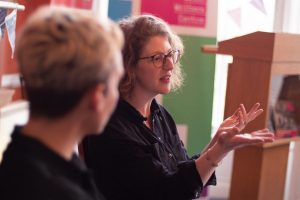
The talk that most attracted me was: ‘Publishing with a Mission: the Story of Virago and later Champions of Women’s Voices.’ Emma Warnock, publisher at No Alibis Press, was interviewing Sarah Savitt, publisher of the female powerhouse that is Virago.
I arrived early and was brought upstairs with a fresh cup of coffee (my fourth of the day) and notebook tucked under one arm. The all-day readathon participants were taking a short break, with hungry writers and readers now picking at sandwiches and supportively hugging one another. The sun was smiling in through the centre’s big Georgian windows , heating the crowded room. A scattering of jackets, glasses and pens with marked paper were dotted among the chairs, as the crowd had by now settled into their day-long residency.
Women Aloud NI
During the short interval, I nabbed a member of Women Aloud NI, a volunteer-run organization that brings women from different backgrounds together through the power of sharing words. A refreshing mixture of ethnicities and cultures was evident.
One lady I was speaking to was a Frenchie based in Antrim, one of the one-hundred-and-sixty-eight-strong memberships from all over the world, who are living in Northern Ireland. Members expressed a strong feeling of unity and mutual support, with everything from being published on the website’s blog, to receiving feedback on works-in-progress, to day-long events.
Ballymoney-based author Jane Talbot is the project manager and event coordinator of the organization. She said that Women Aloud NI is about “uniting each voice and creating a community. We’re adding to the cultural life of this country, but how many readers know about all the women writers in Northern Ireland?”[2] Another member reminded me “It’s in the name. We want female voices to be heard – loudly!”
After that the final part of the readathon commenced. Writers and poets performed with passion, depth and unapologetic wit, absorbing the attention of the entire room before a timer would politely ring, keeping them within three minute slots.
Afterwards, people shuffled away from their seats once again, and I snatched an early place for the closing talk of the day with Sarah Savitt.
Virago Publishing
According to the event page, the talk would be framed around two crucial questions: first, was around the social, political and financial climate that impelled Dame Carmen Callil to set up Virago Publishing, the first mass-market dedicated publisher for 52% of the population – women in 1973; and, secondly, with statistics showing that male writers remain over-represented whether print publishing continues to have a gender issue.
Sarah tackled the story of the publishing house first. She defined Virago as feminist history makers within the literary landscape.
Australian born founder Carmen Callil was an active force in the feminist movement. The second wave of feminism was in full force, with the Equal Pay Act having been passed in 1970. The same year witnessed Kate Millet’s Sexual Politics, published by Doubleday and Co; while the first Women’s Studies department opened its doors in San Diego State University, followed shortly by a Women’s Studies program at Cornell.
There followed the publication of Sisterhood Is Powerful: An Anthology of Writings From the Women’s Liberation Movement, which gathered many prominent feminists’ essays into a seminal volume. By 1973, there was a palpable need for greater representation of female voices.
The plan was to create an openly capitalist enterprise aimed at a broad audience. As Sarah put it: “from the margins but never marginalized. Carmen ran a tight shift – even the tea towels were washed at a specific time each day. It was important for the house to be taken seriously and more so, for the writing to appeal to the masses.”
She continued: “The primal focus was not simply to publish radically feminist work. Instead, it was about generating a wide audience for female writers who were tackling subjects and genres of every kind – from fantasy to forgotten about classics to erotica. The focal point of committing to publishing women was the radical act in itself. Even better, publishing work that would appeal to masses meant greater profit and importantly, making competitive money for the authors.”
Sarah fondly recalled how, after the first year in business, people were asking the house: “do you have enough books to publish next year?” Yes, they did. There were plenty of female voices waiting to be read.
Until 1978 Virago focused mainly on non-fiction works. As the house grew, so too did its range. Publishing overlooked classics was, and still is important, especially those that had gone out of print.
The Secret Garden by Frances Hodgson Burnett and The Ghost Stories of Edith Wharton are recent examples revived by the imprint.
Looking back on its early days, Sarah shared how the current boss of Virago, Lennie Goodings considers the rapid success of the company as unsurprising since, “women wanted to see themselves on a page.”
As the political landscape changed, the publishing world adapted. Now, the imprint only accepts submissions from agents. Crucially, it changed from its own publishing house to an imprint, having been bought by Little, Brown in 1995. But the core beliefs and mission statement endure.
The Struggle Continues
Notwithstanding a long record of success, commercial doubts linger around work by female authors. Sarah said that even Michelle Obama’s autobiography becoming a New York Times bestseller, and which bookshops struggled to satisfy demand for, met the doubts of industry executives as to its mass appeal.
Similarly, their publication of A Girl is a Half-Formed Thing by Eimear McBride had been turned down sixty times before it arrived at their door, after which it enjoyed great success.
Addressing the second question of the day – whether an imprint that exclusively published female authors remains a necessity – Sarah refers to a damning statistic. Currently in the UK, every CEO of every publishing house is a white male.
Publishing houses worldwide still submit more books by male writers for literary prizes, and book reviews in major publications disproportionately highlight books by men. Moreover, male authors are still paid more than female peers.
In 2017, Narrow The Gap published a report demonstrating that women writers make 89 cents to the dollar men earn doing the same job.[3] Annually, that makes up a difference of $6,552. Yet The Bookseller published a report showing women dominated the literary bestseller list for 2017, with Margaret Atwood, Sarah Perry, Elena Ferrante, Helen Dunmore, Arundhati Roy, Ali Smith, Zadie Smith, Naomi Alderman and Maggie O’Farrell all in the top ten. Indeed, the only male author on its list was Haruki Murakami.[4]
Wake Up Irish Poetry
In response some female authors are calling for a response in a way similar to the #MeToo phenomenon. In Ireland ‘Wake Up Irish Poetry’[5] is an open letter addressed to the Department of Culture, Heritage and the Gaeltacht and the Arts Council calling for acceptable standards of ethics and governance in the Irish arts sector.
In response to the talk, the room was alight with passion, with Women Aloud NI attendees responding that Northern writing was especially male-dominated. They also referred to an insulting campaign by PSNI to ‘encourage female officers to nominate male officers to help them in their careers.’
Encouragingly, Words Ireland are in conversation with the Arts Council at the moment to work on a code of conduct policy. Separate to that, the Irish Writer’s Centre are also working internally on a code of conduct policy and customer charter, both of which are in draft stage.
Sarah Savitt of Virago at the Dublin Writer’s Centre. Image: George Hooker
Advice
Meeting with Sarah, after what must have been an exhausting day representing the imprint, she exuded the same energy and enthusiasm. I asked what she would love to see come through her letterbox in 2020, and in the years to come.
She said she believes writers tend to have a sixth sense about these things, but that it felt imperative for her to put out work from underrepresented groups. So she is interested in writing from those living with, and writing about disabilities, and from perspectives informed by maternal mental health, the female body, stem cell technology, and menopause.
Significantly, she stated that if more of those unrepresented voices are heard, it gives greater freedom to those few currently writing from that perspective, who may currently feel an obligation to represent that position.
Finally, self-servingly, I asked for her advice on how a so-far unpublished female novelist should go about submitting a book for publication. Her answer was wise and thoughtful:
Don’t get too carried away, wasting time on followers and trying to build up clout. You need to know the ecosystem. Spend your time instead learning about how to get an agent, which publishers would suit you, reading work related to them. Follow the submission guidelines that are listed on an agent/publisher’s page. It gives you a better running. Most importantly, keep writing. After all this time, it still really is about the words.
It was a hopeful closing to an important day. Tellingly, my own editor informed me that a disproportionate number of submissions coming through to him are from males. So let’s do our part; write our story, no matter how radical or not-so-radical it seems, keep submitting, and keep writing.
[1] Untitled, ‘International Women’s Day 2020: History, strikes and celebrations’ BBC, March 3rd, 2020, https://www.bbc.com/news/world-51666668
[3] Narrow the Gap, ‘Women writers and authors make 89 cents to the dollar men earn doing the same job.’ https://narrowthegap.co/gap/writers-and-authors
[4] Untitled, ‘Publishing’s gender gap is still selling women short’, https://www.ft.com/content/d7d83f6e-bb56-11e8-94b2-17176fbf93f5
You might think of the film ‘The Rocky Road to Dublin’ as some dated artifact, featuring Dub-a-lin in da rare auld times. But many of the cultural assumptions revealed in the film, and which later went towards hindering the film’s reception, are still very much alive in today’s Ireland. The sacred cows may have changed, but the overall cultural relationship with those things deemed sacred is still strikingly similar.
From the opening shot where the proud young boy reels off the complex theological dictates of the Catholic catechism in a machine-like patter, beaming with pride at his own parroting, oblivious to the meaning of the words he is reciting by rote; the film not only captures a moment in Ireland’s time, but achieves something far more profound: it captures the Irish sensibility, a quality slower to date than many would like to believe, and one which still informs how we do business even today.
For instance, in the opening summary of the 1916 Easter Rising, the commentator (Peter Lennon) says that one of the goals of the leaders of the rising was to ‘awaken a lethargic and indifferent Irish population to an ideal of freedom.’
To awaken to an ideal of freedom. What does that even mean? Not just freedom in the context of colonial Ireland, but freedom itself? What would it mean to be awakened to an ideal of freedom?
Vulgar Chancers
In a 1916 essay – the perhaps over-dramatically titled ‘The Murder Machine’[i] – Patrick Pearse critiques the British education system as it was applied in Ireland, arguing that it was deliberately creating lesser people; people for service, and people, in times of war, to be wasted on battlefields, as was happening in France at that time.
His point was that an ideal of freedom entailed having a say over your own education system, which would then be designed to enhance natural gifts, rather than designed essentially for enslavement to the requirements of a greater, indifferent power.
In the essay he recounts a wonderful story, which we would now recognize as a foundational argument for arts subsidy. A farmer comes to him (Pearse was a teacher) complaining about a ‘lazy’ son who chose to do nothing all day except play the tin whistle. ‘What am I to do with him?’ says the farmer. ‘Buy him a tin whistle’, says Pearse.
But is our education system any better equipped now? It seems to have been designed, like the British education system of Pearse’s time, to facilitate powerful institutions. Even at the top end, the universities often seem like dispensers of tickets for corporate jobs. In Ireland today the bulk of jobs are to be found in retail and ‘hospitality’. The modern equivalent of service.
President Michael D. Higgins recently criticised Universities for being too focused on market outcomes where they should be places to provide a ‘moral space’ for discussion. He said that this was due to a perception in academia that there was ‘magic happening in the marketplace… when in fact actually what you had was a whole series of vulgar chancers.’[ii]
In this brave new republic we now occupy, where neo-liberalism informs the values of everything, the arts appear to be regarded as something of an anomaly. Talented people are flung into dead-end jobs with the same casual disregard that they were once thrown into gunfire. The unions are weakened, landlords are murdering people, economically speaking, with killing rents; workers are over-worked and underpaid; the government is in thrall to big business; and people at the bottom are now going hungry and homeless. No matter how you might like to dress this up with figures for job creation and GDP percentages, I doubt that any of it adds up to anyone’s notion of an ideal of freedom, except perhaps the small percentage at the top, benefitting economically from the enslavement of the rest.
Silence and Gratitude
The sense I have after watching ‘The Rocky Road to Dublin’ is that little has changed. The place has been repainted and the furniture moved around, but it all seems eerily similar, with one set of sacred cows replaced by another. The ‘economy’, that eternally needy abstract entity, serves as a replacement deity to whom we now must all pay homage, or face dire consequence.
Thus in 2011 Enda Kenny endowed his government’s austerity budget with a penitential quality: “The budget will be tough, it has to be,” he said, adding it will be the “first step” on the road to recovery.”[iii] Cut-backs to vital services appeared to be punishment for the ‘sins’ of excessive spending during the boom era.
The point is, people’s relationship to power in today’s Ireland is more or less the same as that portrayed in ‘The Rocky Road to Dublin’. They are just now focused on a different God and a different set of authoritative ‘priests’, but the relationship to authority seems essentially the same, and a similar apathy still prevails.
As for an ideal of freedom; this has neither been articulated nor discussed in the state’s short history. It is not an ideal that informs the cultural life of the country. If anything, it is understood in the negative. Freedom from, rather than freedom to.
In the Rocky Road the question after independence becomes: what to do with your revolution once it has been achieved? The idealists hoped for the emergence of a true republic of equality, fraternity and so on.
Instead, as the writer Sean O’Faolain says in the film:
The kind of society that actually grew up was what I called urbanized peasants…A society which was without moral courage, constantly observing a self-interested silence, never speaking in moments of crisis, and in constant alliance with a completely obscurantist, repressive, regressive and uncultivated church. The result of all this was…a society utterly alien to the ideals of republicanism…a society in which there are blatant inequalities…the republic is not going to come slowly, it will be the creation of a whole generation, perhaps two generations… who will have the courage to speak and who won’t be afraid of those sanctions that are continually imposed on them if they do so.
Those sanctions of silence are still imposed on people who speak against the prevailing orthodoxies. And often those sanctions are most strenuously imposed by those who are themselves victims of structural inequalities.
The role of Irish people, mainly born in the 1930s, as identified in the film was to be ‘one of gratitude, well-behaved gratitude’, says Peter Lennon. The understanding being that freedom had been won; now, simply, shut up.
Criticism was regarded as betrayal. But whose freedom was it? What was being asked of Irish people now by the revolutionary generation, or those who had ended up in power, was a ‘new kind of heroism. Heroic obedience.’ In essence, to wait patiently while those in power created the republic.
That, to my ears, sounded exactly like what was asked of Irish people after the banking collapse. Heroic obedience and gratitude. It seems to be the same bargain struck in the name of austerity. And again, criticism is seen as betrayal. Your duty is to be patient while those in power rebuild the republic; to demonstrate allegiance with obedient silence.
But who betrayed who this time around? Did Fine Gael in power care for the people targeted by vulture investors? No. They let them fall into homelessness and left them there. It would be dull to go through the litany of Fine Gael betrayals since austerity. Everyone knows what they are. Besides, this isn’t about Fine Gael. It’s about Irish people and their reaction to being lumbered with yet another, self-serving authoritarian clique, supposedly building or rebuilding the republic.
Participation
How do you build a republic anyway? What does it need? I suppose you could say that a century of heroic obedience and silence – while the big boys build the thing – hasn’t really worked. And there is a very good reason for that. Submissive silence in a people is the antithesis of a participative republic.
A republic presupposes participation. But as the documentary about the reaction to ‘The Rocky Road to Dublin’ shows, Irish people seem to guard jealously the silence that acts as cover for the powerful, more than they aspire to the necessary participative nature of a functioning republic.
Put simply, it is not up to powerful vested interests to build a republic – they’ll never do it anyway, because, as Mel Brooks once observed, ‘It’s good to be the king.’ Who in power is going to spoil their own party by introducing policies that reflect true equality and fraternity?
It’s up to people, by being participative, to build a republic. You don’t even have to do anything dramatic. In the Irish case a way forward might be to simply quit ridiculing those who speak out, as was the fate of Patrick Pearse when reading the Proclamation outside the GPO; and is the metaphorical fate of most anyone who speaks against the prevailing orthodoxies in Ireland.
This above all is what the Rocky Road reveals, the Irish penchant for keeping itself enslaved by imposing on itself heroic obedience and silence. By shutting itself up.
Peter Lennon’s film was widely denounced in Ireland, characterized as a betrayal of a people. The usual rubbish when Ireland is looked at critically by an Irish person. This was in 1968.
In contrast, the film became a huge hit in Paris – a place where they build and maintain republics. It served as inspiration for many French students for what happens to a people when they agree to the pact of heroic obedience and silence.
Interestingly, when Peter Lennon came back to Ireland in the mid-sixties he still saw the glaring power of the church everywhere. But people in Ireland, he found, genuinely believed that all that church stuff was now in the past.
They were enchanted and duped by the ‘modernising’ trend – more-yah in the guise of crooning, finger-snapping, condescending Fr Michael Cleary, singing acapella to new mothers in a maternity ward, of all places.
The young people of the time assured Lennon that Ireland was changing, that the grip of the church’s power was broken, that the grey 30s, 40s and 50s had been consigned to the past. And yet, Lennon’s film, shot with the unerring gaze of Raouel Coutard’s artist’s eye, showed a country still hopelessly in thrall to power; and, most tellingly, in total denial of its own condition. Unquestioning, obedient, silent. Until, that is, they saw Lennon’s film and found something to turn their mute hatred on.
How To Build A Republic
There is in the attitude of the ‘great little country’ – ‘the Best Small Country in the World in Which to do Business’ according to Enda Kenny’[iv] – to its own myths and legends, a sense of the magical mirror that only flatters. And when you critique any of it, you bring down upon yourself the wrath that surges angrily from denial revealed as delusion.
But that, unfortunately, is how you build a republic: by questioning its precious presumptions. This may explain why it has taken so long to even frame the question: how do you build a republic, without getting yourself killed?
The Ireland we dare not look at is decked out with cruel inequities everywhere you care to look, particularly in relation to the low paid, the unemployed, Travellers and Direct Provision tenants.
More recently we were reminded again in the RTÉ documentary ‘Redress: Breaking the Silence’[v] that state officials, in their cumbersome way to make right, actually had the effect of re-traumatising the victims by way, really, of imposing on them an old authoritarian relationship.
This time the concern was whether the victims were fibbing for monetary gain. For the victims it was just another cold authority disbelieving them.
The authoritarianism that truly informs Irish culture peeks out in all its judgmental cocksureness everywhere you look. It’s there in the house rules for Direct Provision tenants, ‘No excuses!!’ it says. It’s in the jokey management sign at the expense of workers, describing them as animals: ‘Where’s your sense of humour?’ It’s in the contempt for the jobseeker as ‘welfare cheat’. It’s in the greedy landlord hinting that payment through sex might be acceptable. It’s in the look-at-me-publican hushing almost the entire county because he feels an urge to sing a song and the world must stop to listen because he’s the man who controls the drink tap. It’s in the bus-driver’s contempt for the social housing passengers who ‘should’ have cars. It’s in the anti-intellectualism that seeks always to control through ridicule.
How do you build a republic? By participating. By speaking up and speaking out. By taking responsibility for the thing that needs to be said, and not waiting for someone else to come along and do it. Or by simply deciding not to ridicule and demean the speaker, because you’re proud of the fact that as a salt-of-the-Earth Irish person that it’s considered clever to broadcast your ignorance and affect a pose of being unable to tell the difference between art, intellectualism and insanity. Even valiantly locking your jaw in that context would be a small contribution in the right direction to the development of a wiser republic.
[i] ‘The Murder Machine’ (1916) by P.H. Pearse: https://www.cym.ie/documents/themurdermachine.pdf
[ii] Jack Horgan-Jones, ‘Universities do not exist ‘to produce students who are useful’, President says’, Irish Times, March 2nd 2020, https://www.irishtimes.com/news/ireland/irish-news/universities-do-not-exist-to-produce-students-who-are-useful-president-says-1.4190859
[iii] Mary Regan, ‘Living Beyond Our Means’, Irish Examiner, December 5th, 2011, https://www.irishexaminer.com/ireland/living-beyond-our-means-176062.html
[iv] Peter Bodkin, ‘s Ireland the ‘Best Small Country in the World in Which to do Business™?’ Not any more…’, TheJournal.ie, December 9th, 2014, https://www.thejournal.ie/ireland-ranking-for-business-1844047-Dec2014/
[v] RTÉ ‘Redress: Breaking the Silence’ https://www.rte.ie/player/series/redress-breaking-the-silence/SI0000006787?epguid=IH000390934&seasonguid=127629864186
In October 2016, I vacated my room in Dublin and moved to a cottage on the seaside in isolated, rural Louth. The day before I did this I broke up with my girlfriend of eighteen months. Though, in hindsight, the breakup had been coming for a while, it was coincidental, or at least unplanned, for these two major life changes to occur at the same time. Though a large part of the motivation in moving to the countryside was to have more time and a better headspace for making music, a record was never a part of the plan. Rather, I felt compelled to express feelings and thoughts that I didn’t feel comfortable speaking to anyone about.
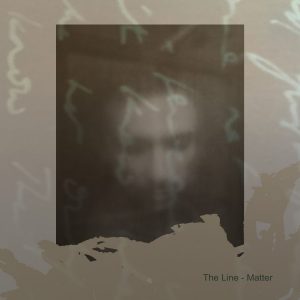
The majority of an album, Matter, was subsequently written over a twelve-month period from late 2016: sparse, emotionally-bare songs with ambience, noise and mind-bending soundscapes – a modern take on the Irish singer-songwriter tradition. A large amount of it is dedicated to sonifying grief, regret and sadness. However, I think there is a sense of resolution and finality found throughout the work as well.
A lot of my work focuses on extremes and dichotomies and this record is an example of that. I realised as I was writing these songs that I used a similar process for many of them and that they have a comparable form. They start out as sweet, sad songs and eventually get washed away in a sea of noise. This is probably most explicitly represented on the track ‘Over’, though it’s done with more subtlety (though not that much more!) on other occasions on the record. I think ‘Not Quite Parallel’ is the most important and effective example of this, which was the first one that I wrote which came out fully formed. The day I moved into the house in Louth I wrote this, and it quickly became evident that there was something I needed to get out and this was the first installment of it.
As well as the explicitly personal content, the sudden change of circumstance gave me a great deal of time to think about my own life and its insignificance. Perhaps this is the real reason that I decided to release this music, as I have written a great deal of work which will never see the light of day. I’m getting older and I find it hard to measure the value of my life thus far, and am beginning to realise the importance of documentation and milestones.
As much as I understand the positive effects of living in the moment, sometimes it detracts from thinking about the big picture. If everything is fleeting and transitory, how can we aim for anything in the future? And equally, what are we going to look back on – except for a collection of moments? Maybe life is just a collection of moments anyway, but I’d like to think that they all add up to something bigger. Even if that’s not true, I’ve decided that I’m going to believe in it anyway. I’m currently doing my best to believe in the greater good, despite the evidence that would suggest otherwise. I think that all of this relates to another dichotomy which is dealt with in the record – the balance between the individual and the universal.
The record was largely written in isolation and, prior to its release, only a handful of people had heard any of it. However, I got a bit of an insight into the process when I showed the demos to my friend Des Garvey, who engineered a lot of the album. I sent the music over to him and his response was something along the lines of ‘that’s what I would have expected an album of your solo music to sound like’. This came as a bit of a shock to me, as it seemed so at odds with the way I viewed myself. It made me realise that very often, the people around you know you much better than you know yourself. Their view of you isn’t obscured by the bias of your own ideas of your ideal self.
There are more particular themes evident throughout the album, though I think a lot of them relate back to these core concepts. For example, the title track deals with individual loss in the face of universal insignificance and the relationships between people, as well as those between waves and matter, in the physical world. The world seems to be quite obsessed with material objects and sometimes I feel like my obsession with waves is at odds with that. ‘Matter’ also plays with the multiplicity of meanings that a lot of words have. With that in mind, it’s worth noting that I’m also interested in homophones and concepts that explicitly have multiple meanings, as it gives the listener more space to infer their own ideas from it. The track ‘Weight’ is reliant on the use of homophones as well, in order to play with listener expectation.
Finally, though the record is heavily built around synthetic sounds (synthesisers, digital noise, processed vocals), at its core, it’s heavily influenced by organic sounds and elemental concepts. A lot of the lyrical themes deal with water and the sea and this is no coincidence. As well as being written mostly in a seaside cottage in winter, the key relationship which the record deals with was defined by a shared love of the sea and will forever be associated with that in my mind. When I listen to it, the sounds of the waves crashing on rocks and the sea gusts permeate every aspect of the music. I hope that other people can hear that as well.
The Line is the new solo project of musician, sound designer, and producer Brian Dillon. The debut album, Matter was released on Dublin label Bad Soup Records on 28 February 2020. Matter is now available to download and stream across online platforms: https://ampl.ink/4xpyV. Follow The Line on social media via Facebook and Instagram.
Never boast to your children that you had seventeen occupations before your twenty-fifth birthday. I did so with my fifth child and it was a bad call. It relaxed him into not worrying about the aimlessness – in my view – of his life. I became the kettle calling the pot black.
‘Oh good’, he said cheerfully. ‘That gives me a few years before I start worrying.’ He was twenty-one, had dropped out of college after first year. Why?’ I asked sorrowfully. ‘It was irrelevant’. And he laughed.
He had thoroughly enjoyed the life of a student unencumbered by distractions like studying. His parents were worried. But like Napoleon’s favoured soldiers, he had a marshall’s baton in his rucksack: he was lucky. Somebody spotted his real talent – he was ‘cool’, a nerveless boy racer – and he trained to be an aircraft traffic controller. At first we all worried about using air transport, but it soon became obvious he was a rounded plug in a round hole. I had spotted it first. When I asked him what the hell he was going to do with his life he calmly answered:
‘You must remember, father’ (my children always addressed me like this when they were being ironic), ‘I am lazy.’ I didn’t worry about him any more. Any young man who can be thus frank with an outraged patriarch has confidence in himself. Or perhaps he realised I’m just a softy. I suspect that boy may be among the minority of my extended tribe who will not be upset by something or other in this old man’s gossip.
Years ago I delicately reminded him he was in the demographic of the four hundred males who top themselves in Ireland every year, but he reassured me: ‘Don’t worry, I’m enjoying myself too much.’ He gave me hope.
It is time to confuse this narrative with facts. There follows a list of my pre-twenthy-five-year-old occupations, and what I learned from them.
Age 13: Slop gatherer for my Granda’s pigs – a lesson in humility. Age 14: Caddie in Milltown golf club – an introduction to the Irish native bourgeosie Age 16: Milk bottle counter in Hughes Bros., Rathfarnham – I lost count after an hour. Age 18: Shipping clerk in Palgrave Murphy on Eden Quay – meeting drunken sailors and horse protestants with names like Jameson and Pakenham and Pim. Age 19: Clerical officer in Dublin County Council – how to surmount job dissatisfaction and survive boredom. Age 21: Worker in Lyons factory, Hammersmith – how to sort rapidly moving strawberries on a conveyor belt. Also that year: lifesaver on the Serpentine, London – how to attract bathing beauties. Also (it was a very busy year:, agricultural ‘praktikant’ on a farm outside Munich – learning the German work ethic. Age 22: Booking clerk and travel guide with Michael Walsh Travel, Dublin – how to entertain fifty-four girl guides on a trip to Rome. Age 23: Bottle washer with Coca Cola – I lasted a day. Also that year: Labourer in Gouldings Fertiliser, Ringsend – I lasted a morning. Also: Farm labourer in the Gaeltacht of Cúil Aodha, Co. Cork – how not to learn Irish. Age 24: Commercial traveller with Rowntree Mackintosh – how to eat a four pound box of chocolate samples meant for customers, in one day. Age 25 – Bus conductor in Leeds – the bells, the bells! Also that year: Pub piano player in the same city – as near to concert pianist as I’ll ever get. Also: English teacher in Pforzheim, Germany. I learned that Germans take their studies seriously. Every age: aspiring writer, singer, actor – I realised early that a very amateur talent is as inadequate for a career on the stage as that of Mrs. Worthington’s daughter:
…she’s a bit of an ugly duckling you must honestly confess,
and the width of her seat must surely defeat her chances of success.
Once I reached twenty-five I became a television technician, then a producer/director, then an independent film maker. All of those occupations passed the time while I was working out what I would do when I grew up. That is still a work in progress.
I console myself by thinking that such a C.V. would look interesting on the back of one of my unpublishable novels; probably even superior to the novel’s content?
Just listing the jobs makes me yawn and reach for a nicotine chewing gum. I gave up smoking years ago. The pipe tobacco had become too expensive when Social Welfare took fifteen Euros off my old age pension. I’m easing off, slowing down, reminding me of a gyroscope, a toy that amused us as children. It was a kind of posh spinning top, with a fixed protective frame and a groove in its single foot which rested on a tightrope of string held taut by us children.
The energy of its internal spinning enabled the gyroscope to defy our altering the angle of the tightrope. It seemed to have a survival instinct, like a living thing. We could make it slide up and down as we wished, admiring its balance, its defiance of gravity and our expectations. Inevitably the initial impetus of its spin weakened, it wobbled and collapsed.
We young dei ex machina would catch it and start the whole game again. More sophisticated versions of the gyroscope are nowadays used by rich and paranoid civilisations to keep tankers and telescopes, space ships and satellites, guns and drones on their straight and deadly paths. To me the gyroscope is still a toy but a serviceable metaphor for life: keep spinning until you drop.
The Lamps of the Virgins from Bearers of the Broken Vessel
At dawn, weaving through hills,
go Daughters of Jerusalem in white,
faces illumed by the flames
of their lamps.
They sing a song about lovers,
become a string of dancing lights.
At dawn, before babes awakened
and bawled to take suckle,
their mothers lit fires
and filled the girl’s lamps.
“Where are you going?”
asks a sister too young for a lamp.
“To remember, to remember,
the daughter of Jep-thah.”
“Why are you crying?”
“The daughter of Jep-thah
ran dancing,
shaking her tambourine.
She was the first
to greet her father,
returning victorious in battle.”
“But why are you weeping?”
“We go to the hills like she did,
with our friends.
We go for one who is soon
to kiss her father goodbye
and leave to be married.”
Jep-thah, whose mother
was without blessing,
had not trusted Yahweh
to hand to him his victory.
He had sworn an oath:
in return for winning my battle,
I will give Yahweh a gift-
the first soul
who runs out from my house-
as a burnt offering, whole.
The daughter of Jep-thah
ran dancing,
shaking her tambourine.
She was the first
to greet her father,
returning victorious in battle.
Jep-thah tore his cloak
and fell to the ground.
“I love you, my daughter.”
She knelt,
put a kiss on his forehead,
“I love you, my Abba.”
On hearing what Yahweh
was promised,
Jep-thah’s daughter did not flee.
She avowed,
“Here I am, Yahweh, I’m yours!”
But first, with her friends,
she climbed up in the hills
to grieve,
singing, “My love will not perish
in flames.”
She would never know the tug
from the cry of a babe.
At dawn, a soldier’s widow weeps,
looks out her latticed window.
She sees the flickering lamps
dance on the hill and remembers.
She puts a kiss on her babe’s
waking warm cheekand sings to her daughter
of Yahweh.
Feature Image: William Blake, Wise And Foolish Virgins, 1826, Metropolitan Museum, New York.
Sat in silence on the bottom step, with my knees tucked under my chin, I fit snugly inside a ray of sunlight which penetrated the dark hallway through a stained glass window above the heavy wooden door. In the four years since my father’s death, a vindictive, sombre air pervaded the house. Harbors of warmth and light were frail, transient things.
The girls had already left for school and the house was deserted, save for me and my mother, Ruth. She was making the most of a rest before her hard day’s work began, and I was desperate for a reprieve from school. One of the teachers had taken it upon himself to iron out the wrinkles in my character with beatings so severe that I had to attend hospital. Ruth complained about the violence done to her child, but had been told that the teacher in question was soon to be retired, and that taking the complaint any further would be a big stab in the back for Catholic education.
I had survived that teacher’s class, but I still hated school, and by way of a plea, I faked a rasping cough, to which my exhausted mother responded in an exasperated, voice, “If I have to leave my bed to get you out to school, I’ll break your two legs.”
I trudged up Blackwood Street, deliberately scuffing the toes of the shoes my mother had worked so hard to buy. My vain efforts to be excused from school had only made me late again. I would be punished. But there was some compensation. Free from the school kids and workers who had already traveled to their appointed places of toil, the road was not busy and apart from two women downstairs, the empty bus granted me full reign of the upper deck. Rightly installed in the front seat, I surveyed all the little streets, shops and people below. The bus rolled down the Ormeau Road, past where the stink of the gas works leered through the windows, then through the markets to Cromac Street, where it slowed down to turn left, into May Street.
It was just at the corner of May Street, that the bus traveled at its slowest pace, and I jumped from the open platform, running to stay on my feet, when I hit the pavement. I passed the courthouse and turned down the back of Town Hall street as far as the court cells, before turning left to face the high walled police barracks. Their huge open gates allowing a view of the large, impressive cobble-stoned courtyard.
The back entrance to my primary school was defined on one side by the barracks wall, and on the other by a fruiterer’s warehouse, and flour mill. Inside the mill, turned an unmanned machine for loading bags of flour onto lorries. Normally the entry swarmed with boys playing hurling, handball and Gaelic football, soccer being banned on account of its association with England. They fought in the entry too, those high walls amplifying and echoing their screams. But the boys had already answered the morning bell, and the entry was empty.
The mill workers had all disappeared for tea break and apart from the clicking of their unmanned machine, there was an eerie silence in the entry. I had heard of big bombs that can kill all the people and leave their buildings and machinery still standing. The solitary slap of my shoes on the concrete alleyway echoed back with a menacing thought. Had the end of the world come? Was there nobody left but me?
I might have run in blind childish panic had I not seen it. The rat. Like an eighth wonder from a Marvel Magazine, defied gravity and clung four feet clear above the ground. The rat’s body ran parallel with the length of the bricks on the corner of the barracks wall. I had never seen a rat so clearly before. It had brown fur and beady eyes. We observed each other briefly before scurrying in our separate directions. The rat made its way back to the mill, while I ascended a broad, cast iron stairway which led from the yard to the upper floor of the old stone school.
It was a peculiar building built in the 1870s, of large coarse granite stones, with an upper floor jutting out to overhang a part of the walled off school yard. Overall, the place resembled one of the old tower houses, built for protection rather than education.
I tried to sit down unnoticed, on a long wooden bench at the back of the class room, but the black smocked, chubby figure of Brother Andia beckoned to me. He squatted down on his hunkers beside the hearth to bend his leather strap over the open coke fire, which burnt in the center of the partly partitioned room. I stood with little defiance, save a disinterested acceptance of the inevitable.
“ah missed the bus,” I started to say, but the excuse seemed lame so I added, “And ah stopped to watch a rat on the wall in the entry.”
“There are no rats in the vicinity of this school,” stated the Brother categorically.
We were a captivating diversion for the rest of the class and perhaps it was for the entertainment of my audience, that I cheeked,
“If there are no rats in the school, then how come you put rat poison down in the cupboards?” My audience was pleased with the show but Brother Andia was not.
“There are no rats in the vicinity of this school.” He repeated, and had me hold out my hands so that I could be punished for being late. The Brother strapped with unusual brutality, so that each stroke left a red swelling.
After three strokes on each hand, I expected my punishment to end. Arms folded across my chest, the injuries fit snugly into my armpits and I half turned to take my seat. But the Brother caressed me lightly across the face with the strap and smiling sadistically had me extend my hands once more. This time I was to be punished for telling lies about seeing rats.
Brother Andia did not come from Belfast, but from one of the twenty-six counties which were no longer under British rule. His years of experience as headmaster of a school, which existed under pressure, within a sectarian state had taught him the necessity of blind loyalty, and when he strapped me, that was the true message which he wished to convey. Oxford Street Christian Brothers primary school was a good, clean school which had no faults, no problems, and no rats.
The Brother continued to strap. Blubbering, I stood there, forced by my naive, stupid stubbornness, to stick to my story.
Donald Trump’s abrupt announcement of a U.S. troop withdrawal from Syria last October brought dire warnings of an ISIS resurgence in the media, and criticism from its regional allies. There were even mutterings of discontent among fellow Republicans, including Senate Majority Leader Mitch McConnell.[i]
However, a significant number of commentators sounded a note of relief. ‘American troops have no strategic reason to be in that country,’ wrote Simon Jenkins in The Guardian, ‘[Trump’s]desertion of the Kurds and his licence to Turkey to invade Syria must rank high in the annals of diplomatic treachery – but for realpolitik they are hard to beat.’[ii]
Turkish president Recep Tayyip Erdoğan waited barely three days to launch a long-anticipated attack across the Turkish-Syrian border, the first major military incursion into Northern Syria territory since the invasion of Afrin province began under Operation Olive Branch in 2018.
As the U.S. President boasted of having ‘destroyed’ ISIS,[iii] the Turkish military were credibly accused of re-arming and re-deploying ISIS and Al Nusra militias to spread terror in Northern Syria. And, as in Afrin, human rights abuses have been so commonplace that any neutral observer would assume they formed part of a coherent policy. These have included artillery and air bombardment of civilians, the use of white phosphorus,[iv] and terrorism from ground forces.
The Turkish government’s use of ill-disciplined local militias has provided a degree of plausible deniability of war crimes, including, potentially, the widely publicised murder of Hevrin Khalaf on the third day of the invasion.
Reductive Analysis
Coverage of the region in the Western media tends to refer to the Syrian Democratic Forces (SDF) and ‘the Kurds’ interchangeably. This reinforces a reductive narrative of the SDF as being comprised of fearless but naive nationalists, apparently content to sacrifice themselves in the pursuit of a Kurdish statehood aligned to U.S. interests in the region.
Both of these recent Turkish military incursions targeted the largely Kurdish areas of the Autonomous Administration of North-East Syria, also called Rojava, which is defended by the Syrian Democratic Forces (primarily by the YPJ and YPG, the People’s Protections’ Units, which started as humble militias in 2011, before developing into a disciplined fighting force) which Turkey accuses of being controlled by the PKK, or Kurdistan Workers’ Party, defined as a terrorist organization by both Turkey and NATO.
Commentators often blame the leaders of the Autonomous Administration for failure to recognise themselves as just another ethnic faction in a crowded neighbourhood. Indeed, ostensibly left-wing media frequently portrays this unusual political formation as a mere tool of the U.S. government, which has failed to invest sufficient effort in diplomacy with the Syrian government or other regional players.
Such a narrative draws attention from heartening developments occurring on the ground in Northern Syria over the past seven years. There is a revolutionary attempt to create a pluralist, feminist, multi-ethnic and ecologically responsible society in Rojava. Moreover, its administration is not seeking independent statehood, rather, its stated goal is to remain within a reorganized federal Syrian Republic.
The Northern region is multi-ethnic, and the SDF incorporates men and women of Kurdish, Arab, Syriac, Turkmen, Armenian ethnicity and others. Most are Sunni Muslim or Christian, but there are others of different religious identities and none. A significant international volunteer contingent also participated in the campaign, garnering worldwide attention[v] at the height of the campaign against ISIS.
The inclusive and diverse makeup of the military organization is an extension of the civilian administration’s philosophy of democratic confederalism. This entails devolved regional councils maintaining responsibility for their local assets, which interface with neighbouring communities and the central administration.
Full implentation of these new democratic processes is a long way off, with the project, by any reckoning, still in its early stages and threatened by potential new developments in this nine-year-old war.
Development is also hindered by continued Turkish aggression (both military and economic), as well as American capriciousness and regional gamesmanship. Notwithstanding Trump’s withdrawal announcement, the U.S. military maintains a regional presence; Russia has increased its role; while the European Union, Iran, and China keep a close eye on proceedings.
The intensity of the decade-long Syrian Civil War has abated but shows no signs of concluding, with millions of Syrians displaced throughout the country, as well as further afield in Turkey and Europe. Thus, despite providing the forces that retook cities and territories from ISIS over six bloody years, the fate of the autonomous region remains uncertain.
Tug of Allegiances
What next for the people in this troubled region? The U.S. is divided between obligations to its NATO partner Turkey, and to a legacy of alliance with the SDF, which provided ground troops that captured territory from the Caliphate.
The SDF might be expected to police the region and/or counter any renewed insurgency of ISIS. The complexity of the Syrian situation does not, however, lend itself to simplistic narratives, which tend towards vapid sentimentality about ‘the brave Kurds’.
The U.S. media is now almost exclusively devoted to the Democratic Primaries and the Coronavirus panic, and these seem likely to hog the headlines for the foreseeable future. Notably, no Democratic candidate has made any serious statements in respect of plans to help or equip the SDF, or to assist the AANES administration to circumvent crippling economic restrictions.
Trump’s occasional nonsensical remarks on the topic can be roughly interpreted as seeing the U.S. objective in the region purely in terms of extracting natural resources at the lowest possible price, but Trump’s decision last October has forced the regional authority to negotiate with both Assad and Russia, and has effectively gifted American interests in North East Syria to Russia.
Meanwhile, the war continues primarily in Idlib province in the north-west, with Erdogan now using millions of Syrian refugees for leverage against Rojava, the Assad government, and Western Europe. Crucially, oil production in the region, according to a recent interview with a Kurdish engineer, is estimated at approximately 25% of capacity,[vi] due to a deficient refinery infrastructure and reliance on the Syrian government to broker sales.
Uncertain Future
The Rojava project faces great uncertainties. Yet compared to other attempts at regional self-determination in the Middle East over the past two decades, it has seen incredible advances in civil society; albeit at an extremely high price, with approximately eleven thousand SDF affiliated fighters dying in the war against ISIS,[vii] and another twenty-five thousand suffering severe injuries
The demands of regional power brokerage and the precarious economic position of the territory mean that there may yet be serious compromises required in order to retain functional autonomy. Talks continue behind the scenes between the SDF and the Syrian government, brokered by the Russians. The question is: how will Rojava chart a course through this next challenging stage in its short but complex history?
[i] David Smith, ‘Donald Trump isolated as Republican allies revolt over US withdrawal from Syria’, The Guardian, October 8th, 2019, https://www.theguardian.com/us-news/2019/oct/07/trump-syria-us-troop-withdrawal-turkey
[ii] Simon Jenkins, ‘Trump is right to take troops out of Syria. Now they must leave Iraq and Afghanistan’, The Guardian, October 14th, 2019, https://www.theguardian.com/commentisfree/2019/oct/14/trump-troops-syria-leave-iraq-afghanistan-us
[iii] Tim Hume, ‘Trump Says the U.S. Has Destroyed ‘100% of ISIS.’ It Hasn’t.’, Vice News, January 9th, 2020, https://www.vice.com/en_us/article/pkebkg/trump-says-the-us-has-destroyed-100-of-isis-it-hasnt
[iv] Dan Sabbagh, ‘Investigation into alleged use of white phosphorus in Syria’, The Guardian, October 18th, 2019, https://www.theguardian.com/world/2019/oct/18/un-investigates-turkey-alleged-use-of-white-phosphorus-in-syria
[v] Patrick Freyne, ‘The Irish man ‘fighting fascism’ in Syria: ‘I was always curious how I’d react to battle’’, Irish Times, March 24th, 2018, https://www.irishtimes.com/news/world/middle-east/the-irish-man-fighting-fascism-in-syria-i-was-always-curious-how-i-d-react-to-battle-1.3435174
[vi] Mireille Court and Chris Den Hond, ‘Is This the End of Rojava?’ The Nation, February 18th, 2020, https://www.thenation.com/article/world/rojava-kurds-syria/
[vii] Wladamir van Wilgenberg, ’SDF says over 11,000 of its forces klled in fight against the Islamic State,’ March 23rd 2019, Kurdistan24.net, https://www.kurdistan24.net/en/news/0dafe596-6536-49d7-8e23-e52821742ae9
All around the snot-nosed parishes of Ireland
small people of both genders, and neither,
are flapping open
copies of The Sunday O’Duffy getting worried
about the continued existence
of the Citizen Army, Fenian Brotherhood,
Official IRA.
We can’t have
parties who perspire to government
secretly controlled by cabals
of men (and ladies) whose faces
we never see; apart from those
faces prescribed by prevailing winds
and the agreed rules
of the European Union,
which we need never see
but rest eternally assured
are there. Or thereabouts.
The only weaponry allowed
those seeking elected office
are five piece suits to help little
men appear substantial,
and no more than six
plastic chairs on which the faithful can
every other month gather
to recite the Our Father,
or discuss the rising
price of sewage. Even
the Social Democrats must come clean
about the continued non-existence
of their army council, and what role precisely
Fintan O’Toole plays in its
military high command.
A mature democracy like ours
needs parties whose manifestos
political correspondents
with excellent haircuts (and none) can safely
spread across their living room floors
and roll around naked on
without fear of being interrupted
by men and women wearing
illegally held
balaclavas.
Listening is a powerful skill. It’s one of the most important things you can learn in life. There are many different ways to listen and many different things to listen to, such as music, thoughts, emotions, facts, and opinions. For as long as I can remember I’ve always been trying to listen just that little bit closer.
I developed a hyper-awareness of sound in particular during my first years of piano tuition. One of my teachers was always playing random pieces of music off the top of her head as I arrived for my lesson. I loved to hear her play like this and longed to be able to do the same. I quickly realised that it was possible to play all the popular songs of the day just by sitting down and listening. The most important lesson I ever learnt and have never forgotten was when I was about 11 years old.
I brought a piece of music on cassette tape to my lesson for the same teacher to listen to and teach me. It may have been Bohemian Rhapsody or some other song with an epic piano part. She had a quick listen and told me to go home and figure it out for myself. This baffled me at first but I thought I’d give it a try. I went home and listened, and then really listened, and I figured out how to play the piece… note for note. What a revelation! From then on I took on everything from Billy Joel to Guns and Roses and became obsessed with learning these piano parts exactly as they were played on the recording. I didn’t just play something similar, I had to have every note correct.
As a teenager I had a deep attachment to the piano and had a pact with myself that I had to play every day or the spell would be broken. Even playing just a few notes would suffice. I generally practiced for a couple of hours every day and even more once I got to university. Piano was a massive part of my life. I also drew a lot and developed a love of black and white photography, so between art, photography and music I didn’t have much time for anything else. I was lucky that I went to a school that somehow allowed me to focus on all three subjects. All this has continued to feed into my compositional life, which only began in my early twenties when I did a Master’s in Music and Media Technologies at Trinity College Dublin (graduating class of 2000).
Having broken the piano spell and replaced it with electronic music I quickly turned my attention to found sounds and musique concrète. Using sounds from everyday life to create vast soundscapes further broadened and deepened my listening experience. Every sound around me became music! Sounds that other people tried to block out while going about their daily business became the building blocks of my compositions. Being able to transform them even further through various electronic processes was mind-blowing to me and incredibly exciting.
For many years I travelled around with a portable minidisc recorder and a small microphone recording anything and everything of interest. Machinery and transport fascinated me the most, especially when I started to pull these sounds apart to see what they would reveal. Electronic music opened my ears to so many incredible compositional possibilities during that time. The idea of sculpting and shaping sounds that had never been heard before was infinitely satisfying.
In a world where there are so many types of music and ways of approaching the arrangement of sonic elements in time, it has always been a challenge to come up with fresh ideas. Classical music was built on a very specific musical language. Composers who understood the power of this language and how to manipulate it most effectively managed to develop their own voice and have stood the test of time. These rules began to be broken down and abandoned at the beginning of the twentieth century. The strict rules of harmony and counterpoint were challenged and new ideas and concepts were introduced. From then on it was a free-for-all to some extent and now you can literally write whatever you want.
This makes things more challenging in many ways as you have nothing to hold on to. You can derive ideas from other works of course but creating a unique soundworld is very ambitious.
Delving into the world of musique concrète gave me a very important and lifelong obsession with timbre. Through working with found sounds I started to explore acoustic instruments for their sonic possibilities. Over the years I have collaborated very closely with professional musicians to explore their instruments and listen deeply to the intricacies of timbre that can be drawn from them.
Through the use of microphones I have built large libraries of sounds from every instrumentalist I have worked with and have explored their timbre even more by layering recordings of certain sounds together to make delicious textures. By using recordings you can enhance even the tiniest sound just by amplifying it within the mix to give you almost a macro-engagement with sound. This process became the basis of a PhD in composition that I completed at the University of York in 2009.
The endless combinations of sonic possibilities in this world will continue to inspire my life and work. Although living the life of an artist has lead me down quite an unconventional path, and can be a struggle at times, I wouldn’t change it for anything. I will continue to listen deeply and I encourage you to do the same.
Judith is currently writing pieces for flautist Lina Andonovska and drummer Matthew Jacobson’s duo
SlapBang and a piece for the RTÉ National Symphony Orchestra as part of The Contemporary Music
Centre’s composer lab.