Last December two Cassandra Voices editors gathered for a think-in with an external advisor. What followed was, for us, an excruciating exercise defining the mission of our publication. Formulating a so-called ‘elevator pitch’ does not come easily to a writer and a photographer more accustomed to asking the questions and framing subjects. Now we were the ones squirming in the crosshairs. After mild coaxing, followed by sterner rebukes, the existential crisis lifted sufficiently for us to work out: we provide a home for independent voices to inspire new thinking.
So what have these highfalutin words to do with the title of Cassandra Voices, featuring a legendary Trojan prophetess renowned for not having her warnings heeded? Well, we believe this space – in print and online – offers autonomous spirits an opportunity to give an unvarnished account of reality, subject to claims being properly referenced or corroborated. As such, this is a determination of relevant facts – often obscured in a mainstream media beholden to vested interests – on which moral evaluation depends. For example, unless we are exposed to the wretched of the earth – such as those confined to refugee camps within Europe’s borders – we are unlikely to consider what is happening to them to be wrong. Out of sight, out of mind.
Prompted in particular by Fellipe Lopes’s self-determined journey to Camp Mória on the island of Lesbos island in Greece, we chose the theme of Displacement for this the third edition. It also encompasses the ongoing impact of the global financial crisis, beginning in 2007, which, in particular, has generated an unresolved housing crisis and widened existing health inequalities. Moreover, we are in the midst of an Internet Revolution profoundly altering the careers of musicians and writers, while social media corrodes our personal space in an age of ‘Surveillance Capitalism’. And we do not forget the environmental challenges of an accelerating and unprecedented Extinction and Climate Crisis, and now a sinister global pandemic.
Finally, we remain committed to conveying a variety of forms through our publication – including photography, poetry, fiction, cultural criticism as well as more conventional journalism – bringing many lenses to understand the challenges we face.
With contributions from: Ben Keatinge, Duncan Mclean, Caoimhe Butterly, Samuel McManus, Navlika Ramjee, David Langwallner, Sarah Hamilton, Bob Quinn, Mark Burrows, Fellipe Lopes, Vincent Dermody, Paul Gilgunn, Daniele Idini, Kevin Higgins, Daniel Wade, Stephen Mc Randal, Ilsa Monique Carter, Alberto Moreno, Alberto Marcos and Bartholomew Ryan.
The picture on the left, of the newly built Covid-19 Test facility on Sir John Rogerson’s Quay in Dublin, was taken by Daniele Idini on March 23rd, 2020. The photograph on the cover is from reportage by Fellipe Lopes on the Mória refugee camp in Lesbos, Greece in January, 2020. Graphic design and layout is by Distinctive Repetition.
Tonight I walked to the sea in the dark. The city streets were empty except for a tomcat clawing at a wooden lamp post. It turned and padded off as it heard my steps, its shoulders rolling, leonine.
When I came to the shore the air was still, the city’s lights amber diffusions in the ocean’s surface stretching out towards the islands marshalled in the bay. As I sat there I thought of personal crises I’d been through, small things now, that made it seem to me that the world for days or weeks creaked and turned askew. And then I thought of this moment, and this external threat, when the world really is altering before us.
The sea’s surface had the sheen of glass – a dead calm. I imagined the water suddenly retreating, the shingle of the ocean’s floor hushing as it was revealed, fish flopping where they lay, the water gathering itself into a giant wave, a dark curtain throwing the skyscrapers of the city into shadow, its angry upper lip broiling with white foam.
Over nine hundred dead in Italy today. Five of them doctors and nurses. 9% of those infected are medical personnel.
What do we do in the face of this wave? Give in to hopelessness?
Someone posted a photo of my graduating class from medical school in Ireland the other day. Young faces then, kids – Asian, Indian, American, Canadian, Australian, Irish, Norwegian. I think of them seeded through the world, now senior doctors, readying themselves for what is to come.
Over 24,000 retired doctors and nurses in my own, small home country of Ireland took themselves out of retirement this week, and said they were ready to throw themselves into the fray; many are people who are of an age that they have a high risk of dying from the virus if they get infected.
With that kind of bravery around we can’t give in to hopelessness. So we build a wall, use ourselves as bricks, and we repel the fucker as best we can.
Before leaving I crouch at the sea’s edge and hold my fist under the water until it’s so cold it hurts. It’s time for all of us to get to work.
Sé Merry Doyle’s 2001 documentary film, ‘Alive Alive O – A Requiem For Dublin’ chronicles the lives of Dublin Street Traders. Their patron saint ‘Molly Molone’ became the inspiration for Dublin’s unofficial anthem, ‘Cockles and Mussels, Alive Alive O’. The final stanza remains poignant in our troubled times:
She died of a fever,
And no one could save her,
And that was the end of sweet Molly Malone.
But her ghost wheels her barrow,
Through streets broad and narrow,
Crying, “Cockles and mussels, alive, alive, oh!”
Following the spirit of Molly, the film demonstrates the fragility of a vibrant culture, and with so many closures, including of the Dublin Flea Market which had to shut up shop due to the lack of a venue for its Christmas market last year. This loss of colour and character to the city is incalculable.
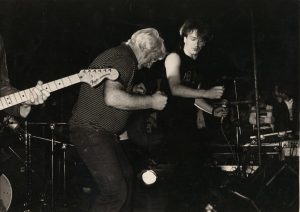
Shot in stages over many years, the documentary contains rare archive footage, capturing the demolition of tenement homes immortalized in the plays of Sean O Casey, as well as vintage shots of U2 in their formative stage as they play an inner–city concert.
U2 on Sheriff Street. Photo courtesy of Christine Bond.
There are also disturbing scenes of street traders being harassed by police, and we witness the last day of trading in the Iveagh Market, with one trader opining: ‘whatever happened to Molly Malone and the city’s pride in her’. It also includes an interview with the independent politician Tony Gregory in which he recalls being incarcerated for defending street traders’ rights.
This is an unprecedented record of the suppression by the State of Dublin’s traditional street traders, the closure of marketplaces, as well as the heroin epidemic that devastated inner city communities in the 1980s. The collection also contains moving recordings of actor Jasmine Russell reading verse especially commissioned from Paula Meehan, now the chair of Poetry Ireland, as well as traditional Dublin ballads sung by musicologist Frank Harte.
We spoke with Sé (over the phone unfortunately from where he is self-isolating in London). He first describes how he had made his first film in 1982 called Looking On, which is set in the North Inner City against a backdrop of civil strife, and the emergence of a yuppie culture that brought speculators into an area considered ‘ripe’.
Sé lived in that part of the city for many years himself, before being attracted to the bright lights of London where he blazed a trail for Irish filmmakers. He returned to his native city of Dublin in 1992, once again taking up residence in that part of the city
He recalls that Tony Gregory had by then won a few battles, especially after he agreed to support Taoiseach Charlie Haughey after the 1987 election, the so-called Haughey-Gregory Pact, in exchange for gaining crucial financial assistance for the inner city in return. Social housing had by then been built, but the persecution of street traders continued unabated.
Sé also remembers how:
I saw a pram dealer on Henry Street have her wheels removed by the Gardai. The Dublin Chamber of Commerce were promoting the removal of traders on behalf of the shopping district. Ironically the women who loaded up on produce bought in the fruit and vegetable market would normally go to Dunnes Stores and fill their prams with their own household purchases at the end of the day.
Then he says:
A notion came into my head. Here was the city singing ‘Alive Alive O’ at football matches, while at the end of rich Grafton Street there is statue of Molly. My family all come from the Liberties and some had been street traders, and so a new film began that would also use footage from Looking On.
Sé said he wanted this film to be lyrical, so he brought in Paula Meehan to add poetry and Frank Harte to sing traditional ballads. ‘A highlight,’ he said, was ‘filming the last days trading at the Iveagh Markets’
Eternally mischievous, Sé reveals how, after the market was closed for the last time, he bribed a security guard to let him back in, and then brought in the old traders to whom he showed old footage of the market to see what would happen. That became the last scene.
According to Sé, raising the money ‘ was a nightmare. I got a small grant from the Arts Council, then another small amount from the Irish Film Board and eventually RTÉ came on board and the film was born.’
The film was premiered at the Cork Film Festival in 2001, and won a number of awards, including at the Galway Film Fleadh. In 2009 it was the official representative of Ireland at the Doc Europa Festival in Lisbon, Portugal.
The Iveagh Market is still closed and mired in controversy. Sé reckons that ‘markets in general are victimised by red tape and speculators wanting their patches. Alive Alive O!’
Whenever I go back to Dublin, I wonder where it’s all gone.
I usually think of the gay marriage referendum, for some reason. It was one of those long spring Saturdays where the evening lasted half the day. There were so many of them in those terminal months before I left. So many sunny afternoons hungover on the grass by the bandstand in Stephen’s Green. So many magic-hour cans by the canal. So many nights that stayed evening until eleven or twelve. So many pills. So many lines. So many dabs of MD. So many illegal raves underneath Chinese restaurants and in garages on Prussia Street and in warehouses by the docks. So many kisses in the after-nightclub dawn.
They announced that ‘Yes’ had won in the early afternoon and we left our tiny rooms in Stoneybatter and went into town to drink. Me and two of my friends. It was standing room only outside Grogan’s so we stood and talked shite in the sun. The streets were wedged with people celebrating. The crowds were chanting “yes” and singing “olé olé”. There were rainbow flags, rainbow beards, rainbow armpits, rainbow headbands, rainbow t-shirts, rainbow hot-pants, rainbow dogs and rainbow cars. There were ‘Yes Equality’ badges and “Same Love” tote bags. There were people posing for photographs in front of sunlit, multi-coloured murals. There were gay couples kissing and strangers cheering them. There were news crews from all around the world, filming the celebrations and having their filming interrupted by people jumping in front of the cameras to celebrate.
Everyone under thirty was home to vote and out for the craic. Town was even more mental by early evening as we walked from pub to pub in the lens-flare light. It was like a carnival. It was like the World Cup. It was like Pride, except it was ourselves we were proud of, the soundness of us. Proud of our country. Proud of our city which voted overwhelmingly for yes. Proud of our young people who were out dancing and singing in the sun and the shade. It felt like a revolution.
We drank in The Bernard Shaw with the South Americans and the continental Europeans who were out to celebrate too. We drank under the stars, and after last orders we walked by the graffiti for yes to Whelan’s. We sang Prince and Madonna and everyone hugged on the dancefloor when the lights came on at the end. The old establishment seemed on the verge of falling. I shifted some lad outside at four. No one wanted to go home even though the seagulls were down for the leftover chips and the sky was glowing up a Sunday morning blue.
Me and my two friends walked back to Stoneybatter. The street sweepers were out. The papers were being delivered. The frontpages said “Ireland says yes” and “Even the Sun Came Out” and “The Rainbow Revolution” and “A New Beginning” and “Ireland’s Big Yes”. They all had pictures of people in the sun in sunglasses hugging and cheering and blowing bubbles and kissing.
“The country’s changed,” my friend said as we sat in our small, dawn-lit kitchen at half-five in the morning having toast and tea. A month later the landlord raised our rent by 30%, and four years on now we’re all gone from Dublin. Me and my friends, and probably most of the people out drinking in the sun that day. We celebrated equality and left a day or a month or a year later. Off to London or South America or Asia or the Middle East or back down the country or onto friends’ couches or back in with our parents or into homelessness. I wish I could go back to those days, but it’s all gone now: that Dublin, those people, that hope.
In association with The Loopline Collection, we are introducing a free documentary film every week during this period of social isolation for you to enjoy.
For this St. Patrick’s night we bring you Sé Merry Doyle’s intimate portrait of the poet Patrick Kavanagh (1904-1967): ‘Patrick Kavanagh – No Man’s Fool’.
Kavanagh’s best-known works include the novel Tarry Flynn (1948), and poems such as ‘On Raglan Road’ (1946), immortalised in song by Luke Kelly, and ’The Great Hunger‘ (1942). His work viscerally conveys the frustrations of Irish rural life in the first half of the century, while grasping at its cosmic possibilities.
We also find these themes in:
‘Stony Grey Soil of Monaghan‘
O stony grey soil of Monaghan The laugh from my love you thieved; You took the gay child of my passion And gave me your clod-conceived.
You clogged the feet of my boyhood And I believed that my stumble Had the poise and stride of Apollo And his voice my thick tongued mumble.
You told me the plough was immortal! O green-life conquering plough! The mandril stained, your coulter blunted In the smooth lea-field of my brow.
You sang on steaming dunghills A song of cowards’ brood, You perfumed my clothes with weasel itch, You fed me on swinish food
You flung a ditch on my vision Of beauty, love and truth. O stony grey soil of Monaghan You burgled my bank of youth!
Lost the long hours of pleasure All the women that love young men. O can I stilll stroke the monster’s back Or write with unpoisoned pen.
His name in these lonely verses Or mention the dark fields where The first gay flight of my lyric Got caught in a peasant’s prayer.
Mullahinsa, Drummeril, Black Shanco- Wherever I turn I see In the stony grey soil of Monaghan Dead loves that were born for me.
In the documentary we find outtakes fleshing out the story with previously-unseen interviews with actor T.P. McKenna, author Dermot Healy, poet John Montague and others close to the poet. There is also a fascinating sequence involving Kavanagh’s brother, Peter on the occasion of the installation of a plaque at Parson’s Bookshop on Baggot Street, sheding light on a controversial relationship. Audio recordings of actor Gerard McSorley’s readings of Kavanagh’s poems, only partially used in the original film, reflect the genius of both actor and poet.
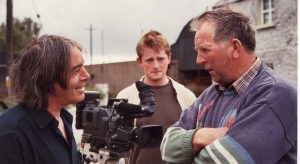
On location, ‘Patrick Kavanagh – No Man’s Fool’.
The film was voted Best Documentary by the Boston Film Festival and features a host of writers and actors, and is just over an hour in length.
My life’s ambition is to write a poem
For you to quiver in ecstasy,
Transcending the storms that have become
For us a weakly reminder
That all is not as it should be
For a generation to come
All out of shape without
Any need for eugenics,
Or medical scapegoats,
As my face takes on a comical twist,
And the log fires send out particles,
And governments negotiate continued support measures,
While the weathermen occlude
The longer stretch in the evenings,
But I won’t cough,
Lest it gives away the position,
And we enter the sublime
Reverence for irrelevance.
It’s word play OK?
Designed in their own way.
I can’t wait for the pattern,
Or the pull of Saturn.
Enough, enough, enough,
Your voice is increasingly rough,
Hand us over a last puff.
No picture of the modern world is complete without a Marxist analysis. The fundamental point – even for anyone who is not a fellow traveller – is that a materialist analysis of capitalism’s inherent instability is essentially correct, and now more relevant than ever.
The problem has always been around how a post-capitalist society emerges without savage bloodletting and numbing totalitarianism. The bearded figure scribbling away in the British Museum would no doubt have been horrified by the barbarous regimes – from Lenin to Kim Jong-Il – that have laid claim to his legacy.
Slavoj Žižek is perhaps the best known representative and synthesiser of contemporary Marxist theory. Anyone who has viewed his films The Pervert’s Guide to Ideology (2009) or The Pervert’s Guide to Cinema (2012) can only marvel at how this middle-aged, slovenly Slovenian Marxist is taken so seriously. Despite the spittle that pours involuntarily out of his mouth as he expostulates, it seems his ideas are judged on merit; albeit a somewhat comedic appearance has probably made him seem less of a ‘danger’ – especially when set against a straight-backed sparring partner such as Jordan Peterson – and ‘Ted-Talkily’ acceptable.
Žižek is a complex political thinker, noted for his observations on ideology. Yet his writing is dense, often impenetrable, and even, at times, frankly nonsensical. Sadly, the content can be obscure, and the ideas often wildly over-stated, though recent books have seen him curb this tendency, leading to greater traction. With age he has mellowed, or at least he has become far more coherent in his critique of the late capitalism disaster movie unfolding before our eyes.
His thought processes are, nevertheless, eminently contestable. Former Irish President Mary McAleese – who lectured me – always despised recklessness, as do I, but in a different sense. It is intellectual recklessness I hold in low regard. Žižek is full of it, at least in terms of his wilder statements calling for insurrection.
Žižek argues that the widespread belief that our world is post-ideological is an ‘arch-ideological’ fantasy. Today, he asserts, ideology entails what people impute to others, whether left or right.
This demonization of others, and the exclusion of outsiders, is indeed very much to the fore in his recent writings, and in our end of day’s capitalist order. Tribalism, nationalism and the targeting of non-nationals and immigrants is an endemic feature of our time.
For a subject to adhere to an ideology he argues, he must have been presented with it, and accepted it as true and right – such that anyone sensible should believe in it. In a seminal text, The Sublime Object of Ideology (1989) Žižek claims that ideology has not disappeared, but has come into its own, and because of its success, it has been dismissed as non-existent. Or should it be that ideology has been internalised?
Ideological Disidentification
Žižek also puts forward the idea of ‘ideological cynicism.’ Ideology today is not as it was for the proletariat for ‘they do not know it, but they are doing it.’ He disagrees that for ideology to be effective it has to effectively brainwash people, as Marx contended in his famous religion being the opium of the people assessment; rather Žižek contends that a successful ideology always permits a critical distance towards that ideology – this he terms ‘ideological disidentification’; saying: ‘I know well that (for example) Bob Hawke / Bill Clinton / the Party / the market do not always act justly, but I still act as though I did not know that this is the case.’
Or perhaps it should be said that behaviour has been modified or controlled, and widespread passivity makes it is irrelevant what we do in a spectator democracy. In effect, we are irrelevant to changing any of this, as the supporters of Bernie Sanders are finding out.
Žižek points to a ‘big O other’, who legitimates control through ‘God’ or ‘the Party’. In The Sublime Object of Ideology, (1989) he argues that such important or rallying political terms are ‘master signifiers,’ even though they are ‘signifiers without a signified’, i.e. words which do not refer to any clear and distinct concept or demonstrable object. Thus, they induce control and a false sense of belonging, but are meaningless.
This claim of Žižek’s is related to two other ideas:
That subjects are always divided between their conscious and unconscious beliefs towards political authority;
That subjects do not know what their beliefs are that leaves them open to domination and control.
Jouissance
Žižek further contends, following the critical theorist Louis Althusser, that ideology is embedded in our everyday lives. In particular, he uses the term jouissance to describe transgressive pleasure that we derive from the master signifiers, such as ‘nation’ or ‘people,’ through cultural products as sports, music, alcohol, drugs, festivals, or films.
Another central idea in Žižek’s initial political philosophy is that any regime only secure a sense of collective identity if their governing ideologies afford subjects an understanding of how these relate to what exceeds, supplements or challenges its identity. Or, in layman’s terms, bread and circuses is the glue that binds identities – ‘Football’s Coming Home’ to quote Baddiel and Skinner.
Žižek adopts the term ‘ideological fantasy’ for the deepest framework of belief that structures how political subjects, and/or a political community, come to terms with what exceeds its norms and boundaries. He identifies Law with the Freudian ego ideal.
But Žižek argues that, in order to be effective, a regime’s explicit Laws must also harbour and conceal a darker underside – a set of more or less unspoken rules which, far from simply repressing jouissance, implicate subjects in a guilty enjoyment in repression itself, which Žižek likens to the ‘pleasure in pain’ associated with the experience of Kant’s sublime.
Žižek’s final position about the sublime objects of political regimes’ ideologies is that these belief-inspiring objects represent the many ways in which the subject misrecognises its own active capacity to challenge existing laws, and to found new laws altogether.
He repeatedly argues that the most uncanny or abysmal aspect of the world today is the subject’s own active subjectivity – explaining his repeated citation of the Eastern saying ‘Thou Art That’. It is, finally, the singularity of the subject’s own active agency that leads to subjects’ recourse to fantasies concerning the sublime objects of their regime’s ideologies.
Like a Thief in Broad Daylight
Žižek’s technical term for the process whereby we recognise how the sublime objects of political regimes’ ideologies are, like Marx’s commodities, fetishised objects – concealing from subjects their own political agency – is ‘traversing of the fantasy.’
Traversing the fantasy, for Žižek, is the political subject’s deepest form of self-recognition, and the basis for his own radical political position, or defence of the possibility of such positions.
Žižek also references Alain Badiou, who argues for an elevation or an insurrection. Žižek also seeks a form of Jacobin army, the intellectual irresponsibility of which needs to be emphasised. Even if these ideas are metaphorical the extremism provides ample ammunition to right-wing critics, who argue he condones or even approves of terrorist methods.
Sadly, in more recent times, the Marxist left has been self-sabotaging, and the cause of its own downfall. They have also had their good arguments stolen and mangled by the right.
Yet it seems that radical Marxists are at last growing up and that the post-modernist wing is grappling with its self-contradicting, and implicit approval, of a valueless universe.
In his recent book Like a Thief in Broad Daylight (2016) Žižek distils many of the abstruse elements of his ideas into manageable and helpful commentaries that have a broader base of appeal. The ethical political order, notwithstanding Habermasean attempts at a reconstituted normalization, have collapsed, he argues.
Freedom of choice is an illusion in a world of disinformation, plummeting educational standards, short-terms contracts, imposed services and privatization. Any alleged freedom we have arrives in a narrow spectrum of choices, subtly imposed upon us through social influencers and technological nudges controlling choices. Or as John Gray put it in The Soul of The Marionette (2015) ‘we are forced to live as if we are free.’
Žižek and others have demonstrated the sinister developments within late capitalism. Including how a rent for profit model means most of us on low salaries serve undeserving sponsors, leading many into the informal market or the black market by violence or the violence of regulation – as David Graeber explores in his epochal work Debt: the First 5000 Years (2015).
Other disturbing trends are in evidence, Roberto Saviona in Zero, Zero, Zero (2015) through a sustained analysis of drug cartels, shows how the corporate model of Mafiosi loyalty has been exported into law firms. The lines between legitimate and illegitimate capitalism are thus blurred to a point of near non-existence.
The ‘woke’ left cannot escape blame for failing to identify the socio-economic issues that really count in peoples lives. Pseudo-feminism plays a class game, marginalizing lower class men as harassers and even demonizing migrants. Indulgence of victimhood has created the abuse excuse.
The Wretched of the Earth
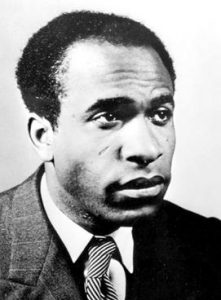
Frantz Fanon
Žižek is quite critical of the great post-colonial Marxist Frantz Fanon and his seminal text The Wretched of the Earth (1961). But Fanon was surely right in identifying a colonial order wherein, ‘the people’s property and the people’s sovereignty are to be stripped from them.’ The Untermensch were obliged to pay the debts of the occupying powers, which is now the international model of austerity.
Žižek argues that our society of depoliticized and compliant sheep invite disaster. He references the film Blade Runner (1980), which is a useful cultural trope as the older replicants – baby boomers – now need to let go of their accumulated wealth and power. Generation X are at least conscious of false memory syndrome or implanted hopes, and some have the wherewithal to do something about it and no longer settle for being victims. So despite the victim excuse, Fanon and Žižek have much in common in their analysis.
The reality is that the analysis of Fanon is now in place across the world. The elite or the corporatocracy are a gang, and what amounts to a mafia is running the planet like a colony.
So the slovenly Slovenian has hit the zeitgeist, and now interacts with more common sense than was evident in his wilder pronouncements of the past. But unfortunately it appears as if the lunatics have already taken over the asylum, and to an increasingly docile audience what he is saying will appear mad, a point that his appearance would appear to affirm.
Or at the very least his ideas will be packaged by Facebook, so he plays a bit part in the drift or acceleration into the abyss that we must resist.
In December 1899 Honolulu-based physicians attributed two deaths to bubonic plague, and a local paper duly announced that the ‘scourge of the Orient’ had arrived.[i] Within months a first plague fatality was reported in continental U.S. as Chinese-American Chick Gin (Wing Chung Ging or Wong Chut King depending on the transliteration) succumbed to the disease in San Francisco. The cause of death was based on a classic plague symptom of swelling around the groin, but was disputed even after rudimentary bacterial analysis. Regardless, political and health authorities were already taking actions that resonate today.
Fearing the economic impact of a dreaded disease, the state governor denied the existence of plague altogether, accusing his own health officials of propagating rumours and ‘injurious opinions’ detrimental to the ‘great and healthful city.’[ii] Conversely, successive quarantines had already been imposed on San Francisco’s Chinatown, excluding non-Asian homes and businesses despite their proximity. Enforced by barbed wire and a heavy police presence, the blockade led to dwindling food supplies and a steep rise in costs. An experimental vaccine with severe side effects, developed in 1897 by bacteriologist Waldemar Haffkine, was made obligatory for any Chinese (and Japanese) wanting to leave the city.
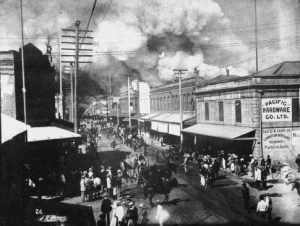
In 1900, Honolulu’s Chinatown was set on fire to in a misdirected effort to control Bubonic plague.
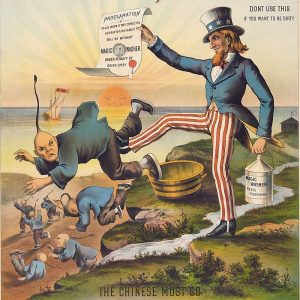
Unsurprisingly, the turn-of-the-century scapegoating of East Asians in California did not occur in a vacuum. Anti-Chinese prejudice had already been formalized in the Chinese Exclusion Act of 1882, banning their immigration for undermining the ‘dignity and wage scale of American workers.’[iii] There were, likewise, widespread perceptions of the Chinese as carriers of disease. If Europeans had been imperilled by the ‘barbaric hordes of Asia’, germs represented ‘a peaceful invasion more dangerous than a warlike attack.’[iv] And while dogma of the day suggested limited danger to the West due to advances in health and civilization, extreme measures might be necessary with plague. In such cases Russia’s ‘heroic methods’ in its Chinese colonies were helpfully referenced, as firing squads for the infected ‘saved trouble and other people’s lives.’[v]
An 1886 advertisement for ‘Magic Washer’ detergent: ‘The Chinese Must Go’.
Old Wine, New Bottle
Associating disease with marginalized groups, minorities and others has hardly been an exclusively American experience. And by today’s standards, persecution over illness is not necessarily as crude, but neither can toxic discourse or indeed violence be excluded. The arrival of a new coronavirus in December 2019 is a case in point. The linking of its presumed place of origin in Wuhan with East Asians generally, and Chinese in particular, did not take long to manifest itself as multiple accounts of discrimination emerged. In Western countries this played on traditional racial tropes such as sordid animal markets and uncleanliness. Reflecting an entirely different experience, namely apprehension over Chinese influence, regional reaction was also alarmist. Both say as much about perceptions of mainland China as of the disease itself.
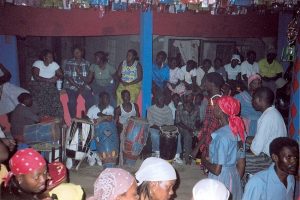
There is no shortage of recent examples that demonstrate medical scapegoating around a novel or poorly understood disease. In 2010, the lynching of voodoo priests in Haiti originated with rumours of pout kolera (magic cholera powder) deliberately poisoning the water supply. The choice of target was partially reflected in the complex history of voodoo practitioners and the Haitian State. At times associated with resistance to foreign occupation, at others integrated into the personality cults of Haiti’s twentieth century dictatorships, notably that of ‘Papa Doc’ Duvalier. Confusion over the origins of the cholera epidemic ‘fed on feelings of insecurity and fear’, in turn fuelling stigmatization and violence.[vi] More sustained anger eventually shifted towards the unwitting culprits, negligent United Nations peacekeepers that had contaminated the Artibonite river with cholera-infected faeces.
Vodou ceremony, Jacmel, Haiti, 2002. Image: ‘Doron’.
A corollary of medical scapegoating is fear and misinformation. Fundamental weaknesses in the Pakistani health sector, combined with accusations of a fake Hepatitis B campaign orchestrated to locate and kill Osama Bin Laden, has reinforced suspicions of polio vaccinations. With rumours of polio vaccines being either harmful or simply a front for intelligence gathering, health workers have since borne the brunt of attacks by armed groups.[vii] Misunderstandings and distortions around Ebola, both in West Africa in 2014 and more recently in the Democratic Republic of Congo have led directly to the deaths of medical staff. In the latter case, mistrust over the response is rampant, provoked in part by ‘community resentment’ over the focus on Ebola while ignoring underlying problems in the country.[viii]
The targeting of health workers as somehow responsible for bringing illness into a community, and thus the cause or at least the visible manifestation of a terrifying epidemic, is an extreme example of the need to apportion blame. But if sickness has historically been portrayed as a punishment for sin, socially excluded groups and minorities have proven most vulnerable. Whether linked to mortality or fear of the unknown, context is key to understanding the long history of how those on the margins of society have been scapegoated. Much as nineteenth century descriptions of Chinese immigrants as ‘walking time bombs of infection’ cannot be separated from pervasive Sinophobia, the frequent panic associated with novel or misunderstood illness has tended to reinforce pre-existing stereotypes.[ix]
From Tragedy to Farce
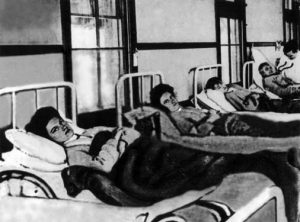
The fate of Chick Gin aside, apportioning individual responsibility for epidemics is unusual in that it is difficult to prove. ‘Typhoid Mary’ is likely the most infamous example as she came to be seen as ‘synonymous with the health menace posed by the foreign-born.’[x] An Irish immigrant cook, Mary Mallon was a so-called healthy carrier of typhoid bacteria, unintentionally instigating outbreaks amongst her wealthy employers in New York until she was eventually tracked down in 1906. Vilified in the papers as a ‘walking typhoid fever factory’ or a ‘human culture tube’,[xi] Mallon would end her days in forced isolation.
‘Typhoid’ Mary Mallon in hospital.
On a more grandiose scale, Canadian air steward Gaëtan Dugas was posthumously declared ‘Patient Zero’, accused of intentionally infecting his partners with HIV and provoking the spread of AIDS in North America.[xii] Although later disproved, the fear and exclusion of the five ‘H’s – homosexuals, heroin addicts, haemophiliacs, hookers and Haitians – remained commonplace in the 1980s.
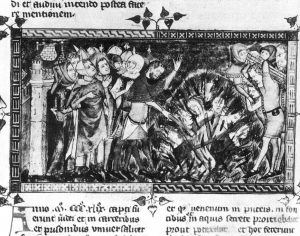
Much like the five ‘H’s, easier to trace is the scapegoating of entire groups, the archetypal example almost certainly being the pogroms and massacres inflicted on European Jews during the Black Death. Rumours of an ‘anti-Christian international conspiracy’ fit snugly with long-standing antisemitism, particularly when mortality rates among Jews were seen as inexplicably low (the fact that sensible hygiene laws laid out in the book of Leviticus had been employed was entirely ignored). Initially directed at medieval lepers and vagrants, Jews came to be accused of poisoning wells, eventually resulting in the extermination of entire communities.[xiii] Six hundred years later hygiene control of typhus, a lice-borne pathogen, became an element of Nazi propaganda intended to justify the mass murder of human carriers during the Holocaust.[xiv]
Representation of a massacre of the Jews in 1349 Antiquitates Flandriae (Royal Library of Belgium).
The transatlantic journey of yellow fever holds particular irony in the history of racial stereotyping over disease. The mosquito-borne virus’s first documented appearance in the New World was in 1647 Barbados. Even if thoroughly misunderstood at the time, much like malaria there was an assumption that black Africans were immune to the disease, all the more so as white Europeans were so highly susceptible (in reality this was largely due to early exposure during childhood). This immunity in turn became one of the justifications on which the Atlantic slave system was built. Brutal conditions on the sugar plantations and corresponding high mortality rates ensured continued new arrivals, often with the same immunity, all the while reinforcing the original racial stereotype. It was only as slavery was gradually abolished in the nineteenth century, a period coinciding with multiple outbreaks of yellow fever in the American South, that former slaves were themselves accused of spreading the disease.[xv]
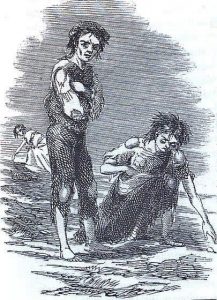
Skibbereen, west Cork, in 1847 by James Mahony.
Cholera likewise has a special place in the history of medical scapegoating and became highly politicized. Despite having long circulated locally on the Indian subcontinent, it only emerged on the global stage in the early nineteenth century, an appearance closely intertwined with colonial trade policies. As the bacteria must be ingested through contaminated water or food, the poorest and most deprived urban areas proved most vulnerable. And given the profile of its victims, the spread of cholera inevitably took on class connotations that shifted smoothly towards immigrants, even as disease transmission came to be better understood. The Irish migratory experience was strongly marked by outbreaks of cholera, with higher mortality rates used as ‘corroboration that they were carriers of the disease’ rather than a reflection of widespread discrimination and impoverishment.[xvi]
The link between poverty and disease was particularly apparent with venereal disease, more specifically syphilis (and gonorrhoea with which it was often confused). Referred to at times as the ‘secret plague’ given the strong underreporting, symptoms had been recognizable since the late fifteenth century. And while there had long been a feminized connotation as per responsibility, hence the expression ‘one night with Venus and a lifetime with Mercury’, apportioning syphilitic blame took on far more sinister connotations through the later association with underprivileged women. Various incarnations of the Contagious Diseases Act in 1860s Britain essentially allowed the arrest and forced treatment of prostitutes in an attempt to limit venereal disease in the military, and subsequently the broader population.[xvii]
The emergence of syphilis also provoked an unusual example of xenophobic scapegoating, essentially a bizarre etymological battle that took on global proportions. As the disease spread throughout Europe and beyond, rivals were duly named responsible. For the French it was the Neapolitan disease, the Italians vice versa; the Russians blamed the Poles; the Dutch turned towards the Spanish; in Japan it emerged as the ‘Chinese ulcer’; while the Turks were less discerning, simply referring to the Christian disease.[xviii] The 1918 influenza pandemic likewise went through multiple national incarnations before settling on the familiar Spanish flu, a reference to the neutral country that first reported the disease. Both examples border on the farcical and if there are lessons to be learned, at least as far as 1918 is concerned, it is rather the impact of censorship and misinformation in controlling a pandemic.[xix]
Lessons Unlearned
Being reminded of past madness has a purpose, especially as we have a nasty habit of repeating our errors. Our understandable fear of disease sadly has often revealed our basest instincts, further stigmatizing the most vulnerable and endangering the health of all. Barbaric reflexes are never far from the surface. The emergence of a new pandemic has provoked ugly reactions very much reminiscent of the past, and counterproductive to controlling both the disease and the corresponding panic. While there are no rules to the patterns of hate linked to epidemics, just as increased social cohesiveness is also a potential consequence, the choice of scapegoating targets is not random. Facile demonization of the ‘foreign’ remains a perpetual risk, and disease a convenient pretext.
As for Chick Gin, he was merely the first of many plague fatalities in 1900 San Francisco. Over the next eight years at least one-hundred-and-seventy-two others would perish, both Chinese and non-Chinese.
[ix] Quote taken from testimony to Congress in 1876 over the state of Chinese immigration, Mary Roberts Coolidge, Chinese Immigration, Arno Press: New York, 1969 (original 1909), p. 106.
[xi] ‘Woman ‘Typhoid Factory’ Held a Prisoner’, The Evening World, New York, 1 April 1907.
[xii] Charlie Campbell, Scapegoat: A History of Blaming Other People, Duckworth Overlook: London, 2011, p. 161.
[xiii] John Kelly, The Great Mortality: An intimate History of the Black Death, Harper: London, 2006, pp. 232, 248.
[xiv] Samuel K. Cohn, Pandemics: Waves of Disease, Waves of Hate from the Plague of Athens to A.I.D.S., Historical journal (Cambridge, England), 2012 November 1; 85(230): 535-555.
[xv] Sheldon Watts, Epidemics and History: Disease, Power and Imperialism, Yale University Press: London, 1999, pp. 245-246.
[xvi] Philip Alcabes, Dread: How Fear and Fantasy have Fueled Epidemics from the Black Death to Avian Flu, Public Affairs: New York, 2009, pp. 74-75, 77.
My colleagues are working flat out these days. After seeing our list of patients, we are on the phone and email advising people to quarantine, to get tested, or take measures such as social distancing.
What we are trying to do is help ‘flatten the curve’ of the outbreak: to avoid a peak of infections; to slow down the rate of transmission; and have it play out over as long a period as possible.
The frightening reports from doctors in Italy describing an overwhelmed hospital service, dealing with a peak in admissions of potentially fatal bilateral interstitial pneumonia caused by the virus, makes the work ever more urgent.
Many of our patients are elderly, multi-morbid, and therefore vulnerable to the worst effects of the virus.
When I advise our healthy patients about measures they can take, many are blasé, given the symptoms they get will probably be mild. When I explain that these measures are not for their own sake, but rather for the most vulnerable among them – their relatives, friends or neighbours – I can see it sinking in, and a new seriousness emerging.
If there is a silver lining to this crisis it is the revelation of how connected we are to each other, in ways we have almost forgotten. We are a species with special concerns. We cannot afford to operate alone as individuals; to do so is to threaten us all. This realisation is putting into stark relief the way we have organised our societies over the past few decades.
Some private health care clinics in Dublin are now putting up signs saying they will not accept patients with respiratory symptoms, directing them towards their G.P’s. This is in one way understandable as a means of limiting transmission, but while the public service is taking extra measures to distribute information and organise the response, these private clinics are under no compulsion to do so.
In the U.S, Trump’s apparatchiks like Mike Pompeo have sprinkled their public statements with references to the ‘Wuhan corona virus’, pointing the finger abroad to evade criticism of their response to the crisis.
This crisis will abate. It is hard to gauge how many people we will lose to the infection, but when the wave has broken and dissipated, hopefully the realisation will have dawned that the defences we build are only strong enough if we build them together.
Dr Samuel McManus is an Irish G.P. currently working in Norway.
1/ I may be repeating myself, but I want to fight this sense of security that I see outside of the epicenters, as if nothing was going to happen "here". The media in Europe are reassuring, politicians are reassuring, while there's little to be reassured of. #COVID19#coronavirus