Blog

  • Underlying Conditions Exacerbate Covid-19 Pandemic

    Pressing Pause

    In the grip of serious illness anyone but an obtuse contrarian seeks medical assistance. As the coronavirus Covid-19 pandemic sweeps across the globe, doctors are performing heroics, often at grave risks to their own health. Enhanced screening, testing and emergency treatment facilities, along with developing a vaccine, are now paramount considerations; but we cannot ignore our underlying fragilities.

    Exclusive focus on the Holy Grail of an elusive cure disregards how the virus is exploiting poverty in wealthy countries, flawed public health policies and destructive environmental practices. At least we may still soften the blow of this outbreak, and reduce the harm and incidence of future episodes. With all changed – changed utterly – returning to business-as-usual is inconceivable.

    Despite what we hear from the Trump administration,[i] there are no specific medicines available to prevent or treat the new coronavirus Covid-19.[ii] The best estimate is that a year-and-a-half is the minimum time required to develop a reliable vaccine, which would actually set a record.[iii] Remarkably, a British-Italian partnership claims it will have one ready as soon as this September, but the challenge of manufacturing, distributing and mass-immunization – including the thorny issue of consent – on an unprecedented global scale, remain.[iv] The options are comprehensively laid out by medicinal chemist Derek Lowe.[v]

    The dangers posed by this outbreak, and future ones that nature will throw at us, require a thorough reappraisal of public health priorities. Medical systems in advanced Western countries – especially those dominated by the private sector – tend to prioritise treatment of the symptoms of the main non-contagious diseases. We ‘live’ with cancer and heart disease as opposed to addressing multifarious lifestyle causes, which the virus is now preying on.

    As Boris Johnson’s predicament underlines, anyone is susceptible to Covid-19, but chances of exposure – without recklessly ignoring medical advice – are often determined by social class, which intersects with lower life expectancy already.

    In responding to the pandemic any nation is likely to be only as strong as its weakest links. The co-existence of extremes of poverty and wealth in societies such as the United Kingdom and U.S. poses particular dangers.

    We must awaken to the environmental origins of viral diseases. What Julio Vincent Gambuto[vi] has described as this ‘Great Pause’ should bring a more harmonious relationship with nature, and other animals, as we negotiate with this and even greater environmental dangers.

    Finally, as Yuval Noah Harari cogently argued:

    When choosing between alternatives, we should ask ourselves not only how to overcome the immediate threat, but also what kind of world we will inhabit once the storm passes. Yes, the storm will pass, humankind will survive, most of us will still be alive — but we will inhabit a different world.[vii]

    In confronting this pandemic we face a choice between top-down, authoritarian control – seen vividly in China – where basic liberties have been all-but extinguished. The alternative is a state that trusts in the collective education and responsibility of citizens – civil society – a rather extreme experiment in which is unfolding in Sweden.

    There may indeed be periods when a state-imposed lockdown is justified to avert a calamity – as in Italy at the height of its surge – but we must remain vigilant to the seepage of emergency powers into ordinary usage when this crisis lifts and only countenance measures that are proportionate to risk.

    Already, authoritarian regimes, such as Viktor Orban’s in Hungary,[viii] are undermining democratic institutions. Alas, the ‘Fourth Estate’ of journalism has been greatly diminished by job losses in the age of the Internet and reliance on commercial advertising, which has opened the door to regressive but digitally-savvy far-right Populism.[ix]

    Social Gradient
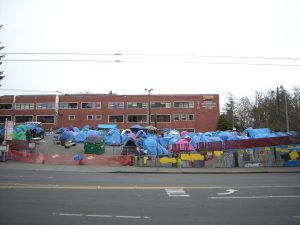
    “Nickelsville” homeless encampment, Seattle, Joe Mabel (wikicommons).

    At this stage much of our knowledge of Covid-19 is provisional, but early research from the WHO in China found 78%-85% of contagions occurred in clusters within family groups.[x] Armed with knowledge of how the disease spreads and sufficient resources, affluent families around the world are taking care of elders and other vulnerable people.

    However, as Charles M. Blow put it: ‘Social Distancing is a Privilege’. He reported on how incidences are highly intersected with race (which aligns with poverty in the United States), citing surveys from Milwaukee and Chicago where victims were 81 and 70 per cent African-American respectively.[xi]

    Myriad factors link poverty to the contagion including: the number of residents per household; the space afforded to each occupant; the extent of inter-generational co-habitation; exposure to pollution; besides other health indicators, such as obesity. Particularly vulnerable categories include individuals squeezed into homeless shelters, or those living in crowded facilities accommodating refugees and asylum seekers; also older generations inadequately protected in residential care homes across Europe.[xii]

    Notably, countries that bore the brunt of austerity policies since the Financial Crash from 2007 such as Italy, Spain, and the U.K. are now experiencing higher mortalities tolls than others, such as Germany or Denmark, where living standards were maintained.

    Sweden
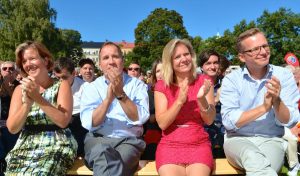
    Swedish Social Democratic Party in Vasaparken, Stockholm in 2013, Image: Frankie Fouganthin (wikicommons)

    Unlike almost every other European country the Swedish government did not mandate the closure of schools, pubs and restaurants. As the pandemic raged this seems to have been flawed, but it is worth exploring why a true catastrophe has not unfolded, as we’ve seen in Italy, Spain, France, the U.S. and the U.K.. Indeed the trajectory of new cases appears to be flattening as we enter mid-April.[xiii]

    Sweden’s mortality count per capita (which is equivalent to Ireland’s whose government has generally been lauded for its response[xiv]) is four times higher than that in neighbouring Norway’s and twice Denmark’s,[xv] both of which swiftly closed their borders, schools, pubs and other businesses, and imposed lockdowns. But the divergence may, in part, be explained by recent under-investment in healthcare. The country had the second lowest number of critical beds in Europe after Portugal prior to the crisis, with only 5 beds for every 100,000 inhabitants.[xvi] Moreover, we are yet to measure the health benefits of avoiding draconian measures.

    Cultural factors such as the absence of kissing and hugging as conventional greetings and sparse habitation are relevant, but it appears that Sweden’s mostly uninterrupted social democratic history throughout the twentieth century,[xvii] including free university education, insulates its population from the worst ravages.

    Notably, 40% of Swedish households are single-person residences,[xviii] and, although the largest cities of Stockholm and Gothenburg have experienced a recent housing crisis with scarce supply and high prices,[xix] recent concerted action by the Social Democrat-Green coalition government has alleviated this, providing subsidies to builders and tweaking capital gains tax for house sellers to encourage turnover.[xx]

    In contrast, English-speaking countries such as the United States and Britain (predicted to experience the worst outbreak in Europe[xxi]) have avoided intervention in the housing market, except at the very bottom of the social scale. But the ensuing ‘Financialization of Daily Life[xxii] has been accompanied by the stripping away of welfare entitlements, bringing widespread homelessness and reliance on food banks. The current pandemic has been aggravated by political leaders so wedded to commercial priorities they seemed prepared to sacrifice the sick and the old.[xxiii]

    Obesity
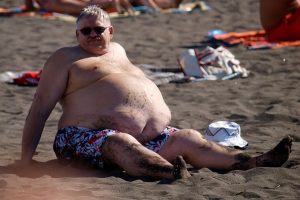
    Image: Tibor Végh (wikicommons)

    The damage wrought by free market ideologies may run deeper in terms of human health if we accept a link with another global pandemic: obesity. This condition is strongly associated with many of the pre-existing health problems that place a person at greater risk of death from Covid-19 infections, including hypertension and diabetes.[xxiv]

    The onset of the obesity pandemic, now afflicting nearly two billion people around the globe,[xxv] has been linked to numerous developments, including the invention of high fructose corn syrup in 1967, as well as over-reliance on the motor car. But the arrival of Margaret Thatcher and Ronald Reagan into power in the 1980s is a generally overlooked factor.

    As Avner Offer asserted: ‘Among affluent societies, the highest prevalence of obesity is to be found in countries most strongly committed to market-liberal policy norms.’ He argues: ‘if stress generates obesity, then welfare states protect against stress, and are likely to have lower states of obesity.’

    He says: ‘it is appropriate to think of the rise of obesity as an eruption, and to look for another eruption to explain it’. He identifies this as the emergence of the New Right in the 1970s, and the market-liberal regimes that carried out economic and social programmes in the main English-speaking countries, and elsewhere.

    With regard to the U.K., where obesity rates have almost tripled since 1979 when Margaret Thatcher came to power, he claims obesogenic conditions were already in place by the 1970s: car-use and television-watching were well established, and food was already cheap and plentiful; but that Thatcherism acted as a catalyst.

    Heightened stress levels especially fuelled by employment uncertainties affect dietary choices: ‘Physiologically, stress leads individuals to prefer fatty and sweet foods, and frequently to consume more calories, exacerbating weight gain, especially in the form of risky abdominal fat.’[xxvi]

    The link between insecurity, stress and obesity is supported by the ‘social gradient’ of obesity’: it is most prevalent among those at the bottom of the social scale, stressed out and living in crowded accommodation in so-called ‘food desserts’, lacking access to nutritious foodstuffs.

    Public v Private Health

    It is a misconception that increasing health expenditure in any Western society, above a certain level, will lead to a rise in life expectancy. In fact, there are rapidly diminishing returns on investment. Moreover, many treatments arrive with significant health warnings, and leave many of us susceptible to Covid-19.

    Primary care, especially maternity services, paediatrics (including selective use of antibiotics and vaccination), and emergency treatment facilities, certainly minimises premature deaths. But countries in thrall to privatised healthcare tend to focus spending on medications, and other costly treatments, as opposed to preventive strategies. Thus the United States, which spends almost 18% of its GDP on healthcare (the highest level per capita in the world)[xxvii], has among the lowest life expectancies among advanced countries.[xxviii]

    Rather than addressing the environmental and lifestyle triggers of the diseases of cancer and heart disease that are the leading causes of mortality (and morbidity), the United States supports a vast pharmaceutical industry that thrives off ill-health, just as its Military Industrial Complex profits from perpetual warfare.

    Shockingly, in the United States a John Hopkins team calculated in 2016 that 250,000 deaths were caused by medical errors each year, making iatrogenic illness the third leading cause of death.[xxix]

    All of this coheres with the 1971 Tudor Hart Inverse Care Law,[xxx] stating:

    The availability of good medical care tends to vary inversely with the need for it in the population served. This inverse care law operates more completely where medical care is most exposed to market forces, and less so where such exposure is reduced. The market distribution of medical care is a primitive and historically outdated social form, and any return to it would further exaggerate the maldistribution of medical resources.

    In other words, efficiency declines as expenditure increases, and the more privatised the health market the worse the outcomes.

    Cancer and Heart Disease

    Disconcertingly, Siddhartha Mukherjee characterises the history of cancer research as, ‘intensely competitive’, and featuring, ‘a grim, nearly athletic, determination.’[xxxi] Patient welfare, as opposed to survival, is often not to the fore, as experts compete for the next breakthrough in extending life, or finding an ever-elusive cure.

    Apart from successfully discouraging smoking, we see insufficient focus and investment by national governments on preventive strategies, particularly in terms of nutrition, which often threaten vested interests. Confronting a virus that can often prove fatal for those on prolonged treatment courses should shift priorities.

    Notably warnings ought to be provided when we purchase red and processed meat, which according to the WHO are ‘possible’ and ‘probable’ carcinogens respectively.[xxxii]

    These foodstuffs, along with saturated animals fats and refined sugars, are also linked to heart disease, the other big killer in Western societies. The Harvard School of Public Health recommend a Mediterranean diet including: ‘high intake of olive oil, nuts, vegetables, fruits, and cereals; moderate intake of fish and poultry; low intake of dairy products, red meat, processed meats, and sweets; and wine in moderation, consumed with meals.’[xxxiii]

    Urban planning should also inculcate more daily exercise by encouraging cycling and walking as opposed to motor car dominance. At least Covid-19 gives us a vision of how tranquil cities can be if motor cars are restricted.

    Antibiotic Overuse
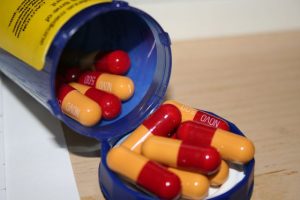
    Another longstanding issue related to this pandemic is persistent overuse of antibiotics in most Western countries, as Covid-19 patients in hospitals are now at great risk of succumbing to infection by bacterial opportunists.[xxxiv]

    Indirectly also, the welfare of a person’s microbiome, the collective term for the bacteria with which we enjoy a symbiotic relationship, is critical to overall health. Fundamental to the understanding of our complex relationship with the bacteria with which we coexist is the concept of amphibiosis: ‘the condition in which two life-forms create relationships that are either symbiotic or parasitic, depending on the context.’

    Over the last seventy years we have progressively weakening this crucial organ, upsetting our cohabitants. Martin Blaser links bacterial impoverishment to the onset of a host of modern plagues including obesity, diabetes, heart-burn and GORD, asthma, a host of allergies, IBS and even autism.

    According to Blaser the main source of the microbiome’s decline has been the invention in 1942 and subsequent over-use of antibiotics, which he likens to the development of the atom bomb. Apart from generally weakening our immune system, over-use in humans and in animal agriculture has given rise to superbugs such as MRSA that already kill thousands each year.

    Antibiotics have saved millions of lives, and many surgical procedures are too dangerous to consider without them. However, over-use by doctors and dentists has surged in most Western countries to the extent that often the average twenty year old has taken almost twenty courses. Indeed, a 2016 study found that over 30% of antibiotics prescribed in the U.S. are unnecessary.[xxxv]

    Generally, the fault does not lie with individual doctors. Besides patients demanding medication, they reflexively prescribe for sore throats to avoid occasionally fatal rheumatic fever, which typically occurs two or three weeks after an untreated strep infection and can be fatal. These infections are mainly viral and do not respond to antibiotics, but problematically a sore throat may already have been colonised by a strain of bacteria that is not causing the disease.

    Today most bacterial infections are treated with broad-spectrum antibiotics. Martin Blaser asserts that: ‘Until doctors can readily distinguish viral from bacterial throat infections, they will always follow the safer course.’ He continues: ‘It is not profitable for companies to go to the trouble and enormous expense of developing new antibiotics.’[xxxvi]

    Targeted antibiotics are only applicable in a small number of cases, and make little sense where companies are concerned with the bottom line, as opposed to the overall health of the patient, and society. A genuinely public healthcare system dictating research priorities would surely address this problem, and help confront Covid-19 and other respiratory diseases.

    Another problem lies with the use of antibiotics in animal agriculture. Just as in humans, untreatable bacterial infections are emerging in farm animals and these are passing the species barrier into human populations. Often farmers utilise antibiotics not to treat disease but in order for these animals to grow more quickly. The practice of using sub-therapeutic doses is now banned in the EU but the law is difficult to enforce.

    Blaser also connects over-use to the obesity pandemic as antibiotics also cause weight gain in humans. This is borne out by studies showing obese individuals to have far less of a range of bacterial strains compared to individuals of normal weight. An NHS study the Avon Longitudinal Study of Parents and Children showed that children who received antibiotics in the first six months of life were likely to have a higher body mass index.[xxxvii]

    Air Quality
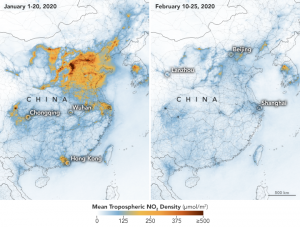
    As in most crises, there is a silver lining to the Covid-19 pandemic as we witness huge improvements in air quality all across the world.

    In 2008, the European Environment Agency warned that air pollution causes almost 500,000 premature deaths in Europe every year, with most of the twenty-eight EU states failing to meet air quality targets.

    In 2015, about 422,000 people died prematurely in European countries from exposure to harmful levels of fine particle matter (PM2.5). These particles are too small to see or smell but cause or aggravate heart disease, asthma and lung cancer.

    The report also attributed 79,000 premature deaths to the toxic gas nitrogen dioxide (NO2) – related to vehicles and central boilers. Ground-level ozone (O3) is also killing an estimated 17,700 people, prematurely, across European nations.

    The main sources of air pollution are: fuel-consuming forms of transport; energy production and distribution; commercial and institutional buildings, and homes; industry agriculture, and waste management.[xxxviii]

    Air pollution has been linked to elevated mortalities in hot spots such as New York and Lombardy, where the Alps are visible from Milan as never before.[xxxix] This Great Pause allows us to reflect on the necessity of much of what we produce in our economies.

    Spillover
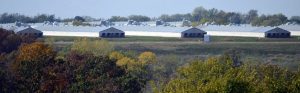
    Concentrated animal feeding operation (CAFO), Unionville, Missouri, United States, owned by Smithfield Foods.

    In 1994 Laurie Garrett warned the world:

    While the human race battles itself, fighting over ever more crowded turf and scarcer resources, the advantage moves to the microbes’ court. They are our predators and they will be victorious if we, homo sapiens, do not learn how to live in a rational global village that affords the microbes few opportunities.[xl]

    The origins of most of the contagious diseases we confront lie in our relationship with other animals. As David Quames puts it: ‘ecological disturbance causes disease to emerge. Shake a tree, and things fall out.’ He warned that human activities are causing the disintegration of ‘natural ecosystems at a cataclysmic rate.’[xli]

    Correctly, a huge amount of attention has been focused on China’s so-called wet markets of captured or dead wildlife, as the probable location of a zoonotic incident that engendered the novel virus (involving bats and the rare pangolin as a reservoir host).

    Previously, a southern Chinese appetite for wild animals was conflated with a period of sustained economic growth in the 1990s, and termed ’the Era of Wild Flavor.’ Businessmen would reportedly gather at one of the province’s many ‘Wild Flavor’ restaurants to feast on a great variety of animals, some of which were reputed to make consumers fan rong or ‘prosperous.’[xlii]

    David Quames describes the scene at the markets:

    The catfish the crabs, and eels churned slowly in aerated tanks. The bullfrogs huddled darkly in scrums. It was grim to be reminded how we doom animals with our appetite for flesh, but this place seemed no more odd or morbid than a meat market anywhere.[xliii]

    He goes on to warn that the risks are not limited to exotic meat markets, and that factory and livestock farms around the world present dangers: ‘It’s almost impossible to screen your pigs, cows, chicken, ducks, sheep, and goats for a virus of any sort until you have identified that virus (or at least a close relative), and we have only begun trying. He adds: ‘tomorrow’s virus pandemic may be no more than a “blip on the productivity output” of some livestock industry today.’[xliv]

    Cow fields are not a timeless and harmless rural idyll: ‘A trillion pounds of cows, fattening in feedlots and grazing on landscapes that formerly supported wild herbivores, are just another form of human impact. They are a proxy for our appetites and we are hungry.’[xlv]

    Perhaps it is no coincidence that carnivorous is an anagram of coronavirus.

    Little State, Big Government
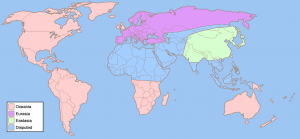
    Fictitious map from George Orwell’s novel 1984.

    The finger must come off the pause button soon. Whether we develop a vaccine or not, we cannot indefinitely endure life as contestants on a dystopian game show. For many of us restraints on natural inclinations – including so-called ‘social distancing’ – have been traumatic. Extended lockdowns will be impossible to enforce without a descent into a barbarity of petty betrayals and transhumance; while the Chinese approach of tracking movements through smart phones – adopted in other countries too[xlvi] – is deeply sinister.

    As in Sweden, civil society can adjust behavioural norms to resist this virus and others to follow, and ensure governments respond meaningfully to even more pressing challenges, such as climate change and the Sixth Extinction. We may have to accept health passports at border checkpoints for a time, but within countries, we should expect freedom to roam, interact and trade.

    At this juncture we need a Little State, which does not impinge on basic liberties and privacy, but a Big Government – as in Sweden too – working to ensure conditions for human flourishing including: healthy nourishment, clean air and water, a roof over one’s head, as well as education and basic healthcare.

    Anyone resistant to government intervention might consider John Rawls’s justification of a redistribution of wealth by allusion to a hypothetical rational agent, ‘situated behind a veil of ignorance.’[xlvii] This fictional character cannot know the situation he will be born into, and must decide the kind of society he would favour. If the family you are born into is a lottery, any rational person surely favours an equitable distribution of wealth.

    At least we confront the prospect of another financial meltdown with an enhanced awareness of the financial clout of governments in a period of crisis. The public purse is deeper than has been acknowledged. Governments control the distribution and value ascribed to money, a measurement tool for the exchange of goods and services.

    In terms of public health we can reduce the use of antibiotics and other unnecessary drugs; promote exercise and combat sedentarism; curb pollution; and highlight the danger of over-consumption of unhealthy foodstuffs.

    It would be tragic if this pandemic led to the demonization and eradication of animals that could harbour suspect viruses, as opposed to leading to the permanent closure of the wet markets and hopefully factory farming too. Quite apart from the morality of this, we are dealing with highly complex ecosystems. Any measure could have unintended, dire consequences.

    As the U.N.’s Sustainability Goals[xlviii] reminds us, biodiversity is essential for human flourishing. The limits of natural capital must be taken into account if economic activity is to remain sustainable, which is especially important for feeding populations. The pandemic highlights crucial interdependencies, and the catastrophic consequences of another outbreak means that the burden to adapt is shared by us all.

    [i] David Smith, ‘Trump sows confusion with claim coronavirus drug will be ready soon’, The Guardian, March 19th, 2020, https://www.theguardian.com/us-news/2020/mar/19/coronavirus-drug-trump-confusion-malaria-treatment-readiness

    [ii] WHO, ‘Coronavirus disease (COVID-19) advice for the public: Myth busters’ https://www.who.int/emergencies/diseases/novel-coronavirus-2019/advice-for-public/myth-busters

    [iii] Megan Molteni, ‘Everything You Need to Know About Coronavirus Vaccines’, Wired, April 3rd, 2020, https://www.wired.com/story/everything-you-need-to-know-about-coronavirus-vaccines/

    [iv] Untitled, ‘Coronavirus: Vaccine could be ready as early as September, according to scientist’ Sky News, April 12th, 2020,  https://news.sky.com/story/coronavirus-vaccine-could-be-ready-as-early-as-september-according-to-scientist-11971804

    [v] Derek Lowe, ‘Coronavirus Vaccine Prospects’ In the Pipeline, April 15th, 2020 https://blogs.sciencemag.org/pipeline/

    [vi] Julio Vincent Gambuto, ‘Prepare for the Ultimate Gaslighting*’, Medium April 10th, 2020, https://forge.medium.com/prepare-for-the-ultimate-gaslighting-6a8ce3f0a0e0

    [vii] ‘Yuval Noah Harari: the world after coronavirus’ March 20th, 2020 https://www.ft.com/content/19d90308-6858-11ea-a3c9-1fe6fedcca75?fbclid=IwAR2am6cP4xQoG17fnKTsCeJdteQJRNwE_D6YkUkkZL25gD7AQN4CW8AOFck

    [viii] Yasmen Serhan, ‘The EU Watches as Hungary Kills Democracy’, April 2nd, 2020, The Atlantic,  https://www.theatlantic.com/international/archive/2020/04/europe-hungary-viktor-orban-coronavirus-covid19-democracy/609313/

    [ix] Frank Armstrong, ‘Democracy in Decay: Steve Bannon & Jordan Peterson’, January 17th, 2020, Cassandra Voices,  https://cassandravoices.com/current-affairs/global/democracy-in-decay-steve-bannon-and-jordan-peterson/

    [x] WHO, ‘Report of the WHO-China Joint Mission on Coronavirus Disease 2019 (COVID-19)’, February, 2020, https://www.who.int/docs/default-source/coronaviruse/who-china-joint-mission-on-covid-19-final-report.pdf

    [xi] Charles M. Blow, ‘Social Distancing Is a Privilege’, New York Times, April 4th, 2020 https://www.nytimes.com/2020/04/05/opinion/coronavirus-social-distancing.html

    [xii] Robert Booth, ‘Half of coronavirus deaths happen in care homes, data from EU suggests’, The Guardian, April 13th, 2020, https://www.theguardian.com/world/2020/apr/13/half-of-coronavirus-deaths-happen-in-care-homes-data-from-eu-suggests

    [xiii] Worldometer, ‘Sweden’, https://www.worldometers.info/coronavirus/country/sweden/

    [xiv] Frank Armstrong, ‘Ireland’s Response to the Coronavirus’, Cassandra Voices, March 28th, 2020, https://cassandravoices.com/current-affairs/irelands-response-to-the-coronavirus-pandemic/

    [xv] Niclas Rolander, ‘Swedish Virus Deaths top 1000 fueling criticism over strategy’ Bloomberg, April 14th, 2020 https://www.bloomberg.com/news/articles/2020-04-14/swedish-virus-deaths-top-1-000-fueling-criticism-over-strategy

    [xvi] A. Rhodes, P. Ferdinande, H. Flaatten, B. Guidet, P. G. Metnitz & R. P. Moreno, ‘The variability of critical care bed numbers in Europe’, Intensive Care Medicine volume 38, pages1647–1653(2012), https://link.springer.com/article/10.1007/s00134-012-2627-8

    [xvii] Untitled, ‘Before Sweden Was Social-Democratic, An interview with Erik Bengtsson’, Jacobin Magazine, September, 2019, https://www.jacobinmag.com/2019/09/sweden-social-democracy-erik-bengtsson

    [xviii] Melissa Godin, ‘Sweden’s Relaxed Approach to the Coronavirus Could Already Be Backfiring’, Time Magazine, April 9th, 2020,  https://time.com/5817412/sweden-coronavirus/

    [xix] Untitled, ‘Revealed: The state of Sweden’s housing shortage’, The Local, May 14th, 2019, https://www.thelocal.se/20190514/revealed-the-state-of-swedens-housing-shortage

    [xx] Simon Johnson, ‘Sweden grapples with housing market reform as risks mount’, Reuters, December 18th, 2019, https://www.reuters.com/article/sweden-economy-housing/sweden-grapples-with-housing-market-reform-as-risks-mount-idUSL8N28L43A

    [xxi] Rowena Mason, ‘UK could have Europe’s worst coronavirus death rate, says adviser’, April 12th, 2020, The Guardian,  https://www.theguardian.com/world/2020/apr/12/uk-could-have-europes-worst-coronavirus-death-rate-says-pandemic-expert

    [xxii] Randy Martin, Financialization of Daily Life, http://tupress.temple.edu/book/3182

    [xxiii] Chris Smyth, ‘No 10 denies Dominic Cummings would have let elderly die’, March 23rd, 2020, The Times, https://www.thetimes.co.uk/article/no-10-denies-dominic-cummings-would-have-let-elderly-die-qsl760jr9

    [xxiv] Jeffrey Kluger, ‘The True Impact of Underlying Health Conditions on Coronavirus Severity’, April 1st, 2020, Time Magazine, https://time.com/5813711/coronavirus-underlying-conditions/

    [xxv] WHO, ‘Obesity and overweight’ March 3rd, 2020, https://www.who.int/news-room/fact-sheets/detail/obesity-and-overweight

    [xxvi] Frank Armstrong, ‘The Unbearable Heaviness of Human Beings’, October 7th, 2020, The London Magazine, https://www.thelondonmagazine.org/article/the-unbearable-heaviness-of-human-beings-2/

    [xxvii] Irene Papanicolas, Liana R. Woskie, and Ashish Jha ‘Health Care Spending in the United States and Other High-Income Countries’, Commonwealth Fund, March 13th, 2018,

    https://www.commonwealthfund.org/publications/journal-article/2018/mar/health-care-spending-united-states-and-other-high-income

    [xxviii] OECD.stat https://stats.oecd.org/index.aspx?queryid=30114

    [xxix] Vanessa McMains, ‘Johns Hopkins study suggests medical errors are third-leading cause of death in U.S.’, John Hopkins University, May 3rd, 2016, https://hub.jhu.edu/2016/05/03/medical-errors-third-leading-cause-of-death/

    [xxx] Julian Tudor Hart, ‘The Inverse Care Law’, The Lancet, February 27th, 1971, https://www.thelancet.com/journals/lancet/article/PIIS0140-6736(71)92410-X/fulltext

    [xxxi] Frank Armstrong, ‘Cancer – A Distorted Version of Our Normal Selves’ Cassandra Voices, September 7th, 2019, https://cassandravoices.com/uncategorized/cancer-a-distorted-version-of-our-normal-selves/

    [xxxii] Untitled, ‘Q&A on the carcinogenicity of the consumption of red meat and processed meat’, WHO October 26th, 2015 https://www.who.int/news-room/q-a-detail/q-a-on-the-carcinogenicity-of-the-consumption-of-red-meat-and-processed-meat

    [xxxiii] ‘Preventing Heart Disease’, The Nutrition Source, Harvard School of Public Health, https://www.hsph.harvard.edu/nutritionsource/disease-prevention/cardiovascular-disease/preventing-cvd/

    [xxxiv] Claas Kirchhelle, Adam Roberts, Andrew C. Singer, ‘Antibiotic Resistance Could Lead to More COVID-19 Deaths’, Scientific American, April 1st, 2020, 2020https://blogs.scientificamerican.com/observations/antibiotic-resistance-could-lead-to-more-covid-19-deaths/

    [xxxv] Center for Disease Control and Protection, ‘CDC: 1 in 3 antibiotic prescriptions unnecessary’  https://www.cdc.gov/media/releases/2016/p0503-unnecessary-prescriptions.html

    [xxxvi] Martin Blaser, Missing Microbe: How Killing Bacteria Creates Modern Plagues, One World, London 2014 pp.64-78.

    [xxxvii] L. Trasande, J Blustein, M Liu, E Corwin, LM Cox, and MJ Blaser, ‘Infant antibiotic exposures and early-life body mass’ August 21st, 2012,

    https://www.ncbi.nlm.nih.gov/pmc/articles/PMC3798029/

    [xxxviii] Untitled, ‘Air pollution: Half a million early deaths in Europe despite progress’, BBC, October 29th, 2018, https://www.bbc.com/news/world-europe-46017339

    [xxxix] Damian Carrington, ‘Air pollution linked to far higher Covid-19 death rates, study finds’ April 7th, 2020, The Guardian, https://www.theguardian.com/environment/2020/apr/07/air-pollution-linked-to-far-higher-covid-19-death-rates-study-finds?fbclid=IwAR0HF2B0LT8aNLWigzRzEhui_w1_gfndwFPP2Xfe4nvu0r2ujY78Hy56RXM

    [xl] Richard Horton, ‘Coronavirus is the greatest global science policy failure in a generation’, April 7th, 2019 https://www.theguardian.com/commentisfree/2020/apr/09/deadly-virus-britain-failed-prepare-mers-sars-ebola-coronavirus

    [xli] David Quames, Spillover: Animal Infections and the Next Human Pandemic, Bodley Head, London, 2012, p.23

    [xlii] Cheryl Miller, ‘The Red Plague’, The New Atlantis, Winter, 2007, https://www.thenewatlantis.com/publications/the-red-plague

    [xliii] Quames, p.197

    [xliv] Quames, p.322

    [xlv] Quames, p.497

    [xlvi] Zac Doffman, ‘COVID-19 Phone Location Tracking: Yes, It’s Happening Now—Here’s What You Should Know’, Forbes, April 7th, 2020 https://www.forbes.com/sites/zakdoffman/2020/03/27/covid-19-phone-location-tracking-its-moving-fast-this-is-whats-happening-now/#1b7e565e11d3

    [xlvii] Stanford Encyclopaedia of Philosophy, https://plato.stanford.edu/entries/original-position/

    [xlviii] UN Sustainability Goals, https://www.un.org/sustainabledevelopment/biodiversity/
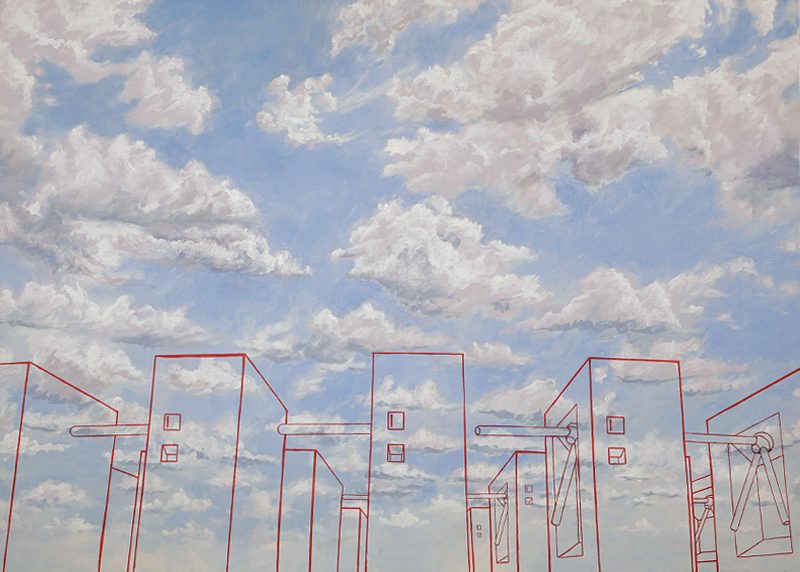
  • A Slice

    Robbie was in what his friends referred to as “swaying tree mode”. This meant the slender greying hipster was pissed, his eyes barely open, and not engaging with anyone but moving slowly side to side, mouthing the lyrics to a song that wasn’t playing. He was tall but no one worried he’d fall over. His skinny jeans were tight enough to turn his long legs into pylons that served as a rock-solid foundation. The ritual had begun. Around 2am, the others’ attention turned to finding a few bags and a session, whereas Robbie exercised his right to abscond via an “Irish goodbye” without a word to his friends, stomach churning, in search of a slice.

    Leaving The Workman’s Club on Wellington Quay, the crisp air off the Liffey hitting his face was somewhat sobering and his eyes opened fully to admire the river’s glow. He stepped in to Di Fontaine’s, and was greeted with a smile from a familiar face, before leaving with an enormous pizza. Parking the big box atop a bin, he dug through his pockets for his headphones. It wasn’t far back to the apartment Robbie shared with his friend Barry, in the Liberties. Jaw clicking, he nursed his “walking home slice”  tearing at the doughy wedge, on the uphill walk past Christchurch, then downhill towards St Patrick’s Cathedral. Against the backdrop of these strikingly lit monuments, he hummed along to Handel’s “Arrival of the Queen of Sheba,” and commended himself for another flawless extrication. Once again he had dodged the eyebrow-licking, coke-fueled shite talk his mates had in store, and unlike them, Robbie would be fresh for training the following morning.

    His roommate, Barry, was probably out on the piss  with his own mates or the Tinder-date-of-the-week. An empty apartment was what Robbie needed. The love of his life was a gorgeous  grey feline. Grimes would be waiting at the foot of the bed, with a hypnotizing purr that would sooth him to sleep. Robbie could see Fallon’s bar on the corner of New Row South and although just minutes away from home, he began to doubt whether he’d make it in time. A nonnegotiable need to piss came over him. Prompted by the swelling between his legs, he scanned the surroundings for the least inappropriate place to have an urgent slash. Relieved that no one was sleeping rough in the alcove at the entrance to the Centz discount store, he seized the opportunity to avoid soiling in his favourite faded jeans. Placing the still warm pizza box on the ground and out of harm’s way, with his back to the road, he released a steady stream of steaming stinking piss.

    Retrieving the box, Robbie arose to meet the flinty eyes of two lads clad in tracksuits. The older one moved closer, mouthing something at him while the younger hung back, smoking a cigarette. Robbie removed an earphone.

    “Giz a slice of yer pizza, Man” the older one demanded. The younger lad laughed at the hipster, blinking and cornered. “Go on Man, don’t be a scabby cunt, just giz a lil’ slice, for fuck sake.” Before Robbie could find any words, the young lad lunged forward, flicking the lit cigarette with precision directly into Robbie’s face, its red embers bursting upwards and into his eyes. The older brother smacked the pizza box out of Robbie’s hands, which opened up, sending several slices and two sealed plastic cups of garlic dip spiraling down to land on the urine-soaked concrete. The guy then grabbed Robbie by the throat, pushing him up against the shop’s metal shutters.  The young one then snatched Robbie’s phone from his hand, severed it from the headphones with a tug and took off running towards Kevin Street.

    Along with a proclivity for skinny jeans, craft beers and ridiculous mustaches, the modern-day hipster harbors a penchant for watching and practicing Mixed Martial Arts. Brazilian Jiu Jitsu in particular. Robbie, being no different to his cohorts, trained quite a bit. Once acquired, the mechanics of locking up, taking an unsuspecting cunt down, and chokeholding him into submission was no problem at all. Even for a gangly chap like Robbie. Drunk or not.

    Now on the ground, and with arms flailing wildly, the older brother blurted out threats about how Robbie was going to get “fucking sliced up.” A serenade made brief, once Robbie’s legs and arms hooked in, and he applied enough forearm pressure to choke out the threats, which went from barks to hardly audible gurgles to silent gasps.

    When the guy stopped struggling, Robbie allowed him enough of an airway to breathe. “I’m fuckin’ sorry man…Let me go, and I’ll get your phone back.” His pleading went on for a while and Robbie half expected him to start crying, but he didn’t. It was cold, very cold, and the puddle of piss crept closer.

    A passing couple were kind enough to ring the Guards, but they didn’t care to stick around. Within a couple of minutes the squad car pulled up, and its flashing blue light gleamed across the surface of the puddle, just as Robbie rolled the guy over in to it, face first.

    A female officer cuffed the shivering suspect. “Up to your old tricks, Damien?” asked her senior officer with a smirk. “C’mon O’Reilly, I’m not into anthin’ anymore. This lad fuckin attacked me!” answered the detainee, now in custody and being packed into the back seat of the squad car. O’Reilly turned to Robbie, “Garda Keogh here will take your statement. Have you been drinking, yourself?” Robbie admitted that he had and after giving his statement, Garda Keogh instructed him to present himself at Kevin Street Garda Station, the following day.

    Damien and his brother were known to the Guards, who upon entering the nearby family home, found a bedside locker drawer full of phones and other contraband, in a room the brothers shared. Robbie’s phone was returned to him, as it matched his detailed description. He was advised that he could press charges if he liked, but unless he was hurt, it wasn’t worth the bother. The younger brother was a minor, but Damien awaited sentencing for a slew of more serious offenses.

    Robbie didn’t venture out the following weekend or the one after. He offered no excuses for his absence, nor did anyone ask. When he did eventually resurface, so did the ritual. At least it seemed so, to his mates, but Robbie had employed some imperceptible changes. He became conscious of leaving before getting “too-too” pissed, and he skipped the pizza. Hands free, he walked with only one earphone in, listening to Wagner’s “The Ride of the Valkyries.”

    The little bump of coke he had done was keeping him alert. Barry’s black leather studded belt had been left in a pile of clothes in their laundry room for weeks. It’s buckle featured a removable set of fully functioning brass knuckles. Barry wouldn’t miss them.

    Grinding his teeth, Robbie felt his knuckles pop as he gripped the brass in one sweating palm, jammed in his jacket pocket. He was looking over his shoulder with every couple of paces and distracted by a group of lads crossing the street behind him, he smacked right into someone at the corner of Kevin Street. It was Damien.

    Out of his pocket came Robbie’s fist, cocked and ready to rain down. For weeks he had fantasized about the sound of Damien’s bones crunching, and now he saw one side of Damien’s face was bruised in healing hues of yellowish green. On the other, was a fresh slice. The  pink scar bubbled up and ran diagonally down his cheek.

    Recognizing Robbie in an instant, Damien clocked the gleaming knuckles before shielding his face and screaming, “I’m sorry man, I’m sorry…Sorry!” When Robbie hesitated, Damien dashed down the street, running at an incredible pace.

    At home, Barry had a little session brewing. There were a load of people drinking and smoking weed on the balcony. Grimes was asleep on the couch, unperturbed by the speaker’s base or the voices raised over it which carried through the sliding door someone left ajar. Retrieving her would have drawn unwelcome attention, so soundlessly, Robbie made straight for his room.

    How much debt would you need to be in before a dealer would cut your face, Robbie wondered examining his own mug in the bedroom mirror. Then he conjured a similar scar and finally decided his dilated pupils made him look like an alien. Burying the brass knuckles deep in his sock drawer, he put in earplugs, and switched off his bedside lamp. He tried to have a wank for some relief to calm down but couldn’t stay hard. Robbie was not used to coke.

    Behind closed eyelids, Robbie watched a woman crying. From the kitchen of a dilapidated Dublin flat, she peered out of the window into a littered courtyard, ashing in the sink and wishing her sons would come home. He still heard Damien’s nylon tracksuit swishing in the wind. Beautiful in a way, it was much like the sound of a serrated blade moving backwards and forwards through wood, or maybe bone. In the darkened room, Robbie raised his right hand, barely able to stare at his shaking fingers.

  • Artist of the Month – Uluç Ali Kılıç

    I am a visual artist based in Istanbul. I was born in 1979 in Ankara, the capital city of Turkey. I studied painting at Hacettepe University in Ankara, graduating in 2003. As a student I was mostly influenced by abstract expressionism. I also began to use installations and video art. These three media are now my visual language.

    I came to Istanbul in 2004, moving into my aunt’s house while she was living elsewhere. There I carved out a studio. During those first years I developed installations and even had my work displayed in prestigious exhibitions.

    I was quite satisfied with life, even though I was broke financially. But since I wasn’t paying rent I could carry on working in the studio. After a while though I started taking freelance jobs as a storyboard artist for TV commercials, and moved with an advertising crowd, working for big agencies in Istanbul, which meant I could take care of myself.

    Unfortunately, after a while, I found I had no time to create my own material, as I had begun working full time for an agency. My life was heading in a direction I wasn’t satisfied with. Then I went travelling, returned, worked again, becoming a freelance producer, and directed some movies. But I was unsure of what I was doing with my life until 2010.

    Then I quit the advertising world for good and became a fulltime artist. Initially, I really struggled to shift my mindset into thinking about what I was doing creatively as a business too. So the first years after leaving commercial work were slow, and I struggled to be creative.

    I didn’t find it easy to be alone in front of the canvas. It took a long time to get going, but over the course of the last five or six years I have been able to create more satisfactorily. I have displayed some of my work in group shows, and also had solo exhibitions.

    A New Language of Expression

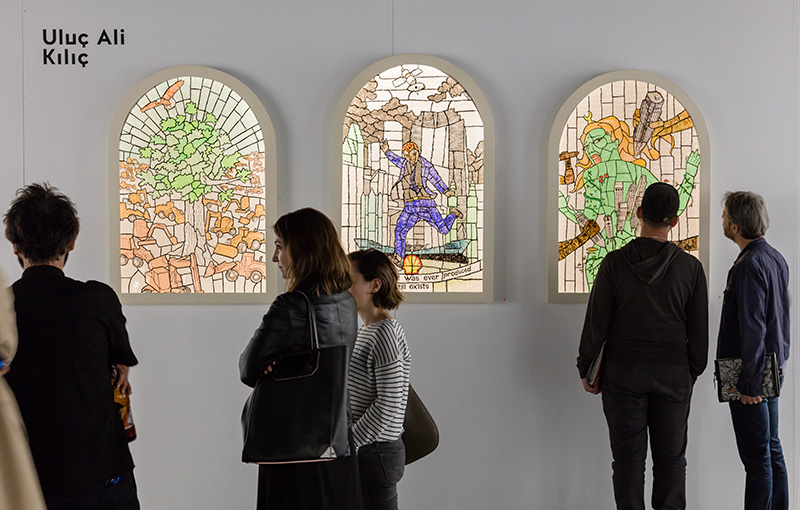
    I have developed a new visual language, all of my own, and created a series of installations in this manner. This included creating stained glass windows, made out of PET plastic bottles I recovered, that appear like paintings. I replaced glass with PET plastic to raise environmental awareness, contradicting how these materials are generally used.

    My subject-matter is often the harm and destruction humanity inflicts on its surroundings, or other traumatic issues occurring in our time, such as the refugee crisis and homelessness. I try to make long-lasting artworks using plastic material which isn’t biodegradable in nature. Likewise, these artworks aim to last long in any viewers’ consciousness.


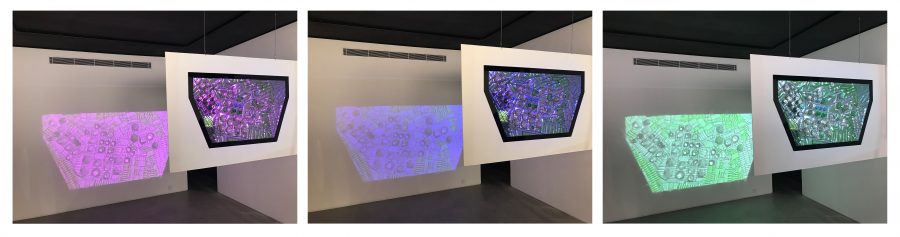
    Also by simulating the atmosphere of a church or cathedral, I try to make a powerful impact on the audience. In some of the installations I am not showing simply a painting as an art object, but also use light beams to create churchlike-effects. This causes the original work to create another painting reflecting on the wall opposite. For example in my ‘Refinery of Light’ piece I created a projection mapped specifically to the contours of the work to create unpredictable patterns on the gallery wall.

    Tough Times

    2019 was a tough but educational year for me. I’ve been through deeply emotional experiences, struggling to come to terms with the end of a relationship, which eventually brought me face to face with my identity and subconscious. Losing a beloved one, I have felt very alone.

    In this era I recommenced painting as a way of dealing with my troubles, questioning my whole being, including my dark side.

    I have always wondered why I use painting as a form of visual expression. During this period painting fitted very well with my condition. First and foremost the process itself was one of the quickest ways of satisfying my hunger to create.

    I find painting keeps me simultaneously in a meditative and an emotional state, bringing focus to the issues I contend with, including who am I; why am I doing what I do; and what is my aim and mission in life. These paintings kept me busy in this emotional state, which is what I needed.

    Otherwise, in solitude, I develop certain obsessive-compulsive tendencies that are produced by stress, or feelings of sadness: then I generate perverse habits and self-destructive mechanisms.

    Rather than falling into these habits I replace these with a new attitude towards life, and ways of thinking.

    Sound and Vision

    As I painted those pieces I was listening to specific songs over and over, for weeks on end. I started building the structure of the painting from the references of the sound that I was hearing, continually tracing lines and gestures.

    This appears first in ‘Mahler Variations’ as I attempted to simulate the instruments in creating the visual structure of the painting. Then I let the panting ask me what it required, until it matured sufficiently.

    Those paintings were like visual reflections of a dance performance. The canvas was my stage and the painting was my movement during the performances. I also recorded myself on video as I painted.

    After a period listening to classical music I would then begin listening to a totally contradictory genre such as black metal for two months. Then there would be a long period of Indian classical music and so forth for each piece.

    So these works can be seen as a chart of a depressive era, during which I descended into my subconsciousness. I should add that I always made my most successful works when I felt pressure on my shoulders, and was out of my comfort zone.

    Under Lockdown

    For any artist this period of isolation is nothing unfamiliar. Solitude brings you closer to your inner self. Artists are personalities who are living in solitude inside the community.

    In my case, at forty-one-years of age, I think I am at a critical stage in life, and feel under pressure to realise my gifts.

    Honestly, I always think that none of my pieces are good enough, compared to what I feel I am capable of, but lately I have been feeling that I should be more thankful for what I have received from life so far.

    Now that we all are forced to stay at home and isolate from one another we have to think about how much comfort and luxury we are accustomed to. We shouldn’t view this as a handicap, but more like a gift for a short period of time, where we start to realize how greedy, spoilt and arrogant most of us are in our lifestyles.

    Yes, it is hard to be suddenly changing our daily routines, but we need to adapt our minds to feel and discover who we really are, and what is most important to us. This situation puts many of us in a very hard position emotionally, psychologically and financially. It also threatens our health, but these limitations also create the pressure which leads to creativity and evolution.

    In fact artists voluntarily create these conditions to produce their works of art. So in a way there’s a similarity between the current situation and the creative process itself. We should use the time as a healing process to wake up from the artificial, materialistic and selfish way of life we are accustomed to. This is the best time to discover ourselves, and call back our souls to take over for the rest of our lives.

    F***ing Money

    It think it is appropriate to finish this piece by referring to an installation I created in 2018 called ‘F***ing Money’, which was a sculpture replicating a cash machine inside a gallery space.

    The actual artwork is not the sculpture but what happens to it. I put a motion sensor in the room which triggers a mechanism. Whenever a viewer gets close to the artwork the mechanism shoots out a tiny jet of water onto the sculpture, eroding it bit by bit. Eventually it collapsed.

    I also exhibited the demolition on video 24/7 from the gallery window in loops on public display. The idea was a reflection on values, interests, labour and on the price we put on the what we create.

    All artworks by © Uluç Ali Kılıç

    ulucalikilic.com/about/

    instagram.com/ulucturucu/

    Feature Image: Uluç Ali Kılıç in his studio. Istanbul, June 2019. Daniele Idini for Cassandra Voices.


  • DUMAINE

    “I’m leaving.”

    “Oh?”

    “Yes. I’m moving on. Been puttin’it off, but gotta go today.”

    “Baggage ready?”

    “Gonna do that now because it’s getting late.”

    “Why don’t I pack you a tuna fish sandwich, just in case?”

    “Yep. Good idea.”

    In the bedroom, I flung the doors of all three floor-to-ceiling closets open wide, which were designed like the entrance of a cathedral, doors that for the greater glory of God, make man minuscule, put you in your place. The perspective of my many possessions purchased, carefully cleaned and stacked up high in an orderly fashion was somewhere between repulsive and overwhelming but mostly beyond my reach. I selected a few books and that fuzzy bear my parents brought back as a gift from Germany, but little else before closing the suitcase.

    She caught me off guard, intercepting me in the hall on my way out, to hand over a brown paper sack as promised. I’d forgotten she’d offered the favor. Preoccupied, I guess.

    “Listen, there’s a chocolate pudding and an apple in with the tuna fish sandwich too.”

    “Thank you.”

    “Okay, bye-bye”

    Glacial and dark by design, her house inhaled the heat if by the gliding open of a sliding glass door, its hermetic seal was compromised. And like a large lung, the house then exhaled a quixotic draft of cooler air, which carried me with it out on to the balcony. Before she’d bolted the door behind me, no matter how briskly, and believe me she was… The sweet swelter had swallowed me whole.

    Across the street, its source obscured by a high fence hugging lush foliage, smoke was rising. Must be the Mexicans. Like too many magpies, they gathered around their granny on her tiny purpose-built patio. No one was more thrilled than she to be grillin’ again.

    Yes, our side of Bayou St. John was on low boil, but the houses on its opposite bank undulated in a mirage. So I was leaning left, feeling in my bones, a future of possibilities and personal freedom lay that way. Right hand tightening its grip on the sweaty suitcase handle, I stashed the sack lunch under my moist armpit, elbow clamped in to keep it there and descended the wrought iron stairs. Pausing at the bottom, I opened the suitcase to put the brown bag in with the rest of my treasures. Now, really on my way, I was again delayed by the obligatory exchange of pleasantries with Steve, our landlord and neighbor below. As it happens he was walking his well-dressed Chihuahua whose name was N’est-ce pas which is French for “Isn’t it so?” Keeping in mind a direct question can indeed be misperceived by older gentlemen as intrusive, in a carefully modulated tone I dared ask,

    “Pardon me Mr. Steve, but why does your dog have on a colour coordinated raincoat and galoshes?”  At this juncture, in unison we surveyed the quivering creature sporting four knee-high Wellingtons on palsied paws.

    “Because it’s a brand new set I just bought that was too cute to leave in the closet even if there isn’t a cloud in the sky. You gone for good this time?” he answered, giving me the eye and theatrically inspecting my little luggage.

    “Afraid so. You two, do take care.” Turning, I saw mucho macho matching heads. The Mexicans were like one monstrous centipede, lined up as they were for a last look over their high wooden fence. We both yelled “Adios” and waved at them but they did not disperse. Didn’t move a muscle. The scorching sun on my scalp said, don’t take all day for this stand off. With better things to do, I would leave the bayou behind.

    I hadn’t got halfway when I spotted the strangers sitting on their front steps just as if they’d lived here forever. They were smoking those cigarettes that smell better than the store bought ones, but you have to roll them yourself. Though unknown to me and mine, these people were in a really good mood, so pleasant in fact that I paused. Especially on account of how thirsty walking with a heavy suitcase made me, and the hissing sound the ice cold can of Dixie Beer let out when they pulled the crackling metal tab stopped me in my tracks. Without hesitation, I held it to my forehead for a minute then next to my neck and drank it slower than heck, so as not to get one of those excruciating brain freezes, to which we Southerners are prone.

    The new tenants invited me inside. Said I could bring my suitcase with me and I did, gingerly placing it on the coffee table, which frankly it monopolized in an absurd fashion. I sat down on their silky soft sofa, but not before being welcomed to do so. Everything of theirs was smaller than ours, and they smelled strange, but were so nice to show interest in what I cared enough about to carry with me. They confirmed my bear was genuinely German. And though I knew every word in my books by heart, indeed they politely declined to borrow them, just as they didn’t care to share my tuna fish sandwich three ways. Said they’d just eaten and instead offered me one of their piping hot homemade brownies. After I don’t know how long, what most intrigued them was that a midget could memorize her digits. I proved my point by borrowing their pencil and a notepad of pretty purple paper to jot down my home telephone number.

    We were having such fun, I nearly forgot they were foreign. The shades were drawn, and I guess I’d been there a while, when one prolonged blast from the building’s main buzzer led to two terse raps on the first floor apartment’s soft hollow-sounding wooden door. Furthermore, when it swung open, you could’ve knocked me over with a feather. Glaring from the hallway, hands on hips, was Mom.

    Like stumbling on an oasis in the nick of time, an accidental magic had occurred. That haphazard ambience which happens in abandoned colonies with greater frequency than you might imagine. Well, that mystical moment had passed and with a firm grasp on my suitcase, Mom was on the march.

    “Step on a crack, break your momma’s back,” I sang real low, hopscotching on one foot, alongside her back to a home that in my eyes was about the same size as The Superdome. Right or wrong, now that meanders of mine are no longer confined, I see Herbsaint-soaked curbs cloaked in ceramic smiles, their teeth-like tiles intelligently fired in the truest hue of Belgian blue. They spell out street names like: D-A-U-P-H-I-N-E, D-R-Y-A-D-E-S, or D-E-S-I-R-E. But the four corners of a sublime world that will always keeps me squarely entertained are contained in time, and still say D-U-M-A-I-N-E.

  • Poems for Holy Week

    Poetry editor Edward Clarke selects poems from Paul Curran, Billy O Hanluain, Haley Hodges Schmid, Ned Denny and his own work to mark Holy Week.


    A corona Sonnet

    With no less haste than the crisis deserves,

    All faces one mask of consternation,

    We’ve learnt, through conversing in spikes and curves,

    This virus respects no race or nation.

    Virgil could not have foreseen the Tiber

    Would fill so fast with the fallen of Rome,

    Hospitals built with sinew and fibre,

    Children in hiding, on their own, at home.

    His toll’s still rising, but Death, if he could,

    Would make no attempt to keep numbers down;

    Warm April predicates wearing no hood,

    His scythe keenly sharpened shines like his crown.

    Unfasten quick this dead pathogen’s trick

    Lest lists of the late outnumber the quick. 

    April 4th, 2020

    Paul Curran was born in Stratford-upon-Avon in 1975. He holds a degree in English Language and Literature from the University of Oxford and a Masters Degree from the Royal Central School of Speech & Drama. He has worked widely as a professional actor. His Only Sonnet loosely follows the pattern of the seasons, comprised of 100+ ‘alternative’ sonnets; Repeat Fees and its 80 sonnets and longer poems was published in July 2017.


    Stock Pile On Hope

    Walk down the bare,
    trembling aisles of your
    self. Everything dispensible
    is now after its Best Before.
    Pass by the Two for One indulgences
    of fear and doubt. Shelves stripped
    of the superfluous. The tattered packaging
    of novelties that amused us
    fade behind their
    spent Use By dates. Remembered now
    as infatuations bought to distract us.
    Is it time to close shop?
    Turn out the lights?
    Time for the din and dirge of shutters?
    We are open twenty four hours
    and we must never close.
    No matter the Feast Day.
    The Plague or The Hour.
    Turn toward that aisle within,
    so often passed in the hurry
    of what seemed to matter
    there you will find the plenty that
    always was and will be.
    Load your cart, fill your bags,
    weigh your trolley down.
    Stock pile on hope!

    Billy O Hanluain works as a language teacher in Dublin. His work has appeared in The Village and The Passage Between. He frequently reads at open mic nights across the city and has contributed to RTE’S Arts Tonight and Arena. He is a DJ with a special passion for Jazz. He lives in Kimmage, Dublin.

    The Ape in the Meme

    Like those who crouch in a bird-catcher’s hide,
    _             He has put up and part-designed
    A shiny means of destruction online,
    Whose checkout page is set and open wide
    _             As all blind graves must look for business.
    And so he means to capture browsers and listeners
    _                            Like birds in a wicker cage:
    That ape who ate his stockpile in the meme,
    _                                           Or famous adage,
    Who licks his unclean lips and can’t be seen.

    He has become fat and sleek, yeah, he’s smoothed
    _             Out all anxieties we had
    About his bad business: he prospers at
    The expense of all of us who are sweet-toothed.
    _             A devastating and wondrous thing
    Is committed in our land and we all sing
    _                            Blindly its praises. No prophet
    Even prophesises and almost every poet,
    _                                           To no one’s profit,
    Tells tales of a life, but not as you’d know it.

    What will be the end of it? Just now,
    _             At the limits of the eye, just off
    The shore of the ear, that ancient boundary of
    The world, the world can’t pass, no matter how
    _             Hard it smashes its waves into it,
    Or coaxes endlessly: just there, I intuit
    _                            You are rowed out with your answer,
    And stand before the multitude on a sea
    _                                           Of radiant stanzas
    For those with eyes to hear and ears to see.


    Edward Clarke’s latest collection of poems, A Book of Psalms, has just been published by Paraclete Press. He is poetry editor of Cassandra Voices.


    ‘See now the bewildered Christ’

    See now the bewildered Christ
    In the empty streets of Jerusalem;
    The surefooted clip clop of donkey and colt
    Accentuated by this brimming vacancy,
    By this our iron-held breath.
    We are inside reading the news;
    We are stacked in buildings, racked
    With urban exodus and suddenly beset
    By the fragrance of country miles.
    Need bares her teeth at need—
    No hosanna can emerge, no palm
    Softens the anxious cobblestones.
    Christ passes unhailed through our midst
    With eyes downcast for love.


    Haley Hodges Schmid came from her native America to England in 2017 to pursue introductory theological study at the University of Oxford’s Wycliffe Hall. A musician by training, she is drawn to the intersection of theology and the arts and eager to explore themes like redemption, joy, and sacredness in her writing


    Iron Age

    When jail shines like a blue marble in space
    and masks of fear eat into the face
    and new strains of deceit are going around
    and the dead demand to be more tightly bound
    and they scramble nine jets at the sight of a dove
    and drive in the nails yet call it love
    and cameras watch live Eden’s knoll
    and separation is the protocol
    and the long war wears the look of peace
    and Medusa stares from a million TVs
    and the cure is seeded with wasp-eyed death
    and all I can trust is my own wise breath
    and misinformation’s the name for the Word
    and they tell the biggest lies this chained world’s heard
    and commit the greatest fraud hell’s ever seen
    and say the withered tree is green

    when a dragon is about to be crowned
    and streets are empty save for the drowned
    and the wolf has the lamb’s best interest at heart
    and to stay alive you stay apart
    and an hourly dose of dread sets the tone
    and the sun itself’s been turned to stone
    and the hungry ghost of the moon descends
    and the axle of the heavens bends
    and the stars disappear through chinks in a rock
    and the hands go haywire on every clock
    and a black horse rides upon manback
    and you still think you’re not under attack
    and they turn the key to “keep us safe” from the Lord
    and at certain times we all applaud
    and death is getting desperate and iron old

    a bird will sing dawn wield your gold


    Ned Dennys collection Unearthly Toys was awarded the 2019 Seamus Heaney Prize. B (After Dante), a version of the Divine Comedy, will be published by Carcanet this autumn.

  • Jonathan Sumption on Law and Politics

    In his recent book, Trials of the State Law and the Decline of Politics, (Profile Books) 2019 Jonathan Sumption argues for judicial deference to the Separation of Powers between the legislative, executive and judiciary branches, warning about the politicization of the latter. He argues that courts have assumed too much power, negating the political process, and that the domain of human rights has become rudderless.

    Keith Joseph

    Recently, in light of the Coronovirus pandemic, he has sagely warned about the endurance of restrictions on basic liberties in an interview on BBC Radio 4 at the end of March, where he decried: ‘A hysterical slide into a police state. A shameful police force intruding with scant regard to common sense or tradition. An irrational overreaction driven by fear. Perhaps this former adviser to the Conservative M.P. and Cabinet Minister Sir Keith Joseph – a formative influence on Thatcherism – is on the road to a more conciliatory Damascus?

    Of course there is a liberal consistency in his approach, in that he does complains in his book about the disproportionate interference by the British State into our private lives. 

    Now, with police officers restricting movement and enforcing self-isolation – curbing a natural inclination towards sociability among human beings – he pointedly decries an appalling vista. In the land where the cause of liberty is taken seriously, and the faerie queen resides, we find the genesis of transhumanism, alongside unchecked executive authority. 

    Sumption’s faith in a representative democracy, which has been undermined in recent times, is touching, but out of step with the perils we face. 

    Quoting the American realist Judge Hand, he points out that a society where basic civility has been all but lost cannot be saved by judicial interventions, let alone politicians. As someone with Thatcherite sympathies he must surely recognise that the neo-liberal order is in collapse all around him. An unfettered free market has brought division and cartelization that is not equipped to deal with the demands of a major crisis. 

    Alas, human dignity is difficult to preserve when you are left to wait on a trolley in a hospital corridor with an undignified death on the horizon. These are the kind of human rights Sumption has never really deigned to address.

    Magna Carta

    I recently paid a visit to Runnymede – in the halcyon days when one was allowed to roam free – the site in 1215 of the signing of Magna Carta (the Great Charter). It is the cornerstone of UK constitutionalism, and the closest to a foundational, written document, albeit the rights and privileges it confers are limited to the nobility of the time. 

    Noticeably, apart from in the gift shop, the text in its complete form is not evident. But one part of the text, Clause 39 is everywhere; on the fabulous exhibit ‘The Jurors’; on one of the chairs, of which more later; in the actual memorial itself in truncated form; and in the recent ‘Writ in Water’ sculpture, where it emerges like a primeval incandescent blob from out of the water. It reads

    No free man is to be arrested, or imprisoned, or disseised, or outlawed, or exiled, or in any other way ruined, nor will we go against him or send against him, except by the lawful judgment of his peers or by the law of the land.

    It is the genesis of due process and the rule of law; a tradition now under grave threat, just as Sumption warns, with fundamental human rights no longer applying under a state of emergency.

    On that subject, in the famous Radbruch Formula (Radbruchsche Formal) the great German jurist argued that where statute law is incompatible with the rule of law to an intolerable degree, and where it negates the principle of equality, which is central to justice, it could be disregarded. In 1946 he wrote:

    [P]reference is given to the positive law, duly enacted and secured by state power as it is, even where it is unjust and fails to benefit the people unless it conflicts with justice reaches so intolerable a level that a statute becomes in effect false law and must therefore yield to justice where there is not even an attempt at justice, where equality the core of justice is deliberately betrayed in the issuance of positive law then the statute is not merely false law it lacks completely the very nature of law.

    Even an arch-Anglo Saxon empiricist such as Sumption now seems to see clearly a return to the embedded draconian legislation of yesteryear; yet as a Justice of the Supreme Court, until 2018, Sumption was not one to use rights-driven considerations to qualify or strike down legislation. He would never have been the Lord Atkin of the last public emergency during World War II, whose famous dissenting judgment in Liversidge v. Anderson (1941) is worth recalling:

    In England, amidst the clash of arms, the laws are not silent. They may be changed, but they speak the same language in war as in peace. It has always been one of the pillars of freedom, one of the principles of liberty for which on recent authority we are now fighting, that the judges are no respecters of persons, and stand between the subject and any attempted encroachments on his liberty by the executive, alert to see that any coercive action is justified in law.

    The Disappeared

    The film by the great Chilean director Guzman Nostalgia for the Light (2010) is part of his continuing exhumation of the nefarious legacy of Pinochet. It is largely devoted to the plight of numerous Chileans searching the desert for the bones of their children, often scattered over great distances, near the camps where Pinochet interned his victims. One particularly poignant scene features an elderly woman finding different bones of her son in different locations, which she proudly exhibits. 

    In Runnymede the disappeared are represented on the deeply affecting mosaic patterns of a chair. Yet the Thatcherism which Sumption contributed to endorsed Pinochet’s rule. Now Milton Friedman’s shock doctrine, visited on Chile after its emergency, may be used against a land more accustomed to moderation. You reap what you sow Lord Sumption. 

    Lord Sumption

    Parts of Sumption’s book, and his more recent pronouncements, demonstrate the dread sense of foreboding of a wise elder, and he serves the public good by speaking out.

    One senses, with his keen sense of history, that he thinks also that neither court nor politicians are going to solve any of this; that it is the beginning of a reversion to a medieval standard of justice, prior to Magna Carta. This humble Fool senses that deep down the noble King Lear-Lord Sumption is revealing less than he has demonstrated.

  • Under Lockdown in Piedmont

    Imagine a world where people live isolated in underground one-person apartments, talk to each other only through video-calls, and cannot go out because, if they do, they will not be able to breathe for long. You have just imagined the world of E.M. Forster’s novella The Machine Stops, in which humanity have altered the world ecosystems to such an extent that human life is forced to become increasingly isolated, artificial and protected.

    With a few alterations, that is the world of the 2020 COVID-19 lockdown, which most of you who are reading this have probably been experiencing for a few weeks. At the end of Forster’s story (forgive the spoiler) one character makes a short-lived, desperate yet joyful dash for freedom, running outside in the decayed police-patrolled natural world. What shall we do?

    I have been in lockdown at my family home in Piedmont, as I write this, for almost one month. While in some respects my life has proceeded as normal – sleeping, breakfast, reading, writing, preparing lectures, brushing the cat, cleaning – in other respects all of that has happened in a hiatus, during which many commitments and responsibilities have been suspended, and a number of new questions have opened up, while other always-present questions have surfaced with greater urgency.

    Severe Measures

    The lockdown measures imposed by the Italian government have been increasingly severe. At the moment, it is forbidden to go out for ‘non-essential’ pursuits. We cannot, for instance, take a stroll, we cannot visit friends or family, and if we go food shopping, we should do it quickly and only one person per household. Even the most introverted of us have started missing seeing their friends’ faces, and hating the screens that reproduce a slightly slowed down, eerie, two dimensional image of them.

    Our bodies, already weakened by sedentary lifestyles, are becoming weaker, muscle-mass decreasing quickly through lack of exercise. We do what we can, setting up home gyms, doing yoga in our bedrooms, a few push ups in the morning. No running, swimming, no going for walks; hardly breathing in the fresh air, panting, moving, or sweating. I do a little gardening in pots on the balcony, which I hadn’t done before. All of a sudden tomato seeds seemed the most important item on my shopping list during my weekly, stressful visit to the supermarket.

    During the first days of lockdown it was still permitted to go out for leisure and to drive from one place to another without a special reason. So we went for long walks in the countryside, where we discovered that many others had had the same idea. Seeing the paths in the hills crowded with people on a Tuesday afternoon made me think that perhaps in all this fear and sadness we could at least collectively recover a sense of enjoyment of being in nature.

    I have not changed my mind. But what we can recover now, we can recover through lack. There are three, fundamental things that we cannot do right now: go outside for a long walk just to breathe in the fresh air (much fresher now, crisp, less polluted); see, hug, kiss or touch our friends; and move our bodies until they hurt, covering distances until we are exhausted.

    What do these three things have in common? They are part of our animal nature. What else? They are the things that a strange, anthropocentric yet anthropo-destructive idea of progress has sought to eliminate. The things that in the name of comfort, modernity, or growth we have chosen to progressively give up. And now that the process is unexpectedly complete and that we are unable to have those things even to a small degree, our bodies are screaming. Shall we listen?

    In Common with Other Animals

    In her work on Kantian-based animal ethics, Christine Korsgaard makes the point that the things we value most and primarily in our lives, are the things we share with other animals. Among them are the exact three needs just listed, now denied and which we’ve been increasingly denying ourselves: social physical closeness, free movement, and contact with the natural world. When these things are missing there is little joy, little flourishing; no amount of internet speed can replace them.

    Korsgaard reminds us of these things to show that even a Kantian approach, according to which humans have value because they are able to think ethically, needs to embrace other animals, because the things our ethical thinking values are those all us – all of us animals – value.

    The rebellion of my animal nature, which I can say I’ve been feeling rising for years during days sitting at a desk, is manifesting now in the restlessness of so many of us in lockdown. In the ‘ahh’ of relief we’ve let out when we step outside in the spring sunshine for a minute. Here is my appeal: let us not treat this restlessness as a problem. Let us treat it as a symptom of reality, a helpful reminder of where we need to ground our activities from now on.

    I keep reading about suggestions for maintaining a sense of normality, with activities organised for the sake of continuing as normal. As if, without that experience of ‘normality’, a chasm opens up for us to be swallowed into.

    But these days are not normal. Continuing to fill the time to distract ourselves from that fact, and the unknowing that comes with it, is precisely to perpetrate the distracted, unmotivatedly-optimistic routine that allows unrestrained invasion of natural spaces, greenhouse gas emissions, accumulation of wealth while others have none, ingestion of other individuals and harmful substances, and progressive isolation in the pursuit of largely unexamined goals. The list could go on.

    So shouldn’t we instead acknowledge the non-normal, take a good look at it, and show ourselves that being swallowed is not the only way to respond to the void left by our previous activities?

    There is talk of reconstruction and change after the current pandemic. I hope that may be true. At an existential, affective and conceptual level, my suggestion is that we start by holding firmly to our animality. Keeping that at the core means a number of things: that we have bodies which we need to nourish and treat as bodies through movement, physical closeness, healthy food, sunlight, etc.. That other people are also animals, and as such they most of all need food, care, warmth, a roof over their heads – something which the current economic system and political structures are not fully taking care of, which, in this perspective, is a basic, fundamental lack.

    It means that we are, in essential respects, just like other animals, pigs, cows, birds, fishes, goats, cats, etc. with whom we share bodies with pumping blood and beating hearts; the fact of being alive; of wanting to continue being alive, and of being sadly mortal. It means that for all of us animals to flourish a natural environment is not an accessory but simply necessary, and with that environment too we share a certain movement of life, development, needs and mutual influence.

    This is philosophical and very concrete at the same time. It involves new laws and policies to give everyone a roof over their head. Travelling less and changing vehicles we use. Adopting a stray cat or dog. Feeding the birds in your garden. Stopping for a chat with your elderly neighbour and really asking her, “How are you?” You can add to the list, in your head or say it out loud. We need everyone’s imagination.

    Another fact we have observed in the lockdown is that we are able to delay gratification and give up long term habits and wealth for the sake of something important. It is excellent news – considering the greater challenges we face such as climate change – that we are capable of changing our habits, such that the pleasure of satisfying those basic needs we are giving up now will return tenfold.

    A Need to Change

    I’ve lived in six different cities over the last ten years. I have friends, whom I miss, in all of them. I have been unable to adopt a companion animal or even keep a houseplant, because I am rarely in the same place for long enough. I have boarded so many planes I am scared to count them.

    I have missed my parents, who are growing older in a country where I do not normally live. I have missed the cat whom I found and left with them before moving abroad.

    I buy vegetables wrapped in plastic which I cook distractedly and eat my dinner quickly while I watch something on my laptop. I work in philosophy, yet rarely do I have the time to think and watch and wait for as long as it takes for something meaningful to come to me.

    I am thirty five, and I am tired. I know, dimly, what I need to change, but I am afraid to change it if I see everyone around me going in the opposite direction, thinking I am insane. But maybe I am not alone in hoping for encouragement and a bigger movement.

    The day I arrived here in Italy, on March 7th, I saw the buds appearing on the trees that line the avenue outside my house. I have been watching them every day since, observing their development into tiny pale green leaves and then into oblong bright green ones that now sway leisurely in the wind with a soft rustling sound. If I am going to change my lifestyle after these months, I’ll start with this.

  • The Legal Challenge of Preventing Future Misinfodemics in the Age of Digital Activism

    Throughout the COVID-19 pandemic, the world has seen a deluge of misleading advice, false rumours, and coordinated attempts to contravene expert advice. Over the years, it’s become popular to collectively refer to this as fake news.

    This was a term that gained traction throughout the 2016 Presidential Election in the United States, and has become a popular buzzword ever since. It was even the Collin’s Dictionary Word of the Year in 2017,[1] highlighting its impact in the cultural zeitgeist. While this phenomenon is not new, the current incarnation carries a significant digital difference. Technology can foster the spread of false stories with unprecedented speed and efficiency.

    This was demonstrated during the Irish referendum to repeal the 8th amendment. Researchers out of UCC showed that when people were given both true and fabricated stories about events in the run up to the referendum, participants, from both sides, recollected false stories, particularly about the other side.[2]

    More recently, the discussion in Ireland has begun to probe the role of digital platforms in perpetuating the dangerous spread of ill-founded claims. It appears that in the time preceding each government announcement about COVID-19, instant messaging apps are flooded with false, misleading, and potentially harmful whispers.

    As these concerns grow, so too do calls for legal intervention. While this is necessary, and likely, important details must be hammered out in relation to risks associated with the delicate task of regulation in this area. In many cases, harmful false information does not affect everyone equally.

    In particular for elderly and vulnerable groups, the accuracy of medical information and advice can genuinely be a matter of life and death. This must also be considered when looking at how far-right campaigns attempt to weaponise digital platforms to lay the blame of COVID-19 against immigrants.

    At the moment, numerous claims with misleading and xenophobic undertones have characterised the social media landscape, with Chinese citizens being disproportionately targeted with abuse online.

    https://twitter.com/Adriel_Kasonta/status/1245488720154898437

    In light of this, an important detail is emerging. Misinformation can be weaponised to target groups that are already marginalised. This must be acknowledged as regulatory solutions to misinformation continue to develop. While law could have a critical role in curtailing future misinfodemics online, marginalised voices must be protected within these efforts. Within this protection, the potential for social media to platform underrepresented voices must be considered.

    The Importance of Digital Activism in Democracy

    The objective of combating misinformation must not be viewed in isolation. While much more needs to be done in order to preserve the accuracy of information and news online, the Internet’s democratic potential must not be undermined. Much of this potential is grounded in creating areas of unprecedented accessibility, where diverse and pluralistic voices can be amplified. This can be seen through the expansion of digital activism.

    Public opinion now widely regards the role of digital platforms as a valuable vehicle for initiating social change. In America, a 2018 study demonstrated that 69% of citizens feel that social media platforms are critical in ‘getting politicians to pay attention to issues’, while 67% felt that they are important for ‘creating sustained movements for social change.’[3] As well as enlarging the scope for democratic deliberation and participation, social media has facilitated new open forums for activism, while eroding previously robust structural barriers and allowing citizens to more directly amplify issues of public interest.

    In recent years, digital platforms have fueled numerous activist movements addressing racial and gender based societal problems. Two flagship social movements have showcased the potential for digital platforms to be a generative environment for social change. The Black Lives Matter movement brought attention to systemic racial injustices, while #MeToo drew global eyes to a wide spectrum of sexual harassment.

    While these two movements had separate social motives, both were operationalised by digital platforms that helped to consolidate harmonised messages, and mobilise international solidarity.

    The 2013 shooting of Trayvon Martin sparked a hashtag that drew attention to events involving unjust treatment and persecution by law enforcement and the criminal justice system. With further shootings by police in 2014, protests led to civil unrest, spurring use of the hashtag that galvanised a number of international ‘chapters’ adopting the same slogan.

    In doing so, social media platforms were instrumental in spawning an umbrella activist movement. After the 2014 shooting of 18 year old Michael Brown, the hashtag resurfaced. In the three weeks after this incident, #BlackLivesMatter appeared on social media approximately 58,747 times every day. When the judicial decision not to indict the police officer responsible for Brown’s death was issued on November 25th 2014, the hashtag was used 172,772 times.

    Within the following three weeks after this decision, the hashtag appeared 1.7 million times across popular digital platforms. Through its ability to focus attention on specific incidents and wider related social problems, the #BlackLivesMatter demonstrated the role of social media as a powerful mechanism for broaching politically sensitive but socially prescient topics.

    Digital platforms have also facilitated impactful discourses surrounding gender based violence and harassment. Originating with accusations levelled at high profile figures in 2017, #MeToo gained viral traction in late 2017, leading to a variety of related stories shared by both celebrities and ordinary users who recounted instances of harassment.

    Many of these users would not have had their stories heard in the days before more accessible platforms that give users access to an audience. In this way, technology and surrounding digital architectures, have revolutionised discussions surrounding stigmatised issues. The hashtag #MeToo has been used tens of millions of times since the initial 2017 tweet from actress Alyssa Milano which prompted women to report their experiences.[4]

    The benefit of ‘hashtag activism’ to foster a social movement around a cohesive message can be seen through its ability to hold power to account. Public pressure on foot of the hashtag and related discussions bred numerous consequences.

    In spite of particular focus in America and the English-speaking world, the #MeToo gained significant international traction, aided by social media’s ability to transcend border. By fostering environments where victims of sexual harassment and abuse could report and publicise personal anecdotes that reinforce the movement’s broader message, it encouraged exposure of personal and often relatable stories. This shows that social media can act as a machine for creating empathy.

    Instances such as #MeToo also forced a discussion to question and challenge existing structural flaws in how harassment was dealt with upon receipt of complaints. This exposed unacceptable standards and worrying loopholes, and did so under a universal and recognisable framing. In this way, social media can carry important social capital, especially to those who need it most.

    This is a point that should be threaded through legal discussions that broach intervention on foot of misinformation concerns. As a policy objective, misinformation must be minimised, while also striving to maintain and expand the internet’s democratic capabilities. 

    The Backfire of Censorship as a Response to Misinformation

    In light of social media’s role as a vehicle for social activism, legal responses to the problem of misinformation online must be delicately handled. If regulatory intervention in this area is based on an obsession with cancelling out anything other than mainstream voices, this could have harmful consequences for digital activism.

    Globally, recent examples can demonstrate how this manifests. In Hungary, recent legislative developments for Prime Minister Viktor Orban to ‘rule by decree’ involve criminal sanctions for spreading false or ‘distorted’ information. These sanctions can match, and even exceed punishments for defamation and slander under Hungary’s criminal code.

    In India, misinformation led to a confused exodus of migrant workers in light of rumours over lockdown restrictions. Many of these migrant workers were desperately attempting to leave their place of work to return home, in fear of being restricted from leaving during a prolonged lockdown. This underscores the reality that misinformation can harm the most vulnerable, and already marginalised.

    In response, the Supreme Court issued advice to the central government, noting how potentially harmful the spread of ‘fake news’ online can be. The Court was correct in identifying the problem, but provided worrying commentary in issuing solutions. It was ultimately advised that media outlets are prohibited from publishing information ‘without first ascertaining the true factual position.’ The factual position needed to be verified by the government.

    This is a problematic solution when recognising the need for governments to be held accountable. It is especially troubling during a crisis such as the COVID-19 pandemic. If the government becomes a self-appointed arbiter of truth, what happens when that same government is faced with information that is true, but that is also unfavourable?

    Social media has a unique role to play in bolstering movements that expose injustices, mistreatment, and neglect of marginalised and disaffected groups. Unfortunately, it is also a space where misinformation thrives.

    This presents a future quagmire, if and when more serious regulatory measures are initiated to respond to this infodemic. These are difficult interests to reconcile. However, the adoption of a holistic approach, grounded in human rights, can help to disentangle this problem, and offer proportionate solutions.

    How Should Irish Legal Responses Proceed?

    The current Irish legal framework has been characterised by numerous encouraging developments in response to this issue, often correctly seen as an electoral problem. More broadly, a major legal issue has been the growing pains of political advertising law in the digital age, Regulation of political and issue based advertising has not been fully applied to digital advertisements and appears outdated when considering the growing sophistication of the technological capabilities.

    Proposals have been floated to legislate for more secure elections by increasing restrictions on political advertising online, including the Social Media Online Advertising Transparency Bill 2017, a law that would prohibit the use of automated accounts for example.[5]

    2018 saw the ‘Interdepartmental Group’ on the Irish ‘Electoral Process and Disinformation.’ This report ascertained that while the risk posed to Ireland’s electoral process was ‘relatively low’, online developments exposed glaring vulnerabilities. In particular, threats of potential ‘cyber attacks’ and ‘the spread of disinformation online’ were identified as ‘substantial risks.’[6]

    This was followed by The International Grand Committee on Disinformation and ‘Fake News’, which convened in Dublin on November 7th 2019. This was a promising development, and recognised the need for a holistic approach to this problem. Signatories from eight countries agreed to advance measures to curb the spread of disinformation, while also acknowledging the need for fundamental rights to be protected.

    The question of how this delicate balance can be achieved is one that requires a lengthy discussion. Viewing the problem of misinformation currently, it appears as though regulation should intercede quickly and heavily. However, it would be far better to take a step back and develop long term and human rights-proofed solutions.

    Adopting a human rights approach, within initial stages, carries two valuable benefits. First, it can ground discussions in a thorough recognition of the scope of rights and civil liberties that need to be protected whilst combating misleading and harmful information online. The right to non-discrimination, the right to free speech, and the right to free and fair elections all need to be taken into account. This is a balancing act that can be achieved when using human rights as a guide.

    In terms of how to achieve this balance, human rights can again inform this discussion. Principles such as proportionality and the well-established need for legal intervention with free expression to be ‘necessary in a democratic society’, provide highly useful guidance. This is guidance that is extremely important considering the tendency for governments to use extreme events to usher in draconian legal measures.

    Some of the most invasive and harmful legislation has been rushed in on the back of a crisis. As seen with the introduction of the Patriot Act after 9/11, the time of emergency is often not an ideal time to craft laws that protects civil liberties. This must be taken into account when figuring out how to intervene to stem the flow of false claims online. 

    Human Rights Central

    The immediate crisis demonstrates that vulnerable groups are among the most immediate victims of the misinfodemic that has accompanied COVID-19. Accordingly, robust steps need to be taken to debunk and mitigate the spread of rumours and falsities that identify marginalised targets in future events such as these.

    Going forward however, this problem must be seen more broadly. A crucial step that the legislators must take is to ensure that human rights are central to forming responses to misinformation. When considering how activist voices and social movements can be protected while advancing solutions, comprehensive and routine consultation with human rights groups is needed.

    Civil society and non-profit organisations must be engaged to inform Irish law makers in how to construct effective prevention of misinformation, but insulate digital activism from censorship. Hopefully, the severity of the COVID-19 pandemic can kick start this complex but critical legal discussion.

    [1] Collins Dictionary Announces “Fake News” as the 2017 Word of the Year’ (Collins 2017) <https://www.collinsdictionary.com/woty>.

    [2] Gillian Murphy, (2019) False Memories for Fake News During Ireland’s Abortion Referendum. Psychological Science30(10), 1449–1459.

    [3] Dan Whitehead, ‘You deserve the coronavirus’: Chinese people in UK abused over outbreak <https://news.sky.com/story/coronavirus-chinese-people-face-abuse-in-the-street-over-outbreak-11931779>

    [4] Monica Anderson, Activism in the Social Media (Pew Research 2018) < https://www.pewresearch.org/internet/2018/07/11/activism-in-the-social-media-age/ >

    [5] Anke Wonneberger, Iina R. Hellsten & Sandra H. J. Jacobs (2020) Hashtag activism and the configuration of counterpublics: Dutch animal welfare debates on Twitter, Information, Communication & Society < https://www.tandfonline.com/action/showCitFormats?doi=10.1080%2F1369118X.2020.1720770&area=0000000000000001>

    [6] Emanuella Grinberg, ‘What #Ferguson stands for besides Michael Brown and Darren Wilson’ (CNN, November 19, 2014)

    [7] Monica Anderson and Skye Toor, ‘How social media users have discussed sexual harassment since #MeToo went viral’ (Pew Research 2018)

    [8]  How Social Media Users Have Discussed Sexual Harrassment Since Metoo Went Viral (Pew Research 2018) <https://www.pewresearch.org/fact-tank/2018/10/11/how-social-media-users-have-discussed-sexual-harassment-since-metoo-went-viral/>

    [9] Colm Quinn, Hungary’s Orban Given Power to Rule by Decree With No End Date,’ <https://foreignpolicy.com/2020/03/31/hungarys-orban-given-power-to-rule-by-decree-with-no-end-date/>

    [10] Supreme Court Asks Government To Curb Fake News On Virus, Set Up Portal Within 24 Hours For Real Time Information, Bloomberg Quint (31 Mar 2020) <https://www.bloombergquint.com/coronavirus-outbreak/sc-asks-centre-to-curb-fake-news-on-coronavirus-set-up-portal-within-24-hours-for-real-time-info>

    [11] Online Advertising and Social Media (Transparency) Bill 2017 Part 1, 2.

    [12] Overview- Regulation of Transparency of Online Political Advertising in Ireland, Department of the Taoiseach (14 Feb 2019) <https://www.gov.ie/en/policy-information/7a3a7b-overview-regulation-of-transparency-of-online-political-advertising-/> Last accessed 11 Oct 2019 

    [13] In particular when the European Court of Human Rights assesses interferences with free expression, a key question the Court asks is whehter the interference was necessary in a democratic society, and predicated on a pressing social need [https://www.echr.coe.int/LibraryDocs/DG2/HRFILES/DG2-EN-HRFILES-18(2007).pdf]

  • Barcelona Under Lockdown

    It all happened too fast, so quickly that we didn’t have time to fully understand. The night before we were sipping beer and eating tapas and waiting for spring to come in the warm evening breeze; the following day we were on the sofa consulting the Netflix schedule for the umpteenth time, without finding an entirely satisfactory choice.

    That feeling is like after an unexpected accident, with a supernatural aftertaste. It is as if a divine finger had pushed a gigantic ‘STOP’ button, and our swirling swarm on planet Earth had been suspended; crystallized in a drop of time. One after another, the places where we went to disfrutar de la vida, ‘to enjoy life’, closed their shutters, leaving us confused and lost.

    For some it was a trauma to be compelled to cook for themselves. Staying indoors in a city that has unbridled sociability as one of its calling cards is difficult, but Barcelona is still trying to maintain its atmosphere despite the lockdown.

    Normally in the evenings the lights of buildings are turned off, with people outside. Lately I discovered that the building opposite my own is actually inhabited.

    Yesterday I went out to dispose of the trash and do the occasional shopping we are allowed to do. As I left the door from the balconies above I heard a ripple of applause: for a moment I was moved, it seemed to me that I had become the hero in a dystopian film.

    I know they weren’t applauding me, it was just a manifestation of unity in this battle, fought with heavy doses of TV series, bored yawning, punctuated by scared, masked bellboys who bring stuff up to your home. I understood these people: even applauding strangers helps fill the empty minutes.

    At least to help us stop missing our previous lives, the weather has decided to remain cold, even if the cold of Barcelona is far from the perennial grey nightmare overhead in Dublin, under which I lived for eight years.

    Occupying one’s time is difficult, with the bars all closed there is no possibility of drinking red vermouth with friends. I live in Barceloneta, a neighbourhood that is a peninsula kissed by the sea.

    Out on the street, the police remind you to stay at home, speaking calmly into megaphones. Someone brings out their dog to take a piss. The most important road, Carrer de la Maquinista, is empty. The most famous restaurant, ‘La Bombeta’, is closed. The buzz of people’s voices is replaced by the singing of birds, unexpected protagonists in neighborhood life, the vida de barrio that we miss so much.

    Flags of Catalonia are still draped from the balconies, moved by a gentle wind. At this time, these people should be my enemies on the football field, as my team, Napoli was set to face Barcelona in the UEFA Champions League round of sixteen, but looking at their worried and tired eyes, so similar to my own, I never felt so close to them. There will be time for confrontation, on the field. Now is the time to be close, very close. If not with our bodies, then in our hearts.

    We all wonder when we will be able to walk back to the Paseo Joan de Borbò, stopping at one of the many bars to talk about stuffed bombas; or who is the greater footballer between Diego Maradona and Lionel Messi; or to watch that black-eyed chica that turns the cabeza and makes the corazon skip a beat, every time she passes by.

    Such a simple thing, like shopping, has become an experience reminiscent of hours spent gaming; at times I feel I am becoming the protagonist of any chapter in the Fallout saga. The neighbourhood is deserted, everything is closed and dark. The only lights on Plaza de la Barceloneta are those emanating from the church of Sant Miquel.

    In the supermarket people are afraid even to smile at you. They are not worried about touching you or being too close, they are simply afraid to recognize in you the fragility of the human condition that unites us all. Breathing inside a mask is for me, with my glasses, embarrassing: with each breath the lenses mist up, giving my vision of the surroundings a dreamlike quality.

    In the meantime people are dying, the daily bulletins are becoming increasingly distressing; there is a great deal of concern, and prayers, for the situation in Madrid, but more than miracles the patients need respirators and medical personnel. Here in Barcelona, too, cuts to the health budget are being felt.

    People have stopped applauding and there is silence around me, so dense and spooky that it is frightening. More than the infection, and what can happen to any of us if we are hospitalized alongside people fighting for their lives.

    We are used to fight for our place in the world, but are we prepared to fight for a lifesaving hospital bed? Now we don’t want to think about it. On the sofas where we spend our days we try to feel secure. Less weak.

    In the meanwhile, I’m out. I allow myself five minutes to smoke a cigarette sitting on a bench. But my mind is not free. I just cannot relax. My only thought is about how to get home and carefully spread the antibacterial soap between my hands. A little anguish peeps out: what if I caught the virus on this excursion? I already know that for the next two weeks this thought will haunt me.

    But I’m not the only one: here we are, stuck between the duty to stay at home and the desire to go out. In the middle of two fires, or, as De Lucia would say, entre dos aguas. But Barcelona no se rinde – ‘Barcelona won’t give up’. It plays the rumba and waits patiently. The day when we will be allowed to leave our thirty-five-square-metre apartments is inching closer.

    When I get back home, I close the door behind me. The sofa seems to look at me worriedly: “Where have you been?”, he seems to ask me. Everything is so unreal that I don’t know how to answer.

  • Poetry – Radu Vancu

    Master of children’s small fingers
    & of the indestructible hair of girls
    & of the transparent shields of the gendarmes –

    today I saw videos of children with broken heads
    & fingers broken, I saw girls dragged by their shiny
    & indestructible hair by gendarmes with shields transparent

    as your indestructible light, I saw
    indestructible teeth broken, indestructible bodies
    shattered, I saw the blood made by you

    splattering in the world made by you
    & there was still so much beauty in it
    & it is exactly this that mashes me.

    Any amount of beauty mashes me.
    An indestructible beauty in a world blown into pieces –
    your cynicism is divine, indeed.

    I saw a dog licking the bleeding face
    of his mistress, collapsed under the boots of the gendarmes,
    careless to their blows which also crushed his ribs.

    He wagged so happily his tail
    when she raised her grazed hand & patted him,
    there was so much indestructible light around him,

    for him the evil only passed accidentally through the world.
    A cop with a high visor, a blond & pure child,
    came running & hit her again.

    Master, I sometimes tell myself you only passed accidentally
    through the history of the world you made, just as we pass
    only accidentally through the poems we write.

    And that it is of your indestructible & luminous beauty
    that the hardest transparent shields are made.
    And that the happiest of us are wagging our tails,

    licking the bleeding faces of our loved ones. Mashed
    under the boots of the seraphim rapid intervention units.
    Terrorized by the anti-terrorist units of the angels.

    Who to endure so much beauty
    – and until when
    – and why.

    You unbelievably gentle master, if I wouldn’t feel sometimes
    your harsh tongue licking my bleeding brain,
    if I wouldn’t see your furry tail sometimes

    wagging happily – everything would be easier
    & more unbearable. Don’t worry, we’re talking here
    between indestructibles.

    Listen to this poem in the original Romanian below.