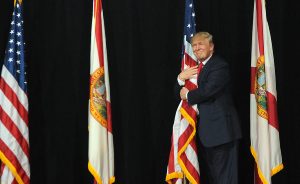
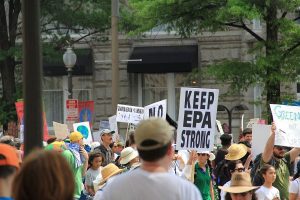
What the hell? Most people in the U.S. appear to be freaking out about Georgia ending its lockdownbefore anyone else. Even Trump weighed in, saying he disagreed with Georgia Governor Brian Kemp. As we stand, restaurants here opened yesterday, as have bowling alleys, parks, nail salons and other facilities. The State also just declared its one thousandth death from COVID-19.
On April 2nd Kemp admitted that he didn’t know that this coronavirus could spread asymptomatically, something the world knew since late January. Kemp may be an idiot, but that doesn’t mean he was wrong to re-open Georgia’s economy. With all respect to those who have lost loved ones or suffered from a bout, it’s time collectively we get back to our new normality.
On a daily basis, we are bombarded with reasons to be fearful, but it’s in our best interest to keep this in perspective. We’re human, and merely one-hundred-and-fifty-years-ago you would be fortunate to live past forty. Now, the argument to resume a bit of human interaction is dismissed as being disrespectful to human life: anyone who dares prioritize the the economy over safety is dismissed as unethical or even cruel.
As noted by the head of emergency of a Bronx hospital, one of the epicenters, the fact that emergency visits went down on April 9th may not be a direct result of everyone staying at home. Rather the wave hit us and we came out the other side.
The wave will likely hit again, and we should be ready, but we shouldn’t follow the example of China and other authoritarian countries and give up basic freedoms in exchange for a false sense of security. We stayed at home and practiced social distancing to flatten the curve. Once it arrived, complete elimination was never going to be possible. Only a vaccine can eliminate a virus. In the meantime, anyone who would like a Chinese government app that gives you a green light whenever you want to leave your house please raise your hand.
Ok – we were slightly off the mark about Biden’s campaign being low-energy, but that doesn’t make us wrong about it overall. He’ll have a tough time holding his own against the targeting machine the Republicans have built up.
The Republicans are great at creating alternate realities for those susceptible to deception. Bull Moose’s own eighty-year-old mother expressed dissatisfaction at the harsh treatment Trump receives in the media. She didn’t seem aware that he had advocated ingesting bleach? Even the makers of Lysol had to issue a public warning. That should have been a cause for impeachment far more than the Ukraine investigations. Impeachment for sheer idiocy and delusions of grandeur.
Yet we digress. Covid-19 is the topic de jour. It’s contagious and potentially deadly. As we speak, much of the world is still in lockdown, and stories of human misery are coming out of epicenters in China, Spain, Italy, and elsewhere. Over the coming months, and especially next winter, suffering is likely to intensify, unless we find a vaccine.
It’s been interesting to observe the left vs right debate in the U.S. around Covid-19. In general, the right is advocating a rapid opening up of the economy and disregarding those less fortunate, while the left hides behind the pretense of the sanctity of all human life, wrapped up in sensationalism. Neither are right, and both sides are driven by fear.
More than ever, the U.S. needs a voice of reason from the center that is prepared to lead in a considerate, less ideological way. This is someone who could advocate for workers’ rights, while at the same time advocating for people’s right to have a haircut.
People in the U.S. love to talk about their free media, but the big problem right now is the populist, special interest media. Trump has turned overzealous partisan coverage against him media to his advantage, turning bully into victim with a sleight of hand rarely seen. He has also successfully called out a media more concerned with getting clicks through headlines than the accuracy of its reporting.
Yet, the media is itself a victim of the current power/money play. They rely on advertising, clicks and the interests of their billionaire owners. Take Jeff Bezos as a case in point. Owner of the Washington Post, he gets far less scrutiny than he deserves, which is entirely due to the fact that he is the world’s richest man.
A few weeks ago, Bezos announced he didn’t think the U.S. should open yet. I’m sorry but he doesn’t get a vote. He benefits directly from lockdowns. His net worth has increased by nearly $24 billion since the start of the year, as his quest for Amazon’s total domination continues. The world’s first trillion-dollar company (that’s a million millions…) should be regulated for the sake of our children who should not be beholden to the undemocratic decisions of a select few corporate entities.
Maybe the idea of taxing the obscenely rich isn’t so crazy. When is enough really enough, and why is no one holding Bezos accountable? It is obvious by now he drives a hard bargain, and is not a pleasant human being. If money buys power, why should he get a free pass, while we still have a voice?
We need a free, independent and accountable media more than ever. We don’t need CNN, Fox, BBC and other special interest ‘news’ channels that endeavor to claim to give us ‘real news’ from ‘independent’ reporters.
This year, America decides between two white men born in the 1940’s to lead them into the 2020’s. Consider that for a moment. The last three Presidents of the U.S. are all still younger today than any of the candidates today. They’ll have to decide on issues that weren’t around even a decade ago, and are hard to understand without a great deal of mental dexterity. Is either up to the task?
As Covid-19 sweeps through Ireland, I can’t help experiencing a feeling of déjà vu. In early 2015, I was based in Guinea as part of the international response to the Ebola epidemic ravaging west Africa. I was responsible for reporting on the progress of the epidemic as well as the measures being applied to halt its further progression. An important element of my work was in helping define the potential recovery needs of the country and articulating a vision as to how the international agency I was working for could contribute in helping Guinea transition from the ongoing short-term emergency humanitarian focus to a middle-long term recovery and development operational approach.
Conakry in the Time of Ebola
Prior to travelling to Guinea, I had read everything I could find both about Ebola and the situation on the ground. Similar to Covid-19, Ebola is a virus and is also believed to originate from bats. However, it is far more virulent, can result in serious haemorrhaging with severe internal and external bleeding and has a far higher death rate.[i]The first Ebola case in west Africa occurred in late December 2013 in Guinea. A 2 year-old boy in the village of Melandiou, close to the Guinean border with Liberia and Sierra Leone feel ill with a mysterious disease, later identified as Ebola and died a couple of days later.[ii] His grandmother, pregnant mother and three year old sister died shortly after.[iii] Ebola was on the march.
In the latter half of 2014 and early 2015, the media was full of apocalyptic descriptions and assessments of the impacts of Ebola on Guinea, as well as its neighbours Liberia and Sierra Leone, and the danger of its spreading further afield. However, the situation on the ground in Conakry which greeted me upon my arrival, was not at all what I had expected. If I had not been aware of the virulence and mortality rate of those who contracted Ebola, I could easily have been convinced that its threat had been seriously over-hyped.
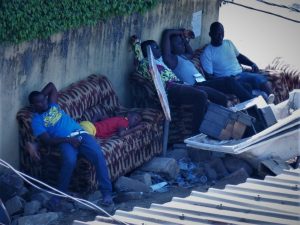
While hand sanitisers were omnipresent and my temperature was taken each time upon arrival at the office, as well as when visiting other organisations, there appeared to be little restriction on the movement of people in Conakry. There was an abundance of economic activity as people moved freely through the streets and the colourful markets heavied with custom. Street food vendors displayed and sold their succulent delicacies to eager passers-by. Aspiring footballers practised their skills on the open roads, briefly making way for passing traffic, while others jogged through the streets. One bridge I passed, several times a day, had a perpetual presence of primarily young men performing their workouts and practising stretches from early in the morning until late evening. A sofa conveniently placed at the end of the street, where our office was located, had been drafted into service as a temporary meeting place for an ever-changing guard of young males.
Conakry in the time of Ebola. (c) Justin Frewen
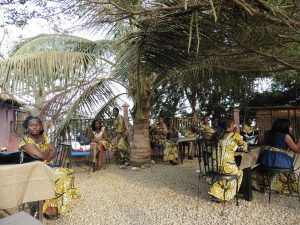
The absence of constraints on physical proximity was particularly evident during the finals of the African football Cup, for which Guinea had qualified after a long absence. In the days leading up to the tournament, a tangible thrill of expectation hung in the air as pockets of people congressed in the streets and cafes to assess their country’s chances. The day of the tournament launch, a pair of enormous speakers were placed in the street behind our office. From 8 AM onwards, music blasted through the neighbourhood. From my vantage point on the second floor, I could see boys and girls dancing in their gardens and passers-by congregating to animatedly discuss the imminent tournament kick-off. A middle-aged woman walked down the street laden with two substantial shopping bags. As she neared the source of the pulsating beat, a broad smile flickered across her pleasant features as she swayed to the rhythm without missing a stride. Some 20 metres later, she resumed her erstwhile gait and homeward struggle with her sagging shopping bags.
International Women’s Day, Conakry,, Guinea, Justin Frewen.
Coronavirus Lockdowns
In contrast, the current coronavirus pandemic has led to lockdowns of varying intensities around the world. As early as 24 March, the Guardian newspaper highlighted how some 20% of the world’s population was under lockdown imposed as a result of Covid-19.[iv] The past month, if anything, has seen a radical increase in the imposition of such measures and the consequent reduction of social and economic activities to prevent the onward transmission of this virus. This contrasts sharply with the general situation in Guinea during the Ebola crisis. Although strict quarantine was imposed on those who contracted Ebola and in spite of the lurid accounts of Ebola’s impact upon the people of Guinea, Liberia and Sierra Leone, there was paradoxically far less overt evidence of its threat in daily, public life.
The primary reason for this difference lies in the transmissibility of the respective viruses that lead to Ebola and Covid-19. As outlined by ‘Médecins sans frontières’ (MSF – Doctors Without Borders), who were instrumental in rallying international awareness and required resources to tackle Ebola, “(H)uman to human transmission occurs through contact with bodily fluids of an infected person or through surfaces contaminated with these fluids.”[v] Covid-19, like other common human coronaviruses, transmits from an infected person a) in water droplets through the air, as a result of coughing or sneezing; b) close personal contact such as shaking hands; and c) touching one’s face (eyes, nose, mouth) after touching an object / surface before washing one’s hands.[vi]
It is therefore clear the potential onward transmission of Covid-19 is far greater than for Ebola, as it does not require direct physical contact with the carrier of the virus. Fortunately, it appears that it cannot be transmitted through the air directly which would greatly increase its range and ease of transmission.[vii] This fact has led to a far greater restriction on social and economic life due to Covid-19’s enhanced transmissibility that was the case with Ebola.
Virus Mobility
Ebola’s infection spread was relatively localised. Despite the occurrence of a few cases outside the epicentre of west Africa (Guinea, Sierra Leone and Liberia), such as in Scotland and North America predominantly via the return of health workers, the virus was effectively contained. Approximately 11,000 people succumbed to the illness and while each of these fatalities was a tragedy for the victims and their loved ones, this figure obviously pales in significance to the rapidly increasing daily totals of Covid-19. As I write today, on 24 April, the recorded deaths are fast approaching 200,000. These figures, however, are undoubtedly a significant underestimation of the actual number of people who have succumbed directly to this coronavirus, not to mention those who may have succumbed to secondary infections due to enfeebled immune systems. In the UK, for example, the daily figures of deaths released to the public do not include those that have occurred in nursing homes or other residential settings.[viii]
One of the major issues confronting health personnel combating Ebola in Guinea was the mobility of people in this region as there was widescale migration by people particularly in the rural areas to obtain income for their families. This situation was aggravated by the porous frontiers between neighbouring countries as people would often traverse national borders in search of work and food or even simply to visit their extended family. Borders in Africa have frequently been subject of fierce contestation and the manner in which they were imposed during colonialism has been one of its most enduring, negative legacies. They have both divided members of ethnic groups, as in the case of the nomadic Tuareg of North Africa, and also forced members of diverse cultural and religious groups into a single polity, such as the Sudan or Nigeria.
In tackling Ebola, it became clear that the presence of these different national jurisdictions, divided by arbitrary and highly porous borders, such as those that existed between Guinea, Sierra Leone and Liberia greatly complicated the tracing of potential contacts of Ebola victims. Frequently, there would be no accurate records of who had crossed from one country to its neighbour. During the Ebola epidemic this resulted in severe delays in tracing potential contacts of Ebola victims, with the potential that these contacts could inadvertently become the source of waves of new infections as they moved from one place to the next.
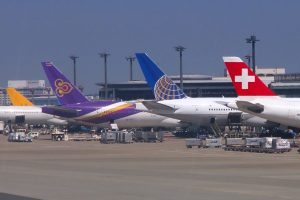
While Ebola was spread in west Africa predominantly through the movement of local people in rural areas trying to augment their meagre incomes, the worldwide dissemination of Covid-19 has been by the more relatively globally affluent. The massive growth in air travel has greatly increased the ease by which viruses can move from one part of the globe to another via their human hosts. When the Spanish Flu, so named because the flu was first widely reported on there, global movement was far slower and it therefore took the virus far longer to journey from one region to another. Today, we can get to virtually anywhere in the world in under 36 hours. This makes it far more difficult to control the onward progression of viruses such as Covid-19 and to effectively localise their impact, as was the case with Ebola.[ix] It should be noted that this risk had been noted as an issue of concern prior to the current pandemic.[x]
‘The massive growth in air travel has greatly increased the ease by which viruses can move’
Fear and ‘loathing’
A frequent occurrence in serious epidemics and pandemics is the parallel transmission of fear which can radiate through impacted communities, even amongst those not yet exposed to the pathogen. A particularly tragic episode during the Ebola crisis occurred in September 2014 in the southern Guinea village of Wome when a team of eight health workers and journalists were murdered. The villagers were terrified that this deputation, which had been sent to help there and fearing they were there to spread the disease, attacked them violently with clubs and machetes.
Although unique in terms of loss of life, the tragedy at Wome was not an isolated event. The Red Cross reported that its teams were attacked an average of 10 times per month over a year by frightened members of the local population.[xi] While there was a degree of understanding amongst member of the international community in Guinea as to the apprehension of local people confronted by outsiders, particularly those decked out in full hazmat suits, there was also disbelief that this could result in such aggression. Outside Guinea, people generally express incredulity at what transpired at Wome. How could people be so ill informed or be in such a state of fear that they would murder those sent to provide assistance. This would surely never happen in ‘developed countries’.
However, if there is one thing we have learnt from Covid-19, it is that the people of Wome were in no way exceptional in falling victim to the plague of fake rumours, conspiracy theories or the negative treatment of health personnel.
Over the Easter weekend in England, numerous phone masts were set on fire amid claims they were spreading the coronavirus. In the early hours of April 14 in Huddersfield, dozens of people had to be evacuated from their homes as a nearby phone mast was set ablaze.[xii] Similar fires were also reported earlier in April at masts in Birmingham, Liverpool and Melling in Merseyside. A video was shared on Facebook and YouTube, allegedly documenting a fire in Aigburth while claiming a link between Covid-19 and mobile technology.[xiii]
One such attack also impacted directly upon the victims of coronavirus when, in Birmingham, a phone mast serving the NHS Nightingale Hospital was targeted by arsonists.[xiv] Mobile masts have also been set alight in Ireland with the latest incident occurring in Cork on the night of 22 April.[xv] Rumours linking Covid-19 and 5G technology have been spread by social media sites such as Facebook, YouTube and WhatsApp, leading to questions as to whether greater control should be exercised over these media to which their providers have responded by deleting what they categorise as false or harmful content related to the virus.[xvi] Intriguingly, there have been reports that social media has also been used in some places to name and shame people breaking social movement restrictions in their communities.[xvii]
There has been deserved widespread praise for those on the frontline of the fight against Covid-19, including nightly clapping by the general public to display their support of health workers. Starting in Italy and Spain, this tribute has spread to many countries around the world. Despite these public accolades, health professionals have been abused in public on account of their engagement in tackling coronavirus. While these incidents have not resulted in fatalities, as in Guinea, they have been extremely disturbing. In early April, Howard Catton, CEO of the International Council of Nurses, revealed his organisation had received reports from around the world of abuse and harassment related to their work in fighting Covid-19. According to Catton, nurses were seen as potential carriers of the virus and thus a threat to the communities in which they lived.[xviii] In England, nurses have been abused in public and accused of being disease spreaders.[xix] Heath personnel have even been forced to quit their accommodation by landlords afraid they may contract the virus from them. In one such instance, Joseph Alsousou, a surgeon based in Oxford was asked to leave his rented accommodation as soon as possible.[xx]
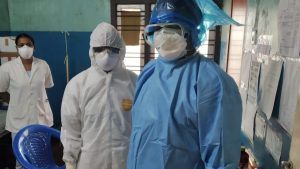
Health Care workers.
From Ebola to Covid-19: Has the WHO Failed Again?
The WHO came under severe criticism for its handling of the Ebola epidemic. The international president of Médicins Sans Frontieres (MSF), Joanne Liu, appeared before the UN Security Council in September 2014 to inform the members directly as to how Ebola was impacting upon west Africa. She revealed that MSF was effectively engaged in building “crematoria instead of hospitals”. The same month Liu demanded that UN members deploy civilian and military resources to tackle this emergency.[xxi]
Following the successful containment of the Ebola outbreak, the WHO apologised for its failure to respond in time and promised to undertake the necessary reforms to avoid a similar situation in the future. However, less than five years later, the WHO is once again under attack for its alleged slowness to respond to the outbreak of Covid-19 and its delay in communicating the gravity of this outbreak to the world at large. To punish the WHO the U.S. President Donald Trump has announced he will withhold the U.S. contribution of US$400 million to the WHO.[xxii] Although some commentators have pointed out that in fact the figure of $400 million is an overestimation given that the U.S. is already as much as $200 million behind in its pledged contributions,[xxiii] this has the potential to seriously disrupt WHO operations at this critical moment.
In effect, while there are understandable concerns that the WHO could have reacted more promptly and effectively to the outbreak of Covid-19, this is not the time to engage in such an analysis. As its Director-General has stated the WHO’s performance in tackling this pandemic will be reviewed both by member states and independent bodies to identify failures in the organisation’s performance.[xxiv] The ongoing underfunding of the WHO together with the organizations endemic internal problems, which predated this crisis, will hopefully feature in this review.[xxv]
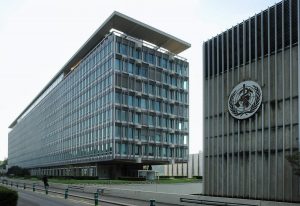
WHO Headquarters in Geneva, Switzerland.
Clear Communication
As illustrated in contexts as diverse as New Zealand and Kerala, successfully tackling Covid-19 requires a communications strategy that provides clear guidelines and recommendations, supported by transparent explanations as to the approach adopted through easily accessible media platforms. In Kerala, the state government provided detailed media briefings on a daily basis outlining the necessary actions to tackle the virus, the importance of contact tracing, the need for quarantining and training for healthcare and hospital personal while also seeking the support and cooperation of the general public in surveillance and containment.[xxvi] These daily briefings proved highly popular and earned widespread public respect for the manner in which decisions and their rationale were explained. Updates on government actions to tackle the virus, relayed through the Chief Minister’s social media accounts, also proved highly popular. The effectiveness and accessibility of these communication measures resulted in a statewide awareness of Covid-19 and the necessity for close cooperation and mutual support between the health service and public to reduce transmissibility and avoid clinical case overload.[xxvii]
In addition to providing Covid-19 related information through standard media channels, the NZ Prime Minister, Jacinda Ardern, has communicated directly with the public, making herself available to the media and holding daily public press conferences, led by New Zealand’s director-general of health, Dr Ashley Bloomfield. Together they have displayed “a reliable, measured and authoritative face for New Zealand’s Covid-19 response”. [xxviii] Of particular value has been the clarity of Jacinda Ardern’s communication on the virus.[xxix] Her leadership style has been assessed by one commentator as “one of empathy in a crisis that tempts people to fend for themselves. Her messages are clear, consistent, and somehow simultaneously sobering and soothing. And her approach isn’t just resonating with her people on an emotional level. It is also working remarkably well.”[xxx]
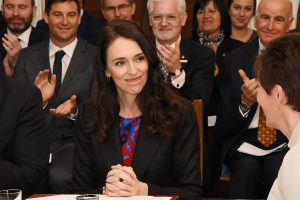
Jacinda Ardern, New Zealand’s Prime Minister.
Uncharted Territory?
One of the primary excuses offered for the difficulty in responding to Covid-19, has been that it is unprecedented and there is no reliable roadmap to guide us. However, while the current situation whereby so many countries have implemented lockdowns of varying levels of severity, closing down large sectors of their economies, is unique, it would be false to argue that we had no warning of the possibility of such an event.
The first two decades of this millennium has been witness to several new epidemics, that could potentially have had a similar, if not far worse, outcome than Covid-19. Two of these were also coronaviruses, namely Severe Acute Respiratory Syndrome (SARS) and Middle East Respiratory Syndrome (MERS). In 2002, SARS originated in Hong Kong, resulting in 8,098 reported cases and 774 deaths, a mortality rate of just under 10%.[xxxi]Middle East Respiratory Syndrome (MERS) was first identified in Saudi Arabia in 2012 and spread to several countries. By the end of November 2019 some 34.4% of patients infected by MERS-Cov had died (858 of 2,494 laboratory confirmed cases).[xxxii] In 2014, Ebola first struck west Africa. Although mainly contained to Guinea, Liberia and Sierra Leone, there were a number of cases in other countries. In 2018, another outbreak of Ebola occurred in the Democratic Republic of Congo (DRC), the 10th in 40 years. As of 19 April 2020, there had been 3,316 confirmed cases, resulting in 2,277 deaths or a mortality rate of almost 69%.[xxxiii]
Many warnings have also been given by experts that a significant threat of a pandemic existed.[xxxiv] There has been at the very least an awareness that the threat of a pandemic which could result in significant fatalities and international disruption existed. Several countries had undertaken simulations that pointed out where major risks lay in terms of their readiness to counter such a threat. The US alone has held several of these exercises since the turn of the century, which had pointed out severe deficiencies in its preparedness.[xxxv]
Kerala – a model to tackle Covid-19?
The southern Indian state of Kerala which has been widely praised for its response to Covid-19. Its success would appear to be based upon two major elements. The first was the speed with which the state reacted to its outbreak in Wuhan. The health minister, K. K. Shailaja, alarmed by news of the virus in China and aware many students from Kerala were studying in Wuhan, organised a high-level meeting to discuss the situation on January 25th. The following day a control room was established to coordinate the department’s work. Eighteen committees were established and held daily meetings to evaluate actions undertaken and host daily conferences where Shailaja briefed on the actions her department was undertaking. The slogan “Break the Chain” has been given to the approach adopted in Kerala where open quote contact tracing” is implemented. This involves tracing all who have potentially been in contact with the infected person, similar to that approach which was critical in tackling Ebola.
By March 19, Kerala had 25 people who had tested positive and 31,173 people under surveillance, of which 273 were isolated in hospitals with the rest quarantining at home. These high numbers were mainly due to the high influx of travellers, including people from Kerala returning home. On March 18 and 19 alone, 7,861 and 6,103 people respectively were put under surveillance. The resources required, both in terms of management and coordination as well as the active input of all sectors of society, leads to the second reason why Kerala has proved so successful to date in its struggle against Covid-19.
The second critical element in Kerala’s approach is the existence of a strongly supported and well-funded public health sector, which forms a strong health shield against epidemics and other threats, even in a state which would be relatively poor compared with Europe and the U.S. This has been greatly supported by the active participation of a strong grassroots section of the state’s public which has combined with the health service to fight Covid-19.[xxxvi]
When one contrasts the resolute measures, large scale mobilisation and effective containment of Covid-19 by a state such as Kerala or a nation like Vietnam – a country of over 96 million people, which despite sharing a border with China had only 268 cases and no fatalities as of 24 April – one cannot but be impressed at their performance. By the same token, one has to question how these relatively resource poor polities have been able to handle this crisis so much better, at least up to now, than the affluent nations in Europe and the U.S..
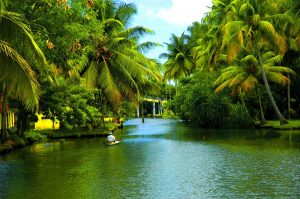
The Indian state of Kerala has been widely praised for its response.
What Lies Ahead?
While it is difficult, at this stage, to estimate with any certainty the actual mortality rate of this coronavirus, it is certainly far less lethal than Ebola. Although Covid-19 discriminates greatly against the elderly in our society, its mortality rate is probably inferior to 1% and is likely to be less than this. However, whether we will ever be able to effectively assess the actual number of Covid-19 cases and related deaths is itself a moot point given the wildly varying rates of testing for the virus in different countries, the differing methods for compiling statistics related to deaths and the fact that almost certainly many deaths that occur as a result of this virus will never be acknowledged.
Moreover, there is still much we do not know about this coronavirus. For example, do those who contract and survive Covid-19 gain immunity and, if so, would this be short or long-term? In South Korea, people who appeared to have recovered have later tested positive again for the virus, though preliminary Indications are that rather than being reinfected, the virus has been reactivated.[xxxvii] Similarly in China, patients who had apparently recovered from the virus are still registering as positive without displaying any symptoms. One 50-year-old man was still testing positive some two months after he first acquired Covid-19.[xxxviii] Given the complexities of and uncertainties related to Covid-19, the current phase consisting of lockdowns and other physical isolation measures may yet prove the easier part of our struggle to return to normality.
If the virus can remain dormant in our system with the possibility of being reactivated and/or being transmitted onwards, the struggle to eradicate Covid-19 becomes infinitely more complex. Either coronavirus victims who continue to test positive, despite not displaying any symptoms, might require extended periods of isolation until they are no longer considered potential vectors of onward transmission or there is an approved vaccine in place. The earliest estimate for such a vaccine, despite acceleration of the testing process worldwide, is mid-2021. However, we need to remember there are still no vaccines for the four coronaviruses, including SARS and MERS, that currently circulate amongst humans.[xxxix]
Certainly, the spread of Covid-19 has been far more extensive than Ebola. However, its transmission rate is only one of the issues facing us today. Just as certain underlying health conditions – cardiovascular disease, cancer, diabetes, high blood pressure – can severely aggravate the impact of coronavirus, this coronavirus could have widespread knock-on effects even more deleterious than its health impact. Covid-19 could become an underlying condition, which will lead to serious economic and social disruption as a result of measures applied to counter its spread. We have even been warned that we could face a worse depression that that which provoked by the Wall Street crash of 1929.[xl]
A further significant area of concern is that of food supply. Although supermarket shelves in the global North, despite earlier panic buying, have been kept sufficiently stocked for our immediate needs, this may not last. Should this pandemic continue for an extended period of time, food supply chains will almost certainly be weakened, if not effectively broken. Food chains are complex structures, composed of intricate, interlinked and interrelated elements – agricultural producers and inputs, large brokerage agencies, shipping and land transport companies and distribution nodes, which are all subject to potential disruption. According to the Food and Agricultural Organization (FAO), reported shipping industry slowdowns due to foreclosures and logistic blockages could soon start to disrupt this chain.[xli] The consequences for the Global South could be catastrophic with potentially hundreds of millions threatened by food insecurity.[xlii]
[iii] Dr. Jonathan D. Quick, The End of Epidemics: The Looming Threat to Humanity and How to Stop it, Scribe Publications, Brunswick (Victoria) Australia / London U.K., p. 27
How I learned to love and obey the rules of the world
You have to keep the white button pressed down, not the red one, the red one is the mains switch for all the electricity. We decided to put it up here out of the way when grandma started to touch everything. Come on, I’ll show you how to get up there. First, put your foot on the edge of the chest freezer, good […] that’s right, then lever yourself there on the barbell, and there you are. Now trust me, let yourself fall against the wall. Why are you shaking? Trust me, I’ll hold you from behind. No, the other one. Don’t shake, you’ll lose your balance. Have confidence in your legs. You’re nearly there. One last push. Not the red one, that’s the mains switch […] now press it again. What d’you mean it doesn’t work. Of course it works. Do it again. Fuck. Wait, come down, I’m going to try to get up there. You have to be more relaxed, one foot here, your arm here to lever yourself up, a little thrust with with your hips. See? What does daddy always tell you? Control over your movements is the first step towards knowing ourselves. See? There is no room for out of place objects in the world. Did you see how daddy did it? Victor, you must have noticed that it works like this at school too, try again. Up with the left then rest your right arm there, good boy, now press the white button. Remember, the first step towards success lies in the preparation of your movements. You must have an awareness of all of your surroundings […] fuck. What do you mean you felt yourself sliding backwards? Don’t worry, daddy will do it today. Click. You see the garage door opening? Listen to how quiet it is. Can you feel the harmony? No, don’t cry. Crying will make you lose your balance. You mustn’t cry, don’t listen to those people who say it is only human, or “cry and let it all out”. Crying is for the weak. The weak are like they are because they aren’t in harmony. No, not that one, that’s the hammer drill, leave that one alone […] they can’t find their place in the world and so they are angry with the world. It’s stupid, Victor. Do you remember what grandpa used to say when he started to not remember where he was? He used to say I want to die before I start wetting myself. Tears are the weewee of the eyes. So you mustn’t cry. You have to face the world with your brightest smile my little man, straight back, stiff upper lip old boy. Why’re
you making that face? Don’t you like my upper crust accent? Do you want to try to turn the switch on? Ok. Think about the movements you have to make, about your body moving through its surroundings harmoniously. It has to be the projection of yourself through the world. Ok, perfect […] fuck. Let daddy do it. Click. You see, now the garage door is closing. Click. Like this it opens again. Victor, do you remember, here hold daddy’s phone for a moment, do you remember when daddy explained to you what a curriculum is? It’s when you introduce yourself to the world and say, “yes, I am a body who knows how to move harmoniously.” Life is a collection of curricula, because you don’t want to spend your whole life with the same people do you? No, Victor, once you get to know someone it is already time to get to know someone else. That’s why you always have to have an up-to-date curriculum, my little man. Do you remember the three little rules? Hold on to my vest for a moment, please. No, not like that, don’t drop it, it’s dirty in here. First of all […] let’s say it together:
One: use one, or two sheets of paper at the most, because nobody has time to waste.
And you have to be like a bolt of lightning out of the blue.
Two: Use white or very light paper, good quality, plain.
You have to keep your tears for yourself. No smudging. You are a harmonious individual.
Three: Use the active voice. Why are you looking at me like that? It means nothing has been started and nothing has been finished, and you are a constantly updating curriculum.
Remember this word, constantly. And seeing as you have a good curriculum, you know what happens afterwards? […] Victor leave the football alone for now. Do you know what happens when you have a good curriculum vitae? Well, it means the best companies want you. You know what a company is, don’t you? It is a collection of people who move together in the same direction to reach a common goal. Like birds migrating in search of food. All together, straight to the point, old man. What’s the matter? Don’t you like what I’m saying? The little birdies commanding the migratory groups all talk like that. In the companies there are also little rules to learn.
Your look, Victor, look at me when I’m talking to you, […] your look is very important. Give me a hand with the barbell will you, please. Like that, bend your arm, but naturally […] you see, I was saying, you have to dress according to the context, casual, or elegant, but no flashy accessories. Flashy accessories scare the other little birdies. As soon as you arrive, smile, open doors with nonchalance. Manage your spaces, be ready. When you meet the group’s toughest little birdies, shake their hands with a firm grip, but not too hard. You have to be careful about your body language, sit nicely on your chair, don’t touch your hair, don’t let your hands fiddle, don’t look closed off. Closed off is when you cross your arms, or lower your eyes. You are strong, you know it and you have to show it, but there is no reason to be mean to the other little birdies. Now do you understand what “harmony” means? You don’t have to do anything other than lean your little head on her soft tummy until she opens up, like flowers do in the spring, and you will be able to taste the flavour of her nectar. No, don’t cry. C’mon, remember what I told you […] dry your eyes, mummy is waiting to take us to karate. I like talking to you like a person, Victor, man to man. You are a beautiful thing.
Walter Comoglio is an italian writer based in Dublin. This short story appears in his first book named “La sera che ho deciso di bloccare la strada”, published by Gorilla Sapiens Edizioni, winner of 2017 POP prize Italy as best debut.
In a powerful 1997 essay, Seamus Deane suggested that the twin forces that beset modern Irish writers such as W.B. Yeats and James Joyce were those of Apocalypse and Boredom.[1] Both the culture in which the writers lived and the art-works they produced are marked by phasic interruptions into colonial despondency of revelatory dramas and epiphanies:
In Yeats’s work–plays and essays, we may feel at times that a little boredom might be something of a relief from the constant appropriation of almost everything that happened in his lifetime to a visionary apocalypse in which all that is ‘past, or passing or to come’ flashes up in a conflagration that consumes time and exposes eternity. What I want to suggest here is the natural alliance between Joycean boredom and Yeatsian apocalypse in relation to temporality and therefore to history.[2]
Deane’s proposal reflects something of the deadlock of revisionist and radical criticism in Irish Studies in the 1990s – a political deadlock which has largely passed into desuetude in the post-Good Friday atmosphere. If revisionism proposed a certain constitutional conservatism and was a bit of a bore, the radical cultural critics wielded a language which was apocalyptically difficult to understand in its more post-post-structuralist modes. And what was lost in the debate was something of the craic of ordinary people, and the points of cracked reality in ordinary life which do not succumb easily to academic enquiry.
Methodologically, of course, we find ourselves these days stretched across wide and strange territories of discourse and discipline, and at a very late stage in the drama of literary criticism from Leavis to Baudrillard. Contemporary criticism has a surfeit of entry points and elaborations, resembling a quantum field in its complexity. I could, whilst sticking only to a psychological theme, find many feminist responses to one essay in late Lacan. Or I could argue for yet another return to a missed aspect of a deconstructed Freud. I would prefer though to draw simple and broad brush-strokes which would not incite the total indignation of a casual reader. My psychological terms are broadly popular (the aesthetic terms are more or less commonly known in academia since Bakhtin). And the argument is willingly simple: that ‘Apocalypse and Boredom’ as a binary needs a mediating term (Crack) which turns out to be dizzyingly deconstructive in its implications. Modern scholars cannot either manoeuvre round or simply ignore this post-structuralist facet of a text but must, as Terry Eagleton has suggested, go through theory and out the other side. And wisdom is to be found in many places including the most demotic and the most abstruse. Our common language in the end must be the structures of wisdom, and Derrida has as much a claim to them as does the greatest ‘realist’ of a pub in Grafton Street. [3]
Deane’s broad historical binary can be broadened to include a psychological dimension and also an aesthetic principle for the detailed analysis of culture, society and art. The psychological dimension appropriate to Irish modernism, I shall argue, is manic-depressive in structure. The corresponding aesthetic principle is a principle of carnival-nihilism where the hyphen suggests an affinity with the related manic-depressive psychology. The hyphen should suggest that the prior term in each case (mania, carnival) is not necessarily adjectival but has also an intimate link with its sister terms depression and nihilism. Adding these terms to Deane’s we might produce a more complex matrix for the discussion of Irish modernism for there are fascinating dialogical correspondences between manic, carnivalistic and apocalyptic phenomena, as indeed there are between depressing, nihilistic and boring colonial experiences. In the process of thus broadening the terms of reference, we will discover the emergence of that third term which ironises the solemnities of apocalypse and boredom: the term known to our common culture as crack.
It is a question of corollaries of structure. Manic-depression is episodic and interruptive of quotidian life in the same way that apocalyptic and boring experiences can be said to be episodic diversions from the ‘normal’ functioning of a happy democratic culture. Mania wrecks routine, and depression makes us incapable of routine. The terms carnival and nihilism are not new, but in an internal relationship with each other they form an aesthetic principle which deforms the more staid genre of tragi-comedy which is often taken by older critics to represent an aesthetic ‘norm’ for representing the human condition.[4] Carnival, like mania, achieves a disruption of normal boundaries, hierarchies and empirical states of mind. Depression and nihilism can kill our sense of the value of the ordinary. Christian apocalypse disrupts boundaries (‘ye shall be as gods’), hierarchies (‘I am the Alpha and Omega’) and forms of empiricism ( ‘they shall see the Son of man coming in the clouds of heaven with power and great glory’). But it is also true that boredom can at its extreme give us an extremely interesting sense of what eternity might be like. In a Derridean sense each of these terms when pushed to its limit can turn into its opposite: there is nothing more boring than an over-long carnival, and nothing more likely to reveal ‘the hidden’ than a night of nihilistic visions.
The dialogical inter-action of these terms furnishes us with both ‘vertical’ and ‘horizontal’ opportunities if we imagine the structure thus:
Apocalypse Boredom (Socio-cultural level).
Mania Depression (Psychological level)
Carnival Nihilism (Aesthetic level).
Taken together as a matrix of six terms we can begin to be experimental, and the advantage of adding psychological and aesthetic terms is to furnish us with a complex language for discussing the contingencies of modernist culture: what, for instance, might a manic-nihilism resemble, say in the early Nietzschean plays of W.B. Yeats such as Where there is Nothing? Could we consider the possibility of a carnival of boredom in Joyce’s Dubliners or Brendan Behan’s The Hostage? How might a sense of apocalyptic depression inform Sean O’Casey’s TheSilver Tassie? The terms are reversible, too, and this adds a further level of vocabulary to our exploration of forms: what is the function, for instance, of a depressive carnivalism in the plays of Samuel Beckett, a nihilistic apocalypse at the end of O’Casey’s Purple Dust and a boring mania in the work of Denis Johnston and Spike Milligan? I will now explore some of these terms more categorically and then go on to demonstrate how their presence can best be detected in the work of Sean O’Casey, a writer placed in the ‘minor’ category of modernists behind Joyce and Yeats, but who may come into his majority when seen as the first realist of crack.
In 1921, at the height of European modernism, the German psychiatrist Emil Kraepelin described manic depression for the first time as involving ‘a heightened distractibility’, a ‘tendency to diffusiveness’, and ‘a spinning out the circle of ideas stimulated and jumping off to others’. [5] In 1924 the Swiss psychiatrist Eugen Bleuler concurred and drew a parallel with artistic production:
The thinking of the manic is flighty. He jumps by by-paths from one subject to another, and cannot adhere to anything. With this the ideas run along very easily and involuntarily, even so freely that it may be felt as unpleasant by the patient….
Because of the more rapid flow of ideas, and especially because of the falling off of inhibitions, artistic activities are facilitated even though something worth while is produced only in very mild cases and when the patient is otherwise talented in this direction. The heightened sensibilities naturally have the effect of furthering this.[6]
We should notice the stress here upon the ‘heightened’ sensibility of the maniac for this reminds us of the heightened sensibility required to experience epiphany and revelation. We should also note the ‘falling off of inhibitions’ for this is a feature we will observe in our analysis of carnivalesque activity. The rapid flow and spinning of ideas also reminds us of some of the features we associate with modernist texts such as Ulysses. In short, the phenomenon of mania touches upon both frenetic literary activity and apocalyptic or transformative experience.
Depression.
Seamus Deane refers in his essay to the ‘marks of boredom’ he detects in Joyce, Beckett and Kafka. They include:
– ‘dinginess of physical circumstance and dress’,
– ‘extreme routinization of action and speech’,
– ‘an individual eloquence that derives from consensual banalities’,
Let us contrast this list with a list of depressive symptoms described by Irish psychiatrist Anthony Clare:
‘-Feelings of guilt or worthlessness
– Loss of concentration
– Loss of energy and noticeable tiredness of fatigue
-Suicidal thoughts …
-Agitation or marked slowing down (retardation’).[8]
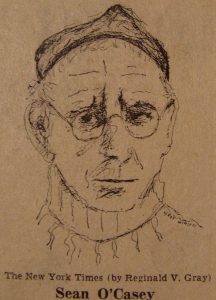
Sean O’Casey, Image by Reginald Gray.
It is clear from these lists that clinical depression and cultural boredom are intimately related. As we shall see in the work of Sean O’Casey, the subject feels that he has been broken into pieces. It is an experience of extreme boredom as a form of disintegration which results, paradoxically, in a form of apocalyptic fear:
[The depressive] feels solitary, indescribably unhappy, as ‘a creature disinherited of fate’; he is sceptical about God, and with a certain dull submission, which shuts out every comfort and every gleam of light, he drags himself with difficulty from one day to another. Everything has become disagreeable to him; everything wearies him … he thinks he is superfluous in the world, he cannot restrain himself any longer: the thought occurs to him to take his life without his knowing why. He has a feeling as if something had cracked in him, he fears that he may become crazy, insane, paralytic, the end is coming near. (Italics inserted).[9]
Colonial depression is a much more disintegrative experience than the term ‘boredom’ allows. The depressive is opened up to extraordinarily painful inner confusion and despair as he ‘cracks’ under the strain of living a false life. The only redemptive feature of the experience lies in the fact that extreme depression can become a form of revelation of capitalism’s utter inner monotony. The depressive subject can become aware of his extreme oppression through his consciousness of his fractured personal moods. There is , also, as we shall see, something redemptive and ironical about that ‘crack’.
Carnival.
So much has been written about carnival in recent decades that the term has sadly been recuperated as a ‘boring’ academic category. We can crack open the term however when we inflect it with an analysis of its relationship with mania and nihilism. The classic description of the function of carnivalism belongs to Mikhail Bakhtin:
The laws, prohibitions, and restrictions that determine the structure and order of ordinary, that is noncarnival, life are suspended during carnival…. All distance between people is suspended, and a special carnival category goes into effect: free and familiar contact among people.[10]
It is a characteristic feature of mania that the patient demonstrates a ‘loss of inhibitions, particularly sexual and social’ and displays an ‘infectious mood – humorous, jocose, euphoric.’[11] The maniac also enjoys breaking the boundaries of propriety- talking to people familiarly on the street, entering private property without permission, cocking a snook at policemen and authority figures. In a sense, we might think of carnival as a form of collective mania licensed by its social contract. The maniac is stigmatised because of his solitude- his actions are not very different from those of the carnival clown. ‘The basic principle of grotesque or Carnival realism’, writes Michael Bristol, ‘is to represent everything socially and spiritually exalted on the material, bodily level. This includes cursing, abusive and irreverent speech, symbolic and actual thrashing’ and so on.[12] The patient in a manic phase often dresses bizarrely, curses abusively and irreverently, thrashes around and confuses his own body with that of a god. Mania is, in a sense, a one-man carnival.
‘Carnival’, writes Bakhtin, ‘celebrates the shift itself, the very process of replaceability, and not the precise item that is replaced, Carnival is, so to speak, functional and not substantive. It absolutizes nothing, but rather proclaims the joyful relativity of everything.’[13] The maniac, remember, is identified by his infectious mood, flights of ideas, pressurised speech with fast punning and rhyming, loss of judgement and inhibition. The maniac, too, proclaims the joyful relativity of all relationships, concepts and objects. There are clear structural connections, then, between the forms of apocalypse, mania and carnival, and I would suggest that mania is the mediating element between the two apparently unconnected forms of apocalypse and carnivalism. In one grotesque twist, the Christian apocalypse is all about the burning flesh of men, and carnival too (L. carne) concerns the destiny of the flesh. We might indeed view the Last Judgement through one grotesque optic as a kind of carnival of revelation.
Nihilism.
Nihilism is the rationalisation of boredom and depression. It is, as it were, the ideology of melancholy. Where people merely act bored or depressed, as in, say, Joyce’s Dubliners , there is at least hope that some relief might come from the pain of their condition. These characters are not committed ideologically to the notion that life is meaningless but are merely acting out the paralysis of a cycle of colonial history. Nihilism, however, perceives the permanent negation of teleology, divinity and broadly socio-spiritual meaning. It searches for the lethal nothingness at the heart of any project and proclaims this as its secret truth. In conjunction with carnivalism as part of the couplet carnival-nihilism, nihilism acts as a corollary to the depression in manic-depression though with an even greater sense of finality. Where the maniac is reduced, in time, to the horrible vacuousness at the heart of his euphoria, the carnival subject, too, comes to understand that his destruction of all actually existing social forms conceals a secret and permanent nihilism. Carnival cocks a snook at authority but conceals from itself the secret vacuousness of its activity. It is a good thing to place a king’s crown on an ass’s head but it is also a gesture of hatred towards norms. Nihilism is thus the darkest of the six terms with which we are approaching Irish modernism because it emerges from the very heart of parodic action. But, in a final redemptive twist, we shall see that nihilism can be dialogised by the comical. Too much nihilism is, simply, funny, as James Joyce illustrates in his ironic parody of Catholic hell in APortrait of the Artist as a Young Man and as Samuel Beckett discovered in Waiting for Godot. [14] Several pages of doom and gloom can become amusingly intense. As we shudder at the crack of doom, we cannot help but be reminded of the craic.
‘I cannot enter the social order except as a vagabond.’ – James Joyce, 1904
The Crack.
To be cracked can mean, as we have seen, to be depressed to the point of madness, but to ‘have the crack’ can mean the opposite: to be infected with carnivalistic joy. A crack can be a fault-line from which revelation might arise (literally ‘a seismic event’ as Deane has it) or a blow inducing paralysis. [15] It is an ambivalent term which mediates between our six analytical terms thus:
Apocalypse Boredom
Mania Crack Depression
Carnival Nihilism.
Crack is the deconstructive term which mediates the transition from one side of the grid to the other. When apocalypse turns into boredom there must be a point at which a position is neither apocalyptic nor boring and I would suggest that the subject here acts like a manic-depressive. When mania begins to turn into depression the patient feels that he is cracking up in the manner described by Emil Kraepelin:
He has a feeling as if something had cracked in him, he fears that he may become crazy, insane, paralytic, the end is coming near. [16]
A post-apocalyptic culture can feel that the old moulds have been cracked but this can induce a morose fear for the future that can induce an anxious boredom. Contrarily, when a culture experiences the onset of an apocalypse it encounters heightened, euphoric feelings as in the 1916 rebellion where millennial fever gripped sections of the population of Dublin. As it becomes hypomanic society can have an almighty craic before its euphoria reaches its peak of revelation and collapses back into self-hatred and paralysis. Crack is therefore something of a pharmakon. A good night out in Temple Bar can be a ‘cure’ for depression, but the booze leaves us with a poisonous headache. A crack on the head from an Irish Brother can give us a poisonous hatred of authority, but can also cure us of all our idealism. Crack is undecided in its effects: both violent and creative, fun and pain, a break and a mould. It is a very archetype indeed of deconstruction, for what could be more ambivalent than a textual crack: a point where the text roars and collapses, enjoys and splits, surges and cleaves. At the very point where Beckett reaches his cracked vision of futility, we can’t help but begin to crack up. There is no craic where there is no crack. And there is no crack where there is no craic. In fact, the term is not just a pharmakon, but the very possibility of there being a pharmakon because there could not be a limit which could not crack, crack being the condition of its hymenicity.
Crack is a transitive term then but one which cannot sustain itself either as a form or a limit. We crack under pressure but then crack away at a solution. A crack in a cup is a pain but great craic if it causes our landlord to drop tea on his trousers. Ireland itself is cracked along its Ulster border, but the border itself is ‘crackers’. A crack cannot be a thing, by definition: but is certainly something. The crack may be Ninety in the Isle of Man, but the crackdown in the Dublin of 1916 was terrible.
Sean O’Casey and The End of the Beginning.
In the work of Sean O’Casey, nihilism is articulated as it emerges from the scandalous pranks of his exuberantly carnivalesque Dublin slum-dwellers. [17] As his work progresses through the years of modernism and civil war, his vision becomes increasingly bleak, so bleak, in fact that it becomes, in an ironic twist, comical. O’Casey’s work hovers in the space of ambiguity created by the word ‘crack’ which can represent both a fault or interruption in the smoothness of a quotidian continuum and a sense of comical social play (craic). ‘Mr O’Casey’, wrote Samuel Beckett, ‘is the master of knockabout in this very serious and honourable sense- that he discerns the principle of disintegration in even the most complacent solidities, and activates it to their explosion.’[18] O’Casey’s wilful destruction of empirical solidities impressed Beckett philosophically (it was entropic) but also because, to use a contemporary phrase, it cracked him up. O’Casey was at his most amusing when he was being nihilistic and achieved his greatest spasms of laughter from his creation of ‘spasms of dislocation’ in the art-work.[19] In his 1934 play The End of the Beginning, two characters, Darry Berrill and Barry Derrill set about the destruction of an Irish country house with great relish and, in the process, wreck themselves:
Darry falls down the chimney … there’ll be a nice panorama of ruin … nothin’ done but damage … I’m after nearly destroyin’ meself! [20]
The country house should be read as symbolic of an emerging De Valeran pastoralism which both O’Casey and Conor Cruise O’Brien took to be a disappointment.[21] ‘Our generation’, wrote O’Brien, ‘grew into the chilling knowledge that we had failed, that our history had turned into rubbish, our past to a “trouble of fools.”‘[22] O’Casey’s country house is an objective correlative of post- Free State Ireland’s paralysis in which his comedic pair stumble blindly about in a void:
Darry (shouting madly). Barry, Barry, come here quick, man! I turned the key of the tap too much, ‘n it slipped out of me hand into a heap of rubbish ‘n I can’t turn off the cock, ‘n I can’t find the key in the dark. (p. 41.)
O’Casey and O’Brien could agree upon the ‘heap of rubbish’ that Irish history had become. Typically, however, O’Casey intensifies the nihilism in the sub-text of the play until its atmosphere becomes apocalyptic:
I can’t do anything … I don’t know what to do …What in the Name of God has happened? … can you do nothin’ right! … God grant that it won’t be the end … Is the clock stopped? For God’s sake, touch nothing … It’s as dark as pitch in there … (pp. 21-30).
At the centre of Free State Ireland, O’Casey surmised, there lay a metaphysical darkness and his play establishes an atmosphere of cosmic doom throughout. Strangely, though the effect of the treatment is comical because his pair of clots are so endearing, reminding us of Laurel and Hardy as they crash into furniture, disappear up and down chimneys and knock cracks in the walls of the de Valeran dream. We cannot tell whether the apocalypse of nihilism is serious or part of the craic. ‘Can’t you find anything?’ asks Darry. ‘I can see nothing’ replies Barry, as the play reaches its climax (p. 24), but again, the effect is amusing in the manner of a cartoon where all the lights go out and we see just the cartoon rabbit’s eyes glowing in the dark. O’Casey is attempting a serious critique of his country’s post-apocalyptic (Easter 1916) boredom, but he discovers that boredom holds a potential energy within it which can explode into epiphanies of entropy, at which point he cannot decide whether to laugh or go mad. His culture is exhausted (‘not a drop left in it, not a single drop! What’re we goin’ to do n– …’) but hysterically explosive: ‘… He lets go of the rope, and runs over to the oil drum. Darry disappears up the chimney‘ (p. 33). For O’Casey, De Valeran Ireland is literally ‘cracked’, deformed in a vortex of nihilism and farce:
He turns and sees that Darry has disappeared.
Lizzie (speaking outside in a voice of horror). The heifer, the heifer!
Darry (calling out). Lizzie, Lizzie!
Lizzie rushes in as Darry falls down the chimney…. (p.33.)
The terms Apocalypse and Boredom are not adequate in their singularity to capture such ambivalencies. Boredom taken too far can rebound as a form of apocalyptic emptiness as in O’Casey’s work from 1923-34 where we encounter darknesses which take us beyond the merely paralytic state of Joyce’s Dubliners towards Beckettian nihilism. Apocalypse, too, can be strangely boring as we can note from my opening quotation where Seamus Deane speaks of the relief that we seek from Yeats’s constant revelations. We must seek mediating terms for the movement between Deane’s twin poles of analysis for, in the end, the terms begin to deconstruct one another. The first step in moving towards a more complex analysis is to introduce more specific psychological and aesthetic terms. The second step is to seek a mediating term for the deconstructive activity of this more complex matrix. In the term ‘crack’ we have a term which mediates the ambiguities of the deconstructive inter-actions of apocalypse, mania and carnival, boredom, depression and nihilism. Yeats and Joyce may have wanted Ireland to aspire to being an Attic culture, but I would wish to install Crack within Seamus Deane’s paradigm to remind us that Ireland was always, already, a very Antic country.[23]
[1] Seamus Deane, ‘Boredom and Apocalypse: A National Paradigm’ in Strange Country: Modernity and Nationhood in Irish Writing since 1970 (Oxford, Clarendon Press, 1997).
[2] Deane, Strange Country, p. 171. For a discussion of manic-depressive activity in the life of W.B. Yeats, see my ‘”Down Hysterica Passio”: The Mood Structures of W.B. Yeats’, Irish University Review vol. xxviii, no. 2, Autumn/Winter 1998, pp. 272-80.
[4] See, for instance, David Krause, Sean O’Casey: The Man and His Work (London, MacMillan, 1960), pp. 86-89 and passim. ‘Carnival’ and ‘nihilism’ should be thought of as standing to the extreme left and right, as it were, of the traditional terms ‘comedy’ and ‘tragedy’. Where tragi-comedy suggests an organic genre in which its terms are nevertheless discrete, carnival-nihilism should suggest an aesthetic that is in creative contradiction with itself. For further discussion of the principle of carnival-nihilism, see my (unpublished) M. Litt. thesis, Ideology and Dramatic Form in the Plays of Sean O’Casey, 1922-46 (Oxford, Bodleian library, 1994).
[5] Emil Kraepelin, Manic-Depressive Insanity and Paranoia , trans. R.M. Barclay, ed. G.M. Robertson (Edinburgh, E&S Livingstone, 1921) in Kay Redfield Jamison, Touched with Fire: Manic Depressive Illness and the Artistic Temperament (New York , Simon and Schuster: Free Press, 1994), pp. 107-8. We might consider manic depression to be a ‘modernist’ illness in the way that some writers have conceived schizophrenia to be a ‘post-modern’ illness (see, for example, Frederic Jameson, ‘Postmodernism, or the cultural logic of late capitalism’, New Left Review, 146, pp. 53-92.) Where the schizophrenic patient loses touch with structures of space and time permanently, the manic-depressive experiences episodic disorientation. He is able to recuperate his identity, albeit tentatively, and thus retains a sense of ironic detachment from a self in crisis which a schizophrenic patient cannot since his very sense of self has collapsed into a permanent ‘flow’ of disorder.
[6] Eugen Bleuler, Textbook of Psychiatry, English ed. A.A. Brill (London, Macmillan, 1924) in Jamison, Touched with Fire, p 108. The reader is referred to Jamison, Touched with Fire, pp. 262-3 (Appendix A) for the fuller Diagnostic Criteria of Mania.
[8] Spike Milligan and Anthony Clare, Depression, p. 35.
[9] Emil Kraepelin in Milligan and Clare, Depression, pp. 23-4.
[10] Mikhail Bakhtin, Problems of Dostoevsky’s Poetics, Theory and History of Literature, Vol. 8, trans., ed., C. Emerson (Manchester, Manchester University Press, 1984), pp. 122-3.
[11] Milligan and Clare, Depression, p. 38.
[12] Michael Bristol, Carnival and Theatre: Plebeian Culture and the Structure of Authority in Renaissance England (New York, Methuen, 1985), p. 22.
[13] Bakhtin, Problems, p. 125.
[14] See, for example, James Joyce, Portrait of the Artist as a Young Man (London, Minerva, 1992), pp.130-40 and Samuel Beckett, Waiting for Godot (London, Faber and Faber, 1965), pp.11-15.
[16] Emil Kraepelin in Milligan and Clare, Depression, pp. 23-4.
[17] See, for instance, Sean O’Casey, ‘The Silver Tassie’, Collected Works vol. ii (London, MacMillan, 1967) where a carnivalesque opening of great joy mutates into a despairing nihilism: The sound of a concertina playing in the street outside has been heard, and the noise of a marching crowd…. Shouts are heard– ‘Up the Avondales!‘ ; ‘Up Harry Heegan and the Avondales!’ Then steps are heard coming up the stairs, and first Simon Norton enters, holding the door ceremoniously wide open to allow Harry to enter … carrying a silver cup joyously…. (p. 25).
cf.:
Teddy: Strain as you may, it stretches from the throne of God to the end of the hearth of hell.
Simon. What?
Teddy. The darkness. (p. 89).
[18] Samuel Beckett writing about The End of the Beginning in ‘The Essential and the Incidental’, Thomas Kilroy, ed., Sean O’Casey: Twentieth Century Views (London, MacMillan ,1975), p. 167.
[19] Beckett, ‘The Essential and the Incidental’, p. 168.
[20] Sean O’Casey, ‘The End of the Beginning’, Five One Act Plays (MacMillan, 1990), p. 33. Further references to this play can be found in the text.
[21] This pastoralism would later produce the De Valeran vision of a countryside ‘bright with cosy homesteads, whose fields and villages would be joyous with the sounds of industry, the romping of sturdy children, the contests of athletic youths, the laughter of maidens; whose firesides would be the forums of the wisdom of serene old age.’ (Eamon De Valera quoted in David Krause, intro., Cock-a-Doodle Dandy (London, MacMillan, 1991), pp. 15-16. In Cock-a-Doodle Dandy , O’Casey developed the point made in The End of the Beginning– that the boredom of pastoralism concealed an apocalyptic force (the cock) which could rip its pretensions apart.
[22] Conor Cruise O’Brien, ‘The Embers of Easter’, O.D. Edwards and F. Pyle, ed.s, 1916: The Easter Rising (London, MacMillan, 1968), p. 231.
[23] For an interesting essay on the relationship between antics and melancholy, see Harry Levin, ‘The Antic Disposition’, Hamlet: A Selection of Critical Essays, ed. John Jump (London, MacMillan, 1968), 122-36. The word antic derives etymologically from the Italian antico (antique) which gives the phrase ‘Antic country’ a satisfyingly Yeatsian accent.
At Cassandra Voices we uncover stories behind stories. Just occasionally these accounts reach the mainstream. So it has proved with what is being popularly referred to as ‘the riddle of Ballinalee’.
Let’s recall the adventure so far. Last week our then anonymous sleuth advanced a theory as to the origin of the words in the opening lines of Bob Dylan’s new song ‘I Contain Multitudes’. It might just explain why the previously unheralded village of Balllinalee in County Longford has shot to global prominence:
Today and tomorrow and yesterday, too,
The flowers are dyin’ like all things do,
Follow me close, I’m going to Ballinalee,
I’ll lose my mind if you don’t come with me.
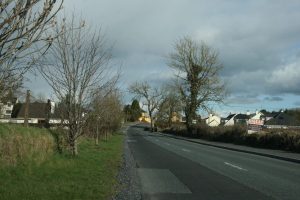
Ballinalee, County Longford, Ireland.
We are now quite convinced that Ballinalee is indeed an Irish reference, especially considering ‘the flowers are dyin’’ in the line preceding is an obvious play on the second verse of the Irish ballad: ‘Danny Boy’.
But when ye come, and all the flowers are dying,
If I am dead, as dead I well may be,
It’s certainly a ballad that would be well known to Dylan.
The Spy Who Came In from the Cold
It’s a plotline that might have been lifted from a Cold War spy novel. Our agent’s identity has been revealed. Like the best of them, pride proved his undoing.
The honey trap was an invitation to be interviewed on Shannonside FM, a local radio station broadcasting to the Longford area, and surrounding counties. He is Dr Francis Leneghan of Oxford University no less. George Smiley himself couldn’t have found a better cover.
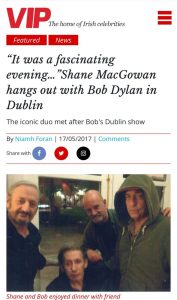
In the interview – which is available here as a podcast – Dr Leneghan repeats his hunch that the Ballinalee reference might be traced to a banquet involving Dylan and his excellency, the resident Bard of Ballsbridge, Shane MacGowan, formerly of the Pogues and the Popes. The meeting of bards, now the stuff of legend, took place at the Intercontinental Hotel in Dublin in 2017 while Dylan was touring Ireland.
In online forums, some fans state that Dylan might have picked up Irish poetry tips from Shane MacGowan, with whom he spent time on a trip to Dublin in 2017.
Bob Dylan fans tangled up in clue to solve Irish riddle of I Contain Multitudeshttps://t.co/wjbMrMPO54
We can exclusively reveal that another one of our agents – who insists he won’t fall for the same ruse as Dr Leneghan who has since been sent for a ‘cooling off’ period in the Scilly Isles – managed to catch up with Shane MacGowan himself.
MacGowan said he remembers having a great night with Bob, so great indeed that he cannot recall what they spoke about. There you have it.
It is widely recognised that mystery coincides with all great poetry, and it seems the riddle of Ballinalee that features in Dylan’s song will remain just that, unless of course we can persuade Shane MacGowan to undergo hypnosis.
It’s Saturday morning and I stand exhausted in line for my weekly shop, having left home without breakfast to get ahead of the despondency that might otherwise keep me indoors all day, despite the incongruent sunshine. I know at heart I am mostly there in hopes of some semblance of normal human contact. The phone rings as I wait. I answer to the now familiar voice of the coroner detailing the latest coronavirus-related death at the nursing home where I work as a doctor. My mind races through the expanding catalogue of names residing in the hastily fashioned ‘COVID wing’ and fixes upon her sunken face and heaving chest.
Last I saw her, rendered unrecognisable behind sheets of dehumanising plastic, she clutched at my hand with her failing limbs and begged me not to leave. But in every room, each now unadorned with the usual ersatz trappings of home and identity one finds in nursing homes – photographs, homespun blankets, love letters from grandchildren – fellow residents lie awaiting their rushed assessments. Oxygen saturations, pulse and respiratory rate, a survey of existing co-morbidities, and finally resuscitation and transfer status to be revisited and revised: who might possibly be saved by hospital transfer, and whose last comfort would be the inevitable cocktail of morphine and midazolam, slipped quietly under the skin at intervals until death arrives.
I have some forty patients to see before resuming my main function back at the practice in the afternoon. There I will take calls from many of those caring for the residents and triage their symptoms, almost inevitably caused by the virus that has taken hold in this seemingly forgotten corner of society.
Across the hall, the atmosphere is suddenly lifted by the wit and humour of a ninety-odd year-old who has somehow escaped the dementia and delirium that pervades here. Unlike his fellow residents, this is a man who never wears his breakfast and is more recognisable to me in crisp shirt and tie, top button fastened. When we first met some months ago I doubted his cognition on hearing him shouting instructions to ‘Alexa’ across the room, but it turns out that I was the one that was out of touch. I look at his records – not for resuscitation, not for transfer. Despite his joviality, the oxygen levels already look poor. Given that it is still early on in the course of his infection, it is only a matter of time before he will crash and be gone.
As the nation scrambled to prepare itself for the deluge of demand on ventilators, this was the kind of man who was never to have been deemed eligible. Yet in spite of the full newspaper spread photos of busy intensive care units, I know there is room for him, and that he has the will to live. Despite his age, were he to defy the admittedly poor odds, he has a quality of life to return to. We embark on the conversation that echoes a distant role-play from medical training which treads gently but directly on taboo. How is it you wish to die, and what interventions might be acceptable or worthwhile to try to prevent that?
I tell him I feel he should at least consider a hospital assessment, and he accuses me of looking for the remaining half of the president’s cheque that he had promised to his doctor following his last successful visit to hospital some months previously. The next time I am at the home he is no longer there and I hope to God I have made the right decision in encouraging him to leave.
On and on it goes, as the moisture accumulates under my mask and the goggles steam over. The delicate exercise of balance between connection and scientific detachment as I pass from room to room. Gaping mouths and vacant faces paint a poor prognosis, but even the most frail have surprised us to somehow come out the other side of this infection. To what quality of life, one may well ask. Does dementia provide some sweet oblivion to the horror of all of this? It is an ugly and brutalising process, despite best efforts from nurses and carers.
Almost entirely recruited en masse from India, these are the compassionate and cheerful bearers of what society now refuses, at poor return to themselves. Let’s not forget that it is a business after all. Living on site in groups of eight or ten, they are simultaneously the protectors of residents and also the vectors by which many will now die. Left to their own devices by a distracted state and a self-preserving management structure (inevitably homegrown), they continued over recent months to meet their duties without full awareness or being properly equipped, and so the virus spread its wings to envelope the entire campus.
Care facilities always tell a story with their decor. I remember a private hospital from training where a self-playing grand piano sat in the lobby. It was possibly the last place in the country I would recommend anyone actually falling ill. This centre is steeped in a dubious faux-heritage atmosphere of fake mahogany and red carpets. At one point there was even a Leeson Street nightclub type velvet cordon rope placed outside the entrance. Perhaps more than anything else these finishes are there to assuage the guilt families inevitably feel as they break a certain human code by consigning a loved one to an institution. Such is the society we have organised for ourselves. But in this situation the contrast between decor and reality is one of the utmost dissonance; all is well, while everything is falling apart.
The airwaves and print media are bursting with opinion, analysis and occasional outrage as the crisis unfolds and consumes the institutionalised elderly. The great and the good understand and discuss, sounding wise and all-knowing. But week after week we are alone. Where is the calvary? Where are the boots on the ground? Who is going to help?
I cease to sleep. I withdraw from friends and family, unable to explain how this has all come to affect me. On the telephone, I struggle to contain the emotion of the distressed families who have been kept away from their loved ones for months at this stage. Meanwhile, the underclass of cleaners, carers, assistants and nurses struggle on, now considered heroes without capes, but shorter staffed and more at risk than ever. Simultaneously caring for and infecting those they seek to serve.
I break the rules and cross the city from odd to even postcode to visit my widowed mother at a remove. The atmosphere is a languid scene of early summer as dogs are walked and the dividends of lockdown are embraced. Garden parties are heard over walls and milestones of self-development and Zoom yoga classes are considered. It’s a different world. But perhaps it always was. On leaving I check my phone and see another two missed calls from the coroner.
Editor’s Note: In avoiding a lockdown, and allowing most schools, restaurants and other businesses to remain open for the duration, the Swedish government’s response to the Covid-19 pandemic has diverged sharply from those pursued by most other European governments – although neighbouring Norway also avoided a mandatory lockdown, confining people to their homes.
With an estimated 213 deaths per million[i] Sweden’s mortality rate, half of which emanate from elderly care homes,[ii] compares unfavourably with other Scandinavian countries such as Norway (37 per million), Denmark (70 per million) and Finland (32 per million), but is comparable to Ireland’s (205 per million), the Netherland’s (250 per million), and far better than Belgium’s (597 per million) or the U.K.’s (287 per million – a figure which is believed to underestimate considerably the true toll[iii]) among other northern European countries. This occurred despite Sweden having the second lowest number of critical beds in Europe, after Portugal, prior to the crisis, with only 5 for every 100,000 inhabitants.[iv]
The implication of Sweden’s relative success in averting a catastrophe, led one French journalist to opine: ‘it’s almost as if we want Sweden to fail because then we would know it is you and not us that there is something wrong with.’[v]In this article a long-term foreign resident in Sweden explores an overlooked dimension to what is informing Swedish policy.
Covid-19: A View from Sweden
A long history of social democracy in Sweden has created safety nets that you don’t find in other countries. I am still waiting to see a homeless person here.
Anyone who claims Swedes do ‘not care about each other’, is incorrect, and this reaches to the core of the problem. Swedes might give that impression, but once you go beyond the surface you find people, if anything, are more humane than elsewhere.
Utilitarianism
The Swedish approach to the Covid-19 pandemic is a sign of underlying differences in how they understand morality in the public sphere, and how they relate with each other: this comes from a more utilitarian perspective.
Utilitarianism has earned a bad reputations as it has been incorrectly conflated with crude capitalism, when it is really about taking peoples’ wellbeing seriously, or ‘the greatest happiness of the greatest number.’ As Jeremy Bentham and John Stuart Mills understood it, utilitarianism is extremely equalitarian .
Notably, the Swedish government has taken the advice of moral philosophers who come from a moral utilitarian perspective. The core difference between their approach and what we are seeing for the most part elsewhere is they attempt to avoid an understandable reaction to save lives immediately. They put aside an emotional response and consider the future consequences.
Priority Setting
Thus, the National Board of Health and Welfare, one of Sweden’s main agencies for handling the COVID-19 pandemic, brought in philosophers to design guidelines for priority-setting in medical care. The work was led by philosopher Lars Sandman, director of the Centre for Healthcare Priority Setting and a professor of healthcare ethics at Linköping University.
In Sweden we are not allowed to take chronological age into account, but biological age—so the main thrust of the guidelines are how to interpret biological age in this situation—and we interpret it as covering both probability to survive the treatment and life-expectancy in terms of years. Hence, we propose that if doctors and other healthcare providers have to choose between helping patients with the same probability to survive but different life-expectancies, they should choose to help the patient with more years left. In relation to the ethical principles in the platform this is a somewhat new interpretation or clarification that has never been explicitly done before.
There are situations where savings lives in the short term can bring more deaths further down the line. This way of thinking underlies a long social democratic tradition, where no one is really left behind, and, indeed, where environmental responsibility is taken more seriously than other countries. Thus Sweden is ranked number four in the global climate change performance index.[vi] Perhaps it is no coincidence that Greta Thunberg is Swedish.
And then we have trust. Swedes trust their government and institutions, which didn’t come about by accident. If your institutions take care of you and take your interests seriously then you are more likely to trust them. And that is an extra benefit in a situation like this. There are few outright prohibitions here, because there is little need for them. Decades of social welfare has brought this level of trust.
Pragmatism
I find the Social Democrats here the least ‘ideological’, or tribal left party I have ever encountered. I know a lot of left-wing people in Europe who are highly doctrinaire, and refuse to consider solutions outside of their traditional tool box. Swedish Social Democrats are far more pragmatic, which makes them adopt policies beyond familiar left-wing ones, while remaining loyal to core values of equality and vindicating basic socio-economic rights such as housing.
One example of this pragmatism is the connection between university research and business. Here it is much easier than in other countries I have worked in to open a business out of university research. They will tax you heavily once you become profitable, but while you are in a development phase you will be given plenty of support, including tax breaks and being allowed to fire employees if necessary. Some of these policies would not be considered by left-wing parties in other European countries.
In my experience Swedes do not respond automatically in an emotional manner. This can be seen in their response to Covid-19. They stop and think seriously about the consequences of any proposal for everyone’s wellbeing, regardless of whether the idea comes from socialism or liberalism.
Good Standard of Living
Sweden’s Social Democrats are a true pragmatic left. Sometimes you feel like you live in the Soviet Union, with controls on the property market, alcohol sales, unemployment benefits and child care, while at other times you feel like you are living in California, with a great connection between university research and entrepreneurship.
In my view, Sweden’s success in maintaining a good standard of living for vast majority of its inhabitants,[vii] over a long time period, lies in striking this balance between commercial pragmatism and ensuring equality.
It is widely recognised among Social Democrats that the Swedish welfare system would not survive without a vibrant business culture. The response to Covid-19 is also guided by recognition that if all economic activity grinds to a halt indefinitely it will have serious implications for the wellbeing, and health, of the population.
[i] Figures as of April 25th, 2020, from Worldometer, https://www.worldometers.info/coronavirus/#countries
[ii] Holly Ellyatt, ‘Sweden resisted a lockdown, and its capital Stockholm is expected to reach ‘herd immunity’ in weeks’, April 22nd, 2020, https://www.cnbc.com/2020/04/22/no-lockdown-in-sweden-but-stockholm-could-see-herd-immunity-in-weeks.html
[iii] Chris Giles, ‘Deaths from coronavirus far higher in England than first reported’, Financial Times, April 7th, 2020, https://www.ft.com/content/c07e267b-7bca-418f-ad9e-8631a29854cb
[iv] A. Rhodes, P. Ferdinande, H. Flaatten, B. Guidet, P. G. Metnitz & R. P. Moreno, ‘The variability of critical care bed numbers in Europe’, Intensive Care Medicine volume 38, pages1647–1653(2012), https://link.springer.com/article/10.1007/s00134-012-2627-8
[v] ‘The Swedish Experiment Looks like it’s paying off’ The Spectator April 20th, 2020, https://www.spectator.co.uk/article/the-swedish-experiment-looks-like-it-s-paying-off?fbclid=IwAR2YBQ1lAk4MGQ-M3QBe787DaGxmuuWyQhTMLk2r6aVMbCZbzJNQ_827caw
[vi] Climate Change Performance Index https://www.climate-change-performance-index.org/
[vii] See OECD Better Life Index: http://www.oecdbetterlifeindex.org/countries/sweden/
Like errant flames from the dying embers of a once great fire, there is much fakery to be found emanating from a previously proud tradition of public intellectualism in the U.K., and elsewhere. The English philosopher John Gray (1948-) is at least not one of the self-help gurus, such as Jordan Peterson, that have gained public attention and earned ample remuneration in the process.
We do not find in Gray’s work the resigned intellectual play-acting evident in many books randomly grappling with our universe, and which provide the kind of quotable flourishes that play well at north London dinner parties. He is the doyenne and most garlanded of U.K. intellectuals today and so demands engagement.
Gray is no worshiper at the alter of the Enlightenment or the humanist tradition. He does not believe it provides us with the coping mechanisms for our current challenges. Ultimately, he has little faith in the ability of civilization, or rationality, to overcome the barbarism of a liberal experiment riveted by self-contradiction.
In short, he sees, both historically and now, the extent to which human irrationality governs actions. Thus he is decidedly anti-utopian, an empiricist and pragmatist. He holds out little hope for the realisation of lofty objectives, such as we find among technological evangelists or Bible-belt Christians. This is a theme he explores in some detail in his book Black Mass [2007].
In fact, all forms of demonist eschatology, chiliasm or end of day’s nonsense is parsed thoroughly in the text, from religious fundamentalism to neo-conservativism, to Marxism and Nazism. Quite correctly he identifies Tony Blair as a neo-conservative.
Thin Veneer
One suspects Gray would endorse Lon Fuller’s remark in a different context about legality and civility providing a thin veneer of civilization if the underlying culture is barbaric. This covering is growing thinner by the day I would argue.
And yet – although he may beg to differ – he displays a residual fractured humanism, and embraces certain conservative values. In effect, he is a Tory of the old school, with modest liberal leanings; the sort of person who, although he writes for the New Statesman, would equally happily associate with Tory grandees. His Disraeli-esque conservatism is one I would share some common ground with.
He has thus embarked on a voyage of passage from an earlier more doctrinaire, Thatcherite conservatism. He no longer venerates a laissez faire approach to the economy, and seems to have recognised that that approach went seriously awry. He is a fellow-traveller in a way with Jonathan Sumption, who has also arrived at a modified conservatism on his own intellectual pilgrimage.
Rather than seismic shifts – in that very British way – Gray argues that change should arrive incrementally, with allowance for the exercise of individual responsibility.
He also argues for a bridge between conservatism and the green or environmental agenda. He expresses a desire to create a Burkean ‘community of souls’, preserving that which is good and noble. But this seems a forlorn hope given how the Antarctica icebergs are on the brink of collapse, and international accords are torn apart with a pandemic upon us.
Covid-19
In a recent article for The New Statesman John Gray argued that the Covid-19 pandemic is a turning point in history, which will bring lasting changes to human behaviour. This will see online interaction rather than face-to-face communication becoming the norm, and a Hobbesian state becoming ever more intrusive, and with people increasingly accepting of this.[i]
In his view the populace will submit to the imposition of increased control, permitting a gradual and imperceptible erosion of civil liberties.
In effect we may be seeing the arrival of a new society of unfreedom, and the arrival of a technological serfdom evident in China, where Bentham’s Panopticon is writ large. But also in Western countries we are seeing surveillance from private and public bodies covering all of society.
One advantage, however, of the ‘Great Pause, of quarantine, as he points out, is that it could lead to a recalibration of ideas and fresh thinking. In silence new thinking may occur. But in order for this to happen we must escape from the distraction of what Frank Armstrong describes as the ‘Doomsday Machines’: the smart phones that prevent us from realising our true selves.
As Fernando Pessoa put it: ‘only by methodically, obsessively cultivating our abilities to dream, analyse and attract can we prevent our personality from dissolving into nothing or identical to all the others.’ It is certainly time for reflection but the path that lies ahead is shrouded in uncertainty.’[ii]
Gaia Hypothesis
John Gray is a convert to James Lovelock’s Gaia Hypothesis that the Earth is a self-regulating organism which maintains the conditions for life on the planet. It is a word he invokes regularly, and without exclusively focusing on humans.
Indeed, Gray appears to have a uniformly negative view of human nature and human beings. In his seminal text Straw Dogs (2004) we are depicted as rapacious, destructive and transhumanist. I suspect he is even more of this view now. Yet he clings on to a belief in decency and the exercise of personal responsibility, and liberally urges for peaceful co-existence to prevail.
As a Green Conservative and an opponent of neo-liberalism, he cautions against what Greta Thunberg described as the fairy tale of growth-without-end, and recognises how this is destroying the planet, and making human lives impossible. The pursuit of profit for its own sake of profit has led human activities to spiral out of control.
While I warm to his Gaian sympathies, there are more disturbing aspects to his ideas that I take issue with. He appears to venerate a Malthusian liquidation or winnowing of the human population in the aforementioned New Statesman article. If there are too many of us I wonder does he regard himself as expendable and surplus to requirements?
In fairness it is ultimately a point about human progress having to be off set against scarcity. Yet it is easy to be sanguine – or even blasé – about meltdown when you sit atop the academic food chain. Stoical acceptance of human absurdity is not what is needed right now. It is a time for action after reflection.
Gray may have glimpsed the gorgon’s head of the dangers we confront, but seems to shrink from urging the radical responses required. I suspect donnish privilege has softened the attack and brought a modus vivendi with these circumstances. After all, his own life has been a success by most measures, so he can at least take refuge in haughty disapproval, or at least he could prior to the Corona-pocalypse.
But of course, in the interests of fairness, his prescience should be noted in pointing out that dwindling planetary resources, and wealth inequalities, are undermining what we cherish, and accelerating Malthusian dynamics.
Any invocation of Thomas Malthus (1766-1834) nonetheless reminds me of Jonathan Swift’s indispensable ‘A Modest Proposal’ (1729). Swift responds to the genesis of the ideas that Malthus would go on to articulate with withering satire, expressed with deadpan seriousness: he promotes the consumption of babies as a way of solving the problem of over-population.
Gray walks the same Swiftian line – though without quite the panache – in an essay on torture in which he mocks liberal values. Tongue-firmly-planted-in-cheek, he argues torture potentially promotes human rights:
Self-evidently, there can be no right to attack basic human rights. therefore, once the proper legal procedures are in place, torturing terrorists cannot violate their rights. in fact in a truly liberal society, terrorists have an inalienable right to be tortured.[iii]
Religious Fundamentalism
I share Gray’s contempt for religious fundamentalism. He does not display the dogmatic atheism or extremism of Richard Dawkins or Christopher Hitchens, but allows for Christian worship in a tolerant way, and merely warns against barbarism, and end-of-day’s eschatological chiliasm.
Yet the solution in his new book of jettisoning both the sweet poetry of Genesis and secular humanism engenders in Seven Types of Atheism(2018) a rather denatured Arcadian spirituality, which is neither flesh nor fowl or even a guide to a more meaningful existence for the varied lives he believes we should lead.
It’s almost an intellectual Flake commercial, which tastes like religion never tasted before; although it should be acknowledged that he is resolutely anti-consumerist, and critical of the manufacture of insatiable desires. At one level he is arguing for makeshift true grit or graft to cope with unbounded irrationality. We must, he suggests, develop new patterns of living to cope with the new disorders and challenges we face.
Intellectual flake commercial.
He says anyone can live in a variety of ways, and I suppose we all do need to slow down and embrace both distraction and silence. But I believe the finality of total silence is always to be resisted – ‘Rage, rage against the dying of the light…’
The Good Life
There are many ways, Gray contends, of living well. Differing types of the good life, but he is insufficiently specific as to what these are.
With the changing world of work, and a lack of employment prospects for many, one suspects he has an overly optimistic understanding that whatever fulfils someone is what they ought to be doing, which is all well and good, but that doesn’t necessarily put supper on the table. I fear most of us will have to find different survival strategies to cope with our disposability in a world that cares for us less and less.
John Gray is reliably sceptical of junk science that is now crashing into us in ceaseless waves, most recently with Donald Trump’s proposal to inject disinfectant to prevent Covid-19.
A useful example Gray has provided is in the recrudescence of phrenology, where criminal patterns of future behaviour are derived from skull sizes, which feeds into racial stereotypes. Our criminal justice system, in allowing bad character admissions, has dangerous preludes of pre-crime and conviction by demonization.
It will take a brave leader, of men or opinion, in future to insist on civilized values. John Gray has intimated, and I agree, they will not matter.
In his esteem for silence to avoid distraction and enhance contemplation Gray comes across like the effete aristocrat in Turgenev’s Father and Sons, as the Bolsheviks steadily take control. But at least The New Statesman provide him with a platform, and the books continue to sell to a dwindling educated public.
Featured Image: Joseph Wright’s An Experiment on a Bird in the Air Pump, 1768, National Gallery, London.
[i] John Gray, ‘Why this crisis is a turning point in history’, New Statesman, April 1st, 2020, https://www.newstatesman.com/international/2020/04/why-crisis-turning-point-history
[ii] Fernando Pessoa, The Book of Disquiet, translated from the Portuguese by Margaret Jull Costa, The Serpent’s Tail, London, 2017, p.107
[iii] John Gray, Gray’s Anatomy: Selected Writings, Penguin, London, p.222
I have always loved Star Trek. The utopian future was at odds with most other fictional visions of the times ahead. It’s easy to paint a world where nothing works, it’s much harder to paint one where everything does and still make it compelling. Plus, there were space ships!
One of the franchise’s great heroes was one Captain Jean Luc Picard, of the star ship Enterprise (of all names). Picard would make regular speeches to some newly discovered civilisation, who were maybe behind the times by fictional 24th century Earth standards on some issue. They may read as follows:
Alien: “What do you mean there is no money in your world?”
Picard: “We have grown out of our infancy. We no longer value the gathering of material wealth. We work to better ourselves and the rest of humanity. War and poverty have disappeared.”
That may sound a little close to Communism for comfort, but as it was portrayed on screen, it came across as something different. That was the magic trick I suppose, they never really delved into how it all works in the United Federation of Planets; we just accepted it and moved along with the story.
In the Trek-verse, World War III was the full stop to capitalism. Humanity was brought to its knees and forced to put aside its petty differences and work together to pull itself from the ashes.
Thankfully, this is not a nuclear war, but it is a global pandemic that carries with it certain similarities to a world war. Regular life and commerce have come screeching to a halt. The comfort of the circular flow model, wherein money flows from producers to workers as wages and flows back to producers as payment for products, has been somewhat derailed.
The tightrope we were walking was but a fragile, impermanent thread. More frayed than we had dared to realise.
GDP and the changing of the guard
Gross Domestic Product (GDP), described as the monetary value of all finished goods and services made within a country during a specific period, has been the common tongue among news reporters and politicians for decades when viewing the course of global economics. How strong is a country? The GDP will let you know. Donald Trump has built his presidency around it. Something he can point to and say, “Look, I’m doing great.”
However, there have been voices of dissent growing for the past few years, pointing to new models of viewing how we are doing as individuals, countries and a global community.
Diane Coyle, of Cambridge University, points out that GDP is an outdated measure for a production economy as now we have an economy that’s 80% services. The metric of GDP ignores this and things like, the now unignorable, climate impact also.
Now, this pandemic has brought America’s economy to a stand-still, and a more humanist approach to leadership is required. Trump can no longer hide behind the straw-man of GDP to indicate how the people are doing (nor any other world leader), and he’s drowning. You can see it in his eyes and in that mega-cringe self-sizzle reel he played at a recent briefing, claiming how ahead of the curve he has been.
The Scarcity Myth
Capitalism operates on a system of “artificial scarcity.” This refers to a scarcity of items, despite the technology and means for production and sharing existing. Meaning there should be a greater or, theoretically, even limitless quantity of production, i.e. we may not have the luxury of Star Trek’s “replicator” devices, that can conjure most items out of thin air but there’s enough to go around, lads.
Take this current crisis wherein an emergency social welfare payment of €350 was, rightly, put in place by our government. The jobseeker allowance pre-crisis was €203. How long have nurses been asking for a pay increase? Where was this money sitting before, or if the money wasn’t “there”, where was the willingness to borrow, which is effectively what our government is doing? All over the world, governments have thrown the fiscal probity rulebook out the window.
Of course, there are deeper financial implications for every cent of government spending and it would take a book to go there, but people see now, it’s there, or at least available. It has always been there, floating through the computers and calculators of world banks and governments.
As technology advances, automation has become a growing concern long before this global lockdown. If robots can do the job, what will all of those people do?
Well, here we are faced with an, albeit twisted, preview. Humanity has been given a time-out. So many brains and bodies given a chance to look at where their lives have been heading and perhaps reassess what is important to them and what they want to spend their fleeting time on this Earth doing.
Diane Coyle calls this the “shadow price of time.” How do we use our time and how much benefit do we get from the activities we undertake? Another shortcoming of the GDP metric, Coyle claims.
We live, broadly speaking, in a privileged era. By that I mean, compared to 100, 400, 3000, years ago (a blip in the grand scale of time). We don’t have to hunt for our meals, or work in the coal mines or build pharaoh’s pyramids.
Instead of pharaoh’s chains, will we now break the chains of doomed capitalism and put greater emphasis on our own shadow price of time? This doesn’t mean sitting around, not contributing, of course.
As Capt. Jean Luc Picard may put it, it’s time to start working to better ourselves and humanity. There is enough. We can see it now. I don’t think capitalism at its core was evil, not in its intent. It’s just how things went. The loudest voice in the room at the time. Now the chinks in its armour have widened and the starlight is shining through.
It’s life Jim, but not as we know it…
If economics, as we know it, can stop in its tracks, will people accept business as usual after this virus is a memory? Unfortunately, unlike Gene Roddenberry, the visionary creator of Star Trek way back in the 1960’s, I can see the future no more than Trump could see covid-19 a few months ago.
Perhaps this is just pie in the sky (very far up in the sky) stuff and we’ll likely all get back to Tommy Hilfiger boxer shorts and daily checks on booking.com for the best deals in Lanzarote once this ends, but it’s a nice thought for now. The thought that instead of backwards, we are boldly going where no one has gone before.
Fifty years ago today, more than twenty million people took to the streets in towns and cities across the U.S. in what was and remains the largest environmental protest in history. On that evening’s news, CBS anchor, Walter Cronkite intoned: “a unique day in American history is ending, a day set aside for a nationwide outpouring of mankind seeking its own survival”.
Cronkite went on to describe Earth Day as an effort at “saving lives from the deadly by-products of that bounty – the fouled skies, the filthy waters, the littered Earth”. One in 10 of the then entire population of America took some part in Earth Day, with bipartisan support across the political spectrum, as well as from both urban and rural areas.
While it harnessed the momentum of the protest and social movements of the late 1960s, such as the anti-war, civil rights and women’s movements, the enduring effect of Earth Day was to be at a political and policy level: by the end of 1970, the (Republican) Nixon administration, bowing to the public mood and with the 1972 presidential election in mind, sanctioned the creation of the U.S. Environmental Protection Agency, as well as passing a raft of highly significant environmental laws and regulations.
Notable among these were the National Environmental Education Act, the Occupational Safety and Health Act, and, crucially, the Clean Air Act. In 1972, the U.S. Congress also passed the Clean Water Act, and in 1973, the Endangered Species Act became law. In the years that followed, a raft of other federal laws and regulations were enacted.
Given the vast influence of the U.S., these regulations in turn were widely emulated around the world and have had profound and enduring impacts on water and air pollution in particular in many parts of the so-called developed world, including Ireland.
William_Ruckelshaus being sworn in as the first EPA Administrator under President Richard Nixon.
Hyper-partisan politics
Viewed through the political prism of today’s deeply dysfunctional and hyper-partisan U.S. politics, it seems almost quaint to recall a time when people, irrespective of their politics, religion or skin colour, broadly agreed that eliminating deadly toxins from the air that they breathed and the water that their children drank was a good idea.
Fifty years later, the ideologically toxic Trump regime is busily dismantling large chunks of the progressive regulatory framework that the actions of the U.S. environmental movement ushered into being in 1970. Most sane people think it’s probably a bad idea to allow high levels of mercury, a potent and irreversible neurotoxin, to be released into the air from coal-burning plants.
Yet regulations limiting mercury emissions from coal-burning are currently being scrapped by Trump. So are rules blocking leaking and venting of hydrofluorocarbons from large air conditioning and refrigeration systems. These chemicals are highly potent greenhouse gases and, according to a 2015 NASA study, are also contributing to global ozone depletion.
People’s Climate March, Washington DC, 2017.
Criminal enterprise
A devastating list of 95 of the major recent assaults by the Trump administration on environmental regulations was compiled by the New York Times late last year. Anyone still labouring under the impression that this is anything other than a family-run criminal enterprise, abetted by some of the most corrupt politicians/grifters in the long and often deeply corrupt history of U.S. politics, should take some time to review this list.
But the key point remains: the original Earth Day was the foundation event for the modern environmental movement, and affected enduring changes in public and political attitudes towards pollution in particular, especially where the evidence of its deleterious effects were impossible to conceal.
Air and water quality in the developed world improved markedly from the 1970s onwards, partially arising from Earth Day legacy, but also due to the offshoring of much of the West’s highly polluting heavy industries, which had triggered the crisis.
So, wealthy countries began to de-industrialise, not by consuming less and living more modestly, but by shifting the axis of production – and pollution – over the horizon, to poorer countries where environmental standards were mostly non-existent and where politicians and public officials could far more easily be paid to look the other way, and desperate workers would accept a pittance to work in conditions dangerous to their own health and damaging to the communities where they lived.
Global warming
Ivan Pellacani (wikicommons)
Another crucial element missing entirely from the original Earth Day was any consideration of global warming. While the concept was well understood within the scientific community by then, it had zero traction in the wider public, and much of the scientific establishment treated it more as an academic conundrum about what could possibly happen at some date several decades hence.
In 1970, global carbon dioxide (CO2) levels stood at 325 parts per million (ppm), having risen from 316ppm when systematic scientific measurements began in 1958. The highest pre-industrial CO2 levels had stood at 280ppm, so the atmosphere in 1970 was already carrying 15% more CO2 than before the industrial revolution.
This matters enormously, as the trace gas, CO2 is the atmosphere’s key chemical thermostat. Dial it up, and temperature rise, almost in lock-step. What about in the fifty years since then? Today, global CO2 levels stand at around 416ppm, which means it has risen by over a quarter in just five decades.
This is likely the most rapid shift in atmospheric chemistry in Earth history. The last time there were CO2 levels this high was in the Pliocene, an era from 5.3 to 2.6 million years ago. Then, sea levels were 20 metres higher than today, and trees grew at the South Pole, and overall global temperatures were 3-4ºC higher than today.
This unprecedented spike in atmospheric CO2 levels since 1970 will continue to impact temperatures on this planet for centuries into the future. Already, it has led to a rise in the average global surface temperature by just over 1ºC versus pre-industrial. This is the largest single temperature shift since the end of the last Ice Age.
The Intergovernmental Panel on Climate Change (IPCC) estimates that the red line for dangerous and irreversible changes to the Earth’s climate system lies at around 1.5ºC, which is already perilously close to today’s levels. The IPCC advises that every effort must be made to decarbonise the global economy to avoid such a scenario.
Based on today’s level of emissions, the global ‘carbon budget’ for +1.5ºC will have been exhausted by 2030. Even the economic downturn arising from the coronavirus pandemic (estimated to see a 5% cut in emissions this year) may only slow this process down by a matter of months.
To avoid breaching the +1.5ºC danger line by 2030, global emissions will need to have fallen by a staggering 60% by then. Nothing short of a global political, economic, social and cultural revolution could effect such a profound transition in such a tight timeframe. In reality, our current economic model, coronavirus notwithstanding, sees emissions actually accelerating at the time we need to be hitting the brakes and bracing for impact.
Anthropocene
Under threat: Mountain Gorillas.
However dramatic the rise in global emissions and temperatures have been in the last five decades, this almost pales into insignificance when measured against the toll humanity has taken on the natural world over this period. We have eradicated almost two thirds of all the wild mammals, birds, fish and reptiles in just 50 years.
The last time a global mass die-off on this scale occurred was some 66 million years ago, in the wake of the asteroid impact that led to the extinction of all non-avian dinosaurs. Many scientists have already designated the current era as the Anthropocene, the era of human impacts, and state that the sixth great mass extinction event in Earth history is already well underway.
Researchers used the term ‘biological annihilation’ to describe the nature and extent of what they termed the ‘frightening assault on the foundations of human civilisation’. It should be borne in mind that while this carnage ultimately threatens humanity, it has already laid waste to hundreds of millions of years of evolutionary progress and, in the process, brutally simplified countless once-complex ecosystems.
“The situation has become so bad it would not be ethical not to use strong language”, said Prof Gerardo Ceballos of the National University in Mexico, commenting on the major study published in the peer-reviewed journal Proceedings of the National Academy of Sciences.
Today, over three quarters of the entire world’s land surface has been ‘significantly altered’ by human actions, with tens of millions of hectares of forests razed and cleared for agriculture. The hunting of wildlife for food is another force accelerating extinctions, with at least 300 species of mammals facing near-term extinctions as a direct result of the bushmeat trade.
At sea, the anarchy is even worse. Over 90% of the world’s large predatory fish, from sharks to tuna, marlin and swordfish, are already gone, with many species now on the brink of extinction. Studies project that as soon as 2048, the world’s oceans will essentially have been emptied of fish.
The vast fishing fleets that scour the oceans have the capacity to catch-and-destroy fish far more quickly than species can breed. Further, ocean acidification as a result of global warming is accelerating, while surface water temperatures are rising quickly, further disrupting marine life.
On top of this, tens of millions of tons of plastic waste is ending up in the world’s oceans every year, then slowly degrading from polymers into near-microscopic monomers, trillions of which are now contaminating the base of the entire marine food chain, as these pollutants are being inadvertently ingested by marine creatures from krill to sea birds. One estimate states that there will be more plastic in the world’s oceans by 2050 than fish.
‘We are stealing the future’
It hasn’t all been one-way traffic. As nature has waned, the human footprint has expanded inexorably. Since 1970, the global population has more than doubled, from 3.7 billion to over 7.8 billion today. In 1970, the total gross domestic product (GDP) of the world economy was around $23.8 trillion (in 2011 values) but by 2019, this had quadrupled, to almost $90 trillion.
Californian environmentalist and author Paul Hawken’s description of the predatory nature and mindset associated with the cult of endless economic expansion has never been bettered: “we are stealing the future, selling it in the present, and calling it GDP”.
While the original Earth Day was inspired by people’s experience of ecological degradation they could see and even smell all around them, and while it achieved some notable successes as detailed earlier, its ultimate legacy is one of acute failure.
We humans proved unable (or unwilling) to extend our empathy to other species, to nature itself, and to act unselfishly on behalf of people in other places, or indeed of all future generations. This did not of course happen by accident.
Neo-liberal thought
Generations of neo-liberal thought have helped inure humanity against the pain of the natural world and the suffering of others, both humans and fellow sentient animals, while shielding the billionaire predators, who have profiteered from this ruin, which is the consequences of their actions and inactions.
Our species achieved spectacular evolutionary success not just by brute force and violence, but primarily by our ability to cooperate, and the strength and complexity of our social structures. These have been worn threadbare by decades of atomised consumerism.
This too did not happen by accident. Fifteen years before the inaugural Earth Day, US economist, Victor Lebow laid out the template for the brave new world of expansion and consumption in 1955: “our enormously productive economy demands that we make consumption our way of life, that we convert the buying and use of goods into rituals, that we seek our spiritual satisfaction and our ego satisfaction in consumption. We need things consumed, burned up, worn out, replaced and discarded at an ever-increasing rate.”
The Consumer Age is now at an end; replaced, I would posit, by the Age of Consequences. As the industrial revolution began in earnest in the early 19th century, poet William Wordsworth, perhaps sensing the fatal shift then underway in humanity’s relationship with nature, wrote presciently:
The world is too much with us; late and soon,
Getting and spending, we lay waste our powers;—
Little we see in Nature that is ours;
We have given our hearts away, a sordid boon!
This Sea that bares her bosom to the moon;
The winds that will be howling at all hours,
And are up-gathered now like sleeping flowers;
For this, for everything, we are out of tune
Featuring image by Daniele Idini / Cassandra Voices