I read a line from a Mineiro poet who wrote: A ausência é um estar em mim.
Reading a poem is a slow act of contemplation
in a moment of the day that the devil cannot find.
I was born when the Sun and Pluto
fought for my location
the burning, brightest, boiling giver of life,
and the coldest, darkest, remote star deep inside the soul.
I’m caught between
absolute defeat and absolute desire
under the canopy of stars
we are wanderers.
ah Iguatu
We have been a civilisation of sky worshippers
children of a celestial father
the forests were monstrous
but they have always been divine,
in the shadow, they have always been my home.
It is time, with the animals, the plants, the stones and the streams,
to return again and stay loyal to the earth.
ah Iguatu
When I opened my eyes
it brought me back to when my brother died
twenty years ago today
his spirit still crackles in my mind’s eye
his charming sneer wakes me up to vitality again.
I’m travelling now through
the luminous green continent of Brazil
full of magic, full of pain,
full of sun, full of rain,
to find another one of my kin.
On my way
I saw thousands of Sub-Saharan Africans in chains
forced over in slave ships
Tupi and Guarani driven from the coast
and desperate folk from Ireland
in coffin ships arriving dead or sickly on the shore.
This is tropical truth
This is celtic truth
This is Hy Brasil
In the Kerribrasilian sea
ah Iguatu
I sauntered up to the sertão in the northeast to a town called Iguatu
to find the river
where my cousin drowned in 1973
the name of the river was the Jaguaribe
they called it the dry river
but as his sister Joan said –
‘there was nothing dry about it that day.’
Patrick was born in Castlecove Kerry
he just had that glow
he became a Redemptorist priest
and headed off to Pindorama he learnt the languages, he played the tunes
he rallied the kids, he said his prayers
he laughed everywhere he went.
He sang a song about the devil
who supposedly was buried down in Killarney
and then rose again and joined the British army
he used to make up the verses here and there,
and the displaced locals shone with him.
ah Iguatu
We are the only creatures
that are allowed to feel that we don’t belong here
while we seem to be there
our identity and presence can be absent entirely.
Tupi, Guarani, Irish and African
the love songs are sad
the war songs are happy
we sing when we are grieving
longing is the loss of life
and loss is the life of longing.
This is tropical truth
This is celtic truth
This is Hy Brasil
In the Kerribrasilian sea
This is Real Absence
a presence I carry in me
sing for the ancestor
smile with the stranger
wandering like the orphan
my mother, your father
my sisters, your brothers
the rivers, my lovers
the mountains, the trees
the leaves, the seas
these dark geographies
oh tears of drowned liberation
oh heretic-holy laughter
Holy Gawd, we’re back to Charles Darwin and his interpreters.
In the mid-19th century Darwin was recognised as a superb recorder of natural history and the inventor of evolutionary theory. He pointed to adaptation as a species’ key to survival. If an animal couldn’t adapt to new circumstances it faced extinction – like the dinosaurs sixty-five million years ago, or the elderly to-day.
Unfortunately Darwin’s innocent findings on adaptation were used to rationalise the superiority of young, thrusting people (early entrepreneurs), and the inferiority of lazy people (the old, the sick, the unemployed and immigrants). Opportunists were bright enough to see gaps in the market and could exploit such arbitrary classification.
However, Darwin wasn’t an entirely objective scientist: he thought Tasmanian natives were inferior humans, that is to say, not useful, who could, justifiably, be annihilated. It was, after all, the culmination of the Age of Enlightenment and the Tasmanians were untutored in the philosophies of Smith, Hume, Descartes, Spinoza et alia; nor had the natives the ability to defend themselves.
The fact that neither they nor the vast majority of European working class and peasants had familiarised themselves with Enlightenment ideas was insignificant. Their ignorance was noticed by the Imperial mindset and the Tasmanians were duly culled, wiped out. Closer to home that mindset facilitated the Irish famine. The poor, the old, the weak, the lame were a drag on the fast moving herd bosses.
In these tortured times the same insight is best represented by President Trump’s sociopathology. He illustrates the simple logic of big business: if you can’t adapt to our commercial imperatives (Big Pharma, for instance), you go out of business, i.e you die.
Thus, if you cannot get on your bike, have not realised there is no such thing as society, not become an entrepreneur, not risen early in the morning, you are disposable.
The crude American and U.K. analogies of a ‘war’ against the present disease have also proved subliminally useful. Idealistic youth was once considered ‘collateral damage’ in our just wars, million-fold sacrifices to preserve freedom and the status quo, including ours.
Now apply the concept of a war to the present pandemic. In every conflict, certain leaders weigh the collateral damage against potential victory. How many body bags as against how much ground gained? In this case, political ground. It is a suitable coincidence that anyone over 65 is ‘non-productive’ and less to be cherished. Are they not a proper sacrifice in the ‘war’ against Coronavirus?
I am biased, an 84-year-old artist, outrageously healthy and still productive but, by actuarial estimates, superfluous. So, with clichéd thoughts and prayers, dispose of me. Do not resuscitate. All is well and all manner of things will be well. Darwinism rules.
Today is a better day, with the roof of my home intact and my family and I bundled up inside; in an effort to comply with the rules handed down to fight against the invisible ‘enemy’, whose name is Covid-19. Regardless, this is what the government is telling me. That and I’m doing my Leaving Cert ‘by hook or by crook’ or whatever that means.
I completed my Junior Cert while I was in emergency accommodation, but I wonder how I would feel now if I was still cramped up in that small space, in that one room, with my two brothers, two sisters and my mum. I wonder how I would cope studying on the floor, with a greater amount of books and a larger family of ants.
I wonder if I would have more fear, as the mice roamed around on the floor chewing up my exam papers.
I wonder how it would feel? I know my faith in God would not wane. If He could get me through it once he could do so ten times over. But I hope the system will have changed in my favour and the thousands of other kids living in a modern type of poverty.
Would the government still impose the stress of exams if they knew what it was like to be me?
I’m living in an inequality that’s hidden, along the airport road. Maybe I’d have to go outside for food ten times more than everyone else because there was never any room in the B&B mini fridge.
I was constantly breathing in the air of misery. I need a mask for that too, just as much as I need one for the sickness looming over us.
Before it was cigarette smoke, canned meatballs and now it’s respiratory droplets of a virus that could kill me.
Or how would I feel if my dad was abusing me, like the girls from the family next door were subjected to. It didn’t take long. I think it was just two weeks and it didn’t take a goodbye either.
One day they just left and took a piece of my heart with them too.
What about these circumstances? Is ‘by hook or by crook’ worth these circumstances?
What if I had to take care of my little ones? While my mom goes outside to try and bring a little money in. If she had lost her job because of the pandemic. Now our only source of sustenance was gone. Then we would be relying on the government even more than what we were doing before. What do you call that? Resting on the government? Relaxing on the government? Maybe even sleeping on the government because of the sheer amount of people whose lives were turned upside down because of it. As if living life sideways was any easier.
500,000 people lost their jobs.
With the threat of being kicked out looming over them. How many kids can cope studying on the floor of a dirty B&B? How many students can cope tasting modern poverty while the weight of a global pandemic is weighing on their shoulders. My brothers would sit on the floor next to door to get a secure connection so they could complete their assignments for university. I would sit on the window sill trying to refresh the Edmodo page. Seeing if I can get a good grade on all the work I’ve been missing.
I wonder what I would say if this was still me?
I would be fighting even harder for the government to understand that the Leaving Cert was never a friend to me. They should understand that they’re adding more stress to me and that I’m already feeling the pressure of this pandemic on top of me. Government: why don’t you listen to us and be a little more considerate? You should just go ahead and cancel the Leaving Certificate.
In whatever happens I know that God loves me and that he’s the only one that really truly knows what’s best for me. So even in this uncertainty, I will praise God with my everything.
So this what I would say if it was still me, studying on the floor of a B&B.
Illustration by Malina Molenda/Artsyfartsy for Cassandra Voices
Editor’s Note: A long-term Western resident in China responds to conspiracy theories about the country benefitting from the Covid-19 pandemic. Most of what is being spread is untrue he says, but he does worry that the country is on the brink of another, dystopian Cultural Revolution.
I have been living here for almost a decade. While there are many amazing things here, it is about the last place on earth I would advise anyone to move to.
The vast majority of people I have met are generous and warm-hearted, and will go out of their way to help you out. The government on the other hand is an authoritarian regime that treats its people as a commodity, and at times like animals to be snuffed out without a second’s thought.
I have every reason to hold up ‘China’ in a bad light, but in fairness you cannot bundle the people and the government into one group. This is an idea fostered by the authorities, who say the country, the people and the government are one and the same. Insulting any of these entities is treated as an attack on all three.
I feel it necessary to respond to conspiracy theories suggesting China developed Covid-19 as a biological weapon, which was unleashed on the world to increase its own economic power. It has been claimed that China’s main cities of Beijing and Shanghai are unaffected – that it is business-as-usual. I can tell you what is really happening.
After Christmas I returned to China through Beijing where we intended to spend time before returning to the city I now live in. On the flight we arrived in on everyone was fully masked. Beijing was in lockdown – NO-ONE was out on the streets.
I had booked a hotel – but ended up alongside five families living in a large apartment for seven days. Only two of us were allowed outside to buy food – everyone else had to stay inside. Before leaving we were covered head-to-toe, in gloves, face masks and head coverings. On our return we went through elaborate cleaning procedures before re-entering the apartment. We had to remove our ‘outside’ clothing and spray everything with 75% alcohol.
No cars with registrations from outside the capital city were allowed in. The schools were on holiday and due to return the first week in March but are still closed all over China. Only students doing important exams at the end of term will be allowed to return initially, which hasn’t happened yet.
Leaving Beijing, I returned to my home city of ****. You are supposed to scan your phone so they can track potential carriers arriving into the city – which I hadn’t, having used a private firm for the airport collection. This meant my car registration didn’t show up on the cameras. So the next day the authorities were in touch to find out how I made it back from the airport.
Business-as-usual?
People here can now move around with less restrictions, but are still obliged to wear face masks. If you want to enter any premises you have to show a ‘health pass’ on your smart phone. It is generated by the local government who have – as it is the same all over China – complete control over every business (according to Chinese law).
I was in compulsory lockdown, graded a higher risk having spent time in Beijing, and had to stay indoors for two weeks. Only then could I apply for a health pass, which I duly received.
They can now monitor my movements – the pass tells a business that I have not been to a particular area, shop, or been in the company of a person who has the virus; or someone who has been in contact with someone who has the virus. I cannot enter any shop without this.
Businesses are taking extreme precautions. If someone gets the virus their movements can be tracked and anyone who might have been in that shop is deemed a potential carrier.
Lots of people are still working from home. All non-essential businesses, including restaurants, are closed. In my city you can only find fresh fruit and vegetables from the local area.
Cinemas, KTV (a chain of Karaoke bars very popular here) and other entertainment centres (concert halls, stadia etc.) are still closed. One lot of KTV personnel I am aware of were jailed last week for breaking the restrictions.
Closed Cities
Only one plane per week from each foreign company is allowed to fly in or out of my city, which has over five million inhabitants. I know this because we sent masks to my home country, along with legal documents. It took DHL a week to get this onto a cargo plane out of here, before proceeding to Shanghai. Once it had left Shanghai it went through Seoul in Korea, and from there took about fourteen hours to arrive in Europe.
If you do arrive in China – you can’t land in Beijing – your plane is diverted to one of twelve regional airports. You will then be placed in compulsory isolation for fourteen days in a hotel at your own cost. If you take a train to or from Beijing without your health pass, your temperature will be taken on arrival.
I have a friend who comes from a northern province close to Russia where there has been a surge in cases from Chinese returning from Russia. You cannot now enter my province from there. Cars from other cities aren’t allowed in either.
Media Blackout
We didn’t see a live report or recent photo of the big boss or any of his minions for about three weeks. All media is strictly controlled. The government controls the narrative.
In all my time here I have never seen a live interview with a Chinese politician. Even those conducted abroad, when the President travels, are closely monitored.
‘Offensive’ online content is taken down by algorithms. I remember one time a friend sending me material via WeChat (the Chinese WhatsApp/Facebook equivalent) and when I went to look for it again the following day it had been deleted – and not by either of us. So bad news is not broadcast.
There is no way any of the leadership would admit if they contracted the virus, as they would be losing ‘face.’ It would suggest they were not up to their jobs, and couldn’t even protect themselves.
Economy
The Chinese stock market lost just over 8% of its value at the height of the crisis, which is considerably less than the global average, but the vast majority of the large companies are under state control, which gives them control over strategy.
The government has also pumped over $256 billion into the economy. Because of its ability to lockdown very rapidly – though not as early as they should have done – the government was able to halt the spread more easily than any Western country could.
I have friends in the army who were pleading with the public to donate PPE, as they were in real danger.
The local government officials in Wuhan severely chastised medics for alerting their colleagues about the virus – they were called traitors. There are banners on the streets here – ‘beware of traitors and foreign spies’ – I kid you not.
All training schools (including extra English classes after school) are also closed, with teaching moving online. University lecturers are also working from home.
Another Cultural Revolution?
Quite a few of my Chinese friends are convinced there is another Cultural Revolution in the offing – even worse than Mao’s original.
https://www.youtube.com/watch?v=PJyoX_vrlns
Universities and primary and secondary schools are strictly controlled. Teaching materials come from an ideological standpoint. History is bent to suit the narrative. There is now social engineering in motion.
Every piece of information on social media can be commented on by text or emoji. You ‘gain’ points by liking anything the government says or does. If you criticise (which only an idiot would) you will receive a phone call to attend your local cop shop to receive a warning.
If you don’t make a comment or just give a thumbs up you get left behind in the points race. You will then be at the back of the queue when it comes to purchasing train tickets, plane tickets or concert tickets; ANYTHING you might like to see or partake in which is up for grabs.
They also marshal a non-uniformed thuggery unit to surround reporters from foreign countries who want to interview independent candidates, which literally stops them from moving.
I saw a BBC unit’s video of an attempt to interview a woman who was running for local government. Her husband had been arrested as an enemy of the state. He had been trying to defend a house owner who was having his property stolen from him by unscrupulous developers in league with the local police.
A group of fifty or sixty agents squeezed up against the interview team, without using their hands, and prevented them from getting to the woman’s door.
It’s like the mafia but on a grand scale – everybody is on the take and you all have to send ‘gifts’ upstream.
Government Takeovers
You now can’t get money out of the country – or at least not much. If you want to emigrate, give up your passport etc., and liquidate your assets you still can’t get more than approximately $50,000 out per year. They have you bound up and stitched tight.
Most of the large companies have now been taken over by government. Jack Ma was forced to give up Ali Baba; the owner of Hainan Airlines Wang Jian refused and met death in mysterious circumstances while on holiday in France. The owner of JD Liu Qiangdong, their best and most trusted shop portal, was forced out as well. These are just the ones we know about.
The law states that if the government needs your company’s co-operation for ‘security reasons’, which they define, you must comply. This is why Huawei’s position as a provider of 5G gear is being resisted in some quarters as the Chinese Govt could have access to anything they like through those servers, routers etc.
Chinese students may disrupt a classroom if they meet any fact that diverges from the official line. I once had a student threaten to fight me because I was bringing his attention to established historical facts contradicting what he was being taught in school.
Older students are encouraged by cyber units to put malware on public computers that foreigners use so as to eventually gain access to their private computers. I had to give up using a USB and the school’s hardware. I now use my own laptop and only send files to students or teachers as an attachment to a message via the in-house intranet and the school passes that on.
I have two phones – a Chinese one with a Chinese SIM for public use – and the other one for Facebook/WhatsApp etc. with a VPN to let me access the outside world.
The Falun Gong hate the government. They had a huge following in China. Unfortunately their rule book more or less stated that the government should be overthrown. So they were purged from top to bottom in the most merciless way. The nation has been poisoned against them.
I once saw an older Chinese tourist being given a Falun Gong leaflet while in London. When she worked out what was in her hands she looked like she was about to have a heart attack, and looked around furtively to be sure no one had seen her accepting it.
I am really looking forward to getting back to the ‘real’ world – but when exactly that is I don’t know.
He distinguishes between private concerns and socio-economic rights; with the latter more urgent than ever during this period of crisis. By comparison, he says, privacy considerations are not essential: ‘the most important human rights are food, shelter and housing.’
Langwallner also addresses the increasingly blurred lines between our real and virtual selves asking: ‘once we have de-humanised social interaction how are we really to know one another?’
He reckons people are over-reacting, ‘in a state of shock,’ and losing all sense of proportion: ‘Yes it is a crisis, but it is a hyper-inflated, neo-liberal world pandemonium that has taken place and the danger is that you lose sight of the bigger picture.’
He fears, ‘they’ll bail out the bankers, but small businesses will be screwed,’ and asks, ‘will the Germans finally step up to the plate?’
Langwallner traces many of our current problems to a technocratic style of governance that has overtaken many institutions, such as the European Union. He says: ‘I don’t like textbook people – they are useless and shouldn’t be in decision-making positions.’
‘What the press should pay attention to,’ he says, is the melting of the largest glacier in Antarctica which could raise ocean levels by five feet.’
As regards the threat of the virus, he reckons more people will die from mental illnesses, as a collective de-humanization occurs. Yet he reserves hope that Boris Johnson’s brush with death could engender a more compassionate conservatism. He hopes that within Britain there is enough of a social democratic consensus, but isn’t so hopeful about Ireland.
Langwallner also revisits his stern criticism of post-modern philosophy which is helping extremists get into power. Neo-liberalism has failed as an idea he says: ‘we require a Keynesian New Deal and prohibition of vulture funds, as well as the introduction of basic income.’
As regards the forthcoming U.S. Presidential election he urges Americans to support Joe Biden against Trump for the sake of a global consensus on climate change.
Coronavirus is like the symptom of an underlying disease. It is the toxic combination of ecocide and neo-liberalism … If you are very rich you can self-isolate, but most of us have to interact with the public
He closes out with a call for people with an interdisciplinary approach to take control, the abandonment of neo-liberalism, and a radical response to climate change. ‘There is hope, but there is real danger.’
Despite a mortality rate not far off Ireland’s (107 v 150 per million), Sweden has come in for a lot of criticism over its response to Covid-19 of leaving responsibility in the hands of civic society, with little acknowledgement of potential health benefits of not imposing one.
Interestingly, nor did neighbouring Norway impose a full lockdown of confining people to their homes, as in most European countries, although schools were closed, along with pubs and restaurants.
The first Norwegian case was discovered on February 26th, with physical distancing measures introduced on March 12th when the first death was recorded. Most of these cases were traced to holiday-makers returning from ski trips in Austria and Italy. On March 16th non-residents were banned from entering Norway. As of April 17th 2020, Norway has performed 13,6236 tests, reported 6937 confirmed cases and 161 deaths (30 per million).
Norwegian-based doctor, and occasional Cassandra Voices contributor, Samuel MacManus provided a Twitter thread on Euresilience which offers an interesting explanation for why the country, which like Sweden has a long tradition of social democratic government, has endured the outbreak without great difficulty.
First he acknowledged that ‘Norway has had some natural advantages, and some less tangible ones,’ in what is not only a health crisis but a societal challenge: ‘The low density of population in Norway has helped. Viruses love crowded cities.’
About a thousand cases arrived at once from northern Italy, but these were mostly youngish fit skiers, who ‘had the best chance of survival, but more importantly were rapidly identified, contact traced and isolated.’
But there are ‘less identifiable factors at play,’ he said. ‘Margaret Thatcher said there was no such thing as society … In Norway society is everything & everywhere. ‘Dugnad’ in Norwegian means a collective voluntary effort; It’s a word used all the time here. For covid a National dugnad was declared.’
He reveals how: ‘people see the institutions of the state not as some kind of foe, but as an expression of themselves.’
He also alludes to how in ‘the mission statement of the Norwegian education system it states that their aim is to produce not improved individuals, but citizens.
Moreover ,‘The government and health institutions have been transparent and open on the hows and whys of what they were doing.’
Also, importantly, ‘The public received their info through the same, reliable channels. 9 out of 10 Norwegians listen to or watch the national broadcaster #nrk each day.’
The economic measures have been all encompassing he said: ‘A patient told me today that non-national sex workers in Norway had a special government fund so they could be paid while business was bad … THAT is enlightened policy.’
In the town hall in Oslo, in the great hall where the Nobel peace prize is awarded, is a vast mural. pic.twitter.com/a0oaWpOC52
Elsewhere economic anthropologist Jason Hickel brings attention to 5-point manifesto signed by 170 Dutch academics in response to the crisis that builds on ‘degrowth’ principles, and which has gone viral in the Netherlands. Hickel summarises the points in English.
This is remarkable: 170 Dutch academics put together a 5-point manifesto for economic change after the C19 crisis, building on #degrowth principles. It has gone viral in Dutch media. In this thread I'll summarize the points in English. https://t.co/jjiJ2nVRW5
1. Shift from an economy focused on aggregate GDP growth to differentiate among sectors that can grow and need investment (critical public sectors, and clean energy, education, health) and sectors that need to radically degrow (oil, gas, mining, advertising, etc).
2. Build an economic framework focused on redistribution, which establishes a universal basic income, a universal social policy system, a strong progressive taxation of income, profits and wealth, reduced working hours and job sharing, and recognizes care work.
3. Transform farming towards regenerative agriculture based on biodiversity conservation, sustainable and mostly local and vegetarian food production, as well as fair agricultural employment conditions and wages.
4. Reduce consumption and travel, with a drastic shift from luxury and wasteful consumption and travel to basic, necessary, sustainable and satisfying consumption and travel.
5 Debt cancellation, especially for workers and small business owners and for countries in the global south (both from richer countries and international financial institutions).
IF YOU HAVE ANY STORIES THAT YOU FEEL NEED TELLING PLEASE LEAVE A COMMENT BELOW OR EMAIL US CONFIDENTIALLY TO ADMIN@CASSANDRAVOICES.COM
Butterflies continue to fly from septuagenarian Bob Dylan’s cocoon. Last week the Bard of Duluth released yet another song ‘I Contain Multitudes’ after his long hiatus. The opening lyrics piqued our curiosity:
Today and tomorrow and yesterday, too,
The flowers are dyin’ like all things do,
Follow me close, I’m going to Ballinalee,
I’ll lose my mind if you don’t come with me.
Why does Ballinalee, a remote village in County Longford in the Irish midlands, feature in the song? One of our correspondents has a theory.
He suggests it is a reference to the early nineteenth century, Irish-language poet Antoine Ó Raifteirí’s (Anthony Raftery) poem ‘The Lass from Ballynalee.’ Raftery was a contemporary of James Clarence Mangan, beloved of Irish songster Shane MacGowan, the resident Bard of Ballsbridge.
Conceivably, the Bard of Ballsbridge, who is a great admirer of James Clarence Mangan, suggested his fellow Bard take a look at Raftery, who was blinded as a child after a dose of smallpox. We’re actively pursuing comment from the Ballsbridge citadel.
It’s known that Dylan spent three days in Ardmore Studios, Bray, during the same trip, working on an as-yet unnamed project with his touring band. Was he inspired by Shane to write some new songs and then record them straight away?
The link might sound fanciful, but another online sleuth has noticed that a line in the final verse of the same song, “Keep your mouth away from me”, matches a line from Lord Longford’s translation of the seventeenth-century Irish poem, “Keep your Kiss to Yourself”.
The latter is anthologised in Seán Ó Tuama and Thomas Kinsella’s An Duanaire, 1600-1900: Poems of the Dispossessed (Bord na Gaeilge, 1981). Did the Bard of Ballsbridge reach to his shelf and grab a copy to present to Bob on their meeting? And what did Bob give Shane?
Our operatives are tracking down the book to check if Raftery’s poem is in there too.
We know that in recent decades Dylan has littered his lyrics with quotations and allusions to sources as diverse Ovid, Chaucer and Homer and the obscure Civil-war poet, Henry Timrod, as well as the usual panoply of blues and folk sources, often within the same stanza. Can we now add an anthology of translations of Irish-language verse to his reading list?
Antiga, Mui Nobre, Sempre Leal e Invicta, the city of Porto, a place so magical, strong and with such welcoming people, full of life and undeniable beauty, alas did not avoid the pandemic. Today it is one of the epicentres of the contagion in Portugal.
For anyone who have been living in the city for the past five years, you can see a constant evolution and growth in several respects, mainly social, cultural and financial.
Now all this prosperity is in jeopardy due to the lack of tourism, immigrants and businesses producing taxes for the government; so Porto and Portugal, which depends mostly on these earnings, faces an arduous period in this global crisis.
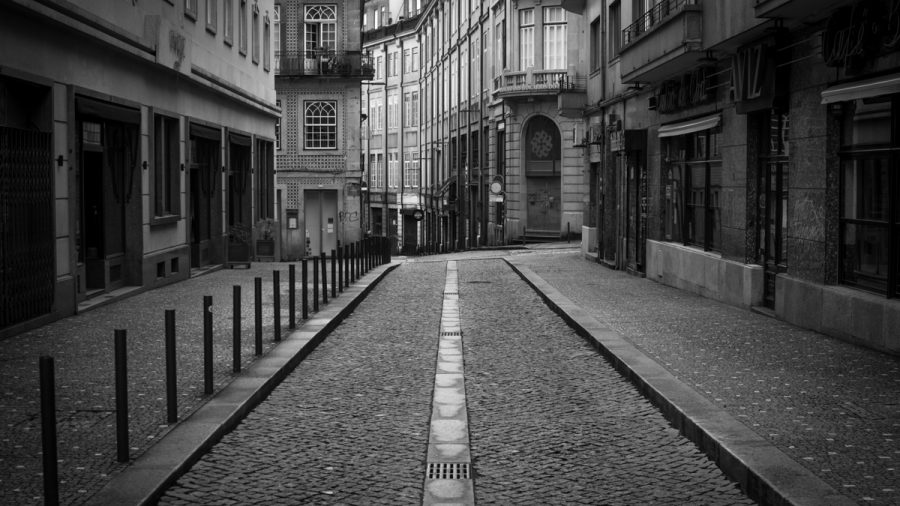
The Portuguese city that won the title of best European destination in 2019, and which is one of the most popular destinations for Erasmus students in Portugal is today empty, and filled with the deafening silence that roams the empty streets of the city.
Feeling of Emptiness
I used to work in the city centre, and during my bicycle commute I would pass through the busiest streets and avenues of the city, where hundreds of shops and university faculties were full of people, who create the rhythm to these neighbourhoods.
Now walking through those same places I passed by on ‘ordinary days’, I can see the extreme change the pandemic has caused in its journey through Porto: the people and stores I saw daily are no longer open as a ghostly atmosphere remains throughout the day.
It is sad to see this charming city this way now because in addition to its natural beauty, it is the people that give life to the place. During this crisis, what we see are great idle spaces waiting for everything to return to normal, with people only able to dream of a freedom they took for granted.
Despite the feeling of emptiness hanging over the city, Porto was one of the first Portuguese cities to apply a rigorous lockdown, with streets famous for their bars and clubs hurriedly closed to avoid crowds and possible contagions, thereby reducing the damage that could have been done.
Insecurity and Impotence
In the few days that I have been out to the market or to use public services, it seems that the majority of the population are following strict social isolation and other measures to prevent the spread of the virus.
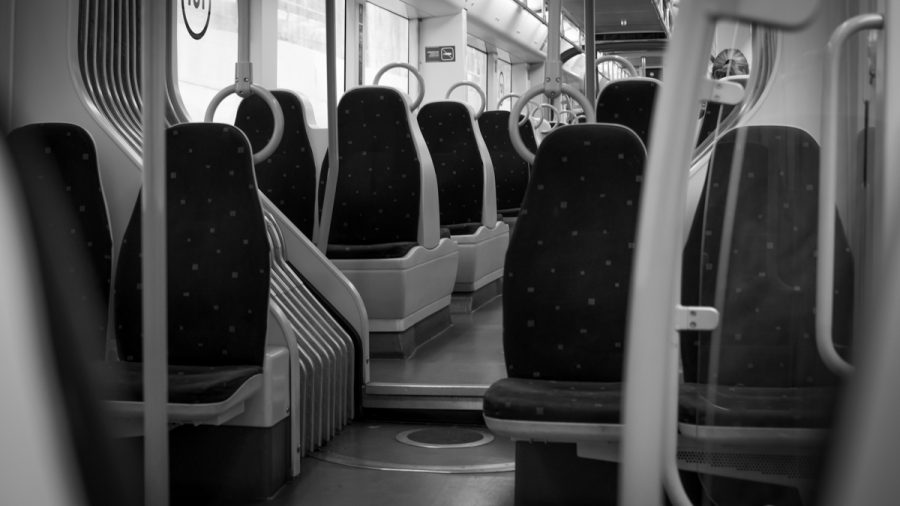
The change in pace of the city and people’s habits is remarkable; we can see this in small acts of daily life, such as taking public transport, which is the opposite of what it had been: now buses and trams are full of empty seats.
One of the measures first adopted was the deactivation of charging stations for tickets at all bus stops and subway stations so that people would avoid having to touch them, thus making all trips free. Yet all these are empty at the moment, or with few people waiting around for public transport. Those who still travel are keeping at a safe distance from one another. I see a bit of despair in their eyes, the only feature you can make out from their masked faces.
It is disturbing to think that a few months ago our lives followed the natural course of existence; I never imagined I would live to witness an event of this magnitude in the world, and I believe that none of us were prepared for such a change. A feeling of helplessness and insecurity is in the air with the virus.
Birds, Dogs, and Freedom
I’ve been spending most of my time indoors, moving from one room to room to the next, trying to break the monotony. These days I realise that one of the sunniest places in the apartment is in the laundry room, a small space that barely holds two people, but it provides us with a view over the street below, and a little sunshine, except when it’s raining.
Sitting in the laundry, in between thoughts, I stop to have a coffee and observe the neighbourhood. The only movement I can make out are people coming home with shopping bags from the supermarket, and dogs taking their owners for a walk.
These days I also notice that the trees in front of my apartment are full of birds, dozens of them, which spend their days singing, and coming and going between branches. This may seem like a cliché, but I envy the freedom of the birds have to come and go as they please.
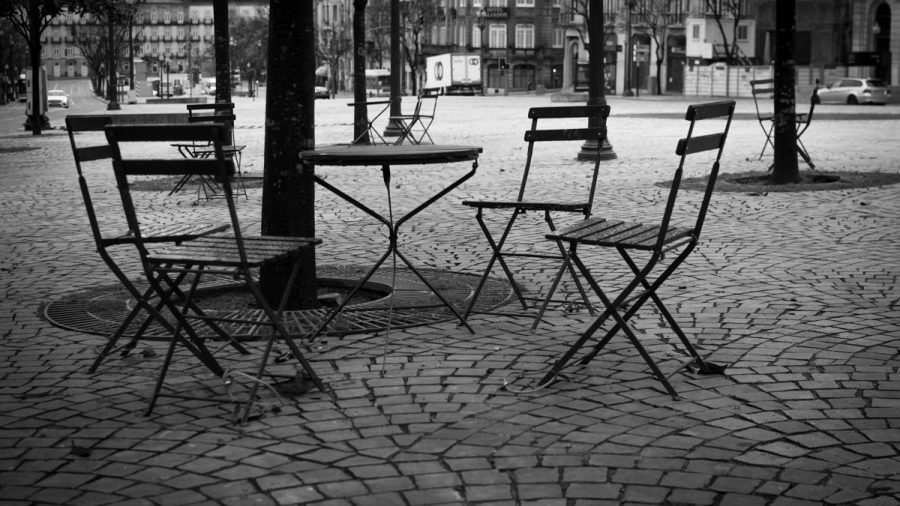
In the days that I went out to take the photos for this article, I was sure that the city had been taken over by pigeons and seagulls. I definitely saw more of them than usual in the squares and gardens!
The few people who venture to the squares share the space with the birds and the solitude of a city that has always been synonymous with joy and strength.
What I, other immigrants, and the Portuguese hope is that we can return to the life we had before, and be able to leave this prison, without bars, that our homes have become. While we try to renew ourselves, the city is still and visibly lacking the energy and joy of the local population.
What is most intriguing in this situation, at least for me, is that we are trying to reinvent ourselves. For example, I have started to cook a lot more during these days of confinement, learning new recipes, in addition to adapting the house for new activities we never used to do at home, like dancing and exercising.
Despite everything I believe that together we will overcome this difficulty, which is happening on a a global scale; staying at home admiring the birds and their songs that echo along with an inaudible cry for freedom from the citizens.
Featuring image and photography by Felipe Monteiro
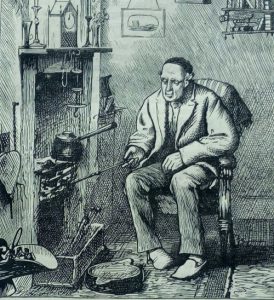
Here’s Mr Pip, aged parent”, said Wemmick, and I wish you could hear his name. Nod away at him Mr Pip, that’s what he likes. Charles Dickens, Great Expectations
Dickens’s Aged Parent, or ‘the AP’, looks contented as he pokes his fire. Most of us locked-down septuagenarians, I suspect, are restless to escape to some kind of normality, albeit a ‘new normal’, that is largely unknown. Meantime we amuse ourselves with the supports of modernity, media, reading and the infinite offerings of the world wide web, as well as absorption in whatever tasks are necessary and permissible, gardening if we’re lucky. The bottle banks may also have a tale to tell.
Few are free from undercurrents of anxiety, more or less severe. How long will this go on? What will the reckoning be? Mass unemployment, social unrest, collapse in asset values, savings emasculated?
There are other fears. If this can happen, then what else? The same or different? Fresh outbreaks of the virus? If world financial systems can somehow be made to cope with this emergency, suppose there’s another around the corner.?
We can have a gnawing sense that our civilisation got things wrong, that it is being, somehow, punished. A year ago I heard a retreat-giver say that we had lost the ability to read the signs of the times.
We had belonged, or thought we belonged, on a planet that although under threat, and although subject to disaster more or less randomly distributed, was broadly on a path of progress, of improvement, even for under-developed regions. Nature mostly provided balance and harmony.
Modern science reinforces this optimism at the cosmic level. We now know that the total universe that includes our Milky Way as one of nearly a hundred million galaxies has been expanding since the Big Bang. But if the rate of its expansion had been even a millionth of a percent slower, the whole thing would have collapsed, imploded in upon itself. There was fine tuning.
Now trust is at issue with a particularly severe jolt for the Western world.
It could be said that most of our strategies of coping are in the nature of distraction. To the extent this is so, the underlying unease remains. Call it dis-ease in fact.
Foreshortened Horizons
Speaking personally, the experience of being herded into seclusion as a 70-plus, brings home as never before, the sense of foreshortened horizons. Are we to lose a whole summer, that we can ill afford to forego, before illness strikes or the grim reaper shows up? At times the lockdown can feel like a dress rehearsal for the real thing. Heretofore, our unconscious aim may have been, as I heard the poet David Whyte express it, to get out of life alive. Yet he also warned: “Reality can be terrible when there’s no time left to say goodbye”.
Is there an alternative, some place where an AP can go, while staying put?
Let nobody mention God in this largely post-religious society! The theology of the Deus Absconditus might be a fit?
Willigis Jaeger, Benedictine friar and Zen master, died on 20th March 2020 in the midst of the Covid-19 crisis, at the age of 95. This is perhaps a suitable moment to invoke his wisdom.
Jaeger was regarded as a mystic, and got into trouble with the Vatican authorities in the time of Cardinal Ratzinger, when it was said that he was subordinating dogmatic teaching to the mystical path.
Jaeger’s declared aim was to unite the wisdom of East and West, incorporating recent scientific findings.
A completely new religious sensibility is awakening in society today. We can only hope that the rigidity ingrained in many religions can be overcome, so that oneness, interdependence, inter-relatedness and love can be experienced … Love is the founding force of the universe. The individual can attain to this realisation by retreating to a place of peace and rest from time to time and, dare I say, by engaging in the practice of the spiritual way.
In Buddhism the pathway is Zen, in Hinduism it is Yoga, in Islam it is the way of the Sufis, in Judaism it is the Kabala and in Christianity it is the way of the mystic.
‘Mysticism’ was defined by Jaeger as a state of ‘empty oneness’.
Mindfulness Revolution
This writer will not make the mistake of attempting to teach that which he has not yet learned. What might be called a ‘mindfulness revolution’ is well under way. Fundamental to all such practice is meditation and there are a variety of teachers on and off line who propose particular methodologies.
As is well known, the invitation is to work towards a personal stillness, the development of a capacity to be present in the moment. It is perhaps fair to say that a core element of the practice is to still the workings of the intellect or rational mind, which is usually in alliance with the ego. In fact it might be said that in the Western world, the human being has tended to become a thinking machine, powered continuously by media in its various forms.
Since our thinking capacity is virtually unstoppable, recourse is had to a device, a support – a focus on breathing, or repetition of a word (mantra) or, simply, inhalation and exhalation of the breath.
So many people, when discussing the value of meditation, will say, I could never be still, my mind is too active. As one who has persevered with this for twenty years, I can only say that the same is true for me. What one realises in time, however, is that each time the subject becomes conscious of a new distraction, and returns to the support, something useful has happened. We have rehearsed what it takes to be less identified with our thoughts, more open to whatever it is that is more. The goal, if there is one, is detachment.
Detachment
Detachment, it might seem runs counter to another stated aim, that of cultivating the capacity to be present, in the Now, as it is said. But in truth what is called for is a presence to self, to body, feelings and mind, and that is not possible save from a place of some detachment.
Concerning the difficulties of attaining a level of detachment – or disidentification – Joan O’Donovan, O.P. has written encouragingly:
We may not be able to disidentify, but we can become aware of how we are identified. That is to say that at the level of our everyday personal self we can begin to be aware of how identified we are with achieving, with seeking for affirmation, with self-justifying. We can practice becoming aware of all this in a non-judgemental way, without even trying to change or improve ourselves. We are simply aware. This simple act of awareness can be an amazing catalyst, because once we become aware of being identified, we are no longer identified.
She stresses however that this kind of self-awareness is not something we acquire by our efforts, because it is already in us.
It is an inner knowing that we can allow to emerge, a latent power of mind, a heart knowing of ourselves, a subjective knowing in which we uncover our own compassion, a compassion that goes from self to others. [ii]
Inducements
The direction that is being taken here does not promise any of the satisfactions of the world-ego.
Yet Jaegar does express what might be thought of as inducements!
We need to enter into a new dimension, a dimension of the unknown emptiness which is beyond all ego-activity. Anyone who breaks through to a deeper all-embracing level of consciousness will find new answers and develop a new understanding of life. Only in this dimension, beyond all rational understanding, will we find real meaning and purpose in our lives. Only when we experience who and what we really are – a timeless being at one with the essence of all beings – will we find answers to the questions of life and death.
The person who can enter this deep stillness will undergo a transformation. In this peaceful resting stillness something happens. The quietude changes us. This quiet is the place from which intuition arises. Decisive ideas are born here. They are not the product of discursive thought.
Although emphasising the value of spiritual practice, Jaeger was in some ways dismissive of religion. He was much influenced by the teachings of Meister Eckhart who was both a mystic and a theologian (and, like Jaeger encountered condemnation from Rome).
Jaeger defined spirituality as “a path to a trans-personal, trans-rational, trans confessional level of experience, where true reality is found”. But he considered that the true meaning of religion lies in the experience of this primary reality, a reality that has nothing to do with rational personal consciousness and lies deeper than all images and concepts.
He saw rituals and ceremonies as important, insisting that religion finds full expression in our daily life and that the experience of the essence of our true being permeates all life. He saw the value of maintaining linkage with mainstream religious traditions as a protection against our going off the rails.
He believed, however that a new language is urgently needed in the religious sphere. ‘I come across numerous people who can no longer understand the traditional language used in Christianity. The conventional images no longer speak to them or touch their hearts.’
The Truth
Part of the problem, perhaps, is that spirituality is a difficult subject to address: Mike Boxhall, a unique spiritual teacher who died in 2019 wrote: ‘Anything you can say about it is really not worth saying as what is said will be words about something, not the experience itself, and will therefore be a concept. A concept is about a truth and is not, and never can be, the Truth.’ [iii]
A spell in the cocoon, perhaps – especially if fed with periods of silence – may afford us a sense of having made some little progress on the path, and perhaps initiate a practice that would serve us well in our residual time. We may have the possibility to discover a self that is more than our everyday self, and in so doing, to exchange New Life for Old. [iv]
The compromise was forged in typical EU fashion at the third attempt after the Dutch Finance Minister led stiff resistance to a push from France, Spain, Greece and Italy for a ‘corona bond’, programme involving direct grants to those countries hardest hit by the pandemic.
The package is mainly made up of an emergency credit line worth 240 billion euros along with a 100 billion euro work subsidy plan. There are plenty of loose ends to be tied up – not least precisely how the rescue fund will be paid for.
North v South
The deal comes amid signs that the Union could itself be coming apart at the seams, with growing popular disillusionment with the project in southern Europe.
The Spanish Prime Minister, Pedro Sanchez, did not pull his punches when he warned his EU colleagues recently : ‘Either we respond with unwavering solidarity, or our Union fails.’
Of the large European states, Spain has suffered more deaths than any other on a per capita basis, though the horrors visited on northern Italy – the powerhouse of the Italian economy – stand out as a warning to us all.
Southern Europe is also heavily exposed economically. All the Mediterranean countries depend on tourism. The evisceration of the travel trade will hit them particularly hard. Coming into this crisis, Italy was particularly exposed, with a stagnant economy and a national debt of around 135 per cent of gross national product.
The Covid-19 crisis has brought back to the surface many of the intra national tensions that blighted relationships within the EU during the long sovereign debt crisis.
Once again, the so called thrifty northern member states led by Germany and Holland, with Finland and Austria in the background, find themselves facing down the group of southern European states including Spain, Italy, Portugal and Greece. A decade ago, they fell along with Ireland into a club of financially stressed states known as the PIGS.
French Switch
The Irish Government – steered by the caretaker Finance Minister, Paschal Donohue, has quietly been making common cause with the southern European group on the core issue of fiscal solidarity. However, the big switch of sides has involved France. That country – mighty in EU terms – adopted a hard line stance back in 2010 towards Ireland, acting in concert with the German Government.
With backing from the then Central Bank Governor, Jean Claude Trichet, the Irish Government was forced to sign on to a bailout where enormous bank debts were taken onto the books by the sovereign.
These days, France is far less well placed. The pandemic has hit home with savage effect. Its banking system is exposed to that in Italy.
It is now counting on a degree of solidarity at the heart of the Union which would have been unthinkable a decade ago when President Sarkozy worked side by side with Chancellor Merkel – a rare survivor from that period.
Post-Brexit U.K.
So how should one rate the response of European institutions and Governments to the Covid-19 crisis since it erupted on the Continent more than two months ago? It may be worth looking at how the U.K. has engaged with the economic threats posed.
In public health terms, the London Government failed to grasp the scale of the crisis and it has been playing catch up ever since. But one bright spot to date has been the decisive approach since mid-March of the new Chancellor of the Exchequer Rishi Sunak.
When he unveiled his Budget, his initial measures did not capture the full scale of the looming tsunami in human and financial terms. However, he has proved himself to be pretty adaptable. Sunak committed to pumping in thirty billion euros in his March Budget, soon following this up with a £30bn ‘furlough’ scheme to compensate employers who hold on to their employees in the crisis.
Recently, the Chancellor went further, effectively strong-arming the Bank of England into making an announcement that it would directly finance the operations of the British Treasury. While the Bank has insisted that the expansion in its balance sheet will not be permanent, the move is regarded as historic.
It is a move that would be considered as unthinkable by most officials in the German Bundesbank.
Since then, he has thrown the kitchen sink in an effort to staunch the flow of blood out of the economy. Economists have calculated that the package of tax reliefs, grants and business loans amount to £350 billion.
Perilous Period
Across Europe, national Governments have moved to tackle the crisis by propping up incomes. Northern European states tend to have efficient bureaucracies and reasonable resilient national balance sheets. But even in places such as prosperous Denmark, there are concerns that many businesses will not reopen after what is increasingly looking like a long shut down.
The picture in Southern Europe is as mentioned much more bleak. In Italy and Spain, there is a real sense of let down amid the crisis, though better off nations like Germany have latterly moved to show solidarity by sending supplies and flying some patients from Eastern France and northern Italy to their hospitals for treatment.
The recently appointed President of the European Central Bank, Christine Lagarde caused consternation when she suggested that the Bank would not bail out any Eurozone member state running up a large deficit. These were remarks her predecessor, the sure-footed Italian central banker, Mario Draghi, would never have uttered.
Lagarde was backed up at the time, by the Bundesbank head, Jens Weidmann, although she reversed her position, soon after.
Since then, the Bank has unveiled a series of measures aimed at propping up demand and supporting the countries hardest hit in the crisis, but Lagarde’s misstep will not have been forgotten.
The Commission
The European Commission under its new President, Ursula van der Leyen, has appeared to grasp the scale of the crisis, acting quickly to suspend the normal state aid procedures and relaxing the rules on national government deficits. It has deployed much of its budgetary resources, but its fire power is limited as Ms Van der Leyen has made clear.
He warns that sharply higher levels of public debt will become a ‘permanent feature of our economies.’
Banks must rapidly lend funds at zero cost to companies prepared to save jobs. Given that the banks would be acting as vehicles of public policy, the Government should guarantee all additional overdrafts or loans that they make.
The ECB has taken action by launching a €750 billion bond buying programme.
Many have joined calls for the launch of a so called ‘Corona bond’. The Irish academic, Brigid Laffan Director of the European University institute in Florence, argues that what is required is ‘the largest deployment of public finance and public power in peacetime in Europe.’
Domino Effect
The response to date from E.U. Governments – where effective decision-making is concentrated – has been less than inspiring. The Dutch Finance Minister Hoekstra caused particular annoyance in Madrid, Rome and Paris over his rather brutal dismissal of the ‘Corona bond’ proposal.
Matters were not helped by a headline in a leading Dutch tabloid following the conclusion of the ‘rescue’ deal: ‘The Netherlands wins European battle’ crowed the newspaper.
The splits go right to the top. The E.U. Commissioners, Thierry Breton and Paulo Gentiloni, have called for the creation of an Economic Recovery Fund, pointing out that ‘no European state has its own means enabling it to deal with the shock alone.
While E.U. governments have put in place contingency plans aimed at meeting the short-term cash flow needs of businesses, the scale of the crisis is only now being appreciated.
The French economist, Jean Pisani Ferry, has warned that the fall in economic activity as a result of Covid-19 could approach fifty per cent, with any recovery from a relaxation in the confinement likely to be both gradual, and subject to big interruptions.
The Belgian economist, Paul de Grauwe, warns that without coordinated action, we could be about to witness a domino effect, as the financial virus spreads from the corporate into the banking sector, and on to the sovereigns.
In his view the only solution is for E.U. Governments and institutions to think outside the box. The ECB, he argues, must follow the Bank of England in indicating a preparedness to buy Government bonds in primary markets, effectively issuing money to fund members state deficits.
Were this to happen, other leading central banks would follow suit and a 1930s-style meltdown could be averted. The alternative scenario does not bear thinking about.