‘We are alive in a time of worst-case scenarios. The world we have inherited seems exhausted, destined for an absolute and final unravelling’. So begins Mark O’Connell’s journey into our ever-darkening future.
There are, he notes darkly, fascists in the streets and in the palaces, while around us ‘the weather has gone uncanny, volatile, malevolent’. The last remaining truth, O’Connell proposes, ‘is the supreme fiction of money, and we are up to our necks in a rising sludge of decomposing facts. For those who wish to read them, and for those who do not, the cryptic but insistent signs of apocalypse are all around’.
The faint splattering sound that reechoes throughout ‘Notes from an Apocalypse’ is that of the shit hitting the metaphorical fan.
‘Listen. Attune your ear to the general discord, and you will hear the cracking of the ice caps, the rising of the waters, the sinister whisper of the near future. Is it not a terrible time to be having children, and therefore, in the end, to be alive?’, O’Connell muses.
Familiar Journey
The journey is a familiar one, in every sense. My mind flows back to early 2003, my first-born still an infant then, her future an unknown country. Out of the fog of broken sleep and newfound joys and terrors, I began, for the first time in my adult life, to look into the future. Not days and weeks, but years and decades.
What I found staring back was every bit as chilling as O’Connell’s more recent epiphany, and it has, to a lesser or greater degree, haunted my waking hours every day since then. As he points out, once you’ve become a parent, ‘whether it happens by choice or by chance, is that it is one of only very few events in life that are entirely irreversible. Once you’re in, existentially speaking, you’re in’.
This being the case, the next question effectively writes itself: How are we supposed to live, ‘given the distinct possibility that our species, our civilization, might already be doomed?’ While he may have lost hope, O’Connell certainly hasn’t lost his dark sense of humour, describing the curious feeling of being sick to death of the end of days. ‘I’m sick, in particular, of climate change. Is it possible to be terrified and bored at the same time?’, he wonders aloud.
Back in the good old days of the Cold War, the spectre of global annihilation was never far away. And while the risks were all-too-real, in reality it was always a binary proposition: either we would have a total nuclear war or nothing at all would happen. And, with luck, cooler heads would prevail and catastrophe would be avoided.
O’Connell notes that we civilians were pleasantly blameless, either way, mere bystanders ‘whose role was limited to cowering in terror, maybe holding the occasional placard, partaking here and there in a chant if called upon to do so’. In classical eschatology, the apocalypse, whether religious or secular, would be delivered in a blinding thunderbolt, ‘a sudden intercession of divine or technological power’.
The very real doom that encircles us is altogether more banal, more insidious and one in which we are both helpless bystanders and active, albeit unwitting, participants. To be alive today, to live in a prosperous modern society is to be an integral part of the very linear system of consumption, expansion and disposal that is fast destroying the natural world and the very basis for our current prosperity and all future prospects for every generation that succeeds us.
Image: Daniele Idini
Footprint
O’Connell acknowledges the thin irony that his own gloomy travelogue entailed vast emissions of the very carbon that is burning down the world. ‘My footprint is as broad and deep and indelible as my guilt… I myself am the apocalypse of which I speak. That is the prophesy of this book’.
That ‘Notes from an Apocalypse’ should be published in the midst of the first global pandemic of the Internet Age seems grimly apposite, life in imitation of art as the confident certainties of our world unravel in unpredictable, non-linear ways.
O’Connell vividly describes his growing obsession with the imminent collapse of civilisation. He sees himself as being obsessed with the future, ‘an obsession that manifested as an inability to conceive of there being any kind of future at all…my journalistic objectivity, a fragile edifice to begin with, was under considerable strain’, he adds.
Many people seek to escape their demons. In this trade, that’s not so easy. ‘It is both a privilege and a curse of being a writer that throwing yourself into your work so often involves immersing yourself deeper into the exact anxieties and obsessions other people throw themselves into their work to avoid’.
The book, O’Connell accepts, probably was initially conceived as a form of therapy, though he admits to what he calls a more perverse motivation: ‘I was anxious about the apocalyptic tenor of our time, it is true, but I was also intrigued. These were dark days, no question, but they were also interesting ones: wildly and inexorably interesting. I was drawn toward the thing that frightened me, the thing that threatened to tear everything apart, myself included’.
This gave him the impetus to embark on a series of what he describes as perverse pilgrimages ‘to those places where the shadows of the future fall most darkly across the present’. Nor is the overtly religious framing accidental. ‘If I could be said to have had a faith in those days, it was anxiety—the faith in the uncertainty and darkness of the future’.
O’Connell’s research took him into many dark places; he describes being unable to click on links in his computer’s browser ‘for fear that what I gained in knowledge I would lose in sanity—my online existence was saturated in a sense of end-time urgency’.
In other circumstances you could reasonably infer that the author was in reality experiencing what is for all intents clinical depression, the key difference being that the auguries of catastrophe which he was consulting are not the product of his fevered imagination, but are a painfully accurate reflection of the world as it stands.
‘Preppers’
Avoiding the sensible options of pouring his energies into what might be seen as more constructive channels, O’Connell ‘set out towards the darkness itself’. And where better to start than with the weird US sub-culture called ‘preppers’. This group consists almost exclusively of middle aged and older white males with an unnatural interest in dried food, assault rifles and racism.
O’Connell is merciless in his depiction: ‘as a group, preppers were involved in the ongoing maintenance of a shared escapist fantasy about the return to an imagined version of the American frontier—to an ideal of the rugged and self-reliant white man, providing for himself and his family, surviving against the odds in a hostile wilderness’.
In seeking to rekindle some imaginary frontier spirit, what preppers are in fact doing, he adds, is ‘creating the necessary conditions for a return to the cleansing violence of the nation’s colonial past … In fact, you couldn’t even properly call it crypto-fascism: it was really just good old-fashioned original-style fascism’. The National Geographic’s TV channel ran a series for three years called Doomsday Preppers; O’Connell gorged on many hours of it on YouTube as part of his research. While ostensibly about gearing up for post-apocalyptic survival, he believes the show ‘is in fact a reality TV psychodrama about masculinity in crisis’.
Preppers, he concludes, ‘are not preparing for their fears: they are preparing for their fantasies. The collapse of civilization means a return to modes of masculinity our culture no longer has much use for’.
While disagreeing with them in almost every regard, O’Connell admits to relating to the ‘distributed matrix of unease from which the certainty of collapse grew. I, too, with my pessimism, my intimate imagination of the world’s unravelling, had driven my own wife, if not to despair itself, then to somewhere in its vast and crumbling exurbs’.
I can certainly attest to the strain that burdening yourself with documenting the slow, agonising death of the world imposes both on you as an individual and on your long-suffering spouse and family.
O’Connell’s perverse pilgrimage takes him to the wilds of South Dakota where, for a price, you can buy a bunker with all the mod cons. This bug-out fantasy is being marketed and sold with the characteristic exuberance of the U.S. real estate industry. ‘This was a new entry into the apocalyptic imaginary: bankers and hedge-fund managers, tanned and relaxed, taking the collapse of civilization as an opportunity to spend some time on the links, while a heavily armed private police force roamed the perimeters in search of intruders. All of this was a logical extension of the gated community. It was a logical extension of capitalism itself’.
At its cold heart, this amounts to the haves battening down the hatches against the have-nots, unequal to the bitter end. Unlike the old anti-nuclear war slogan, it appears that all men will not in fact be cremated equal. And nowhere is this inequality more apparent than in New Zealand, now the world’s favourite end-of-the-world bolthole for the excessively rich.
‘Everyone was always saying these days that it was easier to imagine the end of the world than the end of capitalism. Everyone was always saying it, in my view, because it was obviously true’, O’Connell continues. ‘The perception, paranoid or otherwise, that billionaires were preparing for a coming collapse seemed a literal manifestation of this axiom. Those who were saved, in the end, would be those who could afford the premium of salvation’.
Image: Daniele Idini
Backup Planet
Next, O’Connell tagged along with the space colonisation enthusiasts, most notably oddball billionaire Elon Musk, who described Mars as our ‘backup planet…just in case something goes wrong with Earth’. Similar to doomsday preppers with their bags of dried food, ‘Mars colonisation is apocalyptic scenario as escapist fantasy’.
What he describes as a narrative of exit is, O’Connell argues, fundamentally male, a yearning for escape ‘as a means towards the nobility of self-determination’. The world, our world, urgently needs attention, care, rehabilitation, yet the ultra-rich techno-fantasists are instead writing it off, dreaming of new empty spaces to subjugate, to colonise, to shape in their image, without state or societal oversight, a darkly Utopian fantasy played out on the blank canvas of the cosmos.
‘The politics of exit are pursued, according to cultural critic Sarah Sharma at the expense of a politics of care. ‘Care, she writes, is that which responds to the uncompromisingly tethered nature of human dependency and the contingency of life, the mutual precariousness of the human condition’. To repudiate the Earth is to reject the imperative of care.
It goes without saying that the escapist daydreams of the wealthy elites envisage salvation only for the tiny handful; the mass of humanity will, it seems, be consigned to burn, fight and starve amid the smouldering wreckage of a plundered biosphere that has been asset-stripped to the bone.
The intuition that many of the global 0.001 percenters actually seriously believe this stuff makes sense of a circle I have long struggled to square: how can tycoons and titans so blithely ignore the ever-encroaching ecological consequences of the profitable destruction they are orchestrating? Surely they too have kids, they must ultimately breathe the same air and drink the same water as the rest of us? Well, apparently not.
The colonial mindset that saw groups of determined Europeans and later, Americans, set out to conquer, subdue and enslave every country on Earth they encountered that was incapable of fighting them off is alive and well, and the age of gunboat colonialism has been replaced by the more subtle but equally effective economic colonialism.
East India Company
Today, as before, ultra-cheap goods, minerals and raw materials flood out of the global South through trade channels controlled by powerful transnational corporations whose monopolies are operated every bit as ruthlessly as the East India Company, which enjoyed a royal charter giving it permission to ‘wage war’ and, at its peak, had its own army numbering 260,000 troops, twice the size of the then British army.
The rape, pillage and plunder of the Earth has as a project been underway in earnest for centuries, but it is those of us alive in the 21st century and without tickets to Mars, who are about to reap the whirlwind.
As O’Connell notes, capitalism, ‘which exists and thrives through expansion of its own frontiers, through a relentless force of deterritorialization, is running out of frontiers; running out of boundaries to obliterate, nature to exploit’. The legacy of what he terms its monomaniacal pursuit of cheap resources is a ‘devastated planet that soon may be unliveable for vast numbers of its inhabitants’.
Just quite how soon and for just how many was to become clearer even as I was reading ‘Notes from an Apocalypse’. It came in the publication of a new peer-reviewed study using data from UN population projections and a 3ºC global warming scenario in line with current scientific projections.
While we think of ourselves as a highly adaptable species, filling niches from the high Arctic to the tropical jungles, in reality, most human populations are concentrated into narrow ‘climate bands’ in areas where the average surface temperature is in the range of 11–15ºC.
An average global surface temperature rise of 3ºC in the coming decades would leave some three billion people in areas with average temperatures as hot as the Sahara desert is today. Wide tracts of India, Australia, Africa, South America and the Middle East will, in just a matter of decades, be essentially uninhabitable for humans and most animals.
Consider the impact of 2-3 million refugees fleeing the aftermath of conflict in the Middle East and how the impact of these desperate migrants strained the EU almost to breaking point. Now, multiply that not by 100, but by 1,000 and suddenly the idea of escaping to establish a colony on a barren neighbouring planet no longer seems quite so insane.
Back on planet Earth, the Arctic is burning. ‘That there were wildfires in the Arctic Circle felt like the most important fact in the world. This was a thing we should never not be thinking about, talking about… the subtext of every news headline now, of every push notification, was that we were completely and irrevocably fucked’.
Image: Daniele Idini
An Island Apart?
O’Connell, who is Dublin-based, recalls sharing office space with an ecologist, who told him people often ask her how Ireland will fare with climate change. Overall, and relative to so many other countries, actually pretty well, is the short, but entirely incomplete answer.
‘What would it even mean, after all, to be fine in the context of a drowning world, a world on fire? We were a small island, with nine hundred miles of coastline and an army that would by itself be effectively useless against any kind of invasion. We would be relying, she said, on the goodwill of other countries whose people were starving, drowning, burning. We would not be fine’.
O’Connell’s meditation returns time and again to his own son, from whom he feels he is keeping a secret. ‘Just as I want him to continue believing in Santa Claus for as long as possible, I want to defer the knowledge that he has been born into a dying world. I want to ward it off like a malediction’.
He outlines the complex denialism both he and his wife engage in to shelter their son and his newly born sister from true knowledge of the world as it is. ‘There are times when it seems that we are protecting him, and protecting ourselves, from a much deeper and more troubling truth: that the world is no place for a child, no place to have taken an innocent person against their will’.
O’Connell strikes a universal chord by observing that becoming a parent means having a radically increased stake in the future. Being responsible for a person who must live in the place and time normally inhabited only by your deepest fears means ‘I no longer feel the definitive force of pessimism as a philosophy…life no longer seems to afford me the luxury of submitting to the comfort of despair’.
In what may be a rich irony, O’Connell professes to having lost his taste for cosmic nihilism: ‘Lately I have been glad to be alive in this time, if only because there is no other time in which it’s possible to be alive’.
While it might seem glib in the extreme to be seeking out teachable moments from the imminent collapse of the biosphere and the extirpation of our species among countless others, what does perhaps emerge from his journey is a deeper, visceral understanding of what it truly means to have been alive in the first place.
Notes from an Apocalypse: A Personal Journey to the End of the World and Back by Mark O’Connell, Granta, London, 2020.
Fear plays a major role in influencing the decisions we make and the actions we engage in. Research has shown that there are sound evolutionary reasons for this. The selection pressures from these types of danger have resulted in domain-specificity in the reactivity of the fear system, meaning that the system has evolved special sensitivity toward such dangers. However, ‘not all human fearsare instinctual and hardwired—we need to learn what to be afraid of.’[i] While this capacity is critical in helping humans deal with the different environments in which they find themselves and which present different sources of ‘danger’, it can also be abused by those seeking to advance their own interests at our expense.
Harnessing Fear in the name of ‘Sales’
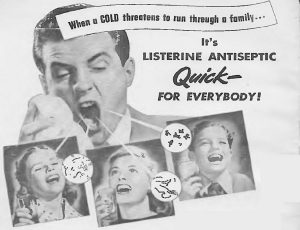
The power of fear has long been recognised as a potential source of profit by the business world. Preying on anxieties and ‘creating’ new ones when required to suit their needs, marketing departments have managed to exploit human fears to successfully boost client sales. As Kali Halloway writes: ‘Listerine’s 1920s ads turned bad breath from a fairly common minor flaw into halitosis, a condition that made you into a social pariah, sexless and alone,’ – leading to an increase in sales in just seven years from $115,000 to over $8 million. ‘In the 1930s, Lysol – a product we now know should be kept as far from genitalia as possible – was marketed as a douche (and more covertly, as feminine birth control), in ads that basically told women no one would ever love them with their awful natural-smelling vaginas.’[ii]
Indeed, even the threat posed by pandemics have provided grist to the mill for opportunistic marketing teams, keen to leverage the fear generated in their diffusion. According to Barry Shafe, the former head of Cussons product development and man behind the launch of Carex in the UK during the SARS epidemic, ‘background noise of pandemic fear was all that was needed to drive consumers to antibacterial soap.’ There was no need to even emphasise the element of fear in their advertising for the project as ‘real fear sells better than invented fear.’[iii]
While the manipulation of the public’s purchasing choices through exploiting the evolutionary programmed and adapted prism of the human ‘fear emotion’, is at the very least questionable, it is only the tip of the iceberg in this respect.
Ad extracted from a scanned copy of the pulp magazine Weird Tales from 1950,
Fear and Hatred in Times of Plague
In times of plague and pestilence, fear is an omnipresent companion. This fear all too frequently translates into a desire to find someone to blame for the danger with which we are faced. The greater the threat to people’s safety and the less control they can exercise over it, the greater the risk that blame for their dilemma will be ascribed to an ‘outside’ group, generally those who are not members of one’s community or nation, no matter how transparently illogical the reasoning.
As Dr. Jonathan Quick writes:
We are all afraid of death. We respond to the fear of epidemic disease by wanting to blame someone else. Anytime a threat arises, we want to blame the “other,” those not like “us.” At the outbreak of the 1918 Spanish flu, Americans blamed “the Hun”. AIDS was blamed on gay men.[iv]
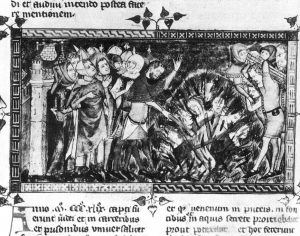
During the Black Death, which struck Europe in the mid-14th century, there was widespread fear and panic as this unknown disease wreaked havoc throughout Europe. Although communities around Europe often turned upon those seen as outsiders, particularly other nationalities, the Jewish community became the primary focus of this fear. This resulted in horrific instances such as the massacres of Jewish people in Frankfurt and Brussels and the extermination of the Jewish populations in Narbonne and Carcassonne.[v]
Representation of a massacre of the Jews in 1349 Antiquitates Flandriae (Royal Library of Belgium manuscript 1376/77).
‘Fake News’
The predilection to blame outsiders, the ‘other’ for the spread of infectious diseases, is further aggravated by the propagation and dissemination of false rumours. The author Maryn McKenna, who researched this phenomenon during the Ebola crisis came up with a term for this, ‘Ebolanoia’. Tracking public response to Ebola in the U.S., McKenna related how individuals and businesses that had been incorrectly identified as having been exposed to Ebola suffered as a result.
False rumors caused a small, long-standing, family-owned bridal shop in Ohio to close. Rumors forced healthy school personnel and students in North Carolina and Texas who had visited West Africa to stay out of school, even though they were thousands of miles from the nearest Ebola outbreak. Misinformation fomented harassment of African-born students as well as other acts of fear and discrimination.[vi]
The anti-Chinese messages currently being circulated in the mainstream media and through social media are generally linked by their proponents to a desire to hold China as accountable for both the spread and deadly impact of Covid-19. While some of these inferences have been less direct, casting suspicion and opprobrium on China and the Chinese people by association, others have given free rein to their racist impulses, such as the French newspaper that proudly displayed the headline ‘Yellow Alert’.[vii]
Dubious as these assertions are in the first place, they are made even worse by the conflation of ordinary Chinese people with the purported misdeeds of China, which has led to serious racist incidents and discrimination against Chinese people around the world. Furthermore, it behoves us to remember that the racist slandering of Chinese people is not occurring in an historical vacuum. It, in fact, stands on the shoulders on a substantial corpus of anti-Chinese racism that has been present for well over a hundred years.
‘Yellow Peril’
The likelihood that a specific outside group – ethnic, religious, etc – will be stigmatised and discriminated against, as well as the severity of the reaction, will be influenced by the history of how these people have been regarded in the past.
As a child growing up, I remember hearing the phrase ‘yellow peril’. I had no idea what this term meant or referred to apart from the fact that it in some way indicated a potential threat. However, like so many phrases that slipped into everyday usage, divorced from their original context, the phrase ‘yellow peril’ has an insidious and disturbing history. As Vince Cable, former leader of the Liberal Democrats, writes:
In the early years of the 20th century there was a deep fear among western societies, expressed both in politics and popular writing, that they were in danger of being overwhelmed by the Chinese: the “Yellow Peril”. Children’s comics were full of the exploits of the evil Dr Fu Manchu, a Bond-type villain bent on world domination. Even serious writers such as Jack London perpetuated the myth. In 1911, the British Home Office circulated material which warned of a “vast and compulsive armageddon to decide who is to be a master of the world; the white or yellow men”.[viii]
Anti-Chinese violence in Britain and the ‘Empire’
19th and early 20th century society in Britain overtly displayed its anti-Chinese sentiments. Racist depictions of Chinese were widespread in the media and this had a knock-on effect, impacting how they were dealt with by the judicial system and in other areas of daily life.[ix] Anti-Chinese feeling even led to acts of violent aggression against the Chinese community. Discussing the current racist violence against the Chinese in Britain, Suresh Grover of The Monitoring Groupexplains, ‘[T]he experience of racism against the Chinese community is not a new feature in British society” with “reports of race riots targeting Chinese businesses and laundries as early as 1919.’[x]
This racist attitude towards Chinese people was rife throughout the ‘Empire’. Schools were segregated in Victoria during the latter part of the 19th and early 20th century[xi] and in British Columbia Chinese Canadians were subject to social, economic and political segregation.[xii] According to OmiSoore Dryden the James Robinson Johnston Chair in Black Canadian Studies in the Dalhousie University Faculty of Medicine:
Anti-Chinese racism has a long history in Canada — the Chinese head tax, the Exclusion Act, just to name two. Chinese people were often referred to as the “Yellow Peril” — a plague, something that would bring destruction to white people and colonial Canada.[xiii]
These racist incidents and stereotyping of Chinese was based on a sentiment of ‘white’ superiority over other races that justified a discriminatory treatment of these people. This feeling of racial superiority is perfectly captured in the following quotation from Edmund Barton, the first prime minister of Australia, when discussing the Immigration Restriction Bill in 1901:
There is no racial equality. There is basic inequality. These races are, in comparison with white races … unequal and inferior. The doctrine of the equality of man was never intended to apply to the equality of the Englishman and the Chinaman. There is deep-set difference, and we see no prospect and no promise of its ever being effaced. Nothing in this world can put these two races upon an equality. Nothing we can do by cultivation, by refinement, or by anything else will make some races equal to others.
Anti-Chinese Violence and Segregation in 19th and 20th century U.S.
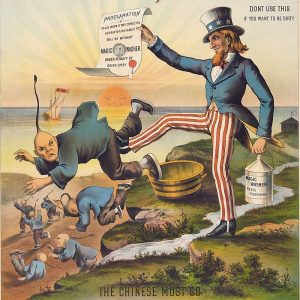
An 1886 advertisement for ‘Magic Washer’ detergent: ‘The Chinese Must Go’.
It was racist stereotypes such as these that led to widespread discrimination and segregation of Chinese people, particularly in predominantly ‘Anglo-Saxon’ countries. In the U.S. for example there were many instances of white people violently assaulting Chinese communities. In 1885, 150 armed white miners forcibly expulsed Chinese immigrations out of Rock Springs (Wyoming), murdering 28 people and burning the homes and businesses of members of the Chinese community. This massacre went unpunished. This incident, however, was only one of many. As Brayden Goyette writes, in the 1870s and 1880s, there were 153 anti-Chinese riots that broke out in the American West.[xiv] According to the historian James Mohr:
…in Honolulu, doctors, colonial administrators, and the general US colonial population lamented the outbreak of bubonic plague in 1900 because it prompted fears that the city would become associated with Asia, where plague was then present… Ultimately, the public health authorities burned contaminated buildings, but fires spread beyond their control and consumed most of Chinatown in flames. Similar anti-Chinese responses occurred in San Francisco during the plague epidemic of 1900–04, when Chinese-specific quarantines were enacted.[xv]
The insecure environment within which the Chinese found themselves led to a process of self-segregation by the Chinese to safeguard their communities and families. As John Kuo Wei Tchen, chair of public history and humanities at Rutgers University and co-founder of the Museum of Chinese in America in New York explains, ‘[T]he Chinatowns we know today — in New York, San Francisco and Los Angeles — are really the consequence of the exclusion laws, which created the conditions, between racism and the law itself, for segregated, isolated Chinatowns.’[xvi]
The continuing plague of Anti-Chinese Racism
According to Suresh Grover, the 2001 Foot and Mouth crisis, saw a distinct increase in racist incidents against the Chinese community ‘due to the unsubstantiated smear that the disease had spread from a Chinese restaurant using illegally imported meat.’[xvii]
A 2009 review on the racism experienced by Chinese people, conducted by the University of Hull and The Monitoring Group (TMG), concluded that the Chinese community was subjected to significant level of anti-Chinese racism in Britain:
The UK Chinese people are subject to substantial levels of racist abuse, assault and hostility. The types of racist abuse suffered by the UK’s Chinese people range from racist name-calling to damage to property and businesses, arson, and physical attacks sometimes involving hospitalisation and murder.[xviii]
This racism can be quite insidious and permeate virtually every area of daily life, even where one might least expect it. Writing about the racism experienced by Chinese people, the actress Elizabet Chan describes how on her first role, ‘the Bafta-winning director chuckled to everyone on set that I’d trained in kung fu,’ and how in her field ‘any character who speaks in some kind of dodgy east Asian accent is considered hilarious.’[xix]
The racism that continues to permeate is inappropriately nourished by the racist tropes of our past. As Sophie Couchman, a curator at the Chinese Museum in Victoria state, states,
It is disappointing that the same language is still used, certain words we used in the 19th century to talk about Chinese immigration – ‘influx’ and ‘swamped’ – and it’s all these sort of monsoonal words.
Covid-19 and upsurge in anti-Chinese racism
The current Covid-19 crisis has seen a dramatic rise in racist assaults on Chinese people globally as a result of their stigmatisation on traditional as well as newer social media. A major contributing factor in this rise has been the reckless use of derogatory references to China by elected politicians. The most egregious example of this is of course the U.S. president, Donald Trump, who on numerous occasions referred to ‘coronavirus’ as the ‘Chinese virus’.[xx]
Trump has NO empathy or compassion.
This is what he looks like during an EPIC crisis that is #COVID19
In the U.K., there have been numerous incidents of violence perpetrated against Chinese people as well as other East Asian people mis-identified by their assailants as being of Chinese origin. Reported incidents include,
confirmed reports of incidents of serious assaults against Chinese students by large groups of white youth …abuse in supermarkets and Chinese owned Take-away businesses, racist graffiti on shop windows and physical violence on the streets or around international student hostels… a Japanese person … greeted as Chinese and then deliberately urinated upon … the attack on the young man from Singapore who was beaten up in February by youths who punched him in the face before shouting out ‘coronavirus’ .. on Oxford Street, one of the busiest streets in the world.[xxi]
Ireland has not been immune to this reaction on the part of its citizens, as was evident in the racist attack on a Chinese restaurant in Galway.[xxii] The anti-Chinese reaction, provoked by Covid-19 has also been widespread in Asia, where restaurants in South Korea displayed ‘No Chinese allowed’ signs in the early stages of the pandemic, Twitter users in Japan initiated the hashtag #ChineseDontComeToJapan trend and over 125,000 people in Singapore, added their names to a petition urging their government to prevent Chinese nationals from entering the city-state.[xxiii]
Promotion of anti-Chinese racism
The perfect storm of victimising the ‘other’, arises the ‘desire’ to blame the other for one’s predicament is seized upon by ideologues to promote their objectives or, in the case of political, business and religious leaders to cover up their own inadequate or misdirected efforts to tackle the threat. The willingness of prominent politicians with large constituencies of ‘followers’, to promote a ‘Blame China’ narrative has contributed significantly to the upsurge in the targeting of the UK’s Chinese and South East Asian communities.[xxiv]
There are two principal reasons why political and other major economic and social figures in the Global North are seizing upon this opportunity to stigmatize China.
At the broader level, the emergence of China, particularly in terms of its’ economic and technical expansion, has created unease and anxiety amongst many in both the US and Europe, as they fear their position of economic and political dominance is being threatened. As the journalist Patrick Cockburnobserves while:
Many politically palatable reasons… will be advanced in the coming months… the real charge against China is one of effectiveness. It has shown itself more competent than other powerful states in dealing with two world crises: the 2008 financial crisis and the pandemic of 2019-20.[xxv]
A secondary and, in the case of leaders such as Trump who have completely mishandled the Covid-19 crisis, more immediate goal is to indict, criminalise and convict China in the court of public opinion, thus distracting from their own ineptitude in a desperate effort to revitalise their political prospects. Now, rather than being seen as the principal architects of the disastrous response to Covid-19 which has resulted in many thousands of death, political leaders in Covid-19 ravaged countries can depict themselves as righteous defenders of their nation’s security and safety against the new ‘yellow peril’.
Fudging Statistics
One of the major excuses for the political onslaught against China has been the alleged fudging of statistics on the number of fatalities and case incidents in Wuhan and how this may have impacted upon the measures the U.S. and Europe implemented to tackle the virus.[xxvi] The thesis appears to be that if more cases and more deaths had been reported early on by the Chinese authorities, this would have conveyed the seriousness of the threat to the political leaders in the U.S. and Europe. The authorities in these countries would then have taken the threat of Covid-19 more seriously and ensured appropriate measures were in place to minimise its impact on their countries and citizens.
Covid-19 was a new virus and therefore required a certain amount of time to be identified and its exact nature determined. It is more than possible that the number of fatalities and cases was greater in China than recorded and that its virulence was therefore underestimated initially. It is also likely that at the earlier stages many cases were not identified and that it was circulating earlier and more widely than initially thought. We have seen in the past week or so, reports emerging from several countries including, inter alia, France and the U.S, that cases were present well in advance of earlier estimations.[xxvii]Ireland probably also had cases prior to initially believed, as this coronavirus might actually have reached Irish shores as early as last year.[xxviii]
It is clear that if there was a significant excedent of cases and fatalities above those initially communicated by China to the international community that this could be argued to have made the new virus appear less threatening that it actually was. However, the reports on the level of fatalities and cases received by the international community were the same for all. Yet, despite this, countries such as Viet Nam, Singapore, South Korea, New Zealand, Cuba, and several others were able to introduce measures to effectively minimise the spread and impact of this coronavirus, others failed miserably.
A case in point is that of Viet Nam. In Viet Nam, as of May 7th, there were only 288 confirmed cases with no reported fatalities.[xxix] This low incidence of cases has been achieved despite the fact that Viet Nam has a population of over 90 million, shares a lengthy border with China, has a relatively weak health sector, compared to wealthier countries, and the inability to carry out widespread testing as was the case in South Korea. Critical to the success of Viet Nam in tackling Covid-19 has been the stringent and effective measures imposed by the authorities there, a united political will and the social discipline and unity of the Vietnamese people along with building on the lessons learned from dealing with previous epidemics.[xxx]
This would appear to indicate that irrespective of the validity of the charges against China with respect to their transmission of the number of cases and fatalities, the information provided by China was sufficient for appropriate prevention and containment measures to be implemented.
International Fudging?
Fellipe Lopes/Cassandra Voices
Furthermore, there is reason to doubt much of the figures that have been reported internationally on both fatalities and incidence of cases.
Ireland has encountered several difficulties in providing reliable and up-to-date statistics on Covid-19 in Ireland and adjustments have already had to be made to previously supplied totals. Ireland has also had issues with respect to delays in testing[xxxi] resulting in late updating of coronavirus figures, false negatives[xxxii] and the tragic case of an 89-year-old man who died of the virus before even receiving his results[xxxiii], which would appear to confirm the belief that we will see more amendments to the current totals further down the road. The accuracy of the numbers provided of people infected has also been criticised by members of the health service involved in treating patients directly.[xxxiv]
There are serious grounds on which to question the figures that the United Kingdom has reported. The Office for National Statistics (ONS) in the UK estimated that the actual number of deaths in England and Wales up to April 17, and registered to April 25 were some 23,000, some 6,375 higher than the figures by NHS England and Public Health Wales collectively, which were only documenting hospital deaths.[xxxv] However, on the 28th of April, the day before the UK started to include non-hospital Covid-19 related deaths, the Health Ministry announced the total deaths for the UK were 21,092 in hospital settings, still less than the number provided by the ONS for 11 days earlier and which only covered England and Wales[xxxvi]. The Financial Times in a report, which generated significant attention, estimated that, in fact, the actual death total in the UK would be over twice the figure reported.[xxxvii]
A further issue arises in trying to engage in international comparison of available statistics, in particular the fatality rate per confirmed cases. As it currently stands on May 7th, the number of confirmed cases in Ireland amounts to 22,385, with a reported mortality total of 1,403.[xxxviii] This is a mortality rate of just under 6.3 % relative to the number of confirmed cases. In the U.K., the total confirmed cases on the same day was 215,858, with 29,958 deaths recorded. This equates to a mortality rate of 13.9% of the identified cases. While allowance needs to be made for the fact that countries are at different stage of the Covid-19 curve, this can hardly fully explain the dramatic differences in these statistics.
Cooperation and Respect
As Patrick Cockburn writes, the approach of the Trump administration in promoting a form of cold war against China is highly irresponsible given the need at this time for a ‘global medical and economic response… to counter a virus that has spread from Tajikistan to the upper Amazon and can only be suppressed or contained by international action.’[xxxix]
It is not only in tackling Covid-19 now that such cooperation is essential. If we are to ensure the global protection of humanity, of all people wherever they may live, we need to establish an international framework through which we can all contribute to the future protection of our species, in an atmosphere of mutual respect free from discrimination and racist slurs.
As OmiSoore Dryden remarks,
…racist stereotype causes harm, not only to Chinese people and to Asian people, but to all of us. Viruses are not caused by a specific people. Gay people and African people did not create HIV. Chinese people did not create SARS or COVID-19. These types of racist stereotypes are diversionary tactics that do nothing to stop the spread of viruses.[xl]
The Way Forward?
Writing in 2004, Christopher Duncan, a zoologist and Susan Scott, a social historian, noted that since 1970, some 34 years, [A]t least 30 previously unknown infectious diseases for which there is no fully effective treatment have appeared… more than are known to have emerged in the preceding 3,000 years.”[xli]
The zoologist Peter Daszak, president of the New York – based EcoHealth Alliance, has researched coronaviruses and inter-species transmission of viruses in China. In 2013, he suggested that given the ability of coronaviruses to rapidly move between species, that it would be advisable to made an investment of about $1.5bn. which he estimated would enable the discovery of ‘all the viruses in mammals.’ This would permit the development of the required vaccines and test kids to successful cope with and stop the first stage of new infection disease emergences.[xlii]
If Daszak’s advice had been heeded when it was made back in 2013, it is quite possible that we might have been able to effectively stop Covid-19 at source or at least severely impede its progress, thus buying time for the implementation of the required measures to eradicate its threat. Of course, hindsight is a wonderful thing but while we can’t turn back the hands of time, we need to prepare for the future and other potential viruses. The past 20 years have seen the emergence of a growing number of infectious diseases– SARS, MERs, Zika… It is therefore imperative we come together as an international community and pool our cumulative resources to formulate policies and put in place measures to protect ourselves from future potential threats. The stigmatisation and abusive racialisation of nations or people has no place in this process and we must reject it absolutely.
Final Thought
As Prabir Purkayaashta writes, [T]he Covid-19 pandemic is only uncovering the deeper fissures that are already existing, and widening existing fault lines in the world.[xliii] We need to be vigilant to this, particularly the appalling legacy of anti-Chinese racism at this time, though we should also remember that the colonial empires of the European nations as well as the expropriation of U.S, Canadian, Australian, New Zealand and other lands from indigenous peoples were based upon an all pervasive racist ideology that also targeted many other peoples.
I would just like to conclude with what a quotation from Melanie Coates which it eloquently summarises our current situation as well as how the current pandemic of anti-Chinese racism should be tackled.
In this torrent of fear and anxiety, we cannot afford to isolate people even more through stigma and xenophobia; we each have a responsibility to support each other and advocate for a better society. Those with the loudest voice—the government and media—must speak out to condemn these actions. They have a duty to educate the public, protect the vulnerable, and hold people accountable for prejudice and discrimination. By staying silent we let xenophobic narratives—specifically, anti-Asian sentiment—and racist attacks damage our society, the repercussions of which will likely persist beyond the pandemic.[xliv]
[iv] Dr. Jonathan D. Quick, The End of Epidemics: The Looming Threat to Humanity and How to Stop it, Scribe Publications, Brunswick (Victoria) Australia / London U.K., p. 18
[v] Sean Martin, The Black Death, 2007, Pocket Essentials Harpenden (Herts), p. 75
[xviii] COLE, Bankole, ADAMSON, Sue, CRAIG, Gary, HUSSAIN, Basharat, SMITH, Luana, LAW, Ian, LAU, Carmen, CHAN, Chak-Kwan and CHEUNG, Tom, Hidden from public view: racism against UK Chinese (Technical Report), Hull University and The Monitoring Group, 2009, http://shura.shu.ac.uk/10529/1/Cole_Hidden_From_Public_View_-_English.pdf
“I couldn’t care less!” announced Roger, sucking down the last drops of champagne from the flute, fashioned of Baccarat crystal, he held fast before refilling it.
“But what did you do to be banned from the restaurant? ” asked Tanya.
“I simply said the music was too loud, and the paintings were not up to scratch.”
At this, Tanya eyed him with some suspicion.
“I guess they are getting all high and mighty,” she said.
“Perhaps I said it twice.” Offered Roger, in a lower voice.
To herself, Tanya thought, “Only twice? That would be a first.”
“The Contessa was with me. She saw the whole thing. All I said, was that the music was too loud, and then I saw the band leader come over to thank Nick.”
“What do you mean, thank Nick?”
“What the fuck do you think I mean? The band leader walked right over, and thanked him…”
Roger’s famous temper was flaring. Again. His face turning red and blotchy.
“And after all the business that you brought them…” said Tanya, in a conciliatory tone.
“The Contessa is my witness. She saw the whole thing. All I said, was that the music…”
“I heard you, Roger. The music was too loud and the paintings were crap. I got it.”
“The music was deafening. You know how loud it can get? Well, it was even louder than that, and the band leader came over to thank Nick…”
“So…Nick was doing him a favour ? Letting him play that loud, and blast the place to hell?” she didn’t quite comprehend.
“What’s wrong with you? I’m just telling you that the band leader came to thank him.”
“Right…” Tanya knew better than to point out a few historical facts. Why risk it? But recently she’d noticed that his manner, always exaggerated, even grandiose, was becoming more erratic. Ordering a cappuccino at the local cafe, he’d begun to wag his finger at the waitress in a peculiar way. Incapable of self-reflection, Roger was oblivious to the abrasiveness of his own comportment and consequently, the now resentful waitress’s scowl.
Tanya concluded it’s better to be banned from your favorite restaurant than to admit you are an arsehole after all. Next time they had a coffee at the cafe, when he wagged his finger, she joined in with him, wagging her finger at the waitress too. He laughed at that and even the waitress smiled.
She didn’t remind him that a month earlier, he’d gotten drunk and shouted abuse at Nick. What would be the point ? She could predict what he would say. That one event had nothing to do with the other. After all he’d been back to apologise and his apology had been accepted. Done and dusted.
He couldn’t see that the magic was gone. Once someone saw the ugly side, they couldn’t unsee it. It was unforgettable. Up until that point, he’d been like the Godfather. Sitting at Nick’s restaurant, at a corner table, with a bottle of champagne, or at the bar, greeting his friends and looking so important. Everyone thought he was “someone,” because he behaved like he was “someone” and maybe he was. The facade was convincing and it had worked for so long.
That bad temper. It was always there. No one was more familiar with his temper than Tanya, and until now, it had been reserved for his nearest and dearest. She wondered if the famous facade was crumbling, due to old age. There were now holes in the fence and the world was watching what before only Tanya saw. The flaws, that for so long, she had bent over backwards to hide.
“Even this year you introduced new customers to Nick’s place, and they’re serious spenders. You can be sure he’s shooting himself in the foot.” Tanya foretold.
“I don’t care.”
“Nick must have taken this personally.”
“All I said was that the music was too loud….”
“How many times are you going to repeat that? I told you, I got it the first time.”
“I don’t usually repeat myself. You are the only one that I have to repeat myself to.”
“So what will you do now?”
“I’ll go to the restaurant next door. I’ve never gone there before, but I guess I’ll go there now. “
It’s happening, she thought to herself. The choices are being made for him because of his misbehavior. He’s not a bad person. It happens because he doesn’t question himself. He is so sure of himself. He has convinced himself that he is beyond reproach. He is certain that everyone else is at fault, not him. Or else it’s the opposite. He fears that he is a fraud and is afraid of being found out.
“Actually, I prefer it at Freddi’s Bistro. The room is just as nice, and the food is better.”
“Nick is just an ordinary Joe. He’s no loss to you.” She was saying something she didn’t mean, to see where it would lead. How could she convey that he was cutting all his lines loose ? And if he wasn’t careful, he’d soon be adrift and all alone. But maybe, just maybe she had it all wrong. Maybe it had all happened as he recounted. Maybe it was Nick who was going through a midlife crisis. All the same, and here she felt quite vindicated, he was out of order, like a geysers shooting up, frequently with no pressure at all.
What amazed her most, was how he continued to find new people to admire him. They’d get taken in by the front, the impressive walls and large gate, and that distant look that implied I’m beyond your understanding. I am a man of substance.I am thinking lofty thoughts. Don’t take me Lightly. Sucking down his booze with the kind of dedication that would shame a baby.
But is it so? Is there a palace behind the impressive gates, or is it a decaying dump? Tanya couldn’t make her mind about that. Though she could read his mind, did she really know him ? And if not, was that important? He was a human being, full of flaws like everyone else.
Unless he was an alien. He could be so heartless, so programmed, so circular in his dialogues. Repetitious, as a broken machine. Or was that his most human trait? There was a terrible aggression in repetition, like hammering nails into a wall. It drove her insane with a rage she had to swallow each and every time. You can’t have two people living together and both losing their temper with each other. They wouldn’t be living together for long. One of them would have to be a wonderful person. God knows, it takes stamina to be wonderful. To eat humble pie. To be bored out of your mind. And well, blow me if the other half doesn’t go and congratulate himself for having survived so long.
“What are you thinking?”
“Oh…Nothing.” she said, somewhat distracted.
“What did you say?” he insisted.
“Nothing. I didn’t say anything. Since when are you interested in what I think?”
“I am interested. Of course I am. It’s just that you always interrupt me.” Roger corrected.
“Right. Anyway, Charlie says that it’s a badge of honour to be banned from “Nick’s. His wife agrees about the noise. They are all fed up with the noise.”
“So you told Charlie, did you?” Roger sprinted to accuse.
“It’s not a secret is it?” asked Tanya.
“It’s none of your business. It’s my business. It’s up to me to tell.”
“I’ll keep that in mind. Must be a coincidence but Nick’s has been quiet since you’ve been banned.” Tanya confided.
“I don’t care one way or another. I don’t wish them any ill will.”
“And Tanya knew he was telling the truth. Roger really didn’t. His outbursts were brief and tempestuous, but once vented, they blew over, as if nothing had happened. It was only the people on the receiving end of them that obsessed about his tantrums. Tanya contemplated the question… Can a brilliance simply disappear? Be hidden, forgotten somewhere, deep in someones mind? Would that brilliance, dying to break loose, remain forever locked in, because of a simple lack? The ability to let it find it’s way out?
First there was: ‘The only thing we have to fear is fear itself.’
Then there was: ‘Ask not what your country can do for you, but what you can do for your country.’
Now there is: ‘We have so much testing. I don’t think you need that kind of testing or that much testing, but some people disagree with me and some people agree with me.’
The first quote is from President Franklin Delano Roosevelt’s first Inaugural address in January 1933 during the nadir of the Great Depression. It is worth quoting the prelude to that famous sentence and, especially in these times, his explanation of what the phrase meant:
I am certain that my fellow Americans expect that on my induction into the Presidency I will address them with a candor and a decision which the present situation of our people impel. This is preeminently the time to speak the truth, the whole truth, frankly and boldly. Nor need we shrink from honestly facing conditions in our country today. This great Nation will endure as it has endured, will revive and will prosper. So, first of all, let me assert my firm belief that the only thing we have to fear is fear itself—nameless, unreasoning, unjustified terror which paralyzes needed efforts to convert retreat into advance. In every dark hour of our national life a leadership of frankness and vigor has met with that understanding and support of the people themselves which is essential to victory.
For FDR the “truth” was that “fear” was the root of the problem. The attitudes and actions provoked by fear were preventing Americans from pulling themselves out of the Great Depression. A psycho-analyst could not have put it more succinctly to the most desperate of patients. FDR was calling for a wholesale change in outlook on economic, social, and political life to bring recovery.
The rest of the speech is full of hard truths about what it takes to survive and then flourish in trying times. There is no blame attributed to wicked Wall Street tycoons, immigrants overrunning the country, or the failures of past Presidents.
This is the kind of Leadership that most of us pointed to over the course of the twentieth century. It is the sort of leadership America has lost – not only for its own citizens – but for the rest of the world too.
JFK
The second quotation is from President John F. Kennedy at his Inaugural Address in January 1961. He focused on the problems of the day: poverty, the arms race, the last vestiges of colonialism and human rights cross the globe. The most prescient part of the speech is:
In the long history of the world, only a few generations have been granted the role of defending freedom in its hour of maximum danger. I do not shrink from this responsibility — I welcome it. I do not believe that any of us would exchange places with any other people or any other generation. The energy, the faith, the devotion which we bring to this endeavour will light our country and all who serve it — and the glow from that fire can truly light the world.
And so, my fellow Americans: ask not what your country can do for you — ask what you can do for your country.
My fellow citizens of the world: ask not what America will do for you, but what together we can do for the freedom of man.
Finally, whether you are citizens of America or citizens of the world, ask of us the same high standards of strength and sacrifice which we ask of you. With a good conscience our only sure reward, with history the final judge of our deeds, let us go forth to lead the land we love, asking His blessing and His help, but knowing that here on earth God’s work must truly be our own.”
JFK was speaking at a time of increasingly hot wars around the world, resulting from the end of nineteenth century colonialism, and the onset of colonialism from the U.S. and the U.S.S.R. that led to the Cold War.
This had led to a build-up of nuclear weapons sufficient to extinguish humanity. In that stressful period he was calling not only for Americans but people around the world to work towards freedom for all humanity.
He was also urging people to use that freedom not just for personal gain but for their country as well, for it was the community people represented in a democracy that has the power to make real change for everyone.
His pitch was that when we work together as individuals through a democracy we all get wealthier and healthier. This too was American leadership at its finest.
Trump
The third quote is from President Donald Trump on May 5th 2020 in a Q&A with reporters. It came at a point when there had been 1.3 million confirmed cases of COVID- 19 and over 76,000 deaths. Meanwhile the unemployment rate had reached almost 20%, and a majority of the population had been under stay at home orders for six weeks. Here is the quote in full:
We have the best testing anywhere in the world, not even close … Look, we have so much testing. I don’t think you need that kind of testing or that much testing, but some people disagree with me and some people agree with me. But we have the greatest testing in the world, and we have the most testing in the world.
Granted this is not President Trump’s Inaugural Address. We’ll get to that in a moment. This is the President’s answer to the question: are there enough tests for people in the U.S. in order to reopen its economy?
It perfectly encapsulates the President’s style of leadership: cocky, bragging, dismissive of anyone who disagrees with him; demonstrating an utter disregard for the American people he governs, and unwavering focus on…himself.
Further, he is saying we have everything we need to reopen because we are the best. The truth, as many of us know, is quite different
Inauguration Speech
This is in line with his Inauguration Speech from January, 2016.
For too long, a small group in our nation’s Capital has reaped the rewards of government while the people have borne the cost. Washington flourished – but the people did not share in its wealth. Politicians prospered – but the jobs left, and the factories closed. The establishment protected itself, but not the citizens of our country … We must protect our borders from the ravages of other countries making our products, stealing our companies, and destroying our jobs. Protection will lead to great prosperity and strength. https://www.whitehouse.gov/briefings-statements/the-inaugural-address/
This is best summed up as: ‘America is broken and suffering from helping out the world; this was caused by greedy politicians; by disregarding our commitment to the world and getting rid of these politicians we can be awesome again. Federal government and foreigners are holding us back and by doing away with them we can realize our greatness.’
This is the end of American leadership. Far from the introspective challenge laid down by FDR or the self-sacrifice called for by JFK, we have a President who blames others, who, he says, we need to be rid of in order to fix our troubles.
But Americans do have homegrown problems – lots of them. And we’ve had them for a long time. It is precisely these domestic issues that led FDR and JFK to make their exhortations during equally challenging times.
Leadership demands change from within and then shows the way. The current President seems to think we don’t need to change ourselves to make life better for all – we can just lay the blame on others and avoid focusing on ourselves.
There’s no hard work, no sacrifice. It’s all about finding the next person to blame, while we wallow in a perceived notion that there is nothing wrong with us. There could no better example of this than the character of the President himself.
It may not need to be said but if the U.S. wants to be great again, it needs to return to the values of hard work of FDR, the ideals of JFK, and be rid of Donald J. Trump.
Fifty years ago a politician published a manifesto which, if implemented, would have changed the nature of Irish society, would have defied the ethos of contemporary political culture and would have spared us so much of the misery caused by the recent crisis. (Vincent Browne ‘Remembering when Fine Gael flirted with a left-wing agenda’, Irish Times, February 12th, 2014)
As a young man I was an admirer of the former President of the High Court, Attorney General and architect of Fine Gael’s Just Society, Declan Costello. I was then privileged to engage with him on an informal basis, appearing before him in court on a number of occasions. He was a complex and often divisive figure, and I disagree profoundly with many of his judgments, but there is no doubting the profundity of the intellect.
He was one of the most impressive public speakers I have seen in action. It was a marriage of content and rhetoric abetted by a dry – very dry – sense of humour, albeit his diction was marred by a faintly detectable lisp. He was a remarkably civilized human being – a petite mannequin – whose pristine intellect was ill-suited to the rough and tumble of Irish politics.
https://www.youtube.com/watch?v=BuHZlTBgSSk
Born into a Fine Gael dynasty – as the eldest son of Taoiseach and barrister John A. Costello – he seems to have cut a dash as a young man. According to one story, Jackie Beauvoir (future Kennedy-Onassis) became infatuated with what would have been a slightly frail young man – he recovered from a bout of tuberculosis in his teens – after they met on her visit to Ireland in 1950.
An unlikely match.
I suspect she would not have had to worry about a husband having affairs with the likes of Marilyn Monroe if the match with Declan had borne fruit.
The curse of hereditary connection is a disease that afflicts Ireland. A privileged few families have dominated power and patronage throughout the history of the state, with the GPO in 1916 Rising acting as an Irish Mayfair. W.B. Yeats presciently described his fellow Senators in the 1920s in the following terms: ‘hot and vague, always disturbed always hating something or other … [they] had … signed the death warrant[s] of their dearest friend[s] … Yet their descendants, if they grow rich enough for the travel and leisure that make a finished man, will constitute our ruling class, and date their origin from the Post Office as American families date theirs from the Mayflower.’
Reference to an Irish ruling class recall a remark that Aneurin Bevin made of Anthony Eden that for all his apparent sophistication, he had the unplayable stupidities of his class and type. The charge of stupidity could not be levelled against Declan Costello, who, despite his flaws, sought to remould Ireland along Christian Socialist lines. Sadly, despite being one of the richest countries in Europe, almost three quarters of a million Irish people were still living in poverty in 2019, a figure that seems likely to rise in the months and years to come.
I remember Paddy McEntee once referring to him once as a cold fish. I am not so sure. Dispassionate might be a better description. Anyway I’d be more inclined to trust someone with Declan Costello’s detachment than the kind of avuncular, back-slapping figure that one often encounters in Ireland.
Declan Costello was legendary for his work ethic, which perhaps compensated for an obvious social awkwardness. His practised remoteness even seemed to extend to his fellow judges at social gatherings.
‘Fine Gael: Social Democratic Party’
Declan Costello will always be associated with the authorship of the Just Society document in 1966 that set out the ideals of the Christian Socialist movement which he promoted within the party.
Despite being clearly at variance with the current neo-liberal hegemony this tradition occasionally crops up in debates within Fine Gael. Notably, during the leadership debates in 2017 Simon Coveney implausibly differentiated himself from Leo Varadkar by claiming to represent it.
The documentspeaks of ‘the very wide areas in our society where great poverty exists, poverty which is degrading and capable of remedy, to appalling social conditions.’
And, ‘We are not living in a just society. This fact must be understood and complacency must be dispelled and enthusiasm created to remedy the social injustices in our midst.’
Fine Gael, it was said, sought ‘office to work towards a society in which freedom and equality are not concepts from an academic textbook but are expressed in real and tangible conditions which all our people can enjoy.’
However, in February 1967, having served as T.D. for Dublin North-West, Declan Costello announced his retirement from the rough and tumble of politics. But the ideals of the Just Society were carried on by ideological fellow travellers such as his brother-in-law Alexis FitGerald, Michael Sweetman, Jim Dooge and Garret Fitzgerald.
FitzGerald went on to become an unsatisfactory two-term Taoiseach in the 1980s. During this period a new kind of party crystallised, influenced by the Progressive Democrats, with figures like John Bruton coming to the fore, that adopted a laissez faire approach at variance with the Keynesianism of the previous generation.
Remarkably, the Fine Gael party was on the brink of changing its name to ‘Fine Gael: Social Democratic Party’ at the 1968 Árd Fheis. Apparently the majority in attendance were in favour of the motion but the coup was resisted on a technicality by the old guard.[i]
I was one of those beguiled by that at the time, believing that a right-wing party, such as Fine Gael, could be hijacked by a left agenda and be transformed via a procedural, albeit unintended, ambush. The ambush occurred at a time when Fine Gael felt self-conscious about standing for nothing and offering no alternative to a resurgent Fianna Fáil led by Seán Lemass.
Since then the conservative faction of large farmer and comfortable professionals serving multinational corporations has assumed pre-eminence. The party now led by Leo Varadkar is distinctly neo-liberal, with concessions to individual rights. The pole opposite of Declan Costello’s political credo.
Yet senior members of the party do continue to claim allegiance to the Just Society. The current Minister for Finance Paschal Donohoe, who has been elected to the same constituency as Declan Costello seat, claimed in 2017 that he possessed a copy of the document and that ‘he [Leo Varadkar] values the just society as much as I do and places its spirit in a modern, outward-looking and dynamic Ireland.’
Judicial Appointment
Like many of his contemporaries Declan Costello was a devout Catholic, which informed the noblesse oblige of the Just Society. Under Garret Fitzgerald and beyond, however, Fine Gael diverged from Costello’s ideals, embracing a socially liberal approach on issues such as contraception, marriage equality, and finally abortion, but an increasingly non-interventionist approach to the economy. This was anathema to Declan Costello’s moral outlook. His religion foregrounded a Christian Socialism that presaged John Rawls’s theory of justice as fairness, but also brought an overly moralistic approach to the private lives of individuals.
Former Taoiseach Garret FitzGerald.
The conversion of Fine Gael from authoritarian conservatives to social liberals has, however, been cosmetic, even under Garret Fitzgerald. It is clear that a neo-liberal consensus began to emerge in the wake of Fianna Fail’s landslide election victory in 1979, and individual rights gradually took the place of social supports as policy planks.
Declan Costello was appointed a High Court judge in 1977 having served as Attorney General under Liam Cosgrave. Owing to the tribalism bedevilling Irish politics successive Fianna Fail administrations. ignored his undoubted abilities as a jurist, passing him over for appointment to the Supreme Court.
This diminished his opportunities for progressive judicial leadership. Only towards the end of his career was he appointed to the largely administrative position of President of The High Court. But by that stage, frankly, the arteries had hardened and the reforming zeal that marked his earlier life had ebbed away.
Socio-Economic Rights
Costello’s judicial record on socio-economic questions is in marked contrast to his political career. The case of O’Reilly v. Limerick Corporation 1989 ILRM 181 suggests he had caved into a prevailing neo-liberal mindset of laissez faire. He claimed the Courts had no business allocating or redistributing resources, which was, he argued, a matter for the Dáil in Leister House alone.
The plaintiff Travellers sought a properly serviced halting site in order to vindicate their constitutional rights under Articles 40.3 and 41.2. Costello refused to grant it on the basis that such an order would involve:
[T]he imposition by the Court of its view that there has been an unfair distribution of national resources. To arrive at such a conclusion, it would have to make an assessment of the validity of the many competing claims on those resources, the correct priority to be given to them and the financial implications of the plaintiffs’ claim.
This appears to contradict his stated view that the Irish Constitution was informed by natural law, which in the Thomistic tradition encompasses fundamental socio-economic rights. Importantly, he recanted the O’Reilly decision a few years later in the case of O’Brien v Wicklow UDC 1994.
But damage had been done with his introduction of a neat Aristotelian distinction between commutative and distributive justice. This absolves the courts from any role in ensuring that elected representatives maintain basic standards of living – so elegantly articulated in the Just Society and also expressed in Article 45 of the Constitution – which underpins any true republic.
This argument was seized on by the libertarian Adrian Hardiman in the case of Sinnott v. Minister for Education 2001 IESC 63, to dismiss the claims of the intellectually disabled plaintiff to an ongoing education. Since then fundamental rights to housing or a living wage have been dismissed by the courts on grounds of non-justiciability.
Authoritarian Streak
Declan Costello became an enforcer of a dominant Catholic morality that pervaded the country until the 1990s. The disgraceful decision to uphold Eileen Kelly’s sacking from her position as a secondary school teacher after she became pregnant during an extra-marital affair was perhaps a nadir.
On due process he displayed equally authoritarian tendencies. Thus in O’Leary v. Attorney General 1995 1 IR 254 he determined that possession of an incriminating document provided sufficient proof that a person was a member of an illegal organisation. The documents in question amounted to thirty-seven posters of a man holding a rifle, with the words ‘IRA calls the shots’ printed on them. Costello determined that the provision was consistent with the presumption of innocence and benefitted from a presumption of constitutionality.
Growing up in a privileged family, he perhaps assumed that the police force could do little wrong, and counted on their probity in executing public function. One wonders what he would make of the case of Garda whistleblower Maurice McCabe, and the dirty tricks campaign against him and others. The litany of Garda abuses is well attested to in Adrian Hardiman’s ferocious dissenting judgment in D.P.P. v J.C. 2015 IESC 31.
Thus, after doing the state some service in displaying authoritarian tendencies Declan Costello saw out his career as an occasionally despotic President of The High Court. I appeared before him in the inception of the Gilligan Litigation, which, in fairness, he handled with even-handedness; at one point booting out a certain barrister of ill-repute, who had appeared unauthorized in private proceedings. It was an intellectual thrill to appear before him.
In my view his most disgraceful, and certainly his most notorious, decision was in Attorney General v. X 1992 1 IR 1. In that case, the facts of which are well known, Costello granted an injunction preventing a fourteen-year-old rape victim from leaving the State for nine months (with the purpose of preventing her from going to the U.K. to obtain an abortion), a decision that was overturned in the Supreme Court, which decided that abortion was permitted where there was a real and substantial risk to the life of the mother, including suicide.
Place in History
Adrian Hardiman.
Alongside Adrian Hardiman, Declan Costello was the finest Irish judge since the halcyon days of judicial activism in the 1960s and 1970s. Alas figures of that calibre are not evident on the judicial benches today. I fear the intellectual decline is irreversible, which represents a threat to decent governance of the state.
We are all products of our time and looking back on history we enjoy the benefit of hindsight. Declan Costello was a great man, with flaws. He had a quiet charm and displayed a courtly graciousness towards others. His brilliant mind was activated by a concern for social justice and, crucially, he possessed a sense of humour.
Within the establishment his intellectual calibre was a form of subversion, meaning he was always the Man Who Would Be King, but never the king. There was nevertheless a certain contradiction between his progressive, even transgressive, instincts as a politician and the reactionary tendencies he displayed as a judge.
The Just Society document stands unsurpassed as one of the last political statements of substance on social reform in Irish history. It displays a coherent vision for a better Ireland that politicians would do well to take off their book shelves today.
[i] Ciara Kelly, ‘Michael Sweetman and the Just Society’, from The Widest Circle: Remembering Michael Sweetman, Edited by Barbara Sweetman-FitzGerald, A&A Farmar, 2011 p.69
The cloud moves, low, across the landscape,
leaving a slick of rainwater on the backs of cows.
It passes through the mind of a priest
and into the eyes of a fourteen year old girl.
It is a pestilence. A curse upon the territory.
In the villages they are rasping for bread.
No chickens hobble through the shit-strewn lanes.
Damp is a curse which slowly infiltrates
clothes, rafters, firewood, children’s skin.
The crops are sunk. The sheep are full of worms.
You dole out sermons on disintegration.
An aged woman is driven from her home
and burnt to cinders on a makeshift pyre.
The chancel windows cast brightness inward,
towards the stunted candles of the choir.
THE RAM IN THE THICKET
It was a boutique hotel in the Dolomiti
and each door could be locked from inside by a golden key
and each key was hung with a sculpted animal.
Hummingbird, hedgehog, fox or snake.
The hotel offered a view across the lake.
My room was cramped. Pushed up against the table
was a bookcase which was nearly waist high.
In it stood a copy of Fear and Trembling.
The pale lettering along the spine reminded me
of the ubiquity of schizoid features.
I took it with me to the loo.
Outside the rain was spitting.
The lake surface was thatched with miniature waves.
As I read about Isaac being tied down by his dad,
I heard an angel bellowing from heaven,
“Abraham, ease off, untie the boy.”
There was a denouement, there on the mountain.
The angel came down. The angel flew.
A sharpness in my intestines.
PLAN FOR THE FUTURE
I’ve worked it out and we’re going to be just fine.
Your job will pay for mango and mine for baby wipes.
My heart throbs dyspeptically when I think of our son.
Where is he now? Does he wear leather and carry a scar?
I’m less than a man. I don’t even know how to drive.
On the other hand I’ve worked out how to arrive on time.
I was sobbing all morning as my heart went out –
unlike the flames on Grenfell, which raged until lunch.
Inside the staircases, lift shafts, flats, nothing withstood.
Tears became gas. Screams caught fire and burned.
Everything that wasn’t blame became ersatz.
It’s hard to stay focused. Our dreams are so grotty.
And the housekeeper creaks on the upstairs floor.
I picture her stroking her long Hispanic body,
which opens, closes, then empties itself completely.
SICKERT
My arm across your body.
These fingers ending in a brush.
How the light falls on my shirtsleeve,
causing the outline to crackle.
In the background a green overcoat
hangs from a glass
partly obscuring your neck and shoulder.
It’s mine. I’m clothing you.
You turn steadily toward me,
like a satellite dish
hacked into
by enemy agents.
What, I wonder, do you withhold?
And how do I prise you open?
HIATUS
Death coiled in one lung.
(Don’t cough!)
Like a tilted ampersand
in a bed of alveoli.
Breathe gently.
A skull beside an inkwell.
Not quite an ‘objet’,
but artfully positioned.
We look back.
Tick… tick…
Primo goes to it.
Mounts the handrail.
96.5cm. For a short man,
navel height.
To fall he has to climb.
“It was like somebody realized you could take the surface of a song, paint a door on it, open it and walk through.”
Mary Gaitskill, Veronica
I’m going to start with a secret: I haven’t written a single good song since last August. It was the night after the sudden death of one of my favourite songwriters in the world, and I had spent the whole day writing an obituary. The summer had passed me by in a long, slow unshakeable depression, I was reeling from one too many painful happenings, and my desire to stare at the ceiling alone and cry and do nothing had far-overpowered any constructive desire to write.
Then, one hot night in August I was dog-sitting alone in an echoey, affluent house in Rathmines. The lights kept flickering off and the dogs kept barking at vague invisible things and I was on edge and jittery. To distract myself, I sat down at a plastic toy-keyboard in the kitchen and my first song in months fell fully-formed out of my hands. I played it over and over again and made a rough recording on my phone. The next day I walked around in the sun listening to the song over and over to remind myself that there is something in me, despite everything, that comes out when I least expect it, and gives me a song.
Ever since my album came out last November, I’ve been asked to talk about songs almost constantly – how I write them, why I write them, songs that I like, songs that have been important to me – and the more I have found myself trying to talk about songs, the more I become convinced that to talk too much about songs, to unpick them too delicately, is to do them a great disservice. The whole point of making a song is to evoke the strangeness that occurs when the right words are put to the right chords and something that cannot be addressed in everyday speech is expressed. I’m talking about good songs, there are plenty of dreadful songs out there that evoke nothing but the need to immediately switch it off.
I’m suspicious about people who talk about songwriting like it’s a day job, like it’s a tap that can be turned on at will and new words and melodies will flow out in abundance. I secretly think the people who work in this way rarely produce anything good. Maybe I’m jealous; if I sit down with the intention to write a new song, it won’t work, whatever I write will feel forced and boring and I’ll begin to convince myself I’ve lost the ability to do it. The truth I have had to accept is that if I knew how to write songs, if I knew how a song worked, I’d do it far more often. That said, there are some things that I do know.
Firstly, I know that it is very important to not let your ‘self’ get in the way of the work. In my experience, a good song can only be written after you’ve successfully gotten yourself out of the way. You have to try and accept that you are a conduit for the work and that the work is not you, it just travels through you. This is infuriating because we live in a world that measures our human worth against our capacity to produce. I think in order to write well you have to discard any sense of your art being a reflection of you – that way you can forgive yourself for the bad work, and also not let the good work go to your head too much.
A good song will be unshadowed by your intention or personality and will just be a mystery that reveals bit by bit itself over time, until months later will you realise – oh yes, that’s what that was about. I think I succeed to do this every ten songs or so, but it’s also important to write nine bad songs in order to really recognise a good one when it arrives.
Secondly, I know that in order to write good songs you have to truly love songs. This is obvious, but I think I started writing songs because as long as I can remember I have loved songs more than anything.
I recently read Mary Gaitskill’s strange and excellent novel Veronica, near the start, the pretty – dislikeable – protagonist Alison describes the want to live inside of music. To live her life as though inside of a song. She doesn’t explain quite what she means by this, but reading it, I thought, oh yes, I know. I think I’ve spent my whole life looking for ways to live inside of songs, I have an obsessive streak, an inability to ever do things gently, and when I find a new song I love I want to be folded up and made small enough to be held inside it.
I think this kind of obsession is a bad and nauseating trait to possess in most aspects of life, but very necessary for the writing of songs. I know the difference between a good song and bad one because when I write a bad one it feels flat and rolled out and beige, but when I write a good one it feels like a full and elaborate structure, colourful and strong enough to hold me inside for days while I work the words out.
Thirdly, when I am really stuck and feeling dreadful, I think going for a long walk, doing some physical work in the garden or having a blisteringly hot shower sometimes helps.
Finally, I have two things I remind myself of when I’m in long phases like this one in which I haven’t written a good song in several months and it’s started to wear down my confidence in my ability. They are, firstly – that thinking your work uniquely terrible is its own form of narcissism and a self-indulgence best to be avoided, and secondly, that you always think you’ll never write again, but you always, eventually, inevitably do write again.
Necrophorus investigator bears
The dead and follows in their footsteps. Moths,
Beetles – anaspis maculata: stained,
Unshielded – big names, small lives; thoughts
Made real, embodied in machines. The spare
Crater of earth, when all earth’s blood has drained,
Will hold its arc and torque, all else being lost.
The hinges in fleas’ legs, then, or the fascia
Of armoured woodlice, or the spastic spring
That spins itself in helical countertwists
Of muscle in shark or frog: the coil of nature,
Barely substantial, sustains and persists
In solid flesh, in every blooming thing;
In neural galaxies, in our behaviour,
In helter-skelter shells, and seeds and petals;
In honeycombs, in choufleur romanescu,
In hips and waists and golden ratios,
In ratios contrived of other metals;
In pentads, heptads, hexagonal sections;
In blurts of pulsing, liquid shapes or gaseous,
In every shape in every fruit in Tesco.
The Victorian whorl of iron, wrought or cast
Tendrils, poised above a chessboard plot
Staked out in dominion’s rectilinear pitches
Like America in barbed wire; or the glass
Holding still and fast those deep-sea creatures
Part water and part number, and those insects
Obedient in angles, lines, and dots,
Curlicue in generation’s syntax.
If necessary shapes, not beautiful
(Beauty being willed, exalting submission),
Atomic and autistic, are fragmented
Blasted, involved, in fraction not in fission;
Then names are feathery fascinators, spells
Whose quivering thrum resounds upon the lips
Cross-hatches nooks in pathways where demented
Buzzings may refer to but do not tell
The true ring of the neurocalypse:
The veil of nerve, the net with which the moon
Drags heaving tides in black full swag of night,
The filter distilling thought from spinal twitch
The measured tension climbing to attune
Itself to the Fall, constructing absence which
Strobes from stencil to template, stasis and flight
Taut as a tent, and black and high as pitch:
The stillness in the flutter of fern fronds,
The still of distant waters’ frothing crust,
The clench and follow of a striking lance
(Not real ones, though; these days there’s no such thing)
The uninflected bow, the arc, the string
Invisible but present in stone or bronze
The heel of Philoctetes poised in dust
The tension in the stone of David’s sling.
That heroes are absences, in corridors
Leading to chambers where no gods are housed,
Makes words of footfalls echoing on the floors
Creaking on wood or clacking on stone tiles
Pronouncing sentences and syllables
Along a winding torchlit pagan course
Where leisurely visitors curiously browse
And wryly nod with educated smiles;
And turn and ask if there’s a coffee place,
Declining middleclass children working class sugar
And glance but do not meet the dusty eye
Of long dead bird, or butterfly, or cougar.
But with the trail of syllables and scents
Drop iterations of the shapes that figure,
As whirligigs and maelstroms live and die,
A small eternity of absolute stasis
The Centre for Ethics in Public Lifeat University College Dublin is inviting questions and reflections on all philosophical aspects of the Covid-19 pandemic.
What are your thoughts about the crisis? Is our freedom threatened? Should we rethink the welfare system? If different countries are dealing with it better, how do we know which experts to believe? Who, if anyone, should take responsibility for the spread of the virus?
Many of the questions we ask ourselves, and others, are ethical questions: from individual actions in everyday life like: ‘Should I go to the shop to buy non-essential items?’; to public, life-or-death decisions: ‘How should respirators be allocated if there is a shortage?’
We are all probably thinking about what we should do, and what is right. Some of the questions we ask, and the decisions we make on a daily basis, may be so ordinary as to seem morally irrelevant, but it is likely that there is an assessment of values going on.
The new, future-oriented questions, such as, ‘What changes, if any, should I make to my lifestyle after the crisis?’, include our ideas about what a good life ought to be; whether there’s a specific good life for me; or the comparative importance of pleasure and helping others in one’s activities.
Some of the time our moral answers, ideas or actions, are intuitive or spontaneous. At other times we need to reflect more intensely.
That’s where moral philosophy comes in, starting with disentangling the problem, and avoiding superficiality to reveal reveal hidden aspects; or evaluating the more relevant questions and asking what follows from each idea, and so on.
We also know that this process works well in conversation. After all, the origins of Western philosophy include long dialogues in the public square of Athens. Our public square, these days, has to be virtual.
So we would like to hear your questions and thoughts, and start a conversation.
The Initiative:
The Centre for Ethics in Public Life invites you to send a question, together with 50-100 words explaining why it’s important.
All questions will be displayed on the centre’s website and a philosopher will respond weekly to chosen queries by a video to be published online.
Everyone is welcome to respond to our videos on the CEPL Facebook pages, with a comment or a 1-minute video, and continue the conversation.