Blog

  • Happy Birthday Mr Yeats

    In Ireland literary deities hover over us like U.S. Presidents carved into Mount Rushmore. It is a stirring thought that it isn’t philosophers, engineers, scientists, painters or even composers that summoned the Irish nation and gave us international renown, but poets, novelists and playwrights. Yet conversely these looming presences barely register in contemporary discussions; just as most contemporary Florentines scurry below Brunelleschi’s dome, with precious few looking to the sky in awe.

    Poets build bridges of a more indeterminate kind than engineers. As W.H. Auden writes in a poem occasioned by the death of Yeats in 1939: ‘Mad Ireland hurt you into poetry. / Now Ireland has her madness and her weather still, / For poetry makes nothing happen.’

    Auden goes too far with that dismissal of poetry – whatever about his contemptuous view of Ireland – but corrects this by acknowledging a few lines later: ‘it survives / a way of happening, a mouth.’ This ‘way of happening’ is in the realm of quantum uncertainty where the extraordinary occurs: coincidences beyond logic, or the ill-defined emotion generated by a sight of great beauty. Poetry does not fit with empirical renderings of reality, the routines of life and the seemingly static laws of nature are defied. It is unsurprising that poets then – Yeats foremost – should dabble in mysticism, scouring every system of thought for explanations for the mysteries they encounter.

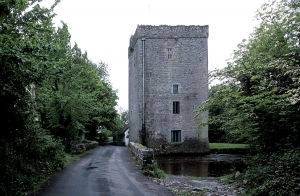
    June 13th 2020 is the 155th anniversary of the birth of William Butler Yeats. Born in Sandymount on the Ballsbridge side of the DART tracks he spent much of his adult life in London, before moving permanently to Ireland after the War of Independence, purchasing a former tower house Thoor Ballylee in Co. Galway where he ‘paced upon the battlements and stared’ at the birth pangs of the Irish state.

    Thoor Ballylee

    County Sligo

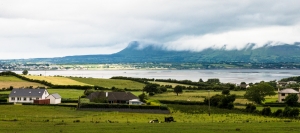
    Yeats will always be identified with County Sligo, the home of many of his ancestors. Innisfree on Lough Gill, Lissadell, ‘far off Rosses’, Knocknarea and Ben Bulben under which he is buried, form the mythical backdrop to his Romantic musing. The stunning landscape triggered romantic verse perhaps unsurpassed in the English language during the twentieth century: ‘Come away oh human child / To the waters and the wild / With a fairy hand in hand / For the world’s more full of weeping than you can understand.’ The enchanting surroundings engendered Yeats’ poetry but simultaneously he bestowed poetry on that landscape.

    When we view stunning Ben Bulben we are, to some extent at least, honouring the Songlines that brought its majesty into being. But for all his evocations of that county, in his descriptions the people are more ethereal than real, moulded in the fairy-realm of his imagination. A far cry from the gritty characters in Joyce’s Dubliners.

    Image (c) Daniele Idini

    Staying Put

    Like rebellious children questioning the authority of a cruel parent, most of the Irish literary pantheon have had a difficult relationship with their homeland, often preferring exile and ruminating on it from afar. Samuel Beckett went so far to write in French to escape the excesses of Irish speech. But Yeats stayed and grew embittered that the nation did not accord him the accolades he felt his due. Politics is the art of the possible, its grubby affairs a torment to the idealist.

    Long before independence Yeats was bemoaning a Romantic Ireland dead and gone and castigating those that fumbled in their greasy tills. But the lofty aspiration he had for the nation were always doomed to failure, like his enduring affection for Maud Gonne that he finally consummated in later life before proposing to her daughter soon afterwards. Independent Ireland could never match his expectations, as a relationship based entirely on romance has failure encoded in its DNA.

    Crucially Yeats came from the Protestant Ascendancy ‘the men of Burke and of Grattan’ and to many among the ascendant Catholic nation who inherited the independent state his claim to being Irish were shallow. This separation worked both ways as the poet who initially embraced and breathed life into Irish nationalism through the cultural revival and plays such as Cathleen Ni Houlihan, later identified himself with an aristocracy that he saw as a natural leadership for a Creole nation.

    Here he fought a losing battle against the enduring tradition of republicanism that rejected aristocracy and prized equality and democracy. He also contended with the powerful force of sectarianism. Many would have considered it unacceptable for someone of Yeats’s background to be in a position of authority. For many hard-bitten Catholics who retained a collective memory of the privations of the Penal Laws and the Famine, independence was an opportunity to build a Catholic state for a Catholic people.

    Fascist Leanings

    The inter-war period (1918-39) were terrible years of fear, poverty and continued conflict in Europe that foreshadowed the cataclysm of World War II. In the immediate aftermath of World War I Yeats wrote prophetically: ‘Things fall apart; the centre cannot hold; / Mere anarchy is loosed upon the world, / The blood-dimmed tide is loosed,’. In the end, in response to what he perceived as the failings of democracy, he chose a reactionary Right as opposed to a levelling left which – as he saw it – would brutally sweep aside an aristocratic elect and usher in a doomed era of materialism. This made Yeats sympathetic to fascism and perhaps even Nazism.

    In his exploration of what is the ill-defined ideology of fascism the historian Roger Eatwell writes:

    Fascism has become a latter-day symbol of evil, like the Devil in the Middle Ages. Demonising all aspects of fascism, a founding form of Political Correctness, has its uses. But dismissing anyone associated with fascism leanings in the 1930s makes it impossible for us to understand how fascism still attracts a significant following.

    We might therefore talk of fascisms, and see it in historical context: a reaction to the chaos unleashed by the Great War and the responsibility of rampant capitalism for the Great Depression, as well as the shocking excesses of triumphant Marxism in Russia.

    To many inter-war intellectuals democracy was on the brink of collapse and there existed a stark choice between fascism and Communism, which had just as little respect for human rights. Also, in its early stages, it should not be conflated with anti-Semitism, especially the genocidal character this assumed, which had a far longer history and was not initially a feature of Mussolini’s approach in Italy.

    One recent biography of Yeats Blood Kindred: W.B. Yeats, The Life, The Death, The Politics by W.J. McCormack outlines aspects of Yeats’s fascist sympathies. He provides details of Yeats’s letter of thanks to Freidrich Krebs, Oberburgmeister of Frankfurt, acknowledging receipt of an award in 1934, his public approval of Nazi legislation depriving Jews of their property in 1938, and other aspects of his anti-Semitism. McCormack concludes that Yeats was a fellow traveller: ‘on occasion. He did not travel early, and he did not travel often’ but he ‘gave comfort to democracy’s enemies, to decency’s enemies.’

    Yeats can justifiably be excoriated for this, but he shouldn’t be judged on what happened subsequently, but instead on the Europe of the 1930s, where he saw a stark choice between the extremes of right and left.

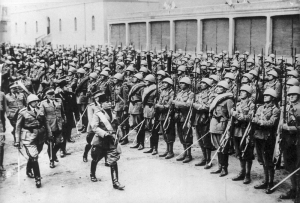
    Benito Mussolini, Rome, 1939.

    Orwell’s Assessment

    There were other intellectuals such as George Orwell who rejected the extremes of both. It is instructive to consider his views on Yeats, which we find contained in a review of an early biography written in 1943, at the height of the war.

    Orwell is surprisingly unimpressed by Yeats’s poetry, and we hear similar anti-Irish prejudices to those found in Auden’s writing. He says that ‘one seldom comes on six consecutive lines of his verse in which there is not an archaism or an affected turn of speech’.

    This criticism may be attributed to Orwell’s affection for sparse, attenuated language which he expresses in his seminal essay The Politics of the English Language. The attitude is encapsulated in his evaluation of one poem that: ‘It would probably have been deadlier if it had been neater.’

    Nonetheless, even Orwell swoons at some poems: ‘Yeats gets away with it, and if his straining after effect is often irritating, it can also produce phrases (“the chill, footless years”, “the mackerel-crowded seas”) which suddenly overwhelm one like a girl’s face seen across a room.’

    Not surprisingly, Orwell lambasts Yeats’s occult dabbling: ‘As soon as we begin to read about the so-called system we are in the middle of a hocus-pocus of Great Wheels, gyres, cycles of the moon, reincarnation, disembodied spirits, astrology and what not.’ These he links to reactionary leanings: ‘if everything is indeed cyclical then the kind of society based on equality and democracy that Orwell prized was in some sense Sisyphean, a doomed effort. Orwell concludes that ‘Yeats’s tendency is fascist.’

    A poem has a life of its own

    For any devotee of Yeats it is difficult to confront the fairly compelling body of evidence for this tendency, but as has been stressed these sympathies came at a time when the horror of Nazism was not apparent; when Communism might have seemed more contemptuous of human life, and when the few surviving democracies at the time were in the grip of the Great Depression. Yeats was wedded to archaic notions of aristocracy and fascism appeared to fit with his prescriptions. He failed to recognise the genocidal evil that lurked there.

    He was never, however, implicated politically in any fascist movement. In fact the political campaigns that Yeats became involved in during his lifetime: the Irish Cultural Revival in the early 1900s and the campaign to retain divorce in the Irish Free State of the 1920s were progressive in character.

    We find a flawed character in W.B. Yeats, like Orwell himself who informed on his associates, but one who produced verse perhaps unsurpassed in the English language in the twentieth century. His political leanings do not diminish the greatness of his poetry. We may still bask in his words without subscribing to his fluctuating political ideas.

    Once a poem is written, the chord attaching it to the author is broken, and it assumes a life of its own.

    A version of this article appeared in Village Magazine in 2015.

  • Quarantine (and then there will be the music)

    It was the silence. The sound of total silence. A deep peaceful vibration carrying the bells from a church I never knew I could hear from this window. The acoustic of silence was able to carry it as if it was across the street, like an apartment in Paris or Vienna, but here in NYC around the corner from Leonard Bernstein Way, birds were singing louder than any singer at nearby Juilliard or Lincoln Center. This was April 4th 2020 and the city for the first time, the world for the first time, was totally shut down. No noise on West 66th Street except for the sound of birds and the feel of a clear breeze. A personal miracle just happened to me because of the pandemic, I don’t have to move out of my apartment of twenty-four years in a building I’ve lived in for thirty-five.

    Twenty-nine years ago, 1989 my first Saturn return, I had been given my first big break by one of the greatest channelers of music, of language, of life, Leonard Bernstein. LB chose me to go on for an ailing famous singer, it was the only time he conducted Candide the operetta/musical he wrote for Broadway after his signal identifying masterpiece, West Side Story.

    Leonard Bernstein

    I had been anointed by the master. Though I was in love with Prince as much as Mozart, LB was a conduit, a crystal microcosm to what my life would be about for the next twenty-nine years. My second Saturn in 2019 resulted in an amazing bookend, I was onstage singing several roles – one of them Queen Elizabeth I – in the world premiere of Olga Neuwirth’s Orlando, at the Vienna State Opera. I had sung in just about every major opera house except for this jewel of a theater which has been bedazzled by the presence of all the great opera composers. But Saturn brought me to this mystical coda and with it, I brought ten years of having had a Uranian shock, a change in musical direction from a very successful classical career into the realms of pop, funk, rock, jazz not only singing and on keys, but as a songwriter, music director, producer, arranger and record label founder.

    So on December 9th 2019 – almost twenty nine years to the day when I stepped on stage with LB and the London Symphony orchestra – the call coming on a pay phone outside of the Belgian National Opera in Brussels; all happening so quickly and inexplicably, that no one could be there to witness it, having to patiently wait years before the video that was made could be viewed on something not even invented yet: YouTube. However, in 2019, this Saturn return, this opening night there was the time to make sure everyone could be there that was important in my musical life. George Clinton, the Godfather of Funk with whom my beloved funk-rock band, Miss Velvet and The Blue Wolf had toured the globe for the past three years; friends, family, fellow musicians, all were there in the hallowed hall of Mozart, Mahler, Beethoven and Berg, documenting this spectacular evening on iPhones, Instagram, Facebook, and live streaming.

    New York

    The planets were all converging behind the scenes to set the stage for the coming Age of Aquarius; the convergence of Saturn and Pluto in Capricorn; heralding the end of an era and the last big party before Covid-19. I returned to New York from Vienna in mid-January after spending my birthday there alone, enjoying the solitude and loneliness after a busy and exciting year. Always superstitious of how one spends one’s birthday and New Year’s, as a way to set a tone for the coming year, in hindsight, it was not only precognitive, but I guess good to know I felt pretty damned good in my solitude.

    I walked around Vienna on January 13th and reflected on what had happened in just a year’s time from one birthday to the next: the release of my second solo album, High Tides with a radio tour on the label I founded, Isotopia Records; accompanying George Clinton and his wife on the red carpet at the 2019 Grammy’s; a tour to Hawaii, Australia and Japan with Miss Velvet and the Blue Wolf; playing with the band upon our return at the Grammy Lifetime Achievement Awards to honor George Clinton, then forty-five more shows with George Clinton and Parliament Funkadelic on the One Nation Under the Groove Tour; the release of the band’s second album which I produced this time with George Clinton as featured guest; the release of a new artist, Lemoyne Alexander and then suddenly it was October and the contract I had held in my hands for three years for the Vienna State Opera, was about to become more than a promise and a piece of paper, it was about to become real. And this time, my two mini dachshunds would come with me as I would be in Vienna for three months.

    Upon my return to 66th street, dragging twelve suitcases and the nostalgia of leaving Europe behind, I found that the front door to my apartment had been taken down and replaced with a new door by the building’s management company. Of course, no one noticed that on the door they disposed of was a painting I had done years before and the new door was a plain white generic one made to fit in with the ‘new renovations’ to ensure everything looked uniform, corporate, anodyne. The dis-ease of greed and herd decorating. I left my suitcases unpacked tripping on them every day, with the excuse ‘well you have to move and now with this vulgar white door, who cares, you can do it’.

    Creative Sanctuary

    You see this apartment was my spot, my creative sanctuary I came back to ten years earlier after my life had fallen apart. Discovering that having doormen who knew me since I walked through those doors as a hopeful twenty-three year old singer – being there through my parents’ divorce, two failed marriages, bringing stepchildren back and forth, the deaths of close friends and pets, my successes and disappointments, discrete and not so discrete love affairs and always the suitcases – were more comfortable and reassuring than family at times.

    The Wheel of Fortune allowed me to keep my apartment in New York City and staying in this spot had become mystical – not only because 65th street would be named Leonard Bernstein Way – but also because I had inherited Andrew Watt’s piano, the great pianist who also received his big break from LB.

    Andre was approached at the last minute to go on for an ailing Glenn Gould for the nationally televised broadcast of the Young People’s Concerts with the New York Philharmonic Live from Lincoln Center series. Andre would be the first African-American pianist and classical artist to break that glass ceiling. His story is what brought me to this building and New York in the first place: the longtime partner of my piano teacher’s daughter in my hometown of Toledo, Ohio, Andre and my parents’ generosity opened the door to my dream of being able to move to NYC, as he had an apartment across the street from Lincoln Center with a piano he wasn’t using. So, in 1984 after a summer as the youngest apprentice with Santa Fe Opera, I was told the best way to build a career as an opera singer was to move to New York or Europe; little did I know that history would magically repeat itself presenting me with the same opportunity as Andre, to jump start my career.

    I didn’t unpack after Vienna and for weeks tripped on my suitcases, what was the point of unpacking since I had to move – the new door being a daily reminder. I was finding the emotional strength to say goodbye to my adult roots: my paintings all over the walls and my recording studio, the foundation of Isotopia Records.

    In February, I saw more Broadway shows than I had in years; I went to New York City Ballet as often as possible, off and off-off Broadway shows, foreign films, it was as if I knew something was coming. I was voraciously having every New York experience as if for the last time. I even produced a music video on the coldest day in February – all over the city – with everyone involved feeling the love and magic of this one of a kind world haven for creativity and inspiration. 

    We could be next…

    By the time the week of March 11th came around and the rumour of this virus running through Italy had ravaged and shut down that country, I was feeling like we could be next as New York is a city of international visitors. Friday March 13th, our lives changed on a dime. By April 4th it was clear I wasn’t going to have to move. They were going to let me stay another year. With the shutdown in place I couldn’t move my suitcases to storage, so as I write this on day seventy-five, they sit as a reminder of the years of being a global citizen, artist, the adventure of travel and discovery.

    I painted the new door and it looked better than the one before it. I went to the piano and pressed the record button.

    Every day at 7:00 pm when those of us who don’t have second homes to run to or the finances to escape, we cheer out the windows to remind each other we are here, we are not alone in our circumstantial solitude; the cheers, whistles, pot banging and trumpet blowing applauding the health care workers who for me had personal meaning as they saved a cherished friend’s life during this disaster; a five minute expression of our love and memory of the dream for what this city was and will be again, but it will be in a new way of discovery and communal survival. And then there will be the music…

    Constance Hauman’s new album The Quarantine Trilogy is out now on Isotopia Records: https://isotopiarecords.com/. For more details of her work see: https://constancehauman.com/


  • SIDE EFFECT

    SIDE EFFECT

    So few cars on our Manhattan street
    Pigeons leaving nests that swirl between
    Highrise ledges, fearless land to eat
    Any mid-street grain or scrap they glean.

    Told to stay at home most acquiesce.
    Now we learn how unbeknownst we spare
    Our New York as we’re emitting less
    Long-lived greenhouse gases in the air.

    Same in Paris, London, Madrid, Rome.
    If our frenzied whirl restarts, when pressed
    To create more jobs and we leave home,
    Will we foul then worse our global nest?

    Covid fear amends our habitat –
    Nature’s own backhanded caveat.

    Micheal O’Siadhail’s The Five Quintets was published in 2018, he now lives in New York.

    Image: Constantino Idini

  • Covid-19: A Simple Moral Calculus

    Introduction

    There are still many unresolved questions regarding the pathogenesis of this disease and especially the reasons underlying the extremely different clinical course, ranging from asymptomatic forms to severe manifestations, including the Acute Respiratory Distress Syndrome (ARDS). SARS-CoV-2 showed phylogenetic similarities to both SARS-CoV and MERS-CoV viruses, and some of the clinical features are shared between COVID-19 and previously identified beta-coronavirus infections. Available evidence indicate[s] that the so called “cytokine storm” an uncontrolled over-production of soluble markers of inflammation which, in turn, sustain an aberrant systemic inflammatory response, is a major [factor] responsible for the occurrence of ARDS.
    Francesca Coperchinia, Luca Chiovatoab, Laura Croceab, Flavia Magriab, Mario Rotondi, ‘The cytokine storm in COVID-19: ‘An overview of the involvement of the chemokine/chemokine-receptor system’ (2020)[i]

    For the first time in the post-war history of epidemics, there is a reversal of which countries are most heavily affected by a disease pandemic. By early May, 2020, more than 90% of all reported deaths from coronavirus disease 2019 (COVID-19) have been in the world’s richest countries; if China, Brazil, and Iran are included in this group, then that number rises to 96%.
    Richard Cash and Vikram Patel, ‘Has COVID-19 subverted global health?’ (2020)[ii]

    The evidence of Hitler’s as well as Stalin’s dictatorship points clearly to the fact that isolation of atomized individuals provides not only the mass basis for totalitarian rule, but is carried through to the top of the whole structure.
    Hannah Arendt, The Origins of Totalitarianism (1951).

    All this hate and violence [in the world] is being facilitated by a handful of internet companies that amount to the greatest propaganda machine in history.[iii]
    Sacha Baron Cohen, speech, (2019)

    Comment is free, but facts are sacred.[iv]
    John Scott, editor of The Guardian, (1921)

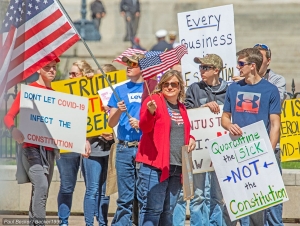
    In March, 2020 a simple moral calculus seized Western consciousness. Prompted by grim epidemiological assessments, and distressing accounts from emergency doctors in Northern Italy, a call to #flattenthecurve resounded across social media. The global force of hashtag activism led millions to renounce meeting friends and family in an extraordinary display of solidarity with vulnerable older people.

    Twitter, which had previously styled itself ‘the free speech-wing of the free-speech party[v], allowing all manner of unmoderated content to appear on controversial subjects such as climate change – as well as hate speech from President Donald Trump – abruptly changed policy on March 16th saying it would be:

    Broadening our definition of harm to address content that goes directly against guidance from authoritative sources of global and local public health information. Rather than reports, we will enforce this in close coordination with trusted partners, including public health authorities and governments, and continue to use and consult with information from those sources when reviewing content.[vi]

    Problematically, however, there is no canonical response to the global pandemic and significant debate has occurred between authoritative sources, as different governments pursue varied policies, with mixed results. This has created potential for national authorities to impugn or disqualify reasonable criticism by grafting health warnings on accounts at variance with a particular government’s guidance, or wider political objectives.

    Twitter has not acted alone, Google has taken unprecedented steps to erase material that violates ‘Community Guidelines’: ‘including content that explicitly disputes the efficacy of global or local health authority recommended guidance on social distancing that may lead others to act against that guidance.’[vii]

    Typically, Facebook adopted a laissez faire approach, although users who had read, watched or shared ‘false’ coronavirus content received a pop-up alert urging them to go the World Health Organisation’s website.[viii]

    Whatever one’s view on the importance of social distancing, our readers may recall Ronald Dworkin’s pronouncement that ‘free speech is a condition of legitimate government.’ He argues that the universality of speech as a mode of rational discourse and scientific inquiry could act as truth-seeking counterweight to mass hysteria, negating unreason and prejudice.[ix]

    Moreover, Stephen Sedley, the great English judge, called freedom of expression ‘the lifeblood of democracy;[x] or as George Orwell put it in the introduction to Animal Farm (1945): ‘If liberty means anything at all, it means the right to tell people what they do not want to hear.’

    Accepting Covid-19 represents an extraordinary challenge requiring a concerted response, censorship by Big Data in such a blanket form, including of recognised academic authorities, surely only lends credence to conspiracy theories, fomented by the far-right in particular. Disregard for freedom of expression casts doubt over the integrity of scientific inquiry and inhibits rational debate.
    Reappraisal

    The English-speaking world was led to believe in early March that Covid-19 had a mortality rate of between 2% and 3% [xi], and that its spread would be exponential, with a reproductive (R) value of 3 (i.e. one person would infect another three), compared to an R value of 1.28 for seasonal influenza.[xii] Moreover, based on Lombardy’s experience, it seemed the death toll would include hundreds or even thousands of health service workers tending to the sick.

    As the weeks passed the assessment of the mortality rate was scaled back to 1.4%,[xiii] but by then the virus seemed to be moving through Europe like a forest fire at the height of summer. Soon the number of daily mortalities from the disease was dominating news headlines.

    Insofar as possible, most reasonable citizens abided by the popular injunction to #staythefuckathome, entrusting governments with emergency powers to guard against errant behaviour.

    As time passed, however, we learnt that early projections on the infection fatality rate seem to have been significantly wide of the mark. Lone Simonsen professor of population health sciences at Roskilde University in Denmark recently said she expected a infection fatality rate ‘possibly as low as 0.2% or 0.3%’, while Professor Emeritus at the Karolinska Institute in Stockholm Professor Johan Giesecke has suggested an even lower figure of 0.1%.[xiv] The U.S. Centre for Disease Control’s best estimate implies a COVID-19 infection fatality rate below 0.3%.[xv]

    Sunetra Gupta, Professor of Theoretical Epidemiology at the University of Oxford has gone lower still estimating an infection fatality rate of between 0.1% and 0.01%.[xvi] She bases this on an assumption the virus has been in circulation far longer than initially assumed, an argument gaining traction, with satellite data suggesting the pandemic hit Wuhan in China a far back as October,[xvii] while France’s ‘first known case’ was in December.[xviii] In truth, however, the infection fatality rate appears to depend hugely on the nature of any society, and not simply its age profile, for reasons to be discussed.

    An aggravated perception of danger is also likely to have occurred through media reports juxtaposing confirmed cases, with mortalities. Thus The Guardian reported on May 16th that, ‘According to the Johns Hopkins University tracker there are 4,531,811 confirmed cases worldwide. The number of people who have lost their lives is 307,001 according to official tolls, but the true number is likely to be much higher.’[xix]

    On a cursory examination, one might assume a infection fatality rate of 6-7%, or “much higher”. Little wonder then that people have been jumping out of the way of one another on footpaths.

    This infection fatality rate may well prove to be considerably higher than a seasonal flu mortality rate of 0.04%, but it is instructive that during one such outbreak in 2017-2018 that there were 61,000 influenza-associated deaths in the United States alone.[xx] Yet these preventable deaths hardly registered on the national consciousness, unlike like the victims of Covid-19.

    As Simon Jenkins, one of the few Guardian commentators who has kept the pandemic in perspective put it: ‘When hysteria is rife, we might try some history.’[xxi]

    Epidemiological Modelling

    Based on a infection fatality rate of 0.9%, in late March an Imperial College team led by Professor Neil Ferguson predicted that unless stern measures were taken there would be half-a-million deaths in the U.K. and over two million in the U.S.:[xxii]

    But as early as March Nobel-prize winning bio-physicist Michael Levitt was identifying common sense flaws in prominent epidemiological modelling, saying:

    In exponential growth models, you assume that new people can be infected every day, because you keep meeting new people. But, if you consider your own social circle, you basically meet the same people every day …. You can meet new people on public transportation, for example; but even on the bus, after sometime most passengers will either be infected or immune.[xxiii]

    Levitt assumed the R rate would decline once reasonable steps were taken, such as social distancing and removing the possibility of close confinement in pubs, at sporting events and other so-called ‘super-spreader’ events. [xxiv] In March Levitt told Ferguson that he had over-estimated the potential death toll by ‘10 or 12 times.’[xxv]

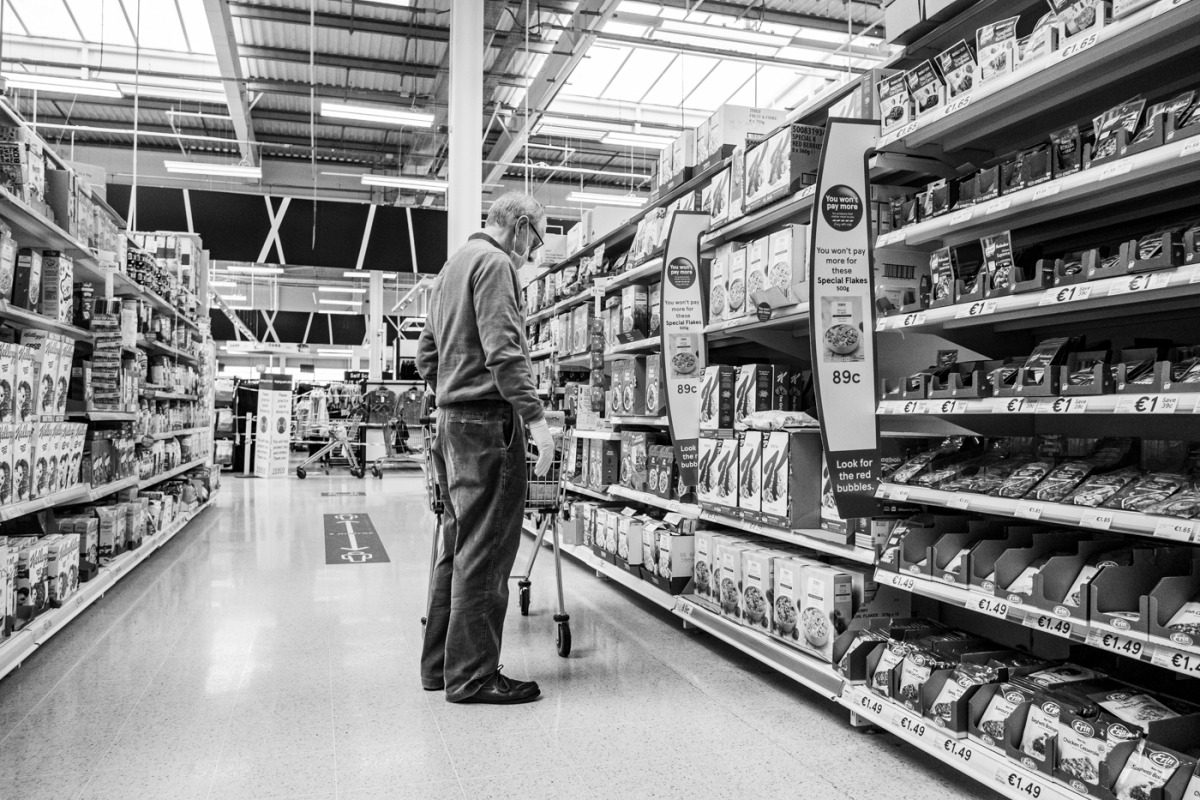
    Moreover, given only one branch seems to have closed its doors over the course of the outbreak in the U.K.,[xxvi] it appears early panic about contagions occurring in supermarkets, which is still leading to people disinfecting their shopping, were largely unfounded.[xxvii]

    Mistaking Flu for Coronavirus

    Mortalities from novel flu viruses tend to be among individuals under the age of forty. This is because ‘emergent viruses resembled those that had circulated previously within the lifespan of then-living people.’[xxviii] This means older peoples’ immune systems are generally better equipped with antibodies to fight off such novel infections.

    As yet it is still unclear whether exposure to other coronaviruses, including the ‘common cold’, provide greater immunity to Covid-19, although one recent paper does suggest, ‘cross-reactive T cell recognition between circulating “common cold” coronaviruses and SARS-CoV-2.’[xxix]

    It remains to be seen whether the death toll from Covid-19 will scale the heights of the ‘Asian’ Flu (H2S2) of 1957, (with a an estimated median R value of 1.65[xxx]) which led to 1 million deaths around the world, including 80,000 in the United States; or the ‘Hong Kong’ flu (H3N2) of 1968 (with an estimated median R value of 1.80) that was responsible for between 1 million and 4 million[xxxi]; let alone the Spanish Influenza (H1N1) outbreak of 1918 that carried off an astonishing fifty million people[xxxii], (with an estimated median R value of 3 [xxxiii]), most of whom were in the prime of their lives.

    Hugh Pennington emeritus professor of bacteriology at the University of Aberdeen recently took an optimistic view on the prospect of avoiding a dreaded ‘second wave’ of infections:

    The idea of a second wave comes almost entirely from the 1918 Spanish flu pandemic. The first wave occurred in June and July and the second in October and November. The first was mild, the second was lethal. It is yet to be explained why the infections occurred in waves and why the virus faded away after the first and then returned.

    ‘Flu is very different from Covid-19’ Pennington says, ‘Although both are commonly spread by the respiratory route, and both have infected prime ministers, the more we learn about Covid-19, the less its biology and epidemiology resemble that of flu.’

    He further contends, ‘In the absence of controls, flu has an R rate of seven [presumably he means at the height of a pandemic]; Covid-19’s is between two and three [lower seemingly than the earlier assessment]. And far more than with flu, Covid-19 cases have very commonly occurred in clusters.’

    Conflation with flu modelling may also be discounting wider “imperviousness” than assumed. UCL Professor Karl Friston famously drew on astrophysics to explain Germany’s low infection rate relative to the U.K.:

    it looks as if the low German fatality rate is not due to their superior testing capacity, but rather to the fact that the average German is less likely to get infected and die than the average Brit. Why? There are various possible explanations, but one that looks increasingly likely is that Germany has more immunological “dark matter” – people who are impervious to infection, perhaps because they are geographically isolated or have some kind of natural resistance. This is like dark matter in the universe: we can’t see it, but we know it must be there to account for what we can see.[xxxiv]

    The curious case of Japan also indicates that certain societies – or nations – are considerably more impervious than others. As the country in the world with the oldest population in the world, and with heavy urban densities, one would have expected the virus to have had a devastating impact there, yet:

    No restrictions were placed on residents’ movements, and businesses from restaurants to hairdressers stayed open. No high-tech apps that tracked people’s movements were deployed. The country doesn’t have a center for disease control. And even as nations were exhorted to “test, test, test,” Japan has tested just 0.2% of its population — one of the lowest rates among developed countries.[xxxv]

    Japan’s population of over 125 million experienced less than 1,000 deaths from Covid-19.

    Nonetheless, apart from underlying exacerbating factors such as population density and an ageing population – relative to its Irish neighbour at least[xxxvi] – as well as a high obesity rate,[xxxvii] the U.K.’s high death toll can, at least in part, be attributed to Boris Johnson’s government’s ‘sleepwalking’ through the beginning of the crisis,[xxxviii] almost wlilfully ignoring the threat, and putting out highly inappropriate messages, including on shaking hands.

    Nevertheless, the suggestion aired on an episode of Channel 4’s Dispatches that 13,000 deaths would have been avoided if a lockdown or stay-at-home order had been introduced at the beginning of March came from a health analyst, George Batchelor, rather than a recognised academic authority, and should be treated with caution.

    Revealingly, in Hong Kong where 90% of cases were contact traced, ‘the number of individual secondary cases was significantly higher within social settings such as bars and restaurants compared to family or work exposures.’ In time it may be determined that Boris Johnson’s hesitation in closing pubs was his most costly mistake.[xxxix]
    QALY

    In Italy, where average life expectancy is approximately eighty-three-years-of-age, the average age of mortality from Covid-19 was approximately eighty years-of-age.[xl] This figure includes over one hundred health care workers.[xli] Many of these premature deaths occurred in the clusters that Hugh Pennington refers to – perhaps from heavy ‘viral load[xlii] encountered in poorly ventilated hospitals and care home facilities.

    The overall loss of life years from the Covid-19 pandemic may prove minimal, however, compared to novel flu viruses, which have mainly afflicted the young over the past century.

    This is not to diminish the value of any life, but public health interventions are conventionally given a comparative value (QALY – Quality-adjusted Life Year), ‘which is routinely used as a summary measure of health outcome for economic evaluation, which incorporates the impact on both the quantity and quality of life.’ The financial cost of any intervention, including a lockdown or stay-at-home order, must be measured against its impact on both quantity and quality of life.

    There are now serious question marks around the efficacy of lockdowns. Using ‘Bayesian’ modelling a team led by Professor Simon Wood in Bristol University supports Michael Levin’s assessment that early epidemiological models were flawed, suggesting that ‘the number of new daily infections in the UK peaked some days before lock down was implemented, although it does not completely rule out a slightly later peak.’[xliii]

    Furthermore, a quasi-experimental study carried out by the University of East Anglia concluded that stay at home orders, or lockdowns were ‘not associated with any independent additional impact.’[xlvi] Another recent study in Nature, however, offers a different assessment, but includes data from China, which may be unreliable, and where the extremity of the measures are  incompatible with democratic norms. Lockdown advocates also generally assume a higher infection fatality rate than recent reappraisals.

    During lockdown, across Europe and beyond, cases and deaths occured in clusters: within enclosed spaces such as care homes,[xliv] hospitals and meat packing plants,[xlv] but also households. Hashtag activism informed the public in most Western countries about the pandemic, who were refraining from unnecessary social encounters, and travel, already.

    This may be why the Norwegian Institute for Public Health has recently called for the government to avoid such a far-reaching measure if the country is hit by a second wave.[xlvii] Norwegian Prime Minister Erna Solberg also bravely admitted before a national television audience: ‘I probably took many of the decisions out of fear.’[xlviii]

    The adverse consequences of lockdowns – including a spike in domestic violence[xlix], its effect on children[l] and unprecedented economic impacts, especially on SMEs and casual workers, also cannot be discounted.

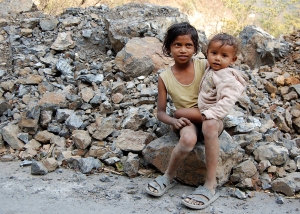
    Worst of all has been the effect of draconian lockdowns on developing countries, such as India. Vikram Patel and Richard Cash (both of Harvard University) wrote in The Lancet:

    we suggest that countries must let people get on with their lives—to work, earn money, and put food on the table. Let shop keepers open and sell their wares and provide services. Let construction workers return to building sites. Allow farmers to harvest their crops and to transport them to be sold on the open market. Allow health workers to do their daily work as before, with sensible precautions such as use of gloves and masks to minimise the risk of exposure to the virus. And allow the average citizen to travel freely with restrictions only applied to clusters where lockdowns are necessary. Livelihoods are an imperative for saving lives. Some will say such an approach, which runs the risk of spreading disease, implies that the lives of poor people are not as valuable as those in wealthy countries. Nothing could be further from the truth. The policies of widespread lockdowns and a focus on high-technology health care might unintentionally lead to even more sickness and death, disproportionately affecting the poor.

    These arguments also apply in wealthier societies, as many among the poor do not have the privilege of being able to work from home, and may participate in the black economy. Government supports are generally inadequate and do not last indefinitely.

    The preceding points are not a definitive argument in favour of Sweden’s policies during the pandemic, faults in which have been acknowledged by its chief architect Anders Tegnell. But it is important for policy makers to recognise the cost of lockdowns, especially for extended periods. Also, importantly, handing discretionary powers to police forces in such circumstances establishes a dangerous precedent.
    Fatalism

    In solitude we have been consumed by a story that feeds into pressing contemporary dilemmas, including on the role of scientific expertise. This can be situated within a long-standing division in Western culture between rationality and intuition, evident during World War II in the conflict between Communism and Fascism.

    As Martin Glover put it:

    Stalin, as a version of the Enlightenment idea of redesigning society on a rational basis, shared the catastrophic implications of carrying out such a project without moral or human restraints. Nazism was against the universalism of Kant and other Enlightenment thinkers. It was tribal: not rights of man, but the German right to lebensraum … Stalinism shows what can happen when Enlightenment ideas are applied wrongly, Nazism shows what can happen when unenlightened ideas are applied rightly.[liii]

    A form of this has spilled into the so-called Culture Wars, including identity politics, that have raged in particular since the 1990s, culminating in Brexit and President Trump, but it is also perhaps evident at a psychological level within most of our personalities. Importantly, excesses of rationality can be as destructive as Fascism, as we saw under the guise of Communism.

    Responses to the pandemic have also been conditioned by prior faith in, or suspicion of, the Western medical system – including from so-called anti-vaxxers – with Populist right-wing politicians dismissing concerns about a bad flu,[liv] and offering to take it on the chin.[lv] In contrast, some on the left seem to have viewed the crisis as an opportunity to enlarge the role of the State, leading to countervailing scientific authorities to be dismissed on ideological grounds.

    There may also have been a tendency, evident in The Guardian, The New York Times and elsewhere, to heighten outrage against the administrations of Donald Trump in the U.S. and Boris Johnson in the U.K. by front-loading mortality statistics.

    Another explanation for the extreme response of individuals who consented to prolonged periods of self-isolation – including those of an age profile suggesting they had little to worry about themselves – is an evident fatalism haunting a globally dominant capitalist system. As David Graeber put it:

    Capitalism is a system that enshrines the gambler as an essential part of its operation, in a way that no other has, yet at the same time, capitalism seems to be uniquely incapable of conceiving of its own eternity. Could these two facts be linked?[lvi]

    An understandable fatalism in the face of climate change and mass extinctions, perhaps spilled into reactions to this pandemic, with self-isolation a form of repentance.

    Moreover, the idea of plague as representing divine retribution may operate at an unconscious level. Apart from Biblical episodes such as that visited on Egypt, it is found in ancient epics such as Homer’s Iliad. Thus, when King Agamemnon makes a war prize of Chryseis the daughter of Chryses a priest of Apollo, the sun god takes revenge by unleashing poison-tipped arrows against the Greek army, many of whom succumb to plague.

    More recently, films, such as Outbreak (1995) starring and Dustin Hoffman, and novels such as Jose Saramago’s Blindness (1997), have played on these fears.

    What was Covid-19 but God or Gaia punishing us for our consumerist sins?
    Guardian Angle

    The so-called hashtag activism that prompted civil society to take preventive measures against Covid-19, and which led to many governments to adopt draconian suppression policies, including lockdowns, has been led in the U.K. and Ireland in particular by The Guardian newspaper

    The free digital site with an estimated 42 million monthly visitors[lvii] devoted unrelenting rolling coverage to Covid-19, emphasising the simple moral calculus with a banner across its home page. This has been to the almost complete exclusion of all other content for the months of March, April and May.

    The Guardian’s loss of proportion, and nuance, has been particularly damaging as it is the most trusted newspaper brand in the U.K., including, importantly, among readers aged 18 to 29.[lviii] This may be traced to its position as a global news provider of free content dependent on maintaining an enormous click rate to derive a profit.

    In a recent memoir the former editor Alan Rusbridger describes how: ‘Only by going for reach could you make up for … the ‘frightening disparity’ between the yields in traditional and online media.’[lix]

    He reveals that by mid-2018:

    The Guardian was reaching 150 million browsers each month and a billion page views per month. There was no talk of paywalls: even so, reader revenues had overtaken advertising. And digital revenues – at £109 million – had, for the first time, overtaken the £107.5 million of print revenues. The paper was confidently talking of hitting break-even in 2018/19.[lx]

    The difficulty is that once you have reached such a high threshold, and have taken on hundreds of staff, you have to keep that readership transfixed.

    The Guardian’s increasingly monopolistic position has come at the expense of journalistic diversity, as smaller publishers cannot compete with its reach. Moreover the perceived reliability of its reporting creates a difficulty for competitors wishing to mount a pay wall without significant marketing investment. In such a squeezed field alternatives are increasingly the preserve of billionaires, such as Rupert Murdoch, the Barclay Brothers, Mike Bloomberg and Jeff Bezos. This is having a corrosive effect on democracy, as many of these publications are ideologically tainted, and support vested interests.

    Underling all this, the number of American journalists fell from 60,000 in 1992 to 40,000 in 2009,[lxi] This pattern has been seen all around the world as revenues diminish and workloads increase. In the U.K. Cardiff University researchers recently conducted an analysis of 2,000 U.K. news stories. They discovered the average Fleet Street journalist was filing three times as much as in 1985. Or, to put it another way, journalists now have only one-third of the time they used to have to do their jobs.[lxii]

    This results in what Nick Davies has described as ‘churnalism’, whereby most journalists are passive processors of ‘unchecked, second-hand material, much of it contrived by PR to serve a political or commercial interest.’[lxiii]
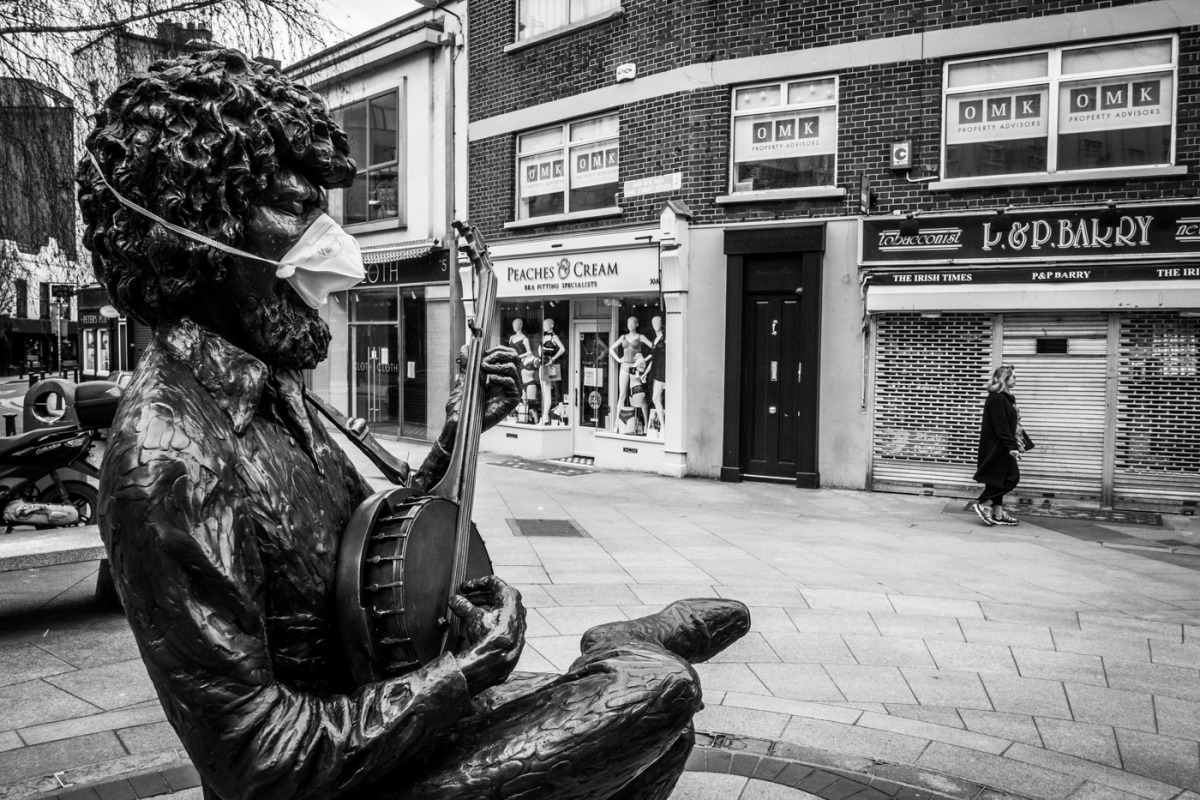
    Hyperbolic Coverage

    An exhaustive assessment of Guardian coverage is beyond the scope of this article, but two examples of their unsatisfactory reporting throughout this crisis should hopefully suffice.

    On Friday, May 15th an article ran under the headline: ‘Dying to go out to eat? Here’s how viruses like Covid-19 spread in a restaurant’.[lxiv] It referred to a video experiment simulating ‘how quickly germs can be spread across a variety of surfaces in environments such as restaurant buffets and cruise ships.’

    To begin with, one guest of 10 at a restaurant buffet is shown with the substance on his hands meant as a stand-in for the coronavirus. Over the course of a typical dining period, the rest of the guests behave in predictable fashion, selecting utensils from serving stations, enjoying their food, checking their phones and so on.

    At the end of the experiment the black light is turned on and the substance is revealed to be smeared everywhere: plates, foodstuff, utensils and even all over some of the guests’ faces.

    A few paragraphs into the article, however, a second experiment demonstrates the positive effect of improved hygiene techniques, after ‘the “infected” person and the other diners take the simple precaution of washing their hands, and utensils and other implements are cleaned or replaced.

    The first difficulty with the study itself is that it is conducted in a canteen-style restaurant – a worst case scenario where cutlery and plates are exposed to many hands. But the most obvious problem is that the headline feeds into a narrative of fear and paranoia, to the detriment of anyone struggling to keep a restaurant afloat.

    Another headline from May 26th paints a lurid picture: ‘Global report: ‘disaster’ looms for millions of children as WHO warns of second peak’.[lxv] Yet it soon apparent that the “disastrous” consequences for children, who are more likely to die after being struck by lightening than from a dose of Covid-19 and barely register as mortalities from the virus,[lxvi] is from increased vulnerability to forced labour and underage marriage. The “second peak” warned of by the WHO in the headline is a non-sequitur that has nothing to do with any elevated danger to children,

    Choice of headline is crucial as many browsers simply scan news sites. A 2010 Pew analysis found that the average visitor spent only 3 minutes 4 seconds per session on the typical news site. That compared with a 2005 survey showing about half of U.S. newspaper readers spent more than thirty minutes reading a daily paper.[lxvii]
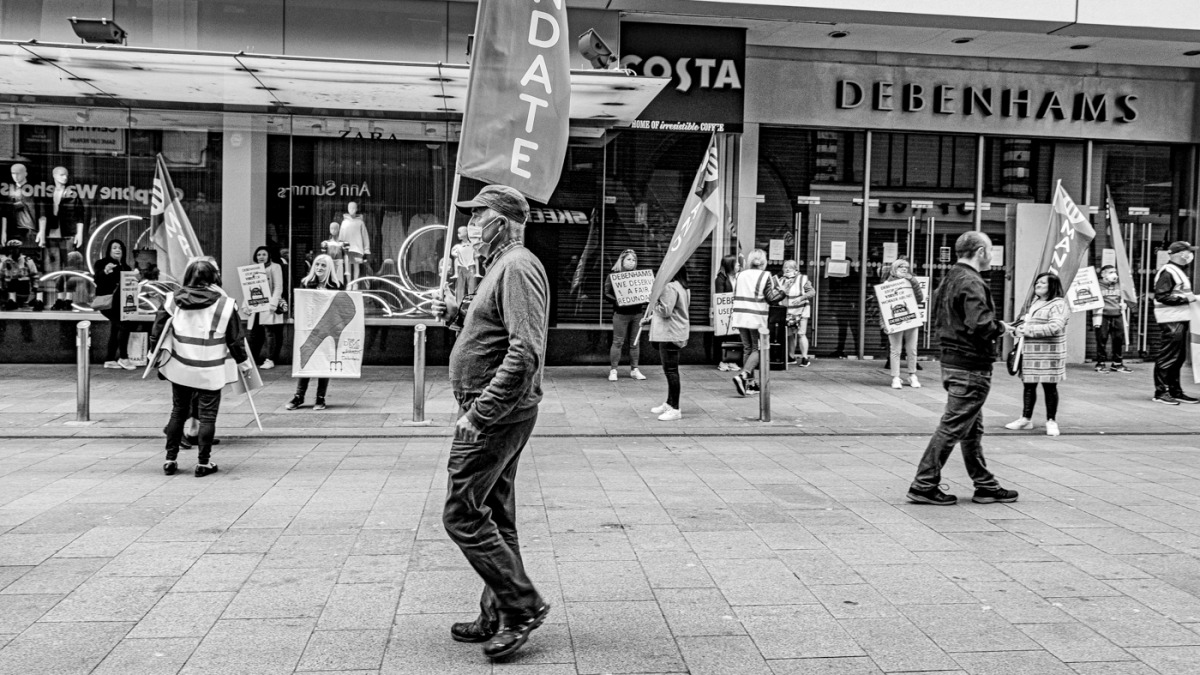
    What has gone wrong?

    Clay Shirky writes in Here Comes Everybody (2008):

    When we change the way we communicate, we change society. The tools that a society uses to create and maintain itself are as central to human life as a hive is to a bee … The hive is a social device, a piece of bee information technology that provides a platform, literally, for the communication and co-ordination that keep the colony viable. Individual bees can’t be understood separately from the colony or from their shared, co-created environment. So it is with human networks.

    He asserts that the ‘Web didn’t introduce a new competitor into the old eco-system, as USA Today had done. The Web created a new ecosystem.’[lxviii]

    The Guardian embraced a form of ‘collaboration media’, which companies and politicians rapidly learned to respect, and fear. Former editor Alan Rusbridger recognised that ‘social media would disrupt conventional politics and transform the speed at which it happened.’ He acknowledges, however, that, ‘It was, obviously, not necessarily good at complexity – though it could link to the complexity. It could be frustratingly reductive. It didn’t patiently and painstakingly report, in the way a good new organisation still did. It was to some extent parasitical.’[lxix]

    Rusbridger also quotes former Sunday Times editor Harold Evans to the effect that ‘an investigation only really began to count once the readers and even the journalists were bored with it.’[lxx] But in an all-consuming demand for clicks, and in the frenzied political era of Trump and Brexit, balance has been lost. Lacking detached and independent journalism we have walked into a prolonged social experiment that will take considerable unravelling.
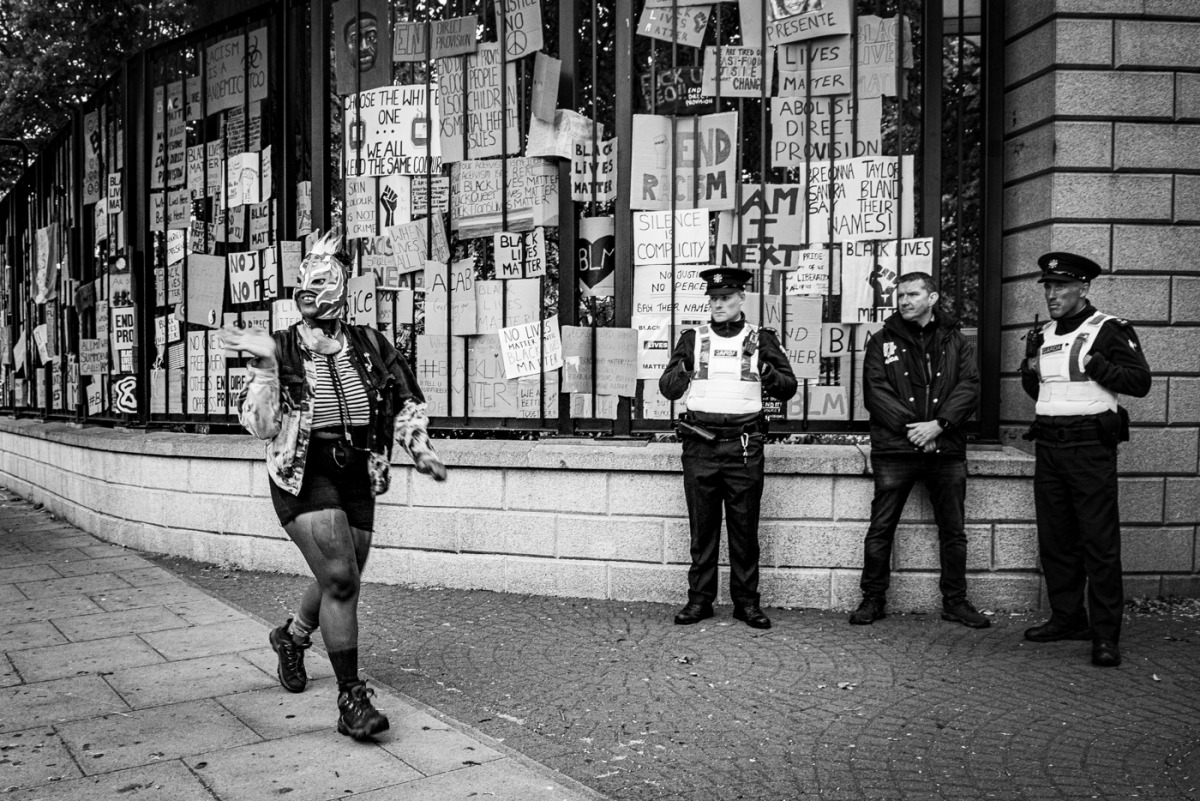
    A New Hashtag

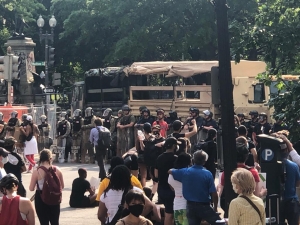
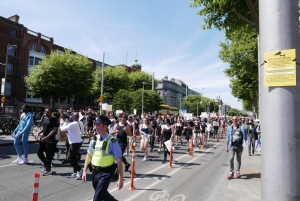
    On May 25th, 2020, George Perry Floyd, a 46-year-old black man was killed when a white Minneapolis police officer kneeled on his neck during an arrest for passing a counterfeit $20 bill. His death brought a wave of demonstrations in major U.S. cities that have spread to other countries, with many protestors donning masks as protection against the virus.

    The hashtag generation has discovered another noble cause in #blacklivesmatter – to be clear #flattenthecurve was certainly well motivated – but let us hope balance and nuance is not lost, and that a deadening conformity does not ensue in debates over race, poverty and the ambit of the state.

    The extraordinary scenes witnessed around the world could also be interpreted as a proxy for societies throwing off the heavy knee of lockdowns, containing a basic human impulse to interact with one another, honouring the exuberant Dionysian element in our nature that had been contained by Apollonian rationality.

    Fyodor Dostoyevsky’s unnamed narrator from Notes from the Underground (1864) seems to envisage the poles of this division. First, he describes the archetypal rationalist that ‘scientifically’ predicts all outcomes in society:

    All human actions will then of course be calculated, mathematically, like logarithm tables up to 108,000, and recorded in a calendar; or even better, well-intentioned publications will then appear, like the present-day encyclopaedic dictionaries, in which everything will be so precisely calculated and recorded that there will no longer be deliberate acts or adventures in the world.

    But he suggests this would create a reaction:

    I, for example, wouldn’t be at all surprised if, in the midst of all this reasonableness that is to come, suddenly and quite unaccountably some gentleman with an ignoble, or rather a reactionary and mocking physiognomy were to appear and, arms akimbo, say to us all: “Now, gentlemen, what about giving all this reasonableness a good kick with the sole purpose of sending all those logarithms to hell for a while so we can live for a while in accordance with our own stupid will![lxxi]

    Thus an excess of rationality may create conditions for profound irrationality, or even absurdity in the case of the utilitarian philosopher Jeremy Bentham’s felicitous calculus.
    What Next?

    We still have to address the public health crisis of a pandemic, requiring substantial reforms in healthcare, architecture and spatial design to contend with a disease that should not be treated as a flu pandemic.

    Once unsustainable lockdowns ease, Western societies with susceptible populations must adapt to life with the virus. A policy of elimination is unrealistic and even cruel, unless we essentially exclude entrants from the outside world, as in New Zealand, or become a police state like China.

    Like a thief in the night, Covid-19 discovered weaknesses in the wealthiest countries in the world that also happen to be among the most unequal. Most obviously it found its way to older individuals, many weakened by increasingly poor diets and sedentarism that is behind a pernicious obesity pandemic.

    It has already been argued that life expectancy is declining in the United States,[lxxii] after two centuries during which it climbed steadily. Our lives, and diets, are simply unsustainable, and perhaps Covid-19 is nature’s (God or Gaia’s?) way of telling us so. The question is whether we are prepared to adopt the environmental approaches to lower the risk of further zoonotic episodes that lead to viruses.

    On a more basic level we need to retrofit buildings – embracing the idea of a healthy home[lxxiii] or workplace that diminishes viral load – and redesign transport systems to prevent contagions. As a priority we require hospital design for better infection control as ‘Building ventilation, whether natural or mechanical serves to dilute droplets nuclei in the air and is the single most important engineering control in the prevention of transmission of airborne infections.’[lxxiv]

    Yet surely we cannot lose the joy of social interaction, or turn romance into an online transaction controlled by algorithms. Great gatherings of people are still the lifeblood of politics, the arts and sport. For these to become historical curiosities, outlawed indefinitely as “super-spreader” events, would be lamentable.

    We have to shake the trauma off somehow, or dance it off perhaps. Above all children cannot be confounded by the fear of their parents and other adults, and have natural inclinations to play frustrated indefinitely. Let us restore the friendly hug or kiss in time. We have to accept a measure of death in exchange for the expression of lives we all value. Society cannot be broken by social distancing.

    Another vital lessons from this pandemic is that we require greater freedom of expression and media diversity. It is unacceptable for unaccountable corporate bodies such as Twitter, Google and Facebook to control narratives indefinitely. In truth, people may have to get used to paying for journalism once again, or at least acknowledge that without payment you are (mostly) getting clickbait.

    In writing ‘the first draft of history’ on Covid-19, The Guardian may be excused for making errors, but nor should the publication be viewed as a neutral conduit of facts either, unmotivated by profit, and without a seat at the highest tables of power. As Rusbridger reveals in response to the Edward Snowden and Julian Assange accounts: ‘I once remarked to a senior intelligence figure that the British and American governments, instead of condemning our role, should go down on their knees in thanks that we were there as such a careful filter.’[lxxv]

    All Images © Daniele Idini

    [i] Francesca Coperchinia, Luca Chiovatoab, Laura Croceab, Flavia Magriab, Mario Rotondi, ‘The cytokine storm in COVID-19: An overview of the involvement of the chemokine/chemokine-receptor system’ (2020)https://www.sciencedirect.com/science/article/pii/S1359610120300927

    [ii] Richard Cash and Vikram Patel, ‘Has COVID-19 subverted global health?’ May 5th, 2020, The Lancet. https://www.thelancet.com/journals/lancet/article/PIIS0140-6736(20)31089-8/fulltext

    [iii] Untitled, ‘’Greatest propaganda machine in history’: Sacha Baron Cohen slams Facebook, other social media companies’, NBC November 22nd, 2020, https://www.nbcnews.com/tech/social-media/greatest-propaganda-machine-history-sacha-baron-cohen-slams-facebook-other-n1089471

    [iv] Simon Rogers, ‘Data journalism in action: what is Facts are Sacred about?’ April 4th, 2013, https://www.theguardian.com/news/datablog/2013/apr/04/data-journalism-facts-are-sacred

    [v] Josh Halliday, ‘Twitter’s Tony Wang: ‘We are the free speech wing of the free speech party’’ March 22nd, 2012, https://www.theguardian.com/media/2012/mar/22/twitter-tony-wang-free-speech

    [vi] Vijaya Gadde and Matt Derella, ‘An update on our continuity strategy during COVID-19’,  https://blog.twitter.com/en_us/topics/company/2020/An-update-on-our-continuity-strategy-during-COVID-19.html

    [vii] Jon Levine, ‘YouTube censors epidemiologist Knut Wittkowski for opposing lockdown’, New York Post, May 16th, 2020,   https://nypost.com/2020/05/16/youtube-censors-epidemiologist-knut-wittkowski-for-opposing-lockdown/

    [viii] Untitled, ‘Coronavirus: Facebook alters virus action after damning misinformation report’, BBC, April 3rd, 2020, https://www.bbc.com/news/technology-52309094

    [ix] Ronald Dworkin ‘The Right to Ridicule’, March 23rd, 2006, The New York Review of Books, https://www.nybooks.com/articles/2006/03/23/the-right-to-ridicule/, accessed 26/4/19.

    [x] Stephen Sedley, Law and the Whirligig of Time, London, Hart Publishing, 2018.

    [xi] Sharon Begey, ‘Lower death rate estimates for coronavirus, especially for non-elderly, provide glimmer of hope’, March 16th, Stat, https://www.statnews.com/2020/03/16/lower-coronavirus-death-rate-estimates/

    [xii] Matthew Biggerstaff, Simon Cauchemez, Carrie Reed, Manoj Gambhir & Lyn Finelli, ‘Estimates of the reproduction number for seasonal, pandemic, and zoonotic influenza: a systematic review of the literature’ BMC Infectious Diseases, September, 2014, https://bmcinfectdis.biomedcentral.com/articles/10.1186/1471-2334-14-480

    [xiii] Ibid, Sharon Begley, Ihttps://www.statnews.com/2020/03/16/lower-coronavirus-death-rate-estimates/

    [xiv] Justin Fox, ‘The Coronavirus is worse than the flu, bro’ Bloomberg, April 24th, 2020 https://www.bloomberg.com/opinion/articles/2020-04-24/is-coronavirus-worse-than-the-flu-blood-studies-say-yes-by-far

    [xv] Jacob Sullum, ‘The CDC’s New ‘Best Estimate’ Implies a COVID-19 Infection Fatality Rate Below 0.3%’, Reason, 24th of May, 2020, https://reason.com/2020/05/24/the-cdcs-new-best-estimate-implies-a-covid-19-infection-fatality-rate-below-0-3/

    [xvi] Freddie Sayers,  ‘ Sunetra Gupta: Covid-19 is on the way out’ Unherd, May 21st, 2020, https://unherd.com/2020/05/oxford-doubles-down-sunetra-gupta-interview/

    [xvii] Kaitlyn Folmer and Josh Margolin, ‘Satellite data suggests coronavirus may have hit China earlier: Researchers’, ABC News, June 8th, 2020, https://abcnews.go.com/International/satellite-data-suggests-coronavirus-hit-china-earlier-researchers/story?id=71123270

    [xviii] Untitled, ‘Coronavirus: France’s first known case ‘was in December’, BBC, May 5th, 2020, https://www.bbc.com/news/world-europe-52526554

    [xix] Guardian staff and agencies, ‘Global report: US House passes $3tn stimulus as experts track Covid-19-linked syndrome’, The Guardian, May 16th, 2020, https://www.theguardian.com/world/2020/may/16/global-report-democrats-push-for-3tn-stimulus-as-experts-track-covid-linked-syndrome?fbclid=IwAR1tpHpfNr_3zdSY68Yw6BUpUfAM6S56Dke8VANSk21Fhx2OQZO9pRDzFug

    [xx] Center for Disease Control, ‘Estimated Influenza Illnesses, Medical visits, Hospitalizations, and Deaths in the United States — 2017–2018 influenza season’, https://www.cdc.gov/flu/about/burden/2017-2018.htm

    [xxi] Simon Jenkins, ‘Why I’m taking the coronavirus hype with a pinch of salt’, The Guardian, March 6th, 2020, https://www.theguardian.com/commentisfree/2020/mar/06/coronavirus-hype-crisis-predictions-sars-swine-flu-panics

    [xxii] David Adam, ‘Special report: The simulations driving the world’s response to COVID-19’, Nature, April 3rd, 2020, https://www.nature.com/articles/d41586-020-01003-6

    [xxiii] Graig Graziosi, ‘Coronavirus: Nobel Prize winner predicts US will get through crisis sooner than expected’, The Independent, March 24th, 2020, https://www.independent.co.uk/news/world/americas/coronavirus-michael-levitt-china-italy-a9422986.html

    [xxiv] Richard A. Stein, ‘Super-spreaders in infectious diseases’, International Journal of Infectious Diseases, April, 2011,  https://www.sciencedirect.com/science/article/pii/S1201971211000245

    [xxv] Tom Morgan, ‘ Lockdown saved no lives and may have cost them, Nobel Prize winner believes’, 23rd of May, 2020, https://www.telegraph.co.uk/news/2020/05/23/lockdown-saved-no-lives-may-have-cost-nobel-prize-winner-believes/

    [xxvi] Amelia Winn, ‘Lidl becomes first supermarket chain to CLOSE a UK store after staff catch coronavirus – but shoppers are told doors will reopen on Monday’, Daily Mail, May 3rd, 2020, https://www.dailymail.co.uk/news/article-8281995/Lidl-supermarket-chain-CLOSE-UK-store-staff-catch-coronavirus.html

    [xxvii] Emily Holden, ‘Do you need to wash your groceries? And other advice for shopping safely’, The Guardian, April 2nd, 2020, https://www.theguardian.com/world/2020/apr/02/do-you-need-to-wash-your-groceries-and-other-advice-for-shopping-safely

    [xxviii] Tom Reichert, Gerardo Chowell & Jonathan A McCullers, ‘The age distribution of mortality due to influenza: pandemic and peri-pandemic’ BMC Medicine, December 12th, 2012, https://bmcmedicine.biomedcentral.com/articles/10.1186/1741-7015-10-162

    [xxix] Alba Grifoni, Daniela Weiskopf, Sydney I. Ramirez, Davey M. Smith, Shane Crotty, Alessandro Sette, Cell, ‘Targets of T Cell Responses to SARS-CoV-2 Coronavirus in Humans with COVID-19 Disease and Unexposed Individuals’ May 14th, 2020, https://www.cell.com/cell/fulltext/S0092-8674(20)30610-3

    [xxx] Matthew Biggerstaff, Simon Cauchemez, Carrie Reed, Manoj Gambhir, and Lyn Finelli, ‘Estimates of the reproduction number for seasonal, pandemic, and zoonotic influenza: a systematic review of the literature’, BMC Infectious Diseases, September 4th, 2014, https://www.ncbi.nlm.nih.gov/pmc/articles/PMC4169819/

    [xxxi] Mark Honigsbaum, ‘Revisiting the 1957 and 1968 influenza pandemics‘,The Lancet, May 25th, 2020,  https://www.thelancet.com/journals/lancet/article/PIIS0140-6736(20)31201-0/fulltext

    [xxxii] Center for Disease Control, ‘1918 Pandemic (H1N1 virus)’ https://www.cdc.gov/flu/pandemic-resources/1918-pandemic-h1n1.html

    [xxxiii] Emilia Vynnycky, Amy Trindall, Punam Mangtani, ‘Estimates of the reproduction numbers of Spanish influenza using morbidity data’, International Journal of Epidemiology, May 17th, 2007, https://academic.oup.com/ije/article/36/4/881/667165

    [xxxiv] Laura Spinney, ‘Covid-19 expert Karl Friston: ‘Germany may have more immunological “dark matter”’’ The Guardian, May 31st, 2020, https://www.theguardian.com/world/2020/may/31/covid-19-expert-karl-friston-germany-may-have-more-immunological-dark-matter

    [xxxv] Lisa Dua and Grace Huang, ‘Did Japan Just Beat the Virus Without Lockdowns or Mass Testing?’ Bloomberg, May 22nd, 2020, https://www.bloomberg.com/news/articles/2020-05-22/did-japan-just-beat-the-virus-without-lockdowns-or-mass-testing

    [xxxvi] Nicola Davis and Rory Carrol, ‘ Experts divided over comparison of UK and Ireland’s coronavirus records’, The Guardian, April 13th, 2020, https://www.theguardian.com/world/2020/apr/13/experts-divided-comparison-uk-ireland-coronavirus-record

    [xxxvii] Untitled, ‘ Obesity crisis: The UK’s weight problem in seven charts’, Sky News, August 20th, 2019, https://news.sky.com/story/seven-charts-on-the-uks-obesity-problem-11583981

    [xxxviii] Jonathan Calvert, George Arbuthnott and Jonathan Leake, ‘Coronavirus: 38 days when Britain sleepwalked into disaster’, The Sunday Times, April 19th, 2020, https://www.thetimes.co.uk/article/coronavirus-38-days-when-britain-sleepwalked-into-disaster-hq3b9tlgh

    [xxxix] Untitled, ‘Coronavirus: Prime Minister Boris Johnson orders pubs, restaurants and gyms to close across the UK’ March 21st, 2020, Sky News, https://www.skysports.com/more-sports/other-sports/news/12040/11961096/coronavirus-prime-minister-boris-johnson-orders-pubs-restaurants-and-gyms-to-close-across-the-uk

    [xl] ‘Coronavirus (COVID-19) deaths in Italy as of June 3, 2020, by age group’, Statista, https://www.statista.com/statistics/1105061/coronavirus-deaths-by-region-in-italy/

    [xli] Untitled, ‘Italy says number of doctors killed by coronavirus passes 100’ France24, April 9th 2020, https://www.france24.com/en/20200409-italy-says-number-of-doctors-killed-by-coronavirus-passes-100

    [xlii] Marta Gaglia and Seema Lakdawala, ‘What we do and do not know about COVID-19’s infectious dose and viral load’, The Conversation, April 14th, 2020, https://theconversation.com/what-we-do-and-do-not-know-about-covid-19s-infectious-dose-and-viral-load-135991

    [xliii] Simon Wood et al, ‘UK Covid-19 infection peak may have fallen before lockdown, new analysis shows’, May 7th, Bristol University, May 7th, 2020, https://www.bristol.ac.uk/maths/news/2020/peak-lockdown.html?fbclid=IwAR2g2Mr0IudkXCnQo8leIdVBueq-fdkLNGk9lQjPYrrrO7GW2jfMT19Hg1Q

    [xliv] Observer Reporters, ‘Across the world, figures reveal horrific toll of care home deaths’, The Guardian, May 16th, 2020, https://www.theguardian.com/world/2020/may/16/across-the-world-figures-reveal-horrific-covid-19-toll-of-care-home-deaths

    [xlv] Megan Molteni, ‘Why Meatpacking Plants Have Become Covid-19 Hot Spots’, Wired, May 7th, 2020, https://www.wired.com/story/why-meatpacking-plants-have-become-covid-19-hot-spots/

    [xlvi] Press Release, ‘New study reveals blueprint for getting out of Covid-19 lockdown’, May 6th, 2020, University of East Anglia  https://www.uea.ac.uk/about/-/new-study-reveals-blueprint-for-getting-out-of-covid-19-lockdown

    [xlvii] Untitled, ‘Norway could have controlled infection without lockdown’, The Local, May 22nd, 2020, https://www.thelocal.no/20200522/norway-could-have-controlled-infection-without-lockdown-health-chief?fbclid=IwAR1jJTUpQLXLgONVqWmLJHQ2-rd-FG7794lONTsaquGaw0DJmhIUEOqWLwk

    [xlviii] Richard Orange, ‘Coronavirus: Norway wonders if it should have been more like Sweden’, The Telegraph, May 30th, 2020, https://www.telegraph.co.uk/news/2020/05/30/coronavirus-norway-wonders-should-have-like-sweden/

    [xlix] Emma Graham-Harrison, Angela Giuffrida in Rome, Helena Smith in Athens and Liz Ford, ‘Lockdowns around the world bring rise in domestic violence’, The Guardian, March 28th, 2020, https://www.theguardian.com/society/2020/mar/28/lockdowns-world-rise-domestic-violence

    [l] United Nations Sustainable Development Group, ‘Policy Brief: The Impact of COVID-19 on children’ April, 2020, https://unsdg.un.org/resources/policy-brief-impact-covid-19-children?fbclid=IwAR35l8582cnFgE_sWLurILYXeGWyg_PYSo8BApmmsarSwa_8_FQGzafxoI0

    [li] Johan Giesecke ‘The invisible pandemic’, The Lancet, May 5th, 2020, https://www.thelancet.com/journals/lancet/article/PIIS0140-6736(20)31035-7/fulltext

    [lii] Jon Henley, ‘We should have done more, admits architect of Sweden’s Covid-19 strategy’, June 3rd, 2020, The Guardian,  https://www.theguardian.com/world/2020/jun/03/architect-of-sweden-coronavirus-strategy-admits-too-many-died-anders-tegnell

    [liii] Jonathan Glover, A Moral History of the Twentieth Century, Pimlico, London, 1999, p.394

    [liv] Oliver Milman, ‘Seven of Donald Trump’s most misleading coronavirus claims’, The Guardian, March 30th, 2020, https://www.theguardian.com/us-news/2020/mar/28/trump-coronavirus-misleading-claims

    [lv] Michelle Cottle, ‘Boris Johnson Should Have Taken His Own Medicine’, New York Times, March 27th, 2020, https://www.nytimes.com/2020/03/27/opinion/boris-johnson-coronavirus.html

    [lvi] David Graeber, Debt – The First 5,000 Years, Melville, London, 2011, p.357

    [lvii] ‘Top 15 Most Popular News Websites | February 2020’, http://www.ebizmba.com/articles/news-websites

    [lviii] Jim Waterson, ‘Guardian named UK’s most trusted newspaper‘ The Guardian, October 31st, 2018, https://www.theguardian.com/media/2018/oct/31/guardian-rated-most-trusted-newspaper-brand-in-uk-study

    [lix] Alan Rusbridger, The Remaking of Journalism and Why it Matters Now, Canongate, Edinburgh, 2018, p.145

    [lx] Ibid, p.348

    [lxi] Ibid, p.163

    [lxii] Ibid, p.181

    [lxiii] Ibid p.181

    [lxiv] Luke O’Neill, ‘Dying to go out to eat? Here’s how viruses like Covid-19 spread in a restaurant’, The Guardian, May 15th, 2020, https://www.theguardian.com/world/2020/may/15/how-coronavirus-spreads-in-restaurant-video

    [lxv] Guardian Staff and Agencies, ‘Global report: ‘disaster’ looms for millions of children as WHO warns of second peak’, The Guardian, May 26th, 2020, https://www.theguardian.com/world/2020/may/26/global-report-disaster-looms-for-millions-of-children-as-who-warns-of-second-peak

    [lxvi] Statista, ‘Coronavirus (COVID-19) deaths in Italy as of June 3, 2020, by age group’  https://www.statista.com/statistics/1105061/coronavirus-deaths-by-region-in-italy/

    [lxvii] Rusbridger, Ibid, p.275

    [lxviii] Quoted in Rusbridger, Ibid, p.135

    [lxix] Ibidp.143

    [lxx] Ibid, p.161

    [lxxi] Fyodor Dostoyevsky, Notes From the Underground, Alma Books, London, p.23-24

    [lxxii] S. Jay Olshansky, Ph.D., Douglas J. Passaro, M.D., Ronald C. Hershow, M.D., Jennifer Layden, M.P.H., Bruce A. Carnes, Ph.D., Jacob Brody, M.D., Leonard Hayflick, Ph.D., Robert N. Butler, M.D., David B. Allison, Ph.D., and David S. Ludwig, M.D., Ph.D. ‘ A Potential Decline in Life Expectancy in the United States in the 21st Century’, The New England Journal of Medicine, March 17th, 2005,  https://www.nejm.org/doi/full/10.1056/NEJMsr043743

    [lxxiii] Kate Hamblet, ‘How to Design a Healthy Home ~ An Architect’s Blueprint’, HealthyGreenSavvy, January 5th, 2019, https://www.healthygreensavvy.com/healthy-home/

    [lxxiv] Fatimah Lateef, ‘Hospital design for better infection control’, Journal of Emergencies, Shock and Trauma, 2009, https://www.ncbi.nlm.nih.gov/pmc/articles/PMC2776365/

    [lxxv] Ibid, Rusbridger, p.250
  • Joy


    ‘Art is only a ‘substitute’ as long as the beauty of life is deficient’ (Piet Mondrian, ‘Pure Art and Pure Plastic Art’ (1937)).[i] My work notebooks are full of quotes I have written out similar to this. Looking through the notebooks I have made over the past twelve years I find I am drawn repeatedly to artists who tend to be on the austere side. And I go beyond even these artistic “saints” and scribble down quotes from actual saints, monks and nuns. It was while reading Paul Schrader’s book Transcendental Style in Film: Ozu, Bresson, Dreyer that I came upon the only recorded statement from Fra Angelico: ‘art requires much calm and to paint the things of Christ one must live with Christ’.[ii]

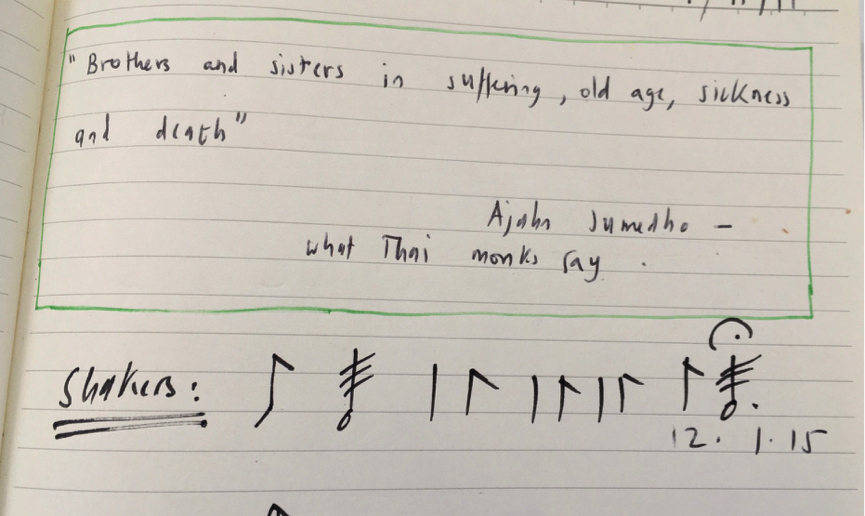
    I jotted that down in February 2017 – I must have already achieved my New Year’s resolutions by then and thought I could set the bar a bit higher. The second track on the album Joy, ‘a’ once had a subtitle which I had heard the Buddhist monk Ajahn Sumedho recite at the beginning of a talk he gave: ‘brothers and sisters in suffering, old age, sickness and death’.[iii] I eventually hid this subtitle as I was worried it might scare people away – I had even forgotten until this week that I had this text in my mind when I wrote the piece. I had spent the last few months wondering to myself what on earth this piece might be about and now I know!

    Probably the most austere of all is one of my longtime heroes: the painter Agnes Martin. As if to chastise myself for the way I have spent my life I wrote this into my notebook: ‘art work… is not beneficial, nothing is gained from it, and it does not tell the truth. It is enjoyed or not according to the condition of the observer. A very small gesture of exultation’ (Agnes Martin from ‘The Untroubled Mind’).[iv]

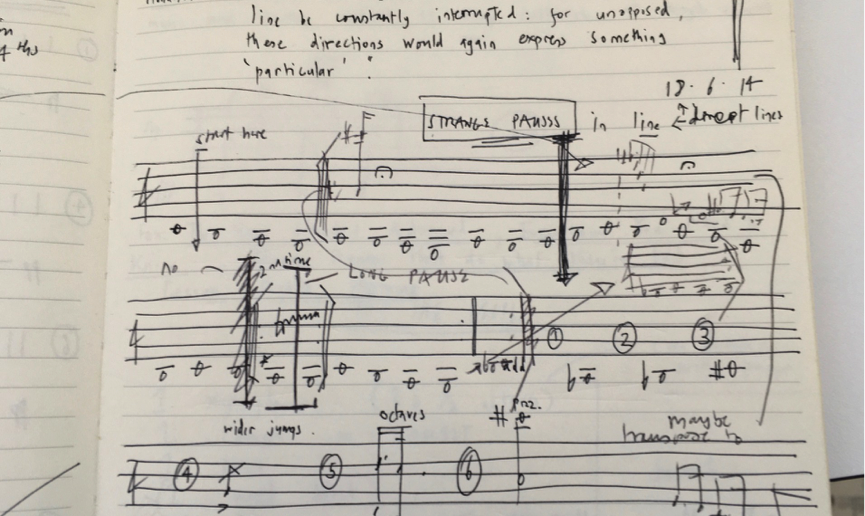
    Notes and sketch from the composer’s notebook

    You may ask why on earth do you find these quotes useful? I fully own up to having a tendency towards the austere myself: over the past five years I have gone at least twice a year on silent retreats in a Buddhist monastery and my biggest disappointment during this lockdown has been missing out on a cancelled ten-day silent meditation retreat at the monastery led by an amazing nun. But also reflecting on it for this article I suddenly realised that I probably need a corrective or balance to clichéd notions of what the arts exist for and the gush spewed out from the art and music worlds to continue making anything. Maybe I am very contrary (okay, I am) but when I read blanket statements about how art needs to reflect life (whatever that means and what if mine is really boring and mundane?!) I think of Martin at her fiercest: ‘art work…does not represent life because life is infinite, dimensionless. It is consciousness of itself. And that cannot be represented’ (Agnes Martin from ‘What We Do Not See If We Do Not See?’).[v]

    So to save me from being lost forever in extreme austerity and the writings of Saint Theresa of Avila, I, and maybe you, have to thank the fact that I started performing my own work fourteen years ago. It has forced me to engage with the messier sides of life and realise the creative act is a bit blurrier than Martin might believe. After the first time I performed a piece of mine solely by myself a close friend came backstage and sobbed in my arms for around five minutes. It was a bit awkward as I had not expected such a reaction. Twenty minutes later another man had a good cry in front of me due to what he had felt my piece had said. A year later a couple asked me to play this piece ‘In Beautiful May’ at their wedding: I asked them repeatedly “are you sure? It doesn’t seem the most celebratory piece and seems to make grown men sob?” But, I ended up performing it at their wedding and everyone seemed extremely happy. As an aside, this is a good lesson in never second-guessing your audience.

    ‘The Spirit of Art’ performance by Betzwieser, Syha, and Hamilton at Halle 14 in 2011

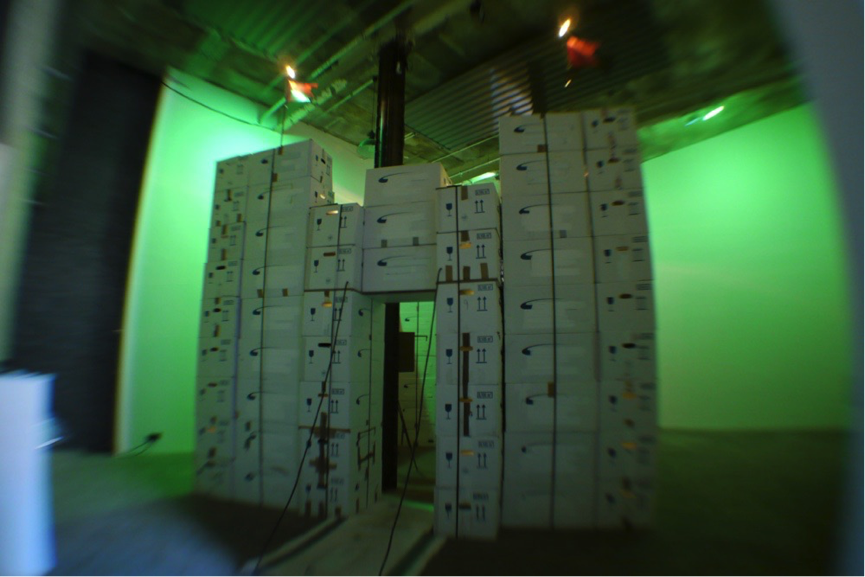
    And the first track on the on this new album ‘The Spirit of Art’, is far from austere and was the result of a process of what could be called grown-ups playing. A gallery in Leipzig, Halle 14, invited myself, the writer Ulrike Syha and the designer Hagen Betzwieser to make a work responding to the idea of archives. This was due to the gallery being the repository of failed applications for an Art fair. In the end we built a castle of boxes filled with the rejected artists’ work and we imagined some type of Art God living in the castle and I sang ‘The Spirit of Art’ inside the building while Hagen manually made dry ice.

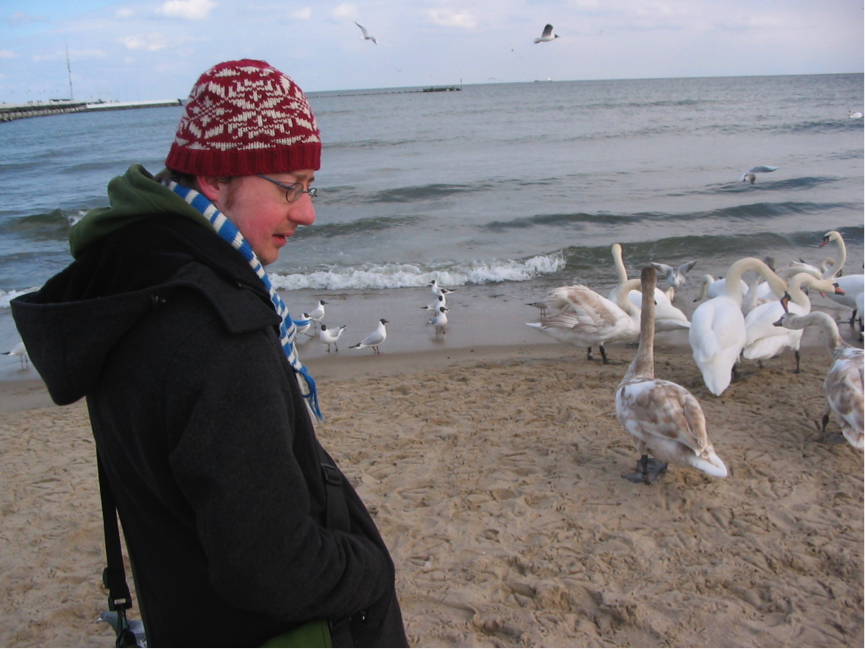
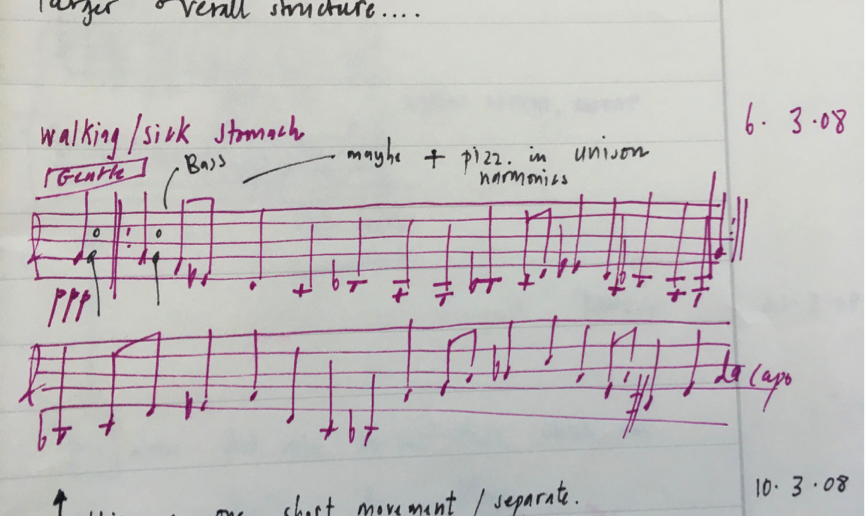
    Another of these new works, ‘product #1’ started as a love song and thank you to the man who organized a trip to Gdansk for us in 2008 after a particularly dark time. And ‘May’ was a melody that appeared from nowhere as I walked near Alexanderplatz in Berlin full of sadness and apparently a “sick stomach” missing an absent friend. It is clear from these examples that life always seeps in.

    Andrew Hamilton with an array of birds visiting Sopot, Poland in 2008

    It is there, also, of course in the monastery, sitting for hours on the ground where the real messiness of life presents itself but after a few days looking unflinchingly at the mess sometimes you can find brief glimpses of happiness that does not rely on anything external – maybe this is akin to what Agnes Martin refers to as ‘a very small gesture of exultation’.[vi]  Perhaps that is the best I can aim for and in all my work I try to take these personal moments and transform/convert them into the abstract, to distill them. Indeed this process can be heard worked out over the duration of ‘product #1’. What begins as a love song gradually gets cut-up and manipulated until by the end it is like viewing an abstracted memory of that song, the personal becomes what Martin would call ‘dimensionless’.

    Sketch for ‘May’ (2008)

    And how even if one piece begins with a clear idea or emotion during the work many other scraps get ‘pulled in’ to the creative momentum. For example I remember ‘a’ was also the result of seeing a painting by Klee called Freundlicher Ort (Friendly Place): I thought no one writes pieces about ‘friendliness’ in new music and that might be fun. Perhaps this made me reflect on childhood as I ended up using different systems of solfège in ‘a’ to recall the embarrassing memories of myself as an upstart boy during theory exams at the Royal Irish Academy of Music on Westland Row. During the sight-singing exams I would inform the examiner I could do it without solfège (I had an irrational hatred of solfège) and they, kindly and without laughing, allowed me.

    The text by Ajahn Sumedho ‘brothers and sisters in suffering, old age, sickness and death” is saying, maybe, that we are all in this together and that is what the piece ‘a’ is probably about but it is also about friendliness, solfège and I even threw fragments of other pieces at it. But then again I forgot all of this completely when I had to find a way to actually structure the material and ultimately I went back to Mondrian and it was his dictum of ‘It is necessary that a horizontal or vertical line be constantly interrupted: for unopposed, these directions would again express something ‘particular’’ that guided how I wrote the final result. So, for me, once the actual writing begins, I often forget what gave the piece the initial ‘ignition’, the abstract takes over (perhaps Martin is saying that life ‘cannot be represented’ because it is so multi-faceted and memory so unreliable).

    Sketch for ‘a’ (2014)

    The ‘beauty of life’ Mondrian referred to in the opening quote is found in the transformation of individual emotions or moments into pure energy and structure. We can experience a form of liberation from being able to ‘drop’ life in the actual making, performing and listening. Maybe Martin and on the opposing side, those who want art to reflect life and the world today are both right? (or maybe both completely wrong!).

    Ultimately, then for me, it is about how I can combine and try to balance the man who loves abstraction, distilling everything down and goes on silent retreats with the man who often gets disapproving looks in the monastery for laughing loudly and sobs every time at that scene when Meryl Streep sings in Mama Mia! Here We Go Again (2018). I hope both can belong: I think the writer Robert Walser finds the balance and distills what could be my borrowed manifesto when he writes (in ‘My Endeavours’), ‘if I sometimes wrote at a venture, on impulse, it looked a bit comical to deadly earnest people; but I was experimenting with language, hoping that it contains an unknown livingness, the arousal of which is a joy’.[xi]


    For more of Andrew Hamilton’s work see his official website: https://andyfhamilton.com/. Andrew’s album Joy is released on Ergodos today as a download and a limited edition CD (with download): https://ergodos.ie/shop/releases/joy/.


    [i]  Piet Mondrian, Pure Art and Pure Plastic Art, and Other Essays, New York: Wittenborn and Company, 1947, p. 32.

    [ii]  Paul Schrader, Transcendental Style in Film: Ozu, Bresson, Dreyer, Berkeley, California: University of California Press, 2018, p. 113.

    [iii]  Ajahn Sumedho, The Way It Is, Hertfordshire, England: Amaravati Publications, 1991, p. 140.

    [iv]  Agnes Martin, Writings, Ostfildern-Ruit: Cantz, 1992, p. 16.

    [v]  Ibid., p. 155

    [vi]  Ibid.

    [vii]  Piet Mondrian, Piet Mondrian: From Figuration to Abstraction, London: Thames and Hudson: 1988, p. 198.

    [viii]  Ol Parker (director), Mama Mia! Here We Go Again, California: Universal Pictures, 2018.

    [ix]  Rober Walser, Speaking To The Rose: Writings 1912-1932, Nebraska: University of Nebraska Press, 2005, p. 102.

  • The State of Irish Agriculture

    On April 30th, acting Minister for Agriculture Michael Creed defended Ireland’s agricultural sector,[i]  claiming we are the second most food secure country in the world. What Creed seems to have been referring to was an Irish independent article from October 2019, saying Ireland had moved from first place to second in a Global Food Security Index.[ii]

    In so doing, Ireland had been overtaken by Singapore, a micro state that imports over 90% of its food. You might ask, how is it possible that this island of concrete was adjudged to be the most food secure place on the planet?

    Singapore, ‘the world’s most food secure country’.

    On closer examination, it seems this “research” had been sponsored by Corteva Agriscience, one of the largest producers of pesticides in the world, and now a subsidiary of DowDupont after a merger with Dow Chemical, (the corporation responsible for the Bhopal Disaster in India 1984). Such vested interests cannot be trusted as a reliable source in assessing the food security of nation states.

    The fact that Singapore is ranked highest in a food security index sponsored by an agri-chemical multinational should come as no surprise, as these chemicals are much more likely to figure in industrially produced food systems, traded on a global market, rather than localized, subsistence food systems.

    It also comes as no mystery to find the Irish independent presenting this highly dubious study as fact. That newspaper has historically represented the interests of the comprador, or broker capitalist class in Ireland; that revolving door between agribusiness, finance and politics, servicing the multinationals that have located in Ireland.

    Moreover, Micheal Creed has a track record of presenting erroneous research to the Dáil regarding emissions from Ireland’s fast-expanding dairy sector.[iii]

    Food security in this scenario equates to commodities being traded on a global market with minimal restrictions. The evaluation is predicated on current availability, price and diversity of food consumed – regardless of productive factors or supply chain interference. It takes no account of the environmental or social consequences of this supply line, or any risks lying further down the line, whether a hard Brexit, a global pandemic, or that the global food system has eroded a quarter of all arable topsoil on the planet since the 1950s.[iv]

    Despite supposedly being number two in the world in terms of food security, Ireland now imports the majority of its potatoes and nearly all its wheat flour; the main staple carbohydrates of the people of Ireland.

    The Teagasc Consensus

    A large part of the belief in distortions like these can be attributed to the neoliberal religion of free trade, which is engrained as a belief system in a great number of Irish farmers.

    Over the course of the twentieth century, the adaptation of new and increasingly expensive inputs into agriculture have been sold as ‘progress’ to farmers. Numerous chemicals and pharmaceutical companies, including SmithKline, Pfizer, Merck, Schering Plough and Roche located their manufacturing facilities in Ireland during the 1960s and 70s, availing of lax or non-existent environmental regulation and lower labour costs. They stayed because of an attractive corporate tax regimes and unrestricted interference in Ireland’s educational system. By the turn of the twenty-first century they accounted for nearly seventy percent of global pharmaceutical output.[v]

    These multinationals have helped the Irish state to adopt an increasingly intensive, highly specialized monoculture agricultural system, geared towards the export market.

    Traditionally, farmers have gone along with this because of the developmental rhetoric and of course, generous EU subsidies.

    Also crucial to manufacturing consent has been the educational apparatus of Teagasc, the state research centre for agriculture. Teagasc uses science selectively to the end of export intensification.

    Connected to the revolving door between chemical and pharmaceutical multinationals located in Ireland, Teagasc and other state educational institutions have effectively locked farmers into an unsustainable, high-input agricultural model, based on the latest bio-technological ‘fixes’ formulated by the agri-chemical industry.

    The end result is scientistic rather than scientific, meaning science is adopted in a cosmetic manner, to provide technical short-term fixes within a strictly liberalised market paradigm.

    A truly scientific approach, which is essential in the face of irreversible climate change, requires rigorous philosophical as well as technical inquiry, taking into account all of the parts involved in a system and their effects. This is a thorny path to embark upon, especially when multinational interests are threatened.

    Irish state education, and Teagasc in particular, indoctrinates a free market ideology into young people. This includes the Law of Comparative Advantage, which involves specialization in one industry over others, for the purposes of international trade. This is the central tenet of the state’s agricultural policies, and the cornerstone of Teagasc’s educational institutions.

    The Law of Comparative Advantage has long been subjected to criticism from other schools of thought such as Development Economics: most notably the Singer-Prebisch thesis, which demonstrates that the terms of trade between countries producing primary products deteriorates over time, relative to countries producing manufactured goods.

    Notably, this economic ‘Law’, was formulated by British Economist David Ricardo in 1817, when the Spanish colonies in the Americas were in the process of becoming independent republics. Spain’s loss was Britain’s opportunity, as ‘free’ trade doctrines became the rationale for unequal exchange between the global North and the global South, then as now, keeping wealth flows disproportionately northwards.

    Now in the former British colony of Ireland the main farmers’ lobby, the IFA, maintains the consensus around globally traded commodities, successfully convincing many smaller farmers that their interests are joined to large scale beef and dairy producers.

    Just recently the IFA managed to compel acting Minister Creed to continue with live exports to Turkey, Algeria and Libya as a way of stabilizing prices.[vi]

    Yet many farmers are discovering that they have given away too much autonomy to the IFA and their political patrons in Fine Gael. Some small farmers broke away from the IFA to form the Beef Plan Movement, which challenged export monopolies from 2018, but the Movement seems to have dissipated.

    Now some disillusioned farmers are beginning to see the EU’s CAP as the source of their problems, and are calling for an ‘Eirexit’.[vii]  However, while free trade agreements in the EU and other consumer markets are a vehicle for the current model, the driver has long been the Irish State.

    Source of the Problem

    With many farmers now in grave financial difficulties, it has become apparent that the source of our agricultural difficulties lies in international free trade arrangements, European or otherwise, being used by the State and accepted without question by farmers’ lobbies in the name of ‘progress’.

    There was nothing inevitable about European integration pushing Ireland so far past its ecological carrying capacity in terms of agriculture: it came from the Irish state’s pursuit of European integration and other free trade arrangements.

    During the 1970s and 1980s, the Irish State pushed to clear wildlife from farms, even if the financial incentives came from EU grants. It is the Irish State which continues to push for export intensification through its Food Harvest 2020 and Foodwise 2025 schemes, seeking markets far beyond the EU. Ireland is now the second largest exporter of infant formula in the world, its largest market being China.[viii]

    A food system that is so integrated into global market chains has brought increased levels of monoculture specialisation in beef and dairy, severely diminishing the diversity of food produced [ix],  and depending not only on chemical inputs ,which pollute our environment and destroy biodiversity, but also on imported animal feedstuffs.

    The dairy industry has grown by 27% [x] in just five years and continues to expand, far exceeding the carrying capacity of the grassland it relies on. Due to homogenization, the supply chain of pretty much all Irish butter and non-organic dairy produce contains on palm kernels, and genetically modified, Roundup-Ready soya and corn.

    This amounts to an appropriation of land, labour and water resources from the global South, causing deforestation in tropical rainforests, erosion of topsoil which takes thousands of years to form; as well leading to the extinction of animal and plant species.

    The successive crises that these policies have led to in Ireland have been misrepresented as ‘fodder’ crises. They are in fact over-intensification crises, arising from destructive free trade policies which have pushed the island of Ireland past its agricultural carrying capacity.

    These are a reoccurring themes in Irish history. The difference between today’s and the crises of the eighteenth and nineteenth century is that Ireland is no longer bottom of the economic hierarchy in the global economic system. As a result, the environmental burden can be externalised to peripheral parts of the world, especially through feed imports.

    Inside Ireland’s largest milking machine. Henry Clarke (wikicommons).

    A New Way Forward

    The progress of the so-called ‘Green Revolution’ in agriculture from the 1940s is beginning to unravel. Short term bio-engineering fixes are spiralling out of control. A continuous stream of newly engineered GM crops – which can withstand higher concentrations of agri-chemicals – are being rolled out in response to new herbicide resistance in weeds which make the existing chemical concentration of previous GM varieties ineffective. The result is higher doses of chemicals in our food chain and mass extinction of pollinating insects and soil microorganisms.

    The limits and consequences of the industrial model of agriculture is now evident from a food security standpoint as well as in terms of the environment. The science behind our agriculture needs to involve a whole systems approach that takes into account all of the ecological consequences of globalized food production, and which places soil conservation and renewal at its core.

    At present, this is missing entirely from Teagasc’s educational apparatus as the current food production model is not circular, but extractive: heavily dependent on imported inputs which cause deforestation, topsoil degradation and extinction of species in other parts of the world, as well as wreaking havoc on biodiversity and water quality within Ireland.

    In the wake of Covid-19, a future roadmap is in the hands of whoever dares to seize the moment. The epidemic has occurred in the wake of years of environmental campaigning and the farm to fork strategy [xi],  which has been pushed through at European level. This  reflects a growing recognition of the limitations of the global industrial food model at the highest levels of political power.

    This crisis of international capitalism is a real opportunity for small producers to adopt more localized regenerative agricultural systems, which are embedded in community and work with natural ecosystems instead of attempting to dominate them. In these kinds of systems, farmers and communities of farmers produce foodstuffs suitable to their bio-regions, sequestering carbon in the soil.

    These kinds of systems generate their own inputs, freeing farmers from the clutches of the agri-chemical industry. In this kind of scenario, farmers produce a healthy diversity of food for their communities, instead of monoculture commodities for cargo ships.

    In order to achieve this, however, we require a complete overhaul of deep-seated beliefs about farming which have been perpetuated by state propaganda, the educational apparatus, and the media.

    The United Nations Food and Agriculture Organization now recognises agri-ecology as the way forward for developing food security in the face of climate change. We must fight State policies which prevent a regenerative agriculture. Not only is this achievable, it is essential.

    [i] VideoParliament Ireland,  Deputy Holly Cairns – speech from 30 Apr, YouTube, 2020 https://www.youtube.com/watch?v=8PrwuHgRxPM&feature=youtu.be&fbclid=IwAR16-ozAjJzFY_iF2fWI8jr0yu0ydOZCdse5vJxvXkavGEltsHoOMAZAM2g

    [ii] Margaret Donnelly, ‘Deputy Holly Cairns – speech from 30 Apr 2020’, Irish Independent, October 16th, 2018, https://www.independent.ie/business/farming/news/world-news/ireland-slips-to-second-in-the-world-for-food-security-37425858.html

    [iii] Press Release, ‘An Taisce has called on Minister Creed to retract misleading Dáil statements on rising dairy emissions’, 25th of June, 2018, https://www.antaisce.org/articles/an-taisce-has-called-on-minister-creed-to-retract-misleading-d%C3%A1il-statements-on-rising

    [iv] Chris Arsenault, ‘Only 60 Years of Farming Left If Soil Degradation Continues’, Scientific American, December 5th, 2014, https://www.scientificamerican.com/article/only-60-years-of-farming-left-if-soil-degradation-continues/.

    [v] Robert Allen, No Global: The people of Ireland versus the multinationals, Pluto Press, Dublin, 2004, p.4

    [vi] Untitled, ‘MINISTER CREED MUST ENSURE THAT LIVE EXPORTS TO ALGERIA CONTINUE’, IFA, May 10th, 2020, https://www.ifa.ie/minister-creed-must-ensure-that-live-exports-to-algeria-continue/#.XrgyI2hKg2w

    [vii] Irish Freedom Party, ‘Irish Farmers are Strangled by EU Regulations | Frank Shinnock at Irexit Cork’, March 4th, 2019, https://www.youtube.com/watch?v=rp41yqAWkzQ&t=1115s

    [viii] Stephen Cadogan, ‘ The origin is green — China is now Ireland’s second most important market for dairy exports’, Irish Examiner, November 15th, 2018, https://www.irishexaminer.com/breakingnews/farming/the-origin-is-green-china-is-now-irelands-second-most-important-market-for-dairy-exports-885402.html

    [ix] Conor Finnerty, ‘Only 1% of Irish farms grow vegetables, the lowest in the EU’, AgriLand, October 22nd, 2016, https://www.agriland.ie/farming-news/only-1-of-irish-farms-grow-vegetables-the-lowest-in-the-eu/

    [x] Ibid, Press Release, An Taisce.

    [xi] Untitled, ‘Farm 2 Fork and Biodiversity Strategies Hold Firm on Real Targets’, Arc2020, May 20th, 2020, https://www.arc2020.eu/farm-2-fork-and-biodiversity-strategies-hold-firm-on-real-targets/

  • Photo Desk: Black Lives Matter Sligo Protest June 5th 2020

    Around 200 people gathered in front of Sligo City Hall this Friday afternoon. The majority of those attending were young, and they spoke about George Floyd, supporting the Black Lives Matter movement, but also raised questions about Direct Provision in Ireland.

    Photography Felipe Lopes

  • Artist of the Month: Letizia Lopreiato

    This drastic, clean-cut deprivation and our complete ignorance of what the future held in store, had taken us unawares; we were unable to react against the mute appeal of presences, still so clear and already so far, which haunted us daylong … The plague forced inactivity on them, limiting their movements to the same dull round inside the town, and throwing them, day after day, on the illusive solace of their memories. For in the aimless walk they kept on coming back to the same streets and usually, owing to the smallness of the town, these were streets in which happier days, they had walked with those who now were absent …
    And the narrator is convinced that he can set down here, as holding good for all, the feeling he personally had and to which many of his friends confessed.
    It was undoubtedly the feeling of exile – that sensation of a void within which never left us, the irrational longing to hark back to the past or else to speed up the march of time, and those keen shafts of memory that stung like fire.

    Albert Camus, The Plague p.60, 1947

    ‘Mood 1: Suspension’ from ‘The Timelapse’. (c) Letizia Lopreiato

    Of trauma and of the exile from self and the world we once knew …

    My handcrafted trauma therapy

    I only recently got back to this book, and how strongly these pages resonate with my tireless work to bring to life my “Timelapse” project experience during this time of self-isolation. It has left me speechless. A poet left with no words, almost ironic in fact … These words truly have been marked by an imposed distancing from all things social so beloved to me, which is starting to feel quite painful at times whilst all these photos and all those words and all these memories have no other place for now, other than the walls of my apartment …

    © Letizia Lopreiato

    This book was left to me by a good friend, one of Dublin’s main characters if you ask me. He was working at “Dublin’s best kept secret café” as the signs says, right behind one of my favourite bookshop. Paco knew, I remember the first day I went there, I just felt his humanity. And so since then I came back every day, my refuge in time of pain and sorrow whilst traveling back and forth, at one stage even every week, and for over a year, in between so many spaces, so many memories … Paco knew I was exhausted but he also knew I had a story tell, letting me write, taking photos for hours in the garden. Always the same seat, by the corner, where it was safe for me to hide. One day he came to me with a flower and a glass of bubbly with a strawberry, a big smile, which would have cheered the entire city up. He just knew though I never told him what was happening. He knew now I know, because we have all, for one reason or another, from the ones we love, the ones far from what we knew as an anchor to our self, we have all been there, in that no man’s land that trauma throws you on. Like a massive wave it carries you to a foreign land. It is a shore, you just can’t see the rest of the island … yet. For many years the sensation of exile following the death of my father truly followed me too, just like the narrator in The Plague, until I arrived home. Ireland, Dublin, its magical people, its incredible feeling of community, allowed me to be present, to slow down, to feel my own thoughts. Thoughts that I have had for so long but that I could not hold the energy to engage with, it was like I couldn’t handle the intensity of them for so long, until when It finally felt like I had no escape from the awareness of them, if I truly want to make through it and still be myself.

    © Letizia Lopreiato

    Paco left me this book the day before he left, after almost twenty years in Dublin, to return to his home town. A return I could never see for myself, as Ireland is already home, it truly always had been for me since I first came here as a kid to practice English. I just knew it was where I belonged, this magical land where healing is led by the creative force of its nature, if you only allow it to flow through you. And thankfully now my mum is here, she is back home too. Her healing began when she asked me for help two years ago, up to then she tried everything in her power not to “disrupt” my life she said. When the only thing I could have asked for, what I was waiting for, was for her to be ready to let me in, and be present. I have never seen myself as the type person living so close to their family, I always aimed to live abroad. I never felt at home in my country, never like I have always done here. But one thing is to choose not to, another thing is to feel you can’t reunite with what you feel as family, simply because trauma took it away, because the losses became unbearable, because the world you knew, the life you had, simply ceased, simply leaving you wondering around like a ghost amongst ghosts, haunted by the sensation of feeling betrayed by life somehow … Losing faith in the unexpected, in the positive, fearing any new beginning, perpetually condemned to relive that painful past, which is always so present, over and over again.

    Love does not equal hurt, it might equal pain, so does life, because that is what life means, it makes us feel. The state of being frozen, collapsed in one’s own perception of constant risk, as if the entire world is aiming to hurt us sooner rather than later if we only allow it. It is that dimension whereby expressing feelings equals weakness, the “better be numb and selfish” mentality, rather than admitting we still feel too hurt. When we think nobody cares anymore, as everybody moved on, somehow, with their lives. Everybody but us … It is hard to dismantle false beliefs, put there to protect us in the first place, when by nature we are drawn to think firstly of all negative possible consequences to our actions. We are animals after all, and nature is something to be feared, the unexpected is a threat, and it can only be fought back, by staying constantly alert.

    ‘Mood 2: Anxiety’ from ‘The Timelapse’. (c) Letizia Lopreiato

    Getting out of the hole in which we stick ourselves in whilst experiencing trauma, and where we ourselves decide to remain even after the event, is because of the self-complacency bubble, the of victimhood, which is way too easy to live in versus the admission of being always able to save ourselves, which does requires effort, accountability and above all which involves the need to learn (or to learn again), to be response-able.

    It might be not what we really want to do what matters in this case, to me at least, it has been more a case of, “did I really feel like leaving that state”, and for this, timing is crucial and it is different for each and every person.

    In this story, I needed to reach rock bottom, and so did my mum, to realise, to feel, that we weren’t betrayed, that trauma has always been there as the most precious healing opportunity, in its pain and apparent unfairness.

    And so surely this is a long way of saying, the way to healing, it requires a choice, and this choice should be recognised as growth, and not as threat, it requires awareness, and awareness to grow, it needs a fearless space, which can only be built through gentleness, compassion, self-love and loads of self-respect, for our need for safety and security, to finally be met. Because fear means resistance, and within resistance, change is nor recognised as growth, but a self-inflicted pain, chaos, anxiety, which becomes the only comfort zone.

    © Letizia Lopreiato

    It is possible to rewrite our story, at any moment, anywhere you are. And each and everyone’s story is always different, but that is the thing, this is not a competition about who had the worst in life. And I won’t go into the details of what exactly happened to me because it is not what I believe the value of sharing this experience is. This is just one experience, one story, which has been sitting in my room making me almost unable to breath properly at night when looking at all those photos hanging on my wall. Every day, I have been reliving the feeling of all those memories, It wasn’t pleasant, but I knew it was “a storm I had to face” to find my land, to find peace. Writing this piece, I have started reflecting on why this was happening, and what this creative process has meant for me. Reflecting on where I stand now after all this, and why I was resisting looking at how this crisis, this storm, changed me and led me to feel love again, to open my heart again.

    I was risking stagnation, the elephant was not even just in my apartment, it was sitting on my chest wherever I was going before I embraced this experience and let it flow through me … My shadow was there, asking me to look at it and become friends. And so I did, I befriended my demons, I accepted my shadow, and now I am at peace. And my mum is on her way to heal too, embracing the last phase of her life, leaving the sensation of shame, of guilt, of abandonment that trauma shuffles you with when not explored, when not embraced.

    This process to me, the one of embracing my shadow, as my dear Jung would have defined it, it has been the highest lesson that self-love could have led me to.

    And I did it through art. Art for me has not only meant survival, art has brought meaning to my life, without which in all likelihood, I would not be here to tell this story.

    My mum is now starting her first ever art therapy course, as well as her English classes, encouraged by how therapeutic this project has been to her too. Her reactions passed from outburst of irritation, to laughter, to surprise when looking at herself in this project’s photos. Hanging on my walls for the past month and a half since lockdown started, there are the photos of the incredible journey within of two women, out of their roles of mother and daughter, two friends, coming back home, home to themselves, and to one another.

    ‘Mood 3: Grief’ from ‘The Timelapse’. (c) Letizia Lopreiato

    A journey of self-healing, of self-empowerment.

    If we would only choose to be present, to gift our time when we sense discomfort, within us and in others, if we would only train our hearts and our minds to hold that space, the space needed for everybody to share their stories of difficulty, of pain, of trauma, of guilt, of shame even … This world would be a better place, a place for empathy, a place for self-acceptance and for truth, rather than a comfortable fiction dimension with “positivity 24/7” as one solution fitting all purposes.

    We have our own unique narratives. But it is important always to keep in mind that history is shaped by those who tell the story.

    So why not being ourselves, to tell our story? To share our truth? To reshape our narrative?

    “Nobody better than you could depict your feelings”, John Gunn, another Dublin’s icon if you ask me, once told me to encourage me to start taking photos of myself in order to portray my poems. This was instead of my original choice to find a photographer for this purpose.

    In Trauma Therapy from a somatic approach, we study that in order to heal from trauma, what needs to be guided is a work reconnecting one’s images, feelings, meaning, expression, actions and relationships. This is because of the disconnection that trauma creates, and which fractures one and / or many of these links.

    If you would ask me what photography helped my mum and I with, I would tell you:

    Using photography along with poetry and reflective journaling, helped the reconnection through images, of the meaning of our feelings, to find a reason and closure for our actions, and even for the hurtful actions of others. It allowed us, to give ourselves a path towards forgiveness.

    © Letizia Lopreiato

    It has represented a free form of expression for our relationship with ourselves, with what happened and with one another.

    Art in the form of what I call “my handcrafted art therapy during lockdown”, truly allowed for this reconnection to start happening.

    This film photography and poetry project, titled “The Timelapse”, is the result of the last two-and-a-half years of documentary work, which felt more like an exploration, and a deep dive into the experience of trauma, bereavement and all its consequences for the mind, the body and surely the spirit.

    The consequences created by the unexpected sudden void which opens under our feet when death knocks at the door. Death, as well as love, triggers within us the more primordial fears, but also the most shining of all glimmers: the one of hope, the one of happiness, the one of that on-going learning process that is the letting go of what has already happened, and which is no longer with us.

    No matter how long we feel we should wait and hold on to the memory of it, how long we feel we should do so, to honour its prior existence … It is a call for the acceptance of the inevitable change that is the jump into the unknown after the experience of loss that has to be embraced to start healing. That beginning of a new cycle in life, where, luckily, everything has already changed, us included, no matter how long it takes for us to admit that.

    We grew. We evolved. It was painful, it was harsh, but it did happen. No matter how long we chose to numb ourselves for, by trying not to look in that mirror. Trauma equals change.

    Trauma is that breaking point, for the no-return to the ones we once were. In its toughest form and shape it is the deepest of all lessons, it is there for us to learn, once and for all, to avoid stagnation.

    Resistance to the inevitable change that trauma imposes translates into stagnation for the spirit, for the mind, an intoxication for the body, that is desperately trying to follow up with a mind that can’t fit the memories of the experience anymore into any of the drawers which once were so orderly, storing the reality we knew before the event. It is a shock to our system.

    © Letizia Lopreiato

    About this project and my creative process:

    The Timelapse – Its digital launch and release during lockdown


    View this post on Instagram


    A post shared by LaLety (@letizia_lety_lopreiato) on

    This project and deciding to finalise and release it during lockdown anyways, with a digital launch instead of a physical one originally due at The Darkroom, here in Dublin, on April 30th, for Poetry Day Ireland, it was surely a journey of exploration for both myself and my mum.

    A deep dive into the the ocean of those memories which truly didn’t fit with any of own or my mum’s drawers anymore. The cabinet of our hearts and of our minds needed to create a new filing system. I write poetry in outbursts, an uncontainable impulse, I feel it as a real need for me to maintain my mental health, rather than an aesthetic exercise. Only recently I started remembering what I write, and this I believe happened because the work of matching poetry with photography allowed me to finally reconnect my mind, my heart, and my spirit.

    Before starting using film photography, I used to write, fill diaries with my poetry, and never open them again. Almost like my poems were truly some little creatures which I was growing until they came of age when they could be let out and about in the world and out of my mind.

    ‘From the Front’ from ‘The Timelapse’ (c) Letizia Lopreiato


    I only now realise that I wasn’t taking proper care of them once I released them into the world though, I have realised this now through a deep self-love journey, that I was probably scared of them somehow, scared to see what parts of me I was releasing into the world, scared of what they truly meant to me. Of what they have been representing of me. Basically I realised that there is a lot of “fear of self” in the mere fact of not wanting to be fully accountable about my own art and in not having wanted it to become a final product until now, an independent creature.

    I have realised I was afraid of losing control of my own fears, my deepest and most guarded secret instincts. A fear that my sensitivity will not be protected if it is released into the world. It was fear and guilt about creating my own Frankenstein, releasing it into the world and then abandoning it with no protection in front of it, to be accepted in its diversity.

    A fear I released fully and substituted with love and respect for myself and for my own creations during lockdown and thanks to this experience, and to all who supported me and believed in me and my art.

    I am thankful above all, greatly thankful to life for having granted me this healing space and time.

    In fact, I didn’t quite understand why It felt so natural since the very first photo I took with my one and only film camera, for me to feel the actual action of turning what I see and sense into an actual tangible creature which finally was freed from my mind.

    ‘When Travel Means Need’ Part 1, from ‘The Timelapse’ (c) Letizia Lopreiato

    The creative process is like alchemy to me. It feels like alchemy. The transmutation of what once was mainly painful and almost unbearable, into light, into meaning, into a being which has a life of its own, for anybody who would like to take it by the hand and go for a walk with it, in the midst of their minds, their hearts, their spirits. It will be a companion for their journey, wherever they would like to be, whenever they might feel like it. It is and will be, always available, just like breath.

    Photography has allowed me to understand, to slow down, always to look with the eyes of the heart, at a manageable pace, the one of the human being, the one of a creation which is and has to be one with nature to feel whole.

    Any distance, any avoidance of that space we need as animals by default, deep within us, to hold understanding of our actions, based on the feeling of it, it translates into a disconnection which we can’t afford. Playing the disconnected ones leads us to not being held accountable not even to ourselves, for our actions, for our words, because if we feel love, we feel pain, we feel loss, we feel it all. Soon it is there to realise that this which seems to be an easier option, always comes at a price, but that whoever loves and cares for us will be the ones paying it, paying the price of our disconnection.

    And if one thing, death, loss, or any trauma in itself, does teach anything, it is that being selfish in this journey means more pain, it means more death, it means more losses, and it means stagnation. It is the emotional resistance to the experience of a change that in our body, in our cells, in the chemistry of our being, has already happened that feeds the disconnection.

    It is the way I liked to see it, and unfortunately I have learned the hard way, it is paramount to need to release the water, our emotions, to follow its flow. Because only water can carve mountains.

    ‘When Travel Means Need’ Part 2 from ‘The Timelapse’ (c) Letizia Lopreiato

    PTSD, depression, anxiety, loss, death, the experience of bereavement itself, both experienced first-hand, as well as lived through the experience of my loved ones, only represented for me the desperate call of my heart to find home, to go back to its true identity, which I had to bottle up to feel safer. Just like we all do. Photography along with poetry and creative writing journaling filled the walls of my apartment now turned into an art studio with photos hanging on almost every wall, and filled the walls I had built within as well. The difference is that now, I can see it, I can see those walls, and they are not within me anymore.

    At the highest stage of the disassociation that trauma had left me with over the past decade, I was almost feeling like I was creating different movies. In every city, evert country, every job I chose to engage with … Experiences that now feel like belonging to different lives, many different movies, that you almost can feel like you wanted to switch from or watch again, to jump in and out of the memory of them without being overly impacted by it as you were living with them in a detached way, to protect yourself, but that is not life. That is surviving. Survival mode made a life style.

    It really is not fiction though, and eventually the realization that all those movies would be looking better as one, and that you truly need to find and hold the space within yourself to sit, and watch it all. You need to feel it all, as your own. Because it represents you, and there can be no shame, no guilt, no fear anymore, because you have always had a choice, to leave behind the victim’s cloak. And you do this with compassion, kindness, self-love and self-respect, whenever you have felt ready for it. Whenever you truly felt at home again, whenever you can trust that out it is safe out there again for your needs to be met, for your voice to be heard, for your feelings to be truly “seen” and welcomed.

    © Letizia Lopreiato

    To experience the fear, to feel the pain, and to find freedom, once again. To be at one with yourself, and with all that is around you. Because independence does not equal loneliness and others can and want to be there and meet our needs, with patience, with time, with real love, with genuine care, if we choose to let them in. All levels of trauma, from childhood to adulthood leave us with the feeling of not being able to choose a way out. Being gentle with ourselves and one another, doing all in our power to show empathy, to feel tolerance, to experience connection as many times per day as we can. Write down the sensations, carry a diary, note it down on your phone, just remember, remember what it feels like to be present, once again. Out of your mind, into your body. There is always time to breath.

    With light and respect,

    Letizia Lopreiato June 2nd, 2020

    ‘Mood 4: Suspension’ from ‘The Timelapse’. (c) Letizia Lopreiato

    Featuring Image:

    Interruption – The Missing Peace: This work aims to represent what grief meant to my mum and I, the way I felt this process has been perceived by the people around me too. An interruption, the missing peace … It was to my eyes that void which opens up beneath our feet, in our stomach. That fracture suddenly claiming its space. That gap which we need to learn how to walk around on, and make our own, as it is now part of the landscape. © Letizia Lopreiato

    instagram.com/letizia_lety_lopreiato/

    These below are some references for the curious minds, to my learnings in regards to the perspective I gained whilst researching on trauma therapy, from a somatic psychotherapy approach:

    • The Polyvagal Theory, Neurophysiological Foundations of Emotions, Attachment, Communication, Self-Regulation (2011), Stephen W. Porges, published by W. W. Norton Company, NY, United States
    • The Pocket Guide to the Polyvagal Theory: The Transformative Power of Feeling Safe (2014), Stephen W. Porges, published by W. W. Norton Company, NY, United States
    • Clinical Applications of the Polyvagal Theory: The Emergence of Polyvagal-Informed Therapies (2018), Stephen W. Porges and Deb Dana, published by W. W. Norton Company, NY, United States
    • The Polyvagal Theory in Therapy, Deb Dana, published by W. W. Norton Company, NY, United States
  • Repression and Covid-19

    The long march of the locked-down migrants[i]
    (Aadesh Ravi – composer, lyric writer and singer)

    Lyrics

    How are the little ones holding up at home?
    I wonder how and with what my old mother feeds them? 

    We toil daily to subsist
    Forced to migrate to make ends meet

    The nation may be great
    But our lives are miserable

    This wicked disease struck us
    and wrecked our lives 

    What life is this? What life is this?
    a wretched life, a pathetic life
    an abject life, a broken life 

    Is there a disease worse than poverty?
    Is there a solace greater than being with one’s family? 

    Just to be at home in these troubled times would have
    been enough

    At least we would have survived together, on some gravy
    or gruel

    The kids flit and hover in my eyes all the time
    My wife’s laments chase me ceaselessly

    What, what should I do? What am I to do?
    What to do? What can I do?

    No need of buses or trains, O’ saaru
    Just let me go, master! I will walk my way home

    No need of buses or trains, O’ saaru
    Just let me go, master! I will walk home

    How are the little ones holding up at home?
    I wonder how and with what my old mother feeds them?

    How are the little ones holding up at home?
    I wonder how and with what my old mother feeds them?

    Let me go, O’saaru! I will walk my way home!
    Let me go, master! I will just walk home!

    Imagined Communities

    Nations, while possessing points of similarity with others, such as a general ‘reverence’ of their external borders, are each a unique and distinct mélange of dominant and disputed histories, cultural groupings, social identities, economic modalities, political structures and legal strictures. Citizens share a set of collective memories and a sense of belongingness with their wider national community – though this can conflict with localised identities particularly in post-colonial states where different ethnic and religious groups were lumped together – despite only ever getting to know a small minority of its members.

    These ‘imagined communities’, according to Benedict Anderson, possess a number of characteristics. They imagine themselves as ‘limited’, as each nation sees itself as different from others; ‘sovereign’ as they are free to determine their own destiny; and ‘as a community’ in that no matter how unequal the internal social relations might be, ‘the nation is always conceived as a deep, horizontal comradeship.’[ii]

    ‘Habitus’ and the State

    The French sociologist Pierre Bourdieu uses the term ‘habitus’ to describe how individuals are socialised through the ‘historical and cultural production of individual practices – since contexts, laws, rules and ideologies all speak through individuals who are never entirely aware of what is happening.’ Individuals then reproduce these practices, mediated to varying extents by their own self-interest and interpretation.[iii] This individual concept of habitus can be applied at the level of groups, such as a nation. This ‘collective habitus’ refers to its

    shared perspective on the world, relatively common sets of values and shared dispositions to believe and behave in particular ways. The state partially orchestrates this collective habitus by creating the conditions under which certain things come to be viewed as natural and inevitable… and others unthinkable… But perhaps the most effective way that the state creates an orchestrates this collective habitus is by ensuring that is seen by the people it governs as being ‘the voice of the people’, which gives it legitimate authority to rule us, and even to exercise violence against us.[iv]

    As individual nations have their own distinctive ‘collective habitus’, the political and social contexts within which governments operate will vary. This will impact upon the respective levels of freedom they have to resort to force or repressive measures in advancing specific policies. What is deemed acceptable by the citizens of different polities will largely depend on the history of repression in their states, the restrictions accepted in the past, the tradition of resistance, public confidence in the authorities, the current levels of political freedom and whether the state and its citizens are faced by some form of existential threat.

    An interesting illustration of how the historical experiences and collective habitus of a nation can impact upon how repressive measures are accepted and rejected, can be seen in the reaction of some segments of society and even the political leadership in the U.S. to the lockdown. In several cities, large gatherings of citizens were able to successfully assemble in public to protest lockdowns in defiance of restriction on movement ordinances.

    Paul Becker/wikicommons

    Moreover, not only did the U.S. President Donald Trump state his support for their actions but he even went so far as to encourage them to ‘liberate Minnesota, Michigan and Virginia’, states which are, not surprisingly, ‘election swing states with Democratic governors.‘[v] In many other nations, such acts of civil disobedience, in contradiction of state ordinances enacted to protect citizens from an infectious disease, would have been heavily clamped down upon by the authorities.

    Power, Control and the Use of Force

    In his book on Power, John Scott expounds on modern governmental management of a territory and the political management of nations and their citizens.

    Modern rulers… see their task as one of government in… shaping, guiding, and directing of the conduct of others by using persuasive processes of signification and legitimation to work through their desires, aspirations, interests, and beliefs… Sovereignty over territory also involves the management of the population to regulating the life processes through which they live, work, and relate to each other. This is what Foucault termed ‘bio-politics’… discipline is a control that is exercised over people through systems of rules that are not simply imposed on them but are instilled in them.”[vi]

    Governments can increase their power and control either by direct imposition of repressive measures or through the prohibition of alternative voices and movements, which they wish to suppress. In most instances, a judicious melding of both methods will be applied. The precise mix will depend on the political and social environment together with the historical experiences of the state in question.

    However, it is important to remember, as Max Weber emphasises, that while:

    Force is certainly not the normal or only means of the state… but force is a means specific to the state… the state is a relation of men dominating men [and generally – one should add – of men dominating women], a relationship supported by means of legitimate (i.e. considered to be legitimate) violence…[vii]

    As David Held writes ‘the web of agencies and institutions’ of a state find their ultimate sanction in the claim to the monopoly of coercion, and a political order, is only, in the last instance, vulnerable to crises when this monopoly erodes.[viii]

    Covid-19 – Gateway to Repression?

    Confronted by an unprecedented and menacing threat, it is normal for people to feel disorientated and even experience levels of panic disproportionate to the threat itself. It is not surprising therefore that the past few months have seen the imposition of unprecedented restrictions in response to Covid-19 by governments around the world. Emergency powers have been used to shut down large sectors of the economy, enforce movement restrictions, screen and isolate potential carriers, and enforce quarantining.

    Covid-19’s rapid spread around the world has impacted upon people living in a wide variety of political, economic, social and cultural contexts. These diverse contexts have mediated the repressive policies available to governments facilitating, refracting or impeding the measures they have attempted to impose the insecurity and fear caused by the pandemic have undoubtedly facilitated the imposition of repressive measures.

    While these measures have generally been implemented in response to scientific guidelines on how to tackle Covid-19, they should be limited to what is required and not used as a means to surreptitiously increase governmental power. Furthermore, as Amnesty International researcher Massimo Moratti warns, while states of emergency are permitted under international human rights law, such restrictive measures should not become a “new normal” and should last no longer than the danger that has necessitated their implementation.[ix]

    ‘Shock Doctrine’

    In her book The Shock Doctrine, Naomi Klein describes how this process mimics the CIA method of ‘coercive interrogation’ which aims at breaking ‘resistant sources’ by creating violent ruptures between prisoners and their ability to make sense of the world around them. Klein argues that this is how shock doctrine works: ‘the original disaster, the coup, the terrorist attack, the market meltdown, the war, the tsunami, the hurricane – puts the entire population into a state of collective shock. Like the terrorised prisoner who gives us the names of comrades and renounces his faith, shocked societies often give up things they would otherwise fiercely protect.’[x]

    The advent of Covid-19 has led to a situation where people are confronted by an infectious disease, for which there is no vaccine, and global lockdowns resulting in deep and widespread social and economic disruption. This has provided an opportune environment for governments to increase their power and control as well as advancing interests of their more powerful supporters. Repressive policies and measures can be introduced, as the ‘shock’ caused by the Covid-19 pandemic leaves the public less able to resist. In a world where lockdowns, isolation and quarantining have become the new accepted norm, coordinated, active resistance to repressive and inhibiting policies has become more complicated. As Patrick Cockburn points out:

    Autocratic governments everywhere are becoming more autocratic and repressive regimes more repressive. They believe that they can get away with it: frightened peoples are looking to their governments to save them in this time of peril, and do not want to discover that they are ruled by incompetent people determined to serve their own interests and stay in power.

    State Repression

    While most of the measures imposed to fight Covid-19 have some level of scientific justification, emergency and repressive powers entail an inherent risk of abuse. Moreover, it is clear many governments have used the COVID-19 pandemic to push through laws and other measures that impose disproportionate restrictions on public freedom and civic rights.

    Significant international controversy arose with the granting of wide ranging powers to Viktor Orban, the Hungarian PM, and his Fidesz party, which decreed jail terms of up to five years for the intentional dissemination of misinformation that might impede the government’s tackling of Covid-19. While the chilling effect of this legislation was widely criticised, it was the refusal to place any time limits on the powers being abrogated by Orban and his regime that led to the most concern.[xi]

    Viktor Orban

    Writing in late March, Osama Tanous describes how Covid-19 has been used as an excuse by Israel to further repress Palestinians:

    Repression has continued, with the Israeli occupation forces using the excuse of increased police presence to continue raids on some communities, such as the Issawiya neighborhood in East Jerusalem, home demolitions in places like Kafr Qasim village and the destructi‘’on of crops in Bedouin communities in the Naqab desert.[xii]

    Despite initially downplaying the threat posed by Covid-19 and the publics’ ‘hysterical’ response to it, the Philippines President Duterte has subsequently implemented an ‘extreme, militarized approach.’ By early April, the Duterte regime had arrested almost as many people for alleged violations of the Covid-19 lockdown and curfews as had been tested for the virus.[xiii]

    In Colombia, already heavily besieged rural and indigenous communities have come under even greater threat as a result of the Covid-19 measures enacted to prevent transmission. In the week following imposition of quarantine measures in cities across Colombia in mid-March, three social leaders were murdered. Already one of the most dangerous countries in the world for social activists and community leaders, with 271 activists killed since the conclusion of the early 2017 peace deal between the government and the Revolutionary Armed Forces of Colombia (Farc), the government’s focus on the pandemic has led to activists saying they are now at even greater risk.[xiv]

    On March 16, a group of United Nations human rights experts warned that,

    emergency declarations based on the COVID-19 outbreak should not be used as a basis to target particular groups, minorities, or individuals. It should not function as a cover for repressive action under the guise of protecting health … and should not be used simply to quash dissent.[xv]

    Furthermore, as the OSCE Right’s Chief, Ingibjörg Sólrún Gísladóttir emphasised, a state of emergency must be proportionate to its aim, and only remain in place for as long as absolutely necessary.[xvi]

    Cloaking Repression

    Repression is not just a matter of custodial torture and extra-judicial murder. Mis-governance or mal-governance is repression too.[xvii] Joel Simon, writes about a new face of repression he terms ‘Repression 2.0.‘ This form of repression continues to incorporate imprisonment and state censorship but it also, at the same time, applies new information technologies such as smartphones and social media to give it a softer edge, masking the harsher aspects. According to Simon:

    Masked political control means a systematic effort to hide repressive actions by dressing them in the cloak of democratic norms. Governments might justify an internet crackdown by saying it is necessary to suppress hate speech and incitement to violence. They might cast the jailing of dozens of critical journalists as an essential element in the global fight against terror.[xviii]

    As Patrick Cockburn explains:

    Governments worldwide claim that journalists are impeding their heroic struggle against coronavirus, but their real motive is more often to conceal the inadequacy of those efforts. Political elites everywhere fear that the pandemic will expose their incompetence and corruption, weakening their grip on political power and economic resources.[xix]

    Writing in pre-Covid-19 times, Simon used the ‘fear of terrorism’ as an example how a government might justify repressive actions. Today, similar arguments are being used to validate punitive measures to fight the current pandemic and prevent the dissemination of disinformation. In the digital age, people can access and disseminate information more freely and in real time. However, the technology that enables this unprecedented intensity and extensity of communication has allowed states to devise and develop measures to corrupt information flows by manipulating and influencing the content that reaches people, thus facilitating a new form of censorship. While [This] tactic is commonly used in countries rated as having closed or repressed civic space… [it] has also been seen in all corners of the globe as a subtle tool to silence critics.[xx]

    The aim here is to control the narrative and if this proves impossible to at least prevent a coherent oppositional one. As White House Chief Strategist, Steve Bannon once said, the story is more important than reality.[xxi] Today, many governments are applying this dictum to their communications on Covid-19.

    Twitter-Gate

    The circulation of conspiracy theories can also be co-opted by governments as a valid rationale for the curbing of the free flow of information, on the grounds they are misleading and may be used, as in their usage by extreme groups, to stir up animosity and violence against targeted groups. However, once these repressive measures they can be used to increase government control over the general flow of information, thus having a chilling effect on communications and alternative narratives, as well as potentially preventing the development and implementation of genuine civil society initiatives.

    An interesting outcome of the struggle to control the flow of information has been that in the U.S., where social media platforms have been caught in the crosshairs of Trump and his administration. Well in advance of Covid-19, governments around the world had been criticising the dissemination of ‘fake news’ and misleading stories being posted and circulated via social media. Incidents such as the burning of phone masts due to false rumours that they were helping to spread Covid-19 and the dissemination of dangerous remedies to fight the virus, the call for social media platforms to monitor content posted has only increased.

    In response, social media companies have started to police posts to a greater extent, purportedly to prevent injurious or false content being uploaded. This increased monitoring of posts led Twitter to fact check a post by Trump over a ‘false assertion that mail-in voting leads to widespread voter fraud.’ In a fit of presidential pique, Trump retaliated by signing an executive order on May 28 that would decrease the protection of social media companies from being sued for content posted on their services.[xxii]

    Failing the Vulnerable

    The development and implementation of measures to reduce the spread of Covid-19 need to take into account the particular needs of the most vulnerable. Unfortunately, as the UN Special Rapporteur on extreme poverty and human rights, Philip Alston writes, this has not been the case as many countries have blithely ignored the needs of the most vulnerable communities,

    The policies of many States reflect a social Darwinism philosophy that prioritises the economic interests of the wealthiest, while doing little for those who are hard at work providing essential services or unable to support themselves… Governments have shut down entire countries without making even minimal efforts to ensure people can get by. Many in poverty live day to day, with no savings or surplus food. And of course, homeless people cannot simply stay home.[xxiii]

    Tanay barisha (wikimedia)

    During an address to the nation at 8pm on March 24, the Indian Prime Minister Narendra Modi announced that a strict lockdown of 21 days duration would come into force throughout the whole of India at midnight. Every state, district and village were subject to this lockdown.[xxiv] The initial lockdown was to be for three weeks, though it has been extended since, and the people of India were informed they would have to get used to staying at home. Modi warned:

    Do not step outside your house. For 21 days, forget what is stepping outside. There is a Lakshman Rekha[xxv] on your doorstep. Even one step outside your house will bring the coronavirus inside your house.[xxvi]

    Paulrudd (wikimedia)

    Acknowledging that these measures could provoke ‘hard times’ for the poor in India, Modi insisted that draconian lockdown measures were required to prevent the untrammelled diffusion of Covid-19, which ‘spreads like wildfire.’[xxvii] While Modi and the Indian government might argue they had ‘reasonable justification’ for ordering such a harsh lockdown, they could surely have implemented it in a manner which would have relieved the severity of its impact on migrant workers and the impoverished. As Professor of Gender and Development Nitya Rao outlines:

    Half of India’s 1.3 billion people are food insecure which means they lack access to sufficient safe and nutritious food. Around 60% of the poorest people from India’s scheduled tribes and scheduled castes, are also anaemic. This means that a total lockdown, while it may help stop the spread of coronavirus, is likely to have a significant impact on food and nutrition. Deprived of the ability to work, threatened by arrest if they ventured forth to secure their rations, the poor of India risked starvation.[xxviii]

    The Indian ‘Trail of Tears’

    As the lockdown came into force, a serious humanitarian crisis erupted with in excess of an estimated hundred million migrant workers stranded in cities and other locations around India with no work or ability to pay for accommodation.[xxix] Many of these migrants were forced to part with their meagre savings so they and their families could gain places in overcrowded trucks to try and get home. Many more were unable to afford the luxury of transport were forced to make their way home by foot. The traumatic scenes of hordes of migrants of all ages, from babies carried by fatigued parents and siblings to old men and women, struggling along the roads of India in a desperate attempt to return home became a common sight.[xxx]

    One of the many heart-breaking stories that have emerged from this modern ‘Trail of Tears’ is that of Jamlo Madkam, a 12-year-old girl. Her parents, Andoram (32) and Sukamati Madkam (30) had eight children. As Jamlo’s mother Skamati recounts, ‘I gave birth to eight children, and of them four died at the age of crawling. And now Jamlo is dead too.’ Jamlo left her home in mid-February for the first time to work at a chilli farm in Telegana with relatives and friends. When the lockdown was instituted, she was left with no choice but to try and make her way home. Tragically, Jamlo passed away on April 18 from exhaustion and lack of food and water. She was only 11 kms from her home in Aded in Bijapur district of Chhattisgarh, having walked more than 100 kms over three days.[xxxi]

    Bringing the virus home

    Follow-up on the condition and living circumstances of labourers who managed to return to their villages is, at best, minimal. Professor Nitya Rao reports how a local project coordinator witnessed truckloads of migrant families returning from Andhra Pradesh, Chhattisgarh, Karnataka and Kerala to their homes in Koraput district in the week leading up to March 26th. The economic situation of these returnees was extremely precarious as many had not received their payments and had little prospect of any income in the coming months. In addition, they might have brought Covid-19 with them back to their families and communities, with whom they live in cramped quarters.[xxxii]

    As Arundhati Roy writes:

    The lockdown to enforce physical distancing had resulted in the opposite — physical compression on an unthinkable scale. This is true even within India’s towns and cities. The main roads might be empty, but the poor are sealed into cramped quarters in slums and shanties.[xxxiii]

    The lack of consideration of the impact of these Covid-19 measures on the more vulnerable members of society is not just on the part of governments. Humra Quraishi writes of the wretched mode of thinking on the part of upper-middle class people who report that the lockdown is causing them no problems as they can access all they need, blithely ignorant to the suffering of the poor as they themselves have never been exposed to hunger.[xxxiv]

    Of course, India is not the only country that has seen the more vulnerable members of society suffering disproportionately due to repressive measure that that fails to consider or take account of their needs. In Colombia, while the more affluent have isolated themselves in relative comfort during the lockdown, the more vulnerable have experienced severe economic hardship and increased food insecurity. The urban informal sector of small-scale and street vendors comprising the greater part of the Colombian economic system, deprived of adequate support to help them through this period, now face having to choose between letting themselves and their families die of hunger or of Covid-19.[xxxv]

    Repression Post Covid-19?

    The struggle against the Covid-19 pandemic has provided scientific justification for the imposition of repressive methods including quarantining, isolation and lockdowns. Although their design and implementation have been disputed, there was general agreement that action was required to avoid overwhelming the public health services, often already stretched to their limits due to chronic under-funding. However, there is widespread concern governments might keep repressive and increased surveillance measures in place post Covid-19.

    According to the Israeli historian Yuval Noah Harari:

    My home country of Israel, for example, declared a state of emergency during its 1948 War of Independence, which justified a range of temporary measures from press censorship and land confiscation to special regulations for making pudding (I kid you not). The War of Independence has long been won, but Israel never declared the emergency over, and has failed to abolish many of the “temporary” measures of 1948 (the emergency pudding decree was mercifully abolished in 2011).”[xxxvi]

    Hariri goes on to warn that data-hungry governments might try to keep biometric surveillance measures in place on the grounds there might be a second wave of Covid-19. Yuval fears that this could help overcome the resistance of those campaigning for the right to privacy as many might accept this argument given the understandable concern of people in general to place health concerns above those of privacy.[xxxvii]

    Google HQ, Dublin.

    Since May 5th, the U.K. government has been running a trial of a contact tracing app which has been made available on the Isle of Wight for its residents. The NSHX app chosen by the government however presents a number of practical, legal and ethical questions and concerns that need to be answered. Primary amongst the concerns raised is the fact that the NSHX app, uses a centralized model. This means that the data collected by this app will not just be retained on your phone but will also be collected centrally on government servers. This is in contrast to the privacy-protective models chosen by most other European countries, including Germany, Italy and Ireland.[xxxviii]  Although, it should be noted that the Irish app is also facing issues with respect to privacy issues in addition to technical concerns.[xxxix]

    Far-Right

    Jumping on the Covid-19 fear bandwagon has become a central plank in the platform of the far-right as it capitalises on the elevated levels of social disorientation due to the pandemic. As Barbara Perry director of the Centre of Hate, Bias and Extremism at the University of Ontario Institute of Technology highlights, [T]here’s nothing the far right likes more … than a crisis. Increased online right wing activity during Covid-19 comes under three main rubrics: conspiracy theories, anti-immigrant and xenophobic attitudes and accelerationist rhetoric, which is concerned with trying to hasten the collapse of society and a race war that would lead to a “white ethno-state.[xl]

    A report produced by the London-based Institute of Strategic Dialogue documents how far-right communities have started talking about COVID-19 as an accelerant for a second civil war, also known as boogaloo… From Feb. 1 to March 28, more than 200,000 posts on social media contained the word “boogaloo.” The most popular hashtag within those posts was “#coronachan.[xli]

    Worryingly, Perry warns these narratives are not restricted to the far right anymore, if that was ever truly the case. She notes that [T]here’s a bigger audience for folks for the far right now. So many of us are online… So we’re so vulnerable, I think, to this sort of messaging. [xlii]

    In a recent article, Thomas Klikauer and Nadine Campbell outlined how the Nazi leader Hermann Goering once observed that the people can always be brought to the bidding of the leaders. That is easy. All you have to do is tell them they are being attacked and denounce the pacifists for lack of patriotism and exposing the country to danger. It works the same way in any country. Klikauer and Campbell then go on to highlight how Neo-Nazis in Germany have adopted a similar approach to that advocated by Goering, by weaving their ideology into the fear of the coronavirus.[xliii]

    President Donald Trump talks to senior staff Steve Bannon during a swearing in ceremony for senior staff at the White House in Washington, DC January 22, 2017. REUTERS/Carlos Barria

    Staying Vigilant

    There is a need for the public to rest vigilant to the introduction of repressive and enhanced surveillance methods in this time of Covid-19, both to ensure theses measures are appropriate and fit for purpose, and are rescinded with the passing of the pandemic.

    We also need to pay attention to the impacts that repressive measures can have on the most vulnerable in our midst including, inter alia, people on low income with few resources, the homeless, asylum seekers forced to live in direct provision and women at home with abusing partners, and hold our governments to account in this respect. In Australia, experts centrally involved in Australia’s Covid-19 response and the Australasian Society for Infectious Diseases have advocated on behalf of immigration detainees and recommended the relocation of those considered no major security or health risk, to safe accommodation in the community.[xliv]

    As the Australian Human Rights Commissioner, Edward Santow, asserts:

    We must… speak up for those whose voices are hardest to hear… If combating Covid-19 is a war, we can be proud of why we got into the fight: to preserve life, especially for vulnerable people. Those are the best of our values. We must now ensure those same values guide how we fight.[xlv]

    [i] These are the lyrics from a song written by Aadesh Ravi, a Hyderabad composer, about the suffering caused by the lockdown migrations across India. You can see the story behind this song and also listen to it at the following link – Aadesh Ravi, The long march of the locked-down migrants, Rural India online, 16 May 2020, https://ruralindiaonline.org/articles/the-long-march-of-the-locked-down-migrants/

    [ii] Benedict Anderson, Imagined Communities, Verso (new edition): London/NY, 2006, pages 6-7

    [iii] Jen Webb, Tony Schirato and Geoff Danaher, Understanding Bourdieu, Sage: London/Thousand Oaks/New Delhi, 2002, p. 15

    [iv] Jen Webb, Tony Schirato and Geoff Danaher, Understanding Bourdieu, Sage: London/Thousand Oaks/New Delhi, 2002, p. 93

    [v] Sanjana Karanth, Trump Defends Right-Wing Protesters Fighting Coronavirus Restrictions: ‘These Are Great People’ Huff Post, 19 April 2020, https://www.huffpost.com/entry/trump-defends-right-wing-protesters-fighting-coronavirus-restrictions-great-people_n_5e9d0ceec5b635d25d6efeb2

    [vi] John Scott, Power, Polity: Cambridge, 2001, page 10

    [vii] David Held, Introduction States and Societies, 1983, The Open University, Oxford, page 35

    [viii] Ibid, page 36

    [ix] CBC News, Hungary’s Orban, Serbia’s Vucic seize greater authority amid coronavirus lockdowns, Canada Broadcasting Corporation, 31 March 2020, https://www.cbc.ca/news/world/hungary-serbia-coronavirus-authority-1.5515846

    [x] Naomi Klein, The Shock Doctrine, Penguin: London, 2008, pages 15-16

    [xi][xi] Shaun Walker and Jennifer Rankin, Hungary passes law that will let Orbán rule by decree, The Guardian, 30 March 2020, https://www.theguardian.com/world/2020/mar/30/hungary-jail-for-coronavirus-misinformation-viktor-orban)

    [xii] Osama Tanous, Coronavirus outbreak in the time of apartheid, Aljazeera, 24 March 2020, https://www.aljazeera.com/indepth/opinion/coronavirus-outbreak-time-apartheid-200324151937879.html

    [xiii] William D. Hartung, Duterte uses Covid-19 response to broaden reign of fear and repression, CNN, 20 April 2020, https://edition.cnn.com/2020/04/20/opinions/duterte-covid-19-philippines-repression-hartung/index.html

    [xiv] Joe Parkins Daniels, Colombian death squads exploiting coronavirus lockdown to kill activists, Guardian, 23 March 2020, https://www.theguardian.com/world/2020/mar/23/colombian-groups-exploiting-coronavirus-lockdown-to-kill-activists

    [xv] Human Rights Watch (HRW), Thailand: COVID-19 Clampdown on Free Speech, HRW, 25 March 2020, https://www.hrw.org/news/2020/03/25/thailand-covid-19-clampdown-free-speech

    [xvi] OSCE Press Release, Newly declared states of emergency must include a time limit and parliamentary oversight, OSCE human rights head says, OSCE, 30 March 2020, https://www.osce.org/odihr/449311

    [xvii] Ashok Agrwaal, State Repression: Behind the Mask of Democracy, Combat Law, 2002, page 4, https://www.academia.edu/26287742/STATE_REPRESSION_Behind_the_Mask_of_Democracy

    [xviii] Joel Simon, Introduction: The New Face of Censorship, Committee to Protect Journalists, 25 April 2017, https://cpj.org/2017/04/introduction-the-new-face-of-censorship.php

    [xix] Patrick Cockburn, ibid

    [xx] CIVICUS Monitor, People Power Under Attack 2019, December 2019, CIVICUS, Page 8, https://civicus.contentfiles.net/media/assets/file/GlobalReport2019.pdf

    [xxi] Thomas Klikauer – Nadine Campbell, Conspiracies and the Coronavirus in the USA and Germany, Counterpunch, 20 May 2020, https://www.counterpunch.org/2020/05/20/conspiracies-and-the-coronavirus-in-the-usa-and-germany/

    [xxii] David Ingram and Dylan Byers, Trump set the stage for tech’s free speech title fight. Zuckerberg and Dorsey are the main event., NBC, https://www.nbcnews.com/tech/social-media/trump-set-stage-tech-s-free-speech-title-fight-zuckerberg-n1217666

    [xxiii] OHCHR News, Responses to COVID-19 are failing people in poverty worldwide” – UN human rights expert, UN Office of the High Commissioner for Human Rights News, 22 April 2020, https://www.ohchr.org/EN/NewsEvents/Pages/DisplayNews.aspx?NewsID=25815

    [xxiv] India Today Web Desk, Coronavirus in India: PM Modi announces 21-day national lockdown, India Today, 24 March 2020, https://www.indiatoday.in/india/story/coronavirus-india-pm-narendra-modi-national-lockdown-21-days-announcement-five-points-1659282-2020-03-24

    [xxv] Originally a line drawn by Lakshmana around the residence he shares with his brother Rama and sister-in-law Sita to protect Sita, as recounted in the Ramayana. In modern India, ‘Lakshmana Rekha’ refers to a strict convention or regulation which must be followed.

    [xxvi] The Economic Times (India), India will be under complete lockdown for 21 days: Narendra Modi, Economic Times-India Times, 25 March 2020, https://economictimes.indiatimes.com/news/politics-and-nation/india-will-be-under-complete-lockdown-starting-midnight-narendra-modi/articleshow/74796908.cms

    [xxvii] Ibid

    [xxviii] Nitya Rao, India’s coronavirus lockdown will hit women and migrant workers hardest, The Conversation, 26 March 2020, https://theconversation.com/indias-coronavirus-lockdown-will-hit-women-and-migrant-workers-hardest-134689

    [xxix] Chinmay Tumbe, In times of a lockdown, support migrant workers, Hindustan Times, 26 May 2020 (updated), https://www.hindustantimes.com/analysis/in-times-of-a-lockdown-support-migrant-workers/story-A3EglS9L3AHRCCuDA0z4TP.html

    [xxx] Newsclick Report, Why Home Ministry’s Travel Plan for Migrant Workers Will Create More Chaos, Newsclick, 12 May 2020, https://www.newsclick.in/Home-Ministry-Travel-Plan-Migrant-Workers-Cause-Chaos

    [xxxi] Purusottam Thakur and Kamlesh Painkra, Jamlo’s last journey along a locked-down road, Rural India Online, 14 May 2020, https://ruralindiaonline.org/articles/jamlos-last-journey-along-a-locked-down-road/

    [xxxii] Nitya Rao, ibid, https://theconversation.com/indias-coronavirus-lockdown-will-hit-women-and-migrant-workers-hardest-134689

    [xxxiii] Arundhati Roy, ‘The pandemic is a portal’, Financial Times, 3 April 2020, https://www.ft.com/content/10d8f5e8-74eb-11ea-95fe-fcd274e920ca

    [xxxiv] Humra Quraishi, Covid-19: ‘All is Well’ Narrative Slips and Falls, Newsclick, 12 May 2020, https://www.newsclick.in/COVID-19-Pandemic-India-Workers-Farmers-Suffer-Middle-Class-Apathetic

    [xxxv] Colombia Solidarity Campaign, Colombia – Covid 19 Pandemic, Colombia Solidarity Campaign (UK), 13 April 2020, https://www.colombiasolidarity.org.uk/campaign-media/25-news/657-colombia-covid-19-pandemic

    [xxxvi] Yuval Noah Harari, the world after coronavirus, Financial Times, 20 March 2020, https://www.ft.com/content/19d90308-6858-11ea-a3c9-1fe6fedcca75

    [xxxvii] Ibid

    [xxxviii] Amnesty International UK, 7 principles that should be guiding roll-out of any COVID-19 contacting-tracing app, Amnesty, 19 May 2020, https://www.amnesty.org.uk/coronavirus/7-principles-contact-tracing-app-rollout?utm_campaign=MEMA2523_UPT_HRUK_COVID19_tracingapp&utm_content=12714&utm_source=amnestyuk&utm_medium=email

    [xxxix] Adam Maguire, Privacy concerns and technical doubts dull hopes of HSE Covid-19 app’s value, RTE, 01 June 2020, https://www.rte.ie/news/coronavirus/2020/0530/1143516-covid-app-hse/

    [xl] Andrea Bellamare, Far-right groups may try to take advantage of pandemic, watchdogs warn, Canadian Broadcasting Corporation, 9 April 2020, https://www.cbc.ca/news/technology/far-right-opportunistic-covid-pandemic-1.5526423

    [xli] John P. Mello Jr., Far-Right Spreads COVID-19 Disinformation Epidemic Online, Technews World, 5 May 2020, https://www.technewsworld.com/story/86648.html

    [xlii] Ibid

    [xliii] Thomas Klikauer – Nadine Campbell, The Covid-19 Conspiracies of German Neo-Nazis, Counterpunch, 26 May 2020, https://www.counterpunch.org/2020/05/26/the-covid-19-conspiracies-of-german-neo-nazis/

    [xliv] Edward Santow-Australia’s human rights commissioner, We must combat Covid-19 but creeping authoritarianism could do more harm than good, The Guardian, 7 April 2020,

    https://www.theguardian.com/commentisfree/2020/apr/08/we-must-combat-covid-19-but-creeping-authoritarianism-could-do-more-harm-than-good

    [xlv] Ibid