Editor’s Note: On Monday 26th of July the luxury 5-star Shelbourne Hotel in Dublin removed four bronze statues depicting two Nubian princesses from the lower Nile with slave girls holding torches. The statues had stood outside the five-star hotel since 1867. Billy O Hanluain reflects on the decision.
Further to reports and in the interests of clarity, the IGS was not consulted about the removal of statues from The Shelbourne Hotel. Such works require planning permission which we believe was not sought. The IGS has contacted DCC Planning urging them to address the matter. pic.twitter.com/2cftDLbffr
— Irish Georgian Society (@IrishGeorgian) July 28, 2020
If the owners of the Shelbourne Hotel were genuinely concerned with slavery and social justice they might consider a tangible gesture addressing its current practices in Ireland and elsewhere rather than tweaking its exterior in an act of ‘woke aesthetics’.
Imagine if they decided to host a conference on human trafficking and offered reduced rates to the organisers and attendees, perhaps even flanking the exterior with banners promoting the event? Imagine they took a stand on homelessness in Dublin, an issue that is literally on its doorstep? Imagine they took a stand on abolishing zero-hour contracts in their industry?
These statues do not neatly fit in to the modern narrative of slavery in the Americas, they refer to a period nearly a thousand years ago, depicting Nubian Princesses with their slaves. So, by implication they portray the enslavement of black people by other more privileged black people. The African continent had slavery of its own long before the Atlantic slave trade began in sixteenth century, culminating in the brutal colonization of most of the continent by European states.
If we are to go back four thousand years and posthumously ‘correct’ the sins of that past, I would fear for many heritage sites around the world tainted by practices and beliefs very much at odds with current ‘enlightened’ standards. In any therapeutic practice, acknowledgment of the past is critical but the difficult work in healing is always how we manage the present, the now, which is after all, the only thing we have.
Remove the Pyramids?
An exhausting and myopic focus on the past can become a virtuous smoke screen for not dealing with present injustices. It is so much easy to bicker about past injustices rather than root out their practices in contemporary society.
Moreover, while we are at: if the hotel is pursuing a ‘woke’ agenda maybe they should consider changing the name of the hotel itself?
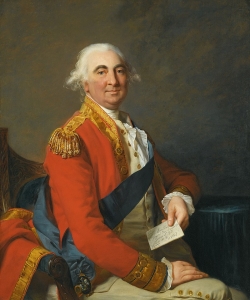
It was named after William Petty, 1st Marquess of Lansdowne, Lord Shelbourne (1737-1805), the first Irish-born British Prime Minister (1782-82), responsible for granting the United States its independence at the Treaty of Paris in 1783. This newly independent state became a slave-owning state until Abraham Lincoln’s proclamation in 1862.
A devotee of laissez faire, Lord Shelbourne did nothing discernible to improve the conditions in Ireland that would lead to rebellion and ultimately the Great Famine.
Lord Shelbourne
Correcting the past is an impossibility, the real challenge is dealing with the present. One doesn’t need to spend time on a Buddhist retreat or on a therapist’s couch to know that the only thing we can actually change is the present moment.
We can seek to understand the present better by having a fuller understanding of the past, but the past remains, unchangeable. A far greater challenge is the existential one of living an ethical life in the present moment rather than attempting the impossible task of rectifying the crimes of the past.
The removal of statues seems to have been opportunistic. It’s as if the owners are trying to gain kudos in the zeitgeist. But it is far easier to make a cosmetic change to the exterior of a building and lay claim to an enlightened agenda than actually take a political and ethical stance on live issues of social and political justice.
Imagine the socially sensitive and woke Shelbourne, discretely provided a few rooms for free to the homeless, or to those fleeing domestic violence, or even to refugees? Then it would be putting its money where its mouth is.
Even before the sheriff issued his notice that you had to be on the road for a good reason, people were stopped, citations written and then there was a considerable fine. But see, in here, there ain’t no ins, and no outs neither. Only the staff have hall passes. And without them there would be no one to conduct what is, for some, the highlight of our week. Though lately it’s only via an intercom. We still have Bingo.
Bebia is both my friend and laundry lady. We’d grown used to visiting when she came to collect dirty linen and in it’s place she left the clean. But now we text back and forth, or just wave. She’s also my son’s mother-in-law, so we share the same grandchildren. Truly a godsend in that she keeps me stocked up with enough snacks to get through the next little while.
I reveled in the luxury of having a room to myself up until they moved in a lady from New Orleans, about two months ago. She is what they consider long term care, and as it turns out, mentally challenged. In my mind, we are okay. For now. Her name, like mine, is Linda, but in an amusing accent, she insists on calling me Mary.
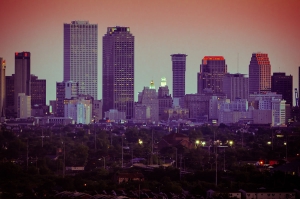
New Orleans skyline from Danziger Bridge.
In spite of stashing everything she owns in scads of bags, she has a tendency to lose things. Each action announced before its completion is also verbally confirmed. This process doesn’t exclude the emptying of her bladder and/or bowels, which she often manages to achieve without closing the bathroom door. All things considered, I’m probably safer in here, with the madding crowd, than out there with the real nuts.
It’s getting real in here. Newly established, the isolation ward has been set up too close for comfort. From my room, I’m able to hear most comings and goings, and I know the current number of patients is exactly nine. In the last twenty-four hours, out of two patients who went to hospital, one died, though not of Covid-19. Then they moved two more into the ward. What I’m not sure of is how many, in total, have gone to the hospital or been identified as having Covid-19, because they move them around during the night. They say about five or six staff tested positive. But a couple of them were out sick before testing was even available. Me, I hydrate. I take daily doses of vitamins and apple cider vinegar. I’m good.
My roommate and I have been advised to stay in our room for physical therapy and we wear masks when venturing out. Our only break from each other is when she showers, or if I go to the whirlpool. I’m sure she is equally fatigued by our togetherness. I say that because, once or twice a week, she packs a bag, and sits on her bed fantasizing about a family member or driver that will rescue her. Lift her off for a visit to her home in Lafayette. An event that though imagined in detail, is not scheduled to happen in the foreseeable future. I fell for it several times, but that was way before we were shut in by the virus.
The next clue that she had a screw loose was when, several nights in a row, she asked if in fact, we were going to sleep over? And if so, could I direct her to the bathroom? Which was, incidentally, a distance of three feet from her bed. Most nights, in spite of her eleven year tenure here, I must remind her that someone will come to collect her, and escort her to the shower. And though she stuttered around it this morning, knock on wood, she hasn’t called me Mary once for a solid four days.
We’re doing okay, my roomie, Linda and I. Staying safe in our room, with the exceptional physical therapy walk or albeit brief, a coffee break. The dining hall dispatches a coffee cart not lacking for crackers, punch, and ice cream melting in little cups. Abandoned, it sits beside the nurse’s station, even as we’re admonished to stay in our rooms. So when it becomes clear that no one is willing to bring the cart around, as I’m one of the rare residents who’ve been diagnosed ambulatory, I don the mask. The rest are in beds or wheelchairs, watching as down the hall I trudge. What they don’t know is that I’m plotting to order a Tyrannosaurus Rex costume, in my size, for that one day when I’ll surprise them all.
‘I hear names that I recognize’
Our room is about ten feet away from a ward where ten residents have been put into isolation. On my hall of twenty-seven mostly double occupancy rooms, there are only nineteen patients now. No longer allowed to circulate, I don’t know what percentage of the population is sick or well. But I hear names that I recognize. Some mentioned as being in the isolation ward.
The ambulances didn’t always make these daily trips, but this place is inadequate for critical care patients, so when someone gets to a certain point, they’re shipped out. We’ve lost several who went to hospital. Three in the past ten days. We’re told they were classified hospice, not virus. Some long time residents, but others were, perhaps just like myself. Before all this happened, we were here for rehab. I’m quick to occupy myself with crochet and jigsaw puzzles on an app. And I don’t touch much of what other folks touch. Got no qualms wielding this can of Lysol, which I won’t hesitate to use.
I hesitate to mention it, but without a single lapse, for about a week now, my roomie seems to have caught on to the irony that my name is, like hers, Linda. I lose patience telling her something that hasn’t changed in the eleven years she’s resided here. No, we will not be served tea with dinner. The staff have posted a sign on the bathroom door to prevent her needlessly heading down the hall. If we were not the same age, I suppose her shortfalls wouldn’t trouble me so. But her issue is not entirely age related. She is capable of parroting just about anything she hears, but appears unable to self-direct. For example, if someone accompanies her on a task, she is perfectly capable of completing it. She’ll spend the day coloring in pages provided for her to do just that. She’ll rearrange her clothes, or pack her possessions, in anticipation of an imagined trip to, of all places, Metairie. I then have to talk her down from that place. Not Metairie, but a mental place. Once or twice a week.
Granddaughter’s Birthday
I fielded a video call from my son on my granddaughter’s tenth birthday. It was my first time doing that type of thing. Loved being able not only to hear, but see them all. Their homeschooling is going as well as can be expected, but when I asked the girls how they like their new teachers, they went quiet.
I tolerate wearing a mask and hope that the need to do so, all the time, will soon pass. We’ve twenty positive cases in isolation and/or hospital right now. Our day clerk has gone to the hospital. She’s the first staff member I knew who got sick, but several have gone through the cycle of: symptoms, sick leave, recovery, and finally testing negative for Covid-19. There have also been a few who did not return.
We were on the sunny south side with its early exposure. Just outside the Covid-19 unit. Until they moved us to a room at the opposite end of this hall we still share with the isolation ward. Now we have a private bathroom, including a shower, which is a plus. And we are now situated off a main patio facing soft northern light. Close enough to smell the coffee in the kitchen. They say the city is starting to open up again, even the restaurants that had been closed down.
My roomie is okay, but it is sometimes a challenge to cope with her doings. She has periods of forgetfulness, I guess. Several times a week, she gets her things together, expecting someone to pick her up for a visit out of town. When she’s not rushing out of the room to see a godchild who isn’t there, she’s wondering how late her family will arrive for a visit not rooted in reality. I talk her down from all that, and remind her there are no ins or outs allowed.
The Rona
Of course, since we moved, she’s disoriented the minute she does step outside the room. Her only diversions are Bingo and coloring, so I wish the staff activities director would simply ensure she has enough pages to color before that department disappears for the entire weekend. I attempted to engage Linda in making crafts, but because I didn’t hover right over her to keep on demonstrating how to do things, she just gave up. We no longer go to the dining hall or gather for group activities as we used to because of this Covid-19 virus they’re now calling The Rona.
This Linda, meaning me, is having a better day, today. Long story short, the other Linda’s bedside lights only came on when the ceiling lights were illuminated, but as the electrician is currently forbidden to call on us, staff remedied our situation in the interim by removing the ceiling bulbs. Now, without blinding me all night, Linda has again the use of her own lamp’s light to color by. Stress level, managed. Also, as an avid Amazon shopper, I had Jeff Bezos deliver a nonslip safety mat and matching bath rug for our private shower. Stress level, lowered. I didn’t have to buy it for myself, but instead of waiting for someone else to get around to it, that’s what I did.
We cower in our rooms. Three more residents have been moved to the Covid-19 unit. That’s a total of twenty-three positive cases. The clerk, who had been working here for several years, has succumbed, after two weeks on the ventilator. She was in her late fifties, but because she commuted, she won’t count in this cluster’s contribution which is a hefty 36% of the deaths in our parish* to date.
I’ve been dwelling on how life has changed in the year-and-a-half that has passed. My way of life was vastly different before, while doing something rather ordinary, a casual misstep occurred. It was something I did several times a day. Every day. That life before was routine for me. I came and went at my leisure. If I wanted to go to the local grocery at 1:00am, I did. If I wanted to grab a burger, or breakfast in the middle of the night, thank you, America, I could grab my bag and hit the road. I’m single, and don’t have a pet, so I did as I pleased. I ate as I pleased, with pure self-regulation, or if I chose, with sweet abandon to a point. Finances being my only impediment. Then one day, just as I was about to reel myself in, fate or karma – choose your causation – intervened and I missed that step.
After a brief stay in hospital, which in hindsight, I wish had been a rubber room, I ended up in a rehab facility. The ultimate rubber room. I figured this would be for a short stint, to get my feet back under me and regroup. Reality reveals to me that life, as I knew it, has changed. I’ve become reliant on assisted ambulation, unable to step away on my own. And so I sit and crochet, or work jigsaw puzzles on my iPad. Physical therapy, as dictated by evaluations, comes welcomed, but in fits and starts.
B-9!
I was winding up my courage to find a way back home, when the whole world turned into a rehab facility. No one comes in, and no one goes out. Even the group activities, which held no interest for me, were cancelled. Bingo over the intercom is not the same, but you are drawn into it, because whether you want to or not, everyone hears the call, “B-9!”. They experimented with players sat in their doorways down the hall; however even those who were interested to participate, couldn’t hear. Either way, I do not feel benign.
Then wearing masks at all times became mandatory, and also remaining in your room. “Don’t come out, we will bring whatever you need,” they say. And they do. What they do not say is how long you will have to wait. And so, we wait.
An extra unit, dedicated to isolating Covid-19 cases, also created an immediate shortage of staff. Not to mention the virus running its course through workers as well as residents. Staff go home for two weeks or if they test negative twice. One in particular did not return. She was the backbone of the unit. The clerk. I was once the clerk in an Intensive Care Unit, so I feel her loss greatly. We were kindred spirits.
Still cowering in our rooms, we are now startled by a cough, and pray for desirable readings when our “vital signs” are checked, even as beds are being rolled down the hall to the locked doors. With cheer we greet the “baby docs” from the local Louisiana State University Medical School, who come bearing swabs they bring back for study in their lab. One of many which is working on a vaccination.
Hope springs eternal, and in the past week, only one new person tested positive. Five wrung out souls have been “clapped out,” applauded for having graduated with test results confirmed negative. They are the brave who weathered the storm with basic intervention. No hospitalization, just medication and the tender loving care of nurses who had already looked after them for years before this beast began to move among us.
As for me and my changed perspective, I appreciate so much more the freedom I once had in my previous life. I promise daily that if I find my way home, I’ll not act the same. I’ll be more thoughtful and frugal, more measured. Then I realize I am snacking on the Kraft Caramels I ordered from Walmart.
Stuff
In 1986, the great comedian, George Carlin, performed a stand-up routine about “Stuff.” He challenged me then, but life has dealt me the bigger challenge. George opened my mind, but it is life that has demanded my obedience and in the end prevailed. I’m still learning to discern the difference between stuff and essentials.
A year-and-a-half ago, unknowingly, I downsized my life in an instant. When Emergency Medical Services hauled me away to the hospital, I didn’t know how little I really required to get along. All I had was the clothes on my back. Fortunately, because it was winter, that included shoes and a coat. For the first week, I slept in a hospital gown, and when I was discharged from the hospital, I then went to stay in a friend’s home. There, she loaned me some of her husband’s clothes, while she washed mine. I returned to the hospital for a spell and finally checked in to this rehab. After a few days, I was escorted to my house, where I gathered several changes of clothes for day and night, and some toiletries. With no intention of staying long, I selected only a few favorites, but I’ve only been back once to gather essential paperwork.
In the rehab, I first shared a room with an older lady who was unable to care for herself. She was waiting to pass, which is another way to say die. We shared with another lady, one in the same condition, a lavatory, and I also had access to the whirlpool bath down the hall. My portion of the room held a single bed, dresser, wardrobe, TV and chair. After Mary passed, I was alone in the room for some time, but having lived on my own for twenty years, I was quite comfortable. Maybe too much so, because my stay began to stretch well into the next year. Since then, through the magic of online shopping, I have accumulated a bit more “stuff,” though with an exit strategy still in mind and heart, I manage on a minimum.
The shift was sudden, when a lady who was about my age, required a room change. She was mentally a child. One who needed a shepherd, of sorts. Having outlived her roommate of several years, it appeared her replacement roommate was ill-suited for the role. But see, I’m a mother, a grandmother, a daughter, and an aunt, who has not only been to beauty school and groomed the glamorous, but gone on to work in a hospital setting where I cared for crack babies by night. Disadvantaged newborns so underweight as to be inconsolable are no problem for a woman like me. Someone who has always operated in caregiver mode.
Not knowing the scoop, I agreed to my new roommate, as if I ever really had a choice. And she moved in with her stuff, which was considerably more than mine. We have since been upgraded to another room, with a private en suite. But it’s a constant battle to prevent her stuff from spreading to the point that housekeeping can no longer perform their chores.
Moving in to our new digs, I simply squeezed all my stuff on to my bed, which was then rolled down the hall, while hers took several trips. Considering that I’ve left behind a three bedroom house, packed to the gills, I think karma has indeed succeeded in downsizing me. I must say, not having kitchen privileges has kept that sort of paraphernalia off my list. For the life of me, I cannot imagine what I filled my house with. Only that it must be extra stuff I obviously never needed. There are moments when I recall some convenient item which I have at home and could use here. But buying a duplicate of something I know I already own, prompts me to think twice before ordering online. Creature comforts are often overrated.
Testing Times
The first time I was tested, we’d just been served a meal, so while the doctor cleared my sinuses with his swab, I predicted I’d probably test positive for banana pudding. Since then we’ve been swabbed three more times. It feels as if we’re participating in a study, but I wasn’t asked to sign anything. Sheepish or deep, it seems the state mandated 100% testing for all care facilities. Too little. Too late.
The Assistant Director announced three days ago, that we were 100% Covid-19-free. There remain a few patients, still recuperating in the dedicated unit, but it’s reassuring to know we are what they call clear. For now. Three more residents came out of the Covid isolation area on Thursday, greeted by all our eyes sparkling above still mandatory masks.
Perhaps it’s true that if it can be dreamed, it can be done. Indoctrination is rampant. Having fallen for this test run they call Covid-19, they now know if we can be herded over a virus, there is no limit to which they can control our lives and minds.
Then there is the California mayor who ordered the skateboard park filled in with sand, to keep kids out. Dominating the parks anyway, those little geniuses drove their dirt bikes in and out and all over the park. The way adults are acting, who could blame them?
For the fortieth time in four hours, Linda might have made her way past my bed to the door where once again, she will peer out, and not recognize her surroundings. However, upon hearing the man across the hall talking on his phone, she’ll rush to his bedside, and ask if by chance, he’s speaking with her nephew. Or is it her niece? Her attentions are rewarded by the poor man’s polite confusion.
Kids are right to peddle away from meddlers, and in to the night. It is just this, which grants each dawn it’s potential. One could even go so far as to call it a distinct possibility, however remote, of anarchy.
*Unlike the rest of the United States, Louisiana is divided not into counties, but parishes.
Andrea Reynell caught up withrenowned documentary filmmaker Sé Merry Doyle to discuss his new film ‘James Joyce – Reluctant Groom‘ in which poet Niall McDevitt guides us through a London landscape with unknown Joycean associations. The film takes us back to period in 1931 when Joyce and his long-term partner Nora Barnacle moved to London for a year in order to secure a legal marriage. The film also demonstrates that in this period of Covid-19 necessity is the mother of invention.
Andrea Reynell: Why was Joyce’s marriage to Nora worthy of a documentary?
Sé Merry Doyle: Well, it mainly came about through Niall McDevitt – the person who leads the whole story – and a well-known poet in London; an Irish poet, very well known in Irish poetry circles. Niall gives literary cycle or walking tours where he uses the landscape to tell stories. He often draws large crowds. I filmed him pre-Covid-19 doing one on Oscar Wilde just to have the material. There were about twenty people traipsing around Wildean landscapes. I noticed how brilliant he was and we became friends and then we did a small film called The Battle of Blythe Road, which was a temple dedicated to the goddess Isis in Hammersmith that W.B Yeats used to run, and where he got into feats of daring do with Aleister Crowley, who was into black magic. Nobody knew about this place in London.
Before telling you how the Joyce film happened, I’ll backtrack a bit. I came to London to show some films, documentaries I had made in The Irish Cultural Centre in Hammersmith and while I was here I ended up making a feature documentary called The Knitting Ring featuring older Irish women, and then Covid-19 hit and the whole place got locked down. Then the Irish Cultural Centre decided to start a digital channel. So we got together lots of musicians, poets, and writers. I was coordinating this with Rosalind Scanlon who’s the cultural director. So since then we’ve been posting weekly on ICC Digital.
The Battle of Blythe Road was my first commissioned piece for them and I went out with Niall. It was just shot on the iPhone, rough and ready but became a viral hit let’s say. Then we decided to take on James Joyce after Niall told me the story. Again the attraction was that it was just me, Niall, and the iPhone with some sound editing. So it was perfect in a Covid-19 world.
It’s about James Joyce coming to London in 1931 to get married because of a law saying you had to live there for a year beforehand. So he came for a year with his wife Nora and his daughter Lucia, and his son Giorgio came over quite a lot as well.
AR:How have current circumstances had an impact on your work?
SMD: Funnily enough before I came to London, I was living in Abbeyleix in Co. Laois, with my daughter and there wasn’t much work. I don’t want to be negative about Ireland, but there was very little happening and I felt like I couldn’t afford to live in Dublin anymore and that’s why I had to move out. I found the environment slightly hostile whenever I tried to put anything out, but then I came to London, and all of a sudden all these people were asking: do you make documentaries and would you make this and that? It felt like a breath of fresh air. People admired me for what I could do and I didn’t have to go out for a pint with someone and find nothing would happen afterwards.
Since Covid-19 in a way I’ve been busier than ever. I go out and shoot little films for ICC Digital. We’re filming some stuff next week under controlled measures. Then I return to my editing suite and balcony near Wimbledon Woods. So my environment is safe from Covid-19.
I see the Joyce film as something that could sit very well on RTE, even though it’s shot on an iPhone; a half-hour film produced extremely economically. So I’m enjoying this new relationship with my iPhone and I’ve been filming poets and actors like Nora Connolly. She did a Bloomsday event. I know certain musicians are having a terrible time right now. Musicians are suffering more than others in the pandemic. They are out there all the time. Now I like going out as well. I like nothing more than bringing all the material back. So, it’s suiting my particular field.
AR: How would you say that independent differ from mainstream films?
In the last couple of years I’ve been mainly working on feature-length documentaries films that are 70-75 minutes long and do well on the festival circuit. I did a film recently on Simon Walker’s father the architect Robin Walker; also on the famous animator Jimmy Murakami who animated When the Wind Blows and The Snowman, and came to Ireland and married. His childhood secret is that he was interned in a Concentration Camp in America for Japanese-Americans after Pearl Harbour.
At least in the Covid-19 era RTE are starting to show feature-length documentaries again. So I would say there is a very fine line between mainstream and non-mainstream. I think TV stations are in danger of losing a large audience though who are not necessarily all intellectuals, but who like a good story and don’t want to be spoon fed: they want to engage with the material and to think for themselves. I think if they took more chances they’d have more success. Fine, at 8 o’clock schedule Coronation Street, but after 9.30 let’s make it a little more loose. We are seeing the same trends is Britain. My colleagues tell me that BBC Four is closing soon or being ‘dumped’ as Boris puts it.
Media is a very complex. A lot of people are streaming, and don’t watch TV any more. I still like watching TV. I like saying “oh this is on now” and just sitting back.
It’s a huge world for our little film on James Joyce. It’s reliant on word of mouth. It’s very hard to know where to place yourself. I think it’s a film that could easily sit in the mainstream. The story is very well told, Nial McDevitt doesn’t over intellectualise. He’s joyous. But finding outlets is extremely hard.
AR:Do you think that 28 Campden Grove, James Joyce’s London residence should hold greater significance?
SMD: I don’t know. London always was the flight path for Irish artists, going back to Jonathan Swift, Oscar Wilde, Bram Stoker, and all sorts of people. London was a jewel of a city for extending creativity. And you see all the blue plaques around the place. A lot of the film involved Niall talking but then he encountered the man who lived there (on Campden Grove) and another guy was moving out. It’s moments like these when a documentary comes alive: somebody coming into the frame unexpectedly, and if you’re a good documentarian you hope to capture that. Another person might say “oh no somebody’s moving out, you better stop filming you know,” but I prefer to take all that in. Films that are set on the street involve people telling a story. All of a sudden somebody reveals a whole lot of things that you never knew. It makes the street much more interesting to be able to say: “oh look, James Joyce lived here for a year.”
It is interesting with all the statues being pulled down. A statue is not a blue plaque, but it is something saying this person fought in India, or where ever, and it may be contentious, but should we take it down?
I did a film long ago about the sculptor John Henry Foley called ‘Sculpture to the Empire.’ But John Henry Foley also made ones of Daniel O’Connell and Henry Grattan and Oliver Goldsmith too. He probably has more statues standing in Ireland than anybody else. But a couple of his statues like the one of Field Marshall Gough in the Phoenix Park were attacked several times by the IRA. Eventually it was moved out of Ireland. So you have this dichotomy around what to do. In India one guy said that we should leave the statues and say that this person was a bastard, and he can bring his children to tell a history. Maybe we have to find a way to absorb them and so in India they put them all in sculptured graveyards. Most of the films I’ve done are set in Dublin. You walk out the door and you can find a story in five minutes. It’s all around you.
SMD: I always wanted to see his statue in Trieste. I liked the fact that he wandered the Earth. Removing his remains at this stage is not a big deal for me. It’s a sideline issue. I was running Bloomsday for a number of years in Dublin in a Duke Street Gallery and various poets and people would come on that day to sing a song or read a poem. John Behan, Ireland’s most famous sculptor always had this fascination with Leopold Bloom and we’re part of a little campaign now to get a statue of Leopold Bloom erected in Dublin. He is one of the most famous fictional characters in the world and is emblematic of fair play and experiences racism too. We thought that this would be a great subject for a statue. I’d love to get Leopold more into the consciousness of Dublin. Joyce used to imagine Dublin in his consciousness and he gave us that great gift in Ulysses. It’s more the atmosphere of Joyce and his works that should be celebrated I think. So leave him be and let him rest in peace wherever he is and God bless him.
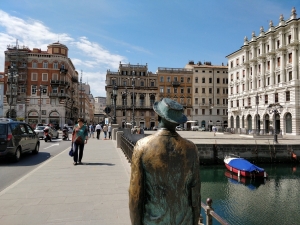
Joyce in Trieste
AR:James Joyce never set foot on Irish soil after he left the country for the last time in 1912. Do you think his exile and the fact that he has no living descendents as of January 2020 has an impact on his legacy in Ireland?
SMD: I think he’ll shine on. He broke the mould like Shakespeare. He had a tragic life in lots of ways. I was just discussing his daughter Lucia suffering from schizophrenia. He dictated most of Finnegans Wake to her; a fairly incomprehensible book for a lot of people, but Joyce said it should be read aloud, and I think the schizophrenia in the language uses Lucia’s fragmented mind. She lived and died in an asylum in Northampton, leaving no children. Giorgio gave us Stephen who was a very difficult character in terms of Joyce’s legacy.
AR: Did the documentary turn out differently to what you had envisioned?
SMD: The Battle of Blythe Road was a rehearsal for doing this one, but It was odd for me as I’d normally have Paddy Jordan on camera. A lot of technical stuff has terrified me. And I remember the iPhone ran out of memory at one point and it started deleting shots, and we also had to go to a café to get a bit of charge, but I got through it, and really enjoyed the experience. I’m not saying I’d like to take this approach all the time. I’d like to have somebody on sound. It was just me and Niall and I’d never experienced that before and I enjoyed it, but it’s nicer having a crew, but needs must.
AR: Do you have any further plans for collaborating with Niall McDevitt?
SMD: We’re planning an Oscar Wilde film, and are currently at the drawing board stage as to what that might entail. Again it’s going to a product of this Covid-19 period. With Joyce we were talking about going to Dublin, Zurich, Trieste, Paris – you know the story of James Joyce’s life – but until Covid-19 abates we’ll stay in an area that we can control, but we’re out filming again on the 27th of July. We’re bringing a lot of artists into The Irish Cultural Centre for lectures and poetry. It’s just three days of filming with people. It’s a very strange time for everyone as you have social distancing. Nobody’s working properly. We don’t know when it’s going to end. So everyone has to find new outlets and new ways of keeping going.
Delighted, I hold in my hand, one of only three known photographs of meself as a young man. It was taken on my eighteenth birthday, back when I worked for local builder The Whimpy Dunne. The Whimpy was the finest craftsman I’ve ever been employed by, whether in Ireland, England or Europe, as I worked in all those places.
The Whimpy was good to me, and it’s a lovely thing for me to know, that after all these years, we still speak highly of each other. I’ve only bumped into him a handful of times since. So receiving this photograph, from his son Adrian, not only made my week, but brought with it a flood of memories.
Many young people have no idea of the great times we had back in the 1970s. It was a boom time in construction and drink was cheap as water. We drank oceans of drink and still had money to live on. We have, since those days, progressed beyond recognition thanks to technology. But the downside is that we’ve also become very different. Socially detached from each other.
I left school in 1975 before turning fifteen years old. Tried every builder in the whole parish of Tyrrellspass and further afield to get a job. It’s only fair to say no one back then wanted to employ a youngster who drank like I did. It wasn’t the amount I drank, but the amount of trouble that went along with it. Like having my name read aloud from the alter by the parish priest at least once a month. The “horizontal craic” I used to call it because I didn’t give a shite about much.
One summer’s day I was sat picking my nose upon the wall at the turnpike in Tyrrellspass. I just didn’t know what to do with myself. Didn’t want to go home. All they ever done there was run me down. Tell me how useless I was. And how I wasn’t worth rearing.
Suddenly a big green Ford Zephyr car pulled up and it was The Whimpy Dunne himself. This man had forgotten more about building than all the others knew put together. I couldn’t believe my luck when he opened the door of the car and this he did say to me.
“Young Feery, I hear that you are a great lad to work. Would you be interested in coming to work with me? If you do, the pickings will be richer than what your picking from your nose.”
Of course I jumped at the chance when he told me he would pick me up the next morning. I ran the whole mile home to find my mother was asleep in the armchair. So ecstatic was I that I climbed up onto the roof to communicate with her in my favourite way.
There I stood at the chimney stack, with my three foot length of plastic soil pipe, to wake her up when I roared down the chimney. “I HAVE A JOB NOW. WITH THE WHIMPY DUNNE. AND FUCK THE LOT OF YOUS NOW.” That’s just the way things were in my home. But I was determined to make the best of my first proper job. And I did.
The Whimpy Dunne was the first man I ever met that never criticized me. All he done was encouraged me, saw my potential and taught me all I knew. I spent the best three and a half years of my working life working for him. We worked hard. Lived hard. But everything was done with great craic and humour. More than just respect and friendship, it felt like being part of a family.
Because The Whimpy got all the best contracts, the work was always very interesting. Once we were building an extension to the castle in Tyrrellspass. One morning, at the start he came in with a big box of tea bags. “Jaysus!” The Whimpy said to me. “Nicky Feery these are some great yokes. Now all you have to do is boil the kettle, put a bag in the cup, and fill with hot water.” Up until this moment, everyone we knew used loose tea to make tea. And in a tea pot.
As the weeks passed, after every cup of tea I made for the two of us, I’d sling the tea bag right out the window of the extension we were building. One day the local farmer, Pete F., was passing by and called in for a chat. That was a lovely thing before technology came about. We took the time to interact, and get to know each other.
As Pete was chatting to us he kept looking out the window at the huge pile of used tea bags that had blue mould now growing out of them. I could tell he had no idea what the mouldy tea bags were. Then The Whimpy had to go to the car for some tools, and Pete then whispered to me, “Nicky Feery! What’s them yokes growing in a pile outside the window?” To tease him, because I knew he didn’t have a clue what they were, I said, “I’ll give you three guesses, Pete.”
He thought and he thought. Then he said, “Sex yokes. They’re sex yokes.”
“No, Pete.” says I, “They”re not condoms.” He thought again.
“Drugs. They’re auld drugs growing up out of the ground.”
“No, Pete, they’re not drugs growing up out of the ground.”
“Ah Nicky Feery. Tell to me, what are they?”
“They’re tea bags, Pete. That’s what we make the tea with now.” That said, I took one out of the box and showed him.
As he walked away, he took off his flat cap and scratched his head, saying to himself,
“Well Holy Jaysus. Tea bags. Tea in a fucken bag. The world is going mad. Whatever will they come up with next?”
He wants to work Monday nights but not Tuesday afternoons; she is available on Saturday evenings but not on Sunday mornings… Small and Medium-Sized Enterprises often find it challenging to recruit part-time workers, with abundant choices available to gig workers in different sectors, but the pandemic has vividly demonstrated the nature and depth of insecurity of this form of employment.
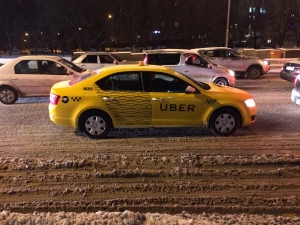
Gig economy workers can range from traditional independent contractors to freelancers and temporary employees, who work at different times during the week. A few examples of companies where gig is the norm include TaskRabbit and Lyft in the U.S.; Uber, Swiggy and Zomato in India; and DiDi, Ele.me and Meituan riders in China.
Some may use gig work to supplement the income they receive from a traditional job. In the U.S., research shows that at least one-third of the total workforce[1] relies on gig economy work as a primary source of income.
Trade Unions generally oppose gig work and have tended to be resistant to independent contractors[2]; for years state legislatures have sought to enforce employment law and regulations on companies operating in the gig environment.
Bearing Risk
The platter of risks that gig workers bear not only relate to labour inputs, but also capital investments, as continuing in work is dependent on circumstances beyond the control of the worker.
For example, Uber, DiDi or Ola drivers use their own money, or borrow it, to pay for their cars. Yet companies may ‘decommission’ drivers in the event of: (a) the company changing the amount it pays to drivers or; (b) the ride-hailing industry experiencing increased competition; or (c) if the company gets flooded with new Uber (or other ride-hailing companies) drivers, due to low barriers of entry; (d) a driver may receiving low satisfaction ratings from customers.
A decommissioned driver may then be burdened with debt, with no ready means of repayment. The platform providers ensure that their workers are not classified as employees in any form, and thereby owe no entitlements to workers.
This is despite the gig ‘employee’ paying for and providing a physical asset that the platform relies on to carry out its business. The objective of the platform providers is to ensure that gig workers are considered independent contractors, and not employees.[3] Contractors in the traditional economy, such as truck drivers, may also sometimes supply their own ‘tools’, but the gig economy differs in that the gig worker doesn’t accumulate any goodwill that can be sold-on or leveraged for financial gain. The goodwill accrues to the platform provider, leaving the worker with few options.
Conventional employers attract full-time talent by offering a stable work environment, a retirement plan, along with other ‘soft’ benefits such as a modern office space, free food and drink and other fringe benefits[4].
However, there is a rational for businesses to engage ‘non-employee’ freelancers to work with their internal teams. The most compelling reasons are: (i) flexibility, (ii) access to expertise, (iii) speed, and (iv) cost. Thus in a survey conducted by Deloitte in 2014, 51% of executives said they expected the use of contingent talent to increase over the next 3-5 years.[5]
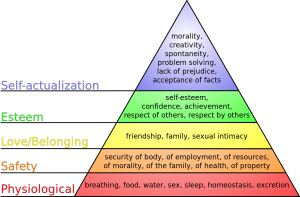
Temporary, irregular work ideally fits someone looking for extra money on the side, or a person who prefers an ad hoc schedule. However a large demographic among the middle class simply cannot afford instability, and are not getting fairly remunerated for their work. Gig work does not bring sufficient security for anyone planning a family, nor does it fulfil at least three of Maslow’s five Hierarchy of Needs (i.e. physiological, safety, social, esteem and self-actualisation) that many full-time positions come with.
Maslow’s Hierarchy of Needs.
The insecurity is very real. Recently, the U.S. Department of Labour (DOL) established that many workers, depending on contractual specificities, in the gig economy should be considered contractors for the purpose of federal wage and hour regulations[6].
Just as gig work can increase one’s earnings to an unlimited extent, the opposite can also hold true, with pay rates varying dramatically, and with a fixed minimum wages rare. The ‘feast or famine’ style of income can, therefore, become increasingly stressful; fluctuation in earnings can make it difficult to save for the future. This is exacerbated by not having an entitlement to a retirement package or pension contribution. Then there is the formidable issue of no sick leave – if gig workers are unable to work, they simply cannot earn.
Along Comes COVID-19…
Once the pandemic struck, gig workers’ income plummeted to an unprecedent extent, and most of them were not on healthcare plans either. This has placed many gig workers in an even more precarious situation.
The ILO recently remarked that Covid-19 could lead to ‘the worst global crisis since World War II’. The pandemic is projected to remove 6.7 per cent of working hours globally, in the second quarter of 2020 – this is the equivalent to the annual salary of 195 million full-time workers: accounting for 8.1 per cent, equivalent to 5 million full-time workers in Arab States; 7.8 per cent, or 12 million full-time workers Europe; and 7.2 per cent, or 125 million full-time workers in Asia and the Pacific[7]. This will affect the motivation levels of gig workers too, particularly those who have recently moved into this form of employment from full-time paid work that had enjoyed associated health insurance and other benefits.
The retail, airline, and hospitality sectors have all witnessed significant layoffs. A couple of months ago some of the leading gig-economy companies responded by offering basic sick leave provisions and safety equipment, including hand sanitizer for drivers.
Whether it is Deliveroo in the U.K., or Meituan in China, or Zomato in India, the fragility of ride-hailing, food-delivery or furniture building work is increasingly apparent through extended lockdowns in many countries, with social distancing set to continue indefinitely. As gig workers are considered ‘freelancers’ and not ‘employees’, companies are excused from offering employment protections like guaranteed wages and sick pay, which is particularly crucial during this crisis as sick individuals should not feel obliged to go out to work.
Huge job losses are now expected across higher income countries. The sectors most at risk include accommodation and food services, manufacturing, retail, and business and administrative activities. There is a high risk that end-of-year global unemployment figure will significantly exceed the initial ILO projection of twenty-five million redundancies[11].
Essential Services
As gig workers are not ‘employees’, most of them are caught between choosing whether to remain at home, self-isolating to avoid potentially passing the virus onto others or remaining in ‘essential’ service work to support themselves and their families.
Those affected include medical workers who are taking significant risks to treat the sick. They are, however, generally low-paid grocery store workers, delivery workers, Amazon factory workers, street cleaners, and others, who have not knowingly entered their chosen occupations expecting elevated health risks, but have nonetheless had to work through the lockdown. Otherwise, if they don’t work in an ‘essential’ line of work during the COVID-19 crisis, they are in lockdown along with everyone else, and may not easily secure employment.
Responses to the U.K. Quarterly Labour Force Survey suggest that workers in manufacturing , sales and service, cleaners, among others are unsuitable for adjusting to remote work. While some countries have provided assistance to workers unable to perform tasks from home, there are certain categories of workers who tend to fall through the cracks of these programmes. Among these are zero-hour contract workers, and small or off-market, self-employed workers such as those who deliver food and clean homes.
To insure against a repeat of this crisis impacting on gig workers, we require policies to support businesses, employment and incomes including: provision of essential healthcare benefits, economic stimulus incentivising job creation, enhanced workers’ rights; and, equally importantly, mechanisms for dispute resolution between government, workers and employers. The right measures could make all the difference between the economic survival or collapse of not just individuals but the economy as a whole.
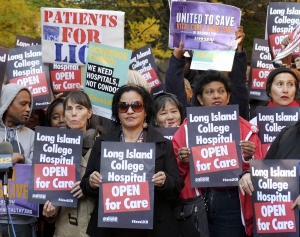
De Blasio Protests the Layoffs of 500 LICH Nurses and Health Care Worker.
‘Chaos is a ladder’
It should be acknowledged that the crisis has also created opportunities for both the companies reliant on flexible employment and even the workers themselves. For example, it has led to partnerships in India between governments and private enterprise including Ola, Flipkart, Swiggy, Urban Company and Uber. This is playing a crucial role in containing Covid-19, according to a report published by the Ola Mobility Institute.
Additional examples include Uber’s announcement in early April of two new Business-to-Business (BTB) partnership arrangements in India. Firstly, with UberMedic, a 24-7 service that works with health care authorities. It provides transport for front-line health care providers to and from their homes and medical facilities. Secondly, BigBasket driver are assisting with last-mile delivery of everyday essential items in four cities.
Also Flipkart, which still competes with Amazon in India, is currently in talks with cab aggregators and the Indian Railways to ensure smooth and hassle-free movement of essential products from vendors to customers. One of the objectives is to offer incentives to supply chain and delivery executives.
These sorts of collaboration allow governments to recognise the potential of gig workers in this crisis, and have produced two non-fiscal strategies; first, by actively engaging the technological capability of the gig platforms and their logistical networks (a hands-on approach); and secondly, passively facilitating their operations through legal protection (a hands-off approach).
The agility of businesses reliant on gig workers brings fewer staffing challenges. This flexibility is certainly of arguable advantage to workers, but at least it may be keeping a small percentage of gig workers in employment that might not otherwise exist.
Also, some gig work employers are sending staff for certification courses run by the likes of Apollo Hospitals in India. This learn how to stay safe and vigilant while delivering goods and services to customers.
In India, many, if not most, gig workers are also economic migrants, and a large proportion returned to their hometowns following the nationwide lockdown. Organisations are now unsure about the extent to which this trend will be reversed once restrictions are lifted.
Analytics on the many impacts of Covid-19 remain thin, apart from some well-researched and presented data available from John Hopkins. Nevertheless, it is increasingly clear that low-income workers have an elevated risk of contracting the virus, and thus the income support system currently in place will leave some low-income workers exposed if they feel compelled to go back to work. Greater protection of their income should be prioritized around the world, particularly in countries like India and the U.S. where gig work is slowly being formalised.
Research into the motivation levels of gig workers in mainland China demonstrates[12] that gig employers generally prefer to wield ‘sticks’ than offer ‘carrots’ to employees, leading to a precarious standard of living.
So far a few progressive steps have been taken in India, and a few more in the U.S., in companies such as Google, Facebook and Uber, who are coming around to recognise their contingent workers as ‘employees’.
At least this crisis creates the space to re-evaluate the operation of the gig economy, especially as we now recognise how ‘essential’ certain forms of work are. We can effectively rebalance our regulations and reward-systems, safeguarding the interest of gig workers, and creating a brighter future for the gig economy.
[1] Habans, R. (2017). The Gig Economy in Illinois An Exploratory Analysis of Independent Contracting, School of Labor and Employment Relations Labor Education Program
[2] Sparkman, D. (2019) The Gig Economy Poses New Safety Threats and Liabilities, EHS Today
[3] Jelani, V. (2016). In a ‘’Gig” Economy, Workers Taking on More Risk, Harvard University
[4] Alan Kohll (2019) How Your Office Space Impacts Employee Well-Being, Forbes
[5] Schwartz, J., Bohdal-Spiegelhoff, U., Gretczko, M., and Sloan, N. (2016). The gig economy: Distraction or disruption?, Deloitte
[6] Pasternak, D. (2019) U.S. Department of Labor Says “Gig Economy” Workers Are Independent Contractors, Not Employees (US), Employment Law Worldview
[7] ILO (2019) ILO: COVID-19 causes devastating losses in working hours and employment, COVID-19: Stimulating the economy and employment, International Labour Organization
[8] Pandemic Erodes Gig Economy Work, The New York Times, 2020
[9] Higgins, T. and Olson, P (2020) Uber, Lyft Cut Costs as Fewer People Take Rides Amid Coronavirus Pandemic, The Wall Street Journal
[10] Mukhopadhyay, B. and Chatwin, C. (2020). ‘Your driver is DiDi and minutes away from your pick-up point’: A Thematic case of DiDi and worker motivation in the gig economy of China. International Journal of Development and Emerging Economies, 8 (1), 1-17
I feel that Europe, in its state of degeneracy has passed its own death sentence.
Stefan Zweig, The World of Yesterday, (1942)
The Best Lose All Conviction…
This piece revisits aspects of The Limits of Multiculturalism– a piece I wrote last year warning of a reversion to the 1930s in terms of austerity, extremism and declining intellectual standards. Now in the wake of a pandemic accelerating these trends, this article draws intellectual inspiration from heirs of the Enlightenment, especially Albert Camus, and also Frantz Fanon.
First published in 1918, and translated into English in 1926, Oswald Spengler’s The Decline of the West was perhaps the most influential text of the 1930s.[i] He blamed what he saw as a declining European civilisation on the dilution of a mythical Aryan race – whether Germanic or Anglo Saxon. Spengler influenced Hitler, although he disliked the biological determinism of the Nazis, but still provided an ideological impetus for the extermination of undesirable races in the Holocaust or Shoah.
In the heady days of the post-Cold War 1990s, when Francis Fukuyama was announcing The End of History and Bill Clinton was feeling your pain, mythical and biological views on race seemed an anachronism, increasingly confined to the dustbin of history. But sadly today a variant on Social Darwinism – underpinning an incipient corporate fascism and acting as the handmaiden to racism in another guise – has found a new suit and tie.
We face an economic depression that is likely to be of even greater scope than the Great Depression of the 1930s, as various categories of workers are furloughed – the new word du jour – indefinitely, and SMEs are moped up by multinational giants that are assuming Blue Whale proportions, if not their unfortunate plight in nature. This coincides with impending environmental meltdown that could generate further pandemics. Moreover, social isolation over the course of the pandemic is limiting associational ties, adversely affecting the poor and disadvantaged.
Alongside a long-term intellectual decline in journalism, mainly brought about by the arrival of the Internet which has turned much of it into glorified PR – or churnalism[ii] to adopt Nick Davies’s expression – with even the global The Guardian now shedding jobs at the height of the pandemic[iii] – and debilitating academic over-specialization, linked to the funding of universities through philanthrocapitalism. In this barren landscape Spengler’s archaic notions thrive.
Moreover, an age of chaos and uncertainty allows strongmen like Putin, Erdogan and Orban to assert domination. Spengler’s demonization of the other – now reimagined in the silhouette of a contagious disease – is right back in focus. Listen carefully and you will recognise that the Social Darwinism of another age is the rallying cry of neo-liberalism, as an age of cartels and select groups brings exclusion and enforced conformity.
Given our intellectual and scholastic deficits, it hardly matters that there is zero empirical evidence for the concept of race, as geneticists have worked out that every person on Earth can trace a lineage back to a single common female ancestor, who lived around 200,000 years ago[iv] Spengler may be a bastardised intellectualism but this is irrelevant if it gains traction in the dark recesses of social media.
‘Guest Workers’
The far-right revives the old ghost, but the centre-right – which is in power across most of Europe and claims to oppose racism – has maintain it in societal structures, such as Direct Provision in Ireland. We also ‘welcome’ guest workers – guestarbeiter – from the Global South as students in wealthy countries such as Ireland, but only to the extent they remain useful. Thus, the number of new international students from outside the European Economic Area (EEA) pursuing higher education in Ireland jumped by 45% between 2013 and 2017 according to a recently released study from the European Migration Network to 18,500.[v]
Yet it doesn’t make a difference to a citizenship or residency application that a person has been resident in Ireland for years on end; while shelling out exorbitant fees to mickey mouse institutions, and ideally housed in a so-called co-living space. In contrast, anyone with an Irish grandfather has an automatic, ‘racial’[vi], entitlement to an Irish passport, and the benefits of citizenship.
Ireland’s societal drift is not an isolated case, as state authorities around the world use the present crisis to adopt authoritarian methods, either through direct elevation of fascists, or through more sophisticated methods of control playing on innate fears of contagious disease, in cahoots with Internet platforms such as Google, Facebook and Twitter that increasingly deny freedom of expression.
There are few safe havens available to migrants any longer, no matter what their status, as seemingly there now exists a permanent state of health emergency[vii] that is likely to be used to exclude ‘undesirable’ entrants. However, at least the pandemic has brought a rupture to an environmentally destructive globalisation that has been working to the benefit of the top 1% for some time.
Image (c) Daniele Idini
Western Intellectual Imperialism
The Meursault Investigation (Other Press 2015) written by the Algerian writer Daoud is a rebuke and a critique of the greatest Algerian, and indeed French, writer of the last century, Albert Camus, in particular his iconic book The Outsider (Hamish Hamilton 1946). Daoud’s criticises Camus’s putative racism or imperialism, or simply a lack of empathy for the murdered Arab. Yet given that the author has been the subject of a religious fatwa in Algeria himself, he is presumably sympathetic to Camus’s rejection of extremism. Daoud’s book concludes with a reflection on an idea that Camus himself would approve of, namely how we should hold on to the precious commodity of truth.
Daoud’s attribution of racism to Camus for accepting continued French control over Algeria, was also made by Edward Said in his Culture and Imperialism (1993). Both are wrong. As a Pied Noirs – a member of the French community in Algeria that emigrated to the French mainland after independence – Camus was doubly despised as an outsider. Having himself experienced racism, or at least xenophobia, his texts should remain formative to our understanding of the challenge of multiculturalism.
It should be stressed that Camus promoted peaceful co-existence between the transplanted French and the native Islamic population, and condemned the torture and death penalty inflicted on the indigenous rebels by the French authorities, memorably depicted in Gillo Pontecovro’s 1966 film The Battle of Algiers. But he also recognised there was going to be a bloodletting in Algeria in the aftermath of independence arising from extremism.
Above all Camus was a product of the Enlightenment and the French tradition of letters and reason. Throughout his novels that encompass his native Algeria along with the French Revolutionary period (The Rebel, 1951), we find a distaste for fundamentalism, whether secular or religious. This should be taken to include extreme advocates of multiculturalism that deny the significance of a country’s cultural inheritance, or diminish the value of common values and norms of behaviour in a polity, while assuming that any state can easily absorb an infinite number of new arrivals.
Today an influential voice, such as Camus’s, is sorely lacking to courageously espouse universal human rights and the rule of law, against the barbarity of relativism.
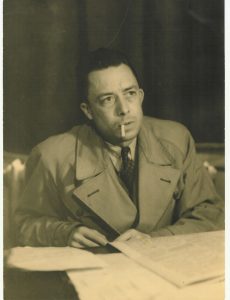
Albert Camus in 1957 by Robert Edwards
Edward Said
In works such as Culture and Imperialism (1994) and Orientalism (1978) Edward Said – who I argue unfairly criticised Camus – emphasises the role of literature in the imperialist project of civilising ‘inferior’ races In his analysis of texts such as Graham Greene’s The Quiet American (1955) and Naipaul’s Bend in the River (1979) Said demonstrates how agents of imperialism operate, and how this morphs into murder and subversion, thereby destabilising so-called primitive post-colonial societies.
In dispassionate fashion, Said also attacks virulent nationalism and an often unstated tribalism – the ideologically indistinguishable Fine Gael and Fianna Failparties from Ireland are good examples – increasingly evident in our time. He asserts ‘Patriotism, chauvinism, ethnic, religious and racial hatreds can lead to mass destructiveness.’[viii] Said also cites Conor Cruise O’Brien to the effect that imagined communities of identity are hijacked by the petty dictators of state nationalism. I fear we are heading in that direction without the reassertion of universal Enlightenment values.
Joseph Conrad’s Hearts of Darkness (1899) about the deranged Colonel Kurtz is perhaps the classic text of colonialism,. Set in the Belgian Congo under King Leopold’s genocidal regime of plunder, we see how the civilising mission has mutated into barbarism and murder. Francis Ford Copolla would later recycle the tale into an indictment of the American civilising mission in Vietnam, with Marlon Brando playing Kurz, with utterly contrived insanity.
Colonialism was a variation, or perhaps a precursor, to the theme of Spengler, often caricaturing the lazy and sensual native, set in contrast to the disciplined, and sexually uptight, coloniser. This required and justified the imposition of jackbooted domination to force submission on the shiftless and degenerate other – a necessary psychological tool conditioning the humanity of both sides.
Yet the coloniser often serves as a role model for the colonised, as we have seen in the unhappy drift of many post-colonial states towards dictatorship around the world; or as Homi Bhabha puts it: ‘Although colonised subjects endeavour to imitate or mimic the behaviour of the coloniser, the mimicry is always imperfect – almost the same but never quite.’[ix] This best explains racially motivated homicide, such as we saw in the brutal murder of the English soldier Lee Rigby, and in the beheading of foreigners by ISIS – almost the same but never quite.
New Corporate Colonialism
Frantz Fanon’s provided a profound insight into how colonised peoples – The Wretched of the Earth – are required to pay the debts of the occupying powers. This has been reproduced in our own societies in the form of austerity. The occupying powers are now the corporatocracy, or those with inherited wealth. The only difference from the colonial period is they are no longer all from the same ethnic group. In fact a veneer of diversity is achieved with the promotion of a few specimens with varied pigmentation, and an embrace of safe, politically correct policies that ignores structural racism.
Nonetheless, allegations of racism are used by the corporate vectors of public opinion in a similar way to gender politics: as a mask for self-advancement and the elimination of competition. But we also see attacks against the left through a conflation of anti-Zionism with anti-Semitism. This was clearly evident in the stitch up of former Labour leader Jeremy Corbyn, who failed to grasp how he, a long-time anti-rascist campaigner, could be accused of being racist, and was too nice, or loyal, to comrades who had fallen over the edge into outright expressions of it.
Vast sectors of the developed world are now easy picking for a corporate colonialism facilitated by transnational law firms, and endorsed by governmental and inter-governmental agencies, including the E.U.. Fanon’s warning echoes across time: ‘The people’s property and the people’s sovereignty are to be stripped from them.’[x]
Fanon also pointed to how mental illness, neurosis and de-rationalisation are responses to post-colonial subjugation. This is being revisited under conditions of austerity, which the Covid-19 pandemic is accelerating. It perhaps explains why so many on the far-right seem unhinged. In my own professional practice as a London barrister I have seen a decided increase in unreal vantage points, with some people feeling like spectators in a film of their existence.
So what conclusions can we to draw on multiculturalism from the vantage of post-Brexit-post-Covid-limbo-in-London, and with Euro-wide fascism and racism on the rise, as fixed borders return and semi-permanent exclusion zones are put in place?
Intimations of Decline
Historically, pandemics have inflamed existing xenophobia and led to racial scapegoating. When the incomparably more devastating Black Death arrived in Europe in the 14th century, cities and towns shut themselves off from outsiders, assaulting, banishing and killing ‘undesirables’ – mostly Jews. Through a combination of state propaganda and media hysteria the contagion of fear has reached medieval levels. Racism is on the rise across Europe, even in the U.K. where the legal status of non-nationals is increasingly precarious.
We are fighting a two-front war: one front is called migration, and the other one belongs to the corona virus. There is a logical connection between the two, as both spread with movement.
Meanwhile President Trump has called the virus a Chinese conspiracy, or Kung-Flu
Here I propose three tentative responses, which may not make for easy reading:
The liberal multicultural consensus based on the rule of law, humanism, tolerance, the promotion of excellence irrespective of race, and a measure of affirmative action to compensation for historic discrimination has broken down. In an age of extremes, even some on the left are demonising the diseased other, but intellectually impoverished commentators refuse to recognise the extent of this. Extremism looks set to get worse even in multicultural Britain, particularly if the economic depression accelerates. This requires a reassertion of intellectualism, Enlightenment values, and interdisciplinary exchange.
An open door policy, or really one designed to drive down labour costs, promoted by Angela Merkel and others cannot be maintained. Focus should now shift, if it all possible to addressing the underlying challenges of post-colonial states, especially in Africa, through debt relief and an end to the exploitation driving many conflicts. A New Deal for Africa is required. Italy cannot be expected to accommodate the millions that are seeking refuge there each year under the Dublin Regulation. If the European Union is worth anything, the existing refugee burden has to be shared more equally, and those states such as Hungary that refuse to participate should be sanctioned or excluded from the Union altogether.
The U.K. extradition courts look set to be flooded with the deportation of the undesirable through revivified warrants. Racially motivated crimes and targeting will continue apace and seem likely to be unchecked by functioning state authorities. This demands a response, challenging the nonsense of racism, but in a way that does not consolidate stereotypes, as I fear the Black Lives Matters movement does. Iconoclasm and statue-breaking have a role to play, but let’s not throw the baby out with the bathwater. Churchill was in many ways a barbarous imperialist but without him Europe would have succumbed to Nazism. There are civilized institutions and literary canons worth upholding.
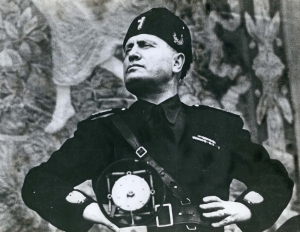
It might come as a surprise that I am more optimistic about the U.K. than elsewhere in Europe; even Boris Johnson for all his buffoonery during the pandemic is not a savage by comparison with the Mussolini-lite characters that are increasingly evident in European governments.
Look familiar?
Relativism and Human Rights
The dominant conception of human rights among legal scholars around the world – including David Deng, An Naim, Yash Pah Ghai, Upednra Baxi, and Richard Rorty – is of a universality adapted to the practices and norms of a given society. So if multiculturalism is to regain traction it must acknowledge universal human rights, and not blithely accept archaic tribal practices or religious extremism; yet at the same time we should retain what is enduringly decent in a particular society.
Fanon and Said provided an insight into the destructive effect of post-colonial racism. Under neo-liberalism we now see an overt far-right fascism, but also a structural form under the centre-right, which is overseeing the impoverishment of all but the super-rich, while maintaining a veneer of inclusivity. Now with an economic and environmental meltdown on the horizon it is time to assert universal Enlightenment values, and fairly allocate the resources of the Earth, while leaving room for diversity and even eccentricity.
Featured Image is of Frantz Fanon 1925-1961.
[i] Richard Thurlow, ‘Destiny and Doom: Spengler, Hitler and ‘British’ Fascism, Patterns of Prejudice, Vol 15, no. 4, 1981, https://www.tandfonline.com/doi/abs/10.1080/0031322X.1981.9969635?needAccess=true&journalCode=rpop20
[ii] Collins Online Dictionary defines this as: ‘a type of journalism that relies on reusing existing material such as press releases and wire service reports instead of original research, esp as a result of an increased demand for news content’, https://www.collinsdictionary.com/dictionary/english/churnalism.
[iii] Jim Waterson, ‘Guardian announces plans to cut 180 jobs’, July 15th, 2020, https://www.theguardian.com/media/2020/jul/15/guardian-announces-plans-to-cut-180-jobs
[iv] Josh Clarke, ‘Are we all descended from a common female ancestor?’ How Stuff Works, https://science.howstuffworks.com/life/evolution/female-ancestor.htm
[v] Untitled, ‘Ireland Number of Non-EEA Students in Higher Education Jumps by 45% Over Five Years’, ICEF Monitor, June 11th, 2019, https://monitor.icef.com/2019/06/ireland-number-of-non-eea-students-in-higher-education-jumps-by-45-over-five-years/
[vi] Ronan McCrea, ‘Covid-19 laces granting of Irish citizenship with danger’ July 14th, 2020, Irish Times, https://www.irishtimes.com/opinion/covid-19-laces-granting-of-irish-citizenship-with-danger-1.4303461
[vii] Kitty Holland, ‘Restrictions on Travelling Abroad May Last Several Years Expert Warns’, Irish Times, July 12th, 2020. https://www.irishtimes.com/news/health/covid-19-restrictions-on-travelling-abroad-may-last-several-years-expert-warns-1.4302672?mode=sample&auth-failed=1&fbclid=IwAR0UPREs1c4aZPlKnVL3ZtC5ZUh5nruoD-5m54MUyf-HvVdP31IXcJVvRFE&pw-origin=https%3A%2F%2Fwww.irishtimes.com%2Fnews%2Fhealth%2Fcovid-19-restrictions-on-travelling-abroad-may-remain-up-to-10-years-expert-warns-1.4302672
[ix] Homi K. Bhabha, The Location of Culture. Routledge, London ; New York, 1994, pp.85-92, https://prelectur.stanford.edu/lecturers/bhabha/mimicry.html
[x] Frantz Fanon, The Wretched of the Earth (1961), p.152
I was looking for an excuse to sing with some of my favourite musicians: Nick Roth, Francesco Turrisi and my sister Deirdre O’Leary. I’d had the pleasure of working extensively with all of them in the past, but never all together at once. Since we all come from and inhabit different musical worlds I had to find a place where those worlds could overlap harmoniously. Nick plays saxophones and percussion in mostly jazz and contemporary realms. Francesco plays keyboards and percussion in mostly early music and jazz domains. Deirdre is a classical and contemporary-classical clarinettist and I sing mostly early music and traditional songs. We all delight in improvising.
I’ve long been drawn to the fabulously intricate music of the fourteenth century Ars Nova and Ars Subtilior, an even more sophisticated sub-genre of the Ars Nova that developed in the last quarter of that century especially at the court of the anti-pope in Avignon. This music features rhythmically and contrapuntally complex lines that remind me of avant-garde jazz, lines of notated ornamentation playing against each other like wild improvisations.
I wanted a story that could be spun into a musical project and, having a penchant for all things gothic (especially of the fourteenth century kind), started researching the Black Death. While I was studying the effects of the plague in Ireland I came across a remarkable story of colliding cultures in medieval Kilkenny, a story so grimly enthralling that it could have come straight out of Hollywood (I wish it could have been directed by Stanley Kubrick!).
The story took place in Ireland at a turbulent time, a time of invasions, war, lawlessness, famine and plague. A time of fear, violence and almost unimaginable mutability.
In 1317 Richard de Ledrede – an English Franciscan of the Order of Friars Minor – arrived in Kilkenny, appointed by the papal court in Avignon as the new Bishop of Ossory (1317–1361) and immediately set about challenging the secular authorities and making a name for himself as a zealous moraliser and “scourge of heresy”. In 1324 he arraigned Dame Alice Kyteler, a wealthy businesswoman and serial espouser (she married four times) on the charge of being a witch. He alleged that she denied Christ, enchanted the citizens of Kilkenny with magic potions – made from entrails of cocks which had been sacrificed to demons, dead men’s nails, hair and brains of boys who had been buried unbaptised – all cooked up in the skull of a decapitated thief, that she had an incubus named Artisson with whom she had sex and who manifested as either a cat, a shaggy black dog or a black man, and that she murdered her first three husbands and was poisoning her fourth.
Dame Alice, however, had powerful allies who protected her and facilitated her flight to England where she vanished from history. The notorious inquisition that ensued was peppered with political intrigue, excommunication, charges of heresy and counter-charges of heresy with the bishop himself being imprisoned in Kilkenny castle for seventeen days during which time he placed the entire diocese under interdict (no masses, baptisms, marriages or burials could take place). When released, he refused to leave quietly, but had his full episcopal regalia brought to him and, with his clergy and parishioners, made a solemn procession to St Canice’s Cathedral where a Te Deum mass was celebrated.
Though Dame Alice escaped with her life, her servant Petronilla de Meath was not so fortunate. She was captured, flogged through six parishes and a confession of sorcery was extracted. She was burned alive at the stake for the heresy of witchcraft, the first person in history to be thus charged and immolated.
Dame Alice’s son William Outlaw was charged with heresy for defending his mother. He was forced to recant, hear at least three masses a day for three years, feed the poor and to pay for the roof of St Canice’s Cathedral to be covered with lead. The roof subsequently collapsed under the weight.
This became the backdrop to our music.
TheRed Book of Ossory is a fourteenth century medieval manuscript compiled in Kilkenny. Pre-eminent among the manuscript’s texts are sixty remarkable Latin poems by Bishop Richard de Ledrede. The same fertile imagination (Ledrede’s) that composed the phantasmagoric sorcery charges also composed beautiful, esoteric and richly imagistic poetry. The bishop instructed that these verses be sung by the priests, clerks and choristers of St. Canice’s “on the important holidays and at celebrations in order that their throats and mouths, consecrated to God, may not be polluted by songs which are lewd, secular, and associated with revelry, and, since they are trained singers, let them provide themselves with suitable tunes according to what these sets of words require”.
“Well,” I thought, “I’m a trained singer!”. So I set to work finding suitable tunes. I spent countless (happy) hours wandering through various medieval music sources (Chansonnier du Roi, Llibre Vermell de Montserrat, Codices Chantilly, Modena, Squarcialupi, etc.) and made speculative reconstructions of many of the bishop’s hymns.
Then, together with my fellow band members, in what was a charmed and wondrous process, we deconstructed those reconstructions. It was a true joy to make music with Nick, Deirdre and Francesco, a very happy and collaborative collision of cultures both in our rehearsals and onstage. And when we came together to make a record of our project, the synergetic spirit lived on as we made an essentially live recording, making music together in the same space and time.
With the name Anakronos I feel we are allowed (if not obliged) to take certain liberties with traditional notions of proper chronology. So, bass clarinet, soprano saxophone and Nord synthesizer breathe electric life into music that was written at least five centuries before electricity was harnessed, music that was written before and after the bishop’s poems, but that could have been sung to his words in his lifetime. And music that I wrote and we improvised.
But why sing the words of a witch-burner? Because they’re beautiful and I find it interesting to contemplate the contradictions that exist within people. As Stanley Kubrick said when asked if his characters were good or evil, “They are good AND evil!”.
For more about Caitríona O’Leary’s work see her official website. Anakronos ‘The Red Book of Ossory’ is now available via Heresy Records as a CD and high-quality download (available here) and streaming across online platforms.
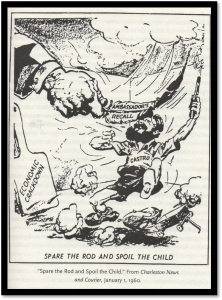
Since the triumph of the Cuban Revolution in 1959, the United States has inflicted various forms of punishment upon the island nation in order to affect regime change. Policies have included a devastating economic embargo, attempts at international isolation, military invasion and a little-known history of terrorism, which has claimed thousands of Cuban civilian lives.
One of the longest-standing expressions of this antagonism derives from an institution usually perceived to be independent of the state in modern liberal democracies – the press. In fact, the mass media has enthusiastically justified Washington’s determination to end the Revolution and re-establish American control. Mainstream media’s role has been to the fore in painting Cuba in a negative light and developing a critical narrative, which does not stand up to honest scrutiny.
Misinformation has been responsible for the preponderance of negative myths around Fidel Castro’s Revolution. But when myth displaces history, facts become immaterial to rational discussion. This is the means by which the worst charges against Cuban society come to be believed, while attempts at authentic examination are denied.
Cuba’s Response to COVID-19
Criticizing Cuba’s many shortcomings throughout the decades has been an easy endeavour for corporate media. Yet the press has studiously ignored positive aspects of the Revolution. This was seen recently in negative coverage of Havana’s decision to send medical teams to some of the countries hardest hit by COVID-19. Indeed, Cuba was the only nation to provide medical assistance to Italy at the height of the crisis there.
A team of Cuban doctors and nurses arrived in Italy to help in the fight against the coronavirus outbreak, as the death toll from the virus in the country surpassed that of China https://t.co/XvXL35q8Axpic.twitter.com/0v6izllYXB
In attempting to convince its readers that sending medical staff abroad to help fight the pandemic should be equated with ‘human trafficking’, the Miami Herald ran a one-sided piece on February 28th. It was written by Cuban-American Ileana Ros-Lehtinen, a former Republican member of Congress well known for her unyielding anti-Revolutionary stance.[i]
The article made an unsubstantiated claim that Cuban doctors had been forced to participate under threat of punishment, with the government arbitrarily confiscating the majority of their salaries. What the piece failed to reveal was that the doctors had volunteered out of a sense of personal duty, receiving far more than their domestic wages under the programme, and used the proceeds to support the government’s efforts to sustain the country’s universal health care system. This came from a desire to give something back to the system that trained them.
To provide that counterpoint would offer rationality and balance, something the U.S. press does not generally permit in supporting Washington’s objectives in Cuba. This is why the media rarely mentions the damage done by the U.S. embargo when reporting on Cuba’s substantial economic difficulties.
While this episode during the COVID-19 crisis is but the latest instance of media bias, it is not an isolated case. One of the most egregious occurred after a number of national journalists were paid by the U.S. government to publish misinformation regarding the Cuban Five – intelligence agents sent to Florida in the 1990s to infiltrate violent anti-Revolutionary organizations with a history of employing terrorist methods.[ii]
The Five were sentenced to lengthy jail terms based in large part on intentionally misleading reporting of journalists. It was a remarkable case of a ‘free press’ blatantly submitting to the directives of their government’s foreign policy dictates.
Other examples include that of American contractor Alan Gross, convicted of bringing illegal military grade communication equipment into the island nation. His case engendered considerable national media coverage, mostly propagating the distortion that he was simply carrying standard telephonic equipment.
Long History
Even before the Revolution, mainstream media was fully behind Washington’s designs on the island nation, helping to generate the fiction that the Maine battleship was intentionally blown up in Havana harbour in 1898. This generated the public support for U.S. entry into Cuba’s War of Independence against Spain that culminated in decades of American hegemony.
Washington’s hostility to the Revolution has been wholeheartedly supported by corporate media. This should come as no surprise as, with few exceptions, historically the mainstream U.S. press has endorsed or vilified the government’s designated allies or enemies. This is regardless of a media outlet’s ideological bent on domestic issues. So whether it’s the left-leaning New York Times or the conservative Washington Post, when it comes to Cuba reporting has been overwhelmingly anti-Revolutionary.
This stance against Cuba is really what a ‘free press’ is designed for; a generally reliable information outlet is utilized to generate support for the government’s foreign policy goals, most often based on capitalist considerations. Indeed, corporate media’s primary consideration, now more than ever, is to be a profitable business. That means a basic tenet of journalistic integrity — fairness – is thrown to the wayside to appease shareholder wealth and advertiser expectations. Thus, the media’s economic imperatives harmonise with the U.S. government’s strategic goals.
Media critic website Project Censored succinctly describes the relationship: ‘Corporate media have become a monolithic power structure that serves the interests of empire, war, and capitalism.’[iii]
Unsurprisingly, the mainstream media – no less of a capitalist institution than the stock market – cannot tolerate Cuba’s socialist values and efforts at egalitarianism being presented as any sort of positive model for other developing nations to follow.
The one-sided perspective, based on the control of information, is particularly effective as most Americans still find it extremely complicated to visit the country due to restriction on travel. As the average person is unable to see for themselves what is good, bad and indifferent about Cuba, media is the only conduit for the message about a country long designated anti-American.
The foot soldiers in corporate media’s propaganda war have been the journalists. While most are not intentionally biased, any mainstream media reporter – experts in foreign affairs or otherwise – writing about Cuba usually approaches the subject with predetermined values based on rigid capitalist understandings of democracy.
Most journalists instinctively cover Cuba from that perspective, regurgitating ingrained biases and misinformation about the Revolution.
Cuba does not conform to Western neo-liberal standards, so by default the mainstream press looks for negative indicators, compared to the supposedly superior capitalist system. The result is that journalism unsympathetic to capitalist values is not published. Instead reporters are selected who perceive Cuba’s system to be inferior, and approach the subject with a set of preconceived prejudices. This lack of any real understanding of a revolutionary society or Cuba’s history only exacerbates those established ideas.
Warren Hinkle, a columnist for the San Francisco Examiner described it as a journalistic axiom about Cuba that ‘if it’s negative, it must be true.’[iv]
Media Consolidation
Mainstream media, now increasingly under the thumb of billionaires, is generally in complete accord with the political and economic views of ruling classes and their foreign policy objectives. The parameters of discussion in the media come under state control through a conjunction in the financial aims of owners and national policy goals.
Under unspoken U.S. rules of proprietorship, the media’s voluntary compliance in disseminating government propaganda is more effective than state-controlled news organisations found under overt dictatorships. There is a perception that privately operated media equates to independence and is a democratic barrier to state authoritarianism. In fact, when mainstream media ownership is under the control of the billionaire class, you don’t need government pressure to ensure compliance, it comes willingly.
Whether supporting American allies – no matter how distasteful — or denigrating those perceived to be anti-American – no matter how undeserving – the mass media can be counted on to adhere to the official agenda of the state. Thus, among the countries that are rarely criticizes in the media are human rights abusers such as Saudi Arabia, Pakistan and Egypt. On the other hand, the propaganda machine has reached epic proportions in its depiction of Venezuela. Cuba, of course, has never left the anti-American ledger.
The difference in how media covers pro- and anti-American nations has been described by Alternet writer Adam Johnson as the ‘North Korea Law of Journalism’, which states that journalistic standards ‘are inversely proportional to a country’s enemy status.’[v]
The North Korea Law of Journalism states: "editorial standards are inversely proportional to a countys enemy status" pic.twitter.com/u0alUnXeQ9
As a result, the more antagonistic the U.S. is to a particular country, the more lackadaisical a journalist can be in truthfully depicting events there. That approach has long characterized coverage of Cuba.
Further Recent Examples
Another recent example of the adverse reporting on Cuba’s efforts to fight COVID-19 arrived in a CNN report written by Patrick Oppmann in late March, with the headline: ‘Coronavirus-hit countries are asking Cuba for medical help. Why is the US opposed?’[vi] Yet the article offered no specific reason why the U.S. government should object.
The wording of the headline implies that the U.S. government has a valid reason for complaining about Cuba sending medical teams around the world. The consumer already has assimilated the false narrative that there is legitimacy in objecting to Cuba’s internationalism. This is before a single word of the article has been read.
The article reports that the U.S. State Department wants countries to refuse any help from Cuban medical brigades, even though they admit that health care systems around the world have been strained to the point of collapse. A spokesperson for the Trump administration then went so far as to call the medical staff ‘slave doctors.’
CNN’s report continued with the standard false narrative about Cuba, laying the blame for the economic shortcomings on: ‘The hyper centralization of the Cuban government, which has been so disastrous for the island’s economy.’
Naturally, there was no discussion of the unrelenting harm that the American embargo imposes. Corporate media reveals its biases as much by what it reports, as by what it ignores. The reporter either had no conception of how Cuba’s economy works or the reforms it has undergone over the past five years to decrease centralization, or simply chose to ignore those facts. Truth and Cuba rarely intersect in corporate media.
International media can be just as biased. A report in The Guardian on May 6th recalled the kind of misinformation disseminated in the early days of the Revolution, rehashing false narratives about medics being exploited by an authoritarian regime seeking political influence. Paul Hare, the British ambassador to Cuba from 2001 to 2004 was quoted as referring to Cuba’s ‘doctor diplomacy’ that began soon after 1959 because Fidel Castro, ‘was very strategic [and] saw a surplus of doctors and he saw it as a way of garnering diplomatic support.’[vii]
This statement from the former ambassador exposes either a shocking lack of knowledge about Cuba or intentional dishonesty. In 1959, Cuba had approximately 6,000 doctors, half of whom fled the country soon after Castro’s triumph. There was no surplus of doctors in the early years of the Revolution. It was only through steady government investment over decades that Cuba’s health care system became universal, despite the economic limitations imposed by the U.S. embargo.
Indeed it wasn’t until 1976 that the pre-Revolutionary ratio of doctors to citizens was restored, but by 2005 Cuba had the highest proportion of doctors to citizens in the world.[viii] Only after fulfilling its commitments to health care nationally did the shift towards medical internationalism occur.
Washington’s latest attack on Cuba’s medical efforts internationally came in June, when Florida’s Republican Senator Marco Rubio introduced the Cut Profits to the Cuban Regime Bill. The proposed legislation, according to the Miami Herald, requires the State Department to publish the list of countries that hire Cuban medical missions and for that list to used when deciding countries’ rankings on the State Department’s annual Trafficking in Persons (TIP) report.[ix] The Bill is the latest attempt to discredit the missions and deprive the Cuban government of much needed resources.
Spanish-American War
Media bias against Cuba did not start with the Revolution. One of the earliest examples originated over one-hundred-and-twenty years ago during the Spanish-American War – referred to in Cuba as the Second War of Independence.
The national media of the day was in full-throated harmony with Washington’s long-standing desire to establish control over the island. The conflict started in 1895 when Cuban rebels rose up to fight for independence against Spain. On the verge of victory in 1898, the Americans came in to help seal the deal and then supposedly to leave – or that’s what the Cubans thought. The pretext for U.S. involvement resulting in sixty years of American hegemony was the blowing up of the Battleship Maine in Havana harbour.
America’s two most influential newspapers whipped up public support for military intervention. At the time of the explosion both William Randolph Hearst’s New York Journal and the New York World, owned by Joseph Pulitzer, were the leading proponents of the yellow press in fierce competition over national issues. But when it came to foreign affairs, the two papers were often on the same page, cheerleading the country flexing its developing imperial muscles.
The New York Journal offered the enormous sum of $50,000 for the capture of those responsible for the Maine explosion, noting: ‘The physical facts, even in advance of the investigation, indicate that the Maine was blown up by a (Spanish) submarine mine.’[x]
That there was no proof for this contention hardly mattered. The only reasonable response, the editorial board concluded, was for the U.S. to enter the war, defeat the Spanish and liberate Cuba. The final objective, to place the island under U.S. dominion, was left unstated.
Once the war ended the Americans imposed military rule from 1898 to 1902, setting the conditions for U.S. social and economic control over the island for the next fifty years. To justify U.S. control, the press reported that Cubans were simply incapable of managing their own affairs.
As New York Times’ correspondent Stanhope Sams wrote disdainfully of the locals: ‘There is no Cuba. There are no Cuban people. There are not freemen here to whom we could deliver this marvellous island. We have fought for a spectral republic … If we are to save Cuba, we must hold it. If we leave it to the Cubans, we give it over to a reign of terror.’[xi]
From Fidel Castro to Elián Gonzalez
When Fidel Castro ended, once and for all, those false narratives, the mainstream press enthusiastically went to work in support of Washington’s goal of vilifying the Revolution. Now the Cubans were depicted as evil, two-faced, illegitimate and a bunch of unappreciative bandits for being forever ungrateful for U.S. benevolence. And worst of all: they went on to become Communists.
While the media criticized those who supported the Revolution as unwitting fools, the most violent attacks came against Fidel. An editorial cartoon in the Charleston News and Courier on January 1st, 1960, played on the supposed immaturity and temperament of the Latin male. Thus, Fidel was depicted as a spoiled child in a playpen, with the caption reading, ‘Spare the rod and spoil the child’.
The mainstream media would ensure that the public appreciated just how ungrateful, childish and vindictive these Cubans, who had the temerity to throw the Americans out and end colonial rule, really were.
While the following decades institutionalised the media’s propaganda war against Cuba, one little boy’s tragedy revealed just how far the press was prepared to go in distorting reality.
Elián Gonzalez created an international sensation in 1999 by surviving the dangerous crossing of the Florida Straits on a raft, an attempt to reach the U.S. that cost the lives of his mother and others aboard. Shortly after Elián was taken in by his relatives in Miami, the press created a series of narratives that merged into a characteristic anti-Cuba bias.
This included a report that Elián wouldn’t last six months if he returned to the horrors of Cuba; that his father Juan Miguel really didn’t want to have his son back; and that his mother died in a desperate bid to gain freedom on America’s shore. Yet none of those charges stand up to scrutiny.
One story in the Miami Heraldpromoted the distortion that Elián would face, ‘a tragic life of deprivation if he returns to Cuba.’ The source relied on was a bystander who is supposed to have said: ‘If he goes back, he will starve to death…. It would be a crime to send him back.’[xii]
When Elián’s father, Juan Miguel González, was interviewed, the media expressed skepticism as to whether he wanted his son returned. This led The New York Times to speculate irresponsibly as to whether Juan Miguel was simply, ‘a puppet of the Castro government,’ who ‘not only would allow his son to stay but would seek asylum himself,’ if he ‘had the freedom to speak his mind.’[xiii] The assumption is, of course, that Cubans who want to remain in Cuba have been brainwashed by the regime.
Alan Gross
In 2009 the media turned its attention to the issue of American contractor Alan Gross, arrested after bringing in high tech, illegal communication equipment known as BGAN, designed to set up untraceable satellite communication networks.
This equipment is prohibited internationally unless under the control of a government. Gross was funded by USAID, one of many government agencies dedicated to the overthrow of the Revolution. Predictably, the case generated a host of misrepresentation in the corporate media.
The overwhelming majority of articles claimed Gross was simply carrying low-level communication equipment, similar to a mobile cell phone.
Consistently misrepresenting what he was doing in Cuba, the press constructed the issue as a helpless American only trying to bring, ‘free speech to an oppressed people under the nose of a government that did not want that to happen’, as one report on CBS News put it.[xiv]
The Washington Post spewed the same fallacy with an additional twist a few days after his arrest: ‘The Cuban government has arrested an American citizen working on contract for the US Agency for International Development who was distributing cell phones and laptop computers to Cuban activists.’[xv]
The Cuban Five
Undoubtedly, however, as alluded to earlier, the worst example of media bias occurred when corporate media ensured a completely unjust court decision was delivered against five men who were trying to prevent acts of terrorism.
The case of the Cuban Five revolved around intelligence agents sent to Florida to infiltrate violent anti-revolutionary Cuban-American organizations with a history of terrorism against their former homeland.
The Cuban Five
The arrest and trial of the Five in 1998 was characterized by an unending stream of misinformation, ensuring the Five would have no chance of a fair trial. This resulted in incredibly long sentences for all five, including two life terms, plus fifteen years for Gerardo Hernandez.
This travesty of justice was made possible by a number of journalists on the Miami Herald who were paid by the United States government to write negative stories against the Five, thereby abrogating any semblance of journalistic integrity. It was state run propaganda pure and simple, with the willing connivance of the so-called free press. Corporate media stooped to disseminating the view that the Five were dangerous spies, determined to steal government secrets and attack the United States.
During the trial various reports written to condemn the Five incorporated elements of fantasy. Wilfredo Cancio Isla wrote a remarkable article in El Nuevo Herald on June 4th, 2001, the day the jury began its deliberations, implausibly claiming that: ‘Cuba used hallucinogens to train its spies.’ The article claimed an anonymous Cuban spy deserter had revealed that Cuba gave its agents LSD and other drugs before sending them on missions abroad.
Isla was paid more than $20,000 US to write those stories. Other journalists accused of being paid by the government included El Nuevo Herald reporter Pablo Alfonso, who wrote sixteen negative articles during the trial. Those fictional reports apparently netted him $58,600.[xvi]
Normalizing Relations
A seemingly important split within corporate media’s coverage of Cuba took place in 2014, when President Obama announced a move towards normalizing relations with Cuba. While mainstream media adopted differing views on the value of the process, the underlying allegiance to U.S. foreign policy remained intact.
From the liberal side, the New York Times ran a series of mostly positive articles and editorials, focusing in on the benefits normalization would bring to American business interests, while at the same time helping to convince the locals of the advantages of capitalism. While the Times remained broadly supportive, the conservative Washington Post coverage was predominantly reactionary – with editorials consistently promoting the view that Cuba should not be presented with any gains from the normalization process until they completely renounced the Revolution.
The New York Times support and Washington Post opposition appeared to demonstrate a clearer demarcation in media coverage of Cuba. In fact, the division was over how to realise long-standing state objectives. The objective had not changed.
The Times saw the opening as a new avenue for regime change, in accordance with Washington’s updated perspective. The Post called for the maintenance of the old strategies. Both sides were speaking for the achievement of the same end: the end of the Revolution and re-imposition of American interests. Neither questioned the legality of those policies, the effectiveness of the regime, or the harm caused to the Cuban population by the embargo; just how best to go about achieving regime change.
That has been mainstream media’s prime narrative since the Revolution succeeded. Obama’s updated motive was to offer Cuba a carrot instead of the stick, in the hope that an influx of U.S. tourists, capitalism and culture would finally convince the locals to abandon the dark side of socialism and overthrow their own government.
Symptomatic of the reporting was an editorial in USA Today, apparently endorsing the opening, but bringing together all the biases and ingrained rationalizations for American hostility towards Cuba:
For nearly 60 years, Cuba’s government has done two things exceptionally well: repress its own people and make a mockery of U.S. efforts to compel change through economic sanctions … Without question, U.S. economic sanctions have been an exercise in frustration. They have not prompted a popular uprising or compelled the Cuban regime to open up. If anything, they have been counterproductive, allowing the Castro regime to blame its woeful economic performance on vindictive U.S. policies, rather than on its failed communist ideology.[xvii]
The article admitted the blockade had been a failure as it hadn’t forced the Cuban people into rebellion. So now maybe a new approach – normalization — is needed to compel these stubborn Cubans to get rid of their socialist oppressors? All because a foreign power demands they do.
Under Trump
While the normalization process created greater economic opportunities for the average Cuban, it all ground to a halt when current President Donald Trump took office in 2016.
Since then Trump has rolled back Obama’s initiatives. Surprisingly, much of the media has been upset about the return to a policy of hostility, probably because they regard Obama’s policy as being a better way of forcing regime change.
Thus a majority in the establishment press adopted a broadly negative perspective on Trump’s approach, including the New Yorker, CNN and USA Today, positioning the rollback as harmful to U.S. tourists and business, with little attention placed on the adverse economic impact it would have on the Cuban population. The media’s continued support for the opening remained grounded in the expectation that Obama’s policy would finally bring about regime change, and that Trump was jeopardizing that new strategy by returning to the old approach.
Over the past year Trump’s aggression against Cuba has included permitting Cuban-Americans to sue foreign entities for using so-called ‘confiscated’ properties, as well as restricting flights from the U.S. to Cuba and trying to curtail remittances. The administration also accused Havana of not cooperating with American anti-terrorist efforts.
Trump’s hostility is largely based on Republican Congressman Marco Rubio’s influence. He has convinced the President that his chances of winning Florida in this year’s election will increase if he return to an aggression stance. This forms the backdrop to criticism of Cuba’s current efforts against COVID-19.
Negative coverage of Cuba’s internationalism during the pandemic comes as no surprise. Washington’s policy of regime change will continue to be supported by a compliant corporate media to ensure anti-Revolutionary bias is undiminished, regardless of any crisis the rest of the world is coping with.
[i] Ileana Ros Lehtinen, ‘Cuba exploits its doctors abroad. It’s human trafficking, not ‘charity’’ Miami Herald, February 28th, 2020, https://www.miamiherald.com/opinion/opn-columns-blogs/Ileana-Ros-Lehtinen/article240740726.html
[ii] Keith Bolender, Voices From other Side: An Oral History of Terrorism Against Cuba, Pluto Press, London, 2010, pg 219.
[iii] Peter Phillips, ‘How mainstream media evolved into corporate media: A Project Censored History, Project Censored, February 7, 2019.
[iv] Karen Lee Wold, ‘POPES, PROSTITUTES, and PRISONERS’, Canadian Network Cuba, Peace Review, 11:1 (1999), 83-89, https://www.canadiannetworkoncuba.ca/Documents/KWald-PPP.shtml
[v] Adam H. Johnson, Twitter, September 10th, 2016, https://twitter.com/adamjohnsonnyc/status/774592061131649026?lang=en
[vi] Patrick Oppmann, ‘Coronavirus-hit countries are asking Cuba for medical help. Why is the US opposed?’, CNN, March 26th, 2020, https://edition.cnn.com/2020/03/26/world/cuba-coronavirus-medical-help-intl/index.html
[vii] Tom Phillips and Angela Giufridda ‘‘Doctor diplomacy’: Cuba seeks to make its mark in Europe amid Covid-19 crisis’, May 6th, 2020, https://www.theguardian.com/world/2020/may/06/doctor-diplomacy-cuba-seeks-to-make-its-mark-in-europe-amid-covid-19-crisis
[ix] Nora Gamez Torres, ‘Scott’s new bill targets countries that hire Cuban doctors through official ‘missions’’, Miami Herald, June 17th, 2020. https://www.miamiherald.com/news/nationworld/world/americas/cuba/article243604002.html?link_id=4&can_id=e6cae2bb447cd7abdbe6ce712332042c&source=email-senator-scott-targets-cuban-medical-missions-trump-policy-changes-frighten-cubans-details-on-cubas-reopening&email_referrer=email_837170&email_subject=senator-scott-targets-cuban-medical-missions-trump-policy-changes-frighten-cubans-details-on-cubas-reopening#storylink=cpy
[x] Charles H Brown, The Correspondents War: Journalists in the Spanish American War (New York Charles Scribner’s Son 1967), p. 124
[xi] Luis Perez Jr, The War of 1898, The United States and Cuba in History and Historiography, North Carolina Press, 2000, p.8
[xii] Lisa Tozzi, Castro wants the kid back, FAIR, March 1, 2000, https://fair.org/extra/castro-wants-the-kid-back/
[xiv] Scott Pelley, The last prisoner of the Cold War, CBS 60 minutes November 29th, 2015, https://www.cbsnews.com/news/last-prisoner-cuba-alan-gross-60-minutes/
[xv] Keith Bolender, Cuba Under Siege, Palgrave Macmillan, 2013, p. 118
[xvi] Wilfredo Cancio Isla, ‘Reporters for hire’, April 19, 2001. www.reportersforhire.org
[xvii] Editorial Board, ‘Obama’s Historic Trip to Cuba: Our View’, USA Today, March 20th, 2016, www.usatoday.com/story/opinion/2016/03/20/cuba-president-obama-fidel-castro-raul-castro-editorials-debates/81938512/
The use of opioid-based drugs (heroin, codeine, oxycontin), increased access to opioid synthetics (fentanyl, carfentanyl) and prescription anti-anxiety medication such as benzodiazepines have skyrocketed globally over the past eighteen years.[i] This has led to an alarming rise in opioid-related disorders and deadly overdoses – from respiratory depression and cardiac arrest – worldwide.
The Republic of Ireland has a long history of opioid drug-related deaths. Since 1998, mortalities due to opioids have increased yearly. Indeed, there is now, on average, one drug-related death every day. The majority of these involve users combining two-to-four drugs mainly, heroin, benzodiazepines, methadone and pregabalin.
Harm reduction as a public health strategy, acknowledges that people use drugs and aims to reduce the harms associated with their use. This also involves addressing the social, economic and health drivers motivating drug use.[iv] However, in Ireland it was introduced as a policy goal with a focus on eliminating the harms associated with drug use alone, which in this case was the elimination of the spread of blood borne viruses into the community in 2001.
Over time, harm reduction as a policy goal was weaved into a health-lead approach to drug use and drug-related deaths. Placed under a Health Ireland framework, the Reducing harm Supporting recovery is the latest government approach to reducing drug use.[v]
However, it is designed within a market-based health framework, led, in theory, by shared decision-making between the government and communities affected by drug abuse. The main responsibility for curbing the crisis is supposed to be handed down from the government to community social partnerships. This document has been in effect for over two years yet drug related deaths have not diminished.
— European Union Drugs Agency (EUDA) (@EUDrugsAgency) July 11, 2017
Dáil Debates
The model on which the newest drug strategy rests is, in fact, contributing to drug-related deaths. Recent Dáil debates show that the drug services element of the social partnership model set up to reduce drug-related deaths is under threat of closure due to the lack of promised funding.
Moreover, the promised shared decision-making is not being passed on to community groups. Decision-making is instead centralized;[vi] while the promised national overdose strategy has witnessed continual delays since 2011. A recent inquiry as to when its publication would occur was met with an argument relying on interventions already in place.[vii]
When we look at the evaluation of current interventions, and those in the pipeline, we see a pervasive stream of government controls getting ahead of actual health outcomes that can change people’s lives.
Naloxone
In 2015 the first leg of the implementation of the Reducing harm policy strategy to curb opioid overdose began with the introduction of the life-saving drug naloxone. It is a medication used to reverse respiratory distress from poisoning due to opioids. It can be injected into muscle tissue or sprayed through the noise.
In Ireland, naloxone is currently used as an intranasal and intramuscular injection, available on prescription only to people who use drugs. In order for it to work, a drug user must obtain a prescription, and an able-bodied bystander must be able to intervene to save her life.
In 2016 a pilot evaluation study assessing its benefits was grossly under-distributed. The government objective was to have 600 distributions over the course of this project.[viii] Yet it was able to deliver only 95 prescriptions and just one drug user reported using it.[ix]
The success of this intervention is also dependent on an able bystander to intervene. As naloxone can only be obtained by someone who has a prescription, a bystander may not have access to the drug due to legal restrictions.
All factors point to defective policy implementations as, on the one hand, the government is claiming to support the use of naloxone, but on the other the law restricts how it can be used. Additionally, social partnerships designed to implement the intervention are at odds with the idea, while people continue to die every day.
Supervised Injection Rooms
The Supervised Injection Facilities (SIF) Act became law in 2017. Permission was thereby granted for a SIF where drug users could go and safely use drugs bought under medical supervision.
This was to be located near Merchant’s Quay Dublin. However, the business association of Temple Bar opposed the site, using emotive terms such as “drug addicts” in relation to addiction services in the city centres perceived as a threat to business.[x]
This led to a saga whereby the state support for the facility ended up as a bad business deal. The end result is a paltry eighteen-month pilot trial that will take place in a basement facility. The SIF site is illogically sited next to a secondary school. The whole affair reeks of Nimbyism, and brought accusations of drug use harming children.
The retail sector wants to see injection sites pushed out of town, but residential communities do not want these either. The facility has since been delayed a second time in response to efforts by the school to resist it. As with naloxone, although SIF is supported in the national drug strategy in practice it is met with legal and social partnership resistance.
Reducing harm and supporting recovery provides knowledge on how to save the body of the drug user by introducing interventions aimed at reducing drug-related deaths. Yet harm reduction policy goals and interventions are not given a fair opportunity due to pre-existing government legislation.
The document is designed under a market-based framework, wherein the power to curb the crisis, in theory, is passed down into community-based partnerships. But all the evidence shows that the required social partnerships needed to diminish this crisis are not being passed down the chain; communities are at odds over strategies and services are under threat of closure. This creates an environment where central government has too much control. As a result, interventions to curb drug related deaths are not being implemented at the required rate, at the expense of drug users, and the community at large.
Community action
Addressing the problem of overdoses should involve delegating control over conditions that lead to drug overdose to the community itself. This begins with a change in attitudes, recognising the experiences that leads to and perpetuates drug use.
Merchant’s Quay Ireland is a leading harm reduction provider that serves the community in overdose prevention. It supports the user of drugs and enhances their lives by providing social services that alter the conditions in which they live. They recently used the participatory research method of photovoice, a methodology where people living with a health issue use photographs to portray their experiences. This explores the topic of the lived experience of addiction and recovery. The photographs were recently showcased in the Dublin Copper House gallery.
The identity of those who have addiction, those affected and how they recovered, was tangible and real. Images of the River Liffey, the Mourne mountains and wild ivy became the essence of the recovery experience. Themes of freedom from the bondage of recovery, the conditions that influence it, and the growing expression of their identity loudly proclaimed: “I am alive”.
The use of photovoice by MQI gave a bird’s eye view on what it is like to have an addiction and be at risk of overdose. This in turn humanized the person who uses drugs – for them to become not just a body, but an independent spirit.
As Michel Foucault shows us in his body/power essay, the state provides knowledge to society – in this case medical knowledge – about the type of body that is valued in order to maintain power and control. The body of the user does not conform to this ideal, leading to a risk environment for drug-related deaths and vicious circles of self-loathing.
Starting from the ground up, empowering people who use drugs, and those at risk of overdose by supporting their voices, provides feasible alternatives to government-controlled health. Otherwise bodies will continue to lie motionless on streets, as the government hums and haws about how life-saving interventions should be delivered.
[i] Center for Disease control and Prevention. (2019). Understanding the epidemic. Retrieved from: https://www.cdc.gov/drugoverdose/epidemic/index.html
[ii] Building on Experience: National Drugs Strategy 2001 – 2008., https://www.drugsandalcohol.ie/5187/1/799-750.pdf
[iv] Riley, D., Sawka, E., Conley, P., Hewitt, D., Mitic, W., Poulin, C., … & Topp, J. (1999). Harm reduction: Concepts and practice. A policy discussion paper. Substance use & misuse, 34(1), 9-24.
Lately there seems to be something very right-wing about being on the ‘Left’. I’m not really sure what the ‘Left’ actually stands for anymore. Until the 1990’s it was the place where you would find a broad array of Marxists, Trotskyites, Labour Party members, Socialists, and even Shinners. All partook of an identity easily distinguished from the ‘Right’, where there was a corresponding mix of Thatcherites, Reaganites, ‘trickle-down’ economists, and extreme libertarians.
Oh boy! Things were easy then. Even if you didn’t sympathize with the Left, agreement with the near-ubiquitous Campaign for Nuclear Disarmament (CND) made you one by proxy. The Left was a vast political and psychological landscape, and it was almost impossible to reach another political standpoint without crossing its borders.
In essence, the Left was once defined by its distinction from the Right; the big Other of Nuclear Power, the Corporation and ‘profits before people’. It was real, accessible, unavoidable, and an essential alternative to the establishment; a crucial political counterbalance to the dominant side of politics. It was, ostensibly, about ‘ordinary-people’, higher taxes for the rich and social investment.
For a long time the Left held the intellectual high ground. Existentialists, artists, poets; Kafka, Camus, Beckett, Joyce, Hemingway, Steinbeck, and many more, were all on-side, raging in their own way ‘against the machine’; against religion, blind conformity, and the inhumanity of a comfortably-numb establishment.
You just had to grab a copy of Kafka’s The Castle, slip into a pair of Birkenstock’s, order a latte, or smoke on a clove cigarette, to declare yourself a Leftie. Today those same cafes are populated with ‘techies’, hurriedly devouring avocado toast, perusing the Economist, fiddling with a ‘fit-bit’, and asking Siri if Tesla shares are on the rise.
So where have they all gone, those Beatniks and the latter-day Chés? Today, distinguishing ideological differences between ruling and opposition parties in most Western democracies requires superhuman vision, or no vision at all. Existentialist dialogue about literature or philosophy is rarely found in mainstream media, instead relegated to academia, or that strange cabal, referred to disparagingly as ‘intellectuals’.
What we are left with is an exaggerated respect for the titans of big business, the market, and venerate unlimited economic growth.
RTÉ Science & Technology Correspondent Will Goodbody gets a rare insight into the functions of Apple’s European Headquarters in Cork https://t.co/DYL0oHVqYT
Perhaps the Left simply grew old and frail? The fruit of the early labours brought sufficient liberty and licence to sire a more politically effete ‘snowflake generation’. Perhaps their offspring have simply ‘sold out’, or been wooed into the corporate fold, via a co-dependence on social media and semi-legal sedatives?
Yet today in Ireland our government is not simply failing to tax corporations progressively, but actively trying to return tax revenues to its corporate ‘benefactors.’
Allegiance of the national media to the Government’s ongoing legal battle to return tax revenue to Apple has been crucial. Thus, in one article published on the RTE News website in September 2019 entitled ‘The Apple tax case: All you need to know,’ RTE’s Business editor Will Goodbody concludes his analysis with the following summation:
But wouldn’t we like to get our hands on the cash?
That would seem like a great idea on the face of it, and one advocated by quite a few politicians.
At a time when we are facing significant economic uncertainty with Brexit, a global economic downturn, trade wars and more, €14.3bn would go a long way towards resolving many problems.
However, that would only be a short term gain and may only go to reinforce claims that Ireland is a tax haven – something the Government strongly denies.
In the long-run the argument made by other politicians and experts is that Ireland would be far better off if it and Apple won their appeals.
This would protect Ireland’s reputation and send a strong message out to the international investment community that Ireland is a safe place to invest, they claim.
Of course, there is much change afoot in the international corporate tax environment anyway, particularly through the OECD. Within the country too, the Government has taken steps to clamp down on corporation tax loopholes.
So while a €14.3bn windfall might seem very attractive, for a small open economy like ours that is so dependent on inward investment and a reputation for doing clean business, it actually could prove massively damaging.
The stakes are very high for all concerned and the next hand will be played on Tuesday morning in Luxembourg.
Note that the argument for accepting the tax arises from “quite a few politicians”, whilst the case to return the tax is made “by other politicians and experts”. Apple must be permitted to avoid paying taxes, otherwise they might take their sugar elsewhere. At least that’s the “expert” view.
Goodbody’s supposedly impartial analysis is really “all you need to know”.
Notably, prior to the Covid-19 pandemic whilst in opposition Green Party leader Eamon Ryan repeatedly stated he hoped the government would drop its legal challenge to the E.U. judgment, and accept the unpaid tax (2). Yet whilst negotiating the Programme for Government this enormous issue, slipped down the Green agenda.
It’s reached the stage where we should not be asking where are the Left, but rather where have our collective morals disappeared altogether with regard to a company paying its dues.
Revealingly, in 1968 the rate of corporation tax in the U.S. stood at 52.8%. Since then it has dropped steadily to the present rate of 21%. Socialism is an expensive business which requires taxation revenue.
In Late 1970’s Britain in particular, the excess of socialism were becoming obvious, with the three day working week, refuse on the streets, and the stranglehold of government by the Unions. In circumstance where initiative was stifled Margaret Thatcher and Ronald Regan championed the old doctrine of unregulated markets.
What Langwallner’s critique hints at is that when the unions became strong, workers in many industries became lazier and devoid of initiative. There is also the U.S. Republican assumption that socialism has the same effect upon the poor. The welfare or unionised notion of paying people to work less, or not at all, may indeed be the ‘terrible’ underbelly of socialism, but this notion needs to be unpacked, with impartiality.
When the poor are given sugar in the context of a political philosophy that values sugar (or material wealth), as the measure of success, it is not unreasonable to expect that teeth will rot and guts bulge. This is, however, true of the poor and of the not-so-poor. The problem with sugar is that it dampens hunger for more demanding or nutritional alternatives.
What do people generally do with the essential supports from a socialist system, once the absolute essentials are paid for? If there is something remaining, do they buy; beer, smokes, take-aways, or books to read? Some might choose the latter, but let’s face it, they are hardly in a majority.
The ‘poor’, are encouraged to become more ‘educated’ and ‘literate’. Yet, all too often, getting homework done, or having academic interests is only really possible as one ascends through the class structure of Western society. Education is impeded at an early stage by classrooms that are overcrowded. Literacy or literature has little social currency, if you don’t believe me ask a poet.
The poor live within a society that values wealth above most other qualities. The education system hardly teaches children to become autonomous individuals, insisting on conformity to a particular curriculum. Children are primarily educated to become ‘workers’ or ‘professionals.’
The poor respond to their marginalization through recourse to booze, smokes, sugar, football, or pot. Or someone can vent frustrations or social impotence upon those vulnerable who are closer to home.
James Joyce described this process in Dubliners in the stories of ‘Counterparts,’ where the ‘hero’ Farrington is lauded in a pub after work, for a witty retort to his hectoring superior’s question: ‘Do you take me for an utter fool?’ His response ‘I don’t think, sir, that that’s a fair question to ask me’.
He has his drinking buddies in stitches, but ends the day realising the joke may have cost him his job, which shines an unforgiving light on his failings. Returning home:
He cursed everything he had done for himself in the office, pawned his watch, and he had not even got drunk.” At home his son becomes the scapegoat: Farrington severely beats him with a stick, for failing to keep the fire alight.
Joyce subtly illustrates the inferiority and anger we inflict on others because of our own socially reinforced notions of success; and what it means to be a ‘winner’ or a ‘loser’. Human psychology changes very little.
A Deeper Analysis
What of the assertion that the socialist transaction cannot avoid reminding both beneficiaries and benefactors, of who the ‘winners’ and the ‘losers’ really are? Now we are upon the fringes of a different kind of question. This is not to doubt the requirement for social supports, but to interrogate more deeply the psychology of the participants, the ideological context, and the material nature of the transaction itself.
We have been playing different versions of the same capitalist game since the advent of civilization, in amassing personal wealth. Yet, the irony is that human-mortality resolutely confirms ownership as a delusion. Every ‘thing’ we think we own, is in fact, merely borrowed for a time. The plastic bags within which we carry home our groceries, may well be around for longer than ourselves.
Science, technology, government and mass production have freed us from a necessity to hoard, but it continues in different forms, as we make it our life’s work. Perhaps we are simply stupid or perhaps instead we have been conditioned to fear instead of trust? Wealth provides security and assuages certain fears. Indeed, if we could only trust our politicians to deliver on their promises, we might be less inclined to hoard, and even happily pay our taxes.
In the decline of the Left, Democracy succumbs to a capitalism that sustains corporations, the market and a state bureaucracy. Arguably Democracy has foundered, and an evolution, or a new kind of ‘social experiment’ is long overdue. Impending environmental collapse means the window for change is fading fast.
In the present version of ‘the game’, there are plenty of ‘losers’. Social welfare is the essential mechanism whereby those ‘losers’ are protected from falling too far from the field. The game is indeed an expensive one. As such, Socialism is a kind of charity that is derived from the taxes of those who are not losing badly, or (in theory at least) from the taxes of those who are not losing at all.
Yet, what becomes of Socialism when it is trapped within the wealth-game and dependent on the charity of the winners? What is the nature of the relationship between giver and receiver? The latter ought to be grateful, whilst the former cannot escape feeling self-righteous, magnanimous, or even ‘Christian’. Much of this ‘sentiment’ is superficial, but what if we dig a little deeper?
What if the recipient of socialist charity feels resentment towards his benefactor? Or what if his outlook is merely ambiguous, or he could not care less about a state that has generously endowed him with entitlements like a home, a medical card and welfare payments? If he lacks gratitude, he is apparently not fulfilling his part of the transaction. But if he experiences gratitude, he is demoralized.
What if the poor are not as thoughtful as some presume? Perhaps they see the relative wealth of the State, and resent that they are dining on crumbs, however hearty? We in the middle classes expect recipients of our social charity to be grateful, at least to the extent that they refrain from breaking into our homes and disturbing the islands in our kitchens.
But what if the poor man is an angry man, and not a grateful demoralized slave? What if he is uncertain as to why he is angry? What if he defines his material wealth, his status, through the same relativist lens as his benefactor? He has clearly ventured outside the contract; he is not playing by the rules. He may even become a criminal.
Mainstream media displays an obsession with ‘obvious’ criminals. Yet the hidden criminality of tax avoidance is immune from daily scrutiny or moral indignation.
But what if our ‘obvious criminal’ is merely demonstrating his anger by pissing on the street, or through petty crime, littering, graffiti or larceny? What if his addiction or self-destruction is a symptom of losing the game? What if much criminality is instead, the sublimation of something deeper? The criminal participates in a different game, where he doesn’t depend on charity and has an equal if not a significantly improved chance of becoming a winner?
We are want to believe that they are indeed grateful for our socialist charity, and immune to the material-relativism that has generated the very excesses that makes such largesse possible. Within this narrative criminals are simply ‘bad-eggs’ requiring incarceratation, re-education, rehabilitation, punishment or perhaps simply entertainment with a little bit of sugar.
Alain de Botton described a ‘Status Anxiety’ where the relatively poor are just as unhappy as the relatively rich. How unhappiness manifests in either ‘class’ is different of course: rich and poor display peculiar versions of the same dis-ease. Neither are immune from feeling like a ‘loser’, and indeed, becoming a ‘winner’ is often far less rewarding, than assumed.
It is only when we have the courage to reject the wealth-game that permits and demands us to be charitable, that ‘we’ begin to reject both cause and effect. At best however, we wallow in the intellectual mire, of continually trying to change the rules; to make society more inclusive, accessible and accommodating for all the players. We never tire of trying to preserve the game and construct what Slavoj Zizek describes as ‘Capitalism with a human face.’
Counter Argument
The counter argument is often that without wealth, charity becomes impossible. Perhaps we are all now ‘trickle-down’ economists.
There is, however, in this modern era, a reasonable reply, requiring a modicum of thought. It states with philosophical confidence, that without wealth, charity itself becomes largely unnecessary. This ‘radical’ assertion is based on a progressive assessment of our social progress, of our technology, our science, our medicine and our ability to provide for honest human needs.
There is today, more than enough for everyone, but only when we begin to define ‘enough’ outside of the context of relativism. Yet it’s a truth that has yet to find a political home, and be lived up to by ‘we the people’. We should not despair, however, the Scandinavian nations, at least, seem to have secured a few lifeboats and embarked on a voyage of political discovery.
On a practical level, the question then arises: how might we elect politicians who will lead by the contrary example of rejecting the wealth-game, instead of the usual perfunctory review of the rule-book?
I believe we must listen to the hidden articulations of our ‘obvious’ criminals, sanction the un-obvious criminals, and honestly reject our material superfluity.
If we should ever embark upon a different game, politicians will have to tell us what many do not wish to hear. That too much money is not good for us. They will have to insist that the game itself is the cause of our dis-eases.
It is simply inhuman to live in a society that does not hold socialist values; and yet we cannot avoid Oscar Wilde’s astute observation in The Soul of Man Under Socialismthat: ‘charity degrades and demoralizes. It is immoral to use private property in order to alleviate the horrible evils that result from the institution of private property.’
We must move our political philosophy beyond the Victorian ideal of a charitable socialism, into a realm of thinking that renders charity itself unnecessary. To do so we must consider human beings as being far more than consumers. We must recognise that the poor don’t require a decent and philosophically grounded education, we all do.
To think philosophically or even intelligently, we must re-evaluate our collective love of sugar. We must dispense with excessive material possession, status anxiety, eternal youth, and fast fashion. The measures of success and the benchmarks for respect within a shared society must be turned on their fat ugly heads.
Such a society would be one where each human being is recognised as being born with something successful already contained within. It need not be consumed or purchased or attained, it is already hard-wired, and needs only to be introduced to the world by the midwife of old Philosophy. If the Left is to become viable again, it must stand as an antagonism to the irrational consumptive ideals that have come to define the individual, society and state. In order to do so, the Left must own a pure philosophy, and lead by example.
The Extinction of the Left
It is interesting to note that many, if not most of the big Corporate entities we might consider to be on the Right, emerged from ostensibly Leftie origins.
Steve Jobs, ‘Leftie’ origins.
Steve Jobs who founded Apple, was an orphan of mixed race parentage. The start-up began in a garage with a few pals, followed by a rise to fame and fortune with a ‘vision’ to bring an ‘alternative’ to the market, a computer for ordinary people. Likewise all the main players from Starbucks coffee, Facebook, Google etc., began their lives with the lefty dream-tropes, of grass-roots change.
In Ireland, we had something of the same transformation of U2 the band, into U2 the industry. We see this evolution in erstwhile Lefty publications like the Guardian, who begin on the Left, and then drift inexorably right-ward, becoming increasingly dependent upon the market, or the ‘clickbait’ of social media.
Arguably the same process has ultimately transformed RTE. It’s income from mandatory TV licences was supposed to insulate it from market forces. Yet it is now caught in a bind between dependent on licence fees and the market revenues it derives from advertisements. The present salaries of its top presenters are as publicised as they are ignored. Early on, the transformation was objected to by one of its most accomplished and renowned directors, Bob Quinn, who resigned as an RTE producer in 1969, objecting to the increasing influence of market imperatives.
Today, stuck between the pay-masters of Government and the Market; ideas uncomfortable to either, are rarely countenanced. RTE’s financial dependence define its intellectual boundaries. What has evolved, might be described as something of a national ‘metronome’, ticking hypnotically between two defined limits; a fidelity to the ruling regime (whomever they may be) and a strict conformity to market ideology. Until RTE is liberated from itself, (and we from it), Ireland’s intellectual paralysis seems likely to remain.
Too often, the Left is contaminated by the same wealth that it seeks on behalf of the proletariat. Thus as Lefties become rich, we evolve slightly different values. The process of the son growing up and murdering his father, is as old as Greek mythology. A cynic might even suggest that the purpose of the Left is simply to nurse the children of the Right, until they are mature enough to leave the den and hunt for themselves.
The Meek shall Inherit the Earth
It appears that you have to be poor to be on the Left. The further one moves from poverty into the middle classes, the more of a material ‘success’ one makes of oneself, the more difficult it becomes to declare oneself a Lefty. As most society get wealthier the Leftist demand for ‘more money’ for the relatively poor is increasingly difficult to sustain. Terms like ‘looney left’ are increasingly grounded in empirical truths.
During the Lefty campaign against water charges in 2014, then Tánaiste and leader of the Labour Party Joan Burton answered a questions in the Dáil with words that may have led to the demise of her career:
“All the protesters I have seen seem to have extremely expensive phones, tablets and video cameras.” [They]… “put Hollywood in the ha’penny place.
It serves to remind us that only ‘genuine,’ ‘deserving’ poor should lay claim to being on the Left. The brutal irony is that the statement was made by the leader of the Labour Party, then in receipt of a salary in the region of €200k per annum, which just goes to confirm the absurdity of Irish politics.
Yet we cannot insist that all Lefties are equally bereft of integrity. Socialist TDs Joe Higgins and Clare Daly, were jailed for protesting against bin charges in 2003. Higgins subsisted on half his salary, donating the remainder to his party. TD’s under the banner of ‘People before Profit’ can claim a similar ideological legitimacy.
Perhaps there is some cut off point at the lower middle class, where the legitimacy of being a Lefty starts to break down? Lefties (real ones) apparently don’t drive Range Rovers, or have islands in their kitchens, and they don’t live in the leafy burbs.
Yet I, along with many family members and a few friends who are relatively wealthy, consider ourselves ‘legitimate’ Lefties. The real test arrives when we are called upon to give some of it back, to pay more taxes, or take pay cuts. I like to think that we would gladly rise to the occasion. However, I am yet to experience a political regime that is willing to lead by example, and until then, my own superfluous wealth is safe from them, and perhaps safe from a more honest version of myself.
Protective Rationalization
The chaplain had sinned, and it was good. Common sense told him that telling lies and defecting from duty were sins. On the other hand, everyone knew that sin was evil and that no good could come from evil. But he did feel good; he felt positively marvellous. Consequently, it followed logically that telling lies and defecting from duty could not be sins.
“The chaplain had mastered, in a moment of divine intuition, the handy technique of protective rationalization, and he was exhilarated by the discovery. It was miraculous.
“It was almost no trick at all, he saw, to turn vice into virtue, slander into truth, impotence into abstinence, arrogance into humility, plunder into philanthropy, thievery into honour, blasphemy into wisdom, brutality into patriotism, and sadism into justice. Anybody could do it; it required no brains at all. It merely required no character. Joseph Heller, Catch-22 (1961)
In many respects a new market space has opened up where Lefties can now outsource our morality, in order to reconcile private wealth with the realities of global, ecological and home-grown privations.
In pursuit of this ‘protective rationalization’ the easiest thing may simply be to deny everything, from climate change to the Holocaust. To blame the poor for poverty and the addict for his addiction – de-legitimizing the left by pointing to their expensive phones.
Having lived in California for many years and been educated there, I wonder at how I reconciled my own life; going to college, driving a pick-up, living in a comfortable apartment in Sacramento, and attending University. How was I able to reconcile my hard-earned comforts with the privations I witnessed while walking through the Mission District? There one encounters a kind of ‘zombie apocalypse’ – an army of homeless, social outcasts, mentally ill, war-veterans, alcoholics, drug addicts, down and outs, panhandling to get by, engaging in petty crime, sleeping on the streets, and being a veritable ‘nuisance’ to all and sundry.
At the time, I bought into a particular narrative that may have held an element of truth back in the naughties. I had emigrated to America with nothing, I had some help from a girlfriend. I lived with her until I could get on my own two feet; obtained a student visa to make myself legitimate; attended college; found a job and secured a credit card.
Encountering the homeless, I too saw them as ‘bums’ and ‘wasters’:too fucked up on drugs; or too lazy to take advantage of the opportunities that California had afforded me. They may not have had expensive phones but they had the same ‘opportunities’ as I enjoyed.
Since then I have grown up, and become a little wiser in respect of what ‘causes’ another human being to sleep on the streets. Yet, what I now know remains alien to many Americans who cling to the belief that their nation is a ‘frontier’ society, where fortune and success await anyone willing to get out of bed early in the morning and get to work.
Henry David Thoreau
Henry David Thoreau
I imagine that when Henry David Thoreau began his life experiment on Walden Pond, his ideas conformed with those of a contemporary Republican in the U.S., Indeed, his assertion that ‘government is best which governs least’ remains a Republican or Right-wing ideal, in respect of taxes and social investment.
If, however, that assertion is amended slightly to: ‘government is best which has to govern least’, we may gain a clearer understanding of what Thoreau stood for. There is an obligation upon government to govern, and there is an equal obligation upon individuals members of society to avoid needing an excess of governance.
Society requires a government to keep us safe from criminals; to protect borders from invasion, (armed as opposed to invasions of the hungry or displaced); to treat its water and sewage; to tend to the sick and to educate children.
Government on all these levels is essential. Yet there is a vital counterbalance to the need for government. This arises from the autonomy of the individual, his freedom to determine his own destiny. If we convince ourselves that the bum has chosen his destiny and that his choice is his ‘right’, his ‘freedom’; we find it easier to exclude the horror of his existence from the relative comforts of our own lives.
But it isn’t easy to convince oneself that another human being deserves a squalid life, simply because of a ‘choice’ he has made as an expression of his liberty. Yet this is an approach that seems to work for a lot of people.
So what can we do? We can’t simply raise enough in taxation to provide every homeless person in the Western world with a slice of middle class living.
Perhaps we can stay on track, with the Republican notion of ‘opportunities’, so that the poor have less of an ‘excuse’ to be poor? Wherever that argument lead us, it cannot escape the hard reality that fellow human beings should not be allowed to sleep, live and die on the streets. Nor can it escape the reality that the existence of winners gives rise to losers. Clean, hygienic shelters/homes, access to adequate nutrition, to mental health services, to education; all are eminently realisable in a state that can send aircraft carriers to the Persian Gulf.
A rejection of personal material wealth raises a different type of intellectual ‘poverty’ and affords us a different type of environmental solution. In respect of the environment, and our own personal ‘enlightenment’, it might well be the only approach that will permit the global human enterprise to continue.
Love thy Neighbour?
So the Lefty question remains: Is it wrong for me to live out a life of comfort, whilst many within my society and billions outside of it, live in squalor or at least as ‘losers’ beyond the prevailing notions of success? I fear the answer is yes. But at what distance does my relative abundance, my moral indignation, my personal wealth, become relatively immoral? Perhaps I owe more of an obligation to my immediate neighbour, if indeed I am aware that he or she is hungry or suffering or is abusing his dependents. But what if he lives two doors down, or a block away, just across the border, or on another continent?
Sadly, as we become wealthier, we become less overtly Lefty. We subtly change our morals to accommodate our ‘success’ in the world. As the process evolves we become overburdened by our possessions, our connections with corporations, or our smartphones. The weight often grows to the extent that we feel a need to outsource those same morals, to a ‘safer’ place than Leftist activism.
We achieve this through comedy, through the arts, or perhaps through supporting the Green Party. Art allows us to feel the pain of the poor without getting our hands dirty. Comedy provides us with a safety valve to laugh at the pointless nature of our own materialism, our insatiable desire for more of the same.
The Green Party are of course not the enemy. Yet the notion that we can ameliorate the collapse of global ecology, through a new type of ‘Green consumption’, through recycling, or by driving an electric car is a palpable manifestation of our capacity for delusions that are at once essential and ineffectual.
The Growth Illusion
The poverty that is chiefly described in the West, is rarely the real poverty that sleeps on the streets and numbs itself with heroin. It is instead, the self-absorbed horror show of ‘relative poverty’; doctors, teachers, nurses, state employees, train drivers, taxi men, all of us feeling that relative to others, we don’t earn enough and don’t possess enough.
The desires of the ‘many’ are the voices that politicians listen to. Putting more money in the pockets of ‘ordinary people’ or ‘the squeezed middle’, is the mantra of almost all political parties. It is the basic economic imperative of the state. It grounds what Richard Douthwaite and others have referred to as the ‘The Growth iIlussion.’ Growth maintains the irony that a cure for our social and environmental ills, can only arise from more of the same cancer.
In Walden Pond, Thoreau made an honest evaluation of our real needs by his little experiment in the woods. He added the corollary of an extended list of things that are honestly beautiful, and of value. Unsurprisingly most of these things cost nothing at all.
I see young men, my townsmen, whose misfortune it is to have inherited farms, houses, barns, cattle, and farming tools; for these are more easily acquired than got rid of. Better if they had been born in the open pasture and suckled by a wolf, that they might have seen with clearer eyes what field they were called to labor in. Who made them serfs of the soil? Why should they eat their sixty acres, when man is condemned to eat only his peck of dirt? Why should they begin digging their graves as soon as they are born? They have got to live a man’s life, pushing all these things before them, and get on well as they can. How many a poor immortal soul have I met well-nigh crushed and smothered under its load.
The Left is Dead, Long Live the Left
We have murdered the Left by failing to recognize that we ourselves, our individualism and materialism, remain the absolute source of our social ills, and petty dissatisfactions.
The revolution cannot begin until we reject materialism in ourselves, the devil at home as opposed to elsewhere. We must become proud to be materially poorer than our neighbours, so that we might be richer; in spirit, in mind, in temporal freedoms, in Nature and in soul. What a truly paradoxical concept! The only thing such an idea has going for it, is the fact that today more than ever before, this is as realizable as it appears impossible.
Plato in his idealised Republic insisted that the political elite of his ideal state, its ‘Guardians’ should not be paid, and should treat gold as if it caused a disease. They would be trained to recognize that their gold lay in their souls and cultivated minds.
James Joyce described his art in A Portrait of Artist of a Young Man as follows: ‘I go to encounter for the millionth time the reality of experience, and to forge in the smithy of my soul the un-created conscience of my race.’ That aspiration should become the banner of an honest version of the Left.
When Ireland or indeed any wealthy country begins to see politicians rejecting their current salaries in favour of a minimum wage, once more copies of Ulysses instead of Argos or Ikea catalogues adorn coffee tables; when we we begin cultivating our gardens, baking bread, and leading by example; only then will the Left be a living honest thing. Then a revolution will have begun; not out the streets at the behest of social media, but rather within, the ‘smithy of the soul.’
Perhaps there is something in the phrase that; ‘there is good in everyone’. Alas, I have my doubts. But it is this ‘good’ that demands practical and honest expression from the top down. It is then that the environment will have a hope, and the plutocrats will have something to fear. Then and only then will the cause and need for socialist charity begin to end. Governments will need to govern less. The Left will be ‘woke’, and the tired old game will have been irrevocably changed.