Blog

  • Covid-19: The Perfect Storm

    Paying the piper?

    When a researcher publishes a research paper he or she is obliged to state clearly any funding source. The reasons for this are entirely obvious. Most ‘bad’, ‘faulty’, or ‘unreliable’ research is tainted by the interests of those who have provided financial support.

    There is nothing new in any of this, and scientific literature is replete with examples – from the use of Thalidimode for morning sickness to Andrew Wakefield linking the MMR vaccine to autism etc. – of bad or biased science. That is not to say necessarily that a scientist or expert offering scientific guidance has been influenced by the overt or covert desires of his sponsors; however, to preserve impartiality he must declare any sponsors before ‘expert’ or ‘scientific’ conclusions are tendered.

    Unfortunately, the same rigorous insistence on transparency in respect of funding does not extend to appearances on TV or Radio. Thus, if an ‘expert’ appears to promote a particular therapy, vaccination, or social behaviour, he is not obliged to declare a vested interests or private sponsorship.

    It falls to the media source itself – the newspaper or interviewer – to ascertain the affiliations or funding of a particular ‘expert,’ either prior to or during the delivery of scientific conclusions or guidance. This process is integral to maintaining ethical standards within journalism. It is particularly incumbent upon-state funded media, whose income is derived from mandatory licence fees that such standards are not compromised. Without this the general populace could find itself following faulty advice or guidelines to the advantage of ‘he who pays the piper.’

    This is precisely the dark territory we have entered in respect of public health guidelines on masks, lockdowns and vaccinations in response to Covid-19.

    Obligatory Mask-Wearing

    The Irish government has recently made it compulsory to wear surgical face masks on all public transport and inside shops.[i] If a person refuses to comply, without providing a ‘valid’ medical reason, he or she faces a fine of €2500, or a prison sentence of up to six months. The Gardai are to police the validity of such medical reasons. The ethics of a law requiring a Garda to question a member of the public on his or her medical condition in a public places has yet to be discussed in a meaningful manner, despite the clear infringement on an individual’s constitutional right to privacy.

    In respect of masks, there are indeed many strong counterarguments, drawn from respectable scientific literature,[ii] against the anti-viral efficacy of masks, the safety of prolonged mask use; besides the social division they create, pitting advocates on both sides against one another.

    Indeed, the near pointless nature of mask-wearing has been pointed out to the Oireachtas by its own commissioned expert witness: Professor Carl Heneghan director of University of Oxford’s Centre for Evidence-Based Medicine.

    Cloth masks are likely to do more harm than good, as it has been stated in many sources that viral particles are so small that the protection offered by most masks is analogous to ‘keeping flies off ones property with a chain-link fence.’ The plastic welder type face shield, in vogue among hotel staff, can reasonably be described as ridiculous in terms of its potential to protect against this virus, or anything at all for that matter. They are, like most masks, little more than a placebo.

    Masks afford wearers the delusion of protection. If one wishes to become aware of the appropriate attire to wear to effectively limit transmission of an aerosol or airborne virus from one person to another, there are plenty of images available online showing what ‘medical-grade’ protective attire and masks looks like.
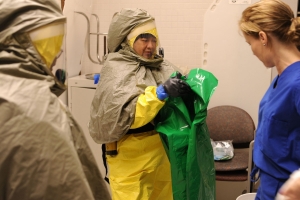
    Hazmat suit.

    The serious question then arises; ‘when will the population be released from an obligation to wear masks?’

    There is no disputing that Covid-19 remains in circulation in Ireland: cases are detected daily and a small number of deaths continue to be reported. There are reasonable concerns that there will be an uptick in cases during the winter months. Historically, coronaviruses cause 30-40% of the common cold which peaks in winter and ‘dies off’ in the summer months. The natural history of coronaviruses is extensively described in the literature.

    I suspect the mandatory wearing of masks among the general public is motivated by two quasi-political aims. The first is to distract from what is best described as the ‘incompetent manslaughter’ of several hundred elderly care home residents at the height of the crisis.[iii] Secondly, to pave the way for mandatory vaccinations, the legal case for which has already been set out by Sarah Fulham-McQuillan, Assistant Professor in UCD’s Sutherland School of Law,[iv] despite such an intervention not even existing. Such an unprecedented law would obviously be to the direct financial benefit of select pharmaceutical companies.

    Therefore, the end game for public mask wearing, the ‘get out of jail card’, or release from the ’duty to mask’ has little to do with the mask itself, which in practical terms is little more than more symbolic; informing or even indoctrinating  an awareness of the ‘danger’ of the virus. The public can only stop wearing masks once the virus is no longer circulating in society. The only mechanism by which it can disappear is through the development of immunity within most of the population.

    Mandatory masks imply ‘mandatory’ protection for elderly vulnerable people and for young, healthy, non-vulnerable alike. Yet young healthy people have practically nothing to fear from Covid-19, again this is repeatedly cited in almost all available literature. Therefore, when the majority of healthy people within society are ‘protected’ from exposure by masks they are compelled to be protected from developing a natural-immunity through an otherwise natural exposure to the virus. This crucial point has been missing from the non-existent debate in the Irish media on the issue of mask wearing.

    When the state makes mask-wearing mandatory, the state has formally rejected natural-immunity among the non-vulnerable.

    When the State rejects ‘natural-immunity,’ indeed when it wilfully or legislatively deprives the non-vulnerable individual of opportunities to acquire natural immunity, the State is then compelled to adopt the only alternative to natural-immunity, and that ‘only alternative’ is a vaccine.

    We can assume that the lockdown and ongoing prohibitions on large social gatherings and social distancing have worked to an extent – albeit perversely not for the most vulnerable – and that those measures have ‘protected’ healthy young people. This means that only a low number of people have been exposed to the virus across society. This point is apparently confirmed by antibody surveys, showing that less than 5% of the population had antibodies,[v] although this survey was not extensive, and antibodies appear to fade rapidly in persons with mild Covid-19,[vi] which gives way to other forms of immunity.[vii]

    Thus, if the only means of eradicating the virus is reaching a herd immunity threshold – assuming we do not reach zero Covid and hermetically seal our borders indefinitely in a new Tír na nÓg – it follows then that the majority of society must eventually be vaccinated in order to achieve immunity. Given that masks have been mandated, it is entirely consistent with government policy that the ‘eagerly’ awaited vaccine must also be mandated.

    Warp Speed

    Perhaps the foremost expert who has been advocating compulsory mask-wearing in the general public has been Professor Luke O’Neill, a Trinity College biochemist, and head of its immunology department. Professor O’Neill is not a Medical Doctor, nor has he a qualification in public health or epidemiology. Most recently he has been to the fore in insisting mandatory masks should be extended to secondary school students.

    As an advocate of compulsory mask wearing, it follows that Professor O’Neill should be a proponent of a universally administered Covid-19 vaccine. Notably, Professor O’Neill’s Twitter feed has included enthusiastic countdowns for the vaccine being rushed through clinical trials at ‘warp speed.’[viii]

    There is nothing new here, and nothing is being uncovered or exposed. Professor O’Neill’s position is neither unusual nor indeed unreasonable. It is entirely expected. Any proponent of universal mask-wearing cannot avoid being a proponent of vaccination as the means of escaping the imposition of the mask – universal vaccination is the only escape from the universal mask.

    The relevant question may be whether Professor O’Neill is a proponent of compulsory masks because compulsory masks may only be escaped via compulsory vaccination?

    The subtle shift, lost on many, is that the current measures have transformed the positive anticipation of a vaccination for those at risk, into a formal obligation for universal vaccination.

    Mask wearers (in theory at least) remain ‘potential hosts’ for Covid-19; natural internal immunity having been officially avoided; immunity can only come from the pharmaceutical industry. Failing to make this connection is a failure of simple logic.

    If universal vaccination is the logical conclusion of mask-wearing, and if indeed members of the public are threatened with jail if they fail to comply; it would seem entirely reasonable to establish any potential conflicts of interest that might exist between any scientific proponents of masks, and the manufacturers of a vaccine, very likely to be compulsory for all; a proposal also mooted in other jurisdictions.

    One does not wish to focus upon Professor O’Neill unduly; however, as he has been perhaps the most publicly visible scientist to promote masks for all it is not unreasonable to examine his relationship with vaccine manufacturers, and operation ‘warp-speed’.

    Sitryx

    In 2018 Professor O’Neill, along with five others[ix], founded a private biotech firm called Sitryx. The company develops therapeutic agents that modulate the immune system. Agents that modulate the immune system or immune response, are essential ingredients to many if not most vaccines available on the market today.[x] It is therefore unsurprising to learn that the largest investors in Prof O’Neill’s firm are indeed vaccine manufacturers.

    GlaxoSmithKline[xi] and Lilly Pharmeceuticals[xii] Sitryx’s biggest sponsors, are currently developing potential vaccines for Covid-19. GSK has invested some $30 million into Sitryx[xiii], and also provided Professor O’Neill with a laboratory and assistants to facilitate his research. All of this information is in the public domain, and indeed is published on Sitryx’s own website:

    Sitryx was founded in 2018 with seed funding from SV Health Investors and raised $30 million Series A funding from an international syndicate of specialist investors including SV Health Investors, Sofinnova Partners, Longwood Fund and GSK. In 2020 Sitryx formed an exclusive global licensing and research collaboration with Eli Lilly and Company. Lilly also became an investor in the company.[xiv]

    What we can at least say is that a cautionary approach to vaccination would be antagonistic to Sitryx’s primary funders. Whilst mandatory vaccination could result in a transfer of enormous tax revenues into the coffers of those companies fortunate enough to win the ‘race’ for the vaccine.

    It is interesting to note that at the outset of the crisis, Professor O’Neill was interviewed on the Late Late Show. At that time he declared that masks were ‘pointless’, if not ‘dangerous’. He described the new coronavirus as an “evil virus” that could get into people’s bodies “through their eyes.” When asked why he thought people were wearing them he replied good humouredly they had watched “too many horror movies”.

    Strangely, however, within a matter of weeks the good professor had entirely changed his mind on the issue and continues to assert that masks are indeed entirely essential and should be mandated for almost everyone.

    Through no fault of his own, Professor O’Neill’s potential conflict of interest has been wilfully ignored in the national and mainstream media. To my knowledge, he has not once been asked about the relationship between his biotech company, and his sponsors at GSK or Lilly pharmaceuticals, having appeared on almost every talk show on radio and television in the land.

    An Alternative?

    Partiality towards the bio-tech agenda and public health guidance, might be in the public interest, if masks and subsequent vaccine were in fact the only option available. The general public have been led to believe that mask wearing regulations are ‘for the greater good’, and that those who object are reckless, anarchic, or simply ignorant.

    https://twitter.com/DonnellyStephen/status/1293973649683288070

    They are not. Mask-wearing policies differ across Europe, mandatory in some countries optional in others. Most Scandinavian countries have resisted the compulsion to the extent that is seen elsewhere. Norway only recommended their use on August 14th whilst using public transport in and around the capital Oslo.[xv]

    Throughout the pandemic the Swedish approach has been far less draconian than in most European countries, permitting (without encouraging) it’s healthy non-vulnerable citizens to be exposed to the virus within the community setting, and thereby developing natural immunity, a policy that is somewhat in keeping with the natural cycle of viral colds and flues. This takes advantage of natural processes to encourage its natural extinction or diminished severity.

    This reduces the potential hosts within society and the attendant risk of the virus spreading to vulnerable or elderly communities. In the face of widespread international criticism[xvi] the country has persisted with the closest model to the much maligned notion of ‘herd immunity.’ Recently the UK press, including the Financial Times[xvii] and Daily Telegraph[xviii], have awoken to the relative success of the Swedish approach, media sources are increasingly joining the ranks of the ‘converted’.

    The same model that the UK initially opted for, but later dismissed based on defective modelling from Imperial College, which suggested that a ‘herd immunity’ approach would lead to half a million deaths in the UK,[xix] a model that has since been shown to have been deeply flawed, and based on flawed epidemiology.[xx]

    The Swedish approach by avoiding compulsory mask-wearing is not entirely dependent upon universal vaccination as their only ‘end game’. That is not to say that the Swedes will avoid or decline a vaccine when or if it arrives on the market; it is merely that their approach is not locked-into a vaccine as the principal source of immunity for the population. The Swedes have maintained the right to ‘opt’ for a mask and, as such, and have preserved the right to ‘opt’ for a vaccine too.

    Regardless of what a country may choose in respect of vaccination, the Swedes will certainly have more of a ‘choice’ relative to those countries that continue to more actively avoid exposure among their healthy non-vulnerable citizens.

    Social Division

    The recent transformation of many aspects of the external environment, into something of a hospital ward, through the wearing of masks by many, and avoidance by many more, is certainly a new departure in the social habits for most people in Ireland and beyond.

    Many are under the impression that mask wearing either in public, in shops or on public transport, is not simply ‘a good idea’ but integral to saving lives. Battle lines have been drawn between the ‘sensible’, and the ‘reckless’.

    The state and national media are on the side of the ostensibly sensible, and mainstream media is presently flooded with a positive insistence upon masks. Regardless of the government’s insistence, and the concurrence of mainstream media, large numbers of people refuse to comply, and social division is apparent on the streets, among neighbours and even within families.

    This division is a consequence of government policy, and that policy is not based upon any agreed international standard. Interestingly, however, there is little evidence of debate on the subject. This lack of dialogue, and indeed the active suppression of views contradicting the official line, is a very worrying development within a supposedly democratic society, where a diverse range of opinions should be heard.

    The present social policy of mandating compliance is a difficult road to navigate without infringing human rights, as members of the public who choose not to wear a mask must disclose their most intimate and private medical details to members of An Garda Síochana in public places, if they are to avoid arrest, fines or imprisonment.

    In the recent past an individual’s personal medical details were entirely private and a doctor might be struck off the medical register or sued for sharing this information, without informed consent. Under the current emergency legislation a member of the Gardaí must elicit a quasi-medical history from a non-mask wearer and be satisfied as to its reliability if the non-mask wearer is to avoid arrest. Inalienable human rights to privacy, have been entirely brushed aside.

    Unfortunately the consequence of current policy is leading to what might be described as the most divisive situation in Ireland since the civil war. There are those who believe that they are ‘saving lives’; their own, their countrymen and the vulnerable. Opponents believe that wearing a mask is harmful to one’s health, will do nothing to save lives and that there are sinister, political and even corporate motives behind the directives.

    Each side of the divide is ostensibly concerned about public welfare. However, those conforming to the narrative are generally presumed correct, whilst nonconformists are readily dismissed as wearing ‘tinfoil-hats’, or being conspiracy theorists, or even ‘anti-vaxxers.’

    Presently, the division within society is only simmering. There have been occasional incidences of angry exchanges between both sides, yet these are mostly confined to the zones where mask wearing and other guidelines are compulsory; public transport, and social settings where other guidelines such as social distancing within pubs, restaurants or social venues also apply.

    https://twitter.com/IrishInquiry/status/1294238059949678592

    For most of us, wearing a mask on the bus, in the shops, or having the local publican issue a dodgy food receipt so that we can have a pint without fear of being arrested, may not be insurmountable limitations. If we are compliant we are unlikely to be questioning the guidelines, and will be looking forward to a return to normality. Fortunately, for the government it is difficult to look forwards and backwards at the same time. Sure enough, dialogue pertaining to mistakes, missed screenings, deaths in nursing homes etc. are all rather conveniently eclipsed by the current political mask wearing debate. It might be argued that there is indeed a malevolent purpose to this.

    If a division erupts into violence or aggression, the parties involved are generally on the extremist fringes of either side of the divide. This is unlikely to remain the case.

    I believe we have been led here by motives that are not in the interests of the greater public. The social division that is being fostered, may (for the present time) be manifest only at the level of ‘wearing the jersey’ and shouting up for one’s team. Yet this relatively benign manifestation is likely to evolve into a more sinister version of itself. This is perhaps inevitable as the associated stresses upon either side will undoubtedly increase in the coming months.

    Second Wave?

    At the time of writing deaths from Covid-19 have declined to almost nothing in Ireland and throughout most of Europe. The question that is in most people’s mind is whether or not this decline will continue throughout the autumn and winter months?

    Covid-19 is member of the coronavirus family, responsible for some 30-40% of the yearly or seasonal ‘colds’ that affect almost all nations.[xxi] With it still circulating, we can expect a seasonal increase in cases in the coming months. Our normal or historical experience with the cold and flu viruses each year sees their arrival some time in Autumn, peaking around March or April, and then waning before generally expiring in late Spring or early Summer.

    There are two significant factors influencing this process. The first being the natural immunity that develops within society as most people are exposed to and recover from the cold virus. The second factor being the increase in the length of daylight and the effects of daylight (UV-light) upon aerosols, droplets or viral particles on external surfaces. There is nothing new in any of these assertions, which are basic tenets of microbiological science.

    Therefore, we can conclude, that as the virus is still here, and as the measures to date have been moderately effective in preventing a build-up in natural-immunity within the population, as the days shorten, a resurgence seems inevitable.

    Stress and Disease

    In my twenty years of experience as a physician I have noted what many doctors have observed since the dawn of medicine itself. This is the simple empirical truth that psychological stress is a major factor in the subjective evolution or pathogenesis of ALL disease. This truism applies more for some diseases, less in others, but is indeed true for all disease. In many cases psychological stress is the sole factor that pushes the generally tolerable symptoms of minor illness, firmly and definitively into the realm of significant pathology. Indeed, the NHS advise that loneliness can make the symptoms of a cold virus feel worse.[xxii]

    Today, the language of psychological and emotional pain has been almost entirely medicalised. Now when one is talking about one’s ‘medical’ illness or one’s ‘diagnosis’, it takes the skill of a competent psychoanalyst to uncover the subjective psychological truths that invariably unite one’s medical ‘pain’ to a deeper insecurity – its emotional or psychological fountainhead. The process is an introspective one, and nowadays most of us are cut off from making these connections.

    For some it may be a simple lack of emotional-intelligence, for many more it is simply easier to run with the medical diagnosis, and just take the pill.

    I am not asserting that pain is ‘caused’ by emotion or psychology. It is not; it is caused by disease. However, emotion or psychology will determine the tolerability of pain and can push the sub-clinical pain into the realm of clinical manifestation. It will and does make almost all disease worse.

    An Honest Version of the Self

    Likewise too, when people become angry, on either side of the mask wearing-divide, there is a history to that anger, one that connects it to deeper and more profound frustrations. This is an important factor, rarely considered by a medical establishment that is in thrall to the idea of the human subject as a ‘biological machine’. One where symptoms are mechanical faults, requiring mechanical or physical remedies. Almost all of these remedies must then be purchased. Modern cures are rarely derived from nature, from introspection or the pursuit of an honest version of the self.

    This is entirely relevant to the subjective ‘deeper’ angers, insecurities and frustrations that are easily brought to the surface in many people, when the scapegoat of an inferior or non-compliant ‘other’ is provided or even offered up by the powers-that-be. History is our teacher here, and as usual she is wilfully ignored.

    I mention the influence of psychological stress to highlight the observation that it is a major determinant in one’s experience with Covid-19 as with any dis-ease. Psychological stress is (medically speaking) a self-fulling prophecy. People who are most anxious about becoming ill are most likely to become ill. If you ask yourself often enough whether or not you have a headache, you will eventually experience one.

    The same applies to Covid-19. Most people who are exposed to the virus do not even know they have been exposed. Many experience little more than a common cold or flu like illness, many more experience nothing at all. As is the case with the common cold, the crucial factor that determines where one is likely to fall upon the spectrum of suffering, is not simply the cold-virus itself, but rather the physical and importantly the mental health of the ‘victim’. There is no individual more acutely aware of his symptoms, than someone who is most anxious about his health.

    Back to School

    Psychological stress for some members of our society has an equally seasonal component. Each September when Irish children return to school, the stress levels within many Irish families, (particularly those with young children) begin to rise.

    There are immediate demands for uniforms, books, lists, shoes, sportswear, transport etc, all of which place a significant burden on parents, especially mothers. Returning to school this year for most families will be fraught with many additional anxieties.
    Children may have to wear masks, visors, social distance in the classroom and the playground, be prevented from bringing lunch boxes, and perhaps have their uniforms washed daily. Schools may not be able to accommodate required classroom sizes and schedules for attendance may have to be altered. The familiar routine is to be a ‘thing of the past’ – the implications for increased stress upon parents and children are incalculable. Let us organize all of this into a list of observations

    An elevated number of potential viral hosts, which is a consequence of suppression of natural-immunity.

    Increased life of the virus in the external environment due to decreased daylight

    Raised levels of social anxiety and subsequent susceptibility to illness/infection

    Continued persistence of the virus at low levels within Irish society

    These factors suggest a resurgence of the virus this winter, and taken in context with the existing level of social stress, and the inevitable increase in those stresses next month; it is not unreasonable to suggest a ‘perfect storm’ is gathering.

    It is highly likely that the present level of bitterness or anger between both sides of the mask wearing divide willl be where that stress and pain becomes publicly manifest. The deeper tragedy at play, is the fact that each side of the division will be seen as the aggresor. Yet those who have fostered the division remain immune to any degree of scrutiny for past mistakes, while dark clouds are on the horizon.

    [i] Orla Dwyer, ‘Explainer: Everything to know about new face covering regulations’, thejournal.ie, August 10th, 2020, https://www.thejournal.ie/when-and-how-to-wear-a-face-covering-ireland-5171841-Aug2020/

    [ii] David Isaacs et al, ‘Do facemasks protect against COVID‐19?’, Journal of Paediatric Child Health, June 16th, 2020, https://www.ncbi.nlm.nih.gov/pmc/articles/PMC7323223/?fbclid=IwAR15wQ0gOySIs8c7I4m9qsCiPJT6E66pM9Hiwr82AKeAPfcmfmKctK9qG1Y#__ffn_sectitle

    [iii] Catherine Fegan, ‘’Many in nursing homes died deaths that certainly could have been prevented’’, Irish Independent, June 13th, 2020, https://www.independent.ie/world-news/coronavirus/many-in-nursing-homes-died-deaths-that-certainly-could-have-been-prevented-39282569.html

    [iv] Sarah Fulham-McQuillan, ‘Strong legal basis for making Covid-19 vaccinations mandatory’, Irish Times, June 27th, 2020, https://www.irishtimes.com/opinion/strong-legal-basis-for-making-covid-19-vaccinations-mandatory-1.4313941?mode=sample&auth-failed=1&pw-origin=https%3A%2F%2Fwww.irishtimes.com%2Fopinion%2Fstrong-legal-basis-for-making-covid-19-vaccinations-mandatory-1.4313941

    [v] Simon Carswell, ‘Coronavirus: Ireland has ‘no significant’ herd immunity, study shows’, July 20th, 2020, https://www.irishtimes.com/news/health/coronavirus-ireland-has-no-significant-herd-immunity-study-shows-1.4308216

    [vi]F. Javier Ibarrondo, Ph.D. et al, ‘Rapid Decay of Anti–SARS-CoV-2 Antibodies in Persons with Mild Covid-19’, July 27th, 2020, The New England Journal of Medicine. https://www.nejm.org/doi/full/10.1056/nejmc2025179

    [vii] Katherine J. Wu, ‘Scientists See Signs of Lasting Immunity to Covid-19, Even After Mild Infections’, New York Times, August 16th, 2020, https://www.nytimes.com/2020/08/16/health/coronavirus-immunity-antibodies.html

    [viii] https://twitter.com/laoneill111/status/1276424356869046279

    [ix] Sitryx, ‘Founders’ http://www.sitryx.com/about-us/founders/

    [x] ‘Adjuvants help vaccines work better’ https://www.cdc.gov/vaccinesafety/concerns/adjuvants.html

    [xi] https://www.pmlive.com/pharma_news/gsk_signs_deal_with_medicargo_for_covid-19_vaccine_1344532

    [xii] ‘Lilly Initiates Phase 3 Trial of LY-CoV555 for Prevention of COVID-19 at Long-Term Care Facilities in Partnership with the National Institute of Allergy and Infectious Diseases (NIAID)’ https://investor.lilly.com/news-releases/news-release-details/lilly-initiates-phase-3-trial-ly-cov555-prevention-covid-19-long

    [xiii] ‘New biopharmaceutical company Sitryx launches with $30 million fundraising to develop disease modifying therapeutics in immunometabolism’, October 8th, 2018, https://www.globenewswire.com/news-release/2018/10/08/1617744/0/en/New-biopharmaceutical-company-Sitryx-launches-with-30-million-fundraising-to-develop-disease-modifying-therapeutics-in-immunometabolism.html

    [xiv] Sitryx ‘Founders’ http://www.sitryx.com/about-us/founders/

    [xv] VOA News, ‘Norway Makes First Face Mask Recommendation Since Pandemic Began’, VOA, August 14th, 2020, https://www.voanews.com/covid-19-pandemic/norway-makes-first-face-mask-recommendation-pandemic-began

    [xvi] Peter S. Gordon, ‘Sweden Has Become the World’s Cautionary Tale’, New York Times, July 7th, 2020, https://www.nytimes.com/2020/07/07/business/sweden-economy-coronavirus.html

    [xvii] Richard Milne ‘Sweden’s pandemic no longer stands out’, Financial Times, August 9th, 2020, https://www.ft.com/content/7acfc5b8-d96f-455b-9f36-b70dc850428f

    [xviii] Allister Herd, ‘Sweden’s success shows the true cost of our arrogant, failed establishment’, The Telegraph, August 10th, 2020   https://www.telegraph.co.uk/news/2020/08/12/swedens-success-shows-true-cost-arrogant-failed-establishment/

    [xix] Mark Landler and Stephen Castle, ‘Behind the Virus Report That Jarred the U.S. and the U.K. to Action’, New York Times, March 17th, 2020, https://www.nytimes.com/2020/03/17/world/europe/coronavirus-imperial-college-johnson.html

    [xx] See: David Richards and Konstantin Boudnik, ‘Neil Ferguson’s Imperial model could be the most devastating software mistake of all time’, The Telegraph, May 16th, 2020,
    And: Freddie Sayers, ‘Nobel prize-winning scientist: the Covid-19 epidemic was never exponential’, Unherd, May 2nd, 2020, https://unherd.com/thepost/nobel-prize-winning-scientist-the-covid-19-epidemic-was-never-exponential/

    [xxi] J. Black, Micriobiology Principles & Applications, (1993) p.580

    [xxii] ‘Loneliness may make cold symptoms feel worse’, NHS, March, 2017, https://www.nhs.uk/news/mental-health/loneliness-may-make-cold-symptoms-feel-worse/
  • Gradations of Evil: Neoliberalism and Neoconservatism

    Since the 1970s, the consistent presence of neoliberalism in politics alongside short, sharp bursts of neoconservatism have shaped our planet to a greater extent than any other ideologies. This has been to the detriment of all but a shrinking cast of billionaires that profit in periods of crisis, even during the pandemic. The prognosis is not good, even if the pandemic provides a porthole for the possibility of a realignment.

    Distinct Ideologies

    At one level, neoliberalism is extreme libertarianism, purged of its earlier socialist or anarchist underpinnings that were ultimately communitarian. Neoliberalism has had a tremendous influence on conservative thinking in recent times. Yet it is not conservatism in a traditional Burkean sense of conserving and preserving that which is good. Neoliberals do not advocate moderation, restraint, anti-extremism, perspective, nuance or that ill-defined word ‘balance,’ save in terms of conventional political rights such as liberty, privacy and freedom of movement.

    Contemporary neoliberals are not supporters of little people, and in effect operate against the interests of the ordinary working person in the name of economies of scale or other workplace rationalisations. It is unbridled free market extremism, engendering a tragedy of the commons.

    It did not begin this way. In its first iteration, the Austrian economist Friedrich Hayek warned against the excesses of socialism in The Road to Serfdom (1944). This was witnessed in Britain of the 1970’s with the three day working week, refuse on the streets, and the stranglehold of government by the unions. Many of Hayek’s points were valid, and I suspect he would be horrified at the political trajectory his ideas have taken. Similarly, Karly Marx was not responsible for and would have been horrified by Stalin.

    The initial idea behind libertarianism was for a combination of unregulated laissez faire economics, and the legitimation of a hedonistic lifestyle through laws and social policies. I see nothing wrong with hedonism per se – or for tolerance of human frailties more generally – and indeed have spent much of my professional career as a barrister upholding the rights of an accused to due process.

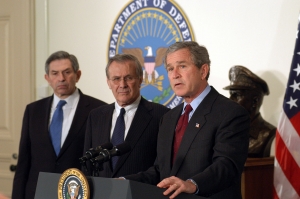
    Neoconservatism, on the other hand, is hardly even capitalist in outlook. It is really an offshoot of a more authoritarian leftism combined with a fundamentalist, morally self-righteous neocolonialism informed by ‘Christian’ values. It is associated in particular with the administrations of George W. Bush, with Paul Wolfowitz and Richard Perle its most prominent ideologues.

    Left to right: Paul Wolfowitz, Donald Rumsfeld and George W. Bush.

    Many neoconservatives made an ideological journey from the anti-Stalinist left to the camp of American conservatism during the 1960s and 1970s, with its intellectual roots in the magazine Commentary, edited by Norman Podhoretz. But anti-Stalinist does not imply a respect for human rights or the rule of law; its followers’ ambitions were simply global rather than limited to a particular country, as was the case with Stalin’s approach.

    Neoconservatism adopts the unregulated free market, but not libertarian permissiveness or due process or a respect for international law: the ends would justify any means. That is what makes it distinctly evil. It attracted money from Christian fundamentalist and the rapture movement and cohabited with authoritarian academics.

    Thus, there is a world of difference between former Supreme Court Justice Jonathan Sumption, a defender of human rights and free markets, and Tony Blair, the UK’s foremost neoconservatives. Blair is a fundamentalist Christian, a self-deluding mediocrity, who exported a destabilising jihadist war based on an absurd world view and sold it as a humanitarian intervention. He cannot really be described as a socialist – although state bureaucracies expanded massively under his New Labour – but nor is he a genuine conservative. He is simply a telegenic opportunist who became drunk on power.

    His neocon influencers were Bush and Irish-American pseudo intellectuals like Daniel Moynihan, who fused Christian jihadism with racist fundamentalism and veneration of a deregulated market. The worst of all possible worlds.

    Neoliberal Permissiveness

    While neoliberals cock a snoop at Christian fundamentalism, some perhaps even going so far as to oppose the war in Iraq, an inbuilt resistance to state intervention means neoliberals such as even Barack Obama, did nothing to heal the wounds, or address the causes of discontent in the developing world.

    I suspect the neoliberal endorsement of liberties and indulgence has in one sense been counterproductive. It may have not started with bad intentions. All were in favour of lifestyle ‘choices’: gay and transgender rights, sexual freedoms and shifting the agenda of equality towards formal equality rather than substantive equality. This involved superficial gestures such as including sufficient mixed race women in boardrooms but keeping the cleaners in the poverty trap.

    The gender equity and transgender lobby now often act in a sinister way, and represent a branch of neoconservative in all its puritanical absurdity. ‘No platforming’ esteemed academics like Germaine Greer steers young people into sexual confusion and away from political engagement. It is a disaster emanating from a preening devotion to political correctness.

    The sponsorship of the gender equity agenda by corporate America negates the real human rights agenda. These companies do not tend to fund advocates of social and economic justice, including rights to housing, healthcare and a clean, safe and aesthetically pleasing environment.

    The privatisation of healthcare and even the Bismarckean welfare state began largely under Nixon in the U.S., where neoliberalism first evolved. It was replaced by an insistence that people exercise personal and professional responsibility, which masked a dismantling of social supports.

    ‘Even Richard Nixon’s Got Soul’ (but not William F. Buckley)

    Nixon, a more sympathetic figure in hindsight – at least by comparison with latter day Republicans – was forced into healthcare privatisation by lobby groups from the medical profession, bringing into being the anti-health care system of America, where in 2018 over 17% of the country’s resources devoted to healthcare, yet it has one of the lowest life expectancies in the OECD. Moreover, industry sponsors regularly renege on private health care entitlements, through the machinations of unscrupulous lawyers. The fact of having a health care plan in the U.S. is no guarantee it will pay out.

    Nixon had his doubts and did not buy into the ideology wholesale, but by the time of Ronald Reagan’s victory in 1980 the neoliberals were firmly in the ascendancy, with disastrous consequences for Americans, as Reagan’s advisor David Stockman describes in The Triumph of Politics: Why the Reagan Revolution Failed (1986).

    A crucial neoliberal mastermind was William F. Buckley, the satanic ideologue of modern U.S. conservatism, who ostensibly venerated Edmund Burke, but subverted Burkean conservatism. Buckley helped establish the new philosophy of neoliberalism through texts such as God and Man in Yale (1953), and through his editorial of the Republican Party intellectual rag The National Review.

    Buckley moved conservatism away from the spirit of Burke’s community of souls, towards naked self-interest. This has led to the undermining, and now the actual buying of the state apparatus by the corporatocracy. Thus, under Buckleys stewardship conservatism mutated into a form of individualism tat undermined states.

    Buckley’s brilliant rhetoric was only matched by his repulsive qualities as a human being. This is all-too-evident in the 2015 documentary Best of Enemies made about his media punditry alongside the almost equally contemptible Gore Vidal during the 1968 American election. Buckley had an enormous, understated, influence in moving the Republican Party, via Reagan, towards libertarianism, and the disaster capitalism now in vogue. Buckley in fact co-opted Russell Kirk, the Burkean conservative author of The Conservative Mind: From Burke to Eliot (1953) onto The National Review, seemingly in order to get him ‘on message.’

    Yet the Republican Party and indeed much of the present Conservative party in the UK are not conservatives in the Burkean sense as aforementioned. They have become neoliberal fanatics, which is far from the origins of the paternalistic conservatism that emerged in Britain the late eighteenth century.

    Why Edmund Burke Provides a Counterweight

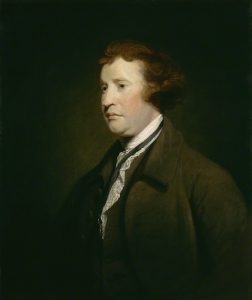
    Edmund Burke was a moderate conservative in the Benjamin Disraeli mould, who sought to preserve traditions he believed worth maintaining. His career was an idiosyncratic mixture of radicalism and abiding by conventions, and he believed in the desirability of change but not change for its own sake. Change should come about incrementally he believed, and with due regard to tradition; his antennae were attuned to unintended consequences.

    Edmund Burke.

    Contemporary neoliberalism has engendered a form of corporate fascism that mandates extreme conformity in working days that stretch into long evening. I doubt Burke would endorse its excesses. He believed in a form of market capitalism favouring small enterprise, as do I too. Burke was also anti-monopolist and would see dominant multinational firms, and perhaps the European Union, as anathema to the capitalism he favoured.

    Neoliberalism should not therefore be equated with traditional conservatism. Indeed if Edmund Burke was around today he might pen a text entitled: Reflections on Imminent Social and Economic Breakdown!

    Burke of course, unlike adherents of neoliberalism believed in the concept of a community, involving associative obligations and reciprocal interactions. A moral and networked community in other words. The neoliberal mentality, on the other hand, leads towards social atomisation and fragmentation, or as Margaret Thatcher famously put it: “There is no such thing as society only individuals.

    Thatcherism is contrary to the Burkean ethos. I suspect that in modern times Burke would be regarded as a Keynesian capitalist, which is precisely what Buckley was attacking in God and Man in Yale. Burke ideas also align with environmentalists as he had a sense of community as inter-generational:

    Society becomes a partnership not only between those who are living, but between those who are living, those who are dead, and those who are to be born.

    He held a defined sense of the public good that was not just where the dice landed in the casino capitalism of the market. Further, though a passionate advocate of rights and liberties he was also a passionate advocate of restraint and moderation. He believed that the extension of rights should not extend to untrammelled liberties and licentious anarchy.

    Although a conservative in terms of his invocation of habit, tradition and social order, and also with his belief in institutional contribution and preservation – as well as measures of fiscal rectitude – he was, conversely, also its opponent of in other respects.

    One drawback to Burke as an intellectual, in my view, was his devotion to religion. Born in Ireland to a Protestant father and Catholic mother, noxious Irish Catholicism shaped him, diminishing his contribution; although one cannot say that he had the religious zealotry of a neoconservative.

    The Beginning of the End of History

    The Bushman-Blairite wars were an exercise in duplicity in shocking breach of international law. There were no smoking guns or development of nuclear weaponry in Iraq. It was Christian jihadism led by a latter-day Crusaders, including telegenic Tony that most lightweight of British gentlemen.

    Neoconservatism is a nefarious dysfunctional ideology that suits the interests of the powerful, which tragically became the consensus. A Dictionary of Received Ideas. There would be no comeuppance for Tony or George Dubya, who now blithely paints portraits of migrants, with all irony seemingly lost on him.

    In Britain, Brexit may lead to the gradual dismantling of the Blairite welfare state, even after the Johnson health care crisis, with the chronic under-resourcing and deregulation of the NHS now laid bare by the pandemic. This applies to all other countries, Italy most obviously, which diverted resources from essential services under neoliberal austerity measures. Meanwhile we see America on the brink of anarchy and civil insurrection due to the triumph of these ideas with the election of Donald Trump in 2016, who is the symptom of a very deep malaise.

    The combination of neoconservatism and neoliberalism is a far more deadly virus than Covid-19, which has simply exposed the soft underbelly of societies afflicted by its ravages. From a neoliberal point of view healthcare or a clean environment are not rights but entitlements and part of a libertarian agenda.

    The lack of regulation of spiraling accommodation and rental costs in the US and elsewhere brings a situation where, for the vast majority, outright ownership of property is a myth. Ostensibly, high salaries are hoovered up in hyper-inflated rents and mortgages subject to repossessions by vulture funds.

    The cost of living is prohibitive, and cramped accommodation makes the possibility of a decent family life almost impossible for most, engendering a dysfunctional humanity. Inequalities, short term contracts, and punishingly long working hours destroy mental health, decrease productivity and render family life – save for a privileged few – a thing of the past. The long-term effects on children are potentially catastrophic.

    This leads to short-termism and prevents even a modicum of forward planning for most people, who must live from one pay cheque to the next.

    Lacking objectivity and perspective, as we struggle for survival in subhuman working conditions that undermine the quality of life, decline arrives in increments. This leads to petty corruption and greed, in a dog-eat-dog universe where the elderly are replaced once they have outlived their usefulness. Their fate is increasingly to be place in decidedly uncaring privatized nursing homes, or spend their last moments on a trolley in an underfunded hospital.

    Nozick the Great Ideologue of Neo-Liberalism

    Anarchy, State, Utopia (1974) by Robert Nozick was a subversive reaction to John Rawl’s A Theory of Justice who had promoted a theory of economic justice. It became a neoliberal bible. Nozick suggested that government intervention, meaning taxation, beyond the enforcement of contracts and the control of crime is akin to slavery or theft. I own my body, he argues, so I therefore own everything my body produces, and if the state takes that which I produce away from me it enslaves me or – more elegantly – ‘socialism forbids consenting acts between capitalist adults.’

    The egregious fault with his argument is that it does not follow that because you own your body you own everything you produce. Inequalities are inbuilt into capitalism as David Ricardo’s Labour Theory of Value demonstrated. It also does not allow for any understanding of the human condition, other than one informed by radically disaggregated and individualistic behaviour, devoid of co-operation and community.

    At the time many thought that him daft, and that his ideas could not be implemented as they would lead to a socially dislocated society. It was even suggested that Anarchy, State; Utopia was an elebatorate joke, or part of an intellectual game. Indeed, Nozick was fond of scholarly conceits and subsequently wrote a book with a radically different thesis. So perhaps he did not take what he said seriously. Others did unfortunately.

    The consequences have been economic collapse and surging inequality, the gradual destruction of the middle class, and the privatisation and diminution in healthcare as a right, as well as homelessness and mass evictions

    The University of Chicago with its two highly placed judges in Easterbrook (dangling for a Supreme Court judgeship) and the truly nefarious ‘most cited’ legal scholar in the world Richard Posner, have also been responsible for much of the damage.

    Here we have the perfect reductio ad absurdum: all of human activity is reduced to the wealth maximisation thesis. Thus rape arises out of scarcity of resources: it is expensive for men to purchase sex so we should have a de-regulated prostitution market according to Posner; or adoption should be de-regulated to deal with a competitive baby market where the product can be purchased by the consumer. Such nonsense is reminiscent of Jonathan Swift’s Modest Proposal (1729) in which he satirizes an earlier version of neoliberalism, with the tongue-in-cheek suggestion that it would serve the polity to kill excess babies for economic gain.

    The Middle Way

    Keynes fell out of fashion because of the stranglehold of unionism and the imposition of socialist dogma in the 1970s. This created ‘a market’ for the work of the Chicago School and trickledown economics characterised by fetishist privatisation, deregulation and the elimination of state subsidies. In the late 1970s a retreat by the state made some sense, but the correction turned into an ongoing campaign. The market may have seemed like a score counter that could be tamed for human purposes. No longer. It is the recipe for inequality

    Naomi Klein in her bestseller The Shock Doctrine (2007) analyses the growth and development of neoliberalism across the world. She dubs the economic paradigm ‘disaster capitalism’, homing in on how these crises and others are used to justify further disaster prescriptions. She quotes Hayek’s disciple Milton Friedman:

    Only a crisis – actual or perceived – produces real change. When that crisis occurs, the actions that are taken depend on the ideas that are lying around. That, I believe, is our basic function: to develop alternatives to existing policies, to keep them alive and available until the politically impossible becomes politically inevitable.

    Naomi Klein.

    That is precisely where neoconservatism and neoliberalism coincide. Proto-neoconservatives remove the democratically elected Allende regime and replace him with Pinochet, before neo-liberal reforms open up the country for exploitation, washing their hands of any blood.

    Yet all the best evidence indicates that stable growth occurs in Nordic and Middle European social democratic countries. There is a tangible link between Keynesian economics and sustainable redistributed growth. Neoliberalism does not generate sustainable growth, as opposed to wealth for the few, and does not provide for redistribution. In effect it is a recipe for diminished human welfare, less good for the greatest number.

    Where Are We Now

    The Nobel Prize winning economist Joseph Stieglitz famously described our present state of affairs as ‘Socialism for the rich capitalism for the poor’. And the new era of state and corporate feudal control and terror we have entered into will accentuate these trends. Thus during this pandemic some of the wealthiest individuals in the world have actually increased their wealth.

    A return to the methodology of neoconservatism can be seen in the emergency legislation that has passed through the parliaments of U.K. and Ireland. In theory these are designed to confront an immediate emergency, but will become embedded, and spiral out of control just as we have with counter terrorism legislation. Enforcing self-isolation and ‘track and trace’ become new norms inflicted by neoconservatives and consented to by neoliberals, many of whom with notable exceptions such as Lord Sumption, forget their libertarian origins as long as the dosh keeps rolling in. Notably Tony Blair is awake to new opportunities.

    The very phrase ‘social isolation’ is problematic and euphemistic – like ‘ethnic cleansing’ or ‘military intelligence,’ a contradiction in terms. In fact self-isolation suits a silo bubble of social atomisation and dealing with people or problems one by one by state authorities. We risk a descent into a new barbarism not least due to the pernicious effects of decades of privatization.

    The Indian activist Arundhati Roy demonstrates how neoliberalism and environmental damage have gone hand-in-glove in her book Capitalism: a Ghost Story (Verso 2014). There are the mass evictions in India of ‘surplus population’ (a truly evil capitalism coining). The street vendors, rickshaw riders, the small shops and business people, and not least the suicide of 250,000 farmers.

    This forced displacement, often from rural areas to cities, augments the channelling of wealth towards the one percent plutocracy controlling India.

    It has been suggested by John Gray and Roy herself that the pandemic may lead to a rethink. I fear not. In fact, rather than becoming, as Roy puts it, a porthole to a sustainable and fair existence for all, I fear increased atomization, semi-permanent social distancing, diminishing social supports and the insidious undermining of civil liberties, supported by a scared and soma-induced population.

    We are now entering an age of corporate feudalism and of mercantile state control with sub Malthusian ideas gaining traction. It is an age of extremism nourished by religious fundamentalism. It is a time for the convergence of Burkean conservatism with Habermasean moderate socialism to implement ideas informed by traditions of decency and the green agenda. It is a time for sustainable personal and societal living to be realised.

  • Poetry – Kevin Higgins

    After Recent Unfortunate Results

    Next election onwards,
    there’ll be a second vote for those
    who turn up with, under their arm,
    a print copy of one of the larger newspapers
    and answer a few unobtrusive questions
    to prove they’ve consumed it correctly.

    A third for those who also present receipts
    that show they’ve dined sufficiently
    in restaurants with at least four stars,
    and a note from the maitre d
    that they know their way around the cutlery.

    A fourth for the lucky few in possession – to boot –
    of a ticket for one of those pampering spas
    at which one temporarily discards
    worldly things to have one’s darker parts
    irrigated of all subversive thoughts.

    So when all’s said and counted,
    people who shouldn’t matter
    can go back to not mattering.

  • Poetry – Oliver Tickell

    Five Poems

    trampled, rain-sodden the leaves
    brown, green, yellow and
    a crimson gilded

    wings flapping to the wind
    above the trees
    the joy of the storm pigeon

    juicy and sharp
    the first few blackberries
    summer’s sweetness yet to come

    bounteous blackberries along the brook
    warm and sweet they meet my lips

    purple stained, thorn pierced
    still my hands reach out for more
    juice-swollen berries


    Oliver Tickell is a writer, journalist, poet, and former editor of The Ecologist, living near the river Thames in Oxford


  • BREAK AN EXIT VI: Hmong Jamón — or the end of the Catalonely

    Liberation

    For the first time since landing I’m allowed to travel the country. My plans to go to Japan and practice Aikido with the masters are on a massive stand by. Hanoi’s fishermen are back on the landscape, monstrous exhaust clouds blurring the skies again.

    My backbone feels their soggy reels, its toxic dust, and flows the fuck out.

    Northwest it is, upstream the Red River—where the only breeze lives.

    I jump on a bus and stay put reading Rachel Carson’s The Marginal World, the otherworldly essay that opens The Edge of the Sea, her ageless and arresting exploration of shores, and I keep dozing and breathing and zeroing myself up between the ditch and underwater eternity for six and a half hours, her words lapping my eyelids ever so softly, I can only dream I will remember them, though I know I won’t:

    The shore is an ancient world, for as long as there has been an earth and sea there has been this place of the meeting of land and water. Yet it is a world that keeps alive the sense of continuing creation and of the relentless drive of life. Each time that I enter it, I gain some new awareness of its beauty and its deeper meanings, sensing that intricate fabric of life by which one creature is linked with another, and each with its surroundings.

    We cross the uncanny waters of the Red River, my blood rushing leisurely like its stream, its shore tumbling in plastic, motorbikes and lorry drivers spitting and braking and accelerating over its waters, fading waves forgiving the green bushes of its deadly shore. Life’s continuity seems aborted here, though millions of living cells are thriving just a few metres beyond the shore, over the eight-lane highway its magnificent current running as thick and slow as pollution.

    The river gives way to a bumpy highway that would inflict some pain on Boris Johnson, running through stunning high-plateaus and flat paddy fields and dusty brown and red and green rolling knolls, until we reach Lao Cai, the capital of the namesake northern province, five hours later.

    It looks just like Chaco, northeast Argentina, the Red River behaving a bit more wildly here than the Parana there, its waters even more turbid and moody, its shores receding, soon the stream will devour thousands of acres, houses and lives.

    The sun is merciless and the umbrellas in bloom; the soil seems to be smoking itself, a sulphuric red and yellow smoulder coming out of the boiling asphalt; corrugated iron roofs collapsing; big empty squares with irrational monuments and massive red flags and thirsty grass and half dressed children; streets broken, stray cats emerging from its cracks with water snakes in their mouths; sellers covered under straw hats and traditional dresses combining red fur and green wool and black velvet.

    Smoked Centuries

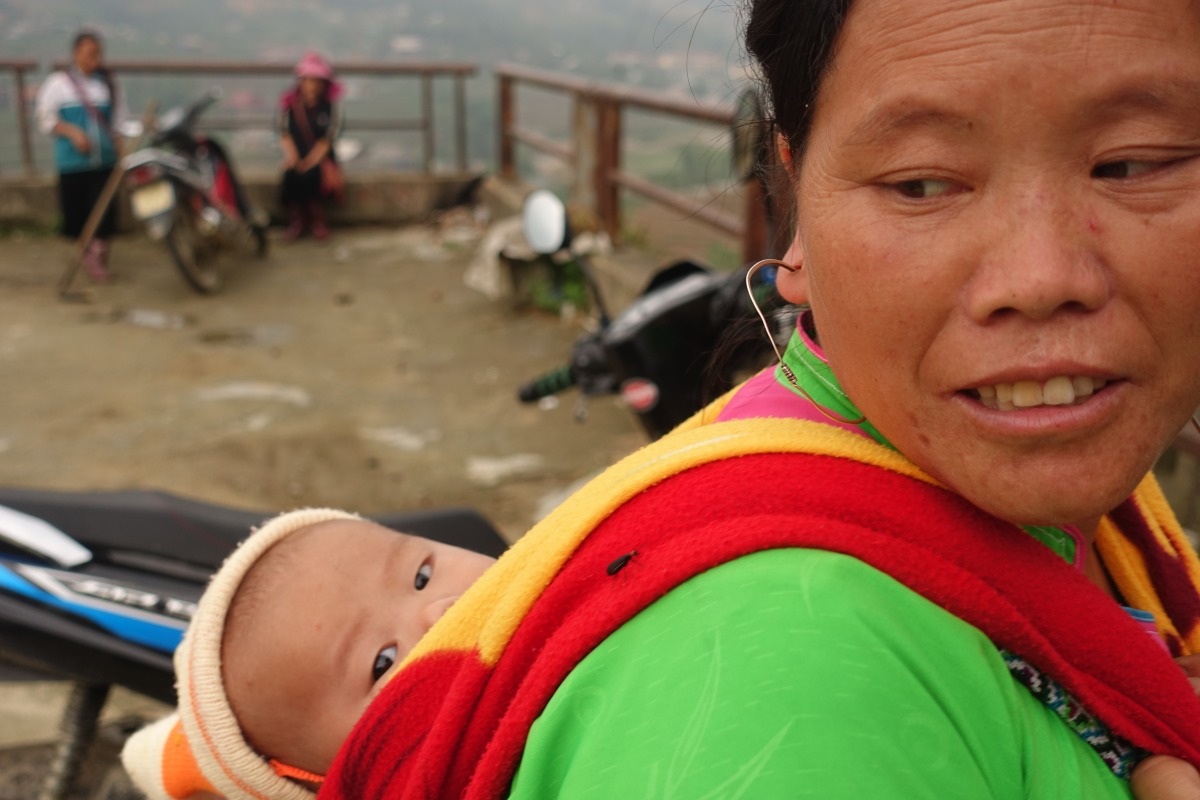
    It is my first encounter with the Hmong, I recognise the patterns and the colours of their traditional clothes; their Caucasian peaceful faces; the unmistakable smoked smiles after centuries escaping the burning thread of genocide. No coastal shore but highland wisdom.

    The bus stops and unloads dozens of dented cardboard boxes full of Hanoi goodies and resumes on its way. It is now that we ascend the ramps towards the unreal.

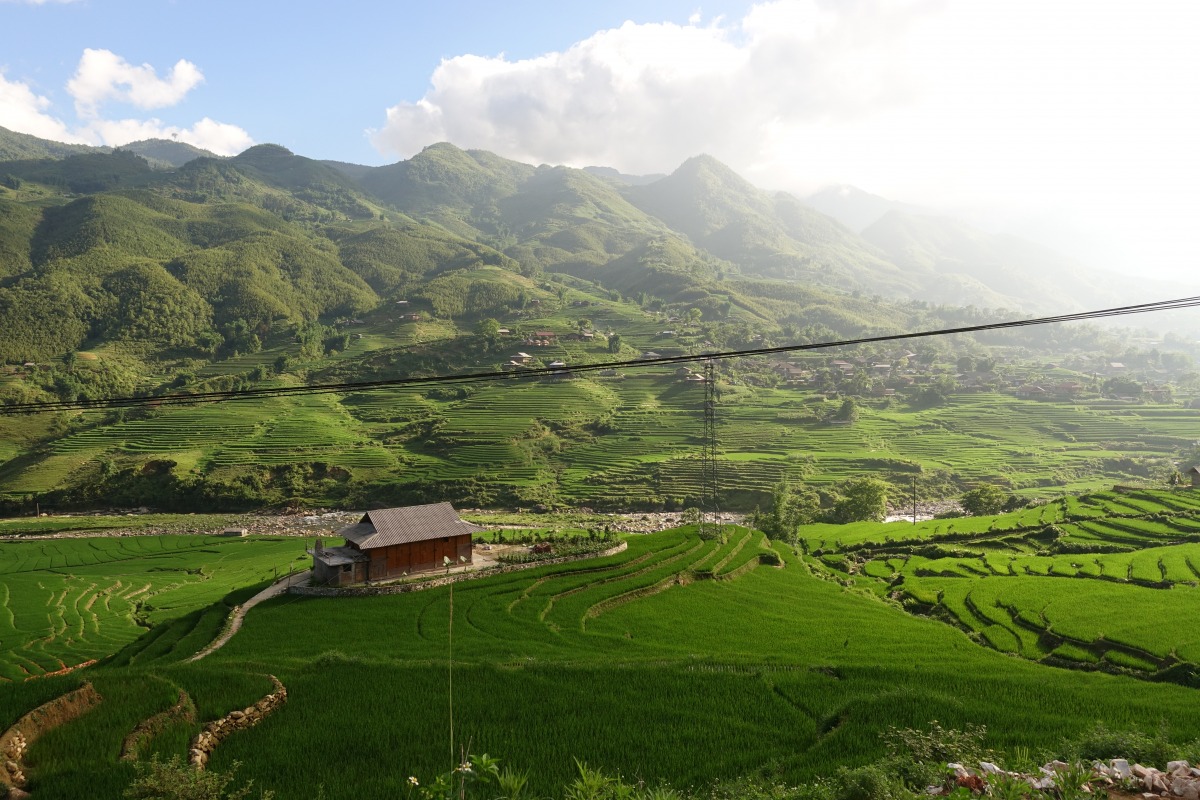
    A land of thick green mountains and brown valleys and disco paddy fields rotating like clay ceramics, forming terraced cliffs of soft angles and endless layers of water.

    It is the ultimate puddle photography kingdom and the most stunning landscape I can recall, and I embrace it alongside my left hand neighbour’s soundtrack. He keeps watching YouTube videos of the best goals from World Cups of the 90’s oblivious to the existence of headphones, like most passengers.

    We are travelling in time and he likely belongs to another century, though right now he appears to be the familiar Guardian sport reader trapped in the pandemic induced memory lane, a stream of old news that is almost sadder to read than watching footballers playing in empty stadiums. Most newspapers have turned the pandemic into a single obituary section, allegedly the most profitable feed in the history of journalism. They sell you your fears in order to make you feel safe… until you feel sick.

    We reach Sapa after an hour, the bus advancing like a worm cutting its way through an apple in circles. It is a small town floating in the clouds at 1500 metres altitude. The French army build a sanatorium for the inevitable casualties of war dementia, and over the years other French colonizers, fancier ones, would develop the town as a spa destination, a suspended, forever misty little kingdom, its air as purifying for fighting tuberculosis as it is deadly for Macbooks today.

    The town is full of empty open craft shops, bakeries, Italian restaurants, with swarms of locals taking selfies in its lake and landmarks; as for hotels and pensions I find a post office that it is actually a hotel and a couple of postcolonial real hotels that are actually nothing.

    Fairground Attraction

    The pension I had booked seems abandoned, its dusty hall sealed with a rusty lock, its insides like a historical chair museum: a number of seats of a number of colours stacked up in drunken heaps reaching the ceiling. I check my phone and see the confirmation I received from booking.com a couple of days ago stating that my reservation of the last room available had been successful, that it would be ready at the time of my arrival.

    I seem to unmask another algorithmic fuck up, and I have no time for it.

    It is dusk now and my phone is dead and my vision blurred, my one-arm glasses resting on its coffin in the depths of my dog-on-a-rope backpack. After trying a few more ghost homestays I come across a motorbike rental shop and I get myself a scooter with half a break and a cracked frame. The smiley owner suggests trying a lodge up the road. It is also switched off unlike the town Xmas lights and Chinese lanterns and the Karaoke bars and its blasting speakers trimming its unnerving neon landscape.

    I see a shadow lurking in the background of the hall, and I knock. A barefoot guy in pink underwear and green tank top agrees to open the premises for my sake and offers fish, meat, eggs and opium, in that order.

    I tell him I’m a vegan fish. He says opium is vegan. I tell him I’m a rehab cop. He doesn’t seem to understand what rehab is, but the cop word shuts him up like cocaine running through a platinum nasal septum. Smoothly that is.

    I drop my bags, charge my phone, read about the Hmongs a bit more and get out again at 8:30 pm looking for my first meal in two days. Most places are closed or empty and it seems clear that I’m the only Westerner around, a seemingly disturbing fact for half the people I encounter. I count five kids covering their faces with their elbows as I pass by. The parents smile at their offspring’s gesture.

    It is a shameful smile, another classic in the history of embarrassment, which is also the history of ignorance and neurosis, which is the history of mankind: ignorant adults and their blank smiles building the future of idiocy and racism by repeating and not questioning, the swirling ashes of habit and inheritance crushing the evolving layers before spreading, once again, the illiterate seed of nationalism.

    I keep my mask on and try many more places, all of them denying me entrance until I end up scoring some boiled vegetables in a little plastic bar with an inviting owner. He is a well travelled man and tells me that the town has been very quiet since the virus, almost three months of no business. The Government promised to give some help, though he is still waiting to get his share.


    Ambulance less

    It feels like landing in a dystopian fairground, a place that has been frozen while celebrating Xmas a couple of centuries ago, the blasting speakers still on, lonely, drunken voices echoing over the lake waters and the empty flashing junctions like the spooky promise of a car crash in ambulance-less land.

    Sleep never comes and I stand up at 6am sharp: the Karaoke echoes have been replaced by the drilling orchestra and its seven masked performers. I can see them from my window. I pull down the blinders and realise how developed the place is. I read that homestays, hikes and fancy hotels have been booming for the last twenty years in Sapa, Chinese and Western tourists pouring dollars, euros and yens like rodeo cowboys in the last saloon on earth.

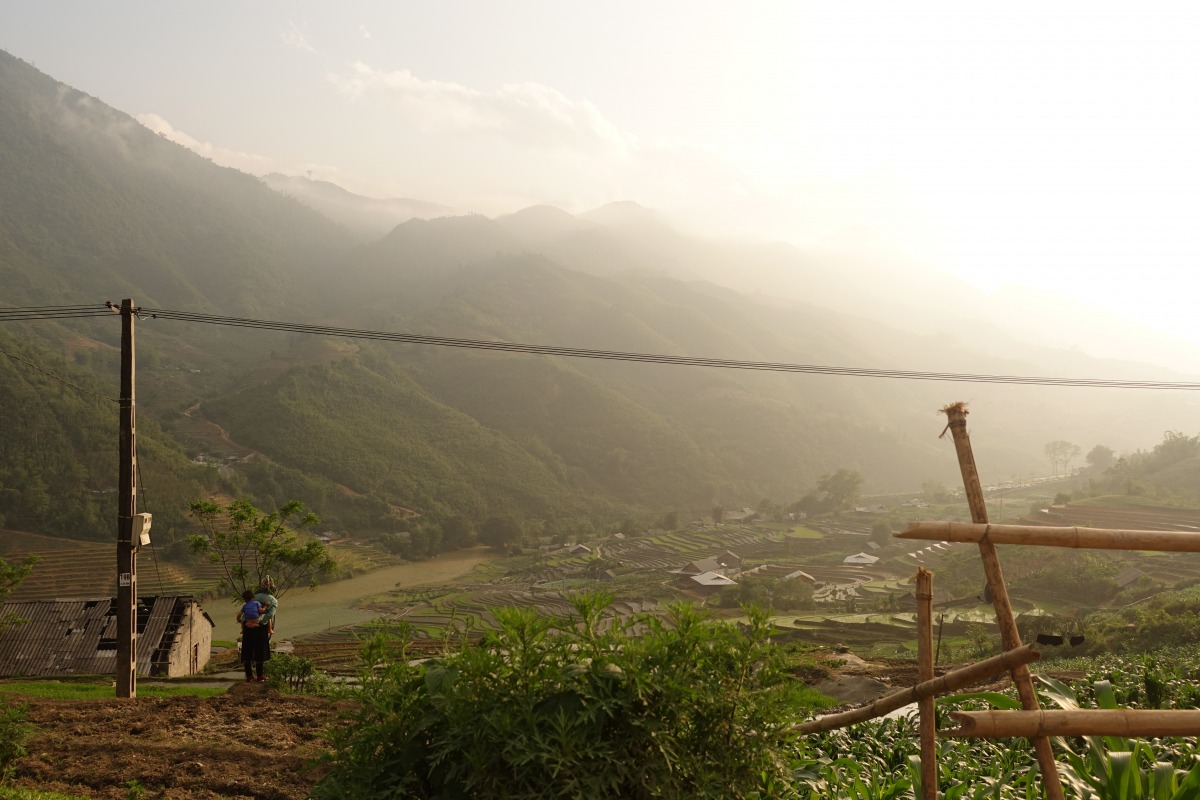
    I search the map for escape routes. The mountain range is colossal and its valley spreads through many little villages from where it is possible to take a number of hikes. I book a homestay on top of a side road, set up Google Maps and drive towards it. It is an eight-kilometre distance that takes me an hour, quietly descending the broken road I ascended on the bus. I keep stopping to take pictures, amazed by the canyon, its dramatic waterfalls and terraced cliffs. Eventually I reach a panoramic point that overlooks the valley, its edges rounded by paddy fields and its bottom crossed by one shy river. The hills are massive and one of them imposes itself over the rest like an overweight Buddha. It is called Fansipan. It is fancy, and also the highest in the country. 

    Catalonely

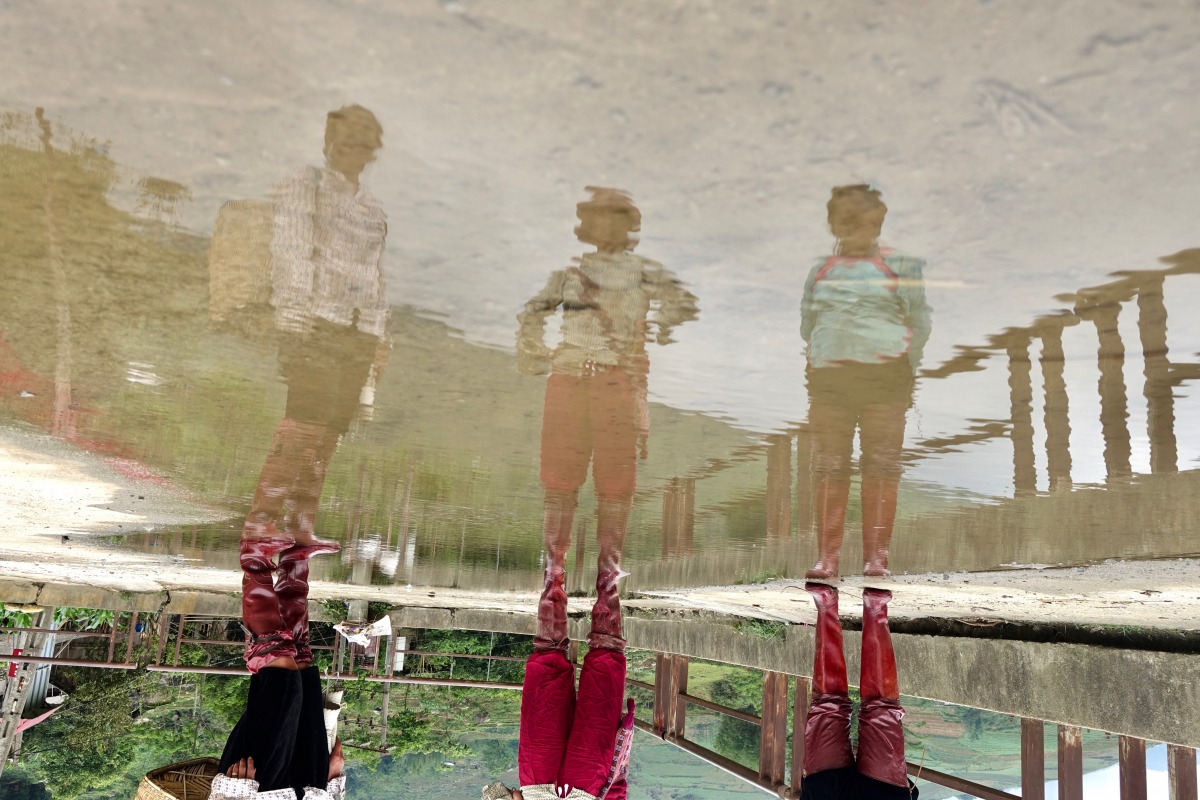
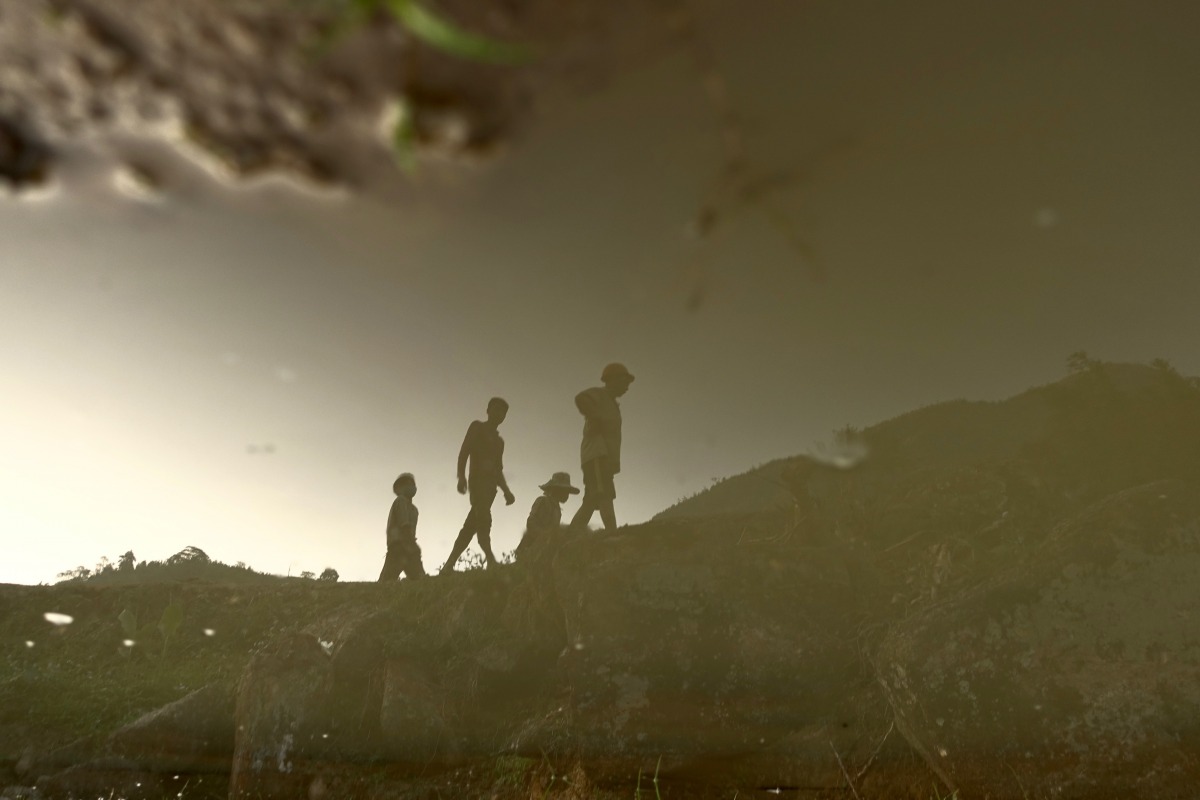
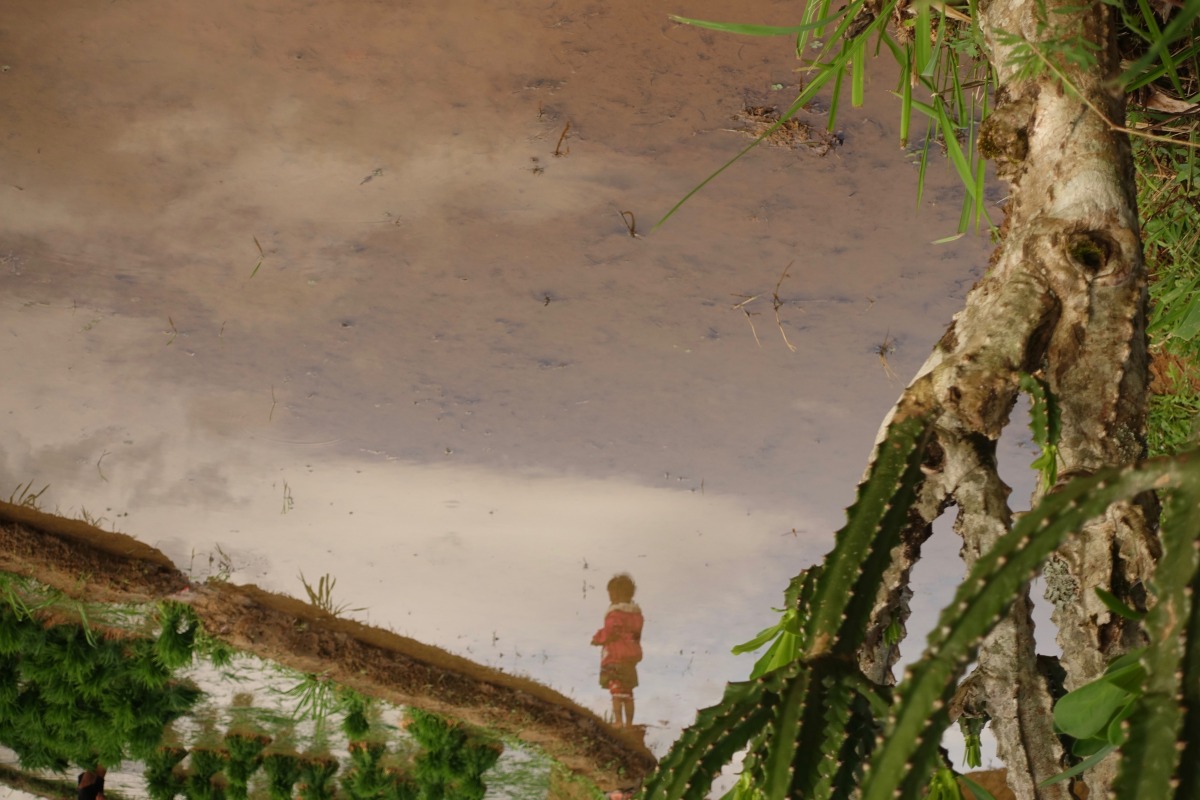
    I find a puddle esplanade and I’m taking pictures of its reflections when three ladies dressed up in Hmong traditional clothes wave at me, big smile on their faces. I say hello and one of them asks the most boring question, though she does it without any hint of mistrust.

    I tell her I’ve been here since the first flood.

    She considers my spine —almost disguised by my skirt.

    “Where do you come from”?

    “I was born in a Mediterranean puddle”

    She smiles now.

    I tell her I’m CatalIrish assuming she won’t understand.

    “That is some strange combination”, she replies in perfect English.

    “I’m from Barcechina, but haven’t lived there for a while. Been in Indonesia and Hanoi for the last few months. What about you, your accent sounds English”.

    “Oh thanks, that is nice. I have never lived abroad but I try my best to learn. I was tourist guide, so I’ve been practicing the language for a while”.

    “Since you were born by the sound of it”

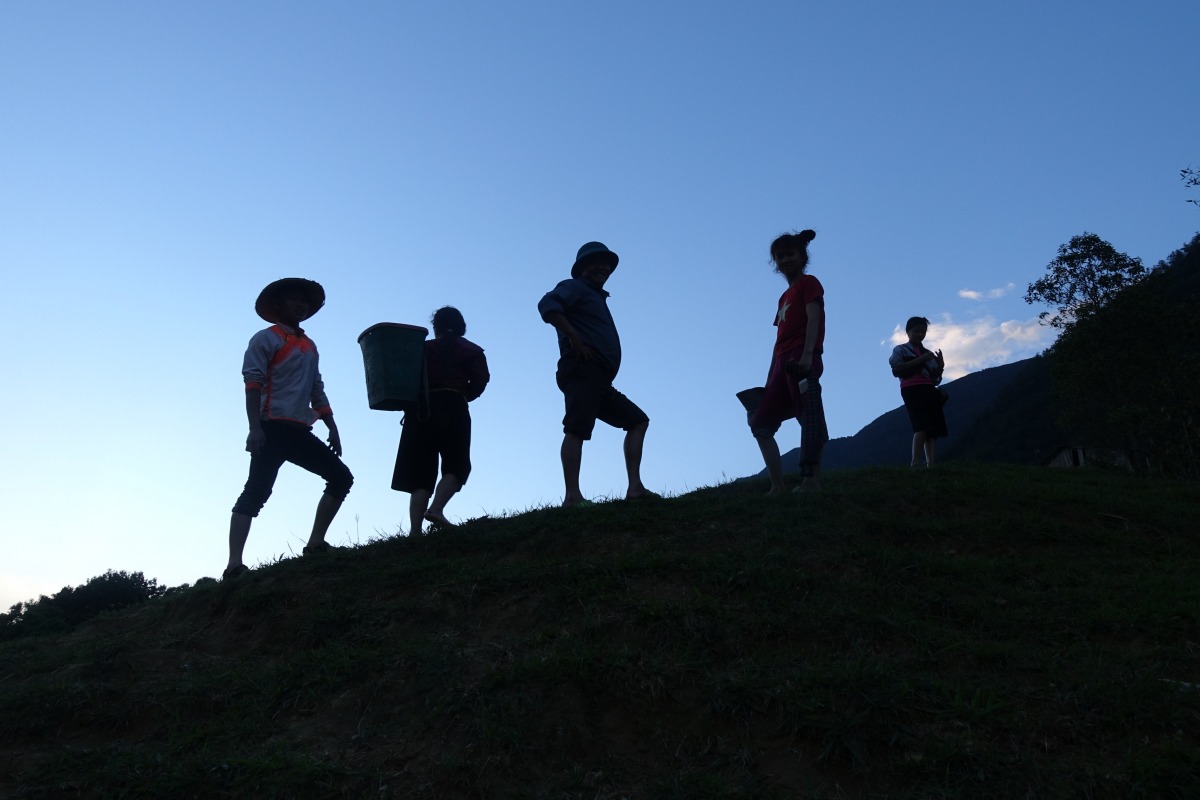
    The three of them smile and the pale sunshine breaks away biblically, a sudden mist silhouetting us against the moisturised evergreen valley.

    “It is good to see your face. We haven’t seen faces like yours in three months”.

    “Seriously? I might have a unusual face”.

    Triple cracking laughter.  Plus my smile.

    After last night’s looks this is music to my ears.

    We exchange names. The three of them are wearing long and lustrous red leather boots oblivious to the mud.

    “Are you working in the paddy fields?”

    “Since Corona, yes”, replies Bha, the spokeswoman.

    I wonder how hard that might be.

    “It is not hard. It is family work. I did also help while I was a tour guide”.

    She is of strong complexion and large smile.

    “What do you do?” she asks.

    “I use to work before Corona, I’m mostly a puddle photographer now, and I write now and then”.

    “What about”?

    “Perhaps about you”?

    “Why me?”

    “Because it is happening. I only write about what happens.”

    She smiles again.

    “What do you mean by puddle photographer”?

    “Shall I demonstrate”?

    “Yes.”

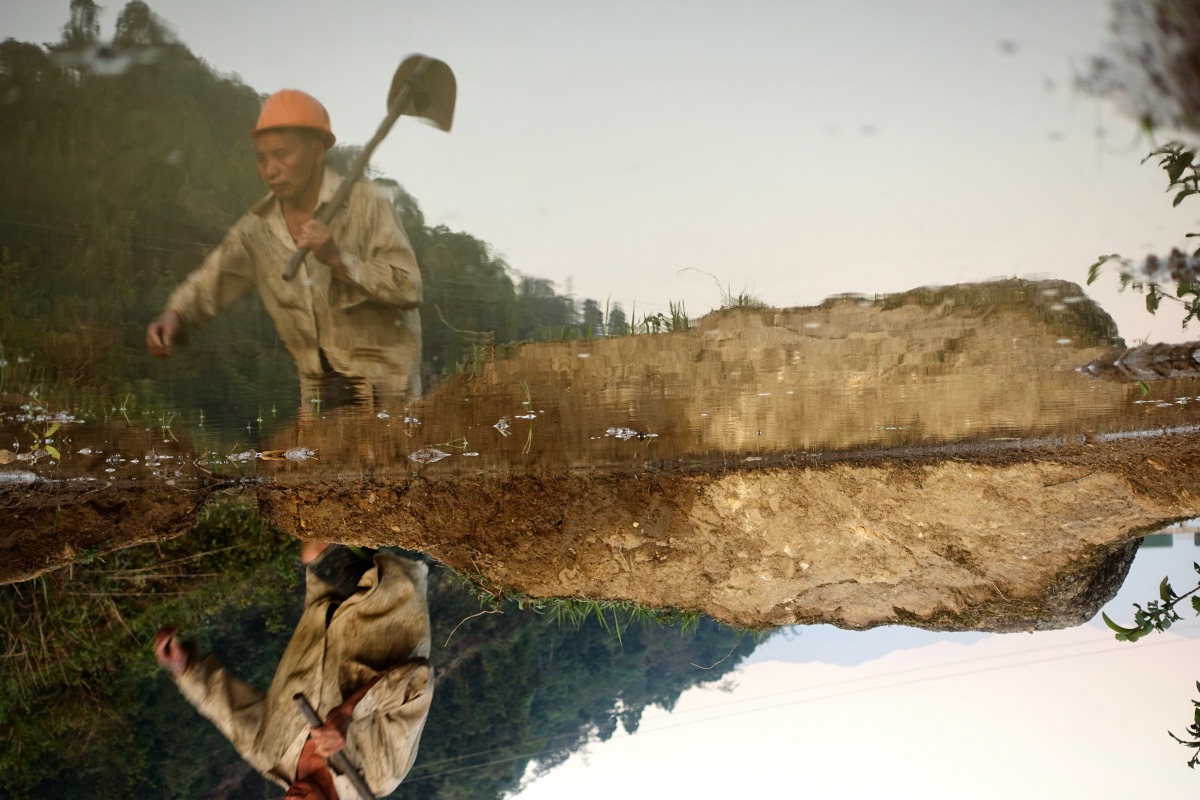
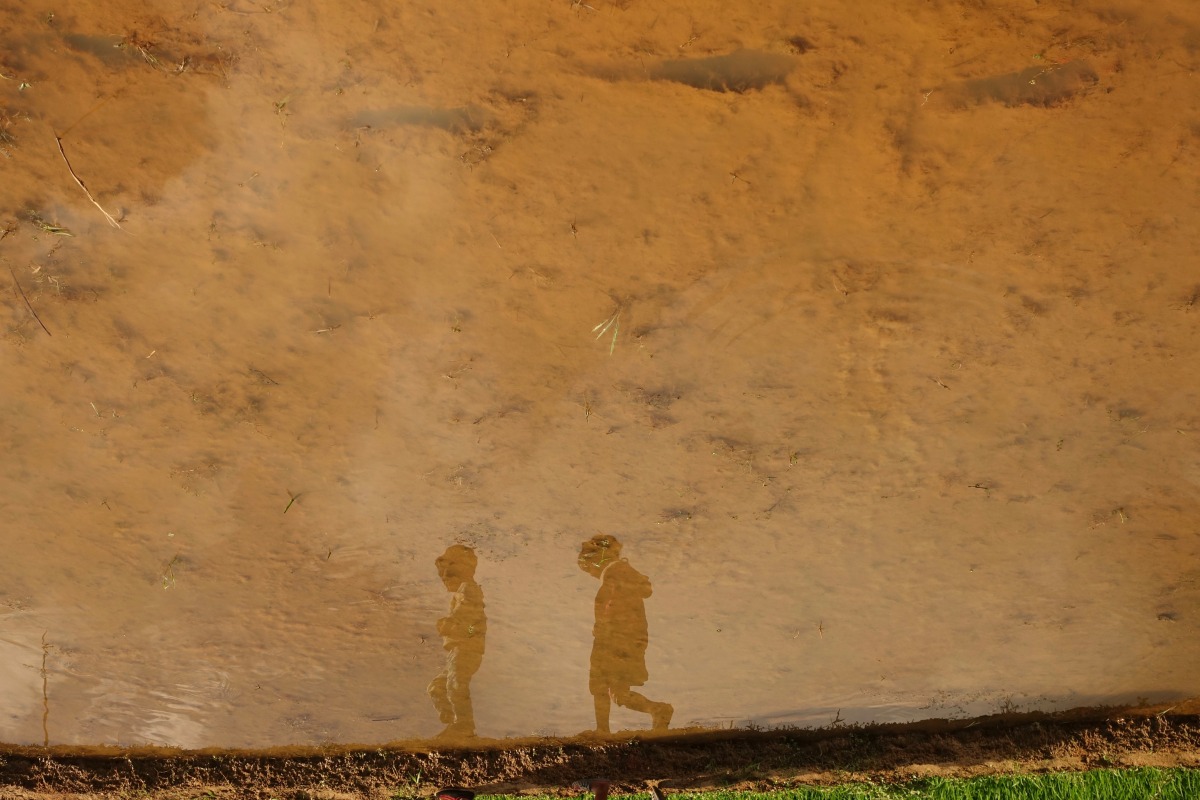
    I kneel over a puddle and start shooting them, their reflections mildly distorted by the wind, the boots shinning like the dream of a crushed empire, likely next door’s one.

    We exchange WhatsApp numbers erratically, the blinding light delaying my performance. Eventually Bha extends me her device and I see my name and the picture I uploaded to my Tinder profile last week. I wonder how the fuck that picture has ended up in a Google search of my fake name. Only then I realise that this is not an algorithmic fuck up, but a rather fucking smooth Google Facebook operation.

    I resolve to erase all my profiles once I find the homestay, but then I’d lose her smile and the possibility of a coffee and her story.

    I jump on the scooter and resume navigation. I’m über conscious of satellites orbiting around my coordinates, my embarrassing profile shot spinning around the Earth, the Orion shores and Barcechina’s morbid tides, exposed and shared like any other bit of privacy we dreamt of achieving only a few weeks ago. I can’t get over it.

    At this stage it seems clear that the invisible massacre is going to keep fast forwarding the ultimate step of our alleged evolution: from Homo Sapiens to Homeless in the Clouds. I can relate to that, no problem, been surfing evictions in growingly draconian manners since I was eighteen.

    I was aware of the non-existent nature of my data privacy way before landing, but this is my unmasked encounter with the eerie work of State reaped algorithms. I keep producing ridiculous amounts of free labour for those who are virtually enslaving me before selling my data to ancient regimes for fucking millions.

    I long for my infinity pool, those dataless days, where tracking your movements would, at least, have required some fucking effort. On those indulgent, forever-high days, just a bit of crawling would get you to places.

    Lilly May

    She is six-years-old. Her name is not Lilly, though it means Lilly in Hmong. Her fingernails are darker than her features, same as her t-shirt, forearms or knees. She wears ragged clothes much older than her and the carbonised particles living on her head allow her to perform all kinds of granitic hairdos. Lilly can speak English, Hmong, French and Vietnamese, and every time I speak to her in Catalan she seems to grasp it effortlessly. Somebody told me once that Chomsky learned Catalan while on a train journey from the south of France to Barcelona. It is some short distance, though as it turns out Chomsky invested less than ten minutes to the task… while on a tunnel.

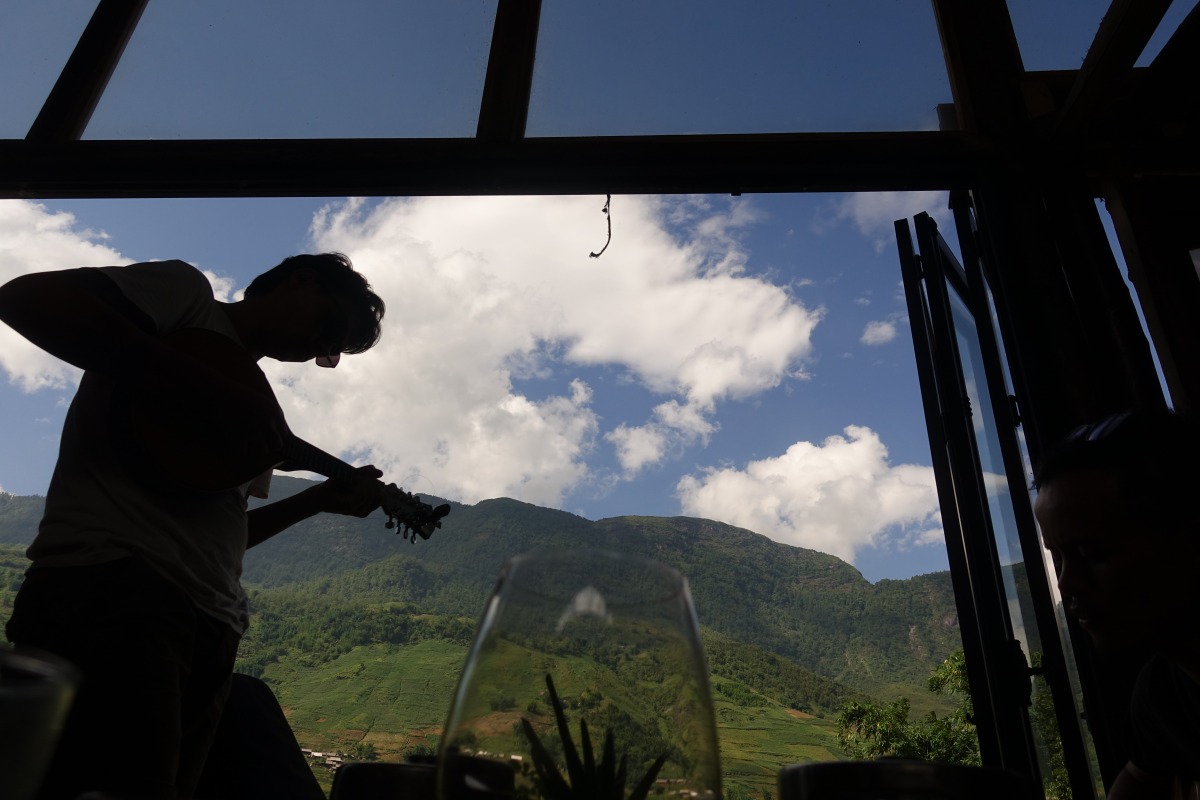
    Lilly is playing a banjo that is almost longer than her. She has it resting on her lap. The banjo belongs to an intrepid young poet who rhymes in Shakespeare’s language over mandolin, bodhran, banjo, guitar, or whatever instrument that falls into his hands. He is a self-taught wild player and a writer on the rise who could be the unlikely offspring of Laurie Lee, Hazel Court and Shane McGowan.

    He calls himself Lock.

    Lock is suggesting Lilly stop banging the instrument against the floor while grasping its large neck. Lilly apologises and balances it again on her lap. The sunlight outlines her funky dreadlocks, just a few of them, growing disparagingly, holding some grudge against the imposing nature of the sudden beams on them.

    The chords vibrate slightly and produce a dream-like minimalist sound that would give John Cage some pleasure.

    Leave Space

    Maggie Nelson recalls in her essay The art of cruelty the life struggle of a musician trying to free himself of his surname, which is also a metaphor of his stance as an artist:  ‘The most, the best, we can do, we / believe (wanting to give evidence of / love), is to get out of the way, leave / space around whomever or whatever it is.’

    Lock is giving Lilly some space though he will try to protect his instrument while sharing it with her. Perhaps that is why he now decides to add an old dusted fiddle to the performance. Lilly swaps instruments and remains transfixed by the fiddle as if talking to its soul, without any sign or intention of playing it.

    Lock says that a few weeks ago he witnessed Lilly beating the shit out of a bunch of expats after they explained to her how to play a certain game of cards.

    Lilly seems oblivious to her genius and reluctant to please her audience, which is only me. I ask her to play something. She considers me with tedium and concludes the inevitable: I don’t deserve it. She tells me to come back tomorrow and resumes her telepathic fiddle communication.

    We are inside Lock’s bar and residence, a room resembling a Western saloon that oversees the opposite side of the colossal Fansipan mountain range, its backyard facing a sculptured paddy field descending the valley, then raising, until ticking the oblivious toes of the fancy range.

    Lock built the whole place with his business partner just a few weeks before lockdown. He has a fully stacked wooden bar and a library running along its back wall. George Orwell, Laurie Lee, the unbearable Patrick Leigh Fermor and a few more writers I had never heard of living on its shelves. I’m the only customer, a one-man audience, reader and drinker, though Lock and I could make a habit of getting nicely locked over the coming weeks? Months? Years?

    “The bench you are sitting on. Do you know what that is”? Lock asks me.

    It sounds like a question Magritte could have asked Gertrude Stein. I wonder if the bench is a bench is a bench is a bench.

    Lock tells me it’s a coffin.

    I smile.

    I’m seemingly alive.


    Before Lilly May

    On my fifth day on the high-plateau I seem to have come up with a little routine. I spend the days reading and writing, eating peanuts and watermelons and pineapples, drinking coffee and then tea, which is the outstanding way of drinking coffee in Vietnam: for every coffee you order you get a little glass of green tea. It is a remarkable way of avoiding the inevitable depression after the intake.

    And then, around 5pm I get my camera, jump on my bike, wander around and stop in whatever appealing places I can find; then dismounting, start taking pictures and try to talk to whoever comes my way: who are mostly members of the Hmong.

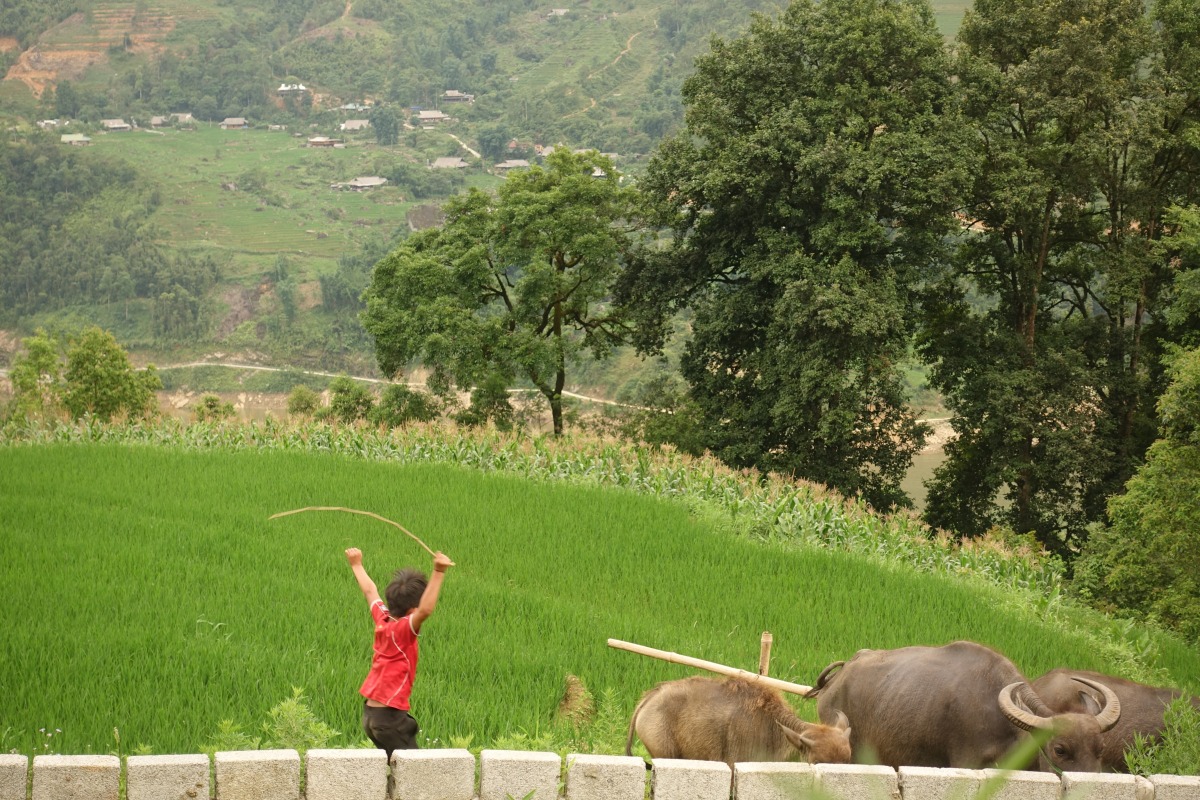
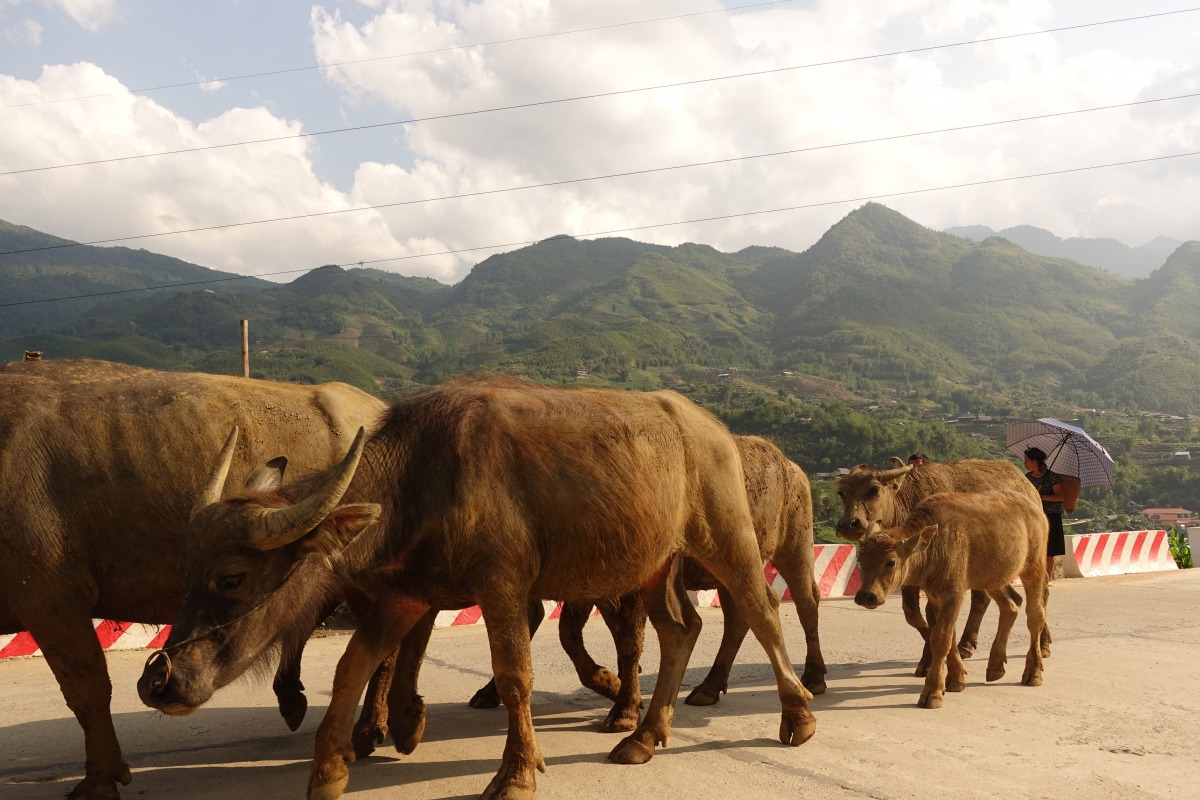
    The Hmong (a word that translates as human beings or free people) are one of the five ethnicities living around the stunning Sapa Valley. They are spread over the mountains of Laos, Thailand, Burma and Vietnam, fleeing extermination at the hands of the Qing dynasty toward the end of the 18TH century, though they had been under attack for over five thousand years. The Chinese failed to consummate the genocide of the free loving tribe, though they would claim to have succeeded by displaying the beheaded skulls of some of their leaders on spears. Until then, the Hmongs had been settling around the Yellow River, always on the move, adjusting their nomadic lifestyle to the fertility of the changing soil. Their ancestors travelled a long way, in all likelihood from the Siberian and Caucasian highlands. Their nomadic kingdom stands now as a free fortress built over paddy fields and dizzying heights where water buffalos, chickens, snakes and pigs pace around like utopian cattle.

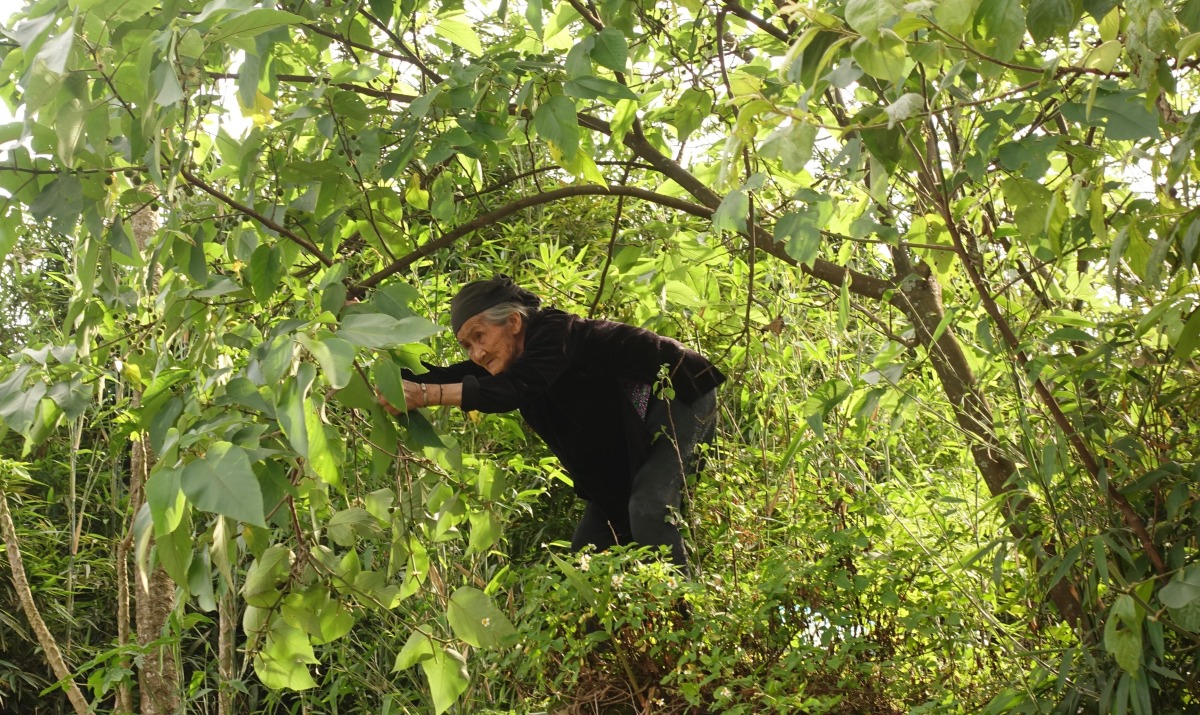
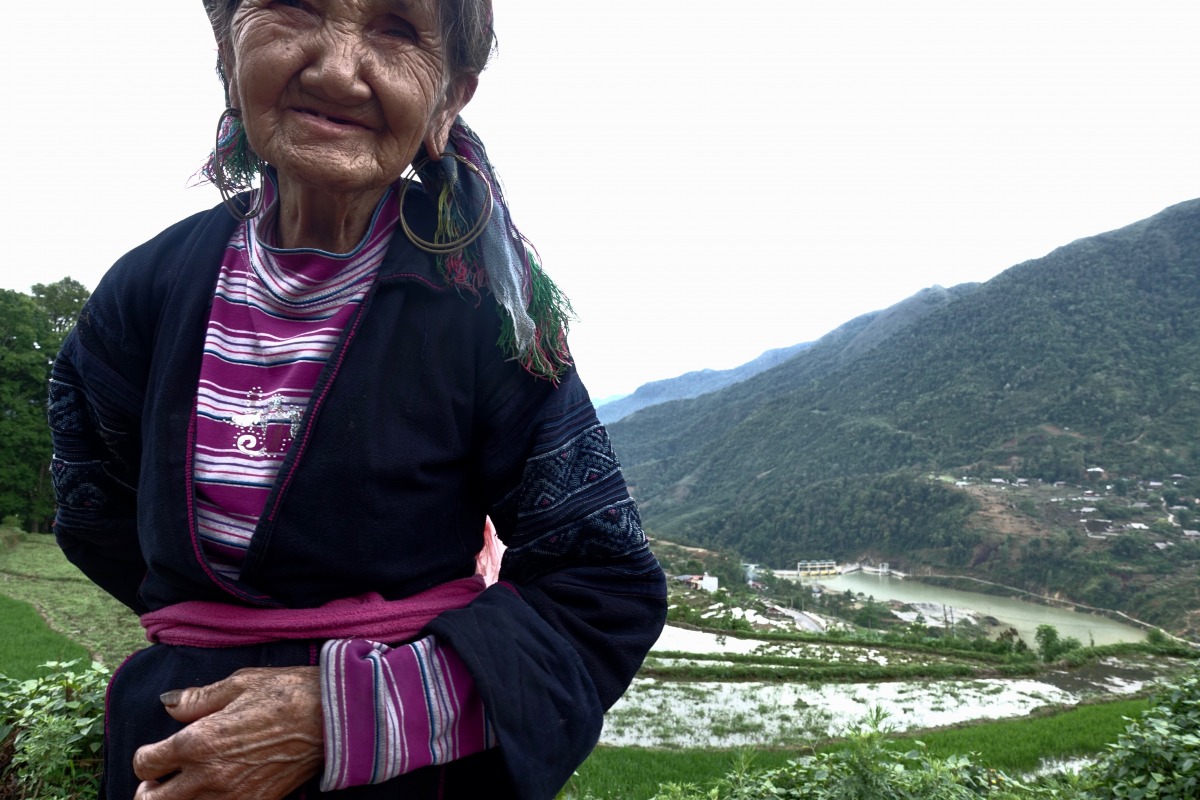
    Today on my fifth day I set off to a Hmong village after 5pm. It is a ten minute ride across the green dam that I can see resting on the bottom of Fansipan from my bungalow. The ride is quiet and the sun is lowering fast. I encounter a family labouring on the paddy field before the dusty road that leads to the colossal dam bridge. I dismount and try to engage in conversation with a Hmong lady walking the ditch. She could be a passer by or the matriarch. She might well be the same age as Mumruinho, though she looks like she could be her grandmother; that is, my great grandmother. 

    Every Old Man I see 

    It is one of the good things of being a Folded Arms orphan: every old person you see could be you grandfather, if not your father or your great-grandmother.

    Patrick Kavanagh wrote it first.

    Every old man I see reminds me of my father.
    When he had fallen in love with death.
    One time when sheaves were gathered.
    That man I saw in Gardiner Street.
    (…)

    It still happens to me though the more I look myself in the mirror – something I try to avoid – the older than my father I am, which is aberrational: I’m almost three years older than him when he died.

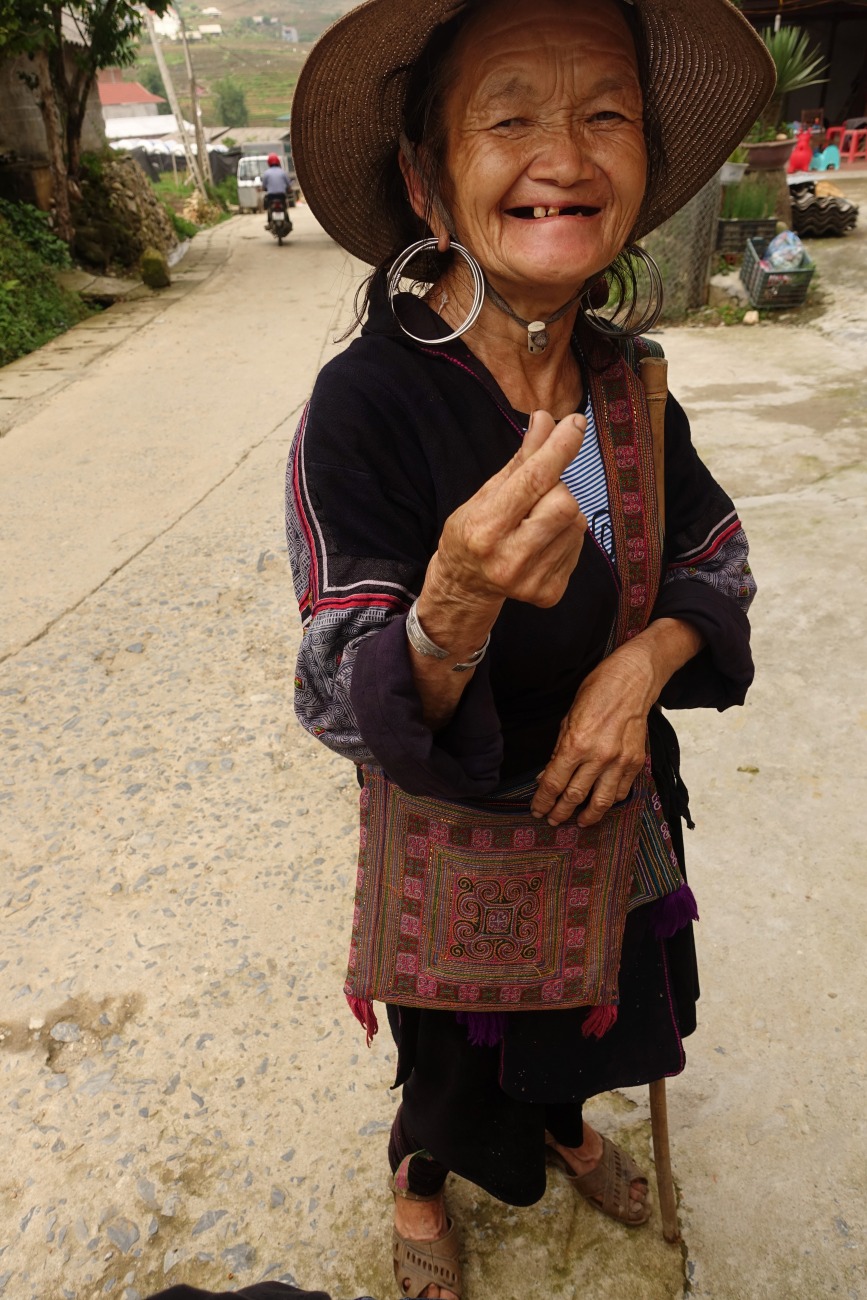
    My sudden great Mumriunho has a single tooth and a smile that seems wider and greener than the goddam dam. We stare at each other. She is smiling all the way. I smile all the way back.

    Eventually she makes a shape using both thumbs and index fingers. She is clicking. I offer her the camera. She takes it eagerly and points it at me. I tell her not to, please, anywhere but me. She understands and clicks the sunset. I suggest she takes a self-portrait, which is unfair. She declines by pointing at her lonely teeth and performs the same eyebrow-arching routine I’ve been performing all my life.

    Her fingers are slim and her nails flat like mine and Mumruinho’s. I grab her free hand and extend my fingers to compare the size of our palms. She likes that and seems impressed with the symmetry.

    The sun is exploding on the green waters now and arching flashes on our faces that might have never looked more Oirish. It is astounding. I’m tempted to take a selfie though they are like cheese or chicken: something I try to avoid inflicting on myself.

    After remaining smiling for a while her fingers point towards a little house before the bridge. I tell her to come along with me, but she starts walking in the opposite direction. Only then she turns around once more and makes another shape with her fingers, her left palm extended, all its fingers involved now as if she were holding the skull of a little kid.

    She smiles and points again to the house and walks away.

    Eagle Snake

    The house is only a ten minute walk away. The dam waters are purple now, its surroundings devoid of trees except for a bunch of willows conjuring the end of the world, tracing wrapped X’s with their branches by its dusted shore. I get close to the brown waters and the trees and take some shots of its reflections, a paddy field family bending their spines in the far distance, across the dam. There is a long branch resting by the shore and I crouch and take it as a walking stick, its crust pierced and layered by the lazy lapping, plastic twirling around its edges, mould whispering the memory of an ancient stream that has inevitably decayed.

    I’m standing against the light, the distorted willows providing some shade, a few broken layers that seem to replicate great Mumruinho’s fingers. I wonder how the willows can grow here, the soil is strewn with dirt and rubble, and I conclude the dam waters might provide some irrigation.

    I’m considering this when a mighty snake uncurls itself from one of the branches and performs an eagle-like offensive: it flies into my face. I elude it with a swift tenkan, and when it is ready to counterattack I sway my truncheon and stick it between its eyes.

    It is my most accomplished Aikido movement in a decade, though it does not seem enough to kill it. Her brains are inside her fangs now, and I start trotting away, my adrenaline filling the dam like a million Alka Seltzer tablets.

    As I run away I see a shadow coming out of the house. I wave towards it and the shadow waves back and proceeds to walk towards me. It belongs to a young kid of seemingly Hmong features.

    Hmongs believe that killing snakes brings bad luck, only hunters are entitled, and I’m not one just yet. They also believe that if one manages to sneak into your home somebody in the family will die.

    I convince myself that the shadow hasn’t seeing anything, and I entertain myself thinking that I might remind her of her father. The shadow could remind me of my lack of offspring… and eventually it will.

    It seems to be a friendly shadow. It gets closer and smiles. She starts another finger-based conversation and offers to take a picture of me. I brand an X across my face and smile. I offer to take a picture of her and she seems to like the idea.

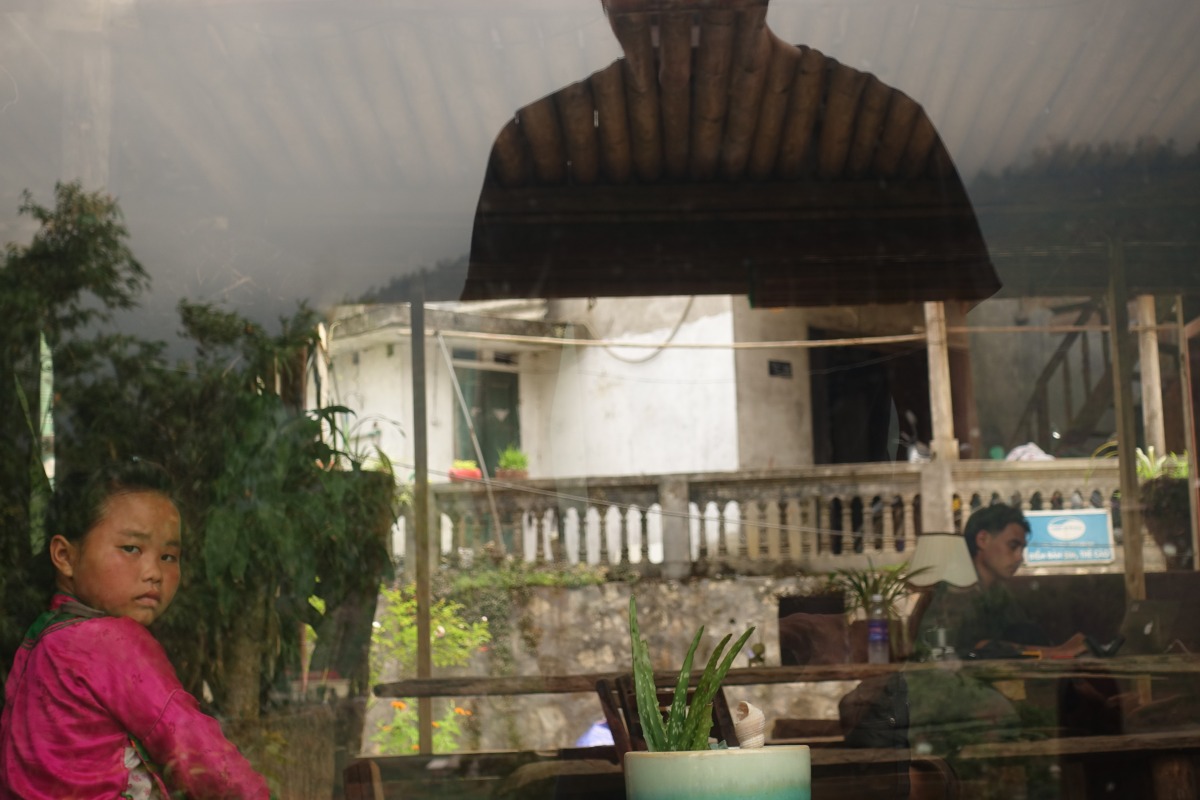
    The shadow is wearing an old green uniform much older than her: her grandpa’s uniform perhaps? She definitely reminds me of her ancestors: I can picture a lineage of bridge sentinels. The shadow arranges her outfit proudly and stands on top of a boulder: the colossal bridge behind, the sun in her face, all over the uniform, my shadow on her way.

    I position myself at an angle and shoot a few times. The light is heavenly and I can’t help but ask her to try a second location, just a few steps ahead. This time the sun is on my face and she is the creeping, redundant shadow. I shoot six photos and she calls it a session after stepping on the snake’s corpse. I finger tell her that it was my fault. She thinks I want to take a shot of the corpse. I tell her not and a second afterwards she grabs it and makes the universal eating hand sign.

    Yummy.

    We exchange emails and I agree to send her the photos. She seems real happy. She is carrying a small speaker in one of her many trouser pockets. She is listening to some reggaeton aberration, until the music stops and Dylan comes in, his crackling voice seemingly broadcasted from a remote planet. My jaw drops, my heart explodes. We sit down and listen.

    I’ve just reached a place
    Where the willow don’t bend.

    There’s not much more to be said
    It’s the top of the end
    I’m going
    I’m going
    I’m gone

    I’m closin’ the book
    On the pages and the text
    And I don’t really care
    What happens next
    I’m just going
    I’m going
    I’m gone

    I been hangin’ on threads
    I been playin’ it straight
    Now, I’ve just got to cut loose
    Before it gets late
    So I’m going
    I’m going
    I’m gone

    Grandma said, “Boy, go and follow your heart
    And you’ll be fine at the end of the line
    All that’s gold isn’t meant to shine
    Don’t you and your one true love ever part”

    I been walkin’ the road
    I been livin’ on the edge
    Now, I’ve just got to go
    Before I get to the ledge
    So I’m going
    I’m just going
    I’m gone

    I can only wonder if when I’m gone, whether this might be my last shore. I’m crying. I get ambitious and try to explain the story of my recent encounter with her grandmother, who could also be my great-grandmother if not Dylan’s granny. It involves many fingers trying to emulate different sizes, a syncretic effort in genealogic trees and Bob’s visions. She smiles and performs an eyebrow routine that turns us into sisters. I point at my mouth and try to illustrate an almost complete lack of teeth. She smiles again and says something and then points at the other side of the bridge with her index finger and makes the finger click sign.

    I set off towards it.

    Seven Eleven

    It is my seventh morning here. I wake up after another mighty dream, which seems to be the nature of my oneiric life since mountain landing. In the dream I’m hanging out with Trump and another evil motherfucker in one of Dublin’s corpo-fucking district hotels, by the Samuel Beckett’s bridge.

    It is weirdly sunny and Trump is inside the hotel room and I’m outside on the balcony and the sun is setting and the blinders have covered Trump’s hairdo abhorrence and the light is filtering through it and the coiffure becomes a magnificent muffin pump up with gold. I take a picture of him across the window and he, Trump, comes out.

    He seems a likeable character and tries to engage in conversation. He asks me what worries me the most. Next thing all the office buildings surrounding us start collapsing, Facebook, Google, Airbnb, you name it. He seems oblivious to it.

    I answer Property Fascism and I can’t help but blame him for it and smile at the phenomenal demolition.

    He seems disappointed. He tells me that if I like Proudhon so much I should let other people come and live with me. I wonder how the fuck Trump knows about Proudhon and I consider property and realise that the hotel we are hanging out in is actually my house. It is a dream house quite literally.

    Next thing I’ve kicked him and the other motherfucker out. Then somebody knocks at the door. I’m writing the most inspired poem of my life, an ode to Rachel Carson, who was born the same day as my grandmother, and I ignore the bells. Then I realise that a little kid has sneaked in and I get pissed off and go and tell him that he can’t sneak into my house like this, particularly when I’m working.

    Immediately afterwards I feel guilty in some tripolar fashion: I’ve embarrassed the kid, myself and poetry in one go. Trump will be proud.

    The Never-Ending Smile

    I open my eyes and I’m not dreaming anymore though I’m living the dream, sprawled on a king-sized bed overlooking the hills. A cloud in the shape of a dragon seems to be resting on the far edge of Fansipan. I wash my face, get out of the bungalow and walk down the garden towards the kitchen. It is a five dollar per night eco-lodge, breakfast included. I am the only guest. It is some real life dream. Since the invisible massacre prices have dropped down so much that I can almost live like Trump now; offshore that is.

    As I’m opening the kitchen door I see a silhouette past the front gate, by the ditch of the road. There she is. Dylan’s granny, my great grandmother, her lonely teeth filling the valley, the morning, our eyes, the whole sense of belonging. I wave at her and she smiles back and keeps smiling. I walk down the stairs and say hello.

    She starts finger talking while maintaining her smile. We might be stuck in finger grammar. She points at me and finger clicks.

    I finger tell her to wait for a second and run to my bungalow, take my camera and come back. Now her fingers are producing a new sign. It is actually a universal sign. Rubbing the inside end of your index finger with your thumb. Even Trump would understand that.

    I smile back and imitate her. Then she stops making gestures altogether and remains on the ditch, just smiling at me. It is by far the longest I’ve ever been staring at someone who is smiling back. I can recall many situations when I stared smiling at people who were not smiling back at all. I was young and angry. They were old and angry, mostly journalists.

    I offer her a coffee.

    No.

    An apple.

    No.

    To come in.

    No.

    She just keeps smiling, the ditch is her shore and my offering its breaking waves. I keep smiling back and then she tries to talk, but can only produce broken sounds, half of her body is shaking awkwardly while doing so. I draw closer, wondering if she is ok. She keeps smiling and starts walking away dragging her left leg, shaking her shoulders. I wonder if she might have had a stroke after our first encounter, and conclude that I was the one stricken. She was probably like that all the time.

    We exchange a fingered goodbye and I see her disappearing gently through the blushing rice fields and the long and bushy corn plants until the winding ditch and its floating clouds swallow her completely.

    I get in the kitchen. My landlord isn’t around. I almost miss him. It is some feeling, one of a rare kind.

    He is the skinniest man I’ve ever known. He eats dogs and cats and pork and rice: every bite he takes the thinner he gets. His smile reminds me of the smile of my great-grandmother, which somehow reminds me of my father’s and Rachel’s smile.

    Dreams Never End

    I’m daydreaming. I’m blessed and grateful to be alive. Clouds travelling like steamed up scratches before my eyes now, the paddy fields gleaming, its puddles calling, the whole world ending, while this corner blooms.

    My phone flashes. Lock invites me over for a coffee. I’m a radiator now. I take a shower, pack my backpack and jump on my scooter. It is another ten minutes ride, the winding road bringing puddles and clouds and tin houses and little mud-spattered kids under massive colourful umbrellas, shepherding buffalos and avoiding the sun and the rain of this subtropical highland ever so gently.

    I surf the clouds with my handlebar and sail the mighty holes of the broken road that separates my town from Lock’s; Boris Johnson getting abused with every shake.

    I can’t remember the last time I was on my way to meet someone I’m looking forward to hang out with. As I approach Lock’s village, I bump into my great-grandmother. She keeps sailing her shoreditch. She is walking and shaking. I stop the engine, take off my helmet and her smile takes over the mountain range.

    I dismount off the bike and approach her and we hug.

    It is the best hug I’ll ever get.

    A fucking ocean.


    Ho Chi Minh

    This is before Lock. Time lapses and overlaps once the shore and the waves meet. Continuity goes backwards and forward, upside and down, like my open mouth and my galloping heart.

    After leaving the sentinel shadow behind I cross the dam bridge. It is goddam steep. Feels like Moses traversing the brinies. To my left hand side there is a ravine flushing its waters over pointy rocks and vertiginous treetops, the horizon narrowing and growing farther like a rattlesnake on the run. I feel the dizzy spells. I look upfront or to my right-hand side, where the sun is setting behind the paddy field where I’m setting off to, the electric waters flashing otherworldly echoes that I fail to capture.

    The same family is still perched on the plantation, their rubber boots covered in mud, their scythe’s lowered and rusty, a buffalo couple waiting and flirting on the side of the road, its legs equally covered in mud, a psychedelic pink outlining the raw flesh on their buttocks: it is an indisputable fluorescent take on Boris Johnson’s double chin.

    I climb the little stepped hill, I finger my hello and the four members finger back at me. Father mother daughter and son, I presume. The sun is rubbing the edge of the hill, the dusk turning the paddy fields into silver puddles edging the rim of the world, the family shadows projected on it, sharp rice stalks forming a calligraphy seemingly inspired by Rachel’s take on puddles, which is as good as puddle literature gets:

    Under water that was clear as glass the pool was carpeted with green sponge. Gray patches of sea squirts glistened on the ceiling and colonies of soft coral were a pale apricot color. In the moment when I looked into the cave a little elfin starfish hung down, suspended by the merest thread, perhaps by only a single tube foot. It reached down to touch its own reflection, so perfectly delineated that there might have been, not one starfish, but two. The beauty of the reflected images and of the limpid pool itself was the poignant beauty of things that are ephemeral, existing only until the sea should return to fill the little cave.


    The Ephemeral Answer

    I finger translate that to the family. It takes some effort. They smile and keep bending. I show them my camera and the father points his thumb to heaven. I smile and bend and shoot their ephemeral reflections on the water until the sun goes down.

    Then I ask them for a phone number to send them the shots and have a chat. I tell them I’d like to write the story of the Hmong tourist guides coming back to work the paddy fields after the virus. The daughter has the best English and passes me her contact details.

    I know I won’t ever do it: it is only the dream of the dead journalist. I haven’t been here enough to come up with a meaningful subject to write about, so I keep producing abherrajournalist ideas.

    Nonetheless the virus side effects are a subject in itself, one that is rewriting the universe and its laws, our way of living and disengaging physically from each other.

    I would write five WhatsApps to the first five tour guides I encounter and none would quite answer. Journalist Shoreditch this is.

    Tin Booming

    I pay my respects to the family, jump on the scooter and keep riding up the road. After two minutes of ravenous ramps, distorted trees and clouds of midges avalanching my mouth, ears and nostrils, I encounter a second sunset, though this time the light dismays fast and darkness takes over.

    I take a diversion through a skinny road, the dam growing smaller underneath, an awkward tin house with a blasting soundsystem on top a hill to my left hand side. There are puddles everywhere, and I keep dismounting and shooting, while the volume keeps rising, encircling the hillside, resonating in the suddenly emerald waters, now darker than ever under a starless sky.

    After messing a bit with the water and the finger clicking, a silhouette emerges from the tin house; then a second one; and then a third and a fourth. I can’t help but recall The Chainsaw Massacre, the four silhouettes sporting what seem to be blue overalls and hillbilly hats, though the music is nothing like hillbilly; it seems to be another bastard take on reggaeton.

    I wave at the silhouettes but the silhouettes don’t wave back, their hands resting on their hips. It is chilly now and I’m just wearing a likely child-labour-made shirt and my skirt, all covered in mud.

    Smells like dead rats.

    I jump on my scooter, turn the engine on and fuck off. Ten metres on I notice a glow and hear a blasting sound that has nothing to do with the music. The explosion shines the valley and echoes all over the branches and waters, swirling and twisting like a frantic cloud of deathcore midges. I gulp and accelerate. A second detonation follows and then a third one. The roads are thinning, and my breath under the mask produces a reek of my own carbon dioxide that intoxicates me even more.

    I keep driving frantically all over the place until I encounter a Hmong village resting on top of a hill. A Tannoy sound system seems to be broadcasting the voice of a preacher. I get closer. There seems to be some kind of religious ceremony going on, swarms of Hmongs gathering under a corrugated iron roof.

    I wonder if I’ve just been hit and this is my funeral.

    They look at me in awe and I smile wondering if the sparkle in my eyes would translate what my mask is failing to express —only a few people look like they are not pissed off and/or fatally ill with their masks on. Next thing a talking hand tells me to move on. It is a robust coppery hand, a lyrical twist on the iron fist.

    I do as I’m told and the one-way road brings me further into the settlement, an uneven land of paddy fields and makeshift shacks where chickens, buffalos and goats pace around as if they are in Utopia.

    Walloped Knickers Rainbow

    I wind up at the entrance of a house, its front surrounded by a display of hanging clothes, a walloped knickers rainbow. I stop by a steep slope and catch my breath. I remove my helmet and mask and breath the night air not quite knowing where I am, still pulsing, the echo of the shots travelling up my thighs, adding its throbbing chords to Boris Johnson’s bastard drumming. Then I hear the powerful sound of an engine and a motorbike stops right by my side.

    “Are you lost”?

    I look up and I see Ho Chi Minh.

    “Since the 80’s”.

    “Good for you” he says with a broad smile.

    He is sporting stripped jean shorts and a sleeveless t-shirt that reads: “Dreams start here”.

    “I’m eager to chase the dream”

    “Ha! Good for you. You are not lost anymore. I’m driving back to my partner’s bar, you’ll love him. It is a ten-minute ride from here. You are welcome to follow us,” he says.

    “You’ll be alright with us. We love to get lost as well”, says a voice rising from the back seat.

    I’m stunned.

    Ho Chi Minh reincarnation has wide bones and broad shoulders and a steel jaw, a Bermuda Triangle that turns his passenger into a blind spot.

    Her head peers from under his shoulders and she says her name is Sam. Her smile could also alter humanity’s course.

    “Let’s get lost” I shout.

    And a cloud of dust swallows us. 

    Titanic Apocalypse 

    Ho Chi Minh drives a motocross bike from the 50’s. It makes sense. The engine is modern and its wheels and suspension much more functional than my own. I follow them through bumpy roads, waving puddles everywhere, plus cracks and dogs and frogs and buffalos guided by umbrella-blooming-shepherd children, grocery-local-shops heaping up in columns of raw meat and cigarettes and rice wine, on the shore ditch.

    Sam lifts herself up on the back seat, spreads her arms in the air, and her slim body arches the arrows of joy. Buddha is smiling on top of Fansipan, its toes rubbing her arms. This could be a cheesy mountain take on Titanic though it is more like the happy epilogue to Apocalypse Now.

    Ho Chi Minh drives fast and she turns around and grins and finger grammars; her hands are saying all this is yours, us; plus we are alive, life is a dream. She seems to embody Ho Chi Minh’s t-shirt inscription … And yes, her smile could alter the course of humanity as much as her boyfriend’s pipe’s exhalation could coat my lungs into underground for eternity. It is all a balancing act.              

    From Sapa to Norfolk by Bike

    The ride will take us to Lock’s saloon where I’ll met him for the first time and find out that he and Ho Chi Minh are business partners, a couple of freedom outcasts building the foundations of the ultimate kingdom against the invisible massacre.

    We share a few beers and play some songs before the big Wednesday, small candles igniting up the last shore, Ho Chi Minh is arranging the space and its lights, every corner and window softly setting up the lonely and humble stage of the end of Catalonelyness.

    Ho Chi Min was also a tour guide before the disgraced beer, and still runs a wild homestay resting on top of a steeped hill five minutes drive from the bar. The homestay is named after his t-shirt, and offers private rooms and three bungalows spreading upstream from the river that crosses the valley.

    Lock tells me he has been playing Irish punk traditional music for the last ten years, mainly in Hanoi, Hong Kong and Yangon. I cheer to that. His coast is humble and welcoming, his smile the ultimate shore.

    My compass points towards his library, the small and shy and yet magnificent destiny running along the back wall, an island swiftly becoming our continent, its jackets our coats, its pages the map of an instant brotherhood lit upside down, sideways and beyond.

    It feels like engaging in fire underwater, such an otherworldly flame it is.

    The waves are breaking furiously, its foam producing light, life, cells, torches; plus some breeze, the ultimate shade. We could swim this waters forever, neatly sealed, like the shore to the ocean, like the path to our footprints, the fire next time and this one, its flame never stolen, its warmth lapping, kissing, and embracing the unlikely encounter of a lighter and its sparkle.

    Lock is a well-travelled man, a wild punk trad player that left England when he was eighteen. He tells me he has lived in Burma, Thailand, China, Hong Kong, Cambodia and Vietnam. I inevitably ask for his recent adventures. He tells me that two years ago he rode a bicycle from Sapa to Norfolk, his English home, an eighteen month odyssey that he has almost finished writing about over the last two weeks, while quarantining after performing a visa run to Thailand.

    I wonder how tough it might have been to be in an isolation camp.

    “What at you talking about? I was taken into a nice hotel, it felt more like being with The Pogues backstage. I loved it. I was down to my last pennies and got fed three times a day by the same chef that would sell me one dollar Valiums and shots of whiskey every night. The weird thing was that every morning this doctor would knock at your door to check your temperature. Mine was 28 degrees for the two first mornings. He wrote it down, said it was fine and never came back. I was dead. It was sweet.”

    His smile runs halfway between Dylan’s grannie and Jane Harlow’s, and it has the cheeky intensity of Shane McGowan’s. I look outside, The Pogues blasting, and I can see Buddha crystal clear, his dimples pierced by clouds and rain and sunshine, his toes playing with the water buffalos, the paddy fields like the dream-like sculpture where John Cage could have ultimately disappeared into utter freedom.

    For the first time since I got my heart smashed like puddle rubble life is a miracle, a mighty dream. My syndrome is embraced, my roofless top covered.

    (…)

    Every man I see
    In October-coloured weather
    Seems to say to me
    “I was once your father.”

    And yet, he could be my son.

  • Poetry – Haley Hodges

    Make of me, too, a microcosm

    Make of me, too, a microcosm—
    Merger, marry, manifest
    As the bridegroom, as the stone-melted
    Heart. Move but do not remove me, for monsters
    Maraud in madness here, and we meet
    Mettle to mettle about the place. But you—
    Magnificent as mystery, as morning, you
    Are mooring the ship of me, mastering the maze
    Of my malaise to run like marrow through bronze
    Bones, an unmappable river overlapping the
    Mayhem. You mumble or hum of Spring-things,
    May-things made for me, mighty and bright
    As midnight meteor, final as eucatastrophe
    Mounting in stillness. You dip Ursa Major
    Into the pail with a wink milky as motherhood:
    Come meadow, come minnow, come maple
    And mink, come drink, (you say) come marvel!
    Our blue marble maiden—mess though she may be—
    Her majesty is mineral-deep! Minstrels sing it and mages
    Know it. Myriad music still marks her mind, her memory,
    Music of mending and meaning, naming and being—
    Music of mackerel meandering, matter and mass,
    Metaphysical music marching from moment to minute
    To minute and back in a palindrome line, meticulous
    And light as a match, hatchling fresh. You say much more,
    All unmeasurable, and to the unending moment of you I say:
    Make of me, too, a magic.

  • The Club

    Part I

    “DON’T QUIT” My father’s mantra was taped to the dull beige wall above his bed. Its edges were a little worn after being ripped down from one hospital wall and taped to another, for years. Deafening was the respiratory wheezing which somehow managed to be erratic and yet, constant at the same time. As a family, we were drowning in an aching cesspool of disease, but it defined that life was still present. It defined that my father was still alive. So we sat. We waited. Held on to each breath. Hour after hour. Night after night. For the better part of those last three months. The reality was, if not in the physical sense, in an emotional one, I’d been there for seven years.

    That hospital was an all-too-familiar environment. Homey to us all. The room scattered with bits of our life. A keyboard, magazines, photos, Dad’s guitar, a soapstone carving of a seal he was crafting. It was all there, in an attempt to provide us any peace. The doctors and nurses, porters and administration, housekeeping and parking attendants, other patients and their visiting families. Everyone within that sphere were part of what was to us, “home.”

    Better than sleeping upright in the chair, or awake and listening to my Dad struggle for breath, was the penthouse stairwell landing. It morphed into a makeshift sleeping area we siblings fought for, and as the youngest, most often I lost.

    It had been seven years since we got the news. My mother and father were in the hospital room. While out in the dim hall, I waited. Glancing around at the sterile surroundings, I was excited to see my father again, but nervous. Why were we in this strange place? He’d been tired and required some tests. Whatever that meant.

    “Your father has cancer.” Those were the words.

    “Can I catch it?” I asked.

    “No.”

    I wondered what cancer was. It made Mom’s eyes puffy. She’d been crying. She was sad. At Daddy’s side, I held his hand, like I always had. Squeezing my little fingers, he looked into my eyes and smiled. My mother held his other hand, small gasps escaping her lips, and tears in her eyes.

    “Your Dad will have some treatments to make the cancer go away,” they said. “He will be losing his hair.”

    HALT! I was horrified. What did they mean “lose his hair?” Why? Where was his hair going? Dad would be bald?

    “It could come back in any color.”

    “Like pink, or purple or red or blue?” I quizzed.

    “Sure!”

    Dad’s hair didn’t matter, but I knew by the look in their eyes, and their strained voices, that something was wrong. All attempts to convince me made it more obvious that life would never again be the same. At age six I was unable to comprehend the scope of sadness that would become our reality. From this moment forward, the course of my life would be altered. Forever.

    He was given thirty days to live. My mother was just thirty-six and would be left to raise a family of five alone. Then, during the subsequent seven years, in cycles of thirty to ninety days, he was given additional time to live. It would prove to be an unimaginable journey: fear, insecurity, loneliness, lack of identity, hardening, pain. The canvas appearing bright, a guise brimming with fun, friends and popularity, Yet, the brush strokes, and the mediums were layered; opaque textures veiling a stark and sombre reality.

    Dreading the last buzzer of the day at school became a mainstay. What would I come home to? I turned age seven, eight, and nine. The years went on, and some questions remained the same, some changed. Would I end up all alone? Would that old lady with the weeping mole be my nanny once again, or would I be shipped off to whomever would take me? I wondered this knowing I might be with them for more than a month. Ages ten, eleven, and twelve passed, and the pain continued. Would my parents be home, or would the chemo-induced nightmare have Dad slumped over the porcelain, convulsing, heaving, and regurgitating nothing again? Would he remember me today? Would he get lost driving, if he could even drive? Would Mom be crying? Of course, she always cried. And would the ambulance be backed up to the door with Dad crawling to the stretcher, as a form of pride? At age 13, I wondered would Mom survive? Would I?

    He was dead. My father. Lifeless. Hollow. Dead. Dad died from a harrowing seven-year battle with cancer. A battle I would ultimately recognize as being a significant moment in my own life. It would serve as a catalyst for the person I became. Silent. Sober. Glazed, I sunk into a therapist’s worn velvet sofa, deep in that tearstained domicile of heart wrenching human agony. Behind a calm façade, the only evidence of anguish I saved for that lacerated outlet of my pain, were the petals of a crimson poinsettia. Sympathetic yet, clinical, I felt my therapist’s analytical eyes summing me up. I didn’t want to be here. I wanted a reprieve. Wanted to melt into the blueness of his sofa. Blend into his flat, silent walls. Walls which had absorbed the malaise of multitudes.

    That excruciating sound had ceased. The agonizing gasps for life that accompanied each passing second for the past month stopped. That last breath of life had taken him with it, leaving a silent, still, deserted form laying there. My Dad was dead. I didn’t know it then, but I was now part of a club. A club that I’d find out, in later years, was unlike any other. Neither prestigious, nor chic, it was nevertheless a club. It was a club that would give bearing, and direction to the future me. The club would open doors. And these doors would lead me into the lives of others.

    Part II

    Club Life. Who are we but an assemblage of clones. Xeroxed human forms convinced that by seeking individuality, we don’t exploit its very existence. As club members, we attend the club of the moment, striving to be a part of the in-group; a clique, attempting to carbon copy the look, speech, smell, and thoughts of others. Lost in a sea of conformity, we’ll adapt to anything familiar for that feeling of wholeness. Righteousness. Acceptance. Gregarious sheep, we follow our instinct to flock, and when separated from the group, we become agitated and crave safety from lurking predators who may challenge us, or our character. We search for the lead sheep to follow down the road. The road to conformity right over an imminent cliff at the peril of what makes us unique. Original.

    We could choose to believe that we are beautiful. Singular individuals. Designed to be a happy result. An impeccable concoction of experiences that when blended together become our life as we know it. Like a recipe, we are just ingredients, temperatures, measurements, outer elements, and mediums, and who is cooking. All these play a role for the outcome of the dish that is this life. Our ingredients and our process contain variables both habitual and fortuitous. Making each and every decision, experience and moment, directly affect the core of who we become. Internally. Externally. These uncertainties and variables add the fundamental flavour and the texture to our souls. Our lives mould us into who we will be.

    So, let’s talk food, spices to be specific. For the most part, spices are added in small, portions. Sometimes so insignificant they are invisible to the eye. When blended, they often vanish. Yet their potency and flavour are a game changer. How much spice, tasty or disgusting has been added to the lives of others and while unaware of why, still we somehow sense something in their presence.

    Some ingredients seem similar. But there exists a vast difference between, vinegars for instance. Selecting white, cider, malt or balsamic, would we then pour the potent fluid directly from its bottle, or over a fire, find its thick sickly sweet reduction? Faced with different conditions, the same ingredient reveals otherwise hidden characteristics from the inside, out.

    Measurements; a pinch, an ounce, a cup; the abundance of an ingredient or lack thereof can build or destroy what we perceive as the expected end result. Do we have enough? Is it too much?

    And who is cooking in your kitchen? Is that a Three Star Michelin Chef preparing avocado mousse with green pistachio oil, garnished with fleur de sel?  Or is it Grandma’s loving hands putting her warm heart fondly in to preparing her mother’s, age-old family recipe of roast beef and mashed potatoes? Then there’s the fifteen year old kid slinging burgers at the local drive-thru, just to make a buck.

    How’s the heat? Low and slow? Is the lid on or off? Are we baking or grilling over mesquite on the barbeque? Have you tried deep fried? Is stuff sautéed on the stovetop or simply served, cold and raw? An utter absence of heat changes everything. Regardless of method employed, each element plays an intrinsic role in what will be plated and served to please or repulse one’s appetite. And at the end of the day all we can say is that dinner is served, or Bon Appetit!

    As humans full of a variety of ingredients; mediums, measurements, methods and so forth, we differ and yet find what we share in common. Lonely in our fight to be profoundly unique, conversely, we crave to fit in and be part of a group. We want a club that will unify us. Bring us together in a harmonious and understanding manner, and thus the recipe.

    The universal understanding of clubs comes decked out in the all-knowing perceived costume of book clubs, tennis clubs, rotary clubs, dance clubs, bike clubs, yacht clubs, even golf clubs. But the clubs in disguise that resonate in all of our lives each and every day are blatantly obvious yet not drafted or defined. These are the clubs of reality, the clubs of experience, the clubs of heartache, sorrow, joy, bliss, danger, and courage, LIFE.

    These clubs build the foundation within us to erect relationships with others based on empathy and understanding of shared mutual knowledge and experiences. These clubs categorically hoist us into levels of sameness. Ultimately allowing us to relate with one another in a way that can be truly understood. The clubs become a vast and endless springboard to deeper relations. Club menus adorned in new attire are decorated and large; lost a parent club, pregnant club, married club, divorced club, singles club, couldn’t have a child club, owned a business club, the LGTBQ club, been an addict club, had a daughter club, had a son club, had a sister club, was abused club,  lost a job club, went bankrupt club, made a million club, survived cancer club, chronic pain club, attended university club, wrote a dissertation club. I think you get the picture.

    Part III

    It was overcast when I left my scheduled ultrasound, childless, except for the unborn one inside me. I was enjoying every moment of being seven months pregnant with my second. A clingy camouflage dress did anything but that for the basketball-esque lump that bulged beneath it. I ran my hands down and around us both, saying, “I love you.” I even pressed on its body parts. Hoping to awaken our little one. Feel those movements that made me feel so whole. So beautiful. So utterly complete. Growing at the proper pace, meant together we were squished behind the steering wheel, in order for my feet to touch the pedals. But these nuances are nothing. These petty discomforts, which arise with pregnancy, pale in comparison to being a conduit of life.

    Had I seen a penis? Was it a boy or girl? Would it go to an Ivy League school? Questions about my unborn child played out in my head as I drove down the street that afternoon. Wait, would my little girl adjust or object to her new room? Her new sibling? And what about the nursery? What about the crib? The decorating around it was nowhere near complete. There would be plenty of time for that, although I anticipated an early arrival. This would be a carbon copy of my previous little miracle who entered the world two weeks early. I had so many questions and thoughts. So much newness, I was about to burst.

    In a couple of months, we’d have two children. Two years apart. Perfect! Oh and I wouldn’t split my love. There was enough of me to go around! I would DOUBLE my love. Yes. It would all be perfect. U2’s song, “It’s a Beautiful Day” played on the radio. I sang along. Well, the words I knew. “It’s a Beautiful Day, don’t let it get away, it’s a Beautiful Day, don’t let it get away.” “You’re on the road but you’ve got no destination you’re in the mud mmm mmm mmm . . . you’ve been all over and it’s been all over you.”

    I hummed and mumbled through the rest. It was perhaps a grey day, but it was still beautiful to me. Seemed I always left those ultrasounds in such a euphoric state, after observing the little life inside me. A life I had played a major part in creating. And for those nine precious months, I took seriously and welcomed all responsibility for controlling the wellbeing of this little miracle inside me.

    The phone in my lap vibrated before it rang. Competing with Bono’s, “What you don’t have, you don’t need it now,” my husband answered my singsong hello.

    “Honey, great news! Your doctor just called and has the results from your ultrasound.”

    Thump, thump, thump. Heart pounding. Pounding. I veered off the road. I wanted to back up, Wake up. Start the day anew. You don’t get results from ultrasounds unless they are bad. And no, not personal calls from your doctor, only minutes afterward. I couldn’t hear anything. The world spiralled around me. I needed air. At that moment, I knew. All those hopes and dreams I’d entertained in my head moments before, of my unborn child, would NEVER be. I knew.

    The five days to follow were some of the most agonizing, I’d ever experienced. Ultrasounds. Amniocentesis. Internal exams. External prodding. Counselling. Tears. Decisions. Conclusions. Devastation.

    Four days later, I huddled with my husband in the boardroom of a hospital in another city. White walls surrounded the big brown table where we sat on insignificant office chairs forged from metal and woven fabric. Other than that, the room felt empty. Lifeless. Not counting the dozen or so medical professionals gathered to go over the prognosis, answer any questions and hear our decision.  Considering that my husband chose to leave it in my hands, head and heart, our decision was actually mine.

    Introductions were made after everyone was seated. Dr. Jones. Dr. Ramirez. Dr. Denard. Dr. Hall. There was a blur of specialists, a handful of nurses, a couple of psychologists and some pre-med students. Inconsequential formalities. My heart was pounding again. I tried to swallow, but my throat was dry.

    The professionals spoke. “Your son.” A son! Son. “Severe heart defects.” Their mouths moved but the words were muffled. Muted. The cold, rawness of the first words spoken “Your son. Severe. Heart. Son. Defects. Son. Severe. Son,” skipped like a scratched vinyl record. “His chances of survival through the birthing process are next to none, if he lives that long. Upon birth he’ll need an immediate heart transplant only possible in select hospitals thousands of miles away. You’d have to relocate for quite some time. That heart may be rejected, that is if we can find a heart for him. He’ll need more transplants as he grows. Chances. A son. Survival. Immediate transplant. Relocate. Thousands of miles. A son rejected.” For what seemed like an eternity, the whirlwind was spinning. And then it stopped.

    The room held a thunderous silence. I looked out at the blank faces staring back at me. I felt so small. Why couldn’t they make my decision? Why did it have to be me? I opened my mouth to speak, but my voice cracked. Breathe, breathe, breathe, I told myself, clearing throat again. “I want to terminate my pregnancy.”

    I said it. Said the words I did not want to say. But knew I had to. The words I had prayed to receive. And then I heard the sighs. Sighs of relief. Escaping the mouths and hearts of everyone in the room. Sighs offering me comfort about a decision well made. We left the hospital. Silenced. Dispirited. I would return to the hospital at 9:30 the following morning to voluntarily end the life of my child.

    We’d stayed at the same hotel, a year prior, during my husband’s heart surgery. It felt comfortable. Homey. They addressed us by name, and we were treated well. For me, the hotel held many memories. My first experience there had been a private party with a rock band on their world tour. Then a “Bride-to-be” wedding gala and the list goes on. It was a place where the infamous and “B” actors stayed while shooting on location. Falling in to conversation with them in the elevators or the lounge happened all the time. To be honest, the sheer retail therapy available; shopping at close proximity and bag drop at my fingertips, would’ve been a draw. But that night, thoughts so banal, didn’t enter my mind.

    They gave me drugs to aid my sleep that night and maybe I did. Don’t know. Had to remind myself to breathe. Just breathe. Deeply. Inhale. Exhale. BREATHE. Faith Hill’s lyrics ran through my head, “Caught up in the touch, the slow and steady rush. Baby isn’t that the way love is supposed to be? I can feel you breathe. Just breathe.”

    Unable to sleep any longer, it was early the next morning, when we went downstairs for breakfast. Happier times had been had in this very restaurant for us. This not being one of them, and well aware I’d need superhuman strength for the self-administered labour, I ordered Eggs Benedict.

    Nearby a man and a woman sat together, laughing over their coffee. I’d never been so desperate for a laugh, myself. But her laugh was so familiar. Familiar enough to make me look up. And I realized it was the actress who had played Marion Cunningham, the perfect mother from the television show, Happy Days. How many hours of my childhood had been spent, after school, sprawled on a bean bag chair enjoying the Cunningham family and their antics, while my parents were away at the Cancer Clinic? It is then I smiled. Because, like some kind of surrogate mother who had been there for me before, she made me feel safe. She’d no clue about who I was. Of the trauma I was facing. Nor how, at that moment, she gave me, in a small way, a glimmer of hope.


    When it was time, we drove to the hospital. I needed to take anything and everything I could from this moment. I needed to remember every detail. I wanted my senses to never forget. With chunky crimson red boots, I was again wearing my camouflage dress. It wasn’t a maternity dress. Simply a stretchy form fitting, high necked, short sleeved, three quarter length dress. Of ever so slightly see-through fabric. I felt good in this dress. Even though it was the same dress I had on when they told me the news. Out of what I was about to experience, I was desperate to accentuate any ray of light I could. And if some trivial piece of fabric could boost my senses even an iota, I was going to take it.

    Hand in hand, we walked through the doors. The only brightness in a flatly lit room were the walls lined with colorful paintings and clay works by young children. The smell was that ever present hospital smell. Clinical, yet sort of stale and so familiar from my past, that oddly I found some comfort in it. Behind a desk, where we would register, sat two ladies. One was on the telephone. I’m pretty sure her unlucky colleague was wishing she’d been the one on the telephone too, after she greeted us with an appropriate, “Good morning. Can I help you?”  “Uh yes, I am here to…” Someone stepped in for me, as I broke down. We were then ushered to an elevator.

    Stepping out, we turned left twice, circumnavigating a maze of linen carts in the hallway to the room where I would give birth to my son. A room that felt forgotten. Obscure. Hidden. It was like a place to hide a dirty little secret. Inside, medical instruments hung on its walls which were white. The bedding was bright on a lone single bed. There were dismal peach coloured drapes around a window with no view. The room was brighter than its small, dull and grey bathroom with just a toilet, sink and an emergency pull cord.

    The alternatives to inducing my labour had been discussed and it was agreed that I would take part in a study. Meaning, throughout the day, I would insert a series of pills. Vaginally.  Labour to ensue. And like the beginning of a bad joke, a couple of doctors, an intern and two nurses entered the room. After signing the forms, I was handed a package of pills and told to go into the washroom to insert one. I was then told I could leave the hospital, but not to venture far. In case my labour came on too quickly. And oh yes, try to keep calm. In a daze, and for lack of anywhere else to go, we hit a nearby shopping mall. Aimless, we wandered the halls, to buy nothing. Looking, we saw nothing. Listening, we heard nothing. Thinking, we tried hard not to feel. My emotions were so contradictory, so raw. Wanting to experience everything, and at the same time, nothing.

    Blessed with a high pain threshold, the intensity I am capable of enduring is legendary. To my amusement, after our first child, my husband said, “I’ve a new respect for you. Bet I could take an axe to your leg and you wouldn’t flinch.” That labour lasted thirty-nine and a half, (Can’t miss that half) hours. And except for short intervals, with all I had, I was pushing for four. Well this was no different.

    Soon enough, mental torment became secondary to physical agony. The pills were working.

    And this labour began with a vengeance. Because this baby wasn’t entering our world to stay, I’d expected the labour to be less severe. But I couldn’t have been more wrong.

    My husband wanted to return to the hospital, because the labour was so severe, but I insisted we keep walking. Non-contracting moments were filled with emotion. I wasn’t ready to say goodbye. Not yet. Didn’t want to lose this feeling of my son inside of me. Didn’t want to lose part of myself. I wanted to continue talking to him. Playing with him. Moving his little body about me and rubbing love all over him. Desperate, I didn’t want to let go of the hopes and the dreams. I didn’t want to make my decision a reality.

    Excruciating, when the contractions came, my head went somewhere else. Breathe, Breathe, Breathe. I was stubborn. I would not go. Not yet. We walked out to the truck, where I couldn’t stop crying. Looking at my despondent husband, I knew it was he who could take no more.

    I didn’t care. Body and soul, I was in my finest form, with no intention to vacate either. And loving myself pregnant, the occasional whimper escaped me, but louder was the emotional pain. We drove back to the hospital parking lot, only to sit in the truck for as long as I could convince him to stay. Walking back through those doors, going up in the elevator, and down the dingy hallway, again we skirted around the linen carts and entered the white room in the hospital’s most remote corner. Pausing every 45 seconds or so to breathe through the pain, indeed we had succeeded in arriving. To my son’s birthplace, where he would also die.

    I wasn’t dilating. The nearby nurse monitored my progress and though attentive, my husband was terrified. Now clothed in a dreadful blue hospital gown, I lay in the white linen of the bed, trying to find calm. Embracing these last moments with the child within and praying for the strength to deal with it all. Breathing through the pain that would not give me a moment’s peace, as hour after hour flew by and yet, time stood still.

    Nurse on one side and husband on the other, I was escorted to the washroom numerous times, to relieve the enormous pressure on my poor bladder. In my modesty pleading that they leave me alone. Time and again the routine was the same. Until the last time which differed, in that as I sat down, the labour pains came. Breathe. Breathe. Breathe. I had an urge to push, just as a wave of nausea washed over me. I wasn’t sure how much longer I could do this. Was I supposed to push? At that moment my world changed.

    “Oh my God! What is happening to me?” Feeling something. I screamed, “Help me, help me, someone, please help me! God, help me!” Between my legs, I saw my son’s small hands grasping at my legs. He was out. He was flailing beneath me. I only heard my own screams. “Anyone. Somebody hold me. Take me away. I need to die now. He’s alive. He’s not supposed to be alive. Oh my God, what have I done?” In seconds the nurse and my husband were there. Alarms sounded, and people came running.

    Told to hold my baby, that they might get me back in bed, I didn’t want to. I couldn’t touch him, I was afraid. Managing to get me and my son onto the bed, they then cut the umbilical cord. I so wished the noise in this hospital would stop. Not realizing the noise was me, screaming.

    The life that called my body home had moved out. After no more than a few minutes of chaos everyone left, and I lay there alone. Empty. Hollow.

    Dismal and omniscient, the peach-coloured curtains were now closed. And as though choreographed, a dark grey shadow cast itself against them, making the room more muted and mundane than before. It was like the natural light of a foggy day and this broken only by a tiny beam of electric light coming from beyond the bathroom door. Where moments before, I’d borne my son. The blue gown I wore was wet. Blood-soaked, it lay limp and lifeless over an abandoned abdomen, and almost as dreadful was a deafening silence that echoed between the four walls of my room. Tormented I asked myself, “Why was my child moving? Why was his heart beating? Why was my son alive?”

    The door to the hall opened and there he stood. My husband. With a nurse, he entered the room. Holding my son. Swaddled in the satin and flannel blanket his Grandma had made just for him. Taking the baby in to my arms, I wept. My soul ached with so many questions that still went unanswered. I had to stay in the moment. This one moment in time I knew would end without any kind of closure. There would be nothing more than this.

    We spent the next three hours alone with our son. His small chest was moving rhythmically but with no breath. I held him and told him stories of his sister and the life he would have had. Pum pum. Pum pum. Pum pum. He was perfect. Small, but perfect, and his skin was slightly transparent. He had little fat on his body. His heart continued to beat and mine was beating faster. His long delicate fingers wrapped around mine as I held him. I tried to make each and every piece of him a photograph in my memory, a keepsake of my son. A son I would never see again. Pum pum. Pum pum. I apologized to him and told him how much I loved him. He had the sweet aroma of all newborns. That scent bottled, would be an immediate success. Why wouldn’t his heart just stop beating? Damn. Why wouldn’t mine?

    We lit a candle, named our son and the hospital’s pastor blessed him. I felt peace for a moment. However, that peace was short lived. Quickly kyboshed, it was absorbed by one resounding question. A question lurking, to which I needed an answer. Due to severe heart defects, I had made the difficult decision to end my son’s life. Yet he’d been born with a beating heart, and three hours later as I loved him in my arms, it continued to beat.

    That day stands alone for leaving me emptier than anything I’d ever encounter. Equipped only with my previous life experiences, I’d entered an unknown abyss, and come out hollow, yet grown. And I didn’t want to belong to this. Nobody asked if I wanted to be a member. But that was the day I joined another club.

  • Musician of the Month: Undine

    For more about Undine’s work see:

    Facebook: https://www.facebook.com/MusicUndine

    Instagram: https://www.instagram.com/musicundine/
    Official site: http://undinemusic.com/um/undine.asp

    Twitter: https://twitter.com/MusicUndine


  • In Search of Greek Inspiration

    The grip of the pandemic having loosened, Frank Armstrong travelled over land and sea from Rome to Athens, and on to the Dodecanese Islands. Although Greece’s Covid-19 death toll has been among the lowest per capita in Europe, it now contends with severely diminished tourist earnings, and the worrying prospect of another war with Turkey. Contemporary Greece draws on an unparalleled history that inculcates moderation and an appreciation of nuance, but the pandemic has also triggered a more belligerent posture towards outsiders.

    from google.com/maps

    Hellas of the North

    The Greeks are among the great sea-faring nations of the world. Indeed, from the sixth century BC Greek sailors voyaged as far as what the Greco-Egyptian geographer Ptolemy described as the islands of Alwion (Albion), Iwernia (Hibernia), and Mona (the Isle of Man).[i]

    Despite the challenge of geography, Greek culture has an enduring presence in Ireland. In particular, during the early Christian period Irish monks sought seclusion in the wild places, inspired by Early Church Fathers, who came from the extensive Hellenic world of the eastern Mediterranean. James Joyce once mused of Ireland: ‘Is this country destined some day to resume its ancient position as the Hellas of the north? Is the Celtic spirit … destined in the future to enrich the consciousness of civilisation with new discoveries and institutions?’[ii]

    In Book Five of Homer’s Odyssey we first meet the eponymous hero. Cursed by the sea god Poseidon for blinding his son the Cyclops Polyphemus – a feat he may have got away with had it not been for a hero complex inducing him to goad his victim – a shipwrecked Odysseus is spending an unhappy exile on the nymph Calypso’s verdant island of Ogygia. According to Plutarch this is ‘far out at sea, distant five days’ sail from Britain, going westward.’[iii] In my mind’s eye, Odysseus’s place of exile is this windswept Emerald Isle, with Joyce’s Leopold Bloom his literary incarnation.

    I booked a flight to Rome in ‘green-listed’ Italy at the end of July, and made my way down to Greece. The vast majority of Italy’s death toll from Covid-19 occurred in three provinces in the north of Italy, while Greece has registered less than three hundred fatalities out of a population of over ten million.

    In Greece’s case it is unclear if a pre-emptive lockdown and travel bans have had the desired effect, or whether what Karl Friston called ‘dark immunological matter’ means the population is less susceptible. Arguments in favour of the latter include especially how elders remain overwhelmingly within families as opposed to care homes, generally healthy diets and a climate conducive to outdoor gathering.

    Land Ahoy!

    Departing by ferry from Brindisi, we sailed down the Adriatic through the Straits of Otranto towards the Ionian Sea. After a few hours of blissful isolation, from out of the mist the rugged coastline of Albania hove into view. The sheer mountains rising out of the sea recall a steep political trajectory; from the last monarchy under the cartoonishly named King Zog (1922-39); to the post-war Communist dictatorship of Enver Hoxha. This terrain, now parched by August sun, was the last redoubt of Communism in Europe.

    Out on deck I struck up a conversation with Christos, a street musician from Thessalonika now living in Athens, where he earns a crust playing the songs of Bob Dylan and Leonard Cohen, alongside more traditional tunes, in which the bouzouki figures prominently. This instrument, which entered Irish traditional music in the 1960s, is associated with the 1.6 million Greeks who fled Turkey after the Greco-Turkish War of 1919-22.

    Christos had just spent two weeks in an agricultural commune in Puglia that is developing a self-sustaining way of life at a remove from both state and corporations. The experiment had imbued him with great enthusiasm, although he cautioned that non-hierarchical structures are not necessarily conducive to harmonious relations: therein lies the challenge of independence.

    Ancient Greek thought from Heraclitus, who said ‘No man ever steps in the same river twice, for it’s not the same river and he’s not the same man,’ embraced nuance and avoided moral absolutism. Plato’s utopian ideas in The Republic are an outlier that have inspired totalitarian regimes through history. His heir Aristotle’s golden mean between extremes of excess and deficiency holds a more enduring appeal.

    Albert Camus in The Rebel (1951), identified an enduring tension between a Caesarian Marxist project that permits all manner of atrocity on the journey to earthly paradise, and an approach he identifies with Ancient Greece, characterised by moderation, incrementalism and respect for tradition. He suggests:

    The profound conflict of this century is, perhaps, not so much between the German ideologies of history and Christian political concepts, which in a certain way are accomplices, as between German dreams and Mediterranean traditions … in other words, between history and nature.[iv]

    This tension is evident again today during the pandemic, with many governments adopting a Caesarian, command-and-control approach with the utopian objective of eliminating the virus altogether; rather than a proportionate response relying on community solidarity and individual responsibility.

    Corfu

    Approaching the Greek island of Corfu a plump moon rose in the east, while to the west a red sun lingered along the horizon in a last gasp of effervescence. The cosmos seemed aligned as the first stars twinkled overhead, although a nagging worry had afflicted me throughout the journey. Anyone entering Greece must complete an online form declaring they had not tested positive for Covid-19, or been in close proximity to anyone who had.

    Unfortunately I only discovered a requirement at the port to fill in the form at least one day before departure, compelling me to make it out for the following day.

    Christos was in a similar pickle, but less concerned. He assured me that in Greece such a minor discrepancy was unlikely to be problematic, and advised that when I disembarked to wait at the back of the queue. This stratagem was designed to make departure from protocol easier for the border guard, with no other passengers around to witness any flexibility.

    Following Christos’s instructions (he was getting off at the next port on the mainland), I finally presented my passport and an email confirming I had completed the form for the following day, which was a few short hours away. A barrel-chested guard with a black face mask obscuring all but a pair of glowering eyes barred my path. For all their history of philosophy and the arts, one should recall that the Greeks are a people forged in the crucible of warfare.

    His response was decisive: “you don’t have the form. Get back on the ship.” I pleaded that it would be valid in a few hours, but I was met with no sympathy, and had no alternative but to return to the ship. At least, unlike hundreds of refugees now landing in Greece who are pushed back to sea in breach of the principle of non-refoulement, I would have another opportunity to enter Greece through the port of Igoumenitsa on the mainland.

    I returned on deck and met Christos who was now worried that he too would be denied entry. An eight-hour return journey back to Brindisi would be a bitter pill for either of us to swallow. He began furiously calling various people, engaging in animated conversations that yielded little certainty as to what would ensue. He assessed our chances 50/50 as the ship entered the port; I was more hopeful given I now had a Greek accomplice.

    The Port of Brindisi.

    In a period where every case of Covid-19 is a blow to Greece’s ailing tourist economy that relies on keeping its case numbers low, even a Greek returning home has cause for concern if the box-ticking exercise has not been completed on time. Our predicament hardly merits comparison with a refugee on an improvised life raft being pushed back out to sea, but at least one can empathize.

    The ferry shuddered into its berth in a port veiled in darkness. Descending the ramp we braced ourselves for another unwelcoming committee, and the negotiations that would ensue. Unlike in Corfu, however, there were no border guards on hand to meet us – the only foot passengers. Alone in the terminal at some remove from the passport control, we considered waiting until midnight when our forms would be valid, before concluding that loitering for another hour-and-a-half among the trucks might land us in worse trouble. Better to brazen it out we agreed.

    Leaving ourselves in the hands of fate, we set off for the passport control. Christos went first, offering his passport. The guard lazily surveyed it, barely raising his head to match the photo with the face beneath the mask, before waiving him through with no mention of the form. Thankfully he repeated the same drill with mine. A few metres on I let out a little whoop. “Quiet now,” said Christos but I felt sure he was smiling under the mask.

    Athens from the Hill of the Muses.

    Towards Athens

    Such are the slings and arrows of outrageous fortune that avoiding Corfu seems to have been a blessing in disguise, as the island of Corfu was assailed by severe storms and flooding a few days late.

    Parting company with Christos, who was returning straight to the capital to resume his troubadour career – in the straitened circumstances of the pandemic – I chose a route through the mountainous north to Athens. I arrived the following day in the city of Ioannina situated at an altitude of five hundred metres along the shores of Lake Pamvotida. The difficulty of negotiating this region as a solo travel without a car soon became apparent however. Organised tours to historic sites are prohibitively expensive and buses rare. I resolved to head straight to Athens the following day.

    Arriving by bus in the sprawling metropolis of over three-and-a-half million one is instantly struck by the volume of traffic chug-a-chugging over misplaced manholes along wide highways; but at least the pollution seemed to have dissipated since my previous visit as a schoolboy over two decades ago.

    It was, nonetheless, cloyingly hot, a thermal layer that lingers all night over the city throughout the month of August. The advantage of this climate, however, is that outdoor congregation outside tavernas and bars is possible throughout much of the year. This may be another reason why the pandemic has had a limited impact on Greece to date, as social distancing is not scrupulously observed and masks were only made compulsory for indoor public spaces at the end of July.

    My first stop was the Hill of the Muses facing the Acropolis. A muse is a source of inspiration, and it is a sign of Greek humility to attribute any genius to an external agency. I gave a prayer to Clio, the muse of history, and in a few accounts the muse of lyre playing.

    When I later texted a friend to say I was surveying the Parthenon that sits atop the Acropolis he sent me a passage from St Paul’s Acts of the Apostles, which begins: ‘Now while Paul waited for them at Athens, his spirit was stirred in him, when he saw the city wholly given to idolatry.’

    Paul discusses the resurrection with Epicurean and Stoic philosophers, and condemns Athenians for their superstitions.

    32 And when they heard of the resurrection of the dead, some mocked: and others said, We will hear thee again of this matter.

    33 So Paul departed from among them.

    34 Howbeit certain men clave unto him, and believed: among the which was Dionysius the Areopagite, and a woman named Damaris, and others with them.[v]

    The Acropolis from the Hill of the Muses.

    Adherence to Orthodox Christianity remains a powerful source of identity and community in Greece. Moreover, the Christian philosophical tradition relies heavily on Plato. This has often brought moral absolutism and a lack of tolerance. Indeed, Plato stands accused of bequeathing to Christianity: ‘the best form of political control imaginable: hell’ He also excluded those agents of creative disorder from his Republic – the poets!

    I discovered a tension in Greece between a more militant approach to religion, and one that embraces a transcendence reconciled to science and reason.

    Although Christianity displaced most Greek pagan beliefs – that lively universe of immoral gods who steal into one another’s rooms for illicit congress – a playful irreverence is still evident in Greece today, albeit tempered by the abnormal social rituals of the pandemic.

    Island Hopping

    After melting in Athens for a few days I took a ferry to the island of Icaria; named after Icarus the son of Daedulus (after whom Joyce named the autobiographical Stephen Daedulus), who created wings from wax and feathers to escape the island of Crete. Daedulus warns Icarus against either complacency or hubris, advising him neither to fly too low nor too high – a golden mean – thereby avoiding the sea’s dampness that would clog his wings, and the sun’s melting heat. Alas, Icarus flew too close to the sun and crashed to his death.

    Icaria.

    Present-day Icaria was designated among the Blue Zones of the world where people live far longer than average, according to Dan Buettner. I am prepared to believe that the clear blue Aegean Sea is indeed a source of eternal youth; such as that sought by the sea nymph Thetis for her son Achilles, the leading Greek warrior in Homer’s other epic the Iliad. Alas, she failed to submerge him fully, and years later a well-placed arrow to the heel beneath the gates of Troy laid low that most warlike of Greek heroes.

    A timeless conflict between Trojan and Greeks (or Argives as they referred to in the Iliad) appears to be still raging three millennia later in the long-standing enmity between Greece and Turkey. In July Turkish President Tayyip Erdogan’s provocative decision to convert the Hagia Sophia museum in Istanbul into a mosque generated heated passions in Greece. There is now a real possibility of warfare erupting over the small island of Kastellorizo that would give Turkey drilling rights over natural gas fields nearby.

    Icaria.

    In Icaria, the legacy of constant battles is evident in crumbling fortifications along the cliffs approaching the capital Agios Kirykos. This was the scene of one of the last German victories of World War II – the Dodecanese Campaign of late 1943.

    The island is known throughout Greece as the ‘red rock’ on account of its long-standing Communist sympathies, which appear to coexist comfortably with religious devotion. Indeed, the Blue Zone study attributes favourable health outcomes to a community congregating in worship.

    Curiously, despite the pandemic, and the susceptibility of the older population who disproportionately attend church, many consider it disrespectful to wear a mask during services. More worryingly, the shared-spoon ritual when taking the Eucharist remains sacrosanct. This is now leading to friction within families.

    Alas, due to pandemic restrictions the festivals that form an integral part of traditional life did not occur this year. In an era of expanding government interference in all things Bacchanalian, it is worth considering the health benefits of festivity.

    I was able to avail of accommodation at historically low prices in the month of August. This is bound to create shortfalls in an economy highly dependent on external income: “We will have no money in the winter,” my landlady cheerfully stated, “but we will have the food from our gardens and hopefully the tourists will come back next year.”

    Icaria seems likely to welcome more tourists next year, but any warfare with Turkey could put this and many other islands out of reach for the foreseeable future, compelling the native population to fall back on their resources.

    The Mask Slips

    My last stop was the island of Kalymnos, one of the Dodecanese chain a few hours south of Icaria, closer still to the Turkish mainland. From Agios Kyrikos I caught a high-speed ferry that bumped along at a furious rate, passing a succession of sunburnt islands rising obstinately from the sea.

    Kalymnos.

    Buffeted by sea winds, I marveled at the scene as I stood out on deck, when a pair of coast guards suddenly loomed in front me. I then realised my mask had slipped onto my chin, and braced myself for a hefty fine. Thankfully they restricted themselves to a ticking off, to which I responded with utmost obsequiousness.

    Further along the deck two Germans were not so lucky. Despite being about ten metres from anyone else – and brothers seemingly too – they were each issued with €200 fines for failing to have their masks in place.

    Perhaps those two fine Teutonic specimens, one clad in garish Ralph Lauren attire, the other more understated but still standing out from the crowd, were a sore reminder of ancient and modern foes: the occupying Nazis of the 1940s, and that more recent imposition of crippling austerity after the economic crash; a policy still identified with the former German Finance Minister Wolfgang Schäuble.

    Kalymnos.

    The capriciousness of the measures seemed obvious when the guard completely ignored a Greek lady nonchalantly smoking a cigarette as they re-entered the cabin. Piracy at sea has long antecedents in this region, and the Covid-19-era appears to be opening up new opportunities.

    Kalymnos is an altogether busier and more prosperous island than Icaria, renowned for its sponge diving. The capital Pothia is a large port that would ordinarily enjoy throngs of visitors in the middle of August. Now there were mostly mournful restaurateurs sullenly sitting outside their kitchens, while innumerable cats lingered inquisitively in doorways.

    I chose to stay at the furthest remove from Pothia at the isolated resort of Emporios, with a permanent residence of just twenty souls, and accessible by a bus that only operates three times a week.

    On the return journey a few days later I became keenly aware of the precipitous drop to the sea below from a road snaking along the cliff face. One false turn and we would crash to our doom. I grasped the hand rail tightly, wondering how that last moment of life would feel before an overwhelming concussive impact that would give way to an eternity of silence. Thus reconciled to my own mortality, and with an enhanced awareness of how all life hangs on a thread, I was ready to end my own short exile.

    Though much is taken, much abides; and though
    We are not now that strength which in old days
    Moved earth and heaven, that which we are, we are,
    One equal temper of heroic hearts,
    Made weak by time and fate, but strong in will
    To strive, to seek, to find, and not to yield.

    From Ulysses by Alfred Lord Tennyson

    [i] Philip Freeman, Ireland and the classical world. Austin, Texas: University of Texas Press, 2001. p. 65.

    [ii] James Joyce, Occasional Critical and Political Writings, Oxford University Press, Oxford, 2000, p.124

    [iii] Plutarch, Concerning the Face Which Appears in the Orb of the Moon, http://penelope.uchicago.edu/Thayer/E/Roman/Texts/Plutarch/Moralia/The_Face_in_the_Moon*/D.html

    [iv] Albert Camus, The Rebel (translated by Anthony Bower), Penguin, London, 2000, p.240

    [v] Acts 17:16