Blog

  • Talking Through Your Chin-Box 3.2

    Gasping for a hit, Carl made himself a fresh cup of coffee. But big-nosed and bat-eared, when he tried to slam it, the steaming brown liquid dribbled down his chin to piddle over his pink tie and white shirt. His accountant’s uniform.

    ‘Fuck!’ He’d forgotten the stitch-up already. His lips weren’t even that sore. His doctor had done a fine job. No gaps. Nothing could get into his mouth now. Not the normal way. Ingenious. Time was at a premium, that is if he didn’t want to be scalded. So with a tea towel, Carl did his best to sop up all the coffee off his face and clothes. Behind him, the door swung open. And from where, with a crash, the handle had hit the wall, some flaking paint fell to the floor. Looking down, before she stepped over it, in came his wife.

    ‘We have to get that door fixed.’

    She saw it. The gold thread razzle-dazzling his mouth. Extra strength.

    ‘So after I specifically told you not to, you went and got your mouth stitched up, didn’t you? Isn’t that right? You disgust me Carl.’

    Taking off his coffee-stained jacket and tie, he looked directly at Nicola, who mimicked a quite convincing fit of dry retching, and then said,

    ‘You’ll be sick now and have to swallow your own vomit. You’ve gone and done it, haven’t you? You’ve only gone and done it.’

    ‘Yes. I have gone and done it. I’m not getting the sack. No way.’

    At which, she jumped back from him.

    ‘What the hell sort of a sound was that?’

    ‘It’s my new voice. Rather thought you’d like it, Nicola. You were always a Columbo fan, weren’t you? Still are, far as I know. It’s the voice of Peter Falk, isn’t it?’

    ‘Trying to be funny Carl? Because I’ve a left foot here that’ll soon sort that out, when swiftly raised to your anatomy’s pendant parts.’ She said this, moving in towards him.

    ‘Hold on. See this pimple on my chin? Right in the middle? Come closer for a look, because it’s been fitted quite snugly.’

    ‘Yeah, I can see it alright. Wasn’t there this morning, when you left for the office.’

    ‘I know it wasn’t. Because it’s not a pimple. It’s the Chin-Box 3.2. Now that they’ve stitched my lips together, henceforward I’ll talk out of it. Oh, and I can tune it to any voice in the world.’

    Akimbo, Nicola stared into his talking Chin-Box 3.2, as she picked up his coffee cup. The hankie he handed her was for the dregs that dribbled down her chin, as in one gulp, she drained what was left.

    ‘You mean to say, out of all the voices in the entire world, you picked Peter fucking Falk from Columbo? Is that what you’re telling me through your Chin-Box 3.2, Carl? Well, is it?’

    To this, Carl said nothing, now unbuttoning his white shirt. He took it off, and Nicola watched his hairy chest throw the shirt, along with the pink tie, into the washing machine. His hairy spine then walked past her to the far side of their small apartment. Where, from the bedroom wardrobe, he took out a fresh white t-shirt which, in small print on the front read, ‘With Millions of Invisible Advertisements.’

    Returning to the kitchen, he answered, ‘Yes, Nicola. It is. That’s what I’m telling you. Through my Chin-Box 3.2. And as I said, I won’t be getting sacked any time soon. Now, the next time I sneeze, there’s no danger that my nose will fall off of my face. We’re ok for rent. Well, for the next while, at least. And for the foreseeable future, I’ll be talking out of my Chin-Box 3.2, so get used to it.’

    ‘Was that the actor, Leonardo Di Caprio just then?’

    ‘No. It was a mixture of 50% Donald Duck and 50% Bono. I think. I’m only getting used to the controls. Messing around a bit.’

    ‘Who knew that combination would sound like Leo Di Caprio.  I must have a look at how you did that. But you’re trying to play on my love of hip-hop. You’ll not get around me that easily. Did I not say to you, “Don’t get your mouth stitched up, Carl?” That it’s unproven in the fight against the Gordian Worm Virus? Didn’t I?’

    ‘Yes, you did. And your bat-eared boy didn’t listen. Because you’re wrong.’

    Stomping over to the other side of the kitchen table, Nicola fished around in her handbag for a small box which, in front of Carl’s big nose, she placed on the table.

    ‘Is that what I think it is, Nicola?’

    She pulled up a chair to sit at the table, and crossing her arms, looked him straight in the eye.

    ‘It is, Carl. In my view, the Eat-Babies theory is correct.  The Stitch-Your-Lips-Up theory is pure gastroenteritis. Inconsistent and dribbly, indeed. This here is a small box of baby G worms that I’ll eat, and in so doing, become immune to their poison. It’s like that old Turkish delight of a king, Mithridates of Pontus taking small amounts of poison. So many people wanted to kill him, but he developed an immunity. Quite ingenious really. Millions of years BC this was. And people were quite thick back then, relatively speaking. So that’s what I’m going to do, Carl.’

    ‘Won’t they just lay eggs in your body? And therefore those eggs will travel to your brain, hatch and lay more eggs. Hatch, and eventually, when you sneeze, your nose falls off. They’ll burst out of your head, leaving you completely sacked, forthwith.’

    ‘No Carl. They’re dead baby worms. Dead.’

    ‘Oh well. Dead babies. That makes it all right doesn’t it? Do you have any sort of conscience?’

    ‘No. They’re worms, Carl. Just worms. I can’t afford a conscience and by the way, neither can you. If it were otherwise, we’d all be sacked. Now, it’s your turn to get used to it. So please do. I’m eating worms. Dead baby G worms. And I’m making sure to chew each one at least twenty times before swallowing, as the very nice chap in the shop told me to do.’

    Around the wooden kitchen table, the two of them sat in silence, staring at the box before them. Inside the box, dead baby worms were floating in some kind of fluid.

    ‘You know Kevin, from downstairs on the second floor?

    Of course I do. You know I do, Carl. Nice man. He works for the Post Office or whatever it’s called now.’

    ‘Not any more, he doesn’t. His nose fell off last week. Got sacked before his two nostrils hit the ground. Seems they’re evicting him from the building tomorrow. If it hasn’t happened already. In the middle of the night. With baseball bats.’

    Nicola pushed back from the table. Her chair scraped noisily across the wooden floor.

    ‘What sort of a voice was that?’

    Carl was fiddling about furiously with the Chin-Box 3.2 controller on his phone.

    ‘70% Margaret Thatcher and 30% Ronald Reagan, I think. Might’ve been a bit of George Dubya in there as well. Thinking of using that as my new work voice. What do you think? It’d be great for any promotions coming up.’

    ‘I think if you’re talking like that, getting your lips sewn together with golden thread has done far worse things to your mind than ever having Gordian worms running wild about it. Like, how will you sleep in your condition?’

    I’ll sleep fine, Nicola. Don’t worry about that.’

    ‘No you won’t. I sleep beside you every night, and I know. You haven’t thought this through. Budgeting being your forte, you’re supposed to be an accountant for god’s sake. Even before you got your lips sewn together, every second night, religiously, at 3 am, you saw giant insects coming in through the bedroom windows. With less air getting in to your bunged-up mind, God only knows what you’ll see. With less and less circulating your head, by the end of the month, I’ll be married to a person whose brain is the size of an amoeba. Can’t believe those adverts finally convinced you to stitch yourself up. This isn’t on, Carl. You’re a fucker, and you know it. How will you eat?’

    Standing, he went to his light blue holdall. The one with the two gold stripes, which now matched the thread in his lips. His hands rummaged inside for a considerable length of time until, onto the kitchen table, he slapped something long and snakelike.

    ‘Via my Cheek-Tube, Nicola. That’s how I’m going to eat. Through my Cheek-Tube 400.’

    Backing away from him, she nearly collided with the door, shaking her head from side to side to side to side and foaming at the mouth.

    ‘So from now on, you’re gonna eat through a tube?’

    ‘Yes.’

    ‘A tube? Really?’

    ‘Yes. It’s the Cheek-Tube 400. Top of the range. I just insert one end of the tube into my cheek like so, where they’ve cut a small tube-hole insertion point, if you can see it, and then put the other end of the tube into my food, and press this button on the side, and hey presto Nicola, HEY PRESTO!’

    Selecting a breakfast bowl with rainbow butterflies on the outside, into it he put three Weetabix. And after an unstinting splash of cold milk, he pushed the appropriate end of the tube into the bowl. With no noise or effort whatsoever, up his Cheek-Tube 400, the Weetabix disappeared, travelling in a more mashed and condensed form, to the inside of his mouth. Then through theatrical ums, and ahs, while he was chewing, gulping, swallowing, and speaking in different voices, he said through his Chin-Box 3.2, ‘Watch this!’

    ‘I can chew, swallow and talk all at the same time. Look Ma! No hands! From now on, at work, my productivity will sky rocket. It’s a win-win for everybody. I won’t be able to sneeze anymore, because my lips are stitched together, Nicola. The World Health Organisation has stated quite categorically that before anyone sneezes they open their mouth and then a-tish-hoo a-tish-hoo a-tish-hoo. If you can’t open your mouth then no a-tish-hoo a-tish-hoo a-tish-hoo can happen, and therefore no sneezing ever again. This means my nose won’t fall off.  If, at any point, I’m infected with the G Worm virus, and forced by my boss, into a Pass-the-Hankie scenario, I’ll be able to blow at my own pace. Nice and slow. Or fast and furious! But my nose won’t fall off my face, because I can’t open my mouth. I’m back in complete control again! Cool Carl, your bat-earred boy wonder. Nicola, even if I do manage to catch the virus my nose won’t fall off. I won’t be sacked. Don’t you get it?’

    ‘I get it. It won’t work. But I do get it. The WHO are wrong. You will sneeze again. But if you believe in all that gastroenteritis hokey-cokey, well then that’s fair enough. I’m not arguing with you any more, Carl. Life’s too short. I’m tired. It’s a bollocks theory but go ahead, it’s your own life to live out how you please. I’m only your wife. Sure why would you even consult me? Eh? Why? I’m only a poor little know-nothing solicitor.’

    ‘Nicola, Eileen McCruddy’s nose fell off this morning. And so too did her husband’s. Do you know Sarah Mince?’

    ‘Yes.’

    ‘Well, her nose fell off as well. Do you know Tom Tiddle?’

    ‘Yes.’

    ‘Well his nose fell off three times this year already. He’s lost three jobs as a result. In the current recrudescence of the virus, it’s getting more and more expensive to get someone to sew it back on again. Do you know Marty Smarty?’

    ‘Yes.’

    ‘Well, his nose fell off as well. Yesterday.’

    ‘If this goes on much longer, we’ll have no neighbours or friends left. I’m scared, Carl. Everything is shit. So very shit. Fuck it. I’m doing it now. I have to go to work on Monday. I’m eating dead worms right this minute.’

    ‘Are you sure?’

    ‘No, I’m not sure about anything anymore, but I’m doing it anyway. I can’t get my mouth stitched up. I’d suffocate, I would. I’m not built like you. I’ve no other choice.’

    They sat back down, around the table.

    ‘Nicola, have you talked to Susan lately?’

    ‘Yes. We talk every day on the phone. Practically every three or four hours, these last few weeks, since I marooned myself temporarily into our apartment.’

    ‘I’m sorry, but I have to tell you.  Her nose fell off at the weekend. She lost her job on Monday, and she’s being evicted tomorrow morning.’

    ‘What? Carl, she has to come and stay here with us. Most law firms don’t accept no-nosers, even for their first offence. Why didn’t she tell me herself? I was only talking to her earlier this morning on the phone.’

    ‘She was afraid how you’d take it, in your current dread fear of contracting the virus hyper-hysteria. Nicola, are you sure you’re okay with letting her stay here?’

    ‘Of fucking course I am. You’re disgraceful if you think I’d have a problem with letting one of my best friends move in with us for a while. We were at law school together. Disgraceful. Do you have a problem with it? Do you, Carl? You fucker!’

    ‘No, of course I don’t. In fact, I’ve already arranged everything with Susan. She’s all packed and down in the foyer of our building. Just waiting for the okay to come up. Knew I had to check with you first. We’re living in a mad world at the moment. Nothing is certain.’

    Nicola rushed over to Carl and threw her arms around his shoulders. She started to cry.

    ‘I should’ve known you wouldn’t let me down. I love you, Carl. Thank you. Though she should have confided in me first. It’s dreadful she didn’t. Unbelievable really.’

    Putting her lips on his, she kissed him hard. Or tried to. Forgetting his lips were stitched up.

    ‘However golden and shiny the thread, kissing stitched-up lips is absolutely dehumanising. Carl, this has no feeling or warmth whatsoever. How will we survive as a couple without the comfort of kissing?’

    Plunging his left hand down his trouser pocket, he took out an apparatus.

    ‘These are my Loving Lips 4,000. They were included with my Stitch-Up bundle at the doctor’s. Seems I just attach them over my stitched-up lips and hey, presto! Kiss me and find out how good they are, Nicola. Come on. Kiss me! Kiss me! Kiss me! It has a robot tongue with AI.  4,000 wurps per second.’

    ‘You just made that up, didn’t you?’

    ‘Yeah. Yeah. I don’t know what the 4,000 stands for. Unfortunately, wurps don’t exist yet.’

    Tears streamed down her face, and with the hankie, dabbing at her eyes, she moved towards him. When he too, moved towards her, she closed her eyes and again they kissed. But this time, Kerboom! Bang Boom! Boom! Boom! Like Sidney Opera House fireworks. On New Year’s Eve.


    ‘These don’t feel, in any way, like your old lips. Nice though. I’ll give you that, Carl. Nice indeed. Wurps, eh?’

    They kissed again.

    ‘Can you kiss and talk at the same time?’

    ‘Of course.’

    ‘Do George Clooney.’

    ‘A bit old for you, isn’t he?’ said Carl, in a Donald Duck / Ricky Gervais melange.

    ‘Just do it, Carl. Do George Clooney. And stop trying to put me off my food with Ricky fucking Gervais.’

    ‘I don’t know if I’m comfortable with that. I’d feel a bit violated to be honest, Nicola.’

    ‘And mix it with Fred from the corner grocery store.’

    ‘He’s a bit young for you, Nicola. I’m shocked. Where has all this come from?’

    ‘Just do it Carl. Without telling me, you got your mouth stitched up. It’s gonna be for at least a year. You owe me big time. Just bloody do it!’

    ‘Ok. Ok. Ok.’

    The banging on their apartment door was Susan. Unable to contain herself any longer, she turned the knob and walked into their living space. The nose she’d already had sewn back on, was running quite badly. By the look of it, probably a backstreet job. She was sweating too. Shaking Carl’s hand, she said, ‘Thanks Carl and Nicola. Thanks so very much for letting me stay with you for a while. I owe you one. Will pay you back when I get another job. Promise.’ And with this, she sneezed. Twice. Into his face. By accident. At least her nose didn’t fall off. Even so, she looked mortified. Depending on how many times you’d already had it re-sewn beforehand, most nose-jobs lasted 7-8 weeks. But with these backstreet jobs, who knew?

    To reassure her, Carl put his right hand into the air to give her the thumbs-up. And in the Chin-Box 3.2 Tarantino voice, he said, ‘You see Nicola, I’ve still got my nose. As I speak, my stitch-up is already paying dividends. Just like the YouTube adverts said it would.’

    Running to the kitchen table, Nicola ripped open her box of worms, and forthwith, put two dead babies into her mouth. As directed by the very nice chap in the shop, she chewed twenty times, and then swallowing hard, re-joined the others.

    ‘Welcome to our home, Susan. Welcome.’
  • Dublin Bay’s Unsettled Future

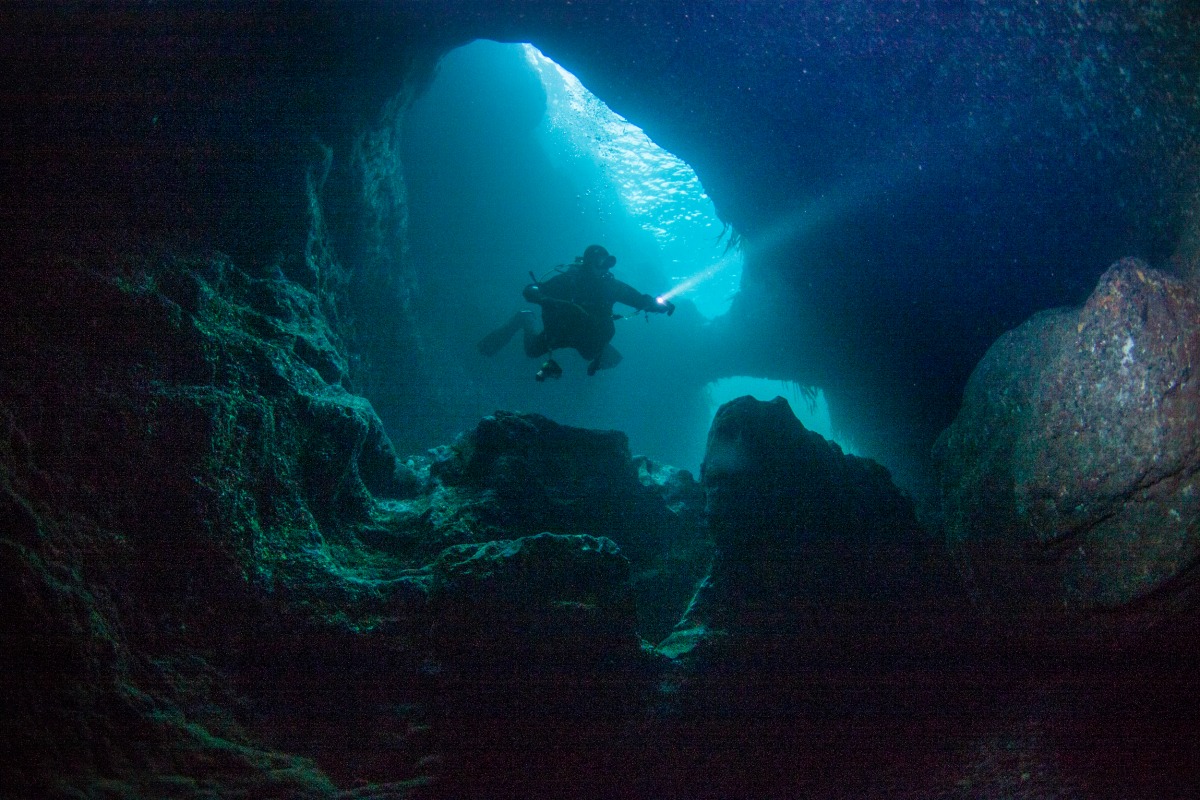
    Jacques Cousteau, the inventor of the aqua-lung which finally allowed human beings to roam freely under water once said: ‘The sea, once it casts its spell, holds one in its net of wonder forever.’

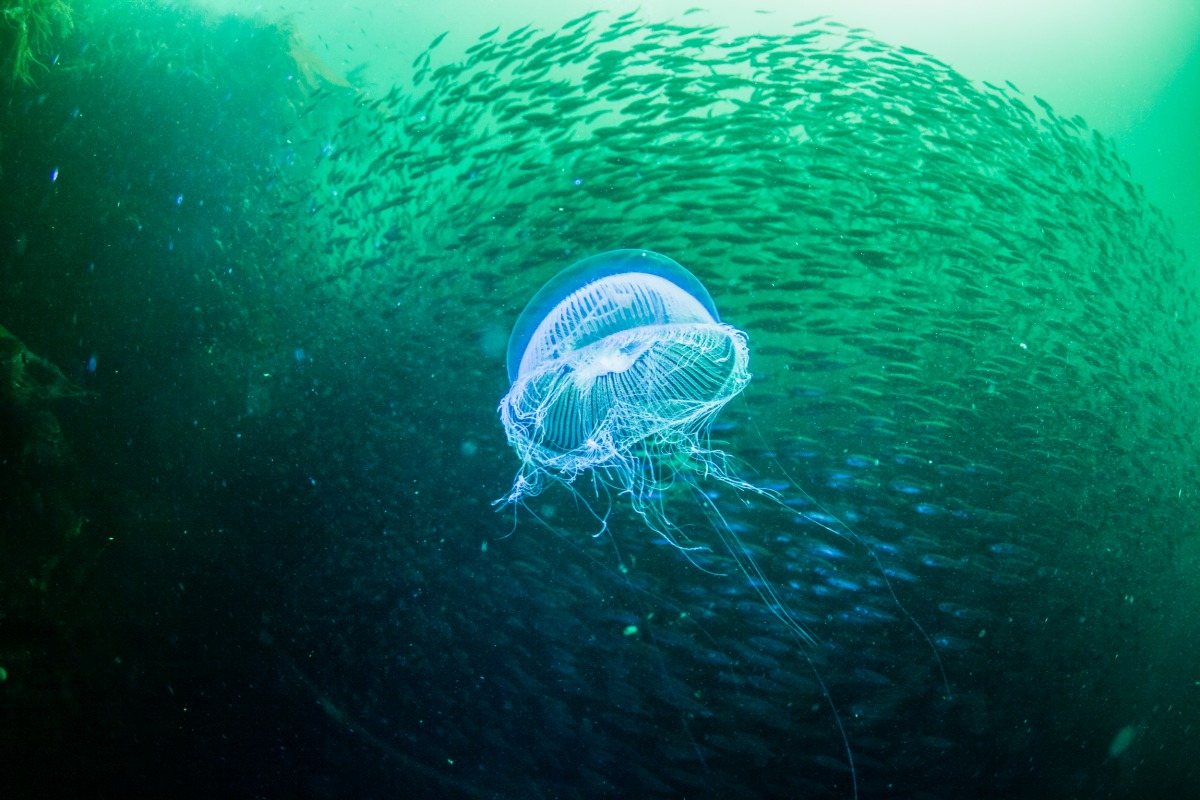
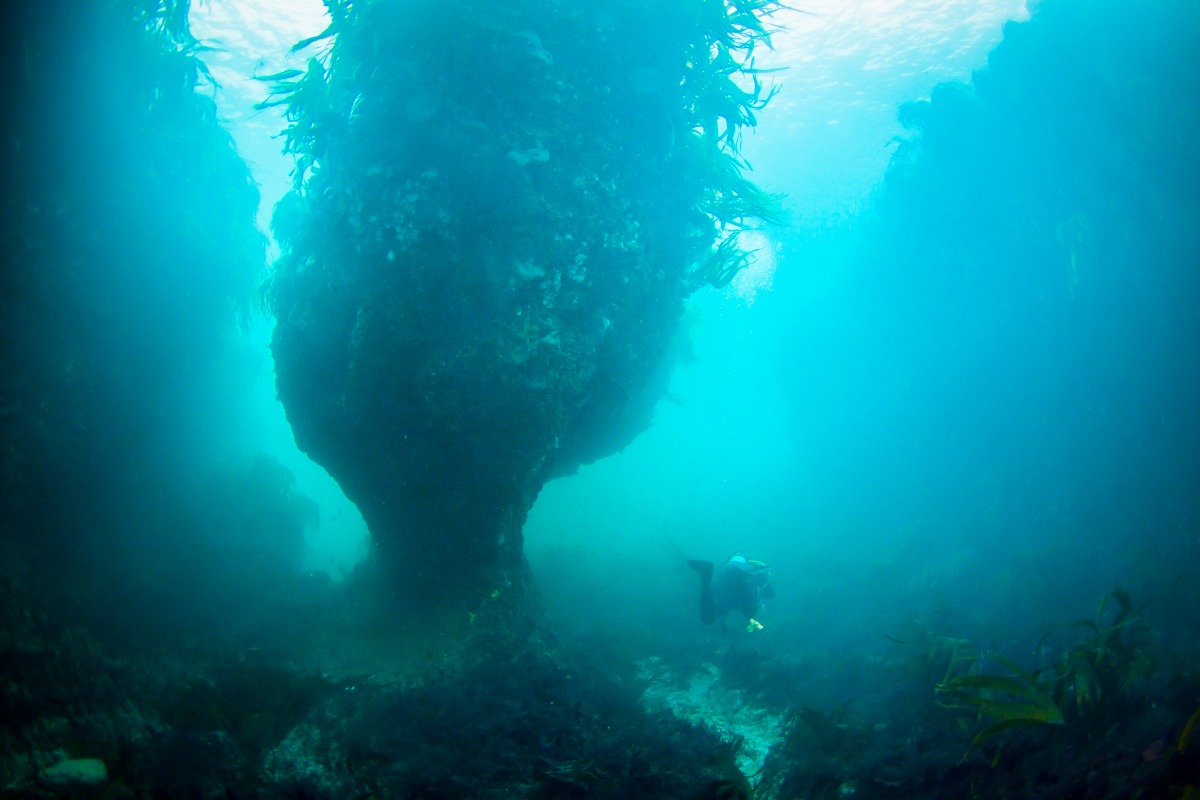
    Like many other kids growing up in Dublin, I first learned to swim in the two-hundred-year old man-made harbour of Sandycove. Gifted a birthday present of a rubber diving mask by an adventurous uncle I was immediately mesmerised by an incredible world that didn’t follow the predictable conventions of dry land, with shimmering shoals of white bait and sand eels darting among the stunningly beautiful kelp forests that surround Sandycove.

    Like Jacques Cousteau, the sea had caught me in its net and my early love of underwater Dublin Bay led me to become first a snorkeler and then a scuba diver. I qualified as a scuba-diving instructor in 1998, and since then I have been working with the fantastic team in Oceandivers, who have had the pleasure of introducing thousands of divers to the incredible underwater world on our doorstep in Dublin Bay.

    Hook Head Wexford.

    Underwater Photography

    I took up underwater photography soon after becoming a dive instructor. Since then I have been bringing a camera along with me on dives as much as possible. I began shooting on 35mm film with an amphibious camera, and have kept up as much as possible with the fast moving technology over the past twenty years.

    Bringing electrical equipment into salt water is never a smart idea, let alone cameras that cost thousands of euros! I have had more than a few teary endings to dives as water snuck past a vital rubber barrier.

    Saint John’s Point Donegal.

    I have spent hundreds of hours photographing some of the country’s most dramatic landscapes, hidden away from most of the population, and am constantly on the look out for new audiences for the beautiful underwater scenes I am lucky enough to capture.

    Being underwater is not something our body can endure for long without the assistance of technology, primarily the aqualung that Cousteau invented in the 1940’s, which heralded the arrival of the underwater sport of scuba diving. With over ten thousand certified scuba divers now in Ireland, we have a substantial number of active amateurs and professionals diving regularly all year round, all along our incredible 5,500 km of coastline.

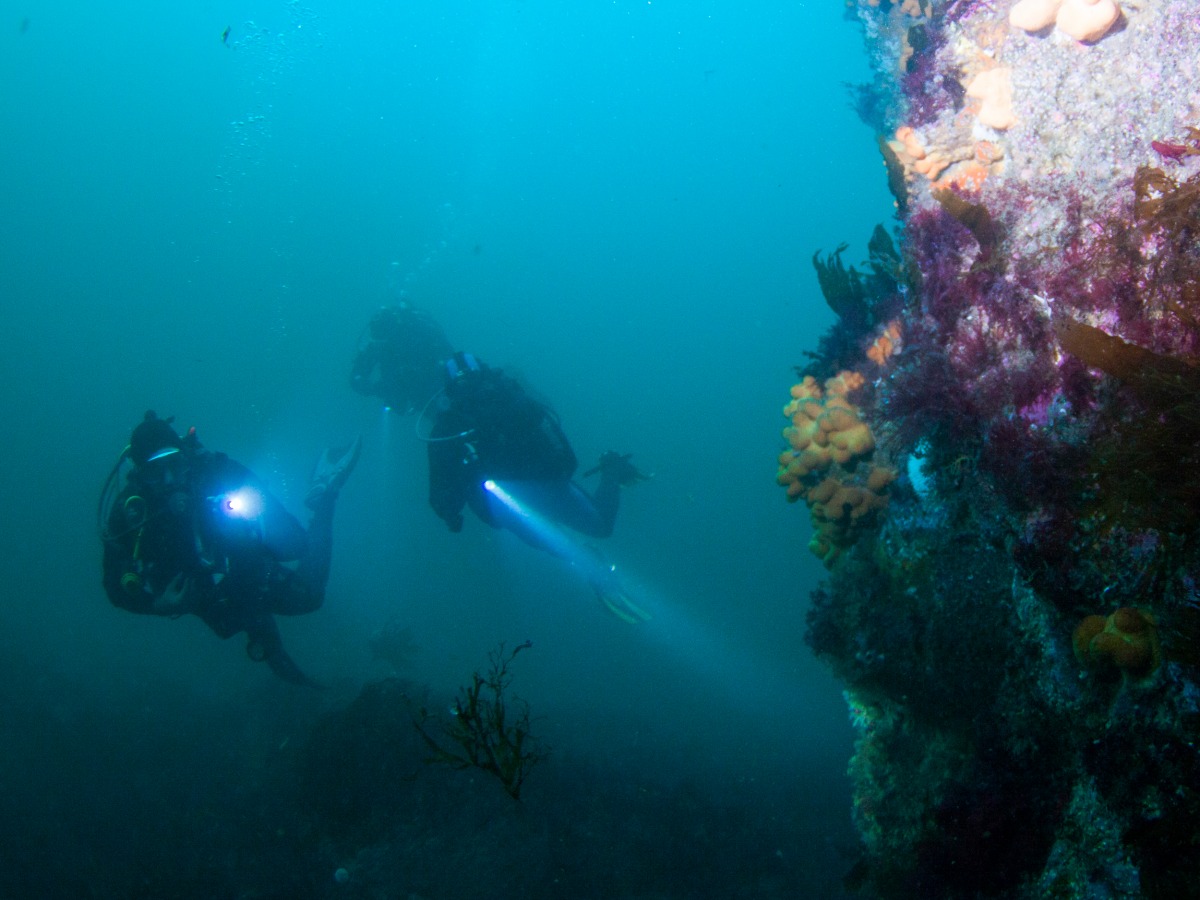
    Divers on Dublin Bay.

    These divers are rewarded for braving our cooler waters with incredible scenes of raw nature, and dramatic underwater scenery that rivals any of the best dive locations in the world.

    Cousteau himself rated some of the sites he dived in Ireland as being among the best in the world. The west coast in particular offers a multitude of islands and sea cliffs in deep clear Atlantic water, interspersed with the wrecks of unfortunate vessels that ran aground in the oft wild conditions. To explore every dive site on the west coast would take a lifetime, with new sites being discovered every season by intrepid divers.

    Horn Head Donegal.

    Dublin Bay

    Due to the density of population in our capital city, Dublin Bay is one of the most well-dived locations in the country, despite at times having less than ideal diving conditions.

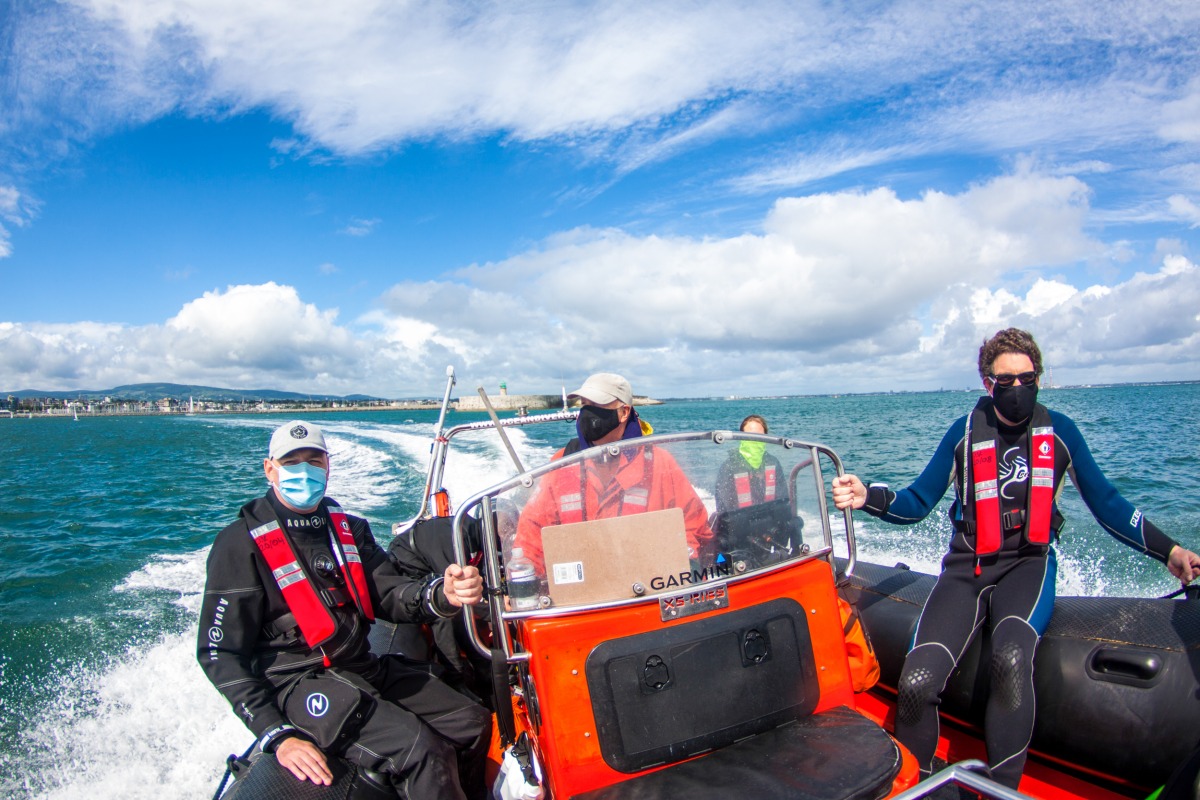
    Divers trade in ‘Viz’ or underwater visibility. As a rule, the clearer the water the better the dive. Divers depart from Dun Laoghaire Harbour to the south and Howth harbour in the north, finding adventures around Dalkey Island or Lambay Island; or surveying shipwrecks off the Old Bailey Lighthouse or on the Kish sandbank.

    The silt and sandy bottom around Dublin Bay is in a state of constant motion, drawn by the strong tidal flows moving down the east coast of the country. These massive sand banks are also easily disturbed by strong southerly or easterly winds, leading to dramatic drops in visibility when a strong wind blows. Unlike the deep water off the west coast, Dublin Bay is a relatively shallow body of water with a primarily sandy bottom.

    Coral Garden Dalkey Island, Dublin Bay.

    The sediment and sand along the northern half of the Bay is particularly plentiful, meaning the dive sites there are extremely poor, with visibility rarely rising above a metre or two. But on the southern side of the Bay there are sites where visibility regularly reaches beyond five metres, providing reasonable conditions for divers to train in.

    Hook Head, Wexford

    Sandycove is among the few locations in the Bay where divers can regularly access clear water with the depths required to train new divers in safe conditions.

    Recently, under the guise of Covid-19 prevention measures, divers were denied vehicular access to the site as a result of a poorly designed bike track. This removes one of the last accessible dive sites within the city, and hopefully a solution can be found.

    Dalkey Island, Dublin Bay.

    Dalkey Island

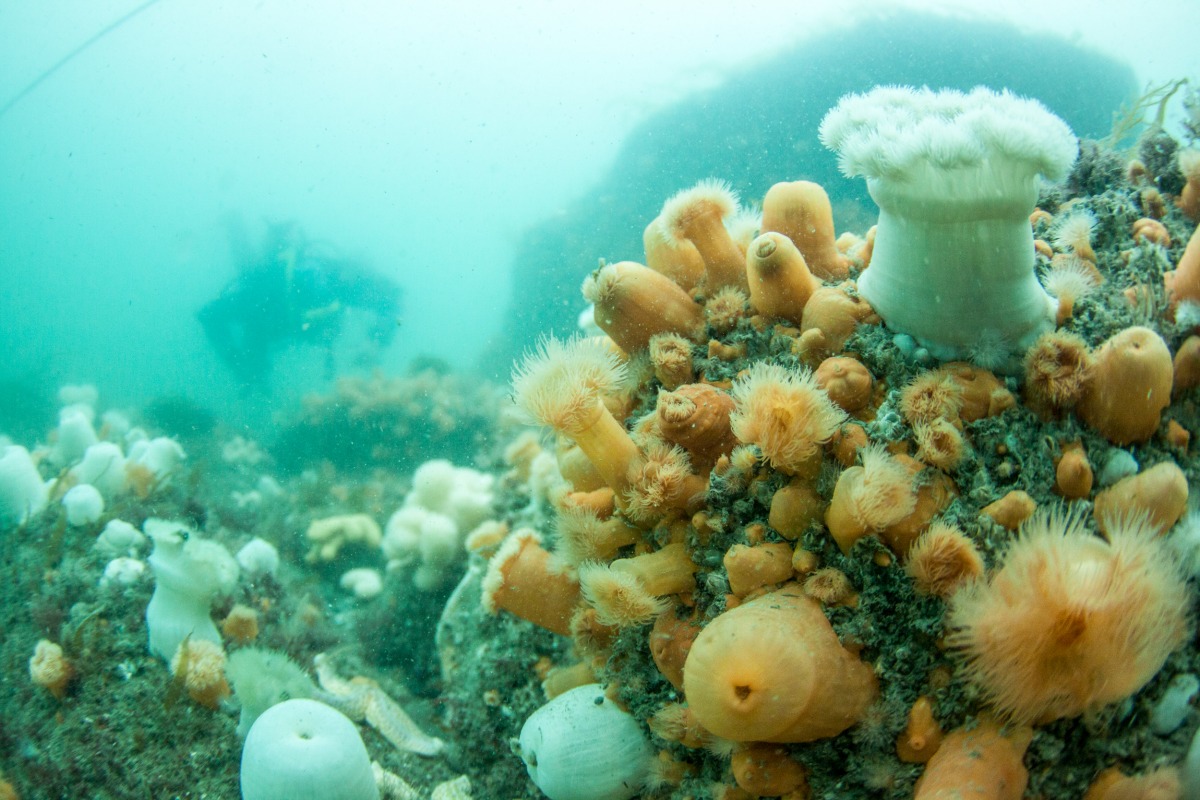
    The rocky outpost of Dalkey Island, jutting proudly out of the sandy sea bed, offers the best of the boat dive sites in Dublin Bay, with an incredible ecosystem flourishing just a stone’s throw from the capital.

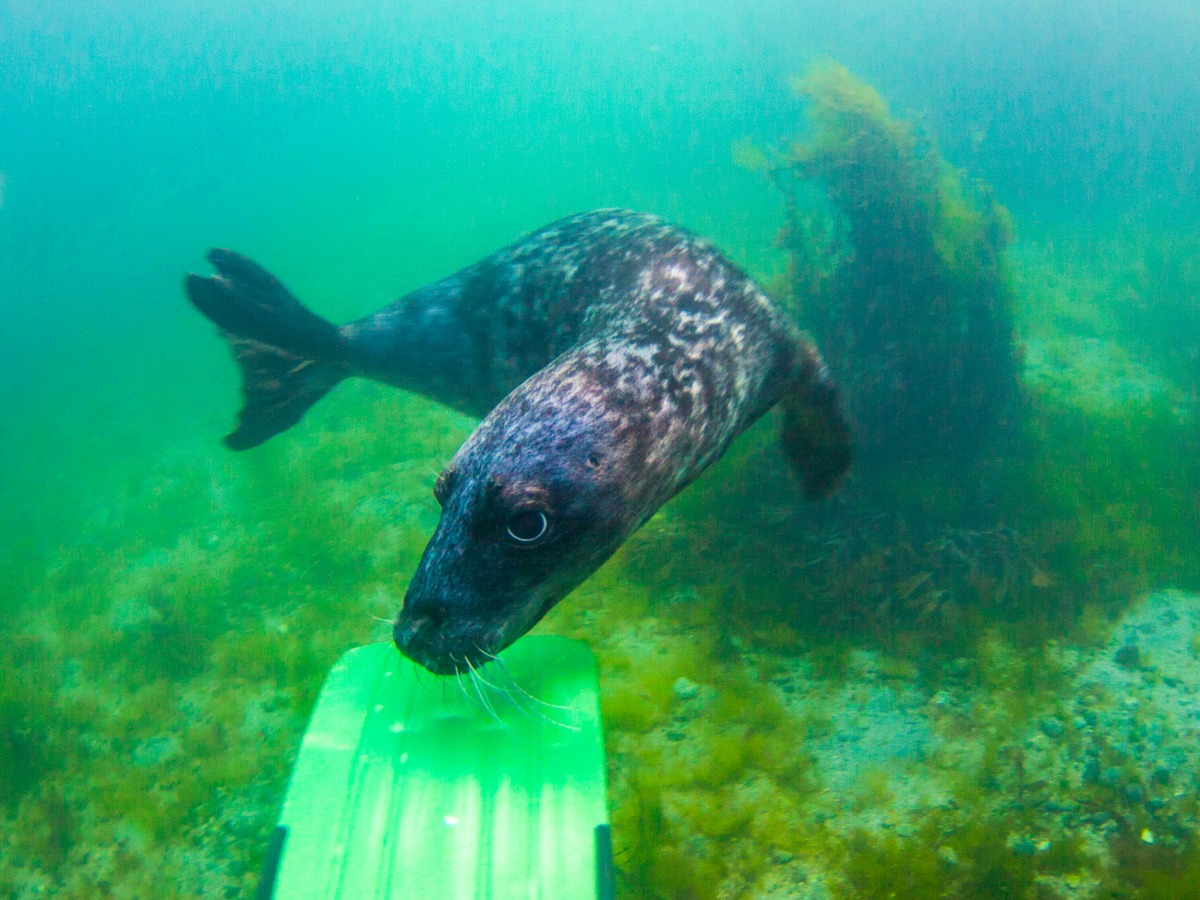
    Watched over by a thriving seal colony along the surrounding coastline, Dalkey Island offers a thriving marine environment, which is fed by rushing tidal flows as the waters empty from Dublin Bay and are funnelled through the two sounds between the island and the mainland.

    This incredible wilderness is close to the heart of the city, but alas so few take the opportunity to visit it either above water or below. Yet DART services run every few minutes from the centre of the city out to Dalkey (a less than 30 minute ride), from where a ferry leaves for the unspoilt Island.

    The Bills Rocks off Galway.

    Dead Zones

    As indicated, a few natural factors deny Dublin Bay the crystal clear water that divers can find along most of the west coast. This sand and silt in Dublin Bay is easily stirred up by wind so visibility can drop from ten meters to under a meter in the space of a few hours. Moreover, as you move along the coast from the north to south numerous large rivers carry silt into the low depths of the Irish Sea, with the same process occurring along the Welsh coastline; the distance between Dublin and the island of Anglesey, where the port of Holyhead is located is barely a hundred kilometres.

    Killary Fjord, Galway.

    Looking to the future for Dublin Bay, the biggest concern is that what has happened in the Baltic Sea will be replicated on the Irish Sea, including Dublin Bay.

    Dead zones form when an excessive level of nutrients, primarily nitrogen and phosphorus, enter coastal waters and fertilize algal blooms. When these algae die and float to the bottom, they provide a rich energy source for bacteria, which in the act of decomposition absorb oxygen from surrounding waters.

    The Irish Sea has already numerous dead zones recorded around river estuaries, especially from the large rivers in the south east. The worry now is that these will expand and overwhelm more of the Irish Sea’s thriving wildlife.

    Over the last forty years the Baltic Sea has transitioned into a near holistic dead zone, as divers watched on in horror, and the relevant authorities in different countries failed to act.

    Killary Fjord, Galway.

    A similar fate is not inconceivable for the Irish Sea, if sufficient care is not taken of this precious resource. Although we have the advantage over the Baltic Sea of an opening onto the wild Atlantic on either end – allowing a flushing effect from the tide – what we do above ground will ultimately makes its way into the Irish Sea

    Decisions made by our farming, construction and logging industries, along with our waste water handling, will decide whether we preserve this unique ecosystem – the last remaining great stretch of wilderness on our doorstep.

    Conservation will also requires the same level of commitment from our near neighbour across the water, as we share a guardianship of this body of water, and the decisions we make in Ireland will be insufficient.

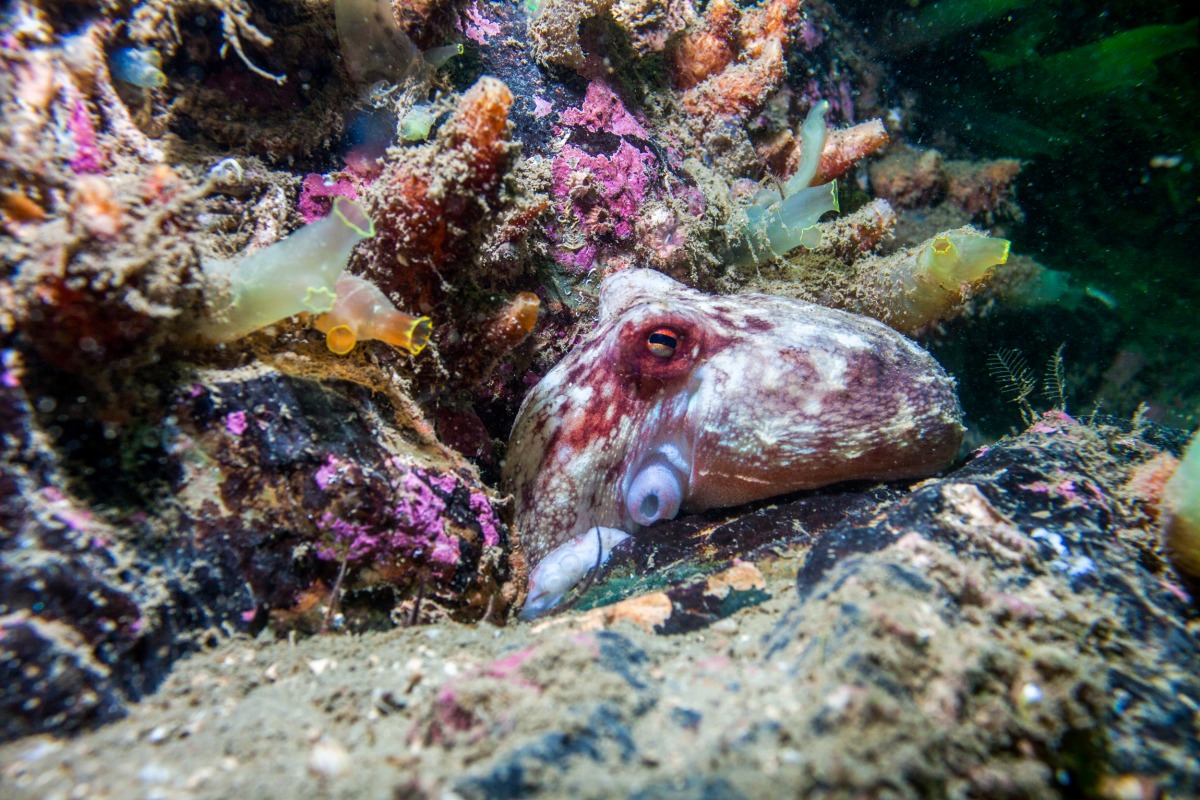
    All Photographs are taken by Daniel Mc Auley from Dublin Bay, Donegal and Co Clare.

  • Lebanon’s Rotten Leadership Seems Irreplaceable

    As Lebanon marked the centenary of its creation last week, it was not state-orchestrated ceremonies or mass demonstrations that marked the occasion, but rather the media circus surrounding the visit of French President Emmanuel Macron.

    Macron’s visit came with Lebanon mired in an unprecedented crisis that has plunged to new depths following last month’s devastating explosion at Beirut’s port, caused by 2,750 tons of the chemical compound ammonium nitrate.

    The impact of the explosion is hard to understate. Its sound and force stretched for miles, releasing a huge mushroom cloud that killed close to two hundred people, and scarred thousands both physically and mentally; destroyed countless homes, and leaving once vibrant streets desolate. The immediate aftermath was dystopian: “It was like a movie. People moving slowly, covered in blood, glass shattered everywhere. Leaving a whole city riddled with PTSD,” recalled one witness.

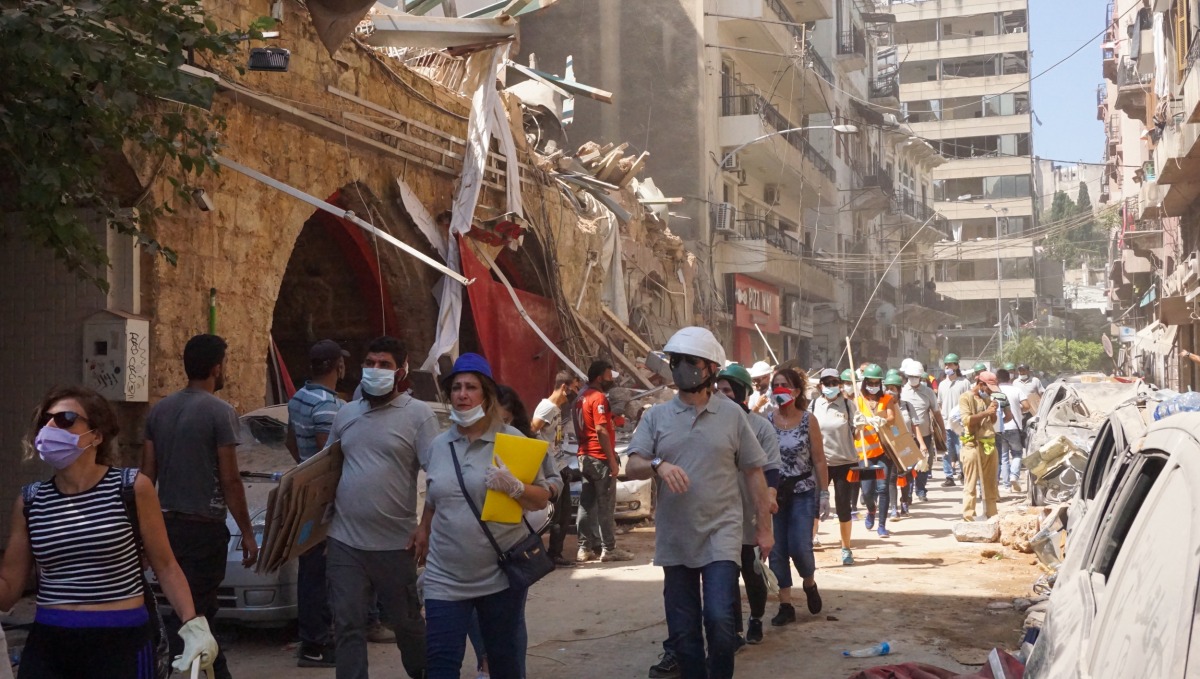
    To many the sheer negligence of allowing such a dangerous chemical to sit in a warehouse for six years demonstrated the extent of state authorities’ incompetence. In contrast, Lebanese civil society rose to the challenge, with community clean-up teams, armed with sweeping brushes and hard-hats, appearing across the city following the blast.

    Volunteer groups walk through a damaged street in the Gemmayzeh area two days following the Aug. 4 explosion. (Luke FitzHerbert)

    The explosion also shined light on the state’s glaring absence from such efforts. State authorities, led by the army, were derided for their perceived failure to provide leadership in the aftermath of such devastation. “State, what state?” many were asking.

    Indeed, the army only tended to draw attention to themselves by obstructing non-state efforts; such as holding up a Dutch rescue mission’s access to the port for hours. Moreover, a published army circular demanded non-existent documentation from volunteer groups working on the ground, prompting objections from UN officials.

    People have been complaining bitterly about soldiers idly standing by, while private citizens roll up their sleeves, and the erection of seemingly pointless checkpoints that only interfered with volunteers trying to move between damaged areas.

    Political leaders have also been vilified, verbally abused or even assaulted. When the former education minister tried to join cleanup efforts, he was chased away by angry residents. Another minister was harangued by a large crowd throwing water at her. A third had his convoy attacked.

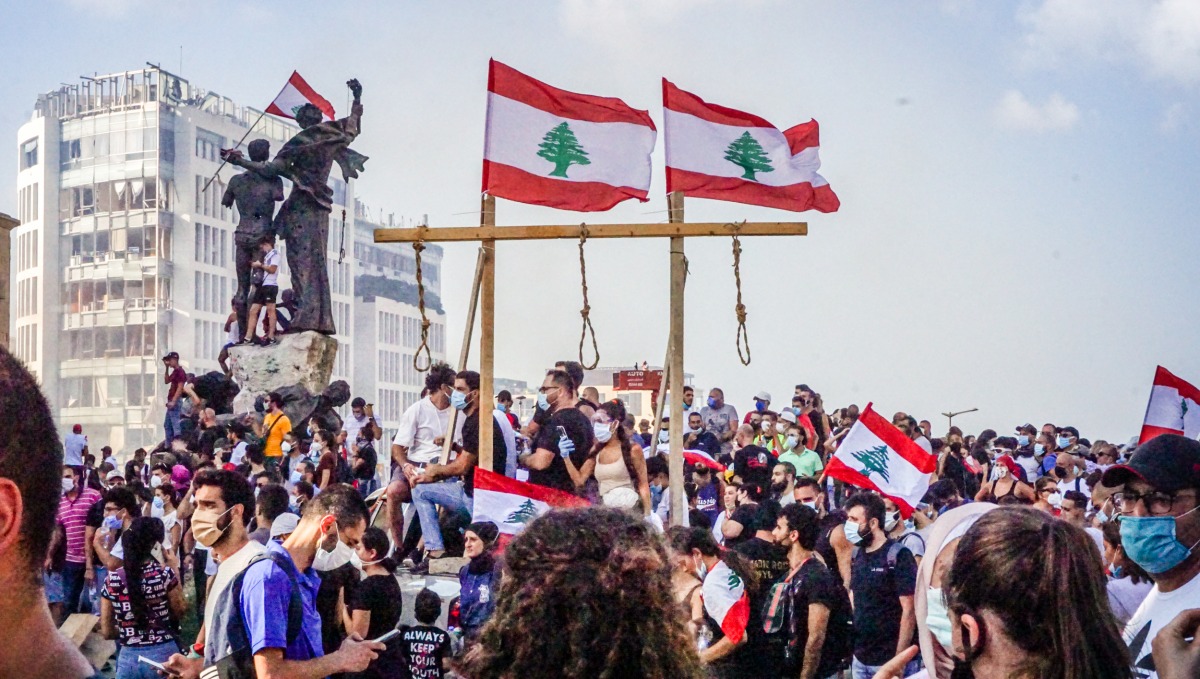
    Speaking ahead of protests on the Saturday, four days after the explosion, one activist told me he anticipated violence, as “the reaction to terror and murder. We were bombed by our own government.” In downtown Beirut, protesters’ rhetoric against political leaders took on a darker tone, with banners reading “The verdict has been issued. You are all murderers. Hang the nooses,” in the main square.

    Nooses are seen in Beirut’s Martyr’s Square, as protesters gather demanding leaders be held accountable following the Aug.4 explosion, 8th August, 2020. (Luke FitzHerbert)

    Perhaps in normal times, it would be an overreaction to denounce one’s leaders as murderers. But Lebanon is not going through normal times. The anger on the street generated by the explosion was layered with the raw emotional trauma the affair has induced, and also showed the pent-up rage that has built up against the governing elite.

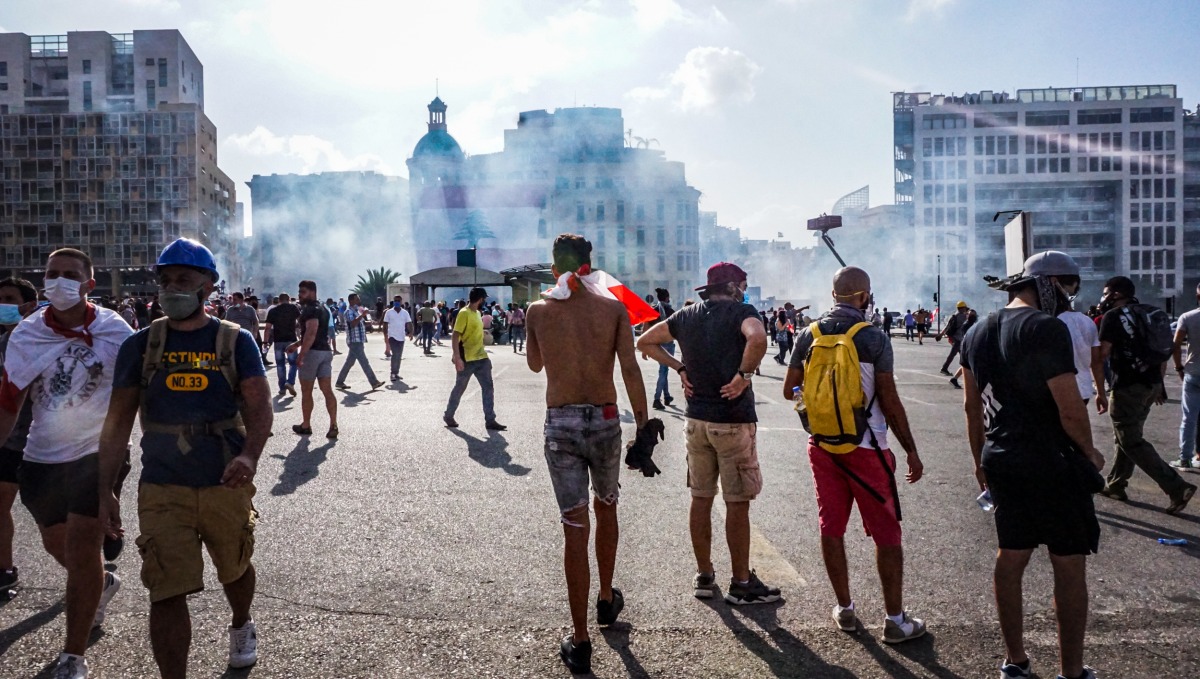
    On Saturday August 8th, central Beirut descended into chaos, with running street battles developing between protesters and security forces. By mid- afternoon, a large area of central Beirut had become clouded in tear-gas, as rubber bullets flew through the air, and buildings caught fire; with protesters storming and ransacking state-affiliated buildings, while a number of government ministries were occupied, and hundreds of people were injured over the course of the day.

    But despite these highly anticipated protests, public demonstrations have failed to replicate the mass movement of last October, where huge and largely peaceful crowds managed to topple the then government. Instead of attracting huge numbers as happened then, recent gatherings have tended to quickly disintegrate into general mayhem.

    Almost a year on from the thawra (revolution) last October, civil unrest no longer generates the same energetic response. Tear gas and confrontation with police are now predictable outcomes, and almost mundane occurrences. “I’m so over this,” said my colleague, as we sat watching protests from the office.

    Protesters in Martyr’s Square as tear gas rises in the distance from running battles with security forces, Aug. 8, 2020 (Luke FitzHerbert)

    Even the resignation of the government, announced live on TV while protesters occupied government buildings didn’t seem like a victory. “It means nothing. He was just a puppet,” said one demonstrator moments after the announcement. Instead of being seen as a step forward in the direction of acquiescing to popular demands, the government’s resignation only showed that real control belongs to the sectarian power-brokers, in whose string-pulling hands lie the power to appoint a new government of their choosing.

    Having reached this impasse, Lebanon’s thawra activists do not know which way to turn, having been unable to overturn the sectarian power-sharing system that the previous government was merely the public face of. As one activist put it: “we are locked in a dark room and can’t find the key to get out.”

    Instead it is Emmanuel Macron who has set the agenda. He visited Beirut two days after the explosion, lapping up the despairing crowd’s demands for change and promising a new political pact for Lebanon. Since that visit, he has returned a second time, organized an international emergency aid conference for Lebanon, with another set for next month, and has promised a third visit in December.

    Anticipation of these dates reflect how Lebanon’s political trajectory is now being set by foreign powers, and not through an internal struggle between reformists and representatives of the status quo. “They have seized the debate,” explained a Lebanese academic of the international response, “as being for or against the Macron plan.”

    That plan is very similar to previous ones: requiring the state to undertake robust structural reforms against corruption and mismanagement that will release the promised billions of dollars in international assistance.

    Lebanon’s sectarian power brokers have already put in place a new Prime Minister, Mustapha Adib, a little-known former ambassador to Germany. At a dinner hosted by Macron at France’s stately embassy in Beirut last week, the power brokers promised there a government would be formed in two weeks. Macron left, saying this was Lebanon’s last chance. The next six weeks are thus critical.

    But despite Macron’s public expressions of compassion and solidarity with Lebanon, there are many disinclined to swallow it. When French jets flew over Beirut last week, spraying the sky with the colours of the national flag, many rejected the gesture, instead remarking on how unwelcome the sound of roaring jets was to a traumatised city.

    Nor are Macron’s efforts solely motivated by France’s long-held ties to Lebanon. Macron is engaged in a battle for influence against Turkey in the East Mediterranean, linked to energy exploration. The power play stretches from Libya to Greece and Cyprus, with Lebanon the latest territory to get involved. Turkey’s soft power in Lebanon is quietly growing, with Turkish President Raycip Tayyep Erdogan’s Sunni Islam credentials holding appeal in the country’s north.

    With the prospect looming of an IMF deal opening Lebanon up to more foreign investment and the expansionist tendencies of regional powers Turkey and Iran, Macron’s manoeuvres can be interpreted as pre-emptive step to prevent other powers from exploiting Lebanon’s difficulties.

    While foreign states eye the spoils, many ordinary Lebanese have given up on their country progressing altogether. The explosion has accelerated a brain-drain that was already well under way. The country’s economic collapse and political paralysis point to a grim future, holding no appeal to Lebanon’s dynamic and ambitious youth.

    A Beirut research group, Information International claims there has been a 36% increase in the daily number of people departing the country since the explosion. As one local who plans to leave put it: “It’s time to leave and not look back. I used to be filled with romantic thoughts about Beirut  whenever I considered leaving. But these died with the explosion.”

    It will take Beirut at least a year to recover from the explosion. In the meantime it remains to be seen whether French-led efforts  will have any success in forcing the regime to change its ways. Previous efforts have ended in failure, with Lebanon’s leaders building a reputation for grand declarations leading to nothing new.

    Political leaders now openly talk about changing the system; about creating a truly civil society and ending corruption. But while the rhetoric reflects local and international demands, the old guard shows no sign of departing the stage. This is despite unprecedented calls by many – who consider them a collection of thieves, criminals, former warlords, liars, gangsters, or murderers – to stand aside at last. Hatred of the power brokers has reached endemic proportions, but the means of removing them is not obvious.

    All photography by Luke FitzHerbert for Cassandra Voices.

    Help us maintain our international coverage with a donation via Patreon.

  • Michael McNamara: “It’s About Society”

    In an impassioned speech at the ghostly Convention Centre currently housing Dáil Éireann, Michael McNamara TD denounced as ‘draconian’ the Criminal Justice (Enforcement Powers) (Covid-19) Bill 2020. This will permit Gardaí to inspect premises and close them down temporarily where a breach in compliance has been observed.

    The Clare representative chairs the Dáil’s Special Committee on Covid-19 Response, where he has grilled, among others, the Minister for Health, Stephen Donnelly, and the acting Chief Medical Office Ronan Glynn; he also brought in expert advice including Professor Carl Heneghan, Director of the Centre for Evidence-Based Medicine at Oxford University, on the contentious issue of masks.

    Looking beyond the Bill itself, McNamara pointed to the wider ramifications of suppression policies on Irish society – in particular to their effect on communities in rural Ireland:

    He began:

    The purpose of this is to introduce what everybody more or less accepts is draconian legislation. I notice that the Minister says that it would be impracticable to have to bring in new legislation as this is a global pandemic, but her own party leader, the Tanaiste, has pointed out that Ireland is essentially out of kilter with every other European state.

    My question would be: how is the pandemic different in Ireland to every other country? It’s only different insofar as we have been more draconian in our restrictions and frankly those restrictions have failed, because at the end of it all our detection figures are the same as they are in Sweden. Now I am not saying that Sweden was the perfect model, but I am pointing out that there were no closures of bars in Sweden, there was no lockdown in Sweden; there are no closures of bars in fact in any other country in Europe; but we have had these really draconian measures and they have manifestly failed, or else the figures being provided by NPHET on a daily basis are incorrect and I don’t for a moment believe that the figures being provided by NPHET on a daily basis are incorrect. I believe that they are correct and I believe that our figures are higher than in other countries because the strategy we have pursued is failing, has failed and is failing, and I don’t say that with any joy. It’s quite sad given the sacrifices people have made in good faith. They cancelled foreign holidays. They were told that foreign holidays are the great evil, must be avoided, yet countries where they didn’t do that are not having the same infection figures are we are.

    So we have these really draconian restrictions which have served no apparent purpose, because our transmission figures are higher than in other European countries. Of course we have failed to deal with the real clusters in Direct Provision Centres – I understand there was a discussion of that in NPHET but it was advised by senior figures in NPHET that you can’t raise that because it would be politically sensitive – so we won’t look at the Direct Provision Centres. We won’t look at the meat plants because they keep the show rolling here. God knows what they finance, but they clearly finance something, otherwise they wouldn’t have been left do their own thing when bars were being hammered.

    So we are all agreed. Even the bars seemed to have bought into this policy of the beatings will continue until morale improves, which is effectively what this piece of legislation is about. We’ll introduce more and more draconian legislation. Make it harder and harder and harder.

    The Gards. The AGSI have expressed reservations about it. Ordinary rank and file Gardai across the state don’t want it. They have said it is going to bring An Garda Siochana into disrepute. They have a job to do and it is not to focus exclusively on bars as the government want them to do, because we have to scapegoat somebody for the failure of government policy. So we’re going to bring it in, but we are going to have provision where it’ll be rolled over.

    Does anybody in this house really believe that it won’t be rolled over after November? Do they? Minister do you believe in reply to this that this won’t be rolled over, that you won’t be putting down an amendment in a few weeks time to roll it over? Because I know it is going to be rolled over, because that is the nature of giving over powers to organisations. It’s the nature of bringing in draconian legislation with sunset clauses that aren’t really sunset clauses. They stay on the books forever.

    We had a long debate it wasn’t in this house, it was in a different house, I did say I think before this house rose that it sets a terrible example that we are all sitting here 1-2-3, oh about twenty of us, at what cost? And we are asking teachers to go back into schools – and thankfully they are going back, and it’s a huge credit to this government – and in particular to teachers, boards of management and parents across the country that we have got our schools open again, but this is not an example to set to anybody. So that’s why I don’t think we should say we are going to roll over this legislation because it is unnecessary. The only possible basis for it is: if we can only swallow this one more piece of medicine we’ll open the bars.

    This isn’t about bars – or to me this isn’t just about bars – it’s about society; it’s about rural Ireland, which is dying on its feet. You know young people can’t meet anywhere. They can’t meet in bars, they can’t meet in nightclubs, they can’t meet in weddings. They can’t even go to matches. So where will they meet? Well of course they will meet where we don’t think they should meet because they are social animals.

    We are all social animals. We need to meet. We need a sense of community. And as a colleague who I recently spoke to – who is from Kerry as it happens – he said you know – he lives in Dublin – “God I really hadn’t realised, I went down to Kerry for the first time because of Covid etc, I went down to Kerry for the first time in months and month and I just couldn’t believe the sense of isolation, desolation and desperation that is there.”

    Because we are destroying communities: we are destroying a sense of community; we are destroying a sense of society, and with that we are doing untold damage to people’s health; to people’s mental health; to people’s sense of wellbeing; to people’s sense of optimism. And it has to end. It has to come to an end at some point. And the logical point for it to come to an end is when the powers given to the Minister for Health in the Emergency legislation which I voted for, don’t regret voting for – I think it has been slightly abused mind you – I expected it might be slightly abused, I wasn’t, unfortunately, disappointed in that regard. But I know that the Minister for Health is going to put down a motion carrying on these powers because that is what government departments do: they never relinquish power, and I know the Minister for Justice is going to seek to roll over this legislation and I don’t believe that we can continue to roll over draconian legislation which is having.

    I am not a Covid denier, it is a very serious virus, it has killed people in this country, it will kill more people in this country, everybody needs to be careful, they need to be cautious but at some point we as legislators in this House will have to trust people and say to them: be responsible, for God’s sake look after yourself; look after your family members; look after those with whom you come in contact with, but we can’t continue to do that through coercive criminal legislation. Not without destroying society. Not without destroying individuals. It cannot continue indefinitely.

    So on that basis, I urge the Minister to put a proper sunset clause in place. A date after which these powers will not continue, especially given that any closure order made cannot be challenged. And Minister you said … you fudged it about how you challenge if a pub is closed for a day. And I said earlier this is a lot more than about pubs, but it is also about pubs.

    How do you challenge? You challenge it by way of judicial review. Are you seriously telling me that the 6,000 or so publicans that are shut down, that are on their knees, that are now having their payment reduced, some of them, that they are going to take a judicial review, that they are going to hire a solicitor and a junior council and a senior council and go to the High Court and pay the tens of thousands of euros necessary to challenge their closure for a day?

    Of course they are not. But then that closure for a day is going to be used against them when they go to seek to renew their licence. So these are draconian powers. These powers are having an effect on people, and they have to come to an end at some point.

  • Musician of the Month: Gemma Dunleavy


    Singin’ Songs and Stories


    My name is Gemma Dunleavy and I’m a yapper. I’d talk the handle off a cup. I also write and play music. I see myself as a storyteller first, then a musician. It’s where I feel my true gift is, my natural comfort is in meandering through my memories, picking out the best details to paint the clearest picture in the heads of those listening.

    I’m from Sheriff Street in Dublin 1. My whole family grew up there and I still live there now. Like any inner city community there’s the good and the bad. The flats had problems with drugs and crime being rampant during the ‘90s. The heroin epidemic tore through the area and claimed the lives of many young, unemployed, and vulnerable people that were left to rot by the system. The skeletons of that epidemic still haunt us today. There were many effects of this: lives were lost, families destroyed, crime in the area rose, and the resulting social stigma from outside the community. The most important side effect was something different: resilience. People had nothing else but each other, no other options but to push through and that’s what we did and continue to do up to this day. Our community is rich in spirit, hope, and support. We have some of the best talent: athletes (boxer Pierce O’Leary), writers and artists (see ADUANTES by poet Michelle Byrne and painter Tara Kearns – playwright Sean O’Casey lived here too), and a string of musicians and directors hailing from our area (Luke Kelly and others). I’m extremely proud of where I’m from and my desire to preserve our community and protect it from aggressive redevelopment will never diminish.

    I learned the value of a good story from a young age – I grew up in between my two nannies and their friends talking around the sitting room table. They would talk about living in the tenements and their memories there, describe the poor conditions and tragedies with a smile on their faces, and a gleam in their eyes, as if they were chatting about green meadows and clear skies. They spoke with such fondness you could almost feel the warmth from their bodies. They were proud women with strong roots and they made me proud to be from Sheriff Street. I loved their sense of togetherness, the laughs, and the community. Growing up with them meant growing up in a community, being raised by a community of people – something that’s not so common anymore. Through telling my own story I saw parallels between myself and them, finding comforts in things that from the outside might sound jarring. I had an aha! moment where in some strange way I was in my own version of their tenements. Their voices saying “We had nothing but we had it all” made sense.

    I delved into my memories to tell five of the most important stories I had. Each story was from a different perspective based on a stereotype I grew up around. I dressed each one in chords and melody – and I had the help of the gritty voices that shaped my childhood. I tied it all together under the name of Up De Flats. For the concept I created five characters based on friends, family, neighbours, and myself. I would step into each of these characters and tell their story for each song. Before any of this became music, I gave each character a name and I’m going to take a moment to introduce you to these characters whose names haven’t yet stepped outside of my head (until now): 

    Chantelle is a seventeen-year-old from Sheriff Street. She goes out with Dayo, a fella who is a couple years her senior. He’s mysterious. People never quite know what he’s up to exactly but it’s probably not good. He’s not shy of a police chase, but he never gets caught. Chantelle knows his moves but he protects and respects her and their nights cruising down the Boundary Wall in the car where they can forget about everyone else are enough to show her he’s for her only. The boys on the street respect him and all the girls fancy him – he has street cred, making him feel all the more desirable to Chantelle. Edel is a desperate mother whose son has fallen victim to the heroin epidemic. “He’ll never change, but I made him this way” she wails as she describes him as a beautiful setting sun while watching him fade away from the devastating effects of drugs.

    Paulie is a young man who’s grown up in the flats with his single mother and six siblings. Being the eldest, he was often left to raise his siblings as alcoholism took over his mother after his father’s death by suicide. He spent his later teenage years in detention centres and has only ever earned money through drugs and robberies. Now out of prison, his past means he will always be looking over his shoulder – but he will never let anyone in because in his eyes, the pain he has suffered is enough of a weapon to wipe anyone out. And if it was necessary that’s what he would do. He has a stern look – no one would dare cross him – but he would die for his siblings, and grandmother whose voice he hears at night when he’s alone and scared telling him, “It’s alright, son. I’m here”.

    Kelly is a young single mother tired of the cyclical patterns of working class life. Her three kids, and the housing crisis, make it hard for her to ever get on her feet. She longs to be able to escape to a better life but is locked in the social welfare system. When times get hard she’s plagued by memories of her brother’s face who she lost to suicide. With pride as high as the sky, she’ll never let anyone know how she’s feeling, coming off as a fun-loving, strong mother who sometimes gets tired, but never gets low.

    The last story is a love letter to my community and the only one that is fully from my own perspective. I was a young girl who had to move away to pursue her career and in doing that I realised that everything that people search all over the world for had always been on my doorstep: a sense of purpose. I reminisced about the soundtrack of the summer getting played by the police sirens and the blue lights flashing through my window at night being something that calmed me down.

    Making this release was a tough – yet cathartic – journey to go on, down the dark and dreary, soft and warm lanes of my memory. At times it was hard, revisiting certain memories, but I felt privileged to finally understand and be able to articulate my frustration at the classist discrimination and prejudice that effects working class areas in Dublin. There was a fire burning inside me to give a voice to the other side of the traits these stereotypes were often demonised for. Behind the anger, the frustration, the addiction, and the crime was a common denominator: pain. I wanted to give a voice to that pain to show all our flaws and beauty, vulnerability, and rawness. I wanted to strip back all our layers because I know no hearts like the hearts I’ve grown up around in my community. I wanted to reveal our characters in a space where we weren’t going to be demonised.

    I had no idea when I began shaping these stories that they would become my debut EP, but four months later, the stories have been listened to thousands of times, falling on many different ears. Something I’m so, so grateful for. For years, the media and authorities slandered us and we had no voice. But now, people are finally listening.


    For more about Gemma’s work see:

    Bandcamp: http://gemmadunleavy.bandcamp.com/album/up-de-flats

    Facebook: https://www.facebook.com/gemmadunleavymusic/

    Instagram: https://www.instagram.com/gemmadunleavy_/?hl=en

    Twitter: https://twitter.com/gemmadunleavy1

    Spotify:


  • WARNING: The (Open) Secret lives of Content Moderators

    Tick Yes or No: ‘I understand the content I will be reviewing may be disturbing. It is possible that reviewing such content may impact my mental health, and it could even lead to post-traumatic stress disorder (PTSD).’[i]

    Last year, a sixteen-year-old Malay girl posted a poll on Instagram asking her followers whether she should live or die.[ii] 69% voted for death and she took her own life. The followers who voted that she should die neither took action to protect their ‘friend’ nor shared empathy or concern.

    People are awful.[iii] This is what my job has taught me”, says a former Facebook content-moderator who recently sued the social media giant after experiencing psychological trauma as a direct consequence of his work. The Wall Street Journal recently described content moderator as ‘the worst job in the US[iv] , and the same applies to other countries, which this article elaborates on.

    Very little is known about the role, mental health toll or other work experiences of content moderators. They may work for YouTube, Facebook, Google and other such platforms that we are all pretty much ‘addicted’ to.

    A few studies are now looking into the working conditions for people[v] who determine what ‘material’ or ‘content’ can be posted to Facebook or Twitter or YouTube. Their job is to decide on whether content adheres to the ‘community guidelines’ of online platforms. They work day and night so that we the users are saved from exposure to videos of graphic violence or child abuse as well as hate speech, among the constant stream of user generated material uploaded on to social media feeds.

    There are thousands of content moderators, who are paid to view objectionable posts and decide which need to be removed from digital platforms. Many are severely traumatized by the images of hate, abuse and violence they see on a daily basis so that we, our families and children get to see ‘WARNING: The following post or content may be disturbing to some viewers.’

    The heavy mental health toll on content moderators who are hired on a ‘freelance’ or ‘gig’ basis cannot be underestimated.

    Never-ending Uploads and Ever-Expanding Platforms

    A staggering three hundred hours of video content is uploaded on to YouTube every minute, while over ninety-five million photos[vi] are uploaded to Instagram each day, along with over five hundred million tweets sent out on Twitter (or 6,000 tweets per second). Therefore, it is virtually impossible for human moderators to vet every piece before a content is uploaded and goes live (with some potentially going ‘viral’). Popular platforms such as these serve user-generated content uploaded by a global community of contributors.

    The uploaded content is just as diverse as the user base, meaning inevitably that a significant amount is offensive to most users and, by extension, the platforms. Users routinely upload (or attempt to upload) content such as: child abuse, animal torture, and disturbing, hate-filled messages.

    Facebook outsources the hiring of content moderators and provides office space. Its sites are largely outside the United States – mainly in south, south-east and east Asia, but the operations have expanded to the US, more specifically in California, Arizona, Texas and Florida.[vii] Content moderators work at a computer workstation where they review content –  a steady stream of text posts, images and videos. These can range from random personal musings to information with ramifications for international politics. Some of it may seem rather benign – just words on a screen that someone didn’t like. While the worst may be incredibly disturbing. On a regular basis moderators have to witness beheadings, murders, animal abuse, and child exploitation. Therefore, one might wonder, what toll on mental health does this take?

    One previously unreported aspect of a moderator’w job is the numerical quotas that these subcontractors[viii] are forced to meet: each moderator is required to screen thousands of images or videos per day in order to maintain their employment.

    Facebook alone has an army of about 15,000 people in 20 locations[ix] around the world, who decide what content should be allowed to stay on Facebook, and what should be marked as ‘disturbing’, whether execution videos from terrorist groups, murders, beatings, child exploitation or the torture of animals. In addition to the stress of exposure to disturbing images and videos, there is also the pressure to make the right call about what how to mark the content. A wrong decision taken under stress will have penalties, financially for the worker, and also may have mental health effects on other human lives.

    Platforms, as we know them, reserve the right to police user-generated content through a clause in their Terms of Service (which none of us read, or do we? Should we?), usually by incorporating their Community Guidelines as a reference. For example, YouTube’s Community Guidelines prohibit  ‘nudity or sexual content’, ‘harmful or dangerous content’, ‘hateful content’, ‘violent or graphic content’, ‘harassment and cyberbullying’, ‘spam, misleading metadata’, ‘scams’, ‘threats’ videos that would violate someone else’s copyright, ‘impersonation’ and ‘child endangerment.’

    ‘Now you see me’

    The Cleaners, a recent documentary, features interviews with several former moderators who were previously outsourced by a subcontractor in the Philippines. The interviewees exposed their experiences of filtering the very worst images and video the internet has to offer. In the Philippines, workers operate out of jam-packed malls, where they spend over nine hours a day moderating content for as little as $480 a month.[x] With few workday breaks and no access to counselling, many of these individuals end up suffering from insomnia, depression and post-traumatic stress disorder.

    Records also show the average pay of a full-time online content moderator in the US is around $28,000, but globally and by a large measure a significant amount of hiring is done through outsourcing and on a temporary basis. In Ireland, research shows that typically a Facebook employee would be paid a basic rate of €12.98 per hour,[xi] with a 25% bonus after 8pm, plus a travel allowance of €12 per night – the equivalent of about €25,000 to €32,000 per year. Yet the average Facebook employee in Ireland earned €154,000 in 2017.

    On average, the workload involves moderating about 300 to 400 pieces of content[xii]  – called ‘tickets’ – on an average night. On a busy night, their queue might have 800 to 1,000 tickets. The average handling time is 20 to 30 seconds – longer if it’s a particularly difficult decision.

    ‘We are trash to them, just a body in a seat’ shares a content moderator. Every work minute is strictly bound.[xiii]  Harsh working conditions characterised by specified bathroom breaks and a meagre nine minutes of wellness time engenders a stress that is exacerbated by employers’ downplaying the importance of mental health care.

    The continuum of content in those quotas range from tone-deaf jokes; kids dressed up as history’s great dictators that may constitute hate speech; nude images; domestic violence images, and then the really graphic and inhumane ones that inevitably surface. The content moderators have about twenty-four hours[xiv] within which they have to classify the posts under bullying, hate speech, and other content as appropriate.

    Like other forms of gig workers, digital reputation or future work orders come from high ratings. Several former moderators felt pressurised to achieve a 98% quality rating. This would mean that the auditor would agree with 98% of their decisions taken on a random sample of tickets. Moderators are therefore scrutinised for the smallest mistakes. An unending stream of extremism, violence, child sexual abuse imagery and revenge porn, does not give moderators time to consider the more subtle implications of particular posts.

    Artificial Intelligence (AI) cannot nail this one… just yet!

    Moderators are human beings, so mistakes are inevitable. However, to shatter one misconception on this front: Artificial Intelligence (AI) cannot help much in this field. They currently act as triage systems; for example, by pushing suspect content to human moderators and weeding out some unwanted material on their own. But AI cannot solve the online content moderation problem without human help. For example, AI uses either a visual recognition to identify a broad category of objectionable content or match content to an index of banned items (for example, illicit materials, child abuse, terrorist content, etc.) – and then it allocates a ‘hash’ or an ID so that if these are detected again, the uploading process will be disabled. But then guess who will need to set the parameters before the automation can work!?

    Automated systems using AI and machine learning still have a long way to go before they can carry out content moderation independently (free of human help that is). We are surely not there yet.

    Content moderation is arguably one of the most important tasks that BPOs perform today, fulfilling outsourced contracts for social media giants ranging from Facebook and TikTok to Live, among many others. This has led to a process-driven BPO[xv] industry that has become the refuge for quick-fix content moderation based on subjective criteria. Add to that how many of the mods are often young people (their average age is less than thirty), who sometimes join even before finishing college degrees, and the problems begin to add up.

    The Need for (Content Upload) Speed and…Training!

    One might have assumed that US companies who hire moderators would have a good understanding of these issues, but it turns out that they really don’t. It has been reported for instance that Facebook doesn’t provide ongoing cultural education for these moderators to bring them up to speed. The one exception is when a particular issue goes viral on Facebook, and there’s a sudden need to bring everybody up to speed in real time. With this laissez faire approach it is unsurprising how many Court, Senate and Congressional hearings Mark Zuckerberg has had to attend over the past four years (and not just for the Cambridge Analytica scandal).

    One former moderator shared how he witnessed images of child sexual abuse[xvi] and bestiality with me while weeding out content that was unsuitable for the platform. He suffered from psychological trauma as a result of these working conditions and a lack of proper training.

    Accenture is one of the companies that hires contract workers to review content for big networks like Google, Facebook, and Twitter. There is a well-documented history of content moderators reviewing[xvii] including graphic and disturbing imagery – with jobs taking significant mental health tolls, and leading to psychological trauma.

    In order to share more of what goes on during content moderation, the freelancers have to break the nondisclosure agreements first, and this is an area where there is journalistic investigations and research work pending. One of the burning questions is whether the company has anything to say about the psychological and emotional impact of watching the brutality, pornography, and hate that the moderators have to look at on a daily basis?

    Some Debt Cannot be Repaid

    Facebook has already paid out a $52 million settlement to content moderators suffering from mental health problems such as Post Traumatic Stress Disorder (PTSD).[xviii] In light of repeated allegations and the seriousness of the situation, the company has agreed to compensate American content moderators and provide extra counselling during their tenure. The social media giant will pay a minimum of $1,000 to each moderator.[xix]  The settlement covers 11,250 moderators which is a glimpse at the colossal number (in hundreds of thousands) of moderators involved in this work globally.

    “I know it’s not normal, but now everything is normalized[xx],” said a moderator who declined to share his name and other details because of the confidentiality clause he signed when he took the job. Non-disclosure agreements are non-negotiable for moderators, and are forcibly imposed by the platforms. For example, YouTube content moderators are reportedly being told they could be fired if they don’t sign ‘voluntary’ statements acknowledging their jobs could give them PTSD (i.e. post-traumatic stress disorder).

    Reports also shows that Accenture managers repeatedly coerced site counsellors to break patient confidentiality.[xxi] Although these allegations were refuted by Accenture, such fault lines between workers and management are bound to affect organisational morale.

    Further studies are elusive on whether companies such as Accenture are shifting the responsibility of mental health care onto individual employees, and thus avoiding liability in the face of increasing lawsuits from dormer moderators. In response to growing allegations, certain social media giants have reinstated their commitment towards safeguarding their employees’ mental health and have clinical psychologists on call.

    The Valley of Uploads

    While some of the specifics remain intentionally obfuscated, content moderation is done by tens of thousands of online content moderators, mostly employed by subcontractors in India and the Philippines, who are paid wages well below what the average Silicon Valley tech employee earns. We need more studies and investigations on this as time progresses, as our hunger for newer ‘tailor-made’ media feeds continues to grow.

    The general assumption is that the large tech companies can easily hide the worst parts of humanity, otherwise freely available on the internet. There is no easy solution. With billions of users and unending uploads, there will never be enough moderators to check everything before it is shared with the world.[xxii]

    Legal challenges and new methods of reporting abuse help to narrow the risks, but the task is nonetheless Sisyphean. The complexities are ongoing, ever-growing and multi-faceted. The trade-off between a ‘quick fix’ of myriad issues would still create a dispersed range of unintended externalities to the stakeholders involve. This list includes the users, content moderators, companies, lawmakers and legal systems monitoring these behemoth digital platforms.

    [i] Madhumita Murgia, ‘Facebook content moderators required to sign PTSD forms’, Financial Times, January 26th, 2020, https://www.ft.com/content/98aad2f0-3ec9-11ea-a01a-bae547046735

    [ii] Jamie Fullerton, ‘Teenage girl kills herself ‘after Instagram poll’ in Malaysia’, May 15th, 2020 https://www.theguardian.com/world/2019/may/15/teenage-girl-kills-herself-after-instagram-poll-in-malaysia

    [iii] Marie Boren, ‘Life as a Facebook moderator: ‘People are awful. This is what my job has taught me’’ Irish Times, February 27th, 2020, https://www.irishtimes.com/business/technology/life-as-a-facebook-moderator-people-are-awful-this-is-what-my-job-has-taught-me-1.4184711.

    [iv] Jennifer O’Connell, ‘Facebook’s dirty work in Ireland: ‘I had to watch footage of a person being beaten to death’’, Irish Times, March 30th, 2019, https://www.irishtimes.com/culture/tv-radio-web/facebook-s-dirty-work-in-ireland-i-had-to-watch-footage-of-a-person-being-beaten-to-death-1.3841743

    [v] ‘Managing and Leveraging Workplace Use of Social Media’, SHRM, January 19th, 2019,  https://www.shrm.org/resourcesandtools/tools-and-samples/toolkits/pages/managingsocialmedia.aspx

    [vi] Daisy Soderberg-Rivkin, ‘Five myths about online content moderation, from a former content moderator’. October 30th, 2019, https://www.rstreet.org/2019/10/30/five-myths-about-online-content-moderation-from-a-former-content-moderator/

    [vii] ‘Inside Facebook, the second-class workers who do the hardest job are waging a quiet battle’, Washington Post, https://www.washingtonpost.com/technology/2019/05/08/inside-facebook-second-class-workers-who-do-hardest-job-are-waging-quiet-battle/

    [viii] Terry Gross,  ‘For Facebook Content Moderators, Traumatizing Material Is A Job Hazard’, NPR, July 1st, 2019,

    [ix] Ibid, O’Connell, March 20th, 2019.

    [x] Ibid, Soderberg-Rivkin, October 30th, 2019.

    [xi] Ibid, O’Connell, March 20th, 2019.

    [xii] Ibid O’Connell, March 20th, 2019.

    [xiii] Prithvi Iyer, Suyash Barve, ‘Humanising digital labour: The toll of content moderation on mental health,’ Digital Frontiers, April 2nd, 2020, https://www.orfonline.org/expert-speak/humanising-digital-labour-the-toll-of-content-moderation-on-mental-health-64005/

    [xiv] Ibid O’Connell, March 20th, 2019.

    [xv] Prasid Banerjee, ‘Inside the secretive world of India’s social media content moderators’, LiveMint, March 18th, 2020, https://www.livemint.com/news/india/inside-the-world-of-india-s-content-mods-11584543074609.html

    [xvi] Kelly Earley, ‘Irish content moderators prepare lawsuit against Facebook and CPL’ December 4th, 2019, https://www.siliconrepublic.com/companies/irish-content-moderators-facebook-cpl-recruitment

    [xvii] Paige Leskin, ‘Some YouTube content moderators are reportedly being told they could be fired if they don’t sign ‘voluntary’ statements acknowledging their jobs could give them PTSD’, January 24th, 2020, https://www.businessinsider.in/careers/news/some-youtube-content-moderators-are-reportedly-being-told-they-could-be-fired-if-they-dont-sign-voluntary-statements-acknowledging-their-jobs-could-give-them-ptsd/articleshow/73594478.cms

    [xviii] Untitled, ‘Facebook to pay $52m to content moderators over PTSD’, BBC, May 13th, 2020, https://www.bbc.com/news/technology-52642633

    [xix] Ibid

    [xx] Elizabeth Dowskin et al, ‘Content moderators at YouTube, Facebook and Twitter see the worst of the web — and suffer silently’, July 25th, 2019, https://www.washingtonpost.com/technology/2019/07/25/social-media-companies-are-outsourcing-their-dirty-work-philippines-generation-workers-is-paying-price/

    [xxi] Sam Biddle, ‘Trauma Counselors Were Pressured to Divulge Confidential Information About Facebook Moderators, Internal Letter Claims’, The Intercept, August 16th, 2019, https://theintercept.com/2019/08/16/facebook-moderators-mental-health-accenture/

    [xxii] Ibid, Soderberg-Rivkin, October 30th, 2019. https://www.rstreet.org/2019/10/30/five-myths-about-online-content-moderation-from-a-former-content-moderator/

  • Candidate for the Roberts Prize

    It was an honour to be elected. I was on the faculty at Inchfield, and seized the opportunity to work under specialist in topologic geometry, Professor Knowlton. Five years later, I was working on a level nearly lateral to his, which earned me the invitation to an informal gathering in his garden. This is where he and a select few would deliberate over nominees for the prestigious Roberts Prize in Mathematics, and who would be awarded its substantial cash prize. Seeing as that year, it was Knowlton’s privilege to judge.

    Having been to Knowlton’s house before once or twice, I’d a cursory acquaintance with his unkempt hedges, substantial brick residence, and an older son who had since entered a foreign university. Knowlton seldom mentioned his younger son, who was mentally deficient.

    We settled at a mosaic table on a piazza, near enough to the French doors that Mrs. Knowlton could handily supply us with coffee and its accompaniments. As I anticipated, Dr. Fuller kicked off the meeting by hammering his preference for a member of his own staff. And though the lad in question had been nominated by someone else, we were gratified when Morris, whose field is probability, grilled Fuller. “Yes, yes, of course he’s all those things, but isn’t he also in fact, your godson?”

    The laughter that ensued provided Sorensen an opportunity to introduce his own protégé, an emeritus in Arizona whose research with Euler circuits had thus far attracted only local attention. Sorensen’s a sucker for obscure underdogs. For example, from an array of composers that including Sorensen, no more than six other human beings have ever heard of, like one would a boutonnière, he’ll select his current favorite. He amuses me so much, that I was quite preoccupied when from around the corner came Knowlton’s younger son, to sidle up behind me.

    Slight, and fair haired, Donald was perhaps sixteen at the time. I suppose he chose me because I was the youngest at the table, and because I always greeted him with a smile. He touched my collar and whispered loudly, “Mis’er Irving, come with me. I want to show you something.”

    “Later, Donald” I murmured. But his expression, eager to the point of pain, got me off my chair, and excusing myself. However the frowning Knowlton was quick to chastise his son. “Donny, go away. Mr. Irving and I are talking.”

    Donald displayed a particular kind of fear, hurt, and anger which alarmed me. His expression reminded me of a childhood playmate whose father drank. But for the moment reassured by the bland face of Prof. Knowlton, I followed Donald.

    The boy led me back around the corner he’d come from, and via a side-door, in to the house. He then took me up a flight of stairs to his room, which, bare of the expected zoological, mechanical, or academic clutter, was very tidy. And taking from under his bed, a battered spiral notebook, he passed it to me.

    I leafed through the early pages full of penciled numbers, by no means neat, but not illegible. Some basic problems in addition and subtraction. But impatient, he snatched the book and thumbing deeply into it, then handed it back, pointing to an area on the left-hand page. Obedient, I looked only to find before me, his wobbly notation of the Fibonacci Sequence. That plaything of the best minds in each century, encrypted by Nature in cauliflowers and pine cones—1, 2, 3, 5, 8, 13, 21…

    Smiling I pointed to the sequence, and when Imurmured its terms, his own face spread with corresponding joy. “Yes, one an’ two, then two an’ three, then three an’ five…”

    Noting that his written sequence ended at 89, I pointed to the last terms. “Fifty-five and eighty-nine?” Blinking, he grimaced, and pressing fingers, which twitched, to his jaw, he retreated.  I waited while, with his skull in both hands, he sat on the smooth white bed.

    “A hun’red and forty-four!”

    I tried to smile, suddenly aching that this devoted mathematician should have to strain so hard to take the first steps of the science. He was still frowning and holding his head, as I continued to leaf through the later pages.

    “A hun’red and forty-four, Mis’er Irving, is twelve twelves,” said Donald. Dismounting from the  bed, he took the book, for the purpose of indicating another sequence: 1, 4, 9, 16, 25…

    Again, I was arrested by the point where the sequence stopped.

    “Fourteen times fourteen?” I murmured, almost at once regretting that I had. Retrieving the book, with a fresh frown, he retreated to the bed, and began drawing little squares and dotting them. I bent over him to see and realized that he was solving the problem through a crude yet ingenious system of incremental multiplication, similar to a written abacus, which I could only imagine he had invented himself. He seemed to have no notion of the usefulness of place value and columnar operations.

    “A hun’red and ninety-six,” he produced at last, straightening.

    “Who taught you to do this?”

    He blinked.

    “Donald, did your mother teach you to add fourteen fourteens like that?”

    “No.”

    “The one, two, three, five, eight, did your mother teach you that? Did anyone teach you that?”

    “No.”

    “Would you like to have someone teach you about numbers?”

    “No,” said Donald.

    “Have they tried?”

    “My math is different,” said Donald.

    I’’m not proud of it, but to be sure that Fuller wasn’t getting anywhere with his prodigy I needed to go back downstairs, and that’s where I went.

    Though Knowlton’s sarcastic appraisal lowered my estimation later, Gening, a statistician for whom I had the greatest respect in those days, was holding the floor when I arrived. In fact, as he laid out the merits of a statistician in Washington, it occurred to me that he possessed all those qualifications himself, only more so. Statistic analysis has never been my strength, and I have, perhaps exaggerated, respect for people who master standard deviation at an earlier age than I did.

    When Donald came up behind me again, his hand touched my collar just at the same moment that Knowlton snapped, “Donald!” Out-of-place against a noble old hawthorn hedge, the boy was wilting before my eyes, which prompted me to rise and, once more, follow him.

    Donald did not take me upstairs, but only out of earshot. “Mis’er Irving,” he said, “You di’n’t stay for what I wanted to tell you. Daddy’s judging the Roberts Prize for math. I want to enter wit’out him knowing. I can’t enter if he knows, you know. It wouldn’t be fair to the others.”

    “Donald, you have to be nominated, you see. That’s what those other mathematicians are here for today, to help your daddy pick somebody good out of the ones that have already been nominated.”

    “But they haven’t picked yet, have they?”

    “Well, no.”

    “Then couldn’t you nominate me, Mis’er Irving?”

    At this moment Ivy, the Knowltons’ maid, came in. “Mr. Irving, Mr. Knowlton begs you not to pay any mind to Donald. He’s been moody all week. Mr. Knowlton’s specially anxious to have your thoughts on the selection.”

    I hadn’t known how much I’d been hoping to hear this until it presented itself.

    “Certainly, Ivy. I’m coming.”

    I had my own definite idea about a candidate, but wouldn’t have brought it up without this encouragement. Silently thankful for Donald’s interruption, I took my iron-filigree chair and began.

    “What seems to me,” and gazing at each face, I saw how my sententious tone caught them by surprise, but they remained attentive to me, “is that we’ve an almost equal array of accomplishments before us. Who can say which achievement will really mean more to the science, and to progress. Which will really find its most useful expression, in the future? Burkhardt’s circuits? Pauley’s conchoidal surfaces? Who can tell? What we can estimate now, right here, is the human contribution, the dedication, the labor, that a particular candidate puts into their field. Begin with the expenditure of time. I happen to know that Tillson, for example…”

    Every face turned to the French doors, behind which were sounds of struggle, Ivy’s breathless protests, and Donald’s urgent, partly muffled exclamations.

    “Ivy! What’s the boy doing?” demanded Knowlton with an expression of stern distaste.

    “Oh, he won’t… won’t… stay inside like you asked,” she answered.

    “Donald!” barked Knowlton. “Stay inside, for heaven’s sake. Give me half an hour!… Ivy, tell him I’ll walk with him after…” and raising his watch,“three, we’ll go to the duck pond at three o’clock.”

    “No!” Donald’s protest was clearly audible. “I have one thing to say to Mis’er Irving, one thing! Mis’er Irving don’t mind, ask him, he don’t!”

    “Donald,” Knowlton’s voice adopted a tone I would not have defied as a boy, “Mr. Irving does mind. He is here on business. No, Irvie, please,” as I must have started to get up and go to the boy. “Donald, this isn’t like you. Why don’t you go upstairs and draw in your sketchbook for awhile?”

    The inner rumpus subsided. Ivy must have persuaded Donald to go upstairs. Frightened that my little opportunity would be lost, I frantically tried to pick up my thread, but picked up something quite unconnected, as in my nervousness, I blurted it out.

    “Knowlton, who teaches Donald his mathematics?”

    The broad, avuncular face was caught with surprise. “Donald? No one! They tried, years ago. Kate tried so hard back then. Hired a specially trained teacher from the elementary school. A tutor from the staff at her own girls’ college, stewed over the times tables with him herself for hours. It was no use. I doubt he can do more than addition on his fingers. We gave up when he turned twelve.”

    I stared into the mosaic tabletop,  as I felt my face became bright red. It must have been the sun on my neck that let me feel it. Looking up, I saw what none of the others could. Donald leaning out of a second-floor window, and waving his notebook. He pointed at me, then at himself. and nodded.

    “Mr. Irving,” Benedict’s smooth, cultured diction interrupted, “You were speaking of a ‘human contribution.’ Permit me to remind you that the true measure of the human contribution of a mathematician is his contribution to humans. The significance of discovery, be it scientific, mathematical, or any sort, lies exactly in the degree to which it can be appreciated and put to use by the human community. That is the purpose of the Roberts Prize. It is a social recognition, paid in hard social and economic currency, awarded in a structured scientific community.”

    I was distracted by Donald disappearing into the window and slamming it shut.

    “So that,” I rejoined weakly, “if one had to deliberate awarding either Newton or Leibnitz a prize for the discovery of calculus? The criterion wouldn’t be who had worked longer, or harder, or more independently. But only who published, got it out there, for human consumption, first.”

    Benedict seemed taken aback, but soon replied,“Isn’t that, Irving, the only honest way?”

    “But suppose we found a lost medieval manuscript that described calculus. One that had been lost since it was made, that had never done a soul any good. Would it be a scientific achievement?”

    Knowlton, of all of them, seemed readiest to agree. “Benedict! Think, man! A medieval Newton!”

    I looked up and saw a light, that pensive face regarding me through the window. The head that independently endeavored in a science which I suppose had been a source of torment to him. The head which produced that little system of symbolic multiplication, by a labor I simply couldn’t imagine.

    “No,” conceded Knowlton, laying his hands on the mosaic tabletop. “You’re right, Benny. It’s a social enterprise. Art is in the eye of the beholder.” He turned to Fuller. “Tell me again about the algorithm Beckridge used.”

    “Bother the Roberts Prize,” I grumbled. And it is then, that I left my chair.

  • Spain: Vegan Jailed for ‘Glorifying Terrorism’

    The jailing in June of thirteen rappers for ‘glorifying terrorism’ in their lyrics has once again thrown the spotlight on Spain’s use of draconian legislation to stifle free speech and dissent.

    But the sentences of up to nine months meted out to Pablo Hasel and twelve members of La Insurgencia collective pale in comparison with the ordeal suffered by vegan activist Juan Manuel Bustamante, who spent sixteen months in jail on trumped-up terrorist crimes.

    Known to friends and family as Nahuel, the softly spoken twenty-nine-year-old from Madrid was arrested in a dawn raid in November 2015. It was the beginning of a Kafkaesque nightmare that saw him pass through five of Spain’s most notorious prisons, often locked up in solitary confinement and denied a vegan diet by his captors, who also beat him. It ruined his family’s finances and led him to attempt to take his life after his release.

    For the first time, Peru-born Nahuel has spoken to a foreign medium about his experiences and how they have scarred him. He speaks of the mental trauma, the beatings, the sense of loss but also of his profound gratitude to his mother for never giving up on him.

    Nahuel had been a vegan since the age of thirteen. He and five of his friends, Francisco Martínez, Borja Marquerie, Candela Betancort, David Budziszewski and Diego Hernández, were part of a small vegan anarchist group called Straight Edge Madrid. They went to concerts, they handed out propaganda at flea markets, marched for animal rights and posted slogans on social media.

    It was to be the latter that caught the eye of police and would be presented in court as evidence that they were ‘glorifying terrorism’. Often, these slogans accompanied images of graffitied bank branches. Among the subversive messages were: “Your ATMs will burn”, “Death to capitalism”, “Hate Spain, hate tobacco”, “Resistance is not violence. It’s self-defence” and “Goku lives, the struggle continues”. (Goku is a Japanese manga character with a cult following in Spain.)

    But the ‘glorifying terrorism’ charge was, in fact, a last roll of the dice by the authorities, who had initially hoped to convict Nahuel and his friends on full-blown terrorism charges. That sounds too far-fetched, but thanks to Spain’s anti-terrorism laws, their case was just the latest example.

    As Eduardo Gómez, Nahuel’s lawyer, said: “The persecution and jailing of anarchists is a recurring theme. It has never ceased.” He listed four big police operations of this type in Spain between 2012 and 2015: ‘Pandora’, ‘Piñata’, ‘Pandora II’ and ‘Ice’ There were thirty-three arrests across all four, which resulted in not a single conviction. Nahuel was one of twelve to be jailed without bail on ‘terrorism’ charges.

    ‘Ice’ was the operation against Nahuel and his friends.

    Liberal Democracy?

    Such abusive behaviour by the police and the judiciary is at odds with the image of Spain as a modern and consolidated liberal democracy. As the former Spanish foreign minister – and now EU high commissioner for external affairs – Josep Borrell is fond of saying, “No one is in prison in Spain for their opinions, only their acts”. The reality, however, isn’t consistent with such a claim as in recent years tweeters, puppeteers and rappers are among those who’ve being prosecuted and even jailed for political content.

    Spain is often associated with having a good time. As well as the hedonistic attractions of sun, sand, sea and sangria, it boasts almost unrivalled heritage and cultural portfolios. It’s a country that wields a lot of soft power. Perhaps because of these factors, a string of unsavoury cases violating civil liberties have been shrugged off by the EU and human rights NGOs.

    Worryingly, the lawfare has taken on an extrajudicial dimension. Former interior minister Jorge Fernandez Diaz, a man who recently claimed Pope Benedict told him “the devil wants to destroy Spain[i], has been implicated in some of the most notorious cases targeting left-wing politicians and Catalan nationalists, who were the victims of fabricated stories[ii] that implied corruption and which were planted in right-wing media.

    Solitary Confinement

    Nahuel spoke to Cassandra Voices about his ordeal and how it has affected him.

    Each prison marked him in its own way. “I was in Soto for a short time,” he said. “But what little I saw in solitary confinement was horrible. Especially when interacting with officers. Navalcarnero was old and dirty, like some South American prisons. In Estremera, I had to deal with openly fascist officers.

    “Morón was more violent in every way, and that was when I came out of solitary, so I was sent to the conflictive prisoner modules. Aranjuez was totally horrible and they did anything to screw my life.”

    What’s more, Nahuel had to deal with indifference and hostility to his vegan lifestyle, even though the central prison administration recognises a prisoner’s right to a vegan diet. He recounted how in Estremera his diet “was either not respected or was acknowledged in the most absurd ways such as giving me a plate of rice with three tomatoes or a boiled potato, or a plate of rice with another plate of rice”.

    He added: “Being vegan in prison is very limited since they do not give you that option and what you can buy on your own is not usually vegan, almost everything contained milk or milk protein. For [the prison authorities] it seemed stupid for me to continue with my position.”

    Nahuel’s ordeal began in the early hours of November 4, 2015 at the home of a friend. He and his pals had just finished watching Into the Wild and playing Smash Bros when police stormed in. They later took him home and removed a laptop and hard drives.

    The arrest baffled Nahuel. “You never expect that your small group is important enough for the police to follow you for months,” he said. “In the end, all they saw was that I did concerts, sold merchandising and fundraised through events attended by at most twenty-five people.”

    Despite the tenuous nature of the charges, the police announced the breakup of a major terrorist organisation. The press dutifully reported the arrests with damning headlines.[iii] El País, considered Spain’s paper of record, reported that Nahuel “is known to the police. He has been arrested on multiple occasions, always for violent acts. In the ‘Surround Congress’ demonstrations, in riots after so-called Dignity Marches, in rallies supporting detainees, in squatting attempts… José Manuel is this group’s main protagonist”.

    Judge Carmen Lamela

    A day later, the six accused appeared before the National Court. Presiding over the case would be judge Carmen Lamela, an uncompromising reactionary renowned for her harsh treatment of those accused of ‘terrorism’ – as eight Basque youths involved in a late-night bar fight with off-duty police officers found out.[iv] And the charge sheet against Nahuel was daunting: membership of terrorist organisation, possession of an explosive substance or objects and damage with terroristic ends.[v] State prosecutors called for 35-year sentences.

    Judge Lamela argued[vi] in the indictment that the accused “constitute and behave as a criminal organisation with a terrorist purpose” with links to other terrorist organisations such as GRAPO (a far-left group active in the 70s and 80s) or the ‘Coordinated Anarchist Group’, whose existence has yet to be proven. Nahuel says of the judge: “It didn’t matter what was said or shown. She had the police version and it didn’t matter when we presented evidence [to the contrary].”

    Furthermore, prosecutors argued that the social media memes shared by the young activists constituted “a glorification of violent subversion of the state’s political and social structures and of the struggle against all established powers by various terrorist groups with an anarchist or insurrectionist profile both in Spain and abroad”.

    And police claimed[vii] that the six had participated in the occupation of buildings to carry out anarchist propaganda, in the burning of bank branches and in the violent riots and public disorder caused after the so-called ‘March of Dignity’ in March 2015.

    Nahuel and his friends weren’t helped by the – intentionally – very loose definition of terrorism in Spain’s criminal code. Article 573 of the code[viii] defines it as anything that “gravely alters the peace” and “subverts constitutional order”. Worryingly from a human rights perspective, it requires no link to armed activity.

    Explosive Substances?

    But what exactly were the explosive substances found in the group’s possession? Among the evidence presented by police were bangers, matchsticks, red cabbage soup, orange juice, bleach and bicarbonate of soda. The only actual weapon displayed by police after the raids was a baseball bat.[ix] If it wasn’t so serious, you’d laugh.

    Yet, when it came to trial, all six were absolved, with the judge ruled that there was “insufficient proof to indicate their concrete participation in a violent act of a criminal nature, nor sufficient evidence that irrefutably demonstrates that they have influenced others to commit such acts”.

    But in Spain, with its appalling record of judicial persecution of non-conformist dissidents, such flimsy ‘evidence’ was enough for police and prosecutors to build a case. In the meantime, Nahuel had rotted away in solitary confinement.

    Aside from being denied a vegan diet, Nahuel encountered other problems in jail, including beatings from guards and prisoners. But he also suffered psychological and health problems. Inevitably, considering the harsh regime under which he was detained.

    “The FIES regime is applied to those accused of terrorism and drug trafficking,” he explains. “I spent more than a year in solitary confinement. All my interactions were observed, including conversations. What I could read was also restricted.

    “After a few months, I began to have muscle pains in the stomach, neck and shoulders. I was recently diagnosed with thoracic outlet syndrome and cervical radiculopathy.”

    But perhaps the real damage was to his prospects. “When I came out of prison, my life had been ruined. All my career plans and savings had disappeared, so my priority became getting a job. So, I’ve had loads of low-grade jobs without contracts. I was always an anarcho-syndicalist, and now I’m even more so.”

    FIES Regime

    One of the aspects of the FIES regime was that he was constantly moved around. One transfer from Madrid to Seville[x] was particularly arduous – the journey is usually five hours by road. “It was the worst transfer,” he said. “It took four days. The policeman handcuffed me in a small cubicle because he thought I was a Basque terrorist.”

    During his time in solitary confinement, Nahuel found comfort in the knowledge that his mother, María Goretty, was fighting tooth and nail for his freedom. Maria was in no doubt as to why her son was jailed. At the time, she said: “He is in prison for having a conscience, for thinking.

    She organised weekly protests in Madrid’s Puerta del Sol. Watching footage of dozens marching in the autumnal rain demanding his release is both moving and inspiring.

    Nahuel says of his mother’s efforts: “I was genuinely surprised by my mother’s strength. After my arrest, she got into debt and our savings disappeared in a matter of weeks. She had to carry the emotional burden of being ignored and questioned by those who are unaware of the situation in prisons. I can’t possibly thank my her enough for everything she did for me and the people who were with her giving their all.”

    Natalia Bosch, the mother of Candela Betancort[xi], also campaigned and gave interviews to raise awareness of the case. She said at the time: “It’s madness. There’s absolutely nothing, not one shred of evidence. It’s just about what they posted on social media.”

    It was evident to the mothers that their children weren’t ‘terrorists’ but prisoners of conscience, jailed for their beliefs and ideals – in an EU state in the 21st century. As Natalia Bosch said:[The accusation of] ‘terrorism’ is used as a form of repression by the state against certain collectives.[xii]

    Nahuel explains the police’s strategy. “They speculated about unrelated events. Later, they intentionally traduced conversations or tweets to distort their meaning. It was a disgrace.”

    Does he think they were being stitched up? “The police knew what they were doing,” he says. “And this became clearer the longer the investigation went on.

    “More than a set-up, it was a belligerent action against certain political positions and, at the risk of sounding self-centred, me. I say this because in their report they highlighted my ethnic origin, that I was against the Spanish banks and that I was the most dangerous anarchist in Madrid. And the press did the rest by destroying my future opportunities in Spain with its descriptions.”

    Latent Xenophobia

    Nahuel is not alone in thinking latent xenophobia played a role in the harsher treatment meted out to him. His lawyer, Eduardo Gómez, suspects that he was denied bail because he was of Peruvian origin.

    And like the vegans’ mothers, he also believes that the accusations[xiii] “prove yet again that these sort of [police] operations only look to break up dissident collectives”. He added[xiv]: “It’s the so-called criminal law of the enemy – you are accused more for who you are than for what you have done.” For Gómez, what Nahuel endured in jail was “genuine torture.”[xv]

    Speaking about Nahuel’s case on Catalan TV, Basque human rights lawyer Endika Zulueta said that “People are afraid when they go to a demonstration that they will be beaten, fined, detained and imprisoned. And what that fear does is neutralise people exercising their fundamental rights… and in this case, the criminalisation of thought.”

    Silencing or cowing dissent appears to be the aim of the Spanish authorities, and it the case of the vegan activists, it appears to have worked. Between July 14th and November 2nd, 2015, Straight Edge Madrid’s Twitter profile posted just over 2,000 tweets. It has remained silent since their arrests. Nahuel explains: “I rarely used Twitter as I didn’t like it. I never had the password. I used YouTube in conjunction with the others but after our arrests, the password was changed, and I saw no need to post anything. My priorities had changed.”

    Mental Scars

    It’s clear the mental scars of his time in jail have taken their toll on Nahuel. Right from the start, the authorities targeted him for harsher treatment.[xvi] Of the six vegans, four were granted bail after two day, while Borja was eventually granted bail after eighteen days on remand. But Nahuel’s ordeal behind bars lasted from November 4th, 2015, when he was arrested until March 8th, 2017 – 489 days. And the six weren’t acquitted until July 26, 2018.

    Nahuel speaks of the trauma he has suffered since his acquittal: “I’ve gone to therapy on and off,” he says. “In 2018, I had severe bouts of clinical depression and tried to commit suicide. I feel better now but I can’t say I’m stable. I’ll go back to therapy when I’ve got economic stability. I haven’t received any compensation from the state.”

    He’s also had to go into exile and suffers from a ‘Google problem’ as searches bring up headlines labelling him a ‘terrorist’. “It was impossible for me to get a job in Spain, even in the black economy, because of the information publicised by the police.” he says. “I got work in Germany, then the Netherlands and Belgium. Now, I’m in Estonia working for a while. Even so, I’ve had to explain my situation in Spain.”

    The worrying thing is that Nahuel’s ordeal was not an isolated incident. The Spanish state is obsessed with subversives[xvii] who “want to destroy Spain”. These are the internal enemies[xviii] vilified by the right-wing media: Basque and Catalan nationalists as well as supporters of Podemos, the junior partner in the coalition government.

    Recently, ordinary Catalan nationalists have been charged with ‘terrorism’ on the flimsiest of evidence. As with Nahuel, a compliant media published a series of ‘leaks’ aimed at establishing their guilt before any judicial proceedings had begun. One paper even went so far as to link them to the 9/11 attacks.[xix] As with Nahuel’s case, a fictitious terrorist organisation, the GAAR (Fast Action Group[xx]) was fabricated by the authorities. Another low-level Catalan nationalist, Tamara Carrasco[xxi], was accused of ‘terrorism’ and ‘rebellion’ for blocking a motorway and staging a sit-in in a toll both.

    It’s all part of a tried and tested formula.[xxii] Yes, it often ends with innocent people jailed or, at best, in exile, their futures destroyed. And it often ends with Spain on the receiving end of humiliating rebuke from the European Court of Human Rights. But it’s a price worth paying to save the unity of Spain – especially if the state has no intention of compensating those wrongly accused.

    [i] ‘Fernández Díaz confiesa que el Papa Benedicto XVI le dijo que “el diablo quiere destruir España”’ Ondacero, June 12th, 2020,  https://www.ondacero.es/noticias/espana/fernandez-diaz-confiesa-que-papa-benedicto-xvi-dijo-que-diablo-quiere-destruir-espana_202006125ee34f4d65a80900017fc637.html

    [ii] Jose Antonio Romero, ‘The “cesspit of the Spanish state,” under scrutiny by the courts’, El Pais, April 8th, 2019. https://english.elpais.com/elpais/2019/04/08/inenglish/1554718836_944961.html

    [iii] Patricia Ortega Dolz, ‘Cinco anarquistas detenidos por ataques a bancos y nexos terroristas’, November 5th, 2015, https://elpais.com/politica/2015/11/04/actualidad/1446670621_424512.html

    [iv] Pascale Davies, ‘Basque bar fight trial tests 10 years of fragile peace in the region’, The Guardian, 14th of April, 2018, https://www.theguardian.com/world/2018/apr/14/basque-country-bar-fight-high-court-ruling-terror-related

    [v] ‘Carmen Lucas-Torres, Cuando te toman por terrorista por tener en casa lejía, bicarbonato y caldo de lombarda’, 27th of May, 2018, https://www.elespanol.com/espana/tribunales/20180525/toman-terrorista-tener-lejia-bicarbonato-caldo-lombarda/309970179_0.html

    [vi] ‘La causa judicial contra una supuesta organización terrorista anarquista que quedó reducida a unos tuits sobre Goku’ Publico, May 19th, 2018, https://www.publico.es/sociedad/causa-judicial-supuesta-organizacion-terrorista-anarquista-quedo-reducida-tuits-goku.html

    [vii] Carmen Lucas Torres, ‘Cuando te toman por terrorista por tener en casa lejía, bicarbonato y caldo de lombarda’, May 27th, 2018, El Espanol, https://www.elespanol.com/espana/tribunales/20180525/toman-terrorista-tener-lejia-bicarbonato-caldo-lombarda/309970179_0.html

    [viii] http://noticias.juridicas.com/base_datos/Penal/lo10-1995.l2t22.html

    [ix] Marcus Pinheiro, ‘Straight Edge, el “grupo terrorista” que quedó en nada: fin al proceso que encarceló 16 meses a un activista vegano’, August 21st, 2018, El Diario, https://www.eldiario.es/politica/acusaciones-audiencia-nacional-straight-edge_1_1970359.html

    [x] Terasa Correl, ‘La pesadilla del anarquista vegano que pasó año y medio en prisión por terrorismo: “Tras ETA, el Gobierno necesitaba otro enemigo”’ July 27th, 2017, El Publico, https://www.publico.es/politica/straight-edge-pesadilla-anarquista-vegano-paso-ano-medio-prision-terrorismo-gobierno-necesitaba-enemigo-interno.html

    [xi] Inigo Dominguez, ‘Terrorists or troublemakers?’, December 30th, 2016, El Pais, https://english.elpais.com/elpais/2016/12/22/inenglish/1482402715_561273.html

    [xii] Inigo Dominquez, ‘Absuelto de enaltecimiento del terrorismo el anarquista vegano que pasó 16 meses en prisión’, July 26th, 2018, El Pais, https://elpais.com/politica/2018/07/26/actualidad/1532619800_455742.html

    [xiii] Inigo Dominguez, ‘Piden dos años de cárcel por sus tuits para seis miembros de un grupo anarquista vegano’, El Pais, May 19th, 2018, https://elpais.com/politica/2018/05/17/actualidad/1526584732_803262.html

    [xiv] Inigo Dominguez, ‘Terrorists or troublemakers?’ El Pais, December 30th, 2016, https://english.elpais.com/elpais/2016/12/22/inenglish/1482402715_561273.html

    [xv] Eduardo Gómez Cuadrado, ‘Sentencia Straight Edge Madrid: Cuando mostrar posiciones de rebeldía no es apología del terrorismo’, September 10th, 2018, Rights International Spain, http://www.rightsinternationalspain.org/es/blog/137/sentencia-straight-edge-madrid:-cuando-mostrar-posiciones-de-rebeldia-no-es-apologia-del-terrorismo

    [xvi] ‘El castigo ejemplarizante de Nahuel’, Contexto y Action, May 11th, 2016, https://ctxt.es/es/20160511/Politica/5953/regimen-FIES-abuso-judicial-prision-preventiva-Straight-Edge-Espa%C3%B1a.htm

    [xvii] Connor Blennerhasset, ‘Spain on Trial’, May 1st, 2018, Cassandra Voices, https://cassandravoices.com/politics/spain-on-trial/

    [xviii] Conor Blennerhassett, ‘nemies of the People’ Cassandra Voices, February 1st, 2018, https://cassandravoices.com/current-affairs/global/enemies-of-the-people/

    [xix] ‘Ataque contra las torres gemelas de septiembre de 2001 – Ap / Vídeo: Entre el material incautado a Jordi Ros apareció un plano llamado “esquema bomba”, ABC, November 7th, 2018, https://www.abc.es/espana/abci-planearon-acciones-visualizando-videos-atentados-11-s-201911062204_noticia.html?ref=https:%2F%2Fwww.google.ie%2F

    [xx] Ignasi Jurro, ‘Los independentistas radicales crean los GAAR para “parar Cataluna’’, Cronical Global, December 8th, 2018, https://cronicaglobal.elespanol.com/politica/gaar-gaar-independentistas-radicales_205563_102.html

    [xxi] Tamara Carrasco: “He vivido un destierro, un exilio y un confinamiento a la vez” October 2nd, 2019, LM, https://www.lamarea.com/2019/10/02/tamara-carrasco-he-vivido-un-destierro-un-exilio-y-un-confinamiento-a-la-vez/

    [xxii] Connor Blennerhassett, ‘Hate Crimes in Spain not as they Seem’, Cassandra Voices, October 1st, 2019, https://cassandravoices.com/current-affairs/global/hate-crimes-in-spain-not-as-they-seem/

  • Italy: Thankfully it is Summer

    Photographer Daniele Idini travelled from North to South of Italy and discovered a country in severe economic crisis desperate to resume the good life.

    On July 8th I landed in Malpensa (Milan) on a half-empty Ryanair flight from Dublin. It is the largest airport in Italy, located about forty kilometres from the city of Milan.

    I’ve known this airport since its inception, having grown up just two kilometres away. Over the past few years, while living abroad, more often than not it has been the first destination on my visits home. I was not surprised to see it so empty considering the circumstances, but still, I cannot deny the unease I felt walking along its silent corridors.

    On a Ryanair flight

    At the passport control there was a table in the middle of the exit corridor filled with mandatory forms that all passengers are obliged to fill in. These certify that you are currently not under a mandatory quarantine due to Covid19, and ask for reasons for your travel.

    After a temperature scan, a border guard asked where I was flying from.

    “Dublin,” I replied.

    “And before that?” he replied.

    “Dublin” I asserted

    “Ok move along,” he said.

    And that was that.

    Milan, Malpensa Airport, July 2020

    Across Italy face masks are mandatory in all indoor public spaces, as well as some outdoor locations where social distancing is difficult to practice such as outdoor markets, busy city centres and the like. Compliance is generally high throughout the country, with many wearing them even where it is not mandated, but clearly in the north – in the regions that have borne the brunt of the pandemic – compliance is more evident.

    Tuesday’s market in Arona, northern Italy on July 2020.

    Wearing a mask – which is compulsory in many parts of the world at this stage – is widely regarded as a symbol of solidarity or just to communicate that you care. In Italy it is often to be seen hanging off a person’s chin, or only covering the mouth but not the nose. It is commonly worn above the elbow, ready for use when the need arises. It is hard to see how it is really providing much protection against contagion, apart from in clinical settings where it is worn by trained professionals.

    Rome bus, on July 2020.

    The widespread message is that if you care you wear one as much as you can. Alas, if you care you cannot have close contact with your grandparents either, even after months of living at a distance.

    Morning in Bologna, on July 2020.

    On the Road

    After spending time in the north I moved south towards the mezzogiorno, driving all the way to the tip of Italy from where I took a ferry to Sicily, stopping briefly along the route in Bologna, Orvieto, Naples, Pizzo Calabro and on the way back in Rome.

    While crossing the Strait of Messina, Southern Italy, on July 2020.

    The pictures that are featured in this article are nothing more than snapshots, offering a view of the ripples on the surface of a new reality, in which we are all involved, in some way or another, in trying to come to terms with.

    While crossing the Strait of Messina, Southern Italy, on July 2020.

    A few hours is obviously insufficient to grasp the actual situation in each place: definitely not in a country like Italy where variety and internal differences are determining characteristics. Nor is it easy to convey how the many people facing different realities that I encountered are coping in different ways with the obvious trauma of a very strict lockdown, and the unprecedented economic uncertainty that lies head.

    Vicolungo Outlet Village, Piedmont, Northern Italy, on July 2020.
    Monthly Market in the small town of Giarratana, Southern Sicily, on July 2020.

    Nonetheless, I noticed common traits running through both north and south, region by region. One thing was definitely apparent: in addition to the collective trauma and the aftermath of the lockdown, I found a country struggling to cope, on the one hand with a lack of clarity about the present and the experience of the last few months; and on the other an absolute inability to forecast anything any longer. Our hard won, mainly technologically induced ability to predict the future, has gone out the window at every level of society, of our economy, and right down to the basic level of our lives.

    Infinity Café, Bologna, on July 2020.

    How many employees should one medium-sized factory rehire after the lockdown to recover? What will the demand be for certain local products over the next few months? Will tourism recover next year, or ever? What about Christmas this year? How long will the redundancy package last for, and when will the actual payment arrive.

    Bologna’s city center, on July 2020.

    The majority of laid-off workers I spoke to, or know, by the month of July had only just received the emergency payment for the months of March or April. How long are personal savings supposed to last in those households that are lucky enough to hold them? What about the hundreds of thousands that are working in the so-called black economy for which no safety net exists at all? They are now dependent on what savings they have, if any; meanwhile charities are overwhelmed by requests for help, as loan sharks circle.

    Rome, on July 2020.

    The impossibility of forecasting demand stretches into a future strewn with unforeseeable and seemingly insurmountable challenges. This disproportionately affects (as always) small and medium-sized businesses, which live under the constant threat of another lockdown; an eventuality that many fear will be the final nail in their coffins.

    Street market of Porta Portese in Rome, on July 2020.

    The resultant anxiety and irrational behaviours seem like withdrawal symptoms from our contemporary addiction to predictability. The whole ‘Surveillance Capitalist System’, of which Italy can be considered a fully paid up member is precisely built on this. Economic activities rely on the forecasting of natural phenomenon and human behaviours. The delusion lies in believing the two are not linked. The more random Nature seems be to, the less rational the human reaction to it is.

    Bologna,on July 2020.

    The Mechanic

    Along the trail a mechanic repaired my faulty tyre. While doing so, he was more than happy to give a brief account of his experience of the lockdown.

    For the months of March, April and parts of May his repair shop was forced to close altogether. State support was supposed to be €600 per month, but only two months of payments arrived, and after a considerable delay. State-backed loans for small businesses were difficult to obtain due to a misunderstanding between banks and the government about eligibility criteria and missing procedures. It is July, and the monthly electricity bill for the shop remains at €300 per month.

    It would be interesting to find out the number of businesses that have already folded across Italy, especially with tourism at a small fraction of its usual level, with international tourists in particular staying at home.

    Souvenir shop in the small town of Scicli, southern Sicily, on July 2020.

    According to another source, it is increasingly common to close down businesses at least on paper, but for them to continue trading to make ends meet. The choice between punishment for tax evasion and actual survival has been effectively settled for many, across numerous sectors.

    Café in Arona, northern Italy, on July 2020.

    The distance between Rome’s national politics and what is happening on the ground is greater than ever. The paradox here lies in the fact that that social/political gap has increased at a time where the central state has usurped powers from local authorities to implement the nationwide lockdown.

    Morning in Orvieto, center of Italy, on July 2020.

    We can now certainly expect cash-rich mafioisi to expand into the legitimate economy by bailing out ailing businesses. Serious discounts are available, and they will also earn loyalty from many communities that feel abandoned by the State. This issue requires serious investigation, as the Italian State cannot afford to be undermined any further.

    Grand Hotel et des Iles Borromees closed for business in Stresa, Northern Italy, on July 2020.

    The collapsed tourism sector is the de-facto lifeblood of the economy in many if not most rural areas across Italy, where not much else goes on during the off season. The rediscovery of Italian locations by Italian holiday makers is insufficient for the current system to survive. We seem to be witnessing the end of mass tourism as we know it, at least for the foreseeable future, but I haven’t heard much discussion about the economic alternatives for these areas.

    While crossing the Strait of Messina with a view of a Caronte & Tourist ferry, the main private navigation company operating in the Strait, Southern Italy, on July 2020.

    The crowds of people that come out at night in Naples, Rome and that are flooding into popular seaside resorts are an expression of a desire for the restrictions to come an end. I sense the calculus of risk versus safety has shifted decisively for many towards a willingness to take more risks. Even the economic decision for many families to spend a few days on vacation despite their real financial uncertainties is a sign that there is real hope of an imminent recovery.

    Saturday Night in Pizzo Calabro, on July 2020.

    But the truth is that mixed government messaging that shift between doomsday scenarios saying ‘Be Careful or we will go into lockdown again,’ alternating with ‘Everything will be fine,’  is creating an increasingly divisive society. Already alt-right political parties like La Liga led by Matteo Salvini or Brothers of Italy led by Giorgia Meloni are taking advantage of the divisions. The opposition are frantically attempting to come up with alternative solutions amid the usual propaganda touchstones of immigration and unemployment.

    Salvini’s traces in Bologna, on July 2020.

    What is not being said is that the current government is dealing with this particular situation with the bureaucratic, legal and health infrastructures that were undermined as result of decades of mismanagement and corruption, which members of that same political class in power are responsible for and in some cases complicit, having occupied key decision-making positions in previous administrations, both locally and in Rome, over the previous decades.

    On the banks of the River Tevere overlooking the Aventino’s hill, Rome, on July 2020.

    The erosion of the middle class and ever-widening wealth inequality was not caused by this pandemic. The massive defunding of the public health system, followed by privatisations was a process that was more pronounced in Lombardy and Piedmont. It so happens that these two regions were disproportionately hit by Covid-19. This is the bitter fruit of economic policies that emerged in the early days of Berlusconi’s twenty year dominance, and which were accelerated by the dysfunctional political class that emerged in this culture.

    Bologna, on the July 2020.

    Maybe, that is the reason why no significant discussions are taking place around possible reforms of the public health care system so the threat of another lockdown hangs overhead. Again, especially in Lombardy and Piedmont.

    Tuesday’s market in Arona, northern Italy on July 2020.

    Sadly, another lockdown could be the only antidote to the possible overwhelming of ICUs in a system that stopped hiring staff after retirements over the past ten years,  and therefore lack not only physical infrastructures but especially well trained personnel to confront the possibility of a spike in infections.

    Thankfully it is still summer.

  • Our Environmental Future Depends on Tiny Circuit Boards

    When we think about the challenges we face regarding our environment, and how we’re going to address them, we tend to focus on big, ambitious concepts. One recent article on the subject referred to these as  ‘bold engineering ideas that go beyond simple recycling’ — highlighting possibilities like beaming electricity in from Space, or harnessing energy given off by people’s body heat, or even pulling harmful gas straight out of the air.

    These are exciting ideas, and in many cases they may actually be feasible too. Rest assured that brilliant minds in numerous fields relating to environmental conservation (and rehabilitation) are working on all sorts of audacious projects. In another ten years, wind and solar power may be the norm; in another twenty, pulling gas out of the air might be common practice; in another twenty-five, we may rely on Space in various ways to power our world. Just because there are some promising big ideas doesn’t mean there aren’t equally important small ones though. And to that point, it’s fair to say that the foundation we’re laying for environmental protection depends as much on tiny circuit boards as anything else.

    If that sounds like a bizarre or abstract notion, it’s actually one that’s fairly easy to explain. Putting it simply, IoT is saving the environment, at least to the extent the technology currently available to us is able to do so. Loosely defined as the network established by connected devices that can communicate with one another, the IoT is essentially producing a global system of environmental monitoring. It’s being used to track endangered species for purposes of research and protection; it’s helping to reduce e-waste by giving devices the ability to alert us when they need to be repaired, replaced, or recycled; it’s fighting deforestation, keeping tabs on ocean environments, conserving energy in homes and cities, and limiting water waste in farming and irrigation. And undoubtedly, this list only scratches the surface of the IoT’s broad, emerging environmental impact.

    All of these functions, however — indeed, the very concept of an ‘internet of things’ — depends upon the functionality of the devices that are connected. And this functionality is driven by nothing more than the circuits and chips housed within everything from sprinkler system monitors, to electronic ocean buoys, to our very own smartphones.

    To be clear about the matter, we should note that printed circuit boards have already progressed meaningfully over the years. This is not so much a result of improving technology, but rather a foundation for it.

    An interesting article looking at the evolution of Protel PCB design — one of the first major design software, in use since the ‘80s — shows that there has been a direct, continual evolution of design. Protel specifically has survived and been adapted to some of the more modern design systems that are still in use today, and which produce the very PCBs we use in our everyday devices (and throughout the IoT). In this sense, circuit design is one of the longest-running modern industries in tech, and something that has consistently driven both consumer and industrial electronics forward.

    Now, however, we need that evolution to continue. As Eoin Tierney wrote when exploring why software is so complicated ‘our demand for greater ‘power’ impose constraints that can only be met with greater complexity.’ Such is the case with the ever-expanding IoT as relates to environmental conservation. In the coming years, we will develop better understanding of how we can put connected sensors to use to monitor our environment. We’ll learn more about how these sensors should communicate with each other, and what that communication should lead to in terms of direct protective action. More processes relating to all of this will be automated, and our dependency on tiny devices and the tiny circuit boards inside of them will deepen.

    The more successfully those circuit boards advance, the more capable our devices will be of meeting our “demand for greater power” as relates to saving our environment. As exciting as the bigger and bolder ideas associated with climate change can be, it is advancement in this space that is capable of setting up non-stop, worldwide systems that can move us in the right direction.