Blog

  • Seal the Deal

    it is difficult enough for the fishermen to make a living but because of inaction with seal culls, they are now suffering very seriously … What is needed is to dramatically reduce the amount of seals in our water in the same way as we have to reduce our deer population … There is no nice way to do this – the hard core facts are we need a seal cull and we need it immediately and nothing less will be sufficient.
    Michael Healy-Rae, T.D. for Kerry, February, 2019.

    I have rarely agreed with Michael Healy-Rae’s, or others from his Kerry dynasty, views on anything, but the colourful manner in which they impart their message has always brought a smile.

    I respect their support for the people of Kerry, while disliking a partisan style which pits one part of the country against another. They are undoubted masters of public relations and gaining valuable media coverage, delivering messages in a way that seemingly makes them loved in Kerry, if not by the Dublin medja.

    This time, however, it’s personal. Healy-Rae has attacked friends of mine, having called for their death in the usual lurid language.

    Among the dive community a petition to stop licences being granted to cull seal colonies along the coast was quickly arranged. Within days it garnered 5,000 signatories, a number which is still climbing, as divers voice their anger at the prospect of an attack on one of the most popular of Ireland’s coastline animal communities.
    Dalkey Days

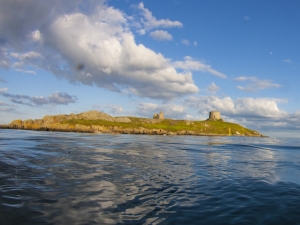
    I spent my teenage years bringing groups of children out to meet the seal colony on Dalkey Island. Snorkel camps run weekly during the summer months out of Dun Laoghaire always culminated with a much loved boat trip to Dalkey Island to swim among the resident seals.

    Some of the first underwater images I took with a disposable underwater film camera were of these playful sea creatures interacting with children from around south county Dublin. It was always hard to determine who was more playful the children or the seals, who seemed to have a number of games they liked to play, including hide and seek, tag and their constant favourite of fin chomping without being seen.

    The playful nature of seals reminds any snorkeler of a dog looking for affection from its owner. So listening to news stories where people are saying the best solution to the problems afflicting the fishing community is to take a high powered rifle to these playful creatures filled me with rage and frustration around the management of our coast, and what the future holds for it.

    Of course it is a complex issue replicated across the world and our history, where human appetites come into direct competition with other predators in the natural world.
    The Grey Seal 

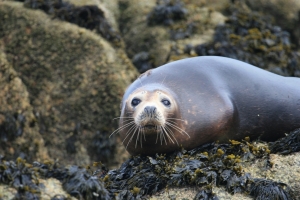
    The Grey Seal – one of the two seal species found along our coastline – holds an auspicious distinction of being the first animal to be protected by law against hunting back in 1903.

    By that time the Grey Seal had become nearly extinct in Irish waters, having been hunted for both their meat and fur. Now, thanks to conservation efforts their numbers are estimated to have reached over five thousand around Irish waters, with nearly 300,000 worldwide.

    Although this sounds like a fair number, they are actually fewer in number than the African Elephant, another endangered species more wildly known for being at risk of extinction. With Ireland home to just over one per cent of the worldwide Grey Seal population, we have a great opportunity to help conserve this incredible marine animal for future generations.
    Hunter Gatherers

    The fishing industry has been under threat for as long as I can remember from all sides. In a way it is the last remaining among the hunter-gatherer professions, so it’s easy to understand why the call for seals to be culled has come from this quarter.

    Fishing quotas introduced at a European level can seem deeply unfair to those who support their family from fishing. Catches often have to be thrown back into the water on account of it being a species which cannot be sold due to quotas. On the other hand, the playful seal does not have these caps inflicted on it, and is able to hunt for fish to its heart’s content.

    Technological advances have allowed super trawlers to travel thousands of miles to hoover up fish stocks, with implications for small scale fisheries. The recent restaurant closures due to the Covid restrictions has seen a collapse in demand in local markets for their produce.

    Like so many business, fishermen are facing a very difficult year while the playful seal watches on, oblivious to the stresses of running a business in the era of Covid-19.

    This is not a new battle between two communities, with the fisherman receiving enough support in the 1960s and the 1970s to allow culls of seal colonies. Yet it is all too easy to blame the fishermen for cruelty, while ignoring the methods required to provide affordable fish for supper.
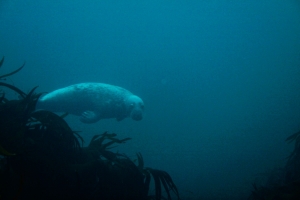
    Joy and Wonder

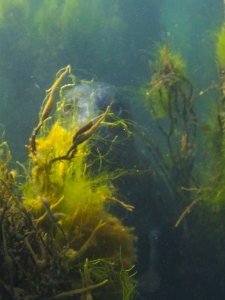
    As a diver, meeting a seal under water brings great joy and wonder, although on rare occurrences seals take a dislike to the bubble trail divers surround themselves with. Ironically, it’s easier to encounter a seal on a snorkel and held breath, as they don’t perceive a threat from the diver’s bubbles.

    Seals are wrapped up in Irish mythology and lore, with stories of the ‘Selky featuring prominently among most coastal communities.  A Selky is a shape-shifting seal that comes ashore and is transformed into a beautiful woman.

    Lucky fishermen could win themselves a wife by capturing the seal skin and hiding it from the Selky. If the captured Selky found her skin only then would she be able to return to her underwater lair, leaving the fisherman alone and holding the baby!!

    Anyone who has heard the melodic calls of the seals around Dalkey island can well understand why such myths sprang into existence. Seals provide a human tone that could easily deceive the ear. In protecting them around our coastline we are also preserving a part of our own cultural inheritance, as these tales would mean very little we were to drive this species from our waters again.

    Quite recently, while bringing an open water diver on a final dive for their open water course we had the pleasure of being joined on the dive by a playful Grey Seal. The seal stayed with us for over five minutes and watching my student’s eyes I could tell this magical encounter would stay with him for the rest of his life. Hopefully through this interaction a new diver also became a new guardian and advocate of the seal population.
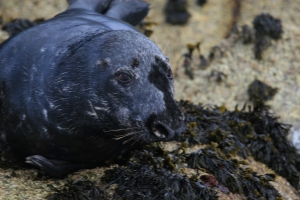
    Farmers Replacing Hunters

    Sandycove in Dublin, beside Dun Laoghaire, like Dalkey Island is home to multiple seals colonies, but with the welcome new cycle lanes divers can no longer park cars near this space, meaning these interactions are frustratingly difficult to avail of. Hopefully a resolution can be found, as divers cannot transport equipment without a vehicle.

    Almost every diver includes stories of encounters with seals among their favourite dives, so it is easy to see why a petition to save the seals would garner such support from within the dive community in such a short time.

    Every year I make a point of revisiting the seal colonies on Dalkey island to see how these friends from my teenage years are getting along. In the last few years I have been delighted to observe the population increasing with nearly forty Grey Seals counted this year.

    If you haven’t had the pleasure of spending time on Dalkey Island yet I again highly recommend it in these pandemic times. It offers an opportunity to see wild animals in their natural habitat while exploring a nature reserve, without leaving the confines of the county.

    In this time of rampant extinction events the playful Grey Seal communities in Ireland stand out as an example of how, with the right steps taken by our political leaders, we can preserve species from extinction. It is also a clear sign that once steps are taken continued care is needed to ensure these creatures survive and thrive.

    The grandfather of scuba diving Jacques Yves said: ‘We must plant the sea and herd its animals using the sea as farmers instead of hunters. That is what civilization is all about – farming replacing hunting.’

    Perhaps other ways to earn a living from the sea may in time become available to fishing communities, and a compulsion to hunt in a destructive manner will decline.

    Hopefully steps can be taken so that a balance can be struck between fishing communities and the seal communities that co-exist along our incredible coastline.

    If you believe in preserving these seal communities that have so recently come back from extinction along our coast please sign the petition by clicking here.
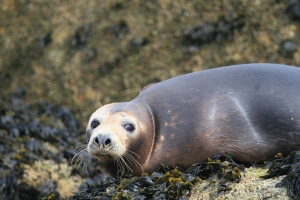
    All Images by Dan Mc Auley, read more of his articles on Ireland’s marine life here.
  • Amy Coney Barrett and “Originalism”

    The day that they killed him, someone said to me, “Son
    The age of the Antichrist has just only begun”
    Air Force One coming in through the gate
    Johnson sworn in at 2:38
    Let me know when you decide to thrown in the towel
    It is what it is, and it’s murder most foul
    What’s new, pussycat?
    What’d I say?
    I said the soul of a nation been torn away
    And it’s beginning to go into a slow decay
    And that it’s 36 hours past Judgment Day

    Bob Dylan ‘Murder Most Foul’

    As I have previously argued, the death of Ruth Bader Ginsburg is the death knell on a long liberal tradition of American judges, including William O. Douglas, the Irish-American William Brennan, and Harry Blackmun. More recently we have had John Paul Stevens, and perhaps David Souter, who went on a voyage from straight conservatism to moderate liberalism, can be added to that list.

    This sad passing should be of grave concern to the world, as the composition of the U.S. Supreme Court is more important than any President. It has finally been subsumed by the dangerous ideologies of neoliberalism, religious fundamentalism and hatred and exclusion of the other.

    At one level, abortion is the canary in mine shaft, which may be distracting from other equally important issues. America has had to contend with threats to the seminal judgment of Roe v. Wade before, when Ronald Reagan appointed Sandra Day O’Connor as the first female judge of the Supreme Court. She appeared to be an ardent anti-abortionist, but flipped to some extent in Planned Parenthood v Casey (1993). I don’t think Trump has made the same mistake – much to my chagrin – with Amy Coney Barrett.

    Let us be clear. The appointment of a woman simply because she is a woman is not a cause for celebration. It is another Populist gesture from a Trump Presidency designed to deflect from criticism of her judicial philosophy. She is deeply conservative and an adherent of an historical and literalist approach to the interpretation of the U.S. Constitution, which is aligned with deep-seated religious and political fundamentalism.

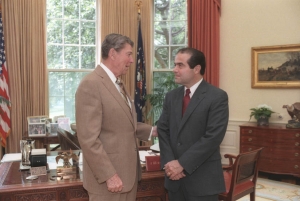
    As an ardent Catholic boasting seven children, of whom two are adopted, it is fair to surmise that she may have reservations about contraception. Her support of the ownership, possession and use of handguns – even for non-violent felons in Kanter v Barr (2019) – is conditioned by an historical approach to interpreting the Constitution. This she has inherited from the recently deceased Supreme Court judge Anthony J. Scalia – affectionately known to liberals as Tony the Phoney – under whom she clerked. ‘His judicial philosophy is mine too,’ she said.

    Scalia with President Reagan in 1986.

    Justice Harry Blackmun, (the author of the majority decision in Roe v Wade) realised this might happen in Planned Parenthood (1973); the light flickering at the end of his moving judgment. That light is now extinguished.

    Of significant concern to all non-nationals, she also voted as circuit court federal judge for Trump’s hard line legislation on Green Cards, and will no doubt also expand the protection of religious rights, conditioned by historicism and literalism. Gay rights groups have also been very troubled by her views. Such ‘deviant’ preferences were contrary to public morality in 1789 after all, as was the presence of inferior races.

    We have entered a dark era dominated by the religious right, involving literal and historical interpretation of the U.S. Constitution. A return to eighteenth century values is upon us, including the fire and brimstone of the Old Testament, neglecting to remember that Thomas Jefferson was a deist, if that. Let’s not forget that the United States required a Civil War to end the ‘peculiar institution’ of slavery that was not even mentioned in that document, apart from in the three-fifths clause that represented a African-American slaves as three-fifths of a white person for electoral purposes, in order to maintain a balance between slave and non-slave owning states.

    Originalism

    So what is the evangelical Christian conditioning of her mentors?

    • Old Originalism or Original Intent dates from the 1980’s scholarship of Robert Bork, and is linked to the intention of the Founding Fathers, or a subtle shift to meet objections; the ratifiers of the Constitution.
    • New Originalism (if it can be termed thus) or Original Meaning Originalism or Original Public Meaning focuses on the original public meaning of the Constitution. Which includes the unmistakable whiteness of the signatories. This leaves a measure of indeterminacy and thus discretion to future generations, but is really a sleight of hand designed to conceal much of the above.
    • A further distinction has been drawn between Original Meaning and Original Expected Application. The argument is that whereas Original Expected Application binds us to the intention of the Founding Fathers, Original Meaning gives us a text which we show attention and fidelity to, and which provides a blueprint for future generations

    In essence, the original version of Originalism (now termed inter alia Old Originalism) contended that in order to interpret the Constitution, judges should search for the intention of the Founding Fathers. The view was a rejection of what was perceived as the judicial activism of the Warren and Burger courts, and was initiated by Reagan’s Attorney General Edwin Meese, who argued for ‘Original Intention’ to put decisions back on the proper path of reflecting the views of the Founding Fathers, and respecting ‘democratic’ principles.

    Thus, it is important to stress that from the outset Originalism is associated with neoliberal or even neoconservative political principles, not a middle ground Burkean conservative approach.

    There has also been a subtle nuancing from Original Intent to Original Understanding or Original Meaning, to deal with the objection that it was the ratifiers’, not the framers’ intention, that was important, but even at the time there were powerful intellectual objections.

    It has been repeatedly argued that we cannot access the mental states of the Founding Fathers or ratifiers. They might have had conflicting mental states, and their intentions are simply unknowable. Further, and crucially, it seems to me, the Founding Fathers or ratifiers had no particular foresight as to the state affairs and social circumstances that would emerge after they had departed, while the Constitution was presumably designed to cope with the exigencies of new circumstances.

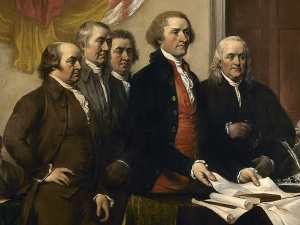
    Founding Fathers, John Adams, Thomas Jefferson, Benjamin Franklin, Roger Sherman, and Robert Livingston.


    Original Meaning Originalism

    Jefferson Powell has added a further criticism, which is that the Founding Fathers themselves did not believe that looking to their intention was an appropriate approach, and that it was the public words of the text that were binding.

    There is another powerful and all-pervasive intellectual objection to Original Intent, which is a dominant theme of this article: even if we are certain of the precise intentions of the Founding Fathers and ratifiers, and even if we knew they intended to bind us to their settled historical meaning, why should we care?

    Why, in substance, should we be bound by the dead hand of history?

    In reaction to these criticisms the Original Intent movement shifted its position. Spurred on by Justice Scalia and members of Reagan’s Justice Department, the movement began to argue it was not the intention of the Founding Fathers or ratifiers that was important, but the publicly shared meanings of the text. Or at least those shared in 1789.

    The New Originalism (or ‘Original Meaning Originalism’) has as its core idea that the meaning of the constitution is the original public meaning of the document, or its conventional semantic meaning, including the meaning as changed by amendments. Such theorists then began to look at dictionaries and documents of public record to ascertain what citizen views were on constitutional matters at the time. They believed that such sources would discipline courts from engaging in judicial activism.

    A Constitution Falls to be Interpreted by Successive Generations.

    Barnett has argued that the text legitimates the use of the State’s coercive power, and legitimates judicial activism. That ultimately it defers to a theory of popular sovereignty in that the people gave their permission to that written text (which in this jurisdiction they extend frequently by referendum), with the government acting as agents of the people. This is correct, but it is the will of the chosen few, interpreted through the prism of Old Testament values and emergent racism.

    Jack Balkin, a moderate liberal, defines Original Meaning as a commitment to the fidelity of the text and the principles of the text, which must mean different things to each successive generation; as words themselves shift in meaning over time, and the nuances of the abstract terms and vague clauses of a constitutional text shift and change.

    He argues for a form of redemptive constitutionalism through the passage of history, where the open-ended language of the constitution delegates the application of terms to future interpreters, arguing that,

    The whole purpose of a constitutions cannot be simply to forestall political judgements by later generations on important issues of justice, to preserve past practices of social custom or judgements of political morality, or to freeze existing assessments of rights in time. When we view these open ended rights provisions together with the more rule-like structural features of constitutions, we can see that they serve a somewhat different goal. They are designed to channel and discipline future political judgements not forestall it.

    Balkin asks the question: what do abstract provisions in the constitutional text do? Are they designed only to limit future generations, or are they also designed to delegate the articulation and implementation of important constitutional principles?

    Balkin later expands on the constraints on political judgement imposed by the text, but cautions against freezing political judgments at a fixed position in time. He contends that the constitution is an aspirational document and that the position of those such as Justice Scalia – who claim we are constrained by the original intent of framers or enacters – is a ‘narrative of decline.’ A “decline” has lately turned into a slide.

    In contrast, Balkin argues that principles existing and embedded in the Constitution can be re-interpreted by successive generations to confront contemporary issues. Thus he argues that the class clause in the constitution can protect the right of homosexuals, even if no one at the time of the enactment approved of homosexuality.

    Barret’s views on gays, immigrants and abortion suggest she thinks otherwise.

    Dworkin

    The late Ronald Dworkin, has written eloquently, about historicism, particularly in response to the nomination of Judge Robert Bork to the Supreme Court, and the publication of Bork’s Tempting of America. In assessing the legal intentions of the framers Dworkin argues:

    They intended to commit the nation to abstract principles of political morality about speech and punishment and equality, for example. They also had a variety of more concrete convictions about the correct application of these abstract principles to particular issues. If contemporary judges think their concrete convictions were in conflict with their abstract ones, because they did not reach the correct conclusions about the effect of their own principles, then the judges have a choice to make. It is unhelpful to tell them to follow the framers’ intentions. They need to know what legal intentions – at how general a level of abstraction – and why. So Bork and others who support the original understanding thesis must supply an independent normative theory – a particular political conception of constitutional democracy – to answer that need. That normative theory must justify not only a general attitude of deference, but also what I shall call an interpretative schema:  a particular account of how different levels of the framers’ convictions and expectations contribute to concrete judicial decisions.

    Ronald Dworkin

    Dworkin elaborates that the farmers’ intent can be viewed on levels of generality and that we must seek to ‘disentangle the principle they enacted from their convictions about its proper application in order to discover the political content of their decisions.’

    He expands on that by saying that Bork uses the framers’ intent inconsistently, and at different levels of generality; in a reductive fashion and in a very strict sense for the cruel and unusual punishment clause of the Eight Amendment (to permit capital punishment); but in a broader sense for the principle of equality (to meet the future but then uncontemplated need of outlawing racial desegregation).

    Dworkin concludes that:

    There is nothing abstruse or even unfamiliar in the notion that the Constitution lays down abstract principles whose dimensions and application are inherently controversial, that judges have the responsibility to interpret these abstract principles in a way that fits, dignifies and improves our political history. 

    Justice Brennan

    On retirement Justice William J. Brennan argued against Original Intent on a number of grounds. He noted that the ‘proponents of this facile historicism justify it as a depoliticization of the judiciary,’ but ‘the political underpinning of such a choice should not escape notice,’ and that a ‘position that upholds constitutional claims only if they were within the specific contemplation of the framers in effect establishes a presumption of resolving textual ambiguity against the claim of constitutional right.’

    Brennan further argues, apropos the U.S. Constitution, but of equal application to the Irish Constitution, a constitution is not just a majoritarian document, but embodies substantive value choices that are placed beyond the legislature. Contemporary courts should abide by this duty in modern circumstances.

    End of Days

    What Amy Coney Barret’s appointment means is that the liberal academic, political and legal agenda has lost the argument, and the Bible Belt is in the box seat. It is game over in the U.S. Supreme Court, and the interpretation of texts will now be literal and historical.

    Expect decisions that are pro-gun ownership, anti-abortion, anti-gay rights, anti-health care and above all a reinstitution of Christian evangelical rights. People of colour and migrants will be excluded as unworthy to the clean and pure. It is an exclusionary and intellectually baseless approach, but it is running America and most of the rest of us by extension.

    Above the duty of the court is to keep the chosen few happy and rich. A quote from Orson Welles’s ‘The Third Man’ captures the sentiment:

    If I offered you twenty thousand pounds for every dot that stopped, would you really, old man, tell me to keep my money, or would you calculate how many dots you could afford to spare? Free of income tax, old man. Free of income tax – the only way you can save money nowadays.

    People are seen as insignificant dots, and objects of exploitation for the elect.

  • Irish Government Requires Additional Insights

    On April 28th Fintan O’Toole brought a telling revelation to light in an article entitled, ‘Government ditched its own plan during this crisis’. He claimed that ‘Within the nexus of experts engaged in the management of the crisis, there are increasing concerns about the systems part of the operation’

    He then revealed that:

    the Government has a very well thought through system for managing emergencies – but it more or less completely ignores it … There are reasons why the Government missed the huge part of the crisis that was unfolding in nursing homes and residential institutions. One of them is the tunnel-vision that results from a top-down, command-and-control approach that is utterly at odds with what is supposed to be State policy

    O’Toole refers to a 60-page document called ‘Strategic Emergency Management: National Structures and Frameworks’, which specifically envisages ‘the potential widespread spread of a pandemic’.

    When Covid-19 cases began to multiply, however, ‘it was shoved in a drawer.’ ‘Power instead was taken over by the Taoiseach’s department and information was fed into it, primarily by a single body of experts, the National Public Health Emergency Team [NPHET]’, which ‘lacked voices from the nursing home sector.’

    The mistakes that were made at the height of the pandemic in March/April, when sick patients were returned to care homes may be traced to defective leadership structures, but at this stage there is little value in pointing the finger of blame, as we may assume that individuals were acting to the best of their abilities under enormous pressure, as epidemiological assessments were projecting a far worse death toll than was ultimately the case.

    But structural problems remain in the organisation. It is high time we re-examined how the government is being advised to bring the population to the promised land of ‘living with the virus.’ At this stage other forms of advice should be sought. Presumably the government is already receiving significant inputs from the business sector, but other important viewpoints are not part of the conversation.

    Varadkar’s Comments

    In what was a stark reversal of the situtation in late April when Dr Tony Holohan when asked about possible easing of restrictions replied, “I haven’t made up my mind,” the now Tánaiste Leo Varadkar identified a growing cleavage in Irish society between the private and public sectors on Claire Byrne Live. He commented that the pay packets of those on NEPHT (and his own) would not be affected by further restrictions and that cabinet would be the ones making any decisions on imposing further restrictions.

    That such a provocative comment, which perhaps only “Dr” Varadkar – whose background as a doctor was generally perceived as advantageous at the height of the crisis – could have been aimed against the doctor-in-chief in NPHET, which although composed primarily of civil servants, rather than doctors or scientists, nonetheless appears to have a higher standing in the eyes of the public than government Ministers.

    In fact, it might be expected that an expert grouping would see it as their responsibility to put forward a variety of courses of action as opposed to plumping for one, leaving it to the government to weigh the total implications of the various options.

    With case numbers – blunt statistics which have assumed a frightening importance – not reaching the stratospheric levels that some were predicting earlier this week, the government’s gamble to take a less draconian approach, which is more in line with Ireland’s European partners, may just be paying off. Also, Varadkar’s suggestion that the number of hospital admissions, especially requiring ICU, and mortalities, will become the guiding indicators may also signal a change in the way in which State will be contending with the virus in future.

    Varadkar’s comments, along with Fintan O’Toole’s earlier insights, may also highlight a broader problem, as to whether a body with the composition of NPHET can, in coping with an emergency, be prone to an element of ‘groupthink,’ such as we have witnessed in the past in controversial situations in Irish public life, notably the Bank Bailout in 2008.

    Advisory Groups

    HIQA, for its part, established a COVID-19 Expert Advisory Group on September 29th to support an evidence-based response to COVID-19, under the chairmanship of Cillian de Gascun. This includes what appear to be most of the leading scientists in the country, who will have insights on the virus itself.

    There is also an EAG Research Subgroup the members of which are:

    Prof. Colm Bergin (Co-Chair), Consultant Infectious Diseases, St. James’s Hospital and Professor of Medicine, Trinity College Dublin
    Prof.Cliona O’Farrelly (Co-Chair), Professor Comparative Immunology, Biochemistry, Trinity College Dublin
    Dr Teresa Maguire, Head of Research Services and Policy Unit, Department of Health
    Dr Siobhán O’Sullivan, Chief Bioethics Officer, Department of Health
    Dr Mairéad O’Driscoll, Director of Research Strategy and Funding, Health Research Board
    Dr Mark Ferguson, Director General, Science Foundation Ireland
    Prof.Stephen Kinsella, Associate Professor of Economics, University College Limerick
    Prof.Orla Feely Vice President for Research, Innovation and Impact University College Dublin
    Prof.Ivan Perry, Professor of Public Health, University College Cork
    Dr Ana Terres, Head of Research and Development, HSE
    Dr Sarah Gibney Senior Researcher, Research Services and Policy Unit and IGEES, Department of Health (replaced by Peter Doherty, Research Servicesand Policy Unit, Department of Health)

    Again this contains a significant number of civil servant administrators and a single individual from a non-scientific discipline, tellingly perhaps, economics.

    Guiding Philosophy

    It is hardly surprising that the Government has looked to administrators and academic scientists to guide it through this crisis. There must be some concern, however, that apart from economic cleavages between the private and public sector a scientific or technocratic background will not necessarily equip an individual to weigh up choices with profound ethical implications, affecting all strata of an increasingly diverse Irish society.

    In contrast in Sweden, where the effectiveness of government messaging in the absence of draconian measures has been roundly praised – even by those critical of an unwillingness to impose a lockdown – philosophers have been advising the government from the outset. Problematic policy choices and ethical dilemmas are faced and addressed.

    Notably, the National Board of Health and Welfare, one of Sweden’s main agencies for handling the COVID-19 pandemic brought in philosophers to design guidelines for priority-setting in medical care. The work was led by philosopher Lars Sandman, director of the Centre for Healthcare Priority Setting and a professor of healthcare ethics at Linköping University.

    Sandman said:

    In Sweden we are not allowed to take chronological age into account, but biological age—so the main thrust of the guidelines is how to interpret biological age in this situation—and we interpret it as covering both probability to survive the treatment and life-expectancy in terms of years. Hence, we propose that if doctors and other healthcare providers have to choose between helping patients with the same probability to survive but different life-expectancies, they should choose to help the patient with more years left. In relation to the ethical principles in the platform this is a somewhat new interpretation or clarification that has never been explicitly done before.

    These, we may assume, are the kind of ethical choices that NPHET and the medical establishment faced at the height of the pandemic, but behind closed doors. Perhaps a different philosophical approach would be to the fore in Ireland, with greater emphasis on preservation of life as opposed to overall public health. But it would surely have been beneficial for NPHET to have had recourse to the intellectual clarity provided by professional philosophers, and for there to be greater transparency around this decision-making.

    The Aosdána

    Moreover, as we build towards ‘living with the virus’ it is worth considering other forms of expertise. Harking back to Ancient Ireland we might consider a new role for the Aosdána (áes dána, ‘people of the gift’). These were the skilled men of early Irish society, whose hereditary or demonstrated skills were in law, medicine, history, music, masonry, carpentry, metalwork – but primarily in poetic composition. The recovery of public art in Ireland is not an idle concern. Artists may prove to be healers, as we navigate these choppy waters.

    An obvious body to consult already in existence is the Aosdána, an association of artists created in 1981 and supported by the Arts Council of Ireland. The Aosdána could select from its members individuals to represent artistic creation in Ireland, which is essential to nurture during this global crisis.

    There has to be a concern that a body constituted such as NPHET is associated with what Iain McGilchrist might describe as ‘left-brained’ thinking, a tendency which is often associated with those heavily specialized in their chosen fields. Indeed, their very expertise may leave them less resourced to offer a broader wisdom enabling us to answer the hard question: yes, but what are we to do in the here and now?

  • Covid-19: What is in a Name?

    In Plato’s dialogue ‘Cratylus,’ Socrates and his friends Cratylus and Hermogenes discuss the issue of how phenomena are named. At the heart of the discussion lies the question of whether names have a natural relationship with the things they signify; or is this a random exercise, determined by custom, and are these names therefore mutable? So could the name ‘table’ simply be adjusted to ‘elbat’ by government decree?

    Many years ago I listened to the legendary publisher John Calder (of Calder and Boyars) at an afternoon session in Dublin’s Abbey Theatre. By that time he had published approximately fifteen Nobel Prize winning authors, including Samuel Beckett. He mused on how fifteen years had passed since the first of Beckett’s publications and his rise to becoming ‘a household name,’ after winning the Nobel Prize for literature in 1969. Ideas are not grasped overnight, they take time, John Calder observed.

    Socrates, Cratylus and Hermogenes might well stand a better chance of grasping the nature of the current pandemic than many contemporaries, as many of the main terms in use are of Greek origin.

    Epidemic: from Greek ἐπί epi ‘upon or above’ and δῆμος demos ‘people.’

    Pandemic: from Greek πᾶν, pan, ‘all’ and δῆμος, demos, ‘people.’

    Equally important terms derive from Latin:

    Virus: from Latin ‘poison, slime, venom.’

    Vaccine: from the Lain ‘vacca,’ meaning cow, a named conferred by Louis Pasteur in honour of Edward Jenner who pioneered the concept by using cowpox to inoculate (mid-15c., ‘implant a bud into a plant,’ from Latin inoculatus, past participle of inoculare ‘graft in, implant a bud or eye of one plant into another,’) against smallpox.

    Exponential: from Latin exponere ‘put forth.’

    At another point in their discussion the philosophers look up at the sky. They point to various planets and speak their names. Then one says: ‘There are things up there which do not have a name.’

    And another adds: ‘There are things down here which do not have a name.’ This brings to mind a disturbing thought, which is that if all things in the universe are related, and some things do not have a name, can the system of naming be relied upon?

    Take the proposition that someone, anyone, may carry the virus but show no symptoms. That, I believe, is a novel idea. One which did not have a specific name, in common parlance anyway.

    At least one eminent virologist has dismissed the claim outright that a ‘healthy-sick’ individual can pass on the virus as a ‘crowning of stupidity,’ when he explained ‘Why Everyone Was Wrong’ in their initial assessment of Covid-19. No doubt other experts hold differing views, but we are clearly in new linguistic territory when ‘asymptomatics’ are suffering from (or is that experiencing?) a disease.

    A few days ago I observed a group of teenagers, aged around twelve or thirteen, pushing, shoving, hugging, flirting, shouting, laughing, jumping, dancing, and even kissing around the Triangle in Ranelagh in Dublin.

    I doubt any of them are as yet familiar with the Classical etymology of important medical terms, or the nomenclature around ‘the virus’ now in circulation. If they knew what the Covid-19 restrictions are at all, they were blatantly flouting them with the enthusiasm of a Republican at a White House garden party.

    Perhaps instinctively they knew they had little or nothing to be concerned about themselves. A report in the Wall Street Journal in May quoted the U.S. Center or Disease Control to the effect that since February only fifteen children under the age of fifteen in the U.S. had died of Covid-19, compared to about two hundred who had died of flu and pneumonia. I just hope their instinct to embrace the fullness of life will not betray any older relatives who might be more susceptible.

    At another point in Plato’s dialogue a row breaks out between Cratylus and Hermogenes. Cratylus tells Hermogenes that ‘Hermogenes’ is not actually his name. This infuriates Hermogenes. It is so his name. His name is Level 3, not level 5! Level 3, Hermogenes! As Leo Varadkar might have said to Tony Holohan.

    Feature Image: The Death of Socrates (1787), by Jacques-Louis David.

  • Shipwrecks: Ireland’s Manmade Reefs

    In his first article Dan Mc Auley revealed some of the hidden secrets below Dublin Bay, and a looming threat to that environment. In this article Dan takes us to the mysterious world of shipwrecks around the Irish coastline, of which there are a remarkable 18,000, two of which he has been taking photographs of for nearly twenty years.

    When divers receive their initial certification as Open Water Divers under the PADI training system the next step is the Advanced Diver Programme. This teaches the many different disciplines available in the diving world, including Drift Diving, Photography Diving, Drysuit Diving and Night Diving. There are, therefore, many options available to the newly certified aquanaut, but without doubt the most popular and sought after certification is in Wreck Diving. Wreck Diving offers a snapshot of history on the ocean floor.

    With the combination of a long history of maritime traffic and often quite ferocious seas, it comes as no surprise that the Irish coastline is strewn with shipwrecks, many of which date back hundreds of years. Each one provides a fascinating porthole on a bygone age, telling stories that are often of historical significance, as well as allowing divers a chance to encounter what are often quite intriguing new environments for marine life.

    Shipwrecks are formed when human ingenuity is defeated by the raw force of nature, and often tell a tragic tale.

    Julia T.

    18,000 Shipwrecks

    According to the Underwater Archaeology Unit (UAU), there are over 18,000 shipwrecks along the Irish coastline, which is more than enough to keep even the most gun-ho of ‘wreckies’ (wreck divers) satisfied for a lifetime.

    Obviously not all of these are diveable, or even worth exploring, as their journeys don’t end when they reach the sea bed: the relentless ocean keeps working on these vessels.

    Sometimes in shallow waters they can be quickly broken up into smaller and smaller pieces as waves pummel the steel or wood of the ship against the sea bed. If a ship runs aground in deeper water, however, a slower process begins, as nature slowly reclaims the ship: firstly by turning it into a reef that becomes a refuge to marine life clear of the sea bed.

    This offers a treasure trove of subjects for an underwater photographer, concentrated in an area easily dive-able on one tank.

    As the process of disintegration continues apace, cargoes are often shifted across the sea bed. The story continues with different species of marine life taking up residence in the hulls of the ship, just as sailors had enjoyed that privilege above the surface.

    Hook Head Wreck.

    First a Confession

    With such an array of shipwrecks around the coastline to choose from, it is tough to decide which stories to tell in a single article; I will therefore focus on my two favourites, and explain what makes this pair special to me.

    Before doing so I must confess that I am by no means a true ‘wreckie.’ Rather, I relish the opportunity to photograph the marine life these wrecks attract. This natural profusion is my true love, as opposed to the history of the wrecks themselves.

    A true wreckie would probably want to hear about the Cunard ocean liner RMS Lusitania that was sunk by a German U-Boat in 1915, eighteen kilometres off the Old Head of Kinsale, killing 1,198 and leaving 761 survivors. This appalling loss of life was among the reasons why the United States eventually joined the Allied side during World War I.

    Others would be drawn to SS Laurentic, another British ocean liner of the White Star Line that was converted into an armed merchant cruiser at the beginning of World War I. That vessel sank after striking two mines near the Inishowen penninsula north of Ireland on January 25th 1917, with the loss of 354 lives. She was carrying about 43 tons of gold ingots at the time, and, intriguingly, twenty bars of gold are yet to be recovered.

    Instead the wrecks I have chosen are two that I have dived nearly every year for the past twenty years, and have had a chance to watch at intervals their continued journeys below the waves.

    Julia T.

    Julia T

    The wreck of the Julia T is located in a top secret location off the variegated Mayo coastline, known only to initiates to one of Ireland’s top dive centres, Scuba Dive West.

    A shroud of mystery continues to lie over what brought it to the sea bed. This perhaps emanates from a curious indifference on the part of the Irish state to the value that wrecks offer to divers when these become man-made reefs on the sea bed.

    As a result, nobody knows precisely what caused this ferry to sink to the bottom of the Atlantic Ocean in an ideal location at exactly the right depth and area for divers to explore. What we do know is that the ship sank without any spillages or casualties and without causing any environmental damage on July 4th, 1998, while under tow to be decommissioned after a lifetime supplying the Islands communities of Inish Boffin and Inish Turk off the Galway coastline.

    Julia T.

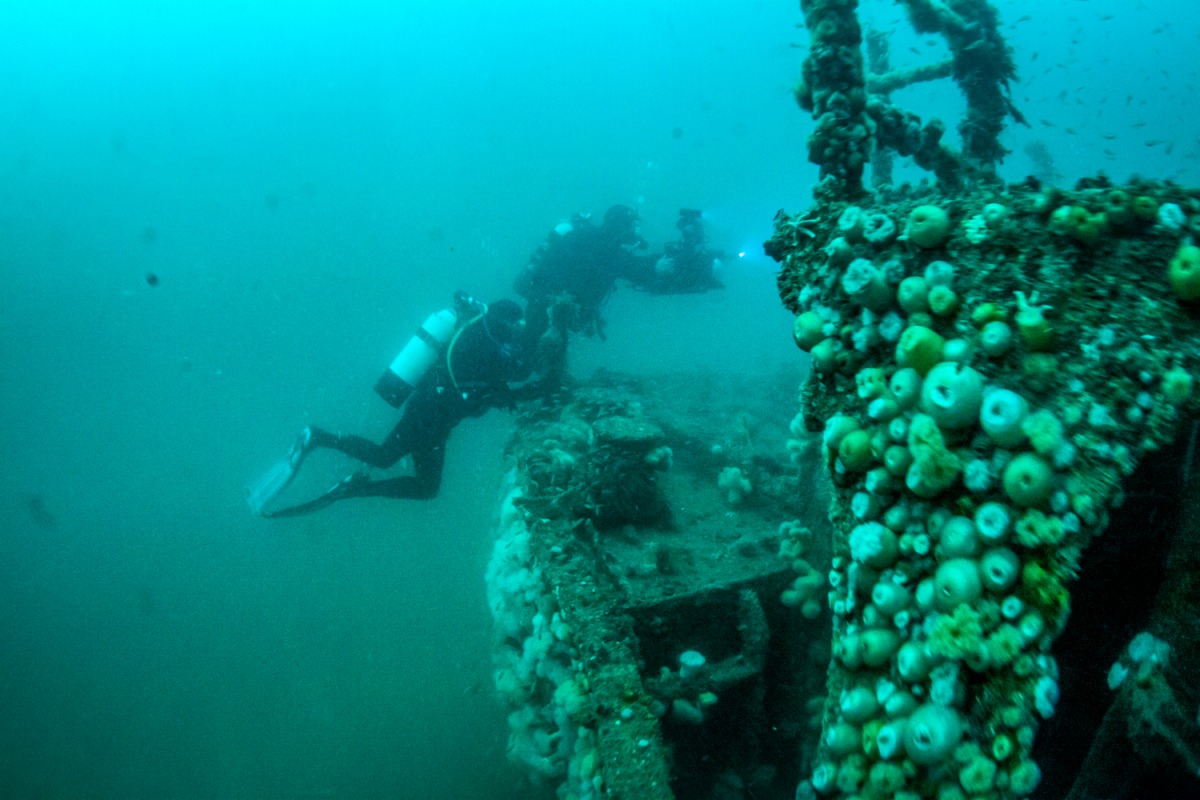
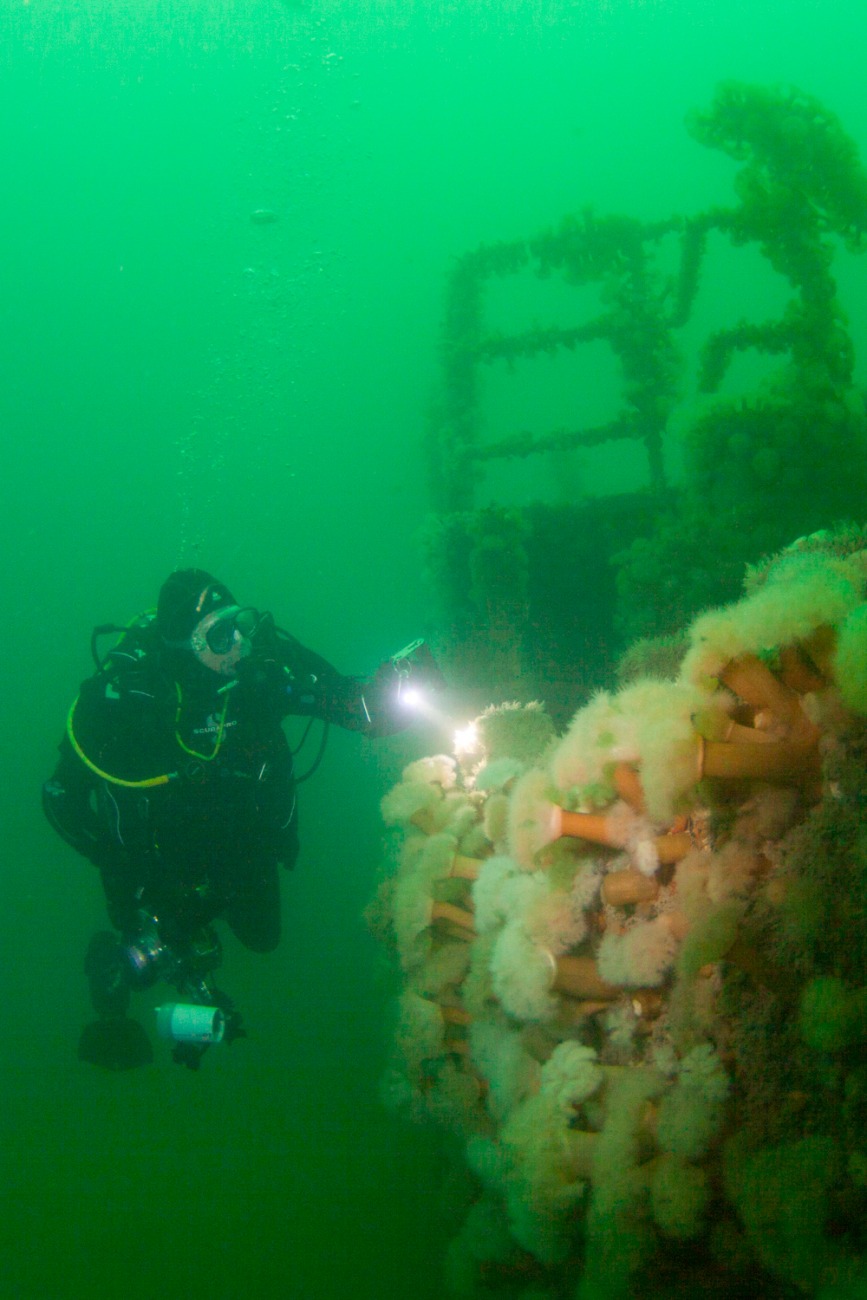
    At over thirty meters in length it was the last in the line of the Clyde-built boats (so-called Clyde Puffers) with a flat bottom to allow for beach landings, which now allows it to sit perfectly upright on the sea bed.

    I have been lucky enough to dive it nearly every year since it first sank over twenty years ago, with each dive offering fresh insights into what happens to a ship once it descends below the waves.

    Situated at an ideal depth for advanced divers of twenty metres, it has provided a perfect training ground for imparting the skills essential for safely exploring wrecks; whetting the appetite of many a newly blooded wreckie to explore other sites along the coast.

    Julia T.

    A Profusion of Life

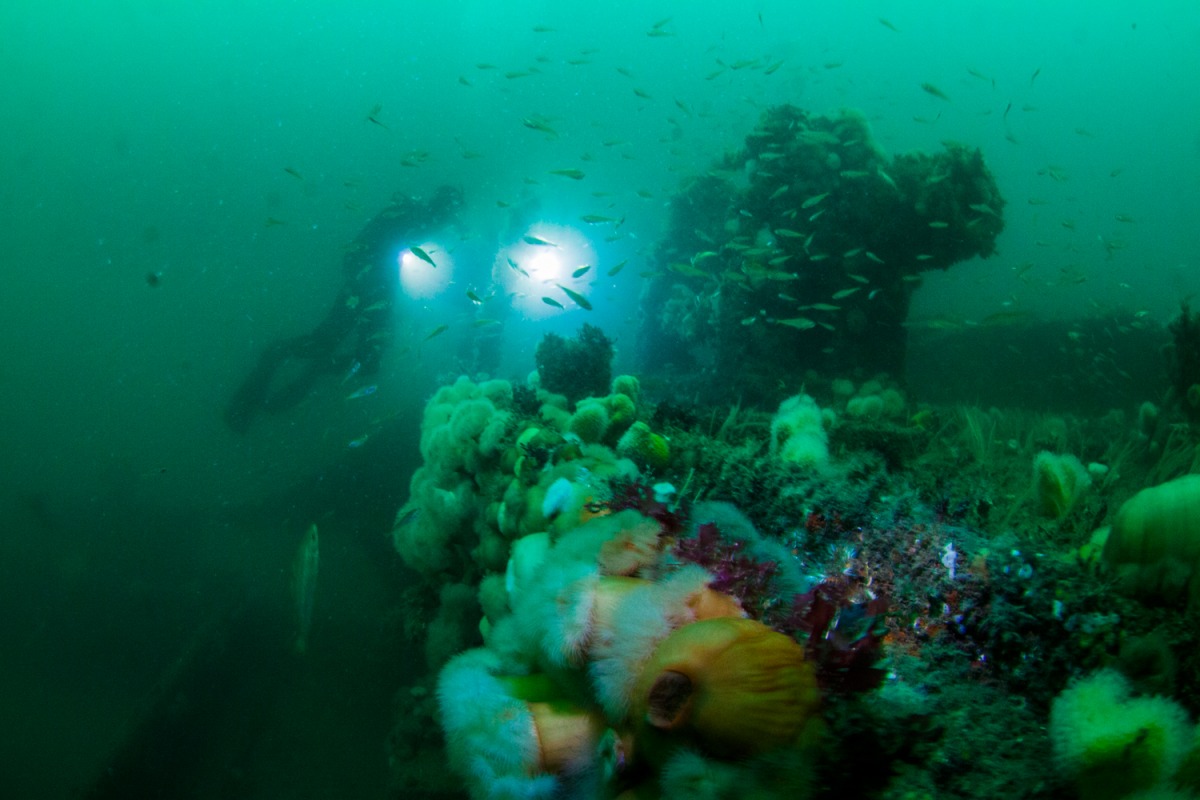
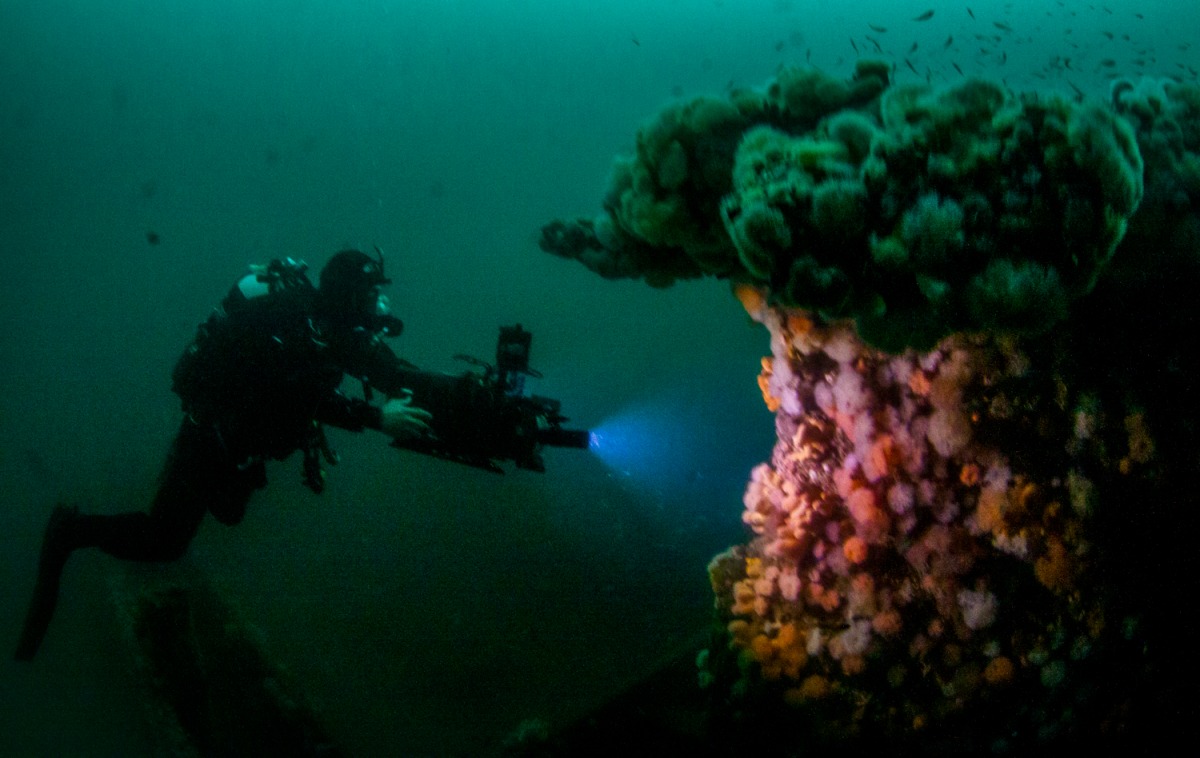
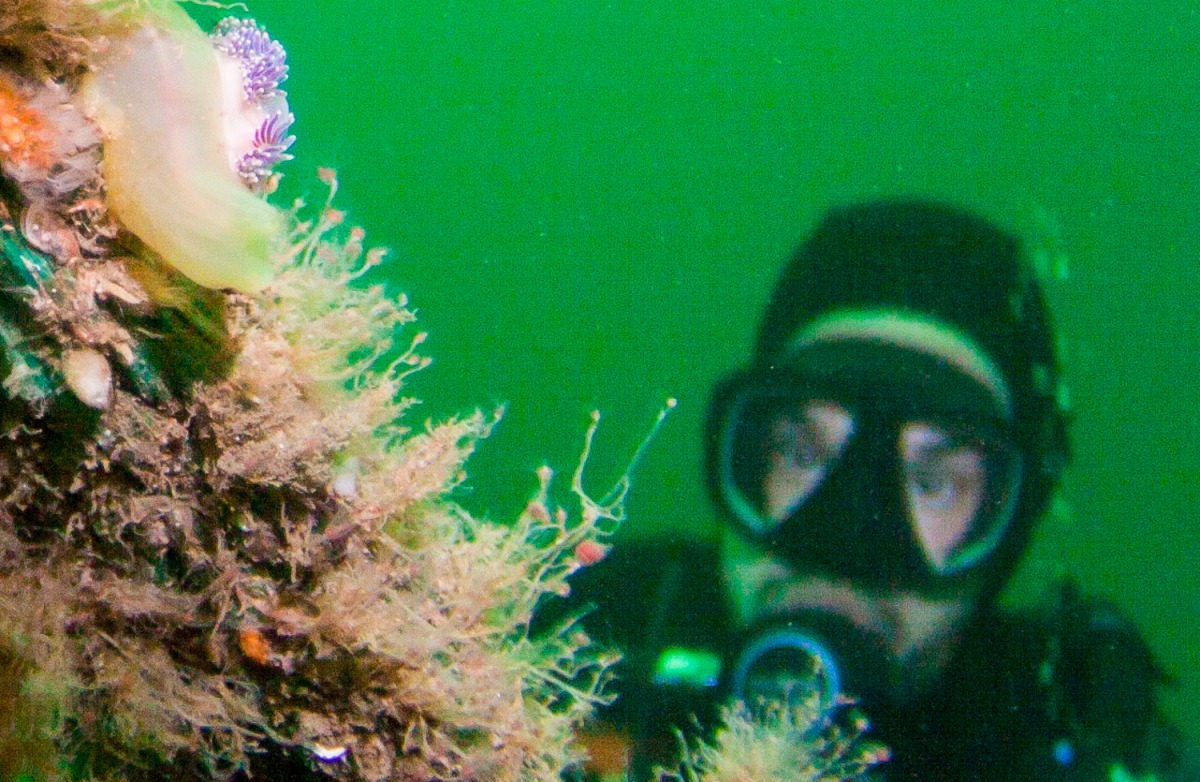
    Since sinking to the sea floor it has become a safe home for thousands of marine critters, amidst the might of the Atlantic Ocean. In excess of forty exquisite nudibranch, a soft-bodied, marine gastropod mollusc, have been recorded on the wreck on a single dive. Nudibranch appreciation clubs now travel annually to the site of the wreckage to spot these elusive and colourful creatures.

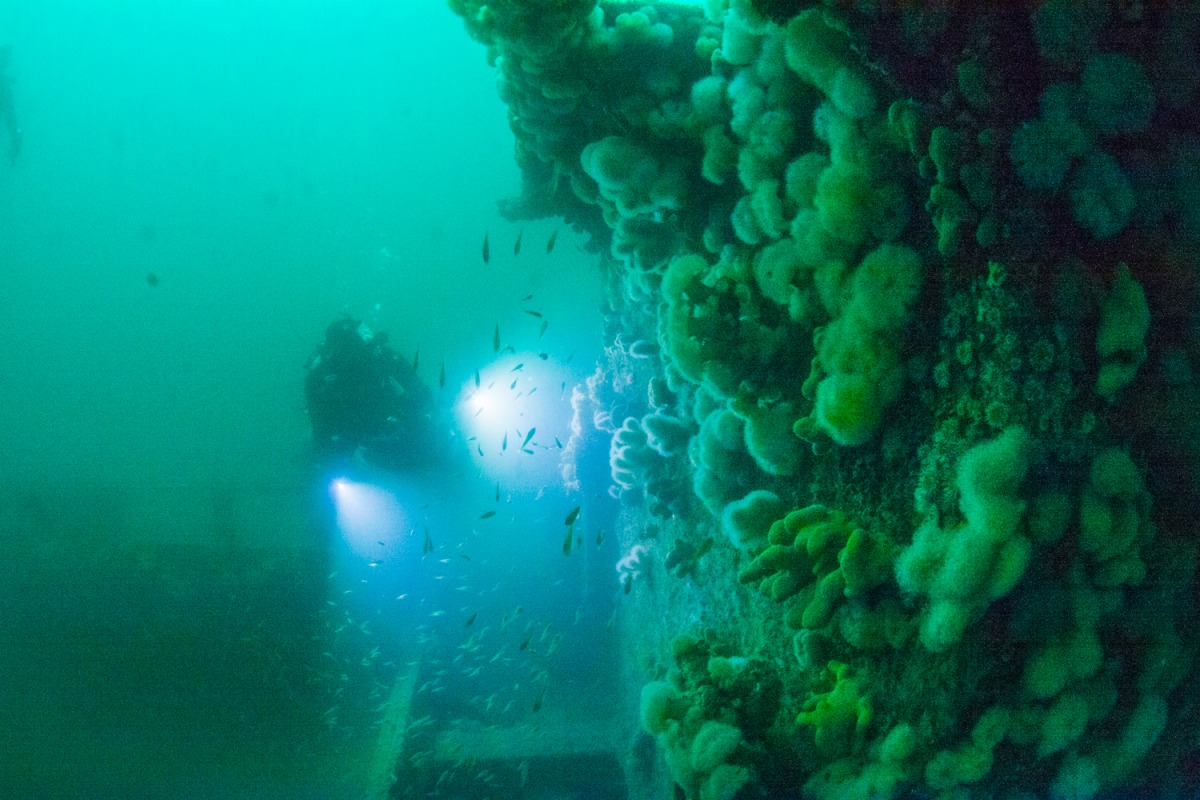
    Shoals of mackerel and cod also often take refuge from the raging seas in the large hull of the ship, while varied species of brightly coloured wrasse fish use the wreck as a nursery for their young, before heading out to deeper water.

    The mighty conger eel has also been spotted lurking in the darker parts of the wreck, along with passing thornback rays on the sea bed around the wreck.

    Over the years more and more filter feeders, like the plumose anenome have carved out a niche in the wreck, as well as the awe-inspiring jewel anenomes that bring a vivid colour to the rust-coloured exterior of the wreck.

    Given the extent of this cornucopia of marine life it is hard to see just where the man-made structure ends and nature now begins. Indeed, the monetary value of the material constituents of the wreck is now a tiny fraction of its value as a dive location, and for marine life. The site now draws hundreds of international divers, and is regularly listed as one of the top dive destinations in the world.

    Julia T.

    Unnamed Trawler

    The second wreck I visit each year is located in much shallower water, barely eight meters below the surface by the beautiful Hook Penninsula in county Wexford. Very little is know about the first incarnation of this unnamaed trawler that sank in the 1960s, as is often the case with ships before they meet the ocean floor.

    This shipwreck lies in the surge zone – constantly pounded by the southerly swells that carved the Hook peninsula itself – meaning its ageing process is starkly different to that of the Julia T.

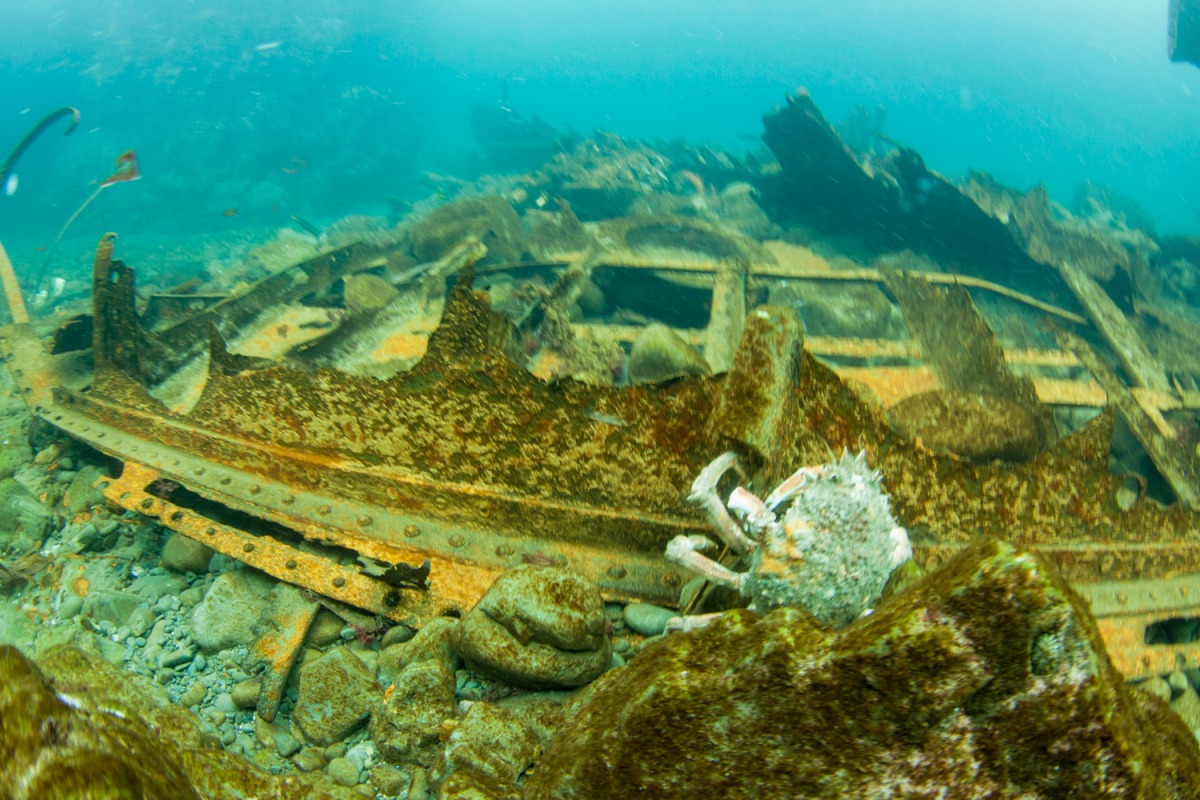
    On my annual descents I have observed just how rapidly nature is able to reclaim what is left by man. The metallic shell of the wreck is regularly hit with such concussive force that the base elements have actually melded into the stone shoreline, with only the strongest parts now recognisably part of a ship.

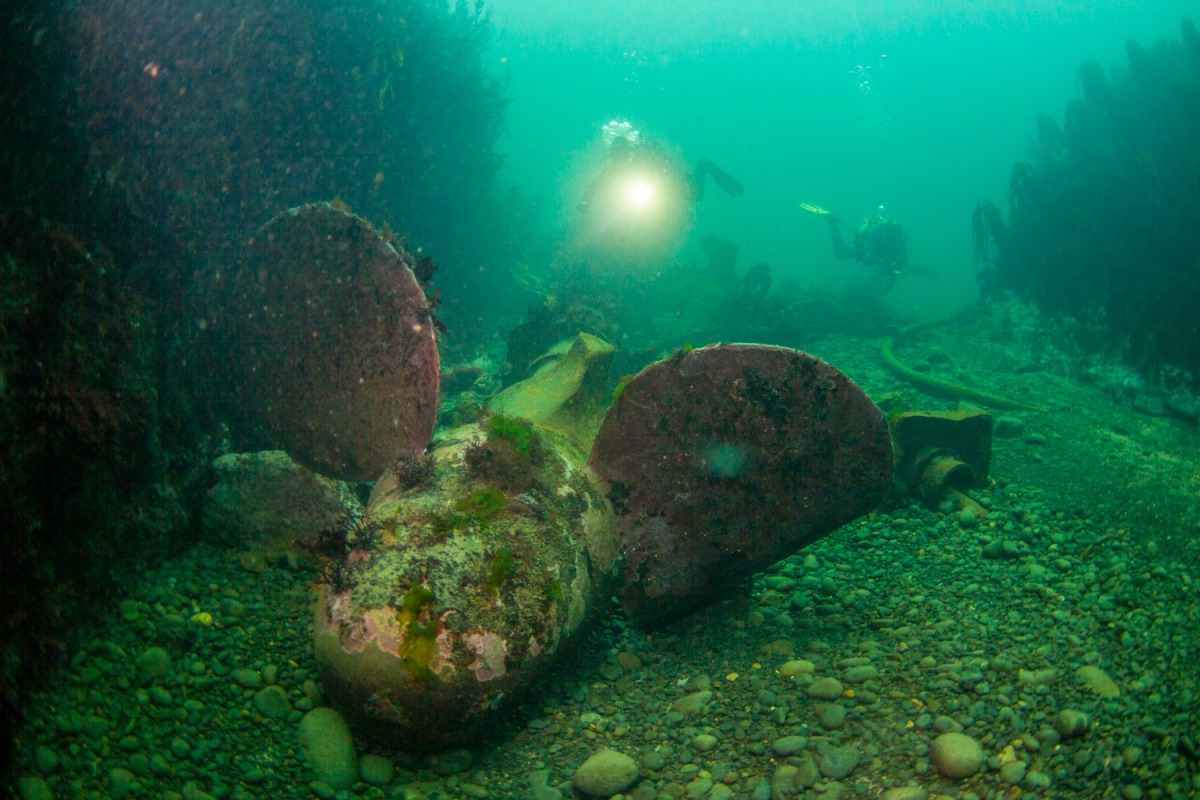
    At this stage the engine block sits proudly on the seabed, with the propeller and its drive shaft streaming out of it, giving the impression of a skeleton of a prehistoric sea creature.

    The engine block is an occasional home to spider crabs that come to shallower waters every year to mate before returning to the deep sea.

    Each year offers new insight into the ferocity of the winter storms, demonstrating how the incredible caves and blowholes have been carved over millennia into the unique Hook peninsula.

    This dive, although accessible from the shore, requires divers to go by foot for half-a-kilometre in full scuba gear before taking the plunge. It’s certainly an endurance test, but at least the coastline is a feast for human eyes.

    Hook Head wreck.

    Mapping Underwater

    Over the last few years a project has been completed by the team at Infomar to map the entire under water sea bed in Irish territorial waters, an area which is over ten times the size of our land-based territory.

    This incredible feat harnessed the most recent technological advances, and is an achievement that few other countries can lay claim to. It offers remarkable insights into the wealth of marine life along our coastline, which will hopefully be preserved for future generations to encounter.

    All of this data is easily accessible via Infomar’s website, and anyone with an interest in the secrets below our seas should take a look. So far they have released 3D imagery and articles on 65 of the 18,000 shipwrecks.

    In terms of other resources, there is also a wealth of knowledge contained in the National Maritime Museum of Ireland in Dun Laoghaire, with recovered artefacts on display from what are often tragic shipwrecks. For just a few euros aspiring wreckies can learn about the history of the wrecks they intend to visit.

    Important Insights

    As an underwater photographer shipwrecks will always hold a fascination. Perhaps the most important insight I have drawn from my many visits to these manmade reefs is how quickly nature reclaims the structures that we discard, rapidly transforming our waste into natural capital. Once barren sea beds can even be transformed into incredible ecosystems by what may initially seem to be the intrusion of an alien vessel, practically overnight.

    As we struggle to feed the many billions of human beings on our planet sustainably, it is perhaps worth considering the speed at which the sea converts our waste ships into nurseries for marine life. This process demonstrates how little we really understand about life below the ocean’s surface.

  • Looking Back on Lockdown

    With lockdown actively under consideration in some European states once again, including Ireland, we look back on a selection of testimonies from a period many of us thought we had put behind us.

    It all happened too fast, so quickly that we didn’t have time to fully understand. The night before we were sipping beer and eating tapas and waiting for spring to come in the warm evening breeze; the following day we were on the sofa consulting the Netflix schedule for the umpteenth time, without finding an entirely satisfactory choice.

    Diego Pugliese, ‘Barcelona Under Lockdown’, April 3rd, 2020.

    Image (c) Daniele Idini

    Our bodies, already weakened by sedentary lifestyles, are becoming weaker, muscle-mass decreasing quickly through lack of exercise. We do what we can, setting up home gyms, doing yoga in our bedrooms, a few push ups in the morning. No running, swimming, no going for walks; hardly breathing in the fresh air, panting, moving, or sweating. I do a little gardening in pots on the balcony, which I hadn’t done before. All of a sudden tomato seeds seemed the most important item on my shopping list during my weekly, stressful visit to the supermarket.

    Silvia Panizza, ‘Under Lockdown in Piedmont’, April 6th, 2020.

    We can have a gnawing sense that our civilisation got things wrong, that it is being, somehow, punished. A year ago I heard a retreat-giver say that we had lost the ability to read the signs of the times. We had belonged, or thought we belonged, on a planet that although under threat, and although subject to disaster more or less randomly distributed, was broadly on a path of progress, of improvement, even for under-developed regions. Nature mostly provided balance and harmony.

    Modern science reinforces this optimism at the cosmic level. We now know that the total universe that includes our Milky Way as one of nearly a hundred million galaxies has been expanding since the Big Bang. But if the rate of its expansion had been even a millionth of a percent slower, the whole thing would have collapsed, imploded in upon itself. There was fine tuning. Now trust is at issue with a particularly severe jolt for the Western world. It could be said that most of our strategies of coping are in the nature of distraction. To the extent this is so, the underlying unease remains. Call it dis-ease in fact.

    Fergus Armstrong, ‘A Voice from the Cocoon’, April 17th, 2020.

    Image (c) Felipe Monteiro

    What I, other immigrants, and the Portuguese hope is that we can return to the life we had before, and be able to leave this prison, without bars, that our homes have become. While we try to renew ourselves, the city is still and visibly lacking the energy and joy of the local population.

    What is most intriguing in this situation, at least for me, is that we are trying to reinvent ourselves. For example, I have started to cook a lot more during these days of confinement, learning new recipes, in addition to adapting the house for new activities we never used to do at home, like dancing and exercising.

    Despite everything I believe that together we will overcome this difficulty, which is happening on a a global scale; staying at home admiring the birds and their songs that echo along with an inaudible cry for freedom from the citizens.

    Felipe Monteiro, ‘Porto Under Lockdown’ April 17th, 2020

    Dmytro Sidashev / Alamy Stock Photo

    I had booked a hotel – but ended up alongside five families living in a large apartment for seven days. Only two of us were allowed outside to buy food – everyone else had to stay inside. Before leaving we were covered head-to-toe, in gloves, face masks and head coverings. On our return we went through elaborate cleaning procedures before re-entering the apartment. We had to remove our ‘outside’ clothing and spray everything with 75% alcohol.

    No cars with registrations from outside the capital city were allowed in. The schools were on holiday and due to return the first week in March but are still closed all over China. Only students doing important exams at the end of term will be allowed to return initially, which hasn’t happened yet.

    Leaving Beijing, I returned to my home city of ****. You are supposed to scan your phone so they can track potential carriers arriving into the city – which I hadn’t, having used a private firm for the airport collection. This meant my car registration didn’t show up on the cameras. So the next day the authorities were in touch to find out how I made it back from the airport.

    Tobias Easterby, ‘China Under Lockdown: Another Cultural Revolution?’ April 19th, 2020

    Illustration by Malina Molenda/Artsyfartsy for Cassandra Voices

    What if I had to take care of my little ones? While my mom goes outside to try and bring a little money in. What if she loses her job because of the pandemic? Then our only source of sustenance would be gone. Then we would be relying on the government even more than what we were doing before. What do you call that? Resting on the government? Relaxing on the government? Maybe even sleeping on the government because of the sheer amount of people whose lives were turned upside down because of it. As if living life sideways was any easier.

    Elizabeth Ekinwande, ‘Leaving Certificate Under Lockdown’, April 19th, 2020.

    The Swedish approach to the Covid-19 pandemic is a sign of underlying differences in how they understand morality in the public sphere, and how they relate with each other: this comes from a more utilitarian perspective.

    Utilitarianism has earned a bad reputations as it has been incorrectly conflated with crude capitalism, when it is really about taking peoples’ wellbeing seriously, or ‘the greatest happiness of the greatest number.’ As Jeremy Bentham and John Stuart Mills understood it, utilitarianism is extremely equalitarian .

    Notably, the Swedish government has taken the advice of moral philosophers who come from a moral utilitarian perspective. The core difference between their approach and what we are seeing for the most part elsewhere is they attempt to avoid an understandable reaction to save lives immediately. They put aside an emotional response and consider the future consequences.

    William Smith, ‘Covid-19: ‘A View from Sweden’, April 25th, 2020.

    Image (c) Daniele Idini

    Across the hall, the atmosphere is suddenly lifted by the wit and humour of a ninety-odd year-old who has somehow escaped the dementia and delirium that pervades here. Unlike his fellow residents, this is a man who never wears his breakfast and is more recognisable to me in crisp shirt and tie, top button fastened. When we first met some months ago I doubted his cognition on hearing him shouting instructions to ‘Alexa’ across the room, but it turns out that I was the one that was out of touch. I look at his records – not for resuscitation, not for transfer. Despite his joviality, the oxygen levels already look poor. Given that it is still early on in the course of his infection, it is only a matter of time before he will crash and be gone.

    As the nation scrambled to prepare itself for the deluge of demand on ventilators, this was the kind of man who was never to have been deemed eligible. Yet in spite of the full newspaper spread photos of busy intensive care units, I know there is room for him, and that he has the will to live. Despite his age, were he to defy the admittedly poor odds, he has a quality of life to return to. We embark on the conversation that echoes a distant role-play from medical training which treads gently but directly on taboo. How is it you wish to die, and what interventions might be acceptable or worthwhile to try to prevent that?

    Anonymous Doctor, ‘Diary of a Pandemic Doctor: Nursing Home Chaos’, April 26th, 2020.

    Fear plays a major role in influencing the decisions we make and the actions we engage in. Research has shown that there are sound evolutionary reasons for this. The selection pressures from these types of danger have resulted in domain-specificity in the reactivity of the fear system, meaning that the system has evolved special sensitivity toward such dangers. However, ‘not all human fears are instinctual and hardwired—we need to learn what to be afraid of.’ [i] While this capacity is critical in helping humans deal with the different environments in which they find themselves and which present different sources of ‘danger’, it can also be abused by those seeking to advance their own interests at our expense.

    Justin Frewen, ‘Fear and Loathing in the time of Covid-19’, May 14th, 2020

    Image (c) Conor Blennerhassett

    The resorts of Magaluf, Palmanova and Santa Ponça on the southwest coast of Mallorca are among the island’s most popular destinations. By May, they are usually heaving with a mix of young families, pensioners and stag and hen parties – all availing of cheaper low season prices and temperatures in the high 20s and even low 30s.

    Conor Blennerhassett, Photo Essay: Mallorca After the Pandemic, May 26th, 2020

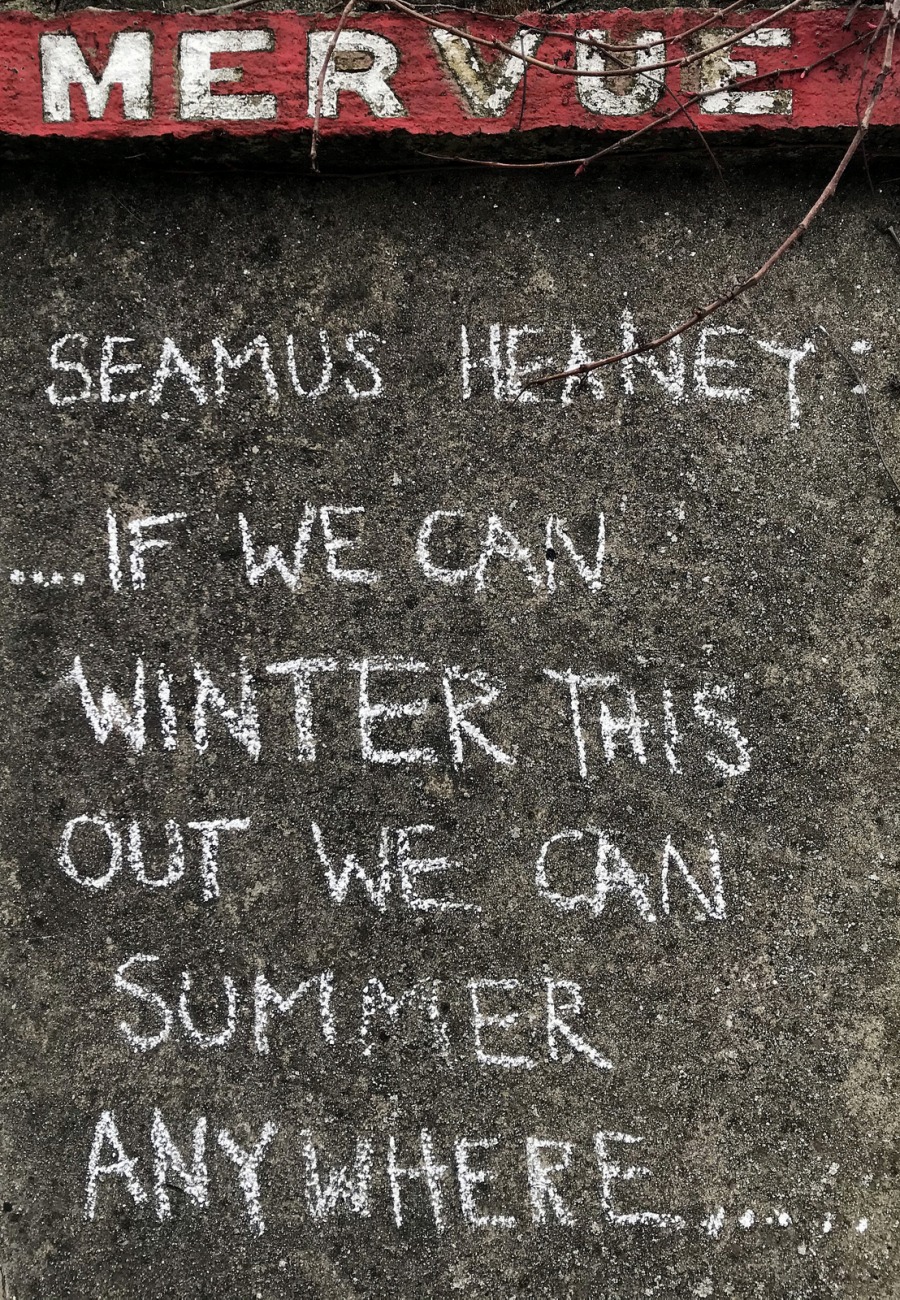
  • ‘If we winter this one out, we can summer anywhere’

    2019 was a great year for me, my first book was published and had a historic exhibition in the GPO – Stars and Souls of the Liffey – I had arrived, my Everest.

    January 2020 started slowly, but I watched as a new virus was decimating an unknown city in China called Wuhan. From a comfortable distance it still looked bad, watching a city imprisoned in military lockdown, but still it was far away. How would I and Ireland react if this was to travel? And slowly through February it crept ever closer, by the end of the month it started crippling Northern Italy. As always I swam, but me and my mates talked nervously about this approaching unknown, it now had a name – Covid-19.

    How would I fare if Dublin itself  went into lockdown? Without AA meetings for my recovery, would I give up and relapse?

    By early March a few cases were being recorded in Ireland, the media went into hysterical frenzy, almost shaming the inevitable innocent cases.

    Then I got an email to say that my next project was now cancelled. Devastated, I went for my usual swim, sometimes the magic water doesn’t work, it didn’t that day. I came home frozen, riddled with fear, no work, fear of how to pay my rent; suddenly I became unwell. A sore throat and mild fever, paralysed me, as I lay alone on my sofa.

    But no cough. Back then the only symptom mentioned was the hacking cough. I checked my phone and there was now talk of Ireland entering lockdown around St Patricks Day. Armageddon was arriving  Supermarkets running out of food, even fucking toilet paper. I was now in a delirious state of panic.

    The next day the fever went, but I still had the sore throat. On the Monday I tried phoning my Doctor; no answer; permanently engaged or just automated messages to contact some new HSE hub.

    I was now in a state of constant anxiety, with no food in the house, and yet I couldn’t leave home. and I live alone.

    I phoned my ex wife. She kindly said she’d shop for me. On St. Patrick’s Day Leo made his grim, great speech. I still felt he knew something that he wasn’t telling us. Maybe this virus was as deadly as the Spanish flu of 1918-20 that killed up to fifty million, including my grand-uncle aged just nineteen. Death figures of 85,000 were being predicted in Ireland by our Fear driven media.

    All that week I had an intermittent sore throat, but still could not get in contact with my Doctor.

    The thing to watch for was the breathlessness I had heard. This was what caused the dangerous pneumonia. On the Saturday night I went to bed early alone, and suddenly had problems breathing. It being Saturday I could not disturb my Doctor, nor did I want an ambulance arriving to take me to quarantine in hospital, where I’d be met by Hazmat-clad Doctors and become Patient No. 3. Laid low by fear and shortness of breath I could not sleep. By 5am I made a decision to complete my final book, Americans Anonymous and get my things in order in case this was it.

    I eventually relaxed and nodded off, waking up feeling much better. I tried phoning my doctor on the Monday but again couldn’t get through.

    Gradually that week I started to improve. The sore throat, my only symptom, kept coming and going, and I started to practice Wim Hoff breathing exercises to strengthen my lungs, and resumed taking short swims, back to the sea.

    I told people what happened and they asked did I have the cough?

    “No,” I said

    “You are ok then,” I was reassured.

    I walked slowly, masked up, around a deserted Sandycove and saw the Heaney quote on a local gate wall:

    “If we can winter this out, we can summer anywhere”

    As the weeks went by I felt better, swam more and got stronger.

    Did I have Covid-19? Or was it just a flu or an emotional breakdown?

    I still don’t know. It’s all an unknown, like so much around Covid-19.

    As a photographer, I wanted to capture this historic situation within the two mile radius we were permitted to travel.

    Images of masked individuals seamed too obvious, everyone was doing that, and mouths reveal so much in portraiture, and that emotion is what photography is all about for me.

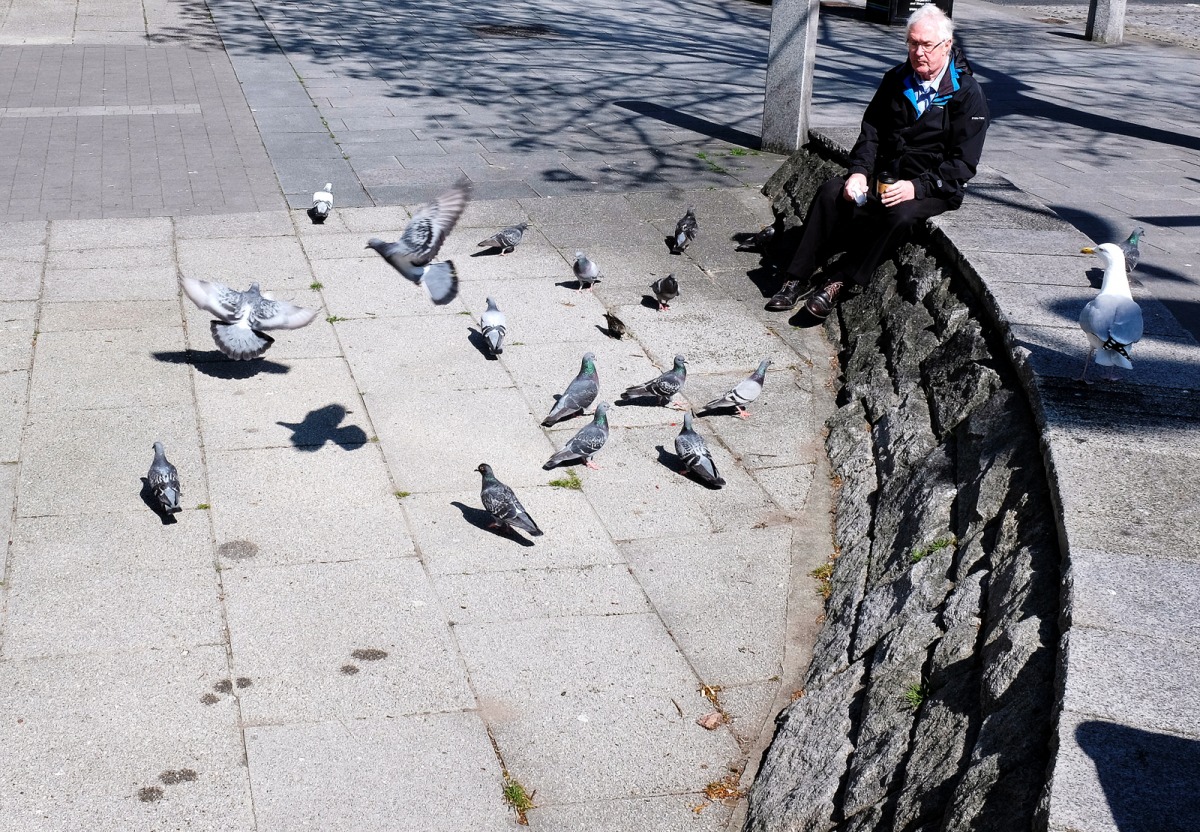
    I explored a deserted Dun Laoghaire, a man feeding pigeons summed up the sombre mood of the time. For weeks I could not capture this historic situation enfolding.

    Somehow it seemed unphotographable: this the most important event of our lives and I couldn’t capture it.

    Then one night down by the sea, a lone surfer emerged out of a sunset. I snapped. Magic and the image worked. I donated it to a Charity art auction and it sold well.

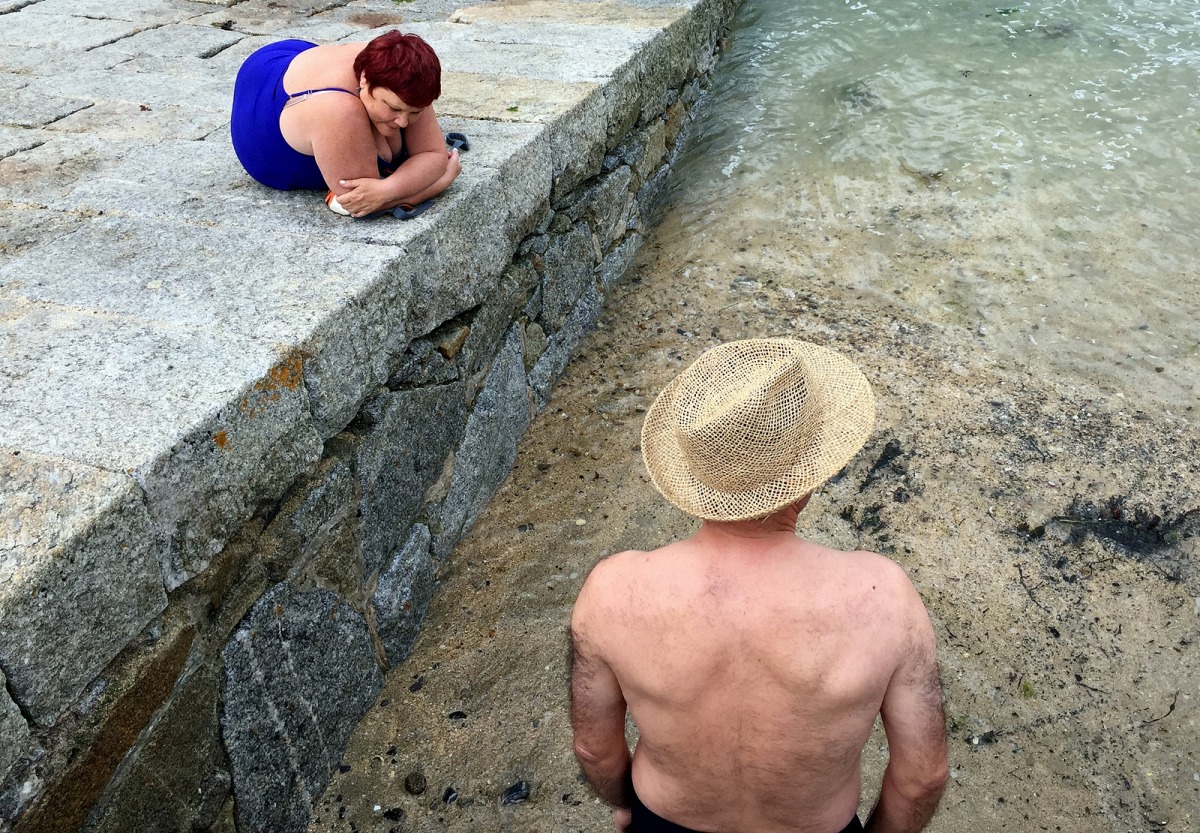
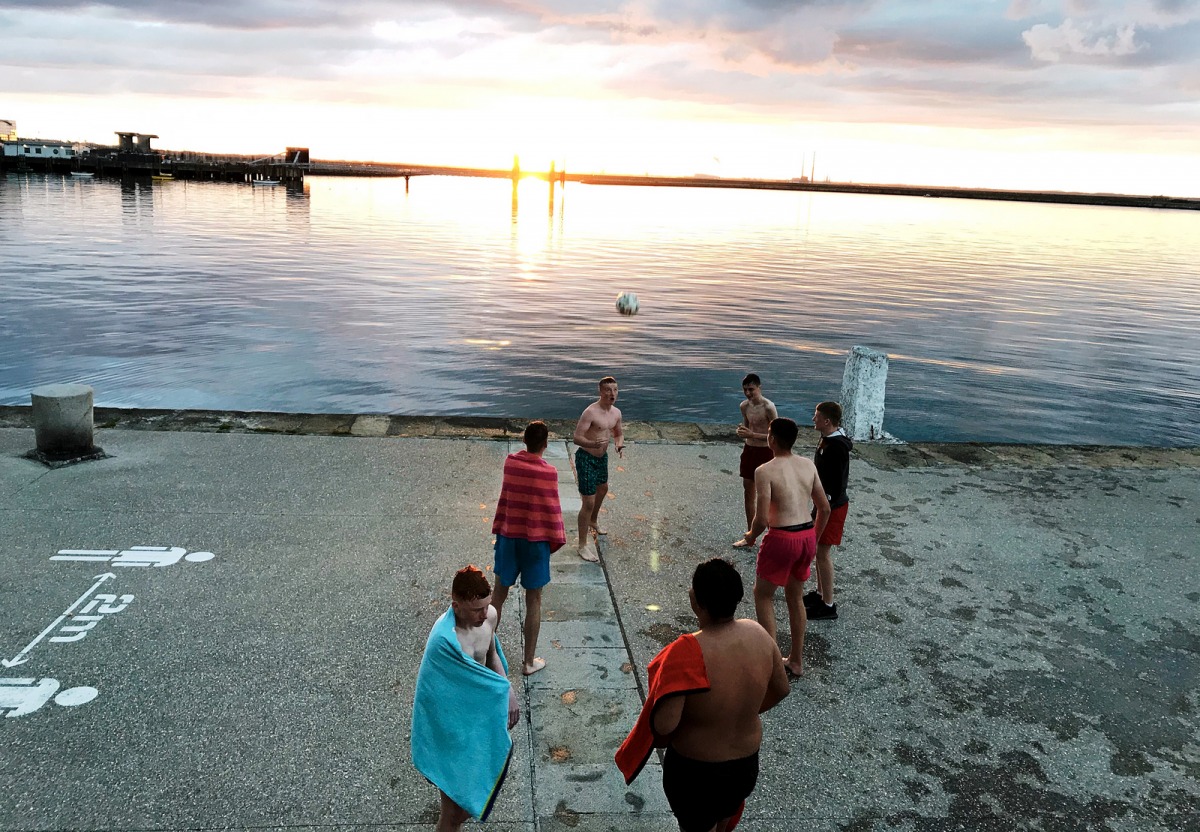
    As lockdown eased more and more people descended to summer in Dun Laoghaire around the Forty Foot. To swim, to escape, to even have fun in our new Covid world.

    Gradually I began to photograph this migration, at first people were cautious, masked, socially distancing on the newly opened beach, but as May turned to July people began to summer properly. The beaches became crowded, like normal, not the new normal; no one wore masks. The virus didn’t spread outdoors, or so we believed.

    Vitamin D and the sun were tonics for our immune systems and slowly I began to create my own personal take on this most unforgettable of summers, which Heaney had promised.

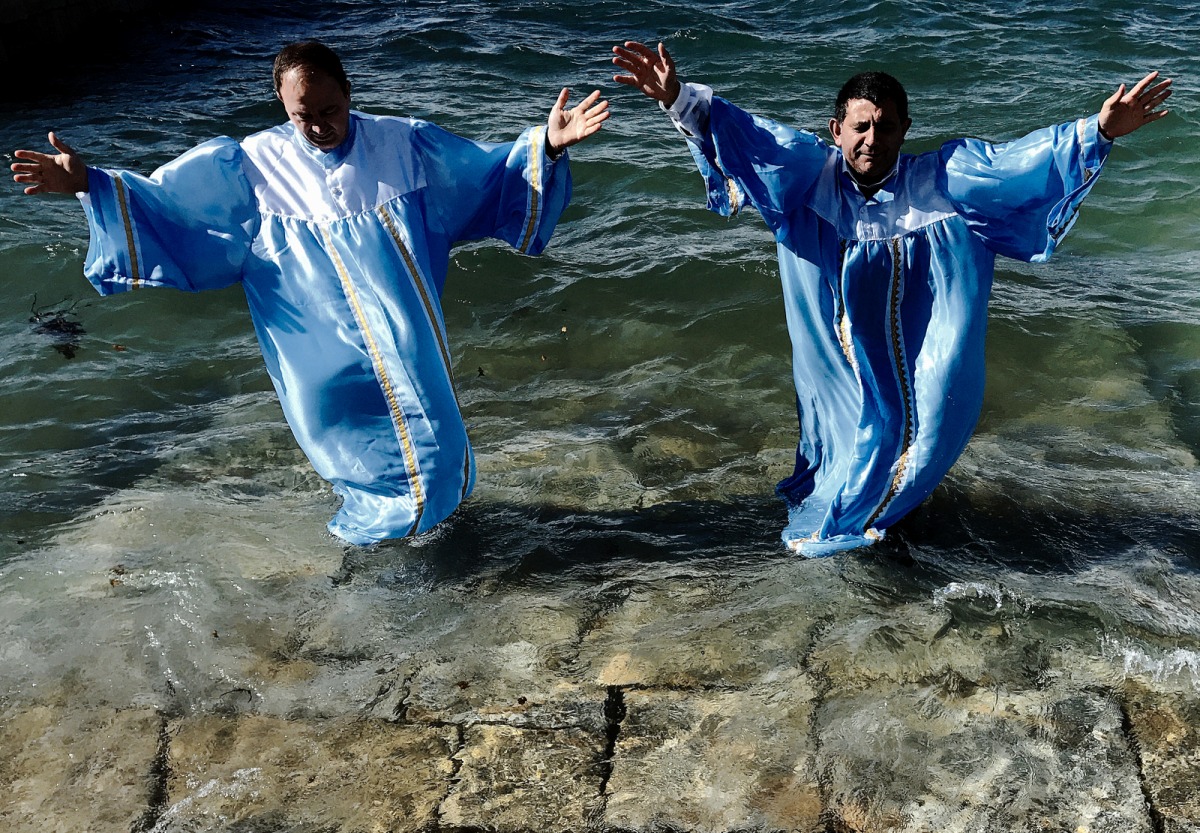
    As this summer of all summers now ends it looks like we are facing into another winter “to out.” Maybe we will all need Spiritual healing that the Born Again seek from our healing waters of Dun Laoghaire.

  • The British Radical Tradition: E.P. Thompson

    Britain has produced its fair share of major public intellectual figures. Having surveyed the legacies of George Orwell, Christopher Hitchens, the Irish-born Edmund Burke and contemporary leading lights John Gray and Jonathan Sumption, I now turn my attention to the great radical historian E. P. Thompson.

    Intellectuals often stand apart from a mainstream radical tradition. Hitchens, for example, while broadly adhering to Thomas Paine and The Rights of Man was a contrarian and dedicated atheist who tendentiously supported George W. Bush’s War in Iraq, although perhaps the waterboarding he voluntarily submitted to, and declared to be a form of torture, acted as a form of atonement.

    It is unthinkable, however, that Edward Palmer (E. P.) Thompson (1923-1993) would have performed such a volte-face. Thompson held himself squarely within the English radical tradition of William Cobbett, Thomas Paine and Robert Owen, as well as his hero the poet William Blake, and to a lesser extent William Morris. Thompson’s ideology was a form of socialitist libertarianism for the ordinary man.

    I grew up reading his work, and indeed watching his grey mane flowing in the wind as he addressed CND rallies, although I understand he was a difficult colleague, a hopeless administrator and an egotist. It seems to have been another case of don’t meet your heroes.

    The Making of the English Working Class

    His lasting contribution is the seminal The Making Of The English Working Class (1980), possibly the greatest work of history of the twentieth century that emphasised a new form of bottom-up history, related to the subaltern history that was emerging at the same time in former colonial societies. Notably, Edward Said’s Orientalism, which was published in 1978.

    Thompson methodology is well captured in the following quotation from this canonical text:

    I am seeking to rescue the poor stockinger, the Luddite cropper, the “obsolete” hand-loom weaver, the “utopian” artisan, and even the deluded follower of Joanna Southcott, from the enormous condescension of posterity. Their crafts and traditions may have been dying. Their hostility to the new industrialism may have been backward-looking. Their communitarian ideals may have been fantasies. Their insurrectionary conspiracies may have been foolhardy. But they lived through these times of acute social disturbance, and we did not. Their aspirations were valid in terms of their own experience.[i]

    Also, In The Making Of The English Working Class, Thompson places himself firmly within the British rights-driven tradition and focuses on The Liberty Tree, and its essential components of freedom under the law, freedom from arbitrary arrest, trial by jury, habeas corpus and the spectrum of individual rights now under threat of obliteration.

    I suspect, just as Lord Sumption is a libertarian, albeit in a different sense, who has spoken out about the restriction on our current restrictions on liberties, Thompson would be horrified at the course of current events in the U.K. ushered in by Coronavirus Emergency legislation and recent Counter Terrorism Legislation.

    https://twitter.com/RTUKnews/status/1296487156198903808

    The Poverty of Theory

    Although a Marxist – albeit unlike his contemporary historian Eric Hobsbawm he resigned from the Communist Party of Great Britain after the Soviet invasion of Hungary in 1956 – he was also a historian in the empiricist tradition, distrustful of great meta narratives and the abstract musings of structuralists, which culminated in his famous polemic against Althusser The Poverty of Theory or an Orrery of Errors (1978).

    He argued that individuals were agents of activity though caught within the agency of history. They have room to achieve what they do, but only under specific conditions and defined constraints. His sense of the developmental nature of the working class is perhaps best illustrated in the following quote: ‘The working class did not rise like the sun at an appointed time. It was present at its own making.’[ii]

    This led to the famous opening passage of The Making of the English Working Class, and his emphasis in his teaching on bottom-up or grassroots analysis, rather than a top-down, theory-driven, approach. He prized empirical evidence derived from the activities of human subjects. A true historian.

    That great book in fact has many resonances for our age, not least in how the chiliasm of despair and poverty awakened renewed religiosity – Wesleyan Methodism in particular. His bottom-up analysis pointed to how religion became the opium of the people. This may also explain the rise of religious fundamentalism in our own period of profound economic security.

    Thompson demonstrated how local worker communities were often collective, and how a moral economy operated that distributed goods and services according to the respective needs of those who traded and bartered. These localized and community-driven economies were also explored by the late David Graeber in his Debt: the First 5,000 Years (2011).

    It would be a mistake to view Thompson as anti-religious, or to put it another way, he saw a values in religion or in certain religions. On the one hand he rejected what he saw as an authoritarianism implicit in the hierarchical structure of Catholicism, but in Protestantism he found a pragmatism that chimed with his distrust of system-building.

    Influence of Antonio Gramsci

    Thompson was greatly influenced by Antonio Gramsci, in particular his famous concept of hegemony and a war of position for proletarian emancipation. Gramsci identified an ongoing war of position occurring between the elites and workers, a category which extends conceptually to embrace anyone who is not part of an ever-narrowing plutocracy or billionaire class.

    Gramsci allocated a substantial role to intelligentsia and politicians, but also to workers’ councils in altering the course of history to achieve a Communist society. The working class would first have to attain a cultural hegemony before gaining political power he argued: ‘The workers could only win if they achieved cultural hegemony before attaining political power.’

    Occasionally, he seems to identify it (hegemony) with political power exercised by coercion, but as a rule he distinguishes the two concepts, so that hegemony signifies the control of the intellectual life of society by purely cultural means. Every class tries to secure a governing position not only in public institutions but also in regard to the opinions, values and standards acknowledged by the bulk of society. The privileged classes in their time secured a position of hegemony in the intellectual; as well as the political sphere; they subjugated the others by this means, and intellectual supremacy was a precondition of political rule. The main task of the workers in modern times was to liberate themselves spiritually from the control of the bourgeoisie and the church and to establish their own cultural values in such a way as to attract the oppressed and intellectual strata to themselves. Cultural hegemony was a fundamental and prior condition of attaining political power. The working class could only conquer by first imparting its world view and system of values to the other class who might be its political allies; in this way it would become the intellectual leader of society just as the bourgeoisie had done before seizing political control.[iii]

    The Rule of Law

    Thompson diverged from conventional Marxist theory in his approach to the role of law. A conventional Marxist view consider this as:

    by definition a part of a ‘superstructure’ adapting itself to the necessities of an infrastructure of productive forces and productive relations. As such, it is clearly an instrument of the de facto ruling class: it both defines and defends these rulers’ claims upon resources and labour-power – it says what shall be property and what shall be crime – and it mediates class relations with a set of appropriate rules and sanctions, all of which, ultimately, confirm and consolidate existing class power. Hence the rule of law is only another mask for the rule of a class. The revolutionary can have no interest in law, unless as a phenomenon of ruling-class power and hypocrisy; it should be his aim simply to overthrow it.[iv]

    In contrast Thompson was a qualified supporter, arguing that: ‘Law may be seen,’ he argued, not only instrumentally and ideologically, but also ‘simply in terms of its own logic, rules and procedures – that is, simply as law.’

    In Whigs and Hunters: The Origin of the Black Act (1975) Thompson argues against the idea that the law could be reduced to a superstructure, reflecting the class interest of the ruling class, but offered instead a more complex truth inherent to which was the fact that ‘it could not be reserved for the exclusive use only of their own class.’

    He concluded that the law did mediate existing relations and was ‘a superb instrument by which these rulers were able to impose new definitions of property to their even greater advantage,’ for example, in terms of his historical works by extinguishing agrarian use-rights and by enclosures but on the other hand, the law mediated these class relations through legal forms, which imposed, again and again, inhibitions on the actions of the rulers.

    Also, Thomson argued that rulers ‘believed enough in these rules, to allow, in certain limited areas, the law itself to be a genuine forum within which certain kinds of class conflict were fought out.’ On occasion the government itself was defeated in the courts: ‘Such occasions served, paradoxically, to consolidate power and to enhance its legitimacy,’ but also ‘to bring power even further within constitutional controls.’

    Thompson suggested  that this role of law was in essence: ‘a legacy as substantial as any handed down from the struggles of the seventeenth century to the eighteenth and a true and important cultural achievement,’ and further that ‘the notion of the regulation and reconciliation of conflicts through the rule of law’ was ‘a cultural achievement of universal significance’

    He asserted that though imperial in its origin, the rule of law inhibited that imperial power such that:

    Transplanted as it was to even more inequitable contexts, this law could become an instrument of imperialism. For this law has found its way to a good many parts of the globe. But even here the rules and rhetoric have imposed some inhibitions upon the imperial power. If the rhetoric was a mask, it was a mask which Gandhi and Nehru were to borrow, at the head of a million masked supporters.

    His classic position from Whigs and Hunters is encapsulated in the following statement:

    But the rule of law itself, the imposing of effective inhibitions upon power and the defence of the citizen from power’s all-intrusive claims, seems to me to be an unqualified human good. To deny or belittle this good is, in this dangerous century when the resources and pretensions of power continue to enlarge, a desperate error of intellectual abstraction. More than this, it is a self-fulfilling error, which encourages us to give up the struggle against bad laws and class-bound procedures, and to disarm ourselves before power.

    Later he elaborated that:

    If I have argued elsewhere that the rule of law is an ‘unqualified human good’ I have done so as a historian and a materialist. The rule of law, in this sense, must always be historically, culturally, and, in general, nationally specific. It concerns the conduct of social life, and the regulation of conflicts, according to rules of law which are exactly defined and have palpable and material evidences – which rules attain towards consensual assent and are subject to interrogation and reform.

    Criticism

    Thompson has been criticised for upholding what is considered by some to be the conservative doctrine of the rule of law, and not an unqualified good according to Morton Horowitz; or as Adrian Merritt argues: its logic is ‘the logic of class formation.’

    Bob Fine also suggests that the Rule of Law need not be characterized as ‘an unqualified human good’ for one to recognize that it is superior to bald authoritarianism, and that other institutions such as democratic elections limit power and that, rather than limiting power, the law serves in various ways to enhance the power of the ruling class.

    Nonetheless, in Thompson’s defence it can be argued he is only suggesting that the rule of law was neutral and not conservative and neither promoted nor impeded substantive justice. In this context  Thompson insists that he was ‘not starry-eyed’ about the law. On the contrary he was bent on ‘exposing the shams and inequities which may be concealed beneath this law.’

    Nevertheless, for Thomson the rule of law was ‘an unqualified human good,’ because it is invariably superior to unbridled authoritarianism, and what makes the rule of law an unqualified human good for Thompson is the lack of any available substitute mechanism for limiting arbitrary power in complex societies.

    His faith in the common man is again evident in his assessment of jury trial.

    Jurors have found, again and again, and at critical moments, according to what is their sense of the rational and just. If their sense of justice has gone one way, and the case another, they have found “against the evidence,” … the English common law rests upon a bargain between the Law and the people: The jury box is where the people come into the court: The judge watches them and the people watch back. A jury is the place where the bargain is struck. The jury attends in judgment, not only upon the accused, but also upon the justice and the humanity of the Law.

    British Empirical Tradition

    Like all British empiricists from Burke to Hitchens and Orwell, and especially as an historian, Thompson was acutely sensitive to issues of truth and lies, shabby cover ups, semi-truths and disinformation.

    Thompson’s book on Blake, his last, endorses the attack on the beast, which is in effect the state or state religion classified by Thomson as the whore of Babylon.

    As an educationalist he was incidentally a humanist, recognising the importance in his teaching of objectivity and tolerance, but seeing these not as important matters in and of themselves – in that we are all a product of our time – but as offering useful educational and heuristic methods.

    His focus on ordinary people, on human rights and the rule of law and his distrust of great systems and absurd generalisation and abstractions is now of great relevance, as are his warnings and research into religious fundamentalism. Alas, E.H. Thompson’s devotion to the determination of facts, detail and accuracy is sorely lacking in contemporary discourse.

    [i] E. P. Thompson, The Making of the English Working Class, Victor Gollancz Ltd, London, p.14

    [ii] Ibid, p. I

    [iii] see Lezsek Kolakowski: Main Currents of Marxism: Its Rise, Growth and Dissolution Volume 1: The Founders, Oxford Paperbacks, Oxford pp.241-42

    [iv] Thompson, in Beirne and Quinney, Marixism and Law, Wiley, New York 1982

  • Poetry: Ernest Hilbert

    Spolia Opima

    Models, slender and famished as cheetahs,
    Shed their imperial haute couture
    Already in sweatpants, they hail their cabs

    Behind the Grand Palais before
    Applause dies down inside around
    The vacant runway. Afternoon sunlight’s

    Lambent overhead on friezes of Lutetian Limestone.
    Violinists grimace at their scores—
    Haydn, Hollywood, the B’s and Broadway hits,

    Rehearsal house-lights hard above,
    Rosin fine as cocaine settling on the boards.
    They’re not arrogant. They’re bored.

    They’re paid to make the beauty go.
    Why else? We all make beauty pay.
    Gourmands’ are all aglow as it arrives— 

    Voila, another flambé. Cherries, drenched
    In century-old brandy, burn like coals.
    The waiter itches to check his phone. He grins.

    I’m given to hyperbole, I know,
    But something’s got to me. It’s all around.
    You have to learn to make it pay you back.

    The bathroom’s OUT OF ORDER. Sewage seeps
    Into the restaurant. The manager’s
    Frantic, alone today. The line’s

    Become a mob. A voice from an SUV
    Barks at the drive-through speaker. In the back,
    Children cheer a whirl of color on a screen.

    I feel the boredom underneath the beauty.
    It’s weird, and getting desperate these days.
    In auction rooms, the arms go up. And . . . sold.

    The next exquisite investment’s on the block.
    The views—the hills, the seas—are still pristine for those
    Who can afford the heights. Who’s this beauty for?

    Beauty’s boring. I do go on and on,
    Don’t I? Oh, you have a nosebleed.
    Here, drip some in my drink. See this?

    Flick this switch. Now listen. Someone will scream.


    Crypt

    The cities burn above me as I sleep.
    I’m walled by trophies looted long ago
    Along the routes of conquest, centuries

    Of funereal remains, gold that’s dimmed
    By dust and bound by web, as valueless
    As the dirt that slowly takes it back again.

    I wake and wonder where I am. I move
    My arm and bottles clink. I raise my head
    Enough to see I must have drunk them all.

    I’m underground. I know because the light
    That works like stars in chinks is far
    Above me. Even in this dusk I find

    There’s something left inside a bottle here.
    Sitting up, I take a swallow and get it down
    Before I choke, and spit out warm urine.

    I half-remember falling off the edge
    Of the world. Then nothing else. I barely breathe,
    The air’s so thick and sapped of oxygen,

    A gas of churned-up worms and sporous loam.
    I want to learn the way back up. I try
    To name the things I see—sextants, I-Phones.

    An avian chorus summons me. What years
    Have gone? I fall toward sleep again. The soil becomes
    A lake that’s darker than the night. My dreams

    Are long as centuries, of wars and new words,
    All telling me “you are gone,” but I’m still here,
    Curled up, and cold, in my crown of amethyst.


    Apollinaris, Medicus Titi Imperatoris hic Cacavit Bene

    I check my e-mail. There’s nothing there for me.
    I check the wall. Not much, some recipes
    I’ll never cook, some boasts, some oaths, some jokes,
    Advice, little different from graffiti

    Scrawled on Roman stone two thousand years ago,
    Small bursts of unofficial human hopes,
    And on we go, unchanged, forever griping
    Era to era—it’s almost comforting—

    Election slogans packed in ash at Pompei,
    Billboards on the Temple of Bacchus at Baalbek,
    Winged lions tagged on the Great Enclosure,
    Signs of the Khufu Gang left in Giza,

    So many words, like air exhaled to air,
    Like tiny helium hearts escaping
    In a delirium of approval up a wall,
    Or displeased emperor’s thumb aimed down.


    Visit Ernest Hilbert

  • Cuba Libre! At Home with Ronan Sheehan

    Last week Andrea Reynell met renowned Irish man-of-letters Ronan Sheehan in his Dublin home. They discussed his abiding passion for Latin poetry, the challenges and opportunities for young writers and what has inspired him to assemble a volume of translations of Cuban poetry from a range of Irish writers.

    I was welcomed into a cosy sitting room with a green/blue sofa, a pale wooden table with chairs, while dozens of photographs and art works adorned the walls. The Libyan Sibyl and another painting reminiscent of the great Irish epic, An Táin Bó Cúailnge (The Cattle Raid of Cooley) caught my eye. A well-used fireplace lay to my left behind Ronan, as the open door to the back garden let in a cool breeze as we sat at the table.

    A: How did you get your start in writing poetry?

    R: I don’t really write in poetry. I write more prose which I started writing when I was at school and I got interested in literature then. I had two things published when I was sixteen one was a short story in The Irish Press which was a big thing in my day. And the other was a poem in a magazine called The Kilkenny Review, or something like that. But subsequently I learned to love poetry, but I don’t really write poetry. I can write translations which is a different thing.

    A: I’d be the same myself. I prefer writing prose to poetry. I’ve been doing a few bits and pieces but don’t have anything published. But as long as I enjoy it really. How much do you reckon the Irish literary society has changed since you first started writing?

    R: That’s a good question. I think It’s changed a lot. When I was in my teenage years the nineteen-sixties. I suspect you weren’t born then Andrea.

    A: (laughs) No. Not even close.

    R: For starters there was very little or no publishing houses in Ireland and when The Irish Press started to publish stories and poetry that was kind of revolutionary because the only other places were a couple of literary magazines that was all that was there. And consequently, to get something published was a big deal. And now there are a lot of publications and in some way that’s better, in the sense that there’s more chances for people to start off. In other ways I have reservations about it because I often get the sense that there’s too much going out. I hope that doesn’t sound mean spirited.

    A: How important do you think the arts are today?

    R: I think the arts are very important if you like but, for this reason that what you might call the world of culture. It’s really dominated by enormous interests, the high-tech companies like Google and also by Hollywood and big music companies so that the small country and the individuals are really cowed by the sheer power of those things. So, whenever the arts afford individual voices to be heard I think that’s very important for that reason. I mean I could name other reasons as well but that’s one cultural reason as to why I think the arts are very important.

    A: What poets, or writers past or present would have an influence on your work?

    R: Jorge Luis Borges

    (There’s a photo of the late, famous Argentinian writer on top of the book case across from me) Do you know who he is?

    Jorge Luis Borges (right).

    A: Yes, I’ve read up on him.

    R: Did you read it from my essay?

    A: I did indeed, and it was very interesting.

    R: Thanks a lot. Sorry I wasn’t looking to drag that out of you!
    In school I studied Classics and I studied Latin and English when I went to UCD. While I really loved that engagement with books and so forth and as I got older I realised that there were some books and some writers and even some works that touch you. In a way that is not necessarily quite rational. You don’t look at all the points in Ulysses like you’re taught and say: “oh that’s a great book.”
    But it’s different when something affects you right? So I hope this doesn’t sound pretentious but a writer whom I loved in Latin was Catullus who was a Latin poet and I did a project about Catullus some while ago. And another writer was Tacitus who was a historian so that’s one thing, don’t want to go on forever. Another person that I loved, as I wrote a book of short stories was Borges and it was a thrill for me to meet Borges. And if you read the essay that I did I think I’ll always remember. When I quoted to him something that he’d said about Tacitus. And he said, “Tacitus records the crucifixion but does not perceive it” and Borges just looked across and said “Did I write that? I don’t think I’m a very good writer you know, but maybe in the sixty years trying I’m entitled to the odd good line.”

    A: That’s brilliant

    R: Isn’t it?

    A: That just really encapsulates who he was.

    R: Yeah it does. It’s a very good position for a writer to be, you know. Not to be arrogant, not to be presumptuous that you’re great. In my case I’ve written a few things I think came out well, a lot of things that didn’t. But I’d much prefer to be in Borges’s camp and say well, I think one or two things came up, you see. So, you’re sort of at ease with yourself in that position, does that make sense?

    A: It does indeed. And how much of an impact do you reckon he’s had on your future and current work?

    R: He had an influence on some of the essays that I’ve done, and he has an influence on a book that I’m writing now, and I’ll tell you why. That while I say an influence, it’s something that I have in my ear or try to do well is, he has a terseness, a succinctness about his sentences that I love because they’re so resonant. And when you leave down a page that Borges has written you feel this resonance of meaning and possibility and a richness of language so it’s beautiful you know it’s lovely. That’s what writing is for and I would love to try and imitate that.

    A: So, for the readers of this article, where did the idea for the book of poetry come from?

    R: Many years ago I edited an issue of a magazine called The Crane Bag on Ireland and Latin America and for one reason or another I don’t think I was able to do anything Cuban in that issue. One of my favourite books is a Cuban book called The Kingdom Of This World by a writer called Alejo Carpentier which is about the slave revolt in Haiti in the 1790’s, then Santo Domingo. So when I was on the board of Poetry Ireland about twenty years ago, the possible of going to Cuba came up. So, I went and met people in the writers’ union including the president and we made an agreement that we would do a joint anthology of poetry together, that’s how it came about.

    A: What would your favourite poem of the anthology be and why?

    R: That’s a good question. It is a poem that translated by Trudy Hayes and it’s called, It’s a poem about. (He trails off here) How about I go get it? It’s very short, I’ll read it, it’ll be nice.

    A: Yes, go ahead.

    He walks out of the sitting room, which leaves me a chance to take in the abundance of things on the walls. A clock ticks away, a steady beat, as I wait for him to return. He soon reappears with a black book.

    R: This is a proof copy of the book. If I may say a little bit about the book?

    A: Yes, absolutely.

    R: So, see what you make of this, this is called ‘Blessed are the Mean Spirited’ (Interpreted/translated from Spanish by Trudy Hayes)

    Blessed are the unperturbed spirits
    Not born of a poisoned womb
    Or terrorised by a lurching ghost,
    Or by their own raging seed,
    Those erupting with a terrible sickness
    Doomed to wander eternally a path in the wilderness that never
    leads home.
    Blessed are those not burning on a furnace of love,
    The unmarked smiling ones,
    The behatted archangels In fishnet tights,
    The patters of bellies, the jellied ones, the loved ones, the
    virtuous ones,
    The pied pipers and their enchanted mice, the business tycoons
    and the Superheroes,
    The movers and shakers, the poised, collected, unshaken ones,
    The fragile ones, the wise ones, the palatable ones, the smiling
    and waving ones,
    The truly fine ones and the truly sweet ones sweet to the core.
    Blessed are the Innocent birds of paradise, the steaming cow
    dung, the Implacable stones.
    But MAKE WAY for the creatures of the Dream and the
    Nightmare.
    Make way for the lost, damned, grief-stricken souls wandering
    a lonely path.
    Madder and drunker than their ancestors. Scorched by love.
    Trying to find a way home to the house of straw hats, for they
    saved you. 

    A; Wow, that’s haunting and ominous but powerful

    R: Isn’t it? I hate sounding like a professor, but one of the things I like is the kind of writing that makes a point, which communicates something. Lots of poetry doesn’t do that but that’s fine, there’s nothing wrong with that. I read that out at a street party during the summer and Trudy read it out somewhere and people responded to it. Do you know they thought that was good. Ok so that’s one thing. It either speaks for itself or it doesn’t. Another thing I’d like to say about this book. It’s about fifty Cuban poems and about fifty translations and without going into the entire history of the whole thing, it’s quite powerful if you bring it into a book, lots of different voices. Some of the people translating are really well-known poets who are lauded, others are people I brought in, they’re not poets at all. But they’re good, they’ve got something to say, they can use language, they’ve got some spirit. So that when you’re reading this you don’t know what to expect next, so the idea is to give a book a kind of potency like that.

    A: I find that’s exactly what it does, so moving along to another question. I found there was a big difference in formality between some of the poems, so for example The Boy and the Moon with lines like:

    The moon and the boy play
    A little game between them;
    They see each other without looking, they talk in fits of silence.

    Versus in ‘Pineapple’ where we have a lot more of what you could call Irishisms.

    Indulge me, pineapple.
    Imagine if bould Fergus,
    leppIng from Tara had given Glasgow a miss,
    Ryanairing it instead to hotter shores. 

    I love that line.

    So, What are your thoughts on the differences in this language?

    R: Ok can I be theoretical for a bit? This is going to sound academic or whatever. Ten years ago, I did a translation of the Latin poet Catullus called The Irish Catullus or One Gentleman of Verona.  It was a protest against the closure of the Classics Department in Queens University. The phrase the Irish Catullus really derives from a translation of the Aeneid which is called the Irish Aeneid. What was called the Irish Aeneid was the first ever translation of the Aeneid into a vernacular language in the thirteenth century by a bard of Ireland. They translated it before anybody in Oxford or Cambridge or anything, ok? But the way he did the Aeneid was he really rewrote the whole thing right, like he reshaped it. (Ronan gives a laugh here)

    A: As you do.

    R: As you do. The whole point of this was so that the people of Sligo, and Mayo and Galway and that culture could receive it otherwise there was no point in doing it.

    A: So, I guess you could say in ‘layman’s terms’ more or less.

    R: Yes, exactly. In the culture that it was going into. So I invited the people, including Mia and the people who were translating the Catullus poems to do it in what I call the Irish Aeneid spirit. To reshape it, to put it into our context if they wanted to. There’s a hundred translations of Catullus. What’s the point in doing another in just the same way? So, people did that, and Mia did it brilliantly. There’s lot of sex in Catullus. Roman street sex poems and Mia translated them into Dublin sex poems and they’re brilliant, they really work. So here what she’s done is something similar and a different idea. She hasn’t just followed word for word the poem, she responded to it and she’s introduced her own language and that’s a perfectly legitimate thing to do.

    A: So, what challenges did you face when translating poems from Spanish to English, do you think some things may have got lost in translation?

    R: Yes, I think it’s a truism that something gets lost in translation but equally if nothing is translated everything gets lost. So I think Spanish in a way is deceptive in that you’d think that because the words are specific, that you can’t just use a dictionary and translate them, but you can. But the thing that’s not so easy to do is the rhythms of Spanish like they have noche que noche oscura (‘night what a dark night‘s’). It doesn’t sound the same in English so that’s in some of the poems. I have a little Spanish, and I can see there’s a whole atmosphere and world in those poems that doesn’t necessarily come out through translation, but something else does come out which makes it all worthwhile.

    A: In the preface you say that fifty poems by Cuban poets born prior to 1959 were chosen and fifty poems by Irish poets born prior to 1922 were chosen. Is there a significance to these dates?

    R; Yes, the reason is that there was the Cuban Revolution in 1959 and there was the Irish free state (that was established) in 1922 (and the Irish Civil War) so in a way the idea was to sidestep the issue of the revolution in both countries.

    A: Again in the preface, it was written that fifty Spanish poems were swapped with the Irish side and fifty poems in English were swapped with the Cuban side. But in the end fifty Spanish poems were taken and were translated into English and given an Irish interpretation. Why did you decide to take this route rather than have Irish poets write their own poems?

    R: That’s another good question too. Because this is the first encounter between the two countries at this level although there’s another interesting one which I’ll come to in a minute. So it’s better to sometimes manage something like this. There was a formality in a way that perhaps made this manageable whereas if you were to open it up in the way you had described it would be a different proposition.

    A: What will your next writing or poetry project be?

    The criminal court of justice, Dublin. Daniele Idini/Cassandra Voices

    R: The next writing project I will be doing is to revise a book that I’ve been working on for a while which is called Green Street. Green Street is the name lawyers gave to the Special Criminal Court. Did you ever hear of Robert Emmett?

    A: Yes

    R: Did you ever hear of Sarah Curran, Robert Emmett’s fiancée? My cousin Margaret is a descendant and looks like her and that’s her up there in the green hat. (He points at a photo framed by the door). See, so she has to go to Green Street. What do you think of that? Anyway, so that’s what I’m going to be doing. So yes the most famous thing that ever happened in Green Street was the trial of Robert Emmett. And as I say Robert Emmett was in love with Sarah Curran, and I also did cases on Green Street and a few years later my brother and I did so in a way exploring that.

    Sarah Curran playing the harp. Painted by William Beechey, c.1805.

    A: Is there anything else that you’d like to comment on that you feel would be important for readers to know?

    R: I think that I’m going to make a compliment to Cassandra Voices shall I do that?

    A: If you like, can’t go wrong.

    R: A really good thing that can happen in literary culture is to have small groups or magazines that are bringing out books or magazines and programmes that are independent. That’s really what I know in my experience of such things, that’s where real creativity resides.

    After I stop recording, I get a closer look at the photo of Sarah Curran’s ancestor, the green hat is indeed striking, the face shapes are similar too. I thank Ronan for his time and step out into the warm sunlight to make my way home.

    Feature Image: Daniele Idini (c)