It is easy when we are in prosperity to give advice to the afflicted. Aeschylus
Protestations against James Joyce’s ‘The Dead’ House on Usher’s Island being ear-marked for a hostel are rooted in cultural-bias and emotional-led egocentrism, and exhibit blatant hypocrisy among the denouncers. Artsy sentimentality can be the lesser evil, but it is still based on emotional, and, cultural biases.
The Aeschylus quote above may seem naïve with society unsettled by the Covid-19 pandemic – anxiety heightened and spurred on by the populist mediocrity – but the reality is, these past twenty years, we have never had it so good, especially with plenty of food at our disposal, alongside acres of indoor comfort available from pulsating warm radiators, hot water galore, and lest we forget our electronic devices yielding Netflix.
A festive analogy may be relevant here, the geese have gotten fat and inactive. Selfishness abounds. Narcissism and the age of the red-carpeted self are traits which are promoted rather than rationalised.
A thought-tormented age
This was perhaps anticipated in James Joyce’s short story ‘The Dead’ from Dubliners (1914), when the character of Gabriel Conroy says:
But we are living in a sceptical and, if I may use the phrase, a thought-tormented age: and sometimes I fear that this new generation, educated or hypereducated as it is, well lack those qualities of humanity, of hospitality of kindly humour which belong to an older day.
Regularly trudging past ‘The Dead House’ on the banks of the Liffey I have noted its square, flat Georgian edifice. Its jet-black door. Joyce describes it as ‘the dark, gaunt house’.
Over the past few years, it has come to light that this building on Usher’s Island is set to become a tourist hostel. This has led to cries of ‘cultural vandalism,’ but why were the same journalists and commentators silent when the building sat derelict for years? Unused. Unravelling and falling apart at the seams.
For a year, I sat in on Readings of Joyce’s Ulysses in Sweny’s Pharmacy on Lincoln Place, and did not encounter a single Irish writer of any standing. At the end of each session a wooden bowl was passed around to the attendees, who would dispense a few coins to help pay the rent. No rich, successful Dublin-based writers were coughing up dough to keep this cultural institution afloat.
The reality is that Dublin-based, and Dublin-enthralled, writers do not admit to themselves that Dublin has been swallowed up by the capitalist project. They are simply in denial.
The cultural embargo comes out in plaintive cries of ‘How dare they wreck our heritage?’ from behind computer screen in comfortable homes. Keyboard heroes. One and all. It has to be said that some are indolent and sly, with one eye on anything Joyce-related to enhance their own reputations and further book sales.
I do wonder – the Diogenesian cynic may ask – whether many of them have actually deigned to read much of Joyce’s work bar a few short stories from Dubliners? They may want to be associated with his masterpiece Ulysses but are they possessed by it?
Do they want to recreate the Cabman’s shelter under Butt Bridge or Bella Cohen’s bordello down on the now gone Tyrone street?
In ‘The Dead’ itself, Gabriel’s face colours when asked about his writing for the Daily Express, a Unionist newspaper, and is even labelled as a ‘West Briton’ by Miss Ivors. In Dublin parlance a ‘West Brit,’ or ‘Castle Catholic,’ remains someone who would have no home-spun patriotic scruples in dealing with the mother colony for purposes of profit; the comprador elite of an ex-colony.
How many Irish-based writers now have English agents, English publishers? How many have made their careers in London? More power to them, but the wedge of Anglo-Irish relations should narrow at least somewhat in the near-future. Here is hoping. Better to work together than at difference.
‘the dark mutinous Shannon’
There is a great irony contained in Gabriel’s epiphany as he observes snow falling from outside of his hotel window in the closing monologue. He does not mention the Liffey, but instead dwells on ‘the dark mutinous Shannon waves.’
In his biography of Joyce Richard Ellmann states:
The fine description: “It was falling on every part of the dark central plain, on the treeless bills, falling softly upon the Bog of Allen and, farther westward, softly falling into the dark mutinous Shannon waves,” is probably borrowed by Joyce from a famous simile in the twelfth book of the Iliad, which Thoreau translates: “The snowflakes fall thick and fast on a winter’s day. The winds are lulled, and the snow falls incessant, covering the tops of the mountains, and the hills, and the plains where the lotus-tree grows, and the cultivated fields, and they are falling by the inlets and shores of the foaming sea, but are silently dissolved by the waves.” But Homer was simply describing the thickness of the arrows in the battle of the Greeks and Trojans; and while Joyce seems to copy his topographical details, he uses the image here chiefly for a similar sense of crowding and quiet pressure. Where Homer speaks of the waves silently dissolving the snow, Joyce adds the final detail of “the mutinous Shannon waves” which suggests the “Furey” quality of the west. The snow that falls upon Gabriel, Gretta, and Michael Furey, upon the Misses Morkan, upon the dead singers and the living, is mutuality, a sense of their connection with each other, a sense that none has his being alone. The partygoers prefer dead singers to living ones, the wife prefers a dead lover to a live lover.
There are the true Joyceans who love Joyce for his unrivalled creative genius and dedication to his Art and more power to their elbows. Kudos my fair-weathered literary friends.
A Hostel for Creatives
What about it keeping it as ‘The Dead House’ by way of a Hostel? Let creative folk add their work inside: paintings. Musings. Writings. Musical nights. Don’t let it become a shell. A phantom dedicated to Joyce Ltd. The Irish Tourist mentality to wring money and promotion out from every Joycean occasion. He would really have detested that.
Joyce’s attitude towards his ‘fatherland’ are perhaps best encapsulated in a memorable speech of Stephen Daedalus from Portrait of an Artist:
I will tell you what I will do and what I will not do. I will not serve that in which I no longer believe, whether it calls itself my home, my fatherland, or my church: and I will try to express myself in some mode of life or art as freely as I can and as wholly as I can, using for my defense the only arms I allow myself to use — silence, exile, and cunning.
There are plenty of Joyce tributes/buildings in the city, including, The James Joyce Centre, on North Great George’s Street, Davy Byrne’s on Duke Street, and Sweny’s Pharmacy, on Lincoln Place
Dublin is a bustling city. A garrulous metropolis. Where many, many tourists flock. No doubt they will return. Let ‘The Dead House’ vibrate and echo some of that human activity; and wouldn’t it be great if funds were apportioned to update and renovate some of the sagging grey buildings of Usher’s Island on that stretch of the quays?
As Mary Jane says in the story that the coffin, ‘is to remind them of their last end.’ An empty, dilapidated house is a soulless thing. A crypt, devoid of life.
And as Gabriel says in his speech to the rapt attendees of the party on Usher’s Island, ‘Ladies and Gentlemen, it is not for the first time we have been gathered together under this hospitable roof, around this hospitable board.’
And it wouldn’t be quite something to hand-over to the Land of the Living, salvaging something from the Land of The Dead?
Each witch hunt is a tribute act to the last.
There is always a committee of three.
The gravity in the room is such
they struggle to manoeuvre
the enormity of their serious
faces in the door.
Except in the TV version,
there is hardly ever a microphone.
Though they will usually give you
a glass of water and, if you ask,
tea in a slightly chipped cup.
The better quality of witch hunt
will provide you with a plate
of sandwiches which, these days,
would likely include
coeliac and vegan options.
One member of the panel interviewing you
is always a man with a shaky voice
who obviously doesn’t know what he’s doing.
His wife thinks he’s at the garden centre.
Another is a woman trying
on a posh accent for size
who looks like she’s dreaming
of killing you
in some way that would give her
special pleasure.
It is written,
somewhere deeper than law,
that no such committee
shall ever be constituted
unless it contains
at least one ex-hippy.
There is always the moment
when a pile of typed pages emerge
from an already opened envelope,
and one of them asks you: how, then, do you explain this?
And the three of them sit there,
pretending it’s a real question.
And you realise this committee is history
paying you the huge compliment
of making you (and people like you)
the only item on the agenda;
that in asking you about what you said,
did, or typed on the mentioned dates,
they reveal themselves
like the black tree at the bottom of the garden
that only shows its true self in winter.
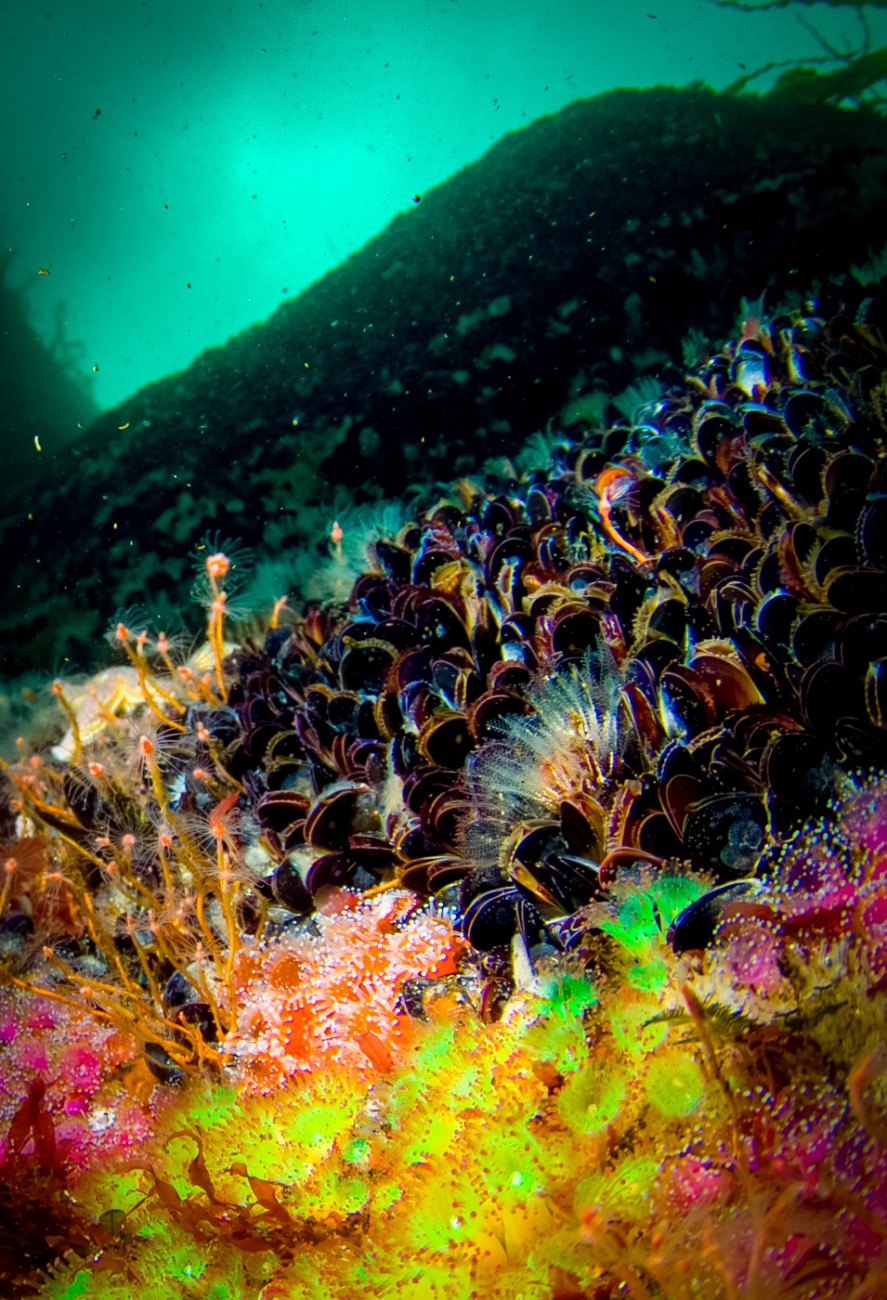
Mere colour, unspoiled by meaning, and unallied with definite form, can speak to the soul in a thousand different ways. Oscar Wilde
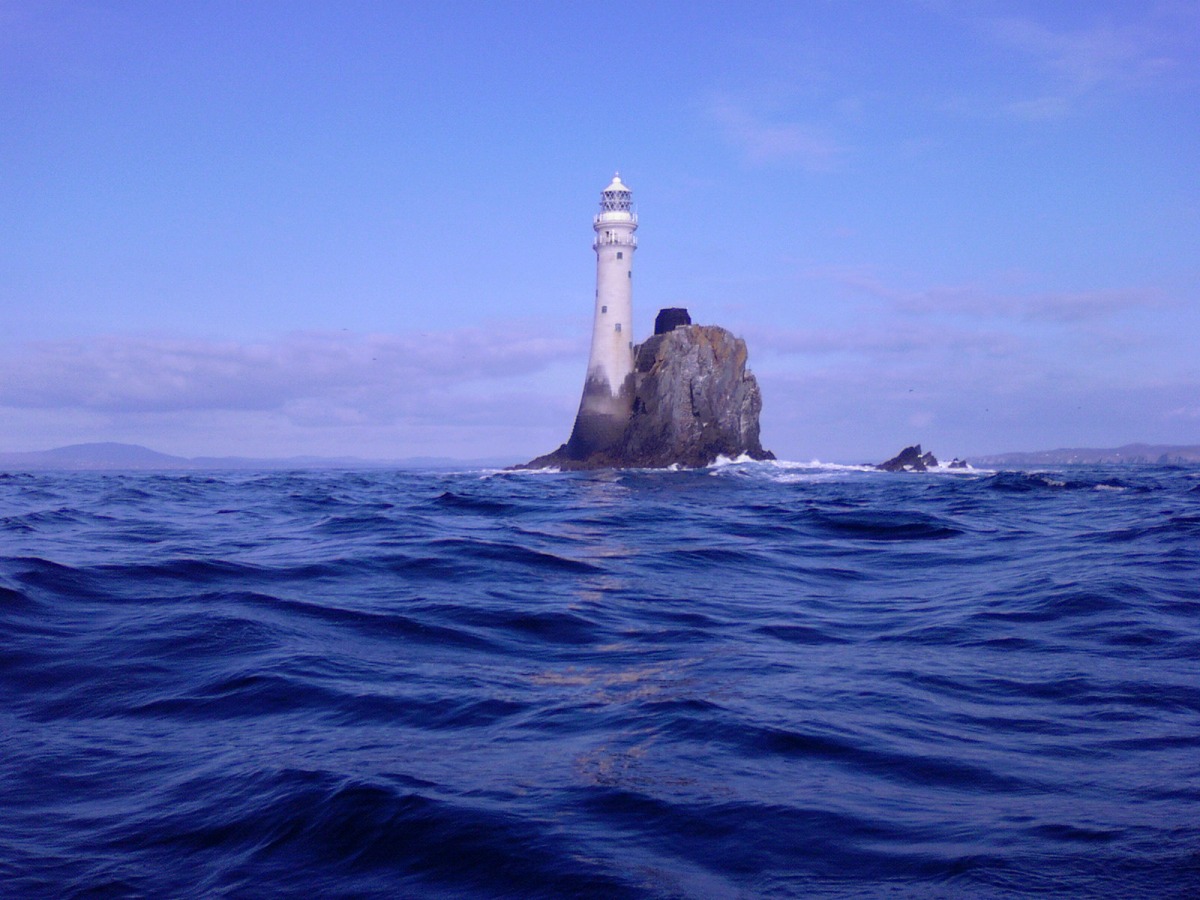
One of the most dramatic dives I have ever completed was the awesome Fastnet lighthouse off the west Cork coastline. As a young diver of barely sixteen I was on a dive trip with forty other to explore that stretch of coastline.
Blessed by one of those rare days when the might of the Atlantic Ocean is transformed to a glass like surface we braved the journey out to this rock known as ‘Ireland’s tear drop’ to Irish emigrants: it being the last view of their homeland before the dangerous journeys to a new life in the Americas began.
Fastnet Lighthouse, 2005 By Tom from Aberystwyth, Wales. Wikicommons (cc)
Fastnet lighthouse is located thirteen kilometres off the Cork coastline and is an incredible feat of human ingenuity. Built to withstand the mighty swells that normally pound this part of the coastline it towers forty-five metres above the Atlantic Ocean.
First constructed in 1853 after a shipping disaster involving the loss of ninety-two lives, it was rebuilt by the Irish Lights in 1897 in its current form, using 4,300 tons of dovetailed Cornish granite.
This was the dramatic backdrop to a dive that even a quarter of a century on stands out in my memory as something truly special. To my naive young self it seemed that dives like this were the norm, as opposed to an event of great note. I have yet to return to this site, with mighty Atlantic swells forcing me back more than once.
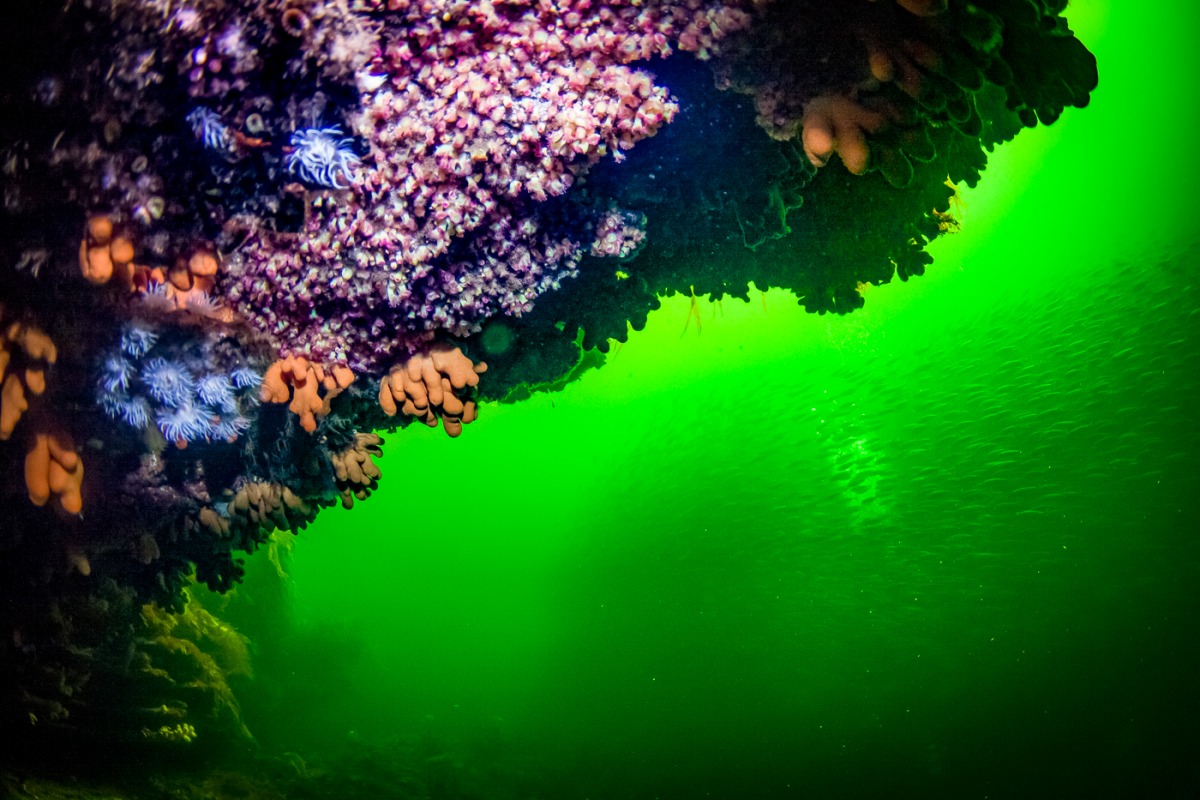
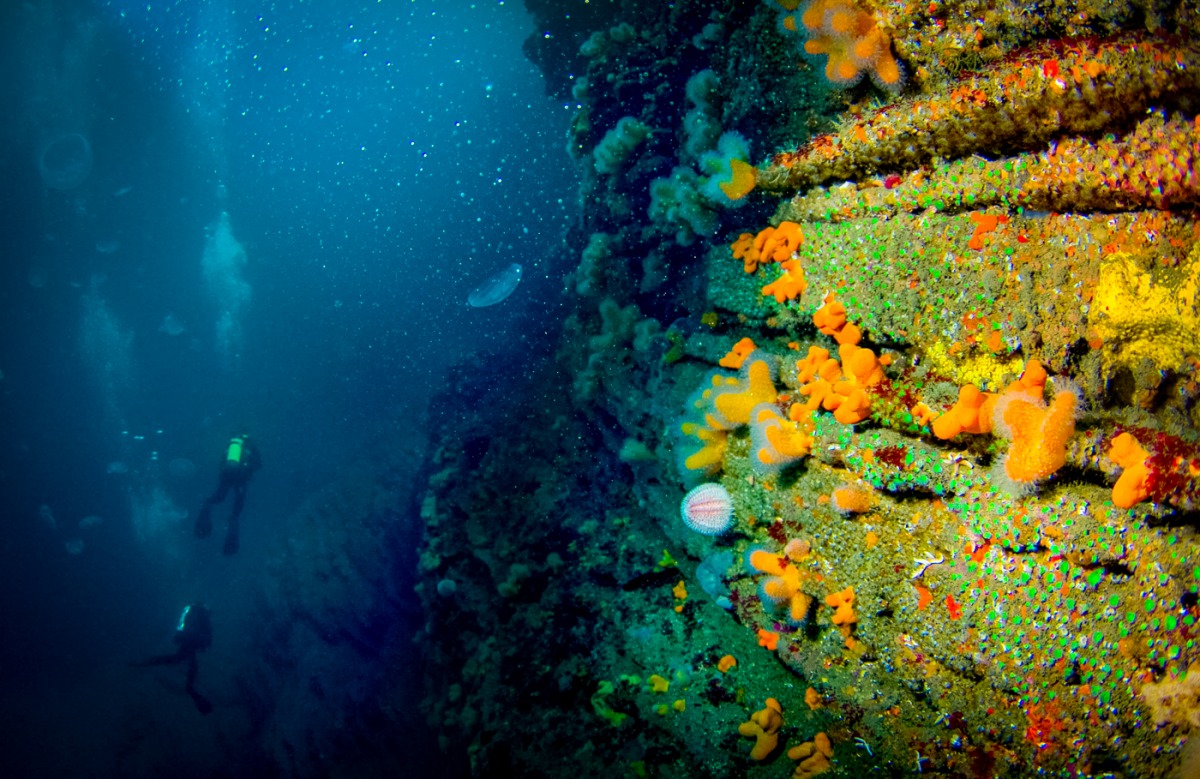
I surfaced from the dive blown away by the walls that dropped from the surface heights down to depths of eighty meters, with a shipwreck also noticeable in the depths below. The sheer cliff faces was dressed in colours reminiscent of the Bermuda shorts I had worn as a youngster in the 1980s.
Neon colours of pink, yellow and green dressed the sheer faces that in the crystal clear waters of the Atlantic lent me an unmistakable feeling of flying.
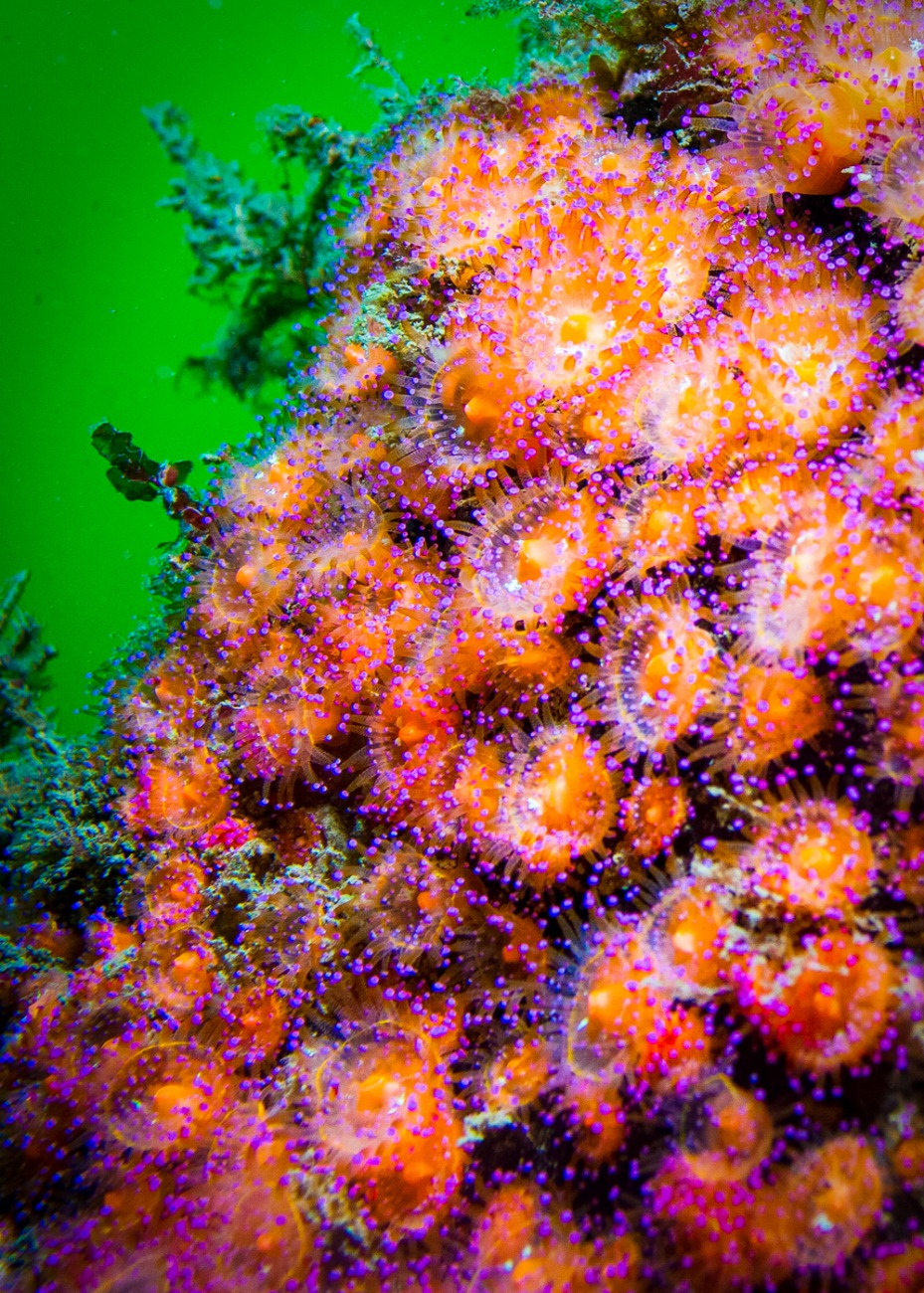
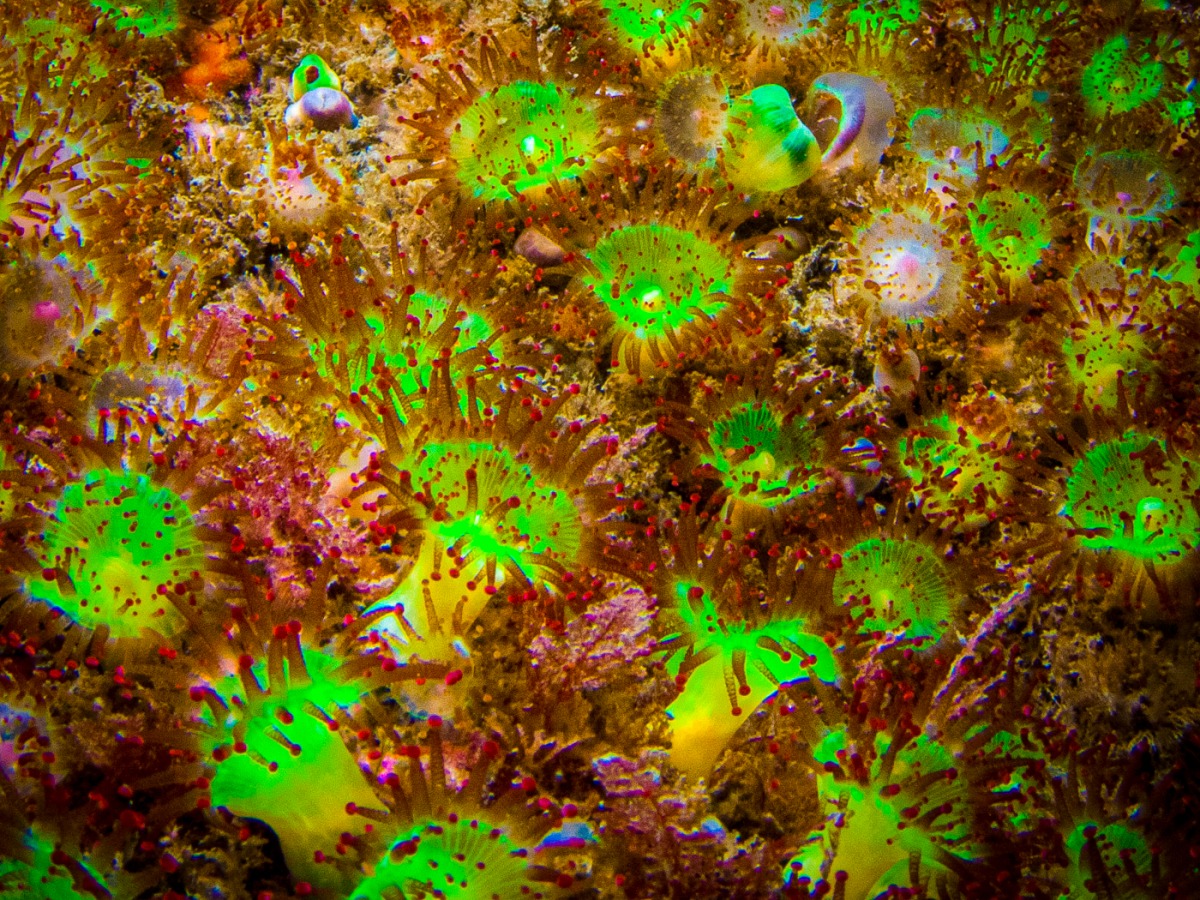
A French photographer that was diving in the group with us surfaced raving about the colours of the Jewel anemones colonies. I was instantly intrigued at how such colourful creatures could survive and thrive in such a remote and windswept location.
At that point I had only taken a few underwater images, mainly with disposable cameras, so the French photographer’s excitement in response to these colourful creatures left an unmistakable imprint on my younger self. As my underwater photography career expanded, the subject I have always sought out has been this beautiful and colourful creature clinging to the most exposed rocks in the most remote locations.
Jewel anemones are asexual, reproducing by splitting into two identical species connected by a thin sliver. They form colonies of identical creatures on rock faces up to eighty meters in depth. They thrive in high energy zones, where the waters of the Atlantic wash over them with great force.
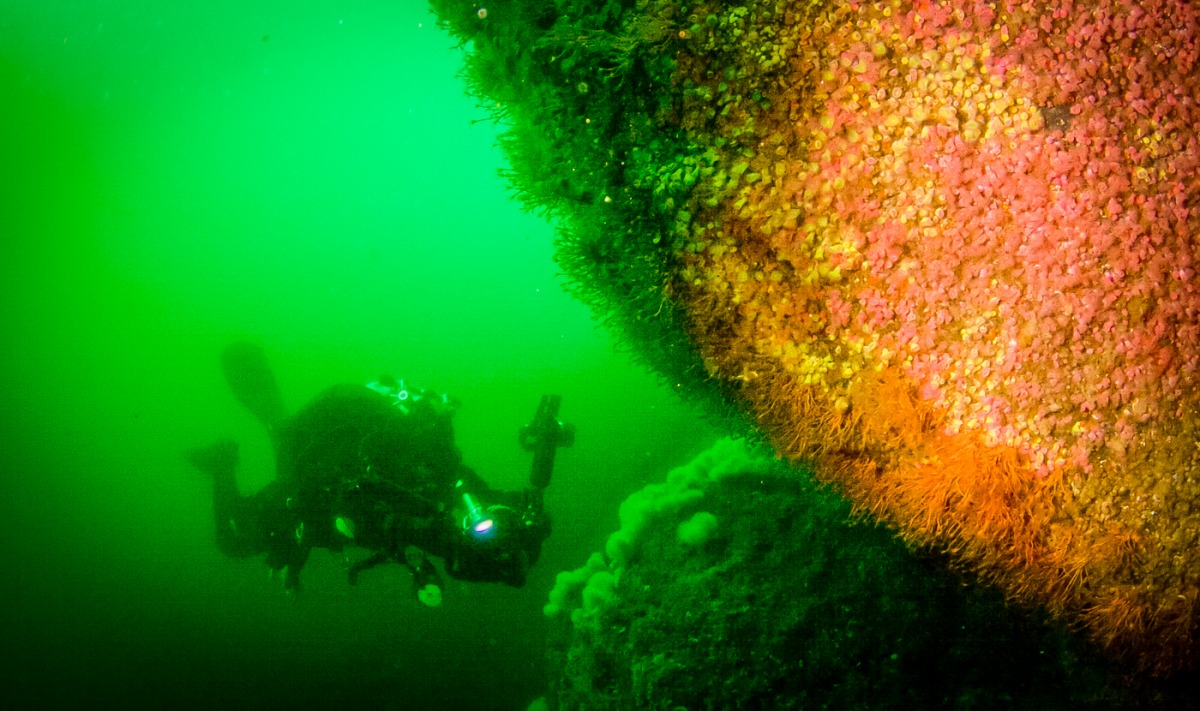
Their method of reproduction means you normally find patches of colour fighting for real estate. Neon Green battles with neon pink for prime locations on the surface of underwater cliff faces. Rarely seen on the east coast, they are to be found in all of the most dramatic sites I have dived along the Atlantic coast.
As well as finding them on cliffs they can be found clinging in a similar manner to shipwrecks, fighting the same battles of colour for the best seats on the exposed sides of sunken vessels.
Over my time diving whenever I have had the chance to dive with a camera in hand I have sought out battles of different colours, and tried to capture the beauty that the colour imparts on the final image.
In showing the image to non-divers I relish their disbelief that such colours exist below the waters that surround this country. It is assumed that only in the tropical zones where coral reefs bloom can such vibrant colours exist. This notion is shattered by the beautiful vibrant colours of these incredible rock clinging creatures.
When training new divers the images of jewel anomies always brings an audible intake of breath as they realise what to expect on future dives. Dive sites around Ireland are actually filled with colour, but the nature of water and the way it absorbs light means that in order to bring these colours out in their true glory the underwater photographer requires powerful strobes, or flashes, to reveal the vibrant colour.
As a diver setting out, one of the first pieces of equipment to acquire is a torch. In recent times the technology driving the underwater torch has gone through a massive innovation cycle with the introduction of LED torches.
Now for relatively little money a powerful torch can be purchased that only a few years ago would have required a suitcase battery to power it.
Some of the best underwater photographers in the world describe the technique of capturing underwater imagery as painting with light. The placement of the light or strobes will completely change the final imagery with the true colours being brought out through the introduction of artificial light, which was absorbed by the water column on to the subject.
The colour patterns that these amazing colonies produce across the walls, spread out around the Irish coastline, are truly dramatic and the battles between the different colonies make for the most amazing and dazzling splashes of colour, unique to the geographical location of the dive.
The translucent nature of the species means they can bring incredible colour to either macro or wide-angle photography, like imagery of flowers above water. The colours bring a light into even the darkest of moods.
Another dive season has ended along the Irish coastline in recent weeks, and thankfully it has coincided with the return of travel restrictions, so although 2020 was a much shorter dive season I had the opportunity to get some exciting dive trips in during a truncated season.
As the Atlantic storm cycles move quickly through the alphabet of names the waters are churned, with visibility dropping to only a few feet, and so the number of divers entering the water drops dramatically. Although there are many dive sites dive open throughout the year the restrictions on travel means divers are unable to travel to these sheltered locations. As the seasons in our marine environment moves into the winter stage only the bravest of divers head into the seas to get their fix of the underwater world.
By the time I got to Lenny’s place he was pacing up and down out front; his unusually frantic movement a poor advertisement for the stuff he was peddling; the stuff I was there to collect. He had his navy blue Boy Scout shorts on with a sleeveless t-shirt that allowed tanned biceps to stick out. His sparklingly clean teeth screamed ‘fake’, and his slightly balding black hair was gelled back so he could just as easily pass as a mafia boss as a guy working in hotel estates maintenance with me. When he walked his feet stood out ever so slightly, pointing to the left and to the right. For some reason my lateness, by perhaps ten minutes at most (deemed pretty acceptable where I was from), was stressing Lenny out beyond what I would consider normal. He really didn’t want to be considered a drug dealer. The house that he shared with his partner was at the end of a long row of typical island dwellings, two story detached wooden houses inclusive of a big porch out front; where the inhabitants could sit and relax in the evenings. A traditionally wooden white garden fence was just beyond the porch, decorative more than functional. A section of scorched grass lay underneath the fence, peppered by spurts of water from a nearby sprinkler. I strolled down around the corner to the house. Lenny slipped over, pushed his hand through his hair and said:
‘Where in Hell’s name were you? You should have been here ten minutes ago.’
There was sweat dripping from my forehead – the August so oppressive even in such close proximity to the sea – I exuded near monuments of it. That whole morning had been spent slouching from one end of the island to the next on various errands, the sweat from my bones burning in the summer sun. Taken aback by Lenny, I just replied,
‘I was hitchhiking over. Lifts were slow today. I didn’t think you’d sweat it.’
I was attempting to calm the air. But Lenny was still pacing up and down the path, the frantic movement that confronted me only slowly beginning to ease. He was chewing gum intently, biting into his mouth like crazy, before finally slowing down. He then walked around to the garage at the side of the house, swung the door open and ushered me in; slowly closing the garage door so that a bright sun gave way to a fully darkened room. Bits of storage stood out behind a small ford coupe car on which a number of boxes were left. The car had put been away for summer. Lenny grabbed a box from one of the top shelves and carried it down. He lifted a bunch of old newspapers that had become browned around the edges and left them on the ground beside the car. He mooched around with these for a few minutes, before taking out a small translucent bag, filled with dark green bundles of grassy textures. A waft of marijuana filled the room. He opened up the bag and took out a sticky bud. ‘Feel the stickiness on that one Dara,’ he said; the tension that had resided now flittering away in the stuffy garage air. Lenny’s disposition changed when the black bud was held up to his nose. ‘Look at the tentacles, he said ‘little beauties. Real Chappaquiddick Green.’
I took the bud and held it up to my nose, the little black squidgy form like a spider out of which red tentacles protruded towards me. The plant was so exquisitely tender and beautiful it seemed – at once – cruel to have to actually smoke it; its poignant odour so carefully organic while – at the same time – intrinsically seductive. ‘Wow, that’s lovely,’ I said to Lenny as he leant back, a horticulturalist’s gleaning grin making its way across his face like a Cheshire cat. I could see that my comment brought instant gratification; a certain pride in having procured this planted product bursting through his smile. Again, his hand pushed back through his gelled balding hair, and his teeth – no doubt false – glistened like they were commissioned for a new Colgate ad. I decided, given the degree of satisfaction he was receiving from holding up his product, to massage his ego even more. ‘So, you’re one of the main growers behind Chappaquiddick Green, number seven in The High Times list of top ten variants US weed? I’m impressed.’ Lenny has been telling me all summer about the plant he grew every year on the small island of Chappaquidick. He told me he just sprinkled the seed in an area of wild overgrowth only to return sporadically to water it throughout the summer months, when the drought hit. He harvested his plant in the final weeks of July. The island, whatever the geographic specificity, was particularly fertile, unearthing a potent strain of weed known far and wide across the United States. Chap green, he called it. I gave him fifty bucks in exchange for the luxurious product.
I was handing over the dough when Lenny pulled back the bag and reverted momentarily to his earlier frantic self. Jitteriness returned; the momentary calming of mood offset by the powerful odour of the product. This Irish kid he was selling his dope to could end up putting it in whiskey, getting so fucked up on it he’d need ferrying to hospital on the Cape. How could he be sure the kid wouldn’t smoke himself into such a slumber the cops would be called and the trail would make its way back to Lenny? ‘Lenny, relax,’ I said, trying to calm his nerves, ‘I’ll whack it into a bong and avoid any cookies, or any of that shit. You don’t have to worry. I’ve smoked a lot.’ But it didn’t seem to work. He remained beyond edgy. He started pacing around the garage again, banging into boxes, and knocking over old discarded items. ‘What the fuck was he giving me? Mango juice shit,’ I thought to myself glancing at my watch, wondering about my schedule for the rest of the day (meet Don, get home, get bombed, meet Sarah, get home again, get bombed again). I didn’t have time to calm the dude down; whatever the reason for his overly zealous jitteriness. ‘Calm the fuck down Lenny. I’m meeting my sister’s friend for a Chinese. My friend can’t get off work. She’s coming from Boston for a night to see her brother. We’ll eat and grab a beer. I’ll smoke a joint, play some pool. Nothing too far off the charts.’ It worked. He looked at me, and seemed, for a moment, properly relieved. ‘Ok, ok, man’ he then replied, moving back to his Lenny-is-a-bit-chilled gear, and then confirming that my attempts to assuage his many-years-smoking-weed induced paranoia seemed to work.
I worked with Lenny and his boss Sandy in the Harbour View Hotel in the village of Edgarstown that summer, doing maintenance around the estate. I got some standard Mexican weed off Lenny after a few weeks into the job. Lenny had no problem supplying the commercial Mexican stuff. But he kept waxing lyrical about the stuff coming down the line: the real stuff. Once that fancy stuffy arrived, so too did his paranoiac alter-ego, mistrustful of the same Irish kid he had worked with all that summer. I drifted away from his garage that day excited by the potential thrashing to be had from the infamous Chappaquiddick. I had a full schedule ahead. I had to get back to meet Don, give him some of the green, and find out where to meet his sister. Then I had to make my way back to the house, have a shower, get changed, returning again to Oaks Bluff to meet Sarah, show her around a bit, before making it back home. I had to be up early for work the following morning, so the level of blastedness had to remain low. I hitchhiked back from Lenny’s place, wandered up the main street of Oaks Bluff to drop off some stash to Don. He was dressed in his geeky Subway gear when he came out to meet me. I told him Lenny was more edgy than normal when making the pick up so he should try not to overdo getting heavily baked at work; who knows what might happen? He just replied ‘Jerry’s Dead.’ A whole street of kids standing outside shops had given a carnivalesque atmosphere to the village’s activities. The summer was really starting to kick off, and humidity levels were rising. ‘Jerry’s Dead’, what the fuck is he talking about? I thought before asking to elaborate.
‘Jerry who?’ I asked.
‘Jerry Garcia, one of The Grateful Dead. They’re a band, apparently.’
‘Never heard of him or them,’ I said, realising that there was more to it than a rockstar dying and that Don was somewhat perturbed.
‘You wouldn’t believe it man. Jamie and Shaun rang in to say they were out for a week. That depressed this dude is dead. It’s JFK levels of impact. I’m not shitting you.’
‘A week? What the fuck?’
‘Yea. It’s like their fucking mother died. Left in the dock. I’m practically on my own here.’
‘This Garcia dude. Some kind of Jesus figure or what? A whole week because he died?’
‘Yeah. Weird. Apparently, they’ve been deadheads for years…Some fan cult thing. Can you make sure to meet Sarah tonight? And I’ll see you tomorrow? Don’t forget?’
‘No problem, man. It’s all on the itinerary.’
I handed a nugget of Chad G from the bag Lenny had given me earlier, and began to make my way back along the country roads to the trailer park where we were staying, the stultifying humidity causing spots of sweat to burst into lathers of salt; white lines marking the blue t-shirt I was wearing that day. I took off up through the country roads, up through the part of the island where workers and all year-round inhabitants lived. Beyond the huge, ostentatious mansions, the billionaire estates, was the other part; the part of the island where those who had given their life to the island lived. Once beyond the sumptuous coastline, making your way into the inner beast of the vineyard, a distinctive odour washed over you; the smell of the large population of skunks that had become endemic on the island. When I got to the trailer-house I had a quick shower, and noticing no one was around, got the first bong of the day in order. I pulled the curtains, whipped my top off, and ploughed into the big bottle of murky smoke that hovered in the bottle as the water spilled out from the sides. Then, watching the water trickle out, the smoke hovered like a volcano about to erupt. The sweet smell of sumptuous marijuana filled the room. As I stood watching in my underpants, the smoke filtered out across the room like a genie freed from a bottle; floating up into air, sun rays cutting through it as little patterns of smoke dissipated in the light. The hit was inhaled deep into my lungs, the smoke soothing my senses.
And then nothing happened. I sat on the bed, feet sticking out, bong in hand, sweat dripping down from my hair onto a near naked body. ‘Lenny, talking shit, as usual,’ I thought to myself, plucking a significant portion of the black bud with the sticky red tentacles and readying it for another hit of the bong. Five or possibly ten minutes passed, most of it spent cursing Lenny for bigging up the product to such dizzying heights. I lay back on the bed, head resting against the wall, angry that someone had duped me who I had come to regard as a friend. ‘Fuck you Lenny,’ I thought again to myself, ‘you’ve stung me for half my wages for this powerdust.’ In it went again, folded neatly into the foil wrapped around the bottle neck, the water beginning to gush out again from the bucket, smoke hovering around the depleting watermark before – in one big breath – I sucked deep it into my lungs. Coughing and spluttering, I pushed the smoke out into the stuffy humid air. Again, there was nothing of significance. I waited. I waited more. And still, nothing of significance came to pass.
‘Fuck him,’ was the lurid expression of choice to curse my newly perceived conman workmate, as I dressed myself at the speed of Superman, checked my wallet for cash, and took to the road. It was a about a twenty-minute walk to Oaks Bluff where I would meet Sarah, take her out for a Chinese and a beer afterwards. I was hoping the bong hits would relinquish any residual social unease, so that the evening would flow. Tasked with entertaining my friend’s sister, a professional and holidaying banker, I need to be suitably caned for the occasion; to lighten the mood accordingly. Instead, I was deliberating on the non-effect of the previously purchased weed. It wasn’t working. I was down half a week’s work on a fucking placebo. I got to the Chinese, met Sarah and we started talking incessantly about the island. Then, as I was about to order noodles or something to that effect, I took a blow full blast to the back of my head from some imaginary psychedelic tennis racket, such was the speed which all sense of reason and normality evaporated from my reckoning. ‘It just creeps up on you, and then boomp’ were words trickling out from my increasingly fractured consciousness, a brain with which it was more and more difficult to maintain any rational contact. I stood up, dizzy and lacking in motion control, stuttering in Sarah’s direction ‘back in a sec.’ It was probably forty minutes since I had wandered skeptically from my digs, cursing Lenny for the low-grade product he passed off as high grade. Rushing out the door of the restaurant, I began cursing him for precisely the opposite reason: not informing me of the potency of the product. I began to see colour vibrations everywhere, waxed out collages on vineyard specific shop designs.
Beside the harbour where ferries pull in there was a restaurant I worked in, one that specialised in ripping off tourists before returning to the mainland. It sat beside a nicely engineered boardwalk; a buffer zone between Martha’s Vineyard and the Cape. Leaving the restaurant in a mess, I looked to dip my head in the seawater beside the restaurant; a last gasp attempt to push back the slow unraveling of my brain. There was no way I could conduct a civil conversation with Sarah, serious intake of food or not. The immersion of head in water, a head that seemed to be slowly severing from its body, was offered as the perceived panacea to newly ingrained paranoia.
I arrived as a mass of energy, stumbling from the street where the restaurant was situated, sound and vision forming symphony of its own accord, to the sea. In it went. The water ebbed and flowed, trinkets of foam pushing up from the sea onto the lathered wood of the boardwalk. Past, present and future were no longer distinctly discernible as moments giving rise to others, but one long durational flow. I lay down on the boardwalk, my hands withholding my body mass from slipping into the water. In it went again; immersed in the cold saltiness of the water. Out it came. In it went again; before the rush of the marijuana induced caning slowly subsided. But not gone.
Not gone. Instead, it mellowed to a manageable state, defined by the slightly less crazy universe my head emerged back into. Time became a lovely fuzzy concept. Brain fog gave way to a sudden appreciation of my surroundings: the beautiful sunset in the distance, the sound of families nattering to one other; holiday time emerging in its essence. Newly self-baptized, I stumbled back towards the restaurant, ringing the water from my shortly cropped hair; a hardly noticeable after effect of the immersion. Sarah’s laugh made for a mutual laugh, as the night began with noodles and chat.
We finished the Chinese with some sort of weird oriental ice cream and then made our way to a pool bar on the main street, where – in typically American fashion – we shot pool. We ordered a tray of bottles of Bud, before a feeling of breezy elation carried me through the two or more hours we spent there. Like a living replica of the Paul Newman hustler in The Color of Money, every shot I hit seemed to hit its target. The earlier discombobulating unease surrendered to merry exultation. I moved around the room with a swagger, the exuberant array of colours generated from the lighting that fell on the red-carpeted pool tables, giving an intense aura to the balls that lay upon on it. By the time we said goodbye, Sarah still brushing off the final traces of jetlag, the sun was setting outside, and the sea was calm. The boats moored at the harbour were lying motionless, a pink afterglow over the setting sun making for a serenely painterly affect. I sat at the edge of the seashore, and smoked a one-skinner joint of pure Chap Green. Darkness came in in a blanket of incursions; my head pushed back upon the wooden boardwalk as I imagined hugging roguish Lenny; a person I had since given his VIP status; most important work colleague in the world.
I still had to get home: the morning promised a wholly different experience cleaning up recently let condominiums. My second job was usually undertaken in the throes of a mind-numbing hangover, brought on by the reliably miserable quality of bar tap beer. The weed was proving itself to be all things Lenny had promised: slowing time down so that my presence alone seemed to sync seamlessly with the island’s inchoate rhythms. Once I said goodbye to Sarah, a moon began to shine upon me; ushering in all sorts of strange prisms; its rays no longer extraneous to nature’s form but part of a mysterious essence; the universe clicking into being as a monolithic life force. It was a force slowly propelling me back towards the trailer where I left the main stash of luscious Chad, a piece of which was nestled in my pocket. Darkness slowly introduced itself, and the trees that line the road reached out to say hello. I moved back and forward across the road with trucks steaming past, lights momentarily blinding me before pushing off into the night. Dogs barked from the back of trucks, echoing like drum beats from an evolving consciousness. I passed through the ever-changing shadows; the smell of the unseen community of skunks one of the island’s unyielding mysteries. I was about to skip over to the other side of the road when a long, elongated Cadillac came around the corner, driving at the speed of a casual cyclist, before brushing up towards me. Once lit up by the moon, I could see the spray-painted gold surface of the old, yet well-kept automobile, flowers decorating its surface along with a load of signatures written with permanent coloured markers. The Caddy had been custom designed, like some trace of a forbidden past; parsed with an accumulation of markings of a once forgotten land. I struggled to adjust my eyesight to the newly arrived vehicle, struggled to account for an intrusion of immense colour upon the dusty island road. Trees shepherding the walker from swirling Atlantic winds cast shadows all around. A man resembling Arthur Lee from the sixties psychedelic band Love, hair banded in the same manner, smiled up at me from the driving seat, before declaring – punctuating the slow drone of crickets nestled invisibly somewhere in the roadside ditch – ‘Ok, brother. Jerry’s Dead.’ I stopped in my tracks, the spoken words echoing some earlier moment that day – travelling from a past that existed only as memories rolling along the surface of a disaffected consciousness. ‘Jerry’s what?’ I said, trying not to attract undue attention in response.
‘Jerry’s Dead,’ he replied again, the Caddy glistening in the heavy moonlight. A big flower was painted on the gold-sprayed bonnet, under which the words ‘The Bad Cat’ were lightly scrawled. My eyes squinted to recognise the driver in profile, but as soon as I did I could see that he was the same guy tourists gathered around on sunny days, when he drove his Caddy slowly through the island villages. Throngs of tourists would gather around his car, looking to make out the myriad of famous signatures that adorned its sides and rear. Bill and Hillary Clinton, Robert de Niro, James Taylor and Carly Simon, Spike Lee, were just a few of the famous autographs that people spoke about as they walked around the Bad Cat’s Caddy. Every time I had tried to get near, tried to nestle up beside the fawned over Caddy, I was usually brushed aside by over eager tourists. ‘Rick, aka The Bad Cat’ he said to me, one hands lying over the side of the car. Before I could get my bearings, light piercing my vision, I heard the words ‘hop in.’ I pushed my body over the side of the car, as we journeyed into the night. ‘Jerry’s Dead’ the Bad Cat said again, words to which I muttered some episodic sense of affirmation, before passing through the island’s belly like surfers cutting into the sea.
Suddenly, the Bad Cat, who was by then smoking a joint he quickly passed back to me in the rear, took a turn down a small road where a white-sanded beach lay empty in the sullen moonlight, small waves trickling in upon the shore. It was a picture of exotic serenity, so unlike the tourist hotspots adjacent to the island’s main villages, most notably The Inkwell Beach in ear shot of Oaks Bluff. We swooned down upon the white fluffy sand where the wetter sand glistened in the sumptuous moonlight, the smoke from the final embers of the Cat’s joint lingering in the sea breeze before drifting off into some alternate stratosphere. Very little was said as the Caddy pulled in at the dunes. All that was felt between us was our mutual recognition of the night; an ostensible collective hymn to the legacy of a dead man. ‘What’s happening?’ was the question that first left my lips, as the Cat walked around to attached massive audio wires to the car stereo. He opened the boot and then proceeded to take out two considerably sized speakers. ‘The music of the spheres,’ he remonstrated smiling in my direction, my head fizzing as the beach at night began to open up and entice us in. I was standing in the presence of a stranger, but the pulses of time were moving to a kind of rhythm. ‘Muzak,’ I spluttered, still unsure as to how the night had taken its turn; wondering if the Cat was an hallucinogenic vista or a dream I had come upon walking home; my brain’s unfettered response to the mysterious impact of the Chad G. ‘Yeah, cool,’ I said, ‘put on some tunes.’ Then the Cat placed the two speakers on the bonnet of the Caddy, just above the painted on pink and yellow flower. He then rumbled around in the glove compartment, before producing an old battered cassette.
At that point the night began to calm. Lights began flickering on the horizon, fireflies buzzing in the moonlight sky, waves dancing along the shore. Sand bugs jigged around at our feet. The Cat blew the dust off an old cassette that he took from the glove compartment, that he then pushed above him in order to see the title. He glanced over at me and smiled, whispering the words ‘music.’ Before I got a chance to respond in any way he declared aloud ‘I’ll play you two songs before the other cats arrive.’ My mind seemed to slow to nothing, before I eventually asked ‘what other cats?’ still piecing together the prior events of the night to include the present destination. Any trace of linearity had banished, time taking the form of a continuum of moments, a seemingly never-ending present. I still struggled to respond to his statement. ‘The deadheads, who else?’ he said; fiddling with the cassette player. He then walked over to the car bonnet, before throwing a warm Pabst in my direction.
The slow silence that followed ended with music spilling out from the attached speakers like sun piercing through drawn curtains, drumming a mysterious essence into the warm summer night. A fast-paced bluegrass beat began to play as the Cat suddenly jumped up onto the bonnet of the Caddy and shouted out the words ‘Cumberland Blues.’ He started to sing along to the beat, stamping his feet to make a clanging noise on the bonnet. The last thing I expected was a rush of energy propelling me onto the sanded area in front of the Caddy. Before I knew it, the Cat was jumping liked a lunatic, singing the words ‘I can’t help you with your troubles, if you won’t help with mine.’ As his arms and legs splashed out in all different directions, he bellowed out the refrain ‘I GOTTA GET DOWN, I GOTTA GET DOWN.’ I looked over to see his whole physical demeanour transforming in an instant. He leapt up and down at rapturous speed; his whole life looking to depend on making as big a movement as possible, pushing out the words into the hazy night sky.
Soon my heels could be felt skipping to the beat with him, with each verse accompanied by the refrain ‘I GOTTA DOWN.’ A baseline arrived, making our bodies more susceptible to the pulsating rhythms of the night. The Cat jumped down on the sand again, syncing movement to the pervasive rush of a banging refrain ‘I GOTTA GET DOWN.’ As the song pushed to a close, the Cat leaned over to press stop on the stereo, before a short monologue ushered from him. ‘Now, listen sir,’ he began. My t-shirt was ripped at the side, so as to reveal red lines of sunburn. My converse runners had begun to tighten around my ankles, their sides filling up with sand. Then it suddenly dawned on me that I had hardly spoken with the Cat; that he was on some sort of night crusade; that he barely asked my name. He was staring into the night sky, over across the Atlantic, his baggy trousers accompanied only by near worn out sandals. His hands were pushed in front, his tie-dyed t-shirt a perfect match for the loose headband that was now used to keep his Afro in place. Then he spoke:
The mines man. All fuckin day. The government owned mines. You work all day. You know nothing different. And then the light. You see the light. You dig? You can’t not see it anymore. You dig? Fuck Cumberland. You’re not going down anymore. Jerry knew that man. He knew it in his heart. I gotta get down…a double fucking metaphor man. You dig. I gotta get down the mine. And I gotta get down..you know.. You know like get the fuck down…I gotta get the fuck down.
He began bopping his head up and down, waving his hands waving around like some manic preacher, spelling out the words ‘I gotta get down’ over and over again. ‘I never heard of this guy Jerry. I never heard anything about this guy before today. I only heard he died from my friend earlier,’ I shouted back, yet he was oblivious. The Cat kept shuffling around; looking so unconvinced that I had never heard of the band. The Cat simply wasn’t buying my protestations; such was the impression his body gave off of sheer and utter disbelief. I gathered myself to pluck out the ends of a joint from my pocket, before playing around with it for a few minutes and then passing it towards the Cat again. ‘Rickie’ I said, ‘he was obviously some kind of Dylan dude?’ For whatever reason, once the song ended time seemed to stagnate, with just the waves crashing against the shore a sign of the island’s intrinsically calming force. The Cat still wasn’t offering to answer my question; his mind seemingly elsewhere entirely. Raising his finger to his lips to make a ‘ssshhh’ noise, he leant back over the windscreen of the Caddy and pressed play on the stereo again. At that point, I considered running back home so as to make it to work the following morning, but I couldn’t just leave. It would be so unmannerly to go. But then a punchy base line pulsated through the speakers the Cat had placed on the sand. My body began to jerk in all directions, to a rush of harmonic vibrations. A luscious Hammond organ echoed in the night, before an electric guitar solo intervened and the refrain rang out. All I could hear was the Cat singing along to the song, bellowing out words to the effect of ‘China Cat, China Cat;’ instruments meshing into an cacophony of sonic commotion.
The instrumentation and chorus reached a near transcendent crescendo only for the sound of numerous cars on the dunes above us to interrupt the scene. Flashing lights arrived with the cars, piling along the road towards the beach where we parked. The Cat was pushing his arms up in the air, as a mass of bodies, all with similarly styled hair – all wearing black t-shirts with a skull like form just about discernible in the flittering darkness. There must have been twenty or more in the crowd of people who made their way from the number of cars that had suddenly arrived, quickly descending onto the beach and forming a crowd of people around the Caddy and the Cat. The Cat jumped onto the car’s bonnet again and screamed out ‘the Dead!!’ Like a murmuration of swallows that had descended from rooftops on a warm spring evening, a crowd of people – impossible to discern as individuals in the dark – formed a circle around the Caddy and the speakers. Once a lone voice singing out the words ‘China Cat’ in a moonlit sky became upwards of twenty people in a group that moved only in rhythms; an inchoate meshing together of people into a singular multiplicity.
‘China Cat’ was the last refrain to stick in my head as we danced until darkness was slowly swallowed by the dawn. As the sun rose over the sluggishly beating waves, my head spun off into a distant universe; the once shadowed figures who emerged from the series of cars at the side of the beach – the vast array of Deadheads as the Cat called them – suddenly emerging as individuals in a drug and booze haze. As the dial on my hand watch edged towards ‘4 am’ I made my way through a crowd of people all wearing black t-shirts with a variation of skull illustrations, perhaps grieving but joyously celebrating the life of a once great American icon. There were a number of small stalls, put together with pieces of board and collected beach pebbles, selling off juice drinks and long elongated mushrooms, various strands of weed and homemade beer. It was like a little festival had initiated itself around me, the exact point of installment a mystery from the night that had engulfed me. The Cat was no longer at his Caddy. He was with a group of oblivious Deadheads. When he saw me alone, he stood up, brushing the sand off his shorts and t-shirt, smiling over in my direction. He was no longer delirious with excitement, but calmer in his demeanour. The night had moved on and the Caddy’s sound system had played a significant part. A bright red glow of a newly arrived morning sun, appeared to cast its rays onto a glittering sea, marked the transition from night to morning; the point when time would remerge intact. I was about to leave the last remnants of the party, the words ‘Jerry’s Dead’ still echoing in my mind, when the Cat put his arms around me and said ‘One minute, good sir.’ He began walking me over towards the Caddy, where the shiny gold spray paint adorning it could be seen clearly in the light. There were loads of signatures written in permanent black marker along the sides of the automobile, some even on the boot. The Cat pointed to a scrawl from which, once focused on, the words, ‘Hi Rick, thanks for the ride, Bill Clinton’ appeared. He smiled to say ‘here last summer.’ Then he spent a few minutes eyeballing the other side, pushing his nose up against the panels to make out what I presumed was another signature by some visiting celebrity.
Standing back, he pointed his foot again at another scribble. ‘Hey Rickie, thanks for the ride, Jerry Garcia, 94’ was a near illegible scrawl, the Cat proudly asserting ‘he sat right where you sat.’ I tried to reciprocate his enthusiasm; such was the considerable distinction of fan revealed to me over the course of the evening. Nodding in affirmation, my feet still dragging in the sand, I again moved to get away. But before I could turn around to begin the slow walk home, with two or possibly three hours sleep beckoning, the Cat made his way to the other side and began pushing me down towards the shore. The speakers had all but silenced, although people’s voices could be heard speaking in hushed tones against a mellowed-out flutter of psychedelic guitars and singing voices; the tempo of the music altered to fit the sun’s morning glow. ‘I want to tell you something before you go,’ he said. He began to walk again towards the sea, turning around and nearly tripping himself on the soft sand. His baggy pants were hanging down by his sandals, and a tie-dyed sleeveless t-shirt that reflected the early morning sun revealed an array of colours: yellow, pink, and mauve.
I stumbled along the sand wanting to initiate the conversation that hadn’t taken place when the Caddy pulled up beside me the previous evening; memory that now seemed liked a scene from a television series I had somehow played a starring role in. The connection between then and now was a blur; like two islands separated by a vast sea, not unlike the sea that had confronted me walking with the Cat. Like the post all night partying Marcello who stumbles on the seashore in Fellini’s La Dolce Vita, when an amorphous sea creature confronts the unsavoury hedonist, I staggered in a disheveled state down towards a lightly trickling sea upon a cleanly kept seashore. The small granules of crushed seashells mixed in with the sand were like diamond crystals reflecting back the low din of newly expressed sunlight. In the distance was a glimmer of sunny haze, lights that speckled out upon the skyline like the morning dew in a garden when the party is over and daylight penetrates the newly evacuated space.
‘Look out over there,’ the Cat said, pointing out at the sea, towards the glimmer of light that shimmered against the dawn signaling another island day. ‘America,’ he said, pointing out again. Feeling a new brush of sobriety, the wind pushed through me, my words trickled out from a newly alerted consciousness ‘this is it, Rickie. The real America. This reason I came here. Jerry is the Elvis I never knew.’ The Cat went quiet all of a sudden, his silence a cue for me to leave. But on turning around, hoping to avoid another soliloquy about a song, I was soon sucked into another chapter in a night in thrall to the shape-shifting legacy of the band. I had to wait, had to listen, and to hear. Just as the capricious residue of night began to lose sway in the chirpy magnitude of an incoming morning, the Cat lost all sense of reason. ‘This isn’t America,’ he began shouting, suppressing the sound of music still loudly discernible from the Caddy parked at the other end of the beach. ‘This isn’t America, you fool, how can you think that?’ echoed out like trinkets across the island bay, cutting through the temporary lull. The changed atmosphere hit me straight away. He kept shouting out the words, more animated with each passing gesture. ‘This isn’t America,’ he raged, wagging his finger around. And then, pointing to the sea, towards the Cape I imagined was the repository of light sparkling against the shedding glow of the moon, he shouted out ‘that’s America, over there. That’s America.’ When he spoke, white froth began to build at the sides of his mouth, fury spat out into the wind.
An eerie quiet descended from all directions, the Cat’s once serene behaviour relenting to the inchoate ramblings of a megalomaniac. The need to stop him – to avert the look he directed at me – penetrated my own illusory attempt to cut through the malevolent anger; anger that seemed to be a cosmic corrective to the tantric balance of the previous night: the return of some deeply repressed energy to the world’s wholeness. ‘Look Rickie,’ I muttered, the sound of the music tempering – somebody had obviously turned it down – ‘I’m just saying thanks. I’m only here, on the island, in America, for a few months. A J1.’ A flock of seagulls swooned down from beside a small group of rocks at the edge of the shore, before some litter blew from one of the groups of people still huddled together in the aftermath of the party; a party that seemed like a celebration and a wake. The Cat began to hyperventilate as soon as I said this to him, becoming more and more animated in the interval between my words leaving my lips and gathering relevant meaning for him. ‘I didn’t mean to upset you,’ I rushed out in an instant, a futile attempt to calm his nerves. But then he shouted out ‘this isn’t America,’ before pointing out again towards the sea, at the flickering lights in the distance that intimated a remote otherworld, ‘that’s America.’
Morning’s arrival saw the lights fade on the horizon; curious markers of a land of which the island was a surrogate child. The distant lights were the embers of another universe; an affirmation of a distant elsewhere. The Cat fell to his knees holding his head, screeching the words as before ‘this isn’t America.’ And then, with the aura of the previous night dissipating into the morning light, he held his hands out crying ‘Jerry’s Dead.’ He bellowed out the words with such force that his whole body was thwarted on the sand. Some of the deadheads careful not to interrupt the discussion until then dropped everything and rushed from the congregations on the beach. A bunch of them ran down to the seashore in a desperate attempt to help the Cat to his feet. They came to form a circle around him as he shouted out the words again: ‘Jerry’s Dead.’ I took a chance to run back to the Caddy, along the road we had driven the night before, when we travelled to the beach for the first time. The mood, by that point, had changed. There was no longer any mysteriousness to the day. I skipped out along the road with my thumb held out, hoping to hitch a ride to Oaks Bluff to begin a new workday. Some semblance of music tickled my consciousness. But it was impossible to know if it was real or my hallucination. Perhaps it really was music emanating from another cosmic dimension; the hidden recesses of a new America.
When the film is over, with the lights still off and the low buzz of people leaving the room, I like to stay in my seat while the credits roll. There is a special kind of magic hidden in the image of thousands of scrolling names, like a vibrant tapestry carefully knitted, carrying the ideas of countless people working together for one single creative outcome.
We met in Dublin, as students. It was in the MA room, in the recording booth, in a fully-packed Ryan Air flight with destination to Sofia that a small but important concept emerged in my mind. By experience, or by force of habit, I had a fixed idea of the isolated composer working for countless hours on end; a dim light, a dark room, a head full of ideas. A familiar concept really, that’s how I had been making music for years. But the familiar changes, and it was in that MA room, on that crowded plane, sitting by the cliffs of the Irish west coast or on a summer night in the living room of a beautiful countryside house in Spain, that I realised that being a composer doesn’t necessarily have to be a one-woman show; that composition feeds on other creative forms, it feeds on other people, and that’s when many seemingly impossible things start to happen.
American writer Kurt Vonnegut once said, ‘We have to continually be jumping off cliffs and developing our wings on the way down.’ I find this phrase to be a very concise and accurate representation not only of life in general, but also of creative practice and expression. Sitting in front of an empty page, hands hovering a few centimetres above the piano, scattered thoughts trying to form an idea, all often feel like standing in front of a cliff, both terrifying and exhilarating. I find that when other people enter the scene the picture changes substantially.
I am standing just a couple of steps away from the cliff, and I get to see one, two, three, seven, or even ten jumpers. Displayed right in front of my eyes, there’s a whole new collection of movements and wings; I want to try all the different shapes and colours; I can jump on my own or hand-in-hand with someone, eyes closed, eyes on the ocean, or facing the sky with my back turned around – the possibilities are infinite. It still is terrifying, it still is exhilarating, it feels new and different every single time.
The entire neighbourhood is out of power, Néstor and I are stuck in the rental house with a huge set of lighting equipment to carry, the recording starts in a couple of hours, and it’s pouring rain outside. The team is scattered around the city in pairs, each with a mission, each with a problem or two to solve. I can feel the energy, I can feel the tension, the impetuous movement, and the meticulous detail. After almost an hour of anxiously waiting, we manage to find our way out and get to the church in Rathgar. Everyone is in motion, the room swirls with zeal. Cables rolled on the floor, music stands upright, paper lanterns hanging, fog machine on, mics in place, parts laid out. I am standing in the second row, score in hand. We all are in position and ready to charge when I see the silhouette of the baton coming down and the music starts to play… nothing else matters.
When the credits roll and the room is dark, I can see the names scrolling. And if I read between the lines, figures start to emerge in my mind; a playground full of curious children, a pool for stirring sparkling thoughts, a collection of manifold imperfect pebbles washed up by the shore, eleven jumpers facing the edge of a cliff and ready to develop wings on the way down.
Sharing
Néstor Romero Clemente
The throne room of the Aljafería Palace is a serious place – it was, after all, meant to be one. I have vivid memories as a child, listening amongst the audience, and gazing upwards at the golden pinecones that hung from the ceiling. They looked heavy. Would they fall and smash my head? I was often suppressing a cough, terrified to disrupt the revered atmosphere of the moment, but always enjoying the music. As a kid, I was lucky to attend a couple of old music concerts that took place in that room. My mother’s mentor, Jorge Fresno, was an Argentinian guitarist – a pupil of Narciso Yepes and good friend of Tomás Marco – and used to play there quite often. It is safe to say that Jorge was one of the greatest guitar players to grace the concert halls (and throne rooms!) of Spain.
I must have been eight-years-old or so at the time. It would have been unlikely for someone my age to be spotted in that room, not for lack of access, but for lack of interest. Often, in these concerts, the room was half empty. The thought would have seemed unlikely too of me and my friends recording our music in that very same place almost twenty years later.
I often feel that composers and musicians are unlikely beings, but I hesitate to word it that way, for I am one them. And the thought of naming them as such invokes a narcissistic feeling in my gut, which I dislike. I don’t want to feel special, nor meaningful – that would be distracting – and I don’t think I am. I don’t mean unlikely as a synonym for ‘better or worse than.’ What I mean by ‘unlikely’ is that it requires a succession of demographically unusual events for someone to not only want to be a composer or a musician, but to be able to pull it off to the extent that it becomes a liveable existence. There is a lot of drive, hard-work, discipline and all that. But I feel that there’s also a lot of luck. You have to be lucky to be given the opportunity to do this, to grow up in a place where it is a possibility, where your family and friends support it, where you can share it openly and sincerely, where you can progress academically, professionally, mentally, emotionally… Actually, maybe the word isn’t ‘unlikely’, but ‘lucky’!
Either way, to me, the formation of our collective is a consequence of two things. On the one hand, that very series of unlikely situations happening simultaneously in each and every one of our lives. On the other hand, once together, a great reciprocal need to share between the people that form our also unlikely group of friends. Matan comes from Australia, Caterina is Colombian-Italian, Haku is South Korean, Jan is German, Ciaran is Irish, Edu is Brazilian, Rekha is Malaysian, Guillaume is Belgian, Rob and Jeremy are American, and I myself am Spanish. We all come from tremendously different cultural backgrounds, educations, faiths and musical traditions. And we share so much. Above all, a great friendship, fuelled by our common interests and passions, and by that need for sharing them all with each other, to keep in touch, to collaborate and make things together, music, films, whatever comes. If the path is shared, then it is special and meaningful. And I dare now say this, for it is common, and it is shared.
Back in the throne room, during the recording, there were some new faces, and many familiar ones as well. Some of these musicians had held me as a baby on their laps. A few of them I had just met. My mother, my uncle, my childhood mate at the town’s children’s orchestra, my new composer friends. And the lovely members of O’Carolan. How unlikely that a local band which I listened to on repeat as a kid – the very one that introduced Irish traditional music into my life – was in that room, as members of the ensemble, smiling as part of this unlikely project of Irish conception. Ireland has been a blessing to me as a composer, filmmaker and in general as a person – but that’s a story for another time… That day I was as sick as I’ve ever been. I had a terrible fever and I was feeling nauseous. And I felt like the happiest person, lucky to be sharing with all these people, back in that room that all of a sudden didn’t seem that serious.
And that’s really what it’s all about. Sharing and learning together. Meeting new people, reconnecting with old friends, making music, filming stuff, and having a good time together.
Sadly, Jorge passed away in 2015. I only met him a handful of time, but I somehow miss him so much – he played such a huge role in my life, and he didn’t even know. The image of Alba, his daughter, playing her Viola da Gamba next to my mother, first in Aljafería, and then in the Christ Church down in Rathgar, bringing to life the music of this wonderful group of people, makes me feel that perhaps it wasn’t all that unlikely. It was such a gift! Being a musician, a composer, is indeed an uncertain path. However there is something that I know for sure within all this. If I grow to be an old man, I will joyfully look back on a life well shared.
https://vimeo.com/371108468
Strength in Numbers
Matan Franco
The common thread, it can be argued, which unites most music composers and their creative practice is that, in most instances, their work unfolds in intense isolation. Sure, there may be elements of collaboration – rehearsing with an ensemble, working with a writer whose libretto you are setting to music, or, in the case of music for film and media, working closely with the director to achieve a common vision. However, when it comes to the nuts and bolts of composing, the actual meeting of pen and paper, when small black dots, lines and dashes are applied to an overwhelmingly blank manuscript, it is these extended periods of time which most commonly occur in laborious solitude.
This idea of walking a singular (and at times lonely) path is often reinforced by the tertiary institutions which train us, in their critiques/feedback/emphasis that we should be aspiring to find a ‘unique’ and highly ‘individualised’ compositional voice – no pressure! And so, going against this dogma can feel somewhat counterintuitive to many young composers in the early stages of their careers.
And yet, this is exactly how Sonic Gate Studios came to be. As we reached the conclusion of our 12 months of full-time study together, two things became abundantly clear:
With most of us being international students and having left our families behind in our home countries, we found a deep friendship and kinship with one another – we had become a family, and an incredible support system that we could each depend on. This was a serendipitous meeting of souls, one which we were eager to nourish and grow well into the future;
Each one of us had a unique skillset and ‘area of expertise’, which were fully complementary and compatible – so why not make the most of it?
And so, the idea to form SGS, to go ‘into the world’ as a united collective of multidisciplinary artists, came quite intuitively and organically. It has been a means for us to keep in constant contact, even from all corners of the globe (we have fortnightly SGS Zoom meetings). More so, it has held us all creatively accountable, both individually and collectively. While many of us were faced with the challenge of having to re-integrate and re-settle back into our local creative communities in our home countries following graduation from the course, our SGS projects have enabled us to expand our horizons while lessening the distance which separates us.
To date, we have created a music-driven non-narrative film exploring the history and significance of the Aljafería Palace in Zaragoza, Spain (in collaboration with musicians local to the area); we orchestrated the music for a Malaysian horror film, which was recorded by a 60-piece orchestra in Sofia, Bulgaria (for which we typeset and prepared all the music); we have recorded an EP in a church in Rathgar in collaboration with Irish musicians – a ‘love letter’ to the country in which all members of SGS met; we have composed bespoke music for the 2020 European Press Prize, celebrating the best journalistic stories to come out of Europe in the last year; and we are currently composing a suite of works in collaboration with a Belgian-based Piano Trio, to be performed and recorded in Ireland next year, as well as a number of choral works (composed by our female members) with texts by female Irish poets, also to be performed in Ireland in 2021 – with each passing project, it feels as if the distance between each of us diminishes, enabling us to ‘visit’ parts of the world we may not otherwise have been able to.
In light of the unprecedented global pandemic which has severely impacted the whole world at large this year, as well as the serious climate concerns, social and political unrest we are witnessing, the idea that ‘strength lies in numbers’ perhaps rings true now more than ever before. Our ability to weather these storms and reach the other side as intact as possible will heavily rely on our putting aside our differences and coming together in support of one another. With the global arts industry being one of the first and hardest hit, and which will likely be the last to fully recover, our ability and desire to collaborate with one another (as we do in Sonic Gate Studios) will go a long way not only in extending our individual arts practices and revitalising and rebuilding our industry, but in reminding the world of the magnificent beauty that exists all around us – and this is something which we shouldn’t have to experience in isolation.
Sonic Gate Studios is a collective of international sound artists engaged in interdisciplinary projects.
The team comprises:
Néstor Romero Clemente (Spain, based in Ireland)
Caterina Schembri (Colombia/Italy, based in Ireland)
Before we turned our eyes from nudity,
Or banished certain words, death was the first
Obscenity—the one from which the rest,
In time, would find their way. The first
To make a joke of life. The first
To show us what may come of children’s games:
A skull left caked in mud, the slicing rain.
What is a rude word if not a reminder
Of the grave in which one’s coffin will be lowered?
An old man’s kiss upon a young girl’s navel
Would not be possible if not for death.
Dressed up in our Sunday best, our deaths
Seem almost hypothetical. They’re not.
Plastic surgeons, age-defying creams,
Air-brushed waistlines on the cover of Cosmo—
These prove our distaste. Death’s in the ghetto.
But only look out past your green kept lawn,
And there it is, unfazed, a grinning fact.
Around the beginning of the second century AD, the Greek writer Plutarch unknowingly created the spark for a flame of artistic inspiration which, not unlike the notion of the ancient Olympic torch, has transcended millennia until today. He might, perhaps, have nourished the expectation that his work’s renown would outlive him, but he could not have imagined that his words would be traced through the 20th century poetry of Cavafy to the 21st century songs of Leonard Cohen and Laura Marling.And yet, in a single stunning example of ancient influence and contemporary Classics, one particular story of his has been read, performed, spoken, sung, enjoyed, downloaded, streamed and reflected on in a chain of inspiration which spans over a century of creativity. The remarkable longevity of one small digression in the mass of Plutarch’s extant work demonstrates beautifully the basic humanity which has connected us from antiquity to now, reflected and refracted through the lens of varying personal and societal perspectives. As a result, the historic loss of Alexandria has become, paradoxically, our cultural gain.
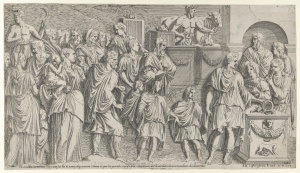
Mark Antony Offering a Sacrifice.
The spark in question is embedded in Plutarch’s account of the downfall of Mark Antony, Roman general and lover of the Egyptian queen Cleopatra, at the hands of the future Emperor Augustus. Antony’s defeat at the Battle of Actium in 31BC was already distant history in Plutarch’s time, but its seismic influence on the governance of Rome – replacing the failing Republic with the dictator-led regime of the Empire – would have been ubiquitously understood. Plutarch, however, was not in the business of writing purely historical accounts: his Lives, under which Mark Antony’s destiny is recorded, are self-proclaimed biographical character studies rather than dispassionate factual recordings; as such, curious digressions and titbits of hearsay weave their way through his narratives. One such side-story is related in the description of Mark Antony’s final night in Alexandria before his monumental defeat at Actium:
And it is said that during the middle of that night, as the city lay subdued and downcast from fear and expectation of what was to come, the harmonious sounds of all manner of instruments could suddenly be heard, along with the sound of a crowd of Dionysian revellers and satyr-like carousers, as if some Bacchic band was processing out of the city in a raucous fashion: their collective course seemed to take them through the middle of the city to the outer gate facing the enemy; at this point the noise, which had reached its peak, fell away. It seemed to those who analysed this sign that the god to whom Antony continually sought to compare and attach himself was leaving him.
This folktale-like aside could be dismissed simply as adding little more than narrative colour to the portrayal of Antony’s demise. And yet, this physical representation of Antony’s personal loss also serves as a powerful reminder of the inevitability and ineluctability of a foregone fate. The god, representing the general’s aspirations and inspirations, deserts him in a flutter of fictitious revelry; the irony of the joy in the Bacchic procession and its solemn symbolism is all too present. The nuance of Plutarch’s story, it seems, lies in the act of reconciling with an unavoidable destiny; it is theme which fans the flame of inspiration in modern artistic endeavours.
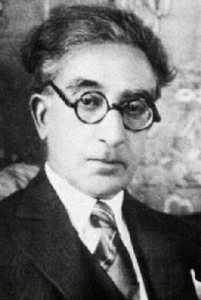
Constantine Peter Cavafy 1863-1933.
The primary reinterpretation of Plutarch’s curious digression appears in Constantine Cavafy’s 1911 poem The God Abandons Antony. Cavafy’s frequent evocations of influential figures and events from antiquity in his poetry often serve as a mechanism for exploring wider, more universal moral and psychological themes – as is expertly demonstrated in another of his poems, Ithaka – and in this poem, too, the past is blended eloquently with the present. Where Plutarch’s biographical purpose constrained him from offering explicit comment on the story he presents, Cavafy’s poetry freely re-interprets the situation in the form of a didactic monologue:
When suddenly, at midnight, you hear an invisible procession going by with exquisite music, voices, don’t mourn your luck that’s failing now, work gone wrong, your plans all proving deceptive—don’t mourn them uselessly. As one long prepared, and graced with courage, say goodbye to her, the Alexandria that is leaving. Above all, don’t fool yourself, don’t say it was a dream, your ears deceived you: don’t degrade yourself with empty hopes like these. As one long prepared, and graced with courage, as is right for you who proved worthy of this kind of city, go firmly to the window and listen with deep emotion, but not with the whining, the pleas of a coward; listen—your final delectation—to the voices, to the exquisite music of that strange procession, and say goodbye to her, to the Alexandria you are losing.
(trans. Edmund Keeley & Philip Sherrard.)
Knowledge of the poem’s classical context clearly identifies the addressee of this moral admonition as being Mark Antony, but the poem can be read from two perspectives: one as a dramatised portrayal of a piece of historical biography, and the other, divorced from its ancient inspiration, as an edification of endurance, that most human of experiences. The former poignantly captures the mood of despair, realisation and tragic inevitability in Plutarch’s original story, set against the background of Antony’s approaching demise. The encouragement of stoicism and acknowledgement in the face of defeat chimes particularly with Plutarch’s own presentation of Antony on the eve of the battle: in the first part of the chapter narrating the rumoured Dionysian revelries, the biographer describes how Antony, having decided to mobilise his attack on Octavian the following day, orders a lavish feast on the premise that he did not know whether he would ever be able to do so again. In the second, universalised interpretation of this poem, we are encouraged to view the ‘invisible procession’ as a metaphor for realising and confronting our destinies. In turn, the desired stoicism in recognising that our futures are uncertain and never fully under our control is as pertinent now as it was to Antony. Cavafy, in a style similar to psychologists and cognitive behavioural therapists today, encourages us to replace the ‘what ifs’ with the ‘now whats’ when coming to terms with complications in our lives; in his reinvigoration of Plutarch’s words, therefore, the poet expertly blends specific story and general advice, ancient context with modern relevance.
Almost a century later, the next reincarnation of Antony’s loss was brought to life by another poetic genius in the form of Leonard Cohen’s song Alexandra Leaving. Mirroring Cavafy’s simultaneously faithful and creative relationship with his ancient model, Leonard’s lyrics are at once recognisable to those familiar with his poetic source, and yet strikingly innovative in their new shape.
Suddenly the night has grown colder The god of love preparing to depart Alexandra hoisted on his shoulder They slip between the sentries of the heart
Upheld by the simplicities of pleasure They gain the light, they formlessly entwine And radiant beyond your widest measure They fall among the voices and the wine
It’s not a trick, your senses all deceiving A fitful dream, the morning will exhaust Say goodbye to Alexandra leaving Then say goodbye to Alexandra lost
Even though she sleeps upon your satin Even though she wakes you with a kiss Do not say the moment was imagined Do not stoop to strategies like this
As someone long prepared for this to happen Go firmly to the window. Drink it in Exquisite music. Alexandra laughing Your first commitments tangible again
And you who had the honor of her evening And by that honor had your own restored Say goodbye to Alexandra leaving Alexandra leaving with her lord
Even though she sleeps upon your satin Even though she wakes you with a kiss Do not say the moment was imagined Do not stoop to strategies like this
As someone long prepared for the occasion In full command of every plan you wrecked Do not choose a coward’s explanation That hides behind the cause and the effect
And you who were bewildered by a meaning Whose code was broken, crucifix uncrossed Say goodbye to Alexandra leaving Then say goodbye to Alexandra lost
Say goodbye to Alexandra leaving Then say goodbye to Alexandra lost
Linguistic resonances to Cavafy abound: phrases such as ‘exquisite music’, ‘one long prepared’, ‘go firmly to the window’, and, critically, ‘say goodbye to her, the Alexandria that is leaving’ are all re-worked into Leonard’s musical response, weaving their way through the fabric of the work to ground it unmistakeably in its origins. The themes of stoicism in the face of loss or change are also concurrent with his 20th and 2nd century sources; in essence, at least, Leonard Cohen’s interpretation stays close to its predecessors. However, it is the striking innovation of replacing the physical Alexandria with an abstract name, Alexandra, that gives the song its own life independent of its sources. Cohen’s poetic artistry lies in his concealment of exactly who Alexandra is and what she represents: instead, snapshots of vague reminiscence are brought sharply into focus when interrupted suddenly by didactic commands familiar from Cavafy. It is as if he descends momentarily into reverie, only to be dragged back to the present by the imitations of his poetic source. Through the deliberate mystery invested in his subject, Cohen is able to generate in the listener a milieu of emotions – nostalgia, wistfulness, longing, regret – all brought together by the abstract concept of ‘Alexandra’. As such, the exact context of Alexandra’s leaving is laid open for us to decide, with some fascinating results. A brief glance at online forums discussing the meaning of song lyrics reveals that many have sought to tie the song to their own particular experiences of love, loss, and betrayal, while others acknowledge that the lyrics have taken on different meanings over time; one man, for instance, was particularly struck by the song’s affinity with his emotional state after giving his daughter away on her wedding day. In this way, Cohen’s boldest innovation – the abstract Alexandra – becomes simultaneously his tightest bond with its predecessor; as in Cavafy’s poem, Antony’s plight is universalised, but this time through the lens of another most human of emotions: love.
The final link in this intriguing chain of interpretation comes in the form of Laura Marling, a singer-songwriter who, not unlike Plutarch himself, invests an element of biography into her work. Her song, Alexandra, is as much a tribute to Leonard Cohen after his 2016 death as it is to Alexandra Leaving in particular, while Marling has herself described the 2020 album in which it falls, Song For Our Daughter, as ‘essentially a piece of me’. With pride of place as the opening track, Alexandra offers a fascinating new perspective on the Alexandra of Cohen’s song, taking her abstract and forming it into a tangible, intelligible persona. Crucially, Marling’s take offers something which Alexandra Leaving could not: a female voice, rather than a perception of the situation necessarily filtered through Leonard’s ‘male gaze’.
What became of Alexandra Did she make it through What kind of woman gets to love you?
Wrote us all a little note Nothing left to lose What kind of woman gets to love you?
I need to know Where did Alexandra go?
Alexandra had no fear She lived out in the woods She’d tell you what you’re doing wrong If she thinks she’ll be understood Pulls her socks up to her knees Finds diamonds in the drain One more diamond to add to her chain
I need to know Where does Alexandra go? Where did Alexandra go?
It won’t change how I’m feeling You can try to help me understand If she loved you like a woman Did you feel like a man
I need to know Where did Alexandra go? Where did Alexandra go?
You had to say You feel too bad You could not bear Be understood I had to try A fuck to give Why should I die So you can live
What did Alexandra know? What did Alexandra know? What did Alexandra know?
The sense of inevitability which permeated Plutarch and Cavafy finds its place once more in this work, but it does so instead through the juxtaposition of gender and love, while Marling’s more overt debt to Cohen provides the frame within which to discuss wider issues of masculinity and self-discovery. When interviewed about the meaning of Alexandra, Marling emphasised her fascination with Leonard Cohen’s attitude towards women as a leading part of the song’s inspiration, but it feels more like a wider portrait of the negative tropes of masculinity and love. My own interpretation of the song rests on Marling questioning a male interlocutor about the fate of Alexandra and his relationship with her, asking powerful questions like ‘what kind of woman gets to love you?’ and ‘what did Alexandra know?’. As more details about Alexandra’s character are revealed, portraying her as free-spirited and forthright, it sets up the contrast between masculine and feminine perceptions of love: ‘if she loved you like a woman / Did you feel like a man’. The song’s climax, however, is when the male perspective is revealed. ‘You had to say / You feel too bad / You could not bear / Be understood’ highlights the all-too-prevalent issues of masculinity as meaning emotionally closed-off, especially when confronted with a woman who would speak her mind and challenge his behaviour.
For me, the central lines – ‘why should I die / So you can live’ – embody the frustration of women (in this case, ‘Alexandra’) feeling compelled to mute their own needs in order to accommodate the emotional detachment perpetuated by norms of masculinity. Although Plutarch himself may have been far from Marling’s mind in the composition of Alexandra, his story’s themes of self-reflection and facing up to an unavoidable fate resonate throughout the song, only this time the sense of inevitability is linked to the very current issue of gender conventions and their consequences.
Stoicism, introspection, loss, endurance: these are universal ideas which, after finding their place in a smattering of ancient lines, have been reincarnated in ever more innovative ways through the mediums of modern poetry and song. In this way, the spark of Plutarch can be found, via a convoluted relay of beacons through Constantine Cavafy and Leonard Cohen, in the flame of Laura Marling, even though their ancient and modern contexts bear no direct resemblance to each other. There is much in our world which can be attributed – directly or indirectly – to antiquity, but there is little so poignant as this literary lineage of Alexandria’s loss.
Lockdown measures remind me of the prescription of anti-depressants and other psychiatric medicines. They are both harsh, and both are administered in response to a moment of crisis; both often have severe side effects, which in time often obscure the initial malady that required their prescription.
Anti-depressants can be beneficial in stabilizing a patient and alleviating the most distressing symptoms of whatever underlying trauma caused them to present to a doctor in the first place. The logic of medication should be that once a certain stability has been achieved, a less medicinal and more holistic approach should be available to the patient including intensive psycho-therapy, talking therapy and most crucially for any patient, being properly listened to.
This, unfortunately, is what so rarely happens with cases of depression. The initial period of chemically enabled stability is seen as progress, and the primary causes of trauma remain unacknowledged, or only partially addressed.
While the trauma remains essentially untreated, the patient will find himself having his doses upped and reduced, his prescription swapped and changed, leading to him suffering a range of side effects which take centre stage in the narrative of his condition. We become transfixed by the shadow but not the object that casts it.
It is not very different to what we are now experiencing with Covid-19 and our second lockdown. Lockdown is the strongest non-pharmaceutical intervention available. It is the equivalent of ECT bolted through every nerve end of our society. One doesn’t have to look hard to see its devastating side effects.
Like our patient, who hoped that his medically induced stability might create an environment benign and supportive enough to allow him properly to address what lay at the root of his problem. Our first and very lengthy period of lockdown should have been used to confront and mend some of the systemic flaws in our health system.
We have also out-sourced the care of our most vulnerable to privately run ‘Care Homes’ that are mostly staffed by poorly paid workers. The final years of so many of our parents’ lives, and in time our own, is a for-profit-business. There’s great money to be made in dying.
I am sure that I am not alone in feeling like a child eavesdropping on a parental row – leaning over the bannister upstairs to hear what’s being shouted in the kitchen below – when it comes to the bickering and blaming between NPHET and the government.
'None of those people would have faced being on #PUP, none of them have to tell someone they are losing their job, none of them will have to shutter a business for the last time' – Tánaiste Leo Varadkar on #NPHET#cblivepic.twitter.com/ZAw7sDxGLo
It’s a reckless side show of hopeless administration and even worse leadership. There have been failures in testing, track and trace, and screening at ports and airports. It has just been reported that the UCD lab is to suspend all Covid-19 testing over two weekends due to staffing issues.
80 people on trolleys at UH Limerick on a day when we learn that only 23 additional critical care beds have been delivered nationally since March and publication of the HSE Winter Plan is delayed for a further week. The State must step up, not just individual citizens#COVID19pic.twitter.com/QGx2y5rnTh
Fix what is broken and we might have a better tool for confronting the virus.
Now we are patronized with talk about ‘behaving well,’ and maybe being able to enjoy Christmas. We were encouraged to come out and clap overworked medical staff rather than see them receive an immediate increase in salary, something which the government lost no time in awarding themselves, just as hundreds of thousands adjusted to living on €350 or less a week.
Covid-19 has held an unflinching lens to the structural inequalities in our country. Those who can, work from home, their salaries largely unaffected. Mainstream radio and print media run nauseating life style features about how much money people are saving, while another grubbier realty is far closer to the truth, that hundreds of thousands of workers are down many thousands of euros since March 13th.
We are a great country for cake sales and 5k sponsored fun runs, but not so good at drawing a line in the proverbial sand and saying enough is enough. We acquiesce too much, and are now complicit in our predicament.
Did anyone else find an eerie symmetry – a dark poetry – to how on the very day we went into a second lockdown, our government voted to seal the Tuam Mother and Bay Home files for thirty years?
As we lock down now once again, we seem to be burying our past, perpetuating the shame, punishing again those who suffered in denying them light and justice. We live in the strangest and most disturbing times.
A barrel of industrial waste poured into a suit
donated by a casino owner who knows people
with a tangerine tea towel tossed strategically on top
because it was the only available metaphor for hair
was running for re-election as CEO of South Canadia
against an old coat with holes in it.
The barrel of waste was trailing
histrionically among professors emeritus
whose brains were in the process of being dismantled
by lethargy and time, and among those
who, as and when the stock market permits,
take a year off to celebrate their dividends
by doing good works among brown people in far countries
not lucky enough to have stock markets or dehumidifiers.
Such people agreed with each other that the barrel of waste
made the raging boil on the nation’s privates
way too obvious, and hoped by throwing
the old coat over it they could again
forget it was there.
The barrel of waste said the old coat couldn’t deliver
on the promises he wasn’t making,
and maintained good leads among morticians,
pimps, and police informants
and had the total bastard vote
ninety nine percent sewn up –
in essence everyone except the late John DeLorean
and perhaps Alan Dershowitz.
There was a minority faction who wanted the boil
on the nation’s privates given free antibiotics, lanced
with a big needle imported from Sweden
and then cauterised. But most people found
though they were in favour, in their hearts,
of lancing the boil,
in practice they were for
allowing the boil to grow redder, angrier, more toxic
under the old coat with holes in it.
So the minority extremist faction
who wanted the thing treated
were sentenced to the echo chamber
to argue about whether the old coat
with holes in it really
was the lesser evil.
The midwife of history,
grown bored with the year twenty twenty,
had decided to play one of her jokes.
I am a father, a husband, a son, a friend, a doctor, an athlete, a traveller, a student and a citizen. Although just one person, I nonetheless occupy many nodes in the complex networks that make up society. These extend into the past, traverse the present and reach towards the future.
Over the past few months I have been deprived or diminished in many of these roles. Had I been asked if I wanted to relinquish the responsibilities inherent to these roles I would have declined, but I may have wanted to increase my responsibilities in some areas.
I am just one person in a vast network of people whose lives have contracted in the past six months. This makes me consider the extent of the wastage across society.
Why? Policies were adopted by an unelected government on the erroneous advice of experts listening to other experts, who predicted an enormous death toll from Covid-19 that has not come about anywhere on the globe. These same experts are now doubling down on initial errors and inflicting incalculable harm on the delicate fabric of society.
I don’t think these experts took into account people like a patient of mine, eighty-five-year-old Joe, who was married to Mary for sixty-years. They were forced to separate, partly because of her dementia when she had to go into a care home, but then because of public health restrictions. Mary resides in a nursing home and Joe visits every day, but the last time he held her hand was on their sixtieth wedding anniversary in March.
Previously Joe would cry when recounting his visits to Mary. Then he realised that if he spoke to her about their early days he could bring her back to life; at least for an hour or two. This stanched his tears. He was happy to have a small piece of the woman he married return to him.
His last such conversation was in March. Until recently he was still visiting her and looking and waving at a woman who didn’t recognise him. If the day was bright and sunny all he’d see was his reflection in the window. Joe managed to see Mary this week; to hold her hand and speak to her, but unfortunately she was unconscious. She stayed that way until she died a few days later.
The experts never asked Joe how he and Mary would like to live out their last days, nor sought the opinion of the thousands of elderly people whose children live abroad and who had planned perhaps their last trips to a wedding, a graduation or a funeral. Instead a paternalistic decision was taken, after a shameless use of the national media for propaganda purposes, inculcating a fear of imminent death in the elderly if they did not comply with the rules.
The past is being separated from the present and the future, as grandchildren now avoid grandparents for fear of being harbingers of contagion and death.
Perhaps most egregious of all is the passing away of a generation deprived of family and friends in the final moments of life. No last words of forgiveness, reconciliation, gratitude or love can be expressed. Such pronouncements on death beds have always nourished the generations to come.
As a people we traditionally celebrate death in a very communal way. We wake our dead. We toast their memory. We keep them alive in stories. We form processions to accompany their coffins to the church and the graveyard, where we huddle against wind and rain to say our final goodbyes. Then we gather for soup and sandwiches as a family, making sure to thank all those who have remembered. How dare they take this away from people indefinitely.
Our bonds are being ripped asunder. Our young in schools are now sitting in alienating environments, their every move regimented.
For anyone in university, the experience of academia will not be much better than watching a documentary on YouTube. The vital experiences of college life that sustain us for a lifetime are rarely found in books, but are the product of societies, sporting events and the parties that bring lasting bonds of friendship. These are all human connections that come about through proximity and touch.
What of this year’s Leaving Cert cohort? Students have been deprived of completing their fourteen years of school in a way so many generations before them have done. They are deprived of rites of passage that include the exams themselves, the celebration of results, and then on to the debs. Little wonder nearly 50% of the class of 2020 have reported high levels of depression or anxiety.
And what of the many small businesses, run by the parents of those young people that have been told to pull down their shutters? Who are these people that have the right to tell someone to cease trading and potentially permanently damage sources of livelihoods, and the future prosperity of their families?
Severing social threads by ending sporting activities, indefinitely shutting pubs and restaurants and restricting travel has already taken many formative experiences away from young people, while future encounters may well be tainted indefinitely by a fear of contagion.
And as to the future, are we supposed to believe the oxymoronic slogan of staying together by staying apart. How can this fortify social bonds?
They have instilled fear and paranoia where once there was social capital, infantilising the population with lockdowns.
This is a population that had grown restive about injustices and was developing a growing awareness and intolerance of homelessness, poverty, inequality, sexism, environmental damage and racism. Now the only of most politicians seems to be to keep their jobs, while maintaining social distancing, wearing face masks and eschewing all forms of human contact and connectivity.
To what end? To protect the vulnerable or the health service? The hypocrisy of this is astounding. Since when has an Irish government dramatically altered our society in such a short space of time to protect the vulnerable, or our health service?
Why can’t they admit they got it wrong – that they over-reacted and panicked when the initial grossly erroneous estimates were published? Instead they continue in the same vein. Isn’t it clear by now that the damage that has been caused, and will be caused, is far greater than any perceived health crisis.
Perhaps buried within their spuriously scientific reasoning is the fact that politically this crisis was fortuitous. It came at a time when the electorate had rejected the current government, and become radicalised and deserved a second election, but where are the opposition now?
They should end these arbitrary rules, lockdowns, based on specious and selective use of science purveyed by celebrity scientists. They should listen to international experts and use international data to inform decisions and stop preventing people, young and old, from leading meaningful lives.