Following on from last months ‘Alone EP’, Greg Clifford has released a music video for ‘Brontide’, which features on his forthcoming LP ‘Lines Of Desire.’
Brontide, which is defined as the sound of distant thunder (created by seismic activity), is a song and video about isolation, alienation, confusion and fading memories. According to Clifford, ‘this is an emotionally layered and charged production. Brontide, for me, symbolises impending doom and gloom. Dementia, in this case, is the suggested source of sadness’.
The video was filmed in Co. Sligo earlier this year. Clifford explains
we filmed in my Grandaunt’s house. She was a big part of our family and would spend almost every Christmas with us. She sadly passed away and the house was left to my Dad. Earlier this year we travelled west to clear out the rest of her belongings before the new owners moved in. It’s surreal and rather harrowing making sense of someone else’s belongings. It’s quite incredible how much one accumulates in a lifetime. It’s subsequently prompted me to de-clutter, as I don’t wish to be someone else’s burden when I’m gone. To break up the emotionally and physically draining days my Dad and I decided to shoot some video footage. I felt it was important for the family to have this sentimental visual documentation, irrespective of its artistic merits. In a reversal of our usual roles, I manned the camera while he featured in the video. The house was like a time capsule and is quintessentially Irish in nature, equipped with the obligatory Catholic iconography and mismatching, and rather barmy, wallpaper and carpets.
Greg and his father, who release work under the moniker CLIFFORD CLIFFORD Productions, made the most of the location and opportunity. According to the songster: ‘it’s incredible getting to work with my Dad. He’s a true artist, who has inspired me throughout my life. He’s incredibly thorough and committed to artistic disciplines. He cuts no concerns. We have a unified artistic vision and are both influenced by the German filmmaker Werner Herzog’, who is a proponent of trusting impulse and intuition.
Werner Herzog’s aesthetic was the driving force behind the video’s approach: ‘Coincidence always happens if you keep your mind open, while storyboards remain the instruments of cowards who do not trust in their own imagination’.
In Clifford’s opinion, ‘I feel the video truly captures the themes expressed in the song. The emphasis was placed on suggestive footage rather than conveying a clear narrative. I held the camera very close to the back of my Dad’s head at times to coax the viewer into immersion, allowing the audience connect with his abandonment and reflections. I filmed through glass, which distorted his face, and shot him staring vacantly into mirrors, which creates a sense of loss and confusion. This, for me, suggests he is being denied access to his memories’.
The poignant video, which is layered and open to interpretation, captures a sense of beauty in decay and the importance of letting go. Time waits for no man.
The story of subliminal messaging follows an interesting evolution, one infrequently told about a technique that may have created a monster. Considering this technique in the context of advertising, we can trace its roots back to the post-war 1940’s and 50’s United States. In so doing we must set the stage and, as Voltaire insists, ‘define our terms’.
Post-war America was undergoing an unprecedented economic boom. Manufacturing was in the ascendancy and incomes rising as never before. Modern capitalism was struggling through the birth canal of history and media-advertising was to be its midwife. The somnolent frugality and penury that defined the war years, and especially the pre-war Depression, was steadily usurped by a ‘terrible beauty’; the ‘American dream’ was assuming a material reality in cars, clothes, movies, music, diners and jukeboxes , enterprise, technology and invention; so much and more was coming out of America, and much of the world looked on with envy.
Post-war America thus experienced an explosion in new media; of television, radio, magazines connecting capitalist aspirations, with revenues increasingly derived from advertising.
Those behind the advertising fuelling American economic growth were fondly known as the ‘ad-men’. It was their job to motivate particular behaviours within a newly financially empowered individual, increasingly referred to as the ‘consumer’. Citizens had evolved into civic and economic units, with civic and economic or consumptive obligations. Consumption, despite being a euphemism at the time for the ravages of tuberculosis, was to become the bedrock of democratic capitalism.
By the late 1950’s and early 60’s, however, these consumers had begun to satisfy many of their material wants with products that initially endured, leading to new and more targeted influences. Rather than satisfy real and prescient needs, it became the job of the advertiser to ‘get inside’ the consumers’ minds and encourage them to think and feel differently, about each other, about the world, and about products.
America at the time was rich in oil, steel, lumber, agricultural lands and innovation. Resources were not unlimited, but they appeared so. Notions of conservation, environmental protection, biodiversity or climate change, were barely on the table, at least until Rachel Carson’s seminal Silent Spring was published in 1962.
During those halcyon days the Republican mantra of ‘trickle down economics’ had some substance, as there appeared to be an overabundance flowing down the social ladder. Even ‘socialism’ in respect of constructing roads, schools and other infrastructure enjoyed a share.
Planned Obsolescence
By the early 1950’s, however, it appeared to the captains of industry that the consumer market was becoming saturated. After large sections of the white middle classes had purchased a fridge, a car, a TV, a washing machine and other consumer durables, insiders feared the economy might be headed for a crash. Consumers might purchase enough material conveniences, but would soon begin to purchase less! Limitless economic growth might eventually come to an abortive and premature end.
There were disturbing indicators: for instance, between 1940 and 1950, the proportion of American families with mechanical refrigerators increased from 44 to 80 percent. Indeed, such ravenous consumption of homes, cars, and other goods meant that by the mid-1950s, marketers and businessmen feared, the saturation point was at hand. This fear led to two important marketing innovations. Planned obsolescence, the intentional design of goods to be short-lived, provided consumers with a reason to buy replacement items and created trends that promoted “keeping up with the Joneses.”[i]
Market segmentation arose from the theory that consumers had different preferences, rational and irrational, influencing their purchases. Advertisers began to target consumers on an individual level in order to market goods. These innovations helped advertisers to differentiate products and more successfully market them.
In The Affluent Society (1958), economist John Kenneth Galbraith condemned advertising for creating ‘wants that previously did not exist,’ but recognized its importance in stimulating the consumption that had generated post-war prosperity. Thus, between 1946 and 1955, the amount of money spent annually on advertising in the United States nearly tripled, from $3.4 billion to $9 billion. Consequently, throughout the post-war period, the ad man’s ‘real and perceived abilities to influence politics, culture, and the economy steadily grew.’[ii]
This makes sense: people don’t need to purchase products they already own. Fuelling the fears of a crash, was the reality that products were initially being made to last. Everlasting nylons, everlasting light bulbs, cars and machines with serviceable or repairable parts; permanence and durability were great ideas in the early days, but these ideas soon became dangerous with unfettered economic growth in mind.
The legacy of this revision is now all around us in terms of the environmental costs, and the ‘Growth Delusion’ has been extensively written about. (See Richard Douthwaite’s The Growth Illusion, Lilliput Press, Dublin, 1992) An irony emanating from this era is the permanent shift into our present reality of ‘planned obsolescence’. If products refused to wear out they would need an inbuilt expiry date. One might say with reasonable confidence that from the 1950’s the most enduring material artifact of manufacturing, has not been products, but landfill and human waste.
The task of the ad-man thus evolved from satisfying existing practical needs into creating new ones. Ideally, the ‘need’ for products that would gracefully expire and require replacement. If the products themselves refused to wear-out they would be portrayed as ‘outdated’, ‘outmoded’, or even an embarrassment to the owner.
The enduring, and egregious reasoning for dumping millions of tons of functional material products, in place of more ‘fashionable’ and ‘modern’ alternatives, slowly and effectively became normalised.
To all but the old-school farmer, this modern notion of ‘fashion’ as an important feature of function, persists to this day. The techniques for sustaining this ideology are taught in most universities. Of itself ‘fashion’ is perhaps a strange ideology and so-called ‘fast’ fashion is of course one of the largest contributors to the mass production of human waste. Thus an environmentally inimical notion of style emerged ascendant, and is now practically unassailable. Any questions of the cost or necessity of ‘fashionable’ apparel can readily be dismissed as outmoded.
Freud’s Nephew
This juncture in the history of advertising is best illustrated by the career of Edward Bernays – the nephew of Sigmund Freud – perhaps the most famous ad-man in the history of media. His influence as one of the founders of the ‘science of advertising’ is detailed in a BBC documentary: ‘The Century of the Self.’ He made use of Freud’s theory of psychoanalysis throughout his career to develop marketing strategies that have come to define the industry to this day.
For the advertiser or student of media ‘getting inside the mind of the consumer’ is perhaps an entirely reasonable objective. And yet, when we pause to think for a moment, how many of us would be wary of someone proposing to ‘get inside our mind’?
Bernays most famous use of these ‘new’ psychological techniques, was during his professional association with the tobacco industry. At the time in America, and indeed in many Western countries, most women did not smoke. The practice was socially frowned upon. If they could be encouraged to start smoking, profits would potentially double.
Ingeniously, Bernays effectively enlisted the women’s suffrage movement, by fostering a notion that not smoking was a sign of women’s oppression. His campaign implied that social stereotyping was preventing women from smoking, and that it could become an expression of their equal rights.
This perhaps intimates a familiar failure within feminism, which is the pursuit of equality rather than creating a practical respect for difference. A persistent desire to achieve equality with men, raises women no higher than equality. It sets the bar at the level of ‘man the trousered-ape’. Feminism rarely permits itself to go beyond men, into the realm of an overdue respect for female distinction, especially motherhood.
If men can smoke, then women should be free to do so also. The idea is simple, it contains a simple truth, but is hardly reflective of anything truly ‘feminist’ or ‘feminine’. Here we encounter the original ‘evil’ of the Sophist; the attempt to prove a facile argument by using true facts.
Whatever one’s views on the link between women smoking and their oppression, Bernays’s conversion of smoking into an assertion of equality, was unquestionably marketing genius. It should also be recalled that the harmful effects of heavy smoking were not then as widely accepted as they are today.
A decisive moment in Bernays’ campaign was when he enlisted a group of women to march in the Easter Sunday Parade of 1929. At a pre-ordained moment the women halted the parade, lit up cigarettes and puffed away.
Bernays and the tobacco industry temporarily re-branded cigarettes ‘torches of freedom’ The artfully manipulated ‘scandal’ had the desired effect, connecting smoking with female empowerment, and within a few years, a woman’s ‘right’ to smoke had been largely conceded. The tobacco companies were laughing all the way to the bank.
The successful marketing of cigarettes as progressive statements of liberty, female emancipation or a sign of Western sophistication, continues to this day in Africa and in the Middle East.[iii]
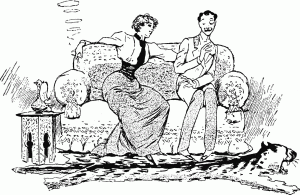
1890s satirical cartoon from Germany illustrates the notion that smoking was considered unfeminine by some in that period.
Old Socrates and the ad-man/Sophist
Of course ‘sublimation’ has a longer history than Bernays and the Manhattan ad-men. One might ask, what exactly does it mean to be a ‘victim’ of subliminal messaging? And when or if the victims deny they have been wronged then the delusion is complete.
Sublimation might be defined as some kind of ‘subversive mind control.’ Yet, perhaps the process is not a dark or subversive tool? Perhaps it is intrinsic to the functioning of group psychology. It may be integral to how our shared beliefs are transmitted, become established and are continually reinforced through a collective and instinctual need for belonging?
When misappropriated this ‘process’ of sublimation, becomes what Freud referred to as ‘mass psychogenic delusion’[iv] or what is sometimes described in Psychiatry as a ‘conversion disorder’. Certainly, when particular ideas are introduced into the sublime – the subconscious mind – there is often no limit to the evils they might engender there.
The ‘message’ is about getting us to behave in a certain way, to convince us to move in a particular direction, despite, or even in contradiction to external evidence, or our own better judgement. Yet this type of definition is equally unsatisfactory. It simply transfers the objective criteria for these newly fostered ‘needs’ to an external place; to someone else, to an ‘outside-of-self’ analysis of what one’s needs really are. This outside or objective ‘other’ must then decide what one’s thinking would normally be, if one’s mind had not been manipulated in the first place.
If I am aware that I am being deceived, I am hardly being deceived. And if someone tries to tell me that I am being deceived, (as with Plato’s cave dwellers), I might prefer to continue with the deception, before having my gullibility exposed.
If someone is apparently thinking or acting against their own better judgement, he or she will require an ‘other’ to identify this for them. It’s a classic Catch-22. If I am to realise that I am mad, someone else must tell me, or I must figure it out myself. If I’m sane enough to figure out I’m mad, I cannot have been that mad in the first place.
Whilst we are ostensibly guided by our own reasoning, we cannot know that our reasoning is being manipulated. Once we become aware of the manipulation; once we have recourse to our own ‘better judgement’ the spell has been broken. But it takes a brave soul to declare to the world: ‘I am being manipulated; I am being controlled or motivated by the ad-man.’
The essential deception contained within all forms of sublimation, therefore, is the requirement to make the subject believe that his newly fostered belief or desire, has not been caused by the advertisement itself. The advertisement has not caused us to desire a product, but has simply reminded us of an endogenous internal need, one that is entirely one’s own. The ad-man like the sophist has proven a false need by using true facts. The need in this case is only true by virtue of the unspoken fact that we have come to believe its ‘truth’.
The fostered desire must be hitched to our own desires, our inescapable instinctual imperatives; our desire to be happy; to live in accordance with reason; to be moral and just; or to be loved, accepted or respected by others. The ad-man must encourage us to ‘realise’ autonomously that life will be better, once we go ahead with the purchase.
There is of course a strong internal bias here. If I admit that my needs are not my own – that they are not genuine but have been hijacked by another – I must then admit to a sort of mental weakness; a failing on the part of my brain or intelligence. It is far easier, and safer, to assume and even insist that my beliefs are my own. That I am too intelligent to be ‘brainwashed.’
The Sophists
Sublimation is as old as civilisation. Socrates was convinced that we never really ‘learn’ anything at all. He believed that all important knowledge is within our minds at birth. That it is merely brought into being or delivered into the world. The midwife in this process is the philosopher. Socrates believed the challenge does not lie in the introduction of novel thoughts or ideas, but rather in altering how we go about our thinking. His solution is a Socratic methodology of thought.
Learning how to count presupposes (in the Socratic sense) an innate knowledge of relative numbers, this knowledge is something that we are born with, and do not acquire. We simply learn how to express and use that knowledge, to apply it in the pursuit of mathematics.
The structure of language might equally be considered an innate tool, as Noam Chomsky argues with the idea of a universal grammar. It is useful in helping us describe our thoughts, but we do not require language in order to have thoughts. We do not need to formally learn how to engage the process of thinking. Language might help us express our thinking, but we are born with an ability to think, and merely learn to express our thinking through the tool of language.
For Socrates, learning how to think is a relatively simple matter. There is a good and bad way of thinking. The benchmark for success being its independent approximation with truth; an absolute truth, a priori, unique, unassailable and independent of man. In the Socratic sense, truth is attainable through reasoned independent thinking: in other words, through philosophy. Independence in thinking was, however, an anathema to Socrates antagonists the Sophists. It remains an anathema to the ad-man, independent thinkers are rarely fashionable.
The main point here is that Socrates is of the belief that there is a distinction between acquiring information or skills, and understanding or correct thinking. What we should ‘do’ with information as it is acquired or learned through our senses, is already known to us innately. The truth is already within us, it is the ‘good as such;’ the ‘good’ in all of us. It is not acquired or purchased from another. It need only be brought into the world by learning how to think correctly, independent of any motive other than truth.
So here’s the rub, the crucial distinction between Socrates and the Sophists is that the Sophists were uninterested in an internal, a priori truth or the ‘good as such’. They defined ‘good’ as being in the realm of the external, material world. In simple terms, they correlated ‘good’ with success and power. ‘Justice is what is good for the stronger’ is the first Sophistic argument that Socrates refutes in the opening chapter of Plato’s Republic.
For the Sophist, understanding or philosophy is not to be confused with an inner or a priori ‘good.’ Instead it connotes success in the world. There is a very important distinction between the type of thinking advocated by Socrates and that of the Sophists: the former encourages an evaluation of one’s thoughts from the perspective of an internal uncompromising ‘good as such’; the latter identifies truth on the basis of its success or value in the material or external world.
Social Media
Whilst Socrates would have little interest in a ‘like’ button on social media, a Sophist might feel that the number of likes ascribed to a particular thought or idea is a good reflection of its inherent value, and even truth.
Socrates had little concern for the external world, which he likened to mere shadows upon the wall of a cave. He cared only that he might reconcile his existence in the world with his inner good or an internal a priori notion of truth. If that is accomplished, or at least pursued in an unbiased and philosophical manner, the affairs of society and the world will largely take care of themselves. Socrates’s ideals coincide with Confucius’s wise words:
To put the world in order, we must first put the nation in order; to put the nation in order, we must first put the family in order; to put the family in order; we must first cultivate our personal life; we must first set our hearts right.
What distinguishes Socrates from the Sophists is that the latter were practical teachers. They charged a fee, and considered knowledge a commodity. Socrates on the other hand always insisted that he had nothing to teach anyone. The wisest man is the fool, or at least he who knows the true extent of his own ignorance.
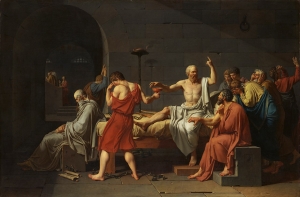
The Death of Socrates
For the Sophist, winning an argument is not simply a question of truth or falsity, but rather devolves to how the argument is presented. Using true facts to win false arguments is the criticism that is levelled against the Sophist, and indeed it is the essential meaning of the word Sophistry.
In this ancient contest we find the unacknowledged origins of advertising, and the ‘art’ of persuasion itself. Winning a false argument by using true facts, often entails convincing another of an untruth through recourse to simple self-evident facts. The other’s mind might then be hijacked into thinking and acting upon an idea that he might otherwise find repugnant. Subliminal advertising has its roots in this essential contest.
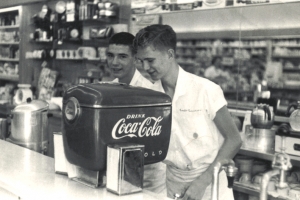
If you have been convinced by an external agency to desire popcorn or Coca-Cola at the cinema, then it is not unreasonable to assert that you have fallen prey to a certain type of invidious sophistry.
The Popcorn Experiment
By all accounts James McDonald Vicary – a late contemporary of Bernays and graduate of the University of Michigan – was an interesting ad-man. He presents a very interesting contrast to Bernays. He began his marketing career as a boy while in the employment of a company conducting a political poll for the election of a city mayor.
Sent about town in a cab, he interviewed passers-by to determine how they were going to vote. Vicary came from a humble background, having lost his father at a young age, and his family had struggled to make ends meet. A biographer informs us that his trip about the town was his ‘first time in a cab,’ and the success of his polling data in the prediction of the election outcome, confirmed his career in marketing research.
In 1957 Vicary issued a press release in which he described the results of an experiment he had conducted on the good people of Fort Lee New Jersey. The experiment is famously known as the ‘Popcorn Experiment’ and it is often referred to as the first documented use of subliminal messaging in advertising products.
Vicary claimed to have conducted his experiment on 46,599 movie goers, who, whilst watching a movie at a theatre in New Jersey, were exposed to screen images telling them to ‘eat popcorn,’ and ‘buy Coca-Cola.’ During the movie the ‘messages’ flashed on the movie screen in 1/3000th of a second, and as such were too brief to be consciously recognised by the viewers. Nevertheless, Vicary reported that these ‘subliminal messages’ resulted in a 57.5% increase in popcorn sales and an 18.1% increase in Coca-Cola sales during the movie.
Now you see it…
What is perhaps most interesting about Vicary’s story is that the experiment generated a public outcry, and was soon dismissed as a hoax or at worst a fraud. Either way, Vicary himself later declared that the results were fabricated and that the experiment never even happened.
It is important to contextualise Vicary’s renunciation. Amid the hue and cry, he was asked in an interview whether he had obtained people’s consent to have their minds ‘altered’ in the manner in which he claimed? It is quite possible, given the level of opprobrium he faced, and fearing potential claims for compensation, that he chose to distance himself from his work and quietly disappear into historical obscurity.
The irony here is that Vicary is still considered the father of subliminal messaging in advertising, and the result of the experiment was believed (or at least feared) by many to be substantially true. Indeed, there have been subsequent experiments proving the effectiveness of subliminal messaging in influencing our behaviours. The technique was quickly banned in America, and elsewhere. It seems unlikely that it would be banned if there was no possibility of effectiveness.
Although the experiment was dismissed as fraud, the unreal or ‘faked’ results convinced more people of the effectiveness of the technique than might have been convinced if Vicary’s results had been deemed truthful. Thus, ironically the faked results had an apparently greater impact in convincing people than the truth might have done. This recalls Nietzsche’s assertion that mankind is too often inclined to hold untruth in greater esteem than its inverse.
For our purposes the question is a simple one: what is the difference between the sublimation described and conducted by Vicary, and that same sublimation that was described and conducted by Bernays?
Vicary’s experiment resulted in an immediate backlash, and intervention by the U.S. Congress prohibiting such techniques. In contrast, Bernays continued to enjoy a favourable reputation and career. In the wake of his success with the ‘torches of freedom,’ he achieved legendary status within the marketing world. His books are still widely read and his techniques continue to be taught and applied.
Why is that Bernays enjoyed fame and fortune, whilst Vicary was compelled to vanish into obscurity, probably relieved that he had not ended up behind bars?
Perhaps the distinction between Bernays and Vicary’s approach, might be summarised as follows: as long as the individual subject can be preserved from the truth that they have ‘given up’ control of their mental faculties; as long as they remain convinced that the sublimated idea is compatible with their own thinking, the sublimated message will be readily accepted as an endogenous idea – one that has merely been reinforced or brought to light by the ad-man.
The Algorithm
In the wake of the 2016 American Presidential election evidenceof Cambridge Analytica meddling first came to light. It became apparent that algorithms had been applied to personal data, gathered from social media, which had then been used to manipulate voting patterns. The Western world (for a brief time) was horrified that minds had been tampered with, unbeknownst to those minds. Subliminal messaging had reared its ugly head once again.
It is highly likely, however, that the outrage was neither felt nor voiced by the true ‘victims’ of the algorithms. Rather, the anger emerged from the ‘other side.’ It was articulated, often by journalists, who felt that ‘other’ minds had been controlled, and the election of a President had been secured by devious means. This is an important distinction, and it reminds us that the victims of mind control tactics or subliminal messaging are very unlikely to admit to its effect, let alone develop an awareness of the tactics deployed on them.
Alexander Nix of Cambridge Analytica (2017).
And so it might follow that, if we, (the big ‘we’) are victims of subliminal mind control, how would we know? Who will tell us? In political parlance: only the left will inform on the right, and only the right will inform on the left. For each side of the political divide to label its antagonist as ‘brainwashed’ is nothing new. But what happens if each side is not in the habit of listening to one another, and if both sides are indeed correct?
Today we don’t have to look too far to find the evolution of sublimation: Bernay’s techniques are everywhere. Closer to home, sublimation is nowhere more obvious than in the practice of ‘predictive text,’ and the algorithms employed on social media.
When I begin to reply to an e-mail, my e-mail account offers to finish my sentences, and even offers complete sentences on my behalf. What is happening here? Why am I not insulted by a computer presuming to know my innermost thoughts, before I have taken the trouble to think them myself?
How is this process any different from what Vicary attempted in his Popcorn Experiment? Who controls this algorithm that presumes to think on my behalf? How deep into my psyche do these algorithms and advertisements reach? These are questions that we ‘victims’ rarely care about sufficiently to ask. The process appears benign and refined. Frighteningly, I cannot deny that those words the algorithm suggests do appear to coincide with what I might write, were I presumptuous enough to persist in thinking for myself!
Shouldn’t I steadfastly preserve my right to think autonomously? Perhaps I should respond like an inebriated rock star, and throw my computer screen out a hotel window in disgust at this presumptuous hijacking of my thoughts.
Tucker & the Gadfly.
I have a very close friend who does not read much. I love him dearly because he is straight and honest with me. I value his opinion because he is often more honest with me than I sometimes care to be with myself.
This friend recently introduced me to a Fox presenter whom I had never heard of called Tucker Carlson. One evening he insisted that I watch one of Carlson’s shows. Initially, I was surprised and somewhat amazed at what he had exposed me to. I forget what Carlson was talking about, but I remember being struck that he seemed quite sincere, and that much of what he was saying appeared to make sense, despite the way he was contradicting many of my core beliefs.
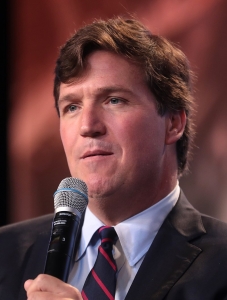
Tucker Carlson (2018).
Some days after watching, I decided to return to Carlson in order to better understand him, to recognise what he was trying to convince me of, and how he was going about it.
I watched two more episodes and the techniques he was employing gradually became obvious. It was not entirely clear at first, hence my perplexity and compulsion to watch him again. His techniques are no different to those used by Bernays or the sophistry of using true facts to prove false unspoken arguments. The facts were obvious, but the arguments, particularly in the arena of race, or race relations, were subtle: concealing dark convictions that align with primitive fears and aggressions.
There is a certain type of mind that is drawn to people like Carlson; a mind like my own that engages with the world with a set of hard-wired preconceptions, fears and desires. Yet Carlson was not music to my ears because I don’t harbour a fear-based love for guns or a suspicion of black people. Some of my fears I am conscious of, others less so.
If, for example, I were fearful of Black America, of its claims in respect of racism, slavery, inequality; if I were subconsciously fearful that equality or reconciliation was a threat to me; to my wealth; my morality, or my entitled share of wealth, then Carlson would be my man. It is not simply because he is racist or that he does not believe in ‘equality’. Carlson is interested in attracting an audience, and what he offers in return is a sublimated validation of one’s prejudice and fear.
One need only watch him at work to see this. The language he uses is openly about freedom and democratic values, and yet, there is a subtext that is difficult to identify immediately, or pick out with direct quotation marks. There is an artful use of words, not quotable sentences but words, interjected into sentences, which serve precisely the same purpose as ‘Eat Popcorn’ or ‘Drink Coca-Cola.’ or ‘torches of freedom’.
One quickly gains the measure of Carlson’s deeper opinion, or at least of what would likely be his opinion upon issues like gun control, or socialist initiatives such as universal health care, race relations, capitalist wealth, or global warming.
His unspoken ‘opinions’ or sublimations in respect of race are particularly invidious. The young black American is more often portrayed as a criminal thug, a gangster, a cop-killer. Yet this criticism of Carlson cannot be sustained easily, as there are protective ‘pro-black’ images interspersed in his monologues – ordinary black folk occasionally behaving like decent white folk.
I imagine the deception is so complete that Carlson has many black subscribers. It is almost as though he is reiterating the traditional racist slur that ‘not all blacks are bad people.’ Subtle slurs like this, provide the racist with a moral foothold.
It is once again a truth that is used to prove a false argument. Undoubtedly, it is a slur that some Black Americans reiterate and perhaps unwittingly inflict upon themselves. In essence the same sentence may be seen as a subtle evolution of outright racist contempt.
The former traditional slur has a sublimated racism, whilst the latter outright form is openly vile. The former in its disguise is perhaps more invidious, the latter whilst more grotesque, is at least openly so. Carlson’s racism is in the realm of the former: the sophisticated truism that has its racism concealed beneath the surface.
But the point here is not a critique of Carlson’s techniques. Instead it is a warning to avoid the same mistake as I made. After watching two final episodes of Carlson in an attempt to gain the full sublimated picture, I then tried to get rid of him out of my life: to cleanse myself of the poison.
Unfortunately, however, my YouTube feed now regularly spits Carlson onto my screen. I only ever watched two of his shows, yet he finds me at almost every login. I often watch shows about vintage cars, van-lifers and philosophers, yet regardless of my previous choices the algorithm has decided that I am – or should become – a fan of one: Tucker Carlson, an anathema.
The algorithm has made me one of his countless millions of viewers. Perhaps I would have done less harm to the ‘greater good’ had I watched two episodes of a different kind of porn.
The modern advertisement might have been defined by Bernays, but the algorithm that finishes my sentences, sends me ‘likes’, and has wedded me to Carlson, was engineered by a small group of techies in Silicon Valley. They apply the most up to date science and research in their engineering. They reach into our minds every time we interface with social media platforms, with the Internet and the ubiquitous smartphone. The purpose of the Internet we are informed is simply to turn a profit. But what is the product they are selling, when most of these platforms appear to be ‘free’?
I have often heard it said of social media: ‘when you cannot see the product being advertised, it’s because you are the product.’
Our preferences and opinions become part of the programme, encouraging certain types of thoughts and behaviours in others. The ‘like’ button is integral to the function of social platforms and yet what purpose does it serve in respect of the data or information that is being liked or disliked? Behind the like button lies one of the core values of the algorithm itself; the Sophistic assertion that truth is dependent upon likes. That ‘truth’ becomes truer when enough people ‘like’ it.
Human behaviour is predicated upon thought: what we do and when we choose to do it; how we portray ourselves; how we are perceived by others; all of these facts become lines of code within the algorithm.
If we can assert that the history of sublimation reaches as far back as the Greek mind; what can we say of the philosophy of the algorithm? When enough thought becomes manipulated, we may well move into a world where the dominant mode of thinking becomes that of the algorithm itself.
What if the algorithm has already become our new master, the predominant mechanism for thought and the architect of empirical reality? Does it contain a few lines of code that might define or preserve a moral truth of some kind? How would we know if the algorithm is out of control, if it has ‘gone viral’?
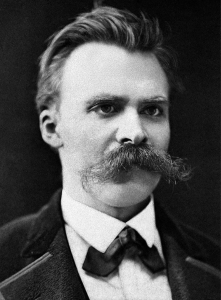
The Sophists may have had a counterbalance, a devil’s advocate in the form of Socrates the ‘old gadfly.’ Man has always had a counterbalance, a morality of some kind. If the advertisement and the algorithm have managed to move beyond morality, beyond good and evil, ‘it’ rather than we, has become what Nietzsche referred to as the ubermensch.
Friedrich Wilhelm Nietzsche (1844-1900)
What role does the Algorithm play in the election of a President? In taking to the streets in Dublin because a black man is murdered in America? What role does it play in hatred? In being afraid of a virus, or in wearing a face mask? In taking a vaccine, or in taking one’s own life? The darkness in our world may not be the workings of conspiracy – nor the consequence of irrational political allegiance – it might just be a consequence of sublimation: of a gullible embrace of the thoughts of others.
What has become of old Socrates, that he cannot and will not come to our rescue? Perhaps he is dead, and perhaps as Nietzsche said of God, ‘we have killed him’?
Feature Image: Alan Curtis & Patricia Morison in ‘Hitler’s Madman’ (1943).
[i] ‘Invisible Commercials and Hidden Persuaders: James M. Vicary and the Subliminal Advertising Controversy of 1957’ Kelly B. Crandall HIS 4970: Undergraduate Honors Thesis University of Florida Department of History, http://plaza.ufl.edu/cyllek/docs/KCrandall_Thesis2006.pdf
[ii] Kelly B. Crandall, Invisible Commercials and Hidden Persuaders: James M. Vicary and the Subliminal Advertising Controversy of 1957. HIS 4970: University of Florida, Department of History, April 12, 2006
[iii] Amos, Amanda, and Margaretha Haglund. “From Social Taboo to “Torch of Freedom”: the Marketing of Cigarettes to Women .” Tobacco Control 9.1 (2000). Web. 28 Apr 2010.
[iv] Bartholomew, Robert; Wessely, Simon (2002). ‘Protean nature of mass sociogenic illness’ (PDF). The British Journal of Psychiatry. 180 (4): 300–306. https://www.cambridge.org/core/services/aop-cambridge-core/content/view/2BDC2262E104B8A33F3DD49773DA0D8B/S0007125000268578a.pdf/protean_nature_of_mass_sociogenic_illness.pdf
Whenever I show them the Future,
they refuse it;
say: this future has bad hair,
waves its arms around too much,
is too Jewish,
or not Jewish enough,
too not-a-woman,
or the wrong sort of woman.
This Future has a face that one day
might raise the corporate tax rate
by zero point five percent,
and is a little too insistent
that poor people be allowed live,
give or take, as long as the rest of us.
That sort of thing scares the people we dine with
nights we’re not dining with you.
I ask the barman for more finger food,
picture the ocean raging into the restaurant,
and them still sat there muttering at the chicken goujons:
the people we talk to won’t vote for
such extreme solutions. No one wants to live in Cuba,
one of them says, as she’s washed out the door.
I pray, when all the futures
they’ve turned their noses up at
are safely in the mud
and the men in boots and leather come
to escort us all to the Processing Centre
in the back of a truck
that I be shot, cleanly through the skull, at the front gate,
so I don’t suffer their groans
about the quality of the gruel,
and how that last beating one of them got
was clearly in breach of the Human Rights Act
and worthy of a curtly worded,
but still civil, letter to The Observer.
Feature Image: ‘The Temple of the Liberal Arts’, by Jacques Sablet (1749-1803).
In the presence of great music we have no alternative but to live nobly … and indeed one can hardly think of life without music. Sean O’Faolain
In March the live music industry essentially ground to halt in Ireland. Sadly, owing to safety concerns, live music remains prohibited under current restrictions, and now even buskers are banned from playing.
Undoubtedly, the first lockdowns provided for a period of reflection, and many artists appreciated getting off the merry-go-round of gigs and promotional events.
Indeed, music was to the fore throughout the spring. Who can forget the indomitable spirit displayed by musicians singing from balconies? Although in Ireland, where few of us live in apartment blocks, most musicians were reduced to entertaining the birds, or other local fauna, in their gardens.
It is apparent that many musicians used the time wisely – drawing inspiration from introspection – embarking on new projects, and finishing off old ones that had been gathering proverbial dust in hard drives.
Yet as time goes by it is clear that among the biggest losers from Covid-19 are musicians, and others involved in the live music industry. The term ‘gig economy’ actually derives from the way most of them have been earning a crust since time immemorial. But in March the taps stopped flowing.
Lacking a live audience that is intrinsic to a performance, and which no Zoom session can replicate, we’ve heard that some are no longer even taking up their instruments.
It was a mad enough career at the best of times, with many doing it for the buzz rather than the money. Sadly, many may never resume their careers.
As we strike a balance between safety and the wellbeing of the population, music should figure prominently in the conversation, and state funding of the arts should be at least commensurate with other EU countries. In the short to medium term, concerts may take a different form, but we do need to make them happen or face a cultural decline that we may never recover from.
We asked a number musicians and others working in the industry to strike four notes in response to the pandemic.
From the top:
Fin Divilly – Songwriter and Performer John Cummins – Poet, Musician and Creative Workshop Activist David Agnew – Musical Artist and Legendary Concert Performer David Keenan – Songwriter and Performer Aisling Moore – Songwriter & Performer Gareth Quinn Redmond – Ambient Composer Daniel Lambert – Music Venue Owner, Band Manager and CEO of Bohemians Football Club Avoca Reaction – Drag Artist & Producer Ger Murphy – Live Streaming Host, Photographer and Gig Organiser Robbie Dingle: Songwriter, Busker and Artist Stephen James Smith – Poet
Fin Divilly – Songwriter and Performer (Also featured in the cover image by Daniele Idini)
Optimistic Note: In the face of financial and social pressure, songwriters have far more to sing, think and talk about. Dreaming of comfort and stability is far more fruitful than the real thing.
Pessimistic Note: Read above on a bad day when you can’t even support your arse in a pair of trousers.
Practical Note: More time alone allows for more self-reflection on what it is you truly want to be creating and who you are.
Existential note/How you are coping: Read above and picture me smoking, drinking and writing in peace at home in my underwear, forgetting what day of the week it is.
Veteran Oboe player David Agnew by Virtuoso Fotografia
David Agnew – Musical Artist and Legendary Concert Performer
Optimistic note: Lucky to be supported by the broadcaster I work for, recorded many pieces remotely and lucky to have performed live several times despite restrictions.
Pessimistic note: Worried that vaccines won’t bring the live experience back in a meaningful way for classical music. It will be a long time before older audiences will congregate, I’m sure.
Practical note: It has given us all the time to evaluate exactly who we are as musicians, and value what we do. It has been difficult to maintain match fitness, going from one hundred concert performances a year for the past forty years in my case, to six small-scale live performances with twenty-five people in the large church. You need the constant organic and charged musical environment with colleagues and the big audience-throng to sparkle.
Existential note/How you are coping: Online teaching has been rewarding. Remote recording on your own is difficult but fantastic to see it mixed and realised in the final cut. Writing, collaborations with others, when we haven’t had the time before has opened up new avenues and friendships. When we get back to something, and we still don’t know what that is going to be, we will have a greater sense of value and appreciation of everything we’ve probably taken for granted, and assumed would last forever.
John Cummins. Daniele Idini/Cassandra Voices
John Cummins – Poet, Musician and Creative Workshop Activist
Optimistic note: time to take stock, see where my art is at…time to plan an approach when allowed to play again … levelling the playing field somewhat in the industry across the board, artists can stream easily enough, if they so choose…
Pessimistic note: the impact on the mind and the pocket of so many people who have had the rug pulled…
Practical note: difficult and frustrating for people to plan anything with certainty…
Existential note/How you are coping: trimming the day down to its particular parts – having a morning, slow and steady … being in the afternoon … embracing the evening … connecting to the night … whether we like it or not, we are all in this together … I try to keep an eye on the bigger picture and not get bogged down in just me and me and …
Songwriter David Keenan by Mark William Logan
David Keenan – Songwriter and Performer
Optimistic Note: Being creative and expressing observations, internally and externally has always been the go to reaction, a means of understanding. I sense a unity in the artistic community in the face of the current restrictions and the trauma inflicted on our way of life. Swells of creativity are stirring as people are going to their tools and collectively spewing. Adversity breathes action and there’s a duty to self and to the craft to try to articulate what we’re seeing now and beyond.
Pessimistic: The eradication of live gigs has been a severe trauma on the individual, the facilitators and the audience. Live medicine, that age old human ritual is being denied. Psychologically this is so destructive as well as to the livelihoods that have been erased. It brings into question the concept of essential work and how reverence for the Arts has diminished in recent times. I worry that the Arts are not being valued as crucial sources of emotional and psychological wellbeing and will continue to be devalued in the new year.
Practical note: Those involved in the production side of the industry have vast experiences to teach. I suggest that initiatives to support unemployed teachers such as these should be set up to help them pass on this knowledge to young and old. The same goes for funded workshops for artists be it online or in person. We have to revalue the work, not devalue it even more in a time where so much is given away for free online, almost expectedly so. The shop local concept should be encouraged and applied to Irish Musicians / Artists. Buy a physical copy of a record / t-shirt / book from your favourite artists or venues. Streaming is of no use in terms of making a viable living.
Existential note/How you are coping: I’m doing my best to stay as creative as I can and trying to protect my energy reserves, building for the new year. These past few months have invoked a lot of anxiety, confusion and anger but it’s important to me that I try to grow and turn the base into something pure. Expressing myself through music and words has always gifted me healing and renewal. I’m staying as tight as I can to those lights, hopeful of what’s to come.
Ashling Moore by Megan Shannon Photography.
Aisling Moore – Songwriter & Performer
Optimistic note: I think there is a lot of opportunity to wrote and really find myself as an artist. In terms of the music industry, there is more and more recognition from the government and others of how important music is. I just got awarded a grant to start my EP which is a helping hand. Also a scheme might be coming out that pays musicians hourly like other jobs which is ideal.
Pessimistic note: Trying to be inspired to write about things other than the lockdown can be difficult. It is hard to know how long it will take before performing can go back to the way it was
Practical note: Lack of practice with performing.
Existential note/How you are coping: I’ve started reading books again. I’ve started exercising and being more aware of what I’m eating. It’s been hard but I have a socially distanced gig coming up so that has helped a lot. Knowing that there is solutions being created gives hope to us musicians
Gareth Quinn Redmond by Daniele Idini
Gareth Quinn Redmond – Ambient Composer
Optimistic note: I felt very vindicated having spent so much money on recording equipment at the start of the first lockdown, it has been a lifeline being able to continue writing and recording throughout the year. I’m not sure what state I would be in now if I didn’t have this set up.
Pessimistic note: It has been a tough year mentally, which got even harder at the start of October when I lost one of my best friends and bandmates to suicide. I have a great support network of friends around me but nevertheless it is so hard to grieve his loss when nothing about my day to day life reminds me that he is gone.
Practical note: It has been a great year for reflection but this is constantly overshadowed by the eternal dread of possibly not gigging ever again, not like I did before anyway. I can’t imagine doing anything else in my life, so I’m worried about the impact the new reality will have on the arts.
Existential note/How you are coping: Taking it day by day, my family and friends are so supportive. Compared to many I am very fortunate, I just need to keep reminding myself of that.
Daniel Lambert – Music Venue Owner, Band Manager and CEO of Bohemians Football Club
Optimistic note: we’ve been given the space to somewhat remove ourselves from the rat race, to breath and contemplate.
Pessimistic note: the lack of a clear date for the restart of live music as we knew it makes it hard to motivate each other.
Practical note: spend the time wisely, develop the online shop, investigate opportunities outside of core gigs, see the opportunities in difficult times.
Existential note/How you are coping: by swimming in the sea every single day.
Optimistic note: It’s nice to have a break from the hustle.
Avoca Reaction by Kyle Cheldon Barnett
Avoca Reaction – Drag Artist & Producer
Optimistic note: It’s nice to have a break from the hustle.
Pessimistic note: Performing on Zoom/similar platforms is a paltry substitute for a real crowd at a regular gig.
Practical note: All of the work opportunities I’ve had since March have been better paid than pre-pandemic.
Existential note: The first lockdown showed me how much my self-worth was tied up in my work/output. Over lockdown I’ve been working on finding satisfaction outside of performing.
Ger Murphy – Live Streaming Host, Photographer and Gig Organiser
Optimistic note: I’m in the unique position of doing pretty well out of Covid so not sure my opinion counts! But here ya go…. A lot of people and businesses were working nonstop, gig to gig, so this break has given time to look at how they work and hopefully come back stronger.
Pessimistic note: Can’t see live events coming back for another 6-12 months so bulk of my mates jobless until then.
Practical note: I have a live streaming company so never been busier.
Existential note/How you are coping: I’m graaaaaand.
Robbie Dingle by Daniele Idini
Robbie Dingle: Songwriter, Busker and Artist
Optimistic note: I’m finding this time to be very productive and am using the time to hone and polish my skills. I have surrounded myself with great musicians and am learning and busking on the street every day (with safety precautions). I am finding myself to be more focused and driven as it gave me the time to really think about what I want to do, projecting myself and thinking about my future in music. In the band I am in we have been chosen to be part of a Covid series called “justtheone” alongside some great artists and this gave us a kickstart to release more which I am very excited about.
Pessimistic note: The fact that bars have been closed and sessions I used to play at, open mics, jams I attended and hosted I am missing the interaction with a crowd and artists. In these spaces artists share their ideas and performances. Artists polish and cut the fat off songs to see what works and without this space I feel it will have a detrimental effect on art, creativity and an artist’s livelihood.
Practical note: With no gigs and regular busking I have set up a PayPal and moved into the city centre to play every day. The money earned from YouTube videos via PayPal has paid for a bike I now use to travel mobile and light around the city. The bike has a rack and I just use my busking amp and guitar which is very handy. No time on buses which is saving me money and I can access and travel to places that I could not before as I used to carry a hiking bag with all my busking stuff for the day. Now I can busk, go home for lunch, relax, recharge my batteries and even busk a second time.
Existential note/How you are coping: Recently I moved to the city centre to busk and play every day and sometimes struggle with rent (like everyone if you’re not a politician). Some days can be very bad and others brilliant. This can be due to the weather, location or getting stopped by the police if there is a congregation of people. The public are very generous to us and I feel we are much appreciated during these hard times. People light up as many have not heard live music in weeks or even months, they dance and sing and for us to bring that out of them while doing something we love outweighs anything negative about a buskers life.
Poet Stephen James Smith by Babs Daly Grace Photography
Stephen James Smith – Poet
Optimistic note: What won’t kill you….
Pessimistic note: Many won’t recover.
Practical note: We’re learning
Existential note/How you are coping: ‘Let everything happen to you / Beauty and terror. Just keep going / No feeling is final ― Rainer Maria Rilke.
Are you a musician denied a living from live music? Answer these questions in the comments section.
Optimistic note: Pessimistic note: Practical note: Existential note/How you are coping:
The degree of civilisation in a society can be judged by entering its prisons. Fyodor Dostoevsky, The House of the Dead (1862).
The quote above is from a work of fiction, but the author was drawing on a memory of four years imprisonment, following conviction for involvement in the Petrashevsky Circle – a Russian literary discussion group of progressive-minded intellectuals opposed to Tsardom.
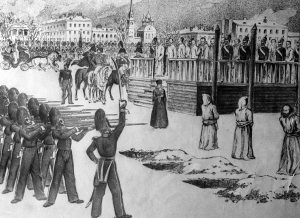
The great novelist only narrowly avoided a firing squad too – a stay of execution arriving at the last moment – which shaped his views on the death penalty. In The Idiot (1869) Prince Myshkin offers a salutary critique: ‘the whole terrible agony lies in the fact that you will most certainly not escape, and there is no greater agony than that’. He asks: ‘Who says that human nature is capable of bearing this without madness?’
A sketch of the Petrachevsky Circle mock execution.
For morals reasons – the idea of the state descending to premeditated killing – most jurisdictions no longer permit execution of prisoners following conviction for capital crimes. The strong likelihood of miscarriages of justice makes the argument against the death penalty appear insurmountable. A 2014 study indicated that one-in-twenty-five sentenced to death in the U.S. had been innocent.
The idea endures, nonetheless, that certain offences place perpetrators beyond the pale, incapable of redemption – diabolic even – wherein they are viewed as a perpetual threat to society, or even a moral contagion.
But, like it or not, the vast majority of prisoners do eventually re-join society, and it is in the wider community’s interest – with due regard for a victim’s or their relatives’ thirst for retribution – that convicts are rehabilitated to the extent they emerge as law-abiding and, ideally, self-sufficient citizens.
Given an estimated one in every two re-offend within three years of release in Ireland it appears the correct balance between punishment and rehabilitation is not being struck. A ‘Bibilical’ ‘eye for an eye’ view – reconciling moral accounts – still informs Irish attitudes to incarceration, with overcrowding exacerbating difficulties in an inadequate prison infrastructure.
According to Fíona Ní Chinnéide, of the Irish Penal Reform Trust in July: ‘At the outset of the pandemic, Irish Prisons were way overcrowded, you had people sleeping on mattresses on the floor.’
With courts resuming normal service, she feared prison populations would rise sharply, leading to further overcrowding: ‘I mean, in the best of times overcrowded prisons do not support rehabilitation and lead to increased tensions, drugs and violence, but Covid-19 brings an additional layer to this.’
Small Scandinavian countries such as Norway (20% after two years), Denmark (29% after two years) and Finland (36% after two years) currently lead the world in curbing recidivism. This can be attributed to prisons preparing inmates for life on the outside, including through open prisons that reintegrate offenders back into communities.
Slopping Out
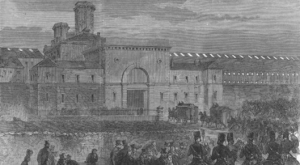
A de-humanization of prisoners is evident in the nineteenth century layout of Mountjoy Prison, the conditions of which could drive anyone to madness, or at least perpetuate a life in crime. Any visitor can discern a judgmental Victorian morality pervading the edifice.
Mountjoy Prison, Dublin 1850 Illustrated London News Public Domain.
The spectre of Henry Martin Hitchins, formerly Inspector for Government Prisons in Ireland, who oversaw its opening in 1850 lingers. He advised the first governor:
prisoners committed to your charge have been convicted of grave offences against God and man, that they have forfeited their civil rights and are confined much to protect society against their evil practices as to afford them an opportunity of repentance and reformation. It is therefore of primary importance that the prisoners should be brought to a proper sense of their condition and after the religious exhortations of the chaplains nothing so directly tends to effect this object as a firm and steady exercise of a severe discipline.
Inhumane features of the nineteenth century regime endure wherein the prisoner forfeits basic civil rights and experiences degrading treatment. Gary Simpson was held in Mountjoy Prison between February and September 2013. As a ‘protection prisoner’ he was kept in isolation from other prisoners – detained in cells on the D1 wing prior to its refurbishment. During that period there was no in-cell sanitation, nor even a sink providing running water.
Prisoners were normally provided with a ‘slopping out’ chamber pot and a plastic bucket of water for washing their hands. Simpson brought an action for damages in response, alleging he was regularly compelled to urinate into empty milk cartons as the chamber pot was too small to be used more than twice without being emptied. He claimed he had to defecate into a refuse bag for the same reason.
Simpson received damages of €7,500 in 2019 after contending with conditions the Supreme Court agreed breached a constitutional right to a basic level of dignity while in prison. The paltry nature of this award – commensurate with a soft tissue injury – is a damning reflection on the degree of Irish civilisation.
Most of us, generally law-abiding citizens are not kept awake at night at the prospect of a stretch behind bars, but even among ‘respectable’ families there are often members who find themselves on the wrong side of the law. And delving into family histories invariably yields an ancestor who has offended against dominant morals expressed in the laws of the day.
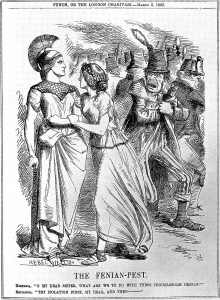
In my own case, a great-grandfather Luke Armstrong (1853-1910) of Tubbercurry, Co. Sligo was subjected to at least two stretches behind bars for activities he viewed as political – the so-called Land War of the early 1880s – but which the Crown authorities considered criminal. An ambitious shopkeeper, ‘who was better dressed than his Tubbercurry companions,’ he was arrested in April, 1884 and charged with his fellow conspirators with being a member of the Fenian Society, and conspiring to murder a land agent.
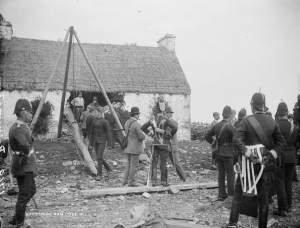
An eviction during the Land War.
Luke Armstrong and his co-defendants were eventually transferred to Kilmainham Gaol in Dublin, and brought to trial the following November at Green Street Courthouse. Thankfully, given the gravity of the charges, all the accused were acquitted based on the unreliability of the Crown informant’s evidence.
As a high-ranking member of the IRB, this was not Luke’s first brush with authority. He was also incarcerated in Enniskillen Gaol earlier in the 1880s where he was subjected to ‘two days’ solitary confinement by the Governor. Luke must have gained extensive experience of slopping out during these unwelcome sojourns.
The Land War of the 1880s may seem like a far off, almost mythical, period, but as recently as the 1940s Irish political prisoners were held – for years on end in many cases – without trial under Emergency Powers Orders in Nissen huts in the Curragh – labelled Tin Town (Baile an Stáin or an Bhaile Stáin) by internees that included the novelist Máirtiín Ó Cadhain.
According to the historian Tony Gray, the EPOs ‘were so draconian that they effectively abolished democracy for the period, and most aspects of the life of the country were controlled by the dictatorial powers the government acquired.’[i]
Ironically, another great-grandfather of mine, former Taoiseach (1948-51 and 1954-57) John A. Costello, was responsible for drafting emergency legislation while Attorney General in 1926 in response to the assassination of Kevin O’Higgins; although according to his biographer David McCullagh: ‘While portrayed as draconian, the response was in fact far more measured than might have been expected, or than was initially considered.’[ii]
At least, to Costello’s credit, in opposition when emergency powers legislation came before the Dáil again during World War II he insisted on a right of appeal to the courts from special tribunals.[iii]
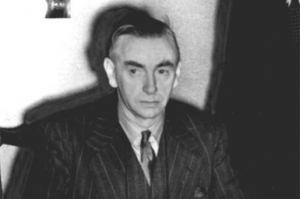
John A. Costello 1891-1976.
Today, new emergency legislation in response to the pandemic awakens fears that “generally law-abiding citizens” could yet fall foul of draconian laws intended to protect the community. Indeed, the term ‘lockdown’ is derived from the lexicon of incarceration: the confinement of prisoners to their cells for all or most of the day as a temporary security measure. Perhaps our experience of stay-at-home orders will instil greater empathy with the loss of liberty and privations endured by a prisoner.
One should be hesitant, therefore, to assume prison to be the fate alone of an underclass or those exhibiting extraordinary moral deviancy. Any one of us could face a stint behind bars, either through weakness, as a result of a mistake or error, a miscarriage of justice, or even where a moral conviction leads to a stand against a law or authority we consider illegitimate.
In accepting this possibility, we should consider the minimum duty of care owed by the State to any person incarcerated, and the purpose of a prison sentence.
Principles of Sentencing
Objectives of sentencing include revenge, retribution, just deserts, deterrence, incapacitation, rehabilitation and restoration.[iv] The most familiar type of sentencing is a custodial sentence, but judges can also levy fines, or make community service orders; contributions to the poor box are often accepted as a form of contrition in lieu of sentencing.
The handing down of a prison sentence demonstrates to the community that morally repugnant behaviour will receive its just deserts. The threat of incarceration may also act as a deterrent, and a victim’s desire for revenge or retribution should be respected and vindicated.
The current conditions of Ireland’s prisons now amply provide for deterrence and revenge: who in their right mind would relish even a night in ‘the Joy’?
To an extent this is how it should be. Unless the State administers sentencing proportionate to a crime – as agreed by the community through its laws – faith could be lost in the rule of law. Indeed, vigilantism could emerge in its absence – as we have witnessed with extra-legal pursuit of drug dealers in some Dublin neighbours, and especially in Northern Ireland, where horrific kneecapping still occurs. The State should endeavour to monopolize the use of force with the objective of reducing violence, and other antisocial behaviours, overall.
Mandatory sentencing of ten years under the Misuse of Drugs Act 1999 for possession of drugs with a value over €13,000 has not, however, proved an effective deterrent and in most cases judges find exceptional circumstances apply to avoid the full imposition of the term for what is a non-violent offence.
It is understandable that judges would wish to avoid the nuclear option of a prison sentence, which often hardens individuals to lives in crime. If, however, Irish carceral institutions adequately rehabilitated young offenders in particular – nipping errant behaviours in the bud – judges might be inclined to prescribe short interventions. This could offer a chance for someone to turn over a new leaf, and even learn new skills in a safe environment.
Legislators might also consider broadening the range and reducing the period for convictions to be ‘spent’ – fixed at seven years for particular offences. This might diminish the social stigma of serving time behind bars, allowing for it to be seen as a therapeutic intervention rather than a lifelong stain on one’s reputation.
One means of addressing victim impact and an understandable desire for retribution or revenge is through non-adversarial mediation. This includes the idea of restorative justice, which brings perpetrators together with victims of crime. Ideally, a consensus is formed around what the offender can do to repair the harm caused by the offence. See Alan Gilsenan’s documentary The Meeting (below).
Anders Breivik
Incapacitation is also a necessary ingredient to sentencing, where an individual presents an ongoing threat to society, or even to fellow prisoners. This is a familiar justification for the death penalty, and there remain scenarios where an agent of the state – usually a police officer – acting in the common good, may lawfully kill someone, notwithstanding the twenty-first amendment to the Irish Constitution prohibiting the death penalty. Such a response is only lawful if it is proportionate to the threat – a test similar to justifications for self-defence.
Dostoyevsky’s moral argument, and the likelihood of miscarriages of justice, are convincing arguments against the death penalty, but the ongoing danger posed by individuals must still influence the severity of sentencing.
Thus, the continued solitary confinement of Anders Breivik – currently serving twenty-one years for a bomb and shooting attack that left seventy-seven people dead in Oslo – was not held to violate Articles 3 and 8 of the European Convention on Human Rights, relating to the prevention of torture and inhuman or degrading torture, and the right to privacy and family life.
Flowers laid in front of Oslo Cathedral the day after the attacks. Image: Johannes Grødem
The test employed is one of proportionality. The court obviously took into account that Breivik is a mass murderer who had admitted to indiscriminate killing for a political end. Authorities fear he could exert a nefarious influence over fellow prisoners given an opportunity to do so. This view may be correct but it sets a dangerous precedent; albeit the Norwegian government argued that Breivik’s three-cell complex, with access to video games, TV and exercise facilities, is better than the conditions of most other prisoners, thereby compensating for his solitary confinement.
In recent times terrorism has emerged as a justification for harsher sentencing – and even torture– and extended periods of questioning before charges, but the definition of a terrorist is loose and unsatisfactory, and a form of structural racism (or Islamophobia) appears to inform treatment of offenders in many jurisdictions. My own great-grandfather was considered a Fenian terrorist in his day.
The temporary removal of liberties such as conjugal rights between husband and wife is generally considerate a proportionate punishment when a guilty verdict is found. This view was upheld in Ireland in the case of Murray v. Ireland [1985]. But what if the denial of such a liberty impedes rehabilitation or the restoration of a flourishing individual to society? This judgment may merit re-examination if we are to prioritise rehabilitation.
The interest of the community in ensuring a prisoner is equipped to transition back into civilian life should trump an understandable desire for revenge felt by victims of crime and their relatives. But this reasoning does not now inform sentencing in Ireland, where even posting a letter requires a lengthy review process at either end. Enjoying the privilege of just one phone call a week means prisoners cannot easily stay in touch with family members.
Among the reasons for Finland’s low rate of recidivism is the open prisons developed to prepare convicts for life on the outside. Instructively, Finland has the lowest per capita incarceration rate in the European Union, with just 51 people per 100,000 in some form of prison, according to the World Prison Brief, while Ireland’s stands at 84 per 100,000, which might well be higher but for current overcrowding inhibiting sentencing.
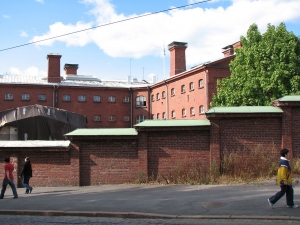
The former prison building of Katajanokka, Finland is being renovated into a hotel.
Also, instructively, Ireland ranked sixth worst in Europe in a crime index conducted by Numbeo scoring 44.52, whereas Finland lies in thirty-fifth place overall on 22.80. Thus, despite a significantly smaller prisoner population, Finland is also a safer country than Ireland, scoring 77.20 against 55.48. Given Ireland’s GDP per capita ($89,383) exceeds Finland’s ($49,334) by a considerable margin, this is clearly a question of priorities rather than resources, and sadly, an indicator of our respective “degrees of civilisation.”
Sasu Tyni, a researcher at Helsinki University and the Criminal Sanctions Agency (RISE), says that the Finnish system is based on a belief that locking people up is a last resort. ‘Closed prisons are more or less grounded in security purposes, while open prisons aim to be closer to society, family, work etc,’ she explains. ‘The strategy of the Criminal Sanctions Agency has for years been to use closed prison as the last option. We assume an open prison system can decrease the risk of recidivism.’
Prison governor Kaisa Tammi-Moilanen explains that prison authorities have ‘purposely tried to avoid everything that we can which are associated with a prison,’ which means there are no physical barriers stopping prisoners from escaping. Tammi-Moilanen explains this is intentional, as it encourages prisoners to develop a sense of self-control.
Prisoners in a closed prison don’t need to learn any self-control, because everything they do is controlled. But to be a normal citizen you need to have inner control of your life, so you know how to behave, you know what is good for you and you know what is good for the society.
At present the open prisons at Loughan House and Shelton Abbey are, to an extent, used to cope with the overcrowding in the closed prisons and therefore in their current use could only play a minor role in the effective management of prisoners through the prison system.
There is no evidence that international best practice has been taken into account since.
Reskilling
Re-evaluation of the role of Irish prisons does not appear to be on the immediate horizon. The new Minister for Justice Helen McEntee indicated that Garda reform, domestic violence and the modernisation of the sector’s IT services were her three priorities in an interview with the Sunday Business Post in August.
Yet historic shortfalls in rehabilitation have brought high rates of recidivism at significant cost to the exchequer: the average price of an ‘available, staffed prison space’ was €75,349 in 2019. Moreover, the lawlessness evident in parts of Ireland can be traced, at least in part, to the failure of the prison system to rehabilitate adequately.
Targeted investment should produce long-term savings by reducing recidivism. The new Minister thus has a huge opportunity to leave a profound legacy that could ameliorate conditions in certain ‘no go’ neighbourhoods.
Introducing meaningful open prisons to reintegrate prisoners into communities would require a cultural shift however. Prevailing Irish attitudes towards crime are informed by enduring social cleavages: in Dublin expressed in euphemisms about someone being ‘from the inner city;’ or ‘of Traveller origin’ in rural Ireland. Yet prison reform could address long-term poverty and social exclusion. Any progress would be a significant feather in the new Minister’s cap.
It seems obvious that prisons should offer inmates a chance to break the chain in a life of crime, rather than perpetuating one. Sadly, incarceration remains a breeding ground for criminality. Fresh thinking is required to address shortfalls in mental health provision, drug addiction counselling, and general education – especially illiteracy: one in six of the adult population in Ireland is still functionally illiterate.
In 1997 the Irish Times reported: ‘It is widely accepted that the standard of education of most inmates adults and juveniles is somewhere between third and fifth class of primary school.’ Twenty years later the same paper reported: ‘Overall, four out of five prisoners (80 per cent) left school before their Leaving Cert, more than half (52 per cent) left before their Junior Cert, and just over a quarter (26 per cent) never attended secondary school.’
Anyone hoping to leave a life in crime behind should be able to glimpse viable alternatives while in prison. A Leaving Certificate is generally seen as a foothold for advancing one’s career. In 2011 the Irish Times reported that 117 prisoners were sitting the Leaving Cert and 161 were taking Junior Cert exams that year, but current figures are not easily accessible.
Alternatively, offering prisoners business skills has been floated as one approach by chef-entrepreneur Domini Kemp, who participated on a programme at Wheatfield Prison. As she it put it:
I read that prisoners cost north of €68K a year in Ireland and it struck a chord with me that if you could teach them how to start their own business and reduce the rate of reoffending, how much you could save.
An entrepreneurial career path will obviously not suit every ex-prisoner. The challenge of starting a small business should not be underestimated. But the state should be empowering prisoners with career alternatives for when they return to their communities.
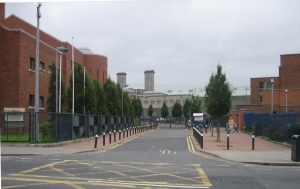
Mountjoy Campus, North Circular Road, Dublin, Dublin 7, Ireland
Wellbeing
In an enlightened society such as Finland’s it appears as if the traditional prison is being phased out. This may be attributed to many factors including an inclusive education system, as well as advanced ideas on wellbeing. Minister of Social Affairs and Health in Finland, Pirkko Mattila, explains the connection between economic growth and wellbeing:
Economic growth improves people’s wellbeing, whereas wellbeing and health of the population enhance economic growth and stability. This interlinkage must be better recognised. In Finland, we are putting forward a holistic approach to this question that requires horizontal thinking and cross-sectoral co-operation. We call this approach, the Economy of Wellbeing.
This holistic approach seems to play an important role in keeping crime to a minimum in Finland. In contrast the steady acquisition of wealth in Ireland appears to be decoupled from the Economy of Wellbeing. A more enlightened prison system could help bridge that divide.
Nevertheless, it may be impossible ever to extinguish the evil that leads to certain crimes. The example of Anders Breivik in Norway demonstrates that even highly civilised countries witness heinous crimes, or black swan events.
We may always require prisons to act as a deterrent and to protect society from evil behaviour, but it is worth bearing in mind that any one of us could find ourselves behind bars. It is in all our interests that prisons assist inmates to become functioning members of society. The Irish prison system is now perpetuating criminality, and the new Minister should make reform a priority.
Featured Image: main hall of Kilmainham Gaol.
[i] Tony Gray, The Lost Years: The Emergency in Ireland 1939–45 Little Brown & Co, London, 1997, p. 5.
[ii] David McCullagh, The Reluctant Taoiseach: A Biography of John A. Costello, Gill and MacMillan, Dublin, 2010, p.63
Everyone was amazed when it happened and I mean everyone, including Jeffrey. For weeks now Ramona had been hanging around in “Murphy’s,” a pub in Nice where, every Wednesday night, they held an open mike. A real beauty, with auburn hair and glittering eyes, she brought her violin with her, and when she played, there was a hush… because she played so well. And of course, all eyes were focused on her athletic, yet graceful movements.
“Who is she?” asked Denis, a regular customer. The long-haired barman just shrugged his shoulders. Fortunately, for the small band of regulars, mysteries of this kind don’t last long at Murphy’s.
An Italian, in her last year at the conservatoire in Nice, the first time she’d showed up in Murphy’s, it was with a young man who also happened to be from the conservatoire.
Jeffrey was the one who’d started Open Mike. On any given Wednesday, he was the king of what was at best, a shabby pub. The performance space was so small, that in an effort to avoid each other, musicians had to constantly move. In addition, the way to the bathroom was right through that area. So, there was a constant stream of people trying to break through the band.
But this was exactly what the musicians here were used to. In fact, what better way to perfect, not only their musical skills but the ability to play in challenging conditions.
All musicians and singers were welcomed here. But most of the regular players belonged to the busking bands. Their specialty was strolling from table to table, singing and larking about the restaurants.
They had little tricks to delight the audience. Like swapping guitars between two players in mid-song without losing a note. Playing in restaurants and hotels was mostly a publicity tour.
Although the tips were important, what they wanted was a private gig. That’s where the big money was.
All the bands got private gigs. Some more than others. Jeffrey knew all the musicians in Nice. Truth be told, he’d trained most of them. Some came from England, Europe, and America seeking the Riviera’s cocktail of sunshine, music and money. Jeffrey was a highly entertaining person with a good sense of humour, but he could also be as twisted and complex as a spider’s web. Lately he was complaining that Pierre was playing the guitar too loud. Not an unreasonable point, but it could have been made in a reasonable manner. Nonetheless, when Pierre was at loose ends, Jeffrey approached him to sit in on a few gigs.
Jeffrey said, “If you want to play with me, you’ll have to be my bitch! This was vintage Jeffrey. Pierre didn’t like it. He was a macho guy from the suburbs of Paris. It’s fair to say that if you needed Jeffery, you’d need a shrink as well. To patch up your battered ego. But if you survived it, the end result was good. It knocked all the nonsense out of you. So, when Jeffrey saw Ramona, like a peacock, he was quick to fan out his feathers. What he loved more than anything was fresh blood.
Ramona stood by, watching them perform, while like a neon sign, Jeffrey’s smile flashed. Squeezed into that little space, he played harmonies with Greg and Johnny, kicking his slender long legs in the air.
Bob was playing the drums as a precariously placed pint of beer trembled, on the window sill behind him. The pub was busy. People were half talking and half listening. Ramona stood right next to the band. Though classically trained, she was totally absorbed in this popular music. Seeing she was on her own this time, Jeffrey invited her, with her violin, to join in on their new song. Improvising, she weaved herself into the session so seamlessly, that everyone was enchanted.
Then the musicians changed. Ryan came in with the double base and George swapped guitar with Johnny. Jeffrey swapped with Connor, Daniella walked over to the microphone and the new group started to play the crowd pleaser “I’m Your Venus.” Ryan, a large looming figure, who looked not unlike a hairless gorilla was playing the double bass and singing the chorus with total abandon: “I’m your Venus! I’m your Venus!”
“No, you are not!” retorted a male voice from the bar.
Jeffrey leaned towards Ramona to say something. Then they went out on the street to sit at a table, where Jeffrey ordered two shots of brandy.
“You were amazing,” he said to Ramona. “And the way you managed to improvise just now was great! Rolling his cigarette as he spoke, occasionally he raised his head to look at her.
His constant smile distracted her from those desperate eyes. He was tall and skinny and although already in his 60’s, Jeffrey was still good looking. Ramona’s smile was a bit more demure.
Later, he raved to everyone who would listen, “She’s got so much talent, and she is only 21!”
It was already spring, and soon summer would come rolling in like a big wave. Everyone would be gigging somewhere, vocal cords stretched to the limit, as the audiences in private gigs demanded more songs. But still, the musicians showed up at Open Mike. Sometimes to engage extra musicians for a specific gig, or replace a musician that left the band.
It was a rehearsal of sort, as they all knew most of the same songs. Jeffrey knew thousands.
“I’ve got a gig in July,” said Jeffrey. “But I’ve got no band. They left me.” Smiles and rolling of the eyes ensued, as if this was the best thing in the world.
“Said I was too much of a drama queen,” he volunteered. Elated, Jeffrey was teaching Ramona how to sing and to play the drums.
“She came over last Tuesday,” he said, “And we practiced for hours. What a voice she has!”
As he said that, Jeffrey looked at Daniella. He was an expert at double edged sentences, serving a carrot for one person, while he stuck it to another.
One of the few female singers around, Daniella was a solid performer, but Jeffrey was determined to put her down. After all, she wasn’t his protege.
For years he’d talked up what a dream it would be to team up with her, but when he finally got the chance, he did everything to derail it.
But now Ramona was the star. He was showing her the ropes. Telling her which songs worked if you were after a big tip. Jeffrey had extensive experience.
He regaled his friends with descriptions of how sexy she was. How she acted in his apartment when she came over to practice. “If I wasn’t so much older than her, I would have thought that she was trying to seduce me. The other day, she said that it was too hot in the room and she started taking off her blazer! She had this tiny little top on underneath. It was just too much for me.”
As the weeks went by, Ramona became part of the scene. She was gigging with Jeffrey. The violin was only used occasionally, because Ramona quickly became a jack of all trades, playing the Cajon, the banana shaker and singing. Jeffrey taught her the song “Diamonds are a Girl’s Best Friend” which she sang in her charming Italian accent.
“I really like him,” She confided to Daniella one day. “What do you think”?
Daniella answered with a look of disapproval.
“Yes, I know he is much older than I …”
“MUCH older,” said Daniella, “But that’s not it.”
“What is it then?”
“He’s complicated and hasn’t been kind to his previous women.” This meant nothing to Ramona. She was in love! Daniella reflected to herself, “He is only kind when he wants something.”
But Ramona, at age 21, still believed that she could change things.
Astounded by his good luck, Jeffrey was beaming. He looked ten years younger. “I’m so in love!” He declared to all. At Open Mike, he didn’t drink his habitual shots of brandy.
“Ramona has me on a healthy regime. She worries about my drinking.” He explained with pride.
To be fair, everyone was enchanted. After all, if a fellow who’s nearly over the hill can net such a beauty, there is hope for us all.
Some even imagined there was future potential for the pitter patter of little feet.
Ramona received a scholarship to do her Masters at the Paris conservatoire in September. She considered declining, because she was having so much fun. The summer was full of excitement.
Beautiful Daniella was singing, “Sway with me,” Johnny was on the drums, and spending a lot of time adjusting some buttons on his amplifier, Pierre played electric guitar.
“Too loud,” said Jeffrey, before he walked out.
Because Pierre’s band in Paris played instrumental rock, he wasn’t accustomed to accompanying a singer. All he cared about were the pyrotechnics on his guitar. If it meant drowning the singer’s voice, then so what? Jeffrey had found little success reminding him that the singer was the focus.
“You have to make the singer sound good”. Pierre nodded his head, but when it came to playing, he defaulted back to his own style.
Nonetheless, Ramona joined them and played the Cajon. In her new dress, she looked sexy with the instrument strapped to her hip. Later, sitting with the other musicians, she and Jeffrey ordered shots of brandy.
The health regime hadn’t lasted long. They were invited to a private party in a villa near Monaco. Jeffrey was over the moon, because a young, and good looking, millionaire there asked him, “Where do you find a girl like that?”
“How can I reply?” He said, grinning from ear to ear.
“In a Christmas cracker,” someone offered.
“So, is Ramona going to stay in Nice?”
“No,” said Jeffrey, “I think it’s important that she does her Masters”. Then he paused and looked around. “It’s ok. I’ll go and visit. She’ll come and visit. We’ll work it out.”
In October, when summer began to fade, Open Mike, with its surprises and mysteries continued. The musicians’ expectations dropped dramatically, but for hardly any money, they grabbed any small gig that came their way, just to carry on and keep their musical muscles tuned. Bands managed by business minded people did well financially, wintering in Barbados, the Bahamas, St Bart, even Australia. They performed for the richest people on the planet, including but not limited to Putin.
Ramona came back from Paris a couple of times to join the musicians at Open Mike, playing the Cajon, or the banana shake and the occasional song.
“Where’s Jeffrey?’ Someone asked.
‘Oh, he isn’t well,’ said Ramona, rolling her eyes.
“She knows how to handle him,” someone said.
Jeffrey went to Paris from time to time. He spent all his savings going back and forth.
“What’s it like?” asked his friends.
“It’s great. While Ramona goes to the conservatoire, I busk under a bridge on the Seine. And at the end of each day, I bring home food for my woman.”
He insisted on saying how great it was to be able to play what he wanted. Not beholden to anyone. Winter was coming and soon it would be Christmas.
Jeffrey decided to make a surprise visit to Ramona, but he was a little subdued when he came back from Paris.
“I think it’s over.”
“Why? What happened?”
“She wasn’t happy to see me. Just asked what I was doing there. She spent the whole weekend in bed eating Nutella with a spoon straight from the jar. She was so indifferent. But when I decided to leave and said goodbye, she started crying. There was nothing I could do.”
Jeffrey’s appearances at Open Mike became rare. He complained that Pierre had taken over and that the music was overpowering. Daniella suggested that they could gig together, inviting him to lunch at her parents’ house. There he met her friend Elena, who also sang and played guitar. Daniella was considering forming a band with her.
Jeffrey made a beeline for Elena, and spent the whole lunch romancing her. Daniella was none too pleased. But Elena assured her that she had no interest in Jeffrey. He was far too old.
“Can you believe it!” Said Daniella to her friend Johnny. “Right in front of me, Jeffrey asked Elena to gig with him. He was complimenting her, and telling her she’s the best singer in Nice.
She has never in her entire life performed a gig. Ok, she is an ok singer and an ok guitar player. But just ok! But you know what the worse thing was?
How she squirmed and giggled with such pleasure while Jeffrey was basically insulting me.”
“Well, said Johnny, you know that’s Jeffrey’s specialty, the old divide and conquer. He’s getting Elena on to his side and pitting you two against each other. Don’t be upset. It’s pure manipulation. He does it to all of us. Perhaps he wanted to show Ramona that he could replace her.” Daniella’s dark eyes flashed her fiery indignation.
“But where is the loyalty?”
“To be fair, Elena does know a lot of the songs and that makes him comfortable. Because at the end of the day, he is scared. He is scared of not being up to scratch.
And with her he is still a star, because she can prop him with her guitar playing.”
When they were back from the gig, Elena called.
“So how was it?” Asked Daniella.
“It was fine. They could’ve done without me. I just used the banana shaker. But I still got paid”.
And later Johnny was heard to say, “Imagine, splitting your money with one more player you really don’t need?”
I waited at my usual train station, taking photos and watched the people around me and wondered what was going to happen to all of us. Covid-19 had reached our country, our state and our city. Cases were springing up everywhere and the decision had been made to shut down our office and everyone was to work from home. A couple of days later all the offices in the city were shutdown. Restrictions and lockdown had begun.
Trains still ran for essential workers who had to carry paperwork at all times, but for most of us it was off limits and would be for another thirty-six weeks.
For the last eight years or so I have been photographing my commute, using windows, doorways and reflections to frame the people and their stories. It started as a way to bring some art creation back into my life. I had learnt photography from my father who taught me how to work a darkroom, film cameras and the joy that comes from capturing an image. I went on to study photography after school and fell completely in love. The years went on and the need for enough money to live, and then life pulled me away from the practice. But once I hit my thirties I realised how much I was missing, and it was time to make it happen once more. So I challenged myself to capture images on the way to and from my work. My obsession with commuters had begun.
Public transport is a heartbeat of a city and a visible microcosm of our society. No matter what socio-economic, political or cultural background you come from it is one of those things that everyone uses, a great equalizer.
Commuting in Melbourne during peak hour has become my meditation time really, it is hard to describe but it is the few hours of the day where I can focus on my art and reflect on my own thoughts and see myself within the people around me. No-one talks on the train, no-one makes eye contact. People dive into their devices and try to avoid others, they just want to get to their destination without incident, “don’t make eye contact with the crazy” is the unspoken rule.
I read the newspaper in between my stops and become furious at the decisions being made, punishment and outrage seems to spin the wheels of our media these days and it saddens me. I look at the people going about their everyday life and wonder if they will ever become aware that their pain, their struggles and sense of isolation is not unique but yet felt by everyone.
It is these scenes that I love to put a spotlight on, to show others what they miss by looking down all day. Street photography is a unique beast, it has varying opinions but really I see it as capturing now, the current history, the current people, places and faces. This year more than ever I have come to realise how important it is that someone, somewhere is taking images of the mundane. We lose a giant reflective mirror on ourselves if we don’t take the time to focus on what’s around us.
I purposely choose to use a mobile phone rather than a heavy bulky DSLR for my commuting images. I like the challenge of the technology; it reminds me of using a thirty-year-old film camera where you never know what you are going to get. Mobile phone cameras have a level of unknown, for example – how far can you push it? Can you find the edges of the extreme and still produce a good image? You don’t have to be technically minded to use one either and that accessibility in particular I love. It removes one of the biggest barriers which can scare people off the art – which is “How do I use this thing?”
Accessibility has not helped make the industry take mobile photography seriously however. It feels like some days people think that if too many people know the secrets then we have ruined the entire industry. This is an opinion I completely disagree with. More people taking more photos only generates more ideas, more focus and new identities.
Like all change, it’s slow, competitions now have specific categories for mobile photography, but they are lesser in their reward. It is a reminder that acceptance of quality in particular has some way to go.
The reality is, however, that it doesn’t matter what equipment you use, a great image will always be a great image. You can’t make a technically perfect but poorly captured image brilliant. You either have a great image or you don’t. You can’t force it and you can’t force others to like it. In particular, I wish I could tell my younger self that. Just be and create what you see, ignore the noise, ignore the internal self-judgement. Your own unique view has substance and worth.
So what’s in the future? Hope I think. It will be months still before I can regularly shoot on trains again but it is allowing me time to consider what’s next and to reflect on what I have captured over the years. I am currently trying to put together images which will be turned into a book. I have been published in a couple of different books this year and I have another coming out next year which be amazing. Exhibitions and competitions I have put on the back burner until I am ready to come out of this covid-19 slumber.
There is always work to be done, and images to capture, and although times at the moment make it hard not only to get out physically, but emotionally and mentally to have space for creation that will change. Things always do whether we want them to or not. Life and art are precious and for those that like to create the two are often intertwined.
A brand can be a name, term, sign, symbol or design, or a mix of them all[3], which are used to identify goods or services of one or a group of sellers. Branding helps in differentiation and enables consumers to recall memories, thereby facilitating the initial buying process, or perhaps triggering frequent purchases which brings customer loyalty.
Historically, branding was pursued via effective advertising, both above and below the line. In the East and South Asian markets, however, word-of-mouth remains a key channel of marketing communication, leading to changes in the way branding has come about.
The 3Es of Business Branding are Efficiency, Effectiveness and Experience[4]. It can be argued that although a business needs all three of them to sustain a successful brand, increasingly it’s the ‘experience’ component that differentiates one brand from another. Thus, it is not always about what makes you different, but more importantly, what differentiates you from others.
Enrique Iglesias
It’s increasingly difficult to have an efficiency advantage, or even an effectiveness advantage. Take for example, Enrique Iglesias – performing a selected list of his all-time hits and going live in a large music stadium. The auditorium is packed with two thousand people and even the cheap seats went for about $100 a pop. At the end of the performance the whole auditorium erupts in ecstatic applause.
Later on, Enrique ran a social experiment (as he often does) to test what would happen if he took the same ‘product’ and placed it in a different context. So, he decides to go into a subway station in New York city (which had great acoustics). He dresses up as a busker, posing as a random musician on the street trying to earn a crust.
Iglesias sang the same hits with the same gust one weekday morning. There is security around, nonetheless. You can imagine what happened next. A crowd gathered and everybody was hushed and mesmerized, and it all ended with a big applause at the end.
No, it didn’t go that way.
Only a few people stopped. Few gave him money and a thousand people simply passed by without paying the least bit of attention to a busker playing a few hit songs.
So, what was different in this situation? Well, everything really – maybe it wasn’t the right audience. It was not the right time. They weren’t in the right state of mind or mood. They weren’t expecting it; they didn’t desire to hear this music.
Or they simply couldn’t appreciate it without the branding; without the context; the stage; the auditorium; the advertising, and maybe the ticket prices they paid in the first place also led them to appreciate the pieces more. It was just not the same experience when he played for free.
Among the famous products from that time was the Ford Model T. The famous car available in any colour as long as it was black.
Ford Model T.
The major innovation of that time was the assembly line. And the assembly line was all about efficiency. The objective was to try and get a certain level of output with diminished input to achieve economies of scale. And management of the time was all about the ergonomics of reducing waste in that sense. Their objective was to reduce waste by maintaining the same or reducing input with time, and increase the output – then finally to increase the value at the end of the day.
Efficiency is alive and well today. Recently, Price Waterhouse Cooper interviewed a handful of CEOs, and asked them what were some of the major projects they were launching. 70% said a major cost cutting initiative[6].
So, when it comes to cost cutting, it’s okay to cut the bad costs, and not cut the good costs.
Effectiveness
Our next concept is effectiveness, at the industry level, whether a firm is into making automobiles, or maintaining a green supply chain, the focus is largely on value creation. As mentioned earlier, efficiency was all about having a certain level of output with less input – but value chain is quite different.
This approach demands to know: how do you get more out of limited inputs? For example, if you think about it from a people perspective, one aspect of this is about: can I achieve the same end with fewer labour inputs? Basically, would firing people be a good option? Or from a value perspective effectiveness, can you train them?
At a product level, we can look at something like a razor from the perspective of effectiveness. Think of Gillette’s original safety razor? It was a single blade and the idea was that you wouldn’t cut yourself.
The next big innovation was the second blade. The first blade gently lifts the hair out of the follicle. The second one swoops in and cuts it off, giving your face the feel of a baby’s skin.
This idea of effectiveness leads to a race in terms of performance. But all of these competitions lead to diminishing returns. The second blade adds a lot over the first blade, the third a little less, and so on. The more and more blades you get the greater the diminishing returns.
When it comes to computers or smartphones companies are competing with diminishing functional benefits. Most people don’t even know what the RAM is on their PCs anymore.
Now do we choose our Mac or iPhone based primarily on its quality? Do we really get a better battery life, higher screen resolution? If we did, we might have chosen an HTC or a Samsung. Therefore, the value chain missed out on a critical component, and that is the consumer of that value chain. Consumers pay over good money for what the companies have created, but they’re not part of the value creation process in any way.
If we consider value within the chain, experience is where the real focus should be. The argument is that no value is created outside of the customer or consumer experience.
Attention to ‘the three Es’
Therefore, a few questions to be asked when working on your brand development. First, how much effort and attention are the top management paying to each of these three Es?
Does the product or service actually have efficiency advantages? If they do, are they actually trading at a lower price compared to the competition? Is that their only differential advantage? Or are they similar to the competitors on the functional and utility benefits? And maybe, whether the firm knows it or not, the experience is actually what is differentiating them from the competition.
A really important question is: if it really is about experience, how are you going to design and deliver experiences? This includes examination of how that experience is different to the design of the product or service itself. There have to be real and radical changes in the way firms design and deliver value to their consumers depending on the market.
For effective cross-cultural branding, go ‘Glocal’ while still staying Global
For example, you may recognise Nike from its symbol or slogan (‘Just Do it’) faster than you would identify Adidas from theirs; Mercedes, BMW and Suzuki are most identifiable through their logos in their sectors, along with Coca Cola or McDonalds in theirs.
Rear light of a Mercedes-Benz C-Klasse.
Companies have continued to leverage these brand assets for decades now. At the same time, they have gone global, and through that internationalization arrived an understanding of the importance of global branding, but also a nuanced awareness of local factors, a phenomenon referred to as glocalization.
Just think of HSBC’s slogan for example: ‘the world’s local bank. Local banks staffed by local peoples,’ which highlights the importance of local knowledge and inclusiveness.
Lux entered the Chinese market in the 1980s and a popular Hollywood actress did their TV commercials then. While bathing herself in a large bathtub (certainly an exotic scene to the Chinese viewers at the time), she said seductively “I only use Strong Man. How about you?” Lux became a household name within a few weeks!
However, given that the Chinese use characters based on ideograms and the majority of people are unfamiliar with the Roman alphabet, international brands have to be careful in choosing an appropriate Chinese name.
In Taiwan, Lux means ‘beauty,’ which matches the packaging and how the image of Lux is projected in adverts. Marketing localization focuses on expressing a culturally appropriate message, whereas transcreation creatively transforms the message in order to maximize cultural resonance.
As a language and culture loaded with symbolism and imagery, a direct translation can often lead to comical or negative results. A brand name that has some meaning to the consumer will be more easily recalled. In addition to linguistic cues, other factors that affect the translation/naming process are identified as follows: a) Reflecting product benefits or industry characteristics; b) Quality and brand positioning; c) Links to logo or packaging; d) Country of origin effect, and finally; e) Traditional values, Beliefs and customs.[13]
The social standards of customers differ from culture to culture; one wo/man’s meat is another wo/man’s poison. The ethical values of an organisation determines its corporate image, and ultimately its brand identity.
The company’s culture, heroes, stories and beliefs play a significant role in shaping how its brand and related components are built. An example is how innovation and knowledge inform the different themes or logos owned or used in the Google search engine every day.
Google’s glocal initiatives gives it a secure, trusted and all-encompassing image around the world. Albeit, there are privacy concerns now leading to serious accusation of wrongdoing. In addition to privacy issues, Google has also been a bad boy when it comes to paying taxes and exploiting tax loopholes. Such factors detract from a company’s brand image.
Another example of a ‘glocal’ initiative is with how local level managerial delegation works for Microsoft. Similarly, in order to celebrate its long-term market share and participation, Coca Cola in Turkey briefly renamed itself Koka-Kola[14].
Other examples from the fast-food market include how McDonalds serve dishes and meals that are specific to country contexts and diets. Thus, a meal in the Middle East would have very different ingredients (reflecting local tastes and taboos) from one served in India and China. Similarly, KFC in China serves rice with most orders.
Cultural and cognitive connections are also crucial in international marketing initiatives as companies compete for market dominance. Marketing should establish immediate, cultural bonds with target audiences. Equally important, however, is to guard against over-indulgence in some markets. There may be a danger of patronising a culture when a brand is obviously trying to localise its offering.
In a world in which brands ruled for more than a century (e.g. Coca-Colonization, and Tesco-ization, or McDonaldization as presented in research on Globalization), what explains this trend? The ease of accessing information should theoretically make consumer-choice processes easier. Of course, even in the virtual world, full information is not possible.
For brands striving to maintain ‘global-ness’ in their adverts and action, some suggestions would include effective communication of goals, messaging and brand values to stakeholders. This involves explaining, developing and encouraging your vision with employees as much as with customers.
The next issue is to increase communication with your transcreation team, throughout a project timeline. You should be on hand to to answer questions, discuss disparities, and offer support.
Finally, it is necessary to spend time building trust in your team, by asking generic as well as specific questions, such as will the translation of a German slogan work as well in Canada or another European market? Will your imagery convey the same meaning in China as it does in the US?
A well-established content in one market may not be appropriate for the new market and you have to trust that your transcreation team knows what is the best move. Thus, it is vital to choose a localisation or transcreation team that are aware of cultures and customs.
Featured Image: Enrique Iglesias, Vilnius, Lithuania 2007.11.29 by Kapeksas
I’ve always experienced music as a way to access another kind of reality.
My earliest musical memory is of falling asleep in the back seat of the family car, drifting through the Northern suburbs of Brisbane.
Enveloping Darkness, the hum of the engine, the radio playing, soft orchestral music, timpani drums, cavernous reverb, drifting into dreams.
I’ve spent most of my life searching for musical experiences of that access profound wonder, the ephemeral and transcendental.
It began with guitar. First, five years of classical guitar tuition followed by an inevitable turn to the dark side. The Blues. Rock N Roll. Grunge. Punk. Indie. Lo-Fi and Post-Rock.
Eventually, I succumbed to the lure of drum machines and samplers. IDM. Trip-hop. Drum N Bass. Ambient and Glitch. Then, inspired by the work of John Cage, I gave up making music altogether and worshiped the primal vindication of noise. Tape Loops. Junk Ensembles. Free Jazz. Avant Metal. In my mid twenties, I got involved in Zen and took lay Buddhist vows. I was enchanted by Zen’s focus on the elusive dichotomy of sound and silence. Reciting sutras. Drumming on wooden blocks. Clanging Bells.
Following the footsteps of the historical Buddha, I went to India.
But while in a monastery in Bodhgaya, I had an argument with the head abbot.
He told me that I wasn’t allowed to play a small wooden flute in my room at night.
No music in the temple.
So, I packed my bags and went in search of music.
Then, in Varanasi, I heard the sarode for the first time.
I was hooked.
Luckily in 2003 I met my first teacher, Sougata Roy Chowdhury in Kolkata. Through him I found a channel to that inexpressible world of the profound. I became obsessed with learning Indian Classical music. For five years, I kept returning to India for talim (learning) with my teacher. I practised like a demon. Soaked up the Kolkata vibe. Drank loads of chai, smoked biddies and ate far too many biscuits. Eventually, I became competent on the instrument. With the blessings of my teacher, I began to perform and settled in the West of Ireland.
While living in Ireland, I became aware of the idea that there was some sort of connection between Irish traditional music and Indian culture. I wanted to explore how Irish music might sound on the sarode but I also wanted to avoid it becoming a gimmick relying on cliches. So, I undertook a four-year structured PhD (Arts Practice) in the Irish World Academy at the University of Limerick. During these four years, I apprenticed myself to a number of traditional musicians in an attempt to learn Irish music in somewhat of an authentic manner. Through Ged Foley I began to learn tunes on the fiddle and learnt how to behave at a session. Steve Cooney put me in touch with something deep and ancestral and Martin Hayes guided me into a world of feeling.
The Sound of a Country
Moving to East Clare, I was lucky enough to find a common bond (and neighbour) in legendary percussionist Tommy Hayes. With our project An Tara, we began to explore the spaces in-between Irish traditional and Indian classical music. We experimented with different rhythms, improvisation approaches, tonalities, timbres and new compositions. Eventually, this partnership became less about being Irish or Indian and more about us becoming authentically ourselves. Playing with Tommy gives me an incredible freedom because I feel like I am supported no matter where I go, that Tommy is really with me, both aurally and in spirit.
Through the freedom and support given to me by many other musicians previously mentioned, I began to feel more and more confident to ‘compose’ my own music on the sarode. What came out was a music that was neither Indian nor Irish. Sometimes tunes. Sometimes not. Over the last few years, I have become very interested in going deeper into this creative space which is not just in between cultures but perhaps pre-cultural, pre-cognitive and intuitive.
Then lockdown happened.
In April 2020, I moved myself into a small wooden cabin surrounded by woodland in Faha, East Clare. I setup my recording equipment. I left my instruments laying around. I watched the sunrise. I listened to the morning robin song. Watched the stars. Shook with the wind. Absorbed the rain and sun. Then let my intuition guide me. The result is my third solo album The Other Side of Knowing. Everything on the album came in the moment. Captures something of my knowing or more accurately my unknowing in that moment. The tracks were then sent to be mixed and mastered by the wonderfully talented Seán Mac Erlaine. When I listen back to it now, it all feels like a dream fragment.
And I am reminded again of my childhood, being in the back seat of my parent’s car with the radio on. I feel into my memories of my parents; my father’s sense of humour, his love of the blues, soul and sixties rock; my mother’s intuitive creative world view, her deep empathy and thoughtfulness. I think of my sisters; two mischievous identical twins, one of them outgoing and gregarious and the other quiet reflective and loyal. I remember myself as a quiet curly haired kid who lived in a world of fantasy amongst the backdrop of noisy, yobbo beer drinking men, spendings hours down at the creek or in a make believe world in our backyard pool. Then, I am back again, here in Ireland, in my middle aged body, the feeling of damp and the sound of rain. And I wonder what I have learnt from the musical journey of my life so far. The honest answer is, I do not know. And yet, when I sit with my instrument and listen; to my own body, the room, the rain, the sound of breath, the gentle scraping of a string, I feel that something can come which is beyond me and my experience. An Other Side of Knowing. I can’t put anymore words on it than that.
‘They sang Cuban love-songs and moonsweet madigrals and selections from the best and finest of Italian opera’. Flann O’Brien At Swim-Two-Birds
Edited by Ronan Sheehan under the imprint of Cassandra Voices, Cuban Love Songs is a joint effort of the Writers and Artists Union of Cuba (UNEAC) and a variety of Irish writers and poets, including established names and rising talents. Tastefully designed by Kate Horgan, it is an Irish salute to Cuba and a Cuban salute to Ireland.
‘Two islands, together in a sea of struggle and hope,’ was the phrase used by Ireland’s President Michael D. Higgins when visiting Cuba in 2017, and also in welcoming the President of the Republic of Cuba H.E Mr Miguel Diaz-Canel Bermudez, along with his wife Lis Cuesta Peraza to Ireland in October 2019
José Martí
The outstanding figure among the fifty Cuban poets represented in this volume is José Julián Martí Pérez (1853-1895), who is generally referred to as JoséMartí. The literary-political career of this poet, essayist, classicist, journalist, translator, university professor, publisher, and revolutionary is evocative of the Young Irelanders of the 1840s, or even the organisers of the 1916 Easter Rising. His lyrics for Guantanamera became Cuba’s best known song.
A widely travelled abolitionist who mourned the death of U.S. President Abraham Lincoln in 1865, Martí settled in New York during the 1880’s and 90’s. There he encountered the Nicaraguan poet Ruben Dario and possibly our own Oscar Wilde. He believed that Latin American countries needed to gain an awareness of their own history and nurture native literature, a view echoed in the writings of Patrick Pearse.
Martí died at the Battle of Dos Rios on May 19th, 1895, and is still revered as a national hero.