“If we nominate Trump, we will get destroyed … and we will deserve it,” Lindsey Graham, May 3, 2016
With the world looking on, on Wednesday January 6th President Trump incited his followers to storm the U.S. Congress in order to disrupt the certification of the 2020 election. An election which he lost by millions of votes.
Over the last four years President Trump has mocked the Office he holds and the country he swore to defend to the great amusement of his followers, and the exasperation of his detractors. And his efforts have paid off. Some of his followers have ceased to be patriots and can now officially be labeled terrorists.[i]
Republican leaders and conservative voices were quick to condemn the violence. As House minority leader Kevin McCarthy – who had previously indicated his support for Trump on every conceivable occasion – finally muttered ‘this has gone too far.’
And that is because President Trump has been going too far a long time. And he has been aided and abetted by Republican leaders, the media looking for shock value (and thereby revenue), and by all ‘the other side does it too’ apologists.
To Republicans who wanted conservative judges and justices appointed, lower taxes, less immigration, and the repeal of Obamacare, all this behavior was acceptable. Even a source of amusement. After all, Trump was a reliable turn-out machine. He was a golden ticket; the entertainer-in-chief to a conservative base long since tired of liberals and coastal elites telling them how to lead their lives.
Republican after Republican laughed away the President’s shortcomings as foibles. As long as he pushed their agenda and helped their candidates get elected, all the President’s failures were acceptable.
In the days to come conservative voices may claim the storming of Capitol Hill was the work of foreign infiltrators, saboteurs or left-wing pederasts. Or maybe they’ll say the other side started it in 2016 when they started the campaign ‘#notmypresident. But they will be hard pressed to undo what the American people have now seen is a real-world consequence of the tweeting of falsehoods; the ineptitude and the lies that Trump has spewed for the last four years.
By backing Donald Trump to the hilt, no matter what he did or said, they have now ensured his supporters will only listen to him. Republican leaders who now call for peace won’t get it from Trump supporters. Fully 75% of Georgian Republican voters in the recent Senate runoff believed the Presidential election was won fraudulently. A claim that is simply false, but has been repeated ad nauseum by Trump and numerous Republicans.
The result is that many of these voters lost enthusiasm for the Senate runoff, and Georgia just ensured that the Senate is now also in Democratic hands. Republicans lost, and it is now too late. And this has now gone too far.
And yet it is said the darkest hour is just before the dawn. A silver lining to all of this is that these disgraceful scenes may lead to soul-searching in the Republican Party; once of Abraham Lincoln that put an end to slavery, and which broke up monopolies under Teddy Roosevelt. Perhaps they can get back to their roots as a Party of limited but just government, genuinely free markets, self-determination, and even global leadership. Such sentiments may seem far-fetched but at times like this we need is a little optimism.
Happy New Year from across the pond!
[i] Terrorism is defined in the Code of Federal Regulations as “the unlawful use of force and violence against persons or property to intimidate or coerce a government, the civilian population, or any segment thereof, in furtherance of political or social objectives” (28 C.F.R. Section 0.85). https://www.fbi.gov/stats-services/publications/terrorism-2002-2005.
Feature image: Washington DC, United States. 6th Jan, 2021. Protesters seen all over Capitol building where pro-Trump supporters riot and breached the Capitol in Washington, DC on January 6, 2021. Rioters broke windows and breached the Capitol building in an attempt to overthrow the results of the 2020 election. Police used buttons and tear gas grenades to eventually disperse the crowd. Rioters used metal bars and tear gas as well against the police. (Photo by Lev Radin/Sipa USA) Credit: Sipa USA/Alamy Live News
I would like to share with you a little journey through my current thoughts – a small piece of my ever-shifting consciousness.
Through my life’s journey I have come to realise that the source of my anxiety always stems from not knowing something. What I am, who I am, where I am and where I am going. Every bit of my identity that can be described with human language is a construct. I am here typing these words, my inner being looking out through the eyes of my head onto the screen. I am on a planet floating through the universe, and sometimes when I’m lucky I am able to know that I know very little.
Where does the mystery begin? Where does it end? I could say I know everything about an apple. I’m familiar with it. But it is also a sacred object, with an unimaginable design. It is a mysterious expression of cosmic creativity, made from the building blocks of the universe. The same cosmic code that constitutes you and me. Every time I start to think about anything, no matter how mundane, the deeper I go with it, I always reach the same place. Behind everything there’s a gigantic world of not knowing. Everything we know is just the tip of an iceberg.
I equally don’t know why I chose music over everything else. It just attracted me like a magnet. I never get tired of it. Recently I began to understand the magic of words a little better and I’m dabbling in poetry, which for the first time I am enjoying immensely. I am convinced that language (including this text) is utterly confusing and misleading. I believe poetry is the only true language as it simulates accurately the workings of the subconscious mind, and therefore it feels more true than the forest of symbols we usually operate within.
I have released one album of music so far called “The Essential John Moods”. I have written and recorded two more since then, but I feel I’m only now approaching deeper layers of songwriting. I am also certain that I’ll never get anywhere. At least nowhere close to a destination. I think of my life and my relationship with music as a creative odyssey.
Growing up middle class in Germany in the 1980s, the son of a judge and a Polish Homeopath, I have been slowly simmering in the soup of late twentieth century post-spiritual materialism like many my peers. My parents were a little into church, a little into Yoga, a little into science, but generally as confused in life as anyone else. Death was rarely mentioned, and if it was its presence was so heavy that one could almost feel the temperature drop in the room. There was no lightness to death, and I learned to regard it as something foreign; always avoiding the topic in conversation.
My parents were, and are, lovely people, but back then they just didn’t know what to teach me about life’s purpose. They wanted me to have good grades and do well in life, but spiritually they were just beginning their own journeys, and their messages were mixed or confused. I literally had no idea why I ought to do anything in life. For a while I moved through it cluelessly or mechanically. Definitely the relative wealth of my upbringing (never a lot of money but never existential scarcity) made it possible for me to float and feel depressed.
It was only through my own confrontation with this question of death in a non-intellectual, more holistic way and a great deal of suffering that I grew more in touch with the finite beauty of life and realized that the absence of death was like a severed limb, an absence ultimately rendering life meaningless.
And these were just my personal experiences. But of course I am just a part of the human family and this eventually led me to think about the state of consciousness of the world I grew up in, and live in today. So what is the consciousness of our current time? How are the majority of people dealing with the problem of not knowing? And why do we seem largely incapable of admitting how little we really know about life?
I always found it impressive to hear highly intelligent people such as Fritjof Capra, Albert Einstein, and Werner Heisenberg utter humble statements, outlining the limits of their knowledge. There is so much fear hidden behind human surety. When we can’t admit what we don’t know, we will never truly be able to accept the great unknown and flourish in it. Instead we will try to conquer it, label and name things and in the process pretend that we have already mastered it.
Never in human history has it been easier to look away from the sacred and the mysterious. Our bodies know it more than our intellects. Everything is always in flux and the creative expression of cosmic intelligence flows through us all. But it’s easy to be comfortable and distracted these days, as we are supplied with a constant steam of digital bread and circus by large corporations… Netflix, Facebook, endless TV shows, swipe right, double click to like. It has many shapes and names. It’s a complex web of distractions set up to turn us into mindless pleasure seekers and to direct our gaze away from the mystery.
So the question that I, along with many of my contemporaries, now ask ourselves, is how do we get away from a world where we dominate nature through a fear that expresses itself in short-term greed, selfishness, and which is devoid of a deeper meaning?
My personal and practical answers are: look at death; look at nature; listen to the silence; look at the limits of knowledge; try to find poetry and wonder again. Psychedelics are a wonderful pathway to the mystery. Spending more time wandering in the wild is always good. Look at what indigenous peoples have done for thousands of years sustainably, gently taking and giving back to nature. We need better ideas than those ascendant today. We require subversive joy in the face of immanent death and demise.
Thank you very much for reading, and I wish you a wonderful life!
Here’s a poem I recently wrote:
The Unspeakable
You’re a being of light and time now the universe is opening its mind to let you in to the other side where the streets are empty no cars nothing left behind let’s take a ride morning’s broken it was a long night we’re standing in the doorway of an old beginning in a new design and a new god to pray to in a branded shrine praying to the mundane but keep finding the divine even with a blind eye you can see how it all combines where beauty and disaster intertwine how a storm sometimes can help your mind to communicate with the undefined the things you can never say even if you tried what’s rotten and raw what’s deep and macabre what’s infinite slow the words that don’t grow what you cannot let go the places inside unspeakable things unspeakable mind how it grinds and grinds the unstoppable device even if you slow the ride it’ll rapidly unwind the machinery of time when you’re the sensitive kind likely to get undermined it just hurts sometimes to see humankind scared and unaligned afraid of the breathing of the night a world of wrongs turned into a world of rights an animal so lost in sight confusing darkness with the light but maybe it will all clear up in time and the storm will pass us by another animal assigned to read the signs while the sun still shines on more disaster, more design more unspeakable words of an unspeakable mind a being of pure light you’ll be. An old beginning in a new design.
The restrictions in 2020 presented more challenges for some careers than others. For musicians in Ireland it was an unprecedented year when most were unable to perform live.
In a long read, meanwhile, Marcus de Brun contemplated The Algorithm of Evil that advertising uses to increase our consumption of products we often don’t need.
What role does the Algorithm play in the election of a President? In taking to the streets in Dublin because a black man is murdered in America? What role does it play in hatred? In being afraid of a virus, or in wearing a face mask? In taking a vaccine, or in taking one’s own life? The darkness in our world may not be the workings of conspiracy – nor the consequence of irrational political allegiance – it might just be a consequence of sublimation: of a gullible embrace of the thoughts of others.
In December Frank Armstrong turned his attention to penal reform as an estimated one-in-every-two prisoners re-offend within three years of release. He also revealed a poignant episode in his own family history regarding a great-grandfather Luke Armstrong (1853-1910) of Tubbercurry, Co. Sligo who ‘was arrested in April, 1884 and charged with his fellow conspirators with being a member of the Fenian Society, and conspiring to murder a land agent.’
Thankfully, given the gravity of the charges, all the accused were acquitted based on the unreliability of the Crown informant’s evidence.
That month David Langwallner turned his attention to the U.K.-based, German writer W. G. Sebald:
The attention in W. G. Sebald’s writing to the fascist era in European history anticipates many of the controlling measures of our time. Images abound throughout his work, leading to observations and recollections both of historical incidents, literary tradition and the lives of friends and immigrants, as well digressions on nature. We find a unique blend of memoir, historical and philosophical disquisitions, and a form of narrative storytelling based on fact with the occasional intrusion of fiction.
Boidurjo Rick Mukhopadhyay turned his attention to Cross-Cultural Branding: ‘Glocalisation.’ He recalled a social experiment conducted by Enrique Iglesias. A performance at a packed auditorium where ‘even the cheap seats went for about $100 a pop’ was greeted by ecstatic applause. Later on, however:
he decides to go into a subway station in New York city (which had great acoustics). He dresses up as a busker, posing as a random musician on the street trying to earn a crust.
Iglesias sang the same hits with the same gust one weekday morning. There is security around, nonetheless. You can imagine what happened next. A crowd gathered and everybody was hushed and mesmerized, and it all ended with a big applause at the end.
The practice of putting up and decorating a so-called ‘Christmas’ trees – usually an evergreen conifer – can be traced to the pagan worship of Ancient Rome. Evergreen wreaths were brought into Roman homes during the Saturnalia celebrations (a festival for the god Saturn).
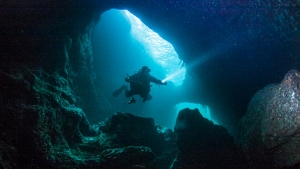
The sedimentary rocks of the peninsula are festooned with fossils of long departed sea creatures, which creates a very special ambience. These soft rocks have been pounded by violent waves, where the Irish Sea meets the mighty Atlantic.
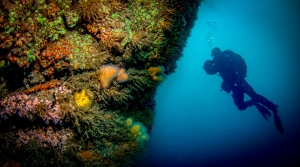
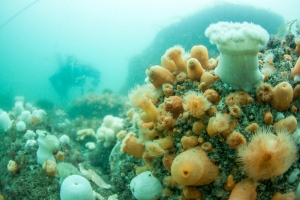
The Ocean swells have sculpted a labyrinth of gullies and rock walls, encrusted with a cornucopia of multi-coloured sponges and anomies. This unique topography, mixed with the clear waters around the Hook, gives the diver an impression of being on a flight through a surreal landscape.
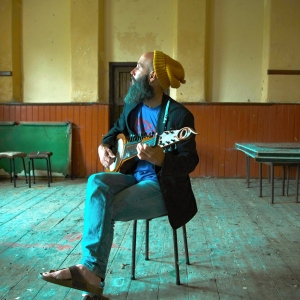
Musician of the Month for December Matthew Noone’s musical journey began with rock’n’roll in the Northern Melbourne suburbs before following in the footsteps of the historical Buddha to India, before settling in Clare in the West of Ireland:
While living in Ireland, I became aware of the idea that there was some sort of connection between Irish traditional music and Indian culture. I wanted to explore how Irish music might sound on the sarode but I also wanted to avoid it becoming a gimmick relying on cliches. So, I undertook a four-year structured PhD (Arts Practice) in the Irish World Academy at the University of Limerick. During these four years, I apprenticed myself to a number of traditional musicians in an attempt to learn Irish music in somewhat of an authentic manner. Through Ged Foley I began to learn tunes on the fiddle and learnt how to behave at a session. Steve Cooney put me in touch with something deep and ancestral and Martin Hayes guided me into a world of feeling.
Also in music, Greg Clifford announced his latest release:
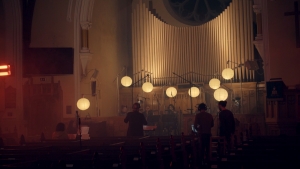
Brontide, which is defined as the sound of distant thunder (created by seismic activity), is a song and video about isolation, alienation, confusion and fading memories. According to Clifford, ‘this is an emotionally layered and charged production. Brontide, for me, symbolises impending doom and gloom. Dementia, in this case, is the suggested source of sadness’.
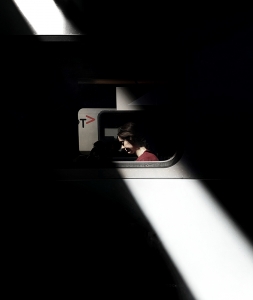
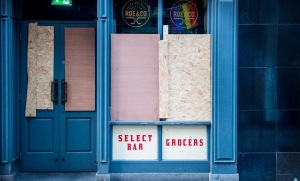
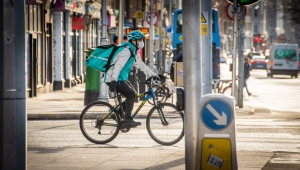
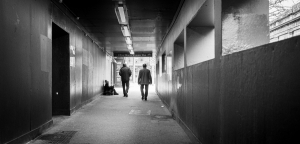
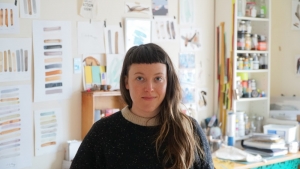
using windows, doorways and reflections to frame the people and their stories. It started as a way to bring some art creation back into my life. I had learnt photography from my father who taught me how to work a darkroom, film cameras and the joy that comes from capturing an image. I went on to study photography after school and fell completely in love. The years went on and the need for enough money to live, and then life pulled me away from the practice. But once I hit my thirties I realised how much I was missing, and it was time to make it happen once more. So I challenged myself to capture images on the way to and from my work. My obsession with commuters had begun.
There was plentiful poetry in the month of December, as Kevin Higgins berated ‘Our Posh Liberal Friends.’
I ask the barman for more finger food, picture the ocean raging into the restaurant, and them still sat there muttering at the chicken goujons: the people we talk to won’t vote for such extreme solutions. No one wants to live in Cuba, one of them says, as she’s washed out the door.
Edward Clarke meanwhile recalls, ‘One morning during the first week of Advent,/ When I was possessed, / After a birthday’s dark exhilarations,’
Image (c) Daniele Idini
And finallyJames Harpur brought us a poetic white Christmas:
Christmas Snow
Never came that year, and yet
It came in other ways, remembering the Light;
As suds frothing in the Garavogue
Around bridge arches, a scuttled trolley;
It fell from lamps in Henry Street
Illuminating tracer-lines of sleet
And shoppers gripping rods of sleek umbrellas
As if playing giant straining fish;
It fell as stars above the Sugar Loaf
Lit up as cats’ eyes by the gaze
Of a farmer standing by a gate
Above Wicklow and its mercury lanes.
The idea that our response to the Covid-19 pandemic might be moving us in the direction of the authoritarian horrors of the last century is one that a great many are resistant to. They may feel, for example, that we are living with an extraordinary circumstance, and that the response, however undesirable and unprecedented, remains unavoidable in the face of the threat.
Even to those who feel this way, however, the danger of authoritarianism is something which we should all meditate very deeply on. The comparatively free societies which we have grown up in are a rare and precarious achievement; we are simply not aware how precarious because they are the only world we have ever known.
Dr Billy Ralph, meanwhile, questioned a cosy scientific consensus in Ireland:
Throughout this pandemic we have witnessed very little meaningful scientific debate in Ireland. Irish experts are drawn from a small circle of academics, some with vested interests, supporting the government’s highly successful publicity campaign. In other countries, in contrast, there are heated public debates between scientists as to whether to adopt a dominant approach of blanket policies, or one of shielding elderly populations.
But in Ireland Nobel laureates and professors from prestigious universities around the world are routinely dismissed with smart quips by gullible journalists. But let us examine the three mantras in a dispassionate way that acknowledges each of their adverse impacts.
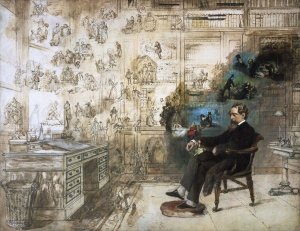
Featured Image: Dickens’s Dream by Robert William Buss.
With a Dickensian Christmas forming on the horizon David Langwallner drew on the wisdom and compassion of the great author Charles Dickens in an impassioned appeal for meaningful reforms:
To revert to Dickens as the supreme chronicler of Christmas. If someone has the temerity to present themselves like Oliver Twist with an empty bowl and ask for more will our modern day workhouses permit another spoon of porridge?
Or will they ask: ‘are you not happy with your existing pile of gruel – the charitable food banks that ease the conscious of the rich?’ Now with Covid-19 restrictions in full force diminishing most incomes – but especially those least well off – many now need a bit more, just to survive. This should involve chasing down the artful dodgers in the large corporation, who have picked a pocket or two avoiding paying their fair share of tax.
Also that month, notwithstanding a deep antipathy to all forms of religious fundamentalism, David Langwallner drew on the theme of Religion in his Public Intellectual Series.
With the loss of religious forms, however, many living in modern technocratic societies experience a loss of meaning, and even a moral void. The social structure of religions fostered close relationships and inculcated a sense of community, as well as charity, the protection of human dignity and a commitment to public service. The Bible injuncts kindness towards strangers, and to do unto others as you would wish them to do to you, which also derives from Aristotelian philosophy.
‘The Dead House’
There was also debate around what to do with Dublin’s historic buildings, as Neil Burns decried the elitism of the Irish literary community:
Protestations against James Joyce’s ‘The Dead’ House on Usher’s Island being ear-marked for a hostel are rooted in cultural-bias and emotional-led egocentrism, and exhibit blatant hypocrisy among the denouncers. Artsy sentimentality can be the lesser evil, but it is still based on emotional, and, cultural biases.
Under normal circumstances tourists flock to Ireland for its rich cultural inheritance and traditions. Indeed we live atop generations of history. When the soil offers its secrets in the form of ruins and artefacts, we either attempt to preserve or reduce them to rubble. More often than not, we choose to tear down or bury the past. This often occurs without the general public being aware of what is happening.
Their method of reproduction means you normally find patches of colour fighting for real estate. Neon Green battles with neon pink for prime locations on the surface of underwater cliff faces. Rarely seen on the east coast, they are to be found in all of the most dramatic sites I have dived along the Atlantic coast.
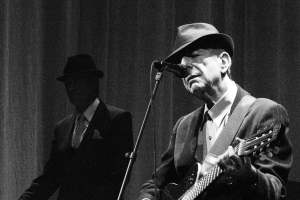
Around the beginning of the second century AD, the Greek writer Plutarch unknowingly created the spark for a flame of artistic inspiration which, not unlike the notion of the ancient Olympic torch, has transcended millennia until today. He might, perhaps, have nourished the expectation that his work’s renown would outlive him, but he could not have imagined that his words would be traced through the 20th century poetry of Cavafy to the 21st century songs of Leonard Cohen and Laura Marling. And yet, in a single stunning example of ancient influence and contemporary Classics, one particular story of his has been read, performed, spoken, sung, enjoyed, downloaded, streamed and reflected on in a chain of inspiration which spans over a century of creativity. The remarkable longevity of one small digression in the mass of Plutarch’s extant work demonstrates beautifully the basic humanity which has connected us from antiquity to now, reflected and refracted through the lens of varying personal and societal perspectives. As a result, the historic loss of Alexandria has become, paradoxically, our cultural gain.
We met in Dublin, as students. It was in the MA room, in the recording booth, in a fully-packed Ryan Air flight with destination to Sofia that a small but important concept emerged in my mind. By experience, or by force of habit, I had a fixed idea of the isolated composer working for countless hours on end; a dim light, a dark room, a head full of ideas. A familiar concept really, that’s how I had been making music for years. But the familiar changes, and it was in that MA room, on that crowded plane, sitting by the cliffs of the Irish west coast or on a summer night in the living room of a beautiful countryside house in Spain, that I realised that being a composer doesn’t necessarily have to be a one-woman show; that composition feeds on other creative forms, it feeds on other people, and that’s when many seemingly impossible things start to happen.
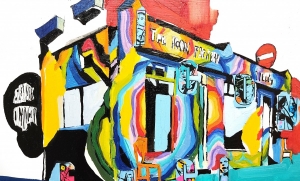
November’s featured artist Aga Szot discussed her Temple Bar-based Icon Factory:
Ten years ago I walked those streets of Temple Bar and no one could have imagined it would be possible to walk those lanes. It was a NO GO area and even Dubliners did not walk there. They were identified as dark spaces, and with anti-social behaviour, public toilets and worse. There was no reason why people would choose to walk there.
Now our art projects attract hundreds every day into the area, and are included in national tour guides, indicated as one of the most popular attractions in the area: an art centre which invites artists to participate in the project with its educational and civilised mission. We made this space safer and a better place for all.
‘Jerry Garcia, one of The Grateful Dead. They’re a band, apparently.’
‘Never heard of him or them,’ I said, realising that there was more to it than a rockstar dying and that Don was somewhat perturbed.
‘You wouldn’t believe it man. Jamie and Shaun rang in to say they were out for a week. That depressed this dude is dead. It’s JFK levels of impact. I’m not shitting you.’
‘A week? What the fuck?’
‘Yea. It’s like their fucking mother died. Left in the dock. I’m practically on my own here.’
‘This Garcia dude. Some kind of Jesus figure or what? A whole week because he died?’
‘Yeah. Weird. Apparently, they’ve been deadheads for years…Some fan cult thing. Can you make sure to meet Sarah tonight? And I’ll see you tomorrow? Don’t forget?’
‘No problem, man. It’s all on the itinerary.’
Image Graeme Coughlan: www.graemecphotography.com
While a seedy pool hall was the location for another of Daniel Wade’s Dublin chronicles ‘Niall’: ‘They shoot pool like they’re born for it. Some for cash,others for pride or thrills; there’s no sole reigning champion. Anyone might wear the crown’
In further fiction from Stephen Mc Randal, the character of Manus stands in opposition to an anti-mask crowd but is more bothered by the sectarian and racist rhetoric, before heading to another Free Julian Assange rally.
Each witch hunt is a tribute act to the last.
There is always a committee of three.
The gravity in the room is such
they struggle to manoeuvre
the enormity of their serious
faces in the door.
Before we turned our eyes from nudity,
Or banished certain words, death was the first
Obscenity—the one from which the rest,
In time, would find their way. The first
To make a joke of life. The first
To show us what may come of children’s games:
A skull left caked in mud, the slicing rain.
What is a rude word if not a reminder
Of the grave in which one’s coffin will be lowered?
An old man’s kiss upon a young girl’s navel
Would not be possible if not for death.
Dressed up in our Sunday best, our deaths
Seem almost hypothetical. They’re not.
Plastic surgeons, age-defying creams,
Air-brushed waistlines on the cover of Cosmo—
These prove our distaste. Death’s in the ghetto.
But only look out past your green kept lawn,
And there it is, unfazed, a grinning fact.
Lockdown measures remind me of the prescription of anti-depressants and other psychiatric medicines. They are both harsh, and both are administered in response to a moment of crisis; both often have severe side effects, which in time often obscure the initial malady that required their prescription.
It is high time we re-examined how the government is being advised to bring the population to the promised land of ‘living with the virus.’ At this stage other forms of advice should be sought. Presumably the government is already receiving significant inputs from the business sector, but other important viewpoints are not part of the conversation.
Dr Billy Ralph was even more critical of the damage that had been done to the fabric of Irish society over the course of the pandemic:
Policies were adopted by an unelected government on the erroneous advice of experts listening to other experts, who predicted an enormous death toll from Covid-19 that has not come about anywhere on the globe. These same experts are now doubling down on initial errors and inflicting incalculable harm on the delicate fabric of society.
Image (c) Barry Delaney.
Meanwhile, prompted by warnings from Taoiseach Leo Varadkar that 85,000 could die over the course of the pandemic photographer Barry Delaney revealed the grim foreboding he felt back in March:
The thing to watch for was the breathlessness I had heard. This was what caused the dangerous pneumonia. On the Saturday night I went to bed early alone, and suddenly had problems breathing. It being Saturday I could not disturb my Doctor, nor did I want an ambulance arriving to take me to quarantine in hospital, where I’d be met by Hazmat-clad Doctors and become Patient No. 3. Laid low by fear and shortness of breath I could not sleep. By 5am I made a decision to complete my final book, Americans Anonymous and get my things in order in case this was it.
This proved a false alarm, but it gave way to a period of creative impotence in his photographic practice:
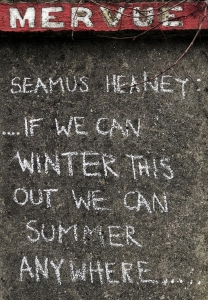
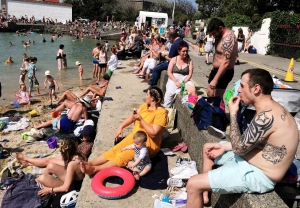
As lockdown eased more and more people descended to summer in Dun Laoghaire around the Forty Foot. To swim, to escape, to even have fun in our new Covid world.
Gradually I began to photograph this migration, at first people were cautious, masked, socially distancing on the newly opened beach, but as May turned to July people began to summer properly. The beaches became crowded, like normal, not the new normal; no one wore masks. The virus didn’t spread outdoors, or so we believed.
Image (c) Barry Delaney
Classicist Ronan Sheehan, meanwhile, drew attention to the etymology of the terms in common use during the pandemic:
Epidemic: from Greek ἐπί epi ‘upon or above’ and δῆμος demos ‘people.’
Pandemic: from Greek πᾶν, pan, ‘all’ and δῆμος, demos, ‘people.’
Virus: from Latin ‘poison, slime, venom.’
Vaccine: from the Lain ‘vacca,’ meaning cow, a named conferred by Louis Pasteur in honour of Edward Jenner who pioneered the concept by using cowpox to inoculate (mid-15c., ‘implant a bud into a plant,’ from Latin inoculatus, past participle of inoculare ‘graft in, implant a bud or eye of one plant into another,’) against smallpox.
Exponential: from Latin exponere ‘put forth.’
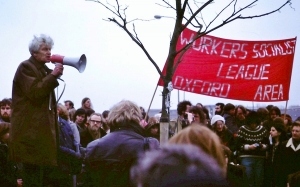
David Langwallner continued his Public Intellectual Series with an account of the English radical historian E. P. Thompson:
His lasting contribution is the seminal The Making Of The English Working Class (1980), possibly the greatest work of history of the twentieth century that emphasised a new form of bottom-up history, related to the subaltern history that was emerging at the same time in former colonial societies.
We have entered a dark era dominated by the religious right, involving literal and historical interpretation of the U.S. Constitution. A return to eighteenth century values is upon us, including the fire and brimstone of the Old Testament, neglecting to remember that Thomas Jefferson was a deist, if that. Let’s not forget that the United States required a Civil War to end the ‘peculiar institution’ of slavery that was not even mentioned in that document, apart from in the three-fifths clause that represented a African-American slaves as three-fifths of a white person for electoral purposes, in order to maintain a balance between slave and non-slave owning states.
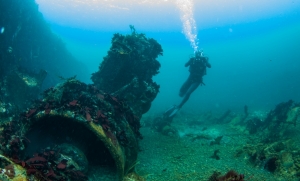
We received two submissions from underwater photographer Daniel McAuley that month, the first featured shipwrecks, which become reefs:
With the combination of a long history of maritime traffic and often quite ferocious seas, it comes as no surprise that the Irish coastline is strewn with shipwrecks, many of which date back hundreds of years. Each one provides a fascinating porthole on a bygone age, telling stories that are often of historical significance, as well as allowing divers a chance to encounter what are often quite intriguing new environments for marine life.
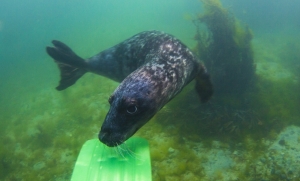
The next introduced us to the seals living along the Irish coastline, now threatened by fishermen disturbed by a competitor as over-fishing reduced catches.
The playful nature of seals reminds any snorkeler of a dog looking for affection from its owner. So listening to news stories where people are saying the best solution to the problems afflicting the fishing community is to take a high powered rifle to these playful creatures filled me with rage and frustration around the management of our coast, and what the future holds for it.
I’ve been passionate about music from an early age, and my love of the post-punk spirit of DIY and experimentation found a crossover with the further reaches of sonic exploration coming from the Fine Art approaches to sound as a sculptural medium. I then discovered improvised music and was smitten. The possibilities just seemed wide open. There was a directness and a simplicity that was really appealing. It was also a much quicker route to producing music by sidestepping years of training. Of course, it’s not just musical ability you bring to the table, it’s imagination and intelligence too.
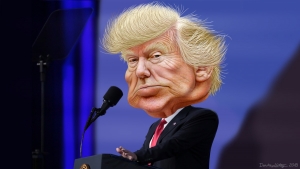
By DonkeyHotey – Donald Trump – Caricature, CC BY-SA 2.0.
In poetry Kevin Higgins appears to have been inspired by the forthcoming elections:
A barrel of industrial waste poured into a suit
donated by a casino owner who knows people
with a tangerine tea towel tossed strategically on top
because it was the only available metaphor for hair
was running for re-election as CEO of South Canadia
against an old coat with holes in it.
Image (c) Daniele Idini
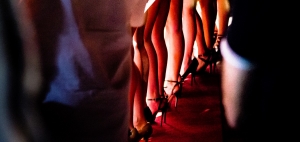
While Ernest Hilbert mused on ‘Models, slender and famished as cheetahs,’:
The bathroom’s OUT OF ORDER. Sewage seeps
Into the restaurant. The manager’s
Frantic, alone today. The line’s
Become a mob. A voice from an SUV
Barks at the drive-through speaker. In the back,
Children cheer a whirl of color on a screen.
I feel the boredom underneath the beauty.
It’s weird, and getting desperate these days.
In auction rooms, the arms go up. And . . . sold.
The next exquisite investment’s on the block.
The views—the hills, the seas—are still pristine for those
Who can afford the heights. Who’s this beauty for?
Beauty’s boring. I do go on and on,
Don’t I? Oh, you have a nosebleed.
Here, drip some in my drink. See this?
Flick this switch. Now listen. Someone will scream.
As summer gave way to a season of mist and mellow fruitfulness in September Covid-19 returned with a vengeance, but by now there was considerable disagreement over elusive facts.
The main go-to-man among Irish scientists for the Irish media has been Trinity Professor of Immunology Luke O’Neill. On June 22nd he claimed that Ireland would have had 28,000 deaths if there hadn’t been a lockdown.
The piece earned praise on Twitter from Irish Times journalist Ronan McGreevy.
This is a brilliant blog post which should be ready by every journalist covering Covid-19. It takes aim at several ubiquitous experts who have made wildly inaccurate predictions and who have not been held to account for those predictions. https://t.co/1QgEahaxfH
Andrea Reynell, meanwhile, looked for new ways of socialising during The New Abnormal; although having to order a meal made the idea of going out for a drink less appealing.
It is easy for some premises that already served food. But it is a bit of a pain knowing that you’re spending more than you want, all for the sake of a socially-distanced drink.
Divers on Dublin Bay.
That month we receive the first in a series of articles from underwater photographer Daniel Mc Auley. The first acquainted us with the hidden world below Dublin Bay.
The silt and sandy bottom around Dublin Bay is in a state of constant motion, drawn by the strong tidal flows moving down the east coast of the country. These massive sand banks are also easily disturbed by strong southerly or easterly winds, leading to dramatic drops in visibility when a strong wind blows. Unlike the deep water off the west coast, Dublin Bay is a relatively shallow body of water with a primarily sandy bottom.
Coral Garden Dalkey Island, Dublin Bay. Image (c) Dan Mc Auley
Another new contributor Neil Burns wrote movingly following his work in addiction services:
Heroin addicts tend to mate for life. Like dilapidated swans – twisted in a deadly alliance they dance and embrace towards a finality of breath. Like a sculpture in a Giorgio de Chirico painting. It is an ersatz marriage of sorts, sharing needles – inveigling that sharp, finite pain. Into the vein. The arm. The thigh. Leaving rack-marks like horse gallops that tear up the grass on a racecourse. Puckered, indeed, punctured skin. Delving into the life’s blood. The blood’s life which is cherished. Next to Godliness. Spike island. Feel like Jesus’ son was The Velvet Underground’s lyric. Warm blanket to insulate against the world’s harshness. Being judged. Much of it in the head and coveted paranoia.
f you have already worked out that whoever lives inside your phone when you say ‘Hey Siri’ or ‘Hey Google’ can read emails out to you, find the nearest movie theatre, or reserve a restaurant table, then Artificial Intelligence (AI) is already in your life.
Image: Luke Fitzherbert
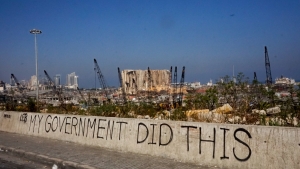
Next, Luke Fitzherbert despaired at Lebanon’s rotten leadership after a massive explosion that rocked Beirut:
The impact of the explosion is hard to understate. Its sound and force stretched for miles, releasing a huge mushroom cloud that killed close to two hundred people, and scarred thousands both physically and mentally; destroyed countless homes, and leaving once vibrant streets desolate. The immediate aftermath was dystopian: “It was like a movie. People moving slowly, covered in blood, glass shattered everywhere. Leaving a whole city riddled with PTSD,” recalled one witness.
And in the wake of Amy Coney Barrett’s appointment to the Supreme Court David Langwallner reckoned it was game over for American democracy.
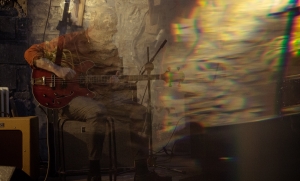
My name is Gemma Dunleavy and I’m a yapper. I’d talk the handle off a cup. I also write and play music. I see myself as a storyteller first, then a musician. It’s where I feel my true gift is, my natural comfort is in meandering through my memories, picking out the best details to paint the clearest picture in the heads of those listening.
Also in music coverage Brian Mooney was keeping the conversation going after the tragic loss of his wife to cancer:
six months now. A year of firsts. A lot of lessons learnt. A new wisdom.
And I feel quite stupid and not quite intelligent enough. Exposed, as my better half who I was always so proud to be beside has gone away.
I have to build now. My friends are close and music has kept the conversation going…
Gasping for a hit, Carl made himself a fresh cup of coffee. But big-nosed and bat-eared, when he tried to slam it, the steaming brown liquid dribbled down his chin to piddle over his pink tie and white shirt. His accountant’s uniform.
Also in fiction, Yona Shiryan Caffrey brought a portrayal of cocooning widows in rural Israel in Tina.
…. Myriad music still marks her mind, her memory,
Music of mending and meaning, naming and being—
Music of mackerel meandering, matter and mass,
Metaphysical music marching from moment to minute
As well as a number of works from Mischa Willett, along with the irrepressible Kevin Higgins, who wondered at the longevity of Henry Kissinger:
For its birthday, a baby gets Spina bifida
A Bengali family have all their arms sawn off.
Fifty bodies topple into the sea off Indonesia
but none of them are Henry Kissinger
Each time Henry Kissinger again fails to die
It’s been difficult finding the words to express my worsening mood and deepening depression. I’m referring specifically to my subconscious responses to altered public behaviour and the marks left by social reaction to Covid-19. For the first time in my life, I’m noticing increasing anxiety and, with the stress, a direct link to declining health. I’ve been struggling with this worsening dynamic over the last month or two, trying to get to grips with it. Trying to better understand its cause. I’m sure I’m not alone in this.
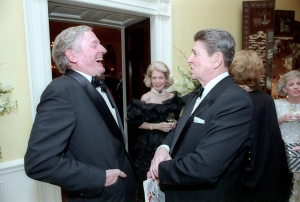
2/7/1986 President Reagan with William F Buckley in the White House Residence during Private birthday party in honor of President Reagan’s 75th Birthday
on the other hand, is hardly even capitalist in outlook. It is really an offshoot of a more authoritarian leftism combined with a fundamentalist, morally self-righteous neocolonialism informed by ‘Christian’ values. It is associated in particular with the administrations of George W. Bush, with Paul Wolfowitz and Richard Perle its most prominent ideologues.
There are thousands of content moderators, who are paid to view objectionable posts and decide which need to be removed from digital platforms. Many are severely traumatized by the images of hate, abuse and violence they see on a daily basis so that we, our families and children get to see ‘WARNING: The following post or content may be disturbing to some viewers.’
From Spain, Connor Blennerhassett brought a report on the ordeal suffered by vegan activist Juan Manuel Bustamante, who spent sixteen months in jail on trumped-up terrorist crimes: ‘a Kafkaesque nightmare that saw him pass through five of Spain’s most notorious prisons, often locked up in solitary confinement and denied a vegan diet by his captors, who also beat him. It ruined his family’s finances and lead him to attempt to take his life after his release.’
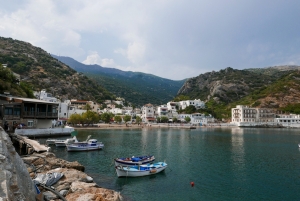
Icaria, Greece
Over in Greece Frank Armstrong found a hardening of borders, and attitudes, in the wake of the pandemic, and drew wisdom from the writings of Albert Camus:
Albert Camus in The Rebel (1951), identified an enduring tension between a Caesarian Marxist project that permits all manner of atrocity on the journey to earthly paradise, and an approach he identifies with Ancient Greece, characterised by moderation, incrementalism and respect for tradition. He suggests:
The profound conflict of this century is, perhaps, not so much between the German ideologies of history and Christian political concepts, which in a certain way are accomplices, as between German dreams and Mediterranean traditions … in other words, between history and nature.
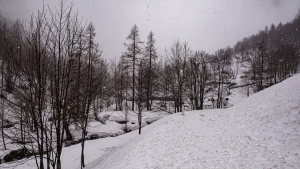
Vietnam. Image (c) Hectic Fish
Also, for the first time since his arrival, Hectic Fish was also able to travel around Vietnam, he proceeded to the territory of the Mnong accompanied by a copy of Rachel Carson’s The Marginal World ‘the otherworldly essay that opens The Edge of the Sea.’
The shore is an ancient world, for as long as there has been an earth and sea there has been this place of the meeting of land and water. Yet it is a world that keeps alive the sense of continuing creation and of the relentless drive of life. Each time that I enter it, I gain some new awareness of its beauty and its deeper meanings, sensing that intricate fabric of life by which one creature is linked with another, and each with its surroundings.
There was also fiction fromSarah Johnson with ‘The Candidate for the Roberts Prize’ where ‘The significance of discovery lies exactly in the degree to which it can be appreciated and put to use by the human community.’ And Glenda Miller’s ‘The Club’ in which an experience of cancer prepares her for the agonies of the birthing process.
Next election onwards, there’ll be a second vote for those who turn up with, under their arm, a print copy of one of the larger newspapers and answer a few unobtrusive questions to prove they’ve consumed it correctly.
A third for those who also present receipts that show they’ve dined sufficiently in restaurants with at least four stars, and a note from the maitre d that they know their way around the cutlery.
A fourth for the lucky few in possession – to boot – of a ticket for one of those pampering spas at which one temporarily discards worldly things to have one’s darker parts irrigated of all subversive thoughts.
So when all’s said and counted, people who shouldn’t matter can go back to not mattering.
It’s getting real in here. Newly established, the isolation ward has been set up too close for comfort. From my room, I’m able to hear most comings and goings, and I know the current number of patients is exactly nine. In the last twenty-four hours, out of two patients who went to hospital, one died, though not of Covid-19. Then they moved two more into the ward. What I’m not sure of is how many, in total, have gone to the hospital or been identified as having Covid-19, because they move them around during the night. They say about five or six staff tested positive. But a couple of them were out sick before testing was even available. Me, I hydrate. I take daily doses of vitamins and apple cider vinegar. I’m good.
I left a depressed New York city following the surprise election of Donald Trump in November 2016; a city reeling in disbelief at what occurred – but I had captured history unfold in Time Square – now I was heading into the heartland of how this had actually happened – the Rust Belt – then the bus broke down at night in rural Pennsylvania and I missed my connection to Kentucky. I overnighted in a cheap motel and caught an early bus to Kingsport, as we pulled into Bristol, Virginia we alighted for a cigarette break and this anonymous traveller waved his American flag, in defiance or support? To understand this election, one had to be in the rural American heartland, to see what was actually going on – coal-mining towns decimated by unemployment, despair and opiates.
He wants to work Monday nights but not Tuesday afternoons; she is available on Saturday evenings but not on Sunday mornings… Small and Medium-Sized Enterprises often find it challenging to recruit part-time workers, with abundant choices available to gig workers in different sectors, but the pandemic has vividly demonstrated the nature and depth of insecurity of this form of employment.
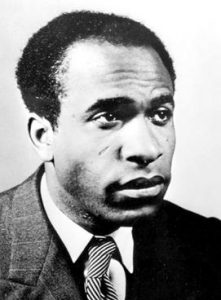
Frantz Fanon’s provided a profound insight into how colonised peoples – The Wretched of the Earth – are required to pay the debts of the occupying powers. This has been reproduced in our own societies in the form of austerity. The occupying powers are now the corporatocracy, or those with inherited wealth. The only difference from the colonial period is they are no longer all from the same ethnic group. In fact a veneer of diversity is achieved with the promotion of a few specimens with varied pigmentation, and an embrace of safe, politically correct policies that ignores structural racism.
So where have they all gone, those Beatniks and the latter-day Chés? Today, distinguishing ideological differences between ruling and opposition parties in most Western democracies requires superhuman vision, or no vision at all. Existentialist dialogue about literature or philosophy is rarely found in mainstream media, instead relegated to academia, or that strange cabal, referred to disparagingly as ‘intellectuals’.
What we are left with is an exaggerated respect for the titans of big business, the market, and venerate unlimited economic growth.
The Republic of Ireland has a long history of opioid drug-related deaths. Since 1998, mortalities due to opioids have increased yearly. Indeed, there is now, on average, one drug-related death every day. The majority of these involve users combining two-to-four drugs mainly, heroin, benzodiazepines, methadone and pregabalin.
Criticizing Cuba’s many shortcomings throughout the decades has been an easy endeavour for corporate media. Yet the press has studiously ignored positive aspects of the Revolution. This was seen recently in negative coverage of Havana’s decision to send medical teams to some of the countries hardest hit by COVID-19. Indeed, Cuba was the only nation to provide medical assistance to Italy at the height of the crisis there.
Storytelling is a shield against loneliness and the unbearable weight of boredom. Truth does not exist, and if it does, then all storytellers are liars. And all storytellers are liars, though Rousseau might have argued that when you are loyal to yourself you are telling nothing but the truth.
If we are to go back four thousand years and posthumously ‘correct’ the sins of that past, I would fear for many heritage sites around the world tainted by practices and beliefs very much at odds with current ‘enlightened’ standards. In any therapeutic practice, acknowledgment of the past is critical but the difficult work in healing is always how we manage the present, the now, which is after all, the only thing we have.
And Andrea Reynell caught up with renowned documentary filmmaker Sé Merry Doyle to discuss his new film ‘James Joyce – Reluctant Groom‘ in which poet Niall McDevitt guides us through a London landscape with unknown Joycean associations. The film went back to a period in 1931 when Joyce and his long-term partner Nora Barnacle moved to London for a year to secure a legal marriage.
Grammar expresses a human desire to control time. Regimented in terms of right and wrong, grammar draws lines by which people can express themselves as concurring or not with their own era. Breaking with grammar rules has often been seen as a form of resistance against the dominant forces of a time: take le verlan in disaffected French suburbs for example. But in corona times this paradigm has been inverted: the notion that humanity is at the heart of time has been annihilated. And now, our era has rejected us. Suddenly our grammar is exposed as fantasy. But wasn’t there always an implicit arrogance in the phrase “next week I will be sitting in Tulum drinking tequila”? It seems hubristic that humans are grammatically equipped to script their own future when anything can happen. Such reflections have been on my mind since our latest release flukishly coincided with the pandemic.
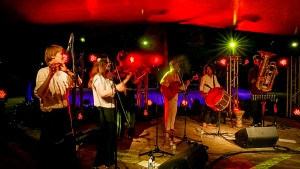
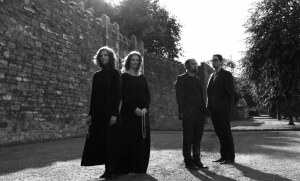
Anakronos (left to right): Caitríona O’Leary, Deirdre O’Leary, Nick Roth, and Francesco Turrisi (photograph by Tara Slye).
Also in music coverage, Catríona O’Leary finally found an opportunity to work with some of her favourite musicians: Nick Roth, Francesco Turrisi and my sister Deirdre O’Leary, and was inspired by the the witch hunts of medieval Kilkenny:
But why sing the words of a witch-burner? Because they’re beautiful and I find it interesting to contemplate the contradictions that exist within people. As Stanley Kubrick said when asked if his characters were good or evil, “They are good AND evil!”.
The word ‘landscape’ not only refers to the topography of an environment, but also to its existence within society, consciousness and experiences. As we move through our existence we traverse thousands of constantly shifting landscapes – geographic and experiential- moulding them around us. Boundaries shape how we think, move and express ourselves. Our ability to understand ourselves, and our place in this world, rests on our collective responsibility to protect and celebrate our surroundings.
Finally, Nick Feery ‘the boy from Tore’ brought us back to his eighteenth birthday when he worked for his local builder Whimpy Dunne.
June brought criticism of Big Data censorship and the coverage of the pandemic in mainstream media, as it became clear the doomsday scenarios certain epidemiologists painted in March were wide of the mark. Frank Armstrong wrote:
Accepting Covid-19 represents an extraordinary challenge requiring a concerted response, censorship by Big Data in such a blanket form, including of recognised academic authorities, surely only lends credence to conspiracy theories, fomented by the far-right in particular. Disregard for freedom of expression casts doubt over the integrity of scientific inquiry and inhibits rational debate.
He found fault in particular with The Guardian’s coverage:
The free digital site with an estimated 42 million monthly visitors devoted unrelenting rolling coverage to Covid-19, emphasising the simple moral calculus with a banner across its home page. This has been to the almost complete exclusion of all other content for the months of March, April and May.
The Guardian’s loss of proportion, and nuance, has been particularly damaging as it is the most trusted newspaper brand in the U.K., including, importantly, among readers aged 18 to 29.[lviii] This may be traced to its position as a global news provider of free content dependent on maintaining an enormous click rate to derive a profit.
He also interpreted the global Black Lives Matters eruption as an unconscious response to the lockdown experience: ‘The extraordinary scenes witnessed around the world could also be interpreted as a proxy for societies throwing off the heavy knee of lockdowns, containing a basic human impulse to interact.’
Covid-19’s rapid spread around the world has impacted upon people living in a wide variety of political, economic, social and cultural contexts. These diverse contexts have mediated the repressive policies available to governments – facilitating, refracting or impeding the measures they have attempted to impose – the insecurity and fear caused by the pandemic have undoubtedly facilitated the imposition of repressive measures.
By PJeganathan – Own work, CC BY-SA 4.0, https://commons.wikimedia.org/w/index.php?curid=89483458
He continued:
Repressive policies and measures can be introduced, as the ‘shock’ caused by the Covid-19 pandemic leaves the public less able to resist. In a world where lockdowns, isolation and quarantining have become the new accepted norm, coordinated, active resistance to repressive and inhibiting policies has become more complicated.
Never ones to let a good crisis go to waste, the advertising industry has swiftly conceived and produced a slew of adverts to hawk their clients’ wares by tapping into the positive sentiments of this catchphrase. Praising frontline workers or highlighting our newfound unity – separated but together – they strive to manipulate the emotions and purchasing decisions of their target audiences.
Moreover, Laurent Muzellac was proposing that greater attention should be given to the impact of lockdown on younger people, including children:
governments should not only care about the lives of its citizens today, but also be concerned with the longer term health and wellbeing of the nation. To mitigate the next crisis and guide future investment, the government should first consider how many, and which, lives confinement saved, and which it destroyed.
Justo Lapiedra (wikicommons)
Next in an important article on The State of Irish Agriculture Eoghan Harris demonstrated the hypocrisy of the Irish agricultural authorities in claiming that Ireland was the most food secure country in the world:
Food security in this scenario equates to commodities being traded on a global market with minimal restrictions. The evaluation is predicated on current availability, price and diversity of food consumed – regardless of productive factors or supply chain interference. It takes no account of the environmental or social consequences of this supply line, or any risks lying further down the line, whether a hard Brexit, a global pandemic, or that the global food system has eroded a quarter of all arable topsoil on the planet since the 1950s.
He further revealed:
Over the course of the twentieth century, the adaptation of new and increasingly expensive inputs into agriculture have been sold as ‘progress’ to farmers. Numerous chemicals and pharmaceutical companies, including SmithKline, Pfizer, Merck, Schering Plough and Roche located their manufacturing facilities in Ireland during the 1960s and 70s, availing of lax or non-existent environmental regulation and lower labour costs. They stayed because of an attractive corporate tax regimes and unrestricted interference in Ireland’s educational system. By the turn of the twenty-first century they accounted for nearly seventy percent of global pharmaceutical output.
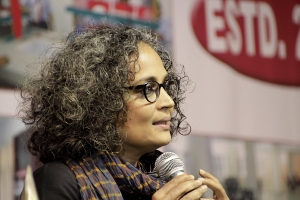
In India and beyond, Arundhati Roy demonstrates how neo-liberalism and environmental damage go hand in glove in her Capitalism a Ghost Story (2014). Since the publication of The God of Small Things (1997) she has channelled her energies into political activism against the growing environmental and economic calamity being perpetrated on her native land, through the depredations of neo-liberalism. It is that political conscience that is the primary interest of her new awareness.
For centuries only certain people could share their stories. They were those occupying positions of power: men, for example, as opposed to women. Feminist methodologies made it very clear that having one’s voice heard is essential to having a societal impact. Since women’s voices were counted, our societies have changed. Following this logic, other communities made their voices heard through various forms of storytelling: they were LGBTQI communities, disabled people, ethnic and racial minorities, working class people and many other groups. Hearing each and every one of these stories has brought our societies closer to real equality.
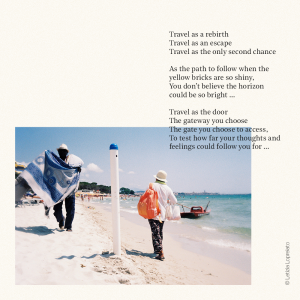
‘When Travel Means Need’ from ‘The Timelapse’ (c) Letizia Lopreiato
Artist of the Month Letizia Lopreiato found a sanctuary from a sense of exile in Ireland:
For many years the sensation of exile following the death of my father truly followed me too, just like the narrator in The Plague, until I arrived home. Ireland, Dublin, its magical people, its incredible feeling of community, allowed me to be present, to slow down, to feel my own thoughts. Thoughts that I have had for so long but that I could not hold the energy to engage with, it was like I couldn’t handle the intensity of them for so long, until when It finally felt like I had no escape from the awareness of them, if I truly want to make through it and still be myself.
In the beginning they need and want to be heard yet, at some point, silence will be required to stay sharp. They should never choose the sound of their own voice over the work. Staying quiet is not what artists are very good at but it is what needs to be done sometimes. Silence doesn’t have to last forever and invariably there will come a time when a fork in the road is reached: one way ‘stop talking’, the other ‘continue speaking’. The artist will feel in their bones when this fateful day arrives.
You may ask why on earth do you find these quotes useful? I fully own up to having a tendency towards the austere myself: over the past five years I have gone at least twice a year on silent retreats in a Buddhist monastery and my biggest disappointment during this lockdown has been missing out on a cancelled ten-day silent meditation retreat at the monastery led by an amazing nun. But also reflecting on it for this article I suddenly realised that I probably need a corrective or balance to clichéd notions of what the arts exist for and the gush spewed out from the art and music worlds to continue making anything. Maybe I am very contrary (okay, I am) but when I read blanket statements about how art needs to reflect life (whatever that means and what if mine is really boring and mundane?!) I think of Martin at her fiercest: ‘art work…does not represent life because life is infinite, dimensionless. It is consciousness of itself. And that cannot be represented’.
So few cars on our Manhattan street
Pigeons leaving nests that swirl between
Highrise ledges, fearless land to eat
Any mid-street grain or scrap they glean.
Told to stay at home most acquiesce.
Now we learn how unbeknownst we spare
Our New York as we’re emitting less
Long-lived greenhouse gases in the air.
Same in Paris, London, Madrid, Rome.
If our frenzied whirl restarts, when pressed
To create more jobs and we leave home,
Will we foul then worse our global nest?
Covid fear amends our habitat –
Nature’s own backhanded caveat.
I didn’t particularly want to write this article. I didn’t want to get involved in the whole online social media circus of opinion and rebuttal, triggering and offense. But I feel like I have something to say, and what I have to say is important.
Acknowledging the loss and suffering caused by Covid-19 he continued:
Our civil liberties and civil rights are not something that we be taken for granted. We forget now that Irish independence and the fight for freedom came at a high cost. ‘The price of liberty is eternal vigilance’, is a quote attributed to Thomas Jefferson.
It does not matter whether you consider yourself to be politically on the left, centre, or the right, the erosion of civil liberties that has occurred in most Western democracies over the last few months is something that should concern you. If the there is one thing the history of the last century has taught us, it is that tyranny can take many forms.
In times of plague and pestilence, fear is an omnipresent companion. This fear all too frequently translates into a desire to find someone to blame for the danger with which we are faced. The greater the threat to people’s safety and the less control they can exercise over it, the greater the risk that blame for their dilemma will be ascribed to an ‘outside’ group, generally those who are not members of one’s community or nation, no matter how transparently illogical the reasoning.
Dr. Jonathan Quick writes:
We are all afraid of death. We respond to the fear of epidemic disease by wanting to blame someone else. Anytime a threat arises, we want to blame the “other,” those not like “us.” At the outbreak of the 1918 Spanish flu, Americans blamed “the Hun”. AIDS was blamed on gay men.
During the Black Death, which struck Europe in the mid-14th century, there was widespread fear and panic as this unknown disease wreaked havoc throughout Europe. Although communities around Europe often turned upon those seen as outsiders, particularly other nationalities, the Jewish community became the primary focus of this fear. This resulted in horrific instances such as the massacres of Jewish people in Frankfurt and Brussels and the extermination of the Jewish populations in Narbonne and Carcassonne.
From the United States Christopher Parkison was despairing at The End of American Leadership under Donald Trump, ‘cocky, bragging, dismissive of anyone who disagrees with him; demonstrating an utter disregard for the American people he governs, and unwavering focus on…himself.’
“We have the best testing anywhere in the world, not even close … Look, we have so much testing. I don’t think you need that kind of testing or that much testing, but some people disagree with me and some people agree with me. But we have the greatest testing in the world, and we have the most testing in the world.”
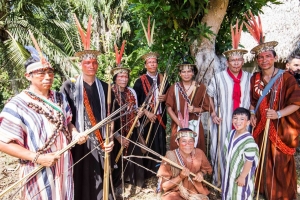
The pandemic of the new coronavirus Covid-19 is forcing indigenous populations of the Amazon to self-isolate to prevent its spread within villages. In doing so they are fortified by traditional customs and the ancestral relationship with the forest. This occurs both in reverting to traditional food sources, and adopting behaviours that ensure the safety of the community in times of adversity.
The pandemic was causing serious job losses in Ireland, and elsewhere, which brought protests from Debenhams workers that were cut short by An Garda Siochana in powerful images captured by Daniele Idini (including the featured image). Elsewhere Spaniards came out of lockdown to find touristic regions such as Mallorca seem like ghost towns.
Before the shit wave I had emailed a fellow environmental advocate and diplomat living in Vietnam. He replied swiftly after I mentioned the break up and the virus, and wrote that he had a safer place than Indonesia — a huge, almost deserted house where he lived with his young daughter. He said that figures in Vietnam were the lowest in the South East and that a painter friend of his would also be joining us for a while and that we would all have fun together.
As a young man I was an admirer of the former President of the High Court, Attorney General and architect of Fine Gael’s Just Society, Declan Costello. I was then privileged to engage with him on an informal basis, appearing before him in court on a number of occasions. He was a complex and often divisive figure, and I disagree profoundly with many of his judgments, but there is no doubting the profundity of the intellect.
There are, he notes darkly, fascists in the streets and in the palaces, while around us ‘the weather has gone uncanny, volatile, malevolent’. The last remaining truth, O’Connell proposes, ‘is the supreme fiction of money, and we are up to our necks in a rising sludge of decomposing facts. For those who wish to read them, and for those who do not, the cryptic but insistent signs of apocalypse are all around’.
I’ve worked it out and we’re going to be just fine.
Your job will pay for mango and mine for baby wipes.
My heart throbs dyspeptically when I think of our son.
Where is he now? Does he wear leather and carry a scar?
I’m less than a man. I don’t even know how to drive.
On the other hand I’ve worked out how to arrive on time.
I was sobbing all morning as my heart went out –
unlike the flames on Grenfell, which raged until lunch.
Inside the staircases, lift shafts, flats, nothing withstood.
Tears became gas. Screams caught fire and burned.
Everything that wasn’t blame became ersatz.
It’s hard to stay focused. Our dreams are so grotty.
And the housekeeper creaks on the upstairs floor.
I picture her stroking her long Hispanic body,
which opens, closes, then empties itself completely.



 Meanwhile,