The Final Report of the Commission of Investigation into Mother and Baby Homes has unleased another wave of soul-searching in Ireland. How could a society claiming to be ‘Christian’ have failed to protect, and even to have harmed, its most vulnerable – unmarried mothers and their ‘illegitimate’ children? The harrowing accounts fit within a wider ‘Theology of Incarceration’ that inculcated subservience and prevailed on the downtrodden to await their rewards in heaven.
‘The story of Matt Talbot is significant because it reflects the traditional approach of the Irish Catholic Church to the question of social justice’ wrote Ronan Sheehan in his seminal account of enduring exclusion in Ireland’s capital: The Heart Of The City by Ronan Sheehan and Brendan Walsh Brandon Books, (Dublin 1988); a second edition was published as Dublin: The Heart Of The City by Lilliput Press (Dublin, 2016).
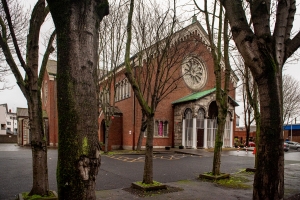
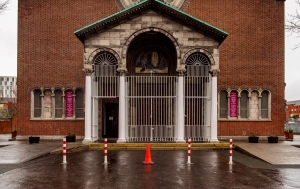
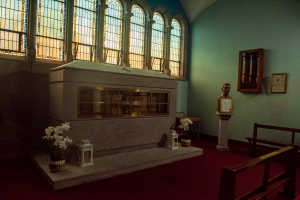
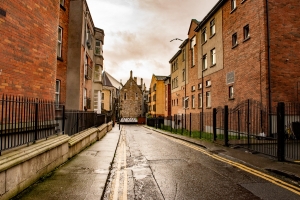
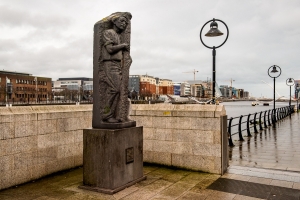
Matt Talbot’s legacy continues to resonate through Dublin, and beyond: in the name of Talbot Street off O’Connell Street; and in one of its foremost bridges: the Talbot Memorial Bridge linking Memorial Road (and Custom House Quay) on the north bank of the river to Moss Street (and City Quay) on the south where there is a sculpture of Matt Talbot by James Power erected in 1978 and irreverently called ‘the pain with the chains.’ There is also a shrine to the ‘Venerable’ Matt Talbot’s inside the Neo-Romanesque Church of Our Lady of Lourdes on Sean McDermott Street dating from 1954, and a plaque on Granby Lane off Parnell Square.
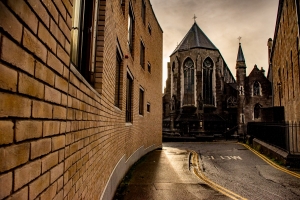
Granby Lane, Dublin 1.
Life and Death
The ascetic figure of Matt Talbot assumes centre stage in a chapter in Sheehan’s book entitled ‘Moral Issues and the Catholic Church’. After Talbot’s death in 1924 the example of his life would serve as propaganda for the Church. This posthumous status far exceeded any ambition in a humble working man, who drew solace from a profound religious conviction after struggling with alcohol addiction during his youth.
Sheehan recalls:
In his teens and twenties Talbot, like the other men in his family, drank heavily and was probably an alcoholic. Like the drug addicts of today the Talbots often stole to finance their habits and one occasion they took a street musician’s fiddle. Matt would pawn his boots for drinking money and walk barefoot. One day in 1884 after an idle week that had left them penniless, Matt and his brothers, Phil and Joe, stood outside a public house waiting to be invited inside for a drink. No one asked them ‘if they had a mouth on them’. Talbot went home and later that evening went to Clonliffe College where he took the pledge.
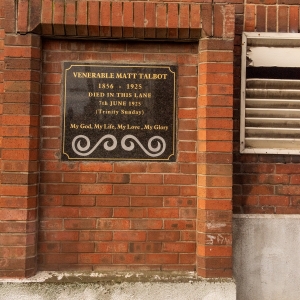
And so began Talbot’s recovery, engendering a moral rectitude that saw him repaying gambling debts and vainly searching for the fiddler whose instrument he had misappropriated. From that point onwards Talbot became a regular mass-goer at St. Saviour’s Dominican Priory on Upper Dorset Street. Indeed, it was while on his way to mass on nearby Granby Lane that he collapsed and died of heart failure. There is now a plaque dedicated to his memory at the site.
Plaque to Matt Talbot on Granby Lane.
Labourer and Ascetic
For much of his life Talbot worked as a labourer at a timber yard, at a time when workers’ movements were in ferment, and revolution in the air. Sheehan writes:
His [Talbot’s] relationship to the labour movement is a matter of dispute. He was on strike in 1900 and in the General Strike of 1913 and he was a member of the Irish Transport and General Workers Union. He refused to collect strike pay and when his colleagues pressed it on him, he gave the money to strikers with young families. Unusually for a Dublin man, he often admitted publicly that he could not understand issues and was prepared to be guided by people he felt were better informed. ‘Jim Larkin knows the rights and wrongs of it,’ he is quoted as saying with reference to the strike of 1913. Most frequently he referred issues to his spiritual advisors, or consulted texts they recommended.
Talbot’s mortification of the flesh included sleeping on a plank with block of wood for a pillow. Sheehan tells us that ‘When he died, in 1925, it was discovered that he had worn chains about his body.’ In death rather than life he would play an important role for the Irish Catholic Church: ‘Talbot’s subservient piety was adopted by the Church as a symbol in ideological crusades of the thirties, forties and fifties,’ and any deference to Jim Larkin’s methods would be obscured.
Our Lady of Lourdes on Sean McDermott Street, Dublin 1.
Irish Catholicism
A strong association between Church and State was perhaps predictable in a newly independent Ireland, given Catholicism’s role in preserving a distinctive Irish identity after the failure of the United Irishmen movement in the 1790s to bring lasting unity between Protestant, Catholic and Dissenter. Declining use of the native language after the Great Famine of the 1840s made religion an obvious point of distinction between ‘Catholic’ Irish and ‘Protestant’ English.
The Catholic basis of Irish nationalism was affirmed during the struggle for independence: the 1916 Easter Rising was consciously suffused with religious symbolism; and in its aftermath prominent Republican figures from Protestant backgrounds such as the Countess Markievicz, and Roger Casement converted to Catholicism.
After independence in 1922, devotion to the ‘one true Church, Apostolic and Universal’ crossed the political divide between the Pro- and Anti-Treaty Civil War factions of what became Fianna Fail (1926) and Fine Gael (1933).
In conformity with Catholic doctrine, in 1925 divorce was prohibited in Ireland, a bar that was only removed after a referendum in 1996; while in Dublin in March, 1925 – the year after Matt Talbot’s death – according to Sheehan, ‘the police mounted a massive raid on an area variously known as the kips, Monto, the digs, the village. This was the brothel zone.’
Moreover, the Constitution that came into force under Éamon de Valera in 1937 – and accepted by a majority of the electorate – identified a ‘special position’ for the Catholic Church, in an article only deleted after another referendum in 1972.
Right up until the 1990s – the revelation in 1992 that Bishop Eamon Casey had fathered a child with an American woman is often viewed as a pivotal moment – there was little challenge to the pre-eminence of a Church, which created a state within a state through the provision of education and health that brooked no opposition. Thus in 1951 a combination of the Church hierarchy and the medical profession scuppered the ambitions of Minister for Health Noel Browne to introduce a measure of universal health care through the Mother and Child Scheme.
In its aftermath then Taoiseach John A. Costello of Fine Gael announced unapologetically: ‘I am an Irishman second, I am a Catholic first, and I accept without qualification in all respects the teaching of the hierarchy and the church to which I belong.’ In truth, few among the political class would have demurred from Costello’s unequivocal deference to the Catholic hierarchy.
Our Lady of Lourdes on Sean McDermott Street, Dublin 1.
‘Dominion of Damnation’?
Nonetheless, Fintan O’Toole arguably goes too far in a recent assessment of the Church’s ‘Spiritual Terrorism’: ‘There was no such thing as ”society” as distinct from … dominion of damnation, no neutral State beyond its reach. It pervaded everything and invaded all of our bodies.’
For Irish men, at least, an independent caste of mind, and sense of humour, remained possible within fixed parameters. Building on the Irish Literary Revival, by the 1950s Dublin contained a remarkable artistic community, which included writers such as Flann O’Brien, Brendan Behan, Patrick Kavanagh and J.P. Dunleavy, while the gay artist Patrick Scott was emerging on the scene; meanwhile many Irish Republicans of that period were being influenced by Marxism, to the consternation of the Church.
Notwithstanding greater emphasis on social supports under Éamon de Valera’s Fianna Fail from 1932, including an ambitious house building programme; and the introduction from 1948 of Keynesian fiscal policies under Fine Gael’s John A. Costello – whose son Declan would develop the idea of Christian socialism within that party with his Just Society document – for most of the population even socialism remained a dirty word; while Communism was considered the work of the devil.
Shrine to the ‘Venerable’ Matt Talbot, Our Lady of Lourdes on Sean McDermott Street, Dublin 1.
Archbishop John Charles McQuaid
According to Ronan Sheehan, ‘The political message that the image of Talbot is supposed to communicate is that the working class is properly a subject class.’ This ‘theology of incarceration’ was expressed by Archbishop John Charles McQuaid in an introduction to the first full-length biography of Talbot:
Yet it will be seen that the author in setting out the main events of the life of the Dublin workman has helped us to understand the sanctity to which he ultimately attained. The evidence is of a very remarkable spirit, or rather, gift of prayer, the practice of self-denial in poverty and work, the habit of recollection in the presence of God, a very tender graciousness towards children and a deep love of the most Holy Mother of God … We cherish the hope that the Church may set the seal of her approval from the virtues that made this obscure and gentle workman an image, in our midst, in Dublin, of the Patron of the interior life, St Joseph.’
McQuaid’s unctuous benediction seems the realisation of W. B. Yeats’s concern about an emerging Ireland where ‘men were born to pray and save’; in political terms, as Sheehan, put it:
When proletarian energy is focused upon the ‘interior life’ it is rendered politically tame. In Talbot the class struggle for justice is replaced by an individual struggle for holiness. It is precisely because he was a worker that we can see in Talbot’s spirituality the epitome of the negative ideological role Marx and Engels attributed to religion.
Sheehan caustically observed: ‘Instead of attempting an analysis of the society in which he lived, he meditated.’
Through no fault of his own, the political quiescence of Matt Talbot produced an ideal role model for the Catholic Church of an uncomplaining working man, who awaits his reward in heaven. Importantly this was before the arrival of a Theology of Liberation in the wake of Vatican II that animated many Irish radicals in the 1960s, including the journalist Vincent Browne.
The importance of religious devotion to Talbot in his battle against alcoholism remains significant. Developing spiritual practices or a religious faith can often be beneficial to recovering addicts. However, Talbot’s apparent deference to authority as a working man suited the capitalist structures which the Catholic Church of that period legitimated.
Granby Lane, Dublin 1.
God after God?
A more activist Irish Catholicism infused with Liberation Theology is now closely associated with the continuing work of Father Peter McVerry, whose approach to poverty, according to Sheehan, ‘stands in contrast to that of the promoters of the cult of Matt Talbot.’
The philosopher Richard Kearney in his book Anatheism: Returning to God after God (Columbia, New York, 2010) proposes ‘the possibility of a third way beyond the extremes of dogmatic theism and militant atheism: those polar opposites of certainty that have maimed so many minds and souls in our history.’
Thus the Lutheran pastor Dietrich Bonhoeffer awaiting execution in a Nazi concentration camp for participating in a plot to kill Hitler proposed a reformed Christianity after the ‘Death of God’ heralded by Nietzsche, Freud and totalitarianism. Bonhoeffer wrote: ‘The God of religion, of metaphysics and of subjectivity is dead; the place is vacant for the preaching of the cross and for the God of Jesus Christ.’ To Kearney: ‘Christianity thus becomes not an invitation to another world but a call back to this one, a robust and challenging ‘Christianity of this world’, a secular faith that sees the weakness of God as precisely a summons to the rekindled strength of humanity.’
Throughout most of the history of the State Irish Catholicism reinforced a social order in which the working class were asked to count their blessings rather than their wages; while ‘fallen’ women and their progeny were treated with indifference and cruelty. A sanitized account of Matt Talbot’s life provided a useful lesson in subservience. Now that the spell is broken, it remains to be seen whether a Catholicism after Catholicism can yet emerge in Ireland.
All Images (c) Daniele Idini
Statue of Matt Talbot on the south side of Matt Talbot Bridge.
Welcome to the second Cassandra Voices podcast introduced and written by Nicola Bigatti, and produced by Massimiliano Galli. This podcast was recorded in the heart of Dublin 8 in what used to be the studios of the 2014 indipendent project Radio Liberties.
This podcast continues a journey through Italian ‘Library Music,’ a vast catalogue of records composed mainly in the 1960s and 1970s by some of Italy’s finest musicians, with Rome and Milan becoming centres of excellence.
Although recording artists associated began with generic soundtrack music, this provided a springboard for an innovative music scene. From a commercial base in T.V. series and advertising jingles, musicians forged unique styles, and developed distinctive sounds such as that associated with Spaghetti Westerns, a genre known as Film Poliziesco-groove.
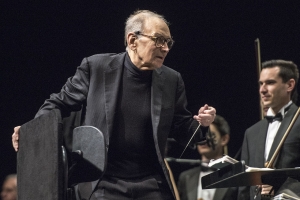
Ennio Morricone in 2015
Foremost among these composers was Ennio Morricone, who achieved global fame for soundtracks to films such as ‘Once Upon a Time in America’ (1984) and ‘The Good the Bad and the Ugly’ (1966). Morricone passed away in July of this year at the age of ninety-one, and this Podcast is dedicated to his memory.
This Italian Library encompassed avant-garde composition, classical harmony, psychedelia, and funk with brash horns, guitars, and futuristic synths prominent. It was a fertile ground for experimentation and creativity, strongly influenced by the social, economic and political dynamics of that epoch.
Composition occcurred under the shadow of political and social turmoil in Italy – ‘the Years of Led’ (Anni di piombo) as a succession of bombings and assassinations by extremist groups shattered an uneasy post-War consensus.
Over the treetops, along the edge of the upper lake, a merlin hunts a starling. Isolated from its flock, that starling fights to avoid the clutches of a small falcon. Fallen memories of past murmurations dance on the surface for a moment and then perish in the peaceful water below: it looks inevitable and only a matter of time, before the old wizard sinks its claws into the imperiled druid.
While the two brothers approached the water’s edge below, I dropped from one spent thermal; drifting in the sky, lazily looking to let another warm current lift me a little higher above the tree line to stalk their predestined path.
The lake stretched up the valley in a murky rectangle, darkened by peat-rich soil from the surrounding steep hills and cliffs. Although the minerals obscured its muddied depths, the lake’s surroundings reflected flawlessly on its curtained surface until a rare whisper of air turned the portrait of a fine day into a shimmering jewel, before still perfection returned once more: blue to silver to sky blue again.
Opposite the beach, through the valley, and over the mirror, a river cracked their impending trek in half. A high ridge overlooking one side of the lake followed all the way back, descending through trees, returning to the shore where the siblings stood.
Sporadic shadows of uneasiness splashed across my consciousness when sometimes the trees and dirt glistened like the vast liquid ornament, sitting ancient where only it could ever belong, in the middle of the upper glen.
Separated by six years, they stood close together now at the lake’s edge. Sailing in the void above the brothers, I watched them move together, trading gestures and pointing at the surroundings. I heard their voices bouncing back and forth and sometimes blending in unison as they overlapped and interrupted one another without hesitation; a complex, instinctive, fluttering dance; only possible with two people who have served an early life sentence in each other’s company.
Laid out before them in a glorious widescreen feast, they took a breath and surveyed the land. Paul, congratulated himself on the idea of coming to the mountains for the day, “Not a terrible way to spend a Tuesday afternoon Cormac, huh?” Trying to downplay it for as long as he could before falling short, arms outstretched, he blurted, “How impressive is this?!”
Cormac was kicking himself for not thinking to bring swimming shorts or a towel. He regarded a couple of Scandinavian backpackers. The sun turning the girls’ faces into shining beacons, their skin almost transparent, as they floated in the water. Any initial signs of shivering distress rapidly turned into cool relief. On this April day, a revitalizing dip was an enticing prospect. Best not get all wet before the hike, he thought, before responding to the brotherly bag of enthusiasm beside him, “It looks fucking magnificent, Paul, yeah.” Squinting up the valley in the distance, “I hope your itinerary for the day includes the top of that waterfall…”
Although neither of them had been here before, Paul, the eldest of three boys, assumed responsibility as rookie trail-guide for today’s excursion, perusing all of the hiking options before embarking, he of course felt obliged to select the most spectacular. “Yeah, we’ll follow the river right to the top, halfway around, I think”
Concerned Cormac might be put-off by the expedition’s wingspan, Paul added, “It’ll only take three or four hours to get the whole way round.”
“Good stuff.” Unperturbed Cormac scanned the way forward, “Which way are we doing it?” Glancing left and then right, but before Paul could answer, Cormac was already marching for the trees and the path counter clockwise around the lake. He turned his head back, “This way okay, yeah?” They moved off the beach leaving the bathers and picnickers in peace.
It felt like two lifetimes ago since I had last seen them together. The sight of the pair walking side-by-side was the harbinger of a misty solace. Still young men, one in his mid-twenties, the other in his early-thirties, they ambled between the trees in a familiar rhythm. It struck me as an extremely rare occurrence, like two celestial bodies lining up for an instant, with a third eclipsing, in the middle. Each one on their own, otherwise lonely orbit. A photon of bliss stretched out supernaturally; they carried on in concert along the path where time stood still and the planets ceased to spin; drawn together once more, not by gravity but by blood and time.
In tandem footprints left in their wake, was an unexpected gift. A whole spectrum of emotion swung heavily into my gut. Sadness to joy; plunged down into deep cold darkness before regurgitating into the light and warmth of the shallows, safe. As I watched and listened, I was drawn a bit nearer to them, getting closer to the tops of the trees and the earth below.
Sheltered in the woodland, still on the first segment of the ellipse, their voices were not completely clear; the conversation cutting in and out, almost like the leaves and branches obscured their voices as much as they shielded the light of the Spring Sun.
Cormac had just returned from Vietnam. He was paying a long overdue visit to family and friends for the next couple of months. After travelling around Southeast Asia for a spell teaching English, he’d settled down in Saigon with a local and had been working in a school there for nearly two years.
In an effort to try to reconnect with his baby brother, Paul took the day off work so they could get away from the city for a few hours and loiter in each other’s presence. He worked primarily in Dublin, where they grew up. Just after sloshing out of a long distance relationship, he felt the connection with his brother was also beginning to evaporate.
“They’ve chosen areas across the country where they’ll have a chance to thrive.” Paul had heard about a project that aimed to reintroduce wolves back into Ireland. They’d all been slaughtered centuries ago. “They’ve selected this place as one of those territories.”
“Apparently, once the Brits rid themselves of all their wolves, they decided to rid us of ours too.” Cormac stated matter-of-factly. “Thanks very much, Lads!”
“So where will the new wolves comes from? Russia or somewhere?” Cormac wondered aloud.
“Did I tell you about the wolf we saw in Colorado?” Paul inhaled and continued, “We woke up, before the alarm clock, in a motel in Pagosa Springs. We wanted to cover a lot of ground on the longest day of our road trip, so we surfaced at 5am. Ten minutes after we’d set off towards Durango, this giant wolf lumbered across the road in front of our car. Steam rising from its frame, we gave the smoldering demon a wide berth. We were still in shock about a mile down the road, when we see a deer, its demeanor faster to react, and flighty. We wondered if it detected the danger looming just up the road, in the morning gloom.”
The brothers were now halfway up the length of the lake, when on the opposite side, through the grey sessile oak trees and across the water, they spied a lone cave. In the middle of the day, that black hole stood out in its surroundings. Its main purpose, perhaps, to destroy any light that dared enter. On this brilliant day, it remained in constant shadow. Once glimpsed, it drew the eye to stare into its belly and locked their gaze.
“When he was a monk in the monastery, down at the lower lake, St. Kevin used to go up there for days on end. It’s known as St. Kevin’s Bed.” Patting himself on the back, Paul was again pleased with himself for researching the locale.
“Jesus, what was he running away from? Was the monastery not bad enough?”
“It’s the whole religious seclusion thing.” Paul started to ramble, “Like, didn’t Jesus spend some time in the desert on his own, sacrificing and praying and what-not…”
Neither of them had a considerable handle on religious history.
“I think that was Lent,” recalled Cormac, “Forty days and forty nights.”
“Sometimes I feel I’m doing my own forsaken religious sacrifice, but not by choice.” Realizing he was feeling sorry for himself, Paul swerved back onto his tour guide script, “There’s not supposed to be much room inside, not big enough to stand in.”
“Some of the most beautiful temples in Vietnam are in very unapproachable locations. Both Buddhist and Catholics have solitude in common. The whole way of life seems extremely bleak to me. I get that retreat is beneficial to a certain degree when life gets a bit too noisy and there’s no access to a volume button but to spend your time cramped in a damp cave for days on end could be taking it a step too far, no?” The Cu Chi tunnels popped into Cormac’s head. Just north of Ho Chi Minh City, he’d crawled through them, and saw the booby traps. In that light, he reassessed St. Kevin’s cell on his bleakness scale. “I’m not sure if I understand all that monk stuff. The never-ending stillness is hard for me to grasp.”
“At least the monks, whether Irish or Vietnamese, had their own pack to fall back to, even in all of these beguiling solitudes. I heard about a group of people in Japan, the Hikikomori, they completely isolate themselves from everything because I think they feel like they don’t belong in modern Japanese society. These people are living solitary lives whilst being suffocated by their own flock living all around them in massive Japanese metropolises. Locking themselves away in their tiny rooms – a refuge within four walls; the only place they are not totally lost. Now to me…That sounds bleak”
“We should try and get up here again before I fly back,” inhaling the earth around him, Cormac’s content demeanor reinforced his suggestion, “Bring the folks with us next time. They’d love it.”
“I was telling Dad that we were coming up, and he said he used to do drills in this valley when he was in the army. He mentioned a famous soldier, I can’t remember his name, he swam across the water under the cover of darkness and crawled up to the cave where he evaded capture. Perhaps the wolves should have tried something similar.”
They rambled on in silence for a time, breaking from their shelter of trees to approach the stony plateau of the Glenealo river; gushing towards them, in abrupt steps, from small bubbling rapids higher up, to man-sized waterfalls on the way down, until finally at the mouth, it all blurred into the stillness of the upper lake.
Before their ascent, they stopped at some old scattered ruins on the land between the lake and the falling river: an abandoned miner’s village from a time long forgotten. Paul stopped in the shell of one of the houses and started plastering sun cream onto the back of his neck. Cormac, although having fair hair, had no interest in sun protection, his nose already beginning to turn pink; another freckle materializing every few minutes, one after the other around his eyes and forehead; he was wandering around the broken house feeling the stone: Artefacts of an era he endeavored to visualize, but couldn’t quite render, no matter how hard he squinted in his mind.
Hanging drone-like, overhead, I could see them working hard as they began the steepest uphill section of the hike. As I meandered closer, through the air above, I could see the river was stuck in the same exact frame of motion. From far away, the cloud of motionless foam and spray deceived the beholder into thinking it alive. No sound emanated; stuck in one, ongoing split-second, the constant cacophony of slapping water with subtle gurgles was lost for the moment. Walking slower now, those two young men zigzagged up their hill, taking little notice as they followed the water’s previous beginnings. The ancient determination of the river to flow downhill was quenched somehow by a moment in time when only the brothers continued to move. I drifted down a bit closer.
They talked about other people instead of their own lives. Paul spoke of an old school friend, who was back home after finding out his mother had been in a car crash.
“I didn’t bump into him but he was over last week. His mother is in a very bad way. It was some guy driving a flatbed truck in front of her. Something fell off the back, on to the top of her car. One of those nightmare freak accidents. They reckon she’ll never fully recover. He only stayed a couple of days with her and then scurried off back to California with his mam a complete vegetable.”
“What the fuck is that about?” Cormac was wrestling with the thought of one of their parents getting sick while he was over on the other side of the world.
“I’m not sure what his work situation is over there, but you’d think he’d be able to take a bit longer off. Anyway, I’m shocked that you’re confused by this. I haven’t seen you in two years. Barely heard a peep since the funeral. Like a magician, now you see him, now you don’t … have a fucking clue where he is.”
Both of them were moving with deliberation up the slope where the trail was at its most arduous.
Cormac batted away his brother’s unexpected jab by continuing as if he hadn’t heard, “I ran into Sarah in town a few weeks ago and she’s convinced that he’s on heroin, hiding somewhere outside of Los Angeles. I wasn’t sure, like, he’s always been a bit of a dozy cunt. Looking back, didn’t he always seem to have problems with people? There was always some trouble stalking him from the near distance.”
Cormac hesitated before speaking, “I know this sounds awful,” he knew he wouldn’t be able to recapture the words once spoken, “But wasn’t he an altar boy for a few years?”
Paul’s body felt a little heavier. The day turned a shade darker although not even a wispy cloud existed to tarnish the sky’s fine blue covering. His first thought was, not a chance, but once sparked, the idea continued to crackle, like kindling in his mind.
Cormac continued, “It’s not out of the question that something could have happened. You hear all the stories, and it’s not farfetched. If something despicable happened, maybe it messed with him. Maybe that shit stuck to him like one of those nasty parasites. You know, one of those monstrous things that you don’t even realize you’re hosting. It just feeds on you and makes you sicker and sicker.”
The upper lake prospers on secrets and rumors. Shadow and light dance over the surface; old whispers long spoken and nearly forgotten, ready to plummet to the bottom at any moment. Some rumors remain, and with them an unbreakable tension.
Paul, stopped to take a breather, “You would think, in that situation, you’d say something immediately. But I appreciate it’s hard to put yourself into a specific circumstance like that”
“The act of crying out for help can be almost impossible sometimes…But fuckin hell, that’s a terrifying thought.” Cormac was trying to think of the exact reason why he was living half way around the world. He thought about the snippy comment Paul made about not seeing him since their brother’s funeral. Cormac didn’t think he harbored any guilt, leaving when he did, but thought he heard some resentment in Paul’s voice. Excess thoughts were flapping around in his head. “It would make sense that somebody, weakened by an experience like that or under the constant reminder of trauma would turn to drugs or run away from that completely, to another country.”
“Do you think you needed to leave here when you did?”
“I wasn’t talking about that. You know, I didn’t run away. There was nothing here for me at the time and I needed something fresh … Something just for me … to be on my own for once. But, yeah, I think he could have thought the exact same thing when he went to America.”
At the top of the route, they collected some water from the rocky froth. A dent in the stream was left unfilled where they had dipped their flasks. Each guzzled while surveying the terrain, trying to distinguish each trail, locate where they had come from and understand exactly how they had arrived to this absolute extremity.
“Certainly easier than staying to fight it and causing a fuss.” Paul probed, “Say, if we got stranded up here, would you want a rescue helicopter coming up to get us?”
Not lingering at the top, they crossed a bridge over the river and kept moving along the ridge back in the direction of the beach that had been their starting point.
“Definitely not an ideal situation, it would be on the news and everything, but yeah, I’d want it to come and get us”
“Sometimes it’s easier to stay silent. Don’t trouble anyone else with your bullshit. It would be too mortifying.” Paul seemed at ease with his position on this topic, but perhaps was testing his youngest brother, playing Devil’s advocate. “You’d never live the embarrassment down, having the helicopter sent up and everything. I think I’d just hole up somewhere and wait for the storm to pass.”
Cormac was baffled, “Why would you do that? It sounds unnecessarily risky to me. I’d say it would get really cold. You’d rather risk death than feel slightly unpleasant … Feel like a bit of a knob?”
“Nah, it’s Ireland, a bit of rain on a hill. Find some shelter easy enough; keep the head down until sunrise.”
“You’re downplaying a potentially disastrous situation where the mountain is the local priest and you have found yourself as the quiet altar boy. Family would be worrying about us, the car would be down at the entrance and we’d never have mentioned a plan of camping overnight…”
“I’d be okay”
“… Never mind in a few years it wouldn’t just be the weather you’d worry about. What about the wolves? What would you do when the howling begins in the middle of the night? You can hear them getting closer, crying up into the abyss, as they relay the exact position of their prey.”
“Maybe I’d shelter in St. Kevin’s bed, like that jammy soldier. It’s probably better in there if there was a big storm out here. Nice and cozy.”
I watched them consider the precarious situation as they tip-toed along the wooden sleepers on the trail high above the lake. Their thoughts becoming less complicated as they were forced to concentrate on each perilous step. Both of their voices were weakening. Cormac’s face was twisted in confusion. Paul’s expression was hard to see. Blurring. I had to go closer to watch, within a stone’s throw overhead.
Beneath them but above the waterline, lurked that cave. What in the world could even be inside that hole? Stones? Moss? Spiders? Some campfire remnants or an abandoned bird’s nest? What about the scrawlings of an ancient druid? Or is there something else living in there – a dying wolf maybe; another artefact, black as the darkness itself.
How deep is it really … If you were to properly investigate? I heard them saying that it’s very small but what if there was a crack in the corner and just enough room to squeeze in? If I had a light, I’d just take a fleeting peep.
I’d keep scraping and scratching at the dirt and keep going further into danger. Are there more ruins in this cave like the fading memories in my mind?
They reached a viewing platform perched all the way out on the edge of the high ridge. A perfect predatory vantage. They peered down at the lake and I followed their gaze. The water’s presence was at first reassuring, but I sensed it knew every thought in every crease of my mind. The shadows growing and retreating on the surface, thoughts and memories. Beware the underwater cliffs.
They discovered a spot to sit, looking down at where they began. An apple each was a welcome boost before finishing the last section of the trail. Crunching into the delicious fruit, they marveled at the fantasy backdrop, in which the lower lake and monastic ruins shimmered behind the beach. There was magic in this land: a mystical ether passed down by the druids before they were swallowed by the island’s monasteries.
“Those monks did have to put up with some amount of shit…And never mind the bloodthirsty Viking skirmishes. No wonder St. Kevin tried to break it up with the odd cave getaway”
“Yeah, it might have been a relief for him at times. Things appear to make more sense up here. The energy is different.” Considering the setting before him, Paul couldn’t resist embellishing – “Or maybe an evil wizard was pursuing the Saint, and instead of endangering the Sanctuary he built, St. Kevin would fall back away, lead the wizard into a snare, out here in the wilderness.”
The light lunch was long finished but they lingered, looking at the lake; pure beauty reflected.
For Paul, the day had many purposes. The main one was to spend some quality time with Cormac, before he headed back to the other side of the world. He missed his company, his mannerisms, and the scrunched-up expressions on his sun burnt face. He said to Cormac before he left the first time, to come back before making any big permanent decisions. Paul had been away for a stint on the continent, and it’s only when he came back, he realized how much he loved his home.
The other main purpose was to sell Ireland to him; give him an image to look back on and to remember fondly. A picture to clutch onto, that would not fade as quick as a few drunken nights out, down the local. He was desperate not to lose the only brother he had left.
Like boys, they skipped and swirled their way down to the bottom of the valley on wooden steps fashioned from recycled railroad ties which had been built into the slope.
Though Cormac’s only long-term plans involved making a life in Vietnam, he didn’t have the heart to break it to Paul just yet, because he needed to keep that connection. Thinking about the stones in the miner’s village, he didn’t want their relationship to exist on old memories, and promised himself that he’d make more of an effort with both Paul and his parents.
“Mac Tíre,’meaning wolf in the Irish tongue, translates as “Son of the country.” Sometimes, through no choice of their own, the sons of this country may feel they no longer belong to its soil. Ireland’s children have always had to keep moving, be on the go. They’ve thrived and prospered in other parts of the world. Our generation have been culled like the wolves before us. Leaving for better opportunities elsewhere or all too often, leaving this world forever.
So do I keep scratching and scraping at the dirt until I find something? What happens if something finds me first?
As they neared the beach, the terrain levelled out. I watched them ghosting through the trees close to lake level. Cormac stopped dead in his tracks, making Paul echo his sudden movements. Paul’s whole body was almost invisible now. It was a silvery liquid form, impossible to recognize anymore.
I drifted in closer, my toes nearly touching the soil. I strained to hear Cormac, his voice a faint whisper. “You nearly flattened it.” He paused, pointing around the base of a towering Scots pine tree. Then he looked up the trunk and spotted an old woodpecker hole. “It won’t survive.”
The baby starling lay waiting to be trampled on the forest floor between them. Very still, it was a ball of fuzz in an alien world, pink and exposed. Two varieties of feathers scattered around the baby signaled a frantic scrap. Its brooding mother attempting to lead the predator away from the nest. Cormac picked up the starling and stood at the base of the tree. Handing the pre-fledgling druid to Paul, Cormac freed his hands so he could climb on his brother’s back. Using the tree for balance, he managed to clamber up and stand steady on Paul’s shoulders.
I blinked my eyes until they hurt. I saw the foggy outline of Paul, hunched with the weight of his brother. Raising his arms he passed the bird up to Cormac, who took the starling into his tender hands, and steadied himself again, before reaching up to the nest to place the hatchling back into its home.
The beach was busier than before. The unexpected spring heat drawing opportunist paddlers to haunt the cooling shallows. I could just make them out in the crowd. Yes, there they were, together. The fine grains of sand barely reacting to their footsteps.
I touched the earth for the first time and they began to rise. Each soul on the beach lifting into the air around me in a slow steam. The sand was warm between my toes. Standing alone, the world started spinning again, with everyone who was left on its surface still hanging on to their delicate existence.
Above the lake, my brothers took towards their final tranquil passage. I was left alone on the earth, without them, no longer in the middle. I watched them leave: diving upwards, soaring over the valley back towards the source of the river. Both shapes dancing together. Two birds nearby, entangled in furious battle, threatened their cosmic journey. The brothers glanced a glint of magic upon the mid-air tussle. The merlin opened its talons and took off into the horizon. As my brothers vanished over the river, the valley held its breath while the liberated starling flew towards the tree line where her hatchlings nested in the old woodpecker cave.
And under the water, memories swim in a frenzy, not on the lakebed, but bubbling, murmuring just below the surface.
The palpable relief being felt by many over the accelerating approvals of apparently safe and efficient Covid-19 vaccines is hardly surprising. But away from triumphalist headlines, partially satiric messages have circulated widely on social media essentially stating: “I can’t wait for a new vaccine to come out so I can refuse it.”
These are easy to dismiss as frivolous, or the ravings of an unhinged libertarian fringe, but such statements also evoke a frequent paradox in Western societies; namely calls for scientific breakthroughs to benefit the health of all, while maintaining a scepticism about public health measures enacted by governments and reliant on a mercantilist pharmaceutical industry. And more ominously, concerns over anti-vaccination lobbying distract from life and death issues surrounding equitable vaccine access for a large portion of humanity.
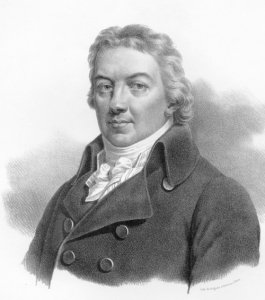
Edward Jenner 1749-1823.
Pitfalls of the Public Good
Heralded as a milestone among Enlightenment advances, Edward Jenner’s late 18th century inoculation of his gardener’s son with cowpox is a path well-trodden by medical historians. In attempting to provoke an immune reaction to the far more dangerous smallpox virus, this precursor to modern vaccination built on centuries of traditional practices, notably in Africa, the Middle East and East Asia.
By subsequently infecting his test subject with live variolous matter to prove his point, Jenner likewise carried on a long tradition of dubious experimentation. Despite minimal understanding of disease transmission – let along virology – vaccine development has consistently provoked opposition, whether political, philosophical, spiritual, or from scientists themselves.
A significant factor in the dramatic European demographic expansion over the course of the 19th century was the spread of smallpox vaccination. There is a reasonable corollary between the broadening of States’ responsibilities over health matters and the emergence of openly anti-vaccine movements. Both processes accelerated during the Pasteur-Koch era even as the array of infectious diseases that were understood and potentially preventable expanded.
Uncertainty and disbelief shifted to the questioning of the basic premise of vaccination, manufacturing conditions, and even the means of prescription to a population. More familiar incarnations include arguments over the presence of aluminium adjuvants; discredited studies pointing to the occurrence of autistic disorders; the possible corruption of decision-makers for the benefit of laboratories; or a broader discordance between the interests of the pharmaceutical industry and those of public health.
A succession of scandals led Ben Goldacre in Bad Pharma: How drug companies mislead doctors and harm patients (Fourth Estate, London, 2012) to write: “I think it’s fair to say that anti-vaccine conspiracy theories are a kind of poetic response to the obvious regulatory failure in medicine and in the pharmaceutical industry. People know that there is something a little bit wrong here.”
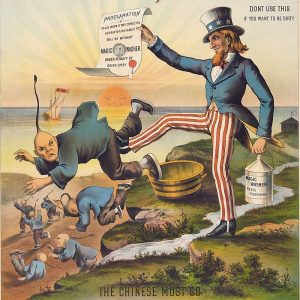
Far from being solely a European issue, health coercion, including the authoritarian imposition of mass vaccination, has unsurprisingly manifested itself in colonial history. A highly toxic plague vaccine developed in India was tested on prisoners (along with the microbiologist responsible for its discovery), before being made obligatory for Chinese residents of San Francisco during an outbreak of Bubonic plague in turn-of-the-century San Francisco.
An 1886 advertisement for ‘Magic Washer’ detergent: ‘The Chinese Must Go’.
Attempts to tackle African sleeping sickness are similarly striking. The example of pentamidine in the 1940s, an antibiotic which was believed to treat sleeping sickness (ten million preventive injections would prove as useless as they were dangerous), highlighted not only the irrationality of colonial policies in place at the time, but also a blind faith in scientific progress. Public health policies could indeed seem far removed from what was being referred to as the common good.
Past failings and Understandable Reservations
Vaccines have since become a highly symbolic element of the State’s power over the human body, with objections today frequently based on claims of infringement on individual liberties. But while the dismissal of scientific evidence is disturbing in and of itself a far more sinister side exists, the assassination of health workers administering polio vaccines in Pakistan being an obvious example.
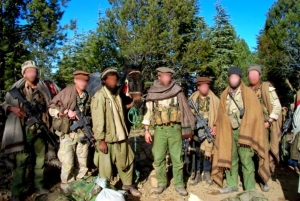
As opposed to a demonstration in national power it is rather a question of a State failing in its responsibilities, be it through limited health infrastructure or outright negligence. And the CIA’s fake Hepatitis B vaccination campaign used to determine the whereabouts of Osama bin Laden in 2011 has hardly reassured those living in areas beyond the government’s remit. Rather, long-standing doubts about the motives behind mass vaccinations have been reinforced.
Delta Force GIs disguised as Afghan civilians, while they searched for bin Laden in November 2001
A comparable incredulity can be observed at present in Europe, where compliance with health measures taken by various States to fight the Covid-19 pandemic remains closely linked to the trust of populations in their respective governments – a trust that has unfortunately long since been waning in many societies. Hopes in scientific research for the health of the greatest number of people is confronted with the reality of a mercantilist pharmaceutical industry, or even the possible instrumentalization of public health by certain opportunistic governments to suppress pre-existing social discontent. All amidst a backdrop of wider deteriorating democratic norms and respect for basic human rights.
Debate, or Lack Thereof
While it is undeniable that an army of researchers was required to secure a Covid-19 vaccine, a cynic would question the speed with which pharmaceutical companies have developed a serum for a large and clearly solvent market, while many diseases remain outside the agendas of these laboratories. The legitimacy of a vaccine passport can also be challenged, not only because its medical effectiveness is still questioned by many, but also because it could prove a powerful deterrent to migratory phenomena and the right to asylum. The well-intentioned rush to digital health could unfortunately prove to be an additional obstacle for many countries for which access to Covid-19 vaccination may be late or even logistically impossible in view of refrigeration requirements.
If there is one matter on which there should be a consensus among populations, it is that of equitable access to these new therapies, especially given the infusion of public funds to finance the research. In particular, the terms of agreements between laboratories on the operation and licensing of Covid-19 vaccines should be made public and openly debated.
Whether or not one is convinced of the merits of vaccinating at this time against this particular virus; whether or not one questions the way this pandemic has been managed by our respective governments; and whether or not one criticises the manufacturing conditions of the serums, it would seem deeply naive to leave in the hands of competing economic powers one of the essential pillars of any society: the possibility of preserving the health of the greatest number of people. The history of vaccination, despite all the missteps and at times understandable reservations, provides an apt demonstration of this goal.
Featured Image: World Health Organization photo by D. Henrioudpreparing for production of measles vaccine.
The authors are researchers with the Research Unit on Humanitarian Stakes and Practices, Médecins Sans Frontières – Switzerland. The views expressed in this article are theirs and in no way represent the organization to which they belong.
Dervla Murphy’s father was one of Pádraig Pearse’s patriots. Schooled in St Enda’s, aged eighteen he was incarcerated in an English prison for three years, ‘sewing sacks for the post office, wretchedly fed and crawling with lice’, as she wrote in her autobiography, Wheels Within Wheels. The Murphys were anti-Treaty Republicans. Every one of the family was jailed ar son na cúise.
Her mother’s family the Dowlings, on the other hand, were terribly respectable, and wealthy, until her mother’s father, a drinker, fell into the Royal Canal and died. His wife, Jeff, happened to be passing when his corpse was lifted out. Maybe as a result of this trauma, Dervla’s grandmother Jeff retained ‘a tight-lipped aversion to pleasure, however innocent.’
But at the home of Dervla’s father’s people, in Charleston Avenue, Rathmines, ‘there was poverty too, but it was happy-go-lucky rather than gloomy and self-pitying,’ Dervla wrote.
When Feargus Murphy and Kathleen Dowling married they immediately left Dublin for Lismore, a remote and beautiful tiny town in the Blackwater Valley of Waterford. Feargus had been appointed county librarian, and immediately settled in to create literary centres out of country libraries. He founded Ireland’s first mobile library with the help of Kitty – the couple sometimes sleeping in the library van as they toured the county.
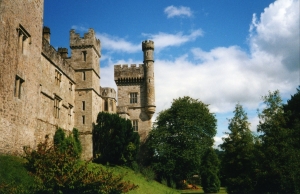
Lismore Castle, Co. Waterford.
Dervla was born in 1931. By the age of two, her twenty-six-year-old mother had been crippled by rheumatoid arthritis. After travelling to England, Italy and Czechoslovakia in search of a cure she returned to Lismore, a hopeless cripple whom doctors advised to avoid having any more children.
The family loved and cosseted their one fierce chick. Dervla spent time in Dublin with her mother’s people, the enduringly Unionist Dowlings, and with her beloved paternal grandparents and cousins in Rathmines. There she roamed a house filled with Pappa Murphy’s books and her grandmother’s endless bridge games. Pappa had been on hunger strike in England for six weeks at the age of forty-eight, dragging his health down, and Granny had also been jailed.
In Lismore, Dervla grew up with a healthy level of wilfulness. Among her friends were the neighbouring Ryans, a conservative family. She spent as much time in their home as in her own; their son Mark, an intellectual priest, became a second father to her.
At home, she was raised on her mother’s preferred diet for her only child of raw beef, raw liver, raw vegetables and brown bread, with four pints of milk a day, with no place for tea or coffee let alone fizzy drinks. Cooking could be problematic: at one stage Dervla and her father made dinners on an improvised electric cooker which he had repaired; they wore wellington boots to prevent fatal shocks!
For her tenth birthday received a a secondhand atlas from her Pappa, and a second hand bicycle from her parents. This combination brought the realisation one day as she cycled up a favourite hill near Lismore that she could actually get to India if she simply kept pedalling.
At twelve she was supposed to enrol in St Angela’s Ursuline College in Waterford – her aunt Kathleen wrote to her enthusiastically from Mountjoy Prison promising she’d love it – but on account of the circumstances of her mother’s illness and perhaps also the meagre pay of librarians in the new Irish State, this was not possible until 1944, when she was thirteen.
Dervla loved the school and thrived there, but by the following year a crisis had developed in Lismore. A series of housekeepers had nursed her mother and kept the ragged home together. But this situation could not endure, leading to a conference with her parents where three options were laid before her: Dervla could leave school and nurse her mother; she and her mother could go to live with relatives in Dublin where it would be easier to find help and Dervla could attend another school; or Dervla could return to school in Waterford and her parents could somehow soldier on.
The decision was left to the fourteen-year-old Dervla: ‘We had just finished dinner and I saw my father’s hand shaking as he lifted his coffee cup to his lips,’ she remembered. Of course she chose to leave school and look after her mother.
The Murphys in Dublin were incandescent at the decision. A cataclysmic row erupted leaving the family at permanent loggerheads. ‘As a result of our tribal warfare I never saw Pappa again,’ she wrote. A period of love and funniness had come to a sudden end.
Dervla became her mother’s full-time carer until she was almost thirty, nursing by day and by night an increasingly helpless woman. Even in the early stages of her illness she was compelled to manipulate knitting needles just to turn the page of a book.
The only respite for Dervla were long walks with Mark Ryan, the neighbouring priest, and long cycle rides. On one such, aged seventeen, she met a solitary Englishman who, like her grandfather and her father, had been imprisoned for the cause – in his case in a Japanese POW camp in Burma during World War Two. Godfrey and Dervla established a private companionship until his death in 1959 in London when she was aged twenty-eight.
She had been writing since childhood, but in these years she did so with greater discipline and intent. She completed a novel about an illegitimate girl growing up in a small Irish town, which she sent out to half-a-dozen publishers; one of whom hinted that a happy ending would make it publishable, but Dervla was not prepared to compromise.
At least Dervla gained some relief from her onerous duties with a few long cycling trips – to Wales and Spain, through Italy, France, Belgium, Germany – but her increasingly mentally ill mother’s autocratic insistence on perfect housekeeping brought on a complete crack-up.
Her mother passed away in 1961 and her father a year later. Then in the terrible winter of 1963, Dervla headed off on her bicycle Rozinante, with a meagre bag of supplies, a few quid and a pistol. She was on her way to India.
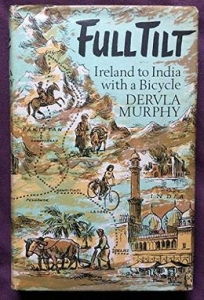
Her thrilling account of the trip, Full Tilt: Ireland to India on a Bicycle was snapped up by the prestigious British publisher John Murray. This was before the days of the hippie trail. Her journey had been unimaginably exotic (and yes the pistol did come in handy) as she cycled over the mountains of Pakistan, breaking her ribs, experiencing ravings after heatstroke, among other mis-adventures.
Dervla travelled and wrote about it for another forty years. Her books became classics in their genre. These covered work with the Dalai Lama’s sister in a camp for Tibetan refugee children that was a central experience in her spiritual life; riding a mule through Ethiopia, along with travels in Nepal, India, Madagascar, Peru, Cameroon, Palestine, Romania, Laos, and even Northern Ireland.
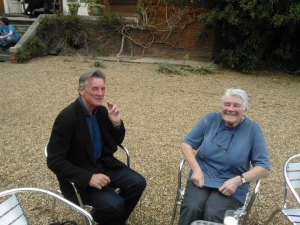
Dervla Murphy with Michael Palin in 2012.
When she gave birth to a daughter and brought her up single-handed, she may just have kicked out the first stones of the wall that then surrounded Irish women; this was in the age of Magdalen Laundries and Mother and Baby Homes. She demonstrated that a single woman with a baby did not have to be at the mercy of church and state and all-seeing respectability.
Dervla Murphy’s books have remained in print for longer than any other modern writer. She remains our greatest explorer, and a stirring voice of a liberal worldview that Ireland has only gradually accepted; a voice calling for a new world.
This was back in the days when boys were still called Osmond or Norris, and girls were called Eunice or Mabel. It was a time of Bronco toilet rolls and King Crimson albums. A time when Jack Russell terriers still snapped at the coalman’s feet and your mother bought the weekly grocery shop from the Co-Op on tick.
Every now and then, if you were lucky, you could find someone who kept an open house, someplace to visit on those damp and dreary October afternoons in the 1970s when the cafes were shutting up for the day and when the pubs hadn’t yet opened their doors. When the suffocating bleakness of our provincial backwater became overwhelming, you could always head out to Sadie’s place.
Sadie Bramwell was known locally as a kind of bohemian. She had acted in a couple of horror films when she was young, and counted Patrick Campbell and Vincent Price as friends. Her house was a rambling Edwardian redbrick set in four acres of neglected grounds. It was situated on the edge of a shallow valley that eventually led down to the spread of the Marsh. Her husband, an American, was some kind of professor who taught at Harvard. He was a remote and distant man, and rarely around. When he was at home he would hide in his study upstairs, appearing only occasionally in the kitchen always wearing the same tweed jacket with worn leather patches on the elbows. He would show Sadie a passage from the book he was reading or an article that he was working on before shuffling off back to his study. And there were the two teenaged sons who were mostly away at boarding school. Like their father, the boys were withdrawn and odd, and seemed to spend all of their time in their bedrooms when home from school.
Sadie would hold court in the large kitchen cluttered with books, newspapers and magazines. You could call round any time in the day and help yourself to whatever was on offer, which was mostly tea, or if you were lucky baked beans on toast. And in the colder months there was the Aga to warm your backside against. There would be two or three of us there, and Sadie always seemed pleased to see us. I think she was bored and a little lonely. I could sense there was a kind of resilience at work in her, and that perhaps somewhere in her past there had been great difficulties. Another thing that struck me was that she didn’t seem to like female visitors, and could at times be frosty and imperious with them. My friends Evelyn and Yolanda eventually stopped going there. ‘That witch gives me the heebie-jeebies’, Evelyn would say. I would try to convince the girls that Sadie was all right but they would have none of it.
We would gather around the long table in the kitchen and listen to Sadie gossip about the famous people she once knew. How so-and-so, a faded matinee idol, was in fact gay, and that a certain successful novelist didn’t write his own books. She told us about the time she attended a private reading by Allen Ginsberg when he visited London in 1965. She said the poet sat on the floor surrounded by his ‘catamites’ and that he was picking at his bare feet and how it made her feel quite ill. But the great thing about Sadie was that she was also interested in what you had to say. The conversations were never one-sided.
Sadie didn’t drink alcohol or take drugs, although she did admit to once taking a puff on a joint with Peter Sellers, but she had no time for the courts that locked up the hippies and pop musicians for smoking flowers. ‘These are the very same judges’, she would say, ‘who are cruising around Piccadilly picking up teenage boys to molest in their Mayfair homes.’
But no one took advantage of Sadie’s hospitality by smoking dope inside her house. You could always go out the back and light up in the overgrown garden. There was a marble sundial fashioned like a seraph hidden amongst the high grass that we would cluster around. You could then look out for Oscar, the giant peacock. This huge bird’s iridescent plumage would sometimes fan out and peer through the tangled wilderness of ragged shrubs and couch grass, shimmering like a magnificent thousand-eyed alien. Sadie had inherited Oscar from the previous owner of the house, and she claimed that he was once a female but had changed gender and transmogrified into this splendid haughty male specimen.
During this time I decided I needed to move out of town for a while. I knew some people living out at Mr. P’s farm, so I rented one of the static caravans he kept in the yard. There were always four or five such dwellings there, and people would come and go. The rent was nominal. Mr. P was an eccentric old farmer who lived with his sister who had taken to the bed many years back and was never seen out and about. Mr. P seemed somewhat lonely and liked the company of the various dropouts, oddballs and hippie types that would appear looking for a place to live.
It was one day in October 1972 that Charlie Hardy pulled into Mr. P’s farmyard in a battered old Morris Minor. I was surprised because I had no idea that Charlie could drive, he just wasn’t a driving type of guy. I’d been friends with him for several years and had never once seen him behind the wheel. I didn’t drive at that time and was terrified of being driven around, especially by fast drivers. But somehow Charlie persuaded me to go for a spin. And so we spluttered out of the yard in stops and starts.
‘I didn’t know you had a driver’s licence Charlie.’
‘I don’t’, said Charlie, gripping the steering wheel tightly as he tentatively maneuvered the Morris through the farmyard gate and out on to the road.
‘Are you sure about this Charlie?’ I should have known that the niceties of driving licences, insurance and motor tax were wasted on him.
‘Yeah, we’ll be fine. I got the hang of it yesterday.’ He turned to me and grinned. He was always slightly unkempt and disheveled, but for some strange reason I can clearly recall that exact moment when he turned to face me. I found myself inexplicably staring at the few wispy strands of hair on his chin. For the briefest of moments Charlie looked exactly like that Shaggy character from the Scooby Doo cartoons.
And so we spluttered on for some fifteen miles through the back roads and winding lanes, past a few scattered hamlets, until we eventually pulled up at Sadie’s. The house always gave the impression that no one lived there. At this time of the year it could seem gloomy and forbidding, but I was relieved we had arrived in one piece. And Charlie seemed very pleased with himself. It was as if he had managed, at long last, to accomplish something in life.
I hadn’t visited Sadie for over a year and as always she was welcoming. But there was less of a welcome from the stranger sitting at the kitchen table opposite her. I could immediately sense the waves of suspicion and resentment darting out from his eyes. Sadie would never introduce anyone, so we just ignored this fellow and made ourselves some tea. I tried to get some kind of measure of him out of the corner of my eye, and I could tell he was a rustic type, in working clothes with his neck loose in a worn brown flannel shirt. After a bit of chat with Sadie, Charlie and I went out the back for a smoke. We were glad to escape the brooding presence of this unwelcome intruder.
‘What the hell is he doing here?’ said Charlie.
‘God knows. Did you see the cut of him?’
‘I know him’, said Charlie. ‘It’s Bradshaw. Triangle Head Bradshaw.’
‘Triangle Head!’ I spluttered.
‘Did you not see the head on him?’ Now of course I did. This strange man had a head shaped like an inverted triangle, topped with a flat thatch of tight red curls.
It transpired that Charlie knew Triangle Head Bradshaw from when he was at school. Charlie came from a small town far down on the Marsh, and this lad went to the same school as him. Charlie said that Bradshaw was the son of a cantankerous old farmer known as Ragwort Bradshaw. The Bradshaws were some kind of non-conformist ‘chapel folk’ and had a tumbledown smallholding on the edge of the Marsh where they kept sheep and chickens. Ragwort Bradshaw had the reputation for being a disagreeable old devil, and was often up before the magistrates on matters to do with illegally extending the boundaries of his property. There were three sons. Triangle Head was the youngest.
We heard the sound of a car leaving so we went back into the house.
‘So what’s the story with Triangle Head, Sadie?’
‘Triangle Head?’ Sadie laughed. ‘Oh why are you boys always so cruel?’ Evidently Bradshaw had been calling round to see Sadie for the past year or so. She said she felt sorry for him and that he was harmless. Charlie told her that the Bradshaws were unsocialised hillbillies and that they got on everyone’s nerves down on the part of the Marsh where they lived.
I didn’t see Bradshaw again at Sadie’s house. I wasn’t going round there as often anyway as we were all beginning to drift away. But I did once ask Sadie if he was still visiting her. She brushed the question aside so I left it at that. It was years later that I learned from an old friend of Sadie’s that Triangle Head Bradshaw had begun to make her feel uneasy. It seems he became a bit of nuisance, and that her sons didn’t like him skulking about the place when they were home from school. It was a classic case of unrequited love. Bradshaw was enraptured by Sadie and eventually plucked up the courage to declare his exalted feelings for her. Of course that was it. Sadie had to get rid of him. Nobody knows what was said, but he never came back. But there is a coda to the story of Triangle Head. After Sadie had sent him packing he went directly home to his farm on the Marsh and wrung the necks of all his two hundred and fifty egg-laying hens.
Une Charogne (1859) is among the most important poems of the 19th century, containing all of its author’s ground-breaking aesthetic. Our own aesthetically challenged century could learn a lot from it, in terms of the aesthetic of rupture, spleen and discord.
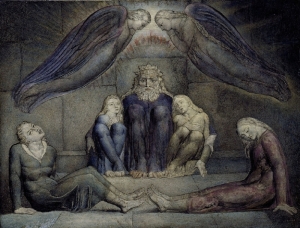
It is Baudelaire’s response, in a sense, to the early Romantics, such as John Keats for example, and particularly concerning notions of beauty. Baudelaire, like Mary Shelley and Shakespeare before her, found more engagement in what could be described as the dark horror of existence, which had always existed in literature, particularly in writers such as Dante Alighieri, in whose work Dame Francis Yates saw the keys, or genesis, of the Gothic novel: in particular in the last Canto of the Inferno when Count Ugolino is forced by starvation to eat his sons locked away in a tower. However, Baudelaire’s genius was to take such an aesthetic into the everyday. In this this way he was a true revolutionary and visionary.
Count Ugolino and his sons in their cell, as painted by William Blake circa 1826.
Une Charogne is the perfect example of his aesthetic. The poet starts off describing a carcass which he has seen rotting on his way home, and which he associates with a former love which he felt for his girlfriend. The reader, however, is only made aware of this in the very last verse of the poem. The remarkable contrast of topics is so unexpected that even one-hundred-and-sixty-years on the poem continues to shock.
The poem, typically, follows the genre of memento mori, Baudelaire’s originality lies, however, in applying what were rather banal motifs associated with death – such as skulls placed alongside everyday fare like fruit and flowers – and then to insert affairs of the flesh, and, of course, the heart.
Only readers who have experienced real heartbreak themselves, what the Ancient Greeks described as the Orphic mysteries, will have any real appreciation of the fantastical act of catharsis that is taking place, how the poet wonderfully evokes his former passion for a beloved, and then inverts Love with its counterpart Hate; thus upturning the apple cart of feelings for the beloved which have been transformed into their opposite; diabolical hatred and disgust; perhaps more so for himself, for being duped by such feelings in the first place!
As indicated, anyone who has been in Love and who has then lost – inevitably harbouring a sense of betrayal – will recognise, and feel, the powerful emotions driving the poem forward. The poet’s dedication and craft at the description of the whole process continue to inspire awe.
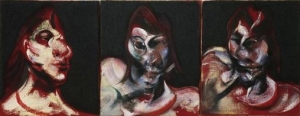
Three Studies for a Portrait of Henrietta Moraes, by Francis Bacon,1963.
Francis Bacon Interviews
Regarding my transversion, I was helped enormously by using the interviews conducted by David Sylvester with the twentieth century British painter Francis Bacon. Bacon was a keen reader of Baudelaire, and one who followed the French poet’s dramatic overhaul of the Romantic spirit. One only has to consider Bacon’s entire corpus of imagery, the violent palette of colour, the decomposing matter of flesh, and the ‘smoky bacon’ of decomposing Love!
I find that this unique aesthetic contradicts directly the flimsy narrative of many contemporary literary journals which are marred by politically correct censorship; the overwhelming and ever-present narrative of all-inclusivity and sensitivity to Others that has now reached idiotic proportions.
What do I mean by that? Take for example the narrative of Une Charogne below. Anybody reading the poem with a half a brain will understand there is a very definite mask wearing taking place on the part of the poet. The diabolical humour is just that, a very nasty joke. But one which is very human.
When one has been jilted the immediate response is to seek revenge. Exact some hate! This is simply being human, and to deny the presence of this impulse is simply perverse. All is fair in love and war. A person who has betrayed you with another having vowed to love you forever is now in the arms of another.
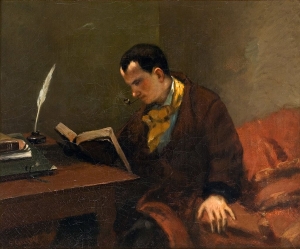
Portrait of Charles Baudelaire by Gustave Courbet (1848).
Fail Again
There is, I would say, no greater pain on this Earth than the agony of abandonment. It is the hardest possible task for any human being to accept graciously that loss, and then to move on. It reflects the instruction of Samuel Beckett in Worstward-Ho: ‘Ever tried. Ever failed. No matter. Try again. Fail again. Fail better.’
Life onwards will be mere monochrome. A travesty in a sense. This is the exact sentiment that lies behind Baudelaire’s Une Charogne. The poet is damned, damned by the Other. And so he will exact his revenge. The poet finds it in the poem, alone, in its very composition.
I would liken this Art to extracting puss. It is an act of catharsis. Again, a very Greek notion. Francis Bacon was also a great fan of the Ancient Greeks, like Baudelaire before him.
I have made the point repeatedly: if there is not a little poison in the well there is no sweetness to the water. I have met all too many high-minded moralists who plead constantly for whatever Other is currently in fashion.
These latter-day saints among the chattering classes are hypocrites, who sanctimoniously bottle up their resentments. I have been a witness to a deformed humanity spurting out in the most toxic manner imaginable. Believe me, it is not a pretty sight! — Hypocrite lecteur, — mon semblable, — mon frère! (— Hypocritish reader, — my fellow, — my brother!)
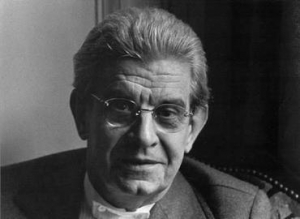
The French psychoanalyst Jacques Lacan.
Broken Word
On the philosophical plane the poet has completely sublimated Friedrich Hegel’s (1871-1831) dialectic of the Master and Servant. To speak in the terms of Baudelaire’s countryman Jacques Lacan (1901-1981) – of a different generation but observing an unaltered humanity – he is killing symbolically the Other in the world of the Real. This for Lacan, as for the poet, is entirely symbolic.
Baudrillard – perhaps the most Baudelairean of late twentieth century French thinkers – was to make of this his unique discourse point. He believed that we had lost our capacity for creating metaphor, so enamoured were we by the hyperreal; that is to say the literality of living we now observe in a mediated age where news is constant, and so ever-present. The Hegelian Now repeated ad infinitum is a poet’s nightmare. This explains why we are living in a period of atrocious, purely confessional poetry. The so- called ‘Spoken Word’ where the Now is Ever Present!
I AM
The spoken word speaks – BEING poetry itself! Such is the utter fallacy.
This is the poetry of idiots.
If you do not kill your enemy symbolically, you will never kill him. Such is the Real. Not reality, but the symbolically Real, which for a poet IS the only reality.
Have you ever considered where Populist monsters spring from?
Take a leaf out of Baudelaire’s black book, write your words in Hate, as much as Love. Be the totality that is You. And you will be a better artist, and Human, for it.
XXIX.- UNE CHAROGNE
Rappelez -vous l’objet que nous vîmes, mon âme, Ce beau matin d’été si doux : Au detour d’un sentier une charogne infâme Sur un lit semé de cailloux,
Les jambes en l’air, comme une femme lubrique, Brûlante et suant les poisons, Ouvrant d’une façon nonchalante et cynique Son ventre plein d’exhalaisons.
Le soleil rayonnait sur cette pourriture, Comme afin de la cuire à point, Et de rendre au centuple à la grande Nature Tout ce qu’ensemble elle avait joint ;
Et le ciel regardait la carcasse superbe Comme une fleur s’épanouir. La puanteur était si forte, que sur l’herbe Vous crûtes vous évanouir.
Les mouches bourdonnaient sur se ventre putride, D’où sortaient de noirs bataillons Des larves, qui coulaient comme un épais liquide Le long de ce vivants haillons.
Tout cela descendait, montait comme un vague, Ou s’élançait en pétillant; On eût dit que le corps, enflé d’un souffle vague, Vivait en se multipliant.
Et ce monde rendait une étrange musique, Comme l’eau courante et le vent, Ou le grain qu’un vanneur d’un mouvement rythmique Agite et tourne dans son van.
Les formes s’effaçaient et n’étaient plus qu’un rêve, Une ébauche lente à venir, Sur la toile oubliée, et que l’artiste achève Seulement par le souvenir.
Derrière les rochers une chienne inquiète Nous regardait d’un oeil fâché, Épiant le moment de reprendre au squelette Le morceau qu’elle avait lâché.
Et pourtant vous serez semblabe à cette ordure, A cette horrible infection, Etoile de mes yeux, soleil de ma nature, Vous, mon ange et ma passion !
Oui ! telle vous serez, ô la reine des graces, Après les derniers sacrements, Quand vous irez, sous l’herbe et les floraisons grasses, Moisir parmi les ossements.
Alors, ô ma beauté ! dites à la vermine Qui vous mangera de baisers, Que j’ai gardé la forme et l’essence divine Des mes amours décomposés !
XXXIX. – The Exquisite Cadaver
Remember the ideal object which you discovered~
That beautiful summer morning, Dear soul:
By way of the path where you found that exquisite
Cadaver lying on a bed of pebbles,
Her legs in the air, like some old tart,
Burning and stewing in poisons,
Her belly slit, almost nonchalantly,
Pouring forth all manner of noxious gasses.
The sun burns down on the decomposing
Body, as if searing a steak,
Rendering back a hundred- fold to Mother Nature,
What she herself had first conjoined.
And the sky looks upon the superb carcass
As it would upon a flower of Evil,
The rigor mortis encroaching to such a point
That the very earth around it has been scorched.
Great Blue Bottles swarm in convoys,
Buzzing out of the gaping cave, Cyclopean…
While a treacle of feasting larvae thickly drip,
Making of the stain a macabre Persian carpet.
The process of decomposition rose before me,
Falling in waves, and which I perceived in a kind of
Pointillism, so that, wave-borne,
The corpse seemed to come alive and multiply before me!
This alternate universe was announced in atonal chords,
And hit me with all the fever of a jungle humidity,
Or, like the sporadic grains, scattered by a winnower,
Whose rhythmic movements spun me in a dervish.
The effaced shapes and forms were as if but a dream
From a preliminary sketch, slow to arrive,
And which the artist, not being able to rely on memory,
Had then to resort to the magnetism of specific photographs.
Behind the rocks an unnerved dog
Looked at us both with a ravenous eye,
Trying to deduce the auspicious minute
When he could rip apart some rotting flesh from the bones.
And yet, You now would appear to be not so dissimilar to this horror,
This putrid infection,
At one time Star de mes yeux,
You my one time, all consuming passion!
Yes! After the last rites have long ago been pronounced upon us,
O You, my once graceful Queen,
When will you now, in your own time,
Wallow with these bones upon the grass?
So, my great Beauty! Whisper then to the vermin
How you will cherish their kisses,
While I guard for eternity this sublime image,
Of all of our decomposing Love.
Feature Image: Charles Baudelaire by Étienne Carjat, 1863
I had second thoughts about boarding a plane to Stockholm to meet Ingmar Bergman twenty-four hours after being diagnosed with a severe bronchitis, possible pneumonia, in the depths of the winter of 2000-2001. But the chance of a rare encounter with the greatest humanist in cinematic history proved irresistible.
Bergman now appears like a colossus among the Lilliputians in our present Netflix-inflected-era of cinema. By the time I met him – Jean-Luc Goddard excepted – he was the last one standing among a golden generation from the dominant art form of the twentieth century. As Gore Vidal put it: ‘The Tenth Muse, as they call the movies in Italy, has driven the other nine right off Parnassus, or off the peak, anyway.’
So, the last of a fine vintage was residing in Stockholm, that Nordic enclave of decency and rigour.
As director (both in film and theatre) and scriptwriter Bergman is almost unsurpassed as a humanist artist in the twentieth century, but he was also unquestionably an autocrat – a quality one might forgive in a director – who could act like a right bastard. Or so it was said. Certainly his relationships with women (of whom in the fashion of a Tudor monarch he married five and divorced four), and the testimony of male colleagues, would suggests he could be quite the unpleasant human being.
When I visited him, I encountered an aged man, but not a paltry thing, devoid of sentimentalism and self-destructive tendencies, notwithstanding unfair attempts to sully his reputation by the Swedish tax authorities in 1976.
This unfortunate episode led to a mental breakdown and a ten-year German exile. In its aftermath, the special prosecutor said that the alleged crime had no legal basis, and that it would be like bringing ‘charges against a person who has stolen his own car, thinking it was someone else’s.’
Revealing, even a society as solidly rational as Sweden’s was inclined to defenestrate its greatest living artist.
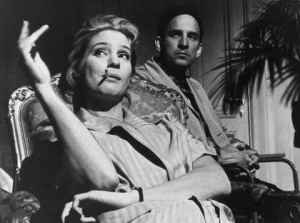
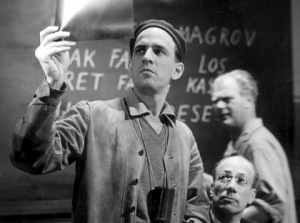
Bergman and actress Ingrid Thulin during the production of The Silence, 1963.
Ladies’ Man
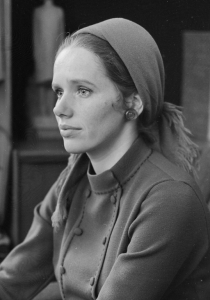
Liv Ullman in 1966.
Bergman seems to have been quite the heartbreaker in his time. Although I think men probably hated him more, which he seemed to be clearly aware of. At least some of his lovers did well out of their association, even if he could be merciless about them.
A long-time lover and mother of one of his nine offspring, the Norwegian actress Liv Ullmann used his fantastic script to create the poweful film ‘Faithless’ (2000). It was more his than her own, and she knew it.
His qualities as a martinet are well attested to. Stellan Skarsgård who worked with him and the Danish director Lars Von Trier said that although he thought the latter was probably mentally ill, he considered him, nonetheless, a great person, unlike ‘that not nice guy’ (a.k.a. bastard) Bergman. Sadly, the qualities of greatness are rarely juxtaposed with niceness.
Christopher Hitchens, excluding his worst failure in not opposing the Bush-Blair invasion of Iraq, claimed before his death that he had nothing to be ashamed of, bar a few unforgivable acts with women. Bergman lived much longer and his genius was undimmed, but there were actions for which many in Sweden will never forgive him. I suspect, however, among males of his generation there was a certain sexual jealousy, as well as professional rivalry.
So a distinct singlemindedness did not make for a ‘man’s man,’ but films suffused with such warmth as ‘Wild Strawberries’ (1957), ‘Fanny and Alexander’ (1982) or Smiles of The Summer Night (1955) hardly sprang from the consciousness of a psychopath.
Ultimately, despite a reputation, like Andrei Tarkovsky, for being a difficult bugger, there is an extraordinary humanity to his oeuvre, evident especially in ‘Fanny and Alexander’, along with a contempt for religious fundamentalism and the deliberate infliction of cruelty. That film is a masterpiece of a kind that acts as a building block to civilisation.
I recall viewing it in the old Lighthouse Cinema on Abbey Street in Dublin on its Irish premier in 1982 along with the late Irish film director Kieran Hickey, a big-hearted gay man. Kieran arrived with a strikingly youthful boyfriend, and another Irish film director of international renown (who will remain nameless) in tow. Afterwards in the nearby Palace Bar that well known director was heard to mutter belligerently “The talented bastard.”
Press conference of Ingmar Bergman at The Venice film festival in 1985.
Stockholm Syndrome
So on that flight to Stockholm I was very concerned about my health, but I determined to go nonetheless having secured the elusive appointment with Bergman at the Swedish Film Institute after a lengthy recitation of how I adored his films.
Mercifully and miraculously, the fever and lung condition ceased to trouble me on arrival, perhaps it was the anti-bacterial effect of temperatures fourteen degrees below, or maybe the adrenalin rush of getting out of Dublin and into a new exciting environment such as Stockholm worked the trick. Either way, the cold expelled the demons from my system.
The following day, after a pleasant tour around the so-called Venice of the North, I was feeling chipper and made my way through the unglamorous state-sponsored housing of Stockholm’s immigrant district to the Institute.
Bergman had allocated a half hour of his time, which ran into over an hour. He was both engaged and culturally astute. James Joyce and Samuel Beckett were discussed, the former dismissed, the latter lauded. Although certainly lacking in avuncularity, I did not encounter a numbing coldness in Bergman. On the contrary I discerned a modulated passion, devoid of sentimentality.
He probably sensed he was on his last lap, but it was several years before his final film ‘Saraband’ in 2003. A last, most wintry achievement.
By that time, he explained, he had retired from cinema due to osteoporosis, as his hands could not operate the cameras. The digital age gave him the freedom to create ‘Saraband’ . So he came out of retirement and created a final work of genius.
It is a rare for an artist to produces a great work of art when over the age of seventy. A select list includes: ‘Ran’ (1985) by Akira Kurosawa, Westward-Ho (1983) by Samuel Beckett, containing the immortal pronouncement: ‘Ever tried. Ever failed. No matter. Try again. Fail again. Fail better’; Saul Bellow’s final novel Ravelstein (2000), and the late flowering of Michelangelo of course. Bergman thus belongs in the Sistine chapel of talent undimmed by age.
I would not describe Bergman as emotionally closed when we met. Unlike Samuel Beckett, who I also encountered, he was far from reluctant about talking about his own work. Though hardly modest, he was at least self-critical. Such modesty would have been misplaced in a genius.
The exterior of the building was used by Ingmar Bergman for the bishop’s house in the film Fanny and Alexander (1982).
Relationship with Religion
After retiring as a director in 1982, his script writing came to the fore, earning him many awards. Thus, a screenplay about his parents’ lives ‘The Best Intentions’ (1992) brought a Palm D’Or to its director Bille August. ‘Faithless’, (2000), featuring a character called Bergman, and directed by Liv Ullman was also much garlanded, as was his theatre work in that period.
Above all else there are clear intellectual and humanistic themes evident in his work, often demonstrated in stark terms, but leavened by a comic touch.
Where to start with evaluating this genius? It is worth recalling that his father was a conservative Lutheran pastor under whose authority the young Ingmar was locked up in dark closets for infractions such as wetting himself.
While father preached away in the pulpit and the congregation prayed, sang, or listened. I devoted my interest to the church’s mysterious world of low arches, thick walls, the smell of eternity, the coloured sunlight quivering above the strangest vegetation of medieval paintings and carved figures on ceilings and walls. There was everything that one’s imagination could desire—angels, saints, dragons, prophets, devils, humans…
He also bridled at the testing and homework required in secondary school, and was thus considered a ‘problem child;’ it is striking how many artists are ‘problematic’ to authority figures.
Resistance to authority figures and a deadening Puritanism is obvious in a film such as ‘The Seventh Seal’ (1957), which includes the extraordinary scene of a life or death chess match between the knight played by Max von Sydown and Death played – pronounced evocatively as Döden in Swedish – played by Bengt Ekerot.
There is also a precious understanding that children should be children in ‘Fanny and Alexander’, and we find an acute understanding of pain and death in ‘Cries and Whispers’ (1972). Then we find a chilling grasp in ‘Persona’ (1966) of the abusive relationships between women and men, and women and women, based on inequality, intellect and bargaining power.
Despite his early rejection of religion, Bergman displayed a love of magic and ritual in many of his films; while the first part of ‘Fanny and Alexander’ features a release of warmth in what we assume to be a cold person, but is not entirely so. The idea of time passing and emotional disappointment is beautifully conveyed in ‘Wild Strawberries’, which scales the achievements of the Japanese director Yasujirō Ozu.
And of course there is merriment in parts of Fanny and ‘The Magic Flute’ (1975), and the awful deceptions of love in ‘Summer with Monika’ (1950); and above all in the brilliant romantic comedy ‘Smiles of a Summer Night’ (1955), which was turned into a Broadway musical ‘A Little Night Music’ by Stephen Sondheim in 1973, and which also inspired Woody Allen’s ‘A Midsummer’s Sex Comedy’ (1982).
Bergman on the set of ‘Wild Strawberries’ in 1957.
Fårö Away
By the time I met Bergman, he was dividing his time between Stockholm, and a more reclusive existence on the island of Fårö in the Baltic Sea.
Dressed in a duffle jacket and an ordinary pair of jeans he set about recommending various sights to visit in Stockholm and its environs, and spoke at length about Beckett and Tarkovsky who he regarded as a natural successor. He considered Liv Ullmann his greatest muse. Perhaps he considered her the one who got away, given the pair never married, despite having a child together, unlike the other mothers to his other children, all of whom he married.
Victor Sjöström
I recall him also waxing lyrical on the performance of Victor Sjöström – then approaching eighty years of age – in ‘Wild Strawberries’ – which must go down as one the best performances by an aged actor in cinematic history.
After the first hour had elapsed it became clear that I would not be graced by his presence any longer. Genius loves company to quote Ray Charles, but on its own terms, and time was precious.
Bergman was undoubtedly a selfish individual, and an egomaniac, but he was, nonetheless, among the greatest humanist artists of all time.
His work has a lot to say to our own muddled time: that children deserve childhood and not religious intrusion; that fundamentalism of all types is dangerous to civilisation; that bullying can occur between and across genders; that death and plague are omnipresent in the game of life, and that our modern age is precarious and an historical consciousness remains important.
Okay to buy your grandchild an ice-cream.
Illegal for them to lick it.
Fine to bake granny
a gleaming fruit cake,
as long as you only email her
a high resolution photo of it.
Okay to give your son or daughter
a bright new football.
Illegal for them to kick it.
Permissible to purchase for yourself
a new set of golf sticks or a tennis racket.
Illegal to hit anything with them
outside the confines of your own
downstairs bathroom.
You can’t have a friend around for a meal
unless both of you have been
fitted with gum shields.
And should you go for a socially distanced walk
with a lover
butt-plugs are now mandatory.
Every living room is its own flat-pack factory
singing the happy song of us,
hammering together our coffins.
I, smudge in the eyescape of others,
As my trowel lodges in mulch,
Palm-sore, snuggle the quiet bulbs
Into the trickling earth which inhumes us,
While these, artfully coned, only swoon
To consecrate a humble bloom.
The sun paints everslant shadows all day
In this great sphere of transition
Centring nowhere, where I witness
Clattering jackdaws, black hands at edges of vision;
A pigeon diving to the ancient oak
Descants over a cloudsong.
I work head down and I do not care
About the crunching crowds along
The path, children puddle-jumping,
All actions an acting in the long
Blind sleep of self, beneath the bronze Scots pines,
Aplomb, adamantine
Sentinels, setiferous fists raised to the hollow blue,
Heedless of a conscious cry.
Hedges patrol, keep watch on me,
Vain and stretched in fisheye,
Where the early frost becomes a forest of drops
On the blinkless, lashy grass.