Blog

  • Covid-19 in Ireland: Landfall

    In August of last year I wrote an article pointing to the impending consequence of the Irish government’s rolling lockdown policy, ‘The Perfect Storm[i] gathering on the horizon over the country. By that I meant a significant second wave of Covid-19 – to hit this winter. I made that prediction based on the following factors:

    An elevated number of potential viral hosts, which is a consequence of suppression of natural-immunity.

    Increased life of the virus in the external environment due to decreased daylight

    Raised levels of social anxiety and subsequent susceptibility to illness/infection

    Continued persistence of the virus at low levels within Irish society
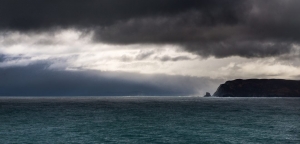
    The ‘storm’ made landfall at the start of January, leading to the imposition of an extreme lockdown for the third time – with children denied their constitutional right to an education –  amid renewed fears the hospital system would be overwhelmed, as many elderly in care homes passed away once again.

    Sadly, this ‘third’ wave actually commenced in week 48 of 2020 (22/11/2020), while the country was still under Level 5 Lockdown restrictions, according to a report by the HSPC.[ii]

    Could additional deaths have been averted if the Taoiseach had not sought ‘a meaningful Christmas’; or if NEPHT’s advice had been followed to the letter – permitting house visits rather than opening restaurants and gastropubs[iii] at the start of December? Based on the HSPC report that seems doubtful. And I would question whether most Irish people would have willingly foregone sociability throughout the depths of winter – there was certainly no political clamour to cancel Christmas – having endured near-constant lockdown since March. But you never know.

    Furthermore, without a Christmas spending spree many indigenous retailers and restaurateurs might have been forced out of business – to the unrestrained joy of Jeff Bezos, Tescos and the rest.

    But in Ireland, as ever, we desperately need someone to blame third time round; anyone other than NPHET that has managed to preserve a reputation for scientific insight despite the damage it is doing to the country. So, instead of questioning the government’s response, youngsters – who may have availed of a brief chink of light to socialize – are scapegoated.

    Other than that we find talk of selfish immigrants returning home over Christmas to see loved ones. And now attacks on those who escaped the overwhelming doom and gloom for a post-Christmas break. Yet, whatever one’s thoughts on the sustainability of flying, it is notable that just 1% of cases since the pandemic began have been traced to travel abroad.

    Lockdown Policy

    In the midst of any crisis scientific arguments compete to establish the best way forward. In the case of Covid-19 in Ireland ‘the argument’ has been remarkably one-sided. Discussions in the media are generally over the severity of lockdowns to be employed – this hitherto unheard of public health intervention with enormous collateral damage, which has somehow been normalised.

    From the outset I have been convinced that the Irish government at the prompting of the WHO – along with most other Western governments – adopted an erroneous approach, based on a flawed epidemiological assessment, which led Leo Varadkar to suggest there could be a staggering 85,000 deaths[iv] in Ireland.

    Virtually alone in Europe, the Swedish health authorities (relatively free of political interference) stood apart, refusing to lockdown in March, 2020. I would argue that this softer approach has been to the benefit of the vast majority of people living there – and may even lead to a lower death toll in the end – compared to the trauma of lockdowns experienced by citizens in most other European countries.

    Notably, during the first wave almost 92% of confirmed deaths from Covid-19 in Ireland were among over sixty-five-year-olds,[v] and when this Irish cohort is compared to Sweden’s considerably older population a very different picture emerges; in contrast to the usual truck of ‘deaths per capita’ and ‘deaths per million.’

    Hats off to the impressively organised states of Norway and Finland, where Covid-19 mortality has remained very low indeed, but vigorous track and trace strategy operating in these countries have proved ineffective elsewhere; even Germany is floundering this winter, having been locked down for months.

    Revealingly, in March 2020 the Director-General of the Norwegian Institute for Public Health Camilla Stoltenberg[vi] recommended that her government should keep schools open – as in Sweden – and was advocating last June for a softer approach in the likely event of a second wave.

    Now, as the death toll from Covid-19 in Ireland steadily converges with Sweden’s – especially when adjusted for the relative age of each population – it remains to be seen whether much-vaunted, but still experimental, vaccines will significantly alter the respective death tolls.

    I maintain that a policy of keeping the Irish population under rolling lockdowns until the whole population is vaccinated will have a worse impact on the nation’s long-term health than any mortality or morbidity that may be avoided.

    Zero Covid Utopianism

    The frankly bizarre ‘option’ of Zero Covid-19 that has been grasped by some on the left, and the right, in Ireland is a form of Utopianism. It ignores the virtual impossibility of eradicating an aerosol, sub-microscopic pathogen such as Covid-19 from Ireland. Moreover, we remain one of the most globalized societies in the world with over half-a-million foreign born resident in the country[vii] and an Irish-born diaspora of three million;[viii] rely on international trade for most commodities; besides having a porous border to the North.

    Moreover, New Zealand and Australia are currently enjoying summer, when respiratory viruses retreat. This seasonal effect is enhanced by a depleted ozone layer over the Southern Hemisphere – causing the world’s highest rate of skin cancers[ix] – which elevates the level of UV light that destroys viruses. Both countries are also insulated from the rest of the world by vast oceans and an uninhabited landmass. Even still, outbreaks occurred in New Zealand and Melbourne last winter, prompting draconian responses.

    Notably, however, the maximum number of cases that Melbourne – with a population almost the size of Ireland’s – experienced in a single day was just seven hundred, and it required an extreme 112-day lockdown[x] – and/or the arrival of spring before an apparent elimination. In contrast, case numbers in Ireland have exceeded eight thousand in a single day.
    Covid-19: Southern Dreaming

    A Zero-Covid approach assumes the island of Ireland is sealed hermetically. Good luck with telling the DUP that they have to follow the rules of the South! And ‘success’ would presumably give way to a permanent state of siege against the viral dangers posed by the outside world.

    At this point even New Zealand’s Prime Minister Jacinda Arden has had enough, acknowledging the long-term impossibility of pursuing Zero Covid she recently said: ‘Our goal has to be though, to get the management of Covid-19 to a similar place as we do seasonally, with the flu. It won’t be a disease that we will see simply disappear after one round of vaccine.’[xi]

    Comparing Ireland to East Asian countries may also be inappropriate as, Wuhan apart, no single country in that region has experienced a significant outbreak. Notably, Japan, which has avoided locking down throughout the crisis experienced forty times as many flu and pneumonia deaths during that period. This suggests other factors – East Asia has been the geographic origin of several modern coronavirus epidemics – may be inhibiting the spread of Covid-19 there.[xii]

    Yet this message has not trickled either left or downwards into popular opinion as the Irish Times continues to print articles in support of ‘the plan.[xiii]

    ‘Zero Covid’ is as much a vote-winner, as a zero tolerance for crime or any other virtuous objective, but it’s political claptrap from an taxidermized left and a neoconservative right, furnished by scientists that seemingly have no conception of biological realities.

    Reality Bites

    The success of any institution might be summed up by the notion that it is only as good as its ability to predict the future. Throughout human history we have had two powerful methods of prediction: science and religion. If not religion, we might define this in terms of ‘faith,’ or an ‘unscientific’ belief system of some kind or other.

    If the Romans, the Egyptians, the Spartans, or the Native Americans, had done a ‘better’ job predicting the future, the world would be a different place. Thus, the success or persistence of any individual, nation, or civilisation, is based on an ability to reliably predict the future. Our faith in science is strengthened solely by this condition, and undermined when predictions go awry.
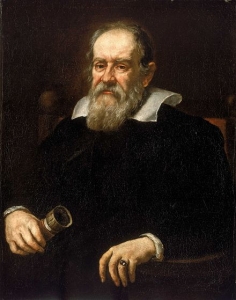
    Galileo Galilei, 1636 portrait by Justus Sustermans.

    Galileo’s prognostications in respect of the Earth and the Sun led him into conflict with the dominant powers of his day. The accuracy of his predictions disturbed the established cosmic order, as any heresy does. The predictions of Einstein had a similar effect on Newtonian Physics, and now Quantum Mechanics has become the sacred cow. Final judgements on the success or otherwise of policies are, of course, made through the prism of hindsight.

    Two Schools of Thought

    At present around the world there are two broad scientific schools[xiv] of thought in respect of how to respond to Covid-19. On one side there is a dominant view: that we are in the midst of a once-in-a-lifetime crisis, where humanity is dealing with a virus that will kill, and perhaps permanently incapacitate, many millions more than it has already done; and that the correct response for any government should be to impose a lockdown and mandate masks until the ‘scientific cavalry’ arrive, carrying their novel genetic vaccinations as shields to save the day.

    On the other side there are the conspiracy theorists, Covid-deniers, and a minority of scientists who consider most most masks in use to be ineffective, and who argue that restrictions and lockdowns cause more harm than good. These scientists have advocated protecting the vulnerable and permitting an equilibrium of natural immunity to emerge within the non-vulnerable majority as the least harmful way forward.

    The question for ordinary people and politicians, then, is where does the truth lie? Or, more accurately, who is correctly predicting the future?

    When the dust settles in a few years, perhaps we’ll see that the truth lies somewhere in the middle. An appreciation of a middle way, or synthesis, is evident in Sweden’s chief epidemiologist Anders Tegnell’s acknowledgement in June that mistakes were made in the first wave.[xv]  Such concessions to human fallibility seem to be the preserve of Scandinavian leaders. This may explain why increased restrictions have been introduced in Sweden during their second wave, though its government has refrained from imposing a lockdown, and the emphasis is still on personal responsibility.

    By the start of February, without a lockdown, Sweden appears to be sitting pretty with the death toll falling precipitously during the month of January, suggesting a herd immunity threshold may have been reached.

    [An earlier version of this article read: “surveys indicate that at least forty percent of the [Swedish] population now have antibodies to the virus,[xvi]” We have sought corroboration from Sebastian Rushworth MD @sebrushworth, having been advised that this claim is unreliable]

    Likewise, there are positive signs that India has now reached a herd immunity threshold,[xviii] without recourse to vaccines.

    Benefit of Hindsight

    Last April I resigned my position on the Irish Medical Council to the shock of family, friends and former colleagues. I did so because I believed a catastrophe was immanent, and that hundreds of nursing home residents would die as a consequence of political ineptitude and mass hysteria. As it transpired, 62% of deaths in Ireland occurred in this setting during the first wave of the pandemic, the second highest proportion in the world.[xix]

    I take no comfort that my fears were realised, and have since also resigned as a contracted employee of the HSE. I could no longer, in good conscience, enforce guidelines upon staff and patients I do not consider either efficacious or ethical.

    I would argue that a failure to conduct a proper inquiry into the decision-making that led to this carnage has led to avoidable mortality in this second wave in the care home setting. Any enquiry would surely have highlighted the inadequacy of safety protocols in these settings, and the absence of real expertise on NPHET.

    Before my small Covid-19 rebellion, in March 2020, I circulated a paper on the response to Covid called The Mismanagement of Covid-19 in Ireland. Its premise was (and remains) quite simple: that Covid-19 is a viral illness with a mortality confined to a relatively small and manageable subset of our population.[xx]

    I argued that Ireland’s gross demographic – the youngest population in Europe – is (and was) the key to navigating a safe path through the crisis. With a relatively low population of over sixty-fives – approximately 650,000 – this amounted to a manageable population of those truly vulnerable.

    I also noted how, unlike during influenza pandemics of the past, children and young adults were not dying of this disease, and that the vast majority of adults without serious underlying conditions were also relatively (if not entirely) immune to significant consequence.

    Long Covid

    A current cause for concern with Covid-19, which may be deterring our governments from permitting younger people from resuming their lives is so-called ‘Long Covid,’ or Covid ‘Long Haulers’ as this is referred to in the U.S..

    This is a condition that appears to fit within the category of a post-viral syndrome, or post-viral fatigue;[xxi] which is ‘a sense of tiredness and weakness that lingers after a person has fought off a viral infection. It can arise even after common infections, such as the flu.’

    In October one of the leading advocates for Long Covid patients, and a firm advocate of draconian policies, Oxford University’s Professor Trish Greenhalgh clarified that Long Covid is only very rarely a long-term affliction:

    The reviews we’ve done seem to suggest that whilst a tiny minority of people, perhaps one per cent of everyone who gets Covid-19, are still ill six months later, and whilst about a third of people aren’t better at three weeks, most people whose condition drags on are going to get better, slowly but steadily, between three weeks and three months.[xxii]

    But a paper from 2017 gives an idea of the pre-existing scale of chronic and post-viral fatigue syndrome in the U.K.:

    Fatigue is a symptom of a number of diseases—anaemia, depression, chronic infection, cancer, autoimmune disorders and thyroid disorders among them. But no apparent cause can be found for a state of extreme and disabling exhaustion that has acquired a number of names, the most generally accepted worldwide being chronic fatigue syndrome (CFS). In the UK, where it is (often incorrectly) known as ME (myalgic encephalomyelitis), 150 000 people are said to be affected. Other terms used for the condition are postviral fatigue syndrome (PVFS) and chronic fatigue and immune dysfunction syndrome (CFIDS).[xxiii]

    So, we can conclude that Long Covid is hardly a new phenomenon, and while the pandemic is likely to create an additional burden on health services, the extent of the problem needs to be put in context: perhaps one percent of sufferers are still ill after six months.

    Moreover, the impact of Covid-19 is significant heightened by environmental factors such as air quality[xxiv] and poor nutrition. I would argue, therefore, that the threat of Long Covid is insufficient grounds for closing universities and denying young people the chance of a social life beyond walking the block.

    Indeed, the obesity pandemic that leads to a wide range of morbidities is a far greater challenge to this nation’s health, and a crucial indicator of an individual’s risk of severe case of Covid-19 .[xxv] Yet there has been no serious attempt since the Covid-19 pandemic began to address how Ireland fails to adopt international best practice for addressing obesity.[xxvi]

    Seasonality

    In my March paper I also observed that Covid-19 is a member of the coronavirus family responsible for many common colds,[xxvii] and that such viruses are seasonal, in that they are eliminated especially by increasing UV light (and the population’s tendency to retreat indoors). These were hardly earth-shattering revelations, and have been noted by many other doctors and scientists around the globe.

    I also compared the population of over sixty-five-year-olds in Ireland, to the equivalent cohort in the U.K., noting there are roughly twenty-times the number of over sixty-five in the UK (while the overall population is less than ten times that number); so I assumed U.K. mortality would be in the region of twenty times that of Ireland’s.

    In this respect, Ireland has performed significantly better than the U.K., but other factors such as population density and an elevated risk of severe disease among BAME groups[xxviii], may account for the  higher relative death toll there. It should also be emphasised that the U.K. has almost the highest rate of mortality in the world.
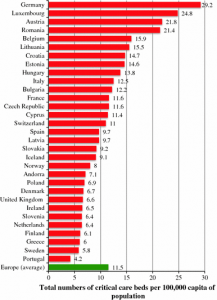
    ICU Capacity at the beginning of the pandemic.

    Like many other doctors and scientists, I argued that in the absence of a proven cure or vaccine at that time for Covid-19, humanity is (or was) very much operating at the whim of nature. Thus, without a cure we were (and to a certain extent still are) subjected to natural forces, as I assumed this virus would spread widely through the population. All we could do, then, was ‘flatten the curve,’ protect the vulnerable, and await a safe vaccine.

    At the outset of the crisis that was the mantra behind which the public united. Flattening the curve would reduce the rate at which the vulnerable would present for treatments in hospitals. This would protect the system form being overwhelmed, bringing an increased chance of survival for those badly afflicted.

    ‘Protect the NHS’ from collapse was a similar cry across the water. That made sense at the outset of the crisis. The reiteration of these ‘priorities’ might now illicit a yawn, as our national health authorities did not use the flattened time and space to increase ICU capacity substantially, which brings the ‘necessity’ of recurring lockdowns.

    Hysteria

    Since March of last year events have taken a strange turn. With fear and hysteria at the helm politicians lost their nerves. The mantra shifted from ‘flatten the curve’, to ‘protect everyone from this deadly disease,’ despite it becoming clear that the infection fatality rate (IFR) is considerably lower than the 0.9% assumed initially. Now a paper on the WHO website states that the infection fatality rate for the disease is less than 0.2% ‘in most locations.’[xxix]

    Perversely, children have become the focus of inordinate efforts; locked indoors, locked out of school and forced into wearing masks. We have insisted upon protecting them from a disease that has not caused a single child death in Ireland throughout the entire crisis.[xxx]

    Troublingly, when Covid-19 panic gripped the nation, politicians and mainstream media listened only to the scientific ‘authorities’ that fed the hysteria and justified everything from political incompetence to profligate expenditure. Hospitals were emptied in preparation for an approaching ‘tsunami’ of illness, as tens of thousands of deaths were incorrectly predicted by politicians and esteemed professors, all of whom continue to profess, and have even grown in esteem.

    Covid patients were dumped from hospitals into Nursing Homes, and tests were withheld from residents lest they run short for the healthy-hysterical. The vulnerable were not only abandoned, but too many of them were crushed in the stampede.

    Thus, there is the shocking case of a resident in a Meath care home discovered to have had a maggot-infested a wound.[xxxi] What began as a campaign to protect the vulnerable, had turned into nothing short of a manslaughter machine.

    At the End of the Day

    The natural endpoint for viral infection in respect of many viral pathogens is of course ‘herd immunity.’ This is the point where a sufficient proportion of a population have been exposed to and develop full or partial immunity to a particular pathogen, such that its rate of reproduction is below 1 most of the time.

    With insufficient hosts, a virus can no longer spread easily. This is not full elimination but an endemic equilibrium within the population, with a certain annual death toll tolerated – such as is the case with influenza, which kills up to a thousand people a year in Ireland, despite the availability of a vaccine.

    This natural evolution, or pathogenesis, is also helped along by the seasonal shift from spring to summer. Increasing daylight reduces the level of viral particles, and people spend more time out of doors, or ventilate their living spaces in warmer conditions. This is how nature brings an end to seasonal colds and flus. Yet curiously this basic piece of natural science was largely ignored in March. Talk of UV light became highly politicised and thence poisoned.

    The Swedes

    Sweden provided a template for a country acting within the bounds of common sense and science. From the outset health authorities there endeavoured to protect a vulnerable aged cohort, leading to a natural-immunity developing within the population. In permitting this to occur they also took the precaution of doubling ICU capacity[xxxii] which, like Ireland’s, had been among the lowest in Europe when the pandemic began.

    Comparison between Sweden and Ireland cannot be made on a like-for-like basis, any more than the Irish can be compared to any other national group; however, some relevant comparisons can be drawn in respect of population demographics.

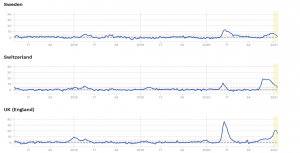
    Sweden has twice Ireland’s population, but 3.2 times the number of over sixty-five-years-olds. Ireland has not quite experienced just over a third of Sweden’s mortality (11,815 v 3,418); but while Ireland’s death rate from Covid-19 has been steadily increasing over the month of January, Sweden’s has flattened to point where, according to the WHO, Sweden’s death toll has been in single figures since the start of February, while Ireland has been experiencing daily deaths over one hundred.
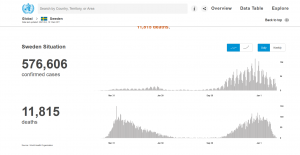
    Source: WHO

    There may be a further uptick in Covid deaths in Sweden once schools reopen – and even a third wave – but the hopeful signs are that the country is now reaching a herd immunity threshold – one that has brought less suffering overall when compared to other jurisdictions.

    A similar comparison can be drawn between Sweden and most other European states, implying, in most situations, that mortality is not significantly reduced by lockdown policies. Yet invariably whenever one reads about Sweden in mainstream Irish media[xxxiii] comparisons are only drawn with best-in-class Scandinavian neighbours, where lockdowns have also been, for the most part, avoided.

    Lockdowns are likely to increase mortality through missed cancer screenings, dysfunctional health services, serious mental health impacts, besides the ‘shadow-pandemic’ of domestic violence that has occurred under lockdown.

    The writing on the wall?

    What of the good people on the opposite side of the Swedish argument? It is fair to say that lockdowns can flatten the curve. This is apparent if we compare mortality graphs on the Euromomo website that tracks excess deaths across Europe. It shows that Sweden did not see the same kind of spike on their graph of mortality during the first wave as in other countries that locked down, but experienced a steady decline, which in July led the New York Times to state prematurely that ‘Sweden Has Become the World’s Cautionary Tale[xxxiv]

    Source: Euromomo.

    The question is whether the short-term benefits of lockdowns in terms of averted-deaths are worth the cost? Or, were lockdowns necessary, and will they ultimately translate into lives being saved rather than simply deferring deaths? Perhaps the truth lies in the middle of these arguments but I know which side I lean.

    Lockdowns do not prevent deaths, but slow the rate of infection and mortality. They can only ease the burden on hospital or tertiary care services. The purpose of lockdown should be to insure that the sick can access the best treatment available, and should not be ‘a primary means of controlling the virus[xxxv] according to leading authorities in the WHO, as we are experiencing in Ireland.

    Although the mortality figures in Ireland still lag behind Sweden’s I suspect this is deferred mortality and does not represent patients who have been cured or saved. The curve has been flattened. Thus far, lockdown policies have had the beneficial effect of decreasing mortality by less than 20% compared to Sweden’s when adjusted for our respective age profiles. In my view, however, what may simply be deferred mortality, cannot justify the burden of lockdowns on the wider population.

    Only when the crisis has passed, and with the benefit of hindsight, will it be possible to determine if the Swedes broadly got things right. Although, it is more appropriate in the context of a disease that has killed thousands of people – and caused suffering to most of the rest of the population – to state that some countries will have managed it better than others. For sure, no one will have got everything ‘right’.

    Assuming vaccines do not represent a panacea, if it transpires that most Irish mortality is confined to the nursing home sector, and that all lockdowns accomplish is to preserve a larger number of potential hosts for successive seasonal resurgences then the pandemic will have been a more painful and long-running saga in Ireland than it might otherwise have been.

    [i] Marcus de Brun, ‘The Perfect Storm’, Cassandra Voices, August 19th, 2020, https://cassandravoices.com/science-environment/covid-19-the-perfect-storm/

    [ii] Epidemiology of COVID-19Outbreaks/Clustersin IrelandWeekly Report Prepared by HPSC on25thJanuary 2021, https://www.hpsc.ie/a-z/respiratory/coronavirus/novelcoronavirus/surveillance/covid-19outbreaksclustersinireland/COVID-19%20Weekly%20Outbreak%20Report_Week032021_25012021_WebVersion_final.pdf

    [iii] Digital Desk Staff, ‘Opening hospitality will mean limiting Christmas gatherings, Nphet warns’, November 26th, 2020, Extra.ie, https://www.breakingnews.ie/ireland/nphet-strongly-opposed-to-parts-of-governments-lockdown-exit-plan-1042387.html

    [iv] ‘Up to 85,000 Irish people could die from coronavirus in worst-case scenario, Taoiseach indicates, as three more diagnosed’ John Downing, Eilish O’Regan and Gabija Gataveckaite, Irish Independent, March 9th, 2020, https://www.independent.ie/world-news/coronavirus/up-to-85000-irish-people-could-die-from-coronavirus-in-worst-case-scenario-taoiseach-indicates-as-three-more-diagnosed-39029363.html

    [v] COVID-19 Deaths and Cases, Central Statistics Office, https://www.cso.ie/en/releasesandpublications/br/b-cdc/covid-19deathsandcases/

    [vi] ‘Norwegian health chief: we advised against closing schools’, 10 June, 2020, Unherd, https://unherd.com/thepost/norwegian-health-chief-we-advised-against-closing-schools/

    [vii] ‘Census of Population 2016 – Profile 7 Migration and Diversity’, https://www.cso.ie/en/releasesandpublications/ep/p-cp7md/p7md/p7anii/

    [viii] Ciara Kenny, ‘ The global Irish: Where do they live?’, February 4th, 2015, Irish Times, https://www.irishtimes.com/life-and-style/generation-emigration/the-global-irish-where-do-they-live-1.2089347?mode=sample&auth-failed=1&pw-origin=https%3A%2F%2Fwww.irishtimes.com%2Flife-and-style%2Fgeneration-emigration%2Fthe-global-irish-where-do-they-live-1.2089347

    [ix] American Institute of Cancer Research, Skin cancer statistics, https://www.wcrf.org/dietandcancer/cancer-trends/skin-cancer-statistics

    [x] Phil Mercer, ‘Covid: Melbourne’s hard-won success after a marathon lockdown’, 26th of October, BBC, https://www.bbc.com/news/world-australia-54654646

    [xi] Luke Malpass, ‘Jacinda Ardern declares 2021 ‘the year of the vaccine’’, January 21st, 2021, Stuff, https://www.stuff.co.nz/national/politics/124012148/jacinda-ardern-declares-2021-the-year-of-the-vaccine

    [xii] Ramesh Thakur, ‘The West should envy Japan’s COVID-19 response’ January 10th, 2021, Japan Times,  https://www.japantimes.co.jp/opinion/2021/01/10/commentary/japan-commentary/west-japan-coronavirus-response/

    [xiii] Gabriel Scally: It is essential Ireland tightens borders in fight against Covid-19, January 30th, 2020, Irish Times, https://www.irishtimes.com/opinion/gabriel-scally-it-is-essential-ireland-tightens-borders-in-fight-against-covid-19-1.4471283

    [xiv] Sarah Bosley, ‘Covid UK: scientists at loggerheads over approach to new restrictions’, September 22nd, 2020, The Guardian, https://www.theguardian.com/science/2020/sep/22/scientists-disagree-over-targeted-versus-nationwide-measures-to-tackle-covid

    [xv] Rafaela Lindeberg, ‘Man Behind Sweden’s Controversial Virus Strategy Admits Mistakes’, Bloomberg, June 3rd, 2020,  https://www.bloomberg.com/news/articles/2020-06-03/man-behind-sweden-s-virus-strategy-says-he-got-some-things-wrong

    [xvi] Sebastian Rushworth M.D., ‘Here’s a graph they don’t want you to see’, 25th of January, 2021, https://sebastianrushworth.com/2021/01/25/heres-a-graph-they-dont-want-you-to-see/

    [xvii] Sheena Cruickshank  ‘A new study suggests coronavirus antibodies fade over time – but how concerned should we be?’ October 27th, 2020, The Conversation, https://theconversation.com/a-new-study-suggests-coronavirus-antibodies-fade-over-time-but-how-concerned-should-we-be-148957

    [xviii] Amy Kazmin, ‘India’s tumbling Covid cases raises question: Is the pandemic burning itself out?’ February 1st, 2021, Irish Times, https://www.irishtimes.com/news/world/asia-pacific/india-s-tumbling-covid-cases-raises-question-is-the-pandemic-burning-itself-out-1.4472406?mode=amp

    [xix] Fergal Bowers, ‘High percentage of virus deaths in Ireland’s care homes highlighted in comparison report

    [xx] Mismanagement of Covid in Ireland’ May 27th, RTE, https://www.rte.ie/news/coronavirus/2020/0527/1143036-covid-deaths-ireland/

    [xxi] ‘What to know about post-viral syndrome’ Medical News Today, https://www.medicalnewstoday.com/articles/326619

    [xxii] Jennifer Rigby, ‘Why long Covid can be really grim, but is rarer than you think’, October 3rd, 2020 The Telegraph, https://www.telegraph.co.uk/global-health/science-and-disease/long-covid-can-really-grim-rarer-think/

    [xxiii] Postviral Fatigue Syndrome, Science Direct, https://www.sciencedirect.com/topics/medicine-and-dentistry/postviral-fatigue-syndrome

    [xxiv] Matt Cole et al, ‘Air pollution exposure linked to higher COVID-19 cases and deaths – new study’, July 13th, 2020, The Conversation, https://theconversation.com/air-pollution-exposure-linked-to-higher-covid-19-cases-and-deaths-new-study-141620

    [xxv] Meredith Wadman, ‘Why COVID-19 is more deadly in people with obesity—even if they’re young’, September 8th, 2020, https://www.sciencemag.org/news/2020/09/why-covid-19-more-deadly-people-obesity-even-if-theyre-young

    [xxvi] Shauna Bowers, ‘Irish policies to tackle obesity ‘fall behind international best practice’ – report’, November 9th, 2020, Irish Times, https://www.irishtimes.com/news/health/irish-policies-to-tackle-obesity-fall-behind-international-best-practice-report-1.4403921?mode=sample&auth-failed=1&pw-origin=https%3A%2F%2Fwww.irishtimes.com%2Fnews%2Fhealth%2Firish-policies-to-tackle-obesity-fall-behind-international-best-practice-report-1.4403921

    [xxvii] Anthony King, ‘Coronavirus family now a prime suspect in previous pandemics,’ February 4th, 2020, Irish Times, https://www.irishtimes.com/news/science/coronavirus-family-now-a-prime-suspect-in-previous-pandemics-1.4463053

    [xxviii] Tom Kirby, ‘Evidence mounts on the disproportionate effect of COVID-19 on ethnic minorities’, The Lancet, May 8th, 2020, https://www.thelancet.com/journals/lanres/article/PIIS2213-2600(20)30228-9/fulltext

    [xxix] Infection fatality rate of COVID-19 inferred from seroprevalence data

    John P A Ioannidis, WHO, September 13th, 2020, https://www.who.int/bulletin/volumes/99/1/20-265892/en/

    [xxx] (According to the CSO there have been 20,402 confirmed cases of Covid amongst the age group 0-24yrs, during the period from Feb 2020 to December 2020 and not a single recorded death in Ireland. https://www.cso.ie/en/releasesandpublications/br/b-cdc/covid-19deathsandcasesseries18/

    [xxxi] Simon Carswell, ‘Widow ‘outraged’ by footage of husband’s facial wound’, August 26th, 2020, Irish Times, https://www.irishtimes.com/news/health/widow-outraged-by-footage-of-husband-s-facial-wound-1.4338831?mode=sample&auth-failed=1&pw-origin=https%3A%2F%2Fwww.irishtimes.com%2Fnews%2Fhealth%2Fwidow-outraged-by-footage-of-husband-s-facial-wound-1.4338831

    [xxxii] Emma Lofgren, ‘’The biggest challenge of our time’: How Sweden doubled intensive care capacity amid Covid-19 pandemic’, June 23rd, 2020, The Local, https://www.thelocal.com/20200623/how-sweden-doubled-intensive-care-capacity-to-treat-coronavirus-patients

    [xxxiii] Suzanne Cahill, ‘Coronavirus lockdowns are still a step too far for Sweden’, February 3rd, 2021, Irish Times,  https://www.irishtimes.com/opinion/coronavirus-lockdowns-are-still-a-step-too-far-for-sweden-1.4473119?mode=sample&auth-failed=1&pw-origin=https%3A%2F%2Fwww.irishtimes.com%2Fopinion%2Fcoronavirus-lockdowns-are-still-a-step-too-far-for-sweden-1.4473119

    [xxxiv] https://www.nytimes.com/2020/07/07/business/sweden-economy-coronavirus.html

    [xxxv] Michelle Doyle, ‘WHO doctor says lockdowns should not be main coronavirus defence’, October 12th, 2020, ABC, https://www.abc.net.au/news/2020-10-12/world-health-organization-coronavirus-lockdown-advice/12753688
  • Tales from a Fourth Industrial Revolution

    Back to the Future in search of ‘Green’

    Conversations, perceptions and priorities change over time. About a decade ago, most energy and ‘green’ talks highlighted examples such as Brooklyn Bridge Park, once the greenest destination in New York city; Solar Power Towers in California; planning for the renewable energy ‘supergrid’ in Europe; the U.S. Navy’s plans for a Green Fleet; or Los Angeles’s centrally planned mechanism for ending the use of coal by 2020.

    Moreover, where previously to be ‘green’ was associated with activism, now it’s considered more in terms of economy, business and investment.

    This explains in large part the recent emergence of triple-helix connection between research, industry and government, and a green emphasis found in university curricula and other educational institutions. This draws on global evidence of the effectiveness of renewables in transforming rural livelihoods, the nature of community development, and addressing the energy-poverty nexus.

    We are now witnessing a steady increase in the proportion of renewable energy sources; this is a gradual transition from mere ‘additives’ to ‘alternatives’ within the total energy mix in rural areas of developing nations.

    About two-thirds of the world’s poorest people live in rural areas. Among the numerous factors that lead to the eradication of rural poverty are increased access to goods, services and information, requiring increased participation from institutions at all levels.

    The alleviation of poverty is hindered by two inter-linked phenomena: a lack of access to improved energy services and worsening environmental shocks due to climate change – which severely affects the vulnerable, poor, most of whom live in rural areas. Mitigating climate change, increasing energy access, and alleviating rural poverty are thoroughly entwined; this overlap leads to an energy-poverty-climate nexus.

    Improved access to energy services alone will not eradicate poverty, but it does create immediate and visible impacts. Up to 1.5 billion people still live without access to electricity, another billion only have access to unreliable electricity, and close to half of the global population depends on traditional biomass fuels for cooking and heating. Energy-poverty results in unmet basic needs and depressed economic and educational opportunities that particularly affect women, children, and minorities.

    Electricity catalyses rural economic activity and increases the quality of services available to meet basic business and domestic needs through improved lighting, labour-saving devices, and access to information via TV, radio and cell phones. The provision of high-quality public lighting can increase security and improve delivery of health and education services. Improving the delivery of affordable, reliable energy services to rural communities is critical for helping them develop human and economic capacity to adapt in the face of a changing climate.

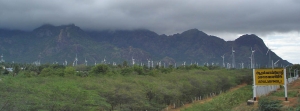
    The largest wind farm of India in Muppandal, Tamil Nadu

    Sustainable Development and Energy Access

    The umbrella term ‘sustainable development’, can be viewed as a water tank having two-leaks, one leak being ‘poverty’ and the other ‘environmental degradation’. Both these challenges, i.e. the leaks, need to be dealt with simultaneously. In modern times, no country has managed to substantially reduce poverty without greatly increasing the use of energy, or utilising efficient forms of energy and/or energy services. Without ensuring minimum access to energy services for a significant proportion of the population, countries have been unable to move beyond a subsistence economy.

    However, merely introducing cheap, easily available ‘green’ energy is insufficient. Its utility lies in facilitating human development. The energy sector has strong links with poverty reduction through health, education, gender, and the environment.

    One of the most important factors in sustainable development is a fully sustainable supply of energy resources. About one-third of the world burns wood and other biomass for cooking, heating and lighting, accounting for more than 13% of global energy consumption. In rural areas conventional cooking fuels, burned in traditional cooking stoves, emit toxic emissions resulting in more than 1.8 million premature deaths per year, according to WHO estimates, with children younger than five accounting for half of all fatalities.

    A secure supply of energy it thus an essential requirement for development within a society. In the long term, moreover, a sustainable supply of energy resources should be available at a reasonable cost, and without negative societal and environmental impacts, assuming an effective and efficient utilisation of energy resources.

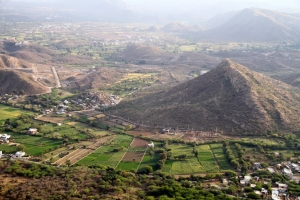
    A typical rural peasant Indian village in Rajasthan, India.

    Sustainable Energy Development Strategies and Renewable Energy

    Sustainable Energy Development Strategies typically involve three major technological changes: energy savings on the demand side; efficiency improvements in the energy production; and replacement of fossil fuels with various sources of renewable energy. This is important because, energy savings and energy efficiency are critical components for achieving sustainable development, as suggested by several researchers. In addition, however, efficient renewable energy technology management is also required.

    While energy saving and energy efficiency are two issues that public policymakers consider when formulating a strategy to maximise available energy potential, management of renewable energy technologies involves a wider variety of private and public actors along with the participation of users at the grassroots level.

    India, in particular, has seen how the public-private-people partnership mechanism works for renewable energy technology applications in rural areas. The public and private sector work together to bring solar energy technologies to rural users, working closely with NGOs, VOs, suppliers, universities and think-tanks to create a win-win for all stakeholders involved.

    Additionally, evidence show how renewable energy-based entrepreneurship has transformed rural lives and rural development management. The use of solar lantern, lamps, irrigation pumps, home lighting systems, amongst other innovations, have proved useful for businesses and families in many rural areas. This not only raises income levels, but also brings the community closer together, thereby generating social capital through increased connectivity and collaboration.

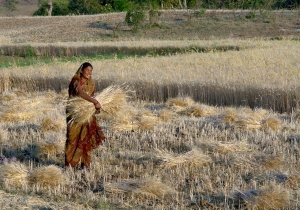
    Woman harvesting wheat, Raisen district, Madhya Pradesh, India.

    Renewable Energy and Rural Livelihoods

    From alternative job creation in rural households to electrification of schools for children’s education, along with uses in the health service and maintaining biodiversity, renewable energy promises a wide range of development options to rural areas. In rural India, RETs provide lighting to thousands of remote villages that cannot access electricity through grid extension. This provides clean energy to rural households in the so-called electrified villages. It can also supplement electricity in households with poor electricity supply (ranging between 5 to 8 hours per day) through grid tail-end injection systems (which have increased costs and are difficult to adopt in households without an initial induction).

    There are huge market development possibilities wherever the government establishes renewable energy markets for rural population. Central governments in developing nations (especially in emerging BRICs) can target key provinces for the development of specific renewable energy option, and also explore and encourage potential government-industry partnerships to spur market technology.

    Adoption of effective policies – the building of an institutional framework to support renewable energy development; the establishment of effective financial mechanisms to provide capital for renewable energy development; the implementation of market transformation strategies to encourage renewable energy development; and the enhancement of international co-operation to promote renewable energy technologies; will together create the necessary and much anticipated level playing field, essential to enabling renewable energy technologies to compete with conventional energy options.

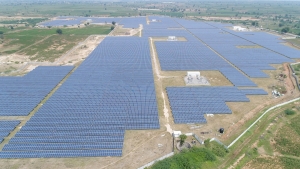
    Solar Power Plant Telangana II in state of Telangana, India.

    Solar Energy-based Entrepreneurship in South Asia

    The South Asian experience with Renewable Energy Technologies (RETs) and its dissemination to low income, rural households, along with developing solar energy-based entrepreneurial opportunities, have been highly successful. Initially, it was a success story from Bangladesh, which claimed the title of ‘solar nation’ due to its proactive rural development plans, tied to alternative energy use. This in turn inspired neighbouring countries.

    However, research shows that India started its work with RETs well before most other nations (East or East), led in particular by organisations that have built or supported solar energy entrepreneurs, which have been instrumental in transforming rural livelihoods and wellbeing, using solar energy technologies.

    The penetration of RETs in the form of Solar Home Systems (SHS) in rural households and the use of that technology for creating micro enterprises has been widely cited as a successful case of solar RE contributing to rural development. Households who received the SHS used the technology to start micro-enterprises from home by making and selling different home-made handicraft goods e.g. jute and silk products.

    These micro-enterprises, particularly those run and managed by women, also hired and actively engaged workers from the local community.

    In addition to SHS, there are entrepreneurs who have started energy-based businesses in rural areas using solar lanterns, solar mobile charging stations, solar headlamps, amongst many other forms of solar technologies. Rural women are often the ones leading the way in assembling solar accessories in village-based technology centres. Solar engineers are increasingly employed in designing SHS, working in battery factories, and other accessory-related businesses.

    India International Trade Fair, Pragati Maidan, in New Delhi on November 15, 2006.

    Who is a Solar Energy Entrepreneur?

    In this context, a ‘Solar Entrepreneur is someone who would do one or a combination of the following – buy, rent, borrow, sell, maintain, service, manufacture or install – any or a mix of solar energy technologies for setting up an income-generating energy-based enterprise/s.’

    Examples of these technologies include solar home lighting systems, solar lanterns, solar crop dryers, solar kilns, solar wax melters, solar cookers, solar lamps and headlamps, solar irrigation pumps, solar mobile phone chargers, solar vans, and short-haul transport mobility vans amongst many others.

    The applications and multi-faceted use of these technologies are visible in both rural and urban areas. A wide range of local-level applications, however, is largely seen in rural areas where communities are involved in the process of use and expansion of these technologies amidst a growing realisation that solar energy technologies are not merely ‘additives’ or ‘add-on’ energy options, but an ‘asset.’

    Research shows that solar energy entrepreneurs typically develop community-based initiatives, and are drawn from both sexes, work with various institutions and different partnership arrangements. For example, prior to the introduction of new technology in a rural area, an NGO or VO (informal institutions) works on sensitising the region before any change takes place.

    This would ordinarily involve trainers and educators coming from universities, thinktanks, governments and also informal institutions. This is also a stage where potential entrepreneurs are identified and supporting mechanisms are discussed. The technology would be provided by a thinktank or a corporate body and, in some cases, indigenous renewable energy-based enterprises who work closely with local SME-ranged suppliers.

    The finance required to secure a solar energy technology can come from entrepreneurs’ personal savings or family/community borrowing. Increasingly, there are also options available from cooperatives, regional rural banks and microfinance bodies.

    The building of solar energy entrepreneurship is generally activised by a host of actors (both public and private) at the initial stage until it catches on in rural areas. As it grows through community adoption, many more individuals and groups tend join in to expand the scale and operational effectiveness of solar energy technologies. Community involvement in projects where local-level entrepreneurship is generated is not optional anymore, similarly, the importance of locally sourced enterprises cannot be stressed sufficiently at a time when indigenous products need to gain more markets, locally and nationally. While cheaper ‘made in China’ products can be more accessible, this won’t help local suppliers and nested institutions that are committed and engaged in supporting indigenous solar energy businesses.

    Feature Image: Social forestry near Mothugudem of Khammam district in Andhra Pradesh, India

  • Musician of the Month: Justin McCann

    So what, and why, is music? Why is the organisation of meaningless noises into arbitrary mathematical sequences more than a glorified parlour game? Why is it something we pay attention to, take seriously, even dedicate our lives to?

    Writing about music is like dancing about architecture, but I’ve been to places where I’ve seen a lot of architecture worth dancing about. I’m gonna give this a bash.

    Music is the freest of the artforms because it’s the most abstract. It’s not representational, it’s not solid and it’s not specific. It doesn’t smack of anything else on the planet, so it must be transcendent. You could say the same about mathematics, but maths doesn’t make you cry. Besides, it’s useful, and I’m with Chuang Tzu when he says ‘Everyone knows the usefulness of the useful but no one knows the usefulness of the useless.’

    And Alan Watts when he says ‘It is in this kind of meaninglessness that we come to the profoundest meaning.’

    Or David Byrne when he says ‘Stop making sense.’

    I don’t feel like I’ve got to the heart of this yet. Let me try again.

    Some academics think music maps the inner texture of our emotions somehow. (“Somehow” is the rub there, isn’t it?) You hear the curvature of a melody and it somehow mimics the rise and fall of elation, or the downward arc of grief. Makes sense: when Joni sings ‘The bed’s too big, the frying pan’s too wiiiiiiide’, that’s how the sobbing of the mind sounds, isn’t it? And a choppy distorted guitar doesn’t make you feel rage, it reminds you of rage because it is rage. Listening to Minor Threat’s “In My Eyes” or Hüsker Dü’s “I’ll Never Forget You” when you’re in a bad mood is like having a friend next to you saying ‘I KNOW RIIIIIIIIIIIIIIIIGHT?!’

    No, that’s not it.

    In my college dissertation I suggested that music, especially live music, takes you back to the womb somehow. Makes sense, right? Sound enters your world long before sight. The background hum of the world outside. The sound of your mother’s voice. But especially that rhythm, that incessant 1-2, 1-2 of the heart. Is that why most songs are in 4? Is that why a lot of the percussion patterns in Fela Kuti-derived Afrobeat sound exactly like heartbeats?

    And what are you doing in the womb besides listening? You’re dancing. You’re certainly not thinking. When you get out of your mind on psychedelics, jump into a swarming throng and wave your limbs to wave after wave of shattering sound, aren’t you taking yourself back to a time before you had to think about anything, judge anything, be anything – a selfless utopia where your only job is to hear, feel and move?

    No, that’s not it.

    Maybe I should stick to what music means to me. The way I think of it, the best musicians are like the blind leading the blind. They take that step forward, reach out, feel the tusks, ears and tail of the unfathomable elephant that is reality and report back in metaphors. And the harder the metaphors are to wrap your head around, the more they convey.

    Watch a Kate Bush or Prince live show and I’m instantly face-to-face with a forbidding mystery, something that goes beyond the realm of pleasure into something more profound and emotionally complex, a joy that’s nearly pain. In this country artist and audience have discarded meaning and sense and finally started dealing with the important things. “Enjoyment” is far too tame a word; “entertainment” is contemptuous.

    Music tears back the curtain. Beethoven’s Seventh and Live at Leeds evoke the drama and dynamics of the Deuteronomic history. The surface silliness of “People Take Pictures of Each Other” and “Sofa No. 2” hide the pure, abstract beauty of Platonic Form. “Funky Drummer”, “Ordinary Pain”, Afrobeat, soukous, mbaqanga are Bach if he knew how to dance, the music of the spheres, the courage to choose joy in the face of horror.

    Bonus points to Talking Heads for marrying the rhythm of life to urban neurosis and alienation, creating a shamanistic genre that’s too self-conscious to commit to the trance. Plus white people can dance to it.

    Meanwhile Revolver, Low and Sound of Silver sing to my inner alien, that glacial part of me that’s already transcended the petty cares of this life and started pulling at some of those cosmic threads that remain beyond the reach of homo sapiens.

    Mix all these elements in with the elation of gospel, the estrangement of hip-hop and the Zen of Nick Drake and you’ve got some of my favourite parts of the elephant, the stuff I draw on when I sit down to write. What comes out has to be extreme: maybe it expresses a strong feeling, evokes absolute horror or euphoria, or is just extremely abstract. But I always abandon the thing if it can’t do more than sit there looking nice.

    Composing demands that both sides of your brain pull their weight. If nothing of yourself goes into a song you’ve got no reason to write it, and if you don’t get the technical details right no-one has any reason to listen to it. So it’s important to me that my lyrical abstractions express my fury and ecstasy, but equally important that I invert some of the root notes, don’t overdo it on my beloved descending fourths and avoid perfect cadences whenever possible (some of my best friends are perfect cadences, but you have to make some effort to move with the times). The more rhythmic and harmonic surprises the better, but no weirdness for weirdness’ sake, the Beatles wouldn’t like it.

    Rhythm is vital: syncopation and percussion-heavy grooves are music’s equivalent of the Tao, the movement and flow of the ideal life. But if I don’t take my pop choruses equally seriously I’ll feel the Beatles frowning at me from over my shoulder – and we can’t have that. If possible, let the Dorian hooks and conga patterns sound the way this looks. Let energetic songs sound like fire, a mixture of yellow, red and lots and lots of dark orange. Let slow jazz songs squeeze out greens and blues, and slow folk songs express the sunyata of clear water. Let all the elements combine to do … something.  Lockdown’s monotonous enough without half-assed songs making it worse.

    I have no idea how close I ever come to hitting these goals. But I do know that the attempt reminds me that there’s more to life than is dreamt of in the routines and mental habits that make up my everyday experience of it. Time with that unfathomable elephant is time well spent.

    Facebook: https://www.facebook.com/JustinMcCannMusic

    Mekkan Ju Facebook: https://www.facebook.com/MekkanJu

    Playback Facebook: https://www.facebook.com/playbackireland

    YouTube: https://www.youtube.com/channel/UCSwydzh2T6j_QZEcbFA0PNg

    Soundcloud: https://soundcloud.com/justinmccann

    Bandcamp: https://mekkanju.bandcamp.com/

  • Cassandra Voices Third Anniversary!

    On February 1st, 2018 we published the first edition of Cassandra Voices as a monthly online edition. On this our third anniversary we recall its contents. Help us enhance our offering in the years to come by becoming a Patreon supporter.

    Image (c): Daniele Idini

    In the wake of Brexit chaos Frank Armstrong pointed to the difficulties presented by an unwritten constitution in the U.K.:

    An amateur sporting organisation would hardly tolerate its managing agreement and fundamental members’ entitlements to float in such fashion, and it is surely inappropriate for a modern democracy. Ancient sources such as Magna Carta are cited as formative on the UK Constitution, but without a definitive text any principles are nebulous, and ephemeral.

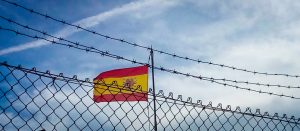
    Connor Blennerhassett brought our attention to ‘numerous cases that have made headlines in Spain, and which raise serious doubts over Freedom of Speech.

    Spain is not currently involved in a foreign war, but is instead embroiled in an existential conflict with itself. One of the most unpleasant aspects of this is a deluge of draconian sentences being handed down, mostly to young people for ‘offending the symbols of Spain’.

    Picture by Daniele Idini
    Image (c) Daniele Idini

    Meanwhile in Culture of Complaint human rights lawyer David Langwallner fulminated against:

    political correctness, and the dumbing down it has brought to personal relationships and public discourse. In many instances it has marginalised forthright criticism, protecting vested interests, who employ the tactic of character assassination. Relationships between men and women are also distorted.

    In an article that was circulated widely Sandra Higgins revealed the motivation behind her Go Vegan World advertising campaign:

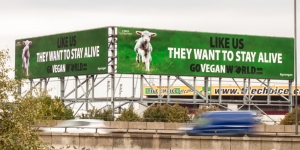
    Most people imagine themselves to be animal lovers. Few scenes on television spark more awe than those featuring animals in their natural habitats, or more affection than those featuring companion animals in documentaries exploring their complexity and playfulness. We find ourselves moved when we witness the precariousness of their lives in TV veterinary series. If we witness one of them being chased or threatened, we find ourselves with bated breath until they escape.

    Image (c): Daniele Idini.

    While Bartholomew Ryan drew connections between the careers of Roger Casement and James Joyce:

    For Joyce and Casement, to be a radical cosmopolitan is to be an exile soul – ‘self exiled in upon his ego’ as Joyce put it in Finnegans Wake –  perpetually on a homeward journey. Thus, while every page of Ulysses is rooted in a specific place in Dublin, it is also what Yuri Slezkine called, ‘the Bible of universal homelessness’.

    Elsewhere, Eoin Tierney asked: What Future for Sport?

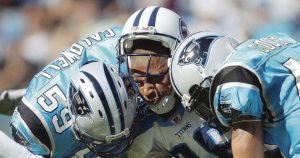
    Concussion is the greatest concern. American Football, Rugby, and Soccer, are all under investigation for short- and long-term consequences of the sudden jarring of brain in skull. Injuries in general worry parents all over the world. Excessive wear and tear on leg joints that will yield early arthritis, surgeries on shoulders, wrists, hands, and feet, dietary aberrations and poisonous supplements, drugs and therapies of dubious efficacy, all and more are suffered to maximise the sporting capability of young bodies.

    Image (c): Daniele Idini

    And Frank Armstrong put forward his original Late Risers’ Manifesto:

    Automation in a variety of sectors could liberate millions from mind-numbing labour. But despite technological advances workers’ earnings have stagnated since the 1990s, while the rich have grown seriously richer, as we face an unemployment cliff. A powerful remedy to the impending obsolescence of many types of work, and grotesque inequality, could be the introduction of universal basic income. This would provide an unconditional payment to every citizen sufficient to avert poverty, providing an opportunity for individual flourishing, to the ultimate benefit of society. Another appropriate response would be for the law to require all companies to register a defined social purpose, beyond simply the exploitation of opportunity for profit. That way the dynamism of entrepreneurship might be harnessed for the common good.

    Barry Gibbons

    We also featured artist’s Barry Gibbons’s show Diaphanism

    Featuring contemporary approaches to printmaking, this show explores textures of light, line, colour and shape in new configurations. The title of the exhibition is a neologism based on the adjective ‘diaphanous’ – derived from the Greek words dia and phainein, meaning to ‘show through’. This new body of work sees diaphanous textures relaying atmospheric scenarios and quiet spaces.

    Image (c): Daniele Idini

    Chris Parkison, meanwhile, advocated an unusual approach to rising anger towards Donald Trump:

    Compassion is the answer. Seriously. Show compassion towards Donald Trump. Before you dismiss the idea out of hand, consider how you have reacted to him over the past year. Have those responses made you any healthier or happier, or helped you sleep at night? Have you instead grown more bitter and angry? Donald Trump isn’t going to change, but your reactivity towards him can. And by altering this you will make the world a better place.

    Image (c): Daniele Idini

    There was short story from Maggie Armstrong, ‘Hard At It’:

    And so the time came to rent an office space. We must all find our space. I wanted to read and create and explore, and where was everyone? Where were all the artists? Apparently they had ‘spaces’. One Friday evening I woke up in the National Library, my cheek pressed to the desk and a man’s face a few inches from mine. It was a big, sympathetic face.

    Image (c): Daniele Idini

    In poetry Edward Clarke brought us: The tune / Of ‘Wolves A-Howling’, / So you can make no tarrying, / And hurry / Out across / The peaks of wild Arkansas, / The heights of south Missouri

  • Fiction: An Oligarch’s Wife

    To sit quietly and take in the view was unusual for Alexander Seymionovitch. His tall French windows flung wide open were like an extension of his arms warmly embracing the air of a new world which at least to him seemed astonishingly peaceful. Even though his thoughts circled like a pack of Siberian wolves, he felt his heart was full to overflowing with very positive vibrations. He watched the sea’s reflection of sprinkled sunlight dance above him on the ceiling and marveled at how it dappled the walls of his palatial home in celebration of his happiness. I love her. I love her. I love her. Perhaps he was being foolish to suddenly behave like a teenager. A man in his prime, armed with infinite power and unlimited money. A man used to calling the shots. At the ripe old age of sixty Alexander had fallen in love.

    He found himself under a spell, and in that sense of powerlessness, he discovered fragility and fear, but also savored a sweetness. Until now he’d been content with his life. He was fine. Just fine. He hadn’t asked for this to happen. But now that it had, he couldn’t see any other way to live.

    For the last ten years Seymionovitch had been a resident of Monaco. His seaside mansion with all the trimmings was in every way the sort of residence you would expect of a Russian billionaire. But only now did he notice something that even to the poorest of paupers cost nothing, if only they had one good eye. That the Mediterranean was indeed so beautiful. So blue.

    Alexander was not unattractive, but muscular. Of medium build, he kept himself in good shape, believing that physical fitness kept him mentally sharp and gave him an edge in business.

    Without meaning to, his gaze could be intimidating. His brown eyes radiated intelligence. And often people speaking to him felt compelled to avert their own eyes, for fear that he could read their thoughts. When he smiled, which occurred often because he was heavily invested in appreciating the absurdity of life, he displayed deep dimples which made him irresistible to women and men alike. In business he was famed for being brilliant, charming and brutal.

    But now, he heard a rustle behind him and the faint sound of footsteps running on tip toes. Without even turning around to see who it was, because he knew, Alexander beamed. Slender silky arms clasped him from behind, and a soft cheek nuzzled his neck.

    “Here you are!” she exclaimed. He pulled her over to sit on his lap.

    “Let me have a look at you.” His wife of one month was approaching her twenty-first birthday.

    “Did you notice how blue the sea is today?”

    “Of course, but what is so special about that?”

    “I’ve just never taken the time to absorb the fullness of its beauty before.”

    “Oh Papa, everything is beautiful here!” She called him Papa, because she said he was not only her husband and her lover, but also the father she’d never had. Alexander harbored no doubt about how much Anna adored him, but he remained mystified as to why she didn’t consider their age gap an obstacle. “I could be your grandfather,” he reminded her.

    “Don’t say that!”

    When they met, he didn’t even register that she was a woman. To him she was a child. One who should be left to play with children her own age. This initial meeting occurred where she was working as a waitress in a Moscow café. Seymionovitch was preoccupied, dining there with a few young executives. Although she was striking, Alexander didn’t even see her. But the younger men couldn’t take their eyes off of her, and furthermore they said as much to her. Without acknowledging the compliment, Anna took their order with a blank stare.

    When one day, he sat down at a table on his own, the woman in question didn’t waste any time.

    “Mr Seymionovitch,” she said, “I’m scared of your young executives.”

    He looked at her with surprise. “Why would you say that?”

    “Because that’s just it. They’re young.”

    Alexander was bemused. “But you are young too. It’s normal. There’s no reason to be afraid.”

    “I don’t like the way they look at me.”

    Now Alexander appraised her for the first time. He surveyed her for a solid minute and realized that those green eyes and high cheekbones pointed to a specific and highly desirable genetic marker. Must be some Mongolian blood in the mix.

    “You shouldn’t be working in a cafe if you fear the gaze of young men.”

    “But I have no choice.”

    “You always have a choice,” said Seymionovitch, leaving her a generous tip and the salient memory of what no one in Monaco disputed was indeed a dazzling smile.


    Seymionovitch didn’t give it another thought. Beauty was beauty, and where there is such a concentration of wealth, beautiful women will always be a dime a dozen. They came, married well, and then they went away. Where? Who cares! He wasn’t looking for anything. Business was a game that took him to faraway places. And when he wasn’t traveling, he spent most of his time in Monaco, where all the other oligarchs also found it convenient to base themselves.


    Anna still marveled at the fact that she was married to Alexander Seymionovitch. It was like a dream come true, and she still enjoyed recalling the moment when fate reunited them. It was springtime and he gave a large party at his Moscow mansion. An army of waiters and waitresses had been hired for the event, and she was one of them. Anna waited until he was alone to approach him. She was carrying a tray laden with glasses of Champagne, and said in a clear voice, “Mr Seymionovitch, you were right!”


    Giggling, she recalled his confused expression which seemed to say: “A waitress dares address me so directly? Who are you and what do you want?”

    “Remember that moment?” She asked.

    “I didn’t know who you were, let alone what you were talking about. Now, Anna, tell me the truth, you were after my money, you little gold digger.”

    “Not so little.” Said Anna, cupping both of her cashmere covered breasts in two exquisitely manicured hands.


    Anna grew up with her mother, Irina and grandmother, Natasha. She’d never known her father. She told Seymionovitch that men were a mystery to her. She was fascinated by them, but had always feared young boys. They were so cruel, brash, and never serious. When their hands weren’t chasing her, their eyes told her it wasn’t a question of if, but when.

    “You know the way someone looks at you, and you’re certain what they really want is to use up your body and take your soul away?”

    “No, I don’t know. Tell me!”

    Anna laughed, “It’s hard to describe.”

    “What about me?” asked Alexander, “What do you feel when I look at you?”

    “I feel safe. I feel that I’m at home and everything is good.”


    He pushed her gently away from his chest, so that he could examine her face.

    “Now, it’s your birthday soon. Your twenty-first! I would like to do something special.”

    “Do you have an idea of what you would you like to do?”

    “I don’t know. But not a party. I don’t like parties.”

    “I already know that.”

    “You know everything about me!” cried Anna, kissing him behind his ear.

    “Not everything,” said Alexander, overcome by a disturbing thought. This was too much happiness. It can’t last. Spinning around, she clocked the contemplative expression before Alexander could resume his legendary poker face.

    “What are you thinking?” Without answering, he held her closer, in silence, and after a while, she said, “Surprise me!”

    “Yes, Baby. I will.”


    “We’ve got a gig,” said Jeffrey. “Good pay. But we don’t know nothing about it.”

    “Whatever,” said Sebastian, “Just pay me. Where is it?”

    “Monaco.”

    “When?”

    “Tomorrow morning.”

    “In the morning?”

    “Have to be there at 9.30.”

    “Address?”

    “At the train station there. We’re signing a confidentiality contract. None of us can ever talk about it.”

    “Intriguing.”

    “Our instructions are to arrive by train.”

    “I wonder why.”

    “I don’t even know their nationality. That would influence what songs we prepare.”

    “This kind of secrecy smells Russian.”

    “A driver will meet us at the station. Oh, and they want a saxophone player.”

    “A bit last minute isn’t it? Maybe Rich is available. He’s a decent sax player.”

    “That’s not a bad idea. Hang on…” Jeffrey makes a call.

    “Hey Rich, are you around? Will you pop into the cafe? Yes, something to discuss.”

    “Does Raffi know?”

    “Yes, and you know Raffi. He’s already busy getting his beauty sleep.”


    The following morning the band boarded a train hurtling toward Monaco. Sebastian’s red curls cascaded down the shoulders of his fancy shirt. Holding his guitar, Jeffrey stretched his skinny legs to rest on the seat facing him. Raffi’s sunglasses blended almost imperceptibly into his long dark locks, as he regarded a Cajon lodged between his feet. Next to him leaned a saxophone case steadied by Rich’s right hand.

    “Well,” said Jeffrey, “People are strange. You just have to go with the flow. We don’t know what kind of crowd will be there. But we will wing it as we always do. At least we don’t have to put up with a girl singer. Sometimes people ask for a girl singer, and that’s a pain in the butt. No matter how nice a girl is, it’s going to cause more problems than it’s worth.”

    “I didn’t realize how sexist you are,” said Raffi under his breath.

    “No, no, no,” exclaimed Jeffrey. “Don’t get me wrong. I love women. But it’s hard to work with them.”

    “I wouldn’t mind being in a girl band,” said Sebastian, which brought the house down. Even Rich, who was half asleep, shook off his snooze and smiled.


    “Blindfolded?” Perplexed, the musicians stared at the demure PA, whose slicked back obsidian hair nearly distracted them from her hasty clarification that for the inconvenience, Mr Seymionovitch was happy to pay each of them the tidy sum of €5000.

    “That’ll be fine,” said Jeffrey, stifling his excitement.

    Ms. Abramovitch seemed relieved as she indicated for them to follow her up a grand staircase and enter into the master bedroom.

    “This must be a surprise birthday party. It’s pretty quiet.”

    Ms Abranovitch looked past Jeffrey and his unfiltered assumption, in anticipation of Seymionovitch’s entrance via a terrace door. His PA wasted no time introducing the motley crew of musicians to their generous patron.

    “It’s my wife’s 21st birthday, and she’s asked me to surprise her,” explained Alexander.

    As the musicians nodded, their eyes darted around the room. No bedroom could’ve been larger or more tastefully decorated, mixing modern paintings with antique furniture. There was an atmosphere of opulence and luxury, yet one could still call it cosy.

    “Ms. Abromovitch mentioned the blindfold, did she not?”

    “Yes,” answered Sebastian, who had to stop himself from asking Seymiononovitch to explain why the blindfold was required.

    “It’s no problem at all,” assured Jeffrey.

    “Well, just now, she is in the bath.”


    “Oh, Papa! Where are you?” A youthful voice filtered in from somewhere in the next room.

    “It’s a surprise!” said Alexander, “I want you to make her cry!”

    “Wait. If it’s her birthday, aren’t we supposed to make her laugh?”

    “But she is happier when she cries.”

    “Papa! Where are you?”

    “I come now Baby, I come to you!” and with that, he hurried into the other room.

    “What will we sing to make her cry? It’s impossible to know what we should play.” Befuddled, the band huddled together, whispering potential strategies worthy of a football team.


    “No, not yet,” said Alexander.

    “But I’m bored,” said Anna. Alexander sat at the edge of the bath.

    “I have a surprise for you, so soak a bit longer.” Anna was covered in soapy bubbles.

    “Shall I close my eyes?” she asked. Hearing the saxophone’s initial notes, she looked at Alexander.

    “What was that?” And at that moment four blindfolded men entered her extensive bathroom. Anna nearly jumped out of her bath.

    “Alex, I’m scared.”

    “But Baby, they can’t see you.”

    “Get them out!” Anna was crying.

    Blindfolded, the band stood there, confused by the rapid conversation in Russian.

    “It’s going wrong,” whispered Jeffrey to Sebastian.

    “Get them out!” Not knowing what else to do the band started a song.

    “Stop!” shouted Seymionovitch.

    “Please wait for me in the bedroom.”

    Being blindfolded meant they had to feel their way out of one unfamiliar room into another. Sebastian nearly fell over his double base as Jeffrey felt strong arms grip his shoulders and push him roughly out into the bedroom.

    “Can we take our blindfolds off?” he asked. Seymionovitch snapped back at him in Russian.

    Raffi whispered, “I’m not fluent but that sounded distinctly like Russian for Fuck you, Man.”

    “I hope we’re still getting our 5K.”

    “Don’t take the blindfolds off.” As Alexander was helping Anna out of the bath, a cloud of doves exploded into the air outside her bay windows followed by scores of red balloons, and Seymionovitch felt like someone had punched him in the stomach.


    The band began to play, and Raffi sang “I’m So in Love with You,” his voice so clear, sweet and grave all at once, was carried by the acoustics in the high-ceilinged room to waft like a cloud of sound through the open French doors. At this point, Anna burst into tears.


    “That’s it?” asked Jeffrey in surprise, when Ms. Abramovitch handed each of them an envelope, before ushering them out onto the driveway, where a uniformed driver was waiting to chauffeur them away.


    “What the hell happened back there?” said Jeffrey.

    “It’s all in here,” said Sebastian, recounting the cash in his envelope.

    Rich stuffed his pay into the sax case without even checking it.

    “She must be exceptionally beautiful,” said Raffi, who was the last musician to climb into the Rolls Royce Phantom, before the chauffeur shut the door behind him with that hushed thump reserved only for those who can effortlessly afford it. The Phantom then pulled away from Alexander’s sea side palace and coasted down his longest of private lanes, to turn toward the train station, after a discreet exit through the slowly closing Monegasque gates of an oligarch’s estate.

  • Featured Artist – Emily Mannion

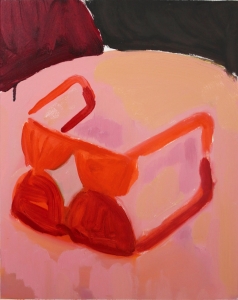
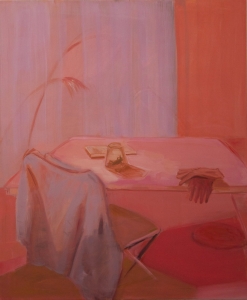
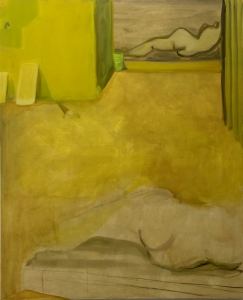
    Painters talk of the temperature of paint. It’s warm. It’s cold. There are colours that complement each other, others that do not. Colour is sensory. It is non-verbal and arguably pre-verbal, and gives us a framework for how to navigate and sublimate our visual surroundings. The grass is green, the ocean is blue, the sun is yellow. 

    To read colour in such an abrupt manner can make it seem static, rational even. Yet an artist can use colour as a strategic or manipulative tool, intentionally misleading and seducing the viewer with the hues and saturation of an artwork. The warmth of colours can be disarming like the hazy, golden yellows of a summer at dusk, or the rosy pinks of  the evening as it shutters to a close. However, with painting, as in life, all is often not exactly what it seems. Much ugliness can be hidden beneath exquisite surfaces. Yet paradox lies at the heart of most art.

    Desire, Melancholy and Loss

    Giorgio Morandi

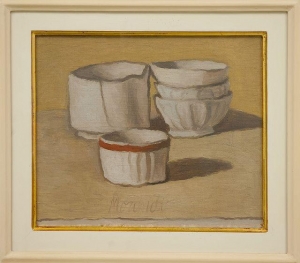
    In September, I found myself standing before a painting by the Italian artist Giorgio Morandi, Natura Morta con tre tazze (1943), at the Museo Novecento in Milan, experiencing this tension first hand.  In this painting stands three stacked bowls and a jug that looks to have just sidled up beside them.

    The lips between the two forms  connect, barely. A long dark shadowy line throws itself at the edges of where they meet. Its outline highlights the chasm that opens beneath them. It’s a strikingly intimate moment. In the foreground there is a third presence, another bowl which is situated at a remove from the  other two, differentiated by the vibrant red stripe that, like a belt, contains it. An outsider  perhaps? The palette of the paint is neutral, and the brushstrokes minimal. The red stripe is defiant. It penetrates.

    There is an undoubtable tension between these objects, like watching one of Shakespeare’s plays, yet the mystery between them is left to the viewer. As my eyes move across the surface, peeling away the narrative layers I begin to feel the discord within me dissipate. Unmoored, I felt my internal structure begin to break apart. I became every object in that painting, if only briefly – a meditation on desire, melancholy and loss

    Yet transcendence is a temporary state and once again the necessary coldness of reality was upon me. This  distance is now filled with longing. The tears began to gather in my eyes. I waited a little longer and moved to the next painting.

    Sacred Space

    Morandi is regarded as one of the greatest painters of the last century. A mythology has been  built up around him and the very particular process he employed to make his paintings. He safeguarded it with a religious fervour. His studio was a sacred space where he worked  exclusively with the same everyday objects that he placed, assembled, and reordered until the setting and light was just right.

    They were common objects jugs, mugs, bottles, their physical volume and shape lending them certain characteristics. They acted like players on a stage, the drama slowly unfolding before him, each arrangement offering a different narrative. When observing his paintings, one notices how the external signals are combined with his internal fears to create works that are silently directing us through the painful journey of existence. They are empty vessels in an empty landscape.

    Human Frailty

    The pandemic has thrown into light our human frailty, our need for connection, our  surroundings and lived spaces. It has brought a metaphysical awareness to the things with which we surround ourselves. The domestic is now a sacred space and the quotidian is kingmaker.

    Like Morandi, this sphere of the domestic is where I choose to situate my work. I create narrative vignettes culled from personal history, literature, music and film. At times these scenes seem banal, in others absurd. They are purely imagined spaces that are vague and elusive, offering fragmentary impressions of wonder, beauty, loneliness, and dread – and the duality that exists within us all.

    My painting is both a language and alchemy. It is uncontainable, and oftentimes unpredictable with each work following its own logic. I use oil paint in a manner that reflects the sensibility of the oil itself. The surfaces of the painting have a diverse, formal vocabulary. At times I apply it with a quick, gestural abandon with the material sliding across the  surface. At other times the paint is applied dry or diluted, methodically building layers and light through a process of application and wiping back.

    Erasure is part of everything. A private performance where the traces are left behind on the canvas – residues of hair and dirt are solidified in time compressed.

    Moments Between

    I aim to depict points in time where nothing much happens, and anxiety builds as our agency is suspended. Dramatic interludes are left to one side in favour of those moments between. We are deprived of that cathartic release. The scenes are at once familiar and yet there is a strangeness to them, an eeriness. The interiors are populated with objects, both uncanny and transcendent: a glove; an insect under a glass; a broken egg; a curtain shimmers; things are only half revealed.

    Animals and figures sometimes appear yet they are more present in their absence. The objects seem to exist independent of our gaze. They carry on without us when left to themselves. They are ‘still lives’ in the conventional, historical sense. But now they have become autonomous figures. They too have become the players on the stage.

    It is true that we cannot experience pleasure without first knowing pain; that we contain both true and false selves. One thing can be seen more clearly in relation to another. These polarities provide us with perspective and also uncertainty.

    The psychoanalyst Donald Winnicott said that ‘artists are people driven by the tension between the desire to  communicate and the desire to hide.’ The human condition is not a paradox to be solved but rather one to be lived. We should embrace the shadows within.

    Images 1-6:

    ‘Objects of desire’ 40 x 50cm, 2020.

    ‘False Gods’ 120 x 150cm, 2019.

    ‘St. Lucy’, 25 x 35cm, 2019.

    ‘Sunglasses’ 31 x 39cm, 2019.

    ‘You can have it all’ 140 x 170cm, 2020.

    ‘Persona’, 120 x 150cm, 2020.

    Feature Image: Andrea Wyner

    Instagram: https://www.instagram.com/emilymannion1/?hl=en

  • Dublin’s Forty Foot over Fourteen Years

    For the past fourteen years I have been a daily swimmer at the Forty Foot in Dun Laoghaire – my home town.

    Seven years ago I began documenting this life down by Sandycove, particularly those summer days when the sporadic Irish sun comes out, a signal for Dubliners everywhere to descend on this place to cool down, socialise, get intimate and, above all, have fun. 

    In winter’s past this small enclave around Sandycove harbour is deserted, bar myself and a few other hardy swimmers and misfits from modern society.

    This winter – the year of Covid – things have changed.

    The so-called ‘Dryrobes’ crowd have arrived to join our old motley crew this year, as more ‘normal,’ well-heeled Dubliners have come to soak up the magic water, and enjoy, or endure, our icy secret, that used to be the preserve of those of us considered mad by the rest of society. But in the new normal of our world today, what is normal?

    The only normal people I know, are the ones I don’t know very well !
    The Forty Foot is special to me; three years ago it nearly took my life, when a wild storm hit as I was swimming out by the rock.

    But the sea water has helped heal me spiritually, physically and mentally. Every day however cold I swim. Sometimes alone, sometimes with my crew. Nearly always I come out refreshed and feeling alive, even normal. 

    When the first days of summer arrive, along comes the rest of Dublin to bask by the Irish Sea.

    Teenagers come to celebrate the end of school; to have their first drink or maybe first romance – just as I did, decades ago.

    The regulars come to top up their all year tans, and take longer swims.

    Lovers come to be alone and get intimate; families congregate at the back of the Forty Foot wall, on the small Sandycove beach – the quiet side.

    All of this happens around one big rock on the southern tip of Dublin, a place that makes Dublin so special to me, and many others.

    These fourteen images from my fourteen year pilgrimage give an insight into this unique Forty Foot life and style, that comes so alive in summer, and even now this winter. 

  • Mother and Baby Home ‘Whitewash’ Compounds Victims’ Torture

     Men never do evil so completely and cheerfully as when they do it from religious conviction.
    Blase Pascal

    While researching my new book Feminism Backwards (Mercier Press, Cork, 2020) long held worries about the role of the Catholic Church in Ireland, particularly its role in relation to women, really snapped into focus for me.

    At this moment, as a nation, we are in shock at the horrors pouring into the public discourse about what went on in Mother and Baby Homes. But just step back a minute to consider where this viciousness and misogyny came from.

    Most of us are probably aware that the Catholic Church’s hatred of women has a long tail: the first bad girl being of course Eve, who ate the apple, and then persuaded Adam to take a nibble, and whizz-bang-wallop everything went to hell. Since time immemorial, as far as the Church ‘Fathers’ have been concerned, women are the ‘root of all evil.’

    The Garden of Eden with the Fall of Man, Peter Paul Rubens, Jan Brueghel the Elder, c. 1615.

    And, just as centuries of antisemitism reached its apogee in the Holocaust, so centuries of Catholic anti-woman propaganda culminated in the ‘Burning Times’, the Inquisition, and the burning alive of 80,000 women, some believe many more, as ‘witches.’

    While the Inquisition didn’t reach here, we got the Great Famine (1845-51) instead. Things were appalling for almost everybody under centuries of British occupation, but after the Famine life suddenly became considerably worse for Irish women. Before this the Catholic Church was not all-powerful: there were few churches, and priests had to be sent to France to study, while seminaries and convents were almost non-existent.

    Then the British government made a devilishly clever intervention: trebling its annual subvention to Maynooth University so that from then on the teaching of priests would be done at home, far from revolutionary ideas of liberté, égalité, fraternité! With the terrible outcomes of the Famine scarring Irish society indefinitely their objective was achieved more fully than they could have imagined.

    With the last remnants of a clan-based, more matriarchal Gaelic culture destroyed, the big farmers – those who collected rents for landlords – along with the ‘gombeen men’ who extended credit, would decide, no matter what the cost to their sons and daughters, that the family farm should never be subdivided. Ever. These early capitalists suddenly found common cause with the freshly-funded zealots of Maynooth.

    Late marriage or no marriage. Permanent Celibacy. Emigration. A convent or a mad house – take your pick young lady.

    Abandoned cottage, County Sligo.

    Late Nineteenth Century Catholicism

    The newly funded, and energised Catholic Church, with their big farmer foot soldiers – only big farmers could afford to send their sons to Maynooth, or their daughters to a newly opened convent – filled the power vacuum left by the post-Famine societal collapse.

    Repression became the order of the day.

    How was it possible that normal people could be made to accept it? As Goretti Horgan writes in her paper: ‘Changing Women’s Lives in Ireland’: ‘normal life after the Famine was impossible.’ Millions had died horrible deaths, hundreds of thousands had emigrated in ‘coffin ships’, the template for survivors of a repressed, patriarchal, misogynistic, conservative, anti-sex and anti-woman Ireland had been laid, and the Virgin Mary, a goddess stripped of sex, agency and colour, was to be the icon to which all Irish women were to henceforth aspire. ‘Passive, virginal, pious, humble, with an unlimited capacity to endure suffering’, as Tom Inglis put it in ‘Origins and legacies of Irish prudery: Sexuality and social control in modern Ireland.

    The Church gained further power when Charles Stewart Parnell promised them control of education and health in return for support in the national struggle. And after the 1916 Easter Rising, when many of the poets and revolutionaries had been shot and thrown into pits of lime by our old friends the British, once again the Church and the gombeen men slithered into the power vacuum, establishing what Sean O’Faolain famously described as their ‘dreary Eden’.

    As Peter Lennon says in his wonderful 1967 film ‘The Rocky Road to Dublin’ – which has still not been shown on RTE! – we’d survived seven hundred years of British occupation only to sink under the weight of our new (deeply conservative) leaders, and the Catholic clergy. Or as Sean O’Faolain put it: ‘We became a society of (browbeaten) urbanised peasants, without moral courage, constantly observing a self-interested silence.’

    https://www.youtube.com/watch?v=hWY8hkF3yWk

    Bloody hell.

    It seems probable that Éamon de Valera, ‘the father of the nation’, suffered a nervous breakdown during fighting in 1916 and must surely have suffered from PTSD and Survivor Guilt, having been the only signatory of the Proclamation to avoid being shot and thrown into a lime pit thanks to his American passport.

    Once in power after 1932 he got joined forces with the Archbishop of Dublin, John Charles McQuaid – the J.Edgar Hoover of Irish society – a prelate with spies everywhere; a sexually repressed celibate, obsessed with women’s sexuality . The imprint of these two damaged men over the Irish Constitution of 1937 is clear.

    John Charles McQuaid and Eamon de Valera, December 1940.

    The Constitution of 1937 is a document very different from the wonderful Proclamation of 1916. Misogyny, sexual repression, and a viciously anti woman theocracy was set in legal stone, and over the following decades Ireland slowly sank into economic, physical and psychological stagnation, characterised by hypocrisy and widespread mean-spiritedness – if I’m not having a good time then sure as hell you can’t either; with sex the only real sin.

    The Church, with its supposedly celibate priests, brothers and nuns had set up a dictatorship; and the State backed them all the way.

    The terrible ‘architecture of containment’ – eerily similar to the brutal Workhouses set up by the British complete with terrible food, contempt for inmates and mass graves – grew like a cancer over the whole country. Mother and Baby Homes. Industrial Schools. ‘Orphanages’. Magdalene Laundries. Lunatic Asylums.  The Church had control over, and benefited financially, from them all.

    By the 1950’s Ireland, proportionately, had more people incarcerated in such institutions than the Soviet Union.

    Of course the middle classes were affected by the general repression, ferociously implemented by the Church – our very own Taliban – but the real horror and damage fell on the working classes, and the rural poor.


    There was inter-generational incarceration. Children snatched by the ‘Cruelty Man’ were dumped into Orphanages, from there graduating to Industrial schools, the girls going on into Mother and Baby Homes, Magdalene laundries and, if they dared speak out or speak up, into the nearest lunatic asylum. All of the institutions were abusive. Once inside escape was virtually impossible.

    The worst of all the institutions were the ‘Mother and Baby Homes’. The most vulnerable of all:  mostly teenage mothers, very often rape victims, and their ‘illegitimate’ babies were hit hardest. Having a baby ‘outside wedlock’ was never a crime, at least on the statute books. but an all-powerful Church punished ‘offenders’ with torture. The damage usually lasted a lifetime, and the place of incarceration was a charnal house, while the State looked the other way.

    The hideous farce was not lost on everyone that all of this took place in a country where you couldn’t even buy a bloody condom, where the priests said ‘life’ was too precious to put on one, that contraception was against God’s will.

    Whitewash

    Fast forward to January 12th, 2021 and the long-awaited, much-anticipated, very expensive, 4,000 page-long Final Report on the Commission of Investigation into Mother and Baby Homes. Hurray, hurray!

    After five years work, with an €11 million euros tab for the taxpayer to pick up, breath was bated.

    The government held a webinar for a handful of surviving mothers. The Taoiseach issued a rote apology. Survivors, in confusion, begged for time. They hadn’t even received the Report yet, so how could they comment? The government told them to download it. Download and print a document running into thousands of pages? For many of the women the height of technology at their disposal was a smart phone.

    Within hours, social media had exploded with shock and dismay. The historian Catherine Corless, whose tireless work had uncovered the unlawful deaths of 796 babies, and toddlers, stacked and wrapped in rags in old septic tanks once belonging to the Tuam Mother and Baby Home, and forced the government into commissioning this Report, looked deflated and exhausted. ‘It’s a whitewash.’ she said on the evening news.

    The mothers, the survivors, who’d waited so patiently for their stories to be finally taken seriously, to be apologised to for the horrors they had been through in the Homes, were gutted at the Report’s conclusions, the choicer of the conclusions were: there was no abuse; there were no forced adoptions.

    The girls were doing the same work they would have been doing if they were at home. There was no coercion for girls to enter these places. They were refuges, harsh refuges yes, but refuges all the same. And choicest of all: Society, and the men who fathered these children, must take blame. Everyone in the whole country must take blame.

    If everyone’s to blame, no one is to blame, right?

    Liveline went into meltdown. Could it really be, after everything that was said and explained and poured over, that this whitewash was the best they could come up with? Joe Duffy often sounded as if he might break down himself. Could it really be that this whitewash was the best they could come up with?

    Survivors

    I spoke to some survivors.

    Ann O’Gorman described being taken pregnant and aged seventeen into Bessborough Mother and Baby Home in Cork. Her head was shaved, her clothes appropriated, and her name was taken. She remembers ‘a terrible place of sadness, mothers crying, babies crying.’ The girls worked all day, every day, scrubbing and cleaning on their hands and knees. Cutting the nuns’ precious lawns with hand scissors. Every girl lived in fear behind twelve-foot high walls, forbidden to talk to each other, forbidden to make friends. Forbidden to even think of leaving. If any girl did so the Gardaí would pick them up and haul them back again.

    When the time came for Ann to give birth she was brought into a bare room and put on a table, with one nun in charge. She didn’t even know where the baby would ‘come out of’. She was terrified. The labour was long, and very difficult. There was no pain relief. Not so much as an aspirin. When her baby was finally born she knew there was something wrong: the nun turned her back and was ‘working on the baby.’ The seventy-three-year-old nurse, asleep upstairs, was sent for. She ripped Ann’s afterbirth out so savagely that Ann passed out for two days. When she awoke, still haemorrhaging, a nun said, ‘You have an angel in heaven’. Ann ran to the window and saw two men, one carrying an orange box, the other a shovel. Were they off to bury her baby?

    Ann cried and cried and cried.

    For fifty-two-years she begged and pleaded and wept beseeching the nuns to give her information about her baby. She had called her Evelyn. Could she see a birth certificate? Could she see a death certificate? Could she be told where little Evelyn was buried?

    The nuns slammed the door in her face. They denied Evelyn had even been born.

    Two years ago with the help of another survivor, Catherine Coffey O’Brien, Ann finally got a death certificate for her baby. She and other survivors once again begged the nuns to tell them where their babies were buried.

    It turns out there are nine hundred missing babies in Bessborough, though as Ann says, ‘they weren’t buried, they were just thrown in a field.’

    Surely the Commission would help? For Ann, for all these mothers, finding their dead babies was all they cared about.

    The Commission said the nuns couldn’t remember.

    And that was that.

    Ann is not looking for redress. She is not even looking for heads on plates (I know I certainly would be), she just wants to know where her baby is buried so she can mark the spot, put in a wildflower garden and a bench so that all the mothers grieving so dreadfully for so many years for their disappeared babes can have somewhere nice to sit. To heal.

    I spoke to Sheila. When her baby, a little mixed race boy, was born the nun held him up and asked: ‘What is this?’ When he was being Christened the priest said her father’s offering wasn’t sufficient and raped her in the sacristy.

    She said for the nuns it was always all about money. Every week the nuns would take the women in a van down to the social welfare office to sign on. Then the nuns kept the money. The nuns also got money for each mother, and for each baby, from the government. They also got money from the families. They got more money for the rosaries and baby clothes the mothers were forced to make. And they got lots and lots of money when the babies were adopted. Sometimes they kept on getting money for a baby who’d died, or been adopted, by ‘forgetting’ to tell the authorities.

    The girls came out of the homes broken-hearted. Empty. You couldn’t speak about it to anyone. You were just dirt.

    As for having a choice, Sheila laughs bitterly, We had nothing. None of the girls had anything. The priest would go to the hospital and make sure you wouldn’t be allowed in. He’d go to the baby’s father and tell them to avoid having anything to do with you: it would ‘spoil their chances’ in the future, as for a landlord letting you in pregnant, or with a baby, are you joking me? There was nowhere to go. There was no choice. Nothing. You were blacklisted. They made sure of that.

    Sheila says she’ll never forgive the nuns. Ever.

    Catholic Emancipation Centenary procession from the Phoenix Park, 1929

    Torture and Exploitation

    Other Survivors filled the airwaves screaming their outrage over what has been done to them. And now over what is being done again by this whitewash.

    Of course there was torture! Of course there was exploitation. Of course there was abuse on a massive scale. Of course the mothers were half-starved and many of the babies starved to death. Of course there were ‘dying rooms’ where babies were left to die. Of course there was brutality, what else do you call giving birth on a table with a nun screaming at you?

    “You weren’t shouting and roaring like that when you were having sex were you?”

    Of course it was inhuman to labour without so much as an aspirin, with you and your baby butchered in the process by nuns who had no training in midwifery, and zero interest in making your labour and little babe’s passage into the world any easier, au contraire, your labour was in return for your sins; your little babe was the result of sin; if your baby died, or you died, what of it? Both of you were contaminated, you were nothing, you were filth and nobody wanted you. Nobody. 

    Of course there were forced adoptions. What else do you call a child ripped out of a mother’s arms? What else do you call a mother shown the door, her little one kept back so it could be sold: sometimes for thousands of dollars to returning WWII American GI’s; to ‘good Catholic families’, and/or whoever else fancied a baby? Passports, birth certs, names, all handily manufactured by the powers that be.

    The nuns put advertisements in the Lost & Found offering babies, as if they were puppies.

    Of course there was abuse on a massive scale. What else do you call the discovery of seven-hundred-and-ninety-six little bodies wrapped in rags and ‘stacked like Cidona bottles’ in old septic tanks in Tuam? What else do you call the ‘burials’ of nine hundred babies in the field in Bessborough? What else do you call death certificates that showed babies died of heart failure, malnutrition, ‘choking on porridge’, rickets?

    And of course the government, successive governments, knew. One infamous inspection in 1944 described a room crammed with babies, ‘emaciated and not thriving’, aged between three weeks and thirteen months there were ‘fragile, pot bellied and emaciated.’ Another doctor lifted nappies to find them ‘crawling with maggots’.

    For decade after decade the government looked the other way.

    Now many survivors believe the Commission is compounding that dereliction.

    What happened was, and is, the Church the State’s responsibility. They were the people in power.

    Image: Richard Tilbrook (wikicommons)

    It Can’t Be Goodbye

    After a week of agony for the mothers, the Commission responded to the flood of desperate queries with a message to the effect that their job was done, and that they were shutting up shop. Goodbye.

    Except it can’t be goodbye.

    The government, the Church and the Commission in refusing to engage, and in trying to spread the blame so widely that no one is really to blame, are compounding an already ghastly wound. It’s a bit like what happened when the first little bones were discovered in Tuam: the local priest came in, threw a bit of holy water around and said a prayer, then the government came in and dumped a load of concrete on their graves. It might have seemed like a clever solution in the 1970’s. This time round it just won’t wash. It shouldn’t wash.

    This time round the Catholic Church needs to be put in the dock.

    All of their assets, currently handily concealed under ‘charitable’ status must be revealed, their ‘charitable’ status removed. Now, and forever.

    All of  their financial entanglements with our schools, hospitals, day care centres, mental health facilities – everything – must be revealed.

    They must be forced to pay the remainder (74%) of the redress they slithered out of previously, and pay in full, proper and generous redress to the mothers and babies, the families, they tortured in their terrible ‘Homes’.

    Not that it’s going to be easy. Last weekend the ‘Primate’ of all Ireland, Archbishop Eamon Martin – sounding spookily like Daniel O’Donnell – said he didn’t wish the Church to be ‘scapegoated’ for what happened.

    Scapegoated? Really?

    A growing number of people believe the Church should be criminally prosecuted for what happened. They orchestrated this terrible hate against women. They kept at it and at it and at it, until the whole country was distorted and weird. They kept at it until their coffers were  bulging and when finally, FINALLY, the State was forced by the Women’s Movement to bring a pittance in for ‘unmarried mothers’ and terrified young girls found they could manage, they could keep their babies, and didn’t need the terrible ‘Homes’ anymore, the nuns said; “Grand so”, sold the properties for millions and pocketed the cash. Same as they’ve always done. Just like other dictatorships drunk on power, hypocrisy and an inflated sense of their own importance have done.

    This time it has to change. This time we, as a society, and the government in our name, has to stand up to the Church.

    So many of the survivors who’ve spoken out in the last week say the one good thing this time around is that society is listening to them. That this time around society is turning the nuns’ and the Church’s weapon, used so viciously against all those terrified young mothers, for so long, against them: NOBODY WANTS YOU. Nobody.

    We’ve had  so many reports, so many television programmes, so many books, radio documentaries, films, plays. We’ve had the Ferns Report, the Ryan Report, the Murphy Report, the McCoy Report, and now this Report. All of them documenting in vivid and horrific detail the violent abuse – sexual, physical and psychological – by the religious of the Catholic Church. Their victims? Irish babies, Irish children, Irish teenagers, Irish mothers.

    The government Reports take years and cost millions in taxpayers money. The Church says sorry. The government says sorry. A pathetic redress scheme is put in place mostly for the benefit of lawyers, and which taxpayers mostly finance. Criminal convictions for criminal behaviour by priests? By nuns? The stumping up of millions by the Catholic Church? You must be joking.

    We’ve come so far in liberating ourselves in Ireland. We have a young, educated, and brilliant population absolutely aghast at what has happened. It is time to bring the whole horrible mess out into the light of day. It is past time to separate the Church from the State. It is time to grow up, and face the Church down.

    It is what we, as a society, what the mothers and survivors, desperately need.

    This time we must do it properly. For once, and for all.

    Featured image: A shrine, with an image of the Virgin Mary, is seen in the corner of an enclosed area on part of the site of the former mother-and-baby home run by the Bon Secours nuns, where the remains of an unknown number of babies and toddlers were found buried, in Tuam, Co. Galway, March 7, 2017. REUTERS/Peter Nicholls

  • My Approach to Literary Networking

    My Approach to Literary Networking
    after Francois Villon 

    Most days I’d rather be bundled
    into the courthouse between
    two hairy policemen,
    with a highly debatable anorak
    dragged over my face, and
    blamed for killing Kirov –
    the crowd lobbing big thick
    spits and battering the van
    as I’m carted off –

    or be stopped at the Canadian border
    travelling on a makey up Polish passport,
    the remnants of a Dutch industrialist
    and what I think was his second wife settled
    unhappily in my glove compartment;

    or attend my mother-in-law’s funeral
    having been fitted with a wooden nose
    because (everybody knows)
    the other one fell off due to
    third stage syphilis;

    than ghost about the joint provoking
    nods from gabardine coats
    of great import and longevity,
    grunts of approval
    from fully clothed minor male poets.

    Feature Image: Joseph Stalin and Sergei Zhadanov at the funeral of Sergei Kirov in December, 1934 (unknown author).

  • Funk

    Yeah, been in a funk. These last few weeks. Couple of things contributed to it. But an overarching feeling is one of restlessness. My worst fears were realized when I moved back to the suburbs. Always associated my youth with a debilitating depression. Growing up here. Feeling so different.

    For much of my life I dealt with depression. Finding things that interested me, with which I then filled my days. Found a job I loved and overworked. Took pride in my resilience. Stamina. Charting how productive I was. Seemed to stave off the sadness. Both from the business itself, and seeing myself get so much done.

    I’ve infinite time on my hands now. Had hoped the Spanish tutorials and woodworking would pique my interest. Maybe take over. Didn’t realize how much of my identity is comprised of being like this. Type-A personality. Working myself to death. Raised by people who honored above all, the work ethic. Bootstrap economics. Wasn’t prepared for the fact that I’d struggle with a sense of worthiness. When unemployed. And underpaid. The rational me knows better. But at my core I wonder. What will develop. From this radical new chapter.

    Integrating shadow work on family issues is deceptive. And exhausting. Feeling a bit stuck at times. So, all apologies for not showing up. At least not in the ways I usually do. Trust some good will come from this. But man, does it suck.

    On the plus side, at Christmas I was reminded just how much I enjoy wrapping presents. So, there’s that. And also this amazing autumnal light. To help me hang in there. With grace. And patience. In solidarity.

    Feature Image: Marina Azzaro