Blog

  • The Hero’s Journey

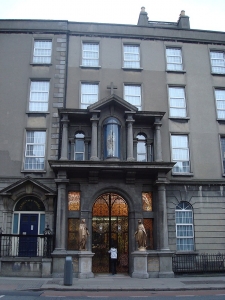
    Whitefriar Street Carmelite Church, Dublin.

    Twelve years ago I was asked to sing a selection of traditional Irish love songs in Whitefriar Street Carmelite Church in Dublin, for the launch of an anthology of Irish love poems. This collection had poems which were written over a period of 1,200 years, between 800 AD and the present era.

    Whitefriar Street of course contains relics of the even older tragic hero of many a love story, St. Valentine, who was executed for marrying young couples at a time of prohibited love. However, as I read through the love poems in the collection, the earliest ones struck me for their vivid rawness. The first poem, The Lament of Créide starts with the striking words,

    “The arrows that murder sleep
    At every hour of the cold night
    are love lamenting”

    In 8th century Gaelic these words have a sibilant, chilling cadence that invoke a dark and desperate trauma. Créide had just come on her lover Dínertach’s body on the battle field and grief menaced her mind.

    The emotions depicted create a surge in me. This was something worth expressing with music I though. It has all the essence of human feeling that great and tragic drama is made of.

    It sucked me into a renewed appreciation of early Irish mythology, and I started looking at other examples from the canon of early Irish literature, such as The Táin, for this exquisite portrayal of drama and character archetype. As a singer and a composer I found that these stories had an emotional and dramatic template that interested me.

    These were stories that lasted throughout the centuries; that contained great dramatic archetypes. They described patterns of being that seemed timeless and epic. They were crying out for melody and musical interpretation.

    In my journeys through these myths and historical perspectives I started to notice that character portrayal frequently represented archetypes within meta-narratives. Some of these archetypes could be found in similar thematic stories throughout the world. Cúchullain had his echo in Achilles, and Ferdia might be compared to the Trojan Hector.

    These archetypes manifest values of what the 17th century Italian political philosopher Giambattista Vico called The Age of Gods. Nietzche calls this the age of heroes

    I was using the modality of sean nós to interpret these stories through music, but it took me a long time to notice that perhaps I was doing so because folk music and folklore was a parable-ist way of interpreting these thematic issues and explanations of life, to the people who shared them. Traditional songs did indeed trade in the wisdom of fable and parable to enable an understanding of the world. It is a metaphorical world full of tropes and archetypes.

    I needed to look deep into the psychology of folklore and folk songs to understand why the anthology of sean nós exists. This was my reason for an enlightening return to the roots of my tradition; to try and explain how this song tradition navigates a psychological portrayal of human nature.
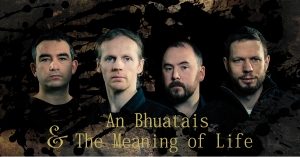
    Band Photography | Musicians | | Holst Photography Ireland

    The following extract is the introduction to An Bhuatais & The Meaning of Life, a book and CD collection of contemplative songs and essays. It is a hard-backed 112 page edition, based on the philosophical themes of the accompanying CD. The CD and book are complementary elements of a contemplative philosophical experience:

    A song, like a story, speaks from a time and a place. Time passes, and its voice diminishes. But sometimes a story speaks to the essence of human nature and its power lasts through time regardless of space; regardless of place.

    An Bhuatais [The Boot – the album’s title track] has a context related to a changing social dynamic between the late 18th and early 19th century in Ireland. The native Catholic population of Ireland in the 17th century were suppressed by a series of penal laws designed to disenfranchise them and leave them firmly outside the protection of public and legal institutions of state. These penal codes were defined along sectarian divides which delineated the native Irish from the coloniser.

    The native population had at least a religious institution which offered solace and sanctuary. The Catholic clergy who tended to this disenfranchised population were outlawed, and for a time had a bounty on their head. Sharing in the fate of their flock, they had spiritual and moral credibility.

    The penal code relaxed over the 18th Century and in 1795 Catholicism was officially permitted into the fold, most visibly with the establishment of the Catholic University of Maynooth.

    This is all interesting to our story because it makes the animosity of the author of An Bhuatais towards the local Priest all the more comprehensible. As opposed to the hunted priest of the recently repealed Penal period, the priest in this song clearly doesn’t suffer along with his parishioners. He doesn’t share the suffering of the songs author; he is not one of the people.  He is castigated for abandoning spirituality for profane wealth. Betrayal and hypocrisy; they are powerful themes, and they incite gut felt creativity.

    There is something basic and fundamental in the representation of the hero in the tragic mythological perspective. Friedrich Nietzsche, the harbinger of resurgent nihilism, recognised this in his analysis of the heroic archetype. This helped him form theories on the pre-eminence of the dominant will – the natural state of an amoral being – and the end of belief. While it is a helpful filter on the mythological perspective of death, it is a perspective which creates a lot more problems than it solves.
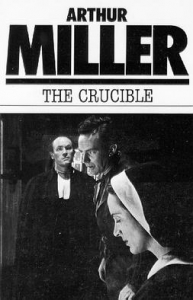
    Illusions of “the end of history” and the implication that we have no more to learn from the past are, it seems, endemic with humanity. It’s an arrogance which seems to consistently blind our species. The American playwright, Arthur Miller, enacts this folly in the character of Judge Thomas Danforth in The Crucible, where he says: “This is a sharp time, now, a precise time – we live no longer in the dusky afternoon when evil mixed itself with good and befuddled the world.”

    Danforth’s error, and burning certainty, illuminate something that has been observed by historians of civilisation throughout the ages. Ibn Khaldun and others have told us that civilisations and empires flourish and wither in cycles. Giambattista Vico, argued that the cycle of civilisations went through three stages which he called: the Age of Gods, the Age of Heroes, and the Age of Men.  Although he is ruled by superstition, Danforth’s speech is paradoxically of the “Age of Men”. His certainty that the institution of his court is the nexus of reason is an arrogance of every age. The “precise time” he talks of is his certainty in the error of past ages and the enlightenment of his own.

    Vico’s theory tells us that the age of reason is an epoch, not a culmination. That man-kind keeps cycling through the spiral of civilisational rise and fall, and that we keep refining our myths and reinventing our stories.

    Stories and songs can carry more than eternal narratives. I recall a drive on a narrow rural road, playing a recording of An Captain Ó Máille sung by Stiofán Ó Cualáin, and feeling an overwhelming sense of belonging; of returning home. O Cualáin’s unaccompanied phrasing, which emanates a familiarity with landscape, living, and language, has a close familial sense.

    His performance – though I think performance is the wrong word for something that sounded so spontaneous and lived in – is unique, and I was surprised by how much I felt I knew intimately the essence of what this voice carried. This singing has its own inscape. It’s one that is as much shaped by cultural phenotype as by the rugged landscape of Connemara.  I felt my soul could make its home there.

    An Bhuatais & The Meaning of Life is available through:

    Website:
    www.lorcanmacmathuna.com

    Bandcamp:
    https://lorcanmacmathuna.bandcamp.com/album/an-bhuatais-the-meaning-of-life

    Spotify:
    https://open.spotify.com/album/4ughUTW4jIawqVLiY8D5am?si=p6hJeIqsS0yr_3HgPBv2Kw

    Featured Image (of Connemara) by Daniele Idini.

  • Is there a Doctor in the House?

    Imagine if you will, a government that nobody actually voted for. A government with no opposition that legislates at the behest of a committee of unelected civil servants. A government that took over from a “caretaker” administration that had been voted out of office nearly five months previously, yet still held full executive powers and introduced legislation resulting in civil restrictions unprecedented in the history of the State.

    How did we get here?  Well, if it were not already apparent, the last twelve months have certainly served to expose the shocking state of ill-health of Irish democracy. In addition to the scenario referenced in the first paragraph, there exists a web of inherently unhealthy relationships, both familial and commercial, spanning the entire Irish political class, a tamed, nodding media, and the pharmacological and technological industries. This political and financial incest between those who introduce legislation, those who control and disseminate information, and those hawking their wares is evidently self-serving, but most certainly does not serve the public interest, and represents an existential threat to genuine, transparent democracy.

    Sandwiched somewhere in the middle is a Police Force. Once upon a time it had designs on being a Police Service, but over the past twelve months it has most definitely reverted to being a Police Force; one whose members appear unable or unwilling to question the legality – or at the very least the morality – of their orders from their political masters, preferring instead to seek the comfort of overtime and the surreality of TikTok dance challenges.

    A pliant citizenry have, of course, played their own role, and the ease with which the majority have demonstrated their willingness to surrender unquestioningly their most fundamental rights and freedoms has been truly shocking. It would almost lead one to believe that the people no longer wish to bear the onerous burden of personal responsibility, instead wishing to cede responsibility for living their own lives to the State. Everything has its price, of course. Perhaps public acquiescence is not so surprising after all, considering that for some time now indoctrination has been masquerading more and more as education.

    Stateism may very well turn out to be the life choice of a generation reared on an intellectual diet of The X-Factor, but it will be a shocking legacy to leave to their children, who didn’t sign up for it.

    Evidently, the political situation in Ireland mirrors a broader trend towards “Super-Stateism” and the erosion of democracy and its associated freedoms in the Western world generally, and – more pertinently in Ireland’s case – the European Union.

    Bleating about European militarism from some of the usual suspects on the Irish Left ring hollow. They signed up for this, one and all. The days of Ireland opting out of aspects of the European Project that it finds unpalatable are long gone. The cent began to drop in Brussels and Berlin the day the Irish people acceded to having a second EU referendum force-fed to them after returning the wrong answer first time around.

    The cent dropped all the way when the political class volunteered Ireland to be Europe’s fall guy for the economic crash of 2008 and the people went along with it. It’s all or nothing with the EU now, comrades. Are these people really so naïve that they don’t realise that once political and monetary union have been achieved, then military union must necessarily follow? Perhaps those who resolved to vote for them in the last election can answer the question for them in the next one.

    Looking at the current lie of the Irish political landscape, it is honestly hard at the moment to see from where meaningful change will come. Despite their virtue-signalling, hand-wringing (and hand-sanitising), from a political point of view there is actually very little to dislike about the current situation for those on the red and green wavelengths of the political spectrum.

    The long-term prognosis for the return of healthy democracy does not appear to be great. However, the Covid-19 narrative that has been created now seems to have almost taken on a life of its own. Trial balloons are being floated up on an almost daily basis in order to gauge the receptiveness of a fearful, weary public to absolutely ridiculous, dystopian nonsense. The political class and their allies have created a monster, but they would do well to remember that artificial monsters, having once gained self-awareness, do have a habit of eventually seeking out their creators and… well, let’s say, coming home to roost.

    The Irish body politic needs a prescription for a Great Reset, alright – just not the type of Great Reset that the self-serving elitists who are currently pulling the strings are working towards.

    Cassandra Voices is a home for independent voices to inspire new thinking that publishes a wide variety of viewpoints, find our submissions guidelines here.

  • Kafka’s Café

    Levi ‘Lev’ Driscoll, wrote the odd sentence or two when creativity revealed itself to him. This month, albeit at a snail’s pace, he’d immersed himself in Frank Herbert’s classic, Dune. How he relished reading the exploits of Paul Atreides and his mother Jessica, deep into the vast inhospitable desert on Planet Arrkais. Lev marvelled at how the novel’s plot had been devised to move the narrative forward – like the colossal sandworms burrowing at its centre, the sci-fi story tunnelled and lunged into a distant future, simply by devouring and expelling sand.

    At age forty-five, Lev’s daily garb consisted of jeans and a plain t-shirt. When he was in the mood, he donned Cherry Red Doc Martins, or might dye his lank auburn locks an astonishing Hulk Green. In younger days, he’d sported the facial accoutrement of two studs and a nose ring. A soul-patch still featured below his lower-lip. He listened to Wayne Shorter, Van Morrison, and The Blue Room Jazz Sessions. Some Punk. A recent listen was that band called Idles. Lev watched what he ate, adding pomegranate seeds and blueberries to his a.m. porridge. A breakfast which steeled him for the day.

    This morning’s thought had already been jotted down on a writing-pad, where he sat in the breakfast nook of his small Rathfarnham apartment, Good literary fiction is a desert citadel visited only a few times in one’s life. Breeching those stone walls brings with it a knowledge and invigorating power all of its own.

    Turning on the radio he heard writer Colm Tóbín, talking about Irish writers’ fathers and their lives, whereupon Lev thought, Jazyhus, yer man Colm Tóbín’s voice sounds like it went off to Grasse in France for an apprenticeship in perfumery. Like it rolled in a field of lavender and chamomile!

    Lev left his flat, caught the No.16 bus into town and went dandering about in Dublin city centre. He mooched for a few deals in Dunnes before deciding to walk the 8km home. It was late autumn and the sun was bright but the air very cold. Wind-raked dead leaves heaped at the sides of pavements with their muted browns, and October yellows.

    Quiet were the white swans of Portobello, and their amorous dalliances on the Grand Canal went unnoticed by busy Dubliners in the early afternoon sunshine. He walked south of the city centre, into Rathmines and regarded a church’s chiselled proclamation, SUB. INVOC. MARIE. IMMACULATE. REFUCII. PECCATORUM (of Mary Immaculate, Refuge of Sinners, or possibly “Shinners,” as the IRA once stored weapons and ammunition in its vaults during the War of Independence). A Neoclassical colonnade and four columns stood proud as the façade, sprouting fleur-de-lis, under a copper-covered dome. The original burnt down in a fire of 1920 where a new one sits in its place, peeping over the skyline, in a shade of aquamarine flaring with copper hues and an impressive, oxidised jade patina. Rumoured to be destined for Saint Petersburg’s Russian orthodoxy, the impressive architecture conjured places such as Rome, or indeed, Russia, thought Lev. Yet, it seemed like an opal set in granite.

    To get off the street, Lev didn’t even look up at the sign above its door before entering one Rathmines establishment. Without registering its high-windows, tables and chairs, or mute patrons within, what he wanted was a hot drink and to sit down. Maybe a freshly baked Danish, if there was one? And for some reason, at that moment, he mused about Vermeer’s chequered black & white tiled floor. Would it, he wondered, have been mopped, regularly? Also, he pictured Joseph Decker’s painting, Green Plums. Then Lev summoned from memory, some NASA photos he’d seen, of Jupiter’s meteoroid scarred moon, Europa.

    Inside the café, a Gaggia coffee machine operated at full steam. Out of it gurgled runnels of a dark, bubbling, black gold. At its side, feldspar porcelain espresso cups piggy-backed on top of each other along with small white matching saucers stacked and ready for dispensing. An alluring aroma of roasting coffee beans permeated the café where chatter was subdued. The high-fi-system played Handel’s Water Music, seemingly on a loop. Not a flat-screen television in sight, and a sign stated that it was forbidden to use smartphones. Plastic mother-in-law’s tongue sat sterile in plastic pots. Fake ferns and philodendrons were fixed with grey pebbles inside sable-coloured wooden borders. A glass cloche covered some raisin-studded scones nestled beside the cash-register up front.

    When his turn came to be served, Lev stepped forward and almost absentmindedly asked, “Can I have a cappuccino, please?”

    “Did you submit Form 1A?” enquired the lady behind the counter. A pair of lacquered chopsticks held her brown locks in place and she sported tortoise shell-coloured glasses. White shirt. Black apron, trousers, and shoes. Her elaborately embossed name tag said simply, “Server.”

    “No, I’m afraid I did not,” Lev was lost.

    Pink slips of paper were piled high in an in-tray before him, but he hadn’t noticed.

    “You still have to submit Form 1A.” She said glaring through her glasses at Lev.

    “I just want a coffee,” replied the writer, now sheepish. She sighed.

    Another customer stepped forward to order and Lev stood back a little, letting the other customer pay for and receive her green tea.

    “There’s your receipt, and here’s my receipt, for your receipt.” clarified the lady in the glasses, securing her own slips in the till. Thinking about writing, Lev conjectured, You have to keep a full-stop dancing on its tippy-toes. He then moved forward again. At this, the lady clucked her tongue.

    “I’m still waiting,” Lev reminded her. She looked at him again with an imbibing eye, imagining he was an outlier and hence, a troublemaker.

    “Which street do you live on?”

    “What does it matter which street I live on?” Lev began to show signs of incredulity.

    “Because, Sir,” she snapped, “We only serve some streets on Tuesdays and Wednesdays, and others on Mondays, Fridays and Saturdays. It’s all here in the rules,” She said, tapping a laminate posted at the till. And on it was a map depicting which streets were allowed to order coffee on what days. Lev found it all rather formal. Something about it didn’t sit well with his socialist perspective.

    “This is wile bad craic, Hey!” He uttered, entirely exasperated.

    “Now, you’ll have to fill out Form 1A. With adjuncts A1 and B1, Sir.”

    What fresh hell is this? Lev pondered.

    “Why?” was all he asked.

    “Because, Sir, you fail to follow protocol.”

    A speaker above the coffee-machine barked out, ‘More A32 Forms, immediately!’

    On the counter was a box of black ink Biro ballpoint pens, and a photocopier behind the counter ran pink slips of paper which were bakery warm to the touch.

    While all around him customers filled in their forms in quiet acceptance, he regarded the server in question and her carapace of harshness with a mixture of bemusement, anger and wonder. Was this Stalinist Russia or Thatcher’s Britain, where civil servants replaced all working roles with their applications and forms inhabiting long corridors to the sound of opening and closing doors behind which were row upon row of file cabinets filled with documents ranging from ordering a clothes peg, Form 2344ABX, to marriage vows, Forms 32 C & D. Entering here meant submission to an authoritative power and being controlled by it. Out in grey society, the faceless masses walked around with their heads drooped, proles going about their conforming lives. No individuality permitted. Conform through endless bureaucracy or go insane in the process. Few go insane. Most do conform. But, under no circumstances would Lev. He aimed for coconut shampoo, raspberries and cream, lemon-curd sandwiches, a three-day weekend with Habanero sauce. Peaking cream puffs and apple-turnovers. Falling popcorn, the fifth of November, and bonfire night. Dance music. Pubs. Freedom of choice. Not this, whatever this was.

    “May I have a scone with my cappuccino?’ asked Lev.

    “Oh, you want a fruit scone?’ She said with all the vigour of a congregating sloth at a sleepover in Connecticut. Lev sensed that his request was bothersome, but he would hold out to see how far this would go.

    “Please move over to the other line. This line is for people with slips. The other line is either for those who have not made their minds up yet, or Sabos like yourself. That’s short for Saboteurs around here,” she explained. Lev saw no other line, but he spied a stand which read “Sabos.”

    “Does this work the same way for a bacon sandwich?” he asked, arching an eyebrow.

    “To have a bacon sandwich, you’ll have to make an appointment.”

    “To have a freaking BLT?”

    “An appointment with the chef.” She stipulated.

    “Lemme get this right. To order a simple bacon sandwich, I have to make an appointment with the establishment’s cook?”

    “His title is Chef Martine, Sir,” said the server, adding, “And yes, that’s the rule. There are no exceptions to the rules. Not here. Would you like to make an appointment?”

    Stunned, Lev nodded his assent, as the server spoke into an intercom.

    “A Sabo requests an appointment, Chef Martine.”

    Lev stood for forty minutes before being ushered into a small yet neat stainless-steel kitchen where, with a square blade, the chef was decapitating a head of lettuce from its white neck. Luscious and wet, the green leaves fell open in that kind of surreal slow-motion Lev had only seen in advertisements on TV. This was the inner sanctum of scones and other closely held secrets. Chef Martine’s accent was fabulously French. “No. Get rid of dis, and dis, and dis. Out!” Pausing his pointing at which produce needed to be replaced or replenished, in less than a split second, he looked Lev up and down, before waving him away.

    “I have no time to…to…to deal with the likes of you, Monsieur!”

    Backing out to the café, again Lev attempted to ask for a drink and without the appropriate paperwork. He was denied. Lev wondered about the hivemind rolling over to authority. The weak-livered acceptance. Rising up, he steadied himself upon a table top and announced, “You! All of you!” Around twelve café patrons looked up from their flat-whites, green-teas and Americanos. “You have freedom of choice to come in and order a drink without having to fill in mundane forms!” No one dared to agree with his rebellious talk. “To spend your lives in cubicles fulfilling meaningless work just because it’s been set out for you, is a form of bondage and slavery! You in your Birkenstocks, reading gossip magazines full of middle-class morality and intolerance by the cart-load!”

    “SIR! Can you calm down?” called out the server, white face contorted in confusion, indignation and trembling with anger.

    “I WILL NOT CALM DOWN, you… COG! What kind of establishment is this place, anyway? What’s it called?”

    “Sir, you are in Kafka’s Café.”

    Something clicked and so he saw it all now. The endless bureaucratic processes. The strict adherence to these formalities. The authoritarian staff. The server’s clerkish comportment. He felt anger. Despair. Hopelessness. This was not just a comment on the establishment in question, but to a wider enslavement of human beings. Freedom of expression was viewed as distrustful and downright careless. Dangerous even. People like Lev were to be ridiculed and ignored. They were insane outliers who were not at all loyal to the state.

    “Okay, I’ve read The Trial. The Castle and this…This is circumvented madness towards a form of totalitarian rule. I just wanted a fucking coffee!” said Lev out loud.

    With a nod, the server sent a staff member out back to alert the relevant authorities. Stepping down from his table top pulpit, Lev sat quite still playing The Clash’s Rock the Casbah on his smartphone. Café personnel looked on and whispered at the bizarre behaviour of this madman. Lev did not hear a van screech up to the pavement outside. Nor did he notice as burly men in dark uniforms stormed in, until they grabbed hold of him. His phone was sent crashing to the floor, where its plastic housing cracked and scattered.

    Screaming “Poseidon! Poseidon!”* Lev was brought out into the street by a balaclava-clad, snatch-squad and dragged into the back of a waiting van. His demonstrations were soon silenced by its doors when they were slammed shut behind him, before the vehicle roared off and disappeared.

    The citizens in the café merely blinked as they began filling in their 1A forms again. The age of banality was long and continued unabated as, outside, a stroke of raindrops dashed the Dublin pavement, people filed along the streets where, once more, normality pervaded. The white floating petals of the swans’ feathers, the hue of hedge bindweed (Calystegia Sepium) drifted down the canal water’s surface and on into the diminishing autumn evening.

    *Poseidon is a piece of prose by Franz Kakfa.

    Featured Image: Egon Schiele, Self-Portrait with Physalis, 1912.

  • ZeroCovid’s Neoconservative Traits

    So-called ‘ZeroCovid’ is a ‘zero-tolerance’ approach to the virus, promising to eliminate community transmission in Ireland. The concept has gained traction among young people, especially, desperate for an end to a seemingly endless cycle of lockdowns, and others worried by the danger posed by the disease itself.

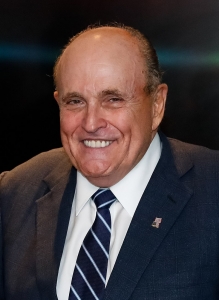
    The original ‘zero-tolerance’ policy is identified with Donald Trump’s associate Rudy Giuliani’s tenure as mayor of New York (1994-2001), and involved punishment for even minor infractions.

    Rudy Giuliani

    Most criminologists agree, however, that zero-tolerance, based on the ‘broken window’ theory of policing, made little difference to overall crime rates, which seem to have been falling in New York prior to Giuliani’s period in office. New powers of arrest simply handed police carte blanche to remove homeless people from affluent neighbourhoods. Thus Time Square became a safe haven for tourism, but ghettos remained no go.

    Zero-tolerance policies emerged in a neoconservative era alongside ‘humanitarian interventions,’ culminating in the illegal invasion of Iraq in 2003, led by U.S. President George W. Bush, and supported by U.K. Prime Minister Tony Blair. Blair also backed a zero tolerance approach to crime in the U.K., and has recently inveigled his way back to prominence as part of the ‘war’ effort against Covid-19.

    Neoconservatives engineered a War on Terror which, apart from direct military actions, included ‘shock and awe’ tactics to cow opponents, galvanising support through appeals to nationalist sentiment and by demonising – often phantom – enemies.

    Finally, neoconservatism is aligned with neoliberal austerity adopted in the wake of the Financial Crisis, beginning in 2007-2008. Austerity proponents assume purgative measures – described as ‘The Shock Doctrine’ by Naomi Klein – are required to heal the body politic of its economic woes.

    Family Resemblances

    The ZeroCovid elimination approach in Ireland bears significant family resemblances to an illusory zero-tolerance policy to crime. There are also shades of the War on Terror’s ‘shock and awe’ tactic of elevating fear and appealing to narrow national self-interest. The imprint of austerity is apparent in a promise of deliverance after painful expurgation, as a population already frayed by successive lockdowns is exhorted to double down and accept greater stringency. Naomi Klein has also identified a Pandemic Shock Doctrine.

    It may seem surprising that Irish leftists should be attracted to a policy which seems to have a neoconservative mentality, but notably ‘recovering socialists developed neoconservatism in the sixties and seventies,’ and the Marxist dialectic permits great suffering before the achievement of a socialist paradise.

    Leading spokespeople do not, however, give the impression they welcome the embrace of leftists. Tomás Ryan recently called for ‘more of a grand coalition attitude’; while another, Anthony Staines is, or was, a member of Fine Gael. Among the few practising doctors associated with ZeroCovid is Maitiú Ó Tuathail, whose friendship with then Fine Gael Taoiseach Leo Varadkar gave him access to a confidential agreement between the State and the IMO, which is now the subject of a Garda enquiry.

    ZeroCovid is certainly not a blueprint for a socialist republic – the narrowness of its focus its quite striking – and advocates assert pro-business credentials, Ryan emphasising that ‘ZeroCovid countries are ranking highest in business confidence.’ Far from being treated as revolutionaries in the mainstream media, its spokespeople have become household names during the pandemic, blurring a distinction between expert witness and political actor.

    Some on the left may be attracted to ZeroCovid in the hope that ‘Napoleonic’ state mobilisation witnessed during the pandemic will be carried into ‘peacetime,’ to address poverty and environmental destruction. The shady dealings we have witnessed in this period, however, set a dangerous precedent, as the executive director of the British Medical Journal Kamran Abbasi put it:

    Covid-19 has unleashed state corruption on a grand scale, and it is harmful to public health. Politicians and industry are responsible for this opportunistic embezzlement. So too are scientists and health experts. The pandemic has revealed how the medical-political complex can be manipulated in an emergency—a time when it is even more important to safeguard science.

    Given the paucity of investigative journalism in Ireland it is difficult to assess corruption levels, but the one euro billion spent on PPE in 2020 raises a red flag, while allegations of contracts being awarded inappropriately are ventilated on social media.

    End of the Truce

    It is also notable that despite the obvious distinction between the government’s suppression approach, and ZeroCovid’s elimination policy, there has been no direct confrontation between the two groups. At the end of January, however, the truce ended with the chair of the Irish Epidemiological Modelling Advisory Group Philip Nolan decisively branding ZeroCovid ‘an utterly false promise.’

    This intervention may have been linked to recent politicisation, as the Social Democrats, and to a lesser extent Labour (which announced ‘a national aggressive suppression strategy, zero Covid-19 by another name’), followed People Before Profit’s earlier embrace of the project.

    Throughout the pandemic ZeroCovid spokespeople have been welcomed within the dominant media consensus – assessing the virus a once-in-a-generation challenge – with nationalist appeals – adopting the hashtag #wecanbezero – perhaps seen as a way way of channeling latent radicalism away from opposition to reliance on strict lockdowns.

    Origins of ZeroCovid

    The genesis of the movement in Ireland is unclear. Last summer the Wellcome Trust, whose offshore dealings were exposed in the Paradise Papers, launched a global ‘Zero Covid’ fundraising initiative for vaccine research, with the support of Goldman Sachs Gives and others.

    The Irish initiative traces its origins to a disparate group of academic scientists led by Staines that brought forward a Crush the Curve petition in July, preceding the emergence of a Zero Covid Island group. It has since morphed into another organisation called ISAG: ‘a multidisciplinary group of scientists, academics, and researchers who have come together to advocate for a SARS-CoV-2 elimination strategy for the island’.

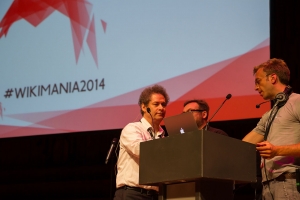
    Yaneer Bar-Yam preparing to speak at an event in 2014.

    Among those involved is a MIT Professor Yaneer Bar-Yam, who does not appear to have had any previous connection to Ireland. Bar Yam previously advised the Pentagon ‘about global social unrest and the crises in Egypt and Syria’, and the National Security Council and the National Counter Terrorism Council on global strategy, elsewhere described as ‘preventing ethnic violence.’ He also advised policymakers on the elimination of Ebola, a disease which presents a very different challenge to Covid-19.

    Tomás Ryan is himself a former Post-Doctoral Fellow (2010-2016) at MIT, having previously been a Junior Research Fellow at the Wellcome Trust Sanger Institute and Wolfson College, Cambridge (2009 – 2010). Ryan’s background is in neuroscience and has no publications in virology or epidemiology.

    Bar-Yam set up an organisation called ENDCRONAVIRUS.ORG (https://www.endcoronavirus.org/) in February 2020, and may see Ireland as a potential testing ground for counter-viral methods.

    ZeroCovid appeals to national self-interest, requiring exclusion of a diseased ‘other,’ through mandatory quarantines for foreign arrivals, and promotes the creation of zero-transmission zones within the country. In August Bar-Yam co-authored a paper entitled, ‘A green zone strategy for Ireland,’ which recalls Baghdad’s ‘Green Zone’ under U.S. occupation, and districts ‘purified’ by the application of a zero-tolerance approach to crime.

    Indefinite elimination of what appears to be an endemic seasonal virus from a globally integrated country such as Ireland appears Utopian however, with most scientists assuming Covid-19 will be with us forever.

    Last month, Nature asked more than one hundred immunologists, infectious-disease researchers and virologists working on Covid-19 whether they believe it can be eradicated. Almost 90% responded to say it will become endemic

    According to one of those surveyed Michael Osterholm, an epidemiologist at the University of Minnesota in Minneapolis. ‘Eradicating this virus right now from the world is a lot like trying to plan the construction of a stepping-stone pathway to the Moon.’

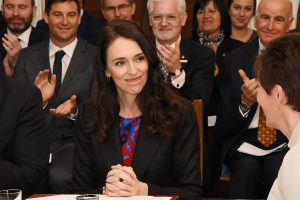
    Jacinda Arden

    New Zealand

    For obvious cultural reasons, Irish ZeroCovid strategists often cite New Zealand’s as a model to follow – factors other than suppression policies appear to be inhibiting Covid-19 in east Asian countries –  but this ignores the extreme isolation of a sparsely populated island nation situated on the other side of the world, under a depleted ozone layer that brings elevated levels of virus-killing ultraviolet light. Moreover, New Zealand does not have a disputed border with another jurisdiction to contend with. Also, importantly, New Zealand’s imports arrive in containers, as opposed to Ireland’s reliance on ‘roll-on roll-off’ trucks.

    https://twitter.com/John_McGahon/status/1360552471345717249

    Moreover, it seems significant that there have been less than two thousand cases of Covid-19 detected in New Zealand so far during the pandemic. Common cold viruses display infuriatingly unpredictable behaviour, waxing and waning seasonally, like influenza, which derives its name from the influenza degli astri, or ‘influence of the planets.’

    A paper from 1973 entitled ‘An outbreak of common colds at an Antarctic base after seventeen weeks of complete isolation’, discusses the case of six of twelve men wintering at an isolated Antarctic base that sequentially developed common cold symptoms after seventeen weeks of complete isolation.

    According to the authors: ‘Examination of specimens taken from the men in relation to the outbreak has not revealed a causative agent,’ which the authors say could ‘well have been the effects of a coronavirus.’ Bewildered, they conclude: ‘in some way virus persisted, either in the environment or in the men.’

    Furthermore, in an article for Cassandra Voices Justin Frewen observed how decisive political leadership encouraged personal responsibility:

    In addition to providing Covid-19 related information through standard media channels, the NZ Prime Minister, Jacinda Ardern, has communicated directly with the public, making herself available to the media and holding daily public press conferences, led by New Zealand’s director-general of health, Dr Ashley Bloomfield. Together they have displayed “a reliable, measured and authoritative face for New Zealand’s Covid-19 response”.Of particular value has been the clarity of Jacinda Ardern’s communication on the virus. Her leadership style has been assessed by one commentator as ‘one of empathy in a crisis that tempts people to fend for themselves. Her messages are clear, consistent, and somehow simultaneously sobering and soothing. And her approach isn’t just resonating with her people on an emotional level. It is also working remarkably well.’

    The virus returned mysteriously to Auckland in August, however, leading to a second lockdown. Civil liberties advocates may take issue with the mandatory confinement of anyone testing positive – and mandatory quarantining of all visitors – but the response to the virus has been to the benefit and satisfaction of the vast majority of New Zealanders, and the satisfies a principle of proportionality.

    But another outbreak at the beginning of February has brought yet another lockdown to Auckland, and Prime Minister Jacinda Arden has since signalled that the country’s elimination strategy is to be abandoned in the wake of the arrival of vaccines, stating: ‘Our goal has to be though, to get the management of Covid-19 to a similar place as we do seasonally, with the flu. It won’t be a disease that we will see simply disappear after one round of vaccine.’

    Yet surprisingly vaccines are not seen as a game changer by ZeroCovid advocates. An ISAG webinar on January 21st found Staines arguing in favour of mandatory quarantine facilities, on the basis that new variants could ‘dodge some of the effects of vaccines.’

    It begs the question: if new variants are swirling around the world indefinitely – just as strains of influenza vary from year-to-year occasionally evading the effect of vaccines – will Ireland maintain quarantine requirements indefinitely, as a true believer associated with Bar-Yam’s organisation has proposed? This seems unthinkable for a country with a diaspora of three million and a high proportion of immigrants, some of whom may leave Ireland if this approach is adopted. Unfortunately, as in the War of Terror, the enemy is within, and the war unwinnable.

    Australia

    A more tortuous, and arguably disproportionate, route to the elimination of Covid-19 was witnessed in Melbourne, Australia, which may serve as a warning to an Irish public desperate for the pandemic to end.

    With a similar population to the whole of Ireland’s Melbourne experienced a winter outbreak, beginning in June, that brought a stringent lockdown lasting almost three months. Notably, however, the number of cases peaked at seven hundred per day and the virus declined with the arrival of spring. Ireland has had ten times that number in a single day in January, and as of mid-February has still not brought case numbers down to that level.

    Just this month Melbourne went into another lockdown again after an outbreak in a Holiday Inn, giving the lie to the notion that elimination avoids recurring lockdowns; especially in a country such as Ireland conteding with leaky borders, a poorly resourced health system, and a history of distrust in State institutions.

    Advocates of ZeroCovid now call for a level of stringency that brought an end to the Melbourne outbreak, in particular advocating schools close until late April, seemingly oblivious to the damage on children, already denied months of education.

    Apocalyptic Warnings

    Irish ZeroCovid advocates have been unusually apocalyptic in their assessment of the danger posed by Covid-19, with Tomás Ryan projecting in June that a herd immunity approach, involving successive lockdowns, would result in 50,000 deaths, while Sam McConkey warned in March there could be up to 120,000 deaths.

    The latter death toll would be greater than has been witnessed in the U.K., which has the second highest mortality rate (after Belgium) in the world, and a population ten times that of Ireland. Even in almost libertarian scenarios – such as in the two Dakota states in the U.S. – death tolls have been nowhere close to those proportions.

    While ZeroCovid might be dismissed as a fringe organisation, or cult, the degree of media exposure its advocates have enjoyed, and their tendency to ‘shock and awe’ with outlandish projections has distorted debate in Ireland, drawing attention away from the profound damage of lockdowns.

    The Irish media has developed a fixation on the virus to the almost total exclusion of other challenges we face. Mortality from Covid-19 is not portrayed as equivalent to death by natural causes, but a consequence of moral failings in the population or an indulgent government. It has parallels with the attitude of the Pro Life movement.

    Looking forward to life improving.

    And yet, as spring approaches case numbers will surely recede, with a range of vaccines and new treatments reducing severity and mortality. Socially distancing has become second nature to many Irish people, and there is increasing knowledge of the importance of ventilation.

    The Irish government should resist a social experiment that holds no promise of success, and the public should look forward to life improving. In time we are likely to accept a seasonal mortality from Covid-19, just as we tolerate the burden of seasonal influenza, along with many of the environmental factors that cause or exacerbate the non-infectious diseases that remain our leading killers by far.

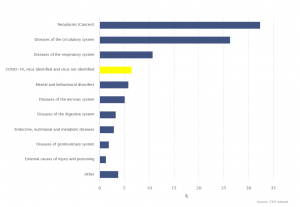
    Percentage breakdown of top ten registered causes of death, January – October 2020. Source CSO
  • The Dogs and Deer with Fionn mac Cumhaill

    We’ve lost Fionn and his Fianna, the stories that were told for hundreds, thousands of generations by firesides in Ireland and Scotland. Our language gone from us, and with it these science-fiction-like stories have drained away.

    The stories of the poets and hunters and warriors may, it seems to me, have been part of a Neolithic shamanistic religion.

    This was Ireland’s Dreamtime, our golden age, the perfection of time and place that we long for, we remember, we memorialise, we identify with, we idolize.

    All of the important names of these idols of the Fiannaíocht relate to deer. Fia is a deer in Irish, a fianna is a deer herd; Fionn, named for his white-blond hair, was originally Deimne, a fawn; the name of his magically-acquired wife, Sadhbh, means a doe, and Oisín and Oscar, his son and grandson, are both words for young male deer.

    Both Sadbh and Oisín came to Fionn in deer form – they were hunted down by the Fianna’s hounds, but defended from the hunting-pack by the enchanted superdogs Bran and Sceolan.

    Tír na nÓg

    The Fianna and their wit and prowess are part of the language – of our lost language in Ireland. To someone arriving late and bewildered we used to say they were “Oisín i ndhiadh na Féinne” – Oisín long after the Fianna, searching hopelessly for them. It’s a saying that came from the story of Oisín, lured to the land of youth, Tír na nÓg, by a seductive blonde on a white horse; he comes home for a visit and finds himself crumbling into a man of three hundred years old as soon as his foot touches the soil of Ireland.

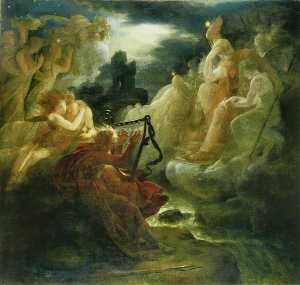
    Ossian playing his harp, by François Pascal Simon Gérard, 1801.

    For equality we said cothrom na Féinne, the equality of the Fianna, because equal shares and equal respect were their watchword. Even our picnics and barbecues were fulacht fia, the word coming from the ancient method of pit cookery. We said “Dar fia!” for “by Jove!” Our ancient board game was fiachall, played with pieces called fia. It’s not for nothing that our national anthem starts “Sinn na Fíanna Fáil”, identifying us as Destiny’s deer.

    All of the stories might be medieval fanfic; or they might have been written by monks schooled through childhood in the oral tradition, who took their chance to undercut the Christianity from which they were now making a nasty, brutish and short living. Or they might be ancient béaloideas given written form by those transgressive monks. Wherever they come from, their echo rings out from our hearts.

    Fionn mac Cumhaill

    Fionn, the leader of the Fianna, started his life, as did many heroes in stories everywhere in the world, hidden from those who had killed his family and were hunting for him. Brought up by poet aunts deep in the woods of Slieve Bloom, he sallied out and became the leader of the royal guard that included his father’s killers.

    In between battles and contests, hunts and hero-deeds the Fianna loved to sit around on mountain-tops composing poetry. In one of the beloved stories of these poem-contests, one of the lads asked what was everyone’s favourite sound. The pretty boy Diarmuid said it was the cries of women in love; Oisín said it was a cuckoo calling from a hedge; Oscar, the sound of a spear on a shield. Then they asked Fionn, and he said the best music in the world was “the music of what happens”.

    But back to the dogs. The Fianna’s dogs were central to their stories, and especially Bran and her brother Sceolan: “We went westward one time to hunt at Formaid of the Fianna [aka Ballyfermot], to see the first running of our hounds.

    These are the words of Fionn Mac Cumhaill’s son Oisín, a few days earlier a buff young man in his prime, now suddenly three hundred years old and feeling it.

    Lady Gregory

    “It was Fionn was holding Bran, and it is with myself Sceolan was; Diarmuid of the Women had Fearan, and Oscar had lucky Adhnuall,” he says, in Lady Gregory’s translation of the debate between the the two ill-tempered old gentlemen, St Patrick and Oisin, in her book Gods and Fighting Men.[i]

    “Conan the Bald had Searc; Caoilte, son of Ronan, had Daol; Lugaidh’s Son and Goll were holding Fuaim and Fothran.

    “That was the first day we loosed out a share of our hounds to a hunting; and Och! Patrick, of all that were in it, there is not one left living but myself.”

    Oisín had landed back from his Tír na nÓg love nest and gone around Ireland looking for his family and friends. Everyone he met told him these were people from a myth, or had lived hundreds of years ago. He was at the south end of Glenasmole, in the Dublin Mountains, when he went to help some puny little fellows who were trying to shift a boulder out of the way of a road they were building. The girth of his horse broke and he got a shocking land, his burden of years coming on him in a moment. St Patrick took him in, in the hope of bringing him to the Christian way of thinking. But they had one big problem with each other: their attitude to dogs.

    “Fionn, the son of Uail, delighted in dogs,” wrote James Stephens in one of the best children’s books ever written, Irish Fairy Tales[ii], a reworking of the Fiannaíocht stories. “And he knew everything about them from the setting of the first little white tooth to the rocking of the last long yellow one. He knew the affections and antipathies which are proper in a dog; the degree of obedience to which dogs may be trained without losing their honourable qualities or becoming servile and suspicious; he knew the hopes that animate them, the apprehensions which tingle in their blood, and all that is to be demanded from, or forgiven in, a paw, an ear, a nose, an eye, or a tooth; and he understood these things because he loved dogs, for it is by love alone that we understand anything.”

    Fairy Child

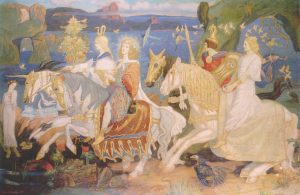
    John Duncan ‘Riders of Sidhe’

    Fionn was the son of Uail Mac Baiscne. He was, in the way of mythic heroes, also a child of the Sidhe; his mother, Muirne, was the granddaughter of Nuadha Airgeadlámh, the Tuatha de Danann’s silver-handed king.

    Fionn was also – in one of those family problems we don’t talk about – a cousin of his dogs Bran and Sceolan. Fionn’s mother’s sister, Tuiren, made the mistake of falling for and marrying Iollan, a man of the Sidhe, but Iollan’s old partner, Uct Dealv, took grave exception to his marriage.

    She kidnapped Tuiren and turned her into a bitch, as you do, and handed her over to Fergus Fionnlaith, the man in Ireland who most disliked dogs. However, Tuiren’s charms were just as powerful in doggy as in human form, and Fergus was soon as besotted as anyone with a new puppy.

    Fionn tracked down his auntie and disenchanted her, but in the meantime she’d had two pups which remained in dog form, and were Old Irish superhero dogs – Bran and Sceolan.

    Bran, whose name meant ‘raven’ was the kind of dog we nowadays call a merle. “Speckled back over the loins; two ears scarlet, equal-red… Yellow feet that were on Bran, two black sides and belly white, greyish back of hunting colour,” as Douglas Hyde translated the bitch’s description in his collection Beside the Fireside, adding “Bran would overtake the wild geese, she was that swift.”[iii]

    Some 1,969 years later, Led Zeppelin underlined this good taste, singing, “You can tell all your friends around the world, ain’t no companion like a blue-eyed merle.”[iv]

    Heaven Awaits

    As Oisín debated with the newfangled patron saint of Ireland, he was enraged by Patrick’s insistence that his beloved dogs would not go to heaven, a place Patrick was bigging up.

    The leap of the buck would be better to me, or the sight of badgers between two valleys, than all your mouth is promising me, and all the delights I could get in Heaven,” he says snarkily. “Fionn never refused strong or poor, although cold Hell is now his dwelling place.

    Patrick tells him he’s a withered, witless old man, and what’s more, the Fianna are all in Hell.

    “O Patrick, tell me as a secret, since it is you have the best knowledge, will my dog or my hound be let in with me to the court of the King of Grace?” asks Oisín.

    “Old man in your foolishness that I cannot put any bounds to, your dog or your hound will not be let in with you to the court of the King of Power,” says Patrick.

    Yes, the pre-patrician old Irish were doggy people. In the long-gone words of Oisín:

    If I had acquaintance with God, and my hound to be at hand, I would make whoever gave food to myself give a share to my hound as well. It was a delight to Fionn, the cry of his hounds on the mountains.

    Lucille Redmond’s collection of stories, Love, is available on Amazon and on Apple Books

    [i] Gods and Fighting Men by IA Gregory, published by John Murray, London, 1905

    [ii] Irish Fairy Tales by James Stephens, published by Macmillan, New York, Toronto, London, 1920

    [iii] Beside the Fireside: a collection of Irish Gaelic folk stories, by Douglas Hyde (parallel texts in English and Irish), published by D Nutt, London, 1890

    [iv] Bron-y-Aur stomp, from Led Zeppelin III, released by Atlantic, 1970

    Feature Image: The Monarch of the Glen, 1851, by Sir Edwin Landseer

  • Chambí’s World: Martín Chambi (1891-1973)

    Before Ireland’s third pandemic lockdown began, in December 2020, I paid a visit to my local library, in the hope of stocking up on books and films to sustain me in the months ahead. And I’m glad I did: the long weeks of isolation would have been far heavier, more dispiriting and lonely, without the hoard of soul-food I gathered from the library’s gloriously ample and eclectic store.

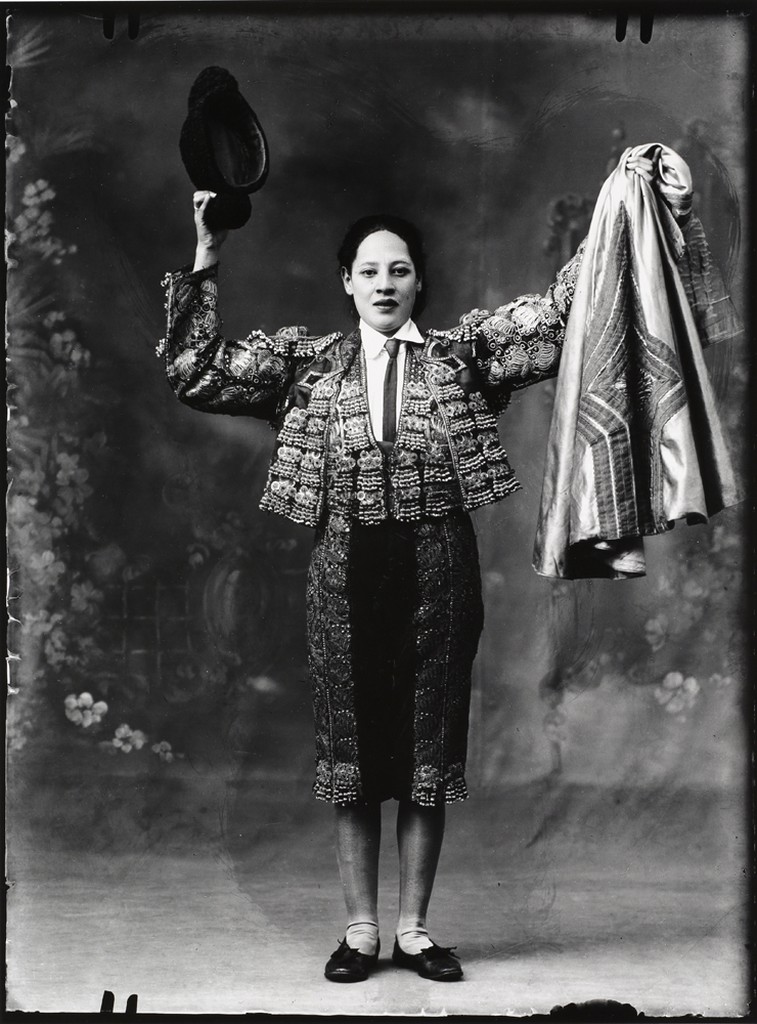
    Among the titles which have so enriched my days since, was a retrospective collection of work by the indigenous Peruvian photographer, Martín Chambi, born (to my rather boyish delight, exactly a hundred years before myself) in 1891. I can say without exaggeration that it’s become one of my favourite books.

    Cataloguing and celebrating the work, migration, landscapes, and customs of  primarily Quechua-speaking peoples in the Peruvian Andes, where the Inca empire reigned until the late sixteenth century, Chambi’s images form a mesmerising record of the effects of social and political marginalisation; while at the same time seeming nearly to sing, in festive tribute, to such communities, his own.

    “He was the first great photographer not to regard us through the eyes of the colonist”, observed Sara Facio, founder of the Museum of Latin American Photography in Argentina (Hopkinson, 2). “I am representative of my race”, he said himself: “my people speak [through] my photographies.”

    I’ve never practiced or studied in the visual arts, and so my response to photographs tends to be intuitive and instantaneous, rather than analytical and honed. In so far as I’m able to classify my preferences, I seem to share François Truffaut’s belief, “that a successful film”, for example, has “simultaneously to express an idea of the world and an idea of cinema,” and moreover to sympathise with his demand “that a film express either the joy of making cinema or the agony of making cinema.” I expect the same from photography.

    I’m most attracted to those artists who deploy their techniques and draw on their chosen traditions skillfully, of course, but also with a view to making a statement on reality. And by reality, I mean any space of experience and interaction in which other people – their rhythms, labours, presence, and visual attention – are implied or acknowledged.

    Also with Truffaut, I like to glimpse, if I can, something of the artist’s own peculiar passion from the work they’ve produced: to trace beneath the surface of a photograph, or indeed a poem, some shadow of that human fixation, that otherwise private and unresolvable neediness and knottiness, which partly impelled its making. In other words, I go back to images and artworks that seem, however delicately, to dramatise a tension I also feel in my own life, between outwardness (love of the world) and introspection (the ability to self-examine). These, broadly, give some indication of the shaping concerns, and no doubt also the limitations, of my appreciation for photography: what I look for, and why.

    Such reflections also drive to the heart of what I found, and what I value so much, in Martín Chambi’s work specifically. By approaching his “people” in a spirit of creative sympathy and affection, camera in tow, he was also, I believe, asserting and defining his own life in the world: taking a side, but in a way that affirmed his deepest needs and sense of belonging; the instincts of his evolving self, as an inheritor of Amerindian culture in a rapidly, often violently modernising era. All of this, moreover, shines, easily and entrancingly, in the images he left behind.

    Importantly, to the extent that he was photographing indigenous, peasant, and labouring people as people, with the warmth of recognition and respect, Chambí was not only offering a series of social documents on his time, but elaborating a visual rebuke to those discourses and forces (of metropolitan disdain, colonial hegemony, economic plunder) that thrive on the invisibilisation of some classes and communities, and the elevation and sanctification of others. His photographs are a defiant counter-narrative to the schematism, relentlessness, and embedded calculation of such world-histories.

    Within (or alongside) this quality, however, is another. In fact, there’s a baseline atmosphere in Chambi’s work, difficult to describe, but which I find totally captivating. Its main element, I think, is intimacy: an intimacy, reached for and reciprocated, with his subjects. In real terms, after all, almost anyone can point a camera in a given direction, and click: anyone can take a photograph. But it’s surely a rare observer who can sight and salute, in every other portrait, the exact individual and their humanity. Trawling his work today, it’s as if Chambi has seen some inner light in each person, each scene, a light that even they had only been foggily aware of before, and handed it back to them, in praise and thanks – for it was theirs to give, theirs to keep.

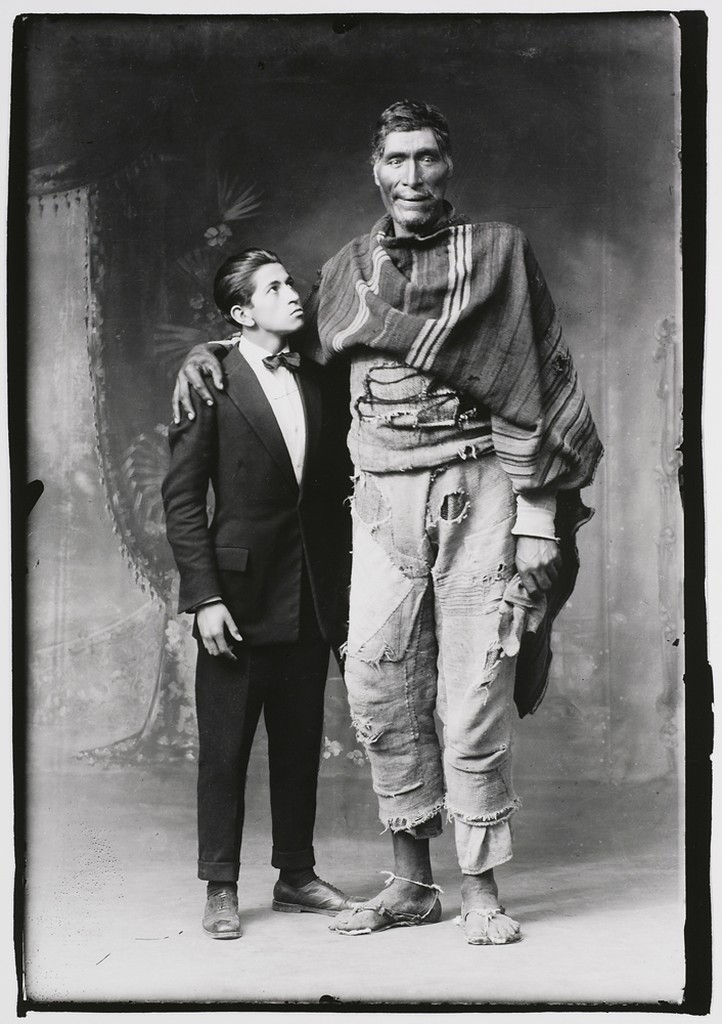
    I’m thinking of the so-called “Giant of Paruro” (7 ft tall), pictured by Chambi in 1925: the gentleness in his face and hands, the intense, unobtrusive quiet of his stance, raggedly clad and yet majestic. Or a year later, the portrait of Miguel Quiespe, known as ‘El Inca’ after tramping barefoot across the mountainous region of his native Paucartambo, organizing for the cause of land rights and reform; later (I learn) he was found dead in Lima, assassinated. He sits before the camera, both statuesque and bristling, in native garb, seemingly immersed in thought, as he raises a (criminalised) coca leaf in one hand, his eyes turned downwards, hidden in shadow and light. Then, one of my favourites, a photograph in which Chambi himself appears, pacing a hand-woven, local rope bridge in Cuzco, 1929, a trail of bent-backed, quick-stepping pedlars passing on either side of him, as they haul their loads against a backdrop of wide, sun-white sky.

    And there are many more: carefully glanced and emotionally laden images of life and the living, in the far reaches of an epoch hostile to both, promising only poverty and physical erasure. In Chambi’s work, by contrast, every presumed margin seems to gleam, a vital centre and a known locale, human to the root. Linger long or attentively enough over these pictures, and you might just hear their chatter and talk, the lithe exchange of their moment, break out – photographer and friends, laughing shyly with one another.

    Speaking for myself, I look at these social portraits with a sensation that blends vivid familiarity and strangeness, awake to the dauntingly vast distances (of time, place, circumstance and experience) over which my nevertheless visceral certainty of identification must travel. Perhaps this is an effect of the artist’s own kinship: the impression, always, that the particular gaze – directed as it may be, curated as its chosen vistas undoubtedly are – is not so much motivated by acquisition and judgement, fixing people in their places, as filled by what is surely a kind of joy, the capacity for human affinity and recognition.

    As our twenty-first-century pandemic rages on, as vaccines are tested, staggered, and accumulated unevenly across the globe, I realise that we live in an era, as Eduardo Galeano once said, “of powerful centres and subjugated outposts”, ruled by regimes of in-/visibility and engineered inequality – whose dominance is never total (267). I believe that’s why these photographs speak so eloquently: with their art, vision, feeling, and friendship. We still live in Chambi’s world.

    References

    Eduardo Galeano, The Open Veins of Latin America (NYU Press; New York, 1973/1997).
    Amanda Hopkinson, Martín Chambi (Phaidon; London, 2001).
    François Truffaut, The Films in My Life (Da Capo Press; Boston, 1994)

  • Wonder Woman: The Baudelairean Ideal

    Charles Baudelaire (1821–1867) reshaped the trajectory of modern literature. In acknowledgement T.S. Eliot famously called him ‘the Father of Modernism.’

    Many monolingual English speakers might be unaware that, along with Shakespeare and Dante, Baudelaire has been instrumental to how we in the West perceive the world.

    As an example, I think back to the early nineteen-nineties when I was living in Paris and the Austrian hosiery company Wolford were launching an advertising campaign using the photography of the celebrated fashion photographer Helmut Newton. I remember being on Place Concorde, not far from the Louvre, when his iconic black and white photographs of the giantesses were illuminated in the night sky, transforming the very street into a living interior of the exterior; just as Walter Benjamin had remarked about the arcades in his remarkable study of the nineteenth century French poet. This was pure Baudelaire in the late twentieth century.

    Of course, the Baudelairean woman is a whole motif or trope in herself, and is certainly one of the principal reasons why readers, male and female, still turn to Baudelaire, as he is one of the few poets who can write about women and love in a truly remarkable way, and which still makes sense to us today.

    Take the transversion of the poem ‘Sisina’ which I have transversed as ‘Wonder Woman’ in place of the name Théroigne, which according to my Flammarion notes is a reference to Théroigne de Mericourt (1762– 1817), who was involved in the French Revolution in 1792.

    The poem makes reference to a particular incident which happened on a staircase. This same woman appears in the famous French historian Michelet’s Histoire de la Révolution Francais, and she is also found in the poet Lamartine’s Histoire des Girondins. Apparently, Baudelaire was inspired by a drawing by the artist Raffet that depicts the incident and which was published by Pommier & Pichois.

    As this historical connection is likely to be lost on contemporary readers, I have supplanted it with the reference to the movie Wonder Woman. You have to choose your battles.

    I was particularly impressed by the character in the film while watching it with my ten-year-old daughter, as I thought she made a very good role model for young girls. My choice, I believe, is in accord with the symbolism and underlining metaphor in the poem.

    Baudelaire’s reference is to another actress Elisa Neri, who played the role of Théroigne, from what I understand, in theatrical productions during Baudelaire’s day. The poet came into contact with her through his attachment to Mme Sabatier, who was to have such an impact on him.

    I am of course referencing the climax of the Marvel movie when Wonder Woman, played by Gal Gadot, confronts Ares the God of War – thus mirroring the original reference made by Baudelaire to Théroingne de Mericourt played by the actress Elisa Neri.

    I expect Baudelaire would be entirely at home in today’s world where women have taken such a prominent place. After all, are the Gal Godot’s of today not the very same women of Baudelaire’s time? Women who showed incredible strength in the face of adversity.

    Surely, it is in the role of the Amazonian that the Baudelairean Woman is most idealised, which the poem Sisina is an example of, though it certainly stands alone.

    Spleen and Ideal is full of references to Amazonian and powerful women of which Lady Macbeth is one of the crowning figures, but first here is the poem ‘Sisina’ by Baudelaire followed by my transversion into English, which I have given the title ‘Wonder Woman’.

    LIX.- SISINA

    Imaginez Diane en galant equipage,
    Parcourant les forêts ou battant les halliers,
    Cheveux et gorge au vent, s’enivrant de tapage,
    Superbe et defiant les meilleurs cavaliers!

    Avez-vous vu Théroinge, amante du carnage,
    Excitant à l’assaut un people sans souliers,
    La joue et l’oeil en feu, jouant son personnage,
    Et montant, sabre au pong, les royaux escaliers?

    Telle la Sisina! Mais la douce guerrière
    A l’àme charitable autant que meurtrière;
    Son courage, affolé de poudre et de tambours,

    Devant les suppliants sait metre bas les armes,
    Et son Coeur, ravage par la flame, a toujours,
    Pour qui s’en montre digne, un reservoir des larmes.

    Wonder Woman

    Imagine Diana and her gallant retinue
    Charging through the forests bursting through the thickets,
    Mane and throat to the wind, drunk on uproar,
    Superbly defiant the best riders!

    Have you seen Wonder Woman, lover of carnage,
    Happily defending the down-trodden,
    Cheek and eye aflame, enfevered in her role,
    Assaulting, sword and shield in hand, the staircase?

    Just like Gal Jadot! But the gentle warrior
    Is as much a charitable soul as she is a seasoned killer;
    Her courage, panicking in the explosions and drums,

    Is to know when to put aside weapons before suppliants,
    And her heart, ravaged by both fire and pain, is always,
    For those who have some dignity, also a reservoir of tears.

  • Fiction: Luigi’s Trip  

    My boss sent me looking for Luigi. One of his super-rich clients had been sucked in by a betting scam Luigi was running down at the dogs. Luigi took this dude for a lot of twine and you could maybe say that my boss was seeking… restitution. It was my job to stick close to Luigi, wait for him to slip up.

    First stop, his apartment. He wasn’t there, but Dolores was. Five foot five and stacked, packaged in a singlet and daisy dukes. Biting that lip.

    “Hey, Carter. You look good.”

    She came up close to touch my cheek, then spun around and yeah, ground that tush of hers into my crotch. The glance over her shoulder said Follow me, and I did.

    Dolores was juicier than a peach. Hungrier than a shark. When we were done, she lay on the bed like a rag doll. Zipping up my pants, I asked her, “Where is he?”

    “Luigi? Oh, Luigi’s long gone.”

    He’d been a busy boy … tying up loose ends, collecting debts. Generally making people nervous, like something big was going to happen. People were looking for him. But now, no trace.

    A few days before, I was having breakfast at the Valhalla when my phone went off. Hamzy’s retread factory had gone up in flames overnight … and was still burning. Did a drive-by and sure enough, Fifteen engines plus cops diverting traffic. Smoke poured out the back of a building packed with enough rubber to blaze for days.

    Hamzy liked the gee gees, but they didn’t like him back. When he’d burned through every legit line of credit to feed his habit, he had to turn to some pretty unsavoury people. He’d gazed into the abyss, and the abyss was gazing back. Desperate times.

    Hamzy and Luigi shared a love of fishing, and it’s not hard to imagine Hamzy pouring his heart out during a day spent chasing snapper off Long Reef. Luigi had his fingers in a lot of pies, but now some of those pies had teeth. The brain trust’s coinciding interests might’ve come up with the idea of a new start, in a new state, for Luigi.

    You could rely on Luigi to fly under the radar. He’d never been flashy, not even in the good times. He liked to do the rounds in a battered ten-year-old Commodore with multiple plates, driven by Dolores’ brother, Pete.

    Pete was big.  Not the sharpest tool in the box. A rangy guy with massive hands, he didn’t like me running around with Dolores. Not out of loyalty to Luigi, but because he just plain couldn’t stand the sight of me. One drunken night he let the cat out the bag when he says to me, “I wanna punch you in the face, Pretty Boy.”

    I filled the boss in about Hamzy and how I thought Luigi was in the picture, especially given his history of playing with matches. A while later, the boss passed on scuttlebutt he’d picked up in the city: suspected arson, accelerant used. Police investigating. A two and a half million-dollar property insurance policy. No financial loss cover … maybe Hamzy didn’t want peeps looking at the books.

    The boss pulled a few strings. His office was lousy with strings: like a cat’s cradle. He got me an in with Hamzy’s brokers…I was to be Hamzy’s quote unquote special adviser, sitting in on his meetings with the loss adjuster and lawyers. “Keep your mouth shut and listen,” he said. “Don’t fuck up.”

    So, I got some cards printed…Lloyd Carter, Business Continuity Consultant or some such bullshit…and dusted off my only suit. I’d been spending some time on the weights, and the sleeves were tight as sausage skins. No way I could have buttoned up the jacket. Still, the fake credentials worked.

    The law offices were located on a floor high above the harbour, and tiny sailboats way down below threaded around the ferries and gin palaces. In the boardroom, I sat with Hamzy across from the adjuster, a hatchet-faced Irish dude, and some other fuckers.

    Hamzy had dressed to impress, black shirt and purple tie under a grey leather bomber. Hair slicked back, trailing a cloud of Drakkar Noir so potent it stung my eyes.

    Hatchet Face was all business. “Mr Hamzy, I’d like to explain the process to you. If your claim is to be accepted, we need to determine the cause of the fire and rule out the possibility that you had any involvement. This will involve a physical investigation at the site, as well as a factual investigation. You and your staff will have to be interviewed, give statements and so on. At the end of that process, I will report to my principals and seek their instructions.  Do you understand?”

    Hamzy was smooth.  Cucumber cool. “I understand. You have your job to do. I just worry about my guys, their families. Those poor kids…” I swear, his eyes welled up like he was chopping onions. Fuck, he was good. Here’s how Hamzy told it:

    As usual, the factory closed at midday on Saturday. It was locked up tight, and the alarm activated. I was fishing all day. At 21:00 I got to the factory and parked my boat. The missus doesn’t like my boat parked on her driveway, so I keep it at the factory. That way on Monday morning, the guys can give it a good wash. So, I turned off the alarm, and put the boat inside, before locking up tight again and reactivating the alarm. Then I get a call at 06:00, about alarms going off like crazy, and authorities already alerted? I got back there at 07:15, and the place was already an inferno.

    That’s all he knew. Then they put him through the wringer. For six weeks. They got nowhere. Forensics came up with nothing…too many chemicals in the place, so they couldn’t root out the accelerant. The employees knew nothing and Hamzy stuck to his story. The cops lost interest. The money men knew in their guts he did it, but they couldn’t find a (fancy word) nexus.

    So back to the aerie over the sparkling sea, the boardroom was chock full of suits. I didn’t know who they were, but there was a guy down the end with a poker face, in a navy suit that cost more than my car. I thought, That’s the guy.

    Hatchet Face said something like “You know that we know. We know you did it, and we can drag this out. Make you take us to court. It could go on for years. But the clients are reasonable people, so in the interest of harmony and goodwill, they’re willing to settle the matter by a final payment in full. One million.

    “Thank you. Can I take a moment to discuss this with my adviser?” That was supposed to be me, but Hamzy didn’t need my advice. He just stood at the picture window in reception, staring all the way out across the sparkly blue to the Heads. Maybe he was thinking of snapper. We went back in.

    “I want to thank you, Gentlemen, for your candour. I agree that it would be best to finalise this troublesome matter, so we can all get on with our lives. I would hate for us to go through the expense and inconvenience of legal action. The only winners are the lawyers, right?” A nervous chuckle went through the room. Not me. I don’t chuckle. Anyway, I was likely to split a sleeve if I did. Suit was quiet too, looking at his manicured nails.

    “One and a half million,” said Hamzy. Hatchet looked at Suit. A signal. “We’ll send a release out today,” said Hatchet.  “Thanks for your time, everybody.”

    Boom. Job done.

    Then I was back to core business, looking for Luigi. All roads led to Dolores. She would give me a lock on Pete. Also, Dolores was a rabbit hole I was happy to fall into.

    I met with her at the Valhalla for a steak. She arrived in a white shirt dress; top buttons undone showing a fluorescent orange push-up bra. She had a side hustle, selling used panties to pervs on the net. She’d hooked up with someone in factory seconds who sold her the slow-moving stock dirt cheap. Which meant her lingerie was always…interesting.

    Dolores was short-sighted but didn’t like glasses, so she walked in chin up and looking down her nose, like a queen. We sat side by side in a booth for ease of canoodling, and rejected the cat-piss House Red in favour of a nice Barolo. Went back to the place she shared with Luigi…cartons of knickers and packing materials all over the place, a vacuum sealer she got on eBay in the corner, to ensure freshness. She liked to look after her customers.

    But at that particular moment, she was looking after me. Afterwards, I asked her about Pete.

    They were close. He was eleven and Dolores just fifteen, when she woke him before dawn, her finger on his lips to hush him up. The two of them lit out, away from the busted furniture, dogshit and violence thrumming like a high-tension wire. They hitched rides to the Emerald City, where she took care of him, kept him safe.

    It was only natural that he swung by to let her know he and Luigi had concluded some business. They were gonna make themselves scarce for a while. He and Dolores had no secrets, so Pete spilled the whole deal. Here’s how he told it:

    Luigi and Pete were waiting at the factory when Hamzy arrived. Hamzy killed the alarm and opened up. While he messed with the boat and trailer, the boys headed out back and poured petrol all around the place. They half-filled heavy-duty plastic bags with petrol, hung them off machines. Luigi drilled a hole through the metal wall cladding and pushed through a short length of cordite, one end into a little plastic bottle of petrol. Everybody out, alarm on. Locked up. At 04:30, Pete and Luigi went back and lit the fuse. And presto! Inferno.

    So, see Hamzy hadn’t uttered a word of a lie. No wonder his story held up. Next day Luigi and Pete hopped into the Commodore and drove west with a few bricks of fifties totalling a hundred grand; to be split 70/30, because Luigi was the brains.

    “Pete called me,” said Dolores. “He’s in Broken Hill.”

    I got on a plane along with all the miners in fluoro. Pete was holed up in a shitty motel on the Silver City Highway, drinking rum and Coke at ten in the morning when I busted in. “The fuck you want, Pretty Boy?”

    I told him I knew the story but had no dog in the Hamzy hunt. What I wanted was Luigi. He laughed at me. “Luigi? Good luck with that; I reckon the pigs have him finished off by now.”

    On the road, Luigi was excited, chatty, talking about the casino in Perth, and his plans for a lesbian double at the Golden Apple. Pete asked if he was going to bring Dolores out west. Luigi said he and Dolores were through: she was nothing but a cunt and a whore, just a set of holes to stick his dick in. He knew she was running around on him and she could go fucking rot.

    I could picture Pete’s heavy hands tight on the wheel, his eyes on the road.

    Luigi needed to piss, so he had Pete pull over. Luigi walked a little way off and was going like a horse when Pete came up from behind with a tyre iron from under the driver’s seat. Clubbed him to the ground, turned him over and bashed his face to jelly.

    “You’d better keep your mouth shut, Pretty Boy.” I put up my hands and backed out, leaving him to his rum and Coke, his hundred thousand dollars, and his shitty motel room on the Silver City Highway.

    Back in Sydney, me and the boss closed the book on Luigi. Not the result we were after, but restitution of sorts.

    And Hamzy. For a smart guy, Hamzy was fucking dumb. His payout staved off trouble for a while, but soon he was up to his old tricks. They found his Sportsman drifting 20NM off the Heads. Open verdict.

    Me and Dolores still fool around. Her and her crazy lingerie. She looks after me. And I look after her.

    Featured Image: Kings Cross, Sydney.

  • J. G. Ballard: Foreshadowing Collapse

    The fusion of mood and setting, the mapping of a landscape of the troubled mind – that is what really matters in Ballard.
    Martin Amis

    I have been drawing attention for some time to the disintegration of a neo-liberal world order. The pandemic has delivered the coup de grâce, but the fighter’s limbs had been flailing around like jelly for some time.

    The disease arrived at the perfect pitch of lethality to lay low Western societies drowning in casino capitalism, religious fundamentalism and post-truth delusions. An unravelling natural world, confronting climate change and over-exploitation seems to have cast a last shot at redemption against the latter day conquistadors of Goldman Sachs, and their kind. A multi-variant insidious viral strain has emerged, against which there is no conclusively effective pharmaceutical remedy or long-term immunity.

    Covid-19 has wreaked most devastation in countries worst afflicted by the Financial Crash beginning in 2008; the Southern fringe of Europe and especially the U.S. U.K., and Ireland; the underlying health of these populations already undermined by ‘lifestyle’ diseases – especially the stress of living in permanent income insecurity.

    Only a few small Western nations preserving vestiges of a Post-War II Keynesian compromise between capitalism and socialism have rejected a feudal property market and death-on-the-instalment-plan living standards. Scandinavian outliers and New Zealand have avoided both excess death and dehumanisation of lasting lockdowns, or Chinese totalitarianism.

    In these islands of civilisation there exists sufficient social solidarity, trust in state institutions and a bedrock of economic security for carriers of the disease to isolate voluntarily. Elsewhere, it goes against the grain of pernicious neoliberalism to jeopardise one’s income or sacrifice hedonistic freedoms for the greater good.

    For the most part, Ireland differs from the U.S. insofar as rather than religious zealotry, a corporate fundamentalism – with an all-consuming cost-benefit analysis of life –  is the dominant paradigm. Among a shrinking Irish ruling class dull anti-intellectualism incubated on the rugby pitches of UCD holds sway, and is muscularly enforced in the Four Courts.

    Now, across the world, neoliberalism is giving way to its nasty ideological cousin, neoconservatism, wherein the forces of the state enforce a near permanent lockdown that draws more and more into the financial abyss, while a servile media provides the necessary distraction.

    Under lockdown we seem to be entering the territory of Aldous Huxley’s Brave New World:

    There will be in the next generation or so a pharmacological method of making people love their servitude and producing dictatorship without tears, so to speak, producing a kind of painless concentration camp for entire societies so that people will in fact have their liberties taken away from them but will rather enjoy it.

    Empire of the Sun

    Marooned in leafy Surrey as a barrister-in-law in the south of England during this Covid period I have borne witness to the U.K.’s profoundest Post-War crisis, with deaths per capita from the disease among the highest in the world; although when one takes account of the relative age of each population, Ireland has experienced almost as high a toll. And at least in the U.K. real debate has raged around the erosion of civil liberties attendant to lockdowns; however hypocritical it may be for ideologues of the neoliberal order to reject the lethal fruit of their politics.

    Now, surveying the scene, it strikes me that in numerous works J.G. Ballard anticipated a major meltdown.

    Ballard was irretrievably damaged as a young boy by internment under the Japanese in Shanghai during World War II. This is vividly captured in the memoir Empire of the Sun (1984) that Stephen Spielberg made into an Oscar-winning film.

    The work details executions, casual brutality and dehumanising conditions. Like other Concentration Camp survivors, besides the lifelong trauma, Ballard clearly appreciated the fragility of life thereafter, motivating him to produce almost twenty novels, as well as numerous short stories and works of non-fiction. It also lowered his opinion of humanity, or rather revealed what each of us is capable of doing to one another.

    As John Gray put it:

    His traumatic childhood left him with the conviction – fully corroborated by events in the twentieth and twenty-first centuries – that order in society has no more substance or solidity than a rackety stage set.

    Empire of the Sun is, however, atypical of his oeuvre, as the novels unveil differing dystopian visions. His books are often classified as science fiction, but the writing is of a higher literary calibre than that label would imply, and real possibilities are only slightly exaggerated.

    Image: Daniel Mc Auley

    The Drowned World

    Two early novels The Drowned World (1962) and The Drought (1964) anticipate an environmental apocalypse, although as Martin Amis points out, only The Drought attributes the cause to the Greenhouse Effect.

    The Drowned World is set among the last remnants of humanity, where foodstuffs and water are in short supply. In isolation, strange delusions and inner conflicts emerge among the characters, tendencies we may recognise in ourselves during this period of confinement.

    The ‘hero,’ biologist Dr Robert Kerans, finds:

    His unconscious was rapidly becoming a well-stocked pantheon of tutelary phobias and obsessions, homing on to his already over-burdened psyche like lost telepaths. Sooner or later the archetypes themselves would become restive and start fighting each other, anima against persona, ego against id….

    Under the strain of dislocation a new form of humanity is emerging that appears to be a regression towards Cro-Magnon Man:

    The growing isolation and self-containment, exhibited by the other members of the unit and from which only the buoyant Riggs seemed immune reminded Kerans of the slackening metabolism and biological withdrawal of all animal forms about to undergo a major metamorphosis … withdrawal was symptomatic not of a formant schizophrenia, but of a careful preparation for a radically new environment.

    We may hope our contemporary metamorphosis under lockdown may prepare us for a radically new environment, and that we do not, as in the novel, depart on a suicidal mission, like Kerans, ‘A second Adam searching for the forgotten paradise of the reborn sun.’

    Alas the signs are not good as resources dwindle and trickle down trickles out, while our natural inclination towards sociability is undermined by social distancing, enforced by the law.

    Image from 1980: Dublin City Library And Archive.

    Unlimited Dream Company

    The Unlimited Dream Company (1979) is a veiled attack on suburban U.K. consumerism. The cold metallic buildings have created a consumer-induced comma punctuated by visits to shopping centres and theme parks. A series of memorable passages evoke the scene:

    The pavements were deserted, the well-tended gardens like miniature memorial parks consecrated to the household gods of the television set and dishwasher.

    And,

    They sat in the sunlight with numerals on their windshields, the advance guard of a digital universe in which everything would be tagged and numbered, a doomsday catalogue listing each stone and grain of sand under my feet, each eager poppy.

    The ghostlike narrator, anti-hero, or hero – it is unclear – Blake is a fiendish Pied Piper of Hamlyn with sexual designs on the entire population of men, women and children, who he aims to liberate by teaching them to fly:

    I had taught them to fly, by guiding them through the doors of my body, and now they would make their own way to the sun.

    Like any demagogue intoxicated by his own rhetoric he believes that evil in this world will give way to paradise in the next:

    I was certain now that vice in this world was a metaphor for virtue in the next, and that only through the most extreme of those metaphors would I make my escape.

    It is no accident according to John Gray that the narrator’s name is Blake. In a letter, the poet William Blake declared ‘to the eyes of the Man of Imagination, Nature is imagination itself.’ Thus the character of Blake finds:

    Already I was thinking of my next vision, certain now that it would not be a dream at all, but a reordering of reality in the service of a greater and more truthful design, where the most bizarre appetites and the most wayward impulses would find their true meaning.

    Ballard is suggesting that our dominant consumerism is the living death of a theme-park existence, where all forms culture – or should that be infotainment – has been appropriated, packaged and commodified. This social structure is easily manipulated by the spin merchants that promise flight for all.

    Image: Fellipe Lopes

    Millennium People and Crash

    In a sense, Ballard expressly anticipates the current madness in a later novel Millennium People (2003), as the dark age he referenced is readily apparent – collective hysteria and a sequence of witch hunts.

    Millennium People finds members of the middle class resorting to irresponsible revolutionary and terrorist activities. Half-baked as it is, the approach of the terrorists in the novel seems akin to the well-intentioned, but largely irrelevant enterprise of Extinction Rebellion.

    Ballard is suggesting that the chattering class have lost their sense of civic responsibility and display an absurd sense of entitlement; a process that has only accelerated in recent times with income structures collapsing before our eyes.

    The most controversial book, and a delicate exercise in the boundaries of fiction and bad taste – not unlike Pasolini’s film Salo (1975) – is Crash (1973), which depicts the fetishist behaviour of those who get their thrills out of being involved in car crashes.

    The book acts as a metaphor for a thrill-seeking culture that seeks artificial stimulation. Glorification of death and suicidal ideation is evident in contemporary devotion to a blood sport such as MMA, and ‘heroes’ like Conor McGregor.

    Hugo Darnaut’s 1885 Ideal picture from the Stone Age.

    Mass Media Infection

    Several of Ballard’s works refer to our current Post-Truth loss of reason, as well as the onset of various witch hunts. This latter is apparent in the Blairite reforms of the criminal justice system, which brought a return to social primitivism.

    The Drowned World’s suggestion of a human reversion to Cro-Magnon Man now appears more and more prescient. Neoliberalism followed by neoconservatism will lead to social primitivism amidst the unravelling of civilisation. This is apparent in the lapse towards authoritarianism in Hungary and Italy; not to mention Mussolini-lite Varadkar in Ireland, the nastier Trump and the insidiously clownish Johnson. And as in Ballard’s imagination, professional standards are breaking down under the strain.

    Finally, in The Atrocity Exhibition (1970) Ballard is rightly credited with predicting the Reagan presidency, but in that extended series of essays the overarching theme is how the mass media has infected us all like a virus, leading to docile stupidity or inanity, and inaction through manipulation; such is life, such is the virus.

    What we now see is bland consumeristic compliance, fetishistic behaviour, random acts of violence, witch hunts, and media manipulation preceding societal and ecological meltdown; where Millennium People engage in tokenistic act of self-sabotage, as they endeavour to subvert the inevitable.

    Featured Image: An aerial view of housing developments near Markham, Ontario

  • Chef Death

    “Take me off!” Dad directed all his anger at Mi Sun, an Asian nurse who barely spoke English. But now she understood him perfectly. For Rage is a universal language. Frantic, she phoned my sister and managed to communicate that despite my father’s protests, she didn’t have the authority to halt a patient’s treatment in mid-dialysis. I was tired too and despite my weariness, found myself frying, flipping, and browning. Making meals up until the moment he would no longer be able eat. I’d no choice but to continue. My dying father was living for my cooking, and for lack of a better title, I appointed myself, “Chef Death.”

    It was the least I could do. He’d been enduring four-hour-long dialysis appointments, three days a week, for the last seventeen years. Even in 97 degree heat, he would conceal the gruesome shunt on his arm, with the long sleeve of a heavy sweatshirt. I for one, couldn’t fathom what it felt like to have the blood drained from your body and rinsed “clean,” before then having it pumped back in again. He spent his last session screaming.

    In his youth, he’d been an athlete, scouted by all three New York pro baseball teams. Turning his attention to drawing, he’d supported a family of six on a freelance artist’s salary. But at that stage he could barely walk, and those graceful hands that won art awards and fielded line drives, now struggled to pick up a fork. He’d had it. He’d had it with my sister too. She’d been living with him for five years, pleading that he adjust his diet, which might’ve made life easier between dialysis sessions. Unfortunately, what made him happy, made him worse. However, with death imminent, hospice gave him the green light for unlimited amounts of comfort food.

    I’m the middle daughter of a Sicilian mother. One who got bitten by the culinary bug. On a white sheet which stretched the length of our dining room table, I watched my grandmother lay freshly made ravioli.  My job was to close the ends of each ravioli with a pinch.

    My mother was also a good cook, but her talents were wasted on my picky father’s pedestrian palate.  Once it was me on the frontline, I was a sleepwalking waitress. A glorified short order cook who didn’t aim for extraordinary. I’d been helping him for months prior to his hospice kicking in, carefully commuting from Covid ravished Queens to pandemic plagued Jersey.  My sister assured me these efforts were appreciated, “Dad said you’re great!”  He said, “She cooks, she cleans, and she drives!”

    Irony, you are one serious Bitch. This was supposed to be my “Summer of love.” I’d even burned foul smelling sage, while performing an embarrassing full moon ritual to declare this my “Summer of love.” But instead of primping for socially distanced dates, there I was, putting his preferred number of ice cubes in my father’s plastic cup. Once when I was roasting chicken, out of nowhere my father says, “Laura, I’m going to introduce you to…”I stopped breathing. Did he actually have a contact that could be the glimmer of a potential boyfriend? I was psyched as he continued, “I’m going to introduce you to … the greatest sandwich on Earth … liverwurst and onions!”  I top off his Coke and cover my mouth. What was I thinking?  He didn’t have any romantic contacts for me, and even if he did, physically he wouldn’t have been able to flip open his poor old phone.

    We’d had a running sandwich feud over Levy’s Rye bread. Because I’d pronounced it, Levi’s, like the jeans.  Every time he asked me to buy this bread, I’d say it wrong and he’d go ballistic. “It’s Levy’s bread, not Levi’s jeans!”  Dumbfounded, I’d yell back, “Who cares, Dad?  Do you have stock in Levi’s bread?” In the supermarket, eyeing eleven brands of rye, I don’t see the one he would want. About to give up, I spotted it, that glistening gem in a sea of plastic packaging. Levy’s Real Jewish Rye. I grabbed it like I was Leonardo DiCaprio in Blood Diamond, only to return home and commit the sin of mispronunciation. “Dad, I got Levi’s bread!”  He was speechless.

    When you’re ninety and stop dialysis, the expectation is that you’ll be dead in a few days, or well on your way to a kind of sleepy incoherence. This is what the hospice nurse had said in private. But my father’s mind was running at full capacity about his empty stomach. “I’ll take four pancakes, one at a time.” I obliged while he explained his reasoning. “If you give me two pancakes at once, by the time I finish the first, the second one is cold.” His pancakes also had to be five inches in diameter and I was careful to adhere to those measurements. He was even more exacting about maple syrup distribution and didn’t trust me with the task. As he took the bottle from my hand, I watched him start from the center, then pour a perfect circle around the piping hot pancake, as if he was putting the finishing touches on one of his water colors. Inhaling, I stifled my impatience. “Let me do it,” he said. “No one lets me do anything anymore. I can still do things!”

    How horrible, trying to control the one thing he could and wanted do. My sister alleviated that guilt by reminding me I was sleep deprived. I’d been up since 5:45 am hunting for non-existent car keys my father said fell under his hospital bed. This wasn’t how I imagined my “Summer of love,” crawling around in my underwear to appease my father’s nightmare. As a result of the three Extra Strength Tylenol my sister-in-law had given him for his excruciating pain, he was hallucinating. Again.

    We persuaded him to take Lorazepam, a hospice drug that alleviates agitation and induces deep sleep.  As the night aide, Agar, wheeled Dad into his room, he placed his breakfast order, “Tomorrow, one egg sunny-side up and four sausages.” For all my father’s fascism about food, his soft side was equally extreme. Dad insisted his day aide, Sunday, a six-foot-two Nigerian man, abandon whatever he’d brought to eat on his break, in favor of sharing a meal with my father. I was raised by a working-class artist who never employed people. If he understood the concept, it was only to firmly reject it. Our rotating 24/7 aides were treated as any guest would be. Dad was delighted when they would break Levy’s bread and drink Margaritas with him. In this way the atmosphere here was less hospice and more of a Happy Hour.

    In between meals, my father asked me a sobering question; what will I miss when I die?  I confessed I had never thought about it. But he had, “I’ll miss the trees.” This made sense. When he retired from commercial art, he painted landscapes for fun. Trees and sky were among his favorite subjects.  “I’ll miss their leaves blowing in the wind.” His response seemed so simple, and even simpler that I could love him more for missing trees, even if his answer to that question wasn’t me.

    Yesterday, he requested veal cutlets with A LOT of garlic. He spouted his specifications all day. “Go to the butcher. Have him pound the veal thin. Ask him to pound the cutlets very thin.” My sister bought veal at the supermarket where there was no real butcher. And they weren’t thin. Using the back of my knife, I pounded with Sweeney Todd vengeance. They were haemorrhaging as my father shouted, “Don’t pound!  It’s too much work!” But as long as I pounded, he thrived.  My nurse friend had warned me that his demise could get ugly. But we were over a week in and he wasn’t even puffy yet. My food was magic!  I put in the extra garlic, parmesan, parsley, and breadcrumbs, combining ingredients until all the flavors came together. My hands worked independently of my body. All my life I’d hated my hands. They were my mother’s hands. It never made sense that my slender body should lead to these chubby, tapered elf fingers that didn’t match the rest of me. I felt my mother took control as I chopped, breaded and fried, finally internalizing why I inherited these hands from her. They weren’t meant to be pretty. They were destined for a purpose.

    Delivering the cutlet to my father met with silence, until…“This is so delicious,” he said, almost like he was praying. He asked for another, insisting his aide Menoushka and I experience the same bliss.  I hadn’t had this dish in twenty years. Welcome back to my mouth veal cutlets. You’re perfect.

    As a girl, my father tucked me in to bed, so It seemed fitting that at the end of his life, I return the favor. Curling up behind him, I floated my arm over his body and sang, “Good night Sweetheart, ’til we meet tomorrow.” He joined in, ”Goodnight, Sweetheart, sleep will vanish sorrow.” Neither of us could remember the rest, but by then he’d fallen asleep.

    The next night another role reversal occurred, when while spooning with him, I momentarily shifted my body. “Stay with me,” he insisted. We had a chat about breakfast. He wanted pancakes again, and for the first time, I told him my order. “I want one egg scrambled, three slices of bacon and one slice of Levi’s toast.” Through a garbled, fluid filled voice, he laughed hard. That was our last conversation.

    My father lingered another miraculous fifteen days. I was with him when on his own, he took his final breath. The four oxygen tanks we’d stockpiled would benefit someone else. His last aide Dee, was there with us too, and after he passed, she said, “Your father really loved you, because in his dreams, he was always calling your name.” I said, “Dee, it wasn’t me he wanted, it was my food.”  She was polite when she disagreed, “No Laura. I think what he wanted was you.”