Blog

  • Meeting Samuel Beckett’s Genius in Person and his Plays

    Undeniably, Ireland has produced some of the finest creative writers in the history of the English language. From the Dean of St Patrick’s Cathedral, Jonathan Swift (1667-1745) through to Samuel Beckett (1906-1989), who ultimately abandoned English in favour of French, a body of work has expressed a contradictory national character.

    A recurring theme in Irish writing has been what a therapist would refer to as abreaction – the expression and consequent release of a previously repressed emotion. Thus, the drama of colonisation and sectarian division enthralled a global audience, at a remove from what is often the painful direct experience of a dysfunctional state and troubled society.

    On the other hand, we have seen little in the way of philosophical wisdom in Irish letters, apart from George Berkeley (1685-1753), and Edmund Burke (1729-1797) at a stretch. So Ireland must make do with imaginative writers as intellectuals: our novelists of departure, and poets of abstraction.

    I had the good fortune to encounter in the flesh arguably the last in the line of towering figures, Samuel Beckett, in a café in Montparnasse, Paris in 1982.

    Ireland had just won rugby’s Triple Crown in what was then called the Five Nations, before succumbing to the French team at the Parc de Princes, and Beckett was primarily inclined to banter about rugby and cricket with his countrymen. It must be stressed that he was a charmingly convivial person, and while austere, decidedly good company; even when pressed to do so he sedulously avoided discussion of his own work, preferring to muse on the artistic contributions of others.

    That slightly detached dignity, captured in John Minehan’s award-winning photograph was exactly as I found him. A kind and decent man, who concealed a madness arising out of intense creativity. A burning gaze alone revealed the creative fire that raged inside.

    The Last Modernist

    Beckett was the last of the great Modernists. His crucible and training ground was the Paris of James Joyce, Gertrude Stein, as well as Ernest Hemingway and F. Scott Fitzgerald. It is a great pity that Beckett never had the chance to meet the author of The Great Gatsby – that great work exploring the vacuity of capitalist aspirations. Fitzgerald matched him for pithiness, although he lacked the same profundity.

    Those were heady days on the Seine, albeit Beckett was late to the party. He acted as a sort of amanuensis to Joyce, assisting him, in a way that is still unclear, in the completion of Finnegans Wake (1939). At one level he seems to have operated like a staff nurse, or what today we call a carer, leading Joyce – who was almost blind by that stage – to his final statement of total incomprehensibility, or brilliance, depending on your viewpoint.
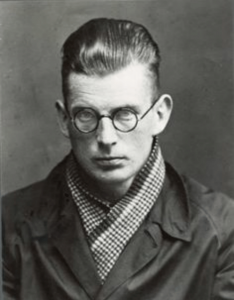
    Photographic portrait of Samuel Beckett as a young man.

    Yet Joyce’s torrent of words – full of richness and fecundity – the psychobabble of tongues and the fiddling with language, had a depressing effect on Beckett aesthetically. It is widely agreed that the latter’s early works, such as Dream of Fair to Middling Women (1932), More Pricks Than Kicks (1934), and Murphy (1938), did not scale the heights of his post-World War II masterpieces.

    Similarly, I would argue the polyglot innovation found in Joyce’s final work is a form of literary escapism of limited relevance in this dark age of casino capitalism. Linguistic accuracy in marshaling facts is what I prize most highly, and Beckett delivered powerfully in this regard.

    Beckett laconically described the relationship between the two literary titans in the following terms: ‘James Joyce was a synthesizer, trying to bring in as much as he could. I am an analyser, trying to leave out as much as I can.’[i]

    Irish Bluffers

    In my experience the Irish often display a tendency towards loquacity and linguistic chicanery. Unfortunately this provides scope for bluffers and often brings a resistance to facing up to the truth. Too often we take refuge in the deliberate self-deceptions of lyricism, or display a love of rhetoric and bombast that permits falsities.

    As Seamus Heaney puts it in the poem ‘Whatever You Say Say Nothing’ (1975):

    O land of password, handgrip, wink and nod,
    Of open minds as open as a trap,

    Where tongues lie coiled, as under flames lie wicks,

    Having said that Joyce in his early work, particularly Dubliners, captures some of the spoofing that is still a feature of life in the city, particularly evident politics, where the theatrical pseudo-debaters of hucksterdom are out in force.

    Perhaps if we Irish were better listeners, and concentrated on using language with greater precision, we would not have dug ourselves, collectively and individually, into the awful hole we found ourselves in when the Banks crashed in 2007.

    Uncharacteristically as an Irishman, Beckett is famous for the compression of language, which may explain his departure into French. Not a word is wasted in his writing; but like Joyce, words are sometimes re-invented or used in novel ways. Thus Beckett mangles and distorts language, stripping it to the bone to devastating effect, yet generally enhancing our understanding of it.

    I cannot say I have enjoyed reading all of his oeuvre. The later works, particularly the plays, are heading towards the extinction of language itself, and offer an unsparingly bleak take on both art and human communication. I should add that all of this was in marked a contrast to the chatty and open person I encountered in Montparnasse.

    However, the quartet of plays, Waiting for Godot, Endgame, Krapps Last Tape and Happy Days bear the unmistakable hallmark of genius, a commendation that should also apply to All That Fall, a play for radio memorably dramatized by Michael Gambon in 2013.

    In my view the only playwrights his equal over the course of the twentieth century have been Eugene O’Neill for his A Long Day’s Journey into Night (which is also an exercise in Irish psychosis); Arthur Miller with Death of a Salesman and The Crucible; and perhaps David Mamet for Glengarry Glenn Ross; as well as the best of Bertolt Brecht. Indeed, Brecht was the only twentieth century dramatist of comparable stature, and even then he falls short in my view.

    I would argue the only real modern rival – and that excludes the Bard of Avon –  to Beckett’s Godot or Endgame is his near Irish contemporary Oscar Wilde’s The Importance of Being Earnest. Surviving an Irish upbringing is never easy. It is perhaps no coincidence that Wilde died a broken man in Paris having endured imprisonment in Reading Gaol – immortalized in verse – his downfall coinciding with the Importance of Being Earnest becoming the toast of London.

    Beckett preserved his genius to the end through an intelligent exile, the default option for Irish creatives and intellectuals. Yeats died in France. Beckett and Wilde in Paris. Joyce in Zurich. Most Irish writers get out Hibernia – ‘the land of winter’ which the Romans chose to steer clear of – if they can.

    In my experience the Irish can be a deeply malicious lot. Anything goes and always has. Our downfall, collectively as a nation, lies in the art of cutting tall poppies down to size, and destroying national heroes. Thus the great nationalist leader Charles Stewart Parnell (1846-1891) was driven to an early grave for an affair out of wedlock with a married woman, Kitty O’Shea.
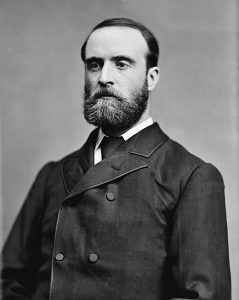
    Charles Stewart Parnell, driven to an early grave.

    Not all artists, it should be emphasised, lack wisdom and judgment. Beckett aged gracefully and is now buried in modest Parisian grave, where he is treated as a French writer and a hero of the Resistance during the Nazi occupation of France, where he demonstrated true courage.

    The Novels

    Moving on to the novels of Beckett, including the famous, or infamous, post-War trilogy of novels: Molloy (1951); Malone meurt (1951), Malone Dies (1958); L’innommable (1953), The Unnamable (1960). It is here we see a gradual dismantling and delimiting of language. In my view by the time of The Unnameable the artifice has gone too far and the conceit frankly tiresome.

    My favourite novel, suffused with humanity, is Company (1980), which was part of an Indian summer of later works. Company, and indeed Worst Ward How (1983), also demonstrate the compression of language of the greater plays, as well as a playful sense of humour, something he is often unfairly accused of lacking.

    Company is a lyrical and profound statement of his childhood in Leopardstown. Coincidentally, I was born just up the road from Beckett’s childhood home – not two hundred yards away – although not to the same conditions of privilege.

    The compression of language at times in the novels is aphoristic and the statements on the human condition act like gelignite in their exactitude: ‘You must go on. I can’t go on. I’ll go on,’ from The Unnameable, and in the and in the 1983 story Worstward Ho – ‘Ever tried. Ever failed. No matter. Try again. Fail again. Fail better.’

    There is an effortless font of ridicule in this. Woody Allen would have a field day, as he did in his essay on Irish writers.

    In Our Times

    I am not a literary critic and do not pretend to be one, so I am appropriating Beckett’s legacy for my own purposes.

    It is clear to me that in our post-truth universe we require searing honesty rather than linguistic chicanery of a sort that provides us with ‘known unknowns,’ associated with the former U.S. Secretary of Defense Donald Rumsfeld. We need to concentrate on that which matters, which is the truth, forensically researched and conveyed with precise language – and barbed if necessary – thereby providing an accurate portrayal of the human condition and the challenges we confront.

    The extent to which Slavoj Zizek and Alain Badiou, the great Marxists or post-Marxists of our age, quote Beckett is revealing, although less surprising in the case of the latter given he is French. They quote Beckett to couple both absurdity and engagement, and to demonstrate the effective use of language.

    Thus every lawyer committed to the truth, particularly a criminal defence lawyer, would do well to read and absorb Beckett in order to focus precisely on what is chosen to be said and, equally importantly, left unsaid. Beckett also helps us to recognise the nuances and tropes of language.

    Moreover, a close reading of Beckett embeds a faculty for detecting bullshit: contained in his works you will find an unstinting focus on the essentials to human life.

    What do you mean when you say this? What do you mean by what you say you mean? What do you mean by what you say or said or said then? Why did you do what you did? Who are you, and what do you say you have done?

    Cross examination techniques are of course a poor excuse for a Beckettian aphorisms, but the importance of a literary appreciation in a lawyer should not be underestimated.
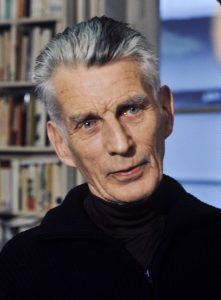
    Samuel Beckett in 1977.

    Swift Return

    Other great Irish writers besides the Modernists are also relevant to our present dark age, Jonathan Swift above all else. The Dean of St Patrick’s Cathedral received a disappointing sinecure after a controversial career as a journalist in London, where in carrying out his duties he alienated a large amount of influential people. The culmination of his rage arrives at the end of his life in the totemic work: ‘A Modest Proposal’.

    The conceit of that piece, based on acute recognition of the Malthusian capitalism operating at the time, and contempt for absentee landlords, is that rather than letting the poor die in increments it would make ‘economic sense’ to eat their babies whole. This was the ultimate cost benefit analysis approach to law and economics, still evident in our dangerously commoditized world.

    Finally, another Irish Nobel laureate, W. B. Yeats is also relevant in this regard, not for the Romantic murmuring of Innisfree, nor the more insightful political poems surveying the grubby inception of the state – ‘And add the halfpence to the pence. / And prayer to shivering prayer’ – but for the mystical poems from 1919 onwards, with their anticipation and exploration of the totalitarianism on the horizon.

    Thus in ‘The Second Coming’ (1919) Yeats anticipates a world of immoderate extremism that has returned to haunts us.

    Turning and turning in the widening gyre
    he falcon cannot hear the falconer;
    Things fall apart; the centre cannot hold;
    Mere anarchy is loosed upon the world,
    The blood-dimmed tide is loosed, and everywhere
    The ceremony of innocence is drowned;
    The best lack all conviction, while the worst
    Are full of passionate intensity.

    So notwithstanding a tendency towards bluffing and linguistic chicanery, Irish writers have much to offer. Above all Beckett. He reminds us to be precise and exact with our words, while anticipating the age of extremes we have entered – a dark age of neo-liberal meltdown and capitalist excess, with fascism rearing its ugly head again.

    Illustration by Malina/Artsyfartsy

    [i] Mel Gussow, ‘BECKETT AT 75- AN APPRAISAL’, New York Times, April 19th, 1981, https://www.nytimes.com/1981/04/19/theater/beckett-at-75-an-appraisal.html

  • Lebanon’s Perfect Storm

    On Friday 14th of February Lebanon commemorated the fifteenth anniversary of the brutal assassination of former prime minister, Rafic Hariri. On the eve of the commemoration, the current prime minister, Hassan Diab, lamented how, in Hariri’s absence, ‘Lebanon lacks the regional and international presence to save us from crisis.’

    Diab was brought in to lead a new government following mass demonstrations that began in October of last year. He has been tasked, no less, with pulling Lebanon back from the brink of economic collapse.

    Yet the formation of a new government has done little to assuage public anger. Events in the capital, Beirut on Tuesday 11th of February made this abundantly clear.

    By mid-morning downtown the Lebanese capital was bracing itself as parliamentary deputies gathered for a vote of confidence on the newly-formed government. Protesters were also assembling at various locations around the city in an attempt to disrupt the vote.

    Waving flags, many pre-empting what was to come with helmets and gas-masks, the protesters were articulating a widely-held view that, regardless of what happens in parliament, the new government is a sham, cooked up by the same rotten elite that protesters have been demonstrating against for months.

    Twitter and other social media were aflame, with digitally savvy individuals using hash-tags ‘like no confidence!’ ‘Tuesday Rage!’ ‘Lebanon Rises!’, to thread together the assembled masses, while urging everyone ‘to meet us on the streets’, as videos showed busloads of citizens converging on the capital.

    Water Cannons

    Expecting trouble, security forces had erected concrete barriers the previous day, blocking off major approaches to Parliament Square. Meanwhile, protesters gathered around the barriers.

    One girl sat atop a slab, waving a Lebanese flag, while a water cannon sprayed either side of her creating a rainbow effect. Others pulled down segments of the wall only to be met by further barrages from water cannons barring their way.

    Elsewhere protesters disrupted traffic towards parliament. En route, one deputy had his car surrounded by protesters chanting ‘thief thief thief!’

    Other parliamentarians had eggs thrown at their convoys, while one had stones hurled at him by a protester, smashing his car window and then striking his head, forcing him to divert to a nearby hospital for medical attention. Yet he made it to the parliament in the end, battered and bruised but there to vote.

    Pro-regime Thugs

    But anti-government protesters weren’t the only ones out on the streets. Groups of pro-regime thugs, sent out by their political bosses, zipped about town protecting harangued deputies and hampering the protesters.

    On scooters these hired hands roamed from one flashpoint to the next, seeking confrontations with what seemed implicit approval from the security forces – themselves willing to give occasional beat downs to isolated protesters getting under their skin.

    https://twitter.com/carolinebeyloun/status/1227190644290080774

    Meanwhile, as the toxic whiff of tear gas was spreading downtown, the barricaded parliament was slowly filling up. But numbers were still lacking for the quorum required to begin the two-day session.

    Eventually the parliamentary Speaker, Nabih Berri – widely regarded as thug-in-chief – decided to commence proceedings, despite the small numbers, leading to allegations on the streets of constitutional trickery.

    Embed from Getty Images
    House Leader Nabih Berri (right) pictured with Walid Joumblatt (centre) and Yasser Arafat (left) in 1982.

    Either way, the session began and after nine hours, the vote was held prematurely, quashing any hopes of it being derailed. The new government won, as expected, while the protesters licked their wounds outside: three-hundred-and-fifty people having been injured over the course of the day.

    Lebanese of All Stripes

    The day’s events demonstrated to many people that the revolution has been sold short; as one observer put it: ‘while the Prime Minister speaks to a half empty-parliament about the importance of the right to protest, security forces were throwing tear gas and beating people up outside.’

    Indeed, Tuesday the 11th was the 118th day of a revolution that began on October 17th of last year, triggered by a proposed tax on WhatsApp that inspired national outrage.

    The streets have been filled with Lebanese of all stripes, saying with one voice: ‘the political class, every last one of them, must move aside, taking their corrupt, decades-long mismanagement with them, and give us our country back.’

    The local and international media dared to believe that something truly special was happening in Lebanon. For the first time in living memory a unified political voice that transcended sectarian divisions seemed to be exploding into life.

    During the early days there really was something special in the air. Streets were buzzing with revolutionary optimism; mass rallies crowded the streets, with a distinctly festival-like-atmosphere attracting children and families.

    Sunni-dominated Tripoli, Lebanon’s largest northern city, long tarnished by a Salafist reputation, went from being perceived as Beirut’s neglected cousin, to ‘the bride of the revolution’, following memorable demonstrations. Suddenly Tripoli felt a lot closer to Beirut.

    Embed from Getty Images
    An early demonstration in Tripoli turned into a rave that went viral across the country and reset the city’s image. 

    Sectarianism

    Inspired by such scenes, protesters organised a human chain the length of the country. Up and down Lebanon, demonstrators stood hand-in-hand along the coastal highway. Stretching from north to south in a powerful gesture the message was clearly anti-sectarian, saying ‘We are not Christian, Sunni, Shia, Druze. We are Lebanese.’

    Embed from Getty Images
    Demonstrators form a human chain on the 11th day of revolution.

    In Lebanon political representation is still based on a confessional quota system that renders governance a power-sharing puzzle between sectarian groups. Governments are patched together through tenuous coalitions predicated on back-door deal, widely seen as an impediment to addressing deep structural problems.

    All the while, Lebanon has been careering towards an economic abyss. After a decade of economic stagnation, with foreign remittances drying up and Saudi money deserting a country increasingly seen as an Iranian orbit, the collapse has come into plain view.

    The corrupt ineptness of the ruling elite has been called out by an enraged public, watching on in horror as the country’s potential is squandered by politicians, who hide behind the excuse of sectarian power-sharing.

    In reality they have pilfered from the state coffers in order to maintain patronage networks, without regard the wider public interest. Thus protesters say: ‘Shame on them.’ Indeed, nowadays politicians are likely to be refused service in restaurants or are jeered if they enter fashionable bars.

    The foreign minister’s humiliation at a Davos panel discussion stirred jubilation back home, with replays giddily shared online. A wave of hostility towards the political elite, regardless of sect, is in full swing.

    Banking Crisis

    The public outcry is not surprising. Spiraling national debt dwarfs national GDP, as the government digs itself deeper into a deeper whole of debt, in turn selling these off to Lebanese banks, thereby threatening ordinary people’s savings.

    In October banks closed suddenly and remained shut for two weeks. People were unable to withdraw dollars from ATMs. Slowly it became apparent that the banks were running on empty, through acute shortages of U.S. dollars, the currency which is pegged to the Lebanese lira.

    This led the banks to impose capital controls to prevent a run. Meanwhile the Central Bank failed to step in to regulate the situation, leaving individual banks to do so on an ad hoc basis. Then rumours (since confirmed) began to circulate that the ruling class were transferring billions abroad,[i] fuelling suspicion that the banks and politicians were in on the act.

    Among ordinary people there are fears that the days of the lira being pegged to the dollar are numbered, causing deposits to plunge in value.

    On a daily basis panicked customers engage in furious arguments with bank staff who refuse to release dollars, while on the black market the lira’s value is collapsing. Smashed up ATMs and banking outlets are a familiar sight, and sign of the growing anger.

    Embed from Getty Images
    Vandalized bank fronts in Beirut and elsewhere are have become a common sight.

    Ongoing Crisis

    The dollar shortage has driven up prices on everyday items, and workers are being laid off; tourism has ceased to a trickle; butchers’ sales are said to be down by 50%; the young talk increasingly about emigrating; malls and high streets are empty; migrant workers crowd outside their embassies attempting to flee a country where the currency crisis makes it almost impossible to send money home.

    Now economists predict that the country will sink into a pit of poverty that will bring a lost decade, where college graduates will become street sellers and refugees will go even hungrier than they already are.

    So amidst these increasingly severe conditions, the tone of protest has shifted from optimism to anger. While the early success in dislodging the former government was celebrated, the protesters demand for a technocratic government without political ties has not been met. The new government tasked with enacting reforms continues to co-exist with the vested interests that appointed it.

    Embed from Getty Images
    Renewed protests shifted in tone with more aggression from protesters and security forces.

    Yet reforms are essential if the government is to unlock the financial assistance that international players like the IMF could offer. A cliff-edge is imminent with interest on a Eurobond due to be paid next month and politicians arguing about whether to cough up. This has triggered rumours that there’ll be nothing left over to pay the salaries of civil servants.

    Whatever happens in the short term, it seems as if life is only going to get harder for ordinary Lebanese before there is any sign of improvement.

    [i] Naharnet Newsdesk ‘Hammoud Replies to Berri: All Lebanese Banks Transferred Funds Abroad’ Naharnet February 7th, 2020, http://www.naharnet.com/stories/en/268948-hammoud-replies-to-berri-all-lebanese-banks-transferred-funds-abroad

  • Rugby: the Four Irish Provinces take to the Field

    I yearn for Six Nations matches at this time of year. Despite my worthier self, I cannot take my eyes off a psychological drama and physical spectacle offering respite from interminable winter.

    The violence is terrible, but it seems life-affirming that these specimens can, for the most part, withstand the battering. At its best, it conveys life-in-action, a primal dance and irrepressible human spirit.

    One man who never played in the Six Nations is the Australian of Zimbabwean-descent, David Pocock, and to my mind he has been the bravest player of this era. It is unsurprising that his political convictions are similarly resolute. Fittingly, he was once arrested after chaining himself to mining equipment in a protest against a new coal mine in New South Wales.

    Thankfully he seems to have emerged relatively unscathed from his many bouts on the field, bowing out at last from international rugby at the end of the recent Word Cup, unfortunately on a losing note against Engalnd.

    Embed from Getty Images

    Make no mistake, there are injuries which occur as a matter of probability in rugby that make the endurance of the current rules almost unforgivable. Driving straight into the back of a player, with staggering force, who is grappling with his hands on the ground is surely unsustainable, but at least the high tackle is being clamped down on by referees. This makes the current game a more enjoyable spectacle as a player can offload more easily out of the tackle, and the quagmire of rucks and mauls become less frequent.

    ‘Drico’ v O’Connell

    For this Irish rugby fan of over thirty years duration the recurring debate is whether Brian O’Driscoll or Paul O’Connell was the greater Irish player of the era. Both were giants of the sport that transcended the structures from which they emerged, subtly altering players that emerged in their wakes. Thus the sublime Garry Ringrose is the heir to O’Driscoll and the all-action James Ryan the pretender to O’Connell’s throne, an unenviable posture locking the Irish scrum.

    The provincial origin of each of these totemic player must be taken into account. Munster from which O’Connell hails is the beating heart of Irish rugby where many of its origin myths lie. Of course much of this is late magic, compared to the rarefied surrounds of Trinity College in Dublin, which is said to have the oldest pitch still in use in the world. But Munster is where a distinctive mark was placed on the sport of rugby itself in the latter decades of the twentieth century.

    Essentially Munster played above the collective athletic attributes of the team with an unprecedented unity of purpose that laid low the greatest international team of its time. Of course the All Blacks had been beaten before and since on tours, but this was generally where teams were composed of stellar internationals playing for clubs, or perhaps if the All Black team was at a low physical ebb on a long tour. In 1978 the Munster team in unison with the crowd performed a mythological feat no less: Alone it Stands indeed.

    Embed from Getty Images

    Archetypal Munster rugby players, such as the late Moss Keane, were certainly not small or necessarily unathletic, but are rarely the biggest or fastest in their positions. It was when they combine with one another, as a band of brothers, that they overhaul and outwit – with a capricious gale blowing behind them in the second half – any opponent who dares enter their Thomond Park redoubt.

    This group togetherness – comparable to what the medieval Arabic writer Ibn Kaldun termed asabiyyah in describing the warlike Bedouin tribes of North Africa – allied with tactical awareness and sheer bravery yielded two European Cups in the early years of professionalism (2006 and 2008), at a time when French and English teams could not easily pluck talent from the outer regions of the Southern Hemisphere, as occurs today.

    That is not to say that Munster was closed to foreign influence; the team embraced the new wave of professionalism, recruited wisely, and established a brand that had a halo effect on Irish rugby as a whole, before the limitations of a small population made it impossible to sustain the conveyor belt of talent required for success.

    As a player Paul O’Connell possessed what is commonly referred to as Munster ‘dog’ in spades, but he allied this with often quite outrageous feats of skill in the air. He was not, however, for all his capacity to take a game by the scruff of the neck and play it his way – fast rucking and relentless pick and drives – the complete player. His handling in the loose at times let him down, and he never developed the dexterity commonly seen in Southern hemisphere players of his ilk.

    Embed from Getty Images

    This was perhaps the product of an upbringing where rugby was explicitly training rather than a form of self-expression, as where kids ‘play’ with a ball in a game such as ‘tag’ on a sun-baked field or beach. One could point the finger at the wet climate of the south-west of Ireland which required outdoor activities to be more structured.

    Perhaps this background in hard graft and adversity accounts for what seems to have been a tendency on O’Connell’s part to see the ball as means to an end: putting points on the board. As a leader, he seemed untroubled to amaze a crowd in the process of scoring points, calculating that a try from a rolling maul counted for as much as the giddiest of wing play.

    O’Driscoll, on the other hand, was a trickster, who played with a smile on his face, and burst on the global scene as a superstar when scoring a bravura hat trick of tries in Paris in 2000, before in 2001 seducing British and Irish Lions fans in Australia, who waltzed to his tune.

    A brash, cosmopolitan boy from the capital city of an increasingly prosperous country and class, ‘Drico’ ended his career to great fanfare, winning a second Six Nations Championship medal in 2014. He was the swashbuckling hero who performed feats on a rugby pitch that amazed a crowd, but he was as physically brave as any Munster contemporary. His capacity to recover from serious injury, especially the cruel assault on him as captain of the Lions in 2005 against the fearsome All Blacks, was also nothing short of remarkable.

    It is, however, as a team captain that one might prefer O’Connell. One senses that other, lesser, players reveled in O’Driscoll’s star turns on the pitch, but perhaps relied overly on his individual brilliance.

    O’Connell on the other hand appeared to exercise the force of a demagogue over his companions. Under his guidance, players offered the same relentless hunger for confrontation, and group togetherness in the Munster tradition, as opposed to the elusive capacity for individual brilliance that O’Driscoll imparted.

    Leinster Schools Rugby

    I grew up in the province of Leinster and my formation as a rugby fan arrived in the school’s game where we viewed the likes of Dennis Hickey when he was a young buck. It is now one of the world’s great breeding grounds for new braves, as the remarkable recent consistency of Leinster in European competition demonstrates, with four European Cup wins to date: 2009, 2011, 2012 and 2018.

    I have heard it said that the relatively flat lands, and slightly drier conditions, of the east of Ireland produce a different, swifter, physical specimen, meaning the archetype of the Leinster player is generally a purer athlete than the Munster equivalent – players such as Jordan Lamour and Andrew Porter conforming to this type, in contrast to grizzled Munster legends such as ‘the Claw’, Peter Clohessy or ‘Gaillimh’ Mick Galway.

    Embed from Getty Images
    ‘the Claw’, Peter Clohessy or ‘Gaillimh’ Mick Galway in action for Ireland.

    The all-round excellence of O’Driscoll remains the high water mark, but the number of players of great ability breaking through is quite astonishing to behold. I admit to a vain pride in a step cousin Caelan Doris – a wunderkind number 8 – who is now a regular part of the international squad.

    If only I had a few of young Caelan’s genes my rugby career might have got beyond the muddy far pitches of Gonzaga College. Although admittedly a reluctance to allow my head to be left in close proximity to rapidly moving legs, and little appetite for the punch-ups that marred many encounters in the 1990s, made even a moderately successful career unlikely.

    A Nation Once Again?

    A polite argument broke out among a few friends recently on the subject of nationalism, and whether it is a destructive force in the world. That led me to consider what motivated the appreciation I have for a sport that is often quite dull as a spectacle, with constant repetitions of drills and risk aversion all too often evident. Indeed, to the uninitiated the game of rugby, with its puzzling array of rules, is not the most accessible.

    Competition between national groups reminds me of the psychodrama of a contest between competing forces, which take on the simplistic roles of good and evil to the viewer. Thus, even if an opponent displays skill or impressive composure I cannot enjoy it, and positively shrink from the sight of his success. Meanwhile even if my own side are playing in a stolid fashion I can still appreciate the effect, and even look beyond any skullduggery, especially if it is part of a wider strategic plan, weakening the opponent before striking in an unexpected way.

    Likewise, it seems to me, nationalism can be an ugly, zero-sum game of winning and losing, whether it is the aspiration for a united Ireland – albeit there are distinct practical and civic advantages – or having one language dominant over another under the law. Similarly, we are generally inclined to disregard whether nationalistic aspirations are achieved by fair means or foul, ignoring the cruelty of earlier conquests, just as the Americans laid claim to virgin territory, glorifying the first settlers and ignoring those who once populated the land in relative harmony.

    There is, however, a more edifying side to nationalism, where we achieve a form of greatness not in terms of others, i.e. winning as the be-all-and-end-all, but simply in the way we exist, and play. Lest we forget, few states of the Old World appear to be content where different ethno-linguistic groups co-habit – even the prosperous Belgians of different languages only grudgingly co-exist.

    It is in the songs we sing, in the food we prepare, and in the nature we adore and protect that the best expression of group solidarity is found, and in sport at times too. This is the nationalism of an O’Driscoll, where magic happens, but where the processes derived from tradition, which we might associate with an O’Connell figure, are upheld.

    Maybe conflict is in the nature of humanity, and in that respect sport serves a purpose that George Orwell overlooked when he peremptorily described it as ‘an unfailing cause of ill-will.’ But perhaps it really just channels or acts as a conduit for ill-will, and is not the cause itself. Of course the contrary argument that discord is actually magnified by these latter-day gladiatorial contests might, paradoxically, also hold true. It seems as if the meaning of sport is as varied as any other field of human endeavour, and forms of it are always likely to excite us.

    The Four Proud Provinces

    In Irish sport the code of rugby is almost unique in generating genuine all-Ireland national fervour,crossing political and sectarian boundaries. Notably, ‘big’ Davy Tweed, a former Unionist councillor and alas a convicted paedophile, played on a number of occasions for the Irish team, and with great energy it should be said. It was Tweed who demanded an alternative to Amhrán na bhFiann, the anthem of the Irish State, which bequeathed us Phil Coulter’s ‘Ireland’s Call’, a rather primitive song. But for all its harmonic deficiencies it has nonetheless proved a popular, and unifying dirge that is belted out with great emotion by crowd and players alike.

    It has snobbishly been said that rugby is a game for thugs played by gentlemen, while soccer is the reverse. Clearly there is a class basis to each of these sports across Britain and Ireland. The food calories alone that an elite rugby player requires every day must be quite an investment throughout early adulthood. But it is perhaps more accurate to say that rugby is an institutional sport, requiring the availability of pitches and training facilities all too often absent in working class districts, and more likely to be found in a rural setting. Yet the example of the Southern Hemisphere demonstrates that even working class kids can develop into professional players.

    During the amateur era Ulster were the most successful of the Irish province, and fittingly the Ulstermen were the first to win a European Cup in 1999, using a group of players drawn overwhelmingly from the region. But the province has latterly struggled to compete with the number of new players available to Leinster every year, and the great spirit that Munster players still derive from playing in the red jersey.

    Moreover, the recent displays of toxic masculinity in Ulster rugby shocked the entire country, and brought an existential crisis to the game. This is a stain that has not been fully removed, at least publicly, from the public – as was the case in New Zealand where less worrying incidents led to the development of a respect and responsibility programme for players.

    Yet all but the most curmudgeonly of Irish rugby fans rejoice when Ulster performs on the European stage, unlike the more divisive Leinster-Munster rivalry, and the success of Ulster players in the Irish shirt provides a bewitching fellowship recalling the United Irishmen of Catholic, Protestant and Dissenter.

    Like the Leinstermen of lore, Ulster’s greatest warriors tend to be fleet-footed athletes but with a Nordic edge of physical brutality epitomised by the incomparably tough Stephen Ferris. The new Ulster hero is the powerful Jacob Stockdale, who has made scoring tries at the highest level look easy.

    The Western Province

    One can only admire the durability of the men of Connacht, withstanding probably the wildest weather in the rugby world in their Galway citadel. Against the odds, they have created a spirit unique to themselves that culminated in victory against Leinster in the Celtic League in 2016. My father comes from Sligo on the Western seaboard, so I have a particular sympathy for their plight as underdogs in the Irish game.

    As an immigrant for a time in London I did my own impersonation of one of the province’s greats, the rampaging number 8 Noel Mannion who, it should be said, was not the most fleet-footed.

    Living in Bloomsbury in the heart of the capital, I went out for a stroll one night that took me to the back of the British Museum, a tranquil spot amidst the maelstrom of the capital. I proceeded down the road, lost in reverie. Luckily, however, just in time it dawned on me that a small crowd of youths, who didn’t seem like a welcoming committee, were about to surround me. There were no other pedestrians, or cars, in sight. Then, as I recall, one of them requested a cigarette.

    I responded that that I could not provide him with one, which seemed to perturb him, so without pause I turned heels and began to walk back up the street. At that point another one enquired as to why I had taken that course of action. I replied that I was being surrounded. Then I took off at a gallop as fast as my ruddy thighs could carry me.

    It was then that I summoned the spirit of Noel Mannion in 1989 at the Cardiff Arms Park when, after he charged down a kick he found it in his possession with a clear run to the try line, almost the length of the pitch away. Like Noel before me, I pinned back my ears, and hoped the chasing pack wouldn’t catch me. But by this stage one of the youths was abreast. He tried to trip me up, but I strode on with a power and pace hitherto unknown.

    At last I heard the youth scream in despair before I reached the well-lit sanctuary of Gower Street, and in my mind I heard the away supporters in the Cardiff Arms Park roar their approval.

    Although he hails from a land far down under, Bundee Aki now carries the flame of Connaught resistance in the Irish team and one must admire a guy who brings his family to an ethereal place such as the City of the Tribes, and gateway to the Never Never Land of Connemara. Romantically, I expect the next great hero of Irish rugby, in the mould of an O’Driscoll, O’Connell or Ferris, but of a distinctly Far Western character, to emerge as the heir to Bundee.

    Twickenham Awaits

    So let us gather Irish people, new and old, to enjoy the spectacle this weekend. I for one am avoiding any sense of guilt at enjoying this crucible of unabashed manliness. All sports should of course be open to both genders, but the failure of educational institutions to provide adequately for women over the course of our history should not inhibit the simple pleasures we derive. After all it’s not a zero sum game between the respective sports of the two sexes.

    Win or lose, let us hope the Irish team carries itself with pride on the pitch. If they do lose, and we cannot expect the team to win every game, away from home, against a rugby union with a far greater playing pool than our own, let them hold their heads high in the knowledge they played with pride in the traditions laid down by those who once played their parts, and with the individual brilliance which each has been endowed.

    For the men of Leinster, Munster, Ulster and Connaught must play with a unity of purpose and great skill to overcome the English team, summoning the spirits O’Driscoll, O’Connell, Ferris and even Noel Mannion.

  • A Composer’s Story

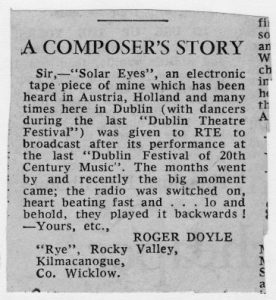
    When I was sixteen I gave up learning the piano. In her report my music teacher (who had terminated my studies) wrote: ‘what an awful shame’.

    The story is a common one. Young peoples’ lives become filled with music on records, video, in films, on radio and TV, during Saturday nights, in supermarkets, in amusement arcades, on the streets and in concerts. Culturally exploded thus, they sit down to Mr. Beethoven and wonder what on earth this glaring composer from the distant past has to do with the rhythms they feel and the harmonies they hear.

    When I left school I was drumming on a local pop group and living at home, sleeping till lunchtime. I hadn’t qualified for university and my father wanted me to get a job. I remember replying in writing in answer to an advertisement for a shop assistant and saying that my hair was long and I wouldn’t get it cut. I only had the music. I used to sit at the piano for a few hours each afternoon, improvising.

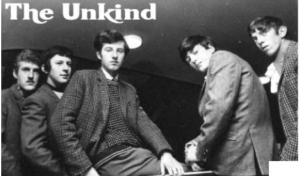
    Pop band The Unkind with drummer Roger Doyle (centre)

    The Royal Irish Academy Of Music 

    Over a period of months I gradually composed a four-page piano piece and showed it to my former piano teacher. She suggested I contact Dr. A.J. Potter in the Royal Irish Academy of Music. I played my four-page piece for him; he had a vacancy and the following week I started composition studies with him – once a week for an hour. From then on I had to have something composed for every Monday afternoon.

    Dr. Potter never said ‘you can’t do that’. On the other hand he never told me exactly what to do. Maybe this was his approach. We talked about life and art and he gave me the musical space I needed. He said you could read all the books you liked about instrumentation but if you really wanted to know how a trombone works you should buy a trombonist a drink after the concert. He never encouraged me and I needed a little.

    After a year at the Academy I submitted my compositions for the Junior Composition Scholarship which would mean a year’s free tuition. At the beginning of the next term I received a phone-call from the office of the Academy: ‘With regard to your recent application for the Junior Scholarship in Composition we wish to inform you that you have been successful in…’. I had never planned on being a composer; necessity was the mother of my invention.

    I wanted to write a piece for orchestra in my first scholarship term. Dr. Potter said: ‘Well go ahead!’. I had a drawing of the highest and lowest notes of each instrument in front of me as I composed Four Sketches for orchestra. It took me five months and was later performed, when I was twenty two, by the Dublin Symphony Orchestra (because it won second prize in its competition for composers), and the RTÉ Symphony Orchestra (the National Radio/Television orchestra).

    The first radio broadcast of any work of mine was of Four Sketches. In 1969 at the end of my second year at the Academy I was awarded the Vandeleur Scholarship in Composition. During my third year I began experimenting with my tape recorder at home in my search for new sounds and compositional approaches. I took to tape music like a duck to water without ever being bothered about the ‘do you call this music?’ syndrome.  I never stopped and thought too much – I just did it.

    When I first heard tape music (loosely termed electronic music) on record, it was as though it had been brought back to me as a memory. It was strangely familiar. It was what I was looking for.

    The next time I submitted taped works to the Academy, I wasn’t awarded the scholarship. Since the Academy only had a cheap mono tape recorder and I needed a recording studio I thought: ’Three years is enough’, and so I left. The Academy is not a University so there was no degree to get even if I had stayed I was twenty one and still sleeping till lunchtime.

    Utrecht

    Soon after, a small record company in Dublin promised to bring out a record of my music, recorded some of my pieces, and then went bust. Then in 1974 I was awarded a Dutch Government Scholarship to enable me to study electronic music at the Institute Of Sonology at the University of Utrecht. This changed everything. In Holland I had the chance to come in out of the cold and join the stream of European avant-garde music. I attended three weeks of the World Music Days Festival in five Dutch cities.

    At the Institute Of Sonology in Utrecht the students had to complete fourteen studio exercises before they were allowed to submit a compositional or purely technical project, to a committee which would decide if it was ‘of sonological interest’ (sonology is the study of sound), or not. It took me ages to understand the principles of how the studio worked, about voltage control, amplitude modulation etc.. I was the last to complete my fourteen studio exercises. In the second term I was allotted twelve studio hours per week in response to my project, all on my own. I used to get heart poundings opening the door of my allotted studio – one of the best equipped in Europe.

    I began a new composition using almost entirely electronically generated sounds for the first time. This
    piece later became Solar Eyes, which was broadcast backwards on Irish radio.

    Letter from Roger Doyle to the Irish Times, July 1976 (courtesy of the composer)

    During the Easter holidays I got a great idea: why not bring out the LP myself that had met such a disastrous fate a year earlier – the covers had already been made and were sitting at home. I had saved enough from the scholarship spending money to be able to do it. I sent to Ireland for the recordings of my instrumental pieces and set about making copies of my tape pieces in the Institute’s studios – revising a section of my piece Oizzo No in the process, improving it immensely.

    I took my new master tape to Phonogram in Amsterdam and asked them to make me 500 records and gave them the money. When I told them I couldn’t afford a test pressing they said: ‘don’t worry Mr. Doyle, we’ll keep trying till it comes out ok’. And they did, and it did.

    I wanted to cover up the name of the record company that had gone bust, on the back cover, so I had 500 new backs printed with some new information on them, which I began to stick on individually with glue over the existing ones – thus becoming the first composer in the history of the world to stick his own record covers together. I was twenty five and had a record of my own music out, called Oizzo No.

    I shipped them off to Ireland and sold one to a customs man at Dublin airport on my arrival home. I had to sell 330 copies to break even, which I did after two years.

    ‘The Curious Works of Roger Doyle’ documentary (directed by Brian Lally) is being shown in the Mermaid Arts Centre in Bray on 17 April. Tickets available here: https://www.mermaidartscentre.ie/whats-on/events/the-curious-works-of-roger-doyle

    For more on Roger Doyle’s work see: http://rogerdoyle.com/

    Bandcamp: https://rogerdoyle1.bandcamp.com/

  • Caroline Flack and the Painful Lessons of Grief

    Whenever a celebrity dies of natural causes people respond in unified mourning. If a celebrity dies tragically however – from an overdose or by their own hand – people react with volleys of blame-calling.

    It is a natural reaction for us to want to cast blame somewhere. We point the finger at nameless, faceless entities manifesting greater evil than we would ever be capable of – whether trolls, social media or the tabloids. We assure ourselves these remote actors are the true killers.

    The hardest thing I have ever had to learn – one I am still struggling to get my head around – is that with suicide, we never fully know.

    The Denial Stage

    Grief comes in waves. These waves become less consistent, less engulfing over the years. But when I feel one breaking, after the passing of an anniversary, bumping into an old mutual friend, or after a dream where I’ve seen his face and kissed him back to life, I often revert to the denial stage.

    I shut my eyes, imagine travelling through time to precisely the right moment as an ethereal angel from the future, where I summarise a breath-taking, lifesaving speech that will change everything.

    Wait! I’ve carved a way out for you after all these years. I have the cure. You don’t have to die. You’re free!

    Then we eat ham and cheese toasties. I make fun of the jar of mayonnaise he insists on keeping by his bedside locker. We watch Beverly Hills 90210 – with the original cast obviously – smoke a joint, laugh about his previous intentions. Everything is light. I’ve wiped away the darkness.

    This is the sort of wistful longing that awaits Caroline Flack’s family and friends as they attempt to heal from such a heart-wrenching event. They have a lifetime of such longing in store – an ache that is felt like an infected tooth which, if untreated, will be left to rot. It is nothing like the collective mourning and sense of injustice we feel for her.

    Having said all that, I don’t think we should belittle the grief that can be felt for celebrities we’ve never met.

    Celebrities can become a part of our daily lives. Flack fans will think of the times they saw her glistening locks and beaming smile as they sat at home watching Love Island or The Extra Factor. They’ll remember the satisfaction and sense of girl power when she held Amber Gill’s hand[i] after Michael Griffiths confessed to coupling up with another lover in Casa Amor, and blaming it on Amber for being chaaaldish.

    Even think back to 2014, when her career skyrocketed after deservedly winning Strictly Come Dancing.

    Searching for Answers

    Through my own search for answers I learned how Caroline was put on anti-depressants, right after this success, in order to cope with the pressure.

    Living as we do, in a two-dimensional world of the virtual and the real, we paste together a narrative of who a celebrity really is when they are alone. We generate this picture from social media identities and assorted news stories, all laying claim to differing truths or alternative versions of the same story. And if that celebrity acts in a way we do not expect, we feel it is our right to cast judgement. After all, we think, it is they who exposed themselves to the unforgiving limelight.

    The difficulty with rushing to judgment on celebrities trapped in this secondary world is that no one has been trained in how to conduct themselves online. Societal boundaries and rules do not exist in the same way.

    Considering the internet only emerged less than thirty years ago this is hardly surprising. We are expressing ourselves through the intermediary of a screen and often take on a pseudonym.

    Temptation is also rife here. We can now find instantaneous answers to almost anything we want to know. And once that hunger has been sated, does the truth even matter?

    Brain Studies

    Brain studies show that we are predisposed to put more emphasis on negative than positive thoughts. A study designed by four psychologists from Case Western University and the Free University of Amsterdam, entitled ‘Bad Is Stronger Than Good’, explores how ‘throughout our evolutionary history, organisms better attuned to adverse outcomes would have been more likely to survive threats, which increases the probability of these genes being passed on.’[ii]

    In other words, our brains are not designed for happiness. They are hardwired for survival. While the world around us has developed far beyond the hunter-gatherer stage, our brains are still looking out for the next challenging situation.

    We literally have to fight for our positive thoughts to overcome negative ones. Now, imagine a public figure confronting a media storm. Think of the hundreds, or even thousands of comments, stories or headlines, and then the very real consequences of losing your job, partner and house as a result of these damaging misconceptions.

    Consider how much brain power is required to reverse that swarm of negativity. Even those armed with the greatest resilience would struggle. And Caroline was not someone who was in a place of strength. In October of last year, before the public outcry, Caroline admitted to being in a weird place, saying ‘when I actually reached out to someone, they said I was draining.’[iii]

    Darkest Hour

    I have experienced pain at the death of a celebrity passing before.

    I remember when Mac Miller overdosed in September 2018, I spent two days in bed. My mum found me cradling my cat, whimpering in the sitting room. I had to explain bashfully that everything was fine, except that a famous rapper, who of course I did not know personally, had died at the age of twenty-six.

    But there was something so haunting about the news of Caroline that prompts me to write. A heavy, stomach-filled-with-cement, stabbing feeling. I can feel it now as I type. It was a painful realisation of: ‘I get it. I get why she felt as if she had no way out.’ I can see how so many paths of hope were blocked for her.

    In some of my hardest times, I remember likening mental anguish to the feeling of drowning and looking around while the rest of the world is breathing easily.

    If I had a press pack or a bodycam documenting times I’ve been at my lowest, at my darkest, at my most embarrassing or – for want of a better word – ‘craziest’, a bystander might not see any difference between that behaviour and how we imagine Caroline to have acted on that night in December. Perhaps my admission is a way of acknowledging how ill-equipped any of us are to act as judge and jury.

    Search for the Light

    The weight of suicide is a heavy one to bear. The pain of the victim does not dissolve after they are gone. It is left with the survivors to carry forever.

    The statement Caroline was forbidden to post, which has since been released by her family has arrived much too late. We had already found her guilty.

    It is difficult to find hope in tragedy, but even now we must search for the light, if only to guide those trapped in the darkness.

    Russel Brand, a pure and eloquent voice for celebrity eulogies, gave me bittersweet hope. In part, it reads as such:

    We have the power to hurt one another and the power to heal one another, perhaps that’s the only power we have. We can never see the positive impact of our actions, the times when our kindness and compassion may have saved a life, but we can see what happens in its absence.

    There is freedom in asserting our own power. It is a responsibility that should be taken seriously. However, it is important to understand that no amount of love or affection can stop someone from ending their life.

    Ultimately, we have no control over anyone’s decisions to do so. But what we do have control over is ourselves. We control what we think, how we react to things, how we treat other people, what we read, watch or write. This is the true power of human existence.

    For the survivors, there are pages and pages of words left unsaid to the person they have lost. I’ve been writing my own for years. And I’m tired of carrying this. I’m tired of the pain. I’m tired of watching bright, talented and special people die.

    So, for those who can see no way out: know that you are worth your weight in gold. Know that the people who love you would move mountains just to keep you here. Know that I would sacrifice every star in the sky to transcend time and bring back who I lost.

    Search for the light. Even if it is the tiniest little glint. I promise you it is there.

    [i] Tilly Pearce, ‘Caroline Flack’s reaction to Love Island’s recoupling clash between Amber Gill and Michael Griffiths is priceless’ Metro, July 3rd, 2019, https://metro.co.uk/2019/07/03/caroline-flacks-reaction-love-islands-recoupling-clash-amber-gill-michael-griffiths-priceless-10111688/

    [ii] Roy F. Baumeister, Ellen  Bratslavsky, Catrin  Finkenauer, ‘Bad is Stronger than Good’, Review  of  General  Psychology2001.  Vol.  5. No. 4.  323-37 https://journals.sagepub.com/doi/10.1037/1089-2680.5.4.323

    [iii] Tilly Pearce, ‘Caroline Flack’s reaction to Love Island’s recoupling clash between Amber Gill and Michael Griffiths is priceless’ Metro, July 3rd, 2019, https://metro.co.uk/2019/07/03/caroline-flacks-reaction-love-islands-recoupling-clash-amber-gill-michael-griffiths-priceless-10111688/

  • Synapse Fire

    One of the main things I characterize my misspent youth by, is a knack for exploiting the trust my middle-class parents misplaced in me. At seventeen, I was too old to be dragged along with them on what seemed like monthly getaways, but too young to exercise any degree of responsibility or restraint. My folks had a mobile home near Ballymoney beach, which had hosted many a night of debauchery for my older brother and his cronies. He was away in Amsterdam, so I’d decided it was my turn. That bank holiday weekend, I had access to a car, three malleable mates and in the palm of my hand, an assortment of different colored pills.

    My mother’s arty liberal ideals had long since crushed my father’s more traditional views into dust. You’d only ever get the faintest of grumbles from him, dampened behind a rumpling newspaper. This self-censorship wasn’t always prevalent or so he told me, over glasses of scotch, his tongue unbinding nostalgically in the wake of my recent nuptials. I am now a man it seems. After what they’d been through with my older brother, Dad found it best to defer parenting us to my mother, who for lack of a better term, had notions.

    My father had been ‘too strict’ with my hyperactive brother who had some violent tendencies. The significant shift of power happened when his bright idea of sending my brother to boarding school backfired in a big way, offering more of a breeding ground for criminal activity than an educational utopia. Kenny’s expulsion from the school brought a great shame to my father. A gang of boys in the year ahead of him had caught wind of Kenny’s lucrative little drug trade and expected a sizeable cut in exchange for their silence. If their demands had been more diplomatic he’s always maintained, there wouldn’t have been a problem. They were too greedy, couldn’t be reasoned with, and Kenny refused. These boys were all “somebody’s son” and were bred to get their way.

    Junior Cup team rugby players could use the pool and it was common knowledge that Kenny swam late at night. He was always the last to leave. So when three of them jumped in on top of him, he thought they were trying to drown him. One boy had a chunk of flesh ripped out of his cheek, and another suffered a fractured skull. But it was the ring leader who got his teeth knocked out, some of an ear bitten off, and lost the sight in one eye. So obvious was it a  three-on-one attack, that no charges were pressed against my brother Kenny. However, his dealings were exposed, and he was turfed out.

    My mother employed a more permissive style of parenting with me, indulged my every whim, never punished bad behavior and challenged my thought process in ways she must have thought Socratic. I got away with fucking murder. Although I did appreciate the level of freedom this afforded me, I couldn’t help but feel sympathy for my father, subjected to the periodic “I told you so” moment, anytime my report card pleased her or I’d been involved in some minor sporting victory. It brought me no joy seeing him voiceless and defeated. I had this recurring dream, before I got medicated, where he manifested as a wounded fox, caught in a trap, bleeding from his soft eyes.

    So my folks fecked-off somewhere abroad for the long weekend, as did my mate Dan’s parents, whose neighbors had no visibility of their driveway. No one to notice the missing car. Dan and I had gone to primary school together. We had not been friends, but gravitated toward each other in secondary school, given we were among the few token posh-lads at the community school. His Dad was self-made and didn’t believe in private education, but my mother gave me the option to choose where I thought would best meet my developmental goals. I’d love to say it was my selflessness that led me there, being aware of my father’s crumbling business. Private school fees would have been a strain. Then again, the boarding school my grandfather, father, and brother had attended did not have a football team and rugby was compulsory for all first years. That and it was full of wankers. I made the case that I would become a more well-rounded individual given the opportunity to carry on playing competitive football and also broaden my worldview immersed in an environment boasting a more diverse student population. A more prominent priority was my overdeveloped libido that had been cultivated, I believe, by early exposure to a wealth of magazines and conspicuously labeled VHS tapes in my brother’s bottom drawer. The community school was co-ed and I’d been assured, full of ‘damp yokes.’

    Dan and I were placed in A1. The tiered class structure was supposedly based on an aptitude test we’d taken, but I’m positive that in seeing where we’d come from, the Year Head had employed mercy. A1 was no cake-walk, but it wasn’t exactly Dangerous Minds, like C2 for example. Woodwork and Metalwork were housed in the C-Area and despite me disregarding my brother’s advice to “batter someone on day one to let people know you’re not to be fucked with,” I did feel compelled to jump in and help Dan, who was himself on day one, getting “battered.” His expensive shoes, pressed shirt and an accent he couldn’t convincingly conceal, made him an easy target. I did manage to get one good dig in, bloodying the nose of Barry O’Neil, but ultimately was booted around with Dan until burly Mr. O’Brien came rushing out of his classroom to put a stop to the ‘madness.’ Dan was soft as shit and I didn’t feel like we’d anything in common, but sticking together seemed necessary.

    Stu’s experience was ours in reverse. His mother had notions too, and identified in him a level of intelligence that had escaped his siblings. He traversed the gauntlet of his council estate covering up our primary school’s crest with his definitive black bomber jacket. He’d bate through that estate early each morning and came skidding into the yard on his orange BMX. He and I would kick a football around together. We were schemers, thieving whatever was in fashion, taking turns every few days at the small-break. Pogs, Premier League stickers or whatever was going. We had another little racket that proved more lucrative, both of us having somewhat of an entrepreneurial spirit instilled in us by our older brothers. We’d get to school early and pilfer the strawberry and chocolate milk left out on the school steps, which were very much in demand, most parents having opted for low-fat regular milk for their little darlings. We’d sell our spoils. Shamefully now, I must confess we did abuse the good nature of an elderly newsagent proprietor in our boldest of schemes. We’d drop a box of one bar or another from the shelf and kick it underneath the stall, only then to enquire about said missing bar. He’d potter into the store room to fetch another box. Stu’s hands were as fast as lightning and his bomber jacket’s pockets were deep. I’d keep sketch at the counter and stall the shopkeeper when necessary. Most of our classmates had money and no one dared rat on us given our brothers’ reputations. Our little enterprise drew us close together. His mother adored me, finding my little posh-lad witticisms funny. Mine found his salt-of-the-earth Dublin attitude a charm, often dropping Stu into conversation with other parents as though it were proof of her open-mindedness or some such shit. Stu didn’t think it was shrewd to associate ourselves with Dan in our rough secondary school, but ultimately shared my sympathies for our pretty and effeminate alumnus.

    Katie came from the same estate as Stu and was in a similar boat. Her mother had intended to send her to the all-girl convent school, but when her parents split, Katie’s cunt of a Da was not forthcoming with chipping in on her tuition. She was into boxing and as a result, rumoured to be a lesbian. I can attest to the fact that she was not, after our ‘five minutes in heaven’ shared in Stu’s downstairs bathroom, during a game of Spin the Bottle, back in first year. She was also better at football than Stu and me put together. She’d definitely been a tomboy growing up, but had blossomed into an athletic goddess and never abandoned us. She did harbor though, a great deal of hatred for those girls that had ostracized her and the lads who only started paying her attention when her breasts filled out. We, her real mates, dared not taint our genuine friendship by trying it on with her. She wasn’t interested in us that way more like, and we knew it. One good thing her Da had done, was teach her to drive, and any chance we got, we’d borrow Dan’s parents’ Jeep and have adventures to which no one else in school was privy.

    I’d been taking a pill, here and there, from my brother’s stock. He often tasked me with cutting up coke for him and for my trouble, I’d also taken a little sample of that. Stu was doing the same with his older brother’s weed. Dan’s folks had a never-ending supply of wine, and with Katie able to drive, we were sorted for our weekend by the sea.

    I’d been involved in school debates since first year, much to the glee of my mother who’d heard about them in a parent teacher meeting and hadn’t ceased encouraging me not to waste my ‘gift,’ the ablity to talk my way out of essentially, anything. If I’m honest, I did enjoy the debates. The most recent one was about different types of civilizations, Eastern and Western philosophy. I’d been arguing publicly, that to our society’s detriment, foundations laid for us by the Greeks and Romans were being forgotten,. I argued that in a perfect society, like many of the great Greeks, everyone would be bisexual, citing the statistical odds being for more love in a world where marriages end in divorce and of those ‘successful’ marriages, only a fraction are purported to be happy. Privately, I’d made known to the lads my personal opinion, that there wasn’t one good way, and that we should be learning from all cultures, taking meditative practices from the East and hallucinatory journeys from the Native Americans.  “Are you fuckin’ high, Man?” Stu asked in response to this. I said I wasn’t, but that I highly recommended ‘getting high’ together. With a smirk, Dan added “Theory AND Practice. ” I’d fuck all practical knowledge, but in theory, the lads agreed. Even Katie.

    The plan was for all four of us to trip on something different, together. We would get out of our heads around a bonfire on the beach. We’d get to know each other, and ourselves, on a deeper level. We weren’t live-for-the-weekend piss-head, druggy wasters like lots of our classmates. Our trip was about enlightenment. That and our heads were fucking melted from Leaving Cert propaganda, to which we were not immune.

    On the Saturday we’d gone swimming and had a BBQ. We drank copious amounts of red wine and even dusted off a holy grail type bottle of scotch. It’s absence would certainly be attributed to my brother. Our experience was to be had on the Sunday night, us having Monday off to recover. Stu and I gathered firewood, while Dan and Katie discussed our path to enlightenment, deciding who should do what drug, and why.

    When darkness fell, we were all fairly buzzed on Dan’s fancy wine, and Katie revealed our missions, should we choose to accept them. She was highly strung, admittedly, and had never smoked a cigarette, let alone weed. She would get blazed and allow herself to relax and submit to the humour that was all around us. Stu was quiet, so he was to do some white, freeing himself from the shackles of self-consciousness and let his words flow. Dan was the consummate jester of the group, and we were often plagued by his seeming inability to share his true feelings, veiling everything in jokes. A yoke was to be had, whereby his heart would unfurl in waves of sincerity. I, being the depressive of the group, had issues sleeping and because of the meds, never remembered my dreams. We’d all been listening to a lot of Bowie, and were aware that if one were to take certain sleeping tablets, and force themselves to stay awake, they’d enter into this trippy dreamy state. Even if I couldn’t remember, the group would let me know what I could see and what I was saying. I was up for it, on the condition that they try their utmost not to let me drown in the sea.

    The ironic ceremony began with Dan raising up our offerings to the drug gods, and I blessed them with the sign of an upside down cross. Stu gave us his iteration of something resembling a Gregorian chant and drummed away in rhapsodic gesture on a Jacob’s biscuit tin. Our sage Katie danced around us, puffing plumes of weed smoke to protect us on our journey.

    Wine-red tongues told the stories of our lives up to that symbolic juncture and proclaimed what the future would bring. That sacred fire erupted between each speaker, fueled by my bottle of lighter fluid, with a well-timed squeeze. A handful of sand was sprinkled, let to trail in to the sparking flames, as a gesture to mark what had passed. This, before we acknowledged the infinity of what lay ahead, with a nod to each end of the pale grey beach. Faces were warmed with the memories of our shared experiences and an assurance that from what we had been born in to, we would indeed escape. Then we sat in silent reflection. Only the moon moved, slipping down the back of a starlit sky until the horizon bore an orange hue.

    As the sun was coming up, Dan and I had wandered from our camp, walking at the water’s edge. The cold ends of each wave rushed over our pale freckled feet. Dan’s drug-sticky palm was on the back of my neck. He was expressing some sense of loss for not having taken part in the debate, but said that he shared my sentiments. Stu was burning the ears off Katie, who lay euphoric in the sand, her muscles rippling in the morning light, her face awash serene, unperturbed by Stu’s rapid hand movements, wild eyes and practically unhinged jaw.

    We had always joked about Dan’s sexuality, in good humour. His overtly heteroerotic jokes and signature pelvic thrusts accompanied by animal noises were a daily occurrence when discussing girls ‘we’ fancied., He’d had girlfriends, so none of us were really sure, but we wouldn’t have been surprised if he’d come out to us. It might even have made his life easier.

    The other two weren’t moving, Katie unable to peel herself from the sand and Stu entranced by her beauty. Dan and I walked, arms around each other’s shoulders, through the endings of rushing waves.

    He kept banging on about ancient Greece and then he stopped me. Looking into my eyes and cupping the back of my head, he leaned in and kissed me. Drunk would have been an understatement, but I was not so drunk that I lacked the capability to immediately push him away, had I wished. I allowed him his moment, before sensitively withdrawing. I explained to him that there was no problem at all, but that he’d gotten it wrong. It was just an argument that I’d been making in the debate, an ideal that I believed in, but sorely lacked the capacity for, because, I was straight. I said, “Sorry.” He was unperturbed to say the least, smiling and gripping the prominent erection pitched in my shorts.

    I’d nicked the wrong blue pills from my brother and had not enjoyed the hoped for dreamy state. They weren’t Ambien, they were feckin’ Viagra. Watching the sun rising, my dick became hard out of nowhere, and my error became painfully clear. If Dan had been high like Katie, he might have gotten paranoid, but in his euphoria all he did was stroke my face and sympathize with my obviously hilarious situation. How did I know if I never tried? I never tried, that’s how I knew, I told him. This did not convince him. He brought up something we’d spoken about more than once. We had both been pining away for Katie for years. Lust only distorted the truth that it was primarily a physical attraction and that he and I shared more in common and were better suited as partners, ‘if only’ we were gay. He walked ahead and declared the beach his stage. A compelling speech ensued, arguing that in the spirit of our exploratory weekend, we should have a real kiss, purely to decipher whether there was something there or not. If I felt nothing, he’d forever go in peace.

    My inebriation coupled with comfort in my own sexuality allowed me to humour this proposal. I can’t say that it was a wholly unpleasant experience. He took me in his arms, embraced me and kissed me with tenderness, withholding any predilection he may have had for groping. When he released me, dough eyed, I couldn’t help but make a joke that the absence of any ‘magic’ had defied the boundaries of biological science, and actually eradicated my erection. I expressed my love for him, and offered our relationship as an example of how a platonic love might be the purest form. I could love him more than anyone on earth, my feelings unsullied by lust. He echoed my sentiment that we’d be friends forever, and we hugged before he started walking back to the others. I maintained I was going to hang back to let my lad fully go down, but really, I just needed a moment.

    I had achieved my dreamy state, but this was due to sleep deprivation and being full of Shiraz. Blood dripped out of the sun.

    Turning to face my friends, now nestled around the still smoldering fire-pit, I took note of Dan’s long wide footprints in the sand. I walked in his same path, placing my small feet inside the impressions he’d made, knowing that the following days he’d shroud his embarrassment in jokes, though there was no need. I wished I could get inside my friend to take away his pain, and carry him through the undoubted hurt to come.

  • Poetry – Brendan McCormack

    omeros is unforgiveable

    they come and they go
    fleeting wet bullets
    my bed has left me
    for another bed

    the world has lost eternity
    clocks are now winding
    towards a new paternity

    i wait within the ward of maternity
    for mother to give birth to me
    so that the idea of him
    will return

    midnight in the soup cans of desire

    the taps have stopped dripping
    love is cold
    i am stuck like ketchup
    waiting for her
    to give me a slap
    and release me from
    the gravity of our affair

    sometimes it is enough
    to sit and cry
    and stare

    sometimes the night
    is stuck like this
    and who knows
    who is dying
    by chance

    it is raining in dublin
    all we can think about
    is love

    a soupçon
    is enough for now.


    Brendan McCormack is a writer from Dublin. He now lives and works in West Cork. He is an environmental activist and was part of the successful ‘Save Our Skibbereen’ campaign and ran as an Independent in the local elections of 2019. His first collection of poetry, ‘Selling Heaven’, was published in 2012 by Burning Apple Press, NJ, USA. A second collection was published in 2014, ‘Phuckle – Irish Auf English’. He has featured in anthologies such as ‘The Gladstone Readings’, 2016, and ‘Songs for Julia’, 2014. He was shortlisted for the Bridport Poetry Prize in 2009. He is currently working on a novel, ’88’.

  • Poetry – Lynn Caldwell (with recording)

    Holding Vellum to the Light

    The pages of the city
    unfold its secrets
    like holding vellum to the light,
    a palimpsest of the past.

    Who walked here on sacred ground?
    What foundations lie under
    that coffee shop all birch and glass?
    You may see
    a piece of broken railing,
    the bronze of a sword.
    This step led to an open door –
    kettle’s on, teacake still warm –
    a girl, flaming hair and rough linen.
    The open space above you
    was a window:
    a woman called children to dinner;
    there, that corner,
    a man waited for a lover
    who never arrived.

    Take a minute.
    In the blank spaces
    look into the light:
    you can see footprints, a torn letter in the wind,
    a field of buttercup and burdock,
    willowherb and silverweed
    underneath the paving.

    Watch your step, consider
    what marks the trail you leave behind.

    Lynn Caldwell’s work has been published in The Irish Times for the Hennessy New Irish Writing Award; Dedalus Press’s anthology WRITING HOME; FLARE; and The Antigonish Review, and has featured on Irish radio’s Sunday Miscellany. She was a runner up in Aesthetica’s Creative Writing Award 2017, has a BA in creative writing from the University of Victoria, Canada and blogs at http://kennedystreet.wordpress.com

    Featured Image Daniele Idini.

  • Gimme Some Now

    In an attention economy devised to distract and occupy consciousness, the exponential flow of information generates continual flux in its wake. The novelist William Gibson recently observed that this leaves us with ‘insufficient now to stand on.’[i] How can art and music respond in this context?

    Gibson’s Neuromancer (1984) foresaw and forewarned about the development of emerging digital technologies, virtual realities, and massively powerful corporate entities that control data.[ii] As a result of information overload and digital distraction, a deficit of attention and meaning has become more pronounced. Our present digitally-accelerated culture is akin to that which Jean Baudrillard outlined, where ‘there is more and more information and less and less meaning.’[iii]

    This creates a challenge to remain present – as a seemingly-infinite cascade of data continually threatens to undermine the stability of the present. A culture of information saturation mediates social relations in digital space and the ‘meatspace’ of the physical world – a relentless barrage frequently driven by the force and logic of late-capitalism and the free market – where profit is the highest good.

    These mediated dimensions of reality relentlessly seek to commandeer our attention and shape our perceptions (Cambridge Analytica, etc.). Is it possible to be free in this context? How to live with our extended technological prosthetic nervous system without it dictating the focus of our lives? How to resist corporate conglomerates that monitor and accumulate data to convert this into capital and power?

    In order to resist the extractive and manipulative aspects of these hyperrealities, space is needed to comprehend experientially where we are at – so that we can remain autonomous. If we can recalibrate our connection to the digital spectacle, we may disentangle ourselves from it and gain the freedom to address some of the global issues we face: climate change, ethnonationalism, inequality, neo-imperialism, and so on.

    ‘The purpose of all art is magical and evocative’, said William Burroughs, a means to evoke ‘the real magical forces that sweep away the spurious’, and where a concert can be ‘a rite involving the evocation and transmutation of energy’ connected with the engagement between audience and performers as well as the use of repetition and volume.[iv]  The role of sound in altering consciousness subtly and profoundly fascinates me, especially in electronic music, minimalism, and underground rock.

    Burroughs’ development of the cut up technique (with Brion Gysin) resulted in experimental art and writing that sought to engage and alter conscious also – to break the spell of a consensus reality generated by mass media imagery. I endeavoured to refresh and update these aspects in my own work.

    In this context, I devised an ecstatic, multisensory experience titled Digital_Ritual for amplified and processed voice, electronics, tape, and visuals. Perhaps, it is possible to reconfigure consciousness through the same digital technology that engenders the ‘continuous partial attention’ that increasingly disperses and divides our attention.[v]  This counter-magic includes digital-lysergic imagery from digital and Internet culture: GIFs, esoteric Instagram hashtag searches, laptop and smartphone cameras, occult Facebook groups, and endlessly scrolling screens.

    https://www.youtube.com/watch?v=z5Z9oXSmqDI&feature=emb_title

    The intention here is to re-orientate, rather than disorientate, a participant. Both audio and video are subjected to minimalist techniques of composition: repetition, stasis, steady pulses, and variation of sonic fragments. The acoustic and psychoacoustic components of sound are enhanced in the music by using a just intonation tuning system – where all intervals are tuned in whole number ratios. There is improvisation, randomness and noise to engage consciousness also.

    Musically, the focus is on density, rhythm, texture, and timbre rather than common-practice voice-leading or harmonic progressions. This evokes an esoteric (‘hidden’) aspects via the subconscious effects of provocation of ANS responses. The techniques used engage autonomic nervous arousal (ANS) of psychophysiological (body and mind) processes: affect through density and volume,[vi] perceptualization via timbre,[vii] and rhythmic entrainment from steady pulses held at length.[viii]

    This is intended to evoke, and to learn from, what Gilles Deleuze terms, ‘the affects, perceptions, and sensations to which we can be subject’ – rather than being concerned with communication of a fixed, unitary meaning.[ix] A profound experience of what it is to be alive is as resonant and significant, if not more so, than a conception of why we are here.

    Judith Becker outlines that ‘the strongest version of happiness in relation to musical listening and an example of extreme arousal is ecstasy.’[x] The ecstatic often bends and blurs our constructs and boundaries to provoke consciousness to new states by bringing us to our conceptual – the sublime – and sensorial limits. Thereafter, the reception of a work is differentiated and enhanced by a participant’s consciousness.

    Creating experiential spaces and states through art allow us to know how it is to be alive in all its weirdness, wildness, wideness, and wonder on a deeper-than-surface level. To expand consciousness beyond those narrower modes of operation which dominate when we are engaged in our daily struggles for survival, or our endless scroll through our myriad screens of cascading data.

    /// Recalibrate attention to the fullness of now /// Experience the inexplicable /// Reset the operating system ///

    Digital_Ritual happens at Smock Alley Theatre, Dublin on 20 February 2020 @ 9pm. Tickets: https://smockalley.ticketsolve.com/shows/873612060 ///

    Paul Gilgunn is the music editor of Cassandra Voices, and a former Musician of the Month. For further information on Paul’s work visit: https://gilgunn.org

    Facebook: https://www.facebook.com/Paul-Gilgunn-900819373459647/?ref=br_rs

    Instagram: https://www.instagram.com/paulgilgunn/

    Twitter: https://twitter.com/PaulGilgunn

    [i] Joshua Rothman, ‘How William Gibson keeps His Sciene Fiction Real’, The New Yorker, 16 December 2019, https://www.newyorker.com/magazine/2019/12/16/how-william-gibson-keeps-his-science-fiction-real

    [ii] William Gibson, Neuromancer, London: Victor Gollancz, 1984.

    [iii] Jean Baudrillard, Simulacra and Simulation, Chicago: University of Michigan Press, 1994.

    [iv] William Burroughs, ‘Rock Magic: Jimmy Page, Led Zeppelin, and a search for the Elusive Stairway to Heaven’, Crawdaddy Magazine, June 1975, reproduced in Jon Bream, Whole lotta Led Zeppelin: the illustrated history of the heaviest band of all time, Minneapolis: Voyager Press, 2008, pp. 166-167.

    [v] Linda Stone, a former Apple and Microsoft consultant, coined the term ‘continuous partial attention’ in 1998. For an overview, see Eileen Wood and Lucia Zivcakova, ‘Multitasking: What is it?’ in Larry D. Rosen, Nancy Cheever, L. Mark Carrier (editors), The Wiley Handbook of Psychology, Technology, and Society, West Sussex: John Wiley & Sons, 2015, p. 406.

    [vi] Luke Harrison and Psyche Loui, ‘Thrills, chills, frissons, and skin orgasms: toward an integrative model of transcendent psychophysiological experiences in music’, Frontiers in Psychology, July 2014, Volume 5, http://journal.frontiersin.org/article/10.3389/fpsyg.2014.00790/full, accessed 15 February 2020.

    [vii] Cornelia Fales, ‘The Paradox of Timbre’, Ethnomusicology Winter 2002, University of California: Santa Barbara, 2002, pp. 56-95.

    [viii] Martin Clayton, Rebecca Sager and Udo Will, ‘In time with the music: The concept of entrainment and its significance for ethnomusicology’, 2004, http://www.open.ac.uk/Arts/experience/InTimeWithTheMusic.pdf, accessed 19 February 2020.

    [ix] Gilles Deleuze quoted in David Kelly (editor). Encyclopedia of Aesthetics V.1, Oxford University Press, 1998, p. 518.

    [x] Becker, Deep Listeners: Music, Emotion, and Trancing, Indianapolis: Indiana University Press, 2004, p. 79.

  • Who will take on Trump? 

    So the Phony War continues in the Democratic Primaries as Bernie takes the New Hampshire primary by a small margin over Buttigieg, while Klobuchar finished a surprise third. But this month’s column is concerned with the bigger picture, and how the apparently unstoppable Trump procession to the Presidency could be halted by a virus beyond its control.

    Iowa

    Much ink has been spilled on the Dems’ bungling of the results of the Iowa primary. The reasons for the mishaps would be almost funny, if they weren’t true.

    Apparently the app used had security issues, and little or no training had been given to a largely elderly and volunteer army of caucus chairpersons (all 1,600 of them across the State). Also, internet trolls publicly posted the number used to call in results, rendering the phone lines that acted as a ‘fail-safe’ useless.

    Whatever the reason, it should be clear by now that politics has got a lot dirtier. Yet Democrats cannot comprehend this simple point, as many are unable to let go of a bygone era when the game was played by vastly different rules. Had they learned so by now, they would have over-prepared, playing chess rather than horseshoe.

    Open Mike 

    Enter Mike Bloomberg. The media declared the entire week a triumph for President Trump, who was ‘acquitted’ of impeachment; while Iowa showcased Democrat ineptitude to the delight of Republican pundits.

    Although Buttigieg and Sanders shared the Iowa honors when the results were finally announced, Bloomberg was the real winner. He was in the process of hiring a staff of over two thousand the same week as the Iowa poll.

    Bloomberg’s approach is simply to run the best campaign money can buy, spending more than any other Democrat candidate. Ever.

    Need an army of social media influencers? Hell, pay $150 to a bunch of them and have favorable things said about you.[i] Then wait until the opposition come looking for you.

    As Charlie Pierce put it in Esquire: ‘Bloomberg is not coming for the other candidates. He’s simply waiting, on the ground that he’s prepared, for them to come to him.’[ii]

    Also, potentially at his disposal is an army of mayors and special interest groups he’s funded for years.  No doubt he expects to be rewarded for his investments.

    New York tabloid market

    Left-leaning Dems are crying foul at the thought of a general election between two soon-to-be octogenarians New York billionaires. Clearly that’s the future America! But seriously here’s the rub.

    Before the Internet deluge, the New York tabloid market operated like the modern-day internet, offering content to the highest bidder, with an attentive public and a small number of ‘kingmaker’ platforms fighting it out for relevance. Oh and all of this happening in a city that famously never sleeps.

    Trump and Bloomberg were ahead of their time, for decades sharpening their claws in the then biggest media market in the world, long before the rest of us became online trolls.

    Still, while you wouldn’t bet against Mike pulling off a shock he’s still a long shot. So far he has avoided the intense scrutiny the other candidates have been subjected to, but having spent $300 million this will change in the coming weeks.

    Feel the Bern?

    What about the rest of the Democratic field? Pete Buttigieg the surprise package; Bernie Sanders, the old timer shooting from the hip knowing it’s his O.K. Carrol; or the New York Times’s darlings Klobuchar and Warren?[iii]

    If the results of the New Hampshire and Iowa polls are any indication, the center left is far more crowded than the lane further left occupied by Warren and Sanders.  If Warren pulls out sooner rather than later because of her poor showing to date, it could spell trouble for Bloomberg, Buttigieg and Klobuchar. Warren supporters are more ideologically in tune with Bernie supporters. Notice we haven’t even mentioned Joe Biden, another center-left candidate.

    Here’s why. Biden currently lacks the mental dexterity. He also has a Ukraine problem courtesy of Trump. At the very least, it was inadvisable for Hunter Biden, the son of a Presidential candidate, to accept $50,000 a month to sit on the board of an obscure Ukrainian gas company. It smells of corruption, and his poor showing in Iowa and New Hampshire were a direct result of this and the tired ‘same old’ feeling surrounding his campaign.

    The Klobuchar, Buttigieg and Warren campaigns call to mind the words of the ‘Father of Advertising’ David Ogilvy: ‘Remember to give people a logical reason to justify their emotional decision.’

    Not many would choose Warren, Buttigieg or Klobuchar on a purely emotional basis. Warren comes across as a good-natured librarian with a tendency to lecture. Klobuchar is sensible, but without a clear edge and unpredictability factor.

    Likewise Buttigieg – the McKinsey nerd – sounds too rehearsed and polished, if very sensible. He’s also unable to connect with anyone under thirty – which should scare Democrats more than any inability to connect with African-Americans. Still, the emotional pull of being the first ever openly gay presidential candidate make him attractive to some voters.

    That leaves us with Sanders. Feel the Bern? The Bernie Bros are the only group currently capable of pushing back against the formidable online army that Trump has built up, deploying similar bullying tactics online. For a full outline of these sinister trends I recommend this excellent article by McKay Coppins for The Atlantic.[iv]

    Yet Bernie scares a lot of middle Americans suspicious of radical socialist ideas at a time when the economy is doing relatively well. His railings against billionaires disturbs many among a middle class that have done well off the back of the recent stock market upsurge.

    Still, while his path to the nomination is more obvious than the others, three weeks is a long time in politics, and things could still change significantly any time up to March 3rd – dubbed Super Tuesday – when we should have a clear picture on who will take on Trump in November.

    What hasn’t changed is the prediction we made in this column in January – Trump will win the election.  Unless, of course, something drastic happens.

    https://www.youtube.com/watch?v=qLz6ydbq3D8

    Coronavirus

    We can’t finish this month’s column without talking about the Coronavirus.

    After the initial round of panic reason set in. Then panic hit again. And currently we have a mixture. Now dare mention the economic impact and people call you insensitive. But let’s stare the reality squarely in the face.

    As of writing, the Dow Jones is still near record highs, but this could change dramatically in the months ahead.  Trump’s stock market rally has seen the Dow gain 48% since the inauguration, making believers out of Republicans, as the Impeachment vote demonstrated when only Mitt Romney broke ranks.

    Coronavirus might be the trigger to collapse this deck of cards. How soon? Probably by April, maybe May. The virus is expected to peak around April, but by then the quarterly earnings will have been impacted.

    Should most of us in the U.S. be afraid of Coronavirus? It depends. If you’re healthy and don’t work in healthcare you’ve little to worry about. Based on the limited information we can glean from the Chinese news bubble, people with an otherwise healthy immune system, who are not regularly exposed to the virus, can rest easy. Apparently it is doctors, the elderly and other vulnerable categories who are susceptible to infection.

    But that won’t stop many of us from cancelling cruise ship vacations, holidays to Asia, and even overseas trips to trade fairs. It will also impact global supply chains, which rely heavily on China. All this means lost revenue, which will hit the markets once results first show up on balance sheets in April.

    The length of this market downturn will ultimately decide November’s election result.

    Remember you read it first on Cassandra Voices. Subscribe Today and Share!   

    [i] Meghan Mistry ‘Mike Bloomberg’s campaign is looking to pay influencers’, CBS News, February 7th, 2020, https://www.cbsnews.com/news/mike-bloomberg-2020-campaign-pay-influencers/

    [ii] Charlie Pierce, ‘Michael Bloomberg Is the Doomsday Money-Bomb Waiting for Every Democratic Candidate’ Esquire, February 9th, 2020, https://www.esquire.com/news-politics/politics/a30834790/michael-bloomberg-looms-over-new-hampshire-primary/

    [iii] Untitled, ‘In a break with convention, the editorial board has chosen to endorse two separate Democratic candidates for president.’ New York Times, January 19th, 2020, https://www.nytimes.com/interactive/2020/01/19/opinion/amy-klobuchar-elizabeth-warren-nytimes-endorsement.html

    [iv] McKay Coppins, ‘The Billion-Dollar Disinformation Campaign to Reelect the President’, The Atlantic, February 10th, 2020, https://www.theatlantic.com/magazine/archive/2020/03/the-2020-disinformation-war/605530/