Blog

  • Stayers’ Hurdle

    His eyes squint as the 6am light reflects off the plastic bags, cans and crisp packets of the Grand Canal. Portobello has never looked so good, as his legs struggle up the incline away from the city. The sound of the water makes him suddenly acutely aware of the thirst in his mouth, the remnants of warm beer long-replaced by an all-encompassing dryness with a sinister chemical edge. His stomach suddenly cramps, and the effort of the walk is now superseded by a fierce clench. Fifty-year-old bus driver shits himself on city bridge – the headline flashes before his fading eyes and a smile cracks out from his parched mouth. But he holds on and continues down towards Rathmines. And as he struggles down the main street past the barracks, the birds high up above the rugby pitch chirp. And he looks at the message scrawled on his hand – ‘Tomorrow the birds will sing’ – the marker still visible along with the minuscule cartoon birds in question. And he knows it to be true, for Dennis O’Kane has never felt this alive.

    Twelve hours earlier, and it’s the 5.15 at Kempton Park. That was the big one. Circled in the Post over his corn flakes, there was some serious value to be had. Those heavy spring showers really fucked up both form book and favourite, and the various weather forecasts he’d seen placed a nice dousing for the greater London area right around 4. Brentford vs Burton would be a good indicator – throw a couple of quid on that, find some dodgy website from the Far East showing it and fire on 50quid on Paco’s Prince once the heavens opened over west London. That would take him right up to 6 o’clock or so, certainly late enough for a few celebratory cans of Lidl’s finest. Premium Pils for a premium Saturday.

    The morning sun bounces off the metallic blue Fiesta outside his window. There was certainly no chance of it moving anytime soon – he’d heard the hippie girl next door come in fairly late last night, and come fairly heavily this morning. Yet another Saturday tradition in Grosvenor Gardens, one of the downsides of this cheaply built 1970s apartment block. The amber shine on the TV nearly stirred something in him, as it always did. Weekends spent punting and pinting in the rain suited him perfectly. Grey days were guilt free for a grey existence. But the sun was far more judgemental. It pierced the trees, emerging from a shadowy blue sky to permeate his ground floor flat and in one swoop of light ask the question – is this it? Is this really it? And the answer for the last ten years had been a yes, an anguished, numbed yes sustained by accumulators and aluminium Ales. An existence that he generally accepted as his destiny, but that stung on those sunny Saturday mornings to the soundtrack of a stranger’s sexual climax.

    He crossed the Rathmines Road, interactions complete for another day. ‘That’s 6.89, do you have a Clubcard?’ ‘he’s in to 7s now, that ok?’ ’any change?’ A couple of old lads smoked angrily outside Grace’s pub, stale smell of Budweiser and farts permeating out the door. He’d given it a go, become a familiar face for a while, but it wasn’t quite him. Sometimes he could sup away in silence or pass a few comments on whatever was on in the corner. But there’d always be some loud cunt who would ruin it. Always had to get the last word in. ‘I’ll tell you this for nothing…’ That or bring up the missus. Or the kids. And he’d sit there and stare into his pint, pining for an inexistent memory.

    5.18. The muck flies up past the leathery hooves as they approach the second last, Paco’s Prince beginning his charge to the front. The silver can begins to crumple under the tense grip as the heartbeat quickens. The warm pissy beer momentarily quenches the nervous dryness and the world is a distant back marker to the action. Clears the last in second, but the favourite is leggy as fuck and he knows it. The whip cracks frantically but it’s redundant as Paco’s Prince strides past, gliding over the heavy ground. Chuck a bit of rain down and those fancy English cunt horses don’t stand a chance. Paco’s Prince, descendent of some knacker horse and trained in the non-regal Roscommon storms it at 10s. Get the fuck in. And before the high diminishes the door knocks. What the fuck. Who the fuck. Ah sure g’wan the fuck.

    ‘Yes?’
    Confused. Beautiful, but confused. ‘Simon?’
    ‘Eh sorry?’
    ‘Simon, the Airbnb?’

    She’s not Irish, that much is clear. She’s also definitely not here to see him. Nobody looking like this would be standing here to see him. Come to think of it, nobody would be standing here to see him.

    Victorious euphoria beginning to wear off sharply, as sweat forms on his neck.

    ‘I think you have the wrong door. No Simon or Airbnb here.’

    Mild distress, and he notices the case for the first time. Noticed the wet hair as drips formed on his doorstep. Those spring showers clearly weren’t confined to west London, the change in weather having gone unnoticed by him.

    ‘Is not Airbnb?’
    ‘No’
    I’m very sorry for disturb you.”

    The sadness in her eyes. He’d never seen anything like it. Never been captivated by something so instantly, strongly and painfully.

    ‘No that’s ok. I wasn’t up to much. Where were you looking for anyway?’

    Confusion again, but of a different type. The look of someone without a fucking clue what’s just been said. To be fair, communication had never been his strong point.

    ‘Ahhh – can you say again?’
    ‘Yeah where were you looking for? What address? House number?’ Speaking slower this time – fuck does she think I’m treating her like a retard? Sweat building, ads loudly interrupting in the background.
    ‘Ah yes, yes.’

    She took her phone out. It was always these moments she’d mistype her pin. Had to be on some strange doorstep in some strange town, talking to a stranger who was speaking some completely alien form of English.

    ‘One moment’, as she cleared a comically large raindrop from her screen. A mutual laugh
    ‘Bit wet out there – was sunny and all this morning!’
    ‘Oh yes – oh no! I am too late’
    ‘Sure could be back in an hour – you never know’
    ‘Here – Apartment 3, Grosvenor Halls, Rathmines,’ Their heads briefly touched as she showed him the phone, a 21st century fleeting moment. She smelled like heaven, and he was immediately aware he smelled of Lidl Cans, a chipper and a 50 year-old batchelor with a Heinz-heavy diet.
    ‘Right so I’m 3 Grosvenor Gardens, Halls is the other side of the car park.’

    More confusion.

    ‘C’mon I’ll show you.’

    He stepped across the threshold and pointed her in the right direction.

    She made her way across the potholed courtyard, and he felt a sudden urge to keep the conversation going.

    ‘Holiday is it?’
    ‘Yes yes – holiday!’ as she looked back at him through the rain.
    ‘Well you picked a great place!’ the sarcasm clear even through the linguistic border.

    And as she entered into the building across the way she glanced back at him and laughed – ‘So far so good! Thank you!’

    Door closes and for a few seconds he lingers outside. The tv is still on, horses being paraded for the next race. The horses that have paraded round that living room for the last ten years. Those fucking horses. He sits down, reaches for his can and takes a sip. 1m6f heavy going, grade 3. No clear favourite but fuck all value. Her scent lingers. Fuck all value. How many races has he watched with fuck all value. How much of his life has he spent sitting here. Fuck all value. His head is racing, his heart pumping. ‘What the fuck have you done. What the fuck have you done. Fifty years-old and this is it. Fifty fucking years!’ The remote smashing the wall startles him, as the batteries roll across his cheap, dark green carpet. And before he can stop himself the TV is off, his keys are in his hand and he’s gone.

    The Dodder. It hadn’t been the best choice of route to evaluate his existence, as young life and love buzzed back and forth to Trinity Halls, repealing and appealing. But he’d made it to the Dodder, and now he sat and watched it flow. Briefly he thinks of jumping in. Not as a suicide thing – he’d never really been into that. More just to do something. But sure he’d only end up back in the depot in Donnybrook, only this time a wet miserable cunt. One adjective wasn’t going to change much. And then he thought of her. He wasn’t delusional. She must have been half his age, and if he was a Bohs she was a Barcelona. Short of a seriously dramatic injection of funds that wasn’t going to happen. But still. There was something more. Her eyes had so much life in them, so much expression. She was hardly going to fuck him or anything, but he felt she could help him. He felt she had to help him. And as the rain started to fall again to the rustle of wind and leaves he looked around and realised his thirty minute walk to this bench was the furthest he had walked in months or even years. Rocks parted the water as it surged down from the Dublin Mountains, currents merging together again effortlessly on their race to Ringsend.

    Nature made it look so easy, like it was all part of an inevitable process. And for many years he had assumed life was the same. He’d sat and waited for it to happen. Waited for the girlfriend, the wedding, the kids, the grandkids – the milestones that those around him ticked off as they faded further from his life into their own. Friends from his road, lads from school, his brother, lads in work. ‘I met a bird,’ ‘I’ve been seeing that Sarah wan from round the corner,’ ‘lads got a bitta news – you’ll be needing your suits next summer!’ ‘its a boy!’ ‘Fucking Johnny’s got his girlfriend pregnant.’ It had always seemed so natural to them. Breathe, eat, love, live. And as the group left behind got smaller, the comments started to hurt a bit more. ‘Ah sure you just have to find the right one!’ ‘You’re better off without – they’re a fucking a nightmare.’ ‘How about you Dennis – any birds on the go?’ Like a sprinter on a mountain stage, when the peloton dropped you it hurt more. And there’d been the occasional glimmer, the odd hope of getting back on. A few dates here and there, a couple of the sexual hurdles cleared. But then just as he’d grabbed someone’s wheel the pace was cranked up, until eventually he’d let go. The river flowed on and the rock stood still.

    ‘Its beautiful, no? Is the Doo-Der?’

    Jesus. It was her. What the fuck was she doing in Milltown?

    ‘Yeah yeah, lovely. We say the Do-dder though. Not many tourists come here! You get into the apartment ok?’
    ‘Ah yes yes. Thank you again! You come to the Do-dder a lot? Is a nice walk!’
    ‘Eh yeah.. no not too much no. Actually not for years.’
    ‘And today?’
    ‘Eh.. just felt like a walk. Good to stretch the legs I guess.’

    A silence. Normally a silence was welcome – an escape route back to the sofa. But he’d already traded the sofa in for a wooden bench so he pressed on.

    ‘So what has you in Dublin?’
    ‘Holidays. Its not a normal place for holidays?’
    ‘I guess it is, but Temple Bar or the Guinnes Factory and all that stuff. Not really Rathmines and the River Dodder!’

    She laughed. She didn’t fully understand him, though it was getting easier, but there was something comforting about him. His complete lack of sophistication, his honesty – there was no agenda here. There wasn’t going to be a subtle touch of her shoulder, or some invented shit about Brecht or Voltaire.

    ‘Exactly! Everyone goes there. I don’t come here to see more French people, or Spanish or Americans. I come to see Irish people and the… Dodder.’
    ‘Fair enough – sure Temple Bar’s a fucking shithole and the Guinness Factory is just 15 quid for a pint. And you’d get a better one down the local anyway.’
    ‘Local?’
    ‘Ah sorry – a local pub. One with no tourists.’

    Was it technically a local if you hadn’t been in about four years? The place was rammed, the old lads seeking refuge in the passageway between the jacks and the smoking area as the younger crowd milled around the bar. She returned with two more Guinness. It may have been 4 years, but his memory was spot on about the pint Slatterys did.

    ‘Its got to be creamy, but smooth. Kind of velvety.’
    ‘But how can it be good in one pub and not another pub?’
    ‘It just is, but you can tell by looking at a place. No music, old lads and lots of wood – you’re getting a good pint. Pop music, disco lights and a plastic glass you may as well drink your own shite.’

    He regretted the vulgarity but she loved it.

    ‘Ok, we need to compare it. I need to see.’
    ‘You want to drink shite?’
    ‘No! I want to try Guiness in another pub! To see the difference.’

    Another pub, coming up with one had been a struggle. He couldn’t in all consciousness bring her near Grace’s, couple of the ones down in Donnybrook maybe…

    ‘You know the George Bernard Shaw?’
    ‘The writer?’
    ‘No no, is a pub. My friend lived two years in Ireland. Recommended it me. The same person who recommended me Rathmines!’

    She looked him in the eye, almost conspiratorially. Flashes of decades ago, when a girl got that look in her eye. Annie Kelly in the Bleeding Horse, her hand resting on his leg. He’d almost blown his load. He knew this was different – very little chance of a fumble down Pleasants Place – but the glint was the same. And it was fucking magical.

    ‘Richmond Street’ as she showed him her phone.

    That one. Mad looking place. Hipster, I believe the term is. Suddenly he was incredibly aware of his old corduroy trousers and baggy shirt resting on his belly of many years of neglect.

    ‘Ah yeah. You want to go there? Eh… yeah wouldn’t be my style I guess but yeah. sure go on. Bet you the Guinness is shite though!’

    The wind on the street bit at her cheeks and cleared some of the brown, stouty fuzz from her brain. Maybe this was why they drank so much, because the weather smashed you sober. And suddenly the oddity of her situation forced itself on her. She had been in Dublin for a few hours. She was drunk. She was with a fat, old man. Well not grand-pere old, but 50+. 30 years older maybe? Travelling alone always hinted at some sort of romantic possibility, but this was certainly not one of them. This was not a George Clooney, not the mysterious Irish man her friends had joked about. ‘Oh you’re going alone? Interesting… Are you coming back alone?’ But she was having a great time.

    ‘Look I know I’m probably not who you pictured spending your night here with so if you want to head off or have friends to meet, that’s grand. No need to bring me along.’

    The interruption, the silence the street, the traffic, It had thrown him. What the fuck was he doing here ruining this girl\s night? A sudden urge to run back to his comfort zone, grab a bag of chips, let off the fart he’d been sitting on for about 20 minutes.

    ‘No, no – come on! We have to try this other pint.’ She didn’t want him to go. She didn’t want to default to her people. She didn’t want to wander into Dublin, find people who looked like her. Find people who talked like her, thought like her. Find some guy who fucked like her and ate brunch like her. For this weekend she didn’t want that bullshit, the same lines and conversations. Pills and ruminations on Le Pen, house music and start ups.

    He fucking hated this place. For someone who’d spent 4 years in silence watching horses on a moderately comfortable sofa, this was too much, too quick. He lifted his glass and the plastic threw another few millilitres of brown on his hand. Nothing worse than bad Guinness, but they’d hit a rhythm and he couldn’t change. The conversation had mostly been about her and Dublin. She fielded questions on the former, he was the expert on the latter. Twenty-five-years-old. From Paris. No clue who Neymar was and indeed it had nearly killed the conversation. Intrigued by Irish culture and had planned the trip with an ex. Decided to do it solo, hence in the Bernard Shaw with a fat bus driver.

    The basics had been divulged earlier in round one – name, job and marital status. He was Dennis, she was Chloe. He drove buses, she worked in graphic design. He was single. She was single. The latter had segued into rounds two to six. The ex, The idea of Dublin. The mutual break up that turned out not to be so mutual. The drama of the French. Irish drama. Joyce. Behan. The great tradition of the drunken wordsmith, the tragedy settling at the bottom of the glass while the tomes travelled the world. But as the bell tolls for round 7, she lands the first decisive punch.

    ‘Were you ever married before?’ It was funny how rounds did that. A conversation could be halted mid-stream while beverages were acquired, and a completely new one struck up to herald their return. No warning, no context – each pint was its own snippet and this one Dennis O’Kane had been dreading more and more over the last ten years.

    ‘Eh, no. Never walked the plank, as they say.’
    ‘The plank?’

    Fuck. The whole language thing. Sweat pores opened again, clocking serious overtime of a Saturday.

    ‘It’s an expression… but yeah, never got married’
    ‘Did you ever nearly get married?’

    Ah here. That first punch developed into a sequence. Irish people wouldn’t ask you that. Must be a continental thing. He looked at her, her expectant gaze unaware of any faux-pas having being committed.

    ‘Nah, not really. I mean it depends on what you mean by nearly but.. no.. not even nearly.’ It really didn’t depend on what was meant by nearly.
    ‘Is normal in Ireland?’

    Temporary relief, as she starts talking about declining marriage rates in France. How it’s fairly common these days for people to just co-habit. But he knows its only temporary and it’s time to throw in the towel.

    ‘Ah look, the truth is… I never really had anything serious.’
    ‘Serious?’
    ‘I… never really had what you would call a girlfriend.’
    ‘Ah.. you are gay?’ Says it like she’s solved a fucking puzzle or something.
    ‘Ah jaysus no.. I mean not that its a problem.. but look at me, I hardly look it, do I?’

    She laughs, eschewing her default political correctness.

    ‘Well… no maybe not.’

    He wants to leave. He wants to get up, throw his plastic pint over this crowd of young, happy cunts and retreat back to Rathmines. But she keeps looking at him. An expectant smile that knows he will submit. And suddenly he starts telling his story. A few dates in his late teens / early 20s, the odd ride up to his mid 30s and then nothing. Friends paired off and faded away. Those that remained would focus nights out on setting him up, the mortification of being shoved towards some poor girl in the corner to bore the ear off her for five minutes and apologetically move on.

    ‘Why?’
    ‘Eh.. like I said, just never really found anyone.’
    ‘No.. I ask why, not what. Why did you never ‘find someone?’

    The air quotes. The jugular. Shame turns to anger, but still she smiles. There’s no malice there. There’s purpose.

    ‘I guess… I don’t know. I mean… I’m not exactly George Clooney, am I? I watch football and horses, I drive a bus and my diet is oven chips and pints.’

    Silence. The smile, the stare but silence.

    ‘I was never good at talking to people. Like with a group I was ok, I could contribute. But one-to-one… I don’t know what to say. I never knew what to say. A rake of pints used to help, but even then…’

    He trails off. There’s a lump forming in his throat.

    Silence.

    ‘Like.. if I liked a girl I’d get nervous. I’d… I knew I wasn’t worthy. They’d want someone better.’

    Silence. He’s struggling to keep it together.

    ‘Or I’d start thinking about what my mates would say.’ See them all in the corner laughing. ‘Dennis is after scoring some rotten bird – it was the pressure. I… I… I don’t know. I just don’t know.’
    ‘Dennis…’

    She holds his hand. Relief. It’s over – he can sense it’s over.

    ‘If you do not love yourself, you will not love anybody else. If you do not love yourself, nobody will love you.’
    ‘What?’
    ‘You have to love yourself first. Before anything else.’
    ‘This advice would have been nice 20 years ago…’
    ‘Its advice for now. For today. You can start today’
    ‘Yeah… easy to say. Easy for you to say… you have everything going for you. You’re young, you’re beautiful, you’re… happy.’

    Her smile doesn’t waver. Her glance doesn’t break.

    ‘And so are you. You can be beautiful, you can be happy… young… well ok, maybe not young.’

    They laugh. A badly needed moment of comic relief.

    ‘I’m not beautiful though, and I don’t think I’m happy…’
    ‘Are you happy tonight?’
    ‘Tonight… until about 10 minutes ago!’

    Meant as a joke, and she takes it that way. More laughter. Then silence. A longer silence and she finally looks away, as if she’s calculating something.

    ‘Ok, I know what we do. Tonight we have fun, and tonight we make you feel happy and beautiful. Wait here.’

    His brain is fried. Piecing together the last few hours. Painfully regretting the last few decades. Pondering the next few minutes. Is she coming back? What’s she got planned? Am I getting sucked off here? The pints have definitely gone to the head.

    She comes back and takes his hand. Something is pressed into his palm. Her eyes dart quickly around the smoking area.

    ‘Take this.’
    ‘What?’
    ‘Quickly! Take this!’
    ‘What is it?’
    ‘Ecstasy’

    Drugs and love. Two things he’d never touched. And two things he’d seen consume a fair few mates.

    ‘Ah here, I don’t do that shit. Never have.’
    ‘You don’t go out drinking with young French girls either! Try! It’s not a lot, but you’ll like it. It will help you.’

    She looks up at him, eyes expectant and insistent. He knows this only ends one way.

    ‘Now we can have fun.’

    The thing is so small he barely feels it. If it weren’t for the slight chemical tinge in his throat he wouldn’t be sure he’d taken it. How the fuck does this tiny thing leave fellas on the floor?

    ‘So what’s supposed to be happening to me now?’
    ‘Nothing! It takes time. You’ll know when you know.’
    ‘I’ll take your word for it, but I’m not sure its going to do much to a big lad like myself.’

    Forty-five minutes later and he’s standing at the bar by the dance floor. Warmth is rushing through his blood, words rushing out his mouth. The young lads he’s talking to are clearly loving the novelty of it, the novelty of him. but it’s love all the same. He sips his Becks and savours the surge of hops into his dry mouth. The dryness causes the briefest sense of panic and dread, the briefest moment of apothecary awe. How the fuck is something so small so powerful? But the anxiety is washed away as quickly as it arose, as this newly formed brain trust calculate he most likely drove them to school for 6 years.

    ‘I’m telling yiz, I drove that 16 bus for six years. Fucking hated you lot crowding the corridor in your fucking oversized blazers. Never got how yous were able to chat to any women at all looking like extras from a fucking production of Bugsy Malone.’

    ‘Did you know half of us were sneaking on without paying?’

    ‘Of course I fucking knew, You weren’t MI5 lads! Did I care was a different question. Whether Dublin Bus got their hands on your 50p or not was no real concern of mine.’

    ‘The shit we used to get up to on that top floor… smoking joints, getting hand jobs down the back.’
    ‘We saw it all. There was a few lads in the garage who were known for taking a bit too much interest in the cameras if I’m being honest.’

    The conversation goes on, and Dennis is suddenly an observer, surveying the scene in front of him. The scene around him. The crowd is swaying, if not in unison, in generally asynchronous frantic motions to the music. Chloe hovers around making acquaintances but never moving too far away. And at the centre, there he stands. He knows he stands out. He knows there’s nobody like him, not even remotely like him there. He senses and sees the odd looks and comments from the shadows, the disdainful eye of the dickhead behind the bar. But he doesn’t care. He’s aware it’s the chemicals talking, but he doesn’t care.

    Somewhere just off the South Circular Road. He sinks into a dusty sofa while around him people dance. Tiredness is taking over and the offer of ‘top ups’ sensibly declined.  The smell of spliff, so recognisable from so many routes, hangs heavily in the air. Out of the illicit smoke Chloe emerges from the impromptu living room dance floor. She sinks down beside him.

    ‘So?’
    ‘So?’
    ‘So did you have fun? Do you feel happy?’

    Such a simple question, but he takes an age before answering. His brain struggles with the various computations and calculations.

    ‘I had fun. I definitely had fun. Compared to an evening of betting on the horses I had great fucking fun. But happy?…. It’s hard to say. I mean … yeah I was happy for the night, but like, tomorrow this is just a hangover and a memory. Maybe a story. It doesn’t change anything.’

    ‘Yes.. tomorrow you will feel terrible. And probably the day after that too! Maybe even in the next couple of hours.’
    ‘Cheers for that. Feeling much better now’
    ‘Ha well, you will feel terrible maybe. But you will also feel different. You will think and realise that happiness is possible. Life is possible. If you let your brain see it.’
    ‘So take these things every day?’
    ‘No! I think never take them again. But remember that feeling. Remember how you talk to me, to them, to yourself. Remember the difference to how you talk to yourself this morning.’
    ‘It does’t work that way. I mean I’ve gone drinking and been happy. Woke up the next day and felt shit. I know how this works.’
    ‘Dennis, do you like films?’
    ‘Cinema – do you like cinema?’

    She likes these fucking random questions. Suddenly he’s properly fucking wrecked.

    ‘Eh yeah, I guess. I mean, everyone likes films, no? Look, I think I’m going to head. Leave you to it.’
    ‘My favourite film is with Charlie Chaplin. City Lights. It is a silent film, but there are words in it I never forget. The main character finds a man who is by the water. He is going to kill himself. And Charlie Chaplin, the main character, says this line to him.’

    She takes his arm and turns it over. She has a marker in her hand. And then she’s writing.

    He reads it. ‘Tomorrow the Birds will Sing.’

    ‘Tomorrow the birds will sing. Tomorrow can always be a better day than today. But you have to believe it and you have to make it happen. You will still have horrible days, you will still have horrible moments. But if you keep believing this, if you keep thinking of this message, you will be ok. Listen to the birds.’

    She draws two little birds to complement her quote.

    ‘Do you always do this?’
    ‘Do what?’

    She leans over and kisses him on the cheek.

    ‘Goodbye Dennis. Thank you for showing me Dublin and for showing me you.’

    We rely on contributions to keep Cassandra Voices going.

  • Musician of the Month – Rhob Cunningham

    The other morning I was cutting through Dublin on the way to the national bus station.

    Having moved away from a cheap place in Vienna, home for nearly 2 years, a friend has offered a place to shelter, a cottage under generous Glangevlin skies, north-east of Cavan.

    The journey from Dublin involves a coach up north, in to Enniskillen, before a bus back south to Blacklion through borderless Belcoo. It’s a three-hour walk thereafter. Hitchhiking optional.

    You’ve got to set off from Blacklion by 2pm this time of year, boy-racers make it risky in the dark.

    The daylit strolls, though, are really something to behold.

    Having recently trekked for seven hours to play a gig atop a Swiss Alp – walking for six of those hours barefoot because my boots were haunted – I can safely say Cavan’s undulating hills, serpentine roads and shimmering lakes, equal the barren majesty of any European peak.

    Lordy! Such burgeoning beauty.

    Shoes or not.

    I hadn’t bothered looking at the Dublin-to-Enniskillen timetable, coaches depart every couple of hours; so, when I came across a fellow, curled up in the sun of Winetavern Street, just before the river, I had time to lean over and ask was he okay.

    A disheveled chap, Marti, was from Poland. He’d been in Ireland thirteen years, longest sober period in that time was a three-year run. He was an alcoholic and had stolen two bottles of wine this morning, leaving him mostly foetal. 

    A sister in Poland, his loving mother had passed away in 2001,
    at 8 years young his father had stepped from a height, taking his own life;
    his son, here, now, recounting the man’s insides splayed before him. 
    My mind went back to a year ago. An intelligent and dear friend with schizophrenic tendencies, showing symptoms, had been taken by his brother to be admitted. The doctors assessed him and sent him home. Within twenty-four hours his illness paved a similar end to that of Marti’s father.
    My cheeks flushed red, guilty for new gratitude at having not been below.

    Marti spoke of his alcoholism, an equally misunderstood affliction. We agreed nobody sees it here. When pressed, he told me his options: first, go to Dublin’s Simon Community; with further help at High Park Treatment Centre.

    He mentioned a dream of visiting Australia. I told him me too. They have different stars there, ones we don’t see. They like some stars so much, they put the pattern on their flag.

    Being in the heap that he was, I had called an ambulance. It wasn’t until after the phone call, when sitting him up, he peeled a sticker from his hand. The kind you get in hospitals when you’ve been on a drip.

    I asked him about how he got sober that last time, that three-year stretch. He didn’t answer. Instead, he told me how, one day, long sober, he was on a bus to leave and visit his sister. He had the ticket and it was fifteen minutes to wait and, in those fifteen minutes, he felt compelled to find a drink.
    So he went to the shop and robbed some,
    hasn’t been out of trouble since.

    As the ambulance arrived, we wished each other well. 
    I travelled the day and wrote a song. I will sing it in Australia and think of Marti.


    For The Depot

    ************************************

    I met you of a morning
    The sun upon Winetavern
    Dead or sleeping,
    looking pretty worse for wear

     The only person passing
    And partial to persuasion
    You pined for help,
    I called it in, faked a chair

     You’d been this bold a fair while
    And fared worse than this morning
    You told me of
    a coach that should have stretched you home 

    A battle raged internal
    To fast or swipe a bottle
    You wiped your face,
    confessed to two you took today 

    With evidence rising,
    efforts change.  

    The red that stained your clothing
    For blood, I had mistaken
    Spying your hands
    you’d think mine never worked a day 

    Your mother, she’d adored you
    Father died before you
    He took his life
    when you were just a kiddo 

    So help communes at Simon’s
    And High Park if they’ll have you
    You wished me well,
    left me for the depot 

    With evidence rising,
    efforts change.

    We rely on contributions to keep Cassandra Voices going.

  • Brazil’s Struggle for Life is a Global Concern

    The year began darkly in Brazil. On January 1st, 2019, Jair Messias Bolsonaro was sworn in as President of the largest and richest nation in South America. In his inauguration speech, Bolsonaro stressed his commitment to liberate Brazil, ‘from socialism, inverted values, the bloated state and political correctness’, and called for ‘Brazil above everything, and God above everyone.’[i]

    This far-right authoritarian presidency represents a new era for the nation, featuring unrestricted attacks on environmental protection, human rights movements and social inclusion. Dismissing democratic ideals, his neo-liberal philosophy envisions opening protected reserves to the agribusiness and extractive sectors; reducing crime through liberalising gun possession; and recovering the Judeo-Christian tradition, by marginalising vulnerable groups.

    This new era threatens not only the rainforest and minorities but also democracy, and the world´s fragile climate.

    (c) Fellipe Lopes

    The effect of polarising discourses on an impressionable population

    Bolsonaro was elected in October 2018, vowing to fight corruption and reduce criminality, using an iron fist. Almost fifty-eight million electors supported his messianic message, elevating him to power.

    Removed from any understanding of the complexity of social justice and inclusion, the former army captain promises oppressive power, with armed force on the streets.

    At first sight, his election was a response to a growing disillusionment with the political system. Countless politico-financial scandals and institutional corruption have brought many Brazilians to a stage of hopelessness. People were angry and disenchanted by previous administrations. Voters looked to a saviour, and demanded change, in the shape of this warlike army captain.

    Bolsonaro’s polarising and polemical rhetoric spoke to the fear and dissatisfaction of millions. His campaign manipulated these sentiments, attacking opponents, and promising economic prosperity alongside ultra-conservative Christianity. This formula gained traction through social media and WhatsApp groups that relentlessly spread his message, as well as disseminating fake news about opponents.

    In the past, as a member of the Congress he has openly approved of torture[ii], offending women, indigenous populations, black people and the LGBTQ community. He has made homophobic, xenophobic, racist and misogynist remarks his hallmark.

    Some of his outrageous statements include[iii]:

    • ‘‘The Brazilian cavalry was too incompetent. The American cavalry showed competence in exterminating their Indian populations in the past, nowadays they don’t have this problem anymore.’[iv]
    • ‘I had four sons, but then I had a moment of weakness, and the fifth was a girl.’[v]
    • ‘I would not be capable of loving a homosexual son … I would prefer to see him die in a car accident.’[vi]
    • ‘You can be sure that if I get there [the presidency], there will be no money for NGOs. If it is up to me, every citizen will have a gun at home.’
    • ‘The scum of the world [referring to refugees] is arriving in Brazil as if we didn’t have enough problems to solve’[vii]
    • Trying to invade the West and subject us to this aberration.’ – caption of a video posted on his official Facebook page.[viii]

    His well-publicised hate speeches did not discourage people of all economic classes and social groups from voting for him. On the contrary, the lack of political correctness brought comfort and emboldened those in step with such a tone.

    Many of his supporters interpret the aggressive messages embedded in his speeches as speaking truth to power, or as bringing down the hypocrisy of political correctness. They dismiss the dangerous violence in his words and gestures, including the celebrated simulation of firing a gun with his fingers. This reveals the submerged prejudices of many Brazilians. As a society we must recognise these, and transform in order to move forward.

    This is a period in which the language of political leaders, such as Bolsonaro and Trump, paves the way for the dehumanisation of certain social groups, including indigenous populations, women, black people, LGBTQ community and refugees. These groups are confined to zones of social and political exclusion, in landscapes of abandonment and forgetfulness; dispossessing their lives of intrinsic value and meaning.

    With Bolsonaro’s signature of presidential decrees, his worldview expands into attacks on environmental reserves and wild animals, leading to ecological death.

    (c) Fellipe Lopes

    The disastrous first thirty days

    Only a month in office,[ix] and the new head of the Brazilian state has already signed numerous problematic presidential decrees into law, sided with fascist regimes such as Israel, Italy, Hungary and America, and nominated untrustworthy ministers.

    Among the most alarming is the transfer of powers over indigenous territory to the jurisdiction of the Ministry of Agriculture. Brazil is already the most dangerous country in the world for environmental activists.[x] This move, alongside the demonization of activists amidst a culture of impunity, is likely to foment further violence, and expand deforestation.

    The agribusiness lobby has also managed to reduce bureaucratic oversight in obtaining environmental licenses, with the objective of further deforestation and expansion of agricultural plantation and mining in the Amazon.

    Amazon River (c) Bartholomew Ryan.

    In 2018, the country registered a 13.7% increase in deforestation, the heaviest annual toll for a decade[xi]. With the eradication of NGOs, this is likely to break further records over the coming years.

    After lifting controls on deforestation in the Amazon region, in response to lobbying by the agribusiness and extraction industry, the administration has been hit with its first major humanitarian and ecological crisis.

    On January 25th a dam, constructed to facilitate mining, collapsed[xii] in Brumadinho, south-eastern Brazil, releasing a toxic wave of mud which swamped human lives, houses and surrounding rivers. So far at least thirty-four people are known to have died, with nearly three hundred missing. This is not the first mining dam to have collapsed in the region. Three years ago, the city of Mariana and the Sweet River was engulfed by a similarly deadly tide, containing waste from a nearby iron-ore mine. This was the worst ecological crime in Brazilian history.[xiii] Vale, the company responsible for both disasters, has not been held to account for the Mariana disaster, and continues its activities, without regard to environmental laws.

    A day prior to being hospitalised to remove a colostomy bag, the consequence of a stabbing at a presidential campaign rally in September 2018, Bolsonaro flew over the disaster zone with his Environmental Minister, and mining lobbyist, Ricardo Salles. Despite creating a crisis management office and deploying the armed forces in support of rescue missions in the area, the president referred to the disaster as an ‘accident’. He refuses to commit to prosecuting Vale for its crimes against people and natures. This is in stark contrast to the iron fist he vows to wield against organised crime and corruption.

    The president´s environmental discourses and measures are a deadly combination whose impacts will have global repercussions. The Amazon forest plays a key role in maintaining the world’s fragile climate. Its complex ecosystems is vital to sustaining life, including human life, on our planet. Accelerating its destruction is catastrophic for us all.

    Yet the reality of climate change is deemed an ideology and ‘Marxist plot’[xiv] by the incoming Minister for Foreign Affairs, Ernesto Araújo.

    The first thirty days also included withdrawal from the UN Migration Pact, signed in December 2018; a decree simplifying restriction on gun possession; and an award to Israel’s Prime Minister Benjamin Netanyahu of Brazil’s most prestigious medal for foreign dignitaries, among other disastrous measures.

    Now a financial scandal has erupted involving Bolsonaro’s eldest son and recently elected senator, Flavio Bolsonaro. This political dynasty won the trust of the electorates with a high moral tone, guaranteeing to sweep corruption away. This revelation, however, of suspicious payments and cash flows, involving Flavio Bolsonaro, his former bodyguard and driver, and Bolsonaro’s wife, is pointing to money laundering, and staining their reputation. The Supreme Court Justice suspended the investigation at the request of Flavio Bolsonaro, but it may resume in February.

    (c) Fellipe Lopes

    A ray of hope

    We are yet to comprehend fully what the social impacts of the 2018 election will be. Already, it is widening existing fissures within Brazilian society, and distancing people on opposing sides of a political chasm. There is conflict and separation, blaming and shaming. Nevertheless, all of us are permeated by the same toxic atmosphere.

    Whatever we agree or disagree on, Brazilians share a common future. We are tied together, with each other, and with the whole planet. The destruction of our forests and pollution of our waters is the erosion of our social fabric and the pollution of our bodies.

    An exploitative economic and political system which disdains to acknowledge the inter-connectedness between all life is destined to collapse eventually. But this failure has a human cost, and brings untold suffering.

    To avoid our social and ecological death, we must view the world with awakened eyes, re-humanising our vision to see nature and people as one. Then we will revere the intrinsic value of all life.

    We need real leaders to invest our trust in to guide us through these dark times. It is time for politicians to unite us under a common vision of justice, sustainability and inclusion. Let us hold hands and bring to life an understanding of our humaneness.

    The feature image by Vitor Schietti was awarded first place in the national contest Como somar num mundo em conflito in 2016. It was taken in Jericoacoara, in the state of Ceará, in 2013. The other images were kindly provided by Felipe Lopes and Bartholomew Ryan.

    We rely on contributions to keep Cassandra Voices going.

    [i] Dom Phillips, ‘Bolsonaro declares Brazil’s ‘liberation from socialism’ as he is sworn in’, January 1st, 2019, The Guardian, https://www.theguardian.com/world/2019/jan/01/jair-bolsonaro-inauguration-brazil-president, accessed 28/1/19.

    [ii] Fernanda Trisotta, ‘”dia que Bolsonaro quis matar FHC, sonegar impostos e declarar guerra civil”

    Leia mais em: https://www.gazetadopovo.com.br/politica/republica/o-dia-que-bolsonaro-quis-matar-fhc-sonegar-impostos-e-declarar-guerra-civil-8mtm0u0so6pk88kqnqo0n1l69/

    Copyright © 2019, Gazeta do Povo, accessed 18/1/19.

    [iii] Eliane Brum, ‘How a homophobic, misogynist, racist ‘thing’ could be Brazil’s next president’, October 6th, 2018, The Guardian, https://www.theguardian.com/commentisfree/2018/oct/06/homophobic-mismogynist-racist-brazil-jair-bolsonaro, accessed 18/1/19.

    [iv] Chico Mares, ‘#Verificamos: É verdade que Bolsonaro elogiou cavalaria norte-americana por dizimar índios’, December 6th, 2018, Lupa, https://piaui.folha.uol.com.br/lupa/2018/12/06/verificamos-bolsonaro-cavalaria/ accessed 18/1/19.

    [v] Bolsonaro: “Eu tenho 5 filhos. Foram 4 homens, a quinta eu dei uma fraquejada e veio uma mulher”, April 6th, 2017, YouTube, https://www.youtube.com/watch?v=Cp1GdBx32CM.

    [vi] Untitled, ‘DEPUTADO JAIR BOLSONARO FALA DA ‘PROMISCUIDADE DE PRETA GIL’ E DECLARA QUE ‘SERIA INCAPAZ DE AMAR UM FILHO HOMOSSEXUAL’ EM ENTREVISTA’, June 7th, 2011, Extra https://extra.globo.com/famosos/deputado-jair-bolsonaro-fala-da-promiscuidade-de-preta-gil-declara-que-seria-incapaz-de-amar-um-filho-homossexual-em-entrevista-1980933.html, accessed 28/1/19.

    [vii] Untitled, ‘Ouça entrevista em que Bolsonaro chama refugiados de “escória” e sugere infarto a Dilma’, September 21st, 2015, Jornal Opção, https://www.jornalopcao.com.br/ultimas-noticias/ouca-entrevista-em-que-bolsonaro-chama-refugiados-de-escoria-e-sugere-infarto-a-dilma-46313/, accessed 28/1/19.

    [viii] Jair Messias Bolsonaro, January 6th, 2019, Official Facebook Page, https://m.facebook.com/story.php?story_fbid=1340804376068545&id=211857482296579, accessed 28/1/19.

    [ix] Elizabeth Gonzalez and Luisa Leme, ‘Tracking the First 100 Days of Brazilian President Jair Bolsonaro’, January 22nd, 2019, American Society / Council of the Americas. https://www.as-coa.org/articles/tracking-first-100-days-brazilian-president-jair-bolsonaro, accessed 28/1/19.

    [x] Lilian Campelo| Edition: Juca Guimarães, ‘Report: Brazil is deadliest country for environmental activists; 57 killed in 2017’, 1st of August, 2018, Friends of the MST, https://www.mstbrazil.org/news/report-brazil-deadliest-country-environmental-activists-57-killed-2017, accessed 28/1/19.

    [xi] Dom Phillilps, ‘Brazil records worst annual deforestation for a decade’, November 24th, 2018, The Guardian, https://www.theguardian.com/environment/2018/nov/24/brazil-records-worst-annual-deforestation-for-a-decade, accessed 28/1/19.

    [xii] Manuela Andreoni and Shasta Darlington,  ‘With Hundreds Missing Following Burst Brazil Dam, a Frantic Search for Survivors’, January 26th, 2019, The New York Times, https://www.nytimes.com/2019/01/26/world/americas/brazil-dam-break.html?action=click&module=Latest&pgtype=Homepage, accessed 28/1/19.

    [xiii] Folha de sa Paulo, ‘Year Of Mud, The Heavy Toll Of Brazil’s Worst Ever Ecological Disaster’, March 11th, 2016, World Cruch, https://www.worldcrunch.com/green-or-gone-1/year-of-mud-the-heavy-toll-of-brazils-worst-ever-ecological-disaster, accessed 28/1/19.

    [xiv] Rute Coelho, ‘Minister calls climate change a ‘Marxist plot’, November 16th, 2018, Plataforma,  https://www.plataformamedia.com/en-uk/news/politics/interior/minister-calls-climate-change-a-marxist-plot-10188562.html?target=conteudo_fechado, accessed 28/1/19.

  • A Monk Manqué II: Thaura Mornton

    Back to love and sex. Liking is preferable to loving – and less conducive to heartache. Youth is oblivious to that boring truth.

    The unbiddable first love of my life lived in Terenure, Dublin, a half a mile away from me and I called her Thaura Mornton. We were equally devoted to amateur theatricals.

    She was sixteen when I, returned from my first migration to London, standing in the wings of the Marian Hall, Milltown, first saw her onstage singing ‘Tony from America’, a number from Lionel Monckton’s ‘Quaker Girl’ musical comedy. In the middle of the song she grinned offstage and winked at me. I was smitten. She was an elusive butterfly and led me in a delightful gavotte during the years when I was a recidivist emigrant. Thaura was spirited, an only and over-protected child. Her loving father once warned me that whatsoever male harmed her would find a loaded shotgun lodged in his posterior. And discharged.

    At night, therefore, she would climb through her bathroom window, negotiate the roof of a rickety shed and make her way to the hop in Templeogue Lawn Tennis club, amongst whose hormonal boys and girls was the much-adored rugby international, Tony (later Sir Anthony) O’Reilly.

    Inevitably Thaura became pregnant, sadly not by Tony or me, had her baby adopted – in the nineteen fifties girls had little choice – and was taken on a grand tour of Europe by her maiden aunt. I still possess the single  breathless postcard she sent me from Rome; ‘Everything is so beautiful’, she wrote.

    When she returned she still led me in a merry dance of frustration and obsession. When I saw the film Carmen Jones – Hammerstein’s improvement on Bizet’s opera – I understood her better. She even looked like Dorothy Dandridge. For me she was that love which is ‘a baby that grows up wild and won’t do what you want it to’. But the chase was everything. I saw her as untamed, the perfect companion for my adventures.

    When the Betty Ann Norton School of Acting decided to put on an amateur production of Thornton Wilder’s ‘Our Town’ they cast Thaura and myself in the lead parts of George & Emily. My joy was unconfined: my romantic delusion and myself would be working closely together every night for a few weeks. The idyll lasted a single rehearsal when the director became ill and the show was cancelled. Life went frustratingly on, punctuated by hard-earned rendevouz which the lady in question often cancelled at short notice. I simply could not understand her.

    However, walking her home one evening after a film in the Theatre De Luxe cinema in Camden St., she demanded: ‘When are you going to get a real job and settle down?’ At twenty-one I had already been a bored civil servant, factory worker, failed student and aspirant writer, unemployed again.

    The penny dropped; she wanted security, had become broody. Her question made me realise that even her irrepressible spirit had bowed to the ambitions of muddle-class slurbia. It was like the Invasion of the Body Snatchers. She had contracted ordinariness, had capitulated to respectability, to browbeating nuns and Christian Brothers, to frowning teachers and concerned parents to whose concerns I had never managed to pay attention – which fault  she had easily identified in me. I was not what she actually wanted in a mate.  So, as per usual I ran and as usual was wrong.

    In the following years Thaura and I had the occasional brief reunion. Years passed before she kissed me goodnight with the softest lips in the world. I was on the point of emigrating again, this time to Canada and here was my lost love suggesting I take her with me. I thought long and hard, regretfully said no.  Her reverse capitulation had come too late. By that time I had also shifted my sights, adopted a different ambition, that of changing the world. It was by now the nineteen-sixties and I was still baying at the moon.

    Even more years later, each well married to strangers, Thaura and I together polished off a bottle of whiskey in one sitting. We laughed and mocked our younger selves until tears came to our eyes. I lost touch again, forever. I heard that she died sitting alone in her armchair, aged fifty something. We had never become, in the biblical sense, one.

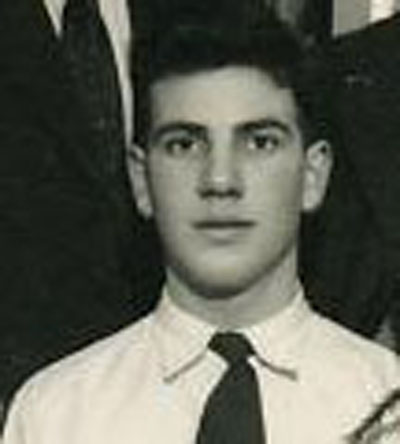
    Bob Quinn, pictured in 1952.

    There always is, or should be, somebody like that in a life. James Joyce got it right in ‘The Dead’: a might-have-been love against which no subsequent union can compete.

    The need for the ‘one’, a real or imaginary at-onement, is a powerful urge springing from our time as protoplasmic life forms which reproduced themselves. They can’t have had much fun four million years ago… they merely split in two. Once those simple organisms were divided we were lost, like garden worms bisected by a spade, wriggling frantically to find our other half, condemned to seek a soulmate who would spiritually complete them – and  satisfy basic drives.

    ‘All man’s miseries’ wrote Blaise Pascal, ‘derive from not being able to sit in a quiet room alone.’

    Gradually, the  most elemental  human instinct was romanticised and called love. Worse, for us naïve Catholic youngsters the delightful illusions of romance were transubstantiated into a spiritual straitjacket. In Christian circles it was called ‘atonement’ and cleverly channelled into a guilt trip about sins to be atoned for. What a joke! We would have been better left to our own devices, even if it meant being Tom Eliot’s ‘ragged claws, scuttling across the floors of silent seas’. The psychic wounds acquired in that battle between religion and libido left scars forever unhealed and unsuccessfully ignored.  Ask any celibate priest.

    Religion was the first and most successful multinational industry in Ireland. The only native entrepreneur who could compete with it was Arthur Guinness. My father and one brother each spent forty years in St. James Gate Brewery constructing barrels for Uncle Arthur’s brew. This aversion therapy meant that neither died of the free beer or ruined livers, the fate of many of their fellow tradesmen.

    Before Guinness arrived the  Irish Bishop seems to have made an unspoken pact with the Irish Politician: ‘You keep ‘em poor and we’ll keep ‘em ignorant’. Soon he made another treaty, this time with Arthur Guinness: ‘We’ll keep ‘em ignorant and you keep ‘em drunk’.

    The Bishop would never tolerate earthly aspirations. His and the brewer’s captive imbibers of Faith ended up as guilt-ridden, frustrated, self-flagellating, unhappy topers. Many intelligent Irish males suffered this fate and justified silent movie star Louise Brooks’ description of us as ‘the worst lovers in the world’. Some did their best to avoid emasculation. They became entertainers, poets, novelists, journalists, fast talkers, hustlers, petty criminals, moneylenders, politicians, bankers and other drunks. But they kept on wearing the green jersey  and going to mass on Sunday.

    My father was a lifelong teetotaller because his own father – also a cooper, as were all his forefathers back to 1798 – had died young and alcoholic. In my long life I may have consumed beer  enough for all three of us.

    Drunkenness was a sin; but did you know that the respectable business of banking was also once a sin, worse, a ‘mortaller’, as we knew it. In more frank times  banking was called usury or money-lending and was damned by the major religions. Now the innocuous term ‘banking’ covers a multitude of heinous crimes in comparison with which drinking  is akin to being in a state of grace. Banking is no less than usury in a collar and tie. At least pawnbrokers were a service for the poor. On Fridays, on my way home from Synge Street school in the No. 83 bus queue at Leonard’s Corner I would notice weary Kimmage housewives bearing their husband’s good suits home, having redeemed them from the pawn shops in Camden street where the  precious garments had lain since Monday morning as security for borrowed money.

    Up to medieval times the only people forced to dirty their hands with lucre and commit the sin of lending at exorbitant rates were Jews because they weren’t allowed do anything else. When that talented people demonstrated what an excellent way it was to make money, the Christians (notably the de Medicis in Florence and the merchants of Venice) took over the business – ‘How odd of God to choose the Jews’ – damned the unfortunates as God-killers and respectabilised their own unscrupulous moneylenders by calling them bankers. As Gore Vidal pointed out, human beings are enemies of all vice that is not directly profitable.

    Historical, anti- Anti-semitism’s roots may be a perverse symptom of Christian guilt. i.e. embracing the sin, hating the sinner.

    Read the first installment of Bob Quinn’s memoir here.

    We rely on contributions to keep Cassandra Voices going.


  • Explaining the Shutdown with Trump’s Magic Eightball

    Hegel remarks somewhere that all great world-historic facts and personages appear, so to speak, twice. He forgot to add: the first time as tragedy, the second time as farce. Caussidière for Danton, Louis Blanc for Robespierre, the Montagne of 1848 to 1851 for the Montagne of 1793 to 1795, the nephew for the uncle.
    (‘The Eighteenth Brumaire of Louis Bonaparte’, Karl Marx, 1852)

    One might add a third instance to Hegel’s comment via Marx—a phase where it all devolves into a lesser sequel to Dumb and Dumber. On a fundamental level, the Fox and Friends-fueled ‘crisis’ over what is clearly a profoundly bad and ruinously expensive idea — a massive wall (or steel palisade, or whatever) across a massive and often inhospitable border is gratuitously unnecessary, the product of dimwitted hubris and incipient dementia coupled with an antiquated political system.

    But this is America, and unlike a shitty sequel, we cannot simply decide to give the film a miss and… ride a bike or binge-watch on PornHub or something. Or maybe enjoy that glass of Kendall Jackson Chardonnay in peace without having to wonder how the dolt of a president will force you to pay attention to politics (or even that AOC retweet from one’s Bernie Bro nephew).

    Image (c) Contantino Idini

    Aside from the hardcore Trump supporter, and angry racist Fox News Grandpa, it isn’t as if anyone thought it was a good idea. Okay, by the most generous polls, 43% of the population believe the wall might be a good idea, which is to say that the country may be slightly less racist than one was afraid it was.

    Still, though, this is the opposite of overwhelming support, and while the approval for the shutdown hovered at around 22%, we had a president from the less popular of the two major parties who lost the popular vote causing and overwhelmingly unpopular shutdown over an in-your-face-racist wall that most people don’t want, and he can get away with it due to this country’s antiquated political system — and because while the wall is unpopular, it’s still polling at 87% among Republicans, and Senate Majority Leader Mitch McConnell doesn’t want to get primaried by a more drooling-prone version of himself. And this is democracy. Apparently.

    So how can this kind of situation be avoided? Within the framework of the U.S. Constitution the repeated House votes under Democratic control have about as much effect as all those votes to repeal Obamacare did when Republicans controlled the House and the Democrats held the presidency.

    Grassroots? Again, the population as a whole isn’t the demographic Mitch McConnell (or Rush Limbaugh or Ann Coulter) serves — it’s the elderly white suburbanites who’ve never actually been on the receiving end of a crime by a person of color, but who saw a meme on Facebook that was really scary, and whose notion of God is, if Protestant, informed by megachurch Prosperity Gospel and if Catholic, same as the Protestants, but with an Ave Maria and child-buggery chucked in.

    A considerable if not commanding majority rightly views such people with suspicion and contempt and tells such members of said demographic who are blood relatives to shut the fuck up when they opine that ‘black people didn’t used to mind being called the n-word’ at the Thanksgiving dinner table. But these people vote, and they are the make-or-break demographic in the Republican primaries.

    Meanwhile, on the ‘left,’ aside from the welcome continued growth of the socialist-and anarchist Real Deal, the #Resistance spent the shutdown tearing itself up over whether it was better for the Women’s March to cheer for Louis Farrakhan or an Israeli strafe run on a Palestinian village, while continuing to take no real steps to open up the movement into something where marchers can do anything other than make up the numbers.

    Cries of ‘Russiarussiarussia’ continue to abound, particularly at those who have the temerity to criticize the media-favored Democratic Party candidate du jour (at the moment of this writing, former prosecutor Kamala Harris, whose website has no policies laid out but does have merch. for sale).

    We’re almost two years away from the 2020 general election, yet the rancor and brain rot of the American presidential campaign season has set in. And being Americans in a neo-liberal hellscape of a job market, the overwhelming majority of federal employees didn’t quit despite not being paid for a month.

    However, the mere threat of airport and airline workers actually walking off the job was what actually broke the shutdown (contra #Resistance Twitter, which has begun to operate on the mistaken assumption that Nancy Pelosi is a brain-genius), indicating that the potential power of the working class in strategic industries shouldn’t be dismissed as something for the second verse of a Pete Seeger song.

    Alexandria Ocasio-Cortez calls for the electoral college to be abolished.

    Alexandria Ocasio-Cortez was absolutely right to call for the abolition of the antiquated Electoral College system that keeps giving us presidents who decisively lost the popular vote, but it’s not enough. As a whole mass of American historiography has amply demonstrated, the American Constitutional system was designed to limit the power of what Alexander Hamilton called ‘the great beast,’ by which he meant the voting public.

    Many of the problems in American politics are not reducible to governmental structures — the dictatorship of capital and associated rampant inequality and looming ecological catastrophe have no obvious technocratic solution (sorry, Elizabeth Warren) — but the Constitutional fetishism of both major American parties makes serious discussions about significantly changing an effectively anti-democratic and deliberately unwieldy basic structure of government radically difficult.

    So, apparently, Trump’s magic eight-ball told him to change course, and we’re no longer stuck with the stupid fucking shutdown and uninspected meat and vegetables and vandalism in the national parks, but we still have the MAGA-hatted Republicans and #Resistance Democrats… and more of this. And very little impetus to force our rulers to change the system that makes things like this happen again and again

    We rely on contributions to keep Cassandra Voices going.

  • Artist of the Month – Ruth Lyons

    Salarium 230 million BCE – Ongoing – We are salted by the salt of this palace

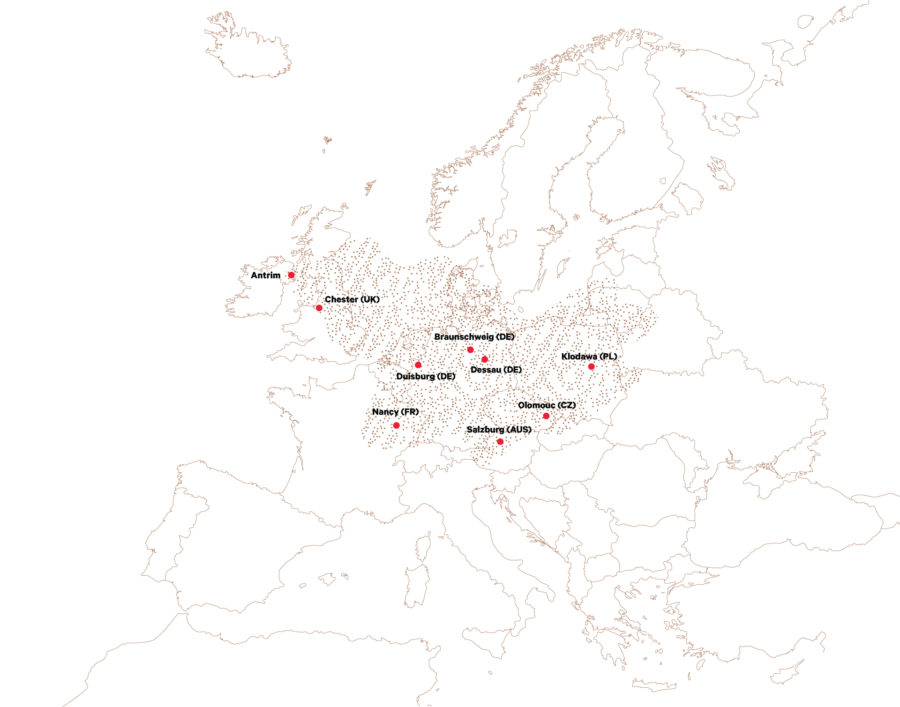
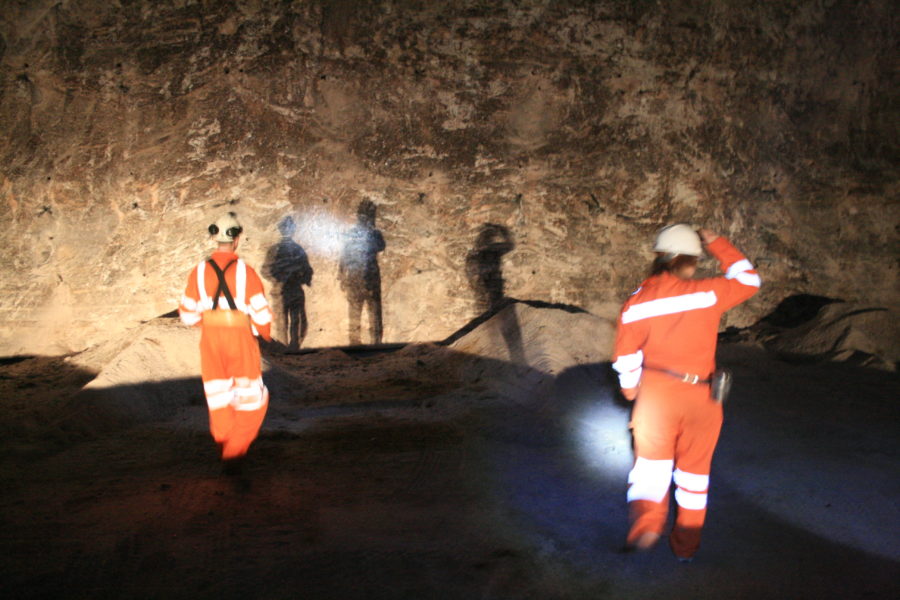
    The Zechstein Sea is an ancient body of salt water, now existing as a geological seam of salt extending across Northern Europe from Ireland to Russia. As the seam progresses eastwards and deepens into what was a body of salt water, the mineral content changes and the colour and density of the salt varies: giving rise to brown salt in Ireland; a grey colour in the UK; red and blue in Germany; and white in Poland.

    As part of an ongoing project I have been creating carvings from rocks found in salt mines acrosss Europe tapping into this seam. These vessels range from a roughly hewn rock to a finely carved bowl; they are a manifestation of this ancient sea, an enduring connection that defies contemporary borders and nation states. At the same time, the forms reflect their simple origins in the collosal power of today’s mining industry: the digging out of the earth and the hollows that remain.

    Salt is hygroscopic by nature. It has a need to absorb water, in essence to return to being the sea. Given this property, the vessels are unusable objects. Rather they are hosts, a symbol of openness and a meditation on the extraordinary world of little things, conveying the idea of the sea contained in a salt crystal.

    Salarium is made possible and facilitated by EUSalt, an umbrella association for European salt workers. Following an initial expression of interest in the concept of the project, EUSalt have supported Salarium through an annual commission of salt carvings that serve as awards and gifts for presenters and exemplary mines at their annual GA Salt summit. In this respect the economy of Salarium has become an essential structural element in the project, which is not simply a faciliating force, but a conceptual cornerstone to its formation.

    The title ‘Salarium’ refers to the economic value of salt within the relatively short spectrum of recorded human history, and the seminal role that it has played as the origins of ‘salary’ in the development of the contemporary economy. As geologists consider the end of the Holocene and the onset of a new geological epoch, Salarium (230 million BCE- Ongoing) offers a punctuation, a hollow, a space to consider human legacy and the transience of economic value.

    Elements of Salarium will be on show at:

    Talbot Rice Gallery, Edinburgh

    23 February – 4 May 2019

    Borderlines

    with Lara Almarcegui, Rossella Biscotti, Lonnie van Brummelen & Siebren de Haan, Willie Doherty, Nuria Güell, Ruth E. Lyons, Amalia Pica, Khvay Samnang, Santiago Sierra, Mona Vatamanu & Florin Tudor.

    National Gallery of Ireland

    20 April – 7 July 2019

    Shaping Ireland: Landscapes in Irish Art

    www.ruthelyons.com

    We rely on contributions to keep Cassandra Voices going.

    [Best_Wordpress_Gallery id=”27″ gal_title=”Ruth Lyons”]

  • Who Needs a Healing?

    In the inner world, time has a way of standing still long enough so you can come to your senses.  Then you can have eyes that see and ears that hear. My Aunt Jewel taught me this more by example than with words. She had no use for words and she wasn’t really my aunt. Mama, a divorcée from Mississippi, had married into Auntie’s Choctaw Indian family one-day shy of my first birthday. At four feet eleven with a heart as big as Texas, I could always count on her for a kind word and a tender voice.  Learning some of the old ways with her taught me that cause and effect can’t always be foretold much less recognized and controlled.

    My earliest memory of Auntie is the first time she took me to her one room church near the Little Cypress Bayou that flows through the Blue Elbow Swamp, eventually entering the Sabine River near I-10 in Orange, Texas.  The church, a tiny clapboard painted white with a piney wood floor and a few benches, was where the beleaguered believers felt they belonged.

    “Who needs a HEALING” screamed Preacher, a red-faced man in black pants and a cheap white, sweat-soaked shirt that encased his gut, revealing a life time of buttery biscuits and sausage gravy.

    “Nancy Ann, I think ya got a fever” Auntie said aloud as her brown hand felt my white face.

    “No mam – I ain’t got no fever!

    “Yes, you do” she whispered as she firmly took me by the arm and guided me to the homemade dais.  Down on my knees I went with the weight of Auntie’s hand on my right shoulder.

    When Preacher caught his breath long enough to notice he had a child to work on, he began crying and wailed, “unless you change and become like this little child, you will never enter the kingdom of heaven.”  He held up a small bottle of Jerusalem Holy Oil, so all could behold the glorious healing about to occur.  As I looked up at Preacher, heartburn from that morning’s breakfast caused me mistakenly to believe it needed to be healed.

    “Child, do you want to be healed,” he asked while kneeling to better look me in the eye.

    “I think so.”

    The fears that bumped around in my already wizened seven-year-old psyche were very real.   I didn’t have the faith in the old ways like Auntie did.  My pagan mother had taught me to believe in the evil eye and being cursed and such, but not in the hell that Preacher and Auntie did.  To Mama, heaven was a piece of land, a good scotch with a good screw; something that made this life a little easier to bare.  Hell was in between your ears, right here, right now.

    “Child are you ready to confess your sins,” Preacher asked.

    “I think so.”

    “You think so,” he said with a faint smile.

    “Yes Sir.  I think so.”

    “Do you repent of all your sins, so you can be healed?”

    “Y e s . . . sir” slowly slipped from my lips and with that, I was suddenly looking up at the ceiling as Preacher held the back of my head, while making the sign of the cross on my third eye with his oily finger.  Auntie, already filled with the Holy Ghost, was speaking in tongues. My skinny little body began to swoon as it filled with the divine energy.   The room began to swirl, and I fell back on Aunt Jewel who slowly lowered me to the floor.

    “Praise God” she wailed.

    “Praise God” cried the congregants who were no longer quietly singing and humming along with the makeshift band.  Now they were making a loud and glorious music unto the Lord singing I’ll Fly Away as loud as possible:

    When the shadows of this life have gone
    I’ll fly away
    Like a bird from these prison walls I’ll fly
    I’ll fly away.

    As I lay there on the floor unable to get up and surrounded by all the wonderful beleaguered believers, my heart filled with joy and my nose filled with the scent of the myrrh and sweet-smelling cinnamon used to make the Jerusalem Holy Oil Preacher had used to heal me.  The singing was muffled as if far away,

    I’ll fly away, oh glory
    I’ll fly away in the morning
    When I die, Hallelujah by and by
    I’ll fly away.

    After what felt like an eternity, I was helped to my feet.  Everyone was beaming at me.  Auntie, grinning ear to ear, was hugging me up close and whispering now we got to git ya baptized baby girl.  Now we got to git ya baptized.

    “Yes Lord… I know Lord… Thank you Lord…” Preacher prayed while still on his knees.  His voice just loud enough so everyone could hear he was still conversing with Jesus.

    There was a static electricity in the room.  Every time someone came to hug me, there was a shock.  My hair was sticking out on end the way it does when you pull a sweater over your head in the winter.  But my stomach wasn’t burning anymore, and Auntie was so pleased with me she was promising a Dairy Queen double dip.

    While she was saying her goodbyes, I went outside to stand in the October chill.  It was a clear day with a slight breeze.  Looking up at the sun, I wondered if my heart got healed.  I wondered if a healing was the same as a protection. Mostly, I wondered what if Mama was right?  What if hell really is between your ears, right here, right now?  What then?

  • Confronting ‘the Russia in Ourselves’

    The Russian bear looms in the English-speaking imagination as savage and barbaric, but with a native cunning in need of taming. Throughout the nineteenth century British imperialists looked on their seemingly ursine counterparts with a mixture of dread and superiority. William Makepeace Thackery’s poem ‘The Legend Of St. Sophia Of Kioff’ (1855) contains a typical portrayal of their Asiatic barbarism:

    Down they came, these ruthless Russians,
    From their steppes, and woods, and fens,
    For to levy contributions
    On the peaceful citizens.

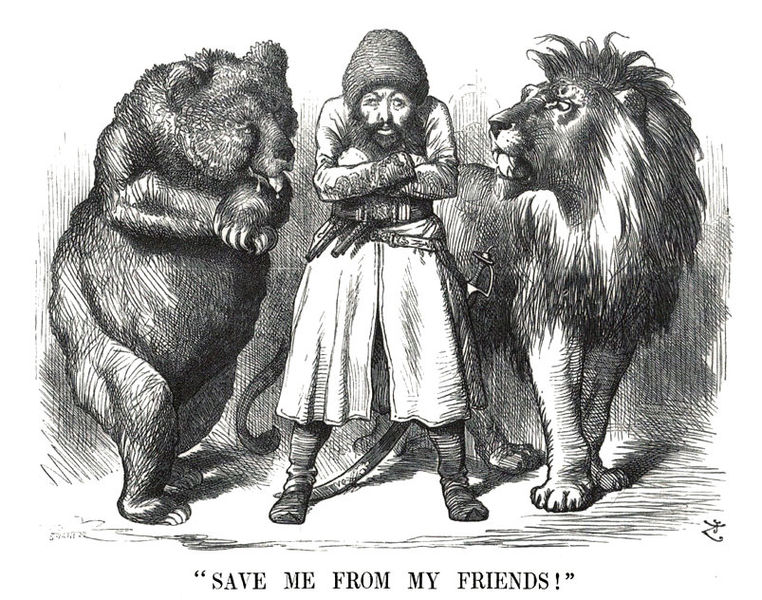
    The ‘Great Game[i]’ of that time involved intrigues between British and Russians agents. India was the ultimate prize, with the ‘Near East’ forming part of an expansive theatre. Curbing Tsarist Russia’s encroachments brought British military expeditions into Central Asia. There they met the bellicose Afghans – who dished out one of the most ignominious defeats in British military history: the 1842 retreat from Kabul, when all but one European and a few Indian sepoys from Sir William Elphinstone’s 4,500-strong army limped back to base in Jalalabad.

    Great Game Cartoon from 1878.

    These colonial intrigues endowed the English language with a term now more commonly used in a sporting context: ‘pundit’, originating from the Sanskrit word ‘pandit’, meaning ‘knowledge owner’, or ‘learned man’. These local informants provided intelligence on the warlike peoples inhabiting the inhospitable terrain between lush India and the endless steppe. Tales were embellished to please the ear of the listener, moulding enduring Oriental stereotypes. Today’s pundits on international affairs also draw, perhaps unwittingly, on historic accounts, and are similarly prone to over-statement.

    By Jingo

    Nineteenth-century British Russophobia popularized the term ‘jingoism’, which can be traced to a song commonly sung in Victorian musical halls:

    We don’t want to fight but by Jingo if we do,
    We’ve got the ships, we’ve got the men, we’ve got the money too,
    We’ve fought the Bear before, and while we’re Britons true,
    The Russians shall not have Constantinople.

    The Anglo-French victory in the Crimean War 1853-56 checked Russian designs on a Mediterranean port, but the dispute simmered, as Tsardom became a byword for tyranny – ironically, given the brutality of the simultaneously expanding British Empire. Projecting one’s worst characteristic onto to a remote ‘other’ is not restricted to individuals.

    By the end of the nineteenth century British imperialists felt more secure in their hold over the ‘jewel in the crown’, and another, Teutonic, enemy had arisen, aspiring to weltmacht (‘world power’): Germany was upsetting the balance of power in Europe, and required containing.

    Détente with Russia – which from 1891 had been in alliance with the French – followed, culminating in the Anglo-Russian Entente of 1907, and eventual alliance during World War I. Long before the unexpected Bolshevik Revolution of 1917, however, British policy makers were worrying about the consequences of a Russian victory on the Eastern Front.

    These concerns reached fever pitch after the October Revolution, and the triumph of the Reds in the Russian Civil War, which included an unsuccessful intervention by Allied forces in support of the Whites. But by 1920 the Red Army was in command of most of the former Russian Empire, and had reached the gates of Warsaw. A shattered Germany, experiencing Communist insurgencies, lay ahead, before ‘the miracle of the Vistula’ – the victory of the Polish forces under Marshall Pilsudski, supported by the French. The Polish-Soviet conflict was resolved by the Treaty of Riga in 1921, bringing respite for two decades.

    In the Western imagination, during the 1920s and 1930s the Russian menace merged with the Red Peril, and a layer of ideologically-driven ruthlessness was added to the character. American reactionaries used the scare to destroy the labour movements that were then making inroads. The clampdown on the American left involved draconian measures (instigated by, among others, a young J. Edgar Hoover) against ‘subversives’, such as five-time Socialist Party Presidential candidate Eugene Debs, sentenced in 1918 to a ten-year prison sentence for urging resistance to the military draft, later commuted to three years. The media played its part, including disseminating the forgery, ‘The Protocols of the Elders of Zion’, which established the myth of Jewish Bolshevism. America would bend principles where necessary to keep out the ‘Commies’.

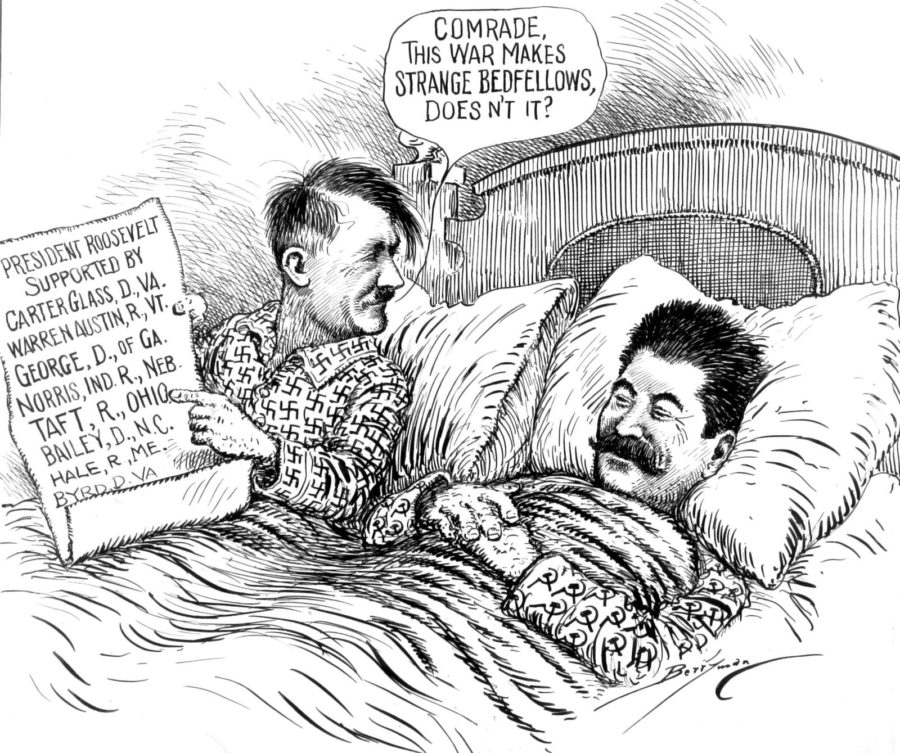
    In Europe in 1939, the uneasy peace on the Eastern Front ended with the unlikely Molotov-Ribbentrop Pact between the Soviet Union and Nazi Germany, ushering in the fourth, and most savage, partition of Poland. Hitler repudiated that Pact in 1941, with Operation Barbarossa, the invasion of the Soviet Union. The ensuing alliance between Britain (and eventually the United States) with the Soviet Union decisively changed matters. The murderous Red Tsar, Joseph Stalin, was affectionately known as ‘Uncle Joe’, as long as the Nazi foe persisted.

    Predictably, relations deteriorated rapidly again after the war – especially after the Berlin Blockade of 1948-49 – but the prospect of mutually assured destruction (MAD) brought a Cold War, lasting forty years.

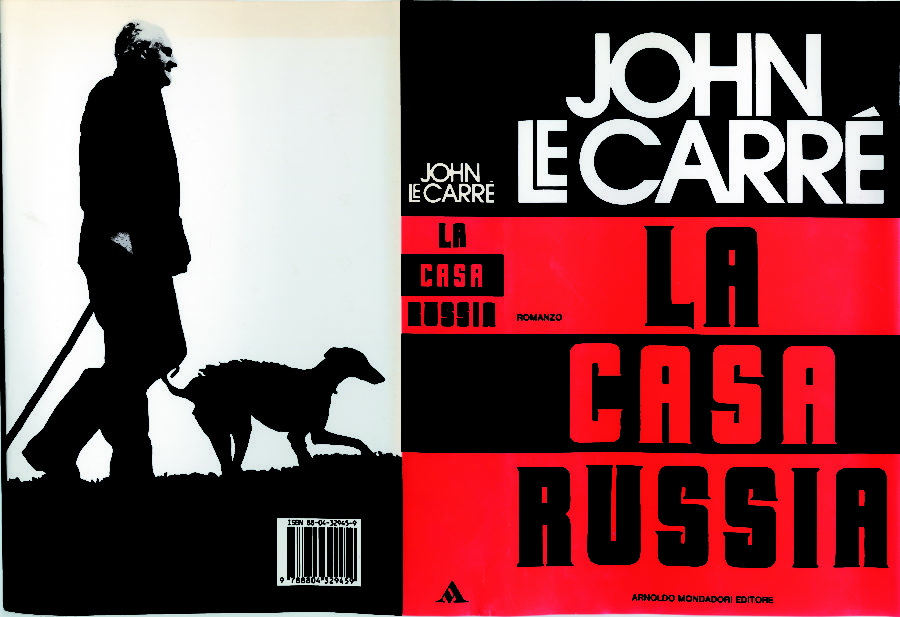
    John le Carré

    From an imperialist perspective, World War II was a pyrrhic victory for Britain, which completed its metamorphosis from global hegemon to medium-sized client-state in the bipolar geopolitics of superpowers. The shambolic invasion of Suez of 1956 was the dying gasp of the British Empire, and the ‘winds of change’ swept through Africa during the 1960s.

    To a large extent, the United States inherited Britain’s role as the world’s policeman, although the U.S. has shown greater reliance on proxies – ‘divide and conquer’ – the extension of ‘soft’, cultural power, and economic manipulation – with the Iraq and Vietnam Wars notable exceptions.

    As part of a contiguous Anglosphere, the United States nonetheless inherited various tropes about a Russian ‘other’, extending back into the nineteenth century. The McCarthyite witch hunt in the 1950s against Communist sympathisers, especially in Hollywood, showed the U.S. at its most paranoid.

    The excesses of the American intelligence services both internationally, through the CIA, and internally, through the FBI under its long-time director J. Edgar Hoover, are well documented. These included targeted assassinations, foreign coups and mind control experiments (the MKUltra project saw U.S. citizens being dosed with LSD, generally without their consent or knowledge). In any intelligence war, the U.S. could play just as dirty as its opponent.

    In the latter half of the twentieth century a new layer to the Russian mystique was added by the Cold War literature of John le Carré, and other spy novelists. Karla, a recurring le Carré character, emerges as the archetypal devious, ruthless and ideologically driven Russian spymaster.

    That is not to imply that the Soviet and successor Russian regime have not been villainous, and manipulative. According to Ben MacIntyre in his account of the extraordinary career of Oleg Gordievsky, a KGB officer who spied for the British, the KGB ‘had long excelled in the art of manufacturing ‘fake news’;’ taking ‘’active measures’ to influence public opinion’, and ‘sow disinformation where necessary’[ii].

    But the organisation was also beset by money-grubbing corruption and institutional decay, especially as ideological fervour wavered in the great chill of the final decades before glasnost and perestroika, under Mikhail Gorbachev. After being posted to Copenhagen in the early 1970s, Gordievsky discovered that the recruitment of informants was ‘an invitation to corruption’, since most officers invented their interactions, falsified bills, ‘made up their reports and pocketed their allowances.’[iii] Upon being posted to London at the end of that decade he then found that most of the information sent back to Moscow by the heavy-drinking KGB bureau chief was ‘pure invention.’[iv]

    The Russia of the Western imagination refuses to conform to reality. Indeed, the threat may be aggrandized by self-serving writers. It is in the interest of the powerful Military Industrial Complex, for U.S. society to remain on edge, at war-without-end. In one rare slip, Lockheed Martin Executive Vice-President Bruce Tanner revealed to a conference in 2015 that his company would see ‘indirect benefits’ from the ongoing war in Syria.[v]

    Al-Jazeera reported that the ‘black budget’ of secret intelligence programmes alone was estimated at $52.6bn – under President Obama’s watch – in 2013. That was only for the secret programmes, not the far greater intelligence and counterintelligence budgets.[vi] These agencies at times use mouth pieces in the press, and academia. The import of information being released to the public by U.S. agencies competing for funding and survival surely requires careful analysis.

    One former CIA station chief in the Middle East, characterised the diverging roles of the main agencies to the investigative reporter Seymour Hersh as follows: ‘Don’t you get it Sy? The FBI catches bank robbers. We rob banks … And the NSA? Do you really expect me to talk to dweebs with protractors in their pockets who are always looking down at their brown shoes.’[vii] U.S. spooks are every bit as manipulative, and far better funded, than their Russian equivalents in a discipline the former CIA spymaster James Jesus Angleton described as ‘the wilderness of mirrors’.

    Vladimir Putin is not a mass murderer in the mould of a 1930s dictator, intent on imposing an inflexible ideology on the rest of the world. Crony capitalism or strongman rule could be used to describe his regime. Importatnly, his ambitions appear to be limited to restoring the territory of the Soviet Empire to Russia, rather than fomenting World War III.

    The Russian President is probably best viewed as a Shakespearian villain, whose violent impulses, as Alexander Solzhenitsyn put it, ‘stop short at ten or so cadavers, because they have no ideology.’[viii] This offers scant consolation political prisoners in Russian prisons, but Putin has certainly shown no genocidal tendencies. Soviet technology has been in decline vis-à-vis the West since the 1960s, and with the breakup of the Union the rump Russian state lost important technological and industrial centres, such as Dnipropetrovsk in Ukraine; but the English-speaking world remains fixated on the threat.

    Russia’s ‘strengths’

    The academic author Timothy Snyder is a leading purveyor of Russian history, and mythology. In a recent interview he stated:

    Throughout the Cold War, Russia was always better than us when it came to penetrating their enemies and breaking them down from within. Rather than smashing things overtly, they would work from behind the scenes to cast doubt on things. They’d insert their people into enemy organizations and slowly create chaos from inside. They’ve always excelled at turning people against each other.

    The British, in particular, by the end of the Cold War had gained the upper hand over their Soviet counterparts, with their man in London’s KGB station feeding her Majesty’s government almost anything they would wanted to know, including that then Labour leader Michael Foot had been in the pay of the KGB until 1968.[ix] Gordievsky’s intelligence-gathering was of an enormous assistance in Margaret Thatcher’s (and Ronald Reagan’s) establishment of good relations with the reforming Mikhail Gorbachev. Also, by the early 1980s the CIA had over one hundred covert operations underway inside the Soviet Union, and at least twenty active spies.[x]  Nonetheless Snyder insists on the fiction of an omniscient Soviet spymaster transitioning into a Russian web guru:

    Russia lost the Cold War because the Cold War was decided by economics and technology; it was a material competition. But after the Cold War, we moved into a different world, a world defined by the internet, and that’s a much more psychological world. The techniques they’ve been honing for decades are much more powerful in this new digital world, where emotion dominates and everyone is connected and there is so much information floating around. This is a world of information warfare, and that suits Russia’s strengths.[xi]

    Snyder’s anachronistic generalisations about the Russian character belie the distinction between the ideologically-driven Communists under the Soviet Union, especially prior to the Prague Spring of 1968, and the more venal aspirations of the successor Russian regime.

    One academic review of his recent book (The Road to Unfreedom: Russia, Europe, America, New York, Tim Duggan Books, 2018), portraying Putin as a latter-day Nazi, sets the record straight:

    The fact that Timothy Snyder is an influential public intellectual and respected historian is no reason for scholars not to challenge his facile and polemical analysis of the contemporary Russian state. By obfuscating the broad debate on Russia, Snyder denies the need for a serious, unbiased analysis of those features of the Putin regime that could be characterized as fascist. Distortions, inaccuracies, and selective interpretations do not help illuminate what motivates the Russian leadership’s self-positioning on the international, and in particular the European, scene. Simplistic reductionist techniques and invalid reasoning further confuse the analysis—and bias policy responses.[xii]

    Snyder’s polemics appeal to the mass media market, and “bias policy responses”. It is as if failings in our own civilisation appear to demand external explanation.

    Timothy Snyder, historian and author, teaching at Yale university in 2017.

    ‘The Russia in ourselves’

    In his account of the career of Carl Jung, Laurens van der Post recalled, ‘many post-war occasions when he [Jung] spoke with increasing urgency of the necessity for us all to understand that the Russian problem in the external world could never be resolved without more disaster unless we first dealt with the Russia in ourselves.’[xiii] Through the Cold War and beyond, from South America to Vietnam and Iraq, the U.S. acted with just as much contempt for human rights and international law as the Soviet Union, or Russia. Even under Obama’s Presidency, drone strikes – extra-judicial assassinations – were a recurring projection of U.S. power.

    The main difference between ‘East’ and ‘West’ has been, for the most part at least, domestic preservation of the Rule of Law, including freedom of expression, in the latter. This has permitted criticism on the fringes, if not in a mainstream media often beholden to corporate interests.

    The expansion of NATO into Eastern Europe in the 1990s stoked Russian fears of encirclement, bringing a desire for a strong, militaristic, leadership to protect the country from outside interference after the chaos of the Yeltsin years. More recently, EU leaders sought to absorb the Ukraine into the Western orbit. This is despite many parts of that country containing Russian-speakers with a nostalgia for the predictability of life under Pax Sovetica.

    Ukraine’s fertile plains were the bread-basket of the Tsarist and Soviet Empires, making many Russians understandably apprehensive about a complete divorce. Moreover, Russia’s military planners see these flat lands as military indefensible, and her ‘natural’ frontier as extending to the Black Sea, Carpathian mountains, and flood plain of the Vistula.

    Squeezed in the middle, Ukrainians labour under kleptocratic and tyrannical rulers serving interests in both East and West. But many Western commentators have failed to acknowledge the machinations of the latter, while magnifying the role of the former amidst a twenty-four hour news cycle that offers little time for dispassionate reflection.

    Trump-Russia

    The arrival of Donald Trump at the U.S. Presidential helm may prove to be one of the worst disasters to afflict the world’s environment. He is the quintessence of a loud-mouthed American who knows nothing of the world, or even his own country, while irrationally believing in his powers of divination, and capacity ‘to get the deal done’.

    For many commentators the success of his malignant buffoonery requires an external explanation, drawing attention from the disgust that many ordinary Americans justifiably felt towards a Washington capital seething with lobbyists, spooks and over-paid bureaucrats. Enter Vladimir Putin in the Karla role – himself an ex-KGB agent – manipulating not only Trump, who is supposed to have been captured in flagrante delicto romping with Eurasian hussies, but also the American people who – according to this narrative – have been stupefied by Russian trolls: “Russia’s strengths” according to Timothy Snyder.

    Whatever about the veracity of any claims of Russian collusion, or the idea that U.S. intelligence community could so easily be outflanked, psychologically we appear to be obscuring the ‘Russia in ourselves’. The United States is an increasingly dysfunctional and unequal society. Aside from the dismantling of Medicare, the appeal of Trump to blue collar American is not entirely irrational. He promised to protect indigenous U.S. industry, and ‘drain the swamp’ of a widely despised capital. ‘Lying’ Hilary Clinton was correctly seen as an establishment figure who would do nothing to alleviate the continuing decline of working class America, bedevilled by obesity and drug addiction, while real wages have stagnated for decades.[xiv]

    No doubt Putin sought a friendly regime in the White House, but pundits habitually exaggerate the Russian leader’s influence, just as many journalists blithely accepted the nonsense about Saddam Hussein constituting a threat to global peace. The accumulated myth of the sly and aggressive Russian has been given a new lease of life.

    A Colossus of American Journalism

    Seymour Hersh is a colossus of American journalism, who has interrogated the structures of power internally and externally since the 1960s, invariably setting the record straight. His real breakthrough was exposing the My Lai massacre during the Vietnam War; he went on to reveal chemical and biological weapons programmes in the late 1960s; internal repression of anti-War groups by the CIA; mafia intrigues; the foreign policy dirty tricks of Nixon and Kissinger; the hypocrisy of JFK’s Camelot, U.S. links to Saddam Hussein’s weapons programmes in the 1980s; and the horror of Abu Ghraib. Without his tireless work we would know a great deal less about Uncle Sam’s unseemly side.

    It is reassuring that neither Hersh, nor his family, were harmed over the course of an ongoing award-winning career, contributing especially to the New York Times and The New Yorker. He records just one death threat in that time, from a prominent mafia fixer in the 1970s.[xv] Among the American establishment there were, and still are, progressive forces resisting foreign misadventures and barbarities, such as using a sack full of fire ants to extract information from an internee, as occurred during the so-called War on Terror.[xvi]

    Seymour, ‘Si’, Hersh, photographed in 2004.

    Fascinatingly, however, in his Reporter: A Memoir, Hersh bemoans the unwillingness of editors in the New York Times to support investigations into corporate America in the late 1970s, which frustrated him at one point to such an extent that he hurled his typewriter out the office window – the following day the window was replaced and nothing more was said of the incident.

    Hersh recalls:

    Writing about corporate America had sapped my energy, disappointed the editors, and unnerved me. There would be no check on corporate America, I feared: Greed had won … the courage the Times had shown in confronting the wrath of a president and an Attorney General in the crisis over the Pentagon Papers in 1971 was nowhere to be seen when confronted by a gaggle of corporate conmen.[xvii]

    The point about freedom of expression in the English-speaking world is that mainstream media only generally conduct investigation into threats to political and economic stability. The Watergate investigation was permitted, as this was an illegal attack on half of the U.S. political establishment; also, a significant proportion of America’s elite began to viewed the Vietnam War as unwinnable after the Tet Offensive in 1968, permitting critical articles form Hersh and others. But investigating white collar crime can be to the detriment of advertisers, and therefore altogether more difficult to pursue.

    Holding his nerve

    Hersh delivers a withering assessment on further media decline in the Internet era:

    We are sodden with fake news, hyped-up and incomplete information, and false assertions delivered non-stop by our daily newspapers, our televisions, our online news agencies, our social media, and our President.[xviii]

    The problems are by no means restricted to the purveyors of fake news, external or otherwise:

    The mainstream newspapers, magazines, and television networks will continue to lay off reporters, reduce staff, and squeeze the funds available for good reporting, and especially for investigative reporting, with its high costs, unpredictable results and its capacity for angering readers and attracting expensive law suits.[xix]

    He concludes: ‘it’s very painful for me to think I might not have accomplished what I did if I were at work in the chaotic and unstructured journalism world of today.’[xx]

    As an old school reporter that pursued stories as doggedly as his body permitted, Hersh now considers himself an odd-man-out, and has found his recent reporting falling foul of editorial disfavour, even in supposedly progressive outlets such as The New Yorker, and The London Review of Books. Thus, while investigating the assassination of Osama bin Laden, David Remnick, the editor of The New Yorker, who had close ties to the Obama administration, complained about his use of the ‘same old tired source’, much to the grizzled Hersh’s bemusement.

    Perhaps more surprisingly, The London Review of Books delayed publication of another article he wrote challenging ‘the widespread perception that Bashar Assad had used a nerve agent two months earlier against his own people … The article, which was taken by many as an ad hoc defence of the hated Assad and the Russians who supported him, and not the truth as I found it’,[xxi] worried the editor. As a result Hersh took the story to Der Spiegel.

    Corroboration arrived in early 2018 when Defense Secretary James Mattis diverted from the previous narrative about the chemical attack, saying: ‘We do not have evidence of it’. Mattis can hardly be described as a Putin supporter, considering he resigned over Trump’s abrupt announcement that he would pull U.S. troops out of Syria – which presumably gives a free hand to the Russians. An investigator as formidable as Hersh generally has his ducks in a row.

    Russia Today

    In many respects, the state news agency Russia Today acts as a mouthpiece for Putin’s government. At times it does purvey what appears to be fake news, casting a fog of uncertainty over the reliability of everything it publishes. But to suggest mainstream media in the West is not also serving vested interests would be naïve, and fails to recognise that what is delivered as news is a product of editorial decisions: facts do represent opinions, contrary to one banal advertising slogan of the Irish paper of record.

    Any online publisher, even a reputable state broadcaster such as the BBC, measures success in ‘clicks’, albeit the bait must be sophisticated if it is to ensnare the educated reader. A bare-chested, unapologetically homophobic Vladimir Putin performs the role of pantomime Russian villain with aplomb. Even The Guardian is not immune from dangling half-baked investigations before its consumers.[xxii] Seymour Hersh, notwithstanding his contempt for the U.S. President, stated in 2017: ‘Trump’s not wrong to think they all fucking lie about him.’[xxiii] The Trump-Russia affair may prove to have more to do with inter-agency disputes – cops and robbers – than Russian machinations.

    But the buffoon Trump must have been manipulated by the Eurasian spymaster, whose agencies have ingeniously transformed the Internet into a labyrinth of conspiracy theories and distracting nonsense, right under the noses of the CIA, FBI and NSA. This allows us to avoid assessing the ‘Russian in ourselves’, and acknowledging the pathologies of Western societies, from social media addiction to ever-widening inequalities, and ecocide.

    With mainstream media failing to pursue vested interests, the greed that Seymour Hersh points to may have won, for the time being at least. It is simpler to blame a straw Russian bear, rather than examining the serious failings in our own societies.

    We rely on contributions to keep Cassandra Voices going.

    [i] See Peter Hopkirk’s canonical account: The Great Game: On Secret Service in High Asia, New York, Kodansha, 1992.

    [ii] Ben MacIntyre, The Spy and the Traitor, London, Penguin, 2018, p.46

    [iii] Ibid, p.26

    [iv] Ibid, p.130

    [v] Lee Fang and Zaid Jilani ‘DEFENSE CONTRACTORS CITE “BENEFITS” OF ESCALATING CONFLICTS IN THE MIDDLE EAST’, The Intercept, December 4 2015, https://theintercept.com/2015/12/04/defense-contractors-cite-benefits-of-escalating-conflicts-in-the-middle-east/ accessed 15/1/19.

    [vi] Jonathan Turley, ‘Big money behind war: the military-industrial complex’ Al-Jazeera, January 11th, 2014, https://www.aljazeera.com/indepth/opinion/2014/01/big-money-behind-war-military-industrial-complex-20141473026736533.html, accessed 14/1/19.

    [vii] Seymour M. Hersh, Reporter: A Memoir, New York, Random House, 2018, p.300.

    [viii]  Alexander Solzhenitsyn, The Gulag Archipelago, New York, Perennial Classics, 1974, p. 173.

    [ix] It is believed that most of these payments were used by Foot in order to keep afloat the left wing newspaper, Tribune, he edited. When the cabinet secretary, the politically neutral Sir Robert Armstrong, was presented with this incendiary information he elected not to inform the Prime Minister Margaret Thatcher, assuming, correctly, that Foot would lose the forthcoming election in 1983. MacIntyre, 2018, p.142

    [x] Ibid, p.200

    [xi] History News Network, ‘Yale’s Timothy Snyder says Russia pioneered “fake news”’, May 4th, 2018, https://historynewsnetwork.org/article/168751, accessed 14/1/19.

    [xii] Marlene Laruelle, ‘Is Russia Really “Fascist”? A Comment on Timothy Snyder’, Ponars Eurasia, 9/2008, http://www.ponarseurasia.org/memo/russia-really-fascist-reply-timothy-snyder, accessed 15/1/19.

    [xiii] Laurens van der Post, Jung and the Story of Our Time, London, Verso, 1976, p.22.

    [xiv] Drew Desilver, ‘For most U.S. workers, real wages have barely budged in decades’, Pew Research Centre, 7th of August, 2018. http://www.pewresearch.org/fact-tank/2018/08/07/for-most-us-workers-real-wages-have-barely-budged-for-decades/, accessed 14/1/19.

    [xv] Hersh, 2018, p.234.

    [xvi] Ibid, p.318.

    [xvii] Ibid, p.247.

    [xviii] Ibid, p.3.

    [xix] Ibid, p.4.

    [xx] Ibid, p.5.

    [xxi] Ibid, p.330.

    [xxii] Erin Durkin, ‘Trump: report FBI investigated him as possible Russian agent is ‘insulting’’ The Guardian, January 13th, 2019, https://www.theguardian.com/us-news/2019/jan/13/donald-trump-russia-new-york-times-washington-post-fbi-putin, accessed 14/1/19.

    [xxiii] ‘Tyler Durden’, ‘Seymour Hersh: “RussiaGate Is A CIA-Planted Lie, Revenge Against Trump”’,  ZeroHedge, 8th of February, 2018. https://www.zerohedge.com/news/2017-08-02/seymour-hersh-2018, %E2%80%98russiagate%E2%80%99-cia-planted-lie-revenge-against-trump, accesseed 14/1/19.

  • Fintan O’Toole’s Brexit Myopia

    As a freshly UK-embedded Irish barrister I am adjusting from confronting Ireland’s problems to addressing those of my new home. Worlds’apart, in a global village. In terms of Brexit, as far as the Irish media is concerned the Backstop, and a recrudescence of the ‘Irish Question’, is the only story, but from my perspective the border issue pales by comparison with the precarious position of Irish nationals resident on the UK mainland. All bets are off. In the Westminster extradition courts there is a growing apprehension among all non-nationals, amidst a descent into political farce. Eastern Europeans in particular are on red alert.

    I recently immersed myself in the Brexit literature (word used advisedly), a choice not unlike Christopher Hitchens consenting to undergo waterboarding. Most offer blow-by-blow accounts, and are an utter waste of time.

    By far the most useful and simultaneously useless book to emerge has been from that august man of letters, Irish Times columnist Fintan O’Toole. His Heroic Failure Brexit and The Politics of Pain (London, Apollo, 2018) suffers from a cultural myopia bordering on xenophobia. This account by an Irish-resident journalist is useless at providing any insight into the English character, but serves, nonetheless, as a useful vantage on the general superficiality of Irish political discourse.

    O’Toole rightly inveighs against neo-liberalism throughout his text, but fails to recognise the extent to which the Brexit vote was in certain respects a reaction to the rampages of this pernicious ideology of free market free-for-all. For some, Brexit embodies an attempt to preserve an innate decency in the English character, rather than selling-out to multinational or Eurocractic control.

    There endures a residue of decency in ‘old’ England – informed by secular and Christian socialist or liberal values – which are dying out rather faster in Ireland. Moreover, many argue that the UK should run a mile from the imposition of the austerity policies that liquidated the social structures of Ireland and Greece.

    O’Toole’s argument that Jacob Rees-Mogg, and others, are seeking detachment for the sake of further wealth accumulation is valid, but the denunciation of Brexit as economic folly and a lapse towards an unrealistic autarky is less persuasive. Seeing Brexit as simply a manifestation of national self-pity, combining grievance and superiority, or a racist attempt to curb immigration, neglects to consider the rising indignation that many British justifiably feel at the encroachment of faceless bureaucrats intent on imposing austerity. This is coupled with a rising contempt for a New Labour-led political correctness that never confronted the downsides, in terms of labour protection and integration, of mass migration.

    It is not simply a product of racism, a label O’Toole is too fond of flinging. Quoting Enoch Powell’s ‘Rivers of Blood’ speech is the sort of simplification favoured by those who reach for the Hitler label at student debates.

    Lazy Stereotypes

    Neo-liberalism favours immigration in order to drive down labour costs. O’Toole is thus passively endorsing that which he purports to condemn when he decries how lazy the UK workforce has become. He ought to acknowledge that the Irish workforce has not always been renowned for its commitment, which protected some of us from a premature death through exhaustion. Indeed the flâneur is a fabled specimen in Irish literature.

    As the jokes runs (in a droll Dublin accent): an Irish professor of literature was asked by his Spanish host at a conference in Spain whether there was a Gaelic word similar to the Spanish mañana. ‘Sure’ said the professor, ‘we have five words similar to mañana, but none convey quite the same sense of urgency.’

    Like O’Toole, Taoiseach Leo Varadkar favours a productive, early-rising population, shoehorned into unthinking and robotic work, leading to death on the instalment plan; zero hour contracts; meaningless corporate jobs; and the siphoning off of wealth to vulture funds controlled by off-shore multi-nationals.

    I vote for more leisure time. Who knows, it might lead the charmless O’Toole, and Varadkar his intellectual consort, to greater depths of analysis and cultural refinement.

    Fintan O’Toole fails to comprehend that Ireland is the perfect little neo-liberal shit storm, which has prompted the aforementioned Rees-Mogg to invest in our little meltdown, after the double-whammy of liquidation by the ECB and American transitional corporations.

    Britain, in its post-Brexit phase, cannot be described, as O’Toole purports to, in a reductive way. Yes, it is a society in existential crisis, but with many cross-currents. One cannot reduce this to a superiority complex, or colonial hangover. The pantomime villain qualities ascribed by O’Toole to the UK’s political caste are increasingly evident in politicians the world over.

    Boris Johnson may be an opportunistic clown, but he rarely put a foot wrong as Mayor of London. His books are even sometimes well written. If he is a clown he is a more civilised prankster than our gang of horribles: the tasteless Varadkar, gombeen Kenny, blathering drunk Cowen, and the good ol’ boys of the Law Library.

    Boris Johnson: a superior clown to our own vaudeville acts..

    O’Toole commits the common Irish error of confusing speaking seriously on serious issues, which he does not understand, with being serious. Gravitas should be leavened with wit, not outright hysterical or self-righteous condemnation. The clownish but observant Johnson actually realises the necessity for laughter in the darkness, in common with the more sinister congeniality of the arch-Machiavellian Michael Gove. They are smarter than O’Toole allows.

    Turning the lens

    The unvarying narrative in the mainstream Irish media is that Brexit is a disaster, not just for Ireland but also the UK. About this I am not so sure. Cultural imperialism and splendid isolationism are distasteful aspects of the British character, but Europe was always an uncomfortable fit for other reasons too. Snap judgments are misleading.

    Irish commentaries inevitably turn to what is in it for ‘us’, whether Europe, Brexit or anything else. Grubby calculation is an increasingly odious national characteristic, which clouds any assessment of whether it is the right path from a British perspective.

    Let us recall that the Irish brand of disaster capitalism involves the state providing tax breaks for multi-nationals, and appeasing Canadian and American vulture funds; the destruction of not just the working class but increasingly the middle. According to Social Justice Ireland, last year 790,000 people were living in poverty, of whom 250,000 were children.[i] How is this possible when GDP per capita is at almost seventy-five thousand euro?

    Though he condemns neo-liberalism, and indeed endorses legitimate outrage against European excesses, O’Toole is incapable of turning his lens on Ireland’s failings; or the receding possibility of reforming an EU increasingly beholden to corporate lobbyists.

    Superiority and self-pity are characteristic of Irish attitudes too: the no longer purring Celtic Tiger is a Paper Tiger. For generations we endured the lachrymose nationalism of a failing state, now we talk ourselves up as the best little country in the world. As Flann O’ Brians put it: ‘Moderation we find is a difficult thing to get in this country.’[ii]

    This sentimental patriotism fed into a grotesque over-estimate of our exceptionalism, which now permits the Mussolini-lite fascism, embodied by the grandstanding Varadkar, to go unchecked. Give me the incrementalism and resistance to the grandiosity of grand ideals that are a hallmark of historic British decency – tempering other aspects of the national character – any day.

    The English Sausage

    On a more mundane level, over breakfast in Bloomsbury, I reflected on the humble English sausage which helps gives an appreciation of the national character. Reading O’Toole’s overblown account of the British objection to EU bureaucratic regulation I found it a pity that he failed to mention the British sausage.

    The sausage is a geopolitical signifier. Its fate a precursor to Brexit, the fons et origo of all that has gone horribly wrong.

    Cast minds back to a kerfuffle at the inception of the EU, regarding the standardisation of the British sausage, and how incensed people became. With hindsight we see what could have gone wrong, and now has.

    As an Irishman, albeit one who is partly Austrian, and an internationalist – effectively now a mongrel warrior – I recall how we derided the British for being so small-minded about their precious sausage. Hindsight is of course twenty-twenty vision. The British were perhaps right, then and now. They were outraged, and continue to be, by a foreign order of bean counters telling them what to do, and preaching to them about standards. And what role models and standards emanate from the EU exactly?

    Then the story descended into silly season farce, but I think it remains emblematic and prescient of the tensions that have always existed between Britain and the EU.

    If they regulate a sausage then who is next among the pantheon of eccentrics that populate English public life, excoriated by O’Toole. People are increasingly standardised, like sausages, in modern Ireland. As an unapologetic eccentric, I am dismissive of technocratic robots and muppets. If the political consensus leads to neo-liberalism then give me the oddness O’Toole attacks, any day.

    The reclamation by O’Toole of British decency towards the end of the book, citing Orwell and parts of the Bloomsbury set, does not atone for the cack-handedness of his analysis of the English character.

    Face it Fintan there is something rotten in the state of Brussels

    Let us focus on what has been wrong with the EU from the outset, and which O’Toole unsatisfactorily broaches. Foremost has been the appointment of faceless bureaucrats at levels removed from local concerns, who impose a levelling conformity – here I am providing a clear distinction between standards and standardisation. Technocrats are invariably drawn from a privileged elite, selected through education for conformity, political-correctness and reliability. Then they are insulated in their silo bubble of privilege from the experiences of the common person.

    The salaries, junkets and gravy trains engender a bland sub-Americana esperenta by degrees; an Orwellian doublespeak that passes for education, breeding compliance and homogeneous uniformity.

    The idea that breaking down trade barriers and permitting the free movement of labour (including myself), capital and goods would promote tolerance, and enable cultural exchanges, amid the fiction of economic growth-without-end, made superficial sense at the outset. The very simple idea of Erasmus programmes and scholarly exchange has been a boon. The benefits are considerable, but the downside is increasingly apparent.

    Let us face it Fintan, the EU has become an instrument of international global capitalism, encouraging the mass migration of workers who are willing to work for less, and harder, than their domestic counterparts. Nothing wrong with hard graft and thrift, but what if indigenous jobs are threatened, and employment rights done away with? Why should people feel compelled to work themselves to an early grave, as in Japan? Unrestricted labour mobility suits the corporate agenda, but not workers. The British are entitled to be lazier or less hard-working than their European counterparts.

    Brexit is certainly in part an objection to mass migration. The moral evil of racism has been at work, but that should not be used as an excuse to suspend all judgment on the desirability of mass migration. A sovereign country ought to have some control over who enters, and on what terms; while those who settle in a new land should expect to make reasonable cultural accommodations. If unrestrained, multiculturalism can generate extremism among indigenous and new arrivals.

    The other major downside of a German-led EU has been the imposition of austerity policies, generating social fragmentation and breakdown, in Greece and Ireland in particular. Austerity, as all the best evidence indicates, rips societies apart and delays economic recovery. It represents the triumph of what Naomi Klein termed the corporatocracy,[iii] bringing control of the world to the mega-rich, who inflict poverty-by-degrees on the rest. Thus the transnational law firms and multinational corporations lobby the EU for TTIP, which would permit them to sue local governments for any diminution in their clients’ profits.

    Our increasingly neo-liberalist EU promotes the boom and bust cycle of the shock doctrine, pioneered when Milton Friedman visited Pinochet in Chile in the 1970’s to unleash his brainwashed Chicago graduates on the local population; just as Ireland was treated after the Bailout.

    Growth and development is achieved not by austerity but by the mixed social democratic economy, which provides incentives, but allows individuals to recover if there businesses fail.

    A Sovereign Nation

    Let us turn now to the vexed question of sovereignty, or domestic jurisdiction, not simply policing borders, but the internal assertion of national protectionism. Brexit, at one level, is no different from the Boston Tea Party, a nationalist assertion, insisting enough is enough, particularly if a foreign power is draining, not contributing to, the well-being of the local population.

    The protection of small and local business is crucial, even ‘Forthright Grantham grocer’s girl’, Margaret Thatcher, another devotee of Milton Freedman, conceded as much. Now, seemingly inexorably, the local bookstore is giving way to the chain shop, while the bakers, butchers and greengrocers are superseded by the supermarket. European standardisation has facilitated this baleful transition. Communities, being torn apart in Ireland, are built from the bottom up. Small is beautiful. There are as many antiquarian bookstores in the small town of Dorking as there are now in Dublin.

    Theresa May has proceeded with caution, amidst mounting opposition, towards a smooth exit. She and her more moderate cohorts must know that a deal has to be struck in the national interest, now that the path of risk has been chosen. Britain being Britain it has, in a cri de coeur, insisted on its rights being respected. It still has values and pride, unlike Ireland, which meekly accepted the role of a vassal state during the Bailout.

    Fintan, this is a difficult but unpalatable truth: the British people may have been right in thinking that there is no future for the EU. Could it be time to consider an Irexit? For just as the medieval Hanseatic League collapsed, so will the EU. A rising fascist triumphalism has already attained power in Hungary, Poland and Italy. It may be time to circle the wagons of democracy and the Rule of Law, for a spell at least.

    If our contemporary Hanseatic league is collapsing, a negotiated departure of our own may have a salutary outcome, giving way to looser affiliations, and a greater degree of national autonomy to protect indigenous populations against the rampages of global capitalism. Perhaps the British have grasped we are facing a gathering storm, and are muddling through. It might of course end in disaster, but their difficulties in many respects compare favourably to our Irish dependence on footloose multinational corporations, and an EU-subsidised agri-food industry.

    Like Oscar Wilde’s Dorian Gray, whose portrait ages while he is blessed with a seemingly eternal youth, in his account of Brexit, Fintan O’Toole shies away from reflecting on failings in his own land. His book demonizes the assertive neighbour, along the well-trodden path of lachrymose patriots, and ignores what is staring him in the face.

    We rely on contributions to keep Cassandra Voices going.

    [i] Cillian Sherlock, ‘790,000 people living in poverty in Ireland: Social Justice Ireland’, Irish Examiner, December 19th, 2017.

    [ii] Flann O’Brien, The Best of Myles, Dublin, Dalkey Archive Press, 2007.

    [iii] Naomi Klein: The Shock Doctrine, New York, Vintage, 2008.

  • Sic Transit Gloria

    I learned to drive in a field when I was five, from the same grandfather who taught me how to ride a horse and chew tobacco. At age ten, I took my other grandfather’s El Camino out on Highway 1, the longest road in Louisiana, from church camp all the way to vacation bible school. That spiritual summer, compelled by the power of Christ, I think was the first and last time I truly felt the thrill of being behind the wheel. Once legally licensed, I found myself in a few fender benders, reluctantly dealing with mechanical malfunctions often due to my feminine indifference in the face of minute maintenance. I recall nonchalantly applying mascara in my rear view mirror, moving at about 80 miles an hour, when someone shouted from the next lane, Hey Miss, your car’s on fire! And indeed it was.

    Walking to work one morning, right off Rue Royal in New Orleans’ Vieux Carré, I ran into the Chicken Man, a local voodoo practitioner of some repute. Ebony face smiling out from under his ivory cowboy hat, he stopped to ask me how I was doing, and I answered, I could be better. He offered to help, if somebody put a gris-gris on me. I just shook my head, I don’t know Chicken Man, I’m just sick and tired of my grandma’s old Pontiac breakin’ down on me. You got a mojo for that? 

    He brightened, Pretty Lady, I got a mojo for everything. Come by tomorrow and I’ll have it fixed up.   So I did. At the back of his shop, the cool cat sat, in a candle-lit cloud of incense, amongst a hocus-pocus host of saints and skulls. His pink leather palm presented what looked like any other mojo, a little silk sachet, a kind of bouquet garni, containing some pungent mumbo jumbo botanicals tied up with a cord into a necklace.  I wrinkled my nose, before I caught myself and inquired, with all due respect, Do I have to wear it around my neck all the time or put it under my pillow every night? 

    He shook his head, amusement playing at the corners of his mouth, before suggesting, It‘d be more powerful dangling on that dashboard of yours. 

    What do I owe you, Chicken Man? 

    Averting his eyes, he answered, What you think its worth.  Suddenly sheepish, I gave him the paltry five bucks I had, saying I’d be back with more once the mojo started working, and a week later, I was.

    How’s that old black magic treating you, Gallery Girl?  He knew I sold sub-Saharan sculptures down on the corner and Royal Academy equestrian oil paintings further up the street on Saturdays.

    Well Chicken Man, it’s like this. Wednesday, I was driving up St. Charles on my way to meet a couple of acquaintances, for gin and tonics at Fat Harry’s. And right when I ran that yellow light at Napoleon Avenue, somebody else hit me, seeing red. We spun around, and took out a fire hydrant with us, exploded up like we struck oil, or something. The car is totalled. I just got an insurance check in the mail for thousands of dollars. So I don’t know, you tell me?  He slapped the counter, disgorging a baritone chuckle and said, not without some pride, Yeah, that voodoo is a funny thing, ain’t it? Now that car of yours ain’t gonna break down on you no more.

    Soon I met a Saudi prince who was training in Texas as a NASA astronaut. Before going up in the space shuttle, he spent a weekend in the Big Easy and at a party, took a shine to me. He flew me to Houston and I headed straight for the hotel spa. Four hairy Germans I’d seen on MTV, joined me in the jacuzzi, who turned out to be a band called The Scorpions. They were playing that night. After a massage I met the boys from Deep Purple, by the pool. They invited me on a tour of Southfork Ranch, with the promise of a jigger with JR Ewing on the set of the TV show, Dallas. Alas, I declined, more inclined to stay with my sovereign space cadet, and with no prior training I crash landed the shuttle simulator at Johnson Space Center during something they referred to as, The Hawaiian Scenario.

    Back home, I began to receive boxes by UPS, laden with hand-beaded veils, silk caftans and silver coffee sets, directly from the Arabian Peninsula. The most intriguing object arrived in a velvet presentation case bigger than a shoe box. Nestled within was an extravagant necklace rendered in 24 karat gold, depicting the space shuttle flying over the royal palace at Riyadh, flanked by palm trees and crossed swords, crest of the House of Saud. The Canadian jeweller I worked for weighed the necklace, matching earrings, ring and armful of bracelets, made his calculations, and counted the cash into my hot little hand. He snickered, imitating my Saudi suitor, Desert Flower, sell my love gift to buy a Toyota.

    True, the the transaction afforded a sporty new Japanese import which I drove cross-country to my new home in Haight-Ashbury. There’s an old song about leaving your heart in San Francisco, well that’s where I left my last car. After you go over the Golden Gate Bridge a few times the parking tickets start to slow you down. It was the wild west, and I went to work at Wells Fargo Bank. The South was my stage and the powers-that-be ponied up for a Mustang convertible from which I coached my mostly male confederates to deposit fat checks.

    I left California’s colourful Victorian hilltop houses for Hong Kong’s Victoria Peak, where an outdoor escalator, snaking 800 meters through equatorial territory, exported 80,000 expats in our power suits from well feathered nests, down to towers full of tycoons in the harbour. One day during a typhoon, gliding in gleaming Gucci shoes, I slip on the slippery slope. I flip and finally flop face down. The Prada purse spills open my personal life. My new Nokia cracks and the briefcase breaches the confidentiality agreement upon which my financial future relies. Across the ground I crawl on Armani clad knees to gather a promising career’s required gear. Nearby, Cantonese neighbours watch the other gweilo, (ghost people, foreign devils) march over me with ruthless efficiency, toward their next promotion. When I shuffle in to my office like a wet cat, the Managing Director bellows, Pack your bags, Moneypenny, you’ve been reassigned to Mumbai! 

    My boss at the Bombay Stock Exchange called me the « Secret Weapon », once I commissioned thirty custom-made subcontinental saris. On a tour of the Taj Mahal in an Indian congressman’s propaganda plastered car, we were mobbed by a crowd mistaking me for Sonya Ghandi. She was 20 years my senior and from Lusiana, Italy not Louisiana, USA but how to say that in Hindi? Traffic outside the Taj Hotel was terrifying, with women wretched from profound poverty pressing naked brown babies against tinted windows hoping for a hand out. I went for my wallet, and perhaps to protect me, the chauffeur, from Chennai, activated the child safety lock. If he hit a local, company protocol dictated we speed to Sahar airport to take the first flight exiting Indian airspace. When I did that, the plane set down in the Land of the Rising Sun.

    Taxi drivers in Tokyo wore pristine white gloves. So did subway staff who pushed people, politely sealing them like sardines inside trains, avoiding delay. They bowed deeply during departure, except in the event of a suicide. Seppuku on the tracks is second only to finishing yourself off in Mount Fuji’s forest. On 9/11, I watched a Japanese TV presenter fly two paper planes between his thumb and index fingers in to a tiny origami model of the Twin Towers. Turning off the television, I crumpled my job contract for a fledgling hedge fund. The entire hiring team in New York had died.

    I ride the Red Line from Tallaght to town and something about the announcement Next Stop- Hospital makes me uneasy. It was Monday morning, when I was last on the LUAS, Gaelic for Speed. A gargantuan guy fell asleep, his head heavy on my shoulder, tinny tunes belching from his ear-buds. A teen turned abruptly, his backpack exfoliating my face. I felt faint and rose rapidly toward the doors. Scurrying ahead was a small Muslim in a tightly tied violet headscarf, set on getting out, when without warning, she collapsed into my arms. The scrum scattered, leaving us like lepers in a circle of stares. Uncaring, the train resumed its route to Smithfield, while the corolla of fair freckled souls muttered advice at me. When the doors slid open, I locked her armpits in the crook of my arguably larger limbs, and dragged her to the wet sidewalk. Asking her name, I examined her pupils for dilation. Finding a phone in her plethora of packages I wondered if ABDUL was her husband. Sweating, tears tumbled down her dampening cheeks. Pedestrians paused to diagnose diabetes or epilepsy, and someone called an ambulance as she stammered, I’m pregnant. Her fine boned brown fingers fluttered in mine until the Fire Brigade arrived.

    Before anyone asked, I blurted out, This is Annie, she’s 24, 14 weeks pregnant and she hasn’t eaten today. She’s a social worker for people with disabilities. The medics nodded, like bored horses, installing her inside the ambulance. The doors thumped shut and it sped away, along with that part of me that wanted to take care of her and her baby for the rest of their lives. I could have been a grandmother by now, but I forgot to have kids. Standing there in the wind, I worried about her, and then about me, before closing my coat. Lighting a cigarette, I quickly cut across the square.

    I’m a little uneasy, loitering at bus stops. Secretly, I become that seven-year-old that was nearly snatched by a creep who coaxed me into his Cadillac while waiting for the school bus. With local law enforcement’s « Stranger Danger » lecture fresh in my head, I fled just like Officer Friendly said. I fled as far as I could go on little legs made of marshmallow. Now I’m not bolder but older and yawning under a Dublin donut shop’s awning advertising, Aungier Danger. In relentless rain I rearrange my mane, bonding with a distinguished blonde delighted I’m from across the pond. The boisterous bus whisks us to Wicklow. It’s full of familiar faces further back, but we flock together up front.

    As the miles go by, my mobile Mona Lisa smiles, slipping off shoes, distracted, detaching clip-on earrings, the way women do on long bus rides. We fuss about budgets, discuss what’s distressing, and she’s …undressing. She fidgets a bit with her scarf, her wig, all her self-possessed feminine grace going whirligig, in to a big bag between her feet, like a grinning sheela-na-gig. Her prominent profile petrifies when she presses the pink plastic button to signal her stop, uttering huskily over the clitter clatter in the dusky half light, This is me, and bolts off the bus. Clearly, a chrysalis doesn’t need a Chrysler, because as if by sorcery, only a lone man can be seen in the tail lights, marching on the motorway. I watch through the window, as he grows smaller in the gathering gloom, then look back at the button, but I don’t dare press it. Lunging in the lurching double-decker, I hang on tight to tell the driver in a hoarse whisper, This isn’t me. Briefly he beams, then turns to stare straight ahead, his two shafts of light searching the night. His foot finds the metal gas pedal and we careen down the dark tarmac to a faster moving future.

    We rely on contributions to keep Cassandra Voices going.