This statement might make me sound old, but I have been through many different phases as a musician during my fifteen year career. I began as the talented kid in the school of music, where I started playing guitar in the 1990’s. Next, I was the super-unprofessional teenager, with no clue as to what I was doing with my crossover band. There followed the wannabe rockstar period. Currently I am the Italian guy playing and producing music in Ireland. I am still discovering who I am as a musician.
After many years of gigging and recording albums, I now find it most rewarding to integrate my research into my practice. This has influenced my sound – and also probably made my career more complex. Sometimes I think I overcomplicate things, at other times I fear I will be considered banal. The conclusion I have come to is that I just want to be authentic, and honest with myself. It doesn’t matter what anyone else thinks about what I do.
Next year I will release my new album in Italy. Around ten years ago I founded a band called rumori dal fondo in my hometown of Milan. This will be our third studio album. During this period I moved to Ireland, in 2013, and there I developed, along with my musical brother Stefano Schiavocampo, another band called SignA. We played at most of the major Irish music festivals for a couple of years, an experience which helped me grow as a musician. I still learn a lot from Irish colleagues, and have met incredible talents like Villagers, Damien Rice, Bantum, Meltybrains, Donal Dineen, Fehdah and Loah, to name a few.
Rumori dal fondo, Le Mie Facoltà
Every musician has a different story to tell and tries to convey this to an audience. All of us want our music to be listened to, but the perception of success has changed so much over the last twenty years.
I am increasingly uncomfortable with the way this industry works. We are living in a time when social media followers, views, likes, and tiny pixelated hearts are the main barometer establishing who is doing well, and who isn’t. Perhaps the difference between success and failure has always been based on superficial measurements, and this is simply the transition between analog and digital technology. It just seems part of the collective madness in our evolving relationship with technology.
Social media seems to be the only show in town. Everyone must have a ‘presence’, even when, paradoxically, you are singing a song in opposition to the platform you are using to promote yourself (as we did, and will continue to do).
Memory Shithole by SignA
MySpace, then Facebook, now Instagram. Where has the damn music gone? An algorithm based system operates in the background, so people post anything just to gain exposure. We end up knowing more about a musician’s smile, workouts, or pet poodle than their songs.
I start feeling a bit deranged when I think about these things. Perhaps it is because I grew up in the 90’s when the concept of fame was completely different. After a decade of glitter and glam in the 80’s, to be an outsider was suddenly cool. ‘Success’ itself was deeply uncool.
Nirvana were the most popular band in the world, but the celebrity culture ate them alive, contributing to Kurt Cobain’s suicide. Perhaps this explains my resistance to the idea of ‘listener interaction’, or ‘followers’.
My theory is that Kurt understood the game, but ended up playing it against his better judgment. Undoubtedly it was easier to tour in a comfortable bus, and sleep in decent hotels, but after a while he became an alternative Madonna in the mainsteam. It was a twist of fate that has cost us all. Now every time I spot a Nirvana t-shirt in a H&M shop I think how disappointed he would be to see his face in there, especially next to a Guns & Roses t-shirt, a band he despised.
Kurt Cobain interview
What kind of game are we all playing were anyone is able to produce their own album in the comfort of their own living room with a computer, before releasing it as a product on every digital platform in the space of twenty-four hours?
What happens if no one likes what you produce? A world where success is measured in clicks could be tricky to handle, especially for an sensitive young person, struggling to find their place in the world.
On my new album there is a song called Abilità (Ability), which is about not falling apart if you struggle to reach the goals you have set. There is a sort of autoanalysis: a pathway towards overcoming the disappointments you feel at failing to achieve life, work, or relationship aspirations.
I realise, at the end of the day, that remaining true to oneself is the only way forward. Sometimes this can be difficult, because not everyone will appreciate what you do.
Everyone is unique and reacts differently to challenging situations, but I thought my experience might be useful to others making their way. I once saved myself from myself by making music. I am sure it will continue to save me, no matter who, or how many people, are listening.
Did you know that Cassandra Voices has just published a print annual containing our best articles, stories, poems and photography from 2018? It’s a big book! To find out where you can purchase it, or order it, email admin@cassandravoices.com
Nothing is born alone. We all come from somewhere and are the result of thousands and thousands of bonds over time.
To be an explorer of nature is to discover those webs, networks, circuits and fluids. And reconnect with the subtle dimensions of nature, looking over those multiple and diverse universes of the organic kingdoms.
That is the collection phase. But the work does not end there, then comes the construction stage.
But what to build? For What, Whom, and Why?
My work is an ongoing research into the perception of the senses in space – of the body in different contexts. I am interested in the experiences that we keep in our memories and unconscious. I am fascinated by the integration of human beings with nature, and in re-evaluating the forgetfulness that we suffer from in city life. But what is fundamental for me is to talk about the environmental realities of the places I visit.
The process begins with trips to explore the territory, to know the particular qualities of its ecosystem and collect carefully the necessary materials.
Thus I present a conglomeration of unique information from each site. This set of experiences results in the development of installations that operate as symbols and formal configurations, habitable, immersive and floating spaces.
The REFUGE is a central concept, as well as life in COMMUNITY, and the search for the SUSTAINABILITY of the work. In that intention to reconnect with nature and its forms, my research brought me into closer contact with native communities. I have witnessed the links they keep with the natural world in their daily habits, but also (like us) living under this sad domestication of capitalism, and the enormous complexity of living in a system that does not measure the true cost of consumption in terms waste.
Over time I have discovered that the collection outings and subsequent construction of installations are ways of weaving points of view and amplifying perceptions.
This involves reevaluating found objects; linking similar materials from different places, and at the same time meeting the same human reactions on one side of the world as another. This brings my interest to a point of integration. I channel the bio-diversity that surrounds us in order to revisualize our relationship with Earth, our planet, and question our ways of inhabiting it.
The power of these bonds offers a possibility of a broader understanding of Who we are, What we are doing, and Why that is.
Luz Peuscovich is our Artist of the Month for December. For more details her website is www.luzpeuscovich.com; follow her on Instagram @luzpeuscovich.
Did you know that Cassandra Voices has just published a print annual containing our best articles, stories, poems and photography from 2018? It’s a big book! To find out where you can purchase it, or order it, email admin@cassandravoices.com
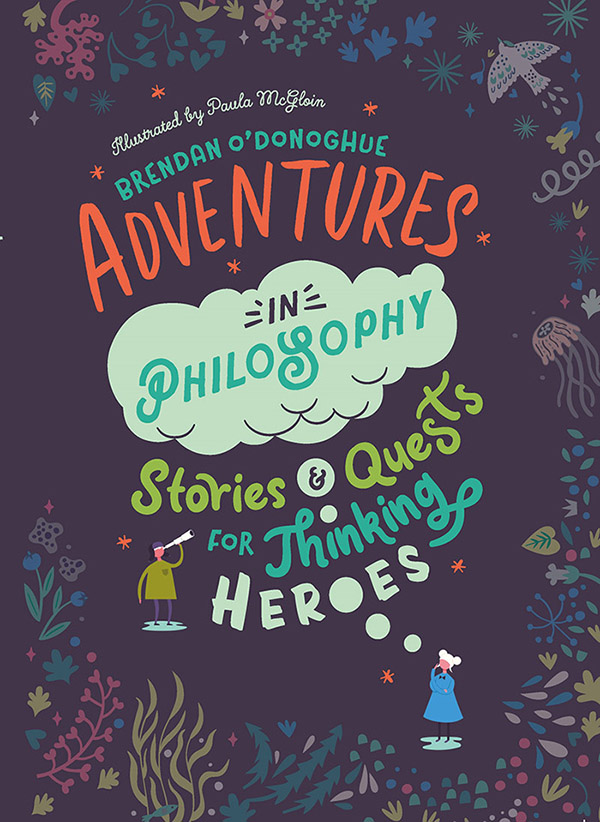
I think that Adventures in Philosophy – Stories & Quests for Thinking Heroes is a brilliant book. If you are a curious person who loves short stories then this is the book for you, and you learn all about philosophy and philosophers without even realising it.
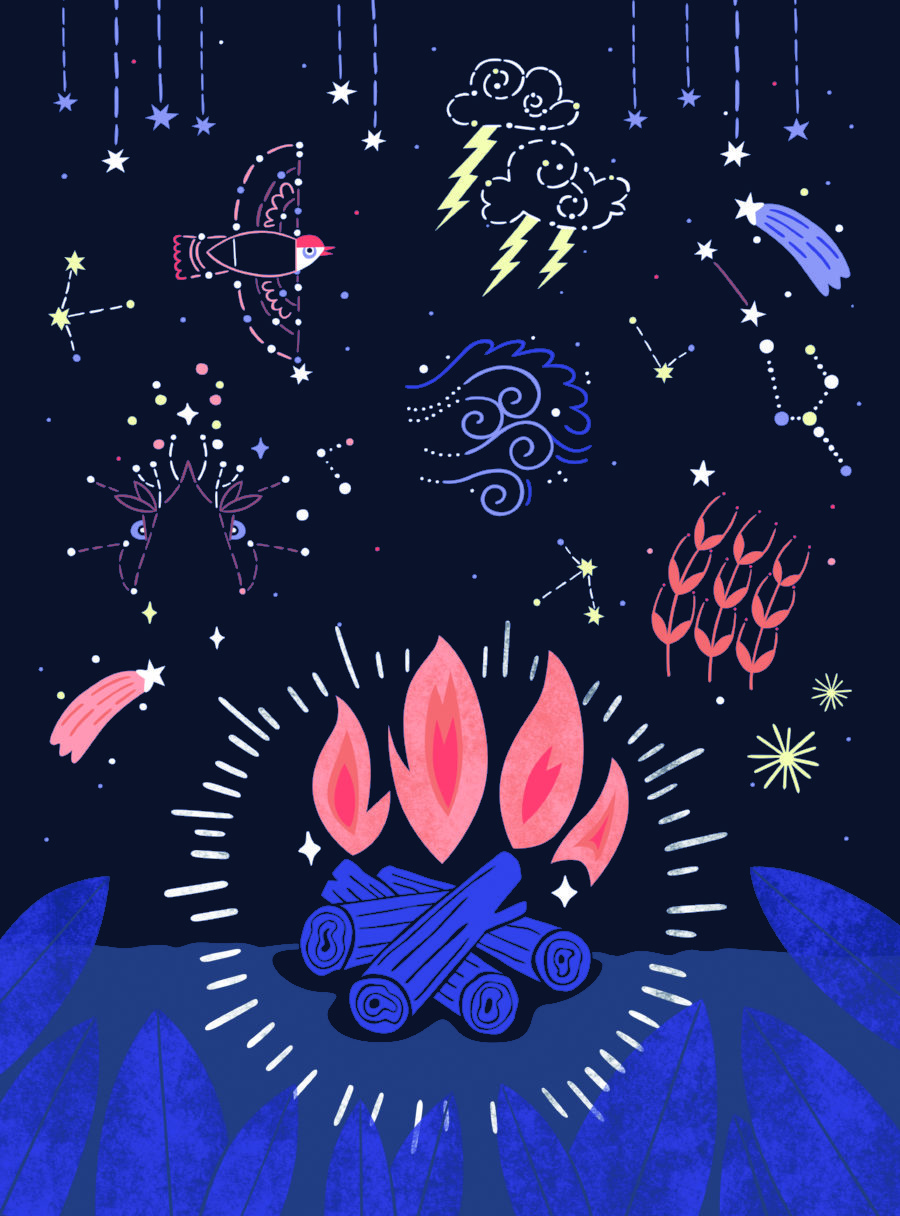
The book is divided into three sections: Part 1: Step into the Unknown, Part 2: Discover New Trails of Thought, and Part 3: Return Home to Begin Again. Then the three sections are divided into smaller sections which include a beautiful illustration, then a mythical story, then a conclusion to the story with a couple of questions to make you wonder, and after there are the thoughts of lots of famous philosophers on the subject. The illustrations are amazing and make me almost want this book to be a picture book, almost. I hope you enjoy this book immensely if you read it, and have great adventures in philosophy.
Part 1: Step into the Unknown says it all in the title, as the heroes set off into the unknown, on the start of their adventure. The introduction to it is very touching and really makes you feel confident. The heroes are all different but are all courageous and confident in their own way. I really liked stories 6. Plato’s Cave which is all about reality and 7. The Brain in the tank.
Part 2: Discover New Trails of Thought is the part when you’re really starting to ponder on all these questions. The stories that I love lots are 1. A different kind of Hero: Theseus and the Minotuar, which is a very confusing story but very enjoyable all the same, and 6. Artificial Intelligence (AI): Opening Pandora’s Box which really makes me wonder whether humans are doing the right thing or not. I really like this part because it is very questioning and amazing.
Part 3: Return Home to Begin Again… is when the heroes come back to their homes. My favourite stories are 8. The Animals Return: The Coming of the Buffalo Dance because it’s all about animals but it’s sort of a sad story too and of course 9. Adventuring Home to Earth. I think this story is actually my favourite one out of all of them because it’s linked with the very first mythical story in the book The Frog in the Well but I won’t spoil it for you!
This book made me think of a lot of questions such as:
What life is there after death?
What is death?
What is good and bad? And how can we live a good life?
And what is art and why do we make art?
What should we do about the planet and the environment?
Finally, the question came up a few times – should we eat animals? Is there a respectful way to live with animals but still eat animals without being greedy? Such as the way it is discussed in some of the stories such as “The Animals Depart: The Hunter and the Fox-woman” or “The Animals Return: the Coming of the Buffalo Dance”. And do these questions help with today’s problems with the environment?
These are hard questions and there is probably no right or wrong answer. We need to think about questions like these and I think that philosophy can help us. Some of the stories even show us how to be in harmony with nature and the environment which is really important nowadays with climate change and environmental disasters. Philosophy can seem a bit strange and useless on its own, as we’re not used to thinking like that, but this book shows us how to use philosophy to look at everyday problems.
I hope you enjoy this book and have a great adventure in the forest of your mind. I loved this book and I hope you will too.
Lena Muzellec is eleven years old, and in sixth class in her primary school in Dublin. Her favourite hobbies include playing camogie and chickens, reading and hanging out with friends.
Did you know that Cassandra Voices has just published a print annual containing our best articles, stories, poems and photography from 2018? It’s a big book! To find out where you can purchase it, or order it, email admin@cassandravoices.com
I raise myself into the UNHCR’s prefrabricated 10×20 ft unit; directly in front of me is the 5×4 latrine I was looking for. Occupied. I’ll have to wait, glad, in fact, just to be cool.
I turn my attention left to the man whose workplace is this metal container, a stocky Afghan, with thick, combed, black hair. I’ve seen him before, here and around the camp. There is a warmth about his demeanour – he has a smile that makes you want to smile – offset however by an expression alluding to something more cerebral about his character. His deep set eyes haven’t escaped my notice, and ever suggest his mind is attending to thoughts which, evidently, prompt less than a continuously cheerful disposition.
I’m a little bit nervous, I suppose. So I lean against the cool interior, the idea being that a casual comportment will mask any anxiety I feel, now that I’m in this man’s space. Its thirty-five degrees outside – ‘hot’, I gasp, and raise my eyebrows. He nods in jovial agreement.
Now more comfortable, I look around the room. A shaded white room, with laminate flooring, the equidistance of the wall-to-wall-to-ceiling dimensions induce feelings of claustrophobia, though he seems comfortable. He stands to one side, elbow on the sill of the window, two dainty tables and an equally dainty chair to his other side.
On one of the tables I spot something about which in the past I’ve been curious; so I now take the opportunity to query the small packages stacked on the collapsible tables to his left. He gives them a glance, and then his eyes revert to me, once more. Fifty food packages, I now understand, for the fifty unaccompanied children, currently residing in Camp Skaramangas – the parentless refugee children ten kilometres north-east of central Athens.
I look at the packages and I look back at him again, alert and no longer leaning. ‘What’s … the story?’ I nervously query, the idiomatic expression revelatory of more than mere linguistic dissonance. He is himself a refugee and it is experiences such as these that remind us that this does indeed warrant its own respect. He paces a little and tells me of the children whose parents may not have made the journey – they could be dead, back home. Silence.
‘It’s very sad,’ he quickly concludes, in that way you would hope someone in charge of dispensing such basic essentials to parentless children, in a refugee camp, would, before moving on. He sits down onto the chair. ‘That’s awful,’ I concur trivially. Contrasted with my own, now no longer casual, attempt to compose myself, his expression, his tone and his body language exhibit a capacity to appreciate the gravity of what has prompted, for me, little else than a compulsion to muster an appropriate response, unsuccessfully, and in lieu of it arising naturally.
Contemplating such human horror can of course be difficult for the onlooker, such difficulty being only amplified when it relates to utterly innocent children. One is witness to a human experience of which a claim to understanding would amount to no less than impertinence – our empathic powers curtailed given those experiences which cannot be graphed in the thin air of speculation.
But despite this, perhaps even in spite of it, one also feels constrained to recognise no mere accident – innocent children, recall. A symptom of an injustice, a failing, a signature of what is wrong with the world; and in its symptomatic nature what is at once intangible, becomes oddly tangible.
A human experience so far removed from my own becomes that which I feel compelled to pronounce should not be. Momentarily unhinged, a witness to the unspeakable, sense making becomes the urgent prerogative of our sociality. Yet the process in which this encounter with horror gives way to the attempt to determine it as an injustice, brings with it the unsettling self-consciousness of the futility of one’s reaction to so unspeakable an experience, even hypocrisy, as injustice is decried from the comfortable position of distance. Some moments later I am finished with the facilities and nodding a goodbye to the UNHCR man, before exiting back out to the midday sun.
I remember first entering Camp Skaramangas following a brief induction in a petrol station café, outside the camp. A smoking area, on the platform and amongst the petrol pumps created an atmosphere that rules were, here, suspended. In the café we introduced ourselves before discussing the details of what we would be doing as volunteers in the refugee camp, nearby.
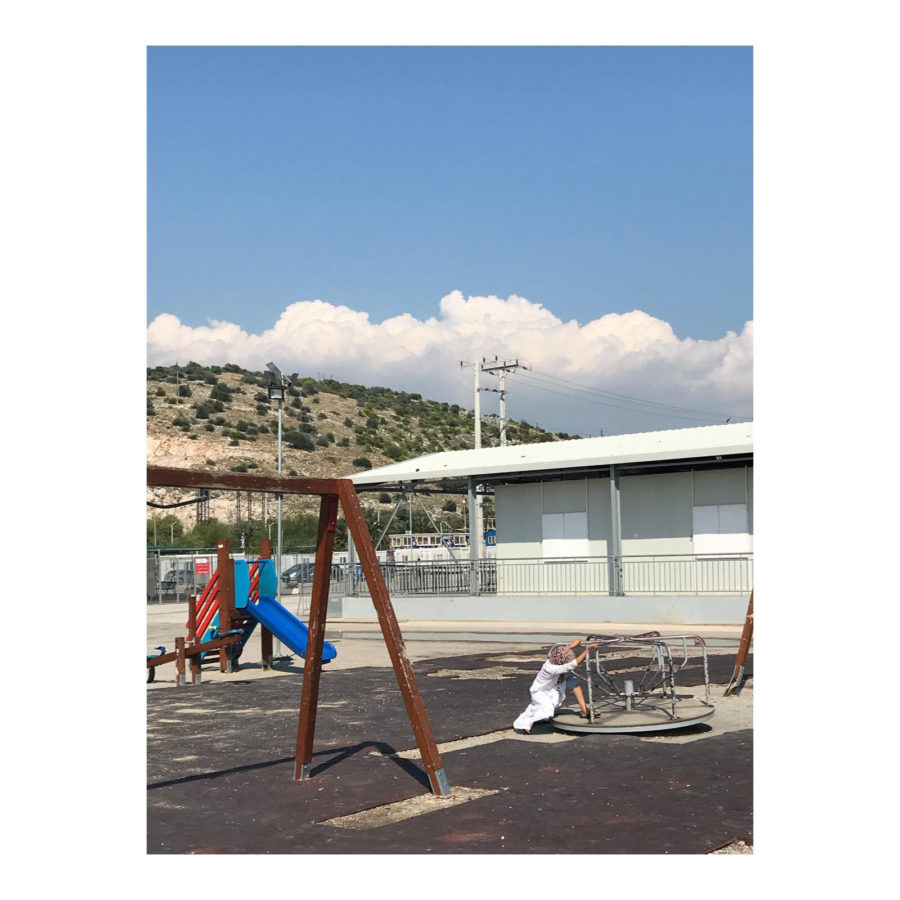
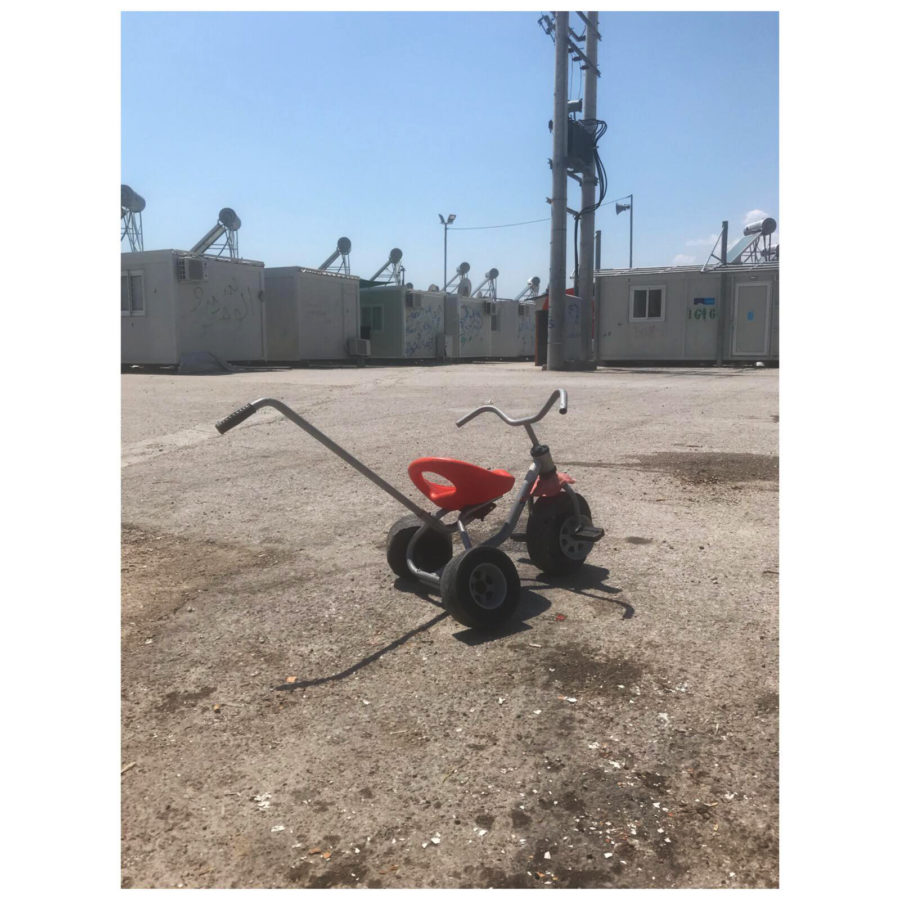
Through a gate guarded by the Greek navy security services we walked onto the port and into the camp, gravel crunching below our feet. Few people could be seen, although it was an area wherein over two thousand people resided, in the many white steel units we could now see before us – a truly cosmopolitan setting with people from countries including Afghanistan, Syria, Iraq, Palestine, Iran, Sudan and more. I was of course quickly on good terms with a fellow volunteer from Coventry. We walked into the camp and we were guided through the areas in which we would be working, and shown the facilities we would be occupying. A few early risers could be seen dispersed walking to and fro.
Young men, the likes I had previously visualised in the images of refugees ‘marching’ along European railway tracks (the connotations of an invasion framed with such percipience) strolled casually by; women and men pushing trolleys of watermelon, appeared busy, as children, similar in appearance to the young Alan Kourdi whose body appeared on our screens in what seems now like a moment in history, either aided their elders or ran around guilelessly in the early morning hours, as children do.
Nervously, we tentatively followed the coordinator’s lead, meeting a few volunteers on the way – a mix of Spanish, English, Norwegian and Dutch accents filled the air.
Then could be heard the tones ringing out from the residents, an altogether more foreign sound. Suddenly the nervousness I was feeling, given these new surroundings, began, as we paced through, to transmute into something else. Amid what I superficially took to be more and more foreignness, I felt myself becoming quite self-conscious. And in fact, I now felt foreign.
An uneasiness began to settle, as I became conscious not only of the colour of my skin but my attire, my sunburn, my lanyard which felt all the more pathetic an officiation of my presence. I was entering a space wherein I found faces, half-familiar, having seen them on television and in the news, looking back at me, and I was aware of this.
I suddenly felt like an imposition. There was a feeling I could not shake. Although I was there to help, my being, my presence, felt as though it was imbued additionally with something less benign; taking time away from the everyday goings on of European living to offer my aid to an ‘otherworldly’ situation. Basically I began to feel anxious that people might be looking at me with some bitterness, as a Westerner.
Of course, I quickly met residents who expressed such a welcome that thoughts of their being bitter, or resentful, were not only quashed but gave way to an understanding of their having a diametrically opposite disposition; additionally for anyone who may have viewed my presence with bitterness, albeit in silence, I am inclined to suspend judgement given an understanding of the as good as warrant such bitterness has at its disposal, in view of the both historical and current catastrophes for which the West is deeply responsible, and in accordance with which the lives of many have been coerced.
In any case the feeling was there. Introduced to the impoverished conditions of those on the Athenian port (all of whom have a story of struggle, if not travesty, and such uncertain futures, that their capacity to endure, nevertheless, is nothing short of remarkable), I was conscious of how I represented a life which they did not enjoy.
That subtle feeling of anxiety, embarrassment, shame, which in the coming days I would be able to suppress (given the very flattering gratitude of the residents, not to mention the self-congratulation to be enjoyed in the company of my fellow volunteers), seemed to allude to some tacit recognition that my presence truly was less than benign. And, there was a feeling that despite appearances, despite the fact that in volunteering I may have appeared to care, I represented a way of life the hypocrisy of which was more typically manifest in the choices I made to more often than not, not so much as give them a second thought. It quickly felt a bit superficial.
The fifty children, parentless, and who spend much of their day roaming around what is little more than a barren car park on what was once an Athenian shipping port and whose vulnerability can be all the more sickeningly contemplated should one consider the likelihood of the near presence of human trafficker’s, may indeed prompt one to conjecture that the world is bereft of justice.
But in the absence of provisions, recognition of such injustice seems as pertinent as an acquaintance with the same may be brief. Of course there is the work of the Afghan of the UNHCR, for example, with the unaccompanied children, providing for their desperately needed conditions of growth, the food packages of course being the most basic instance of initiative, in this regard. But my volunteering hardly compares, and truth of the matter is that following the feel good experience I of course did just look away.
I spent the morning and early afternoon of my last day volunteering in Camp Skaramangas with the children before having lunch with a number of the volunteers and residents. Volunteers come and go so you do not say goodbye to the children.
So many goodbyes would be cruel, never-mind the psychological impact. So I just said goodbye to friends in the early afternoon, and then left the camp and its over two thousand residents. A number of hours later I was standing on a runway having just landed in Sofia airport, slightly dazed amid unfamiliar voices, and struck by the attire, but particularly the moustaches, of a number of my fellow eastern European passengers.
It was roughly 9 pm and I was at this point keen to get to my hostel sooner rather later. From the runway we were guided into the airport, through the glass doors and into a large square room which led to a number of steps at the top of which was Bulgarian Passport control. We shuffled into the room, fatigued couples not speaking, children re-energised now they were finally off the plane.
Airports and the security therewith have a way of making us all feel suspect. But being a young Irish man, and landing in Sofia, from Athens, any nerves were on this occasion eclipsed by a rather indulgent self-confidence, my being a man on the road. I stood upright, passport in hand and shifted determinately amongst my fellow travellers toward the security personnel above.
But five minutes, then ten minutes, then twenty minutes went by, and as the man fashioning the perm came to lose what was at first his amusing quality, and as retaining posture became tiresome, the experience as a whole quickly enough became all the more frustrating. It appeared as though very little progress was being made and I came to question the old fashioned border checking that I had not been accustomed to in Western Europe.
Had it not been for the language barrier I might have made more of an effort to engage in the mutterings of those in my company. Increasingly frustrated, I started to observe the minutes go by on my watch, arm rigid. Perspiring ever so slightly now with the frustration, and with my passport in hand, waiting freely to access Bulgaria, what an utterly ludicrous image I was.
Craving my counterfeit cigarettes, purchased only that morning from an entrepreneurial resident of Camp Skaramangas there I was, shamelessly agitated at what was a forty minute wait for my rightful access to a country, a right so shamefully taken for granted.
People wait years to get through European borders, and not for a holiday; good people who I had only that day had lunch with, and who had only a few hours previously expressed gratitude for my efforts in the camp, efforts the sincerity of which I could not now help but think was void.
Given the mere hours that passed, the dictum ‘Out of sight out of mind’ came to mind, as my supposed concern for the horror of such vulnerability encountered only that morning rather belatedly reminded me of what is worthy of our frustration. Failing to uphold, satisfactorily or efficiently, my right to free travel through borders, I found myself naturally irritated – as a European citizen, I expected better. Not so for those without that birth-right. They can continue to wait.
When I tell people this story they offer consolations: at least I volunteered – apparently enough to neutralise the fact that even should such an effort imply that I view the residents of Camp Skaramangas as equals, my behaviour suggests otherwise.
Of course, I can hardly be expected to live frustration-free, given the comparative triviality of whatever situations may arise. Nevertheless, the alarming rate at which one can forget, immersed, once more, in those comparatively trivial struggles, intimates what little hope there might be for those who most need the attention of others.
For the issue is all the more unsettling given the effectiveness of nullifying any concern we might have for those who must wait, through their being removed from our field of vision, as people close by.
In a political atmosphere in which it is often suggested that it is migrants who pose a threat to ‘our’ way of life – Hillary Clinton being amongst the most hypocritical of recent voices for this sentiment – efforts to cast our eyes away from those on the shores of Europe and to the concerns of those individuals, who through the fortune of birth are entitled to expect better in life, portends the upholding of human inequality as an increasingly more likely and well-sustained global state of affairs. For of course, should we not look, we need not be concerned: out of sight, out of mind.
Did you know that Cassandra Voices has just published a print annual containing our best articles, stories, poems and photography from 2018? It’s a big book! To find out where you can purchase it, or order it, email admin@cassandravoices.com
Architects … are better able than many other professions to ride out recessions … They will use the lean times to think hard about the directions architecture might take when the good times roll once again.
(Glancey, 2009)
In August 2008 Ireland was the first EU country to declare itself officially in recession. The economic downturn was swift, and in the succeeding years the country found itself in the grip of a sustained economic depression, occasioned by the convergent demise of the banking and construction sectors.
The collapse of the construction industry ‘hit the architect profession at a faster rate than other professions’[1] with almost one third of architectural firms laying off between 61% and 100% of their staff.[2] The constriction of the profession was seismic, disproportionately affecting marginalized and vulnerable constituents of the workforce; notably female architects.
Despite almost gender parity in architectural education, women compose just 28% of registered architects in Ireland.[3] Burdened by unsuitable working practices, lower pay and a general deficiency in numbers, the practice of architecture can be an unforgiving topography for many women. While this predicament may seem embedded within the industry, it is clear that ‘the harsh economic climate has … undercut the conditions which are conducive to gender equality,’[4] leading to the enduring phenomenon of highly skilled female architects disappearing from the profession.
There has been a paucity of research in recent years on the relationship between the struggles women face and the economic factors that contribute towards them, and it is within this context that a debate on redefining the profession and production of architecture for female (and male) architects is required. Using the recession as a catalyst for change, it is essential that architects ‘recognise the importance of continuing to challenge the labour market disadvantage that women…face,’[5] by acknowledging the factors that unduly affect them, principally: the outdated, gendered image of the architect; a pervasive long-hours working culture that disproportionately affects those caring for dependents; the profession’s intolerance toward flexible working; and the general deficiency of senior positions available to women within mainstream practice.
In this study alternative forms of working – such as flexible, part-time working and the creation of more female-led practices to inspire the next generation of architects – will be explored as a means of fostering a more inclusive and equitable profession for all.
The scope of this study is consciously narrow, its aim is to ignite a wider discussion on the vital contributions women make within the industry, and the efforts that must be taken to prevent the continuing trend of women leaving it.
In recent decades the number of female students entering architectural education has risen steadily year-on-year, with female enrollment now on a par with that of male students.[6] Despite this encouraging trajectory, women’s participation stagnates as they progress through the profession with the ‘percentage of women (falling) at each ascending management tier.’[7]
In 2006, research conducted for the Architect Journal’s ‘Women in Architecture’ campaign highlighted the attrition of female architects from the profession, noting that while 35% of undergraduate students were female, women accounted for only 4% of retiring architects.[8] The spectre of this missing 31% is damaging to the future of the profession and it is therefore essential to call attention to the structural issues that motivate it.
1.1 The image of the (female) architect
(a woman’s) intellect is not for invention or creation, but for sweet ordering, arrangement, and decision. John Ruskin
That Ruskin’s indelicate stance on the capacity and worth of creative women so closely typifies prevailing contemporary attitudes towards female architects is not surprising. Indeed, clichés abound about women in architecture today, ’many of which are destructive and detrimental…entrenched assumptions about what it is to be an architect.’[9]
These ‘entrenched assumptions’ appear to be borne out of engendered prejudices of what an architect is and what they do. Certainly throughout history architects have been many things – artists; philosophers; master-builders – but only recently have some been women. Women’s involvement in – as Ruskin would characterise – ‘invention or creation’ has therefore been largely overwhelmed and diminished by the vast contribution that male architects have made before them.
This, coupled with the architectural establishment’s casual misogyny in the erasure of pioneering female architects’ achievements, has done little to recast the image of the architect as anything other than male. Most notably, the awarding of the 1991 Pritzker Prize to Robert Venturi, but not his wife and practice co-founder Denise Scott Brown, led a chorus of voices to question why Scott Brown’s equal contribution and authorship were not similarly honoured. Furthermore, the removal of Patty Hopkins – co-founder of Hopkins Architects – from promotional material for the BBC’s ‘The Brits Who Built the Modern World’ series does little to foster the idea that architecture is anything other than a male domain.‘’
This airbrushing of the contributions women have made to the profession has rendered them invisible, allowing enduring prejudices of what an architect should be to persist and encouraging female architects to feel that their efforts are not worthy of the same recognition as their male counterparts.
1.2 Children
While there are various factors that contribute towards the attrition of female architects at different stages in their career, maternity appears to be a principal factor.
Having children impacts the careers of women considerably more than men,[10] and a recent survey conducted by the Architects Journal found that 92% of female architects believed that having children had hindered their career prospects.[11] Women have commented that after having children they were ‘not taken seriously, were sometimes demoted, passed over for promotion or were seen to have failed to give the art of architecture the full attention it deserved.’[12]
As soon as I started working part-time my employers treated me differently and assumed I was less committed. I was overlooked for promotion twice when I was on maternity leave and not even informed that structural changes were being considered.[13]
1.3 Long hours: time-discipline in architecture
‘An important factor in the flow of women from the architecture profession is the family-hostile, long hours working culture that still prevails’[14] within mainstream practice.
Long-hours have become an accepted and pervasive element of being a salaried architect, indiscriminately affecting both men and women in the pursuit of making a project the best it can be. Evening meetings, project deadline, and the over-servicing of projects beyond the negotiated fee, can prolong the working day, significantly encroaching on an architect’s personal time. ‘’Theoretically ‘work devotion’ is gender neutral, but the long working day … relies on a social foundation of gender norms that disadvantages women’[15] more than their male colleagues.
Consequently, flexible working is often favoured by women ‘as a strategy to reconcile the competing time demands of paid work and family life.’[16]
Unsurprisingly, architecture is often considered to be more intolerant of part-time work than other professions, with one of the strongest barriers to flexible employment being the established long-hours culture within the profession.[17] Periods of economic and employment uncertainty encourage this culture of working by creating ‘a climate where it is necessary to demonstrate high commitment’[18] and ‘unfailing availability’[19] to the job. This has led to what Karen Burns, in her chapter for the recent RIBA publication, ‘A Gendered Profession: The Question of Representation in Space Making,’ describes as ‘‘competitive overstaying’, as employees contend with each other to demonstrate loyalty and devotion to work,’[20] in an effort to stymie possible redundancy.
Consequently, many women forced into redundancy following the 2008 recession have commented that their inability to pursue long-hours working meant they were considered easy targets due to a ‘two-tier system where part-time and flexible workers are seen as less legitimate or committed workers.’[21] In this context, women are unfairly disadvantaged by having responsibilities outside of the workplace, which are incompatible with working beyond contractually agreed hours with no or little remuneration.
1.4 Career advancement
In recent years Parlour – the Australian gender advocacy group – has challenged the long-hours system in architecture arguing that the ‘culture…retards the retention of female architects, and hinders women’s progression to senior levels.’[22]
The growing chasm between men and women as they advance up the architectural ladder has been highlighted in research conducted by the Architectural Association, which notes that only 20% of partners in architectural practice are women, this figure dropping to just 5% in large practices.[23]
While it is clear that women possess the same motivation and skill to succeed in senior roles, employers remain largely unsympathetic towards family life, perceiving full-time work as the only means of servicing projects, and conveying dedication to the often unrelenting and demanding expectations of the highest echelons of the profession.[24]
Indeed, part-time working is a key factor in women’s under-representation in senior architectural positions as ‘women are more likely to have ‘atypical’ or flexible career paths, with multiple breaks, different levels of intensity and changing roles over the course of a career.’[25] In contrast, men are more likely to follow a ‘traditional’ career model – that of unbroken and unwavering devotion to the profession via unpaid overtime – and be ‘active in the conventional areas of influence and power in the profession. (It is clear) the structures of the profession are still geared towards (the) linear, rising career trajectories,’[26] favoured by men.
As women are often unable to meet the loyalty and dedication that many employers expect, senior roles often appear unattainable for the majority of women. With little hope of career advancement in a profession that openly favours a ‘traditional’ working model, it is unsurprising that a significant number of women choose to leave the profession.
It is clear that within the architectural profession a system persists that works against the specific needs of women. It is essential, therefore, that the contributory factors to this system are no longer viewed merely as accepted inconveniences, but rather as opportunities to reduce the current rate of attrition. Indeed, ‘women architects’ commonly interrupted career history, and need for flexible working conditions can be reframed not as an aberrant or problematic work pattern, but as the model for innovative new professional paradigms in architecture.”[27]
2.1 The case for meaningful flexible working
If the practice of long-hours is ‘read as a signal of productivity and commitment, flexibility can be perceived as a conflict with an organisation or profession’s norms.’[28] A recent survey conducted by the RIAI has reinforced the low levels of support for part-time work in architecture, identifying 10% of architects as working part-time compared with 38% for all professions. ‘This is a particular problem for women (as) 27% of all women professionals work part-time, while only 16% of women in architecture do.’[29]
The stigma surrounding flexible working has stymied the adoption of part-time and non-standard working methods for decades, encouraging entrenched negative perceptions of alternative working models to fester.
Changing these attitudes is crucial if more meaningful part-time arrangements are to be developed.[30]
Positively, flexible working policies are inherently responsive, allowing both employers and employees to react to specific needs at particular times.[31] For employees meaningful part-time work can provide a balance between external demands and the rigours of professional practice, while for employers it allows quick responses to ever-changing workloads. Practices can explore the potential of flexible working simply by cultivating job-sharing arrangements; coupling part-time and full-time members of staff on projects; and providing staff access to new technology to facilitate home working. Many practices report that implementing these measures has ‘reduced amounts of overtime required while increasing productivity and maintaining the quality of their work.’[32]
It is important that practices make a virtue of these working arrangements as ‘a forward-looking, equitable … firm is attractive to clients and new staff.’[33] Furthermore, in the context of the recent recession ‘introducing flexible working options … in workplaces where there is a history of reducing hours or changing patterns of work in response to demand, could prove a valuable means to retain jobs … and (provide) greater flexibility for workers now and as the economy recovers.”[34]
2.2 New (role) models of practice
As non-traditional, flexible forms of working have increased in recent years, the notion of what constitutes a ‘career’ in architecture has been queried.
The recent influx of equitable practices such as Assemble, Fluid and earlier pioneers such as Muf have consciously positioned their work on the fringes of the profession,[35] putting greater emphasis on social rather than financial rewards. Entrepreneurial in nature, these practices have boycotted the traditional forms of working in favour of ‘non-standard’, inventive modes of practice that have proven to be more innovative and diverse in form.
Research suggests that the last recession encouraged the adoption of more ‘non-standard’ working as architects sought to find relevance within an industry decimated by construction inactivity. Consequently, the success of practices such as Assemble must motivate architects to embrace new, more loosely architectural ways of working as a means of adapting more easily to ever-changing economic and work/life balance conditions.
2.3 A Practice of One’s Own
The embrace of new working models in recent years has largely been borne out of necessity. For those made redundant and unable to find work following the 2008 recession “a trend, common to all recessions in the construction industry, for the unwaged or unemployed to form new architectural practices, reoccurred.”[36]
This trend follows an increasing pattern of women who ‘end up in small practice, or starting their own practice, not because they actively choose to…but because they find themselves with few other options.’[37] Indeed, according to a recent survey published by the Architects Journal, 16% of female architects become self-employed after having children due to the complexities of carving a rewarding career in mainstream practice whilst caring for dependents.
One of my main reasons for working as a sole practitioner was for the flexibility. I have small children, and running my own practice has allowed me to juggle motherhood and my work.[38]
That female sole-practitioners report ‘remarkably high levels of job satisfaction’[39] should, however, encourage us to reconsider self-employment not merely as a necessary response when times are hard but an effective means of reclaiming personal autonomy and organising levels of project engagement around external demands. Moreover, for many young female architects, who cite a lack of female-run practices ‘as a factor leading to (the) under-representation of women in architecture,’[40] seeing more women subvert the established routes of career ascension and actively counter the pervasive negative stereotypes that cast doubt on their ability to perform in the profession will ‘increase (their) motivation for career advancement and success.’[41] The effects of encouraging more female role models within an overtly male-dominated profession like architecture should not be underestimated.
Conclusion
Recessions are a time for architects to rethink their game. They need not despair – but, rather, regroup for the next boom.
Glancey (2009)
Prior to the 2008 economic crisis Ireland possessed one of the highest levels of workplace gender parity in Europe.[42] This changed however as an entire framework of statutory and public bodies promoting equality endured drastic budget cuts and closures.[43] The seismic withdrawal of gender policy in the aftermath of the recession is indicative of the large-scale marginalisation of issues that affect women in the workforce, specifically in architecture.
For a profession that claims to be concerned by societal inequalities, the recession highlighted ‘a major discrepancy … between the egalitarian rhetoric of architecture and its backstage realities.’[44] Indeed, the recession exposed a myriad of pervasive and deeply rooted inequalities within the profession that disproportionately impact women, and have contributed significantly to their decision to leave the profession over recent decades.
Central to the inequalities experienced by women is the long-hours culture that permeates all aspects of mainstream practice. The persistent misconception that those who are unable to commit to long-hours are less committed to the profession has become a significant impediment to women who predominately undertake the majority of dependent responsibilities. This, coupled with the view that those with children are unable to undertake managerial positions, has ensured women’s career advancement has stagnated with a minority of women currently occupying director or partner positions. Consequently, the under-representation of women in leadership roles has ensured the dominant image of the architect is still male, effectively rendering women’s significant accomplishments in recent decades obsolete.
As frustrating as this pattern may seem it is within our power to change it. Encouragingly, Ireland has a wealth of extraordinary and internationally-renowned talent, with female-led and co-led practices such as Grafton Architects, Heneghan Peng and O’Donnell and Tuomey proving that women can create meaningful change if they challenge the structures that work against them. The growth of more female-led practices could help slow the current attrition rate of women from the profession as more women ‘put themselves forward and become visible and influential.’[45] Furthermore, by implementing new strategies, such as flexible working, that ‘mediate between the day-to-day activity of producing architecture and each woman’s individual needs’[46] both employers and employees can respond better to work/life demands.
The propositions put forth in this study are consciously simple solutions to the larger problem of inequality within the profession. While the case for more appropriate and flexible working practices is unlikely to constitute a sustained assault on the profession-at-large, it may, at least, encourage an incremental erosion of the problems that have been allowed to fester for too long.
In short, it is clear the profession needs to retain ‘more people who think (and work) in diverse ways, not fewer’[47] if it is to deliver better working environments for all architects – not just women – and if it is to survive the next, inevitable recession.
Did you know that Cassandra Voices has just published a print annual containing our best articles, stories, poems and photography from 2018? It’s a big book! To find out where you can purchase it, or order it, email admin@cassandravoices.com
[1] Prescott, J. and Bogg, J., Gendered occupational differences in science, engineering, and technology careers. Hershey, PA: Information Science Reference, pp.49-52., 2013, p.49 [2] Hays.ie. (n.d.). Architectural firms have shed an average of 60% of employees in two years. [online] Available at: https://www.hays.ie/press-releases/HAYS_163705 [Accessed 25 Nov. 2018]. [3] RIAI Membership Survey 2017. [online] The Royal Institute of the Architects of Ireland. Available at: https://www.riai.ie/uploads/files/RIAI-Membership-Survey.pdf [Accessed 5 Nov. 2018], p.2 [4] Fowler, B. and Wilson, F., Women Architects and Their Discontents. Sociology, 38(1), pp.101-119. , 2004, p.117 [5] TUC (2009). Women and Recession: How will this recession affect women at work?. [ebook] Available at: https://www.ictu.ie/download/pdf/womenandrecession.pdf [Accessed 27 Oct. 2018], p.8 [6] Clark, J., Six myths about women in architecturre. In: J. Benedict Brown, H. Harriss, R. Morrow and J. Soane, ed., A Gendered Profession: The question of representation in space making. London: RIBA Publishing, 2016, p.18 [7] Fairs, M. (2017). Female architects respond to gender survey: “It’s getting better but far too slowly”. [online] Dezeen. Available at: https://www.dezeen.com/2017/11/17/female-architects-respond-architecture-gender-survey-worlds-biggest-firms/ [Accessed 27 Oct. 2018]., 2017 [8] Duncan, J. and Newman, V., Women in architecture: stand up and be counted. In: J. Benedict Brown, H. Harriss, R. Morrow and J. Soane, ed., A Gendered Profession: The question of representation in space making. London: RIBA Publishing. 2016, p.61 [9] Clark, 2016, p.15 [10] Stead, N., Redesigning practice. [online] Parlour. Available at: http://archiparlour.org/setting-our-own-house-in-order/ [Accessed 17 Oct. 2018], 2012. [11] Brown, et al., 2016, p.7 [12] Manley, S. and de-Graft-Johnson, A., Why women still leave architecture? A research report. Women & Environment International Magazine, [online] 62(63), pp.19-20. Available at: https://search-proquest-com.ucd.idm.oclc.org/docview/211604807?accountid=14507&pq-origsite=summon [Accessed 5 Nov. 2018]., 2004, p.20 [13] Burns, K., The Hero’s Journey: Architecture’s ‘long hours’ culture. In: J. Benedict Brown, H. Harriss, R. Morrow and J. Soane, ed., A Gendered Profession: The question of representation in space making. London: RIBA Publishing., 2016, p.66 [14] Humphryes, J., Redesigning the profession. In: J. Benedict Brown, H. Harriss, R. Morrow and J. Soane, ed., A Gendered Profession: The question of representation in space making. London: RIBA Publishing., 2016, p.121 [15] Burns, 2016, p.66 [16] Rose, J., Hewitt, B. and Baxter, J. (2011). Women and part-time employment. Journal of Sociology, 49(1), pp.41-59, p.41 [17] The Parlour Guides to Equitable Practice: Long-hours culture. (2014). [ebook] University of Melbourne and University of Queensland. Available at: http://www.archiparlour.org/wp-content/uploads/2014/05/Guide2-LongHours.pdf [Accessed 27 Oct. 2018], p.9 [18] Craven, V. (2004). Constructing a career: women architects at work. Career Development International, [online] 9(4/5), pp.518-531. Available at: https://search-proquest-com.ucd.idm.oclc.org/docview/219290042/fulltextPDF/358285285D7E4C03PQ/1?accountid=14507 [Accessed 5 Nov. 2018]. p.524 [19] Mark, L., Women in architecture survey 2017: Pay gap widens between male and female architects. Architects Journal, 244(3), pp.1-30., 2017, p.30 [20] Burns, 2016, p.64 [21] Parlour, n.d., p.3 [22] Burns, 2016, p.64 [23] Humphryes, 2016, p.120 [24] Clark, 2016, p.25 [25] Clark, 2016, p.27 [26] Clark, 2016, p.27 [27] Stead, 2012 [28] Burns, 2016, p.66 [29] Clark, 2016, p.26 [30] Parlour, n.d., p.4 [31] Parlour, n.d., p.4 [32] Parlour, n.d., p.4 [33] Rubery, J. and Rafferty, A. (2013). Women and recession revisited. Work, Employment and Society, 27(3), pp.414-432., n.d., p.426 [34] TUC, n.d., p.9 [35] Hamer, S., On age and architecture. In: J. Benedict Brown, H. Harriss, R. Morrow and J. Soane, ed., A Gendered Profession: The question of representation in space making. London: RIBA Publishing., 2016 p.45 [36] RIAI Annual Report 2007. [online] The Royal Institute of the Architects of Ireland. Available at: https://www.riai.ie/downloads/annual_reports/2007_Annual_Report.pdf [Accessed 27 Oct. 2018].The Royal Institute of the Architects of Ireland, 2007, p.16 [37] Clark, 2016, p.22 [38] Clark, 2016, p.22 [39] Stead, 2012 [40] Humphryes, 2016, p.119 [41] Stratigakos, D. (2016). Where are the women architects?. Princeton: Princeton University Press., 2016, p.35 [42] Barry, U. and Conroy, P. Ireland in crisis 2008-2012: women, austerity and inequality. [ebook], 2013, Routledge. Available at: https://researchrepository.ucd.ie/handle/10197/4820 [Accessed 27 Oct. 2018]., 2012, p.1 [43] Ibid, 2012, p.29 [44] Fowler, B. and Wilson, F., 2004, p.114 [45] Duncan and Newman, 2016, p.59 [46] Pepchinski, M., And then we were the 99%: Reflections on gender and the changing contours of German architectural practice. In: J. Benedict Brown, H. Harriss, R. Morrow and J. Soane, ed., A Gendered Profession: The question of representation in space making. London: RIBA Publishing, 2016, p.245 [47] Clark, 2016, p.29
It was only you who knew the spaces through the ladders.
The dent of shadows
Upon the tumbling walls.
When the door is too small to walk through
And the gate shifts at your hip.
All the while the windows wait for no one.
Like miniature hats.
Where idle hope feasts on the cavities of the rooms
As soaring beginnings roar.
Where the seamless thread that shapes your brow
Falls hollow into your skin.
As the walls of the dolls’ house
Can no longer keep you in.
*******
I am not…
I am not just around the corner,
Or held in the palm of your hand,
like a scent escaping the rose.
I am not fully heard in the howl of the gulls,
Or in a scattering of dandelions raw through the air,
like condensed smoke.
I am not in the taste of the salt of seawater,
Whose splash is seeped into your skin.
I am not to be touched through your feet on the grass,
Or in the chill of the heat of your summer’s loss.
I do not scream through the silence of the stars,
I am not hounded by your tears
Or held in the rubble of your fingertips.
I am not in the sworn word that returns to your mind,
As sword or scythe through the kind air.
If you see me in the shadows I am not there.
I am far closer than all of this.
Paul Downes’ poetry has been published in the Wallace Stevens Journal and EUR/OPEN. He has also published books and journal articles in areas of philosophy, psychology, education, law, anthropology and social policy and has given keynote lectures and invited presentations in 29 countries. His books include, The Primordial Dance: Concentric and Diametric Spaces in the Unconscious World (2012), Inclusion of the Other: Concentric Space as a Life Principle Beyond Schopenhauer, Nietzsche and Ricoeur (Routledge, forthcoming 2019). He is Associate Professor of Psychology, School of Human Development, Dublin City University, Ireland.
Did you know that Cassandra Voices has just published a print annual containing our best articles, stories, poems and photography from 2018? It’s a big book! To find out where you can purchase it, or order it, email admin@cassandravoices.com
THE LONG READ: In the last edition ‘How Irish Propaganda Operates’ explored how political and media duopolies uphold a dominant consensus of steady economic growth and rising rents, to the benefit of a shrinking, propertied elite. The Irish media sector is commented upon in a 2018 survey of press freedoms by Reporters Without Borders which found that the ‘highly concentrated nature of media ownership in Ireland continues to pose a major threat to press freedom, and contributed to Ireland’s two-place fall in the 2018 World Press Freedom Index.’ They also pointed to the chilling effect of high awards in defamation actions.[i] Curiously, however, that report neglected to mention the 2018 acquisition by the Irish Times of the Cork-based Landmark Media group, which includes the Irish Examiner, to create the current print duopoly.
As regards the ‘crucial constituency’ of farmers supporting the political duopoly, and concomitant failure of the government to compel reductions in GHG emissions – of which the agricultural sector produces over one third of the national total[ii] – a recent report found Ireland was the worst-performing state at tackling climate change in the EU.[iii]
This sequel explores how the Internet, especially social media, is shaping the future of Irish politics. The wider global context is a rise in support for the Far Right, a tendency to which Ireland is not immune. This resurgence is prompted by deepening inequality, and the political, moral and economic failure of the Russian Communist model, but also disorientation in the wake of technological change;and a fundamental failure at the heart of liberalism to identify universal values. We may be on the brink of a new age of barbarism, but cannot afford to give up hope of reforming state and supranational institutions.
I –Changing Politics
To my surprise a few months ago I received email correspondence from Leo Varadkar: ‘Blooming hell’, I thought to myself, ‘His Early-Riserliness, contacting me!’. ‘Perhaps he’s ready to commit to decarbonisation, public housing and basic income, and is looking to this hitherto unheralded journalist for advice. Now where did I leave my singlet…’
My ego crumpled on discovering it was political spam with a sender address of finegael@fiinegael.ie. There would, alas, be no warm breakfast awaiting on Merrion Square after we had buddied-up at the gym.
Then I got annoyed. I had never given my email address to anyone from that organisation, let alone consented to receive Mr Varadkar’s grimacing impressions of a vlogger. I decided, however, against channelling subsequent missives straight into the ‘junk’ folder – where I would consign other unsolicited mail – to see how the story unfolded.
The emails are an intermittent reminder of just who is in charge of this country, and what he and his party pals are up to. There is little sophistication or depth to the presentations – boil-in-the-bag corporate fare – but they leach into my consciousness like the jingle on an annoying commercial, or ear worm. I may yet complain to the Data Protection Commissioner, but will settle for writing this article, for the time being at least.
With its ample resources, Fine Gael has been fastest out of the new technology blocks among Irish political parties. We may assume the rest are catching up, or will go the way of the Progressive Democrats.
The din from online chatter is rising, and parties are steeling themselves for a long digital ground war. Politics has travelled a great distance since Alexis de Tocqueville in his seminal account of Democracy in America (1830) declared that ‘nothing but a newspaper can drop the same thought into a thousand minds at the same moment.’[iv]
Now we are confronted with a barrage of information from multiple sources on a digital screen. It is early days, in historical terms, in our relationship with a new technology, but our neural pathways are already being reconfigured in ways we do not yet comprehend. Just as the invention of writing altered how the brain processes and retains information, so it has been with the Internet.
As the character Mark Renton puts it in the original Trainspotting: ‘Diane was right. The world is changing. Music is changing. Drugs are changing. Even men and women are changing. One thousand years from now, there will be no guys and no girls, just wankers. Sounds great to me.’ Politics is changing too, and the calibre of some of those in power is an indictment on the failure of more of us to get involved: as Micheal O’Siadhail warned: ‘the thieves of power / Come noiselessly in nights of apathy.’[v]
Political parties have been using focus groups, analogous to those used in the advertising industry, to test the popularity of policies for decades. Analysis of Internet browsing offers far greater and wider insights. A graphic presentation produced by Eoin Tierney for a previous article in Cassandra Voices illustrates the extent of our data leakage.[vi] Unless we take various precautions, records of our online movements are available to the highest- – or best-connected – bidder.
Some years ago I attended a conference at which one of the speakers was said to be, in hushed tones, ‘Obama’s scientific advisor’. He described how the former president’s second campaign team had made use of extensive data mining – tapping into data from Amazon purchases in particular as I recall – but warned the other side ‘would catch up in time for the next election’.
Pandora’s box had been prised open, and various troll armies have since crawled out, now led by an aging commander-in-chief with disconcertingly bright hair, while in the background another short, middle-aged man – who looks suspiciously like a trophy hunter clad in combat apparel – is whipping the troops into a frenzy. But it is important to recognise that the supposed good guys actually began this particular arms race.
Anarchic social media offers rich bounties for these excavations. In particular Facebook has an addictive quality built around the narcissistic pleasure of external validation. Its dystopian possibilities are powerfully conveyed in ‘Nosedive’ (2016), an episode of Netflix’s Dark Mirror, in which individuals rate each other from one to five stars based on social interactions. High aggregate scores are a passage to wealth and privilege, while low ratings spell poverty and exclusion. The main character ‘Lacie’ sees her attempts at social climbing implode spectacularly, ending in despair, poverty and isolation. It is as bleak a prophecy as you could find on the damage social media could wreak if we are not very careful.
Since a whistleblower revealed the sinister machinations of Cambridge Analytica on Facebook the fear that our political preferences are being conditioned by artificial intelligence tools has risen to panic in some quarters. Their trick appears to involve outspoken contributors taking ‘ownership’ of subtly positioned political messages, which confirm, amplify and ultimately modify opinions.
The commentariat links this to a quarter of Europeans now voting for Far Right parties[vii], and there is some truth to this contention. But mainstream media may be overstating Facebook’s role for their own purposes. Discrediting social media is part of ongoing attempts to salvage the sunset technology of the newspaper, which makes the case for regulation and taxation of the former. But the Internet is a multi-headed hydra, and the trolls are usually ahead of the game. Insulated and seemingly innocent WhatsApp groups are the next target, as was the case during the recent Brazilian election[viii]. We need better, transparent social media not rid of it altogether.
Twitter, unlike Facebook’s ‘secret sauce’ algorithm deciding what we see on our feeds, has kept its own feed mainly organic, although advertising is increasingly apparent, and relative anonymity seems to bring out the worst qualities in keyboard warriors. Donald Trump’s brand of hectoring nonsense seems to be ideally suited to that medium, at least to his fifty million followers. He won the presidential election with most major newspapers bitterly ranged against his Nativist agenda.
Twitter permits direct access to those who specialise in this attenuated form of speech – its one hundred and forty characters the social media equivalent of a haiku. The interactivity is key, with famous figures accessible as never before. This can even have geopolitical ramifications. At an EU summit last year British Prime Minister Theresa May offered to mediate between Europe and the U.S., to which Dalia Grybauskaitė, the president of Lithuania replied there was ‘no necessity for a bridge’, when they could all communicate with the American president via Twitter.[ix]
Irish politicians have not transitioned entirely into new media – the state broadcaster and print duopoly remain the main political battleground, or talking shop – but Twitter is an increasingly powerful vehicle for individual campaigns, and the intimacy of the Facebook environment suits it to subtle messaging.
Until we go about fixing the Internet, including social media platforms, a level of paranoia is justifiable. If Varadkar and his advisors are willing to harvest email accounts, what else are they willing to do? We know he has already floated the idea of creating anonymous accounts to make positive comments under online stories on popular news websites.[x] We have no way of knowing what conversations go on when Varadkar meets Mark Zuckerberg. Ultimately ‘we the people’ must eventually assert control over the social media we use, and integrate it into the fabric of democracy.
II – Inequality
The disorientation of technological change is only one aspect of the profound changes occurring in societies around the world. The era of the Internet coincides with, and is partly generating, unprecedented inequality – to the extent that just eight billionaires control half the human planet’s financial wealth.[xi]
As elsewhere, in Ireland we see disturbing concentrations, especially expressed in property, insulated by our political and print media duopoly from significant taxation. Thus, the wealthiest top five percent in the country own over forty percent of its wealth, with eighty-five per cent of that held in property and land. In the last financial year a mere €500 million (or just 1%) out of total tax receipts of over €50 billion, derived from land or property.[xii]
Indicatively, between 1996 and 2012 the number of qualified accountants in the state grew by a staggering eight-three percent to number 27,112. A sign of the times is that there were just 6,729 Catholic priests and nuns at that point[xiii], indicating we have moved from worship of God to Mammon.
The accountancy profession assists individuals and companies in financial consolidation. This can lapse into unethical forms of tax avoidance as was revealed in the Paradise Papers, where ‘top five’ accountancy firms channelled assets or income through countries with low taxation regimes.
High professional fees make accountants vested interests in asset preservation, and in the process many are stakeholders in the political and media duopoly. The wider influence can be seen in an obsession with imaginary money as a measure of value. In a previous article for Cassandra Voices Diarmuid Lyng identifies a ‘reducing eye – the Súil Mildeagach’ at work in contemporary Ireland which sees only uses and benefits; where ‘a cow is looked on as pounds of beef, and a tree is assessed for the length of its timber.’[xiv]
The decline of the Irish left, especially if the Labour party is counted as such, is part of a global social democratic downward spiral, seen vividly in the precipitous fall in support for the German SPD. This can partly be traced to the economic, political, and moral failure – and ultimate demise – of the Soviet Union at the end of the last century. In response, Tony Blair’s ‘New Labour’ in the U.K., and Bill Clinton’s Democratic Party in the U.S. moved into the centre- or even the centre-right ground, and pursued latter-day colonialism.
The rightward drift of traditionally left-wing parties has brought an ideological vacuum now being filled by the Populist Right, which appropriate Marxist analysis, decrying capital flight and corrupt state institutions. Ironically, it is generally the New Labour old guard and Clinton Democrats that are to the fore in defending free trade arrangements, including the European Union, which is increasingly beholden to corporate lobbyists, and NAFTA. Previously free trade had been one of the major planks of conservative parties around the world, but these (including the Republican Party and the Tories in the UK), are increasingly in thrall to Far Right factions.
The ‘old’ Left is not entirely dead. The success of Jeremy Corbyn and his allies in the U.K. Labour Party in building the largest socialist party in Europe in the face of unstinting media opposition, including in the apparently left-wing Guardian, has been highly impressive.[xv] In the last election, Corbyn’s supporters bypassed mainstream media and used memes and vlogs to powerful effect online, besides grass roots activism through the Momentum organisation.
Spain’s Podemos is also bucking the trend in the face of a hostile mainstream media. It shows that social media, in concert with grass roots organisation, remains a conduit for left-wing agendas. The fear is, however, that that space is increasingly dominated by the highest bidders, who generally do not advocate that their wealth should be subject to greater taxation.
What differentiates the New Right or what used to be called the Far Right – or just plain fascists – from the Left is a marked rejection of universal values applying to all of humankind. The appeal is always to ‘our’ people, ‘our’ families, and ‘ourselves’, certainly not, ‘them’, ‘that lot’, or ‘those’ foreigners who are amassing on ‘our’ frontiers.
Fascism plays to selfish self-interest, and individual striving for status as part of an identity seen in opposition to others. Left-wing arguments are a weapon to be deployed against pampered ‘elites’, but leaders like Trump aspire to the same pampering once they have ‘drained the swamp’. Many of his supporters also aspire to climb the greasy pole that leads to a notional Trump Tower.
A comparatively generous social welfare system – in part a legacy of Labour’s period in office between 2011 and 2016 – is one reason Ireland is largely bucking the trend in terms of developing a rebranded fascism. Also, historically, our over-bearing near neighbour has been the target of nationalist ire, and we do not carry the same racist colonial baggage afflicting relations between indigenous and migrants seen elsewhere. Moreover, for all its faults, Catholicism does not distinguish between people on the basis of ethnicity or race. But the universalism of the Old Left and Catholicism are fading away and, as in the 1930s, Ireland is not immune from continental movements, especially as the Housing Crisis and evictions ensue.
Ascendant neo-liberalism does not encourage xenophobia. It is bad for business. Migration keeps down labour costs, and ethnic variety generates economic dynamism. The late Peter Sutherland, neo-liberal high priest, was one prominent supporter of tolerance.[xvi] But free movement of people is only an addendum – almost a good will gesture – to the core principal of neo-liberalism: the free movement of capital and individual enrichment. Contemporary fascism pitilessly highlights any policy failings relating to integration policies, while only superficially addressing capital flight, as unscrupulous politicians like Trump (and others) are often self-interested players themselves.
III – Wasted Lives
The late Zygmunt Bauman argued that economic migrants become scapegoats as long as the real powerbrokers of a neo-liberal Globalisation are untouchable. In his book Wasted Lives (2010) he contends:
Refugees and immigrants coming from ‘far away’ yet making a bid to settle in the neighbourhood, are uniquely suitable for the role of the effigy to be burnt as the spectre of ‘global forces’, feared and resented for doing their job without consulting those whom its outcome is bound to affect. After all, asylum-seekers and ‘economic migrants’ are collective replicas (an alter ego? fellow traveller? mirror images? caricatures?) of the new power elite of the globalised world, widely (and with reason) suspected to be the true villain of the piece.
Like that elite, he considers:
they are untied to any place, shifty, unpredictable. Like that elite, they epitomise the unfathomable ‘space of flows’ where the roots of the present-day precariousness of the human condition are sunk. Seeking in vain for other, more adequate outlets, fears and anxieties rub off on targets close to hand and re-emerge as popular resentment and fear of the ‘aliens nearby’. Uncertainty cannot be defused or dispersed in a direct confrontation with the other embodiment of extraterritoriality: the global elite drifting beyond the reach of human control. That elite is much too powerful to be confronted and challenged point-blank, even if its exact location was known (which it is not). Refugees on the other hand, are a clearly visible, and sitting, target for the surplus anguish.[xvii]
This kind of scapegoating is beginning to be seen in Ireland. A small online publication www.theliberal.ie offers a news carousel, previously plagiarized[xviii], alongside vindictive comments about migrants. One headline from November 12th read: ‘Uproar from locals as Wicklow hotel set to become direct provision centre’, the ‘report’ by James Brennan went on to say:
‘Locals are said to be “very concerned” over the proposed centre with one social media telling The Liberal: “Locals have held meetings about it and have both privately and publicly stated that they’re very concerned about the new centre. There will be uproar if this goes through”.
More disgraceful even than this ‘post-truth’ abandonment of evidential standards, is a headline to another ‘report’ written by James Brennan, which read: ‘As more migrant Direct Provision centres pop up, a 48-yr-old homeless Irish man DIES on the street in Waterford’. The message is clear: it is a zero sum game between homeless Irish dying on the streets, and migrants who are being provided for. The publication was also vocal in its support of Peter Casey’s Presidential candidacy. He made incendiary comments about members of the minority Traveller community – a traditional Irish scapegoat.
Interestingly, the editor and owner of the magazine, Leo Sherlock, is the brother of Cora Sherlock, deputy chairperson of the Pro-Life Campaign. Well accustomed to the emotive language of protecting ‘our own’, it could be that the Pro-Life campaign will provide the resources and know-how for a new campaign against immigrants, just as in America the Far Right has moved from anti-abortion to anti-migrant.
In a disturbing turn of events, investigative journalist Gemma O’Doherty has adopted anti-migrant slogans from the Far Right playbook, especially attacking George Soros.[xix] She recently tweeted that his ‘twisted Open Society Foundation … seeks to destroy nation states’.[xx] Also, her Youtube channel recently featured an interview with John Waters in which both interviewer and interviewee conveyed the idea of a migrant tide overwhelming Ireland[xxi], a country more sparsely populated today than in the mid-nineteenth century.
As wealth inequality rises, and homelessness increases, in this small open economy a desperation sets in that is easily manipulated. The Celtic Tiger has become a Paper Tiger, where most of the population does not enjoy the fruits of extravagant economic growth. For most rising gross domestic product leads to rent hikes and unaffordable property. As Bauman explains, in circumstances where the global elite are untouchable, outrage against vulnerable outsiders is likely to follow.
IV – The Mediated People
Technology is leaving a profound impression on all our minds. The smart phone is altering homo sapiens at a profound level of consciousness. We are now, as Bill McKibben puts it, a ‘mediated species’:
Everyone I know seems a little ashamed of the compulsive phone-checking, but it is, circa 2017, our species-specific calling card, as surely as the bobbing head-thrust identifies the pigeon. No one much likes spending half the workday on e-mail, but that’s what work is for many of us. Our accelerating disappearance into the digital ether now defines us—we are the mediated people, whose contact with one another and the world around us is now mostly veiled by a screen. We threaten to rebel, just as we threaten to move to Canada after an election. But we don’t; the current is too fierce to swim to shore.[xxii]
The compulsive checking is attritional and ultimately lonesome, as we avoid direct contact with one another. George Steiner attributes these habits to a ‘dread of solitude, an incapacity to experience it productively’[xxiii], which afflicts the young, but this extends well into old age.
Linked to the advance of the smart phone is a declining opportunity for book reading. The Canadian literary critic Northrop Frye identifies the properties of the book with the preservation of democracy itself. It is he says the:
by-product of the art of writing, and the technological instrument that makes democracy a working possibility – avoiding all rhetorical tricks designed to induce hypnosis in an audience, relying on nothing but the inner force and continuity of the argument … Behind the book is the larger social context of a body of written documents to which there is public access, the guarantee of the fairness of that internal debate on which democracy rests.
The book is non-linear, he says, allowing us to flick back and forth: ‘we follow a line while we are reading but the book itself is a stationary visual focus of a community.’
He distinguishes this from:
the electronic media that increases the amount of linear experience, of things seen and heard that are quickly forgotten. One sees the effects on students: a superficial alertness combined with increased difficulty preserving the intellectual continuity that is the chief characteristic of education.[xxiv]
Frye was writing in the 1970s when electronic media meant television. He might despair at contemporary attention spans, with kids unhinged and transfixed by a Snapchat that brings the inbuilt obsolescence of a social media posting to the next level. But he might also encounter knowledge and insights far exceeding those he found in his own less technology-addled students.
We have developed remarkable specialisms through advances in book-learning, but these are increasingly remote from one another. The Internet brings more generalised understandings – new horizons of knowledge – which could de-mystify formerly esoteric fields and inaugurate Johann Wolfgang von Goethe’s (d.1832) vision of weltliteratur, ‘world literature’, and perhaps more clearly, Gottfried Wilhelm Leibniz’s (d. 1716) dream of a bibliotheca universalis, a ‘universal library’, where expert insight could be available to all, everywhere. It could really lead us into thinking more globally. But this beast needs considerable taming.
The raging digital torrent is inherently unstable, as the content on any screen (including this article) can easily be tampered with. This makes it easy to develop superficial arguments that shift with circumstances. But latter-day fascists are arguably less ominous a presence in the absence of complex ideological statements, conventionally expressed in books, such as Karl Marx’s Das Kapital, or even Adolf Hitler’s Mein Kampf. As the dissident Soviet writer Aleksander Solzhenitsyn put it: ‘Shakespeare’s villains stopped short at ten or so cadavers. Because they had no ideology.’[xxv] Thus, even the book, which performs an important role in preserving democracy, can, paradoxically, be used to undermine it. Similarly, the Internet can have positive and negative effects on our politics.
The online contributor may exert an influence on the outcome of elections and referenda but there is a sedentarism to his political participation. How many people attended Donald Trump’s inauguration? Historically, any political credo lacking a clearly outlined ideology tends to lack durability. What will remain of Trumpism after Trump? This recalls Percy Shelley’s ‘Ozymandias’: ‘Of that colossal Wreck, boundless and bare / The lone and level sands stretch far away.’
Similarly, the incipient Irish Far Right lacks a convincing ideologue. John Waters has an intellect to be reckoned with, but it is difficult to see how he can reconcile the universal values of the Catholic faith he espouses with the xenophobia evident in Far Right movements. Moreover, Ireland is an increasingly liberal society – even decriminalisation of marijuana cannot be far off – where Catholicism is commonly disparaged, but the policies of the duopoly which brought the rise in rents, and a Housing Crisis, threatens a new form of serfdom, or rage on the streets.
V – A New Age of Barbarism
Apart from technological shifts, and the moral and political vacuum brought by the demise of the Soviet Union, which permitted a corporate takeover of societies, the value system of a dominant neo-liberalism rests on decidedly shaky foundations. The philosopher Alasdair MacIntyre identified a ruling ‘Emotivism’: ‘the doctrine that all evaluative judgments and more specifically all moral judgments are nothing but expressions of preference, expressions of attitude or feeling, insofar as they are moral or evaluative in character.’[xxvi]
In other words we operate at a time when justice, including economic justice, is seen as an expression of arbitrary norms. MacIntyre traces this to the Enlightenment, when David Hume and later Fredrich Nietzsche led the attack on the universal values which the Aristotelian philosophical tradition had laid down. Thus, Aristotle’s The Nicomachean Ethics begins: ‘Every art and every scientific inquiry and similarly every action and purpose, may be said to aim for some good.’[xxvii] In contrast liberalism, or Emotivism, identifies no “good”, only self-interest.
In what is a remarkable passage MacIntyre despairs at the onset of a new age of barbarism:
It is always dangerous to draw too precise parallels between one historical period and another; and among the most misleading of such parallels are those which have been drawn between our own age in Europe and North America and the epoch in which the Roman empire declined into the Dark Ages. Nonetheless certain parallels there are. A crucial turning point in that earlier history occurred when men and women of good will turned aside from the task of shoring up the Roman imperium and ceased to identify the continuation of civility and moral community with the maintenance of that imperium. What they set themselves to achieve instead – often not recognizing fully what they were doing – was the construction of new forms of community within which the moral life could be sustained so that both morality and civility might survive the coming ages of barbarism and darkness. If my account of our moral condition is correct, we ought also to conclude that for some time now we too have reached that turning point. What matters at this stage is the construction of local forms of community within which civility and the intellectual and moral life can be sustained through the new dark ages which are already upon us. And if the tradition of the virtues was able to survive the horrors of the last dark ages, we are not entirely without grounds for hope. This time however the barbarians are not waiting beyond the frontiers; they have already been governing us for quite some time. And it is our lack of consciousness of this that constitutes part of our present predicament. We are waiting not for Godot, but for another – doubtless very different – St. Benedict.[xxviii]
So what are Irish “men and women of good will” to do in these times? Retreat from the Dublin metropolis and carve out cooperative self-sufficient communities? This is one alternative. But the European imperium has not been lost entirely, and the pressing environmental problems of our time require world governance. Moreover, multilateralism is the only way to preserve peace in the nuclear age.
The institutions of the Irish state and European Union at present do not serve the interests of the people, but this could change if a broad Left-Green alliance, espousing universal values, is forged. In this respect, Irish progressives should get behind a new group, led by the economist Thomas Piketty, offering prescriptions for a fairer and more sustainable Europe.[xxix]
Irish Democracy is in for a long bumpy ride as we struggle to contain our online urges and the challenge of grotesque inequalities. To counteract a slide into barbarism, we must think globally and act locally, doing what we can in our own way, and never succumbing to despair. In these times we also need artists to sustain us.
Did you know that Cassandra Voices has just published a print annual containing our best articles, stories, poems and photography from 2018? It’s a big book! To find out where you can purchase it, or order it, email admin@cassandravoices.com
[i] Reporters Without Borders, ‘Ireland: Unhealthy Concenrtation’, World Press Freedom Index 2018, https://rsf.org/en/ireland, accessed 12/12/18.
[ii] Ciaran Moran, ‘Emissions from agriculture increase by almost 3pc in 2017 due to dairy expansion’, Irish Independent, December 8th, 2018.
[iii] Jeo Leogue, ‘Ireland worst performing European country at tackling climate change’ Irish Examiner, December 10th, 2018.
[iv] Alexis de Tocqueville, Democracy in America, translated by Henry Reeve, Hertfordshire, Wordworth Editors Ltd, 1998, p.220.
[v] Micheal O’Siadhail, The Five Quintets, Waco, Baylor University Press, 2018, p.149
[vi] Eoin Tierney, ‘A Guide to Preventing Data Leakage’, Cassandra Voices, June 1st, 2018.
[vii] Paul Lewis, Seán Clarke, Caelainn Barr, Josh Holder and Niko Kommenda, ‘Revealed: one in four Europeans vote populist’, The Guardian, 20th of November, 2018.
[viii] Tom Phillips, ‘Bolsonaro business backers accused of illegal Whatsapp fake news campaign’, The Guardian, 18th of October, 2018.
[ix] Andrew Rawnsley, ‘Mrs May discovers you can’t be a bridge builder and a bridge burner’, The Guardian, 5th of February, 2017.
[x] Diarmaid Ferriter, ‘‘Leo Varadkar: A Very Modern Taoiseach’ is shallow, flimsy and exaggerated’, Irish Times, September 8th, 2018.
[xi] Melanie Curtin, ‘These 8 Men Control Half the Wealth on Earth’, Inc., undated.
[xii] David McWilliams, ‘Why do we tax income instead of wealth?’, October 9th, 2018, http://www.davidmcwilliams.ie/why-do-we-tax-income-instead-of-wealth/, accessed 10/12/18.
[xiii] Tony Farmar, The History of Irish Book Publishing, Stroud, The History Press, 2018, p.12
[xiv] Diarmuid Lyng, ‘A Hurler’s Silver Branch Perception’, Cassandra Voices, June 1st, 2018.
[xvi] Ruadhán Mac Cormaic ‘Selfishness on refugees has brought EU ‘to its knees’, Irish Times, December 26th, 2015.
[xvii] Zygmunt Baumann, Wasted Lives, Modernity and its Outcasts, Oxford, Polity Press, 2004.
[xviii] Joe Leogue, ‘TheLiberal.ie goes offline amid plagiarism row’, Irish Examiner, January 10th, 2017.
[xix] Jon Henley, ‘Enemy of nationalists: George Soros and his liberal campaigns’, The Guardian, 29th of May, 2018.
[xx] Gemma O’Doherty, ‘George Soros names 5 Irish MEPs @MarianHarkin @LNBDublin @MaireadMcGMEP @SeanKellyMEP @brianhayesMEP as proven or potential allies of his twisted Open Society Foundation which seeks to destroy nation states. Which of them will deny this?’, December 1st, 2018, 12:32pm. https://twitter.com/gemmaod1/status/1068965965940043777, accessed 11/12/18.
In his autobiography– in itself an unusual exercise for a lawyer – Geoffrey Robertson QC, refers to himself as a ‘Baby Boomer’, and devotes a chapter to that generation. Although of Generation X myself, we share similar career trajectories in our commitment to human rights, which is probably why Geoffrey kindly sent me this biography, Rather His Own Man, for review.
The title is revealing on all sorts of levels. First, there is no doubt that he has ploughed a creative and perhaps lonely furrow on legal and societal issues, enhancing the cause of human rights in the UK, and throughout the planet. Compared to other Baby Boomers his contribution has been largely positive, which could not be said for his birthfellow Mr Clinton.
Secondly, though every inch a hard-working scholarship boy from an ordinary school in Sydney, it may be argued that the opportunities he was afforded, notwithstanding his obvious dynamism and drive, were not commonly allocated to Generation X. With fewer aspirants in the 1960s it was easier to forge the path of an international human rights lawyer. He might concede that to achieve his level of dominance and fame would be impossible now for anyone starting from a lower rung on the social ladder. More to the point, the cause of human rights, something I will return to, is dying. Thirdly, and I think most importantly, in the present age – more so than ever – remaining your own man or woman is increasingly difficult, or even nigh on impossible.
At one level the autobiography is a unique insight into a fading life experience of a somewhat gilded age. He is, as he intimates several times, at the end of the Biblical cycle of ‘three score year and ten.’ The death of his parents at the end of the book are engendering in a personality – one suspects of huge warmth and decency – intimations of mortality. The dying of the light.
As the great chronicler of our age, and perhaps the foremost Baby Boomer Bob Dylan put it ‘It is not dark yet but it is getting there.’[i]
There are many aspects of his upbringing which startled me in the realisation that they were similar to my own. We are both bibliophiles, with a love of the great works of literature. Omnivorous in that respect. The first few chapters of the autobiography offer an immersion into the great fictional and non-fiction books he has absorbed. This very defined liberal arts background is no longer typical of lawyers, but is surely crucial to his eminence.
Elsewhere among his corpus of works there is strict legalism, such as his textbook on Media Law, but he has also put the whole justice structure under a microscope, and has placed law in a sociological and philosophical and indeed historical context.
He epitomises the paper-giving public intellectual practitioner, which are increasingly being replaced by robotic technocrats. To speak and write as mellifously, and occasionally orotundly, as he does might invites caricature and ridicule among the dominant philistinism of today.
He is a non-conformist in the best sense and has represented far from popular people. In this respect, Alberto Moravio’s novel The Conformist (Secker and Warburg 1952) shows how the bureaucratic conformity evident in many lawyers leads to the endorsement of fascism. As a cosmopolitan London QC, something one senses he is hugely proud of, he had the protection and freedom to remain a non-conformist, immune from parochial pressures. He flew the coop and in hindsight is quite prescient about how scholarship decisions, which reading between the lines were marginally in his favour. Expatriation gave him a distance from, and perspective on, his native land; about which he writes with a tint of nostalgia and doe-eyed remembrance, in common with Irish Americans recall of their ‘old country’.
It should be stressed it cannot have been easy to ascend to his level even in more informal times. He tells an interesting anecdote of his first appearance at Knightsbridge Crown Court, representing an indecent t-shirt seller, where his ‘irritable vowels’ of Australian slang lead a snobbish judge to rebuke him. The t-shirt my lord he intoned ‘Says Fuck art, let’s dance.’ To which the judge responded with a reference to his Australian inheritance you surely meant to say: ‘Fuck at, lets drance.’
Elements of the English establishment may have embraced him but one senses he is still a quintessential outsider.
As an aside, just as Geoffrey Robertson aspired in his childhood to appear before the Old Bailey so did I, managing to do so very recently. I recall saying in front of my peers when I was sixteen precisely what he had: ‘I want to be a barrister at the Old Bailey in England’, and being greeted with the same jeering laughter and bemusement.
Now I doubt suburban Sydney is as bad as suburban Ireland in its contempt for that particular courthouse, but I recognise that he had many barriers of prejudice to surmount. It should be stressed that his affectionate evocations of the Australian bar are quite different from my view of the Irish bar.
He makes the point several times and he is absolutely right, that all true change comes from troublemakers, dissenters and muckrakers and that the bland technocratic and compliant conformity of our new world order needs to be resisted.
Yet the vanity, though not in a bad way, of the narrative is quite breathtaking. It is almost like reading Katherine Hepburn’s autobiography, simply entitled Me (Knopf 1991), as if everybody should know who that is. Well of course they do, and there is nothing wrong with subjectivism, or an element of personal vanity as long as it leads to the whole series of achievements and good deeds he has accomplished.
One is dumbstruck at the litany of the high profile representations, and wonders how he has done it. Not least physically. Leaving aside enormous ability, other aspect of his personality emerge, which might be open to censure. He is a total social butterfly and name dropper, and his friends and associates are all glittering examples of the chattering classes, as are many of his amours. Now I would imagine this pronounced maven-like networking ability is a huge asset and he has effortlessly glided between different worlds in the cosmopolis. Is he a lawyer? Is he a public intellectual? Is he a media don? Is he just another part of the culture of solipsism and celebrity?
I do not mean to be dismissive and am not. That maven-like ability and his ability to interact at different cultural levels, I suspect, is why he has achieved as much as he has done. Like all great advocates he is an everyman, and complex creature. But to be this unclassifiable is now no longer, in my view, an asset, but a liability. The lawyering caste, and the world at large, is now populated by arcane specialist, not generalists, however Olympian.
Robertson is clearly the thinking woman’s lawyer. The alpha-male-minus of the Baby Boomer generation. Man, the very man, but not a caveman. A feminist success. He is very critical, as am I, of corporate lawyers and the vast wealth they accumulate doing no good at all. I think he is very proud in hindsight that he has fulfilled his potential and has been a conventional success by pursuing a less than conventional path.
There are little clues though to the alpha-male-minus that I must say I do not like. He sees nothing wrong with academic Stalinists no platforming people. But I do. His fellow Baby Boomer and Australian Germaine Greer was no platformed for saying that a man who becomes a woman can never truly understand what it is like to be one. He is rightly indignant, as am I, about Catholicism and how its institutions have covered up child abuse, and in fact wrote a beautiful crisp book on that theme called The Case Of The Pope (Penguin, 2010). What he neglects to deal with is that now in Ireland this specialist knowledge base on child abuse has been used by a corrupt state to make false accusations and frame people. Thus the sins of the clergy are recast to target those who dissent and challenge the cosy consensus, led by lawyers often religious in orientation.
I attended a CPD session run by his chambers. Most professional it was, but one was not oblivious to the anti-corporate corporatisation. The slick presentations, the office marketeers and managers. Doughty Street Chambers is in many respects a factory for the good, and he presides over it all like a latter day Friedrich Engels. And he is very proprietorial. At times the CPD was so slick I wanted to holler. But that is too trite a judgment and perhaps reveals my own parochialism. Doughty Street Chambers, of which he is rightly enormously proud, is a totemic achievement and he presumably knows in this age of advertising and soundbites that in order to take on corporatisation one has to adopt their methods, or at least know a bit about branding. Robertson has been brilliant at marketing himself and his product.
I applaud him for this, but I doubt the backbiting Australian legal community are quite so approving. From reading this book I do not think he is anything other than a deeply humane man with an acute and developmental sense of justice, along with a terrific eye for detail, nuance and erudition. He is very prescriptive that a lawyer needs to know the hard data, know his onions before grappling with the ethereal world of human rights. Hard Graft. Sydney scholarship boys grow up harder, and are less tolerant of those that have had it handed to them on plate.
He is very interesting on the nature versus nurture question, having been been given opportunities to grow and develop, thereby escaping the shackles of his background. He has not blown these chances. By contrast, by and large Generation X has had to make more sacrifices and often settle for less. Much less.
He writes with great precision about the secular religion that is human rights as an ethic for our time, but it sounds like the lilt of a dying generation, or generation a their song. It is fin de siècle and the new zeitgeist, which I imagine troubles him, as much as me, is resurgent fascism, the decline of pluralism and multi-cultural tolerance, along with the utilisation of surveillance, which he eloquently conveys in his analysis of his client Julian Assange, under an increasingly oppressive state. Human rights lawyers are the new subversives, as defined by state criminals. The dangerous rise of what Chomsky captured as a triage of evil: postmodernist relativism, neo-liberalism and religious fundamentalism; our post-truth universe, so alien to the truth-telling barrister.
He does mention the word postmodernism favourably once, and such intellectual artifices have probably influenced him unduly, as indeed has an overly-attuned political correctness, but he has had to, and done so brilliantly, navigate some choppy waters.
He defines himself as a Gladstonian Liberal and a Cromwellian Puritan. I am with him on the former, but not the latter. Puritanism far too easily morphs into Brahmin self-righteousness. Also, dare I say, to define oneself in such sonorous terms, is an echo of a different age. Based on his positive ambivalence towards Lord Denning and enthusiasm for U.S. Legal realism as well as the Harvard Socratic method he seems to be a pragmatist, like myself. Castles in the sky, I would imagine, he has always resisted.
The most interesting part I found was his analysis (pp. 446-447) of the ‘banality of evil’ – to appropriate Hannah Arendt’s phrase – among government, judicial and state officials, which I witnessed in Ireland. Bean counters absolve themselves of responsibility for evil deed by claiming they had to feed their families. Evil is incremental and increasingly apparent in our times.
Just as Eichmann saw himself as only putting people on trains, and a mere functionary in Hannah Arendt’s description, so austerity cost-cutters render a decent existence for many people a huge struggle, if not an impossibility.
I think Robertson accepts he – and I hope he does not take offense – is now a banger, a cab rank tart and a gun for hire, even for the right reasons. I doubt he has ever considered himself anything else and there is underlying the ego a deep-seated modesty, and acceptance indeed, of the absurdity of the human condition.
He is prescient about knowing when enough is enough. Experience and judgement are all assets, but not if mind and body are failing.
It is a remarkable life, and for a lawyer almost unique. He is also still fresh and childlike and a real force for good. In this day and age that is a huge achievement.
To revert briefly to Irish, or Australian, begrudgery, it just shows how far you can go with the gift of the gab. But the light is dying for the good. It as if we have stepped into Jean Renoir’s 1939 film La Regle De Jeu, on the precipice of an environmental and economic collapse that collectively we are sleep walking into. Robertson has stood bravely resisting the subversive tide. But the tide is high, and what can this King Canute or Rumpole of the legal profession do apart from
Rage, rage, rage against the dying of the light. (Dylan Thomas: ‘Let us Not Go Darkly Into That Night’ (1952)).
Did you know that Cassandra Voices has just published a print annual containing our best articles, stories, poems and photography from 2018? It’s a big book! To find out where you can purchase it, or order it, email admin@cassandravoices.com
[i] (Dylan: Not Dark Yet from Time Out of Mind (Columbia 1997).
There will ultimately occur conflagration of the whole world … nothing will remain but fire, by which, as a living being, and a god, once again a new world may be created and the ordered universe restored as before. Marcus Tullius Cicero, De Natura Deorum ‘On the Nature of Gods’ (45BCE)
I –Buddha in the Garden
On a recent trip to Belfast my attention was drawn to a small statue of the Buddha in the garden of a house I was staying. In a cityscape distinguished by myriad places of Christian worship – from ‘low’ church chapels with gaudy signs, to matronly Anglican churches, and looming Catholic cathedrals – I wondered whether greater devotion towards the ideals of the contented-looking representation before me would prove more conducive to reconciliation than pathways offered by Christian sects, alike in their devotion to a single biblical source.
Can the tenets of any religion be dismissed as projections of economic and other power relations? A materialist conception certainly explains a lot – the use of doctrine for political ends such as keeping women in servitude – but is at odds with curious dynamics internal to traditions. Adherents may be urged into irrational acts, from welcoming a stranger into their homes on appointed days, to growing beards to a certain length. These do not appear fitted to please any capitalist overseer.
Marx recognised the suffering which impels faith in the deliverance of a higher power. Nonetheless, he viewed belief in the supernatural as an opiate, and a superstition to be overcome on the road to a rational Communism. Missing from that materialist school of thought, however, is acknowledgement of the possibility of ‘magical thinking’ co-existing with scientific rationality, even in the same brain. As the Danish physicist Neils Bohr put it: ‘The test of a first-rate intelligence is the ability to hold two opposed ideas in the mind, at the same time, and still retain the ability to function (Turok, 2012, p.77).’
There may of course be irreconcilable tensions between religion and science, as with the museum that Creationists have built to provide an account of the nearby Giants Causeway to fit with ‘Biblical history’. This may lead to a perception that battle has been joined between the values of the Enlightenment and barbaric fundamentalists. This could, however, lead to a denial of the creative fictions contained in religions.
Perhaps the main reason that religions endure in ‘advanced’ technological societies is because they offer a trove of stories the loss of which would diminish our humanity. The fables emanating from the sacred texts of Christianity are interpreted by each generation in novel ways. This can involve a setting aside of scientific evidence, as where Kerry TD Danny Healy Rae says God is responsible for the weather and thus Climate Change too, but not always. The account may involve a weighing of moral scales, where virtue is rewarded, and vice punished.
The will of God, or gods, may seem capricious – as where Abraham agrees to sacrifice his first born son – but might also yield powerful insights. Many atheists fixate on the interpretations of religious dogmatists, and do not allow for creative ambiguities, which a mind open to magical thinking, however fleetingly, accommodates.
It is, nonetheless, fair to say that the bible, the main corpus of the various Christian faiths, enjoins belief in one God ‘the Almighty’, which is shared with its monotheistic cousins Judaism and Islam. History suggests this story lends itself to appropriation by male autocrats justifying absolute power.
But are the mythologies of Ancient Greece and Rome which furnished their religions, or the animist faiths of tribal societies, any less prone to dominance by power-hungry males? Certainly the father of the Greek gods Zeus was a bit of a scoundrel. Are animists necessarily kinder to the earth than ‘people of the book’? This is unclear because animists religions have never exercised the kind of dominion over the Earth that the bookish people wield.
The peculiarity of Buddhism is that it is a both a religion which indulges in magical stories, and a philosophy, albeit one requiring a leap of faith into the idea of karma, which says the actions of an individual affects that person in this and subsequent lives. It is well-adapted as a method of self-improvement, impelling restraint, but the Buddha in his meditative posture seems a little removed from the cut and thrust of this world for my liking; that story by itself cannot sate my appetite for ‘true’ fictions.
Art is a repository of fictions, often requiring a suspension of belief, and a surrender to magical thinking. This is the wonder we feel when staring into ‘the heavens’ of a Renaissance basilica’s ceiling, or as we enter ‘the world’ of a novel. In many respects being an artist is akin to a religious vocation, an idea which co-habitats slightly uncomfortably with any economic assessment of utility.
The twentieth century has witnessed the implosion of many hallowed artistic forms leading to what Edward Clarke has described as post-modern decrepitude, but the fictions keep bubbling up through popular songs, cinema, and perhaps in the new wave of virtual reality via the digital medium.
II – ‘The only thing that can displace a story is a story’
Environmentalists are prone to despondency, as most of humanity blithely ignores scientific projections. Despite repeated warnings of the dire consequence of Climate Change, and the Sixth Extinction which has seen humanity wipe out sixty percent of the Earth’s wildlife since 1970, behavioural change is painfully slow.
Last year George Monbiot proposed a simultaneously simple but elusive solution: change the story, writing:
Stories are the means by which we navigate the world. They allow us to interpret its complex and contradictory signals. We all possess a narrative instinct: an innate disposition to listen for an account of who we are and where we stand.
Monbiot argues that a string of facts, however accurate, will not correct or dislodge a powerful story, and often simply provoke indignation if a prior narrative ‘truth’ has been established. ‘The only thing’, he says, ‘that can displace a story is a story’. He concludes that those ‘who tell the stories run the world’.
Currently it is fair to say that the neo-liberal ‘story’ is ascendant. The American Dream, that anyone can be successful as long as the pesky state does not impose red tape and steal their hard-earned lucre, still animates many. The corollary is a fatalistic narrative which sees no other outcome than a steady slide into an ecological abyss.
To alter these stories we could understand better their primary means of conveyance: natural languages, which, unlike mathematics, have evolved in humans through use and repetition, without conscious planning or premeditation.
The fate of human languages has mirrored the fate of animals in Nature. The seminal technology of writing – a secondary modelling system based on a prior system of spoken language – standardised dialects previously subject to inter-flow and cross-fertilization. This brought a hitherto unexperienced permanence, superseding oral recitation in poetry, which changed subtly with each telling. We can only now look back on that oral universe preceding writing through the prism of our own literary universe.
According to Walter Ong: ‘Writing or script differs as such from speech in that it does not inevitably well up out of the unconscious.’ He asserts nonetheless that writing ‘heightens consciousness’ by creating distance, or objectivity. He adds: ‘though inspiration continues to derive from unconscious sources, the writer can subject the unconscious inspiration to far greater conscious control than the oral narrator.’
This profoundly altered ways of thinking: interiorizing consciousness; allowing unprecedented analysis in philosophy; and providing a recording apparatus crucial to scientific enquiry. According to Ong: ‘examination of phenomena or of stated truths is impossible without writing and reading. (Ong, 1982, pp.77-94)’ This tool has allowed man to assert control over Nature. Technologies accumulate as knowledge is passed down through generations, and interrogated in texts.
Later, print technology reduced the number of dominant languages, enforced by military and economic might. Less than one hundred human societies developed vernacular literatures. Thousands of languages perished, their marvels scattered like desert sands beneath towering pyramids.
Now with the arrival of the Internet barely a dozen languages exert an irresistible pull on those still standing. It is not inconceivable that the various translation tools we have at our disposal will reduce human communication to a single language, English most likely.
II – Agricultural and Technological Revolutions
Similarly, with the domestication of animals (cattle, pigs and sheep especially) and plants (principally wheat, rice and corn) over the course of the First Agricultural Revolution (from c. 10,000 BCE) homo sapiens – already in possession of fire and domesticated dogs – became dominant in most fertile regions of the world. It was then that exploitation of the biosphere commenced in earnest, although early humans had previously wiped out megafauna, once they migrated out of Africa.
It is no coincidence that writing was invented in the Middle East, where agricultural surpluses first freed a small intellectual strata from the demands of labouring to produce food. Henceforth agriculture and writing would form a mutually-enforcing alliance.
The development in Europe of the printing press by Johannes Gutenberg circa, 1450 – as well as improvements in the quality and supply of paper – helped bring the Scientific Revolution of the seventeenth century. The improved legibility of texts permitted rapid, silent reading. This created further scope for interiorization of consciousness, a defining feature of the Western mind.
There followed a Second Agricultural Revolution – involving improvement in crop and animal breeding, enclosure of estates and the adoption of new machinery – that swept through north-west Europe in the eighteenth century, placing further pressure on wildlife habitats. Thus, the last Irish wolf was hunted to extinction in 1783, by which time most of the island’s native forests had been stripped away to make way for agriculture, especially cattle.
The rapid dissemination of ideas brought by the Gutenberg Press was also instrumental in the colonisation of the globe by Europeans from the fifteenth century onwards. This presented new lands and pre-agricultural peoples to exploit, as well as a fruitful exchange between the primary food crops and domesticated animals of the Americas (including corn, potato and turkey) and Eurasia (especially wheat, rice, cows, pigs and sheep).
Apart from genocide, plague and irredeemable cultural loss, this brought annihilation to wildlife, particularly in the Americas where megafauna such as the buffalo were wiped out in the nineteenth century, to make way for cattle.
The mid-twentieth century witnessed the Third Agricultural Revolution, or Green Revolution, including widespread adoption of newly-invented artificial fertilizer, derived from natural gas using the Haber-Bosch process, mechanisation, and the development of high-performing cultivars. This raised crop yields prodigiously allowing human population to increase from one and a half billion in 1900 to over seven billion today.
Now in this the Anthropocene many free animals survive only through piecemeal human protection. Our dominance extends to every continent, while thousands of species die out each year. Ecocide continues apace in the Amazon rainforest, and elsewhere.
The Internet – our latest communication breakthrough – places further pressure on minority languages. Will it accelerate the Sixth Extinction and devastating Climate Change? Or could it shatter a long-standing perception of a divide between the rights of homo sapiens and all other species? Can we move from human rights towards a more expansive idea of rights for all of Nature? To do so we must change the story.
IV – The Greek Legacy
The first comprehensive writing system, cuneiform, was developed in Sumeria, just over five thousand years ago, diffusing slowly around the globe.
Later the Ancient Greek alphabet accurately fixed the sound of language for the first time by introducing vowels as letters. This according to Ong ‘analyzed sound more abstractly into purely spatial components (Ong, 1982, p.90)’, making it easier for anyone to attain literacy. It allowed fuller description than unvocalised Semitic scripts, or pictographic alphabets such as Chinese, whose vast number of characters lends itself to educational elitism.
The breakthrough in script seems to explains the extraordinary eruption of Ancient Greek culture which laid the foundations of Western music, mathematics, philosophy and literature. Regrettably however, through Plato especially, the notion of human superiority over all other animals was implanted, a philosophical assumption that furnished the Abrahamic faiths with reasoned justification for the mythology of man being made in the image of God.
This idea of a divine right over Nature became axiomatic, even surviving the profound questioning of religious assumptions in the Enlightenment. This is the story we must change.
V – Virtual Reality
The Internet brings unmatched access to knowledge: a universal human library. A young child can easily access information about the plight of other animals, and develop an understanding of the looming threat of Climate Change. But the technology also has an as yet unchecked capacity to distract and isolate, especially through the smart phone device. How are we are we then to reach a point where we accept the true fiction that any one individual’s life can make a difference?
The physicist Neil Turok describes the digital format as, ‘the crudest, bluntest, most brutal form of information that we know.’ In this form, he says, everything is reduced to ‘finite strings of 0s and 1s’, with analogue information ‘infinitely richer. (Turok, 2012, p.230)’ The Internet effectively conveys attenuated images and sounds, but other sensations, and connections, are unavailable, even those conveyed in seemingly obsolete books. This suggests it could breed isolation, perhaps compounding an apathy towards ecological collapse.
Yet through the Internet we demystify specialisations in various domains; text shifts into pictographic emoticons; hyperlinks move us beyond the linear progress of the book form; video is cinema-for-all – while photographs implant images telling a thousand tales; the division between virtual and real collapses, especially in gaming technology. There is also another avenue for the spoken word, via traditional ‘radio’ stations, and the podcast is a powerful new medium, offering an opening for the revival of oral poetry perhaps.
Down through the ages poetry has been in metaphorical play with Nature, while novels generally move into the interior world of the narrator. In the latter, phenomena such as storms or floods tend not to intrude – they serve no moral purpose – whereas the ancient poet is in dialogue with a cosmos of which he is at the centre. Poets used mythologies to bind peoples into a singular tribal identity.
For the ancients, whose laws and customs were conveyed through poetry, disastrous weather was seen as punishment by the gods, perhaps for failure to perform the requisite sacrifices. In contrast, the rational person-of-the-book, explains bad weather in terms of air currents moving around the globe, and reasons there is nothing one person can possibly do to alter these conditions. Novels according to Amitav Gosh:
conjure up worlds that became real precisely because of their finitude and distinctiveness. Within the mansion of serious fiction, no one will speak of how the continents were created, nor will they refer to the passage of a thousand year: connections and events on this scale appear not just unlikely but also absurd within the delineated horizon of a novel (Gosh, 2016, p.61).
The earlier poetic view, however obscurantist, actually offers a greater likelihood of someone taking responsibility for their actions, as the person-of-the-book may more easily dwell in his interior world. How then can we reconcile scientific reason with a belief that individual actions feed into a collective responsibility?
Can Homo Digitalas move beyond her solitary life into a universal scheme of responsibility? If we believe ourselves to be part of a greater whole the possibility for collective action may yet arise. The Internet may broaden the fiction of Marshall McLuhan’s ‘Global Village’, enlivening what is a scientific myth of Gaia: an imagined community of Nature, including ourselves.
The novel, written from the perspective of the solitary individual at a fixed moment could pass into obscurity. The Internet can engender new artistic forms closer to the spoken tradition of poetry, with a common vision in aeons and origins. An older relationship with the word might be restored, with mythology and scientific rationality co-habiting to create a new story.
Already, however, we see social and political cleavages opening up, linked to the arrival of the new medium. Just as the rupture of Gutenberg’s Press awoke sectarian identities, leading to the Wars of Religion of the seventeenth century, similarly the fingerprints of a technological shift seem evident in contemporary clashes.
To realise fresh narratives out of the Internet we need to adapt our behaviour, tempering our dependence on the smartphone device. An interface less conducive to isolation is surely necessary.
In the meantime Nature groans under the weight of human exploitation, and we demand a Fourth Agricultural Revolution bringing humans and other animals into an elusive symbiosis. Few languages may survive the Internet, but that technology may help engender a unifying mythology, maintaining our precious Nature. Without this we seem doomed.
References
Amitav Gosh, The Great Derangement: Climate Change and the Unthinkable, University of Chicago Press, Chicago, 2016.
Walter Ong, Orality and Literacy: The Technologizing of the Word, Metheun, London, 1982.
Neil Turok, The Universe Within: From Quantum to Cosmos, Faber, London, 2012.
I recently sweated in a dark, low tent. Fifty other bodies squatted close to mine. Rich, pitch black darkness surrounding us. I sweated until I nearly passed out. Sometimes singing, sometimes close to vanishing in the damp air. Every now and then I glimpsed the faint glow of hot basalt stones steaming in the pit. An occasional foot might brush off my leg. Heavy breathing and steaming water a constant song. A voice emerging from the darkness might offer some profound words and they would sweat their way into my subconscious. All of us in there together, forgetting everything but that moment and the lilting heat. And that very rare collective vulnerability and trust and intensity.
That experience spoke to the deepest part of me. I didn’t realise how much I needed to be a part of a space like that. I realised that Art for me is an attempt to create that space. A sense of being met exactly as you are, where you are. Feeling that you are allowed to relish in your humanity for a moment, blind to all of the mental projections and madnesses of modern living, To feel surrounded by understanding and compassion when you are in the darkest of places. To accept and allow ourselves to see those twisted thoughts and broken parts and feel safe enough to do so. Just for a moment. Art is a little voice of guidance in the darkness and for me the role of the Artist is to be there in a symbolic solidarity in those darkest and most intimate of moments.
I can’t deny that I have always been attracted to the beauty that can be found in ugliness, things beyond their purpose, re-imagined ideas of how things come alive. And I have always been attracted to unearthing the truth. It’s different for everyone, but there is something collective about the search. I know that the path towards truth is a tough one, filled with brambles and thorns and long, slow moments of seeing who we really are and what we are really doing, and most people don’t want to do that. But that’s what art is for. Little glimmers of things we have discovered and want to share. And the fun part is finding new ways to express those things so that they are abstract enough to feel universal and specific enough to hit us where it resonates. A good dose of the ridiculous is always great to shake things up! Someone recently told me that a performance piece I did was like the Blair Witch Project in a bouncy castle! This will be appearing as a tagline on everything I make henceforth!
Sometimes I am surprised by what comes out of me, and sometimes I work with the grittiest of revelations because they are the most challenging and often the most interesting. Art is not there to be liked or disliked, to be deemed good or bad. It’s just there and we nurture it if we chose to. Samhain is upon us and the darkening of the year. And there is the eternal task of transformation, turning darkness into light. Seeing the beauty in what appears to be ugly. Fifty sweating bodies, anonymous in the darkness was one of the most beautiful and profound experiences of my life.
I emerged first, a quick breathless burst into the freezing, late October air, too hot to stay for the last moments. I threw my body down on the cool grass and watched the dry leaves fall from their trees, the smell of smoke and wet earth delighting my senses. Some kind of ritualistic rebirth. Like every song, it arrived to greet me. Asking for a living form. I am not afraid of where music and art might take me, because I know it’s doing something that has nothing to do with me. And life is far more interesting when we acknowledge that we are not in the driver’s seat. That we have very little control, so we might as well let those beautiful, strange, subconscious expressions lead the way! It’s certainly brought me to the most magical, surreal and delightful of places. If there is one thing in life that I don’t ever doubt, it’s my commitment to art. As my shirt was steaming in the cold air, after one of the most intense experiences I had ever put my body through I knew that to be absolutely true. And to quote my mother I hope that the things I create can be ‘postcards to a darker hour’. Maybe my songs or performances will sweat in the dark with you sometime! Hah!