Stone can only offer you its stillness, The fact of its materiality. Its quiet unobtrusive existence that just is. It will never clamour for your attention. It could never hope to gain it anyway, competing with the hyper-stimulating technological landscape in which we dwell.
As an artform scultpture has none of the bells and whistles of music, dance or film to seduce the senses and arrest the emotions, drawing them wherever the artist may please. It does not even have colour to manipulate you with. But it is there, never too far away if you care to notice it. Solidified, petrified, compressed life from millions of years ago. Asking us to zoom out beyond our brief turns on the merry-go-round to contemplate geological time, the endlessly slowly, subtly-shifting ground beneath us. Ireland was still attached to mainland Europe when this Kilkenny limestone was being formed from compressed marine life. Cosmic time.
A nunataq is an Inuit word to describe a fissure in a rock edifice where life can survive. Recent DNA tests show that a strain of sandwort arenaria ciliata found exclusively on Ben Bulben’s limestone plateau has miraculously survived the Ice Age nestled in a nunataq for over a million years. These extraordinary rocky refuges have captured my imagination and inspired the body of work I am presently engaged in. I have papered sheets of gold leaf into the crevices, places where what is precious might survive the ravages of the outside world.
What essential internal golden nugget of me will survive as the harsh realities of a marriage breakdown buffet me about? What precious forms of life will survive this merciless Age of Extinction and wanton ecological destruction? What precious vein of natural material will be saved in this time of accelerating technological advance and algorithmic reduction? What can be saved? Where will the nunataqs we need be? I stay nestled in the gold-leafed crevice and hope the harsh winds will blow past, allowing me to survive.
They turned up at the door dressed all in black,
from their baseball caps and bomber jackets down
to their DM boots, and they hustled in like hitmen
or bouncers, or bailiffs, or the Old Bill
or some kind of security syndicate,
shifting on their feet, in uniform,
black-gloved hands bearing black briefcases.
One of them did the talking, one was silent.
I told them of the massacred bananas,
savaged in their skins on the kitchen table,
and how I’d thought it was the live-in landlord
tripping home from a spree whose bitter end
involved the bananas taking an awful beating.
But seeing the state the place was in next day,
he’d thought the same of me. That’s when we knew
there were some hungry monsters in the kitchen.
So, casing the joint, the men inhabit the kitchen
and fall to all fours, closing on the kill.
The dishwasher gets dragged out, and it’s like
lifting the stone on a woodlouse colony.
The wall had been unfolded from the floor
like a turned page; and the cave’s mouth revealed
the shredded remains of the wall, the copper pipes
and a burial mound of apple cores and nutshells.
So then I told them of the landlord’s apples
taken from the bowl and, one by one,
carted up the corridor and left
like the scene of a lynching or line-up execution
after the firing squad had done its work:
the butchered fruit, at two-foot intervals,
arranged like a sacrificial offering
in a ghoulish symmetry of rotting heads.
And I told them of the unfathomable noise,
that thumping from behind the walls at night
like a house party got out of control
somewhere down the road, or maybe next door,
or in the next room. When you went to look
no one was there. All you found were the scraps
churned up from the dustbin and flung to the floor
as the scratch of claws retreated across the roof.
Back in Calcutta, Ajit would impale them on a spear, standing over the manhole killing rats like shooting fish in a barrel. One time, from behind my bedroom door, a writhing hairy thing the size of a hen appeared on the end of a prong, under my nose, as I drank my rum; and I jumped out of my skin as Ajit took off laughing down the hall.
Here in the kitchen, the men recall the foxes
they’d stalked this morning halfway to the heavens
in the open air at the pinnacle
of the latest mile-high plate-glass monolith
rising out of the rubble at London Bridge,
reaching an impossible perspective
seventy storeys upwards, in the grey
and swirling skies directly under the flightpath.
They’d been living on the sixty-seventh floor
of Europe’s tallest tower as it went up,
surviving on the builders’ scraps, said the quiet one.
It’s dark when we clock on. If you miss your step
no one would catch you; no one would know you’d gone.
The city was a circuit board, its grid
lit up with diodes in the night, then dawn
was spread like a map in pink and grey beneath you.
And to hear him tell it, me and the landlord
hang off a cliff, transplanted by vertigo
down to the streets below, looking out through the eyes
of animals on the sprawl that, at first light,
the foxes contemplated from the sky:
rabbit warren, anthill, molehill, rat run…
You could step out into the atmosphere, he said
with a faraway look, go strolling down the river.
Timur Moon works as a psychotherapist at hospitals and clinics in London. Formerly a journalist, he worked as a reporter and correspondent based in the UK, South Asia and the Persian Gulf. He is currently working on a collection of short stories and continues to write poems.
Mary Beatrice Midgley was a giant among philosophers, though she only published the first of her nineteen books at the age of fifty-nine, a feat which is unfathomable today in more than one respect. That anyone could start so late and produce so much, and so vibrantly (she produced in addition over two-hundred-and-eighty articles) is close to miraculous – her last book What is Philosophy For? appeared just a few days before her ninety-ninthbirthday. But more than that, that a philosopher could wait until she was actually ready to say what she wanted to say is something that is hardly permissible today – ‘I wrote no books until I was a good 50, and I’m jolly glad because I didn’t know what I thought before then’, she explained.
Mary was an adult among adolescents, but she remained in a permanent state of youthful rebellion. One of the constant themes of her work is meta-philosophical. ‘Despite its irritating features’ she tells us, ‘philosophy is not a luxury but a necessity’. Humans need philosophy whenever things get difficult: politically, ethically, personally, psychologically, scientifically, emotionally. Any area of the messy, brilliant, muddle that is human life can be an occasion for puzzlement or anxiety, and this is where philosophy, with its ability both to get down to the nitty gritty and to bring the big picture into view, comes in handy. It is not an affair reserved for the ivory tower but an activity as much part of human life as raising children or preparing food.
Philosophy ought not to be produced hastily to satisfy assessors or auditors. Work of that sort, Mary observed, is almost bound to be negative — to work quickly one must almost invariably accept the background assumptions of predecessors and complain only about the details. In contrast, Mary’s work, and her view of philosophy in general, was both positive and holistic; while the philosopher needs something of the doggedness and rigour of the lawyer, she also needs the vision of the poet; to be able to see how things connect, to understand how thought gets mired in confusion when the myths in terms of which certain concepts are intelligible no longer serve us. And in this case what is needed is an ability not only to diagnose but to create– myth, image and metaphor. Mary’s exemplification of her own image of what philosophy should be, and involves, was peerless. Her prose was starlit by quick and vivid turns of phrase that took thought in new directions. Philosophical argument, she writes in her last book, is more like chasing rabbits than mining for nuggets of gold.
Two myths that no longer serve us resurface in Mary’s work repeatedly; the myth which see humans as opposed to animals, and, relatedly, the myth of the social contract which pictures us all as unconnected to each other as atoms stranded in the void. (Mary reminds us that the myth was created for seventeenth century male house-holders performing their civic duty on behalf of their household: it forms part of the background picture against which female emancipation seemed to many incoherent).
Both myths, transposed to the contemporary scene, are destructive to human life, and the task of the philosopher – whom Mary compares to a plumber – is to sniff out the problem and to replace stagnant concepts with those that aid the flow our thinking and living. In picturing human in opposition to beast, we constrain possibilities for theorizing and acting in relation both to each other and to animals. If we change the picture and think of ourselves instead as a kind of beast—a human kind—we open up a different ethical vista. We might now recognize each other as creatures of passion, instinct and habit (as much as creatures of reason) and—as Cora Diamond has put it—also come to see other animals as our fellows.
Likewise, in thinking of ourselves as featureless individuals or egos, loci of choice and unconstrained liberty, we dishonor and fail to make central in our philosophical theorizing the material reality that should be our very topic: how to live, and how, as human animals, social animals, we are radically and essentially dependent on each other. Mary’s work teaches us, reminds us, that our lives are held together through all manner of affective ties, fragile and precious, sometimes volatile, as well as the bounds of friendship and love. And this insistence brings into view another current of Mary’s thinking. Traditional philosophical ways of thinking about the human subject are gendered. A philosophy that falsifies women’s experience is bad philosophy.
In turning again and again to the human scene, our shared forms of life, our human nature, and our capacities to create myth, image and narrative, Midgley evinced a philosophical attitude characteristic of three other distinguished moral philosophers of the last century, all of whom were her contemporaries at Oxford during World War II: Iris Murdoch, Philippa Foot and Elizabeth Anscombe. All these writers, like Midgley, are recognised as re-appropriating a classical emphasis, derived from Plato and Aristotle, on human nature and virtue, which they then electrified with the teachings of Wittgenstein. In the years immediately following the war, the Quartet met regularly at Philippa Foot’s house in north Oxford to discuss the orthodoxies of the day, which, as Midgley wrote recently, they saw as disastrous and to which they voiced a unanimous and joint “No!’.
This story of the Quartet is important, not just from the perspective of gender activism in philosophy, but because it reminds us of precisely those facts that Mary’s philosophy makes so plain. Philosophy, like human life, is not a pursuit for an isolated individual but for a group, a collective, a gang. An isolated thinker soon becomes drawn to fantasy, consolation, and narcissism: this group of friends in Philippa Foot’s living room remained firmly grounded in reality.
The collaborative nature of philosophy is something that Mary has taught us, not only by her writing but by inviting us into her living room, where for the last three years we have regularly shared tea and biscuits and talked about topics as various as G. E. Moore, octopi, and Brexit. Mary animated the past for us as she painted vivid pictures of herself and her friends discussing Plato’s forms, plotting against R. M. Hare, ice-skating on the frozen Cherwell. She helped to make real the philosophy of A. J. Ayer and J. L. Austin by locating it in space and time. But these conversations, so precious to us now, became something more than philosophical ‘research’ (a label Mary despised).
As our friendship with Mary grew we came to rely on her sane, wise and philosophical outlook to help us not only with our work but with our lives. Philosophy as therapy came to life in Mary. In her living room our gripes about the impact agenda, the marketisation of the University and the pressures of the REF were transformed into occasions for philosophical work, historical reflection and calls to action: ‘Well, what are we going to do about it?’, she would ask.
Mary’s imagination and sense of a job to be done remained inexhaustible even as her bodily frailty diminished her physical territory to a couple of small rooms in Jesmond, Newcastle. Philosophers around the world were sent missives from her computer—‘Is history of philosophy still being taught?’, ‘Is it true that no-one reads Kant these days?’, ‘How can I find out more about Transhumanism?’. And she would send us out on missions too, waiting patiently for reports, while we went about looking in archives, chasing references, interviewing friends and giving talks about the Wartime Quartet (or, as Mary suggested, the Re-Socratics). We are terribly sad that we won’t have a chance to tell Mary about our latest trip to the Anscombe Archive in Philadelphia (‘Find out about Elizabeth’s family’, we were instructed. ‘We absolutely must know what was going on there!’).
Something feels strangely amiss in the idea of an ‘Obituary’ for Mary Midgley – not least of all the discovery that Mary was not, after all, immortal. An obituary gives notice of an ending. It does so by isolating an individual, treating her as a single organism whose complete life can now be told. But Mary’s story and the story of her contribution to philosophy is, for us, only just beginning. That story places Mary back in her context, among friends, one dazzling half of a hundred conversations still unfinished—she was writing to collaborators on the morning of her death. Those conversations must now go on with new interlocutors and under these sadder conditions. It is up to us to weave Mary’s work into our intellectual lives and in doing so make it part of a continuous shared effort to ‘make sense of this deeply puzzling world’.
This article was originally published for the Insitute for
I am sitting on a Frontier flight, a low-cost U.S. airline – basically the American Ryanair – my girlfriend beside me and Tiziano Terzani’s book, Lettere contro la guerra (Letters against the war, 2002) in my hands. We are flying to Seattle. I capture her attention by nudging her with my elbow to read and translate a passage in which Terzani describes, very accurately, what we nowadays refer to as ISIS. The letter I am reading is dated September 14th 2001, just three days after the Twin Towers attack on 9/11.
I suddenly realise how one just needs to travel in order to know different cultures and realities; to understand the inefficiency of anti-immigration policies now regulating the movements of mankind. Something is just not working. Terzani understood this after a life spent in Asia, where he was a war correspondent for several European press agencies. He interacted and talked with politicians, philosophers, soldiers and even Afghan jihadists, trying to understand perspectives unknown, misunderstood or veiled in mystery.
People put in charge of handling and regulating immigration often treat travellers with unprovoked skepticism. Is it that they have never left their native countries and experienced life abroad?
The week before our flight to Seattle, I was detained for three long hours in Denver International Airport. They brought me to one of those small rooms that make you feel guilty even if you have done absolutely nothing wrong.
I was subjected to an intimidating interrogation by American Immigration, and after document and visa checks, fingerprints and a retinal scan, I was told that I could not pass through because I had not booked a return ticket to Europe.
I had not booked a return flight because I did not yet know the duration of my stay, but I assured them I was aware of the three month limit. The guards informed me that my ESTA visa requires a return flight.
Though I have never travelled inter-continentally before, I was made aware of these types of issues. Many friends had told me of their experiences, so I carefully checked online and asked around to be sure I had everything needed for travel into the U.S..
How could I have forgotten to check these important details? Tired and stunned by the long flight, I gently asked the officer where it was indicated that I must have a return flight. She only reiterated that it was ‘mandatory’, though I could not find it written anywhere.
Was I being bullied? Was an Italian musician not their ideal tourist? Perhaps it was my lack of cash in hand that appeared suspicious. Whatever the reason, if a return flight is mandatory to enter the country, should it be tucked away in obscure small print?
I next attempted to text my girlfriend so she should know I had been detained by immigration, and was running late. The guard accused me of lying and promptly confiscated my phone, arguing that I was not allowed to text while in their custody.
They demanded I purchase a return ticket, as my backpack was meticulously inspected. The agent, half-smilingly, asked me why I had a backpack full of music gear. I explained I was a musician carrying a portable studio in order to record an album. He suggested I might attempt to work as a D.J..
They proceeded to ask me a plethora of questions about my girlfriend, and any additional contacts I had in the U.S.. Eventually, they found me a return flight to Europe for $3,000. They insisted that I purchase it immediately in order to be given leave to enter the country. But I refused to buy a flight at that price, so they found me a $300 flight to London, which I agreed to purchase.
Once I received my return flight confirmation, they completely changed their tune, wishing me an amazing holiday in the USA!
Denver’s airport is located in a clearing east of the city. From the big windows, through the summer mist, you can lose yourself for miles in the outline of the Rocky Mountains. Ironically, the sound of Native American flute and drum music hums through the corridor. I find that strange, for obvious reasons of cultural and actual genocide. My contemplation of the vastness and beauty of the country I had just landed in was being spoiled by the long wait in a small cold, sad interrogation room.
After such a welcome, I expected to find a heavily-guarded country; some sort of gigantic Switzerland, but the reality is far more chaotic.
Areas of Denver around Capitol Hill and Broadway are full of homeless people, completely abandoned to their own destiny. There are so many of them. This is a city within a city, where people protect themselves from the burning June sun in the shade of trees. I understand even more the enormity of this country.
Dublin, where I live, is now sadly notorious for having a homeless emergency, and this problem is evident all over Europe. But beside what I met in the U.S., it is nothing.
Walking around town, I met various strange souls and colourful characters, which just seems to be the norm. It is as though the ‘American Dream’ shoots out in all directions, with no clear destination. There is obviously the ‘freedom’ of becoming a high level manager, or a careless financial broker with limitless riches, but then there is also the ‘freedom’ of living with empty pockets.
The homeless pitch their tents pretty much everywhere in the big cities. In Seattle, for example, all along the coast, tents surround every column supporting the Alaskan Way Viaduct above.
We can donate to homeless charities, and those organisations still exist, so we can help them on an individual level. But the problem is more visible than ever, and it does not seem like there is a way of escaping this social pattern.
The Western Empire, that is the United States, has exerted enormous influence over the world over the last seventy years. Ultimately, however, its interests do not align with humanity, including American citizens.
Supporting the idea that there is a general disregard for people, is the great American drama of discriminatory healthcare. If you can afford to pay thousands of dollars for insurance, you can have the very best, overpriced, innovative treatment in the world. If you cannot, you risk bankruptcy by paying prohibitive fees, or suffer in silence.
Low income individuals can still apply for Medicaid, which is government-funded healthcare. They are, however, lucky to find anyone who will go ahead with it due to the excruciatingly time-consuming billing process.
There is an unacceptable lack of government-funded healthcare in a state which, only this year, under Donald Trump’s administration, invested $700 billion on ‘defence’ programs. Are new and more powerful weapons to be the highest aspiration of the richest country in the world?
To justify this level of government spending, you will always need an enemy. But throughout its history, the most powerful army in the world has always prevailed. Is immigration to be the new enemy? This would make sense when taking into account the devastating possibilities of modern warfare.
As Vladimir Putin suggested in an interview with Oliver Stone, war at this level will have no winners, conflict between nuclear powers can only end with the destruction of the planet.
Millions of people are now on the move around the world: seeking employment or just a more fulfilling life; or trying to escape the horrors of war, racial and political intimidation, or like me, simply visiting a partner.
How can the rest of the world look towards the West with hope if these are the social dynamics? How can we pretend that this so-called democratic society of America is the leading example of humanity, and not an arrogant menace?
THE LONG READ: Ireland is neither a totalitarian state, nor even a dictatorship. Nonetheless, the propaganda of an economic elite has forged a dominant consensus, in which two centre-right parties compete for power. Across a print media duopoly and national broadcaster well-honed techniques of social control divert attention and sow confusion, while subtly instilling dogmas. The education system also plays a vital role in propagating social norms and channelling aspirations. The dominant consensus is not doctrinally extreme or even illiberal, at least by international comparisons, but it insulates embedded wealth in the form of land and property from taxation, stimulates demand for mortgages among the young, and protects the farming sector from environmental oversight.
I – We have ways of making you think…
As Nazi Germany’s Minister of Propaganda, Josef Goebbels had one major difficulty: a taste for dark-haired beauties. His marriage to the perfectly-Aryan-looking Magda (with whom he would later ‘loyally’ commit suicide inside Hitler’s bunker in 1945, after they first murdered all six of their sleeping children) became a sham. Poor Josef could not help taking advantage of the brunette actresses over whom his role effectively gave dominion, controlling movie sets that were a Harvey Weinstein paradise. In particular, Goebbels conceived a passion for a Czech – untermensch – beauty Lída Baarová, which almost drove him to end the marriage in 1938. Hitler himself intervened demanding his propaganda chief remain with his wife and children. The mask concealing the hypocrisy could not be allowed to slip.
Despite occasional differences of opinion, Hitler realised that Goebbels was crucial to the smooth functioning of the Third Reich. While Leni Riefenstahl delivered innovative blockbuster effects, Goebbels genius lay in delivering subtle cues, released under a comfort blanket of light entertainment. Goebbels saw maintaining a feel-good factor as the essential role of propaganda. He did not even care to see der Fuhrer appear in cinema news reels. In a totalitarian society a subservient people should not be over-exposed to politics.
He had immersed himself in the golden era of the silver screen, expressing particular fondness for the 1937 Disney classic ‘Snow White and the Seven Dwarfs’. Overtly political films were not only useless but also counterproductive he believed. The depravity of ‘the Jew’ should be integrated into pictures which carried an audience along, such as the lively 1940 ‘historical’ drama Jud Süss, ‘Jew Suss’. This contrasted with the heavy-handed style of Der Ewige Jude (1940) ‘the Eternal Jew’, directed by Fritz Hippler that depicted Jews alongside rats inside the Warsaw Ghetto. Goebbels correctly predicted this would bomb in the box office.[i]
Light entertainment diverts, as does outright nonsense, which George Orwell referred to as ‘Duckspeak’ in his novel Nineteen Eighty-Four, published in 1949. Its effect is to lower the intellectual level of conversation, spread confusion and allow the speaker to evade responsibility: a tactic increasingly familiar in our era of ‘post truth’. In the novel the official language of Oceania is overtly-propagandist Newspeak, but Duckspeak’s capacity to accommodate contradictions, even midway through a sentence, was much valued by the ruling regime.
There are societies such as North Korea’s, or previously Mao’s China when children informed on their parents, where freedom of expression is almost completely eradicated and replaced with Newspeak – and probably Duckspeak – to such an extent that individuality is effectively extinguished. One result is a severe lack of economic dynamism. Market economies, however, require freethinking innovators in order to thrive; a small resistance movement even survived in Nazi Germany because Newspeak had not entirely permeated that society. ‘Hard’ propaganda – or Newspeak – is thus only of limited value. Instead, the ‘soft’ propaganda of light entertainment and, increasingly, Duckspeak – including the obfuscation by politicians who ‘duck out’ of answering questions – is more generally deployed to support indispensable fictions in liberal democracies – like the canard of opportunity-for-all. Moreover, even in democratic societies educational filters screen for obedience.
Variants of these influences can be identified in Ireland, where great wealth subsists alongside grinding, long-term poverty. Irish society is generally tolerant, but growing inequality is unraveling the social fabric, and creates conditions for the scapegoating of minorities.
II – Ireland’s Two-Party System
Foreign multinationals are a transient presences on the Irish scene. Their indigenous handlers, an aging cohort of predominantly male, property-owning, car-driving, privately schooled, health-insured professionals – lawyers, accountants, doctors, financial service providers and other high-earning business people – are the enduring economic elite of the state. Its dominant consensus does not emerge from smoke-filled rooms any longer. Rather, it is an aggregate conception of what a ‘normal’, self-interested person of this class aspires to. Indeed, those upholding what is a neo-liberal orthodoxy may be unaware – like Ebenezer Scrooge – of its detrimental effect. What is an often passive propaganda is expressed through a media dependent on advertising revenue, and in the policies of the two largest political parties.
A recent poll showed seventy percent of the highest (AB) social class support one or other of the two main centre-right political parties, in particular Fine Gael (Irish Times MRBI poll, October 16th, 2018), now the ‘natural party of government’ for the dominant interest.
The ‘bricks and mortar’ of property remains, overwhelmingly, their preferred asset, with many acting as landlords. Thus, according to economist David McWilliams the wealthiest top five-percent in the country own over forty percent of its wealth, with eighty-five per cent of that held in property and land. The key objective of Irish propaganda, and we may call it that, is therefore to keep the economy on an even keel of steady growth, and rising rents, while ensuring that wealth, mostly property, is subjected to minimal taxation. The result is that in the last financial year a mere €500 million out of total tax receipts of over €50 billion, derived from land or property.[ii]
The dominant consensus also insists that it is necessary to keep a lid on government expenditure on public services (most of which the elite does not use), so as to avoid the over-heating of Bertie Ahern’s ‘boomenomics’ before the crash of 2008. Then low taxation on income and wealth went hand-in-hand with spending increases, and public sector salary ‘benchmarking’ with the private sector. The ineptitude of these policies were partly to blame for a property bubble before the crash of 2008, and has consigned Fianna Fáil to its present subaltern role, in which it now flaunts a more centrist approach.
In a clear signal to the economic elite, Minister for Finance Michael Noonan launched his Budget 2016 claiming the days of ‘boom and bust’ would be consigned to the history books.[iii] Throughout his tenure (2011-2017) no serious public housing initiatives were embarked on. In 2015, for example, by which time economic growth for the year was at 7.8%, a mere 334 social and affordable units were built.[iv] The ensuing scarcity ensured a dramatic recovery in property prices, including that held by the state bank NAMA.
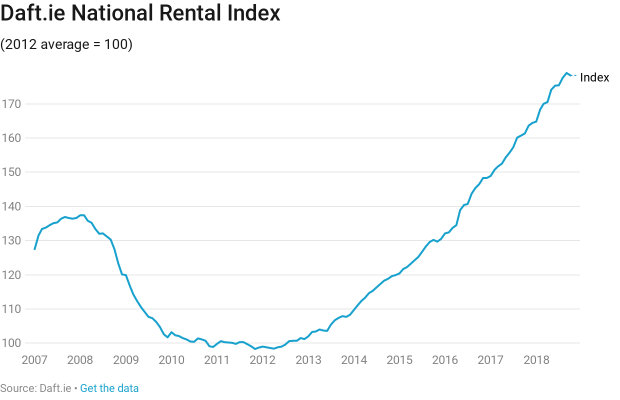
Another salient feature of Irish propaganda is the essential delivery of buy-in from young adults, who continue to purchase property at inflated prices. Prior to the crash Dublin prices soared to such an extent that a residence in the city became more expensive than New York or London.[v] Dublin prices are set to reach boom-time levels this year according to Pat Davitt, head of the Institute of Professional Auctioneers and Valuers (IPAV), with an average family home costing over half a million euros.[vi] Meanwhile average Dublin rents now exceed the heights of the Celtic Tiger by thirty percent. This means those landholders, and institutions, that weathered the recession have seen huge dividends.
Source daft.ie
Any new property purchaser instantly becomes a stakeholder in the dominant consensus. The buy-in of upwardly-mobile youth not only maintains market demand, but also brings political support for the dominant consensus. Political parties threatening the ‘stability’ under the centre-right axis are subtly undermined as the ‘loony’ left and not given a platform in the mainstream media, or co-opted into governing coalitions and discredited, as was the case with Labour, the Greens and now the Independent Alliance.
Importantly, up to fifteen percent of the population are foreign-born nationals. Apart from UK nationals, they do not enjoy a right to vote in general elections, unless they take out Irish citizenship, costing almost one thousand euro. Unlike native-born Irish, who historically had among the highest rate of private home ownership in the world, peaking at 80% in 1991, (declining to 71% in 2011),[vii] many come from countries where renting for life is the norm, and may not wish to reside here long-term. Politically, this large cohort only exerts influence via multinational employers, who face demands for wage increases due to spiralling rents. At the bottom of the ladder are unskilled (or at least unqualified) non-EU migrants – gastarbeiter – many of whom are on short-term- (often student-) visas, and permitted to remain in the country only insofar as they serve an economic purpose.
III – The Crucial Constituency
The elite’s longstanding hold on power, via the two main political parties, relies on a crucial constituency of farmers and their extended families, who are evenly distributed throughout the state, apart from Dublin. Although continually declining in number, they are overwhelmingly native Irish – thus enfranchised – vociferous campaigners, and of a vintage that tends to vote. This ensures their supposed interests, more accurately those of comprador multinationals that trade their commodities, are protected by Irish propaganda.
A remarkable eighty-percent of farmers, working on almost eighty-five thousand separate farms, support either Fine Gael or Fianna Fáil according to the aforementioned poll. The former are especially reliant on their allegiance, which means the national (and global) interest in reducing GHG emissions in order to avoid up to €600 million every year in EU fines after 2020 may be overlooked.[viii] Agriculture produces almost a third of total national emissions, yet contributes a mere 1.7% of carbon taxes.[ix] The farming sector is, however, an increasingly fragile alliance, with the average annual income on dairy farms approximately €85,000, but averaging only €15,000 on the average dry cattle (beef) farm, all of which, derives from subsidies.[x]
An urban working class of unskilled, semi-skilled and unemployed, has been mollified by comparatively generous social welfare payments, but is increasingly impoverished by the scarcity and cost of property, rising rents, and a failing system of public health. Eighteen to twenty-five-year-olds are discriminated against by lower social welfare payments, but tend not to turn out for elections, and are inclined to emigrate, so can easily be ignored.
Preserving a share of working class support remains important, in terms of optics at least, for the two main political parties, especially Fianna Fáil, which preserves the charade of being a party for all classes. Unlike farmers, however, historically a working class consciousness has not been evident in Ireland, and approaches to the national question and moral or religious concerns have tended to sway this cohort. Also, while farmers have clear objectives in terms of maintaining a subsidy regime, and avoiding environmental regulation, the working class is more easily distracted from establishing fixed political aspirations.
The widespread protests over water charges in 2014 were one of the few occasions when the dam broke, and working class discontents spilled onto the streets. But this single issue could be conceded, and sustained engagement with politics avoided. Yet, according to Social Justice Ireland, last year 790,000 people were living in poverty, of whom 250,000 were children.[xi]
Similar to farmers, most civil service workers, including senior teachers, have been kept on side with generous pay and conditions. Teaching salaries averaging over $60,000 per year compare favourably with other OECD countries. As with the social welfare system, new entrants have been discriminated against, with many being forced to emigrate during the crash, but they count for less politically than their senior colleagues. The current modus vivendi between the teaching unions and the ruling parties is reflected in the terminal decline of the Labour Party, their traditional voice in the Dáil.
The new Minister for Education, Joe McHugh, recently described secondary teachers as being overburdened by ‘initiative overload’[xii], which might come as a surprise considering they enjoy more than sixteen weeks of holidays per year, and curricula that have changed little in decades. Secondary school teachers play an important role in upholding the dominant consensus.
The spiral of inequality, globally and nationally is, however, accelerating, and the coalition of interests maintaining the dominant consensus is unstable. Multinationals siphon off vast profits from a market one Tesco executive allegedly referred to as ‘Treasure Island’, with consumer prices, on average, twelve percent higher than in the UK,[xiii] while some avoid corporation taxes altogether. Meanwhile the state labours under a debt of over €200 billion after a bailout the terms of which (including the creation of NAMA) protected the interests of those members of the economic elite that did not speculate wildly prior to the crash – such as former solicitor Brian O’Donnell who was evicted from his Dalkey home in 2015 – while working to the detriment the poor, and the impressionable young who had been encouraged to take out crippling mortgages.
The Irish economy is vulnerable to global financial shocks – with just fifty large firms accounting for three-quarters of all exports[xiv] – a recrudescence of nationalism after Brexit, and the growing obsolescence of many forms of work, including our current farming model. The economic elite is intellectually rudderless, and only knows the way of economic growth-without-end, where ecological constraints are ignored, and in which the retail cartels make a mockery of the notion of a free market. The centre-right cannot hold for long, but in the meantime, the wheels of Irish propaganda keep turning.
IV – The Propaganda Model – Education
State secondary school pupils are encouraged to take subjects that will prepare them for work in multinational corporations, with an emphasis on science and technology, rather than arts, humanities or social sciences. Philosophy is unavailable as a secondary school subject, while history has been downgraded in recent years.
In the state school system, which I observed as a supply teacher, rebellious students are removed from obedient peers and housed en bloc in ‘pass’ classes, or entire schools, which are little more than advanced creches, or holding facilities. There behaviours and performances deteriorate in the absence of positive role models. Ill-equipped for work or even social life, the dole queue awaits, or worse. Importantly, this underclass is unable to articulate their grievances – one in six of the adult population is functionally illiterate.[xv]
The essential breeding ground of the economic elite is found in the paradoxically state-funded system of private education, in which the state pays the salaries of teachers – costing around €90 million per year. This ensures a private education is not prohibitively expensive, broadening the base of the elite, with over twenty-five thousand students enrolling in 2017.[xvi] In these institutions lasting ties are formed, and the best preparation for the Leaving Certificate offered, which is generally a code to be cracked. Behavioural problems among middle class students are less pronounced, in my experience, but where rebelliousness, or just a lack of conformity, is apparent authorities employ long-standing methods of control. The sport of rugby emphasises the collective in a test of manhood, with dissenters often subjected to homophobic slurs.
As far back as the 1920s, one of the leading Dublin Catholic secondary schools for boys of its time, O’Connell School on North Richmond Street, recommended its pupils in the following terms: ‘Your ‘Richmond Street’ boy makes a good official. In the first place he possess the necessary academic qualifications to place him high on the examination lists. He has, in addition, certain qualities which make him a good colleague. However clever an official he may be, he has to pull with the team.’[xvii] Little has changed in a hundred years. The abiding ambition of most all-male private schools remains not only examination results, but also to develop a cast of mind disposed to “pull with the team”, while instilling an idea of what is ‘normal’ in the dominant consensus.
Widespread single gender education keeps more troublesome and sports-obsessed male adolescents apart from females, who streak ahead academically. But when both enter the workforce, the demands of motherhood generally count against women working the long hours necessary for career advancement in most of the elite professions. ‘Early-rising’, workaholic male professionals are the praetorian guard of the dominant consensus.
Irish class boundaries are not impermeable, or based on race or creed – as Leo Varadkar’s background illustrates – but it is increasingly difficult for anyone who is not from an elevated social background to rise up through the educational ranks to become a lawyer, doctor or even a banker. For example a young barrister, after a minimum of four years full-time study, is required to work without a salary for a further two, while he ‘devils’ under a senior colleague, thereby excluding a large proportion of the population. That profession is the bulk supplier of the country’s judiciary, which goes some way towards explaining the Court’s historic deference to property interests – notably: In the matter of Article 26 of the Constitution and in the Matter of The Housing (Private Rented Dwellings) Bill, 1981.
Privileged classes, nonetheless, still produce offspring with intellectual or artistic aspirations that survive the stultifying educational system. As the economic benefits of the humanities and arts are now grudgingly recognised these pursuits are indulged with financial support available from state and private sources, albeit generally via laborious application processes. Ideally, however, the ‘creative’ is an advertising executive. Due to high rents, artists are pushed into becoming ‘art-repreneurs’, and conscripted into marketing the state as a place to do business.
Academia once offered a platform for meaningful critiques of Irish society, but little interaction with the public now occurs, as excessive specialisation has brought abstraction to most subjects. As in other countries, young academics are required to ‘publish or perish’ prolix articles addressed to their peers, leaving little time for political engagement. In 2012 Tom Garvin, Emeritus Professor of Politics decried the dismantling of prior ‘semi-democratic’ structures in University College Dublin, claiming: ‘internal representative structures and freedom of speech were closed down and replaced with Soviet-style top-down “councils” that passively received and passed on instructions from on high’. As non-academic staff began to outnumber academics Garvin found ‘an indescribable grey philistinism’ characterise the public culture of the college ‘and a hideous management-speak’ drowned out ‘coherent communication.’[xviii]
IV – The Propaganda Model – Print Media
The Irish media is subject to global trends, but also internal dynamics. The reputation of journalists as crotchety, difficult people, so often depicted on screen, belies how most now “pull with the team”, or see their careers stall. The journalist that questions dominant consensus is depicted as a conspiracy theorist, but this cautionary distrust of authority now appears to be in short supply. Print media in Ireland is on its knees as young readers, in particular, opt for online content, which has resulted in significant redundancies. Precarious freelancing is the norm for new entrants.
Denis O’Brien – who a tribunal of enquiry in 2011 concluded had handed over hundreds of thousands of pounds to a government minister, who it was ‘beyond doubt’ had given ‘substantive information to him, of significant value and assistance to him’ in securing a mobile telephone licence[xix] – controls a great swathe of Irish media, including the Irish Independent, the Sunday Independent – the widest-circulating daily and Sunday newspapers – thirteen regional publications, commercial radio channels, Newstalk (the Orwellian association seemingly lost on them) and Today FM. O’Brien’s outlets are generally pro-business, or more accurately pro-multinational, and often critical of the institutions of the state and even individual ministers, but generally support the economic elite with selective regurgitation of government Newspeak.
For example, the headline of the Irish Independent on October 18th 2018 ran: ‘Varadkar’s Government in crisis after one minister resigns, another faces fight for survival.’ The article simulates the drama of Fianna Fáil calling time on the coalition, thereby maintaining the fiction of two opposing forces – or only two options in the event of an election. The dominant consensus is woven into the piece with the reminder: ‘The instability has created a major crisis for the Government after a Budget that was well received by most sectors’. In contrast, Social Justice Ireland argued that the budget disproportionately benefited high-earners, noting: ‘Budget 2019 fails to make any notable impact on Ireland’s entrenched inequalities and fails to tackle any of the major challenges the country currently faces.’[xx]
The ‘Indo’ also ostentatiously stimulates demand among upwardly-mobile youth for property and health insurance. Thus the headline on the 19th of October 2018 read: ‘Families to save in home loan and health shake-up’. Its consumer affairs correspondent announced: ‘Families are to enjoy the benefits of a price war in health insurance, and increased competition with even more entrants into the mortgage market’. Mostly, however, it provides the mainstays of effective propaganda: light entertainment, especially blanket sport coverage, celebrity gossip and sexual titillation.
There is only one other genuinely daily national indigenous newspaper – the Irish Times – which has hoovered up the Irish Examiner and regional titles to create a duopoly. It is considered, and styles itself, ‘the paper of record’, but rarely conducts meaningful investigations, tending only to print sensitive material once it has been aired elsewhere, such as when reporting on the harassment of employees by Michael Colgan, the former director of the Gate Theatre.[xxi] The catastrophic purchase of www.myhome.ie at the height of the last boom makes it a vested interest in the property market, which is reflected in extensive property supplements. Often seen as a bastion of Irish democracy, its credibility was undermined by the hosting of unmarked advertorials of the government’s Project Ireland 2040 plan.[xxii]
The imprint of government Newspeak was also evident on October 13th, the morning before the last budget was announced, with the headline ‘Significant spending increases for housing and health’ emblazoned across the front cover. Importantly, it gave a positive spin on the budget, which could be seen from every newsstand in the country, ensuring, even if the paper itself was never read, it maintained the ambient feel-good-factor. Was the positive spin provided as a quid pro quo for the scoop, or strategic leak?
The fingerprints of the economic elite are also apparent in the opening words of an article by chief political reporter Pat Leahy on October 14th. He cautioned the following: ‘First, do no harm. Any finance minister should heed the primary precept of the Hippocratic oath, and ensure that their fiscal and economic prescriptions do not damage the Government, or the economy.’ “Doing no harm” appears to involve upholding the dominant consensus, and avoiding the issues of social exclusion and sustainability.
The ‘Old Lady of D’Olier Street’ still provides a platform for left-leaning and progressive journalists, including Fintan O’Toole, Una Mullally and David McWilliams, but this does not imply relentless focus on Ireland’s economic and social structures. Their emphasis has tended to be on identity politics, issues of individual liberty, particularly reproductive rights, gender equality, and from O’Toole the ongoing dramas of Trump and Brexit. Only McWilliams consistently nails the social structures. Ultimately, the paper cannot afford to affront AB readers or farmers with ‘shrill’ left-wing commentaries or sustained campaigns, but in keeping these writers on board it maintains the illusion of being progressive.
It has also dumbed-down considerably recently in the face of ‘commercial realities’, in other words a high salary overhang. Stodgy book reviews have been marginalised, with increasing emphasis on business, vox pop reporting –with leading articles like ‘Life on the Luas: a tale of two tracks’[xxiii] – consumer affairs and, as usual, lavish sport coverage: all of these fit with the propaganda model of distraction with light entertainment.
We have relied on UK publications to break stories such as labour abuses in the fishing industry, the substitution of horsemeat for beef, and the recent scandal of unmarked government advertorials. Serious interrogation of the role of the Gardaí has been conducted at a remove from the mainstream.
Two political magazines, The Phoenix and Village Magazine, offer satire and dissent, but the former is not available for free online and thus has limited political clout. The latter is yet to develop a viable commercial model, but at least upheld freedom of expression and Dáil privilege by publishing online (along with www.broadsheet.ie) a record of Catherine Murphy’s speech accusing Denis O’Brien of corruption, after he had taken out an injunction against RTÉ, and when the Irish Times took fright.
VI – The Propaganda Model – the State Broadcaster
The state broadcaster receives a compulsory licence fee from anyone with a television set in the country, but still depends on advertising revenue to remain financially solvent. Like the Irish Times, RTÉ is a broad church, but both TV and radio stations are awash with light entertainment, including vox pop phone-ins like Joe Duffy’s Liveline which also offers an outlet for nonsensical Duckspeakers, while Ray D’Arcy and Ryan Tubridy provide distraction throughout the day on the news and current affairs channel RTÉ Radio 1.
Tubridy is Ireland’s highest-paid broadcaster, and often its public face as host of the prime time, Friday night ‘The Late Late Show’. A scion of a well-known Fianna Fáil family, he has assumed a seemingly unassailable position, and rarely courts controversy; although he recently suggested that people who (legally) cycle two abreast should be ‘binned‘,[xxiv] and once compared breastfeeding in public to urinating on the street.[xxv] Mostly however he tugs at the heartstrings of viewers, while devoting his spare time to writing children’s books.
RTÉ mostly anesthetises the population with light entertainment, especially sport – one recent survey showed that on ‘Morning Ireland’, the highest-rating radio show in the country, environmental stories were covered for only 0.92% of the time, whereas sports news accounted for 12.41% of content.[xxvi] Elsewhere, shows such as ‘Claire Byrne Live’ offer a small screen outlet for Duckspeak. At the end of one episode last year, during which evidence for human-influenced climate change was ‘debated’, thirty-four percent of respondents did not believe this would pose a serious threat in their lifetimes, while nine-percent did not know.[xxvii] Damien O’Reilly has also provided an outlet for Ryanair boss Michael O’Leary to express the Duckspeak of climate denial,[xxviii] the farming lobby no doubt delighted by this muddying of the waters.
What passes for news and current affairs coverage generally consists of assessments of Tweedledum and Tweedledee politics, or commentaries on controversies stirred up in the print media. A case in point was in the recent presidential election when the previously unknown, and unsupported, Peter Casey made a demeaning remarks about Travellers, which was greeted with such ‘outrage’ that he became a serious candidate in the election, thereby providing plenty of fodder for Joe Duffy, and others.
Ironically, the most serious political critique is found in the weekly comedy show ‘Callan’s Kicks’, where a degree of latitude is permitted. But as Theodore Zeldin explains, comedy can actually have the effect of reinforcing conformity ‘by being its safety valve’. Zeldin points out that carnivals, such as the medieval festival of fools, ‘have throughout history made fun of authority, and turned hierarchy upside down’, but ‘did so only for a few days.’[xxix]
*******
Ireland is a free country without an oppressive secret police force systematically monitoring communications. Despite the chilling effect of current defamation law, freedom of expression is enshrined in the Constitution and European Charter of Human Rights. Nonetheless as George Orwell put it in his proposed preface to his 1945 novel Animal Farm: ‘Unpopular ideas can be silenced, and inconvenient facts kept dark, without the need for any official ban.’ Orwell observed how:
At any given moment there is an orthodoxy, a body of ideas which it is assumed that all right-thinking people will accept without question. It is not exactly forbidden to say this, that or the other, but it is ‘not done’ to say it, just as in mid-Victorian times it was ‘not done’ to mention trousers in the presence of a lady. Anyone who challenges the prevailing orthodoxy finds himself silenced with surprising effectiveness. A genuinely unfashionable opinion is almost never given a fair hearing, either in the popular press or in the highbrow periodicals.
Irish propaganda upholds a dominant consensus: preserving low taxation on wealth, especially property; encouraging steady economic growth, including rising rents; maintaining buy-in from young property purchasers; and insulating the agricultural sector, often referred to as ‘our farmers’ on the state broadcaster, from criticism. This is achieved through straightforward manipulation of the media as well as instilling conformity through the education system, but also in the use of light entertainment, especially sport, as distraction, as well as in the peddling of plain nonsense, on RTÉ especially. With the advent of social media we are seeing new and sinister methods of achieving these objectives, which this article has not addressed, but which Ireland is not immune from.
The relatively new medium of the internet need not necessarily be feared however. It can, even through increasingly compromised social media, counter propaganda, by allowing like-minded individuals to converge and orchestrate campaigns. Propaganda can easily be exposed and alternative viewpoints expressed. But we must guard against its capacity for offering further light entertainment distraction, and platforms for madcap Duckspeakers.
The most important weapon against propaganda is education, both childhood and lifelong, which must address adult illiteracy. A priority should be reform of that sector in Ireland: first by ending subsidised private education; then placing greater emphasis on the enquiring humanities and arts, before addressing the decline of higher learning institutions.
The water charges campaign failed to generate long-term political engagement among the working class, or an increasingly squeezed middle. Representatives of the economic elite could concede on that single issue and take the rug from underneath organisers, who had seen the campaign in broader terms. Future campaigns should directly confront a taxation system which fails to alleviate rising wealth inequality. As we have seen, the top five percent in the country own over forty percent of its wealth, eighty-five per cent of which is held in property or land. A long-standing regime of minimal property taxes, along with the failure of the state to construct social housing to any extent, have severely accentuated wealth inequalities and seen property prices and rents spiral. A campaign for housing as an ‘inalienable and imprescriptible’ right enshrined in the constitution[xxx], should become the main progressive objective.
[i] ‘We Have Ways of Making You Think’, TV mini-series, BBC (1992)
[xvi] Carl O’Brien, Jenna Clarke-Molloy, ‘Private school enrolment returns to boom-time high’, Irish Times, December 28th, 2017.
[xvii] David McCullagh, The Reluctant Taoiseach: A Biography of John A. Costello, Dublin, Gill and MacMillan, 2010, p.10.
[xviii] Tom Garvin ‘The bleak future of the Irish university’, Irish Times, May 1st, 2012.
[xix] The report summaries the payments made to the then Fine Gael Minister Michael Lowry saying, ‘In aggregating the known payments from Mr Denis O Brien to Mr Michael Lowry, it is apposite to note that, between the granting of the second GSM licence to Esat Digiphone in May 1996, and the transmission of £420,000 sterling to complete the purchase of the latter of Mr Lowry’s English properties in December 1999, Mr O’Brien had made or facilitated payments to Mr. Lowry of £147,000 sterling, £300,000 sterling and a benefit equivalent to a payment in the form of Mr O’Brien’s support for a loan of £420,000 sterling.’ From: Untitled, ‘Lowry helped O’Brien get mobile licence’, Untitled, RTÉ, 22nd of March, 2011, https://www.rte.ie/news/2011/0322/298935-moriarty_background/, accessed 16/11/18.
[xxi] Laurence Mackin, Conor Gallagher, ‘Seven women allege abuse and harassment by Michael Colgan’, Irish Times, November 4th, 2017.
[xxii] Kevin Doyle, ‘Varadkar orders review of Project Ireland €1.5m publicity campaign amid controversy’, Irish Independent, March 1st, 2018.
[xxiii] Rosita Boland, ‘Life on the Luas: a tale of two tracks’, Irish Times, October 14th, 2017.
[xxiv] Untitled, Stickybottle, ‘Flood of complaints to RTE after ‘Late Late Show’ cyclists item’ 14th of March, 2018, http://www.stickybottle.com/latest-news/complaints-rte-cyclists-item/
[xxv] Denise Deighan O’Callaghan, Letter to the Editor: ‘Tubridy’s comments on breastfeeding’, Irish Times, November 8th, 2004.
[xxviii] Sasha Brady, ‘Michael O’Leary slams climate change as ‘complete and utter rubbish’’, Irish Independent, April 8th, 2017.
[xxix] Theodore Zeldin, The Hidden Pleasures of Life: A New Way of Remembering the Past and Imagining the Future, London, Maclehouse Press, 2015. p.177.
[xxx] See Eoin Tierney, ‘The key Change to Fix the Irish Constitution’ July 1st, 2001, Cassandra Voices, http://cassandravoices.com/law/the-key-change-to-fix-the-irish-constitution/, accessed 21/11/18.
Andrej Babiš is a chameleon. At one point you see him on a poster beaming out a jovial smile, or handing sweet pastries at an election rally; then you watch him giving interviews to international media full of resentful claims, while ‘representing‘ the views of our country.
So who is he and how did he get elected? Ironically, he is not originally Czech, but from Slovakia. First and foremost he is a businessman who claims to bring order to our political situation.
An average Czech person would say a lack of political experience does not matter because he is a rich already, and hence would not be dependent on the post to generate wealth for himself. Many also believe his business experience is going to prove useful.
But let us focus on his most recent activities, which caught the attention of Le Monde and The Guardian. Anyone can see that he is playing to the narrative of fear and hatred which chronically follows the refugee migrations. Unfortunately, a considerable number of Czechs share his views, at least according to polls. Most have forgotten how, even in recent history, Czechs have sought refuge from political persecution and economic stagnation.
To be honest, it is surprising that people from a country with a long history of seeing people flee political oppression can show such close-minded thinking. Mr Babiš claims, which I sincerely hope do not represent the real views of people, certainly do not help improve their understanding.
Not only are his claims manipulative, they also tend to be misleading. ‘Britain has always been an ally of the Czech Republic‘, he recently asserted; yeah well, our small country’s requests for help to our ‘ally‘ fell on deaf ears twice last century. First before World War II when the British and French conceded the Sudetenland under the Munich Agreement with the Nazis, and then again after the War when the Soviets were permitted to take over.
Funnily enough, Czech people do not actually have much to ‘fear‘. The Czech Republic is not a place where many migrants want to settle. It is merely a transition state and to this date, only tens of people actually have actually sought asylum.
From time to time, Mr Babiš does raise important issue, such as when he draws attention to the blood money that smugglers are making. But most of what he is saying is nonsensical, such as persuading potential migrants to stay in their countries of origin. The fact these people have decided to leave with little hope of returning demonstrates the severity of their predicament.
That is a predicament Czechs went through multiple times throughout our history, when many were forced to leave their homes and families behind, bribe a smuggler and hope that the bullets miss their bodies when they climbed over the barbed wire fence, and run for their life – all in the hope of a better life.
How can Mr Babiš turn a blind eye to our history and speak on the behalf of Czechs? And even if there was no historical context to rely on, do his arguments about dividing ‘our culture‘ and ‘their culture” stand up to scrutiny? I don’t think so.
I have to give him this though, he might be on to something when he says that the media fails to report on the important issues. The ‘if it bleeds it leads’ approach in reporting certainly does not invite an average person to dig deeply, and see what lies under the surface.
That is how you find yourself around a family table, listening to strong opinions (mostly based on news headlines) with people actually not knowing and/or not wanting to know any more. But before you let his complaints about the state of media impress you, I dare you to guess the name of the Slovakian businessman who owns the widest-circulating Czech newspapers?
I would love to think that the close-minded and history-oblivious views Mr. Babiš throws in do not represent the majority of people’s views, but I actually don’t know. I may myself be in a sound chamber, and do not tend to surround myself with close-minded people. So I tend to think that the situation over here is not so bad.
Then again, our feeble chauvinistic president Miloš Zeman was re-elected last year, supported by Mr. Babiš, who speaks to the international media and goes to Brussels with the kind of views I have set out. It is incredibly unfair of him to represent our country (blissfully unaware of the paradox that he is not even Czech) and offer these ideas, completely ignoring the history of Czechs and of Europe itself.
Earlier this year, The Economist (March, 2018) published a special report speculating on the potential for autonomous or self-driving cars to solve the countless problems associated with today’s gasoline-powered, human operated vehicles. Autonomous cars, they and other tech-enthusiasts argue, will virtually eliminate road accidents, revive suburban areas, solve the problem of parking, and reduce traffic in our cities.
The naïve claim is that a single technology will solve a host of social, cultural and environmental problems, while allowing the economy to keep growing, never questioning whether the endless pursuit of autonomous mobility or economic growth is good for the planet, let alone urban regions.
I – Appropriation of Critiques
Ascribing commodities with magical powers is nothing new. Marx called it the fetishism of commodities. A commodity, he wrote, is a mysterious thing that achieves mystical properties, not due to its use value, but from ways in which it objectifies social relations. It is much easier, and profitable, to address the urbanizing planet’s profound socio-ecological crisis with a new technology than to question the social and cultural desire for automobile-propelled mobility.
Like the rhetoric of the sharing economy, which appropriates the collective idea of sharing in the monetization of everyday life — driving, dwelling, and eating — the rhetoric around the autonomous car appropriates critiques of the automobile that have long been made by environmentalist and anti-car activists.
The fantasy of this fetish object begins with its very naming as somehow autonomous (literally, outside of or beyond the law). All new technologies, be they cars or smartphones, pencils or paper, alter the existing cultural and social matrix of technologies. The question is how do they do so, who in particular will benefit from them, and how are they sold to the public because, today, all technologies are developed within the laws of capitalism — they have to make money and be profitable, and in the case of the autonomous car, further rather than overcome, the individualism that is at the core of the system of automobility.
Critics of the car, activists and academics alike, have long pointed to not just the physical violence that mass automobility brings out, but the conceptual violence of automobility as the symbol of autonomous mobility.
Automobility, in this sense is fundamentally contradictory. The ‘auto’ in automobility implies a coherent self, someone composing her biography in motion. Driving is the ultimate pursuit of the autonomous self. If freedom is motion, forever moving forward, then the car on the open road is the ultimate expression of autonomy.
At the same time, the ‘auto’ in automation, automaton, and automobile implies a machine, not a human, and a seemingly autonomous machine that is, however, utterly dependent on an infrastructure for it to express the driver’s autonomy, often at the expense of other non-car drivers.
Critical theorists of automobility have pointed out that automobility is not at all autonomous, but radically dependent on a host of infrastructure systems. They suggest that the vast system that makes automobility both possible and desirable, ironically, if taken as an intrinsic part of automobility would call into question the very idea and practice of autonomous mobility. Their point is that it is not necessarily the individual in the car that expresses autonomous mobility, but that it is rather the infrastructure, the vast network of highways, gas stations, traffic lights, licensing and insurance systems, that fosters the illusion that movement is autonomous. Thus, the editors of a 2006 edited collection called Against Automobility write, ‘the complex infrastructure of automobility produces, as one of its effects, the appearance of independent automobility.’
II – ‘Energy Crisis’
Ivan Ilich, the theologian and radical activist, made the same claim when he criticized the term ‘energy crisis’ in the 1970s in his landmark essay ‘Energy and Equity’ (1974). There was only a crisis, he wrote, because of the number of ‘energy slaves’ that needed to be fed. His point was that the energy crisis revealed the opposite of autonomy: our radical dependence on networks of infrastructure and energy. Autonomy, in his sense, could not be found with a technological tool, green or otherwise, but with social and political liberation.
If automobility as autonomous mobility is impossible on conceptual grounds, attempts to resolve such antagonisms will always fail. In his last book, the sociologist John Urry wrote that even the car manufacturers are beginning to realize that automobility’s antagonisms might be ‘impossible to ‘solve’ in any simple sense.’
The Economist said as much itself back in 2012. To address ‘peak car’ – saturation of the automobile market in the rich countries – car manufacturers had two options: either flood the economically poorer countries like Vietnam, Indonesia, and India with more gas guzzling combustion engines; or bring technology and car companies together to offer rich countries the autonomous car, a ‘highly profitable innovation.’
The autonomous car, far from overturning the system of automobility that became dominant in the twentieth century, will only perpetuate it and fuel expectations for increased personal mobility, rather than collective, public mobility on public transit. The expectations that we should all have access to a private car to go, where we want and when we want, were in part produced by the infrastructure of automobility.
III – Uber-flawed
Uber’s former CEO, Travis Kalanick, argued that Uber was not, as might appear, in competition with taxis, although that is the most visible aspect of the clash (and the associated labour disputes of Uber’s drivers). Rather, Kalanick said that they were not competing in an existing market, but producing an altogether different one. Uber was competing against car ownership. The goal? To make, in Kalanick’s words: ‘car ownership a thing of the past.’
Kalanick’s claim points to a key aspect of the discourse of the autonomous car: its proponents have appropriated long-held knowledge about the damage cars do to society, in order to sell autonomous cars.
For years anti-car activists have pointed to a number of antagonisms. The response: autonomous cars will ease the antagonisms of automobility by reducing traffic, ending the over one million fatalities that occur on the world’s roads every year, cutting back carbon emissions (when the cars become self-driving), reduce parking and supplementing public transportation, or in some areas, offering a more cost-effective form of quasi-public transport. With autonomous vehicles, we find what The Economist describes as the possible saviour of both the system of automobility and the dispersed suburban form.
For decades, anti-car and environmental activists have been drawing attention to these problems with cars. Their point was not to find a technological alternative that could, in theory, provide the same pseudo-freedom of mobility that the car provides, but to question radically that pursuit, and support collective solutions in the interests of the common good: safe and effective public transportation, cycling, and an urban and suburban form conducive to walking and hanging around.
Today criticisms of the car are recycled by the industry because a technological alternative has become viable that does not call into question the economy of infinite growth. Those who for years persisted in supporting conventional cars because they were still profitable (and as such willingly sacrificed human lives in exchange for personal mobility and profit), now conveniently reach for the anti-car arguments.
IV – Unsustainable Growth
Autonomy (2018), is a book co-authored by Lawrence D. Burns, former vice-president of research and development at General Motors, and a key proponent of self-driving cars. The introductory chapter is entitled ‘The Problem with Cars’, and introduces a litany of problems associated with the ‘personally owned, gas-powered, human-operated automobile.’
These cars he writes are inefficient. Cars are usually occupied by only one person, and in city centres cars rarely travel faster than 12 mph (3). Cars are heavy, and so dangerous, killing 1.3 million people per year, and they contribute to American dependence on oil. And given all that, they still spend 95% of their lives parked.
‘Years from now,’ writes Burns, ‘we’ll regard as incredibly wasteful the way we got around in the twentieth and twenty-first centuries….The system is completely irrational.’
Adam Jonas, a financial analyst at Morgan Stanley, claims that the car industry is the ‘the most disruptable business on the Earth.’ ‘Happily,’ writes Burns, ‘the solution also happens to be better for the earth’. This is telling because it is economics, not an interest in climate change, that, in the end, drives such innovations. If it happens to pollute less, all the better, but the ultimate goal is infinite economic growth, which in today’s climate, cannot be sustained.
There are, however, two glaring omissions in Burns’s account: no mention of the vast sums of money spent on highway building and maintenance, particularly in North America, much to the detriment of public transportation, and not one mention of public transportation as an already available, collective option to much of the problems he discusses.
The bus does make an appearance in his narrative: co-founder of Google, Larry Page, while an undergraduate in Michigan in the early 1990s, was forced to wait in the freezing cold for buses that never arrived on time, if at all. While stuck waiting, writes Burns, Page wondered ‘how poorly we as a society had solved the transportation problem.’ The solution, was not to make public transportation more effective, but to come up with an idea for personal rapid transportation, which would lead to the race to build self-driving cars.
Most remarkably, The Economist’s 2018 special section on autonomous vehicles, claims they will save the suburb from the car by reducing or eliminating driving and the amount of space given over to cars, thereby, ‘updating the 20th-century dream of garden cities.’ Garden Cities, they write, can again become self-sustaining, producing their own power through solar, and growing their own food. Since autonomous vehicles can be parked elsewhere and roads narrowed, car spaces can be reclaimed as gathering spaces for people.
V – Suburbs without cars?
Is it possible to conceive of the dispersed suburbs without privately-owned cars? The lack of sidewalks will turn into a bonus as the playing field between cars and pedestrians is levelled. What about the demise of car ownership? If car ownership is part of the debtscape of suburban neo-liberal automobility (Walks, 2015), how might the de-privatized self-driving car change this?
For Wendell Cox, one of the staunchest supporters of neo-liberal automobility, the idea of suburban dwellers not only giving up car ownership, but sharing rides with their fellow suburban dwellers in self-driving cars is unthinkable. In other words, self-driving transportation services should not resemble in any form public transportation.
In all of these cases, radical alternatives that were about a right to the city, are commodified and sold to us as saviours of the city. And it is unlikely these self-driving cars will benefit the places that need them most: suburbs and peripheries lacking in good public transportation.
The current mood around self-driving cars places them in the increasingly exclusive central cores of cities like Google’s proposed smart neighbourhood, Quayside, on the Toronto waterfront, which will make use of self-driving cars.
If the current forms of ‘tech mobility’ (Henderson, 2018) are any indication – like the privatised Google buses in San Francisco ferrying workers from the downtown to their suburban tech campuses – so-called sustainable forms of liveability that are associated with self-driving cars, carbon-free mobility, and bike lanes, will exacerbate rather than overcome the infrastructural inequities between the central city cores and the periphery, enhance the autonomous mobility of the few, not the many.
Morality is the basis of things and truth is the basis of all morality. Mahatma Gandhi
Donald Trump’s lawyer, Rudy Giuliani was recently asked whether his boss had a case to answer arising from the conviction of his former associate Paul Manafort. He responded with the not-altogether-original, but nonetheless all-too-convincing argument that ‘truth is not truth.’ It seems we have entered a virtual reality nightmare.
Of course times passed have been consumed with other disturbing ideologies such as, Social Darwinism, racism, Fascism and Communism. More recently we have seen neo-liberalism reign supreme, giving rise to Francis Fukayama’s foolhardy vision of an End to History.
Just as Marxists shibboleths about the inevitability and finality of Revolution ignored reality, the neo-liberal world order is disintegrating before our eyes, a point which Fukayama now concedes; recently he meekly acknowledged there had been a decline in faith in democratic institutions, and that democracy was now moving backwards.
So perhaps Post-Truth will be a passing affliction. Alas I doubt it.
Post-Truth, or truth decay, has been coming for a while and its origins need to be traced as it dictates the activities of the Trump administration.
I – Post Modern Nonsense
First came the purveyors of nonsense, and incomprehensible prose, the Structuralists and Post Modernist poseurs of the Sorbonne.
They united in rejection of universal values, while espousing a gospel of relativism, thereby ditching the inheritance of the Enlightenment. This led to the dismissal of evidence, rationality, science, rigour, precision, and all the integrative forces that holds society together.
Noam Chomsky in this context wrote a passage worth quoting in full:
It’s entirely possible that I’m simply missing something, or that I just lack the intellectual capacity to understand the profundities that have been unearthed in the past 20 years or so by Paris intellectuals and their followers. I’m perfectly open-minded about it, and have been for years, when similar charges have been made — but without any answer to my questions. Again, they are simple and should be easy to answer, if there is an answer: if I’m missing something, then show me what it is, in terms I can understand. Of course, if it’s all beyond my comprehension, which is possible, then I’m just a lost cause, and will be compelled to keep to things I do seem to be able to understand, and keep to association with the kinds of people who also seem to be interested in them and seem to understand them (which I’m perfectly happy to do, having no interest, now or ever, in the sectors of the intellectual culture that engage in these things, but apparently little else).
Since no one has succeeded in showing me what I’m missing, we’re left with the second option: I’m just incapable of understanding. I’m certainly willing to grant that it may be true, though I’m afraid I’ll have to remain suspicious, for what seem good reasons. There are lots of things I don’t understand — say, the latest debates over whether neutrinos have mass or the way that Fermat’s last theorem was (apparently) proven recently. But from 50 years in this game, I have learned two things: (1) I can ask friends who work in these areas to explain it to me at a level that I can understand, and they can do so, without particular difficulty; (2) if I’m interested, I can proceed to learn more so that I will come to understand it. Now Derrida, Lacan, Lyotard, Kristeva, etc. — even Foucault, whom I knew and liked, and who was somewhat different from the rest — write things that I also don’t understand, but (1) and (2) don’t hold: no one who says they do understand can explain it to me and I haven’t a clue as to how to proceed to overcome my failures. That leaves one of two possibilities: (a) some new advance in intellectual life has been made, perhaps some sudden genetic mutation, which has created a form of “theory” that is beyond quantum theory, topology, etc., in depth and profundity; or (b) … I won’t spell it out.”
It is, in other words, nonsense on stilts, that degrades our culture. But it has gained traction, and power, and should not be underestimated.
Relativism, which should never have gone beyond those flaneurs, has been hijacked by the Populist Right, including Climate Change Deniers, Anti-Vaxxers and Creationists, who insist on balanced coverage for their ludicrous views, each one as ‘valid’ as the other, in Post Modernist hell. This reaches an apogee in the churning garbage emanating from spokespeople for the Trump administration, especially the deranged President himself.
The gospel of relativism brings contempt for truth, reason and evidence. It entails the rejection of scientific methods, order and the Rule of Law.
The first point to note about Post Modernism is that it encourages distrust in established truth, and generates an atmosphere of looseness and imprecision, where arguments are accorded even and equal weight, even if lacking any substance. The misplaced logic is that since all views are equal, all views should be aired and taken equally seriously.
The late David Foster Wallace described this as ‘an epistemic free for all in which the truth is wholly a matter of perspective and agenda.’
‘Balanced coverage’ and ‘tolerance’ of opposing points of view in the media often leads to the elevation of nonsense, or lies.
Balance should not permit the assertion that Climate Change is a fraud. Undue weight is being accorded to marginal opinions and minority views, which simply should not be given a platform. Abandoned is the quest for an elusive truth. The media is giving a microphone to divisive extremism.
This nonsense is creeping into our culture, our media, our law courts and is a form of brainwashing.
Relativistic and structuralist ideas, such as the indeterminacy of texts, alternative ways of knowing and the instability of language opens the way for Trump and his acolytes to say that every word he utters should not be taken literally. Just as a text by Derrida contradicts itself, Trump similarly can make contradictory statements, from one tweet to the next.
II – Holding to Truth
As a lawyer I have been trained to consider distinctions between fact and opinion. I understand how an apparently established fact can actually be the product of manipulation, distortion or outright fabrication.
In my work for The Innocence Project in Ireland I found many instances of perjured evidence, false and fabricated claims and cognitive and confirmation bias by experts, or really pseudo-experts, leading to false conclusions and erroneous convictions. Innocent people are often incarcerated on the basis of lies and this false expertise.
In this Post Modern zeitgeist we privilege opinion over knowledge, and feelings over facts. This includes confirmation bias where people rush to judgment and follow their prejudices, rather than properly evaluating sources.
Indeed, with regard to so-called expert witnesses I am reminded of Wittgenstein’s famous comment, itself capable of multiple levels of interpretation: ‘Whereof one cannot speak, thereof one must be silent (Wittgenstein, 1922)
As difficult as it is to establish the truth, and as complex as it may prove to be, we must continue to strive for it, and not succumb to relativism, or take refuge in Post-Truth nonsense.
This pursuit is indispensable for penal and judicial decision-making, as well as the pursuit of social and economic justice. Acknowledging there truth helps inform political and personal choices arising from our interactions with banks or politicians, or indeed with respect to one’s health.
The truth protects us against those who mislead, dupe or destroy us. Better to acknowledge ‘home truths’, and act accordingly, rather than be seduced by banalities. But it is often difficult to determine what is genuine when you are being bombarded with disinformation.
As Pope Francis sagely remarked: ‘there is no such thing as harmless disinformation: trusting in falsehood can have dire consequences.’
So in a sane, rational universe that is how everything should and ought to be decided. Except that is not what confronts us today.
III – Info-tainment
Following the degradation of so many discourses, our media is too often consumed by ideological representations of alternative truths – and at worst utter nonsense – in a misplaced quest for balance, or pandering to vested interests.
News programmes generally adopt a Punch and Judy format, rather than providing serious analysis. We are addicted to what Susan Jacoby termed ‘info-tainment’ (Jacoby, 2009).
In this respect it was noticeable that the intellectual level of the Clinton-Trump Presidential debates had reached a nadir. For anyone who has listened to the Nixon-Kennedy debates of the early 1960s, or indeed many subsequent electoral ones in the US and Britain, it was simply not a debate.
It was more like an episode of the Jerry Springer show. But the vaudeville act, the circus clown that is Trump, is actually now President of the United States, having manipulated a series of communications both in the debate, and the media, which were exercises in falsity, total inconsistency, randomness and communication in proto-fascist mode: lashing out at the outsider.
People were brainwashed into believing that he would help them. The disenfranchised working and middle class reached out to him, and he responded by appointing three members of Goldman Sachs to his cabinet; a classic instance of what Zizek terms ‘ideological mis-indentification’ (Zizek, 1989) with the marginalised voting for self-destruction.
Print media has also dumbed down. The reasons are obvious. Vested interests have to be appeased. In addition megalomaniac owners cannot be criticised. Things are known, or suspected, but left unsaid. Independent courageous reportage, beyond The Guardian or The New York Times is increasingly rare.
The so-called text generation, drowning in email communication and other digital ephemera, exacerbate the problem.
Admittedly, my own emails appear like hieroglyphics – ungrammatical and unpunctuated – so I am scarcely one to talk. But in my defence, I simply cannot take the medium seriously, whereas the rest of the world seems to have lost any interest in oral conversation, or expressing themselves in permanent written form.
The Internet is a truly poisoned chalice: the major problem is that people feel free to utter whatever they like, however bizarre, extreme or libelous. This accentuates the disentangling of truth from fiction, and facts from lies.
The Silicon Valley entrepreneur Andrew Keen has argued that the Internet has replaced genuine knowledge, but that is undifferentiated knowledge derived from the crowd, or mob, which blurs any distinction between fact and opinion.
Established ideas are under threat and rationality jettisoned, replaced by subjectivism, the pseudo-expert, and elevation of the opinion of the equivalent of ‘the man on the Clapham Omnibus’. As Tom Nichols wrote: ‘every opinion on any matter is as good as every other (Nichols, 2017)’; I am also reminded of William Burroughs’s famous statement that: ‘Opinions are like assholes everyone has one.’
Another problem is information overload. We are creatures of bounded rationality that can only absorb so much. We have to filter. The Internet presents us with a cacophony of competing voices, all clamouring for attention. This desensitises, and makes it impossible to disentangle valid arguments from nonsense. In effect we are being deceived by a web of deceit, semi-fact, mumbo jumbo and plain nonsense.
III – Bad Education
Perhaps most disturbingly, our education system is producing ill-informed, philosophically illiterate, and indeed often genuinely illiterate children. We are operating in a post-Gutenberg Galaxy, where even lecturers and teachers generally no longer read books outside their specialisms, and are insulated from intellectual cross currents. Goethe’s ideal of a civilised education, which inoculates against fascism, no longer abides
A partial education breeds the self-righteousness of fascism. Why appeal to true argument when your thought processes stands unexamined and your prejudices go uncontradicted? In these circumstances, the gutter press finds a ready market.
Information is not gleaned from the close reading of texts, but from online synopses. Superficial knowledge and semi-literacy accentuate the perversion that everyone has a right to express their opinion, no matter how ludicrous.
Let us be clear, academic degrees and education are distinct from one another. We hand out qualifications like confetti, but true education is lacking. Yet, apart from foreign direct investment, the education sector appears to be the biggest growth industry in Ireland. But what kind of person is it producing?
We find an emphasis on narrow technocratic skills and rote learning, where teachers slavishly adhere to syllabi. Books go unread, but instead are summarised on Internet sites. The standardization of learning outcomes breeds bullshit, piled on bullshit.
As an established lecturer I have encountered increasing nonsense about balance and standardization. In the ivory tower the careful weighing up of argument has given way to an obsession with footnotes, and citation, and a narrowing in doctoral work; most baleful, is the decline of the academic as public intellectual.
In this respect we should note the important contribution of perhaps the only acceptable Post Modernist, Michel Foucault. He argued that the more severe punishments of earlier times have been internalized, through insidious methods of control in schools, hospitals and factories.
In a 1978 interview he remarked:
In my book on the birth of the prison I tried to show how the idea of a technology of individuals, a certain type of power, was exercised over individuals in order to tame them, shape them and guide their conduct as a kind of strict correlative to the birth of a liberal type of regime. Beyond the prison itself, a carceral style of reasoning, focused on punishable deviations from the norm, thus came to inform a wide variety of modern institutions. In schools, factories, and army barracks, authorities carefully regulated the use of time (punishing tardiness, slowness, the interruption of tasks) activity (punishing inattention, negligence a lack of zeal); speech (punishing idle chatter, insolence, profanity); the body (punishing poor posture, dirtiness, lack in stipulated reflexes) and finally sexuality (punishing impurity, indecency, abnormal behaviour) (Foucault,1980).
This leads to a social hygiene, wherein people are assessed not on what they have to say, or the quality of any service they may provide, but more on their attire; or whether they wear a uniform that conveys a false sense of expertise and arrogant authority; cleanliness next to a self-serving godliness. Give me someone with an occasional slovenly appearance and I see a degree of human fragility.
Intolerance and contempt for human frailty, except of course by the power elite who act as they please, marginalises real authorities from making contributions to society.
In our glorious colleges and universities and schools worse is happening. First and foremost there is a suppression of speech and discourse, with discussion confined within narrowing parameters, and divisive subjects omitted.
We are in an age of conformity where obedience to authority has become a sine qua non of success. The great old days of uninhibited debate are disappearing from campuses.
One aspect of this is the so-called ‘snowflake’ phenomenon, leading to anything remotely controversial being deemed offensive. This is used as a method of thought control, and heralds the gradual erosion of criticism of vested interests.
Moreover, within the college structure promotion and preferment are linked to an increasingly controlled discourse, where ideas that cut across the norm are penalized. Those countervailing ideas often do not sit comfortably with elites, and are usually tinged with leftism or anti-authoritarianism, or involve discomforting truth-telling. Alas, the paradigm of discourse is neo-liberalism, and increasingly a knee-jerk conservatism, which is morphing into outright fascism.
IV – No Platforming
The academic community is also responsible for other outrages attacking freedom of speech. One truly sinister development is a phenomenon known as ‘no platforming’, whereby anyone presenting dissident views is barred from campus appearances.
There are acceptable reasons for exclusion of errant views. For example the trash talk of the fascist historian David Irving, who condones the Holocaust, or at least intimates it never happened, is an obvious case in point. But he is a denier of truth, and his lies should be restrained.
Recently the ‘no platform’ lobby barred the eminent feminist and author Germaine Greer from speaking in UK campuses, as she had argued many years ago that a man who becomes a woman can never fully understand what it is like to be a woman.
The ‘no platform’ lobby which secured her ban was made up of transsexual academics. Take note, these are not necessarily trans-sexuals, but a lobby group. They are also proto-fascists and part of a new semi-literate cabal of arcane specialists.
It is academic Stalinism, or Fascism if you prefer. Such groups use the immense power of blackmail, intimidation by social media and character assassination, to put fear into often squeamish academic authorities.
V – Anti-Social Media
Social media is unraveling our social fabric through lies, disinformation, smears and character assassination. As Pierre Omidyar, the founder of Ebay put it: ‘The monetization and manipulation of information is swiftly tearing us apart.’
The use of trolls and bots to spread disinformation by Trump, Bannon and Cambridge Analytica undermined democratic institutions, as well as fact-based debates.
Cambridge Analytica specialised in forms of artificial intelligence that look set to nurture a new species, a new form of human identity, who become bland consuming nodal points, and receptors of a barrage of disinformation and nonsense.
This paradigm shift in our culture, will curtail necessary criticism and free thinking and is already afflicting the media. Before appearing on radio shows I myself have been told what I can and cannot say for fear of upsetting a vested interest. Instead, increasingly lobby groups of the most extreme nature are invited on shows and their views accorded credibility, when they have nothing of substance to say.
We are creating a new generation of technocratic fascists: selfish, materialistic, ultra-conformist people receptive to Post-Truth. A new Dark Age looms with the Far Right gaining increasing authority, as the edifice of neo-liberalism crumbles, and social support structures are dismantled.
Post-Truth has I fear already taken hold. The truth does not matter; what is important is convincing someone of the truth, often through advertising. Stories are planted and lines between fact and fiction disappear.
People are buying the bullshit. The sensationalism and gossip of the gutter press is now being taken seriously. We are holding court to pseudo-expertise. Lies have become intrinsic to commercial and business interaction; The People of the Lie as in the title of the seminal book by M. Scott Peck in which he conflates evil with untruth. He contends that this undermines life and liveliness, transforming people into automatons.
Such people are not up front but operate by covert means. Evil people, Peck argues, scapegoat others: since they consider themselves repositories of perfection, they must demonise ‘the other’.
This leads, ineluctably, to hostility towards the foreigner and migrant, the recrudescence of tribalism, and a denial and rejection of reason; a veneration of the past and the equation of disagreement with treason; a ‘them and us’ universe.
Evil people prevent us from exercising reasonable choices, where we grow in integrity, courage and self-esteem. Evil is also linked to a self-image of respectability and, as Peck defines it, the exercise of coercive power, often by those in authority, who undermine growth and development.
Evil is surprisingly obedient to authority. The truly good in times of acute stress do not desert their integrity, maturity, sensitivity. They act on principle, not regressing in response to degradation, preserving empathy for the pain of others.
*******
Hannah Arendt would recognise our current descent:
The ideal subject for totalitarian rule is not the convinced nazi or the convinced communist, but people for whom the distinction between fact and fiction (the reality of experience) and the distinction between true and false (standards of thought) no longer exists.
The ‘People of the Lie’, the powerful and corrupt, project their deviance and criminality onto others. Morality does not apply to them, and those they disagree with are deemed enemies of the people. All that matters now is to win, and to mask untrue intentions in order to survive.
The really important values of truth, integrity, sincerity, depth, originality, creativity are being abandoned. Alas, the lunatics have by now taken over the asylum.
Truth is not truth. The imitation game has won. How can we retain our individuality when fact is replaced by semi-fact or worse? When we are assailed by streams of advertising; nonsensically balanced coverage; relativism and Post Modernism; bogus standards in high places; putative expertise and ass-hole opinions?
Instead jaded rituals, religious and secular, particularly in countries like Ireland, desensitise us to reality.
References
Hannah Arendt, The Origins of Totalitarianism, Schocken Books, Berlin, 1951.
Michel Foucault, Power/Knowledge: Selected Interviews and Other Writings, 1972-1977 (edited by Colin Gardner), Pantheon, New York, 1980.
Susan Jacoby, The Age Of American Unreason, Pantheon, New York, 2009.
Tom Nichols, The Death of Expertise, Oxford University Press, Oxford, 2017.
M. Scott Peck The People of the Lie: The Hope for Healing Human Evil, Simon and Schuster, New York, 1983.
Ludwig Wittgenstein, Tractatus Logico-Philosophicus, Keegan Paul, London, 1922.
Slavoj Zizek, The Sublime Object of Ideology, Verso, London, 1989.
On a recent visit to Athens I chanced upon the supposed tomb of Socrates near the Acropolis. Socrates chose to remain in the city after being found guilty on trumped up charges of corrupting youth. For this he was handed the ultimate sanction of a death sentence, to be self-inflicted with hemlock. By receiving his punishment he was making a statement to posterity to the effect that the Rule of Law was of greater importance than the individual injustice being inflicted on him. The operation of the law would just have to improve, the alternative being anarchic barbarity.
Nearby, somewhat hidden and a tad derelict is perhaps the most historically-significant structure in Athens, the birthplace and site of Athenian democracy, and thus the birthplace of democracy itself, where the impassioned speeches of the great orator Pericles (died c. 450 BCE) set the small polity on the destructive course of the Peloponnesian War.
More recently, Randy Newman’s song about America,‘In Defense of Our Country’ from Harps and Angels (2008) expresses a cautious, pre-Trumpian optimism that the political leaders of a decade ago were ‘hardly the worst / This poor world has seen.’ But presciently he references Caligula, the emperor which President Donald Trump best resembles at the fag end of American empire. But Trump actually democratically won the Presidential election, at least the electoral college, just as Hitler achieved power through elections, before dismantling the Rule of Law.
I have expressed reservations in the past about democracy, and I despise demagoguery. But let me construct a few words in its defence.
I – ‘Benevolent Authoritarianism’
A comment often attributed to Churchill is that democracy is the least worst form of government, which I consider trite, and perhaps untrue. The enlightened despot may prove more effective, as the great Franklin Delano Roosevelt showed.
Similarly, David Runciman in How Democracy Ends (Profile Books, 2018) endorses the concept of benevolent authoritarianism. Such is the luck of the draw, however, that a benevolent oligarchy almost invariably leads to despotism of the Right or Left, and utter disaster.
Let us nonetheless lay out the positives of what Pericles effectively pioneered. First, in the immaculate expression of honest Abraham Lincoln ‘the rail splitter’ in his Gettysburg Address of 1863 it is governance by the people. On the scene of the Civil War battlefield that would eventually end slavery he resolved:
these dead shall not have died in vain, that this nation, under God, shall have a new birth of freedom and that government of the people, by the people, for the people, shall not perish from the earth.
So it is that “we the people” are sovereign, as opposed to governance by faceless corporations, multi-national banks and nefarious corporate law firms, purchasing our political class.
We also find governance by the people for the people in the U.S. Declaration of Independence (1776), the first modern constitutional statement of democracy.
At least in theory. The problem is our public representatives are beholden to the crypto-fascist advocates of neo-liberalism. The Irish state, for example, is effectively run by Goldman Sachs, corporate law firms, Vulture Funds and banks for their own enrichment. The people are irrelevant, and many among the judiciary, mired in debt, seem to be in on the act.
The people are drip-fed justifications by the establishment media for austerity, on behalf of these global parasites, and conditioned to accept inflated house prices, robber baron banks, besides substandard and ludicrously expensive rental accommodation. The abolition of pensions, and death on a hospital corridor are the new reality.
Our Brave New World of the Internet is incubating a dangerously compliant and accepting population, reflected in Trump’s ability to win over the American people, who he persuaded to consent to their own demise. This, what Timothy Snyder called ‘anticipatory obedience’ (Snyder, 2017) involves going with the flow of home seizures and deportation of untermenschen migrants, until at last they come for you, at which point there is no one left to protect you. As Pastor Neimoller put it under the Nazis:
First they came for the socialist and I did not speak out because I was not a socialist. Then they came for the trade unionists and I did not speak out because I was not a trade unionist then they came for the Jews and I did not speak out because I was not a Jew Then they came for me and there was no one left to speak for me.
So stand up and be counted. Hopefully it won’t require you to walk out in front of a tank, but be prepared.
II – A Final Solution
At the Wannasee Conference of 1942 the Nazis under Reynard Heydrich decided on the Final Solution, or genocide, of the Jewish people. The transcript is available, and captured on celluloid in Kenneth Branagh’s film Conspiracy (2001).
A modern incarnation of this is the secretive and monastic meetings of the Bilderberg Group – once chaired by our own late unlamented Peter Sutherland – where the spoils of an utterly unsustainable and unequal economic system are divided.
The modern Wanasee meetings are no doubt attended by a phalanx of pseudo-experts, or even genuine experts, working out what to do with the troublesome poor of the Earth.
I suspect their plan is to to undermine democracy on behalf of the world’s corporate elite. People are commodified by banks and financial institutions: there are far too many of them, and their number needs to be reduced. Liquidation can occur by degrees: beginning with withdrawal of social support and evictions, which leads to suicide, addiction, health collapse and early death. In the Third World it will be far worse for those in coastal regions when the storms hit. Meanwhile, the good ol’ boys of Steve Bannonet al will continue to reap the harvest.
People are often ill-informed and vote stupidly. Trump was elected on a ballyhoo of promising the disenfranchised working and middle class social protection, and job creation, after stoking fears about a foreign Other. What happened both with the election and since is the most nefarious soap job since the Nuremberg rallies.
Trump appointed to his cabinet three Goldman Sachs officials, who were responsible for much of the mess that people find themselves in the first place. He has also appointed mad dog generals, and cosies up to vile dictators. The spectre is truly frightening.
Trump immediately set about dismantling Obamacare and tore up the Paris Climate Change Agreement. With two strokes of the pen much of the Obama legacy was lost. The smooth-talking Obama is now a political eunuch.
The elite are intent on making ‘difficult’ decisions, which will reduce the population of the world. This will require ‘strong’ government and the maintenance of ‘public order’ when disobedience appears.
Neo-liberal policies will certainly not be in the interest of the people who voted Trump in. As the former Greek finance Minister Yanis Varoufakis put it, ‘And the weak suffer what they must.’
The democratic problem is that ‘we the people’ did vote for neo-liberals in Ireland and for a long time in the U.S. Even Viktor Orban in Hungary has a democratic mandate, and Brazilians have voted for a New Age conquistador in Jair Bolsonaro. Meanwhile the National Front are on the threshold of power in France. Democracy is electing fascists.
Why? Well genuine democracy requires mass literacy and proper education, which is diminishing, as is access to accurate information. Bannon and Cambridge Analytica have used artificial intelligence to influence voting patterns, and warp the human mind. We are witnessing the dissemination of disinformation, and what Zizek calls ‘Ideological Misindentification’. People are buying the bullshit, even though, at heart, they know it is untrue.
Nonetheless, declining adult literacy and the use of sophisticated triggers have conditioned people into buying advertising as argument and substituting soundbites for subtlety and nuance. Hysteria, semi-baked nonsense and shrillness is replacing rational discourse.
In the Post-Truth zeitgeist appeals to emotion have replaced the importance of facts, and fascists have always enjoyed rituals and symbols. Whenever anyone talks of nationalism or the national interest I am reminded of the adage that ‘patriotism is the last refuge of the scoundrel.’
The Left are nostalgic and see opportunity in Austerity but, lest we forget, after the Wall Street Crash the Weimar Republic did not witness a Populist socialist insurgency but Nazism. Our present economic collapse is ineluctably leading towards a new form of corporate fascism.
If the Left is to salvage democracy it must borrow the approach of Antonio Gramsci, the leader of the Communist Party of Italy in the 1920s, which is to construct a cultural hegemony with a receptive middle class (especially now as the distinction between working and middle class is being obliterated). This will involve an expansion of state institutions and husbandry of natural resources to bring an electable and progressive broad social democratic front to power.
I do not think this is impossible, ‘Hope springs eternal in the human heart’ as Alexander Pope put it, but democracy needs leadership of a kind that is not apparent at this juncture.
III – A Lost Leader
On my plane journey to Athens I read an extract from a speech by Mr Obama about visiting the same birthplace of Periclean democracy I had visited. He expresses himself beautifully: precise, as is his want; erudite (something he is given too little credit for); and with pristine socially-democratic-convictions. But he is now disempowered, and his legacy is being dismantled by Trump.
This brings us back to Roosevelt, and one major problem with U.S. democracy, at least. Obama was prevented from seeking a third term by rules introduced in the wake of Roosevelt’s becoming electorally unassailable, primarily because he was obviously acting in the interests of the people. If the rules had not been changed the American public would not have had to face the unenviable choice of Hilary Clinton or Donald Trump, with the former the lesser of two evils.
We need a new Obama, or better still a new Roosevelt, a leader with vision and with purpose. We may need many of them, but few are apparent. Direct democracy and referenda by the people are also required.
Further, we need to steel ourselves for civil disobedience to aid in the vitalisation of our democracy. Instead we have a spectator democracy, or passive democracy, controlled by vested interests. When the institutions of state and the state itself act criminally the obligation for citizens is to fight back in proportion to the force they are confronted with.
We also need proper information, and since it is not coming through mainstream media, which has been bullied into submission, the new radical press is the only drip feed available for the vitalization of the body politic, alongside similarly-motivated NGOs.
The truth is indeed in some respects the only weapon as Havel put it while imprisoned under another dictatorship: ‘If the main pillar of the system is living a lie then it is not surprising that the fundamental threat to it is living in truth (Havel, 1991).’
IV – A False Dawn
Ethical decisions are indeed complex: the suppression of fearless criticism is a negation of ethics. The obligation of professional ethics should be fearless truth-telling. Standing up to the power.
Democracy dies when it denies the legitimacy of the opposition, when the Rule of Law is set aside, and when authoritarian politicians act subversively, and in a concerted fashion, to undermine civil liberties and human rights by criminalising and prosecuting dissent or opposition.
Using the excuse of such shibboleths as national security, public order and the common good, rogue state institutions classify their enemies as criminals and subversives.
Other characteristics of failing democracy include a breakdown in forbearance and the utilisation of constitutional hardball, such as Trump stacking and weaponizing the Supreme Court.
Democracy is dying because our elected leaders rather than distancing themselves from extremists are embracing them. In fact they are the extremists. Let us be clear about this: we are seeing state fascism.
There are insidious forms of subversion: a coup can really be governance by the grey, for the grey, where small but influential think tanks and special interests pull the strings.
If it inconveniences these elites, the democratic will of the people is ignored, as in Greece, where Alexei Tsipras twice received a mandate to counter austerity but was ignored.
Greeks must honour their debts even if they were induced into them by Goldman Sachs and its acolytes. The banal refrain is that Greeks do not pay their debts, but the same could be said for all the banks that have had their debts written off.
While the Greek electorate recognised where their true interest lay, by electing a radical socialist, in most countries passivity has created a consumer model of democracy that has lost any bite.
The real source of a failing democracy is found in vacuous digital communication, and the passivity wrought by blanket advertising. The false dawn of online democracy through social media is proving to be a chimera. The sharing of inconsequential thoughts in organisations that purport to be democratic, produce sound chambers that operate like cults as David Eggers splendid fictional book The Circle (Eggers, 2013) documents.
A cult of mindless belonging to nothing is manifest, and it is not the only mindless cult around. We also have scientology, our esteemed religious traditions, and of course the neo-liberal cult itself.
I fear that humans are becoming increasingly robotic, technical machines. Altruism, compassion and a concern for the plight of others is being eliminated.
So leadership is what is needed but the Leader must like Churchill have ‘nothing to offer you but blood, sweat and Tears.’ And yet I retain faith that we will fight back against the fascism which Madeleine Albright, no less, believes has returned(Albright,2018).
We are drifting towards this precipice incrementally, led by a coalition of interests inculcating robotic consumerism, passivity, environmental destruction and widening inequality. The democratic order has been subverted by rogue states and the corporatocracy.
The Barbarian hordes are at the gates and a new Roosevelt must emerge to save democracy.
References
Madeleine Albright, Fascism: A Warning. Collins, New York, 2018.
Dave Eggers, The Circle, Knopf, New York, 2013.
Vaclav Havel Open Letters: Selected Writings 1965-1990, Faber and Faber 1991.
Timothy Snyder, On Tyranny: Twenty Lessons from the Twentieth Century, Tim Duggan Books, New York, 2017.
The history books are laden with white men changing the world, from Alexander the Great to Churchill. Look at our religions- Jesus and all his disciples are white. Every saint painted on a fresco is white. The great explorers of the fifteenth, sixteenth and seventeenth centuries were all white. Every astronaut who landed on the moon has been white. Every statue we have from antiquity to the Renaissance is a thing of white marble beauty. Even the most famous wizards of all time–Merlin, Gandalf and Dumbledore–are all white old men. And of course movie stars have been white males from the Silent Era to the present. Finally, who runs and has run the Western governments since time immemorial, only old good ol’ white men.
This may create a perception that white men are exceptional. Is it any wonder then that people of all races, religions, social status and nationalities look to white people to lead them? It’s the perception of trust that leads to a feeling of entitlement: ‘I can be President. I can be an astronaut.’ And the stereotype has been fed time and again by artists, the media, politicians, universities, military organizations, educational systems and now marketing departments.
It has been established that people who are more attractive have a better chance of landing a job than those who are not. Given our heritage, what is sexier than a white male fueled by innate self-confidence.
And what happens when we come across white men in history who may have noble ideals but end up killing millions? We frame them as tragic figures with flaws that lead to disastrous outcomes (Christopher Columbus, Hernán Cortés, Richard Nixon) or misunderstood (Julius Ceasar, Napoleon Bonaparte, Lenin) and a warning to other white men not to make the same mistakes. After all it is assumed that white men in power are basically good guys, who will do the right thing.
Is it any wonder then that we feel secure at a reptilian level when we see a white guy in power? After all, we know the history of white guys and with it the frequent narrative of progress: haven’t they done a good job for the vast majority of humanity? And if they haven’t, who are we to trust? In any case we can always (at least in liberal democracies) get rid of the white guys that are bad apples, and replace them with white guys who will do better.
Of course this is a very Eurocentric view of the world, but who can argue that our interconnected world is not a product of the Age of Discovery (circa 1500 to 1700), the Enlightenment (c. 1600-1800) and Colonialism (1600-1900), all led by governments, leaders, and thinkers that were white men?
We can argue about their methods, and whether we would be better off without them, but we cannot argue against the proposition that they have been largely responsible for creating the modern world. The representation of white men from history, from art, to science, to commerce is long and well-rooted, and it is there that we find the root of white male privilege.
As a white man the odds of you getting the job, education, spouse, bank loan or a role in a major motion picture acting role you aspired to were significantly higher than if you were from any other gender or ethnicity. That is the American Dream we talk about, although what we all know is that it is really the white man’s dream. How can we question whether there exists White Male Privilege then? Indeed, if you are a white male and not in a position of power or wealth, many people will assume there is something wrong with you.
From this perspective can you see the appeal of Trump? A rich white guy, who promises to change a broken two party system run by white men. A white guy, who promises to come in and throw out the other white guys, who have been corrupted by power and wealth. A white guy, who blames women and minorities and immigrants for the country’s woes. The country was doing dandy under the white guys, Reagan, Bush, Clinton, Bush Jr., until that black guy came into office and some white lady became speaker of the House. Conservatives (mostly white folks) want a return to the status quo and can you blame them? America has been great for white people so far.
If you’ve come this far thinking I am Conservative, or worse, then this next bit is gonna be a let down. I am not. In fact, my argument is that this long history is starting to crack, and indeed will crumble over the next fifty to one hundred years. Our children and grand-children could be in for a real treat, as the world moves in fits and starts out of the Age of the White Man, and into the Age of, well, whatever we call it in two hundred years.
We have already seen the beginning of this in the twentieth century. With some exceptions, every country in Africa, Asia, South America and Oceania has thrown off the yoke of colonial white masters from the eighteenth and nineteenth centuries. Yeah, people of Spanish, English and Chinese heritage control some countries, but they were at least born in those countries and serve the inhabitants instead of a bureaucracy in Peking or London of Madrid. This means that new leaders who aren’t white are getting a chance to change the course of their country’s political history.
How about Europe, where the leaders of he two biggest economies, U.K. and Germany are women?
The world’s second and third largest economies? China and Japan (the EU doesn’t count as a country) are run by indigenous Chinese and Japanese.
African and South American countries are run by local governments, increasingly at liberty to forge regional alliances that do not involve European powers.
In the US there are black television channels (BET), Hispanic television channels (Univision), movies with all black production units and stars that are no longer on the fringes of society: they are mainstreaming.
As for university curricula, well you can major in Spanish, Chinese, African, Asian, African American, and Women’s Studies at just about every place of higher learning in the US.
Artists? Who are the biggest stars on the planet today? Lady Gaga, Dre Dre, Madonna, Taylor Swift, BTS? Who makes the best music? Kendrick Lamar (Pulitzer Prize). White crooners like Elvis, Sinatra, Harry Connick have disappeared, boy bands have crawled back under the rocks from whence they came, even the most popular singer-songwriters all seem to either non-white or female.
I am not saying that white males don’t have a leg up anymore. But the system has been rigged in their favor for hundreds of years. It is going to take some time for that ebb away. Now that increasingly all kids can look up and see people of their own skin color, sex, sexual orientation, and religion make it, they can have the confidence to do so too. They will work harder knowing it is possible to succeed.
And we are just starting to see how the crumbling of their privilege is affecting white men. The confirmation hearing of Brett Kavanaugh is a perfect microcosm. Why were Conservatives in such a hurry? After all, there were plenty of conservative white men more qualified than Kavanaugh for the job.
Midterms are coming up, and to start the confirmation process again risked hitting the speed bump of an altered Senate, where there is no guarantee that white conservative men will control either branch. They had to get this guy and they had to do it now.
The white male fears run deeper. With a majority of white male conservatives on the Supreme Court, white men think they can now rest more easily, secure in the knowledge they may have one remaining ally in the years to come, when white people will not longer be a majority in the country, and when Blacks and Latinos and LBGTQ and women, and Indians, and Chinese will start to win districts that were were once the preserve white men.
The Brahmans in Congress know their time is limited, and this was the last major push to keep a hold on a power they have enjoyed since the foundation of the state. So hats off to them, but it it won’t last.
What we’re seeing now is the last wheezing breath of old white men in power, pathetically clinging to it like an addict who cannot quit, and refuses to die, because their vanity demands they go on using others.
Kavanaugh is on the Supreme Court, but the tide of history is too powerful at this point. Instead of leaving a legacy to be proud of, they will leave a stain we will all wash out eventually, so that instead of being remembered they will be forgotten, once new leaders with vision take over.
In one hundred years you won’t read about Mitch McConnell or Newt Gingrich or Donald Trump, but about Madeleine Albright, Condoleezza Rice, Barack Obama, Ruth Badar Ginsberg, Angela Merkel, Serena Williams, Gabriel Garcia Marquez, or Neil Degrasse Tyson. After all, they are who kids look up to these days, and certainly not George Bush or Donald Trump or Samuel Alito. Wanna know why? Because if you are white, male, grew up in Kentucky, and have an eighth-grade-education, your whiteness won’t get you where you want anymore. Republican policies will ensure you don’t have access to a proper education, healthcare, a healthy environment, or social services. Live in a city however, where you can hustle, make connections, go to college, and kill it in law school, and you will have a pretty good shot at making Partner one day, or even the Supreme Court.
We will see the fading of trust in white power and a belief in leadership which is colour and gender blind. That is my hope anyway.