Blog

  • Numb

    Dublin, October 1992.

    Well he hugged me and he said that it was time for a change. We need to get closer to nature, to believe in hope and he started saying things about the harvest and…

    Where was he this time?

    South Africa. It seems that he spent an afternoon in Mandela’s farm and probably they chatted about agriculture.

    Brainwashed by Mandela.

    Jaysus, he couldn’t stop talking about him, about his wisdom, his efforts, his fucking antelopes.

    Tell me honestly, does he want to write stuff about Africa? Fela Kuti style?

    No, thank god he didn’t mention it. He just said something about the real nature of sounds but I dropped the conversation.

    I like Afro stuff.

    Shut up Clayton.

    And, funny thing, Mandela gave him vanilla seeds as a symbol of universal peace.

    Doesn’t it grow in places like Madagascar?

    Not in Killiney for sure. But you know Paulie? He bought a glasshouse.

    So compulsive.

    Well, he showed me a machine that can reproduce a microclimate with a constant humidity of 95%. But really, he was talking too much.

    I think I know what you mean.

    Anyway, there is a good thing about that. He wrote some commandments to let vanilla grow properly.

    Really?

    It’s a list of things that you don’t have to do. Like a negative mantra. Things like don’t whisper, don’t talk, don’t run if you can walk or don’t grab, don’t clutch, don’t hope for too much. He put a blackboard on the glasshouse wall and he wrote commandments down. Seriously. And he insisted that I read and repeat them before entering the glasshouse. It was 37 degrees, no oxygen inside and Paulie kept talking about Mandela and I had an idea for a song.

    Whoo!

    Yeah, It came out quickly. It’s me repeating things that you don’t have to do in the same key. Simple as that. I want to call it Numb.

    Like I feel numb.

    Shut up Clayton!

    But Paulie doesn’t have to sing. He would sing it too much and he would ruin everything.

    Do you think he will agree?

    I wrote some vocals for him to sing in falsetto on the chorus.

    Hmmm.

    Yes, I know. Probably we’ll have to create a mystical explanation for it. Something about, I don’t know, the voice of angels or shit like that.

    I think we need Mandela to convince him.

    Well, do you remember when he wanted to shoot a video on the top of the Column of Victory in Berlin and they told him that it wasn’t possible and he started shouting and crying and he wanted to talk with Helmut Kohl?

    Yes.

    Well, Helmut Kohl called back. He said he is sorry, we can make the video. I was thinking about telling him the good news and maybe…

    We have to find Mandela’s phone number.

    You are probably right .

    Thank to the effort and the intercession of Nelson Mandela, the song Numb was released as a single in June, 1993.

    We rely on contributions to keep Cassandra Voices going.

  • Kaleida’s Vesper Wood on her First Solo Album ‘Instar’

    C.V.: Your album is entitled ‘Instar’, meaning ‘a phase between two periods of moulting’, which might indicate that you are at a vulnerable stage in your personal life. Can you explain a little about this?

    C.W.: I chose the title less to mean vulnerable, and more to indicate growth and transformation…and the process of presenting myself as a solo artist … shedding an old skin … celebrating eternal change… Actually I first came across the word in a Rebecca Solnit book called A Field Guide to Getting Lost. She wrote: ‘Instar describes something both celestial and ingrained, something heavenly and disastrous, and perhaps change is like that, a buried star, oscillating between near and far.’[i]

    Instar album cover – photo by Marisa Marulli, album artwork design by Haris Fazlani.

    You enjoyed global success as one part of electro-pop duo Kaleida. Does this solo album project indicate that you are taking a separate path, or will your collaboration with Cicely Goulder continue?

    It will continue! We’re working on another album at the moment.

    How has it been to be a female duo in a business that tends to be male-dominated?

    Sometimes frustrating (we frequently get asked what our producer’s name is, where is HE based etc.) but we have been pretty successful in creating a protective environment for ourselves by sticking together and maintaining creative control over everything we put out. Sometimes this means the process takes longer and we have to learn along the way, but we have avoided being ‘shaped’ by a male producer, or really by any men in the industry. We’ve put together a really supportive team around us too, of both men and women, who respect us for the quality of our work.

    During that period which gig did you enjoy the most?

    Probably opening for Alt-J in Prague. It was a beautiful evening, sun-set, and the Czech love to dance, no inhibtions…a great, open-hearted crowd.

    How would you distinguish the Instar sound from Kaleida’s?

    It’s more stripped back, less electronic, more organic, raw. I kept things pretty close to the demo’s as I wanted the tracks to retain an intimate, un-refined, transparent feel.

    Growing up what kind of music did you listen to, and how has that informed your song-writing career?

    Lots of church choral music, as I was in the church choir in quite a traditional church. Then I had a phase of being obsessed with old Appalachian ballads, the kinds that were discovered buried deep within the mountain communities, that had hardly changed since the 1600’s and 1700’s when they were brought over from the British Isles. Old, medieval sounding music. After that I had a long long love affair with Bjork, The Knife, Scandinavian electronic music … still do I guess!

    Are you also influenced by poets and other writers in your choice of themes or lyrics?

    Yes, I get influenced by stories, identities, atmospheres I read about in novels or even in the news. One of the tracks on Instar, Carson, was inspired by Carson McCullers, who wrote the Heart is a Lonely Hunter. That book had a lonely, southern world that really got under my skin, having grown up partially in Kentucky. It has a sadness to it, and of course an outsider appeal, that resonated.

    Photo for single ‘descend’- by Linda Mason, single artwork design by Haris Fazlani.

    What advice would you offer to anyone who aspires to a career in music?

    Be recklessly driven and passionate about making music, and just keep going at all costs.

    You have enjoyed a parallel career in the environmental field. Has an elevated awareness of the natural world exercised a creative influence on you?

    I’m sure in some ways. Sometimes I think my link to the environment is more emotional than anything – a feeling for the beauty of it and the painful knowledge that we are destroying it so bluntly.

    To what extent is your art political?

    I’m not a very political person, but I do get pretty emotional about women’s rights, and what we’re doing to the environment. Sometimes these ideas trickle into the tracks. I battled a lot with my reproductive health in the last few years, and I had a lot of anger about the lack of awareness of women’s health issues in our society, which I was perceiving as symptomatic of our lack of equality. I think little boys should be raised to understand and respect women’s bodies, as should women of course – there is a whole miraculous but delicate and time-bound system of procreation going on in our bodies, and people should speak up more about honoring it. I’d like to see men support women more on their biology, instead of being afraid of it, or ignoring it…I encountered a lot of that along the way anyway. You’ll find a lot of my feelings about it in Instar…

    Where do you see yourself in ten years?

    A couple of albums down, several tours in, living between a city and the wilderness (the dream) with a loving family!

    Do you think you will ever make it over to Ireland to play a gig?!

    I would love to!! One day.

    www.vesper-wood.com
    Photo by Imani Givertz.

    [i] Rebecca Solnit, A Field Guide to Getting Lost, New York, Penguin, p.83

  • Double Take

    In 1973, my first time here,
    I’d stood in wonder with my head strained back
    As dizzily I’d tried to see how high
    The buildings had to reach to scrape the sky,
    Then lowered my gaze just like a steeplejack,
    Who staring straight ahead finds nothing sheer.

    Instead now I’m a resident who knows
    To cross Manhattan’s gridded streets it’s best
    When lights are red to zig and when they’re white
    To zag – a kind of crow’s rectangle flight,
    Combining north or south with east or west,
    Allowing chance to lead me by the nose.

    And yet my sights too low do I neglect
    The joys I’m underlooking as I pass?
    Careering too determined and hard-nosed,
    I miss those older buildings juxtaposed,
    With superstructures shaped in steel and glass,
    Where classical and modern intersect;

    Or how the scrapers taper, tilt or lean,
    To strike us with new beautiful contours;
    How topmost floors designed to counteract
    Excessive symmetry are stacked,
    And houses show surprise entablatures –
    So much unless we look remains unseen.

    On top of one apartment block my eye
    Picks out what seems at first some weeds grown wild,
    But they’re well-watered leaves of terrace trees
    Seen peeping over penthouse balconies –
    The rooftop plants you’d tended as a child,
    Still waste their green on earthbound passers-by.

    I can’t be too unworldly or withdraw –
    I live my lower days here down-to earth,
    Look horizontally for safety’s sake –
    But suddenly a higher double take
    Delights still in my love’s New York rebirth.
    I’m staring heavenward again in awe.

    Micheal O’Siadhail is the author of sixteen volumes of poetry. His latest book-length poem The Five Quintets was previously reviewed by Frank Armstrong for Cassandra Voices.

    We rely on contributions to keep Cassandra Voices going.

  • No Comment – Saoirse Sexton

    All Images © Saoirse Sexton

    [Best_Wordpress_Gallery id=”34″ gal_title=”Saoirse Sexton”]

  • Building the Book: Cassandra Voices Volume I

    ‘This is madness’, two friends chimed one night upon hearing I planned to bring out a book, reminding me I had no marketing strategy or distribution network. I would lose a fortune they maintained, consigning good paper to land fill.

    I was at least reassured by the designer’s, Distinctive Repetition, insistence on the most stringent environmental standards; meaning, whatever else, the book would not be expensive on the Earth.

    Perhaps I should have listened to my friends’ heartfelt remonstrances, and issued a countermanding order. But I held a strong attachment to the idea of bringing out a hard copy in time for the Christmas market after a year working online.

    For convenience Cassandra Voices is now a limited company, but we have always had more of the character, and pitfalls, of a rock band. The money required by participants is just one constraint among others including time, technical abilities and mental health.

    Short-term financial reward is only one metric for success; providing a platform for progressive writers and artists not ordinarily present in the media landscape brings its own rewards. Salaries will hopefully follow diligent application.

    Anyway, so far we have managed to shift over half of the editions and will continue to flog them over the next few months. The investment has cut a swathe through what small capital I held in reserve, but in return I feel Cassandra Voices is more relevant having made its print debut. I may have little business acumen, but am familiar with the saying that ‘you must speculate in order to accumulate.’

    Our economic system, predicated on the fiction of money, ascribes little reward for writing, particularly journalism that bites, so it was never going to be easy to bring to life this publication, fostering views that go against the grain .

    Bringing out digital monthly editions over the course of the year required a lot of persuasion from an editor without a cheque book, but we managed to attract excellent contributions nonetheless. I had a strong sense that many of these articles deserved to be cast in the relatively permanent form of a book, which minimises distraction and imparts information more effectively than online reading.

    It would also offer a showcase for my photographic partner Daniele Idini, and an award-winning graphic design studio. I was determined to bring out the print edition, even if it did not make short-term business sense. In so doing I hope we are performing an important role in our democracy.

    Since publication our friend Sé Merry Doyle of Loopline Film has made a short documentary on our efforts to sell the book,featuring a number of quirky Dublin characters, and a dying world of independent bookshops.

    Finis.

  • No Comment – Jenny Hauser

    All Images © Jenny Hauser

    [Best_Wordpress_Gallery id=”35″ gal_title=”No Comment”]

  • A Monk Manqué

    PROLOGUE

    ‘The reverend Judge leaned over and addressed the defendant’

    ‘I have taken your spotless record into account.’

    ‘However…by the power vested in me I am obliged to sentence you to three score years and ten, maybe more, maybe less.’

    ‘You will serve this time in an open facility.’

    ‘Allowing for the normal remission for good behaviour as well as dungeon fire and sword, flood, war, illness, acts of God, built-in obsolescence and unforeseen accidents, you will enjoy a limited amount of personal freedom.’

    ‘As soon as you have interiorised the rules you will be left to your own devices.’

    ‘May the Lord have mercy on your soul.’

    The newcomer beamed up at the man with the dog collar and gurgled happily.

    ‘Goochy goochy,’ smiled the Judge as he dribbled icy water from a chalice, down onto the infant’s head.  The victim’s face contorted in shock at this first betrayal and its bawled protests echoed and re-echoed round the cathedral walls.


    A MONK MANQUE


    1/  Birthday

    The recommended way to tiptoe through one’s eighties is to move as appropriately, delicately and prudently  as possible.

    But Oscar Wilde knew that ‘the tragedy of old age is not that one is old but that one is still young.’  Picasso agreed: ‘It takes a long time to grow young.’

    Therefore, as the sun sets over your absent-minded yardarm there remains a sliver of light and life, a tincture of  your compos (or, if you prefer, compost) mentis, implying the detritus of a long life. In the face of imminent extinction an extra birthday should be less a celebration than an act of defiance, a flinging of caution to the winds. What have you to lose? A dribble of sand in your hourglass? A narrowing shadow on your sundial, a mark on the wall of your cell, an acceptable stay of execution – anything but the conventional wisdom of decrepitude. Just face the fact that life has lived you, rather than the reverse.

    On such an occasion avoid the liars who say: You’re Looking Great, Haven’t Changed a Bit. Translated, they are saying ‘you’re fucked.’

    My exact contemporary, holocaust survivor Ben Barenholtz, who produced Coen brothers films and brought bread and vodka for he and I  to ritually consume at the Galway Film Fleadh, told me he had an ex-friend, another liar who had said exactly the same thing to him every year for the previous twenty years.

    The amusing thing about this compliment is that we ancients can’t help believing it. We skip and dance down the road – a pathetic, not to say gruesome image until we are forced to pause for breath. We then resemble the attitude of the nun in Elizabeth Jenning’s poem who was breathless with adoration. The cruel realisation is that we have simply run out of puff. In a Copenhagen pub not long ago that truth dawned on me in the company of two of my sons when I couldn’t resist dancing a hornpipe with a lovely young stranger. My legs needed  a rickshaw taxi to get me back to the hotel while my fine sons continued their frolics until morning.

    My actual state of health – fit  as a trout in the opinion of doctors – is ironic. The pair of elderly Jehovah Witnesses who used call to my door, assuring  me I could live to be one hundred and fifty if I accepted Jehovah, stopped visiting when I rejected their kind offer by quoting George Gershwin –  loudly and in song

    ‘Oh, Methusaleh lived 900 years, but who calls that livin’ when no gal will give in to no man who’s 900 years…’

    There’s the rub. As many of our faculties slither into the wings, the biological imperative insists on slyly hanging around, hoping like Lazarus for stray crumbs. When he was in his fifties actor Rod Steiger blamed his manic depression on those unreliable faculties. Myself, twenty five years younger than Steiger, had already intuited the tragic side of the human comedy.

    But then I had the accumulated experience of  three centuries – the 19tht, 20tth and 21stst – and five generations of my tribe. Three of my late grandparents – I never met the fourth – were born in the eighteen eighties and are as vivid and present to me in this room as their great-grandchildren when the latter noisily visit me. I can see all their faces, hear their voices, remember their gestures as well as I do those of my parents and my own children and grandchildren. Assuredly as their DNA, much of their experiences must lurk in my consciousness, co-exist in my eyes and ears – through which, after all, come my only perception of reality – and are as real to me as the screen before my eyes or the billion-celled stew of cells bubbling in the cauldron of our shared genes. This room is crowded and can be disturbing  to one who always fled the proprietary demands of the tribe. To age is not to run out of ideas but to acquire a confusion of ghosts amidst the living.

    They, young and old, are all here and not here, as simultaneously as Schroedinger’s cats. They so vividly exist, so demanding of my attention, that my direct and indirect human experience amounts to nearly one hundred and fifty years, just as the Jehovahs promised! So why am I not yet a wise and quiescent old man, nodding by the fire?

    The reason is that I am male.

    Females are blessed. They may suffer in our coming and going, but in time most of them lose interest in things libidinous – their body instructs them so – and they achieve a kind of equilibrium. Their vanity takes a different form – pride in their home, their children, an inside track to God and love of cats. They live longer than males by ceasing to chase windmills, by settling for less: security.

    In my experience males were once listened to and females could safely be leered at. This was disastrous for both. The former became bores, the latter withered under the stares. Suddenly everything is reversed. Males are tentative and silent; females are garrulous.and assertive, to me an interesting evolutionary experiment.  Mature, compliant females are an oxymoron but, as with unicorns, males still believe in  the myth.

    Such creatures must exist somewhere. Otherwise life is not worth living. Males are condemned to this poetic possibility ad infinitum or longer, a lifetime. Patsy Murphy diagnosed us as having ‘too much libido’. The libido is the killer, nature’s trick to keep the species going. A person can die of it.

    Fifty years ago they conducted an experiment in the University of Berkeley (named after an Irishman, wouldn’t you know!) in California. They immersed a healthy male human specimen in a saline solution at body temperature. He floated as lightly as if he were in the Dead Sea. They doused the lights and plugged his ears. He was rendered sense-less, devoid of all stimulation. The outcome? Involuntary erection. I’ve read that it also happens to hanged men. Is that what Dylan Thomas, at nineteen, intuited when he wrote of  the force that through the green fuse drives the flower? The French writer Michel Houellebeq is obsessed with the phenomenon, gaily mixing philosophy and social commentary and ending up with with sheer pornography. I would guess it has made him a Franc millionaire.

    The fading of the faculties, the sense of impending annihilation, is the greatest imperative since Henry Kissinger boasted about the aphrodisiacal qualities of power. Hence the epithet: Dirty Old Man. Kurt Vonnegut jr. was more charitable when he wrote to me (always in block capitals on postcards): OLD MEN ARE OBSCENE AND ACCURATE.

    Mr Vonnegut was my late and great penfriend who, like George Bernard Shaw conducted his correspondence by postcard. One of them was emblazoned: LIFE IS NO WAY TO TREAT AN ANIMAL.

    When Pandora’s box is opened and releases all evils into the world the only thing left is Hope. During the conquest and annihilation of Berlin in 1945, all ages copulated desperately and publicly. Innocent courting games like ‘spin the bottle’ were discarded. Adolescent boys, knowing they would soon die defending their city sought a first and last joyful petit mort. For the girls it was to pre-empt their inevitable rape by a Russian soldier. War has that effect. The youngster were like rabbits transfixed in the headlights of tanks and they grew up faster than Margaret Mead’s famous teenagers in Samoa. They followed their first and last instinct: make love not war – but with somebody suitable. The few remaining active adults led by example. Threatened German cities were like chaotic brothels and all for free. I did not see the city of Munich until a dozen years after the sale was over. My timing is always haywire. Firebombed cities were inhabited by cripples, widows and orphans, many of the latter with high-boned Tatar faces, although starvation must have aggravated  the effect. It is estimated that at the end of that last spot of European bother fifty percent of all surviving German females were raped. I read that in a book. I get all my real information from books. If the internet kills the printed book, my mind will go blank. I often quote Thomas Moore, the Irish balladeer: ‘All my books have been woman’s looks, and follie’s all they’ve taught me.’

    Kurt Vonnegut happened to be in Dresden at the height of its firestorm so he was well qualified to have an opinion.  He briefly summarised the calculated destruction of cities like Dresden, Hamburg, Berlin and Pforzheim with the pithy: ‘So It Goes’.

    So far this seems to be all about love and sex and death? Pretty much. Next to food, what is more important than our driving forces, especially love, the engine room of the ship? We are all Darwinians now. Young optimists believe that love is an experience that is, has been or will be as neat, orderly, delightful and well conducted as ordained by someone called God, a part-time Hollywood producer. I remind ye who keep this faith (while all others are losing theirs)  that ye are not paying attention. The bottle does not spin forever. A love affair is a mini-life: it begins in joy and ends in despair. Roll on the next one. We are a cosmic ditty, accompanied by a honkytonk piano in a sleazy bar.

    Socrates put it more gracefully: ‘much of what men do is a desperate attempt to immortalise themselves; sensible women take the more direct route of having children’. Socrates regarded founding a family as a terror management strategy. The only simple reaction I have to these ponderous considerations is to keep singing and dancing  provided, in keeping with subtle requests, that I do so in the privacy of my own kitchen.

    The truth of that great platitude, ‘yourelookingreathaventchangedabit’ is simply this: you are decommissioned. Writer Joe MacAnthony has described our generation as tourists in the departure lounge.  We are in our anecdotage. Who would have thought that ‘Riobárd’, the child in the frontispiece to these words would survive so long?

    How can I be the same person as  that innocent four-year-old pencilled in my teetol father’s 1940 portrait?

    Riobárd, as the child was named, must have had some intimation of what was ahead of him. How else could innocence survive the tripwires of life? Noam Chomsky said that there is an inbuilt matrix for complex language in a baby. Is there also an inbuilt preparedness for the hard truths of life?

    It is a fact that my Uncle Jim Toner– who had run away from his home in Dublin to join the British Army and survive the slaughter of WWI – long afterwards described me, the child in the portrait, thus: ‘He may be alright but he has the head of a bloody rogue.’

    I overheard that remark and worried about it, but nobody reassured me. Maybe Uncle Jim, a teenager in the Royal Army Medical Corps who had collected body parts of youngsters on the killing fields of Picardy – where the roses bloomed – was reminded of something unbearable in that innocent portrait?

    Back in Dublin from his war service, Uncle Jim married what was known as ‘a servant girl’, begat no children of his own, endured public resentment at his fighting for the Old Enemy and sometime in the nineteen fifties decided to dull his pain with the aid of a gas oven. Post-traumatic stress syndrome was not then recognised. I have looked him up in the British Military Archives. He was awarded  the DCM, abbreviation for Distinguished Conduct Medal, meaning he was immature enough to do something foolhardy in the midst of carnage.

    Conferment of the D.C.M. gallantry award was announced in the London Gazette (1920) and accompanied by a citation.

    Award Details: 61586 Pte. J. Toner.  During the period 17th September to 11th November, 1918, while acting as a bearer, particularly at the capture of Bohain. There being a congestion of wounded, he repeatedly led forward squads of bearers over very difficult country during the night and greatly assisted in the evacuation of them

    This had never been revealed to us children by our nationalist father although my mother, who concealed guns under her dress when céilís were raided during the War of Independence, often said  ‘We were better off under the British.’

    There were other military associations. When the British army abandoned our sacred soil in 1922, my mother’s sister Kathleen ran away with a British Tommy who, like her own father, my grandfather, reared pigs at their home in Berkshire. Their son Sydney, my uncle, became a teenage frogman in WWII and my hero. Years later I enticed Sydney’s daughter Kathy to elope with me to Ireland where we were known for a brief interlude as ‘kissin cousins’. Kathy later married a Red Devil, one of those RAF types who put on daring aerial displays. Admitting these connections makes me wonder if I am not an honorary member of that suspect class, a West Brit or Shoneen.

    For a start, I was born in the Pale. My childhood radio listening consisted mainly of the BBC Home Service because Radio Éireann was broadcast for only a few hours per day. My first language was English, albeit in a dialect light years from the received pronunciation  of the Home Counties BBC accent. My early reading was what we called the comic cuts: The Rover, Hotspur, Eagle, all published in England.  My favourite authors were Robert Louis Stevenson, Arthur Conan Doyle, G.A. Henty, Agatha Christie, P.G. Wodehouse, John Wyndham, Leslie Charteris and so forth. Even the Irish language detective story writer Reics Carlo,  who was obligatory reading in school, turned out to be English.

    Among our official heroes, Pádraic Pearse was half-English, James Connolly was half-Scottish and James Larkin was a Liverpudlian. No wonder I am ambivalent about nationalism, both Irish and English. The last night of the Proms in the Albert Hall with its sea of Hooray Henrys roaring out ‘Land of Hope and Glory’ fills me with dismay and not a little envy. Filming American children reciting their oath of allegiance with hands on hearts every morning in school amazed me. Nationalism has become a dirty word in Ireland. How do the English and the Americans get away with their jingoism?

    Perhaps because they are, respectively, past and present empires and Ireland’s only imperial achievements were spiritual and vanished into the ether.

    As very soon must I.

    This started off as a note on my birthday but could end up as a memoir, the grandiloquent lie. Every act of memory is an act of imagination, As all lives end in failure, my guess is that an honest memoir would produce in the reader a depression as deep as Killary Harbour.

    Therefore this must, de facto, be another fictional memoir, a scrapbook, an anecdotal antidote to a life. Fortunately I am a magpie and keep the evidence: love letters, photos, notes, theatre programmes, membership cards, birth, marriage and death certificates, diaries, expired passports, manuscripts, film scripts, and so on and so forth. How I have kept them together after a peripatetic life is a wonder, but such memorabilia may keep me relatively, at least chronologically honest. They may raise an occasional giggle or even a sharp intake of breath in the wrong places.

    I am past caring, one of the few benefits of ageing.

    Bob Quinn is an Irish filmmaker, writer and photographer. His documentary work includes Atlantean, a series of four documentaries about the origins of the Irish people.

    Did you know that Cassandra Voices has just published a print annual containing our best articles, stories, poems and photography from 2018? It’s a big book! To find out where you can purchase it, or order it, email admin@cassandravoices.com

  • ‘Don’t let me stop you from going for a swim’

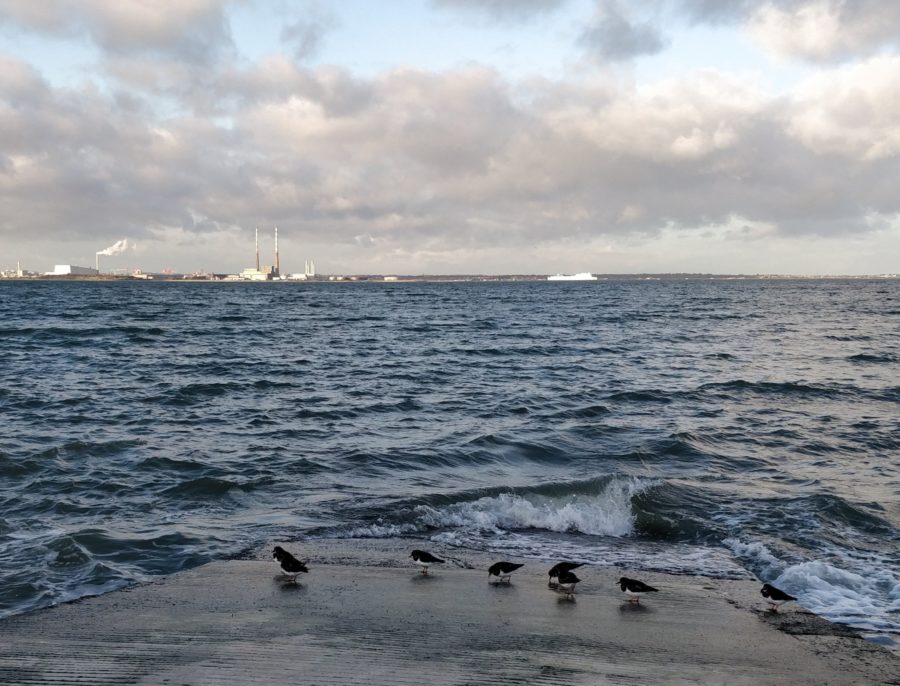
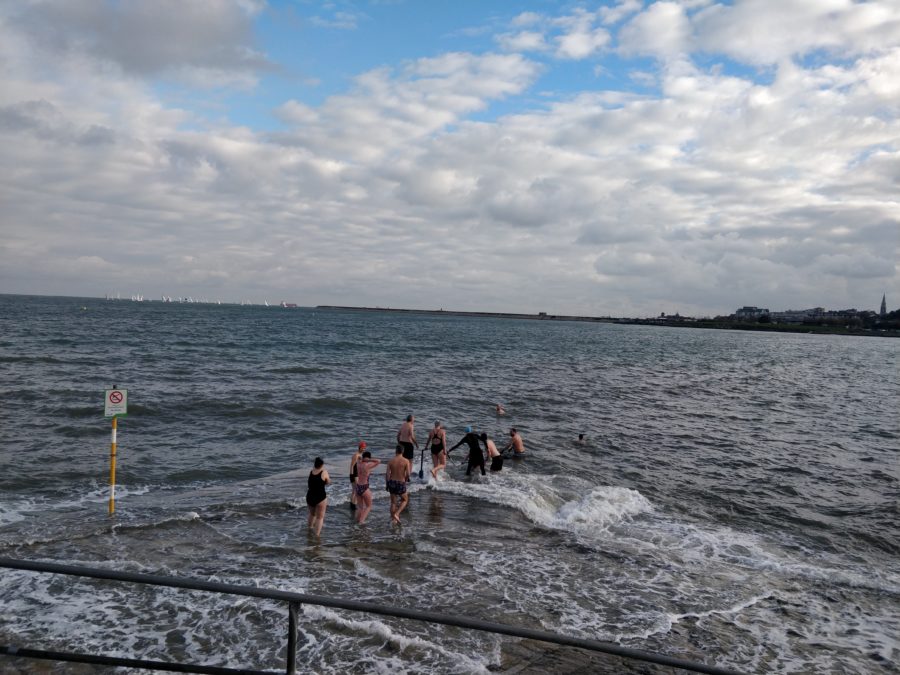
    Picture this scene. Next to a Martello tower, a grimy concrete shelter below which a motley crew, ranging from whooping lads to fragile ladies, make their way, often daily, into the ocean at Seapoint, Dublin. Some swim significant distances – measured in buoys and other landmarks – others simply ‘take the waters’. There are New Irish here, while native Dubliners mix easily with country friends, in the collective gasp before wading in.

    I have visited the sea most days so far this winter. It is the dread of the cold, not the cold itself that holds the most fear. Once enclosed by the water my limbs thrash a course, and I am no longer conscious of the temperature. That is as long as I go in every day. If I leave it for any length, the cold will sting, even in the summer months.

    Is this a sport I wonder? There is no zero sum game of winners and losers. No match reports. No fandom. But there is conviviality, life affirmation, fitness and even a boost to the immune system I have been told. But something deeper motivates my immersions, and any health benefits are tangential.

    I am dreading the months of January, February and March. It is hard to contemplate temperatures that will have dropped a further three or four degrees to eight degrees.[i] Remarkably, the average sea temperatures in December is higher than in May, when the difference between air and water could be fifteen degrees. This month the water is often warmer than the air, although you lose heat a lot quicker without your clothes on.

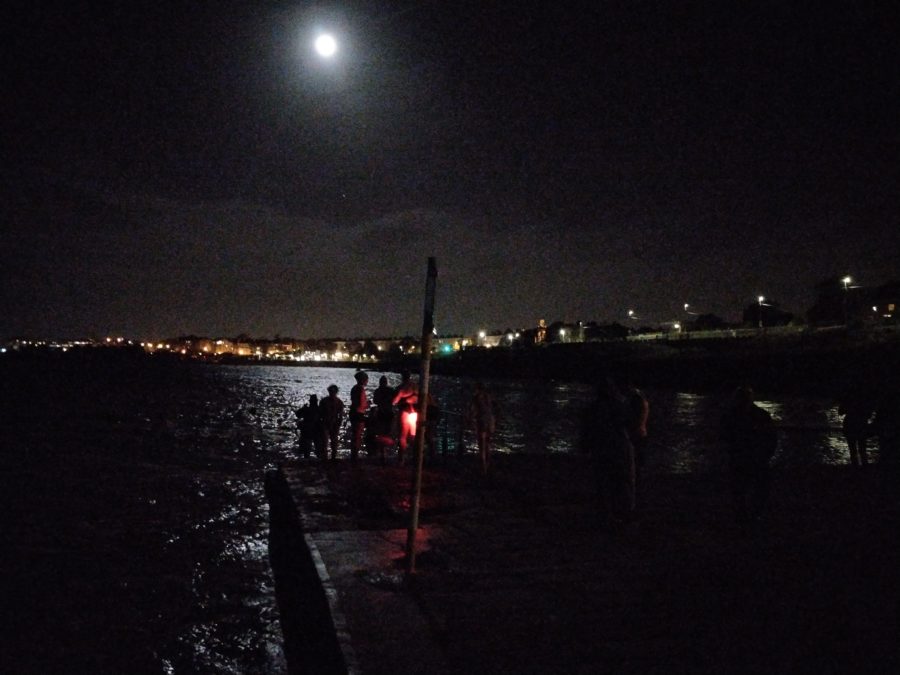
    Also this month the solstice coincides with a full moon. I have no idea if this has a symbolic significance. What I do know is that swimming with a crowd during a full moon is great craic. I have attended these lantern-lit gatherings for the past two months, and am hoping to brave it again on the 21st. One trick to stave off hypothermia is to bring along a hot water bottle to pour over extremities afterwards, making sure to avoid giving yourself a scalding.

    I have just started wearing protective gloves – which I found on the street – into the water. It makes quite a difference to my hands on the twenty-five minute cycle home. I am thinking of acquiring booties that I see other people wear, but that would involve a financial investment in this lowest maintenance of sports. Really all you need are togs, towel and a good dollop of madness.

    I take pleasure in seeing an array of birdlife by the seashore: there are the usual suspects of gulls and cormorants – which I now see are colonising the River Dodder near where I live as fish numbers decline in the sea – but also Brent Geese along with Waders some of which make their way from Iceland, so I guess they find our waters positively balmy! It is shocking to hear that shards of plastic are affecting these migrants’ welfare.[ii]

    Most days I take a picture from the same spot overlooking the Poolbeg stacks. I do wonder about posting these on social media, but I have available to me the superb technology of a telephone, which takes fine pictures of sky, sea and land converging. Obviously in the process I am selling the platform of an irresponsible multinational, but cannot the same be said of any author whose book is on display in a chain store? I just want to convey the beauty of my city and its hinterland, and how we should treasure the wildlife, and examine carefully issues like the emissions coming from that eerie incinerator by the stacks.

    This summer my mother died. Losing a parent is generally a seismic life experience. I think my dedication to the swimming has had something to do with that. Cycling to and from Seapoint I pass by places I associate with her. It is sad, but I don’t want to avoid it.

    When my mother went into a hospice I immediately returned from the UK where I had been working. The following day she said: ‘don’t let me stop you from going for a swim’, much to our amusement. Two days later she passed away.

    The other landmark near where I swim is Dun Laoghaire pier. It is so much a part of the geography of this place that it seems timeless, but it was built on the initiative of a private citizen, Richard Toucher, a Norwegian sailor who settled in Dublin, passing away in 1841. He provided, at great personal expense, most of the granite for the building of the harbour. This philanthropic enterprise saved many lives, and now provides a bit of shelter as we swim at Seapoint, where it can still get quite choppy.

    This is an extract from one of his letters:

    I write not for fame, but for utility. It is my aim rather to be understood than admired. To elegance of composition I aspire not. But I have some nautical experience…and…the idea of an Asylum Port at Dunleary is ever first in my thoughts.

    The Merchants, Ship Owners and Ship-Masters of Whitehaven, Workington, Maryport, Harrington and Parton, are also preparing a petition to be presented to His Grace The Duke of Richmond, praying his aid and support for the erection of this much wanted pier at Dunleary. This I am not astonished at, when I reflect how many of their relatives have been lost on the coast of our Bay, the numbers of widows and fatherless children that are left to bemoan that this pier had not long since been built, which would have saved to them what was in this life most valuable.

    For his troubles Richard Toucher died a bankrupt.[iii] We recall his great legacy today, this Cassandra Voice, who devoted his fortune to the continuing benefit of others.

    Did you know that Cassandra Voices has just published a print annual containing our best articles, stories, poems and photography from 2018? It’s a big book! To find out where you can purchase it, or order it, email admin@cassandravoices.com

    [i] ‘Dublin Sea Temperature’, Global Sea Temperature, https://www.seatemperature.org/europe/ireland/dublin.htm, accessed 13/12/18.

    [ii] Tim O’Brien, ‘Plastic shards from Dún Laoghaire spill found in Donabate’, Irish Times, 12th of November, 2018.

    [iii] Tom Conlon, ‘Richard Toutcher – the case for a memorial’, Dún Laoghaire Harbour Bicentenary, January 23rd, 2018. http://dlharbour200.ie/richard-toutcher-the-case-for-a-memorial/, accessed 13/11/18.

  • Who did pay that Restaurant Bill Mr Varadkar?

    Following an account of a New York banquet in a recent biography of Leo Varadkar[i], we submitted a Freedom of Information Request (FOI) to the Department of the Taoiseach. We are seriously concerned at the close proximity between the Taoiseach and leading Irish journalists, including one of the authors of Leo: A Very Modern Taoiseach, Phillip Ryan, who is deputy political editor across the titles of the generally pro-government Independent Newspaper group.

    That book revealed that the ‘Taoiseach has made a virtue out of wining and dining journalists who accompany him on international trade missions’, believing, ‘it is important to spend time with them socially’. Perhaps most troubling is that the authors seem entirely unashamed about spilling the beans on one of these junkets.

    On one New York jolly, ‘More than twenty guests, who included journalists from print and broadcast media, joined the Taoiseach and foreign affairs officials for a five-course, three-hour-long meal’. The authors, at least one of whom seems to have been present, recall the guests devouring ‘French onion soup, foie gras, filet mignon and mushroom ravioli dusted with black truffles’, followed by further drinks in Fitzpatrick’s Manhattan Hotel in Midtown.[ii] Yum yum yum.

    Our FOI sought, ‘records of department expenditures from an Taoiseach’s visit to America this year in Boucherie Restaurant and FitzPatrick’s Manhattan Hotel, both in New York on March 16th and 17th, 2018.’ We were intrigued to know who paid the bill in a restaurant where the ‘Butcher’s Block’ of 16oz filet mignon, 16oz, ‘hang steak’ and 16oz ‘bone in New York strip’ costs an eye-watering $205, and that’s leaving aside its environmental impact.[iii]

    According to the officer, the department holds no record of any such expenditures. But it is hard to believe that the Taoiseach stumped up, or that journalists were asked to put their hands in their pockets, a notoriously rare occurrence. We are now flummoxed, and invite any journalist or government official present to let us know who paid the bill by emailing admin@cassandravoices.com.

    ‘Tubs’ entertains Varadkar on the ‘Late Late’

    Fresh from selling as many toys as possible on the Late Late Toy Show, amid paeans ‘to those less fortunate this Christmas’, Ryan Tubridy interviewed Leo Varadkar on the ‘Late Late Show’ on December 11th. At the recent Fine Gael Ardfheis Varadkar pledged to reduce income tax cuts if he is re-elected Taoiseach[iv], which will presumably increase toy sales next Christmas.

    To date, we have enjoyed no success with any of our FOI enquiries into Tubridy’s third party dealings. RTÉ’s solution to the problematic situation of employees and contractors receiving payments from third parties has been to introduce a Catch-22 rule whereby potentially damaging material is withheld if it is commercial sensitive.[v]

    Tubridy previously offered this plug of the Varadkar biography, enthusing that it, ‘offers the reader and voter a fascinating insight into an intriguing and public figure that none of us really know. With incisive background detail coupled with up-to-date analysis, this is a very welcome account of a private man in the most public role in Ireland.’

    On his light entertainment show, Tubridy went through the motions of grilling the Taoiseach, demanding whether the HSE is fit for purpose, to which Varadkar replied: ‘Not as the organisation it is now,’ intimating ‘structural change’, a move to ‘slim down’ the organisation and bring ‘a lot more autonomy’, which sounds suspiciously like an impending privatisation. But it was all soon sweetness and light between RTE’s leading man and the top of the political class,

    In a departure from the Irish Times’s usual Varadkar veneration, especially the use of cutesy images obviously supplied by government press office, Peter Crawley offered this assessment:

    If, like any number of its international guests, you had no idea what kind of a programme The Late Late Show is, last night’s broadcast was as good an introduction as any.

    What kind of talk show, for instance, would interview the leader of the country as its first guest, as a warm-up act for two crooners and a comedian?[vi]

    ‘Murph’ shows up for the team

    Meanwhile, Varadkar’s loyal fixer, and founding member of the legendary Five-A-Side Club of Young Fine Gael Turks, Eoghan Murphy was before the Dáil, opposing the Solidarity-People Before Profit Anti-Eviction Bill, which includes a ban on renovating a property as grounds for ending a lease.

    Murphy maintained that the government is showing a clear commitment to social housing, but his sympathies clearly lie with embattled ‘small’ landlords, bemoaning, ‘We are losing landlords in this country, it is a fact.’

    He cited the statistic that eighty-five percent of landlords own one or two properties, but this tells us nothing about the proportion of the rental sector held in those circumstances. Moreover, a single property could be a four-bedroom house in his Dublin Bay South constituency costing €6,000 per month;[vii] lies, damn lies and statistics, as Mark Twain put it.

    Murphy’s claim that it is ‘wrong to demonise these people because they are providing homes for other people’ is a subtle abuse of the English language. A landlord does not ‘provide’ for a tenant, providing for someone implies generosity, not offering a property in exchange for a rent, which in Dublin, for too long, has been left to ‘market forces’, and the gumption of gouging landlords.

    The rhetoric about protecting the small guy – beloved of neo-liberals the world over – affords protection to owners of multiple properties, who are increasing their assets, as Murphy’s speech concedes. His political colours are revealed in this passage which will anger anyone caught in an impossible rental situation:

    We have to be very careful in interfering more than we are at the moment. We have to make sure that we are not placing extra burdens on these small landlords. And we have to make sure that we are not prohibiting someone from selling a property that they own when they might need to sell that property for perfectly legitimate reasons in their own lives. They may not have the money to re-compensate the person living in the property at that point.[viii]

    God help anyone renting in Dublin at this time, because this government’s sympathies (and Eoghan Murphy’s it would appear) lie with the wealthiest five percent in the country, who own over forty percent of its wealth, with eighty-five per cent of that held in property and land. We suggest a more important priority: to make sure everyone has a roof over their head.  Unfortunately many of the leading journalists in this country, who should be pursuing this injustice, are themselves dining at the top table.

    Did you know that Cassandra Voices has just published a print annual containing our best articles, stories, poems and photography from 2018? It’s a big book! To find out where you can purchase it, or order it, email admin@cassandravoices.com
    [i] Frank Armstrong, ‘Leo-Liberal’, Cassandra Voices, October 5th, 2018.

    [ii] Phillip Ryan and Niall O’Connor, Leo: Leo Varadkar – A Very Modern Taoiseach, London, Biteback Publishing, 2018, p.321-322

    [iii] Boucherie, New York, Menu, http://boucherie.nyc/menu/, accessed 18/12/18.

    [iv] Juno McEnroe, ‘Varadkar pledges income tax cuts if re-elected as Taoiseach’, Irish Examiner, 17th of November, 2018.

    [v] Frank Armstrong, ‘RTÉ Says: ‘Stars’ In Their Own Cars’, Cassandra Voice, July 1st, 2018.

    [vi] Peter Crawley, ‘Leo Varadkar on the Late Late Show: Taoiseach has become ‘CEO’, Ireland ‘the organisation’, Irish Times, 8th of December, 2018.

    [vii] Daft.ie, https://www.daft.ie/dublin/houses-for-rent/ranelagh/dartmouth-road-ranelagh-dublin-1858718/, accessed 18/12/18.

    [viii] ‘Deputy Eoghan Murphy – Private Members’ Business – 12.12.2018’, YouTube,   https://www.youtube.com/watch?v=z1RRw0lM9iI, accessed 18/12/18.

  • Hello Julian Assange

    It was sunny outside. Manus still felt something akin to minor guilt at lying in bed on a sunny day. Just having the option carried a guilt. He had spent most of his life not having to get up in the morning, not working, living off social security benefits.

     There was a certain amount of guilt involved but it was easy to rationalize away. In a world that accepted the waste of half of its food production each day, and for thousands of kids to die of hunger each night, rationalizing guilt away came easy.

    He would have liked to fight against the injustices of the world but it seemed like a global system with no head to cut off that wouldn’t pop back up immediately. Manus had not spent his life researching and exposing corporate crimes or hacking computers. He wouldn’t know where to begin with research and when it came to computers he was technologically challenged.

    His lifestyle choice to just take drugs and scrounge off the state as much as they would allow had been as proactive a revolutionary stance as he could manage, which the less enlightened members of society failed to understand, instead viewing him as a lazy good-for-nuthen-opportunist-bum, but Manus didn’t hold it against them. ‘There but for fortune’ after all.

    No, regardless of mainstream social exclusion, condemnation and relative poverty for someone living in the privileged sector of the planet, Manus had often enjoyed his choice: to lie in or get up.

    This morning, however, he had allowed himself to be robbed of all enjoyment.

    This morning he was cursed with the knowledge that he had pushed a young woman away from him.

    She liked to keep her options open and he had texted her more or less demanding that she give him a definite date for their next meeting. In a ‘normal relationship’ this might well have been acceptable but this was not a ‘normal relationship’. In fact this was not a ‘relationship’. Avril had insisted from the start. She didn’t want a ‘relationship’. She liked to call round. Once or twice a week. Just for sex. And sex had nothing to do with anything. So Avril said.

    But after a few months, Manus got used to her and when she didn’t call for a week or so he was pushing her for rights he didn’t have.

    It was in the contract. She was younger than him by over two decades. All she wanted was a bit of fun and instead of being grateful he had pushed the last woman who would ever fuck him away. Now there was guilt.

    He didn’t want to get out of bed all day. He was stupid and now he was condemned for his crime. Sentenced for the rest of his life to be alone.

    (It wasn’t really true as his thirteen year old daughter who lived with him seventy-two hours a week every weekend would have been quick to point out. But this was the other ninety-six hours of the week, and he was alone.)

    Ah the suffering and the pain.

    He would lie with it all day. No, that might have been excusable had he been thirty or forty years younger, but he wasn’t and though he was very tempted to visit an old favourite familiar haunt, he was just too old. He knew he didn’t have that many days left to waste, no matter how favoured and familiar an old haunt it might be.

    And he had things to do.

    It was Assange’s birthday for a start. Manus was to meet people at Saint Stephen’s Green at a quarter past one. They were going to deliver a letter to the Australian embassy. Originally they had just talked of making a cake and Manus had thought to hassle a friend or two over to play guitar, and maybe see if they couldn’t get something like a small street party going. But that had been before Avril had ditched him. Since then Manus was lacking the strength or enthusiasm to hassle anyone. Yet again his broken heart had got in the way of political activism, or positive action of any kind.

    Ciaron O’Reilly had instigated the protest.

    Amongst other things Ciaron had taken a hammer in his hands and damaged American war planes that would otherwise kill or harm the poorest people in the world.

    Acting like a responsible citizen had earned Ciaron hard time in high security prisons, and Manus’s respect.

    So perhaps it was for Ciaron, as much as for Julian, that Manus would get out of bed and make his way into town. Manus imagined Julian Assange wouldn’t be overly impressed with their protest. Nobody could be. There would be half a dozen people, a dozen people at the most.

    Most passers-by wouldn’t know who Julian Assange was.

    Against a tsunami of banners and all the technology money can buy, which told people that what Julian Assange was doing just wasn’t important, Manus and a few others would stand with a single banner saying ‘free jullian assange’. The few standing with the banner, if they got noticed at all, would look like weirdo nutters. Manus was going to go, perhaps just to show some solidarity with the weirdo nutters.

    Around 11a.m. George Kirwan called for Manus.

    George was one of them smart ass bastards from a fairly privileged background; a former chairman of a Trinity debating society, who would come up with a nuanced argument against anything you said. Manus was one of those dumb ass fuckers from a fairly unprivileged background, where debating skills ran from shouting to yelling personal threats, to physical violence.

    Manus asked George why he wasn’t going to the protest. George said he didn’t protest anything because he thought it was ineffective. Manus asked if all ‘protest was ineffective’ then should we do nothing? George backtracked saying ‘he very seldom protested and saved his energy for the ones he felt were important, which did not include Assange.’  Furthermore, George wasn’t sure Assange was his political ally since Wikileaks had, ‘not just published, but directly funnelled leaked documents to the Trump campaign first’; George continued: ‘directly dealing with a dime store Hitler was naïve in the extreme and a wrong act’.

    It didn’t ring true for Manus that Assange or Wikileaks would be dealing directly with the Trump campaign, though as usual he hadn’t done much research and couldn’t say with any certainty. George as always was certain: ‘there was a server in Wikileaks communicating with a server in Trump Tower’, George swore it with rather more venom in its delivery than the truth needed. Trinity’s training got lost and George could be as emotive as any uneducated thug when he defended a false position.

    Manus said that since he had started speaking for Assange he had heard all kinds of negative fact and fiction. All of which for Manus sidestepped the main issue.

    Publishing the crimes of the powerful should be applauded, not a punishable offence.

    For none of these other reasons, fact or fiction, would Assange be imprisoned.

    Wikileaks was known all around the globe for telling the truth. It had an effect on the way the world was perceived, with potential to affect how it’s citizens and environment were treated.

    Allowing the Wikileaks founder to be imprisoned would send a clear message ringing around the world. Exposing government and corporate crimes would not be tolerated.

    George lost some of his evangelical zeal against Assange and relented with, ‘their wasn’t enough evidence against him for a conviction, but enough to lose him the support of the left.’

    George spouted on then about some group in America who used to fight legal cases for poor black communists to have the right to preach communism and then they fought for rich white fascists to have the right to preach fascism. Then they decided they didn’t have enough resources to fight for both and decided to just fight for the Commies. Not that he was saying Assange was a fascist.

    How had the so-called left gone along with this crap? How had the most effective exposer of corporate and government crimes been turned into the left’s enemy, or person of no worth, or person they least wanted to defend? The answer was obvious, corporate power had attacked Assange because he exposed their crimes and the corporate media swamped the world with their attack, but it was the left’s acceptance of such obvious diversions and spurious attacks that bothered Manus.

    Manus had a frazzled brain. Too much: drugs, drink, punches to the head. He couldn’t always take in a lot of info and he could retain less. George hadn’t done half as much drugs or drink and had probably never been punched in the head in his life. Manus wasn’t fit for arguing with him.

    The two were friends of a sort. They had both protested against the Dublin Housing Crisis; they had both helped out at a social centre. They helped each other sometimes. For all their differences they had things in common.

    George had brought his three-year-old daughter Paulina. Paulina and Manus had gone through a number of high and low points over the three years of her life. Manus had been a fun distraction one night while both her parents had sneaked off but when Paulina became aware of the dirty trick that had been played on her she screamed all night. It had taken a long time but Paulina was gradually forgiving Manus. She got Manus to flush the toilet for her. Which Manus did again and again and again and again. Paulina was delighted. It was nice for Manus too, to perform a task that seemed a worthwhile and appreciated service.

    Nick phoned and arranged to meet Manus on Saint Stephen’s Green. Like Manus, Nick came from the North. Like Manus, Nick had been called names and spat at a lot when he walked the streets as a youth. They both shared the experience of gangs of loyalist thugs throwing bricks and bottles and chasing them. Manus was a taig in a mostly prod area and could run for one of the taig streets. Nick was actually a prod in a totally prod area but his family would have been the only black family in his whole estate. Loyalists in the North of Ireland were known for their sectarianism, but Nick’s family gave them a chance to prove they were just as racist. Nick developed fighting skills whereas Manus was just a great runner. Manus figured Nick had always tried and usually managed to beat the bastards at their own games. He could fight better, play sports or chess better and stand at the bar and talk bullshit about football better than anybody.

    Nick was over six feet tall and when he let his dreadlocks out of his big hat they came down to the floor.

    Manus and Nick had coffee, sat on the grass on Saint Stephen’s Green. Manus babbled about his own child’s graduation from primary school and how it looked like an American teen movie. And how he felt depressed since he had just pushed that woman away. And how he hoped to get a ‘coffee with Chomsky’ van together which would permanently play Chomsky speeches or Democracy Now! episodes or CounterPunch news, or any alternative to corporate news and views of the world. Everywhere you looked there was a corporate message. One small screen wasn’t going to achieve much, but it just might keep his personal sanity.

    Nick loved the idea. Nick was a cobbler by trade but still hoped to build a studio and record his own music. He had two grown boys up North who visited regularly, but Nick at fifty years of age now lived in Dublin with his new partner and their five year old son Thor.

    Nick babbled about his partner going to some medium who had said Thor was a really old soul. Manus’s mother used to go in for that type of stuff. Nick also went on about how England was still in the World Cup and how Manus, even though he wasn’t into football or nationalism, had to join in the world’s prayer that England couldn’t win the World Cup. The world would never hear the end of it. They still hadn’t shut up about their win in 66.

    At least, thought Manus, Nick didn’t repeat the football being more serious than life or death crap.

    Manus and Nick met May O Byrne at the main gate outside Saint Stephen’s Green. Nick had to go to pick up his kid but Manus introduced them anyway. Telling Nick: ‘come on and meet this one she’s cool.’

    ‘Nick this is May she’s an activist. May this is Nick he’s not stopping today but he’s one of us.’

    Nick went on and May and Manus stood alone.

    May had the petition letter, but said she wasn’t that pleased with it because it quoted Obama. The fact that Obama had been responsible for so many deaths in his time put May off.  Manus shrugged. He didn’t reckon the Australian government would give a shit what the letter said. They were never going to protect Assange. What government in the world was going to thumb its nose at America?

    May was even older than Manus. She said her husband wasn’t well enough to attend. He was eighty-five. Her hubby had been a newscaster in Australia. She said he could see the telexes that came into the news office which never got read. After a while he found it impossible to put on a face that looked like it believed what it was reading and so he lost his job.

    May said there was another Australian coming. A woman called Kate. Manus tried to check himself from his ridiculous notions of finding a partner, long or short term, in Kate. At his age looking for a partner. How long did he think he had left? Still his mind ran on. She would probably have rolls of fat hanging over her pants and a squashed up ugly face. He was shallow.

    She turned up. Fit-looking and highly attractive.  When May went to shake hands Kate insisted on a hug. Manus got a hug too. A bit of much needed physical for Manus. She had been visiting her parents. Catching a flight back at the end of the week.

    Just right for a non-committal shag on a holiday thought Manus.

    Kate said she had emigrated to Australia on her own in the seventies. Had Manus heard that right. Emigrating in the seventies on her own made her around his age. Was that possible? Had he found an attractive woman from his own age group? Could she feel attracted to him?

    Youth went for sexual gratification, age expected accomplishments or at least a place in society. Manus was the least accomplished person in the world, with the lowest place in society.

    He had to stop with the negative self-image. It was that Avril ditchen him thing. It was the getting no nouky. Being the least accomplished person in the world or his place in society didn’t bother him so much when he was getting laid.

    Kate had been shoe-shopping. ‘Well shoes are just so expensive in Australia.’

    Believe in the corporate portrayal of the world or not you still had to live in it.  And despite his own choice, he understood that being a bum was not a popular preference.

    Sid turned up with his bowler hat, scarf, waistcoat and corduroy trousers. A talented singer song writer. Sid and Manus were close enough in years. They talked of Ciaron O Reilly’s unceasing efforts. They both did little bits now and again but Ciaron was full time, twenty-four-seven, year-in year-out. They talked of their kids. Sid’s daughter, born when Sid was in his twenties, was in her forties now. Sid said he had been there when his daughter was a child but he may as well not have been. Sid didn’t drink now but he had been a hard drinker. Manus was coming on fifty before a woman had decided not to abort his kid. Age must have granted him some semblance of sense then, as he had stopped drinking and hard-drugging in order to look after his daughter.

    It had clearly been the better buzz.

    Liam arrived. Almost in his forties, with a twenty-one year old son that he had fought for and gained joint custody over when the child was young. A clean cut man from a stable background. Manus and Liam had put the movie Underground: The Julian Assange Story on in a social centre before Assange’s sixth year in detention. They were useless at getting an audience. They got the usual suspects: June; Sid; Manus; Liam; Dave; and Brian (Brian couldn’t stay though, he was no spring chicken and probably didn’t enjoy the music plus, any talk of computers confused him. He had never used one). There had also been a new face, a Polish girl who actually came to the protest the next week. Liam had remained upbeat and positive. The Polish girl was a new convert. One at a time huh? Even if he was getting laid, getting paid and had a place in society other than lowest, Manus’s optimism couldn’t turn the idea of one person into the possibility of victory. Liam was realistic enough too though. Like Manus he saw no victory possible through their pathetic efforts. And like Manus he didn’t know any other tactics. And while the effort and its lack of effect made them feel useless, not to make the effort made them feel worse.

    Paul arrived. Manus didn’t know much about him. Seen him at a few protests. In his thirties maybe.

    He lived down the country somewhere, but if he was in the capital and something was happening he would go. He looked a solid, stubborn sort that would be good to have beside you in a line against thugs in uniforms.

    Ann arrived. Manus had never met her before. She was writing a piece for a Russian magazine. Younger than Manus by a few decades. In a flouncy dress. Manus’s attention switched. Them flouncy summer dresses always got Manus.

    Sometimes he could be such a letch.

    They walked through the park. Manus asked Sid if he had had much success as a singer-songwriter. Sid said, ‘No. Thank god.’ ‘Why? Did you not want success?’ asked Manus, to which Sid replied ‘my head’s so big already it would have blown up completely. Sure I’d a had to get myself a new hat and everything.’

    Manus understood how difficult it would be to cope with success. And agreed with Sid’s sentiment, but in actuality he could have done with a bit of it.

    They walked through the park and after a wrong turn or two found the embassy.

    Martine was there with his two kids who were both under ten years old. Martine had thought of becoming a priest, but had backed out at the last minute. Thank fuck.

    The letter requesting that the Australian government start looking after Julian Assange’s human rights, signed by two and a half pages of Australians living in England and further afield, was read. Photos were taken. Manus held a banner: ‘free Julian Assange’.

    That was it.

    Martine and his kids went off.  Everyone else decided to go to the park for coffee and tea and small buns with a single letter of the birthday boy’s name on each one. Thirteen buns.

    They had the banner spread out in front of them on the grass.

    Free Julian Assange.

    Kids were still starving to death while half the world’s food production was being destroyed. Ecological and nuclear disaster threatened the planet like never before while the corporations’ need for constant profit kept pushing us all towards said disaster. And Julian Assange was hold up in some room in London, threatened with life imprisonment for publishing the truth.

     And it was a beautiful sunny day in Dublin’s Saint Stephens Green.

    The group talked and exchanged phone numbers. Manus didn’t offer or ask and wasn’t offered or asked for a phone number.

    Sid called to him as though the two should walk off together, but Manus stalled. He wanted to walk with Sid but what was Kate doing?

    Liam was showing Kate where the museum was. Manus went too. Perfect, Liam would walk off and Manus could show her round. It was almost too pat. Walk and talk round a museum with an attractive woman he had met at a protest. Engaging conversation and curiosity glances. They would get some food. Time would pass and she would have to get the last bus back out the country unless she wanted to stay in Dublin for the night.

    As usual his mind ran on fantasies. but his mouth said nuthen.

    Liam hugged her goodbye.

    Manus hugged her goodbye too.

    On their walk through town Liam asked Manus if he would like to write a letter to Julian. Manus kina shrugged his laugh. Manus had spent his life trying to ignore or block out what he thought he could do little about. And now he wanted to write to Julian and say he supported him. Hopefully there were better more effective supporters than Manus.

    Did you know that Cassandra Voices has just published a print annual containing our best articles, stories, poems and photography from 2018? It’s a big book! To find out where you can purchase it, or order it, email admin@cassandravoices.com