Out with the old, in with the new. In the same month that Don’t Look Back in Ongar (2024), the final (27th) instalment of the Ross O’Carroll Kelly fictional autobiography was published, the Irish-language musical comedy Kneecap (2024) quickly became the year’s highest-grossing cinema release.
The differences between these two are more than apparent: the ROCK books and newspaper column have given us a satirical history of the south Dublin elite as the country bounces between booms and busts over more than 20 years, while Kneecap is the semi-biographical contemporary story of two working-class Belfast boys who team up with a schoolteacher to form Kneecap, the Irish-language rap group. But it’s also possible to imagine a baton being passed along here, especially when we regard the books and the film in terms of the linguistic shitscape that is modern Ireland.
In the semi-fictional universe of ROCK, the contortions of the English language are the greatest source of comedy, the most pertinent commentary on class and gender difference, and the clearest exposition of Irish culture as being in a state of perpetual colonial aftermath. The bizarre renderings of various accents in ROCK, along with highly convoluted slang, its very narrow field of cultural references, and the characters’ sponge-like acquisition of Americanisms, are a turn-off for many. But they are flattering for readers who, by understanding the linguistic nuances, become themselves the objects of satire.
Kneecap is more patently ‘about’ language. In the film itself and in the band’s music and branding (Kneecap is a band in the real world), language is described in the clearest terms as a political issue. The use of Irish, especially in the northern context, is an anti-colonial act – the campaign for the passing of Irish Language Act of 2022 in the British parliament forms the background to the story. Each word is a bullet fired for freedom, according to the mantra of the die-hard pre-ceasefire philosophy of one protagonist’s father (played by Michael Fassbender, who played Bobby Sands in Hunger some years ago). Alongside the fluently delivered postcolonial critique of language and empire, the film also plays on more subtle conflicts of personal battles fought with language – one protagonist whose parents have raised him in Irish and now refuse to speak it to him, another who refuses to speak English when detained by police, and another who hides his Irish-language musical activity from his language-activist partner.
Cultural Divide
These mutual misunderstandings will put ROCK readers in mind of the language barrier that is raised between Ross and his own son, Ronan, who has been raised in Finglas and speaks with a working-class Dublin accent. Now Ronan works in the highest government circles for his grandfather (Ross’s father), the Trump-adjacent Taoiseach. Father and son both speak English, and Ronan always understands Ross, but Ross often just does not get what his son is saying to him:
‘I shouldn’t be tedding you this, Rosser.’ ‘You might as well tell me? I probably won’t understand it anyway.’ ‘The Gubderminth ren ourra muddy.’ ‘They what?’ ‘Thee ren ourra muddy.’ ‘No, it’s not catching.’ ‘Thee.’ ‘They.’ ‘Ren.’ ‘Ran.’ ‘Ourra.’ ‘Out of.’ ‘Muddy.’ ‘Oh, muddy! Okay, I get you.’
The joke is partly Ross’s low intelligence, which is what he is referring to at the start when he says he probably won’t understand. Ross is completely ignorant, near-illiterate and unable to focus on anything requiring mental exertion. But he is firm in his self-identity and in the cultural values that count (rugby, private schools, luxury consumption, machismo, etc.). The joke is also of course based on class caricatures, and the working-class characters are treated with as much Swiftian mercilessness as anyone else.
More than Swift, however, the contortion of English in the mouth of Ronan resembles the Joycean madness that descends on the language, on all languages, in Finnegans Wake in particular. When Ronan speaks, the Attorney General becomes the ‘Attordeney Generdoddle’ – and the reader finds themselves in the position of Ross, trying to transform this hibernicized monstrosity back into something comprehensible, back into the language of power. The ROCK books are full of these linguistic breakdowns and anomalies, of characters talking past each other, of language acting as a pick with which to dig even deeper into one’s own trench. The world of the ROCK books, like the language that is spoken in them, is chaotic, controlled by the wrong people, and full of injustices in every chapter. This dark portrait of Ireland, like the best satire, is delivered as a prolonged, stupid, sick, and yet funny, joke.
Naoise Ó Cairealláin with Michael Fassbender in Kneecap.
Labour of Resistance
While the do-nothings in the south live free of the British yoke, the Belfast crowd are working hard at the labour of resistance. Education, self-motivation, organising are all positive attributes in Kneecap, which goes some way toward explaining the heavy emphasis on drug-taking hedonism that runs throughout, a careful counter to the characterisation of moralising busybody do-gooder that in other times and contexts has stuck so well to militant gaeilgeoirí. Indeed, when Irish does occasionally appear in earlier ROCK instalments, it tends to reek of worthiness, a tool for virtue-signalling southerners for whom gaelscoileanna are little more than feeder schools for the elite private institutions.
That there is something important and vital at stake is absolutely clear in Kneecap. The achievement of bringing so many people to see an Irish-language film, both within the island and without, is enormous. The band and the film itself combine masterfully punkish attitudinizing and youth-coolness on the one hand, and mainstream institutional endorsement on the other. The Kneecap thing is slickly done and, with money from TG4, Northern Ireland Screen, Coimisiún na Meán and Screen Ireland, plus public endorsements from people such as Elton John and Cillian Murphy, and positive coverage everywhere from the Guardian to the LATimes, they will bring the Irish language and the reasons why it should be spoken to more eyes and ears than perhaps anyone has ever achieved. They also show no sign of toning down their solidarity with Palestine, which will surely hurt their chances when it comes to the Oscars, now that the film has secured the Irish nomination.
Joyce jokes in A Portrait of the Artist that the best English in the world is to be heard in Lower Drumcondra. Ross O’Carroll Kelly would be dismayed to hear this, given that it is on the northside, but he would also have to admit that he is no judge. In fact, he might not even understand the statement, whether joke or not. Being in judgement about language, having an opinion of any kind, is a sophisticated thing in the ROCK universe. In a way, this is a kind of guarantor that the language that does get spoken there has a kind of spontaneous purity, as it flows with so little friction. In Kneecap, the characters can only dream of being so mindlessly expressive. When we look ahead to the process of unification that is surely underway at this stage, the unionist-nationalist divide will occupy much of our attention, but other, vast cultural gaps run through the island, as the difference between this book and this film illustrates.
There still exists – even today – a yearning, a nostalgia for European solidarity, a solidarity of European culture. Regrettably, solidarity itself no longer exists, except in hearts, in consciences, in the minds of a few great men at the heart of each nation. European consciousness – or what one might call a ‘cultural European awareness’ – had been on the wane for years ever since the awakening of national identity. You could say that patriotism has killed Europe. Joseph Roth, On the End of the World (first published in 1933).
Late last month 28.9% of Austrians voted for the Freedom Party (FPÖ) led by Herbert Kickl, an avowedly anti-migrant, anti-Islamic party, founded in the 1950s by former Nazis. The governing conservative Austrian People’s Party (ÖVP) gained 27.5% lost 20 seats, while its coalition partner, the Greens received 8.2%, losing 10 seats. In third place, the centre-left Social Democratic Party (SPÖ) received 21.1%, marking its worst result ever. In fourth place, the liberal NEOS increased its share to 9.1%.
We can only hope that the conservatives do not enter into a coalition with Kickl’s party as Hindenburg did with Hitler’s Nazi party. Perhaps a Dutch solution will at least dilute the forces of darkness. Kickl was formerly the speech writer of the now-deceased long-time leader of the Freedom Party, Jörg Haider, but Kickl is far less ambiguous in his pronouncements than his former boss.
What’s clear is that the far right is on the rise across Europe, Ireland and the world. My own childhood in Ireland, as a half-Austrian, not unlike Hugo Hamilton’s experience as recounted in his autobiography The Speckled People, involved casual racism and bullying on account of my background.
At one level Austria is among the most cultured of nations. So, I defend it. Ma Vlast as Smetana said about Czech Bohemia, albeit a defensive posture often leads to a failure in understanding. Why Kickl? What is the Austrian Mind that has created this?
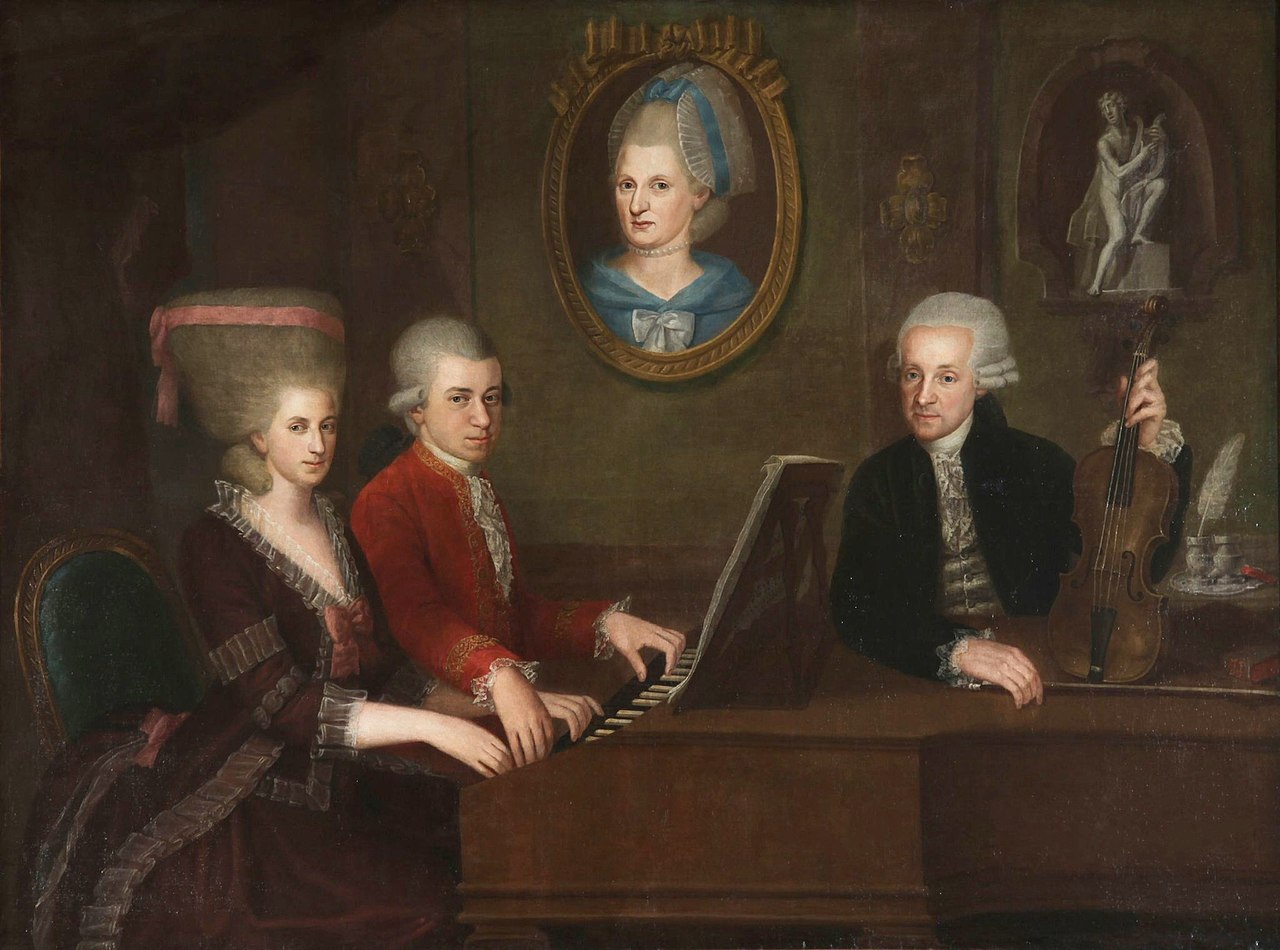
Mozart family, c. 1780 (della Croce); the portrait on the wall is of Mozart’s mother.
Mozart of Salzburg
My family, who I am close to, hail from Salzburg, home of the Fespiele. Mozart was, of course, born in Salzburg where a little museum glorifies his brief tenure on Earth. Mozart’s music combines lyricism, frivolity and profundity in equal parts. What it points to in the human condition is not just chocolate-box fripperies, or the texture of lightness that is Eine Kleine Nachtmusik,but the darkness therein. Darkness threads through the Austrian mind, juxtaposed with light.
Thus, Don Giovanni is about the destructive powers of rakish satanism, also evident in Stefan Zweig’s arguably best book beautifully filmed by Max Ophuls’ Letters from an Unknown Women.
In Mozart also the incomparable Magic Flute splendidly rendered into film by IngmarBergman, is in effect about the dubious justification of freemasonry to which Mozart belonged; and also, a cri de coeur, in praise of enlightened and benevolent monarchism against the vectors of state and, in particular, church authoritarianism. This assertion of a wise moderation against extremism resonates today.
The great enfant terrible of Austrian letters and its greatest post-war writer Thomas Bernhard was gloriously insulting about Austria. His masterpiece Woodcutters (1984) is about a man in a chair at a party sipping Champagne. Letting fly at Austrian bourgeois hypocrisy, he says:
Everything about you, everything you are, has always been pretence, never genuine, never real.
In his will, Bernhard ordered that none of his works should be performed in Austria. This has been deliberately avoided. All cultures have their tropes.
Culturally, Austrians, along with the Irish and British, have far too close a relationship with kitsch. The Merry Widowlight operetta, like a jaded ritual, is still performed in the Lehrer Theatre in Bad Ischl and elsewhere. The Blue Danube is not unlike a classic Britpop song.
The great Herman Brochwas fascinated by kitsch, linking it correctly to a decline in values:
The maker of kitsch does not create inferior art, he is not an incompetent or a bungler, he cannot be evaluated by aesthetic standards; rather, he is ethically depraved, a criminal willing radical evil. And since it is radical evil that is manifest here, evil per se, forming the absolute negative pole of every value-system, kitsch will always be evil, not just kitsch in art, but kitsch in every value-system that is not an imitation system.”
In some respects, the triumph of kitsch paves the way for Nazism, as Broch and indeed Robert Musil have both argued. Radical evil and bad art is evident in our age too. This is a kind of camp fascism which Susan Sontag also identified.
Beethoven was of course German, but lived and died in Vienna. His darkness is a counterpart to Mozart’s light. His deafness influences the isolated pessimism of the later atonal dark sonatas, and are close to the finality of expression in musical terms that Beckett created in language.
His final string quartet is integral to Dr Faustus by Thomas Mann, where the satanic composer, modelled on Heidegger, sells his soul to the devil.
I have found that it must not be. The good and the noble, what they call the human, even though it is good and noble, what men have fought for, have stormed citadels for, and in their moment of fulfilment, have jubilant proclaimed it is not to be. It is not to be, it will be taken back. I will take it back.
Mann, the great German conservative, had the moral integrity to decamp to the U.S. and to Switzerland, buta crucial point to appreciate is that conservatism is not all bad if it conserves the good and the ethical too. So, the Christian Democrats in Austria have a stark choice, whether to embrace satanism or not.
Sleepwalkers
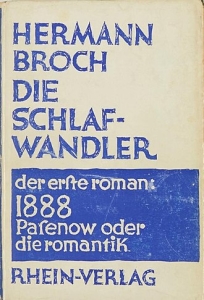
The rise of Nazism is also anticipated brilliantly in Broch’s The Sleepwalkers, one of the great novels of Austrian heritage. In the character of Hugenau, a man solely motivated by profit – homo economicus to use the term favoured by the nefarious law and economics movement in Chicago – we have a real sense in 1918 of a brutalised generation containing the seeds of fascism. The book culminates in the murder of a journalist and the rape of his wife.
This is akin to neoliberal Europe today where meaningful journalism has been effectively killed and defiled, as state-sponsored criminals launch hatred at ‘the other.’ Off with their heads, or to Rwanda, or now Albania.
The legendary Austrian filmmaker Michael Haneke in The White Ribbon, based in pre-war Germany at the turn of the twentieth, demonstrated how damage had been done to a whole generation by a cruel form of authoritarianism. Today, social media has augmented the problem of semi-literacy. Strange fruit, as Billie Holiday would say, is ready for demonisation. In Ireland the neoliberal governing parties have generated the social conditions for riots and a new decadence.
As for Italy, the land of Fellini and Da Vinci, where the far-right mayor of Monfalcone near Joycean Trieste has banned cricket as she does not like Bangladeshi people in her town; they only play cricket she says and contribute nothing. The fact that such football clubs as AC Milan was originally a cricket club seems lost on her. Mayor Anna Maria Casing, elected on an anti-immigration platform is now an MEP. Her far-right colleague, prime minister Meloni prosecuted Roberto Saviano the legendary journalist for calling her a bastard over her immigration policies.
So, Austria is not alone in its infamy.
The darkly pessimistic Herman Broch shows how the far right and populism go hand-in-hand with hatred:
It is always he, unfortunate wretch, who assumes the role of executioner in the process of value-disintegration, and on the day when the trumpets of judgment sound it is the man released from all values who becomes the executioner of a world that has pronounced its own sentence.
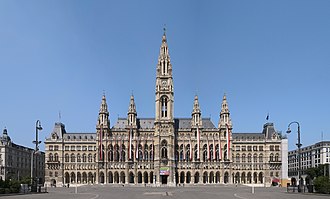
The Rathaus (City Hall), the seat of the local government.
Golden Age
The golden age of Vienna ended peremptorily with the dismembering of the Austrian empire, after the assassination of Archduke Ferdinand at Sarajevo sparked the inferno of World War I, when leaders sleepwalked into war. This is the state of somnambulism that Broch also identified evident in Musil.
The word Kaakinen is Broch’s playful word for Vienna which, in effectively means shit. Thus, he writes in The Man Without Qualities:
Stupidity is active in every direction and can dress up in all the clothes of truth. Truth, on the other hand, has for every occasion only one dress and one path, and is always at a disadvantage.
In Zweig’s retroactive memoir The World of Yesterday there are references to Freud and Herzl (one of the founders of Zionism), among the titanic intellectual figures of pre-war Vienna. These are curiously name-dropped like the celebs of our time, but in a curious state of derealisation of how history is closing in. Freud, who was Austrian, died as an emigre from fascism in the U.K..
Whether the concept of hysteria is sexual or not, no doubt this is a hysterical age where all sorts of fantasises are being sublimated into nefarious activities and agendas – and indeed where persecution delusions are omnipresent. This leads to the scapegoating of immigrants.
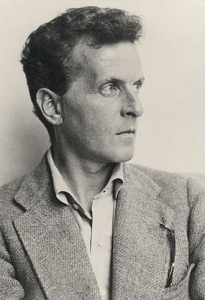
Ludwig Wittgenstein, 1930.
The Sound of Silence
Ludwig Wittgenstein is central to our age of distortion and manipulative language. The fundamental achievement of his Tractatus is a recognition of the limitations of language. It can only show and represent, he argues, and, within limitations, clarify. Thus, language is context-specific, self-limiting and denuded of ethical and moral context.
Reading Wittgenstein, like reading Hemingway, Camus, and Beckett, clarifies how language should be used clearly, and is most useful for everyday life, but not ethics. The final line of the Tractatus has acquired a mythical status: ‘What we cannot speak about we must pass over in silence.’
Silence is important, but when we can speak let us speak out ethically. A recent Austrian Nobel laureate is Peter Handke is a great writer, though not in Thomas Bernhard’s league. Handke’s flirtation with the Serbian cause, however well-intentioned and misconstrued, leave a degree of doubt, given the Austrian mindset, but there is a rich warm humanism in his work.
Handke argues you must create silence or, rather, the effect of silence, through words.A Sorrow Beyond Dreams his recent recollections of his mother’s suicide is jaw-dropping, and among the best books published in the last ten years. So let us create the silence of words, before it is too late.
Feature Image ‘Avenue in the park of Schloss Kammer’ produced by Austrian artist Gustav Klimt in 1912 whilst he was living near the village of Unterach on the southern shore of lake Attersee in Austria.
As a journalist, Anya Parampil is unafraid of rattling the cage. She now writes for the Grayzone, founded by her husband Max Blumenthal in 2015, an online publication which aims to ‘break through any narrative of the day that is pushing the United States’ public in support of war.’ Previously she worked as a producer and broadcaster, then an anchor correspondent, for Russia Today (U.S.), from which she was fired, after refusing to accept restrictions on her reporting of U.S. foreign policy.
In this podcast Anya likens writing about U.S. foreign policy from Washington D.C. to working inside ‘the belly of the beast’. Her work charts the policy machinations emanating from what she describes as a ‘deep state’ whose power, she argues, exceeds democratically elected politicians.
Anya is the author of Corporate Coup – Venezuela and the End of US Empire (Or Books, New York, 2023), which dissects the motivations of the U.S. government, under the presidency of Donald Trump – directed in particular by figures such as John Bolton and Eliot Abrams – to sponsor a shadow government of Venezuela under Juan Guaído to challenge President Nicolás Maduro.
As we approach another Presidential election, Anya sees little hope of a change in approach from the U.S. towards a country containing greater oil reserves than any other country on planet Earth. She maintains hope, however, that an alliance that includes isolationist supporters of Trump and progressive elements within the Democratic Party could in time tame the beast of this seemingly permanent government, and retains a faith that the First Amendment of the U.S. Constitution on free speech will allow her to continue her work.
“Trump Inhabits Trumpistan”, writes Chris Agee in his rampaging poetic satire, Trump Rant: “Trump Is the Wolf of Washington”. Written over a four-year period from 2017 onwards, and arranged as an expanding series of mock-newspaper headlines, Agee’s book begins as an act of stinging personal portraiture and ends as a thorough-going investigation of America itself – which appears, over the course of the poem, as both an empire in decline and a dysfunctional democracy in crisis. “Trumpian Fever”, Agee writes, “Continually Reminds Me of the Civil War Build-up of the 1850s”. As Agee recognises, and as Mark Twain likewise knew, the past and present have a habit of rhyming through the flux.
A US-born Irish citizen, based in Belfast, Agee is singularly sensitive to the totalitarian impulses and tribal resentments that the title-figure – a “Beacon of Malevolence” – has proven adept at mobilising, both in and out of political office. “Trump Is Ten Times Worse Than Nixon”, he insists, reminding us that the current Republican nominee for president “Openly Supported the Kenosha Shooter”, Kyle Rittenhouse, in 2020. Such precedents alter the civic atmosphere, toxifying public politics, possibly beyond repair.
The Trumpian era, Agee suggests, is defined by ruthlessness, for “Trump” at heart “Is a Political Cutthroat”: a charismatic leader with brash demogogic tendencies, brazenly echoing white nationalist discourses in his bloated ascent to political power. “Trump Is Malcolm X’s “American Nightmare””, we’re informed: a proposition that feels at once historically grounded and chillingly prophetic.
In this respect, the Rant may bear a resemblance to the work of Allen Ginsberg, combining oratorical force with a deep-running sense of cultural urgency. “Trump Is the Real Plot Against America”, Agee declares, “Trump Is a Mouth Who Loves Mouthing”. It should be said that part of the appeal of Trump Rant – what stops it from being merely abrasive and makes it, instead, thought-provoking and often funny – is its fizzing sense of how ludicrous Trump can be. It’s possible, indeed, that when faced with the former president’s one-man circus-show, laughter may be the sanest response. “Trump Is Impossible To Imagine as a Scuba-diver”, Agee quips, and any honest observer would struggle to disagree.
“Trump Speaks No Languages (Not Even English)”, he continues, and we begin to understand the complex blend of fixation and anger that propels Trump Rant along its hurricane-course. Whereas Trump wields language like an ugly weapon, scattering falsehoods and distortions whenever he speaks, Agee, a poet, is using his words to hold up an accusing mirror to power itself. “Trump”, he suggests, “Is The Corrupted Dream”. The Rant, by contrast, might be thought of as a visceral attempt to re-galvanise the original promise – of language as a mode of truthful speech, and of the United States as a vibrant democratic republic (or what Langston Hughes called, with painful justice, the “land that never has been yet”).
With his Democratic rivals staunchly committed to neoliberalism at home and genocide abroad, and his own party plunging ever deeper into a sludge-pit of weaponised nativism, toxic conspiracy culture and personality-worship, as a political figure Trump in 2024 seems as peculiarly emblematic as he has ever been: both homegrown product and representative man, incarnating the feral aggression and strange emptiness of American capitalism. “Trump Is a Tacky Gatsby Bamboozling the National Nick (We’ve Read It All Before!)”, Agee writes, and the tarnished nature of America’s self-mythology seems all the more polluting; the rot too rampant to be reversed.
For all its declarative zest and referential range, Agee’s book is saturated with political dread: we read it in the shadow of things to come.
Feature Image by DonkeyHotey – Donald Trump – Caricature, CC BY-SA 2.0, https://commons.wikimedia.org/w/index.php?curid=66578850
Leaves fall like secret prayers—
calling all angels
September’s having her best
orgasm in a century. Everything lingers
in climax, the character of the light, earthy
fragrances, a whole heaving calendar week
with an arched spine.
Here’s how I know the world
is ill and absurd: a dead fawn stares up
from the roadside, spots unsullied, perfect
and gone. Most days I choose to forget, but
entire families explode in Palestine. Cascades
of leaves now. Calling all angels yes god yes
Recently walking into a garage to pay for diesel, I scanned the news stand, as is my habit, to see if I had missed any of the day’s events. Something did catch my eye, and surprised me. A county Louth paper, the Drogheda Independent, had a headline about the Lourdes Hospital’s, disgraced surgeon Michael Shine.
It seemed a group of his victims had come forward and the Taoiseach was considering a public enquiry. Such abusers leave deep scars that in many cases never truly heal, but he was enabled by the culture of that time. A toxic cowardly omertà still evident in Irish society.
The reason the story caught my eye was that I was once a patient of Michael Shine. At the till, I reflected on that brief experience as a twelve-year-old.
Much to my parent’s dismay, at age twelve, I was six foot tall, and had size twelve feet. My father was a fisherman, skipper and trawlerman in the Irish Sea and Atlantic Ocean. Wherever the fishing was at, he was there. He had a wife and four children who would literally eat him out of house and home. The four children that is, not my mother, who is a saint.
The height issue was not so bad. East German army coats – available from the now long-gone army surplus store in Dundalk, Jocks – tended to grow with you, but getting the size twelve footwear became problematic. Decent footwear in Ireland has always has been difficult to find and expensive. Even now if I want a decent pair of shoes, I have to go to Dublin for the size, range and quality.
Cheap footwear is a false economy, but when you’re size twelve at twelve back in 1989, you have to occasionally hang on until all the other bills are paid, and rightly so. None of us ever starved, but purchasing size twelve shoes, on occasion, had to wait, and this wait unfortunately caused a small issue over time to arise: an ingrown toenail. It went on for a while and caused some pain, which resulted in a referral to the Lourdes Hospital in Drogheda. I can’t remember whether I was twelve or thirteen by that stage.
Drogheda.
Small Scar
I do remember that it was corrected very effectively through a small surgical procedure. As I type, barefoot, I can still see the small scar Michale Shine cut in, removing the side of the nail and the infected area of my left toenail. But before he did so, I had a consultation with him.
I was brought into a medical examination room, high up in the hospital, from where I could look out over the town. The room had a lot of windows, but was far too high up for anyone to see inside. I walked to the side of the examination table, and I think I heard him say something about my toe, so I took off my runners and socks and went to get up onto the medical examination table.
His response was “no, no, your pants as well.” I was wearing jeans at the time. I did as I was told and found myself on the examination table sitting upright, looking out over the roof tops of Drogheda. Boxershorts had not entered my wardrobe at this stage of my life. I think the under garment I was wearing are referred to as slips – men’s underpants. So, from hip to toe, on both legs, I was bare skin.
Shine placed his right hand on my upper left thigh, for my ingrown toe examination, tapped my thigh twice with his palm, smiled a shark’s smile and told me I was a “fine big boy”. Now DaVinci’s Vitruvian man measures a palm as the width of four fingers and I say it with no shame that Shine’s hand was just the width of another four fingers away from my cock. I should probably say penis, but it’s not a word I would ever use and in fact it’s a bit creepy to be honest.
The memory or indeed the incident has not affected me. It might have added some uninvited flavouring to my psychological or sexual development as a confused teenager that I could have done without. But honestly it has not adversely affected me.
I am lucky, very lucky in comparison to some. That was as far as his hand went. In fact, when he said it, I said nothing but stared over his shoulder at the only other man in the room, a junior doctor. It is the memory of the look on his face, that has stayed with me ever since.
I have learned a lot about people over the years. One thing is about how people perceive fear. Experience has taught me that they feel it in one of two ways: fear for themselves or fear for others. It can be a fleeting moment, which you can correct, or it forms who you are for ever more.
In my time with the Airport Police, I was fortunate enough to have been trained in behavioural detection. What I have learned about people, through many life experiences, allows me to honestly assess my memory of that junior doctor’s fear. It was only fear for himself. The nameless coward was mute, grey with fear and looked at me as if to say: please don’t say anything.
The enablers who reside within and contribute to the toxic culture of an organisation or indeed society are sadly simply cowards. Many are not bad people; in fact, most are not, but their cowardliness contributes to the very problems they grumble about. Some in positions of supervision and management are dangerous cowards, as they misuse their limited power and will push you under the bus in a heartbeat to save themselves.
I wonder how many boys were not as lucky as me, and actually said something? You can imagine the enablers, can’t you? Silencing the innocent to save themselves. I imagine that junior doctor would have seen nothing if I had said something.
Perhaps you’re even one of them yourself, an enabler? It’s a disease in Irish society that needs to be challenged at every level. To target those who speak out, tell the truth and call it as it is, is an attack on your own safety and your own democratic right.
Sadly, enablers cannot see that and the coward in them likes to see the whistleblower get what he deserves, which reinforces their cowardliness. They may even spread a false rumour, like the DAA Airport Duty Manager who held court in the airport control room weeks after my departure, informing those present that I was in trouble for being a wistleblower. It is not the case; it was not the case.
Or the Police Inspector who wanted me to facilitate and provide whatever training I could to a candidate for a position in the Airport Police Dog Unit, even before he had been interviewed. I might never have bothered pointing out how it might look to other officers, or how people would perceive that. I had wasted my time objecting, as the candidate still got the job. People like this all needlessly and carelessly damage our democratic society. We spend so much of our lives in a workplace; of course it is part of society. The values and culture we experience there permeates society.
I can speak about these things as I declined DAA’s unfair dismissal offer of €4,800 in return for a non-disclosure agreement. An agreement that listed forty-two separate pieces of legislation that would have inhibited me from taking any further legal action against them. If they have done nothing wrong, why have forty-two pieces of legislation and a non-disclosure agreement? Evidently, I did not sign.
The main evidence that I wanted was in a redacted report. The enablers’ legal team had the evidence statute barred. I wasn’t prepared to move forward without it.
That legal interpretation, I will argue in the future, in employment law is a scam and one that the Workplace Relations Commission are failing to acknowledge as such. Perhaps because it makes their lives easier. The statute of limitations to take a case for unfair dismissal or penalisation in the workplace, under employment law, is six months. I would argue it is not six months for the admissibility of evidence of penalisation in the workplace. This is a legal scam that a weak Workplace Relations Commission are enabling! But don’t judge them too harshly.
The enablers are alive and well in Irish society, just ask the victims of Michael Shine.
Feature Image: Our Lady of Lourdes Hospital, Drogheda
I didn’t have a chance to show you
the sainfoin I sowed back in May,
remembering our holiday in Spain
where we kept seeing it in bloom
by the road and on waste ground, covering
whole hillsides, great cerise stains
of what we later learned was Holy Hay.
Back here I bought some and spread it, watching
as seedlings appeared, unfurled nodding leaflets
in the rough and roguing wind and rain.
Maybe it was the wet, or the rabbits;
whatever, just one made it through to flower,
when each closed and softly bristled brush became
a clump of rosy Jagger lips. Yet I remember
wrongly: it wasn’t Spain, it was Sicily,
and maybe what we saw was Sulla,
Italian sainfoin, a deeper red colour,
but its name would never stick with me;
not like Holy Hay, coumarin still drifting
from an early mowing, with vetch and clovers,
sweet vernal grass, sown by an unseen other
who disappeared with the passing spring.
That’s why I tried it in our garden,
feeling it somehow sacred, so it might recover
the past; seeing it there you would laugh and
I would find in that perennial trait
passed down from your dear, faithful father
a way back to those fertile fields of grace.
Feature Image: Flowers of Hedysarum coronarium at the Jardin des Plantes, Paris
The remains of unquestionably the greatest intellect of the nineteenth century, Karl Marx, are buried in Highgate Cemetery in London. I recently tossed a red rose on the site. I doubt whether Judge Gerard Hogan, to whom I have addressed previous articles in this series, or any other legal positivist, would do likewise.
While positivists often engage, though disagree, with rights-based -thinkers such as Ronald Dworkin, most exhibit a level of incomprehension, and often outright hostility towards certain forms of Radical Jurisprudence. No doubt the often unclearly expressed ideas of late Marxism, structuralism and post structuralism often are a factor, but that is only a partial excuse.
Noam Chomsky – himself a linguistic positivist – once made a comment to the same effect on these authors, exempting Michel Foucault. He had developed a rational understanding of Foucault, but none for example of Derrida, who many including myself regard as largely intellectually fraudulent. Indeed, many Cambridge University philosophers objected to the conferring of an honorary degree on him, although I believe there is an element of truth to his babbling on relative truth or foresight.
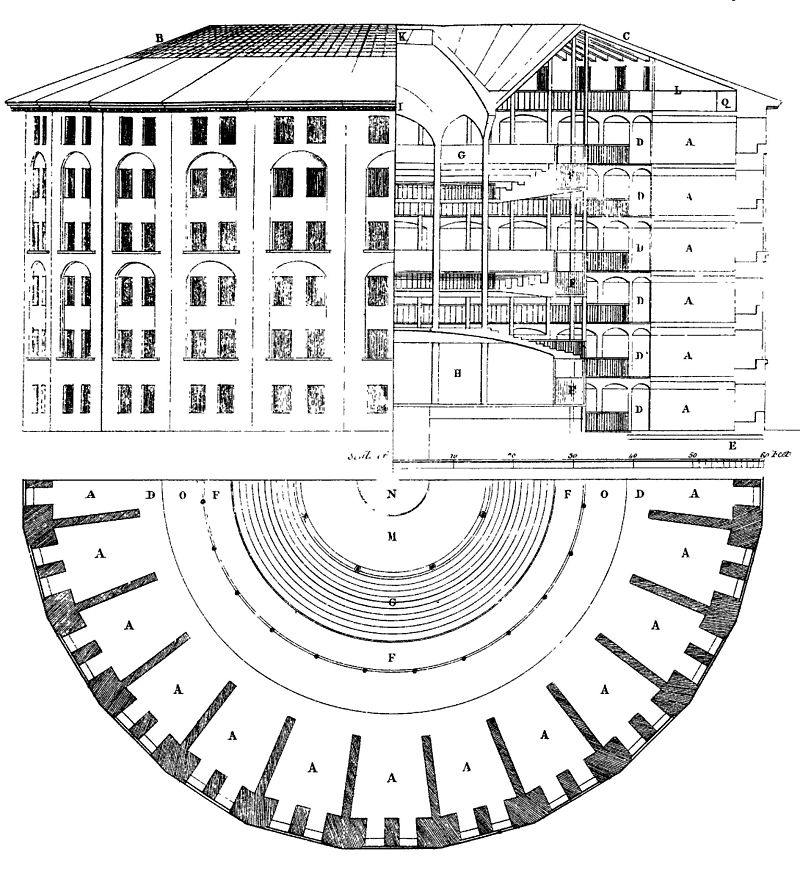
This plan of Jeremy Bentham’s panopticon prison was drawn by Willey Reveley in 1791.
Panopticon
It is, nonetheless, easy to see why, as far as my harsh assessment of post-structuralism Foucault is exempted. Foucault makes very relevant contributions to Jurisprudence and the practice of law.
First, the transplantation of Jeremy Bentham’s idea of the panopticon – the all-seeing surveillance prison such as Kilmainham in Dublin – is in Foucault’s view a depiction of modern society, where a uniform doctrine is enforced in schools, law courts and hospitals, leading to blind conformity.
Foucault presaged the age of Surveillance Capitalismand 24-hour data surveillance in Ireland, achieved in camera in the Quirke Case through the representations of the Minister for Justice Helen McEntee. Thus, we have a global panopticon wherein the value of privacy and freedom is thrown to the wolves.
Now our judges aside from Hogan, most recently in the Dwyer Case restricting the privacy right, ignore ECHR and EU law. This undermines an ideal of liberty, at least as old as J.S. Mill in modern times, and in fact going back to the Greeks. So, Foucault’s insight is not about postmodernism. It translates into the destruction of rights under Article 3 of the Irish Constitution and 8 and 5 of the Convention.
The second of Foucault’s contribution is his book on madness in the age of reason. The fundamental tenet is that the Enlightenment / Age of Reason involved the necessity, intellectually and then institutionally, to confine the unreasoned – those who were called mad – into asylums. Well, who is mad and who is clinically insane?
The recent US Democrat convention, with the rather wonderful Mr Walz speaking from the heart on middle-class US conservatism about banning books and depriving choice stands against that Twitter conversation between Musk and Trump.
The problem of reason and madness is also clear earlier in Ken Kesey’s masterpieces ‘One Flew Over The Cuckoo’s Nest’ (1962). What happens when the lunatics have taken over the asylum and a dissident voice says no? What of when the man or woman of reason, the pursuer of nuance and grey, the boy who cries wolf, the creature of the Enlightenment is locked up by those who are in fact self-interestedly insane.
Foucault was apparently not on the UCD Jurisprudence syllabus in the late 1970s. A short journey to the Arts block to encounter Richard Kearney’s expertise in Continental Philosophy would have been beneficial.
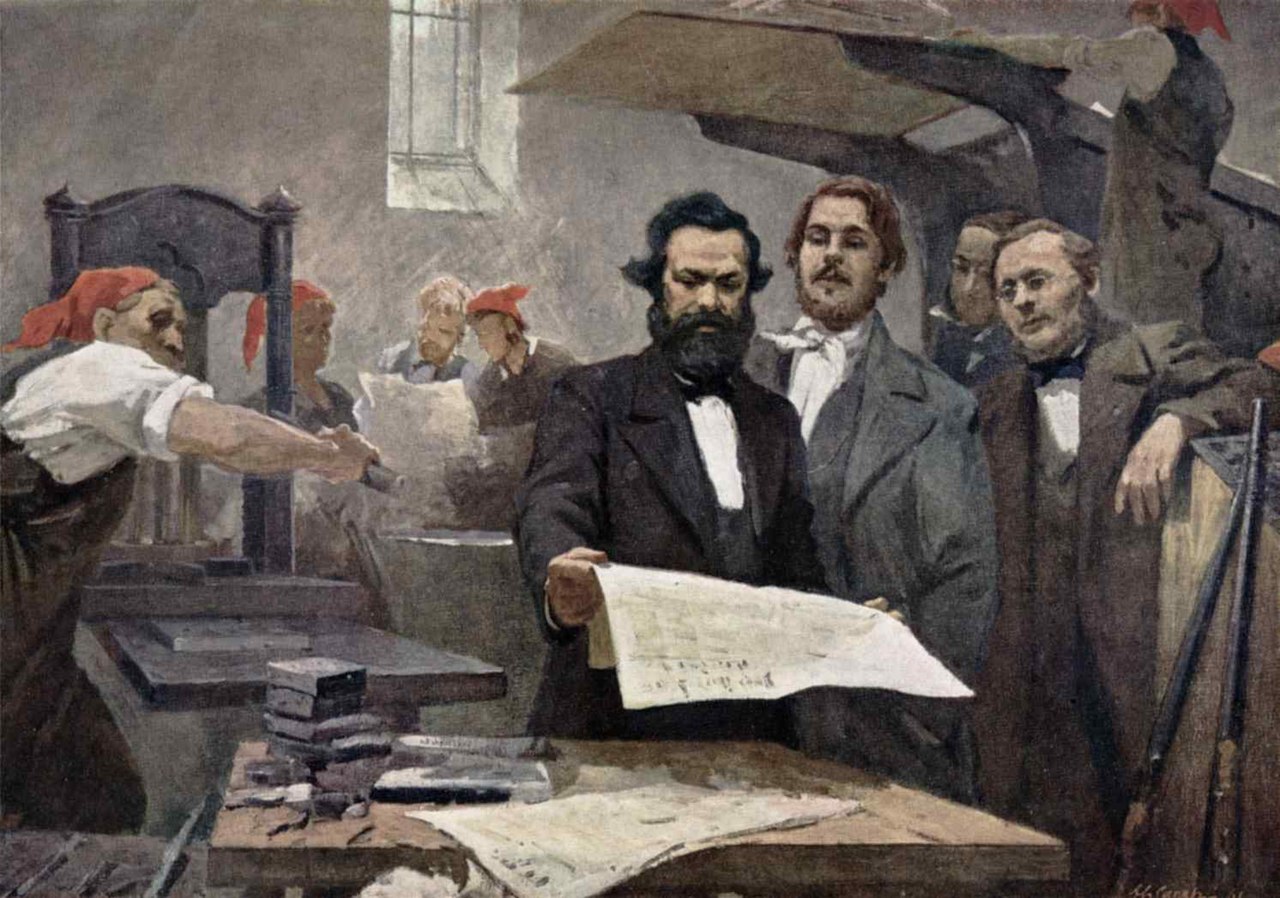
Marx and Engels in the printing house of the Neue Rheinische Zeitung. E. Capiro, 1895.
The Crucial Figures
The crucial figures of radical jurisprudence are not the structuralist, even Foucault, but the great Marxist theoreticians. For Marx law was a mirage, an ideology upholding the interests of the bourgeoisie, He considered it a mere superstructure determined by the economic base. Law, he observed, served the interests of the ruling class.
Thus, in Marxist terms Hogan’s analysis of Kelsen is a form of intellectual masking or ideology justifying a form of state authoritarianism, which Marx would surely have interpreted precisely as the Populism of the petit bourgeoisie. No judicial deferral should be granted to the popular sovereignty of the mob.
Marx though is not consistent about law. He argues that in the properly ordered Communist society there would be no need for laws, as we would spontaneously co-operate in our Communist Nirvana. But at times he concedes, inconsistently, that law is not always bad, and a close textual analysis of his views on property rights, and the freeing up of the alienation of estates to facilitate greater capital, shows that sometimes the superstructure can influence the base, and thus influence economic relations.
So, what of Ireland controlled by a landlord class achieving nothing and facilitating careers going nowhere except to Microsoft and criminal banks, or the legal service class who act like vultures preying on the vulnerable on behalf of the powerful?
The legal realist Oliver Wendell Holmes in his famous rebuke to unregulated free market economics in Lochner (1905) said the Fourth Amendment does not enact Mr Herbert Spencer’s social statics, and nor should the Irish Supreme Court enforce the interests of the commercial fat cats of Aran Square or elsewhere.
Many Marxists, such as Lenin, saw the necessity for rules in a never-ending interregnum on the way to a Communist Utopia, which is never to be achieved. More pragmatically, the fundamental question for any judge which the Marxists pose is: whose interests do the rules serve?
The Marxists influenced the critical legal studies movement, which to some extent educated me, adopting the radical indeterminacy thesis, an idea borrowed at one level from the legal realists. They argue that given the plasticity and malleability of rules, legal outcome can be very unpredictable and in fact subjective.
There really is no such thing as a ‘plain fact’ or literal interpretation of almost any legal text. To avoid nihilism we should invoke moral principle as a corrective.
Alienation
The term alienation coined by Marx more generally to describe exploitation of workers serves as a warning as to how our government is destroying both the working and middle classes,
Subsequent Marxist have been more approving of law. The legendary Antonio Gramsci, while imprisoned by Mussolini, adopted the phrase ‘hegemony’ to suggests as necessary a form of co-operation in law, politics and culture between the proletariat and the bourgeoisie. Now this coalition argument suggests law can be used as an instrument of social change. That depends on a desire to change for the good.
One wonders whether the new, petite bourgeoisie-aligned Keir Starmer government in the U.K. should be a source of optimism or seen as a false dawn? More taxes on the wealthy, or further savage austerity for the poor?
The Rule of Law is a central concept in jurisprudence, though hotly contested, and Marx aside, it has dominated the thinking of some of the main Marxists thinkers of recent vintage.
In his codicil to Whigs and Hunters (1975), E.P. Thompsonexpressed a view on the Rule of Law as an unqualified good, which at times could check arbitrary authority. That of course assumes the Rule of Law exists in an ethical polity. It is not that evident in Ireland today as core principles are violated or improperly implemented.
Thus, the independence of the judiciary is not obvious in Ireland, the use of in camera proceedings, akin to the promulgation of secret laws, is a cardinal violation of the notion that justice must be carried out in public. We also find an apparent tolerance of police corruption, the abandonment of substantive rather than formal equality, and indeed the abandonment of constitutional rights.
Thompsons argument is premised on the idea that the judges are willing to enforce the rule of law, often with the effect of unsettling vested interests, as in the recent, painfully prolonged, Assange case. Irish judges are more likely to do the opposite.
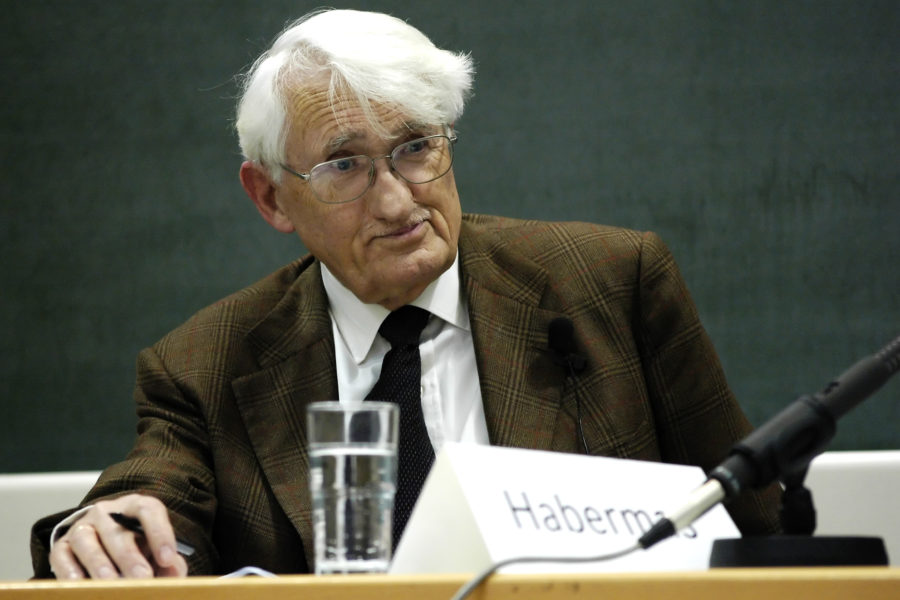
Jürgen Habermas
Habermas
Jürgen Habermas is, as ever, a crucial contemporary thinker, and, with all due respect to Gerard Hogan’s veneration of Kelsen, he is not just the world’s leading intellectual figure but the towering German intellect along with Thomas Mann and Kafka of the 20th century.
Since Habermas abandoned the Frankfurt school, and thus post-structuralism, he has become, for over fifty years, one of the great proponents of the Rule of Law and legalism. He stresses the importance for judges not to subvert rights and parliamentary laws protecting civil liberties including the right to protest, viewing civil disobedience as central to revitalizing democracy.
In contrast, the knee jerk reaction in Ireland and the UK has been to give more powers to the police to regulate dissent.
Habermas’ other idea of communicative action, borrowed at one level incidentally from the arch positivist Austin, is the elaboration of the idea of ideal speech. His ideal for the vindication of speech rights is the eighteenth century salon. The ideas of communicative action in legal and judicial terms blends into the ideas audi alterum partem (‘listen to the other side’), and the obligation not to be either subjectively or objectively biased.
Ideology, a term adopted by Marx, has been reinterpreted by Slavoj Žižek, drawing on another Marxist in Lacan, as ideological misidentification. In both instances, and applied to law, there is the sense that the bureaucratic class are engaged in false consciousness or deceptive ideas.
Lon L. Fuller, who is not a Marxist but a natural lawyer, argued that once a legal system has not a tinsel of legality left, but enforces barbarism, it is no longer a legal system.
To round the series off, a Marxist would fully understand the rage of Populism, but not necessarily approve of it. Of course pure Communist societies do not work, but nor does pure neo-liberalism. Indeed, Ireland is not working except for the landlord class.
What does work legally ethically and morally is a social democratic Just Society advocated by the master John Rawls. What does work is Sweden, Denmark, Norway and much of northern Europe, where people are not in Marxist terms commodified and viewed as product, but in the moral Kantian sense things in themselves.
John Rawls intellectually speaking would never have existed but for Karl Marx and a difficult thing for a legal positivist practitioner to realise is that Marx is in fact the greatest of all legal, political and economic philosophers. This is not to say he is entirely correct or a model to be followed in overall societal regulation, but a useful corrective to interpret laws and asses whose interest they serve and, if necessary, to bend rules to achieve socially just outcomes.
Dworkin in fact argued that the South African judges during Apartheid should potentially have lied about the content of a racist law. I also agree or rather at the very least that they should have interpreted it to bring about socially just outcomes.
Marxism at its best focuses on civil and in particular social and economic rights, and the judiciary responsibility to enforce them into the law and the Constitution, to the extent that this is consistent with the Rule of Law.
History, Stephen said, is a nightmare from which I am trying to awake. James Joyce, in ‘Nestor’, from Ulysses (1922)
If there is any substitute for love, it is memory. To memorize, then, is to restore intimacy.’
Joseph Brodsky, in ‘Nadezhda Mandelstam (1899-1980) An Obituary’, from Less Than One: Selected Essays (1986)
One of the more contentious trends in contemporary historiography, and philosophy of history, is the weird juxtaposing of memory and history, with the latter being privileged (perhaps unsurprisingly, by professional historians) as somehow superior, or more objective. This is evident, for example, in the work of Roy Foster (e.g. ‘Sorry is not enough’, London Independent, 17/07/1999), and of David Reiff (‘The cult of memory: when history does more harm than good’, The Guardian, 02/03/2016). This tendency may have partly originated in a reaction against the work of French historian Pierre Nora, who, in his efforts to define what constitutes a ‘true’ history, instigated this opposition between history and memory. Because outright political agitation and national imperatives dominate readings of history, he argued (see Realms of Memory (1996/1998), therefore there is no objective truth to be found there. However, he went further, adopting the nihilistic perspective that because memory, although preferable, is also selective, there is, effectively, no such thing as a recoverable past. In his somewhat opaque attempt to reconcile Marxist dialectics with an underpinning theology, ‘Theses on the Philosophy of History’ (1940), Walter Benjamin took a more measured, if equally audacious approach. In Thesis VI he wrote:
To articulate the past historically does not mean to recognize it the way it really was’ (Ranke). It means to seize hold of a memory as it flashes up at a moment of danger. Historical materialism wishes to retain that image of the past which unexpectedly appears to man singled out by history at a moment of danger.
But how exactly has memory come to be viewed as the poor relation of history? For what else is history, ultimately, but the product of memory? Or, at the very least, a consequence of the urge to memorialise? If only because Memory (Mnemosyne) is the mother of History (Clio), as she is of all the muses.
This shift in status is compounded by the current fearmongering panic and paranoia about the threat to humanity and the humanities by the dreaded Artificial Intelligence. While AI is NOT nothing to worry about, it should be remembered that narratives of conflict in contested spaces have always been distorted by misinformation: it is known as ‘the fog of war’ or, more commonly, ‘propaganda’. All that has improved (or disimproved, because of the uses to which it is put) is the technology. As the great Irish essayist Hubert Butler wrote in ‘The Sub-Prefect Should Have Held His Tongue’:
Speed of communication has increased, and we are expected to have strong feelings about an infinite series of remote events. But our powers of understanding and sympathy have not correspondingly increased. In an atmosphere of artificially heated emotionalism truth simply dissolves into expediency.
That was in 1956. It was ever thus. Whatever the contemporary concerns about manipulation by A.I., data harvesting, algorithms and bots, it seems to me that digitally native under-30s are more than capable of dealing with the vagaries of the media with which they have grown up and are therefore adept at handling because of easy familiarity. When it comes to being duped online, the kids are savvy enough. It is the supposed adults in the room you have to fear for and keep an eye on.
Perplexity as to the status of historiography as a somehow tainted literary representation or a scientific unbiased recounting is nothing new, with E. H. Carr’s What Is History? (1961) provoking fierce responses like that of Geoffrey Elton’s The Practice of History (1967), because of Carr’s relativism and his rejection of contingency as an important factor in historical analysis; that is, his almost proto-Baudrillardian notion of history as a partisan pursuit, a simulacrum written by the winners, or at least by those whose relative perspectives are skewed by vested interests or their own agendas. Elton, on the other hand, was a strong defender of traditional modi operandi and was appalled by postmodernism and multi-narrative histories, seeing the duty of historians as empirically gathering evidence and objectively analysing it.
Thucydides Mosaic from Jerash, Jordan, Roman, 3rd century AD at the Pergamon Museum in Berlin.
Herodotus vis-à-vis Thucydides
The Carr/Elton debate can be seen as a more recent reenactment of a controversy which has reoccurred throughout (as it were) history, for example in relation to perceptions surrounding the virtues and drawbacks of Herodotus vis-à-vis Thucydides as historians of Ancient Greece, or of Suetonius in contrast to Tacitus of Ancient Rome, the methodology espoused by each echoing the practice of their predecessors. Thucydides and Tacitus may be more analytical and less anecdotal than Herodotus and Suetonius, but their histories are still based on interviews with participants and eye witnesses, and then drawing their own conclusions. How do we know if these interviewees were telling the truth, or if their memories were accurate or faulty? They could be deliberately lying, or accidentally misremembering. Plus, these informants are rarely named. Then there is the question of how much bias effects the reliability of Herodotus’ Histories and Tacitus’ Annals of Imperial Rome, given their respective Athenian and Roman sympathies, which they freely admit. Herodotus may have been accorded the accolade the ‘Father of History’ by Cicero, but at least as early as Plutarch’s pamphlet On The Malignity of Herodotus, he has also been known as the ‘Father of Lies’. When introducing his English translation of the Annals, Michael Grant even refers to Tacitus’ ‘mask of austere impartiality’. Meanwhile, much of Plutarch is pure entertaining hearsay. Furthermore, it is worth remembering that the Greek word Ιστορία (historia), from which our own specialised meaning is derived, meant ‘research’ or ‘inquiry’, rather than the definitive account, and is how Herodotus’ titled his work.
So, while from an early twenty-first century perspective, Herodotus may seem more like a chronicler rather than an analyser, it is important to remember history’s origins in storytelling, and the influence of Homer’s Iliad and Odyssey – the stories from both of which were recited orally long before they were ever written down – on Herodotus’ mindset and methodology. Indeed, in an echo of those tales told around a campfire, which rhymed to facilitate ease of memorisation, it is believed that Herodotus would have given public readings from his Histories in Athens. For this reason, we may find it more understandable that he is nebulous about the differences between tradition and history, and that he did not always realise that eye witness accounts of the same event can vary. If literature is what is written, and Herodotus was writing history, we should not forget the debt both literature and history owe to the oral tradition.
Of course, professional historians will argue that historiography has come a long way since antiquity, especially through the use of documentary evidence – inscriptions, manuscripts, treaties, newspaper and (latterly) television and radio reports, court records, archival material and archaeological discoveries, etc. But all of these (un)reliable sources are, finally, human products and personal artifacts, and thus subject to the fallibility of the species – certainly in their interpretation if not equally so in their inception. Just because something is written down does not make it true, or even representative. What pressures were being exerted on those doing the writing and signing, and what did they stand to lose or gain by their acts of scrivening – their Oaths of Allegiance and their Declarations of War? How far can we even rely on those who observed them, or who claim to have done so? Indeed, overreliance on these constituent parts privileges literacy over the oral tradition, one which Herodotus (influenced as he was by the Homeric epics) came out of and which historians have always relied upon – however unreliable it, in turn, may be, based as it is on folk memory. To favour the written over the spoken word does a great disservice to so-called ‘ordinary’ people, and smacks of a ‘made by great men’ approach to historiography. In this prejudice originates the elevation of History over Memory.
History Faculty building on the Sidgewick Site of the University of Cambridge.
Worthwhile Academic Pursuit
None of the foregoing is intended to denigrate the study of History as a worthwhile academic pursuit. But one has only to trace the history of nationalist, revisionist and counter-revisionist narratives of past events on our own island over the preceding century or so to glean an inkling of the fluctuations of fashion in how history is done and disseminated, and to be aware that all readings of history, whatever the original sources or new evidence which come to light, are necessarily provisional. Plays by Brian Friel like Translations and Making History engage with how this history has been made, and remade. The presentation of the past, whether in memory or history (or historical memory), and the relation of both forms of presentation to the ideal of an unmediated past – that is, to an account of the past not distorted by the medium in which it is presented – is illusory. In this regard, every form of (re)presenting the past is a construction and an attempt to pass on something that is already forever lost.
The concept of historiography as representation, which can easily shade into fiction, while being presented as factual truth, has correlatives in our own time. Herodotus’ treatment of the Persian invasions under Darius and Xerxes implies an underlying conflict between the absolutism of the East and the allegedly free institutions of the West, between Persian monarchy and Athenian democracy. The fact that we have no Persian record of the Persian Wars is down to the fact that Persia was an oral culture, and their version has been lost in the mists of time. In this case, written words would have proven useful. Herodotus’ contention that democracy was the cornerstone of Athenian superiority, and his praise of it as responsible for Athens’ pre-eminent position, might make us mindful of the justifications invoked for the 2003 invasion of Iraq by the United States and Britain. While bringing the benefits of democracy and freedom to a former dictatorship was the general goal of the invasion, the proximate goad was the supposed presence of weapons of mass destruction within the jurisdiction of that regime, a piece of ‘intelligence’ which was subsequently exposed as a faulty, if enabling, fiction. However, that the reason for going to war ultimately proved to be another instance of imaginative invention, every bit as much a representation (or spin) as elements of Herodotus’ Histories, did not bother the advocates of that invasion unduly after it was discovered, evidence that people are still as enthralled by mythic embroidery masquerading as objective fact as they ever were.
To be sure, in Herodotus’ day it was the Persian Empire which was the aggressor, looking to colonise Greece, and the united city-states, including Athens, were merely defending themselves. The notable difference in our day is that it is the democrats who are doing the invading, with the sanctioning intention of toppling an absolute ruler, or eradicating terrorism. Again, how often today do we hear the sound bite, employed not only in defence of Israel’s right to defend itself, but also in support of its continued existence, that it is ‘the only democracy in the region’? Without too much of a stretch, it could be argued that Herodotus was indulging in an early version of what Edward Said subsequently termed, in the title of his masterly book which almost single-handedly founded postcolonial studies, Orientalism (1978). Having initiated the debate, Said developed it further in Culture and Imperialism (1993), sensitising the average western reader to this strange and sinister colonialism of culture. Sadly, these tropes will not cease, for obscurantism is not the sole prerogative of any epoch, or political grouping.
Said’s originality was evident in the way he defined the subject of his book. Orientalism is, first, an academic specialisation: a topic studied by archaeologists, historians, theologians and others in the West who are concerned with Middle Eastern and North African cultures. But Said added two further meanings to the term. Orientalism is also something more general, something that has shaped Western thought since the Greeks: namely, a way of dividing up the world between the West and the East. What appears to be a simple geographical fact is, says Said, actually an idea. The division of the world into these two parts is not a natural state of affairs, but an intellectual choice made by the West in order to define itself. The third meaning for Orientalism is more historically specific. Since the latter part of the eighteenth century, when European colonialism in the Middle East developed most fully, Orientalism has been a means of domination, a part of the colonial enterprise. Said argues that colonialism is not only about the physical acts of taking land, or of subjugating people, but is also about intellectual acts. The academic study of the Orient is unthinkable outside its colonial context and vice versa. So, rather than just an innocent scholarly topic, Orientalism is a general way of imagining the world’s divisions and a specific mechanism for furthering the colonial quest.
Following Foucault, Said describes the Orient as a product of discourse; that is, not as something in the world that is discovered and analysed, but as something created by Western institutions and ideas. The definition of the Orient is a means of regulating it; the apparent truths discovered are in fact ideas circulated and accepted as part of Western colonial activity in the Middle East. The sense of the Orient as a discursive construct, in turn, enables Said to make one of his most important and striking arguments: what the West believed it had discovered about the East tells us little about the colonised cultures, but much about the coloniser’s. The texts and disciplines that comprise Orientalism – historical narratives like that of Herodotus, analyses of religion, travel writing, etc – reveal the values and preconceptions of the West, of the way people in Washington or Paris or London, or indeed fifth century Athens, wanted to see themselves, their fears and ambitions and prejudices. In particular, the image created of the East is used as a means of constructing one’s own identity. The picture of the East functions as a distorting mirror image, enabling the West to say that whatever they are, we are not. This emphasises the way in which a duality, often referred to as a dyad, is set up: West and East, us and them.
In spite of the growing influence of Asian nations and the recent ‘Easternisation’ of international politics and trade, such exclusively Western- or Euro-centric readings still predominate our understanding of global history. This is a mindset which has been challenged, in what can be seen as a continuation of the Orientalism project, by Peter Frankopan, in his The Silk Roads: A New History of the World (2015), and The New Silk Roads: The Present and Future of the World (2018). One would do well also to have a look at Palestinian-American Rashid Khalidi’s books Palestinian Identity: The Construction of Modern National Consciousness (1997) and The Hundred Years’ War on Palestine (2017), in which he depicts Israel as a settler-colonial state, and argues that the modern history of Palestine can best be understood as ‘a colonial war against the indigenous population’.
Bakhmut_during_the_battle_(2023-04-05).
Proxy Wars
Both of the ongoing international conflicts which dominate the news cycle in these times, the Russian invasion of Ukraine, and the Israeli-Hamas hostilities, are in truth complex proxy wars. Appeasement, or its more recent first cousin, conflict management, does not work. As Professor Yossi Mekelberg, of the venerable Chatham House Think Tank, has written:
One conclusion from the collapse of the status quo between Israel and the Palestinians is that conflict management is a fallacy that has failed time and again. As a long-term instrument it at best buys time until the next round of violence begins. More than 75 years of conflict between Israel and the Palestinians have seen periodic outbreaks of hostilities and periodic efforts to bring peace based on a two-state solution. For most of this time the focus has been on managing the conflict. This exposes a lack of belief that a peace agreement laying to rest the differences between the two peoples can be reached. It also shows that the international collective security mechanism set up after the Second World War has failed in its mission to peacefully settle conflicts.This conflict does not need management, it needs its root causes to be addressed.
The Northern Ireland Peace Process, which culminated in the Good Friday Agreement of 1998 (‘Sunningdale for slow learners’), provides some hope that reconciliation is possible in ‘lost cause’ situations, even if underlying tensions still persist. At least it put an end to what were euphemistically termed ‘The Troubles’, with their violence and loss of life. A United Ireland will happen sooner or later, and it will be an economic problem, much as the reunification of Germany was: Britain does not want to continue footing the bill for the statelet, and the Republic of Ireland is charry of taking it on. Meanwhile, most of those resident in the territory – from whatever side of the Unionist/Nationalist sectarian divide – are more preoccupied about having to pay for G.P. visits and prescriptions, should they find themselves in a New Republic.
The Russian/Ukrainian stalemate might be resolved if Putinistas were to be purged of their nostalgia for the Russian Empire and the former reach of the U.S.S.R., and had their fears over N.A.T.O. encroachment addressed; and if Zelenskyyites were not so ardent in their pursuit of N.A.T.O. membership. The Russian invasion was not, as is routinely heard in Western governmental and media discourse, entirely ‘unprovoked’. As Professor Jeffrey D. Sachs of Colombia University has written:
A far better approach for Russia might have been to step up diplomacy with Europe and with the non-Western world to explain and oppose U.S. militarism and unilateralism. In fact, the relentless U.S. push to expand NATO is widely opposed throughout the world, so Russian diplomacy rather than war would likely have been effective. […] The key to peace in Ukraine is through negotiations based on Ukraine’s neutrality and NATO non-enlargement.
As for the seemingly intractable Israeli/Palestinian conflict, with its attendant apartheid, ethnic-cleansing and genocide on the part of the more powerful and well-resourced combatant: if Israel were suddenly left to fend for itself, without being massively underwritten by the U.S. and the E.U., it would soon have to start behaving itself, and acting in a civilised manner with its neighbours – just as a reduction in Iranian (bankrolled by Russia), Qatari and Yemeni support for Hamas would greatly alleviate tensions in the zone. Alas, this is not going to happen, given the North American imperative for a strategic foothold in the region and Zionist funding of their politicians through AIPAC, coupled with German Holocaust guilt, and the onus on oppositional sympathisers to provide some sort of counterforce. The only difference between the I.D.F.’s war crimes and those of Hamas is that the latter lacks the technology to do as much extensive damage, because the former enjoys such disproportionately huge investment, and impunity.
History makes no mistakes because it has no purpose – that much Hubert Butler must have known by that time (1930s and 40s) if only because at Oxford he read the Greek and Roman classics. In any case, the dishonesty, self-deception and self-aggrandizement of those evoking history to pull the trigger didn’t escape him, not did their utter humanness. His knowledge of Russian…and of Serbo-Croatian,not to mention his French and his German, helped him along the line, no doubt, enormously. The detection of humanness in those whose words and deeds obscure it is, however, his own feat. On the other hand, this must have been easier for him, an Irishman, since schizophrenic uncertainty is humanness’ integral part.
So wrote the great Nobel Prize-winning Russian poet Joseph Brodsky in ‘On Hubert Butler’ (1994). In what could be read as a corrective to the notion of this blind, ahistorical history, he also gave this insight in his essay on the work of the great Greek pre-Modernist poet, Constantine Cavafy, ‘Pendulum’s Song’ (1975): ‘The only instrument that a human being has at his disposal for coping with time is memory, and it is his unique, sensual historical memory that makes Cavafy so distinctive.’ However, if the school principal in the ‘Nestor’ episode of Joyce’s Ulysses, Mr. Deasy, is blatantly antisemitic in his exchanges with Stephen Dedalus, Brodsky, in another essay, ‘Flight from Byzantium’ (1985), is patently Islamophobic, displaying a smug ignorance and revulsion of ‘the East’. Indeed, so vitriolic is his repugnance, it is tempting to speculate that he is intentionally verging into parody:
The delirium and horror of the East. The dusty catastrophe of Asia. Green only on the banner of the Prophet. Nothing grows here except moustaches. A black-eyed, overgrown-with-stubble-before-supper part of the world. Bonfire embers doused with urine. That smell! A mixture of foul tobacco and sweaty soap and the underthings wrapped around loins like another turban. Racism? But isn’t it only a form of misanthropy? And that ubiquitous grit flying in your muzzle even in the city, poking the world out of your eyes – and yet one feels grateful even for that. Ubiquitous concrete, with the texture of turd and the colour of an upturned grave. Ah, all that nearsighted scum – Corbusier, Mondrian, Gropius – who mutilated the world more effectively than any Luftwaffe! Snobbery? But it’s only a form of despair. The local population in a state of total stupor whirling its time away in squalid snack bars, tilting its heads as in a namaz in reverse toward the television screen, where somebody is permanently beating somebody else up. Or else they’re dealing out cards, whose jacks and nines are the sole accessible abstractions, the single means of concentration. Misanthropy? Despair? Yet what else could be expected from one who has outlived the apotheosis of the linear principle? From a man who has nowhere to go back to? From a great turdologist, sacrophage, and the possible author of Sadomachia?
Brodsky even goes on to argue that: ‘By divorcing Byzantium, Western Christianity consigned the East to non-existence, and thus reduced its own notion of human negative potential to a considerable, perhaps even a perilous, degree.’ He also implies that: ‘…the anti-individualistic notion that human life is essentially nothing – i.e., the absence of the idea that human life is sacred, if only because each life is unique’, originates in the East, and that Western Christianity’s neglecting the experience supplied by Byzantium is the reason why college campus killers are classed as mentally ill, and presumably suicide bombers are labelled religious fanatics, as opposed to just plain evil. If supposedly enlightened classical humanists can harbour such sentiments, what hope can there be for reconciliation and mutual understanding?
Interestingly, in ‘A Man Must Not Be Too Moslem’ (1953), Paul Bowles (while admittedly, no friend of Said – See Hisham Aidi, ‘So Why Did I Defend Paul Bowles?’, New York Review of Books, 20/12/2019) took entirely the opposite tack, and was so prescient that the ideas contained therein could have been ripped from today’s headlines. He wrote:
Rationalizing words like ‘progress’, ‘modernization’, or ‘democracy’ mean nothing because, even if they are used sincerely, the imposition of such concepts by force from above cancels whatever value they otherwise have. There is little doubt that by having been made indifferent Moslems, the younger generation in Turkey has become more like our idea of what people living in the 20th century should be. The old helplessness in the face of mektoub (it is written) is gone, and in its place is a passionate belief in man’s ability to alter his destiny. That is the greatest step of all; once it has been made, anything, unfortunately, can happen.
Mit Gewalt aus Bunkern hervorgeholt (‘Forcibly pulled out of bunkers’)
Victims of Oppression go on to Oppress
It can be argued that what Israel is doing in Gaza, and has done to the countries which surround it since its foundation, partakes of the classic pattern of abusive behaviour, on a national rather than an individual level. ‘Those to whom evil is done/Do evil in return’ as W. H. Auden had it in ‘September 1, 1939’. It is not unheard of that victims of oppression go on to oppress even more. The Jewish people, who were victims of a genocide perpetrated by the Nazis during the Second World War, are now themselves perpetrating a genocide against the Palestinian people. Perhaps Brodsky’s Jewish ancestry accounts for his self-advertised blindspot: he was merely conforming to stereotype. But the Children of Gaza by now far outnumber Butler’s ‘The Children of Drancy’ (1968/78) – with the added developmental difference that now the whole world is watching their slaughter. Yet the majority of Western leaders persist in standing staunchly by Israel and its policies, paying mere lip service to popular calls for a ceasefire while continuing to supply the weapons used for the razing of Gaza and the annihilation of its people. The last thing our planet needs in this day and age is the continued endorsement and maintenance of yet another theocratic ethno-state. We in Ireland should know this all too well. George Santayana’s famous aphorism is usually misquoted as ‘Those who do not learn from history are doomed to repeat it’, but in its original form read, ‘Those who cannot remember the past are condemned to repeat it.’ Unfortunately, no one learns any lessons from history, and remembers only what suits them, which is why it constantly repeats itself – first as tragedy and then as farce.
Bad things undoubtedly follow when any ethnic or national or religious grouping (often a toxic concoction of all three) claim to have all the answers, and so start getting notions that they are The Master Race, or The Chosen People, or undertake Crusades against the Heathen or Jihad against the Infidel, or any convenient Evil Other. Note that I include here such secular religions as Fascism and Communism, which too frequently manifest as latter-day utopian belief systems which can be used to sponsor mass murder.
All wars are, at root, economic. The geopolitical importance, the religion and the patriotism, the toppling of tyrants and establishing of democracy, are just the attendant window dressing. (Doubtless, all those anti-materialists who would prefer to forget, or only remember in an approved way, will here dismiss my arguments with the classic cheap insult of ‘vulgar Marxist’ – incidentally, a phrase Foster has appropriated from Benjamin’s Theses, although used there in an entirely different context. Apparently, there exist kosher, refined Marxists, and objectionable, vulgar Marxists. Thus, E. P. Thompson is deemed acceptable within the academy, despite the fact that he expressed sentiments such as, ‘so great has been the reaction in our time against Whig or Marxist interpretations of history, that some scholars have propagated a ridiculous reversal of historical roles: the persecuted are seen as forerunners of oppression, and the oppressors as victims of persecution’ (from The Making of the English Working Class (Penguin, 1978).) Yet all wars also end eventually, if only for longer or shorter periods, either through disengagement, conquest, de facto surrender, formal surrender or negotiated peace agreement. The means of disseminating misinformation may be more covert, efficient and persuasive, but what does not change is human nature. The apportioning of blame, who has right (or God) on their side, is in most conflicts a question of ‘How far back would you like to go?’ (which is, in turn, a slightly more grown-up rendering of the childish playground staple, ‘You started it’). Would that be the first incursion or the latest atrocity, or any point on the calendar in-between?
At some point, the origin of the primordial offence recedes from history into myth – found in sacred books and the stories people tell. Sometimes it is even, conveniently, the Word of God (be it Yahweh or Allah). Arguably, memory is more historically accurate than lots of competing histories. Indeed, as has been demonstrated, many of those histories, official and unofficial alike, are based on recollections after the fact. Ultimately, history is nothing more or less than memory. Yet memory fades, unless it is recorded – however rigorously or haphazardly – in history. We currently stand as helpless as we ever were when The Sleep of Reason Produces Monsters, as Goya had it, and Voltaire’s admonition, ‘Whoever can make you believe absurdities can make you commit atrocities’ is still, sadly, applicable.
In normal times Mary used to catch glimpses of the dancers. On his cigarette break from his work in the galley he had started to station himself on the promenade deck outside the large porthole with its closed ruched curtains and watch snatches of “rehearsal”. That was a new word for him. Amongst the many languages of the service decks, English was the common language of command but the word “rehearse” was not in the kitchen vocabulary. Karim said to him one day “It’s a rehearsal” and “They’re rehearsing” and he gradually understood that it was to do with practising the dances and songs that were part of the twice daily shows. The kitchen staff didn’t come into contact much with the dancers although three of the troupe, Patsy, Greta, and Abdul had all been assigned duties serving cabin meals to passengers who were too lazy or too old to come to meals in the restaurants.
Looking into the Moonlight Lounge through the lavender haze of the drapes he started to get an idea of what these rehearsals were. The boys and girls were usually in ordinary clothes but as soon as the playback started beautiful smiles appeared on their faces. Sometimes the Boss stopped the playback in the middle of a song and made them go back to the beginning. Once Greta and a boy he didn’t know were chosen to show the steps to everyone else. Another time poor Abdul was chosen as he was doing it wrong and he had to do it again and again in front of the rest of them until he got it right. Mary thought he saw Abdul looking at the porthole where he was stationed and wondered if he’d seen him there outside, watching.
The boys and girls in the kitchen had given him his new name, Mary. He liked being called Mary. The Blessed Virgin had always been important to him and his family, and in his space in the dark bowels of the ship his only contribution to its dismal look had been an embellished photo of a statue of Our Lady that made him feel better every time he caught sight of it.
When the Coronavirus happened everything changed. No-one quite knew what was going on but after several days of trying unsuccessfully to put into various ports eventually Empress of the Oceans managed to dock in Lisbon and all the passengers and most of the crew were tested and taken off. Mary stayed on as for some reason his work in the galley washing-up and cleaning was considered essential. He was moved from his dark quarters in the hold to a beautiful cabin two decks above from which he had a view of the docks and the city of Lisbon. His family back in Manila kept him informed of what was going on at home and as always their lovely faces on the tiny screen made him happy. They told him Lisbon was in a Catholic country and he was pleased to see the white bell towers of churches that were not completely unfamiliar and he occasionally heard their bells ringing out across the city and the river.
But the “rehearsals” had stopped and when he went to take his station outside the curtained porthole for a cigarette in a break from his much-reduced duties there was nothing to see except the dimly-lit stage and the empty seats, not a soul dancing or singing, no hint of the happy smiles or the playback, all now signs of different times.
Abdul had also been kept on for some reason and was assigned the cabin next to Mary’s. He was Algerian and although not Catholic or even Christian, they seemed to have a lot in common. For the short time before everything changed he had enjoyed doing the shows and learning from the Boss and the other dancers but, as he confided to Mary, he had always felt a bit of an outsider.
As days turned into weeks and the virus continued to keep the world in stasis and the tethered ship immobile, the empty city of Lisbon, sunlit, rain-swept or mist-shrouded, continued to feature outside their windows, and Mary and Abdul became friends. The almost deserted ship became their universe. They talked, in English mostly, though with bits of French, Tagalog and Spanish thrown in, and they talked about food and their families, yes, but mostly about dance moves. Abdul was happy to share with Mary what he’d learned from his short time as a dancer. The Boss had gone but he’d left Abdul the key to the Moonlight Lounge. Abdul would put on some lights and the playback, and to the sounds devised for the pleasure and nostalgic recall of elderly North Americans he showed Mary the moves he’d learned. They kicked, they twirled, they leapt, Abdul lifted him and he felt wonderful. At a certain point it suddenly struck Mary that he was “rehearsing”.
In the inactivity and fearfulness of these virus-hit days the two of them were happy to be dancing while the huge ship around them echoed emptily and without purpose. The docks were deserted and grass was starting to sprout between the paving-stones but the monstrous white hulk of Empress of the Oceans loomed over the city and its broad river. Apart from the thin muffled beat of recorded music from the illuminated Moonlight Lounge the ship was quiet and dark.
When Mary and Abdul finished their “rehearsal” of I Will Survive, Abdul went and sat in the audience where the boss used to sit. Mary went over to the porthole and looked over the silent and deserted city through the lavender haze of the drapes. He could hear the distant bells clanging for a Sunday evening mass that was not going to happen. When he looked down at the quay there were two men with a dog, and they were looking up at the lit porthole of the Moonlight Lounge.