I tend to cite the same small handful of artists as my early influences, but I always find myself defining the difference between ‘influence’ and ‘inspiration.’ As a kid, I was really inspired by bands like Green Day, and I loved Arctic Monkeys, but that doesn’t necessarily reflect the music I make now.
You could probably draw comparisons between some of my songwriting choices and Alex Turner’s, but these bands were probably more ‘inspirations’ as opposed to ‘influences.’ In many ways, it was more about wearing a leather jacket and slicking my hair back, or pairing black eyeliner with shirts and ties, than it was about the music.
I grew up in North London, going to a lot of sessions with my parents, and I think trad music played a big part in the way I write melodies. Trad tunes are so much about repetitive phrasing and short motifs, which I think has ultimately translated into me writing music that is pretty hooky and catchy. Also, learning to play Irish music is a lot about learning tunes by ear, and I think that influenced the way I write, where melody often comes first and is generated really quickly.
Current Practice
I just released an EP called ‘if you’re bored of this city’. It’s a project about desire, obsession, and self-destruction. It’s kind of a personal exploration of my own identity, and about how relationships can become complicated by self-discovery.
I had a very complex relationship with a friend a few years ago, and that was a big drive behind the narrative of this project. Musically, I looked to the songs and sounds that were soundtracking my life at the time of that experience, so it was a lot of dark pop music off the back of the first Billie Eilish album, and the production on the early Chance The Rapper projects, and the breakout of hyperpop.
I was also really inspired by Son Lux’s soundtrack for ‘Everything Everywhere All at Once’, which I saw while I was mapping out a lot of the production for the EP. I think that had a big influence on the project, especially when I listen back to ‘Figure It Out’.
I made a whole series of videos to accompany the project, which string each song together and use the music to soundtrack this night of partying and recklessness. The project tells the story of such a pivotal time in my life, and I wanted to retell that story to the fullest extent through this lens of the art I was into at the time.
I think that’s why the videos are such an essential part of this EP. I’m really proud of what my friends and I managed to achieve with the visual side of this project, as it was all produced independently. It’s all available to watch for free onYouTube.
Future Plans
I’m really only just getting started. Right now, I’m focusing on ways to bring ‘if you’re bored of this city’ to more people, so I’m working on new shows and various other projects.
I think it’s so important to experience music in face-to-face environments with other people, and I want my work to be a catalyst for those kinds of experiences. I love creating and engaging with content online, but live events are really where I thrive, and playing my songs live is the reason I do what I do.
I think through playing more shows and being at more events post-pandemic, I’ve also found myself considering how the music I’m making will work in a live setting, and I’m really enjoying being out, and dancing, and just having a good time.
I’m always working on new music, so it’s only a matter of time before the next project clicks into place in my mind and I start rolling out the next thing…
Few writers can do grief and loss like John MacKenna. He is, without question, the John McGahern of the ‘Ancient East’. Where McGahern has put the villages and drumlins of Leitrim along the inland cusp of the ‘Wild Atlantic Way’ at the heart of his writing, the landscape of South Kildare, and its surroundings are integral to MacKenna’s works and that is no different in Father, Son and Brother Ghost where place is the sorrowful score to MacKenna’s libretto.
Unravelling grief is the strange, poignant music of the heart: If ‘grief is the price we pay for love’ MacKenna paid that price. All MacKenna’s fiction revolves around Castledermot, The High and Low Terraces of Abbeylands where the MacKennas lived: The rivers Lerr and Barrow, Mullaghcreelan Woods, Kilkea, Athy, Carlow, the Sliabh Bloom mountains and the midland bogs looming beyond are accomplices in what becomes a landscape of bitter-sweet melancholy. This memoir, mimicking the prayerful intonation ‘Father, Son and Holy Ghost’ is a hymn to MacKenna’s older brother, Jarlath whose untimely death at 62 in 2005 left the writer so bereft that he has been writing and rewriting this memoir for seventeen years between various other pursuits, not least a plunge into psychotherapy as he told a packed audience at its launch recently in the library in Athy.
Jarlath spent the bulk of his working life as a doctor in North Carolina. In this moving memoir, landscape and place become sites of consecration to a lost brother, evoked through fragments of joyful memories, where often, more harrowing family anecdotes and memories interpose – his mother’s tears when the family were leaving the Low Terrace for a larger house on the High Terrace because she was leaving behind three still born babies buried there at the bottom of the garden.
The sometimes distraught attempt to recover this lost fraternal connection reaches back into his parents’ own history, and the increasing friction and disappointment between them, caused, it appears, by Jack MacKenna’s increasing dependence on alcohol. But if Jack MacKenna was an alcoholic, he was a highly functioning one. John, as the youngest child of three, experienced these tensions more intensely, as he was like an only child because his brother and sister were away at boarding school. They were all, to different degrees ‘survivors of their own small carnage’ but he ‘didn’t know it at the time’. Set apart from their neighbours by being the school mistress’s children, the yearning for belonging abides.
Ten years younger than Jarlath, MacKenna is first separated from him when his adored older brother is sent to boarding school in Limerick while the younger brother is still an infant. In the escalating tensions of the home, Jarlath became John’s rock and anchor and his sense of abandonment in the older brother’s many absences is a source of anguish.
It seems the younger brother only realised when Jarlath died that he had never overcome these earlier losses due to their many separations. The severances are amplified, not just by the large age gap, but by the fact that Jarlath spent his summers working in England during his college years when he first studied for an arts degree followed by a H. Dip in Education and then went on to study medicine.
During these periods, Jarlath’s trips to Castledermot were brief but they are jealously recovered here. In choosing to pursue his medical career in America, the miles of the Atlantic Ocean eventually stretched between them, keeping the brothers geographically apart as adult men.
Unsurprisingly, MacKenna conveys a sense of betrayal by all these ‘sunderings’ culminating in his brother’s death from motor neuron disease a few days after he visits him. They are only spared one last night together as Jarlath deteriorated unexpectedly. All this pours forth in torrents of ‘unending loss’. Loss is ‘the tiny, pitched hole in the sky at night or the sun’s hesitation about rising at dawn’. It is ‘a grief that has been given two decades to condense but it remains’.
With incredible skill this ceaseless grief, punctuated by cherished memories is movingly retold – snatched scenes during school and Christmas holidays, pranks played, photos of the three MacKenna children on swings, at picnics, on car bonnets – photos, not provided in the book but described in the minutest detail. In this, intense nurturing of memory, MacKenna manages, not just to keep his absent brother present but to evoke both brother and disappointed father with immense love.
MacKenna’s despair was so all-consuming that he lost his second marriage amid the wilderness of the fallout from his brother’s death and for this, he is not easy on himself. Fats Domino, Buddy Holly, the Beatles, the Beach Boys, Simon and Garfunkle, Elvis, Mozart and even prayers become accessories in recovered memories – every child of the 60s will identify with them and the same goes for the rosaries and the stations of the cross. The smell of polish, beeswax and lavender evoking back-to-school nostalgia are experiences all those of MacKenna’s generation will easily identify with and they are all tinged with a hint of the sanctified.
Equally, we all knew a Lal McKenna – his single aunt whom, not unlike the heroine of Joyce’s ‘Eveline’, sacrificed her own prospects of love and marriage to care, first for her younger siblings and after that, for her sister’s children in Athy where she lived-in with the family, and also served in the shop. We all know too of the shoe-box coffins where dead and premature babies, excluded from ‘consecrated ground’ for not being baptised were, instead buried in old, abandoned graveyards or other local hallowed spots.
Jarlath’s kindness to the brother, ten years his junior are emotionally recalled as numerous amputations – the ‘tearing apart of what was their brotherhood.’ An image of their father, Jack leaning on a spade at the opening throws a shadow over the pages – a shadow ‘that reached back into the past eight decades’.
The narrative is not chronological but rather moves joltingly from different decades and places – itself evoking loss and dislocation. We are plunged into Jack’s own displacement when, after his mother died soon after he was born, he and his siblings were moved to his grandmother’s house in Celbridge. When his father remarried, Jack McKenna and his siblings were moved back to Bluebell Cottage in Athy where his father, a train driver, was based. Jack McKenna followed his own father into work on the railways and eventually becoming a signalman and foreman in Athy. ‘We are a railway family’ MacKenna informs the reader and his father was an exemplary worker. MacKenna’s earliest dreams was to be a railway worker too.
This beautifully crafted memoir on a grief that brings the writer to the edge of self-annihilation is full of hope too. We are ‘not just the people our parents make us but what we make of ourselves’ and we can ‘all if we are lucky, venture down the road of understanding and mercy’. Like his masterful debut novel The Last Fine Summer (1997) this memoir marks MacKenna out as a dazzling virtuoso of the poetics of love and loss.
Life, as we find it, is too hard for us; it brings us too many pains, disappointments and impossible tasks. In order to bear it we cannot dispense with palliative measures… There are perhaps three such measures: powerful deflections, which cause us to make light of our misery; substitutive satisfactions, which diminish it; and intoxicating substances, which make us insensible to it. Sigmund Freud from Civilisation and its Discontents (1930)
One sees it traversing through the garrulous troughs on social media, particularly X (formerly known as Twitter), and in the comments section on YouTube. For example, ‘Dads car,’ and, ‘Mums SUV’, rather than ‘Dad’s car,’ or ‘Mum’s SUV.’
It is time-consuming to learn how to punctuate and, thus, write correctly – adhering to the rules. Many find concentrating on this to be a chore. One comprehends, but… it is unadulterated, plaintive laziness.
This is not ‘Grammar-Nazism’ as the meme-led, cultural clichéd term goes. This is about improving one’s writing, working harder, avoiding inertia and Mediocrity. Many prefer verbal communication and visual stimuli to sitting down to write – in a chair ‘old school’, the traditional way.
An instantaneous gratification culture is alive and well. It descends into a podgy finger flicking on a dimly lit screen of an evening, absorbing those dopamine hits. Bobbing and weaving through the electronic morass. Jiving and twisting. The synaptic twerking of consciousness.
We, as human beings, have become slovenly. Infantilised, as we pig out on junk food. Recumbent and ‘comfy’, as we wade through the internet’s offerings. Night after night.
WALL-Es
That scene in the Disney Pixar movie WALL-E with overweight patrons onboard the flying-in-space cruise ship on hover chairs flying around onboard, never walking, watching big screens that tell us when to eat and when to chill. These humans reflect what we have become: our seemingly ambiguous comfort in this obesity has been normalised.
This is where the capitalist market has led us. There is profit in wanton laziness for those who make the products of greed readily available and easy to consume. They do not want to give up that income stream, and into the troughs come the snouts that munch, munch, and munch amidst the squeals.
Shucking up gallons of fizzy drinks. Snuffling down handfuls of sweets and munching upon oil-laden fries. Scoffing on crisps, cakes, and biscuits to fill that sugar, fat, and salt desire, with little or no real nutritional value to help our brains and bodies function.
This writer has been guilty of the above, overeating junk food. It leads to diabetes, heart disease, high cholesterol, and long-term health complications. It is a work in progress to avoid being bowled out at fifty, succumbing to gout, fat-infused valves, and diabetes.
The idea of spending, as one young person informed me of late, ‘the evening/night scrolling through TikTok,’ is a sad indictment of where many have arrived. We delight in the displayed lives of others on the smartphone’s small screen. But is there anything to be learned from this narcissistic intrigue and fascination?
This writer believes there is a correlation between poor diets and sedentary lifestyles. It is about accepting banality as the status quo and not desiring to work harder.
Mediocrity, as a movement, is parasitical. It moves onto a host, infects it with its form of banal idealism, and then moves on to the next victim, where it implements the same process. Replication. A bacillus of sorts.
Mediocrity feeds into apathetic mindsets that have been taken over by the synaptic-feed outlay. It encompasses newspapers, mainstream media, and much of what is posted on the internet. It promotes and projects an idealistic self-image. Differences are highlighted and ultimately vilified – leading to racism – day in and day out.
Terms such as ‘Shock’ and ‘Fury’ in online news articles feed into that visceral, tribe-on-alert, emotive response that keeps people in that Sartrean fear of ‘the Other’, compounding accepted, interjected biases.
We are also constantly exposed to false standards of measurement. There is a multitude of inane, beige, loquacious, naive, idealistic, and elegiac minds all desiring the same thing – to be rich and famous.
As Freud states in the opening paragraph of Civilisation and its Discontents: ‘It is impossible to escape the impression that people commonly use false standards of measurement – that they seek power, success, and wealth for themselves and admire them in others, and that they underestimate what is of true value in life.’
Having a million social media followers does not generally bring financial success – it is illusory. These individuals, who are generally beneficiaries of marketing campaigns, have become false prophets. Mediocrity is a virus, burning through media outlets, claiming there is only one way.
Because of its extensive reach and influence, Mediocrity is not readily noticed and thus rectified. It has become entrenched. The indomitable rise of Mediocrity coincides with a fall in proper adherence to punctuation and grammar rules.
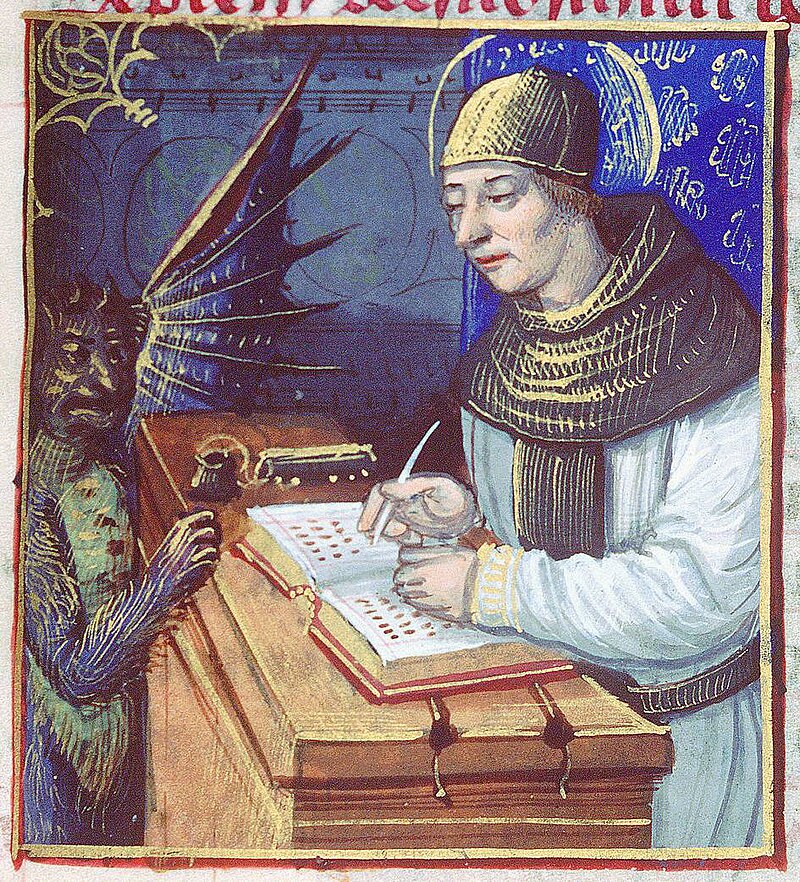
Titivillus, a demon said to introduce errors into the work of scribes, besets a scribe at his desk (14th century illustration),
Punctuation in History
As far back as 260 BCE (Before the Christian Era) in China symbols were being used as full stops on bamboo texts to indicate the end of a chapter. Around this time, Western scholars used scriptio continua, text with no separation between the words. The Greeks were using punctuation marks consisting of vertically arranged dots from the 5th century BC as an aid to oral delivery. After 200 BC, the Greeks used Aristophanes of Byzantium’s system (called théseis) of a single dot (punctus) to mark up speeches.
In addition, the Greeks used the paragraphos (or gamma) to mark the beginning of sentences, marginal diples to mark quotations, and a koronis to indicate the end of major sections.
To take two forms of punctuation, the comma and the semicolon. The comma is widely attributed to Aldus Manutius, a 15th-century Italian printer who used a mark now recognized as a comma to separate words. The word is derived from the Greek koptein (literally ‘to cut off’).
Meanwhile, the semicolon is first attested to in Pietro Bembo’s book De Aetna (1496). In English it is most commonly used to link (in a single sentence) two independent clauses that are closely related in thought, such as when restating the preceding idea with a different expression.
Among great exponents of punctuation, essayist Thomas Carlyle’s 1829 paper ‘Signs of the Times’ employs commas, semicolons, and dashes to break up his sentences and usher in and connect content. Similarly, Herman Melville’s divine usage of the semicolon in his seminal 1851 is evident throughout his almost biblical, classic Moby Dick.
A semicolon can waver back and forth like the tail of a young fry salmon, or a whole raft of them can glitter and flip like sardines caught in a net. A semicolon can work like a wooden gate, allowing the woolly sheep of greater meaning to enter greener pastures, enhancing the experience of reading.
I notice online that some scholars believe that semicolons are pretentious and overactive. So, is this writer just cribbing the numbskulls of opacity? Are we in a fugue state? A place of unlimited bohemianism. Or am I mixing aphorisms?
There are rustling hedgerows of commentators who draft in writers such as James Joyce, saying he ‘kept punctuation usage to a minimum.’ Maybe for Ulysses, but please do not allow yourself to be locked up in the one house of another writer’s style for justification and throw away the key. This is how a particular style becomes overgrown, with mossy banks, thorny thickets, and crabgrass obscuring the view.
I recall a history lecture where the American lecturer said that commas in an academic essay amounted to a crime. This may be true of an academic paper which is dedicated towards a particular arguments that employs texts to make it, but not in a more literary style.
Gertrude Stein seemed to take umbrage at ‘unwarranted’ punctuation with her grandstanding as a grammarian. She was the one who did the heavy lifting in terms of criticism – employing an academic register in her prose to disenfranchise good punctuation usage further. Stating: ‘I really do not know that anything has ever been more exciting than diagramming sentences.’
If we embark upon this model, this mentality, we enter a Stygian process – one that slips off the banks and bobs on down to the underworld – into a void of immutable darkness and further self-perpetuating ignorance.
You see punctuation can give writing its function. That is a litany of small symbols denoting how that particular nuanced form acts or functions. A sentence can be a sentence, but punctuation can jolt it into life. Some may say it is a question of style. I say it is a question of slovenliness in an age of electronic meandering.
In the first part of this series, London-based barrister, who taught Jurisprudence for sixteen years in the Honorable Society of the King’s Inns in Dublin, David Langwallner takes issue with Irish Supreme Court Justice Gerard Hogan devotion to Legal Positivism, instead arguing morality and politics should inform the law. He elaborates further on that debate in this article.
This piece details what I believe is absent in the form of Legal Positivismthat has been advocated by Supreme Court Judge Gerard Hogan. Indeed, there is a wider blind spot among the Irish legal establishment on whether jurisprudence should go beyond Legal Positivism, into the territory of Natural Law.
A few years ago this debate might have been confined to the classroom and seminar, but it now assumes central importance.
There is currently a crisis of legitimacy in the Rule of Law worldwide, unprecedented since the 1930s, and Ireland is not exempt. In my view Positivistic limitations on the subject is a sign of intellectual infantilism – an unnecessary curtailment of the boundaries of law, and what it means. Worse still, Legal Positivism contributes to a false assurance of just outcomes.
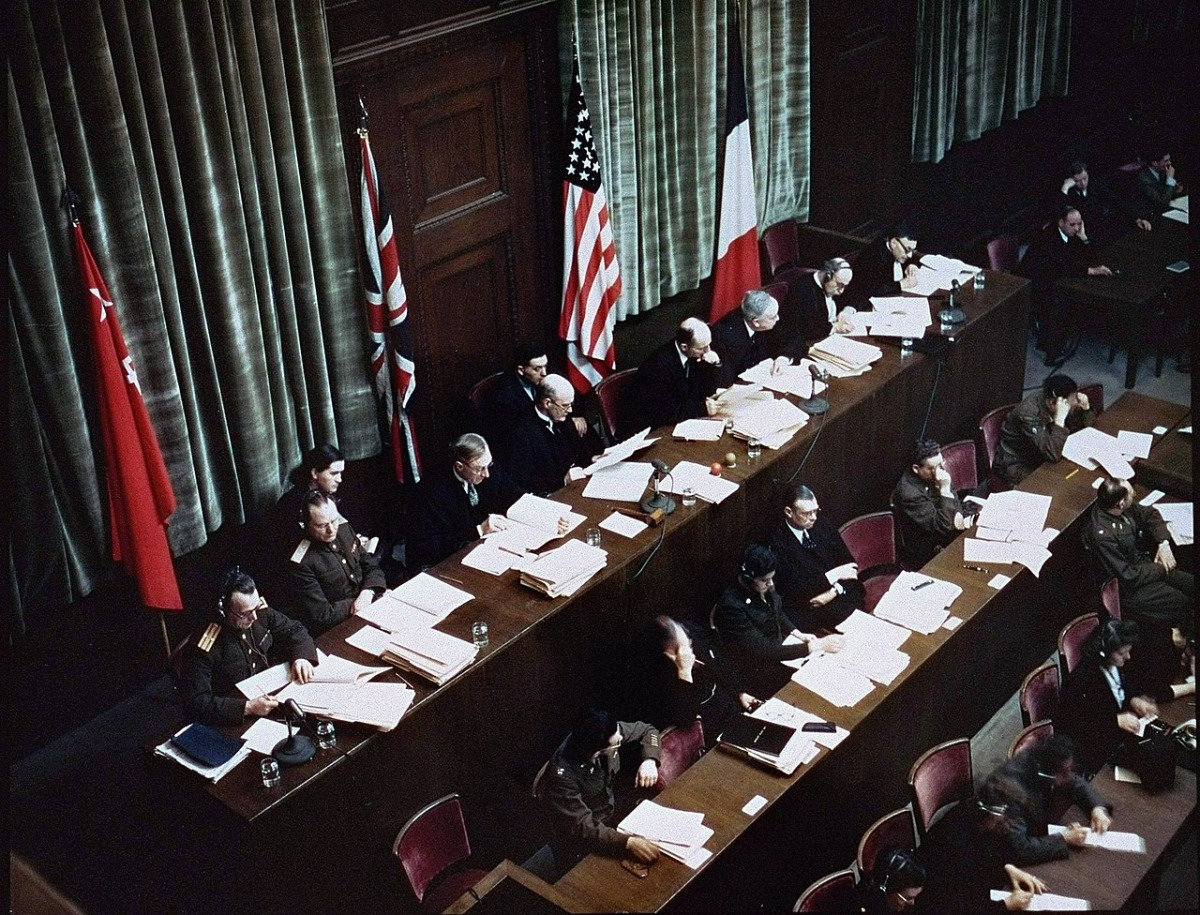
The Nuremberg Trials.
The Fundamental Question of Jurisprudence
Let us thus address the fundamental question of jurisprudence: what law is, and what that matters in its practice?
For a Positivist, the essence of law is legal fact, if it stems from an authoritative source often referred to as the Sovereign. Or let us call it, as Hans Kelsen and Hogan do the grundnorm (‘basic norm’). Then the law is divided into rules conferring powers on officials, within a given system, to apply them. This process occurs at a remove from politics or morality.
H. L. A. Hart, the other leading Positivist with Kelsen, calls these rules either primary or duty imposing rules, or secondary or power conferring rules, which often rely on enforcement by adjudication by tribunals or courts, but not, it seems, by interpretation. That is the initial fallacy.
Thus, according to Legal Positivism the job of any official is to apply rules literally. Giving, what Ronald Dworkin called, ‘plain facts their plain meaning.’
Yet, very little is ever plain, and as the leading jurist of the 20th century, not Kelsen but Dworkin, maintained law is a question of the interpretation, not the application, of plain facts. It is also about principle not authority. And the texture of law is slippery and often as unclear as mud. Hence legitimate legal interpretation is a matter of law, not purely political philosophy. That is the crucial point and the one Hardiman and Hogan, among other UCD Positivists, fail to understand.
Consider this in a different context. Imagine a witness says someone’s hair is dark, the question becomes how dark on a scale of 1-100, and was there any grey in the darkness? There is invariably a lack of clarity on any matter, and even the arch-Positivist Hart conceded an open texture or fuzziness even to statutory rules.
That concession by Hart – as Dworkin correctly maintains – undermines his whole theory. For Hart, where the rule is fuzzy, he suggests a judge use his discretion. Dworkin correctly queries whether discretion per se should form any part of a legal dispensation.
In fact, given that many rules have an open texture – in that they are capable of various interpretations – the reliance on an untrammelled or open-ended discretion, as Dworkin maintains, undermines Hart’s conception of Legal Positivism. The natural lawyer John Finnis also correctly points out, in parenthesis, a weakness to Hart’s internal point of view, crucial to his Positivist agenda. To save Legal Positivism from morality Finnis points out, by using normative language such as ‘ought’ or ‘should’ Hart is conceding a moral component to law.
Contrary to Hogan’s position on legal interpretation, Dworkin contended that it must involve political and moral interpretation, and not be an exercise in literalism or strict constructionism.
To make sense of law as a corpus and not rely on discretion per se law legal interpretation must be an exercise in principled interpretation. Only then can it create a seamless whole that is not a web of deceit, or draconian rules, but one of justice.
Adolf Eichmann
Slow Train
The abandonment of principle and constitutional rights is a slow train to the sort of cognitive dissonance embodied in the likes of Adolf Eichman, when he argued he was only doing his job. This is the divorce of officialdom from morality.
Such issues led to the famous Hart-Fuller Debate on the relationship between law and morality and to a consideration of retroactive laws. Fuller in effect maintained we owe no obedience to laws without a tinsel of legality. Even Kelsen applied retroactivity exceptionally in the case of the Nazis.
Dworkins progenitor and mentor is John Rawls, who is decidedly back in fashion in the academic community. Not that his ideas have ever gone away entirely, but his critique of neoliberalism and his conception of a just society seems more pertinent than ever,
Daniel Chandler in his recent bookFree and Equal: What Would a Fair Society Look Like? (2023) argues that there is a broad approval among academics around the ideas of the maximisation of liberties; a measure of discrimination in favour of the disadvantaged; and an element of putting money aside for future generations to meet the economic and environmental devastation of neoliberalism. To our power brokers, however, these principles have little or no significance. Seemingly, as Chandler contends, the more Rawls gains traction in the academic community, the less his ideas are implemented by our rulers.
Of course, Rawls is a political philosopher and though he does address law, he does not do so with the precision of Dworkin.
For Dworkin the answer is very clear: our judiciary have a moral and principled obligation to interpret laws in a socially just way to protect the innocent, the disempowered, the accused and sanction the government when required. This also includes the moral obligation not to defer to a Separation of Powers, but to declare a law unconstitutional when it is called for. It also includes a non-textualist approach to read rights into the constitution as a living instrument, to protect the rights of the citizen, and non-citizen.
In Ireland the lure of Legal Positivism and the abandonment of the wisdom of Rawls and Dworkin among the judiciary has led to the non-enforcement of social and economic rights. This has contributed to a housing and homelessness crisis, tearing apart the very fabric of our society and fuelling the rise of the far right.
The judiciary could have easily followed Canadian and South Africa as well as Indian Jurisprudence, which either give vitality to the Right to Life contained in Article 2 of the Constitution, by including the quality of that life. They might have also revived Article 45, and thus the social contract.
Ensnared by banking interests, debt, and agency capture, the courts have failed to intervene. These decisions and non-decisions are unforgiveable, immoral, and even borderline criminal.
Further, In Rawlsian terms They have not maximised rights over absurd limitations on public and common good considerations, thus systematically destroying due processand privacy rights, ignoring or sidelining EU and ECHR law along the way. They have given ever more power to our police forces, standing idly by as 24-Hour Surveillance takes place, with more special courts to come, amidst an unspecified emergency.
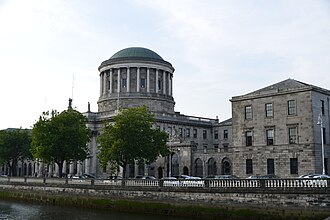
The Four Courts, Dublin.
Long Dead Values
Our gatekeepers have deferred to long dead values. They have not utilised the constitution progressively, and failed to protect non-nationals adequately. I suspect they will curtail freedom of speech if thehate speech bill passes.
Since Adrian Hardiman, and indeed before, they have been utterly useless in upholding the constitution.
Part of the Positivist agenda is to focus on Positivistic realism. Realism, though useful in some respects as an analysis of trial practice and what courts do, justifies cynicism and above all Populism. If there is one idea that captures the leading realists Karl Llewellyn’s conception of policy, it is the will of the majority, or what people want. What Hogan terms the grundnorm of popular sovereignty.
The problem with deferring to Populism in our present Dark Age is that we are dealing with agency capture of the media, excessive blind sheep obedience, alt-right mob rule and the enforcement of it through legislation, such as anti-immigrant measures or mass surveillance.
It is in fact important for judges to be, as Dworkin put it, philosopher monarchs, in the sense of vindicating rights against tyranny. Thus, gatekeepers must protect rights against tyranny and realise that, as Hannah Arendt put it, we should have the right to have rights.
In Ireland the judiciary defer to Kesean popular sovereignty and judicial restraint. It is correct to see them as accomplices to evil. Even Hogan, our finest judge, risks selling his soul to the devil.
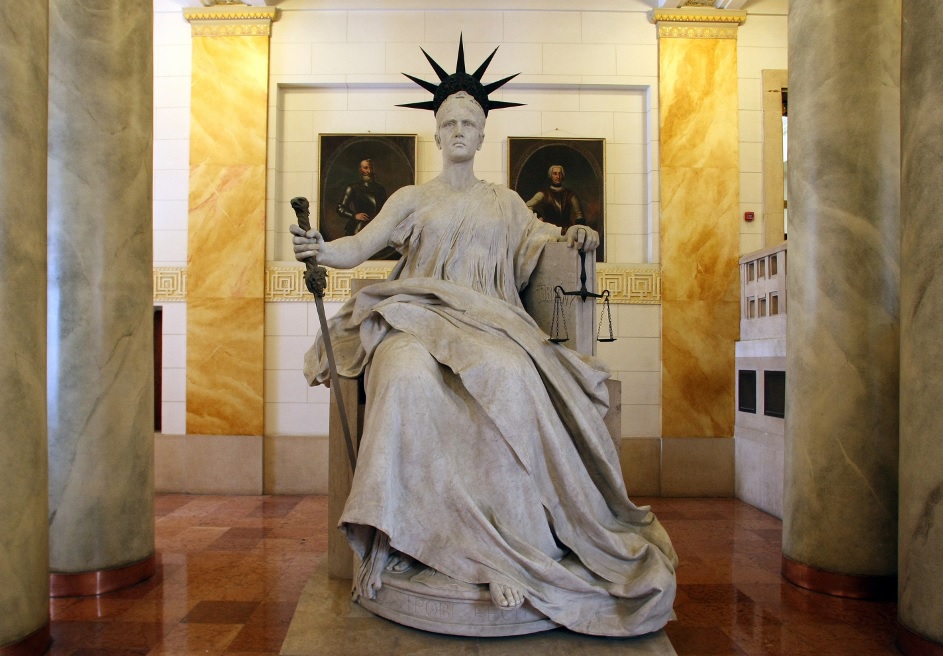
Justitia in the Superior Courts Building in Budapest, Hungary.
Are Rules Important?
The other fundamental question is whether rules are really that important. The realist scholar Roscoe Pound called them merely pretty playthings. This is the view, commonly held among realists, that a judge reaches the subjective conclusion, dictated by policy considerations and then makes the rules fit the facts. In short, the rule is an intellectual justification of a conclusion. This is a view I have some sympathy with, but it again demonstrates the obsolescence of black letter law.
Crucially, Dworkin gives rules or plain fact more weight, and thus does not undermine legality but argues that a rule or even the plain fact of a rule is subordinate to the interpretation of principle. Thus, the judge is obliged to attempt to achieve the best creative and constructive sense of the law as a matter of principle, where principles have dimensions of weight and importance, and rules do not.
The important point comes where there is a conflict between a rule and a principle. Here the principle, whether legal or moral, prevails.
Dworkin points to the Lord Atkins Neighbour principle in the foundational case in Tort Law Donoghue v Stevenson (1932), to the effect that constitutional values are principles in the law. Indeed, a crucial application of principle is where a law is declared unconstitutional. That is when a Positive law struck down by a principle. Or when the principles of the ECHR are enforced, which we rarely see, rendering our constitution a nudum pactum – a promise that is not legally enforceable.
In this respect by its embrasure of literalism and historicism in judicial interpretation, Legal Positivism negates the spirit of the law, and deems crucial issues non justiciable. It does not protect matters of principle and rights, and fails to develop the constitution as a living instrument to adapt to changing circumstances.
The negation of this development of constitutional rights has led in America to the justification of handguns, in that they were commonly in use at the time of the American Revolution by the historicist Scalia, and the over-ruling of Roe Versus Wade, as inter alia in a specific context it sought to graft a non-literal privacy right into the constitution of the US.
Dworkin’s principled interpretation, unlike Legal Positivism, takes rights seriously and takes issue with legal realist premises, based on majoritarianism, that rights are subservient to policy consideration.
with the divine. The plumbline is vertical
as the resulting verse, so that neither agony
nor ecstasy travel horizontally but curl and rise,
sweet smoke from the swung thurible. Perhaps
these are the only prophets left to us, still able
to loop the loose thread of heaven through earth’s
needle-eye, a tremendous feat because her heavy lid
cannot stay open, closes now even on a clear day.
I imagine a bird and the bird is language, the bird
encircles the head of the most high and does not
flinch or burn, does not hide itself in a cleft of rock
that the holy might pass by. It cannot land. The point
is that the bird approaches—the point is flight. We need
only send our winged words through the needle’s eye,
the poets tell me, as though it’s easy, as though handfuls
of heaven are there for anyone to pattern, Dante or
the old woman at the end of the street who drives out
alone to check her spring calves. And yet to see her
returning at dusk, you’d swear she has covenantal
rainbows on her face, in her white hair.
Lucky gull chicks on a city roof
take food from their parents and snuggle for warmth;
for them, life has begun as well as it could.
The flightless chick who fell from its nest above
and is abandoned by its parents
on a hostile gull family’s roof
is shut in a large, bright, open room
and soon learns that fear is a nail
that fixes the whole being to a hard board.
The lost chick can hear its family above
and calls to them, looking up to a place
it cannot reach and from which no helps comes;
flight is weeks away. The enemy adults attack
and the refugee huddles in a corner
watching the privileged chicks eat well,
all because the spots on its head
are not in the correct pattern.
Sometimes it cannot resist any longer
and rushes forward to try and share the food,
but is driven back by sharp, flashing beaks.
The fallen one must somehow hang on,
surviving on forgotten scraps
until its feathers are ready
and a new phase of life begins.
The prisoner walks around and around,
the will to live fighting the hunger,
but it cannot escape for now, no matter what.
Living in terror in this rooftop hell,
every day is the longest day of the year.
Then the fairy spread her wings and flew off. People came from far and wide to hear the tale of their adventures, and when it was told, they grew up loving and loved, with the fairies for their friends and protectors, ever ready to help them if they were in trouble; in time they were married and lived happily together – that is the end of the story. (H.H.H. Nine Little Fairy Stories: A&C Black, London 1923)
London April 1919
Mr Mancini, the stout and mutton-chopped proprietor of the private hotel, had made an exception and allowed Henry Herbert possession of a front-door key, a privilege that was extended to no other of his residents. The outside doors of the slightly dingy establishment, with their stained glass panels and flanked by cream-painted Etruscan columns, were locked at 11pm every night and after that hour it was only Henry Herbert who was permitted the luxury of drawing up in a hansom and letting himself in, or, having walked home carefully in opera cloak and top hat and maybe a little woozy from the champagne consumed in the Crush Bar, of fumbling just a little with the key as he effected his independent entrance.
Somewhat willowy and slim of waist, with daintily barbered moustache (although he may have been getting a little thin on the top), Henry Herbert was a dapper fellow and while he might not have inspired an overriding impression of manliness, most onlookers found it gratifying to observe this tall gentleman with his neat cravat and swinging his cane as he bravely and confidently occupied the London pavements on his determined way to wherever he was heading.
Henry Herbert occupied the first-floor front, the finest rooms of the narrow five-storey building, overlooking the communal gardens with their protecting iron railings, their locked iron gates and their sooty plane trees. But this was in truth not to claim much, for the Frazer Private Hotel was, at best, a modest establishment in an unfashionable area and had few pretensions beyond its respectability and convenience. However, for Mr Mancini, Henry Herbert, with his fabled money and supposed connections was indeed a catch and an embellishment to the house, somewhat belied by his private ways and apparently modest way of life.
For Henry Herbert it was a two-way transaction. True, money was no object to him, but in exchange for what must at best be considered a somewhat frowsty dwelling he was given freedom from what could be called the attentions of the greater world and the demands of society as well as the quiet and peace he needed to finish his collection of Nine Little Fairy Tales and get them ready for publication. Although South Kensington was near to everything that the great world revered, and not half a mile from his place of birth and his childhood residence, it was, in 1919, a place in free fall from its glory days, the great houses being broken up into flats and rooming-houses, and its great cream stucco façades looking increasingly tired and begrimed as leases expired, families fled and ownership splintered.
On this day, in April 1919, at half past seven in the evening, Henry Herbert walked back to the Frazer Hotel after not having attended a concert of Mendelssohn and Schubert at the Aeolian Hall. The reason for his non-attendance was that the concert had been cancelled because of the “influenza epidemic” and, as he walked back to Queen’s Gate, past the groups of delivery boys waiting with their bicycles, the cabbies at the rank, the loiterers around the Gentlemen’s subterranean convenience and those few intent upon some business, he was for the first time hit with the realization that although the terrible war was over, something equally terrifying had taken its place, something that was evident in the subtly changed activity and atmosphere of the London streets. He had also taken note of a story that had been buried in the middle pages of most newspapers and variously reported as “General Dyer defends the Empire as illegal meeting broken up at Amritsar” to “Two hundred natives killed in the Punjab.”
Henry Herbert knew he was different from other men but after over 40 years of life still hadn’t quite worked out what it was that made him a constant outsider. Although he maintained decorous relations he was certainly at odds with his commercially-minded family to whom turning a decent profit took precedence over matters of the heart or art. As the only son of seven children, the preponderance of females put a terrible weight of expectation upon Henry Herbert’s narrow shoulders, far, far greater than the modest expectations placed upon his six sisters – that they should marry, and marry well enough not to bring disgrace upon the family. Four of them had accomplished what had been asked of them, not spectacularly but respectably, two were unmarried and certain to remain so, a disappointment to their parents but a minor one compared to Henry Herbert’s earth-shattering failure to do even the most miniscule part of what was expected of him, the only boy.
He loved his nephews and nieces, he adored his mother, he doted on his sisters, especially the unmarried youngest, Olive. He liked music and books, he loved pictures, he wrote fairy tales, he did illustrations, he collected engravings, he disliked sport, he was uninterested in politics, he was largely indifferent to the business that kept the great Empire turning. And now, for the first time, as he made his way through the streets of Kensington back to the Frazer Private Hotel on this day in April 1919, he had a flash of consciousness that not only had a major change come upon the world, wrought first by the terrible war that had just ended and now being consolidated with the palpable but hushed-up horrors of the influenza epidemic, but also that he himself, Henry Herbert, embodied this change in two ways. First in an awareness of how singular he was and the infinite vistas that opened because of this and how unlikely it was that the new world would be able to accommodate him, and second, that at the same time he was a part of this mass of human beings he encountered every day. This filled him with equal measures of fear and hope, putting him into a kind of stasis, and for a moment he was almost unable to breathe.
He stopped for a few moments by the church on the corner of Queen’s Gate to catch his breath and regain his equilibrium.
Having to some extent recovered, despite having soiled his lavender gloves on the sooty railing, he continued on the last stretch back to the Frazer Hotel.
This crisis of the imagination was to be replicated by real events a few moments later. Hardly had he put his key in the door than it was opened from within by Mr. Mancini. Behind the bewhiskered and sweating landlord centre-stage was a supporting chorus of residents and servants in what seemed like a tableau of outrage.
So what was this all about? After a lot of fevered explanation on the part of Mr. Mancini, it turned out that Miss Stratford-Tuke, the horsy girl from an impoverished county family who occupied the fourth floor back, had put in a complaint about a supposed visitor of Henry Herbert’s who had been encountered the previous day in the exceptionally dingy and dreary drawing room on the ground floor. This dark-skinned and hirsute young man, having been taken for a servant by Miss Stratford-Tuke and challenged for lolling in the chintz-covered armchair in front of the sulky heatless fire whilst perusing a year-old Illustrated London News provided by the establishment, had apparently proceeded to “insult” her.
After many fevered accusations from the angry chorus. Henry Herbert got to the bottom of it. The visitor was a acquaintance of his, a certain Tommy Stephanides, a young cockney Greek whom he had met amongst the etched glass and chandeliers of the Salisbury Tavern on St. Martins Lane. Tommy had been sitting at a nearby table with a glass of beer and a small volume of poetry which Henry Herbert eventually recognized as identical to his own copy of Towards Democracy, a revolutionary collection in the style of Whitman by Edward Carpenter. The sight of this familiar green book had the unusual impetus of emboldening Henry Herbert to initiate a hesitant conversation with the young man sitting at the next table.
From this interchange he learned to his amazement that the fellow had actually visited Edward Carpenter’s Uranian commune at Millthorpe in Yorkshire and the flyleaf had been signed by the man himself.
Tommy Stephanides with his crisp black hair and sharply defined moustache had something of the extremist about him, uncompromising and fundamentalist almost, no apparent softness and yet, somehow, the softest, most revolutionary person Henry Herbert had ever met. Clever and sketchily-educated though he was, Tommy negotiated the world in a way that Henry Herbert could only dream of. He lived with his mother in a tiny flat near the market in Spitalfields and he worked as a typesetter at a nearby press that turned out pamphlets and manifestos for revolutionary causes. He had been born in London along with the 20th century. He’d always felt constrained by his circumstances and had always felt that there must be something better for him and his mother. He had a Portuguese pal who had gone out to British East Africa and had made a better life for himself. But he lived his life as it was with a certainty and a commitment that seemed to spring from some source unavailable to Henry Herbert. He had a hunger for art and music and was doing his best to educate himself by attending evening classes at the Worker’s Educational Association, but his enormous energy still allowed him to find time to be outside the factory gates with pamphlets at least three evenings a week. It was, in fact, Tommy’s very certainties that made him able to be so soft. His negotiation with the world around him was without nuance, an absolute rejection of the rules by which the world was governed. This gave him an incredible freedom, including the freedom to be soft.
Henry Herbert found Tommy physically alluring and was also cautiously attracted by his brave radicalism and his uncompromising vision.
As the explanations unfolded against the background of anaglypta wallpaper, oleographs of Osborne House and gas mantles in the dreary vestibule of the Frazer Hotel, it soon became clear that the ‘insult’ to Miss Stratford-Tuke was entirely in the young lady’s mind and that while Tommy may indeed not have behaved like a gentleman, his comportment had been largely reactive, a modest response to the pent-up fury in the young lady when she perceived that her accusations were empty.
Henry Herbert had indeed invited Tommy to call on him at the Frazer Private Hotel. He loved the boy with the love of a true innocent. It was significant that it was Edward Carpenter that had brought them together. He knew well that he himself was not made for family life, the pursuit of money or the service of Empire but had never seen himself as any kind of revolutionary, while recognizing and accepting the fact that he was different. Picking up boys from the rich and hazardous street-life of post-war London, however tempting, was not Henry Herbert’s way. The terrible lessons of Oscar Wilde just over twenty years earlier had made him cautious. He sublimated his libido into his collecting, his daily routines and his fairy stories.
* * *
Glasgow docks, Berth 5, April 1923
Olympia Stephanides in her widow’s black waited at the foot of the gangway of the RMS Doric bound for Mombasa with her case and bundle while her son negotiated with a couple of officials. A motor taxi drew up and a dapper figure in a dark overcoat and with a cane emerged. The taxi-driver extracted a suitcase from the back. The man tipped the cabbie and took charge of the suitcase. He looked around and, fixing his eyes on Mrs. Stephanides approached her, took her hand briefly and inclined his head to hers. Tommy finished his dealing with the officials and joined his mother and the gentleman.
The ship’s horn sounded three times and suddenly the somewhat static scene of the wharf burst into frenetic life. The visually monochrome but socially divided crowd fast sorted itself into separate queues for the two gangways. To the observer it became evident that one was for steerage passengers, the other for first and second class. The man with the cane was seen to have a moment of hesitation, but after a brief consultation with Tommy, he joined the mother and son on the steerage gangway.
The rain which had been threatening to fall started as the ship’s horn sounded again. The comings and goings ceased, the crowds on the wharf dispersed and the Doric drew away from the wharf and heaved slowly off into the grey Clyde and the world beyond.
Whether the dapper gentleman had left the ship before it sailed or whether he had remained on board was not observed.
Feature Image: John Atkinson Grimshaw, Glasgow Docks 1881.
This article is a response to Supreme Court Justice Gerard Hogan’sAnnual Hale Lecture in Trinity College, Dublin in November 2023 on the on the topic of: ‘Grundnormen in UK and Irish Constitutional Law,’ and I thank him for sending it to me.
The grundnormen is a creation of the legendary Austrian jurist Hans Kelsen. He is viewed by many as the greatest figure in Jurisprudence of the 20th Century. For his own part, in the mould of Justices Niall McCarthy, Adrian Hardiman and Declan Costello, Gerard Hogan is, in my view, our only current top class Irish judge, and a man for whom I have great respect.
However, Hogan’s paper, although a brilliant piece of work, is profoundly unsettling not as such in what it is right about, but in terms of what it is wrong about, largely by omission or occlusion, i.e. what it does not say.
He frankly concedes that the UCD lectures he received in jurisprudence failed to equip him with an understanding of the relevance of John Rawles or even The Natural Lawyer, John Finnis, nor does he reference radical jurisprudence, or indeed the éminence grise of 20th century legal philosophy, Ronald Dworkin. Thus, Hogan emerges as an arch positivist – as of course was Kelsen – a literalist and strict constructionist. It is fair to describe him as a black letter lawyer.
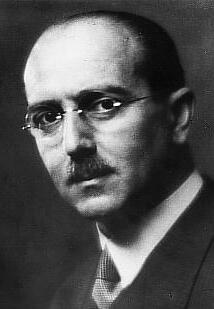
Kelsen was the purest and most consistent of the positivists in emphasising the precise distinction between law and the domains of politics and morality, with one significant aberration on which more later. It is called a pure theory of law, Kelsen argued, because it only describes the law and attempts to eliminate from the object of this description everything that is not strictly law: Its aim is to free the science of law from alien elements. This is the methodological basis of the theory.
Hans Kelsen 1881-1973.
Kelsen: The Pure Theory of Law
It is perhaps unsurprising that one of Hogan’s instructors in jurisprudence while in UCD, Professor John Kelly, in a superb posthumous A Short History of Legal Theory (Oxford University Press,1992), expresses equally bafflement with post-positivism. It is merely an afterthought in that book. Well that is UCD.
Likewise, consider Adrian Hardiman’s apparent chastisement of John Rawls in his judgment in the seminal 1991 Sinnott case for viewing political philosophy as a branch of jurisprudence:
[t]heorists of this view consider that they can provide a body of principles which can be interpreted and applied by courts, to the virtual exclusion or marginalisation of the political process…I[f] judges were to become involved in such an enterprise, designing the details of policy in individual cases or in general, and ranking some areas of policy in priority to others, they would step beyond their appointed role.
Also, the reference to Lord Denning’s subtle dismissal of jurisprudence at the outset of Hogan’s paper is at one level a revelation of the standard wisdom of practising lawyers that only positivistic jurisprudence is relevant to court cases.
When the U.K. Supreme Court overturned Boris Johnson attempt to suspend parliamentary scrutiny by proroguing it, Lord Pannick KC, the advocate in the case, gave a most revealing and rare interview after the event. In a sense Hogan’s argument is about where they stretched matters too far. I disagree.
The problem with Hogan/Kelsen, and positivism more broadly, is, fundamentally, the cleavage between law and morality and/or law and politics, which are treated as if they are separate domains and not relevant to the subject of jurisprudence.
Hogan also purports not to understand the Natural Lawyer. When it comes to John Finnis I agree. Finnis argues unconvincingly that the law should reflect self-evident goods such as marriage involving sexual congress, which has as its aim the production of children. In short sex for the sake of sex, not for conception, is not good, because it does not conform to the common good of friendship, which is intrinsic to heterosexual congress within marriage, or the good of parenthood.
Jeremy Bentham like many positivists regarded natural law as ‘nonsense upon stilts;’ or as the other positivist John Austin suggested: if you invoke in a court room that an act is contrary to natural law a judge will indicate the inconclusiveness of your reasoning by hanging you. Many are also sceptical, as they ought to be, of inserting the values of The Iona Institute into the Irish Constitution.
But that does not answer the question of morality or politics as an aspect of jurisprudence by a process of legitimate legal interpretation. This is the interpretation of texts in the sense of the grand style judge, mentioned by Karl Llewellyn, who defers not just to literalism, but also to policy and principle.
Thus, Hogan effectively dismisses John Rawls and Ronald Dworkin, Marx’s Grundrisse and the legal realist perspective on policy from legal interpretation. Hogan also falsely invokes Oliver Wendell Holmes as a positivist. He was in fact the founder of legal realism – the forerunner to Llewellyn – who said, ‘The prophecies of what the courts mean in fact are what I mean by the law.’
It is, however, brave of Hogan to attempt to define the mystical grundnorm. In Ireland it can be interpreted as the Constitution, based on popular sovereignty, or parliamentary sovereignty in the UK. But at its most abstract level the grundnorm is that which is responsible for the historically first constitution, in Kelsen’s own words.
So, why does that create problems? First, and not least, the concept of original intent and the intentions of the Founding Fathers, is intrinsic to US jurisprudence, especially through the likes of Amy Coney Barrett. This involves a deference to long dead people or long dead intentions in different historical circumstances, an approach which Ronald Dworkin has rightly criticised.
Kelsen, like indeed Hogan, was in an extracurricular sense far from apolitical. He was a Jewish intellectual and supporter of Weimar Germany. However, he believed, as Hogan does, in the essential goodness of the state. Although, in fairness Hogan has sagely warned about the denudation of due process by the Irish judiciary. In my opinion Kelsen was, and Hogan is, over-wedded to the view that states have duties to allow rights, but only on its conditional fiat. I cannot accept that at face value for it assumes the state apparatus in its present incarnation protects rights, which in the case of Ireland it clearly not the case.
It assumes the Irish state has a tinsel of legality. Yet with our corrupt police force, dysfunctional justice department, populist leadership, and compliant judges we are entering a period of anarchy I fear.
The Nuremberg Trials.
Nuremberg Trials
Curiously, Hogan does not mention Keisen’s famous moral detour, where he contorted positivism to justify the jurisdiction of the Nuremberg War Crimes Tribunal. Although Kelsen fundamentally disagreed with the legal basis for the assumption of authority and the way in which individual responsibility was not more differentiated, he defended the Nuremberg Trials. Contorting the principle of retroactivity, he argued the Nazis knew at the time what they were doing was immoral and not innocent. Thus, he created an exception to retroactivity, which is a cardinal violation of positivism, and indeed that amorphous notion, the Rule of Law; for which he has been heavily criticised by other positivists such as Joseph Raz.
Hogan quotes another positivist, Jonathan Sumption at length in dissent at the prorogation of parliament case around the necessity to defer to parliament and the Rule of Law, or ‘the people’ as in Ireland. This should apply only if parliament is entitled to deference, which it is not in my view in Ireland, and only marginally so in the UK.
Judicial review should protect against executive action or ouster clauses removing the jurisdiction of the courts, as in the UK. The Irish courts do not apply judicial review with rigour, and certainly not in a fashion similar to the mandatory orders in South African or India to enforce shelter, housing and health care rights. They also defer to the notional expertise of immigration tribunals and police decisions.
Hogan has previously referenced the obliteration of due process in Ireland, and indeed the constitutional dispensation has provided scant support for those whose privacy rights have been violated.
In my view, the most important book of political philosophy since Karl Marx’s Grundrisse is John Rawls’ A Theory of Justice (Harvard University Press, 1971).
The Rawlsian approach is to pose a question: where people are placed behind a veil of ignorance wherein they cannot know what their personal circumstances will be, how would they chose to order their society?
He suggests that most people would choose the maximum number of liberties, as they would not enjoy living in a society where civil liberties are not adequately protected. Secondly, he argues that most would choose some measure of wealth edistribution in favour of the disadvantaged.
If you were to be born a sub-Saharan Africa, or Ireland for that matter, you would surely want some measure of social protection. This principle is despised by neoliberals, and is central to the arguments in favour of housing rights, health care rights, food rights and a civilised society.
Thirdly, Rawls argues for equality of opportunity and the elimination of self-advancement based on birth, family ties or social position.
Rawls adds an additional idea, The Just Savings Principle, wherein we cannot denude the Earth for future generations. However, Amartya Sen, in The Idea of Justice (Harvard University Press, 2011) argues that Rawls fails to address the reality that the achievement of a Rawlsian society is resource dependent. Clearly, we need to build a just society based on our capacities and needs.
Ireland is among the richest countries in Europe, yet successive governments have permitted rampant homelessness and moveable refugee shelters. Surely these ongoing violations require mandatory orders?
Codicil
As a codicil, Hogan references the Irish Constitution, and has written the definitive text on the subject, but at this stage all that wonderful analysis seems to amount to a Tristam Shandyesque cock-and-bull story. The problem is positivism: positivism in an age of draconian laws; positivism in a crypto-fascist age.
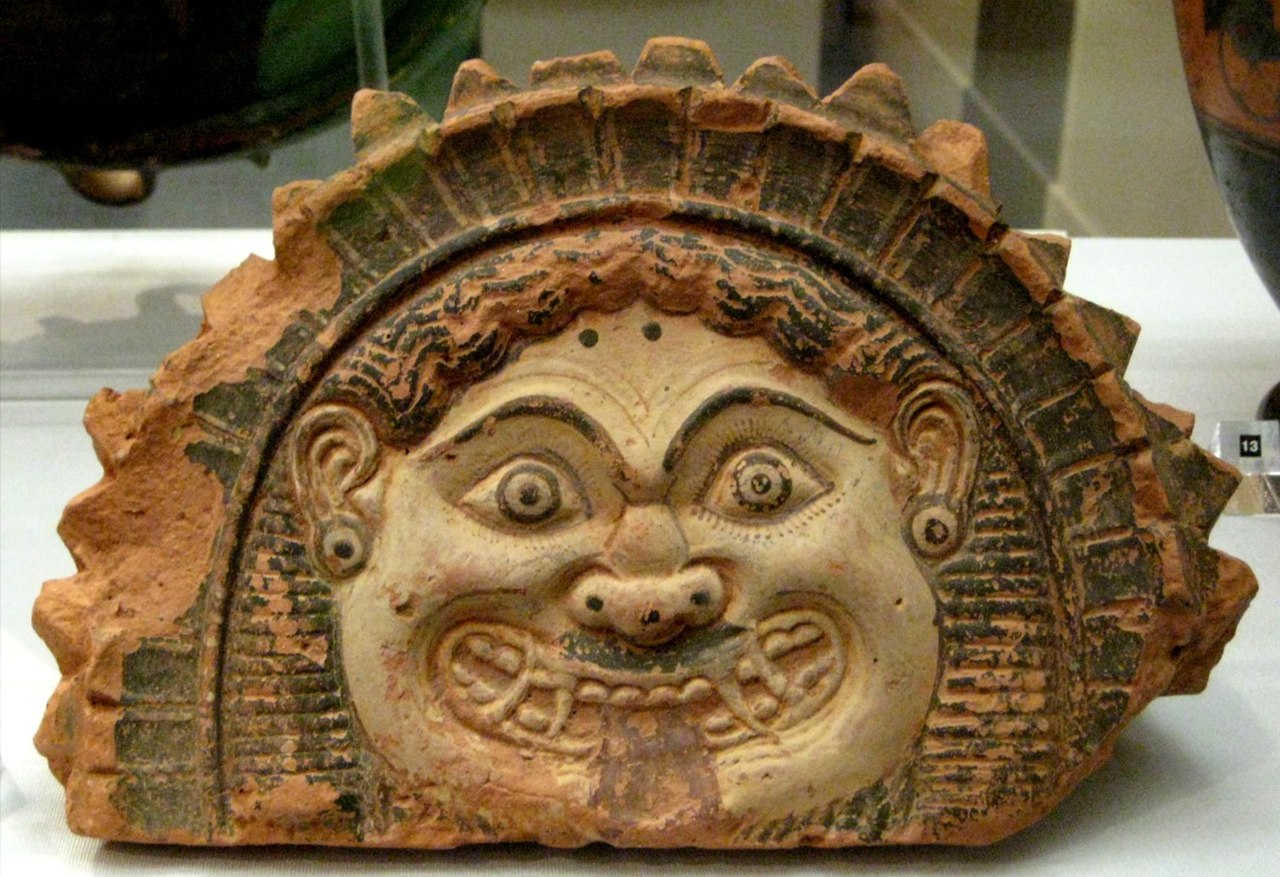
Thus, when Hogan suggests popular sovereignty as a grundnorm, he should look squarely at the Gorgon’s Head and the rampant Populism that neoliberal policies have produced.
Populism is not an acceptable juridical dispensation when all civility is lost, as in fact Sumption hitherto argued. The law becomes, as the jurist Eugen Ehrlich argued, in a criticism of Kelsen, a mask for brute force. We are right because we are powerful: macht geht vor recht as Bismarck put it.
The fundamental questions are whether the gatekeepers, including the judges, are really aware of the social realities, and are they attempting to achieve a just and decent society. Gerard Hogan should bone up on Rawls, Dworkin, Legal Realism and even Marx’s Grundrisse, in my view a far more convincing abstract analysis of the role of law in society than Kelsen’s Grundnorm.
In light of recent developments, not least, the announcement of Michael McGrath as the next EU Commissioner, it is timely to look again at the infernal plight of workers of conscience – those noble people who blow the whistle on wrongdoing, and who strive to keep a corroded system from descending further into the abyss.
Until 2022, Michael McGrath was Minister for Public Expenditure, National Development Plan Delivery and Reform (referred to henceforth as DPER). Under his Ministry, new EU protected disclosures legislation of 2014 was advancing, and also EU Directive number 2019/1937 of the European Parliament and of the Council of Europe of 23 October 2019 was set to be transposed into Irish law.
This provision was, however, effectively sabotaged long before it was transposed, and Minister Michael McGrath was central to that. The entire Protected Disclosure Act is under the remit of DPER.
Cynical Collusion
The now sinister OPLA – Office of the Parliamentary Legal Advisor was exposed on these pages before in November 2022 and again in March 2023. Its rapid expansion appears to have been in anticipation of the significant effectiveness of this EU Resolution on Protected Disclosures to stem corruption and protect whistleblowers. Two things happened to neutralise and sabotage this EU provision before it was transposed:
The vast expansion of OPLA involved OPLA being placed, unconstitutionally, on the statute books in December 2018, just as the Dail was rising for its Christmas recess. It occurred with no committee stages, or debate. This was in defiance of the Dunning Capacity Report, into OPLA which was not sent back to the sub-committee on Dail reform for consideration in December 2016 by the Dail Clerk who received it from Dunning. Thus, Dunning’s report was effectively suppressed. The integration of the OPLA into the Houses of the Oireachtas as rank-and-file civil servants, under the Dail clerk(a civil service appointee) in the Executive Arm of Government, is, as pointed out, a violation of the constitutional Separation of Powers. The discovery that OPLA was secretly involved in the investigation of Protected Disclosures in defiance of the provisions of the Act since 2013, and that it was all set to escalate as per Dunning, exposes a sleight-of-hand to virtually cut the legs out from under whistleblowers, striking a lethal blow at an integral part of democracy.
The unlawful appointment of the Ombudsman by the civil service body – the PAS (Public Appointment Service) – is a violation of the Ombudsman’s Act 1980, and subsequent amending acts. The Ombudsman Act specifically disallows the Ombudsman from being appointed by the civil service. The Ombudsman was also appointed as Commissioner for Protected Disclosures, another canny moved within DPER while Michael McGrath was Minister. The Ombudsman knew full well that the OPLA – since 2018 a civil service body – was already involved in the investigation of Protected Disclosures since 2013, and that this was considered the main area of “growth and challenge for OPLA.”
I have been in email contact with the CEO of the PAS about this unlawful appointment of the Ombudsman. I accused her of stepping outside of her remit in the appointment of the Ombudsman and pointed out that the Ombudsman’s Act 1980 specifically excluded it as a civil service appointment. To this she replied that it was done by PAS as “sanctioned” by the then Minister, Michael McGrath.
He has no power to unilaterally alter legislation. The competition for the Ombudsman’s job was held by the PAS in August 2021, when the Dail was in recess and during the holiday season. The only Irish applicant was Ger Deering. On the appointment board was David Moloney, SG in DPER who was central to the entire legislation, as it was progressing at Committee stages in the new Protected Disclosures Act. David Moloney merely continued what Robert Watt, whom he replaced, had commenced.
Both David Moloney and the Ombudsman appeared before the Finance Committee, which was responsible for the deliberations into the Protected Disclosures legislation, and which met several times in 2021 and 2022 to discuss the enhanced the Protected Disclosure Bill 2014, and the EU Directive about to be transposed.
David Moloney effectively misled the Finance Committee in failing to inform the Chair and members that the PAS, with the apparent collusion of Minister Michael McGrath, after unlawfully taking over the appointment of the Ombudsman, whom it was also decided would become the new Commissioner for Protected Disclosures.
Ger Deering’s appointment is a Constitutional one, and it thereby had to be ratified by the Dail before he went to the Aras to get his seal of office from the President. Mr Deering appeared before the Finnance Committee and made a speech on his appointment in December 2021 for the purpose of his appointment being ratified by the Oireachtas.
I contend that Deering also misled the Committee, whose members and Chairman seemed to have been unaware that the Ombudsman should not have been appointed by the civil service body – the PAS – by law. Deering knew that he would be using the unconstitutional OPLA as new Commissioner for investigating Protected Disclosures, but he never revealed that at the Finance Committee despite the fact that John McGuinness, the Committee’s chairman, discussed the plight of whistleblowers with him fairly extensively and name checked a number of better known ones.
McGuinness and his committee approved Deering’s appointment on behalf of the Oireachtas and he duly went to the Aras to receive his seal of office from the President.
Whistleblowers – The Walking Wounded
The dual strategies of the newly expanded OPLA – an unconstitutional entity since 2018 – and the sabotage implicit in the appointment of the Ombudsman utterly neutralised the provision of the EU Directive on Protected Disclosures, even before the full transposal of the EU Directive in January 2023.
It was all done by DPER under Michael McGrath as Minister. The senior civil service have dealt a mortal blow to democracy, with full ministerial collusion and, above all, have commenced the ongoing campaign against whistleblowers – the walking wounded in a deeply corrupt system.
In 2022, at a meeting of the Finance Committee, which McGrath attended with his senior civil servants, including David Moloney, and where a number of whistleblowers were also present, the civil servants backed by McGrath managed to get the provision of the EU Directive on PDs known as ‘The Presumption of Causation’ excluded from the EU Directive as transposed.
This had provided for the presumption of victimization of a whistleblower, who reports wrongdoing without the whistleblower having to prove victimization is as a result of whistleblowing. This, of itself, was a significant blow to the effectiveness of the EU Directive.
Democracy Under Threat
Democracy depends on five major planks:
A free, robust and independent press.
A free and independent judiciary.
A robust and independent police force.
Robust whistleblower legislation.
A functioning democratic parliament where issue of major public import can be raised under privilege.
The combined forces of the OPLA and the unlawfully appointed Ombudsman has dealt a direct, mortal blow to at last three of the five planks listed above. OPLA is unlawfully involved in Protected Disclosures and in the Workplace Relations Commission (WRC) and the Labour Court – both courts are subordinate to the High Court and a significant number of whistleblowers prosecute their claims, or aspect of their claims, in the WRC/Labour Court.
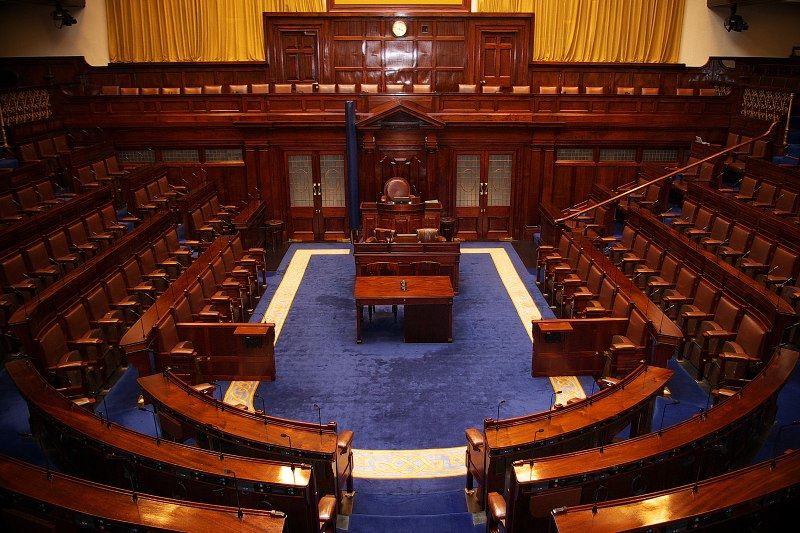
Above all, OPLA has dealt an absolute mortal blow to the Dail itself. Arguably it has paralysed our parliament: there are numerous examples of OPLA muscling in, in a very heavy handed way on Dail Committee, especially in cases brought under privilege by whistleblowers to the Committees.
The Committee Chairpersons are gormlessly allowing this, and are being bullied by the Committee Clerks who, in turn, are taking their instructions from the Dail clerk, Peter Finnegan, himself the chief architect of the draconian new OPLA in December 2018.
In a case I had with the CPPO Committee, the OPLA took over the case from its clerk designate. I pointed out to the head of OPLA that no Standing Order (SO) of the Oireachtas allowed for it and asked what allowed it. I received no reply from Melissa English, the Chief Parliamentary Legal Adviser, whom I have accused of unlawfully and unconstitutionally trespassing into the sacrosanct area of the Oireachtas and the Ceann Comhairle, in a violation of the Separation of Powers, and a blow to the prudent use of Dail privilege.
As OPLA operates in secret in addition to its listed function in Dunning’s capacity report of December 2016 as listed below, it may well be involved with the Gardai, and indeed with media enquires as fielded by the more robust elements in the media. I know from personal experience that the Gardai co-operate with the Ombudsman, attempting to sideline one complaint of a criminal nature I made to the Ombudsman. The Ombudsman cannot investigate suspected crimes.
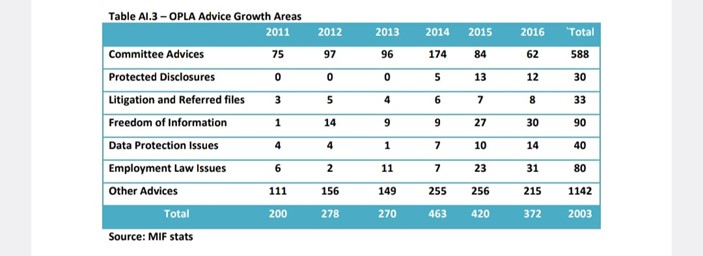
The table below from Dunning’s Capacity Report (Dec 2016) includes all the secret areas OPLA are involved in where they have no jurisdiction:
OPLA, and indeed its boss, Peter Finnegan (Dail Clerk) have no remit in at least four areas of growth as listed above. OPLA’s remit is ostensibly confined to the tripartite functions of 1) Advices to the houses of the Oireachtas and its staff, 2) Defending the Houses of the Oireachtas in Court and 3) Help with drafting Private Members Bills (PMBs). Enhanced Protected Disclosures legislation and the whistleblowers who rely on it have been taken out with military precision.
I have raised the OPLA and the unlawful Ombudsman appointment with John McGuinness, Chairperson of the Oireachtas Finance Committee unsuccessfully. I have also made a complaint to the Relevant Section in the EU, responsible for the transposal of the EU Directive on Protected Disclosures into Irish law, backed by a number of other whistleblowers. The EU passed the buck back to the Irish courts. As if any whistleblower can afford to go to Court!
Several whistleblowers (myself included) have appealed to mainstream media outlets to expose the OPLA in its unconstitutional reconfiguration since 2018 and its unlawful involvement in PDs. They have all refused to act.
Transparency Ireland have become a quangoistic arm of state, which now fully funds the organisation. Dr Lauren Kierans, the Maynooth academic in the area of PDs who wrote the new Protected Disclosures Act for DPER has been informed that her act was sabotaged as outlined above. She passed the buck to Transparency Ireland and is now on maternity leave.
The retaliation against and destruction of whistleblowers is all set to escalate as OPLA continues to expand. As Transparency Ireland expands too, and academic departments and units on whistleblowing mushroom in Maynooth and Galway Universities, whistleblowing has now become a lucrative industry, where everyone is well-remunerated bar the destroyed whistleblowers themselves – for whose welfare these organisations ostensibly exist.
Whistleblower, Shane Corr (where OPLA also interfered) was suspended as a Principal Officer by Robert Watt in the Health Department. Watt was himself central to the creation and the funding of the OPLA since 2018 when he was SG in DPER until replaced by David Moloney in 2021. Corr was threatened by Watt with a criminal breach of the Official Secrets Act after OPLA deemed his submissions to the PAC were not covered by privilege.
Whistleblower and very senior official, John Barrett, the Garda Head of HR according to a Village Magazine article some time ago, was subjected to tyrannous retaliation by Drew Harris for exposing the Templemore Garda slush funds scandal. He is awaiting a hearing in court. This is to name but two of an army of destroyed whistleblowers.
In a deeply compromised, dysfunctional democracy, everyone will be rewarded bar whistleblowers. The Finance Committee is in a state of paralysis and the Minister who colluded all the way, Michael McGrath becomes an EU Commissioner in circumstances where he actively incapacitated the EU’s own Directive for the protection of whistleblowers.
The irony of this cannot be overstated. What part the early announcement of his departure has to do with my rigorous challenged to the CEO of the PAS in recent days, Margaret McCabe, is anyone’s guess.
After all, the vacancy for the EU Commissioner does not arise until October. Meanwhile, whistleblowers will continue to be condemned, vilified and relegated to the ranks of public pariah, while endless amounts of public money will be thrown at the industry and the army of persons who have colluded to destroy them. Foremost among these is OPLA and the Ombudsman. According to theLaw Society Gazette in July 2018 OPLA’s Melissa English believes she’s worth it. Our democracy meanwhile, which can always be measured by the treatment of whistleblowers, was never more undermined.
To comprehend, regard the brutal wilderness to hand.
More than most, the burrow-broken vagabonds
recall the living tune. In remoter reaches
of the Wicklow hills, they live where a sodden soul
could barely pass, and look out all the year on unimpeded
barriers of heath. In every season, heavy sleets of freezing water
descend interminably, so the roof-thatch drips a colour
peaty-blue, and the cottage-floors are sinking,
boggy in the wet. The wide skies rock in hellish
storminess: by dawn the ragged larches that endure
are bent and twisted, bowing bleakly to the rim
where sunlight somehow rises in the summer.
Down the beggar-glens the churning wind, as well,
comes whirling with a river-roar that time
to time will lessen, of a sudden, giving way
to hush – enough, that is, to sow a tension
in the listening body, neck and limbs, of anyone
who waits, crouching with an ear ajar
for the mournful cries of country-dogs
that prowl among the crags. The elder-folk
who keep and carry on the memory, the quenchable
tradition, of risen insurrection, raising fire in the guts,
are dwindling today, a disappearing army, blown afar –
though here and there, disguised among the lonely
and the low, I’ve met them as I passed along,
and gathered up their words. To see these Irish men
and Irish women sunken, unrepenting, their leather-
skin and ageing eyes ablaze again, condemned for good
not to the viscerating gibbet, but to the slow obscurity
of dying-out, forgotten but by dreamers and the fey –
it’s been enough to wring me with the pang of isolation,
an echo of that dumb, determining distemper, impossible
to heal, of unredeemed deracination… a share, perhaps,
of the desolation mixed in every region of the land
with the waterfalling beauty of experience itself, the luminous
cascade we all have known, elusive, controvertible, but actual
and active to the penetrating mind. I raise my hungry fist
in health – to the ferocity and wonder of the world.