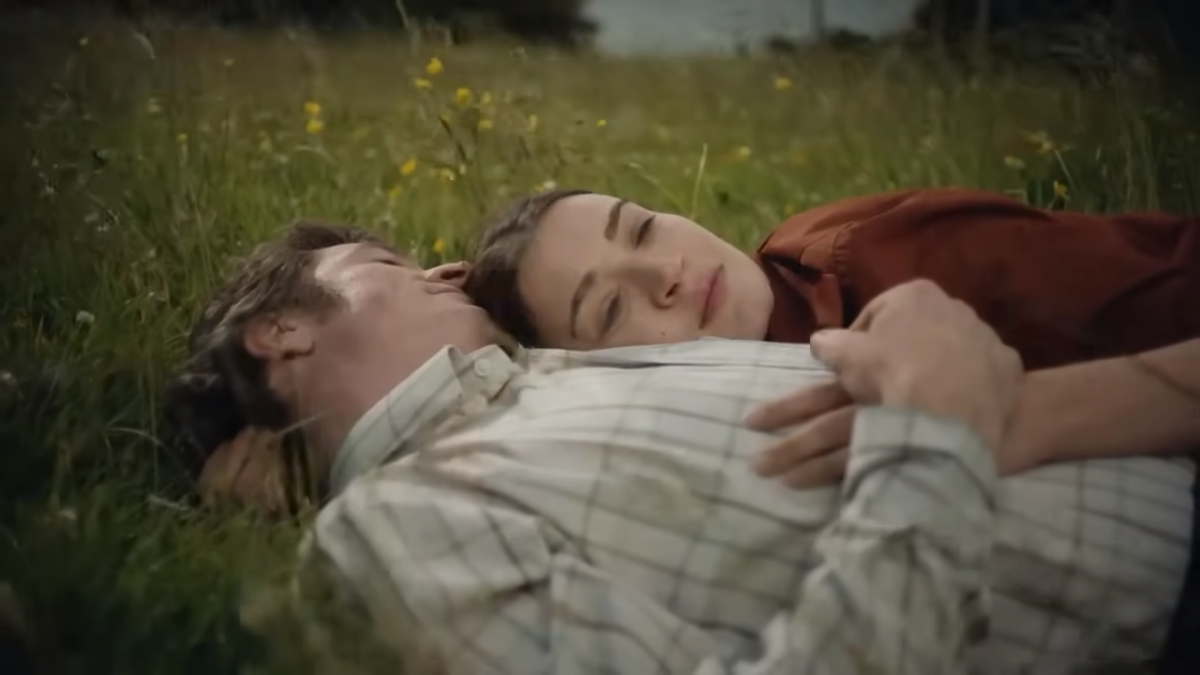
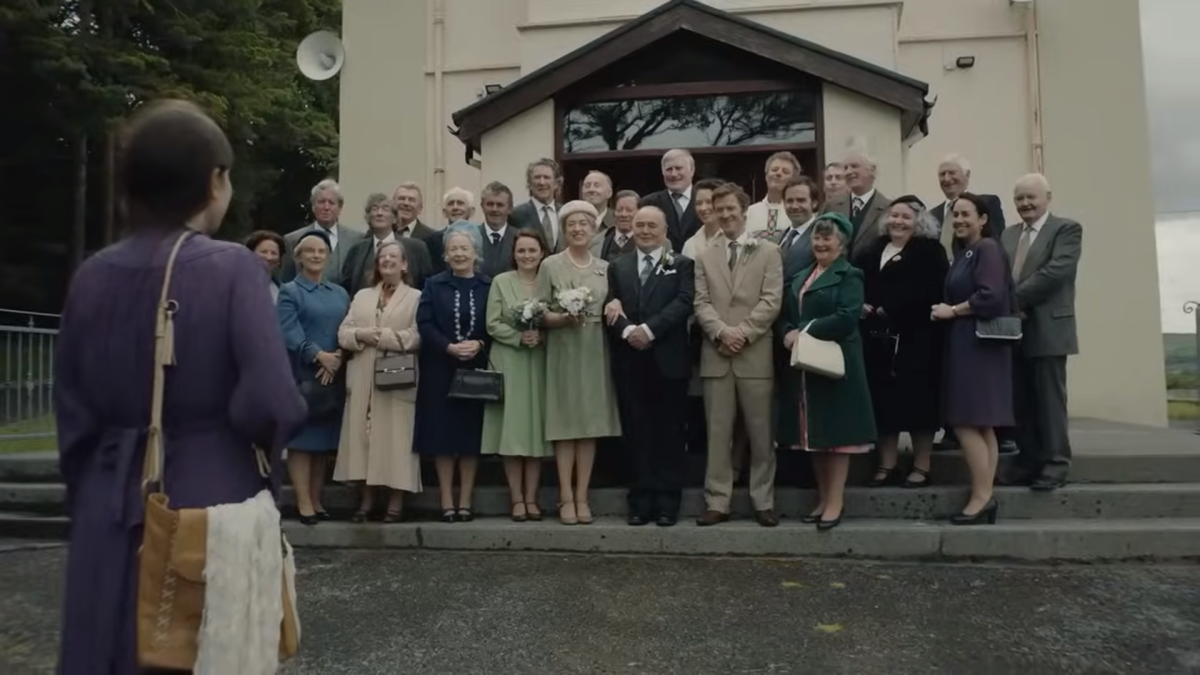
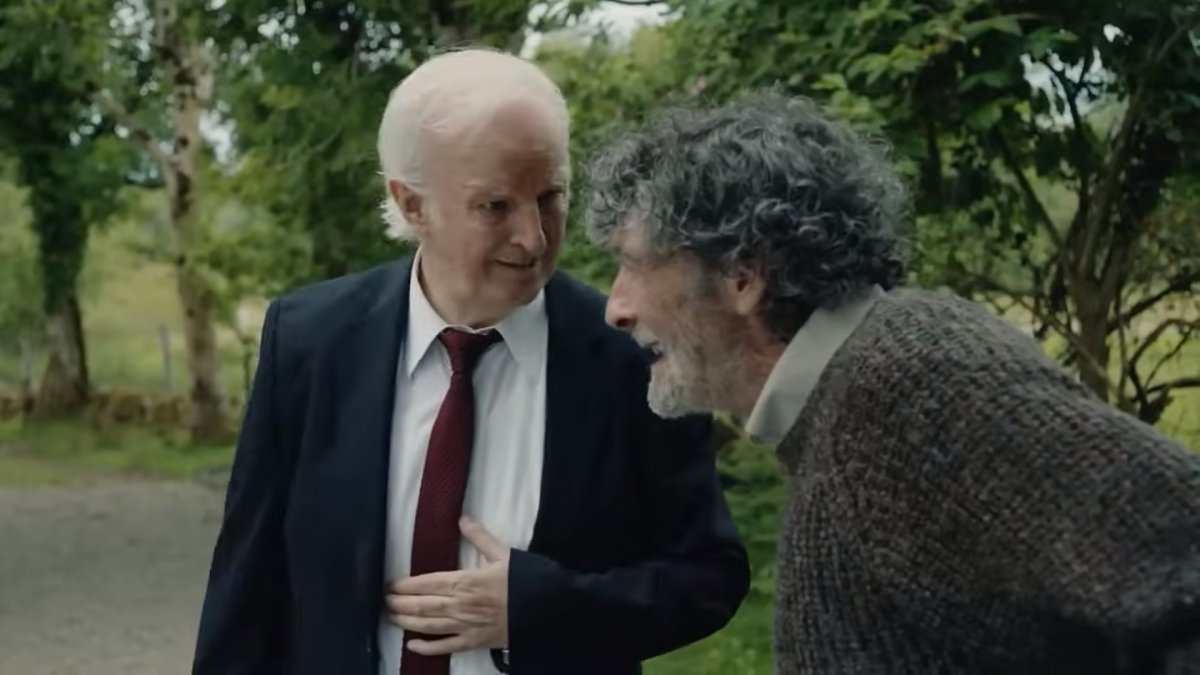
Some viewers have noticed the numberplate on the Ford Cortina in That They May Face the Rising Sun, the recent film based on John McGahern’s 2002 novel of the same name. The plate reads ‘OZU 155’. Surely this is a reference to the Japanese filmmaker Yasujirō Ozu? In interview, the director, Pat Collins, has said that the coincidence of the number plate was unplanned, but deliberately retained.
Ozu is not well known in the West now, but he is certainly a canonical name among people, like Collins, who know their cinema history. Ozu is celebrated for an observational, restrained style of storytelling, with minimal music or camera movement and, indeed, minimal plot. Collins’s admirable adaptation of McGahern’s final novel bears more than passing resemblances to key Ozu films, such as Late Spring from 1949, Early Summer from 1951, Tokyo Story from 1953 and An Autumn Afternoon from 1962. Like Collins, these all share a concern with the gentle unfolding of inter-generational time, with subtle domestic interactions, and with the challenge (sometimes welcome, sometimes not) posed by the visitor from outside.
What is most pertinent about this playful reference, however, is the common take on Ozu that he addressed ‘universal’ themes, and that his appeal is ‘universal’. Similar observations litter the reception of That They May Face the Rising Sun, and of another recent Irish breakthrough hit that I consider a companion piece to this, 2022’s An Cailín Ciúin, directed by Colm Bairéad. Both of these films are set in isolated, unnamed rural locales, with ordinary folk as lead characters, and have plots that are not besmirched by the concerns of urban existence (crime and punishment, politics, violence, money, addiction, social isolation, class conflict), which tend to dominate the stories we watch on screen. As with Ozu, paring away as many specific plot details as possible makes these films feel, to reach for vocabulary favoured by reviewers, ‘timeless’, ‘classic’, ‘profound’, ‘dreamlike’, ‘beautiful’, ‘delicate’.
It has been a long-running complaint that Irish cinema was dominated too long by questions of national and/or sectarian identity, that its narratives were tediously populated by priests and hysterical IRA men running around in ill-fitting leather jackets. Why couldn’t we just have a ‘normal’ cinema that would tell non-political stories that would have a universal appeal? The embarrassment of a liberal commentariat, and academy, at our political backwardness means that any Irish film that is not about the British question in some form or other is greeted with praise for having achieved some kind of postnationalist maturity. The two recent Irish films that we are concerned with here are therefore feted, as evidence that we have grown up.
It is true of any film set in the past that it is as much about the time it is made as the time it depicts. That They May Face the Rising Sun is set in the early 1980s, but the couple at the heart of the story, self-exiled from the city, are recognisably from our times. The period details are minimal, and the sense of being in the past is achieved mostly by the omission of digital devices, screens and disposable homeware. The fashion and hairstyles, so often an important guide to period, are neutral enough to belong either to the 1980s or to the present, especially if we regard Joe and Kate as ageing hipsters. (All the other characters are timelessly old-fashioned in their appearance.) As for what they do, they are engaged in what we now call remote working and the back-to-basics simplicity of their existence, with its mix of intellectual life, light agricultural activity and overpopulation-conscious childlessness, has a whiff of prepperism.
A very memorable sequence dwells on the wake, hours after the unexpected death of the lonely Johnny, who has been marooned in a life of drudgery in London for decades. In the crowded kitchen of Johnny’s brother’s family, a woman leads the group of country people in reciting a decade of the rosary, keeping track with a set of beads on her lap. Everybody participates in the ritual, responding to her as she cycles through the prayers. We linger on the faces and voices for longer than a more distractable film would allow. In the midst of all this, our protagonists Joe and Kate remain silent. For all of their integration into the community and the vital welcome that they offer to all comers, they are nevertheless not fully part of it.
The tone of this separateness is carefully judged; the silence of Joe and Kate is not hostile, nor is it received badly, as the story is one of tolerance. But, whereas in the novel, it is the community that kindly tolerates the blow-ins who have landed in their midst, in the film the flow of tolerance has switched, and now it is the liberal couple who tolerate the traditional, conservative values of the community. The contemporary characteristics of Joe and Kate align them with our 2024 values. The vast changes that have taken place between the early 1980s and now are palpable in this difference.
Nobody knew better than McGahern the tightness of the stranglehold that the Catholic Church held over the life of the country, especially in rural areas and in the schools. (He lost his job as a teacher because of the content of earlier novels). It is apparent to us now that the church was in fact at an unsustainable peak of dominance, triumphant in the abortion referendum of 1983 and in the defeated divorce referendum of 1986. But events such as the outcries at the death of Ann Lovett and the persecution of Joanne Hayes would set in motion the church’s reputational freefall in the intervening decades (rapist priests, slave laundries, death camps for children of the unmarried, the list goes on) and the blanket implementation in recent times of what was in the past quaintly known as ‘the liberal agenda’.
That They May Face the Rising Sun is a document of the final years of the previous dispensation, before the enormous transformation that has brought us to the liberal consensus that now prevails. When did this change take place, and how? Certainly the election of Mary Robinson in 1990 is a milestone, and in and around that date we could also include the Maastricht Treaty, Sinead O’Connor ripping up a photo of the pope (both 1992), the rise of globalisation and neoliberalism (Clinton, Blair, the World Trade Organisation), the 1995 referendum that introduced divorce (by a margin of 0.28%), and the world wide web.
One other, admittedly cosmetic, landmark event was the switch in 1987 to the standard European style of car numberplates, where the numbers and letters actually mean something. ‘OZU 155’ stands for the Japanese filmmaker, whose work is celebrated for the vacuous virtue of being about everything and therefore about nothing — in other words, for being politically inoffensive. Any edge of critique present in Ozu is blunted on contact with a commentariat in search of liberal universalisms, hungry to understand ‘story’ as a virtue and ‘context’ as an embarrassment.
McGahern similarly needs to be pruned of embarrassing excrescences. The problem is that in all his books he is a border writer, constantly conscious of the Troubles, the aftermath of the Civil War, the problem of political-institutional legitimacy and the family dysfunctions that flow as a result. He presents the awkward vista of rural communities that to this day persist in voting for political gombeens, seemingly unable to adapt to the fact that people in Dublin and Brussels know what is best. The film adaptation of his final novel forgives these errors by the device of celebrating the tolerant humanism of the educated outsider, stand-ins for viewers who crave forgiveness for despising the backwardness of pre-liberal Ireland and its uncomfortable, unresolved politics and its quaintly non-rational numberplates.
I was en route to Leitrim for a second time in a month when ‘Zooropa,’ the U2 song from the album of the same name, came on the stereo (a consequence of Spotify’s predictive algorithm). I hadn’t heard the song in thirty years, the year the album came out and I was a student working in Bavaria for a long hot summer. Suddenly, I was back in the apartment room in Straubing, listening and thinking about the Europeanisation of U2 that had come on the back of Achtung Baby and now Zooropa. The previous summer I worked on an old Soviet style pig farm about a hundred kilometres from Berlin. As U2 hung old Trabants from the stage, I considered driving home to start university in one of these relics of the old world: the former Soviet Bloc that bewitched my younger self. The two U2 albums shouldered my journey into Old Europe, experiencing the stark contrast between the former DDR and the richer region of the Bavarian West.
It was only as I set out for Leitrim the second time and the song played that I thought of its significance as a harbinger of the future: the lurch into Capitalist Realism and the End of History. Zooropa is steeped in contradiction as a song, marking the creative energy that pulsated across Europe at the time and the strange perpetual present that would define the new age. ‘No particular place names, no particular song,’ Bono sings, an incendiary criticism of the new Europe’s neoliberal squashing of tradition and place.
Before this Bono implores us to ‘skip the underground…go to the overground’ in a raucous anthemic lament predictive of the exploitation and extortion of the underground music scene in the decades to come. Perhaps it is this very exploitation that led Mark Fisher to coin the term Capitalist Realism in his book of the same name in the first place (ironically, Bono has been at the forefront in legitimising neoliberalism as a social and economic force).
Fisher defines capitalist realism as the ‘widespread sense that not only is capitalism the only viable political and economic system, but also that it is now impossible even to imagine a coherent alternative to it.’ This contractual entrenchment in a singular ideology brings with a fatigue culture. In response to a lengthy quotation from The Communist Manifesto, Fisher would offer the retort ‘capitalism is what is left when beliefs have collapsed at the level of ritual or symbolic elaboration, and all that is left is the consumer-spectator, trudging through the ruins and the relics.’
For Fisher, who took his life in 2017, neoliberal consumerism is defined by an orgy of the recycled without the commitment that defines the properly political. We watch The Truman Show, all the while laughing at the naivety and innocence, unaware that the media is owned by similarly large corporations, and much of the news curated for the masses.
It is not that, therefore, that we skip the underground, as Zooropa suggests. We move up to an overground feeding on an ever-dwindling underground that becomes a proxy for it. Most of today’s ‘alt’ music would not sound out of place in the 1990s. Ruins, relics are everywhere, fodder for commodity production, without ritual and symbolic currency.
Image: Darn Thorn
Monumental Failure
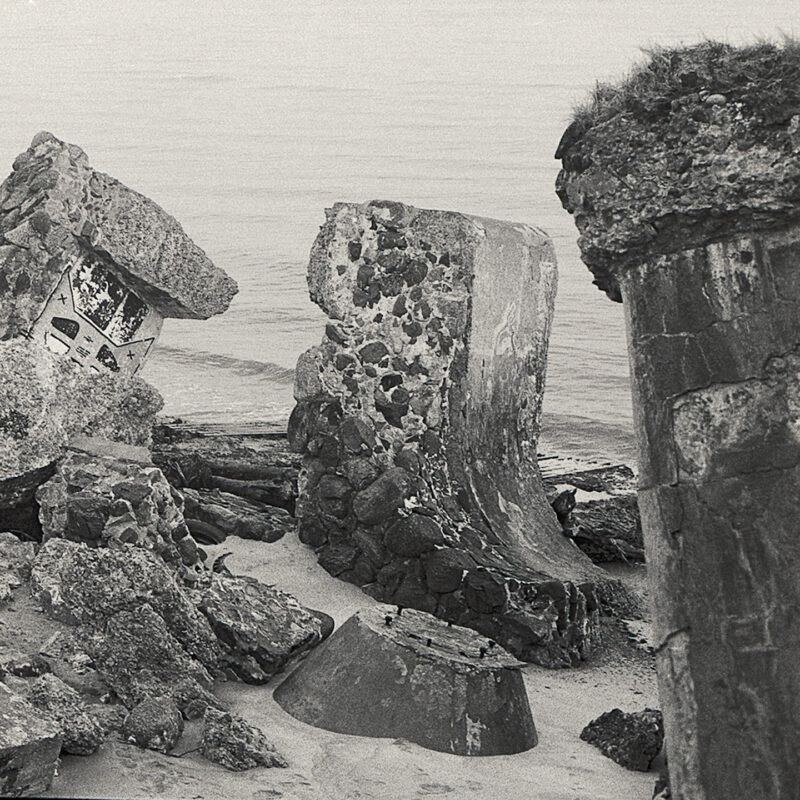
It is perhaps for this reason the Sligo-born artist Darn Thorn’s solo exhibition Monumental Failure at Leitrim Sculpture Centre, my second reason for travelling to Leitrim in the space of a month, leaves such a mark, the photographic document resistance to the consumer-spectator fix. Thorn’s show consists of old and new work, the main body of which is a video projected slide show containing haunting photographs of the destroyed bunkers along Europe’s northern coastline.
High in the hills of Leitrim, a reservoir of natural colour and landscape, is the Centre itself. As one drives into New Line, Manorhamilton, in my case on a sunny summer evening, the blue and white colours of the centre are a dalliance with sun-soaked hills that lie all around. Thorn seems aware of this, given the curation of the show and the placement of work within the labyrinth spaces of the gallery.
On entering the space, itself, a series of older framed photographic works, two of which are in colour – all directly or indirectly concerned with the process of ruination as it transforms natural and manmade habitats – are hung. The two works in colour, titled Unknown Zone #8 and Unknown Zone #10 respectively, are images that seem to hang some way between the ‘beautiful’ and ‘sublime’ as landscape erupts in a sea of colour, and the ‘index’ is less a known quantity in comparison to the black and white images. These are sumptuous, and often mystifying photographs that seduce the senses in a far different capacity to drier, more contemplative and ‘index’ directed black and white photos.
Produced over a decade, and part of prior exhibitions in Thorn’s catalogue of work, the prints in the first space are primers for the meat of the exhibition projected by video in the main gallery space. In the first area black and white photographs produced between 2010 and 2016 are hung, one of which is ‘Oakhampton Castle in Ruins (after Turner).’ This is a giclee print, aligning photographic process with present day content, both of which the viewer is invited to connect in one. Thorn’s use of technical equipment is important, part of a broader aim to make time palatable as a process that exists as a continuum. Working against the desire to simply appropriate and recycle the past in objects of rebuilt ‘time’, a mainstay of capitalist realism, one finds here a measured engagement with the history of art via a ruined building that carries through Turner’s career as artist, used to define a graduating romantic sensibility.
Thorn is obviously familiar with the romantic preoccupation with ruins. His stark black and white rendering of the great castle (in its (post-)modern iteration) is that of an object to be approached cautiously. It is a kind of wry commentary on the genius of Turner in rendering landscape both ‘beautiful and ‘sublime.’ It is also, in this regard, something of an austere commentary on the site of exhibition: deep in the West of Ireland, the Leitrim hills. How do we make sense of this landscape? In the post-Covid, climate change era, is it even possible to look at landscape as anything other than commodity? Because, in my estimation, Thorn can do beautiful and sublime if that is what is needed. But his concern with landscape as a genre of art is to help connect with the past in a way that is primal and other to that of commodity culture.
Image: Darn Thorn
Perfect Location
Perhaps this is why Leitrim, with its traces of an older, less atomised Ireland, is the perfect location for this exhibition. Ruins lie everywhere, in the built environment or the landscape, as the Old and New Ireland face off against one another. It is difficult not to think of the coastline near Manorhamilton on entering the exhibition space and confronting the mainstay of Monumental Failure: austere analogue and monochrome images of the destroyed bunkers that litter Europe’s beaches like ghosts in the machine.
As mentioned in the short text accompanying the exhibition, French architect and theorist Paul Virilio began a career documenting these bunkers in the 70s, traces of an historical war machine that had become spatial and unmoored from time: bombs could fall at any moment, in night or day. Virilio, like Thorn, approaches the bunkers as monuments to a regime of power, whether the Atlantic Wall Hitler dreamed of becoming a ruination to rival Greek Civilisation, or a nation’s resistance to the Soviet March towards a future that is dialectically driven by Progress itself.
The destroyed bunkers that Thorn fixates on in three separate series, whether in Denmark or Lativa, are upended, torn apart, existing as traces of totalitarianism to which Europe’s past is intrinsically bound. Unlike the real landscape around the Sculpture Centre, these often-melancholic images present regimes of power best understood as evil.
They can be read in an implicit socio-historical or moral context, an art historical context as periodic movements, or as primers for an imagination that has no context other than a subject reckoning with time. It is the latter position that implored me to respond to the austere force of the imagery. Maybe Ireland’s recent Covid past was a trigger, but the ruins seemed more than mere historical indexes of a long-lost history, depictions of time that preceded the critic and artist. The idea of retreating to a bunker and hiding away in hope that the war would pass spoke to me of the pandemic lockdowns, the society-wide shutdowns ordered in lockstep across Europe during the Covid 19 pandemic. By looking at Europe’s past Ireland’s past began to stare back at me.
Image: Daniele Idini.
The War on Covid
‘The War on Covid,’ as Michael Casey referenced it in a timely article, (as really a ‘war on people’) is not a glitch in the smooth functioning of the West, but the continuation of social atomisation that accelerated in the previous decade. As capitalist realism bears its ugly teeth, the masses emerge as the ultimate consumers in every facet of life. Stay in, shut up, consume. The lockdown is the bunker mentality of global capitalism, delivering ‘goods’ while ‘keeping you safe’ becomes the key mantra spluttering from the mouths of bureaucrats high on the capital involved in controlling movement of people in space.
Is it mere coincidence that Thorn completed the series titled Monumental Failure, presented in four parts (there is an architectural drawing for an Atlantic Wall bunker by the Lodt organisation projected onto the floor in addition to the photographs of ruins projected on screen) as lockdown ended and the war in the Ukraine usurped it as a media focus? The ruins depicted in these haunting, exquisite, ‘failures’ are symptoms of totalitarianism that persists in our wake. They are signifiers of a bunker mentality that atomises and reduces human beings to bodies in hiding.
A certain symmetry therefore exists in knowing that these images document the beaches of Europe as of today, comment on Europe’s historical war machine, and pay homage to the medium of photography as practiced at the time the bunkers were constructed. Thorn spent considerable time in Lativa, a country that was invaded by the Soviets and Nazis in quick succession, the ruins acting as monuments to liberation and signs of an imminent fascist return.
The complex history of the region, as one regime of power succumbs to another, becomes manifest as haunting blots on landscape, the ruins left uncared for like remains of alien life. Recently, I stumbled upon an online debate concerning the Memorial Museum at Auschwitz, that morally debated the transformation of the death camps into a visiting centre (we see the museum at the end of Jonathan Glazer’s The Zone of Interest) to remind us of genocidal horror. The thrust of the debate concerned the morality of memorialising something as horrific as the camps that killed so many. Why, the argument went, build a monument to genocide? As I drove home from Leitrim thinking of the ruined bunkers whose various parts lay scattered on the beaches of Europe, meticulously rendered in Thorn’s monochrome images, I thought of a bunker mentality born less of a credo to murder than to ‘keep us safe.’
If the Memorial Museum is intended to engender memory of an event, what, we might ask, is the purpose of the ruined bunkers? Once intended to hide away from terror, the bunkers soon became the object of terror. Would destroying the bunkers trigger a mass forgetting, or do the ruins simply invoke the credo that one person’s idea of safety is another’s idea of terror? If there’s an ethical purpose to Thorn’s Monumental Failure it is to help see both positions as one.
Apart from blatant attempts to curry favour with the genocidal regime in Israel, and his Far Right base back in the USA, Senator Graham must (one presumes) be aware that in January, only three months into the catastrophic mechanised slaughter by Israel in Gaza, ‘the weight of the explosives dropped by Israel exceeded 65,000 tons, or more than the weight and power of three nuclear bomb dropped on the Japanese city of Hiroshima’.
With the bomb payload now, as Israel – under pressure – drops more, and larger bombs, every day, killing a child every ten minutes, reducing Gaza to rubble and sand.
Gaza has already suffered the equivalent of nuclear Armageddon for over eight months.
Not enough blood Senator Graham and friends? You need more?
It got me thinking about the Daddy of Armageddon, ‘Oppie’, and his lionisation in Christopher Nolan’s ‘blockbuster of the century’, or ‘the epic, biographical, thriller, drama’ (Wiki), we were all mightily encouraged to go see last Summer, ‘Oppenheimer’.
But was ‘Oppenheimer’ the movie really an ‘epic, biographical, thriller drama’ about the guy who invented the nuclear bomb, or was it just the Patriarchy up to its old tricks – glorifying War, shiny weaponry and ENORMOUS bangs whilst blatantly ignoring Wars mostly female and child victims? Not to mention that which is never, ever mentioned, the catastrophic effects on our shared planet, Mother Earth?
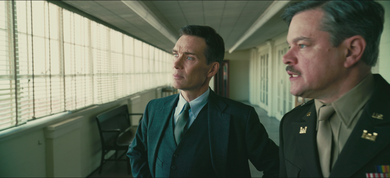
Cillian Murphy as Robert Oppenheimer and Matt Damon as Leslie Groves
Cillian Murphy
Of course like everyone I was proud of our own Cillian Murphy and his portrayal of Oppenheimer, eerily channelling the brilliant, charismatic, ‘overwhelmingly ambitious’ scientist co-opted by the American military to create the bomb to end all bombs, Murphy so committed to faithfully portraying ‘Oppie’s’ legendary intensity, and skinniness that legend has it during filming while the rest of the cast sat around chomping down on convivial suppers, the wine flowing freely, Cillian retired alone to his trailer to consume one cashew.
Dedication to the cause.
The real Oppenheimer was the eldest son of wealthy German-Jewish immigrants to the US. Brought up in New York, schooled in America, England and Germany’s (pre-Hitler) finest universities, he hung out with the greatest scientists of his day.
When asked to create an atom bomb, offered billions in funding, 760 scientists, and an entire purpose-built town in New Mexico to do so, he accepted. For an incredibly ambitious scientist it was too tempting an offer to turn down.
Creating the bomb was an extraordinary achievement. Terrible, but extraordinary. As they watched the first test go off in the desert only three years later, Oppenheimer said: ‘Some people laughed. Some people cried. Most people were silent’.
But here’s the thing: Christopher Nolan’s three hour extravaganza about the bomb that doesn’t question the morality of making such a hideous ‘weapon of mass destruction’; that doesn’t show us Hiroshima or Nagasaki; that perpetuates what U.S. journalist Greg Mitchell calls ‘America’s dirty secret’ in not calling out the bombings of Hiroshima and Nagasaki as war crimes, isn’t that a falsehood?
Isn’t that endorsing the terrible lie at the heart of the Patriarchy: that might is right. That military might is righter still?
For decades we were soothed with platitudes around America’s decision to bomb: America had to bomb Hiroshima and Nagasaki! It was the only way to ‘save’ lives! The Nazis were about to build their own bomb! The Soviets were minutes from building theirs! The Japanese were nasty slitty-eyed monsters, bad, bad people trying to take over the whole world, of course they had to be bombed!
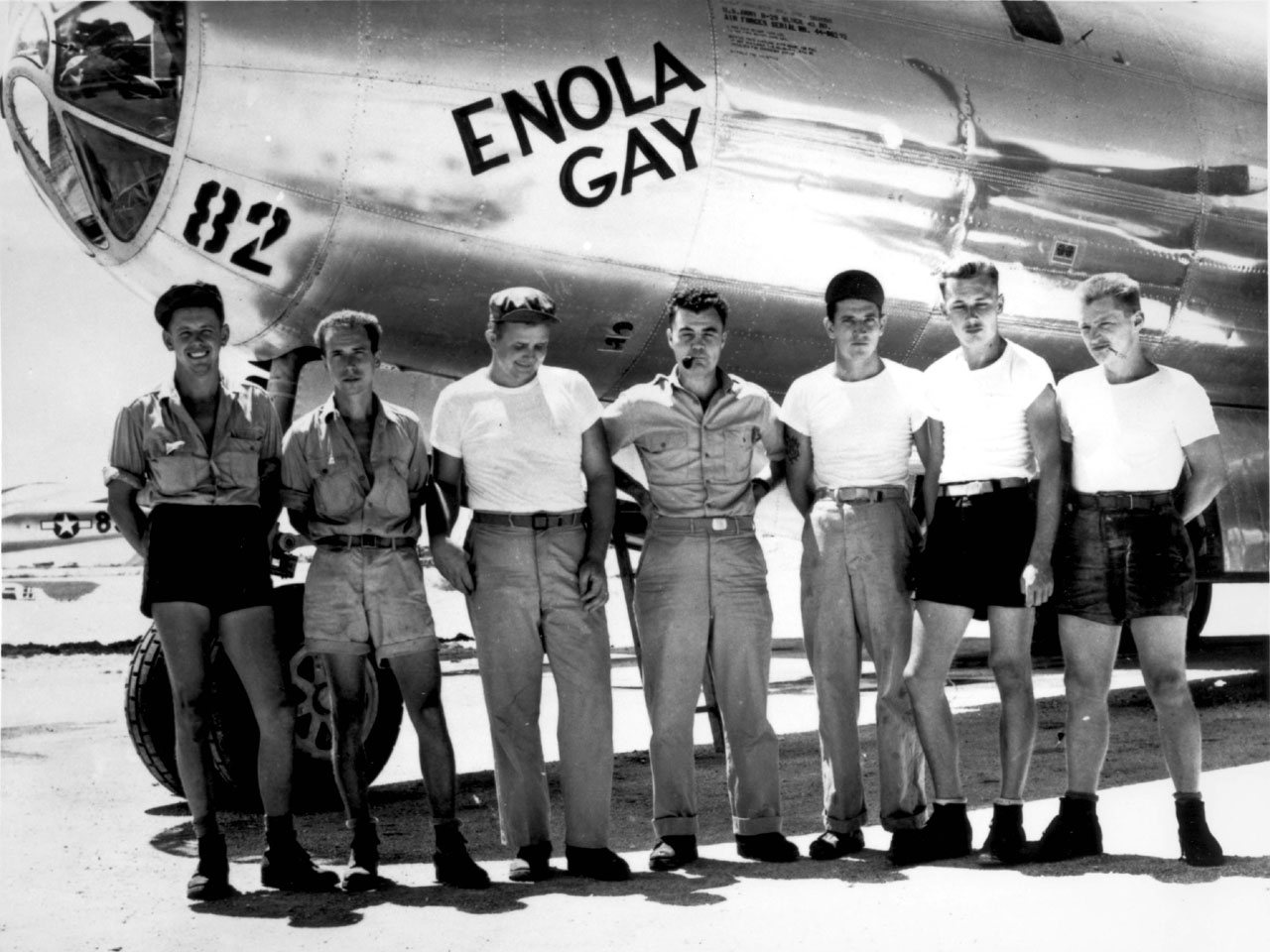
The Enola Gay dropped the “Little Boy” atomic bomb on Hiroshima.
The usual claptrap
None of which claptrap the film interrogates.
It doesn’t tell us:
a) that the bomb could have been dropped on the many military targets dotted around Japan (as opposed to being dropped on a city packed with civilians).
b) that the bomb could have been dropped over an unpopulated area, or over the sea. A demonstration, and warning, of America’s new and deadly power.
c) that with the Soviet Union launching a separate attack, if the US had waited two to three more months, Japan would have sued for peace. No bombs needed.
d) that the Nazis were already defeated, barely capable of raising a fart, never mind a nuclear bomb.
e) that the U.S. top brass’s estimation that it would take ten years and one million US soldiers to ‘subdue’ Japan sounds about as scientific as UK and US claims that Saddam Hussein had ‘weapons of mass destruction’ ready to destroy us all within minutes.
Tragically, and as per damn usual, the drum beat for War drowned out all other voices. Sadly for us all, Christopher Nolan goes with the central platitude: of course Japan had to be bombed.
One of the main reasons the American ‘brass’ wanted to obliterate two cities in Japan was the seriously bloody nose inflicted by the Japanese on America at Pearl Harbour, when 2,400 American military personnel were killed, and tons of military equipment destroyed.
Just as Afghanistan and Iraq had to be destroyed by an enraged American military after the surprise attack on the Twin Towers, just as Gaza has had to be pounded into rubble, thousands of its people slaughtered ‘because’ of Hamas’s incursion into Israel, Japan had to be fucked in the head by the American military because of Pearl Harbour.
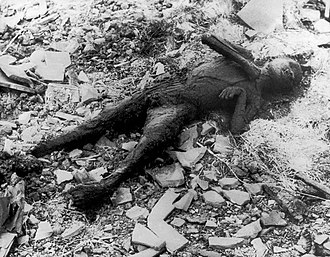
Yōsuke Yamahata photographed this child incinerated in Nagasaki. American forces censored such images in Japan until 1952.
No Matter What
Weeks after Oppie and co. ran the first test in New Mexico, sending radioactive plumes fifteen kilometres into the sky, turning the desert sand to glass, poisoning the land from which its indigenous inhabitants had been driven, Hiroshima, then three days later, Nagasaki, and their completely innocent inhabitants, felt the full force of the nuclear bomb.
210,000 people were ‘vaporised’ instantly. 95% of them civilians. Most were women and children. Hundreds of thousands more died horrendous deaths from ‘radiation sickness’, in the hours, days and years to come. One survivor remembers the sound of cracking. Not of the wooden houses burning, but human beings’ limbs, heated to impossible temperatures, snapping off.
Eerily akin to Israel’s current destruction of Gaza’s health system, 90% of Hiroshima’s doctors, nurses and medical staff were killed, or injured. Forty-five hospitals were either destroyed or damaged. Medical help for victims was poor to non-existent.
Nolan also conveniently forgets to mentionthe indigenous peoples driven off their lands so that ‘Oppie’s’ town could be built. Their lands destroyed to this day by the nuclear testing. ‘Our land, our sea, our communities and our physical bodies carry the legacy of these deadly experiments, with us now, and for unknown generations to come’.
Oppenheimer in 1946.
Important Men
While the first two thirds of ’Oppenheimer’ is super busy with what my friend called, ‘Important Men rushing along corridors, writing mysterious calculations on blackboards and peering into pipettes’, as if to make up for ignoring the horrors of Hiroshima and Nagasaki, the final section of the film is taken up with the crucifixion of Oppenheimer at the hands of America’s military. Essentially for refusing to say the bomb was 1,000% brilliant.
Brought in to visit President Truman, Oppenheimer worried he had ‘blood on his hands’. As he left the Oval Office Truman hissed he never wanted to ‘see that cry baby scientist again’.
Oppenheimer, the darling of America, became Oppenheimer the Jew. The Communist. The spy. The unmentionable.
Horribly, his Jewish ancestry made him vulnerable. Jewish anti-semitism was embedded in every layer of American society at the time. Recommending a young Oppenheimer his Harvard professor said, ’Oppenheimer is a Jew but entirely without the usual qualifications’. At Berkeley, attempting to get a position for a colleague, he was told No. ‘One Jew in the department is enough’. Which was ironic, since the most brilliant scientists in America were Jewish refugees from Hitler’s genocidal Germany would soon be working in Los Alamos with Oppenheimer. Many of them women – another blindspot in Nolan’s re-telling.
Prophetically, Oppenheimer himself died of cancer at only sixty-two years of age. The guy who unleashed nuclear Armageddon on the world succumbed to radiation’s deadly kiss himself. An extraordinary black and white clip on YouTube shows him, more ghost than man, whisper: ‘Hiroshima was far more costly in life and suffering, and inhumane, than it needed to have been, to have been an effective argument for ending the war.’
Sadly Nolan shows us none of this. Like so many other big beasts working in Hollywood he seems dedicated to the glorification of weaponry. Of War. Most of all of minimising War’s terrible human cost to innocents.
The Patriarchy’s pet project
War is the Patriarchy’s pet project. How the Patriarchs, including those nasty handmaidens to the Patriarchy who never get their own hands dirty, love it. How they make millions from it in their arms factories. How conveniently they forget that it’s women and children, who always pay the highest price.
Always.
Can we honestly claim to be civilised democracies as Gaza is reduced to dust, with billions in ‘military aid’, i.e, 2,000 lb bombs from America the UK and Germany, with thousands of its people killed, maimed, burnt alive, buried alive under the rubble of their houses in front of our eyes?
As the orders of the highest courts in the world – the International Court of Justice, the International Criminal Court – are openly flouted by Israel, America and Britain?
As we enjoy blockbusters glorifying War’s killers?
The launcher of this book in Dublin, translator Pierre Guglielmina, gave a speech in The Little Museum of Dublin, in which he managed to nickname the text with the accurate acronym HIT IT – like a piece of modernist wordplay. Pierre described it as a panorama of French literature from the Commune times of 1870 to the Great War (1914), a study that “hit [him] hard”. “The movement of HITIT, from Mallarmé to Proust through Apollinaire…[he said] is a triumphant one, and I have been trying to understand why.”
It should be a source of embarrassment that in Ireland we still have had no public inquiry into the State’s response to the COVID-19 pandemic. Despite talk of terms of reference, nothing has materialized, and nor does this situation seem likely to change during the lifetime of new Taoiseach Harris’s government.
The mainstream media, which received millions in advertising revenue throughout the pandemic, would appear to have no interest in searching questions being asked. It may not be appetising to recall overwhelmingly uncritical coverage; placing the daily tally of new cases and deaths on their front pages news for almost two years; seemingly oblivious to everything else happening in the world.
Nor does the main opposition party in Dáil Éireann, Sinn Féin seem gung ho for one either. During the pandemic, they failed to interrogate adequately the domineering, even dictatorial, roleof Chief Medical Officer Tony Holohan in particular, or the runaway budgets that developed in that period. Despite this spending, our health service appears to be no better equipped to deal with medical emergencies.
In my view, Sinn Féin (and other opposition parties) should reconsider this stance as it hands a huge political opportunity to opponents on the far right as we enter a period of elections. The Irish people require accountability on this era-defining response.
For all its faults, and failure to interrogate basic premises, the U.K. Covid inquiry is at least holding power to account. That inquiry implicitly acknowledges that extraordinary and unprecedented measures were taken, undermining basic civil liberties, and causing grave harms, including to children denied education and those caught in situations of domestic violence. The damage to our collective mental healths may be more difficult to quantify.
The pandemic experience in Ireland
Kevin Bardosh sits down with Frank Armstrong, Editor of Cassandra Voices, an Irish public intellectual forum and online news source, to discuss the pandemic experience in Ireland and what we can expect from a possible Irish Covid Inquiry.… pic.twitter.com/m9xme5z5Gu
— Collateral Global Charity (@collateralglbl) May 15, 2024
A self-fulling prophecy
Writing for the Irish Times on May 23 2020 clinical psychologist and author Maureen Gaffney reckoned that ‘Covid-19 has scored a direct hit on our most basic psychological drives.’ She seemed oblivious, however, to how statements such as her own that ‘the consequences of the coronavirus pandemic may have changed life more permanently’ might have been contributing to the anxiety of her readers.
The direct health impact of what Peter Hitchens acutely described as ‘the Great Panic of 2020’ are fairly obvious. But the ripple of psychological effects is less easy to assess. Psychological injury, or so-called nervous shock, is difficult to quantify in law. A successful claim requires reasonable foreseeability, and the presence of a duty of care.
Dr Gabor Maté, in particular, has pointed to the effect of stress and trauma on our health. Thus, if a national leader with a duty of care says that thousands of people are likely to die from a deadly disease and imposes a stay-at-home order for an indefinite time period, serious collateral damage in terms of stress and even trauma is reasonably foreseesable. Unless they are working from a firm evidence basis and/or a robust rational, political leaders should exercise great caution in making such pronouncements or laws.
A 2017 study demonstrated that people who feel lonely report worse cold symptoms than individuals who are not. The exacerbating factor of loneliness on Covid symptoms may be just the tip of the iceberg.
In 2020Dr Marcus de Brun highlighted in this magazine how psychological stress would be a major determinant in one’s experience with Covid-19: ‘Psychological stress is (medically speaking),’ he said, ‘a self-fulling prophecy. People who are most anxious about becoming ill are most likely to become ill. If you ask yourself often enough whether or not you have a headache, you will eventually experience one.’
By early March a few cases were being recorded in Ireland, the media went into hysterical frenzy, almost shaming the inevitable innocent cases.
Then I got an email to say that my next project was now cancelled. Devastated, I went for my usual swim, sometimes the magic water doesn’t work, it didn’t that day. I came home frozen, riddled with fear, no work, fear of how to pay my rent; suddenly I became unwell. A sore throat and mild fever, paralysed me, as I lay alone on my sofa.
But no cough. Back then the only symptom mentioned was the hacking cough. I checked my phone and there was now talk of Ireland entering lockdown around St Patrick’s Day. Armageddon was arriving Supermarkets running out of food, even fucking toilet paper. I was now in a delirious state of panic.
The next day the fever went, but I still had the sore throat. On the Monday I tried phoning my Doctor; no answer; permanently engaged or just automated messages to contact some new HSE hub.
I was now in a state of constant anxiety, with no food in the house, and yet I couldn’t leave home. and I live alone.
I phoned my ex wife. She kindly said she’d shop for me. On St. Patrick’s Day Leo made his grim, great speech. I still felt he knew something that he wasn’t telling us. Maybe this virus was as deadly as the Spanish flu of 1918-20 that killed up to fifty million, including my grand-uncle aged just nineteen. Death figures of 85,000 were being predicted in Ireland by our Fear driven media.
All that week I had an intermittent sore throat, but still could not get in contact with my Doctor.
The thing to watch for was the breathlessness I had heard. This was what caused the dangerous pneumonia. On the Saturday night I went to bed early alone, and suddenly had problems breathing. It being Saturday I could not disturb my Doctor, nor did I want an ambulance arriving to take me to quarantine in hospital, where I’d be met by Hazmat-clad Doctors and become Patient No. 3. Laid low by fear and shortness of breath I could not sleep. By 5am I made a decision to complete my final book, Americans Anonymous and get my things in order in case this was it.
Barry’s panic is likely to have been replicated across the population.
The pandemic experience in Ireland
“Ireland is an unusual country; instinctively perhaps anti-English would often be the reflex.”
“When the pandemic began, people were glued to their television screens like everybody else around the world. They were observing what Boris Johnson… pic.twitter.com/TxrJhxVtba
— Collateral Global Charity (@collateralglbl) May 15, 2024
Around for a lot longer than initially understood
Yet Covid-19 had been around for a lot, lot longer than we imagined by the time in February 2020 it was presented to us as a SARS-like illness. Indeed, Spanish virologists found traces of the novel coronavirus in a sample of Barcelona waste watercollected in March 2019, some nine months before it was identified in China, according to the University of Barcelona. Similarly, a study by the National Cancer Institute (INT) of Italy found that it was circulating in Italy in September, 2019.
That patient presented himself at Cork University Hospital on February 29th, 2020, days before the first confirmed case (via a PCR test) of COVID-19 in the Republic. Analysis later established the particular strain in his case showed ‘very little difference’ from the original strain from China’s Hubei province, and had none of the characteristic mutations found in strains then prevalent in Bavaria or Lombardy.
The man, however, had no epidemiological link to any area where the virus was prevalent at the time or any link to a confirmed case.
All this vindicates Oxford’s Professor Sunetra Gupta, assessment from the outset that Covid-19 had been circulating for months prior to the imposition of lockdowns, and was far less deadly than assumed by Imperial’s Professor Neil Ferguson in his famous paper. Tellingly, it was hardly registering in our hospitals in the winter of 2019-2020.
The pandemic experience in Ireland
“I found the ‘Zero-Covid’ movement quite absurd, but it really was popular.”
“Ireland traditionally is quite a catholic country. The ‘Zero-Covid’ movement was a sort of Holier movement than even the mainstream.”
— Collateral Global Charity (@collateralglbl) May 15, 2024
Long Covid
It may be that many of the symptoms associated with Long Covid or ‘long haulers’ as sufferers are known in the U.S., are the product of that collective panic; a combination of disease and trauma locked bodies over months of painful lockdowns.
In March 2021 Adam Gaffney, an assistant professor in medicine at Harvard Medical School, argued for a more critical appraisal of Long Covid. Having expressed scepticism around a condition characterised by symptoms such as ‘brain fog’, he recalls being contacted by a journalist who said: ‘I’m asking as much as a person as a journalist because I’m more terrified of this syndrome than I am of death.’
Gaffney acknowledges ‘myriad long-term effects, including physical and cognitive impairments, reduced lung function, mental health problems, and poorer quality of life’ from severe bouts of COVID-19 – long recognised as post-viral syndrome – but cites a survey showing two-thirds of ‘long haulers’ had negative coronavirus antibody tests, and another, organised by self-identifying Long Covid patients indicating around two-thirds of those surveyed had undergone blood testing reported negative results.
He asserted: ‘it’s highly probable that some or many long-haulers who were never diagnosed using PCR testing in the acute phase and who also have negative antibody tests are “true negatives.’ In other words, for many this may have been a disease with a psychological origin, which Gaffney attributes to ‘skyrocketing levels of social anguish and mental emotional distress,’ referencing a paper showing that about half of people with depression also had unexplained physical symptoms.
The pandemic experience in Ireland
“The structure of the Irish economy is dependent on a number of large multi-nationals who operate in the country including Pfizer, other big pharmaceutical companies and big tech due to the low rate of corporation tax.”
— Collateral Global Charity (@collateralglbl) May 16, 2024
Class Action?
Investigating the consequences of that social anguish may, in fact, be one of the less contentious matters which any COVID-19 Inquiry in Ireland would consider, as members of the government could reasonably point to the global hysteria, in large part generated by social media.
What is likely to have deterred the government from setting up an inquiry in the first place is a fear of a class action from relatives of care home residents, who seem to have died unnecessarily: Ireland experienced the second highest proportion of care home deaths in the world, during what is called, inaccurately the first wave, of spring 2020.
Throughout, Irish people were effectively lied to, via a compliant media, regarding the nature of deaths from COVID-19. Thus, the Central Statistics Office (CSO) adopted WHO guidance listing COVID-19 as the underlying cause of death when:
confirmed by laboratory testing irrespective of severity of clinical signs or symptoms.
diagnosed clinically or epidemiologically but laboratory testing is inconclusive or not available.
Chief Medical Officer Tony Holohaneven acknowledged a remarkably low threshold in April, 2020: ‘Clinically, the “index of suspicion” for the disease would be “a good deal higher” than would normally be the case for flu.’
Our democracy demands an inquiry into what led our government to take many of their decisions. Was it simply a lack of expertise that led the State to adopt flawed policies, or did they know more than we have been told?
How is it possible that decision-making was almost entirely devolved to the Chief Medical Officer (CMO) Dr Tony Holohan in 2020?
We must also scrutinise the manner in which subsequent decisions were taken on masks, further lockdowns, and perhaps most insidiously, vaccine passports.
If indeed we are to prevent the precedent of the COVID-19 response changing life more permanently, questions need to be answered. It is incumbent on the main opposition parties, Sinn Féin to demand this of the government, and promise one to the electorate if they come to power. If not, I suspect the far right will continue to make inroads into their support.
These are extraordinary times. Last month serial sexual abuser Harvey Weinstein, had his 23-year sentence squashed; a Channel 4 documentary aired new sexual misconduct claims against Kevin Spacey, and Woody Allen and Roman Polanski are feted at the Venice Film Festival. ‘Hiding in plain sight’ – and having ruthless lawyers – still seem to work as a treat in the misogynist’s playbook.
Let’s take Woody Allen. These days Woody Allen looks like someone’s favourite teddy that’s been savaged by a pitbull, but don’t be fooled – he’s as unrepentedly misogynistic as ever. And just as keen to claim his innocence: No Court Ever Convicted Me.
Some days it feels as if #MeToo had never happened.
So Woody is the guy who, since the very beginning of his career, made films about older guys glomming onto young women. Very young women. Mariel Hemmingway, in everyone’s favourite Woody movie, ‘Manhattan’, was sixteen-years-old. Sixteen! Being drooled on by a 40-something Woody Allen.
When shooting wrapped on ‘Manhattan’ Woody drove her to her parents mansion and suggested she run away to Paris with him, where he would make her a star. Would there be separate bedrooms? Asked the kid. Eh, no.
Praise the Lord (and pass the ammunition), that was the end of that.
But Woody went on to make more, and more, movies featuring older men – very often himself – and younger, much younger women.
Emma Stone, Allen, and Parker Posey at the Cannes Film Festival in 2015
Cultural Icon
Part of the blindness to this carry on arose of course from Woody being a ‘cultural icon’ for millions of Boomers. The softly-spoken, wonky-specked hero of their fav films, could do no wrong. Woody was their very own ‘Lovable, Neurotic Nebbish’.
As Steven Kurutz of the New York Times wrote that Woody was the litmus test for all things groovy: ‘E. E. Cummings, Paris, 1930s jazz and the sophisticated, cultured world his films came to represent.’
Apart from a few sharp eyed critics like Joan Didion who said Mariel Hemingway in ‘Manhattan’ was ‘another kind of adolescent fantasy, a high-school senior with perfect skin, perfect wisdom, perfect sex, and no visible family’, or film critic Pauline Kaelwho asked, ‘What man in his forties but Woody Allen could pass off a predilection for teenagers as a quest for true values?’
Most people played along. It was just Woody, playing out his ‘predilections’. Hahaha. Then came real life.
It turned out it was the same Woody Allen who groomed, seduced, and had a secret affair with his and Mia Farrow’s sixteen-year old high school daughter, Soon-Yi. A young woman whom he had been de facto father to for thirteen years. A young girl, chauffeured to him in his apartment still in her school uniform.
When confronted by a horrified Mia – she’d found the pornographic photos he had taken of Soon-Yi on his desk – Woody went full DARVO. Deny. Attack. Reverse Victim and Offender. Who cared if he destroyed his family and his partner Mia in the process? Certainly not Woody.
He denied Soon-yi was his daughter, that he had been in loco parentis for over thirteen years. Denied grooming her. Denied that Soon-yi, a Korean street child, surviving on trash until adopted by Mia and then husband Andre Previn, was peculiarly vulnerable, having never even had a boyfriend until Mr Specs moved on her.
No no no, wrote Woody. ‘Here was a sharp, classy, fabulous young woman: highly intelligent, full of latent potential, ready to ripen superbly’.
“Ready to ripen superbly.”
Woody Allen and Soon-Yi Previn in Venice in 1996
Worse to come
During custody proceedings it turned out, as Dylan would testify years later in her open letter to the New York Times that Allen had groomed her, and abused her, ‘doing things to her that she didn’t like’ for ‘as long as she could remember’?
Immediately, the vast army of lawyers, PR wonks, ‘experts’ employed by him to destroy Mia Farrow and allow him ‘have’ Soon-Yi, switched their attention to destroying the evidence of his then seven-year-old daughter, Dylan.
In a classic Toxic Dad move, Woody lodged a legal appeal to gain custody of his and Mia’s three younger children: Moses, Dylan and Ronan, saying Mia was an unfit mother. A harridan. A bully. A crazy person. Whom her children hated. That these ‘false allegations’ of abusing Dylan were manifestations of Mia Farrow’s ‘festering anger’ against him. Part of a ‘bitter custody battle’.
Woody was the first to bring up the toxic ‘Parental Alienation’ defence now poisoning thousands of custody cases in both America, the U.K., even here in Ireland, whereby abusive fathers can get full custody of children when their lawyers assert the Mums have ‘alienated’ them against the same abusive Dad.
According to one top US lawyer, it’s ‘easier for the Courts to grant custody to an abusive father than to believe the mother’. Thousands of women, and children, have suffered terribly. Little comfort to them that the guy who dreamed up this latest patriarchal wheeze hacked himself to pieces in his kitchen with a carving knife as local deputies moved in with child abuse charges.
As Woody’s attacks on Mia as ‘harridan’ were amplified by an adoring press, lapped up by fans, interview after sympathetic interview was conducted with our man, ‘as New York as the Statue of Liberty’. It was box office. Who doesn’t love to see a super-rich, beautiful blonde with a large, multicultural family, taken down?
Luckily, Woody overplayed his hand. The seven week-long custody case didn’t go his way. The judge, to Woody’s and his expensive lawyers evident astonishment, denied him custody. In case anyone was in doubt as to why the Judge spelled it out: ‘Mr. Allen’s resort to the stereotypical ‘woman scorned’ defence is an injudicious attempt to divert attention from his failure as a responsible parent and adult.’ Hurray!
Mia Farrow at the 2018 Pulitzer Prizes awards ceremony.
No Criminal Conviction
Sadly, attempts at securing a criminal conviction against him for the sexual abuse of Dylan foundered.
First, the New York hospital who conducted ‘interviews’ at Woody’s behest with seven-year-old Dylan, destroyed all their evidence, then claimed she had either been ‘coached’ or was ‘deluded’. Before any judicial process could take place they allowed Woody Allen to hold a press conference on the hospital steps to ‘proclaim his innocence’.
The New York Prosecutor was apoplectic. But hey, Woody was Woody. He brought millions of dollars into New York, right? What was a seven-year-old’s ‘discomfort’ compared to that?
A young NYC welfare officer who interviewed Dylan separately, believed her. He was ‘instructed’ to find her allegations ‘unfounded’. When he refused, he was fired. His superior said: ‘The elite do whatever they want to do. There are no consequences’. She resigned.
Meanwhile in separate proceedings in Connecticut where Mia and the children lived, another prosecutor believed there was ‘probable cause for a criminal case’. But it was this prosecutor and Mia Farrow who reluctantly decided to call a halt to further legal proceedings as putting a traumatised seven-year-old through any more of this brutality would be too much.
Woody held another press conference: he was clean! More parties! More cheering!
And he continued to make films, play jazz, and yes, actually get married to Soon-Yi. He was sixty-two, she twenty-seven.
Most importantly, he got to keep his precious status as an ‘auteur’ and ‘proven genius’. One of the ‘greats’ of Western cinema.
Ronan Farrow.
Post Traumatic Stress
He almost got away with it.
His victims, daughter Dylan and partner Mia Farrow – though all the children in the family were affected – were left with the pain, post-traumatic-stress, years of self-loathing, anxiety and depression, while he partied on.
As Dylan wrote, ‘Sexual abuse is a life long sentence. It never goes away’.
Woody said it was all ‘stupid’, ‘silly’. There was nothing he could do. And, magic trick!, no court had convicted him. He was clean.
Luckily, just when you think you’ve killed it off for good, the truth has a nasty habit of reappearing.
It was the lionisation of her father at the Golden Globes in 2014 that drove Dylan, now a beautiful young woman in her twenties, into offering that open letter to the New York Times:
For as long as I could remember my father had been doing things to me that I didn’t like…
I didn’t like how often he would take me away from my mom, siblings and friends to be alone with him. I didn’t like it when he would stick his thumb in my mouth. I didn’t like it when I had to get in bed with him under the sheets when he was in his underwear. I didn’t like it when he would place his head in my naked lap and breathe in and breathe out. I would hide under beds or lock myself in the bathroom to avoid these encounters, but he always found me.
Woody’s obsessive grooming culminated in taking the little girl to a ‘crawl space’ in the attic in the family home in Connecticut, making her lie on her tummy and watch her brother’s train set go round, while he touched her private parts, then penetrated her with his finger.
He told her it was ‘their secret’. That one day he would take her to Paris and make her a movie star.
Horribly, the exact same line he’d used on Mariel Hemingway.
Dylan’s letter to the New York Times was a bombshell. Twenty-two years after her mother’s initial disclosure of abuse, cultural indulgence towards male abusers had chilled. Significantly.
Dylan’s younger brother, Ronan Farrow, who Allen had offered a ‘comfortable life’ to in return for speaking out against his sister and his mother, was developing a successful investigative journalism career. His eyes were on that other elephant in the room of abuse, Harvey Weinstein.
Crucially for Dylan, and for their mother Mia, Ronan became an ally.
At first, he admits he was horrified at his sister’s public re-announcement of their father’s sexual abuse. He begged her not to. ‘It was the last association I wanted’. A bonfire in which friendships, powerful allies and those all-important connections would get burnt. Where Woody Allen’s ferocious spin machine would go into overdrive once more.
Thankfully the #MeToo Movement was sweeping through the ‘entertainment world’.
Woody’s ‘this is all too silly’ schtick began to look threadbare.
Ronan’s book on the Harvey Weinstein scandal,Catch and Kill became a Pulitzer Prize-winning best seller. Hachette, poised to publish Woody’s memoir under the same imprint, pulped Woody, and championed Ronan. Amazon cancelled a four film-deal.
The Tables Turn
The coup de grace was a four-part HBO documentary aired in 2021, ‘Allen v Farrow’ made by Jane Doe Films. The details, painstakingly put together, paint an utterly damning portrait of an decidedly not nice little guy.
Woody began to sound less sanguine, dismissing the actors who dared refuse to work with him, with: ‘That’s how actors and actresses are, denouncing me became the fashionable thing to do, like everybody suddenly eating kale.’
As if kale had anything to do with justice. With little ones being abused.
Rather prophetically justice has come for Woody and his ilk, Harvey Weinstein etc., via the media. The same media these men manipulated, for years.
Far from being a ‘Trial by Media’ as these scions of the patriarchy like to characterise it, for abused women, going to the media, taking the fight to Twitter, or TikTok, or the New York Times, is a ‘form of rebellion’. It is a way, said Baroness Helena Kennedy QC. with regard to yet another alleged sexual abuser, Russell Brand, for abused women to ‘throw a brick through the windows of the Criminal Justice System. A way of saying: You Have Let Us Down’.
Throwing bricks through windows has a venerable feminist history. Smashing the windows of shops in London was an effective tool in the Suffragettes armoury. Not listening to us? How about this: Crash! Bang! Wallop! And down came the huge plate glass windows in cascading showers of splinters.
The sexual exploitation and abuse of women by powerful men is still endemic in our culture. However it is called out – through film, documentaries, social media, by incredibly brave young women like Dylan Farrow, by throwing bricks through windows – it is our way of saying ENOUGH.
As the founder of the now seemingly inactive Irish Innocence Project, and co-founder of The European Innocence Network, I staunchly oppose the death penalty, with exceptions for certain Crimes Against Humanity. I have personally visited and represented individuals on death row in Kenya and the U.S.. This underscores the critical need for our legal system to exercise caution, and precision, to avoid wrongful convictions.
Recently, I have condemned in a Cassandra Voices Podcastthe inhumane prospect of Julian Assange enduring indefinite incarceration. This stance does not, however, imply a belief in universal innocence, or countenance a dismissal of deserved punishment. Rather, I advocate for a measured approach to justice, echoing Shakespeare’s notion of ‘measure for measure’ in determining appropriate consequences for actions.
Following an ethical determination of guilt, the central question revolves around what form of punishment is suitable. But before delving into punishment, we must first address the concept of guilt, and whether the guilty evade accountability.
Unfortunately, instances abound of individuals with power or wealth evading justice through various means. Examples include former President Trump and Clinton’s long list of pardons on leaving office, and instances of state officials abusing their authority, as depicted in literature such as Klima’s 1991 novel Judges on Trial. These cases underscore the danger posed by those entrusted with upholding the law manipulating it for personal gain.
David Langwallner begins a two-part series on why people are found guilty of crimes they did not commit dealing with confirmation bias, leading questions etc.https://t.co/N2k7bKiiUI#HateCrimeAct#HateCrime
A state or judicial criminal is often the worst criminal. They have subverted the Rule of Law and the processes they were appointed to uphold. They are professional hypocrites.
In his 1971 detective novel Equal Danger, Leonardo Sciascia demonstrates how in Italy judges may become, by stages, complicit in murder. Chillingly, the President of the Supreme Court intimates to the investigating detective that in condoning murder the judiciary are incapable of error.
Sciascia also documented the complicity of the mafia and Christian Democrats in the murder of God’s banker Roberto Calvi in 1982, and of course the kidnap and murder of the progressive, or incorruptible, Christian Democrat Aldo Moro in 1978.
In Ireland the incident that primarily gave rise to Conor Cruise O’ Brian’s immortal phrase GUBU (grotesque, unbelievable, bizarre and unprecedented) was the murderer of the nurse Bridie Gargan and the farmer Dónal Dunne in 1982. The murderer Malcolm McArthur was discovered on the private property of then Attorney General Patrick Connolly.
Not uniquely in Ireland, the powerful avoid and do not accept responsibility for their actions and may resort to framing others. Voltaire, the earliest expert in miscarriages of justice coined the phrase per encourager les autres, to deal with the scapegoating of Admiral Pyle by the establishment.
Political criminals also enact laws to protect their interests. The new Hate Crimes Bill in Ireland is finally being opposed by SF as they have recognised the danger it poses.
The legal principle of ‘presumed innocent until proven guilty beyond reasonable doubt,’ as established in the case of Woolmington v DPP (1935), serves as a foundational tenet. Yet, challenges arise, particularly regarding the interpretation of evidence and credibility of assessments.
In every case I have recently conducted the same question is asked by jurors: “is sure the same as beyond all reasonable doubt?” Judge rightly say yes, and try to avoid further questioning to avoid being buried in semantics.
Of course, the crucial point is that unless someone tells a defence lawyer he or she is guilty – in which case you either withdraw or can only defend by challenging the prosecution evidence without asserting innocence – you cannot know definitively.
Cognitive bias cuts all sorts of ways. A defence lawyer should be timorous about getting a client to plead guilty if there is any doubt. Not least, many clients are vulnerable and inclined to please authority and, as has happened in my experience, defendants may seek to change their plea.
The intersection of morality and legality further complicates matters. It is essential to caution against conflating moral judgment with legal culpability. Instances of moral condemnation influencing legal proceedings – as seen in the admission of bad character evidence – highlight the need for a nuanced approach.
A feature of my speeches is to caution a jury not to confuse morality with legality. Moral condemnation is often used by the prosecution to smear the accused, and the previous bad character admissions ushered in by Blair in the U.K. opens that gateway.
In Ireland, however, the exclusion of bad character is not a good idea. Evidence of bad character is only inadmissible in certain defined exceptions, such as if one puts one’s good character in evidence. There should be more of a halfway house.
Despite efforts to discern guilt, the process remains fraught with challenges. Guilty individuals often resort to elaborate tactics to obfuscate the truth, necessitating a vigilant approach from their lawyers. Additionally, societal biases and institutional pressures can influence witness testimony and judicial outcomes.
In the pursuit of justice, it is crucial to distinguish between genuine miscarriages of justice and rightful accountability. While liberal objections to wrongful convictions are warranted, there are instances where the punishment must align with the severity of the crime. The case of the Moors Murderers 1963-65, Ian Brady and Myra Hindley, serves as a poignant example of criminals rightfully facing lifelong imprisonment.
Reluctantly, it must be conceded many are guilty. And it is sometimes very difficult to get them to accept their guilt. Even my great hero Clarence Darrow ‘Attorney for the Damned’ represented Leopold and Loeb, who in a nihilistic fashion attempted to kill another young man simply to prove they could get away with it. As in the Jamie Bolger case. Darrow knew they were guilty and avoided an insanity plea. Instead, he made the greatest plea in mitigation in the recorded legal annals to avoid the death penalty. But they did do it.
Lucy Letby mugshot.
Nurse Letby Case
The recent case ofNurse Lucy Letby who was found guilty of murdering seven infants in Manchester crown court in 2023 is instructive.
She is not the first Mancunium serial killer. Between 1963-65 in Saddleworth Moor near Manchester Mancunians Ian Brady and Myra Hindley murdered innocent children. It is noticeable that they were also influenced by the film ‘Compulsion‘ documenting the Leopold and Loeb case.
Working on a recent case in Manchester, I resisted the temptation to visit the moors, but did pass by Market Street, Cheshire where another notorious murderer, the serial killer and doctor, erstwhile respectability known as Harold Shipman had his surgery. In this case a later inquiry revealed the police should have acted sooner. So, one should not always attack the police.
And there is some evidence in Nurse Letby’s case that the NHS, in collective group think, buried their heads in the sand as the evidence accumulated. They were protecting the guilty through cognitive bias. A consultant who gave evidence in her case said lives could have been saved if there was not a cover up to preserve institutional reputation. Thus, in fairness, state officials, doctors and police officers are often hit from both sides: damned if they do; damned if they don’t.
I have represented clients in several cases where due to witness reluctance or external pressures, the police have taken the action of NFA (No Further Action), which they have come to regret.
The cheaper the crook…
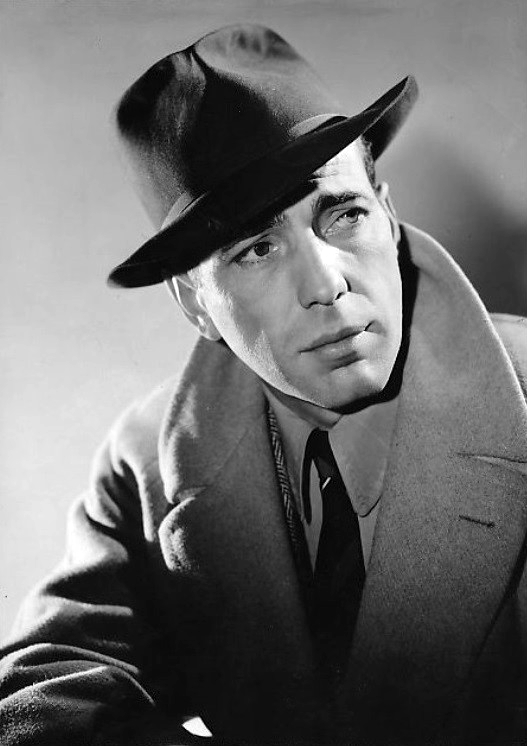
So, what are the hallmarks of guilt? It is surprisingly difficult to work out. One crucial sign is perhaps, as the American actor Humphrey Bogart said: ‘the cheaper the crook the gaudier the patter.’ Overly complex explanations are often a sign of guilt.
The patter includes: convoluted challenges to police evidence gathering and exercise of due diligence on instruction; excessive casting of doubt on overwhelming expert evidence; elaborate excuses for extreme violence based on self-defence; and inappropriate allegations of police misconduct.
Now the process must be tested and many wish to save their skins. Those who are desperate will often resort to anything, and the defence lawyer on instructions often must facilitate this.
I remember how both myself and Adrian Hardiman were tarred with damnation, overlooking constitutional niceties, in the constitutional challenge to The Proceeds of Crime Act as lawyers for Gilligan by the Sunday Independent.
A trial process weighs up whether evidence is relevant or not, and whether there is a case to be answered. The question of whether a case should have been brought in the first place is a different matter.
Legal representatives may also argue over whether there has been an abuse of process through non-disclosure, non-compliance or a fit up. In this respect the absence of video or phone evidence is crucial. Once confronted, a guilty person may tangle themselves up in lies, which affects their credibility when giving evidence
A witness who is lying must avoid the truth and is often lulled by persistent questioning into the trap of telling the truth by indirection.
Thus, the prosecuting barrister Edward Carson, after listening to days of Oscar Wildes’ ridicule at his trial for gross indecency in 1895, popped the surprise question – a deadly weapon to be sparingly used in the barrister’s art – about the boy Grainger.
Did you Kiss him?
The answer which leads to the Reading Gaol and early death in Paris was:
Oh no he was far too ugly.
It must be stressed that the credibility of a witness must be read in the context of the vulnerable person they may be. Some suffer from addiction and mental health issues, which is not to say they are not telling the truth.
Sadly, in a world of increasing subjectivism and loss of truth those who lie may have been telling the truth as they see it, or as they remember it, but not as a fact. Witnesses for defence and prosecution also have intellectual masking to justify in their own mind what they have done. Everyone, as Voltaire indicated, has their reasons.
Anti-social Media
In our time, text evidence from social media and other digital uploads such as chat lines are often very incriminating. The utilisation of social media can have disastrous consequences as historic texts and chats can come back to haunt you. They might demonstrate a propensity as a prelude or aftermath to an incident, and they often show planning, ostensible grooming or worse still acceptance. But comments of a salacious nature in isolation can be magnified by unscrupulous prosecutors.
Scurrilous tactics are never justified, but tarnished evidence is often admitted. I am no fan of racist vigilante groups or engaging in quasi entrapment, but I recognise that sometimes they catch people who are guilty, or, more ambiguously, exhibit certain traits.
Video evidence often confronts someone with what they really did under the influence and normally leads to a quick acceptance of responsibility.
What happens next has been characterised by Oliver Wendell Holmes as the ‘bad man’ of law:
If you want to know the law and nothing else, you must look at it as a bad man, who cares only for the material consequences which such knowledge enables him to predict, and not as a good one, who finds his reasons for conduct, whether inside the law or outside of it, in the vaguer sanctions of conscience.
The legal process is often unforgiving, albeit this is necessary at times.
I do not believe in punishment as denunciation, or retribution where guilt and sin are confused, such as occurred in the sentencing of Roger Casement to death.
With respect to what the British call just and proportionate punishment, I had the privilege of inspecting a Norwegian prison when attending a death penalty conference in Oslo. The tennis courts, swimming pools, private rooms discourage recidivism and potentially rehabilitate criminals.
The Court of Appeal in the UK in R v. Ali (2023) is actively discouraging judges from sending people to prison, not least in congested post-Covid times. Most come out not wiser, but weaker.
But let us also be conscious of the appropriate punishment for the massacre of the innocents. Not all who claim a miscarriage has occurred are victims. There is a time for a liberal objection to a miscarriage of justice, and a time for when the punishment should fit the crime. Even the Norwegian prison system struggled with the serial killer Anders Breivik, who they had to build a special facility for.
I wonder will certain lawyers, businessmen or lawyers ever see justice? Not likely, apart from a few subordinates thrown to the wolves. This was the pattern of our banking prosecutions. The rich can retain the best lawyers and engage in plausible deniability, and a chain of command.
Thus, corporate lawyers, judges and businessmen, as well as puppet politicians, have the justice game rigged, up to the point where they commit murder. Then of course the system must react? This may become a pertinent question for Ireland in the coming months.
Rationalism is a psychosis; a dissociation of intellect and feeling; the suppression of our intuitive, emotional, and sensual being (the heart’s domain). Enlightenment thinkers wished to replace the credulity of religious compliance with reason. They put their faith in human progress and an expansive intellect – and some, it should be said, in a deeper and more natural spirituality.
They thought they could reform society, but radical social reform has rarely, if ever, been generated by external pressure. It arises when an established worldview reaches the limit of its credibility and its possibilities.
For all the fine words and egalitarian instincts, what emerged was a restricted and abstracted rationality, blinkered by the narrow focus of scientific empiricism: a civilization devoid of core significance that was to become a kind of megalomania. Mathematical abstraction, reductionist precision and the crushing urgency of capital accumulation could never have generated a benign culture.
Without consent to meaning and an imaginative response to the innate feelings that evoke a deeper sense of being, Western civilization will continue its fragmentation and decline until it succumbs to incompetence, overreach, and inner contradiction.
At this point, Goya’s Capricho 43 comes to mind once more. There he sits, Goya himself, slumped over a table, looking like he has the whole world on his shoulders and wishing it would all go away.
However, the words on the panel are stark: “The sleep of reason produces monsters”. And the owls, bats and lynx are generally presumed to symbolize a resurgent irrationality always watching for reason to lower its guard – a clear expression of Enlightenment values. It is balanced somewhat by the caption for the print: “Imagination abandoned by reason produces impossible monsters; united with her she is the mother of the arts and the source of their wonders”.
This is fine so far as it goes, but it ultimately amounts to the same thing. It implies that you can’t trust imagination without reason to almost police it. But in art – so in life generally – the imaginative impulse is primary. It is not going to lead you down the road to ruin as in some Victorian morality tale.
Imagination is the indispensable quality, a benign compulsion in an unfolding life. A creative leap, the capacity to conceive the new, is essential if life is to evolve rather than merely repeat.
Even mathematics, the very rock on which the rational world is built, is itself a brilliant act of imagination; an original, symbolic system, independent of life as lived, and that may in turn be applied to our practical engagement with its process.
Reason elaborates the idea in a kind of inner dialectic that bridges the gap between inspiration and cultural expression, between the imaginative realm and the everyday. In practice, this is an indivisible, spontaneous process – not linear and mechanical – and its accomplishment is a sensitive art.
However, we can’t really be sure what Goya meant. He was unhealthy, overworked and disillusioned. But the sleep of reason is not loss of control; the sleep of reason is rationalism, reason without heart.
"The peremptory watchword "believe in God" has been superseded by “trust the science”. Its dogmatic purpose is no different and it was used to effect during the pandemic as a marketing slogan for social compliance and pharmaceutical profit."https://t.co/QtqRvZn2Co
Looking at Capricho 43 with the Covid pandemic at its height, the bats were insistent. Their association with the new disease was a topic of speculation. A global panic was underway; the threat index was rising, and we were at war with a virus. The response to this “existential” threat (yet another) was employing the standard rhetoric of the war machine. Civil liberties were suspended; a crusade was launched; “trust the science” was on the banners; and facts and figures were deployed like heavy artillery.
If your attitude to the world is purely rational, your actions – both the action itself and the manner of its effect – will reflect the sense of separability and isolation that characterizes it.
Notwithstanding the fact that we humans have co-evolved with viruses, that their presence is vital, even if some are potentially harmful, a program of total suppression was begun. At least until a vaccine (a “magic bullet” that would stop Covid dead in its tracks) could be developed, we were told.
Since the time of Edward Jenner in the late eighteenth century it has been known that a small piece of a virus or bacterium can stimulate an immune response. The technique has been used to prevent many common diseases ever since.
A corona virus tends to generate variants liberally and is not so susceptible to a traditional vaccine. For the biotech industry, which had struggled after the financial expectations of The Human Genome Project were not realized, and the difficulty of meeting regulatory requirements, its moment had come. They were now cast as world saviours and the whole force of a global pandemic was behind them.
To put it very simply, gene-based vaccines cause your own cells to produce a spike protein – essentially a piece of the virus – which, like a traditional vaccine should then provoke an immune response. All very well if you “trust the science”.
In this case it meant trusting a pharmaceutical industry with a long record of disregard, deception and harm and allowing them to manipulate, or ‘program,’ your own cells.
But no scientist can assure the outcome of speculative interference in the elusive and dynamic process at the heart of, and common to, every living system. A cell is a cell: nucleus, cytoplasm, membrane, and the tiny world within continuously generating growth. All cells share the same structure; all life is cellular; and all life is interconnected. What could possibly go wrong?
Just to add that claims for efficacy went all the way from “magic bullet” to balm and Covid is still with us, vaccinated or not. And, I almost forgot, a few more billionaires now grace the earth.
In our latest podcast Sunetra Gupta recalls her role as the "anti-lockdown Professor" & explains her work on developing a universal influenza vaccine. She's still awaiting an apology from her opponents such as George Monbiot. Listen to the Full Pod on https://t.co/56pM7rEj94pic.twitter.com/DJp1JuaUaH
The publication of Los Caprichos marks the opening of the nineteenth century. In Spain, the war with France and years of political upheaval would follow. Goya reflects the disorder in his strikingly expressive work of those years until his death in exile in 1828.
By this time Europe and North America were on the verge of a world that would seem very familiar to us now. Both electrification and the internal combustion engine arrived in the 1880’s, and the subsequent years are known as La Belle Epoque in Europe and The Gilded Age in America.
The conspicuous affluence these terms betray rested on a period of intense industrialization and exploitation, during which the British Empire was the great world power. By the year of Goya’s death economic liberalism was about to reveal its most brutal aspect.
In Britain the new poor laws were enacted to starve masses of the underclass into wage slavery. Without support millions more were plunged into sea of destitution. Included in this purgatory of despair were tens of thousands of women and girls forced into prostitution and an early grave. This was the social catastrophe confronted by Charles Dickens and Karl Marx.
Across the seas, India and China (and countries in between), two ancient and distinct civilizations – their history, social structures and trading patterns rent – were forcibly conscripted into a global trading and financial system to their utter detriment, and to the enrichment of an elite group of financiers, industrialists and Western powers who controlled it.
Further south, the scramble for Africa would soon open the gates to yet another prolonged exhibition of colonial barbarity.
One appalling outcome: the instability and structural disintegration wrought by this interference in traditional systems of land use, production and trade left them unable to deal with the consequences of a prolonged drought in the 1880’s. (A phenomenon not unknown and provided for by tradition). As in Ireland a few decades earlier, famine ensued. It is estimated that between Asia and Africa perhaps as many as fifty million may have died.
The unspeakable horror of all this is chronicled in detail in Late Victorian Holocausts: El Niño Famines and the Making of the Third World by Mike Davis, in so far as words or even pictures can convey the terrible suffering of fellow human beings on such an immense scale. Its full effect requires an imaginative capacity typically repressed in the cultivated mind by the assumption of superiority.
In the words of Mike Davis, ‘What seemed from a metropolitan perspective the nineteenth century’s final blaze of imperial glory was, from an Asian or African viewpoint, only the hideous light of a giant funeral pyre.’[i]
Listen to our podcast with Toby Green as he discusses the effect of Covid lockdowns on Africa, which was largely unaffected by the disease, and the intellectual failure of many on the left. https://t.co/EsbBdkq4xr@toby00green@battleforeurope @SunetraGupta @KevinBardosh
For all the achievements of Western civilization in science and the arts the dark side of our history is actual. Moreover, it still resonates around the world in conflict, poverty, migration, and debt.
It is critical that we should acknowledge our defects now that, so we are told, we are once again standing at the edge of fundamental change. The transition to a post-carbon future will not forestall dire predictions without a radical shift in perspective and it remains ‘business as usual’.
Unrestrained capital accumulation, open-ended economic growth, finance capitalism and the rigged marketplace are entrenched. Bacon’s slogan “knowledge is power” still drives and validates the scientific ideology that underlies it all. Together they perpetuate a toxic system to which the question of how it is fuelled is almost incidental.
In addition, the corporate sector now has the ‘sustainable’ technology supposed to save us firmly in its grip; ‘saving the planet’ is a heaven-sent marketing strategy; and the promise of a ‘just transition’ has becomea sickly green joke.
A cursory analysis of the crisis we are facing would reveal the dynamic driving it. That it has done so for almost half a millennium is why the crisis is so acute and why its cause should be so obvious.
That there are limits to growth is axiomatic. And it should also be apparent that renewable technologies could never equal the energy potential of fossil fuels. The dispersed energy of wind and solar and the second-hand energy of biofuels, even without the problem of intermittence, could only possibly match the concentrated energy of fossil fuels – discounting the growth imperative – by an expansion of its technologies on such a scale that this factor alone would be problematic.
In any case, highly complex renewable systems present their own difficulties. Every method of energy production requires energy to support it: for mining coal, pumping oil, or the massive resource extraction demand by renewables and the ‘smart’ technology that enables it. This requirement has initiated yet another round of colonial exploitation and despoilation.
Also, known reserves of many essential minerals are deficient. And resource scarcity is insurmountable; what doesn’t occur cannot be conjured into existence. A finite world has bio-physical limits: as its resources are subject to exhaustion, so our ambitions are subject to restraint. Our centuries long escapade is being constricted and the problems of over-development and over-complexity cannot be solved by more of the same – more regulations, more laws, plans, targets, goals, reproof, and penalties.
Image: Aleksandar Pasaric
What use is a carbon-free future if our rapacious civilization continues as is? Biodiversity loss, degradation of soils, deforestation, plunder of the oceans, toxic pollution of every kind: all these are just as malignant, if not more so. Degradation and degeneracy cannot be ameliorated by new technologies. And it is delusional to hope that ‘sustainability’ can somehow allow us to defy some of the most fundamental realities of being.
All this prowess we’ve engineered over time seems to have convinced too many of us that men are gods. And challenging the Gods never ends well. Hubris is followed by nemesis – inexorably if we can’t break through the bounds of scientific rationalism. And the stimulus for such a profound shift in consciousness cannot be prescribed; it can only arise organically. Whether from disillusionment, decline, crisis, chaos, or common sense remains to be seen.
The ground of this dilemma was prepared during that long period of transition from the Middle Ages to the modern world: when the dominance of capital was extended, scientific inquiry established the mechanical worldview, and the hegemony of humanity over nature began its destructive course in earnest. If only Galileo could have seen the future through his telescope.
It was at that time of change, about the year 1605 – just five years after Giordano Bruno was tied to the stake and the breadth of his perception went up in flames with him – that Don Quixote first set forth. Caught between these worlds, his adventure in a sense exemplifies dilemma. The changing conditions were presenting a choice: between faith and belief – and the new belief; between metaphor and fact; between self-realization and passivity; between the individual subject and the social object; and for Don Quixote himself perhaps – depending how you read it – between the way of a (wise?) fool and the way of conviction.
Adventure is a disorder, a disruption of the everyday. The quest is, in part, a dissatisfaction in the everyday, a compulsion to discover its deeper reality. In the mediaeval epic the hero and the epic plane are coincident, so to speak. “The men of Homer belong to the same world as their desires”, to quote Jose Ortega y Gasset.[ii]
But Don Quixote is at odds with his world. In this he is probably the first hero of the modern age – an anti-hero, if you will – not borne by the established manner of a chivalric tale, but impelled by his own will, along “the trackless way”, in Joseph Campbell’s words,[iii] of his unfolding life; and creating in his wake his own ‘mythology’, by his own heroic self-realization in a world at variance with his inner being and feeling – as individual integrity will be in an abstract world of facts and figures.
Capital and the new science were breaking the world apart. The organism was torn from its environment, but the soul craves reconciliation and unity. The pathology of progress – distraction, addiction, obsession, emotional disorder, and mental distress to the point of psychosis – all those cries of pain and anguish resound because the world is no longer whole.
And when the prevailing culture is a secular, socio-economic state and no more, to which art and philosophy are peripheral (and largely commodified), it cannot set the terms for a necessary transformation.
To be convinced – whether by religious or scientific dogma makes no difference – is to set yourself at naught and passive in a world always active and renewed. Self-realization, the search for meaning within a prison of abstraction and global assent is, in consequence, only possible in the individual psyche and through the daily heroism of each one of us.
The reign of Gods, Goddesses and our own Christian God was over, or coming to an end. If, on the other hand, the cosmic mystery is implicit in every individual existence – plant, animal, or human – then the poetic imagination, art in its broadest sense, out of which the mythic realm was born and which gave form to its cultural expression, could turn its gaze to the metaphysics – indeed the miracle – of being in every one of us.
And would it be too much to hope that it could then transform everyday life through the reconciliation of the spheres of night and day, of the timeless, or momentous, process of creation and its manifestation in time – and so of reason and authority, the heart, and the head.
But now the giants are on the march again; thousands of them ranged across land and sea. Transformed into windmills, not now by the necromancer, Freston, as Don Quixote once suspected, but by vicissitude and the main chance. Aloof, pristine, impertinent, enormous, their alien presence and baleful monotony is an affront to the vibrant landscape – each one a great counter calculating a return. For every turn another dollar.
The old gods would be in turmoil: the wind harnessed to the strategic avarice of a corporate machine. For what? To ‘save’ a world that the Megamachine (to borrow Fabian Scheidler’s term) has itself constructed and put at risk?
And so also the sun: once raised variously to the status of God or Goddess, powerful mythological symbol, the vivid nucleus of a living cycle that would every dawn dispel the dark. It, too, is to be committed to the same end. That their potential falls short I have already discussed; that even the most critical demands of our current over-consumption can be met is doubtful. But it must now also power the banal syllabus of cyber mania.
Socially destructive global monopolies are eager for every megawatt to propel their program of corporate dominance. The digitalization of the world is an imperial project of unprecedented ambition. A counterfeit world is being prepared. Uniformity of thought, action, experience, and expectation is promoted – autonomy would disturb the shallow manner of digital exchange.
The pioneers of science would be amazed. After all their hard work the earth is becoming flat again. The individual is fading away. Apparently, our lives are to be run by corporate favour and AI. Wow! Our common heritage, from the production of food to our very biology, is to be appropriated by an affected concern and handed over to ‘experts’.
Thankfully, an authentic humanity will not easily be overcome by technocratic pedantry, and we should all have enough experience of bureaucratic and executive stupidity to expect the project is delusional and self-defeating. After all, if they kill the goose, what then?
Unfortunately, it has the potential to further the cause of technocratic governance by a coterie of corporate behemoths who have made no secret of their anti-democratic and anti-social resolve, even as they cloak it in the sweet-sounding words of beneficial intent. And there appears to be no limit to their field of operation, or the level of enforcement through sophisticated systems of surveillance and control.
The intemperate pushing of AI omnipotence has some of the characteristics of mania about it. With any luck it may be destined for the same fate as other notable examples of this recurrent phenomenon. In the meantime, let’s be clear: artificial intelligence is what it says on the tin. It is fake in the same way that artificial flowers are fake. In other words, it is no more than an imitation of intelligence; or rather it purports to be since its proponents have a much- reduced understanding of intelligence in the first place.
The only way a digital system could seem analogous to intelligence is if human beings have been persuaded that they themselves are analogous to machines.
For all the accomplishments of computer science, computers still lack resolve. No computer can make an autonomous decision and no idea can arise unbidden in its electronic circuitry. The data it contains has been handed to it and its operative rules are pre-programmed in algorithms and codes. So-called ‘generative’ AI, so far as I understand it, is simply an intensification of the basic on-off electronics and the yes-no, if not this-that, and, or, both, neither, binary mathematics of existing systems.
To assert that the voluntary and boundless nature of mind and intelligence can be fully represented by a symbolic mathematical system of 1’s and 0’s is absurd – to any thoughtful person. But, of course, if in the first instance you define ‘intelligence’ by what can be contained in its restrictive code then you have AI.
The computer is an ingenious machine, without doubt, a remarkable tool as it stands, but for some reason its potential has been dressed in vainglorious exaggeration from the outset. The haughty claims for AI are no different today than fifty years ago, although confident prophecies of omnipotence still await fulfilment.
That more and more aspects of living and our thought processes can be formulated digitally, and that the programs (the preset rules of the game) are run at breakneck speed is what makes it so impressive. But whereas endless variation and repetition are possible, and answers (largely based on past conclusions) can appear as if by magic, without a non-material imagination, new ideas cannot emerge from old data.
There has been much excitement over the ‘existential’ threat of AI. Indeed, in the hands of the corporate sector, it is busy constructing its own reality with the callous logic of the machine. But there is nothing new here either: apocalyptic alarms have always been associated with the disruption of custom and loss of confidence. If it comes to it, wild forecasts of digital conquest can be countered by simply pulling the plug. The real worry is what on earth has humanity come to that it can so easily imagine subordination to its own technology, to the extent of its own obsolescence – that some would even welcome its approach.
That it is already secondary, to some extent, has nothing to do with the superiority of AI, but is entirely due to our significant distance from the profound coherence of being.
But with so much money at play, the industry is oblivious to either temporal limits or harm. And the next step in the construction of an omniscient computer system – always a goal – follows sensibly enough in the reasoning of scientific materialism.
If the mind has been reduced to the brain, and the brain itself is analogous to a data-processing, memory storage device, then why not build a ‘cognitive’ system that exceeds the intellectual capacity of any human; that would, in turn, design a new improved machine and so on. An “intelligence explosion”, until hey presto! the Singularity is reached – ultra intelligence, omniscience, omnipotence, virtual Godhood!
As fantastical as all this might seem to anyone with their feet still on the ground, there’s more. The geeks among us don’t rest easy. If you’re interested in fantasy, it’s all gathered under the acronym Tescreal. Just be aware that the principal actors here are over-exalted, self-regarding white males in the main, and a forceful eugenicist agenda (a ‘more enlightened eugenics’ apparently) runs through it.
If partisans of AI infallibility were left to stew in the juice of these absurdities within the techno-utopian compound of Silicon Valley, and certain university departments, they needn’t trouble the lives of ordinary decent people. But unfortunately, they command limitless capital and the insatiable dreams of monopolists. Ah, but their intent is to save the world. It’s more likely that an unholy pairing with messianic pretensions will pave the road to hell.
And not only do they appear to be living on another planet, they actually think we can. In this respect, it is a point worth making that no man ever set foot on the moon, and no man or woman ever will, unless they want to bring their life to a painful conclusion. Man reached the moon by bringing his earth environment with him in a spacecraft. An ingenious accomplishment, undoubtedly, but a miss is as good as a mile. And because what is contained in the spacesuit, spacecraft, or space colony for that matter, is clearly partial rather than whole, prolonged existence in it is simply impossible, either physically or psychologically – unless, of course, you’re a machine, or a posthuman!
Given the wonder of existence in the first place, the greatest marvels of being are mind and consciousness, memory and ideas. Any degree of self-awareness should open us to the profound mystery from which they arise. That anyone could make of this ineffable experience nothing more than a mechanical process to be downloaded into a plastic ‘chrysalis’ full of semi-conductors, switches, and silicon chips; and to then emerge as a kind of super-intelligent, posthuman immortal shows just how far from any real sense of our creative presence some of us have drifted.
Every day now, it seems, we are subject to reproof. Signs of crisis are insistent and portents of doom pressure us in a seemingly chaotic world. This essay has attempted to set a wider context; to highlight the critical issues; and to point to the obvious fact that if the corporate/political/ideological covenant responsible for our present state is being relied upon to provide solutions we are going nowhere.
For all its achievements to date, it is now becoming clear that scientific materialism and the single-minded logic of its methodology is reaching the limits of its efficacy; even as materialist anticipation is reaching for its apotheosis in the extravagant representations of AI – the ultimate expression of its reductionist worldview.
And it is possible to see on the wildest shores of this ‘promised land’ a kind of hysteria in the face of diminishing returns, and the desperate resuscitation of a fading ideology.
But the piling on of the past will not work. With increasing complexity every solution begets more problems. It’s a vicious circle, such that at this point many of us might be beginning to feel Sancho Panza’s reproach – windmills in the head is right! How to step off the treadmill is the crux of the problem, although it is also all too clearly the solution. And in the absence of another world to step on to we are hooked by a kind of compulsion neurosis.
A more benign world will require a new morality in its broadest sense; it will not arrive ‘off the peg’, so to speak. ‘Smart’, ‘sustainable’, ‘clean’, ‘green’, the defining terms of our post-carbon future, are a cruel deception if their only purpose is to keep the machine in gear.
Strangely, the very ideology that defines the world will not recognize its material constraint. It still relies on the illusion of superabundance and the invocation of technological superiority in a world struggling for breath.
And where – is it ever asked – is our humanity in this brave new world? The whole drama of a single life, a sort of flourish upon the oceanic well of time and creation; and the billions of us marooned in an abstract world of facts and figures. How do we dignify our lives in a world in which fire has been quenched?
Corbusier’s ‘machine to live in’ is realized in the technological dependence and the spick and span aspect of the all-electric house. But there was a time when the hearth was symbolic of the Navel of the Earth; when fire, the Goddess of the hearth, symbolized the presence of the divine. The hearth and its home were explicit symbols of implicit unity: the invisible or immaterial realm made visible in the material culture.
Such sensibilities are long gone, of course, and unity and meaning must be sought in the human heart – as they should be at this stage of our cultural evolution. But what if the heart itself is cold? What if the material culture is destructive or merely bland?
We now live in a manner without discernment or reserve, informed by opinion and the ubiquity of the market. Jesus drove the moneylenders from the temple; a second coming would be welcome in the face of an ill-considered, commercial culture of unprecedented shallowness. Its dominance and its demands, and its impression upon all is turning hearts to stone and our world into a wasteland.
It is true that most people’s lives are enriched and gain meaning in the ordinary communion of family, friends and community; and perhaps in the practicalities of daily life. But there is a wider world, and in the minds of capitalists the end always justifies the means. In their calculations you don’t count – the phenomenon of your being, that is, not your efficiency in the economy of capital accumulation.
In the everyday language of economics. the economy appears to be an almost perfect mathematical system independent of human history – an abstraction isolated from reality as a whole. In the extremism of neo-liberalism its jurisdiction has neither moral, social, or cultural bounds and it now regulates the global like a detached and senseless Victorian viceroy. To the extent that our lives are decided by it, the social context will be inhumane, and inadequate to our potential and imaginative capacity.
Life in the shallows of economic determinism soon exhausts itself. There is an emptiness at the heart of contemporary culture that will not be filled by the ‘green agenda’. The post-carbon future, as currently outlined, exemplifies the metaphor of the machine no less than its antecedent. Technological solutions will only perpetuate our insulation from the vibrant process of creation. And ‘smart’ technology, let us be clear, does not run on fresh air. On the contrary the magnitude of its energy demand may be unprecedented in industrial history.
The real world arises organically as a self-organizing system, whole and complete at every step of its evolution. That is to say, it is incomparable – it’s what it is and what we are – and may be benign or destructive as we might inhabit it. A bio-physical system is ‘limited’ by the very interdependence of its diverse elements, such that individual behaviour is always governed by a superior context.
Scientific materialism and the pathology of dissociation have led us astray. “For there is in the universe neither centre nor circumference”, wrote Giordano Bruno, “but if you will, the whole is central, and every point may also be regarded as part of a circumference in respect to some other central point”.
Each one of us, then, is centre; each one of us manifests the whole, to put it another way. It follows that every identity is ‘I’; and in this sense there is no ‘you’, no other.
In the face of this reality, capitalism rewards one at the expense of another, the few at the expense of the many. In the interest of accumulation, it externalizes costs – to the individual, society, and the environment. It is dehumanizing, anti-social, toxic, ultimately self-destructive, and now global.
We are preoccupied with solutions; but the critical choice is not between fossil fuels and renewables, but between a narrow rationalism and an expanded consciousness, between the sleep of reason and integrity. The crisis we are facing is not, in the first instance, a problem to be solved, but a failure to clearly perceive its cause.
In the words of Jose Ortega y Gasset, “we do not know what is happening to us, and that is precisely the thing that is happening to us – the fact of not knowing what is happening to us”.[iv]
[i] Mike Davis, Late Victorian Holocausts, Verso, London, 2001, p 8
[ii] Jose Ortega y Gasset. Meditations on Don Quixote, quoted in Joseph Campbell, The Masks of God: Creative Mythology, Penguin, London, 1976