In December the Irish Fiscal Advisory Council (IFAC) published a comparatively critical reviewof the government’s Budget 2024. Criticisms of ‘bad budgeting’ arose from the ‘lack of transparency,’ and the use of ‘fiscal gimmickry.’ IFAC defined the latter as ‘creative accounting techniques’ used to make the numbers ‘look more favourable than they are.’
The Irish Times described this as ‘an extraordinary broadside against the Government’, with RTE referring to IFAC’s assessment as ‘controversial.’ However, as IFAC made clear in February, they were standing firm behind their ‘perfectly valid’ analysis which they stated was backed by ‘substantial evidence and reasoning in support of this conclusion.’
This episode had me wondering whether similar kinds of “fiscal gimmickry” are at work outside of budget time, specifically when Ministers are out making what are nominally ‘new’ funding announcements. You will of course be familiar with this type of thing.
It goes something like this: a Minister appears on RTE, or broadcasts via their social media platforms, that they are ‘delighted’ to be announcing x million for some initiative. Now the ordinary person probably never stops to consider whether this is new expenditure for a new program, additional expenditure for an existing program, or simply existing expenditure for an existing program.
But to be fair to the average voter, there are a few Ministers that probably never to stop to ask this question themselves. What matters to them is that they are out and seen to be doing things – energy in lieu of action. If taking a bit of creative licence results in positive media coverage, then some see that as all well and good.
I must confess that for some time I’ve been puzzled by how some Ministers seemed to be making ‘new’ multi-million announcements every other week, whilst for others such announcements were few and far between. So, I thought I would investigate the matter. As we’ll see, this is where a kind of “fiscal gimmickry” meets the ‘the politics of the last announcement.’
In Table 1 we can see the number of funding related announcements made by all our current government ministers (excluding the Taoiseach) in 2023. We have a total of fourteen Ministers spread across seventeen Departments. The median amount (think middle value) of funding announcements made last year was 11.5, so just under one funding announcement per month.
As we can see, half of our Ministers made less than this, and some significantly less. For instance, Messrs McGrath (6) and Donohue (5), perhaps the two Ministers most associated with the word ‘prudent’, were certainly amongst the most judicious. The same goes for Minister McEntee (4), although she was off on maternity leave for a period.
Just three Ministers; Harris (32), Martin (30) and Humphreys (21) were significantly higher. But to be fair to Heather Humphreys she is Minister of two departments (Social Protection/Rural and Community Development), so it’s really just Harris and Martin that were so far ahead of the pack.
Could it be that they occupy larger spending Departments and hence their respective Ministers need to make more funding related announcements? Considering neither of these Departments is in the top five in terms of expenditure, however, and indeed Martin’s is forth from bottom, that doesn’t seem to account for it.
The second largest spender is the Department of Health, but Minister Donnelly made one of the fewest amounts of funding announcements (6). In fact, the size of a Department’s expenditure seems to have almost zero relationship with the number of funding announcements that its Minister makes.
As we can see from Figure 1 there’s no statistically significant relationship between the size of a department’s expenditure and the number of funding announcements its respective Minister makes.
Minister
Department(s)
No. funding related announcements (2023)
Department(s) Gross Expenditure €000/rank (2023)
Comment
Simon Harris
Further and Higher Education, Research and Innovation
32
€4,092,446
(6th place)
Catherine Martin
Tourism, Culture, Arts, Gaeltacht, Sport and Media
30
€1,165,509
(13th place)
Heather Humphreys
Social Protection/Rural and Community Development
21
SP – €23,901,145 (1st place)
RCD – €428,981 (17th place)
Minister for two Departments
Norma Foley
Education
13
€10,025,107
(3rd place)
Charlie McConalogue
Agriculture, Food and the Marine
12
€2,164,509
(9th place)
Roderic O’Gorman
Children, Equality, Disability, Integration and Youth
12
€5,931,759
(5th place)
Darragh O’Brien
Housing, Local Government and Heritage
12
€6,414,089
(4th place)
Michael Martin
Defence/Foreign Affairs
11
Defence – €1,209,737 (12th place)
FA – €1,057,144 (15th place)
Minister for two Departments
Eamon Ryan
Transport/Environment, Climate and Communications
10
Transport – €3,516,269 (7th place) Environment – €1,066,060 (14th place)
Minister for two Departments
Simon Coveney
Enterprise, Trade and Employment
7
€1,621,413
(11th place)
Michael McGrath
Finance
6
€600,240
(16th place)
Stephen Donnelly
Health
6
€21,358,420
(2nd place)
Paschal Donohoe
Public Expenditure
5
€1,670,513
(10th place)
Helen
McEntee
Justice
4
€3,428,623
(8th place)
Maternity leave for a period
We’ll zoom in on new Taoiseach Simon Harris for three reasons. First, he’s the most prolific in terms of making funding announcements – averaging almost three a month; secondly, he’s the new Taoiseach so it could provide a window into what his tenure might look like; and thirdly he’s the only Minister I am aware of that has ever been accused of making re-announcements dressed up as new spending measures.
In January Simon Harris appeared in DCU for a carefully choreographed photo opportunity. This was off the back of a big announcement he made about seeking Cabinet approval for a ‘new’ student housing policy. Note: this policy is almost indistinguishable from its predecessor.
Off the back of this he appeared in DCU with the big funding announcement that he was there to ‘unveil plans for 500 student accommodation beds,’ something he again alluded to during Fine Gael’s Ard Fheis over the weekend. The glaring problem with this was, of course, that he’d already announced it last year, with an almost identically choreographed photo opportunity.
So, is this characterisation of Harris fair? Let’s take a look at some of his other creative accounting announcements. In June 2023 he announced: ‘Today I am launching a €9 million fund for higher education institutions to improve access to higher education for students with an intellectual disability.’
It was in 2022, however, when he first launched what was then a €12 million fund. It was to work as follows; €3 million would be disbursed in 2022, with the remainder disbursed over 2023-25. So, essentially it is €3 million a year over four years. Yet with Harris’ approach €12m can be announced one year, €9 million the next, €6m the year after and then €3 million in the final year!
If you weren’t following closely, you would be forgiven for thinking this has been a total of €30 million (12 + 9 + 6 + 3) rather than the €12 million that was originally set aside. Now the Minister could surely counter that what he said was technically correct, and he would have a point.
Such announcements, however, as the USI pointed out, are made on the assumption that most people don’t look beyond the headlines. Or read the Department’s press release which will usually contain explanatory notes.
In October in the wake of Budget 2023, where the Minister was severely criticised for having produced no new funding for student accommodation, he suddenly appeared to announce that he was ‘Delighted to announce a new €434 million student accommodation partnership, which will help build over 2,000 beds on college campuses across the country.’
Delighted to announce a new €434 million student accommodation partnership, which will help build over 2,000 beds on college campuses across the country.
This one seemed to catch everyone off guard, including the universities, his Cabinet colleagues and the opposition. One of the glaring problems with this announcement was there was nothing new in it. Not only can the universities already borrow from the EIB, they already have significant borrowings. Their issue isn’t being able to access borrowing, it’s their ability to repay the money sustainably. Several universities are already grappling with financial deficits this year. Indeed, the entire sector has to deal with a core funding deficit of over €200 million, which is a hangover from the Austerity period – a shortfall he was supposed to address but has now left to his successor to sort out.
If his past Ministerial performance proves a good indicator of Simon Harris’ future performance as Taoiseach, then we can expect big announcements, and then big announcements with even bigger bells on. But scratch beneath the surface and you’ll probably find some fiscal gimmickry afoot. I just hope that when these big announcements come, they will be met with equivalent levels of scrutiny by our media and state broadcaster.
My wrist watch stops dead shortly after we arrive in Tangier (at 21:16 – 2/6/2022, to be precise), which is symbolically appropriate. Time runs differently in Joujouka, the rural village located some 110km south of here in the Rif Mountains, for which this urbane, noisy, historically cosmopolitan port city is on this occasion serving as a gateway. I’d been to Morocco once before, in 2013, when the fissures in our marriage were beginning to make themselves felt. For that reason, and others, I was then flying solo. Now here I am again, with J, bringing her on part of the pilgrimage I had made then, having separated and reunited in the interim, working through whatever it was we’d had to sort out, together and apart. This would be a shared experience. Love me, love my obsessions.
In his monumental history of the drone in music, Monolithic Undertow: In Search of Sonic Oblivion (2021), which ranges from vibrating sound waves at the exploding dawn of the universe to the stoner/doom/drone metal of bands like Sleep, Earth, Boris and Sunn O))) – via the choral chanting of Buddhist and Christian monks, Indian raga, free jazz improvisation, various indigenous folk traditions, Krautrock, contemporary classical and avant garde, and electronic experimentation (drone is not codified or confined by genre) – Harry Sword devotes an entire chapter to The Master Musicians of Joujouka, in which he writes:
A mystic Sufi sect … the Masters – members of the tribe Ahl Serif – produce a narcotic cacophony that hinges on frenetic tribal drums, gruff call and response chants and the screeching drone of multiple rhaita pipes. Playing a music unique to the village and passed from father to son, the Joujouka sound is unlike any other.They’ve been at it for centuries. William S. Burroughs (or was it Dr. Timothy Leary?, provenance is disputed) famously called them the ‘world’s only 4000-year-old rock’n’roll band’. Playing for up to twelve hours straight, musicians and audience alike entering a waking dreamscape, theirs is a brutal trip. Joujouka music is principally about healing, delirium and fertility.
The Masters entered western consciousness initially through the Beats in the 1950s, and then the 1960s counter culture. Paul and Jane Bowles, Burroughs and his Canadian painter pal Brion Gysin, had all taken up post-War residence in Tangier, with visits from Allen Ginsberg, Jack Kerouac, Gregory Corso and Peter Orlovsky, among others. In 1951, Bowles and Gysin attended a Sufi music festival in Sidi Kacem, a couple of hours from Tangier, with a painter from Joujouka they’d met in the city, Mohamed Hamri. When he heard the Masters, Gysin was enthralled, saying he wanted to listen to their music every day for the rest of his life. Bowles, while an avid archivist of Moroccan tribal music – he made over 250 field recordings on location, Alan Lomax-style – was less enamoured, finding the Masters’ music ‘too crude’, and the hardships of village life unseemly. Later, when Hamri took Gysin to Joujouka, the ex-pat discovered to his astonishment that the music he’d fallen in love with was played by Hamri’s uncles. Gysin and Hamri then opened a restaurant in Tangier, the infamous 1001 Nights, where members of the Masters became the house band. It was there that Burroughs first heard them.
When the Rolling Stones arrived in Tangier in 1967, seeking respite from the fallout of the Redlands drug bust and attendant media attention while awaiting trial, Hamri and Gysin met them and Hamri struck up a friendship with Brian Jones, the only Stone to stay behind for a longer, more immersive encounter with the culture. Hamri brought Jones to the village, where he too was overwhelmed by the Masters’ music. Ever the ethnomusicologist, the troubled musician returned in 1968 to make recordings, which eventually saw the light of day in 1971 on Brian Jones Presents the Pipes of Pan at Joujouka. Before his death in 1969, Brian had produced the album and prepared the cover, which brought the Masters’ music to a wider audience outside Morocco. Later, in January 1973, jazz musician Ornette Coleman and the Masters recorded together, with ‘Midnight Sunrise’ surfacing later on his album Dancing In My Head (1975). In 1980, The Masters played at Glastonbury, as part of a three-month tour which included a week’s residency at London’s Commonwealth Institute. They were at Glasto again in 2011, opening the festival on the Pyramid stage. They have since toured as far afield as Japan.
The Masters’ performances in their home place feature a dancer sewn into goatskins: he represents Bou Jeloud, a Pan-like figure, half-goat half-man. In the legend, Bou Jeloud gave an Ahl Serif ancestor the gift of flute music and bestowed fertility on the village every spring when he came out of his cave and danced. This is commemorated in the Joujouka festival, now held every June. In 2008 the Masters honoured the 40th Anniversary of Brian Jones’s influential recording by opening their annual Rite of Spring to outsiders. Since then the extended gathering has become an annual occurrence, attracting artists, filmmakers, musicians, writers and fans from around the world. As well as generating valuable global publicity, the boutique festival is an important economic factor in the life of Joujouka, which remains predominantly a working agricultural village. These guys are still primarily farmers, who have not turned pro.
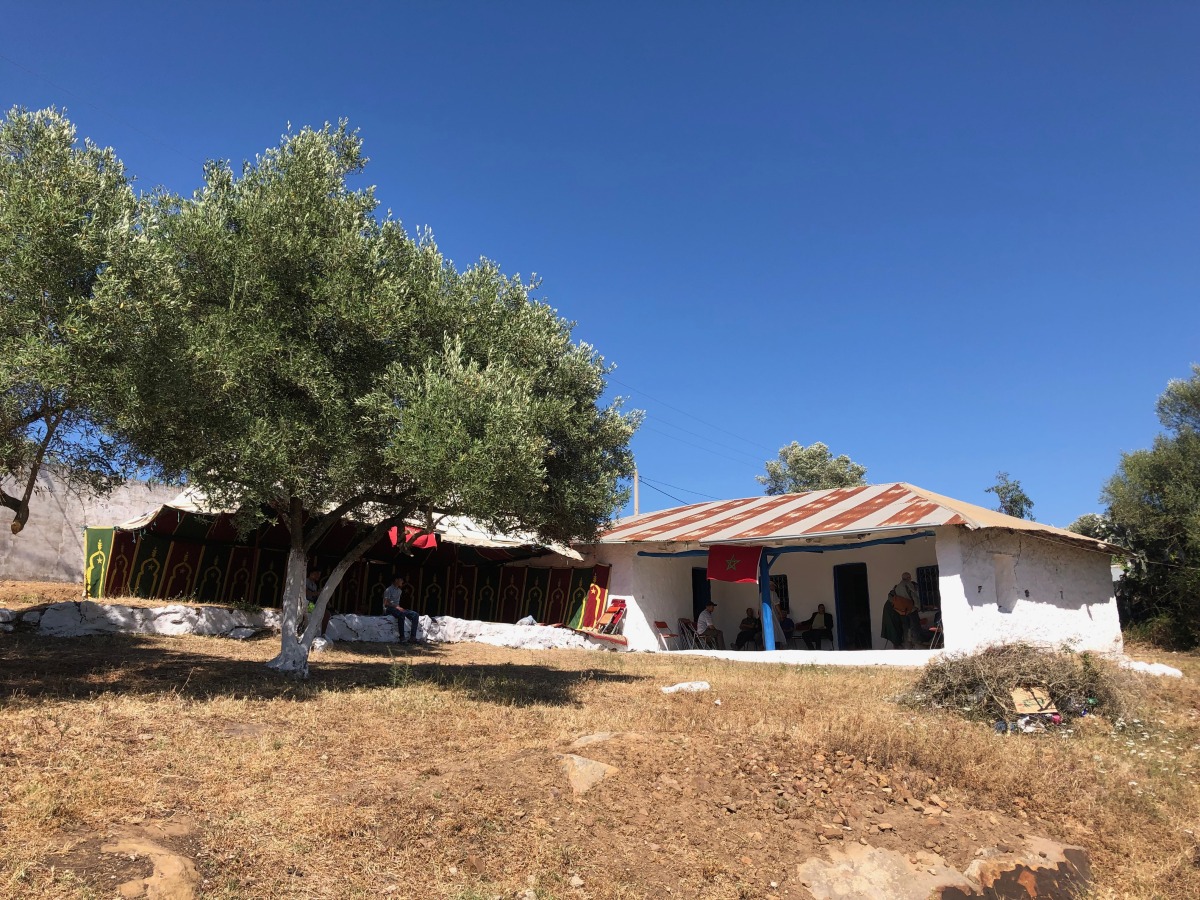
The extended festival offers a unique opportunity to around fifty guests, on a first-come first-served basis, to spend three days with the Master Musicians. This small influx stay in the village with the Masters and their families as hosts, and experience the music in the place – set amid a spectacular landscape – where it originated. The Masters play non-stop each night for three or four hours, in a large three-sided, green-and-red tent at the madrasa. During the lazy afternoons, spontaneous jams break out. Tickets are limited because you lodge in family homes, enjoying breakfast with them, and partake of a communal evening feast in the madrasa, before the Masters get down to business. It may be more arduous to get to, as well as more expensive (although with transport from and to the railway station, plus full board and lodging included, it probably all works out fairly equitably in the end), but it sure beats hell out of the rough and tumble crowds at Electric Picnic.
J is an ’80s and ’90s indie pop and rock girl (just as I, to some extent, am that boy). These days her principal favourite listening is Bach’s concertos for harpsichord, the plinkity-plonkity predictable resolves of which grate on my nerves (although I do have a certain tolerance for some of his keyboard works for church organ, for example the Fugue in G minor, which at least occasionally utilise the harmonic possibilities of that instrument for dronish effects – even if the lauded composer can never quite help himself when it comes to showing off his considerable chops). Sitting at our table on a terrace overlooking the swimming pool in our well-appointed hotel, with the techno beats of synth pop booming from the nightclub downstairs, I wonder how she will take to Joujouka – the village, the people, and the all-enveloping drone?
The next morning we are sharing a taxi with Richie and Marek, two Joujouka veterans I met there on my last visit, bringing us to El Ksar El Kebir, the nearest town of any size to the remote village. From there, we join another local taxi to take us up to our weekend destination. Like any expedition of faith – religious, quasi-religious or secular – Joujouka inspires devotion. Muslims may be required to take the Hajj to Mecca only once in a lifetime, but many Joujouka heads – those who get it and realise this ritual is for them – wind up coming back every year. Richie, a Scottish guy living in Portsmouth, and Marek, from London, are two such. Later I will reunite with Phil, hugging like long lost brothers. He’s an American labour lawyer now married (to a woman he met in Joujouka) and relocated to Mallorca, who always appears on some rented, high-end 1000cc motorcycle, which he then takes off on when the festival is over on Monday mornings, lighting out for the High Atlas mountains and the desert beyond, getting to places inaccessible by car and bus, or even camel.
But as every good nostalgist should know, you can’t step into the same river twice. The lingering pandemic, which had made the brandishing of vaccination certs mandatory at airports and passport controls on our journey here, means that Covid-hesitancy has depleted the usual number of attendees. There are about twenty-five people here this year, rather than the full complement of fifty. While facilitating more intimacy, this in turn makes it slightly more difficult to get a spontaneous vibe going later in the evening. Add to this the news that the festival’s chief organiser will be absent this year, for personal reasons, and one of the main points of contact and social lubricants between the villagers and their guests is removed.
There are other notables missing: Miho Watanabe, the indefatigably humorous Japanese academic, musicologist and multi-instrumentalist, who has travelled to many remote corners of the world to discover more about diverse native musical forms of expression, but who keeps returning to Joujouka; and Stephen, Phil’s ex-Navy biker buddy, now some sort of recondite computer coder – if Phil can be formidably cerebral, Stephen is possessed of the imp of roguish madness which lets him share my absurdist sense of humour. On the previous occasion I also met Donal, London-Irish friend-of-friends, and purveyor of the Exploding Cinema club; and David, copywriter and author of numerous articles on the Beats, Lou Reed, and the Deià of Robert Graves. Then there was Paul, music magazine editor, and writer of books on Iggy Pop, David Bowie, and Brian Jones. So: interesting folks. I have since noticed that the Masters’ website, in advertising the 2023 festival, starts with the admission that: ‘After two years of absence and a small offering this year, The Master Musicians of Joujouka annual festival is back in 2023.’ Still, reduced is better than nothing – and there would surely be fresh encounters to be had.
Last time I was assigned the room in which Brian Jones purportedly stayed during his sojourn here (I’m sure they tell more than one guest that, every year). This time J and I are billeted in a smaller room in a house a little further afield from the madrasa. But at least it has a double bed (with a straw mattress), instead of reclining sofas all around the walls. Family homes here are built around a central shady courtyard with a well in the middle. There is no running water, and the toilet is the proverbial hole in the ground, a shower is buckets of water (heated if you are lucky) thrown over yourself. Electricity only arrived in the mid-’90s.
Sometimes I think I’m getting too old for this. Also, I fret over J’s adaptation to the Spartan conditions. But that’s before the music beings. There again, I have my misgivings about how she will respond to that, too.
the definition of a gentleman..
Q: “What’s the definition of a gentleman?” A: “Someone who knows how to play the bagpipes, but doesn’t.” Corny, I know; but telling. Why do some people have such an aversion to many other iterations of the drone? I have heard the bagpipes described as one of the greatest instruments of torture ever invented. How can people be repulsed by the soothings of the uilleann pipes, or driven to distraction by sean-nós singing? Because of cultural associations that they would prefer to forget? Or are they genuinely put off by what they perceive as the sheer monotony of the sound, and its accompanying volume? More commonly than irritation, you hear people say they can’t stand drones because they find them boring. But drones are not boring – or else they are meant to be. A commercial device called the Mosquito discourages young people from loitering in shopping malls; it emits sounds in the 17.5-to-18.5-kilohertz range which, in general, only those under the age of twenty-five can hear. Drones are life’s underlying hum made more manifest. Louis MacNeice certainly thought so, in his jocose poetic lament for the decline of folk culture in the Western Hebrides, and indeed throughout Europe, ‘Bagpipe Music’ (1938). It’s no go the Yogi-Man, it’s no go Blavatsky/All we want is a bank balance and a bit of skirt in a taxi seeks to mimic the sound of the titular instrument.
The cultural dissemination of the drone is beautifully captured in Tony Gatlif’s wonderful documentary, Latcho Drom (Romani for ‘safe journey’) (1993) – perhaps the greatest film ever made about music and people. With scant dialogue and no voiceover, it presents scenes from Gypsy life, starting in Northern India, and working its way westward through Egypt, Turkey, Romania, Hungary, Slovakia, France and Spain. This is one route drone music took from the east, the other being through North Africa, Galicia, Britany, Cornwall, Wales and Scotland, to Ireland. It is a sound fundamentally at odds with the Anglo-Saxon conception of the world. Ethnomusicologist Joan Rimmer has suggested that the music of the Arab world, Southern Europe and Ireland are all linked, while folklorist Alan Lomax has said in interview: ‘I have long considered Ireland to be part of the Old Southern Mediterranean-Middle Eastern family of style that I call bardic – highly ornamented, free rhythmed, solo, or solo and string accompanied singing that support sophisticated and elaborate forms.’ Máirtín Ó Cadhain compared the singing style and dark physical appearance of Seosamh Ó hÉanaí to that of the Gitanos of Granada. This so-called ‘black Irish’ appearance is often attributed to Spanish Armada shipwrecks in the west of Ireland, or ancient trade routes from there with the Berbers. Film-maker Bob Quinn, in his Atlantean series, suggests a North African cultural connection, explaining the long physical distances between the cultures with the seafaring nature of the Connemarapeople. The musical connection has also been tenuously connected to the fact that the people of Connacht have a significant amount of ancient Berber or Tuareg DNA.
If you find drone music boring, or oppressive, or maddeningly distracting, I suggest that the fault may lie with you or your attitude to life, rather than with the drone. Your antipathy is explicable as rage against the unwanted. The trick is to turn this anger to your advantage, through
Metanoia, an Ancient Greek word (μετάνοια) meaning ‘changing one’s mind’, which refers to the process of experiencing a psychotic ‘breakdown’ and subsequent, positive psychological re-building or healing, a transformative change of heart, a transcendental conversion. Try focusing your attention, meditating, being ‘mindful’ as they say nowadays. In other words, whether squatting cross-legged on the ground, or whipping yourself into a frenzy of idiot dancing, don’t be afraid to enter the trance state. Listen to the voices within – until, one by one, they all disappear. Drones are as much about providing profound spiritual balm as they are a reminder of mournful, cosmic tedium. The choice is yours as to which way to go. The drone is what prayer should be – as Beckett has it in Malone Dies, the ‘last prayer, the true prayer at last, the one that asks for nothing.’ Om.
And that is about as historical/philosophical/spiritual as I’m going to get in droning on about drone.
Understandably, J had grown accustomed to hearing me rattle on about Joujouka, long before she decided to come here with me. Or so I had thought. Strangely, when I talk to her about it now, she says that I never said much except that I loved it, so she wasn’t sure what to expect. We had been living apart since the pandemic began, and neither of us had travelled on an aeroplane in over two years, so there was appreciable anxiety and hesitation around the trip, on both our parts. There was more at stake than just a holiday.
She makes friends with the family we are staying with, especially the teenage daughter of the house, Selma, who begins teaching her Arabic. Selma’s father is a French language teacher, and works in another town. Most Joujoukans of working age have migrated to Tangier or Chefchaouen, sometimes visiting for weekends, leaving a preponderance of the very young and the very old in the village. Selma spends a lot of time with her grandparents. As for the status of women, like the urban/rural divide in any country, there is more freedom and equality to be had in the cities, while traditional roles still obtain in the countryside. Selma will not make her life here.
Slowly, J is becoming more like her old self again. After a number of serious health issues, and being cooped up for lockdown, caring for her dying father, she is impressed by the way people here ‘just let things be, how happy they are with little’. This is what she remembers about being there:
Being with you again. The well in the middle of the farm. The great, fresh food. The green canopy. The hole to pee in. Taking my shoes off outside our room. The chickens outside. Donkeys, goats and chickens wandering around and the large village square. The walk to the music. The dust on the road. The heat. The trance of the music. The sweet, sweet mint tea. The talk around the table. The Goat Auntie – her lovely smile (a reference to Nadia, a Copenhagen-based Lithuanian pianist, who came with her aunt, a former concert violinist grown frustrated with orchestra politics, who now breeds goats – thus amalgamating two good personal reasons for being in Joujouka). Feeling shy. Feeling out of condition. The great walk to the cave. The music. The language barriers. The dancing. The strange day when I was blessed. The Japanese dancing. The long, colourful djellabas.
Ironically, given the Dionysian intensity and volume of the Masters’ sound, and the frenetic movements or trance states which it induces, this music is believed to have healing powers to cure instances of insanity. Legend has it that in the fifteenth century the Sufi mystic saint Sidi Achmed Sheikh, the ‘healer of disturbed minds’ who brought Islam to the surrounding area, arrived in the village and bestowed the ability to heal manifestations of madness on this group of local musicians, in return for which he was given the gift of their music. The village is his resting place. For centuries visitors have peregrinated to his tomb here to seek cures for mental illness. The musicians are said to be blessed by baraka, the spiritual power of the saint, and people also seek them out in the hope that they might partake of it. I’m as cynical as the next person when it comes to Rousseauan idealisations of the Noble Savage, and am fully aware of Edward Said’s critique of western Orientalism. Perhaps the salutary properties of this supposed baraka transmitted through the Masters’ music is a load of superstitious codswallop after all – but I’d still rather go to Joujouka seeking a cure for anxiety, depression, neurosis or psychosis, than to any psychiatrist from the so-called ‘developed world’. The experience of hearing the Master’s music live is indubitably preferable to undergoing a course of electro-convulsive therapy, and undoubtedly no more or less efficacious.
Talking to me now, J concludes: ‘Would I go again? Not sure – time is short, perhaps I’d like to try other places, other experiences. Compared to how you said it would be, it surpassed it. Joujouka was more primitive than I imagined, but Morocco more modern. You were right about an out of this world experience. Thank you for taking me.’
J is Scottish, and grows wistful when she hears bagpipe music: I knew she’d get Joujouka, and its ecstatically healing drone.
Believers undertake pilgrimages all the time, be it holy expeditions to Marian apparition sites such as Lourdes, Fatima, Medjugorje, or our own Knock (a destination to which my devout father, who was unquestioningly and without any trace of scepticism well into this stuff, organised an annual busman’s outing), or the religious journey which provides the backdrop for Chaucer’s Canterbury Tales, or the bereaved who traipse the Camino to Santiago de Compostela in Galicia. My own parents’ idea of a summer holiday was the parish pilgrimage to Rome, Assisi and Loreto (they never quite had the wherewithal to make it to the Holy Land), a trip sixteen-year-old me declined to share with them, understandably not fancying a week or two in pullman coaches with the blue-rinse set, shepherded by the local dog-collared men-in-black. Better to remain at home, and have a ‘free house’ with my friends. Loreto is a particularly interesting case, as its showpiece is the Holy House of Loreto, or as it is also known, the Flying House – the purported childhood abode of the Virgin Mary in Nazareth where, according to the Bible, an angel appeared to her to tell her she would give birth to Jesus, a feast day in the Catholic calendar dubbed The Annunciation – which according to the tradition was miraculously saved by angels so that it would not be destroyed by infidels after Christian crusaders were expelled from Palestine in the 13th century, and flown by them to its present location on the Adriatic coast.
I hold all revealed religions to be inherently daft, as any old bollocks will do in constructing one. At least Buddhism, which indulges in neither polytheism nor monotheism, and is more of a non-authoritarian guide for contented living, doesn’t go in for divine intervention of any kind to bolster its paths to enlightenment. At the same time, I try to cultivate in myself respect for people of faith, however ludicrous their gullibility may appear to me, and have no wish to offend them. People are welcome to their delusions, as long as they don’t start trying to foist them on me.
Of course, my pilgrimages would have to involve music. My first, and the first time I was ever outside Ireland, aged seventeen, was to see Bob Dylan play at Blackbushe Aerodrome in Surrey in July 1978. My mother stipulated that I couldn’t go unless my older cousin Raymond accompanied me. Thankfully, he did – which was kind of fortunate, as on the way back, sleepless at 6am, I nearly boarded a train for Glasgow instead of Holyhead, until he alerted me to the fact that this was not necessarily our preferred destination. I wrote a poem about the weekend round trip, a long meandering ballad which was accepted for publication by the late David Marcus in the New Irish Writing page of The Irish Press, my first appearance in a national outlet. And now here I am in the midst of this Moroccan musical trek, for the second time. As Bernard MacLaverty has it is his finely-wrought novel Grace Notes (1997), when describing the conclusion of his composer heroine Catherine’s creative journey: ‘Music: her faith.’ I might imagine myself more sophisticated than the regions of religious pilgrims, but I may well be just as much another kind of fundamentalist. After all, lots of people don’t get the fascination, devotion and reverence Bobcats have for Bob Dylan.
The afternoons are spent listening to some of the musicians play folkier jams, on liras (a recorder-like flute, quieter than the night-time’s oboe cousin, the rhaita), doumbek drums, lute-like ouds, and a bodhrán gifted to the village by an Irishman. A revolving door of players sit in for a while, have the craic, then go on their way, for all the world like a trad session in an Irish pub. The one constant, and the highlight for me, is Sheik Ahmed Talha, one of the most musically talented and humble guys you are ever likely to meet. A tebel drum player by night, he turns fiddle-player by day, improvising away with a bow on the strings of his instrument, held upright like a miniature double-bass, resting on his knee. Unlike the Bou Jeloudian suites of the evenings, these melodies come with vocals, and are really local folk songs.
Later on Sunday afternoon, when the sun has eased, a group of us walk to Bou Jeloud’s cave, a mile or two from the village. The legend begins with Attar, a young shepherd, who dared to rest in the forbidden cave of Magara, while his flock grazed on the greenery below. The cave was seen as taboo by villagers and, soon enough, Attar was roused from his slumber by the sound of pipes being played by the part-goat, part-man figure of Bou Jeloud – the ‘father of the skins’. Bou Jeloud made a deal with Attar: he would teach him the secrets of his music, on the understanding that Attar never share them. If he did break this vow, his teacher would be entitled to take a bride from the village. As is the way of these stories, Attar couldn’t keep the music to himself, and was heard playing by an infuriated Bou Jeloud, who then came to take his promised bride. The villagers kept to the bargain, but presented Bou Jeloud with the mad Aisha Kandisha, who tired him out with her insane dancing. Although briefly gratified, Bou Jeloud could eventually take no more, and left the village alone. Following his departure the villagers enjoyed a successful harvest. The ritual would continue each year, and time after time, Bou Jeloud would leave without a woman, and a rich harvest would follow. When Bou Jeloud finally vanished for good, Attar continued the ritual by dressing in goatskins himself, dancing with local boys who took on the role of ‘Crazy Aisha’. And so it continues to this day.
The final ascent to the cave is rocky and precipitous. Some of us make it up, some of us don’t. Last time, I didn’t, taking a perverse pleasure in making the journey and then not entering. This time, I manage to climb up, gingerly finding my footholds, and clamber inside. I’m obviously making progress in conquering my vertiginous fears. We gaze out at the sun declining over the rolling hills and valleys, verdant with their precious crop. J didn’t trust herself enough to get up here with me, or perhaps it was getting down afterwards that proved too worrisome. Ascent is only half the battle, and descent can be just as tricky. Maybe she will complete the final stage next time – if there ever is one.
Back at the ranch on Sunday evening we gather once again for an exquisitely lengthy post-prandial goodbye set from the Masters. Rhaita players sit in a row on one side, tebel players on the other, and work up their non-stop, improbably inventive rhythms, defying any conventional time signature. The percussionists pound out an incessant barrage of colliding patterns on their goblet drums (with sheep hides for skins), struck with a piece of wood shaped like a spoon in one hand and a thin stick in the other. Just as one passage of play is reaching a crescendo, one of the drummers will suddenly throw a curve ball change of beat, and the rhaita players kick in again, building another fugue, carrying on a follow-the-leader routine, constantly upping the ante, using circular breathing techniques to maintain the notes, until unified screeches ring out in ascension, gaining in intensity until the pitch is ringing out beyond the lavish tent, high into the homestead hills, reaching the starry sky above. And Jesus Christ, it is loud. Who needs electricity?
If you are going to attend the oldest, most exclusive dance party in the world, you better get up on your feet and get lost in gyrating to the pure sonic upheaval. It’s then you feel the music coursing through your body, and the visceral sensations transcend any rave you’ve ever been at, until you don’t know where you end and it begins. By moving alternately on the carpeted dance floor between the horns and the drums, you can control the mix. Ahmed El Attar, the group leader, lends a hand, setting aside his drum for the moment to entice all sitters to jive, starting with the prettiest women, but not stopping until even the most reticent man is on his feet. I watch as J cavorts with Marianne and Tomoko, her American and Japanese sisters. Then Bou Jeloud appears, brandishing his leafy olive branches, twitching with venom like a strung-out speed freak, and the bonfire is ignited. The diminutive Mohamed El Hatmi is a quiet, dignified village elder by day. Now, in the guise of the goatman, as if possessed, he attacks the musicians, the village boys, and ourselves with his sticks. We will doubtless be made more fertile, and a good harvest is guaranteed.
From a safe distance, Selma stands watching her grandfather perform with the other men of the village. Will the secrets of baraka ever be passed on from father to daughter, as well as from father to son? It will take a while to change a system which has existed since time out of mind. Or maybe it’s just not her thing. She has told us she wants to be a policewoman: a very perspicacious and practical career choice in these parts, considering the possible perks.
I have heard vague murmurs, accusing organisers and attendees here of ‘cultural appropriation’ and, even worse, ‘poverty tourism’ – in short, that the whole affair is just another hipster stop-off on some world music global circuit. All nonsense, of course. The concept of cultural appropriation is annoyingly imprecise and so deeply flawed. It seems to me to be little more than an academic version of the hoary old chestnut ‘Can white guys play the blues?’, which is insulting not only to the white guys (and girls) who love the music and want to play it, but also to the black guys (and girls) whom it exoticises as having a superior aptitude for expressing genuine feeling in a musically authentic manner because of their racial purity and troubled history. This is the equivalent of claiming, ‘My residue of inherited emotional hurt and suffering because of my ethnicity is greater than yours and, furthermore, is directly the fault of yours.’ It may be a valid area of enquiry for sociologists and postcolonial theorists, but it makes little or no sense to actual musicians. It’s as reprehensible as defining your identity around patriotism, which is, if we are still to accord with Dr. Samuel Johnson, ‘the last refuge of a scoundrel’. Even if such essentialism does account for part of what you are, why get so reductively precious about it? Why not, instead, share it? For the fact is that there wouldn’t be any blues at all if it wasn’t for cultural and racial miscegenation and cross-pollination. Blues music is a hybrid form derived from the meeting of African polyrhythms, field hollers and microtonal inflections with European melodic and harmonic structures and counterpoint, coming from the folk and even classical traditions – which is what makes it, along with jazz and rock’n’roll, North America’s greatest gift to the world. That slavery was a component in this process is undeniable and immensely regrettable, but such exclusionism is hardly going to retrospectively correct it now. For every Led Zeppelin, who had to be dragged through the courts before giving the African-American composers who influenced them the credit and royalties they or their estates were due, there was a Rolling Stones, who always gave songwriting credit to their musical progenitors, and through the 1960s British Invasion helped the U.S.A. to discover its own musical heritage, as well as making the twilight years of many original bluesmen and women a whole lot more comfortable. Just watch them worshipping at the feet of Howlin’ Wolf on Shindig! in 1965. Prior to accepting the booking, they had in fact insisted that The Wolf also appear on the programme, or else they wouldn’t.
As Zadie Smith has said in interview about her work, after the success of her debut novel White Teeth, “If I didn’t take a chance I’d only ever be able to write novels about mixed-race girls growing up in Willesden”, adding, regarding political correctness: “Identity is a huge pain in the ass.” Or, as Bernardine Evaristo put it more succinctly, “This whole idea of cultural appropriation is ridiculous. Because that would mean that I could never write white characters or white writers can never write black characters.”
Add to this that the music of the Masters is very much a live experience, of which all recordings are but an approximate representation. We hear sound and, by extension, listen to music, not only with our ears, but also with the rest of our bodies. Detonating shells set off supersonic blast waves that slow down and become sound waves. Such waves have been linked to traumatic brain injury, once known as shell shock. Symptoms of post-traumatic stress disorder are often triggered by sonic signals: New York residents experienced this after 9/11, when a popped tire would make everyone jump; so too did Halloween bangers in Belfast and Derry during the Troubles. It is necessary to induce and re-enact the initial trauma, in order to heal it. As Keith Richards said in 1974, when many of his band’s contemporaries were concentrating on studio work, “A band that doesn’t play live is, to me, only half a band.” Plus, everyone who goes to the trouble of getting to Joujouka in the first place really knows their music, and is respectful of the people and the place. It’s about cultural appreciation, rather than appropriation.
Besides all of which, as Harry Sword reports in his book, Gysin was almost bitter when Hamri brought the Joujouka musicians to do shows in Tangier in the 1960s, as if the music should be kept secret. The same sort of protectiveness, which verges on proprietorship, can be found Paul Bowles writing, where it is evident that he was a somewhat colonial figure who saw old, underdeveloped Morocco as a tableau, and hated any modernisation. But this attitude underlines a disrespect and disregard for the people. Bowles wasn’t kind to Moroccans in that he was writing about a medievalesque Morocco, and disliked seeing that changing. But that somebody in Joujouka has a fridge is a good thing – otherwise meat goes bad and children get sick; or you can’t keep your insulin if you’re diabetic. Your lifespan is going to be reduced if you don’t have access to a road or a water system. Should that culture be preserved at the expense of modern healthcare?
There is also the hope that by bringing in visitors each year from all over the world, the children of the village will get a perspective of how important the music is, and in turn, keep it going.
And now, if you’ll excuse us, me and Sheik Ahmed are off to check our privilege.
Monday morning, coming down, we say our goodbyes, and share a taxi with a Japanese couple to Chefchaouen, the famous ‘blue city’, about two hours away to the east. We will have a relaxing week here, in a beautiful hotel with all mod cons, lush vegetation, hanging gardens full of bougainvillea and hydrangeas, loungers and a pool. We visit the medina, the Kasbah, have massages in a hamman spa, take a day trip to the waterfalls at Akchour. J’s recollections are of ‘The blue, the cats, the shower, the swing chair, the food, the swim in the pool so fresh, the echoing, haunting call to prayer – like bees swarming, at first threatening then meditative.’
On our last evening here, we climb to the disused Spanish Mosque, overlooking the town from a hill to the east, to watch the sunset, as many tourists, Moroccan and foreign, do. On the way back down, we hold hands and then kiss, almost as though we’ve just met a few days ago, for the very first time, and the years dissolve and reassemble around us.
It is notoriously difficult to capture the obliterating thrill of listening to music, much less playing it, never mind describing the music itself, in mere prose. It’s what makes most rock journalism, or any kind of writing about music, even and perhaps especially academic studies, painfully redundant. If anything can be said to, music partakes of the ineffable – and therefore is usually relegated to being discussed in terms of its theoretical structure or sociological impact. As a maxim attributed to several sources has it, ‘Writing about music is like dancing about architecture.’
So too, in my opinion, is writing about intimate relationships. Unlike some writers who have made great hay out of their marital problems and breakups (or, conversely, washed the clean linen of how enviably happy they are with their perfect partners in public), I have never wanted to capitalise on my disappointment, heartbreak and stress by writing about it in any directly confessional, memorial-ish way. I never wanted to be divorced (although, in fairness, perhaps some of them didn’t either). For proof – and while one should never tempt fate by speaking too soon, pretending a journey is over – I even waited long enough so that I could finish by recounting a reconciliation rather than a rupture. As far as I can see, most people don’t get divorced because of infidelity or domestic violence or the easily pleaded ‘irreconcilable differences’, but because they have grown bored with the patterns of the relationship they have established, and fancy a change. They want to try something different, or they start wondering if their lives would have turned out completely differently if they’d married someone else. Or else, they resort to unfaithfulness and partner-bashing and their differences being irreconcilable because they are bored, and need an outlet. Equally, most couples who choose to stay together – after a given time – do so ‘because of the children’, or because of their mortgages, or because they are fond of their creature comforts and dread a downgrading change. Or maybe some people even get good at getting divorced, after they’ve done it a couple of times. But there are different ways of being married, even to the same person.
For boredom, as we have established, is an inescapable fact of life. If it wasn’t, then explain games to me. Like chess, or its poor man’s version, draughts; or cards, be it anything from Bridge to Snap, or the gamblers’ Holy Grail, Poker; or golf, or Formula One motor racing, or even football. Or board games: they don’t call them bored games for nothing. They can’t all be accounted for by ambition expressed through competition, because very few people are good enough at them to compete at a level that really matters. Rather, all these activities are about passing the time. Granted, social theorists and educationalists will tell us that children playing games is part of the process of socialisation – learning how to deal with other people. But as J.M. Coetzee has the narrator of his novel Disgrace (1999) note about its protagonist David Lurie, an academic who has been downgraded to teaching Communications 101, ‘Communication Skills’, and Communications 201, ‘Advanced Communication Skills’:
Although he devotes hours of each day to his new discipline, he finds its first premise, as enunciated in the Communications 101 handbook, preposterous: ‘Human society has created language in order that we may communicate our thoughts, feelings and intentions to each other.’ His own opinion, which he does not air, is that the origins of speech lie in song, and the origins of song in the need to fill out with sound the overlarge and rather empty human soul.
Drone is about acknowledging this taedium vitae, and transforming it. Instead of being crushed by it, you are subsumed by it, putting it to good use. Drone slows time down, and makes room for memory. The journey is inward, as well as outward. You won’t hear the sound of yourself, or the sound of the world, or the sounds of the world inside yourself, or yourself in the world, unless you listen intently.
Unlike the exciting and/or relaxing holidays of flings and affairs, it is difficult to be married, to anyone. Although it can, on occasion, perhaps even often, be rewarding and fruitful. Good marriages, bad marriages: first they are good, then they are bad, maybe then they are good again, then maybe they are bad again. It’s a cycle. Irreconcilable differences? We have them every day of the week. Maybe all true love is a form of masochistic endurance. Try it, if you think you’re tough enough.
As for pilgrimages, they too can be one facet of self-mortification, as well as a way of merely filling in time. But, just as with my marriage, and just as with my lifespan on this earth – I came to dance. Did ye get healed? Oh yeah, we did. Just like every time. Joujouka has vouchsafed its miracle of harvest once again. But this time round, since it’s all circular and everything is connected, let’s have an epilogue instead of an epigraph. In my end is my beginning.
There is no intensity of love or feeling that does not involve the risk of crippling hurt. It is a duty to take this risk, to love and feel without defense or reserve.
William S. Burroughs, Letter to Jack Kerouac, from Lima, Peru, May 24th, 1954
I have just finished representing a client in a murder case and have plenty to reflect on about guilt and innocence. This is a two-part excursus for Cassandra Voices dealing first with why certain people are found guilty of crimes they did not commit.
The Innocence Project, with which I was involved over many years, has flagged the issue of cognitive or confirmatory bias, which often plays a crucial part in my closing speeches. The idea that we are liable to jump to conclusions based on pre-existing prejudices or our life experiences is as old as Dante or Francis Bacon.
The idea explains why in natural justice terms the aphorism: justice must not only be done but be seen to be done, cautions against a decision based on the perception of bias, including objective bias. The crucial point is to be self-reflexive and to acknowledge shades of grey. Such is the path of wisdom – esteem nuance and not dogmatism. That is how to judge or be a juror, or even an investigative police officer, and not a persecutor.
In terms of Confirmatory Bias Drs. Dror and Hampikian of The Innocence Project have demonstrated that even when experts review a DNA test, if the police disclose which is the suspect’s DNA profile, a favourable match to the evidence may be found.
In a case study they conducted, two state experts who declined to exclude a suspect had information about his background. Whereas, when that same evidence was sent to seventeen out-of-state experts at another lab – who had no information on the suspect – twelve of the seventeen DNA analysts excluded the suspect from the inquiry, four deemed the matter inconclusive, and only one agreed with the original state police lab scientists that the suspect could not be excluded.
We refer to this as confirmatory bias, and in my view it goes beyond police officers and social workers. It also seems to apply to pathology experts and forensic experts. The best are trained to understand such biases exist, and as one expert I recently cross-examined recently intimated, allow for a spectrum of doubt.
A crucial problem emerges in the trial and investigative processes when repetitive, leading questions are asked.
Elizabeth Loftus and Maggie Bruck specialise and are associated with the Innocence Project in false memory syndrome, which is accepted as persuasive in many courts. So, for example Loftus conducted a survey familiar to lawyers as to how different participants react to how any question is framed.
An example of a leading question is illustrated by the difference between the following questions.
Question 1: At what speed did car one contact car two?
Question 2: At what speed did car one smash into car two?
The question using the verb to smash led to the witnesses seeing broken glass when there was none and to assume guilt. In short, the question was framed to achieve a particular answer. It was suggestive and leading.
A leading question the big no-no of the criminal courts, as it is used to elicit a desired answer, and build a conclusion from a premises. Unfortunately it is often employed by police officers and social workers. A barrister may attempt to lead, but is chastised if it is obvious.
Language matters and those who misuse or traduce it to achieve outcomes whether for personal, political or commercial reasons should be treated with the utmost scepticism. It is increasingly tolerated in a culture of obvious untruth and exploitation, which is now seeping into the criminal justice system.
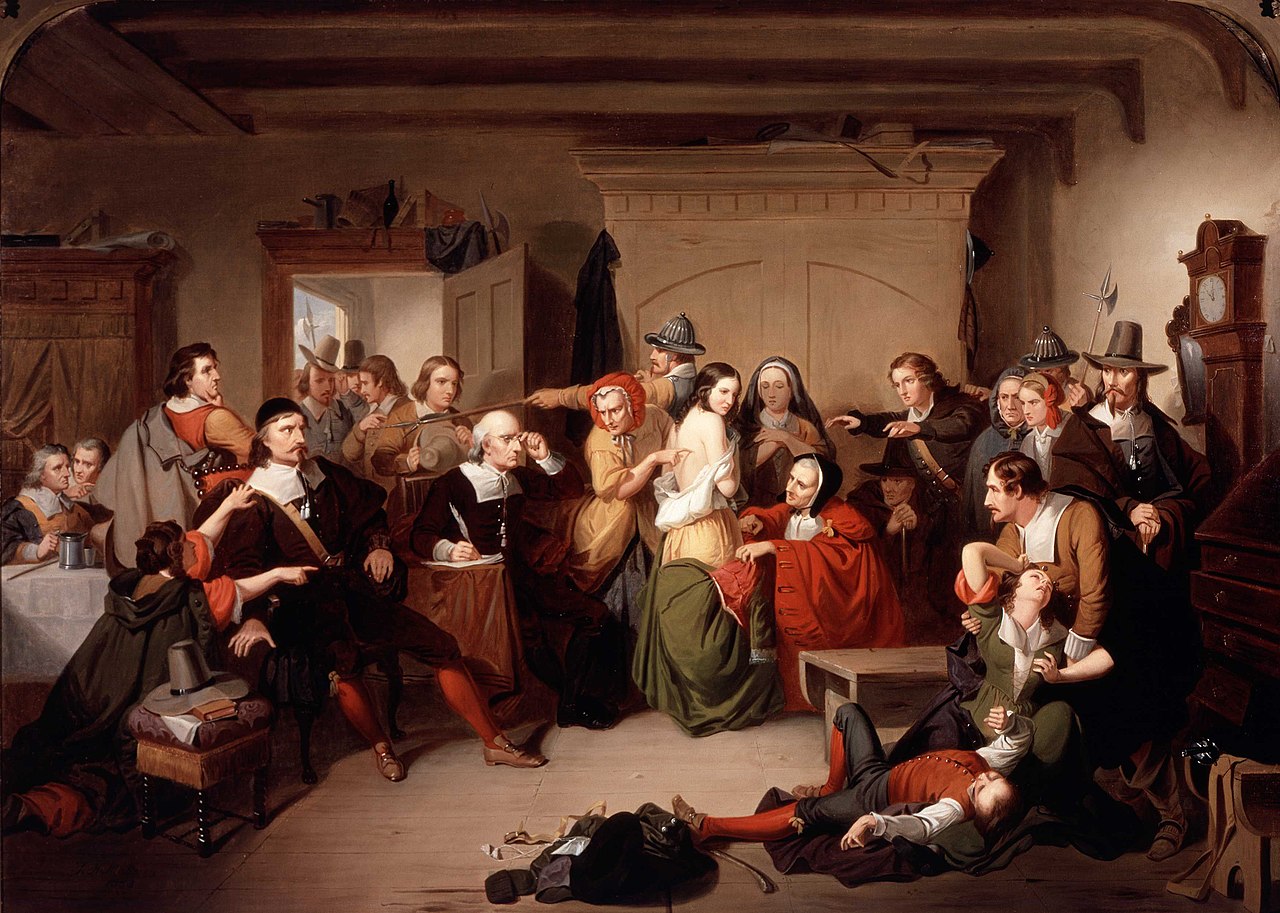
Brains can be reduced to mush by leading and direct questions. By such mechanisms children can be led to believe that day workers slaughtered rabbits, as Stanley Schiff recently remarked in a book about the Salem Witch Trials.
Examination of a Witch (1853) by T. H. Matteson, inspired by the Salem trials.
An opinion once adopted
Francis Bacon, the great British philosopher and intellectual as well as Lord Chancellor of Britain also remarked in this context:
The human understanding when it has once adopted an opinion … draws all things else to support and agree with it. And though there be a greater number and weight of instances to be found on the other side, yet these it either neglects or despises, or else by some distinction sets aside or rejects
In rape and abuse cases such attitudes as this have spiralled out of control, particularly through the overloading of a formal accusation with endless satellite allegations, which create an overwhelmingly prejudicial effect; compounded by the admission of bad character evidence in the U.K.. This represents the over-weighting of morality to determine criminality.
Historic cases are hugely problematical, as is delay. The all too convenient idea that a victim waits donkey’s years because of suppressed memories leaves a defendant, twenty or more years later, relying on the fallibility of memory – often in the absence of documentation – to defeat allegations. When relationships break-up and partners move on and there are children involved it often opens up an unholy vista.
That is not to undermine the victims of serious crimes. But the falsely accused are also victims and their lives are often destroyed.
Conceptual closure, and stereotyping are necessary as a survival plan but not for justice. Black and white thinking leads to tick box, or slot machine justice.
Luke Sheehan explores the latest developments in the Assange Case, and is joined by barrister David Langwallner to discuss the approach of the U.K.'s High Court.https://t.co/gHTNYXJ4fb@Stella_Assange@DanielFooksArt
Life of course is messy, as is the criminal justice system , and we need categories or categorisations to survive, but we must confront the problem of over-categorisation.
The legendary jurist Jerome Frank was much attuned to how the prejudice of participants in the trial process (judges and indeed jurors or witnesses) influenced decisions, and how selective recall or mistakes about facts often affected the outcome of a case.
Thus, the unpredictability of court decisions resides primarily in the elusiveness of facts and deep-seated prejudice. He wrote:
When pivotal testimony at the trial is oral and conflicting, as it is in most lawsuits, the trial. Court’s finding of the fact involves a multitude of elusive factors: First the trial judge in a non- Jury trial or the jury in a jury trial must learn about the facts from the witnesses and Witnesses, being humanely fallible, frequently make mistakes in observation of what they saw and heard, or in their recollections of what they observed, or in their courtroom reports. Of those recollections. Second, the trial judges or juries also human, may have prejudices – often unconscious unknown even to themselves – for or against some of the witnesses, or the Parties to the suit, or the lawyers. Those prejudices when they are racial, religious, political or economic, may sometimes be surmised by others. But there are some hidden, unconscious. Biases of trial judges or jurors – such as for example, plus or minus reactions to women, or unmarried woman, or red-haired woman . . . or men with deep voices or high-pitched voices.
Identification evidence or the fleeting glance is often subject to the Turnbull Warning of the dangers of same, and although safeguarded it remains troublesome.
Juries have always been swayed by advocacy, and it is, as I have hitherto written, about a dark art more akin to magic or sorcery, but even the most ingenious sorcerer cannot normally produce a silk purse from a sow’s ear. Jurors are not entirely naïve and, in my experience, do focus on the evidence, but particularly in America, hysterical prosecutors often confuse morality and criminality. That this is fuelled by excessively religious people warrants condemnation.
There are other causes of false convictions. In Ireland since 2015 when the JC Case jettisoned the exclusionary rule, allowing the police to characterise tainted evidence as inadvertence or a mistake, it created an open door for targeting and framing. The prevalence of police corruption and incompetence in Ireland recommends, in my view, a special layer of checks in addition to the DPP, before any arrest is sanctioned.
Another consideration is where an offence is far too loosely defined such as the proposed Irish criminalisation of so-called hate crimes.
I am very attuned to dealing with vulnerable people with mental health problems and drug addictions. The problem of false confessions arises when a person is interviewed often without an appropriate adult in the room, and starts to sing like a canary. Vulnerable people will confess to almost anything, often based on lack of self-esteem and incredibly short-sighted desires to get out on bail, sometimes just to go to the pub or attend a football match. Solicitors should always be present. Psychiatric reports need to be secured.
The explosive growth of social media has led to a proliferation of new crimes, such as what may be a mistaken decision to engage in a sexual role play conversation and, in that context, there is the rise in demonic entrapment, including the targeting of perceived sex offenders by vigilante groups who prepare the case for the police.
We live in an age of extremes, characterised by witch hunts, increasing executive decrees, secret laws and over-regulation. It is eminently possible to stray into a wrong place at the wrong time and be accused unfairly.
A crucial final point is to appreciates the damage caused by a false allegation. Even if a person is ultimately found not guilty, they may be traumatised for life.
I hope the Innocence Project gains more traction improving processes at the beginning of the system, rather than providing a photo opportunity twenty years later, when someone’s life has already been destroyed.
The question of compensation also arises, as in the recent Andrew Malscherk case who served eighteen years for a rape he did not commit.
But to anticipate my next article not all are innocent, and some who are guilty are assumed to be innocent. Bob Dylan’s song about Rubin Carter ‘Hurricane’ is forceful and brilliant, although it may have given a sanitised account of the accused. Not that he could have been the champion of the world but that he was always an innocent man in a living hell.
My relationship with making art began aged twenty-one as a means to bolster my ego and be cool. I chose photography, mainly because I can’t draw. Also my mum and her brothers were into photography in their twenties, so there were a few nice old cameras around my house when I was growing up.
Maybe the ego thing is an obvious thing to say as there’s always so much ego involved in becoming an artist I think, particularly if you’re not rich. Probably if you are rich too.
Either way, I’m quite suspicious of my reasons for choosing a really hard thing to do that most likely will provide only precarity and emotional insecurity regardless of how good you might be at it. What am I trying to prove?
BIT ROT BULLY SHOT (2022) 9.08 mins single channel h-8/digital video w/ audio by Frank Lohmeyer & Dorje de Burgh.
Having said that, sticking with making pictures has been the source of pretty much all the valuable learning I’ve done outside of various mistakes and some major moral failures in my personal life.
Throughout art school and after my thinking was primarily influenced by the writing of JG Ballard. Mainly his recurring theme of any given personal or social reality existing simply as a stage set that can be swept aside at any moment.
When that actually happened to me I didn’t handle it well. My mum’s death changed everything. We were very close and her dying was the thing I was always most afraid of, so when she was diagnosed as terminal I completely unravelled.
But I did keep making pictures, and Dream the End, the work that formed a few years later from a combination of those pictures and her own, would be the first thing I’ve made that I feel actually had a real resonance with people. It taught me that if you try to tell the truth you have a real chance at communication and connection.
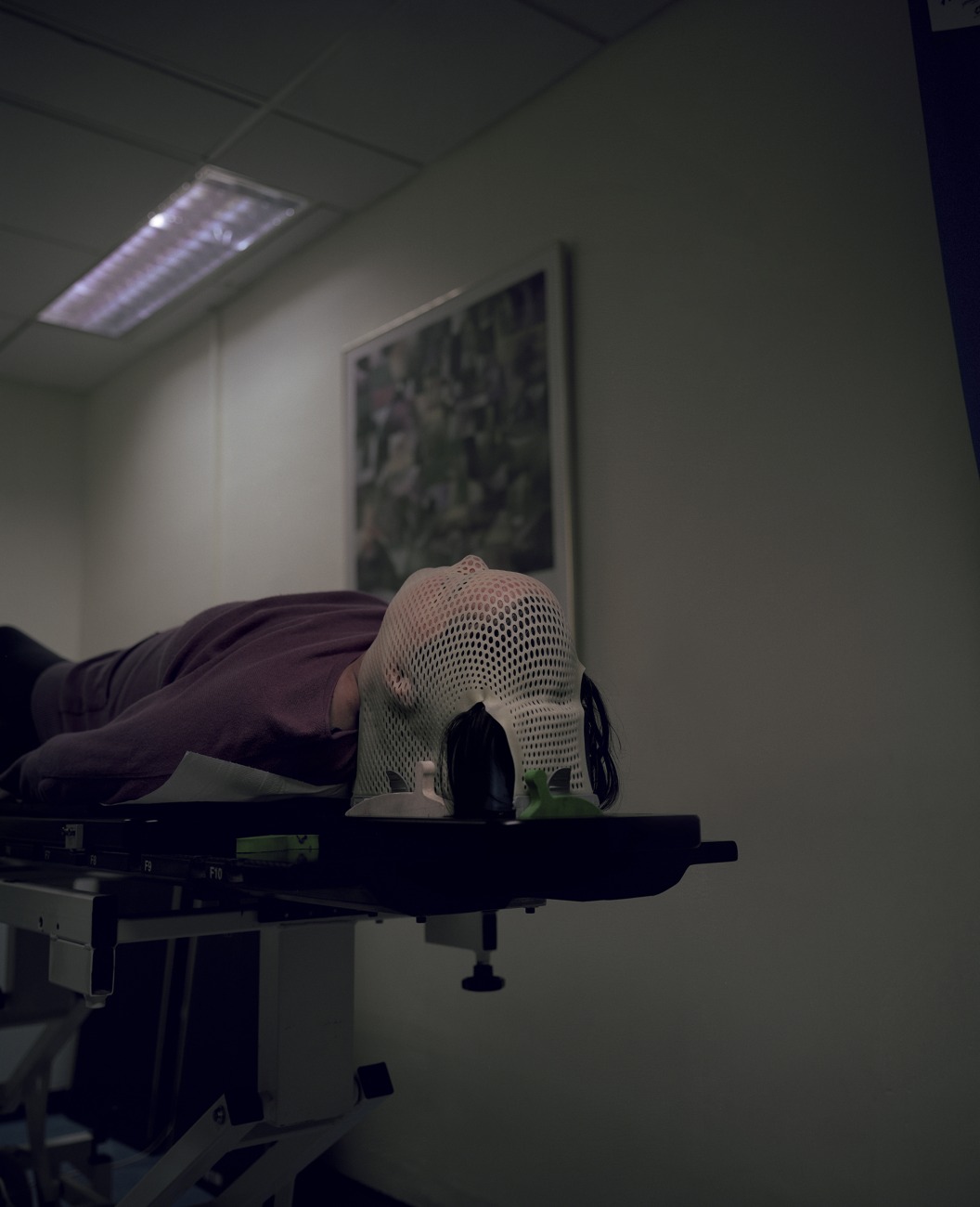
Brain Scan (St Luke’s), archival pigment print, (2017), 820mm x 1000mm – Courtesy of PhotoMuseum Ireland collection.
And as we move further into a mediatized landscape that seems designed to atomise and alienate us from each other, as the death machine rumbles on, any form of human connection seems vital.
I know in some ways I’ll never move past this part of my life, I still carry many grudges and various medium to low level addiction issues that I’m only beginning to deal with, but I’m glad the last thing me and my mum did together was make something.
Soon afterwards I learned that my father had returned from the cult they’d been living with since I was three and now lived as a woman, so inviting her to make a work together seemed like the obvious thing to do, and also a useful way of side-stepping my own fear of meeting after a lifetime apart.
Sadly she’s pretty unwell, suffering with quite severe psychosis susceptibility syndrome, so collaboration or even direct contact wasn’t possible. But as we figured this out I began to make a film imagining what a work about our relationship might look like without her presence.
The Sting of Love, from How to Kill Something That Doesn’t Exist, 7.07 mins single channel hi-8/super 16mm projected onto unprocessed Fuji Crystal Archive c-type paper, text adapted from Rollenspiele: Frauen über Rainer Werner Fassbinder (1992, Thomas Honickel) mit Margit Carstensen, Irm Hermann, Hanna Schygulla und Rosel Zech. Courtesy of The Arts Council of Ireland collection.
Then the pandemic hit and I decided to move on from trying to understand my two families.
Following the summer of 2020 I moved to a small town called Carrick-on-Suir in south Tipperary that was both uncannily familiar and totally alien. The work that resulted from living there was in part an attempt to remove myself from the equation, and confront the world in more purely formal photographic terms.
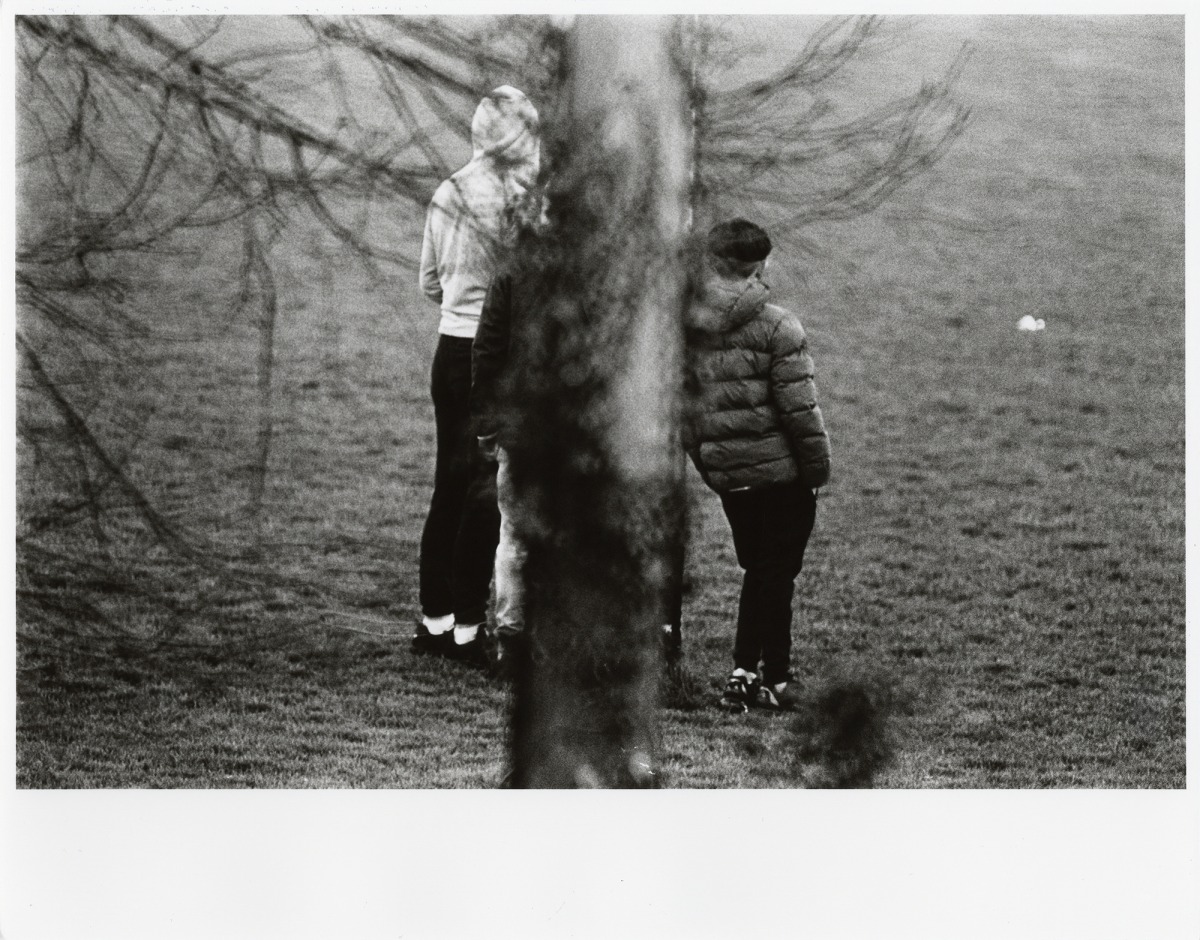
Untitled, Carrick, silver gelatin hand print, (2021), 250mm x 310mm.
In addition to being an attempt to somehow subvert the representations of the Irish landscape that I was familiar with, Under the Same Sky is about proximity and distance, and alienation from ourselves and each other. It is also very much concerned with my own conception of home — what home means, what constitutes it and what are the conditions of belonging.
The best part of making this work was getting to show it in South Tipperary Arts Centre in Clonmel, the town next to Carrick. Often these kinds of loosely documentary style photographic works are made and then disappear to be shown elsewhere, and are never seen by the people local to the place the work is about. The first comment in the visitor’s book described it as ‘an excellent documentation of misery’.
This line of thought (home not misery) continued as my life became less tethered to a particular place, and during a spell living on a small island off the west coast of Ireland and then mainland Europe I made BIT ROT BULLY SHOT.
Bit rot is naturally occurring digital decay. A bully shot is old slang for a good shot. The film is about de-materialisation and the natural world as a home that we spend less and less time in, forgoing what can be a beautiful reality for some bullshit virtual escape. How close we are to paradise and how much we’re fucking it up.
There’s also an element of petty revenge involved, as I was told that I wasn’t allowed to make work featuring the island I was living on by the artist friend I was then living with.
I’ve always made work in an analogue way. This was a decision born of aesthetic taste but as our world becomes more digital I feel that this mode of working is increasingly the point.
In terms of who ultimately controls memory, meaning and history we are in a dangerous position, and this would suggest that personal histories and counter narratives are more important and hold more radical potential than ever before.
BORING PHOTOGRAPHS, made in collaboration with Chris Dreier of the OJAI, is a playful toe in the water as regards subversion of the de-materialised attention economy. It’s a riso publication of forty photographs accompanied by an essay on collaborative vernacular photography written by A.I..
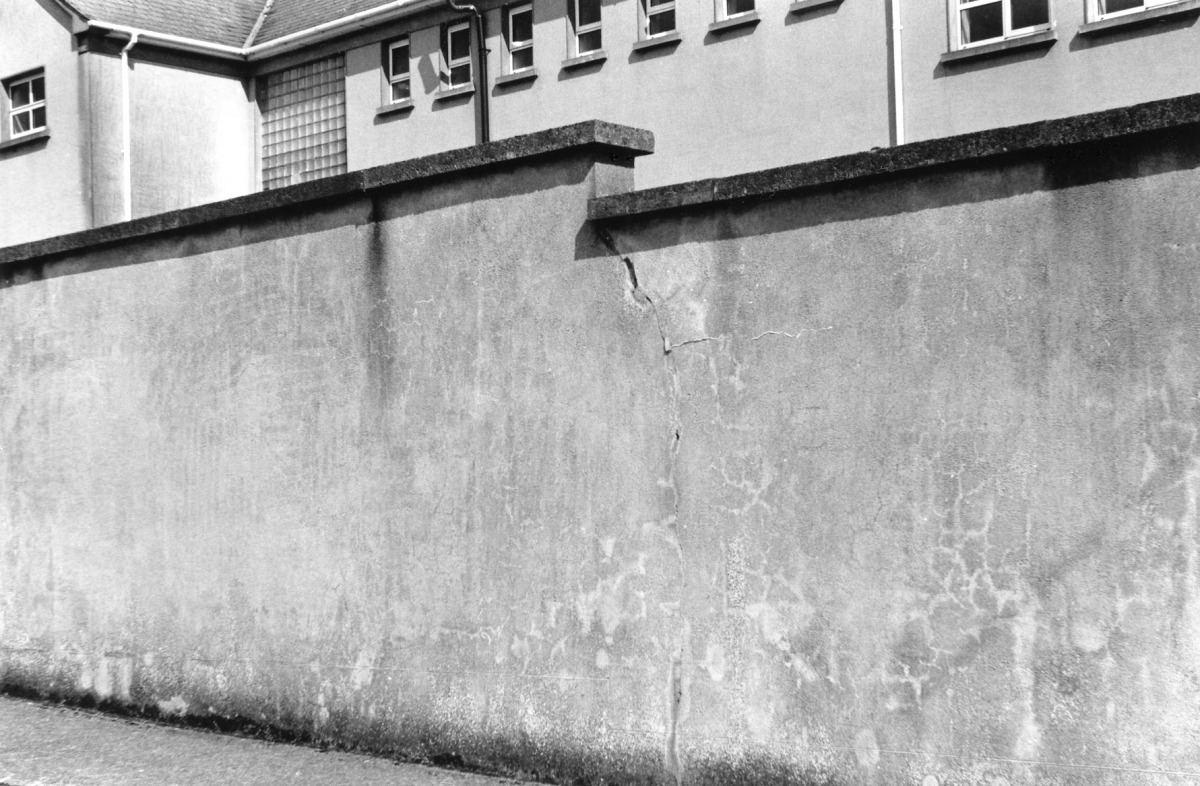
Convent Wall, silver gelatin hand print, (2023), 127mm x 178mm.
We launched this work and the publication in two pedestrian tunnels in Berlin. This is very much Chris and her OJAI co-director Gary Farrelly’s longstanding m.o., but for me it was a definite light bulb moment.
In light of the current levels of hypocrisy and moral compromise apparent across the art world superstructure in regard to the genocide in Palestine, it feels apparent that we have moved past the moment of institutional critique to one of stark institutional irrelevance.
Steal as much as you can to survive and make the work, but forget career ladders and gatekeeping. Make it DIY.
Still from TIMEFUCKER multi-channel hi-8 video.
TIMEFUCKER, my new film and book about the poetics of dystopia should be finished by summer 2024.
For the Irish, living as we do on a divided island, the question doesn’t have to be facetious. As a negative example, to try to land on a positive answer, Northern Ireland comes to mind. Wherever that congenitally deformed statelet ends up, its passage through the twentieth century will form a storyline we will never stop arguing about. God bless us.
Lebanon, where I lived briefly from January 2011, is a mystifying and compelling organism.
Were it on the seafloor, it would be brightly coloured, shape-shifting and perhaps equipped with a defensive poison. A territory carved out of the Ottoman Empire via the secret Sykes-Picot Agreement of 1916 and the Paris Peace Conference of 1919, it formed with Syria the ‘French mandate’. It has held together against expectations, and enjoyed tangible golden ages through the same century-long lifespan as our post-colonial Ireland.
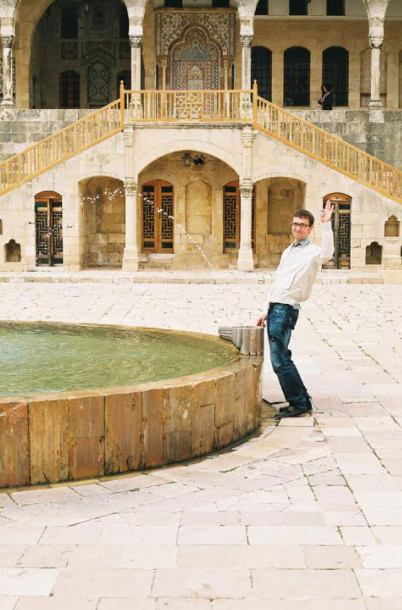
At the Beittedine Palace, 2011.
The local cultures, which still roughly map onto the religious arrangements of the confessional political system, have incredibly deep roots. I say ‘cultures’ and ‘roughly’ because this is a land where people will seriously make the case that they are the direct descendants of the Phoenicians, if not the Canaanites. Some of the ingredients here are antiquated enough to make monotheism look like a recent fad.
Other claims include references to identifiable cities and mythologized landscapes in ancient history that remain traceable today: the cedar tree that appears on the flag is of the stock used to build the Jewish Temple, and the forests are referred to in the Epic of Gilgamesh.
In cities like Batroun, Saida and Sur, the phantoms and visible stubs of Phoenician harbours can still be observed. Compressed between the plains and deserts leading to Mesopotamia, and the coastal route to the Nile and Egypt, it has produced merchants and travellers over the millennia. The Lebanese diaspora may number seventy million.
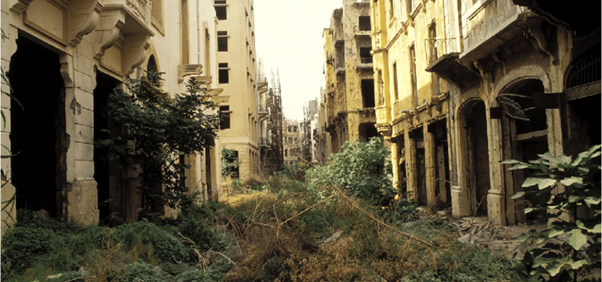
Beirut’s Green Line after the Civil War.
To live in Beirut at the time I did, was, I now realize, a taste of a brief golden age all on its own. One of the clichés that had to be learned was the fable of the glorious 1950s and 1960s: the period after the Second World War and before the domestic civil war, when the traditional merchant classes were joined by elite émigres from other parts of the defunct empire to create prosperity. They became ‘bankers to the Middle East,’ a role now occupied by Dubai.
Wealthy post-Ottoman families that retreated there included the Sursocks, who would form a link to Ireland, and Jewish families from Iraq and beyond. Nadim Shehadi, the guest speaker on our latest podcast, is a product of the cosmopolitan confidence of that time.
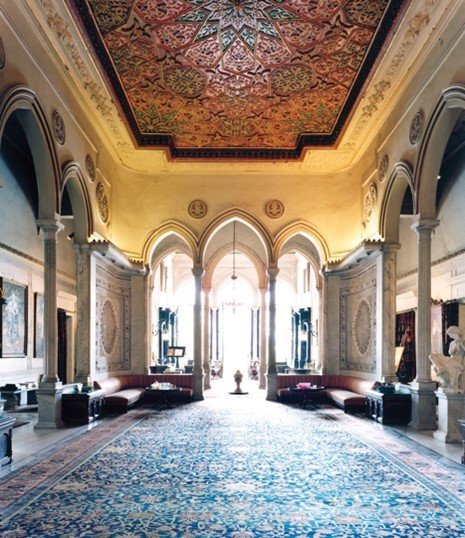
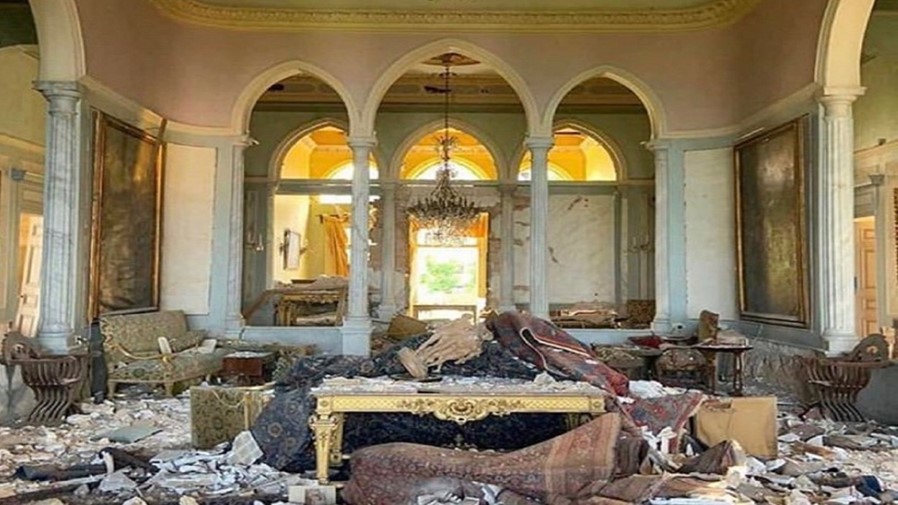
Sursock Palace before the explosion of 2020.
In 2011, the Arab Spring was triggered by events in Tunisia the week I arrived. Through connections, I had the opportunity to meet the renowned journalist Robert Fisk for coffee, and as we sat in a place on Sadat Street, the TV in the corner was flashing images of Mohamed Bouazizi burning. I had been reading about the story, and Fisk hadn’t, so for a few minutes I was the one explaining events to him.
My journalistic Larp brought me up and down the country. No-one ever called me out on it. I wrote one story for the Daily Star, the Saad Hariri-sponsored newspaper, about a scheme to write essays and theses for brattish students at the American University of Beirut. My real job was writing multiple choice questions for a rich private school and educational company.
I had a blast. Young and hopeful journalists were everywhere, and the dismal course of that profession, with Facebook annihilating the business side and ISIS looming into view with plans to cast them in their snuff movies, was not yet obvious.
One young English writer I knew noted that “the next few years are looking pretty good for work.” She might have been right, but that sort of attitude, shared by the foot soldiers of the international NGOs, was already watering seeds of uncommon bitterness among the Lebanese. Their rivers of trouble were sources of fresh water for well-paid and often decadent hordes of expats. One wonders how high the shoots might have grown by now.
At the moment of the horrific Port explosion of 2020, I was living in Paris. A Lebanese woman I knew there, a filmmaker[1] and activist, called me briefly, with her voice inflamed from sobbing. “Really Luke, what have we done to deserve all this?”
Sursock Palace after the explosion of 2020.
Add to this the financial collapse which wiped out savings and plummeted the domestic currency, the Syrian refugee influx which increased the population by at least 30%, the pandemic pains and now a very possible Hezbollah-Israel war, and you might have a country that even her most ardent lovers will leave. Who will stay, and who will join the seventy million-strong diaspora? What cause for hope might persist?
One of the characters I met during my time there was Nadim, during a dinner at the palace of the Sursocks in Gemmayzeh. With characteristic Lebanese curiosity and openness, he simply stayed in touch with me, a random person who had breezed through then strayed very far from Beirut, like most of our overconfident cohort running around at the time.
One also wonders, incidentally, whatever happened to all those little girls and boys?
[1]Of course she was, and is. Her first films were beautiful, artful, personal things shot through with a heatwave of avant garde, mostly concerned with her much-traumatized locality of the Shia south. Some recent work is here.
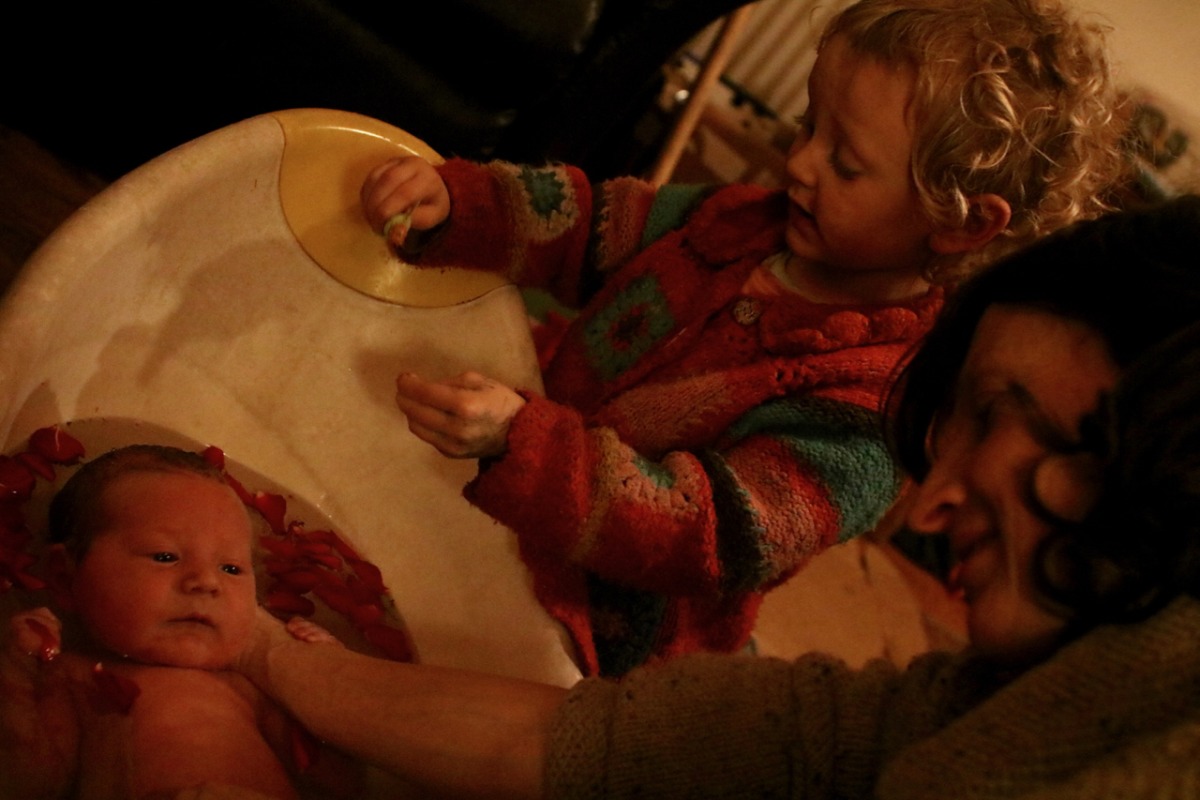
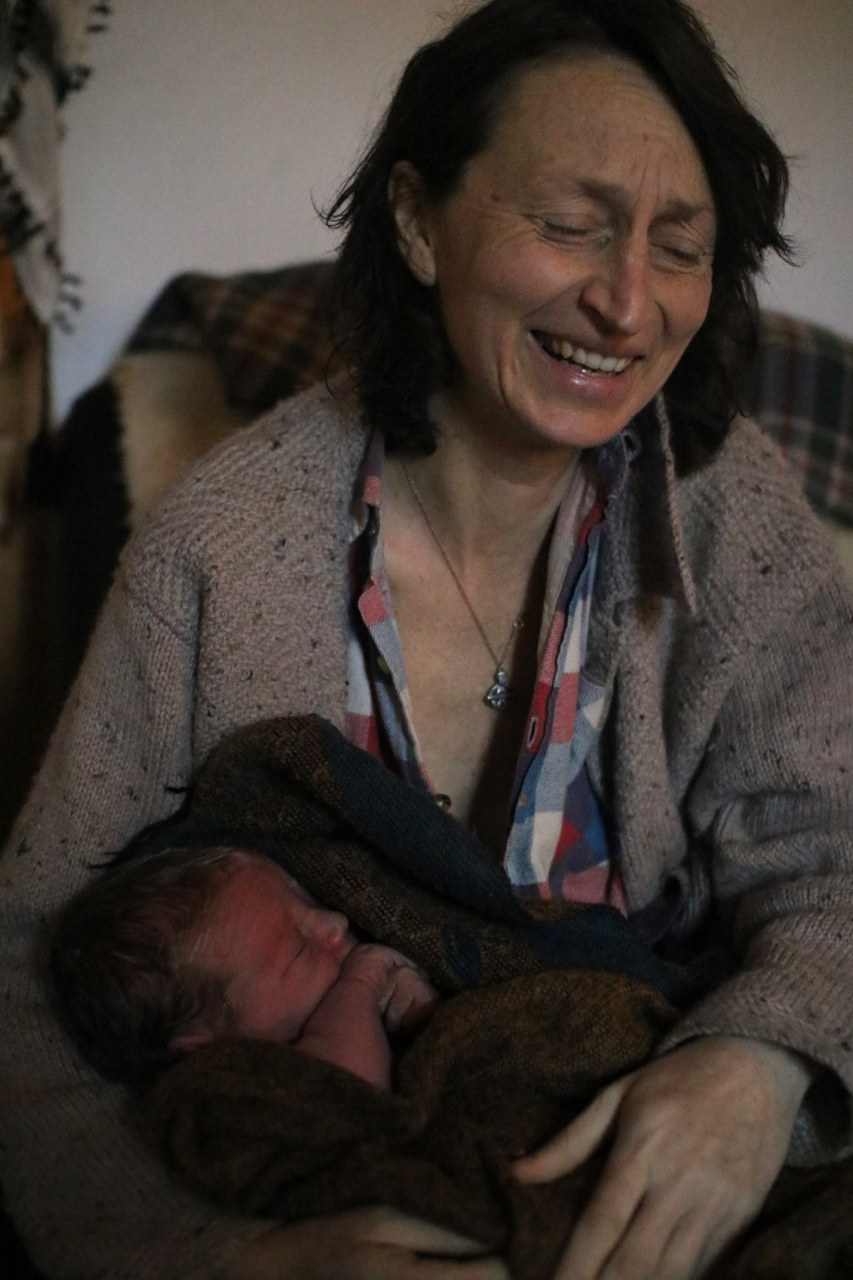
It’s Mother’s Day morning and I am on the brink. Desperate, determined, exhausted and certain all at once. I have passed an eternal night trying to push out a child, with no apparent progress.
I don’t have a midwife gently coaching, or calling the ambulance, as the case may be.
I am freebirthing.
‘Is that like a home birth?’, people would ask, when I told them of my birth plans. ‘Yes, only without a midwife,’ I would say. ‘Oh,’ they would respond; an ‘oh’ loaded with ambiguity. Because, in fairness, it doesn’t sound ideal.
Most Irish women choose to give birth in hospital because they think home birthing with a midwife is a riskier option. This is a view promoted by every medical professional in the country. However, some reading of alternative birth experts soon reveals the best kept secret in the Coombe: a woman’s body is designed to give birth unassisted.
Known as a physiological birth where each biological process activates the next in a delicately balanced sequence, it is the origin of the hypnobirthing image of the unfolding lotus, petal by petal. The most dangerous thing one can do at a birth is interfere with this process.
Modern obstetrics which is based on the ‘active management’ of birth, is the petal plucking inverse of this ideal. Drugs to induce and speed labour and pain medications which stall labour, are standard interventions in normal hospital births. These then lead to ‘emergency interventions,’ such as antibiotics, episiotomies, foreceps and Caesarean sections (c-sections).
In effect, obstetricians are busy ‘saving’ mother and baby from the complications they themselves created.
From the perspective of physiological birth; modern obstetrics is akin to a sexual violation of women. It is predicated on ‘getting the baby out alive’, an approach which traumatizes and damages the long-term health of both mother and child.
Most obstetric staff have never even witnessed a physiological birth. Midwifery training in Ireland takes place in a hospital setting only, and most will have never witnessed a home birth, and could be more accurately called obstetric nurses.
As Irish hospital policy is increasingly determined by insurance liability, where the proof ‘we did all we could,’ is the best defence against malpractice suits, there is a corresponding rise in the national rate of c-sections.
So, in the medical paradigm, which expectant Irish mothers are forced to occupy, for lack of an alternative, where home-birthing is risky, freebirthing would be considered reckless.
And we all know what happens to reckless mothers: They get Tusla called on them.
A HSE homebirth
I applied to the HSE home birth scheme for my first birth in 2018. But the community midwife serving West Kerry had retired one year previously and had yet to be replaced.
There are about twenty community midwives serving the entire country – and the HSE insurance requires that at least two midwives attend each birth. As there is no community element in midwifery colleges in Ireland, our national home-birth scheme relies entirely on midwives who have been trained abroad. Little wonder then that just 0.4 per cent (approximately 280) of births in Ireland occur at home.
So, despite occupying an entirely different health paradigm; the hospital was the only option available to me. And then I discovered freebirthing.
After reading Laura Shanley’s Unassisted Childbirth, which lists the myriad ways that medical intervention causes birth complications, I decided to birth at home, without a midwife.
But with the combination of a long labour, doubtful doulas and a fretting family, fear overtook faith. In the early hours of Little Christmas, we drove from our home on the Dingle peninsula to Tralee hospital, naively thinking we could get checked out, allay our fears and be on our merry way.
We hadn’t accounted for the Hotel California door policy of the Irish maternity ward. Labouring women can check in any time, but security locked doors ensure they cannot leave. ‘For our own good’ presumably.
And there in the belly of the beast, I fell foul of the highly medicalised birth policy, which allows a woman just 18 hours to deliver her baby from the time of her waters breaking before emergency intervention. In the U.K. birthing mothers are given at least 24 hours before ‘emergency deliveries’ are considered.
So, despite the fact that first time births can take up to forty hours to deliver, mine was treated as an emergency and my refusal of syntoconin (a drug to speed up labour) infuriated the obstetrican. The umbilical cord was cut immediately after birth, still pulsing full of blood. The child was pulled from my breast, even as he began to grub for colostrum and taken next door to instead be given a shot of glucose for pacification, as the paediatrician syringed a vial of blood from his tiny veins.
My refusal of ‘precautionary’ antibiotics on the grounds that it would destroy my son’s virgin microbiome precipitated a stand-off in which we were threatened with a court order, the Gardaí and Tusla. The Tusla officer was almost embarrassed, being called to ‘investigate’ and indeed intimidate the only woman on the ward who was breastfeeding.
There followed three arduous nights in hospital in which my son’s sugar and salt levels were monitored, each day bringing new threats to my hopes for a natural beginning to his life: ‘If you don’t get those levels up, we’re going to have to give him formula.’
That was my trauma. Minor compared to most, but it radicalised me, made me an advocate for birthing reform and affirmed my position outside the system. But Life will always buck an affirmed position.
For my second pregnancy I was even more determined to birth at home. But at thirty-six weeks, after a heavy, heart-wrenching bleed, I went for a scan that showed placenta previa, where the placenta is encroaching on the perineum and obstructing the safe exit of the child. Though the child’s head could nudge past, it’s a high risk one, even for a fervent opponent of the system like myself.
So, again I was bound for the belly of the beast and Eirú, my daughter, was delivered by c-section. And I saw the medical maternity machine from the other end of the spectrum. As a birthing mother not wanting intervention, I was treated as a pariah, but as a birthing mother needing intervention, I was treated as a queen. As in this way, I made my peace with these two faces of the Irish medical industry; a merciless machine staffed by heartfelt humans.
But, though tempered, my view was unchanged. Previa affects 0.2% of mothers. And the national rate of c-section is 30% and there is a chasm of accountability between the two figures.
A film looking at the way people give birth in Ireland, the system and how it should change.https://t.co/2ivReYmId1
So here we are in 2024, pregnancy number three and we are older and wiser and much less furtive than we were as first time parents. Now we are open about our plans to freebirth. The pregnancy is fully ‘off grid’. I don’t even feel the need to visit the G.P.. My dates are sure. My pregnancy is healthy.
Having gone through the rigorous and ambiguous process of ‘getting signed off’ for a HSE home birth previously, I knew my designation as a geriatric VBAC (meaning a forty-one-year-old vaginal birth after c-section) would eliminate me from the narrow confines of ‘low risk’. So, I spared myself and the child the bother of engaging with a ‘care system’ that would reduce me to such terms.
A doula with a doppler the week before gave me the reassurance I needed that the placenta and baby were in a good position. I’d read the freebirth manual twice over; I was packing shepherd’s purse tincture for post-partum haemorrhage, clary sage and castor oil to stimulate the uterus, chilli tincture for the child’s respiration and I had the numbers of a few good women that I could call for advice in a pinch. Ready as I would ever be.
The bull jumping ceremony of the Hamar tribe in Ethiopia.
The Initiation
To become a mother, a woman must shed aspects of her youthful self that would create chaos for herself and her new child. So Nature, in her infinite wisdom, made birth a rite of passage. An initiation into motherhood.
Initiations are characterised by endurance. Birth is not painful per se – a contracting uterus after birth is usually more painful – though birth ‘complications’ can be very painful indeed, but it is intense – earth-shatteringly, butt-rackingly intense.
The initiate must undertake a journey into the unknown, meet her limits and transcend them. She is shown the insubstantial nature of her persona and must rely on the felt experience of her body and access the instinctual wisdom of her mammalian brain. The two aspects of her self will grapple, the little and the large, the personal and the impersonal taking turns to lead. Her fear will do battle with her trust.
I cannot say for certain that my faith was stronger than my doubt or that my courage prevailed over my fear. For there were times in those eight hours of the most intense pushing sensations, in which every fibre of my being shuddered and squeezed with the effort of expulsion; pushes so magnificent as to be worthy of the crowning glory of a head; only to succeed in squeezing out yet another tiny piece of shit – which my faithful partner faithfully wiped away; the orgasmic foreplay of pre-labour forgotten in the less pretty reality of active labour – that my weakness and doubt did prevail.
Between these surges, I sometimes collapse weak on the bed taking the minutes of reprieve to drift into a semi-conscious nap. But it was no power nap. On the contrary, using the intervals in this way left me ill-prepared for the violence of the surges and less than aware riding them.
In the other times, I breathe and remain alert and rise like a disciple to meet those waves as they roll my body; and those waves I rode. So, on I go through the night like a surfer, catching a few and getting wiped out in others as my strength gives out; my pre-labour thoughts of Macha, the horse goddess, running a marathon in childbirth, gone as I half roll on the bed baying like the cow goddess Boann.
Transferring to a hospital is as inconceivable as it is impossible in my current state in which all that exists is me riding an ocean of sensation.
Sometime, about half-way through the storm; Diarmuid drills a hook into the ceiling and hangs an extension cord from it that I could bear down on it.
Eight hours of eternity passed like this. Me and Doubt and Faith and Baby and the rest of the Gang going up and down. Diarmuid keeps vigil on the periphery. The children sleep soundly next door.
Then there is birdsong and dawn light. Morning arrives but the baby does not. From the frontal cortex of my brain comes the thought (for I now occupy the recesses) occurs: ‘I don’t want the children to witness their mother as an alien cow goddess’.
The children wake and Diarmuid goes out to them. I stay in the room, baying through the surges and I hear Eiru start to cry at the strangeness of the sound.
My instinct says there is nothing wrong, but here I am again in a labour that is taking ages. Patience. Tenacity. Endurance. The words rise from my subconscious as guidance. But my frontal cortex says: ‘Diarmuid, It’s not progressing, we have to call someone.’ Something for him to do. He’s on it.
I emerge from the bedroom to reassure my daughter, my body a boiling ocean.
‘Mammy when I woke I thought there was a cow in the room,’ my son says. Amused, I feel the wave building inside me again. I hug my anxious daughter quickly, ‘Mammy’s good, baby will come soon;’ as the wave towers over and in me, about to break. I step out of her embrace and into the toilet, close the door, sit on the bowl in a sequence of seconds.
And the wave breaks.
Only this time, unlike the hundreds or thousands of other times throughout the night, the wave carries a little body in it and pushes it all the way down the birth canal.
‘Diarmuid’ I croak, with jubilation and anxiety and blood all mixed. And he is there. ‘Oh thank God, the head.’ And he calls out to our six-year-old: ‘Uisne, take your sister into the neighbours, I’ll come soon’.
‘Dig deep, one more push,’ he says, not knowing that I am being dug, I am being pushed. But I follow his instruction anyway, like a robot. And a big slippery child comes out. And we catch him between us.
There is blood; looks like a lot of blood. How much is too much? We don’t know. But seven drops of shepherd’s purse tincture under the tongue should be sufficient. Is he breathing? I suck mucous from his nose. Yes, he is. Oh, sweet slippery baby. Diarmuid tries to carry me to the couch, but the domesticated mammal bridles at the prospect of getting blood on the couch. So, I sit in a pool of blood on the floor. Looking every inch the warrior. Bruised and weeping, utterly spent and victorious.
We haven’t been out in public yet. We are resting. I am writing. We are content. I tend to his umbilical cord myself. I treat my hemorrhoids with frankincense and aloe vera and look at my cervix with a hand mirror and great fascination. I am my own healer, calling on fellow warriors for advice.
He has not been outside yet, felt the spring on his silken skin. But I will not rush him, I wish for his separation to be as gentle as possible.
Some authority that had been taken from me at Uisne’s birth by coercion, at Eiru’s birth by fate. It has been restored by this home birth; this freebirth.
Maternity Rights
I represent a growing number of Irish women who have an ‘alternative’ approach to health. My faith in modern medicine is limited to its functionality in diagnostics, bone setting and some emergency interventions. That’s it. I don’t believe it has any real role in solving chronic illness, which cancer would be, and I most certainly don’t think it has any role to play in 99% of births.
From this worldview then, giving birth at home is a ‘no-brainer’, except that it’s also a ‘no goer’, for many Irish women, who, either through age or some perceived health issue, (i.e. low iron, vegetarian diet or high blood sugar) or geographical reasons, do not have access to the very limited HSE home birth service.
In 2008, community (home birth) midwives were compelled to sign very restrictive memorandum of understanding with the health service. Midwives became obliged to transfer birthing women to the hospital in scenarios previously considered normal, such as heightened blood pressure or a delay in labour, or risk losing their licenses to practice.
The U.K.-based Private Midwives Ireland operate under a slightly less restrictive insurance requirements, but the cost of €6,500 to €10,000 precludes many women.
So, into the barbarous hospitals we go. Or not. Freebirth is our bright shining alternative.
The highly medicalised maternity model in Ireland is compelling Irish women to give birth unassisted by midwives at home. And though this may sound like a dangerous scenario to the uneducated; the experience has been both empowering and healing for a growing number of Irish women, many of whom are now sharing their stories on social media.
Motor and Sensory Regions of the Cerebral Cortex.
Instinctual Mammalian Brain
The physiological unfolding of birth requires that a woman relax completely in order to occupy the instinctual mammalian brain that governs the birthing process. Anything that draws her into the frontal cortex is discouraged in this non-intervention, best practice birthing model. Hospitals then, are exactly opposite to the optimal environment for a birthing mother. This reality has been recognized in many European countries such as the Netherlands, which has an extensive national home birth service and birthing centres.
Ideally, Irish mothers would be attended by experienced midwives who did not have to operate under such punitive criteria and the threat of losing their licences. But in the absence of this, giving birth at home under her own authority is one of the most liberating and empowering things a woman can do. Finally, I can testify to this.
Life contrives to give us what we need. In the decimation of our home birth service, there is an opportunity for us to step into the gap ourselves alone. The rewards are great and many. And perhaps if enough of us step into that breach, the country’s health care professionals will be compelled to answer the call for maternity reform and give us the support in our own homes that we deserve.
Follow Siobhán de Paor’s blog:http://insideoutpost.ie/
Anyone watching the agonizing progress of the Julian Assange case proceeding through the U.K. justice system will be aware that it’s highly unlikely that any judge will simply throw open the gates of Belmarsh prison in assent to calls to ‘Free Assange’.
Sadly for those sympathetic to him, extradition has inched ever closer over the last three years thanks to High Court decisions: first overturning a lower court ruling that blocked extradition on the basis of suicide risk in 2021; next blocking an initial attempt to appeal in 2022; then blocking another appeal attempt in 2023.
Assange has survived more than a decade of a bizarrely public seclusion and alleged U.S. security targeting that ranged from standard kidnapping and rendition to assassination, details of which were forbidden to be submitted this time round. Yet figures fighting or speaking up for him are not lightweight: more support from Australia where Prime Minister Anthony Albanese backed a parliamentary motion calling for his release in 2023, while his wife Stella has raged for the life of her besieged man like someone out of a Greek drama. Might there be a true reprieve?
On March 26 the High Court played the ball back to the Americans in a ruling that confirmed three out of nine questions of his imperilled rights: ‘that the applicant [Assange] is permitted to rely on the first amendment, that the applicant is not prejudiced at trial, including sentence, by reason of his nationality, that he is afforded the same first amendment protections as a United States citizen, and that the death penalty is not imposed.’
A response is due in three weeks. Had this ruling gone differently, Assange could have been on a plane within days.
It is worth mentioning here where – even were the death penalty threat to be muzzled – he may end up: the ‘supermax’ prison class where the US boxed up the likes of Ted Kaczynski, Zacarias Moussaoui and Ramzi Yousef.
An earlier legal concept that was applied to the question of blocking U.S. extradition demands the ‘Death row phenomenon,’ actually starts to look more humane when one itemizes the torture regime of prisons where inmates are slowly aged in isolation under observation without even the chance to kill themselves.
According to a former warden of the most secure such place, ADX in Colorado, it constitutes a ‘life after death… it’s much worse than death.’
For Stella Assange, speaking on the steps of the court, this ruling was at least a partial hint of genuinely positive momentum, a support for the notion that Assange might have rights after all. For others responding from around the world, the rejections of the six of the nine grounds formed part of the ominous, serpentine locomotion of the UK justice machine to eventually doom the Australian to that fate.
For Irish barrister and human rights specialist David Langwallner, who previously spoke to the Cassandra Voices podcast, the ruling gives a hint of a real path to appeal, and can be taken as a serious gesture from the judges. Speaking again informally to CV, he condemns the ongoing absurdity of a persecution that “should have ended long ago,” and lays out precedents like Soering Vs. United Kingdom.
SYRIZA’s rise to power in 2015 created shock waves around the world. The international Left celebrated a victory that seemed unfathomable a few years earlier. Its electoral triumph gained even more attention than it otherwise would have, because the stakes surrounding it were exceptionally high.
The Coalition of the Radical Left, as is the meaning of the acronym, was about to engage in a crucial and tough negotiation with the E.U. and particularly Germany, regarding Greece’s debt. The party had been elected after promising to take a much harder stance in these negotiations. Analysts around the world were warning that this clash could endanger the global economy.
Nine years later, this once mighty political force that scared the world’s financial establishment, now lies in ruins. Poll after poll shows its electoral support diminishing. Opinion polls consistently show it to be in third place, trailing PASOK (Panhellenic Socialist Movement) by a small but steady difference. It is now perilously close to single digits.
Furthermore, after two recent splits (not counting the one in 2015, which will be mentioned later), and the clear and present possibility of a third one looming, it appears to have fallen into complete disarray internally, as its recent, almost farcical, convention exposed. To fully understand the trajectory of its downfall, however, we need to return to the historical context that created its rise.
José Manuel Barroso and Kostas Karamanlis in Dublin in 2004.
There is [plenty of] money…
In October, 2009, Kostas Karamanlis, president of the right wing Nea Dimokratia, the ruling party at the time, called an early election, after his party lost ground in the European elections in June of that year. In his election campaign the Prime Minister, who had been ruling Greece since 2004, was very open about the necessity of taking significant austerity measures.
On the opposite side, Giorgos Papandreou, president of the centrist party PASOK, the main opposition at the time, just a month before the election, in September 2009, uttered the phrase that was going to become emblematic in the years that followed: ‘There is [plenty of] money…’
Naturally, PASOK won in a landslide, taking 44% of the vote, while Nea Dimokratia subsided to a mere 33.5%. It is important to note that SYRIZA was the last party to enter the parliament in this election with only 4.6% of the vote. Soon after his emphatic victory, however, Giorgos Papandreou had to face the grim reality of Greece’s problematic economy within the context of an unraveling global crisis, its perpetually rising debt, as well as a rising deficit, and probably worst of all, the cold determination of key players in the EU to make an example of Greece, as a means of enforcing hard line fiscal discipline across the Union.
On April 23, 2010, a mere few months after taking office, the PM made an historic announcement, from the picturesque island of Kastelorizo, at the far end of Greece.
In it, he explained that the real volume of the deficit of 2009 had just been exposed. The previous numbers had been cooked up it was revealed, which led to the coining of the expression ‘Greek statistics.’ He continued to say that his government inherited ‘a ship that is ready to sink’ and that Greece was unable to borrow money from the markets on viable terms.
Hence, he had to ask for the activation of a support mechanism from the EU, which was the colonial-style loan agreement that became known as the Memorandum. What followed was an almost decade long period of havoc, that saw Greek living standards plummet, the welfare state dismantled, and a great number of strategic national assets being sold off.
The worst shock for the citizens of Greece was in the beginning, which gave rise to massive popular protest movements, fierce clashes between demonstrators and police and a broadly acquired culture of disdain towards the political establishment. In this turbulent political climate, where governments formed and dissolved repeatedly, the two traditional big parties kept losing ground and PASOK in particular, saw its electoral base being gradually dissolved. SYRIZA, led by the young and charismatic Alexis Tsipras started gaining momentum.
Alexis Tsipras in 2008.
Leftwards
The disillusioned and desperate voters of PASOK were increasingly turning to the Left, where an up-and-coming new leader was promising another way out of the crisis, with better terms and more dignity. In the elections of May 2012, Nea Dimokratia won a Pyrrhic victory with a meager 18.8% of the vote. SYRIZA breached the traditional two-party system by coming in a close second on 16.8%, and PASOK dropped into third place with 13.2%. This was also the first time the unashamedly Nazi Golden Dawn party entered the parliament with 7%.
These results didn’t allow for the formation of a government, so a second election was swiftly called. In June 2012, Nea Dimokratia won the election again, this time with 29.6% of the vote. SYRIZA came a close second again with 26.9%, and PASOK dropped a bit further down to 12.3%. Nea Dimokratia was then able to form a coalition government with PASOK and another smaller party, but the old two-party system was thoroughly broken, and SYRIZA had by now cemented its place as the main opposition party. As the Memorandum policies tore apart Greek livelihoods, it seemed only a matter of time before the Left would win the next election.
That time arrived two and a half years later. In January 2015, after relentlessly campaigning against the Memorandum Agreements (there were three by now), Alexis Tsipras became the first Prime Minister to come from the traditional Left in Greek history. SYRIZA won the election with 36.3% of the vote and formed a coalition government with an ‘anti-Memorandum’ populist right wing party. Meanwhile, PASOK’s share collapsed to 4.7%.
Negotiations with the Troika
The rest is history as we say in these cases, implying that most people remember at least the gist of what happened. SYRIZA went on to try and renegotiate the Memorandum with the so-called ‘Troika’ (European Commission, European Central Bank and International Monetary Fund). This effort was spearheaded by the eccentric economy professor Yanis Varoufakis, but stumbled upon the unrelenting determination of people such as Germany’s Minister of Economy at the time, Wolfgang Schäuble, to create an emphatic cautionary tale, by steamrolling Greece and even pursuing its expulsion from the Euro currency, a scenario which became known as “Grexit” at the time.
After six months of futile negotiations, on June 27, Alexis Tsipras decided to call a referendum on the agreement proposal presented by Jean-Claude Juncker on behalf of the ‘Institutions’ – which was simply a new label used for the Troika, a shift in semantics, arguably, of very little substance.
This referendum was never meant to be about Greece leaving the Eurozone and technically the question was not that, but it was widely presented as such, inside and outside Greece. It was perceived that if the Greeks voted ‘NO,’ that would lead to a head on collision with the EU, which would in turn end up in Grexit. This might have been the case indeed, if the SYRIZA government had held its hard line to the end.
On July 5, 2015, Greek voters overwhelmingly rejected the Troika proposal, with NO getting 61.3% of the vote, while YES received 38.7%. The next day, Yanis Varoufakis, who was a proponent of the hard line, filed his resignation from the Economic Ministry, as requested by Alexis Tsipras. This was meant to be seen as a token of good will towards the Institutions, but was mostly interpreted as a first step towards capitulation.
On July 12, after seventeen hours of negotiations, Greece came to an agreement with the Institutions, effectively signing a new Memorandum, with similarly harsh terms to the ones rejected in the Referendum, leaving many in Greece, and around the world, to wonder, to this day, what was the point of it. Essentially, the SYRIZA government and Alexis Tsipras had completely capitulated.
To be fair, this was done under immense pressure from the Institutions, particularly the EU ones, whose stance during the final stage of the negotiations amounted to a threat of total economic war. On the other hand, however, that stance was entirely foreseeable.
Yanis Varoufakis.
The First Split
After the capitulation came SYRIZA’s first split. On July 15, the first part of the new Memorandum was voted into law by the Parliament, thanks to the votes of opposition MPs, after 32 of SYRIZA’s MPs voted against it, including three Ministers. Others had already resigned.
Alexis Tsipras was then compelled to call an early election, which was held on September 20. He managed to win this election again with 35.5% of the vote, and form a coalition government with the same right wing populist party. Importantly, a new party formed by the dissidents from SYRIZA, who voted against the memorandum, didn’t manage to get more than 3% of the vote and was left without parliamentary representation.
SYRIZA was able to snatch victory in that second election of 2015, as the wrath of the public against the old political establishment was still warm, but also after getting rid of its ‘far-’Left faction, which was more open to examining Grexit scenarios. Thus, the party had effectively made its first pivot towards the political centre, notably retaining the bulk of the former PASOK voters that brought it into government.
At the same time, however, the glass had cracked, as the popular Greek expression goes. The party had received a massive dent to its credibility, which had not matured sufficiently to find expression in those very early elections. The path forward though, was going be one of gradual, albeit constant attrition.
Thereafter, SYRIZA’s rule was full of challenges, imposed by the memorandum, which finally reached a point of completion in 2018, although many (Yanis Varoufakis for instance) would argue that there are still commitments in place that bind Greece for decades to come. Regardless, Alexis Tsipras celebrated what he proclaimed to be the end of the memorandum era and tried to present that as a successful outcome from his administration. His time in office, however, was heavily tainted by the terrible tragedy in Mati, on July 23, 2018, where a wildfire claimed the lives of 102 citizens, in what was seen as a gigantic failure of crisis management by the State.
On July 7, 2019, SYRIZA lost the election, but not as badly as many had anticipated. Nea Dimokratia won decisively with 39.8% of the vote, and was able to form a single-party government, but SYRIZA came in second with 31.5%, thus maintaining the status quo of it being the other major party in the new two-party system. At the same time though, PASOK had managed to regain some ground, coming in third place with 8.1%.
After the defeat, Tsipras announced there would be a reorganization of the party, with more involvement, and also an increase in membership. He therefore presented plans that would make the party more inclusive, which also meant politically more inclusive, so that it would represent the whole spectrum of the Left to Centre-Left and would be appealing to the middle class, which had been heavily taxed during his administration. This was met with some resistance and begrudgery from a big section of the rank and file, namely the old guard of the traditional New Left.
The leader of Nea Dimokratia, Kyriakos Mitsotakis, became the new Prime Minister, continuing a Greek tradition of dynastic families dominating politics, as his father had been Prime Minister in the early nineties. His administration was riddled with numerous scandals and fiascoes and was also seen as autocratic, with brazen disregard for the Rule of Law. Many would argue that it is the most radical right wing administration the counrty has witnessed since the military dictatorship (1967-1974).
It was also tainted by a terrible tragedy, the train collision at Tempi, which claimed the lives of fifty-seven citizens, mostly young people. Therefore, it came as a massive surprise, including to the politicians and voters of Nea Dimokratia, that in the recent elections they won by an unprecedented landslide, while SYRIZA as the main opposition suffered one of the most comprehensive defeats in the history of the Greek parliament. Twice!
On May 21, 2023, Nea Dimokratia won the elections with 40.8% of the vote, a 1% increase on 2019, crushing SYRIZA with a double score, as they came in second with 20.1%. PASOK regained some more ground, establishing itself in third place by raising its share to 11.5%, and has since been considered to be back in the game. These elections could not easily produce a government, as they were held by the ‘simple proportional’ system, that was voted into law by SYRIZA during its rule.
According to many pundits, this was one of SYRIZA’s most critical failures. They legislated for the simple proportional system – a long-standing demand of the Left – but they were unable to navigate its consequences. This system doesn’t give any extra seats to the first party, so it makes it almost mandatory to form a coalition government with other parties.
SYRIZA was unable to convince the electorate that they would be able to secure such a coalition agreement, as they confronted the stern refusal of PASOK to leave that window open, as well as the Varoufakis party and the Communist party. The right-wing populist party that had been their partner in government before, didn’t even exist by then. So, isolated by the rest of the Left, they ended up falling victim to their own law, while at the same time creating the impression that such left-wing ideas sound more democratic in theory, but are dysfunctional in practice.
Nea Dimokratia wanted to achieve a single party government and seeing this was entirely within their reach, they instantly opted for a repeat election, which would be held with the old system which provides an up to fifty seat bonus to the party in first place. Nea Dimokratia had already voted this ‘boosted proportional’ system back into law in 2020, but when the election system changes, it comes into effect after the next election.
The campaign period was very short. The repeat elections were to be held over just a month. The results of the May elections had taken absolutely everyone by surprise. No polling was able to predict this. In fact, it was the first time anyone could remember in a long where the polling was not seriously favouring the right wing faction.
The shock was numbing for SYRIZA politicians and supporters. There was very little time and very low morale to be able to make any drastic changes for a more effective campaign. A second electoral humiliation seemed inevitable, and the main sentiment was fear that the second defeat would be even worse. And it was.
On June 25, 2023, Nea Dimokratia won with 40.6% of the vote, and formed a single party government, while SYRIZA lost even more ground, getting 17.8%. PASOK made very little gains, coming in third with 11.8%, but found itself closer to second place, affirming its comeback, after sinking into near oblivion eight years earlier.
President Joe Biden greets Greek Prime Minister Kyriakos Mitsotakis, Monday, May 16, 2022, in the Oval Office. (Official White House Photo by Adam Schultz)
Resignation of Alexis Tsipiras
After such an unmitigated disaster, it was inevitable that Alexis Tsipras should resign. He didn’t do so immediately, but a few days later, fueling conspiracy theories down the line.
Many supporters and colleagues tried to dissuade him, as it seemed unthinkable to replace him. He was the leader who drove the party from barely entering the parliament, to governing the country in the space of a few years. There was almost a cult of personality around him, which persists to this day among a broad section of left-wing voters. But no leader, no matter how historic, could bear the weight of what had just happened. So, on June 29, after being president of SYRIZA for fifteen years, Alexis Tsipras resigned, leaving the party in even further disarray.
An internal election was called to elect a new president. In July, four candidacies were submitted to the party Central Committee. These candidates represented different fractions within SYRIZA and the different approaches within the reorganization and the political direction of the party in the future.
Efklidis Tsakalotos, a former minister of the economy, was the candidate representing the old guard of the New Left, the generation that broke away from the Communist Party after the split of 1968. They had been pushing back for years against the agenda of pivoting further to the centre.
Representing the aforementioned centrist agenda was Nikos Papas, the former right-hand man to Alexis Tsipras, a former Minister for State, as well as Minister of Digital Policy, Telecommunications and Media. He is probably the most Machiavellian figure to emerge out of the Greek Left in several decades.
Between the two, politically, was a female politician that had risen to prominence within SYRIZA’s rank and file. Well-educated, rather moderate, but still representing the Left, Effie Achtsioglou is a former Minister of Labor, Social Security and Social Solidarity. She became the clear favorite to win the race.
Finally, a fourth candidate entered the fray as a dark horse – the seventy-seven-year-old Stefanos Tzoumakas, a former minister from the old PASOK administration of the 1980s, which had been much more left-leaning in policies than the PASOK of the mid-1990.
This internal election was scheduled to take place in September, meaning most of the campaigning would take place in the summer. Given that timing, on top of the destroyed morale from the preceding national election, the trajectory of the campaign seemed very idle and ultimately grim. There was no hype, no discussions, no passionate political argumentation, no media coverage, and not much interest if truth be told.
It felt as if hardly anyone cared about this election and there was serious concern that the whole process would take place very quietly, with Effie Achtsioglou being elected after an embarrassingly low turn-out, undermining her position from the beginning. Her victory was considered a certainty, as polling showed her to be very far ahead of the other three candidates.
Stefanos Kasselakis.
A Twist in the Tale
Then out of the blue in late August, a massive twist in the tale occurred. It took most people by surprise, but there had been assiduous preparations going on under the radar during SYRIZA’s idle summer of wound licking. A young, rich and handsome, gay Greek businessman who had been a resident of the USA since adolescence –previously working for Goldman Sachs and being a ship owner – who had only very, very recently joined the party, started getting a lot of traction on social media in the last days of August, making TikTok-like videos with political statements.
Rumors started spreading among SYRIZA supporters that an almost messianic figure had come from America to save the party. It escalated very quickly until finally, on August 29, ten days before the internal elections were scheduled to take place, Stefanos Kasselakis announced his candidacy to the Greek people by means of a viral video (and also with much less fanfare a few days later, through the official party process).
Έχω επίγνωση ότι δε διαθέτω κομματική προϋπηρεσία. Η προϋπηρεσία μου είναι στην εργασία, στην κοινωνική ζωή. Η υποψηφιότητα που τώρα θέτω δείχνει έναν άλλο δρόμο: Από την κοινωνία και για την κοινωνία. Αρκετές γενιές χάθηκαν. Είναι ώρα να φτιάξουμε το Ελληνικό Όνειρο που τόσο… pic.twitter.com/cUejwTOany
— Stefanos Kasselakis – Στέφανος Κασσελάκης (@skasselakis) August 29, 2023
The stagnant waters of the internal election suddenly turned into a full-blown tempest and took the spotlight of media coverage, even monopolizing the headlines for many days. This guy who had seemingly appeared out of nowhere, was exclaiming that he was the one who could beat Mitsotakis, and appeared to pose the only credible threat to Efi Achtsiolou after the resignation of Alexis Tsipras.
Most of the party cadre were taken aback, especially as, despite his enormous clout, he didn’t seem to have the support of any of the party’s prominent MP’s. Except one that is. Pavlos Polakis has been a very particular character within SYRIZA. Known for his abrupt manners, coarse rhetoric and polemic stance against the Mitsotakis administration, he was passionately loved by a significant section of the party’s supporters and fiercely hated by his political opponents. Often labeled ‘toxic’ by his opponents, a label which may have even appealed to some of his own supporters.
Polakis had previously disagreed with the decisions around the process of succession back in July, and, although he was widely expected to, had not submit a candidacy for the internal election. Now it seemed that he had figured out another plan altogether.
Other than their common Cretan ancestry, the somewhat aristocratic Kasselakis and Polakis seemed a very odd couple. And yet, from the beginning, Kasselakis was being labeled ‘the Polakis candidate.’ Among the thirty members of the central committee that signed endorsements for Kasselakis’ submission of candidacy, there was only two current and six former MPs. Except Polakis, most of them were largely unknown to the general public.
The rank and file of the party was instantly rather suspicious of the American-bred newcomer, his dramatic entrance and his precipitous rise in popularity. The other candidates and their supporters within the party also quickly expressed their reservations. Except Nikos Pappas.
In retrospect, it’s tempting to think that he never seemed as fazed as everyone else. For one thing, Kasselakis soon made it clear that he represented the ‘pivot to the Center, so we can govern again’ line, with a twist of American modernity. He spoke about ‘the Greek dream,’ the ‘modern, patriotic Left,’ ‘healthy entrepreneurship’ and other rather centrist-sounding rhetoric. Indeed, he had already written an article back in July, calling for SYRIZA to become a Greek version of the Democratic Party of the USA. But his wildest statements were yet to come.
After the initial shock, and the realization that this guy was not a joke, but was in fact, getting significant traction among the desperate and disillusioned SYRIZA voters, the criticism began, and got gradually harsher.
The old guard, the remaining left wing of the (increasingly less) left-wing party, was the first and loudest to react. Tsakalotos and his supporters labeled him ‘a phenomenon of meta-politics,’ ‘TikTok politician’ and accused him of wanting to abolish the left-wing character of the party.
Meanwhile, various revelations about Kasselakis’ past started circulating, fueling resentment against him among the traditional Left. Articles and speeches by him were uncovered from no more than a decade before, where he expressed openly neoliberal views, even praising Mitsotakis specifically.
Stefanos Tzoumakas completely unloaded against him with raging rhetoric, but he had very little influence, as he was nothing more than a cult figure in the race. Effie Achtsioglou was more reserved in expressing her doubts around his suitability, albeit she eventually did. Nikos Pappas on the other hand, merely welcomed him in the race, saying that new candidacies would bring more attention to the race.
He got that right for sure. This election had hardly even making it into the news, but after Kasselakis’ appearance, his candidacy became a primary focus of the news media. This was only interrupted by the catastrophic flooding in Thessalia, which was also a reason to delay the first round of the election by one week, to September 17, thus giving Kasselakis more time to unfold his communication strategy.
Effie Achtsioglou.
Social Media
What played a critical and rather shady role in this whole affair was social media. It had been mostly word of mouth and social media rumours among members throughout the summer, that many prominent party cadre and MPs had been undermining Tsipras in various ways and had invested in his defeat in order to replace him, cancel his plans for broadening the political framework of the party towards the centre and take back control of the party. This was especially directed at the traditional Left faction, coming mostly, but not exclusively, from former PASOK supporters that had joined the party at the time of the Memorandum.
There was also, however, apart from the informal channels, a certain digital tabloid media outlet, called Periodista, that consistently peddled that precise narrative, sometimes even boasting ‘you’re not going to read this anywhere else.’ The owner and chief editor of Periodista, Dimitris Bekiaris, is widely considered to be a stooge of Nikos Pappas, who had, among other things, given him an enviable position in the public service under his Ministry, back in 2015.
In September 2023, these rumors and conspiracy theories spiraled out of control on social media, with very well known and prolific SYRIZA twitter accounts raging against the ‘nomenclature’ in favor of Kasselakis. Many people with inside knowledge of the party’s higher echelons, would swear, mostly in private, that the informal communication apparatus of SYRIZA in social media had always been controlled by Nikos Pappas.
This rumor mill peaked just a few hours before the first round of the election.
On Saturday, midnight, September 16, Nikos Manesiotis, a journalist largely unknown to most people until that point, but highly controversial since then, published anarticle, where he claimed that Efi Achtsioglou sent an sms to Alexis Tsipras the night of the second defeat pushing him to resign.
Very quick to reproduce that article was Dimitris Bekiaris, through his tabloid. So quick in fact, that either by a typing error or some dubious miracle, the article appears until today to have been reproduced before it was publishedin the original Manesiotis outlet. The aforementioned SYRIZA twitter accounts picked it up and waved it like a pitchfork. The news spread like wildfire and became the headline of the day. The day of the election that is.
Kasselakis won the first round with 44.9%, gaining a serious advantage for the second round against Achtsioglou who got 36.2%. At the lower end of the same clash, Tsakalotos came in third with 8.8%, followed closely by Pappas who got 8.6%. Tzoumakas got 1.3%.
The next day Pappas got behind Kasselakis and Tsakalotos behind Achtsioglou.
The two camps were set for the second round that would come after one week.
On September 19, one of the closest associates of Alexis Tsipras, Thanasis Karteros, wrote an article in Avgi, the official SYRIZA newspaper, where he completely dispelled the sms conspiracy theory, using notably scathing language. describing: ‘Lies, provocations, revelations from the intestines about malicious sms, that neither the receiver, nor anyone else was aware of, until we were enlightened by the rats of the internet.’
But it was too late. The election campaign was muddied and any notion of the truth had been relativised by the proliferation of incessant trolling polemic in social media.
Kasselakis Victorious
On Sunday, September 24, Stefanos Kasselakis won the second round with 56.7% of the vote, against 43.3% for Efi Achtsioglou and a new day dawned for the Greek Left. A pretty grim day so far. To be fair, Kasselakis appeared to make an effort to reconcile the different factions of the party, but the chasm was too deep. He immediately offered Achtsioglou any position she might want in the new reality of the party. Achtsioglou declined claiming she was ‘too exhausted’ to take on big responsibilities, which, admittedly sounded disingenuous, given she was contesting for the leadership of the party until the day before.
But the most acrimony kept coming from the Tsakalotos faction of the old guard. They were particularly triggered byKasselakis’s speech on October 10 at SEV, the Union of Greek Industrialists, where he introduced himself as a left-wing businessman and made remarks hardly distinguishable from a ‘trickle down’ narrative. He stated that ‘SYRIZA is passing to the next stage of its historical trajectory, where it does not demonize the word ‘capital,’ but sees it as a useful tool for prosperity.’ Going even further, he suggested that they should offer stock options to employees, something already previously proposed by Kyriakos Mitsotakis.
From that day on, it was a mere countdown before the first split. Or rather, the first stage of a two-stage split. A month later, on November 12, the Tsakalotos faction, including the majority of the prominent historical cadre of the old guard, announced its departure from SYRIZA with a strongly worded text of resignation. Two MPs and 45 members of the Central Committee left the party.
This had seemed inevitable for some time, and the supporters of the president didn’t appear very worried about it. It was seen by many of them, and definitely by the raging trolls on social media, as a politically hygienic purge, that would liberate the party from a burden holding it back. At the end of the day, they didn’t have enough MPs, or popular support, to create another party that could be competitive. The assumption was that they would soon be all but forgotten as a relic of the past. This had happened before and could be the case again, but the splitting was not complete yet.
Kasselakis and his entourage were hoping that they would merely get rid of the annoying, ideological old geezers, but keep the predominantly forty-something Achtsioglou faction within the party. But that was not how things turned out.
After his victory, Kasselakis became increasingly aggressive with those who he considered to be questioning his authority and were not keeping in line with his vision for the transformation of SYRIZA. He maintained a harder stance towards the Tsakalotos faction, which was expected to leave anyway, but his somewhat authoritarian style created discontent that spilled far beyond the old guard.
On November 23, 9 MPs and a total of fifty-seven party cadre from the Achtsioglou faction announcedtheir departure from SYRIZA, stating in their text that ‘Stefanos Kasselakis was elected democratically. But his course is undemocratic.’
The nine MPs declared themselves independent, and as had been speculated over the days before, they joined the other two MPs from the Tsakalotos faction, so that they could reach the minimum threshold of ten MPs necessary in the Greek Parliament to form a ‘parliamentary group,’ and enjoy institutional status and representation.
Thus, the two-stage split was completed and a new party was founded, called Nea Aristera (New Left). Its name was meant to point at its historical ideological origins, but also project the idea of a new beginning. The new political force found itself with little time to build an apparatus before the European elections, but with a ready-to-go parliamentary group.
Quite belligerently, Kasselakis labeled the Achtsioglou faction and the new party ‘defectors,’ and raged against them for not surrendering their seats back to SYRIZA. Their usual response was that the SYRIZA they were elected to didn’t exist any longer, and the new ‘Kasselakis party,’ as they labeled it, was hardly even left-wing any more.
Suitability for Prime Minister?
As time passed, the consequences of the acrimonious split started registering in the opinion polls. After the Christmas break and the new year, poll after poll was showing SYRIZA’s electoral influence waning and PASOK making gradual gains, until several of them started showing SYRIZA in third place with a tendency to reach single digits. At the same time, Kasselakis performance in the question of ‘suitability for Prime Minister,’ was staggeringly low, reaching just 4% in one poll.
This became yet another cause of friction and nagging within the party, as a shimmering question arose in everyone’s mind: What happens if SYRIZA performs as miserably as the polls suggest in the European -elections? There was a lingering murmur that Kasselakis would have to resign in that eventuality.It was in that climate that the party was heading towards its convention in late February.
On February 17, five days before the convention which was set to take place February 22-25, Kasselakis took an initiative that created yet more turmoil. Completely circumventing every party organ, he used his personal social media to ask members to log in to the digital platform SYRIZA, in order to fill in a questionnaire, with a rather provocative content.
Questions included whether SYRIZA should change its name and symbol and as whether it should identify as Left or Center-Left. The remaining rank and file of the party went ballistic over this and called for an immediate meeting of the political bureau, where Kasselakis was expected to explain his actions.
Kasselakis did not, however, attend the meeting on February 19, as he was in London. Instead, he sent a letter which left the assembly of the political bureau unimpressed, and which was characterized as patronizing. Party cadre who had supported him in the internal elections were now openly expressing their discontent about his behavior and even mentioning the possibility of replacing him.
Notably, Pavlos Polakis and Nikos Pappas both expressed criticism during that meeting. After the fallout of a two-fold split, the new president was once again being doubted and his leadership questioned. In response to that he made an unequivocal statement in London, during an event in LSE, that same evening, three days before the convention. After being asked if he would consider resigning if he lost in the European elections by more than twenty percentage points, he answered with a simple, unequivocal ‘No.’
The following day, Kasselakis returned to Athens and attended the second meeting of the political bureau, giving the members an ultimatum. He refused to be judged by the results of the European elections in June and asked the attendees to commit that they would not challenge his leadership for the next three years – all the way to the next national elections – regardless of how the party performed in June. Otherwise, he would call for another internal election. According to reportsthe response he got was that nobody can receive such a blank check and that this was an unprecedented request.
The next day, on the eve of the convention, some in the media described the meeting of the political bureau as a defeat for the new president, as he didn’t get the commitment he had asked for (only three members supported that request) and had to walk back his threat of an internal election. In any case there seemed to be some kind of compromise reached that members hoped would make the convention less contentious than it was projected to be with that last minute escalation. But another massive plot twist was about to take everyone aback and light a fire under the convention.
Dramatic Intervention
February 22, was the first day of the convention. It was set to begin at 6pm, with Stefanos Kasselakis giving his introductory speech at 7pm. At 4.48pm, Alexis Tsipras broke several months of silence and neutrality with an emphatic intervention that he posted on social media. In it, he passed critical judgment on almost all the protagonists.
Regarding those who had left to form Nea Aristera he wrote: ‘The defeated of the internal elections already left the party, because they lost the fight for its leadership. Not concerned with this fragmentation, the one who wins is our political opponent.’ Of Kasselakis he said: ‘The winner is reportedly asking for a three year blank check, regardless of the result of the European elections. Thus projecting an anticipation of electoral failure and also not caring about its consequences.’ Finally, towards unnamed plotters, he said: ‘While others disagree behind the scenes, but are quietly waiting for the electoral failure to come, so they can pin it on him. Not caring about what that would mean for the party and the country.’
Most importantly though, he brought back the internal election scenario, saying that Kasselakis was right to bring up the issue of his leadership being questioned, but advised him ‘to seek a vote of confidence, not from the political bureau, but from those who made him president.’ Despite the omni-directional criticism, Tsipras’ intervention was mostly interpreted by media pundits as an attack on Kasselakis. Not just in terms of what he said, but also given the timing. The text was posted without prior notice, just over two hours before Kasselakis’ opening speech. One can only imagine the panic and frenzy of his speechwriters, having to adapt to that at the very last minute.
The new president picked up the glove thrown by the former president and delivered a fiery opening speech at the convention. His passionatep0erformance was likened by some commentators to a television evangelist sermon. He spoke away from the podium, using a teleprompter, often addressing the crowd directly, which was overwhelmingly on his side. He finished his speech shouting ‘Find me an opponent and let’s go!’ proclaiming an internal election for president, seemingly ignoring that it wasn’t his decision to make, and he could only submit it as a proposal for the convention to ratify. Which it didn’t.
But there was quite a roller-coaster before getting to that point. The first evening of the convention was promising more heated confrontation, and definitely a lot of behind-the-scenes commotion. Late into that same night there was, reportedly, ameetingbetween eight prominent SYRIZA cadre, to discuss the rapid developments. Nikos Pappas was one of the people present.
The main topic of this dinner meeting was which candidate would stand against Kasselakis, after his flamboyant challenge. The meeting decided to call on Olga Gerovasili, a former minister, government spokesperson, vice-president of the parliament and a very close associate of Alexis Tsipras, to be the new president’s opponent. This stand-off, however, would be seen as a proxy clash between Kasselakis and Tsipras, something that would be likely to tear the party completely apart.
The next day, Olga Gerovasili had a series of meetings with many key figures among the rank and file. Her name was already all over the media until finally on February 24, the third day of the convention she announcedher candidacy, before loud booing from the crowd, that forced the facilitator of the convention and even Kasselakis himself to intervene to stop the heckling.
What ensued was an unprecedented back and forth, impromptu debate between Kasselakis and Gerovasili, that continued the following morning – the final day of the convention. There was a strong disagreement about the procedure and the date of the proposed election that heated the atmosphere even further, as two different proposals were submitted by the two opposing sides.
As more and more of the people attending were agonizingly realizing that there is a clear and present danger of yet another split, perhaps even more acrimonious than the previous ones, Kasselakis and Gerovasili started calling on each other to stand down, in a bizarre blame game that seemed to reach an impasse.
The future of the party was hanging on a thread, until the final plot twist occurred that provided a way out by means of vague compromise. Three prominent SYRIZA cadre submitted a carefully worded proposal to the convention. Its main point was to reject the proclamation of an internal election, confirm confidence to the president and go forth united to the battles ahead ‘the first one being that of the European elections.’
The effort was led by Sokratis Famelos, the leader of SYRIZA’s parliamentary group and one of the few remaining people who enjoy widespread respect within the party. Along with him was Giorgos Tsipras (a cousin of Alexis Tsipras), who had supported Kasselakis in the previous internal elections. The third one was Nikos Pappas.
If this proposal were to be voted on, the other two would automatically become redundant. It gained enormous traction very quickly and easily passed by a large majority among the 5.000 representatives that were present. There was a general sense of relief, mixed with a realization of damage sustained, as if everyone had managed to run out of a crumbling building during an earthquake. The next day was not going to be easy, but the worst outcome had been averted, although the party had (barely) survived.
Olga Gerovasili.
Winners and Losers?
There was a lot of discussion in the media after the convention, about who were the winners and losers. As much as there were different interpretations to that, the common denominator was SYRIZA had lost overall. Some pundits described it as a lose-lose situation for everyone involved. The only one who came out unscathed, as the one who, almost literally, saved the day, was Sokratis Famelos.
Kasselakis and his team tried hard to present it as a victory for their side, but the fact of the matter is that they didn’t get any guarantee that the president will remain in his place regardless of the outcome of the European elections. Also, his proposal, which he insisted on until the last moment was ultimately rejected by the convention in favor of the Famelos one. Furthermore, his rather erratic behavior at many points during the convention might have received a lot of applause from the attendees, but these people are not representative of the population at large. His overall image among the broader public definitely sustained damage.
Olga Gerovasili also had her image tainted, as she was repeatedly booed by members of her own party on prime time national television. Furthermore, she appeared rather weak, after preferring to avoid the head on collision with Kasselakis. As for Alexis Tsipras, he also undoubtedly had his status wrinkled, as his own proposal was also rejected by the convention and his intervention was seen by many as making things worse. Many pundits describe him as the main loser of this whole debacle. Some other pundits, however, speculate that his main purpose was to distance himself from Kasselakis for future reference.
All these plights of the Greek Left, make one wonder to what extent SYRIZA ever really stood a chance. Its rise to power was a product of a very specific and very turbulent historical context when for a moment, everything that was solid was melting into air. They saw a massive void in the previously galvanized political establishment and jumped excitedly in to fill it. They grabbed a once-in-a-lifetime opportunity, but ultimately left the impression that they didn’t really know what they were getting into.
Their administration was suffocated and chastised by all the main powers of the Western world as soon as they got into office. They fought against them half-heartedly, without ever convincing anyone that they would be prepared for an ultimate showdown. And thus they had to succumb. All the back and forth and pointless drama made them look like amateurs who were hopelessly improvising. And once the fervor and turmoil that brought them into power subsided and became a bygone era, they struggled to find a road map to become a sustainable force for the long term.
Eventually, a majority of them internalized the idea that the party wouldn’t be able to govern again as itself and had to change its appearance and even its political identity. The tragic irony is that this had already been happening, little by little over the previous years. But it seems they needed a more definitive and somewhat ceremonial manner to make a point that this is not any more the old SYRIZA of the 2015-2019 administration. No longer the Coalition of the Radical Left
that bites far more than it can chew, but a modern, moderate and patriotic party of professional politicians that know what they’re doing and can play the contemporary communication game just as well as the Mitsotakis gang.
Truth be told, that’s not been going too well either. However, while this article was being written SYRIZA has seen a slight recovery in the polls, which, coupled with the simultaneous stagnation or even small drop of PASOK in the same polls, has brought it back into second place, but still below their last national election results. But even if Kasselakis manages to overcome his very bad start and gain more ground in the polls, or even get a positive result in the European elections, SYRIZA as we knew it is gone.
In any case, the road ahead is a very difficult one for the Greek Left. Polling consistently shows the unchallenged domination of Nea Dimokratia under Mitsotakis. It seems extremely unlikely that any single party could defeat them, especially in a national election. A completely fragmented political spectrum of the centre-left is heading towards the European elections without any prospect of cooperation whatsoever. The assumption is that every force wants to maximize its electoral influence in June. Then, after the dust settles and there is a certain hierarchy established, there will be a gradual process of political fermentation (as we say in Greek) in order to form an anti-Mitsotakis front. But right now, this prospect seems light years away.
His blue look was on the ground, as though it held the reason for the last five minutes. She took him all in. The hair was wavy on top and cropped tight at the sides, sprinkled grey. He looked down at her on the step. Are you ok?
My hero? she ventured.
From her seat on the steps in the archway, she watched the rain come fast and heavy on the lane.
He laughed, lowered his head and folded his arms, looked at his shoes then at the rain, searching for the next thing to say.
We should bring you to the hospital.
No, she said. No hospital.
The steps led up to what looked like two apartments with dark, imperious doors. Across the lane, the open back door of a commercial kitchen, wheezing steam, chattering work and a churning smell of Italian food mingled with the food bins parked by the door. The rain was the type that felt like God tipped over the sky and the blue was washing away. She loved it. She wanted to ride down a newborn river crashing through the buildings, forests, mountains, meat till she reached the ocean and swallowed it. But she had just been hit by a car so instead, she wanted her seat.
Do you live near here? he said, biting his lip.
He sure wore that black suit.
Sorry I slapped you, she said.
Ah, he waved his hand. You were in shock.
Ask me the next thing.
Are you drunk? he said, smirking.
No. I just want to go home.
It’s just I saw you in the restaurant –
I want to go home.
I’ll take you.
No, she said, trying to rise.
She stopped because she lacked the strength, so she concealed it by instead shifting to fish out her purse from underneath her.
Were you drinking? he pursued, worrying his lip again.
Ignoring him, she lit a cigarette, and blew a drag at him, careless, spent. With something like tiredness, her long lashes closed slow and long on him. She felt languorous, suspended for an unknown interval, free and anonymous on a step behind the rain. Her head rested on the wall.
A pack of girls in hotpants skittered trilling and swearing through the alley like a fuckle of turkeys, their jackets held high over their heads as umbrellas. Celine could taste blood on her tongue.
Gimme one a’those, will ya? he said, dabbing his face dry with the cuff of his jacket.
His finger grazed hers when he took the packet – a shock of intimacy worse than his manhandling when he cowboyed her clear of the road, away from the traffic and chaotic onlookers. Snatching her lighter from the air between them where she threw it, he moved closer. Her palm massaged the hip that caught the bumper. The car that hit her threw bawls of abuse out the window, taking her for drunk as well. It struck her how much taller than her her rescuer was when he was close, the way trees get taller when you walk toward them.
So what are you fallin’ all over the place for? he said, squinting down at her.
Fuck off, she said, quietly.
He laughed. Is it your birthday or something?
She looked at him.
Well, you’re all decked out in leopard print and silk and eating alone in a restaurant. And falling all over the place drunk.
I’m not drunk, she said, emphatically flat.
Really? he smirked.
And I’m not engaging your asshole-ishness either because if I do collapse and start spitting up blood you’ll know I’m not drunk and that yes, you tool, I have a condition. Tachycardia.
I don’t care.
Jesus.
Because you’re just so fucking beautiful I can’t think of anything else.
She laughed, a great blart of a belly laugh.
Fuh – I haven’t laughed like that in a while, she said.
Well at last, he beamed, A fuckin’ smile outta ya.
You think this is funny?
I do, a bit, yeah.
She spiked him an awful look.
He retreated and exhaled, letting the air flupper his lips like a horse.
The rain was thunderous on the cobblestones and rooftops.
And I’m not a l-lady, she stammered, I’m a strong woman. I’ll take it from here.
I’m Bob by the way.
Ya. Call me a taxi, will ya?
I can drive you.
No.
Bob followed Celine’s taxi in his car without her knowledge. It brought her through Shantalla and dropped her at the University Hospital. The night was dirty green and umber with trees and street light. He parked outside Mr. Waffle and watched her in the mirror walking away from him toward the building where she was born.
He shadowed her to the ICU. In an open plan of a dozen beds, she rounded a corner and was gone. Staying hidden, he spied out from the corner and saw her. Four beds down, stopped at the one near the window. The bed contained a small figure, a child.
As she faced the bed with slumped shoulders, Celine’s expression was sombre. Her heart separated through water. She stood still at the foot of the bed and raised a hand to her mouth.
You won’t let me leave, wee one, she whispered to her fingers.
The child’s small, closed eyes, with the tubes up her nose and down her mouth. Her daughter hooked up to the Matrix, and not the Ribbon, where it was easier to spend time with her. Celine softly traced a curl on the sleeping forehead. With soundless poise, she placed herself on the plastic grey seat next to the head of the bed, and lightly rested her hand on the bedspread. The night drank the place down. Beyond the window, it painted with hate.
You can’t out-G me, she said to it. I’ll hate you dead.
She wished she knew what she thought. In that moment she was blessed with the truth that it was not possible to know anything, not even that you didn’t know, because you often did and had no excuse. And what did knowing and not knowing at the same time do to each other? Give birth to something, anything you wanted. She wanted freedom. In that moment, she had it. But the guilt of having it swept in to rob her of it. Nothing after nothing, and she was herself again, for the first time that day, without self, nobody, happily, with all the answers and no way or wish to convey them. She was without her body, left with a voice that would not speak, wiser than her and uncontrollable until the time called for it, and it just came to cut through the ugly and vulgar. She almost worshipped it. She hesitated to call it truth, in case it taught her a lesson in manners about labelling and chose never to speak to her again.
Christ, anything but that, she prayed.
No, it wasn’t gone. It would hold its peace. It would hold all the pieces.
Maybe it will be today, she thought. On your birthday, Polly, pet. I’ll be there to welcome you. Here or there, in the next place. Don’t be scared. Ever. When it comes time to go.
Polly hadn’t moved. Not a twitch or a sniff, in her deep sleep. Did she sense her mother? Celine did not aspire to that level of vanity. She loved her daughter, she wasn’t in love with her, and didn’t expect the same in return, she didn’t expect any love.
It will cleanse you, she said silently, covering her mouth with her fingertips again, afraid that the world might see the words.
Your death, love.
Something selfish made her acknowledge death; where it was in the room, where it came near and pulled up a chair. It carried the details, and the world’s ‘reality’: the floating world, a weaponised litany of details masquerading as facts, aiming her memory at her with diagnoses, prognoses, projections, reflections, incompetence, fallacies, failure, contingencies, hope for the best, prepare for the worst, deny God, deny faith, accept death, a reality that did not accept the agency of free will, but stole it and sold it back in the form of vanity branded as truth. Untraceably, one’s own truth. Good or bad.
Details. She didn’t want charts, names of medicines, names of doctors, nurses. Let death slobber over those. But she had them. Like a disease, she couldn’t get rid of. If she had them, Polly didn’t have to have them and if Celine tossed them, they’d be far from Polly. Either way, Polly was free. Either way. She would be free.
And with that endorsement, Death reached a hand out toward her child. Celine caught the wrist. It was like catching solid air. It struggled. She put its fingers in her mouth, and bit down. They slithered down her throat and fizzed in her oesophagus. Peristalsis saw them to her stomach where they were corralled in a dance of digestion. She swallowed all the death in the room. And felt better.
The pain of envy struck Celine’s breast. Polly was closer to birth, and therefore death, and was the only guide Celine had to her own point of origin, the point in space and time where she was born. Yes, Celine was caught in vain self-preservation and all its grey shades. With a shock, she realised that it had been here in this very building, thirty years ago in two days time. Celine was born into this on September 17th 1988, perhaps on this very spot. It was violent genius, divine.
Polly or Celine. One or the other would go. The old way. Barter. No. Not that way. It was what Celine would mean it to be. For one to live, the other did not have to die. No deal of Celine for Polly. Or the threat of what no intervention would bring – Polly for Celine – with nature favouring the robust. She appealed neither to the god of nature or the one who was supposed to control it. She blessed herself and thanked whatever was the most honourable aspect of God, the one who protected the meek, for her life and for Polly’s. She had always accepted Polly’s immortality. For the first time she was able to accept her mortality, two years into her small but powerful life. If Polly lived, her mother would live. If Polly died, her mother would die, she promised God. But she swore neither of them would die and she put her foot down.
If she dies, she said to God, I’m coming for you.
Bob, watching her from the corner, saw a small curly brown head on the pillow above a face of rosebud features. A potted plant sat on the bed stand. He was struck by its dark green leaves and bright red flowers, a liminal vigil above its small human ward. What he saw – mother and daughter – he couldn’t process at that moment, and slipstreamed into an oblique thought.
Bob considered the watering of a potted plant, why it could never be a good thing to pour water from a jug down on top of the soil. It would only wash the nutrients away after the manner of a flood. For another thing, if plants were sentient, and he had some doubt as to whether they were not, it would become distressed, and he couldn’t abide the thought of that. For the overall health of the thing, at least, it was better to be gentle with watering, like rain, as gentle as nature is when it waters. Even heavy rain distributes water evenly, hitting the ground lighter than a jug’s spout aimed at a stem.
The roots took in water from below, he acknowledged, watching Celine’s face. The leaves took in light from above.
I’m the youngest of five, and I grew up in a home surrounded by musicians and artists. My parents and siblings all participated in art or music in some form and shared circles with those of similar interests, with our home setting the stage as the hangout spot to what were in my eyes some of the most creative and talented characters that the early 2000s had to offer. It was this upbringing that would contribute to my eclectic taste and deep appreciation for art and the work that goes into creating it.
At home, there was vast a collection of music in every medium from every decade, paintings and ornaments were placed on every available wall and surface all while musicians were jamming in the sitting room on what seemed like a daily basis. Naturally, being the youngest of such a big family and their groups of friends, I always wanted to get involved with whatever was happening!
Creativity and its exploration were always appreciated, and my enthusiasm to participate was seen and rewarded by those around me with everyone imparting hints of wisdom and technique of their respective craft to the young and eager student that I was. These early experiences would later ignite a passion within me to explore the vibrant cultural landscape of Ireland, where I discovered a wealth of talent but also a myriad of challenges facing artists.
In 2017, my journey into the Irish art scene began in earnest with a simple introduction of just sharing some of my own artwork on Instagram. It started as a “sure we’ll see what happens”, but over a short time I began to really enjoy the process of creating and publishing, and the thought of pursuing art as a career looked like an intriguing endeavour. But upon looking at the established and more experienced artists around me, I quickly discovered the struggles many faced due to the lack of resources available to them.
First Painting.
Limited studio availability and often prohibitively expensive. Seemingly exclusive gallery spaces and minimal stage time opportunities. Few to promote them and those who did seldom had the artists’ best interests at heart. And importantly, nowhere left in Dublin to socialise while also being able to explore art through play. It seemed despite undeniable talent and passion, an artist in Ireland often found themselves struggling with financial instability, limited exposure, and a lack of support networks and opportunities to develop their craft.
Becoming a professional artist appeared an impossible task, and I was frustrated by the fact that I was put off before I could really begin. Moreover, I thought about everyone else who might have experienced that same feeling of “why bother”. The number of tortured artists plagued with that “what if”, and the number of great concepts and ideas that would never make it to print just because they had nowhere to go to even begin. Myself, I didn’t always have dreams of being an artist, I just had an interest and wanted to explore the possibility. But I do feel that someone who really has that desire to pursue a career around creativity absolutely should have every opportunity to do so.
So, at nineteen years of age, I turned my art page, “Newmanations”, into my first attempt to go into business with the aim to provide all these resources to artists and the wider community. I would spend the next two years on research – volunteering at conventions, speaking with artists and musicians wherever I could find them, property viewings, attending city council redevelopment proposals and whatever else I could do to soak up information about the art and business landscape around me. It was then time to put some of this self-education into practice, and on the 17th of August 2019 I hosted my first ever music and fundraiser event. “Newmanations Presents: Raise The Bar!”
A small but respectable beginning to my endeavours, the event proved successful on all accounts, and the wave of positive responses from the community made the possibility of the long-term success of my venture very real. However, the pressure of continuing to operate a business and the extended social media use that went with it proved too much for my health. At twenty-one and with burn out in full swing, I silently bowed out of operations, but always with my mind fixated on the possibility of what I was trying to achieve. It would take another three years, several jobs, and a global pandemic before I would get back to my mission, all the while fine tuning my business model and preparing for a return.
On the 19th of August 2022, 3 years and 2 days from my first ever event for which this current project gets its name, “Raise The Bar Events” was born! Founded on the principle of putting artists first, Raise The Bar Events is the continuation of my dedication to provide a platform where artists’ voices can be heard, their talents celebrated and their careers supported. Its purpose is to strengthen and develop the communities around me, all while elevating the Irish arts scene by empowering its most vital contributors – the artists themselves. It has quickly gathered momentum, having since organised 30+ showcase style events, headlines and an Ireland tour for an international act, with lots more to come!
Central to my business ethos is a commitment to fostering a safe and inclusive environment for artists and audiences alike. That’s why I’m proud to be partnered with “Safe Gigs Ireland”, an initiative dedicated to promoting safety and awareness at live events and keeping them free from any kind of abuse. By partnering with Safe Gigs Ireland, I work to ensure that every event or showcase I host prioritizes the safety of everyone in attendance including the performers, creating spaces where everyone can enjoy the transformative power of music without fear or hesitation.
Looking ahead, I’m excited to embark on new initiatives and partnerships that will further my mission of empowering artists and enriching our cultural landscape. There is immense talent and potential within the creative arts in Ireland, and we need something like Raise The Bar Events to provide a comprehensive platform that supports artists across all disciplines, amplifying their voices and fostering cross-disciplinary collaboration. It will push the boundaries and challenge the status quo of business and art.
Lastly, as a business owner, I firmly believe in using my platform to affect positive change beyond the realm of art. That’s why I’m proud to participate in “Hell and Back, June 2024” to raise money for “Feed Our Homeless”, a Dublin based charity providing vital support and services to those in need. By leveraging my resources and influence, I hope to make a tangible difference in the lives of others, embodying the spirit of solidarity and compassion that defines my business ethos.
In summary, Raise The Bar Events is more than just an event management company – it’s a labour of love, driven by a deep-seated passion for art, community, and social responsibility. As it continues to grow, my commitment to supporting artists, promoting safety and wellbeing and giving back to my community will remain unwavering. This is a legacy project for a positive infrastructure to remain long after I do. Together, with my family, friends, collaborators, the artists I work with and the project’s growing community of supporters, we are shaping a brighter, more hopeful future for the arts in Ireland and beyond.
Raise The Bar Events – The cornerstone of artistic and community development for generations to come.
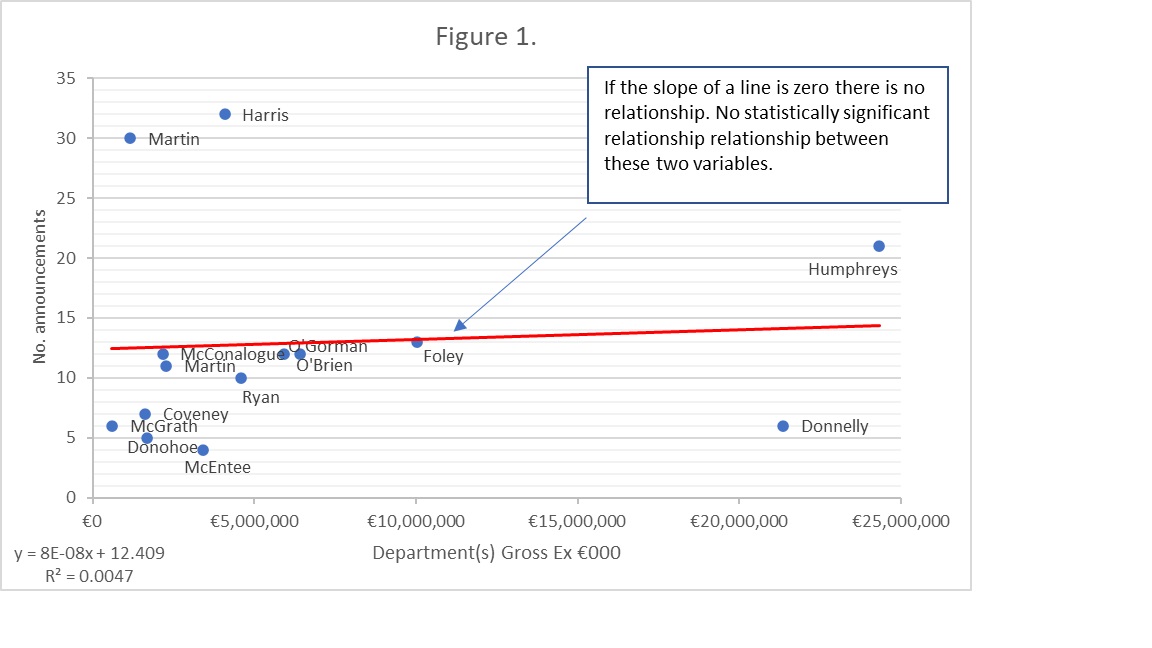 We’ll zoom in on new Taoiseach Simon Harris for three reasons. First, he’s the most prolific in terms of making funding announcements – averaging almost three a month; secondly, he’s the new Taoiseach so it could provide a window into what his tenure might look like; and thirdly he’s the only Minister I am aware of that has ever been accused of making re-announcements dressed up as new spending measures.