My dream takes me to the White House
where Kelly green fountain streams
spit red globules, ricochet on the pristine lawns.
Dirty skies sit low, a brazen breeze propels
smell of sizzling flesh to the oval office
stage where emerald men show cause
bear not the crystal bowl of shamrock, Mr President
but a clay jar of sinews stewed in the tears of Gaza.
I wake to the daymare of a festival episode
stars of our sod line out to stroke your cloak, Mr President
detonate the oval space with leprechaun lyric.
Like a gaping silence of Connemara stone
what remains unsaid
scars my heart.
Feature Image: President Joe Biden participates in a bilateral meeting with Taoiseach of Ireland Leo Varadkar, Friday, March 17, 2023, in the Oval Office of the White House. (Official White House Photo by Adam Schultz)
Jim Sheridan is a significant figure in the international film industry because of his creativity and talent. He has made an influential documentary, ‘Murder at the Cottage’, about the Sophie Toscan du Plantier case.
In the recent Cassandra Voices Podcast, he explained why he believed Ian Bailey is innocent and much maligned.
In a recent blog, I explained why I believe that the thought processes making Jim Sheridan such a gifted filmmaker may be unhelpful when seeking to find Sophie’s murderer. Here are two issues I raised in my blog: Hitchens’s Razor and the Myth of Bailey the Victim.
Christopher Hitchens’s Razor
The brutal murder of Sophie Toscan du Plantier is a fact, not a literary exercise nor a dinner party game where people share their theories of the crime. In the Cassandra Voices interview Sheridan spoke about his relationship with Bailey, explaining why Bailey was ‘tortured’ for twenty-seven years, and why he insists Bailey did not murder Sophie. The content was bizarre and told us much about the workings of Sheridan’s thinking, but little about the murder of Sophie.
Topics included a child floating in amniotic fluid, the guilt felt by Jim’s mother over his grandmother’s death, the famine, a landlord during the famine being called Bailey, a tired old concept called tribal memory, scoring 180 in darts, the mis-attribution of a Life of Brian sketch, Michael Collins, and the killing of Irish people in Clonakilty.
I am no legal expert, but am still certain none of this would be evidence introduced by either side in a murder trial for Sophie. It is irrelevant and a complete distraction from the seriousness of the case. One could have as easily brought up astrology, tarot cards, and reading the runes for consideration.
When we apply Christopher Hitchens’s razor to Sheridan’s comments: “What can be asserted without evidence can also be dismissed without evidence.” – we see that all those interesting concepts contain no evidence concerning the murder. They can be dismissed. The stream-of-consciousness outpourings of Mr Sheridan are fascinating. We see how different personal and cultural themes may be woven into a beguiling and entertaining narrative. However, finding the murderer of Sophie is about evidence. There can be no room for the evidence-free assertions highlighted by Christopher Hitchens. This will not be the last time Hitchens’s razor will be applied.
Ian Bailey’s many confessions
Sheridan has dismissed each of Bailey’s 10-plus confessions. In the podcast, he focuses on one described by a senior journalist, Helen Callanan. Both she and Bailey have given several statements about a confession to AGS. Mr Sheridan was not present at that meeting. Mr Sheridan’s narrative is that Bailey learned he was being sacked, and he responded by using heavy irony: as he was a master of irony. Sheridan claims that the confession was ironic. He goes on to say when Callanan told her boss, Matt Cooper, about the confession he did not believe her.
First, we are told Mr Bailey had been informed that he was being sacked. The implication is that the sacking was a trigger that provoked Bailey’s comments. This is not supported by evidence. Bailey was a freelancer, working from article to article or project to project. He may not be given further work but he could not be sacked. Furthermore, there is not a single reference to him being sacked in his statements nor those of Helen Callanan. Is the sacking an assertion without evidence or is their evidence that Mr Sheridan could share with us?
Second, Sheridan insisted, “Bailey was English perfection in sarcasm and irony.” That is Jim’s opinion. It is an opinion that fits his Bailey never-confessed narrative. For a teller of tales that will suffice, but we need more than assertions. Is it true? What is noticeable about what Bailey has presented on social media, in written articles, and said in countless interviews, is that he is a man bereft of irony. There is no perfection here. Indeed, with Bailey, there is evidence to the contrary. There is no evidence supporting this assertion. He is dull, crude and infantile. The signed statements by Helen Callanan could not be clearer. She saw no irony in what was said. We know she was present, that Bailey was a liar, and Jim was not there … so who to believe?
Finally, Jim Sheridan tells the podcast listeners that he doubted very much that Matt Cooper, Callanan’s editor, thought that Bailey had admitted his guilt to Callanan. I have never seen a statement from Cooper to that effect. We are not given any information about the alleged discussion between Callanan and Cooper. When Mr Sheridan says he “doubted very much” is that an assertion without evidence, or is there something more substantial?
In The Murder of Sophie: How I Hunted and Haunted the West Cork Killer(2020), Michael Sheridan’s brilliantly detailed book on the case, there is no mention of any sacking nor of Matt Cooper. One can only hope that the source of these later iterations was not the pathological liar, Ian Bailey.
As a story, Jim Sheridan’s narrative is engaging. It is both coherent and plausible. For a consumer of fiction, it works. However, a good story is not grounds to dismiss the observations of a capable journalist. If there is hard evidence to back his narrative, I hope Mr Sheridan will share it; if there is none he ought to declare it.
Elsewhere Sheridan dismisses all the other confessions. The evidence shows there have been more than ten confessions made. From a teenager through to older adults, male and female, people with a range of occupations. The confessions were made with Bailey sometimes drunk, sometimes sober, and in a variety of emotional states. They are made in different ways. They are not all attributable to Bailey’s non-existent irony skills. There is nothing to indicate any of the statements about Bailey confessing were made by dishonest people with a vested interest in Bailey being convicted. However, the tired and emotional Bailey was repeatedly a dishonest man in the statements he made to vindicate himself.
The myth of Bailey the victim
27 years of torture unable to move unable to leave, branded a murderer without charge. Jim Sheridan
We know Bailey was charged and found guilty (in absentia) in France. Jim Sheridan asserts Bailey was tortured for twenty-seven years; that he was an innocent man, badly let down. We are told his life was miserable. All the time it is implied that he was a victim. Poor Ian.
I do not believe for a moment Sheridan would give this foul-mouthed thug a free pass. It is more likely he did not take a close look at the way the man behaved when he was not on ‘best behaviour’ with Jim. I took a look at Bailey in my forthcoming book The Pervert in the Hills. The man was odious. A torturer, not the tortured. He inflicted pain for an exceptionally long time and kvetched when he started to get a little back.
Is anyone feeling Ian’s pain? When you gather evidence on the man the notion of him being a victim is unsustainable. When Bailey is judged on actual long-term actions rather than short-term impressions it is difficult to feel sympathy for him.
Jim Sheridan is in good faith seeking to understand what happened to Sophie. I do not think old historical events, a mix of disparate notions, evidence-free assumptions, or unjustified sympathy for Bailey holds the key to discovering the murderer. Thankfully a well-put-together circumstantial case has already shown us Ian Bailey did it. He was a despicable man. He was a foul, malignant narcissist who, I believe, murdered Sophie Toscan du Plantier.
The Pervert in the Hills: How Ian Bailey, the monster at the heart of the Netflix documentary Murder in West Cork grew to hate me by J P Holzer on sale from April, 2024.
There is a poem by Mary Ruefle called „Provenance“. It ends with with the following words:
„So I have gone up to the little room in my face, I am making something out of a jar of freckles and a jar of glue
I hated childhood I hate adulthood And I love being alive.
This is also what my artist statement closes with, the one I occasionally have to send out to residencies or other art institutions to prove that I am always ready to be my entire weird self and produce something out of nothing (or a jar of freckles and a jar of glue) for a humble chunk of money, or simply a room to live, sing, sketch, write, sew, paint, film, and make noise in.
I don’t like the categorisation of creative work, those restrictive boxes for organic, wild, un-boxable growths. „I make things“, I often say. „You’re a storyteller“, my partner says. „You point at what has always been there, and make me see it for the first time“, my cousin says. „Ha ha“, my brother says.
There isn’t one thing that was here first. I was not making music before I was painting, or painting before I made sculptures. The documentation available to me from my childhood in provincial Austria shows that I made drawings as a baby, and at one point I glued three pieces of paper together and called it „Staubsauger (Vacuum cleaner)“. There is also a cassette tape that features me at kindergarten age, passionately singing a song I had just made up called „Wenn ich alleine bin, bin ich verloren (When I am alone, I am lost)“ about feeling mistreated and very, very sad and I can happily report that nothing has changed. I still do all those things, partly because I must, but mostly because nobody was silly enough to tell me to stop. I am also, of course, still very, very sad.
Creating music and visual art, similar to dancing, aren’t primarily fancy, romantic, dramatic jobs. It is mostly basic human behaviour. I am glad I get to do all of it to this extent.
I don’t think the ways in which I came to make music are particularly interesting. It was just a way of saying something when things needed to be said; a way to prove to my teenage self that I, too, could say those things in that particular way. I can’t play any instrument „properly“, but I put many to good use. My music reading skills are still that of a seven-year-old learning to play the recorder. I don’t know which notes or chords I am playing most of the time, but music has been a solo endeavour for the majority of my life, so I don’t need to communicate my unorthodox ways of producing it to anybody.
I made my first record back in 2005-ish, using a very slow laptop, the free software Audacity, a peanut-sized clip-on microphone, and the audacity to think that this is how you could make an album. I learned how to be my own recording engineer, learned how to mix my songs by knowing no theory but knowing my ears, learned how to turn field recordings into rhythms, learned how to make beats by trial and error, copy and paste, and I obsessively wrote lyrics because that was always the easiest part. I wrote in English because it was fun, it was a game of discovery and growth, and it was the right tool to reach beyond the confinements of home. When I was twelve, in the early days of the internet, I would stay up all night to talk to American teenagers in music-themed chatrooms. It made me feel connected to the world in a way that seemed vital and endlessly exciting at the time. Connecting to my international audience through poetry brings back very similar emotions.
The narrators and characters in my work have a tendency to seem lost, searching, observing, often barely tethered to the earth. I myself have trouble figuring out the boundaries between the self and its surroundings, often losing track of who I am and what I do. My work is strongly influenced by recurring dreams and folklore, images of the subconscious that are found again and again throughout the history of humans explaining themselves. That is how i put myself in context, this is how I find my footing.
Every morning, I wake up raw and shapeless, barely remembering who I am, as if it was all lost in sleep. Creating music and images means re-making myself, establishing my contours, every day anew. The work is what tethers me to the earth; this is gravity.
Between 2006 and 2022, I made six solo albums, three or four EPs, an album with my band Twin Tooth, a few short film soundtracks, a bunch of singles, a hard drive full of unreleased material, and various songs in collaboration with friends, most of them long-distance because I love to make things difficult and expansive for myself.
As I am writing this, I am sitting on a couch at an artist residency inside a former stove factory in Chattanooga, Tennessee. A fellow resident is frying something in the adjacent kitchen, and a pickup truck down in the parking lot has the bass turned up so high that the walls are shaking. At night, the freight trains blow their horns. I have an old guitar at my disposal, a stack of watercolour paper, and a lot of empty wall space to fill.
Songs will happen here, and if not here, then somewhere else, after. There are four music-related projects I would like to finish and five I would like to start. An album’s worth of lyrics for the next Twin Tooth record need to be written. A solo EP demands polishing. A scrap of found fabric wants to be shaped into a person. Paper is patiently waiting to be sent through a Letterpress. What must be said will be said, if not in sound, then in color, light, paint, fabric.
Jar of freckles and jar of glue, both in my back pocket.
This piece is not intended to provoke. It is more a look at the way people’s minds are shaped, how people think, and how that is articulated towards others.
I realized something was ‘ratten’ in the state of ‘Norn Ireland’ when I was about four. My half-brother of about six or so and I were walking the street just on the periphery of our Nationalist Catholic housing estate, whereupon a teenager brandished a samurai sword, and with a twist of anger in his face said to us: ‘Youse are Fenian bastards.’
I was perplexed even at that young age. We would venture around the estate pretty often so it was nothing new being out on our own during the day but this situation was … as I would grasp later, characterised by something that I would often hear in the rising and vitriolic anger during my life
‘Dirty Fenian bastard!’ and, ‘Fucking black bastard!’
These sectarian epithets, ‘terms,’ are learned from family members, from the local community, whether it be friends, etc., and were reinforced in those communities when I was growing up. Handed down. Indeed, I have repeated some sectarian hatred and bad language myself to tarnish ‘the other side’ i.e., the hated, and much-vaunted, enemy.
They are known in psychological terms as Interjections – or interjects. Which can be defined as the unconscious acceptance of terms, ideas, and personality traits of parents, guardians, and others we are close to when developing.
This language of physical revulsion, termed ‘the Sartrean Other,’ is purely tribal; a visceral reaction to ‘difference.’ The anatomy of disgust – physical revulsion. One is revolted by this other person, who does not worship the same way and that is to be feared, ridiculed and mistrusted – whole-heartedly.
Bigotry came swarming from the pulpit, the soapbox, and the barstool from fervent rhetoricians stoking tensions. Revisionism is a strong pill that many swallow. Leafing out the hurts and wrongs of the past from the blood-soaked history of the place. Darkness lies there amongst the weeds where goblins live and thrive. The goblins of fear-mongering suspicion – like you have an aura around you defining you as a being from a particular community, and once confirmed that aura becomes a symbolic role: to hate, to destroy, and to kill.
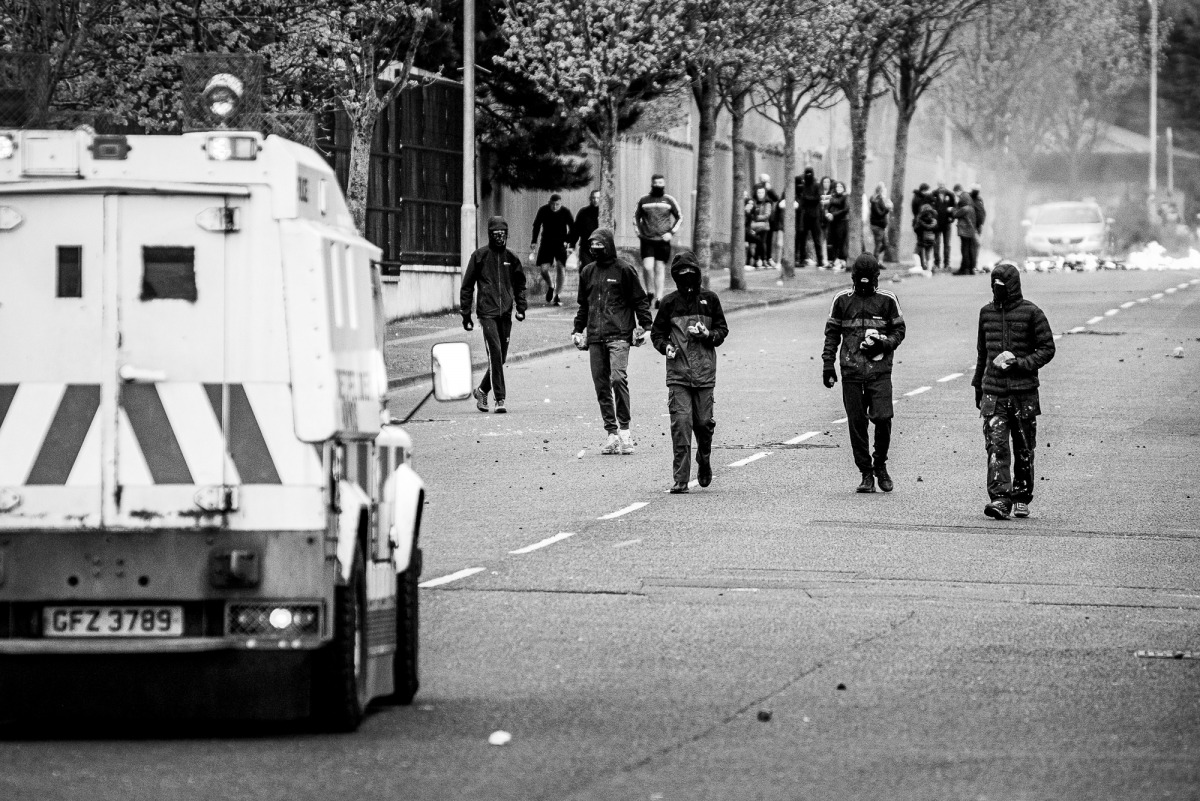
I have witnessed the teeth-binding, red-faced fury of hatred during a riot in Belfast when the two tribes were pitted against each other – the furore of two communities each on one side of the road separated by the police.
The din was deafening. I remember thinking to myself, ‘What circle or balcony of Dante’s Hell is this?’
Reinforced bigotry, non-capitulation, and plaintive victim-hood have been the two imposing forces that have fitted so succinctly into a certain kind of joint which once forged is forged into eternity in a union of unrest and hatred.
I once worked in a factory setting in East Belfast and while on a break went over to the table in the canteen. A colleague pulled out a chair, put the book he was reading down into an open holdall – a Noam Chomsky work by the way – and smiled. His arms were swathed in tattoos. He was stocky but friendly with me. I cannot recall if we chatted much or not but I did wonder if this fella was a Loyalist paramilitary. By the look of him, I’d opt for, yes, but looks can be deceiving. One thing is for sure, he looked like a tough individual.
Afterwards I wondered about the Chomsky book and thought to myself, ‘Fairplay, you’re reading Chomsky of all folk. For East Belfast, that’s a brave step in self-education.’ I smiled to myself at this autodidact. It was Chomsky’s Who Rules The World?
I told these guys like him, and guys from East Belfast during my shift and on the assembly line, that I was in recovery from alcoholism and do you know what? They listened and nodded their heads and some said, ‘Yeah, my Da was an alcoholic. A terrible alcoholic. Fairplay to you that you are working on it.’ I replied, ‘Sorry to hear that, and, thanks.’ It was gracious. Maybe God was looking over me. Who knows?
I was never queried if I was ‘A taig?’ I have no idea if they thought it. I surmise that it was because I was quiet, well-mannered, and honest with them: ‘I am from Ballymena and I am in recovery from addictions.’ Which is true. I was, and I am.
I worked late a couple of nights and through the night, a few shifts, at the factory and was never, ever questioned or challenged. I worked hard, and in many regards, was silently respected for my hard work.
Then a couple of years ago, I was working with a few guys from the Shankill and, again, do you know what? We became rather friendly.
After our shift(s), they gave me lifts up home to a Nationalist area. Maybe seeing where I lived. Possibly. But that’s the cynic in me, maybe, showing some caution too.
Don’t get me wrong, thirty-odd years ago I could have been taken to a quiet area say, up further than Ballysillan, made to get out and down on my knees and blasted in the back of the head with a gun – a couple of shots for good measure. ‘There goes another Fenian bastard.’ The supposed killers may have said. Blasted into eternity. Like the other victims of sectarian violence. Boom. Gone.
But sectarianism doesn’t just hold a grip on the minds of people back home, from working-class ‘sectarian’ communities. Indeed it can apply to people who refer to themselves as ‘Christian’, and who can be just as evil as the balaclava-clad gunman.
I know because when I was homeless, and in a homeless hostel, in Belfast. I was harassed by a naïve, and arrogant member of staff who would profess themselves to be a ‘Christian’. Their harassment was down to pure green-eyed jealousy. Their religious ethics, and morals, were overtaken by the temper of ‘Getting one over on another human being.’ Because they felt inferior.
Basically, I was getting some attention from a female member of staff, who was to be my ‘link worker.’, This other member of staff did not like this and wanted to put an end to it. There was nothing going on, we just got on, but people noticed. Nothing would happen, nevertheless, this person glowered and bristled in their own way. It was selfish and clearly jealousy.
That’s a pretty bad situation to be in if you feel you have to harass a homeless person in a hostel just because you wanted other staff members in the hostel to worship you.
If you ask me, that was a disgusting way to act toward someone who was going through a difficult, and vulnerable, situation – someone without a familial home or any support. I was coming to terms with my alcoholism, but still in the early stages of accepting the reality and had not hopped on the wagon by that stage. I was struggling.
I also remember working with a young woman from Loyalist Tiger’s Bay on a project, in Belfast. We were chatting together and she said, ‘You know, Neil, there’s no difference between us, this sectarian and religious stuff.’ And I replied, ‘You know, you are 100% right.’ Her conversation released me from the infinity of it, and I knew things would be different from then on; meaning I would have to leave in order to move on with my own life, and be free of it.
People in power, usually part of some particular establishment have a vested interest in preserving the statelet and write about it – with bias. As in, our side, our argument is more legitimate than yours. Hogwash.
Things can be different. As I have outlined my experiences in that factory and with those guys from the Shankill. I simply listened to their story. They listened to mine.
It would be great if you could challenge yourself and listen too. You may learn something. I know I did.
This was in stark contrast to the assessment of Professor Neil Ferguson at Imperial College London, whose modelling assumed Covid-19 had just arrived in the West and that we had no cross-immunity from other coronaviruses against it, meaning itwould kill almost one in a hundred of those who contracted it. For reasons still inadequately explored, the U.K., Irish and most Western governments – along with many in the Global South – followed Ferguson’s (and others’) doomsday prediction and chose untested lockdowns in anticipation of a vaccine – a containment strategy to ‘flatten the curve’, as opposed to a (Chinese-style) elimination strategy.
Sunetra Gupta has been vindicated in her assessment that Covid 19 had been circulating far longer than initially understood, and also that it had a much lower fatality rate than Ferguson and others assumed from limited data. Moreover, it was obvious that this social experiment would cause serious harms, while its inability to contain the virus was unknown.
Sunetra Gupta did not take lockdown lying down. She and a number of academic colleagues authored the Great Barrington Declaration in October 2020, advocating for an end to lockdowns, and promoting the targeted protection of the elderly – who were by far the most susceptible to death from the virus.
What followed was not, as she hoped, a civilised discussion weighing the costs and benefits of each strategy, but abuse and even an attempt to have her silenced.
Sunetra Gupta argues that what we experienced with lockdowns represented a distortion of the precautionary principle, arguing:
I think that people were incorrectly assuming that they were applying the precautionary principle to all of this. So they were thinking, okay, well, you know, the worst case scenario is what we should be going by. And that’s because they were thinking in one dimension, which is we’ve got to do whatever it takes to stop this pandemic from unfolding, because it is compatible with the idea that 1% of the population will die if it just unfurls. What they were missing was the fact that these very measures that they were seeking to employ to stop the spread were ones that came at a very huge cost – and that was known at the time – what we didn’t know is whether those measures would stop the spread. And even if they did, what effect that would actually have eventually on the final death toll. But what we absolutely knew for certain – because it was happening in front of our eyes – is that these lockdowns would cause people to die. People were already dying from not being able to sell toys in the pavement in Delhi and being told to go back home to their villages, so the costs of lockdown were known, the benefits of lockdown were completely unknown. And under those circumstances, what you should be doing if you’re adopting the precautionary principle is to not go with lockdowns, but think of other solutions.
Some years ago, Sunetra Gupta and colleagues theorized that parts of the influenza virus ‘targeted by the immune system are, in fact, limited in variability and acts as a constraint on its evolution.’
Interestingly, Sunetra Gupta argues here that the possibility of an influenza pandemic was ‘actually eliminated a long time.’ She bases this assessment on how until 1918: ‘we experienced influenza only in pandemic form, just because of the demographic characteristics of the time. But since 1918, we’ve had influenza as a seasonal, regular endemic occurrence.’
Today, she says, we are ‘all regularly exposed to influenza,’ giving us protection against severe disease.’ She further argues:
What happened in 1918 was that, in my opinion, there had been no flu around for thirty years. So when the virus arrived, people under the age of thirty were extremely vulnerable. And that’s why you saw such high death rates in young people. People over the age of thirty were more protected.
She says it’s true, to an extent, that international travel predisposes us to pandemics, but, paradoxically, ‘we are regularly exposed to different viruses, which gives us a wall of immunity against these emerging threats.’ She assumes that without regular exposure to the other seasonal coronaviruses ‘we would have been more susceptible’ to COVID-19.
Based on her evolutionary theory, she had predicted the Swine Flu pandemic (that generated unwarranted hysteria) of 2009 two years before it hit. She says she ‘wasn’t the least bit worried in 2009 because, first of all, I thought even if it weren’t basically identical to the 1918 flu, that most of us would have a considerable degree of immunity against severe disease.’
Contrary to Bill Gates, who claims the world must create ‘a fire department for pandemics’ to avoid catastrophic outbreaks, Sunetra Gupta says ‘we don’t need to panic to the degree that we do about new pandemics; what we need to do is to be clear headed and rational and try and think about ways of protecting those who might die or might be severely ill and hospitalised from these pandemics or these events.’
The Role of the Epidemiologist
The medical historian Mark Honigsbaum wrote inPandemic Century –One Hundred Years of Panic, Hysteria and Hubris(2019) that ‘by alerting us to new sources of infection and framing particular behaviours as risky, it is medical science, and the science of epidemiology in particular, that is often the source of irrational and often prejudicial judgments’. Then in 2020, the Nobel Laureate Michael Levitt claimed that epidemiologists see their function ‘not as getting things correct, but as preventing an epidemic. So therefore, if they say it is one hundred times worse than it’s going to be, then it’s okay.’
Sunetra Gupta argues:
the role of epidemiology is to provide a conceptual framework within which you can understand what is happening and, rather than preventing pandemics or epidemics, which I’ve always been skeptical about, what you want to prevent is the death or the consequences of these events.
She reckons: ‘it’s a hubris, really, as we saw to think that you can stop the spread of a virus like SARS-CoV-2.’ However, ‘where you can intervene is to try and prevent the consequences of that spread, in that you can protect the vulnerable, or at least try to. But the idea that you could stop the spread was, I think, extremely misguided.’
She calls for greater resilience in the health system, pointing to the nefarious influence of neoliberalcapitalism on public health.
If you’re trying to maximize what they call efficiency, you end up with these big hospitals instead of sort of more local, smaller units. And that creates the conditions for vulnerable people to be exposed more easily to the virus.
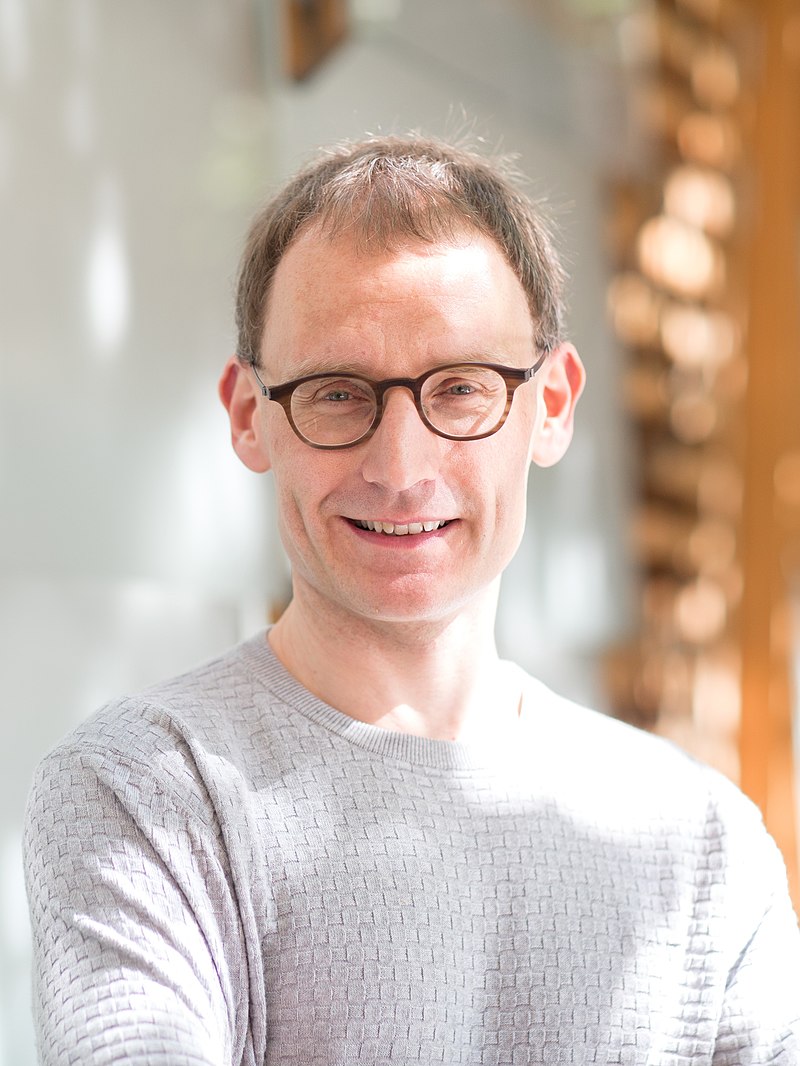
Professor Neil Ferguson.
SIR Model
Unlike Neil Ferguson, Sunetra Gupta’s team made no assumptions about the infection fatality rate in March 2020. She now says:
The purpose of that paper was to show that you can take a simple model, an epidemic model, which applies to coronavirus or any virus that gives you some level of immunity for a certain period of time, at least in the case of coronavirus. Of course, that would be short. Measles would be long. But any such model, which is called an SIR model – simply because people go from being susceptible to being infected and then recovering – you can fit a model like that to the available data under a very wide range of infection fatality rates.
She says Ferguson and his colleagues fitted the available data based an IFR of almost 1% because: ‘They were using data from the Diamond Princess cruise ship and a few other bits of data from Wuhan.’ In such a model as this the two variables, she says, ‘are the infection fatality rate and when the epidemic occurred … So what we showed is what we were seeing could easily be the result of an epidemic that had already occurred [that] had a very small infection fatality rate. Or as Neil proposed, there was an epidemic that was just taking off and had a high infection fatality rate.’
What I probably shouldn’t have done is given any answer at all, because the infection fatality rate is not really a number that you can think of in terms of the average across the population. So there will be parts of the world where, because there is [a high proportion of] elderly or people with comorbidities… [there is greater] vulnerability to death … So it is actually somewhat meaningless to think of the IFR as an average number, but it’s certainly not 1%.
‘What I was trying to do with that paper’ she says ‘is just to say, you can’t have that level of certainty in this situation.’ She agrees that ‘at the time you wouldn’t be able to discriminate between lockdown and the build-up of immunity and the contributions of seasonality. But now, because we have more data, you can and so it’s much more likely that we had built up what’s known as herd immunity in certain pockets or substantially it had accrued in certain areas.’
She adds:
We couldn’t tell then because we hadn’t done the experiment of lifting lockdown and seeing what would happen. But we did do that experiment a year later. And at that point you could discriminate between those two hypotheses. And I think what now I will say is that you can explain what happened almost anywhere in the world, using a simple model in which you accumulate immunity, but you also lose it quickly, which is known for all coronaviruses combined with the effects of seasonality. And that simple model … will explain qualitatively all patterns that we see.
On March 17th, 2020, Mark Landler and Stephen Castle wrote in The New York Times. ‘It wasn’t so much the numbers themselves, frightening though they were as who reported them: Imperial College London.’ Due to the professor’s W.H.O. ties, the authors noted ‘Imperial was treated as a sort of gold standard, its mathematical models feeding directly into government policies.’
Not long afterwards on March 24th, a report appeared in the Financial Times, quoting Sunetra Gupta to the effect that perhaps as much as half the UK population had already contracted Covid-19. However, the author of that article added that her group’s modelling was ‘controversial; and ‘its assumptions were have been contested by other scientists.’
Despite their differences, Sunetra Gupta speaks of a respectful relationship with Ferguson, with whom she had ‘friendly chats’ during the period. There was ‘no disagreement’ about ‘the basic ideas and assumptions.’ It’s just that he said ‘he thought that their worst case scenario was more likely than what I was saying, which is that we didn’t know, and perhaps veering more towards [that there had already been] substantial waves in areas like London … But we both acknowledged there were a spectrum of possibilities. And until we had the full data, we wouldn’t know where we were.’
She acknowledges, nonetheless, that ‘it’s hard not to have emotion about these things. But you know, at the end of the day, you’ve got to think about whether an intervention is achieving its purpose and whether the collateral damage is too great or not.’
Interestingly, Sunetra Gupta says she had ‘a great time’ during lockdowns as she lives in ‘a nice house with a big garden, and my daughters, who were in their early twenties, came back home for six months.’ She now wonders whether ‘at some point someone should write a play called Oh, What a Lovely lockdown!’
She says that’s the point: ‘the lockdowns … were put in place by those of us who are privileged; [what] Martin Kulldorff called them the laptop classes … while throwing the poor and the young under the bus.’
Regarding an extraordinary article in The Guardian by George Monbiot calling for ‘a time delimited outright ban’ on lies that endanger people’s lives, referring to people such as Allison Pearson, Peter Hitchens and Sunetra Gupta ‘who have made such public headway with their misleading claims about the pandemic,’ she says she was ‘absolutely shocked that someone like Monbiot would claim to know more [than me] about how the pathogen spreads, about epidemic behavior and control measures.’
She wonders, ‘why would someone with … no qualifications to speak of these things accuse me of spreading lies and misinformation … Why would he do that? I mean, it’s shocking.’
She says she tried:
to ask common friends to tell him. You know what? Pick up the phone to me. I’ll explain to you. I mean, that’s what he should have done. He should have said, oh, why is she saying this? Maybe I should just pick up the phone to ask for an interview and get her opinion. And then … he’s free to disagree with it. Although from a position of someone who is not precisely qualified to make those judgments. So I find that kind of behavior absolutely shocking.
Sunetra Gupta says she has repeatedly called for debates, for example, with Neil [Ferguson] with whom she has only ‘ever had a respectful engagement.’ She expresses surprise ‘that places like the Royal Society didn’t put on more debates and instead ‘just toed the line on this and just went with the consensus.’
She says:
I have not been approached with an apology from any of [her critics at the time]. An apology on account of how they behaved, but nor, indeed an apology on having got a lot of things wrong … So they criticised me for wrong reasons, and they should now come and say to me, we are sorry. We now see that lockdowns are indeed very harmful and that school closures didn’t prevent transmission, or that vaccines don’t block infection. They should apologize to me, but they haven’t.
She also has some harsh criticism for the way in which academia now operates:
I think the circumstances now under which academia is expected to operate are ones that are conducive to people … forming these sorts of groups, consensus groups, because that’s how they fund their research … by reviewing each other’s grants and just generally agreeing with each other. And of course … some of these funds are coming through some form of philanthro-capitalism. Those are all features of the system which lend themselves to this kind of aggravation of an idea of a risk. And … there’s also the … huge temptation of putting yourself in the middle of it being the saviour … “I had to get a burner phone because I’m so important.” And, you know, “I was the one who delivered the world of this scourge.” Those are the sort of rather more simple … reasons why we saw what we saw, rather than some huge conspiracy.
Reflecting on the period where she earned such publicity she says:
I’d always hoped [it would be] through my writing, through my novels, not necessarily through science. So I know it’s not something I particularly find to be that gratifying because this is just sort of my job and … it’s caused nothing but distress to me and to my family; for my daughters, it’s been a difficult period to have to deal with this fame, notoriety, that I achieved.
However, she doesn’t buy into the idea that the role of a scientist is simply to deliver the science:
because I think that one can always hide behind one’s profession. I mean, the best example … I often talk about [is from] the film Mephisto [1981, directed by István Szabó], where the central character, the actor … has kind of accepted the patronage of the Nazis at one point [and] when he’s accused of that, just says, “please leave me alone. I’m just an actor,” … nobody is just an actor or just a scientist. It’s not good enough to say, “I’m just a scientist. I just do mathematical modelling and you know, whether lockdowns work or don’t work or harm other people, it’s none of my business.” That’s not acceptable to me.
Childhood Covid-19 Vaccination
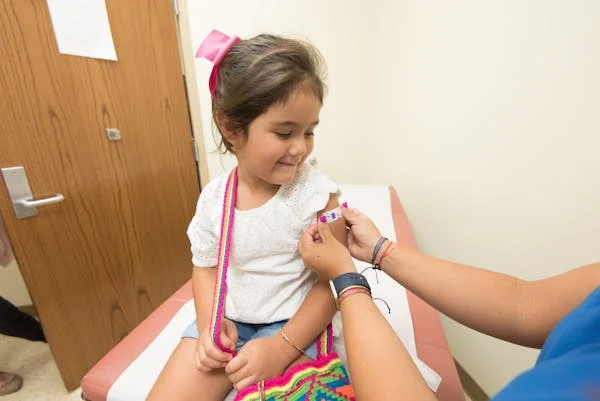
Regarding the vaccination of children against Covid-19 she says:
from the outset that there should never have been given to people who were effectively at zero risk of dying from Covid, particularly because it was never likely to prevent transmission for any more than a few weeks … so there was no logic. Again, if we talk about logic rather than anything else, there is no logic to vaccinating people who are not at risk if the vaccine does not prevent transmission.
we warned against this early on by saying one of the reasons not to vaccinate young children, even if it is completely safe, is because it doesn’t prevent infection. So it will create vaccine hesitancy against vaccines that actually people do need … we have limited resources, so it has an opportunity cost. And what we’re seeing in this country and across the world is … the diversion of funds that are meant to tackle these serious endemic diseases … And it’s very, very sad because it’s causing deaths and particularly in places, not so much the UK and Ireland, but … in sub-Saharan Africa or India, I mean, the infection control programmes and vaccination programmes have collapsed in many places, and this is going to lead to many more deaths than Covid, particularly in children, not to mention starvation and other issues.
She does not, however, believe that the excess deaths we have witnessed in recent times should be attributed to Covid-19 vaccines, pointing to the example of Sweden ‘which doesn’t have many excess deaths, but did vaccinate its population.’
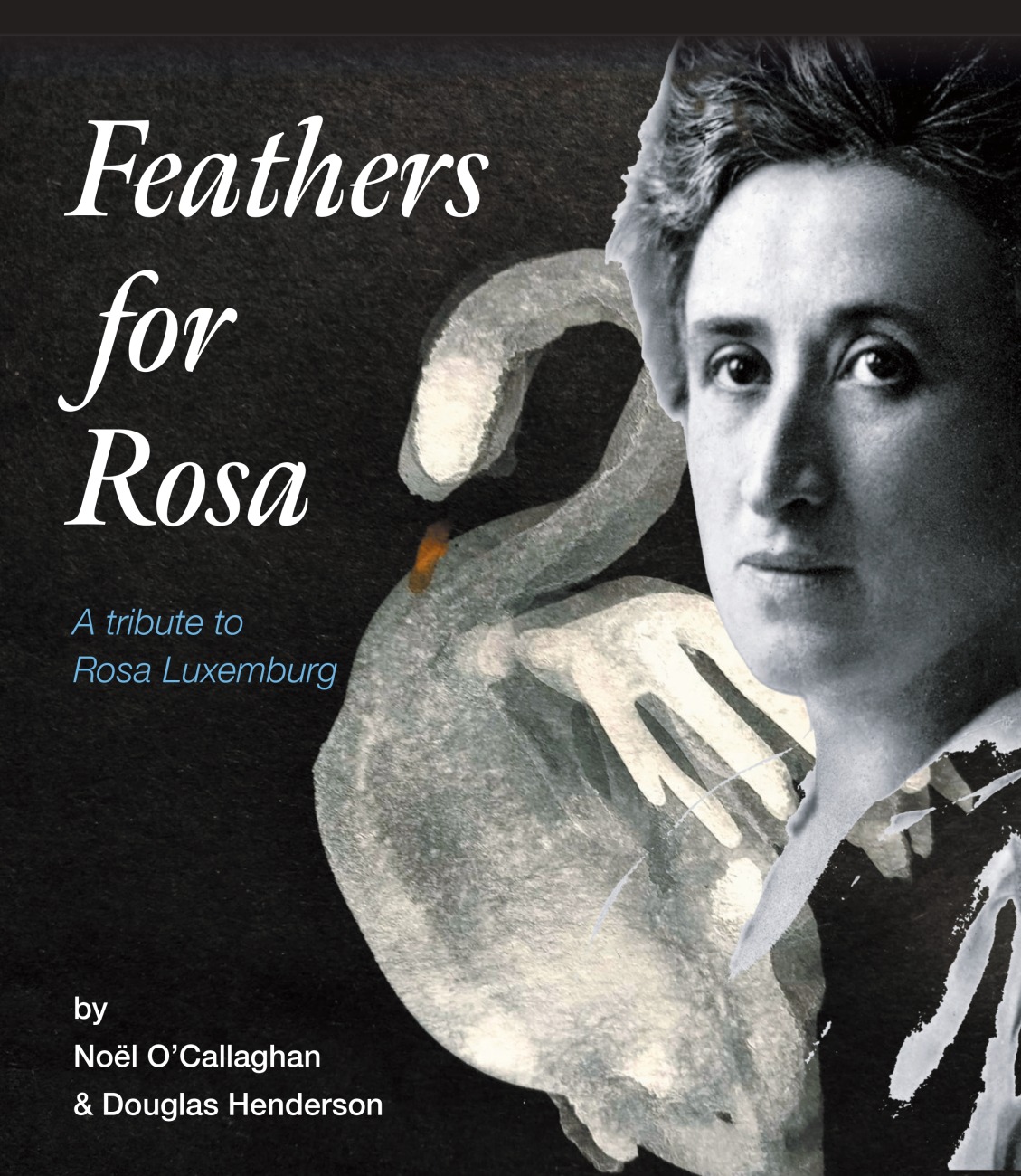
To celebrate International Women’s Week, The New Theatre is presenting ‘Feathers for Rosa’ by Noël O’Callaghan and Douglas Henderson—an unusual tribute to Rosa Luxemburg. Centring on the poem ‘Du liegst | You lie’ by German-Jewish poet Paul Celan, it consists of a thirty-minute performance interspersed by three original songs. There is also an exhibition of paintings, an installation of a basket of white feathers from the Berlin canal swans, and a nine-minute experimental film and music video.
The following dialogue is based on the film script: Speakers are Noël (N) and Douglas (D).
N: I was once chased by an angry swan twice my size…
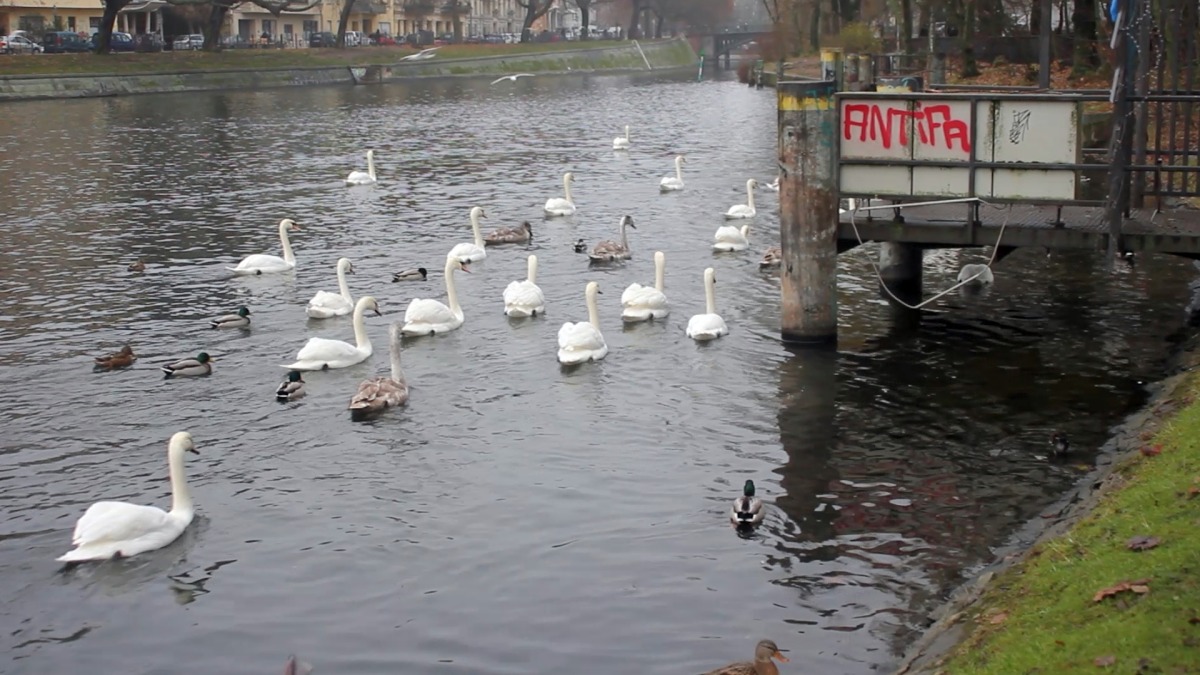
Years and years of painting swans… this flock lives on the banks of the Berlin canal—the same waterway where the body of Rosa Luxemburg was thrown on January 15th, 1919 and lay for four months undiscovered…or was it?
Did the swans floating above, perhaps the ancestors of this flock, discover it under the ice?
Did the moorhens and ducks spread the news up and down the banks… there’s something in the weeds… something in the weeds… something’s caught.
One day, he brought a poem into the studio…to set to music. It was called ‘Du liegst – You lie’ a poem by Paul Celan… about the murder… and about the body in the canal.
The Flock.
D: I found this poem in an email from my friend Alex. Its vividness and incantational drive seemed to drag me along in its wake. I was a bit surprised, since I associated this German-Jewish poet with poetry of the Holocaust and thought of him as somewhat impenetrable. Had complexity and interpretation veiled an evidently deep political commitment? Could it make a song?
Du liegst im großen gelausche, umbuscht, umflockt
You lie in the great listening, ambushed, flaked round
N. A strange and powerful song emerged and, as we played it night after night, a vision projected itself onto the dark, studio walls… a drowned Luxemburg, disembodied, upside-down, surrounded, Ophelia-like by bushes and waterbirds (umbuscht, umflockt), manifested itself as a sort of stained-glass window… and I made the painting ‘Du liegst’. Was I thinking of Harry Clarke? Yes, I think Rosa should have a stain-glass window. Was I also thinking of Millais’s Pre-Raphaelite Ophelia or of Georg Basiliz’s upside-down portraits?
D: The poem is a retelling of the brutal murder of Rosa Luxemburg and her political ally Karl Liebknecht… at times mimicking the sadistic language of her killers…Rosa’s body thrown into the Landwehr Canal… her political ally, Karl Liebknecht, riddled with bullets in the Tiergarten…
der man ward zum Sieb, die Frau müßte schwimmen, die Sau
the man became a sieve, the woman had to swim, the pig
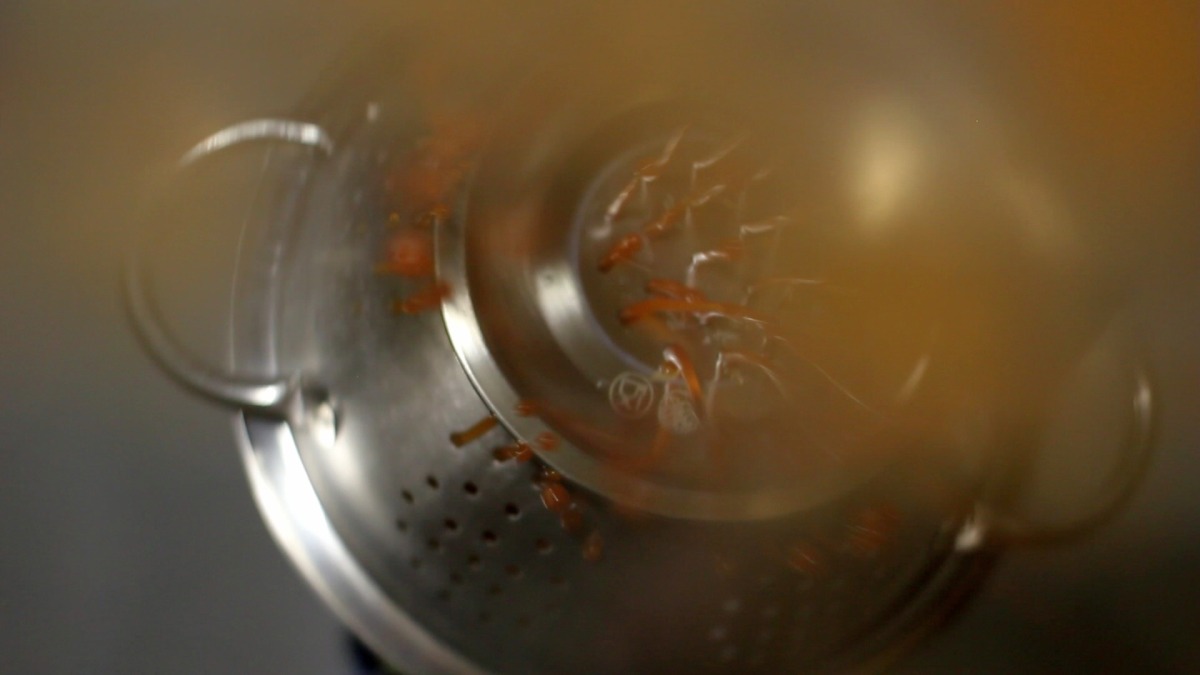
Sieve – screen grab from film.
N: The poem is also an account of Celan’s last trip to Berlin just before Christmas 1967…the city in a state of political turmoil following the murder by police of the student Benno Ohnesorg during protests against the visit of the Shah of Iran. During his visit, Celan walked the banks of the Spree and Havel rivers and along the Landwehr Canal past the site of Luxemburg’s death. Further along the canal from here you reach the Hercules Bridge, and in a park nearby, there’s a statue of Hercules fighting a boar… a pig.
geh zu den Fleischerhaken, zu den roten Äppelstaken
go to the meat hooks,
to the red apple candlesticks from Sweden
… the Nazi meat-hooks of Plötzensee prison, the Fleischerhaken… the apple candlesticks from Sweden seen by Celan at a Christmas market in Berlin, the Äppelstaken.
Es kommt der Tisch mit den Gaben er biegt um ein Eden
Here comes the gift-laden table, it turns around an Eden
…Hotel Eden, where Luxemburg was held and tortured before her murder.
D: Candles were important for the Roman Saturnalia, the feast of Saturn, the precursor of Christmas. Hercules offered candles to Saturn in place of human sacrifices…honouring Saturn’s altar not by slaughtering a man, but by kindling lights… Sweden – the refuge of Willy Brandt, the architect of détente in Europe, who once said peace isn’t everything, but nothing is possible without it.
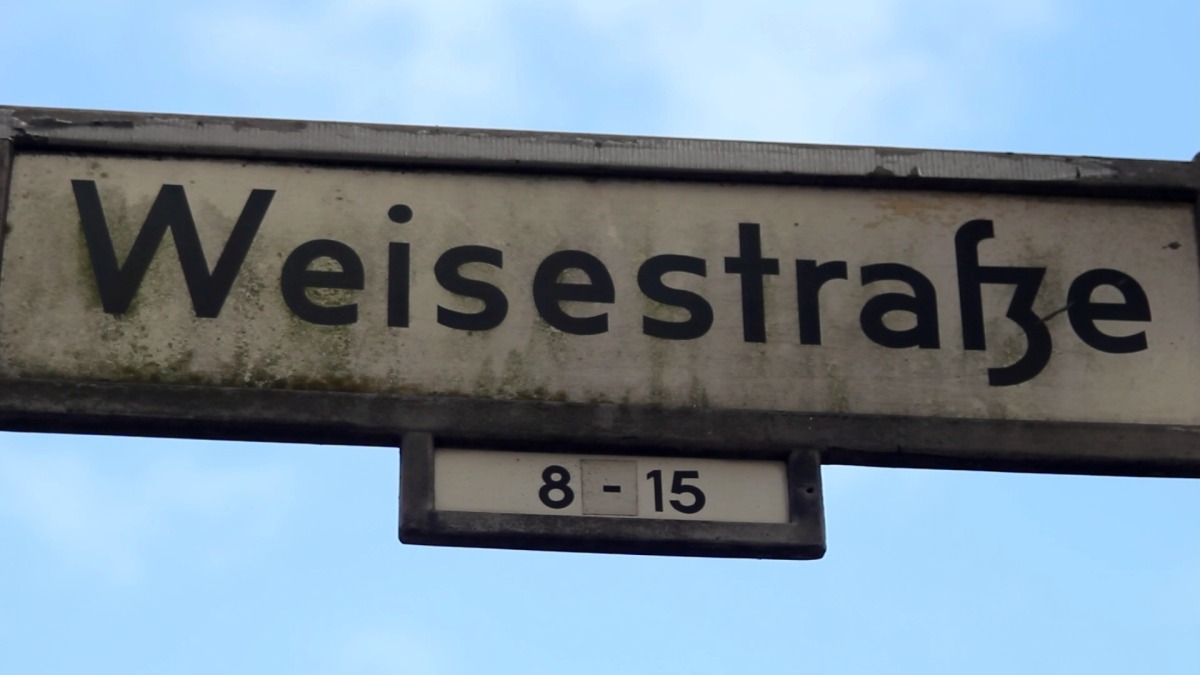
N: Weisestraße in the Neukölln district of Berlin is a ten-minute walk from where we’ve both lived for many years. It’s a typical street for this area… many apartment buildings dating from the end of the 1800s… really nothing to distinguish it from other similar streets in the area… nothing that alerts you to the weight of history. It was here at house number 8 that Rosa Luxemburg, together with her political ally Karl Liebknecht, spent some of their last days before their brutal murder… hiding from fascist militias in the apartment of supporters. Here they held political meetings to discuss the failed January uprising, even read bedtime-stories to their hosts’ children, until, fearing discovery, they had to leave…
D: We did some filming there one day in late December. There was a police raid on a nearby café because of an Instagram post supporting left-wing Palestinian resistance. We met some activists from the feminist anti-capitalist Zora collective who had been targeted there. They asked about our project and were delighted to hear that their name would be travelling to Ireland.
N: Banks of feathers like snow (umflockt)… I started collecting them… apropos of nothing, really, other than their beauty… then thoughts of Emmeline Pankhurst intruded. Her hateful White Feather campaign to send men to their deaths in World War 1. To turn a thing of such beauty into shame… it’s evil. Luxemburg was so different. She urged soldiers to lay down their weapons, to desert… and to know their real enemy. She paid for this with her life…
für sich, für keinen, für jeden
for herself, for no one, for everyone
The time has come to reclaim the White feather, to honour the Deserter…
‘I see them walking,
walking back,
back from the front,
The walking wounded,
The walking dead.’
(from Woman of the Rubble’s speech – ‘Feathers for Rosa’ performance).
Der Landwehrkanal wird nicht rauschen Nichts stockt.
The Landwehr Canal won’t rush. Nothing stops.
‘Feathers for Rosa’ is funded by donations through our gofundme campaign. Donors receive original watercolour sketches of swans made on the banks of the Landwehr Canal.
Restless at the kitchen table, year of our Lord
twenty twenty-four, year my words marched
backward into my mouth and forward only
when forgotten, year of the idiotic Stanley tumbler,
year of the subtle but far reaching machinations of
neo-Marxism depending on who you ask, year of
our lady of fuck around and find out, year of pundits,
year of Doja Cat, year of royal family tabloid drama, year of
literal and figurative warfare, bloodlust year, year of desire
year of frustrated desire, year of gradually excruciating
guided identification of desires, year of my father
unable to discuss that which is not the village
council, year of the child, the laughing year of the wailing
child, the domestic year, the exotic year, the year
of everything turning to poetry, the year of poetry
turning to nothing, the year of your turning to
everything, the year of totality, the lost and found
year, the year of the late bloom of the heart’s silent
madness, year of attending to various screens, year
of continual scrolling, the unchurched year, the year
of tallying ecclesial Latin absorbed by the body, the
pleni sunt coeli et terra gloria tua year, the irreverent
year, the year of tabula rasa and later perceptions
of time, the year of the timely year, the seasonal
year, the calendar year, the yearly restlessness
at the kitchen table year of annual infinity
the year of the erotic diminuendo, the yearless
pleasured year of self, the wanton year, the may be
out after hours year, the year of slow staircase
ascents, the year of our Lord not yet come
again, the year lavished on a boy, the year wasted
on a man, the unmanned barely manageable
one-woman year of kitchen table restlessness,
the year of being trapped in a word document
the year of being trapped in a word
Noah Artowski, by now a six-year veteran of the Israeli Defence Forces, looked out towards the azure, glimmering sea. He imagined it melting like water colour into the blueness of the sky. He stood on the balcony of his aunt Sarah’s apartment in Tel Aviv, where she lived alone with her two dogs. His hands rested on the warm metallic bar as he became trapped in the sea’s embrace. How beautiful the sea, alive in the sunshine, beyond the human ways of things. He knew that it would live on, unaware of death, even to the end.
“Would you like tea or coffee? Or perhaps something stronger?” It was his day off.
“Coffee please.” He said with a smile, and when it arrived he lit a cigarette and took a drink, savouring both flavours simultaneously, stoking the warmth of the morning like bellows on a midnight fire.
“A beautiful day’ he said sitting down on the balcony chair, and his eye caught the sea again.
“Yes.”
“I’ve got something to show you” said Sarah. Her dogs followed her inside and back out onto the balcony where she placed a shoe box on the table.
“I found this box of photographs when we were cleaning out Grandma’s house. Take a look, there are some interesting ones.’ Noah took the lid off the box and gathered the photographs in his hands. The first one was taken in the 1980’s judging by the fashion of the clothes, and was in colour. It showed his mother and father smiling on their honeymoon in Portugal. They looked happy. The next one showed his mother in military fatigues. He went on slowly flicking through the pile with his index finger. He came to an old photograph, black and white and faded. There was an old crease mark where it had once been folded away. He turned it over and saw ‘August 1939’ had been written on the back. He turned it around and stared at it for a while. It was a family portrait. The smartly dressed mother and father sat in chairs and in front of them their three daughters sat on the floor, all of them looking directly into the camera. As was the custom of those days, no one smiled.
“Who are they?”
“They are your Grandmother’s cousins. From Lodz.”
“Where is Lodz?”
“Poland.”
“Did……………………..” He paused. The sea had caught his eye again. Or perhaps it was the blue.
“They are all dead. They were sent to Dachau.”
“Yes, I remember. She told me. I haven’t seen them before. In a photograph I mean.” She thought about saying how sad it was, but the silence did the job for her. He looked intently at the photograph. Without any sense of urgency he studied each one of their faces, one by one. There was a kind of stoicism in their expressions. They had no idea what was coming. Looking at the photograph he didn’t feel the benefit of hindsight, but knowing what became of them, he was able at least to attempt to touch the lives within the picture frame. To connect somehow. He noticed that one of the little girls, the youngest one, was holding a bracelet made of pearls. She was the central point of the portrait. That she was holding the pearls in her hand seemed strange, in such an austere setting. Maybe she had began to play with it and neither the photographer or her parents had noticed. He looked closer and detected a twinkle in the little girls face as if she was indeed about to burst into laughter. He carried on looking at the photograph, particularly at the young girls face and the pearl bracelet that she held, captivated by the image. Then he thought about what became of her and her family. He looked back out to sea. The sun was beginning to set.
KHAN YOUNIS – GAZA – SEPTEMBER 2023
Heba, which means gift, stood up with her doll in her arms and followed her mother into the kitchen. It was the birthday of her older brother and members of her extended family, including her grandmother and her aunt had been invited over that evening to share a meal. When her uncle Meerab arrived he picked Heba up and took her out on to the balcony with her doll still firmly clasped between her arms. The sun was setting in the west and they looked out at the fire dance sea. There was suddenly no need for words.
“It’s like we’re in jail” said Meerab.
“How?” Said Heba.
“There is the sea and we’re not allowed to sail away on it. Can you think of another people who live by the sea and can’t sail?” Her silence was her answer.
“No. That’s alright. There is a lot your generation must learn about. About our people, our history.” Heba looked up at her uncle and then back out to sea. The sun had almost passed over the horizon.
Heba’s mother came out on the balcony to call them in for dinner. There were large bowls of maqlubeh and a plate stacked high with taboon, bottles of soft drinks and jugs of water. The family sat around the table and began to talk happily and freely. When they were together around the table as a family, eating and drinking and talking, they were free.
By the end of the meal however the conversation had taken a serious turn. That almost always happened at their dinner table when politics became involved. Meerab said the politics had been imposed and where politics is imposed, suffering always follows. Meerab had never left Gaza. He was now twenty-three years old. Every day he looked at the sea and wondered what lay beyond and as each year passed into another, Heba wondered the same. She was becoming the same as her uncle because she asked the same questions.
When the quarrel abated Heba’s Grandmother, who had been listening quietly to the whole conversation, began to speak.
“When I was a little girl, I lived in the mountains. We never saw the sea then. It was like it never existed. I was near Heba’s age when I first saw the sea. I remember when the soldiers came and told us to leave.” Suddenly, a distant expression, woven in sorrow, came over her face. Some memory too painful to linger on, entered her inner vision. She carried on speaking to sooth the memory away. “We travelled here to Gaza, my family, your grand-fathers family and many others. Almost our whole village came. I remember seeing the sea for the first time. It was beautiful.” She looked at Heba and remembered being her age. They smiled at each other, but Heba didn’t really know what they were smiling about. She thought it was the sea.
When the meal was done and the plates were being washed Heba’s grandmother called her over and sat her on her lap.
“I have something to give you.” Heba looked up at her grand-mother and smiled. She loved presents but she loved surprises more. She wondered what it could be. The old lady reached into the large side pocket of her dress and produced something in her open palm, showing it straight away to Heba. Heba looked down at the object and then looked up at her grand-mother.
“Here. It’s for you. I had it when I was a little girl and now it is yours. I want you to keep it. Maybe someday when you have a grandchild you can pass it on to them.” Heba looked down. There in her hands was a beautiful white bracelet made of pearls. It glowed and shined with equal beauty. She put it on her wrist and looked at it in admiration.
“Thank-you.” Said Heba. And they held each other for a while.
“There is an answer to all our problems in this part of the world. Sometimes I think no one has thought of it.”
“What is it?” Asked Heba.
“Love.”
OCTOBER 7th 2023 – TEL AVIV
Noah lay on the sofa in his apartment looking through the photographs that his aunt had entrusted to him. He was an early riser but had laid in bed for an extra hour that morning. He enjoyed coming in and out of dreams. They would usually evaporate like morning mist with the dawn alarm. That morning he had written the dream down immediately after he had woken up, slightly disorientated by its vividness. He had walked out of the gates at Dachau with the little girl in the photograph who held the pearled bracelet and as they passed out of the camp he woke up. They were holding hands as they left. Once he had written what he remembered of the dream down, he tried to fall asleep again and re-enter the dream. It didn’t work. He just lay there, staring at the wall.
He placed the photograph of his family, and the girl holding the pearl bracelet, on the floor. He sat up on the sofa and drank from his coffee cup. Then he took the television remote and turned on the television. It was the news. Bewilderment and fear. ‘Israel invaded by Hamas.’ ‘Many killed and captured.’ Noah sat there in his apartment with his mind in many places at once. His mobile phone buzzed and he picked it up off the coffee table. The message was from an old friend and simply read ‘Sons of Satan.’ Each lineament of thought continued on its path to the same conclusion. War.
The more information that filtered through on the news the more tense he became. With the kidnappings the anger turned to fury. Just after noon that day his mobile phone buzzed and he picked it up once again. It was the army. He was to report to duty the following morning.
OCTOBER 7th – KHAN YOUNIS.
Heba was woken by the sound of a barking dog below on the street. It was just after dawn. She got out of bed with her doll in her hand and walked out on to the balcony. There before her lay the great shining sea with all its mystery and secrets, and all its possibility. The sun was rising up over the land, warming the balcony by quick inches. Heba sat there with her doll, listening to the silence.
The morning warmed. Somebody in the kitchen turned the radio on. At first it was just a noise but as the newsreaders voice rasped, the words began to solidify, creating their own gravity, somehow filling the air with weight. The report was clear. Hamas had penetrated the fence border between Gaza and Israel. The death toll was unknown. Heba’s family gathered in the kitchen to listen to the radio reports coming through. A new dread fed them all. It didn’t even need to be spoken. Something terrible was about to be unleashed.
Heba’s mother took her by the hand and led her into her bedroom.
“Pack up your things. We may have to leave soon. She looked up and saw her father at the doorway with a look of worry on his face. She had never seen him scared before. His expression frightened her.
“What’s happening? Are we leaving?” Asked Heba.
“We may have to.” Said her mother.
“Don’t worry. Everything will be alright God willing.” Said her father and he smiled at her. The worry on his face had gone, even if only for a few moments. She smiled back at him. She took out the suitcase from under her bed and began to pack her things as her parents had asked. She left the pearl bracelet on her wrist.
DECEMBER 7th 2023 – KHAN YOUNIS
Noah opened his eyes and then shut them again, wondering where the edge of dreams lay. Then there was shouting. He rubbed his face and stood up. All notion of dreaming vanished as he saw his army fatigues hanging neatly at the end of his bed. He rubbed his face and stood up. He knew exactly where he was and what he was doing. This was the day his platoon was going to enter the city of Khan Younis in the south of Gaza. The north had already been laid waste.
The fear of death was on him. If there is a nature to war it must be that, death, fear and suffering. Except for those in charge. He knew that he was too young to die so well that he had stopped thinking about it. To think about death was to give into it. He sat down on the toilet and released his bowels and then had a quick cold shower. He looked into the mirror and felt ready for the mission. It was time to go.
His platoon moved slowly down the empty Gazan street. It was a waste land. As he looked around, images of Hiroshima came to Noah’s mind. The buildings skeletons, the people gone. It seemed the place was haunted. They walked on, ten feet apart, and came to a small square. This is what they had been trained for all those years. This was when they were told their soldiering would count. They were told it would be of value. Noah’s keen eyes scanned the square, up and down, south, east, north and west. There was no one there after the heavy bombing. The civilians had either left or were dead. The intelligence they had was that there may by some Hamas fighters left, likely in tunnels underground. That was the mission of his platoon, to flush them out and kill them.
Noah’s OC ordered him and three other soldiers to head west along the street that led out of the square for one block and to enter the building on the left side to see what they could find. Once it was secure they were to reconvene immediately at their present position. The soldiers took the order and left in single file moving cautiously along the street ready to fire in an instant. Slowly they went with guns raised, still ten feet apart, alert to the possibility of an ambush at any given moment. They entered the building by forcing a door. When they were inside Noah took the corridor which led to a courtyard at the back. Filled with trepidation he went along, now feeling the sweat on his face. He had to overcome the fear of being killed and of killing. He remembered why he was there. He took off his dark glasses and used the back of his shirt sleeve to dry himself. He couldn’t hear a sound on the bottom floor so he went on down the long passage way until finally he came to the end.
He put out his hand and opened the door. He suspected they were lying in wait for him outside. Vigilance was critical. He stepped out of the open doorway and stood still. The place had been virtually destroyed. His eyes tracked along the courtyard to the other side where a broken wall was still standing. His eyes carried upward where he saw a dead girl hanging from the wire at the top. The force of an exploding bomb had left her there. He stood motionless, his eyes and soul at odds. His eyes and his soul in conflict. His eyes and his soul falling. Tangling in the wire her hair fell backwards to the ground, almost parallel with her right arm. Her doll lay below her. Heba’s eyes were closed. He stood there looking. The colours on her dress becoming more vivid. Becoming brighter. His eyes followed down and there he saw the pearl bracelet on her wrist, undeniable. He remembered his relative, the little Polish girl. He swayed in sickness. The unfading beauty of the pearl bracelet seemed through his eyes to be pulsing with the life of us all. It passed through time, across generations, beyond the fathomless sea. He felt himself falling, falling slowly through the air, falling to the place where there is no light, and the end is only dreamt.
David Langwallner is a barrister working in the U.K.. He has written numerous articles for Cassandra Voices, and was a natural choice to speak to about the Julian Assange case, which shows every sign of drawing towards a dénouement in a London courtroom.
Between Tuesday, February 20 and Wednesday, February 21, a strange scene played out before the High Court. As the judges listened to Assange’s lawyers and to American envoys advance contrasting arguments about the case, outside the chamber protestors demanded freedom and clemency for the Australian journalist. Facing a 175-year custodial sentence in the U.S. in what could be a CMU (a Communications Management Unit), Assange must struggle with the possibility of a future that could mean death – or even worse.
The CMU, as we discuss in conversation with David, represents a carceral system many degrees more cruel than the Belmarsh Prison where he has languished for half a decade.
In places like the Terre Haute, Indiana facility or Colorado’s Supermax, inmates typically enjoy nine hours of visiting time per month, and CMU prisoners are barred ‘from any physical contact with visiting friends and family, including babies, infants, and minor children.’
However, Assange’s lawyers may have a compelling argument to work with in this respect, as Britain, despite Brexit, still adheres to the European Convention on Human Rights. A U.K. Court must still follow judgments of the European Court of Human Rights. Assange’s lawyers based their arguments on his current condition, and the probability of torture and death resulting from the extradition.
Over the two days – with their client unable to attend due to physical weakness – Assange’s lawyers pushed back against the U.S. argument that Assange and Wikileaks committed harmful acts of espionage when they published huge tracts of confidential material, as America’s post-9/11 wars were raging across the Middle East.
The Court’s decision on whether to grant a final appeal hearing in this case is expected in the coming weeks. For David Langwallner, while he did entertain a number of options – including one whereby Assange might be publicly condemned but eventually released after informal, behind the scenes diplomacy – Assange’s fate, and the state of the world more broadly, looks increasingly dark.
He argues that a ‘New Dark Age’ may be upon us, whereby authoritarian dictatorships and Western democracies alike are emboldened to fling their truth-telling critics into the oubliette with impunity.
Citing the proposed ‘Hate Speech’ bill in Ireland as an example of creeping authoritarianism in the digital age, he condemned the clear hypocrisy:
We’ve reached a world where a subversive is what you designate to be a subversive… Under the Hate Speech bill in Ireland, which is totally ludicrous in my view, we are going to have the criminalization of offense. As long as you offend them. They can offend you by locking you up, but if you offend the establishment they’ll prosecute you… Also, with the notion of taking rigorous actions against hackers who may not have done anything criminal, it is the slippery slope to ‘pre-crime,’ and guilt by accusation.
The interview began with a question about the prison where Assange is being held – His Majesty’s facilities at Belmarsh, a place with which David Langwallner has an interesting history. It was apt to start by discussing complex questions of fundamental rights and justice systems in democracies, and our ability to trust the behaviour of technocratic leaders in this digital age.
The brutal treatment of an increasingly frail Julian Assange is diminishing any trust in the rule of law, natural justice and freedom of speech.
Yeshua, O Yeshua, legions
of demons are dying to drive
the Holy Spirit from many of us
living in this wilderness.
The more we turn our lives
to your desires, the more the legions
try to snuff our fires. We pray
the Holy Trinity
Bermuda Triangulates
the Adversary’s fiends,
even for one day and night,
since we need sleep,
since we need sleep,
we who strain ourselves so
joyously for you — you whose
glory is our driving force.