Toby Green also wrote, along with Thomas Fazi, The Covid Consensus: The New Politics of Global Inequality(2023). This latter work engages with the impact of lockdowns on African countries which were, for the most part, unaffected by the disease itself.
In this podcast, Green discusses the application, more widely, of a form of authoritarian capitalism that lingers to this day, with the onset of perma-crises, continued restrictions on civil rights, and the ascendancy of techno-billionaires.
He also points to an intellectual failure on the part of many on the left, who failed to recognise there were two versions of accumulation in conflict, one representing traditional forms of small businesses reliant on in-person contact, the other the monopolies which digital capitalism has favoured and whose power is now far, far greater.
Frank Armstrong previously reviewed The Covid Consensus for Cassandra Voices.
The track which features in this episode is Kurfewture (2021) by Shakalak:
In February Anne faced the days with her usual shaky stoicism. She opened the curtains to cold stunted mornings glimmering through the window and at the bottom of the park the pathetic trees. At lunchtime Ryan’s was full of the office crowd so she went at three when she only had a couple of old timers and the occasional dog for company. The barmen knew her and brought a large one to the table when she had settled herself, then she felt OK and had another one. Anne thought about the letter in its pink envelope. She hadn’t opened it immediately but left it on the windowsill pretending not to notice it. When she put her coat on, she picked it up and turned it over to see if there was a return address, nothing. Finally, she slid a butter knife under the gummed flap and tore it open. At first it seemed like the letter was written in a foreign language, she couldn’t understand any of it. She looked again at the name and address on the envelope.
It was getting on for five thirty when Anne left Ryan’s and crossed the road to Dunnes. She wandered through the shelves of fruit and vegetables, the brightly coloured packets of rice and pasta, put a net of oranges in her basket and a sliced pan. Just a sandwich this evening, cheese or a bit of ham maybe biscuits or a fruit cake? Well no. At the checkout a woman was emptying a full trolley, must have a few to feed at home Anne thought. The woman unloaded several packets of mince and a red pepper. This was going to take a while. There were a few people waiting now, the woman was nearly at the bottom only a couple of bottles of Fanta and a bottle of Coke to go. Anne put her items on the conveyor belt. The boy at the checkout looked at her briefly as he put the bottle of Smirnoff through. Tomorrow she’d go to Tesco’s.
The letter was waiting for her when she got home. She smoothed out the page and put on her reading glasses. After she read through it quickly, she sat back. There could be a mistake there must be plenty of Anne Wilsons. How could her mother be alive after all these years with no word It was forty years since that night when Anne was nine years old, the night her mother disappeared. The bottle was within reach, and she poured herself a stiff one. Forty years is a long time still Anne could remember it clearly. It was a Friday night, and her birthday was next day. Ten years old, she would be a big girl and allowed to stay up late. Every detail of that night stood out sharply in her mind, but there was no warning that her mother wouldn’t be there next day. Her father said nothing and said nothing until the day he died. From then on was sad, the brightness was gone. It was worse than if her mother had died then Anne and Dad could have gone to the grave and put flowers on it and cried.
Anne ordered the taxi for six. It was raining and traffic was slow. The taxi driver was listening to the evening news on the radio. Anne sat very still in the back seat waiting for the lights to change as the windscreen wipers swept back and forth making a squeaking noise on the windscreen. The news had given way to ads: insurance, face cream, cold remedies. Anne listened and looked at the lights smudged against the rain spattered glass. The lights turned to green, the taxi inched forward and then sped on unimpeded. It was moving steadily now making its way through gleaming wet streets. She was rarely in this part of town, the buildings seemed darker, the streets emptier. It stopped raining as the taxi drew up to the hospital entrance. She climbed the steep steps and pushed open the gigantic door. Anne’s memories of her mother were all bound up with her disappearance. No child can accept abandonment, there had to be a reason. All through her teens she was haunted by a phantom mother, a mother that didn’t leave. At eighteen she had her first drink. It was in the Palace Bar sitting on high stools with Paul a guy from her class in college. Anne raised her glass of orange and vodka to her mouth and the pain she wasn’t even aware of vanished. A comfortable numbness gathered around her neck and shoulders. In that instant she knew she needed it and that she wanted more.
The hospital was vast and gloomy, there was no sign of her. How would Anne even recognise her? She went to the nurse’s station, but there was no one there. Wandering aimlessly, she eventually noticed some movement from one of the beds, a tiny woman was waving frantically at her.
‘Come here, come here,’ she gasped.
Was this her mother? Maybe she had expected a monster not a little bundle with snowy hair and a soft pink bed jacket.
‘It’s you I knew you as soon as I saw you. Do you hate me? Please don’t hate me I couldn’t bear it’
Anne sat down.
‘What should I call you?’
‘Oh, call me Margaret,’ her face dimpled into a girlish smile.
‘Why are you here? Are you ill?’ Anne asked carefully.
Margaret’s smile faded she plucked distractedly at her bed jacket and blew her nose.
‘Yes’, she said in a small voice. ‘I’ve got cancer’.
Anne caught sight of herself in the window her hair grey and unkempt, her skin greyer still. She didn’t feel able to offer sympathy. It was forty years too late, but still she had the decency to pretend. She was well practised at passing herself off as a decent human being. She turned to her mother.
‘I’m so sorry is there anything you need?’
Her mother’s blue eyes were closing, she tried to say something, but she was overcome with sleep. Anne stood up and bent over the sleeping woman pulling the blankets around her then left the way she had come.
After she graduated Anne and Paul got married and bought a house. They tried to be like everyone else. They had a normal mortgage and a normal car. They got up in the mornings like everyone else and went to work, but that was where it ended. At home with the T.V. turned up loud so the neighbours couldn’t hear they argued heatedly and without inhibition. Alcohol no longer sedated Anne’s anger but seemed to fuel it. There was guilt, shame and above all the need to escape. Still, they went to the pub, on her third double vodka Anne convinced herself this was a good life, the only life she deserved and then the drinks would work their magic once again. One night Paul collapsed and was brought to the cardiac care unit in James’ St Hospital. A year later he didn’t get that far. The house was empty without him. The silent kitchen reminded her of the angry words that had passed between them. She hadn’t told him she loved him for a long time. In work it was harder to hide that things weren’t the way they should be so when she told her boss she was planning early retirement he didn’t discourage her.
She was alarmed to see her mother wasn’t there when she visited again. Then behind her a voice called:
‘Yoo hoo it’s me I’m not dead yet.’
Margaret grinned impishly at her from the confines of a wheelchair.
‘Will you get into the bed for me,’ the nurse cajoled.
When she was settled Margaret turned to Anne and said:
‘Oh, good now we can have a nice chat.’
Anne stiffened.
‘I think you need to tell me where you’ve been all these years.’
‘I met a man who was kind to me,’ Margaret said seriously. And I thought love was the most important thing in the world.’
‘It is,’ Anne surprised herself by saying. ‘But why didn’t you take me with you?’
The older woman started to cry. She dabbed at her eyes with a tissue.
‘You have no idea how many times I asked myself that and then time passed so quickly, and I thought it was too late.’
‘You don’t think it’s too late now?’, Anne asked bitterly.
‘Was it hard for you?’, Margaret ventured.
‘You could say that.’
Anne leaned back in her chair. Then from somewhere deep in her chest she started to laugh. At first Margaret looked shocked and then soon she was chuckling too. Before long the two women were bent over with laughter. It resounded around the ward, down the corridor and out into the star-studded night.
February gave way to March and at the beginning of April when the light is beginning to brighten in the sky Margaret slipped away in her sleep like a child exhausted by play. It was a small gathering at the funeral just one or two nurses from the hospital and some other people Anne didn’t know including a tall man with curly hair wearing a long grey overcoat. She found herself leaving the crematorium with him.
‘Did you know her well’, he asked.
‘No, I really only got to know her recently, but you could say we go back a long way.’
‘I’m her son David,’ he said smiling a familiar youthful smile.
Next morning when Anne opened the curtains pale lemon sunshine washed the famished lawn. Eggshell blue sky, fresh and limitless roofed the world. Spring had arrived in person and to Anne this time it seemed different. There was nothing special about the daffodils clustered under the trees even the birds’ carefree song had been sung a thousand times before, but there was a detail and Anne had noticed first thing. When she opened her eyes this morning she hadn’t wanted to escape.
We are sad to report that a Lee Enfield rifle, used in the 1916, Rising, belonging to the late great Shane MacGowan, has gone missing.
The Lee Enfield 303 rifle was used by volunteers during Easter Week, and was given as a present to Shane MacGowan for his 60th birthday by fellow singer Glen Hansard. It has disappeared, thought to have been taken, possibly as a joke, from his home.
The rifle has major emotional significance to Shane’s widow, Victoria, as it was used during the occupation of the GPO in 1916. It brought the singer some joy after being given as a present.
“Shane was not a materialistic person,” Victoria says, explaining that mementos given to him by friends were valued by him much more than “flashy stuff.”
Notably, the gun was already decommissioned, so “it’s not as if it can even be used for it’s original purpose,” Victoria added.
Typically stolen art and antiques may fetch 10 – 25% of full market value, as the object can never be sold on the open market again when it is known that it does not legally belong to the vendor.
In this instance, as the unusable gun was bought for €2,000, this suggests that resale value may only be worth €200 – €500, in the event that the object is identifiable as having been acquired through misappropriation.
Crucially, the value of art and antiques is all about the provenance – the story behind it, and where it came from.
In this instance, as the gun has “H Munn” inscribed on the wooden butt, the artifact is particularly identifiable – and thus possibly of even less resale value than otherwise.
Ultimately, the person who took it may want to look into their conscience and consider whether holding onto it at the cost of distressing his widow is worth the hassle.
Alternatively, should the taker fail to find their conscience, it may be in their interest to evaluate whether the prospect of being prosecuted for criminal larceny is worth the while for something of relatively little monetary value – as well as facing potential ire from his army of fans on later dates.
Speaking to Victoria, she says that “whoever took it probably didn’t mean any harm” and it “was possibly a joke” but that she “would love to get it back, no questions asked.”
If it can be found, Cassandra Voices is happy to accept the artifact with no questions asked, and return it to Victoria. Just drop us a line: admin@cassandravoices.com.
As a child I was drawn to draw figures. I watched my mother paint and listened to my father tell stories. As my study and practice of art and anatomy have progressed in depth and complexity so too has my choice of models.
As we all grow, live, love and age we acquire scars, stretchmarks, mum tums, cellulite, lines, fat and much more. All of these surface details for me have come to be the most precious parts of humanity’s patina.
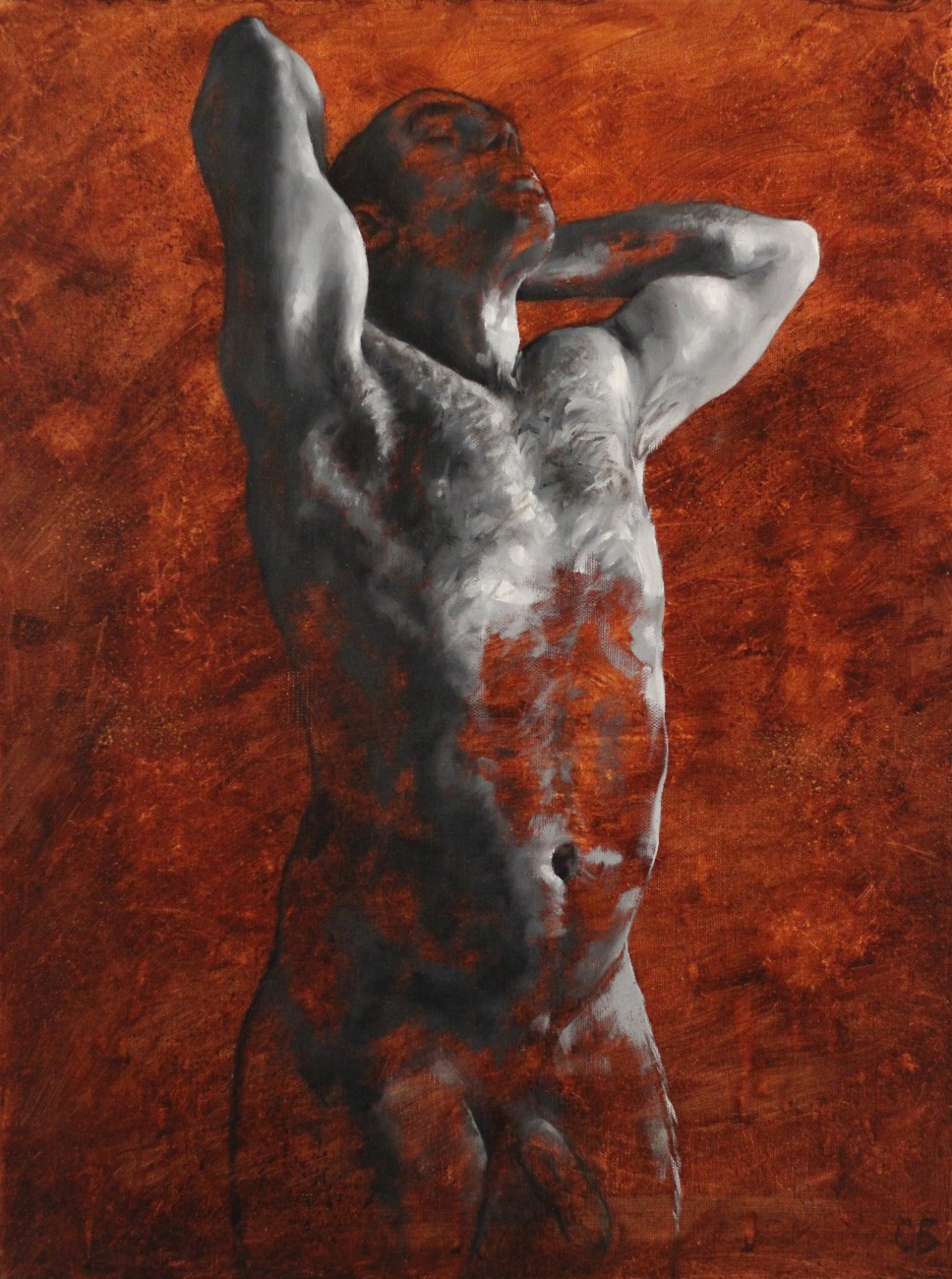
Grey Morning.
When nude we show much of our lived story in our skin and form and my art strives to take the time to pause and explore these lives and celebrate their beauty. Paintings for me are a one frame play using light, line, value and colour that can draw out the best parts of not just the model’s unique story but in a way that most of us can relate to and admire.
In a time where scrolling airbrushed myriad images and rapid videos is the unhealthy and unsatisfying trend, take the time to stop and look at just one image for a while and enjoy the anti-scrolling that is visual art and the cure for many of western humanities current maladies.
Many of my models are amateur first-timers and model for me upon hearing of a friend or acquaintance of theirs having already enjoyed modelling for me. I’ve spoken to all about their motivations, and none have felt their body or story typically celebrated in mass media.
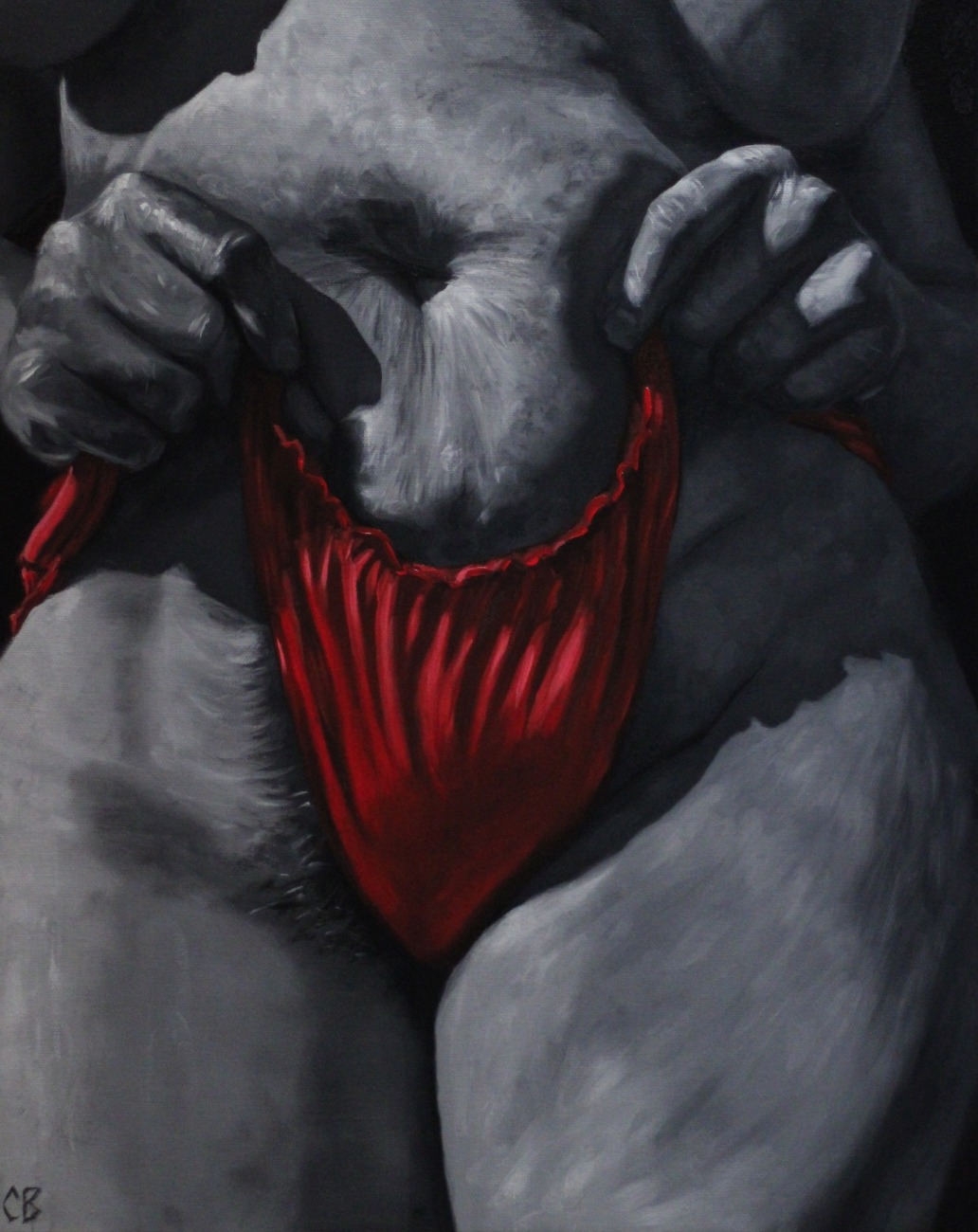
Red Thread No. 9.
Rather than erase the signs of aging to look like the fictional 1% that is sold to us, my art utilises the marks of aging from a genuine love and appreciation of greater complexity in forms that only comes as people age and mature. For me, the human form is the greatest narrative device and I love using it to explore and celebrate the bittersweet lives we all live through our bodies.
I have always been driven to make things and learn through my broad range of interests, which has seen me live a somewhat fractured life professionally and educationally. I went from studying engineering to completing degrees in both sport science and psychology. My father was a fisherman, and I went from working for him to labourer, bin-man, barman, office worker, assistant psychologist in a prison, fine art metal worker in a bronze foundry and now a welder for over a decade.
It was working in the bronze foundry with other artists that showed me making art was the one thing that united and made sense of the fractured parts of myself.
Metal Men No.1.
Eleven years ago after a divorce I set about researching and teaching myself the methods of realist drawing and painting in the traditional fashion.
After building my skill set I then set about working with models to make the art I wanted to see made. I’ve exhibited and sold numerous works at art shows and events while working fulltime and been rejected by near every gallery I’ve approached.
Nudes, even ones as good as I make, are a hard sell in Ireland. Most of the younger, less conservative people who love my work have neither the spare income to buy art, let alone a house with walls to hang.
Eventually Giovanni from GalleryX saw my work at Artsource and offered me a solo show. This show represents over ten years of study, work, practice, rejection, small wins and unwavering passion for the human form and the importance of visual art in our lives – now more than ever.
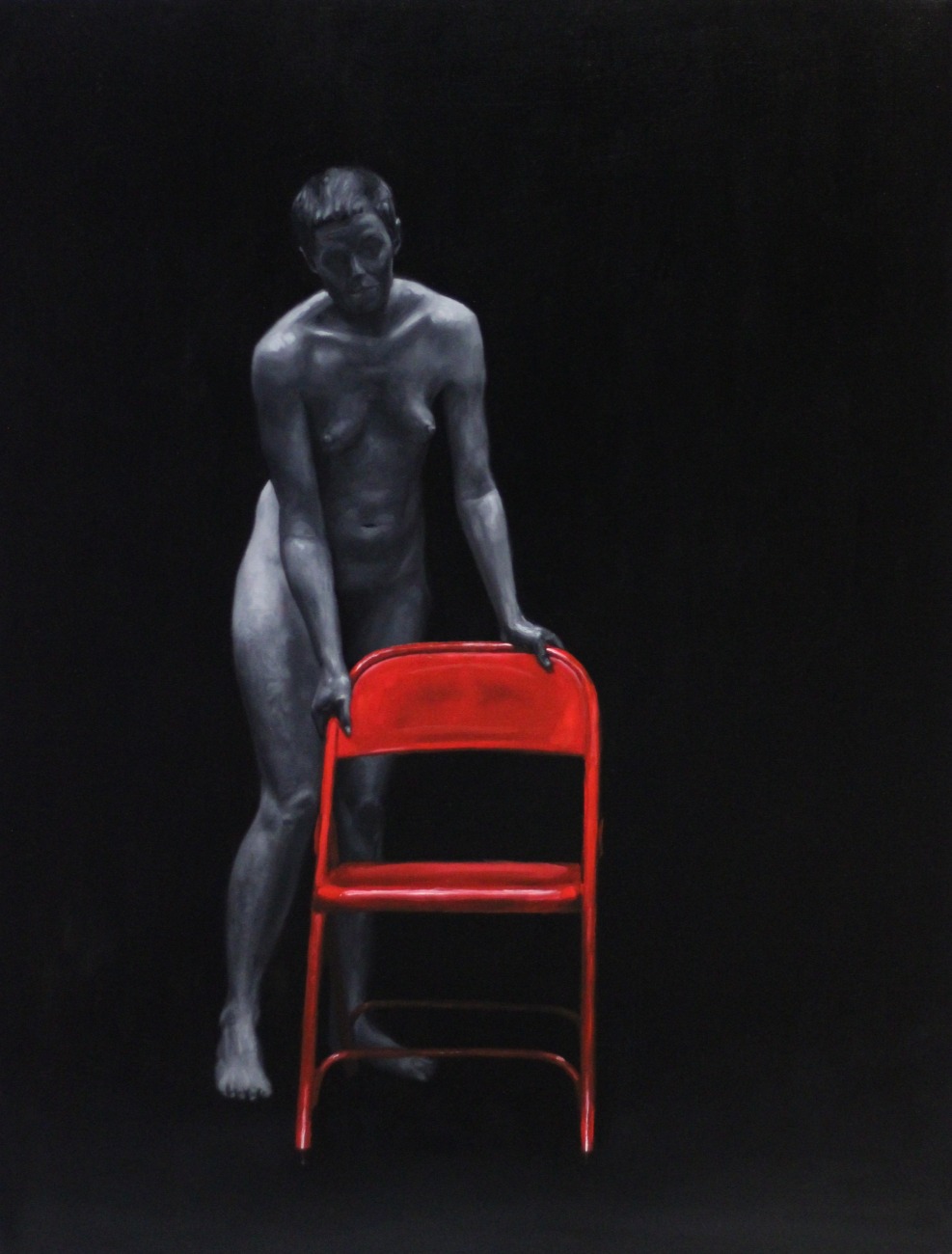
My Red Thread series explores a common but diverse element that to me seemed present in all of my work with female models and expressed through their connection to fabric and objects of a deep red colour.
Red Thread No.3.
I don’t have the words for this exploration. Hence I have nine paintings that do what words or music or film cannot. The paintings themselves, like all of my work, are only ever completed when viewed and experienced.
The possible similarities and diversity in the experiences of these myriad completions in the mind’s eye of the viewer, and the range and overlap with the experiences of the models themselves, are what this series of works explores.
Making a living as an artist is a challenge, but living as an artist and art lover is something that makes every living day a feast for the eyes.
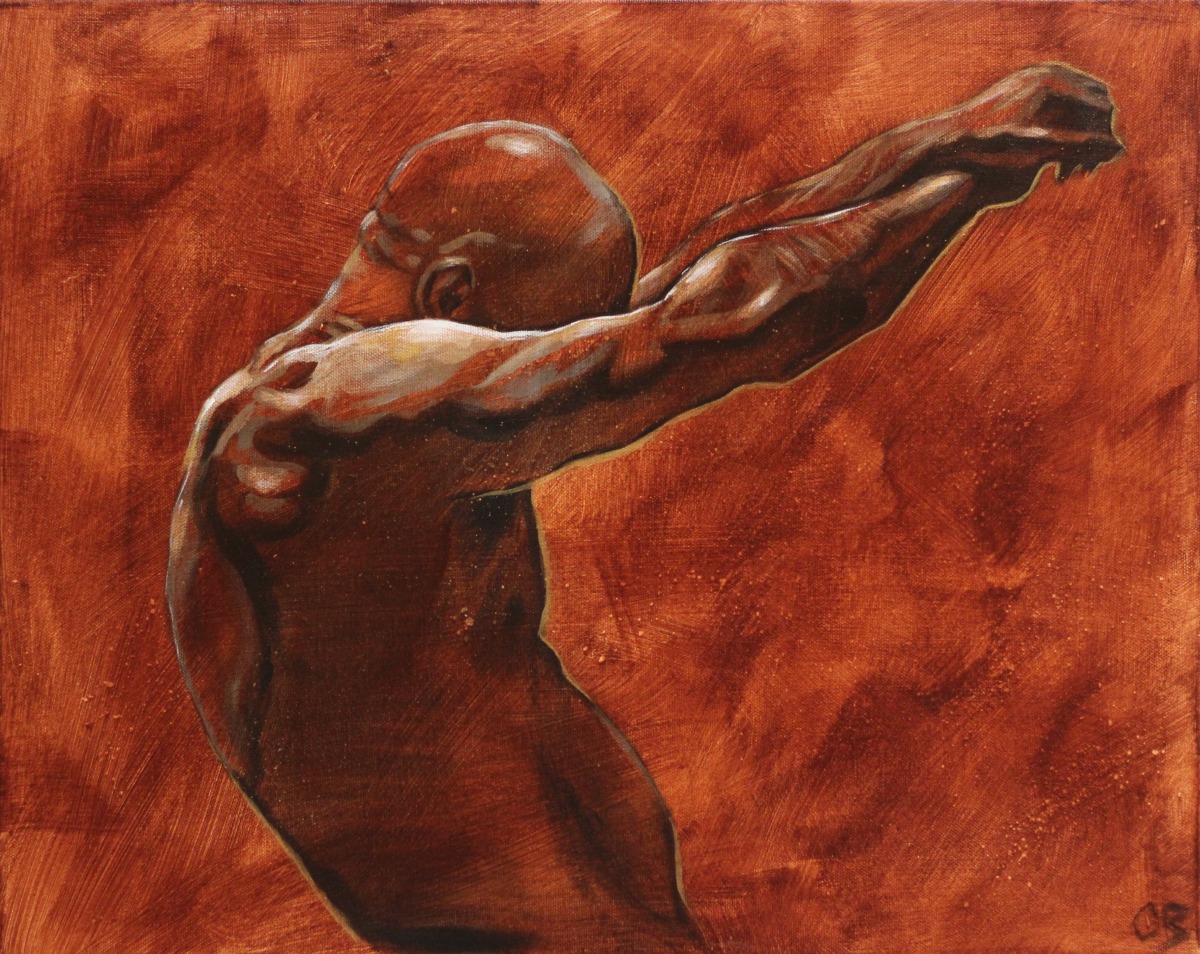
Metal Men No. 6.
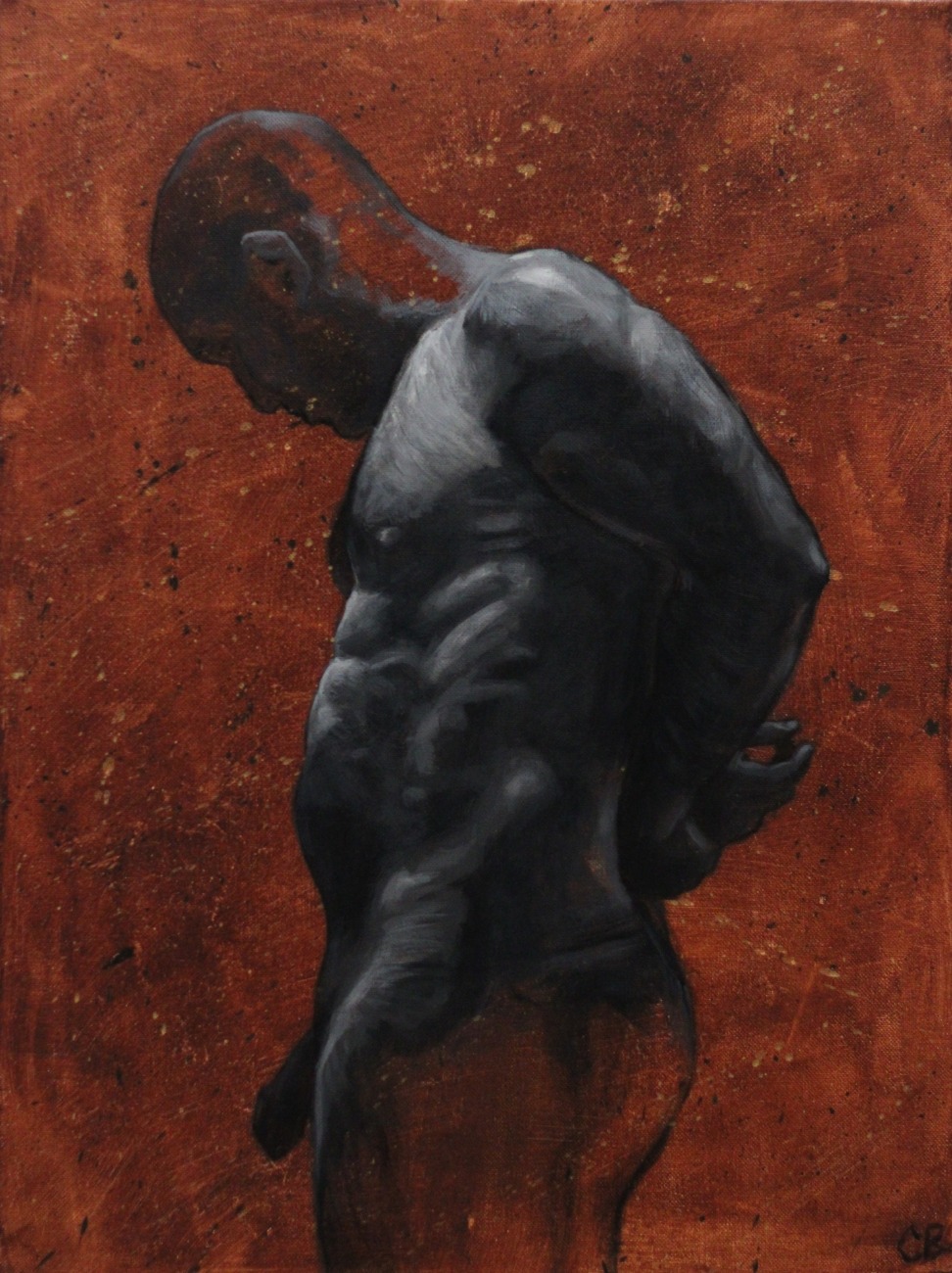
I have worked as metalworker for over a decade and two dominant colours I get to enjoy as an artist in great variety of hue and form are that of sand-blasted grey steel and orange- brown oxide rust. I have incorporated these colours into my Metal Men series which seeks to explore themes around modern fragile masculinity, violence and depression and surrender to the grind of life and one’s own demons. This series is additionally personal to me as for many of these first pieces I have used myself as model and actor.
Both of these series of paintings, along with sixteen other figurative works will be available to view and buy as part of my first solo exhibition in Gallery X, Hume Streetin the heart of Dublin from May 3rd to 18th.
Did COVID-19 originate from a pathway connected to China’s trade in wildlife-for-consumption, or did laboratory activity trigger the pandemic? Where do things stand with the so-called Lab Leak Hypothesis? One thing is for sure: in this pressing matter, one of the hardest combined attitudes to take is to be both engaged and polite.
Many combatants, previously capable of professional comportment, have descended into bare knuckle insults of the kind academe has not seen since the world decided one must be on the Left or the Right, or that one should comport oneself responsibly in the face of a Cold War that may become hot. Are you on the right side of history, or involved at all? You are either ready for flak, in this situation, or keep your head down.
Many scientists with an opinion worth sharing are choosing not to do so.
They might be wise. After all, some of this fighting has gotten dirty. Where some engaged in respectable debate before, rivals are now trying to cancel and professionally immolate one another. Direct exchange rather than article or book writing now makes up the majority of this discourse. Peer-reviewed articles on either side of this exchange have been few. Before you say – ‘That’s because there’s no evidence for the lab-leak’, or ‘That’s because there’s no evidence for the wet market/ zoonosis’, consider this: the Chinese government most likely had insight, and most likely destroyed evidence related to one or the other.
Viscount Matt Ridley, our interviewee here, has been both interested and engaged with the question of the virus origin since the start. He has been so without lapsing into ad hominem jibes. Though he has lapsed into Twitter exchanges of fire, his manner throughout has been civil. He stands with scientists, skilled researchers and a majority of the public in thinking that COVID-19 resulted most probably in a misadventure connected to a Chinese lab.
This does not mean he is correct.
Why is it important to point this out? In a context where both sides of a highly contentious argument disagree over all but the smallest of premises, the question of decency – and its cousin attributes honesty and responsibility – does come to the fore. Decency is also a cousin of openness by the way, and as we encircle in our conversation, China’s rulers have been anything but open. Therefore, take a listen to this exchange, and a look at Matt Ridley and Alina Chan’s book, as a start about posing this question for yourself. For all of us who lived through the pandemic, and in memory of those who didn’t, asking questions about its origins remains a primary part of the aftermath.
It is a notable feature of the prevailing world order that citizens of Western states, in particular, are significantly ill-informed and mis-informed of the past and present contexts of either their disadvantage or their comfort. For centuries the corporate/political/church covenant (imperialism) has sucked the earth of its bounty, dissipated its coherence, shattered communities and brought it to the edge of ruin. It accomplished this through the exploitation, enslavement, dispossession, degradation, starvation and murder of countless millions of fellow human beings.
Upon this base history and its persistence rest our affluence and our inequalities, the persuasive delusions of Western civilization (“our values”), its obtrusive superiority and an unrestrained financial sector that through the extension of rentier/monopoly/surveillance capitalism has all but established a global imperium.
Moreover, this supranational dominance has a forceful ally in its dis-integration of the world in the mis-conceived dogma of scientific materialism that reduces life to matter, minds to brains, whole self-organizing organisms to constituent parts; that effects the enclosure of everything spontaneous, primary, vital, and has generated a bio-tech industry determined to exploit the common process of becoming as if it was just another thing.
During a period of lockdown, I reopened a book on Goya[i] that I hadn’t read for many years. Any study of Goya is likely to reproduce his etching, The Sleep of Reason Produces Monsters. This was intended as the frontispiece of Los Caprichos, a series of 80 etchings published in 1799 that were a cutting satire of Spanish society at the time.
What gave rise, at fifty-eight years of age to the sudden disillusionment of the successful court painter has long been a matter of speculation. A serious illness in 1792 had left him permanently deaf and he was overworked, trapped by too many commissions. Burdened by demands, constrained by compromise and impelled by a maturing self-realization, creativity and assertiveness, his social position was becoming precarious and the conflict was perhaps too much to bear. Thankfully, he still had thirty years ahead of him and these years freed him enough to become the artist so admired today.
The usual reading of this striking work (published as Capricho 43 and replaced on the title page by a self-portrait) is that without reason we are susceptible to the naivety, superstitions and ignorance of our irrational impulses. It is a common theme of Enlightenment thinking, central to its comforting tale of intellectual and cultural progression, and it underpins the white-supremacist ideology of Western imperialism, as we shall see.
And fair enough, the reforms of Charles III notwithstanding, Spain at the time was the Spain that endured for so long – stuck in its ways, morally enervated and restrained by the barbarity of the Spanish Inquisition. That Goya was eventually appalled at the indolence and hypocrisy of Spanish high society and the regressive influence of a hidebound clergy is not surprising.
However, it is also a simplistic narrative which I’ll return to later, but to be clear, no one can be sure exactly what Goya was trying to express when he conceived the image. In any case, the purpose of this essay is not to put Goya on the couch, so to speak, but to explain why I found Capricho 43 such an arresting image at the height of the COVID panic and to pursue the train of thought that it provoked.
It is not the least of the failings of much social and political commentary these days, especially in the mainstream media, that history begins with the latest headline; that, as it has been said, “it is all text and no context”. To this end we need to go back in time.
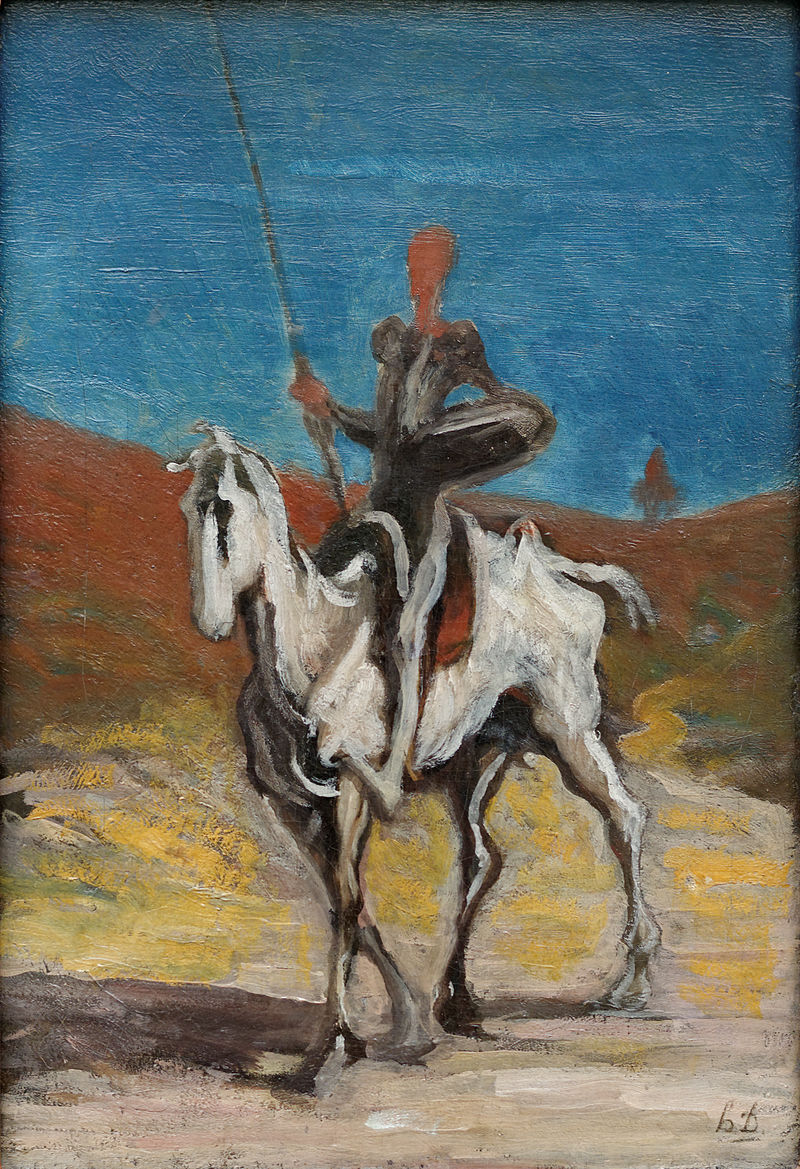
Almost exactly two hundred years before Goya published Los Caprichos, Don Quixote de la Mancha rode out like an epic hero of old to confront “at least thirty outrageous giants” that ranged before him and his squire, Sancho Panza, on the plain of Montiel. Impelled only by his own will and disregarding his squire’s assurances that they were windmills, Don Quixote spurred on his horse till he came before his foe. Then, “covering himself with his shield and couching his lance,” he charged, plunged it into the unrelenting sail…..and was tossed aside by the great machine.
“Mercy on me, cried Sancho…did I not tell you they were windmills, and that nobody could think otherwise, unless he had also windmills in his head”. To no avail.
Don Quixote by Honoré Daumier (1868).
Tilting at Windmills
And so his adventures proceed. This celebrated episode, though it only takes up a couple of pages near the beginning of a book of approximately 750 pages sets the tone for the rest – by part tragic, comic, ironic.
Deluded clown, romantic idealist, assertive self-hood: all this and more have been read into the character of the famous knight-errant. That Cervantes intended it as, in some sense, a parody of the chivalric tale seems to be so. But, perhaps most importantly, as the diverse interpretations of the work themselves might indicate, it is a compelling portrait of an individual caught between two worlds.
It was written at a time when the long transition from the Middle Ages to the modern world was reaching a conclusion. The trappings of the centralised state: bureaucracy, social control, militarism and an economy favouring capital accumulation – all so familiar to us now – were being established at this time.
The sixteenth century opened with death, destruction and unparalleled savagery in Central and South America. It was accompanied at home by large land enclosures and dispossession. And witch trials, actually an occasional occurrence in the Medieval Period, proliferated throughout Europe.
The seventeenth century continued the pattern with a huge growth of standing armies; the Thirty Years War that decimated Central Europe; genocide in South and Central America repeated in the North; the transatlantic slave trade; and, crucially, the establishment of the world’s first joint-stock company (forerunner of the modern corporation) in Amsterdam.
As Fabian Scheidler argues in his succinct history of our capitalist civilization,[ii] European economies had developed into what was essentially a circular war economy. European states borrowed enormous amounts of money to finance wars at home and exploitation abroad. The riches they acquired were largely used to repay banks, who, in turn, lent more money and so on.
It was a system that made “entrepreneurs”, war-profiteers, and banks extremely rich, but shattered communities and beggared populations at large. The physical power of the state was indispensable to the project, but the state’s role, it is important to note, was not in the first instance to extend its power, but to facilitate capital accumulation by a privileged few.
This, then, was the social environment in which that other pillar of the modern world arose. The development of science is portrayed as the triumph of rationality over irrationality, verifiable knowledge over superstition, and more. But the actual science that developed resulted from an evolving sense of individual autonomy and mathematical clarity and, for reasons to be discussed, it generated an ideology favoured by the forcible socio-economic power structures of the day.
Furthermore, this type of science did not so much replace religion as the ideological basis of society as extend its dualistic thinking to the relationship between humanity and the natural world – from God versus man to man versus nature.
To be clear, the problem is not with science per se, but with the reductionist worldview that underlies it and the vested interests that support it. That we should look at the world without pre-conceived ideas or doctrinal certainties and let it speak for itself is fine. And it would be ridiculous to disavow astonishing discoveries in every field and technological achievements in engineering, medicine and so much more. While the many social advances that would eventually arrive in the wake of modernity can hardly be disregarded – although we in the West are mostly indifferent to the exploitation on which our complacency rests.
And it might be added that the values of justice, freedom and equality which are the hallmarks of a liberal democracy are routinely circumscribed by class. Laws may be inscribed, but bias is ingrained.
This is not intended to establish some imagined pre-modern, universal state of nature, but the mutual emergence in this period of a strict rationality in both science and a system of market economics, whereby the intrinsic, or use-value, of material necessity and nourishment is subordinated to its exchange-value in the capitalist marketplace, was problematic from the outset.
Since the introduction of double-entry bookkeeping in the fourteenth century, income and expenditure could be formulated mathematically and profit or loss calculated accurately. Increasingly, the focus of trade became profit: to repay lenders if finance had been required and to accumulate money.
Ted Dace has described the outcome of this process clearly: ‘As the basis of economics becomes the trade itself and not the tangible thing exchanged, money is transformed into an all-consuming monster. No longer bound up with the limitations of actual land, people and resources, it springs to life, an abstraction with a will of its own.’[iii]
By now it is our most pressing need and its acquisition has become an urgent necessity for the many, superfluous wealth for the few; it delineates the structural hierarchy of class and serves as a measure of human worth generally. But, as Ted Dace cautions, ‘sooner or later abstraction runs up against reality.’
Meanwhile, the real economy of everyday life has been all but consumed by the predation of finance capitalism and corporate monopoly. And the basic needs of a sustainable life for so many people have become subservient to a parasitic imperative of making money out of money, out of you.
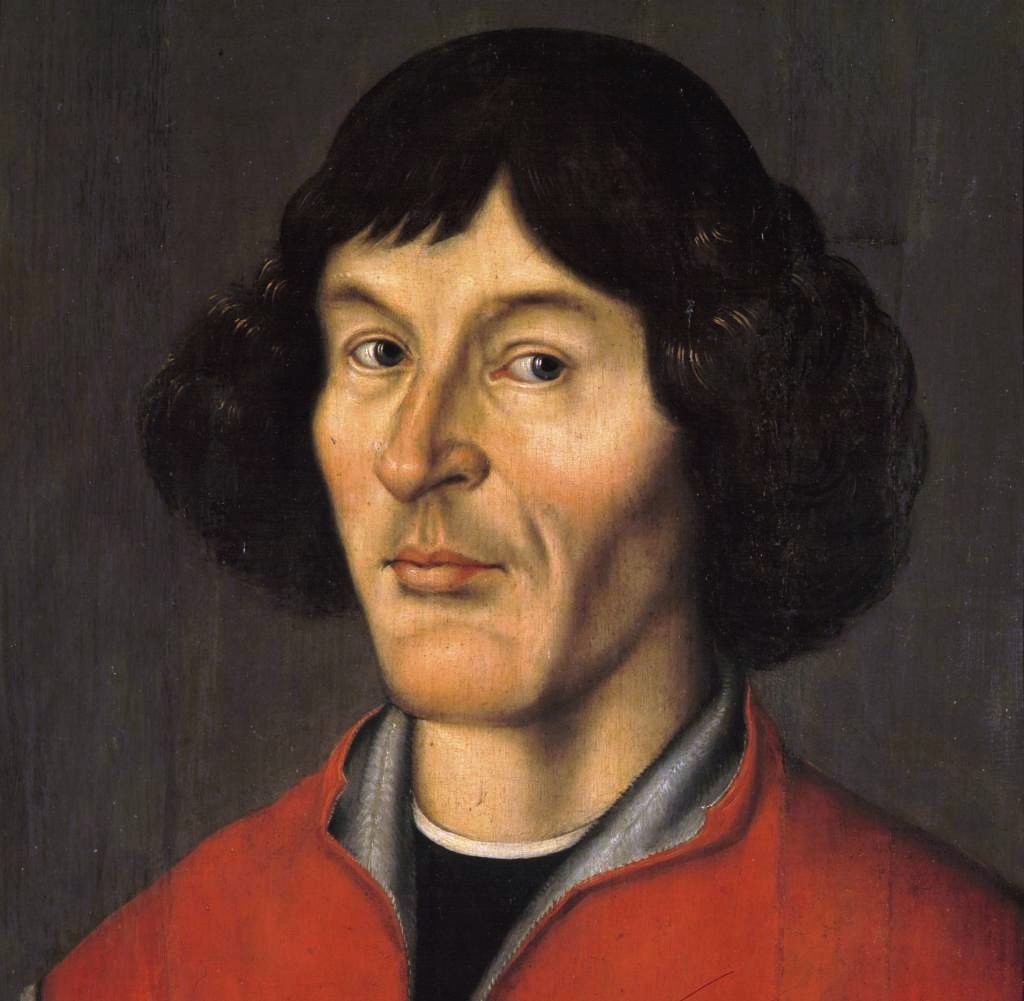
Nicolaus Copernicus.
Like Clockwork
When Copernicus turned cosmology on its head in 1543 he began a process, unimaginable then, that would in time overwhelm God himself. The mathematical precision that astronomy seemed to reveal encouraged the idea that all physical interactions on earth could be so understood.
Thus, Johannes Kepler wrote in 1605: “My aim is to show that the celestial machine is to be likened not to a divine organism but rather to clockwork ….. Moreover, I show how this physical conception is to be presented through calculation and geometry”.
A few years later Galileo was unequivocal: “When God produces the world, he produces a thoroughly mathematical structure that obeys the laws of number, geometrical figure and quantitative function, Nature is an embodied mathematical system.” And even more emphatically: “Reality is that which can be described mathematically. Everything else is illusion.”
In the Medieval period and, as a general rule, most human cultures that ever existed or survived outside the modern age, the world as a whole was organic and alive, to a greater or lesser extent indivisible, and sustained by an animating principle – God, Spirit, Soul, or the many poetic metaphors of world mythology.
This philosophia perennis, so-called, is an expression of experience rather than ideas. It is a philosophy, or understanding, of our inner nature and the common experience of being. And, perhaps for this reason, the archetypal symbols generated by it are recognizably similar across many outwardly diverse cultures.
And considering that the deep reality of being is beyond intellectual grasp, scriptural certainty, and social constraint, it relies on mythopoetic metaphor and the affective power of ritual to express what is essentially ineffable, and to relate it to the cycle of daily life.
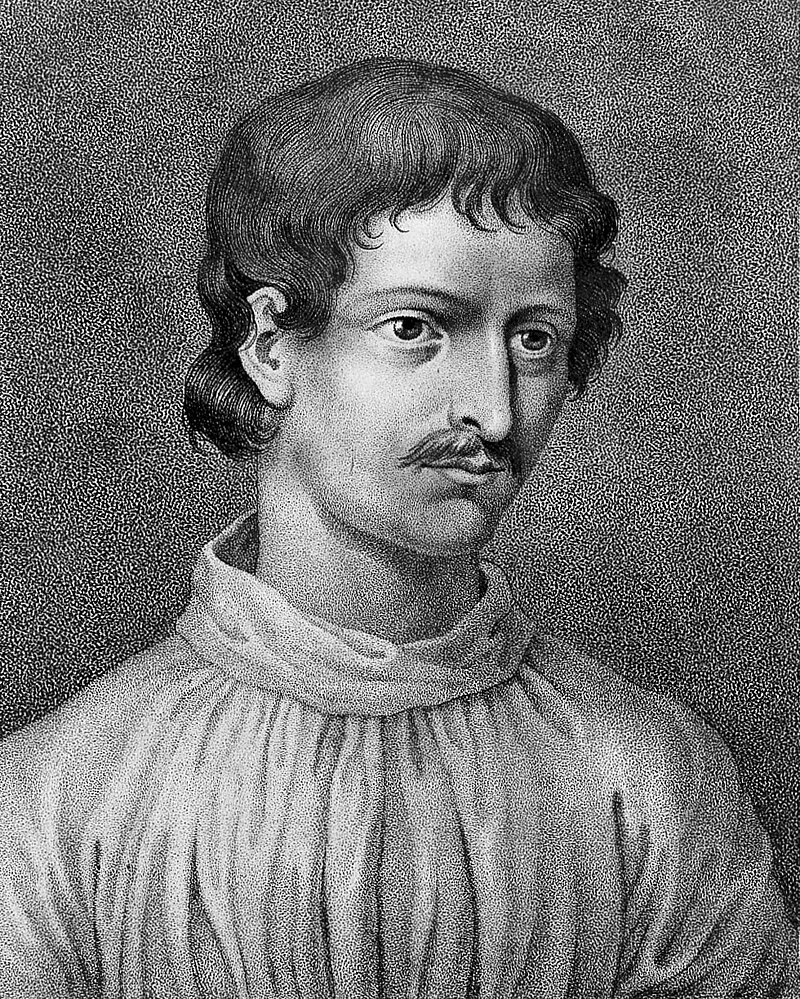
Portrait of Giordano Bruno.
Giordano Bruno
The introduction of the heliocentric model by Copernicus, and its determination by others, so stormed the citadel of belief the full weight of The Inquisition bore down on Galileo – who wavered. The recalcitrant Giordano Bruno supported Copernicus, but his philosophy cut much deeper.
Bruno and others before him had regard for these words from a twelfth century hermetic text, The Book of the Twenty-four Philosophers, “God is a circle whose centre is everywhere and circumference nowhere”. But if the very idea of centre has no meaning, as this suggests, then the fixed framework, a sort of cosmic theatre of space and time in which the universal process unfolds – and on which a mechanistic science depends – means nothing either. With it goes anything fundamental and we are left, it would seem, with no ultimate principle or recourse.
Yet Bruno’s view of the universe was far more profound than anything Galileo could ever have observed through his telescope. All Galileo could see was the inflexible authority of a mathematical system – that must definitively exclude the possibility of an evolving cosmos. And vindication would arrive three hundred years later when Einstein established relativity as a scientific principle.
Nonetheless, we are all here, alive, and conscious of our continuing existence. Being is absolute; our presence is substantial. For all the relativity of physics – and quantum uncertainty – the daylight world of consciousness is whole, it is now, it endures. Life is immanent, some process is generating it, and experience is real.
This, of course, is a great mystery that wells like a spring within each of us and the world in which we live. At the same time, it is beyond us, beyond apprehension and the linear logic of language. The mystery is us; for which reason we cannot know it objectively.
Bruno had much else to say about doctrinal matters, the function of a church and its undesirable interference in philosophical or scientific inquiry. Refusing to recant and pursued around Europe, he was eventually cornered in Venice and spent eight years in the dungeons of the Inquisition in Rome. Still obdurate, condemned and consigned to a foretaste of the flames of hell, he spoke these telling words: “You pronounce sentence upon me perhaps with a greater fear than that with which I receive it.”
In this tumultuous period, the authority of Catholic dogma was losing its grip as science and philosophy advanced, and no amount of bible thumping could secure it. An existent mythology or set of beliefs cannot prevail when there is no consent to meaning. In fact, no established canon can remain consistent with the evolution of experience and understanding. Although the dead weight of its persistence can overwhelm the embodiment of a new sensibility at the heart of an emergent culture.
Bruno’s pointed accusation largely explains the deranged reaction to his ideas and the science of Galileo and others. The suppressive resolve of the Inquisition was frantic and irrational, but the leading lights of the Reformation clung even more tightly to the Bible. Martin Luther let go of it occasionally to fling his ink pot at the devil but was otherwise unrestrained in his invective against Copernicus and his followers.
Bruno, for all his profanities, still had God on his side, so to speak, but it couldn’t save him from the intense conviction of The Holy Office of the Inquisition. Neither science, philosophy, nor the evidence of the senses could be permitted to challenge the insistent truths of Holy Scripture and that was final. The authenticity of individual experience was no match for the infallible authority of “revelation”, and another way is intolerable when conduct is prescribed on tablets of stone. Such is the power of The Word as all good book-thumpers, from St. Paul to Chairman Mao, to neo-liberal economists know well.
But mere obedience to a precept could never be said to awaken the soul to the redemptive power of a mythic or religious tradition. To interpret its symbolism as literal and historic is to profoundly misunderstand its character as an evocation of our inner nature and the mystery of becoming; and to miss entirely the deeper meaning it holds within its poetic folds for the cosmological, sociological, and psychological orders of existence.
Biblical literalism and Pauline universalism are the solid ground of our presumptive superiority and missionary impulse. For centuries they have been both pretext and apologia for white-supremacist imperialism. Unparalleled in its destructive violence throughout the long history of humankind; and all the more menacing because the espousing nations have managed to persuade the greater part of their populations that its cruelty and its condescension are the precise opposite of this reality. We are really impelled by the best of intentions.
The only thing to add to this continuing horror story is that, as Fabian Scheidler has emphasised, the missionary zeal of a church, now in decline, has been assumed by the high- priests of globalist organizations such as the WTO, the IMF, and the World Bank. And an amoral cabal of investment banks, hedge-funds, corporate raiders, property speculators and sovereign bondholders (to list only the most obvious) feasting on unearned income from monopoly rights, speculative gains, political favour, and predatory credit.
Furthermore, since 2008 it has been clearer than ever that those who command capital control the world; that the present system secures the concentration of wealth into fewer and fewer hands; and that its beneficiaries have forgotten, if they ever knew, the theme of countless tales and fables the world over – that to have everything is to have nothing.
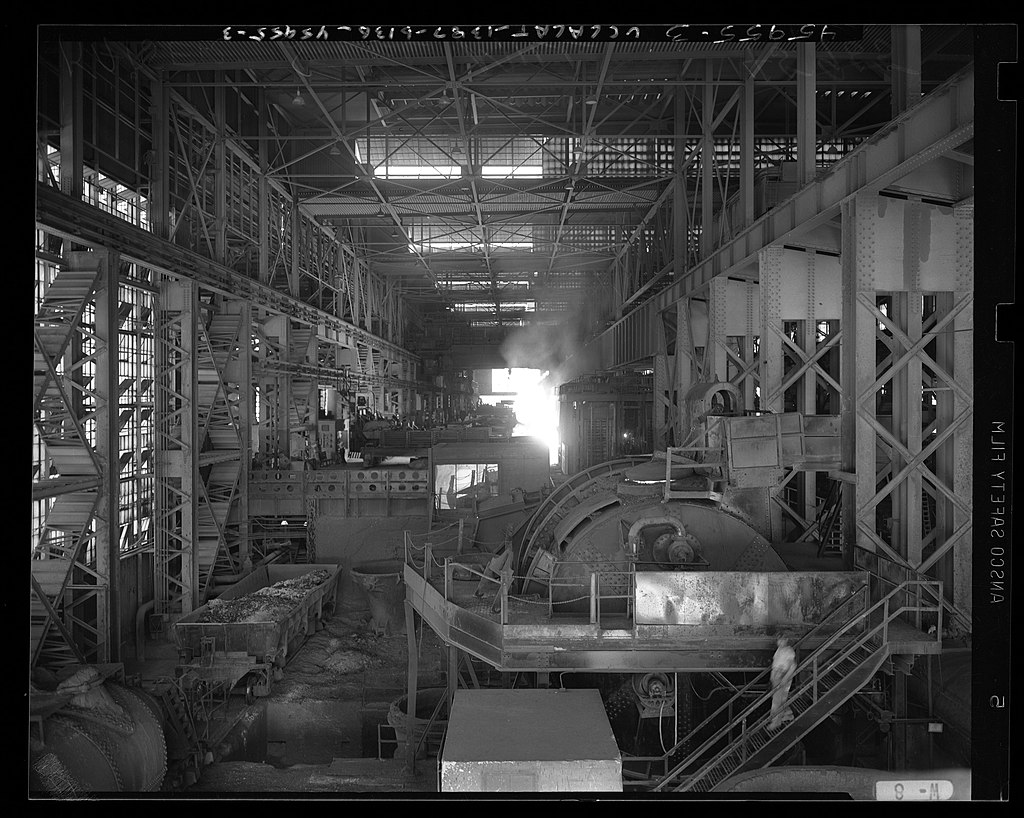
The interior of Kaiser Steel mill in Fontana, California.
The Metaphor of the Machine
Science, as we know it today, developed in a world in which capitalism was well established, accustomed to quantification and already defined to some extent, therefore, by mathematics and the ‘laws’ of the capitalist marketplace. In other words, a strictly rational tone was already sounding when Kepler and Galileo began their inquiries.
Under the sway of mathematics everything becomes a number. The world is what can be measured, and measurement defines reality. The moral power and mechanistic bias of science would confirm the imperialist/capitalist dream. Everything, including all that lives and all that sustains life, could be abstracted, quantified, and assigned an exchange value. Whether a bushel of grain, a slave in the fields, or a cog in an industrial machine, all were just so many commodities to be used, abused, bought, and sold.
Just as our privileged position at the centre of the universe was being usurped by the Copernican revolution and Bruno’s relativism, the organic worldview of tradition was being steamrolled by the metaphor of the machine.
But if Kepler and Galileo saw an image of the machine and the unerring mathematics of clockwork in the orbits of celestial bodies and in physical processes on earth, Descartes, Hobbes, Newton, and others later extended the metaphor to include living organisms. And the science that developed from this radical epistemological shift would shape both society and human consciousness and establish a scientific orthodoxy that has survived to the present day.
That authoritarian states and capitalist elites with imperial interests and ambitions would welcome these reductionist assertions and favour the scientific consensus that advanced them is no surprise. Class warfare at home and genocide abroad are less troubling with convictions like these. A machine, after all, is determinable, controllable, and dispensable.
It should be said that these early mechanists were still devout. But the world was no longer alive. It was now thought of as inanimate matter, designed by God but governed by fixed mathematical principles. In a sense, then, the scientist was extending God’s work on earth, and in such a way the quasi-religious status of science began to emerge.
For Francis Bacon (1561-1626), in whom the notion of a scientific priesthood was first conceived, the development of Western civilization would be a scientific and engineering project defined by his slogan, “knowledge is power”.
God would be a bystander, but we were doing his work. With God on our side and the power of science the world would lay itself open and there would be nothing we couldn’t know or conquer – a presumption of omniscience that still prevails in the scientific community.
It should also be said that dissenting voices were raised. Not all scientists were prepared to degrade life to this extent. But the church itself had mastered its alarm and ceded worldly matters to the domain of science, while it would continue to look after our souls and prepare us all for Paradise.
That art, science and philosophy were now free to pursue their own interests without having to look over their shoulder at the stern face of one of God’s representatives on earth, or his legion of scriptural zealots, is one of the boons of modernity, unquestionably. That these three branches would in time diverge and simply feed off themselves would become a significant problem. But, meantime, a modus vivendi had become established; and that such an arrangement would be uncontentious is largely due to a shared dualism.
Religion and science were agreed: the spiritual and material realms were separate and distinct – God above, humanity and the world below.
Up to this point, three orders of existence were recognized: body, soul, and spirit. Our bodies were connected to the spiritual realm through our souls – the ‘rational soul’ of man, in Christian theology and the equivalent, to all intents and purposes, of the human mind, which was, as yet, regarded as immaterial.
Mechanistic science may have removed soul from nature but, since human beings (well, cultivated minds at any rate) considered themselves a cut above brute existence they were still thought to have souls (or minds, or free-will) through which they interacted with God and put themselves in line for eternal life. But all the rest, the whole ecology of living, was mechanical, purposeless, and determined. And our disconnection from nature and more holistic modes of understanding sank into the culture with ruinous consequences.
As dispiriting as this might seem, we could still rely on our God as ideological support, dispeller of doubt and final consolation. But his days were numbered. The convenient accord with the church was never going to survive the rapid progress of science and the no doubt exhilarating sensation that “knowledge is power”. Every advance would endorse the swelling authority of science and install reliable principles such as Newton’s deterministic laws of motion.
This burgeoning faith in science, reason and human progress is what we know today as The Enlightenment. Edge God aside and it is the prototype of contemporary secular humanism.
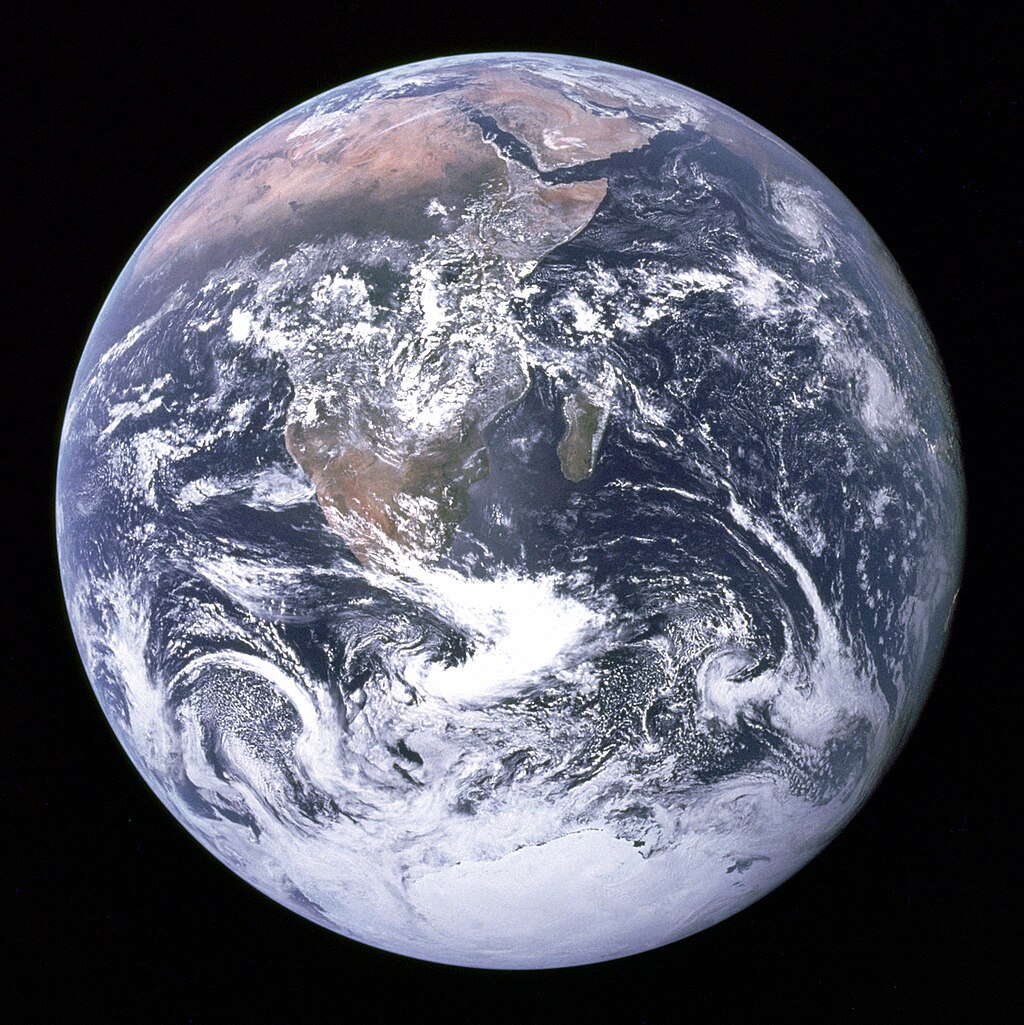
“The Blue Marble” is a photograph of the Earth taken on December 7, 1972, by the crew of the Apollo 17.
From ‘Believe in God’ to ‘Trust the Science’
A machine requires a maker and God made the world we were taught. But the more science discovered about the world-machine the more it became clear that, once set in motion, further divine intervention was unnecessary. Towards the end of the eighteenth century, it was also evident that there was no scientific rationale for God either. Fifty years later conspicuous atheism would provoke no censure and materialism was a firmly established tenet of scientific endeavour.
In the orthodox view the universe is composed entirely of matter. The energy that activates it is also material, or physical. It operates according to fixed laws that can be observed, measured, and formulated – and it is fully determined by them. Like a machine it is a hierarchy of parts right down to the “ultimate building-blocks” of sub-atomic particles and chemical molecules. Even biology is reducible in this way, and in the end, there need be nothing we cannot know.
Of course, if these are a priori assumptions then complete knowledge is indeed possible – it’s a foregone conclusion. That actual science has long since swept many of these assumptions aside has not radically removed them from the core belief system of scientific dogma and, crucially, from its day-to-day application.
As a firmly entrenched belief it has replaced religion as the authoritative voice in contemporary society. The peremptory watchword “believe in God” has been superseded by “trust the science”. Its dogmatic purpose is no different and it was used to effect during the pandemic as a marketing slogan for social compliance and pharmaceutical profit.
In any case, the injunction to “trust the science” simply points up the conventional morass into which scientific orthodoxy has sunk. Science is supposed to be about open inquiry, not a defence of “the science” as if certain matters were resolved beyond question just like old-style religion.
Science prides itself on its empiricism and its positivism. Fair enough; it has undoubtedly been an effective strategy and the basis of unprecedented technological development, but all experience must now defer to the “scientific method”.
The objective world of facts: length, height, weight, motion, capacity, etc., from the stars to sub-atomic particles, is the real world. A world objectively apparent, but devoid of meaning, purpose, or self-existence. Moreover, it disallows subjective experience (reality for most of us) and diminishes your creative presence to the point of disappearance.
Excluded from the terms of the world-machine are those elusive qualities of existence that make us feel alive. Whole organisms are more than the sum of their parts and it is this ‘more’ that is forever beyond the materialist’s scope.
Science can tell you all about life, but it cannot tell you what life is. It can describe the surface of things, but not their substance. The scientist may well stand to one side (in a confusion of subject and object) and probe every inch of you, but life will not be pinned.
Scientists can’t seem to start with a whole organism in its environment and develop a methodology to understand it in these terms as a living phenomenon, in a way that does not involve objectification and dissection – even though it is instantaneously apparent to direct experience.
And one viewpoint need not necessarily delegitimize the other. One could accept both as two sides of a coin, but science insists on its “truth” as superior.
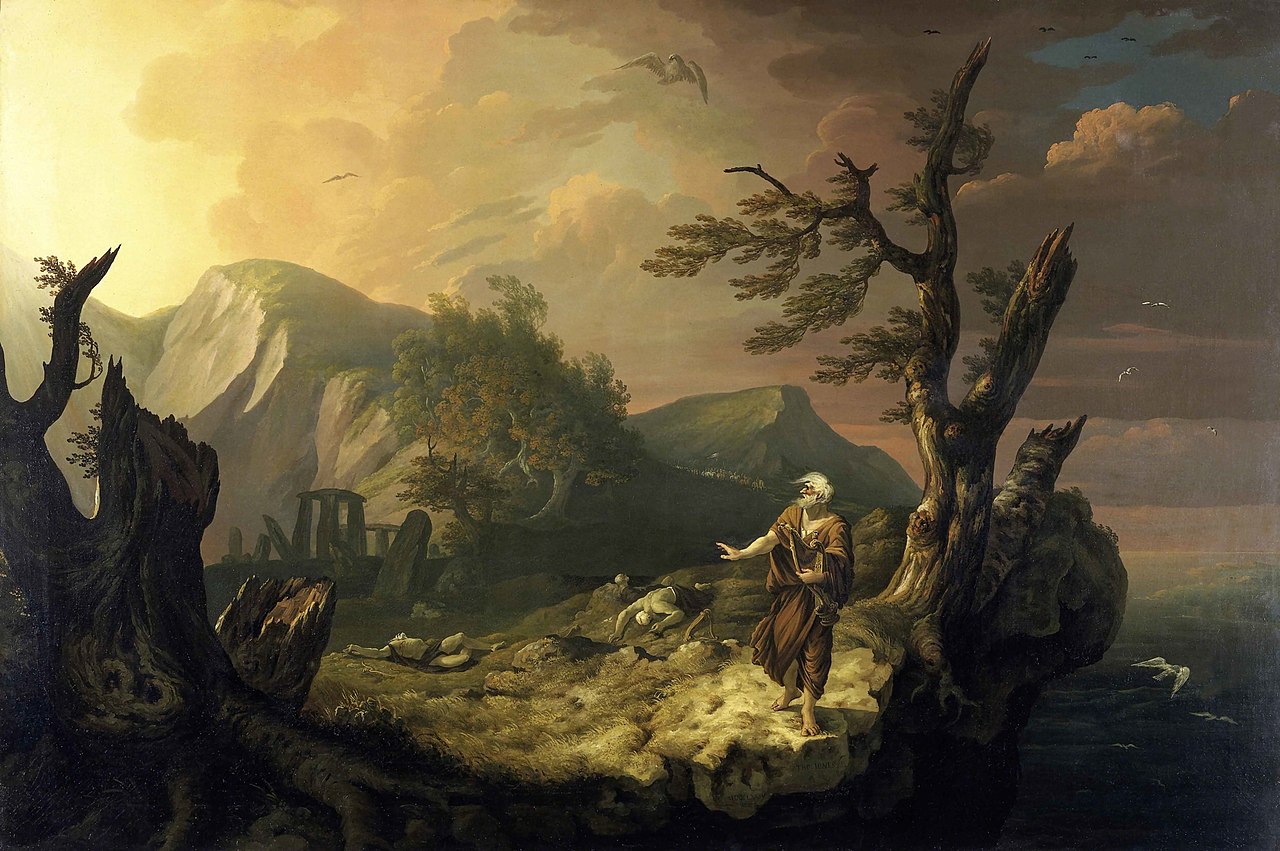
Thomas Jones, The Bard, 1774.
Romanticism
The idea that science alone could define our world was challenged with great energy by the Romantic movement in the late eighteenth and early nineteenth century. It left its mark but was no match for the brutal industrialism and economic liberalism of the Victorian era, that explicated Bacon’s rationale.
That said, it would be some time before some scientists would dare to insist that manifest qualities of human nature are illusory; that even the sense of our own being is delusional; that nihilism would be celebrated in literature and philosophy and disintegration of form become the measure of art. And it will perhaps be a little more time before ‘intelligence’ is boxed and the scientifically emancipated individual of the Enlightenment will be, finally, almost fully dehumanized.
But hands up how many of you feel like a machine (as opposed to perhaps being treated like one!). The very idea is clearly nonsensical. In short, a machine is lifeless so how on earth did it ever come be identified with life. It’s hard to imagine even the most ardent materialists can really regard themselves as glorified machines and the world as clockwork, but their science is conducted as if universal existence is material, mechanical, mathematically determined and nothing else.
For Descartes, humanity was uniquely raised above this perfunctory level by the human mind, or soul, which is immaterial and part of our ‘higher’ or spiritual nature. Today’s materialist can invoke no such redemption since the mind has been reduced to the brain – which marvellous (and perplexing) organ has itself been reduced to a personified data processor and control centre.
And while on the face of it, religious creationists and scientific materialists seem at opposite extremes, they in fact make common cause, both in their determinism and their appeal to either an external deity or some deus ex machina such as genetic programs, or ‘laws’ of nature.
Set against both the religious duality of God and humanity, spirit and matter, and the reductive objectivity of scientific analysis and its duality of subject and object (a make-believe world constructed from without) is the immediacy of feeling. The world before our eyes, present to the senses; the sublime plenitude of life, its constancy, its astonishing detail, process within process; a universal accord that could only have evolved as an integrated whole.
There can be moments in life when we forget ourselves, captured by the intensity of experience. Moments of rapture or clarity, free of distraction or intent, that feel complete, and doubt and endeavour dissolve in the pure sensation of being alive. Typically, these moments are fleeting, not a state of permanent bliss. Nor should they be. The everyday is normal; there is a living to be progressed. But they reveal an immediate reality beyond cold hard facts.
The philosopher Alan Watts once joked that in sober society, it seemed, normality was the world seen on a wet Monday morning. The daylight world of consciousness is inescapably the plane on which our daily lives unfold. But science has extended its scepticism to the ‘childhood’ of our religious beliefs to anything beyond its scope. God is not a testable hypothesis, but neither is the very real sensation I’ve just described.
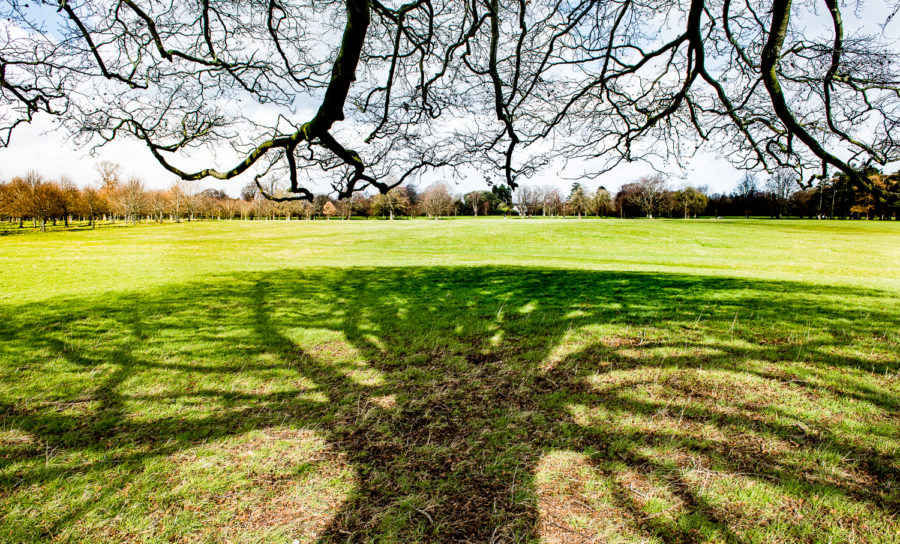
Image Daniel Idini (c)
A World of Things
Science is decisive: the limits of its application define our worldview and determine its commonplace expression. But it generates a world of things, a world without context or meaning. As a consequence, we now live in a forest of facts and can’t see the wood for the trees.
This objective world of facts and things seems real and obvious, which it is, and most of us aren’t bothered by post-modernist allegations that it’s all just interpretation. But at a deeper level there is no such thing as a thing. Which is simply to say that no-thing can exist as an isolated entity apart from other things.
A tree, for instance, seems unequivocally present and specific, but it can only arise and endure as a system of transpiration, photosynthesis and more, supported by an underground universe of micro-organisms. In other words, a tree is more properly thought of as a process. A process, what’s more, that is inextricably interdependent with our own continuing existence through the interchange of carbon dioxide and oxygen.
It follows that every other thing (and this includes us) is also a process that can only exist within the greater process of life as a whole. It is this essential truth of being, not sentiment or scientific necessity that commits us to earth, water, fire, and air. We are nature. Consequently, any de-spoilation of the world or nullification of others is an offence against our selves.
But the language of science is definitive. It supports a methodology that sets the world apart and fails to see that the objective distinction of things is by convention only: that the everyday world of material culture is real at that level, but that a deeper unity underlies it.
The stupendous diversity, adaptivity and integrity of our world – our being – evolved without direction or external law. That is to say, “laws of nature” are implicit. What makes life consistent is that, as it appears in the moment and evolves over time, it establishes patterns. And what makes a pattern a pattern is that it repeats (becomes a “law”). More than anything else living organisms are habitual. As they reproduce and grow and reproduce and grow, they follow well-worn paths. And old habits die hard. Apples can’t be oranges. The young cuckoo abandoned in its egg flies south in autumn.
Habitual behaviour is unconscious. A couple of cells grow into ten trillion. That’s ‘easily’ explained. A ‘genetic program’ underlies it biologists assure us; even though they can barely define a gene and the complexity of cellular development is impossible to fully describe. But a living organism has been formed: one that for the duration of its life is present, constant, adaptive, and purposeful. Try explaining that.
How genes alone could have the determining power of organic development is a modern mystery. How can genes, chemical molecules in the nucleus of a cell, be purposive while the whole organism is mere machine and fully determined? The soul, Rupert Sheldrake suggests, has been resurrected in the genome.[iv]
The expectations of The Human Genome Project have not been realized; in fact, many were confounded. Sure enough, DNA keeps yourself to yourself so to speak, but suddenly everything was ‘genetic’. The cause of all disease and even aberrant human behaviour, not to mention your very appearance (good, bad, or indifferent) was hidden in those helical strands.
We were to finally uncover “the secret of life”. Just as in physics, the atom, and then sub-atomic particles (hundreds now and counting – if they hang around long enough) were thought to constitute the ultimate building blocks of matter, so human biology could be reduced to the molecular level. Our lives are just a matter of physics and chemistry.
What was actually discovered was incalculable complexity, so intricate it resists scientific analysis. Mechanical explanations fall far short. Whole organisms can never be explained in terms of their parts (if you could even isolate parts in this case). And yet an industry has been capitalized as if, and has stepped, like a bull in a china shop, into a dynamic, balanced process common to all life with who knows what consequences.
Furthermore, that such prodigious expansion of interconnected and interdependent life since ‘day one’ could be solely due to the random mutation of genes favoured by natural selection; that integrity in the whole could be produced and sustained by chance in the particular (as is current mechanistic orthodoxy), is a stroke of luck so far beyond calculation as to make the proposition meaningless.
It is also at odds with Darwin himself, in whose view it is the organism that adapts to environmental pressure, and those adaptions are then inherited by its progeny.
The inheritance of acquired characteristics is not easily understood, certainly. But there is no evidence it is genetic. Since genes only exist as integral parts of a whole organism, it is only within a machine theory of life they could be said to determine organic formation or carry that ‘information’ from one generation to the next.
In other words, evolution is a creative process, not a blind mechanism; a sensual interplay of organism and environment, in a world, not determined but open, and committed to its fulfilment – whatever that might be – only as the seed is committed to flower.
Feature Image: The Sleep of Reason Produces Monsters, Francisco Goya, c.1799, Etching, aquatint, drypoint and burin, Collection of the Nelson-Atkins Museum of Art.
[i] Gwyn A. Williams, Goya and the Impossible Revolution, Penguin Books, England,1976.
[ii] Fabian Scheidler. The End of the Megamachine, Zero Books, England, 2020.
[iii] Ted Dace, Escape from Quantopia, Collective Insanity in Science and Society, Iff Books. UK and USA 2014. p.208.
[iv] Rupert Sheldrake. The Science Delusion, Coronet, England, 2013.
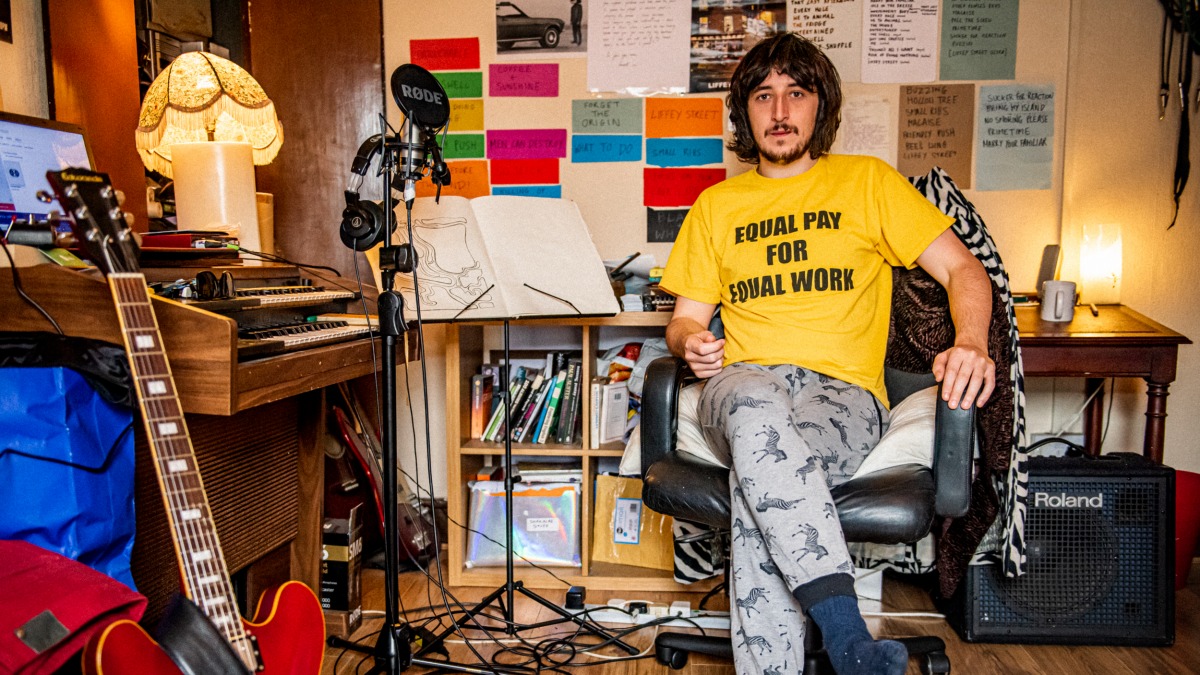
We have a special edition in our Musician of the Month series as Frank Armstrong interviews John Cummins of the Dublin band Shakalak.
Aficionados of the Dublin cultural scene over the past decade or two are likely to be familiar with John Cummins. Cutting a dash with a distinctive Rasputin beard and Reggae styles, John’s poetic performances in the Dublin vernacular have mesmerised audiences young and old. His playful, rhyming verse always had great musicality, and it seemed a natural progression for him to begin collaborating with musicians, culminating in the formation of the band Shakalak in 2018, which also contains another former Musician of the Month in Fin Divilly. If you haven’t made it along to one of their gigs yet, you are in for a treat.
John recalls some of his earliest musical memories:
Absolutely loved music … I remember going into into the record player in the room and putting her on and learning how to treat the needle respectfully and all that. So you just listen to whatever was there. What was that? Leo Sayer, you know, things like that … And then when I was a little bit older, maybe my brother [Paul] was probably fifteen and he got his hands on the guitar … So Paul would be playing and learning songs in the room, and yeah, I’d be left handed picking her up upside down, just playing one string or something like that, you know, that kind of thing. He’d be doing Simon and Garfunkel songs. I remember your wonderful tonight, Eric Clapton. He learned how to do that one, and he told me that that was his song and that he wrote it, and I believed him. I was of an age to believe that … I must have believed that for years, until it was years later when I was at a party somewhere and I heard it …, fucking Penny dropped … I am old enough to remember Bob Marley when he passed away and and everyone getting the the reggae into you. The knitted jumpers [with] Bob Marley R.I.P. all around and Bobby Sands at the time, all that. And then people going off to the Lebanon, maybe bringing back cassette tapes … and they do the rounds around the estate … So you’d be getting all sorts. And then you may be working and then you’re buying, buying your own music, whatever you like.
And talks about moving from poetic performances into becoming a musician:
So everything that I’ve been writing for a good number of years has consciously been with structure around where it’s easily adaptable to a template for a song. So everything’s been written with music in mind for years and sometimes they’d have melodies, sometimes they wouldn’t, sometimes they’d have certain BPMs or whatever, or even a key. And around that time, 2010 was when I first started. I suppose really performing … I started doing the open mics [in the International], and Stephen James Smith would help me a lot back then. The glass sessions, the Monday Echo, similar things that Minty is doing now on the Tuesday nights and the circle sessions on the Monday nights. Great stuff. This is a great old spot.
…
And that was where I came out of the shell. I started off hiding behind the page. Then I’d be doing things with my eyes closed. And then you’re just meeting people and you’re hooking up, and you’re there strumming a guitar, and you’re chatting your poems over and it’s all coming together. Loads of little collaborations down the years … Played with a band during the Lingo Festival. I don’t know if you remember that. The Lingo Festival 2014, 15, 16, … played with a band. Then I got the bug and then there was a couple of vibe for fillers where I jumped up on stage with these amazing musicians. And I was doing my poems in between, and that gave me the bug as well. You know, I kept feeding the bug, as it were … So Fin and I just got just got chatting. It just really happened very naturally, organically and quickly, you know? Meanie. A friend of Finn’s, came in with a couple of little beats because we were looking for a drummer back then, you know, a real life human being drummer like, which, you know, are not that easy to come across.
As to the vibrancy of the Dublin cultural scene today compared to the time he was starting off in early 2010s he says:
It’s a shilling thing, I think. It’s a money thing. Definitely. Things are more expensive. There were some Wednesday nights back then you’d be like a stone going across the town trying to catch several nights that were going on, and the talent, as it were. I don’t really like that word, the talent, but the people sharing their songs and doing their bits and bobs, it was great … there was something in the air … Well venues are less. That’s maths isn’t it. That’s just out there. You can Google that and find out all them that’s disappeared and gone … [But] I think it’s going strong [still] … If you go down there to the sessions on the Monday night [in the International], that room is jammed down there, you know. And then there’s the Smithfield creatives that do bits and bobs. I haven’t been on social media now for for a few years, so I feel that I’m not up to speed to tell you what’s going on around town. But from word of mouth, from what I’m hearing, it’s not the same. Not as maybe … prolific or strong or whatever, but it is happening. Definitely. Yeah.
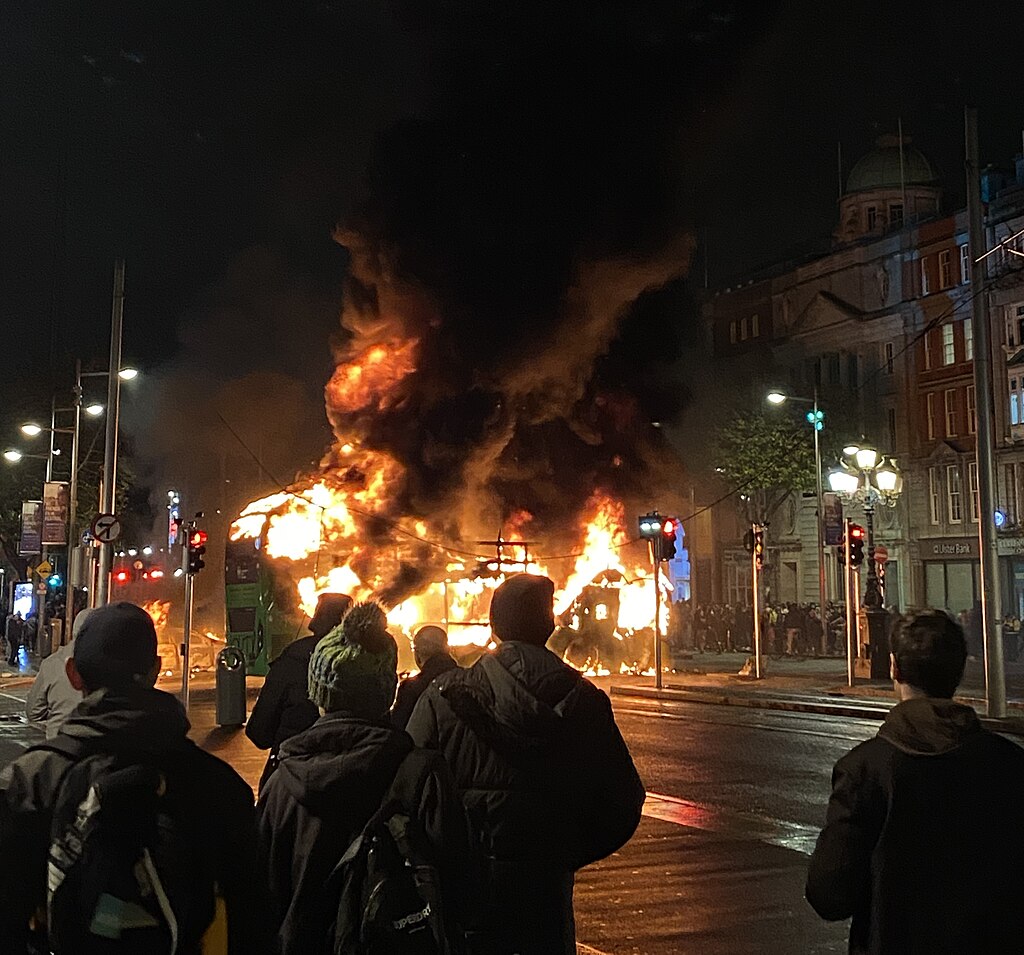
On the April 13 2024, a man stabbed several people in a shopping centre in Sydney. The morning after, I was walking past the Four Courts in Dublin, when a man approached me making a stabbing motion in the air. I fixed my eyes on him as my heart sped up, but it stopped as quickly as it started. Just a gesture of three or four stabs. I saw there was nothing in his hands, but kept my distance as he passed. He didn’t make eye contact or acknowledge me.
The experience threw me off kilter. For a second I doubted what I’d seen. Why would someone do that? To scare people? But he didn’t even seem to notice me. Was he on the phone, and accompanying his words with thoughtless gestures, inconsiderate of how it might affect passers by? Or was he lost in his thoughts, unaware of the world, and acting out some inner drama? Safe to say, I looked over my shoulder a few times as I walked on.
The problem of violence, such as the Sydney stabbing, or the shocking attack on Dublin’s Parnell Square last year, involves many factors: trauma, mental illness, addiction, social isolation, inequality… We could pull on any thread and find enough material to make a case for its importance in contributing to such acts.
For the mainstream media and politicians, however, explanations are simple. These people are “thugs“, “hoodlums“, “scumbags“. Anyone questioning the role society plays may be accused of giving criminals a free pass, and not holding them accountable for their actions.
After violent attacks like the ones mentioned, the media is normally quick to assure people that the motivation was not “terrorism”. The distinction seems to be this: terrorism is motivated by an ideology, a political position. A terrorist act has meaning. But these other types of attacks, according to the mainstream, have no meaning. The attacker was “schizophrenic”, homeless, jobless. Therefore, the violence has no sense to it. It is merely an outburst of animal savagery into the pure, clean, bright and ordered streets. The blame does not lie in us, but in them – those who cannot raise themselves up high enough to walk among us in our enlightened ways.
Violence is like a volcanic eruption. It comes from the lower, subterranean levels of the social body. And we happily ignore the tectonic pressures that are pressing down on those in the depths.
Felix Guattari has imagined a city where one would be able to leave one’s apartment, one’s street, one’s neighbourhood, thanks to one’s (dividual) electronic card that raises a given barrier; but the card could just as easily be rejected on a given day or between certain hours; what counts is not the barrier but the computer that tracks each person’s position — licit or illicit — and effects a universal modulation.
Our smartphones would be easily integrated into such a system. We could implement it in an afternoon. Of course, some people will complain of the undemocratic aesthetic of such a system, but then when they read the news reports about stabbings, and think of the children, they will put aside their misgivings and gladly walk through the sliding doors with the rest of us. Most of us conformed to a similar QR code system during the pandemic in the name of the public good.
Instead of radical change, society is on track for a compromise. Instead of asking ourselves why our society causes so much illness, loneliness and violence, we are resolving to create stronger walls between us.
Europe is already a fortress, a walled garden in the memorable words of Josep Borrell, the EU’s foreign policy chief. Our world is divided into the lucky few within, and the unlucky masses without. This dichotomy reaches its most absurd form in Gaza, where enemies at Israel’s gate are not outside, but themselves walled in, a city under siege, enclosed by blockades and checkpoint borders, barraged by missiles.
Image: Daniele Idini.
Golden Tickets
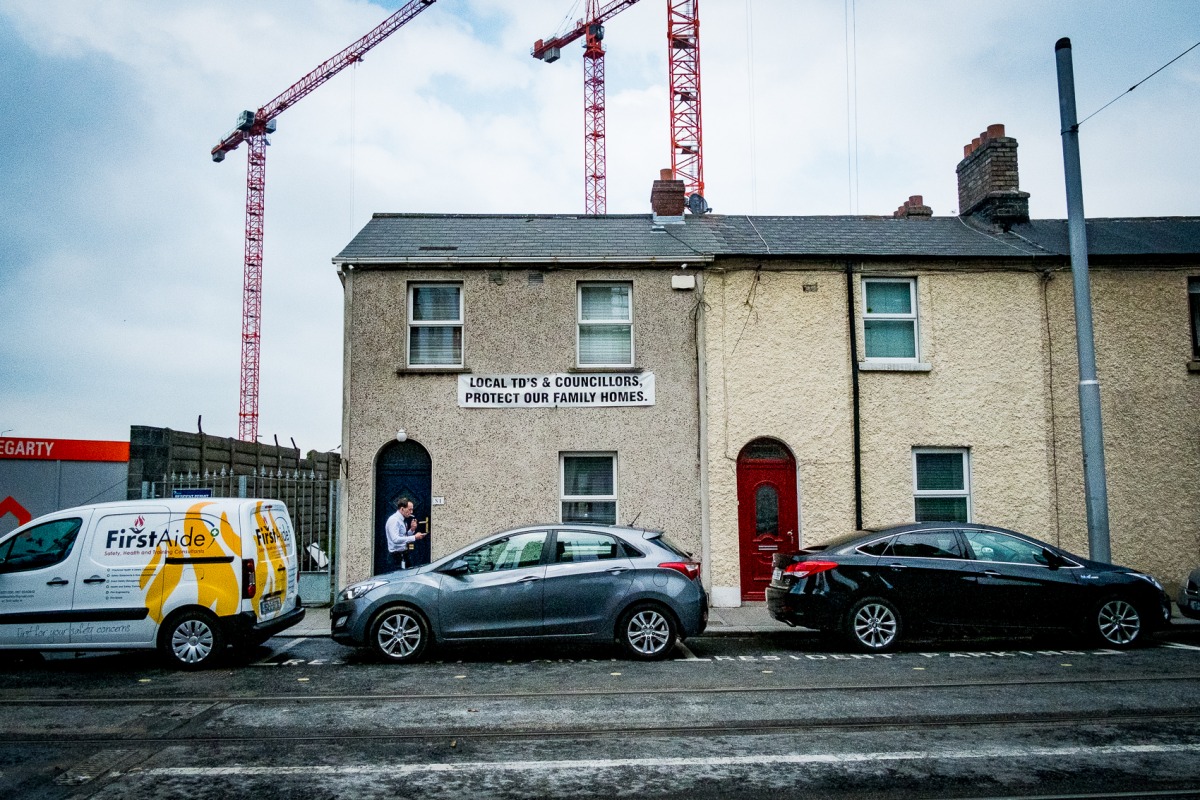
Western society dangles two tickets into the middle class before the labour force: inheritance and hard work. For many people, however, even the second option is becoming unfeasible. The ladder is being pulled up, and the majority of young people now worry they are going to be left behind.
Let us step past, however, the despair of the downwardly-mobile middle class, of which much has been already written. What are we to do with those who cannot meet the demands of middle class careerism? If you can’t manage your addictive behaviours (after all, we are all addicts, in one way or another), and you can’t navigate the world of work, what happens to you?
Those who cannot work are directed to a world of rules, appointments, documents, waiting rooms, lines, interviews, and regular check-ins.
But what if you don’t have a fixed address? And what if you don’t have a mobile phone? Or what if you can’t keep track of all these requirements?
If you fail to navigate the Kafkaesque world of bureaucracy, then you have the final frontier; a Diogenes-like existence at street corners, hostels, and cardboard windbreaks. Soup outside the GPO. Spare change. Random assaults by drunken louts who take middle-class disdain for you as permission to inflict pain.
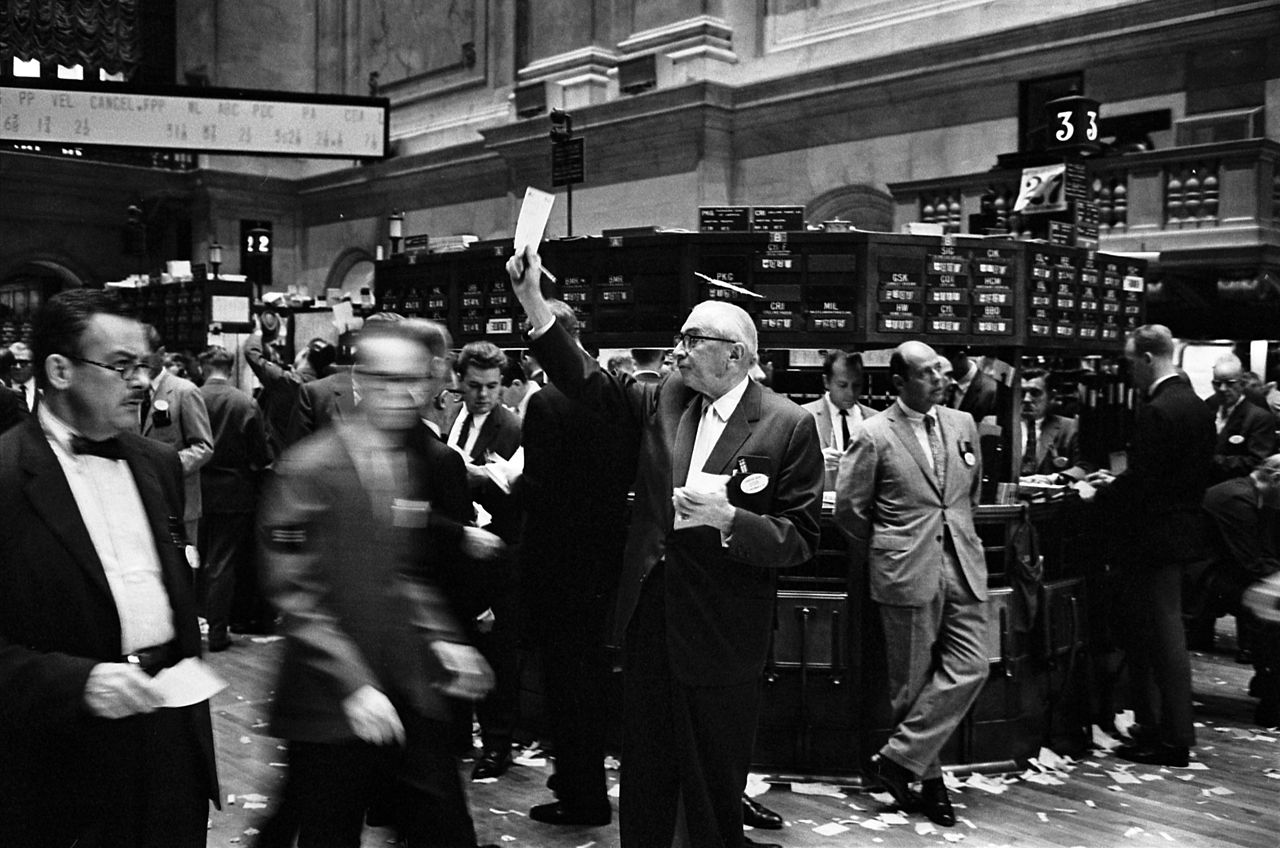
Stockbrokers, New York, 1966 from United States Library of Congress‘s Prints and Photographs division under the digital ID ppmsca.03199.
A Successful Civilisation
Historically speaking, our civilisation has arrived at a point of absurd wealth. Through industry, the machine, the market, automation, and the outsourcing of backbreaking work to countries with conveniently lax labour laws, we have access to luxuries unimaginable to a mediaeval king. According to the British Fashion Council, we have enough clothes to dress the world for the next six generations. According to the UN, we can feed everybody on the planet. Why then, do we insist on bestowing the fruits of collective human achievement only to those who pass the test of ‘functioning’ in an insane society?
This hyper complex informational administrative “service” economy is historically unprecedented. And yet we expect everybody to pick up the skills necessary to thrive in it, or we punish them brutally and unsympathetically. We see it as a bare minimum achievement to survive in this strange environment and punish those who can’t live like us with alienation, hunger, and hardship.
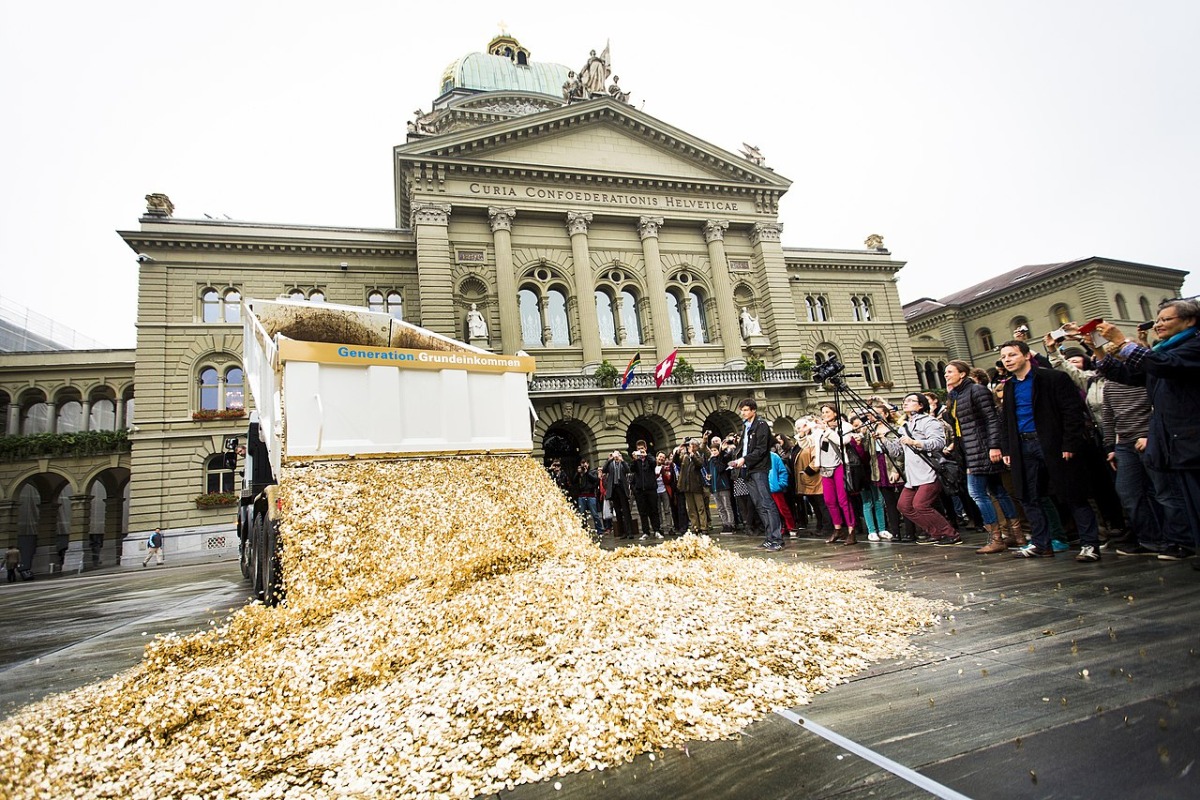
In 2013, eight million 5-centime coins (one per inhabitant) were dumped on the Bundesplatz in Bern to support the 2016 Swiss referendum for a basic income (which was rejected 77%–23%).
The Case for Universal Basic Income
I am a proponent of Universal Basic Income (UBI). The idea is simple: give everybody enough money for clothes, food and shelter. The income is different from the dole. Everybody gets it, even if they don’t need it. There’s no need to endure intrusive bureaucratic nosing into how you spend your time in order to qualify for it.
Most of us dismiss UBI out of hand. But why? Do we fear that a life of safety, satiety and comfort will make us lazy, debased, selfish creatures? It appears to me our current system does a fine enough job at that. If anything, UBI would do the opposite. It would improve morality, because it’s easy to be generous and patient when you are well-fed and comfortable.
But for all you cynics, to whom I sympathise, let’s put aside the appeal to morality and ask this: Do you really think a basic lifestyle of security and comfort would be enough for most people? I think many people would work simply so they can show off their wealth to others, without needing to be incentivised by fear of ruin. As social animals, our need for status is deeply felt. People will work to signal their vigour, or simply as a way to pass the time and give their life a sense of purpose and meaning.
And what about jobs that nobody would do for free? At the moment, these are the lowest paying jobs in our economy. We expect the people with the fewest opportunities to resort to them – essentially a kind of slavery. In a better society, the most unpleasant jobs, like cleaning the toilets, would be the best paid. Or maybe we can just build some robots to do that, rather than building robots to make music and art – you know, the stuff that humans actually like doing.
Anyway, what’s the big deal if people become idle? Let them go for it. Idleness is certainly less harmful than most of the activity that goes on in our civilisation, and earns applause, billions of euros, and occasionally Nobel Peace Prizes.
Fin Divilly – Songwriter and Performer by Daniele Idini.
Not just for Artists
UBI was trialed in Ireland, in a flawed manner, via the Basic Income for the Arts (BIA) pilot scheme, which closed in 2022. As the name suggests, a basic income was extended to artists alone. To me, this runs contrary to the most important part of Universal Basic Income: its universality. You shouldn’t need to prove that you are already providing a service to society in order to qualify for it. That’s putting the cart before the horse. UBI is meant to free up people so they can begin to do more valuable things with their time, which should be valuable to society too.
By granting it only to a certain category of people, it implied that the income was a conditional grant, rather than an unconditional gift. It came across as a transparent deal: we’ll give you money, but we want you to create commodities in return. Rather than challenge the logic of capitalism, opening the way for a new kind of society, it reinforced the existing system.
I understand that artists were impacted badly by the pandemic, but so were homemakers and carers – are they contributing less to society than professional artists? UBI should be a no-strings-attached gift given in good faith to everybody, not a conditional grant for a cohort of well-respected creatives.
The flawed thinking behind the BIA scheme was so effective at poisoning the well, and confusing people about the potential of UBI, that it almost feels intentional. A better trial would involve a completely fair lottery, with the name of everyone in the country in the pot. That way, we could see the impact of receiving a UBI on the lives of people from a cross section of Irish society, and all types of socioeconomic backgrounds.
A lot of people today are stuck doing work they know is meaningless, simply because it pays the bills. The technical term for such an employment, as coined by the late David Graeber, is a “bullshit job”. Far from being a ticket to freedom, bullshit jobs induce a feeling of guilt, low self-worth, and absurdity. Most of us have ideas of what we would like to do if we had more time, if we weren’t constrained by the necessities of earning money for rent, food, and utilities. Ultimately, we are kept in place by a sensation of insecurity. Imagine what we could do if our lives weren’t based on fear.
From forests, fields and fens, fair folk are found, where witchery winds with the wailing wind, dug deep down dreams drooled by departed drowned, as painfully professed by powers pinned. In iron, imps immersed incur ill eye, manacled to mortal machinations, while led by living lights, our lost lives lie sunk ‘neath stars of shoreless sublimation. Hence, happiness haunts high in harrowed hells as eldritch escorts eagerly enthrall, with conjured chains to clasp close cloistered cells run red by romance rebuffing recall. And nevermore need namesakes now be known, to those tied tight unto this twilight throne.
Feature Image: The Quarrel of Oberon and Titania by Joseph Noel Paton (1849)