I’m a filmmaker and Kerry based farmer, currently on a residency at the Fire Station Artists’ Studios in the heart of the city for the next two years. I’m very familiar with Dublin, and it’s fair to say it’s my second home since I came to Ireland in 1981.
I will also be heading to the bothy project (Sweeney’s Bothy) in Scotland in January as part of my research. This is on Eigg, and the island is owned by the community and completely self-sustaining (Eigg Electric).
My research will focus on the concept of dematerialisation in urban environments. The idea is to explore how cities can become more sustainable, efficient, and culturally enriched by re-imagining the use of physical materials and objects. This concept may be aspirational, but I think that is the artist’s privilege.
I cycle to the South Wall, through the docks, past the sewerage treatment plant, incinerator and power station almost every day for a swim. You cannot ignore that the city’s waste is not managed properly, the stench and volume of overflow is there to be seen by everyone.
Moving the port and repurposing the land offers tremendous possibilities, it is obvious when cycling through it. I wish, however, that this vision could be taken even further by considering innovative ideas such as transforming Poolbeg into a cultural hub akin to the Tate Modern in London.
This could not only celebrate art and culture but also serve as a focal point for sustainable energy and food production using recycled waste.
It seems to be that waste management in general in Dublin is oversubscribed and under serviced. There is a saying in farming “where there’s muck, there’s money” and I firmly believe this. People need to face up to their sh!t, people who clean it up should be rewarded more – it shouldn’t be such a dirty job!
There is ample opportunity to reimagine waste management in a way that is both enjoyable, productive and eco-friendly. By making waste management a clean and fun part of everyday life, we can contribute to a cleaner and more sustainable city, it is in fact a no brainer. Why are there no communal gardens?
In my opinion there should be an emphasis on high-rise, high-density living – with greater emphasis on rewilding and natural green spaces to keep people, and their dogs happy. By incorporating such features into the redevelopment plans, we can create a dynamic and efficient urban landscape that embraces modern living while reducing our environmental footprint.
I believe there should be more imaginative thinking and bold ideas in urban development. The transformation of Dublin Port would be a significant step in the right direction, but I think the exploration of additional creative possibilities could make our city a more vibrant, sustainable, and enjoyable place to live.
I hope Dublin can evolve into a city that embraces innovation and imagination, it has everything going for it.
When David Irving, the mad fascist historian imprisoned in Austria for Holocaust denial, was asked to speak by The University Philosophical Society in Dublin in the late 1980’s, the Student Union – involving the current Labour leader Ivana Bacik – instigated a protest that led to a minor riot to prevent him from speaking.
Given the criminal damage, which included broken windows, it’s miraculous no one was badly hurt. Having stormed the Bastille, they tried to track down Mr. Irving, who, bizarrely, had taken refuge in The Dracula Museum at the very top of the building. In the meantime, I, and others, witnessed him with a load of maps of Concentration Camps on the floor in front of him, in near darkness, insisting it could not have happened. I left the building.
As the events unfolded, I was asked to speak to the chamber and suggested that a much better course of action would have been to allow Irving to speak and then heckle and destroy.
I should add that my original advice that he should not have been invited had been ignored.
David Irving.
Guilt and Attribution
I am loathe to agree with Mr. Varadkar about anything but I can’t help agreeing that the events in Dublin’s fair city on the 23rd of November disgraced Ireland. The question of course is the attribution of blame and responsibility. The Moral ledger. Guilt and attribution.
Before initiating new legislation, I believe Varadkar and his government should read Albert Camus’s The Rebel on the subject of extremism, and how a reign of terror begins. How do we identify in advance the sans culottes?
Here today we see a potential terror, but a terror by whom and for what purposes? And how does the state not become part of the problem – as an ancien regime adopting draconian laws that foment terror in response? How do we prevent the creation of a police state purporting to prevent anarchy?
The far right is a product of neo-liberal Ireland, state authoritarianism and surveillance, and the conduct of our thuggish professional and business classes. The people rioting are Leo’s Picture of Dorian Gray: the generation he inherited as Taoiseach; and let us not forget the earlier, inconsequential, insurrectionist protest outside the gates of the Oireachtas. It wasn’t exactly The Boston Tea Party or the Trumpian storm on the White House, but a worrying indication of the shape of things to come.
Though the numbers are small in Ireland now, the movement is trending with over one-third of Europeans endorsing far right-wing parties. And now the proto-fascist Geert Wilders has emerged as the main victor in the Dutch election; while in Italy far right Prime Minister Giorgia Meloni prosecutes the legendary Italian journalist Roberto Saviano, who had the temerity to describe her as a bastard over her immigration policies.
Leo Varadkar ought to understand, as Mr Saviona does, that crony capitalism and drug cartels exhibit similar features. The drug cartels, subversion and gangsterism of the inner-city rioting often finds a reflection in the mendacious and buccaneering conduct of the commercial classes. Varadkar’s government cannot wash its hands of responsibility of the causes of the Promethean storm.
Moreover, irresponsible comments by Mary Lou McDonald that Drew Harris should resign betray a complete lack of empathy with the injured, some seriously, rank and file Garda officers. Whatever I think of the police as an organization – which is not much – the timing of remarks such as these was unacceptable, and in context offensive.
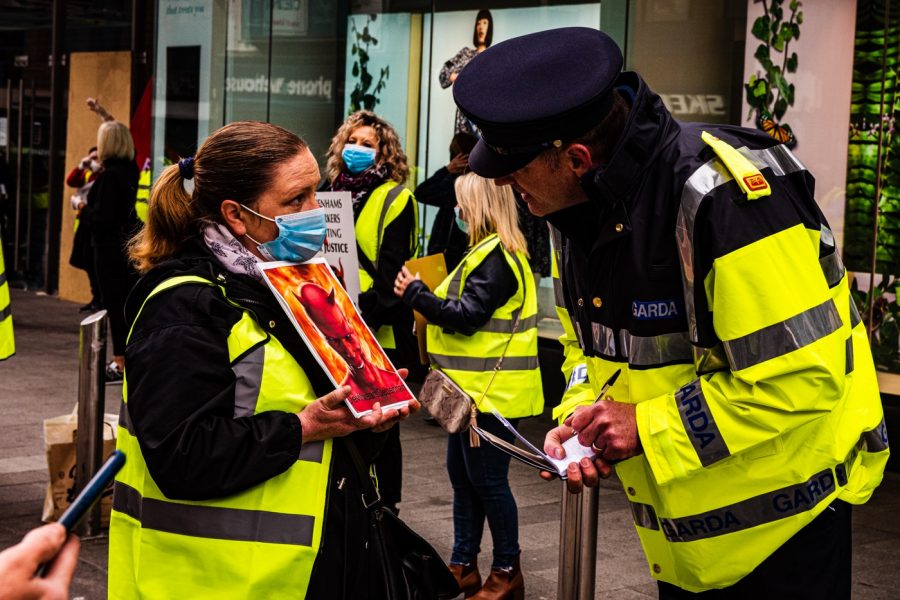
Image: Daniele Idini
Themes of Protests
The themes of the protests are transgender rights, sex education at schools, immigration, corruption, and criminalizing offence. A whole phalanx of designer leftist and so-called progressive issues are under attack. These are issues that need to be disentangled, and the rage of the mob understood if not in some situations, in my view, condoned.
Of course we ought to be highly sceptical of agendas underlying this Populism, not least when it is guided by keeping Ireland for the Irish, or that Irish lives matter. This is a nasty echo of the exclusionary racism and division of our time such that one cannot say all lives matter without generating offence. The extremist reaction in response is to say that non-national life should matter less and can even be destroyed. Sadly, it seems, the moderate, inquiring centre ground has been lost.
The question of sex education at school interacts with religious mullahs and those who enforce dogmatism. But it was nonetheless ridiculous to attempt, essentially, to no platform someone of William Binchy’s intellectual stature – however misguided he may be in my view – disqualifying him from talking about euthanasia because he is a white privileged male further fuels the fire.
Moreover, it is unarguable that the transgender lobby are ludicrously over-represented in the media and dedicated to no platforming.
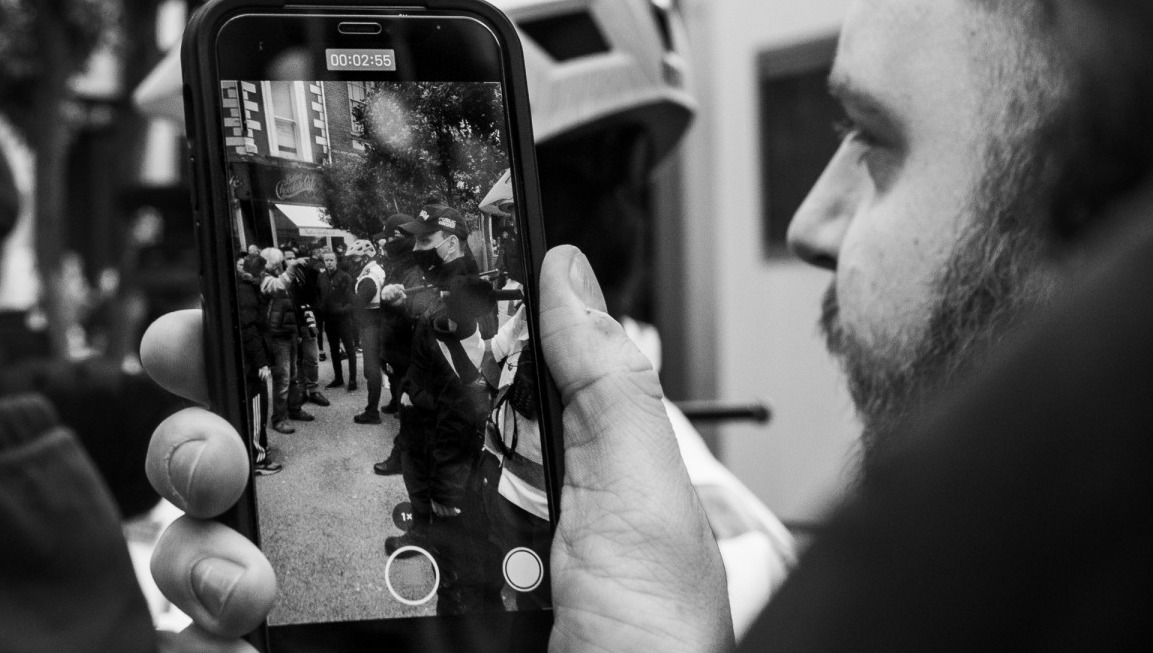
Clearly, the Dublin Protest on the 23rd became nasty and racist after a social media sensation attributed blame to a non-national for a brutal attack produced a flash mob. Unsurprisingly, the protesters ignored how a Brazilian delivery rider had given the victim a chance of life, in a proportionate defence, acting as the good Samaritan.
Image: Daniele Idini
Understanding Hatred
It is time to rid ourselves of Irish exceptionalism and investigate the gorgon’s head. To condemn at one level is to fail to understand. The indignation is the product and the cause of others.
Let us deal first with the right to protest, as I envisage a new set of laws being promulgated to regulate this. Certainly, the Gardai now need to deal with a situation of extremism spiralling out of control with increased presence on the ground. But now many are calling for them to be equipped with tasers which are useless at preventing a riot such as we saw in Dublin.
The current Minister for Justice Helen McEntee TD previously obtained a High Court order from Justice Owens requiring telecommunications service providers to retain certain data – including user, traffic and location data –for a period of twelve months, for the purpose of safeguarding the security of the State.
Those in power ought to consider Paul Lynch’s Booker Prize winning novel, Prophet Song, a dystopian vision of an Ireland of the near future, which describes:
The dark pouring of the riot police, the rattling staccato of live rounds fired above protesters heads … the slow-motion collapse of the body torn into pixels as it is consumed by tear gas.
Article 11 of the European Convention of Human Rights provides for freedom of assembly. This means that every individual, regardless of cause, has the right to protest, march or demonstrate in a public space. Historically the police had a duty to refrain from restricting this right unnecessarily and a positive obligation to take measures to protect peaceful protests. It was also the case that any intervention had to be necessary, proportionate and for one of the following aims:
In the interest of national security or public safety
– to prevent disorder or crime.
OR
To protect health or morals – to protect others’ rights.
Freedom of assembly is also guaranteed under the much-denuded Article 40.4 of the Irish Constitution.
In the famous Irish common law ‘orange lily’ case Humphries v Connor, 1864 plucking an orange order lily from a woman in the nationalist area of Belfast was adjudged to be a justifiable police act and a regulation of protest, as this would likely cause a breach of the peace. In these situations, historically, the police may take reasonable steps, including arrest, to prevent or stop a breach of the peace intended to cause harassment, alarm, or distress. The authorities already enjoy sundry other powers about rerouting matches, such as in the Love Ulstersituation.
The Dublin riot should not be used as an excuse to introduce new powers that will have little or no affect on preventing disorder on the streets.
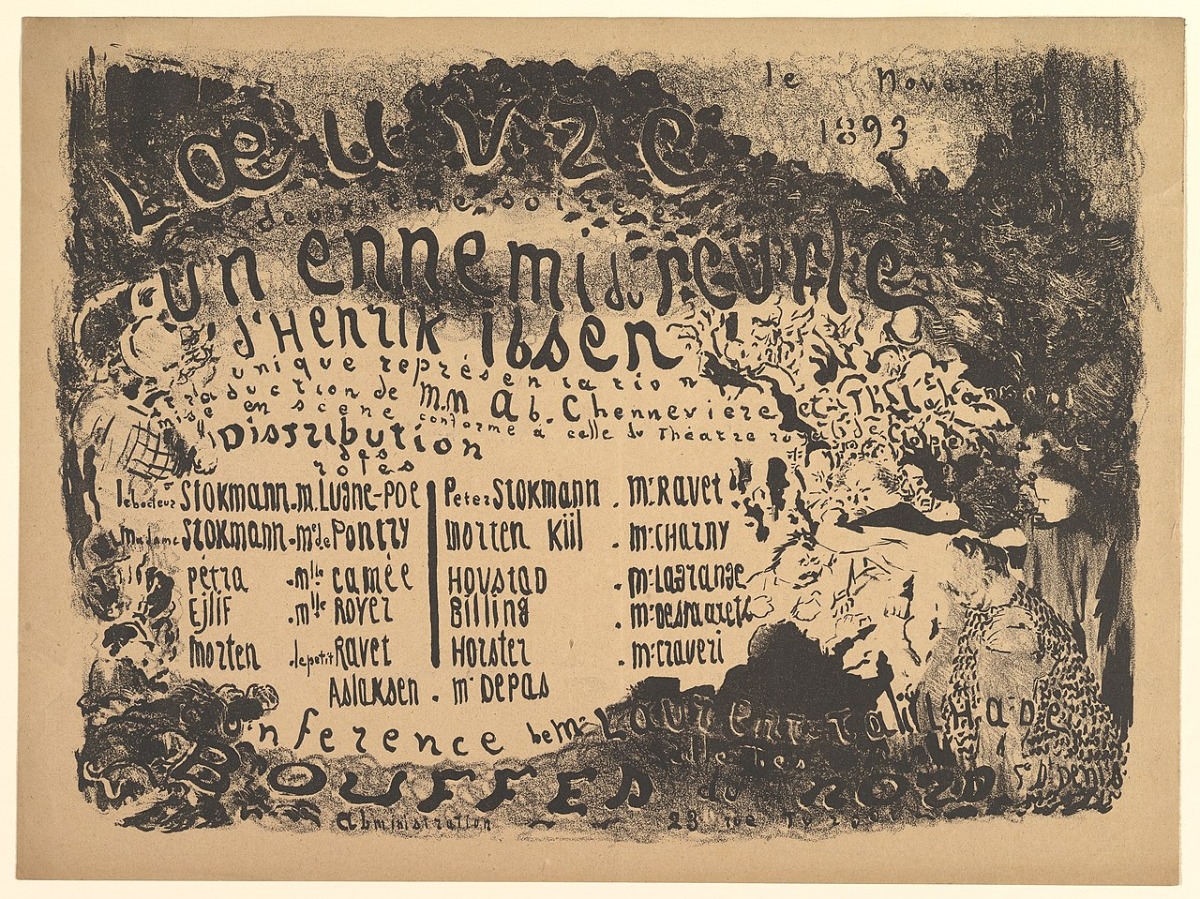
Édouard Vuillard, An Enemy of the People program for Théâtre de l’Œuvre, November 1893
Corruption
One interesting aspect of the allegations made by far right protestors is that our ruling classes is irredeemably corrupt, a view which aligns with left-wing, even Marxist, critiques of crony capitalism.
Although Henrik Ibsen was not an overtly political writer his An Enemy of The People (1882) explores a moral question pertinent to our times. In that play a prominent and well-connected engineer, whose brother is the town mayor, is asked to conduct a survey of the waters of a town which has become famous as a spa resort, attracting a great deal of tourism. When he tests the waters, however, he finds that they are polluted. He informs the town burghers and indeed his brother. In essence, he protests.
Rather than lauding him and complimenting him for a finely attuned sense of ethics and professional analysis, they turn on him with ever-increasing ferocity. He is told that he will destroy the local economy. He is named and shamed. His family is torn apart, and he becomes an enemy of the people.
This was also the fate of Jonathan Sugarman and Garda Maurice McCabe, among others, who have exposed serious wrongdoing in the Irish state. Interestingly, the arrests of those who speak out is also evident in Paul Lynch’s novel.
For Leo Varadkarto say that anyone involved in civil disobedience or protest requires disproportionate sanction is to fail to understand the right in question.
Jurgen Habermas, the greatest living intellectual on the planet, argues for the vital importance of civil disobedience in vitalizing a democracy. The question of civil disobedience has a long history. One of the first exponents was Antigone, who went against the will of the autocratic King Creon in Sophocles’s play in 430 BC, invoking a distinction between positive law and the law of God.
The right to civil disobedience has never featured prominently in Catholic theology and philosophy, as civil disobedience tends to be sacrificed on the altar of order publique. As Catholicism recedes in Ireland we are witnessing the advent of a new corporate theocracy imposing its own order publique.
But the right to disobey against tyranny is important, as Locke argued; Foucault also chastised what many writers have termed blind obedience, as did Hannah Arendt.
An intolerance of dissent is an increasingly feature of our age. In a recent book by Frédéric Gros Disobey! The Philosophy of Resistance (2021) the question of surplus obedience is canvassed. This is a surplus to requirements where one obeys for the rewards or pledges, assumed promises and out of a visceral sense of gratitude. This is what is called anticipatory obedience.
Leo Varadkar ought to recognise that not all protest is comfortable or right, but it is irrelevant at one level if the protester is misguided; he or she ought to retain a right to be a nuisance.
Towards the end of his career Ronald Dworkin wrote an article on the right to ridicule. Perhaps we should also emphasis the right to be a nuisance: for holding awkward opinions.
It should be stressed that the control of protest is also intimately related to the control of dissent. Thus, the dissident or conscientious objector is prosecuted as a deviation from an oppressive norm. Sakharov is imprisoned by the Communist state subversives. Religious mullahs prosecute Salman Rushdie. Thought censorship rules.
Anyone has a right to be a nuisance or a gadfly in a participatory democracy.
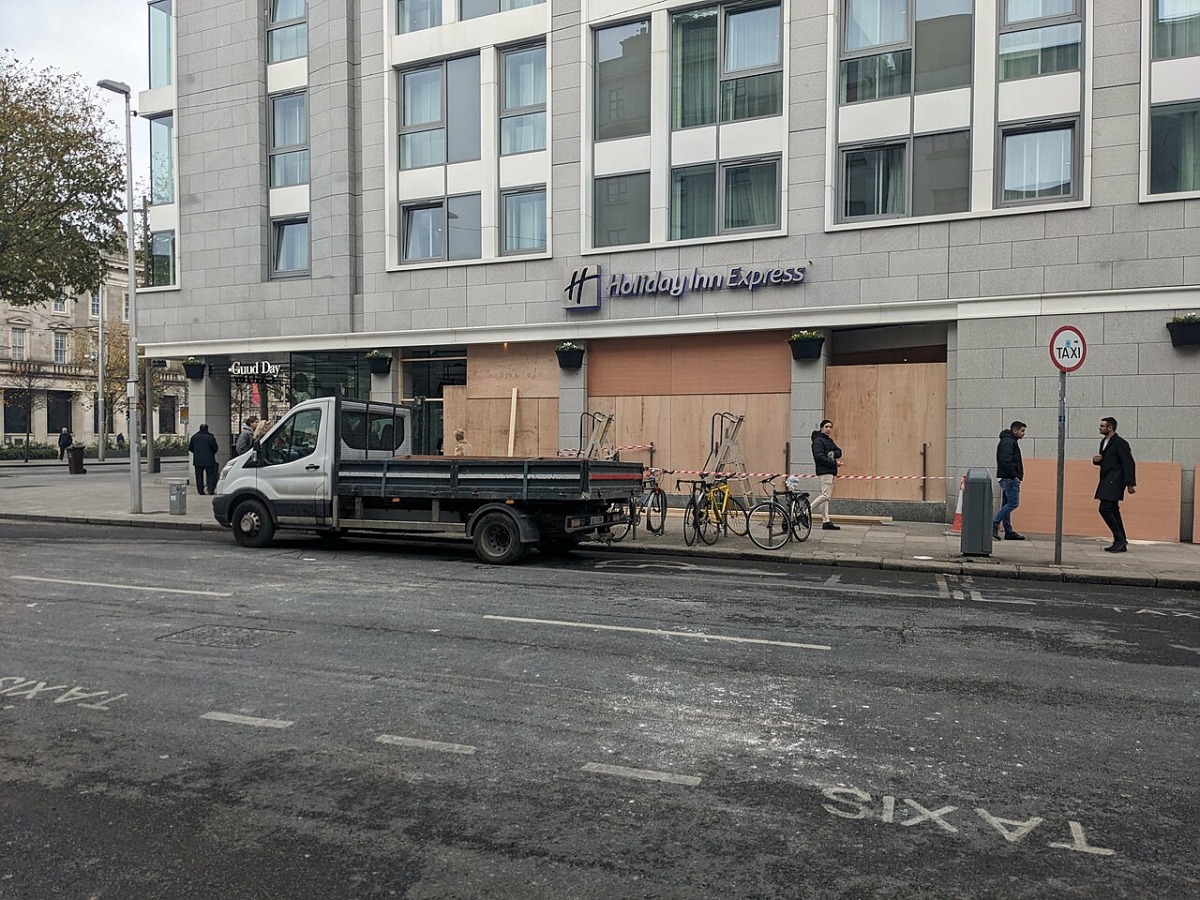
The Holiday Inn Express hotel in the aftermath.
Protection Against Hatred
The Gardaí enjoy the right and should be empowered to protect against hatred. If rioters spread hatred against transgender people, then the protest should be stopped, and they should be prosecuted. The same applies if they spread hatred and racism against immigrants. I am talking about thuggish racist behaviour.
There may be a legitimate argument that an indigenous community is being displaced, and even being rendered homeless. But this does not condone anarchical jihadism. The Irish government are to be commended, to some extent, for protecting refugees in temporary accommodation, but not for negating affordable housing and embedding corruption. People have a right to affordable housing and a decent quality of life in a state. The cost of housing associated with the presence of vulture and cuckoo funds fosters hatred in Ireland.
Through neoliberal policies and increasing state authoritarianism, the ruling parties have fostered far right Populism. In my view in moral terms there is little to distinguish many of the police enforcers from the protestors. You cannot claim the moral high ground to condemn unless you understand blame and responsibility.
Thus, in general, in what remains of our democracy, protest rights should be protected. People ought to have a right to say, peacefully, ‘I disagree’ with the government’s immigration policies, but without spreading hatred towards minorities, or attacking innocent bystanders.
The state has facilitated this promethean storm. The mob subscribes to fascists ideas, but it is within the architecture of the state security apparatus that fascism tends to emerge. Our government may not be overtly racist, but indifference to poverty and social exclusion has caused many problems and contributed to racism.
The police should not be granted any further powers than they already enjoy, instead the government ought to alleviate the social conditions that breed hatred. We in fact need another New Deal and not another fictional or reallatter-day Charles Lindberg leading us to Populist fascism as we find in Philip Roths fictional recreation of the 30’s The Plot Against America. It seems to me that the Plot Against Ireland is the twenty-four-hour mass surveillance.
So, it’s Thursday night in Dublin, I’ve found some Poitin, and am thinking of Shane MacGowan. How very sad it is that he’s gone. ‘A Rainy Night in Soho’ playing on the radio.
I had a funny connection with Shane.
His wife Victoria gave me a photo of her and Shane for an auction, to raise money for a battle against a semi-state body spraying pesticides.
I had to get it signed. ‘Come on over!’ Victoria said. Next thing I’m in their house, Victoria has scarpered, and I’m alone with Shane.
I’ve had the photo of them blown up and printed on canvas. Shane loves it, grabs it, asks me what it’s for, takes a green marker and scrawls, ‘Fuck Those F— Hypocrites! Love Shaney XXX’.
Wow.
Business completed, joints are rolled. Blue gin poured.
My head is melting.
My heart is too.
Shane talks poetry. Seamus Heaney. James Clarence Mangan. The Famine. The Rising. Have I ever been ‘strung out’?. Where do I live? With whom? I explain I’m with my children and their partners. ‘A commune!’.
Would I like some music? Absolutely I would. Shane leans over the arm of the sofa where he’s sitting to rummage through a box of CD’s.
‘I used to play with this band’ he says, shyly, ‘the Pogues’.
I want to jump up and hug him. I want to say everyone in the whole world knows the Pogues and your incredible music Shane!
‘That would be lovely’ I say. ‘I’d love to hear you and the Pogues’.
Shane looks around. ‘Hey Vic, give ‘er that’, he says, pointing to a floor tile on which he’s drawn the Virgin Mary.
In brightest greens and blues, Mary is standing, holding one arm up. ‘What’s she doing?’ ‘Calming her people’ says Shane. ‘And the little guy with a Kalsnikov?’. ‘He’s minding her’.
I’m unsure if I should take it. Victoria, who’s probably seen hundreds of items given away, is graciousness itself: ‘He’s delighted to give you something’.
I finally leave, my head ringing, thinking when I’d asked Paul McCartney if he’d sign a rare Beatles EP, a frosty PR company replied: ‘Sir Paul does not sign memorabilia’
Thinking how CRAZY it is that notorious hellraiser Shane MacGowan has just given me a picture of the Virgin Mary. On a floor tile.
And also, this thought: it’s the middle of the recession. I can’t keep asking artist friends for help. I’ll collect Virgin Mary’s instead. And sell them.
The Irish Museum of Modern Art IMMA made a beautiful print of Shane’s original, ‘Gra agus Beannacht’ added in Shane’s hand.
I was on my way.
I had to visit Shane and Victoria again to get the prints signed. Exhausted after a UK trip, Shane lined up something for himself and said: ‘Okay give me those fukken things’ then, gent that he is, signed them all.
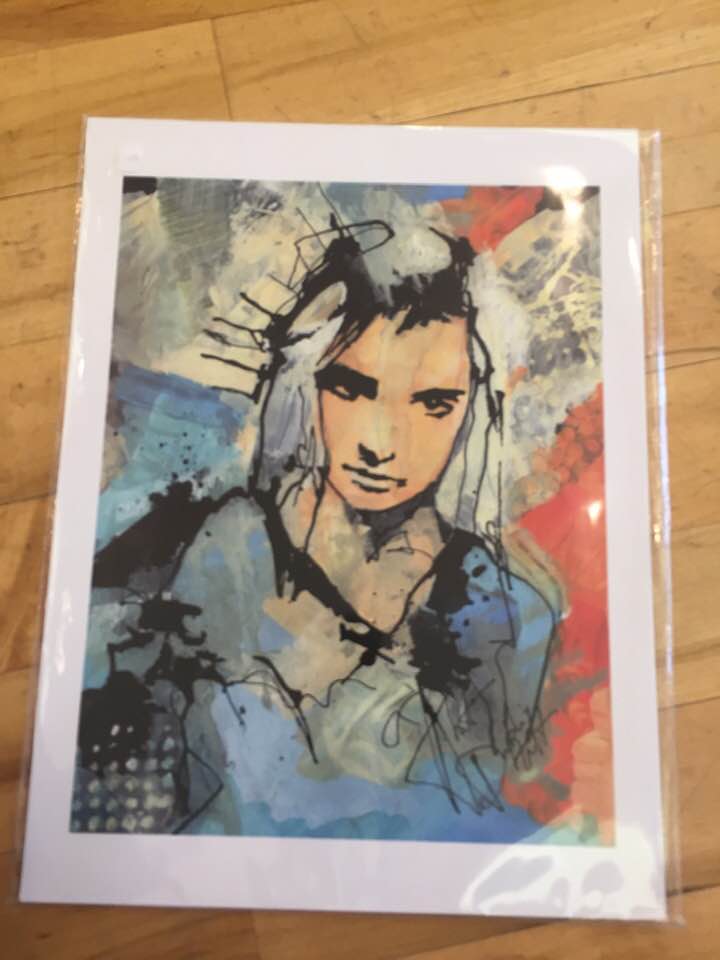
He and Victoria were guests of honour at our first exhibition of Virgins in the local Arts Centre. He the first to buy. A beautiful print of his beloved Sinead O’Connor as Mary by Aga Szot (who previously featured as an artist on Cassandra Voices). Nobody else moved. ‘Fukken tight fist fukken cunts’ Shane growled.
Truth be told, a Catholic boarding school girl, I’d never much liked Mary. She seemed cold. Distant. Pastel. Shane turned me on to a different one. A powerful female icon. A warrior woman, ‘Calming her people’.
With everything he cut to the chase.
‘I just wanted to shove music that had roots, and is just generally stronger and has more real anger and emotion, down the throats of a completely pap-orientated pop audience.’
He sure succeeded. He sure was loved for it.
He was beautiful. Impossible. Sensationally gifted. Honest. Punk. Sensationally sensitive. Spiritual. Political. Wild.
‘Gra agus Beannacht’ in the fullest measure.
He will be sorely missed in this ‘pap-orientated’ world.
The music was the code. It was the transliteration of the style. It was not giving a bollocks in a thoroughly musical manner. It was fuck this and fuck that and frankly fuck you. A rockety life came with the territory. You didn’t have to be Irish. Their England had been influenced by that Ireland of the 50’s. Behan, Kavanagh, O’Brien. Roaring Boys all. Drunken, rackety, genius bores. And Shane could be as drunk and boring and rackety or he could write as beautifully as any of them. Bob Geldof, Waiting for Herb, 2004.
Night Crossing
As the ferry lurched out of Dublin port we reminisced on crossings of yore. In response to regretful talk about the withdrawal of the service out of Dun Laoghaire – which at least had a rail connection – Shane MacGowan recalled, with typical belligerence, “Dun Laoghaire was there before a fucking DART line,” before hissing reassuring laughter.
He then spoke wistfully of his grandfather telling him about how ‘lower order’ passengers would have to share decks with the livestock on board. It seemed a very different world to a Stena Lounge bereft of passengers on this night crossing, but at least the wine was complimentary, and Tina didn’t mind a fewmessers on board.
Indeed, the aesthetic, or anti-aesthetic, of the Pogues was a throwback to a bygone Ireland – and Irish – often scorned by ‘respectable’ people. In particular, those compelled by economic circumstances to take up jobs ‘across the water’.
Shane MacGowan was born in Tunbridge Wells in Kent in 1957 to Irish immigrant parents, but spent his early youth living with maternal aunts and uncles in Puckane, Co. Tipperary. Formative teenage years were spent in 1970s London.
For the emerging poet, rural Ireland – for all its faults – seemed a fairy realm, enlivened by song and alcoholic excess, compared to the industrial decay and entrenched class system of England at that time. Having dabbled in punk with The Nipple Erectors he returned to his musical roots, forming the Pogues (from the Irish phrase póg mo thóin, meaning ‘kiss my arse’) in 1982.
He previously described the ‘Irish look’ the band self-consciously adopted:
The suits, black suits with white shirts which we wore, were Brendan Behan uniform and that’s why we chose them, not to look smart, but to look as if we could have come from any decade … We could have looked like people from the fifties, sixties, or seventies … we just looked like classic Paddies.[i]
Extended Fairground
As the night wore on, in particularly good cheer, Shane began humming a medley, beginning with the ‘Rocky Road to Dublin’, “When off Holyhead wished meself was dead / Or better far instead”, culminating in a vision of Irish inclusivity – at least before the men in the mohair suits moved in – at the ‘Galway Races’:
There were half a million people there
Of all denominations
The Catholic, the Protestant, the Jew,
The Presbyterian
Yet not animosity
No matter what the persuasion
But failte hospitality
Inducing fresh acquaintance
With me wack fol do fol
The diddle idle day
This evocation of carnival wherein social hierarchies disappear in joyful Bacchanalia helps understand what Shane MacGowan engendered with the Pogues during the 1980s: a two-fingered reaction to Thatcherism that helped define our Irish identity.
As the cultural critic Joe Cleary put it in Outrageous Fortune: Capital and Culture in Modern Ireland (Field Day, 2007) in the music of the Pogues: ‘The [Irish] nation is imagined as a kind of extended fairground.’[ii]
He adds, however, that with the Pogues: ‘this version of carnival is never allowed to become cosily celebratory because it is always shot through with sentiments of anger and aggression, sometimes strident, sometimes more muted.’[iii]
Hooliganism
The word hooligan derives from the surname of a fictional rowdy Irish family in a music-hall song from the 1890s. Later, applied to the antics of English football fans, steeped in post-imperial hubris, it took on angry connotations.
But the Pogues were all about the hoolie – a big noisy party – and unashamedly “Up the RA”, when it was still risqué to be so. Their song ‘Streets of Sorrow / Birmingham Six ‘refers to the plight of the Birmingham Six and Guilford Four and was censored by the BBC.
Their old school, rumbunctious hooliganism, fused elements of punk and traditional Irish music with the incantations that arouse from Shane MacGowan’s errant soul.
As Cleary puts it the Pogues, ‘merged the ‘modernist’- and ‘avant-garde’-coded aesthetics of punk with the ‘romantically’-coded idioms of the Irish musical forms.’
He argues:
For the Pogues to yoke together … the avant-garde future-orientated metropolitan aesthetics of punk, with the retro aesthetics of céilí and the broadly political edginess of the pub-ballad scene was an inspired act not only of musical synthesis but of semantic sabotage as well.[iv]
Alongside self-destructive excess there was something serious going on, ‘saving folk from the folkies’ as Elvis Costello put it[v], while asserting a brash, yet accommodating Irish identity – after all, many of the band were not even Irish – notwithstanding an unashamed approval of violent Republicanism, based on a long historical memory of famine, torture and resistance.
The success of the Pogues and Shane MacGowan – who transcended traditional Irish music to become a rockstar celebrity – may go some way to explaining an enduring, relative openness among Irish people to new cultural encounters – even multiculturalism – at least by comparison with erstwhile colonisers.
Like it or not, any witness to an average Saturday night in Dublin can testify to the presence of a carnival of sexual deviancy, donnybrooks and nonsensical pranks. This has become a generally inclusive ritual for Irish self-expression.
In The Dawn of Everything: A New History of Humanity (London, 2021), David Graeber and David Wengrow suggest ‘[t]he really powerful ritual moments are those of collective chaos, effervescence, liminality or creative play, out of which new social forms can come into the world.’[vi] That just about sums up the Pogues’ contribution to Irish culture.
After the Pogues, along with their precursors and followers, we would wear a distinctively wild Irishness as a badge of honour, invite everyone to the party, then regale each other with far-fetched stories of nights that should have ended sooner, at least before the cops turned up, when the fun really started.
The Big Red Fun Bus
With the Irish Sea bathed in pale moonlight on a blissfully calm night, conversation turned to Westerns. With a glint in his eye Shane reeled off his favourites – ‘The Life and Times of Judge Roy Beans’ (1972), ‘The Man Who Shot Liberty Valance’ (1962), “with Jimmy Stewart and John Wayne competing for the same girl”, and ‘The Searchers’ (1956).
But fittingly for a bard whose songs are steeped in tales of underdogs – like the navigators who ‘died in their hundreds with no sign to mark where / Save the brass in the pocket of the entrepreneur’ – his favourite was the more recent ‘Geronimo: An American Legend’ (1993), in which, unusually, a Native American victim is the hero.
By now the rest of our posse seemed to be asleep – it must have been passed 4am – but Shane’s mind was racing in this liminal phase. The high life of London beckoned and the rockstar in him was growing giddy.
We had another Brendan to thank for the drive to London. He and Shane’s full-time carer Elizabeth provide vital assistance and crucially, a sense of humour, in support of Victoria, Shane’s loving wife.
Once installed in the hotel room there was a chance for more songs, including a few Percy French ditties. Then an overlooked classic from his underrated period with the Popes: a homage to the nineteenth century poet James Clarence Mangan: ‘The Snake with Eyes of Garnett.’
It begins fittingly:
Last night as I lay dreaming
My way across the sea
James Mangan brought me comfort
With laudnum and poitin
The vision moves to the scene of a public execution being held on Stephen’s Green in 1819, before another crossing
If you miss me on the harbour
For the boat, it leaves at three
Take this snake with eyes of garnet
My mother gave to me!
The snake is a symbol of renewal, and for Shane perhaps the republican ideal. It also reveals his engagement with the literary canon. After all, he did once earn a scholarship to the exclusive Westminster public school.
He chimed in:
This snake cannot be captured
This snake cannot be tied
This snake cannot be tortured, or
Hung or crucified
It came down through the ages
It belongs to you and me
So pass it on and pass it on
‘Till all mankind is free
Contrary to the association of the snake with deceit and temptation – a phallic devil – according to Chevalier and Gheerbant’s Dictionary of Symbols, the serpent is ‘a continuation of the infinite materialization which is none other than primordial formlessness, the storehouse of latency which underlies the manifest world.’
It is an archetype representing ‘an “Old God”, the first god to be found at the start of all cosmogenesis, before religions of the spirit dethroned him.’[vii]
This becomes the moving spirit of another vagabond poet, James Clarence Mangan who as a Young Irelander renews the spirt of the nation, suffers and dies, apparently of malnutrition at the height of a cholera epidemic, but re-appears in spectral form.
He swung, his face went purple
A roar came from the crowd
But Mangan laughed and pushed me
And we got back on the cloud
He dropped me off in London
Back in this dying land
But my eyes were filled with wonder
At the ring still in my hand
‘this dying land’
Arriving in central London I am struck by the imperial grandeur. The scale and ambition of the architecture makes Dublin seem like a provincial town, but there’s a cold reserve that used to send a shiver down my spine when I lived here.
So many buildings appear uninhabited; unimaginably grand hotels seem more like fortresses with concierge-sentries posted outside to keep the hoi poloi at bay; uttering “can I help you sir,” with a snarl. We’d have to make our own fun.
The launch of Shane MacGowans’s art exhibition ‘The Eternal Buzz and the Crock of Gold’ took place at the boutique Andipa gallery in Knightsbridge, a stone’s throw from Harrods, where his art resides alongside that of Banksy’s.
Walking in I pass Bob Geldof, an unlikely presence, given his aversion to Irish nationalism, but he has credited Shane and the Pogues with awakening an interest in traditional Irish musical forms that he had previously disparaged.
In the relatively narrow confines of the gallery, with the king sitting contentedly on his throne, a carnival atmosphere asserts itself. He had escaped from all this, but that night he was enjoying a return to the crazy celebrity madness, which in England is built on a bedrock of aristocracy.
The champagne flowed, as minor celebrities converged – “he’s Liam Gallagher’s brother you know” – when the ocean parted before the eternal beauty of Kate Moss. A face to launch a thousand camera phones, and sell a few paintings.
Then on to Soho, where the weather at least remained dry. The police were even called. It took seven of them to take old Tom down, or so they say: never let the truth get in the way of a good yearn…
Critics
Acording to Joe Cleary:
Ever since the Great Famine and the Devotional Revolution, and especially when they came to power after the establishment of the Free State, the traditionalists had been concerned to make Irish culture more refined and respectable by filtering out, as ‘inauthentic’ or ‘degraded’, all its more licentious and anarchic or uncouth elements – those very elements that were to make such a whoopingly triumphant return of the repressed in the Pogues’ music.[viii]
In many respects, the unapologetic Shane MacGowan remains an embarrassment to the Official Ireland narrative, now principally articulated in the Irish Times, which inculcates a new breed of conformity that brooks no divergence.
Previously, Irish Times journalist Joe Breen suggested that his distaste for the Pogues resembled the attitude of contemporary African-Americans who preferred contemporary music to a musical tradition obsessed with the miseries of slavery and Jim Crow.
Breen’s reference to American culture betrays the apparent objective of many Irish neoliberal cheerleaders to establish a deracinated Americana in Hibernia, a tax haven for multinationals where the atmosphere of the carnival is strictly commodified. Here, Irish history is reduced to the struggle of modernisers against religious authority – with nothing in between – and where celebration of the national struggle is associated with Populism, or even an exclusive ‘white’ nationalism.
The art of Shane MacGowan and the Pogues offer a rowdy alternative to a creeping homogenisation. He endures, seemingly just to spite them, and even in the dying land he can still revive the spirit of the carnival.
In Dublin last week, riots and looting that broke out in the wake of a horrifying and inexplicable attack on three small children, and their carer, has been widely attributedto nascent fascism. We regard this as an inappropriate and, potentially, insidious suggestion; which is not to say that inflammatory anti-immigrant rhetoric did not fan the flames, or that repugnant and misleading ideas about a Great Replacement are not doing the rounds.
The historian Roger Eatwell describes the amorphous ideology of fascism as ‘a latter-day symbol of evil, like the Devil in the Middle Ages.’ It is a term now bandied about to describe all forms of authoritarianism, as well as nativism or racism, and everything in between.
What we can say about fascism, historically, is that it has arisen in circumstances of economic decline where a disgruntled pool of military or quasi-military personnel supported by the petit bourgeois – and a less apparent wealthy elite – adopt extreme nationalist rhetoric and scapegoat ethnic or religious minorities.
The association of fascism with the military or police has been crucial, as these groups are almost uniquely capable of overthrowing democratic governments and opposing worker movements that lack military training.
What we witnessed in Dublin last week is, in some respects, nothing new, but simply an amplification of a general lawlessness that has afflicted parts of Ireland’s capital city, in particular, since the period of lockdowns. It is also clear that mass immigration has generated serious disquiet among the indigenous community.
The crime that gave rise to the riot and subsequent looting, allegedly perpetrated by an immigrant, appeared to vindicate those who are opposed to immigration, but the looting that followed demonstrates that native Irish are quite capable of random acts of violence.
The simplistic use of the term fascism prevents us from diagnosing the real drivers of criminality in deficient education, homelessness and housing insecurity, a lack of community policing and rehabilitation of perpetrators of crimes.
The government ought to be addressing serious deficiencies in the delivery of public services rather than doubling down on hate crime laws, or extending the powers of the Gardaí, especially if we recognise how fascism really emerges. Apart from ameliorating the social conditions, the best way of confronting hatred of minorities is surely through rational debate.
One could be forgiven for thinking that certain elements within the Irish government are actually keen to see an anti-immigrant (far right?) political movement emerging as a political force in Ireland, as this could split the working class vote and deflects attention from their own failings.
Meanwhile, mercifully, we have seen an interruption to Israel’s incursion into Gaza. Earlier this month Fra Hughes speculated on whether US support for Israel’s war on Gaza acts as a veiled threat to any nation considering joining a fledgling multi-polar world order.
Also Dr. Billy Ralph argues that moves by the HSE to measure health metrics in G.P. practice serves the interest of Pharma, and could foreshadow a dystopian future.
David Langwallner suggests that older artists generally repeat earlier tropes or descend into irrelevance but finds this is definitely not the case with the Rollings Stones‘s latest album.
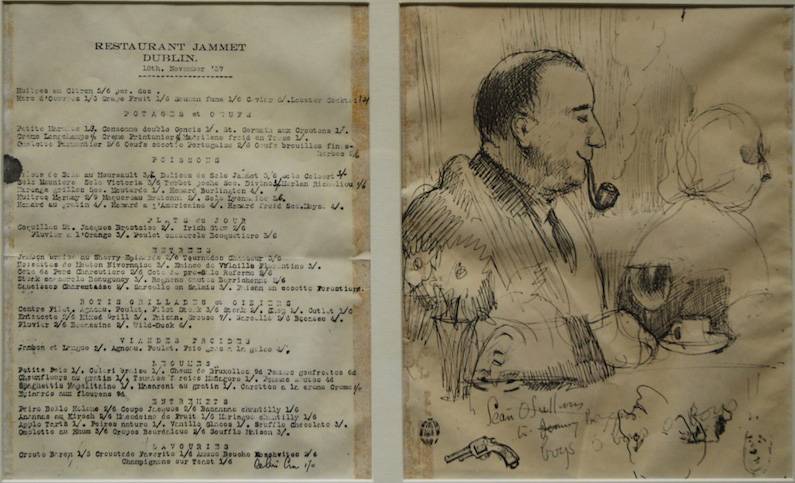
Frank Armstrong reveals that Irish restaurants served as a forum for both Nazi sympathisers and opponents of the Reich, while Jammet’s may have had the finest French cooking in the world.
Musician of the Month Lewis Barfoot admits to loving winter. She finds the stillness and darkness supportive of creative work. Her new album HOME is out today.
And finally, “Love keeps a record of you singing to yourself, / tallies your tears.” No Record of Wrongs is a new poem by Haley Hodges.
Dublin was the second city of the British Empire until end of the eighteenth century. After the Act of Union of 1801, however, many prosperous land owners departed the city and, indeed, by the end of the nineteenth century Belfast’s population was greater.
The former did, however, retain a residual aristocracy who formed the clientele for the few restaurants that emerged towards the century’s end; albeit, the absence, of a significant bourgeois class over the course of the twentieth century meant there was little demand for restaurants for those on middling incomes.
It was perhaps unfortunate for Irish gastronomy to have been colonised by the English who Voltaire described as being a nation of forty-two religions but only two sauces. Besides, Ireland was a poor country by European standards in the nineteenth and much of the twentieth century. The Great Famine was among the most devastating of its kind in human history. Culinary celebration was muted.
Nonetheless, numerous French chefs had already emigrated to Ireland to work in aristocratic households and gentlemen’s clubs by the time the first recognisable restaurant emerged in Dublin in 1861. The Café du Paris on Lincoln Place was intriguingly linked to a Turkish baths on the same premises. They advertised both dinners ‘a la carte and table d’hote; choicest wines and liqueurs of all kinds, [and] Ices.’
Jammet’s
Any history of Dublin restaurants lingers on the legendary Jammet’s which was founded by two brothers from the Pyrenne,s Michel and Francois Jammet in 1901. They purchased the Burlington Restaurant and Oyster Saloon on Andrew’s Street in 1901 and renamed it Jammet’s. Michel had been chef to the lord lieutenant so knew all about what appealed to the aristocracy whose descendents continued to patronise the establishment until its demise in 1967.
In 1908 Francois Jammet returned to Paris leaving his brother in sole charge until 1927 when he handed the reigns to his Belvedere educated son Louis. By that time it had moved to Nassau Street to the site of the Porterhouse Central.
One observer from the 1940s describes the interior of the restaurant: ‘the main dining room was pure French second Empire, with a lovely faded patina to the furniture, snow white linens, well cut crystal, monogrammed porcelain, gourmet sized silver-plated cutlery and gleaming decanters.’ It was the hangout for artists and the literary set such as W.B. Yeats, Michael MacLiommar and Dudley Edwards as well as wealthy professionals and men of commerce.
The family first lived in Queen’s Park, Monkstown but moved to the sixteenth century Kill Abbey in the 1940s where vegetables were grown for the restaurant. A 1928 article in Vogue describes Jammet’s as ‘one of Europe’s best restaurants … crowded with gourmets and wits, where the sole and the grouse was divine.’
It was during the years of the Second World War that Jammet’s really came into its own as the location for the ‘finest French cooking between the fall of France and the liberation of Paris.’ Like other Irish restaurants, Jammet’s managed to evade restrictive rationing and serve customers the fare they were accustomed to. According to one observer ‘American servicemen, cigar-chomping and in full uniform, were streaming across the neutral border to sample the fabulous food in the prodigious quantities available here.’
Red Bank
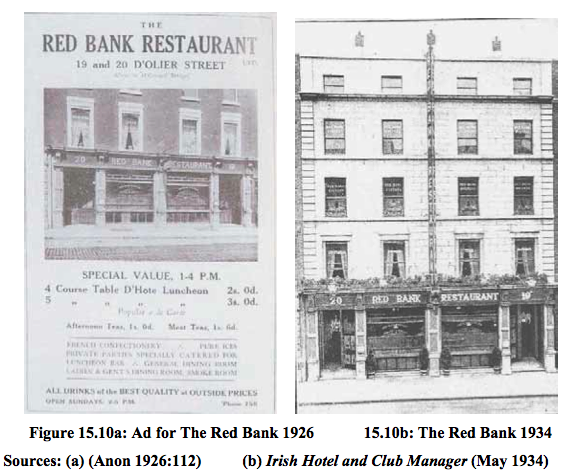
If Jammet’s was the location for Allied excess another long-established restaurant the Red Bank was the place of Axis intrigue. On April 22 1939 the German colony in Ireland celebrated the birthday of Adolf Hitler there. The Irish Times records: ‘A large portrait of Herr Hitler occupied special position in the special decorations. On either side of it were swastikas and every guest wore a swastika or Nazi party badges.’
Disturbingly in May 1940 as the Nazis Blitzkrieged through Europe, the ‘Irish Friends of Germany’ (aka the National Club) held a meeting in the restaurant that was attended by fifty people. George Griffin, veteran anti-Semite and ex Blueshirt, spoke on the subject of the ‘The Jewish Stranglehold on Ireland’. Griffin mentioned many Jews by name and went onto advocate that … we should never pass a Jew on the street without openly insulting him’.
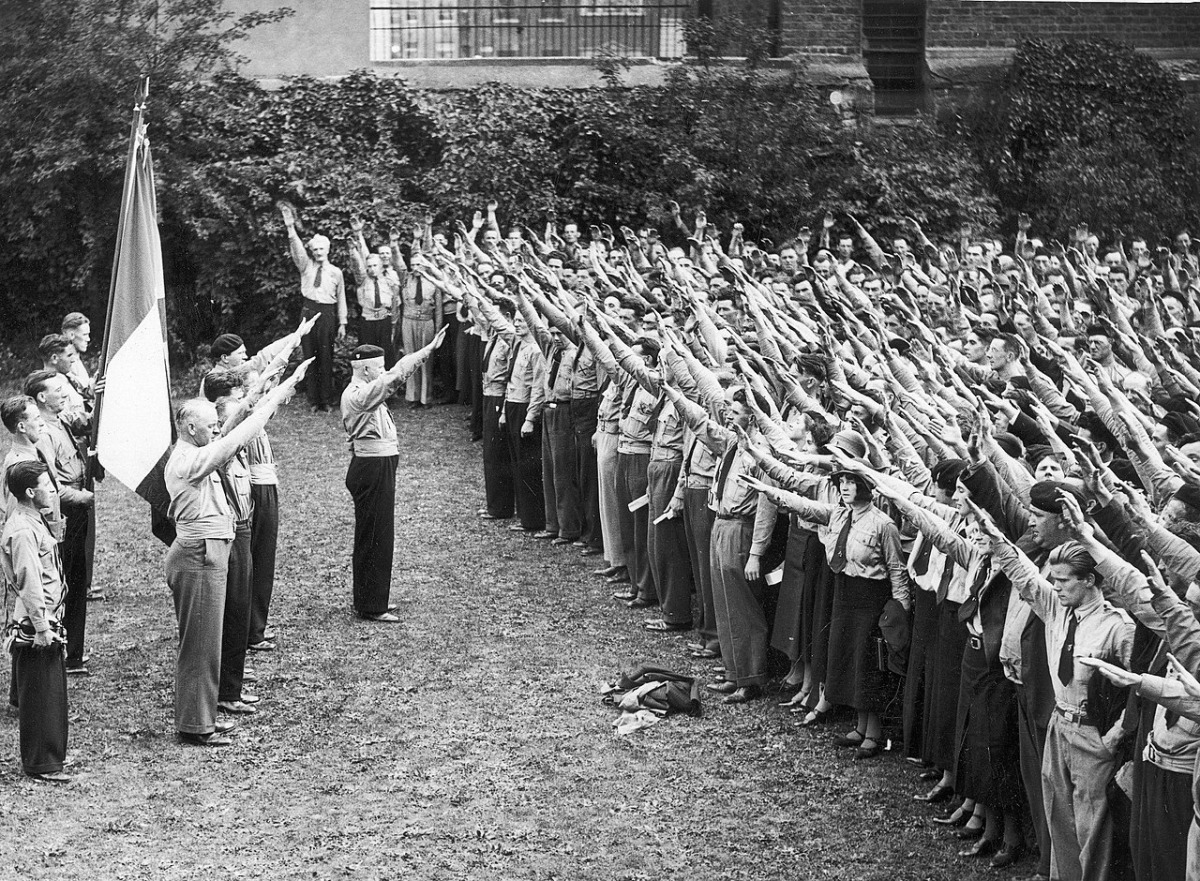
The Blueshirts salute their leader Eoin O’Duffy.
The Unicorn
But Jewish émigrés were themselves involved in the restaurant trade and could dish out their own retribution. It is said that revenge is a dish best served cold but for Austrian Jews Erwin and Lisl Strunz from Vienna it could be salty too.
They escaped from Vienna in 1938 and purchased a premises on Merrion Row which they called the Unicorn. They bought it for a song as Irish people thought the premises was haunted after W.B. Yeats had supposedly conducted séances there.
Lisl would cook her mainly Austrian dishes while Erwin entertained at the front of house. He reminisced ‘during Christmas 1940 when all the lights had gone out over Europe I played my guitar in the restaurant and sang Christmas carols and folk songs in eight languages.
But not all comers were welcome. When Edouard Hempel and his acolytes from the German legation visited Erwin became apoplectic with rage. But he kept his wits about him and calmly took their orders. Before each plates was delivered he doused each one with enough salt to clear a frosty driveway. Hempel nearly choked and the whole table walked out and never returned.
After the war the Unicorn was sold to an Italian family the Sidoli’s and it brought exotic ingredients like pasta to its Dublin clientele. It also involved females chefs which was unusual for the male dominated profession in Dublin.
Another immigrant who came to Ireland to work in the restaurant trade was Zenon Geldof a Belgian citizen who set up a restaurant called Café Belge. His grandson Bob retained an ambition to feed the world.
Steeped in the haute cuisine tradition of Escoffier Jammet’s continued to prosper after the war when it was joined by other restaurants including The Russell.
Ireland’s first phD in the history of food, Máirtín Mac Con Iomaire argues that on a per capita basis in the 1950s Ireland was the gastronomic capital of the British Isles. Although this may not have been that great an achievement as given the nadir that English food had reached by the 1950s. Elizabeth David wrote of her experience in one English restaurant of the time: ‘there was no excuse, none, for such unspeakably unpleasant meals as in that dining room were put in front of me. To my agonized homesickness for the sun and southern food was added an embattled rage that we should be asked – and should accept – the endurance of such cooking.’ Perhaps she should have visited Dublin.
I grew up in Walthamstow, London listening to my Dad play finger-picking folk covers on the guitar and banjo and to my Mum’s very small record collection which we would play on repeat and dance around to in the lounge. I especially remember The Seven Drunken Nights by the Dubliners which me and my sister found an absolute gas to sing along to. I didn’t learn to play instruments as a child, I wasn’t allowed to play my Dad’s and he never taught me per se, but hearing him sing and play and look so happy put the music in my bones.
In 2002 I went to drama school and went on to sing in plenty of theatre shows during my acting career. One of the highlights was a cute children’s show for which Kerry Andrew wrote the music. She has been a dear friend and collaborator ever since.
In 2013 I went on a world tour of 1927’s production of The Animals and Children Took To The Streets. It was an amazing show, a fabulous experience as we toured twenty-one countries in eleven months. But I was bored creatively. I felt like a puppet performing someone else’s work and my soul was calling for more. So I decided to write a song in every country with no expectation of the outcome. At the end of that tour I decided to leave acting and focus on music. I took a three month songwriting sabbatical, picked up a guitar and taught myself how to play and went to release my first EP “Catch Me” in 2015 which contains five songs written on the world tour. This is the title track written in midsummer in St Petersburg.
I then went on to learn piano and built a band around the music and released my first album ‘Glenaphuca”, which spoke of my call to Ireland to embrace the Irish part of my heritage. This is the first song on that album.
Right now, on the first day of November 2023, I sit on the cusp of the launch of my sophomore album “HOME”, which is out in two weeks. It has been a deep dive into healing the legacy of pain and shame that I inherited from my female ancestors here in Cork. The album sheds light on a dark past of institutional incarceration, delicately transformed into a collection of beautiful songs. It is my intention that “HOME” holds the power to heal the wounds of the past and inspire future generations to live without fear.
The songs are a mixture of ethereal folk ballads, rousing anthemic tunes, traditional folk song from Ireland and the UK, a touch of blues and a stirring a-Capella choral finale called Ancestors. I was so lucky to have my pals Kerry Andrew, Ben See, Sarah Dacey, Essa Flett, Justin Ground, Brén Ó Rúaidh, Ellis Kerkhoven and MaJiKer sing this song with me.
I’m about to go on tour in Ireland with the album starting at Whelan’s in Dublin, which I am super excited about, then onto Cill Rialiagin Kerry, before returning home to Cork for two fabulous dates at Sirius Arts Centre and The Oar.
In the new year I will head back to my studio to start birthing the third album. I love winter. I find the stillness and darkness supportive of creative work. In my songwriting phases I like to section my day into little bursts of activity, something like; thirty minutes of songwriting, thirty minutes of classical guitar, fifteen minutes of piano scales, dance for three songs, fifteen minutes of clearing out old audio, then another thirty minutes of songwriting, play five songs, go for a walk, thirty minutes of songwriting and repeat.
If I have a song coming through, I could easily spend the whole day working on it and do nothing else, but a regular practice keeps me steady and in flow. And when a song is coming through I just have to honour that or else I may miss it. It is like catching a wave. So I could literally be swimming in the sea and a song lands in me, so I’d have to jump out and get it down on my voice memos.
Next year I hope to get a bit more independent and capable at recording my own material at home. I’m looking forward to that a lot. And I’ve just bought a lush Stratocaster which I’m gonna throw my fingers into next year.
The theme of ‘late art’ was recently explored by the art historian Carel Blotkamp in The End: Artists’ Late and Last Works(2019) focusing on the visual arts, but in an age nonspecific way.
Raphael’s ‘Transfiguration’ is central to the argument of the book. After Raphael’s death, the author notes his body was laid out beneath the painting in his studio. Vasari tells us that ‘the sight of his dead body and this living painting filled the soul of everyone looking on with grief.’
Raphael died aged just over thirty years of age. Picasso in a much later blasphemous parody had Raphael fucking. More on Picasso and indeed fucking later. This is an article about The Rolling Stones after all.
More representative of late art in literary terms is Thomas Mann’s Doctor Faustus 1947, which was written when he was nearly eighty years of age, and was his second to last work. The last being Felix Krull, both of which were discussed in a previous article for Cassandra Voices. In these works his style loosens and is fresher than his earlier work. I attribute this revitalisation to his hatred of fascism and fakery.
Both of these books were written in old age when the light was dimming, which is remarkable. Great art arrived against the odds, with physical and presumably mental powers failing. Like Michelangelo finishing off the frescoes in the Sistine Chapel with the Last Judgment or even more so the late sculptures.
Picasso approaching ninety, as the aforementioned book references, famously started working faster and faster, painting in a sketch-like figurative way: parodies, exhumations of the western tradition such as by Valazquez Los Meninas; in contextual or parodic form; painting as ideas with the clock against him. He famously said in this respect: ‘I have less and less time, and yet I have more and more to say.’
Well, what a drag it is getting old.
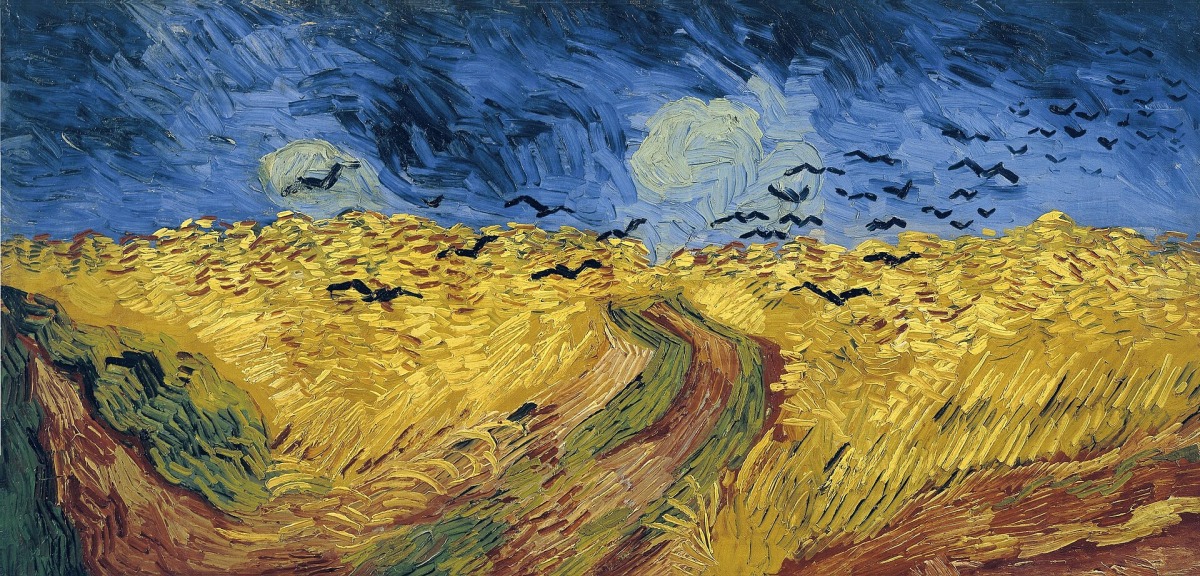
heatfield with Crows — oil on canvas 101×50 cm Auvers june 1890.
More commonly…
But Mann and Picasso are uncommon. More commonly, artists repeat earlier tropes or descend into sentimentality, commercial opportunism or simply kitsch as they age. The late works of Marc Chagall and Salvador Dalí fall into these categories. Opera Designs or endless recycled Kitsch is very evident in the Dali Museum in his hometown of Figures.
The phrase ‘late style’ is also relevant in this context and is, in fact, culled from Theodor Adorno’s 1937 essay on Beethoven. Adorno – and, more recently, Edward Said, whose own last book was on late style – both suggest in a distinct echo of Picassos observations that regularity, precision, and tidiness no longer matter when an artist is faced with death. The writing and painting become more scabrous, irreverent with a lightness and incompleteness but also harrowed.
One thinks above all else of the finest achievement in the history of art the late paintings of Rembrandt, where the artist is merciless in self-portrait particularly his damaged and aged eyes. Though the formal precision is, remarkably, retained. Another notable achievement is in the late work of Goya, his Black Paintings In particular. These are visceral images of human torture, misery, cannibalism, and insanity.
Adorno wrote that late art or style ‘does not resemble the kind one finds in fruit. They are not round, but furrowed, even ravaged.’
Many great artists of course die young and without the necessary anticipation of doom. Egon Schiele tragically dies in the ‘Spanish’ Flu Pandemic of 1919-1920. The Romantic poet Percy Bysshe Shelley drowned after a boat accident. So, the suddenness of a departure does not affect the art for good or ill.
Van Gogh hadn’t reached the age of forty, when he died, but the Wheatfield with Crows is one of his greatest works, the crows above providing a doom-laden portent. In contrast, the truly writer of The Great Gatsby F. Scott Fitzgerald was dead by forty-four having been dismissed as a burn out and a has been. He had felt compelled to hack for money, with the Pat Hobby stories. As he said there are no second acts in American life, although Donal Trump might disagree!
Some artists try and go out on top before retreating into isolation. Neither Harper Lee nor the reclusive J. D. Salinger published much after To Kill Mockingbird and The Catcher on the Rye.
We might tentatively say that generally the best work comes first or close to first, before decline sets in, often with coincident celebrity and accolades. The philosopherJürgen Habermasonce remarked that when they shower you with awards you know you are finished. Stressed vines make the best grapes by all accounts.
In this respect The Nobel Prize is often the kiss of death for creativity. Exceptions to that rule are of course Gabriel Marquez. He wrote as good if not a greater novel than One Hundred Years of Solitude (1967) after the award with Love in The Time of Cholera (1985). And then there is the incomparable Samuel Beckett, about whom more later.
Kurosawa the great Japanese film director was effectively persecuted by the Japanese state by being snubbed at awards ceremony. Suicide attempt followed, and but for the intervention of Steven Spielberg and George Lucas he would not have gone on to produce a work as incandescently brilliant as Ran, his Samurai adaption of King Lear, which is one of the greatest films of all time that he completed at nearly eighty years of age.
Better to burn out…
In Rock music there is a discernible trend in late art achievements. Leonard Cohen’s late albums include Old Ideas (2012), which includes the sublime song, or poem, ‘Going Home’. And Bob Dylan’s Rough and Rowdy Ways (2020) is a continuous flow of genius.
But both Dylan and Cohen were geniuses and not a bunch of blues-thieving, decadent often priapic monsters with a not undeserved reputation for all sorts of destruction of many of those around them.
Giving them their begrudging due, the shows are of course truly spectacular, as anyone who had the privilege of witnessing them in Glastonbury would attest.
The youthful audience, and some bemused older curiosities, largely came to bury Caeser, or Satan, but Sir Michael will not be buried easily and strode on stage in red barbed devilish gown, 28-inch waste and barnstormed, not least with sympathy for the devil.
Well yes, a tour band par excellence re-threading their hits from the 60’s and early 70’s and producing nothing of note in over two decades of self-enrichment. Bigger and Bigger Bangs of the same thing. Outrageously reliving their satanic rebelliousness. Funding Keith Richards drugs, albeit no longer indulged in apparently, and Mr Jagger’s endless libido – growing old as disgracefully as possible. Aged eighty, he is married to a woman almost fifty years younger. The lucky sod.
But the artistic community could rest assured there would be nothing further. No further trouble.
And then it landed ‘Angry’, the opening song of their recent studio album, Hackney Diamonds, a better starter I think than ‘Start Me Up’ and a better song than ‘Shattered’. Propulsive not 1970’s but 60’s revitalised and pared down. And Mr J. certainly sounds angry.
And so, three well preserved and ostensibly vigorous elderly gentlemen in casual costume get in touch with their north London roots and step fearlessly into Hackney, which of course they never hailed from, to introduce a brilliantly named album Hackney Diamonds, with a glorious smash and grab cover.
By any reckoning it ought to have been a re-thread or a bombastic disaster. But is simply a great rock n’ roll album. In my view the best pure rock and roll album since The Clash’s London Calling with a not to dissimilar mining of styles. It even includes a punk song with Paul McCartney on bass, who seems like he was having a ball with the band he had recently described asa Blues cover band. But what a cover band!
Burst of Blues Energy
The bursts of blues energy with at most one longueur is sustained through its forty-five propulsive minutes. The best comparison in terms of form and antecedents is Exile on Main Street, with the odd ballad mitigating the relentless noise. There are many great or near great songs. There is a rose in Hackney and not just Spanish Harlem. OMG.
In ‘Sweet Smells of Heaven’ Jagger sounds as great as in ‘You Can’t Always Get Want’ and ‘Angie’. In short it is one of the greatest ever Rolling Stones songs. Whether it ranks in the top ten is a matter for debate. In my view very close to the absolute pantheon Sympathy For the Devil.
Notably Keith Richard’s is in flying form. I wonder is arthritis loosening his playing style?
Geoff Dyer has recently published a book called The Last Days of Roger Federer and it is not intrinsically about Federer though he was also an artist but is about the dying light augmenting the enormity of the achievement.
Sir Michael who prompted the album to stir the wild beasts from their slumber now suggest they are three quarters way through a new album. A sense of enormous anticipation should now prevail. One hopes though it is not a set of discards and out takes.
Hackney Diamonds would be an incomparable way to put a full stop, but what if the next album is even better? After all, The Beatles in their pomp followed Revolver with Sgt. Pepper’s Lonely Hearts Club Band, but that is now almost fifty years ago. Let us be clear Hackney Diamonds is the greatest stones album in forty years.
They have ascended the charts in Britain and the USA In a way unprecedented since their heyday. And methinks Mr Richards will not be thinking about the money. One senses that old rubber lips thinks the best is yet to come and will force them back into the studios. No pressure then lads.
Love does keep a record of some things—
your solitary walks in Coln Saint Aldwyn’s,
a precise curl of Virginia Creeper tendrils,
vermillion in autumn, the way you carefully
smelled horses’ necks beneath the mane back home,
velveteen crushes of cornhusks lashed to lampposts
Love notes you’ve yet to find a Petoskey stone,
have not managed to secure passage
in a hot air balloon at dawn. Love traces
those scars left by its own sweeping hand, marks
your fevered night-sky relish, your strange enfolding
of language in language and the red-winged blackbirds
enfolding themselves in blue-green marsh
Love keeps a record of you singing to yourself,
tallies your tears. Love folded a page corner
the day your shoulders sank like the horizon,
from a grey-salt schooner, love knows how
you should be touched.
No seeker of wrongs will read
love’s record, nor ask for it
let love’s book be freely shown
When the Irish government via the HSE (Health Services Executive) introduced a Chronic Disease Management programme into general practice, and offered to pay G.P.s for running with it I thought that at last Irish general practice was moving away from its original reactive model and embracing a NHS-style piece work-approach.
We could now show our paymasters what we had done during the working day, not unlike the majority of ordinary people who work for a living. How very plebeian.
As mentioned, a version of this system already exists in the U.K., having been introduced in 2004, against much resistance from the usual suspects. However, once income rose by 25% within a short period of time, a mouth full of gold seemed to make it impossible for anyone to grumble very loudly.
It didn’t take long before problems became apparent, as G.P.s focused on the work that generated most income, waiting times for appointments increased. The government required large amounts of data, so administration workloads increased; a tension thus arose between the demands of actual general practice and that of the masters they served.
That last point needs a little clarification. In the UK the software most commonly used is EMIS. Once a consultation begins, EMIS makes certain demands of the G.P. on behalf of the Department of Health, which appear on the computer screen. The G.P. is paid based on the responses given to these demands, not on what the patient needs, wants or demands. The poor G.P. is now serving two masters, one of whom values metrics, the other maybe just some empathy. But the former pays the bills. Having worked and trained in the U.K., I soon became aware of the grumblings of family doctors and the frustrations of patients.
We now have a similar system in Ireland. It would be nice to think that this will improve the lives of patients and outcomes, and not just increase the incomes of G.P.s, the pharmaceutical industry and any other entities that benefit from illness in society. In the U.K. the evidence would suggest that the management of chronic diseases was improving pre-2004 with the introduction of national and international guidelines and the use of clinical audits in practice.
No Difference to Mortality
There is some evidence to suggest that the management of specific conditions such as asthma and diabetes did improve after 2004, especially in lower socio-economic areas resulting in less emergency admissions, but there appears to be little or no evidence that it has made any difference to mortality.
Having written that last sentence I’m not sure I fully understand it. I’m assuming that the conditions being paid for improved, as per the metrics. Or did it just look good on paper but not translate into increased longevity for the patient?
I wonder who benefits from gathering metrics, moving them up or down, using them to diagnose and prescribe? I suspect there is a health benefit for those suffering from chronic diseases. They see their G.P. regularly and are told at least twice per year that they ‘could do better’, are given more medications and the promise of a dietitian, physiotherapist, occupational therapist or perhaps the mythical unicorn of the health service, a psychologist.
But what are we really doing with this programme which, since 2022, provides ‘opportunistic case finding’, AKA finding customers for Pharma?
As G.P.s we are incentivised to find and manage illness, not return people to health, we maintain the status quo and consider our roles to be central to the process.
I would argue that we are central because without G.P.s the pharmaceutical industry would experience a profit crushing bottleneck. We therefore accept their ‘educational’ courses and their biomedical model of illness as a unidirectional process. Nowhere do we engage our patients in the fundamentals of health, such as how to breathe, sleep, eat, move and connect with others. Strangely, these crucial determinants are seen as by-the-ways, not fundamentals.
We have a society where the state we call health is detrimental to the wellbeing of the shareholders of the large pharmaceutical companies based here.
Fat Boy Slim
For many the Mediterranean lifestyle consists of a takeaway pizza and imported Spanish beer consumed whilst wedged into a Fat-Boy recliner watching perfectly coiffured people extolling the virtue of the Mediterranean lifestyle.
When watching sports becomes the nations favourite activity; when luxury, ease and relaxation, are lauded ambitions; when a narrow STEM education is promoted over the breath of the arts, is it any wonder that we have become a society of vacuous, soft-shelled and compliant serfs?
Maybe we need a dose of Hobbesian reality, to go with our morning lattes, and make us realise that we won’t be protected from the ‘solitary, poor, nasty, brutish and short’ life by accumulating ‘likes’ ,’followers’ or virtual friends on social media. Alas, we are creating William Blake’s ‘mind forged manacles’, as we shackle ourselves to a beast that cannot be satiated.
In my view the simplistic associations that we are developing between metrics such as blood pressure, cholesterol etc, the remuneration of doctors and alleged health outcomes is a road leading to obsolescence of G.P. practice, as AI (Artificial Intelligence) can do this far more efficiently and quickly than any human, and it won’t take ten years to train it to perform the role.
When we structure a health service around metrics, data and finance we are defining these as our goals. Lip service is paid to actual health. These numbers then become a society’s hallmarks of health.
Systems of Control
It doesn’t take too much of a stretch of the imagination to link all possible systems that use metrics to make decisions about human beings and turn them into systems of control.
The Internet of Things will in theory provide this interconnectedness so that our financial, health, consumer and in some circumstances political data can be knitted into societal straitjackets, for our own good of course.
Yuval Noah Harari has made a career frightening the pants off people on this subject. And Mustafa Suleyman in his book The Coming Wave documents the alarming power the already all-pervasive influence of AI, and what it might be in the future.
For those of us who enjoy chaos and unpredictability this is, to coin the exhausted hackneyed phrase, dystopian but if one is of an authoritarian bent, or just has a deludedly ‘in control’ mindset, this shouts out as an opportunity to create a barcoded Nirvana.
We could control everything from what people eat, what they wear, how far they drive, how much they move, physically, and even who they associate with, using personalised algorithms.
The technology already exists. Ubiquitous facial recognition technology, central bank digital currency, social credit scoring systems, wearable devices that record movement and supermarkets that would allow purchases of the ‘right’ sorts of goods for you if you are the ‘right’ sort of person for that product. This could all be linked to one’s current PPSN (Personal Public Service Number).
What could be simpler. A benevolent government could ‘incentivise’, initially, the consumption of the ‘right’ foodstuffs, consumed in the company of the ‘right’ people, whilst watching the ‘right’ types of programmes followed by the ‘appropriate’ amount of exercise.
Brave New World?
Wouldn’t that be such a healthy world? We could prevent obesity, under-activity, mindless viewing of soaps, loitering, even voting for the wrong candidate!
The preceding description is one of an idealised world, in which those in power have our best interests at heart, but it could have a darker side.
A healthy population would be bad for business and business owns politics through a process euphemistically termed lobbying. There is something malodorous about the funding of the main regulatory bodies in for example the pharmaceutical industry. The FDA in America, EMA in Europe and the TGA in Australia are over 70% funded by the industry they are charged with regulating.
Not only is the fox in charge of the chicken coop but he also has the farmer in his employment. This leaves us chickens stuffed and roasted and, perversely, eternally grateful.
A truly nefarious government influenced by business might even encourage the production of foodstuffs that make us ill, whilst our minds are hijacked by media that have the intellectual value of chewing gum. Meanwhile our bodies convert the ‘food’ into surplus, never to be utilised, into fat.
A few decades of this and we are ready to invite another business into the rest of our shortened existence, the erroneously named, health industry and all it has to offer.
As a species we would only have value as consumers, passed from one corporate entity to the next for, for the seventy or less years that we spend on this Earth, our value measured accurately at each stage by metrics dictated by the needs of the individual corporations.
Thankfully such a scenario is only found in dystopian science fiction.