As we witness the barbaric bombing of Gaza by Israel, and as the deaths and horrific injuries of civilian men, women and children rise exponentially, it is necessary to ask: who (apart from the Israeli government) is behind this murderous campaign?
Over decades the United States has liked to portray itself as an honest broker in an intractable conflict between Muslims and Jews, or Palestinians and Israelis.
Nerguizian emphasizes that the current deployment is ‘not intended to be used in an offensive role.’ However, he acknowledges that this could change quickly if Israel finds itself in a ‘total, 360-degree conflict’.
Meanwhile, in the West Bank illegal Israeli settlers have increased their attacks on isolated defenceless Palestinian villages, murdering one farmer collecting his olive harvest and leaving leaflets on cars and bloodied dolls at schools, warning Palestiniansto leave or be killed. We appear to be witnessing a third wave of expulsions, following in the footsteps of 1948 and 1967.
Indeed, even the New York Times is reporting that attacks on Palestinians in the occupied West Bank are surging. At least 115 have been killed, more than 2,000 have been injured and nearly 1,000 others have been forcibly displaced from their homes because of violence and intimidation by Israeli forces and settlers since Hamas’s attacked Israel on October 7, according the United Nations.
America does not only give Israel political cover in the United Nations, it is also continuing to supply them with weapons of mass destruction. Along with the British and the French, the United States appears to be playing a more active role in this conflict.
With stalemate in Ukraine, it seems that the U.S.-led NATO alliance is determined not to see an ally lose in Gaza. We can only speculate as to why this is happening, but Joe Biden has repeatedly stated ‘If there were not an Israel, we would have to invent one to protect our interests in the region’. Israel’s war on Gaza acts as a veiled threat to any nation considering joining a fledgling multi-polar world order.
Many Israelis want to expel Gazans into the Sinai in Egypt and West Bank residents into Jordan to complete the Zionist dream of conquering all of Palestine and expelling its inhabitants.
The current Israeli government that includes far-right National Security Minister Itamar Ben-Gvir may not stop at that, as the illegal occupation of the Syrian Golan Heights and Lebanese Sheba Farms testifies to the endurance of a Greater Israel project, coveting lands much larger than those currently occupied.
Palestinians, however, will not go meekly into the night. Many would rather die than allow another Nakba to take place.
While parents write their children’s names on their bodies so they can be identified in the event of their being slaughtered by American munitions, and as people collect body parts of the dismembered dead around the blast sites, we can only imagine the despair felt by 2.2 million people hopelessly corralled into an area of just 365 square kilometres.
It seems as if Israel is hoping to occupy Northern Gaza and then expel the refugees into Egypt in a campaign of ethnic cleansing seemingly supported by the U.S., its main NATO allies and the European Commission.
Of course, it was Britain that created the problem with the Balfour Declaration of 1917 supporting the establishment of a ‘national home for the Jewish people’, along with the secret Sykes-Picot agreement of 1916 between Britain and France envisaging the dismemberment of the Ottoman Empire after World War I.
The current turmoil in the Middle East may be traced to the British and French policy of divide and conquer, a tactic subsequently employed by the U.S..
Perhaps, it is not the words of their enemies but the silence of their friends that Gazans may remember after the deluge – at least those lucky enough to survive.
When the day becomes the night and the sky becomes the sea, when the clock strikes heavy and there’s no time for tea; and in our darkest hour, before my final rhyme, she will come back home to Wonderland and turn back the hands of time. The Cheshire Cat.
There are very good reasons why bathrooms are located at a remove from the dinner table: one should never defecate in the place where one eats. A barrister reminded me of this old adage one evening at dinner after I had bemoaned Ireland’s corrupt medico-legal system wherein plaintiffs (or more often their solicitors) pay their GPs handsomely to write medical reports for insurance claims. I’m sure my barrister friend would agree, however, that when the dining room has depreciated into the vandalised shell of an old tenement; it will inevitably become prone to unhygienic and antisocial usage.
No doubt it will surprise some to read of a GP complaining about General Practice and biting the proverbial hand that feeds. However, my position within the establishment is ‘as safe as houses’ after my criticism of Covid policy and the role many of my colleagues played during the pandemic. This led to me closing my practice in North Dublin, having resigned my appointment to the Medical Council in 2020.
I was subsequently placed under investigation for attending a public rally against lockdowns, and soon (three years later) the Medical Council is to decide upon my punishment, and that of the other doctors who failed in their duty to promote, unquestioningly, Government policy. Apparently, we were more influential and more of a danger to people than the Taoiseach or the TDs and judges in attendance at ‘Golf Gate’, ‘Party Gate’ and ‘Concert Gate’ etc.
Today I have little invested in General Practice. In truth I have come to see it as a social ill rather than an overall benefit to society. I knew it was unwell prior to Covid, I had taken up my Ministerial appointment to the Council in 2018 in the vain hope of changing it. My experience and the silence of so many colleagues during the Covid years, suggests to me that the illness may be terminal. Its pathology is genetic and runs much deeper than the financial incentive brought to bear on General Practice throughout the pandemic.
Myself and other Covid policy critics, have little left to lose, other than our licences, and a shared sense of disappointment in our profession. Realistically, I feel that disappointment could only be lifted by an unlikely paradigm shift; as such it will probably stay with us until the end. Having adhered to the Covid guidelines, yet being entirely guilty of the ‘crimes’, hopefully we will hold onto our licences and continue to be able to make a living. There are no guarantees. The establishment remains angered by dissent, and can be brutally vindictive when it wishes.
Medicine is sometimes described as something of an ego trip. I have to admit that on occasion it has become one for me, but not in the manner you might think. What I mean by ego trip is that lately, should I glance at headlines on the shelves, or overhear the radio as I push my trolley down the supermarket aisles, I find myself nodding and even chuckling quietly to myself.
The truth in respect of the Covid years remains as politically toxic as any virus. Occasionally however, it leaks into the air in flatulent forms of ‘I told you so’. I’m not alone in this mad little trip, the few doctors who spoke up against; nursing home deaths, masks, lockdowns and compulsory vaccines, also share in this little Pyrrhic victory.
We continue to be gagged, pursued by a certain cabal who pull the strings from within the medical establishment. Excess deaths, missed cancers, suicides and vaccine related injuries cannot remain concealed indefinitely. To coin a hopeful phrase from the current ascendancy ‘tiocfaidh ár lá’. Given the hitherto impossibility of their day ever coming (as it might at the next General Election); so too might we hope that ‘our day will come’.
In the Rare Auld Times
I have been practising as a GP for more than twenty years, and regardless of current trends in a more progressive parlance, I don’t mind expressing a fondness for things like community, traditions, or even the old-fashioned notion of ‘the Family Doctor’. Some things are not ‘old fashioned’ at all. That’s just a term that is applied in the pejorative, for particular motives.
In the olden-days (whenever they were), a reference to ‘years as a Doctor’, might have scooped some credibility from the idea that the longer one has practised at something, the better one performs in the role. Like poker or potty-training, practice means you are more likely to win, and less likely to ruin the carpet.
Today, with the exception of less technologically dependent skills, like piano or pottery, the longer one has practised, the more likely one is to be outdated; married to ‘old fashioned’ or ‘primitive’ methods.
Technology has become synonymous with progress towards the good. For many people, it has made the GP as redundant as the old notion of growing your own vegetables. In today’s world of instant food and information, people rarely visit the GP to dig up an ‘expert opinion’. Everybody’s got one of those – either in their head or at their fingertips. Many patients have already self-diagnosed, long before they’ve reached the waiting room. What they need is a signature, a scan, a test, a vaccine, or the usual panacea of the antibiotic. Augmentin has become a household brand-name, all too often (I am told) it is ‘the only one that works’.
It is an important and relatively recent development in medicine that there is no longer a distinction between what we ‘want’ and what we ‘need’. The distinction remains a valid one, but there are few people we can trust to make it for us. Most antibiotics prescribed in General Practice are prescribed inappropriately, and more often, solely on the basis of demand.
The internet has turned medicine into something of an amateur sport, one that everyone has a duty to participate in. I often hear people in the shops or passers-by on the pavement, applying diagnoses and medical terminology as though they were talking about cooking. Most people, with a rudimentary education, presume to know as much about a particular disease as the average GP. Often (but not always) the presumption is not too far off the mark.
The General Practitioner, despite his oxymoronic designation as a ‘specialist’, has become a somewhat self-conscious ‘jack of all trades’; anxious to avoid complaints and keep his dwindling supply of private customers happy as Larry. Being an expert on nothing, he can be challenged on almost everything, except maybe golf or football?
He does, however, remain slightly relevant to the average family as a sort of ‘medical handyman’; useful in the confirmation of a diagnosis, the issuing of prescriptions, or stamping forms. He’s not a real plumber or electrician, of course, but he can usually put you in touch with one and ‘get the ball rolling’ so to speak.
The erosion of his standing within society may have added to his insecurity. Lately he must increasingly rely upon the government to validate his existence and to mandate the attendance and the dependence of his flock.
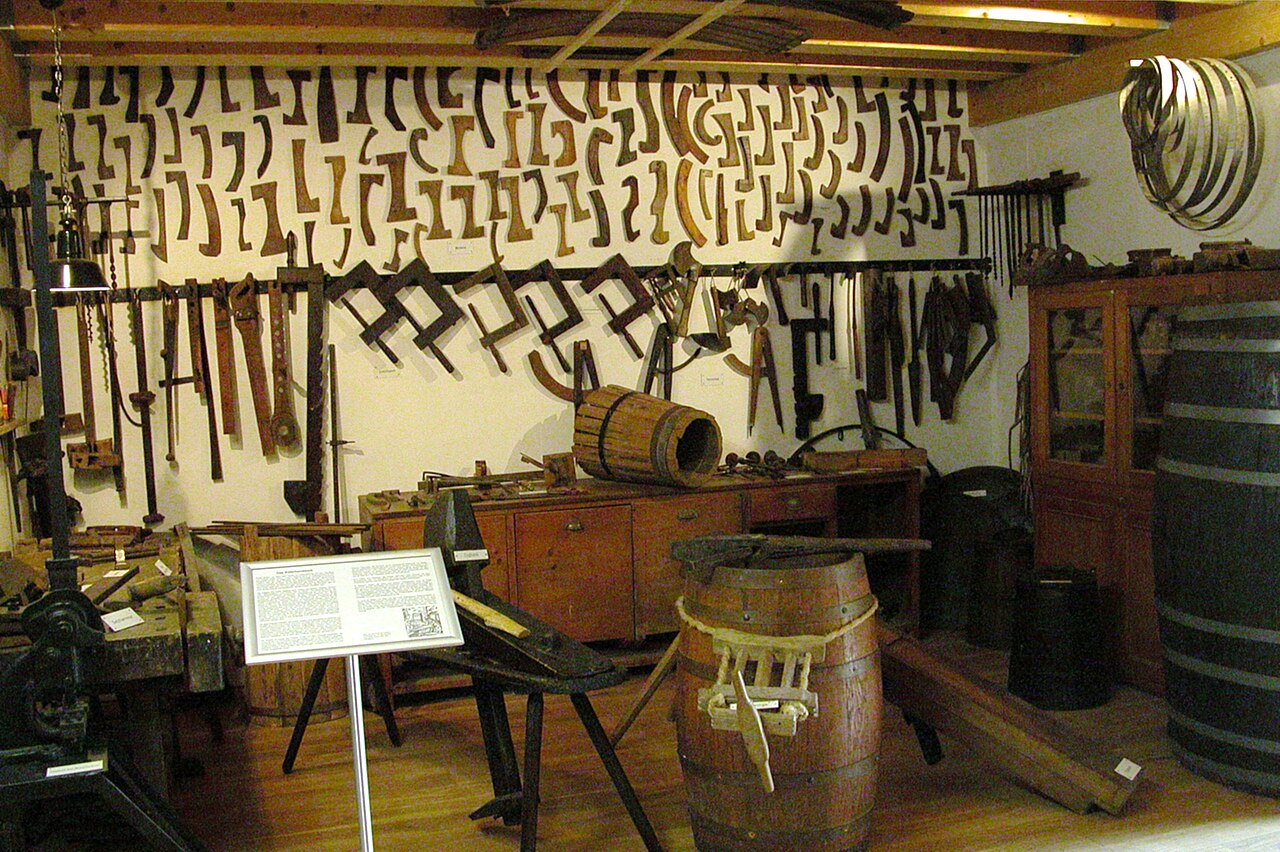
By Trade I was a Cooper
Present company excluded, GPs are (generally speaking) not stupid people, we are at least educated, and some (among the old-fashioned ones at least) might even supplement their phone usage with an occasional book.
Many in the profession are not oblivious to the technological annexation of the lands that once belonged to the General Practitioner. Video and phone consultations are a cheaper and more accessible alternative to a waiting-room full of germs and viral pathogens. These types of consultations were becoming the ‘new-norm’, long before the current ‘new-norm’ replaced the older one.
Impending social irrelevance is a bitter pill for any professional, but we humans are a resilient lot. When plastics and Tupperware made the tinkering of the travelling community redundant, they wisely moved into tarmacadam and power tools.
Equally, General Practice must evolve as it struggles with its own increasing redundancy. During the pandemic, when the government invited GPs to an orgy of self-validation; saving the nation with a dirty cloth-mask and a syringe full of experimental vaccine; few of my colleagues asked any questions at all.
Few resisted the temptation of becoming a ‘hero without a cape’. Fewer still were impervious to the largess and financial incentive, associated with logic-defying Covid Policies. Even the then Taoiseach Dr Varadkar, cashed in on the kudos. He rejoined the Medical Register, and flew to Halting Sites to test the travelling community. What a tragedy it took a pandemic for a Taoiseach to fly to a halting site.
On the Corruption of the Youth
Lately, when I work at the out-of-hours service in Dublin, I do so in the company of a junior Doctor; a GP registrar whom I am supposed to supervise and teach for the duration of my shift. They are fortunate enough when assigned to me, as I hardly know enough to practise medicine, never mind teach it to anyone.
When I chat with these ‘newbies’ I am always surprised at the level of uncertainty they express in respect of their approaching identity as a fully qualified GP. In real terms what does that actually mean anymore? Most of them tell me they are seeking a ‘work life balance’, something very much at odds with the stubbornly persistent notion of what a family Doctor actually is, or perhaps was. A doctor who knows his patients and their families by name? Someone with a small efficient surgery in the heart of a community; a clinic where wounds are sutured, and lumps and bumps are removed or biopsied? Someone who does house calls, and stays for a cup of tea after the final palliative visit to the mum or dad who has just passed away?
Or is the modern GP a youthful, tech-savvy doctor in a hospital scrub top? Someone who works three days per week at a large office block with a shiny glass frontage? A reticent and cautious professional type, who refers the dying to the palliative care team, house calls to the out of hours service, and anything requiring intervention to the relevant ‘specialist’ at the hospital?
The former is an endangered species, confined to the fringes of rural Ireland.
The latter, the GP who works on contract at the busy clinic with the impenetrable waiting list, and the unfriendly receptionist, he or she has become the aspiration and practical or empirical reality.
Woke up one morning, looked out the window and I struggled for something to say, but you, you left me, just when I needed you most. Randy VanWarmer
https://www.youtube.com/watch?v=1u06A-77TN4
Not so long ago, my daughter interrupted some sage medical advice I was attempting to cast at her feet, by cooly stating: ‘Dad, who needs a GP when you have a smartphone?’ Her generation is an increasingly rare occurrence in the waiting room. Young adults have replaced most of what’s on offer at the GP, with a faster and cheaper consultation with Siri, Google, or Chat GPT.
Pharmacists issue medical advice, along with; contraceptives, skin care, and a host of over the counter remedies for common ills. Alcohol, Red Bull, illicit drugs, and street-Xanax are self-applied to a real epidemic, currently plaguing a generation. That hidden disease of mental illness and drug dependence is managed by parents and barely registers on the busy radar of Irish General Practice.
Young adults and teenagers have voted with their feet, unless they need a cert for school or for social welfare payments. The disengagement of young people (if they were ever engaged in the first place) is perhaps one of the sadder realities of General Practice. Arguably they are the cohort most in need of help in coping with; the porn, the drugs, the pressure, and the paradox of choice they must navigate alone, with a smartphone.
At one extreme we have the absence (or abstention) of young people, at the other extreme we have the professional neglect of elderly people within the Nursing Homes. The space between these two demographics, contains some of the abysmal failures of General Practice as it exists today and that is to say nothing of the unique needs of a diverse immigrant population, one that GP’s are neither trained nor even encouraged to understand.
What if the pharmacist could stamp forms or if patients could vouch for their own sick leave? Or if they could simply refer themselves for a routine blood test, or an appointment to see a consultant (as private patients often do); General Practice would be about as socially relevant as tits on a bull. If a couple of antibiotics were available over the counter (as they are in many countries), the meteor would impact and the dinosaurs would shuffle on towards oblivion.
Arguably there is precious little that an average GP can or will do in the community that a competent Nurse could not accomplish quickly and efficiently. Today, almost all minor surgical procedures are referred into queues at the major hospitals. In north Dublin the Out of Hours Service will neither suture a wound nor syringe an ear, which seem to be risky interventions in these litigious times. Almost everything nowadays is referred to a ‘real doctor’ at the hospital.
Ironically, the burgeoning bureaucracy of forms is not the bane of General Practice, it has become the umbilicus. A newly qualified GP can be as competent as he likes in respect of medicine yet, if he does not know how to use the practice software, to tick boxes and lodge claims for a myriad of HSE chronic-care payments, he or she is essentially unemployable.
The traditional mythology surrounding General Practice, the institution’s relationship with the HSE, all mean that like the banks, it is ‘too big to fail’. For example, the training body responsible for the production of new GPs (the ICGP) has complex ties with, and is paid by the HSE.
Like a recruiting agency, it supplies them with Doctors, who fill unattractive hospital posts around the country, as part of their ‘training’. These trainee GPs are also farmed out to provide free labour for select GPs around the country, whilst both the trainee and the ICGP are paid by the HSE. The ICGP is one of those illustrious quangos we Irish are in love with; a ‘registered charity’ with freebies for friends and financial investments as far afield as Saudi Arabia. Colleges and ‘non-profit’ medical organisations like the ICGP and the RCSI., pay no taxes, they share the spoils out in the form of benevolence, salaries and expense accounts.
The entire system of medical training in Ireland is defined by deeply embedded and legitimate forms of nepotism and corruption. Beaumont Hospital freely provides almost everything from patients and teachers to the toilet paper, for the Royal College of Surgeons. The College is a private medical school and it charges students up to €58 thousand per year in tuition for the six year course, three years of which are conducted at Beaumont Hospital. Bizarrely (or perhaps not) this private medical college is sustained by the largest ‘public’ hospital in the country.
Consultant Professors of this and that, can hardly find time to attend to surgeries or public clinics. They are often busy down the hall, at another theatre, lecturing to Saudi Princes and Emirs from Kuwait.
The RCSI (another registered charity), owns and operates a second Private Medical School in Bahrain, where it offers private medical training to Canadian and American Medical Students, for around €44 thousand per annum for the six year degree.
The Taoiseach’s leaking of contractual negotiations between the HSE and one of the rival GP organisations, is merely the tip of just one iceberg that has recently floated by. Off to melt away in warmer waters; like the long-forgotten intrigues and scandals at the IMO another quango who’s last CEO retired amid a teacup of controversy with a pension of ten million euro.
Medicine in Ireland, particularly medical training might well be described as a fermenting vat of rot. We have no swamp; the water is too putrid for any genuine forms of life, reptilian or otherwise.
The drugs don’t work, they just make you worse… Richard Ashcroft
The vast majority of medicines consumed in Ireland are prescriptions issued by General Practitioners. The Pharmaceutical industry from the local Pharmacist to Pfizer itself, depends on GPs for those scripts. A need that is more prescient and influential than those of any particular patient cohort.
This year, circa two billion euro in Exchequer funding was paid to a few pharma companies in return for drugs covered by the medical card scheme. That sum could be more than halved if a National Formulary of prescription drugs was put up for tender each year, as is the case in other countries like New Zealand for example.
Pharmaceutical lobbying, however, discreetly maintains the status quo. In Ireland corporate lobbying will hardly be investigated by a mainstream media, dependent upon corporate payments for advertising revenues and the salaries of A-list celebrities. The general acceptance of corporate influence over the state broadcaster suggests that most Irish people think ‘lobbying’ is something that might pertain to Wimbledon or tennis.
A prescription is often the most efficient way to end a consultation, it does not cost the Doctor a thought because they do not cost him a penny. In Irish Nursing Homes most residents have an extended shopping list of pointless medications, the phenomenon is referred to as ‘polypharmacy’. Many of the frail and emaciated are taking statins, in order to keep their cholesterol down; it’s a little bit like putting famine victims on diet pills. Sleeping pills, sedatives and expensive food supplements to compensate for an unpalatable diet of gruel are the norm for many.
As a consequence of being interlaced with a political and pharmaceutical agenda, and in abeyance to a certain type of mythology associated with the family doctor; Government underwrites General Practice to the extent that it consumes as much, if not more exchequer funding, than the entire Public Hospital system. Last year it cost four billion Euro to pay for GPs and Medical Card Prescriptions, an increase of 49% since 2016.
General Practice is a little bit like a religion in that it is sustained by some established patriarchal ideals. The notion of ‘doctor knows best’ or ‘just what the doctor ordered’ etc., is possibly more embedded in post-colonial or post Catholic societies.
Following the collapse of the Church in Ireland, the GP has become something of alocum tenens, for the parish priest. His is an ‘evidenced based’ religion, one that promises a healthy life; in place of the immodest and unsubstantiated offer of an everlasting one.
Despite a paucity of practical reasons for its preservation, General Practice is nonetheless sustained by popular demand, as a kind of impractical luxury. Like paying rent for a Lamborghini when a bicycle would be overkill. It is difficult to know whether the costly underwriting is motivated by the mythology; or whether it is mandated by the institution or the many others who gorge themselves upon a Health budget that knows no limits.
Church & State
The political preservation of General Practice is accomplished in several ways. You can be as sick as you like, but you will only get paid once the GP signs the IB1 form. Ironically if you are in hospital, a hospital Doctor will give you an IB1 form that you must then bring to your GP and pay for the pleasure of his or her signature.
GPs are responsible for the care of every elderly resident within the depressing environs of the Nursing Home Sector. In Ireland a Nursing Home can neither open nor operate without the supervision of a registered GP, a supervision that is at best light-touch, but is heavily paid for.
Illness benefit, driving licences, passports, nursing homes, access to the public hospital system, to the Emergency Department etc etc., are all stamped and signed by General Practice. These are the lands that belong to a post-colonial landlord, one who operates behind the general facade of a liberated Ireland.
Pharmaceutical companies have an ever increasing need for community GPs to push an agenda of pharmaceutical dependence upon the entire population. Arguably this agenda has gone unchecked for over half a century. Pharma companies provide jobs in Ireland and advertising revenues for the mainstream media, they should never be questioned; and so the executive board of the HPRA is dominated by ex-pharma employees.
Opiate dependence is barely a scratch on the surface; antidepressants, benzodiazepines, Lyrica, statins, antibiotics and polypharmacy in the elderly are more disturbing realities. Each of them are lucrative social tragedies, rarely spoken of in public. Like excess mortality or vaccine-related injuries they are confined to the realm of ‘conspiracy’.
Learned and encouraged helplessness within Irish society in respect of basic health, fear mongering by pharma and state agencies in the guise of various ‘health promotion’ campaigns, means that there will always be the need for a Doctor in the community; one who is almost as skilled as a Nurse, but has all the power and influence of a mafia boss.
I just checked in to see what condition my condition was in. Kenny Rogers
Thirty years ago when I began to study medicine there was this crazy notion that Doctors would ‘cure’ or ‘fight’ disease, whenever possible. That same general expectation of ‘cure’ has all but disappeared from the everyday language of modern medicine. It is no longer expected of the GP to cure, or even to attempt to do so. Long-term illness and ‘chronic management schemes’ have become the ‘ne plus ultra’.
Ironically, apart from cancer, the biggest killers in Ireland are indeed curable diseases; heart disease, type 2 Diabetes, vascular disease, obesity, depression etc. In recent years all of these conditions have evolved to be considered solely in the context of ‘chronic disease management’, associated with chronically diseased payments.
The gaping irony hardly registers. When I mention it to the trainees they return a blank confused expression, as though I were suggesting something possible and impossible at the same time. There is no space within the establishment to discuss the question as to how or why GPs have become facilitators instead of healers? This is another conversation generally confined to the realm of conspiracy.
In Ireland today illness is managed, no differently to a business, wherein profit is the bottom line. Tellingly, amid the mind-boggling array of payment types issued from the HSE to GPs, there is not a single payment or financial incentive in respect of ‘curing’ anything at all, never mind any of the curable diseases that actually kill most people.
In New Zealand, where I completed my GP training some years ago, GPs were actually paid a bonus if their prescribing of antibiotics remained below the national average. Most disease was treated (and often cured) within the community setting. In Irish General Practice ‘cure’ has become an anathema and disease has become our raison d’être.
Image Daniele Idini.
Halcyon Days
Any real or practical value that the GP brings to public health is (or was once) contingent upon the fading reality of the somewhat old-fashioned ‘Family Doctor’. That GP was (and occasionally is) part of a community of people living in close physical (as opposed to digital) proximity. People who are mutually dependent upon each other and the community, in small but positive ways. In the modern world of sprawling high-density estates, the notion of collective, integrative and supportive communities, is becoming little more than a sound-bite that estate agents use to sell houses.
There was once a time when the GP knew all or most of his patients very well. That knowledge was an essential and fundamental clinical tool, as important as the stethoscope, and impossible to replicate through any amount of technology. It was that intimate knowledge that would often determine an intervention, and whether a referral to the specialist was immediately necessary, or necessary at all.
Outside of the paperwork, most presentations in General Practice are motivated by some form of anxiety or worry. Intimate knowledge in respect of the family and the individual often allows the GP to distinguish between anxiety and pathophysiology.
Sometimes he might have got it wrong, but more often, he or she was in the right place. This lack of distinction or inability to distinguish between anxiety and physical pathology, is one of the things that annually overwhelms the health service. It is almost never discussed and is expressed regularly in the unintelligent language of a: ‘shortage of hospital beds’ and a ‘shortage of doctors’. We may not have a shortage of Doctors, rather than a genuine shortage of doctors who know their patients well, or know their patients at all.
The Doctor’s sometimes sage advice was an imperfect thing, derived from his unique knowledge of the person, from a love of learning and an understanding of science. He was also the victim and the enforcer of a particular zeitgeist and strict social paradigm; that aspect of medicine has never changed.
Although it remains a rather lucrative enterprise to have one’s HSE-income, and share it with no one; single handed practice is taxed with an unhealthy level of responsibility. No newly qualified GP would dream of setting up alone in today’s Ireland. Few, if any, single-handed practitioners could provide the type of service that people now expect. Sole practice was the first limb of the cat to vanish. The once ubiquitous ‘walk-in’ surgery once had a financial incentive, supposedly socialist medicine however is strictly by an appointment, generally for sometime next week.
Working for the Man
Presently in Ireland a couple of large corporate entities are hoovering up what remains of the small suburban practices or those rural practices with profitable lists of Medical Card holders. These companies will buy a practice and keep the principal GP on as a paid employee in order to control his Medical Card list.
For the most part, newly emerging GPs know nothing of the ‘halcyon days’, and are generally happy to start working for ‘the man’. They cannot be accused of selling their souls to the devil. In contemporary General Practice there is no place for old-fashioned things like souls, despite the overabundance of devils.
Such corporations pay 12.5% in corporation tax; yet when I had my own practice I paid 52%; the profit margins are a no-brainer. They will then harvest the greatest possible return from the various Medical Card payments, and chronic disease schemes. They can afford to pay GPs good salaries, and hire a minimum number to do the husbandry. This type of corporate General Practice is entirely unregulated in respect of the service it provides (or doesn’t provide) for patients.
These profit driven behemoths are presumed to function in the same way as the traditional Family Doctor. For the most part they are left to their own devices, sucking up a maximum amount of HSE payments and returning a token level of care. They conceal the inadequate service behind a rigid appointment system that keeps patients waiting, the workload at sustainable level, and profit margins as high as possible.
For all their faults these centres are the inevitable future for General Practice, they are what people think they want, and what politicians are eager to give them.
To interface with this industrial model, patients must increasingly learn to translate all of their pain into the unaccommodating language of medical pathology; human beings and their emotional realities become invisible and entirely medicalised. Deeper truths behind the pain, the fear, and the anxiety that are an increasing part of everyday life for all of us, evade this more sophisticated model of Primary Care. The emergent mystery becomes just another number on another waiting list.
Of Human Bondage
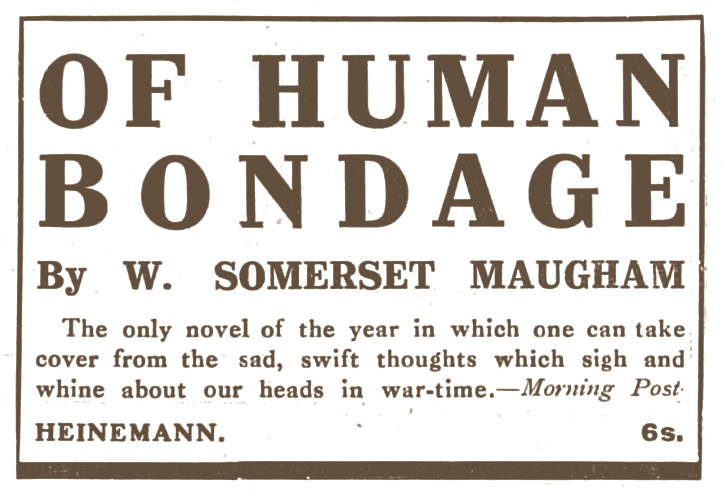
In my early twenties after reading Somerset Maugham’s novel Of Human Bondage, I thought about becoming a Doctor. I didn’t especially want to help people, but I wanted to be in a position whereby I could help them if I wished.
I might have wanted to ‘help people’ in some vague way, but I wanted to help myself first. For a time I probably translated this notion into the more noble expression that many of my colleagues prefer to cling to. It is refreshing to hear honest medical motives expressed in the more acceptable language of a ‘work life balance’.
Maugham’s novel is about all kinds of bondage, the one I wished to liberate myself from was poverty. Medicine has at least afforded me that compensation for the small price of my soul and at times my sanity. I never imagined that I would come to see the career itself as a kind of bondage; a darkening cave wherein we can no longer see the chains or the flickering shadows on the wall.
Many Doctors know there is no need for the antibiotic, no need for the hospital referral, the scope or the scan, and yet we increasingly act according to our own benefit, or that of our employers. Convenience and fear of complaint are the other silent incentives.
In Ireland and abroad, private obstetric care is more likely to result in a caesarean section, and a child with private health insurance is more likely to end up with grommets or a tonsillectomy. Medicine has always been an uncomfortable marriage between profit and compassion. Lately it seems that profit has separated, and is suing for divorce as well as damages.
Image Daniele Idini.
Hope Deferred?
Perhaps the only thing worth saving in General Practice – the most beautiful and essential thing – is the thing that has almost disappeared; the unique nature of the relationship between the family Doctor and the families who attend him or her.
That ‘thing’ is something many people may have once enjoyed and may still enjoy with some ‘old-fashioned’ GPs. It is the thing that saved many lives during the Pandemic, more so than; masks, vaccines or spending ten euro on a pint and a sandwich.
Any future validity for General Practice would be contingent upon training GPs properly, educating them (and patients) to participate in that old partnership in an honest and meaningful way. For the moment however, the relationship is broken. The modern GP is not trusted in the manner that the family doctor once was, and he is wary of his patients or views them solely as a means to a private end. The problem is a million light years away from medical schools, training bodies or public health campaigns, all of whom have their heads in the trough.
Before former Health Minister Mary Harney reformed the Medical Council in 2007, into a weapon for the indignant and a cosy club for political appointments; the family doctor might have been a man or woman with an honest opinion in respect of your health.
An opinion that you could take or leave as you saw fit. Presently, Doctors are not trained to be honest or even candid with patients, quite the contrary in fact. Candidness was something that was permitted years ago. Often (but not always), it was a good and a welcome kind of honesty. The GP had the ‘power’ to tell you that you were ‘too fat’, ‘overly anxious’ or that you didn’t need to be immediately referred for a battery of tests or scans on demand. The GP was frank, candid and honest, and was even expected to be so. Some Doctors and GPs were lazy in their old-fashioned power, and things were sometimes missed, like cancers and physical disease. People were sometimes abused with insensitive words or beaten with the religious paradigm of the day.
Today it is increasingly rare (if not impossible) to encounter a GP who would be willing to run the gauntlet of refusing a test or having a frank conversation with the newly emancipated patient turned consumer. Training bodies and the Medical Council indirectly insist upon an obsequious dishonesty as the gold standard. They advise Doctors to give ‘back pocket’ prescriptions, a euphemism for the unnecessary antibiotic on demand. Happy customers are presumed to equate with healthy patients. The universal goal is a consumer, pleased with the product they have purchased, or recently become entitled to.
A GP might be sanctioned for using the word ‘fat’ inappropriately, and yet he or she will be rewarded in various ways should he provide an inappropriate prescription for a trendy weight loss injection; a diabetic drug currently in short supply as it is being over prescribed in the community for cosmetic purposes.
As an institution, General Practice thrives upon; ignorance, compliance and government subsidy. Most consultations in primary care amount to a waste of time in respect of public health or genuine pathology. An increasing majority attend the GP simply because they have to, or because they have been encouraged or allowed themselves to become prescription drug addicts.
Sometimes, disease becomes an identity; a form of socially sanctioned escape from an unpleasant and painful life. Illness is very often the veil that is worn to conceal a deeper unhappiness. Often, chronic illness becomes a persona with a social and financial incentive, one that can be as alluring and addictive as any drug.
In my own experience far too many ‘sick’ people are simply very unhappy. General Practice in its current form is utterly ill-equipped to deal with, or even to recognise the unhappiness or anxiety that is its principal presentation.
Increasingly, during my years in clinical practice, I found that telling a patient that they are ‘normal’ or that they have ‘normal results’ can cause a kind of disappointment. For some people, telling them they are normal is like denying their pain, barring them from Kafka’s Castle, refusing them a diagnosis and an entry into the legitimate world of the sick.
Image: Daniele Idini
To Italy
“Are you the farmer? We’ve gone on holiday by mistake!”
‘Withnail and I’
In many countries the expensive appendage of General Practice has already disappeared. Outside of the catchment area of ‘old victorian ways’, one attends an accident-clinic in the event of an accident, and almost everything else is self-referred to a specialist; a hospital consultant with rooms in the nearby town or city.
In places like Northern Italy, the Middle East, the U.S. and many more, people do not need a magic letter from a GP to get to see a ‘real doctor’. One simply makes an appointment at the consultant clinic, the receptionist will assign the headache to the neurologist, or the gastritis to the gastroenterologist and so on. Sick children are brought to see paediatricians, those wishing to become more beautiful attend the plastic/cosmetic surgeon, and old people are brought to see a geriatrician before being dropped off at the nursing home. Friendly secretaries will triage and normally arrange a bed over the phone. The first consultation usually occurs with the patient in a bed on the hospital ward. The bill is sent to the state or the insurer.
I am not suggesting for a moment that this is a better system, it is a system that was the principal cause of the horrific scenes in Lombardy during the Pandemic. Covid killed too many elderly people, that much is true, but it was the condition and organisation of the Italian health service in Northern Italy that allowed Covid to become the catastrophe that dominated the television networks.
If we think about it, cholera and a few other diseases (rather than starvation) were responsible for half of all the deaths during the Irish Famine (1847-1851). Now, imagine the hue and cry that would emerge if some renowned British Epidemiologist tried to suggest that half of the total number of Famine victims did not die of the Famine, but died instead from a coincidental ‘pandemic’ of Asiatic Cholera? What remains of the IRA would undoubtedly issue a fatwa.
Apparently when it comes to the Great Famine, we are quite capable of recognising that social conditions (poverty/famine) created the environment where disease festered and then killed exponentially. We don’t blame Cholera for the Famine, we blame the famine for Cholera. It was the Famine that created the conditions for Cholera to thrive, and it was English policy that created the conditions for the Famine itself.
Equally, the Covid virus was not the principal cause of the terrible scenes in Northern Italy. It was the absence of community medicine that created the conditions necessary for the tragedy to unfold in the horrific manner that it did.
There is, and was, no system of community medicine throughout much of Northern Italy when Covid arrived. In Lombardy; frail, elderly people with Covid, had no one to call, other than consultants and specialists, who then flooded their hospitals with Covid and transformed them into the geriatric hotbeds of disease and mortality that provided the horror show, and fuelled the fear-frenzy. That same frenzy soon transformed Covid from a cohort specific disease, into a pandemic that requires universal vaccination, lockdowns and allegedly kills almost everyone it touches.
At home the Italian mistakes were coarsely imitated by the Irish Government as they cleared the public hospitals and transferred a mass of untested, convalescing hospital patients, into all available beds in the Nursing Homes. They introduced Covid into the sector en masse, firmly and strictly locked it in, and thereby caused (or at least facilitated) a wave of death that has yet to be investigated.
In 2016, Lombardy — home to more than 10 million people — saw only 90 medical school graduates go on to pursue specialised studies toward becoming general practitioners. They received annual scholarships of 11,000 euros (nearly $13,000), less than half those secured by people preparing for specialties like cardiology. The numbers have grown in recent years, but not enough to replace retiring general practitioners, medical associations say.
The point I am making here, is that despite the fact that General Practice might well be an overall pathology in Ireland; that is not to say that the institution does not accomplish some purely accidental good. A broken clock will tell the right time twice a day.
Many Irish lives were inadvertently saved by the fact that patients had a relationship with a Doctor (their Family Doctor). One whom they could call and who would tell them what they should or should not do.
Despite the fact that medical advice from the oracle of General Practice amounted to little more than: ‘stay at home and suffer on’; it was the simple fact of having a relationship with a contactable GP that reassured and ultimately saved lives.
Needless to say, (proportionally at least) far more lives were saved by GPs like Dr Pat Morrissey in Adare, and several others – some of whom who became part of a covert network who insisted (despite threats from the IMC president) upon doing more for very sick patients – than simply telling them to ‘stay at home until they turned blue’.
Public health officials were quick to see the value of this old-relationship and offered GPs an unvouched blank cheque, to the tune of €30 per reassuring phone call. However, beyond a phone consultation, Irish GPs by and large did not provide any interventional ‘care’ for those whom they advised to ‘stay at home’.
Nonetheless they saved lives and avoided an Italian-type tragedy simply because those lives had access to a Doctor within their own community. During Covid, it did not matter if GPs were wilfully useless; it only mattered that people had access by phone, by video-link or smoke signal. They were not entirely alone.
The miracle of science was with them, and they stayed in the safest place, far away from established medicine. Whilst Covid patients were in contact with their GP, they were cared for at home by their families. This was not the case in Northern Italy where even a token degree of Community Medicine was non-existent. A passage from the NYT article states the following:
When the first wave hit, Milan — a city of more than 1.3 million — had only five doctors expert in public health and hygiene, said Roberto Carlo Rossi, president of Milan’s Doctors’ and Dentists’ Guild. They were responsible for setting up a testing and contact tracing regimen.
Where most Irish GPs did in fact care for patients in practical terms, was in the Nursing Home. We were the responsible physicians and were the only ones allowed in.
As a consequence of our careless ‘care’, combined with political ineptitude; over a thousand died alone, and in truly horrible conditions, all within a matter of months. During that time Covid payments in respect of their care were doubled, trebled and quadrupled, in spite of the death rate and the abject failure to deliver what might be described (in third world terminology) as ‘the very basics’.
The survival of honest medicine may depend upon an old-fashioned relationship with a different type of Doctor. One who is often found to be ‘non-compliant’ at Medical Council Hearings. Yet, to paraphrase an old philosopher: ‘there may be a different court, one that is higher than the Courts of men; one where a great many of the judgements of this world, will doubtlessly be overturned.’
The Empire Windrush sails tonight, she’s got a one-way ticket, and she’s half way home
In June 1948, The Empire Windrush arrived at Tilbury docks in England to the sound of a brass band and hundreds of cheering residents. On board were 802 people, the majority of whom were returning from the Caribbean. Returning, because earlier in the year John ‘Johnny’ Smythe – the father of Dubwiser’s Eddy and John – was charged with accompanying troops from the Caribbean back home after their fight in World War II.
When, on the outward journey, The Windrush arrived at Jamaica, due to severe unemployment and a struggling economy, hundreds of young men could not be given the jobs they richly deserved. The Jamaican Labour officer appealed to Britain for assistance and the Colonial Office contacted Johnny, the senior officer in charge, and asked for him to assess the situation, come up with recommendations and report back. He interviewed the men, categorised them according to their qualifications and abilities and recommend to the Colonial Office that they return to the UK and seek employment.
Anchored off Jamaica, it’s hard to know if Johnny had any awareness of being at the fulcrum of history. He probably just wanted to help the men under his charge out of a dilemma and seized the opportunity.
Two of our fathers sailed on this ship, at different times and in different directions, and they both agreed on two things. First, that it was a beaten-up old rust bucket. The engine regularly conked out and the anchor would have to be dropped for repairs. Secondly that the camaraderie on board was second to none.
The old German boat now acted as a colonial bus service, stopping at every port to take on and put off people, supplies and anything else that could be crammed in. Every corner of Britain’s crumbling empire was represented, every culture, food, language and philosophy. After the misery of the war, it was a chance for ordinary people from all over the world to meet, rejoice, and plan for a better future.
From the lion mountain he came like a storm, Johnny came from Sierra Leone, an African in uniform
Some years before becoming the unwitting catalyst of the Windrush generation. Johnny answered the call from the ‘motherland’ who, after taking a beating from the Luftwaffe, swallowed their pride and sent a call out to the colonies for help. As a ‘Krio’ (descendant of freed slaves) in Sierra Leone Johnny knew what it was like to be an outsider in his own country, so he coped better than some with a sudden immersion into Scotland in winter and RAF training.
Shot to the right, shot to the left from ‘Johnny’ by Dubwiser.
He ended up as a navigator on Stirling bombers. The only black man in his squadron, he became a talisman for the others. Life expectancy was very short and during the latter part of 1943. On average planes were shot down every five to seven missions.
In November 1943, Johnny was shot down, badly wounded, captured, brutally interrogated by his captors, hospitalised and further interrogated in Frankfurt before being sent to a POW camp.
There, he joined the escape committee, but never tried to escape, as he pointed out that a six foot four inch black man wouldn’t get very far in North Eastern Germany. After eighteen months in the camp, on a morning in 1945 he and the other inmates awoke to find the guards gone and the gates wide open. Russians appeared two days later and they were liberated.
340 years ago, Colston was a slaver-oh, they covered it up, but still we know, now the truth is rolling down the road
Like it or not, statues have power. They point in a direction, usually the one which the commissioners wanted to point in. Bristol was littered for hundreds of years with the name of it’s ‘greatest son’ Edward Colston. Known still in our lifetimes as ‘a great philanthropist’ who, childless, left a lot of his colossal wealth to the city of Bristol.
We aren’t interested in the argument that that was ‘a great gesture’, worthy, indeed of place names and a statue in the city centre. The money was not his to give. The wealth that he created came from the slavery of 80,000 souls. He made the people smugglers who ply their bloody trade across the Mediterranean and the English Channel, look like amateurs. This man was a mass murderer. He gained a fortune and a statue, and in return he reaped genocide.
On the June 7, 2020 Jonas’s son Josh received a message on his phone: There was a big protest happening down at Bristol city centre. He hurried down there in time to see a huge crowd dragging the statue of Colston down towards the cut. He sent his father a photo, who had the sense of a long loud cheer going up across the country. As in so many things, young people were leading the way. Resistance to everything Colston stood for had been building in Bristol over a long period. His time had come and now he lies, battered and bruised, in a museum where he belongs.
A gal from the Caribbean… What an amazing woman!
After the great and ignominious, it’s useful to return to the small. Alexandrine (Spider’s mum) was a small woman, but like so many of the Windrush generation, she was strong. Eight years after the Empire Windrush sank in the Mediterranean, she was invited to come to England after passing a test demonstrating her skills in sewing, cooking and auxiliary nursing.
She left everything, her whole life in Dominica and came half-way across the globe to a country that was becoming less and less welcoming to ‘her kind’. But she knew what she had to do and she saw something in London, a glimpse of a larger potential world, if not for her, then perhaps for her children?
So, she worked, raised her children, worked some more and she kept going, kept doing, through thick and thin. In Dominica her skills as a calligrapher were noticed by Catholic nuns and in England she also learned to type.
In time Alexandrine managed to get a post as a pastry chef at The London School of Hygiene and Tropical Medicine. As the years went by she ensured many others in her circle of family and friends could also get work there, each according to their abilities. She made it her mission to help those who were in turn helping others.
After a generation of work, play, child and grandchild rearing and making what was agreed to be the best curry goat and black pudding in East London, Alexandrine returned to Dominica at the age of forty-four.
From there she sent pictures of herself smiling broadly under a coconut or banana palm and returned to the U.K. every year in the Autumn (to avoid hurricane season) with bags of produce and stories from back home. The beauty of a life well lived is unparalleled. Across Britain, this story is being retold by mother after aunty after grandma. This is our small and unsung legacy, inspiring us to live our best life.
She did, she did, she did and she keep on doing From ‘Amazing’ by Dubwiser.
No beast so fierce but knows some touch of pity, but I know none, therefore am no beast. William Shakespeare, Richard III
I anticipated the takeover of the vast majority of the publishing industry by fourth or fifth-wave feminism. It has been in the mix for five years or so, and it dominates this arena; and not just mainstream publishing, but most alternative avenues too, as far as I can see.
These mindsets want fluffiness. Cats. And Tote bags with witty slogans in an interesting font. There are writers whom they laud and publish; and their work, at best, to quote an agricultural analogy (Not just Beckett), is fair to middling.
Writers are reaffirmed by their agents et al and subsequently develop and own this logic of, ‘I am being published; therefore, I am good.’ But by whose metric? Your own? Qualitative? Profit and dross.
Many seem more interested in being revered as ‘a writer’ than creating Art. This is the cult of personality – a celebrity projection of the ultimate performer, different from the norm. They believe they are special. The core issue is, I believe, that the celebrity culture now at work in the book industry places an over-emphasis on persona and mythos as persona – a literary, bookish cult – whether it be hyped-up media or others, at the behest of Art.
One is reminded of the lines from Bukowski’s The Genuis of the Crowd, ‘Beware those who seek constant crowds; they are nothing alone’; and ‘Not being able to create Art, they will not understand Art’.
Peering into some of these marketed texts, I do not see a lot of literary merit among the prose. Pallid, wane, and an emotionally-led, safe register is my takeaway. More like Young Adult books than adult fiction. The age of banality is upon us.
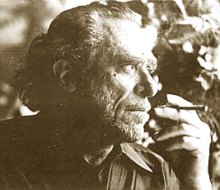
Charles Bukowski
Every sentence should fight for its place…
I suspect that this is part of a wider, individualistic desire, for fame, fortune, and glory. To be looked upon and admired. Put on a pedestal. To have the fine robes of a writer bestowed upon and wrapped around you. Speculated upon in your sartorial elegance.
I hear them on the radio and see them on the TV, these writers of ephemera, here one day, gone the next. Until the next one comes along.
It’s a Warholian, factory process of endless, emotionally-led drones pumping out emotionally-led, dry, grey mush. The sentences are short and adverbs are plentiful, John loves Trudie. Trudie really loathes John. Fred absolutely dislikes Stewart. Or, DCI Kelly DI Slater, investigates…
These novels are tumbling dice and have little or no truck with pushing the literary envelope. They lie prone on the racks and shelves in stores and in the minds of their reader. Would you not rather have something that inspires you to shout from the rooftops? I relate to this! This sentence here is bloody brilliant! Look, the prose is literally leaping off the page. It burns!
The reality that they fail to recognise this is disheartening.
When was the last time Middlemarch was talked about? Dickens? Sylvia Plath’s The Bell Jar?
To quote Howard Jacobson, ‘The problem isn’t with the novel, it is with the reader.’ In an age of frenetic online activity and electronic meandering there is a distinct lack of originality. A absence of creative juice. And a dearth of creative reading.
Challenging books…
Aspersions cast on, for example, James Joyce’s Ulysses, which many have not read, are immature, and rooted in a jealousy that the text holds a higher position in the literary pantheon than their offering(s). Disingenuous assaults are derived from manifest insecurity.
They scoff at bigger, therefore harder, and difficult – but they would not come it and say it – literary texts. Due to the social embarrassment that this may cause and what might be inferred. They do not like to be embarrassed socially. This has its roots in a more organic state of grace.
They do not desire to read ‘challenging’ books, preferring a certain reading homogeneity and inevitable selective stasis. They do not care for a rampant display of maleness. The kind of masculinity on show, say, in Henry Miller’s Tropic of Cancer is scorned and discredited. Man as Dog is the ravenously portrayed symbolism.
But freedom of expression should be allowed. Even in Miller’s canine-like, Parisian existence. If a man is de-fanged, de-barked, and thus emasculated, where is he to go? To be banished into exile? To become prohibited? Becoming chthonic beings like the Morlocks in H.G. Wells’s The Time Machine. Subterranean, knuckle-draggers whose jobs(s) are to fertilise and provide financial support. If that is even the case in these attitudes.
We are in an interesting meridian. I wonder would Tropic of Cancer be published today?
The demographic target for the marketers is predominately female, but it does not commandeer in totality and speak for all things literary.
Their mandate is revenue – at all costs. No matter if the book is well-written. If it has a plot, narration or thought-provoking, relatable characters. They are only interested in appeasing the god of Profit.
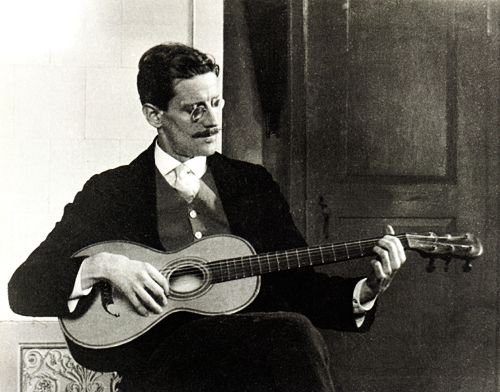
James Joyce 1882-1941.
Art and Persona
Entering a Joycean reverie of Leopold Bloom allowing ‘his bowels to ease themselves quietly as he read, reading still patiently that slight constipation of yesterday quite gone. Hope it’s not too big bring on piles again.’
In the proverbial outhouse, we recognises our shit stinks, like everyone else’s. Are you a writer at all times? In bed, a writer? Asleep, a writer? At stool a writer? Walking down the street?
I have to inform you that, you are not a cut above. Your Art should be your Art and you should stay the hell out of it, if it’s Art you are creating. You deny your organic, biological self but continually project the ideal that you are indeed a writer, and all must lay down prostrate before you and worship at your altar.
That is the central tenet here, the separation of one’s Art and persona; both are not one and the same. They are mutually exclusive. They should be de-compartmentalised. Art is an exposition; a creative process and it emerges predominantly from, boffins say, the right hemisphereof the brain.
It comes down onto the page and then it’s gone; albeit it remains as text. Except the marketers wants to conflate the two. Look at this Kurtz-like, mysterious figure, look at the chatter around them. If there is none, we will create it ourselves.
Beat those jungle rhythms. Not letting the work speak for itself. The vehicle of the plot. An ensemble cast of characters. Dialogue. You know, the three basics of the novel. The holy trinity.
Writing as surrogacy: a biological denial forfeited into writing projects and projections of the writing, literary mother who gives birth to ingenuity and creativity.
There is a certain emotional naiveté at work here.
Being noted as special is an inherent part of being desired to be seen as a writer. It locks into an awakening narcissism so succinctly.
Gatekeepers
As agents, they behave like Amazonian women and gatekeepers. If you do not play into their modal form(s), you will be truncated below the waist and stung with arrows.
I recently undertook a couple of counselling courses. On a Level 4 Diploma, in-house, I was the only male left in a classroom of a dozen or so females including the two female tutors. One of them, I believe, was a feminist and was going to put the squeeze to get rid of me, a male. She succeeded.
I believe there are other feminist cabals that spring up in offices and colleges and publishing houses, and if you don’t like cats and cutesy stuff, and you’re a manly man, with a hint of aggression, possibly, towards them, or unconsciously dominate with your masculinity, in any way, you are a danger. And will be ostracised.
It’s a form of sexism of course – in, on, their own terms. They circle their wagons. They have vested interests – their own cultish mentalities. Dance by firelight.
But what they forget is that if it were not for men, as writer and academic, Camille Paglia relayed: ‘If civilization had been left in female hands, we would still be living in grass huts.’
Paglia had it down too when she relayed that a lot of angry women who had been hurt by men were now in positions of power wanted revenge, and to make all men suffer because of their experiences.
A bit like Estella and Miss Havisham at the beginning of Great Expectations, who emasculate Pip and desire to see him become passive. They want masculinity to be humiliated, suffer, and become truncated below the belt. They want men to be their inferiors, servants, and in the end, inert eunuchs.
What a cadre of selfishness, rank hypocrisy, and flaccid tribalism.
This Jungian projection of man in the female mind as an unconscious symbol of taker, abuser, and destroyer is a possibility.
In Newton’s Third Law of Motion: for every action (force) in nature there is an equal and opposite reaction. If object A exerts a force on object B, object B also exerts an equal and opposite force on object A. In other words, forces result from interactions.
Men work in the dirt. They mix concrete. They lift and lay blocks. They raise buildings. They work on boats. Rigs. Implement dangerous jobs. Men write too. And some men write, craft, brilliantly. They should be respected. Not all men are dangerous predators. It is a dual thing. Let’s value compromise, equality and respect.
So, Israel. Is it a good thing? Was it a justifiable demand for a ‘homeland’ by a horribly persecuted people? Is it a land grab, dressed up in religious and ethnic cod history? Is it a cynical manipulation of a dream by U.K. colonial, later U.S. imperial, self-interests?
Or could it have been what Jewish socialist writer Isaac Deutchser called, a totsieg, a ‘victorious rush into the grave’ spearheaded by Zionists, determined to have Palestine no matter what the cost, be the terrible truth?
Of course, OF COURSE, by any standard even approaching decency the Jewish people should be able to live in security and safety. After what the world has done to them as a people, safety and security should be the bare minimum.
As it should be for every human being. In Iraq, Afghanistan, Sudan, Syria, Ukraine.
Tragically, from its inception the ‘Israeli project’, the vaunted Jewish homeland that was to solve all Jewish problems, has been racist and colonial. Predicated on apartheid and ethnic cleansing.
Many, including many Jews, would argue Israel in its present state threatens not just the security and safety of the Palestinian people, but of the whole world.
If, as famous Israeli historian Ilan Pappe pointed out, ‘the Zionists understood from the beginning that the only way to establish a Zionist state was to cause the Palestinians to leave’, they must have understood the dangers.
‘Zionsm is a racist movement seeking capital to colonise land and exploit religion’ said Pappe.
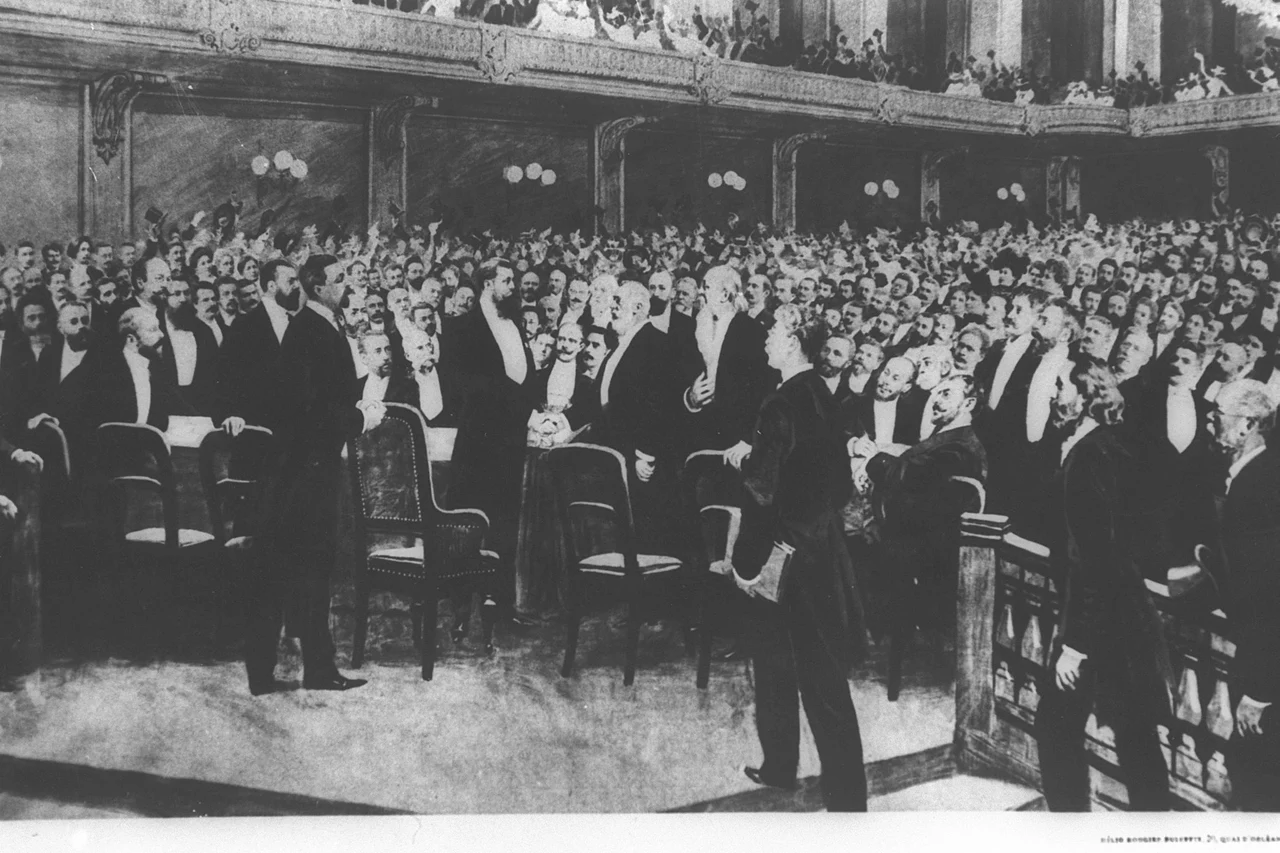
he delegates at the First Zionist Congress, held in Basel, Switzerland (1897).
Expulsion
Palestinans ‘leaving’ was always part of the story. As Zionism’s founding fathers Herzl, put it: ‘we shall endeavour to expel the poor population across the border unnoticed—the process of expropriation and the removal of the poor must be carried out discreetly and circumspectly’.
The thing is most people – rich, poor or middling – don’t take kindly to being shoved off their land or out of their homes, however ‘discreetly’.
The Zionists tried to make out Palestine was a shithole, ‘a malarial swamp’ in Lloyd George’s words. That no one wanted. Early on in the project two rabbis were dispatched to Jerusalem to report on the lay of the land: ‘The bride is beautiful’ said the surprisingly truthful rabbis, ‘but she is married to another man’.
That man was Palestine. O well.
Plans to establish a home in a ‘land without a people, for a people without a land’, barged ahead.
Who cared that this vaunted ‘land without a people’ actually held one and a half million Palestinians on it?
That far from being a ‘malarial swamp’ it was fertile, with cities, farms, orchards, waterways, harbours, schools, markets, a functioning administration, and much loved by its people.
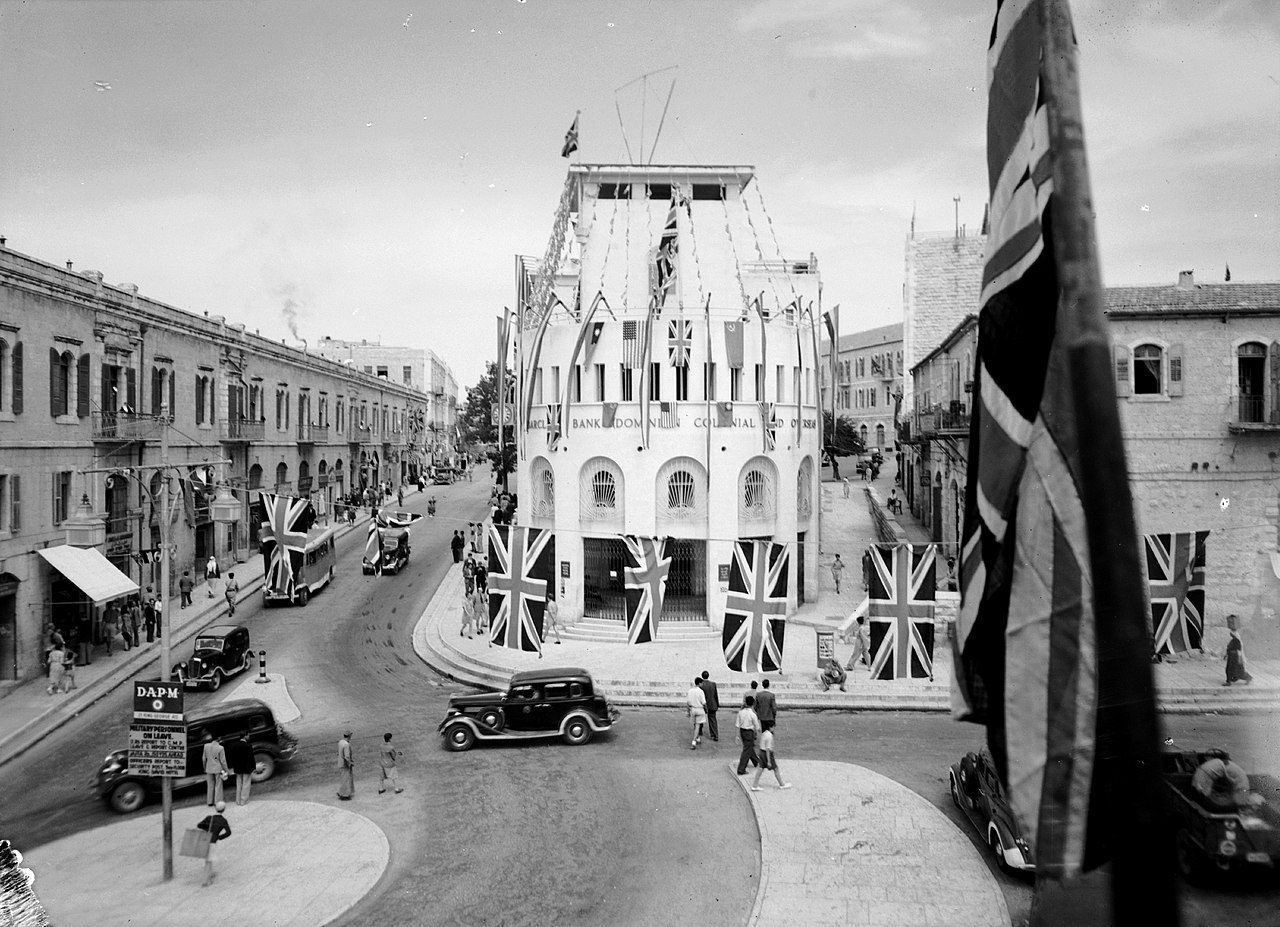
Jerusalem on VE Day, 8 May 1945.
Enter the British.
Still in full colonial mode the Brits decided having Palestine under their control could be extremely useful. The Suez Canal was close by. It was bordered by Syria, Lebanon, Jordan, and Egypt.
In good old colonial divide and conquer mode, they threw their weight behind the Zionist movement now gathering members, and financial backers, throughout Europe and America.
When the British walked into Palestine, Zionists literally walked in alongside them.
Britain’s Governor General said: ‘our aim is to create a loyal little Jewish Ulster in Palestine. To ‘guard against a sea of hostile Arabism’.
Lovely.
The British government ‘gave’ Palestine to the Zionists, and heartily encouraged Jewish ‘ingathering’, while openly supporting, armed, and turning a blind eye to the vicious terrorist activities of Zionism’s infamous militias.
‘We have a strong presence on the ground here’ boasted one militia group, ‘the British cannot say no to us’.
Zionist communes were encouraged and financed, to buy up thousands of acres of Palestinian land and expel the farmers. Zionist militias did what they wanted to the Palestinians, while inward migration of Jewish peoples from Russia, Eastern Europe, Europe and America increased tenfold.
As Zionist terrorists and British soldiers bullied, harassed and belittled the Palestnians, a census of the entire territory was carried out, by the British, aided by Zionists who often entered Palestinian villages disguised as indigenous Arabs taking advantage of traditional Palestinian hospitality, which welcomed, and fed, strangers.
Every single Palestinian village was listed and mapped, the number of men who might resist, where the stores were kept down to the number of olives and apricots on the trees. Crucially how the village could be accessed and exited from.
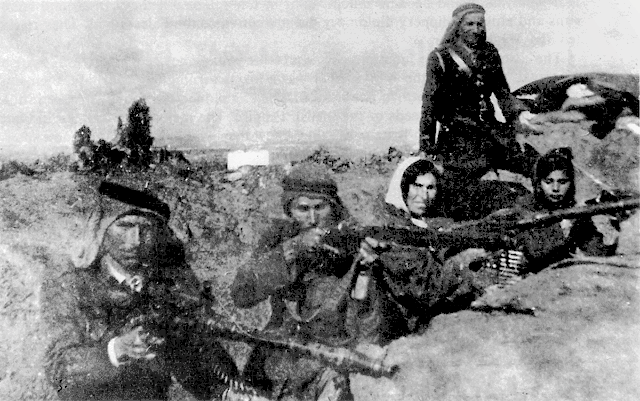
Arab revolt against the British.
Resistance
When a Palestinian resistance movement rose up, distraught at the stealing of their land, the lack of civil rights, the blatant privileging of the Zionists, and an ever-increasing inward flow of Jewish migrants, the British, and their Zionst pals, were armed with a blueprint of every single village’s strengths and vulnerabilities.
The uprising was put down with extreme brutality.
By its end, three years later, all Palestinian men of fighting age had been wiped out. Thousands of Palestinians driven out, their land confiscated, their homes blown up, while Zionist militias roamed the streets triumphant.
When the ‘catastrophe’, the Naqba came with Israel’s declaration of statehood in 1948, and the ejection of Palestinians, Palestinians were defenceless. Hundreds of thousands were forced into exile and refugee camps, carrying what they could on their backs. Their abandoned villages and orchards instantly taken over by the Zionists, or what was now the Israeli government. During the Naqba 530 villages were destroyed.
Then, as one commentator said, the Israelis were handed a ready-made State. The only difference workers noticed when they came into their offices the next day was that their Palestinian colleagues had been expelled. From their own country.
Having utilised their favourite colonisers trick of pitting an implanted group against the local people to further their own ends, the British buggered off, leaving an unfolding catastrophe behind them.
Just as they did in India. In Ireland. In Sri Lanka. In huge swathes of Africa where inequality, historic injustices and bitter racial divisions poison all life and all political institutions to this day.
Palestinian resistance, already fatally wounded by the British, was helpless as Zionist armed terrorist groups surrounded and torched entire villages, blew up Palestinian buildings, killed and displaced hundreds. Entire cities supposed to be under Palestinian control, were surrounded and bombed. All men of fighting age were removed to concentration camps.
Lovely, hey?
As Zionist groups – now the Israeli army – grew ever stronger, attacking and taking over village after village, David Ben Gurion wrote: ‘in each attack a decisive blow should be struck. It should result in the destruction of homes and the removal of the population’.
Sound familiar? Gaza anyone? The West Bank? Silwan?
Zionism’s deadly history of violence against the Palestinian people hit a peak this past ten days as the Israeli army, armed, thanks to billion dollar yearly gifts, grants and loans from the US, and in furious revenge mode after an attack by Hamas, bombs home after home in Gaza, the biggest open prison in the world, where half the population is under fifteen years of age.
Who cares if some old granny, or a few terrified children are still in there? Blast away dear boy, blast away. This is Israel. We can do whatever we want to the Palestinians. The West has always said so.
Fire ahead, say the Americans. We’re monitoring the situation, say the Brits. We love Israel, says Ursula von der Leyen of the EU.
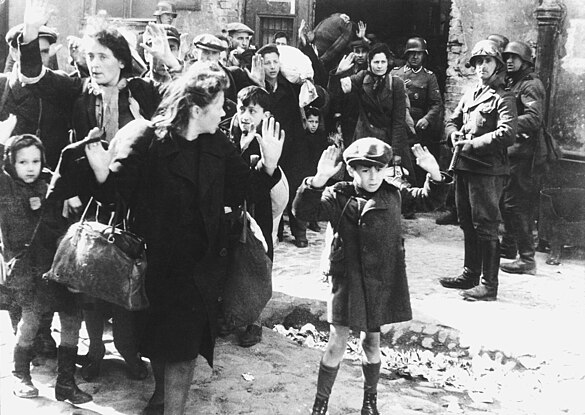
Warsaw Ghetto boy, perhaps the most iconic photograph representing children in the Holocaust.
Sympathy for the Jewish People
The truth is, everyone in the world with a heartbeat sympathises with the Jewish people for seemingly endless pogroms, culminating in the most terrifying pogrom of all, the Holocaust, where six million completely innocent people were burnt, shot, gassed, tortured to death.
But the Holocaust happened in Germany. In Europe. Almost every country in Europe collaborated with the Nazis in ‘exterminating’ – that terrible word – the Jewish people.
France, Poland, Ukraine, Italy, Belgium, the Channel Islands, Norway, Albania, Romania, Yugoslavia, Latvia, just to name a few.
Businesses that collaborated include Coca Cola, Ford Motor Company, and IBM.
American companies in Germany included General Motors, Standard Oil, IT&T, Singer, International Harvester, Eastman Kodak, Gillette, Coca-Cola, Kraft, Westinghouse, and United Fruit.
Hollywood studios ‘adjusted’ films to Nazi tastes.
Financial operations were facilitated by banks such as the Bank for International Settlements, Chase and Morgan, and Union Banking Corporation
And of course delightful German outfits like IG Farben that produced ‘Zyklon B’, the infamous insecticide used by the Nazis to gas millions of Jewish people, communists, socialists, Romanies, jazz players, gays, and ‘undesirables’.
The Allies, horrified at what they’d found in the concentration camps, vowed to destroy IG Farben after the War.
But the top twenty-three directors tried at Nuremberg for their involvement in developing the science behind the extermination of millions of human beings, were given risible sentences of two, three or six years.
And, oops, before you could say ‘O what a lovely Holocaust’ IG Farben was back in production.
No real recompense was ever made to the Jewish people. A handful of Nazi top dogs were topped. Others fled to America, North and South or slid back into their old jobs as ‘captains of industry’. As for art ‘to this day, some tens of thousands of artworks stolen by the Nazi’s have still not been located.’ Never mind returned.
Nobody really paid the price for the horrors perpetrated. Deadly nerve gases magically became pesticides. Companies like IG Farben became vast international corporations gifting humanity: .nerve gases, pesticides, insecticides, heroin, Zyklon B, Lindane, DDT, Agent Orange, Bovine Growth Hormone, Round Up, and GM.
Hey ho. Business is business.
‘Somewhere else’
Instead of truly understanding why and how such hatred had exploded, instead of truly recompensing victims, the idea of a Jewish homeland, of exporting the problem to ‘somewhere else’ was promoted ever more vigorously, gaining mythic status.
Far easier to promote Valhalla on someone else’s land than deal with European Nazism.
Exporting the problem to Palestine, which had not been implicated in the torture of a single Jew, never mind the murder of six million Jews in the most horrific ways possible, of stealing the Palestinians land, of getting rid of them by whatever means you could get away with, i,e, anything, was more heavily promoted than ever, with America, now ‘leader of the Free World’, the Zionists new best friend.
America was more or less happy to play along with Zionism. When Israel won the Six Day War in 1967 – against three Arab nations – they became genuinely enthusiastic. As one American Senator (Jesse Helms, 1995)put it, ‘Israel is the equivalent of a U.S. aircraft carrier in the Middle East. Without Israel promoting its and America’s common interests, we would be badly off indeed.’
Did somebody say the land on which Israel, Britain and America had built this ‘aircraft carrier’, this militaristic, ethnocentric, ethnic cleansing, colony, actually belonged to the Palestinian people?
Em, no. O well.
Big players play while little people, very often brown or black people, get squished.
Funnily enough, another REALLY big player in torturing the Jewsh people, the Catholic Church, criminally responsible for placing a target on Jewish people’s backs for two thousand years – as ‘THE PEOPLE WHO KILLED JESUS!’ – seem to get a free pass.
This vicious and untruthful slur was only rescinded by the Church in 1960!
‘A Sorry about that lads’ kind of apology issued forth: ‘yeah shure thousands of ye were murdered and boiled alive for killing yer man when we all knew it was actually the Romans what done it, but no hard feelings, right?’
So folks is Israel a land of milk and honey, or a catastrophe? A homeland for Jewish people built on a Palestinian graveyard? An aircraft carrier for the U.S.? Or a Western ‘dagger’ plunged into the Middle East?
Who knows where Israeli/Zionist nationalism – fueled by fear, terror, propaganda, militarism and the cynical manipulations of the Big Powers, and a bad conscience – will lead next.
All out war in the Middle East?
All out war in the world?
In the meantime, one can only pray for Gaza. For Palestine. For the ordinary people of Israel not supporting the madness.
For us all.
Feature Image: The Dome of the Rock, Jerusalem. Frank Armstrong, 2003.
What do you pay attention to when you listen to music? The lyrics and melody? The instrumentation and timbre? I hear the bass and rhythm. It’s challenging for me to remember lyrics. A beautiful bass enchants me, and the queen of the bass, of course, is the double bass. Still, it took me more than thirty years of making and listening to music until I finally played it myself.
At the age of seven, I began to play the flute, and a year later, the clarinet in the local brass band in a southern German village right next to the River Rhine.
With my first notes, I became a clarinetist in the youth brass band, in preparation for joining the adult brass band from the village a year later. Until the age of thirteen, I spent my Friday nights playing Volksmusik and marching music, as well as soundtracks from famous American movies.
On weekends, we performed marches in other villages in the district, played music for birthdays, weddings, and funerals — all while wearing uniforms with badges on our chests. These events often involved a lot of alcohol, a repertoire of over one hundred pieces, and plenty of bonding time. I enjoyed it immensely; it felt like home!
I believe this is where my love for the bass began. In a way, I’ve remained attached to this genre. Twenty years later in Berlin, I played the bass clarinet in a brass band.
Sometimes More is Possible
When I was thirteen, my family moved to a small town in northern Germany, which marked a significant cultural shift for me.
It was also where my classical education began. I joined the youth symphony orchestra of the music school., and there I met Judith Retzlik, with whom I now play alongside Myriam Kammerlander in our band gerda vejle.
My new clarinet teacher supported and encouraged me at every available opportunity, while a conductor showed me that sometimes more is possible than I initially thought. I began to professionalize myself, and the dream of playing the double bass started to take shape.
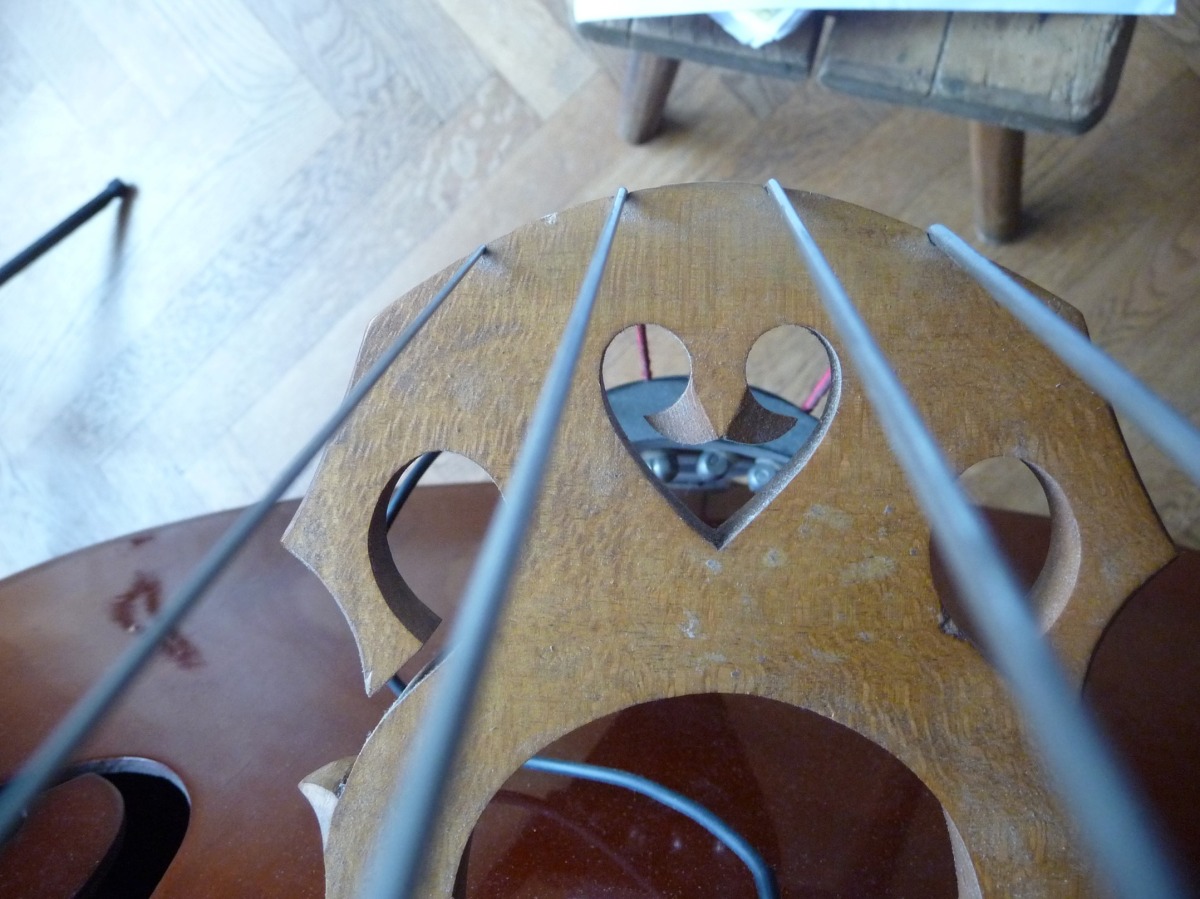
However, another fifteen years passed by before the double bass finally entered my life: Driven by heartbreak, I bought a big and strong double bass with a heart in the bridge (thank you, Judith, for your encouragement), and since then, I’ve been the double bass player and sometimes a singer at gerda vejle.
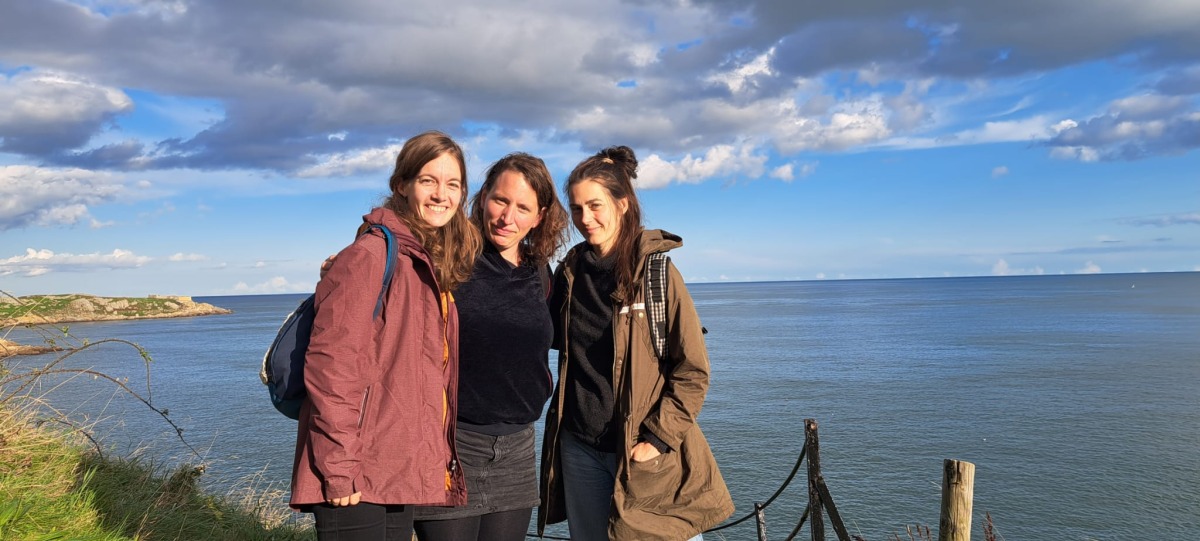
Together with Myriam and Judith, we are gerda vejle: a space for creativity, a creative home, and friendship. If you want to learn more about gerda vejle, you should read Myriam‘s text; I couldn’t have said it better.
My role at gerda vejle is likely to provide a solid foundation for vocals, harp, and violin to rest upon. It’s wonderful to play multiple instruments that allow you to express different facets of yourself. The clarinet is my voice, and the bass is my body.
In the early years of gerda vejle, I listened to a lot of music, mainly because I was responsible for music booking at a new large venue called silent green in Berlin. This time was intense, and there was little time for my own creativity, besides the band.
Today I work as a systemic coach; and support individuals and groups usually from the creative industry in decision-making, change and search processes.
Music and Motherhood
Finding enough time for my own music-making has always been a challenge. It became even more demanding when I became a mother.
Time became the most valuable resource. Unfortunately, it’s still the case that women, in particular, struggle to balance family and music. Creative processes and working conditions are not often child-friendly: concerts and rehearsals frequently occur in the evenings and on weekends when childcare services have already closed.
Moreover, creative work demands full concentration and commitment, which can be challenging to maintain with children. This needs to change.
Gerda Vejle at Vico, Dublin.
The Oceanic Feeling and Baths in the Ocean!
Just a few years ago, I learned from a friend about the concept that describes the feeling I had always been searching for. When I discovered it, it made me the happiest person, not only in life but especially in music: the oceanic feeling. I yearn to lose myself, vibrate, connect, and resonate—a physical experience that I find when I play and listen to music.
In September, 2023, gerda vejle travelled to Ireland, and I became both an ocean swimmer and a resonating double bass player. The oceanic feeling was very close. Hopefully, there’s more of that to come in the future.
Looking ahead, I hope that we, gerda vejle, will finally manage to record our music. Do any of you know a talented female producer? If so, please get in touch with us.
The anthropologist Jack Goody pours scorn on modern dining habits. Solitary consumption he says reverses the customary habit of ‘public input and private output’, making eating alone ‘the equivalent of shitting publicly.’
Dining, after all, as the great gastronome Jean-Anthelme Brillat-Savarin, put it: ‘is the common bond which unites the nations of the world in reciprocal exchanges of objects serving for daily consumption.’
The restaurant emerged as a distinctive forum for public consumption in eighteenth century France. Prior to that it was the simple table d’hôte, where a traiteur would present a large pot to the assembled diners, who arrived at the appointed hour.
This could present difficulties, however, if agreed conventions were lacking on how diners were to participate. On his travels in France, the agronomist Arthur Young bemoaned the greed of his dining companions in hostelries, saying, ‘the ducks were swept clean so quickly that I moved from the table without half a dinner’. In the wake of the French Revolution, an upwardly mobile bourgeoisie sought a more recherché experience.
Originally, restaurants (deriving from the verb restaurer ‘to restore to a former state’) sold medicinal broths. In her history, The Invention of the Restaurant (2000), Rebecca Spang recalls how the restaurants of eighteenth-century Paris differentiated themselves from other eateries by offering sustenance at any time of day. Eventually they began offering more solid fare, thereby encroaching on the traiteurs.
The strict laws regulating the division of business between the different food guilds in France at the time led to a landmark court case in which the restaurateurs carried the day. This allowed the restaurant-style of dining, ‘characterized not by commonwealth but by compartmentalization’, to emerge as the dominant form of eating out in the Western world.
Fine Dining,
Elitist Quality
Today, restaurants invariably ‘plate’ each dish before presentation to the individual customer a style known as service à la russe, which replaced the more medieval display of service à la Francaise during the mid-nineteenth century.
The elitist quality of the restaurant experience is part of its appeal. Indeed, according to Sprang, the ‘restaurant fantasy implicitly required the presence of somebody outside: some poor devil with his nose pressed to the window’.
Thus, a restaurant is more than merely an establishment where food is served. It involves the division of diners into parties and, generally, serves separate portions to individuals. It remains synonymous with French food, and the dominance of French cuisine is apparent in the early history of Dublin restaurants, although this has changed radically in recent decades.
Apart from chefs, waiting staff and often indulgent investors, the most important person for a restaurant’s survival is the food critic. A bad review can sink a restaurant, while praise can bring customers flooding into the next big thing, although in recent times food criticism is being overtaken by online reviewers that are subject to manipulation.
Grimod de La Reynière
The First Gastronome
A food critic may also be referred to as a gastronome. The first of this kind was Alexandre Balthazar Laurent Grimod de la Reynière who wrote his Almanach des Gourmands in the wake of the Revolution.
He issued his pronouncements in the name of tradition as a member of the departed ancien regime. The son of a rich farmer-general, in his early life he displayed liberal tendencies but became disillusioned with the new order, condemning ‘everything that is despicable and vile; there in two words you have the Revolution’.
He asserts: ‘I will never be the friend of a democrat. It is atrocious that men of letters should think as the majority do today (MacDonogh,1997).’
According to his biographer MacDonogh, he began to write about food after being told to write about something harmless, or give up writing altogether. In this medium he ‘masked his vicious attacks behind harmless idioms’. Gastronomy became a vehicle for his reactionary views.
An awareness of ‘good’ food revealed the true aristocrat. After the Revolution he founded what he referred to as a Jury des Degustateurs, and between 1803 and 1812 set about writing his Almanach des Gourmands. The aristocratic display of pre-Revolutionary France could re-emerge in the new forum of the public restaurant.
De la Reynière was also alive to the possibility that he could be labelled a glutton, asserting: ‘Let it be said that of all the Deadly Sins that mankind may commit the fifth appears to be the one that least troubles his conscience and causes him the least remorse.’ Henceforth a glutton would be one who eats too much rather than a refined individual with an interest in talking about food.
The gastronome in his or her most evolved form is not a professional cook. He or she is a man of letters. His or her real table is not the one where he eats but where he or she writes. It is with the flourish of the pen that he or she achieves success rather than through their knowledge of the arcane culinary arts, as ultimately the gastronome is not the one who knows the most, but the one who speaks, and writes, best.
Garden café of the Hôtel Ritz Paris (1904), Pierre-Georges Jeanniot.
‘Lightning Sketches on the Table Cloth’
Curnonsky, the pen name of the great French food critic Maurice Edmond Sailland who was elected Prince Elect of Gastronomy by Le Soir magazine in 1927 describes the role as follows:
There are those who stare with gluttonous resentment, and those who snap impatient fingers at every passing waiter: those who flap huge newspapers in their companions’ faces, and those who shake defiant powder-puffs in their neighbours soup; those who devour bread to repletion, and those who chat so gaily, to the restaurant at large. But there are others, a chosen few who, having developed to a fine degree the study of physiognomy and, coupling this with a skilled pen or pencil, combine their talents in lightning sketches on the tablecloth.
Pascal Ory poses the question ‘Does the chef make the gastronome or vice versa?’. Culinary evolution is largely independent of gastronomic evaluation, but without a critical audience chefs may be insensitive to diners’ tastes.
Moreover, just as when we cook for ourselves we don’t tend to perform heroics, a cook without a responsive audience might take a more functional approach. But innovation and high standards become an imperative when the food critic is there to evaluate.
Even if they may claim to have nothing but contempt for the breed, virtuoso chefs usually seek the validation of critical approval, and boundaries are only broken when gastronomes are there to describe them as such. More to the point, the imprimatur of the critic brings great rewards. Perhaps unfairly, the pen is often mightier than the kitchen knife.
Notwithstanding increasing costs in a fraught business, the back breaking labour of chefing, improved takeaways, the strains of Covid and the distortion of food criticism through sites like TripAdvisor, restaurant dining endures as a sought after experience. After all, where else would anyone refer to me as “Sir”.
Born in 1875, like many in his era Thomas Mann was initially a Great German Conservative, but by the outbreak of World War II he was making anti-Nazi speeches for the BBC.
Mann won the Nobel Prize in 1929 for his chronicles of German families in Buddenbrooks (1901), and for his bildungsromanThe Magic Mountain (1924), along with a number of well received novellas and short stories. Among his later publications, the novella Death in Venice (1929) is a terrific book, expressing his repressed same-sex attraction; it is a worthy expression of a hyper-civilised, fin de siècle aesthetic intelligence. The film by Luchino Visconti with Dirk Bogarde, though laboured, is also a masterpiece. It includes the famous adagio by Mahler, with whom Mann was acquainted.
Mann seems to have known almost everyone who was anyone in his time, and was very catholic in his tastes and company. He remains, however, a crucial bridge between the tradition of nineteenth century letters and the twentieth century. Indeed, the earlier novels referenced above may appear at times like caricatures of that tradition.But great aestheticism does not necessarily equate to human greatness.
As alluded to, Mann was a supporter of Kaiser Wilhelm during the First World War, and a romantic German nationalist with a lifelong fascination with Nietzsche. He lived for most of his adult life in Munich and his lifestyle consisted of work, an eclectic set of friends and a digression into unconventional Germanic behaviour. He was married to a Jewish woman, Katia, who he adored, notwithstanding a suppressed homosexuality or bisexuality: they had six children.
As a novelist, not only Kafka but also Musil and arguably Broch, are greater twentieth century writers of fiction or prose within the Germanic tradition. But greatness also involves moral influence. Although, there was little until the 1930s to disclose his abundant moral courage, it was almost unparalleled among great writers even including Albert Camus. The stakes were higher.
Colm Toibin’s recently published zeitgeist book on Thomas Mann The Magician (2021) reveals at one level a set of character traits crucial to how he achieved greatness. He was innately Protestant, despite a Brazilian, Catholic mother, modest and hard working. Commenting on his own prose style, Mann said it was ponderous, ceremonious, and civilised. This he said was all that fascists hate.
And boy did he hate them. He hated in fact all forms of human fakeness, lies, deceptions and misinformation; an inclination very evident in the early novel Mario the Magician (1929). He also hated a lack of order and fecklessness, which was apparent in his attitude towards his brother Heinrich. And he hated barbarism.
Thus, the arch conservative of Lubeck, in response to the rise of fascism and barbarism, changed his colour. Like Fernando Pessoa in Portugal, the caterpillar became a butterfly.
The change was gradual. First, he had supported the Social Democrats in the Weimar government, writing treatises on his conversion to socialism as the Nazis emerged triumphant over the course of the 1920s and early 1930s.
Mann simply could not deal with Nazis. At an implicit level, it might have been simply a matter of bourgeois taste, as he had an impeccable personal and aesthetic sensibility and was cosmopolitan but not decadent in his outlook.
In American exile, where he was suspected of harbouring communist views, he was asked about his views on the avowedly communist Bertold Brecht. He said he did not like his writing, but that if he liked a communist writer he would have no problem saying so.
Book burning in Berlin, 10 May 1933.
Exile
On holiday in 1933 he was advised not to return to Germany after many of his books had been burned in the modern day auto–da–fé. It is noticeable that it was mostly the books of Jews and communists that were burnt, but the German Student’s Union, spurred on by Goebbels, also burned Mann’s work.
In Berlin, some 40,000 people heard Joseph Goebbels deliver an address saying:
No to decadence and moral corruption … The future German man will not just be a man of books, but a man of character. It is to this end that we want to educate you. … And thus you do well in this midnight hour to commit to the flames the evil spirit of the past.
Mann was excommunicated as a citizen in 1936. His life was threatened, and he was a moving target for the fascists for the rest of his life. Thus he left Germany when he was almost sixty, and apart from some brief post war visits never returned to reside there again.
One wonders what would have happened if he had been more compliant. He was not Jewish and only a socialist at a stretch. It is possible that they would have showered him with hollow accolades if he had shown more deference. But unlike Martin Heidegger, he did not succumb, and thereafter in exile in Switzerland and America he became a more complete human being, which is reflected in the marked improvement in the quality of the prose thereafter.
His wartime broadcast relayed on the BBC might be regarded as a kind of inverse Lord Haw Haw. On one of his eight-minute broadcasts from 1940 Mann condemned Hitler and his ‘paladins’ as crude philistines completely out of touch with European culture.
In another noted speech, he said: ‘The war is horrible, but it has the advantage of keeping Hitler from making speeches about culture.’
‘Crude Philistines’…
At the end of the war, he refused to allow his nation off the hook. They had turned mad; it was collective hysteria and even the 1945 atrocities documented so well in Anthony Beevor’s Berlin: the Downfall 1945 (2002) were in context to him condonable:
Those, whose world became grey a long time ago when they realized what mountains of hate towered over Germany; those, who a long time ago imagined during sleepless nights how terrible would be the revenge on Germany for the inhuman deeds of the Nazis, cannot help but view with wretchedness all that is being done to Germans by the Russians, Poles, or Czechs as nothing other than a mechanical and inevitable reaction to the crimes that the people have committed as a nation, in which unfortunately individual justice, or the guilt or innocence of the individual, can play no part.
Members of the Hollywood Ten and their families in 1950, protesting the impending incarceration of the ten.
Unamerican Activities…
Extremism cuts both ways. In exile he was forced to testify before the House for unamerican activities as a suspected communist. Here is how he responded:
As an American citizen of German birth, I finally testify that I am painfully familiar with certain political trends. Spiritual intolerance, political inquisitions, and declining legal security, and all this in the name of an alleged ‘state of emergency’. … That is how it started in Germany.”
Moreover, when Mann joined protests the jailing of The Hollywood Ten and the firing of schoolteachers suspected of being Communists, he found ‘the media had been closed to him.’ Finally, he was forced to quit his position as Consultant in Germanic Literature at the Library of Congress, and in 1952, he returned to Europe. Th Overton window of the thought police fell on the great writer, as it does to many today. He was now nearing eighty years of age.
Exile created both a looseness and precision of prose style. A spring in the step. Dr Faustus (1947) is one of the best books ever written. It is a masterpiece and worthy of Broch or Musil or indeed Kafka. The stilted Germanic prose style becomes freer. The theme inspires: good versus evil.
The book is about the composer Leverkuhn who sells his soul to the devil. The Faustian pact is Fascism. It is also about the corrupting influence of atonal music and its nihilistic dissonance which creates a valueless universe, like the structuralists and deconstructionists of our time. The great prose meister was having none of it.
In my view, Dr Faustus is also about Martin Heidegger the other central intellectual figures in Germany at the time. Heidegger fell for the bait and took all the Nazi accolades, entering the Faustian pact despite his Jewish mistress Hannah Arendt, who wrote eloquently subsequently about the banality of evil. Mann, though a man of considerable means, said no.
A theme central to his existence was that an artist cannot abandon politics at least not in such a period as the 1940s, and must recognise the moral consequences of his actions.
Dr Faustus frequently references Leverkuhn’s veneration of Albrecht Durer, the great Renaissance artist, and his pictorial representations of moderation, judgment, melancholia and the apocalypse. Indeed, as the Nazi state collapses, he becomes obsessed with melancholia.
In the search for spirituality, Mann invokes in a man who has lost all reason and his soul. When composing Dr Faustus, Mann showed and lectured on this to a fourteen-year-old girl who was visiting, who was Susan Sonntag. Thus, the magician bridges generations and resonates through the ages.
And then at the end of Days with the light dimming he showed in his book about the conman Felix Krull the darkly comic humour at the heart of capitalist chicanery, which, if left unchecked, culminates in fascism.
Mann is the great Protestant Germanic intellect of the last century, but he was also an ethereal magus and magician.
His legacy lies in the assertion of standards, of discipline, of stable family values, and of a certain amorphous sexuality. Above all it is in the condemnation of extremism, the condemnation of barbarism, the assertion of civilised values, the rejection of censorship, the hatred of chauvinism and the social cleansing from the left or right. A consistent hatred of intolerance from all sides.
That is what is needed now.
His life is also an example of moral courage. The Germans wanted the magician back, but he was not satisfied that they had changed. It was him judging them not them judging him. He did not think they were displaying appropriate contrition for what they had done. He was right.
In a different context, in Chile, when Pinochet was forced to call an election – as our conservative rulers will soon be required to in Ireland – a persecuted advertising expert advised the opposition as to how to orchestrate a campaign. No reference to mass murders or internment camps, just young Chileans with the slogan JUST SAY NO.
That is what Mann said to fascism, and what we must now say to the ruling parties in Ireland. No images of homelessness, no incessant exposure of state corruption and criminality. JUST SAY NO, before it is too late.
Around the earth, a warring, wooden sea of brigs was bristling, a-flame; volcanic ash descending on the vacillating map. The weathered world began to shift – a tiny alteration sowing ice across the land. The shining-bellied geese no longer wintered by the lough. The turf-blue river waters died. An iron frost persisted, all the spring, without a rain, the blooming yearly crop undone – in every rill and valley, sick. The factious common people roared in protestation; then dwindled down, masticating slowly, like a herd, on sour, curdled soup and sallow greens: a meal of nettle stems and charlock – the lush, green-leafed, light-golden-flowered thing that grows among the grass. The lark-lit summer moors were blank; the meadow-birds aghast. No longer having feed to give, the grieving poor death-rattled in the fields, as the little cows they tended fell. Like rotten sheep themselves, after supping dead potatoes in distress, whole parishes surrendered, passing out, in fever-thin delirium, to waste and bloody flux: a plague of desperation, day by day. Town and city quickly filled with remnants of the living. The census-takers floundered; swelling ditches overflowed. To put an end to expiration, the famous bishop brewed a broth: a medicine made up of milk and boiling water, with a sprinkling of chalk – to be dispensed among the stricken, till the ague settled down.
Feature Image: gravestone in Coolaghmore, county Kilkenny of the Lee family, of whom three members died in 1741–42.
The underlying theme of Canary is that of missed warnings and overcoming trauma. My mother lost her battle with cancer in 2016 and my son Noah was born asleep in 2020.
I’ve always been interested in the experience of extreme states of mind and body and even though these experiences were so painful, they were also deeply fascinating and have deepened my interest in the Big Questions, particularly what happens after this life ends; what is beyond the physical world that we experience through the senses.
Tracks such as Cascade evoke the terror and drama when the worst thing happens, and the trippy video that my friend Simon Blake gave me footage for – and Tom Schumann and I edited together – really convey something of the sense of being overwhelmed:
In a similar vein, How To Move Forward evokes a sense of the unfolding of a cataclysm, also with an undercurrent of war and conflict. The vocal samples are from ex-Navy Seal Jocko Willink and the video was cut together from authentic combat footage captured by Funker530 in Afghanistan:
In contrast, the album offers plenty of space for meditation and contemplation to explore the possibility of transcendence of the suffering of the world, with tracks such as Temple Gong drawing influence from my time spent in temples in Bangkok:
Similarly, Viññāṇa is inspired by meditation retreats in Sri Lanka and Wales, with hours spent ruminating on the fabric of reality as experienced through deep meditation and reflection; “what it means to be human” as podcaster and scientist Lex Fridman intones on the track.
Neuroscience has come a long way over the last hundred years, with the advent of brain scanning technologies such as fMRI and EEG etc, but the deepest questions still evade answering. The use of the combination of Thai traditional instruments alongside modern electronic production values is intended to musically capture a sense of the old and the new, Viññāṇa being the Pali Buddhist word typically translated as ‘consciousness’.
Album opener Sleeping Meadow sets the scene for a series of dreams with some echoing, sea like sounds and a quote from the Swiss godfather of psychoanalysis Carl Jung, “my relationship to reality was not particularly brilliant“. I’ve always been a dreamer and a bit away with the faeries, and Sleeping Meadow hints at a youthful, pastoral naivety.
Shortest Day is based on samples from an improvisation that I did back at the family home in 2013 when I was seeking to capture something of the strange ambience of our home. My mother was a computer engineer in the 1980s, so our house was full of strange computers that ran games on cassettes. It’s a paean to childhood and the dawn of the era of computing.
Vimutti and When I Leave My Body are collaborations with my dear friend, the German violinist and producer Alex Stolze.
The rest of the Canary tracks I self-produced in collaboration with Mike Bannard at Safehouse studios in Oxford and percussionist and producer Greig Stewart. I really value having their input, I think it can get very insular producing at home and I definitely have my weaknesses in terms of production, especially with drums and percussion.
So, having Greig and Mike to feed into the final refinement process was essential. Alex’s violin parts were taken from some recording that he did for a film project that I’m working on. I took the parts and cut them over a beat that I had in progress, Alex helped with the production and I’m really proud of the result.
Some of the wonky synth parts are taken from my Yamaha DX21 that I’ve had for around twenty years. I’m finally living somewhere where I can have my synths and toys set up and it’s a joy to reacquaint myself with these old friends. Thematically, When I Leave My Body is inspired by the notion of Out of Body Experiences and Robert Monroe was a pioneering researcher in the field. Again, I’m probing the question of what lies beyond this world:
Vimutti is the Pali Buddhist word for freedom. I was crafting the track for a few years, and it came out of the last couple of years before my mother passed away. On reflection her passing was inevitable but at the time we still clung on to some hope that she would beat the cancer that had taken hold. What does freedom really mean, in the face of the inevitable, cruel suffering of our existence?
Somewhere between the tumult and cacophony of tracks such as Cascade and the meditative calm of Temple Gong is Fetus. Also featuring the Thai Gong Circle, Fetus was directly inspired by Noah’s birth and passing, and was composed directly after it happened; art therapy in the true sense.
Balancing a sense of melodrama with deep contemplation, I’m really proud of it, and very grateful to Jonathan Ouin from the band Stornoway who beautifully replayed the main melody lines on cello and Cornish singer Sarah Tresidder who I sampled for the track. Adrienne from Neon Dance helped me put together this ace video for the track, which, similarly to the clip for Cascade, captures the feeling of being overwhelmed:
A reference to the canary in the coalmine as a warning of encroaching threat, the penultimate title track features an extract from a speech by John F. Kennedy where he outlines the dangers of secret societies, apt that within years Kennedy was allegedly murdered by the very institution charged with his protection.
This is also taken as symbolic for one’s own mind, the failure to perceive threats, and the fact that those threats can come from one’s own psychological systems designed for self-preservation.
Unlike the rest of the album tracks, which are Ableton Live productions with to the grid beats, Canary is a free-flowing ambient piece, based on the electronic part, with my friends Greig Stewart and clarinettist Rachel Coombes improvising in the studio. It’s a nice contrast to all the electronica tracks to have something that’s more fluid and organic. Having live musicians to work with in the studio is something that I’d like to explore more in future.
As referenced throughout the album, the final track The Afterlife optimistically gestures at the notion of peace and relief in the transcending of our mortal coil. Here’s hoping!