Blog

  • Michel Houllebecq and the End of History

    Inspired by Michel Houllebecq’s novel Atomised (1998), Ben Pantrey considers the endurance of the Christian idea of the apocalypse in contemporary debates. Note: This article contains plot spoilers for Atomised!

    Atomic Particles 

    Last week, I was in the magazine office, where I picked up a copy of Michel Houllebecq’s book Interventions 2020, which is a collection of short essays. I was instantly struck by the humour, the choice of topics, and the easy-to-read-but-thoughtful analysis of contemporary society. I was shocked.

    “I thought Houllebecq’s books were all about whining about women and immigrants.” I said to the magazine editor.

    “No, of course not. He’s a great writer.” he replied.

    A few days later, I started reading Atomised.

    That book is also extremely readable. In fact it’s the most engaging book I’ve read by a living author. His description of modern life, and the meaningless existence elevated to an ideal in our society, is right on point. The situations he depicts are funny, grotesque, or just plain depressing, but he never wallows. There is a good balance between ideas and plot.
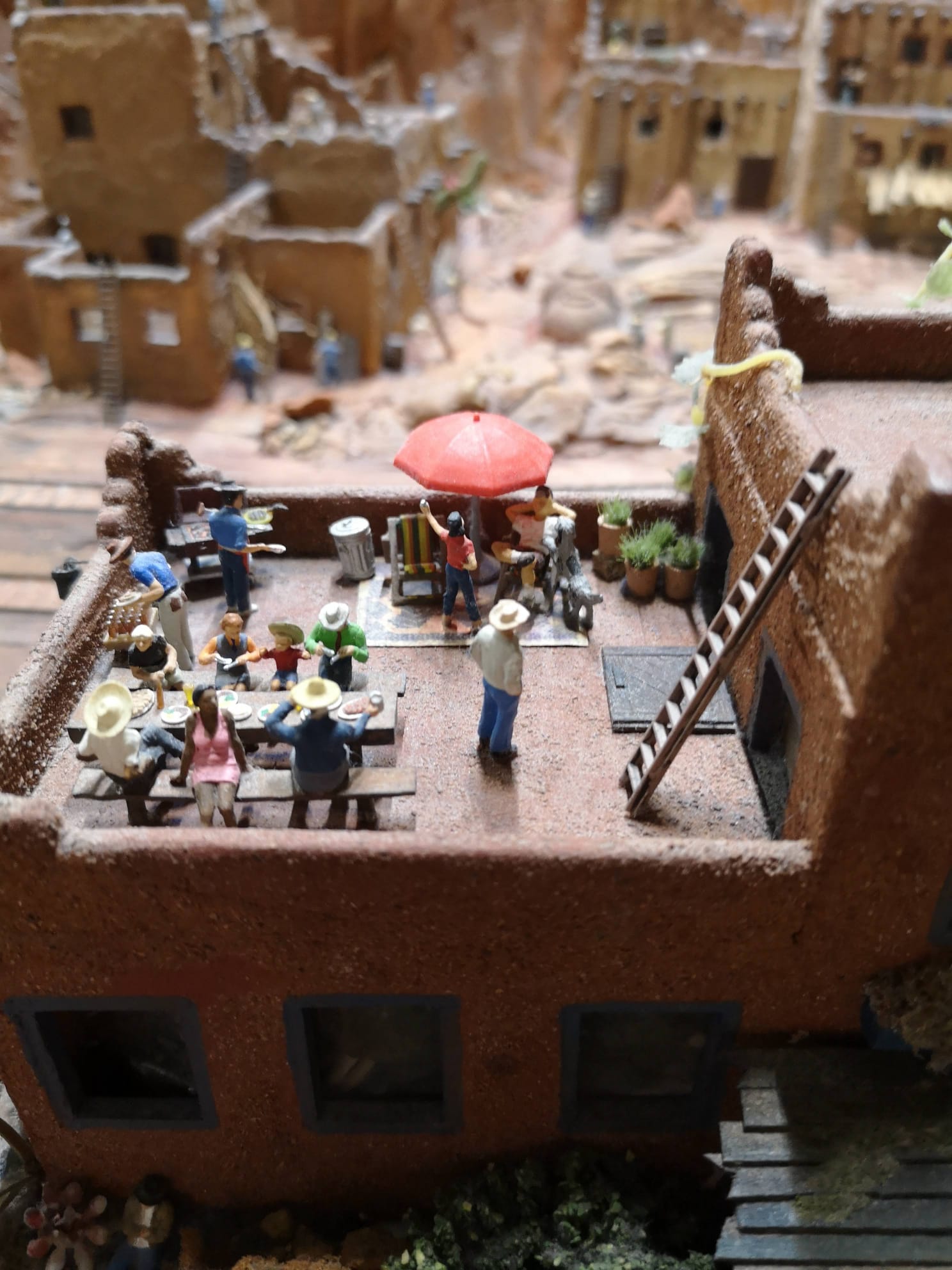
    Miniatur Wunderland.

    Miniatur Wunderland

    More than anything, I was struck by how Houellebeca’s vision matched an idea that had been pressing upon me for some time. In January 2020, I visited Hamburg, and went to an exhibition called the ‘Miniatur Wunderland’.

    It was a building with floor upon floor of model railways in different settings: famous cities, woodlands, desserts, mountains and so on. A miniature model of Hamburg itself was there, with its red light street, the Reeperbahn, where model women posed in red-lit windows, and model men with beer bellies gathered.

    Although constructed from wood, acrylic, steel and plaster, this world was a moving world. Trains and trams shuttled to and fro, aeroplanes took off, and ambulances raced through intersections with their blue lights flashing. I was amazed by the amount of detail that went into this work. They were like Brueghel paintings, with little stories and humorous incidents everywhere you looked: a man falling off a ladder; a love affair; a protest.

    It didn’t happen immediately, but as the years passed, the vision of life suggested by the Miniatur Wunderland wormed its way into my thinking. Standing in the street, I would start wondering how it would look if I was staring down from the sky. How would I perceive the world if I had nothing at stake? If all I was bringing to bear on it was my own curiosity?

    The downside of comparing the world to a model is that it makes everything seem flat and mechanistic. It denies the one real truth of life – subjectivity – and puts in its place a deterministic universe, full of cause-and-effect situations and atoms endlessly shuttling to and fro. There is no space for inner truth, no space for change. Only matter in a void. A big round ball of Being.

    But, since the age of Lucretius this has been exactly the view underpinning the development of scientific thought, and worked out in capitalist economics. Atomistic, materialistic, deterministic. One apple is equivalent to another. Through the medium of money, the variety and uniqueness of physical reality is squashed into a flat virtuality.

    One day Banzan was walking through a market. He overheard a customer say to the butcher, “Give me the best piece of meat you have.” “Everything in my shop is the best,” replied the butcher. “You cannot find any piece of meat that is not the best.” At these words, Banzan was enlightened. (Zen Koan)

    The notion of a commodity with a fixed price (your used copy of a book is worth the same as another person’s used copy of a book in the same condition) ignores the sentimental value of an object.

    ‘Sentimental value’, by which we deem everything that belongs to the domain of actual lived and meaningful experience, is excluded from the reckonings of the marketplace. All the worse, then, that our entire society has become a marketplace, where individuals compete for status: monetary, cultural and sexual. It is this last arena that most fascinates Houellebecq.
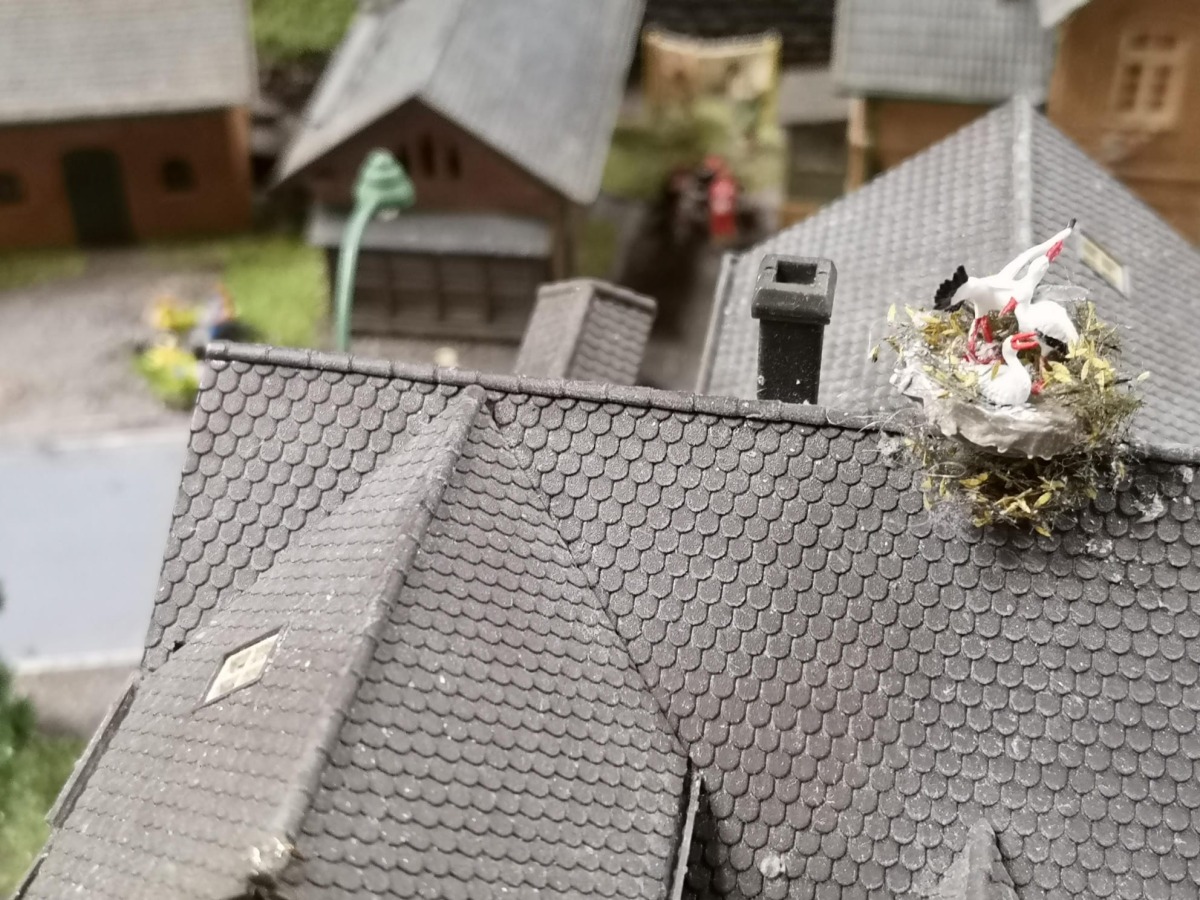
    Miniatur Wunderland.

    Love is an anomaly…

    In Atomised, Houellebecq satirises the dominant ideological model of society, exposing it as spiritually barren, dominated by selfishness, exploitation and ruthless competition in every sphere of life. Love is an anomaly, and quickly snuffed out in a cold world.

    The novel loosely follows the story of two brothers: Michel and Bruno. Their parents are divorced, and they grew up with very different childhoods.

    Michel was fascinated by the natural world, and in his adolescence met by chance with a beautiful girl who loved him in an almost spiritual way, but was met by coldness on his side.

    Bruno, meanwhile, was bullied mercilessly, had no success with girls, and cared more for literature.

    In their adult life, their paths diverge widely. Michel has no desire for life, he drifts onwards, pulled only by his own curiosity to understand the world scientifically. He ignores romantic opportunities, and eventually commits suicide after putting his scientific insights down on paper.

    Bruno, meanwhile, is a sex addict. He pursues sex relentlessly, seeking a validation that no experience can ever provide. No matter the sexual pleasure, or how many orgies he participates in or taboos he breaks, he cannot develop a sense of wholeness. He is always frustrated. This frustration is expressed in his misogynistic and racist articles that nobody wants to publish.

    There isn’t a plot, per se. The main interest lies in the various hijinks Bruno gets up to, and in the bits of social commentary Houellebecq the narrator includes along the way. When describing the protagonists’ father attending school, for examples, the narrator says:

    “Martin’s teacher was keenly aware that there was more to his job than spoon-feeding elementary facts and figures to every untrained citizen. His task was to seek out the qualities that allowed a child to join the elite…” (p. 18)

    Here, Houellebecq is able to bring social critique into his narrative quite effectively, posing provocative interpretations of the role of schooling to the reader. In general, novels act as great mediums for this. The all-knowing tone typical of a novel’s narration, and the fact that they are consumed in private, allows for a direct, and didactic engagement with the minds of readers. The length allows the author to present a totalising view of life all in one go, unlike an article that can only sketch at a perspective.
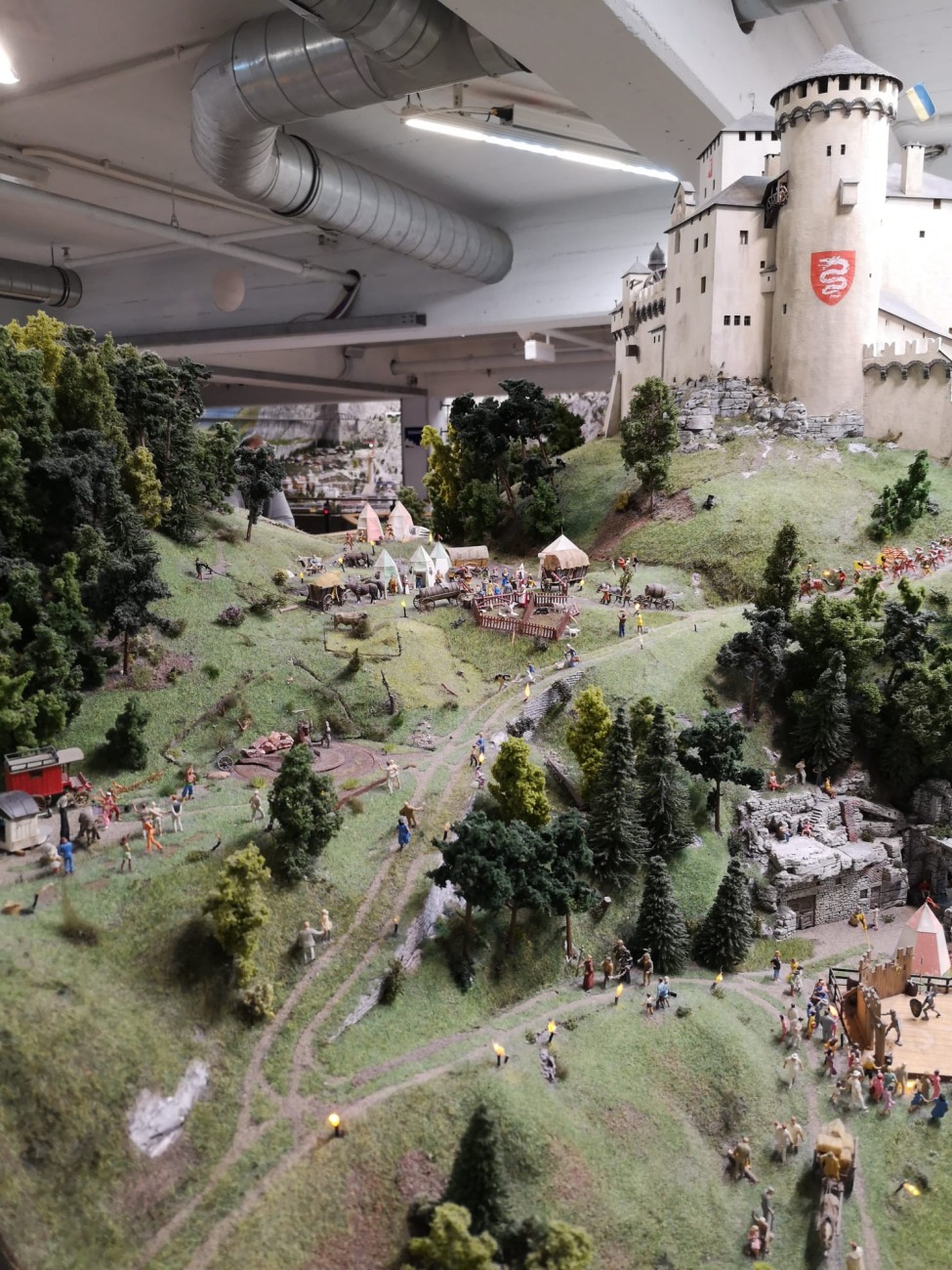
    Miniatur Wunderland.

    New Age Society

    The most damning portrayal of contemporary society arrives in a part of the novel where Bruno attends a festival-cum-self-help-weekend. Houellebecq’s description of the activities at this event could be seen as a a damning assessment of New Age Society as a whole:

    “All around him human beings were living, breathing, striving for pleasure or trying to develop their personal potential. On every floor, human beings were improving, or trying to improve, their social, sexual or professional skills or find their place within the cosmos.” (p. 100)

    Obviously, Houellebecq is not impressed.

    The prime example of Houllebecq’s critique of this self-help 60s-influenced culture is in Michel and Bruno’s mother, who abandons her children in favour of an endless quest of self-discovery and spiritual development.

    Atomised is a bitter and satirical portrait of the modern world where only isolated instances of illogical love redeem a landscape that is otherwise cold, selfish, brutal and crude. Death haunts every moment, with the decaying of our bodies, the shocking cruelties of fate, and our obsession with sex: the one means of delaying the extinction of the species.

    It’s definitely a cynical point of view that Houellebecq promotes, but it’s hard to argue against, and really isn’t so different to that expressed in such popular fiction as The Hunger Games (Suzanne Collins, 2008). Here, too, society is depicted as a ruthless arena of competition. A zero-sum game where those in the lower rungs of society desperately vie to join the elite in a viciously enforced hierarchy.
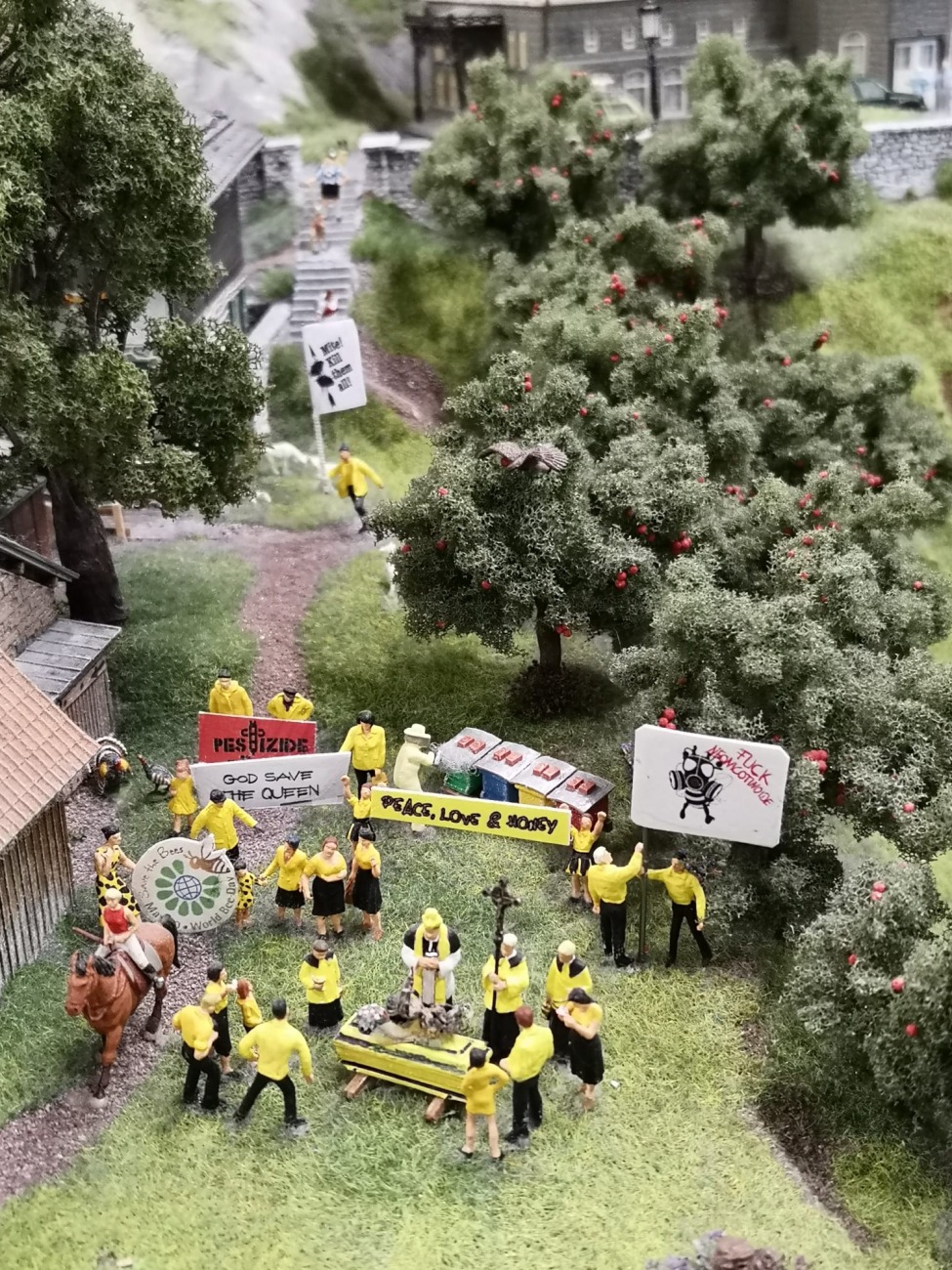
    Miniatur Wunderland.

    Sci-fi Twist

    The final pages of Atomised turns the book on its head, adding an unexpected sci-fi twist. Michel, who has spent his life devoid of romance, devises a way to allow humans to propagate without the need for sex.

    It will all be done in a lab from now on, as with Dolly the sheep, and this lab-based reproduction will allow for genetic modification to create healthier humans that won’t develop crippling conditions like cancer, dementia, cystic fibrosis etc.

    In hindsight, our age of sexual competition, desperate consumerism, and widespread anxiety and paranoia seem rather laughable and superficial. Everything will be settled in peace by a race of sexless, immortal post-humans.

    What do we make of the idea that we are at the cusp of a vast historical shift? The start of a new Millennium, paired with vast strides in technological innovation, certainly put this idea in many people’s minds. This apocalyptic notion manifested first as a fear of the Y2K bug – that computers worldwide would crash at the start of the new Millennium due to dating difficulties, wreaking havoc in the world of finance, medicine and transport.

    Next, there was murmuring over the date 2012, the end of the Mayan calendar, after the Western calendar had ceased to be a problem. This, of course, passed without a hitch. Now we project our apocalyptic fears onto the climate, or on advancements in AI.

    Terence McKenna introduced the doomsday date of 2012 into mass culture. He was vague about what exactly would happen, but believed it would be something new and unexpected. His listeners, high on the drug of Christianity, took this to mean apocalypse.

    Shows like Charlie Brooker’s ‘Black Mirror’ explore the idea of human minds being uploaded into virtual reality when our bodies expire, where we can live in an Eden of our own construction. Is this what Christians meant when they thought of history as a long journey starting and ending in paradise?
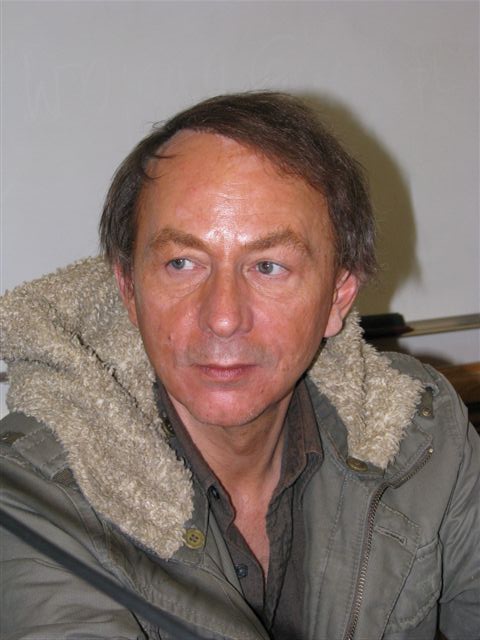
    Michel Houellebecq in 2008.

    Edenic State

    The paradisal state of Eden is that of ignorance: paradise was lost once humanity became self-conscious. In our hedonistic pursuits, I wonder, do we strive for that same unselfconsciousness we have lost?

    It is clear that we see our faculty of reason as something of a curse, even if it does bring us closer to the state of angels. Gnostics lament that nature didn’t bring us one step closer: let us keep our psyche, but free ourselves from the physical body. Let us be like angels!

    With this context, we see how Western science has really been a gnostic dream, with the destruction of physical reality (ecological collapse) and the ascension to pure spirit (cyberspace) its logical goal. We haven’t reached this impasse by accident, but by design.

    Only by recognising and consciously rejecting the gnostic message can we take control of our situation. That involves acceptance of the body, and a rebellion against the tyranny of the mind.

    Am I calling for a plunge into the irrational? After the horrors of the twentieth century, Western man has an understandable fear of the irrational. But remember it was distorted Reason that led to the horrors propagated under Stalin’s Russia and Hitler’s Germany.

    No ‘primitive’ society could have arranged the Holocaust. No, this horror was the dark face of civilisation and a perverse ‘rationality‘. The ‘greater good’: the cold inhumanity of reason. This is what comes of rejecting emotion and feeling, of being out of touch with the messages of the body, our one tangible link with Nature.

    Although we call ourselves a secular society, Christianity still lurks in the shadows of our thinking. Take, for instance, the apocalyptic tone that inevitably attends discussions around climate change or Artificial Intelligence. World leaders packed two by two in Bezos’s Ark. A just reward for our sins. Mr Beast healing the sick. It’s all a bit hellfire and brimstone.

    I’m not saying these areas won’t pose issues in the future, but I think it’s concerning that we always think in black and white: either it’s business as usual or it’s the apocalypse. This blindsides us from acting and reacting in the face of more subtle forms of change. This is, after all, the most likely result of our ecological challenge: the Earth will become slowly more inhospitable. Can we train our eyes on this without jumping to hyperbole?

    This obsession with apocalypse is of course a remnant of Christianity. For Christians, history is linear and has a clear end point: the Day of Judgement, or the Return of Christ. Everything we do until then is fleeting, and only relevant insofar as it affects the judgement that will be meted out to us (unless you’re a Calvinist, in which case there is no relevance whatsoever to these happenings on Earth).

    Christianity has the concept of an End of History built into it, in contrast to cultures that see time as cyclical, just like the seasons of a year or the passing of generations.

    The end of history, or civilisation, does not mean the end of life on this planet, nor even human life necessarily. But it does mean the end of “progress” as we have previously considered it. Our buildings will not always grow taller. Our phones will not always become more sophisticated. Our food will not get more processed. Is that so bad? To live closer to the Earth and to one another?

    For Houellebecq, the end of history means the end of sex as a means of reproduction. And this he considers a form of liberation. The Buddha would agree. He said all desire is suffering. Yet, there’s such a thing as enjoyable suffering. What kind of music would Houellebecq’s post-humans make?

    Another day ends. Throughout the building, lights are flicked off. Conversations slow to a light murmuring, and then drop off completely. At what cost will we keep living in Wunderland?

    Feature Image: Miniatur Wunderland
  • Pietas in Richard Kearney’s Novel Salvage

    When, after a long siege, the Greeks breach the defences of Troy, Aeneas must flee. He carries his father Anchises upon his back and leads his son Ascanius by the hand. Thus encumbered – thus empowered – he begins the epic journey whose object is to found the city of Rome.

    The image of Aeneas and pater Anchises has been painted often, the story told many times. It is inscribed upon the psyche of Europe because it epitomizes the ancient Roman virtue pietas. Aeneas was ‘Pius Aeneas’.

    Pietas means a reverence for tradition, and a reverence for the father at the heart of it. It is a way of looking to the past. It is also a virtue which informs a vision of the future.

    The action of Richard Kearney’s novel Salvage is set in West Cork in the late 1930’s. An island lies off the coast, by Glandore and Union Hall to be precise. In the Irish language, and since time immemorial, it has been known as Oileán Bhríde, Brigid’s Island after the sixth century patroness saint (or ‘mother saint’) of Ireland.

    It has a sacred stream with healing properties, and is a place of ancient pilgrimage, like Croke Patrick in County Mayo, if not on the same scale. The Ordnance Survey of the 1820’s called it Rabbit Island.

    Maeve O’Sullivan, the teenage heroine of the story, is one of the few remaining inhabitants of the island. Her father, a farmer and fisherman, is a practitioner of what nowadays might be dismissed as folk medicine.

    But his collection of special plants and herbs are intimately associated with Brigid’s sacred well and stream. He instructs Maeve in the ancient medical/spiritual knowledge of the island. And in the lore of Brigid generally. She is more than a saint. A pagan earth goddess. A spirit.

    Maeve’s father dies. Her mother loses her reason. Society on the island collapses. Maeve moves to the mainland. Her friends Helen and Seamus,with whom she is in love,encourage her to integrate into a world dominated not by Brigid but by the Cork bourgeoisie.

    Helen and Seamus betray her and break her heart. At no stage in the story does Maeve lose faith in her father and what he taught her.

    In the final scene of the book – in a wonderful and affecting action of cleansing and rebirth – Maeve swims from the mainland back to her beloved island. She is her father’s daughter. She is Brigid’s daughter.

    Semper et ubique fidelis: always and everywhere faithful.

    The author Richard Kearney’s family on his father’s side lived in the nearby Union Hall district for generations. Salvage lovingly recreates, in some detail, that native ground. It is itself an expression of pietas.

    Feature Image: Ruin of dwelling house on Rabbit Island.

  • SUVs: A Symbol of Our Demise

    This article has been gestating for some time. I must admit to a long-standing loathing for cars. Far from mellowing, this hatred has only escalated with the passage of time.

    Into my mid-fifties, I still recall over thirty years ago when I was working as a kitchen porter in a family-run restaurant in one of the suburbs west of Paris, awaiting a lift from my then father-in-law. and actually hurling insults at the espace des boites en métal sur quatre roue!

    So, where is this anger coming from? What’s up? Well, as the title of this piece suggests, the SUV has become symbolic, for me anyway, of many of the fundamental ills of the Western world.

    In the relatively wealthy enclave in north county Dublin I have lived for the last decade or more, the SUV is the ultimate symbol of middle class affluence.

    I grew up with them. Indeed I remember their origins. The Range Rover dates from the 1970s when British Leyland unrolled them and they were pretty utilitarian in design and generally, as four-by-four vehicles, designed for multi-terrain or cross-terrain purposes.

    So, farmers and builders and other rustic types would have been the first customers, but as the vehicles grew in popularity, second generation models began appearing from the 1990s, targeting high-end users such as the Sloan Rangers in London, named after Sloan Square, an affluent part of London where the horsey types in jodhpurs and boots became a social phenomenon.

    Going from agrarian utility to gender and empowerment, you see how these vehicles are symbolically so charged as to be of interest to anyone who wishes to cast a critical eye on contemporary society!

    Of course, the military element is also there, as the SUV stems from the jeep, which had such iconic status in both World War II and the Vietnam War. And here we come to the crux of the matter: might is right! When you are sitting up in an SUV, you command the road. Particularly the fifth-generation types that you see on the roads today, and which are so vulgar in their display of wealth.

    I am thinking especially of the polar white coloured models with so much chrome and bling that you generally associate them with red-carpet type celebrities. Every wannabe designer or football wife now seems to be sitting inside one, suitably suited and jack booted, with god- knows what lying in her trunk(s)?

    So, it’s a metaphor for ostentatious living, opulence and success. So much so that if you wish to appear to be successful you need to have one of these sleekly curved, designer beasts if you really wish to assert your societal success.

    This is how shallow life has become in the West, and it has been that way since the 1980s. Of course, we haven’t even brought in the themes of the energy crisis and the environment yet! All evoked by the same means of transport…

    As a writer, and poet particularly, metaphors are what I need to traffic in. And when I think of today, and the era that we are living through, going back the last thirty or so years, I am also reminded of how literal we have become in our expressions.

    Take the world of poetry. In a realm where you would imagine metaphor to be found in abundance, you literally could not be further from the truth, as it is mostly Spoken Word these days. What the hell does that even mean?

    We have become literally so literal, in other words, so lacking in metaphorical thinking, that we literally can’t even think in metaphorical terms any longer. Hence the appalling state of poetry at the moment, particularly in this c(o)untry where Spoken Word poets are more dominant than any other kind of beast!

    When I think of a master of metaphor, I have to go back to Beckett which, again, like the Range Rover, was still around during the 1980s. His whole world of tramps, hats, dustbins and solitary trees; in that constellation of metaphors, I can see the whole post World War II years. Beckett could only have come out of the total ruins of a global conflict that resulted in the deaths of over sixty million people.

    It’s all there contained in his metaphors. As Hugh Kenner was to point out, Waiting for Godot was both directly and indirectly inspired by Beckett’s only flight with Susanne from Paris, when the Gestapo were quite literally looking for the two of them and they both had to, quite literally, hide by sleeping rough or finding lodgings.

    The play, which became synonymous with post-war Europe, having been born from very real vagrancy and all of the anguish that might come from such a tenuous life; the couple hid out for the remainder of the war in Roussillon.

    Two other poets, masters of metaphor, were of course Seamus Heaney and Ted Hughes. The former employed bog bodies, while the latter adopted the crow, but when compared to the bleak visions of Beckett, in sheer terms of metaphoric power, any one can see that the Sage of Foxrock far out-does them.

    Perhaps one of the greatest examples of the stupidity of our current predicament, a predicament which now sees us in direct conflict with the great powers of the East, who see how weak we have become, is perhaps the famous ‘End of History’ phrase used by Francis Fukuyama in 1992.

    Here we can identify, at the end of the Cold War, the collective West’s deluded belief in its omnipotence. This we should remember was a period of unparalleled wealth, which finally gave way in 2008 to a global downturn that was really the culmination of corporate greed, of which the SUV is now the best metaphor for.

    In the figure of Fukuyama, we can see, again quite literally, how literal people were thinking. Even historians. Whatever happened to the philosopher historians, a dead breed that included Jean Baudrillard, Michel Foucault, Friedrich Hegel and Giambattista Vico? These were metaphorical thinkers who could imagine history as another idiom and thereby create metaphoric space in which to speculate on the nature of history and origins.

    Vico, with his three ages of man theory, would have declared, no doubt, that the period we are now living through in the West is in the third age, when society, as we know it has peaked.

    In architectural terms, think of the Corinthian columns, which resemble great flowering heads spilling out in opulent abundance, which is a natural phenomenon. Compare them then to the spartan simplicity of the Ionic and Dorian column.

    The Corinthians were a civilisation in excess. Apparently, their columns heralded a demise. Only the metaphor remains, and, of course, the ruined columns!

    To return now to the SUV. The sports utility vehicle. I only have to look out my apartment window here to see one. There it is, parked glistening in the sun, awaiting its bold glamazon.

    My wife (she drives a Fiat Panda, so a mini one) has often remarked on how the very worst drivers tend to be the women who drive SUVs, as they are generally so contemptuous of everyone.

    Might is Right, remember! Fuck You! They seem to say just by merely being; both driver now and vehicle. And, this is a sign for us to emulate, as a society! These are the values that we have now been brought up to revere! The Fuck You arrogance of absolute veneer.

    It’s funny, when I was last rereading Thomas Kinsella’s The Táin I was struck immediately by the brash vulgarity of the local Irish princes and princesses. Merely substitute the SUVs for their chariots, and you find the same vulgar trappings of power and wealth.

    The Táin is an old work apparently first originating in the first century AD, yet the manuscript dates from the twelfth century. We need, it seems to me, fresher chronicles. Fresher metaphors, more room to breath. What a culture; Spoken Word and SUVs, my arse!

  • Requiem for a Profession

    We are sodden with fake news, hyped-up and incomplete information, and false assertions delivered non-stop by our daily newspapers, our televisions, our online news agencies, our social media, and our President.
    Seymour M. Hersh, Reporter: A Memoir, New York (2018)

    I doubt there are many career guidance counsellors now advising school leavers to become journalists. This is down to a serious depletion of the Fourth Estate, in Ireland and around the world, especially attributable to the technological rupture of the Internet. Investigative reporting is really being squeezed. This spells danger for our democracies, as power is not being adequately held to account.

    In Ireland Mediahuis, a Belgian company which owns a host of newspaper titles including the Irish Independent, Sunday Independent, Sunday World and Belfast Telegraph recently announced a voluntary redundancy programme. It seems highly unlikely that any of these positions will be re-filled once “re-structuring” is complete.

    In 2022 the profitability of that company’s Irish operation fell considerably (€117.3 million to €65.3 million) from the heights of 2021, when the government’s Covid advertising bonanza was still in full swing. Although online subscriptions increased by 13% over that period, this does not translate into direct profitability.

    Journalism, as an industry, is still reeling from the original sin of publishing online in the early noughties. Once a legacy publisher – the Guardian under Alan Rusbridger in particular – broke ranks and put “the news” online for free, the rest were forced to follow suit, with varying paywalls, or risk irrelevance.

    Declining newspaper sales eventually brought an end to what now seems an Edenic era: when real journalism represented a viable career option for a young graduate, or even a person straight out of school.

    In America the number of journalists fell from 60,000 in 1992 to 40,000 in 2009,[i] a pattern seen all around the world.

    As revenues have diminished workloads have increased. Cardiff University researchers recently conducted an analysis of 2,000 U.K. news stories. This showed an average Fleet Street journalist was filing three times as much as in 1985. Or, to put it another way, journalists now have only one-third of the time they previously enjoyed to perform their jobs.[ii]

    This gives rise to an unprecedented amount of what Nick Davies has defined as ‘churnalism’, as journalists become passive processors of ‘unchecked, second-hand material, much of it contrived by PR to serve a political or commercial interest.’[iii]

    One suspects recent developments in AI will accelerate existing trends, and hollow out the industry further. A latter-day Napoleon might not now consider four hostile newspapers to be more formidable than a thousand bayonets, as government subsidies or a philanthropic grant might easily quell opposition.

    There are a few bright spots on an otherwise bleak horizon – such as the vibrancy of contrarian podcasting – but it’s hard to disagree with the pessimistic conclusion of ‘the last great American reporter’ Seymour Hersh:

    The mainstream newspapers, magazines, and television networks will continue to lay off reporters, reduce staff, and squeeze the funds available for good reporting, and especially for investigative reporting, with its high costs, unpredictable results and its capacity for angering readers and attracting expensive law suits.[iv]

    We now encounter an industry captive to social media behemoths, who demand coin in exchange for boosting and blue ticks. In order to finance the few remaining full-time employees, legacy media relies increasingly on biased “philanthro-capitalism”. Moreover, without a steady sales income, the sensitivities of advertisers – including emanations of the state in the era of Covid – are also less easy to disregard.

    By its nature, investigative reporting struggles against constraints, legal or otherwise. Indeed, Seymour Hersh’s frustrations with his employers in the New York Times over a lack of support for his investigations into corporate America in the late 1970s led him to hurl his typewriter out an office window at one point.

    If current trends continue the practice of investigative journalism in legacy media will go the way of the newspaper boy and shorthand.

    Is it any wonder then that surveys show that less than fifty percent of the populations of the UK and US trust mainstream media? The figure for Ireland is marginally over fifty percent, but falling.

    In this country an aspiring journalist would want to be well insulated against poverty to challenge the dominant neoliberal consensus expressed through the print duopoly, and RTÉ. Having investigated any aspect of the state-corporate nexus a job applicant might have to field uncomfortable questions in any subsequent job interviews. Ireland is a small country after all, where whistleblowers are generally considered a nuisance.

    Those decent ones still working within the profession must maintain a steely reticence, recalling Seamus Heaney’s poem about ‘politicians and newspapermen’ in Whatever You Say Say Nothing (1975):

    ‘O land of password, handgrip, wink and nod,
    Of open minds as open as a trap,

    Where tongues lie coiled, as under flames lie wicks’

    Successive revelations of corruption among elected politician by what is essentially a two-man journalistic operation at On the Ditch – backed by Web Summit founder Paddy Cosgrave – serves to expose the paucity of investigative reporting among the dominant legacy players, where hundreds of journalists rarely, if ever, land direct hits on the political class. Some are obviously frustrated in their efforts, while others are presumably selected for deference.

    Tánaiste Micheál Martin’s crass characterisation of the founders of On the Ditch ignores the existence of a revolving door in Ireland between media and politics that has long inhibited criticism.

    In Irish journalism today, a little investment goes a long way, especially when combined with a willingness to contend with defamation actions, and the more insidious methods that have been employed by emanations of the state in the recent past.

    We hear repeated warnings on RTÉ and in print about the dangers of conspiracy theorists and the purveyors of disinformation. This blithely ignores that, time and again, mainstream media has erred in its assessments and failed to provide an adequate account of “the facts”, let alone acknowledge their own internal contradictions.

    In Ireland the collective failings of the media came to a head during Covid, when a cabal of civil servants unlawfully usurped power from elected politicians and set in train an unprecedented spending bonanza. There have been few if any sustained investigations into how all that money was spent from a media that was awash with advertising revenue. Nor was there significant dissent from clearly damaging policies, such as extended school closures, or the undermining of previously sacrosanct civil liberties.

    Then the Covid crisis gave way to the Ukraine crisis – in what appears a continuation of the Shock Doctrine – and we find a fresh wave of manipulation seemingly designed to nudge a reluctant Irish public into acceptance of NATO membership. Even a token left-wing voices in the mainstream media often reveal themselves beholden to the dominant interest.

    It is instructive how many mainstream journalists seem inclined to undermine the case for neutrality, despite successive opinion polls showing the Irish public overwhelmingly wish to remain non-aligned, or militarily neutral. There are some obvious conflicts of interest, at the very least.

    It is both our greatest strength and greatest weakness in Ireland that as English-speakers we are subject to relentless propaganda, but are equipped linguistically to cut through the Gordian Knot.

    Key critical skills are, however, often lacking, in large part due to an Irish education system that has downgraded the humanities and social sciences, and which according to the OECD’s Andreas Schleicher must avoid producing ‘second-class robots – the obvious implication being that is exactly what it currently produces.

    Perhaps this explains the cacophony of bewildered voices on social media that lapse into outlandish conspiracy theories. False prophets like John Waters offer a vision of a return to de Valera’s Ireland, which was in many respects a miserable, post-colonial epoch with no place for youth or vibrancy.

    Foreign friends wonder why the Irish people are so passive when it comes to housing and securing other rights vis-à-vis the state and dominant corporations. The absence of investigative reporting and critical insight is crucial to maintaining this status quo, where young workers are fleeced by landlords, including REITs that barely pay tax in this country.

    Stopping the rot, and saving Irish democracy, surely begins with reforming the public broadcaster, which barely maintains the pretence that it conducts investigative reporting. Sadly, it has long been beholden to advertisers.

    The malaise has been brewing for some time. The director and author Bob Quinn in 2001 argued that RTÉ had become a:

    bloated and swelling corpse, feeding the increasing number of parasites but incapable of directing itself because there is no life, no human spirit to quicken it … This despite the efforts of bright young men in advertising to string gaudy beads around the neck of the corpse, the vile body, in an effort to persuade the people of this country that their property is still working on their behalf. It is not. It is simply the vehicle for the frustrated fantasies of ad-men, the megalomania of insane technocrats and the sanctification of the acts of a conservative government. If one looks closely at those lines, one will see evidence of the greatest sell-out ever perpetrated on a nation – by the nation itself, through its sons.[v]

    In the past there was at least one national newspaper that tended to go against one or other of the dominant centre-right parties, who have since entered coalition.

    Any country lacking a media prepared to conduct hard-hitting investigative reporting and which prevents divergent opinions from being ventilated cannot remain an independent republic, or a genuine democracy, for any length of time. Despite a groundswell of support for the opposition, removing the current coalition from power without a change in the media landscape may prove extremely difficult, just as in other European countries.

    Feature Image: Daniele Idini

    [i] Alan Rusbridger, The Remaking of Journalism and Why it Matters Now, Canongate, Edinburgh, 2018, p.163

    [ii] Ibid, p.181

    [iii] Ibid p.181

    [iv] Seymour M. Hersh, Reporter: A Memoir, New York (2018), p.5

    [v] Bob Quinn, Maverick: A Dissident View of Broadcasting Today, Dingle, Brandon Books, 2001, p.xxxiv-xxxv

  • Nicholas Battey: April Light

    April Light

    I’ve let the world of people go
    in favour of growing
    spring evenings,
    what all the buds know,
    the jonquils and the willow,
    the prattling birds,
    water chasing water to river,
    fold of showers.
    What sage said April is the cruellest month,
    the year’s promise
    in its tall shadows?
    Let the world of people go.


  • Reform of Defamation Law in Ireland

    Irish Times journalist Naomi O’Leary wrote an article recently commenting on how journalists are curtailed in what they can write by the threat of defamation actions, which contributes to an omerta or code of silence, undermining free speech.

    This leads to self-censorship, dictated by fear of suit. But the Irish Times trust also appears to be compromised by association with vested interests, which dictate the blandishments and glorified stenography passing for journalism commonly encountered in its pages.

    In the aforementioned article, O’Leary cited emotive evidence of a landlord attempting to evict ‘an entire apartment block’, and a civil society group ‘highlighting privatisation in healthcare’ being silenced. She notes, fawningly, that Minister for Justice Simon Harris this week ‘laid out a planned defamation reform, saying it should not be perceived as a “rich man’s law”.’

    Does she seriously think that any reform of defamation laws has simply been designed to restrict the casino capitalism of the current level of awards in defamation cases?

    Indeed, in some instances a high level of damages is appropriate. For example, Lord Aldington was entitled to millions in damages for the outrageous slur that he had participated in sending the Cossacks back to Stalin. The unjustified staining of reputations with crimes against humanity requires vigorous restraints.

    Reforms

    Predictably, the draft guidelines for what lies in store do not look auspicious, as it appears designed to protect the powerful, who dominate legacy media.

    It should be noted that recently both Taoiseach Leo Varadkar and Tánaiste Micheál Martin suggested that Sinn Féin were using legal action and menacing solicitors’ letters to undermine free speech and robust questioning of political motives. There was obvious concern arising out of strict conditions for an RTÉ interview with Shane Ross, discussing his biography of Mary Lou McDonald.

    I have some empathy with Ross – whose views I generally find abhorrent – as when I went on RTÉ they stipulated certain matters, such as overt criticism of the Gardaí, were out of bounds.

    What Ross wrote about the Sinn Féin leader may not have been defamatory, but simply ideologically tainted.  After all, Ross has what might be regarded as extreme views on certain issues, as, arguably, do elements within Sinn Féin. The difference is that Ross is indulged by the establishment with publishing deals and a column in a Sunday paper. Go figure.

    If you want to be a journalist in Ireland it is generally advisable to espouse neo-liberal views.

    Leo-Liberal.

    Village’s ‘Putinistas’

    Moreover, remarks made by Leo Varadkar last year in an interview with the Sunday Times to the effect that those associated with the Leo the Leak story in Village Magazine were Russian sympathisers is a classic example of the degradation of contemporary political discourse, conveyed by media which offers an uncritical platform to those in power. It was, of course, clearly defamatory towards its editor Michael Smith, who has been vocal in his condemnation of Vladimir Putin.

    He might not expect a justified windfall, however, if the case comes before a Fine Gael-appointed judge, as opposed to a jury, as the defamation bill proposes.

    The renowned jurist Geoffrey Robertson QC has criticised gagging orders silencing critics, which serves the interests of the kleptocracy, including Russian oligarchs, in a recent book. but be we should be careful for what we wish for.

    A gagging orders might have been appropriate to counter Labour’s recent absurd slur against Rishi Sunak, which Keir Starmer doubled down on despite internal criticism from within his own party. All too often it has been the fake left, epitomised by Alastair Campbell, which has pandered to press hysteria in criminal justice in the UK.

    Blackmail

    I note the word ‘aggressive’ being used by Ms O’Leary in the context of pre-emptive threats, which is similar to the menace required to ground the criminal offence known as blackmail; the definition of which is menace backed by threats. Such tactics are something the government parties in Ireland and apparatchiks in the police and justice department know a considerable amount about.

    So, spurious defamation actions for ulterior motives may come close to the criminal charge of blackmail backed by threats, but only if these are spurious and untrue. But what if they are true? And where should the balance lie?

    It is almost universally agreed, including, apparently, by the incumbent Minister for Justice, Simon Harris that ‘Democracy cannot truly flourish without robust protection for the right of freedom of expression.’ In a certain respect, however, this Bill will in fact seriously curtail freedom of expression, a point that Naomi O’Leary strikingly ignores.

    Indeed, one wonders whether the whole article was conceived in cahoots with said Minister, who she has previously quoted approvingly over his role in the repeal of the Eighth Amendment, while ignoring that he once adopted a Pro-Life stance. The article is also presented with a flattering shot of the Minister emblazoned over it, depicting him as the champion of free speech.

    Online Disclosure

    Freedom of expression is the central hallmark of a democracy. Anthony Lewis, referring to the First Amendment of the US Constitution, said that free speech should be a search engine for the truth. The great legal scholar Ronald Dworkin argued that free speech is a condition of legitimate government and a counterweight to hysteria and unreason. Stephen Sedley, a great English judge, called it the lifeblood of a democracy. Freedom of speech also opens the government and indeed opposition to intense scrutiny. The prior restraint of gagging orders invites scepticism.

    So, bearing this in mind, let us explore the motivation of the current government for reforming the defamation laws.

    The proposed government Bill on Online Disclosure applies to all media, including Twitter, and potentially criminalises certain categories of ‘hate’ speech.

    It could amount to the most dramatic curtailment of free speech in the history of the state. Thus, if Naomi O’ Leary had the temerity to compare Leo Varadkar to a wart on the sole of one’s foot in jest she might be prosecuted, and appear before a Fine Gael appointed judge.

    The much-trumpeted new Whistleblowing Act ineffectively opposed, and badly amended, is also worth considering. It does not protect media breaking stories; nor does it adequately protect employees including journalist from reporting externally.

    A legal environment that favours legacy publishers that employ expert legal advice in advance of publication, as opposed to private individuals ranting on Twitter – often to very small audiences – also ignores the restraints imposed internally by an increasingly corporatized press, which acts as a stenographer to the powerful. This is a role which Naomi O’Leary herself seems proud to perform.

    The Irish Times is a trust, but dependent on its sponsors and connections; so it does not, and arguably cannot, provide genuinely truth-driven coverage that a true democracy requires. It is institutionally neutered and not just by prospective defamation actions.

    Defamation suits and pre-emptive injunctions chill free speech, and are frowned on by lawyers and responsible journalists. Such injunctions sought to shut down Watergate and Wikileaks. The judgment in the seminal US constitutional case the Pentagon Papers frowned on it. Politicians ought to be thick-skinned when it comes to obloquy and ridicule, it goes with the territory of assuming power.

    What we are dealing with is a far wider problem in contemporary political discourse. Jürgen Habermas – perhaps the leading public intellectual alive on the planet – developed the crucial idea of ideal speech or communicative action, which serves as an argument to the effect that speech should be proper and non-ideological in order to achieve optimum technical outcomes that are also morally purposeful.

    Sadly, most of what passes for debate in Dáil Eireann would be at the very opposite pole to the kind of Enlightenment salon discussions he imagines.

    Outer Limits of Free Speech

    The criminalisation or suing or gagging of speech – generally of those that most need protecting – is an awful feature of these woe-begotten times.

    Given the approving coverage that legacy media already provides to representatives of the parties representing large corporations in Ireland, the least we might expect is that debate on online fora continues remains robust, and, in general, conducted without fear of suit.

    Rarely, if ever, does the Irish Times land a blow against vested interests in Ireland, channelling instead a latent anger against distant caricatures over whom we have no control. Online fora at least offer an opportunity for citizen journalists to provide accounts that challenge dominant narratives in a way that legacy media does not.

    Naturally, speech has its outer limits. Hate speech that inspires violence against minority groups cannot be tolerated in a civilised society. Social media publishers have a responsibility to moderate content, but cannot be allowed to decide what constitutes ‘disinformation’, and censor according to the whims of bodies that may be subject to regulatory capture. Censorship is always dangerous.

    Surely, with respect to Fine Gael for example, one should be allowed to describe them as crypto-fascists, or indeed suggest that Mary-Lou McDonald is associated with terrorists as Mr. Ross seems to have done.

    Fintan O’Toole constantly warns against the dangers posed by Sinn Féin, but rarely does he offer a searing critic of the corporatocracy and dominant political parties. His sympathies seem to lie with a weary establishment, which ‘have no choice’ but to coalesces with the neoliberal parties.

    Untrammelled freedom of expression should only be accorded to those who say something of significance – those who have something to lose by speaking out.

    Robust Debate

    The solution, of course, is not litigation but robust debate in civil society; as one of the great defenders of speech the late great Christopher Hitchens put it: ‘If you disagree with me, do so and stand in line so I can kick your ass.’ Or words to that effect. Possibly slurred.

    A defamation action can ruin a person’s life. A casual disregard for the truth in Ireland and premptive publication fed by the police and its journalistic cohorts in the gutter press can have serious consequences. The Irish Independent and much of RTÉ deserve no special protection.

    Given the platform he is accorded, nor should the gaffe-prone Leo Varadkar be allowed to shelter behind loose laws that should be designed to protect real journalists. His big mouth was most recently in evidence with his crass sub–American Monica Lewinsky comment.

    Indeed, give the parlous state of media in Ireland, one shudders to think what nonsense will be published if we are to dispense with reasonably strict defamation laws, and jury trials.

    Nonetheless, I can agree with a certain amount of what Naomi O’Leary’s recent article argues. No doubt defamation awards should be curtailed and are out of kilter with other jurisdictions, but negating jury trials where liars are exposed would be a retrograde step, and the criminalisation of the nebulous concept of hate speech could be disastrous, rendering satire almost impossible.

    Freedom of expression has its limits. Indeed, one wonders about the responsibility of a publisher such as the Irish Times, which gives a platform to an ideologue like Michael McDowell, who attributes the world’s problems to Vladimir Putin as opposed to the neo-liberal shock brigade that he and his Irish Times acolytes belong to. They have provided cover for mass evictions, a declining quality of life and incipient far-right fascism.

  • Poetry: It Isn’t Just a House

    It Isn’t Just A House

    It isn’t just a house.
    It’s the sacred place I took my babies home to after their tiring journey into this world.
    Their sweet new born cries filled the air
    with beautiful, new life!
    Their laughter, first steps, the almighty tantrums.
    Will the walls whisper their names when we are gone?

    It isn’t just a house.
    It’s our beloved home
    All of life taking place right here.
    For six years we have felt protected by these walls,
    Wrapped in a warm embrace,
    The fear vanished.

    It isn’t just a house.
    It is a sense of belonging,
    Community and friendship.
    A safety net when the world was a frightful place,
    A comfort to me and my children in hard times.

    It isn’t just a house.
    Will our laughter echo through the void?
    The shouts and cries signalling the demise of a big love,
    The tears and tender moments shared,
    Where do those go? once we are gone….
    This house holds the very spirit of my family.
    We reluctantly, tentatively, leave
    And step once again into the unknown.

    It isn’t just a house.
    It is part of us
    A piece of our lives we will never forget
    To you, a prudent financial decision, nothing personal.
    To us, a nightmare
    Forcing us into a life of fear and uncertainty and I ask…. for what?
    Adding insult to injury,
    The vaguely similar, misspelled surname on the eviction notice.
    Don’t you even care enough to know the name of the family you are making homeless?

    The fear returns.

    It isn’t just a house.

  • In Memoriam: Moira Woods

    Such sad news. Another member of the Irish Women’s Liberation Movement is gone. Not just any member, but Dr. Moira Woods, one of the three founders.

    She was something else. By the time us younger ones were venting our rage outside Dáil Éireann in blue jeans and curly hair, thinking we were the bee’s knees, Moira had already shaved her head in support of victims of tarring and feathering in the North, conducted a mock trial of Richard Nixon on the back of a lorry during his visit here, carried an effigy of him on a coffin to the American Embassy, and burnt it. Another day she suggested setting her coat alight in Church in protest against the latest Catholic Church outrage.

    Talk about fearless.

    She was also very clever and enjoyed film star looks. As Marie McMahon put it, ‘besides being by far the most beautiful person in the (IWLM) group to look at, which is an awful sexist thing to say but it’s true! she also had a brilliant sense of humour. And was extremely politically courageous’.

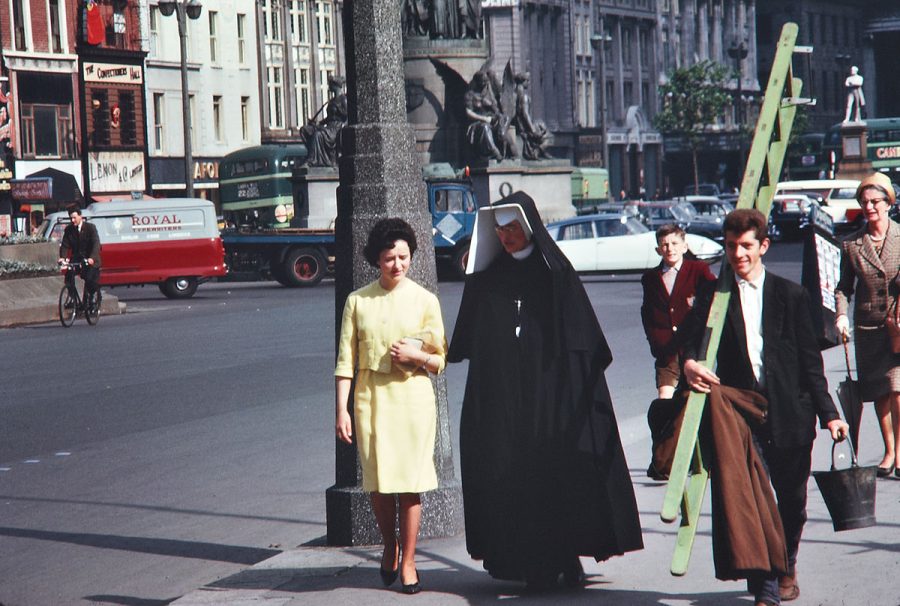
    1950s Ireland. Image: Richard Tilbrook (wikicommons)

    Early Years

    Born in 1934 – a child of the Raj – to an English father and an Irish mother, her family were stationed in Burma before being evacuated to Australia after the Japanese invasion. She was then sent ‘home’ to be educated by nuns, where according to Susan McKay she ‘received thrashings and expulsions’.

    She was, nonetheless, a brilliant student, ready to matriculate for Oxford aged just fifteen, but switched at the last minute to study in Trinity to allow her begin her medicine degree at sixteen.

    ‘In her final year’ writes Susan McKay, she won ‘a medal for psychiatry, a gold medal for surgery and the hospital prize for medicine.’

    Her first marriage was to a fellow student, Roger Hackett. They had two children.

    She later re-married, a surgeon Bobby Woods, who was aged sixty-two, while she was thirty-one. Mary Maher, Woman’s editor of the Irish Times and fellow member of the IWLM said she had ‘never seen a happier marriage’. They went on to have four children.

    While raising her family, running the big house on Ailesbury Road – Deirdre McQuillan remembers her ‘at the stove cooking something wonderful while children and people milled about’ – she became intensely committed to political justice – protesting against the war in Vietnam, the Dublin Housing Acton Committee, and the Northern Troubles.

    Snooty neighbours were not always impressed. The Woods were accused of being ‘communists’, of harbouring Viet Cong. Neighbouring children were forbidden from playing there.

    I don’t think it took a feather out of her. She had bigger fish to fry.

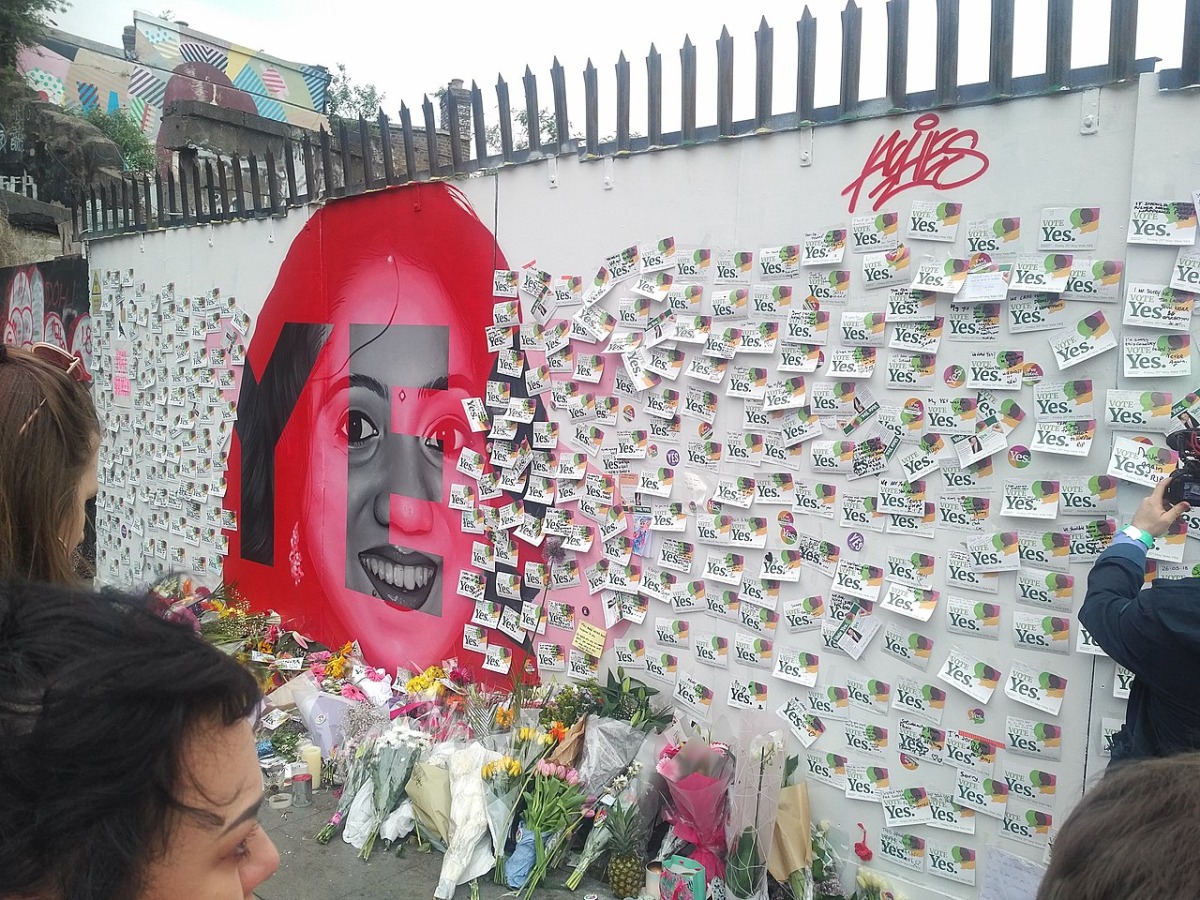
    A mural outside the Bernard Shaw Pub in Portobello, Dublin depicting Savita Halappanavar and calling for a Yes vote in Ireland’s referendum on repealing the Eighth Amendment.

    Justice for Women

    More and more, she joined the fight for justice for women, so that one day she and Margaret Gaj, owner of Gaj’s on Baggot Street, and heroic fellow fighter for justice Máirín de Burca – fresh out of jail for pelting eggs at Richard Nixon’s car the same day Moira was conducting her mock trial – got together in Bewley’s on Grafton Street and decided – HURRAY! – to found the Irish Women’s Liberation Movement.

    Pretty much every gain made in rights for women in Ireland can be traced back to that modest get together of these three women.

    This was an Ireland where women were discriminated against from the day we were born. As we detailed in our pamphlet, ‘Chains or Change’, in every aspect of their lives women were hobbled.

    This began with an education system which funneled us into our designated roles as wives, mothers and caregivers. After primary school we were obviously too thick to do higher level mathematics, thereby excluding us from most properly paid careers, from medicine to airline pilots to bank manager. If a few ladies managed to jump through the various hoops, the infamous Marriage Bar lay in store.

    Once married you were out on your ear, and it wasn’t just for civil service jobs, but also banks, accountancy firms, respectability itself demanded you go home and become, literally, a ‘chattel’ inside your marriage, where you enjoyed few civil rights. Legally you barely existed.

    Your husband could flip over to the UK, divorce you, get full custody of your children and sell the family home from under your feet – all above board!

    Having made sure marriage was the only ‘career path’ open to women the powers that be – the celibate elite of the Catholic Church and the politicians who kowtowed to them – aimed to turn us into little more than domestic servants and baby-making machines.

    There was no sex education, no contraception, and absolutely no termination of pregnancy available. Talk about going to war blindfolded, with your hands tied behind your back!

    Mother and Baby Homes

    Life was less dire for middle class, urban women, but the damnation of a Mother and Baby Home awaited most working class and rural girls unfortunate enough to become pregnant outside of wedlock.

    For many unfortunate middle class women locked into marriages – ‘drowning in babies’ in Nuala Fennell’s immortal phrase – Valium taken by the bucket load was the only source of comfort.

    And women were still ‘churched’ after giving birth, that is brought in and ‘cleansed’, as if birth itself, so ferociously trumpeted by the good fathers, was filthy.

    As Nell McCafferty famously found out, you couldn’t even get a television on the never-never without a male signature. Even if that male was unemployed and pulled in off the street and you’d just been hired by the Irish Times.

    Naturally Moira became the go to person within the IWLM for all matters medical, and psychological. June Levine remembered warmly comforting words from Moira when accessing a nasty memory during a consciousness raising session in Gaj’s, revisiting a man thrusting his penis between the bars of her cot.

    As Moira increased her involvement in women’s rights the damage wrought on our society by crazy levels of inequality, and repression became clearer to her.

    It helped that she had been brought up outside of Ireland. She remained a Catholic, but totally rejected ‘Rome’s’ assumption that it could regulate women’s reproductive lives down to the minutest detail.

    Her presence as an educated and privileged woman carried weight. On a practical level, as one of the few women in the IWLM with ‘means’ she was, as Máirín de Burca says, ‘always there to bail us out of the Bridewell after we’d been arrested. She was incredibly generous. I once landed a homeless family on her and she just took them in.’

    By the late 1970s, Moira was helping set up the first Well Woman Centres, the country’s first menopause clinic, and had begun seeing patients referred to her by the Rape Crisis Centre.

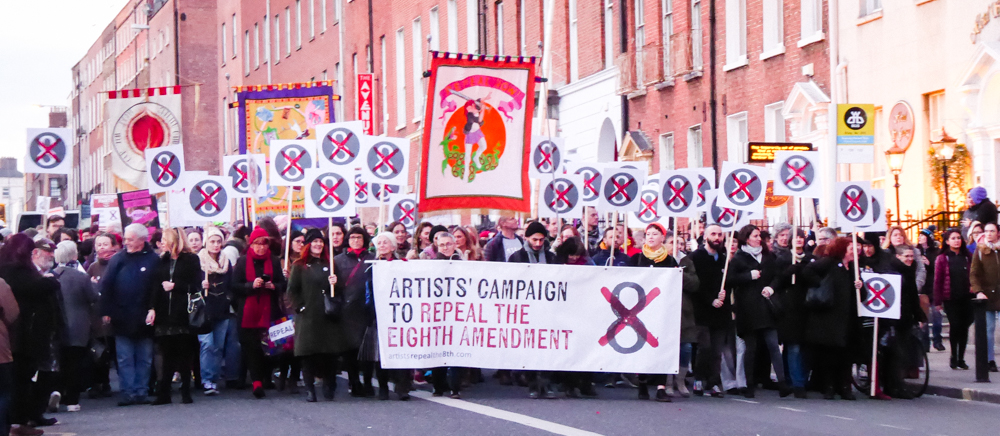
    Image (c) Daniele Idini.

    The Eighth Amendment

    1983 was the year when the backlash against the liberalisation of life in Ireland began in earnest, Moira was at the forefront of the campaign against the insertion of the Eighth Amendment to the Irish Constitution..

    Right-wing Catholicism, representing the most repressive aspects of the religious Patriarchy, had marshaled its forces. Recalling the names of the various organisations sends a shiver down my spine: PLAC, SPUC, the Congress of Catholic Secondary School Parents’ Associations, the Irish Catholic Doctors’ Guild, the Guild of Catholic Nurses, the Guild of Catholic Pharmacists, the Catholic Young Men’s Society, the St. Thomas More Society, the National Association of the Ovulation Method, the Council of Social Concern, the Irish Responsible Society, the St Joseph’s Young Priests Society, and the Christian Brothers Schools Parents’ Federation.

    Passing the infamous Eighth Amendment, giving a foetus equal rights to life to that of the mother, inserted into the Constitution was their sole aim. Shamefully, three separate governments allowed themselves to be terrified into submission and the Eighth was ‘in’.

    It was a bruising battle, and Moira was at the centre of it.

    Within a year of ‘winning’, the disastrous consequences for young women became apparent. Thus, schoolgirl Ann Lovett was found bleeding to death in a grotto in Longford – her little baby lying dead beside her.

    Six months later Joanne Hayes was to be crucified on Ireland’s terrifying patriarchal altar, having been wrongly accused of the death of a baby found on a strand eighty kilometres away.

    An indication of just how desperate things were for young women comes from a remark made by the undertaker who buried the little one found on the strand. He lived beside a quarry, and said it was not unusual to find babies bodies thrown there by desperate mothers.

    How could a society descend to that level of brutality?

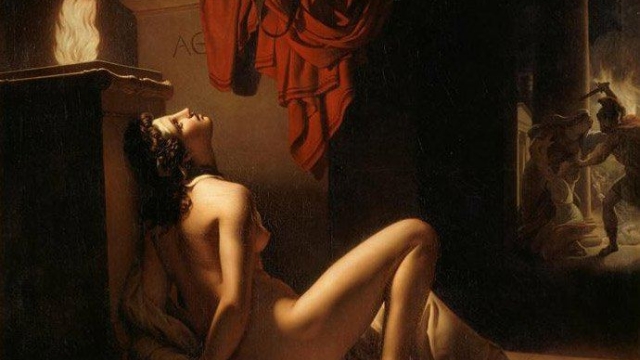
    Cassandra imploring Athena for revenge against Ajax, by Jerome-Martin Langlois, 1810-1838.

    Sexual Assault Unit

    Moira’s next move was to head up a Sexual Assault Unit in the Rotunda. As Emily O’Reilly wrote in a piece for the Sunday Business Post in 2002, Ireland’s first SAU ‘sprang indirectly from the 1983 anti-amendment campaign’ after discussions between Anne O’Donnell, Moira and Dr George Henry, then Master of the Rotunda.

    Dr. Henry had seen SAU’s in Australia, setting one up in an Ireland reeling from sexual violence and guilt, seemed obvious and Moira was the obvious person to put in charge.

    She set about doing things with her usual vigour, but was soon stunned at the tsunami of cases coming her way involving abuse, incest and rape. The outer limits of sexual violence.

    It was a rape case that once again pushed her centre stage. The so-called ‘X’ case.

    A suicidal fourteen-year-old girl, pregnant as a result of rape, was taken to London by her parents to see if they could extract DNA from the foetus for a court case against the perpetrator and were told that would involve a high risk of miscarriage.

    When her parents asked the Gardaí if DNA from the foetus could be used in evidence the Gardaí immediately informed the Attorney General, who sought an injunction, granted by the High Court, compelling the girl and her parents to remain in Ireland.

    In the High Court Declan Costello ruled that despite the rape, the age of the victim, and her being suicidal, she had good loving parents and so the pregnancy must go ahead.

    Five days later an appeal was lodged in the Supreme Court, which decided that termination, in England, could go ahead.

    The child miscarried two days later in a London hospital. Moira was the doctor in charge. The misery wrought on those parents, and that raped, suicidal fourteen-year-old being put through by the system, left her shaking with fury.

    Tragically for her it put her in the cross hairs of the latest iteration of misogynistic religiosity.

    Working alone, with absolutely minimal resources, Moira had seen over 1,000 children in the Rotunda. Incest, barely mentioned at the time, was one of the biggest problems presenting.

    Moira’s methods of work were unheard of at the time in Ireland. She actually spoke to the children, and used ‘anatomically correct dolls’ to help them demonstrate what had occurred.

    She also named fathers she deemed guilty of abuse, which was also unheard of. As Deirdre McQuillan says the practice had been to keep fathers in the family no matter what.

    The ‘no matter what’ was of course crucial. As Sebastian Barry has been so eloquently shouting out in publicising his new novel, God’s Old Time, abusing a child or a young person is akin to murdering them. Protecting the breadwinner – no matter what – could, and often did, mean abandoning the child.

    As one lawyer who saw the subsequent crucifixion of Dr. Moira Woods unfolding put it, ‘part of the problem was she was way ahead of her time. In those days there was no culture of reporting abuse. People wouldn’t believe you, they didn’t want to believe you, that a father had sexually abused his daughter.’

    ‘If it happened now there would be much deeper investigation, and she wouldn’t be in any trouble at all’.

    Sadly it was then, and not now. And the bad people won.

    War of Attrition

    Moira’s stellar career in unflagging support for Irish women and children was mired in vileness, heaped on her by those desperate not to be named.

    Just as happened with Dr. Noel Browne over the Mother and Child Scheme in 1951, the medical profession stood idly by as one of their finest was thrown to the wolves.

    It was a five year, savage war of attrition, with the Medical Council producing a redacted report (as is standard Irish practice), which, wrote Emily O’Reilly, concluded ‘while Woods was found not to have observed proper protocols, it makes no claims about the validity of the accusations.’

    ‘Proper protocols’ were demanded while working alone, and completely under-resourced, in a bat-shit, sexually dysfunctional country.

    Moira didn’t appeal.

    My lawyer friend said, ‘she’d had enough’. She had just separated from her partner of twenty years, and father of her two youngest children, Cathal Goulding, and decided to leave town to live in Italy.

    Deirdre McQuillan says it makes her happy to think she found a new, good life there. Met with an Italian man, Guido, ran a big house, and kept in touch with home via the steady stream of visitors from Ireland, her eight wonderful children and grandchildren – Penny, Denis, Christopher, Catherine, Timothy, Benjamin, Aodgán and Banbán with grandchildren Ben, Erin, Jack, Rowan, Katharine, Oisín, Clíodhna, Darragh, Sophie, Emily, Sophie and Cathal.

    I’m torn between rage and sorrow thinking about her. Her valour. Her beauty. Her passionate advocacy for Irish women, that ‘the issues on which she campaigned throughout the 1970s and 1980s resulted in twenty changes of legislation involving women,’ (according to Stephen Dodds in the Irish Independent in 2002), and the shameful way she was treated by an embedded, religiously inspired, misogyny.

    It is terrifying how blackening people’s reputation works; how repressing the truth works, including taking injunctions out against biographical works. Indeed, Google searches for one of Ireland’s greatest advocates for women, show up pitifully little information.

    Here’s hoping she’s up there with the Great Spirit in the Sky fashioning flaming swords and thunderbolts to hurl down on her torturers – they know who they are. You! And You! And You!

    Rest in Power beautiful Sister.

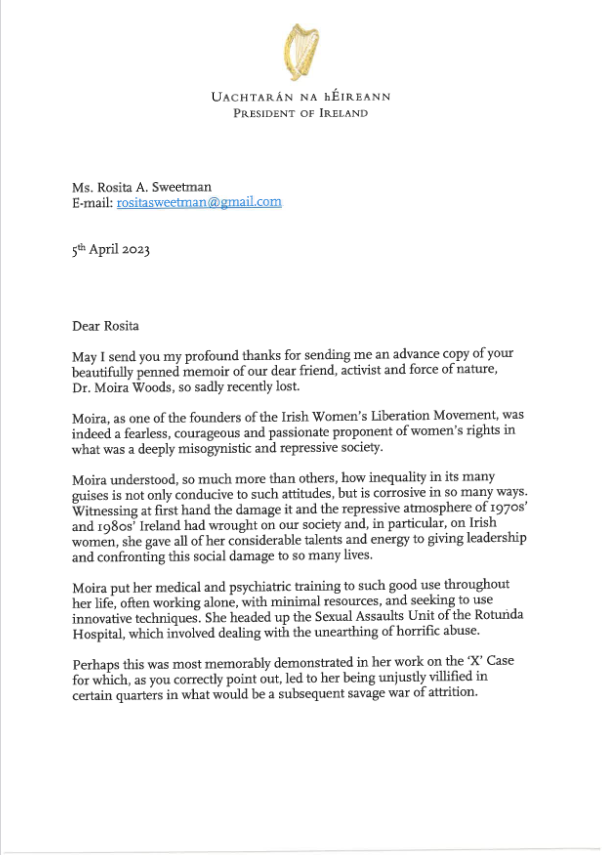
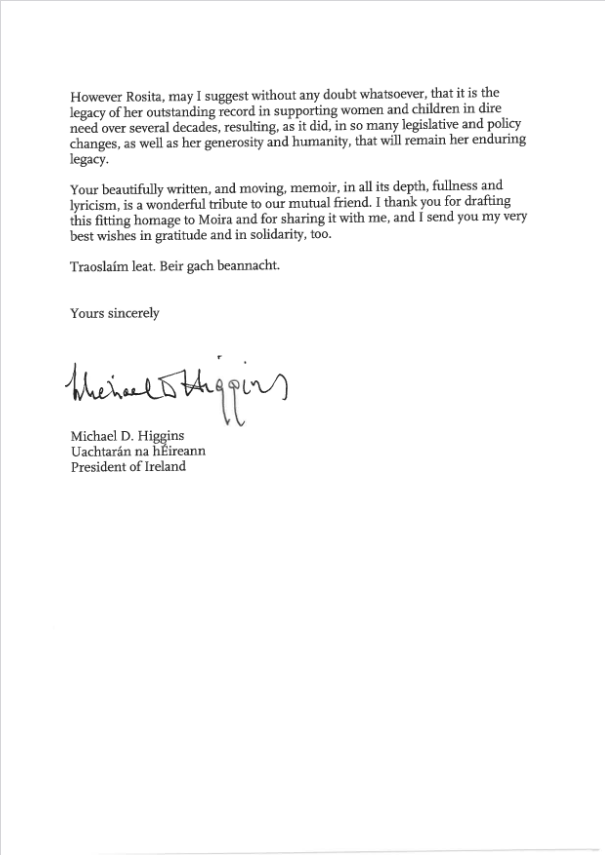
    Rosita Sweetman received this message from Moira’s old friend President Michael D. Higgins in advance of the publication of this appreciation.


  • Tunnel Vision in Chișinău, Moldova

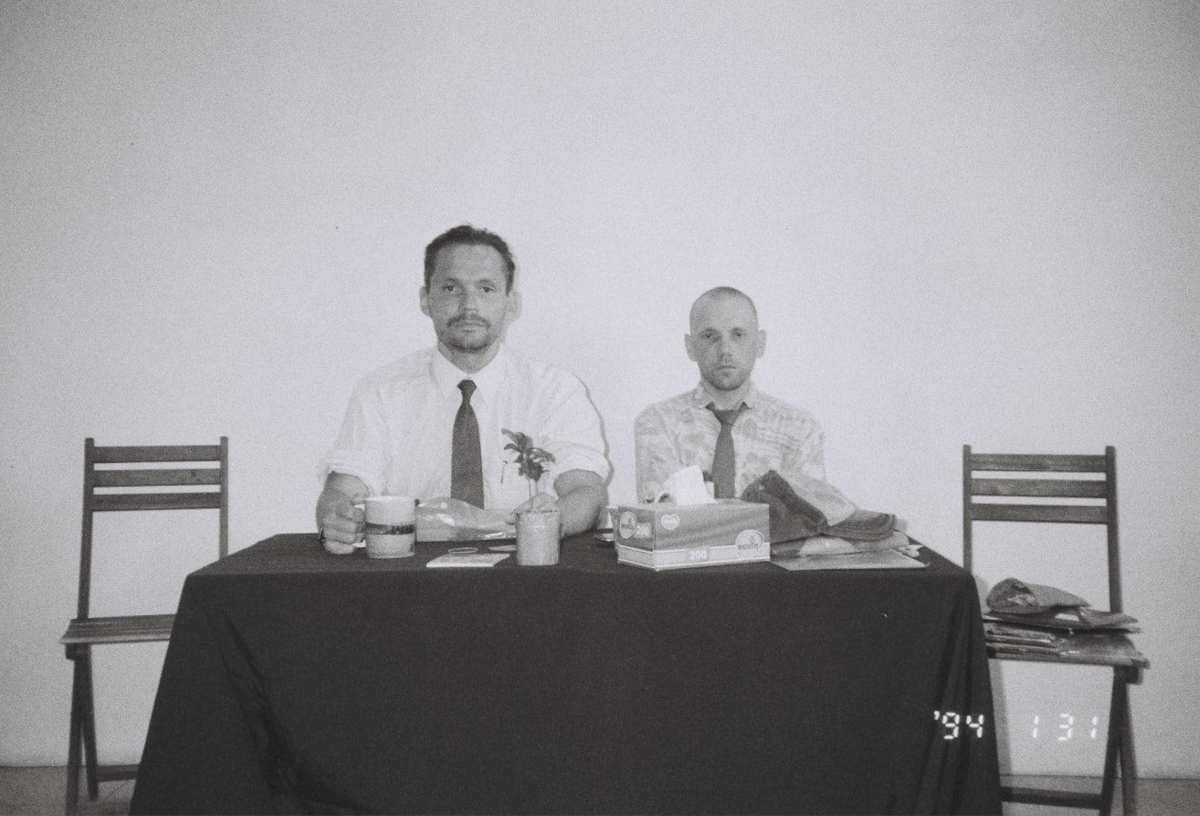
    Gary Farrelly is an Irish visual and performance artist based in Brussels. Together with his German collaborator Chris Dreier, he works under the banner of Office for Joint Administrative Intelligence. O.J.A.I. is a self-styled paraintelligence agency, conducting artistic research in the fields of institutional power, bureaucracy, erotic architecture, ritualistic magic and pedestrian tunnels. The following text is an account of how they fell in love with Chișinău, Europe’s least visited capital city. The author explicitly stipulates that these words are not intended as either a visitors guide to the city nor as a briefing on the current political situation.

    Bald and Bankrupt

    On April 19th 2019, a prominent Russophile YouTuber called Bald and Bankrupt uploaded a video about Moldova entitled Nobody Visits This Country…Find Out Why.

    Mr Bald aka Benjamin Rich, is niche-famous for his swashbuckling travel vlogs exploring obscure corners of the former Eastern Block, with an obsessive interest in the ex-Soviet republics. His videos focus on forgotten and defamed Communist-era architecture and monuments, always demonstrating seemingly genuine care towards the subject matter.

    For some unknown reason however – quite uncharacteristically – all his generosity evaporated the day he arrived in Chișinău, Moldova’s capital. In a very brutal fashion, that day’s upload catalogued a litany of the city’s most embarrassing post-independence scars: cracked pavements, abandoned mega-hotel, dried up fountains, dilapidated apartment blocks and a rusted wheelchair ramp.

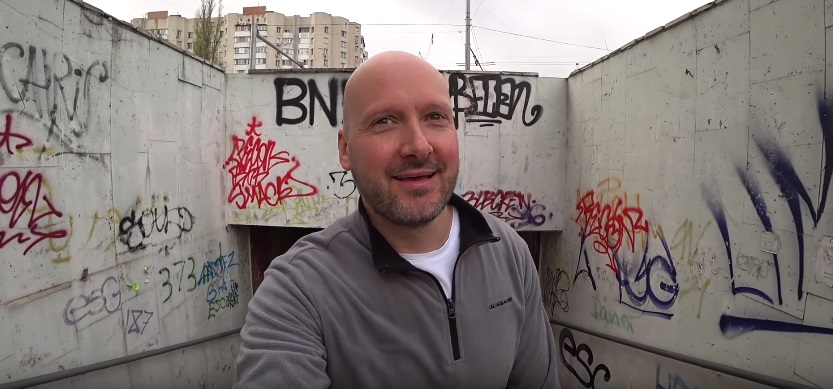
    As he passes POV style through a ramshackle section of pedestrian tunnel, the video reaches its crescendo of defamatory impact, providing a scorching portrayal of the Moldovan capital as an obliterated void inhabited by corrupt elites and demoralized citizens.

    In a very real sense, Chișinău’s reputation was assassinated in the tunnel. As of now, the video has been watched over 11,000,000 times. This makes it by far the most viewed video about the city (or the country for that matter) anywhere on the internet.

    Screenshot of Bald and Bankrupt in Chișinău.

    Down a Rabbit Hole

    Myself and Chris came across this video at the exact moment we were devoting ourselves to a series of performances, musical scores, and radio broadcasts recasting neglected tunnels as sites for performative assembly.

    We were down a rabbit hole of defamatory material related to tunnels such as the infamous assault scene in Gaspar Noé’s Irréversible and other nerve shredding depictions from movies such as Willy Wonka & the Chocolate Factory, THX 1138, Possession, Men, IT, and Logan’s Run.

    We had a burning desire to visit the scene of the Chișinău assassination! So we got in touch with Oberliht, the Moldovan Young Artists Association who were taking submissions for their annual EDU-Art Conference. They accepted our proposal for a Musique Concrète workshop to take place inside the notorious tunnel, using the site-specific acoustics of the architecture to produce a collaborative sound piece with the participants.

    The conference took place in Autumn 2020 when Moldova’s borders were still closed to all but essential travellers due to the pandemic. We asked the organisers to furnish us with the most serious looking letter of invitation possible, completely steamed clean of any artistic flourishes. The word ‘artist’ was dropped from the text and replaced with ‘cultural researcher’ which we deemed much more likely to pass as ‘essential’.

    We arrived at Chișinău Airport at midnight. An intimidating ice maiden border guard in military uniform inspected our “essential traveller” documents for an unnervingly long time before rubber stamping our admission to the Republic of Moldova.

    Enjoying Chișinău with my friend, writer and filmmaker Roisin Agnew during our sloppy summer vacation to the city in 2021.

    First Impressions

    Chișinău is an attractive city, laid out on a compact human-friendly scale, it’s comparable in size to Antwerp, Reykjavik, Belfast or Wuppertal.

    Arriving downtown following the footsteps of Bald and Bankrupt we first encounter the abandoned National Hotel, an impressive Soviet-era behemoth with dried up fountain plaza at street level. Many say it mars the visitor’s first impression of the city. I disagree. I’m drawn to its sturdy, masculine structure.

    The downtown area features an attractive mix of historical architectural styles and luscious green public spaces.

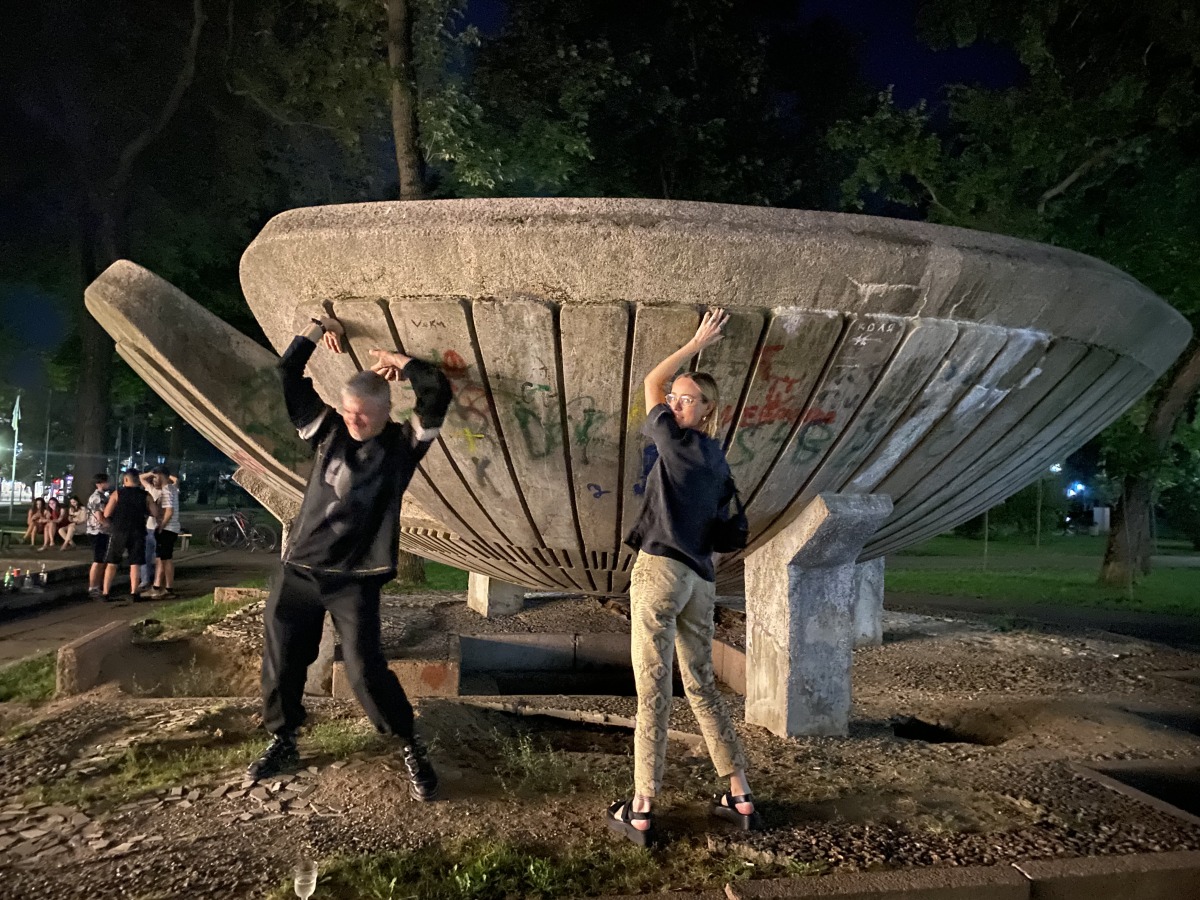
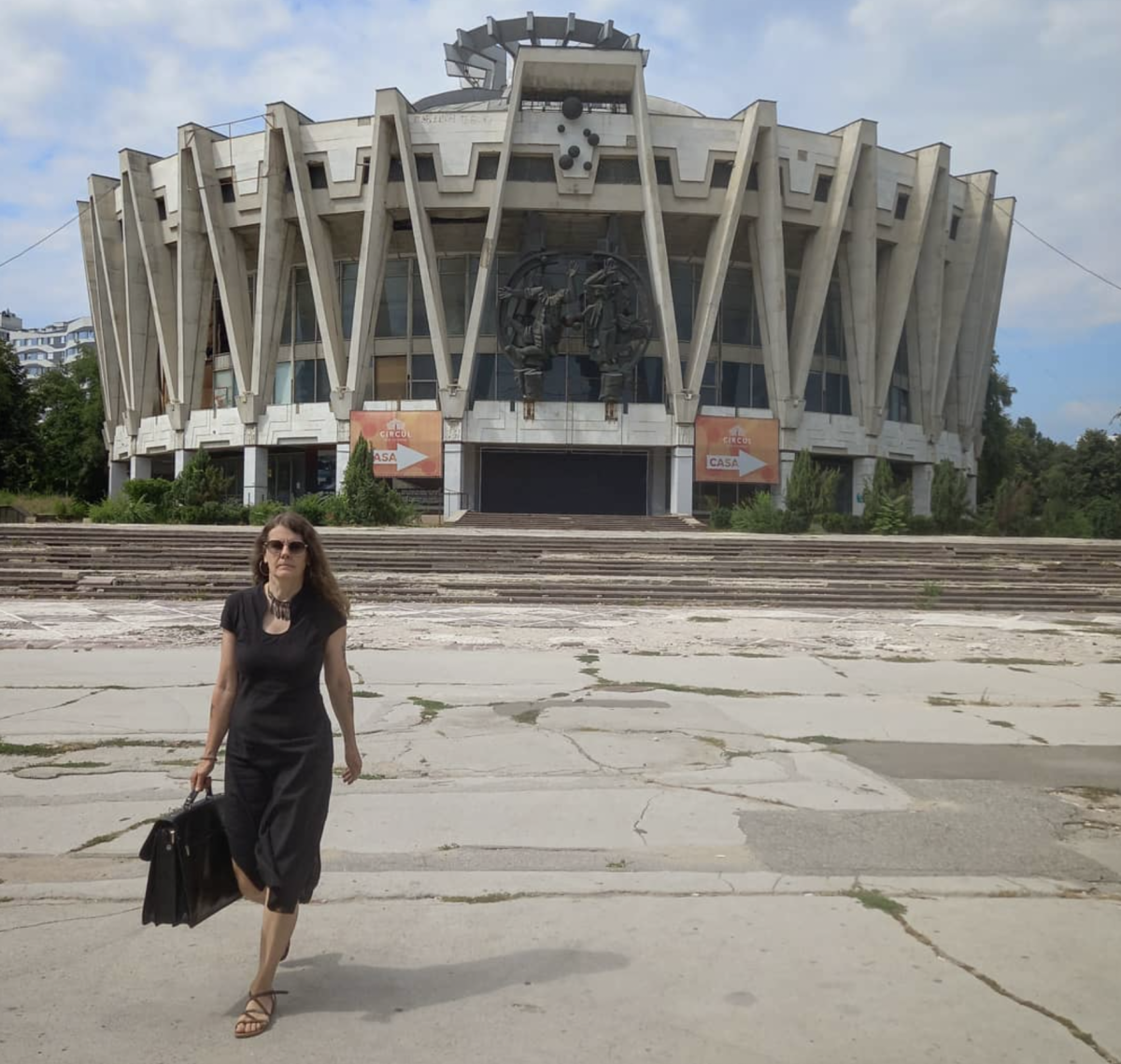
    Typically, I’m not enamoured with ornate old buildings so I didn’t go out of my way to see those things. I was more intrigued by the presence of Soviet-era structures like the Moldtelecom Tower, National Opera & Ballet, Presidential Palace, national parliament and further afield, the State Circus and iconic Romashka ‘Ear of Corn’ residential tower.

    These are imposing, modernist fortresses, constructed in heavy cast concrete, shamelessly still reifying the power of the Soviet state into the public space.

    It was a pleasant surprise to find that there is more than one defamed subterranean passageway running under the central districts.

    We enlisted the help of a well-known local tour guide named Nikolai, who took us on a walking tour connecting all the known pedestrian tunnels and modern office blocks in the area (this was a customised trajectory especially for us). Nikolai was a generous guide, and as we spelunked our way across the city; he talked about the challenges of forging a new national identity in the ideological and spatial debris field left in the wake of the Soviet Union.

    The Soviets had all the resources and coercive power in the world to throw at substantiating and mythologizing their state institutions. Independent Moldova, on the other hand, is facing challenges as a small and fragile state with limited resources and influence on the global stage.

    According to United Nations data, an estimated 1.27 million people emigrated from Moldova between 1990 and 2020, which is rather a lot considering the current population is just under three million.

    This brain drain has had a significant impact on Moldova’s ability to develop and prosper, and many citizens are concerned about the future prospects of their young state.

    Chris Dreier at the State Circus, summer 2021.

    Tunnels Cannot be Avoided

    An ideal day in Chisinau involves lots of wandering and enjoying strange urbanism and generous public parks. Tunnels cannot be avoided due to the epic wide boulevards that crisscross the downtown.

    Due to a strategic location between Russian and European cultural and economic influences, most of the commercial and retail environment is unfamiliar to me. I don’t recognise these banks, clothing brands, billboard advertisements, travel agencies or supermarket chains. The unfamiliarity is pleasurable, I feel like I’ve really travelled somewhere.

    A highpoint is lunch at the performatively bureaucratic trade union cafeteria, introduced to us by our friends Clara and Ana. The subsidized restaurant is an unfashionable trace of post collective social organisation. Customers dine under harsh LED chandeliers at banquet tables with white doily-drape and bouquets of synthetic red roses.

    Moldova is a pretty religious place and the public morality and culture are perceptively conservative to someone coming from Western Europe. If there is an alternative scene, a counter-reaction to the conformist social body, it resides in the Zemstvei Building, a former museum now inhabited by cycling activists, a queer café and the Zpațiu / Zpace contemporary art project space.

    The highpoint is at the end of the hall at 3rd Space, an artist studio inhabited by the Drujba and Kolxoz (Collective Economy) art collectives. I’m particularly enamoured with Kolxoz. Their work revolving around DIY group publishing strikes me as being particularly radical. My last night in Chisinau (this January) was spent with Kolxoz drinking Transnistrian cognac and debating whether Lenin has been ‘cancelled’ in post Cold War Eastern Europe.

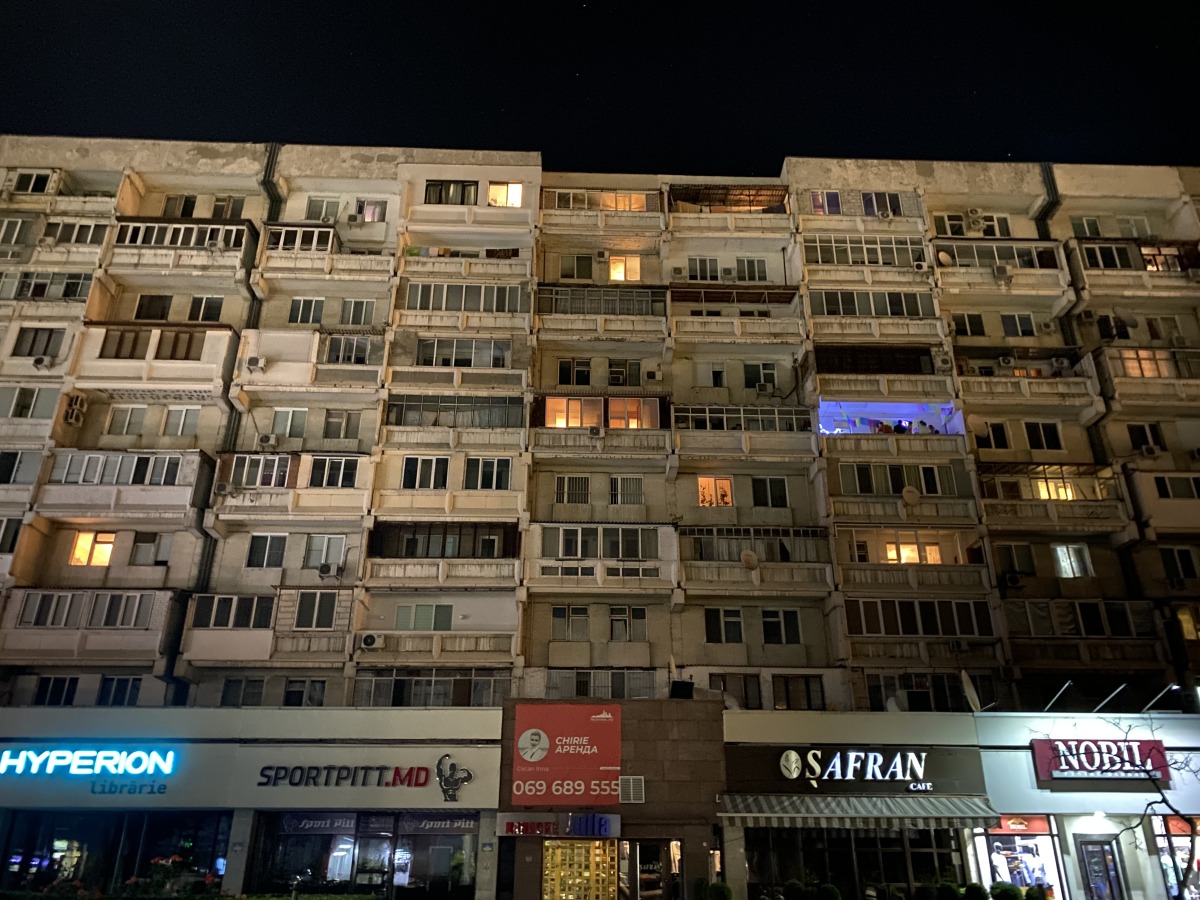
    Mixed apartment and retail block, downtown Chișinău, photo Roisin Agnew.

    Subsequent Visits

    We make several more trips to Chisinau over the next few years. On subsequent visits, it becomes clear that an ambitious municipal beautification scheme has kicked into gear. Pavements have been lavishly restored, buildings freshly painted, and there is fancy new street signage and flower arrangements.

    Interestingly, the pedestrian tunnel in Bald and Bankrupt’s video has been restored to its pristine state. There is a conspiracy theory floating around that the powers that be were so mortified by the video that heads rolled and a massive Tunnel Improvement plan was hastily brought into being.

    Some fine restaurants, fancy cafes, trendy bars and shops are popping up here and there. Chisinau is reinventing itself, with the clear ambition of someday being a mainstream tourist destination, a slightly cheaper, more parochial Bucharest or Cracow.

    It’s a long term plan though, and for the moment being here feels a million miles away from more banal, mediated tourist experiences further west; the city-break destinations characterised by lime scooters, QR code explanations, bubble tea, Van Gogh 3D and the big red fun bus tours.

    This city hasn’t figured out how to market itself to an external gaze. It’s just a medium-sized working city, with really good pedestrian tunnels and office blocks, where people live and go to work and worry about the future. It’s refreshingly dull and I like it.

    Kolxoz in their Headquarters at the former Zemstvei Museum. Copyright Kolxoz.

    Feature Image: Office for Joint Administrative Intelligence in front of National Hotel, Chișinău photo Victoria Tihonova

  • Napoli: It Hurts

    It’s an exciting time to be Neapolitan right now. Or should I say a supporter of Napoli FC? I have to clarify, as there’s hardly a dull moment to be Neapolitan.

    Wherever I go, it doesn’t matter whether it’s New York or Tenerife, when I answer the classic question “Where are you from?” so many emotions rage inside me that I am unable to handle, because I know there will be questions. And if there are no questions they will be insinuations. And if there are no insinuations there will be sterile rhetoric. Or unbearable clichés.

    In short, being Neapolitan is a bit of a blessing, and a bit of a curse. Having clarified this, it is indeed an exciting time to be a Napoli supporter. This illness (in Napoli we don’t say “I am a supporter” or “I’m a huge fan”. We say “I’m ill for Napoli”, which is a literal translation of “So’ mmalato pe ‘o Napule”) got to me when I was just a kid.

    It was not easy falling in love with the team, as during my whole childhood and adolescence Napoli SUCKED. During the second season after I started following them, we had the worst record in our (why is that supporters think they’re part of the team is something to investigate) history. Fourteen miserable points in thirty-four games. We even managed to lose at home to Lecce; a shameful 2-4 result.

    So, you can probably understand when I say that I never expected what we have been seeing from the team thus far in Serie A.

    Napoli is dominating the championship, and it has done so from the beginning. In August, after half the squad was changed, it was impossible to foresee anything like this.

    We are seeing things we’re unaccustomed to, and the enthusiasm the team has brought to the city is incredible. Khvicha Kvaratskhelia, Victor Osimhen, Stanislav Lobotka, Andrè Frank Zambo Anguissa, Min-Jae Kim, Piotr Zielinski, and the other players are writing their names in Napoli’s history, making likely what we thought would be impossible: winning a scudetto.

    What’s more they are making it look EASY! And they are also working wonders in Europe, winning their group stage and putting four goals past Liverpool and six (SIX!) past Ajax at their home ground. Recalling this makes me quiver with excitement. This is Real Madrid or Barcelona stuff. It’s crazy, but it’s happening for real.

    Over-thinking…

    A normal human being would just enjoy what is going on without reflecting too much on it. Unfortunately, I was gifted with an exceptional talent for over-thinking, and therefore began reflecting on how much this team can positively affect the city’s image.

    It all started a couple of weeks ago when I was walking close to La Sagrada Familia where I live in Barcelona and some teenagers came up to me speaking a language I did not understand. They began pointing at the Napoli crest that is on the back of my tracksuit jacket.

    It turned out they were Georgian students, over on holiday. They wanted a picture with me to express their love for Napoli, and Kvaratskhelia. It was an unfamiliar feeling, so I started to go around wearing the jacket to see if it would happen again.

    Since then, I have been stopped, waved at, and had “Forza Napoli!” shouted after me. The other day, entering the office, the guy that works at the bar downstairs and two security guys I had never spoken to before, asked me about Napoli and expressed their admiration for the team I support, expressing their sincere hope that Napoli win the Champion’s League.

    I am astounded by all this attention. I don’t know how to feel about it. And the astonishment does not end there.


    Time Out 

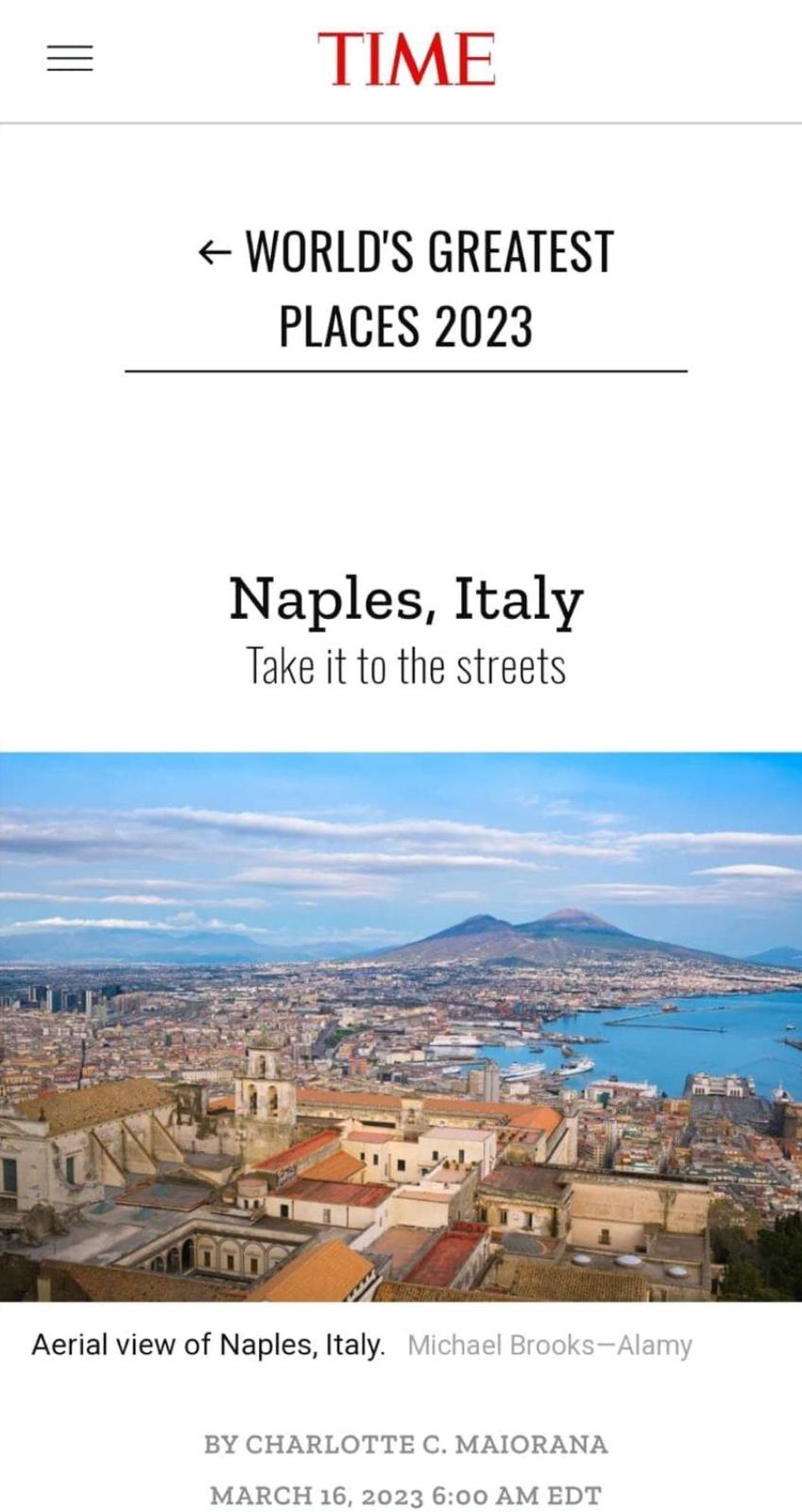
    Time Magazine has put Napoli in its top fifty destinations to travel to. Ryanair has added more routes to and from Naples, and their representative even had a Napoli jersey on.

    A recent article in an Italian newspaper has revelead that for the month of May it is almost impossible to find a hotel room there now.

    Georgian authorities are attempting to create a direct connection between Napoli and Tbilisi to help locals fly to Napoli to see their favorite player. The Diego Armando Maradona stadium has now a diversified audience, with Koreans and Georgians in regular attendance.

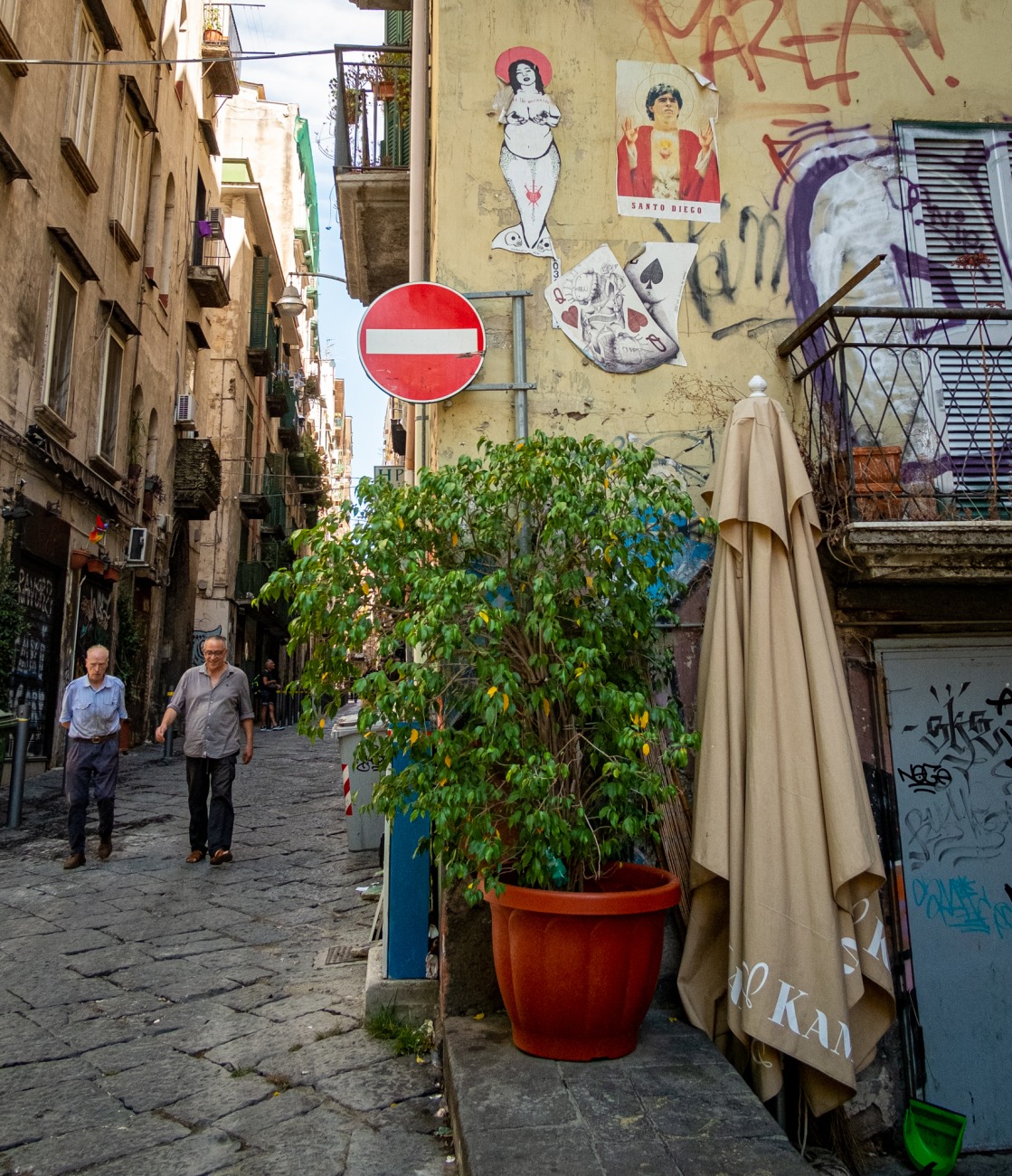
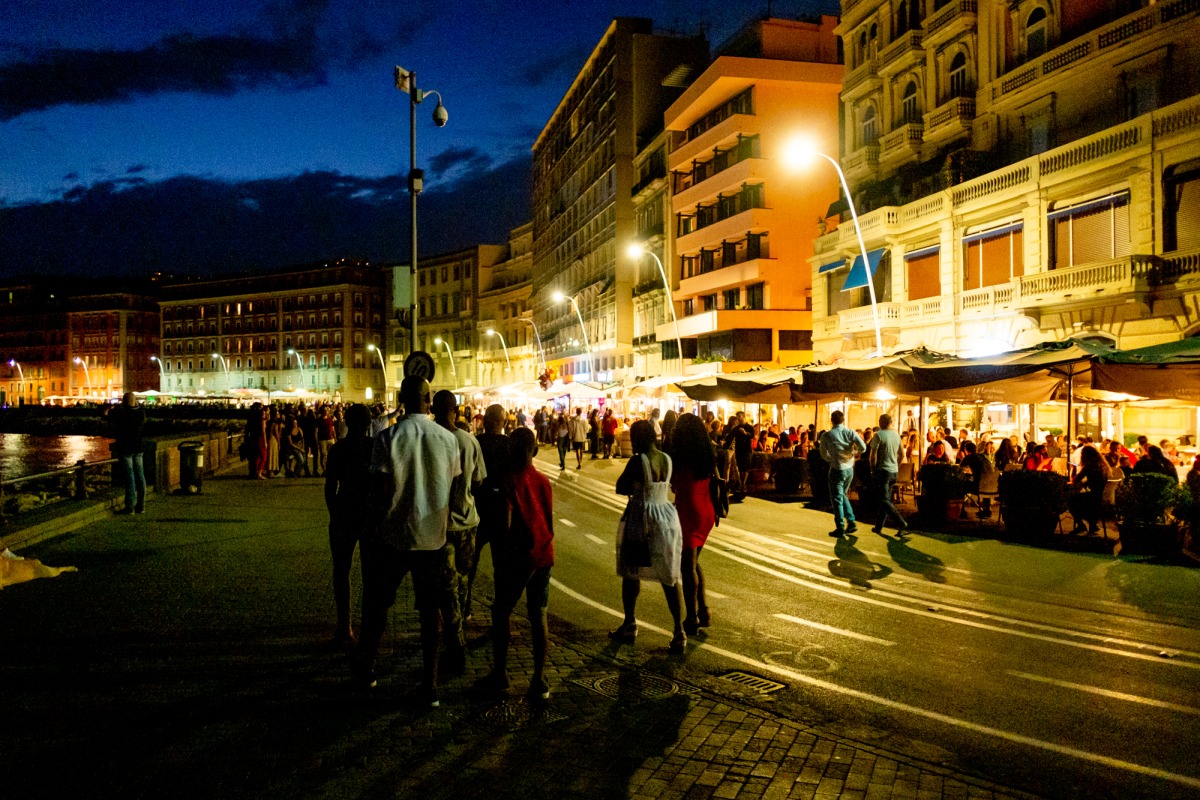
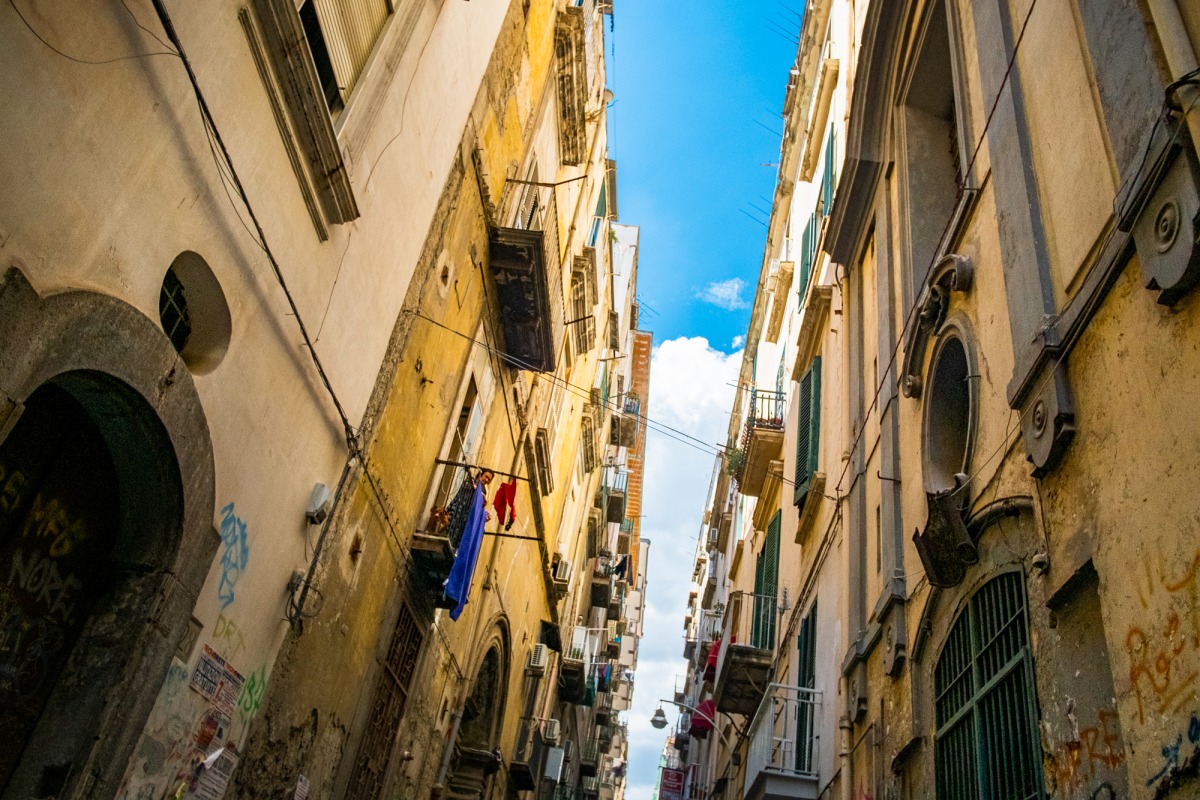
    YouTubers are now flocking to Napoli to see the team play, and in the meantime enjoying the city’s mesmerizing sights, art, and food. Thousands of tourists climb the alleys of the Quartieri Spagnoli in pilgrimage toward the mural of Maradona which is famous throughout the world.

    I should feel proud that my city and team are performing so well. It is just that this is unleashing the usual Italian rhetoric about the Neapolitan being a ‘special people’, and of a ‘special city’, which is experiencing a ‘particular moment.’

    The truth is that I’ve had it up here with that kind of talk about Napoli FC, and Naples. It is hard for me to explain what it feels and means to be Neapolitan. I’ll do my best, but I know that in the end, I might start using the clichés I hate so much.

    Volcanic

    Being Neapolitan means you have to excuse yourself for everything you did not do, every time something bad happens in the city. It means fighting with other Neapolitans, who think that Scudetto celebrations will lead some people to destroy the city and its monuments.

    It involves the frustration of knowing that it doesn’t matter if it’s only ten people’s fault, it will be all the Neapolitans taking the blame. I even saw that a newspaper is worried that there will be killings and robberies throughout the event.

    Being Neapolitan means watching #Vesuvio trend on Twitter every single freaking time there is an earthquake in the southern part of Italy. Let me explain this to anyone who think this sounds strange. It’s worse: it’s stupid. You have to know that being Neapolitan entails having a song sung to us that goes:

    My dream I will fulfill / Il mio sogno esaudirò
    Vesuvius erupts / Vesuvio Erutta
    All Naples is destroyed / Tutta Napoli è distrutta
    Vesuvius erupts / Vesuvio Erutta
    All Naples is destroyed / Tutta Napoli è distrutta

    On the subject of ‘Freed from desire’, some brilliant minds even brought out a single that was distributed on Amazon Music, Spotify, Apple Music, and many other platforms, before somebody had the decency to take it down.

    It means that people from Bergamo, in the northern part of Italy, will happily join the German supporters of Eintracht Frankfurt destroying a part of the city because they hate our guts.

    It means that every taxi driver I meet has seen the film Gomorrah, and I am too ashamed to tell them that I grew up in that neighborhood. It means that you will be the butt of many unpleasant jokes. It means that the lazy and incompetent Chief Wiggum of the Simpsons will speak with your accent.

    It Hurts

    So, how does it FEEL to be Neapolitan? It fucking hurts! And that’s the harsh truth. It is a debilitating struggle, because whenever you talk or reason about your city, you are never right.

    It does not matter who you’re talking to, or about what. You are never right, because you’re Neapolitan. You are wrong because you are Neapolitan. You are ‘special’, you are deceitful, you are the one who steals, who is lazy. They say that in stereotypes there’s always a grain of truth. And that hurts more.

    What I’ve been asking myself during this incredible year is how I should feel about it. I don’t know anymore.

    Should I already feel guilty for what some shitheads will do? Should I feel sorry about it? Should I be proud of what is happening or afraid it will not happen again? Should I laugh about the insults we receive because it’s just that the other supporters are sore losers, or should I be worried that the next time we go to an away match it will not be just a small part of the stadium singing about our sleepy giant?

    I don’t know. What I do know is that I cried while and after Kvaratskhelia had received the ball from Osimhen, then dribbled past the whole Atalanta defence and midfield, turning three times in a very tight space before painting with his right foot a supersonic shooting star which ended its run in the top bin. It was simply too much. There’s only so much beauty you can witness without tears.

    I know it can’t last forever and that I should be far happier. I know that I should be proud of how we’re doing, because as my terminally ill and short-memoried father said after I finished telling him (for the fifth time in six hours) that Napoli had won the Coppa Italia final against Juventus on penalties, “See… in the end it’s not so bad being Neapolitan.”

    Diego Pugliese, Naples, 2020.

    Featured images by Daniele Idini, Naples, July 2020.

    Title image: https://commons.wikimedia.org/wiki/File:19870510_sanpaolo.jpg#/media/File:19870510_sanpaolo.jpg